Where We Are:
The 411 on 211 in South Carolina
United Way Association of South Carolina
2
What is 2-1-1?
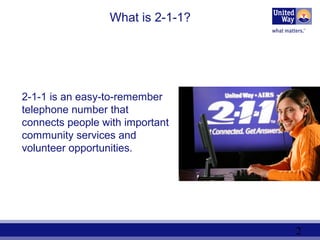
2-1-1 is an easy-to-remember
telephone number that
connects people with important
community services and
volunteer opportunities.
3
Why 211?
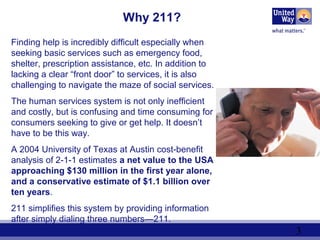
Finding help is incredibly difficult especially when
seeking basic services such as emergency food,
shelter, prescription assistance, etc. In addition to
lacking a clear “front door” to services, it is also
challenging to navigate the maze of social services.
The human services system is not only inefficient
and costly, but is confusing and time consuming for
consumers seeking to give or get help. It doesn’t
have to be this way.
A 2004 University of Texas at Austin cost-benefit
analysis of 2-1-1 estimates a net value to the USA
approaching $130 million in the first year alone,
and a conservative estimate of $1.1 billion over
ten years.
211 simplifies this system by providing information
after simply dialing three numbers—211.
4
Why 211?
• One call gives you access to resources
across your community. 2-1-1 is efficient,
fast and easy to use by telephone or
internet
• No more wrong numbers; no more
wasted time trying to find the right
resources.
• 2-1-1 is a confidential call; most often the
name of the caller is not even taken.
• 2-1-1 maintains the integrity of the 9-1-1
system; saving that vital community
resource for life and death emergencies.
• 24-hour/7 day a week availability; 2-1-1 is
always there for you.
• 2-1-1 is an easy way to find or give help
in your community.
.
5
Why 211?
• 2-1-1 strengthens your
community by uniting the people in
your area who want to help with
those who need help.
• 2-1-1 is a useful planning tool.
Based on aggregate data about
the types of calls that the 2-1-1
Center receives, communities are
in a better position to anticipate
demand for services and mobilize
resources to meet changing
needs.
• 2-1-1 touches the lives of every
person in the community, and
whether you are in a situation
where you need help or find
yourself later in a situation to give
help, 2-1-1 is always there for you.
.
6
What Types of Resources Does 2-1-1
Track?
Basic Human Needs: food banks,
clothing closets, shelters, rent
assistance, utility assistance.
Physical and Mental Health: health
insurance programs, Medicaid and
Medicare, maternal health,
Children’s Health Insurance
Program, medical information lines,
crisis intervention services, support
groups, counseling, drug and
alcohol intervention and
rehabilitation.
Employment Supports: financial
assistance, job training,
transportation assistance, education
programs.
7
What Types of Resources Does 2-1-1
Track?
Support for Older Americans and
Persons with Disabilities: adult day
care, congregate meals, Meals on
Wheels, respite care, home health
care, transportation, homemaker
services.
Support for Children, Youth and
Families: childcare, after school
programs, Head Start, family
resource centers, summer camps
and recreation programs, mentoring,
tutoring, protective services.
Volunteer Opportunities and
Donations.
8
What Does 2-1-1 Do During a Crisis?
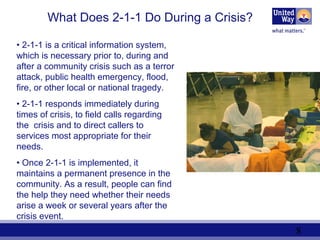
• 2-1-1 is a critical information system,
which is necessary prior to, during and
after a community crisis such as a terror
attack, public health emergency, flood,
fire, or other local or national tragedy.
• 2-1-1 responds immediately during
times of crisis, to field calls regarding
the crisis and to direct callers to
services most appropriate for their
needs.
• Once 2-1-1 is implemented, it
maintains a permanent presence in the
community. As a result, people can find
the help they need whether their needs
arise a week or several years after the
crisis event.
9
What Does 2-1-1 Do During a Crisis?
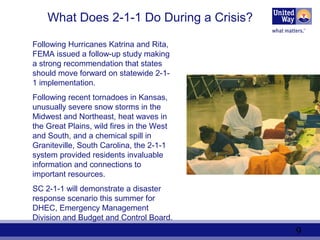
Following Hurricanes Katrina and Rita,
FEMA issued a follow-up study making
a strong recommendation that states
should move forward on statewide 2-1-
1 implementation.
Following recent tornadoes in Kansas,
unusually severe snow storms in the
Midwest and Northeast, heat waves in
the Great Plains, wild fires in the West
and South, and a chemical spill in
Graniteville, South Carolina, the 2-1-1
system provided residents invaluable
information and connections to
important resources.
SC 2-1-1 will demonstrate a disaster
response scenario this summer for
DHEC, Emergency Management
Division and Budget and Control Board.
10
South Carolina’s 2-1-1 Network
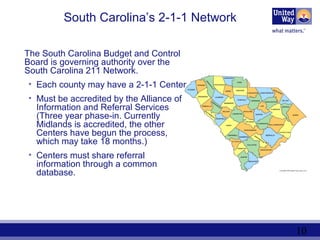
The South Carolina Budget and Control
Board is governing authority over the
South Carolina 211 Network.
• Each county may have a 2-1-1 Center.
• Must be accredited by the Alliance of
Information and Referral Services
(Three year phase-in. Currently
Midlands is accredited, the other
Centers have begun the process,
which may take 18 months.)
• Centers must share referral
information through a common
database.
11
South Carolina’s 2-1-1 Network
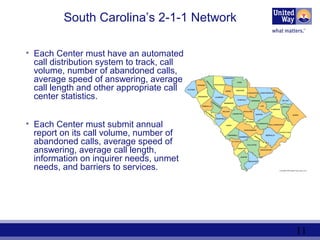
• Each Center must have an automated
call distribution system to track, call
volume, number of abandoned calls,
average speed of answering, average
call length and other appropriate call
center statistics.
• Each Center must submit annual
report on its call volume, number of
abandoned calls, average speed of
answering, average call length,
information on inquirer needs, unmet
needs, and barriers to services.
12
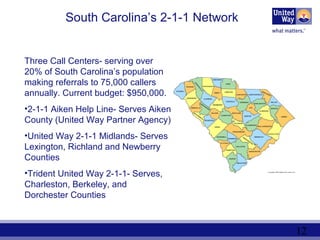
South Carolina’s 2-1-1 Network
Three Call Centers- serving over
20% of South Carolina’s population
making referrals to 75,000 callers
annually. Current budget: $950,000.
•2-1-1 Aiken Help Line- Serves Aiken
County (United Way Partner Agency)
•United Way 2-1-1 Midlands- Serves
Lexington, Richland and Newberry
Counties
•Trident United Way 2-1-1- Serves,
Charleston, Berkeley, and
Dorchester Counties
13
Bringing 2-1-1 Home
Several Models are Possible
•County Call Center
•Stand alone (Aiken) or United Way
(Midlands, Trident)
•Local calls routed to one of the current 2-1-1
Centers
•Community-based hybrid
•Calls answered in local agency (United Way,
community partner or state/local government)
and evening/weekend calls routed to one of
the 2-1-1 Centers
•One we haven’t thought of….
14
2-1-1 Costs For State United Way System
•United Way Association received a $240,000 infrastructure grant
from DHEC to network the 2-1-1 centers and build a database
(funding ends in July 2007)
•$2.1 million to serve all of South Carolina, including current
expenditures of $950,000 (80% local United Way funded), but if the
number of call centers in increased, costs could exceed $5 million
•Without enabling legislation, there is no funding mechanism for
State government to appropriate regular funding for 2-1-1, so the
Network is completely reliant on grant funding for expansion.
15
2-1-1 Costs For State United Way System
2007-2008 Projected Network Costs
211 State Director $45,000
Payroll taxes $3,510
Fringe benefits $10,500
Software licensing $35,000
Database management $20,000
Other (incl. ACD, telecom charges, emergency
readiness) $50,000
Total $164,010
16
2-1-1 Costs For Local Communities
Costs are variable depending on the model
•Single County Call Center
•highest cost
•Local calls routed to one of the current 2-1-1 Centers
•lower per call costs
•needs local resource coordinator (UW or agency)
•Community-based hybrid under authority of a current certified
center
•uses existing infrastructure (requires CIRS certification of
I&R specialist)
•builds on existing community knowledge
•lowest start-up and maintenance costs
•night and weekend calls go to supervising center
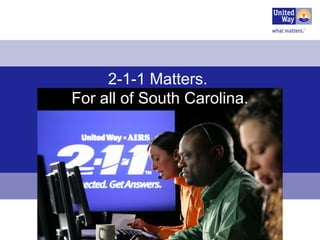
2-1-1 Matters.
For all of South Carolina.

211 Next

  • 1.
    Where We Are: The411 on 211 in South Carolina United Way Association of South Carolina
  • 2.
    2 What is 2-1-1? 2-1-1is an easy-to-remember telephone number that connects people with important community services and volunteer opportunities.
  • 3.
    3 Why 211? Finding helpis incredibly difficult especially when seeking basic services such as emergency food, shelter, prescription assistance, etc. In addition to lacking a clear “front door” to services, it is also challenging to navigate the maze of social services. The human services system is not only inefficient and costly, but is confusing and time consuming for consumers seeking to give or get help. It doesn’t have to be this way. A 2004 University of Texas at Austin cost-benefit analysis of 2-1-1 estimates a net value to the USA approaching $130 million in the first year alone, and a conservative estimate of $1.1 billion over ten years. 211 simplifies this system by providing information after simply dialing three numbers—211.
  • 4.
    4 Why 211? • Onecall gives you access to resources across your community. 2-1-1 is efficient, fast and easy to use by telephone or internet • No more wrong numbers; no more wasted time trying to find the right resources. • 2-1-1 is a confidential call; most often the name of the caller is not even taken. • 2-1-1 maintains the integrity of the 9-1-1 system; saving that vital community resource for life and death emergencies. • 24-hour/7 day a week availability; 2-1-1 is always there for you. • 2-1-1 is an easy way to find or give help in your community. .
  • 5.
    5 Why 211? • 2-1-1strengthens your community by uniting the people in your area who want to help with those who need help. • 2-1-1 is a useful planning tool. Based on aggregate data about the types of calls that the 2-1-1 Center receives, communities are in a better position to anticipate demand for services and mobilize resources to meet changing needs. • 2-1-1 touches the lives of every person in the community, and whether you are in a situation where you need help or find yourself later in a situation to give help, 2-1-1 is always there for you. .
  • 6.
    6 What Types ofResources Does 2-1-1 Track? Basic Human Needs: food banks, clothing closets, shelters, rent assistance, utility assistance. Physical and Mental Health: health insurance programs, Medicaid and Medicare, maternal health, Children’s Health Insurance Program, medical information lines, crisis intervention services, support groups, counseling, drug and alcohol intervention and rehabilitation. Employment Supports: financial assistance, job training, transportation assistance, education programs.
  • 7.
    7 What Types ofResources Does 2-1-1 Track? Support for Older Americans and Persons with Disabilities: adult day care, congregate meals, Meals on Wheels, respite care, home health care, transportation, homemaker services. Support for Children, Youth and Families: childcare, after school programs, Head Start, family resource centers, summer camps and recreation programs, mentoring, tutoring, protective services. Volunteer Opportunities and Donations.
  • 8.
    8 What Does 2-1-1Do During a Crisis? • 2-1-1 is a critical information system, which is necessary prior to, during and after a community crisis such as a terror attack, public health emergency, flood, fire, or other local or national tragedy. • 2-1-1 responds immediately during times of crisis, to field calls regarding the crisis and to direct callers to services most appropriate for their needs. • Once 2-1-1 is implemented, it maintains a permanent presence in the community. As a result, people can find the help they need whether their needs arise a week or several years after the crisis event.
  • 9.
    9 What Does 2-1-1Do During a Crisis? Following Hurricanes Katrina and Rita, FEMA issued a follow-up study making a strong recommendation that states should move forward on statewide 2-1- 1 implementation. Following recent tornadoes in Kansas, unusually severe snow storms in the Midwest and Northeast, heat waves in the Great Plains, wild fires in the West and South, and a chemical spill in Graniteville, South Carolina, the 2-1-1 system provided residents invaluable information and connections to important resources. SC 2-1-1 will demonstrate a disaster response scenario this summer for DHEC, Emergency Management Division and Budget and Control Board.
  • 10.
    10 South Carolina’s 2-1-1Network The South Carolina Budget and Control Board is governing authority over the South Carolina 211 Network. • Each county may have a 2-1-1 Center. • Must be accredited by the Alliance of Information and Referral Services (Three year phase-in. Currently Midlands is accredited, the other Centers have begun the process, which may take 18 months.) • Centers must share referral information through a common database.
  • 11.
    11 South Carolina’s 2-1-1Network • Each Center must have an automated call distribution system to track, call volume, number of abandoned calls, average speed of answering, average call length and other appropriate call center statistics. • Each Center must submit annual report on its call volume, number of abandoned calls, average speed of answering, average call length, information on inquirer needs, unmet needs, and barriers to services.
  • 12.
    12 South Carolina’s 2-1-1Network Three Call Centers- serving over 20% of South Carolina’s population making referrals to 75,000 callers annually. Current budget: $950,000. •2-1-1 Aiken Help Line- Serves Aiken County (United Way Partner Agency) •United Way 2-1-1 Midlands- Serves Lexington, Richland and Newberry Counties •Trident United Way 2-1-1- Serves, Charleston, Berkeley, and Dorchester Counties
  • 13.
    13 Bringing 2-1-1 Home SeveralModels are Possible •County Call Center •Stand alone (Aiken) or United Way (Midlands, Trident) •Local calls routed to one of the current 2-1-1 Centers •Community-based hybrid •Calls answered in local agency (United Way, community partner or state/local government) and evening/weekend calls routed to one of the 2-1-1 Centers •One we haven’t thought of….
  • 14.
    14 2-1-1 Costs ForState United Way System •United Way Association received a $240,000 infrastructure grant from DHEC to network the 2-1-1 centers and build a database (funding ends in July 2007) •$2.1 million to serve all of South Carolina, including current expenditures of $950,000 (80% local United Way funded), but if the number of call centers in increased, costs could exceed $5 million •Without enabling legislation, there is no funding mechanism for State government to appropriate regular funding for 2-1-1, so the Network is completely reliant on grant funding for expansion.
  • 15.
    15 2-1-1 Costs ForState United Way System 2007-2008 Projected Network Costs 211 State Director $45,000 Payroll taxes $3,510 Fringe benefits $10,500 Software licensing $35,000 Database management $20,000 Other (incl. ACD, telecom charges, emergency readiness) $50,000 Total $164,010
  • 16.
    16 2-1-1 Costs ForLocal Communities Costs are variable depending on the model •Single County Call Center •highest cost •Local calls routed to one of the current 2-1-1 Centers •lower per call costs •needs local resource coordinator (UW or agency) •Community-based hybrid under authority of a current certified center •uses existing infrastructure (requires CIRS certification of I&R specialist) •builds on existing community knowledge •lowest start-up and maintenance costs •night and weekend calls go to supervising center
  • 17.
    2-1-1 Matters. For allof South Carolina.