2013
Macedonia
onthe
Annual Report
ofPhilan-
thropy
State
Research
Annual Report
on the State of
Philantrophy
in Macedonia
2013
1
Summary
Recommendations
ANNUAL REPORT OF STATE OF
PHILANTHROPY IN MACEDONIA
IN 2013
Catalist Foundation
Makedonska 21  Beograd Srbija
www.catalystbalkans.org
authors
Aleksandra Vesić  Nathan Koeshall
editor
Nathan Koeshall  Alex Cooper
design
Ivo Matejin  Fondacija Dokukino
financial support
belgrade 2015
Table of Contents
6
General
Overview
The Number of
Instances and Their
Direction
Topics Important
to the Citizens of
Macedonia
Intended Benefi-
ciary Entities of
Donations
Final Beneficiaries
of Donations
How Are Funds
Raised?
Use of Donations
15
Donors
Types of Donors in
Macedonia?
What is Donated?
Profiles of Common
Types of Donors
- They Give to
Whom, How and
What?
Value of Donations
24
Media
Coverage
26
Annexes
General Methodo-
logy and Limitati-
ons
Factors That
Indicate the Level
of Philanthropy
Development
Legal and Fiscal Fra-
mework for Philant-
hropy in Macedonia
2013 macedonia
1
TheStateofPhilanthropy
Foreword
The 2013 Annual Report on Philanthropy in Macedonia was a result
of monitoring of media output concerning local philanthropic giving
between May and December 2013. Though this is a period of only eight
months, we believe that a sufficient level of information has been colle-
cted to gain insight into domestic philanthropic giving in Macedonia.
Even though Macedonia offers tax incentives for philanthropic giving
both to the private sector and individuals, it is very difficult to find
information that would show the scope of donations provided annually,
their purpose, the amount of money donated, the donors, and more
importantly, their outputs, that is, the difference made by them.
Given the challenges, Catalyst opted for a data collection method that
used the media as a primary source and then supplemented it with
other available data sources, such as annual reports from foundations,
companies, and civil society organizations. More specifically, the data
in this report have been collected through monitoring of the media at
the local, regional and national level. We monitored electronic, print
and on-line media in the period from May 1 to December 31, 2013. The
same method was successfully used in a short, independent research in
20111
. Despite the fact that this methodology is somewhat limited2
, we
believe that it provides us with information which is difficult to obtain:
the frequency of donations, geographic distribution, the type of donati-
ons, the purpose of giving, donors, recipients, and final beneficiaries as
well as estimates of the total donated amount in Macedonia in 2013.
Macedonia, unfortunately, was not included in similar research carried
out in several other countries in the region in 20113
. Therefore, it is not
possible to present trends, but only record the baseline situation as of
2013. However, the next report (for 2014) will already enable us to see
the development of philanthropy in Macedonia.
1  Philantropy in the Eye of Media, Aleksandra Vesić, 2011, C.S.Mott Foundation
2  See Appendix 1: General Methodology and Limitations
3  Philantropy in the Eye of Media, Aleksandra Vesić, 2011, C.S.Mott Foundation (BiH, Montene-
gro, Croatia, Serbia)
2013macedonia
2
TheStateofPhilanthropy
Why is it important to monitor the data in this and other
research?
A primary reason to carry out the present research is to monitor the
trends of local donations provided to nonprofit organizations. Nonprofit
organizations, as organizations with an important role in society, still
predominantly depend on foreign donor funds. The providers of which
are slowly but surely leaving the region. In that sense, domestic donors
may be an important source of support to those organizations, and the
research about trends of local donations, and best practices may help
them be more successful in raising funds from local populations.
This, however, is not the only reason for this research. Philanthropy in
the region, and in Macedonia, hasn’t reached its full potential. Besides
the obvious benefit of one-time assistance for those who needed it,
international experience shows that the potential for giving is enormo-
us, if provided strategically. It not only finances services provided to
marginalized groups, but it allows investing in research and develop-
ment in fields such as poverty reduction, education, healthcare, envi-
ronment, etc. Global experience shows that such giving complements
government investments and that it frequently becomes an impetus of
significant progress in those fields.
Therefore, a continuous monitoring of trends in this field may contri-
bute to better understanding of challenges to local giving in each of
the countries where we do monitoring4
. Simultaneously, such under-
standing enables us to influence general trends in philanthropy, their
change and development, and thus, up to a point, how they shape the
society we live in for the better.
 Catalyst Foundation
4  Albania, Bosnia and Herzegovina, Montenegro, Croatia, Kosovo, Macedonia, Serbia
2013 macedonia
3
TheStateofPhilanthropy
Summary
In spite of the fact that, as mentioned earlier, this research is somewhat limited, it certainly
allows us to get a general idea of philanthropy in Macedonia.
Conservative estimates made, and based on the collected data; show that a total of between
2.9 and 3.3 million EUR were donated in Macedonia in 2013, while an average of 27 instan-
ces of philanthropic giving was recorded each month. The research has shown several other
interesting findings:
First, let looking at the breakdown of Macedonian donors, companies were the most active
donors in Macedonia, taking part in 33.2% of all recorded philanthropic instances. The par-
ticipation of the private sector is even higher when included small and medium enterprises
and corporate foundations. The private sector was followed by citizens who participated in
31.8% of instances, while associations and individuals also appeared to active donor groups.
The diaspora's participation of 4.6% was close to the regional average.
Compared to other countries in the region, the percent of the media reports that provide
information about the value of a donation was extremely small (8.8%), and therefore
it was very difficult to estimate the amount of money provided by specific types of donors.
The data points to the private sector (including companies, small and medium enterprises
and corporate foundations) being the leader in the amount of funds donated, with citizens
(mass individual) and individuals following. However, the data should be taken with some
reservation given that there in 90% of the recorded instances, there is no or incomplete infor-
mation on the value of donations.
In regards to the purpose of giving, donors in Macedonia supported marginalized groups
(35.9%), poverty reduction (20.7%) and healthcare (16.6%). Education came fourth with
8.8% followed by public infrastructure with 2.7% as areas that stood out, while other topics
were less represented. The number and the range of topics, in principle, fit into the regional
average.
In Macedonia, institutions were the primary beneficiary entities with 32.3% of all instan-
ces. The second most common beneficiary entities were non-profit organizations (27.7%),
followed by individuals and families with 24.9%. To a lesser extent, other beneficiary entities
included local and national authorities (4.6%) and religious communities (3.7%). In general,
the government – in one way or another – appears as a recipient of donations in almost 73%
of all instances.
2013macedonia
4
TheStateofPhilanthropy
In regards to direct beneficiaries of donations, in other words those who are actually using
the donated money and goods, philanthropy was most often directed to the economically
vulnerable groups (21.2%), adults and children with health problems (15.7%) and adults and
children with developmental disabilities (10.6%). As in most other countries in the region,
there are a number of groups with little or no support (0 – 2% of all instances). However it
is important to note that some groups which appear to be supported less in other countries
were found here, such as the homeless, persons with addiction, children and youth at risk
(children on the street) and people living with HIV (the only funded case in the region.
It is also important to mention the purposes for which the donated money and goods
were used. In over half of all instances of giving — 54.8% — the focus was on one-time
assistance (humanitarian assistance and material and consumer goods). However, it is enco-
uraging that there were a significant number of instances (30.8%) that focused on long-term
more strategic purposes, such as equipment, capital improvements, investments in services
(education, medical and/or social welfare), and scholarships (long term investments in human
capital). Other instances focused on building awareness on specific challenges in society.
There were several other specific characteristics of giving in Macedonia. Geographic co-
verage is extremely imbalanced; more than half of the donations were focused on the Skopje
region or in Skopje itself. Also, as opposed to other Balkan countries, no instances of giving to
other countries in the region were recorded.
The most active media type, in terms of recorded instances of giving, were web-based me-
dia, which is not typical in the region where the print media are dominant. The media follow
instances initiated through social media, and Macedonia was for the time being the only
country in the region where an instance of giving was initiated through Twitter.
Compared to other countries in the region, it was interesting that historical and cultural
heritage were more prominent than in other countries. It appeared to be related to renewal
or giving to religious facilities, mostly monasteries. Also, only in Macedonia were significant
investments into economic development recorded – not in terms of the number of instance
but the amount of money and strategic purposes (modernization of ski resorts as tourism
destinations).
Finally, although there was very little information about donations from or to religious com-
munities and churches, donations with religious purposes were more frequently mentioned
in the country than in other countries in the region. Further, individuals were those who
most frequently appeared as donors. However, the insight into the philanthropic marketplace
connected with religion is far from complete.
2013 macedonia
5
TheStateofPhilanthropy
Recommendations
The results of this research point to several areas in which different stakeholders, especia-
lly those interested in promoting philanthropy, could pay attention:
ᵒᵒ Solve the problem of the lack of data. As all
previous research on local philanthropy, this report
also shows that one of the major issues was the lack
of complete and accurate data on the number of do-
nations, donors, amount of money etc. In that sense,
it is necessary to initiate a dialogue with government
institutions and to explore ways to collect data that
can provide us with a more complete picture.
ᵒᵒ Increase transparency. Given the extremely small
number of the instances of giving where the value of
donations had been published, a major challenge, both
for donors, recipients, and the media is supporting
transparency. Transparency allows insight into data
and increases the trust of donors and general public.
Trust is growing stronger when information about
the amount of funds raised, their purpose, results and
effects of assistance is made public.
ᵒᵒ Build trust in local and small non-profit organi-
zations. Despite the fact that trust is mostly put in
institutions, the research has shown that it is possible
for non-profit organizations to gain trust and dona-
tions from citizens and businesses. In Macedonia,
larger, network organizations (the Red Cross) or those
that originated outside of Macedonia (SOS Children's
Village, UNICEF) are successful. This point to the need
to promote activities and outputs of smaller and local
non-profit organizations.
ᵒᵒ Promote underrepresented issues. As in other co-
untries, poverty and support to marginalized groups
are highly represented as a topic. Still, we should
support higher investments into less represented
and equally important areas: education, culture, the
environment and economic development.
ᵒᵒ Promote giving and outputs of strategic inves-
tments. In Macedonia almost one third of all philan-
thropic giving focused on long term solutions, and
there were several examples of strategic investments.
In that sense, such giving should be promoted as
much as possible and pay particular attention to the
promotion of their outputs. The role of non-profit
organizations in this area is significant, and particular-
ly that of the media.
ᵒᵒ Advocate to the tax authorities to create incentives
for giving. Although the process in Macedonia, as in
other countries in the region, is underway, it should be
intensified.
ᵒᵒ Work with the media. As in other countries, the
media have a large role in shaping public opinion. In
that sense, organizations investing efforts to develop
philanthropy should try to include the media as much
as possible in the process. Their influence is particular-
ly important for instances seeking to support underre-
presented areas, promoting possibilities for strategic
donations, increasing transparency and efforts of the
state to increase giving. In Macedonia, given the extre-
mely small number of instances where the value of
donations had been reported to the public the media
should be more careful to include information about
the value in their report.
2013macedonia
6
TheStateofPhilanthropy
1	 General Overview
1.1	 The Number of Instances and Their Distribution
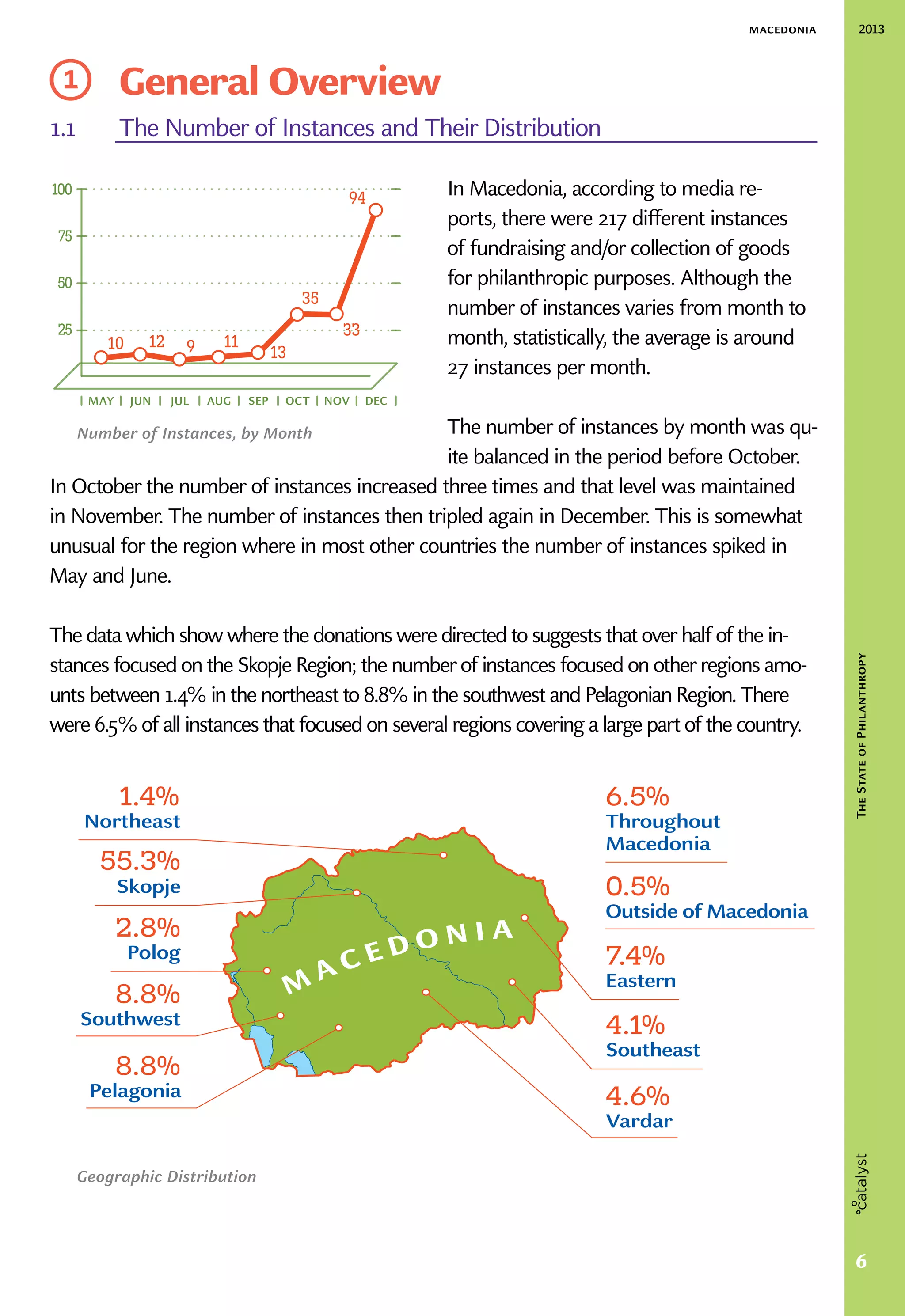
In Macedonia, according to media re-
ports, there were 217 different instances
of fundraising and/or collection of goods
for philanthropic purposes. Although the
number of instances varies from month to
month, statistically, the average is around
27 instances per month.
The number of instances by month was qu-
ite balanced in the period before October.
In October the number of instances increased three times and that level was maintained
in November. The number of instances then tripled again in December. This is somewhat
unusual for the region where in most other countries the number of instances spiked in
May and June.
Thedatawhich show wherethedonationsweredirectedtosuggeststhatoverhalfofthein-
stancesfocused onthe SkopjeRegion;thenumberofinstancesfocusedonotherregionsamo-
untsbetween1.4% inthenortheastto8.8%inthesouthwestandPelagonianRegion.There
were6.5% of all instancesthatfocusedonseveralregionscoveringalargepartofthecountry.
25
50
75
100
MAY JUN JUL AUG SEP OCT NOV DEC
10 12
13
35
33
94
9 11
Number of Instances, by Month
Geographic Distribution
M A C E D O N I A
8.8%
Southwest
6.5%
Throughout
Macedonia
2.8%
Polog
0.5%
Outside of Macedonia
55.3%
Skopje
4.6%
Vardar
7.4%
Eastern
4.1%
Southeast
8.8%
Pelagonia
1.4%
Northeast
2013 macedonia
7
TheStateofPhilanthropy
Finally, there was one instance of giving directed outside of Macedonia – towards a
foundation in the USA.
Over half of all instances focused on Skopje1
. Of the other cities with a lower number of
instances, giving was directed toward causes in Bitola, Ohrid, Štip, Veles and Kočani.
1.2	 Topics Important to the Citizens of Macedonia
The data show that the range of topics/purposes of giving was similar as in other countries
in the region.
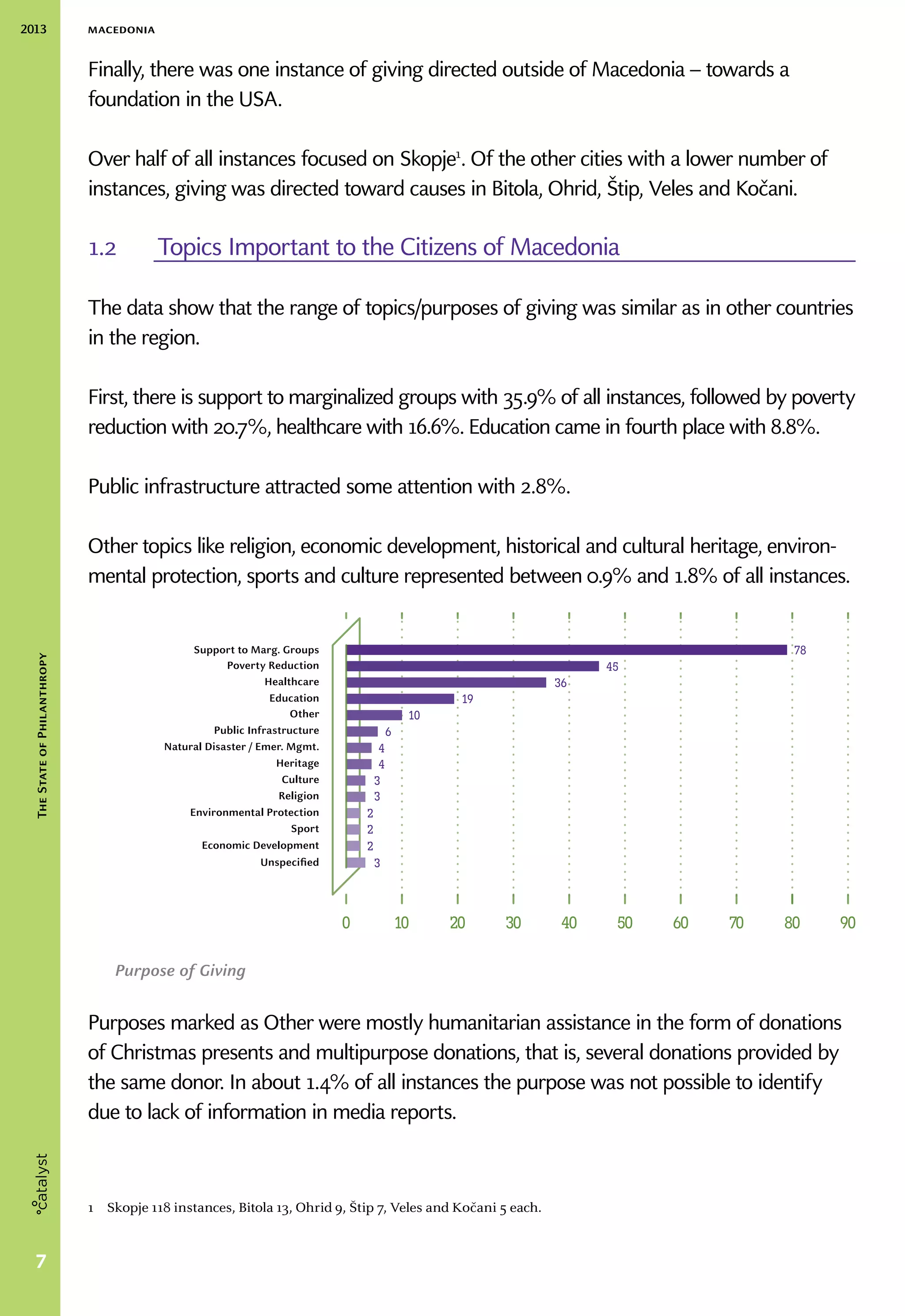
First, there is support to marginalized groups with 35.9% of all instances, followed by poverty
reduction with 20.7%, healthcare with 16.6%. Education came in fourth place with 8.8%.
Public infrastructure attracted some attention with 2.8%.
Other topics like religion, economic development, historical and cultural heritage, environ-
mental protection, sports and culture represented between 0.9% and 1.8% of all instances.
Purposes marked as Other were mostly humanitarian assistance in the form of donations
of Christmas presents and multipurpose donations, that is, several donations provided by
the same donor. In about 1.4% of all instances the purpose was not possible to identify
due to lack of information in media reports.
1  Skopje 118 instances, Bitola 13, Ohrid 9, Štip 7, Veles and Kočani 5 each.
Purpose of Giving
Support to Marg. Groups
Poverty Reduction
Healthcare
Education
Other
Public Infrastructure
Natural Disaster / Emer. Mgmt.
Heritage
Culture
Religion
Environmental Protection
Sport
Economic Development
0 10 20 30 40 50 60 70 80
78
45
36
19
10
6
4
4
3
3
2
2
2
Unspecified
90
3
2013macedonia
8
TheStateofPhilanthropy
TOPICS AND INTERESTING INSTANCES OF GIVING
As in other countries in the region, the four key topics were: support to marginalized groups, poverty redu-
ction, healthcare and education. The statistics shows that instances focused on other topics didn’t attract
that many donors.
Public infrastructure singled out, in terms of the number of instances and includes, investments in basic
infrastructural facilities in rural parts of Macedonia like installing electricity, sewer lines, etc..
Historical and cultural heritage as a topic and purpose of giving in Macedonia, as opposed to other coun-
tries in the region, was connected to renewal or giving to religious facilities, most frequently monasteries.
Two donations could be singled out as investments into economic development: MEPSO AD (Macedonian
Electric Company) a state-owned company supported modernization of two ski resorts (Kruševo and
Ponikva). Their modernization and development could help the surrounding communities generate larger
revenues from tourism.
An instance of giving organized to support the Marko Cepenkov Center of Culture by organizing concerts
of famous Macedonian musicians must also be mentioned. What separates this instance from others was
its use – the collected funds was used for training of young employees of the Center. Donations which
supported development, in particular of cultural institutions were quite rare.
1.3	 Intended Beneficiary Entities of Donations
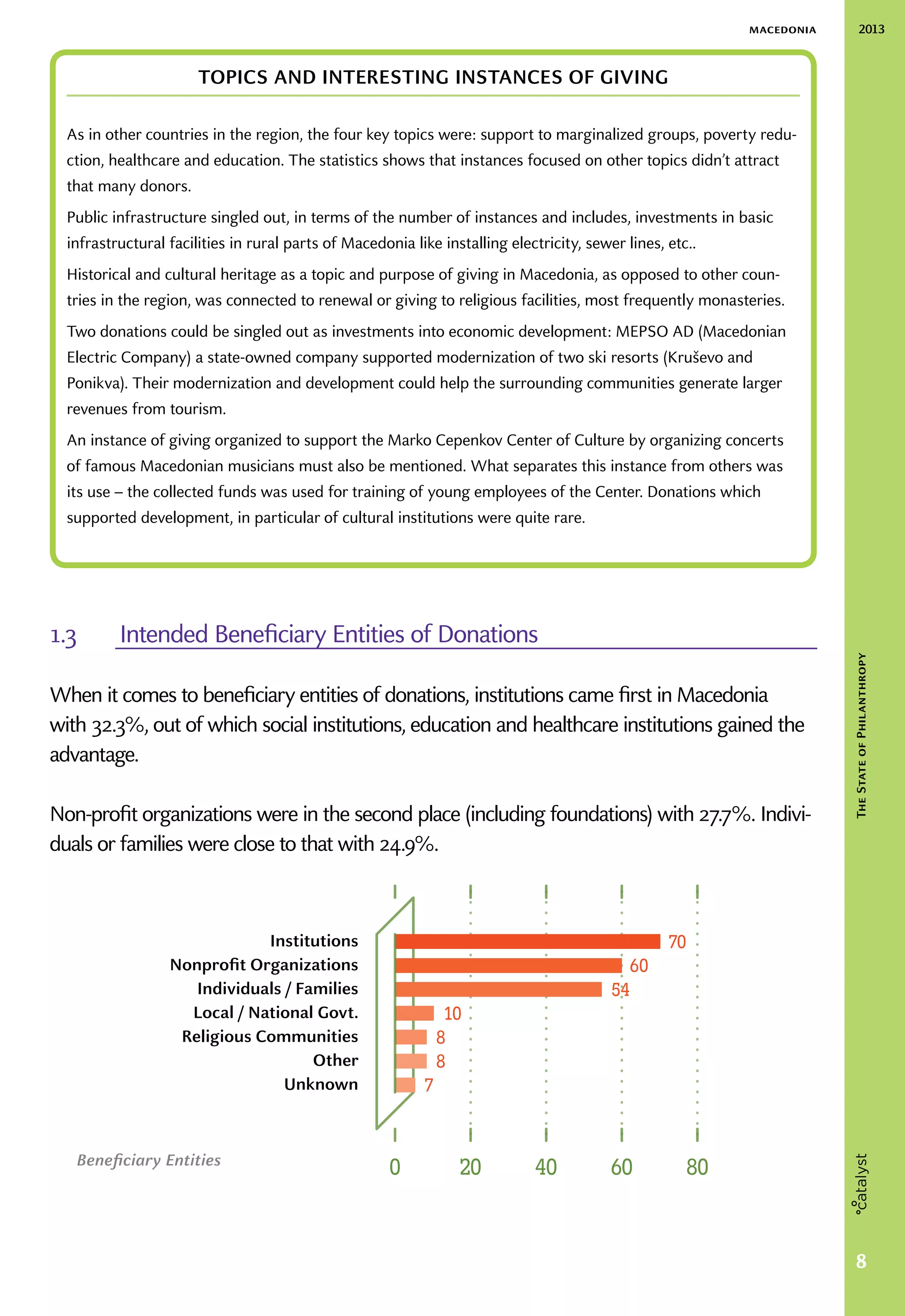
When it comes to beneficiary entities of donations, institutions came first in Macedonia
with 32.3%, out of which social institutions, education and healthcare institutions gained the
advantage.
Non-profit organizations were in the second place (including foundations) with 27.7%. Indivi-
duals or families were close to that with 24.9%.
Institutions
Nonprofit Organizations
Individuals / Families
Local / National Govt.
Religious Communities
Other
Unknown
0 20 40 60 80
70
60
54
10
8
8
7
Beneficiary Entities
2013 macedonia
9
TheStateofPhilanthropy
Local and national authorities followed with a much smaller percentage (4.6%) and then reli-
gious communities (3.7%). There were multiple recipients in some instances who couldn’t be
identified and classified. For some instances (3.2%) it was not possible to identify recipients
(somewhat over 4%).
NONPROFIT ORGANIZATIONS IN MACEDONIA
Nonprofit organizations that received donations in Macedonia included local nonprofit organizations,
the very active Red Cross, Food Bank, several foundations and UNICEF.
The range of topics for which nonprofit organizations received money was not too comprehensive.
More than half of donations provided to nonprofit organizations was for the support of marginalized
groups and around one fourth was for poverty reduction. One or two donations were provided for
healthcare, education, sports, but the absence of other topics was noticeable.
It is very difficult to draw conclusions about the amount of the donated money since the value of
donations was published only in 8.3% of all instances. Judging by the values of donations that were
published it seems that usual donations did not exceed 5,000 EUR except in the case of UNICEF.
Nonprofit organizations mostly received donations from citizens (mass individual giving), mixed do-
nors and companies. While associations and corporate foundations rarely provided donations to them,
small and medium enterprises never did so.
In terms of the number of instances/donations Red Cross and SOS Children's Village are dominant.
Šuto Orizari Day Care Center for Children on the Street was mentioned several times while all other
nonprofit organization were mentioned once or, rarely, twice.
The Red Cross was dominant in terms of the number of instances but its presence in Macedonia was
very specific in that it had a wider range of beneficiary groups (like elderly citizens, the homeless, etc.),
and also their programs did not pertain only to humanitarian assistance but also included providing
services to those beneficiary groups. That's not what the Red Cross usually did in other countries in the
region. Based on the number of instances and partners, the Red Cross gained the trust of the public in
Macedonia.
Of all local nonprofit organizations only one was mentioned – Apollonia Foundation which supported
development in the community of Đevđelija, and which had been founded as a follow up of the phi-
lanthropic work of the Apolonia Group Company. They had several partners among local companies.
They covered various topics including education, culture but also supported marginalized groups.
Despite the fact that the nonprofit sector was in second place as a recipient of donations in Macedo-
nia, it fell behind other countries in the region in terms of the diversity of topics it covered. Also, it is
notable that the public trusts organizations which were part of a larger network (the Red Cross, SOS
Children's Village, UNICEF). In that sense, it seems that organizations needed to invest significant
effort in promotion of their activities and outputs.
2013macedonia
10
TheStateofPhilanthropy
1.4	 Final Beneficiaries of Donations
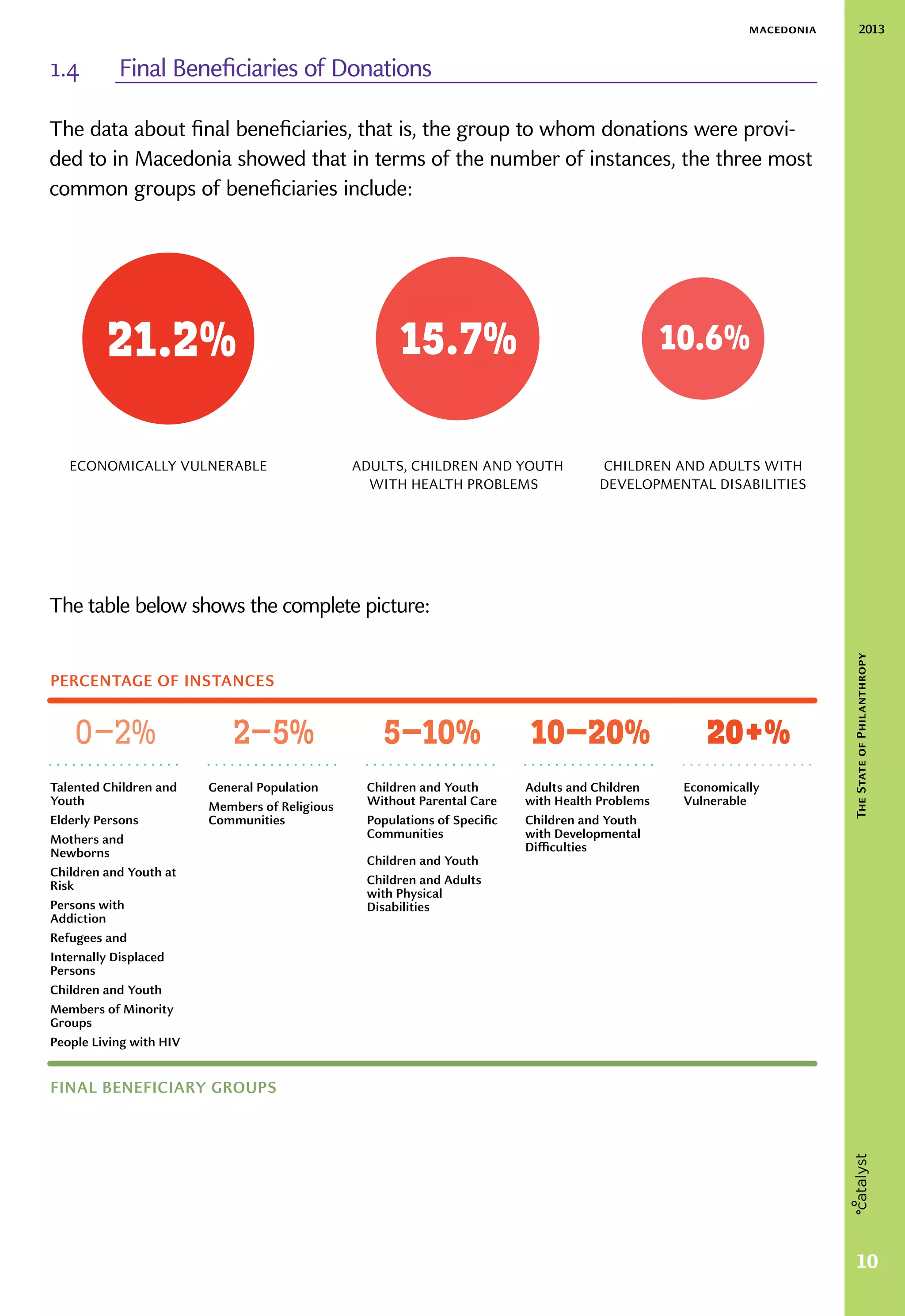
The data about final beneficiaries, that is, the group to whom donations were provi-
ded to in Macedonia showed that in terms of the number of instances, the three most
common groups of beneficiaries include:
The table below shows the complete picture:
21.2% 15.7% 10.6%
ECONOMICALLY VULNERABLE ADULTS, CHILDREN AND YOUTH
WITH HEALTH PROBLEMS
CHILDREN AND ADULTS WITH
DEVELOPMENTAL DISABILITIES
0–2% 2–5% 5–10% 10–20%
Talented Children and
Youth
Elderly Persons
Mothers and
Newborns
Children and Youth at
Risk
Persons with
Addiction
Refugees and
Internally Displaced
Persons
Children and Youth
Members of Minority
Groups
People Living with HIV
General Population
Members of Religious
Communities
Children and Youth
Without Parental Care
Populations of Specific
Communities
Children and Youth
Children and Adults
with Physical
Disabilities
Adults and Children
with Health Problems
Children and Youth
with Developmental
Difficulties
PERCENTAGE OF INSTANCES
0–2% 2–5% 5–10% 10–20% 20+%
FINAL BENEFICIARY GROUPS
Economically
Vulnerable
2013 macedonia
11
TheStateofPhilanthropy
1.5	 How Are Funds Raised?
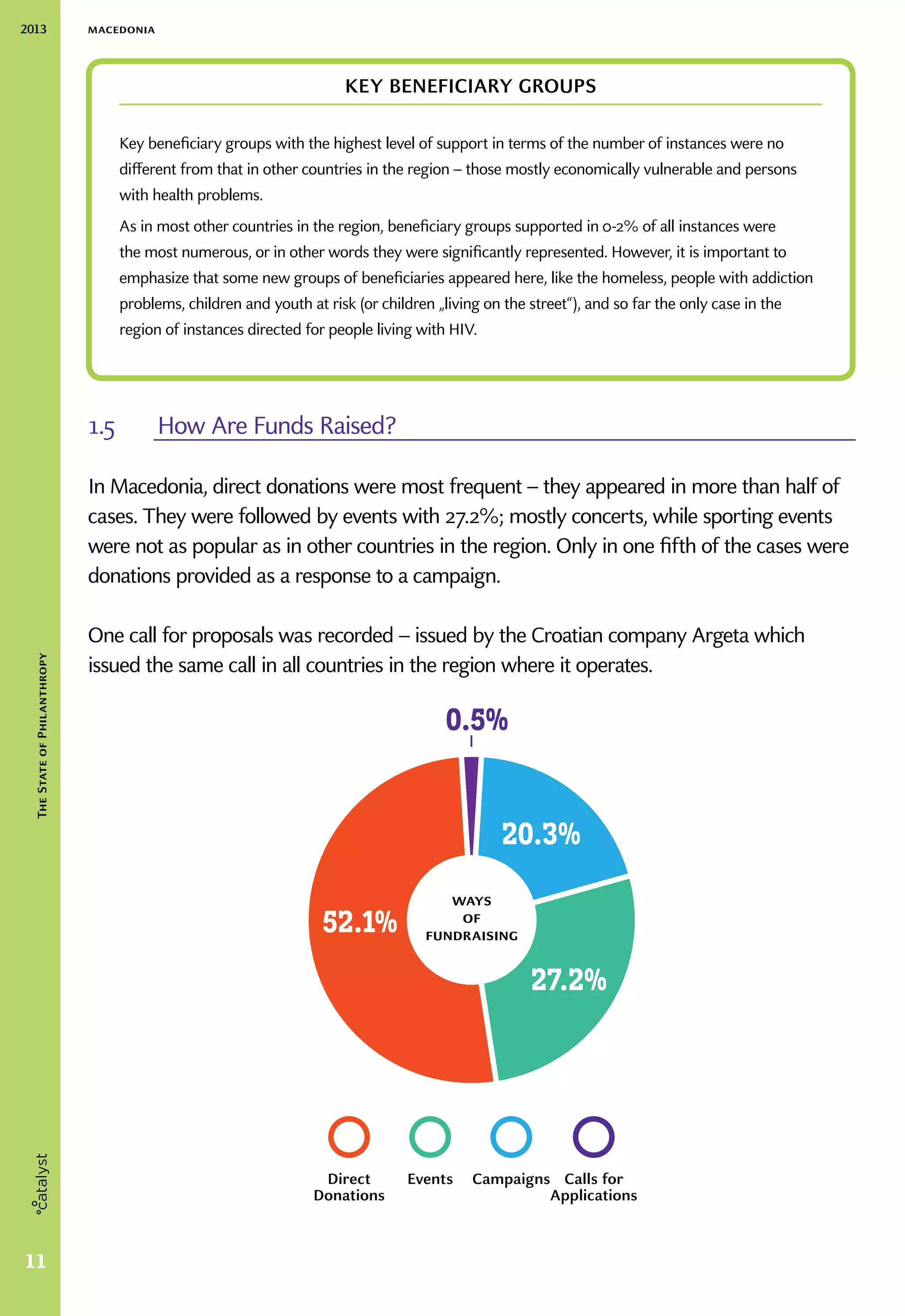
In Macedonia, direct donations were most frequent – they appeared in more than half of
cases. They were followed by events with 27.2%; mostly concerts, while sporting events
were not as popular as in other countries in the region. Only in one fifth of the cases were
donations provided as a response to a campaign.
One call for proposals was recorded – issued by the Croatian company Argeta which
issued the same call in all countries in the region where it operates.
Events CampaignsDirect
Donations
ways
of
fundraising
27.2%
52.1%
20.3%
0.5%
Calls for
Applications
KEY BENEFICIARY GROUPS
Key beneficiary groups with the highest level of support in terms of the number of instances were no
different from that in other countries in the region – those mostly economically vulnerable and persons
with health problems.
As in most other countries in the region, beneficiary groups supported in 0-2% of all instances were
the most numerous, or in other words they were significantly represented. However, it is important to
emphasize that some new groups of beneficiaries appeared here, like the homeless, people with addiction
problems, children and youth at risk (or children „living on the street“), and so far the only case in the
region of instances directed for people living with HIV.
2013macedonia
12
TheStateofPhilanthropy
INTERESTING INSTANCES
One case involved the Kisela Voda local association of pensioners which was a good illustration of how
small local organizations can take part. Women of that association made and traded pies in an organi-
zed manner and donated all the revenues to the Red Cross for the Day Center.
The Book Against Hunger campaign was another interesting example of partnership. This was an
instance jointly organized by five non-profit organizations and the Tinex company. Citizens were called
to donate food and they would be given a free book in exchange for three food donations.
Traditional events have also played an important role – „Zlatno slavejče“ a festival for children has
been donating its revenues to philanthropic goals for several years now. In 2013 the revenues from the
festival was donated to children without parental care.
„Braka Miladinovci“ City Library has also joined in philanthropic projects: it organized „Read a Book
and Donate Health“ campaign. Revenues from membership fees and that obtained from those who
join the campaign would be donated to the Clinic for Children in Skopje for its library and also a
playroom. The campaign attracted not only those who have already been members of the library but
also many other individuals and companies.
INCREASINGLY IMPORTANT ROLE OF THE SOCIAL MEDIA
The media in Macedonia, up to some extent, followed the practice of launching instances through the social
media. For example, telegraf.mk launched a Facebook call to collect money to support renovation of 11. Oktom-
vri Home for Children without Parental Care.
VIP Mobile organized a competition/game on Facebook in order to collect funds for benches in two student
dormitories. Each individual participation in the FB game triggers a donation by VIP Mobile.
The most interesting and the most unique instance was the one organized by the Twitter community together
with photographer Ivana Batev. Around 25 Twitter users posed naked for a calendar. The idea was to promote
sexual health and education by selling the calendar as well as to promote awareness about the freedom of sexu-
al orientation, while the revenues generated from it will be used for humanitarian purposes. This is the second
Twitter calendar created in Macedonia.
2013 macedonia
13
TheStateofPhilanthropy
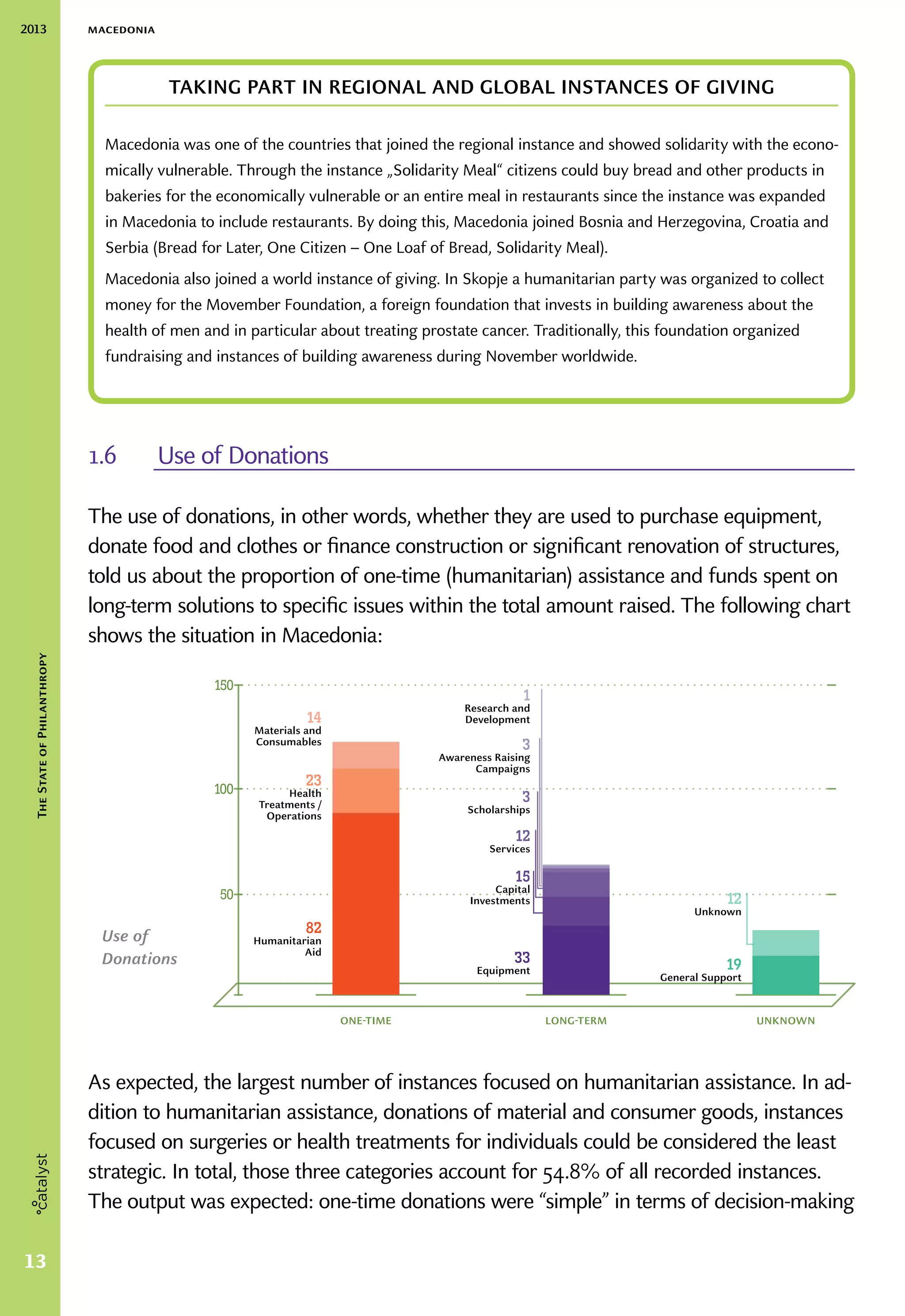
1.6	 Use of Donations
The use of donations, in other words, whether they are used to purchase equipment,
donate food and clothes or finance construction or significant renovation of structures,
told us about the proportion of one-time (humanitarian) assistance and funds spent on
long-term solutions to specific issues within the total amount raised. The following chart
shows the situation in Macedonia:
As expected, the largest number of instances focused on humanitarian assistance. In ad-
dition to humanitarian assistance, donations of material and consumer goods, instances
focused on surgeries or health treatments for individuals could be considered the least
strategic. In total, those three categories account for 54.8% of all recorded instances.
The output was expected: one-time donations were “simple” in terms of decision-making
14
Materials and
Consumables
3
Scholarships
12
Services
15
Capital
Investments
33
Equipment
12
Unknown
19
General Support
82
Humanitarian
Aid
50
100
150
ONE-TIME LONG-TERM UNKNOWN
23
Health
Treatments /
Operations
3
Awareness Raising
Campaigns
1
Research and
Development
Use of
Donations
TAKING PART IN REGIONAL AND GLOBAL INSTANCES OF GIVING
Macedonia was one of the countries that joined the regional instance and showed solidarity with the econo-
mically vulnerable. Through the instance „Solidarity Meal“ citizens could buy bread and other products in
bakeries for the economically vulnerable or an entire meal in restaurants since the instance was expanded
in Macedonia to include restaurants. By doing this, Macedonia joined Bosnia and Herzegovina, Croatia and
Serbia (Bread for Later, One Citizen – One Loaf of Bread, Solidarity Meal).
Macedonia also joined a world instance of giving. In Skopje a humanitarian party was organized to collect
money for the Movember Foundation, a foreign foundation that invests in building awareness about the
health of men and in particular about treating prostate cancer. Traditionally, this foundation organized
fundraising and instances of building awareness during November worldwide.
2013macedonia
14
TheStateofPhilanthropy
in that it was clear who received it and for what reason, or what the expected output
would be and the results were immediately visible. However, such donations, although
useful and often necessary, do not really eliminate the root cause of the problem. In
other words, by donating food and cloths we will not reduce poverty in the long run.
A bit lower than one third of all recorded philanthropic giving focused on donations
with potential long terms effects, or rather, they imply some kind of strategic approa-
ch. Those were donations of equipment, capital improvements, investments in servi-
ces (education, medical, and/or social), scholarships (long-term investments in human
capital) and building awareness about specific problems and research. Those “long-tem”
donations account for 30.8% of all recorded instances.
In 14.3% of all instances it was not possible to determine the exact purpose of the do-
nation. Those are the cases where the purpose of the donation wasn't mentioned – only
the recipient, and in some cases not even the recipient.
STRATEGIC INVESTMENTS – INTERESTING MACEDONIAN EXAMPLES
In addition to the already mentioned examples (investments into economic development, such as reno-
vating the ski resorts as tourism destinations) there are several other examples of strategic donations
in Macedonia that need to be mentioned.
Three instances of giving dealing with awareness building need to be noted because of the issues they
touched upon: autism, people living with HIV and perhaps the most interesting of all and one unique
in the region was the freedom of expression of sexual orientation – referring to the previously mentio-
ned Twitter campaign..
Investments into a UNICEF long-term program supporting the introduction of centers for early de-
velopment of children was also an interesting example. The donation from the Macedonian T-mobile
Company enabled introducing five new centers. As a strategic donation it not only provided new
services in the communities that didn't have them before but focused on development of children, that
is, it implied long-term investment into the future.
Other philanthropic instances that may be considered long-term investments included, a gift in the
form of computer equipment for Ilinden School provided by the OKTA company and a donation of 20
recycling containers provided by Pakomak Company.
2013 macedonia
15
TheStateofPhilanthropy
2	Donors
2.1	 Types of Donors in Macedonia?
The most active donor group in Macedonia in 2013, companies, took part in one third of
the total number of instances.
When small and medium enterprises and corporate foundations were included, the private
sector's participation rose to 35%.
Citizens (mass individual giving) were in second place with 31.8% of all instances.
Mixeddonors2
werethirdwith17%.Associationsfollowedwith8.3%andindividualswith6.5%.
2  Those are the activities undertaken by several donors. They can be citizens and companies, individuals, associations and
companies or any other combination of different types of donors.
MOST ACTIVE DONORS
Tinex, MEPSO AD, EVN Makedonija, Neptun, AD IMB Dairy Bitolj and Komercijalna Bank of Mace-
donia were the most frequently mentioned donors in 2013. Compared to the region, the presence of
state-owned companies was more prominent while shopping malls and banks were not as present.
Two corporate foundations were present (T-Mobile Macedonia and Trajče Mukaetov Foundation–
Akaloid Skopje).
Out of all associations, the most active were Lions Clubs, then several Rotary Clubs as well as various
associations connected with political parties. Out of the media the most active was Channel 5.
Citizens (Mass Individual)
Mixed Donor Types
Companies
Associations
Individuals
Small and Medium Enterprises
Corporate Foundations
0 10 20 30 40 50
72
69
40
18
14
2
2
60 70 80
Types of donors,
including the diaspora
2013macedonia
16
TheStateofPhilanthropy
Private foundations and the religious community were not mentioned as donors.
The Macedonian Diaspora took part
with around 4.6% of all instances whi-
ch was similar in the region. In terms
of the Diaspora, the most active were
citizens (in mass giving) and associati-
ons. In addition to this individuals and
companies in Macedonia also took
part.
YOUTH AS DONORS
In Macedonia, like in Croatia, youth appeared as donors more than in Serbia or Montenegro. Also, similar
to Bosnia and Herzegovina, student organizations, youth forums and clubs, organized instances, while
elementary school and high school students rarely appeared as donors.
Instances organized by youth mostly focused on marginalized groups, for example some supported chil-
dren without parental care, street children, children with disabilities, etc.
INDIVIDUALS AS DONORS
One important example of philanthropic giving that should be mentioned was when Roza Mojkovska,
a person with disability herself, organized a sales exhibition of her paintings and her parents' paintings.
The revenue from the exhibition was donated to Mobility Macedonia, a national organization of persons
with disabilities.
Another interesting example that concerned the Diaspora is the case of a couple, Snežana and Nathaniel,
who live in the USA. At their wedding all guests had the opportunity to give a donation. All funds raised
were given to the Životna Iskra Association of patients diagnosed with breast cancer.
1
Mixed
Donor Types
1
Companies
2
Individuals
3
Associations
3
Mass
Individual
Diaspora
2013 macedonia
17
TheStateofPhilanthropy
2.2	 What Is Donated?
In Macedonia, money was donated in most cases (86.2%), then money and goods (12.4%),
followed by instances of donations in goods. No donations of professional services were
recorded. Also the media did not report about volunteering instances3
.
3  Even though Catalyst recorded volunteering instances, that piece of information is unreliable, because the media, in prin-
ciple, rarely report about volunteering instances, unless they are of major scope and of significant relevance. In that sense,
it may be assumed that the number of those instances (and their share) is probably a lot higher; still, once the information is
monitored year in year out, it may be presented the change in attitude towards volunteering instances.
Money
type of
Donations
86.2%
12.4%
Goods
Money
and Goods
1.4%
2013macedonia
18
TheStateofPhilanthropy
OTHER WAYS TO DONATE – EMPLOYEE GIVING
In Macedonia we came across two examples of participation of employees in companies.
At a traditional picnic of Alkaloid Skopje Company, employees and their families fundraised for the
Gynecology Ward of Mother Theresa Clinic. The company's foundation, Trajče Muaketov, dispersed
the funds.
The employees of OKTA Company donated their food coupons to the Red Cross for economically
vulnerable citizens.
2013 macedonia
19
TheStateofPhilanthropy
top three beneficiary entities
target final beneficiaries
how do they give?
what do they donate?
purpose of giving
36.1% instances
Supporttomarginalizedgroups
18.1% instances
EducationandPovertyreduction
8.3% instances
Publicinfrastructure
Companies
as donors
2.3	 Profiles of Common Types of Donors – They Give to Whom, 		 	
	 How and What?
27.8% instances
Nonprofitorganizations
18.1% instances
Educationalinstitutions
13.9% instances
Localnationalauthorities
16.7% instances
Childrenandyouth
15.3% instances
Economicallyvulnerableand
Populationofspecificcommunities
11.1% instances
Adultsandchildrenwithdevelop-
mentaldisabilities
90.3% instances
Directdonationswerepreferred
8.3% instances
Theytookpartinevents
1.4% instances
Theypublishedcallsforproposals
90.3% nstances
Money
5.6% instances
Goodsandmoney
4.2% instances
Goods
2013macedonia
20
TheStateofPhilanthropy
Citizens
as donors
top three beneficiary entities
target final beneficiaries
purpose of giving
how do they give?
39.1% instances
Individualsandfamilies
31.9% instances
Nonprofitorganizations
13% instances
Socialinstitutions
what do they donate?
30.4% instances
Economicallyvulnerable
26.1% instances
Adultsandchildrenwithhealth
problems
8.7% instances
Childrenwithoutparentalcare
andAdultsandchildrenwith
developmentaldisabilities
33.3% instances
Supporttomarginalizedgroups
29% instances
Povertyreduction
23.2% instances
Healthcare
46.4% instances
Theyrespondedtocallsand
campaigns
37.3% instances
Theyattendedevents
15.9% instances
Theygavedirectdonations
79.7% instances
Money
20.3% instances
Goodsandmoney
2013 macedonia
21
TheStateofPhilanthropy
Associations
as donors
top three beneficiary entities
target final beneficiaries
purpose of giving
how do they give?
what do they donate?
38.9% instances
Individualsandfamilies
27.8% instances
Socialwelfareinstitutions
11.1% instances
Healthcareinstitutions
38.9% instances
Economicallyvulnerable
11.1% instances
Childrenandadultswithdevelopmentaldisabilities
andYouthwithhealthproblems
27.8% instances
Supporttomarginalizedgroups
27.8% instances
Povertyreduction
16.7% instances
Healthcare
77.8% instances
Directdonations
16.7% instances
Theyorganizedevents
5.5% instances
Theyrespondedtocampaigns
94.4% instances
Money
5.6% instances
Goodsandmoney
2013macedonia
22
TheStateofPhilanthropy
Individuals
as donors
top three beneficiary entities
target final beneficiaries
purpose of giving
how do they give?
what do they donate?
35.7% instances
Socialwelfareinstitutions
28.6% instances
Religiouscommunities
14.3% instances
Individuals/familiesand
Healthcareinstitutions
21.4% instances
Childrenandyouthwithdevelop-
mentaldisabilitiesandReligious
groups
14.3% instances
Childrenwithoutparentalcare
andChildrenandyouthwith
healthproblems
14.3% instances
Economicallyvulnerable
42.9% instances 
Supporttomarginalizedgropus
14.3% instances 
PovertyreductionandHealthcare
14.3% instances
Historicalandculturalheritage
100% instances
Directdonations
100% instances
Money
2013 macedonia
23
TheStateofPhilanthropy
2.4	 Value of Donations
Since it was very difficult to find concrete data about the value of donations and the fact
that the media did not report about specific values, the data stated here should be under-
stood as an approximation or as general indicators.
Out of 217 different episodes of philanthropic giving (calls, instances, reports, etc.), values
were reported only in 8.8% of cases which was the lowest score in the region, and it
raises concerns. Values were most frequently reported when donations were provided by
companies, whereas donations given by associations and small and medium enterprises
were not.
The total amount reported by the media pertained to 8.8% of donations and was close to
1.556 million EUR4
for a period of eight months in 2013.
Even though it was difficult to make any estimate as to the total value of donations be-
cause of an extremely small percent of known amounts of individual donations, by using
extrapolation, as we did for other countries, we concluded that the value of philanthropic
donations in Macedonia is between 2.9 and 3.3 million EUR5
.
A further examination of the value of donations by type of donor in relation to the recor-
ded value of the donations revealed the following:
4  The exact amount is 1,555,962.40 EUR. It includes a donation of 1,297,000 EUR provided for modernization of a ski resort.
Considering the size of this donation and that it exceeds other donations it is excluded in the further analysis and the amount
of 258,482.40 EUR is considered to be the value donated in Macedonia in the observed period.
5  As this amount is recorded for the period of eight months, if we consider the period of one year the value would be
387,723.63 EUR. If we put that amount against 100% of donations, we arrive to the amount of 4,406,000 EUR. Given that
the number of donations varies from period to period and that the value of donations differs, this figure should definitely
be reduced. If we reduce the extrapolated value by one third we arrive to the figure of 2.937,000 EUR; if we reduce it by one
quarter, we arrive at the figure of 3,304,000 EUR.
43.2%
Companies
34.9%
Corporate
Foundations
13.7%
Citizens
(Mass
Individual)
6.4%
Mixed
Donors
1.9%
Individuals
8.8% INSTANCES = 258,482 €
VALUE OF DONATIONS BY TYPE OF DONOR
2013macedonia
24
TheStateofPhilanthropy
The data, however, should only be understood as a rough estimate given the high percent
of instances for which there were no reports on the exact value of donations they inclu-
ded.
3	 Media Coverage
Since the data have been extracted from the media reports, a brief analysis of the me-
dia reports is provided below. In the observed period, there were a total of 1,370 media
reports in Macedonia which reported about philanthropy, one way or another. On average,
this means that there were around 170 media reports issued monthly.
As shown in the charts, over three quarters of the reports were published by the web
media (78.5%), followed by the print media with 14.7%. Electronic media was the lowest.
In terms of the territory they covered ninety percent of the reports that were published by
the national media, while the share of others was significantly lower: local 4.5%, sub-regio-
nal 3.2% and finally the media that covered the entire region 0.9%.
As in other countries in the region, the dailies dominated the percentage of reports with
close to 96%.
91.3%
National
4.5%
Local
3.2%
Sub-
Regional
14.7%
Print
6.7%
Electronic
78.5%
Web
media report by frequencymedia report by frequency
1314Daily
50Weekly
media
type
6Monthly
0.9%
Regional
media
coverage
2013 macedonia
25
TheStateofPhilanthropy
A total of 118 media reported about philanthropic giving. In terms of the number of re-
ports the most significant was Dnevnik, out of the electronic were Channel 5 and Alfa TV,
and out of the Web media were bi.mk, faktor.mk and denar.mk.
The print media placed only 13.4% of the articles in the first five pages, and additional
38.1% from the sixth to the tenth page. This is, in general, better placement than what was
usual in other countries in the region.
In regards to the size of articles, the most numerous were short reports, over 67%, and
medium sized 27.8%.
As in other countries, the media in Macedonia served a triple role: they were the primary
source of information about philanthropic giving, they took part directly as partners, and
often, some initiated their own instances of giving, or became intermediaries or even
donors in some cases.
The role of the media is very important for the future philanthropic giving: more frequent
coverage of the topics contributes to the general promotion of philanthropy. However,
analyses of media reporting show that they often failed to provide complete information
and a report or an article about philanthropic giving often consists of only several senten-
ces out of which it is sometimes difficult to conclude who gave the money, what amount
and even for what purpose.
Here, information has to be repeated that raises the concern that only 8.8% of the reports,
which is the lowest percent in the region, included the value of the donation. Therefore,
once again, it is worth stressing that both donors and recipients should pay attention to
this part of the media coverage because it has been shown that transparency contributes
to building trust of both the donors and the general public.
2013macedonia
26
TheStateofPhilanthropy
4	Annexes
4.1	 General Methodology and Limitations
The methodology employed in this research was unavoidably limited by available options
for data collection. Global research shows that the only completely reliable source of infor-
mation about the level of philanthropic giving is from the Tax Administration. This source
was not possible to use in the West Balkan countries for several reasons.
As mentioned before, Catalyst opted for alternative methods of data collection, by using,
primarily, the media as well as reports of associations and other organizations. Specifically,
the data in this report were collected by monitoring the media at the local, regional and
national level, and electronic, print and on-line media in the period from May 1 to Decem-
ber 31, 2013.
There are three key limitations to this methodology. First, it is not possible to get compre-
hensive data, because the media cannot report about all instances of philanthropy and
giving. Second, the media reports often do not state complete information needed for
monitoring of philanthropy (they mostly do not report about value of donations). Third,
another potential limitation is the matter of credibility of data stated in the media reports.
The first limitation – at this point – is impossible to overcome. As for the second and third,
Catalyst has overcome them by cross-referencing data from different media6
, and then
by means of additional research, or verification of the reports provided by companies
and non-profit organizations (if made public). Regardless of these limitations we think that
there are two reasons that work in favor of our analyses:
ᵒᵒ The collected figures, although not comprehensive, present minimum values of re-
levant indicators. Thus, if we speak about the number of fundraisers we may claim,
with certainty, that the number presented in our reports is the minimal number of
instances, because they definitely occurred, and that the actual number of instan-
ces must be higher. It is similar with the value of donations, the number of stake-
holders and the like. Therefore, the data may be used as indicators of the minimal
level of the development of philanthropic giving in a specific country.
ᵒᵒ Continuous monitoring will point to growth and/or drop of figures and change in
data pertinent to our indicators. In that sense, a continuous monitoring through
6  Different media frequently report about the same donations and by comparing data from several media reports more
accurate and complete data may be obtained.
2013 macedonia
27
TheStateofPhilanthropy
the years shows trends of development of philanthropy, and trends of media
reporting.
Catalyst will continue improving this methodology in the future. Also, we plan to establish
contacts with government offices (tax administration, and offices with relevant statistical
data) explain the importance of the data, and explore ways to increase the number of cre-
dible sources of data. In current circumstances, the methodology used enables a prelimi-
nary insight into the status of philanthropy in Macedonia.
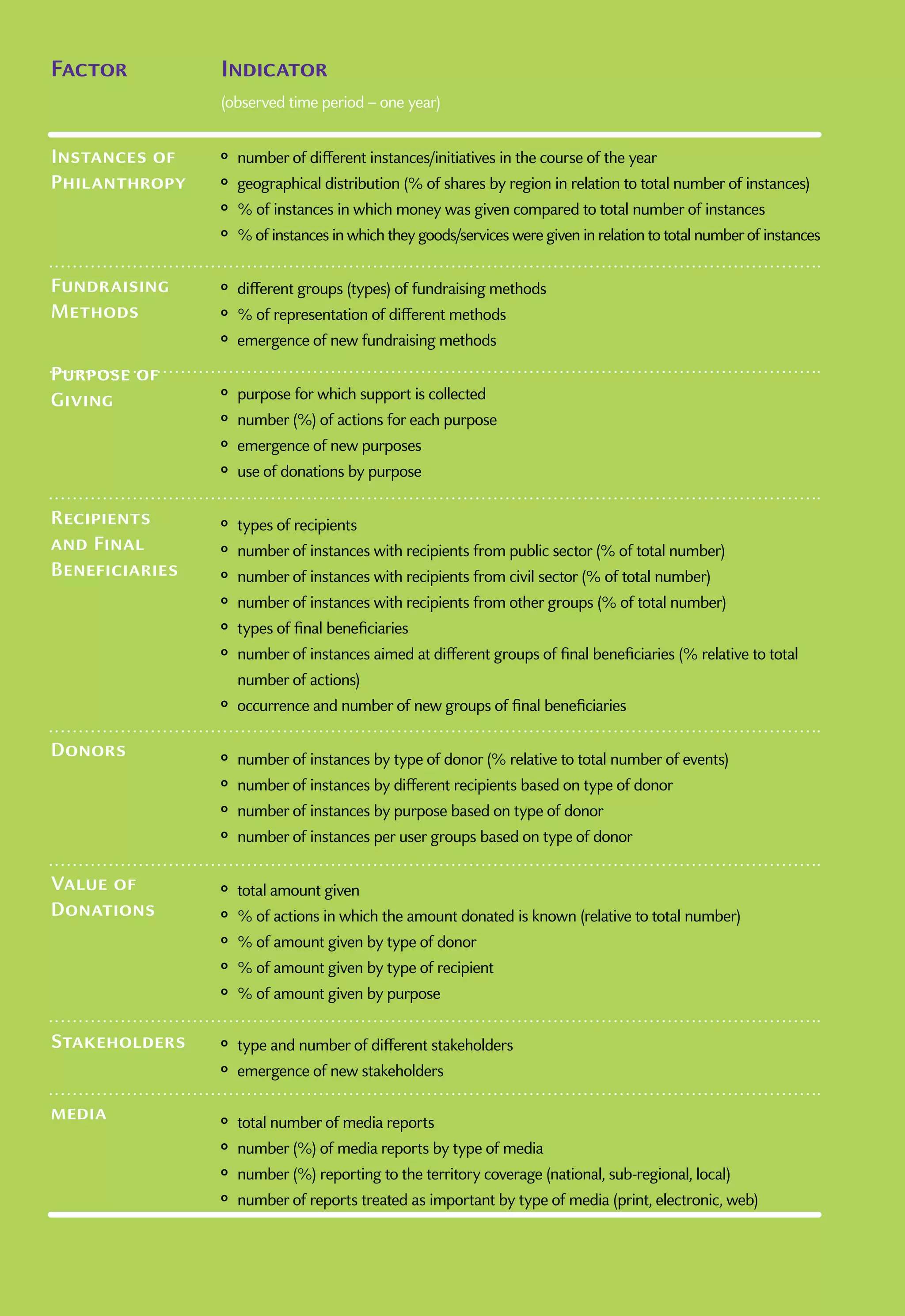
4.2	 Factors That Indicate the Level of Philanthropy Development
It is difficult to give an estimate of the level of development of philanthropy, especially in
the absence of continuous monitoring. Catalyst, therefore, created an initial list of indica-
tors which may point to different aspects of giving: instances/initiatives of philanthropy;
fundraising methods; purpose of giving; recipients of donations and final beneficiaries7
;
donors; stakeholders8
; media coverage.
During this research – which will hopefully last for several years – some of these factors
will change – become sharper, and new ones will be added. At this point, the above listed
factors represent a solid baseline for exploring the status of philanthropy in each of the
countries where we monitor it.
In order to conduct comparative analyses (both between countries and in one country
over time), it is important to define quantitative and qualitative indicators for each factor.
The parameters used were as follows:
7  Although those two categories may seem the same, in practice they often differ. Recipients of donations are usually
registered legal entities (like institutions, non-profit organizations, local authorities, etc.) seeking support for some purpose;
recipients can also be individuals or families. Final beneficiaries, on the other hand, may be various groups who will benefit
from the support. So for instance, if a recipient is a local hospital, final beneficiaries are citizens of that local community. If
a recipient is a school, final beneficiaries are the children/youth of a particular age who attend it. If a recipient if a non-profit
organization handling people with disabilities, its final beneficiaries are citizens with disabilities, etc. An insight into infor-
mation about who receives donations shows the perception of the public about who “deserves” support and who is trusted.
The range of final beneficiaries shows us which groups the public considers vulnerable (in any way) and in time, it will show
us how much the mind-set of people on account of this issue has changed.
8  Stakeholders are not just donors, but also those who call for assistance and those who in some way become involved in the
issue of philanthropy. Experience tells us that the increase in the number of stakeholders contributes to building awareness
about the importance and the role of philanthropy in society.
Factor Indicator
(observed time period – one year)
ᵒᵒ number of different instances/initiatives in the course of the year
ᵒᵒ geographical distribution (% of shares by region in relation to total number of instances)
ᵒᵒ % of instances in which money was given compared to total number of instances
ᵒᵒ % of instancesinwhich theygoods/servicesweregiveninrelationtototalnumberofinstances
ᵒᵒ different groups (types) of fundraising methods
ᵒᵒ % of representation of different methods
ᵒᵒ emergence of new fundraising methods
ᵒᵒ purpose for which support is collected
ᵒᵒ number (%) of actions for each purpose
ᵒᵒ emergence of new purposes
ᵒᵒ use of donations by purpose
ᵒᵒ types of recipients
ᵒᵒ number of instances with recipients from public sector (% of total number)
ᵒᵒ number of instances with recipients from civil sector (% of total number)
ᵒᵒ number of instances with recipients from other groups (% of total number)
ᵒᵒ types of final beneficiaries
ᵒᵒ number of instances aimed at different groups of final beneficiaries (% relative to total
number of actions)
ᵒᵒ occurrence and number of new groups of final beneficiaries
ᵒᵒ number of instances by type of donor (% relative to total number of events)
ᵒᵒ number of instances by different recipients based on type of donor
ᵒᵒ number of instances by purpose based on type of donor
ᵒᵒ number of instances per user groups based on type of donor
ᵒᵒ total amount given
ᵒᵒ % of actions in which the amount donated is known (relative to total number)
ᵒᵒ % of amount given by type of donor
ᵒᵒ % of amount given by type of recipient
ᵒᵒ % of amount given by purpose
ᵒᵒ type and number of different stakeholders
ᵒᵒ emergence of new stakeholders
ᵒᵒ total number of media reports
ᵒᵒ number (%) of media reports by type of media
ᵒᵒ number (%) reporting to the territory coverage (national, sub-regional, local)
ᵒᵒ number of reports treated as important by type of media (print, electronic, web)
Instances of
Philanthropy
Fundraising
Methods
Purpose of
Giving
Recipients
and Final
Beneficiaries
Value of
Donations
Stakeholders
media
Donors
2013 macedonia
29
TheStateofPhilanthropy
4.3	 Legal and Fiscal Framework for Philanthropy in Macedonia
The legal and fiscal framework for philanthropy is certainly an additional factor. This prima-
rily implies clear and harmonized definitions within the legal framework that pertains to:
ᵒᵒ 	Public benefit and organizations acting in favor of it. This means that relevant laws
have to include a clear and harmonized definition of purposes of benefit for the
public (like: culture, education, human rights, etc.). Also, definitions of organizati-
ons acting for the public benefit should be clear and harmonized.
ᵒᵒ Appropriate, clearly defined, easy to prove and attain in administrative sense both
to the private sector and individuals.
A regulated legal/fiscal framework represents significant progress in the development
of philanthropy and points out that state recognizes philanthropy as an important issue.
Regulations, in a way, support the development of philanthropy. Experience shows that
proper regulations are not the only prerequisite for monitoring of giving, however the
fact is that unclear legal/fiscal conditions actually discourage philanthropy’s development.
This creates and maintains the perception of the public that philanthropy is a kind of “gray
zone” which enables fraud (although experience to date proves that abuses are not as
frequent as they are thought to be). Given that other stakeholders (Fund for Active Citi-
zenship) have been working in this field for years, Catalyst didn’t analyze the situation for
fraud in Macedonia, but opted to state the section of the “Tax Regulations of Significance
for Philanthropy Development” publication of the SIGN network.
The text of this appendix has been taken from the publication Tax Laws of Signifi-
cance for Philanthropy Development in the South-East Europe Countries prepared
for the SIGN Network by Dragan Golubović, PhD. This appendix includes a segment
related to Macedonia while the text of the complete publication is available at
http://bit.ly/1wRCKkD
Law on Donations and Sponsorship
The Law on Donations and Sponsorship of Public Benefit Activities (Law on Donations and
Sponsorship) sets out a comprehensive framework on issues pertinent to donations and
sponsorship, including tax benefits provided for corporate and individual donors (infra).9
The Law has the status of general/subsidiary law (lax generalis) in respect to any other law
(lex specialis) which may govern some aspects of donations and sponsorship (Article 5). Ci-
vil society organizations (associations of citizens and foundations)10
are eligible to receive
9  Official Gazette of the Republic of Macedonia, No. 47/06, 86/08, 51/11.
10  CSOs in Macedonia operate mostly in the form of associations and foundations.
2013macedonia
30
TheStateofPhilanthropy
donations if they engage in activities which support and promote public benefit purposes
(infra). In addition to CSOs, other domestic legal entities, including public institutions, state
bodies, and local municipalities may also be the recipients of donations (Article 3(1)7, 7(1).
Exceptionally, foreign legal entities may also be the recipient of donations (Article 7(2).
The Law requires a donor and a grantee to enter into an agreement in writing (ad sole-
mintatem). The subject matter of the agreement may be donations in money, in-kind and
services (Article 3(1)1). Any legal or natural person, domestic or foreign alike, may be a
donor insofar as their activities do not violate the Constitution, law and the international
agreements of which Macedonia is a signatory (Article 6).
At the donor's request, the Ministry of Justice, with the approval of the competent line
ministry, will issue a decision which will confirm that a donation in question will serve a pu-
blic benefit purpose as defined by the Law. Originally, the Law provided that the Ministry
must issue a decision within 15 days following the request, otherwise it was presumed that
a positive decision was issued. However, the 2011 amendments to the Law introduced a
more elaborate and time-consuming procedure in this respect (Article 21, as amended in
2011).
Corporate Income Tax
Corporations can deduct up to 5% of their taxable income for qualifying public benefit
purposes (Article 14 (1), Law on Donations and Sponsorship). While the Law appears si-
lent on the issue of carry-over donations i.e., whether the unspent donation can be carried
to subsequent fiscal years, based on information from local CSOs, tax authorities allow for
such a practice. The Law does not specifically address the issue of the tax status of institu-
tional grants to CSOs which engage in public benefit activities.
Personal Income Tax
Individuals may deduct up to 20% of their taxable income for giving to qualifying public
benefit purposes, but in any event may not deduct more than 24,000 diners, which is
around 400 Euro (Article 13 (1), Law on Donations and Sponsorship). However, with the
2009 amendments to the Personal Income Tax Law, which holds the employers respon-
sible for paying personal income taxes of their employees, the foregoing tax exemptions
practically apply only to giving by individuals who are not employed, but rather provide
some free-lance, short term consultancy service, usually under international development
projects. This legislative development has significantly limited tax incentives for individual
giving.
2013 macedonia
31
TheStateofPhilanthropy
Gifts Tax
CSOs which engage in qualifying public benefit activities are exempted from gifts and
inheritance taxes on goods and objects they receive; insofar they use them to further their
main objectives (Article 16(1). Income generated from gifts is not taxed in the course of
five years following the transfer of gift to the grantee (Article 16(2)).
Value Added Tax
VAT is not levied on goods and services purchased with donated money, but is rather
recovered from the state budget. Although the procedure for VAT exemptions works in
practice, not all companies are aware of the current exemption mechanisms and often
times refuse to engage in donation transactions without VAT being paid by a customer.
Even though the law provides that SMS/telephone call donations are also exempted from
VAT, providers of telecommunication services have not been able to utilize this exemption
to date. VAT is also not levied on tickets for humanitarian events.
Reporting requirements
Both the donor and the grantee are subject to specific reporting requirements with respe-
ct to donation, the details of which are set out in the Law, which they have to file with the
tax authority within 30 days following the execution of the agreement (Article 19(3)). In
addition, following the execution of the agreement, the grantee is obliged to issue to the
donor a receipt in writing, the form of which is to be detailed by regulation issued by the
Minister of Justice (Article 4).
Public Benefit Status.
The Law introduces the somewhat confusing distinction between public benefit acti-
vities and public benefit goals. Public benefit activities are deemed activities in the
following areas: human rights protection, education, science, information-based society,
culture, sport, medicine, social protection and protection of people with special needs,
blood donation, child protection, animal protection, environmental protection, as well as
other activities defined by law to benefit the public (Article (Article 3(1)3). The notion of
public benefit goals entails support to and encouragement of activities in the following
areas: protection of human rights, promotion of culture, morality, education, science,
development of information and knowledge-based society, sport, environmental pro-
tection, socio-humanitarian activities, civil society development, promotion of blood
donation, promotion of international cooperation, as well as other activities defined by
law to benefit the public (Article 2, 3(1)4).
2013macedonia
32
TheStateofPhilanthropy
On the other hand, the Law on Associations and Foundations11
provides for a comprehen-
sive framework for granting the status of public benefit organizations. CSOs may obtain
public benefit status if they perform public benefit activities, implement programs and
projects on a central and/or local level, independently or in cooperation with state admini-
stration bodies and municipal bodies, the bodies of the municipalities in the City of Skopje
and the City of Skopje, as well as if they use the financial resources for realization of acti-
vities (Article 73). The Law provides a list of public benefit activities, which is significantly
broader than the one set out in the Law on Donations and Sponsorship (Article 74, Law on
Associations and Foundations).12
An association or a foundation shall obtain the status of
public benefit organization if: it is registered in accordance with the provisions of this Law;
public benefit activity is the main income code in its operations; its activities and actions
are directed at the general public and the interests of the community; it has the necessary
organizational structure in accordance with this Law; it has human resources capacities
required for the activity in accordance with law; it has appropriate financial resources, i.e.
total assets or annual income amounting to at least 1.500 EURO in Denar equivalent accor-
ding to the exchange rate of the National Bank of Macedonia; it has rules in place gover-
ning conflict of interests and transparency of its work; it is not in bankruptcy or liquidation
and does not have its bank account frozen (Article 75). A separate body, the Commission
of Public Benefit Organizations, decides on granting the status of public benefit (Article
76). The Law envisages that public benefit organizations shall enjoy additional tax bene-
fits, as compared to CSOs which operate without public benefit status, without further
references in this respect (Article 88).
Use of Donations
The Law does not provide for a specific time-line in which a donation must be utilized—
nor does it set a specific threshold with respect to the organization's overhead expenses.
Volunteering.
The Law on Volunteering does not allow for a corporation to be a host of volunteer activi-
ties, even outside of its business premises (Article 6).13
11  Official Gazette of the Republic of Macedonia, No. 52/10.
12  This includes: development of democracy, civil society, and human rights; help and protection of persons with physical
or mental handicaps, persons with developmental disabilities and persons with special needs; protection of children and
youth; protection of marginalized persons and their social inclusion; protection from drug abuse, sexually transmitted
diseases, juvenile delinquency, alcoholism, prostitution and human trafficking; health, health promotion and medical care;
art, culture, and protection of cultural heritage; amateur sport; protection of the environment and sustainable development;
local and infrastructure development; science, education, and training in the educational process; development of ethics and
moral; humanitarian and social aid, reduction of poverty; disaster management; protection and care of animals; consumers’
protection; promotion of philanthropy and volunteering; and other public benefit activity determined by this or other law.
13  Official Gazette of Republic of Macedonia No. 85/2007
2013 macedonia
33
TheStateofPhilanthropy
5.4	 Summary of Outstanding Issues in Macedonia
Donation And Sponsorship Law
ᵒᵒ Excessive administrative requirements imposed on the
donor and the grantee;
ᵒᵒ Overall high and disproportional transactional costs
for executing and supervising the use donations incu-
rred on all parties involved (the donor, the grantee and
the supervising authority);
ᵒᵒ No specific rules with respect to institutional grants
to CSOs;
ᵒᵒ The concept of public benefit is somewhat confusing
and not consistent with the CSO framework regula-
tion;
ᵒᵒ The concept of public benefit is not consistently
applied within the line ministries;
ᵒᵒ Tax incentives for individual giving are limited to the
non-employed;
ᵒᵒ No specific carry-over rules for donations.
Cso Framework Regulation
ᵒᵒ No clear tax benefits arising from the status of public
benefit organization;
ᵒᵒ Initiative to exempt donors to public benefit organi-
zations registered under the Law on Associations and
Foundations from the duty to file a request with the
Ministry of Justice under way.
o

Annual Report on the State of Philanthropy - Macedonia 2013

  • 1.
  • 3.
    Research Annual Report on theState of Philantrophy in Macedonia 2013
  • 4.
    1 Summary Recommendations ANNUAL REPORT OFSTATE OF PHILANTHROPY IN MACEDONIA IN 2013 Catalist Foundation Makedonska 21  Beograd Srbija www.catalystbalkans.org authors Aleksandra Vesić  Nathan Koeshall editor Nathan Koeshall  Alex Cooper design Ivo Matejin  Fondacija Dokukino financial support belgrade 2015
  • 5.
    Table of Contents 6 General Overview TheNumber of Instances and Their Direction Topics Important to the Citizens of Macedonia Intended Benefi- ciary Entities of Donations Final Beneficiaries of Donations How Are Funds Raised? Use of Donations 15 Donors Types of Donors in Macedonia? What is Donated? Profiles of Common Types of Donors - They Give to Whom, How and What? Value of Donations 24 Media Coverage 26 Annexes General Methodo- logy and Limitati- ons Factors That Indicate the Level of Philanthropy Development Legal and Fiscal Fra- mework for Philant- hropy in Macedonia
  • 6.
    2013 macedonia 1 TheStateofPhilanthropy Foreword The 2013Annual Report on Philanthropy in Macedonia was a result of monitoring of media output concerning local philanthropic giving between May and December 2013. Though this is a period of only eight months, we believe that a sufficient level of information has been colle- cted to gain insight into domestic philanthropic giving in Macedonia. Even though Macedonia offers tax incentives for philanthropic giving both to the private sector and individuals, it is very difficult to find information that would show the scope of donations provided annually, their purpose, the amount of money donated, the donors, and more importantly, their outputs, that is, the difference made by them. Given the challenges, Catalyst opted for a data collection method that used the media as a primary source and then supplemented it with other available data sources, such as annual reports from foundations, companies, and civil society organizations. More specifically, the data in this report have been collected through monitoring of the media at the local, regional and national level. We monitored electronic, print and on-line media in the period from May 1 to December 31, 2013. The same method was successfully used in a short, independent research in 20111 . Despite the fact that this methodology is somewhat limited2 , we believe that it provides us with information which is difficult to obtain: the frequency of donations, geographic distribution, the type of donati- ons, the purpose of giving, donors, recipients, and final beneficiaries as well as estimates of the total donated amount in Macedonia in 2013. Macedonia, unfortunately, was not included in similar research carried out in several other countries in the region in 20113 . Therefore, it is not possible to present trends, but only record the baseline situation as of 2013. However, the next report (for 2014) will already enable us to see the development of philanthropy in Macedonia. 1  Philantropy in the Eye of Media, Aleksandra Vesić, 2011, C.S.Mott Foundation 2  See Appendix 1: General Methodology and Limitations 3  Philantropy in the Eye of Media, Aleksandra Vesić, 2011, C.S.Mott Foundation (BiH, Montene- gro, Croatia, Serbia)
  • 7.
    2013macedonia 2 TheStateofPhilanthropy Why is itimportant to monitor the data in this and other research? A primary reason to carry out the present research is to monitor the trends of local donations provided to nonprofit organizations. Nonprofit organizations, as organizations with an important role in society, still predominantly depend on foreign donor funds. The providers of which are slowly but surely leaving the region. In that sense, domestic donors may be an important source of support to those organizations, and the research about trends of local donations, and best practices may help them be more successful in raising funds from local populations. This, however, is not the only reason for this research. Philanthropy in the region, and in Macedonia, hasn’t reached its full potential. Besides the obvious benefit of one-time assistance for those who needed it, international experience shows that the potential for giving is enormo- us, if provided strategically. It not only finances services provided to marginalized groups, but it allows investing in research and develop- ment in fields such as poverty reduction, education, healthcare, envi- ronment, etc. Global experience shows that such giving complements government investments and that it frequently becomes an impetus of significant progress in those fields. Therefore, a continuous monitoring of trends in this field may contri- bute to better understanding of challenges to local giving in each of the countries where we do monitoring4 . Simultaneously, such under- standing enables us to influence general trends in philanthropy, their change and development, and thus, up to a point, how they shape the society we live in for the better. Catalyst Foundation 4  Albania, Bosnia and Herzegovina, Montenegro, Croatia, Kosovo, Macedonia, Serbia
  • 8.
    2013 macedonia 3 TheStateofPhilanthropy Summary In spiteof the fact that, as mentioned earlier, this research is somewhat limited, it certainly allows us to get a general idea of philanthropy in Macedonia. Conservative estimates made, and based on the collected data; show that a total of between 2.9 and 3.3 million EUR were donated in Macedonia in 2013, while an average of 27 instan- ces of philanthropic giving was recorded each month. The research has shown several other interesting findings: First, let looking at the breakdown of Macedonian donors, companies were the most active donors in Macedonia, taking part in 33.2% of all recorded philanthropic instances. The par- ticipation of the private sector is even higher when included small and medium enterprises and corporate foundations. The private sector was followed by citizens who participated in 31.8% of instances, while associations and individuals also appeared to active donor groups. The diaspora's participation of 4.6% was close to the regional average. Compared to other countries in the region, the percent of the media reports that provide information about the value of a donation was extremely small (8.8%), and therefore it was very difficult to estimate the amount of money provided by specific types of donors. The data points to the private sector (including companies, small and medium enterprises and corporate foundations) being the leader in the amount of funds donated, with citizens (mass individual) and individuals following. However, the data should be taken with some reservation given that there in 90% of the recorded instances, there is no or incomplete infor- mation on the value of donations. In regards to the purpose of giving, donors in Macedonia supported marginalized groups (35.9%), poverty reduction (20.7%) and healthcare (16.6%). Education came fourth with 8.8% followed by public infrastructure with 2.7% as areas that stood out, while other topics were less represented. The number and the range of topics, in principle, fit into the regional average. In Macedonia, institutions were the primary beneficiary entities with 32.3% of all instan- ces. The second most common beneficiary entities were non-profit organizations (27.7%), followed by individuals and families with 24.9%. To a lesser extent, other beneficiary entities included local and national authorities (4.6%) and religious communities (3.7%). In general, the government – in one way or another – appears as a recipient of donations in almost 73% of all instances.
  • 9.
    2013macedonia 4 TheStateofPhilanthropy In regards todirect beneficiaries of donations, in other words those who are actually using the donated money and goods, philanthropy was most often directed to the economically vulnerable groups (21.2%), adults and children with health problems (15.7%) and adults and children with developmental disabilities (10.6%). As in most other countries in the region, there are a number of groups with little or no support (0 – 2% of all instances). However it is important to note that some groups which appear to be supported less in other countries were found here, such as the homeless, persons with addiction, children and youth at risk (children on the street) and people living with HIV (the only funded case in the region. It is also important to mention the purposes for which the donated money and goods were used. In over half of all instances of giving — 54.8% — the focus was on one-time assistance (humanitarian assistance and material and consumer goods). However, it is enco- uraging that there were a significant number of instances (30.8%) that focused on long-term more strategic purposes, such as equipment, capital improvements, investments in services (education, medical and/or social welfare), and scholarships (long term investments in human capital). Other instances focused on building awareness on specific challenges in society. There were several other specific characteristics of giving in Macedonia. Geographic co- verage is extremely imbalanced; more than half of the donations were focused on the Skopje region or in Skopje itself. Also, as opposed to other Balkan countries, no instances of giving to other countries in the region were recorded. The most active media type, in terms of recorded instances of giving, were web-based me- dia, which is not typical in the region where the print media are dominant. The media follow instances initiated through social media, and Macedonia was for the time being the only country in the region where an instance of giving was initiated through Twitter. Compared to other countries in the region, it was interesting that historical and cultural heritage were more prominent than in other countries. It appeared to be related to renewal or giving to religious facilities, mostly monasteries. Also, only in Macedonia were significant investments into economic development recorded – not in terms of the number of instance but the amount of money and strategic purposes (modernization of ski resorts as tourism destinations). Finally, although there was very little information about donations from or to religious com- munities and churches, donations with religious purposes were more frequently mentioned in the country than in other countries in the region. Further, individuals were those who most frequently appeared as donors. However, the insight into the philanthropic marketplace connected with religion is far from complete.
  • 10.
    2013 macedonia 5 TheStateofPhilanthropy Recommendations The resultsof this research point to several areas in which different stakeholders, especia- lly those interested in promoting philanthropy, could pay attention: ᵒᵒ Solve the problem of the lack of data. As all previous research on local philanthropy, this report also shows that one of the major issues was the lack of complete and accurate data on the number of do- nations, donors, amount of money etc. In that sense, it is necessary to initiate a dialogue with government institutions and to explore ways to collect data that can provide us with a more complete picture. ᵒᵒ Increase transparency. Given the extremely small number of the instances of giving where the value of donations had been published, a major challenge, both for donors, recipients, and the media is supporting transparency. Transparency allows insight into data and increases the trust of donors and general public. Trust is growing stronger when information about the amount of funds raised, their purpose, results and effects of assistance is made public. ᵒᵒ Build trust in local and small non-profit organi- zations. Despite the fact that trust is mostly put in institutions, the research has shown that it is possible for non-profit organizations to gain trust and dona- tions from citizens and businesses. In Macedonia, larger, network organizations (the Red Cross) or those that originated outside of Macedonia (SOS Children's Village, UNICEF) are successful. This point to the need to promote activities and outputs of smaller and local non-profit organizations. ᵒᵒ Promote underrepresented issues. As in other co- untries, poverty and support to marginalized groups are highly represented as a topic. Still, we should support higher investments into less represented and equally important areas: education, culture, the environment and economic development. ᵒᵒ Promote giving and outputs of strategic inves- tments. In Macedonia almost one third of all philan- thropic giving focused on long term solutions, and there were several examples of strategic investments. In that sense, such giving should be promoted as much as possible and pay particular attention to the promotion of their outputs. The role of non-profit organizations in this area is significant, and particular- ly that of the media. ᵒᵒ Advocate to the tax authorities to create incentives for giving. Although the process in Macedonia, as in other countries in the region, is underway, it should be intensified. ᵒᵒ Work with the media. As in other countries, the media have a large role in shaping public opinion. In that sense, organizations investing efforts to develop philanthropy should try to include the media as much as possible in the process. Their influence is particular- ly important for instances seeking to support underre- presented areas, promoting possibilities for strategic donations, increasing transparency and efforts of the state to increase giving. In Macedonia, given the extre- mely small number of instances where the value of donations had been reported to the public the media should be more careful to include information about the value in their report.
  • 11.
    2013macedonia 6 TheStateofPhilanthropy 1 General Overview 1.1 The Number of Instances and Their Distribution In Macedonia, according to media re- ports, there were 217 different instances of fundraising and/or collection of goods for philanthropic purposes. Although the number of instances varies from month to month, statistically, the average is around 27 instances per month. The number of instances by month was qu- ite balanced in the period before October. In October the number of instances increased three times and that level was maintained in November. The number of instances then tripled again in December. This is somewhat unusual for the region where in most other countries the number of instances spiked in May and June. Thedatawhich show wherethedonationsweredirectedtosuggeststhatoverhalfofthein- stancesfocused onthe SkopjeRegion;thenumberofinstancesfocusedonotherregionsamo- untsbetween1.4% inthenortheastto8.8%inthesouthwestandPelagonianRegion.There were6.5% of all instancesthatfocusedonseveralregionscoveringalargepartofthecountry. 25 50 75 100 MAY JUN JUL AUG SEP OCT NOV DEC 10 12 13 35 33 94 9 11 Number of Instances, by Month Geographic Distribution M A C E D O N I A 8.8% Southwest 6.5% Throughout Macedonia 2.8% Polog 0.5% Outside of Macedonia 55.3% Skopje 4.6% Vardar 7.4% Eastern 4.1% Southeast 8.8% Pelagonia 1.4% Northeast
  • 12.
    2013 macedonia 7 TheStateofPhilanthropy Finally, therewas one instance of giving directed outside of Macedonia – towards a foundation in the USA. Over half of all instances focused on Skopje1 . Of the other cities with a lower number of instances, giving was directed toward causes in Bitola, Ohrid, Štip, Veles and Kočani. 1.2 Topics Important to the Citizens of Macedonia The data show that the range of topics/purposes of giving was similar as in other countries in the region. First, there is support to marginalized groups with 35.9% of all instances, followed by poverty reduction with 20.7%, healthcare with 16.6%. Education came in fourth place with 8.8%. Public infrastructure attracted some attention with 2.8%. Other topics like religion, economic development, historical and cultural heritage, environ- mental protection, sports and culture represented between 0.9% and 1.8% of all instances. Purposes marked as Other were mostly humanitarian assistance in the form of donations of Christmas presents and multipurpose donations, that is, several donations provided by the same donor. In about 1.4% of all instances the purpose was not possible to identify due to lack of information in media reports. 1  Skopje 118 instances, Bitola 13, Ohrid 9, Štip 7, Veles and Kočani 5 each. Purpose of Giving Support to Marg. Groups Poverty Reduction Healthcare Education Other Public Infrastructure Natural Disaster / Emer. Mgmt. Heritage Culture Religion Environmental Protection Sport Economic Development 0 10 20 30 40 50 60 70 80 78 45 36 19 10 6 4 4 3 3 2 2 2 Unspecified 90 3
  • 13.
    2013macedonia 8 TheStateofPhilanthropy TOPICS AND INTERESTINGINSTANCES OF GIVING As in other countries in the region, the four key topics were: support to marginalized groups, poverty redu- ction, healthcare and education. The statistics shows that instances focused on other topics didn’t attract that many donors. Public infrastructure singled out, in terms of the number of instances and includes, investments in basic infrastructural facilities in rural parts of Macedonia like installing electricity, sewer lines, etc.. Historical and cultural heritage as a topic and purpose of giving in Macedonia, as opposed to other coun- tries in the region, was connected to renewal or giving to religious facilities, most frequently monasteries. Two donations could be singled out as investments into economic development: MEPSO AD (Macedonian Electric Company) a state-owned company supported modernization of two ski resorts (Kruševo and Ponikva). Their modernization and development could help the surrounding communities generate larger revenues from tourism. An instance of giving organized to support the Marko Cepenkov Center of Culture by organizing concerts of famous Macedonian musicians must also be mentioned. What separates this instance from others was its use – the collected funds was used for training of young employees of the Center. Donations which supported development, in particular of cultural institutions were quite rare. 1.3 Intended Beneficiary Entities of Donations When it comes to beneficiary entities of donations, institutions came first in Macedonia with 32.3%, out of which social institutions, education and healthcare institutions gained the advantage. Non-profit organizations were in the second place (including foundations) with 27.7%. Indivi- duals or families were close to that with 24.9%. Institutions Nonprofit Organizations Individuals / Families Local / National Govt. Religious Communities Other Unknown 0 20 40 60 80 70 60 54 10 8 8 7 Beneficiary Entities
  • 14.
    2013 macedonia 9 TheStateofPhilanthropy Local andnational authorities followed with a much smaller percentage (4.6%) and then reli- gious communities (3.7%). There were multiple recipients in some instances who couldn’t be identified and classified. For some instances (3.2%) it was not possible to identify recipients (somewhat over 4%). NONPROFIT ORGANIZATIONS IN MACEDONIA Nonprofit organizations that received donations in Macedonia included local nonprofit organizations, the very active Red Cross, Food Bank, several foundations and UNICEF. The range of topics for which nonprofit organizations received money was not too comprehensive. More than half of donations provided to nonprofit organizations was for the support of marginalized groups and around one fourth was for poverty reduction. One or two donations were provided for healthcare, education, sports, but the absence of other topics was noticeable. It is very difficult to draw conclusions about the amount of the donated money since the value of donations was published only in 8.3% of all instances. Judging by the values of donations that were published it seems that usual donations did not exceed 5,000 EUR except in the case of UNICEF. Nonprofit organizations mostly received donations from citizens (mass individual giving), mixed do- nors and companies. While associations and corporate foundations rarely provided donations to them, small and medium enterprises never did so. In terms of the number of instances/donations Red Cross and SOS Children's Village are dominant. Šuto Orizari Day Care Center for Children on the Street was mentioned several times while all other nonprofit organization were mentioned once or, rarely, twice. The Red Cross was dominant in terms of the number of instances but its presence in Macedonia was very specific in that it had a wider range of beneficiary groups (like elderly citizens, the homeless, etc.), and also their programs did not pertain only to humanitarian assistance but also included providing services to those beneficiary groups. That's not what the Red Cross usually did in other countries in the region. Based on the number of instances and partners, the Red Cross gained the trust of the public in Macedonia. Of all local nonprofit organizations only one was mentioned – Apollonia Foundation which supported development in the community of Đevđelija, and which had been founded as a follow up of the phi- lanthropic work of the Apolonia Group Company. They had several partners among local companies. They covered various topics including education, culture but also supported marginalized groups. Despite the fact that the nonprofit sector was in second place as a recipient of donations in Macedo- nia, it fell behind other countries in the region in terms of the diversity of topics it covered. Also, it is notable that the public trusts organizations which were part of a larger network (the Red Cross, SOS Children's Village, UNICEF). In that sense, it seems that organizations needed to invest significant effort in promotion of their activities and outputs.
  • 15.
    2013macedonia 10 TheStateofPhilanthropy 1.4 Final Beneficiariesof Donations The data about final beneficiaries, that is, the group to whom donations were provi- ded to in Macedonia showed that in terms of the number of instances, the three most common groups of beneficiaries include: The table below shows the complete picture: 21.2% 15.7% 10.6% ECONOMICALLY VULNERABLE ADULTS, CHILDREN AND YOUTH WITH HEALTH PROBLEMS CHILDREN AND ADULTS WITH DEVELOPMENTAL DISABILITIES 0–2% 2–5% 5–10% 10–20% Talented Children and Youth Elderly Persons Mothers and Newborns Children and Youth at Risk Persons with Addiction Refugees and Internally Displaced Persons Children and Youth Members of Minority Groups People Living with HIV General Population Members of Religious Communities Children and Youth Without Parental Care Populations of Specific Communities Children and Youth Children and Adults with Physical Disabilities Adults and Children with Health Problems Children and Youth with Developmental Difficulties PERCENTAGE OF INSTANCES 0–2% 2–5% 5–10% 10–20% 20+% FINAL BENEFICIARY GROUPS Economically Vulnerable
  • 16.
    2013 macedonia 11 TheStateofPhilanthropy 1.5 HowAre Funds Raised? In Macedonia, direct donations were most frequent – they appeared in more than half of cases. They were followed by events with 27.2%; mostly concerts, while sporting events were not as popular as in other countries in the region. Only in one fifth of the cases were donations provided as a response to a campaign. One call for proposals was recorded – issued by the Croatian company Argeta which issued the same call in all countries in the region where it operates. Events CampaignsDirect Donations ways of fundraising 27.2% 52.1% 20.3% 0.5% Calls for Applications KEY BENEFICIARY GROUPS Key beneficiary groups with the highest level of support in terms of the number of instances were no different from that in other countries in the region – those mostly economically vulnerable and persons with health problems. As in most other countries in the region, beneficiary groups supported in 0-2% of all instances were the most numerous, or in other words they were significantly represented. However, it is important to emphasize that some new groups of beneficiaries appeared here, like the homeless, people with addiction problems, children and youth at risk (or children „living on the street“), and so far the only case in the region of instances directed for people living with HIV.
  • 17.
    2013macedonia 12 TheStateofPhilanthropy INTERESTING INSTANCES One caseinvolved the Kisela Voda local association of pensioners which was a good illustration of how small local organizations can take part. Women of that association made and traded pies in an organi- zed manner and donated all the revenues to the Red Cross for the Day Center. The Book Against Hunger campaign was another interesting example of partnership. This was an instance jointly organized by five non-profit organizations and the Tinex company. Citizens were called to donate food and they would be given a free book in exchange for three food donations. Traditional events have also played an important role – „Zlatno slavejče“ a festival for children has been donating its revenues to philanthropic goals for several years now. In 2013 the revenues from the festival was donated to children without parental care. „Braka Miladinovci“ City Library has also joined in philanthropic projects: it organized „Read a Book and Donate Health“ campaign. Revenues from membership fees and that obtained from those who join the campaign would be donated to the Clinic for Children in Skopje for its library and also a playroom. The campaign attracted not only those who have already been members of the library but also many other individuals and companies. INCREASINGLY IMPORTANT ROLE OF THE SOCIAL MEDIA The media in Macedonia, up to some extent, followed the practice of launching instances through the social media. For example, telegraf.mk launched a Facebook call to collect money to support renovation of 11. Oktom- vri Home for Children without Parental Care. VIP Mobile organized a competition/game on Facebook in order to collect funds for benches in two student dormitories. Each individual participation in the FB game triggers a donation by VIP Mobile. The most interesting and the most unique instance was the one organized by the Twitter community together with photographer Ivana Batev. Around 25 Twitter users posed naked for a calendar. The idea was to promote sexual health and education by selling the calendar as well as to promote awareness about the freedom of sexu- al orientation, while the revenues generated from it will be used for humanitarian purposes. This is the second Twitter calendar created in Macedonia.
  • 18.
    2013 macedonia 13 TheStateofPhilanthropy 1.6 Useof Donations The use of donations, in other words, whether they are used to purchase equipment, donate food and clothes or finance construction or significant renovation of structures, told us about the proportion of one-time (humanitarian) assistance and funds spent on long-term solutions to specific issues within the total amount raised. The following chart shows the situation in Macedonia: As expected, the largest number of instances focused on humanitarian assistance. In ad- dition to humanitarian assistance, donations of material and consumer goods, instances focused on surgeries or health treatments for individuals could be considered the least strategic. In total, those three categories account for 54.8% of all recorded instances. The output was expected: one-time donations were “simple” in terms of decision-making 14 Materials and Consumables 3 Scholarships 12 Services 15 Capital Investments 33 Equipment 12 Unknown 19 General Support 82 Humanitarian Aid 50 100 150 ONE-TIME LONG-TERM UNKNOWN 23 Health Treatments / Operations 3 Awareness Raising Campaigns 1 Research and Development Use of Donations TAKING PART IN REGIONAL AND GLOBAL INSTANCES OF GIVING Macedonia was one of the countries that joined the regional instance and showed solidarity with the econo- mically vulnerable. Through the instance „Solidarity Meal“ citizens could buy bread and other products in bakeries for the economically vulnerable or an entire meal in restaurants since the instance was expanded in Macedonia to include restaurants. By doing this, Macedonia joined Bosnia and Herzegovina, Croatia and Serbia (Bread for Later, One Citizen – One Loaf of Bread, Solidarity Meal). Macedonia also joined a world instance of giving. In Skopje a humanitarian party was organized to collect money for the Movember Foundation, a foreign foundation that invests in building awareness about the health of men and in particular about treating prostate cancer. Traditionally, this foundation organized fundraising and instances of building awareness during November worldwide.
  • 19.
    2013macedonia 14 TheStateofPhilanthropy in that itwas clear who received it and for what reason, or what the expected output would be and the results were immediately visible. However, such donations, although useful and often necessary, do not really eliminate the root cause of the problem. In other words, by donating food and cloths we will not reduce poverty in the long run. A bit lower than one third of all recorded philanthropic giving focused on donations with potential long terms effects, or rather, they imply some kind of strategic approa- ch. Those were donations of equipment, capital improvements, investments in servi- ces (education, medical, and/or social), scholarships (long-term investments in human capital) and building awareness about specific problems and research. Those “long-tem” donations account for 30.8% of all recorded instances. In 14.3% of all instances it was not possible to determine the exact purpose of the do- nation. Those are the cases where the purpose of the donation wasn't mentioned – only the recipient, and in some cases not even the recipient. STRATEGIC INVESTMENTS – INTERESTING MACEDONIAN EXAMPLES In addition to the already mentioned examples (investments into economic development, such as reno- vating the ski resorts as tourism destinations) there are several other examples of strategic donations in Macedonia that need to be mentioned. Three instances of giving dealing with awareness building need to be noted because of the issues they touched upon: autism, people living with HIV and perhaps the most interesting of all and one unique in the region was the freedom of expression of sexual orientation – referring to the previously mentio- ned Twitter campaign.. Investments into a UNICEF long-term program supporting the introduction of centers for early de- velopment of children was also an interesting example. The donation from the Macedonian T-mobile Company enabled introducing five new centers. As a strategic donation it not only provided new services in the communities that didn't have them before but focused on development of children, that is, it implied long-term investment into the future. Other philanthropic instances that may be considered long-term investments included, a gift in the form of computer equipment for Ilinden School provided by the OKTA company and a donation of 20 recycling containers provided by Pakomak Company.
  • 20.
    2013 macedonia 15 TheStateofPhilanthropy 2 Donors 2.1 Typesof Donors in Macedonia? The most active donor group in Macedonia in 2013, companies, took part in one third of the total number of instances. When small and medium enterprises and corporate foundations were included, the private sector's participation rose to 35%. Citizens (mass individual giving) were in second place with 31.8% of all instances. Mixeddonors2 werethirdwith17%.Associationsfollowedwith8.3%andindividualswith6.5%. 2  Those are the activities undertaken by several donors. They can be citizens and companies, individuals, associations and companies or any other combination of different types of donors. MOST ACTIVE DONORS Tinex, MEPSO AD, EVN Makedonija, Neptun, AD IMB Dairy Bitolj and Komercijalna Bank of Mace- donia were the most frequently mentioned donors in 2013. Compared to the region, the presence of state-owned companies was more prominent while shopping malls and banks were not as present. Two corporate foundations were present (T-Mobile Macedonia and Trajče Mukaetov Foundation– Akaloid Skopje). Out of all associations, the most active were Lions Clubs, then several Rotary Clubs as well as various associations connected with political parties. Out of the media the most active was Channel 5. Citizens (Mass Individual) Mixed Donor Types Companies Associations Individuals Small and Medium Enterprises Corporate Foundations 0 10 20 30 40 50 72 69 40 18 14 2 2 60 70 80 Types of donors, including the diaspora
  • 21.
    2013macedonia 16 TheStateofPhilanthropy Private foundations andthe religious community were not mentioned as donors. The Macedonian Diaspora took part with around 4.6% of all instances whi- ch was similar in the region. In terms of the Diaspora, the most active were citizens (in mass giving) and associati- ons. In addition to this individuals and companies in Macedonia also took part. YOUTH AS DONORS In Macedonia, like in Croatia, youth appeared as donors more than in Serbia or Montenegro. Also, similar to Bosnia and Herzegovina, student organizations, youth forums and clubs, organized instances, while elementary school and high school students rarely appeared as donors. Instances organized by youth mostly focused on marginalized groups, for example some supported chil- dren without parental care, street children, children with disabilities, etc. INDIVIDUALS AS DONORS One important example of philanthropic giving that should be mentioned was when Roza Mojkovska, a person with disability herself, organized a sales exhibition of her paintings and her parents' paintings. The revenue from the exhibition was donated to Mobility Macedonia, a national organization of persons with disabilities. Another interesting example that concerned the Diaspora is the case of a couple, Snežana and Nathaniel, who live in the USA. At their wedding all guests had the opportunity to give a donation. All funds raised were given to the Životna Iskra Association of patients diagnosed with breast cancer. 1 Mixed Donor Types 1 Companies 2 Individuals 3 Associations 3 Mass Individual Diaspora
  • 22.
    2013 macedonia 17 TheStateofPhilanthropy 2.2 WhatIs Donated? In Macedonia, money was donated in most cases (86.2%), then money and goods (12.4%), followed by instances of donations in goods. No donations of professional services were recorded. Also the media did not report about volunteering instances3 . 3  Even though Catalyst recorded volunteering instances, that piece of information is unreliable, because the media, in prin- ciple, rarely report about volunteering instances, unless they are of major scope and of significant relevance. In that sense, it may be assumed that the number of those instances (and their share) is probably a lot higher; still, once the information is monitored year in year out, it may be presented the change in attitude towards volunteering instances. Money type of Donations 86.2% 12.4% Goods Money and Goods 1.4%
  • 23.
    2013macedonia 18 TheStateofPhilanthropy OTHER WAYS TODONATE – EMPLOYEE GIVING In Macedonia we came across two examples of participation of employees in companies. At a traditional picnic of Alkaloid Skopje Company, employees and their families fundraised for the Gynecology Ward of Mother Theresa Clinic. The company's foundation, Trajče Muaketov, dispersed the funds. The employees of OKTA Company donated their food coupons to the Red Cross for economically vulnerable citizens.
  • 24.
    2013 macedonia 19 TheStateofPhilanthropy top threebeneficiary entities target final beneficiaries how do they give? what do they donate? purpose of giving 36.1% instances Supporttomarginalizedgroups 18.1% instances EducationandPovertyreduction 8.3% instances Publicinfrastructure Companies as donors 2.3 Profiles of Common Types of Donors – They Give to Whom, How and What? 27.8% instances Nonprofitorganizations 18.1% instances Educationalinstitutions 13.9% instances Localnationalauthorities 16.7% instances Childrenandyouth 15.3% instances Economicallyvulnerableand Populationofspecificcommunities 11.1% instances Adultsandchildrenwithdevelop- mentaldisabilities 90.3% instances Directdonationswerepreferred 8.3% instances Theytookpartinevents 1.4% instances Theypublishedcallsforproposals 90.3% nstances Money 5.6% instances Goodsandmoney 4.2% instances Goods
  • 25.
    2013macedonia 20 TheStateofPhilanthropy Citizens as donors top threebeneficiary entities target final beneficiaries purpose of giving how do they give? 39.1% instances Individualsandfamilies 31.9% instances Nonprofitorganizations 13% instances Socialinstitutions what do they donate? 30.4% instances Economicallyvulnerable 26.1% instances Adultsandchildrenwithhealth problems 8.7% instances Childrenwithoutparentalcare andAdultsandchildrenwith developmentaldisabilities 33.3% instances Supporttomarginalizedgroups 29% instances Povertyreduction 23.2% instances Healthcare 46.4% instances Theyrespondedtocallsand campaigns 37.3% instances Theyattendedevents 15.9% instances Theygavedirectdonations 79.7% instances Money 20.3% instances Goodsandmoney
  • 26.
    2013 macedonia 21 TheStateofPhilanthropy Associations as donors topthree beneficiary entities target final beneficiaries purpose of giving how do they give? what do they donate? 38.9% instances Individualsandfamilies 27.8% instances Socialwelfareinstitutions 11.1% instances Healthcareinstitutions 38.9% instances Economicallyvulnerable 11.1% instances Childrenandadultswithdevelopmentaldisabilities andYouthwithhealthproblems 27.8% instances Supporttomarginalizedgroups 27.8% instances Povertyreduction 16.7% instances Healthcare 77.8% instances Directdonations 16.7% instances Theyorganizedevents 5.5% instances Theyrespondedtocampaigns 94.4% instances Money 5.6% instances Goodsandmoney
  • 27.
    2013macedonia 22 TheStateofPhilanthropy Individuals as donors top threebeneficiary entities target final beneficiaries purpose of giving how do they give? what do they donate? 35.7% instances Socialwelfareinstitutions 28.6% instances Religiouscommunities 14.3% instances Individuals/familiesand Healthcareinstitutions 21.4% instances Childrenandyouthwithdevelop- mentaldisabilitiesandReligious groups 14.3% instances Childrenwithoutparentalcare andChildrenandyouthwith healthproblems 14.3% instances Economicallyvulnerable 42.9% instances  Supporttomarginalizedgropus 14.3% instances  PovertyreductionandHealthcare 14.3% instances Historicalandculturalheritage 100% instances Directdonations 100% instances Money
  • 28.
    2013 macedonia 23 TheStateofPhilanthropy 2.4 Valueof Donations Since it was very difficult to find concrete data about the value of donations and the fact that the media did not report about specific values, the data stated here should be under- stood as an approximation or as general indicators. Out of 217 different episodes of philanthropic giving (calls, instances, reports, etc.), values were reported only in 8.8% of cases which was the lowest score in the region, and it raises concerns. Values were most frequently reported when donations were provided by companies, whereas donations given by associations and small and medium enterprises were not. The total amount reported by the media pertained to 8.8% of donations and was close to 1.556 million EUR4 for a period of eight months in 2013. Even though it was difficult to make any estimate as to the total value of donations be- cause of an extremely small percent of known amounts of individual donations, by using extrapolation, as we did for other countries, we concluded that the value of philanthropic donations in Macedonia is between 2.9 and 3.3 million EUR5 . A further examination of the value of donations by type of donor in relation to the recor- ded value of the donations revealed the following: 4  The exact amount is 1,555,962.40 EUR. It includes a donation of 1,297,000 EUR provided for modernization of a ski resort. Considering the size of this donation and that it exceeds other donations it is excluded in the further analysis and the amount of 258,482.40 EUR is considered to be the value donated in Macedonia in the observed period. 5  As this amount is recorded for the period of eight months, if we consider the period of one year the value would be 387,723.63 EUR. If we put that amount against 100% of donations, we arrive to the amount of 4,406,000 EUR. Given that the number of donations varies from period to period and that the value of donations differs, this figure should definitely be reduced. If we reduce the extrapolated value by one third we arrive to the figure of 2.937,000 EUR; if we reduce it by one quarter, we arrive at the figure of 3,304,000 EUR. 43.2% Companies 34.9% Corporate Foundations 13.7% Citizens (Mass Individual) 6.4% Mixed Donors 1.9% Individuals 8.8% INSTANCES = 258,482 € VALUE OF DONATIONS BY TYPE OF DONOR
  • 29.
    2013macedonia 24 TheStateofPhilanthropy The data, however,should only be understood as a rough estimate given the high percent of instances for which there were no reports on the exact value of donations they inclu- ded. 3 Media Coverage Since the data have been extracted from the media reports, a brief analysis of the me- dia reports is provided below. In the observed period, there were a total of 1,370 media reports in Macedonia which reported about philanthropy, one way or another. On average, this means that there were around 170 media reports issued monthly. As shown in the charts, over three quarters of the reports were published by the web media (78.5%), followed by the print media with 14.7%. Electronic media was the lowest. In terms of the territory they covered ninety percent of the reports that were published by the national media, while the share of others was significantly lower: local 4.5%, sub-regio- nal 3.2% and finally the media that covered the entire region 0.9%. As in other countries in the region, the dailies dominated the percentage of reports with close to 96%. 91.3% National 4.5% Local 3.2% Sub- Regional 14.7% Print 6.7% Electronic 78.5% Web media report by frequencymedia report by frequency 1314Daily 50Weekly media type 6Monthly 0.9% Regional media coverage
  • 30.
    2013 macedonia 25 TheStateofPhilanthropy A totalof 118 media reported about philanthropic giving. In terms of the number of re- ports the most significant was Dnevnik, out of the electronic were Channel 5 and Alfa TV, and out of the Web media were bi.mk, faktor.mk and denar.mk. The print media placed only 13.4% of the articles in the first five pages, and additional 38.1% from the sixth to the tenth page. This is, in general, better placement than what was usual in other countries in the region. In regards to the size of articles, the most numerous were short reports, over 67%, and medium sized 27.8%. As in other countries, the media in Macedonia served a triple role: they were the primary source of information about philanthropic giving, they took part directly as partners, and often, some initiated their own instances of giving, or became intermediaries or even donors in some cases. The role of the media is very important for the future philanthropic giving: more frequent coverage of the topics contributes to the general promotion of philanthropy. However, analyses of media reporting show that they often failed to provide complete information and a report or an article about philanthropic giving often consists of only several senten- ces out of which it is sometimes difficult to conclude who gave the money, what amount and even for what purpose. Here, information has to be repeated that raises the concern that only 8.8% of the reports, which is the lowest percent in the region, included the value of the donation. Therefore, once again, it is worth stressing that both donors and recipients should pay attention to this part of the media coverage because it has been shown that transparency contributes to building trust of both the donors and the general public.
  • 31.
    2013macedonia 26 TheStateofPhilanthropy 4 Annexes 4.1 General Methodologyand Limitations The methodology employed in this research was unavoidably limited by available options for data collection. Global research shows that the only completely reliable source of infor- mation about the level of philanthropic giving is from the Tax Administration. This source was not possible to use in the West Balkan countries for several reasons. As mentioned before, Catalyst opted for alternative methods of data collection, by using, primarily, the media as well as reports of associations and other organizations. Specifically, the data in this report were collected by monitoring the media at the local, regional and national level, and electronic, print and on-line media in the period from May 1 to Decem- ber 31, 2013. There are three key limitations to this methodology. First, it is not possible to get compre- hensive data, because the media cannot report about all instances of philanthropy and giving. Second, the media reports often do not state complete information needed for monitoring of philanthropy (they mostly do not report about value of donations). Third, another potential limitation is the matter of credibility of data stated in the media reports. The first limitation – at this point – is impossible to overcome. As for the second and third, Catalyst has overcome them by cross-referencing data from different media6 , and then by means of additional research, or verification of the reports provided by companies and non-profit organizations (if made public). Regardless of these limitations we think that there are two reasons that work in favor of our analyses: ᵒᵒ The collected figures, although not comprehensive, present minimum values of re- levant indicators. Thus, if we speak about the number of fundraisers we may claim, with certainty, that the number presented in our reports is the minimal number of instances, because they definitely occurred, and that the actual number of instan- ces must be higher. It is similar with the value of donations, the number of stake- holders and the like. Therefore, the data may be used as indicators of the minimal level of the development of philanthropic giving in a specific country. ᵒᵒ Continuous monitoring will point to growth and/or drop of figures and change in data pertinent to our indicators. In that sense, a continuous monitoring through 6  Different media frequently report about the same donations and by comparing data from several media reports more accurate and complete data may be obtained.
  • 32.
    2013 macedonia 27 TheStateofPhilanthropy the yearsshows trends of development of philanthropy, and trends of media reporting. Catalyst will continue improving this methodology in the future. Also, we plan to establish contacts with government offices (tax administration, and offices with relevant statistical data) explain the importance of the data, and explore ways to increase the number of cre- dible sources of data. In current circumstances, the methodology used enables a prelimi- nary insight into the status of philanthropy in Macedonia. 4.2 Factors That Indicate the Level of Philanthropy Development It is difficult to give an estimate of the level of development of philanthropy, especially in the absence of continuous monitoring. Catalyst, therefore, created an initial list of indica- tors which may point to different aspects of giving: instances/initiatives of philanthropy; fundraising methods; purpose of giving; recipients of donations and final beneficiaries7 ; donors; stakeholders8 ; media coverage. During this research – which will hopefully last for several years – some of these factors will change – become sharper, and new ones will be added. At this point, the above listed factors represent a solid baseline for exploring the status of philanthropy in each of the countries where we monitor it. In order to conduct comparative analyses (both between countries and in one country over time), it is important to define quantitative and qualitative indicators for each factor. The parameters used were as follows: 7  Although those two categories may seem the same, in practice they often differ. Recipients of donations are usually registered legal entities (like institutions, non-profit organizations, local authorities, etc.) seeking support for some purpose; recipients can also be individuals or families. Final beneficiaries, on the other hand, may be various groups who will benefit from the support. So for instance, if a recipient is a local hospital, final beneficiaries are citizens of that local community. If a recipient is a school, final beneficiaries are the children/youth of a particular age who attend it. If a recipient if a non-profit organization handling people with disabilities, its final beneficiaries are citizens with disabilities, etc. An insight into infor- mation about who receives donations shows the perception of the public about who “deserves” support and who is trusted. The range of final beneficiaries shows us which groups the public considers vulnerable (in any way) and in time, it will show us how much the mind-set of people on account of this issue has changed. 8  Stakeholders are not just donors, but also those who call for assistance and those who in some way become involved in the issue of philanthropy. Experience tells us that the increase in the number of stakeholders contributes to building awareness about the importance and the role of philanthropy in society.
  • 33.
    Factor Indicator (observed timeperiod – one year) ᵒᵒ number of different instances/initiatives in the course of the year ᵒᵒ geographical distribution (% of shares by region in relation to total number of instances) ᵒᵒ % of instances in which money was given compared to total number of instances ᵒᵒ % of instancesinwhich theygoods/servicesweregiveninrelationtototalnumberofinstances ᵒᵒ different groups (types) of fundraising methods ᵒᵒ % of representation of different methods ᵒᵒ emergence of new fundraising methods ᵒᵒ purpose for which support is collected ᵒᵒ number (%) of actions for each purpose ᵒᵒ emergence of new purposes ᵒᵒ use of donations by purpose ᵒᵒ types of recipients ᵒᵒ number of instances with recipients from public sector (% of total number) ᵒᵒ number of instances with recipients from civil sector (% of total number) ᵒᵒ number of instances with recipients from other groups (% of total number) ᵒᵒ types of final beneficiaries ᵒᵒ number of instances aimed at different groups of final beneficiaries (% relative to total number of actions) ᵒᵒ occurrence and number of new groups of final beneficiaries ᵒᵒ number of instances by type of donor (% relative to total number of events) ᵒᵒ number of instances by different recipients based on type of donor ᵒᵒ number of instances by purpose based on type of donor ᵒᵒ number of instances per user groups based on type of donor ᵒᵒ total amount given ᵒᵒ % of actions in which the amount donated is known (relative to total number) ᵒᵒ % of amount given by type of donor ᵒᵒ % of amount given by type of recipient ᵒᵒ % of amount given by purpose ᵒᵒ type and number of different stakeholders ᵒᵒ emergence of new stakeholders ᵒᵒ total number of media reports ᵒᵒ number (%) of media reports by type of media ᵒᵒ number (%) reporting to the territory coverage (national, sub-regional, local) ᵒᵒ number of reports treated as important by type of media (print, electronic, web) Instances of Philanthropy Fundraising Methods Purpose of Giving Recipients and Final Beneficiaries Value of Donations Stakeholders media Donors
  • 34.
    2013 macedonia 29 TheStateofPhilanthropy 4.3 Legaland Fiscal Framework for Philanthropy in Macedonia The legal and fiscal framework for philanthropy is certainly an additional factor. This prima- rily implies clear and harmonized definitions within the legal framework that pertains to: ᵒᵒ Public benefit and organizations acting in favor of it. This means that relevant laws have to include a clear and harmonized definition of purposes of benefit for the public (like: culture, education, human rights, etc.). Also, definitions of organizati- ons acting for the public benefit should be clear and harmonized. ᵒᵒ Appropriate, clearly defined, easy to prove and attain in administrative sense both to the private sector and individuals. A regulated legal/fiscal framework represents significant progress in the development of philanthropy and points out that state recognizes philanthropy as an important issue. Regulations, in a way, support the development of philanthropy. Experience shows that proper regulations are not the only prerequisite for monitoring of giving, however the fact is that unclear legal/fiscal conditions actually discourage philanthropy’s development. This creates and maintains the perception of the public that philanthropy is a kind of “gray zone” which enables fraud (although experience to date proves that abuses are not as frequent as they are thought to be). Given that other stakeholders (Fund for Active Citi- zenship) have been working in this field for years, Catalyst didn’t analyze the situation for fraud in Macedonia, but opted to state the section of the “Tax Regulations of Significance for Philanthropy Development” publication of the SIGN network. The text of this appendix has been taken from the publication Tax Laws of Signifi- cance for Philanthropy Development in the South-East Europe Countries prepared for the SIGN Network by Dragan Golubović, PhD. This appendix includes a segment related to Macedonia while the text of the complete publication is available at http://bit.ly/1wRCKkD Law on Donations and Sponsorship The Law on Donations and Sponsorship of Public Benefit Activities (Law on Donations and Sponsorship) sets out a comprehensive framework on issues pertinent to donations and sponsorship, including tax benefits provided for corporate and individual donors (infra).9 The Law has the status of general/subsidiary law (lax generalis) in respect to any other law (lex specialis) which may govern some aspects of donations and sponsorship (Article 5). Ci- vil society organizations (associations of citizens and foundations)10 are eligible to receive 9  Official Gazette of the Republic of Macedonia, No. 47/06, 86/08, 51/11. 10  CSOs in Macedonia operate mostly in the form of associations and foundations.
  • 35.
    2013macedonia 30 TheStateofPhilanthropy donations if theyengage in activities which support and promote public benefit purposes (infra). In addition to CSOs, other domestic legal entities, including public institutions, state bodies, and local municipalities may also be the recipients of donations (Article 3(1)7, 7(1). Exceptionally, foreign legal entities may also be the recipient of donations (Article 7(2). The Law requires a donor and a grantee to enter into an agreement in writing (ad sole- mintatem). The subject matter of the agreement may be donations in money, in-kind and services (Article 3(1)1). Any legal or natural person, domestic or foreign alike, may be a donor insofar as their activities do not violate the Constitution, law and the international agreements of which Macedonia is a signatory (Article 6). At the donor's request, the Ministry of Justice, with the approval of the competent line ministry, will issue a decision which will confirm that a donation in question will serve a pu- blic benefit purpose as defined by the Law. Originally, the Law provided that the Ministry must issue a decision within 15 days following the request, otherwise it was presumed that a positive decision was issued. However, the 2011 amendments to the Law introduced a more elaborate and time-consuming procedure in this respect (Article 21, as amended in 2011). Corporate Income Tax Corporations can deduct up to 5% of their taxable income for qualifying public benefit purposes (Article 14 (1), Law on Donations and Sponsorship). While the Law appears si- lent on the issue of carry-over donations i.e., whether the unspent donation can be carried to subsequent fiscal years, based on information from local CSOs, tax authorities allow for such a practice. The Law does not specifically address the issue of the tax status of institu- tional grants to CSOs which engage in public benefit activities. Personal Income Tax Individuals may deduct up to 20% of their taxable income for giving to qualifying public benefit purposes, but in any event may not deduct more than 24,000 diners, which is around 400 Euro (Article 13 (1), Law on Donations and Sponsorship). However, with the 2009 amendments to the Personal Income Tax Law, which holds the employers respon- sible for paying personal income taxes of their employees, the foregoing tax exemptions practically apply only to giving by individuals who are not employed, but rather provide some free-lance, short term consultancy service, usually under international development projects. This legislative development has significantly limited tax incentives for individual giving.
  • 36.
    2013 macedonia 31 TheStateofPhilanthropy Gifts Tax CSOswhich engage in qualifying public benefit activities are exempted from gifts and inheritance taxes on goods and objects they receive; insofar they use them to further their main objectives (Article 16(1). Income generated from gifts is not taxed in the course of five years following the transfer of gift to the grantee (Article 16(2)). Value Added Tax VAT is not levied on goods and services purchased with donated money, but is rather recovered from the state budget. Although the procedure for VAT exemptions works in practice, not all companies are aware of the current exemption mechanisms and often times refuse to engage in donation transactions without VAT being paid by a customer. Even though the law provides that SMS/telephone call donations are also exempted from VAT, providers of telecommunication services have not been able to utilize this exemption to date. VAT is also not levied on tickets for humanitarian events. Reporting requirements Both the donor and the grantee are subject to specific reporting requirements with respe- ct to donation, the details of which are set out in the Law, which they have to file with the tax authority within 30 days following the execution of the agreement (Article 19(3)). In addition, following the execution of the agreement, the grantee is obliged to issue to the donor a receipt in writing, the form of which is to be detailed by regulation issued by the Minister of Justice (Article 4). Public Benefit Status. The Law introduces the somewhat confusing distinction between public benefit acti- vities and public benefit goals. Public benefit activities are deemed activities in the following areas: human rights protection, education, science, information-based society, culture, sport, medicine, social protection and protection of people with special needs, blood donation, child protection, animal protection, environmental protection, as well as other activities defined by law to benefit the public (Article (Article 3(1)3). The notion of public benefit goals entails support to and encouragement of activities in the following areas: protection of human rights, promotion of culture, morality, education, science, development of information and knowledge-based society, sport, environmental pro- tection, socio-humanitarian activities, civil society development, promotion of blood donation, promotion of international cooperation, as well as other activities defined by law to benefit the public (Article 2, 3(1)4).
  • 37.
    2013macedonia 32 TheStateofPhilanthropy On the otherhand, the Law on Associations and Foundations11 provides for a comprehen- sive framework for granting the status of public benefit organizations. CSOs may obtain public benefit status if they perform public benefit activities, implement programs and projects on a central and/or local level, independently or in cooperation with state admini- stration bodies and municipal bodies, the bodies of the municipalities in the City of Skopje and the City of Skopje, as well as if they use the financial resources for realization of acti- vities (Article 73). The Law provides a list of public benefit activities, which is significantly broader than the one set out in the Law on Donations and Sponsorship (Article 74, Law on Associations and Foundations).12 An association or a foundation shall obtain the status of public benefit organization if: it is registered in accordance with the provisions of this Law; public benefit activity is the main income code in its operations; its activities and actions are directed at the general public and the interests of the community; it has the necessary organizational structure in accordance with this Law; it has human resources capacities required for the activity in accordance with law; it has appropriate financial resources, i.e. total assets or annual income amounting to at least 1.500 EURO in Denar equivalent accor- ding to the exchange rate of the National Bank of Macedonia; it has rules in place gover- ning conflict of interests and transparency of its work; it is not in bankruptcy or liquidation and does not have its bank account frozen (Article 75). A separate body, the Commission of Public Benefit Organizations, decides on granting the status of public benefit (Article 76). The Law envisages that public benefit organizations shall enjoy additional tax bene- fits, as compared to CSOs which operate without public benefit status, without further references in this respect (Article 88). Use of Donations The Law does not provide for a specific time-line in which a donation must be utilized— nor does it set a specific threshold with respect to the organization's overhead expenses. Volunteering. The Law on Volunteering does not allow for a corporation to be a host of volunteer activi- ties, even outside of its business premises (Article 6).13 11  Official Gazette of the Republic of Macedonia, No. 52/10. 12  This includes: development of democracy, civil society, and human rights; help and protection of persons with physical or mental handicaps, persons with developmental disabilities and persons with special needs; protection of children and youth; protection of marginalized persons and their social inclusion; protection from drug abuse, sexually transmitted diseases, juvenile delinquency, alcoholism, prostitution and human trafficking; health, health promotion and medical care; art, culture, and protection of cultural heritage; amateur sport; protection of the environment and sustainable development; local and infrastructure development; science, education, and training in the educational process; development of ethics and moral; humanitarian and social aid, reduction of poverty; disaster management; protection and care of animals; consumers’ protection; promotion of philanthropy and volunteering; and other public benefit activity determined by this or other law. 13  Official Gazette of Republic of Macedonia No. 85/2007
  • 38.
    2013 macedonia 33 TheStateofPhilanthropy 5.4 Summaryof Outstanding Issues in Macedonia Donation And Sponsorship Law ᵒᵒ Excessive administrative requirements imposed on the donor and the grantee; ᵒᵒ Overall high and disproportional transactional costs for executing and supervising the use donations incu- rred on all parties involved (the donor, the grantee and the supervising authority); ᵒᵒ No specific rules with respect to institutional grants to CSOs; ᵒᵒ The concept of public benefit is somewhat confusing and not consistent with the CSO framework regula- tion; ᵒᵒ The concept of public benefit is not consistently applied within the line ministries; ᵒᵒ Tax incentives for individual giving are limited to the non-employed; ᵒᵒ No specific carry-over rules for donations. Cso Framework Regulation ᵒᵒ No clear tax benefits arising from the status of public benefit organization; ᵒᵒ Initiative to exempt donors to public benefit organi- zations registered under the Law on Associations and Foundations from the duty to file a request with the Ministry of Justice under way.
  • 40.