Health Reform
                                Ann Kohler
                        Director of Health Services
              National Association of State Medicaid Directors
               American Public Human Services Association
                                June 8, 2010


www.TheNationalCouncil.org
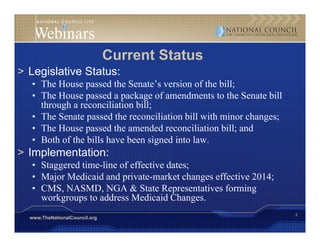
Current Status
> Legislative Status:
    g
  • The House passed the Senate’s version of the bill;
  • The House passed a package of amendments to the Senate bill
    through a reconciliation bill;
  • The Senate passed the reconciliation bill with minor changes;
  • The House passed the amended reconciliation bill; and
  • Both of the bills have been signed into law.
                                            law
> Implementation:
  • Staggered time-line of effective dates;
  • Major Medicaid and private-market changes effective 2014;
  • CMS, NASMD, NGA & State Representatives forming
    workgroups to address Medicaid Changes.
         g p                                g
                                                                    2
  www.TheNationalCouncil.org
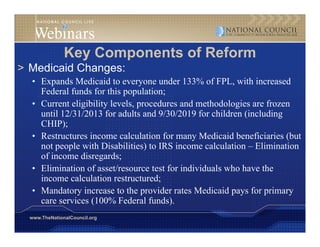
Key Components of Reform
> Medicaid Changes:
  • Expands Medicaid to everyone under 133% of FPL, with increased
    Federal funds for this population;
  • Current eligibility levels, p
               g      y       , procedures and methodologies are frozen
                                                         g
    until 12/31/2013 for adults and 9/30/2019 for children (including
    CHIP);
  • Restructures income calculation for many Medicaid beneficiaries (but
                                              y                       (
    not people with Disabilities) to IRS income calculation – Elimination
    of income disregards;
  • Elimination of asset/resource test for individuals who have the
    income calculation restructured;
  • Mandatory increase to the provider rates Medicaid pays for primary
    care services (100% Federal funds).
                                   funds)
  www.TheNationalCouncil.org
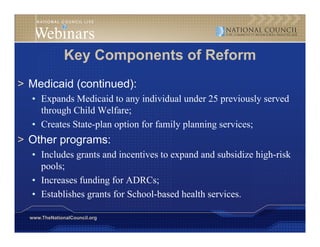
Key Components of Reform
> Medicaid (continued):
  • Expands Medicaid to any individual under 25 previously served
    through Child Welfare;
    th    h       W lf
  • Creates State-plan option for family planning services;
> Other programs:
  • Includes grants and incentives to expand and subsidize high-risk
    p
    pools;
         ;
  • Increases funding for ADRCs;
  • Establishes grants for School-based health services.

  www.TheNationalCouncil.org
Key Components of Reform
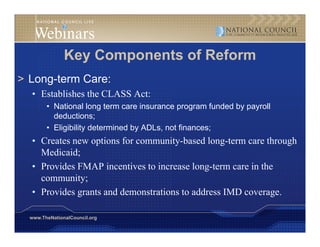
> Long term Care
  Long-term Care:
  • Establishes the CLASS Act:
        • National long term care insurance program funded by payroll
          deductions;
        • Eligibility determined by ADLs, not finances;
  • C t new options for community-based l
    Creates        ti   f           it b d long-term care through
                                                   t         th h
    Medicaid;
  • Provides FMAP incentives to increase long-term care in the
                                             g
    community;
  • Provides grants and demonstrations to address IMD coverage.

  www.TheNationalCouncil.org
Key Components of the Bill(s)

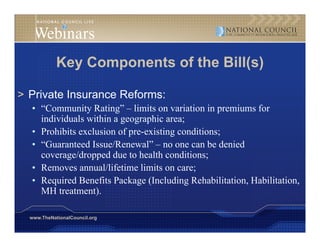
> Private Insurance Reforms:
  • “Community Rating – limits on variation in premiums for
     Community Rating”
    individuals within a geographic area;
  • Prohibits exclusion of pre-existing conditions;
  • “Guaranteed Issue/Renewal” – no one can be denied
    coverage/dropped due to health conditions;
  • Removes annual/lifetime limits on care;
  • Required Benefits Package (Including Rehabilitation, Habilitation,
    MH treatment).

  www.TheNationalCouncil.org
Key Components of th Bill( )
            K C         t f the Bill(s)
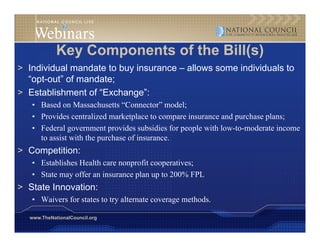
> Individual mandate to buy insurance – allows some individuals to
  “opt-out” f
  “ t t” of mandate;
                 d t
> Establishment of “Exchange”:
   • Based on Massachusetts “Connector” model;  ;
   • Provides centralized marketplace to compare insurance and purchase plans;
   • Federal government provides subsidies for people with low-to-moderate income
     to assist with the purchase of insurance.
                                    insurance
> Competition:
   • Establishes Health care nonprofit cooperatives;
   • State may offer an insurance plan up to 200% FPL
> State Innovation:
   • Waivers for states to try alternate coverage methods.

  www.TheNationalCouncil.org
Potential Impact to State Programs
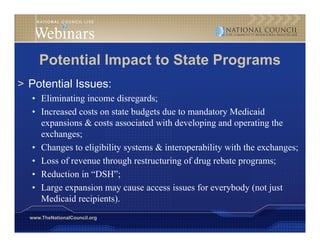
> Potential Issues:
  • Eliminating income disregards;
  • Increased costs on state budgets due to mandatory Medicaid
    expansions & costs associated with developing and operating the
    exchanges;
  • Changes to eligibility systems & interoperability with the exchanges;
  • Loss of revenue through restructuring of drug rebate programs;
  • Reduction in “DSH”;
  • Large expansion may cause access issues for everybody (not just
    Medicaid recipients).
  www.TheNationalCouncil.org
Potential Impact to State Programs
> Potential Positive Changes:
  • Greater availability of insurance in the private sector;
  • Broader range of services available through private insurance
    plans;
  • N preexisting condition exclusion, denial of coverage or
    No       i ti       diti      l i d i l f
    termination of coverage;
  • CLASS act – LTC without Medicaid funding;     g;
  • New Medicaid coverage for low-income people – including
    individuals currently served in some State-only programs.

  www.TheNationalCouncil.org
Future Considerations
> State Budget issues:
  • 48 states experiencing budget shortfalls;
  • Increased Federal Funds (FMAP) expire 1/1/2011;
  • Bills containing extensions to FMAP increase have passed both the
                   g
    Senate & House, but have not been reconciled;
  • Loss of FMAP would lead to significant rate cuts & service
    reductions.
    reductions For more information on proposed cuts:
    http://www.aphsa.org/Home/Doc/WhitePaperFMAP.pdf


  www.TheNationalCouncil.org
For More Information:

                 Ann Kohler, Director of Health Services
        National Association of S
        N i    lA     i i     f State M di id Di
                                      Medicaid Directors
          American Public Human Services Association
                                 Ann.Kohler@aphsa.org
                                          202.682.0100
                                                Ext. 299


www.TheNationalCouncil.org
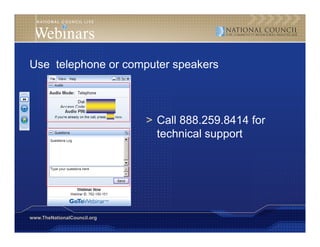
Use telephone or computer speakers


                             > Call 888.259.8414 for
                               technical support
                                           pp


www.TheNationalCouncil.org
Webinar
   Recordings/Presentations
           g

   Available 48 hours AFTER the live event at
   www.TheNationalCouncil.org

   (Click on Resources & Services and then on
     National Council Webinars and Recordings and
     Presentations)


                                                    13
www.TheNationalCouncil.org
National Council Membership

   > Are you making the most of your National
     Council membership?
     www.TheNationalCouncil.org/cs/member_be
     nefits
   > Not yet a member? Join today!
     Email Membership@thenationalcouncil.org or
     call 202.684.7472

                                                  14
www.TheNationalCouncil.org
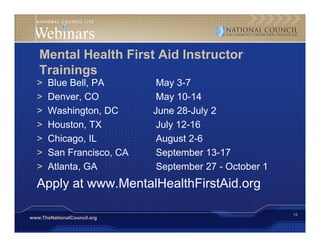
Mental Health First Aid Instructor
          g
   Trainings
  >    Blue Bell, PA          May 3-7
  >    Denver, CO             May 10-14
  >    Washington, DC
       W hi t                June 28 J l 2
                             J     28-July
  >    Houston, TX            July 12-16
  >    Chicago,
       Chicago IL             August 2-6
  >    San Francisco, CA      September 13-17
  >    Atlanta, GA
              ,               September 27 - October 1
                                 p
  Apply at www.MentalHealthFirstAid.org

                                                         15
www.TheNationalCouncil.org
National Council JOBank
  > Recruit top-notch mental health
    and addictions executive,
    administrative, policy, clinical,
     d i i t ti       li     li i l
    and direct care staff
  > P t openings and b
    Post      i       d browse j bjobs


www.TheNationalCouncil.org
National Council E-Learning
> 400+ courses for CE credits
> Special price for organizations with
  60 or fewer employees
                  p y
> Helping you meet compliance,
  licensing, and insurance requirements
Partnership with Essential Learning


www.TheNationalCouncil.org
> April 21: Geoffrey Canada on
          Weaving a Community Safety Net
          > April 27: National Council Client
          Engagement and Retention Best
          Practice Findings
           > May 18 Cli i l Feedback Tool
                   18: Clinical  db k       l


www.TheNationalCouncil.org

Nc live 6 8-2010 kohler presentation [compatibility mode]

  • 1.
    Health Reform Ann Kohler Director of Health Services National Association of State Medicaid Directors American Public Human Services Association June 8, 2010 www.TheNationalCouncil.org
  • 2.
    Current Status > LegislativeStatus: g • The House passed the Senate’s version of the bill; • The House passed a package of amendments to the Senate bill through a reconciliation bill; • The Senate passed the reconciliation bill with minor changes; • The House passed the amended reconciliation bill; and • Both of the bills have been signed into law. law > Implementation: • Staggered time-line of effective dates; • Major Medicaid and private-market changes effective 2014; • CMS, NASMD, NGA & State Representatives forming workgroups to address Medicaid Changes. g p g 2 www.TheNationalCouncil.org
  • 3.
    Key Components ofReform > Medicaid Changes: • Expands Medicaid to everyone under 133% of FPL, with increased Federal funds for this population; • Current eligibility levels, p g y , procedures and methodologies are frozen g until 12/31/2013 for adults and 9/30/2019 for children (including CHIP); • Restructures income calculation for many Medicaid beneficiaries (but y ( not people with Disabilities) to IRS income calculation – Elimination of income disregards; • Elimination of asset/resource test for individuals who have the income calculation restructured; • Mandatory increase to the provider rates Medicaid pays for primary care services (100% Federal funds). funds) www.TheNationalCouncil.org
  • 4.
    Key Components ofReform > Medicaid (continued): • Expands Medicaid to any individual under 25 previously served through Child Welfare; th h W lf • Creates State-plan option for family planning services; > Other programs: • Includes grants and incentives to expand and subsidize high-risk p pools; ; • Increases funding for ADRCs; • Establishes grants for School-based health services. www.TheNationalCouncil.org
  • 5.
    Key Components ofReform > Long term Care Long-term Care: • Establishes the CLASS Act: • National long term care insurance program funded by payroll deductions; • Eligibility determined by ADLs, not finances; • C t new options for community-based l Creates ti f it b d long-term care through t th h Medicaid; • Provides FMAP incentives to increase long-term care in the g community; • Provides grants and demonstrations to address IMD coverage. www.TheNationalCouncil.org
  • 6.
    Key Components ofthe Bill(s) > Private Insurance Reforms: • “Community Rating – limits on variation in premiums for Community Rating” individuals within a geographic area; • Prohibits exclusion of pre-existing conditions; • “Guaranteed Issue/Renewal” – no one can be denied coverage/dropped due to health conditions; • Removes annual/lifetime limits on care; • Required Benefits Package (Including Rehabilitation, Habilitation, MH treatment). www.TheNationalCouncil.org
  • 7.
    Key Components ofth Bill( ) K C t f the Bill(s) > Individual mandate to buy insurance – allows some individuals to “opt-out” f “ t t” of mandate; d t > Establishment of “Exchange”: • Based on Massachusetts “Connector” model; ; • Provides centralized marketplace to compare insurance and purchase plans; • Federal government provides subsidies for people with low-to-moderate income to assist with the purchase of insurance. insurance > Competition: • Establishes Health care nonprofit cooperatives; • State may offer an insurance plan up to 200% FPL > State Innovation: • Waivers for states to try alternate coverage methods. www.TheNationalCouncil.org
  • 8.
    Potential Impact toState Programs > Potential Issues: • Eliminating income disregards; • Increased costs on state budgets due to mandatory Medicaid expansions & costs associated with developing and operating the exchanges; • Changes to eligibility systems & interoperability with the exchanges; • Loss of revenue through restructuring of drug rebate programs; • Reduction in “DSH”; • Large expansion may cause access issues for everybody (not just Medicaid recipients). www.TheNationalCouncil.org
  • 9.
    Potential Impact toState Programs > Potential Positive Changes: • Greater availability of insurance in the private sector; • Broader range of services available through private insurance plans; • N preexisting condition exclusion, denial of coverage or No i ti diti l i d i l f termination of coverage; • CLASS act – LTC without Medicaid funding; g; • New Medicaid coverage for low-income people – including individuals currently served in some State-only programs. www.TheNationalCouncil.org
  • 10.
    Future Considerations > StateBudget issues: • 48 states experiencing budget shortfalls; • Increased Federal Funds (FMAP) expire 1/1/2011; • Bills containing extensions to FMAP increase have passed both the g Senate & House, but have not been reconciled; • Loss of FMAP would lead to significant rate cuts & service reductions. reductions For more information on proposed cuts: http://www.aphsa.org/Home/Doc/WhitePaperFMAP.pdf www.TheNationalCouncil.org
  • 11.
    For More Information: Ann Kohler, Director of Health Services National Association of S N i lA i i f State M di id Di Medicaid Directors American Public Human Services Association Ann.Kohler@aphsa.org 202.682.0100 Ext. 299 www.TheNationalCouncil.org
  • 12.
    Use telephone orcomputer speakers > Call 888.259.8414 for technical support pp www.TheNationalCouncil.org
  • 13.
    Webinar Recordings/Presentations g Available 48 hours AFTER the live event at www.TheNationalCouncil.org (Click on Resources & Services and then on National Council Webinars and Recordings and Presentations) 13 www.TheNationalCouncil.org
  • 14.
    National Council Membership > Are you making the most of your National Council membership? www.TheNationalCouncil.org/cs/member_be nefits > Not yet a member? Join today! Email Membership@thenationalcouncil.org or call 202.684.7472 14 www.TheNationalCouncil.org
  • 15.
    Mental Health FirstAid Instructor g Trainings > Blue Bell, PA May 3-7 > Denver, CO May 10-14 > Washington, DC W hi t June 28 J l 2 J 28-July > Houston, TX July 12-16 > Chicago, Chicago IL August 2-6 > San Francisco, CA September 13-17 > Atlanta, GA , September 27 - October 1 p Apply at www.MentalHealthFirstAid.org 15 www.TheNationalCouncil.org
  • 16.
  • 17.
    National Council JOBank > Recruit top-notch mental health and addictions executive, administrative, policy, clinical, d i i t ti li li i l and direct care staff > P t openings and b Post i d browse j bjobs www.TheNationalCouncil.org
  • 18.
    National Council E-Learning >400+ courses for CE credits > Special price for organizations with 60 or fewer employees p y > Helping you meet compliance, licensing, and insurance requirements Partnership with Essential Learning www.TheNationalCouncil.org
  • 19.
  • 20.
    > April 21:Geoffrey Canada on Weaving a Community Safety Net > April 27: National Council Client Engagement and Retention Best Practice Findings > May 18 Cli i l Feedback Tool 18: Clinical db k l www.TheNationalCouncil.org