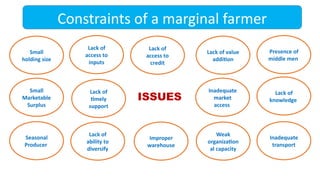
Constraints of amarginal farmer
Small
holding size
Lack of
timely
support
Seasonal
Producer
Weak
organization
al capacity
Lack of
access to
credit
Inadequate
market
access
Presence of
middle men
Small
Marketable
Surplus
Lack of
knowledge
Lack of
access to
inputs
Improper
warehouse
Lack of value
addition
Inadequate
transport
Lack of
ability to
diversify
ISSUES
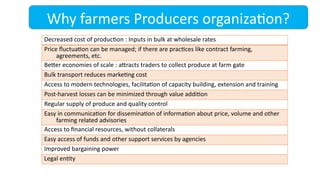
Why farmers Producersorganization?
Decreased cost of production : Inputs in bulk at wholesale rates
Price fluctuation can be managed; if there are practices like contract farming,
agreements, etc.
Better economies of scale : attracts traders to collect produce at farm gate
Bulk transport reduces marketing cost
Access to modern technologies, facilitation of capacity building, extension and training
Post-harvest losses can be minimized through value addition
Regular supply of produce and quality control
Easy in communication for dissemination of information about price, volume and other
farming related advisories
Access to financial resources, without collaterals
Easy access of funds and other support services by agencies
Improved bargaining power
Legal entity
6.
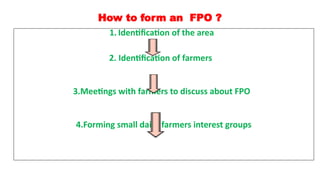
How to forman FPO ?
1. Identification of the area
2. Identification of farmers
3.Meetings with farmers to discuss about FPO
4.Forming small dairy farmers interest groups
7.
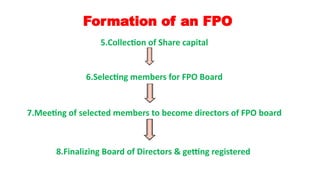
Formation of anFPO
5.Collection of Share capital
6.Selecting members for FPO Board
7.Meeting of selected members to become directors of FPO board
8.Finalizing Board of Directors & getting registered
8.
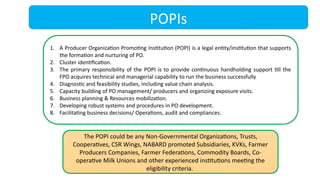
POPIs
1. A ProducerOrganization Promoting Institution (POPI) is a legal entity/institution that supports
the formation and nurturing of PO.
2. Cluster identification.
3. The primary responsibility of the POPI is to provide continuous handholding support till the
FPO acquires technical and managerial capability to run the business successfully
4. Diagnostic and feasibility studies, including value chain analysis.
5. Capacity building of PO management/ producers and organizing exposure visits.
6. Business planning & Resources mobilization.
7. Developing robust systems and procedures in PO development.
8. Facilitating business decisions/ Operations, audit and compliances.
The POPI could be any Non-Governmental Organizations, Trusts,
Cooperatives, CSR Wings, NABARD promoted Subsidiaries, KVKs, Farmer
Producers Companies, Farmer Federations, Commodity Boards, Co-
operative Milk Unions and other experienced institutions meeting the
eligibility criteria.
9.
Registration of PO
Cooperative
SocietiesAct/
Autonomous or
Mutually Aided
Cooperative
Societies Act of
the UT
PC under
Section 581 of
Indian
Companies Act,
1956 (Amended
2013)
10.
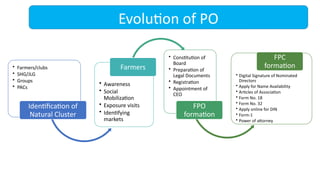
• Farmers/clubs
• SHG/JLG
•Groups
• PACs
Identification of
Natural Cluster
• Awareness
• Social
Mobilization
• Exposure visits
• Identifying
markets
Farmers
• Constitution of
Board
• Preparation of
Legal Documents
• Registration
• Appointment of
CEO
FPO
formation
• Digital Signature of Nominated
Directors
• Apply for Name Availability
• Articles of Association
• Form No. 18
• Form No. 32
• Apply online for DIN
• Form-1
• Power of attorney
FPC
formation
Evolution of PO
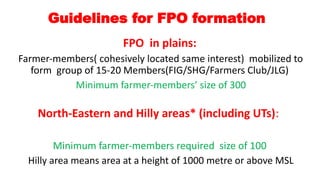
Guidelines for FPOformation
FPO in plains:
Farmer-members( cohesively located same interest) mobilized to
form group of 15-20 Members(FIG/SHG/Farmers Club/JLG)
Minimum farmer-members’ size of 300
North-Eastern and Hilly areas* (including UTs):
Minimum farmer-members required size of 100
Hilly area means area at a height of 1000 metre or above MSL
13.
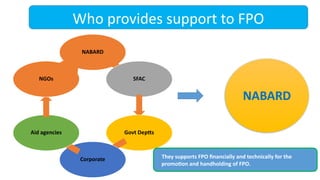
Who provides supportto FPO
NABARD
SFAC
Govt Deptts
Corporate
Aid agencies
NGOs
They supports FPO financially and technically for the
promotion and handholding of FPO.
NABARD
14.
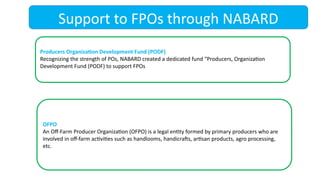
Support to FPOsthrough NABARD
Producers Organization Development Fund (PODF)
Recognizing the strength of POs, NABARD created a dedicated fund “Producers, Organization
Development Fund (PODF) to support FPOs
OFPO
An Off-Farm Producer Organization (OFPO) is a legal entity formed by primary producers who are
involved in off-farm activities such as handlooms, handicrafts, artisan products, agro processing,
etc.
15.
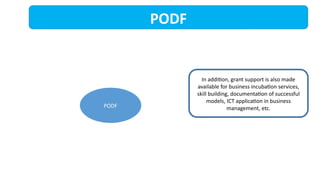
PODF
PODF
In addition, grantsupport is also made
available for business incubation services,
skill building, documentation of successful
models, ICT application in business
management, etc.
16.
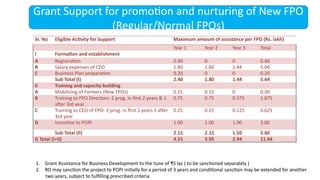
Sr. No EligibleActivity for Support Maximum amount of assistance per FPO (Rs. lakh)
Year 1 Year 2 Year 3 Total
I Formation and establishment
A Registration 0.40 0 0 0.40
B Salary expenses of CEO 1.80 1.80 1.44 5.04
C Business Plan preparation 0.20 0 0 0.20
Sub Total (I) 2.40 1.80 1.44 5.64
II Training and capacity building
A Mobilizing of Farmers (New FPOs) 0.15 0.15 0 0.30
B Training to FPO Directors- 2 prog. in first 2 years & 1
after 3rd year
0.75 0.75 0.375 1.875
C Training to CEO of FPO- 2 prog. in first 2 years 1 after
3rd year
0.25 0.25 0.125 0.625
D Incentive to POPI 1.00 1.00 1.00 3.00
Sub Total (II) 2.15 2.15 1.50 5.80
G Total (I+II) 4.55 3.95 2.94 11.44
1. Grant Assistance for Business Development to the tune of ₹5 lac ( to be sanctioned separately )
2. RO may sanction the project to POPI initially for a period of 3 years and conditional sanction may be extended for another
two years, subject to fulfilling prescribed criteria
Grant Support for promotion and nurturing of New FPO
(Regular/Normal FPOs)
17.
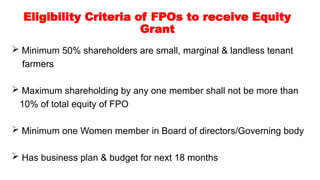
Eligibility Criteria ofFPOs to receive Equity
Grant
Minimum 50% shareholders are small, marginal & landless tenant
farmers
Maximum shareholding by any one member shall not be more than
10% of total equity of FPO
Minimum one Women member in Board of directors/Governing body
Has business plan & budget for next 18 months
18.
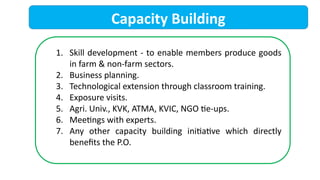
Capacity Building
1. Skilldevelopment - to enable members produce goods
in farm & non-farm sectors.
2. Business planning.
3. Technological extension through classroom training.
4. Exposure visits.
5. Agri. Univ., KVK, ATMA, KVIC, NGO tie-ups.
6. Meetings with experts.
7. Any other capacity building initiative which directly
benefits the P.O.
19.
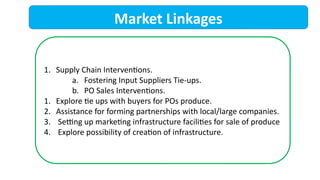
Market Linkages
1. SupplyChain Interventions.
a. Fostering Input Suppliers Tie-ups.
b. PO Sales Interventions.
1. Explore tie ups with buyers for POs produce.
2. Assistance for forming partnerships with local/large companies.
3. Setting up marketing infrastructure facilities for sale of produce
4. Explore possibility of creation of infrastructure.
20.
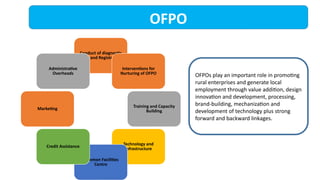
OFPO
Conduct of diagnostic
studyand Registration
Interventions for
Nurturing of OFPO
Training and Capacity
Building
Technology and
Infrastructure
Common Facilities
Centre
Credit Assistance
Marketing
Administrative
Overheads OFPOs play an important role in promoting
rural enterprises and generate local
employment through value addition, design
innovation and development, processing,
brand-building, mechanization and
development of technology plus strong
forward and backward linkages.
21.
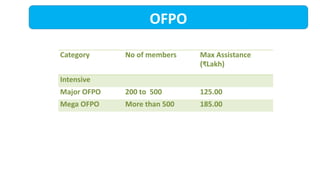
OFPO
Category No ofmembers Max Assistance
(₹Lakh)
Intensive
Major OFPO 200 to 500 125.00
Mega OFPO More than 500 185.00
22.
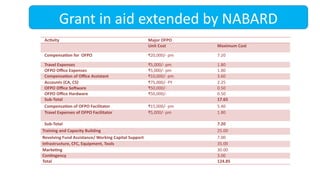
Grant in aidextended by NABARD
Activity Major OFPO
Unit Cost Maximum Cost
Compensation for OFPO ₹20,000/- pm 7.20
Travel Expenses ₹5,000/- pm 1.80
OFPO Office Expenses ₹5,000/- pm 1.80
Compensation of Office Assistant ₹10,000/- pm 3.60
Accounts (CA, CS) ₹75,000/- PY 2.25
OFPO Office Software ₹50,000/- 0.50
OFPO Office Hardware ₹50,000/- 0.50
Sub-Total 17.65
Compensation of OFPO Facilitator ₹15,000/- pm 5.40
Travel Expenses of OFPO Facilitator ₹5,000/- pm 1.80
Sub-Total 7.20
Training and Capacity Building 25.00
Revolving Fund Assistance/ Working Capital Support 7.00
Infrastructure, CFC, Equipment, Tools 35.00
Marketing 30.00
Contingency 3.00
Total 124.85





![Presentation for FPO by Sikander Zulkarnain [Autosaved].pdf](https://cdn.slidesharecdn.com/ss_thumbnails/bird-presentationforfpobysikanderzulkarnainautosaved-250930192642-8242f93b-thumbnail.jpg?width=640&height=640&fit=bounds)


