How big isa cell?
• http://www.cellsalive.com/howbig.htm
3.
The Cell Theory
TheCell Theory
1. All organisms are made of cells.
2. The cell is the basic unit of life in all
living things.
3. All cells come from existing cells.
THIS IS IMPORTANT BECAUSE IT SHOWS THAT
ALL LIVING THINGS SHARE A SIMILAR
STRUCTURE
4.
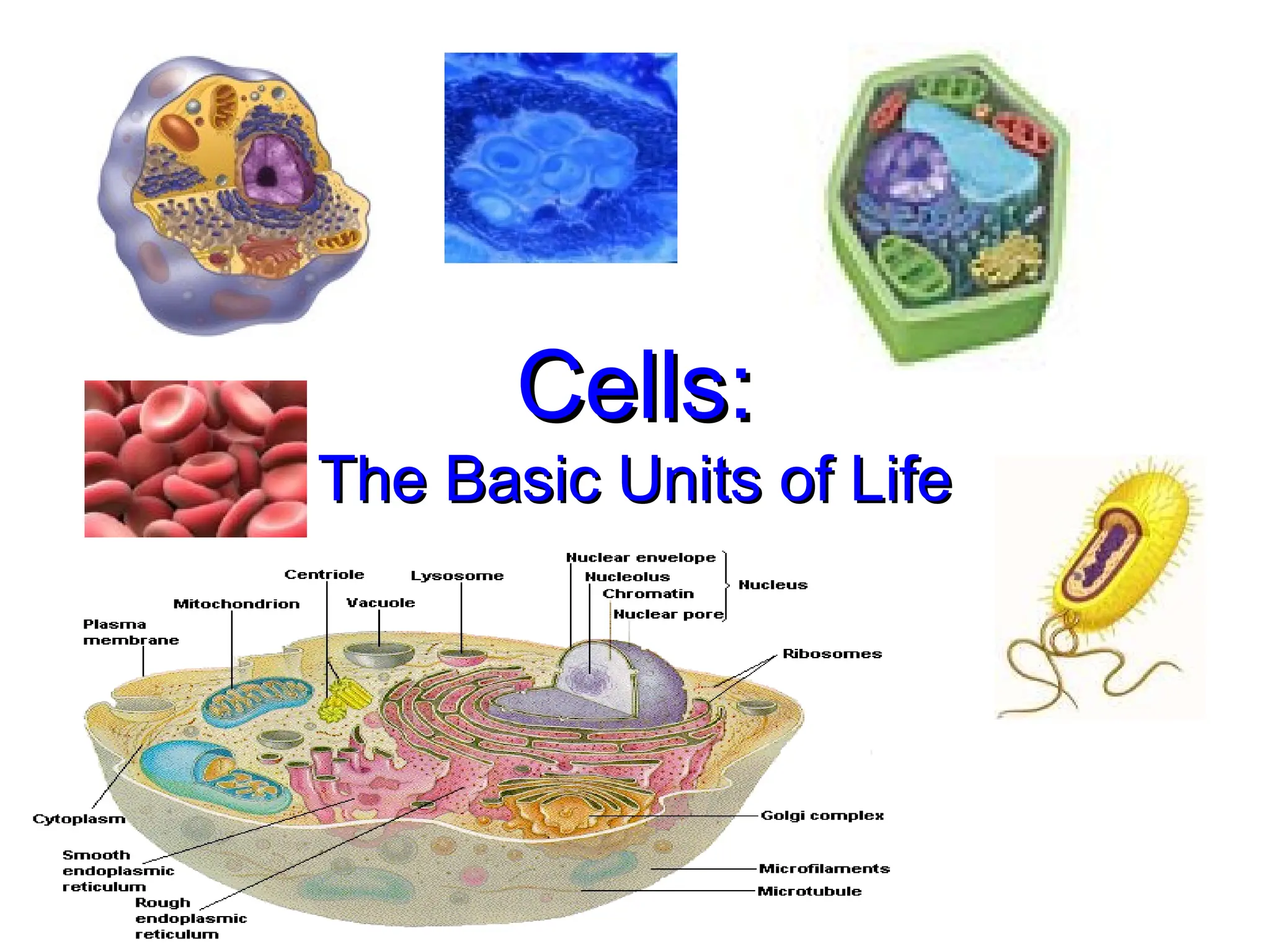
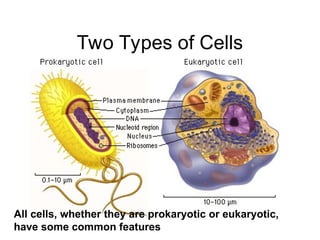
Two Types ofCells
All cells, whether they are prokaryotic or eukaryotic,
have some common features
Two Types ofCells
Two Types of Cells
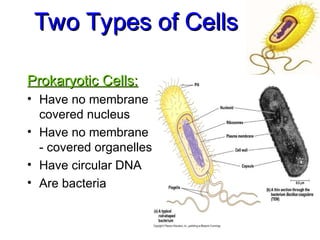
Prokaryotic Cells:
Prokaryotic Cells:
• Have no membrane
covered nucleus
• Have no membrane
- covered organelles
• Have circular DNA
• Are bacteria
7.
Two Types ofCells
Two Types of Cells
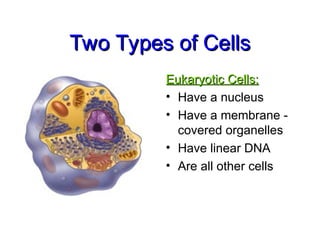
Eukaryotic Cells:
Eukaryotic Cells:
• Have a nucleus
• Have a membrane -
covered organelles
• Have linear DNA
• Are all other cells
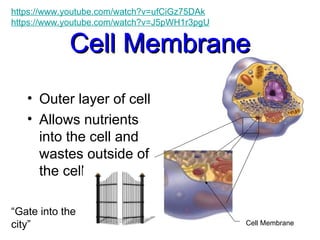
Cell Membrane
Cell Membrane
•Outer layer of cell
• Allows nutrients
into the cell and
wastes outside of
the cell
Cell Membrane
“Gate into the
city”
https://www.youtube.com/watch?v=ufCiGz75DAk
https://www.youtube.com/watch?v=J5pWH1r3pgU
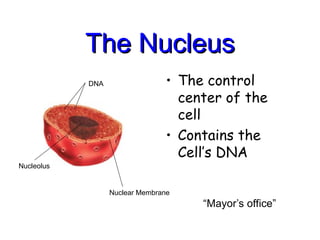
The Nucleus
The Nucleus
•The control
center of the
cell
• Contains the
Cell’s DNA
DNA
Nuclear Membrane
Nucleolus
“Mayor’s office”
12.
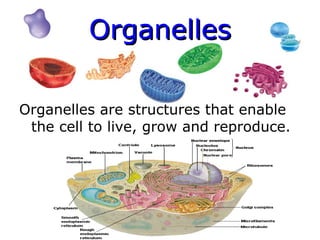
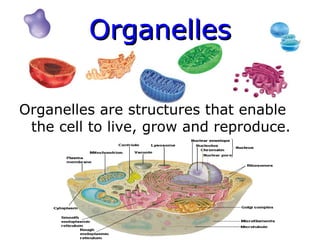
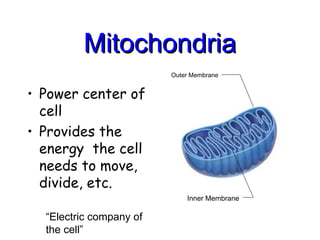
Mitochondria
Mitochondria
• Power centerof
cell
• Provides the
energy the cell
needs to move,
divide, etc.
Outer Membrane
Inner Membrane
“Electric company of
the cell”
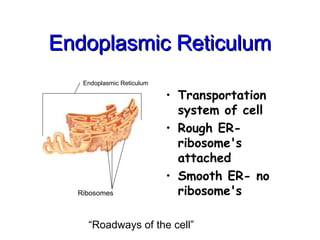
Endoplasmic Reticulum
Endoplasmic Reticulum
•Transportation
system of cell
• Rough ER-
ribosome's
attached
• Smooth ER- no
ribosome's
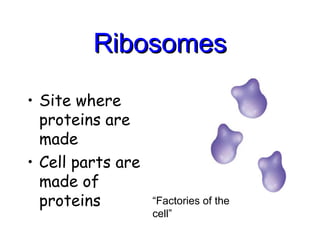
Ribosomes
Endoplasmic Reticulum
“Roadways of the cell”
15.
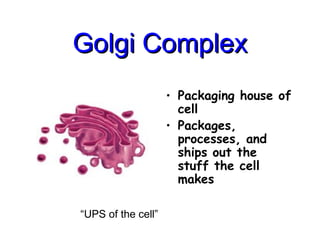
Golgi Complex
Golgi Complex
•Packaging house of
cell
• Packages,
processes, and
ships out the
stuff the cell
makes
“UPS of the cell”
Plant or AnimalCell?
Plant or Animal Cell?
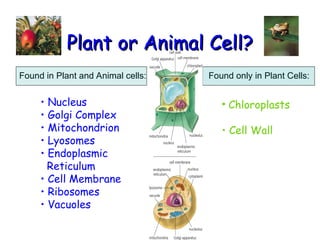
Found in Plant and Animal cells: Found only in Plant Cells:
• Nucleus
• Golgi Complex
• Mitochondrion
• Lyosomes
• Endoplasmic
Reticulum
• Cell Membrane
• Ribosomes
• Vacuoles
• Chloroplasts
• Cell Wall
Editor's Notes
#1 In 1665 Robert Hooke looked at a thin slice of cork and he saw that the cork looked like little boxes. So he called them cells.
The word “cell” in Latin means “Little rooms.”
#3 Matthias Schleiden (German Scientist) conclude that all plant parts are made of cells.
Theodor Schwann also a German Scientist concluded that all animal parts are made of cells.
Because of his knowledge of Schleiden’s theory, Schwann wrote the first two parts of the cell theory which are stated in the slide.
About 20 years later another scientist, Rudolf Virchow, discovered that cells couldn’t develop from anything but other cells.
Students should write this down on their worksheets.
#5 Read from the slide, tell students that all cells have organelles, however not all cells have membrane covered organelles.
#6 These types of cells have no membrane covered nucleus.
They are bacteria cells.
Ask students if they think that all bacteria is bad:
Explain to them that not all bacteria is bad, that there is good bacteria.
It is in food, like yogurt, cheese and some other dairy products.
It is used in medicine as Antibiotics.
Some bacteria can live in extreme conditions, such as:
- In the crust of the ocean ridges, where hot gases are leaking out constantly.
- In the very bottom of the sea, where the pressure is so great that it would crush any other living thing and the temperature is very low.
Have students fill out Prokaryotic worksheet portion.
#7 More complex than bacteria cells
They make up anything that is living, such as:
- Plants
- Animals
- Fungi
- Protists
Anything but bacteria
Some have a cell wall and some do not.
Have students complete the eukaryotic part of the worksheet.
#8 Read from the slide, tell students that all cells have organelles, however not all cells have membrane covered organelles.
#11 Could be considered the library of the cell.
It contains all of the genetic materials used by the cell like DNA and info on how to make all of the cell’s proteins.
The nucleolus in the nucleus stores materials that will be used to make ribosomes and cytoplasm.
#12 Mitochondria is considered the power plant of the cell.
They must have oxygen to make ATP(which is the cell’s energy) So that is why we need to breath.
For very active cells, there are thousands of mitochondria.
#14 The ER is like the FedEx or UPS of the cell.
Substances move through tubular connections from one place to another.
The ER is responsible for delivering proteins to different parts of the cell.
#15 Remember the lipids and proteins that were being delivered by the ER?
When the Golgi complex or apparatus gets them, they modify and package the proteins and lipids and ship them out of the cell.
IT is called Golgi because it was discovered by an Italian scientist named Camillo Golgi (he was the first to discover the organelle.)
Talk about Vesicles and how they are formed by pinched off ER and Golgi complex.
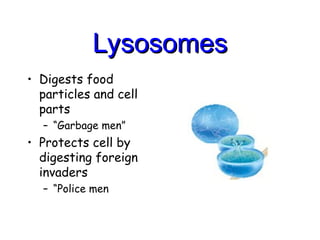
#16 Special vesicles that contain enzymes.
When a cell engulfs a particle, the lyosomes bump into it an pour enzymes into it. Then the particle is digested by the enzymes.
Sometimes lyosomes break open and pour out the enzymes into the cytoplasm. This will kill the cell.
- this is why tadpoles lose their tails
- this is why humans don’t have webbed feet. The lyosomes kill the cells that make up the tails and webbing.
This act is a theory on how we age.
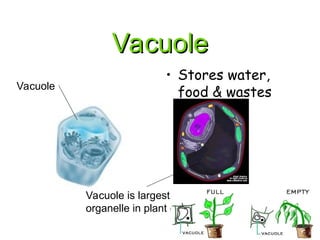
#17 Vacuoles are found only in plants.
Can anyone tell me what happens when you don’t water a plant for a couple of days or week? It goes limp and the leaves droop.
Vacuoles that are full of water and air, support the cell.
When the water and air is lost, the plants go limp. That is why we have to water plants!
The pressure that the water uses to keep the plant up right is called Turger pressure.
Ask students what Trees are made of. What makes them so big? Water and air!
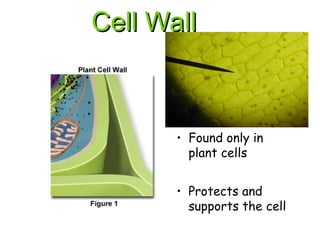
#18 The strength of billions of cell walls ill be able to make a tree stand up tall and bear huge limbs.
Cell walls are made up of a material called cellulose.
Cellulose is a material that is intertwined together. It resembles a blanket or even like hashbrown potatoes all piled up.
When the plant cells are stacked on top of each other and next to each other it looks like building blocks, or for another example, like Tupper ware plastic containers stacked up together.
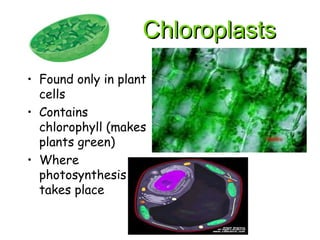
#19 Plant cells need energy too!
Because plant’s don’t ingest food like we do or animals do, they have to make their own food.
Chloroplasts uses the sun’s light energy to make sugar. The sugar is then used by the mitochondria to make energy.
#20 Make sure to write this down on your worksheet.