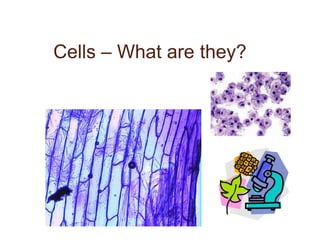
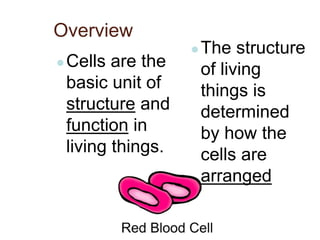
Cells – What are they?
Overview
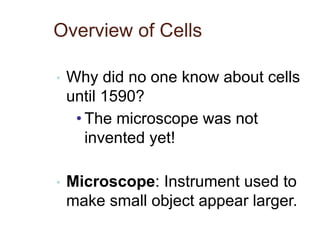
●Cells are the
basic unit of
structure and
function in
living things.
●The structure
of living
things is
determined
by how the
cells are
arranged
Overview of Cells
● Functions that
cells perform in
living things…
◦ Obtain
oxygen
◦ Get rid of
waste
● Your hand is
made up of
more than
100,000 cells.
Why can you
not see them?
● MICROSCOPIC!
Overview of Cells
• Why did no one know about cells
until 1590?
• The microscope was not
invented yet!
• Microscope: Instrument used to
make small object appear larger.
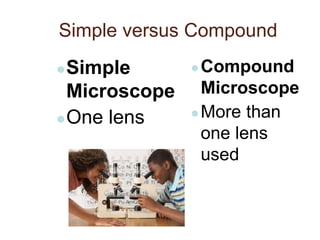
Simple versus Compound
●Simple
Microscope
●One lens
●Compound
Microscope
●More than
one lens
used
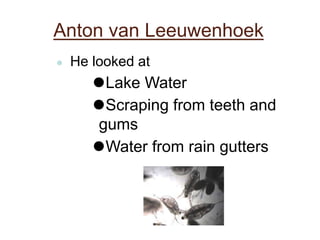
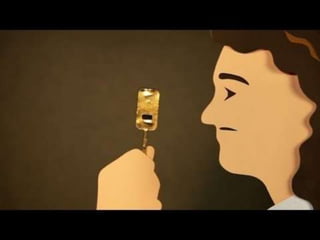
Anton van Leeuwenhoek
● He looked at
⚫Lake Water
⚫Scraping from teeth and
gums
⚫Water from rain gutters
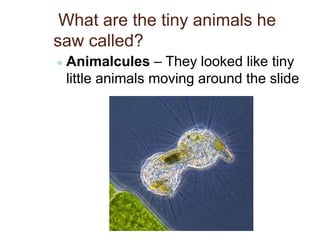
What are the tiny animals he
saw called?
● Animalcules – They looked like tiny
little animals moving around the slide
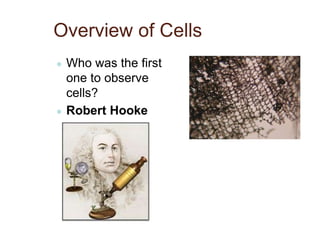
Overview of Cells
● Who was the first
one to observe
cells?
● Robert Hooke
Robert Hooke
●Robert Hooke used the term
“cells” (small rooms) because
he thought they looked like the
small rooms that monks lived
in.
●Like jail cells – small rooms on
top of each other
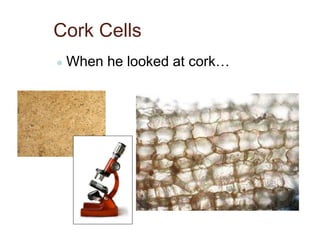
Cork Cells
● When he looked at cork…
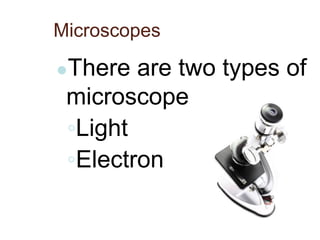
Microscopes
●There are two types of
microscope
◦Light
◦Electron
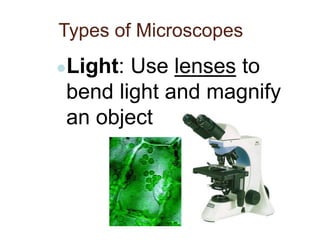
Types of Microscopes
●Light: Use lenses to
bend light and magnify
an object
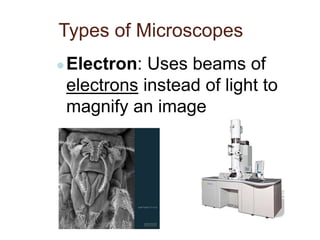
Types of Microscopes
●Electron: Uses beams of
electrons instead of light to
magnify an image
Properties of Microscopes
●Magnification: The process of
enlarging something in
appearance
●Resolution: Ability to
distinguish the individual parts
of a
object
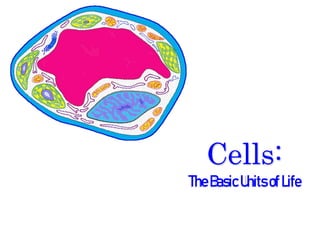
Cells:
TheBasicUnitsofLife
How big is a cell?
• http://www.cellsalive.com/howbig.htm
The Cell Theory
1. All organisms are made of cells.
2. The cell is the basic unit of life in all
living things.
3. All cells come from existing cells.
THIS IS IMPORTANT BECAUSE IT SHOWS THAT
ALL LIVING THINGS SHARE A SIMILAR STRUCTURE
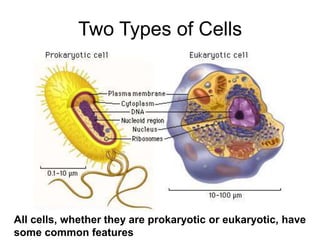
Two Types of Cells
All cells, whether they are prokaryotic or eukaryotic, have
some common features
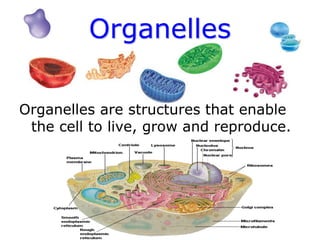
Organelles
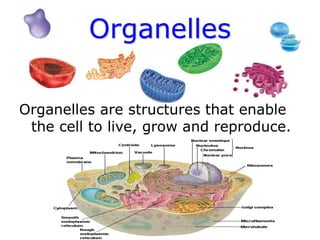
Organelles are structures that enable
the cell to live, grow and reproduce.
Two Types of Cells
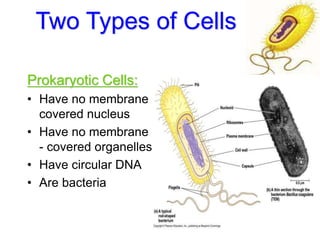
Prokaryotic Cells:
• Have no membrane
covered nucleus
• Have no membrane
- covered organelles
• Have circular DNA
• Are bacteria
Two Types of Cells
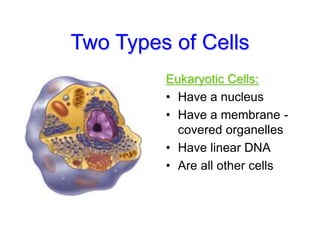
Eukaryotic Cells:
• Have a nucleus
• Have a membrane -
covered organelles
• Have linear DNA
• Are all other cells
Organelles
Organelles are structures that enable
the cell to live, grow and reproduce.
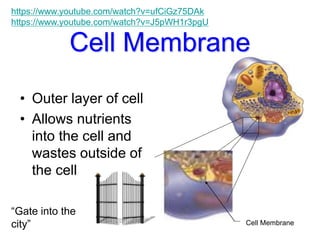
Cell Membrane
• Outer layer of cell
• Allows nutrients
into the cell and
wastes outside of
the cell
Cell Membrane
“Gate into the
city”
https://www.youtube.com/watch?v=ufCiGz75DAk
https://www.youtube.com/watch?v=J5pWH1r3pgU
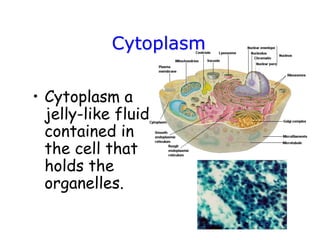
Cytoplasm
• Cytoplasm a
jelly-like fluid
contained in
the cell that
holds the
organelles.
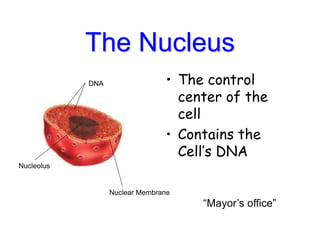
The Nucleus
• The control
center of the
cell
• Contains the
Cell’s DNA
DNA
Nuclear Membrane
Nucleolus
“Mayor’s office”
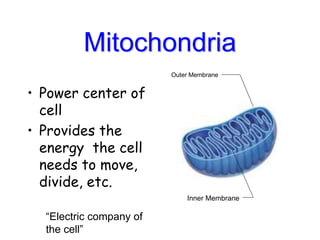
Mitochondria
• Power center of
cell
• Provides the
energy the cell
needs to move,
divide, etc.
Outer Membrane
Inner Membrane
“Electric company of
the cell”
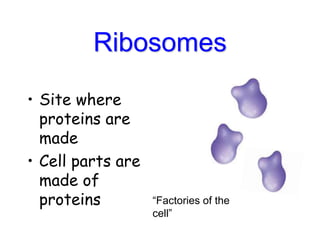
Ribosomes
• Site where
proteins are
made
• Cell parts are
made of
proteins “Factories of the
cell”
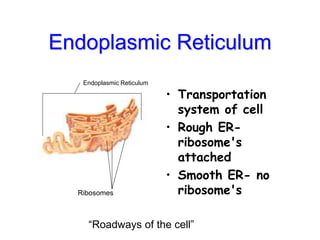
Endoplasmic Reticulum
• Transportation
system of cell
• Rough ER-
ribosome's
attached
• Smooth ER- no
ribosome's
Ribosomes
Endoplasmic Reticulum
“Roadways of the cell”
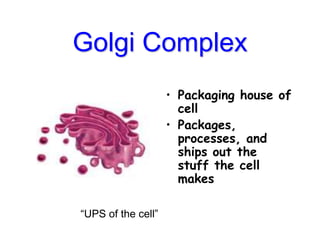
Golgi Complex
• Packaging house of
cell
• Packages,
processes, and
ships out the
stuff the cell
makes
“UPS of the cell”
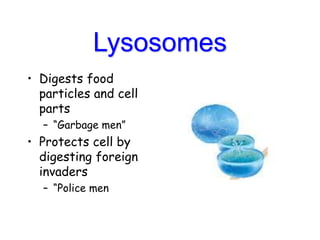
Lysosomes
• Digests food
particles and cell
parts
– “Garbage men”
• Protects cell by
digesting foreign
invaders
– “Police men
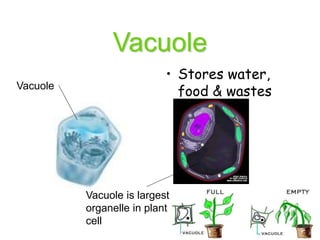
Vacuole
• Stores water,
food & wastes
Vacuole
Vacuole is largest
organelle in plant
cell
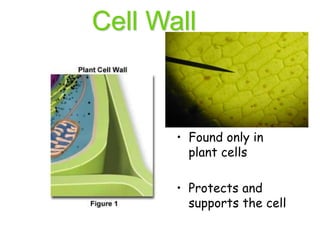
Cell Wall
• Found only in
plant cells
• Protects and
supports the cell
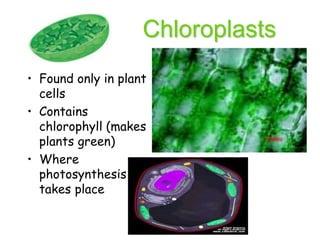
Chloroplasts
• Found only in plant
cells
• Contains
chlorophyll (makes
plants green)
• Where
photosynthesis
takes place
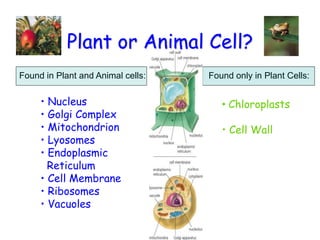
Plant or Animal Cell?
Found in Plant and Animal cells: Found only in Plant Cells:
• Nucleus
• Golgi Complex
• Mitochondrion
• Lyosomes
• Endoplasmic
Reticulum
• Cell Membrane
• Ribosomes
• Vacuoles
• Chloroplasts
• Cell Wall

Cell as basic unit of life.ppt