APPLICATION-DRIVEN
INFRASTRUCTURE
WITH CROSSPLANE
Daniele Monti
➔ GitHub: https://github.com/Monska85
➔ Twitter: @danielemonti
➔ Linkedin: danielemonti1985
Platform Engineer @ SparkFabrik
DEVOPS AND SHIFT LEFT PRINCIPLES
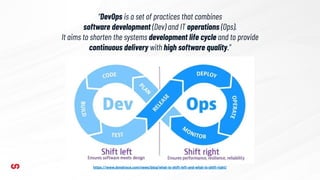
“DevOps is a set of practices that combines
software development (Dev) and IT operations (Ops).
It aims to shorten the systems development life cycle and to provide
continuous delivery with high software quality.”
https://www.dynatrace.com/news/blog/what-is-shift-left-and-what-is-shift-right/
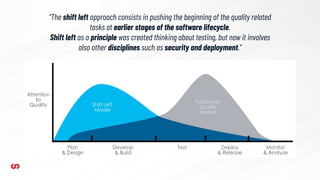
“The shift left approach consists in pushing the beginning of the quality related
tasks at earlier stages of the software lifecycle.
Shift left as a principle was created thinking about testing, but now it involves
also other disciplines such as security and deployment.”
SHIFT LEFT
LIFECYCLE
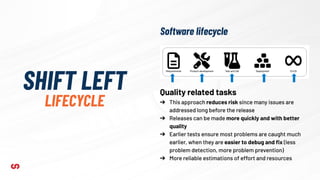
Quality related tasks
➔ This approach reduces risk since many issues are
addressed long before the release
➔ Releases can be made more quickly and with better
quality
➔ Earlier tests ensure most problems are caught much
earlier, when they are easier to debug and fix (less
problem detection, more problem prevention)
➔ More reliable estimations of effort and resources
Software lifecycle
Security concepts must be introduced in the early stages,
so the entire application development workflow will follow
defined security standards.
This prevents code rewritings close to the deployment and
leaves only minor security fixes for the production checks.
SHIFT LEFT
SECURITY
DevSecOps
The supply chain attack is the current challenge in the
security industry. Introducing checks about the third party
software in early stages prevents wrong assumptions on
what our software can include or not.
We can also automate the signing of our artifacts, the
production of signed SBOMs and the execution of SAST
checks to improve our security posture.
SHIFT LEFT
SECURITY
Supply chain
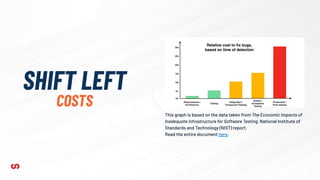
SHIFT LEFT
COSTS
This graph is based on the data taken from The Economic Impacts of
Inadequate Infrastructure for Software Testing, National Institute of
Standards and Technology (NIST) report.
Read the entire document here.
SHIFT RIGHT
COMPLEMENTS
TO SHIFT LEFT
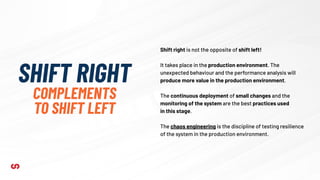
Shift right is not the opposite of shift left!
It takes place in the production environment. The
unexpected behaviour and the performance analysis will
produce more value in the production environment.
The continuous deployment of small changes and the
monitoring of the system are the best practices used
in this stage.
The chaos engineering is the discipline of testing resilience
of the system in the production environment.
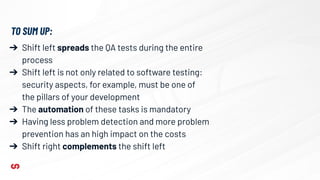
➔ Shift left spreads the QA tests during the entire
process
➔ Shift left is not only related to software testing:
security aspects, for example, must be one of
the pillars of your development
➔ The automation of these tasks is mandatory
➔ Having less problem detection and more problem
prevention has an high impact on the costs
➔ Shift right complements the shift left
TO SUM UP:
YOU BUILD IT, YOU RUN IT.
2006 - Werner Vogels, CTO and vice president of Amazon Web Services
Cloud native
model
“Giving developers operational responsibilities has greatly
enhanced the quality of the services, both from a customer
and a technology point of view.” - A conversation with
Werner Vogels
The old model of throwing the artifact over the wall of
confusion1
and then forgetting about it is no more suitable
in the cloud native model.
1. The “Wall of Confusion” is a DevOps term popularized by Andrew Clay Schafer (AgileRoots 2009 ~17:00
mark) and Lee Thompson (Dev2Ops Interview). It refers to the phenomena where one group in a value
stream approaches their job as complete when they’ve passed it onto the next group.
Ops for Dev
INFRASTRUCTURE AS CODE & PLATFORM ENGINEERING
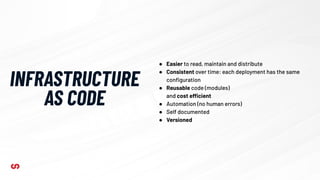
INFRASTRUCTURE
AS CODE
● Easier to read, maintain and distribute
● Consistent over time: each deployment has the same
configuration
● Reusable code (modules)
and cost efficient
● Automation (no human errors)
● Self documented
● Versioned
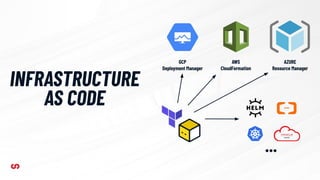
GCP
Deployment Manager
AWS
CloudFormation
AZURE
Resource Manager
...
INFRASTRUCTURE
AS CODE
Foundations guarantee
the highest value to
open source projects
INFRASTRUCTURE
AS CODE
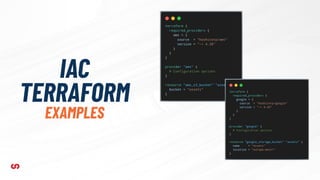
IAC
TERRAFORM
EXAMPLES
IaC & PLATFORM ENGINEERING
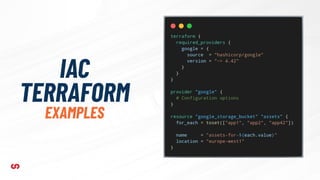
IAC
TERRAFORM
EXAMPLES
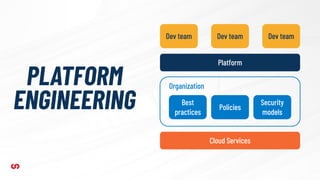
PLATFORM
ENGINEERING
Cloud Services
Organization
Best
practices
Policies
Security
models
Platform
Dev team Dev team
Dev team
THE
PLATFORM The scope of The Platform is to expose a simply way (API) to
obtain a piece of infrastructure or a service encapsulating all
the organization rules.
The Platform offers a simple access to
a complex set of resources.
THE
PLATFORM
INTERACTION MODES
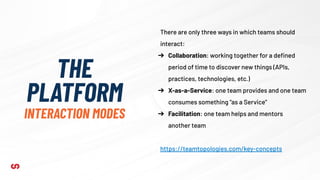
There are only three ways in which teams should
interact:
➔ Collaboration: working together for a defined
period of time to discover new things (APIs,
practices, technologies, etc.)
➔ X-as-a-Service: one team provides and one team
consumes something “as a Service”
➔ Facilitation: one team helps and mentors
another team
https://teamtopologies.com/key-concepts
THE
PLATFORM
API
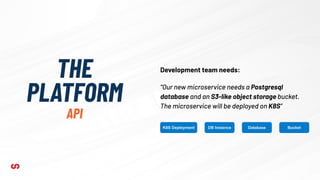
Development team needs:
“Our new microservice needs a Postgresql
database and an S3-like object storage bucket.
The microservice will be deployed on K8S”
K8S Deployment Bucket
DB Instance Database
THE
PLATFORM
API
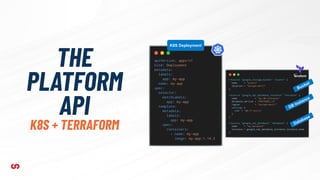
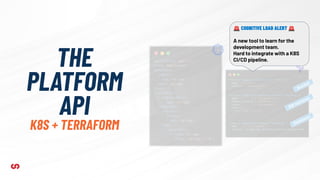
K8S + TERRAFORM
Bucket
DB Instance
Database
K8S Deployment
THE
PLATFORM
API
K8S + TERRAFORM
Bucket
DB Instance
Database
🚨 COGNITIVE LOAD ALERT 🚨
A new tool to learn for the
development team.
Hard to integrate with a K8S
CI/CD pipeline.
THE CLOUD NATIVE CONTROL PLANE FRAMEWORK
THE
PLATFORM
API
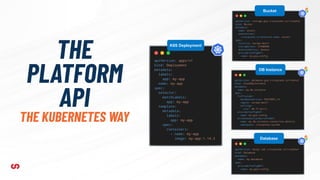
THE KUBERNETES WAY
Bucket
DB Instance
Database
K8S Deployment
Crossplane is an incubating project in the CNCF landscape.
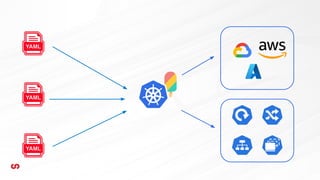
Crossplane enables platform teams to assemble
infrastructure from multiple vendors, and exposes higher
level self-service APIs for application teams to consume,
without having to write any code.
Crossplane extends the Kubernetes cluster to support
orchestrating any infrastructure or managed service.
CROSSPLANE
CNCF PROJECT
Providers are the core concept of Crossplane.
Providers are Crossplane Packages that bundle a set of
Managed Resources and their respective controllers to allow
Crossplane to provision the respective infrastructure
resources.
Each Provider package has its own configuration type, the so
colled ProviderConfig. This resource, for example, is used by
the provider controller to get the API credentials.
CROSSPLANE
PROVIDERS
Managed Resources are the mapping between K8S and the
external services.
A Managed Resource is the Crossplane representation of a
resource in an external system.
Managed Resources are the building blocks of Crossplane.
They are designed to be composed of higher level,
opinionated Custom Resources that Crossplane calls
Composite Resources or XRs.
CROSSPLANE
MANAGED RESOURCES
Crossplane is extensible, thanks to its provider model.
Anything with an API could be connected to a Kubernetes
cluster where Crossplane is running, giving you a CRD
representing each resource.
This model allows Crossplane to manage infrastructure
pieces or services (or whatever) using a specific provider for
those resources.
https://blog.crossplane.io/providers-101-ordering-pizza-wit
h-kubernetes-and-crossplane/ is an awesome example on
how Crossplane could manage any API driven service.
CROSSPLANE
PROVIDER MODEL
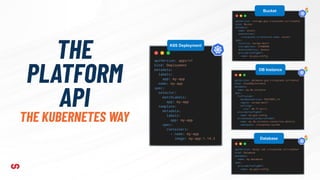
THE
PLATFORM
API
THE KUBERNETES WAY
Bucket
DB Instance
Database
K8S Deployment
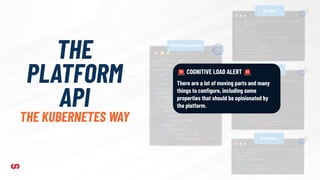
THE
PLATFORM
API
THE KUBERNETES WAY
DB Instance
Database
K8S Deployment
Bucket
🚨 COGNITIVE LOAD ALERT 🚨
There are a lot of moving parts and many
things to configure, including some
properties that should be opinionated by
the platform.
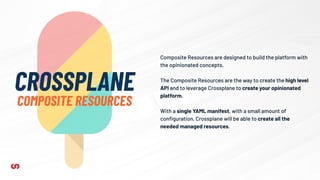
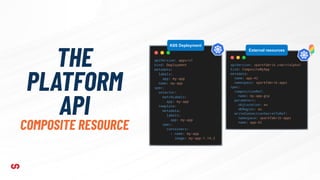
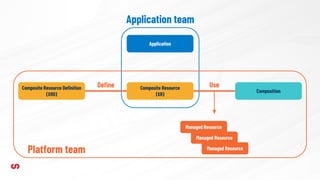
Composite Resources are designed to build the platform with
the opinionated concepts.
The Composite Resources are the way to create the high level
API and to leverage Crossplane to create your opinionated
platform.
With a single YAML manifest, with a small amount of
configuration, Crossplane will be able to create all the
needed managed resources.
CROSSPLANE
COMPOSITE RESOURCES
THE
PLATFORM
API
COMPOSITE RESOURCE
K8S Deployment
External resources
Crossplane uses X as shorthand for Crossplane and
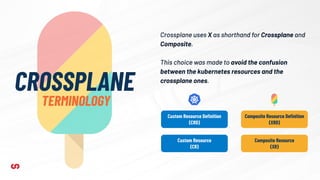
Composite.
This choice was made to avoid the confusion
between the kubernetes resources and the
crossplane ones.
CROSSPLANE
TERMINOLOGY
Custom Resource Definition
(CRD)
Custom Resource
(CR)
Composite Resource Definition
(XRD)
Composite Resource
(XR)
Composite Resource Definition
(XRD)
Composite Resource
(XR)
Define
Composition
Use
Managed Resource
Managed Resource
Managed Resource
Application
Application team
Platform team
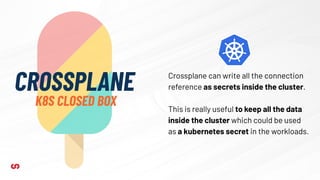
CROSSPLANE
K8S CLOSED BOX
Crossplane can write all the connection
reference as secrets inside the cluster.
This is really useful to keep all the data
inside the cluster which could be used
as a kubernetes secret in the workloads.
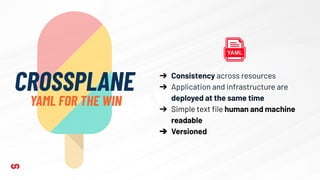
➔ Consistency across resources
➔ Application and infrastructure are
deployed at the same time
➔ Simple text file human and machine
readable
➔ Versioned
CROSSPLANE
YAML FOR THE WIN
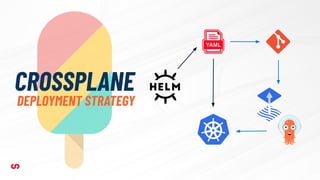
CROSSPLANE
DEPLOYMENT STRATEGY
CROSSPLANE
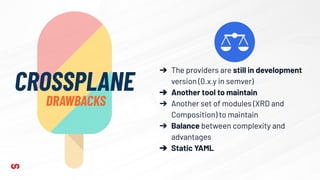
DRAWBACKS
➔ The providers are still in development
version (0.x.y in semver)
➔ Another tool to maintain
➔ Another set of modules (XRD and
Composition) to maintain
➔ Balance between complexity and
advantages
➔ Static YAML
CROSSPLANE
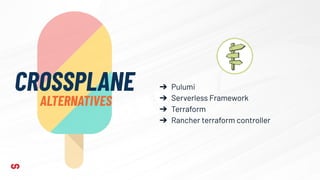
ALTERNATIVES
➔ Pulumi
➔ Serverless Framework
➔ Terraform
➔ Rancher terraform controller
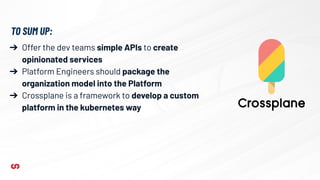
➔ Offer the dev teams simple APIs to create
opinionated services
➔ Platform Engineers should package the
organization model into the Platform
➔ Crossplane is a framework to develop a custom
platform in the kubernetes way
TO SUM UP:
THANK YOU!

20231129 - Platform @ localhost 2023 - Application-driven infrastructure with Crossplane

  • 1.
  • 2.
    Daniele Monti ➔ GitHub:https://github.com/Monska85 ➔ Twitter: @danielemonti ➔ Linkedin: danielemonti1985 Platform Engineer @ SparkFabrik
  • 3.
    DEVOPS AND SHIFTLEFT PRINCIPLES
  • 4.
    “DevOps is aset of practices that combines software development (Dev) and IT operations (Ops). It aims to shorten the systems development life cycle and to provide continuous delivery with high software quality.” https://www.dynatrace.com/news/blog/what-is-shift-left-and-what-is-shift-right/
  • 5.
    “The shift leftapproach consists in pushing the beginning of the quality related tasks at earlier stages of the software lifecycle. Shift left as a principle was created thinking about testing, but now it involves also other disciplines such as security and deployment.”
  • 6.
    SHIFT LEFT LIFECYCLE Quality relatedtasks ➔ This approach reduces risk since many issues are addressed long before the release ➔ Releases can be made more quickly and with better quality ➔ Earlier tests ensure most problems are caught much earlier, when they are easier to debug and fix (less problem detection, more problem prevention) ➔ More reliable estimations of effort and resources Software lifecycle
  • 7.
    Security concepts mustbe introduced in the early stages, so the entire application development workflow will follow defined security standards. This prevents code rewritings close to the deployment and leaves only minor security fixes for the production checks. SHIFT LEFT SECURITY DevSecOps
  • 8.
    The supply chainattack is the current challenge in the security industry. Introducing checks about the third party software in early stages prevents wrong assumptions on what our software can include or not. We can also automate the signing of our artifacts, the production of signed SBOMs and the execution of SAST checks to improve our security posture. SHIFT LEFT SECURITY Supply chain
  • 9.
    SHIFT LEFT COSTS This graphis based on the data taken from The Economic Impacts of Inadequate Infrastructure for Software Testing, National Institute of Standards and Technology (NIST) report. Read the entire document here.
  • 10.
    SHIFT RIGHT COMPLEMENTS TO SHIFTLEFT Shift right is not the opposite of shift left! It takes place in the production environment. The unexpected behaviour and the performance analysis will produce more value in the production environment. The continuous deployment of small changes and the monitoring of the system are the best practices used in this stage. The chaos engineering is the discipline of testing resilience of the system in the production environment.
  • 11.
    ➔ Shift leftspreads the QA tests during the entire process ➔ Shift left is not only related to software testing: security aspects, for example, must be one of the pillars of your development ➔ The automation of these tasks is mandatory ➔ Having less problem detection and more problem prevention has an high impact on the costs ➔ Shift right complements the shift left TO SUM UP:
  • 12.
    YOU BUILD IT,YOU RUN IT. 2006 - Werner Vogels, CTO and vice president of Amazon Web Services
  • 13.
    Cloud native model “Giving developersoperational responsibilities has greatly enhanced the quality of the services, both from a customer and a technology point of view.” - A conversation with Werner Vogels The old model of throwing the artifact over the wall of confusion1 and then forgetting about it is no more suitable in the cloud native model. 1. The “Wall of Confusion” is a DevOps term popularized by Andrew Clay Schafer (AgileRoots 2009 ~17:00 mark) and Lee Thompson (Dev2Ops Interview). It refers to the phenomena where one group in a value stream approaches their job as complete when they’ve passed it onto the next group. Ops for Dev
  • 14.
    INFRASTRUCTURE AS CODE& PLATFORM ENGINEERING
  • 15.
    INFRASTRUCTURE AS CODE ● Easierto read, maintain and distribute ● Consistent over time: each deployment has the same configuration ● Reusable code (modules) and cost efficient ● Automation (no human errors) ● Self documented ● Versioned
  • 16.
  • 17.
    Foundations guarantee the highestvalue to open source projects
  • 18.
  • 19.
  • 20.
    IaC & PLATFORMENGINEERING IAC TERRAFORM EXAMPLES
  • 21.
  • 22.
    THE PLATFORM The scopeof The Platform is to expose a simply way (API) to obtain a piece of infrastructure or a service encapsulating all the organization rules. The Platform offers a simple access to a complex set of resources.
  • 23.
    THE PLATFORM INTERACTION MODES There areonly three ways in which teams should interact: ➔ Collaboration: working together for a defined period of time to discover new things (APIs, practices, technologies, etc.) ➔ X-as-a-Service: one team provides and one team consumes something “as a Service” ➔ Facilitation: one team helps and mentors another team https://teamtopologies.com/key-concepts
  • 24.
    THE PLATFORM API Development team needs: “Ournew microservice needs a Postgresql database and an S3-like object storage bucket. The microservice will be deployed on K8S” K8S Deployment Bucket DB Instance Database
  • 25.
    THE PLATFORM API K8S + TERRAFORM Bucket DBInstance Database K8S Deployment
  • 26.
    THE PLATFORM API K8S + TERRAFORM Bucket DBInstance Database 🚨 COGNITIVE LOAD ALERT 🚨 A new tool to learn for the development team. Hard to integrate with a K8S CI/CD pipeline.
  • 27.
    THE CLOUD NATIVECONTROL PLANE FRAMEWORK
  • 29.
    THE PLATFORM API THE KUBERNETES WAY Bucket DBInstance Database K8S Deployment
  • 30.
    Crossplane is anincubating project in the CNCF landscape. Crossplane enables platform teams to assemble infrastructure from multiple vendors, and exposes higher level self-service APIs for application teams to consume, without having to write any code. Crossplane extends the Kubernetes cluster to support orchestrating any infrastructure or managed service. CROSSPLANE CNCF PROJECT
  • 31.
    Providers are thecore concept of Crossplane. Providers are Crossplane Packages that bundle a set of Managed Resources and their respective controllers to allow Crossplane to provision the respective infrastructure resources. Each Provider package has its own configuration type, the so colled ProviderConfig. This resource, for example, is used by the provider controller to get the API credentials. CROSSPLANE PROVIDERS
  • 32.
    Managed Resources arethe mapping between K8S and the external services. A Managed Resource is the Crossplane representation of a resource in an external system. Managed Resources are the building blocks of Crossplane. They are designed to be composed of higher level, opinionated Custom Resources that Crossplane calls Composite Resources or XRs. CROSSPLANE MANAGED RESOURCES
  • 33.
    Crossplane is extensible,thanks to its provider model. Anything with an API could be connected to a Kubernetes cluster where Crossplane is running, giving you a CRD representing each resource. This model allows Crossplane to manage infrastructure pieces or services (or whatever) using a specific provider for those resources. https://blog.crossplane.io/providers-101-ordering-pizza-wit h-kubernetes-and-crossplane/ is an awesome example on how Crossplane could manage any API driven service. CROSSPLANE PROVIDER MODEL
  • 34.
    THE PLATFORM API THE KUBERNETES WAY Bucket DBInstance Database K8S Deployment
  • 35.
    THE PLATFORM API THE KUBERNETES WAY DBInstance Database K8S Deployment Bucket 🚨 COGNITIVE LOAD ALERT 🚨 There are a lot of moving parts and many things to configure, including some properties that should be opinionated by the platform.
  • 36.
    Composite Resources aredesigned to build the platform with the opinionated concepts. The Composite Resources are the way to create the high level API and to leverage Crossplane to create your opinionated platform. With a single YAML manifest, with a small amount of configuration, Crossplane will be able to create all the needed managed resources. CROSSPLANE COMPOSITE RESOURCES
  • 37.
  • 38.
    Crossplane uses Xas shorthand for Crossplane and Composite. This choice was made to avoid the confusion between the kubernetes resources and the crossplane ones. CROSSPLANE TERMINOLOGY Custom Resource Definition (CRD) Custom Resource (CR) Composite Resource Definition (XRD) Composite Resource (XR)
  • 39.
    Composite Resource Definition (XRD) CompositeResource (XR) Define Composition Use Managed Resource Managed Resource Managed Resource Application Application team Platform team
  • 40.
    CROSSPLANE K8S CLOSED BOX Crossplanecan write all the connection reference as secrets inside the cluster. This is really useful to keep all the data inside the cluster which could be used as a kubernetes secret in the workloads.
  • 41.
    ➔ Consistency acrossresources ➔ Application and infrastructure are deployed at the same time ➔ Simple text file human and machine readable ➔ Versioned CROSSPLANE YAML FOR THE WIN
  • 42.
  • 43.
    CROSSPLANE DRAWBACKS ➔ The providersare still in development version (0.x.y in semver) ➔ Another tool to maintain ➔ Another set of modules (XRD and Composition) to maintain ➔ Balance between complexity and advantages ➔ Static YAML
  • 44.
    CROSSPLANE ALTERNATIVES ➔ Pulumi ➔ ServerlessFramework ➔ Terraform ➔ Rancher terraform controller
  • 45.
    ➔ Offer thedev teams simple APIs to create opinionated services ➔ Platform Engineers should package the organization model into the Platform ➔ Crossplane is a framework to develop a custom platform in the kubernetes way TO SUM UP:
  • 46.