Platform Engineering:
Manage your infrastructure
using Kubernetes and Crossplane
Ahmed AbouZaid
November 2023
About
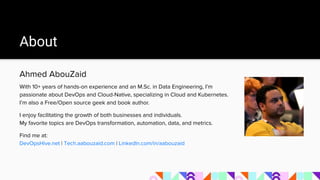
Ahmed AbouZaid
With 10+ years of hands-on experience and an M.Sc. in Data Engineering, I’m
passionate about DevOps and Cloud-Native, specializing in Cloud and Kubernetes.
I’m also a Free/Open source geek and book author.
I enjoy facilitating the growth of both businesses and individuals.
My favorite topics are DevOps transformation, automation, data, and metrics.
Find me at:
DevOpsHive.net | Tech.aabouzaid.com | LinkedIn.com/in/aabouzaid
Overview
● Scenario
● What is Crossplane?
● How it look like?
● Crossplane Concepts
● How Crossplane Works
● Pros and Cons
● Conclusion
● Resources
● Questions
Let’s have a look at a real-world scenario where the
DevOps engineers decided to build an abstraction
layer to be used by all dev teams (aka Platform
Engineering), and they found the solution!
Crossplane, the open-source control plane!
Scenario
Scenario (Cont.)
03
The dev teams follow the
principle of "you build it, you
manage it", but just for the
application, not the
infrastructure, because they
are not experienced with
Terraform.
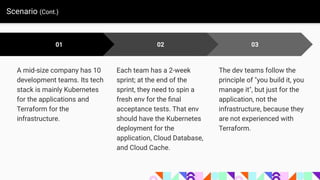
01
A mid-size company has 10
development teams. Its tech
stack is mainly Kubernetes
for the applications and
Terraform for the
infrastructure.
02
Each team has a 2-week
sprint; at the end of the
sprint, they need to spin a
fresh env for the final
acceptance tests. That env
should have the Kubernetes
deployment for the
application, Cloud Database,
and Cloud Cache.
Scenario (Cont.)
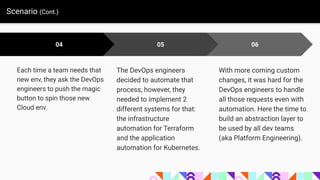
06
With more coming custom
changes, it was hard for the
DevOps engineers to handle
all those requests even with
automation. Here the time to
build an abstraction layer to
be used by all dev teams
(aka Platform Engineering).
04
Each time a team needs that
new env, they ask the DevOps
engineers to push the magic
button to spin those new
Cloud env.
05
The DevOps engineers
decided to automate that
process, however, they
needed to implement 2
different systems for that:
the infrastructure
automation for Terraform
and the application
automation for Kubernetes.
What is Crossplane?
Crossplane is a Cloud Native Computing Foundation (CNCF) project
built on the foundation of Kubernetes to orchestrate anything.
At the core, it is an open-source Kubernetes add-on that extends
Kubernetes to enable the deployment and management of
infrastructure and services of various Cloud providers and
on-premises environments.
In other words, Crossplane is not just a tool but an extensible
Kubernetes operator and framework.
How it look like?
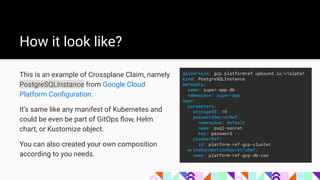
This is an example of Crossplane Claim, namely
PostgreSQLInstance from Google Cloud
Platform Configuration.
It’s same like any manifest of Kubernetes and
could be even be part of GitOps flow, Helm
chart, or Kustomize object.
You can also created your own composition
according to you needs.
apiVersion: gcp.platformref.upbound.io/v1alpha1
kind: PostgreSQLInstance
metadata:
name: super-app-db
namespace: super-app
spec:
parameters:
storageGB: 10
passwordSecretRef:
namespace: default
name: psql-secret
key: password
clusterRef:
id: platform-ref-gcp-cluster
writeConnectionSecretToRef:
name: platform-ref-gcp-db-con
How it look like? (Cont.)
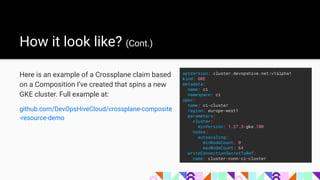
Here is an example of a Crossplane claim based
on a Composition I’ve created that spins a new
GKE cluster. Full example at:
github.com/DevOpsHiveCloud/crossplane-composite
-resource-demo
apiVersion: cluster.devopshive.net/v1alpha1
kind: GKE
metadata:
name: ci
namespace: ci
spec:
name: ci-cluster
region: europe-west1
parameters:
cluster:
minVersion: 1.27.3-gke.100
nodes:
autoscaling:
minNodeCount: 0
maxNodeCount: 64
writeConnectionSecretToRef:
name: cluster-conn-ci-cluster
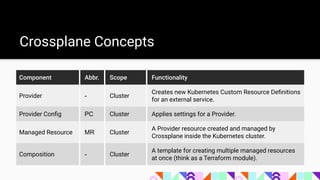
Crossplane Concepts
Component Abbr. Scope Functionality
Provider - Cluster
Creates new Kubernetes Custom Resource Definitions
for an external service.
Provider Config PC Cluster Applies settings for a Provider.
Managed Resource MR Cluster
A Provider resource created and managed by
Crossplane inside the Kubernetes cluster.
Composition - Cluster
A template for creating multiple managed resources
at once (think as a Terraform module).
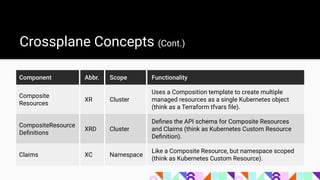
Crossplane Concepts (Cont.)
Component Abbr. Scope Functionality
Composite
Resources
XR Cluster
Uses a Composition template to create multiple
managed resources as a single Kubernetes object
(think as a Terraform tfvars file).
CompositeResource
Definitions
XRD Cluster
Defines the API schema for Composite Resources
and Claims (think as Kubernetes Custom Resource
Definition).
Claims XC Namespace
Like a Composite Resource, but namespace scoped
(think as Kubernetes Custom Resource).
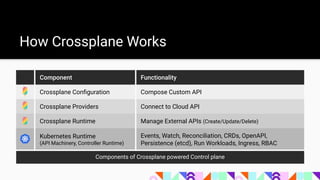
How Crossplane Works
Component Functionality
Crossplane Configuration Compose Custom API
Crossplane Providers Connect to Cloud API
Crossplane Runtime Manage External APIs (Create/Update/Delete)
Kubernetes Runtime
(API Machinery, Controller Runtime)
Events, Watch, Reconciliation, CRDs, OpenAPI,
Persistence (etcd), Run Workloads, Ingress, RBAC
Components of Crossplane powered Control plane
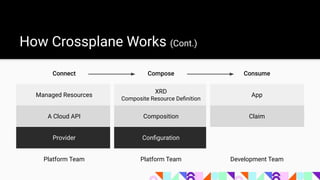
How Crossplane Works (Cont.)
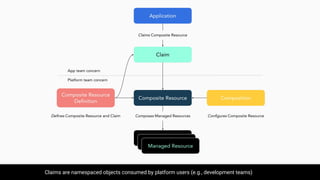
Connect Compose Consume
Managed Resources
XRD
Composite Resource Definition
App
A Cloud API Composition Claim
Provider Configuration
Platform Team Platform Team Development Team
Claims are namespaced objects consumed by platform users (e.g., development teams)
Pros Cons
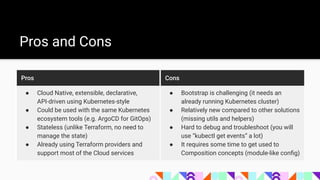
● Cloud Native, extensible, declarative,
API-driven using Kubernetes-style
● Could be used with the same Kubernetes
ecosystem tools (e.g. ArgoCD for GitOps)
● Stateless (unlike Terraform, no need to
manage the state)
● Already using Terraform providers and
support most of the Cloud services
● Bootstrap is challenging (it needs an
already running Kubernetes cluster)
● Relatively new compared to other solutions
(missing utils and helpers)
● Hard to debug and troubleshoot (you will
use “kubectl get events” a lot)
● It requires some time to get used to
Composition concepts (module-like config)
Pros and Cons
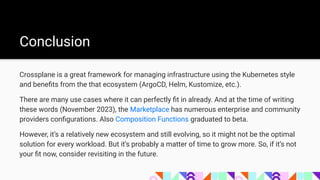
Crossplane is a great framework for managing infrastructure using the Kubernetes style
and benefits from the that ecosystem (ArgoCD, Helm, Kustomize, etc.).
There are many use cases where it can perfectly fit in already. And at the time of writing
these words (November 2023), the Marketplace has numerous enterprise and community
providers configurations. Also Composition Functions graduated to beta.
However, it’s a relatively new ecosystem and still evolving, so it might not be the optimal
solution for every workload. But it’s probably a matter of time to grow more. So, if it’s not
your fit now, consider revisiting in the future.
Conclusion
Resources
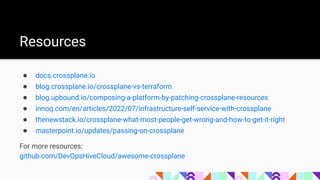
● docs.crossplane.io
● blog.crossplane.io/crossplane-vs-terraform
● blog.upbound.io/composing-a-platform-by-patching-crossplane-resources
● innoq.com/en/articles/2022/07/infrastructure-self-service-with-crossplane
● thenewstack.io/crossplane-what-most-people-get-wrong-and-how-to-get-it-right
● masterpoint.io/updates/passing-on-crossplane
For more resources:
github.com/DevOpsHiveCloud/awesome-crossplane
Thank You :-)
LinkedIn.com/in/aabouzaid
Tech.aabouzaid.com
Questions?
DevOpsHive.net

Platform Engineering: Manage your infrastructure using Kubernetes and Crossplane

  • 1.
    Platform Engineering: Manage yourinfrastructure using Kubernetes and Crossplane Ahmed AbouZaid November 2023
  • 2.
    About Ahmed AbouZaid With 10+years of hands-on experience and an M.Sc. in Data Engineering, I’m passionate about DevOps and Cloud-Native, specializing in Cloud and Kubernetes. I’m also a Free/Open source geek and book author. I enjoy facilitating the growth of both businesses and individuals. My favorite topics are DevOps transformation, automation, data, and metrics. Find me at: DevOpsHive.net | Tech.aabouzaid.com | LinkedIn.com/in/aabouzaid
  • 3.
    Overview ● Scenario ● Whatis Crossplane? ● How it look like? ● Crossplane Concepts ● How Crossplane Works ● Pros and Cons ● Conclusion ● Resources ● Questions
  • 4.
    Let’s have alook at a real-world scenario where the DevOps engineers decided to build an abstraction layer to be used by all dev teams (aka Platform Engineering), and they found the solution! Crossplane, the open-source control plane! Scenario
  • 5.
    Scenario (Cont.) 03 The devteams follow the principle of "you build it, you manage it", but just for the application, not the infrastructure, because they are not experienced with Terraform. 01 A mid-size company has 10 development teams. Its tech stack is mainly Kubernetes for the applications and Terraform for the infrastructure. 02 Each team has a 2-week sprint; at the end of the sprint, they need to spin a fresh env for the final acceptance tests. That env should have the Kubernetes deployment for the application, Cloud Database, and Cloud Cache.
  • 6.
    Scenario (Cont.) 06 With morecoming custom changes, it was hard for the DevOps engineers to handle all those requests even with automation. Here the time to build an abstraction layer to be used by all dev teams (aka Platform Engineering). 04 Each time a team needs that new env, they ask the DevOps engineers to push the magic button to spin those new Cloud env. 05 The DevOps engineers decided to automate that process, however, they needed to implement 2 different systems for that: the infrastructure automation for Terraform and the application automation for Kubernetes.
  • 8.
    What is Crossplane? Crossplaneis a Cloud Native Computing Foundation (CNCF) project built on the foundation of Kubernetes to orchestrate anything. At the core, it is an open-source Kubernetes add-on that extends Kubernetes to enable the deployment and management of infrastructure and services of various Cloud providers and on-premises environments. In other words, Crossplane is not just a tool but an extensible Kubernetes operator and framework.
  • 9.
    How it looklike? This is an example of Crossplane Claim, namely PostgreSQLInstance from Google Cloud Platform Configuration. It’s same like any manifest of Kubernetes and could be even be part of GitOps flow, Helm chart, or Kustomize object. You can also created your own composition according to you needs. apiVersion: gcp.platformref.upbound.io/v1alpha1 kind: PostgreSQLInstance metadata: name: super-app-db namespace: super-app spec: parameters: storageGB: 10 passwordSecretRef: namespace: default name: psql-secret key: password clusterRef: id: platform-ref-gcp-cluster writeConnectionSecretToRef: name: platform-ref-gcp-db-con
  • 10.
    How it looklike? (Cont.) Here is an example of a Crossplane claim based on a Composition I’ve created that spins a new GKE cluster. Full example at: github.com/DevOpsHiveCloud/crossplane-composite -resource-demo apiVersion: cluster.devopshive.net/v1alpha1 kind: GKE metadata: name: ci namespace: ci spec: name: ci-cluster region: europe-west1 parameters: cluster: minVersion: 1.27.3-gke.100 nodes: autoscaling: minNodeCount: 0 maxNodeCount: 64 writeConnectionSecretToRef: name: cluster-conn-ci-cluster
  • 11.
    Crossplane Concepts Component Abbr.Scope Functionality Provider - Cluster Creates new Kubernetes Custom Resource Definitions for an external service. Provider Config PC Cluster Applies settings for a Provider. Managed Resource MR Cluster A Provider resource created and managed by Crossplane inside the Kubernetes cluster. Composition - Cluster A template for creating multiple managed resources at once (think as a Terraform module).
  • 12.
    Crossplane Concepts (Cont.) ComponentAbbr. Scope Functionality Composite Resources XR Cluster Uses a Composition template to create multiple managed resources as a single Kubernetes object (think as a Terraform tfvars file). CompositeResource Definitions XRD Cluster Defines the API schema for Composite Resources and Claims (think as Kubernetes Custom Resource Definition). Claims XC Namespace Like a Composite Resource, but namespace scoped (think as Kubernetes Custom Resource).
  • 13.
    How Crossplane Works ComponentFunctionality Crossplane Configuration Compose Custom API Crossplane Providers Connect to Cloud API Crossplane Runtime Manage External APIs (Create/Update/Delete) Kubernetes Runtime (API Machinery, Controller Runtime) Events, Watch, Reconciliation, CRDs, OpenAPI, Persistence (etcd), Run Workloads, Ingress, RBAC Components of Crossplane powered Control plane
  • 14.
    How Crossplane Works(Cont.) Connect Compose Consume Managed Resources XRD Composite Resource Definition App A Cloud API Composition Claim Provider Configuration Platform Team Platform Team Development Team
  • 15.
    Claims are namespacedobjects consumed by platform users (e.g., development teams)
  • 16.
    Pros Cons ● CloudNative, extensible, declarative, API-driven using Kubernetes-style ● Could be used with the same Kubernetes ecosystem tools (e.g. ArgoCD for GitOps) ● Stateless (unlike Terraform, no need to manage the state) ● Already using Terraform providers and support most of the Cloud services ● Bootstrap is challenging (it needs an already running Kubernetes cluster) ● Relatively new compared to other solutions (missing utils and helpers) ● Hard to debug and troubleshoot (you will use “kubectl get events” a lot) ● It requires some time to get used to Composition concepts (module-like config) Pros and Cons
  • 17.
    Crossplane is agreat framework for managing infrastructure using the Kubernetes style and benefits from the that ecosystem (ArgoCD, Helm, Kustomize, etc.). There are many use cases where it can perfectly fit in already. And at the time of writing these words (November 2023), the Marketplace has numerous enterprise and community providers configurations. Also Composition Functions graduated to beta. However, it’s a relatively new ecosystem and still evolving, so it might not be the optimal solution for every workload. But it’s probably a matter of time to grow more. So, if it’s not your fit now, consider revisiting in the future. Conclusion
  • 18.
    Resources ● docs.crossplane.io ● blog.crossplane.io/crossplane-vs-terraform ●blog.upbound.io/composing-a-platform-by-patching-crossplane-resources ● innoq.com/en/articles/2022/07/infrastructure-self-service-with-crossplane ● thenewstack.io/crossplane-what-most-people-get-wrong-and-how-to-get-it-right ● masterpoint.io/updates/passing-on-crossplane For more resources: github.com/DevOpsHiveCloud/awesome-crossplane
  • 19.