Good Afternoon – Welcome Back!
Grab your Civics books.
Tuesday, March 10th, 2020
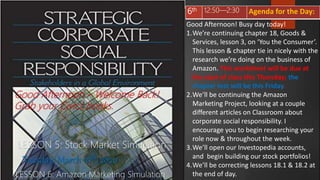
Good Afternoon! Busy day today!
1.We’re continuing chapter 18, Goods &
Services, lesson 3, on ‘You the Consumer’.
This lesson & chapter tie in nicely with the
research we’re doing on the business of
Amazon. This worksheet will be due at
the start of class this Thursday; the
chapter test will be this Friday.
2.We’ll be continuing the Amazon
Marketing Project, looking at a couple
different articles on Classroom about
corporate social responsibility. I
encourage you to begin researching your
role now & throughout the week.
3.We’ll open our Investopedia accounts,
and begin building our stock portfolios!
4.We’ll be correcting lessons 18.1 & 18.2 at
the end of day.
6th 12:50—2:30 Agenda for the Day:
LESSON 5: Stock Market Simulation
LESSON 6: Amazon Marketing Simulation
HOLT, RINEHART AND WINSTON‹#›
CIVICS IN PRACTICE
HOLT
Chapter 18
Goods and Services
Section 1: American Production
Section 2: Distributing Goods
Section 3: You the Consumer
CIVICS IN PRACTICE
HOLT
HOLT, RINEHART AND WINSTON‹#›
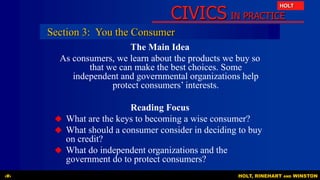
The Main Idea
As consumers, we learn about the products we buy so
that we can make the best choices. Some
independent and governmental organizations help
protect consumers’ interests.
Reading Focus
 What are the keys to becoming a wise consumer?
 What should a consumer consider in deciding to buy
on credit?
 What do independent organizations and the
government do to protect consumers?
Section 3: You the Consumer
CIVICS IN PRACTICE
HOLT
HOLT, RINEHART AND WINSTON‹#›
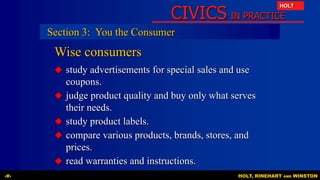
Wise consumers
 study advertisements for special sales and use
coupons.
 judge product quality and buy only what serves
their needs.
 study product labels.
 compare various products, brands, stores, and
prices.
 read warranties and instructions.
Section 3: You the Consumer
CIVICS IN PRACTICE
HOLT
HOLT, RINEHART AND WINSTON‹#›
Independent organizations and the
government protect consumers.
 Government labeling requirements provide contents, health,
and safety information.
 The Better Business Bureau assists consumers with unfair
business practices.
 Government agencies protect consumers from false
advertising, health and safety risks, and mail fraud.
 States and cities provide consumer protection offices.
 Consumers Union publishes reports on most products sold.
Section 3: You the Consumer
CIVICS IN PRACTICE
HOLT
HOLT, RINEHART AND WINSTON‹#›
Installment plans and charge accounts:
 Charge accounts—convenient; can help establish
good credit; interest rates make debt harder to
pay off
 Installment plans—allow purchases without
paying the full amount up front; buyer uses
product while paying for it; product can be
repossessed if payments are missed; service
charges and interest rates increase the total cost
Section 3: You the Consumer
CIVICS IN PRACTICE
HOLT
HOLT, RINEHART AND WINSTON‹#›
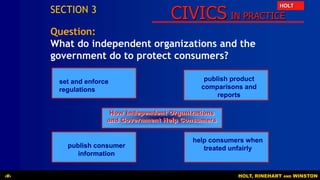
Question:
What do independent organizations and the
government do to protect consumers?
SECTION 3
set and enforce
regulations
publish product
comparisons and
reports
help consumers when
treated unfairlypublish consumer
information
How Independent Organizations
and Government Help Consumers
How Independent Organizations
and Government Help Consumers
CIVICS IN PRACTICE
HOLT
HOLT, RINEHART AND WINSTON‹#›
Chapter 18 Wrap-Up
1. What are the three main features of mass production?
2. What incentive is a key part of mass production, and
why is it important?
3. Why does the U.S. economy depend on the
transportation and marketing of goods?
4. How are products distributed from the manufacturer
to the customer?
5. What choices are available to help consumers make
smart purchases?
6. What are the advantages and disadvantages of using
charge accounts, credit cards, and installment plans?

20200310b

  • 1.
    Good Afternoon –Welcome Back! Grab your Civics books. Tuesday, March 10th, 2020 Good Afternoon! Busy day today! 1.We’re continuing chapter 18, Goods & Services, lesson 3, on ‘You the Consumer’. This lesson & chapter tie in nicely with the research we’re doing on the business of Amazon. This worksheet will be due at the start of class this Thursday; the chapter test will be this Friday. 2.We’ll be continuing the Amazon Marketing Project, looking at a couple different articles on Classroom about corporate social responsibility. I encourage you to begin researching your role now & throughout the week. 3.We’ll open our Investopedia accounts, and begin building our stock portfolios! 4.We’ll be correcting lessons 18.1 & 18.2 at the end of day. 6th 12:50—2:30 Agenda for the Day: LESSON 5: Stock Market Simulation LESSON 6: Amazon Marketing Simulation
  • 2.
    HOLT, RINEHART ANDWINSTON‹#› CIVICS IN PRACTICE HOLT Chapter 18 Goods and Services Section 1: American Production Section 2: Distributing Goods Section 3: You the Consumer
  • 3.
    CIVICS IN PRACTICE HOLT HOLT,RINEHART AND WINSTON‹#› The Main Idea As consumers, we learn about the products we buy so that we can make the best choices. Some independent and governmental organizations help protect consumers’ interests. Reading Focus  What are the keys to becoming a wise consumer?  What should a consumer consider in deciding to buy on credit?  What do independent organizations and the government do to protect consumers? Section 3: You the Consumer
  • 4.
    CIVICS IN PRACTICE HOLT HOLT,RINEHART AND WINSTON‹#› Wise consumers  study advertisements for special sales and use coupons.  judge product quality and buy only what serves their needs.  study product labels.  compare various products, brands, stores, and prices.  read warranties and instructions. Section 3: You the Consumer
  • 5.
    CIVICS IN PRACTICE HOLT HOLT,RINEHART AND WINSTON‹#› Independent organizations and the government protect consumers.  Government labeling requirements provide contents, health, and safety information.  The Better Business Bureau assists consumers with unfair business practices.  Government agencies protect consumers from false advertising, health and safety risks, and mail fraud.  States and cities provide consumer protection offices.  Consumers Union publishes reports on most products sold. Section 3: You the Consumer
  • 6.
    CIVICS IN PRACTICE HOLT HOLT,RINEHART AND WINSTON‹#› Installment plans and charge accounts:  Charge accounts—convenient; can help establish good credit; interest rates make debt harder to pay off  Installment plans—allow purchases without paying the full amount up front; buyer uses product while paying for it; product can be repossessed if payments are missed; service charges and interest rates increase the total cost Section 3: You the Consumer
  • 7.
    CIVICS IN PRACTICE HOLT HOLT,RINEHART AND WINSTON‹#› Question: What do independent organizations and the government do to protect consumers? SECTION 3 set and enforce regulations publish product comparisons and reports help consumers when treated unfairlypublish consumer information How Independent Organizations and Government Help Consumers How Independent Organizations and Government Help Consumers
  • 8.
    CIVICS IN PRACTICE HOLT HOLT,RINEHART AND WINSTON‹#› Chapter 18 Wrap-Up 1. What are the three main features of mass production? 2. What incentive is a key part of mass production, and why is it important? 3. Why does the U.S. economy depend on the transportation and marketing of goods? 4. How are products distributed from the manufacturer to the customer? 5. What choices are available to help consumers make smart purchases? 6. What are the advantages and disadvantages of using charge accounts, credit cards, and installment plans?

Editor's Notes