Shifting minds in the
cultural sector
Towards open data in practice
Open Belgium 04.03.2019
Sam Donvil Alina Saenko
sam@packed.be alina@packed.be
@PACKEDvzw
• Non-profit
• 2006 - 2010: Platform for Archiving and Conservation of Art on Electronic and Digital Media
• 2011 - 2018: Centre of Expertise Digital Heritage
• from 2019: A department in VIAA - Flemish Institute for Audiovisual Archiving
• Flemish, Belgian and European projects
• Support for ICT-processes at heritage and arts organisations (o.a. creating, storage,
cataloguing, online access, exchange and reuse) and policy thereof
• Central concern: sustainability (digital heritage is vulnerable)
www.packed.be | www.viaa.be | www.projectcest.be | www.scart.be | www.projecttracks.be | www.scoremodel.org ...
Programme ‘Shifting minds’ session
- PACKED:
- Open GLAM community: International and in Belgium
- PACKED: open data projects: persistent identification and publishing of data
- PACKED: advocacy en training
- Conclusions and wishlist
- Use cases from the cultural heritage sector:
- Wikimedia publication of King Baudouin Foundation collections - Olivier Van
D’huynslager
- Flemish Art Collection: Arthub/Datahub - Matthias Vandermaesen
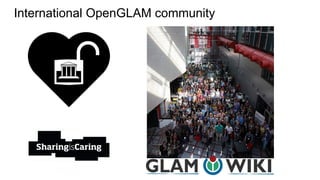
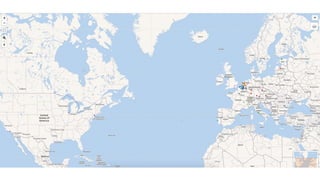
International OpenGLAM community
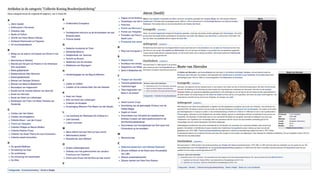
OpenGLAM in Belgium
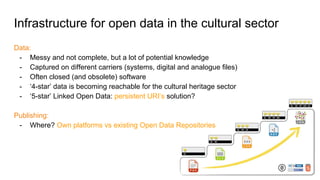
Infrastructure for open data in the cultural sector
Data:
- Messy and not complete, but a lot of potential knowledge
- Captured on different carriers (systems, digital and analogue files)
- Often closed (and obsolete) software
- ‘4-star’ data is becoming reachable for the cultural heritage sector
- ‘5-star’ Linked Open Data: persistent URI’s solution?
Publishing:
- Where? Own platforms vs existing Open Data Repositories
Infrastructure: Persistent URI’s
- Nobody knows what PIDs are and why you should use it
- Not that obvious in the cultural heritage sector
- Not just a standard part of the used collection mgmt systems,
- Not just something that you ask your IT to configure (because there is no IT)
- PID-projects (2013-2016) - Resolver-tool v1
- Open Summer of code 2018 - redevelopment
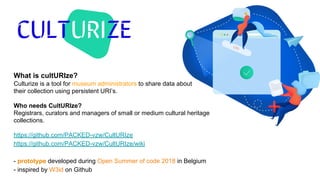
What is cultURIze?
Culturize is a tool for museum administrators to share data about
their collection using persistent URI’s.
Who needs CultURIze?
Registrars, curators and managers of small or medium cultural heritage
collections.
https://github.com/PACKED-vzw/CultURIze
https://github.com/PACKED-vzw/CultURIze/wiki
- prototype developed during Open Summer of code 2018 in Belgium
- inspired by W3id on Github
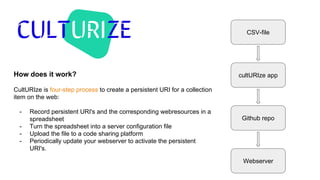
How does it work?
CultURIze is four-step process to create a persistent URI for a collection
item on the web:
- Record persistent URI's and the corresponding webresources in a
spreadsheet
- Turn the spreadsheet into a server configuration file
- Upload the file to a code sharing platform
- Periodically update your webserver to activate the persistent
URI's.
CSV-file
cultURIze app
Github repo
Webserver
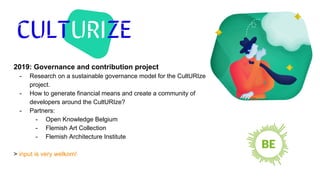
2019: Governance and contribution project
- Research on a sustainable governance model for the CultURIze
project.
- How to generate financial means and create a community of
developers around the CultURIze?
- Partners:
- Open Knowledge Belgium
- Flemish Art Collection
- Flemish Architecture Institute
> input is very welkom!
Infrastructure: Platforms for publishing open data
Use/Build your own platforms:
- Own website (download file)
- Own API’s, OAI-PMH and SPARQL endpoints
- Local/National/International cultural heritage aggregators
and datahubs
Infrastructure: Platforms for publishing open data
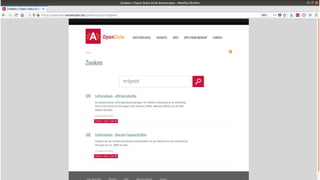
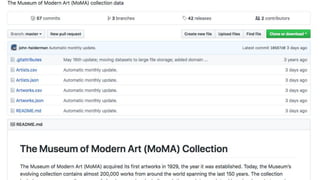
Use already existing open data repositories:
- Government Open data platforms
- Github (download file)
- Wikidata/Wikimedia Commons
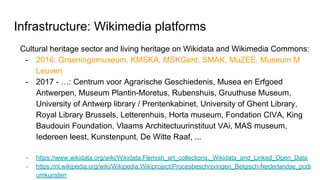
Infrastructure: Wikimedia platforms
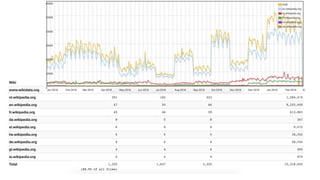
Cultural heritage sector and living heritage on Wikidata and Wikimedia Commons:
- 2016: Groeningemuseum, KMSKA, MSKGent, SMAK, MuZEE, Museum M
Leuven
- 2017 - …: Centrum voor Agrarische Geschiedenis, Musea en Erfgoed
Antwerpen, Museum Plantin-Moretus, Rubenshuis, Gruuthuse Museum,
University of Antwerp library / Prentenkabinet, University of Ghent Library,
Royal Library Brussels, Letterenhuis, Horta museum, Fondation CIVA, King
Baudouin Foundation, Vlaams Architectuurinstituut VAi, MAS museum,
Iedereen leest, Kunstenpunt, De Witte Raaf, ...
- https://www.wikidata.org/wiki/Wikidata:Flemish_art_collections,_Wikidata_and_Linked_Open_Data
- https://nl.wikipedia.org/wiki/Wikipedia:Wikiproject/Procesbeschrijvingen_Belgisch-Nederlandse_podi
umkunsten
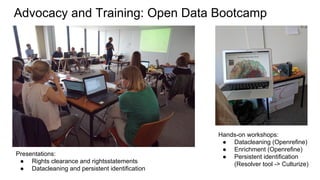
Advocacy and Training: Open Data Bootcamp
Presentations:
● Rights clearance and rightsstatements
● Datacleaning and persistent identification
Hands-on workshops:
● Datacleaning (Openrefine)
● Enrichment (Openrefine)
● Persistent identification
(Resolver tool -> Culturize)
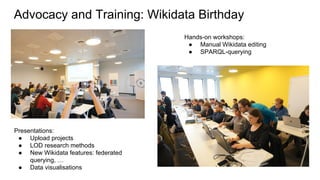
Advocacy and Training: Wikidata Birthday
Hands-on workshops:
● Manual Wikidata editing
● SPARQL-querying
Presentations:
● Upload projects
● LOD research methods
● New Wikidata features: federated
querying, …
● Data visualisations
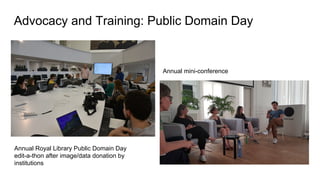
Advocacy and Training: Public Domain Day
Annual Royal Library Public Domain Day
edit-a-thon after image/data donation by
institutions
Annual mini-conference
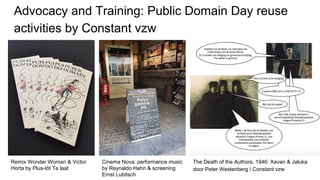
Advocacy and Training: Public Domain Day reuse
activities by Constant vzw
Remix Wonder Woman & Victor
Horta by Plus-tôt Te laat
Cinema Nova: performance music
by Reynaldo Hahn & screening
Ernst Lubitsch
The Death of the Authors, 1946: Xavan & Jaluka
door Peter Westenberg / Constant vzw
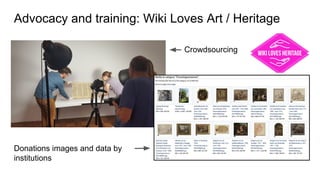
Advocacy and training: Wiki Loves Art / Heritage
Crowdsourcing
Donations images and data by
institutions
Challenges for LOD in cultural sector
digital movement <> no digital mindset
reducing costs <> out-of-control IT-budgets
new ‘digital’ audiences <> losing ‘traditional’ audiences
showing off with fancy tools <> locked up in obsolete technology
engaging with the ‘crowd’ <> abandoned web portals
Wishlist
● More IT profiles in the cultural heritage sector and less dependence on the providers
● More freedom to play around and test things out
● Better open infrastructures and tools that make better internal workflows and LOD
possible:
○ Back office tools: Collection Management Systems, DAMs , Datahubs…
○ Publishing online tools: Resolvers, API’s...
○ Reusing: Wikimedia art viewers, apps...
○ etc...
● Vocal and demanding audience:
○ curating/enriching data
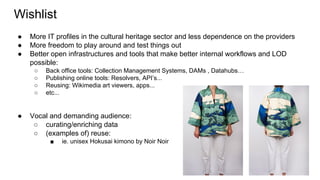
○ (examples of) reuse:
■ ie. unisex Hokusai kimono by Noir Noir
In 2019 PACKED wants to continue to push for open data in the heritage sector:
● Projects:
○ Projects which pool resources for infrastructure on a sector-wide scale:
■ Option 1: sharing ‘one big machine’
■ Option 2: ‘networked’ infrastructure - several machines talk to each other
○ Structured Data on Commons pilots
○ Public domain publication
○ Multilingual information museums of Bruges
○ ...
● More focus on training, institutions publish LOD (semi-)autonomously
Do you see yourself contributing to one of the projects or to the wishlist?
Idea’s or feedback? Please contact us!
PACKED vzw 2019 -...
Thank you!
Questions? Feedback?
Sam Donvil Alina Saenko
sam@packed.be alina@packed.be
@PACKEDvzw
King Baudouin Foundation and Wikimedia
Infrastructure at the King Baudouin Foundation
- Messy and incomplete data
- Works in collection are dispersed over 80+ institutions (depot).
- Registered differently according to its location
- Huge gap! (7000 records of aprox. 26.000 pieces)
- Shared in different ways
- Analog x digital (closed x open(?))
- Webportals
- DAMS
- Arthub
- Overall → DISPERSED
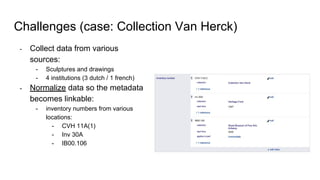
Challenges (case: Collection Van Herck)
- Collect data from various
sources:
- Sculptures and drawings
- 4 institutions (3 dutch / 1 french)
- Normalize data so the metadata
becomes linkable:
- inventory numbers from various
locations:
- CVH 11A(1)
- Inv 30A
- IB00.106
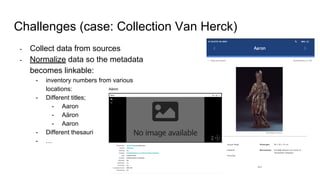
Challenges (case: Collection Van Herck)
- Collect data from sources
- Normalize data so the metadata
becomes linkable:
- inventory numbers from various
locations:
- Different titles;
- Aaron
- Aäron
- Aaron
- Different thesauri
- …
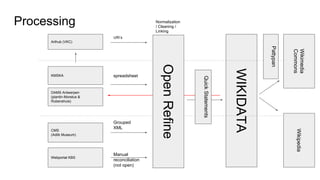
WIKIDATA
Arthub (VKC)
DAMS Antwerpen
(plantin-Moretus &
Rubenshuis)
Webportal KBS
CMS
(Adlib Museum)
URI’s
KMSKA
Normalization
/ Cleaning /
Linking
spreadsheet
Grouped
XML
Manual
reconciliation
(not open)
OpenRefine
Wikimedia
Commons
Wikipedia
Processing
QuickStatements
Pattypan
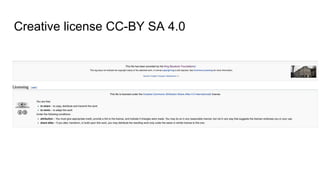
Creative license CC-BY SA 4.0
Results
- Response and commitment → sensibilisation
- Want to commit but find it hard to let go <> volunteers
- Multilingual and connected to authorities and identifiers:
- AAT / RKD
- Access anywhere
- Ingest DAMS (translations titles)
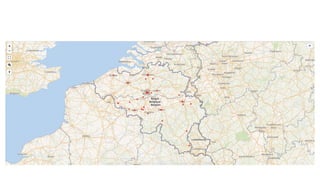
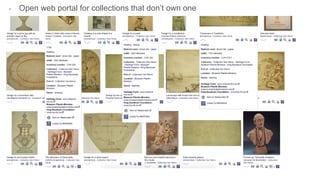
- Open web portal for collections that don’t own one
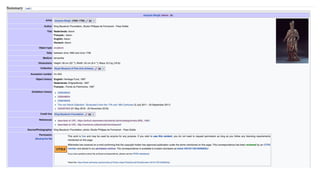
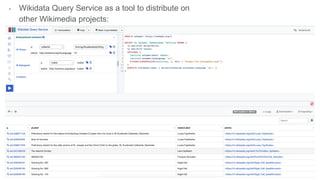
- Wikidata Query Service as a tool to distribute on
other Wikimedia projects:
Arthub Flemish Art Collection
Who are we?
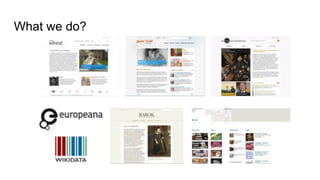
What we do?
Leveraging museal data is challenging
● Getting registration data out of collection management systems
○ No API’s (manual exchange)
○ Proprietary vendor formats
○ Legacy systems
○ Different institutions, different contexts.
● Quality of the data
○ Inconsistent registration (decades of organic growth)
○ No normalisation (no or limited authorities: VIAF, AAT, ICONCLASS,...)
● Which data to use?
○ Context dependent: online browseable collections.
○ Currently: Basic registration (24 base fields)
○ SPECTRUM 5.0: 21 procedures (Acquisition, Loan in/out, Condition,...)
Goals
● Automate sharing museal data between applications
○ Less time between registration and publishing online
● Connect complementary collections and museums
○ Fashion, Industry, Art, Folklore,...
○ Location and time period
● Audit museal data
○ Quality assessment v. digital (re)usability
○ Enrich data with external authorities (linked data)
● Open up collections
○ Publish museal data under Creative Commons licenses.
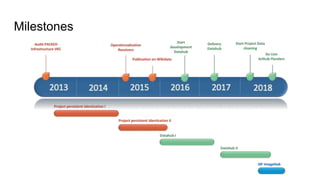
Milestones
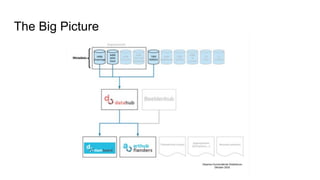
The Big Picture
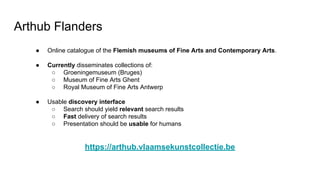
Arthub Flanders
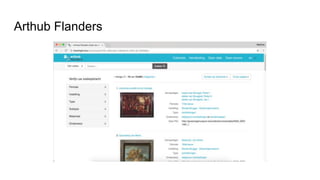
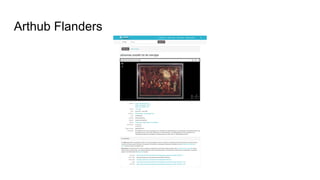
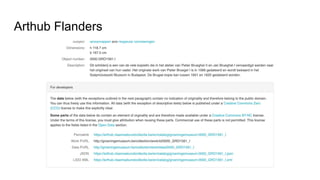
● Online catalogue of the Flemish museums of Fine Arts and Contemporary Arts.
● Currently disseminates collections of:
○ Groeningemuseum (Bruges)
○ Museum of Fine Arts Ghent
○ Royal Museum of Fine Arts Antwerp
● Usable discovery interface
○ Search should yield relevant search results
○ Fast delivery of search results
○ Presentation should be usable for humans
https://arthub.vlaamsekunstcollectie.be
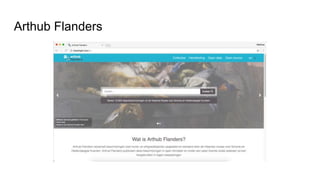
Arthub Flanders
Arthub Flanders
Arthub Flanders
Arthub Flanders
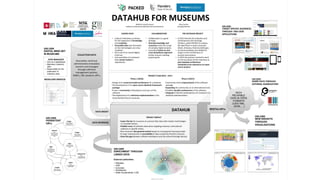
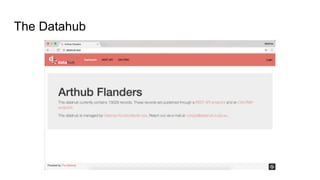
The Datahub
● Aggregation
○ Central “hub” for collection records from different sources
● Persistent storage of a copy of the collection records
○ But NOT a collection management system.
● Publication of collection records via web services
○ Open protocols: HTTP REST API & OAI-PMH
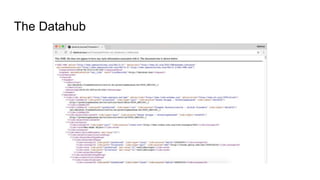
○ Open formats: LIDO XML
The Datahub
The Datahub
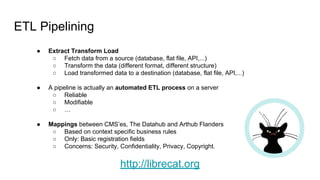
ETL Pipelining
● Extract Transform Load
○ Fetch data from a source (database, flat file, API,...)
○ Transform the data (different format, different structure)
○ Load transformed data to a destination (database, flat file, API,...)
● A pipeline is actually an automated ETL process on a server
○ Reliable
○ Modifiable
○ …
● Mappings between CMS’es, The Datahub and Arthub Flanders
○ Based on context specific business rules
○ Only: Basic registration fields
○ Concerns: Security, Confidentiality, Privacy, Copyright.
http://librecat.org
Data Quality
● What does “Quality” mean?
○ Does the data yield relevant answers?
○ Can I import the data in my application?
○ Can I combine the data with other datasets?
○ Can I present the data with low effort?
○ ...
● Quality is context dependeable
○ Who uses the data? Museum workers, researchers, policy makers,...
○ Where is the data used? Exhibition hall, at home, at an office,...
○ When is the data used? Before a visit, during a meeting,...
https://dashboard.vlaamsekunstcollectie.be
Data Quality
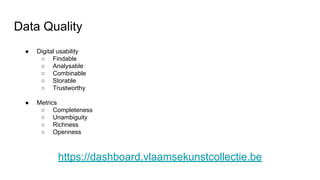
● Digital usability
○ Findable
○ Analysable
○ Combinable
○ Storable
○ Trustworthy
● Metrics
○ Completeness
○ Unambiguity
○ Richness
○ Openness
https://dashboard.vlaamsekunstcollectie.be
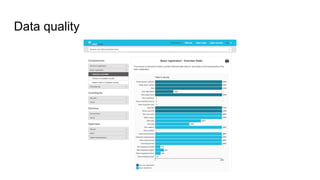
Data quality
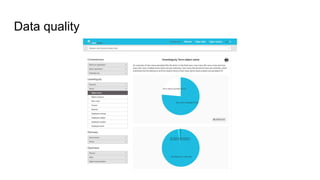
Data quality
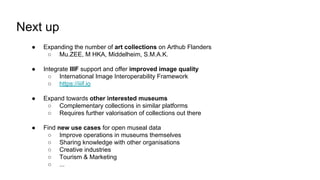
Next up
● Expanding the number of art collections on Arthub Flanders
○ Mu.ZEE, M HKA, Middelheim, S.M.A.K.
● Integrate IIIF support and offer improved image quality
○ International Image Interoperability Framework
○ https://iiif.io
● Expand towards other interested museums
○ Complementary collections in similar platforms
○ Requires further valorisation of collections out there
● Find new use cases for open museal data
○ Improve operations in museums themselves
○ Sharing knowledge with other organisations
○ Creative industries
○ Tourism & Marketing
○ ...
Find us on Github
https://github.com/thedatahub
https://github.com/vlaamsekunstcollectie

20190304_shifting_minds_open_belgium_2019

  • 1.
    Shifting minds inthe cultural sector Towards open data in practice Open Belgium 04.03.2019 Sam Donvil Alina Saenko sam@packed.be alina@packed.be @PACKEDvzw
  • 2.
    • Non-profit • 2006- 2010: Platform for Archiving and Conservation of Art on Electronic and Digital Media • 2011 - 2018: Centre of Expertise Digital Heritage • from 2019: A department in VIAA - Flemish Institute for Audiovisual Archiving • Flemish, Belgian and European projects • Support for ICT-processes at heritage and arts organisations (o.a. creating, storage, cataloguing, online access, exchange and reuse) and policy thereof • Central concern: sustainability (digital heritage is vulnerable) www.packed.be | www.viaa.be | www.projectcest.be | www.scart.be | www.projecttracks.be | www.scoremodel.org ...
  • 3.
    Programme ‘Shifting minds’session - PACKED: - Open GLAM community: International and in Belgium - PACKED: open data projects: persistent identification and publishing of data - PACKED: advocacy en training - Conclusions and wishlist - Use cases from the cultural heritage sector: - Wikimedia publication of King Baudouin Foundation collections - Olivier Van D’huynslager - Flemish Art Collection: Arthub/Datahub - Matthias Vandermaesen
  • 4.
  • 5.
  • 6.
    Infrastructure for opendata in the cultural sector Data: - Messy and not complete, but a lot of potential knowledge - Captured on different carriers (systems, digital and analogue files) - Often closed (and obsolete) software - ‘4-star’ data is becoming reachable for the cultural heritage sector - ‘5-star’ Linked Open Data: persistent URI’s solution? Publishing: - Where? Own platforms vs existing Open Data Repositories
  • 7.
    Infrastructure: Persistent URI’s -Nobody knows what PIDs are and why you should use it - Not that obvious in the cultural heritage sector - Not just a standard part of the used collection mgmt systems, - Not just something that you ask your IT to configure (because there is no IT) - PID-projects (2013-2016) - Resolver-tool v1 - Open Summer of code 2018 - redevelopment
  • 8.
    What is cultURIze? Culturizeis a tool for museum administrators to share data about their collection using persistent URI’s. Who needs CultURIze? Registrars, curators and managers of small or medium cultural heritage collections. https://github.com/PACKED-vzw/CultURIze https://github.com/PACKED-vzw/CultURIze/wiki - prototype developed during Open Summer of code 2018 in Belgium - inspired by W3id on Github
  • 9.
    How does itwork? CultURIze is four-step process to create a persistent URI for a collection item on the web: - Record persistent URI's and the corresponding webresources in a spreadsheet - Turn the spreadsheet into a server configuration file - Upload the file to a code sharing platform - Periodically update your webserver to activate the persistent URI's. CSV-file cultURIze app Github repo Webserver
  • 10.
    2019: Governance andcontribution project - Research on a sustainable governance model for the CultURIze project. - How to generate financial means and create a community of developers around the CultURIze? - Partners: - Open Knowledge Belgium - Flemish Art Collection - Flemish Architecture Institute > input is very welkom!
  • 11.
    Infrastructure: Platforms forpublishing open data Use/Build your own platforms: - Own website (download file) - Own API’s, OAI-PMH and SPARQL endpoints - Local/National/International cultural heritage aggregators and datahubs
  • 16.
    Infrastructure: Platforms forpublishing open data Use already existing open data repositories: - Government Open data platforms - Github (download file) - Wikidata/Wikimedia Commons
  • 20.
    Infrastructure: Wikimedia platforms Culturalheritage sector and living heritage on Wikidata and Wikimedia Commons: - 2016: Groeningemuseum, KMSKA, MSKGent, SMAK, MuZEE, Museum M Leuven - 2017 - …: Centrum voor Agrarische Geschiedenis, Musea en Erfgoed Antwerpen, Museum Plantin-Moretus, Rubenshuis, Gruuthuse Museum, University of Antwerp library / Prentenkabinet, University of Ghent Library, Royal Library Brussels, Letterenhuis, Horta museum, Fondation CIVA, King Baudouin Foundation, Vlaams Architectuurinstituut VAi, MAS museum, Iedereen leest, Kunstenpunt, De Witte Raaf, ... - https://www.wikidata.org/wiki/Wikidata:Flemish_art_collections,_Wikidata_and_Linked_Open_Data - https://nl.wikipedia.org/wiki/Wikipedia:Wikiproject/Procesbeschrijvingen_Belgisch-Nederlandse_podi umkunsten
  • 22.
    Advocacy and Training:Open Data Bootcamp Presentations: ● Rights clearance and rightsstatements ● Datacleaning and persistent identification Hands-on workshops: ● Datacleaning (Openrefine) ● Enrichment (Openrefine) ● Persistent identification (Resolver tool -> Culturize)
  • 23.
    Advocacy and Training:Wikidata Birthday Hands-on workshops: ● Manual Wikidata editing ● SPARQL-querying Presentations: ● Upload projects ● LOD research methods ● New Wikidata features: federated querying, … ● Data visualisations
  • 24.
    Advocacy and Training:Public Domain Day Annual Royal Library Public Domain Day edit-a-thon after image/data donation by institutions Annual mini-conference
  • 25.
    Advocacy and Training:Public Domain Day reuse activities by Constant vzw Remix Wonder Woman & Victor Horta by Plus-tôt Te laat Cinema Nova: performance music by Reynaldo Hahn & screening Ernst Lubitsch The Death of the Authors, 1946: Xavan & Jaluka door Peter Westenberg / Constant vzw
  • 26.
    Advocacy and training:Wiki Loves Art / Heritage Crowdsourcing Donations images and data by institutions
  • 27.
    Challenges for LODin cultural sector digital movement <> no digital mindset reducing costs <> out-of-control IT-budgets new ‘digital’ audiences <> losing ‘traditional’ audiences showing off with fancy tools <> locked up in obsolete technology engaging with the ‘crowd’ <> abandoned web portals
  • 28.
    Wishlist ● More ITprofiles in the cultural heritage sector and less dependence on the providers ● More freedom to play around and test things out ● Better open infrastructures and tools that make better internal workflows and LOD possible: ○ Back office tools: Collection Management Systems, DAMs , Datahubs… ○ Publishing online tools: Resolvers, API’s... ○ Reusing: Wikimedia art viewers, apps... ○ etc... ● Vocal and demanding audience: ○ curating/enriching data ○ (examples of) reuse: ■ ie. unisex Hokusai kimono by Noir Noir
  • 29.
    In 2019 PACKEDwants to continue to push for open data in the heritage sector: ● Projects: ○ Projects which pool resources for infrastructure on a sector-wide scale: ■ Option 1: sharing ‘one big machine’ ■ Option 2: ‘networked’ infrastructure - several machines talk to each other ○ Structured Data on Commons pilots ○ Public domain publication ○ Multilingual information museums of Bruges ○ ... ● More focus on training, institutions publish LOD (semi-)autonomously Do you see yourself contributing to one of the projects or to the wishlist? Idea’s or feedback? Please contact us! PACKED vzw 2019 -...
  • 30.
    Thank you! Questions? Feedback? SamDonvil Alina Saenko sam@packed.be alina@packed.be @PACKEDvzw
  • 31.
  • 32.
    Infrastructure at theKing Baudouin Foundation - Messy and incomplete data - Works in collection are dispersed over 80+ institutions (depot). - Registered differently according to its location - Huge gap! (7000 records of aprox. 26.000 pieces) - Shared in different ways - Analog x digital (closed x open(?)) - Webportals - DAMS - Arthub - Overall → DISPERSED
  • 33.
    Challenges (case: CollectionVan Herck) - Collect data from various sources: - Sculptures and drawings - 4 institutions (3 dutch / 1 french) - Normalize data so the metadata becomes linkable: - inventory numbers from various locations: - CVH 11A(1) - Inv 30A - IB00.106
  • 34.
    Challenges (case: CollectionVan Herck) - Collect data from sources - Normalize data so the metadata becomes linkable: - inventory numbers from various locations: - Different titles; - Aaron - Aäron - Aaron - Different thesauri - …
  • 35.
    WIKIDATA Arthub (VKC) DAMS Antwerpen (plantin-Moretus& Rubenshuis) Webportal KBS CMS (Adlib Museum) URI’s KMSKA Normalization / Cleaning / Linking spreadsheet Grouped XML Manual reconciliation (not open) OpenRefine Wikimedia Commons Wikipedia Processing QuickStatements Pattypan
  • 37.
  • 38.
    Results - Response andcommitment → sensibilisation - Want to commit but find it hard to let go <> volunteers - Multilingual and connected to authorities and identifiers: - AAT / RKD - Access anywhere - Ingest DAMS (translations titles)
  • 39.
    - Open webportal for collections that don’t own one
  • 40.
    - Wikidata QueryService as a tool to distribute on other Wikimedia projects:
  • 45.
  • 46.
  • 47.
  • 48.
    Leveraging museal datais challenging ● Getting registration data out of collection management systems ○ No API’s (manual exchange) ○ Proprietary vendor formats ○ Legacy systems ○ Different institutions, different contexts. ● Quality of the data ○ Inconsistent registration (decades of organic growth) ○ No normalisation (no or limited authorities: VIAF, AAT, ICONCLASS,...) ● Which data to use? ○ Context dependent: online browseable collections. ○ Currently: Basic registration (24 base fields) ○ SPECTRUM 5.0: 21 procedures (Acquisition, Loan in/out, Condition,...)
  • 49.
    Goals ● Automate sharingmuseal data between applications ○ Less time between registration and publishing online ● Connect complementary collections and museums ○ Fashion, Industry, Art, Folklore,... ○ Location and time period ● Audit museal data ○ Quality assessment v. digital (re)usability ○ Enrich data with external authorities (linked data) ● Open up collections ○ Publish museal data under Creative Commons licenses.
  • 50.
  • 51.
  • 52.
    Arthub Flanders ● Onlinecatalogue of the Flemish museums of Fine Arts and Contemporary Arts. ● Currently disseminates collections of: ○ Groeningemuseum (Bruges) ○ Museum of Fine Arts Ghent ○ Royal Museum of Fine Arts Antwerp ● Usable discovery interface ○ Search should yield relevant search results ○ Fast delivery of search results ○ Presentation should be usable for humans https://arthub.vlaamsekunstcollectie.be
  • 53.
  • 54.
  • 55.
  • 56.
  • 57.
    The Datahub ● Aggregation ○Central “hub” for collection records from different sources ● Persistent storage of a copy of the collection records ○ But NOT a collection management system. ● Publication of collection records via web services ○ Open protocols: HTTP REST API & OAI-PMH ○ Open formats: LIDO XML
  • 58.
  • 59.
  • 60.
    ETL Pipelining ● ExtractTransform Load ○ Fetch data from a source (database, flat file, API,...) ○ Transform the data (different format, different structure) ○ Load transformed data to a destination (database, flat file, API,...) ● A pipeline is actually an automated ETL process on a server ○ Reliable ○ Modifiable ○ … ● Mappings between CMS’es, The Datahub and Arthub Flanders ○ Based on context specific business rules ○ Only: Basic registration fields ○ Concerns: Security, Confidentiality, Privacy, Copyright. http://librecat.org
  • 61.
    Data Quality ● Whatdoes “Quality” mean? ○ Does the data yield relevant answers? ○ Can I import the data in my application? ○ Can I combine the data with other datasets? ○ Can I present the data with low effort? ○ ... ● Quality is context dependeable ○ Who uses the data? Museum workers, researchers, policy makers,... ○ Where is the data used? Exhibition hall, at home, at an office,... ○ When is the data used? Before a visit, during a meeting,... https://dashboard.vlaamsekunstcollectie.be
  • 62.
    Data Quality ● Digitalusability ○ Findable ○ Analysable ○ Combinable ○ Storable ○ Trustworthy ● Metrics ○ Completeness ○ Unambiguity ○ Richness ○ Openness https://dashboard.vlaamsekunstcollectie.be
  • 63.
  • 64.
  • 65.
    Next up ● Expandingthe number of art collections on Arthub Flanders ○ Mu.ZEE, M HKA, Middelheim, S.M.A.K. ● Integrate IIIF support and offer improved image quality ○ International Image Interoperability Framework ○ https://iiif.io ● Expand towards other interested museums ○ Complementary collections in similar platforms ○ Requires further valorisation of collections out there ● Find new use cases for open museal data ○ Improve operations in museums themselves ○ Sharing knowledge with other organisations ○ Creative industries ○ Tourism & Marketing ○ ...
  • 66.
    Find us onGithub https://github.com/thedatahub https://github.com/vlaamsekunstcollectie