Digital Admissions
2019
Webinar
HOW PROSPECTIVE TEENS USE ONLINE TOOLS IN COLLEGE SEARCH & CHOICE
Moderator
Mallory
+ Director of Marketing, mStoner
+ LA Transplant
+ Proud Medill Alumna
@MalloryWillsea
Housekeeping:
A few starting details:
45-minute webinar + 15 minutes for questions and answers
Chat and ask questions through the Zoom Control Panel
Tweet during the webinar with #DigitalAdmissions
Please fill out the post-webinar survey
Check your inbox on Friday for the webinar recording and slide deck
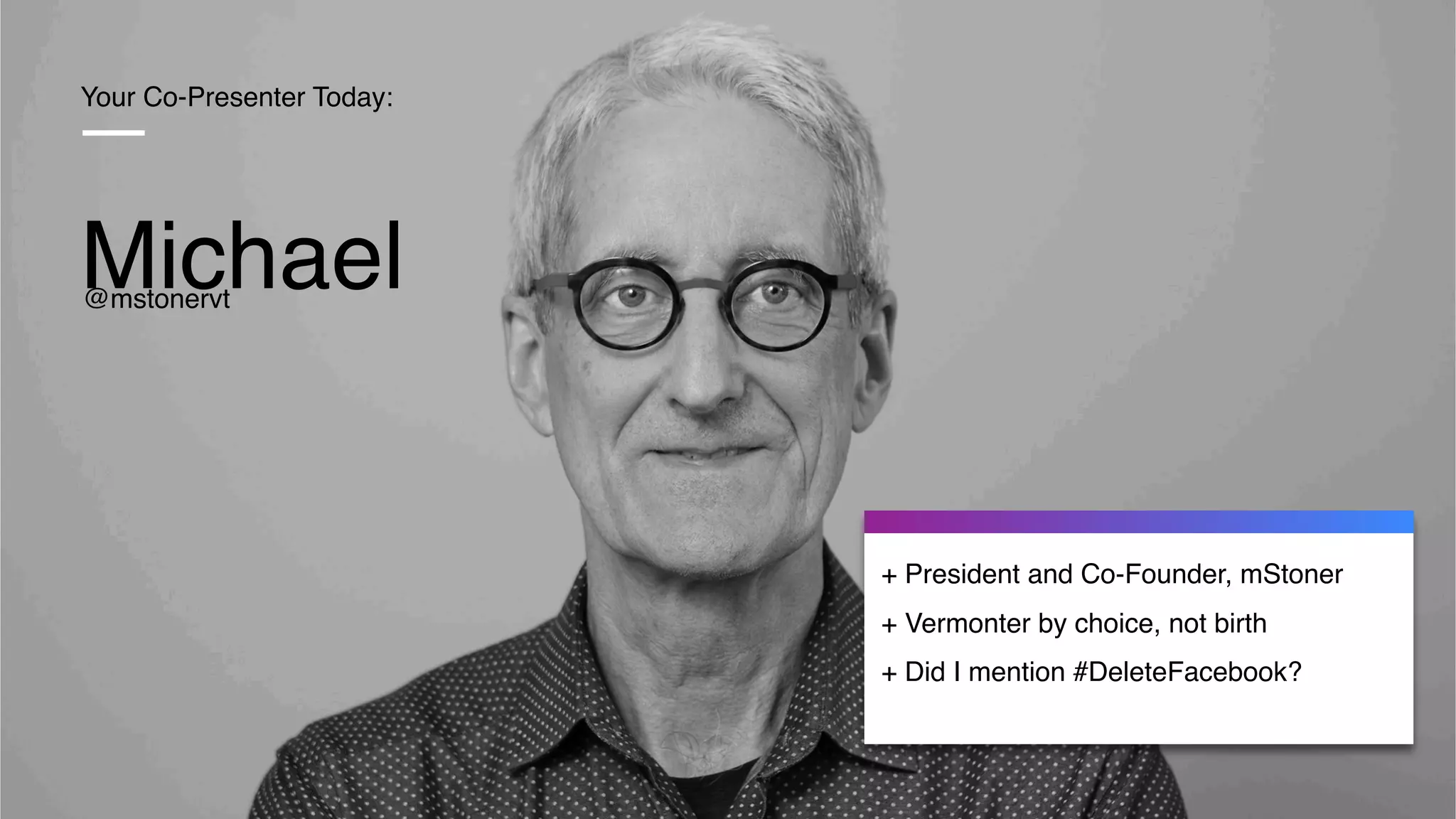
Your Co-Presenter Today:
Michael
+ President and Co-Founder, mStoner
+ Vermonter by choice, not birth
+ Did I mention #DeleteFacebook?
@mstonervt
Your Co-Presenter Today:
Sasha
+ CEO, TargetX
+ Rooted in Latvia, raised in California
+ Currently without power
@sashapeterson
Digital Admissions 2019
#DigitalAdmissions
Today’s
Topics
1. Demographics
2. Key Observations
3. Teens & Social Media
4. Teens & Your Website
5. Communicating With Teens
Agenda
#DigitalAdmissions
Demographics of Respondents
DEMOGRAPHICS
• Survey deployed on
Niche.com
• 2,281 respondents
• We accepted responses
from Classes of 2019-2022
for a total of 1,458
• 26% researching; 28%
deciding; 39% decided
• 76% of respondents
identified as female (but this
didn’t skew results)
• 44% Caucasian/White; 23%
African-American/Black;
23% Latinx; 15% Asian; 3%
American Indian/Alaskan
Native; 2% Hawaiian or
Pacific Islander
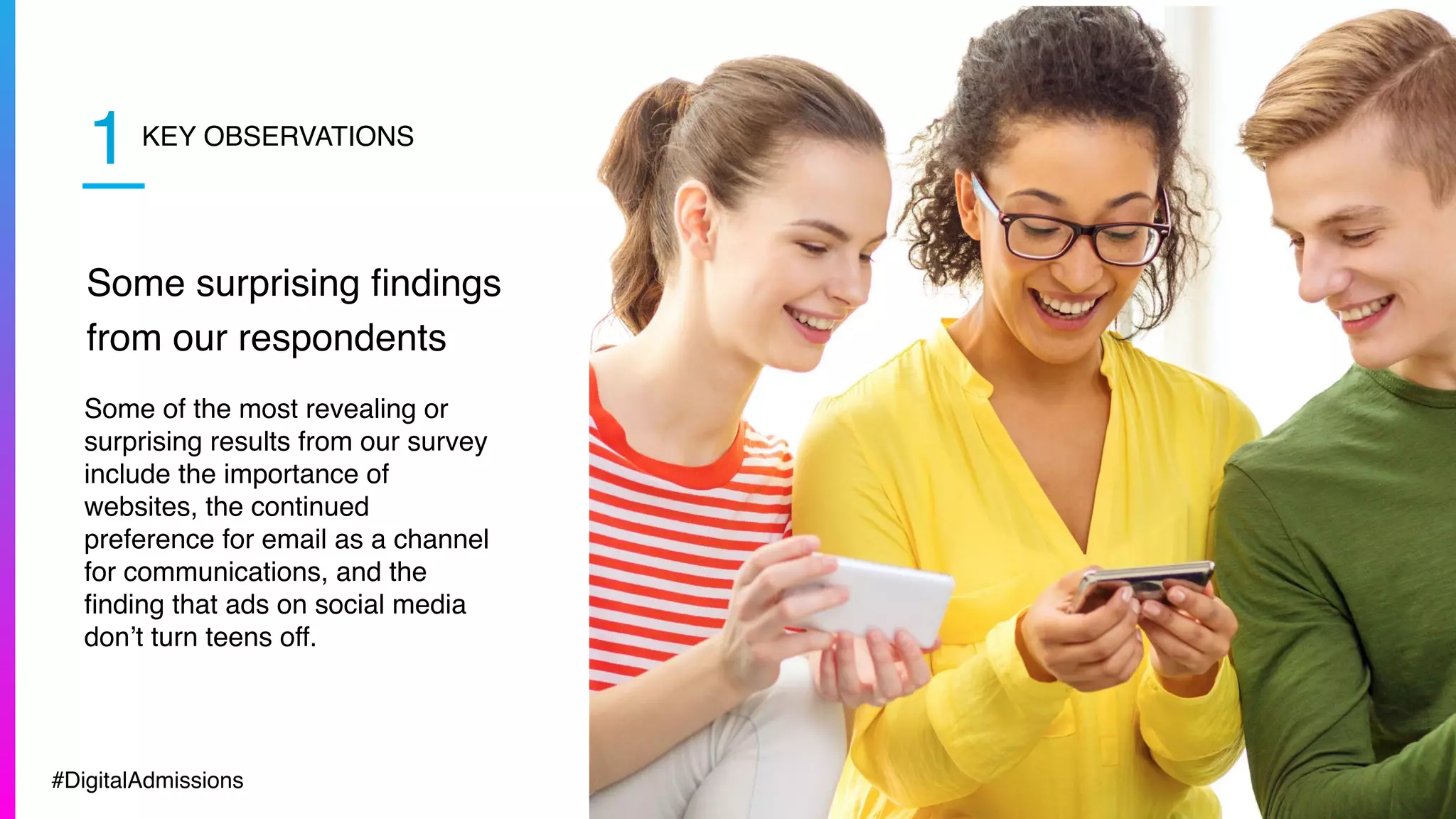
KEY OBSERVATIONS
Some surprising findings
from our respondents
Some of the most revealing or
surprising results from our survey
include the importance of
websites, the continued
preference for email as a channel
for communications, and the
finding that ads on social media
don’t turn teens off.
1
#DigitalAdmissions
Teens & Social Media
Teens use social media extensively in their personal lives
and in college search and choice. But college social
channels are not hugely influential in their decision about
where to enroll. They do pay attention to posts from
currently enrolled students, though.
#DigitalAdmissions
Teens & Social Media
Don’t expect teens to interact on your social channels:
while 63% liked or followed a university social channel, they
consume content but don’t interact with people there.
#DigitalAdmissions
Teens & Social Media
There are some signs of growing disenchantment with
social media: a third of our respondents said they didn’t use
social at all.
#DigitalAdmissions
Teens & Video
YouTube is the second-most popular social channel among
our respondents: 55% use it once a day. And 27% said
videos on YouTube were a major influence on where they
enrolled.
#DigitalAdmissions
Teens & Your Website
Websites are critical to college search and choice: 54% of
respondents said it was very or extremely important in their
decision about where to apply.
#DigitalAdmissions
Teens & Your Website
And 92% of our respondents said that the university
website was more important than the college’s social
media.
#DigitalAdmissions
Teens & FTF
When it comes to enrollment, the number one influence is
in-person or phone interactions with friends who attend the
college.
#DigitalAdmissions
Teens & Ads
Nearly 75% of our respondents have seen ads for colleges
online; a majority (56%) clicked on them. They’re also
aware of ads on social media: 46% of those who noticed an
ad said that they had no impact on their impression of the
institution.
#DigitalAdmissions
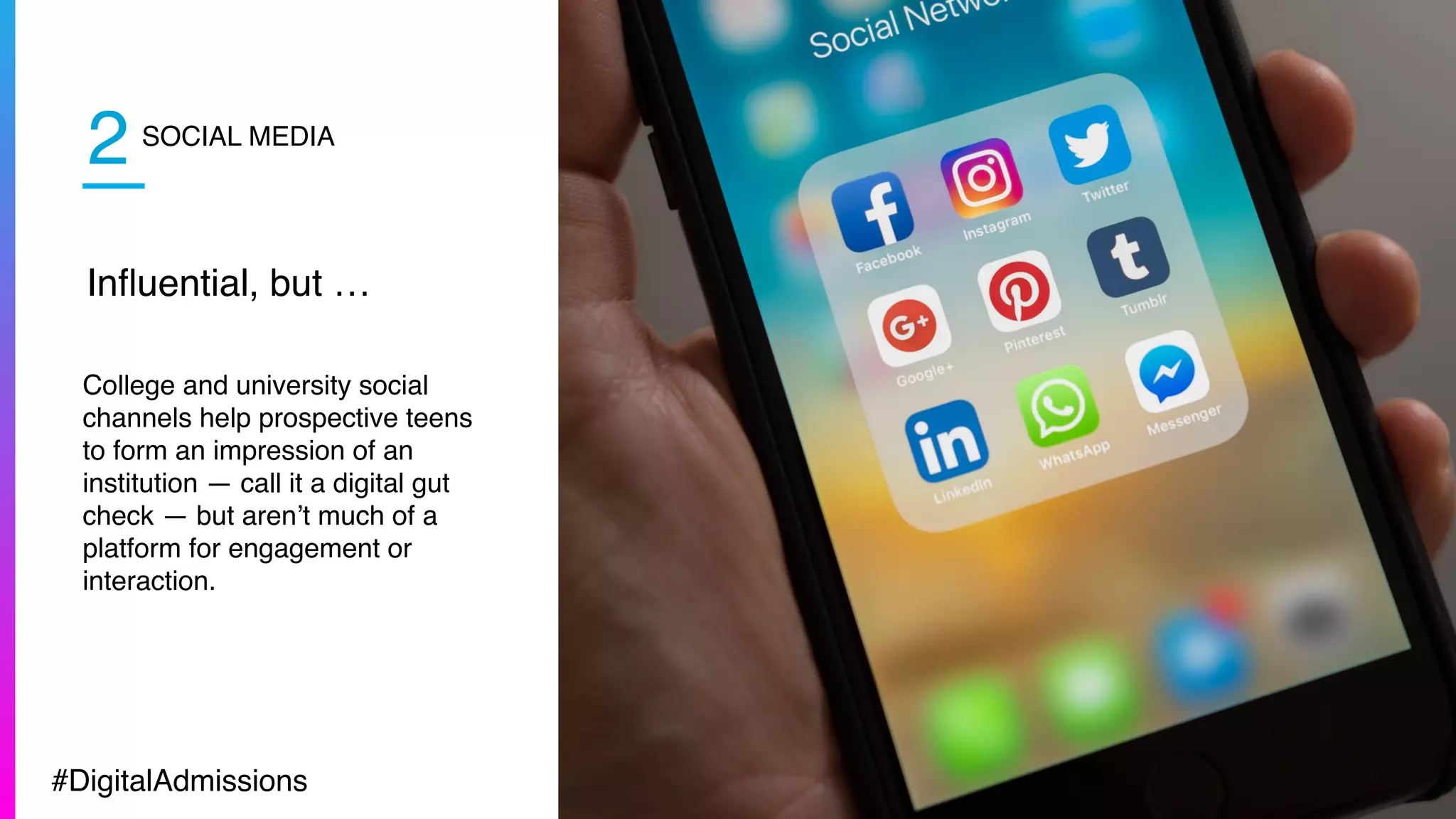
SOCIAL MEDIA
Influential, but …
College and university social
channels help prospective teens
to form an impression of an
institution — call it a digital gut
check — but aren’t much of a
platform for engagement or
interaction.
2
#DigitalAdmissions
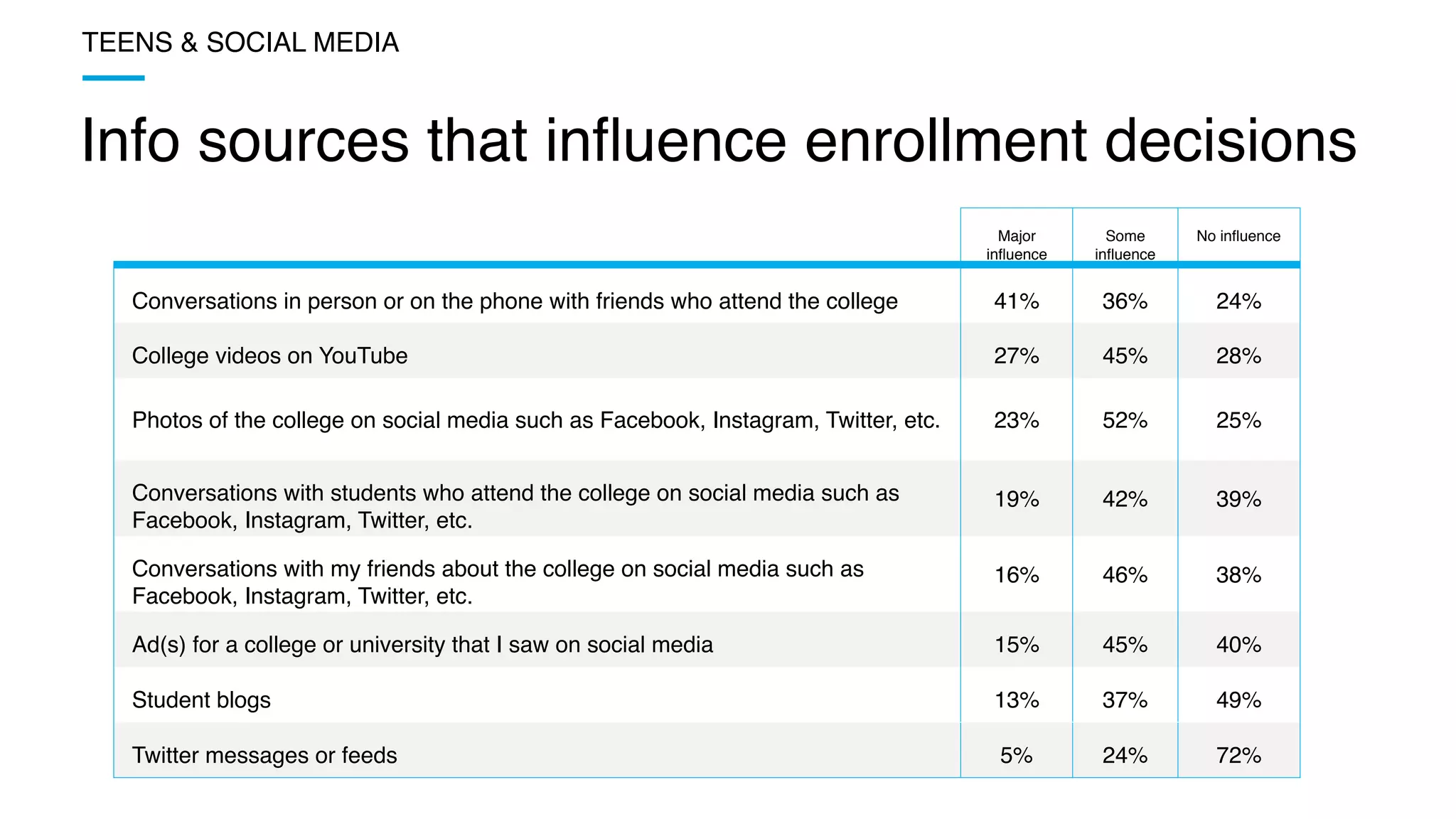
Info sources that influence enrollment decisions
TEENS & SOCIAL MEDIA
Major
influence
Some
influence
No influence
Conversations in person or on the phone with friends who attend the college 41% 36% 24%
College videos on YouTube 27% 45% 28%
Photos of the college on social media such as Facebook, Instagram, Twitter, etc. 23% 52% 25%
Conversations with students who attend the college on social media such as
Facebook, Instagram, Twitter, etc.
19% 42% 39%
Conversations with my friends about the college on social media such as
Facebook, Instagram, Twitter, etc.
16% 46% 38%
Ad(s) for a college or university that I saw on social media 15% 45% 40%
Student blogs 13% 37% 49%
Twitter messages or feeds 5% 24% 72%
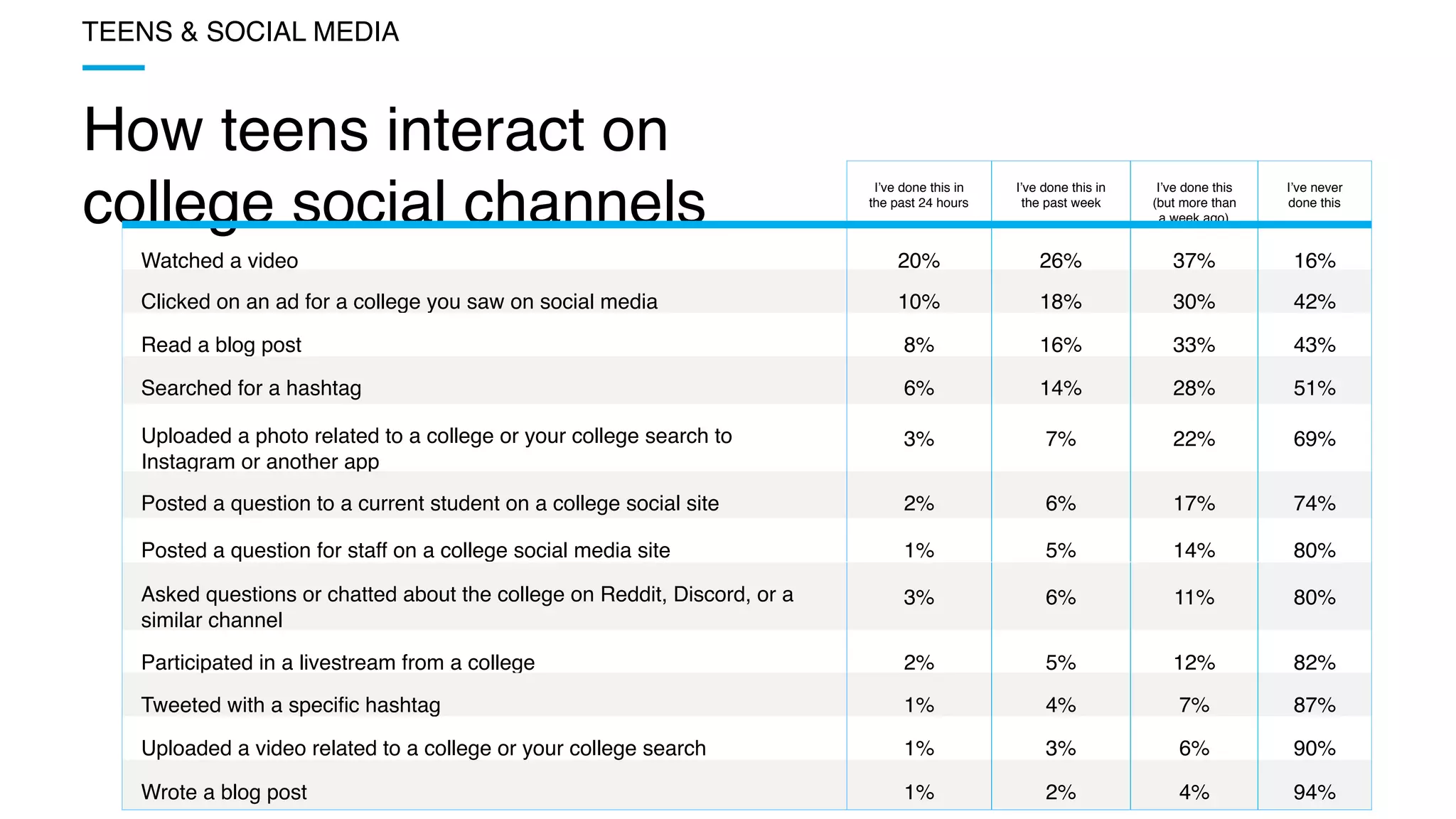
How teens interact on 

college social channels
TEENS & SOCIAL MEDIA
I’ve done this in
the past 24 hours
I’ve done this in
the past week
I’ve done this
(but more than
a week ago)
I’ve never
done this
Watched a video 20% 26% 37% 16%
Clicked on an ad for a college you saw on social media 10% 18% 30% 42%
Read a blog post 8% 16% 33% 43%
Searched for a hashtag 6% 14% 28% 51%
Uploaded a photo related to a college or your college search to
Instagram or another app
3% 7% 22% 69%
Posted a question to a current student on a college social site 2% 6% 17% 74%
Posted a question for staff on a college social media site 1% 5% 14% 80%
Asked questions or chatted about the college on Reddit, Discord, or a
similar channel
3% 6% 11% 80%
Participated in a livestream from a college 2% 5% 12% 82%
Tweeted with a specific hashtag 1% 4% 7% 87%
Uploaded a video related to a college or your college search 1% 3% 6% 90%
Wrote a blog post 1% 2% 4% 94%
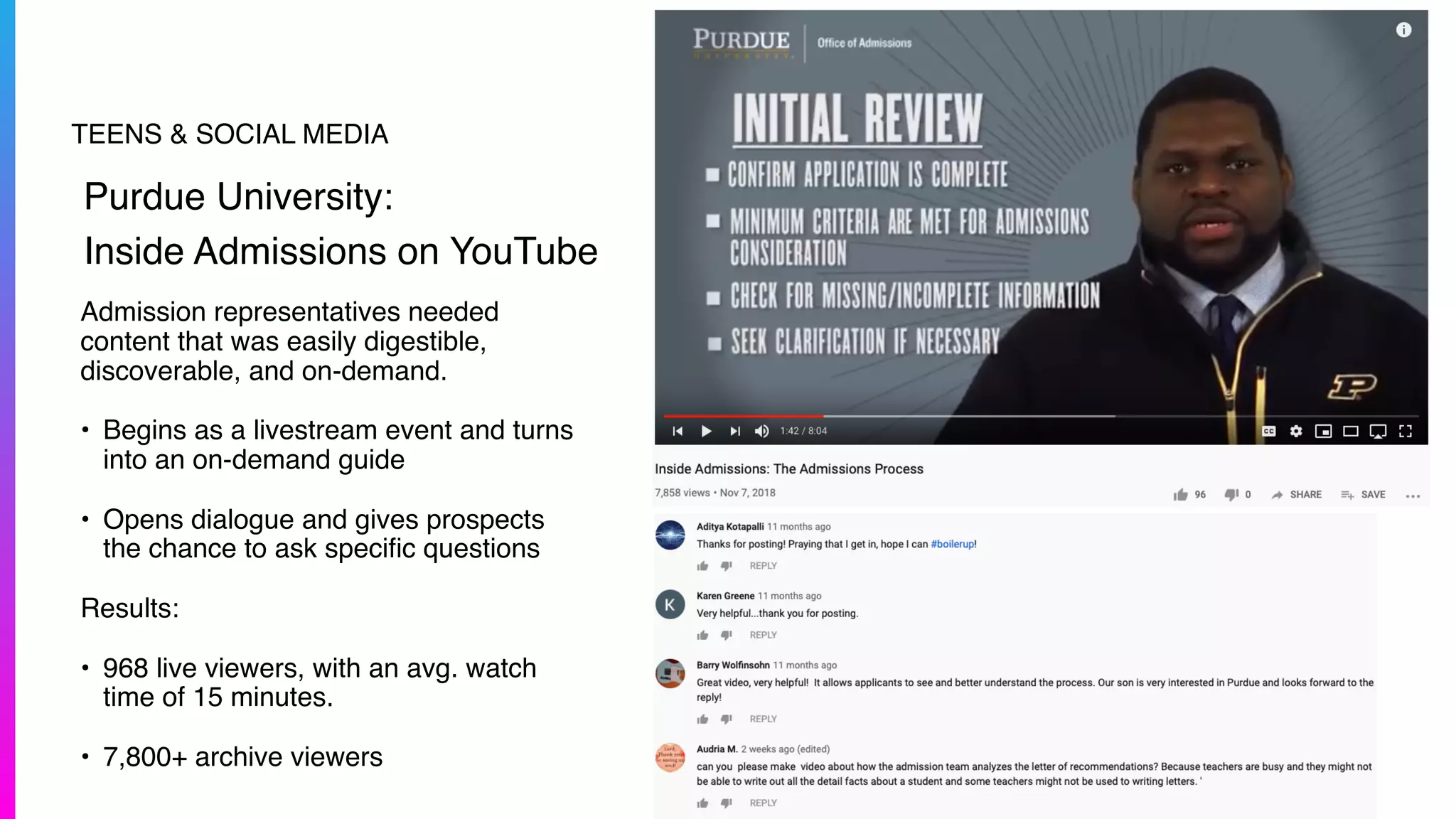
TEENS & SOCIAL MEDIA
Admission representatives needed
content that was easily digestible,
discoverable, and on-demand.
• Begins as a livestream event and turns
into an on-demand guide
• Opens dialogue and gives prospects
the chance to ask specific questions
Results:
• 968 live viewers, with an avg. watch
time of 15 minutes.
• 7,800+ archive viewers
Purdue University:

Inside Admissions on YouTube
TEENS & SOCIAL MEDIA
Arizona State University created an
Instagram campaign to target enrolled
students this past summer, asking “get
to know you” questions.
Results:
• 47% engagement rate on Instagram
Story questions
• 518 likes, 84 profile visits, and 24
saves on Welcome Week carousel
post
Arizona State University:

Incoming Student Engagement
TEENS & SOCIAL MEDIA
George Mason University:

Connecting Students with Schools App
George Mason was looking for a way to connect
prospective students with each other.
• Started with Schools App in 2013, it’s a private social
community via mobile app
• Invited admitted students to join and connect with
staff, current students and each other
Results:
• Schools App members are four times more likely to
enroll
• Almost 284,000 inter-student messages since 2015
TEENS & YOUR WEBSITE
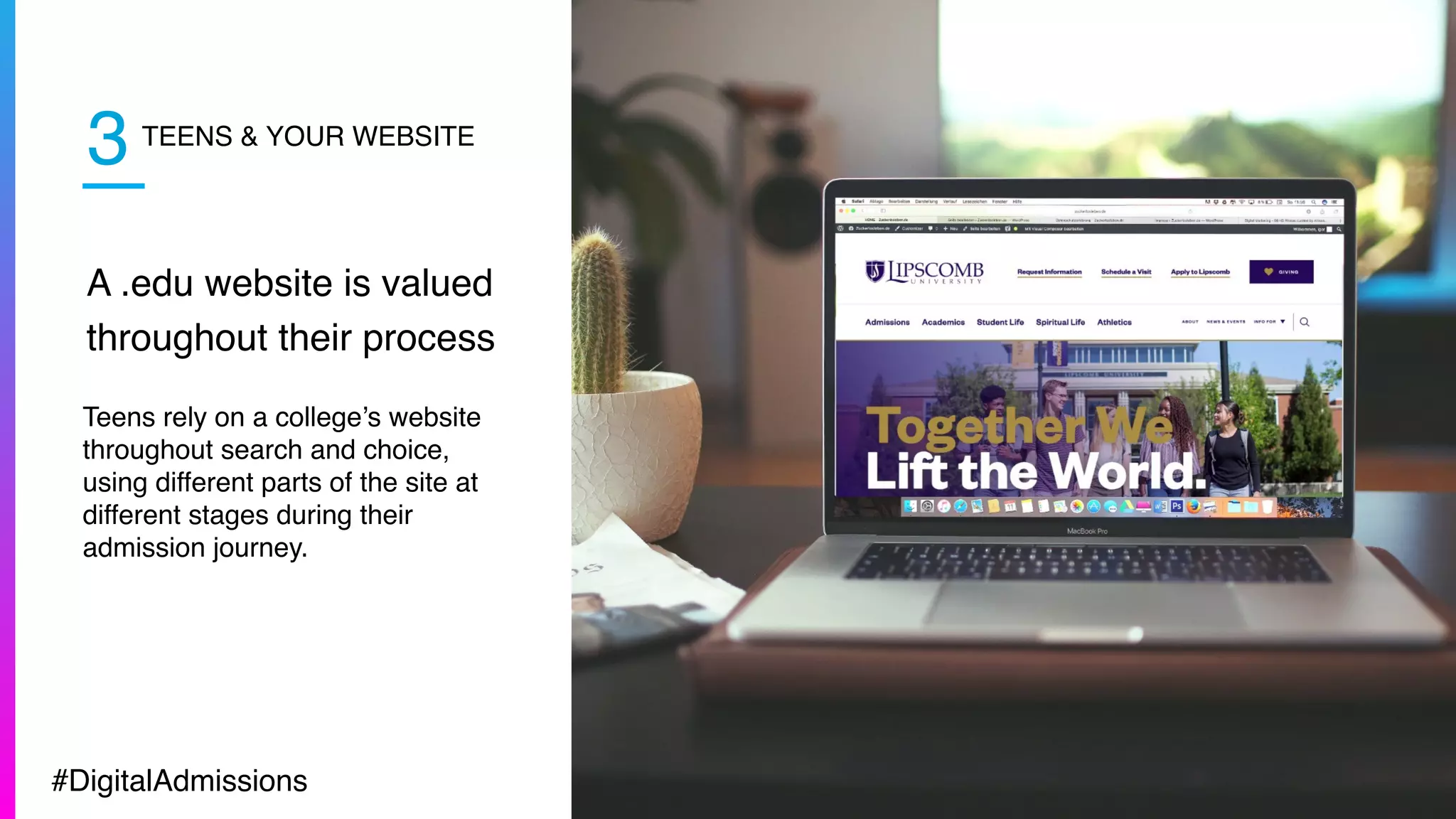
A .edu website is valued
throughout their process
Teens rely on a college’s website
throughout search and choice,
using different parts of the site at
different stages during their
admission journey.
3
#DigitalAdmissions
Most important web content
TEENS & YOUR WEBSITE
1. Major/academic programs:
95%
2. Cost of attendance: 93%
3. Financial aid: 90%
4. Applications/how to apply:
84%
5. Where located/how to visit:
78%
6. Campus culture/student life:
75%
7. How to ask questions or
contact someone: 74%
8. Info about professors: 66%
9. The students, so I can
figure out if the college is a
good fit: 52%
TEENS & YOUR WEBSITE
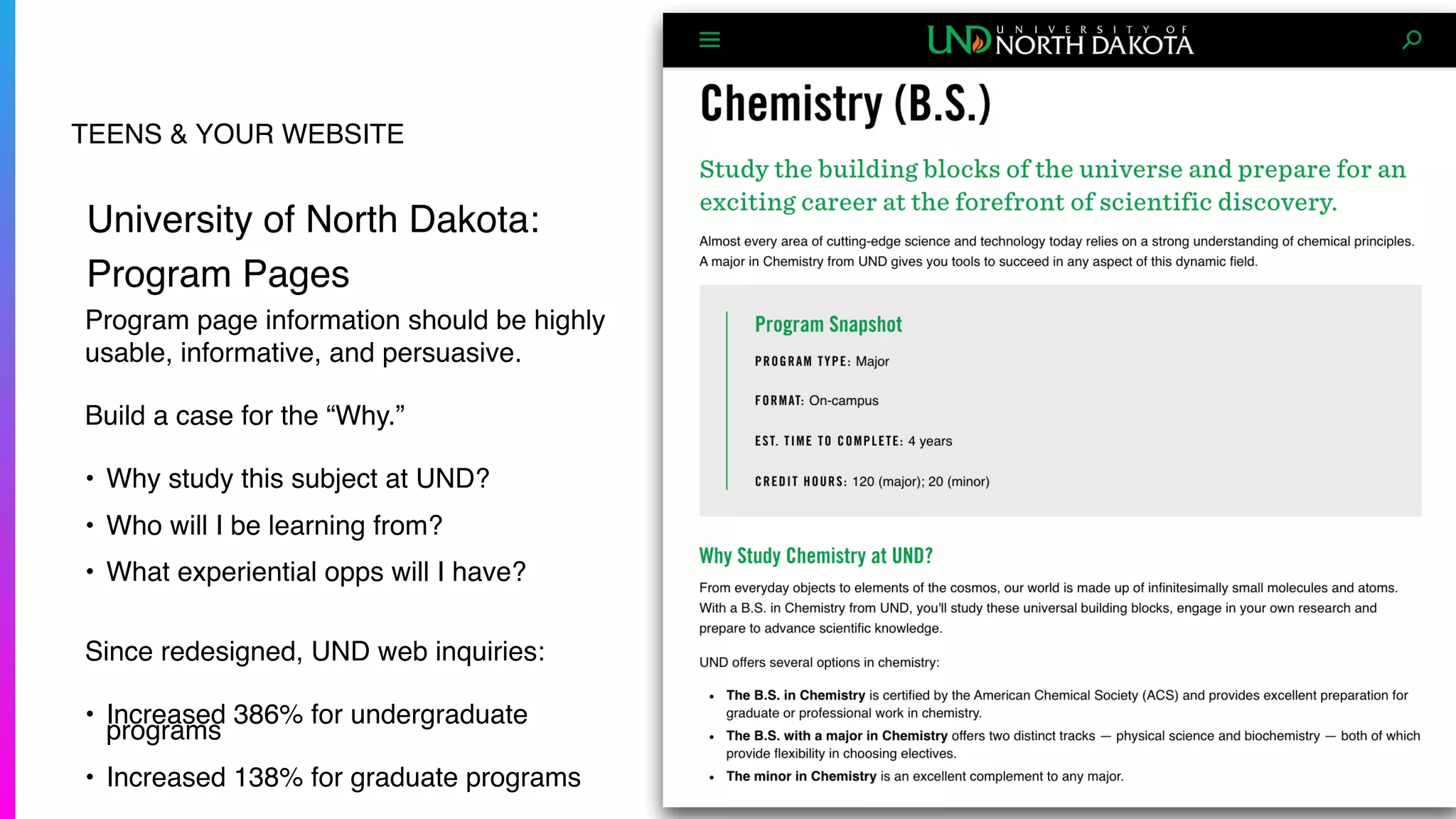
University of North Dakota:
Program Pages
Program page information should be highly
usable, informative, and persuasive.
Build a case for the “Why.”
• Why study this subject at UND?
• Who will I be learning from?
• What experiential opps will I have?


Since redesigned, UND web inquiries:
• Increased 386% for undergraduate
programs
• Increased 138% for graduate programs
TEENS & YOUR WEBSITE
Financial aid content must be easily
accessible and transparent.
Lipscomb’s new site:
• Improved information architecture
• Simplified design
• Optimized content for searchengines
Results:
• Traffic increased 117%
• Entrances increased 584%
• More than 90% of page entrances
are driven by search engines
Lipscomb University:
Financial Aid & Costs
TEENS & YOUR WEBSITE
UNCSA’s site design and strategy
allows the energy of the student
work created on campus to tell
UNCSA’s brand story.
The lead message – “We Promise
This: You’ll Do What You Love” –
sets the tone.
Results:
• One year after launch UNCSA
saw a 518% increase in
admission inquiries.
University of North Carolina
School of the Arts: 

Campus Culture
COMMUNICATING WITH TEENS
Text them, but email may
still be better
Teens are certainly open to being
texted by colleges but a surprising
majority prefer colleges to use
email when reaching out to them.
4
#DigitalAdmissions
Questions?
Resources
Resources
Webinar: Build Empathy
Through Experience Maps
E-Book: Redesigning the Student
Experience
Partner With mStoner
Learn more about TargetX
Dive Deeper Download Explore
Take the webinar survey
Thank You!
MICHAEL STONER
(312) 622-6930
michael.stoner@mstoner.com
SASHA PETERSON
(415) 823-1980
peterson@targetx.com

2019 Digital Admissions

  • 1.
    Digital Admissions 2019 Webinar HOW PROSPECTIVETEENS USE ONLINE TOOLS IN COLLEGE SEARCH & CHOICE
  • 2.
    Moderator Mallory + Director ofMarketing, mStoner + LA Transplant + Proud Medill Alumna @MalloryWillsea
  • 3.
    Housekeeping: A few startingdetails: 45-minute webinar + 15 minutes for questions and answers Chat and ask questions through the Zoom Control Panel Tweet during the webinar with #DigitalAdmissions Please fill out the post-webinar survey Check your inbox on Friday for the webinar recording and slide deck
  • 4.
    Your Co-Presenter Today: Michael +President and Co-Founder, mStoner + Vermonter by choice, not birth + Did I mention #DeleteFacebook? @mstonervt
  • 5.
    Your Co-Presenter Today: Sasha +CEO, TargetX + Rooted in Latvia, raised in California + Currently without power @sashapeterson
  • 6.
  • 7.
    Today’s Topics 1. Demographics 2. KeyObservations 3. Teens & Social Media 4. Teens & Your Website 5. Communicating With Teens Agenda #DigitalAdmissions
  • 8.
    Demographics of Respondents DEMOGRAPHICS •Survey deployed on Niche.com • 2,281 respondents • We accepted responses from Classes of 2019-2022 for a total of 1,458 • 26% researching; 28% deciding; 39% decided • 76% of respondents identified as female (but this didn’t skew results) • 44% Caucasian/White; 23% African-American/Black; 23% Latinx; 15% Asian; 3% American Indian/Alaskan Native; 2% Hawaiian or Pacific Islander
  • 9.
    KEY OBSERVATIONS Some surprisingfindings from our respondents Some of the most revealing or surprising results from our survey include the importance of websites, the continued preference for email as a channel for communications, and the finding that ads on social media don’t turn teens off. 1 #DigitalAdmissions
  • 10.
    Teens & SocialMedia Teens use social media extensively in their personal lives and in college search and choice. But college social channels are not hugely influential in their decision about where to enroll. They do pay attention to posts from currently enrolled students, though. #DigitalAdmissions
  • 11.
    Teens & SocialMedia Don’t expect teens to interact on your social channels: while 63% liked or followed a university social channel, they consume content but don’t interact with people there. #DigitalAdmissions
  • 12.
    Teens & SocialMedia There are some signs of growing disenchantment with social media: a third of our respondents said they didn’t use social at all. #DigitalAdmissions
  • 13.
    Teens & Video YouTubeis the second-most popular social channel among our respondents: 55% use it once a day. And 27% said videos on YouTube were a major influence on where they enrolled. #DigitalAdmissions
  • 14.
    Teens & YourWebsite Websites are critical to college search and choice: 54% of respondents said it was very or extremely important in their decision about where to apply. #DigitalAdmissions
  • 15.
    Teens & YourWebsite And 92% of our respondents said that the university website was more important than the college’s social media. #DigitalAdmissions
  • 16.
    Teens & FTF Whenit comes to enrollment, the number one influence is in-person or phone interactions with friends who attend the college. #DigitalAdmissions
  • 17.
    Teens & Ads Nearly75% of our respondents have seen ads for colleges online; a majority (56%) clicked on them. They’re also aware of ads on social media: 46% of those who noticed an ad said that they had no impact on their impression of the institution. #DigitalAdmissions
  • 18.
    SOCIAL MEDIA Influential, but… College and university social channels help prospective teens to form an impression of an institution — call it a digital gut check — but aren’t much of a platform for engagement or interaction. 2 #DigitalAdmissions
  • 19.
    Info sources thatinfluence enrollment decisions TEENS & SOCIAL MEDIA Major influence Some influence No influence Conversations in person or on the phone with friends who attend the college 41% 36% 24% College videos on YouTube 27% 45% 28% Photos of the college on social media such as Facebook, Instagram, Twitter, etc. 23% 52% 25% Conversations with students who attend the college on social media such as Facebook, Instagram, Twitter, etc. 19% 42% 39% Conversations with my friends about the college on social media such as Facebook, Instagram, Twitter, etc. 16% 46% 38% Ad(s) for a college or university that I saw on social media 15% 45% 40% Student blogs 13% 37% 49% Twitter messages or feeds 5% 24% 72%
  • 20.
    How teens interacton 
 college social channels TEENS & SOCIAL MEDIA I’ve done this in the past 24 hours I’ve done this in the past week I’ve done this (but more than a week ago) I’ve never done this Watched a video 20% 26% 37% 16% Clicked on an ad for a college you saw on social media 10% 18% 30% 42% Read a blog post 8% 16% 33% 43% Searched for a hashtag 6% 14% 28% 51% Uploaded a photo related to a college or your college search to Instagram or another app 3% 7% 22% 69% Posted a question to a current student on a college social site 2% 6% 17% 74% Posted a question for staff on a college social media site 1% 5% 14% 80% Asked questions or chatted about the college on Reddit, Discord, or a similar channel 3% 6% 11% 80% Participated in a livestream from a college 2% 5% 12% 82% Tweeted with a specific hashtag 1% 4% 7% 87% Uploaded a video related to a college or your college search 1% 3% 6% 90% Wrote a blog post 1% 2% 4% 94%
  • 21.
    TEENS & SOCIALMEDIA Admission representatives needed content that was easily digestible, discoverable, and on-demand. • Begins as a livestream event and turns into an on-demand guide • Opens dialogue and gives prospects the chance to ask specific questions Results: • 968 live viewers, with an avg. watch time of 15 minutes. • 7,800+ archive viewers Purdue University:
 Inside Admissions on YouTube
  • 22.
    TEENS & SOCIALMEDIA Arizona State University created an Instagram campaign to target enrolled students this past summer, asking “get to know you” questions. Results: • 47% engagement rate on Instagram Story questions • 518 likes, 84 profile visits, and 24 saves on Welcome Week carousel post Arizona State University:
 Incoming Student Engagement
  • 23.
    TEENS & SOCIALMEDIA George Mason University:
 Connecting Students with Schools App George Mason was looking for a way to connect prospective students with each other. • Started with Schools App in 2013, it’s a private social community via mobile app • Invited admitted students to join and connect with staff, current students and each other Results: • Schools App members are four times more likely to enroll • Almost 284,000 inter-student messages since 2015
  • 24.
    TEENS & YOURWEBSITE A .edu website is valued throughout their process Teens rely on a college’s website throughout search and choice, using different parts of the site at different stages during their admission journey. 3 #DigitalAdmissions
  • 25.
    Most important webcontent TEENS & YOUR WEBSITE 1. Major/academic programs: 95% 2. Cost of attendance: 93% 3. Financial aid: 90% 4. Applications/how to apply: 84% 5. Where located/how to visit: 78% 6. Campus culture/student life: 75% 7. How to ask questions or contact someone: 74% 8. Info about professors: 66% 9. The students, so I can figure out if the college is a good fit: 52%
  • 26.
    TEENS & YOURWEBSITE University of North Dakota: Program Pages Program page information should be highly usable, informative, and persuasive. Build a case for the “Why.” • Why study this subject at UND? • Who will I be learning from? • What experiential opps will I have? 
 Since redesigned, UND web inquiries: • Increased 386% for undergraduate programs • Increased 138% for graduate programs
  • 27.
    TEENS & YOURWEBSITE Financial aid content must be easily accessible and transparent. Lipscomb’s new site: • Improved information architecture • Simplified design • Optimized content for searchengines Results: • Traffic increased 117% • Entrances increased 584% • More than 90% of page entrances are driven by search engines Lipscomb University: Financial Aid & Costs
  • 28.
    TEENS & YOURWEBSITE UNCSA’s site design and strategy allows the energy of the student work created on campus to tell UNCSA’s brand story. The lead message – “We Promise This: You’ll Do What You Love” – sets the tone. Results: • One year after launch UNCSA saw a 518% increase in admission inquiries. University of North Carolina School of the Arts: 
 Campus Culture
  • 29.
    COMMUNICATING WITH TEENS Textthem, but email may still be better Teens are certainly open to being texted by colleges but a surprising majority prefer colleges to use email when reaching out to them. 4 #DigitalAdmissions
  • 30.
  • 31.
    Resources Resources Webinar: Build Empathy ThroughExperience Maps E-Book: Redesigning the Student Experience Partner With mStoner Learn more about TargetX Dive Deeper Download Explore Take the webinar survey
  • 32.
    Thank You! MICHAEL STONER (312)622-6930 michael.stoner@mstoner.com SASHA PETERSON (415) 823-1980 peterson@targetx.com