









디지털 헬스케어와 보험의 미래
Professor, SAHIST, Sungkyunkwan University
Director, Digital Healthcare Institute
Yoon Sup Choi, Ph.D.
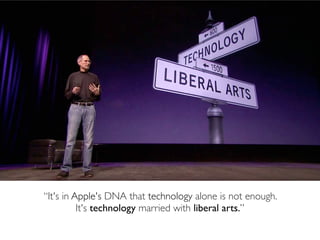
“It's in Apple's DNA that technology alone is not enough. 

It's technology married with liberal arts.”
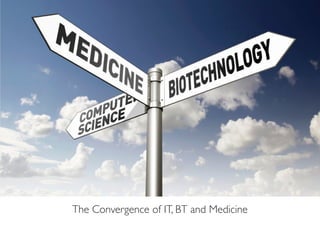
The Convergence of IT, BT and Medicine
최윤섭 지음
의료인공지능
표지디자인•최승협
컴퓨터
털 헬
치를 만드는 것을 화두로
기업가, 엔젤투자가, 에반
의 대표적인 전문가로, 활
이 분야를 처음 소개한 장
포항공과대학교에서 컴
동 대학원 시스템생명공
취득하였다. 스탠퍼드대
조교수, KT 종합기술원 컨
구원 연구조교수 등을 거
저널에 10여 편의 논문을
국내 최초로 디지털 헬스
윤섭 디지털 헬스케어 연
국내 유일의 헬스케어 스
어 파트너스’의 공동 창업
스타트업을 의료 전문가
관대학교 디지털헬스학과
뷰노, 직토, 3billion, 서지
소울링, 메디히어, 모바일
자문을 맡아 한국에서도
고 있다. 국내 최초의 디
케어 이노베이션』에 활발
을 연재하고 있다. 저서로
와 『그렇게 나는 스스로
•블로그_ http://www
•페이스북_ https://w
•이메일_ yoonsup.c
최윤섭
의료 인공지능은 보수적인 의료 시스템을 재편할 혁신을 일으키고 있다. 의료 인공지능의 빠른 발전과
광범위한 영향은 전문화, 세분화되며 발전해 온 현대 의료 전문가들이 이해하기가 어려우며, 어디서부
터 공부해야 할지도 막연하다. 이런 상황에서 의료 인공지능의 개념과 적용, 그리고 의사와의 관계를 쉽
게 풀어내는 이 책은 좋은 길라잡이가 될 것이다. 특히 미래의 주역이 될 의학도와 젊은 의료인에게 유용
한 소개서이다.
━ 서준범, 서울아산병원 영상의학과 교수, 의료영상인공지능사업단장
인공지능이 의료의 패러다임을 크게 바꿀 것이라는 것에 동의하지 않는 사람은 거의 없다. 하지만 인공
지능이 처리해야 할 의료의 난제는 많으며 그 해결 방안도 천차만별이다. 흔히 생각하는 만병통치약 같
은 의료 인공지능은 존재하지 않는다. 이 책은 다양한 의료 인공지능의 개발, 활용 및 가능성을 균형 있
게 분석하고 있다. 인공지능을 도입하려는 의료인, 생소한 의료 영역에 도전할 인공지능 연구자 모두에
게 일독을 권한다.
━ 정지훈, 경희사이버대 미디어커뮤니케이션학과 선임강의교수, 의사
서울의대 기초의학교육을 책임지고 있는 교수의 입장에서, 산업화 이후 변하지 않은 현재의 의학 교육
으로는 격변하는 인공지능 시대에 의대생을 대비시키지 못한다는 한계를 절실히 느낀다. 저와 함께 의
대 인공지능 교육을 개척하고 있는 최윤섭 소장의 전문적 분석과 미래 지향적 안목이 담긴 책이다. 인공
지능이라는 미래를 대비할 의대생과 교수, 그리고 의대 진학을 고민하는 학생과 학부모에게 추천한다.
━ 최형진, 서울대학교 의과대학 해부학교실 교수, 내과 전문의
최근 의료 인공지능의 도입에 대해서 극단적인 시각과 태도가 공존하고 있다. 이 책은 다양한 사례와 깊
은 통찰을 통해 의료 인공지능의 현황과 미래에 대해 균형적인 시각을 제공하여, 인공지능이 의료에 본
격적으로 도입되기 위한 토론의 장을 마련한다. 의료 인공지능이 일상화된 10년 후 돌아보았을 때, 이 책
이 그런 시대를 이끄는 길라잡이 역할을 하였음을 확인할 수 있기를 기대한다.
━ 정규환, 뷰노 CTO
의료 인공지능은 다른 분야 인공지능보다 더 본질적인 이해가 필요하다. 단순히 인간의 일을 대신하는
수준을 넘어 의학의 패러다임을 데이터 기반으로 변화시키기 때문이다. 따라서 인공지능을 균형있게 이
해하고, 어떻게 의사와 환자에게 도움을 줄 수 있을지 깊은 고민이 필요하다. 세계적으로 일어나고 있는
이러한 노력의 결과물을 집대성한 이 책이 반가운 이유다.
━ 백승욱, 루닛 대표
의료 인공지능의 최신 동향뿐만 아니라, 의의와 한계, 전망, 그리고 다양한 생각거리까지 주는 책이다.
논쟁이 되는 여러 이슈에 대해서도 저자는 자신의 시각을 명확한 근거에 기반하여 설득력 있게 제시하
고 있다. 개인적으로는 이 책을 대학원 수업 교재로 활용하려 한다.
━ 신수용, 성균관대학교 디지털헬스학과 교수
최윤섭지음
의료인공지능
값 20,000원
ISBN 979-11-86269-99-2
최초의 책!
계 안팎에서 제기
고 있다. 현재 의
분 커버했다고 자
것인가, 어느 진료
제하고 효용과 안
누가 지는가, 의학
쉬운 언어로 깊이
들이 의료 인공지
적인 용어를 최대
서 다른 곳에서 접
를 접하게 될 것
너무나 빨리 발전
책에서 제시하는
술을 공부하며, 앞
란다.
의사 면허를 취득
저가 도움되면 좋
를 불러일으킬 것
화를 일으킬 수도
슈에 제대로 대응
분은 의학 교육의
예비 의사들은 샌
지능과 함께하는
레이닝 방식도 이
전에 진료실과 수
겠지만, 여러분들
도생하는 수밖에
미래의료학자 최윤섭 박사가 제시하는
의료 인공지능의 현재와 미래
의료 딥러닝과 IBM 왓슨의 현주소
인공지능은 의사를 대체하는가
값 20,000원
ISBN 979-11-86269-99-2
레이닝 방식도 이
전에 진료실과 수
겠지만, 여러분들
도생하는 수밖에
소울링, 메디히어, 모바일
자문을 맡아 한국에서도
고 있다. 국내 최초의 디
케어 이노베이션』에 활발
을 연재하고 있다. 저서로
와 『그렇게 나는 스스로
•블로그_ http://www
•페이스북_ https://w
•이메일_ yoonsup.c
Inevitable Tsunami of Change
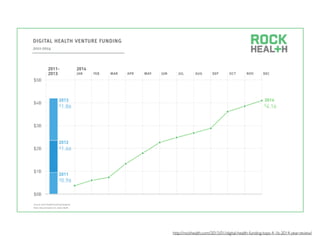
http://rockhealth.com/2015/01/digital-health-funding-tops-4-1b-2014-year-review/
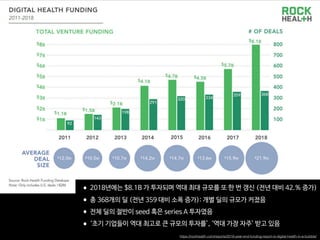
https://rockhealth.com/reports/2018-year-end-funding-report-is-digital-health-in-a-bubble/
•2018년에는 $8.1B 가 투자되며 역대 최대 규모를 또 한 번 갱신 (전년 대비 42.% 증가)

•총 368개의 딜 (전년 359 대비 소폭 증가): 개별 딜의 규모가 커졌음

•전체 딜의 절반이 seed 혹은 series A 투자였음

•‘초기 기업들이 역대 최고로 큰 규모의 투자를’, ‘역대 가장 자주’ 받고 있음
2010 2011 2012 2013 2014 2015 2016 2017 2018
Q1 Q2 Q3 Q4
153
283
476
647
608
568
684
851
765
FUNDING SNAPSHOT: YEAR OVER YEAR
5
Deal Count
$1.4B
$1.7B
$1.7B
$627M
$603M$459M
$8.2B
$6.2B
$7.1B
$2.9B
$2.3B$2.0B
$1.2B
$11.7B
$2.3B
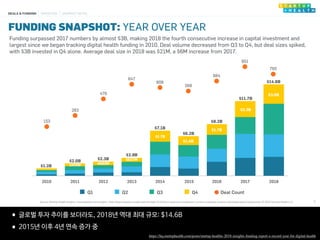
Funding surpassed 2017 numbers by almost $3B, making 2018 the fourth consecutive increase in capital investment and
largest since we began tracking digital health funding in 2010. Deal volume decreased from Q3 to Q4, but deal sizes spiked,
with $3B invested in Q4 alone. Average deal size in 2018 was $21M, a $6M increase from 2017.
$3.0B
$14.6B
DEALS & FUNDING INVESTORS SEGMENT DETAIL
Source: StartUp Health Insights | startuphealth.com/insights Note: Report based on public data through 12/31/18 on seed (incl. accelerator), venture, corporate venture, and private equity funding only. © 2019 StartUp Health LLC
•글로벌 투자 추이를 보더라도, 2018년 역대 최대 규모: $14.6B

•2015년 이후 4년 연속 증가 중
https://hq.startuphealth.com/posts/startup-healths-2018-insights-funding-report-a-record-year-for-digital-health
https://rockhealth.com/reports/digital-health-funding-2015-year-in-review/
5%
8%
24%
27%
36%
Life Science & Health
Mobile
Enterprise & Data
Consumer
Commerce
9%
13%
23%
24%
31%
Life Science & Health
Consumer
Enterprise
Data & AI
Others
2014 2015
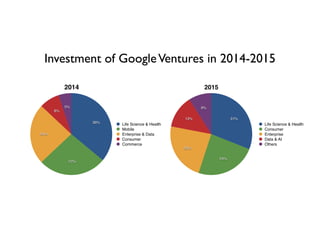
Investment of GoogleVentures in 2014-2015
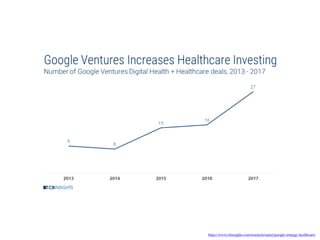
https://www.cbinsights.com/research/report/google-strategy-healthcare/
startuphealth.com/reports
Firm 2017 YTD Deals Stage
Early Mid Late
1 7
1 7
2 6
2 6
3 5
3 5
3 5
3 5
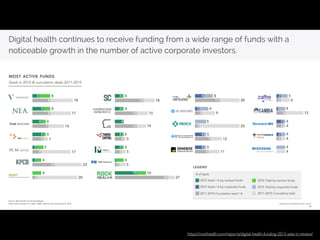
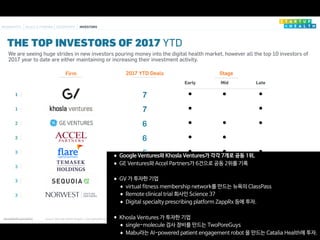
THE TOP INVESTORS OF 2017 YTD
We are seeing huge strides in new investors pouring money into the digital health market, however all the top 10 investors of
2017 year to date are either maintaining or increasing their investment activity.
Source: StartUp Health Insights | startuphealth.com/insights Note: Report based on public data on seed, venture, corporate venture and private equity funding only. © 2017 StartUp Health LLC
DEALS & FUNDING GEOGRAPHY INVESTORSMOONSHOTS
20
•Google Ventures와 Khosla Ventures가 각각 7개로 공동 1위, 

•GE Ventures와 Accel Partners가 6건으로 공동 2위를 기록

•GV 가 투자한 기업

•virtual fitness membership network를 만드는 뉴욕의 ClassPass

•Remote clinical trial 회사인 Science 37

•Digital specialty prescribing platform ZappRx 등에 투자.

•Khosla Ventures 가 투자한 기업

•single-molecule 검사 장비를 만드는 TwoPoreGuys

•Mabu라는 AI-powered patient engagement robot 을 만드는 Catalia Health에 투자.
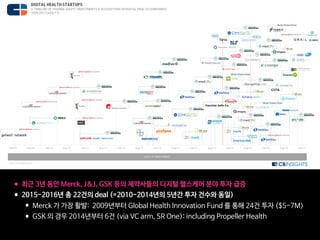
•최근 3년 동안 Merck, J&J, GSK 등의 제약사들의 디지털 헬스케어 분야 투자 급증

•2015-2016년 총 22건의 deal (=2010-2014년의 5년간 투자 건수와 동일)

•Merck 가 가장 활발: 2009년부터 Global Health Innovation Fund 를 통해 24건 투자 ($5-7M)

•GSK 의 경우 2014년부터 6건 (via VC arm, SR One): including Propeller Health
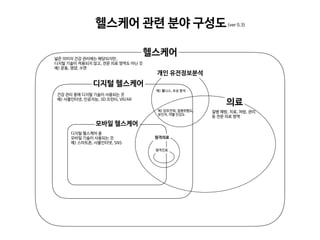
헬스케어넓은 의미의 건강 관리에는 해당되지만, 

디지털 기술이 적용되지 않고, 전문 의료 영역도 아닌 것

예) 운동, 영양, 수면
디지털 헬스케어
건강 관리 중에 디지털 기술이 사용되는 것

예) 사물인터넷, 인공지능, 3D 프린터, VR/AR
모바일 헬스케어
디지털 헬스케어 중 

모바일 기술이 사용되는 것

예) 스마트폰, 사물인터넷, SNS
개인 유전정보분석
예) 암유전체, 질병위험도, 

보인자, 약물 민감도
예) 웰니스, 조상 분석
헬스케어 관련 분야 구성도(ver 0.3)
의료
질병 예방, 치료, 처방, 관리 

등 전문 의료 영역
원격의료
원격진료
What is most important factor in digital medicine?
“Data! Data! Data!” he cried.“I can’t
make bricks without clay!”
- Sherlock Holmes,“The Adventure of the Copper Beeches”
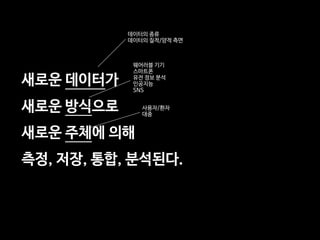
새로운 데이터가

새로운 방식으로

새로운 주체에 의해

측정, 저장, 통합, 분석된다.
데이터의 종류

데이터의 질적/양적 측면
웨어러블 기기

스마트폰

유전 정보 분석

인공지능

SNS
사용자/환자

대중
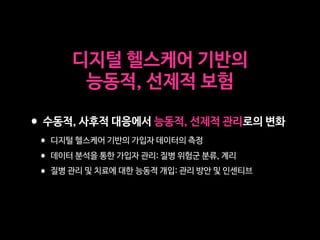
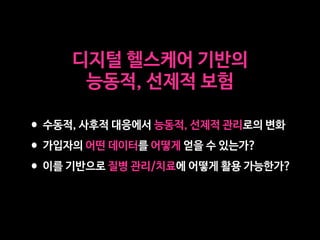
디지털 헬스케어 기반의 

능동적, 선제적 보험
•수동적, 사후적 대응에서 능동적, 선제적 관리로의 변화

•가입자의 어떤 데이터를 어떻게 얻을 수 있는가?

•이를 기반으로 질병 관리/치료에 어떻게 활용 가능한가?
디지털 헬스케어의 3단계
•Step 1. 데이터의 측정

•Step 2. 데이터의 통합

•Step 3. 데이터의 분석
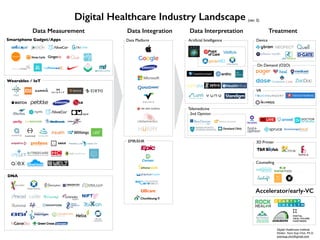
Digital Healthcare Industry Landscape
Data Measurement Data Integration Data Interpretation Treatment
Smartphone Gadget/Apps
DNA
Artificial Intelligence
2nd Opinion
Wearables / IoT
(ver. 3)
EMR/EHR 3D Printer
Counseling
Data Platform
Accelerator/early-VC
Telemedicine
Device
On Demand (O2O)
VR
Digital Healthcare Institute
Diretor, Yoon Sup Choi, Ph.D.
yoonsup.choi@gmail.com
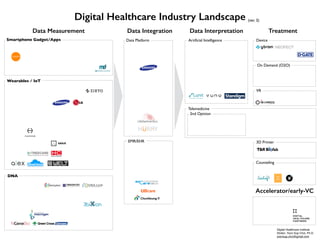
Data Measurement Data Integration Data Interpretation Treatment
Smartphone Gadget/Apps
DNA
Artificial Intelligence
2nd Opinion
Device
On Demand (O2O)
Wearables / IoT
Digital Healthcare Institute
Diretor, Yoon Sup Choi, Ph.D.
yoonsup.choi@gmail.com
EMR/EHR 3D Printer
Counseling
Data Platform
Accelerator/early-VC
VR
Telemedicine
Digital Healthcare Industry Landscape (ver. 3)
Step 1. 데이터의 측정
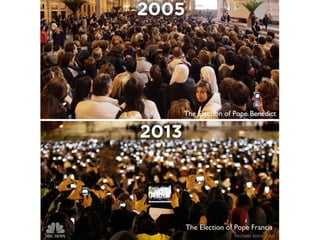
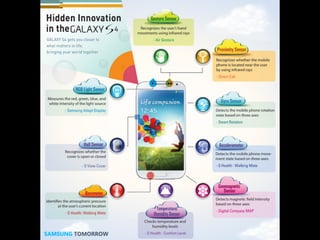
Smartphone: the origin of healthcare innovation
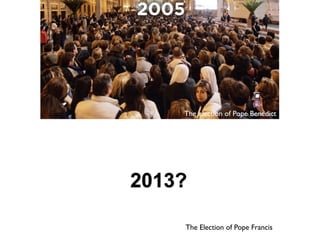
2013?
The election of Pope Benedict
The Election of Pope Francis
The Election of Pope Benedict
SummerTanThese Days
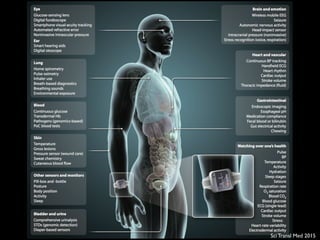
Sci Transl Med 2015
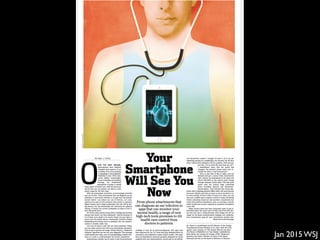
Jan 2015 WSJ
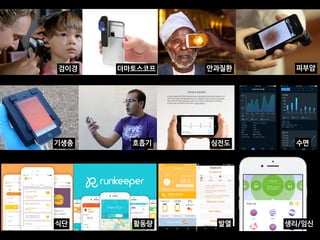
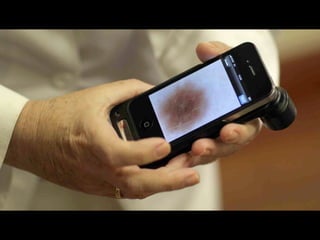
검이경 더마토스코프 안과질환 피부암
기생충 호흡기 심전도 수면
식단 활동량 발열 생리/임신
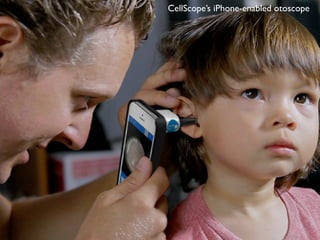
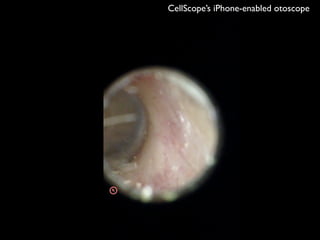
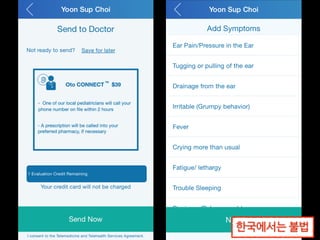
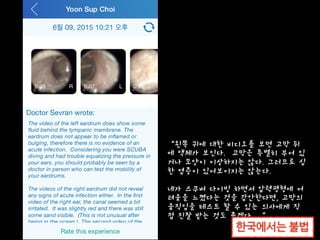
CellScope’s iPhone-enabled otoscope
한국에서는 불법한국에서는 불법
“왼쪽 귀에 대한 비디오를 보면 고막 뒤
에 액체가 보인다. 고막은 특별히 부어 있
거나 모양이 이상하지는 않다. 그러므로 심
한 염증이 있어보이지는 않는다.
네가 스쿠버 다이빙 하면서 압력평형에 어
려움을 느꼈다는 것을 감안한다면, 고막의
움직임을 테스트 할 수 있는 의사에게 직
접 진찰 받는 것도 좋겠다. ...”
한국에서는 불법한국에서는 불법
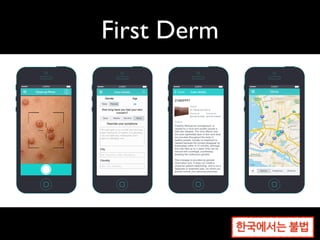
First Derm
한국에서는 불법한국에서는 불법
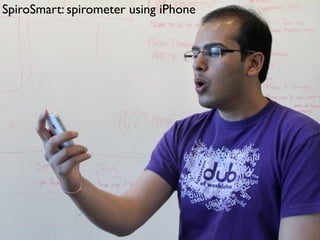
SpiroSmart: spirometer using iPhone
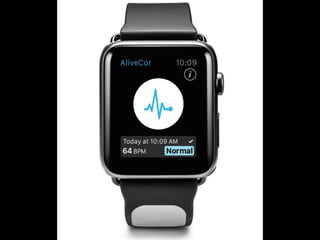
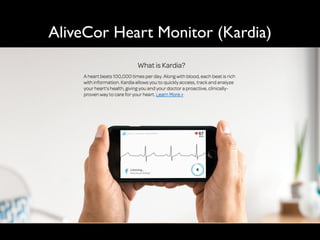
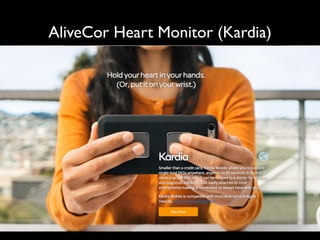
AliveCor Heart Monitor (Kardia)
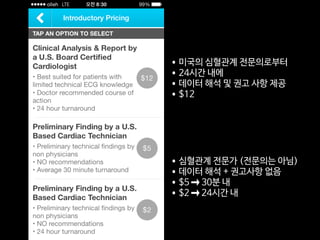
•미국의 심혈관계 전문의로부터 

•24시간 내에

•데이터 해석 및 권고 사항 제공

•$12
•심혈관계 전문가 (전문의는 아님)

•데이터 해석 + 권고사항 없음

•$5 ➞ 30분 내

•$2 ➞ 24시간 내
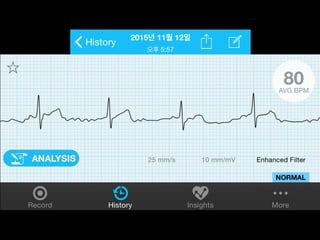
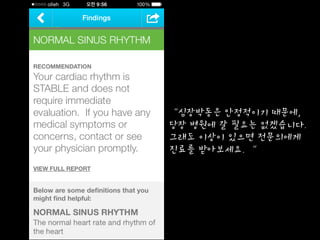
“심장박동은 안정적이기 때문에, 

당장 병원에 갈 필요는 없겠습니다. 

그래도 이상이 있으면 전문의에게 

진료를 받아보세요. “
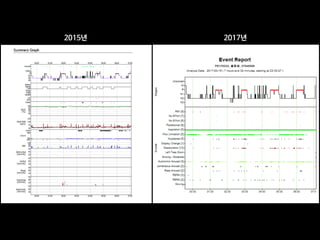
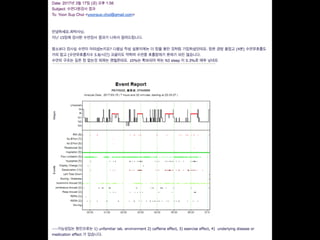
2015년 2017년
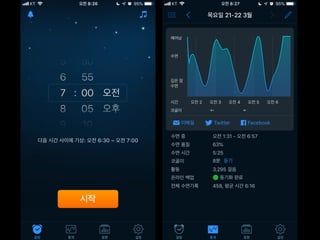
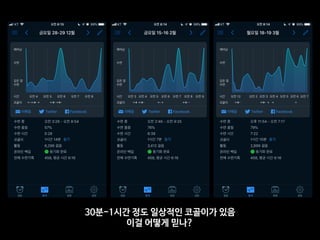
30분-1시간 정도 일상적인 코골이가 있음

이걸 어떻게 믿나?
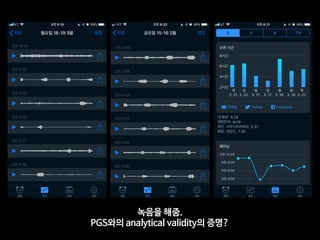
녹음을 해줌. 

PGS와의 analytical validity의 증명?
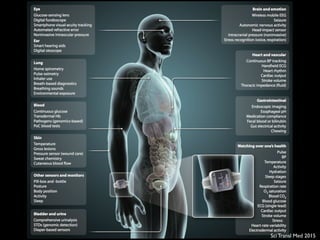
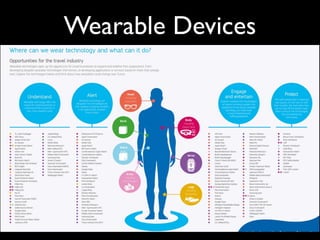
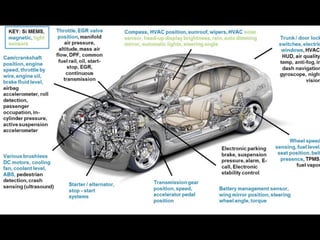
Wearable Devices
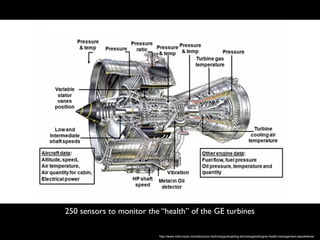
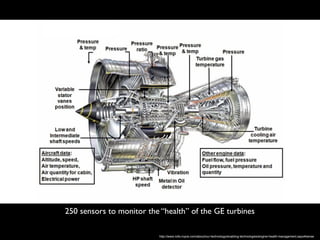
http://www.rolls-royce.com/about/our-technology/enabling-technologies/engine-health-management.aspx#sense
250 sensors to monitor the “health” of the GE turbines
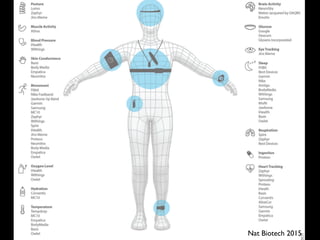
Fig 1. What can consumer wearables do? Heart rate can be measured with an oximeter built into a ring [3], muscle activity with an electromyographi
sensor embedded into clothing [4], stress with an electodermal sensor incorporated into a wristband [5], and physical activity or sleep patterns via an
accelerometer in a watch [6,7]. In addition, a female’s most fertile period can be identified with detailed body temperature tracking [8], while levels of me
attention can be monitored with a small number of non-gelled electroencephalogram (EEG) electrodes [9]. Levels of social interaction (also known to a
PLOS Medicine 2016
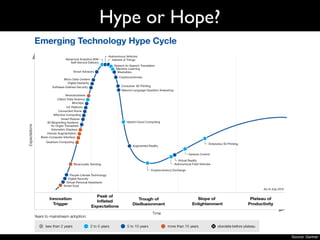
Hype or Hope?
Source: Gartner
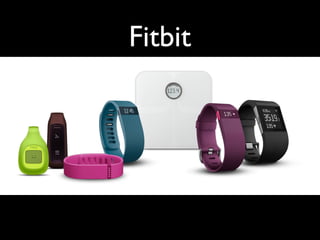
Fitbit
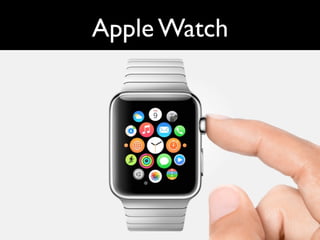
Apple Watch
https://clinicaltrials.gov/ct2/results?term=fitbit&Search=Search
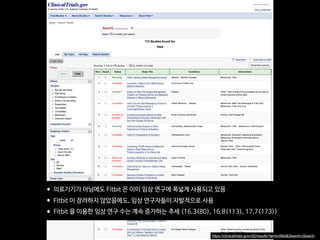
•의료기기가 아님에도 Fitbit 은 이미 임상 연구에 폭넓게 사용되고 있음

•Fitbit 이 장려하지 않았음에도, 임상 연구자들이 자발적으로 사용

•Fitbit 을 이용한 임상 연구 수는 계속 증가하는 추세 (16.3(80), 16.8(113), 17.7(173))
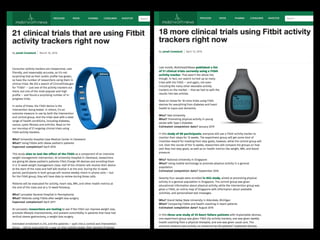
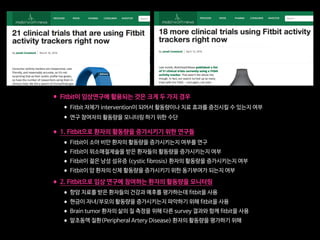
•Fitbit이 임상연구에 활용되는 것은 크게 두 가지 경우

•Fitbit 자체가 intervention이 되어서 활동량이나 치료 효과를 증진시킬 수 있는지 여부

•연구 참여자의 활동량을 모니터링 하기 위한 수단

•1. Fitbit으로 환자의 활동량을 증가시키기 위한 연구들

•Fitbit이 소아 비만 환자의 활동량을 증가시키는지 여부를 연구

•Fitbit이 위소매절제술을 받은 환자들의 활동량을 증가시키는지 여부

•Fitbit이 젊은 낭성 섬유증 (cystic fibrosis) 환자의 활동량을 증가시키는지 여부

•Fitbit이 암 환자의 신체 활동량을 증가시키기 위한 동기부여가 되는지 여부

•2. Fitbit으로 임상 연구에 참여하는 환자의 활동량을 모니터링

•항암 치료를 받은 환자들의 건강과 예후를 평가하는데 fitbit을 사용

•현금이 자녀/부모의 활동량을 증가시키는지 파악하기 위해 fitbit을 사용

•Brain tumor 환자의 삶의 질 측정을 위해 다른 survey 결과와 함께 fitbit을 사용

•말초동맥 질환(Peripheral Artery Disease) 환자의 활동량을 평가하기 위해
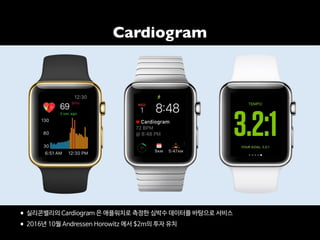
Cardiogram
•실리콘밸리의 Cardiogram 은 애플워치로 측정한 심박수 데이터를 바탕으로 서비스

•2016년 10월 Andressen Horowitz 에서 $2m의 투자 유치
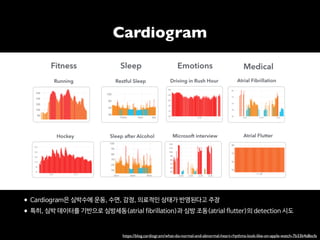
https://blog.cardiogr.am/what-do-normal-and-abnormal-heart-rhythms-look-like-on-apple-watch-7b33b4a8ecfa
•Cardiogram은 심박수에 운동, 수면, 감정, 의료적인 상태가 반영된다고 주장

•특히, 심박 데이터를 기반으로 심방세동(atrial fibrillation)과 심방 조동(atrial flutter)의 detection 시도
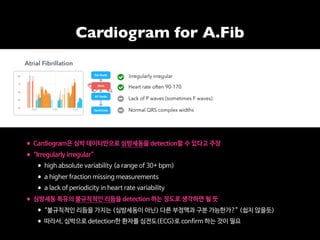
Cardiogram
•Cardiogram은 심박 데이터만으로 심방세동을 detection할 수 있다고 주장

•“Irregularly irregular”

•high absolute variability (a range of 30+ bpm)

•a higher fraction missing measurements

•a lack of periodicity in heart rate variability

•심방세동 특유의 불규칙적인 리듬을 detection 하는 정도로 생각하면 될 듯

•“불규칙적인 리듬을 가지는 (심방세동이 아닌) 다른 부정맥과 구분 가능한가?” (쉽지 않을듯)

•따라서, 심박으로 detection한 환자를 심전도(ECG)로 confirm 하는 것이 필요
Cardiogram for A.Fib
Passive Detection of Atrial Fibrillation
Using a Commercially Available Smartwatch
Geoffrey H. Tison, MD, MPH; José M. Sanchez, MD; Brandon Ballinger, BS; Avesh Singh, MS; Jeffrey E. Olgin, MD;
Mark J. Pletcher, MD, MPH; Eric Vittinghoff, PhD; Emily S. Lee, BA; Shannon M. Fan, BA; Rachel A. Gladstone, BA;
Carlos Mikell, BS; Nimit Sohoni, BS; Johnson Hsieh, MS; Gregory M. Marcus, MD, MAS
IMPORTANCE Atrial fibrillation (AF) affects 34 million people worldwide and is a leading cause
of stroke. A readily accessible means to continuously monitor for AF could prevent large
numbers of strokes and death.
OBJECTIVE To develop and validate a deep neural network to detect AF using smartwatch
data.
DESIGN, SETTING, AND PARTICIPANTS In this multinational cardiovascular remote cohort study
coordinated at the University of California, San Francisco, smartwatches were used to obtain
heart rate and step count data for algorithm development. A total of 9750 participants
enrolled in the Health eHeart Study and 51 patients undergoing cardioversion at the
University of California, San Francisco, were enrolled between February 2016 and March 2017.
A deep neural network was trained using a method called heuristic pretraining in which the
network approximated representations of the R-R interval (ie, time between heartbeats)
without manual labeling of training data. Validation was performed against the reference
standard 12-lead electrocardiography (ECG) in a separate cohort of patients undergoing
cardioversion. A second exploratory validation was performed using smartwatch data from
ambulatory individuals against the reference standard of self-reported history of persistent
AF. Data were analyzed from March 2017 to September 2017.
MAIN OUTCOMES AND MEASURES The sensitivity, specificity, and receiver operating
characteristic C statistic for the algorithm to detect AF were generated based on the
reference standard of 12-lead ECG–diagnosed AF.
RESULTS Of the 9750 participants enrolled in the remote cohort, including 347 participants
with AF, 6143 (63.0%) were male, and the mean (SD) age was 42 (12) years. There were more
than 139 million heart rate measurements on which the deep neural network was trained. The
deep neural network exhibited a C statistic of 0.97 (95% CI, 0.94-1.00; P < .001) to detect AF
against the reference standard 12-lead ECG–diagnosed AF in the external validation cohort of
51 patients undergoing cardioversion; sensitivity was 98.0% and specificity was 90.2%. In an
exploratory analysis relying on self-report of persistent AF in ambulatory participants, the C
statistic was 0.72 (95% CI, 0.64-0.78); sensitivity was 67.7% and specificity was 67.6%.
CONCLUSIONS AND RELEVANCE This proof-of-concept study found that smartwatch
photoplethysmography coupled with a deep neural network can passively detect AF but with
some loss of sensitivity and specificity against a criterion-standard ECG. Further studies will
help identify the optimal role for smartwatch-guided rhythm assessment.
JAMA Cardiol. doi:10.1001/jamacardio.2018.0136
Published online March 21, 2018.
Editorial
Supplemental content and
Audio
Author Affiliations: Division of
Cardiology, Department of Medicine,
University of California, San Francisco
(Tison, Sanchez, Olgin, Lee, Fan,
Gladstone, Mikell, Marcus);
Cardiogram Incorporated, San
Francisco, California (Ballinger, Singh,
Sohoni, Hsieh); Department of
Epidemiology and Biostatistics,
University of California, San Francisco
(Pletcher, Vittinghoff).
Corresponding Author: Gregory M.
Marcus, MD, MAS, Division of
Cardiology, Department of Medicine,
University of California, San
Francisco, 505 Parnassus Ave,
M1180B, San Francisco, CA 94143-
0124 (marcusg@medicine.ucsf.edu).
Research
JAMA Cardiology | Original Investigation
(Reprinted) E1
© 2018 American Medical Association. All rights reserved.
Passive Detection of Atrial Fibrillation
Using a Commercially Available Smartwatch
Geoffrey H. Tison, MD, MPH; José M. Sanchez, MD; Brandon Ballinger, BS; Avesh Singh, MS; Jeffrey E. Olgin, MD;
Mark J. Pletcher, MD, MPH; Eric Vittinghoff, PhD; Emily S. Lee, BA; Shannon M. Fan, BA; Rachel A. Gladstone, BA;
Carlos Mikell, BS; Nimit Sohoni, BS; Johnson Hsieh, MS; Gregory M. Marcus, MD, MAS
IMPORTANCE Atrial fibrillation (AF) affects 34 million people worldwide and is a leading cause
of stroke. A readily accessible means to continuously monitor for AF could prevent large
numbers of strokes and death.
OBJECTIVE To develop and validate a deep neural network to detect AF using smartwatch
data.
DESIGN, SETTING, AND PARTICIPANTS In this multinational cardiovascular remote cohort study
coordinated at the University of California, San Francisco, smartwatches were used to obtain
heart rate and step count data for algorithm development. A total of 9750 participants
enrolled in the Health eHeart Study and 51 patients undergoing cardioversion at the
University of California, San Francisco, were enrolled between February 2016 and March 2017.
A deep neural network was trained using a method called heuristic pretraining in which the
network approximated representations of the R-R interval (ie, time between heartbeats)
without manual labeling of training data. Validation was performed against the reference
standard 12-lead electrocardiography (ECG) in a separate cohort of patients undergoing
cardioversion. A second exploratory validation was performed using smartwatch data from
ambulatory individuals against the reference standard of self-reported history of persistent
AF. Data were analyzed from March 2017 to September 2017.
MAIN OUTCOMES AND MEASURES The sensitivity, specificity, and receiver operating
characteristic C statistic for the algorithm to detect AF were generated based on the
reference standard of 12-lead ECG–diagnosed AF.
RESULTS Of the 9750 participants enrolled in the remote cohort, including 347 participants
with AF, 6143 (63.0%) were male, and the mean (SD) age was 42 (12) years. There were more
than 139 million heart rate measurements on which the deep neural network was trained. The
deep neural network exhibited a C statistic of 0.97 (95% CI, 0.94-1.00; P < .001) to detect AF
against the reference standard 12-lead ECG–diagnosed AF in the external validation cohort of
51 patients undergoing cardioversion; sensitivity was 98.0% and specificity was 90.2%. In an
exploratory analysis relying on self-report of persistent AF in ambulatory participants, the C
statistic was 0.72 (95% CI, 0.64-0.78); sensitivity was 67.7% and specificity was 67.6%.
CONCLUSIONS AND RELEVANCE This proof-of-concept study found that smartwatch
photoplethysmography coupled with a deep neural network can passively detect AF but with
some loss of sensitivity and specificity against a criterion-standard ECG. Further studies will
help identify the optimal role for smartwatch-guided rhythm assessment.
JAMA Cardiol. doi:10.1001/jamacardio.2018.0136
Published online March 21, 2018.
Editorial
Supplemental content and
Audio
Author Affiliations: Division of
Cardiology, Department of Medicine,
University of California, San Francisco
(Tison, Sanchez, Olgin, Lee, Fan,
Gladstone, Mikell, Marcus);
Cardiogram Incorporated, San
Francisco, California (Ballinger, Singh,
Sohoni, Hsieh); Department of
Epidemiology and Biostatistics,
University of California, San Francisco
(Pletcher, Vittinghoff).
Corresponding Author: Gregory M.
Marcus, MD, MAS, Division of
Cardiology, Department of Medicine,
University of California, San
Francisco, 505 Parnassus Ave,
M1180B, San Francisco, CA 94143-
0124 (marcusg@medicine.ucsf.edu).
Research
JAMA Cardiology | Original Investigation
(Reprinted) E1
© 2018 American Medical Association. All rights reserved.
tion from the participant (dependent on user adherence) and
by the episodic nature of data obtained. A Samsung Simband
(Samsung) exhibited high sensitivity and specificity for AF de-
32
costs associated with the care of those patients, the potential
reduction in stroke could ultimately provide cost savings.
SeveralfactorsmakedetectionofAFfromambulatorydata
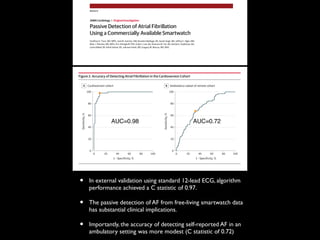
Figure 2. Accuracy of Detecting Atrial Fibrillation in the Cardioversion Cohort
100
80
60
40
20
0
0 10080
Sensitivity,%
1 –Specificity, %
604020
Cardioversion cohortA
100
80
60
40
20
0
0 10080
Sensitivity,%
1 –Specificity, %
604020
Ambulatory subset of remote cohortB
A, Receiver operating characteristic
curve among 51 individuals
undergoing in-hospital cardioversion.
The curve demonstrates a C statistic
of 0.97 (95% CI, 0.94-1.00), and the
point on the curve indicates a
sensitivity of 98.0% and a specificity
of 90.2%. B, Receiver operating
characteristic curve among 1617
individuals in the ambulatory subset
of the remote cohort. The curve
demonstrates a C statistic of 0.72
(95% CI, 0.64-0.78), and the point on
the curve indicates a sensitivity of
67.7% and a specificity of 67.6%.
Table 3. Performance Characteristics of Deep Neural Network in Validation Cohortsa
Cohort
%
AUCSensitivity Specificity PPV NPV
Cardioversion cohort (sedentary) 98.0 90.2 90.9 97.8 0.97
Subset of remote cohort (ambulatory) 67.7 67.6 7.9 98.1 0.72
Abbreviations: AUC, area under the receiver operating characteristic curve;
NPV, negative predictive value; PPV, positive predictive value.
a
In the cardioversion cohort, the atrial fibrillation reference standard was
12-lead electrocardiography diagnosis; in the remote cohort, the atrial
fibrillation reference standard was limited to self-reported history of persistent
atrial fibrillation.
Research Original Investigation Passive Detection of Atrial Fibrillation Using a Commercially Available Smartwatch
AUC=0.98 AUC=0.72
• In external validation using standard 12-lead ECG, algorithm
performance achieved a C statistic of 0.97.
• The passive detection of AF from free-living smartwatch data
has substantial clinical implications.
• Importantly, the accuracy of detecting self-reported AF in an
ambulatory setting was more modest (C statistic of 0.72)
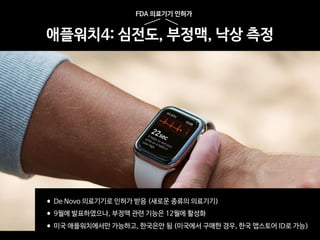
애플워치4: 심전도, 부정맥, 낙상 측정
FDA 의료기기 인허가
•De Novo 의료기기로 인허가 받음 (새로운 종류의 의료기기)

•9월에 발표하였으나, 부정맥 관련 기능은 12월에 활성화

•미국 애플워치에서만 가능하고, 한국은안 됨 (미국에서 구매한 경우, 한국 앱스토어 ID로 가능)
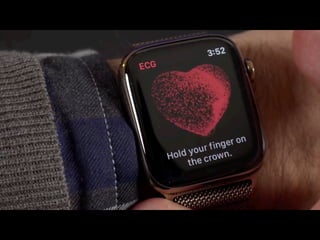
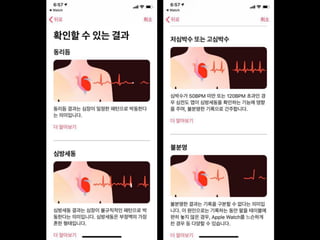
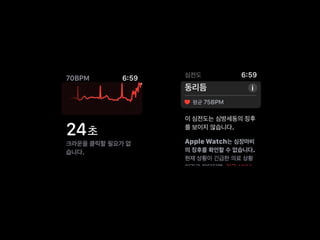
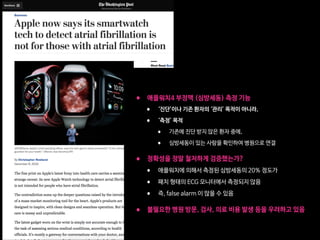
• 애플워치4 부정맥 (심방세동) 측정 기능

• ‘진단’이나 기존 환자의 ‘관리’ 목적이 아니라, 

• ‘측정’ 목적

• 기존에 진단 받지 않은 환자 중에, 

• 심방세동이 있는 사람을 확인하여 병원으로 연결

• 정확성을 정말 철저하게 검증했는가? 

• 애플워치에 의해서 측정된 심방세동의 20% 정도가

• 패치 형태의 ECG 모니터에서 측정되지 않음 

• 즉, false alarm 이 많을 수 있음 

• 불필요한 병원 방문, 검사, 의료 비용 발생 등을 우려하고 있음
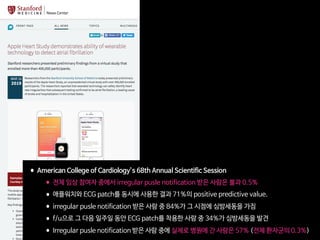
•American College of Cardiology’s 68th Annual Scientific Session

•전체 임상 참여자 중에서 irregular pusle notification 받은 사람은 불과 0.5%

•애플워치와 ECG patch를 동시에 사용한 결과 71%의 positive predictive value. 

•irregular pusle notification 받은 사람 중 84%가 그 시점에 심방세동을 가짐

•f/u으로 그 다음 일주일 동안 ECG patch를 착용한 사람 중 34%가 심방세동을 발견

•Irregular pusle notification 받은 사람 중에 실제로 병원에 간 사람은 57% (전체 환자군의 0.3%)
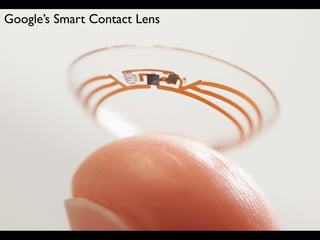
Google’s Smart Contact Lens
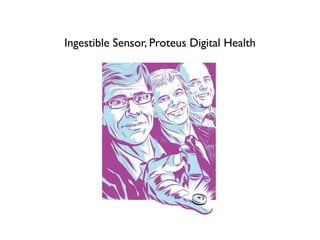
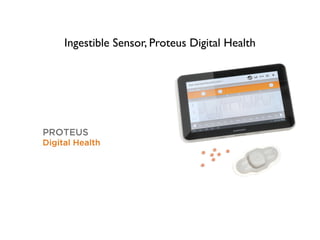
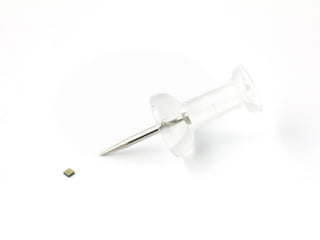
Ingestible Sensor, Proteus Digital Health
n
n-
ng
n
es
h-
n
ne
ne
ct
d
n-
at
s-
or
e,
ts
n
a-
gs
d
ch
Nat Biotech 2015
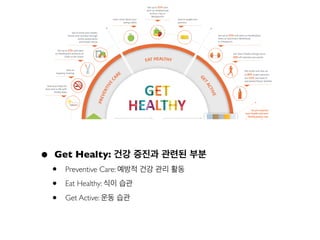
건강관리서비스
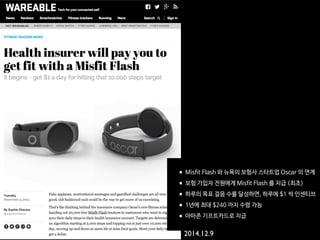
웨어러블+보험사
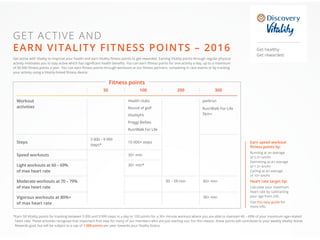
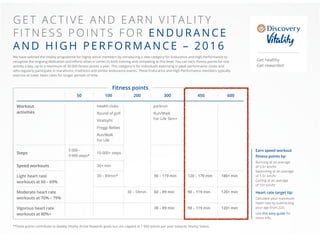
열심히 운동하면 돈을 준다!

: 액티비티 트레커와 보험사의 연계
•Misfit Flash 와 뉴욕의 보험사 스타트업 Oscar 의 연계

•보험 가입자 전원에게 Misfit Flash 를 지급 (최초)

•하루의 목표 걸음 수를 달성하면, 하루에 $1 씩 인센티브

•1년에 최대 $240 까지 수령 가능

•아마존 기프트카드로 지급
2014.12.9
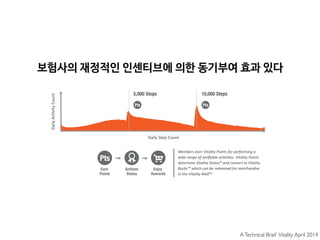
ATechnical Brief Vitality April 2014
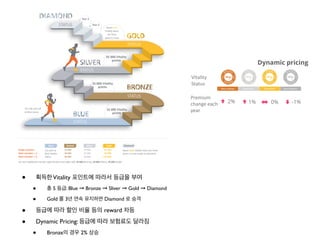
보험사의 재정적인 인센티브에 의한 동기부여 효과 있다
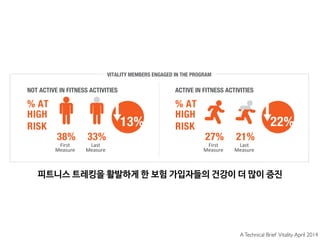
피트니스 트레킹을 활발하게 한 보험 가입자들의 건강이 더 많이 증진
ATechnical Brief Vitality April 2014
Case for physical activity
Correlation between activity
and mortality is evident
Impact of improvement in
activity levels
Physical activity is a trigger for
other wellness engagement
Inactive Mildly Active Active
0.00%
0.10%
0.20%
0.30%
0.40%
0.50%
0.60%
0.70%
Inactive Active
Mortalityexperienceq(x)
Decrease Maintain Increase
-48%
-60%
Source: Internal Discovery analysis
Mortality rate q(x)
Source: Internal Discovery analysis
Observed mortality experience by changes in
current levels of physical activity
More
active
More
active
Less
active
Indexed improvement after becoming
physically active
BeforePhysical
ActivityTrigger
HealthyFood
Prevention
Screening
Online
Allpoints
After Physical Activity Trigger
+16% +23% +26%
+43%
+79%
18
Annual results for the year ending 30 June 2015
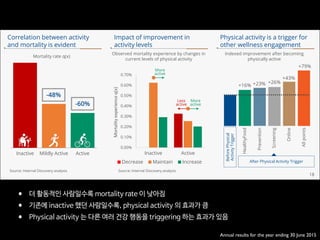
• 더 활동적인 사람일수록 mortality rate 이 낮아짐

• 기존에 inactive 했던 사람일수록, physical activity 의 효과가 큼

• Physical activity 는 다른 여러 건강 행동을 triggering 하는 효과가 있음
Publication in
leading scientific
journals
VIP studies:
Members engaged
in Vitality have
lower healthcare
costs
80%
82%
84%
86%
88%
90%
92%
94%
96%
98%
100%
Not registered
Admit rate (number of
admissions)*
Length of stay in hospital
(days)
Cost per patient ($000)
60%
65%
70%
75%
80%
85%
90%
95%
100%
Not registered
80%
85%
90%
95%
100%
105%
Not registered
Fit people make better patients on a risk-adjusted basis
22
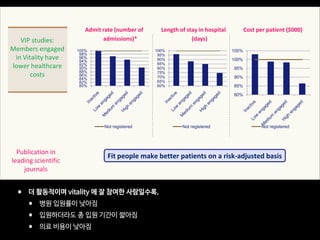
• 더 활동적이며 vitality 에 잘 참여한 사람일수록, 

• 병원 입원률이 낮아짐

• 입원하더라도 총 입원 기간이 짧아짐

• 의료 비용이 낮아짐
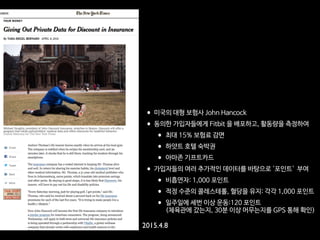
•미국의 대형 보험사 John Hancock 

•동의한 가입자들에게 Fitbit 을 배포하고, 활동량을 측정하여 

•최대 15% 보험료 감면

•하얏트 호텔 숙박권

•아마존 기프트카드

•가입자들의 여러 추가적인 데이터를 바탕으로 '포인트' 부여

•비흡연자: 1,000 포인트

•적정 수준의 콜레스테롤, 혈당을 유지: 각각 1,000 포인트 

•일주일에 세번 이상 운동:120 포인트

(체육관에 갔는지, 30분 이상 머무는지를 GPS 통해 확인)
2015.4.8
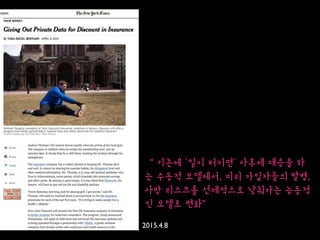
2015.4.8
“ 기존에 '일이 터지면' 사후에 대응을 하
는 수동적 모델에서, 미리 가입자들의 발병,
사망 리스크를 선제적으로 낮춰가는 능동적
인 모델로 변화”
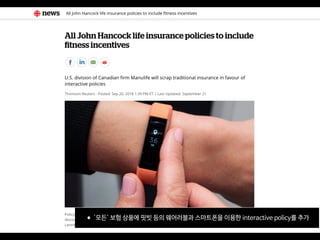
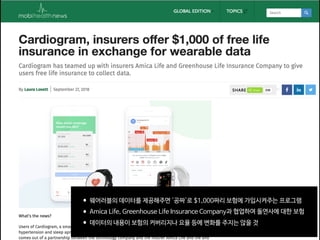
•'모든' 보험 상품에 핏빗 등의 웨어러블과 스마트폰을 이용한 interactive policy를 추가
•웨어러블의 데이터를 제공해주면 '공짜'로 $1,000짜리 보험에 가입시켜주는 프로그램

•Amica Life, Greenhouse Life Insurance Company과 협업하여 돌연사에 대한 보험

•데이터의 내용이 보험의 커버리지나 요율 등에 변화를 주지는 않을 것
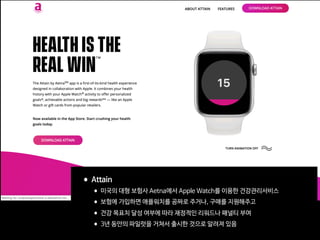
•Attain

•미국의 대형 보험사 Aetna에서 Apple Watch를 이용한 건강관리서비스

•보험에 가입하면 애플워치를 공짜로 주거나, 구매를 지원해주고

•건강 목표치 달성 여부에 따라 재정적인 리워드나 패널티 부여

•3년 동안의 파일럿을 거쳐서 출시한 것으로 알려져 있음
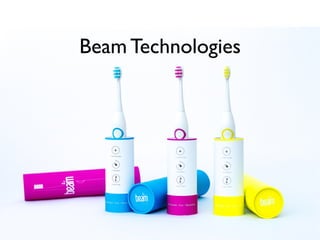
Beam Technologies
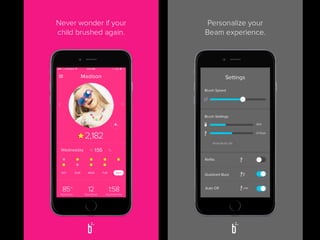
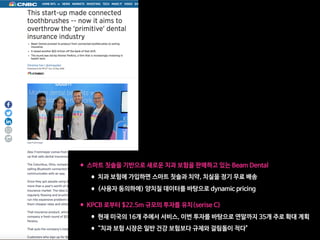
•스마트 칫솔을 기반으로 새로운 치과 보험을 판매하고 있는 Beam Dental

•치과 보험에 가입하면 스마트 칫솔과 치약, 치실을 정기 무료 배송

•(사용자 동의하에) 양치질 데이터를 바탕으로 dynamic pricing 

•KPCB 로부터 $22.5m 규모의 투자를 유치(serise C)

•현재 미국의 16개 주에서 서비스, 이번 투자를 바탕으로 연말까지 35개 주로 확대 계획

•“치과 보험 시장은 일반 건강 보험보다 규제와 걸림돌이 적다"
Personal Genome Analysis
가타카 (1997)
가타카 (1997)
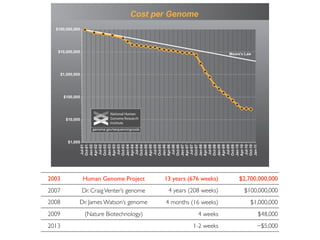
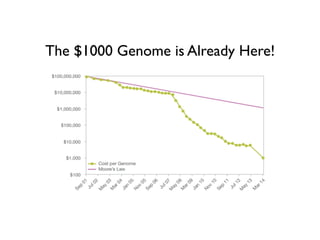
2003 Human Genome Project 13 years (676 weeks) $2,700,000,000
2007 Dr. CraigVenter’s genome 4 years (208 weeks) $100,000,000
2008 Dr. James Watson’s genome 4 months (16 weeks) $1,000,000
2009 (Nature Biotechnology) 4 weeks $48,000
2013 1-2 weeks ~$5,000
The $1000 Genome is Already Here!
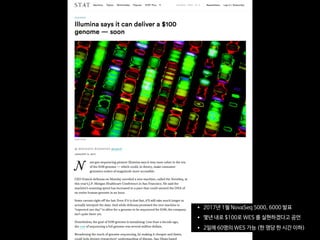
• 2017년 1월 NovaSeq 5000, 6000 발표

• 몇년 내로 $100로 WES 를 실현하겠다고 공언

• 2일에 60명의 WES 가능 (한 명당 한 시간 이하)
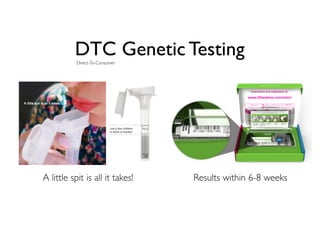
Results within 6-8 weeksA little spit is all it takes!
DTC Genetic TestingDirect-To-Consumer
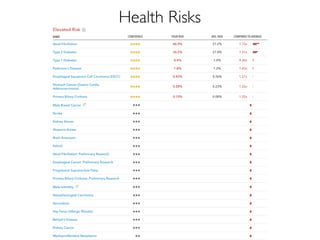
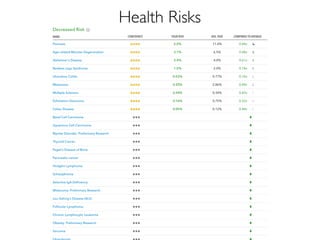
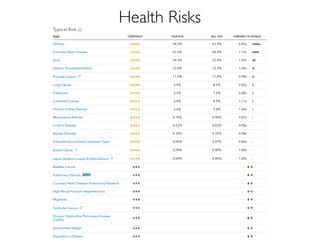
Health Risks
Health Risks
Health Risks
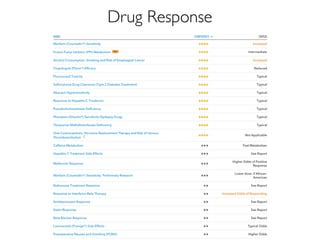
Drug Response
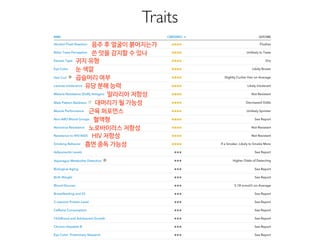
Traits
음주 후 얼굴이 붉어지는가
쓴 맛을 감지할 수 있나
귀지 유형
눈 색깔
곱슬머리 여부
유당 분해 능력
말라리아 저항성
대머리가 될 가능성
근육 퍼포먼스
혈액형
노로바이러스 저항성
HIV 저항성
흡연 중독 가능성
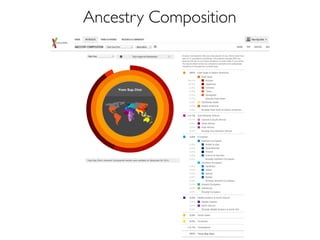
Ancestry Composition
1,000,000
2,000,000
2007-11
2011-06
2011-10
2012-04
2012-10
2013-04
2013-06
2013-09
2013-12
2014-10
2015-02
2015-06
2016-02
2017-04
2017-11
2018-04
3,000,000
5,000,000
2019-03
10,000,000
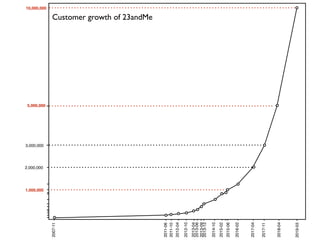
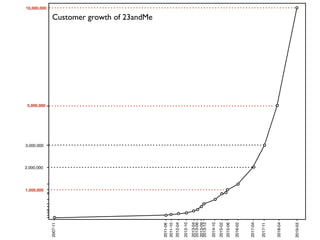
Customer growth of 23andMe
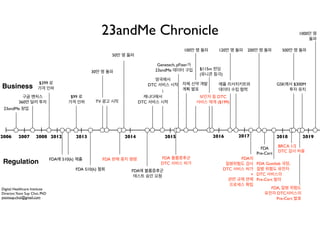
23andMe Chronicle
$115m 펀딩
(유니콘 등극)
100만 명 돌파
2006
23andMe 창업
20162007 2012 2013 2014 2015
구글 벤처스
360만 달러 투자
2008
$99 로
가격 인하
FDA 판매 중지 명령
영국에서
DTC 서비스 시작
FDA 블룸증후군
DTC 서비스 허가
FDA에 블룸증후군
테스트 승인 요청
FDA에 510(k) 제출
FDA 510(k) 철회
보인자 등 DTC
서비스 재개 ($199)
캐나다에서
DTC 서비스 시작
Genetech, pFizer가
23andMe 데이터 구입
자체 신약 개발
계획 발표
120만 명 돌파
$399 로
가격 인하Business
Regulation
애플 리서치키트와
데이터 수집 협력
50만 명 돌파
30만 명 돌파
TV 광고 시작
2017
FDA의
질병위험도 검사
DTC 서비스 허가
+
관련 규제 면제
프로세스 확립
Digital Healthcare Institute
Director,Yoon Sup Choi, PhD
yoonsup.choi@gmail.com
FDA
Pre-Cert
FDA Gottlieb 국장,
질병 위험도 유전자
DTC 서비스의
Pre-Cert 발의
BRCA 1/2
DTC 검사 허용
2018
FDA, 질병 위험도
유전자 DTC서비스의
Pre-Cert 발효
200만 명 돌파 500만 명 돌파
GSK에서 $300M
투자 유치
2019
1000만 명
돌파
•개별 제품이 아닌 제조사 기반의 규제를 유전자 DTC 검사에도 적용하는 방안

•Gottlieb 국장:

•“23andMe의 규제 과정을 거치면서 FDA도 많이 배웠다”

•질병 위험도 DTC 검사를 '한 번' 인허가 받은 회사의 후속 검사는 규제 면제 추진 

•한국의 유전자 DTC 규제 방식과의 괴리는 더욱 커질 전망
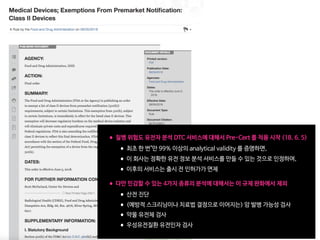
•질병 위험도 유전자 분석 DTC 서비스에 대해서 Pre-Cert 를 적용 시작 (18. 6. 5)

•최초 한 번"만 99% 이상의 analytical validity 를 증명하면, 

•이 회사는 정확한 유전 정보 분석 서비스를 만들 수 있는 것으로 인정하여,

•이후의 서비스는 출시 전 인허가가 면제

•다만 민감할 수 있는 4가지 종류의 분석에 대해서는 이 규제 완화에서 제외

•산전 진단 

•(예방적 스크리닝이나 치료법 결정으로 이어지는) 암 발병 가능성 검사

•약물 유전체 검사

•우성유전질환 유전인자 검사
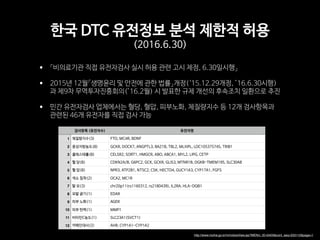
한국 DTC 유전정보 분석 제한적 허용

(2016.6.30)
• 「비의료기관 직접 유전자검사 실시 허용 관련 고시 제정, 6.30일시행」

• 2015년 12월「생명윤리 및 안전에 관한 법률」개정(‘15.12.29개정, ’16.6.30시행)
과 제9차 무역투자진흥회의(’16.2월) 시 발표한 규제 개선의 후속조치 일환으로 추진

• 민간 유전자검사 업체에서는 혈당, 혈압, 피부노화, 체질량지수 등 12개 검사항목과
관련된 46개 유전자를 직접 검사 가능
http://www.mohw.go.kr/m/noticeView.jsp?MENU_ID=0403&cont_seq=333112&page=1
검사항목 (유전자수) 유전자명
1 체질량지수(3) FTO, MC4R, BDNF
2 중성지방농도(8) GCKR, DOCK7, ANGPTL3, BAZ1B, TBL2, MLXIPL, LOC105375745, TRIB1
3 콜레스테롤(8) CELSR2, SORT1, HMGCR, ABO, ABCA1, MYL2, LIPG, CETP
4 혈 당(8) CDKN2A/B, G6PC2, GCK, GCKR, GLIS3, MTNR1B, DGKB-TMEM195, SLC30A8
5 혈 압(8) NPR3, ATP2B1, NT5C2, CSK, HECTD4, GUCY1A3, CYP17A1, FGF5
6 색소 침착(2) OCA2, MC1R
7 탈 모(3) chr20p11(rs1160312, rs2180439), IL2RA, HLA-DQB1
8 모발 굵기(1) EDAR
9 피부 노화(1) AGER
10 피부 탄력(1) MMP1
11 비타민C농도(1) SLC23A1(SVCT1)
12 카페인대사(2) AHR, CYP1A1-CYP1A2
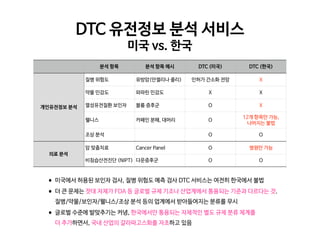
분석 항목 분석 항목 예시 DTC (미국) DTC (한국)
개인유전정보 분석
질병 위험도 유방암(안젤리나 졸리) 인허가 간소화 전망 X
약물 민감도 와파린 민감도 X X
열성유전질환 보인자 블룸 증후군 O X
웰니스 카페인 분해, 대머리 O
12개 항목만 가능,

나머지는 불법
조상 분석 O O
의료 분석
암 맞춤치료 Cancer Panel O 병원만 가능
비침습산전진단 (NIPT) 다운증후군 O O
DTC 유전정보 분석 서비스

미국 vs. 한국
•미국에서 허용된 보인자 검사, 질병 위험도 예측 검사 DTC 서비스는 여전히 한국에서 불법

•더 큰 문제는 잣대 자체가 FDA 등 글로벌 규제 기조나 산업계에서 통용되는 기준과 다르다는 것. 


질병/약물/보인자/웰니스/조상 분석 등의 업계에서 받아들여지는 분류를 무시

•글로벌 수준에 발맞추기는 커녕, 한국에서만 통용되는 자체적인 별도 규제 분류 체계를


더 추가하면서, 국내 산업의 갈라파고스화를 자초하고 있음
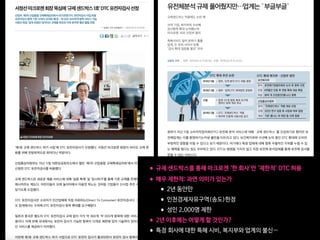
•규제 샌드박스를 통해 마크로젠 ‘한 회사’만 ‘제한적’ DTC 허용

•매우 제한적: 과연 의미가 있는가

•2년 동안만

•인천경제자유구역(송도)한정

•성인 2,000명 제한

•2년 이후에는 어떻게 할 것인가?

•특정 회사에 대한 특혜 시비, 복지부와 업계의 불신…
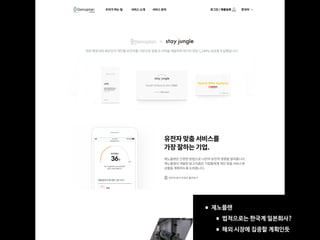
•제노플랜 

•법적으로는 한국계 일본회사?

•해외 시장에 집중할 계획인듯
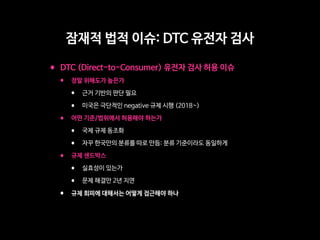
•DTC (Direct-to-Consumer) 유전자 검사 허용 이슈

• 정말 위해도가 높은가

• 근거 기반의 판단 필요

• 미국은 극단적인 negative 규제 시행 (2018~)

• 어떤 기준/범위에서 허용해야 하는가

• 국제 규제 동조화

• 자꾸 한국만의 분류를 따로 만듬: 분류 기준이라도 동일하게

• 규제 샌드박스

• 실효성이 있는가

• 문제 해결만 2년 지연

• 규제 회피에 대해서는 어떻게 접근해야 하나
잠재적 법적 이슈: DTC 유전자 검사
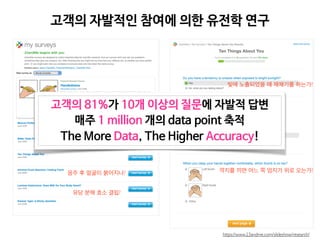
https://www.23andme.com/slideshow/research/
고객의 자발적인 참여에 의한 유전학 연구
깍지를 끼면 어느 쪽 엄지가 위로 오는가?
아침형 인간? 저녁형 인간?
빛에 노출되었을 때 재채기를 하는가?
근육의 퍼포먼스
쓴 맛 인식 능력
음주 후 얼굴이 붉어지나?
유당 분해 효소 결핍?
고객의 81%가 10개 이상의 질문에 자발적 답변

매주 1 million 개의 data point 축적

The More Data, The Higher Accuracy!
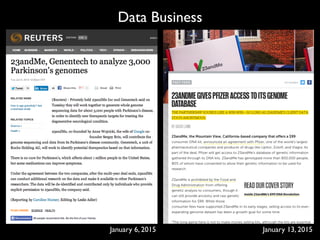
January 13, 2015January 6, 2015
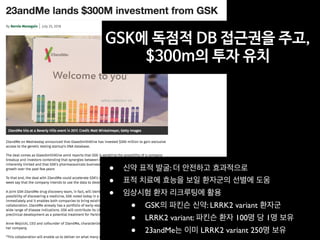
Data Business
• 신약 표적 발굴: 더 안전하고 효과적으로
• 표적 치료에 효능을 보일 환자군의 선별에 도움
• 임상시험 환자 리크루팅에 활용
• GSK의 파킨슨 신약: LRRK2 variant 환자군
• LRRK2 variant: 파킨슨 환자 100명 당 1명 보유
• 23andMe는 이미 LRRK2 variant 250명 보유
GSK에 독점적 DB 접근권을 주고,
$300m의 투자 유치
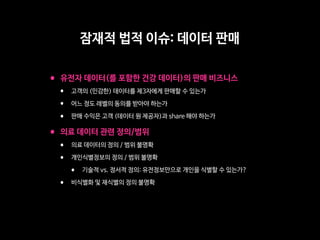
•유전자 데이터(를 포함한 건강 데이터)의 판매 비즈니스

• 고객의 (민감한) 데이터를 제3자에게 판매할 수 있는가

• 어느 정도 레벨의 동의를 받아야 하는가

• 판매 수익은 고객 (데이터 원 제공자)과 share 해야 하는가 

•의료 데이터 관련 정의/범위

• 의료 데이터의 정의 / 범위 불명확

• 개인식별정보의 정의 / 범위 불명확

• 기술적 vs. 정서적 정의: 유전정보만으로 개인을 식별할 수 있는가?

• 비식별화 및 재식별의 정의 불명확
잠재적 법적 이슈: 데이터 판매
1,000,000
2,000,000
2007-11
2011-06
2011-10
2012-04
2012-10
2013-04
2013-06
2013-09
2013-12
2014-10
2015-02
2015-06
2016-02
2017-04
2017-11
2018-04
3,000,000
5,000,000
2019-03
10,000,000
Customer growth of 23andMe
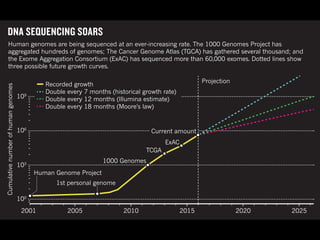
Human genomes are being sequenced at an ever-increasing rate. The 1000 Genomes Project has
aggregated hundreds of genomes; The Cancer Genome Atlas (TGCA) has gathered several thousand; and
the Exome Aggregation Consortium (ExAC) has sequenced more than 60,000 exomes. Dotted lines show
three possible future growth curves.
DNA SEQUENCING SOARS
2001 2005 2010 2015 2020 2025
100
103
106
109
Human Genome Project
Cumulativenumberofhumangenomes
1000 Genomes
TCGA
ExAC
Current amount
1st personal genome
Recorded growth
Projection
Double every 7 months (historical growth rate)
Double every 12 months (Illumina estimate)
Double every 18 months (Moore's law)
Michael Einsetein, Nature, 2015
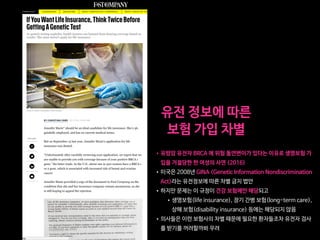
•유방암 유전자 BRCA 에 위험 돌연변이가 있다는 이유로 생명보험 가
입을 거절당한 한 여성의 사연 (2016)

•미국은 2008년 GINA (Genetic Information Nondiscrimination
Act)라는 유전정보에 따른 차별 금지 법안

•하지만 문제는 이 규정이 건강 보험에만 해당되고 

•생명보험(life insurance), 장기 간병 보험(long-term care),
상해 보험(disability insurance) 등에는 해당되지 않음

•의사들은 이런 보험사의 차별 때문에 필요한 환자들조차 유전자 검사
를 받기를 꺼려할까봐 우려
유전 정보에 따른

보험 가입 차별
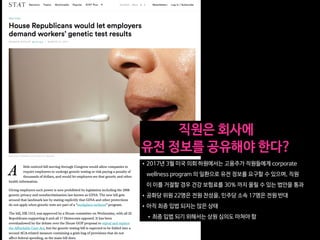
•2017년 3월 미국 의회 하원에서는 고용주가 직원들에게 corporate
wellness program 의 일환으로 유전 정보를 요구할 수 있으며, 직원
이 이를 거절할 경우 건강 보험료를 30% 까지 올릴 수 있는 법안을 통과

•공화당 위원 22명은 전원 찬성을, 민주당 소속 17명은 전원 반대

•아직 최종 입법 되지는 않은 상태

•최종 입법 되기 위해서는 상원 심의도 마쳐야 함
직원은 회사에 

유전 정보를 공유해야 한다?
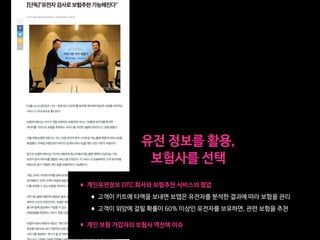
•개인유전정보 DTC 회사와 보험추천 서비스의 협업

•고객이 키트에 타액을 보내면 보맵은 유전자를 분석한 결과에 따라 보험을 관리

•고객이 위암에 걸릴 확률이 60% 이상인 유전자를 보유하면, 관련 보험을 추천

•개인 보험 가입자의 보험사 역선택 이슈
유전 정보를 활용,

보험사를 선택
•보험사의 가입자 선택/차등

• 미국에서는 GINA의 커버 범위 이슈

• 한국에서는 정말 아무 문제가 없을까? (생명윤리법 제 46조)

•가입자의 보험사 역선택

• 법적으로 가입자의 보험사 (직간접적) 역선택이 더 가능성 높음

• 결과적으로 모두의 보험료를 높일 것인가?
잠재적 법적 이슈: 유전자와 보험
디지털 표현형
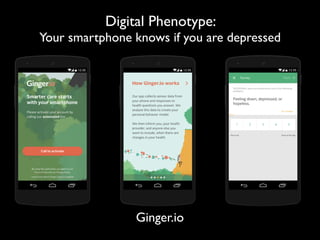
Digital Phenotype:
Your smartphone knows if you are depressed
Ginger.io
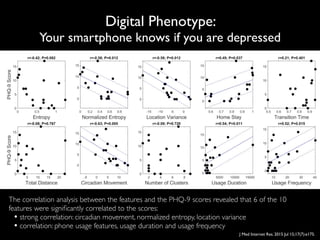
Digital Phenotype:
Your smartphone knows if you are depressed
J Med Internet Res. 2015 Jul 15;17(7):e175.
The correlation analysis between the features and the PHQ-9 scores revealed that 6 of the 10
features were significantly correlated to the scores:
• strong correlation: circadian movement, normalized entropy, location variance
• correlation: phone usage features, usage duration and usage frequency
the manifestations of disease by providing a
more comprehensive and nuanced view of the
experience of illness. Through the lens of the
digital phenotype, an individual’s interaction
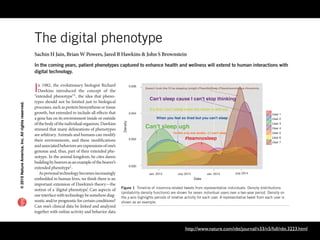
The digital phenotype
Sachin H Jain, Brian W Powers, Jared B Hawkins & John S Brownstein
In the coming years, patient phenotypes captured to enhance health and wellness will extend to human interactions with
digital technology.
In 1982, the evolutionary biologist Richard
Dawkins introduced the concept of the
“extended phenotype”1, the idea that pheno-
types should not be limited just to biological
processes, such as protein biosynthesis or tissue
growth, but extended to include all effects that
a gene has on its environment inside or outside
ofthebodyoftheindividualorganism.Dawkins
stressed that many delineations of phenotypes
are arbitrary. Animals and humans can modify
their environments, and these modifications
andassociatedbehaviorsareexpressionsofone’s
genome and, thus, part of their extended phe-
notype. In the animal kingdom, he cites damn
buildingbybeaversasanexampleofthebeaver’s
extended phenotype1.
Aspersonaltechnologybecomesincreasingly
embedded in human lives, we think there is an
important extension of Dawkins’s theory—the
notion of a ‘digital phenotype’. Can aspects of
ourinterfacewithtechnologybesomehowdiag-
nosticand/orprognosticforcertainconditions?
Can one’s clinical data be linked and analyzed
together with online activity and behavior data
to create a unified, nuanced view of human dis-
ease?Here,wedescribetheconceptofthedigital
phenotype. Although several disparate studies
have touched on this notion, the framework for
medicine has yet to be described. We attempt to
define digital phenotype and further describe
the opportunities and challenges in incorporat-
ing these data into healthcare.
Jan. 2013
0.000
0.002
0.004
Density
0.006
July 2013 Jan. 2014 July 2014
User 1
User 2
User 3
User 4
User 5
User 6
User 7
Date
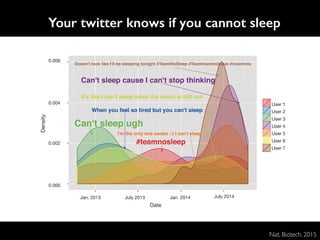
Figure 1 Timeline of insomnia-related tweets from representative individuals. Density distributions
(probability density functions) are shown for seven individual users over a two-year period. Density on
the y axis highlights periods of relative activity for each user. A representative tweet from each user is
shown as an example.
npg©2015NatureAmerica,Inc.Allrightsreserved.
http://www.nature.com/nbt/journal/v33/n5/full/nbt.3223.html
ers, Jared B Hawkins & John S Brownstein
phenotypes captured to enhance health and wellness will extend to human interactions with
st Richard
pt of the
hat pheno-
biological
sis or tissue
effects that
or outside
m.Dawkins
phenotypes
can modify
difications
onsofone’s
ended phe-
cites damn
hebeaver’s
ncreasingly
there is an
heory—the
aspects of
ehowdiag-
Jan. 2013
0.000
0.002
0.004
Density
0.006
July 2013 Jan. 2014 July 2014
User 1
User 2
User 3
User 4
User 5
User 6
User 7
Date
Figure 1 Timeline of insomnia-related tweets from representative individuals. Density distributions
(probability density functions) are shown for seven individual users over a two-year period. Density on
the y axis highlights periods of relative activity for each user. A representative tweet from each user is
Your twitter knows if you cannot sleep
Timeline of insomnia-related tweets from representative individuals.
Nat. Biotech. 2015
Reece & Danforth, “Instagram photos reveal predictive markers of depression” (2016)
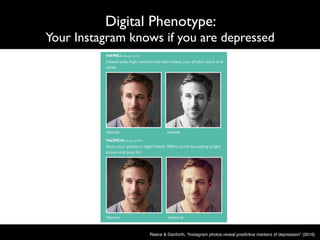
higher Hue (bluer)
lower Saturation (grayer)
lower Brightness (darker)
Rao (MVR) (24) .  
 
Results 
Both All­data and Pre­diagnosis models were decisively superior to a null model
. All­data predictors were significant with 99% probability.57.5;(KAll  = 1 K 49.8)  Pre = 1  7
Pre­diagnosis and All­data confidence levels were largely identical, with two exceptions: 
Pre­diagnosis Brightness decreased to 90% confidence, and Pre­diagnosis posting frequency 
dropped to 30% confidence, suggesting a null predictive value in the latter case.  
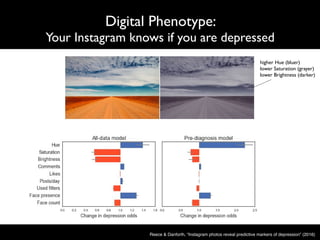
Increased hue, along with decreased brightness and saturation, predicted depression. This 
means that photos posted by depressed individuals tended to be bluer, darker, and grayer (see 
Fig. 2). The more comments Instagram posts received, the more likely they were posted by 
depressed participants, but the opposite was true for likes received. In the All­data model, higher 
posting frequency was also associated with depression. Depressed participants were more likely 
to post photos with faces, but had a lower average face count per photograph than healthy 
participants. Finally, depressed participants were less likely to apply Instagram filters to their 
posted photos.  
 
Fig. 2. Magnitude and direction of regression coefficients in All­data (N=24,713) and Pre­diagnosis (N=18,513) 
models. X­axis values represent the adjustment in odds of an observation belonging to depressed individuals, per 
Reece & Danforth, “Instagram photos reveal predictive markers of depression” (2016)
 
 
Fig. 1. Comparison of HSV values. Right photograph has higher Hue (bluer), lower Saturation (grayer), and lower 
Brightness (darker) than left photograph. Instagram photos posted by depressed individuals had HSV values 
shifted towards those in the right photograph, compared with photos posted by healthy individuals. 
 
Units of observation 
In determining the best time span for this analysis, we encountered a difficult question: 
When and for how long does depression occur? A diagnosis of depression does not indicate the 
persistence of a depressive state for every moment of every day, and to conduct analysis using an 
individual’s entire posting history as a single unit of observation is therefore rather specious. At 
the other extreme, to take each individual photograph as units of observation runs the risk of 
being too granular. DeChoudhury et al. (5) looked at all of a given user’s posts in a single day, 
and aggregated those data into per­person, per­day units of observation. We adopted this 
precedent of “user­days” as a unit of analysis .  5
 
Statistical framework 
We used Bayesian logistic regression with uninformative priors to determine the strength 
of individual predictors. Two separate models were trained. The All­data model used all 
collected data to address Hypothesis 1. The Pre­diagnosis model used all data collected from 
higher Hue (bluer)
lower Saturation (grayer)
lower Brightness (darker)
Digital Phenotype:
Your Instagram knows if you are depressed
Digital Phenotype:
Your Instagram knows if you are depressed
Reece & Danforth, “Instagram photos reveal predictive markers of depression” (2016)
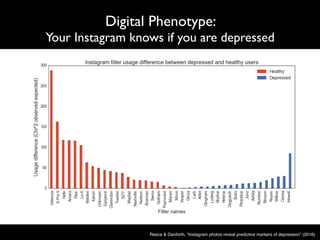
. In particular, depressedχ2 07.84, p .17e 64;( All  = 9   = 9 − 1 13.80, p .87e 44)χ2Pre  = 8   = 2 − 1  
participants were less likely than healthy participants to use any filters at all. When depressed 
participants did employ filters, they most disproportionately favored the “Inkwell” filter, which 
converts color photographs to black­and­white images. Conversely, healthy participants most 
disproportionately favored the Valencia filter, which lightens the tint of photos. Examples of 
filtered photographs are provided in SI Appendix VIII.  
 
Fig. 3. Instagram filter usage among depressed and healthy participants. Bars indicate difference between observed 
and expected usage frequencies, based on a Chi­squared analysis of independence. Blue bars indicate 
disproportionate use of a filter by depressed compared to healthy participants, orange bars indicate the reverse. 
Digital Phenotype:
Your Instagram knows if you are depressed
Reece & Danforth, “Instagram photos reveal predictive markers of depression” (2016)
 
VIII. Instagram filter examples 
 
Fig. S8. Examples of Inkwell and Valencia Instagram filters.  Inkwell converts 
color photos to black­and­white, Valencia lightens tint.  Depressed participants 
most favored Inkwell compared to healthy participants, Healthy participants 
Mindstrong Health
• 스마트폰 사용 패턴을 바탕으로 

• 인지능력, 우울증, 조현병, 양극성 장애, PTSD 등을 측정

• 미국 국립정신건강연구소 소장인 Tomas Insel 이 공동 설립

• 아마존의 제프 베조스 투자
BRIEF COMMUNICATION OPEN
Digital biomarkers of cognitive function
Paul Dagum1
To identify digital biomarkers associated with cognitive function, we analyzed human–computer interaction from 7 days of
smartphone use in 27 subjects (ages 18–34) who received a gold standard neuropsychological assessment. For several
neuropsychological constructs (working memory, memory, executive function, language, and intelligence), we found a family of
digital biomarkers that predicted test scores with high correlations (p < 10−4
). These preliminary results suggest that passive
measures from smartphone use could be a continuous ecological surrogate for laboratory-based neuropsychological assessment.
npj Digital Medicine (2018)1:10 ; doi:10.1038/s41746-018-0018-4
INTRODUCTION
By comparison to the functional metrics available in other
disciplines, conventional measures of neuropsychiatric disorders
have several challenges. First, they are obtrusive, requiring a
subject to break from their normal routine, dedicating time and
often travel. Second, they are not ecological and require subjects
to perform a task outside of the context of everyday behavior.
Third, they are episodic and provide sparse snapshots of a patient
only at the time of the assessment. Lastly, they are poorly scalable,
taxing limited resources including space and trained staff.
In seeking objective and ecological measures of cognition, we
attempted to develop a method to measure memory and
executive function not in the laboratory but in the moment,
day-to-day. We used human–computer interaction on smart-
phones to identify digital biomarkers that were correlated with
neuropsychological performance.
RESULTS
In 2014, 27 participants (ages 27.1 ± 4.4 years, education
14.1 ± 2.3 years, M:F 8:19) volunteered for neuropsychological
assessment and a test of the smartphone app. Smartphone
human–computer interaction data from the 7 days following
the neuropsychological assessment showed a range of correla-
tions with the cognitive scores. Table 1 shows the correlation
between each neurocognitive test and the cross-validated
predictions of the supervised kernel PCA constructed from
the biomarkers for that test. Figure 1 shows each participant
test score and the digital biomarker prediction for (a) digits
backward, (b) symbol digit modality, (c) animal fluency,
(d) Wechsler Memory Scale-3rd Edition (WMS-III) logical
memory (delayed free recall), (e) brief visuospatial memory test
(delayed free recall), and (f) Wechsler Adult Intelligence Scale-
4th Edition (WAIS-IV) block design. Construct validity of the
predictions was determined using pattern matching that
computed a correlation of 0.87 with p < 10−59
between the
covariance matrix of the predictions and the covariance matrix
of the tests.
Table 1. Fourteen neurocognitive assessments covering five cognitive
domains and dexterity were performed by a neuropsychologist.
Shown are the group mean and standard deviation, range of score,
and the correlation between each test and the cross-validated
prediction constructed from the digital biomarkers for that test
Cognitive predictions
Mean (SD) Range R (predicted),
p-value
Working memory
Digits forward 10.9 (2.7) 7–15 0.71 ± 0.10, 10−4
Digits backward 8.3 (2.7) 4–14 0.75 ± 0.08, 10−5
Executive function
Trail A 23.0 (7.6) 12–39 0.70 ± 0.10, 10−4
Trail B 53.3 (13.1) 37–88 0.82 ± 0.06, 10−6
Symbol digit modality 55.8 (7.7) 43–67 0.70 ± 0.10, 10−4
Language
Animal fluency 22.5 (3.8) 15–30 0.67 ± 0.11, 10−4
FAS phonemic fluency 42 (7.1) 27–52 0.63 ± 0.12, 10−3
Dexterity
Grooved pegboard test
(dominant hand)
62.7 (6.7) 51–75 0.73 ± 0.09, 10−4
Memory
California verbal learning test
(delayed free recall)
14.1 (1.9) 9–16 0.62 ± 0.12, 10−3
WMS-III logical memory
(delayed free recall)
29.4 (6.2) 18–42 0.81 ± 0.07, 10−6
Brief visuospatial memory test
(delayed free recall)
10.2 (1.8) 5–12 0.77 ± 0.08, 10−5
Intelligence scale
WAIS-IV block design 46.1(12.8) 12–61 0.83 ± 0.06, 10−6
WAIS-IV matrix reasoning 22.1(3.3) 12–26 0.80 ± 0.07, 10−6
WAIS-IV vocabulary 40.6(4.0) 31–50 0.67 ± 0.11, 10−4
Received: 5 October 2017 Revised: 3 February 2018 Accepted: 7 February 2018
1
Mindstrong Health, 248 Homer Street, Palo Alto, CA 94301, USA
Correspondence: Paul Dagum (paul@mindstronghealth.com)
www.nature.com/npjdigitalmed
Published in partnership with the Scripps Translational Science Institute
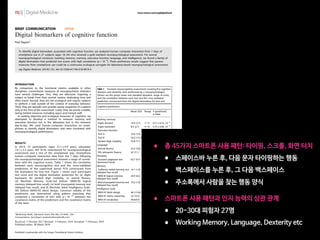
• 총 45가지 스마트폰 사용 패턴: 타이핑, 스크롤, 화면 터치

• 스페이스바 누른 후, 다음 문자 타이핑하는 행동

• 백스페이스를 누른 후, 그 다음 백스페이스

• 주소록에서 사람을 찾는 행동 양식

• 스마트폰 사용 패턴과 인지 능력의 상관 관계 

• 20-30대 피험자 27명

• Working Memory, Language, Dexterity etc
BRIEF COMMUNICATION OPEN
Digital biomarkers of cognitive function
Paul Dagum1
To identify digital biomarkers associated with cognitive function, we analyzed human–computer interaction from 7 days of
smartphone use in 27 subjects (ages 18–34) who received a gold standard neuropsychological assessment. For several
neuropsychological constructs (working memory, memory, executive function, language, and intelligence), we found a family of
digital biomarkers that predicted test scores with high correlations (p < 10−4
). These preliminary results suggest that passive
measures from smartphone use could be a continuous ecological surrogate for laboratory-based neuropsychological assessment.
npj Digital Medicine (2018)1:10 ; doi:10.1038/s41746-018-0018-4
INTRODUCTION
By comparison to the functional metrics available in other
disciplines, conventional measures of neuropsychiatric disorders
have several challenges. First, they are obtrusive, requiring a
subject to break from their normal routine, dedicating time and
often travel. Second, they are not ecological and require subjects
to perform a task outside of the context of everyday behavior.
Third, they are episodic and provide sparse snapshots of a patient
only at the time of the assessment. Lastly, they are poorly scalable,
taxing limited resources including space and trained staff.
In seeking objective and ecological measures of cognition, we
attempted to develop a method to measure memory and
executive function not in the laboratory but in the moment,
day-to-day. We used human–computer interaction on smart-
phones to identify digital biomarkers that were correlated with
neuropsychological performance.
RESULTS
In 2014, 27 participants (ages 27.1 ± 4.4 years, education
14.1 ± 2.3 years, M:F 8:19) volunteered for neuropsychological
assessment and a test of the smartphone app. Smartphone
human–computer interaction data from the 7 days following
the neuropsychological assessment showed a range of correla-
tions with the cognitive scores. Table 1 shows the correlation
between each neurocognitive test and the cross-validated
predictions of the supervised kernel PCA constructed from
the biomarkers for that test. Figure 1 shows each participant
test score and the digital biomarker prediction for (a) digits
backward, (b) symbol digit modality, (c) animal fluency,
(d) Wechsler Memory Scale-3rd Edition (WMS-III) logical
memory (delayed free recall), (e) brief visuospatial memory test
(delayed free recall), and (f) Wechsler Adult Intelligence Scale-
4th Edition (WAIS-IV) block design. Construct validity of the
predictions was determined using pattern matching that
computed a correlation of 0.87 with p < 10−59
between the
covariance matrix of the predictions and the covariance matrix
of the tests.
Table 1. Fourteen neurocognitive assessments covering five cognitive
domains and dexterity were performed by a neuropsychologist.
Shown are the group mean and standard deviation, range of score,
and the correlation between each test and the cross-validated
prediction constructed from the digital biomarkers for that test
Cognitive predictions
Mean (SD) Range R (predicted),
p-value
Working memory
Digits forward 10.9 (2.7) 7–15 0.71 ± 0.10, 10−4
Digits backward 8.3 (2.7) 4–14 0.75 ± 0.08, 10−5
Executive function
Trail A 23.0 (7.6) 12–39 0.70 ± 0.10, 10−4
Trail B 53.3 (13.1) 37–88 0.82 ± 0.06, 10−6
Symbol digit modality 55.8 (7.7) 43–67 0.70 ± 0.10, 10−4
Language
Animal fluency 22.5 (3.8) 15–30 0.67 ± 0.11, 10−4
FAS phonemic fluency 42 (7.1) 27–52 0.63 ± 0.12, 10−3
Dexterity
Grooved pegboard test
(dominant hand)
62.7 (6.7) 51–75 0.73 ± 0.09, 10−4
Memory
California verbal learning test
(delayed free recall)
14.1 (1.9) 9–16 0.62 ± 0.12, 10−3
WMS-III logical memory
(delayed free recall)
29.4 (6.2) 18–42 0.81 ± 0.07, 10−6
Brief visuospatial memory test
(delayed free recall)
10.2 (1.8) 5–12 0.77 ± 0.08, 10−5
Intelligence scale
WAIS-IV block design 46.1(12.8) 12–61 0.83 ± 0.06, 10−6
WAIS-IV matrix reasoning 22.1(3.3) 12–26 0.80 ± 0.07, 10−6
WAIS-IV vocabulary 40.6(4.0) 31–50 0.67 ± 0.11, 10−4
Received: 5 October 2017 Revised: 3 February 2018 Accepted: 7 February 2018
1
Mindstrong Health, 248 Homer Street, Palo Alto, CA 94301, USA
Correspondence: Paul Dagum (paul@mindstronghealth.com)
www.nature.com/npjdigitalmed
Published in partnership with the Scripps Translational Science Institute
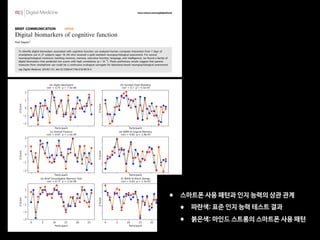
Fig. 1 A blue square represents a participant test Z-score normed to the 27 participant scores and a red circle represents the digital biomarker
prediction Z-score normed to the 27 predictions. Test scores and predictions shown are a digits backward, b symbol digit modality, c animal
fluency, d Wechsler memory Scale-3rd Edition (WMS-III) logical memory (delayed free recall), e brief visuospatial memory test (delayed free
recall), and f Wechsler adult intelligence scale-4th Edition (WAIS-IV) block design
Digital biomarkers of cognitive function
P Dagum
2
1234567890():,;
• 스마트폰 사용 패턴과 인지 능력의 상관 관계

• 파란색: 표준 인지 능력 테스트 결과

• 붉은색: 마인드 스트롱의 스마트폰 사용 패턴
Step1. 데이터의 측정
•스마트폰

•웨어러블 디바이스

•개인 유전 정보 분석

•디지털 표현형
환자 유래의 의료 데이터 (PGHD)
Step 2. 데이터의 통합
Sci Transl Med 2015
Google Fit
Samsung SAMI
Epic MyChart Epic EHR
Dexcom CGM
Patients/User
Devices
EHR Hospital
Whitings
+
Apple Watch
Apps
HealthKit
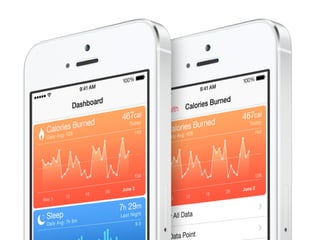
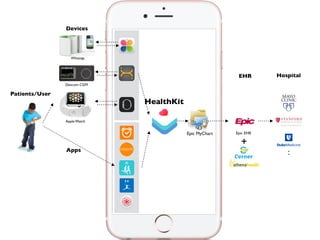
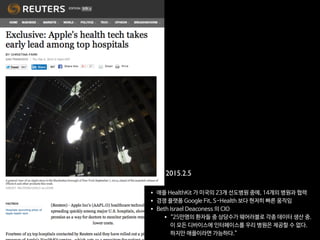
• 애플 HealthKit 가 미국의 23개 선도병원 중에, 14개의 병원과 협력

• 경쟁 플랫폼 Google Fit, S-Health 보다 현저히 빠른 움직임

• Beth Israel Deaconess 의 CIO 

• “25만명의 환자들 중 상당수가 웨어러블로 각종 데이터 생산 중.

이 모든 디바이스에 인터페이스를 우리 병원은 제공할 수 없다. 

하지만 애플이라면 가능하다.”
2015.2.5
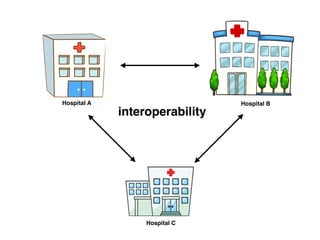
Hospital B
Hospital C
Hospital A
Hospital A Hospital B
Hospital C
interoperability
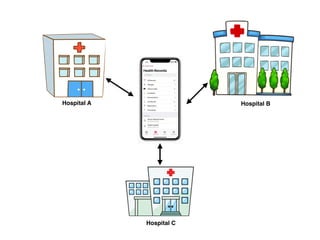
Hospital B
Hospital C
Hospital A
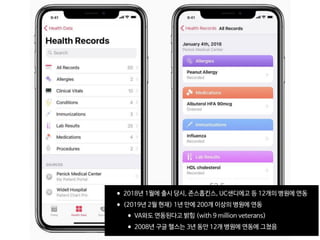
•2018년 1월에 출시 당시, 존스홉킨스, UC샌디에고 등 12개의 병원에 연동

•(2019년 2월 현재) 1년 만에 200개 이상의 병원에 연동

•VA와도 연동된다고 밝힘 (with 9 million veterans)

•2008년 구글 헬스는 3년 동안 12개 병원에 연동에 그쳤음
Step 3. 데이터의 분석
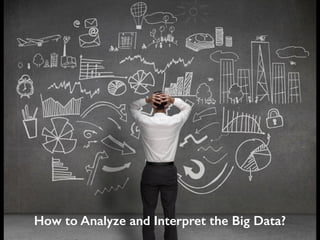
Data Overload
How to Analyze and Interpret the Big Data?
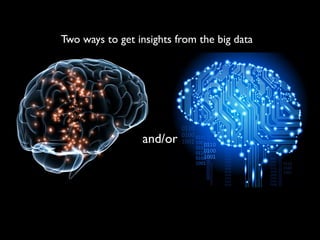
and/or
Two ways to get insights from the big data
원격의료
• 명시적으로 ‘금지’된 곳은 한국 밖에 없는 듯

• 해외에서는 새로운 서비스의 상당수가 원격의료 기능 포함 

• 글로벌 100대 헬스케어 서비스 중 39개가 원격의료 포함

• 다른 모델과 결합하여 갈수록 새로운 모델이 만들어지는 중

• 스마트폰, 웨어러블, IoT, 인공지능, 챗봇 등과 결합

• 10년 뒤 한국 의료에서는?
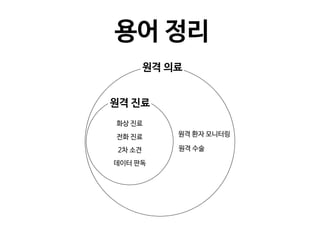
원격 의료
원격 진료
원격 환자 모니터링
화상 진료
전화 진료
2차 소견
용어 정리
데이터 판독
원격 수술
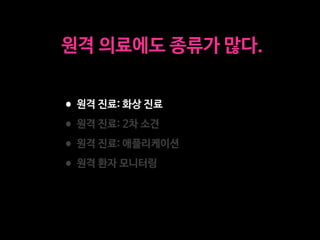
•원격 진료: 화상 진료

•원격 진료: 2차 소견

•원격 진료: 애플리케이션

•원격 환자 모니터링
원격 의료에도 종류가 많다.
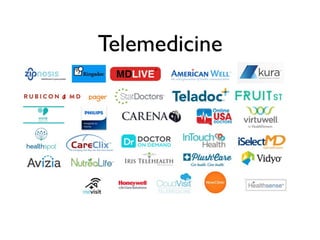
Telemedicine
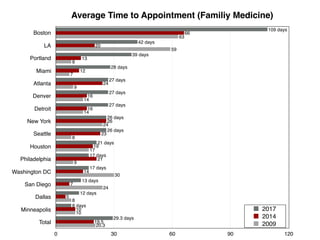
Average Time to Appointment (Familiy Medicine)
Boston
LA
Portland
Miami
Atlanta
Denver
Detroit
New York
Seattle
Houston
Philadelphia
Washington DC
San Diego
Dallas
Minneapolis
Total
0 30 60 90 120
20.3
10
8
24
30
9
17
8
24
14
14
9
7
8
59
63
19.5
10
5
7
14
21
19
23
26
16
16
24
12
13
20
66
29.3 days
8 days
12 days
13 days
17 days
17 days
21 days
26 days
26 days
27 days
27 days
27 days
28 days
39 days
42 days
109 days
2017
2014
2009
0
125
250
375
500
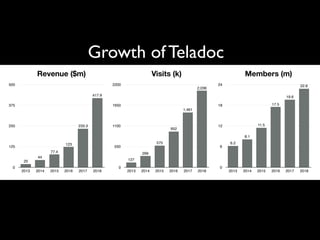
2013 2014 2015 2016 2017 2018
417.9
233.3
123
77.4
44
20
0
550
1100
1650
2200
2013 2014 2015 2016 2017 2018
2,036
1,461
952
575
299
127
0
6
12
18
24
2013 2014 2015 2016 2017 2018
22.8
19.6
17.5
11.5
8.1
6.2
Revenue ($m) Visits (k) Members (m)
Growth of Teladoc
•원격 진료: 화상 진료

•원격 진료: 2차 소견

•원격 진료: 애플리케이션

•원격 환자 모니터링
원격 의료에도 종류가 많다.
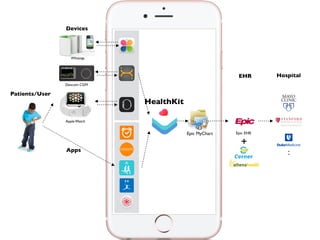
Epic MyChart Epic EHR
Dexcom CGM
Patients/User
Devices
EHR Hospital
Whitings
+
Apple Watch
Apps
HealthKit
transfer from Share2 to HealthKit as mandated by Dexcom receiver
Food and Drug Administration device classification. Once the glucose
values reach HealthKit, they are passively shared with the Epic
MyChart app (https://www.epic.com/software-phr.php). The MyChart
patient portal is a component of the Epic EHR and uses the same data-
base, and the CGM values populate a standard glucose flowsheet in
the patient’s chart. This connection is initially established when a pro-
vider places an order in a patient’s electronic chart, resulting in a re-
quest to the patient within the MyChart app. Once the patient or
patient proxy (parent) accepts this connection request on the mobile
device, a communication bridge is established between HealthKit and
MyChart enabling population of CGM data as frequently as every 5
Participation required confirmation of Bluetooth pairing of the CGM re-
ceiver to a mobile device, updating the mobile device with the most recent
version of the operating system, Dexcom Share2 app, Epic MyChart app,
and confirming or establishing a username and password for all accounts,
including a parent’s/adolescent’s Epic MyChart account. Setup time aver-
aged 45–60 minutes in addition to the scheduled clinic visit. During this
time, there was specific verbal and written notification to the patients/par-
ents that the diabetes healthcare team would not be actively monitoring
or have real-time access to CGM data, which was out of scope for this pi-
lot. The patients/parents were advised that they should continue to contact
the diabetes care team by established means for any urgent questions/
concerns. Additionally, patients/parents were advised to maintain updates
Figure 1: Overview of the CGM data communication bridge architecture.
BRIEFCOMMUNICATION
Kumar R B, et al. J Am Med Inform Assoc 2016;0:1–6. doi:10.1093/jamia/ocv206, Brief Communication
byguestonApril7,2016http://jamia.oxfordjournals.org/Downloadedfrom
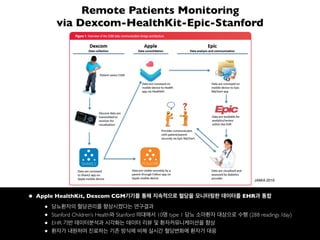
• Apple HealthKit, Dexcom CGM기기를 통해 지속적으로 혈당을 모니터링한 데이터를 EHR과 통합
• 당뇨환자의 혈당관리를 향상시켰다는 연구결과
• Stanford Children’s Health와 Stanford 의대에서 10명 type 1 당뇨 소아환자 대상으로 수행 (288 readings /day)
• EHR 기반 데이터분석과 시각화는 데이터 리뷰 및 환자커뮤니케이션을 향상
• 환자가 내원하여 진료하는 기존 방식에 비해 실시간 혈당변화에 환자가 대응
JAMIA 2016
Remote Patients Monitoring
via Dexcom-HealthKit-Epic-Stanford
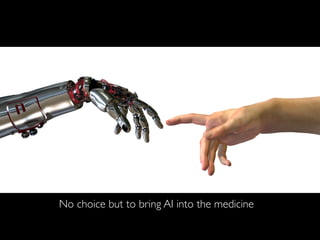
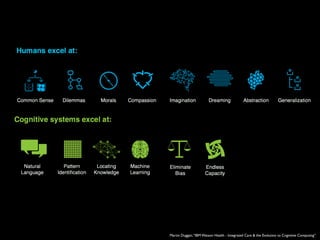
No choice but to bring AI into the medicine
Martin Duggan,“IBM Watson Health - Integrated Care & the Evolution to Cognitive Computing”
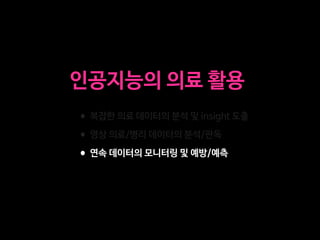
•복잡한 의료 데이터의 분석 및 insight 도출

•영상 의료/병리 데이터의 분석/판독

•연속 데이터의 모니터링 및 예방/예측
인공지능의 의료 활용
•복잡한 의료 데이터의 분석 및 insight 도출

•영상 의료/병리 데이터의 분석/판독

•연속 데이터의 모니터링 및 예방/예측
인공지능의 의료 활용
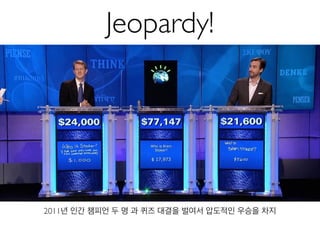
Jeopardy!
2011년 인간 챔피언 두 명 과 퀴즈 대결을 벌여서 압도적인 우승을 차지
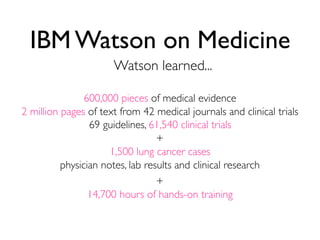
600,000 pieces of medical evidence
2 million pages of text from 42 medical journals and clinical trials
69 guidelines, 61,540 clinical trials
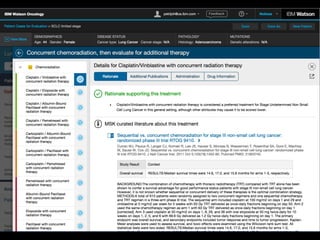
IBM Watson on Medicine
Watson learned...
+
1,500 lung cancer cases
physician notes, lab results and clinical research
+
14,700 hours of hands-on training
메이요 클리닉 협력
(임상 시험 매칭)
전남대병원
도입
인도 마니팔 병원
WFO 도입
식약처 인공지능
가이드라인 초안
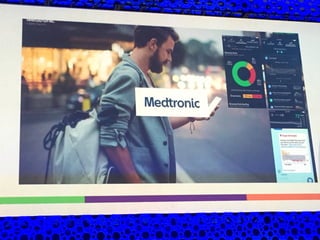
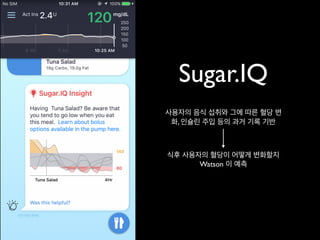
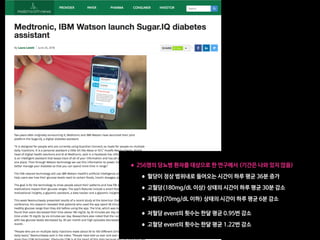
메드트로닉과
혈당관리 앱 시연
2011 2012 2013 2014 2015
뉴욕 MSK암센터 협력
(폐암)
MD앤더슨 협력
(백혈병)
MD앤더슨
파일럿 결과 발표
@ASCO
왓슨 펀드,
웰톡에 투자
뉴욕게놈센터 협력
(교모세포종 분석)
GeneMD,
왓슨 모바일 디벨로퍼
챌린지 우승
클리블랜드 클리닉 협력
(암 유전체 분석)
한국 IBM
왓슨 사업부 신설
Watson Health 출범
피텔, 익스플로리스 인수
J&J, 애플, 메드트로닉 협력
에픽 시스템즈, 메이요클리닉
제휴 (EHR 분석)
동경대 도입
( WFO)
왓슨 펀드,
모더나이징 메디슨
투자
학계/의료계
산업계
패쓰웨이 지노믹스 OME
클로즈드 알파 서비스 시작
트루븐 헬스
인수
애플 리서치 키트
통한 수면 연구 시작
2017
가천대
길병원
도입
메드트로닉
Sugar.IQ 출시
제약사
테바와 제휴
태국 범룽랏 국제 병원,
WFO 도입
머지
헬스케어
인수
2016
언더 아머 제휴
브로드 연구소 협력 발표
(유전체 분석-항암제 내성)
마니팔 병원의 

WFO 정확성 발표
대구가톨릭병원
대구동산병원
도입
부산대병원
도입
왓슨 펀드,
패쓰웨이 지노믹스
투자
제퍼디! 우승
조선대병원
도입
한국 왓슨
컨소시움 출범
쥬피터 

메디컬 

센터
도입
식약처 인공지능
가이드라인
메이요 클리닉
임상시험매칭
결과발표
2018
건양대병원
도입
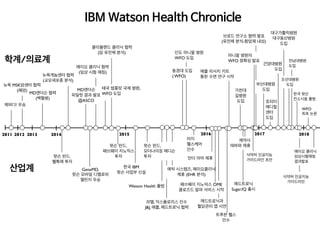
IBM Watson Health Chronicle
WFO
최초 논문
메이요 클리닉 협력
(임상 시험 매칭)
전남대병원
도입
인도 마니팔 병원
WFO 도입
식약처 인공지능
가이드라인 초안
메드트로닉과
혈당관리 앱 시연
2011 2012 2013 2014 2015
뉴욕 MSK암센터 협력
(폐암)
MD앤더슨 협력
(백혈병)
MD앤더슨
파일럿 결과 발표
@ASCO
왓슨 펀드,
웰톡에 투자
뉴욕게놈센터 협력
(교모세포종 분석)
GeneMD,
왓슨 모바일 디벨로퍼
챌린지 우승
클리블랜드 클리닉 협력
(암 유전체 분석)
한국 IBM
왓슨 사업부 신설
Watson Health 출범
피텔, 익스플로리스 인수
J&J, 애플, 메드트로닉 협력
에픽 시스템즈, 메이요클리닉
제휴 (EHR 분석)
동경대 도입
( WFO)
왓슨 펀드,
모더나이징 메디슨
투자
학계/의료계
산업계
패쓰웨이 지노믹스 OME
클로즈드 알파 서비스 시작
트루븐 헬스
인수
애플 리서치 키트
통한 수면 연구 시작
2017
가천대
길병원
도입
메드트로닉
Sugar.IQ 출시
제약사
테바와 제휴
태국 범룽랏 국제 병원,
WFO 도입
머지
헬스케어
인수
2016
언더 아머 제휴
브로드 연구소 협력 발표
(유전체 분석-항암제 내성)
마니팔 병원의 

WFO 정확성 발표
대구가톨릭병원
대구동산병원
도입
부산대병원
도입
왓슨 펀드,
패쓰웨이 지노믹스
투자
제퍼디! 우승
조선대병원
도입
한국 왓슨
컨소시움 출범
쥬피터 

메디컬 

센터
도입
식약처 인공지능
가이드라인
2018
건양대병원
도입
메이요 클리닉
임상시험매칭
결과발표
WFO
최초 논문
IBM Watson Health Chronicle
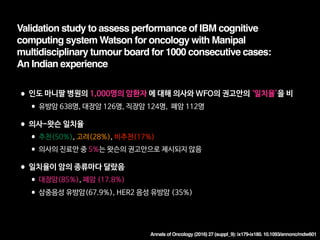
Annals of Oncology (2016) 27 (suppl_9): ix179-ix180. 10.1093/annonc/mdw601
Validation study to assess performance of IBM cognitive
computing system Watson for oncology with Manipal
multidisciplinary tumour board for 1000 consecutive cases: 

An Indian experience
•인도 마니팔 병원의 1,000명의 암환자 에 대해 의사와 WFO의 권고안의 ‘일치율’을 비

•유방암 638명, 대장암 126명, 직장암 124명, 폐암 112명

•의사-왓슨 일치율

•추천(50%), 고려(28%), 비추천(17%)

•의사의 진료안 중 5%는 왓슨의 권고안으로 제시되지 않음

•일치율이 암의 종류마다 달랐음

•대장암(85%), 폐암 (17.8%)

•삼중음성 유방암(67.9%), HER2 음성 유방암 (35%)
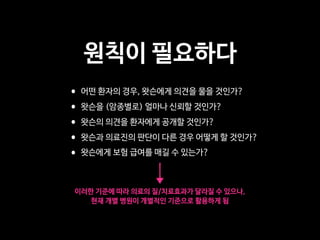
원칙이 필요하다
•어떤 환자의 경우, 왓슨에게 의견을 물을 것인가?

•왓슨을 (암종별로) 얼마나 신뢰할 것인가?

•왓슨의 의견을 환자에게 공개할 것인가?

•왓슨과 의료진의 판단이 다른 경우 어떻게 할 것인가?

•왓슨에게 보험 급여를 매길 수 있는가?
이러한 기준에 따라 의료의 질/치료효과가 달라질 수 있으나,

현재 개별 병원이 개별적인 기준으로 활용하게 됨
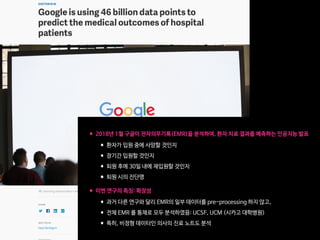
•2018년 1월 구글이 전자의무기록(EMR)을 분석하여, 환자 치료 결과를 예측하는 인공지능 발표

•환자가 입원 중에 사망할 것인지

•장기간 입원할 것인지

•퇴원 후에 30일 내에 재입원할 것인지

•퇴원 시의 진단명

•이번 연구의 특징: 확장성

•과거 다른 연구와 달리 EMR의 일부 데이터를 pre-processing 하지 않고,

•전체 EMR 를 통채로 모두 분석하였음: UCSF, UCM (시카고 대학병원)

•특히, 비정형 데이터인 의사의 진료 노트도 분석
ARTICLE OPEN
Scalable and accurate deep learning with electronic health
records
Alvin Rajkomar 1,2
, Eyal Oren1
, Kai Chen1
, Andrew M. Dai1
, Nissan Hajaj1
, Michaela Hardt1
, Peter J. Liu1
, Xiaobing Liu1
, Jake Marcus1
,
Mimi Sun1
, Patrik Sundberg1
, Hector Yee1
, Kun Zhang1
, Yi Zhang1
, Gerardo Flores1
, Gavin E. Duggan1
, Jamie Irvine1
, Quoc Le1
,
Kurt Litsch1
, Alexander Mossin1
, Justin Tansuwan1
, De Wang1
, James Wexler1
, Jimbo Wilson1
, Dana Ludwig2
, Samuel L. Volchenboum3
,
Katherine Chou1
, Michael Pearson1
, Srinivasan Madabushi1
, Nigam H. Shah4
, Atul J. Butte2
, Michael D. Howell1
, Claire Cui1
,
Greg S. Corrado1
and Jeffrey Dean1
Predictive modeling with electronic health record (EHR) data is anticipated to drive personalized medicine and improve healthcare
quality. Constructing predictive statistical models typically requires extraction of curated predictor variables from normalized EHR
data, a labor-intensive process that discards the vast majority of information in each patient’s record. We propose a representation
of patients’ entire raw EHR records based on the Fast Healthcare Interoperability Resources (FHIR) format. We demonstrate that
deep learning methods using this representation are capable of accurately predicting multiple medical events from multiple
centers without site-specific data harmonization. We validated our approach using de-identified EHR data from two US academic
medical centers with 216,221 adult patients hospitalized for at least 24 h. In the sequential format we propose, this volume of EHR
data unrolled into a total of 46,864,534,945 data points, including clinical notes. Deep learning models achieved high accuracy for
tasks such as predicting: in-hospital mortality (area under the receiver operator curve [AUROC] across sites 0.93–0.94), 30-day
unplanned readmission (AUROC 0.75–0.76), prolonged length of stay (AUROC 0.85–0.86), and all of a patient’s final discharge
diagnoses (frequency-weighted AUROC 0.90). These models outperformed traditional, clinically-used predictive models in all cases.
We believe that this approach can be used to create accurate and scalable predictions for a variety of clinical scenarios. In a case
study of a particular prediction, we demonstrate that neural networks can be used to identify relevant information from the
patient’s chart.
npj Digital Medicine (2018)1:18 ; doi:10.1038/s41746-018-0029-1
INTRODUCTION
The promise of digital medicine stems in part from the hope that,
by digitizing health data, we might more easily leverage computer
information systems to understand and improve care. In fact,
routinely collected patient healthcare data are now approaching
the genomic scale in volume and complexity.1
Unfortunately,
most of this information is not yet used in the sorts of predictive
statistical models clinicians might use to improve care delivery. It
is widely suspected that use of such efforts, if successful, could
provide major benefits not only for patient safety and quality but
also in reducing healthcare costs.2–6
In spite of the richness and potential of available data, scaling
the development of predictive models is difficult because, for
traditional predictive modeling techniques, each outcome to be
predicted requires the creation of a custom dataset with specific
variables.7
It is widely held that 80% of the effort in an analytic
model is preprocessing, merging, customizing, and cleaning
datasets,8,9
not analyzing them for insights. This profoundly limits
the scalability of predictive models.
Another challenge is that the number of potential predictor
variables in the electronic health record (EHR) may easily number
in the thousands, particularly if free-text notes from doctors,
nurses, and other providers are included. Traditional modeling
approaches have dealt with this complexity simply by choosing a
very limited number of commonly collected variables to consider.7
This is problematic because the resulting models may produce
imprecise predictions: false-positive predictions can overwhelm
physicians, nurses, and other providers with false alarms and
concomitant alert fatigue,10
which the Joint Commission identified
as a national patient safety priority in 2014.11
False-negative
predictions can miss significant numbers of clinically important
events, leading to poor clinical outcomes.11,12
Incorporating the
entire EHR, including clinicians’ free-text notes, offers some hope
of overcoming these shortcomings but is unwieldy for most
predictive modeling techniques.
Recent developments in deep learning and artificial neural
networks may allow us to address many of these challenges and
unlock the information in the EHR. Deep learning emerged as the
preferred machine learning approach in machine perception
problems ranging from computer vision to speech recognition,
but has more recently proven useful in natural language
processing, sequence prediction, and mixed modality data
settings.13–17
These systems are known for their ability to handle
large volumes of relatively messy data, including errors in labels
Received: 26 January 2018 Revised: 14 March 2018 Accepted: 26 March 2018
1
Google Inc, Mountain View, CA, USA; 2
University of California, San Francisco, San Francisco, CA, USA; 3
University of Chicago Medicine, Chicago, IL, USA and 4
Stanford University,
Stanford, CA, USA
Correspondence: Alvin Rajkomar (alvinrajkomar@google.com)
These authors contributed equally: Alvin Rajkomar, Eyal Oren
www.nature.com/npjdigitalmed
Published in partnership with the Scripps Translational Science Institute
•2018년 1월 구글이 전자의무기록(EMR)을 분석하여, 환자 치료 결과를 예측하는 인공지능 발표

•환자가 입원 중에 사망할 것인지

•장기간 입원할 것인지

•퇴원 후에 30일 내에 재입원할 것인지

•퇴원 시의 진단명

•이번 연구의 특징: 확장성

•과거 다른 연구와 달리 EMR의 일부 데이터를 pre-processing 하지 않고,

•전체 EMR 를 통채로 모두 분석하였음: UCSF, UCM (시카고 대학병원)

•특히, 비정형 데이터인 의사의 진료 노트도 분석
Nat Digi Med 2018
• “향후 10년 동안 첫번째 cardiovascular event 가 올 것인가” 예측
• 전향적 코호트 스터디: 영국 환자 378,256 명
• 일상적 의료 데이터를 바탕으로 기계학습으로 질병을 예측하는 첫번째 대규모 스터디
• 기존의 ACC/AHA 가이드라인과 4가지 기계학습 알고리즘의 정확도를 비교
• Random forest; Logistic regression; Gradient bossting; Neural network
Can machine-learning improve cardiovascular
risk prediction using routine clinical data?
Stephen F.Weng et al PLoS One 2017
in a sensitivity of 62.7% and PPV of 17.1%. The random forest algorithm resulted in a net
increase of 191 CVD cases from the baseline model, increasing the sensitivity to 65.3% and
PPV to 17.8% while logistic regression resulted in a net increase of 324 CVD cases (sensitivity
67.1%; PPV 18.3%). Gradient boosting machines and neural networks performed best, result-
ing in a net increase of 354 (sensitivity 67.5%; PPV 18.4%) and 355 CVD (sensitivity 67.5%;
PPV 18.4%) cases correctly predicted, respectively.
The ACC/AHA baseline model correctly predicted 53,106 non-cases from 75,585 total non-
cases, resulting in a specificity of 70.3% and NPV of 95.1%. The net increase in non-cases
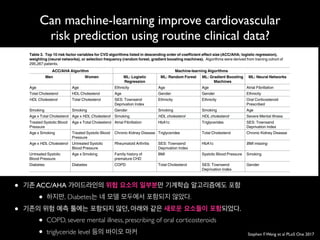
Table 3. Top 10 risk factor variables for CVD algorithms listed in descending order of coefficient effect size (ACC/AHA; logistic regression),
weighting (neural networks), or selection frequency (random forest, gradient boosting machines). Algorithms were derived from training cohort of
295,267 patients.
ACC/AHA Algorithm Machine-learning Algorithms
Men Women ML: Logistic
Regression
ML: Random Forest ML: Gradient Boosting
Machines
ML: Neural Networks
Age Age Ethnicity Age Age Atrial Fibrillation
Total Cholesterol HDL Cholesterol Age Gender Gender Ethnicity
HDL Cholesterol Total Cholesterol SES: Townsend
Deprivation Index
Ethnicity Ethnicity Oral Corticosteroid
Prescribed
Smoking Smoking Gender Smoking Smoking Age
Age x Total Cholesterol Age x HDL Cholesterol Smoking HDL cholesterol HDL cholesterol Severe Mental Illness
Treated Systolic Blood
Pressure
Age x Total Cholesterol Atrial Fibrillation HbA1c Triglycerides SES: Townsend
Deprivation Index
Age x Smoking Treated Systolic Blood
Pressure
Chronic Kidney Disease Triglycerides Total Cholesterol Chronic Kidney Disease
Age x HDL Cholesterol Untreated Systolic
Blood Pressure
Rheumatoid Arthritis SES: Townsend
Deprivation Index
HbA1c BMI missing
Untreated Systolic
Blood Pressure
Age x Smoking Family history of
premature CHD
BMI Systolic Blood Pressure Smoking
Diabetes Diabetes COPD Total Cholesterol SES: Townsend
Deprivation Index
Gender
Italics: Protective Factors
https://doi.org/10.1371/journal.pone.0174944.t003
PLOS ONE | https://doi.org/10.1371/journal.pone.0174944 April 4, 2017 8 / 14
• 기존 ACC/AHA 가이드라인의 위험 요소의 일부분만 기계학습 알고리즘에도 포함
• 하지만, Diabetes는 네 모델 모두에서 포함되지 않았다. 
• 기존의 위험 예측 툴에는 포함되지 않던, 아래와 같은 새로운 요소들이 포함되었다.
• COPD, severe mental illness, prescribing of oral corticosteroids
• triglyceride level 등의 바이오 마커
Can machine-learning improve cardiovascular
risk prediction using routine clinical data?
Stephen F.Weng et al PLoS One 2017
correctly predicted compared to the baseline ACC/AHA model ranged from 191 non-cases for
the random forest algorithm to 355 non-cases for the neural networks. Full details on classifi-
cation analysis can be found in S2 Table.
Discussion
Compared to an established AHA/ACC risk prediction algorithm, we found all machine-
learning algorithms tested were better at identifying individuals who will develop CVD and
those that will not. Unlike established approaches to risk prediction, the machine-learning
methods used were not limited to a small set of risk factors, and incorporated more pre-exist-
Table 4. Performance of the machine-learning (ML) algorithms predicting 10-year cardiovascular disease (CVD) risk derived from applying train-
ing algorithms on the validation cohort of 82,989 patients. Higher c-statistics results in better algorithm discrimination. The baseline (BL) ACC/AHA
10-year risk prediction algorithm is provided for comparative purposes.
Algorithms AUC c-statistic Standard Error* 95% Confidence
Interval
Absolute Change from Baseline
LCL UCL
BL: ACC/AHA 0.728 0.002 0.723 0.735 —
ML: Random Forest 0.745 0.003 0.739 0.750 +1.7%
ML: Logistic Regression 0.760 0.003 0.755 0.766 +3.2%
ML: Gradient Boosting Machines 0.761 0.002 0.755 0.766 +3.3%
ML: Neural Networks 0.764 0.002 0.759 0.769 +3.6%
*Standard error estimated by jack-knife procedure [30]
https://doi.org/10.1371/journal.pone.0174944.t004
Can machine-learning improve cardiovascular risk prediction using routine clinical data?
• 네 가지 기계학습 모델 모두 기존의 ACC/AHA 가이드라인 대비 더 정확했다.
• Neural Networks 이 AUC=0.764 로 가장 정확했다.
• “이 모델을 활용했더라면 355 명의 추가적인 cardiovascular event 를 예방했을 것”
• Deep Learning 을 활용하면 정확도는 더 높아질 수 있을 것
• Genetic information 등의 추가적인 risk factor 를 활용해볼 수 있다.
• 복잡한 의료 데이터의 분석 및 insight 도출
• 영상 의료/병리 데이터의 분석/판독
• 연속 데이터의 모니터링 및 예방/예측
인공지능의 의료 활용
Deep Learning
http://theanalyticsstore.ie/deep-learning/
Radiologist
Detection of Diabetic Retinopathy
Skin Cancer
Digital Pathologist
•손 엑스레이 영상을 판독하여 환자의 골연령 (뼈 나이)를 계산해주는 인공지능

• 기존에 의사는 그룰리히-파일(Greulich-Pyle)법 등으로 표준 사진과 엑스레이를 비교하여 판독

• 인공지능은 참조표준영상에서 성별/나이별 패턴을 찾아서 유사성을 확률로 표시 + 표준 영상 검색

•의사가 성조숙증이나 저성장을 진단하는데 도움을 줄 수 있음
Nam et al
Figure 1: Images in a 78-year-old female patient with a 1.9-cm part-solid nodule at the left upper lobe. (a) The nodule was faintly visible on the
chest radiograph (arrowheads) and was detected by 11 of 18 observers. (b) At contrast-enhanced CT examination, biopsy confirmed lung adeno-
carcinoma (arrow). (c) DLAD reported the nodule with a confidence level of 2, resulting in its detection by an additional five radiologists and an
elevation in its confidence by eight radiologists.
Figure 2: Images in a 64-year-old male patient with a 2.2-cm lung adenocarcinoma at the left upper lobe. (a) The nodule was faintly visible on
the chest radiograph (arrowheads) and was detected by seven of 18 observers. (b) Biopsy confirmed lung adenocarcinoma in the left upper lobe
on contrast-enhanced CT image (arrow). (c) DLAD reported the nodule with a confidence level of 2, resulting in its detection by an additional two
radiologists and an elevated confidence level of the nodule by two radiologists.
- 1 -
보 도 자 료
국내에서 개발한 인공지능(AI) 기반 의료기기 첫 허가
- 인공지능 기술 활용하여 뼈 나이 판독한다 -
식품의약품안전처 처장 류영진 는 국내 의료기기업체 주 뷰노가
개발한 인공지능 기술이 적용된 의료영상분석장치소프트웨어
뷰노메드 본에이지 를 월 일 허가했다고
밝혔습니다
이번에 허가된 뷰노메드 본에이지 는 인공지능 이 엑스레이 영상을
분석하여 환자의 뼈 나이를 제시하고 의사가 제시된 정보 등으로
성조숙증이나 저성장을 진단하는데 도움을 주는 소프트웨어입니다
그동안 의사가 환자의 왼쪽 손 엑스레이 영상을 참조표준영상
과 비교하면서 수동으로 뼈 나이를 판독하던 것을 자동화하여
판독시간을 단축하였습니다
이번 허가 제품은 년 월부터 빅데이터 및 인공지능 기술이
적용된 의료기기의 허가 심사 가이드라인 적용 대상으로 선정되어
임상시험 설계에서 허가까지 맞춤 지원하였습니다
뷰노메드 본에이지 는 환자 왼쪽 손 엑스레이 영상을 분석하여 의
료인이 환자 뼈 나이를 판단하는데 도움을 주기 위한 목적으로
허가되었습니다
- 2 -
분석은 인공지능이 촬영된 엑스레이 영상의 패턴을 인식하여 성별
남자 개 여자 개 로 분류된 뼈 나이 모델 참조표준영상에서
성별 나이별 패턴을 찾아 유사성을 확률로 표시하면 의사가 확률값
호르몬 수치 등의 정보를 종합하여 성조숙증이나 저성장을 진단합
니다
임상시험을 통해 제품 정확도 성능 를 평가한 결과 의사가 판단한
뼈 나이와 비교했을 때 평균 개월 차이가 있었으며 제조업체가
해당 제품 인공지능이 스스로 인지 학습할 수 있도록 영상자료를
주기적으로 업데이트하여 의사와의 오차를 좁혀나갈 수 있도록
설계되었습니다
인공지능 기반 의료기기 임상시험계획 승인건수는 이번에 허가받은
뷰노메드 본에이지 를 포함하여 현재까지 건입니다
임상시험이 승인된 인공지능 기반 의료기기는 자기공명영상으로
뇌경색 유형을 분류하는 소프트웨어 건 엑스레이 영상을 통해
폐결절 진단을 도와주는 소프트웨어 건 입니다
참고로 식약처는 인공지능 가상현실 프린팅 등 차 산업과
관련된 의료기기 신속한 개발을 지원하기 위하여 제품 연구 개발부터
임상시험 허가에 이르기까지 전 과정을 맞춤 지원하는 차세대
프로젝트 신개발 의료기기 허가도우미 등을 운영하고 있
습니다
식약처는 이번 제품 허가를 통해 개개인의 뼈 나이를 신속하게
분석 판정하는데 도움을 줄 수 있을 것이라며 앞으로도 첨단 의료기기
개발이 활성화될 수 있도록 적극적으로 지원해 나갈 것이라고
밝혔습니다
http://www.rolls-royce.com/about/our-technology/enabling-technologies/engine-health-management.aspx#sense
250 sensors to monitor the “health” of the GE turbines
Fig 1. What can consumer wearables do? Heart rate can be measured with an oximeter built into a ring [3], muscle activity with an electromyographi
sensor embedded into clothing [4], stress with an electodermal sensor incorporated into a wristband [5], and physical activity or sleep patterns via an
accelerometer in a watch [6,7]. In addition, a female’s most fertile period can be identified with detailed body temperature tracking [8], while levels of me
attention can be monitored with a small number of non-gelled electroencephalogram (EEG) electrodes [9]. Levels of social interaction (also known to a
PLOS Medicine 2016
•복잡한 의료 데이터의 분석 및 insight 도출

•영상 의료/병리 데이터의 분석/판독

•연속 데이터의 모니터링 및 예방/예측
인공지능의 의료 활용
Project Artemis at UIOT
Sugar.IQ
사용자의 음식 섭취와 그에 따른 혈당 변
화, 인슐린 주입 등의 과거 기록 기반
식후 사용자의 혈당이 어떻게 변화할지
Watson 이 예측
•256명의 당뇨병 환자를 대상으로 한 연구에서 (기간은 나와 있지 않음)

•혈당이 정상 범위내로 들어오는 시간이 하루 평균 36분 증가

•고혈당(180mg/dL 이상) 상태의 시간이 하루 평균 30분 감소

•저혈당(70mg/dL 이하) 상태의 시간이 하루 평균 6분 감소

•저혈당 event의 횟수는 한달 평균 0.95번 감소

•고혈당 event의 횟수는 한달 평균 1.22번 감소
•미국에서 아이폰 앱으로 출시

•사용이 얼마나 번거로울지가 관건

•어느 정도의 기간을 활용해야 효과가 있는가: 2주? 평생?

•Food logging 등을 어떻게 할 것인가?

•과금 방식도 아직 공개되지 않은듯
디지털 의료 구현의 3단계
•Step 1. 데이터의 측정

•Step 2. 데이터의 통합

•Step 3. 데이터의 분석
디지털 헬스케어 기반의 

능동적, 선제적 보험
열심히 운동하면 돈을 준다!
: 액티비티 트레커와 보험사의 연계
PREVENTIVECA
RE
EAT HEALTHY
GETACTIVE
AND
MAGAZINES
MOVIES
CARHIRE,HOTE
LS
FLIGHTS,
Get up to 25% cash back on HealthyGear
items at Sportmans Warehouse
or Totalsports
Join Team Vitality and get up to
50% off selected race events
Get active and save up
to 80% at gym partners
and 25% cash back at
specialised fitness facilities
Give your baby the
best start in life with
Vitality Baby
Get up to 25% cash back
on HealthyCare products at
Clicks or Dis-Chem
Get to know your health,
fitness and nutrition through
online assessments
and health checks
Learn more about your
eating habits
Save at weight-loss
partners
Save on
stopping smoking
Watch movies at
discounted prices.
Get up to 60% off
popular magazines
Get up to 20% cash back
in the DiscoveryCard
store network
Enjoy a wide
variety of shopping
rewards through
discovery/mall
Multiply your
Discovery Miles
rewards with
HealthyLiving
Get exclusive access
to Big Concerts
experiences
Save up to
50% on a wide
range of hotel
accommodation
Save up to 25%
on car rental
Save up to 35%
on local and
international flights
(base ticket fare only)
Get up to 25% cash
back on HealthyFood
at Pick n Pay or
Woolworths
Vitality Baby
As you improve
your health and earn
Vitality points, you
will move from Blue to
Bronze, Silver,
Gold and finally
Diamond status.
PREVENTIVECA
RE
EAT HEALTHY
GETACTIVE
AND
MAGAZINES
MOVIES
CARHIRE,HOTE
LS
FLIGHTS,
Get up to 25% cash back on HealthyGear
items at Sportmans Warehouse
or Totalsports
Join Team Vitality and get up to
50% off selected race events
Get active and save up
to 80% at gym partners
and 25% cash back at
specialised fitness facilities
Give your baby the
best start in life with
Vitality Baby
Get up to 25% cash back
on HealthyCare products at
Clicks or Dis-Chem
Get to know your health,
fitness and nutrition through
online assessments
and health checks
Learn more about your
eating habits
Save at weight-loss
partners
Save on
stopping smoking
Watch movies at
discounted prices.
Get up to 60% off
popular magazines
Get up to 20% cash back
in the DiscoveryCard
store network
Enjoy a wide
variety of shopping
rewards through
discovery/mall
Multiply your
Discovery Miles
rewards with
HealthyLiving
Get exclusive access
to Big Concerts
experiences
Save up to
50% on a wide
range of hotel
accommodation
Save up to 25%
on car rental
Save up to 35%
on local and
international flights
(base ticket fare only)
Get up to 25% cash
back on HealthyFood
at Pick n Pay or
Woolworths
Vitality Baby
As you improve
your health and earn
Vitality points, you
will move from Blue to
Bronze, Silver,
Gold and finally
Diamond status.
• Get Healty: 건강 증진과 관련된 부분
• Preventive Care: 예방적 건강 관리 활동
• Eat Healthy: 식이 습관
• Get Active: 운동 습관
GET ACTIVE AND
EARN VITALITY FITNESS POINTS – 2016
Fitness points
50 100 200 300
Workout
activities
Health clubs
Round of golf
VitalityFit
Preggi Bellies
Run/Walk For Life
parkrun
Run/Walk For Life
5km+
Steps
5 000 – 9 999
steps*
10 000+ steps
Speed workouts 30+ min
Light workouts at 60 – 69%
of max heart rate
30+ min*
Moderate workouts at 70 – 79%
of max heart rate
30 – 59 min 60+ min
Vigorous workouts at 80%+
of max heart rate
30+ min
Earn speed workout
fitness points by:
Running at an average
of 5.5+ km/hr
Swimming at an average
of 1.5+ km/hr
Cycling at an average
of 10+ km/hr
Heart rate target tip:
Calculate your maximum
heart rate by subtracting
your age from 220.
Use this easy guide for
more info.
Get active with Vitality to improve your health and earn Vitality fitness points to get rewarded. Earning Vitality points through regular physical
activity motivates you to stay active which has significant health benefits. You can earn fitness points for one activity a day, up to a maximum
of 30 000 fitness points a year. You can earn fitness points through workouts at our fitness partners, competing in race events or by tracking
your activity using a Vitality-linked fitness device.
*Earn 50 Vitality points for tracking between 5 000 and 9 999 steps in a day or 100 points for a 30+ minute workout where you are able to maintain 60 – 69% of your maximum age-related
heart rate. These activities recognise that important first step for many of our members who are just starting out. For this reason, these points will contribute to your weekly Vitality Active
Rewards goal, but will be subject to a cap of 1 000 points per year towards your Vitality Status.
G E T ACT IVE AND EARN VIT ALI TY
FITNESS POIN TS FOR END URA N CE
A N D HIGH PER F OR MAN CE – 2 0 1 6
We have tailored the Vitality programme for highly active members by introducing a new category for Endurance and High Performance to
recognise the ongoing dedication and efforts when it comes to both training and competing at this level. You can earn fitness points for one
activity a day, up to a maximum of 30 000 fitness points a year. This category is for individuals exercising in peak performance zones and
who regularly participate in marathons, triathlons and similar endurance events. These Endurance and High Performance members typically
exercise at lower heart rates for longer periods of time.
Fitness points
50 100 200 300 450 600
Workout
activities
Health clubs
Round of golf
VitalityFit
Preggi Bellies
Run/Walk
For Life
parkrun
Run/Walk
For Life 5km+
Steps
5 000 –
9 999 steps*
10 000+ steps
Speed workouts 30+ min
Light heart rate
workouts at 60 – 69%
30 – 89min* 90 – 119 min 120 – 179 min 180+ min
Moderate heart rate
workouts at 70% – 79%
30 – 59min 60 – 89 min 90 – 119 min 120+ min
Vigorous heart rate
workouts at 80%+
30 – 89 min 90 – 119 min 120+ min
Earn speed workout
fitness points by:
Running at an average
of 5.5+ km/hr
Swimming at an average
of 1.5+ km/hr
Cycling at an average
of 10+ km/hr
Heart rate target tip:
Calculate your maximum
heart rate by subtracting
your age from 220.
Use this easy guide for
more info.
*These points contribute to weekly Vitality Active Rewards goals but are capped at 1 000 points per year towards Vitality Status.
06
Discovery Vitality (Pty) Ltd is an authorised financial services provider. Registration number: 1999/007736/07. Terms and conditions apply.
The Vitality Dashboard gives you a personalised
view of your Vitality benefits and shows you
how to increase your rewards.
Complete online assessments to understand
your health and follow a recommended
Personal Health Programme.
Log workouts, complete challenges and
monitor eating habits.
Keep track of your Vitality points and get tips
on how to get to Gold Vitality status.
Stay up to date with the latest Vitality news
and articles to support your healthier lifestyle.
Access the world of Vitality on www.discovery.co.za or the Discovery app
Single member:
Main member + 1:
Main member + 2:
You start at
Blue Vitality
status
Blue
15 000
30 000
40 000
Bronze
Reach Gold Vitality status for three
years in a row to get to Diamond
Diamond
45 000
90 000
120 000
Gold
35 000
70 000
90 000
Silver
For each additional member aged 18 years and older, add: 10 000 (Bronze), 20 000 (Silver), 30 000 (Gold).
Follow Vitality on
Vitality Get to Gold journey for a single member.
STATUS
STATUS
STATUS
STATUS
STATUS
Reach Gold
Vitality status
for three
years in a row
Year 2
Year 3
45 000 Vitality
points
35 000 Vitality
points
15 000 Vitality
points
You will start off
at Blue status.
• 획득한Vitality 포인트에 따라서 등급을 부여
• 총 5 등급: Blue ➞ Bronze ➞ Sliver ➞ Gold ➞ Diamond
• Gold 를 3년 연속 유지하면 Diamond 로 승격
• 등급에 따라 할인 비율 등의 reward 차등
• Dynamic Pricing: 등급에 따라 보험료도 달라짐
• Bronze의 경우 2% 상승
Success of Vitality Optimiser product | Launched 2013
Significant upfront discounts Dynamic pricing
Vitality reward partners Ongoing rewards through Cash backs
Term of cover (years) Upfront discount
5 5%
10 7.5%
15 15%
20 17.5%
25 20%
30 22.5%
35 25%
40 25%
Entry Age
Premium
Discount
30 40%
50 35%
55 30%
60 25%
65 20%
70 15%
Term assurance (Max 25%) Whole of life (Max 40%)
Vitality
Status
Premium
change each
year
2% 1% 0% -1%
Bronze Silver Gold Platinum
One person
covered
No
cashback
£50 £75 £100
Two people
covered
No
cashback
£100 £150 £200
Combined
insurance
+ Vitality
product
70
01
To apply for your DiscoveryCard, visit www.discovery.co.za or
call 0860 11 2273.
To join Vitality or to find out more, visit www.discovery.co.za,
call 0860 99 88 77 or contact your financial adviser or your
company’s HR representative.
Discovery Vitality Member | R185 Member + 1 | R219 Member + 2 or more | R249
Please note all information displayed in this brochure is only a summary of the Vitality benefits. Specific terms and conditions apply to each benefit.
PREVENTIVEC
GETACTIVE
AND
MAGAZINES
MOVIES
CARHIRE,HOTE
LS
FLIGHTS,
and 25% cash back at
specialised fitness facilities
Give your baby the
best start in life with
Vitality Baby
Watch movies at
discounted prices.
Get up to 60% off
popular magazines
Get up to 20% cash back
in the DiscoveryCard
store network
Enjoy a wide
variety of shopping
rewards through
discovery/mall
Multiply your
Discovery Miles
rewards with
HealthyLiving
Get exclusive access
to Big Concerts
experiences
Save up to
50% on a wide
range of hotel
accommodation
Save up to 25%
on car rental
Save up to 35%
on local and
international flights
(base ticket fare only)
Vitality Baby
As you improve
your health and earn
Vitality points, you
will move from Blue to
Bronze, Silver,
Gold and finally
Diamond status.
• 등급에 따라서 차등적으로 다양한 인센티브 제공
• 비행기 티켓, 차량, 호텔 숙박권
• 영화 관람, 잡지 구독권
• 디스커버리 신용카드를 이용한 혜택
Blue Bronze Silver Gold
49 50 to 54 55 to 59 60 to 64 65 to 69
Blue Bronze
Gold Diamond
y curves Dynamic pricing premium profiles
e’s dynamic pricing model
Market premium
Competitive price points : Large initial discounts to market prices
Selection : Attract healthier lives
Positive selective lapses : Better matching of price to risk
Behaviour change : Rewards to motivate behaviour change
A
B
C
D
A
B
C
D
48
건강하지 않은 가입자들의 positive selection 효과
• 건강하지 않은 가입자들은 보험 가입을 중단하게 유도하는 것이 보험사에는 이득
• 낮은 등급을 유지하여 보험료가 비싸진 가입자들은 중단 확률이 높아짐
• community rating 에 기반한 타 보험사의 보험료가 상대적으로 저렴하기 때문
Digital Therapeutics
디지털 신약 / 디지털 치료제
"The Birth of Prescription Digital Therapeutics,"
Pear Therapeutics and InCrowd, IIeX 2018”
“치료 효과가 있는 ‘게임’이 아니라, 

‘치료제’가 (어쩌다보니) 게임의 형식을 가진 것이다”

by Eddie Martucci, CEO of Akili Interactive, at DTxDM East 2018
5www.dtxalliance.org
Defining Digital Therapeutics
Thought leaders across the digital therapeutics industry,
supported by the Digital Therapeutics Alliance, collaborated
to develop the following comprehensive definition:
Digital therapeutics (DTx) deliver evidence-based
therapeutic interventions to patients that are driven by
high quality software programs to prevent, manage,
or treat a medical disorder or disease. They are used
independently or in concert with medications, devices,
or other therapies to optimize patient care and health
outcomes.
DTx products incorporate advanced technology best
practices relating to design, clinical validation, usability,
and data security. They are reviewed and cleared or
approved by regulatory bodies as required to support
product claims regarding risk, efficacy, and intended use.
Digital therapeutics empower patients, healthcare
providers, and payers with intelligent and accessible tools
for addressing a wide range of conditions through high
quality, safe, and effective data-driven interventions.
Digital therapeutics
present the market
with evidence-based
technologies that
have the ability to
elevate medical best
practices, address
unmet medical needs,
expand healthcare
access, and improve
clinical and health
economic outcomes.
• 질병을 예방, 관리, 혹은 치료하는 고도의 소프트웨어 프로그램
• 독립적으로 사용될 수도 있고, 약제/기기/다른 치료제와 함께 사용될 수 있음
• 효능, 목적, 위험도 등의 주장과 관련해서는 규제기관의 인허가를 거침
만성질환 관리
14© 2017 by HURAYPOSITIVE INC., a Digital Healthcare Service Provider. This information is strictly privileged and confidential. All rights reserved.
제2형 당뇨병 환자 95% 임신성 당뇨병 환자 2%
기타 1%
정상인 당뇨병 전단계
환자
당뇨병
환자
경증합병증 동반
당뇨병 환자
중증합병증 동반
당뇨병 환자
제1형 당뇨병 환자 2%
보건복지부/건강보험공단
(국민건강증진 및 관리)
병원/제약사/보험사
(비용절감 및 고객만족)
차기 위험단계로의
적극적인 진입 억제를 위한
헬스케어 솔루션
휴레이포지티브
헬스케어 솔루션
$
key facts
Products & Services
서비스 대상 & 역할
16© 2017 by HURAYPOSITIVE INC., a Digital Healthcare Service Provider. This information is strictly privileged and confidential. All rights reserved.
7
7.2
7.4
7.6
7.8
8
8.2
3M 6M 9M 12M0M
▼0.63%p.
▼0.64%p.
당화혈색소(HbA1c,%)
&
Products & Services
의학적 유효성(Health Switch를 활용한 임상실험)
기간
• 1차 실험(0M-6M)
실험군: 중재 O ( )
대조군: 중재 X ( )
• 2차 실험: 실험군과 대조군 교차(6M-12M)
대조군: 중재 X ( )
실험군: 중재 O ( )
당화혈색소 0.63%p. 감소
무의미한 변화
당화혈색소 수준 유지
당화혈색소 0.64%p. 감소
▼0.04%p.
• N = 148명
• 평균 연령: 52.2세
결과
임상 대상자
1 모바일 중재 서비스의 의미 있는 혈당 감소 효과
2 약 6개월의 서비스 후 생활습관 유지 가능성
3 고령 환자들도 사용할 수 있는 간편한 서비스
임상실험을 통해 검증된
Health Switch의 효과
key facts
• 특징: 제2형 당뇨병 유병자
• 기간: 2014.10 ~ 2015.12
1SCIENTIFIC REPORTS | (2018) 8:3642 | DOI:10.1038/s41598-018-22034-0
www.nature.com/scientificreports
The effectiveness, reproducibility,
and durability of tailored mobile
coaching on diabetes management
in policyholders:A randomized,
controlled, open-label study
DaYoung Lee1,2
, Jeongwoon Park3
, DooahChoi3
, Hong-YupAhn4
, Sung-Woo Park1
&
Cheol-Young Park 1
This randomized, controlled, open-label study conducted in Kangbuk Samsung Hospital evaluated
the effectiveness, reproducibility, and durability of tailored mobile coaching (TMC) on diabetes
management.The participants included 148 Korean adult policyholders with type 2 diabetes divided
into the Intervention-Maintenance (I-M) group (n=74) andControl-Intervention (C-I) group (n=74).
Intervention was the addition ofTMC to typical diabetes care. In the 6-month phase 1, the I-M group
receivedTMC, and theC-I group received their usual diabetes care. During the second 6-month phase
2, theC-I group receivedTMC, and the I-M group received only regular information messages.After
the 6-month phase 1, a significant decrease (0.6%) in HbA1c levels compared with baseline values was
observed in only the I-M group (from 8.1±1.4% to 7.5±1.1%, P<0.001 based on a paired t-test).
At the end of phase 2, HbA1c levels in theC-I group decreased by 0.6% compared with the value at 6
months (from 7.9±1.5 to 7.3±1.0, P<0.001 based on a paired t-test). In the I-M group, no changes
were observed. Both groups showed significant improvements in frequency of blood-glucose testing
and exercise. In conclusion, addition ofTMC to conventional treatment for diabetes improved glycemic
control, and this effect was maintained without individualized message feedback.
The incidence and prevalence of type 2 diabetes are increasing rapidly worldwide, and the disease is expected
to affect 439 million adults by 20301
. Previous large clinical trials indicated that adequate glycemic control con-
tributed to a reduction in both microvascular and macrovascular complications as well as mortality rates due to
diabetes2,3
. Complications from diabetes result in greater expenditure and reduced productivity. Therefore, it is a
socioeconomic concern4,5
. Adequate glycemic control is important not only as an individual health problem, but
also as a challenge to healthcare systems worldwide.
However, approximately 40% of subjects with diabetes in the United States do not meet the recommended
target for glycemic control, low-density lipoprotein cholesterol (LDL-C) level, or blood pressure (BP)6
. In Korea,
glycated hemoglobin (HbA1c) levels for nearly half of diabetic patients were above 7.0%7
.
Although successful diabetes care requires therapeutic lifestyle modification in addition to proper medica-
tion8–10
, only 55% of individuals with type 2 diabetes receive diabetes education from healthcare professionals11
,
and 16% report adhering to recommended self-management activities9
. Multifaceted professional inter-
ventions are needed to support patient efforts for behavior change including healthy lifestyle choices, disease
self-management, and prevention of diabetes complications10
.
1
Division of Endocrinology and Metabolism, Department of Internal Medicine, Kangbuk Samsung Hospital,
SungkyunkwanUniversitySchool of Medicine,Seoul, Republic of Korea.2
Division of Endocrinology and Metabolism,
Department of Internal Medicine, KoreaUniversityCollege of Medicine,Seoul, Republic of Korea.3
Huraypositive Inc.
Sinsa-dong, Gangnam-gu, Seoul, Republic of Korea. 4
Department of Statistics, Dongguk University-Seoul, Seoul,
Republic of Korea. Correspondence and requests for materials should be addressed to C.-Y.P. (email: cydoctor@
chol.com)
Received: 29 November 2017
Accepted: 15 February 2018
Published: xx xx xxxx
OPEN
1SCIENTIFIC REPORTS | (2018) 8:3642 | DOI:10.1038/s41598-018-22034-0
www.nature.com/scientificreports
The effectiveness, reproducibility,
and durability of tailored mobile
coaching on diabetes management
in policyholders:A randomized,
controlled, open-label study
DaYoung Lee1,2
, Jeongwoon Park3
, DooahChoi3
, Hong-YupAhn4
, Sung-Woo Park1
&
Cheol-Young Park 1
This randomized, controlled, open-label study conducted in Kangbuk Samsung Hospital evaluated
the effectiveness, reproducibility, and durability of tailored mobile coaching (TMC) on diabetes
management.The participants included 148 Korean adult policyholders with type 2 diabetes divided
into the Intervention-Maintenance (I-M) group (n=74) andControl-Intervention (C-I) group (n=74).
Intervention was the addition ofTMC to typical diabetes care. In the 6-month phase 1, the I-M group
receivedTMC, and theC-I group received their usual diabetes care. During the second 6-month phase
2, theC-I group receivedTMC, and the I-M group received only regular information messages.After
the 6-month phase 1, a significant decrease (0.6%) in HbA1c levels compared with baseline values was
observed in only the I-M group (from 8.1±1.4% to 7.5±1.1%, P<0.001 based on a paired t-test).
At the end of phase 2, HbA1c levels in theC-I group decreased by 0.6% compared with the value at 6
months (from 7.9±1.5 to 7.3±1.0, P<0.001 based on a paired t-test). In the I-M group, no changes
were observed. Both groups showed significant improvements in frequency of blood-glucose testing
and exercise. In conclusion, addition ofTMC to conventional treatment for diabetes improved glycemic
control, and this effect was maintained without individualized message feedback.
The incidence and prevalence of type 2 diabetes are increasing rapidly worldwide, and the disease is expected
to affect 439 million adults by 20301
. Previous large clinical trials indicated that adequate glycemic control con-
tributed to a reduction in both microvascular and macrovascular complications as well as mortality rates due to
diabetes2,3
. Complications from diabetes result in greater expenditure and reduced productivity. Therefore, it is a
socioeconomic concern4,5
. Adequate glycemic control is important not only as an individual health problem, but
also as a challenge to healthcare systems worldwide.
However, approximately 40% of subjects with diabetes in the United States do not meet the recommended
target for glycemic control, low-density lipoprotein cholesterol (LDL-C) level, or blood pressure (BP)6
. In Korea,
glycated hemoglobin (HbA1c) levels for nearly half of diabetic patients were above 7.0%7
.
Although successful diabetes care requires therapeutic lifestyle modification in addition to proper medica-
tion8–10
, only 55% of individuals with type 2 diabetes receive diabetes education from healthcare professionals11
,
and 16% report adhering to recommended self-management activities9
. Multifaceted professional inter-
ventions are needed to support patient efforts for behavior change including healthy lifestyle choices, disease
self-management, and prevention of diabetes complications10
.
1
Division of Endocrinology and Metabolism, Department of Internal Medicine, Kangbuk Samsung Hospital,
SungkyunkwanUniversitySchool of Medicine,Seoul, Republic of Korea.2
Division of Endocrinology and Metabolism,
Department of Internal Medicine, KoreaUniversityCollege of Medicine,Seoul, Republic of Korea.3
Huraypositive Inc.
Sinsa-dong, Gangnam-gu, Seoul, Republic of Korea. 4
Department of Statistics, Dongguk University-Seoul, Seoul,
Republic of Korea. Correspondence and requests for materials should be addressed to C.-Y.P. (email: cydoctor@
chol.com)
Received: 29 November 2017
Accepted: 15 February 2018
Published: xx xx xxxx
OPEN
e.com/scientificreports/
Figure 3. Changes in means and standard errors of glycated hemoglobin (H
study period.
HbA1c levels of the C-I group who received TMC during phase 2 of the study
decreased by 0.6% compared to phase 1 levels. In the I-M group, initial
improvement in HbA1c levels at 3 months continued until 12 months.
Consequently, HbA1c levels in both the C-I and I-M groups decreased
significantly compared to baseline values over the 12-month study period.
보험사
환자
사용료
스타트업
보험료
데이터
질병 관리 서비스
“사업적 수익”
“보험금 지급 감소”
“질병 관리”
The Effect of a Smartphone-Based,
Patient-Centered Diabetes Care
System in Patients With Type 2
Diabetes: A Randomized,
Controlled Trial for 24 Weeks
https://doi.org/10.2337/dc17-2197
OBJECTIVE
Thisstudyevaluatedtheefficacyofasmartphone-based,patient-centered diabetes
care system (mDiabetes) for type 2 diabetes that contains comprehensive modules
forglucosemonitoring,diet,physicalactivity,andaclinicaldecisionsupportsystem.
RESEARCH DESIGN AND METHODS
We conducted a 24-week, multicenter, randomized controlled trial with adult
patients with inadequately controlled type 2 diabetes. The patients were randomly
assigned to the mDiabetes group or the paper logbook (pLogbook) group. The
primary end point was the difference of the change in HbA1c from baseline between
the two groups.
RESULTS
HbA1c reductionfrombaselinewasgreaterinthemDiabetesgroup(20.4060.09%,
n = 90) than in the pLogbook group (20.06 6 0.10%, n = 82). The difference of
adjusted mean changes was 0.35% (95% CI 0.14–0.55, P = 0.001). The proportion
of patients whose HbA1c fell below 7.0% (53 mmol/mol) was 41.1% for the mDia-
betes group and 20.7% for the pLogbook group (odds ratio [OR] 2.01, 95% CI 1.24–
3.25, P = 0.003). The percentage of patients who attained HbA1c levels below 7.0%
(53 mmol/mol) without hypoglycemia was 31.1% in the mDiabetes group and
17.1% in the pLogbook group (OR 1.82, 95% CI 1.03–3.21, P = 0.024). There was no
difference in the event numbers of severe hyperglycemia and hypoglycemia be-
tween the two groups.
CONCLUSIONS
The implementation of the mDiabetes for patients with inadequately controlled
type 2 diabetes resulted in a significant reduction in HbA1c levels, with tolerable
safety profiles.
Diabetes is a chronic disease requiring lifelong management with lifestyle modifi-
cation, medication, or both; therefore, diabetes self-management education and
adherence to the treatment plans are considered key components in the manage-
ment of diabetes (1). As information technology (IT) advances, medical services us-
ing IT devices, such as mobile health care (mHealth) systems, have been developed
to aid chronic disease management. Currently, ;259,000 mHealth applications are
1
International Healthcare Center, Seoul National
University Hospital, Seoul, Korea
2
Department of Internal Medicine, Seoul Na-
tional University College of Medicine, Seoul,
Korea
3
Department of Internal Medicine, Boramae
Medical Center, Seoul, Korea
4
Department of Internal Medicine, Seoul Na-
tional University Bundang Hospital, Seongnam,
Korea
Correspondingauthor:YoungMinCho,ymchomd@
snu.ac.kr.
Received 19 October 2017 and accepted 1
October 2019.
Clinical trial reg. no. NCT02451631, clinicaltrials
.gov.
This article contains Supplementary Data online
at http://care.diabetesjournals.org/lookup/suppl/
doi:10.2337/dc17-2197/-/DC1.
© 2018 by the American Diabetes Association.
Readers may use this article as long as the work
is properly cited, the use is educational and not
for profit, and the work is not altered. More infor-
mation is available at http://www.diabetesjournals
.org/content/license.
Eun Ky Kim,1,2
Soo Heon Kwak,2
Hye Seung Jung,2
Bo Kyung Koo,2,3
Min Kyong Moon,2,3
Soo Lim,2,4
Hak Chul Jang,2,4
Kyong Soo Park,2
and
Young Min Cho2
Diabetes Care 1
CLINCARE/EDUCATION/NUTRITION/PSYCHOSOCIAL
Diabetes Care Publish Ahead of Print, published online October 30, 2018
• 헬스커넥트의 당뇨 관리 앱이 2형 당뇨의 관리에 효과가 있음을 증명

• 총 환자 172명 (실험군: 대조군=90:82), 24주, multi-center, RCT
changes was 0.35% (95% CI 0.14–0.55, P =
0.001). In the per protocol analysis, the
change in HbA1c level was 20.40 6 0.09%
patients in groups C+D (Fig. 1E). The
proportion of patients with HbA1c lev-
els ,7.0% (,53 mmol/mol) was 41.1%
proportion of patients with HbA1c #6.5%
(#48 mmol/mol) without hypoglycemia
was 11.1% in the mDiabetes group and
2.4% in the pLogbook group (OR 4.56,
95% CI 1.03–20.18, P = 0.050).
A total of 136 patients (68 patients
in each group) completed the 7-point
SMBG with no missing entries. There
was no difference between the mDia-
betes group and the pLogbook group
at baseline (Supplementary Fig. 4A). Af-
ter 24 weeks, the glucose levels of the
mDiabetes group at the prebreakfast,
prelunch, and postdinner times were
lower compared with those of the pLog-
book group (Supplementary Fig. 4B).
Other secondary outcomes, including
blood pressure, body composition, fast-
ing plasma glucose, and lipid profile are
provided in Supplementary Table 5. Body
weight modestly decreased in the mDia-
betes group from 67.7 6 11.8 to 67.1 6
11.6 kg (P = 0.005) and in the pLogbook
group from 68.4 6 13.0 to 68.0 6 12.7 kg
(P = 0.041), which, however, were not
different between the two groups (P =
0.531). At week 24, the mDiabetes group
showed a greater reduction in the per-
centage of body fat than the pLogbook
group did (20.93 6 0.29% vs. 20.25 6
0.31%, P = 0.038). Fasting plasma glucose
in the mDiabetes group decreased from
7.8 6 2.1 mmol/L to 7.7 6 2.2 mmol/L,
whereas that in the pLogbook group
increased from 7.3 6 1.8 mmol/L to
8.0 6 1.6 mmol/L. The mean changes
of fasting glucose between the groups
were statistically significant (P = 0.026).
Blood pressure and lipid profile were
not significantly changed after 24 weeks
of intervention compared with baseline
in both groups.
Baseline scores of all SDSCA domains
taken after 2 weeks of the run-in period
and the glucose monitoring scores were
similar between the mDiabetes group
(6.4 6 1.5) and the pLogbook group
Figure 1—Changes in HbA1c levels after intervention. A: After 24 weeks, HbA1c levels were
significantly decreased in the mDiabetes group compared with the pLogbook group. B: Per
protocol analysis showed a more remarkable difference in the change of HbA1c between the two
groups. C and D: There was a more remarkable reduction in HbA1c levels among the patients with
baseline HbA1c levels $8.0% ($64 mmol/mol) and insulin users. E: The reduction in HbA1c was
significant among patients in groups C+D but not in groups A+B. The data were analyzed by
ANCOVA (A and B) or Wilcoxon rank sum test (C–E). *P , 0.05, **P , 0.01, ***P , 0.001.
• 헬스커넥트의 앱 mDiabetes를 사용한 그룹이, 


수기로 혈당 노트를 작성한 그룹보다 HbA1c가 유의미하게 감소 (A,B)

• per protocol analysis 에서는 차이가 더 유의미함 (B)

• 치료 받는 유형이나 베이스라인 대비 HbA1c의 감소폭도 분석

• HbA1c가 원래 높았던 사람일 수록(C)

• 인슐린을 사용했던 환자가, 하지 않던 환자보다 (D) 

• mDiabetes의 효과 좋음
changes was 0.35% (95% CI 0.14–0.55, P =
0.001). In the per protocol analysis, the
change in HbA1c level was 20.40 6 0.09%
patients in groups C+D (Fig. 1E). The
proportion of patients with HbA1c lev-
els ,7.0% (,53 mmol/mol) was 41.1%
proportion of patients with HbA1c #6.5%
(#48 mmol/mol) without hypoglycemia
was 11.1% in the mDiabetes group and
2.4% in the pLogbook group (OR 4.56,
95% CI 1.03–20.18, P = 0.050).
A total of 136 patients (68 patients
in each group) completed the 7-point
SMBG with no missing entries. There
was no difference between the mDia-
betes group and the pLogbook group
at baseline (Supplementary Fig. 4A). Af-
ter 24 weeks, the glucose levels of the
mDiabetes group at the prebreakfast,
prelunch, and postdinner times were
lower compared with those of the pLog-
book group (Supplementary Fig. 4B).
Other secondary outcomes, including
blood pressure, body composition, fast-
ing plasma glucose, and lipid profile are
provided in Supplementary Table 5. Body
weight modestly decreased in the mDia-
betes group from 67.7 6 11.8 to 67.1 6
11.6 kg (P = 0.005) and in the pLogbook
group from 68.4 6 13.0 to 68.0 6 12.7 kg
(P = 0.041), which, however, were not
different between the two groups (P =
0.531). At week 24, the mDiabetes group
showed a greater reduction in the per-
centage of body fat than the pLogbook
group did (20.93 6 0.29% vs. 20.25 6
0.31%, P = 0.038). Fasting plasma glucose
in the mDiabetes group decreased from
7.8 6 2.1 mmol/L to 7.7 6 2.2 mmol/L,
whereas that in the pLogbook group
increased from 7.3 6 1.8 mmol/L to
8.0 6 1.6 mmol/L. The mean changes
of fasting glucose between the groups
were statistically significant (P = 0.026).
Blood pressure and lipid profile were
not significantly changed after 24 weeks
of intervention compared with baseline
in both groups.
Baseline scores of all SDSCA domains
taken after 2 weeks of the run-in period
and the glucose monitoring scores were
similar between the mDiabetes group
(6.4 6 1.5) and the pLogbook group
Figure 1—Changes in HbA1c levels after intervention. A: After 24 weeks, HbA1c levels were
significantly decreased in the mDiabetes group compared with the pLogbook group. B: Per
protocol analysis showed a more remarkable difference in the change of HbA1c between the two
groups. C and D: There was a more remarkable reduction in HbA1c levels among the patients with
baseline HbA1c levels $8.0% ($64 mmol/mol) and insulin users. E: The reduction in HbA1c was
significant among patients in groups C+D but not in groups A+B. The data were analyzed by
ANCOVA (A and B) or Wilcoxon rank sum test (C–E). *P , 0.05, **P , 0.01, ***P , 0.001.
• 환자를 4가지 세부 그룹으로 구분

• A: 생활 습관으로만 관리하는 그룹

• B: hypoglycemia 가능성이 낮아서 메트포민을 복용하는 그룹

• C: hypoglycemia 가능성으로 sulfonylurea와 meglitinide를 복용하는 그룹

• D: 인슐린을 사용하는 그룹

• ABCD 전체와, CD 그룹은 HbA1c의 감소가 유의미

• AB 그룹은 유의미하지 않음
만성질환 예방
Weight loss efficacy of a novel mobile
Diabetes Prevention Program delivery
platform with human coaching
Andreas Michaelides, Christine Raby, Meghan Wood, Kit Farr, Tatiana Toro-Ramos
To cite: Michaelides A,
Raby C, Wood M, et al.
Weight loss efficacy of a
novel mobile Diabetes
Prevention Program delivery
platform with human
coaching. BMJ Open
Diabetes Research and Care
2016;4:e000264.
doi:10.1136/bmjdrc-2016-
000264
Received 4 May 2016
Revised 19 July 2016
Accepted 11 August 2016
Noom, Inc., New York,
New York, USA
Correspondence to
Dr Andreas Michaelides;
andreas@noom.com
ABSTRACT
Objective: To evaluate the weight loss efficacy of a
novel mobile platform delivering the Diabetes
Prevention Program.
Research Design and Methods: 43 overweight or
obese adult participants with a diagnosis of
prediabetes signed-up to receive a 24-week virtual
Diabetes Prevention Program with human coaching,
through a mobile platform. Weight loss and
engagement were the main outcomes, evaluated by
repeated measures analysis of variance, backward
regression, and mediation regression.
Results: Weight loss at 16 and 24 weeks was
significant, with 56% of starters and 64% of
completers losing over 5% body weight. Mean weight
loss at 24 weeks was 6.58% in starters and 7.5% in
completers. Participants were highly engaged, with
84% of the sample completing 9 lessons or more.
In-app actions related to self-monitoring significantly
predicted weight loss.
Conclusions: Our findings support the effectiveness
of a uniquely mobile prediabetes intervention,
producing weight loss comparable to studies with high
engagement, with potential for scalable population
health management.
INTRODUCTION
Lifestyle interventions,1
including the
National Diabetes Prevention Program
(NDPP) have proven effective in preventing
type 2 diabetes.2 3
Online delivery of an
adapted NDPP has resulted in high levels of
engagement, weight loss, and improvements
in glycated hemoglobin (HbA1c).4 5
Prechronic and chronic care efforts delivered
by other means (text and emails,6
nurse
support,7
DVDs,8
community care9
) have
also been successful in promoting behavior
change, weight loss, and glycemic control.
One study10
adapted the NDPP to deliver
the first part of the curriculum in-person
and the remaining sessions through a mobile
app, and found 6.8% weight loss at
5 months. Mobile health poses a promising
means of delivering prechronic and chronic
care,11 12
and provides a scalable,
convenient, and accessible method to deliver
the NDPP.
The weight loss efficacy of a completely
mobile delivery of a structured NDPP has not
been tested. The main aim of this pilot study
was to evaluate the weight loss efficacy of
Noom’s smartphone-based NDPP-based cur-
ricula with human coaching in a group of
overweight and obese hyperglycemic adults
receiving 16 weeks of core, plus postcore cur-
riculum. In this study, it was hypothesized
that the mobile DPP could produce trans-
formative weight loss over time.
RESEARCH DESIGN AND METHODS
A large Northeast-based insurance company
offered its employees free access to Noom
Health, a mobile-based application that deli-
vers structured curricula with human
coaches. An email or regular mail invitation
with information describing the study was
sent to potential participants based on an
elevated HbA1c status found in their medical
records, reflecting a diagnosis of prediabetes.
Interested participants were assigned to a
virtual Centers for Disease Control and
Prevention (CDC)-recognized NDPP master’s
level coach.
Key messages
▪ To the best of our knowledge, this study is the
first fully mobile translation of the Diabetes
Prevention Program.
▪ A National Diabetes Prevention Program (NDPP)
intervention delivered entirely through a smart-
phone platform showed high engagement and
6-month transformative weight loss, comparable
to the original NDPP and comparable to trad-
itional in-person programmes.
▪ This pilot shows that a novel mobile NDPP inter-
vention has the potential for scalability, and can
address the major barriers facing the widespread
translation of the NDPP into the community
setting, such as a high fixed overhead, fixed
locations, and lower levels of engagement and
weight loss.
BMJ Open Diabetes Research and Care 2016;4:e000264. doi:10.1136/bmjdrc-2016-000264 1
Open Access Research
group.bmj.comon April 27, 2017 - Published byhttp://drc.bmj.com/Downloaded from
•Noom Coach 앱이 체중 감량을 위해서 효과적임을 증명

•완전히 모바일로 이뤄진 최초의 당뇨병 예방 연구

•43명의 전당뇨단계에 있는 과체중이나 비만 환자를 대상

•24주간 Noom Coach의 앱과 모바일 코칭을 제공

•그 결과 64% 의 참가자들이 5-7% 의 체중 감량 효과

•84%에 달하는 사람들이 마지막까지 이 6개월 간의 프로그램에 참여
www.nature.com/scientificreports
Successful weight reduction
and maintenance by using a
smartphone application in those
with overweight and obesity
SangOukChin1,*
,Changwon Keum2,*
, JunghoonWoo3
, Jehwan Park2
, Hyung JinChoi4
,
Jeong-taekWoo5
& SangYoul Rhee5
A discrepancy exists with regard to the effect of smartphone applications (apps) on weight reduction
due to the several limitations of previous studies.This is a retrospective cohort study, aimed to
investigate the effectiveness of a smartphone app on weight reduction in obese or overweight
individuals, based on the complete enumeration study that utilized the clinical and logging data
entered by NoomCoach app users betweenOctober 2012 andApril 2014.A total of 35,921 participants
were included in the analysis, of whom 77.9% reported a decrease in body weight while they were using
the app (median 267 days; interquartile range=182). Dinner input frequency was the most important
factor for successful weight loss (OR=10.69; 95%CI=6.20–19.53; p<0.001), and more frequent
input of weight significantly decreased the possibility of experiencing the yo-yo effect (OR=0.59,
95%CI=0.39–0.89; p<0.001).This study demonstrated the clinical utility of an app for successful
weight reduction in the majority of the app users; the effects were more significant for individuals who
monitored their weight and diet more frequently.
Obesity is a global epidemic with a rapidly increasing prevalence worldwide1,2
. As obese individuals experience
significantly higher mortality when compared with the non-obese population3,4
, this phenomenon poses a sig-
nificant socioeconomic burden, necessitating strategies to manage overweight and prevent obesity5
. Although
numerous interventions such as life style modification including exercise6–10
, and pharmacotherapy11–13
have been
shown effective for both the prevention and treatment of obesity, some of these methods were found to have a
limitation which required substantial financial inputs and repeated time-consuming processes14,15
.
Recently, as the number of smartphone users is increasing dramatically, many investigators have attempted
to implement smartphone applications (app) for health promotion16–19
. Consequently, many smartphone apps
have demonstrated at least partial efficacy in promoting successful weight reduction according to the number
of previous studies20–24
. However, due to the limitations associated with study design such as small-scale studies
and short investigation periods, a discrepancy exists with regard to the effect of apps on weight reduction20,21,23
.
Even systemic reviews which investigated the efficacy of mobile apps for weight reduction reported more or less
inconsistent results; Flores Mateo et al. reported a significant weight loss by mobile phone app intervention when
compared with control groups25
whereas Semper et al. reported that four of the six studies included in the analysis
showed no significant difference of weight reduction between comparison groups26
. Thus, the aim of this study
was to investigate the effectiveness of a smartphone app on weight reduction in obese or overweight individuals
Recei e : 0 pri 016
Accepte : 15 eptem er 016
Pu is e : 0 o em er 016
OPEN
•스마트폰 앱이 체중 감량에 도움을 줄 수 있는가? 

•2012년부터 2014년 까지 최소 6개월 이상 애플리케이션을 사용

•80여 국가(미국, 독일, 한국, 영국, 일본 등)에서 모집된 35,921명의 데이터

•애플리케이션 평균 사용기간은 267일
Chin et al. Sci Rep 2016
www.nature.com/scientificreports/
Figure 1. Distribution of weight loss among app users. Percentages (and 95% CIs) of participants achieving
<5%, 5–10%, 10–15%, 15–20% and >20% weight loss relative to baseline at the end of the 6-month trial period.
Data are reported as the mean±SD.
Univariate Linear
Regression
p-value
Multivariate Linear
Regression
p-valueβ (95% CI) β (95% CI)
Gender (male) 0.60 (0.54, 0.66) <0.001 0.71 (0.65, 0.77) <0.001
Age 0.01 (0.008, 0.013) <0.001 −0.026 (−0.03, −0.02) <0.001
Follow-up Days −0.001 (−0.001, −0.001) <0.001 0.00 (0.00, 0.00) 0.886
Baseline BMI 0.146 (0.143, 0.150) <0.001 0.165 (0.161, 0.168) <0.001
Successful	weight	reduction

and	maintenance	by	using	a	smartphone	application	
in	those	with	overweight	and	obesity	
Chin et al. Sci Rep 2016
•대상자의 약 77.9%에서 성공적인 체중감량 효과를 확인

•이 중 23%는 본인 체중의 10% 이상 감량에 성공

•앱의 사용이 약물 치료 등 다른 비만 관리 기법에 비해 체중 감량 효과가 뒤쳐지지 않음
•미국 CDC의 당뇨병 예방 프로그램(DPP)으로 공식 인증

•CDC에서 fully recognised 된 첫번째 ‘virtual provider’ 

•CMS의 보험 수가를 적용 예정

•메디케어 1인당 2년에 성취도에 따라 $630 까지 지급

•B2B 사업으로도 확대 예정


"눔은 OEM(주문자상표부착생산) 업체로서 라이선스를 사간 기업에 


모바일 플랫폼과 건강관리 코치들, 교육프로그램 등을 종합적으로 제공한다"
만성질환 치료(?)
• Woebot, 정신 상담 챗봇 스타트업

• 스탠퍼드의 mental health 전문가들이 시작한 우울증 치료 (인지행동치료) 목적의 챗봇 

• Andrew Ng 교수는 이사회장으로 참여
• Woebot, 정신 상담 챗봇

• 실제 상담사들이 하듯이, 대화형으로 설명하고 사용자의 정신 건강 상태를 체크

• 대부분 설문과 다를 것이 없지만 (정해진 답 중에 하나 선택), UI 상의 혁신이라고 볼 수 있음

• 아직까지는 아주 정교한 NLP를 사용하고 있지는 않음 (세션 당 한 번 정도)
• Woebot, 정신 상담 챗봇

• 실제 상담사들이 하듯이, 대화형으로 설명하고 사용자의 정신 건강 상태를 체크

• 대부분 설문과 다를 것이 없지만 (정해진 답 중에 하나 선택), UI 상의 혁신이라고 볼 수 있음

• 아직까지는 아주 정교한 NLP를 사용하고 있지는 않음 (세션 당 한 번 정도)
depression at baseline as measured by the PHQ-9, while
three-quarters (74%, 52/70) were in the severe range for anxiety
as measured by the GAD-7.
Figure 1. Participant recruitment flow.
Table 1. Demographic and clinical variables of participants at baseline.
WoebotInformation control
Scale, mean (SD)
14.30 (6.65)13.25 (5.17)Depression (PHQ-9)
18.05 (5.89)19.02 (4.27)Anxiety (GAD-7)
25.54 (9.58)26.19 (8.37)Positive affect
24.87 (8.13)28.74 (8.92)Negative affect
22.58 (2.38)21.83 (2.24)Age, mean (SD)
Gender, n (%)
7 (21)4 (7)Male
27 (79)20 (55)Female
Ethnicity, n (%)
2 (6)2 (8)Latino/Hispanic
32 (94)22 (92)Non-Latino/Hispanic
28 (82)18 (75)Caucasian
Fitzpatrick et alJMIR MENTAL HEALTH
Delivering Cognitive Behavior Therapy toYoung Adults With
Symptoms of Depression and Anxiety Using a Fully Automated
Conversational Agent (Woebot):A Randomized Controlled Trial
•분노장애와 우울증이 있다고 스스로 생각하는 대학생들이 사용하는 self-help 챗봇

•목적: 챗봇의 feasibility, acceptability, preliminary efficacy 를 보기 위함

•대학생 총 70명을 대상으로 2주 동안 진행

•실험군 (Woebot): 34명

•대조군 (information-only): 31명

•Outcome: PHQ-9, GAD-7
d cPFWoebotInformation-only control
95% CIb
T2a
95% CIb
T2a
0.44.0176.039.74-12.3211.14 (0.71)12.07-15.2713.67 (.81)PHQ-9
0.14.5810.3816.16-18.1317.35 (0.60)15.52-18.5616.84 (.67)GAD-7
0.02.7070.1724.35-29.4126.88 (1.29)23.17-28.8626.02 (1.45)PANAS positive
affect
0.344.9120.9123.54-28.4225.98 (1.24)24.73-30.3227.53 (1.42)PANAS nega-
tive affect
a
Baseline=pooled mean (standard error)
b
95% confidence interval.
c
Cohen d shown for between-subjects effects using means and standard errors at Time 2.
Figure 2. Change in mean depression (PHQ-9) score by group over the study period. Error bars represent standard error.
Preliminary Efficacy
Table 2 shows the results of the primary ITT analyses conducted
on the entire sample. Univariate ANCOVA revealed a significant
treatment effect on depression revealing that those in the Woebot
group significantly reduced PHQ-9 score while those in the
information control group did not (F1,48=6.03; P=.017) (see
Figure 2). This represented a moderate between-groups effect
size (d=0.44). This effect is robust after Bonferroni correction
for multiple comparisons (P=.04). No other significant
between-group differences were observed on anxiety or affect.
Completer Analysis
As a secondary analysis, to explore whether any main effects
existed, 2x2 repeated measures ANOVAs were conducted on
the primary outcome variables (with the exception of PHQ-9)
among completers only. A significant main effect was observed
on GAD-7 (F1,54=9.24; P=.004) suggesting that completers
experienced a significant reduction in symptoms of anxiety
between baseline and T2, regardless of the group to which they
were assigned with a within-subjects effect size of d=0.37. No
main effects were observed for positive (F1,50=.001; P=.951;
d=0.21) or negative affect (F1,50=.06; P=.80; d=0.003) as
measured by the PANAS.
To further elucidate the source and magnitude of change in
depression, repeated measures dependent t tests were conducted
and Cohen d effect sizes were calculated on individual items of
the PHQ-9 among those in the Woebot condition. The analysis
revealed that baseline-T2 changes were observed on the
following items in order of decreasing magnitude: motoric
symptoms (d=2.09), appetite (d=0.65), little interest or pleasure
in things (d=0.44), feeling bad about self (d=0.40), and
concentration (d=0.39), and suicidal thoughts (d=0.30), feeling
down (d=0.14), sleep (d=0.12), and energy (d=0.06).
JMIR Ment Health 2017 | vol. 4 | iss. 2 | e19 | p.6http://mental.jmir.org/2017/2/e19/
(page number not for citation purposes)
XSL•FO
RenderX
Change in mean depression (PHQ-9) score
by group over the study period
•결과

•챗봇을 2주 동안 평균 12.14번 사용함

•우울증에 대해서는 significant group difference

•Woebot 그룹에서는 우울증(PHQ-9)의 유의미한 감소가 있었음

•대조군에서는 유의미한 감소 없음

•분노 장애에 대해서는 두 그룹 모두 유의미한 감소가 있었음 (GAD-7 기준)
ADHD 치료용 아이패드 기반의 게임
•ADHD에 대해서는 대규모 RCT phase III 임상 시험 진행 중이며, FDA 의료기기 인허가 목표

•8-12살 환자(n=330), 치료 효과 없는 비디오게임을 control group으로

•primary endpoint: TOVA

•의사의 처방을 받는 ADHD 치료용 게임 + 보험사의 커버 목표
•2017년 12월, pivotal trial 의 임상 결과가 긍정적으로 나옴

•348 명의 소아 환자, 4주간의 사용

•ADHD와 집중력이 대조군 대비 유의미하게 개선됨 (Attention Performance Index)

•그러나, secondary outcome에 대해서는 대조군 대비 유의미한 개선을 보여주지 못함

•심각한 부작용은 없었음
•현재의 보험시장

• 기초 통계 사전 데이터 기반의 오래된 보험 계리 모델

• 가입자의 특성, 생활패턴, 건강행동 등에 따른 위험 예측 어려움

•직토: 블록체인 기반의 보험 플랫폼

• UBI (Usage Based Insurance): 가입자 데이터 기반의 맞춤형/참여형 보험

• 직토는 UBI에 필요한 모든 데이터를 취합 & 기관에 전달하는 플랫폼

• 사용자: 플랫폼 참여 및 익명 데이터 공유에 인슈어리움(Insureum) 토큰으로 인센티브

• 보험사: 인슈어블록을 통해서 데이터 분석 및 고연령/유병자 등 위험 계약에 대해서도 


차별화된 인수 심사, 개발, 계리를 통해서 신규 보험 상품 설계 가능
Zikto: Insurance platform based on blockchain
디지털 헬스케어 기반의 

능동적, 선제적 보험
•수동적, 사후적 대응에서 능동적, 선제적 관리로의 변화

•디지털 헬스케어 기반의 가입자 데이터의 측정

•데이터 분석을 통한 가입자 관리: 질병 위험군 분류, 계리

•질병 관리 및 치료에 대한 능동적 개입: 관리 방안 및 인센티브
•임상적으로 증명된 기술만 사용해야 한다

•데이터의 소유권, 프라이버시, 비식별화 등

• 법적인 정의, 범위의 모호함

•보험사의 가입자 데이터 활용, 윈-윈은 가능한가

• “개인 정보를 활용해서 보험사의 배를 불린다” 프레임
해결 과제
•보험사의 건강관리서비스, 어디까지 의료행위인가

• 측정: 웨어러블, IoT 기기 등을 통한 PGHD 측정

• 분석: PGHD를 통해 가입자의 건강 상태 분석

• 예측: 이 분석을 통해 향후 가입자의 건강 상태 예측

• 계리: 보험료 재산정 및 인센티브/패널티 부여

• 관리: 건강관리 수단 제시 (DTx 등)
해결 과제
Feedback/Questions
• Email: yoonsup.choi@gmail.com
• Blog: http://www.yoonsupchoi.com
• Facebook: Yoon Sup Choi

디지털 헬스케어와 보험의 미래 (2019년 5월)

  • 1.
    디지털 헬스케어와 보험의미래 Professor, SAHIST, Sungkyunkwan University Director, Digital Healthcare Institute Yoon Sup Choi, Ph.D.
  • 2.
    “It's in Apple'sDNA that technology alone is not enough. 
 It's technology married with liberal arts.”
  • 3.
    The Convergence ofIT, BT and Medicine
  • 5.
    최윤섭 지음 의료인공지능 표지디자인•최승협 컴퓨터 털 헬 치를만드는 것을 화두로 기업가, 엔젤투자가, 에반 의 대표적인 전문가로, 활 이 분야를 처음 소개한 장 포항공과대학교에서 컴 동 대학원 시스템생명공 취득하였다. 스탠퍼드대 조교수, KT 종합기술원 컨 구원 연구조교수 등을 거 저널에 10여 편의 논문을 국내 최초로 디지털 헬스 윤섭 디지털 헬스케어 연 국내 유일의 헬스케어 스 어 파트너스’의 공동 창업 스타트업을 의료 전문가 관대학교 디지털헬스학과 뷰노, 직토, 3billion, 서지 소울링, 메디히어, 모바일 자문을 맡아 한국에서도 고 있다. 국내 최초의 디 케어 이노베이션』에 활발 을 연재하고 있다. 저서로 와 『그렇게 나는 스스로 •블로그_ http://www •페이스북_ https://w •이메일_ yoonsup.c 최윤섭 의료 인공지능은 보수적인 의료 시스템을 재편할 혁신을 일으키고 있다. 의료 인공지능의 빠른 발전과 광범위한 영향은 전문화, 세분화되며 발전해 온 현대 의료 전문가들이 이해하기가 어려우며, 어디서부 터 공부해야 할지도 막연하다. 이런 상황에서 의료 인공지능의 개념과 적용, 그리고 의사와의 관계를 쉽 게 풀어내는 이 책은 좋은 길라잡이가 될 것이다. 특히 미래의 주역이 될 의학도와 젊은 의료인에게 유용 한 소개서이다. ━ 서준범, 서울아산병원 영상의학과 교수, 의료영상인공지능사업단장 인공지능이 의료의 패러다임을 크게 바꿀 것이라는 것에 동의하지 않는 사람은 거의 없다. 하지만 인공 지능이 처리해야 할 의료의 난제는 많으며 그 해결 방안도 천차만별이다. 흔히 생각하는 만병통치약 같 은 의료 인공지능은 존재하지 않는다. 이 책은 다양한 의료 인공지능의 개발, 활용 및 가능성을 균형 있 게 분석하고 있다. 인공지능을 도입하려는 의료인, 생소한 의료 영역에 도전할 인공지능 연구자 모두에 게 일독을 권한다. ━ 정지훈, 경희사이버대 미디어커뮤니케이션학과 선임강의교수, 의사 서울의대 기초의학교육을 책임지고 있는 교수의 입장에서, 산업화 이후 변하지 않은 현재의 의학 교육 으로는 격변하는 인공지능 시대에 의대생을 대비시키지 못한다는 한계를 절실히 느낀다. 저와 함께 의 대 인공지능 교육을 개척하고 있는 최윤섭 소장의 전문적 분석과 미래 지향적 안목이 담긴 책이다. 인공 지능이라는 미래를 대비할 의대생과 교수, 그리고 의대 진학을 고민하는 학생과 학부모에게 추천한다. ━ 최형진, 서울대학교 의과대학 해부학교실 교수, 내과 전문의 최근 의료 인공지능의 도입에 대해서 극단적인 시각과 태도가 공존하고 있다. 이 책은 다양한 사례와 깊 은 통찰을 통해 의료 인공지능의 현황과 미래에 대해 균형적인 시각을 제공하여, 인공지능이 의료에 본 격적으로 도입되기 위한 토론의 장을 마련한다. 의료 인공지능이 일상화된 10년 후 돌아보았을 때, 이 책 이 그런 시대를 이끄는 길라잡이 역할을 하였음을 확인할 수 있기를 기대한다. ━ 정규환, 뷰노 CTO 의료 인공지능은 다른 분야 인공지능보다 더 본질적인 이해가 필요하다. 단순히 인간의 일을 대신하는 수준을 넘어 의학의 패러다임을 데이터 기반으로 변화시키기 때문이다. 따라서 인공지능을 균형있게 이 해하고, 어떻게 의사와 환자에게 도움을 줄 수 있을지 깊은 고민이 필요하다. 세계적으로 일어나고 있는 이러한 노력의 결과물을 집대성한 이 책이 반가운 이유다. ━ 백승욱, 루닛 대표 의료 인공지능의 최신 동향뿐만 아니라, 의의와 한계, 전망, 그리고 다양한 생각거리까지 주는 책이다. 논쟁이 되는 여러 이슈에 대해서도 저자는 자신의 시각을 명확한 근거에 기반하여 설득력 있게 제시하 고 있다. 개인적으로는 이 책을 대학원 수업 교재로 활용하려 한다. ━ 신수용, 성균관대학교 디지털헬스학과 교수 최윤섭지음 의료인공지능 값 20,000원 ISBN 979-11-86269-99-2 최초의 책! 계 안팎에서 제기 고 있다. 현재 의 분 커버했다고 자 것인가, 어느 진료 제하고 효용과 안 누가 지는가, 의학 쉬운 언어로 깊이 들이 의료 인공지 적인 용어를 최대 서 다른 곳에서 접 를 접하게 될 것 너무나 빨리 발전 책에서 제시하는 술을 공부하며, 앞 란다. 의사 면허를 취득 저가 도움되면 좋 를 불러일으킬 것 화를 일으킬 수도 슈에 제대로 대응 분은 의학 교육의 예비 의사들은 샌 지능과 함께하는 레이닝 방식도 이 전에 진료실과 수 겠지만, 여러분들 도생하는 수밖에 미래의료학자 최윤섭 박사가 제시하는 의료 인공지능의 현재와 미래 의료 딥러닝과 IBM 왓슨의 현주소 인공지능은 의사를 대체하는가 값 20,000원 ISBN 979-11-86269-99-2 레이닝 방식도 이 전에 진료실과 수 겠지만, 여러분들 도생하는 수밖에 소울링, 메디히어, 모바일 자문을 맡아 한국에서도 고 있다. 국내 최초의 디 케어 이노베이션』에 활발 을 연재하고 있다. 저서로 와 『그렇게 나는 스스로 •블로그_ http://www •페이스북_ https://w •이메일_ yoonsup.c
  • 7.
  • 8.
  • 9.
    https://rockhealth.com/reports/2018-year-end-funding-report-is-digital-health-in-a-bubble/ •2018년에는 $8.1B 가투자되며 역대 최대 규모를 또 한 번 갱신 (전년 대비 42.% 증가) •총 368개의 딜 (전년 359 대비 소폭 증가): 개별 딜의 규모가 커졌음 •전체 딜의 절반이 seed 혹은 series A 투자였음 •‘초기 기업들이 역대 최고로 큰 규모의 투자를’, ‘역대 가장 자주’ 받고 있음
  • 10.
    2010 2011 20122013 2014 2015 2016 2017 2018 Q1 Q2 Q3 Q4 153 283 476 647 608 568 684 851 765 FUNDING SNAPSHOT: YEAR OVER YEAR 5 Deal Count $1.4B $1.7B $1.7B $627M $603M$459M $8.2B $6.2B $7.1B $2.9B $2.3B$2.0B $1.2B $11.7B $2.3B Funding surpassed 2017 numbers by almost $3B, making 2018 the fourth consecutive increase in capital investment and largest since we began tracking digital health funding in 2010. Deal volume decreased from Q3 to Q4, but deal sizes spiked, with $3B invested in Q4 alone. Average deal size in 2018 was $21M, a $6M increase from 2017. $3.0B $14.6B DEALS & FUNDING INVESTORS SEGMENT DETAIL Source: StartUp Health Insights | startuphealth.com/insights Note: Report based on public data through 12/31/18 on seed (incl. accelerator), venture, corporate venture, and private equity funding only. © 2019 StartUp Health LLC •글로벌 투자 추이를 보더라도, 2018년 역대 최대 규모: $14.6B •2015년 이후 4년 연속 증가 중 https://hq.startuphealth.com/posts/startup-healths-2018-insights-funding-report-a-record-year-for-digital-health
  • 11.
  • 12.
    5% 8% 24% 27% 36% Life Science &Health Mobile Enterprise & Data Consumer Commerce 9% 13% 23% 24% 31% Life Science & Health Consumer Enterprise Data & AI Others 2014 2015 Investment of GoogleVentures in 2014-2015
  • 13.
  • 14.
    startuphealth.com/reports Firm 2017 YTDDeals Stage Early Mid Late 1 7 1 7 2 6 2 6 3 5 3 5 3 5 3 5 THE TOP INVESTORS OF 2017 YTD We are seeing huge strides in new investors pouring money into the digital health market, however all the top 10 investors of 2017 year to date are either maintaining or increasing their investment activity. Source: StartUp Health Insights | startuphealth.com/insights Note: Report based on public data on seed, venture, corporate venture and private equity funding only. © 2017 StartUp Health LLC DEALS & FUNDING GEOGRAPHY INVESTORSMOONSHOTS 20 •Google Ventures와 Khosla Ventures가 각각 7개로 공동 1위, •GE Ventures와 Accel Partners가 6건으로 공동 2위를 기록
 •GV 가 투자한 기업 •virtual fitness membership network를 만드는 뉴욕의 ClassPass •Remote clinical trial 회사인 Science 37 •Digital specialty prescribing platform ZappRx 등에 투자.
 •Khosla Ventures 가 투자한 기업 •single-molecule 검사 장비를 만드는 TwoPoreGuys •Mabu라는 AI-powered patient engagement robot 을 만드는 Catalia Health에 투자.
  • 15.
    •최근 3년 동안Merck, J&J, GSK 등의 제약사들의 디지털 헬스케어 분야 투자 급증 •2015-2016년 총 22건의 deal (=2010-2014년의 5년간 투자 건수와 동일) •Merck 가 가장 활발: 2009년부터 Global Health Innovation Fund 를 통해 24건 투자 ($5-7M) •GSK 의 경우 2014년부터 6건 (via VC arm, SR One): including Propeller Health
  • 17.
    헬스케어넓은 의미의 건강관리에는 해당되지만, 디지털 기술이 적용되지 않고, 전문 의료 영역도 아닌 것 예) 운동, 영양, 수면 디지털 헬스케어 건강 관리 중에 디지털 기술이 사용되는 것 예) 사물인터넷, 인공지능, 3D 프린터, VR/AR 모바일 헬스케어 디지털 헬스케어 중 모바일 기술이 사용되는 것 예) 스마트폰, 사물인터넷, SNS 개인 유전정보분석 예) 암유전체, 질병위험도, 보인자, 약물 민감도 예) 웰니스, 조상 분석 헬스케어 관련 분야 구성도(ver 0.3) 의료 질병 예방, 치료, 처방, 관리 등 전문 의료 영역 원격의료 원격진료
  • 18.
    What is mostimportant factor in digital medicine?
  • 19.
    “Data! Data! Data!”he cried.“I can’t make bricks without clay!” - Sherlock Holmes,“The Adventure of the Copper Beeches”
  • 21.
    새로운 데이터가 새로운 방식으로 새로운주체에 의해 측정, 저장, 통합, 분석된다. 데이터의 종류 데이터의 질적/양적 측면 웨어러블 기기 스마트폰 유전 정보 분석 인공지능 SNS 사용자/환자 대중
  • 22.
    디지털 헬스케어 기반의 능동적, 선제적 보험 •수동적, 사후적 대응에서 능동적, 선제적 관리로의 변화 •가입자의 어떤 데이터를 어떻게 얻을 수 있는가? •이를 기반으로 질병 관리/치료에 어떻게 활용 가능한가?
  • 23.
    디지털 헬스케어의 3단계 •Step1. 데이터의 측정 •Step 2. 데이터의 통합 •Step 3. 데이터의 분석
  • 24.
    Digital Healthcare IndustryLandscape Data Measurement Data Integration Data Interpretation Treatment Smartphone Gadget/Apps DNA Artificial Intelligence 2nd Opinion Wearables / IoT (ver. 3) EMR/EHR 3D Printer Counseling Data Platform Accelerator/early-VC Telemedicine Device On Demand (O2O) VR Digital Healthcare Institute Diretor, Yoon Sup Choi, Ph.D. yoonsup.choi@gmail.com
  • 25.
    Data Measurement DataIntegration Data Interpretation Treatment Smartphone Gadget/Apps DNA Artificial Intelligence 2nd Opinion Device On Demand (O2O) Wearables / IoT Digital Healthcare Institute Diretor, Yoon Sup Choi, Ph.D. yoonsup.choi@gmail.com EMR/EHR 3D Printer Counseling Data Platform Accelerator/early-VC VR Telemedicine Digital Healthcare Industry Landscape (ver. 3)
  • 26.
  • 27.
    Smartphone: the originof healthcare innovation
  • 28.
    Smartphone: the originof healthcare innovation
  • 29.
    2013? The election ofPope Benedict The Election of Pope Francis
  • 30.
    The Election ofPope Francis The Election of Pope Benedict
  • 31.
  • 34.
  • 35.
  • 36.
    검이경 더마토스코프 안과질환피부암 기생충 호흡기 심전도 수면 식단 활동량 발열 생리/임신
  • 37.
  • 38.
  • 39.
  • 40.
    “왼쪽 귀에 대한비디오를 보면 고막 뒤 에 액체가 보인다. 고막은 특별히 부어 있 거나 모양이 이상하지는 않다. 그러므로 심 한 염증이 있어보이지는 않는다. 네가 스쿠버 다이빙 하면서 압력평형에 어 려움을 느꼈다는 것을 감안한다면, 고막의 움직임을 테스트 할 수 있는 의사에게 직 접 진찰 받는 것도 좋겠다. ...” 한국에서는 불법한국에서는 불법
  • 41.
  • 43.
  • 44.
  • 45.
  • 48.
    •미국의 심혈관계 전문의로부터 •24시간 내에 •데이터 해석 및 권고 사항 제공 •$12 •심혈관계 전문가 (전문의는 아님) •데이터 해석 + 권고사항 없음 •$5 ➞ 30분 내 •$2 ➞ 24시간 내
  • 49.
    “심장박동은 안정적이기 때문에,
 당장 병원에 갈 필요는 없겠습니다. 
 그래도 이상이 있으면 전문의에게 
 진료를 받아보세요. “
  • 52.
  • 54.
    30분-1시간 정도 일상적인코골이가 있음 이걸 어떻게 믿나?
  • 55.
    녹음을 해줌. PGS와의analytical validity의 증명?
  • 56.
  • 59.
  • 60.
    Fig 1. Whatcan consumer wearables do? Heart rate can be measured with an oximeter built into a ring [3], muscle activity with an electromyographi sensor embedded into clothing [4], stress with an electodermal sensor incorporated into a wristband [5], and physical activity or sleep patterns via an accelerometer in a watch [6,7]. In addition, a female’s most fertile period can be identified with detailed body temperature tracking [8], while levels of me attention can be monitored with a small number of non-gelled electroencephalogram (EEG) electrodes [9]. Levels of social interaction (also known to a PLOS Medicine 2016
  • 61.
  • 62.
  • 64.
  • 65.
    https://clinicaltrials.gov/ct2/results?term=fitbit&Search=Search •의료기기가 아님에도 Fitbit은 이미 임상 연구에 폭넓게 사용되고 있음 •Fitbit 이 장려하지 않았음에도, 임상 연구자들이 자발적으로 사용 •Fitbit 을 이용한 임상 연구 수는 계속 증가하는 추세 (16.3(80), 16.8(113), 17.7(173))
  • 67.
    •Fitbit이 임상연구에 활용되는것은 크게 두 가지 경우 •Fitbit 자체가 intervention이 되어서 활동량이나 치료 효과를 증진시킬 수 있는지 여부 •연구 참여자의 활동량을 모니터링 하기 위한 수단
 •1. Fitbit으로 환자의 활동량을 증가시키기 위한 연구들 •Fitbit이 소아 비만 환자의 활동량을 증가시키는지 여부를 연구 •Fitbit이 위소매절제술을 받은 환자들의 활동량을 증가시키는지 여부 •Fitbit이 젊은 낭성 섬유증 (cystic fibrosis) 환자의 활동량을 증가시키는지 여부 •Fitbit이 암 환자의 신체 활동량을 증가시키기 위한 동기부여가 되는지 여부 •2. Fitbit으로 임상 연구에 참여하는 환자의 활동량을 모니터링 •항암 치료를 받은 환자들의 건강과 예후를 평가하는데 fitbit을 사용 •현금이 자녀/부모의 활동량을 증가시키는지 파악하기 위해 fitbit을 사용 •Brain tumor 환자의 삶의 질 측정을 위해 다른 survey 결과와 함께 fitbit을 사용 •말초동맥 질환(Peripheral Artery Disease) 환자의 활동량을 평가하기 위해
  • 70.
    Cardiogram •실리콘밸리의 Cardiogram 은애플워치로 측정한 심박수 데이터를 바탕으로 서비스 •2016년 10월 Andressen Horowitz 에서 $2m의 투자 유치
  • 71.
    https://blog.cardiogr.am/what-do-normal-and-abnormal-heart-rhythms-look-like-on-apple-watch-7b33b4a8ecfa •Cardiogram은 심박수에 운동,수면, 감정, 의료적인 상태가 반영된다고 주장 •특히, 심박 데이터를 기반으로 심방세동(atrial fibrillation)과 심방 조동(atrial flutter)의 detection 시도 Cardiogram
  • 72.
    •Cardiogram은 심박 데이터만으로심방세동을 detection할 수 있다고 주장 •“Irregularly irregular” •high absolute variability (a range of 30+ bpm) •a higher fraction missing measurements •a lack of periodicity in heart rate variability •심방세동 특유의 불규칙적인 리듬을 detection 하는 정도로 생각하면 될 듯 •“불규칙적인 리듬을 가지는 (심방세동이 아닌) 다른 부정맥과 구분 가능한가?” (쉽지 않을듯) •따라서, 심박으로 detection한 환자를 심전도(ECG)로 confirm 하는 것이 필요 Cardiogram for A.Fib
  • 73.
    Passive Detection ofAtrial Fibrillation Using a Commercially Available Smartwatch Geoffrey H. Tison, MD, MPH; José M. Sanchez, MD; Brandon Ballinger, BS; Avesh Singh, MS; Jeffrey E. Olgin, MD; Mark J. Pletcher, MD, MPH; Eric Vittinghoff, PhD; Emily S. Lee, BA; Shannon M. Fan, BA; Rachel A. Gladstone, BA; Carlos Mikell, BS; Nimit Sohoni, BS; Johnson Hsieh, MS; Gregory M. Marcus, MD, MAS IMPORTANCE Atrial fibrillation (AF) affects 34 million people worldwide and is a leading cause of stroke. A readily accessible means to continuously monitor for AF could prevent large numbers of strokes and death. OBJECTIVE To develop and validate a deep neural network to detect AF using smartwatch data. DESIGN, SETTING, AND PARTICIPANTS In this multinational cardiovascular remote cohort study coordinated at the University of California, San Francisco, smartwatches were used to obtain heart rate and step count data for algorithm development. A total of 9750 participants enrolled in the Health eHeart Study and 51 patients undergoing cardioversion at the University of California, San Francisco, were enrolled between February 2016 and March 2017. A deep neural network was trained using a method called heuristic pretraining in which the network approximated representations of the R-R interval (ie, time between heartbeats) without manual labeling of training data. Validation was performed against the reference standard 12-lead electrocardiography (ECG) in a separate cohort of patients undergoing cardioversion. A second exploratory validation was performed using smartwatch data from ambulatory individuals against the reference standard of self-reported history of persistent AF. Data were analyzed from March 2017 to September 2017. MAIN OUTCOMES AND MEASURES The sensitivity, specificity, and receiver operating characteristic C statistic for the algorithm to detect AF were generated based on the reference standard of 12-lead ECG–diagnosed AF. RESULTS Of the 9750 participants enrolled in the remote cohort, including 347 participants with AF, 6143 (63.0%) were male, and the mean (SD) age was 42 (12) years. There were more than 139 million heart rate measurements on which the deep neural network was trained. The deep neural network exhibited a C statistic of 0.97 (95% CI, 0.94-1.00; P < .001) to detect AF against the reference standard 12-lead ECG–diagnosed AF in the external validation cohort of 51 patients undergoing cardioversion; sensitivity was 98.0% and specificity was 90.2%. In an exploratory analysis relying on self-report of persistent AF in ambulatory participants, the C statistic was 0.72 (95% CI, 0.64-0.78); sensitivity was 67.7% and specificity was 67.6%. CONCLUSIONS AND RELEVANCE This proof-of-concept study found that smartwatch photoplethysmography coupled with a deep neural network can passively detect AF but with some loss of sensitivity and specificity against a criterion-standard ECG. Further studies will help identify the optimal role for smartwatch-guided rhythm assessment. JAMA Cardiol. doi:10.1001/jamacardio.2018.0136 Published online March 21, 2018. Editorial Supplemental content and Audio Author Affiliations: Division of Cardiology, Department of Medicine, University of California, San Francisco (Tison, Sanchez, Olgin, Lee, Fan, Gladstone, Mikell, Marcus); Cardiogram Incorporated, San Francisco, California (Ballinger, Singh, Sohoni, Hsieh); Department of Epidemiology and Biostatistics, University of California, San Francisco (Pletcher, Vittinghoff). Corresponding Author: Gregory M. Marcus, MD, MAS, Division of Cardiology, Department of Medicine, University of California, San Francisco, 505 Parnassus Ave, M1180B, San Francisco, CA 94143- 0124 (marcusg@medicine.ucsf.edu). Research JAMA Cardiology | Original Investigation (Reprinted) E1 © 2018 American Medical Association. All rights reserved.
  • 74.
    Passive Detection ofAtrial Fibrillation Using a Commercially Available Smartwatch Geoffrey H. Tison, MD, MPH; José M. Sanchez, MD; Brandon Ballinger, BS; Avesh Singh, MS; Jeffrey E. Olgin, MD; Mark J. Pletcher, MD, MPH; Eric Vittinghoff, PhD; Emily S. Lee, BA; Shannon M. Fan, BA; Rachel A. Gladstone, BA; Carlos Mikell, BS; Nimit Sohoni, BS; Johnson Hsieh, MS; Gregory M. Marcus, MD, MAS IMPORTANCE Atrial fibrillation (AF) affects 34 million people worldwide and is a leading cause of stroke. A readily accessible means to continuously monitor for AF could prevent large numbers of strokes and death. OBJECTIVE To develop and validate a deep neural network to detect AF using smartwatch data. DESIGN, SETTING, AND PARTICIPANTS In this multinational cardiovascular remote cohort study coordinated at the University of California, San Francisco, smartwatches were used to obtain heart rate and step count data for algorithm development. A total of 9750 participants enrolled in the Health eHeart Study and 51 patients undergoing cardioversion at the University of California, San Francisco, were enrolled between February 2016 and March 2017. A deep neural network was trained using a method called heuristic pretraining in which the network approximated representations of the R-R interval (ie, time between heartbeats) without manual labeling of training data. Validation was performed against the reference standard 12-lead electrocardiography (ECG) in a separate cohort of patients undergoing cardioversion. A second exploratory validation was performed using smartwatch data from ambulatory individuals against the reference standard of self-reported history of persistent AF. Data were analyzed from March 2017 to September 2017. MAIN OUTCOMES AND MEASURES The sensitivity, specificity, and receiver operating characteristic C statistic for the algorithm to detect AF were generated based on the reference standard of 12-lead ECG–diagnosed AF. RESULTS Of the 9750 participants enrolled in the remote cohort, including 347 participants with AF, 6143 (63.0%) were male, and the mean (SD) age was 42 (12) years. There were more than 139 million heart rate measurements on which the deep neural network was trained. The deep neural network exhibited a C statistic of 0.97 (95% CI, 0.94-1.00; P < .001) to detect AF against the reference standard 12-lead ECG–diagnosed AF in the external validation cohort of 51 patients undergoing cardioversion; sensitivity was 98.0% and specificity was 90.2%. In an exploratory analysis relying on self-report of persistent AF in ambulatory participants, the C statistic was 0.72 (95% CI, 0.64-0.78); sensitivity was 67.7% and specificity was 67.6%. CONCLUSIONS AND RELEVANCE This proof-of-concept study found that smartwatch photoplethysmography coupled with a deep neural network can passively detect AF but with some loss of sensitivity and specificity against a criterion-standard ECG. Further studies will help identify the optimal role for smartwatch-guided rhythm assessment. JAMA Cardiol. doi:10.1001/jamacardio.2018.0136 Published online March 21, 2018. Editorial Supplemental content and Audio Author Affiliations: Division of Cardiology, Department of Medicine, University of California, San Francisco (Tison, Sanchez, Olgin, Lee, Fan, Gladstone, Mikell, Marcus); Cardiogram Incorporated, San Francisco, California (Ballinger, Singh, Sohoni, Hsieh); Department of Epidemiology and Biostatistics, University of California, San Francisco (Pletcher, Vittinghoff). Corresponding Author: Gregory M. Marcus, MD, MAS, Division of Cardiology, Department of Medicine, University of California, San Francisco, 505 Parnassus Ave, M1180B, San Francisco, CA 94143- 0124 (marcusg@medicine.ucsf.edu). Research JAMA Cardiology | Original Investigation (Reprinted) E1 © 2018 American Medical Association. All rights reserved. tion from the participant (dependent on user adherence) and by the episodic nature of data obtained. A Samsung Simband (Samsung) exhibited high sensitivity and specificity for AF de- 32 costs associated with the care of those patients, the potential reduction in stroke could ultimately provide cost savings. SeveralfactorsmakedetectionofAFfromambulatorydata Figure 2. Accuracy of Detecting Atrial Fibrillation in the Cardioversion Cohort 100 80 60 40 20 0 0 10080 Sensitivity,% 1 –Specificity, % 604020 Cardioversion cohortA 100 80 60 40 20 0 0 10080 Sensitivity,% 1 –Specificity, % 604020 Ambulatory subset of remote cohortB A, Receiver operating characteristic curve among 51 individuals undergoing in-hospital cardioversion. The curve demonstrates a C statistic of 0.97 (95% CI, 0.94-1.00), and the point on the curve indicates a sensitivity of 98.0% and a specificity of 90.2%. B, Receiver operating characteristic curve among 1617 individuals in the ambulatory subset of the remote cohort. The curve demonstrates a C statistic of 0.72 (95% CI, 0.64-0.78), and the point on the curve indicates a sensitivity of 67.7% and a specificity of 67.6%. Table 3. Performance Characteristics of Deep Neural Network in Validation Cohortsa Cohort % AUCSensitivity Specificity PPV NPV Cardioversion cohort (sedentary) 98.0 90.2 90.9 97.8 0.97 Subset of remote cohort (ambulatory) 67.7 67.6 7.9 98.1 0.72 Abbreviations: AUC, area under the receiver operating characteristic curve; NPV, negative predictive value; PPV, positive predictive value. a In the cardioversion cohort, the atrial fibrillation reference standard was 12-lead electrocardiography diagnosis; in the remote cohort, the atrial fibrillation reference standard was limited to self-reported history of persistent atrial fibrillation. Research Original Investigation Passive Detection of Atrial Fibrillation Using a Commercially Available Smartwatch AUC=0.98 AUC=0.72 • In external validation using standard 12-lead ECG, algorithm performance achieved a C statistic of 0.97. • The passive detection of AF from free-living smartwatch data has substantial clinical implications. • Importantly, the accuracy of detecting self-reported AF in an ambulatory setting was more modest (C statistic of 0.72)
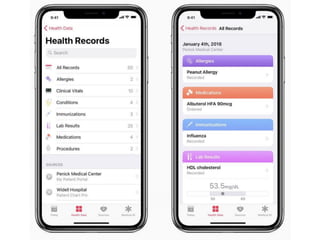
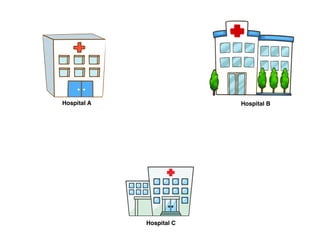
  • 75.
    애플워치4: 심전도, 부정맥,낙상 측정 FDA 의료기기 인허가 •De Novo 의료기기로 인허가 받음 (새로운 종류의 의료기기) •9월에 발표하였으나, 부정맥 관련 기능은 12월에 활성화 •미국 애플워치에서만 가능하고, 한국은안 됨 (미국에서 구매한 경우, 한국 앱스토어 ID로 가능)
  • 79.
    • 애플워치4 부정맥(심방세동) 측정 기능 • ‘진단’이나 기존 환자의 ‘관리’ 목적이 아니라, • ‘측정’ 목적 • 기존에 진단 받지 않은 환자 중에, • 심방세동이 있는 사람을 확인하여 병원으로 연결
 • 정확성을 정말 철저하게 검증했는가? • 애플워치에 의해서 측정된 심방세동의 20% 정도가 • 패치 형태의 ECG 모니터에서 측정되지 않음 • 즉, false alarm 이 많을 수 있음 
 • 불필요한 병원 방문, 검사, 의료 비용 발생 등을 우려하고 있음
  • 80.
    •American College ofCardiology’s 68th Annual Scientific Session •전체 임상 참여자 중에서 irregular pusle notification 받은 사람은 불과 0.5% •애플워치와 ECG patch를 동시에 사용한 결과 71%의 positive predictive value.  •irregular pusle notification 받은 사람 중 84%가 그 시점에 심방세동을 가짐 •f/u으로 그 다음 일주일 동안 ECG patch를 착용한 사람 중 34%가 심방세동을 발견 •Irregular pusle notification 받은 사람 중에 실제로 병원에 간 사람은 57% (전체 환자군의 0.3%)
  • 81.
  • 84.
  • 85.
  • 87.
  • 88.
  • 89.
    열심히 운동하면 돈을준다! : 액티비티 트레커와 보험사의 연계
  • 90.
    •Misfit Flash 와뉴욕의 보험사 스타트업 Oscar 의 연계 •보험 가입자 전원에게 Misfit Flash 를 지급 (최초) •하루의 목표 걸음 수를 달성하면, 하루에 $1 씩 인센티브 •1년에 최대 $240 까지 수령 가능 •아마존 기프트카드로 지급 2014.12.9
  • 91.
    ATechnical Brief VitalityApril 2014 보험사의 재정적인 인센티브에 의한 동기부여 효과 있다
  • 92.
    피트니스 트레킹을 활발하게한 보험 가입자들의 건강이 더 많이 증진 ATechnical Brief Vitality April 2014
  • 93.
    Case for physicalactivity Correlation between activity and mortality is evident Impact of improvement in activity levels Physical activity is a trigger for other wellness engagement Inactive Mildly Active Active 0.00% 0.10% 0.20% 0.30% 0.40% 0.50% 0.60% 0.70% Inactive Active Mortalityexperienceq(x) Decrease Maintain Increase -48% -60% Source: Internal Discovery analysis Mortality rate q(x) Source: Internal Discovery analysis Observed mortality experience by changes in current levels of physical activity More active More active Less active Indexed improvement after becoming physically active BeforePhysical ActivityTrigger HealthyFood Prevention Screening Online Allpoints After Physical Activity Trigger +16% +23% +26% +43% +79% 18 Annual results for the year ending 30 June 2015 • 더 활동적인 사람일수록 mortality rate 이 낮아짐 • 기존에 inactive 했던 사람일수록, physical activity 의 효과가 큼 • Physical activity 는 다른 여러 건강 행동을 triggering 하는 효과가 있음
  • 94.
    Publication in leading scientific journals VIPstudies: Members engaged in Vitality have lower healthcare costs 80% 82% 84% 86% 88% 90% 92% 94% 96% 98% 100% Not registered Admit rate (number of admissions)* Length of stay in hospital (days) Cost per patient ($000) 60% 65% 70% 75% 80% 85% 90% 95% 100% Not registered 80% 85% 90% 95% 100% 105% Not registered Fit people make better patients on a risk-adjusted basis 22 • 더 활동적이며 vitality 에 잘 참여한 사람일수록, • 병원 입원률이 낮아짐 • 입원하더라도 총 입원 기간이 짧아짐 • 의료 비용이 낮아짐
  • 95.
    •미국의 대형 보험사John Hancock •동의한 가입자들에게 Fitbit 을 배포하고, 활동량을 측정하여 •최대 15% 보험료 감면 •하얏트 호텔 숙박권 •아마존 기프트카드 •가입자들의 여러 추가적인 데이터를 바탕으로 '포인트' 부여 •비흡연자: 1,000 포인트 •적정 수준의 콜레스테롤, 혈당을 유지: 각각 1,000 포인트 •일주일에 세번 이상 운동:120 포인트
 (체육관에 갔는지, 30분 이상 머무는지를 GPS 통해 확인) 2015.4.8
  • 96.
    2015.4.8 “ 기존에 '일이터지면' 사후에 대응을 하 는 수동적 모델에서, 미리 가입자들의 발병, 사망 리스크를 선제적으로 낮춰가는 능동적 인 모델로 변화”
  • 97.
    •'모든' 보험 상품에핏빗 등의 웨어러블과 스마트폰을 이용한 interactive policy를 추가
  • 98.
    •웨어러블의 데이터를 제공해주면'공짜'로 $1,000짜리 보험에 가입시켜주는 프로그램 •Amica Life, Greenhouse Life Insurance Company과 협업하여 돌연사에 대한 보험 •데이터의 내용이 보험의 커버리지나 요율 등에 변화를 주지는 않을 것
  • 99.
    •Attain •미국의 대형 보험사Aetna에서 Apple Watch를 이용한 건강관리서비스 •보험에 가입하면 애플워치를 공짜로 주거나, 구매를 지원해주고 •건강 목표치 달성 여부에 따라 재정적인 리워드나 패널티 부여 •3년 동안의 파일럿을 거쳐서 출시한 것으로 알려져 있음
  • 100.
  • 102.
    •스마트 칫솔을 기반으로새로운 치과 보험을 판매하고 있는 Beam Dental •치과 보험에 가입하면 스마트 칫솔과 치약, 치실을 정기 무료 배송 •(사용자 동의하에) 양치질 데이터를 바탕으로 dynamic pricing 
 •KPCB 로부터 $22.5m 규모의 투자를 유치(serise C) •현재 미국의 16개 주에서 서비스, 이번 투자를 바탕으로 연말까지 35개 주로 확대 계획 •“치과 보험 시장은 일반 건강 보험보다 규제와 걸림돌이 적다"
  • 103.
  • 104.
  • 105.
  • 106.
    2003 Human GenomeProject 13 years (676 weeks) $2,700,000,000 2007 Dr. CraigVenter’s genome 4 years (208 weeks) $100,000,000 2008 Dr. James Watson’s genome 4 months (16 weeks) $1,000,000 2009 (Nature Biotechnology) 4 weeks $48,000 2013 1-2 weeks ~$5,000
  • 107.
    The $1000 Genomeis Already Here!
  • 108.
    • 2017년 1월NovaSeq 5000, 6000 발표 • 몇년 내로 $100로 WES 를 실현하겠다고 공언 • 2일에 60명의 WES 가능 (한 명당 한 시간 이하)
  • 110.
    Results within 6-8weeksA little spit is all it takes! DTC Genetic TestingDirect-To-Consumer
  • 111.
  • 112.
  • 113.
  • 114.
  • 115.
    Traits 음주 후 얼굴이붉어지는가 쓴 맛을 감지할 수 있나 귀지 유형 눈 색깔 곱슬머리 여부 유당 분해 능력 말라리아 저항성 대머리가 될 가능성 근육 퍼포먼스 혈액형 노로바이러스 저항성 HIV 저항성 흡연 중독 가능성
  • 116.
  • 117.
  • 118.
    23andMe Chronicle $115m 펀딩 (유니콘등극) 100만 명 돌파 2006 23andMe 창업 20162007 2012 2013 2014 2015 구글 벤처스 360만 달러 투자 2008 $99 로 가격 인하 FDA 판매 중지 명령 영국에서 DTC 서비스 시작 FDA 블룸증후군 DTC 서비스 허가 FDA에 블룸증후군 테스트 승인 요청 FDA에 510(k) 제출 FDA 510(k) 철회 보인자 등 DTC 서비스 재개 ($199) 캐나다에서 DTC 서비스 시작 Genetech, pFizer가 23andMe 데이터 구입 자체 신약 개발 계획 발표 120만 명 돌파 $399 로 가격 인하Business Regulation 애플 리서치키트와 데이터 수집 협력 50만 명 돌파 30만 명 돌파 TV 광고 시작 2017 FDA의 질병위험도 검사 DTC 서비스 허가 + 관련 규제 면제 프로세스 확립 Digital Healthcare Institute Director,Yoon Sup Choi, PhD yoonsup.choi@gmail.com FDA Pre-Cert FDA Gottlieb 국장, 질병 위험도 유전자 DTC 서비스의 Pre-Cert 발의 BRCA 1/2 DTC 검사 허용 2018 FDA, 질병 위험도 유전자 DTC서비스의 Pre-Cert 발효 200만 명 돌파 500만 명 돌파 GSK에서 $300M 투자 유치 2019 1000만 명 돌파
  • 119.
    •개별 제품이 아닌제조사 기반의 규제를 유전자 DTC 검사에도 적용하는 방안 •Gottlieb 국장: •“23andMe의 규제 과정을 거치면서 FDA도 많이 배웠다” •질병 위험도 DTC 검사를 '한 번' 인허가 받은 회사의 후속 검사는 규제 면제 추진 •한국의 유전자 DTC 규제 방식과의 괴리는 더욱 커질 전망
  • 120.
    •질병 위험도 유전자분석 DTC 서비스에 대해서 Pre-Cert 를 적용 시작 (18. 6. 5) •최초 한 번"만 99% 이상의 analytical validity 를 증명하면, •이 회사는 정확한 유전 정보 분석 서비스를 만들 수 있는 것으로 인정하여, •이후의 서비스는 출시 전 인허가가 면제
 •다만 민감할 수 있는 4가지 종류의 분석에 대해서는 이 규제 완화에서 제외 •산전 진단 •(예방적 스크리닝이나 치료법 결정으로 이어지는) 암 발병 가능성 검사 •약물 유전체 검사 •우성유전질환 유전인자 검사
  • 121.
    한국 DTC 유전정보분석 제한적 허용 (2016.6.30) • 「비의료기관 직접 유전자검사 실시 허용 관련 고시 제정, 6.30일시행」 • 2015년 12월「생명윤리 및 안전에 관한 법률」개정(‘15.12.29개정, ’16.6.30시행) 과 제9차 무역투자진흥회의(’16.2월) 시 발표한 규제 개선의 후속조치 일환으로 추진 • 민간 유전자검사 업체에서는 혈당, 혈압, 피부노화, 체질량지수 등 12개 검사항목과 관련된 46개 유전자를 직접 검사 가능 http://www.mohw.go.kr/m/noticeView.jsp?MENU_ID=0403&cont_seq=333112&page=1 검사항목 (유전자수) 유전자명 1 체질량지수(3) FTO, MC4R, BDNF 2 중성지방농도(8) GCKR, DOCK7, ANGPTL3, BAZ1B, TBL2, MLXIPL, LOC105375745, TRIB1 3 콜레스테롤(8) CELSR2, SORT1, HMGCR, ABO, ABCA1, MYL2, LIPG, CETP 4 혈 당(8) CDKN2A/B, G6PC2, GCK, GCKR, GLIS3, MTNR1B, DGKB-TMEM195, SLC30A8 5 혈 압(8) NPR3, ATP2B1, NT5C2, CSK, HECTD4, GUCY1A3, CYP17A1, FGF5 6 색소 침착(2) OCA2, MC1R 7 탈 모(3) chr20p11(rs1160312, rs2180439), IL2RA, HLA-DQB1 8 모발 굵기(1) EDAR 9 피부 노화(1) AGER 10 피부 탄력(1) MMP1 11 비타민C농도(1) SLC23A1(SVCT1) 12 카페인대사(2) AHR, CYP1A1-CYP1A2
  • 122.
    분석 항목 분석항목 예시 DTC (미국) DTC (한국) 개인유전정보 분석 질병 위험도 유방암(안젤리나 졸리) 인허가 간소화 전망 X 약물 민감도 와파린 민감도 X X 열성유전질환 보인자 블룸 증후군 O X 웰니스 카페인 분해, 대머리 O 12개 항목만 가능, 나머지는 불법 조상 분석 O O 의료 분석 암 맞춤치료 Cancer Panel O 병원만 가능 비침습산전진단 (NIPT) 다운증후군 O O DTC 유전정보 분석 서비스 미국 vs. 한국 •미국에서 허용된 보인자 검사, 질병 위험도 예측 검사 DTC 서비스는 여전히 한국에서 불법 •더 큰 문제는 잣대 자체가 FDA 등 글로벌 규제 기조나 산업계에서 통용되는 기준과 다르다는 것. 
 
 
 질병/약물/보인자/웰니스/조상 분석 등의 업계에서 받아들여지는 분류를 무시 •글로벌 수준에 발맞추기는 커녕, 한국에서만 통용되는 자체적인 별도 규제 분류 체계를
 
 
 더 추가하면서, 국내 산업의 갈라파고스화를 자초하고 있음
  • 123.
    •규제 샌드박스를 통해마크로젠 ‘한 회사’만 ‘제한적’ DTC 허용 •매우 제한적: 과연 의미가 있는가 •2년 동안만 •인천경제자유구역(송도)한정 •성인 2,000명 제한 •2년 이후에는 어떻게 할 것인가? •특정 회사에 대한 특혜 시비, 복지부와 업계의 불신…
  • 124.
    •제노플랜 •법적으로는 한국계일본회사? •해외 시장에 집중할 계획인듯
  • 125.
    •DTC (Direct-to-Consumer) 유전자검사 허용 이슈 • 정말 위해도가 높은가 • 근거 기반의 판단 필요 • 미국은 극단적인 negative 규제 시행 (2018~) • 어떤 기준/범위에서 허용해야 하는가 • 국제 규제 동조화 • 자꾸 한국만의 분류를 따로 만듬: 분류 기준이라도 동일하게 • 규제 샌드박스 • 실효성이 있는가 • 문제 해결만 2년 지연 • 규제 회피에 대해서는 어떻게 접근해야 하나 잠재적 법적 이슈: DTC 유전자 검사
  • 126.
    https://www.23andme.com/slideshow/research/ 고객의 자발적인 참여에의한 유전학 연구 깍지를 끼면 어느 쪽 엄지가 위로 오는가? 아침형 인간? 저녁형 인간? 빛에 노출되었을 때 재채기를 하는가? 근육의 퍼포먼스 쓴 맛 인식 능력 음주 후 얼굴이 붉어지나? 유당 분해 효소 결핍? 고객의 81%가 10개 이상의 질문에 자발적 답변 매주 1 million 개의 data point 축적 The More Data, The Higher Accuracy!
  • 127.
    January 13, 2015January6, 2015 Data Business
  • 128.
    • 신약 표적발굴: 더 안전하고 효과적으로 • 표적 치료에 효능을 보일 환자군의 선별에 도움 • 임상시험 환자 리크루팅에 활용 • GSK의 파킨슨 신약: LRRK2 variant 환자군 • LRRK2 variant: 파킨슨 환자 100명 당 1명 보유 • 23andMe는 이미 LRRK2 variant 250명 보유 GSK에 독점적 DB 접근권을 주고, $300m의 투자 유치
  • 129.
    •유전자 데이터(를 포함한건강 데이터)의 판매 비즈니스 • 고객의 (민감한) 데이터를 제3자에게 판매할 수 있는가 • 어느 정도 레벨의 동의를 받아야 하는가 • 판매 수익은 고객 (데이터 원 제공자)과 share 해야 하는가 •의료 데이터 관련 정의/범위 • 의료 데이터의 정의 / 범위 불명확 • 개인식별정보의 정의 / 범위 불명확 • 기술적 vs. 정서적 정의: 유전정보만으로 개인을 식별할 수 있는가? • 비식별화 및 재식별의 정의 불명확 잠재적 법적 이슈: 데이터 판매
  • 130.
  • 131.
    Human genomes arebeing sequenced at an ever-increasing rate. The 1000 Genomes Project has aggregated hundreds of genomes; The Cancer Genome Atlas (TGCA) has gathered several thousand; and the Exome Aggregation Consortium (ExAC) has sequenced more than 60,000 exomes. Dotted lines show three possible future growth curves. DNA SEQUENCING SOARS 2001 2005 2010 2015 2020 2025 100 103 106 109 Human Genome Project Cumulativenumberofhumangenomes 1000 Genomes TCGA ExAC Current amount 1st personal genome Recorded growth Projection Double every 7 months (historical growth rate) Double every 12 months (Illumina estimate) Double every 18 months (Moore's law) Michael Einsetein, Nature, 2015
  • 132.
    •유방암 유전자 BRCA에 위험 돌연변이가 있다는 이유로 생명보험 가 입을 거절당한 한 여성의 사연 (2016) •미국은 2008년 GINA (Genetic Information Nondiscrimination Act)라는 유전정보에 따른 차별 금지 법안 •하지만 문제는 이 규정이 건강 보험에만 해당되고 •생명보험(life insurance), 장기 간병 보험(long-term care), 상해 보험(disability insurance) 등에는 해당되지 않음 •의사들은 이런 보험사의 차별 때문에 필요한 환자들조차 유전자 검사 를 받기를 꺼려할까봐 우려 유전 정보에 따른 보험 가입 차별
  • 133.
    •2017년 3월 미국의회 하원에서는 고용주가 직원들에게 corporate wellness program 의 일환으로 유전 정보를 요구할 수 있으며, 직원 이 이를 거절할 경우 건강 보험료를 30% 까지 올릴 수 있는 법안을 통과 •공화당 위원 22명은 전원 찬성을, 민주당 소속 17명은 전원 반대 •아직 최종 입법 되지는 않은 상태 •최종 입법 되기 위해서는 상원 심의도 마쳐야 함 직원은 회사에 유전 정보를 공유해야 한다?
  • 134.
    •개인유전정보 DTC 회사와보험추천 서비스의 협업 •고객이 키트에 타액을 보내면 보맵은 유전자를 분석한 결과에 따라 보험을 관리 •고객이 위암에 걸릴 확률이 60% 이상인 유전자를 보유하면, 관련 보험을 추천
 •개인 보험 가입자의 보험사 역선택 이슈 유전 정보를 활용, 보험사를 선택
  • 135.
    •보험사의 가입자 선택/차등 •미국에서는 GINA의 커버 범위 이슈 • 한국에서는 정말 아무 문제가 없을까? (생명윤리법 제 46조) •가입자의 보험사 역선택 • 법적으로 가입자의 보험사 (직간접적) 역선택이 더 가능성 높음 • 결과적으로 모두의 보험료를 높일 것인가? 잠재적 법적 이슈: 유전자와 보험
  • 136.
  • 137.
    Digital Phenotype: Your smartphoneknows if you are depressed Ginger.io
  • 138.
    Digital Phenotype: Your smartphoneknows if you are depressed J Med Internet Res. 2015 Jul 15;17(7):e175. The correlation analysis between the features and the PHQ-9 scores revealed that 6 of the 10 features were significantly correlated to the scores: • strong correlation: circadian movement, normalized entropy, location variance • correlation: phone usage features, usage duration and usage frequency
  • 139.
    the manifestations ofdisease by providing a more comprehensive and nuanced view of the experience of illness. Through the lens of the digital phenotype, an individual’s interaction The digital phenotype Sachin H Jain, Brian W Powers, Jared B Hawkins & John S Brownstein In the coming years, patient phenotypes captured to enhance health and wellness will extend to human interactions with digital technology. In 1982, the evolutionary biologist Richard Dawkins introduced the concept of the “extended phenotype”1, the idea that pheno- types should not be limited just to biological processes, such as protein biosynthesis or tissue growth, but extended to include all effects that a gene has on its environment inside or outside ofthebodyoftheindividualorganism.Dawkins stressed that many delineations of phenotypes are arbitrary. Animals and humans can modify their environments, and these modifications andassociatedbehaviorsareexpressionsofone’s genome and, thus, part of their extended phe- notype. In the animal kingdom, he cites damn buildingbybeaversasanexampleofthebeaver’s extended phenotype1. Aspersonaltechnologybecomesincreasingly embedded in human lives, we think there is an important extension of Dawkins’s theory—the notion of a ‘digital phenotype’. Can aspects of ourinterfacewithtechnologybesomehowdiag- nosticand/orprognosticforcertainconditions? Can one’s clinical data be linked and analyzed together with online activity and behavior data to create a unified, nuanced view of human dis- ease?Here,wedescribetheconceptofthedigital phenotype. Although several disparate studies have touched on this notion, the framework for medicine has yet to be described. We attempt to define digital phenotype and further describe the opportunities and challenges in incorporat- ing these data into healthcare. Jan. 2013 0.000 0.002 0.004 Density 0.006 July 2013 Jan. 2014 July 2014 User 1 User 2 User 3 User 4 User 5 User 6 User 7 Date Figure 1 Timeline of insomnia-related tweets from representative individuals. Density distributions (probability density functions) are shown for seven individual users over a two-year period. Density on the y axis highlights periods of relative activity for each user. A representative tweet from each user is shown as an example. npg©2015NatureAmerica,Inc.Allrightsreserved. http://www.nature.com/nbt/journal/v33/n5/full/nbt.3223.html
  • 140.
    ers, Jared BHawkins & John S Brownstein phenotypes captured to enhance health and wellness will extend to human interactions with st Richard pt of the hat pheno- biological sis or tissue effects that or outside m.Dawkins phenotypes can modify difications onsofone’s ended phe- cites damn hebeaver’s ncreasingly there is an heory—the aspects of ehowdiag- Jan. 2013 0.000 0.002 0.004 Density 0.006 July 2013 Jan. 2014 July 2014 User 1 User 2 User 3 User 4 User 5 User 6 User 7 Date Figure 1 Timeline of insomnia-related tweets from representative individuals. Density distributions (probability density functions) are shown for seven individual users over a two-year period. Density on the y axis highlights periods of relative activity for each user. A representative tweet from each user is Your twitter knows if you cannot sleep Timeline of insomnia-related tweets from representative individuals. Nat. Biotech. 2015
  • 141.
    Reece & Danforth,“Instagram photos reveal predictive markers of depression” (2016) higher Hue (bluer) lower Saturation (grayer) lower Brightness (darker)
  • 142.
    Rao (MVR) (24) .     Results  Both All­data and Pre­diagnosis models were decisively superior to a null model . All­data predictors were significant with 99% probability.57.5;(KAll  =1 K 49.8)  Pre = 1  7 Pre­diagnosis and All­data confidence levels were largely identical, with two exceptions:  Pre­diagnosis Brightness decreased to 90% confidence, and Pre­diagnosis posting frequency  dropped to 30% confidence, suggesting a null predictive value in the latter case.   Increased hue, along with decreased brightness and saturation, predicted depression. This  means that photos posted by depressed individuals tended to be bluer, darker, and grayer (see  Fig. 2). The more comments Instagram posts received, the more likely they were posted by  depressed participants, but the opposite was true for likes received. In the All­data model, higher  posting frequency was also associated with depression. Depressed participants were more likely  to post photos with faces, but had a lower average face count per photograph than healthy  participants. Finally, depressed participants were less likely to apply Instagram filters to their  posted photos.     Fig. 2. Magnitude and direction of regression coefficients in All­data (N=24,713) and Pre­diagnosis (N=18,513)  models. X­axis values represent the adjustment in odds of an observation belonging to depressed individuals, per  Reece & Danforth, “Instagram photos reveal predictive markers of depression” (2016)     Fig. 1. Comparison of HSV values. Right photograph has higher Hue (bluer), lower Saturation (grayer), and lower  Brightness (darker) than left photograph. Instagram photos posted by depressed individuals had HSV values  shifted towards those in the right photograph, compared with photos posted by healthy individuals.    Units of observation  In determining the best time span for this analysis, we encountered a difficult question:  When and for how long does depression occur? A diagnosis of depression does not indicate the  persistence of a depressive state for every moment of every day, and to conduct analysis using an  individual’s entire posting history as a single unit of observation is therefore rather specious. At  the other extreme, to take each individual photograph as units of observation runs the risk of  being too granular. DeChoudhury et al. (5) looked at all of a given user’s posts in a single day,  and aggregated those data into per­person, per­day units of observation. We adopted this  precedent of “user­days” as a unit of analysis .  5   Statistical framework  We used Bayesian logistic regression with uninformative priors to determine the strength  of individual predictors. Two separate models were trained. The All­data model used all  collected data to address Hypothesis 1. The Pre­diagnosis model used all data collected from  higher Hue (bluer) lower Saturation (grayer) lower Brightness (darker) Digital Phenotype: Your Instagram knows if you are depressed
  • 143.
    Digital Phenotype: Your Instagramknows if you are depressed Reece & Danforth, “Instagram photos reveal predictive markers of depression” (2016) . In particular, depressedχ2 07.84, p .17e 64;( All  = 9   = 9 − 1 13.80, p .87e 44)χ2Pre  = 8   = 2 − 1   participants were less likely than healthy participants to use any filters at all. When depressed  participants did employ filters, they most disproportionately favored the “Inkwell” filter, which  converts color photographs to black­and­white images. Conversely, healthy participants most  disproportionately favored the Valencia filter, which lightens the tint of photos. Examples of  filtered photographs are provided in SI Appendix VIII.     Fig. 3. Instagram filter usage among depressed and healthy participants. Bars indicate difference between observed  and expected usage frequencies, based on a Chi­squared analysis of independence. Blue bars indicate  disproportionate use of a filter by depressed compared to healthy participants, orange bars indicate the reverse. 
  • 144.
    Digital Phenotype: Your Instagramknows if you are depressed Reece & Danforth, “Instagram photos reveal predictive markers of depression” (2016)   VIII. Instagram filter examples    Fig. S8. Examples of Inkwell and Valencia Instagram filters.  Inkwell converts  color photos to black­and­white, Valencia lightens tint.  Depressed participants  most favored Inkwell compared to healthy participants, Healthy participants 
  • 145.
    Mindstrong Health • 스마트폰사용 패턴을 바탕으로 • 인지능력, 우울증, 조현병, 양극성 장애, PTSD 등을 측정 • 미국 국립정신건강연구소 소장인 Tomas Insel 이 공동 설립 • 아마존의 제프 베조스 투자
  • 146.
    BRIEF COMMUNICATION OPEN Digitalbiomarkers of cognitive function Paul Dagum1 To identify digital biomarkers associated with cognitive function, we analyzed human–computer interaction from 7 days of smartphone use in 27 subjects (ages 18–34) who received a gold standard neuropsychological assessment. For several neuropsychological constructs (working memory, memory, executive function, language, and intelligence), we found a family of digital biomarkers that predicted test scores with high correlations (p < 10−4 ). These preliminary results suggest that passive measures from smartphone use could be a continuous ecological surrogate for laboratory-based neuropsychological assessment. npj Digital Medicine (2018)1:10 ; doi:10.1038/s41746-018-0018-4 INTRODUCTION By comparison to the functional metrics available in other disciplines, conventional measures of neuropsychiatric disorders have several challenges. First, they are obtrusive, requiring a subject to break from their normal routine, dedicating time and often travel. Second, they are not ecological and require subjects to perform a task outside of the context of everyday behavior. Third, they are episodic and provide sparse snapshots of a patient only at the time of the assessment. Lastly, they are poorly scalable, taxing limited resources including space and trained staff. In seeking objective and ecological measures of cognition, we attempted to develop a method to measure memory and executive function not in the laboratory but in the moment, day-to-day. We used human–computer interaction on smart- phones to identify digital biomarkers that were correlated with neuropsychological performance. RESULTS In 2014, 27 participants (ages 27.1 ± 4.4 years, education 14.1 ± 2.3 years, M:F 8:19) volunteered for neuropsychological assessment and a test of the smartphone app. Smartphone human–computer interaction data from the 7 days following the neuropsychological assessment showed a range of correla- tions with the cognitive scores. Table 1 shows the correlation between each neurocognitive test and the cross-validated predictions of the supervised kernel PCA constructed from the biomarkers for that test. Figure 1 shows each participant test score and the digital biomarker prediction for (a) digits backward, (b) symbol digit modality, (c) animal fluency, (d) Wechsler Memory Scale-3rd Edition (WMS-III) logical memory (delayed free recall), (e) brief visuospatial memory test (delayed free recall), and (f) Wechsler Adult Intelligence Scale- 4th Edition (WAIS-IV) block design. Construct validity of the predictions was determined using pattern matching that computed a correlation of 0.87 with p < 10−59 between the covariance matrix of the predictions and the covariance matrix of the tests. Table 1. Fourteen neurocognitive assessments covering five cognitive domains and dexterity were performed by a neuropsychologist. Shown are the group mean and standard deviation, range of score, and the correlation between each test and the cross-validated prediction constructed from the digital biomarkers for that test Cognitive predictions Mean (SD) Range R (predicted), p-value Working memory Digits forward 10.9 (2.7) 7–15 0.71 ± 0.10, 10−4 Digits backward 8.3 (2.7) 4–14 0.75 ± 0.08, 10−5 Executive function Trail A 23.0 (7.6) 12–39 0.70 ± 0.10, 10−4 Trail B 53.3 (13.1) 37–88 0.82 ± 0.06, 10−6 Symbol digit modality 55.8 (7.7) 43–67 0.70 ± 0.10, 10−4 Language Animal fluency 22.5 (3.8) 15–30 0.67 ± 0.11, 10−4 FAS phonemic fluency 42 (7.1) 27–52 0.63 ± 0.12, 10−3 Dexterity Grooved pegboard test (dominant hand) 62.7 (6.7) 51–75 0.73 ± 0.09, 10−4 Memory California verbal learning test (delayed free recall) 14.1 (1.9) 9–16 0.62 ± 0.12, 10−3 WMS-III logical memory (delayed free recall) 29.4 (6.2) 18–42 0.81 ± 0.07, 10−6 Brief visuospatial memory test (delayed free recall) 10.2 (1.8) 5–12 0.77 ± 0.08, 10−5 Intelligence scale WAIS-IV block design 46.1(12.8) 12–61 0.83 ± 0.06, 10−6 WAIS-IV matrix reasoning 22.1(3.3) 12–26 0.80 ± 0.07, 10−6 WAIS-IV vocabulary 40.6(4.0) 31–50 0.67 ± 0.11, 10−4 Received: 5 October 2017 Revised: 3 February 2018 Accepted: 7 February 2018 1 Mindstrong Health, 248 Homer Street, Palo Alto, CA 94301, USA Correspondence: Paul Dagum (paul@mindstronghealth.com) www.nature.com/npjdigitalmed Published in partnership with the Scripps Translational Science Institute • 총 45가지 스마트폰 사용 패턴: 타이핑, 스크롤, 화면 터치 • 스페이스바 누른 후, 다음 문자 타이핑하는 행동 • 백스페이스를 누른 후, 그 다음 백스페이스 • 주소록에서 사람을 찾는 행동 양식
 • 스마트폰 사용 패턴과 인지 능력의 상관 관계 • 20-30대 피험자 27명 • Working Memory, Language, Dexterity etc
  • 147.
    BRIEF COMMUNICATION OPEN Digitalbiomarkers of cognitive function Paul Dagum1 To identify digital biomarkers associated with cognitive function, we analyzed human–computer interaction from 7 days of smartphone use in 27 subjects (ages 18–34) who received a gold standard neuropsychological assessment. For several neuropsychological constructs (working memory, memory, executive function, language, and intelligence), we found a family of digital biomarkers that predicted test scores with high correlations (p < 10−4 ). These preliminary results suggest that passive measures from smartphone use could be a continuous ecological surrogate for laboratory-based neuropsychological assessment. npj Digital Medicine (2018)1:10 ; doi:10.1038/s41746-018-0018-4 INTRODUCTION By comparison to the functional metrics available in other disciplines, conventional measures of neuropsychiatric disorders have several challenges. First, they are obtrusive, requiring a subject to break from their normal routine, dedicating time and often travel. Second, they are not ecological and require subjects to perform a task outside of the context of everyday behavior. Third, they are episodic and provide sparse snapshots of a patient only at the time of the assessment. Lastly, they are poorly scalable, taxing limited resources including space and trained staff. In seeking objective and ecological measures of cognition, we attempted to develop a method to measure memory and executive function not in the laboratory but in the moment, day-to-day. We used human–computer interaction on smart- phones to identify digital biomarkers that were correlated with neuropsychological performance. RESULTS In 2014, 27 participants (ages 27.1 ± 4.4 years, education 14.1 ± 2.3 years, M:F 8:19) volunteered for neuropsychological assessment and a test of the smartphone app. Smartphone human–computer interaction data from the 7 days following the neuropsychological assessment showed a range of correla- tions with the cognitive scores. Table 1 shows the correlation between each neurocognitive test and the cross-validated predictions of the supervised kernel PCA constructed from the biomarkers for that test. Figure 1 shows each participant test score and the digital biomarker prediction for (a) digits backward, (b) symbol digit modality, (c) animal fluency, (d) Wechsler Memory Scale-3rd Edition (WMS-III) logical memory (delayed free recall), (e) brief visuospatial memory test (delayed free recall), and (f) Wechsler Adult Intelligence Scale- 4th Edition (WAIS-IV) block design. Construct validity of the predictions was determined using pattern matching that computed a correlation of 0.87 with p < 10−59 between the covariance matrix of the predictions and the covariance matrix of the tests. Table 1. Fourteen neurocognitive assessments covering five cognitive domains and dexterity were performed by a neuropsychologist. Shown are the group mean and standard deviation, range of score, and the correlation between each test and the cross-validated prediction constructed from the digital biomarkers for that test Cognitive predictions Mean (SD) Range R (predicted), p-value Working memory Digits forward 10.9 (2.7) 7–15 0.71 ± 0.10, 10−4 Digits backward 8.3 (2.7) 4–14 0.75 ± 0.08, 10−5 Executive function Trail A 23.0 (7.6) 12–39 0.70 ± 0.10, 10−4 Trail B 53.3 (13.1) 37–88 0.82 ± 0.06, 10−6 Symbol digit modality 55.8 (7.7) 43–67 0.70 ± 0.10, 10−4 Language Animal fluency 22.5 (3.8) 15–30 0.67 ± 0.11, 10−4 FAS phonemic fluency 42 (7.1) 27–52 0.63 ± 0.12, 10−3 Dexterity Grooved pegboard test (dominant hand) 62.7 (6.7) 51–75 0.73 ± 0.09, 10−4 Memory California verbal learning test (delayed free recall) 14.1 (1.9) 9–16 0.62 ± 0.12, 10−3 WMS-III logical memory (delayed free recall) 29.4 (6.2) 18–42 0.81 ± 0.07, 10−6 Brief visuospatial memory test (delayed free recall) 10.2 (1.8) 5–12 0.77 ± 0.08, 10−5 Intelligence scale WAIS-IV block design 46.1(12.8) 12–61 0.83 ± 0.06, 10−6 WAIS-IV matrix reasoning 22.1(3.3) 12–26 0.80 ± 0.07, 10−6 WAIS-IV vocabulary 40.6(4.0) 31–50 0.67 ± 0.11, 10−4 Received: 5 October 2017 Revised: 3 February 2018 Accepted: 7 February 2018 1 Mindstrong Health, 248 Homer Street, Palo Alto, CA 94301, USA Correspondence: Paul Dagum (paul@mindstronghealth.com) www.nature.com/npjdigitalmed Published in partnership with the Scripps Translational Science Institute Fig. 1 A blue square represents a participant test Z-score normed to the 27 participant scores and a red circle represents the digital biomarker prediction Z-score normed to the 27 predictions. Test scores and predictions shown are a digits backward, b symbol digit modality, c animal fluency, d Wechsler memory Scale-3rd Edition (WMS-III) logical memory (delayed free recall), e brief visuospatial memory test (delayed free recall), and f Wechsler adult intelligence scale-4th Edition (WAIS-IV) block design Digital biomarkers of cognitive function P Dagum 2 1234567890():,; • 스마트폰 사용 패턴과 인지 능력의 상관 관계 • 파란색: 표준 인지 능력 테스트 결과 • 붉은색: 마인드 스트롱의 스마트폰 사용 패턴
  • 148.
    Step1. 데이터의 측정 •스마트폰 •웨어러블디바이스 •개인 유전 정보 분석 •디지털 표현형 환자 유래의 의료 데이터 (PGHD)
  • 149.
  • 151.
  • 153.
  • 154.
  • 155.
    Epic MyChart EpicEHR Dexcom CGM Patients/User Devices EHR Hospital Whitings + Apple Watch Apps HealthKit
  • 157.
    • 애플 HealthKit가 미국의 23개 선도병원 중에, 14개의 병원과 협력 • 경쟁 플랫폼 Google Fit, S-Health 보다 현저히 빠른 움직임 • Beth Israel Deaconess 의 CIO • “25만명의 환자들 중 상당수가 웨어러블로 각종 데이터 생산 중.
 이 모든 디바이스에 인터페이스를 우리 병원은 제공할 수 없다. 
 하지만 애플이라면 가능하다.” 2015.2.5
  • 159.
  • 160.
    Hospital A HospitalB Hospital C interoperability
  • 161.
  • 162.
    •2018년 1월에 출시당시, 존스홉킨스, UC샌디에고 등 12개의 병원에 연동 •(2019년 2월 현재) 1년 만에 200개 이상의 병원에 연동 •VA와도 연동된다고 밝힘 (with 9 million veterans) •2008년 구글 헬스는 3년 동안 12개 병원에 연동에 그쳤음
  • 163.
  • 165.
  • 166.
    How to Analyzeand Interpret the Big Data?
  • 167.
    and/or Two ways toget insights from the big data
  • 168.
    원격의료 • 명시적으로 ‘금지’된곳은 한국 밖에 없는 듯 • 해외에서는 새로운 서비스의 상당수가 원격의료 기능 포함 • 글로벌 100대 헬스케어 서비스 중 39개가 원격의료 포함 • 다른 모델과 결합하여 갈수록 새로운 모델이 만들어지는 중 • 스마트폰, 웨어러블, IoT, 인공지능, 챗봇 등과 결합 • 10년 뒤 한국 의료에서는?
  • 169.
    원격 의료 원격 진료 원격환자 모니터링 화상 진료 전화 진료 2차 소견 용어 정리 데이터 판독 원격 수술
  • 170.
    •원격 진료: 화상진료 •원격 진료: 2차 소견 •원격 진료: 애플리케이션 •원격 환자 모니터링 원격 의료에도 종류가 많다.
  • 171.
  • 175.
    Average Time toAppointment (Familiy Medicine) Boston LA Portland Miami Atlanta Denver Detroit New York Seattle Houston Philadelphia Washington DC San Diego Dallas Minneapolis Total 0 30 60 90 120 20.3 10 8 24 30 9 17 8 24 14 14 9 7 8 59 63 19.5 10 5 7 14 21 19 23 26 16 16 24 12 13 20 66 29.3 days 8 days 12 days 13 days 17 days 17 days 21 days 26 days 26 days 27 days 27 days 27 days 28 days 39 days 42 days 109 days 2017 2014 2009
  • 179.
    0 125 250 375 500 2013 2014 20152016 2017 2018 417.9 233.3 123 77.4 44 20 0 550 1100 1650 2200 2013 2014 2015 2016 2017 2018 2,036 1,461 952 575 299 127 0 6 12 18 24 2013 2014 2015 2016 2017 2018 22.8 19.6 17.5 11.5 8.1 6.2 Revenue ($m) Visits (k) Members (m) Growth of Teladoc
  • 180.
    •원격 진료: 화상진료 •원격 진료: 2차 소견 •원격 진료: 애플리케이션 •원격 환자 모니터링 원격 의료에도 종류가 많다.
  • 181.
    Epic MyChart EpicEHR Dexcom CGM Patients/User Devices EHR Hospital Whitings + Apple Watch Apps HealthKit
  • 182.
    transfer from Share2to HealthKit as mandated by Dexcom receiver Food and Drug Administration device classification. Once the glucose values reach HealthKit, they are passively shared with the Epic MyChart app (https://www.epic.com/software-phr.php). The MyChart patient portal is a component of the Epic EHR and uses the same data- base, and the CGM values populate a standard glucose flowsheet in the patient’s chart. This connection is initially established when a pro- vider places an order in a patient’s electronic chart, resulting in a re- quest to the patient within the MyChart app. Once the patient or patient proxy (parent) accepts this connection request on the mobile device, a communication bridge is established between HealthKit and MyChart enabling population of CGM data as frequently as every 5 Participation required confirmation of Bluetooth pairing of the CGM re- ceiver to a mobile device, updating the mobile device with the most recent version of the operating system, Dexcom Share2 app, Epic MyChart app, and confirming or establishing a username and password for all accounts, including a parent’s/adolescent’s Epic MyChart account. Setup time aver- aged 45–60 minutes in addition to the scheduled clinic visit. During this time, there was specific verbal and written notification to the patients/par- ents that the diabetes healthcare team would not be actively monitoring or have real-time access to CGM data, which was out of scope for this pi- lot. The patients/parents were advised that they should continue to contact the diabetes care team by established means for any urgent questions/ concerns. Additionally, patients/parents were advised to maintain updates Figure 1: Overview of the CGM data communication bridge architecture. BRIEFCOMMUNICATION Kumar R B, et al. J Am Med Inform Assoc 2016;0:1–6. doi:10.1093/jamia/ocv206, Brief Communication byguestonApril7,2016http://jamia.oxfordjournals.org/Downloadedfrom • Apple HealthKit, Dexcom CGM기기를 통해 지속적으로 혈당을 모니터링한 데이터를 EHR과 통합 • 당뇨환자의 혈당관리를 향상시켰다는 연구결과 • Stanford Children’s Health와 Stanford 의대에서 10명 type 1 당뇨 소아환자 대상으로 수행 (288 readings /day) • EHR 기반 데이터분석과 시각화는 데이터 리뷰 및 환자커뮤니케이션을 향상 • 환자가 내원하여 진료하는 기존 방식에 비해 실시간 혈당변화에 환자가 대응 JAMIA 2016 Remote Patients Monitoring via Dexcom-HealthKit-Epic-Stanford
  • 184.
    No choice butto bring AI into the medicine
  • 185.
    Martin Duggan,“IBM WatsonHealth - Integrated Care & the Evolution to Cognitive Computing”
  • 186.
    •복잡한 의료 데이터의분석 및 insight 도출 •영상 의료/병리 데이터의 분석/판독 •연속 데이터의 모니터링 및 예방/예측 인공지능의 의료 활용
  • 187.
    •복잡한 의료 데이터의분석 및 insight 도출 •영상 의료/병리 데이터의 분석/판독 •연속 데이터의 모니터링 및 예방/예측 인공지능의 의료 활용
  • 188.
    Jeopardy! 2011년 인간 챔피언두 명 과 퀴즈 대결을 벌여서 압도적인 우승을 차지
  • 189.
    600,000 pieces ofmedical evidence 2 million pages of text from 42 medical journals and clinical trials 69 guidelines, 61,540 clinical trials IBM Watson on Medicine Watson learned... + 1,500 lung cancer cases physician notes, lab results and clinical research + 14,700 hours of hands-on training
  • 193.
    메이요 클리닉 협력 (임상시험 매칭) 전남대병원 도입 인도 마니팔 병원 WFO 도입 식약처 인공지능 가이드라인 초안 메드트로닉과 혈당관리 앱 시연 2011 2012 2013 2014 2015 뉴욕 MSK암센터 협력 (폐암) MD앤더슨 협력 (백혈병) MD앤더슨 파일럿 결과 발표 @ASCO 왓슨 펀드, 웰톡에 투자 뉴욕게놈센터 협력 (교모세포종 분석) GeneMD, 왓슨 모바일 디벨로퍼 챌린지 우승 클리블랜드 클리닉 협력 (암 유전체 분석) 한국 IBM 왓슨 사업부 신설 Watson Health 출범 피텔, 익스플로리스 인수 J&J, 애플, 메드트로닉 협력 에픽 시스템즈, 메이요클리닉 제휴 (EHR 분석) 동경대 도입 ( WFO) 왓슨 펀드, 모더나이징 메디슨 투자 학계/의료계 산업계 패쓰웨이 지노믹스 OME 클로즈드 알파 서비스 시작 트루븐 헬스 인수 애플 리서치 키트 통한 수면 연구 시작 2017 가천대 길병원 도입 메드트로닉 Sugar.IQ 출시 제약사 테바와 제휴 태국 범룽랏 국제 병원, WFO 도입 머지 헬스케어 인수 2016 언더 아머 제휴 브로드 연구소 협력 발표 (유전체 분석-항암제 내성) 마니팔 병원의 
 WFO 정확성 발표 대구가톨릭병원 대구동산병원 도입 부산대병원 도입 왓슨 펀드, 패쓰웨이 지노믹스 투자 제퍼디! 우승 조선대병원 도입 한국 왓슨 컨소시움 출범 쥬피터 
 메디컬 
 센터 도입 식약처 인공지능 가이드라인 메이요 클리닉 임상시험매칭 결과발표 2018 건양대병원 도입 IBM Watson Health Chronicle WFO 최초 논문
  • 194.
    메이요 클리닉 협력 (임상시험 매칭) 전남대병원 도입 인도 마니팔 병원 WFO 도입 식약처 인공지능 가이드라인 초안 메드트로닉과 혈당관리 앱 시연 2011 2012 2013 2014 2015 뉴욕 MSK암센터 협력 (폐암) MD앤더슨 협력 (백혈병) MD앤더슨 파일럿 결과 발표 @ASCO 왓슨 펀드, 웰톡에 투자 뉴욕게놈센터 협력 (교모세포종 분석) GeneMD, 왓슨 모바일 디벨로퍼 챌린지 우승 클리블랜드 클리닉 협력 (암 유전체 분석) 한국 IBM 왓슨 사업부 신설 Watson Health 출범 피텔, 익스플로리스 인수 J&J, 애플, 메드트로닉 협력 에픽 시스템즈, 메이요클리닉 제휴 (EHR 분석) 동경대 도입 ( WFO) 왓슨 펀드, 모더나이징 메디슨 투자 학계/의료계 산업계 패쓰웨이 지노믹스 OME 클로즈드 알파 서비스 시작 트루븐 헬스 인수 애플 리서치 키트 통한 수면 연구 시작 2017 가천대 길병원 도입 메드트로닉 Sugar.IQ 출시 제약사 테바와 제휴 태국 범룽랏 국제 병원, WFO 도입 머지 헬스케어 인수 2016 언더 아머 제휴 브로드 연구소 협력 발표 (유전체 분석-항암제 내성) 마니팔 병원의 
 WFO 정확성 발표 대구가톨릭병원 대구동산병원 도입 부산대병원 도입 왓슨 펀드, 패쓰웨이 지노믹스 투자 제퍼디! 우승 조선대병원 도입 한국 왓슨 컨소시움 출범 쥬피터 
 메디컬 
 센터 도입 식약처 인공지능 가이드라인 2018 건양대병원 도입 메이요 클리닉 임상시험매칭 결과발표 WFO 최초 논문 IBM Watson Health Chronicle
  • 196.
    Annals of Oncology(2016) 27 (suppl_9): ix179-ix180. 10.1093/annonc/mdw601 Validation study to assess performance of IBM cognitive computing system Watson for oncology with Manipal multidisciplinary tumour board for 1000 consecutive cases: 
 An Indian experience •인도 마니팔 병원의 1,000명의 암환자 에 대해 의사와 WFO의 권고안의 ‘일치율’을 비 •유방암 638명, 대장암 126명, 직장암 124명, 폐암 112명 •의사-왓슨 일치율 •추천(50%), 고려(28%), 비추천(17%) •의사의 진료안 중 5%는 왓슨의 권고안으로 제시되지 않음 •일치율이 암의 종류마다 달랐음 •대장암(85%), 폐암 (17.8%) •삼중음성 유방암(67.9%), HER2 음성 유방암 (35%)
  • 197.
    원칙이 필요하다 •어떤 환자의경우, 왓슨에게 의견을 물을 것인가? •왓슨을 (암종별로) 얼마나 신뢰할 것인가? •왓슨의 의견을 환자에게 공개할 것인가? •왓슨과 의료진의 판단이 다른 경우 어떻게 할 것인가? •왓슨에게 보험 급여를 매길 수 있는가? 이러한 기준에 따라 의료의 질/치료효과가 달라질 수 있으나, 현재 개별 병원이 개별적인 기준으로 활용하게 됨
  • 198.
    •2018년 1월 구글이전자의무기록(EMR)을 분석하여, 환자 치료 결과를 예측하는 인공지능 발표 •환자가 입원 중에 사망할 것인지 •장기간 입원할 것인지 •퇴원 후에 30일 내에 재입원할 것인지 •퇴원 시의 진단명
 •이번 연구의 특징: 확장성 •과거 다른 연구와 달리 EMR의 일부 데이터를 pre-processing 하지 않고, •전체 EMR 를 통채로 모두 분석하였음: UCSF, UCM (시카고 대학병원) •특히, 비정형 데이터인 의사의 진료 노트도 분석
  • 199.
    ARTICLE OPEN Scalable andaccurate deep learning with electronic health records Alvin Rajkomar 1,2 , Eyal Oren1 , Kai Chen1 , Andrew M. Dai1 , Nissan Hajaj1 , Michaela Hardt1 , Peter J. Liu1 , Xiaobing Liu1 , Jake Marcus1 , Mimi Sun1 , Patrik Sundberg1 , Hector Yee1 , Kun Zhang1 , Yi Zhang1 , Gerardo Flores1 , Gavin E. Duggan1 , Jamie Irvine1 , Quoc Le1 , Kurt Litsch1 , Alexander Mossin1 , Justin Tansuwan1 , De Wang1 , James Wexler1 , Jimbo Wilson1 , Dana Ludwig2 , Samuel L. Volchenboum3 , Katherine Chou1 , Michael Pearson1 , Srinivasan Madabushi1 , Nigam H. Shah4 , Atul J. Butte2 , Michael D. Howell1 , Claire Cui1 , Greg S. Corrado1 and Jeffrey Dean1 Predictive modeling with electronic health record (EHR) data is anticipated to drive personalized medicine and improve healthcare quality. Constructing predictive statistical models typically requires extraction of curated predictor variables from normalized EHR data, a labor-intensive process that discards the vast majority of information in each patient’s record. We propose a representation of patients’ entire raw EHR records based on the Fast Healthcare Interoperability Resources (FHIR) format. We demonstrate that deep learning methods using this representation are capable of accurately predicting multiple medical events from multiple centers without site-specific data harmonization. We validated our approach using de-identified EHR data from two US academic medical centers with 216,221 adult patients hospitalized for at least 24 h. In the sequential format we propose, this volume of EHR data unrolled into a total of 46,864,534,945 data points, including clinical notes. Deep learning models achieved high accuracy for tasks such as predicting: in-hospital mortality (area under the receiver operator curve [AUROC] across sites 0.93–0.94), 30-day unplanned readmission (AUROC 0.75–0.76), prolonged length of stay (AUROC 0.85–0.86), and all of a patient’s final discharge diagnoses (frequency-weighted AUROC 0.90). These models outperformed traditional, clinically-used predictive models in all cases. We believe that this approach can be used to create accurate and scalable predictions for a variety of clinical scenarios. In a case study of a particular prediction, we demonstrate that neural networks can be used to identify relevant information from the patient’s chart. npj Digital Medicine (2018)1:18 ; doi:10.1038/s41746-018-0029-1 INTRODUCTION The promise of digital medicine stems in part from the hope that, by digitizing health data, we might more easily leverage computer information systems to understand and improve care. In fact, routinely collected patient healthcare data are now approaching the genomic scale in volume and complexity.1 Unfortunately, most of this information is not yet used in the sorts of predictive statistical models clinicians might use to improve care delivery. It is widely suspected that use of such efforts, if successful, could provide major benefits not only for patient safety and quality but also in reducing healthcare costs.2–6 In spite of the richness and potential of available data, scaling the development of predictive models is difficult because, for traditional predictive modeling techniques, each outcome to be predicted requires the creation of a custom dataset with specific variables.7 It is widely held that 80% of the effort in an analytic model is preprocessing, merging, customizing, and cleaning datasets,8,9 not analyzing them for insights. This profoundly limits the scalability of predictive models. Another challenge is that the number of potential predictor variables in the electronic health record (EHR) may easily number in the thousands, particularly if free-text notes from doctors, nurses, and other providers are included. Traditional modeling approaches have dealt with this complexity simply by choosing a very limited number of commonly collected variables to consider.7 This is problematic because the resulting models may produce imprecise predictions: false-positive predictions can overwhelm physicians, nurses, and other providers with false alarms and concomitant alert fatigue,10 which the Joint Commission identified as a national patient safety priority in 2014.11 False-negative predictions can miss significant numbers of clinically important events, leading to poor clinical outcomes.11,12 Incorporating the entire EHR, including clinicians’ free-text notes, offers some hope of overcoming these shortcomings but is unwieldy for most predictive modeling techniques. Recent developments in deep learning and artificial neural networks may allow us to address many of these challenges and unlock the information in the EHR. Deep learning emerged as the preferred machine learning approach in machine perception problems ranging from computer vision to speech recognition, but has more recently proven useful in natural language processing, sequence prediction, and mixed modality data settings.13–17 These systems are known for their ability to handle large volumes of relatively messy data, including errors in labels Received: 26 January 2018 Revised: 14 March 2018 Accepted: 26 March 2018 1 Google Inc, Mountain View, CA, USA; 2 University of California, San Francisco, San Francisco, CA, USA; 3 University of Chicago Medicine, Chicago, IL, USA and 4 Stanford University, Stanford, CA, USA Correspondence: Alvin Rajkomar (alvinrajkomar@google.com) These authors contributed equally: Alvin Rajkomar, Eyal Oren www.nature.com/npjdigitalmed Published in partnership with the Scripps Translational Science Institute •2018년 1월 구글이 전자의무기록(EMR)을 분석하여, 환자 치료 결과를 예측하는 인공지능 발표 •환자가 입원 중에 사망할 것인지 •장기간 입원할 것인지 •퇴원 후에 30일 내에 재입원할 것인지 •퇴원 시의 진단명
 •이번 연구의 특징: 확장성 •과거 다른 연구와 달리 EMR의 일부 데이터를 pre-processing 하지 않고, •전체 EMR 를 통채로 모두 분석하였음: UCSF, UCM (시카고 대학병원) •특히, 비정형 데이터인 의사의 진료 노트도 분석 Nat Digi Med 2018
  • 201.
    • “향후 10년동안 첫번째 cardiovascular event 가 올 것인가” 예측 • 전향적 코호트 스터디: 영국 환자 378,256 명 • 일상적 의료 데이터를 바탕으로 기계학습으로 질병을 예측하는 첫번째 대규모 스터디 • 기존의 ACC/AHA 가이드라인과 4가지 기계학습 알고리즘의 정확도를 비교 • Random forest; Logistic regression; Gradient bossting; Neural network
  • 202.
    Can machine-learning improvecardiovascular risk prediction using routine clinical data? Stephen F.Weng et al PLoS One 2017 in a sensitivity of 62.7% and PPV of 17.1%. The random forest algorithm resulted in a net increase of 191 CVD cases from the baseline model, increasing the sensitivity to 65.3% and PPV to 17.8% while logistic regression resulted in a net increase of 324 CVD cases (sensitivity 67.1%; PPV 18.3%). Gradient boosting machines and neural networks performed best, result- ing in a net increase of 354 (sensitivity 67.5%; PPV 18.4%) and 355 CVD (sensitivity 67.5%; PPV 18.4%) cases correctly predicted, respectively. The ACC/AHA baseline model correctly predicted 53,106 non-cases from 75,585 total non- cases, resulting in a specificity of 70.3% and NPV of 95.1%. The net increase in non-cases Table 3. Top 10 risk factor variables for CVD algorithms listed in descending order of coefficient effect size (ACC/AHA; logistic regression), weighting (neural networks), or selection frequency (random forest, gradient boosting machines). Algorithms were derived from training cohort of 295,267 patients. ACC/AHA Algorithm Machine-learning Algorithms Men Women ML: Logistic Regression ML: Random Forest ML: Gradient Boosting Machines ML: Neural Networks Age Age Ethnicity Age Age Atrial Fibrillation Total Cholesterol HDL Cholesterol Age Gender Gender Ethnicity HDL Cholesterol Total Cholesterol SES: Townsend Deprivation Index Ethnicity Ethnicity Oral Corticosteroid Prescribed Smoking Smoking Gender Smoking Smoking Age Age x Total Cholesterol Age x HDL Cholesterol Smoking HDL cholesterol HDL cholesterol Severe Mental Illness Treated Systolic Blood Pressure Age x Total Cholesterol Atrial Fibrillation HbA1c Triglycerides SES: Townsend Deprivation Index Age x Smoking Treated Systolic Blood Pressure Chronic Kidney Disease Triglycerides Total Cholesterol Chronic Kidney Disease Age x HDL Cholesterol Untreated Systolic Blood Pressure Rheumatoid Arthritis SES: Townsend Deprivation Index HbA1c BMI missing Untreated Systolic Blood Pressure Age x Smoking Family history of premature CHD BMI Systolic Blood Pressure Smoking Diabetes Diabetes COPD Total Cholesterol SES: Townsend Deprivation Index Gender Italics: Protective Factors https://doi.org/10.1371/journal.pone.0174944.t003 PLOS ONE | https://doi.org/10.1371/journal.pone.0174944 April 4, 2017 8 / 14 • 기존 ACC/AHA 가이드라인의 위험 요소의 일부분만 기계학습 알고리즘에도 포함 • 하지만, Diabetes는 네 모델 모두에서 포함되지 않았다.  • 기존의 위험 예측 툴에는 포함되지 않던, 아래와 같은 새로운 요소들이 포함되었다. • COPD, severe mental illness, prescribing of oral corticosteroids • triglyceride level 등의 바이오 마커
  • 203.
    Can machine-learning improvecardiovascular risk prediction using routine clinical data? Stephen F.Weng et al PLoS One 2017 correctly predicted compared to the baseline ACC/AHA model ranged from 191 non-cases for the random forest algorithm to 355 non-cases for the neural networks. Full details on classifi- cation analysis can be found in S2 Table. Discussion Compared to an established AHA/ACC risk prediction algorithm, we found all machine- learning algorithms tested were better at identifying individuals who will develop CVD and those that will not. Unlike established approaches to risk prediction, the machine-learning methods used were not limited to a small set of risk factors, and incorporated more pre-exist- Table 4. Performance of the machine-learning (ML) algorithms predicting 10-year cardiovascular disease (CVD) risk derived from applying train- ing algorithms on the validation cohort of 82,989 patients. Higher c-statistics results in better algorithm discrimination. The baseline (BL) ACC/AHA 10-year risk prediction algorithm is provided for comparative purposes. Algorithms AUC c-statistic Standard Error* 95% Confidence Interval Absolute Change from Baseline LCL UCL BL: ACC/AHA 0.728 0.002 0.723 0.735 — ML: Random Forest 0.745 0.003 0.739 0.750 +1.7% ML: Logistic Regression 0.760 0.003 0.755 0.766 +3.2% ML: Gradient Boosting Machines 0.761 0.002 0.755 0.766 +3.3% ML: Neural Networks 0.764 0.002 0.759 0.769 +3.6% *Standard error estimated by jack-knife procedure [30] https://doi.org/10.1371/journal.pone.0174944.t004 Can machine-learning improve cardiovascular risk prediction using routine clinical data? • 네 가지 기계학습 모델 모두 기존의 ACC/AHA 가이드라인 대비 더 정확했다. • Neural Networks 이 AUC=0.764 로 가장 정확했다. • “이 모델을 활용했더라면 355 명의 추가적인 cardiovascular event 를 예방했을 것” • Deep Learning 을 활용하면 정확도는 더 높아질 수 있을 것 • Genetic information 등의 추가적인 risk factor 를 활용해볼 수 있다.
  • 204.
    • 복잡한 의료데이터의 분석 및 insight 도출 • 영상 의료/병리 데이터의 분석/판독 • 연속 데이터의 모니터링 및 예방/예측 인공지능의 의료 활용
  • 205.
  • 206.
  • 207.
  • 208.
  • 209.
  • 210.
    •손 엑스레이 영상을판독하여 환자의 골연령 (뼈 나이)를 계산해주는 인공지능 • 기존에 의사는 그룰리히-파일(Greulich-Pyle)법 등으로 표준 사진과 엑스레이를 비교하여 판독 • 인공지능은 참조표준영상에서 성별/나이별 패턴을 찾아서 유사성을 확률로 표시 + 표준 영상 검색 •의사가 성조숙증이나 저성장을 진단하는데 도움을 줄 수 있음
  • 211.
    Nam et al Figure1: Images in a 78-year-old female patient with a 1.9-cm part-solid nodule at the left upper lobe. (a) The nodule was faintly visible on the chest radiograph (arrowheads) and was detected by 11 of 18 observers. (b) At contrast-enhanced CT examination, biopsy confirmed lung adeno- carcinoma (arrow). (c) DLAD reported the nodule with a confidence level of 2, resulting in its detection by an additional five radiologists and an elevation in its confidence by eight radiologists. Figure 2: Images in a 64-year-old male patient with a 2.2-cm lung adenocarcinoma at the left upper lobe. (a) The nodule was faintly visible on the chest radiograph (arrowheads) and was detected by seven of 18 observers. (b) Biopsy confirmed lung adenocarcinoma in the left upper lobe on contrast-enhanced CT image (arrow). (c) DLAD reported the nodule with a confidence level of 2, resulting in its detection by an additional two radiologists and an elevated confidence level of the nodule by two radiologists.
  • 212.
    - 1 - 보도 자 료 국내에서 개발한 인공지능(AI) 기반 의료기기 첫 허가 - 인공지능 기술 활용하여 뼈 나이 판독한다 - 식품의약품안전처 처장 류영진 는 국내 의료기기업체 주 뷰노가 개발한 인공지능 기술이 적용된 의료영상분석장치소프트웨어 뷰노메드 본에이지 를 월 일 허가했다고 밝혔습니다 이번에 허가된 뷰노메드 본에이지 는 인공지능 이 엑스레이 영상을 분석하여 환자의 뼈 나이를 제시하고 의사가 제시된 정보 등으로 성조숙증이나 저성장을 진단하는데 도움을 주는 소프트웨어입니다 그동안 의사가 환자의 왼쪽 손 엑스레이 영상을 참조표준영상 과 비교하면서 수동으로 뼈 나이를 판독하던 것을 자동화하여 판독시간을 단축하였습니다 이번 허가 제품은 년 월부터 빅데이터 및 인공지능 기술이 적용된 의료기기의 허가 심사 가이드라인 적용 대상으로 선정되어 임상시험 설계에서 허가까지 맞춤 지원하였습니다 뷰노메드 본에이지 는 환자 왼쪽 손 엑스레이 영상을 분석하여 의 료인이 환자 뼈 나이를 판단하는데 도움을 주기 위한 목적으로 허가되었습니다 - 2 - 분석은 인공지능이 촬영된 엑스레이 영상의 패턴을 인식하여 성별 남자 개 여자 개 로 분류된 뼈 나이 모델 참조표준영상에서 성별 나이별 패턴을 찾아 유사성을 확률로 표시하면 의사가 확률값 호르몬 수치 등의 정보를 종합하여 성조숙증이나 저성장을 진단합 니다 임상시험을 통해 제품 정확도 성능 를 평가한 결과 의사가 판단한 뼈 나이와 비교했을 때 평균 개월 차이가 있었으며 제조업체가 해당 제품 인공지능이 스스로 인지 학습할 수 있도록 영상자료를 주기적으로 업데이트하여 의사와의 오차를 좁혀나갈 수 있도록 설계되었습니다 인공지능 기반 의료기기 임상시험계획 승인건수는 이번에 허가받은 뷰노메드 본에이지 를 포함하여 현재까지 건입니다 임상시험이 승인된 인공지능 기반 의료기기는 자기공명영상으로 뇌경색 유형을 분류하는 소프트웨어 건 엑스레이 영상을 통해 폐결절 진단을 도와주는 소프트웨어 건 입니다 참고로 식약처는 인공지능 가상현실 프린팅 등 차 산업과 관련된 의료기기 신속한 개발을 지원하기 위하여 제품 연구 개발부터 임상시험 허가에 이르기까지 전 과정을 맞춤 지원하는 차세대 프로젝트 신개발 의료기기 허가도우미 등을 운영하고 있 습니다 식약처는 이번 제품 허가를 통해 개개인의 뼈 나이를 신속하게 분석 판정하는데 도움을 줄 수 있을 것이라며 앞으로도 첨단 의료기기 개발이 활성화될 수 있도록 적극적으로 지원해 나갈 것이라고 밝혔습니다
  • 215.
  • 216.
    Fig 1. Whatcan consumer wearables do? Heart rate can be measured with an oximeter built into a ring [3], muscle activity with an electromyographi sensor embedded into clothing [4], stress with an electodermal sensor incorporated into a wristband [5], and physical activity or sleep patterns via an accelerometer in a watch [6,7]. In addition, a female’s most fertile period can be identified with detailed body temperature tracking [8], while levels of me attention can be monitored with a small number of non-gelled electroencephalogram (EEG) electrodes [9]. Levels of social interaction (also known to a PLOS Medicine 2016
  • 217.
    •복잡한 의료 데이터의분석 및 insight 도출 •영상 의료/병리 데이터의 분석/판독 •연속 데이터의 모니터링 및 예방/예측 인공지능의 의료 활용
  • 218.
  • 220.
    Sugar.IQ 사용자의 음식 섭취와그에 따른 혈당 변 화, 인슐린 주입 등의 과거 기록 기반 식후 사용자의 혈당이 어떻게 변화할지 Watson 이 예측
  • 221.
    •256명의 당뇨병 환자를대상으로 한 연구에서 (기간은 나와 있지 않음) •혈당이 정상 범위내로 들어오는 시간이 하루 평균 36분 증가 •고혈당(180mg/dL 이상) 상태의 시간이 하루 평균 30분 감소 •저혈당(70mg/dL 이하) 상태의 시간이 하루 평균 6분 감소 •저혈당 event의 횟수는 한달 평균 0.95번 감소 •고혈당 event의 횟수는 한달 평균 1.22번 감소
  • 222.
    •미국에서 아이폰 앱으로출시 •사용이 얼마나 번거로울지가 관건 •어느 정도의 기간을 활용해야 효과가 있는가: 2주? 평생? •Food logging 등을 어떻게 할 것인가? •과금 방식도 아직 공개되지 않은듯
  • 224.
    디지털 의료 구현의3단계 •Step 1. 데이터의 측정 •Step 2. 데이터의 통합 •Step 3. 데이터의 분석
  • 225.
    디지털 헬스케어 기반의 능동적, 선제적 보험
  • 226.
    열심히 운동하면 돈을준다! : 액티비티 트레커와 보험사의 연계
  • 227.
    PREVENTIVECA RE EAT HEALTHY GETACTIVE AND MAGAZINES MOVIES CARHIRE,HOTE LS FLIGHTS, Get upto 25% cash back on HealthyGear items at Sportmans Warehouse or Totalsports Join Team Vitality and get up to 50% off selected race events Get active and save up to 80% at gym partners and 25% cash back at specialised fitness facilities Give your baby the best start in life with Vitality Baby Get up to 25% cash back on HealthyCare products at Clicks or Dis-Chem Get to know your health, fitness and nutrition through online assessments and health checks Learn more about your eating habits Save at weight-loss partners Save on stopping smoking Watch movies at discounted prices. Get up to 60% off popular magazines Get up to 20% cash back in the DiscoveryCard store network Enjoy a wide variety of shopping rewards through discovery/mall Multiply your Discovery Miles rewards with HealthyLiving Get exclusive access to Big Concerts experiences Save up to 50% on a wide range of hotel accommodation Save up to 25% on car rental Save up to 35% on local and international flights (base ticket fare only) Get up to 25% cash back on HealthyFood at Pick n Pay or Woolworths Vitality Baby As you improve your health and earn Vitality points, you will move from Blue to Bronze, Silver, Gold and finally Diamond status.
  • 228.
    PREVENTIVECA RE EAT HEALTHY GETACTIVE AND MAGAZINES MOVIES CARHIRE,HOTE LS FLIGHTS, Get upto 25% cash back on HealthyGear items at Sportmans Warehouse or Totalsports Join Team Vitality and get up to 50% off selected race events Get active and save up to 80% at gym partners and 25% cash back at specialised fitness facilities Give your baby the best start in life with Vitality Baby Get up to 25% cash back on HealthyCare products at Clicks or Dis-Chem Get to know your health, fitness and nutrition through online assessments and health checks Learn more about your eating habits Save at weight-loss partners Save on stopping smoking Watch movies at discounted prices. Get up to 60% off popular magazines Get up to 20% cash back in the DiscoveryCard store network Enjoy a wide variety of shopping rewards through discovery/mall Multiply your Discovery Miles rewards with HealthyLiving Get exclusive access to Big Concerts experiences Save up to 50% on a wide range of hotel accommodation Save up to 25% on car rental Save up to 35% on local and international flights (base ticket fare only) Get up to 25% cash back on HealthyFood at Pick n Pay or Woolworths Vitality Baby As you improve your health and earn Vitality points, you will move from Blue to Bronze, Silver, Gold and finally Diamond status. • Get Healty: 건강 증진과 관련된 부분 • Preventive Care: 예방적 건강 관리 활동 • Eat Healthy: 식이 습관 • Get Active: 운동 습관
  • 229.
    GET ACTIVE AND EARNVITALITY FITNESS POINTS – 2016 Fitness points 50 100 200 300 Workout activities Health clubs Round of golf VitalityFit Preggi Bellies Run/Walk For Life parkrun Run/Walk For Life 5km+ Steps 5 000 – 9 999 steps* 10 000+ steps Speed workouts 30+ min Light workouts at 60 – 69% of max heart rate 30+ min* Moderate workouts at 70 – 79% of max heart rate 30 – 59 min 60+ min Vigorous workouts at 80%+ of max heart rate 30+ min Earn speed workout fitness points by: Running at an average of 5.5+ km/hr Swimming at an average of 1.5+ km/hr Cycling at an average of 10+ km/hr Heart rate target tip: Calculate your maximum heart rate by subtracting your age from 220. Use this easy guide for more info. Get active with Vitality to improve your health and earn Vitality fitness points to get rewarded. Earning Vitality points through regular physical activity motivates you to stay active which has significant health benefits. You can earn fitness points for one activity a day, up to a maximum of 30 000 fitness points a year. You can earn fitness points through workouts at our fitness partners, competing in race events or by tracking your activity using a Vitality-linked fitness device. *Earn 50 Vitality points for tracking between 5 000 and 9 999 steps in a day or 100 points for a 30+ minute workout where you are able to maintain 60 – 69% of your maximum age-related heart rate. These activities recognise that important first step for many of our members who are just starting out. For this reason, these points will contribute to your weekly Vitality Active Rewards goal, but will be subject to a cap of 1 000 points per year towards your Vitality Status.
  • 230.
    G E TACT IVE AND EARN VIT ALI TY FITNESS POIN TS FOR END URA N CE A N D HIGH PER F OR MAN CE – 2 0 1 6 We have tailored the Vitality programme for highly active members by introducing a new category for Endurance and High Performance to recognise the ongoing dedication and efforts when it comes to both training and competing at this level. You can earn fitness points for one activity a day, up to a maximum of 30 000 fitness points a year. This category is for individuals exercising in peak performance zones and who regularly participate in marathons, triathlons and similar endurance events. These Endurance and High Performance members typically exercise at lower heart rates for longer periods of time. Fitness points 50 100 200 300 450 600 Workout activities Health clubs Round of golf VitalityFit Preggi Bellies Run/Walk For Life parkrun Run/Walk For Life 5km+ Steps 5 000 – 9 999 steps* 10 000+ steps Speed workouts 30+ min Light heart rate workouts at 60 – 69% 30 – 89min* 90 – 119 min 120 – 179 min 180+ min Moderate heart rate workouts at 70% – 79% 30 – 59min 60 – 89 min 90 – 119 min 120+ min Vigorous heart rate workouts at 80%+ 30 – 89 min 90 – 119 min 120+ min Earn speed workout fitness points by: Running at an average of 5.5+ km/hr Swimming at an average of 1.5+ km/hr Cycling at an average of 10+ km/hr Heart rate target tip: Calculate your maximum heart rate by subtracting your age from 220. Use this easy guide for more info. *These points contribute to weekly Vitality Active Rewards goals but are capped at 1 000 points per year towards Vitality Status.
  • 231.
    06 Discovery Vitality (Pty)Ltd is an authorised financial services provider. Registration number: 1999/007736/07. Terms and conditions apply. The Vitality Dashboard gives you a personalised view of your Vitality benefits and shows you how to increase your rewards. Complete online assessments to understand your health and follow a recommended Personal Health Programme. Log workouts, complete challenges and monitor eating habits. Keep track of your Vitality points and get tips on how to get to Gold Vitality status. Stay up to date with the latest Vitality news and articles to support your healthier lifestyle. Access the world of Vitality on www.discovery.co.za or the Discovery app Single member: Main member + 1: Main member + 2: You start at Blue Vitality status Blue 15 000 30 000 40 000 Bronze Reach Gold Vitality status for three years in a row to get to Diamond Diamond 45 000 90 000 120 000 Gold 35 000 70 000 90 000 Silver For each additional member aged 18 years and older, add: 10 000 (Bronze), 20 000 (Silver), 30 000 (Gold). Follow Vitality on Vitality Get to Gold journey for a single member. STATUS STATUS STATUS STATUS STATUS Reach Gold Vitality status for three years in a row Year 2 Year 3 45 000 Vitality points 35 000 Vitality points 15 000 Vitality points You will start off at Blue status. • 획득한Vitality 포인트에 따라서 등급을 부여 • 총 5 등급: Blue ➞ Bronze ➞ Sliver ➞ Gold ➞ Diamond • Gold 를 3년 연속 유지하면 Diamond 로 승격 • 등급에 따라 할인 비율 등의 reward 차등 • Dynamic Pricing: 등급에 따라 보험료도 달라짐 • Bronze의 경우 2% 상승 Success of Vitality Optimiser product | Launched 2013 Significant upfront discounts Dynamic pricing Vitality reward partners Ongoing rewards through Cash backs Term of cover (years) Upfront discount 5 5% 10 7.5% 15 15% 20 17.5% 25 20% 30 22.5% 35 25% 40 25% Entry Age Premium Discount 30 40% 50 35% 55 30% 60 25% 65 20% 70 15% Term assurance (Max 25%) Whole of life (Max 40%) Vitality Status Premium change each year 2% 1% 0% -1% Bronze Silver Gold Platinum One person covered No cashback £50 £75 £100 Two people covered No cashback £100 £150 £200 Combined insurance + Vitality product 70
  • 232.
    01 To apply foryour DiscoveryCard, visit www.discovery.co.za or call 0860 11 2273. To join Vitality or to find out more, visit www.discovery.co.za, call 0860 99 88 77 or contact your financial adviser or your company’s HR representative. Discovery Vitality Member | R185 Member + 1 | R219 Member + 2 or more | R249 Please note all information displayed in this brochure is only a summary of the Vitality benefits. Specific terms and conditions apply to each benefit. PREVENTIVEC GETACTIVE AND MAGAZINES MOVIES CARHIRE,HOTE LS FLIGHTS, and 25% cash back at specialised fitness facilities Give your baby the best start in life with Vitality Baby Watch movies at discounted prices. Get up to 60% off popular magazines Get up to 20% cash back in the DiscoveryCard store network Enjoy a wide variety of shopping rewards through discovery/mall Multiply your Discovery Miles rewards with HealthyLiving Get exclusive access to Big Concerts experiences Save up to 50% on a wide range of hotel accommodation Save up to 25% on car rental Save up to 35% on local and international flights (base ticket fare only) Vitality Baby As you improve your health and earn Vitality points, you will move from Blue to Bronze, Silver, Gold and finally Diamond status. • 등급에 따라서 차등적으로 다양한 인센티브 제공 • 비행기 티켓, 차량, 호텔 숙박권 • 영화 관람, 잡지 구독권 • 디스커버리 신용카드를 이용한 혜택
  • 233.
    Blue Bronze SilverGold 49 50 to 54 55 to 59 60 to 64 65 to 69 Blue Bronze Gold Diamond y curves Dynamic pricing premium profiles e’s dynamic pricing model Market premium Competitive price points : Large initial discounts to market prices Selection : Attract healthier lives Positive selective lapses : Better matching of price to risk Behaviour change : Rewards to motivate behaviour change A B C D A B C D 48 건강하지 않은 가입자들의 positive selection 효과 • 건강하지 않은 가입자들은 보험 가입을 중단하게 유도하는 것이 보험사에는 이득 • 낮은 등급을 유지하여 보험료가 비싸진 가입자들은 중단 확률이 높아짐 • community rating 에 기반한 타 보험사의 보험료가 상대적으로 저렴하기 때문
  • 234.
  • 235.
    "The Birth ofPrescription Digital Therapeutics," Pear Therapeutics and InCrowd, IIeX 2018”
  • 236.
    “치료 효과가 있는‘게임’이 아니라, ‘치료제’가 (어쩌다보니) 게임의 형식을 가진 것이다” by Eddie Martucci, CEO of Akili Interactive, at DTxDM East 2018
  • 237.
    5www.dtxalliance.org Defining Digital Therapeutics Thoughtleaders across the digital therapeutics industry, supported by the Digital Therapeutics Alliance, collaborated to develop the following comprehensive definition: Digital therapeutics (DTx) deliver evidence-based therapeutic interventions to patients that are driven by high quality software programs to prevent, manage, or treat a medical disorder or disease. They are used independently or in concert with medications, devices, or other therapies to optimize patient care and health outcomes. DTx products incorporate advanced technology best practices relating to design, clinical validation, usability, and data security. They are reviewed and cleared or approved by regulatory bodies as required to support product claims regarding risk, efficacy, and intended use. Digital therapeutics empower patients, healthcare providers, and payers with intelligent and accessible tools for addressing a wide range of conditions through high quality, safe, and effective data-driven interventions. Digital therapeutics present the market with evidence-based technologies that have the ability to elevate medical best practices, address unmet medical needs, expand healthcare access, and improve clinical and health economic outcomes. • 질병을 예방, 관리, 혹은 치료하는 고도의 소프트웨어 프로그램 • 독립적으로 사용될 수도 있고, 약제/기기/다른 치료제와 함께 사용될 수 있음 • 효능, 목적, 위험도 등의 주장과 관련해서는 규제기관의 인허가를 거침
  • 238.
  • 244.
    14© 2017 byHURAYPOSITIVE INC., a Digital Healthcare Service Provider. This information is strictly privileged and confidential. All rights reserved. 제2형 당뇨병 환자 95% 임신성 당뇨병 환자 2% 기타 1% 정상인 당뇨병 전단계 환자 당뇨병 환자 경증합병증 동반 당뇨병 환자 중증합병증 동반 당뇨병 환자 제1형 당뇨병 환자 2% 보건복지부/건강보험공단 (국민건강증진 및 관리) 병원/제약사/보험사 (비용절감 및 고객만족) 차기 위험단계로의 적극적인 진입 억제를 위한 헬스케어 솔루션 휴레이포지티브 헬스케어 솔루션 $ key facts Products & Services 서비스 대상 & 역할
  • 245.
    16© 2017 byHURAYPOSITIVE INC., a Digital Healthcare Service Provider. This information is strictly privileged and confidential. All rights reserved. 7 7.2 7.4 7.6 7.8 8 8.2 3M 6M 9M 12M0M ▼0.63%p. ▼0.64%p. 당화혈색소(HbA1c,%) & Products & Services 의학적 유효성(Health Switch를 활용한 임상실험) 기간 • 1차 실험(0M-6M) 실험군: 중재 O ( ) 대조군: 중재 X ( ) • 2차 실험: 실험군과 대조군 교차(6M-12M) 대조군: 중재 X ( ) 실험군: 중재 O ( ) 당화혈색소 0.63%p. 감소 무의미한 변화 당화혈색소 수준 유지 당화혈색소 0.64%p. 감소 ▼0.04%p. • N = 148명 • 평균 연령: 52.2세 결과 임상 대상자 1 모바일 중재 서비스의 의미 있는 혈당 감소 효과 2 약 6개월의 서비스 후 생활습관 유지 가능성 3 고령 환자들도 사용할 수 있는 간편한 서비스 임상실험을 통해 검증된 Health Switch의 효과 key facts • 특징: 제2형 당뇨병 유병자 • 기간: 2014.10 ~ 2015.12
  • 246.
    1SCIENTIFIC REPORTS |(2018) 8:3642 | DOI:10.1038/s41598-018-22034-0 www.nature.com/scientificreports The effectiveness, reproducibility, and durability of tailored mobile coaching on diabetes management in policyholders:A randomized, controlled, open-label study DaYoung Lee1,2 , Jeongwoon Park3 , DooahChoi3 , Hong-YupAhn4 , Sung-Woo Park1 & Cheol-Young Park 1 This randomized, controlled, open-label study conducted in Kangbuk Samsung Hospital evaluated the effectiveness, reproducibility, and durability of tailored mobile coaching (TMC) on diabetes management.The participants included 148 Korean adult policyholders with type 2 diabetes divided into the Intervention-Maintenance (I-M) group (n=74) andControl-Intervention (C-I) group (n=74). Intervention was the addition ofTMC to typical diabetes care. In the 6-month phase 1, the I-M group receivedTMC, and theC-I group received their usual diabetes care. During the second 6-month phase 2, theC-I group receivedTMC, and the I-M group received only regular information messages.After the 6-month phase 1, a significant decrease (0.6%) in HbA1c levels compared with baseline values was observed in only the I-M group (from 8.1±1.4% to 7.5±1.1%, P<0.001 based on a paired t-test). At the end of phase 2, HbA1c levels in theC-I group decreased by 0.6% compared with the value at 6 months (from 7.9±1.5 to 7.3±1.0, P<0.001 based on a paired t-test). In the I-M group, no changes were observed. Both groups showed significant improvements in frequency of blood-glucose testing and exercise. In conclusion, addition ofTMC to conventional treatment for diabetes improved glycemic control, and this effect was maintained without individualized message feedback. The incidence and prevalence of type 2 diabetes are increasing rapidly worldwide, and the disease is expected to affect 439 million adults by 20301 . Previous large clinical trials indicated that adequate glycemic control con- tributed to a reduction in both microvascular and macrovascular complications as well as mortality rates due to diabetes2,3 . Complications from diabetes result in greater expenditure and reduced productivity. Therefore, it is a socioeconomic concern4,5 . Adequate glycemic control is important not only as an individual health problem, but also as a challenge to healthcare systems worldwide. However, approximately 40% of subjects with diabetes in the United States do not meet the recommended target for glycemic control, low-density lipoprotein cholesterol (LDL-C) level, or blood pressure (BP)6 . In Korea, glycated hemoglobin (HbA1c) levels for nearly half of diabetic patients were above 7.0%7 . Although successful diabetes care requires therapeutic lifestyle modification in addition to proper medica- tion8–10 , only 55% of individuals with type 2 diabetes receive diabetes education from healthcare professionals11 , and 16% report adhering to recommended self-management activities9 . Multifaceted professional inter- ventions are needed to support patient efforts for behavior change including healthy lifestyle choices, disease self-management, and prevention of diabetes complications10 . 1 Division of Endocrinology and Metabolism, Department of Internal Medicine, Kangbuk Samsung Hospital, SungkyunkwanUniversitySchool of Medicine,Seoul, Republic of Korea.2 Division of Endocrinology and Metabolism, Department of Internal Medicine, KoreaUniversityCollege of Medicine,Seoul, Republic of Korea.3 Huraypositive Inc. Sinsa-dong, Gangnam-gu, Seoul, Republic of Korea. 4 Department of Statistics, Dongguk University-Seoul, Seoul, Republic of Korea. Correspondence and requests for materials should be addressed to C.-Y.P. (email: cydoctor@ chol.com) Received: 29 November 2017 Accepted: 15 February 2018 Published: xx xx xxxx OPEN
  • 247.
    1SCIENTIFIC REPORTS |(2018) 8:3642 | DOI:10.1038/s41598-018-22034-0 www.nature.com/scientificreports The effectiveness, reproducibility, and durability of tailored mobile coaching on diabetes management in policyholders:A randomized, controlled, open-label study DaYoung Lee1,2 , Jeongwoon Park3 , DooahChoi3 , Hong-YupAhn4 , Sung-Woo Park1 & Cheol-Young Park 1 This randomized, controlled, open-label study conducted in Kangbuk Samsung Hospital evaluated the effectiveness, reproducibility, and durability of tailored mobile coaching (TMC) on diabetes management.The participants included 148 Korean adult policyholders with type 2 diabetes divided into the Intervention-Maintenance (I-M) group (n=74) andControl-Intervention (C-I) group (n=74). Intervention was the addition ofTMC to typical diabetes care. In the 6-month phase 1, the I-M group receivedTMC, and theC-I group received their usual diabetes care. During the second 6-month phase 2, theC-I group receivedTMC, and the I-M group received only regular information messages.After the 6-month phase 1, a significant decrease (0.6%) in HbA1c levels compared with baseline values was observed in only the I-M group (from 8.1±1.4% to 7.5±1.1%, P<0.001 based on a paired t-test). At the end of phase 2, HbA1c levels in theC-I group decreased by 0.6% compared with the value at 6 months (from 7.9±1.5 to 7.3±1.0, P<0.001 based on a paired t-test). In the I-M group, no changes were observed. Both groups showed significant improvements in frequency of blood-glucose testing and exercise. In conclusion, addition ofTMC to conventional treatment for diabetes improved glycemic control, and this effect was maintained without individualized message feedback. The incidence and prevalence of type 2 diabetes are increasing rapidly worldwide, and the disease is expected to affect 439 million adults by 20301 . Previous large clinical trials indicated that adequate glycemic control con- tributed to a reduction in both microvascular and macrovascular complications as well as mortality rates due to diabetes2,3 . Complications from diabetes result in greater expenditure and reduced productivity. Therefore, it is a socioeconomic concern4,5 . Adequate glycemic control is important not only as an individual health problem, but also as a challenge to healthcare systems worldwide. However, approximately 40% of subjects with diabetes in the United States do not meet the recommended target for glycemic control, low-density lipoprotein cholesterol (LDL-C) level, or blood pressure (BP)6 . In Korea, glycated hemoglobin (HbA1c) levels for nearly half of diabetic patients were above 7.0%7 . Although successful diabetes care requires therapeutic lifestyle modification in addition to proper medica- tion8–10 , only 55% of individuals with type 2 diabetes receive diabetes education from healthcare professionals11 , and 16% report adhering to recommended self-management activities9 . Multifaceted professional inter- ventions are needed to support patient efforts for behavior change including healthy lifestyle choices, disease self-management, and prevention of diabetes complications10 . 1 Division of Endocrinology and Metabolism, Department of Internal Medicine, Kangbuk Samsung Hospital, SungkyunkwanUniversitySchool of Medicine,Seoul, Republic of Korea.2 Division of Endocrinology and Metabolism, Department of Internal Medicine, KoreaUniversityCollege of Medicine,Seoul, Republic of Korea.3 Huraypositive Inc. Sinsa-dong, Gangnam-gu, Seoul, Republic of Korea. 4 Department of Statistics, Dongguk University-Seoul, Seoul, Republic of Korea. Correspondence and requests for materials should be addressed to C.-Y.P. (email: cydoctor@ chol.com) Received: 29 November 2017 Accepted: 15 February 2018 Published: xx xx xxxx OPEN e.com/scientificreports/ Figure 3. Changes in means and standard errors of glycated hemoglobin (H study period. HbA1c levels of the C-I group who received TMC during phase 2 of the study decreased by 0.6% compared to phase 1 levels. In the I-M group, initial improvement in HbA1c levels at 3 months continued until 12 months. Consequently, HbA1c levels in both the C-I and I-M groups decreased significantly compared to baseline values over the 12-month study period.
  • 249.
  • 250.
    The Effect ofa Smartphone-Based, Patient-Centered Diabetes Care System in Patients With Type 2 Diabetes: A Randomized, Controlled Trial for 24 Weeks https://doi.org/10.2337/dc17-2197 OBJECTIVE Thisstudyevaluatedtheefficacyofasmartphone-based,patient-centered diabetes care system (mDiabetes) for type 2 diabetes that contains comprehensive modules forglucosemonitoring,diet,physicalactivity,andaclinicaldecisionsupportsystem. RESEARCH DESIGN AND METHODS We conducted a 24-week, multicenter, randomized controlled trial with adult patients with inadequately controlled type 2 diabetes. The patients were randomly assigned to the mDiabetes group or the paper logbook (pLogbook) group. The primary end point was the difference of the change in HbA1c from baseline between the two groups. RESULTS HbA1c reductionfrombaselinewasgreaterinthemDiabetesgroup(20.4060.09%, n = 90) than in the pLogbook group (20.06 6 0.10%, n = 82). The difference of adjusted mean changes was 0.35% (95% CI 0.14–0.55, P = 0.001). The proportion of patients whose HbA1c fell below 7.0% (53 mmol/mol) was 41.1% for the mDia- betes group and 20.7% for the pLogbook group (odds ratio [OR] 2.01, 95% CI 1.24– 3.25, P = 0.003). The percentage of patients who attained HbA1c levels below 7.0% (53 mmol/mol) without hypoglycemia was 31.1% in the mDiabetes group and 17.1% in the pLogbook group (OR 1.82, 95% CI 1.03–3.21, P = 0.024). There was no difference in the event numbers of severe hyperglycemia and hypoglycemia be- tween the two groups. CONCLUSIONS The implementation of the mDiabetes for patients with inadequately controlled type 2 diabetes resulted in a significant reduction in HbA1c levels, with tolerable safety profiles. Diabetes is a chronic disease requiring lifelong management with lifestyle modifi- cation, medication, or both; therefore, diabetes self-management education and adherence to the treatment plans are considered key components in the manage- ment of diabetes (1). As information technology (IT) advances, medical services us- ing IT devices, such as mobile health care (mHealth) systems, have been developed to aid chronic disease management. Currently, ;259,000 mHealth applications are 1 International Healthcare Center, Seoul National University Hospital, Seoul, Korea 2 Department of Internal Medicine, Seoul Na- tional University College of Medicine, Seoul, Korea 3 Department of Internal Medicine, Boramae Medical Center, Seoul, Korea 4 Department of Internal Medicine, Seoul Na- tional University Bundang Hospital, Seongnam, Korea Correspondingauthor:YoungMinCho,ymchomd@ snu.ac.kr. Received 19 October 2017 and accepted 1 October 2019. Clinical trial reg. no. NCT02451631, clinicaltrials .gov. This article contains Supplementary Data online at http://care.diabetesjournals.org/lookup/suppl/ doi:10.2337/dc17-2197/-/DC1. © 2018 by the American Diabetes Association. Readers may use this article as long as the work is properly cited, the use is educational and not for profit, and the work is not altered. More infor- mation is available at http://www.diabetesjournals .org/content/license. Eun Ky Kim,1,2 Soo Heon Kwak,2 Hye Seung Jung,2 Bo Kyung Koo,2,3 Min Kyong Moon,2,3 Soo Lim,2,4 Hak Chul Jang,2,4 Kyong Soo Park,2 and Young Min Cho2 Diabetes Care 1 CLINCARE/EDUCATION/NUTRITION/PSYCHOSOCIAL Diabetes Care Publish Ahead of Print, published online October 30, 2018 • 헬스커넥트의 당뇨 관리 앱이 2형 당뇨의 관리에 효과가 있음을 증명 • 총 환자 172명 (실험군: 대조군=90:82), 24주, multi-center, RCT
  • 251.
    changes was 0.35%(95% CI 0.14–0.55, P = 0.001). In the per protocol analysis, the change in HbA1c level was 20.40 6 0.09% patients in groups C+D (Fig. 1E). The proportion of patients with HbA1c lev- els ,7.0% (,53 mmol/mol) was 41.1% proportion of patients with HbA1c #6.5% (#48 mmol/mol) without hypoglycemia was 11.1% in the mDiabetes group and 2.4% in the pLogbook group (OR 4.56, 95% CI 1.03–20.18, P = 0.050). A total of 136 patients (68 patients in each group) completed the 7-point SMBG with no missing entries. There was no difference between the mDia- betes group and the pLogbook group at baseline (Supplementary Fig. 4A). Af- ter 24 weeks, the glucose levels of the mDiabetes group at the prebreakfast, prelunch, and postdinner times were lower compared with those of the pLog- book group (Supplementary Fig. 4B). Other secondary outcomes, including blood pressure, body composition, fast- ing plasma glucose, and lipid profile are provided in Supplementary Table 5. Body weight modestly decreased in the mDia- betes group from 67.7 6 11.8 to 67.1 6 11.6 kg (P = 0.005) and in the pLogbook group from 68.4 6 13.0 to 68.0 6 12.7 kg (P = 0.041), which, however, were not different between the two groups (P = 0.531). At week 24, the mDiabetes group showed a greater reduction in the per- centage of body fat than the pLogbook group did (20.93 6 0.29% vs. 20.25 6 0.31%, P = 0.038). Fasting plasma glucose in the mDiabetes group decreased from 7.8 6 2.1 mmol/L to 7.7 6 2.2 mmol/L, whereas that in the pLogbook group increased from 7.3 6 1.8 mmol/L to 8.0 6 1.6 mmol/L. The mean changes of fasting glucose between the groups were statistically significant (P = 0.026). Blood pressure and lipid profile were not significantly changed after 24 weeks of intervention compared with baseline in both groups. Baseline scores of all SDSCA domains taken after 2 weeks of the run-in period and the glucose monitoring scores were similar between the mDiabetes group (6.4 6 1.5) and the pLogbook group Figure 1—Changes in HbA1c levels after intervention. A: After 24 weeks, HbA1c levels were significantly decreased in the mDiabetes group compared with the pLogbook group. B: Per protocol analysis showed a more remarkable difference in the change of HbA1c between the two groups. C and D: There was a more remarkable reduction in HbA1c levels among the patients with baseline HbA1c levels $8.0% ($64 mmol/mol) and insulin users. E: The reduction in HbA1c was significant among patients in groups C+D but not in groups A+B. The data were analyzed by ANCOVA (A and B) or Wilcoxon rank sum test (C–E). *P , 0.05, **P , 0.01, ***P , 0.001. • 헬스커넥트의 앱 mDiabetes를 사용한 그룹이, 
 
 수기로 혈당 노트를 작성한 그룹보다 HbA1c가 유의미하게 감소 (A,B) • per protocol analysis 에서는 차이가 더 유의미함 (B) • 치료 받는 유형이나 베이스라인 대비 HbA1c의 감소폭도 분석 • HbA1c가 원래 높았던 사람일 수록(C) • 인슐린을 사용했던 환자가, 하지 않던 환자보다 (D) • mDiabetes의 효과 좋음
  • 252.
    changes was 0.35%(95% CI 0.14–0.55, P = 0.001). In the per protocol analysis, the change in HbA1c level was 20.40 6 0.09% patients in groups C+D (Fig. 1E). The proportion of patients with HbA1c lev- els ,7.0% (,53 mmol/mol) was 41.1% proportion of patients with HbA1c #6.5% (#48 mmol/mol) without hypoglycemia was 11.1% in the mDiabetes group and 2.4% in the pLogbook group (OR 4.56, 95% CI 1.03–20.18, P = 0.050). A total of 136 patients (68 patients in each group) completed the 7-point SMBG with no missing entries. There was no difference between the mDia- betes group and the pLogbook group at baseline (Supplementary Fig. 4A). Af- ter 24 weeks, the glucose levels of the mDiabetes group at the prebreakfast, prelunch, and postdinner times were lower compared with those of the pLog- book group (Supplementary Fig. 4B). Other secondary outcomes, including blood pressure, body composition, fast- ing plasma glucose, and lipid profile are provided in Supplementary Table 5. Body weight modestly decreased in the mDia- betes group from 67.7 6 11.8 to 67.1 6 11.6 kg (P = 0.005) and in the pLogbook group from 68.4 6 13.0 to 68.0 6 12.7 kg (P = 0.041), which, however, were not different between the two groups (P = 0.531). At week 24, the mDiabetes group showed a greater reduction in the per- centage of body fat than the pLogbook group did (20.93 6 0.29% vs. 20.25 6 0.31%, P = 0.038). Fasting plasma glucose in the mDiabetes group decreased from 7.8 6 2.1 mmol/L to 7.7 6 2.2 mmol/L, whereas that in the pLogbook group increased from 7.3 6 1.8 mmol/L to 8.0 6 1.6 mmol/L. The mean changes of fasting glucose between the groups were statistically significant (P = 0.026). Blood pressure and lipid profile were not significantly changed after 24 weeks of intervention compared with baseline in both groups. Baseline scores of all SDSCA domains taken after 2 weeks of the run-in period and the glucose monitoring scores were similar between the mDiabetes group (6.4 6 1.5) and the pLogbook group Figure 1—Changes in HbA1c levels after intervention. A: After 24 weeks, HbA1c levels were significantly decreased in the mDiabetes group compared with the pLogbook group. B: Per protocol analysis showed a more remarkable difference in the change of HbA1c between the two groups. C and D: There was a more remarkable reduction in HbA1c levels among the patients with baseline HbA1c levels $8.0% ($64 mmol/mol) and insulin users. E: The reduction in HbA1c was significant among patients in groups C+D but not in groups A+B. The data were analyzed by ANCOVA (A and B) or Wilcoxon rank sum test (C–E). *P , 0.05, **P , 0.01, ***P , 0.001. • 환자를 4가지 세부 그룹으로 구분 • A: 생활 습관으로만 관리하는 그룹 • B: hypoglycemia 가능성이 낮아서 메트포민을 복용하는 그룹 • C: hypoglycemia 가능성으로 sulfonylurea와 meglitinide를 복용하는 그룹 • D: 인슐린을 사용하는 그룹 • ABCD 전체와, CD 그룹은 HbA1c의 감소가 유의미 • AB 그룹은 유의미하지 않음
  • 253.
  • 255.
    Weight loss efficacyof a novel mobile Diabetes Prevention Program delivery platform with human coaching Andreas Michaelides, Christine Raby, Meghan Wood, Kit Farr, Tatiana Toro-Ramos To cite: Michaelides A, Raby C, Wood M, et al. Weight loss efficacy of a novel mobile Diabetes Prevention Program delivery platform with human coaching. BMJ Open Diabetes Research and Care 2016;4:e000264. doi:10.1136/bmjdrc-2016- 000264 Received 4 May 2016 Revised 19 July 2016 Accepted 11 August 2016 Noom, Inc., New York, New York, USA Correspondence to Dr Andreas Michaelides; andreas@noom.com ABSTRACT Objective: To evaluate the weight loss efficacy of a novel mobile platform delivering the Diabetes Prevention Program. Research Design and Methods: 43 overweight or obese adult participants with a diagnosis of prediabetes signed-up to receive a 24-week virtual Diabetes Prevention Program with human coaching, through a mobile platform. Weight loss and engagement were the main outcomes, evaluated by repeated measures analysis of variance, backward regression, and mediation regression. Results: Weight loss at 16 and 24 weeks was significant, with 56% of starters and 64% of completers losing over 5% body weight. Mean weight loss at 24 weeks was 6.58% in starters and 7.5% in completers. Participants were highly engaged, with 84% of the sample completing 9 lessons or more. In-app actions related to self-monitoring significantly predicted weight loss. Conclusions: Our findings support the effectiveness of a uniquely mobile prediabetes intervention, producing weight loss comparable to studies with high engagement, with potential for scalable population health management. INTRODUCTION Lifestyle interventions,1 including the National Diabetes Prevention Program (NDPP) have proven effective in preventing type 2 diabetes.2 3 Online delivery of an adapted NDPP has resulted in high levels of engagement, weight loss, and improvements in glycated hemoglobin (HbA1c).4 5 Prechronic and chronic care efforts delivered by other means (text and emails,6 nurse support,7 DVDs,8 community care9 ) have also been successful in promoting behavior change, weight loss, and glycemic control. One study10 adapted the NDPP to deliver the first part of the curriculum in-person and the remaining sessions through a mobile app, and found 6.8% weight loss at 5 months. Mobile health poses a promising means of delivering prechronic and chronic care,11 12 and provides a scalable, convenient, and accessible method to deliver the NDPP. The weight loss efficacy of a completely mobile delivery of a structured NDPP has not been tested. The main aim of this pilot study was to evaluate the weight loss efficacy of Noom’s smartphone-based NDPP-based cur- ricula with human coaching in a group of overweight and obese hyperglycemic adults receiving 16 weeks of core, plus postcore cur- riculum. In this study, it was hypothesized that the mobile DPP could produce trans- formative weight loss over time. RESEARCH DESIGN AND METHODS A large Northeast-based insurance company offered its employees free access to Noom Health, a mobile-based application that deli- vers structured curricula with human coaches. An email or regular mail invitation with information describing the study was sent to potential participants based on an elevated HbA1c status found in their medical records, reflecting a diagnosis of prediabetes. Interested participants were assigned to a virtual Centers for Disease Control and Prevention (CDC)-recognized NDPP master’s level coach. Key messages ▪ To the best of our knowledge, this study is the first fully mobile translation of the Diabetes Prevention Program. ▪ A National Diabetes Prevention Program (NDPP) intervention delivered entirely through a smart- phone platform showed high engagement and 6-month transformative weight loss, comparable to the original NDPP and comparable to trad- itional in-person programmes. ▪ This pilot shows that a novel mobile NDPP inter- vention has the potential for scalability, and can address the major barriers facing the widespread translation of the NDPP into the community setting, such as a high fixed overhead, fixed locations, and lower levels of engagement and weight loss. BMJ Open Diabetes Research and Care 2016;4:e000264. doi:10.1136/bmjdrc-2016-000264 1 Open Access Research group.bmj.comon April 27, 2017 - Published byhttp://drc.bmj.com/Downloaded from •Noom Coach 앱이 체중 감량을 위해서 효과적임을 증명 •완전히 모바일로 이뤄진 최초의 당뇨병 예방 연구 •43명의 전당뇨단계에 있는 과체중이나 비만 환자를 대상 •24주간 Noom Coach의 앱과 모바일 코칭을 제공 •그 결과 64% 의 참가자들이 5-7% 의 체중 감량 효과 •84%에 달하는 사람들이 마지막까지 이 6개월 간의 프로그램에 참여
  • 256.
    www.nature.com/scientificreports Successful weight reduction andmaintenance by using a smartphone application in those with overweight and obesity SangOukChin1,* ,Changwon Keum2,* , JunghoonWoo3 , Jehwan Park2 , Hyung JinChoi4 , Jeong-taekWoo5 & SangYoul Rhee5 A discrepancy exists with regard to the effect of smartphone applications (apps) on weight reduction due to the several limitations of previous studies.This is a retrospective cohort study, aimed to investigate the effectiveness of a smartphone app on weight reduction in obese or overweight individuals, based on the complete enumeration study that utilized the clinical and logging data entered by NoomCoach app users betweenOctober 2012 andApril 2014.A total of 35,921 participants were included in the analysis, of whom 77.9% reported a decrease in body weight while they were using the app (median 267 days; interquartile range=182). Dinner input frequency was the most important factor for successful weight loss (OR=10.69; 95%CI=6.20–19.53; p<0.001), and more frequent input of weight significantly decreased the possibility of experiencing the yo-yo effect (OR=0.59, 95%CI=0.39–0.89; p<0.001).This study demonstrated the clinical utility of an app for successful weight reduction in the majority of the app users; the effects were more significant for individuals who monitored their weight and diet more frequently. Obesity is a global epidemic with a rapidly increasing prevalence worldwide1,2 . As obese individuals experience significantly higher mortality when compared with the non-obese population3,4 , this phenomenon poses a sig- nificant socioeconomic burden, necessitating strategies to manage overweight and prevent obesity5 . Although numerous interventions such as life style modification including exercise6–10 , and pharmacotherapy11–13 have been shown effective for both the prevention and treatment of obesity, some of these methods were found to have a limitation which required substantial financial inputs and repeated time-consuming processes14,15 . Recently, as the number of smartphone users is increasing dramatically, many investigators have attempted to implement smartphone applications (app) for health promotion16–19 . Consequently, many smartphone apps have demonstrated at least partial efficacy in promoting successful weight reduction according to the number of previous studies20–24 . However, due to the limitations associated with study design such as small-scale studies and short investigation periods, a discrepancy exists with regard to the effect of apps on weight reduction20,21,23 . Even systemic reviews which investigated the efficacy of mobile apps for weight reduction reported more or less inconsistent results; Flores Mateo et al. reported a significant weight loss by mobile phone app intervention when compared with control groups25 whereas Semper et al. reported that four of the six studies included in the analysis showed no significant difference of weight reduction between comparison groups26 . Thus, the aim of this study was to investigate the effectiveness of a smartphone app on weight reduction in obese or overweight individuals Recei e : 0 pri 016 Accepte : 15 eptem er 016 Pu is e : 0 o em er 016 OPEN •스마트폰 앱이 체중 감량에 도움을 줄 수 있는가? •2012년부터 2014년 까지 최소 6개월 이상 애플리케이션을 사용 •80여 국가(미국, 독일, 한국, 영국, 일본 등)에서 모집된 35,921명의 데이터 •애플리케이션 평균 사용기간은 267일 Chin et al. Sci Rep 2016
  • 257.
    www.nature.com/scientificreports/ Figure 1. Distributionof weight loss among app users. Percentages (and 95% CIs) of participants achieving <5%, 5–10%, 10–15%, 15–20% and >20% weight loss relative to baseline at the end of the 6-month trial period. Data are reported as the mean±SD. Univariate Linear Regression p-value Multivariate Linear Regression p-valueβ (95% CI) β (95% CI) Gender (male) 0.60 (0.54, 0.66) <0.001 0.71 (0.65, 0.77) <0.001 Age 0.01 (0.008, 0.013) <0.001 −0.026 (−0.03, −0.02) <0.001 Follow-up Days −0.001 (−0.001, −0.001) <0.001 0.00 (0.00, 0.00) 0.886 Baseline BMI 0.146 (0.143, 0.150) <0.001 0.165 (0.161, 0.168) <0.001 Successful weight reduction
 and maintenance by using a smartphone application in those with overweight and obesity Chin et al. Sci Rep 2016 •대상자의 약 77.9%에서 성공적인 체중감량 효과를 확인 •이 중 23%는 본인 체중의 10% 이상 감량에 성공 •앱의 사용이 약물 치료 등 다른 비만 관리 기법에 비해 체중 감량 효과가 뒤쳐지지 않음
  • 258.
    •미국 CDC의 당뇨병예방 프로그램(DPP)으로 공식 인증 •CDC에서 fully recognised 된 첫번째 ‘virtual provider’ •CMS의 보험 수가를 적용 예정 •메디케어 1인당 2년에 성취도에 따라 $630 까지 지급 •B2B 사업으로도 확대 예정
 
 
 "눔은 OEM(주문자상표부착생산) 업체로서 라이선스를 사간 기업에 
 
 
 모바일 플랫폼과 건강관리 코치들, 교육프로그램 등을 종합적으로 제공한다"
  • 259.
  • 260.
    • Woebot, 정신상담 챗봇 스타트업 • 스탠퍼드의 mental health 전문가들이 시작한 우울증 치료 (인지행동치료) 목적의 챗봇 • Andrew Ng 교수는 이사회장으로 참여
  • 261.
    • Woebot, 정신상담 챗봇 • 실제 상담사들이 하듯이, 대화형으로 설명하고 사용자의 정신 건강 상태를 체크 • 대부분 설문과 다를 것이 없지만 (정해진 답 중에 하나 선택), UI 상의 혁신이라고 볼 수 있음 • 아직까지는 아주 정교한 NLP를 사용하고 있지는 않음 (세션 당 한 번 정도)
  • 262.
    • Woebot, 정신상담 챗봇 • 실제 상담사들이 하듯이, 대화형으로 설명하고 사용자의 정신 건강 상태를 체크 • 대부분 설문과 다를 것이 없지만 (정해진 답 중에 하나 선택), UI 상의 혁신이라고 볼 수 있음 • 아직까지는 아주 정교한 NLP를 사용하고 있지는 않음 (세션 당 한 번 정도)
  • 263.
    depression at baselineas measured by the PHQ-9, while three-quarters (74%, 52/70) were in the severe range for anxiety as measured by the GAD-7. Figure 1. Participant recruitment flow. Table 1. Demographic and clinical variables of participants at baseline. WoebotInformation control Scale, mean (SD) 14.30 (6.65)13.25 (5.17)Depression (PHQ-9) 18.05 (5.89)19.02 (4.27)Anxiety (GAD-7) 25.54 (9.58)26.19 (8.37)Positive affect 24.87 (8.13)28.74 (8.92)Negative affect 22.58 (2.38)21.83 (2.24)Age, mean (SD) Gender, n (%) 7 (21)4 (7)Male 27 (79)20 (55)Female Ethnicity, n (%) 2 (6)2 (8)Latino/Hispanic 32 (94)22 (92)Non-Latino/Hispanic 28 (82)18 (75)Caucasian Fitzpatrick et alJMIR MENTAL HEALTH Delivering Cognitive Behavior Therapy toYoung Adults With Symptoms of Depression and Anxiety Using a Fully Automated Conversational Agent (Woebot):A Randomized Controlled Trial •분노장애와 우울증이 있다고 스스로 생각하는 대학생들이 사용하는 self-help 챗봇 •목적: 챗봇의 feasibility, acceptability, preliminary efficacy 를 보기 위함 •대학생 총 70명을 대상으로 2주 동안 진행 •실험군 (Woebot): 34명 •대조군 (information-only): 31명 •Outcome: PHQ-9, GAD-7
  • 264.
    d cPFWoebotInformation-only control 95%CIb T2a 95% CIb T2a 0.44.0176.039.74-12.3211.14 (0.71)12.07-15.2713.67 (.81)PHQ-9 0.14.5810.3816.16-18.1317.35 (0.60)15.52-18.5616.84 (.67)GAD-7 0.02.7070.1724.35-29.4126.88 (1.29)23.17-28.8626.02 (1.45)PANAS positive affect 0.344.9120.9123.54-28.4225.98 (1.24)24.73-30.3227.53 (1.42)PANAS nega- tive affect a Baseline=pooled mean (standard error) b 95% confidence interval. c Cohen d shown for between-subjects effects using means and standard errors at Time 2. Figure 2. Change in mean depression (PHQ-9) score by group over the study period. Error bars represent standard error. Preliminary Efficacy Table 2 shows the results of the primary ITT analyses conducted on the entire sample. Univariate ANCOVA revealed a significant treatment effect on depression revealing that those in the Woebot group significantly reduced PHQ-9 score while those in the information control group did not (F1,48=6.03; P=.017) (see Figure 2). This represented a moderate between-groups effect size (d=0.44). This effect is robust after Bonferroni correction for multiple comparisons (P=.04). No other significant between-group differences were observed on anxiety or affect. Completer Analysis As a secondary analysis, to explore whether any main effects existed, 2x2 repeated measures ANOVAs were conducted on the primary outcome variables (with the exception of PHQ-9) among completers only. A significant main effect was observed on GAD-7 (F1,54=9.24; P=.004) suggesting that completers experienced a significant reduction in symptoms of anxiety between baseline and T2, regardless of the group to which they were assigned with a within-subjects effect size of d=0.37. No main effects were observed for positive (F1,50=.001; P=.951; d=0.21) or negative affect (F1,50=.06; P=.80; d=0.003) as measured by the PANAS. To further elucidate the source and magnitude of change in depression, repeated measures dependent t tests were conducted and Cohen d effect sizes were calculated on individual items of the PHQ-9 among those in the Woebot condition. The analysis revealed that baseline-T2 changes were observed on the following items in order of decreasing magnitude: motoric symptoms (d=2.09), appetite (d=0.65), little interest or pleasure in things (d=0.44), feeling bad about self (d=0.40), and concentration (d=0.39), and suicidal thoughts (d=0.30), feeling down (d=0.14), sleep (d=0.12), and energy (d=0.06). JMIR Ment Health 2017 | vol. 4 | iss. 2 | e19 | p.6http://mental.jmir.org/2017/2/e19/ (page number not for citation purposes) XSL•FO RenderX Change in mean depression (PHQ-9) score by group over the study period •결과 •챗봇을 2주 동안 평균 12.14번 사용함 •우울증에 대해서는 significant group difference •Woebot 그룹에서는 우울증(PHQ-9)의 유의미한 감소가 있었음 •대조군에서는 유의미한 감소 없음 •분노 장애에 대해서는 두 그룹 모두 유의미한 감소가 있었음 (GAD-7 기준)
  • 266.
  • 267.
    •ADHD에 대해서는 대규모RCT phase III 임상 시험 진행 중이며, FDA 의료기기 인허가 목표 •8-12살 환자(n=330), 치료 효과 없는 비디오게임을 control group으로 •primary endpoint: TOVA •의사의 처방을 받는 ADHD 치료용 게임 + 보험사의 커버 목표
  • 268.
    •2017년 12월, pivotaltrial 의 임상 결과가 긍정적으로 나옴 •348 명의 소아 환자, 4주간의 사용 •ADHD와 집중력이 대조군 대비 유의미하게 개선됨 (Attention Performance Index) •그러나, secondary outcome에 대해서는 대조군 대비 유의미한 개선을 보여주지 못함 •심각한 부작용은 없었음
  • 269.
    •현재의 보험시장 • 기초통계 사전 데이터 기반의 오래된 보험 계리 모델 • 가입자의 특성, 생활패턴, 건강행동 등에 따른 위험 예측 어려움 •직토: 블록체인 기반의 보험 플랫폼 • UBI (Usage Based Insurance): 가입자 데이터 기반의 맞춤형/참여형 보험 • 직토는 UBI에 필요한 모든 데이터를 취합 & 기관에 전달하는 플랫폼
 • 사용자: 플랫폼 참여 및 익명 데이터 공유에 인슈어리움(Insureum) 토큰으로 인센티브 • 보험사: 인슈어블록을 통해서 데이터 분석 및 고연령/유병자 등 위험 계약에 대해서도 
 
 
 차별화된 인수 심사, 개발, 계리를 통해서 신규 보험 상품 설계 가능 Zikto: Insurance platform based on blockchain
  • 270.
    디지털 헬스케어 기반의 능동적, 선제적 보험 •수동적, 사후적 대응에서 능동적, 선제적 관리로의 변화 •디지털 헬스케어 기반의 가입자 데이터의 측정 •데이터 분석을 통한 가입자 관리: 질병 위험군 분류, 계리 •질병 관리 및 치료에 대한 능동적 개입: 관리 방안 및 인센티브
  • 271.
    •임상적으로 증명된 기술만사용해야 한다 •데이터의 소유권, 프라이버시, 비식별화 등 • 법적인 정의, 범위의 모호함 •보험사의 가입자 데이터 활용, 윈-윈은 가능한가 • “개인 정보를 활용해서 보험사의 배를 불린다” 프레임 해결 과제
  • 272.
    •보험사의 건강관리서비스, 어디까지의료행위인가 • 측정: 웨어러블, IoT 기기 등을 통한 PGHD 측정 • 분석: PGHD를 통해 가입자의 건강 상태 분석 • 예측: 이 분석을 통해 향후 가입자의 건강 상태 예측 • 계리: 보험료 재산정 및 인센티브/패널티 부여 • 관리: 건강관리 수단 제시 (DTx 등) 해결 과제
  • 274.
    Feedback/Questions • Email: yoonsup.choi@gmail.com •Blog: http://www.yoonsupchoi.com • Facebook: Yoon Sup Choi