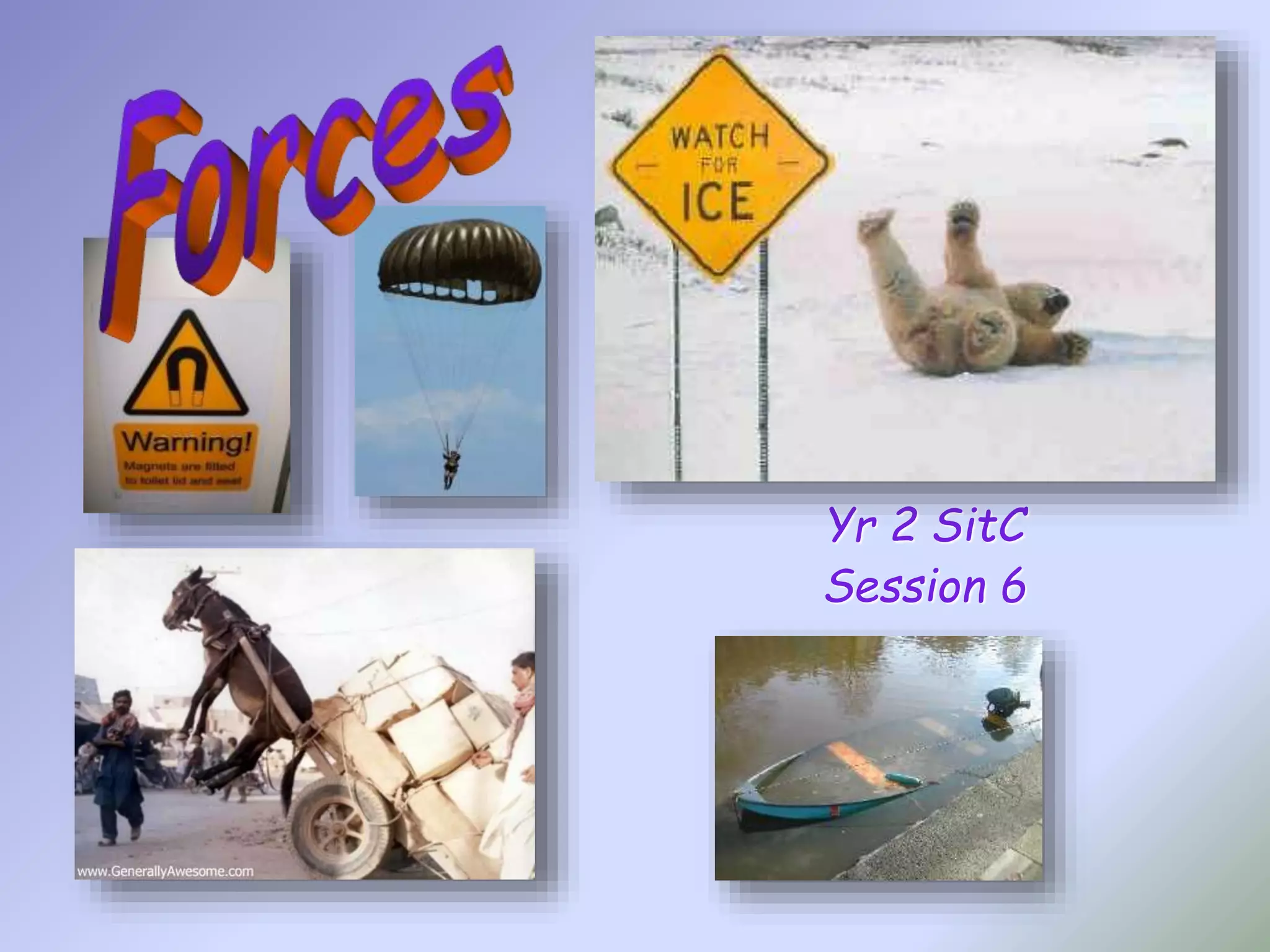
Yr 2 SitC
Session 6
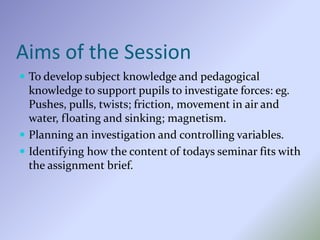
Aims of the Session
 To develop subject knowledge and pedagogical
knowledge to support pupils to investigate forces: eg.
Pushes, pulls, twists; friction, movement in air and
water, floating and sinking; magnetism.
 Planning an investigation and controlling variables.
 Identifying how the content of todays seminar fits with
the assignment brief.
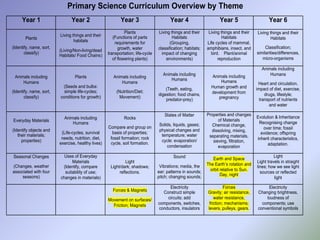
Primary Science Curriculum Overview by Theme
Year 1 Year 2 Year 3 Year 4 Year 5 Year 6
Plants
(Identify, name, sort,
classify)
Living things and their
habitats
(Living/Non-living/dead
Habitats/ Food Chains)
Plants
(Functions of parts
requirements for
growth, water
transportation; life-cycle
of flowering plants)
Living things and their
Habitats
(Grouping,
classification; habitats;
impact of changing
environments)
Living things and their
Habitats
Life cycles of mammal,
amphibians, insect, and
bird. Plant/animal
reproduction
Living things and their
Habitats
Classification;
similarities/differences,
micro-organisms
Animals including
Humans
(Identify, name, sort,
classify)
Plants
(Seeds and bulbs:
simple life-cycles;
conditions for growth)
Animals including
Humans
(Nutrition/Diet;
Movement)
Animals including
Humans
(Teeth, eating,
digestion; food chains,
predator-prey)
Animals including
Humans
Human growth and
development from
pregnancy
Animals including
Humans
Heart and circulation,
impact of diet, exercise,
drugs, lifestyle;
transport of nutrients
and water
Everyday Materials
(Identify objects and
their materials;
properties)
Animals including
Humans
(Life-cycles, survival
needs, nutrition, diet,
exercise, healthy lives)
Rocks
Compare and group on
basis of properties;
fossil formation; rock
cycle, soil formation.
States of Matter
Solids, liquids, gases;
physical changes and
temperature; water
cycle: evaporation/
condensation
Properties and changes
of Materials
Chemical change,
dissolving, mixing,
separating materials,
sieving, filtration,
evaporation
Evolution & Inheritance
Recognising change
over time; fossil
evidence; offspring
inherit characteristics,
adaptation.
Seasonal Changes
(Changes, weather
associated with four
seasons)
Uses of Everyday
Materials
(Identify, compare
suitability of use;
changes in materials)
Light
Light/dark; shadows;
reflections.
Sound
Vibrations; media, the
ear; patterns in sounds;
pitch; changing sounds;
Earth and Space
The Earth’s rotation and
orbit relative to Sun.
Day, night
Light
Light travels in straight
lines; how we see light
sources or reflected
light
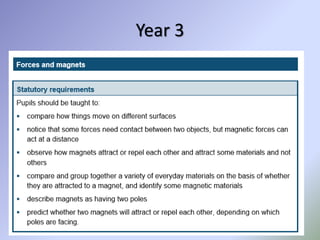
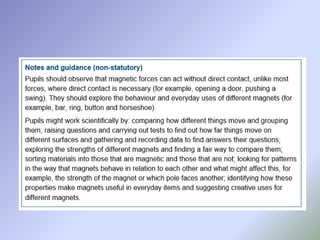
Forces & Magnets
Movement on surfaces/
Friction; Magnets
Electricity
Construct simple
circuits; add
components, switches,
conductors, insulators
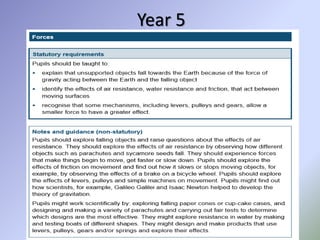
Forces
Gravity; air resistance,
water resistance,
friction; mechanisms;
levers, pulleys, gears.
Electricity
Changing brightness,
loudness of
components; use
conventional symbols
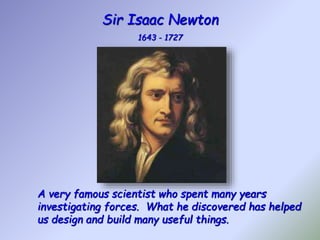
Sir Isaac Newton
1643 - 1727
A very famous scientist who spent many years
investigating forces. What he discovered has helped
us design and build many useful things.
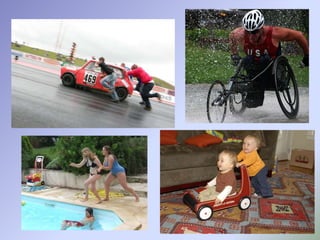
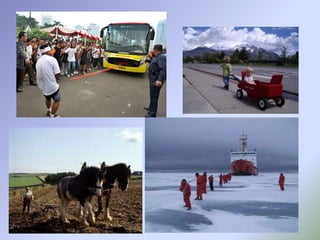
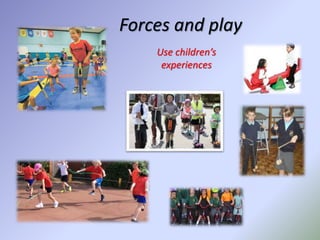
Forces and play
Use children’s
experiences
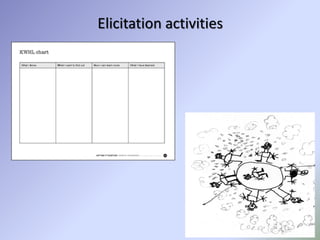
Elicitation activities
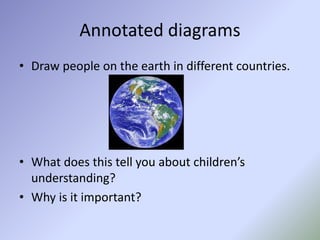
Annotated diagrams
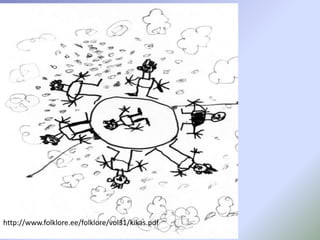
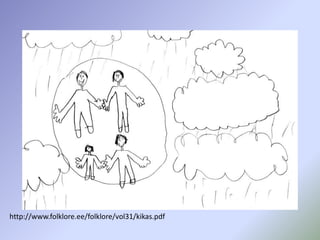
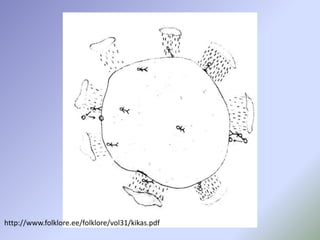
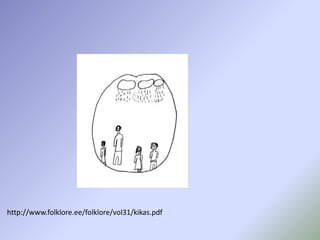
• Draw people on the earth in different countries.
• What does this tell you about children’s
understanding?
• Why is it important?
Children’s ideas
• Look at the following pictures and decide if
the children have an understanding of the
force that holds people on the world, or are
they extended or emerging in this area?
http://www.folklore.ee/folklore/vol31/kikas.pdf
Misconceptions
• Forces get things moving they do not make them stop
• Objects stop moving when the force runs out.
• Objects have forces inside them that make them move
• Forces are involved in moving objects: they are not involved in
equilibriums
• If an object is moving the only force present is moving in the same
direction
• If there is no motion then there are no forces acting
• Only wind has force air doesn’t
• A feather drops to the ground slower than a brick when dropped
from a height because it is lighter
Weight as a force
• Weight = Mass x Gravity
• The weight of an object is defined as the product of
the mass x the acceleration due to gravity
• Since weight acts as a force, its unit is the Newton
(N).
• 1 kg on the surface of the Earth weighs 9.81 N,
because 1 kg × 9.81 m/s = 9.81 N.
In daily life on Earth we take 1 Newton (force) ≈
1/9.81 kg ≈ 0.102 kg ≈ 102 grams (weight).
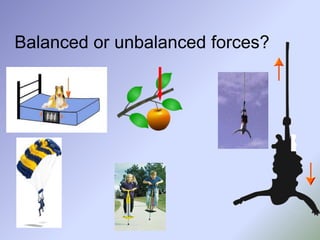
Balanced or unbalanced forces?
Children at KS1 should be encouraged to be
curious and ask questions about what they notice.
They should be helped to develop their
understanding of scientific ideas by using different
types of scientific enquiry to answer their own
questions, including observing changes over a
period of time, noticing patterns, grouping and
classifying things, carrying out simple comparative
tests, and finding things out using secondary
sources of information (NC 2014)
Year 3
Year 5
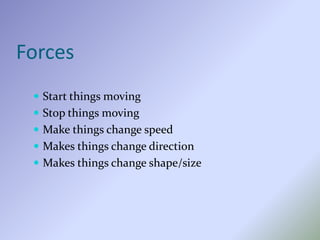
Forces
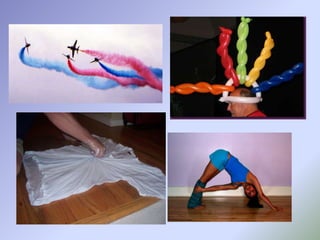
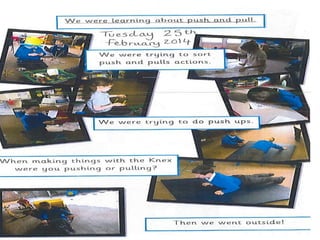
 Start things moving
 Stop things moving
 Make things change speed
 Makes things change direction
 Makes things change shape/size
Newton’s 1st Law of MotionDescribes what happens to the motion of an object when
there is no force acting on it
A body continues in a state of
rest or to move with a steady
velocity in a straight line if it is
not acted upon by forces.
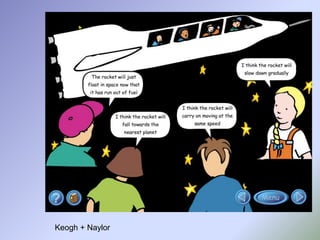
Keogh + Naylor
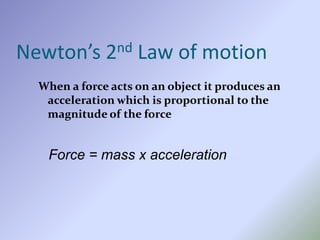
Newton’s 2nd Law of motion
When a force acts on an object it produces an
acceleration which is proportional to the
magnitude of the force
Force = mass x acceleration
Newton’s 3rd Law of Motion
For every action there is an equal and opposite
reaction
Whenever an object A pushes on an
object B, B pushes on A with an equal
and opposite force.
Time to investigate
We can not see forces but we can observe their
effects.
• Try and identify the forces at work
• For each activity decide how you will record your
results and make a recording sheet which you
could use in school.
• Note any questions:
that you (or children might) have and try to answer
them
That could be used to promote thinking/learning
• Try as many activities as you can in 30 Mins
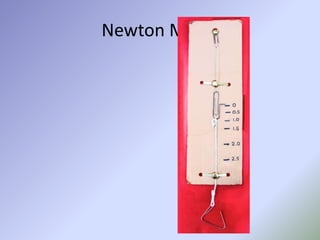
Newton Metre
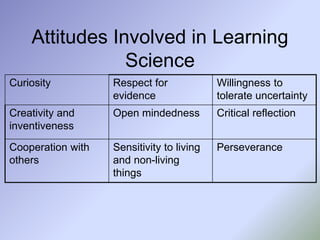
Attitudes Involved in Learning
Science
Curiosity Respect for
evidence
Willingness to
tolerate uncertainty
Creativity and
inventiveness
Open mindedness Critical reflection
Cooperation with
others
Sensitivity to living
and non-living
things
Perseverance
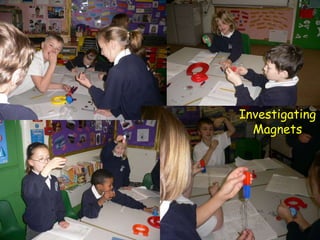
Investigating Magnets
 Which magnet is the strongest?
 Do magnets work through other materials?
 Can you magnetise a needle?
 Can you find magnetic North Pole?
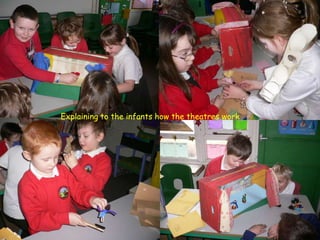
Explaining to the infants how the theatres work
Investigating
Magnets
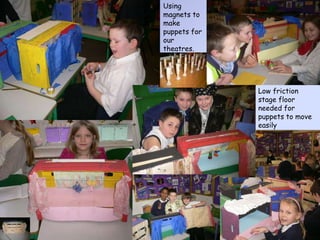
Using
magnets to
make
puppets for
our
theatres.
Low friction
stage floor
needed for
puppets to move
easily
Investigate Floating and Sinking
 Compare the level of buoyancy of a table tennis ball
with a similar sized lump of plasticine, other objects –
can you explain your observations?
 Make the plasticine float
 How would you prove upthrust?
 How could you demonstrate the effect of streamlining?
 Can you make a paperclip float?
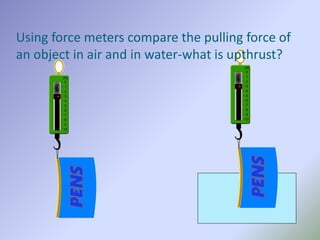
Using force meters compare the pulling force of
an object in air and in water-what is upthrust?
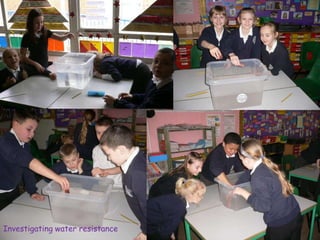
Investigating water resistance
Investigating Gravity
 Do light and heavy objects of similar size hit the
ground at the same time?
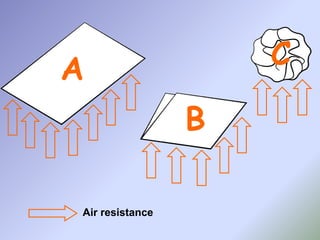
 How can you make a piece of A4 paper drop to the
ground quickly, slowly, ‘medium’ speed?
A
B
C
Air resistance
Investigating Friction
Use the children’s shoes and newton meters to
investigate:
Which surface has the most grip?
Which is the has the least amount of grip?
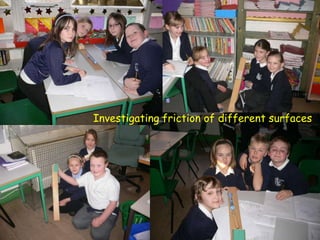
Investigating friction of different surfaces
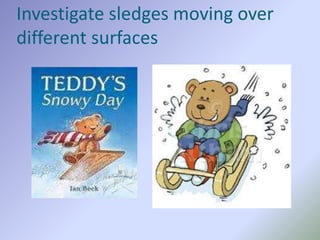
Investigate sledges moving over
different surfaces
Investigating Air Resistance-Plan and
design your own comparative test
Design, make and test two parachutes that will bring the
little bear safely to the ground.
Consider:
What makes the best parachute?
What factors could be changed?
What factor will you keep the same?
What evidence will you collect?
Which parachute was ‘best’ why? What evidence do you have?
Success Criteria
 Can you identify x3 success criteria? One for each of
the following areas:
Concept
Working Scientifically
Attitude
 Can you provide some open person centred questions
for each success criteria?
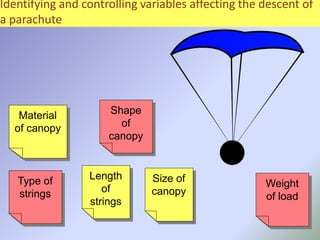
Identifying and controlling variables affecting the descent of
a parachute
Shape
of
canopy
Size of
canopy
Material
of canopy
Type of
strings
Length
of
strings
Weight
of load
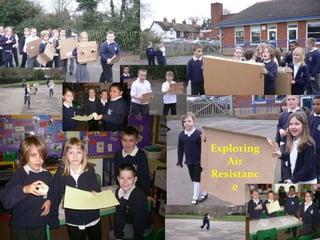
Exploring
Air
Resistanc
e
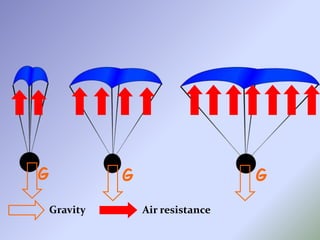
G G G
Gravity Air resistance
Additional considerations:
 How would you adapt the activities for different age
groups?
 How could the activities be contextualised?
 What process skills are being developed?
 How could you assess learning?
 What are the management and safety issues.
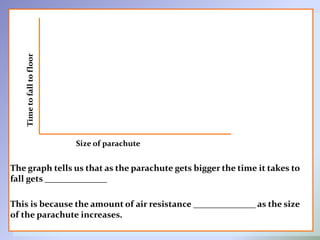
Timetofalltofloor
Size of parachute
The graph tells us that as the parachute gets bigger the time it takes to
fall gets ______________
This is because the amount of air resistance ______________ as the size
of the parachute increases.
Forces activities/quiz
 With regards to the time taken to land on the floor,
what do you think will happen when I drop a canister
with playdough in and one without? Now compare
with paper.
 If I push a car will it carry on forever, if not why not?
 What will your mass be on the moon ?
 What happens to the reading on a Newton metre when
an object is suspended in water?
 What do forces do? ( 4 things)
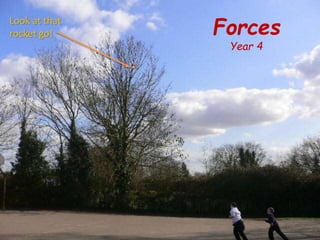
Forces
Year 4
Look at that
rocket go!
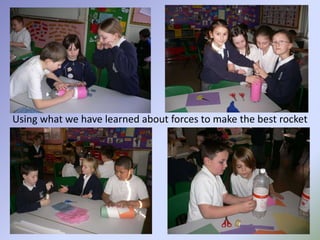
Using what we have learned about forces to make the best rocket
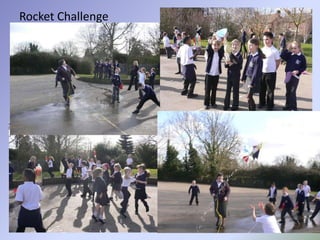
Rocket Challenge
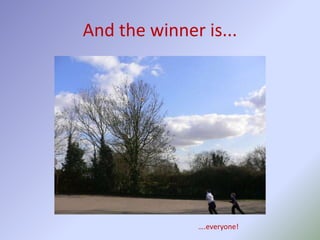
And the winner is...
….everyone!
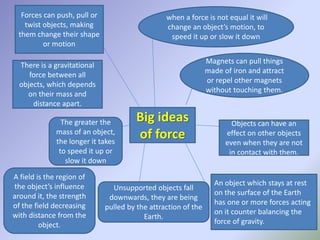
Big ideas
of force
Magnets can pull things
made of iron and attract
or repel other magnets
without touching them.
Forces can push, pull or
twist objects, making
them change their shape
or motion
when a force is not equal it will
change an object’s motion, to
speed it up or slow it down
The greater the
mass of an object,
the longer it takes
to speed it up or
slow it down
An object which stays at rest
on the surface of the Earth
has one or more forces acting
on it counter balancing the
force of gravity.
Unsupported objects fall
downwards, they are being
pulled by the attraction of the
Earth.
Objects can have an
effect on other objects
even when they are not
in contact with them.
There is a gravitational
force between all
objects, which depends
on their mass and
distance apart.
A field is the region of
the object’s influence
around it, the strength
of the field decreasing
with distance from the
object.
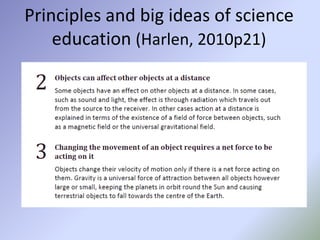
Principles and big ideas of science
education (Harlen, 2010p21)
Working with Big Ideas of Science
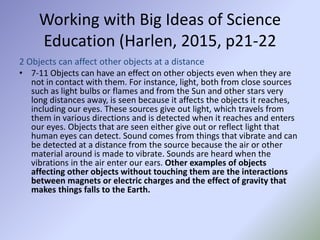
Education (Harlen, 2015, p21-22
2 Objects can affect other objects at a distance
• 7-11 Objects can have an effect on other objects even when they are
not in contact with them. For instance, light, both from close sources
such as light bulbs or flames and from the Sun and other stars very
long distances away, is seen because it affects the objects it reaches,
including our eyes. These sources give out light, which travels from
them in various directions and is detected when it reaches and enters
our eyes. Objects that are seen either give out or reflect light that
human eyes can detect. Sound comes from things that vibrate and can
be detected at a distance from the source because the air or other
material around is made to vibrate. Sounds are heard when the
vibrations in the air enter our ears. Other examples of objects
affecting other objects without touching them are the interactions
between magnets or electric charges and the effect of gravity that
makes things falls to the Earth.
Working with Big Ideas of Science
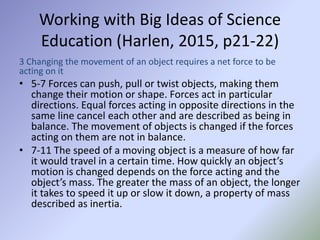
Education (Harlen, 2015, p21-22)
3 Changing the movement of an object requires a net force to be
acting on it
• 5-7 Forces can push, pull or twist objects, making them
change their motion or shape. Forces act in particular
directions. Equal forces acting in opposite directions in the
same line cancel each other and are described as being in
balance. The movement of objects is changed if the forces
acting on them are not in balance.
• 7-11 The speed of a moving object is a measure of how far
it would travel in a certain time. How quickly an object’s
motion is changed depends on the force acting and the
object’s mass. The greater the mass of an object, the longer
it takes to speed it up or slow it down, a property of mass
described as inertia.
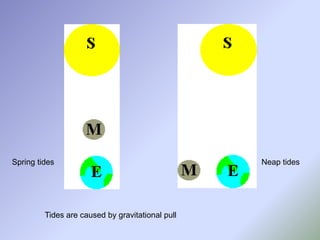
Spring tides Neap tides
Tides are caused by gravitational pull

2019 20 yr 2 sit c 6 forces

  • 1.
  • 2.
    Aims of theSession  To develop subject knowledge and pedagogical knowledge to support pupils to investigate forces: eg. Pushes, pulls, twists; friction, movement in air and water, floating and sinking; magnetism.  Planning an investigation and controlling variables.  Identifying how the content of todays seminar fits with the assignment brief.
  • 3.
    Primary Science CurriculumOverview by Theme Year 1 Year 2 Year 3 Year 4 Year 5 Year 6 Plants (Identify, name, sort, classify) Living things and their habitats (Living/Non-living/dead Habitats/ Food Chains) Plants (Functions of parts requirements for growth, water transportation; life-cycle of flowering plants) Living things and their Habitats (Grouping, classification; habitats; impact of changing environments) Living things and their Habitats Life cycles of mammal, amphibians, insect, and bird. Plant/animal reproduction Living things and their Habitats Classification; similarities/differences, micro-organisms Animals including Humans (Identify, name, sort, classify) Plants (Seeds and bulbs: simple life-cycles; conditions for growth) Animals including Humans (Nutrition/Diet; Movement) Animals including Humans (Teeth, eating, digestion; food chains, predator-prey) Animals including Humans Human growth and development from pregnancy Animals including Humans Heart and circulation, impact of diet, exercise, drugs, lifestyle; transport of nutrients and water Everyday Materials (Identify objects and their materials; properties) Animals including Humans (Life-cycles, survival needs, nutrition, diet, exercise, healthy lives) Rocks Compare and group on basis of properties; fossil formation; rock cycle, soil formation. States of Matter Solids, liquids, gases; physical changes and temperature; water cycle: evaporation/ condensation Properties and changes of Materials Chemical change, dissolving, mixing, separating materials, sieving, filtration, evaporation Evolution & Inheritance Recognising change over time; fossil evidence; offspring inherit characteristics, adaptation. Seasonal Changes (Changes, weather associated with four seasons) Uses of Everyday Materials (Identify, compare suitability of use; changes in materials) Light Light/dark; shadows; reflections. Sound Vibrations; media, the ear; patterns in sounds; pitch; changing sounds; Earth and Space The Earth’s rotation and orbit relative to Sun. Day, night Light Light travels in straight lines; how we see light sources or reflected light Forces & Magnets Movement on surfaces/ Friction; Magnets Electricity Construct simple circuits; add components, switches, conductors, insulators Forces Gravity; air resistance, water resistance, friction; mechanisms; levers, pulleys, gears. Electricity Changing brightness, loudness of components; use conventional symbols
  • 4.
    Sir Isaac Newton 1643- 1727 A very famous scientist who spent many years investigating forces. What he discovered has helped us design and build many useful things.
  • 8.
    Forces and play Usechildren’s experiences
  • 9.
  • 10.
    Annotated diagrams • Drawpeople on the earth in different countries. • What does this tell you about children’s understanding? • Why is it important?
  • 11.
    Children’s ideas • Lookat the following pictures and decide if the children have an understanding of the force that holds people on the world, or are they extended or emerging in this area?
  • 12.
  • 13.
  • 14.
  • 15.
  • 16.
    Misconceptions • Forces getthings moving they do not make them stop • Objects stop moving when the force runs out. • Objects have forces inside them that make them move • Forces are involved in moving objects: they are not involved in equilibriums • If an object is moving the only force present is moving in the same direction • If there is no motion then there are no forces acting • Only wind has force air doesn’t • A feather drops to the ground slower than a brick when dropped from a height because it is lighter
  • 17.
    Weight as aforce • Weight = Mass x Gravity • The weight of an object is defined as the product of the mass x the acceleration due to gravity • Since weight acts as a force, its unit is the Newton (N). • 1 kg on the surface of the Earth weighs 9.81 N, because 1 kg × 9.81 m/s = 9.81 N. In daily life on Earth we take 1 Newton (force) ≈ 1/9.81 kg ≈ 0.102 kg ≈ 102 grams (weight).
  • 18.
  • 19.
    Children at KS1should be encouraged to be curious and ask questions about what they notice. They should be helped to develop their understanding of scientific ideas by using different types of scientific enquiry to answer their own questions, including observing changes over a period of time, noticing patterns, grouping and classifying things, carrying out simple comparative tests, and finding things out using secondary sources of information (NC 2014)
  • 20.
  • 22.
  • 23.
    Forces  Start thingsmoving  Stop things moving  Make things change speed  Makes things change direction  Makes things change shape/size
  • 24.
    Newton’s 1st Lawof MotionDescribes what happens to the motion of an object when there is no force acting on it A body continues in a state of rest or to move with a steady velocity in a straight line if it is not acted upon by forces.
  • 25.
  • 26.
    Newton’s 2nd Lawof motion When a force acts on an object it produces an acceleration which is proportional to the magnitude of the force Force = mass x acceleration
  • 27.
    Newton’s 3rd Lawof Motion For every action there is an equal and opposite reaction Whenever an object A pushes on an object B, B pushes on A with an equal and opposite force.
  • 28.
    Time to investigate Wecan not see forces but we can observe their effects. • Try and identify the forces at work • For each activity decide how you will record your results and make a recording sheet which you could use in school. • Note any questions: that you (or children might) have and try to answer them That could be used to promote thinking/learning • Try as many activities as you can in 30 Mins
  • 29.
  • 30.
    Attitudes Involved inLearning Science Curiosity Respect for evidence Willingness to tolerate uncertainty Creativity and inventiveness Open mindedness Critical reflection Cooperation with others Sensitivity to living and non-living things Perseverance
  • 31.
    Investigating Magnets  Whichmagnet is the strongest?  Do magnets work through other materials?  Can you magnetise a needle?  Can you find magnetic North Pole?
  • 32.
    Explaining to theinfants how the theatres work
  • 33.
  • 34.
    Using magnets to make puppets for our theatres. Lowfriction stage floor needed for puppets to move easily
  • 35.
    Investigate Floating andSinking  Compare the level of buoyancy of a table tennis ball with a similar sized lump of plasticine, other objects – can you explain your observations?  Make the plasticine float  How would you prove upthrust?  How could you demonstrate the effect of streamlining?  Can you make a paperclip float?
  • 36.
    Using force meterscompare the pulling force of an object in air and in water-what is upthrust?
  • 37.
  • 38.
    Investigating Gravity  Dolight and heavy objects of similar size hit the ground at the same time?  How can you make a piece of A4 paper drop to the ground quickly, slowly, ‘medium’ speed?
  • 39.
  • 40.
    Investigating Friction Use thechildren’s shoes and newton meters to investigate: Which surface has the most grip? Which is the has the least amount of grip?
  • 41.
    Investigating friction ofdifferent surfaces
  • 42.
    Investigate sledges movingover different surfaces
  • 43.
    Investigating Air Resistance-Planand design your own comparative test Design, make and test two parachutes that will bring the little bear safely to the ground. Consider: What makes the best parachute? What factors could be changed? What factor will you keep the same? What evidence will you collect? Which parachute was ‘best’ why? What evidence do you have?
  • 44.
    Success Criteria  Canyou identify x3 success criteria? One for each of the following areas: Concept Working Scientifically Attitude  Can you provide some open person centred questions for each success criteria?
  • 45.
    Identifying and controllingvariables affecting the descent of a parachute Shape of canopy Size of canopy Material of canopy Type of strings Length of strings Weight of load
  • 46.
  • 47.
    G G G GravityAir resistance
  • 48.
    Additional considerations:  Howwould you adapt the activities for different age groups?  How could the activities be contextualised?  What process skills are being developed?  How could you assess learning?  What are the management and safety issues.
  • 49.
    Timetofalltofloor Size of parachute Thegraph tells us that as the parachute gets bigger the time it takes to fall gets ______________ This is because the amount of air resistance ______________ as the size of the parachute increases.
  • 50.
    Forces activities/quiz  Withregards to the time taken to land on the floor, what do you think will happen when I drop a canister with playdough in and one without? Now compare with paper.  If I push a car will it carry on forever, if not why not?  What will your mass be on the moon ?  What happens to the reading on a Newton metre when an object is suspended in water?  What do forces do? ( 4 things)
  • 51.
    Forces Year 4 Look atthat rocket go!
  • 52.
    Using what wehave learned about forces to make the best rocket
  • 53.
  • 54.
    And the winneris... ….everyone!
  • 57.
    Big ideas of force Magnetscan pull things made of iron and attract or repel other magnets without touching them. Forces can push, pull or twist objects, making them change their shape or motion when a force is not equal it will change an object’s motion, to speed it up or slow it down The greater the mass of an object, the longer it takes to speed it up or slow it down An object which stays at rest on the surface of the Earth has one or more forces acting on it counter balancing the force of gravity. Unsupported objects fall downwards, they are being pulled by the attraction of the Earth. Objects can have an effect on other objects even when they are not in contact with them. There is a gravitational force between all objects, which depends on their mass and distance apart. A field is the region of the object’s influence around it, the strength of the field decreasing with distance from the object.
  • 58.
    Principles and bigideas of science education (Harlen, 2010p21)
  • 59.
    Working with BigIdeas of Science Education (Harlen, 2015, p21-22 2 Objects can affect other objects at a distance • 7-11 Objects can have an effect on other objects even when they are not in contact with them. For instance, light, both from close sources such as light bulbs or flames and from the Sun and other stars very long distances away, is seen because it affects the objects it reaches, including our eyes. These sources give out light, which travels from them in various directions and is detected when it reaches and enters our eyes. Objects that are seen either give out or reflect light that human eyes can detect. Sound comes from things that vibrate and can be detected at a distance from the source because the air or other material around is made to vibrate. Sounds are heard when the vibrations in the air enter our ears. Other examples of objects affecting other objects without touching them are the interactions between magnets or electric charges and the effect of gravity that makes things falls to the Earth.
  • 60.
    Working with BigIdeas of Science Education (Harlen, 2015, p21-22) 3 Changing the movement of an object requires a net force to be acting on it • 5-7 Forces can push, pull or twist objects, making them change their motion or shape. Forces act in particular directions. Equal forces acting in opposite directions in the same line cancel each other and are described as being in balance. The movement of objects is changed if the forces acting on them are not in balance. • 7-11 The speed of a moving object is a measure of how far it would travel in a certain time. How quickly an object’s motion is changed depends on the force acting and the object’s mass. The greater the mass of an object, the longer it takes to speed it up or slow it down, a property of mass described as inertia.
  • 61.
    Spring tides Neaptides Tides are caused by gravitational pull