Electricity
PG FT Science Session 5 Energy: Electricity
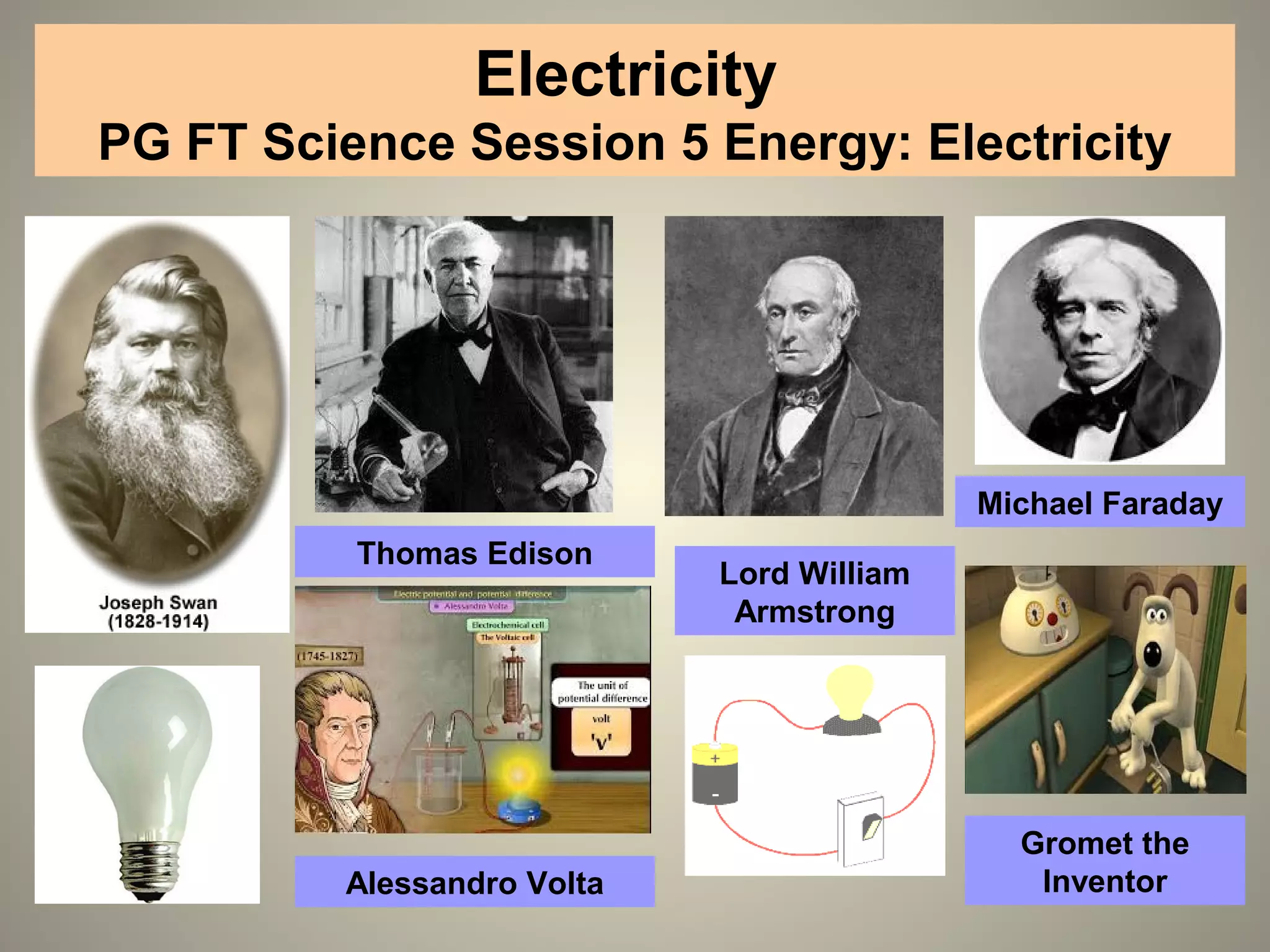
Michael Faraday
Alessandro Volta
Thomas Edison
Lord William
Armstrong
Gromet the
Inventor
ELECTRICITY
 
     
Use of electrical 
appliances.
Students and Staff Turn off sockets before removing plugs, pulling from the
plug and not the cable.
Carry out a visual inspection of equipment – PAT test sticker
should be present.
Ensure water is kept away from appliances/mains.
Low
Use of batteries  Students and Staff Visual inspection of batteries for signs of defects.
Disconnect battery circuits when not in use to prevent
overheating.
Do not use rechargeable batteries.
Instruct students on how to prevent short-circuits, and
rating of bulbs and batteries to prevent explosions.
Low
Trips and falls from leads.  Students and Staff Ensure cabling is not across walkways and is arranged to
prevent trips.
Low
Health and Safety Risk Assessment
3
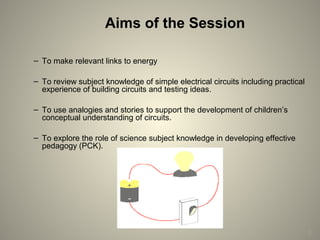
Aims of the Session
– To make relevant links to energy
– To review subject knowledge of simple electrical circuits including practical
experience of building circuits and testing ideas.
– To use analogies and stories to support the development of children’s
conceptual understanding of circuits.
– To explore the role of science subject knowledge in developing effective
pedagogy (PCK).
4
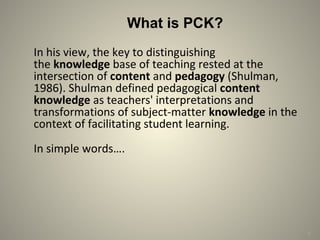
What is PCK?
In his view, the key to distinguishing
the knowledge base of teaching rested at the
intersection of content and pedagogy (Shulman,
1986). Shulman defined pedagogical content 
knowledge as teachers' interpretations and
transformations of subject-matter knowledge in the
context of facilitating student learning.
In simple words….
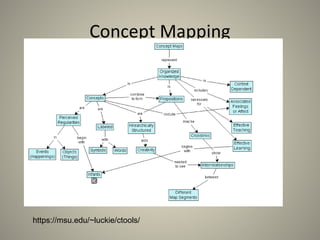
Create a concept map to capture
your knowledge about electricity
Concept Mapping
https://msu.edu/~luckie/ctools/
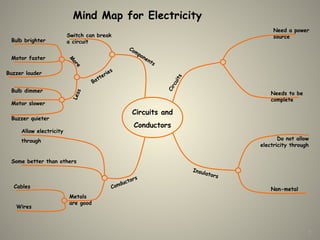
Mind Map for Electricity
Circuits and
Conductors
Circuits
Insulators
Do not allow
electricity through
Non-metal
Needs to be
complete
Need a power
source
Components
Conductors
Allow electricity
through
Some better than others
Metals
are good
Cables
Wires
Switch can break
a circuit
M
oreLess
Buzzer quieter
Motor slower
Bulb dimmer
Buzzer louder
Motor faster
Bulb brighter
Batteries
7
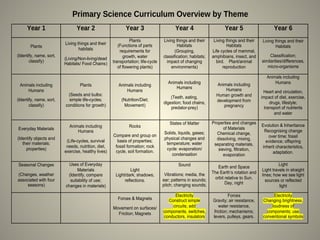
Primary Science Curriculum Overview by Theme
Year 1 Year 2 Year 3 Year 4 Year 5 Year 6
Plants
(Identify, name, sort,
classify)
Living things and their
habitats
(Living/Non-living/dead
Habitats/ Food Chains)
Plants
(Functions of parts
requirements for
growth, water
transportation; life-cycle
of flowering plants)
Living things and their
Habitats
(Grouping,
classification; habitats;
impact of changing
environments)
Living things and their
Habitats
Life cycles of mammal,
amphibians, insect, and
bird. Plant/animal
reproduction
Living things and their
Habitats
Classification;
similarities/differences,
micro-organisms
Animals including
Humans
(Identify, name, sort,
classify)
Plants
(Seeds and bulbs:
simple life-cycles;
conditions for growth)
Animals including
Humans
(Nutrition/Diet;
Movement)
Animals including
Humans
(Teeth, eating,
digestion; food chains,
predator-prey)
Animals including
Humans
Human growth and
development from
pregnancy
Animals including
Humans
Heart and circulation,
impact of diet, exercise,
drugs, lifestyle;
transport of nutrients
and water
Everyday Materials
(Identify objects and
their materials;
properties)
Animals including
Humans
(Life-cycles, survival
needs, nutrition, diet,
exercise, healthy lives)
Rocks
Compare and group on
basis of properties;
fossil formation; rock
cycle, soil formation.
States of Matter
Solids, liquids, gases;
physical changes and
temperature; water
cycle: evaporation/
condensation
Properties and changes
of Materials
Chemical change,
dissolving, mixing,
separating materials,
sieving, filtration,
evaporation
Evolution & Inheritance
Recognising change
over time; fossil
evidence; offspring
inherit characteristics,
adaptation.
Seasonal Changes
(Changes, weather
associated with four
seasons)
Uses of Everyday
Materials
(Identify, compare
suitability of use;
changes in materials)
Light
Light/dark; shadows;
reflections.
Sound
Vibrations; media, the
ear; patterns in sounds;
pitch; changing sounds;
Earth and Space
The Earth’s rotation and
orbit relative to Sun.
Day, night
Light
Light travels in straight
lines; how we see light
sources or reflected
light
Forces & Magnets
Movement on surfaces/
Friction; Magnets
Electricity
Construct simple
circuits; add
components, switches,
conductors, insulators
Forces
Gravity; air resistance,
water resistance,
friction; mechanisms;
levers, pulleys, gears.
Electricity
Changing brightness,
loudness of
components; use
conventional symbols
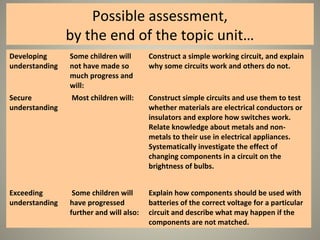
Possible assessment,
by the end of the topic unit…
Developing 
understanding
Some children will 
not have made so 
much progress and 
will: 
Construct a simple working circuit, and explain 
why some circuits work and others do not. 
Secure 
understanding
 Most children will:  Construct simple circuits and use them to test 
whether materials are electrical conductors or 
insulators and explore how switches work. 
Relate knowledge about metals and non-
metals to their use in electrical appliances.
Systematically investigate the effect of 
changing components in a circuit on the 
brightness of bulbs. 
Exceeding 
understanding
 Some children will 
have progressed 
further and will also: 
Explain how components should be used with 
batteries of the correct voltage for a particular 
circuit and describe what may happen if the 
components are not matched.
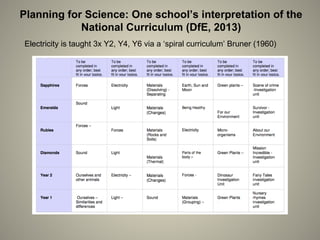
Planning for Science: One school’s interpretation of the
National Curriculum (DfE, 2013)
Electricity is taught 3x Y2, Y4, Y6 via a ‘spiral curriculum’ Bruner (1960)
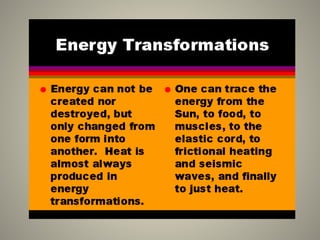
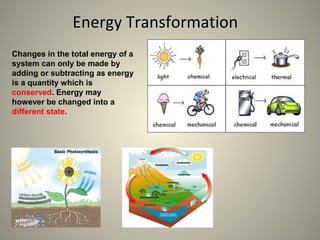
Energy Transformation
Changes in the total energy of a
system can only be made by
adding or subtracting as energy
is a quantity which is
conserved. Energy may
however be changed into a
different state.
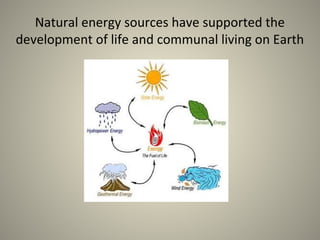
Natural energy sources have supported the
development of life and communal living on Earth
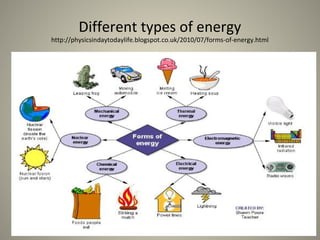
Different types of energy
http://physicsindaytodaylife.blogspot.co.uk/2010/07/forms-of-energy.html
WIND
SOLAR
TIDAL
HYDROELECTRIC
COAL
GAS
OIL
NUCLEAR
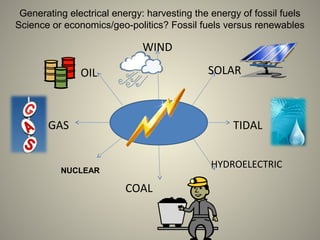
Generating electrical energy: harvesting the energy of fossil fuels
Science or economics/geo-politics? Fossil fuels versus renewables
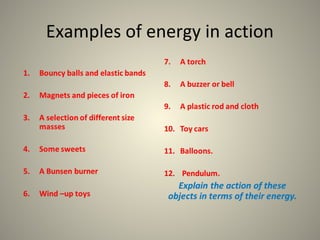
Examples of energy in action
17
What is Electricity?What is Electricity?
What do you think is the difference between static and current
electricity?
Generating static electricity
• Rubbing a balloon against clothing then placing balloon near your
hair.
• Using the charged balloon to pick up bits of paper.
• Using the balloon to divert a stream of flowing water.
• Using the balloon over a plate of salt and pepper – ssh listen
carefully to the moving grains hitting the balloon.
• Rubbing a plastic ruler against clothing
• Using the charged ruler to pick up paper.
• Can you explain what is happening? Why is this called static
electricity?
• How do the materials in which static electricity can be induced
differ from those used for current electricity?
ChallengeChallenge
Using only one bulb, one battery, and one wire ...Using only one bulb, one battery, and one wire ...
• How can you light up a bulb?
• Draw your ideas
• Share range of ideas
• Test
• What type of scientific enquiry is this?
• Which working scientifically skills are you
using?
19
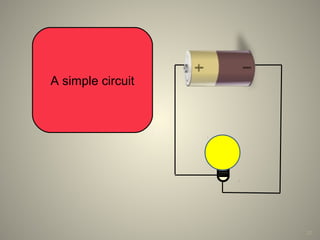
A simple circuit
20
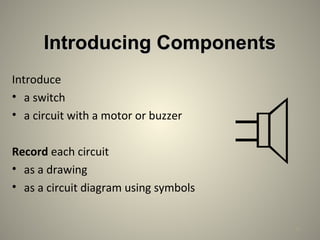
Introducing ComponentsIntroducing Components
Introduce
• a switch
• a circuit with a motor or buzzer
Record each circuit
• as a drawing
• as a circuit diagram using symbols
21
PCKPCK and a practical taskand a practical task
• Play the game ‘throw the ball’ to develop use of
vocabulary for various electrical symbols.
• Did you need to use secondary sources-is this a type
of science investigation?
• Make a simple circuit with one bulb, place the circuit
on a sheet of paper and draw a life size diagram for
the circuit you have made. Please ensure that relevant
symbols are used-what type of science investigation is
this?
• Identify the working scientifically skills that you used.
22
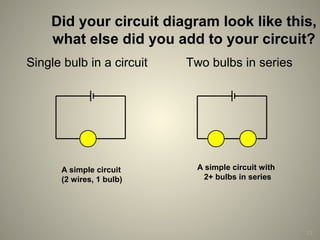
Single bulb in a circuit Two bulbs in series
A simple circuit
(2 wires, 1 bulb)
A simple circuit with
2+ bulbs in series
Did your circuit diagram look like this,
what else did you add to your circuit?
23
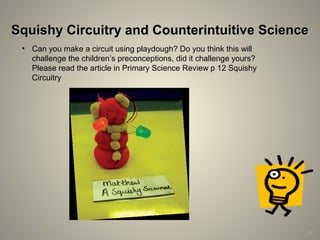
Squishy Circuitry and Counterintuitive ScienceSquishy Circuitry and Counterintuitive Science
24
• Can you make a circuit using playdough? Do you think this will
challenge the children’s preconceptions, did it challenge yours?
Please read the article in Primary Science Review p 12 Squishy
Circuitry
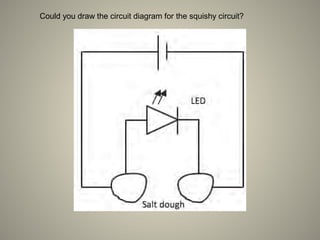
Could you draw the circuit diagram for the squishy circuit?
Learning IntentionsLearning Intentions
• What are the differences in the learning
intentions and success criteria between
building a simple circuit and a building a
squishy circuit?
26
27
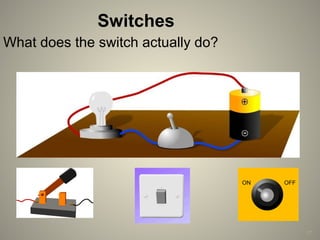
Switches
What does the switch actually do?
28
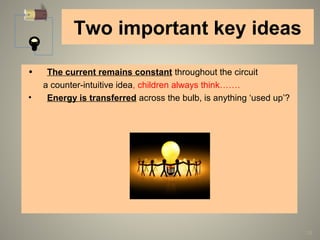
Two important key ideas
• The current remains constant throughout the circuit
a counter-intuitive idea, children always think…….
• Energy is transferred across the bulb, is anything ‘used up’?
29
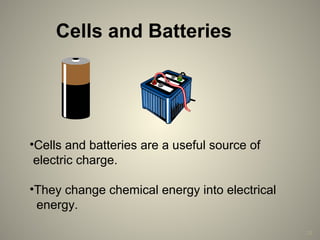
Cells and Batteries
•Cells and batteries are a useful source of
electric charge.
•They change chemical energy into electrical
energy.
30
VoltageVoltage
31
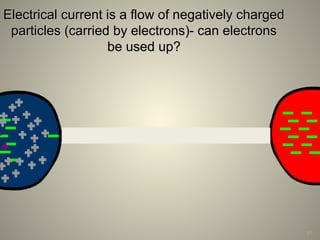
Electrical current is a flow of negatively chargedElectrical current is a flow of negatively charged
particles (carried by electrons)- can electronsparticles (carried by electrons)- can electrons
be used up?be used up?
32
Implications for pedagogy:Implications for pedagogy:
• Electricity is an abstract scientific area
• We can only observe manifestations of the flow of an electrical
current
• It contains some counter intuitive ideas such as current
conservation which will present difficulties for many learners
• As electricity cannot be viewed directly teaching often depends on
the use of analogies and these have limitations which teachers
must be aware of
33
AnalogiesAnalogies
• Analogies are ‘stories’ used to explain abstract phenomena.
• Because we cannot see what is happening, we have to construct a
mental model of how it might work.
• We say ‘it is like…’
• Analogies are powerful learning tools helping us to develop
explanations using existing ideas and experiences.
• In your grps create an analogy
• However….
34
AnalogiesAnalogies
• We must remember that analogies only partly explain
behaviour
• All analogies eventually break down under scrutiny
• Learners respond differently to different analogies according
to their ideas and experience
• There is no holy grail of analogy!
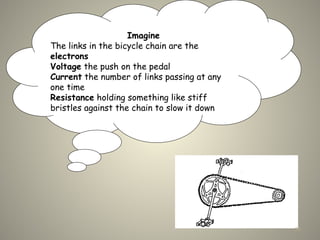
Imagine
The links in the bicycle chain are the
electrons
Voltage the push on the pedal
Current the number of links passing at any
one time
Resistance holding something like stiff
bristles against the chain to slow it down
35
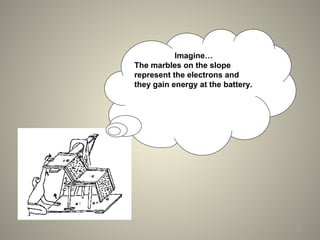
Imagine…
The marbles on the slope
represent the electrons and
they gain energy at the battery.
36
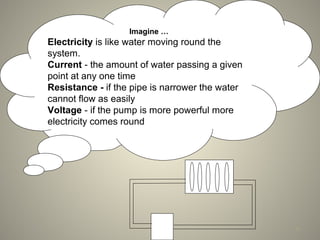
Imagine …
Electricity is like water moving round the
system.
Current - the amount of water passing a given
point at any one time
Resistance - if the pipe is narrower the water
cannot flow as easily
Voltage - if the pump is more powerful more
electricity comes round
37
38
Electricity is usefulElectricity is useful
• Electrical energy can be transferred
quickly and cleanly over large distances
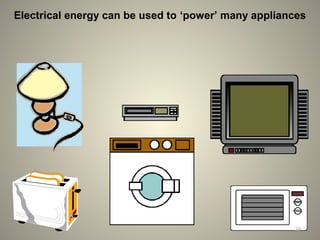
Electrical energy can be used to ‘power’ many appliances
39
40
Elicitaton Activity
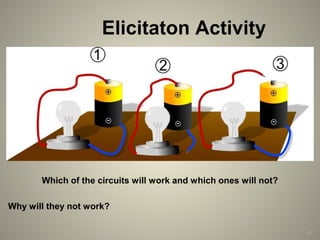
Which of the circuits will work and which ones will not?
Why will they not work?
41
Changing Circuits
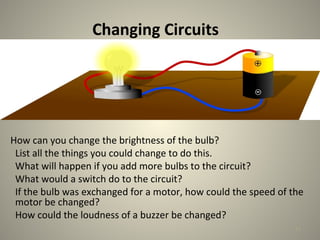
How can you change the brightness of the bulb?
List all the things you could change to do this.
What will happen if you add more bulbs to the circuit?
What would a switch do to the circuit?
If the bulb was exchanged for a motor, how could the speed of the
motor be changed?
How could the loudness of a buzzer be changed?
42
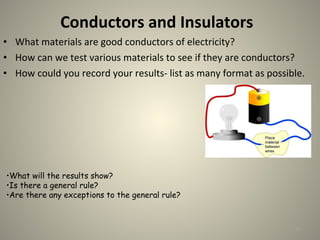
Conductors and Insulators
• What materials are good conductors of electricity?
• How can we test various materials to see if they are conductors?
• How could you record your results- list as many format as possible.
•What will the results show?
•Is there a general rule?
•Are there any exceptions to the general rule?
Some possible teaching
contexts
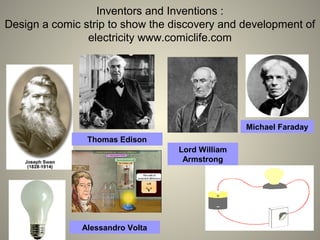
Inventors and Inventions :
Design a comic strip to show the discovery and development of
electricity www.comiclife.com
Michael Faraday
Alessandro Volta
Thomas Edison
Lord William
Armstrong
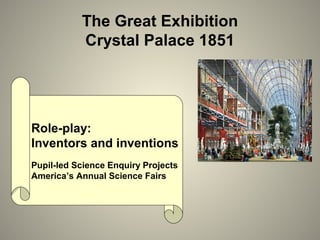
The Great Exhibition
Crystal Palace 1851
Role-play:
Inventors and inventions
Pupil-led Science Enquiry Projects
America’s Annual Science Fairs
Working in partnership with museums
• http://www.twmuseums.org.uk/schools/disco
very/workshops/the-big-5-inventors-
tour.544.html
47
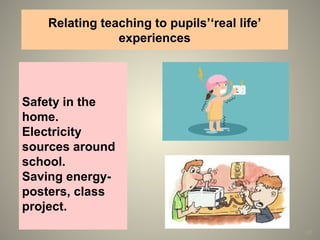
Safety in the
home.
Electricity
sources around
school.
Saving energy-
posters, class
project.
Relating teaching to pupils’‘real life’
experiences
Simplifying Electricity Consumption
• Looking at electricity bills.
• Graph of electrical energy consumption and
costs.
• What are the family/people spending all their
money on?
• Identify uses/usage and try to find ways to
save money.
• What could you do with the savings????
• Well a deal’s a deal.
History: Past and Present
• Make a list of household jobs that we do
using electrical power.
• Design a poster/comic strip to show how we
did the following, before electricity was
invented?
• Cooking our dinner
• Washing our clothes
• Doing operations
• Driving safely at night
History: Toys Past and Present
Explore and compare a number of
modern battery powered toys with
push/pull/twist operated toys.
Design a catalogue to advertise the
different types of toys.
The Day the Earth Stood Still
• A world-wide electricity power cut.
• What would be the consequences for
children’s daily lives?
• Hot-seat interviews with child, electrician,
doctor, dentist.
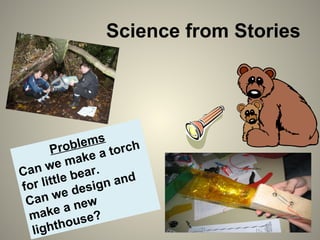
Science from Stories
Problems
Can we make a torch
for little bear.
Can we design and
make a new
lighthouse?
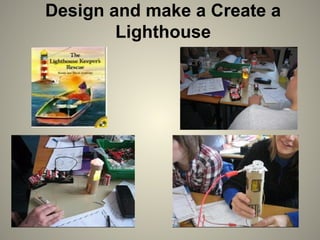
Design and make a Create a
Lighthouse
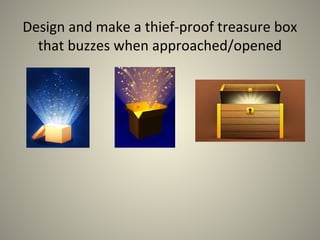
Design and make a thief-proof treasure box
that buzzes when approached/opened
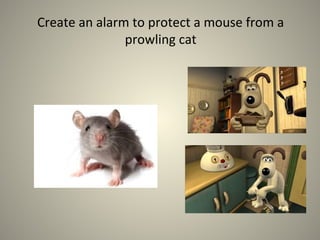
Create an alarm to protect a mouse from a
prowling cat
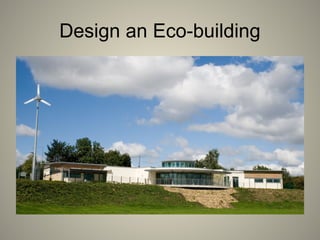
Design an Eco-building
Planning activity
• Using the new NC plan a topic on electricity
for Y6 in the Spring half-term
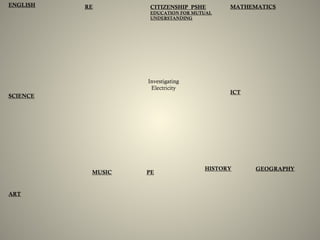
Investigating
Electricity
MATHEMATICS
GEOGRAPHY
MUSIC
SCIENCE
ENGLISH RE
HISTORY
ICT
PE
CITIZENSHIP PSHE
EDUCATION FOR MUTUAL
UNDERSTANDING
ART

Session 6 PGCE Electricity

  • 1.
    Electricity PG FT ScienceSession 5 Energy: Electricity Michael Faraday Alessandro Volta Thomas Edison Lord William Armstrong Gromet the Inventor
  • 2.
    ELECTRICITY         Use of electrical  appliances. Studentsand Staff Turn off sockets before removing plugs, pulling from the plug and not the cable. Carry out a visual inspection of equipment – PAT test sticker should be present. Ensure water is kept away from appliances/mains. Low Use of batteries  Students and Staff Visual inspection of batteries for signs of defects. Disconnect battery circuits when not in use to prevent overheating. Do not use rechargeable batteries. Instruct students on how to prevent short-circuits, and rating of bulbs and batteries to prevent explosions. Low Trips and falls from leads.  Students and Staff Ensure cabling is not across walkways and is arranged to prevent trips. Low Health and Safety Risk Assessment
  • 3.
    3 Aims of theSession – To make relevant links to energy – To review subject knowledge of simple electrical circuits including practical experience of building circuits and testing ideas. – To use analogies and stories to support the development of children’s conceptual understanding of circuits. – To explore the role of science subject knowledge in developing effective pedagogy (PCK).
  • 4.
    4 What is PCK? Inhis view, the key to distinguishing the knowledge base of teaching rested at the intersection of content and pedagogy (Shulman, 1986). Shulman defined pedagogical content  knowledge as teachers' interpretations and transformations of subject-matter knowledge in the context of facilitating student learning. In simple words….
  • 5.
    Create a conceptmap to capture your knowledge about electricity
  • 6.
  • 7.
    Mind Map forElectricity Circuits and Conductors Circuits Insulators Do not allow electricity through Non-metal Needs to be complete Need a power source Components Conductors Allow electricity through Some better than others Metals are good Cables Wires Switch can break a circuit M oreLess Buzzer quieter Motor slower Bulb dimmer Buzzer louder Motor faster Bulb brighter Batteries 7
  • 8.
    Primary Science CurriculumOverview by Theme Year 1 Year 2 Year 3 Year 4 Year 5 Year 6 Plants (Identify, name, sort, classify) Living things and their habitats (Living/Non-living/dead Habitats/ Food Chains) Plants (Functions of parts requirements for growth, water transportation; life-cycle of flowering plants) Living things and their Habitats (Grouping, classification; habitats; impact of changing environments) Living things and their Habitats Life cycles of mammal, amphibians, insect, and bird. Plant/animal reproduction Living things and their Habitats Classification; similarities/differences, micro-organisms Animals including Humans (Identify, name, sort, classify) Plants (Seeds and bulbs: simple life-cycles; conditions for growth) Animals including Humans (Nutrition/Diet; Movement) Animals including Humans (Teeth, eating, digestion; food chains, predator-prey) Animals including Humans Human growth and development from pregnancy Animals including Humans Heart and circulation, impact of diet, exercise, drugs, lifestyle; transport of nutrients and water Everyday Materials (Identify objects and their materials; properties) Animals including Humans (Life-cycles, survival needs, nutrition, diet, exercise, healthy lives) Rocks Compare and group on basis of properties; fossil formation; rock cycle, soil formation. States of Matter Solids, liquids, gases; physical changes and temperature; water cycle: evaporation/ condensation Properties and changes of Materials Chemical change, dissolving, mixing, separating materials, sieving, filtration, evaporation Evolution & Inheritance Recognising change over time; fossil evidence; offspring inherit characteristics, adaptation. Seasonal Changes (Changes, weather associated with four seasons) Uses of Everyday Materials (Identify, compare suitability of use; changes in materials) Light Light/dark; shadows; reflections. Sound Vibrations; media, the ear; patterns in sounds; pitch; changing sounds; Earth and Space The Earth’s rotation and orbit relative to Sun. Day, night Light Light travels in straight lines; how we see light sources or reflected light Forces & Magnets Movement on surfaces/ Friction; Magnets Electricity Construct simple circuits; add components, switches, conductors, insulators Forces Gravity; air resistance, water resistance, friction; mechanisms; levers, pulleys, gears. Electricity Changing brightness, loudness of components; use conventional symbols
  • 9.
    Possible assessment, by theend of the topic unit… Developing  understanding Some children will  not have made so  much progress and  will:  Construct a simple working circuit, and explain  why some circuits work and others do not.  Secure  understanding  Most children will:  Construct simple circuits and use them to test  whether materials are electrical conductors or  insulators and explore how switches work.  Relate knowledge about metals and non- metals to their use in electrical appliances. Systematically investigate the effect of  changing components in a circuit on the  brightness of bulbs.  Exceeding  understanding  Some children will  have progressed  further and will also:  Explain how components should be used with  batteries of the correct voltage for a particular  circuit and describe what may happen if the  components are not matched.
  • 10.
    Planning for Science:One school’s interpretation of the National Curriculum (DfE, 2013) Electricity is taught 3x Y2, Y4, Y6 via a ‘spiral curriculum’ Bruner (1960)
  • 12.
    Energy Transformation Changes inthe total energy of a system can only be made by adding or subtracting as energy is a quantity which is conserved. Energy may however be changed into a different state.
  • 13.
    Natural energy sourceshave supported the development of life and communal living on Earth
  • 14.
    Different types ofenergy http://physicsindaytodaylife.blogspot.co.uk/2010/07/forms-of-energy.html
  • 15.
    WIND SOLAR TIDAL HYDROELECTRIC COAL GAS OIL NUCLEAR Generating electrical energy:harvesting the energy of fossil fuels Science or economics/geo-politics? Fossil fuels versus renewables
  • 16.
  • 17.
    17 What is Electricity?Whatis Electricity? What do you think is the difference between static and current electricity?
  • 18.
    Generating static electricity •Rubbing a balloon against clothing then placing balloon near your hair. • Using the charged balloon to pick up bits of paper. • Using the balloon to divert a stream of flowing water. • Using the balloon over a plate of salt and pepper – ssh listen carefully to the moving grains hitting the balloon. • Rubbing a plastic ruler against clothing • Using the charged ruler to pick up paper. • Can you explain what is happening? Why is this called static electricity? • How do the materials in which static electricity can be induced differ from those used for current electricity?
  • 19.
    ChallengeChallenge Using only onebulb, one battery, and one wire ...Using only one bulb, one battery, and one wire ... • How can you light up a bulb? • Draw your ideas • Share range of ideas • Test • What type of scientific enquiry is this? • Which working scientifically skills are you using? 19
  • 20.
  • 21.
    Introducing ComponentsIntroducing Components Introduce •a switch • a circuit with a motor or buzzer Record each circuit • as a drawing • as a circuit diagram using symbols 21
  • 22.
    PCKPCK and apractical taskand a practical task • Play the game ‘throw the ball’ to develop use of vocabulary for various electrical symbols. • Did you need to use secondary sources-is this a type of science investigation? • Make a simple circuit with one bulb, place the circuit on a sheet of paper and draw a life size diagram for the circuit you have made. Please ensure that relevant symbols are used-what type of science investigation is this? • Identify the working scientifically skills that you used. 22
  • 23.
    Single bulb ina circuit Two bulbs in series A simple circuit (2 wires, 1 bulb) A simple circuit with 2+ bulbs in series Did your circuit diagram look like this, what else did you add to your circuit? 23
  • 24.
    Squishy Circuitry andCounterintuitive ScienceSquishy Circuitry and Counterintuitive Science 24 • Can you make a circuit using playdough? Do you think this will challenge the children’s preconceptions, did it challenge yours? Please read the article in Primary Science Review p 12 Squishy Circuitry
  • 25.
    Could you drawthe circuit diagram for the squishy circuit?
  • 26.
    Learning IntentionsLearning Intentions •What are the differences in the learning intentions and success criteria between building a simple circuit and a building a squishy circuit? 26
  • 27.
    27 Switches What does theswitch actually do?
  • 28.
    28 Two important keyideas • The current remains constant throughout the circuit a counter-intuitive idea, children always think……. • Energy is transferred across the bulb, is anything ‘used up’?
  • 29.
    29 Cells and Batteries •Cellsand batteries are a useful source of electric charge. •They change chemical energy into electrical energy.
  • 30.
  • 31.
    31 Electrical current isa flow of negatively chargedElectrical current is a flow of negatively charged particles (carried by electrons)- can electronsparticles (carried by electrons)- can electrons be used up?be used up?
  • 32.
    32 Implications for pedagogy:Implicationsfor pedagogy: • Electricity is an abstract scientific area • We can only observe manifestations of the flow of an electrical current • It contains some counter intuitive ideas such as current conservation which will present difficulties for many learners • As electricity cannot be viewed directly teaching often depends on the use of analogies and these have limitations which teachers must be aware of
  • 33.
    33 AnalogiesAnalogies • Analogies are‘stories’ used to explain abstract phenomena. • Because we cannot see what is happening, we have to construct a mental model of how it might work. • We say ‘it is like…’ • Analogies are powerful learning tools helping us to develop explanations using existing ideas and experiences. • In your grps create an analogy • However….
  • 34.
    34 AnalogiesAnalogies • We mustremember that analogies only partly explain behaviour • All analogies eventually break down under scrutiny • Learners respond differently to different analogies according to their ideas and experience • There is no holy grail of analogy!
  • 35.
    Imagine The links inthe bicycle chain are the electrons Voltage the push on the pedal Current the number of links passing at any one time Resistance holding something like stiff bristles against the chain to slow it down 35
  • 36.
    Imagine… The marbles onthe slope represent the electrons and they gain energy at the battery. 36
  • 37.
    Imagine … Electricity islike water moving round the system. Current - the amount of water passing a given point at any one time Resistance - if the pipe is narrower the water cannot flow as easily Voltage - if the pump is more powerful more electricity comes round 37
  • 38.
    38 Electricity is usefulElectricityis useful • Electrical energy can be transferred quickly and cleanly over large distances
  • 39.
    Electrical energy canbe used to ‘power’ many appliances 39
  • 40.
    40 Elicitaton Activity Which ofthe circuits will work and which ones will not? Why will they not work?
  • 41.
    41 Changing Circuits How canyou change the brightness of the bulb? List all the things you could change to do this. What will happen if you add more bulbs to the circuit? What would a switch do to the circuit? If the bulb was exchanged for a motor, how could the speed of the motor be changed? How could the loudness of a buzzer be changed?
  • 42.
    42 Conductors and Insulators •What materials are good conductors of electricity? • How can we test various materials to see if they are conductors? • How could you record your results- list as many format as possible. •What will the results show? •Is there a general rule? •Are there any exceptions to the general rule?
  • 43.
  • 44.
    Inventors and Inventions: Design a comic strip to show the discovery and development of electricity www.comiclife.com Michael Faraday Alessandro Volta Thomas Edison Lord William Armstrong
  • 45.
    The Great Exhibition CrystalPalace 1851 Role-play: Inventors and inventions Pupil-led Science Enquiry Projects America’s Annual Science Fairs
  • 46.
    Working in partnershipwith museums • http://www.twmuseums.org.uk/schools/disco very/workshops/the-big-5-inventors- tour.544.html
  • 47.
    47 Safety in the home. Electricity sourcesaround school. Saving energy- posters, class project. Relating teaching to pupils’‘real life’ experiences
  • 48.
    Simplifying Electricity Consumption •Looking at electricity bills. • Graph of electrical energy consumption and costs. • What are the family/people spending all their money on? • Identify uses/usage and try to find ways to save money. • What could you do with the savings???? • Well a deal’s a deal.
  • 49.
    History: Past andPresent • Make a list of household jobs that we do using electrical power. • Design a poster/comic strip to show how we did the following, before electricity was invented? • Cooking our dinner • Washing our clothes • Doing operations • Driving safely at night
  • 50.
    History: Toys Pastand Present Explore and compare a number of modern battery powered toys with push/pull/twist operated toys. Design a catalogue to advertise the different types of toys.
  • 51.
    The Day theEarth Stood Still • A world-wide electricity power cut. • What would be the consequences for children’s daily lives? • Hot-seat interviews with child, electrician, doctor, dentist.
  • 52.
    Science from Stories Problems Canwe make a torch for little bear. Can we design and make a new lighthouse?
  • 53.
    Design and makea Create a Lighthouse
  • 54.
    Design and makea thief-proof treasure box that buzzes when approached/opened
  • 55.
    Create an alarmto protect a mouse from a prowling cat
  • 56.
  • 57.
    Planning activity • Usingthe new NC plan a topic on electricity for Y6 in the Spring half-term
  • 58.