AREAS OF COOPERATION AND
RELATED INNOVATIONS
RB I CSBRAZIL RUSSIA INDIA CHINA S AFRICA
Presented by
Dr. Bandi Ram Prasad
GROWTH MARKETS ADVISORY SERVICES
MUMBAI, INDIA
bandi.ramprasad@gmail.com
9TH
BRICS ACADEMIC FORUM
ORGANISED BY
CHINA COUNCIL FOR BRICSTHINKTANKS COOPERATION
10-13, JUNE 2017 | FUZHOU, CHINA
The author acknowledges the invitation and hospitality
extended by the China Council for BRICS Think Tanks
Cooperation to the 9th BRICS Academic Forum at which this
short note is presented.
Disclaimer:
This briefing is prepared for academic purposes and discussion during the meeting
and is not intended to create any context for commercial decisions. Data used in
this briefing is drawn from public sources by way of access to print publications and
through the internet. Facts presented in this note are as available in the public sources
and not independently checked with respective countries about their accuracy and
authenticity as these are meant only for general discussion and not to make any
particular comment or observation on any country or institution. This briefing is
prepared for internal discussions and reference and is not meant for any commercial
sale. Author holds no responsibility for the data. Growth Markets Advisory Services,
its promoters, owners and management as also the hosts of the Academic Forum
disclaim any responsibility arising from this note.
AREAS OF COOPERATION AND
RELATED INNOVATIONS
RB I CSBRAZIL RUSSIA INDIA CHINA S AFRICA
9TH
BRICS ACADEMIC FORUM
ORGANISED BY
CHINA COUNCIL FOR BRICSTHINKTANKS COOPERATION
10-13, JUNE 2017 | FUZHOU, CHINA
Key Challenges | 4
Areas of Cooperation | 7
BRICS: Progress in Finance | 12
4 | BRICS FINANCE
KEY CHALLENGES
B R I C S
GROWTH AND STABILITY
The world economy is dithering in gaining pace in growth. Growth of real GDP across all regions that began to
falter following the financial crisis in 2008, is yet to recover to the growth levels seen during the period 1999-2008.
‘Gaining Momentum?’ is what IMF in its latest WEO (April 2017) sought to seek, given the pace at which world
economic growth began to pick up, however it has concerns over risks that still prevail.
SLOWDOWN INTRADE AND RISING PROTECTIONISM
External trade in terms of exports and imports have seen sharp deterioration. Globally exports have halved with
advanced and emerging & developing economies showing sharp decline in the growth of trade since 2009. At the
same time, the world is seeing growing protectionism. Since 2008, according to the WTO, G20 economies have
introduced 1,583 new trade restricting measures and removed just 387 giving rise to fears of a quick revival of
economic growth.
DEBT AND LEVERAGE
Corporate debt of non-financial firms in emerging markets rose from $2 trillion in 2004 to $18 trillion in 2014.
Easy money conditions in the developed markets and search for yield by global investors induced corporates in
the emerging markets to borrow heavily with corporate debt/GDP ratio rising by 26 percentage points during
2003-14. China and India have seen sharp rise in corporate debt levels.
FINANCIAL MARKETS
While the presence of BRICS in the global financial markets is sizeable, scope exists for further progress in regard
to aspects such as access to finance. BRICS has seen evolution of multi-asset-class markets growing at rapid pace
that calls for intensification of financial literacy and investor education. Also required will be strengthening of the
governance and management standards in financial institutions to stem vulnerabilities.
GROWTH MARKETS ADVISORY SERVICES | 5
INCLUSION AND INEQUALITY
BRICS countries witnessed sharp surge in income inequalities in the last two decades. Global inequality is
described to be worse than at any time since the 19th century with largest gains having accrued to the top 1% of
the population which has been the experience in countries like China and India. Labour too is seen to be missing
on the benefits from growth.
GOVERNANCE OF PUBLIC INSTITUTIONS
A major challenge facing the emerging markets including the BRICS is the quality of governance standards with
people holding public office found to be wanting in conduct of public office. Institutions are coming into public
glare for deviations in governance and management standards. Erosion of trust could impair the credibility.
DIVERSITY AND EMPOWERMENT
Diversity and empowerment are the principles which BRICS countries have embedded in their philosophy and
strategy for growth, yet sizeable gaps exist in terms of implementation. Representation of women on the Boards
and management of corporate sector in the public and private sectors in the BRICS is still found to be lower as
compared to international experience. CSR initiatives too need a step up.
SUSTAINABLE DEVELOPMENT GOALS
Millennium Development Goals have given way for Sustainable Development Goals, yet the challenges remain
quite daunting and achieving the goals still remains at quite a distance. The thrust now is to move towards
sustainable economies that envisage greater focus on renewables and low carbon footprint with economies
choosing alternative modes of financing such as green finance.
CYBER SECURITY
The global cost of cyber crime is continuously increasing with its cost likely touch $6 trillion by 2021. Global
spending on countering cyber crime is expected to exceed $3 trillion cumulatively over the period 2017-21. Cyber
attacks which are now becoming more frequent are also causing severe disruptions in business leading to higher
costs of maintaining safety and security of the IT.
6 | BRICS FINANCE
CONFLICTS AND STRIFES
Conflicts and strifes disrupt peace and order. In 2016, about 87 million people were directly affected by strife in
Iraq, Libya, Syria and Yemen. In Syria and Iraq if there was no strife per capita incomes would have been higher
by 23% and 28% respectively. Lost output is in billions of dollars. In addition, security risks across a large number
of developed and developing economies remain elevated involving huge costs in terms of stepping up security
measures and strengthening related resources.
SKILLS AND EXPERTISE
India has plans to create a resource pool of 500 million workers. China is likely to see a gap of 24 million workers
in university and vocational labour and if not addressed could impose additional burden of $250 billion on
Chinese companies. The need for developing soft skills is of importance in which the governments need to take
proactive measures in creating policies for a conducive environment for skill development that benefits a large
part of the population.
DIGITAL ECONOMY : FOURTH INDUSTRIAL REVOLUTION
With digital economy gaining momentum, it brings major transformation in the processes involving business,
operations, delivery and distributions standards, customer service and consumer protection, which are all
required to be aligned with the global template. Digital economy also envisages much freer and faster moving
environments that rely on internet and other advances in artificial intelligence, robotics, various aspects of which
need to be fully absorbed and assimilated across policy, regulation and market practice. The success in managing
the fourth industrial revolution will determine the prospects of any nation in regard to its long term sustainability
and the prospects of the people for a better future.
POLICY DISCONNECT
The biggest challenge to policy making has been growing disconnect between the real economy and the financial
markets. While real economy is yet to recover to the pre-crisis levels, financial markets surged to new highs never
seen in the past. A concern that continues to bother is that much of the stimulus package benefit has flown more
to stock markets and in building asset prices rather than stoking the pace of real economy growth. Going forward
and in the context of slowing growth and stalling trade but surging asset prices, greater coordination is warranted
in which BRICS countries can play a more meaningful role.
B R I C S
GROWTH MARKETS ADVISORY SERVICES | 7
The challenges that are emerging in the realm of politics and economics are quite intense and stressful. However,
BRICS countries can harness their strengths to help and support each other in aspects of growth, development,
investment and equality which are so critical to create sustainable economies. Keeping away from ideologies and
political inclinations and approaches to governance and management of economic systems, BRICS can consider
using their key strengths and success factors for the common benefit of the group as also other countries. A few
areas that offer scope for enhanced efforts and elevated levels of cooperation and collaboration are discussed below.
The concept of BRICS came as an investment idea for international investors. What is seen after a decade of BRICS
movement is that this grouping transformed and developed into a huge market by itself giving that much power
to these countries to emerge as investors. BRICS countries are now among the major international investors. The
economic and financial prowess of BRICS is further invigorated by the distinct progress the group had made in
developing multi-asset-class market segments the scale and size of which even surpasses that of some major
developed markets.
FINANCIAL MARKETS
The scope of BRICS finance as it evolved in the last decade of its cooperation and collaboration is quite sizeable. For
instance, in 2007 BRICS had only 110 banks among the World’s Top 1000 Banks compiled by The Banker, London.
By 2015-16 the number crossed the 200 level. The growth in capital, assets and profits of the BRICS banks grew at a
phenomenalpaceinthelasttenyearswithbanksinBrazilandRussiaseeingsizeablerestructuringandreorganization.
In terms of capital markets too, the progress has been spectacular. Stock market capitalization, value of share trading,
growth in the number of contracts traded in various derivative market segments such as equities, currencies, bonds
andcommoditieshavegrownmanifoldandcurrentlythesecountriescommandtoppositionsingloballeaguetables.
A wide range of products offered by the exchanges demonstrate the prowess of the BRICS countries in matching
with the pace and diversity of the developed world in developing and deepening of the financial markets.The share
of BRICS in many financial indicators has also risen impressively in the last one decade of BRICS cooperation.
AREAS OF COOPERATION
8 | BRICS FINANCE
BRICS can harness the advances that it achieved in financial market development to help other countries develop
efficient and robust primary markets for resource mobilization and secondary markets for creating liquidity,
instruments and innovations for hedging risk that all will be of immense value and use for expanding the realm
of the real economy and pursuing stability and sustainability. In the background of uneven and disproportionate
economic growth rates within the BRICS grouping, it could become an imperative to harness the power and potential
of the financial sector to deepen the access to finance and empower the players of the real economy.
Establishment of an exclusive multilateral development financial institution, National Development Bank (NDB) by
the BRICS and Asian Infrastructure Bank by China and other development initiatives to promote trade and commerce
that support economic growth can only add more value to the scope of cooperation and collaboration.
STARTUP ECOSYSTEMS AND SMEs
An area of cooperation that BRICS could engage in is to expand the scope of collaboration in developing efficient
ecosystem for startups and the development of SMEs. China and India are featured among the top 20 global startup
ecosystems. Beijing and Shanghai in China and Bengaluru in India are among the top 20 global startup ecosystems
ranked by Startup Genome. Cities in other BRICS countries such as Sau Paulo, Moscow, CapeTown and Johannesburg
are featured among the leading regional startup ecosystems in the world. BRICS is also the home for some of the
leading Unicorns that enjoy valuations of $1 billion or more. China has 49 Unicorns, India 9 and South Africa 1
among the top 200 unicorns in the world with companies like China’s Didi Chuxing valued at around $50bn and
Flipkart of India at about $10bn.
Similarly BRICS countries also host stronger SME capital markets for helping out SMEs with cost effective resource
mobilization. All the main boards of the BRICS stock exchanges have their respective SME capital markets for capital
issuance and trading. Countries like China and India are seeing robust growth in the newer SMEs entering capital
markets for resource mobilization that could augur well for promoting them across the BRICS community
The power of the Startups and SME capital markets that BRICS hold could play a pivotal role in harnessing each
other’s potential and also help the prospects for other developing countries. Creation of conducive environment
for Startups and SMEs, which are vital for any country is the outcome of progressive development policies of the
governments that could be of great use as an intervention and instrument in expanding the sphere of growth
opportunities and development engagement.
B R I C S
GROWTH MARKETS ADVISORY SERVICES | 9
SUSTAINABLE FINANCE
An important and emerging area that has great relevance for future and in which BRICS has good potential to play
a prominent role, which it is already playing to a significant extent is the promotion of sustainable finance. Though
United States announced its withdrawal from the Paris Agreement on Climate Change (2015), the accord was signed
by 188 countries with countries in BRICS reiterating their respective commitments to the global initiative. The size
of green finance is showing sustained increase with the universe of climate aligned bonds growing to $694 billion
with 3590 bonds and 780 issuers. Labelled bonds itself account for $118 billion. According to OECD, an estimated
$6-7 trillion of annual investment is needed globally for the next 15 years to meet requirements of green investment
in areas such as environmental remediation, energy efficiency, clean energy, clean transportation and green
buildings that are found vital to facilitate transition to an environmentally sustainable and low carbon economy.
Many exchanges in BRICS are signatories to the Sustainable Stock Exchange Initiative that promote investments
compatible with achieving certain standards in environment, sustainability and governance. China and India lead
other markets in the issuance of green bonds. China has put in place measures to strengthen further issuance of
the green bonds such as publishing Green Financial Bond Guidelines for issuance of Green Bonds by financial
institutions; Green Finance Committee of China Society of Banking and Finance (supervised by PBOC) issued“Green
Bond Endorsed Project Catalogue” with Shanghai and Shenzhen Stock Exchanges issuing guidelines for listing of
green bonds.
SKILL DEVELOPMENT
Rapid transformation brought about the digital economy, fintech, e-commerce and internet based work culture
has an important bearing on the skill-sets and expertise required and to be developed. Countries are gearing up
to create vast pools of skilled people and develop expertise required in emerging areas of information technology,
communications, digital economy, artificial intelligence, robotics etc., China and India have drawn ambitious
skill development plans and programmes involving a large number of people and even exploring cooperative
endeavours and collaboration in pursuit of capacity building. According to OECD, digital technologies is reshaping
business models and firms’ organization, and making “soft skills”, such as information-processing, self-direction,
problem-solving and communication, become more important. Many people, however, do not seem to have such
10 | BRICS FINANCE
skills for a digital world; as OECD estimates show, less than 40% of those using software at work every day have the
skills required to use digital technologies effectively. A typical strategy for successful skill development programme
should consist of prioritizing investments for skill development, combine short and long term consideration, foster
a comprehensive approach covering the public and the private sector, align requirements of different levels of the
government and include all relevant skill development stakeholders in the programme.
BRICS could design a cooperative framework where collaborations between BRICS countries and their key respective
key partners could come together to create a robust and vibrant environment that will be conducive to create vast
pools of skills and expertise to help better management of industries and businesses of the future as also harness
their potential for the larger benefit of the general public.
GENDER DIVERSITY AND EMPOWERMENT
The United Nations promoted the idea of gender equality and empowerment of women as an important task of the
Millennium Development Goals (2000) which was further reiterated in the Sustainable Development Goals made
in 2015. A study by the Asian Development Bank found that US and European firms on average do better in regard
to gender diversity followed on the Boards compared to firms in Asia and the rest of the world. In 2012, 90 of the
S&P500 companies in the US have had at least one woman on their boards. In China female representation on the
Board is at 8.5% and in India at 5.2% as compared to 40% in Norway, 27% in Sweden and Finland, 21% in United
Kingdom and 17% in the United States.
BRICS could work together in helping one another expanding the scope of gender diversity as also guiding other
developing countries in achieving progress in empowerment that is found to contribute to sizeable additions to
pace of economic growth and quality of development .
THE DISCONNECT OF MARKETS ANDTHE REAL ECONOMY
Before the global financial crisis in 2008, much of the focus of discussion was on ‘Decoupling’ with analysis that
revolved around the decline of dependence of the emerging markets on the developed markets. Following the
crisis, unprecedented size of stimulus packages were announced by developed and emerging markets to revive
the economy with little success. While a large part of the easy money policies flew to building asset prices more
B R I C S
GROWTH MARKETS ADVISORY SERVICES | 11
so in the stocks, real economy remained sluggish showing slow growth for long. The World Economic Outlook in
the last few years came out with reports that described the ‘new mediocre’ in world economic growth that was
reflected in the themes chosen for the Outlook such as‘Rebalancing Growth’(2010), Slowing Growth, Rising Risks
(2011), Growth Resuming, Dangers Remain (2012), Uneven Growth Short-and Long-Term Factors (2015), Too Slow
for Too Long (2016) which all reflected the futility of so much of stimulus management not able to revive the
growth of the real economy.
On the contrary much of the stimulus benefit flowing into boosting asset prices has been a big concern daunting the
policy management of the developed and developing markets where BRICS is no exception. Also some economies
witnessed unprecedented surge in stock prices and sudden crashes leading to increased volatility and causing
disruption in the real economy. A policy related concern that continues even today.
Billions of dollars of money was pumped up by the central banks in the form of stimulus programmes since the
crisis began only to see financial assets worldwide grew to $256 trillion in 2014 from $184 trillion in 2008 and S&P
reaching to one of the longest bull runs this year. In contrast, the real economy continues to wobble. A spate of
quantitative easing, zero interest rates turning into negative, helicopter money policies proved to be of little effect.
BRICS could explore opportunities for harnessing their strengths in order to make policy more effective in terms
of their policy measures not leading to distortions. Going forward this will be a big challenge for the BRICS in the
context of cooling economic growth rates, stalling trade, rising volatility, growing currency risks which all can have
a telling impact on the pace of development process.
THE STATE ANDTHE MARKETS
A major outcome of the crisis in 2008 was the return of the State in finance. Even in developed markets like US
and Europe, the Government had to intervene providing capital and other support to enable banks, financial
institutions and in some occasions even corporates to tide over the crisis. In BRICS, the State is predominant across
the economy and finance. Given the renewed recognition for the role of the State in finance (World Bank’s World
Financial Development Report-2013; ‘Rethinking the Role of the State in Finance’) the governments of the BRICS
have an important opportunity to evolve and establish ownership neutral policy frameworks in pursuing growth,
sustainability and stability.TheWorld Bank’s report emphasizes that the State has a crucial role in the financial sector.
It needs to provide strong prudential supervision, ensure healthy competition and enhance financial infrastructure.
12 | BRICS FINANCE
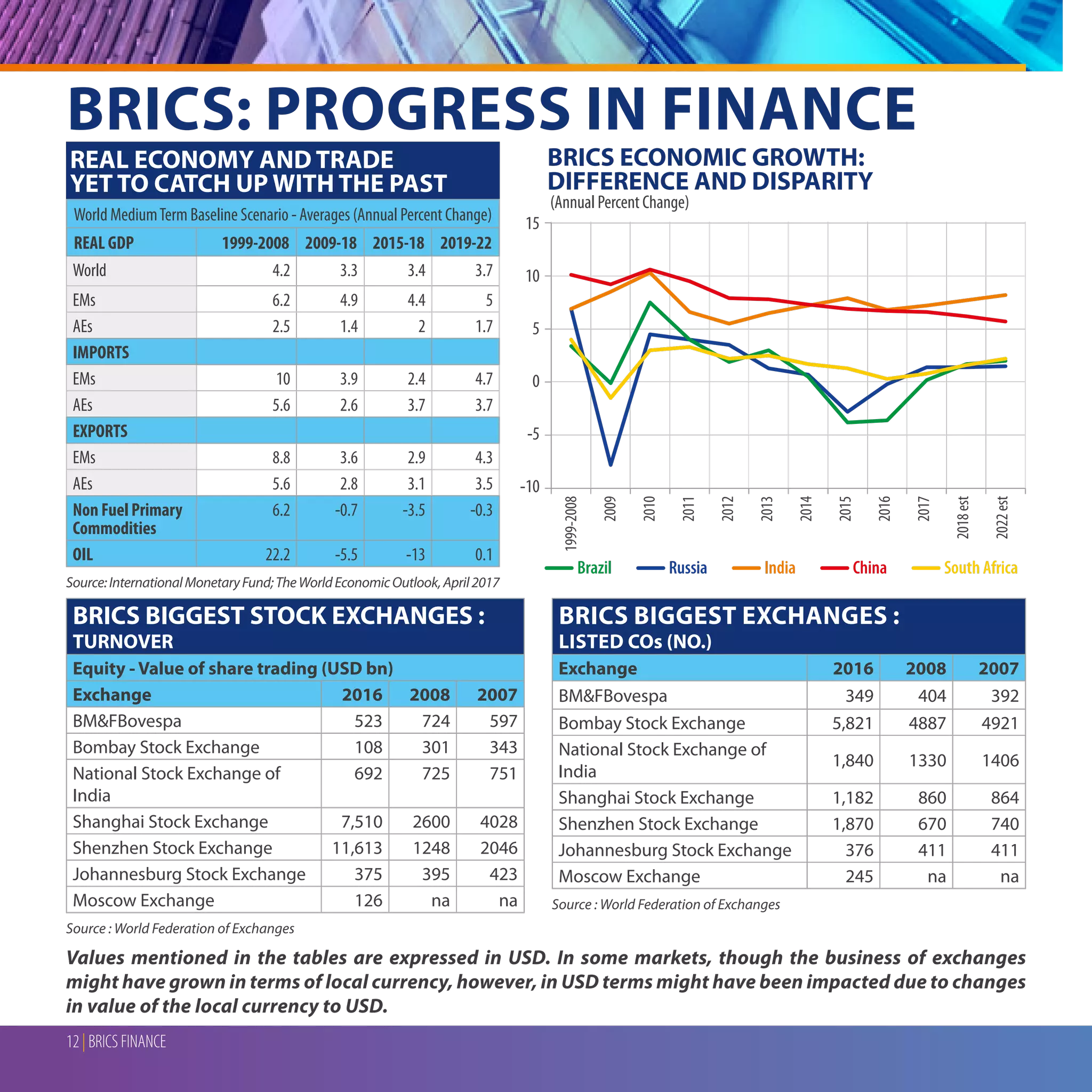
BRICS: PROGRESS IN FINANCE
World MediumTerm Baseline Scenario - Averages (Annual Percent Change)
REAL GDP 1999-2008 2009-18 2015-18 2019-22
World 4.2 3.3 3.4 3.7
EMs 6.2 4.9 4.4 5
AEs 2.5 1.4 2 1.7
IMPORTS
EMs 10 3.9 2.4 4.7
AEs 5.6 2.6 3.7 3.7
EXPORTS
EMs 8.8 3.6 2.9 4.3
AEs 5.6 2.8 3.1 3.5
Non Fuel Primary
Commodities
6.2 -0.7 -3.5 -0.3
OIL 22.2 -5.5 -13 0.1
Source:InternationalMonetaryFund;TheWorldEconomicOutlook,April2017
-10
-5
0
5
10
15
Russia India ChinaBrazil South Africa1999-2008
2009
2010
2011
2012
2013
2014
2015
2016
2017
2018est
2022est
REAL ECONOMY AND TRADE
YET TO CATCH UP WITH THE PAST
BRICS ECONOMIC GROWTH:
DIFFERENCE AND DISPARITY
BRICS BIGGEST STOCK EXCHANGES :
TURNOVER
Equity - Value of share trading (USD bn)
Exchange 2016 2008 2007
BM&FBovespa 523 724 597
Bombay Stock Exchange 108 301 343
National Stock Exchange of
India
692 725 751
Shanghai Stock Exchange 7,510 2600 4028
Shenzhen Stock Exchange 11,613 1248 2046
Johannesburg Stock Exchange 375 395 423
Moscow Exchange 126 na na
Source : World Federation of Exchanges
BRICS BIGGEST EXCHANGES :
LISTED COs (NO.)
Exchange 2016 2008 2007
BM&FBovespa 349 404 392
Bombay Stock Exchange 5,821 4887 4921
National Stock Exchange of
India
1,840 1330 1406
Shanghai Stock Exchange 1,182 860 864
Shenzhen Stock Exchange 1,870 670 740
Johannesburg Stock Exchange 376 411 411
Moscow Exchange 245 na na
Source : World Federation of Exchanges
Values mentioned in the tables are expressed in USD. In some markets, though the business of exchanges
might have grown in terms of local currency, however, in USD terms might have been impacted due to changes
in value of the local currency to USD.
(Annual Percent Change)
GROWTH MARKETS ADVISORY SERVICES | 13
BRICS BANKING
2016 2007
No of Banks in the World Top 1000
Banks
216 110
Brazil 19 19
Russia 15 27
India 40 27
China 136 31
South Africa 6 6
Assets of the Largest BRICS Banks
(USD bn)
28689 5648
Brazil 1608 672
Russia 851 343
India 1948 611
China 23893 3997
South Africa 389 368
Capital of the Largest BRICS Banks
(USD bn)
2011 355
Brazil 116 58
Russia 74 37
India 139 34
China 1656 206
South Africa 26 20
Source : The Banker, London
FINANCIAL DEVELOPMENT INDICATORS : COUNTRY RANKINGS
Financial
Dev.
Index
Financial
Instl.
Index
Financial
Markets
Index
Financial
Instl.
Depth
Financial
Instl.
Access
Financial
Instl.
Efficiency
Financial
Markets
Depth
Financial
Markets
Access
Financial
Markets
Efficiency
Brazil 25 15 31 30 2 143 41 41 19
Russia 32 46 19 89 10 166 37 23 11
India 51 102 38 61 120 103 33 61 26
China 33 57 20 40 100 4 27 59 3
South Africa 28 28 30 9 76 68 18 62 25
Source:InternationalMonetaryFund,2013
BRICS STOCK MARKETS
2016 2008 2007
Market Capitalization
(USD bn)
11208 3498 8494
Brazil 759 591 1369
Russia 622 na na
India 1566 647 1819
China 7310 1778 4478
South Africa 951 482 828
Value of Share Trading
(USD bn)
20947 5993 8034
Brazil 523 724 597
Russia 126 na na
India 800 1026 940
China 19123 3848 6074
South Africa 375 395 423
Number of Listed
Companies
9843 7328 7232
Brazil 349 392 404
Russia 245 na na
India 5821 4921 4887
China 3052 1604 1530
South Africa 376 411 411
Source : World Federation of Exchanges
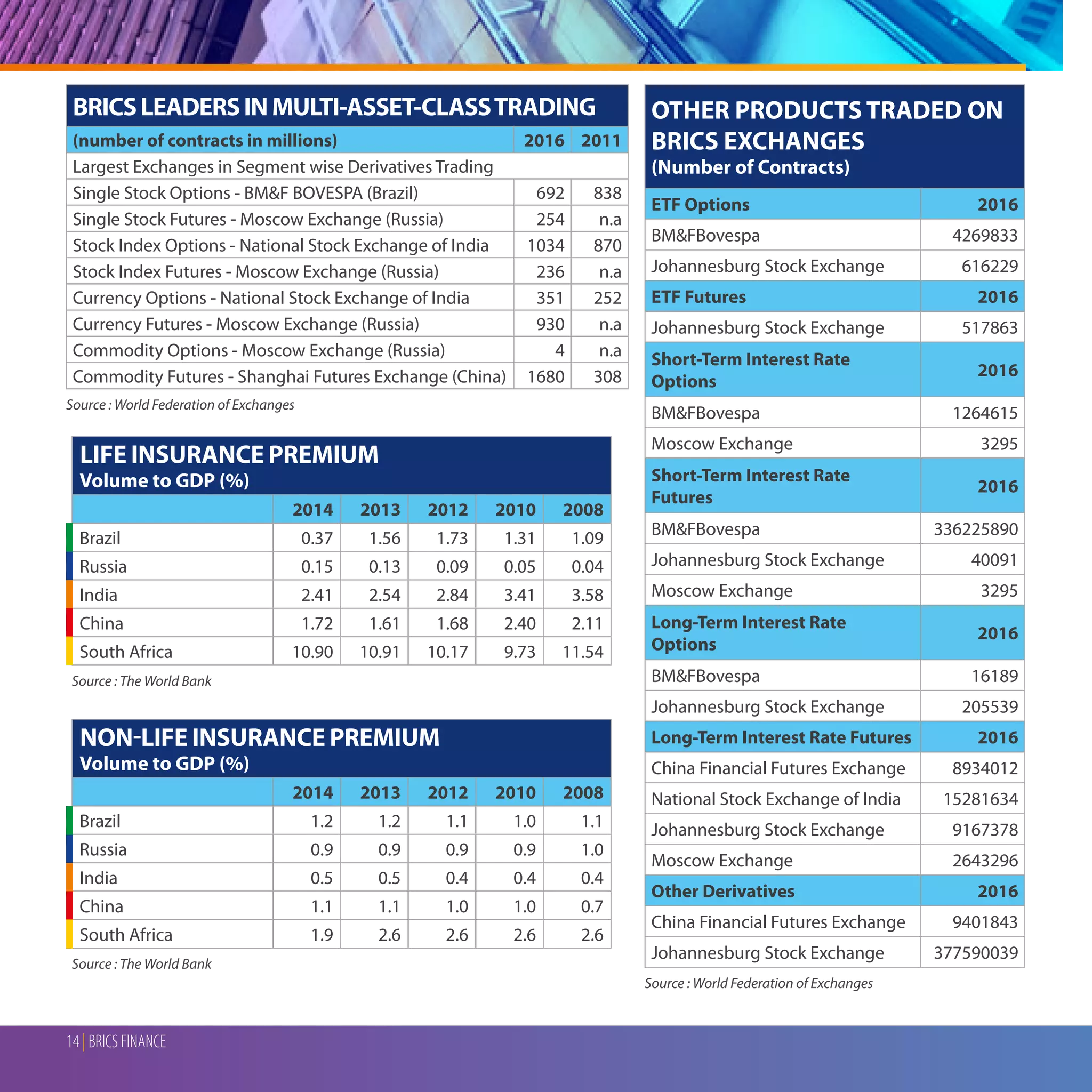
14 | BRICS FINANCE
BRICSLEADERSINMULTI-ASSET-CLASSTRADING
(number of contracts in millions) 2016 2011
Largest Exchanges in Segment wise Derivatives Trading
Single Stock Options - BM&F BOVESPA (Brazil) 692 838
Single Stock Futures - Moscow Exchange (Russia) 254 n.a
Stock Index Options - National Stock Exchange of India 1034 870
Stock Index Futures - Moscow Exchange (Russia) 236 n.a
Currency Options - National Stock Exchange of India 351 252
Currency Futures - Moscow Exchange (Russia) 930 n.a
Commodity Options - Moscow Exchange (Russia) 4 n.a
Commodity Futures - Shanghai Futures Exchange (China) 1680 308
Source : World Federation of Exchanges
OTHER PRODUCTS TRADED ON
BRICS EXCHANGES
(Number of Contracts)
ETF Options 2016
BM&FBovespa 4269833
Johannesburg Stock Exchange 616229
ETF Futures 2016
Johannesburg Stock Exchange 517863
Short-Term Interest Rate
Options
2016
BM&FBovespa 1264615
Moscow Exchange 3295
Short-Term Interest Rate
Futures
2016
BM&FBovespa 336225890
Johannesburg Stock Exchange 40091
Moscow Exchange 3295
Long-Term Interest Rate
Options
2016
BM&FBovespa 16189
Johannesburg Stock Exchange 205539
Long-Term Interest Rate Futures 2016
China Financial Futures Exchange 8934012
National Stock Exchange of India 15281634
Johannesburg Stock Exchange 9167378
Moscow Exchange 2643296
Other Derivatives 2016
China Financial Futures Exchange 9401843
Johannesburg Stock Exchange 377590039
Source : World Federation of Exchanges
LIFE INSURANCE PREMIUM
Volume to GDP (%)
2014 2013 2012 2010 2008
Brazil 0.37 1.56 1.73 1.31 1.09
Russia 0.15 0.13 0.09 0.05 0.04
India 2.41 2.54 2.84 3.41 3.58
China 1.72 1.61 1.68 2.40 2.11
South Africa 10.90 10.91 10.17 9.73 11.54
Source : The World Bank
NON-LIFE INSURANCE PREMIUM
Volume to GDP (%)
2014 2013 2012 2010 2008
Brazil 1.2 1.2 1.1 1.0 1.1
Russia 0.9 0.9 0.9 0.9 1.0
India 0.5 0.5 0.4 0.4 0.4
China 1.1 1.1 1.0 1.0 0.7
South Africa 1.9 2.6 2.6 2.6 2.6
Source : The World Bank
GROWTH MARKETS ADVISORY SERVICES | 15
BRICS BIGGEST DERIVATIVES EXCHANGES (Number of Contracts traded in millions)
NAME OF THE EXCHANGE 2015 2014 2010 2006
National Stock Exchange of India (Equity & Currency Derivatives) 3,031 1,880 1,615 194
Moscow Exchange (Currency Derivatives) 1,659 1,413 na na
BM&FBovespa (Bond & Currency Derivatives)
(Bolsa de Mercadorias & Futuros + Bolsa de Valores de Sao Paulo)
1,358 1,420 1,413 570
Dalian Commodity Exchange (Commodity Derivatives) 1,116 769 403 120
Zhengzhou Commodity Exchange (Commodity Derivatives) 1,070 676 495 46
Shanghai Futures Exchange (Commodity Derivatives) 1,050 842 621 58
Bombay Stock Exchange (Equity & Currency Derivatives) 614 725 na na
Johannesburg Stock Exchange (Equity, Bonds, Financial Commodity and
Interest Rate Derivatives)
488 304 169 105
China Financial Futures Exchange (Equity & Bond Derivatives) 321 217
MCX (Commodity Derivatives) 216 133 197 45
NCDEX (Commodity Derivatives) 29 30 na 53
Source: FIA
BRICS SME CAPITAL MARKETS
MAIN BOARD SME EXCHANGE
LISTED
COMPANIES
MARKET CAP ($ mn)
BM&FBovespa Bovespa Mais 14 478
Bombay Stock Exchange Small & Medium Enterprises 151 2779
Hong Kong Exchanges & Clearing Growth & Enterprise Market 260 40090
National Stock Exchange of India SME Emerge 32 208
Shenzhen Stock Exchange Chinext 570 753545
Johannesburg Stock Exchange
Enterprise Securities Market/Alternative
Exchange/Venture Capital Market
56 1042
Moscow Exchange Innovations and Investments Market 12 3660
Source : World Federation of Exchanges
16 | BRICS FINANCE
PAPERS ON BRICS FINANCIAL MARKETS
A few papers on BRICS financial markets by the author
BRICS DYNAMICS
PRESENTATION MADE TO HEC MONTREAL, CAMPUS ABROAD, MUMBAI Presented by
Dr. Bandi Ram Prasad
GROWTH MARKETS ADVISORY SERVICES
MUMBAI, INDIA
bandi.ramprasad@gmail.com
BUILDING A COMMODITY EXCHANGE
SCOPE AND STRATEGY
PRESENTATION TO THE WORKING GROUP ON THE
MINERAL RESOURCE EXCHANGE MONGOLIA
APRIL 23, 2015,
INTEGRATED MINERAL RESOURCE INITIATIVE
DEUTSCHE GESELLSCHAFT fuer INTERNATIONALE ZUSAMMENARBEIT
ULAANBATAR, MONGOLIA
GROWTH MARKETS ADVISORY SERVICES | 17
SAARCCAPITAL MARKETS
IS IT THE TIME TO GIVE A PUSH?
Presented by
Dr. Bandi Ram Prasad
GROWTH MARKETS ADVISORY SERVICES
MUMBAI, INDIA
bandi.ramprasad@gmail.com
PUBLIC SECTOR BANKS IN INDIA
MORE MALIGNED AND MUCH
MISUNDERSTOOD
Presented by
Dr. Bandi Ram Prasad
GROWTH MARKETS ADVISORY SERVICES
MUMBAI, INDIA
bandi.ramprasad@gmail.com
18 | BRICS FINANCE
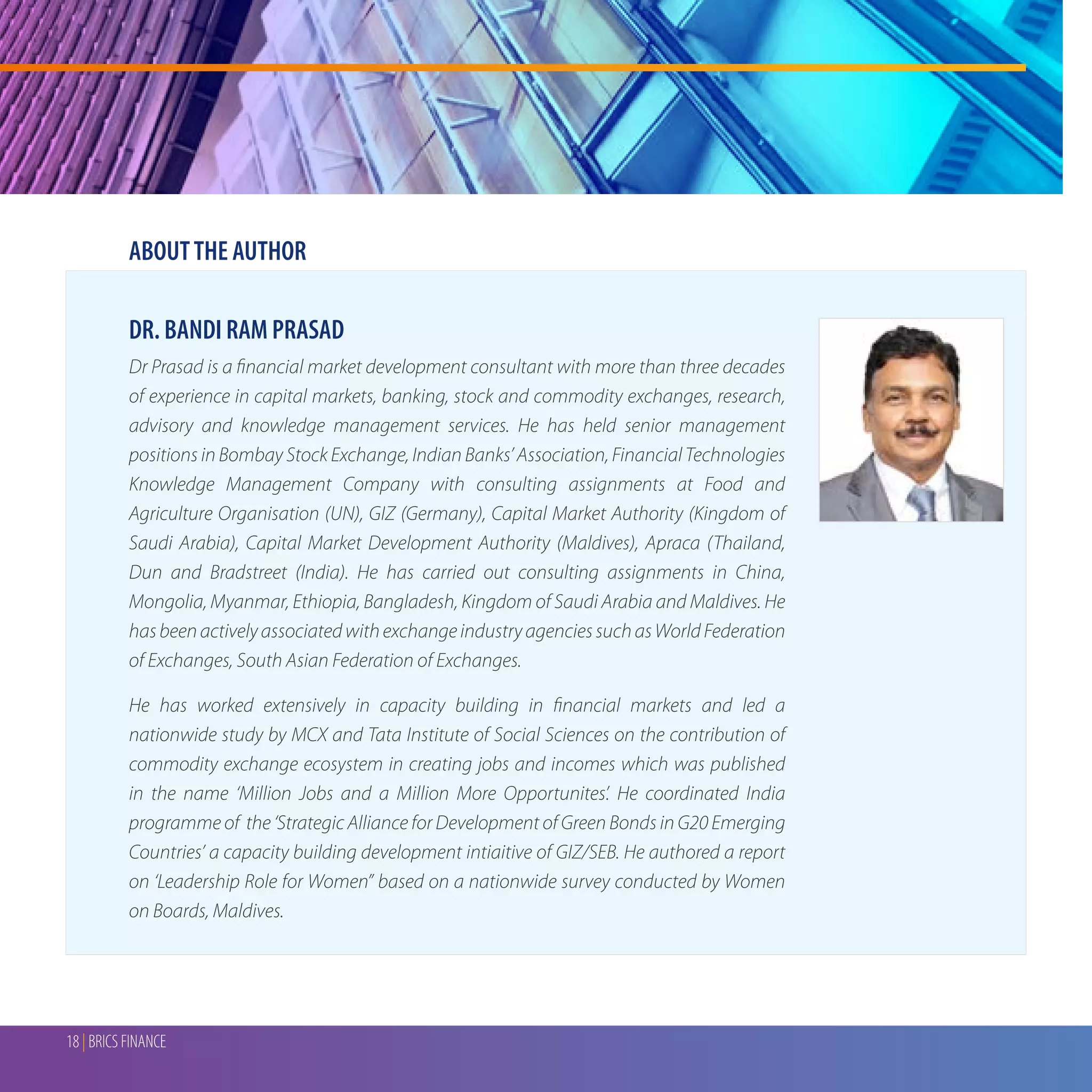
DR. BANDI RAM PRASAD
Dr Prasad is a financial market development consultant with more than three decades
of experience in capital markets, banking, stock and commodity exchanges, research,
advisory and knowledge management services. He has held senior management
positions in Bombay Stock Exchange, Indian Banks’ Association, Financial Technologies
Knowledge Management Company with consulting assignments at Food and
Agriculture Organisation (UN), GIZ (Germany), Capital Market Authority (Kingdom of
Saudi Arabia), Capital Market Development Authority (Maldives), Apraca (Thailand,
Dun and Bradstreet (India). He has carried out consulting assignments in China,
Mongolia, Myanmar, Ethiopia, Bangladesh, Kingdom of Saudi Arabia and Maldives. He
hasbeenactivelyassociatedwithexchangeindustryagenciessuchasWorldFederation
of Exchanges, South Asian Federation of Exchanges.
He has worked extensively in capacity building in financial markets and led a
nationwide study by MCX and Tata Institute of Social Sciences on the contribution of
commodity exchange ecosystem in creating jobs and incomes which was published
in the name ‘Million Jobs and a Million More Opportunites’. He coordinated India
programme of the ‘Strategic Alliance for Development of Green Bonds in G20 Emerging
Countries’ a capacity building development intiaitive of GIZ/SEB. He authored a report
on ‘Leadership Role for Women” based on a nationwide survey conducted by Women
on Boards, Maldives.
ABOUTTHE AUTHOR
GROWTH MARKETS ADVISORY SERVICES | 19
Growth has become an important aspiration and imperative for countries. Globalization and liberalization
has enhanced the access to global markets for resources and brought it within the reach of all countries. To
harness this benefit, it is important for countries in transition to design and develop efficient and transparent
financial market infrastructures with effective frameworks for policy, regulation and market conduct and an
extensive capacity building that will engage with numerous stakeholders to empower them with benefits of
market development.
Asoundstrategybackedwithaclear,defined,andproperlysequencedplanofactionforcreatingcomprehensive
markets structures and pursuing sustained initiatives to create depth and diversity is an important challenge.
Growth Markets Advisory Services is engaged in helping and assisting institutions to learn about opportunities
in financial markets development, extend help and guidance in various processes of building financial
market infrastructure, designing responsible governance and management structures and devising market
development strategies, capacity building, research, communication, evaluation, stakeholder engagement,
financial literacy, investor education and knowledge management.
SECTORS & SEGMENTS
Capital Markets | Banking | Investors | Stock Exchanges | Commodity Exchanges | Intermediaries | SMEs
SPECIALISATION
Consulting | Research | Advisory Services | Executive Education
SERVICES
Policy Advocacy | Market Development Strategies | Business Development | Capacity Building | Growth
Management|Education|KnowledgeManagement|CorporateGovernance|MarketCommunications|Financial
Education | Investor Awareness | Corporate Films & Videos | Research & Publications | Conferences & Seminars
Growth Markets Advisory Services
A 204, Mary Ellen, Mhatarpada Road, Amboli, AndheriWest, Mumbai : 400 058
Tel : +91 22 26777000 | Mob : +91 98201 59618 | 98200 98188
Email : bandi.ramprasad@gmail.com

BRICS : AREAS OF COOPERATION AND INNOVATION

  • 1.
    AREAS OF COOPERATIONAND RELATED INNOVATIONS RB I CSBRAZIL RUSSIA INDIA CHINA S AFRICA Presented by Dr. Bandi Ram Prasad GROWTH MARKETS ADVISORY SERVICES MUMBAI, INDIA bandi.ramprasad@gmail.com 9TH BRICS ACADEMIC FORUM ORGANISED BY CHINA COUNCIL FOR BRICSTHINKTANKS COOPERATION 10-13, JUNE 2017 | FUZHOU, CHINA
  • 2.
    The author acknowledgesthe invitation and hospitality extended by the China Council for BRICS Think Tanks Cooperation to the 9th BRICS Academic Forum at which this short note is presented. Disclaimer: This briefing is prepared for academic purposes and discussion during the meeting and is not intended to create any context for commercial decisions. Data used in this briefing is drawn from public sources by way of access to print publications and through the internet. Facts presented in this note are as available in the public sources and not independently checked with respective countries about their accuracy and authenticity as these are meant only for general discussion and not to make any particular comment or observation on any country or institution. This briefing is prepared for internal discussions and reference and is not meant for any commercial sale. Author holds no responsibility for the data. Growth Markets Advisory Services, its promoters, owners and management as also the hosts of the Academic Forum disclaim any responsibility arising from this note.
  • 3.
    AREAS OF COOPERATIONAND RELATED INNOVATIONS RB I CSBRAZIL RUSSIA INDIA CHINA S AFRICA 9TH BRICS ACADEMIC FORUM ORGANISED BY CHINA COUNCIL FOR BRICSTHINKTANKS COOPERATION 10-13, JUNE 2017 | FUZHOU, CHINA Key Challenges | 4 Areas of Cooperation | 7 BRICS: Progress in Finance | 12
  • 4.
    4 | BRICSFINANCE KEY CHALLENGES B R I C S GROWTH AND STABILITY The world economy is dithering in gaining pace in growth. Growth of real GDP across all regions that began to falter following the financial crisis in 2008, is yet to recover to the growth levels seen during the period 1999-2008. ‘Gaining Momentum?’ is what IMF in its latest WEO (April 2017) sought to seek, given the pace at which world economic growth began to pick up, however it has concerns over risks that still prevail. SLOWDOWN INTRADE AND RISING PROTECTIONISM External trade in terms of exports and imports have seen sharp deterioration. Globally exports have halved with advanced and emerging & developing economies showing sharp decline in the growth of trade since 2009. At the same time, the world is seeing growing protectionism. Since 2008, according to the WTO, G20 economies have introduced 1,583 new trade restricting measures and removed just 387 giving rise to fears of a quick revival of economic growth. DEBT AND LEVERAGE Corporate debt of non-financial firms in emerging markets rose from $2 trillion in 2004 to $18 trillion in 2014. Easy money conditions in the developed markets and search for yield by global investors induced corporates in the emerging markets to borrow heavily with corporate debt/GDP ratio rising by 26 percentage points during 2003-14. China and India have seen sharp rise in corporate debt levels. FINANCIAL MARKETS While the presence of BRICS in the global financial markets is sizeable, scope exists for further progress in regard to aspects such as access to finance. BRICS has seen evolution of multi-asset-class markets growing at rapid pace that calls for intensification of financial literacy and investor education. Also required will be strengthening of the governance and management standards in financial institutions to stem vulnerabilities.
  • 5.
    GROWTH MARKETS ADVISORYSERVICES | 5 INCLUSION AND INEQUALITY BRICS countries witnessed sharp surge in income inequalities in the last two decades. Global inequality is described to be worse than at any time since the 19th century with largest gains having accrued to the top 1% of the population which has been the experience in countries like China and India. Labour too is seen to be missing on the benefits from growth. GOVERNANCE OF PUBLIC INSTITUTIONS A major challenge facing the emerging markets including the BRICS is the quality of governance standards with people holding public office found to be wanting in conduct of public office. Institutions are coming into public glare for deviations in governance and management standards. Erosion of trust could impair the credibility. DIVERSITY AND EMPOWERMENT Diversity and empowerment are the principles which BRICS countries have embedded in their philosophy and strategy for growth, yet sizeable gaps exist in terms of implementation. Representation of women on the Boards and management of corporate sector in the public and private sectors in the BRICS is still found to be lower as compared to international experience. CSR initiatives too need a step up. SUSTAINABLE DEVELOPMENT GOALS Millennium Development Goals have given way for Sustainable Development Goals, yet the challenges remain quite daunting and achieving the goals still remains at quite a distance. The thrust now is to move towards sustainable economies that envisage greater focus on renewables and low carbon footprint with economies choosing alternative modes of financing such as green finance. CYBER SECURITY The global cost of cyber crime is continuously increasing with its cost likely touch $6 trillion by 2021. Global spending on countering cyber crime is expected to exceed $3 trillion cumulatively over the period 2017-21. Cyber attacks which are now becoming more frequent are also causing severe disruptions in business leading to higher costs of maintaining safety and security of the IT.
  • 6.
    6 | BRICSFINANCE CONFLICTS AND STRIFES Conflicts and strifes disrupt peace and order. In 2016, about 87 million people were directly affected by strife in Iraq, Libya, Syria and Yemen. In Syria and Iraq if there was no strife per capita incomes would have been higher by 23% and 28% respectively. Lost output is in billions of dollars. In addition, security risks across a large number of developed and developing economies remain elevated involving huge costs in terms of stepping up security measures and strengthening related resources. SKILLS AND EXPERTISE India has plans to create a resource pool of 500 million workers. China is likely to see a gap of 24 million workers in university and vocational labour and if not addressed could impose additional burden of $250 billion on Chinese companies. The need for developing soft skills is of importance in which the governments need to take proactive measures in creating policies for a conducive environment for skill development that benefits a large part of the population. DIGITAL ECONOMY : FOURTH INDUSTRIAL REVOLUTION With digital economy gaining momentum, it brings major transformation in the processes involving business, operations, delivery and distributions standards, customer service and consumer protection, which are all required to be aligned with the global template. Digital economy also envisages much freer and faster moving environments that rely on internet and other advances in artificial intelligence, robotics, various aspects of which need to be fully absorbed and assimilated across policy, regulation and market practice. The success in managing the fourth industrial revolution will determine the prospects of any nation in regard to its long term sustainability and the prospects of the people for a better future. POLICY DISCONNECT The biggest challenge to policy making has been growing disconnect between the real economy and the financial markets. While real economy is yet to recover to the pre-crisis levels, financial markets surged to new highs never seen in the past. A concern that continues to bother is that much of the stimulus package benefit has flown more to stock markets and in building asset prices rather than stoking the pace of real economy growth. Going forward and in the context of slowing growth and stalling trade but surging asset prices, greater coordination is warranted in which BRICS countries can play a more meaningful role. B R I C S
  • 7.
    GROWTH MARKETS ADVISORYSERVICES | 7 The challenges that are emerging in the realm of politics and economics are quite intense and stressful. However, BRICS countries can harness their strengths to help and support each other in aspects of growth, development, investment and equality which are so critical to create sustainable economies. Keeping away from ideologies and political inclinations and approaches to governance and management of economic systems, BRICS can consider using their key strengths and success factors for the common benefit of the group as also other countries. A few areas that offer scope for enhanced efforts and elevated levels of cooperation and collaboration are discussed below. The concept of BRICS came as an investment idea for international investors. What is seen after a decade of BRICS movement is that this grouping transformed and developed into a huge market by itself giving that much power to these countries to emerge as investors. BRICS countries are now among the major international investors. The economic and financial prowess of BRICS is further invigorated by the distinct progress the group had made in developing multi-asset-class market segments the scale and size of which even surpasses that of some major developed markets. FINANCIAL MARKETS The scope of BRICS finance as it evolved in the last decade of its cooperation and collaboration is quite sizeable. For instance, in 2007 BRICS had only 110 banks among the World’s Top 1000 Banks compiled by The Banker, London. By 2015-16 the number crossed the 200 level. The growth in capital, assets and profits of the BRICS banks grew at a phenomenalpaceinthelasttenyearswithbanksinBrazilandRussiaseeingsizeablerestructuringandreorganization. In terms of capital markets too, the progress has been spectacular. Stock market capitalization, value of share trading, growth in the number of contracts traded in various derivative market segments such as equities, currencies, bonds andcommoditieshavegrownmanifoldandcurrentlythesecountriescommandtoppositionsingloballeaguetables. A wide range of products offered by the exchanges demonstrate the prowess of the BRICS countries in matching with the pace and diversity of the developed world in developing and deepening of the financial markets.The share of BRICS in many financial indicators has also risen impressively in the last one decade of BRICS cooperation. AREAS OF COOPERATION
  • 8.
    8 | BRICSFINANCE BRICS can harness the advances that it achieved in financial market development to help other countries develop efficient and robust primary markets for resource mobilization and secondary markets for creating liquidity, instruments and innovations for hedging risk that all will be of immense value and use for expanding the realm of the real economy and pursuing stability and sustainability. In the background of uneven and disproportionate economic growth rates within the BRICS grouping, it could become an imperative to harness the power and potential of the financial sector to deepen the access to finance and empower the players of the real economy. Establishment of an exclusive multilateral development financial institution, National Development Bank (NDB) by the BRICS and Asian Infrastructure Bank by China and other development initiatives to promote trade and commerce that support economic growth can only add more value to the scope of cooperation and collaboration. STARTUP ECOSYSTEMS AND SMEs An area of cooperation that BRICS could engage in is to expand the scope of collaboration in developing efficient ecosystem for startups and the development of SMEs. China and India are featured among the top 20 global startup ecosystems. Beijing and Shanghai in China and Bengaluru in India are among the top 20 global startup ecosystems ranked by Startup Genome. Cities in other BRICS countries such as Sau Paulo, Moscow, CapeTown and Johannesburg are featured among the leading regional startup ecosystems in the world. BRICS is also the home for some of the leading Unicorns that enjoy valuations of $1 billion or more. China has 49 Unicorns, India 9 and South Africa 1 among the top 200 unicorns in the world with companies like China’s Didi Chuxing valued at around $50bn and Flipkart of India at about $10bn. Similarly BRICS countries also host stronger SME capital markets for helping out SMEs with cost effective resource mobilization. All the main boards of the BRICS stock exchanges have their respective SME capital markets for capital issuance and trading. Countries like China and India are seeing robust growth in the newer SMEs entering capital markets for resource mobilization that could augur well for promoting them across the BRICS community The power of the Startups and SME capital markets that BRICS hold could play a pivotal role in harnessing each other’s potential and also help the prospects for other developing countries. Creation of conducive environment for Startups and SMEs, which are vital for any country is the outcome of progressive development policies of the governments that could be of great use as an intervention and instrument in expanding the sphere of growth opportunities and development engagement. B R I C S
  • 9.
    GROWTH MARKETS ADVISORYSERVICES | 9 SUSTAINABLE FINANCE An important and emerging area that has great relevance for future and in which BRICS has good potential to play a prominent role, which it is already playing to a significant extent is the promotion of sustainable finance. Though United States announced its withdrawal from the Paris Agreement on Climate Change (2015), the accord was signed by 188 countries with countries in BRICS reiterating their respective commitments to the global initiative. The size of green finance is showing sustained increase with the universe of climate aligned bonds growing to $694 billion with 3590 bonds and 780 issuers. Labelled bonds itself account for $118 billion. According to OECD, an estimated $6-7 trillion of annual investment is needed globally for the next 15 years to meet requirements of green investment in areas such as environmental remediation, energy efficiency, clean energy, clean transportation and green buildings that are found vital to facilitate transition to an environmentally sustainable and low carbon economy. Many exchanges in BRICS are signatories to the Sustainable Stock Exchange Initiative that promote investments compatible with achieving certain standards in environment, sustainability and governance. China and India lead other markets in the issuance of green bonds. China has put in place measures to strengthen further issuance of the green bonds such as publishing Green Financial Bond Guidelines for issuance of Green Bonds by financial institutions; Green Finance Committee of China Society of Banking and Finance (supervised by PBOC) issued“Green Bond Endorsed Project Catalogue” with Shanghai and Shenzhen Stock Exchanges issuing guidelines for listing of green bonds. SKILL DEVELOPMENT Rapid transformation brought about the digital economy, fintech, e-commerce and internet based work culture has an important bearing on the skill-sets and expertise required and to be developed. Countries are gearing up to create vast pools of skilled people and develop expertise required in emerging areas of information technology, communications, digital economy, artificial intelligence, robotics etc., China and India have drawn ambitious skill development plans and programmes involving a large number of people and even exploring cooperative endeavours and collaboration in pursuit of capacity building. According to OECD, digital technologies is reshaping business models and firms’ organization, and making “soft skills”, such as information-processing, self-direction, problem-solving and communication, become more important. Many people, however, do not seem to have such
  • 10.
    10 | BRICSFINANCE skills for a digital world; as OECD estimates show, less than 40% of those using software at work every day have the skills required to use digital technologies effectively. A typical strategy for successful skill development programme should consist of prioritizing investments for skill development, combine short and long term consideration, foster a comprehensive approach covering the public and the private sector, align requirements of different levels of the government and include all relevant skill development stakeholders in the programme. BRICS could design a cooperative framework where collaborations between BRICS countries and their key respective key partners could come together to create a robust and vibrant environment that will be conducive to create vast pools of skills and expertise to help better management of industries and businesses of the future as also harness their potential for the larger benefit of the general public. GENDER DIVERSITY AND EMPOWERMENT The United Nations promoted the idea of gender equality and empowerment of women as an important task of the Millennium Development Goals (2000) which was further reiterated in the Sustainable Development Goals made in 2015. A study by the Asian Development Bank found that US and European firms on average do better in regard to gender diversity followed on the Boards compared to firms in Asia and the rest of the world. In 2012, 90 of the S&P500 companies in the US have had at least one woman on their boards. In China female representation on the Board is at 8.5% and in India at 5.2% as compared to 40% in Norway, 27% in Sweden and Finland, 21% in United Kingdom and 17% in the United States. BRICS could work together in helping one another expanding the scope of gender diversity as also guiding other developing countries in achieving progress in empowerment that is found to contribute to sizeable additions to pace of economic growth and quality of development . THE DISCONNECT OF MARKETS ANDTHE REAL ECONOMY Before the global financial crisis in 2008, much of the focus of discussion was on ‘Decoupling’ with analysis that revolved around the decline of dependence of the emerging markets on the developed markets. Following the crisis, unprecedented size of stimulus packages were announced by developed and emerging markets to revive the economy with little success. While a large part of the easy money policies flew to building asset prices more B R I C S
  • 11.
    GROWTH MARKETS ADVISORYSERVICES | 11 so in the stocks, real economy remained sluggish showing slow growth for long. The World Economic Outlook in the last few years came out with reports that described the ‘new mediocre’ in world economic growth that was reflected in the themes chosen for the Outlook such as‘Rebalancing Growth’(2010), Slowing Growth, Rising Risks (2011), Growth Resuming, Dangers Remain (2012), Uneven Growth Short-and Long-Term Factors (2015), Too Slow for Too Long (2016) which all reflected the futility of so much of stimulus management not able to revive the growth of the real economy. On the contrary much of the stimulus benefit flowing into boosting asset prices has been a big concern daunting the policy management of the developed and developing markets where BRICS is no exception. Also some economies witnessed unprecedented surge in stock prices and sudden crashes leading to increased volatility and causing disruption in the real economy. A policy related concern that continues even today. Billions of dollars of money was pumped up by the central banks in the form of stimulus programmes since the crisis began only to see financial assets worldwide grew to $256 trillion in 2014 from $184 trillion in 2008 and S&P reaching to one of the longest bull runs this year. In contrast, the real economy continues to wobble. A spate of quantitative easing, zero interest rates turning into negative, helicopter money policies proved to be of little effect. BRICS could explore opportunities for harnessing their strengths in order to make policy more effective in terms of their policy measures not leading to distortions. Going forward this will be a big challenge for the BRICS in the context of cooling economic growth rates, stalling trade, rising volatility, growing currency risks which all can have a telling impact on the pace of development process. THE STATE ANDTHE MARKETS A major outcome of the crisis in 2008 was the return of the State in finance. Even in developed markets like US and Europe, the Government had to intervene providing capital and other support to enable banks, financial institutions and in some occasions even corporates to tide over the crisis. In BRICS, the State is predominant across the economy and finance. Given the renewed recognition for the role of the State in finance (World Bank’s World Financial Development Report-2013; ‘Rethinking the Role of the State in Finance’) the governments of the BRICS have an important opportunity to evolve and establish ownership neutral policy frameworks in pursuing growth, sustainability and stability.TheWorld Bank’s report emphasizes that the State has a crucial role in the financial sector. It needs to provide strong prudential supervision, ensure healthy competition and enhance financial infrastructure.
  • 12.
    12 | BRICSFINANCE BRICS: PROGRESS IN FINANCE World MediumTerm Baseline Scenario - Averages (Annual Percent Change) REAL GDP 1999-2008 2009-18 2015-18 2019-22 World 4.2 3.3 3.4 3.7 EMs 6.2 4.9 4.4 5 AEs 2.5 1.4 2 1.7 IMPORTS EMs 10 3.9 2.4 4.7 AEs 5.6 2.6 3.7 3.7 EXPORTS EMs 8.8 3.6 2.9 4.3 AEs 5.6 2.8 3.1 3.5 Non Fuel Primary Commodities 6.2 -0.7 -3.5 -0.3 OIL 22.2 -5.5 -13 0.1 Source:InternationalMonetaryFund;TheWorldEconomicOutlook,April2017 -10 -5 0 5 10 15 Russia India ChinaBrazil South Africa1999-2008 2009 2010 2011 2012 2013 2014 2015 2016 2017 2018est 2022est REAL ECONOMY AND TRADE YET TO CATCH UP WITH THE PAST BRICS ECONOMIC GROWTH: DIFFERENCE AND DISPARITY BRICS BIGGEST STOCK EXCHANGES : TURNOVER Equity - Value of share trading (USD bn) Exchange 2016 2008 2007 BM&FBovespa 523 724 597 Bombay Stock Exchange 108 301 343 National Stock Exchange of India 692 725 751 Shanghai Stock Exchange 7,510 2600 4028 Shenzhen Stock Exchange 11,613 1248 2046 Johannesburg Stock Exchange 375 395 423 Moscow Exchange 126 na na Source : World Federation of Exchanges BRICS BIGGEST EXCHANGES : LISTED COs (NO.) Exchange 2016 2008 2007 BM&FBovespa 349 404 392 Bombay Stock Exchange 5,821 4887 4921 National Stock Exchange of India 1,840 1330 1406 Shanghai Stock Exchange 1,182 860 864 Shenzhen Stock Exchange 1,870 670 740 Johannesburg Stock Exchange 376 411 411 Moscow Exchange 245 na na Source : World Federation of Exchanges Values mentioned in the tables are expressed in USD. In some markets, though the business of exchanges might have grown in terms of local currency, however, in USD terms might have been impacted due to changes in value of the local currency to USD. (Annual Percent Change)
  • 13.
    GROWTH MARKETS ADVISORYSERVICES | 13 BRICS BANKING 2016 2007 No of Banks in the World Top 1000 Banks 216 110 Brazil 19 19 Russia 15 27 India 40 27 China 136 31 South Africa 6 6 Assets of the Largest BRICS Banks (USD bn) 28689 5648 Brazil 1608 672 Russia 851 343 India 1948 611 China 23893 3997 South Africa 389 368 Capital of the Largest BRICS Banks (USD bn) 2011 355 Brazil 116 58 Russia 74 37 India 139 34 China 1656 206 South Africa 26 20 Source : The Banker, London FINANCIAL DEVELOPMENT INDICATORS : COUNTRY RANKINGS Financial Dev. Index Financial Instl. Index Financial Markets Index Financial Instl. Depth Financial Instl. Access Financial Instl. Efficiency Financial Markets Depth Financial Markets Access Financial Markets Efficiency Brazil 25 15 31 30 2 143 41 41 19 Russia 32 46 19 89 10 166 37 23 11 India 51 102 38 61 120 103 33 61 26 China 33 57 20 40 100 4 27 59 3 South Africa 28 28 30 9 76 68 18 62 25 Source:InternationalMonetaryFund,2013 BRICS STOCK MARKETS 2016 2008 2007 Market Capitalization (USD bn) 11208 3498 8494 Brazil 759 591 1369 Russia 622 na na India 1566 647 1819 China 7310 1778 4478 South Africa 951 482 828 Value of Share Trading (USD bn) 20947 5993 8034 Brazil 523 724 597 Russia 126 na na India 800 1026 940 China 19123 3848 6074 South Africa 375 395 423 Number of Listed Companies 9843 7328 7232 Brazil 349 392 404 Russia 245 na na India 5821 4921 4887 China 3052 1604 1530 South Africa 376 411 411 Source : World Federation of Exchanges
  • 14.
    14 | BRICSFINANCE BRICSLEADERSINMULTI-ASSET-CLASSTRADING (number of contracts in millions) 2016 2011 Largest Exchanges in Segment wise Derivatives Trading Single Stock Options - BM&F BOVESPA (Brazil) 692 838 Single Stock Futures - Moscow Exchange (Russia) 254 n.a Stock Index Options - National Stock Exchange of India 1034 870 Stock Index Futures - Moscow Exchange (Russia) 236 n.a Currency Options - National Stock Exchange of India 351 252 Currency Futures - Moscow Exchange (Russia) 930 n.a Commodity Options - Moscow Exchange (Russia) 4 n.a Commodity Futures - Shanghai Futures Exchange (China) 1680 308 Source : World Federation of Exchanges OTHER PRODUCTS TRADED ON BRICS EXCHANGES (Number of Contracts) ETF Options 2016 BM&FBovespa 4269833 Johannesburg Stock Exchange 616229 ETF Futures 2016 Johannesburg Stock Exchange 517863 Short-Term Interest Rate Options 2016 BM&FBovespa 1264615 Moscow Exchange 3295 Short-Term Interest Rate Futures 2016 BM&FBovespa 336225890 Johannesburg Stock Exchange 40091 Moscow Exchange 3295 Long-Term Interest Rate Options 2016 BM&FBovespa 16189 Johannesburg Stock Exchange 205539 Long-Term Interest Rate Futures 2016 China Financial Futures Exchange 8934012 National Stock Exchange of India 15281634 Johannesburg Stock Exchange 9167378 Moscow Exchange 2643296 Other Derivatives 2016 China Financial Futures Exchange 9401843 Johannesburg Stock Exchange 377590039 Source : World Federation of Exchanges LIFE INSURANCE PREMIUM Volume to GDP (%) 2014 2013 2012 2010 2008 Brazil 0.37 1.56 1.73 1.31 1.09 Russia 0.15 0.13 0.09 0.05 0.04 India 2.41 2.54 2.84 3.41 3.58 China 1.72 1.61 1.68 2.40 2.11 South Africa 10.90 10.91 10.17 9.73 11.54 Source : The World Bank NON-LIFE INSURANCE PREMIUM Volume to GDP (%) 2014 2013 2012 2010 2008 Brazil 1.2 1.2 1.1 1.0 1.1 Russia 0.9 0.9 0.9 0.9 1.0 India 0.5 0.5 0.4 0.4 0.4 China 1.1 1.1 1.0 1.0 0.7 South Africa 1.9 2.6 2.6 2.6 2.6 Source : The World Bank
  • 15.
    GROWTH MARKETS ADVISORYSERVICES | 15 BRICS BIGGEST DERIVATIVES EXCHANGES (Number of Contracts traded in millions) NAME OF THE EXCHANGE 2015 2014 2010 2006 National Stock Exchange of India (Equity & Currency Derivatives) 3,031 1,880 1,615 194 Moscow Exchange (Currency Derivatives) 1,659 1,413 na na BM&FBovespa (Bond & Currency Derivatives) (Bolsa de Mercadorias & Futuros + Bolsa de Valores de Sao Paulo) 1,358 1,420 1,413 570 Dalian Commodity Exchange (Commodity Derivatives) 1,116 769 403 120 Zhengzhou Commodity Exchange (Commodity Derivatives) 1,070 676 495 46 Shanghai Futures Exchange (Commodity Derivatives) 1,050 842 621 58 Bombay Stock Exchange (Equity & Currency Derivatives) 614 725 na na Johannesburg Stock Exchange (Equity, Bonds, Financial Commodity and Interest Rate Derivatives) 488 304 169 105 China Financial Futures Exchange (Equity & Bond Derivatives) 321 217 MCX (Commodity Derivatives) 216 133 197 45 NCDEX (Commodity Derivatives) 29 30 na 53 Source: FIA BRICS SME CAPITAL MARKETS MAIN BOARD SME EXCHANGE LISTED COMPANIES MARKET CAP ($ mn) BM&FBovespa Bovespa Mais 14 478 Bombay Stock Exchange Small & Medium Enterprises 151 2779 Hong Kong Exchanges & Clearing Growth & Enterprise Market 260 40090 National Stock Exchange of India SME Emerge 32 208 Shenzhen Stock Exchange Chinext 570 753545 Johannesburg Stock Exchange Enterprise Securities Market/Alternative Exchange/Venture Capital Market 56 1042 Moscow Exchange Innovations and Investments Market 12 3660 Source : World Federation of Exchanges
  • 16.
    16 | BRICSFINANCE PAPERS ON BRICS FINANCIAL MARKETS A few papers on BRICS financial markets by the author BRICS DYNAMICS PRESENTATION MADE TO HEC MONTREAL, CAMPUS ABROAD, MUMBAI Presented by Dr. Bandi Ram Prasad GROWTH MARKETS ADVISORY SERVICES MUMBAI, INDIA bandi.ramprasad@gmail.com BUILDING A COMMODITY EXCHANGE SCOPE AND STRATEGY PRESENTATION TO THE WORKING GROUP ON THE MINERAL RESOURCE EXCHANGE MONGOLIA APRIL 23, 2015, INTEGRATED MINERAL RESOURCE INITIATIVE DEUTSCHE GESELLSCHAFT fuer INTERNATIONALE ZUSAMMENARBEIT ULAANBATAR, MONGOLIA
  • 17.
    GROWTH MARKETS ADVISORYSERVICES | 17 SAARCCAPITAL MARKETS IS IT THE TIME TO GIVE A PUSH? Presented by Dr. Bandi Ram Prasad GROWTH MARKETS ADVISORY SERVICES MUMBAI, INDIA bandi.ramprasad@gmail.com PUBLIC SECTOR BANKS IN INDIA MORE MALIGNED AND MUCH MISUNDERSTOOD Presented by Dr. Bandi Ram Prasad GROWTH MARKETS ADVISORY SERVICES MUMBAI, INDIA bandi.ramprasad@gmail.com
  • 18.
    18 | BRICSFINANCE DR. BANDI RAM PRASAD Dr Prasad is a financial market development consultant with more than three decades of experience in capital markets, banking, stock and commodity exchanges, research, advisory and knowledge management services. He has held senior management positions in Bombay Stock Exchange, Indian Banks’ Association, Financial Technologies Knowledge Management Company with consulting assignments at Food and Agriculture Organisation (UN), GIZ (Germany), Capital Market Authority (Kingdom of Saudi Arabia), Capital Market Development Authority (Maldives), Apraca (Thailand, Dun and Bradstreet (India). He has carried out consulting assignments in China, Mongolia, Myanmar, Ethiopia, Bangladesh, Kingdom of Saudi Arabia and Maldives. He hasbeenactivelyassociatedwithexchangeindustryagenciessuchasWorldFederation of Exchanges, South Asian Federation of Exchanges. He has worked extensively in capacity building in financial markets and led a nationwide study by MCX and Tata Institute of Social Sciences on the contribution of commodity exchange ecosystem in creating jobs and incomes which was published in the name ‘Million Jobs and a Million More Opportunites’. He coordinated India programme of the ‘Strategic Alliance for Development of Green Bonds in G20 Emerging Countries’ a capacity building development intiaitive of GIZ/SEB. He authored a report on ‘Leadership Role for Women” based on a nationwide survey conducted by Women on Boards, Maldives. ABOUTTHE AUTHOR
  • 19.
    GROWTH MARKETS ADVISORYSERVICES | 19 Growth has become an important aspiration and imperative for countries. Globalization and liberalization has enhanced the access to global markets for resources and brought it within the reach of all countries. To harness this benefit, it is important for countries in transition to design and develop efficient and transparent financial market infrastructures with effective frameworks for policy, regulation and market conduct and an extensive capacity building that will engage with numerous stakeholders to empower them with benefits of market development. Asoundstrategybackedwithaclear,defined,andproperlysequencedplanofactionforcreatingcomprehensive markets structures and pursuing sustained initiatives to create depth and diversity is an important challenge. Growth Markets Advisory Services is engaged in helping and assisting institutions to learn about opportunities in financial markets development, extend help and guidance in various processes of building financial market infrastructure, designing responsible governance and management structures and devising market development strategies, capacity building, research, communication, evaluation, stakeholder engagement, financial literacy, investor education and knowledge management. SECTORS & SEGMENTS Capital Markets | Banking | Investors | Stock Exchanges | Commodity Exchanges | Intermediaries | SMEs SPECIALISATION Consulting | Research | Advisory Services | Executive Education SERVICES Policy Advocacy | Market Development Strategies | Business Development | Capacity Building | Growth Management|Education|KnowledgeManagement|CorporateGovernance|MarketCommunications|Financial Education | Investor Awareness | Corporate Films & Videos | Research & Publications | Conferences & Seminars
  • 20.
    Growth Markets AdvisoryServices A 204, Mary Ellen, Mhatarpada Road, Amboli, AndheriWest, Mumbai : 400 058 Tel : +91 22 26777000 | Mob : +91 98201 59618 | 98200 98188 Email : bandi.ramprasad@gmail.com