Download to read offline

![Item 1: Consider static factory
methods instead of constructors
public class Person {
private String name;
private int age;
public Person(String name, int age) {
this.name = name;
this.age = age;
}
}
public static void main(String args[]) {
Person person = new Person("John",20);
}](https://image.slidesharecdn.com/20160616-160616080308/85/20160616-3-320.jpg)
![public class Person {
private String name;
private int age;
private Person(String name, int age) {
this.name = name;
this.age = age;
}
public static Person createPersonWithNameAndAge(String name, int age) {
return new Person(name, age);
}
}
public static void main(String args[]) {
Person person = Person.createPersonWithNameAndAge("John",20);
}](https://image.slidesharecdn.com/20160616-160616080308/85/20160616-4-320.jpg)
![Item 2: Consider a builder when
faced with many constructorparameters
public static void main(String args[]) {
MyCharacter character = new MyCharacter.Builder("Merry")
.wearHead(" ")
.wearBody(" T")
.wearPants(" ")
.build();
System.out.println(">>> Item 2:" + character.toString());
}](https://image.slidesharecdn.com/20160616-160616080308/85/20160616-5-320.jpg)
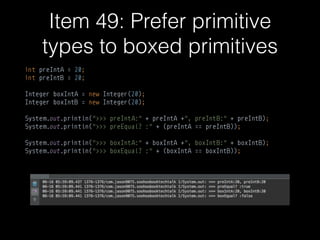
![Macbook Air 10.11.5 (2013)
public static void main(String args[]) {
Long sum = 0L;
for (long i = 0; i < Integer.MAX_VALUE /100 ; i++) {
sum += i;
}
}
vs
public static void main(String args[]) {
long sum = 0L;
for (long i = 0; i < Integer.MAX_VALUE /100 ; i++) {
sum += i;
}
} 0.936 sec
29.438 sec
MAX_VALUE = 2^31 -1](https://image.slidesharecdn.com/20160616-160616080308/85/20160616-7-320.jpg)

![Item 41: Use overloading
judiciously
public class CalculatorMachine {
public CalculatorMachine() {
}
public int add(int a, int b){
return a+b;
}
public int add(int a, int b, int c){
return a+b+c;
}
public int add(double a, double b){
return (int) (a+b);
}
}
public static void main(String args[]) {
CalculatorMachine calculator = new CalculatorMachine();
System.out.println(">>> Item 41:" + calculator.add(1, 5));
System.out.println(">>> Item 41:" + calculator.add(1, 5, 8));
System.out.println(">>> Item 41:" + calculator.add(1.1, 4.3));
}](https://image.slidesharecdn.com/20160616-160616080308/85/20160616-11-320.jpg)
![public static void main(String args[]) {
Set<Integer> set = new TreeSet<>();
List<Integer> list = new ArrayList<>();
for (int i = 51; i $% 56; i++) {
set.add(i); !# [51, 52, 53, 54, 55]
list.add(i); !# [51, 52, 53, 54, 55]
}
set.remove(52);
list.remove(52);
System.out.println(">>> Item 41: set = " + set.toString());
System.out.println(">>> Item 41: list = " + list.toString());
}](https://image.slidesharecdn.com/20160616-160616080308/85/20160616-12-320.jpg)

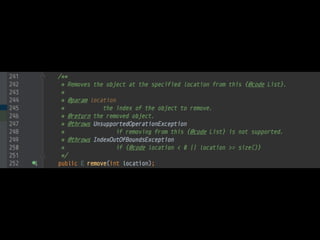
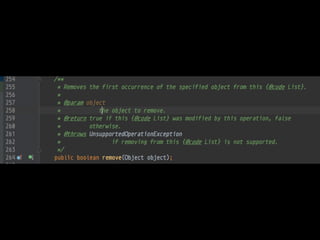
![public static void main(String args[]) {
Set<Integer> set = new TreeSet<>();
List<Integer> list = new ArrayList<>();
for (int i = 51; i $% 56; i++) {
set.add(i); !# [51, 52, 53, 54, 55]
list.add(i); !# [51, 52, 53, 54, 55]
}
set.remove(52);
list.remove((Integer)52);
System.out.println(">>> Item 41: set = " + set.toString());
System.out.println(">>> Item 41: list = " + list.toString());
}](https://image.slidesharecdn.com/20160616-160616080308/85/20160616-16-320.jpg)


This document discusses several items from Effective Java (2nd Edition) by Joshua Bloch related to Java programming best practices. It provides code examples for using static factory methods instead of constructors, using builders for classes with many constructor parameters, preferring primitive types over boxed primitives, and other topics. The examples demonstrate proper and improper usage and the benefits of following best practices related to object creation, collections, and performance.


![[JuraSIC! Meetup] Mateusz Stasch - Monady w .NET](https://cdn.slidesharecdn.com/ss_thumbnails/jurasicmeetupmateuszstasch-monadyw-181026073433-thumbnail.jpg?width=640&height=640&fit=bounds)


