Object Relational
Mapping (ORM)
and Hibernate
Problem
area
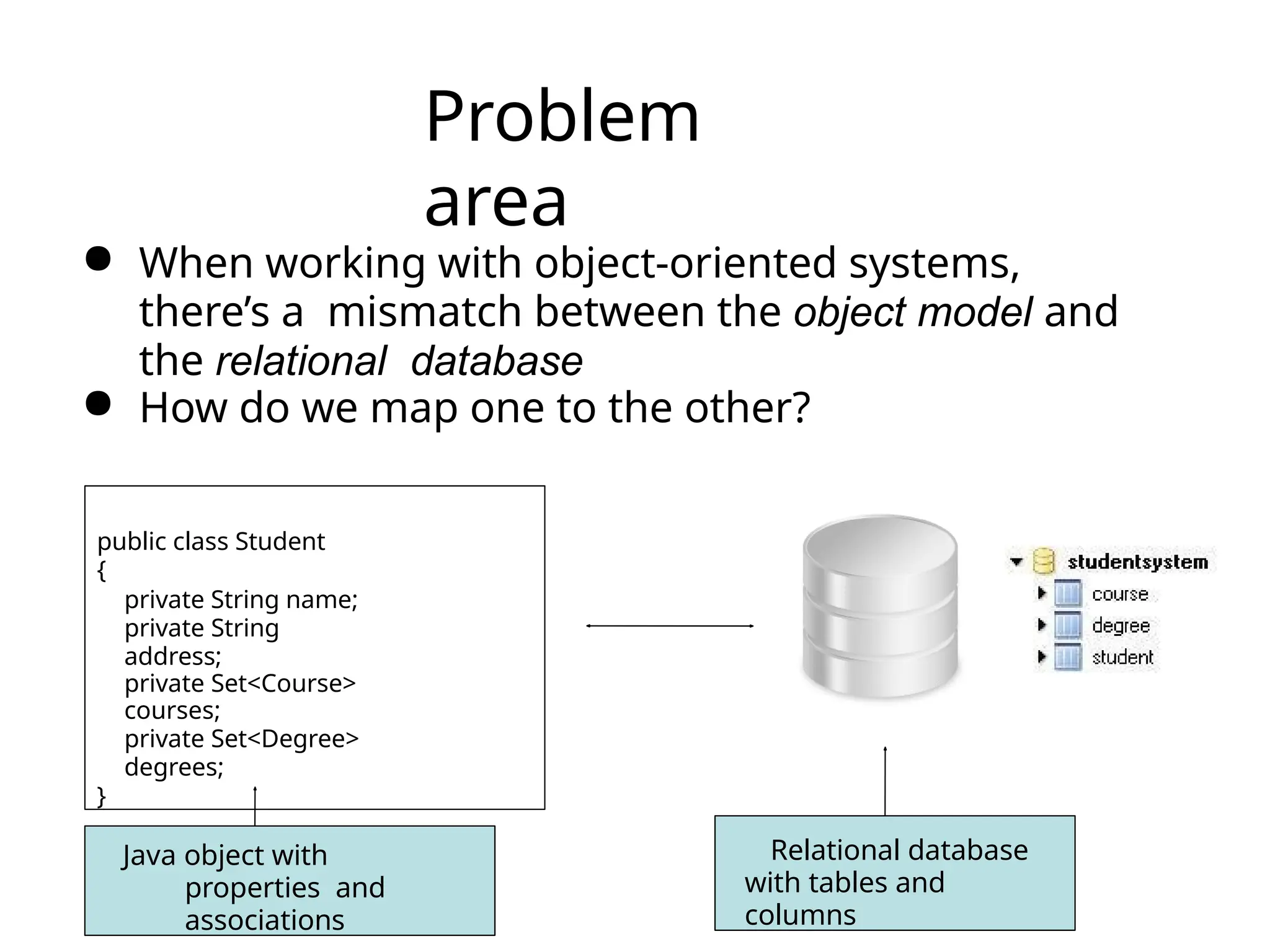
● When working with object-oriented systems,
there’s a mismatch between the object model and
the relational database
● How do we map one to the other?
public class Student
{
private String name;
private String
address;
private Set<Course>
courses;
private Set<Degree>
degrees;
}
Java object with
properties and
associations
Relational database
with tables and
columns
Need for
ORM
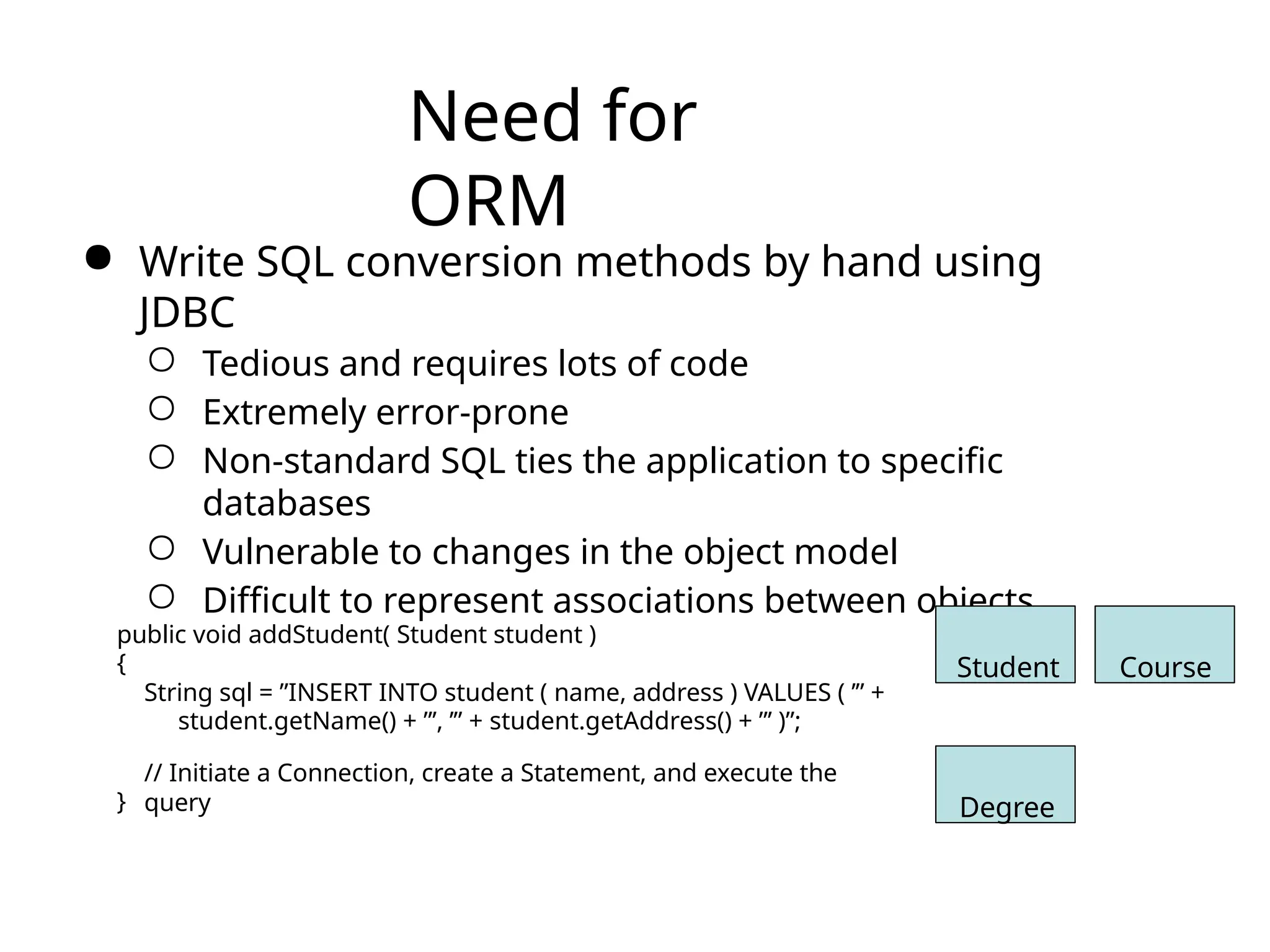
● Write SQL conversion methods by hand using
JDBC
○ Tedious and requires lots of code
○ Extremely error-prone
○ Non-standard SQL ties the application to specific
databases
○ Vulnerable to changes in the object model
○ Difficult to represent associations between objects
Student Course
Degree
public void addStudent( Student student )
{
String sql = ”INSERT INTO student ( name, address ) VALUES ( ’” +
student.getName() + ”’, ’” + student.getAddress() + ”’ )”;
// Initiate a Connection, create a Statement, and execute the
query
}
The preferred
solution
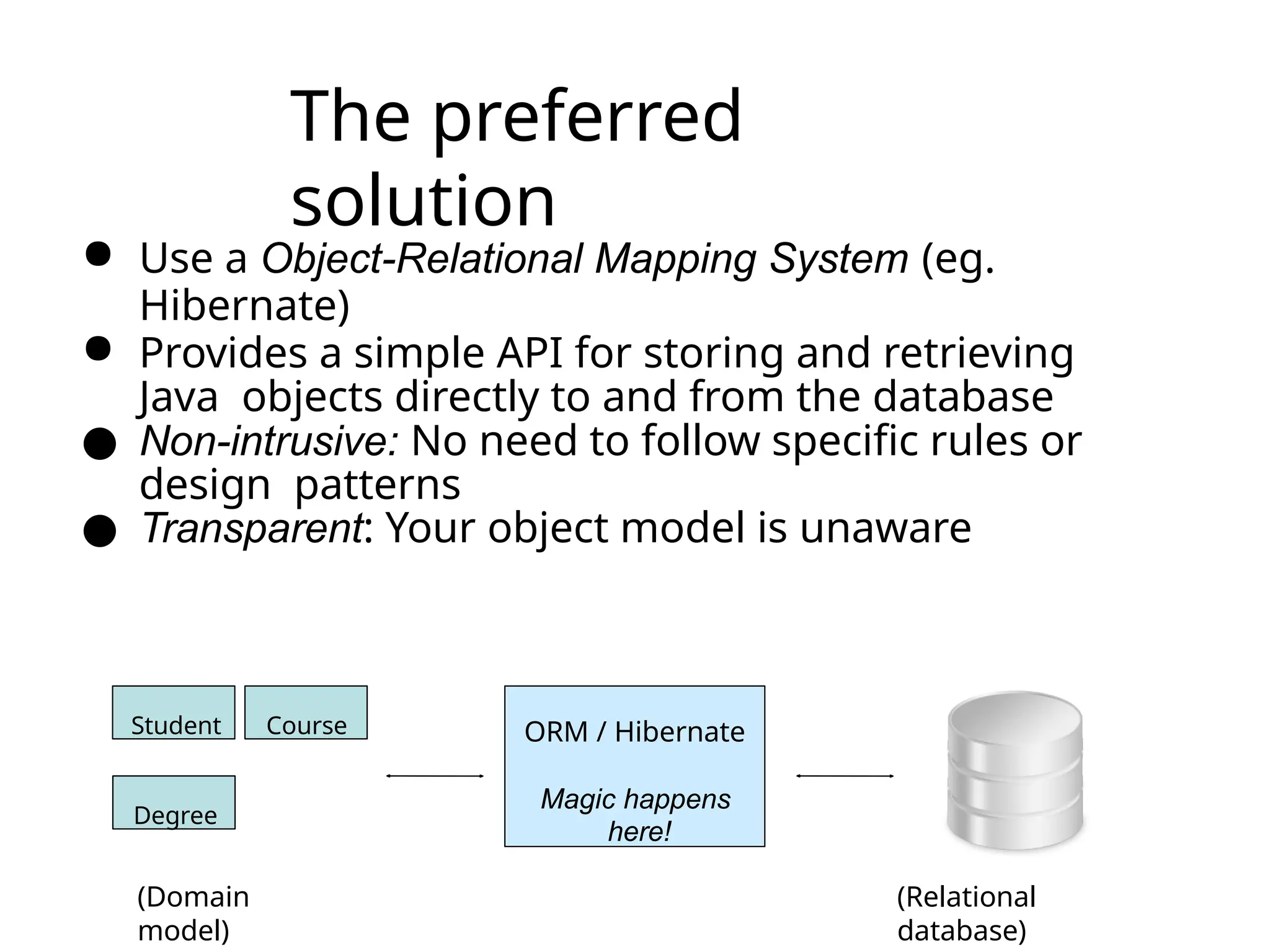
● Use a Object-Relational Mapping System (eg.
Hibernate)
● Provides a simple API for storing and retrieving
Java objects directly to and from the database
● Non-intrusive: No need to follow specific rules or
design patterns
● Transparent: Your object model is unaware
Student Course
Degree
ORM / Hibernate
Magic happens
here!
(Domain
model)
(Relational
database)
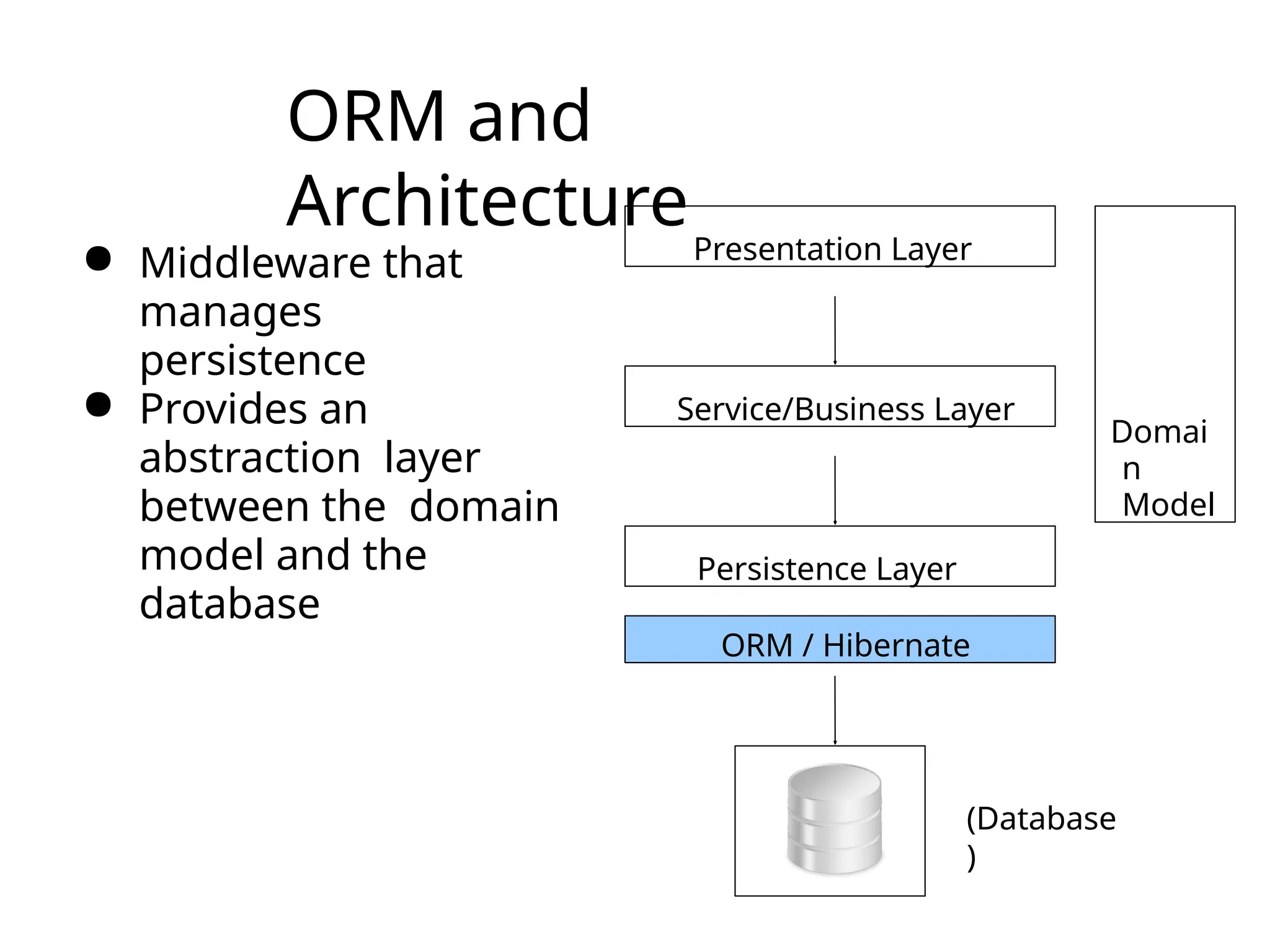
ORM and
ArchitecturePresentation Layer
Service/Business Layer
Persistence Layer
ORM / Hibernate
(Database
)
Domai
n
Model
● Middleware that
manages
persistence
● Provides an
abstraction layer
between the domain
model and the
database
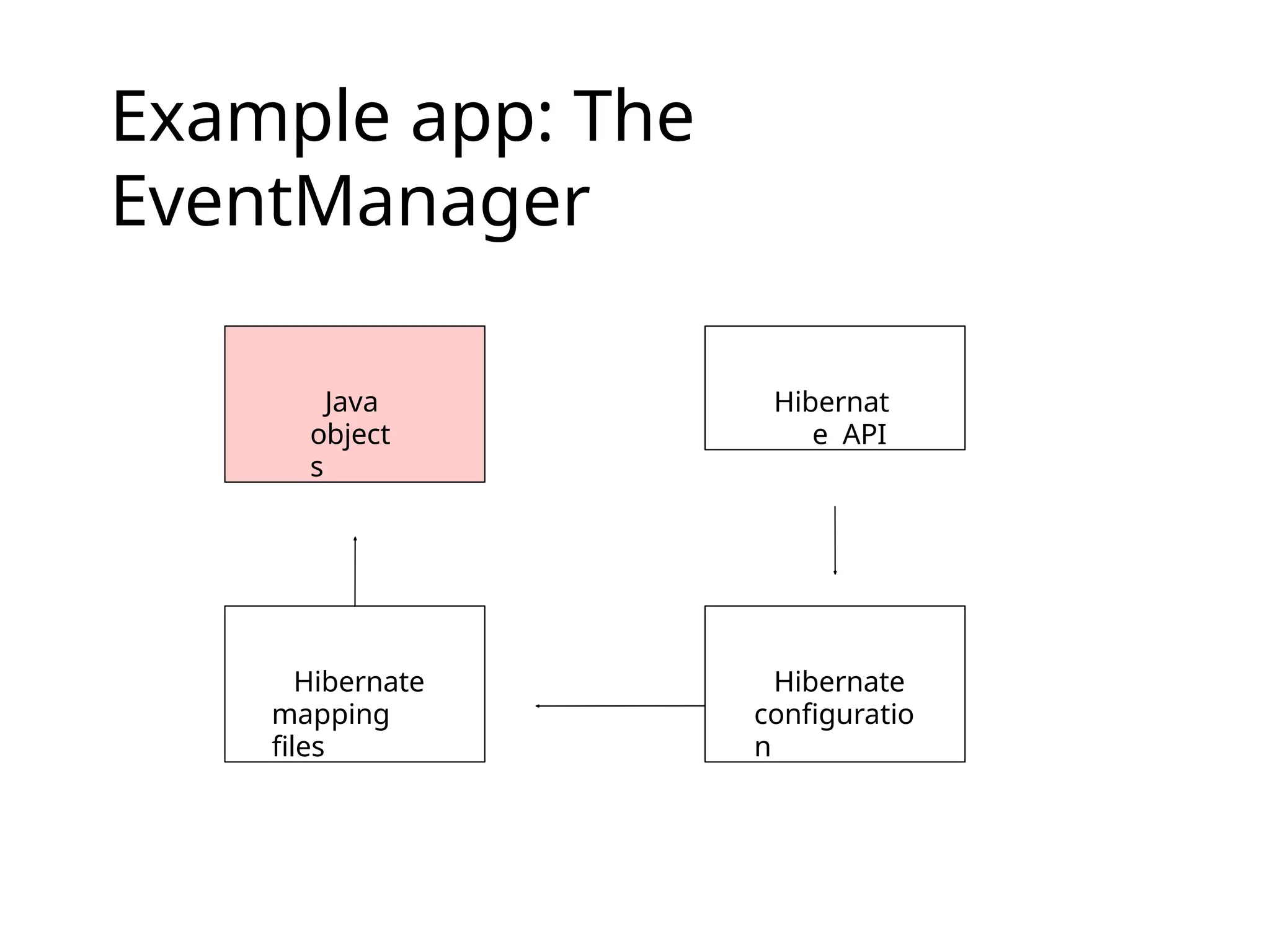
Example app: The
EventManager
Java
object
s
Hibernate
mapping
files
Hibernate
configuratio
n
Hibernat
e API
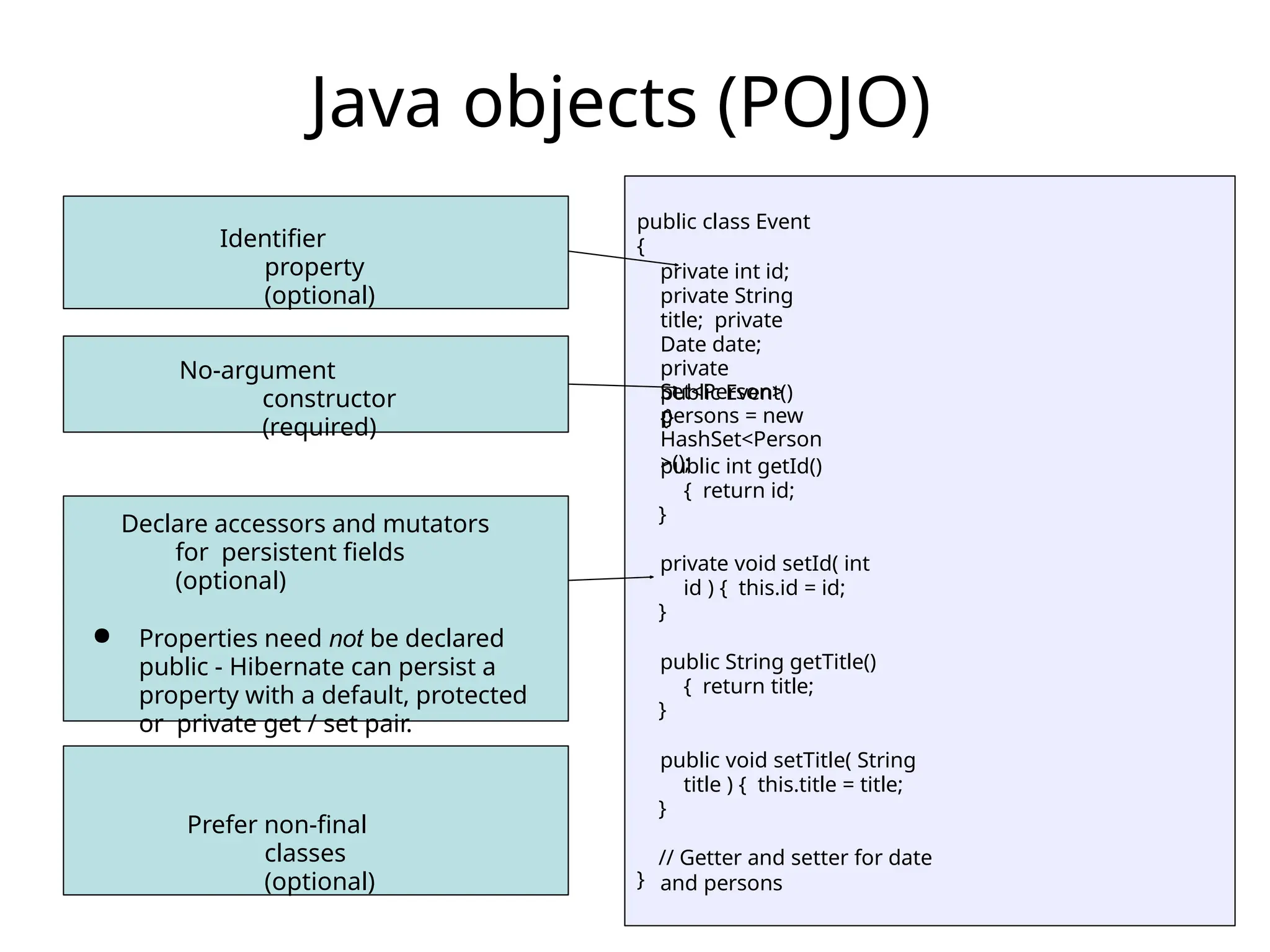
Java objects (POJO)
public class Event
{
private int id;
private String
title; private
Date date;
private
Set<Person>
persons = new
HashSet<Person
>();
public Event()
{}
public int getId()
{ return id;
}
private void setId( int
id ) { this.id = id;
}
public String getTitle()
{ return title;
}
public void setTitle( String
title ) { this.title = title;
}
// Getter and setter for date
and persons
}
Declare accessors and mutators
for persistent fields
(optional)
● Properties need not be declared
public - Hibernate can persist a
property with a default, protected
or private get / set pair.
No-argument
constructor
(required)
Identifier
property
(optional)
Prefer non-final
classes
(optional)
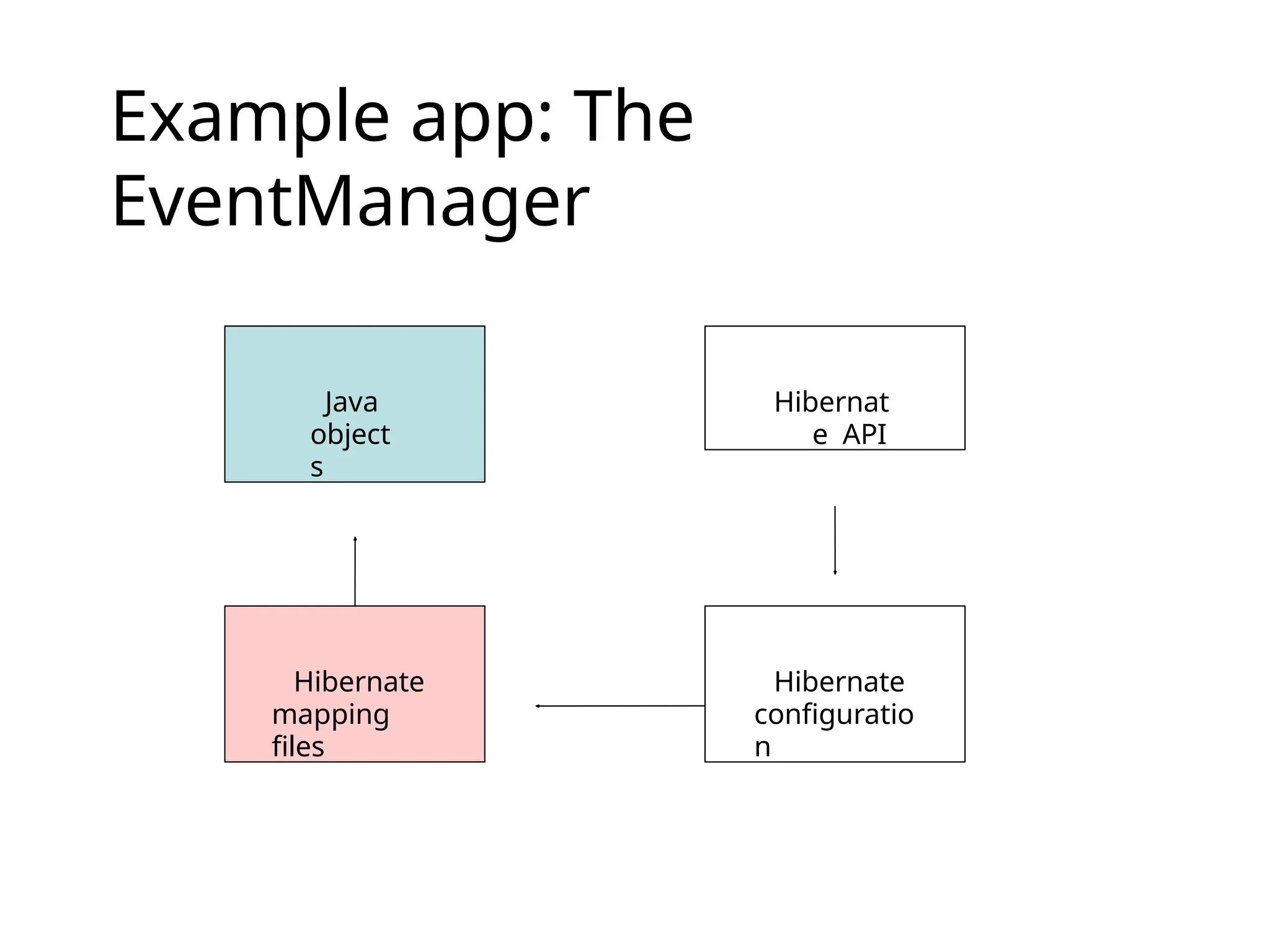
Example app: The
EventManager
Java
object
s
Hibernate
mapping
files
Hibernate
configuratio
n
Hibernat
e API
Hibernate mapping
files
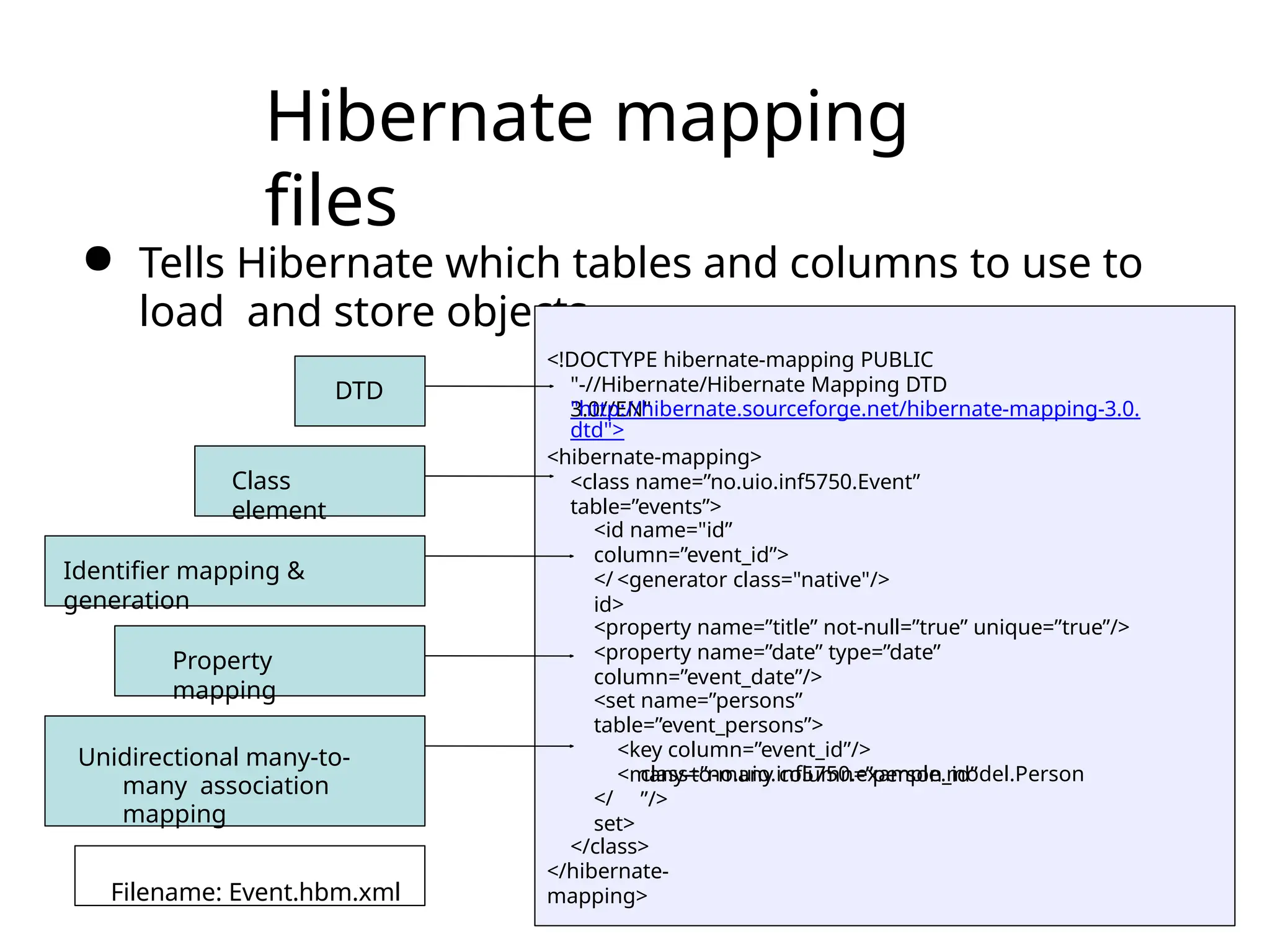
● Tells Hibernate which tables and columns to use to
load and store objects
DTD
<!DOCTYPE hibernate-mapping PUBLIC
"-//Hibernate/Hibernate Mapping DTD
3.0//EN"
"http://hibernate.sourceforge.net/hibernate-mapping-3.0.
dtd">
<hibernate-mapping>
<class name=”no.uio.inf5750.Event”
table=”events”>
<id name="id”
column=”event_id”>
<generator class="native"/>
</
id>
<property name=”title” not-null=”true” unique=”true”/>
<property name=”date” type=”date”
column=”event_date”/>
<set name=”persons”
table=”event_persons”>
<key column=”event_id”/>
<many-to-many column=”person_id”
class=”no.uio.inf5750.example.model.Person
”/>
</
set>
</class>
</hibernate-
mapping>
Class
element
Identifier mapping &
generation
Property
mapping
Filename: Event.hbm.xml
Unidirectional many-to-
many association
mapping
Hibernate
configuration
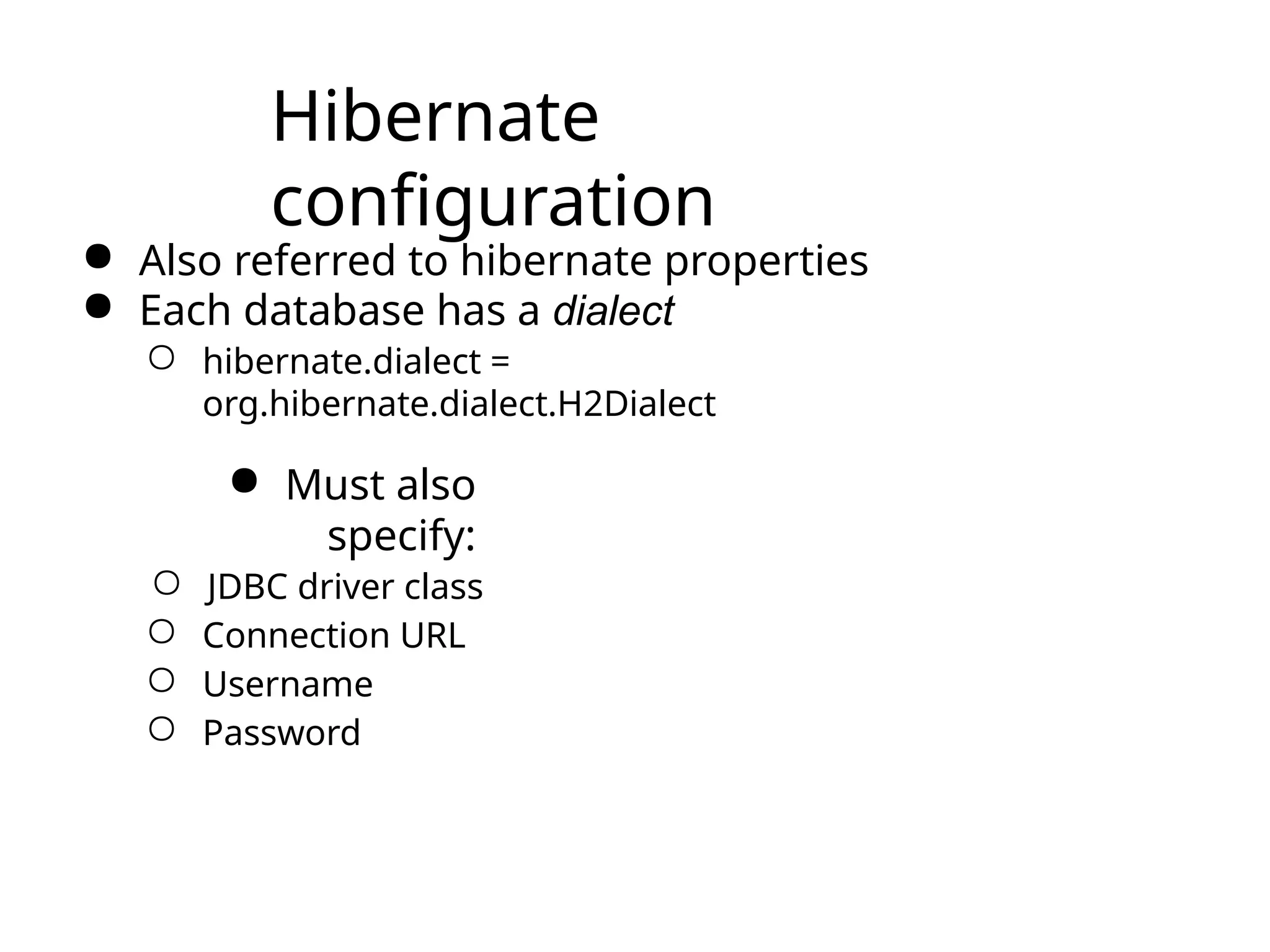
● Also referred to hibernate properties
● Each database has a dialect
○ hibernate.dialect =
org.hibernate.dialect.H2Dialect
● Must also
specify:
○ JDBC driver class
○ Connection URL
○ Username
○ Password
The SessionFactory
interface
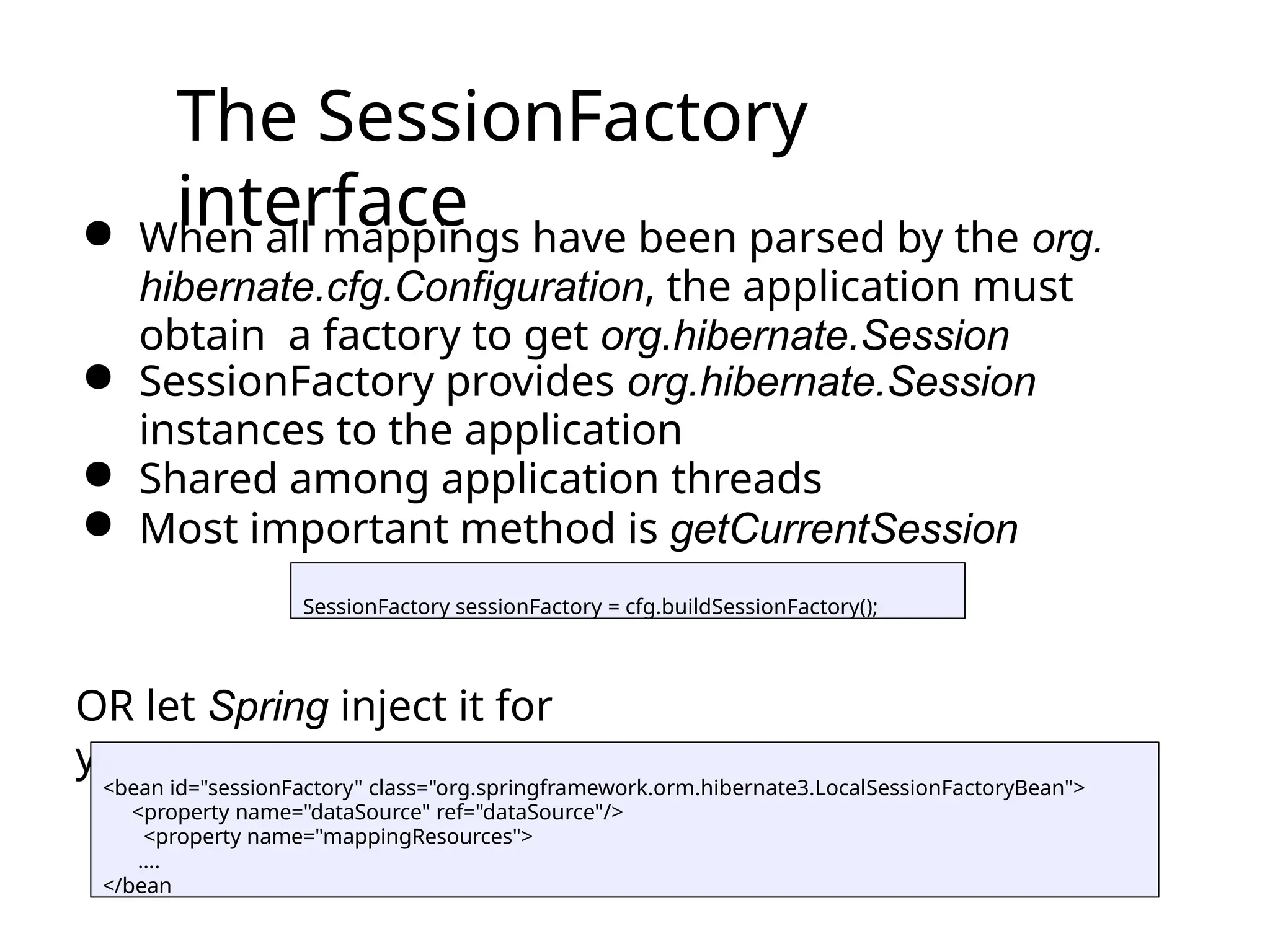
● When all mappings have been parsed by the org.
hibernate.cfg.Configuration, the application must
obtain a factory to get org.hibernate.Session
● SessionFactory provides org.hibernate.Session
instances to the application
● Shared among application threads
● Most important method is getCurrentSession
OR let Spring inject it for
you
SessionFactory sessionFactory = cfg.buildSessionFactory();
<bean id="sessionFactory" class="org.springframework.orm.hibernate3.LocalSessionFactoryBean">
<property name="dataSource" ref="dataSource"/>
<property name="mappingResources">
….
</bean
Transaction
s
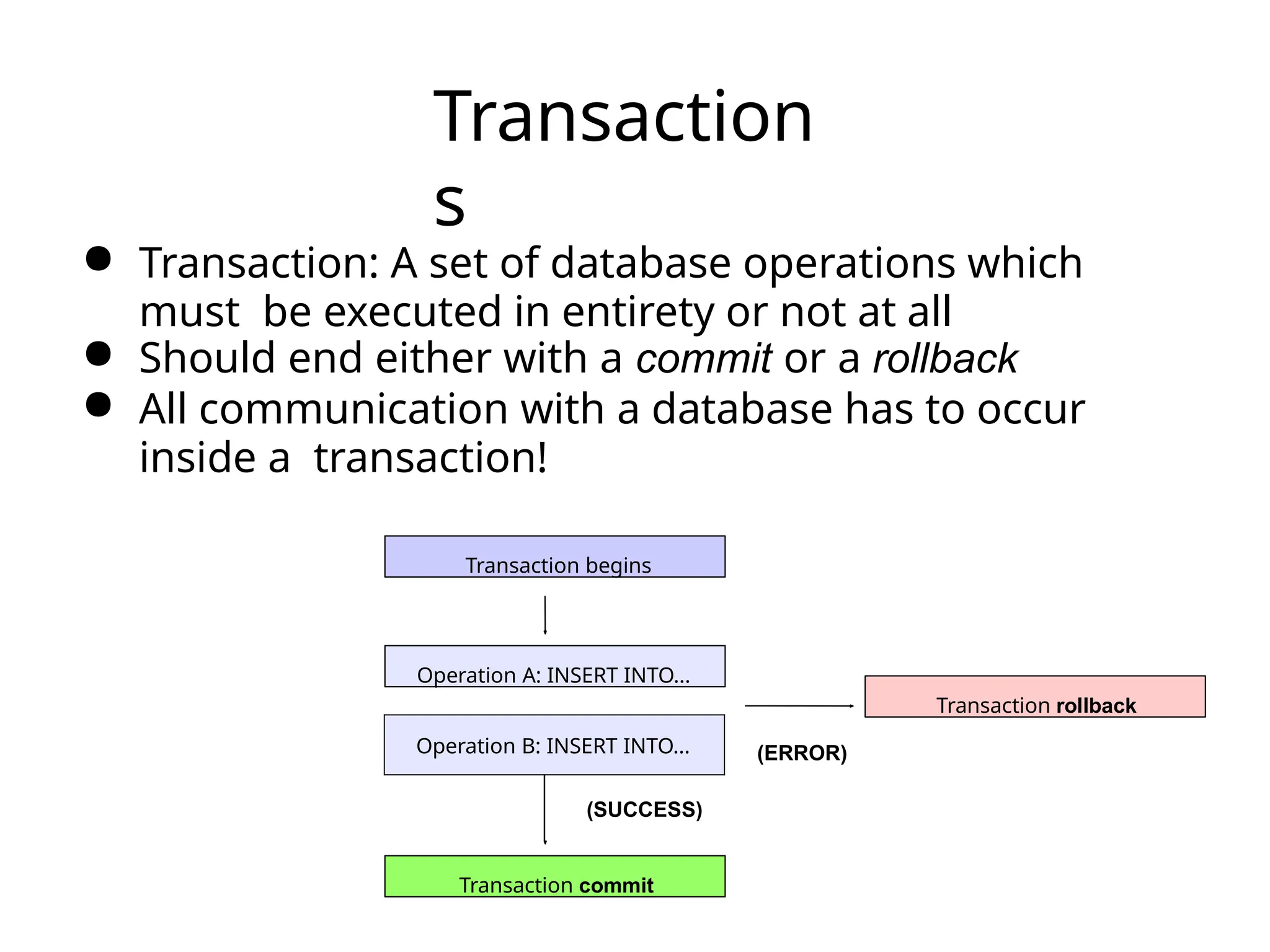
● Transaction: A set of database operations which
must be executed in entirety or not at all
● Should end either with a commit or a rollback
● All communication with a database has to occur
inside a transaction!
Transaction begins
Operation A: INSERT INTO...
Operation B: INSERT INTO...
(SUCCESS)
Transaction commit
(ERROR)
Transaction rollback

New-Hibernate-introduction cloud cc.pptx

  • 1.
  • 2.
    Problem area ● When workingwith object-oriented systems, there’s a mismatch between the object model and the relational database ● How do we map one to the other? public class Student { private String name; private String address; private Set<Course> courses; private Set<Degree> degrees; } Java object with properties and associations Relational database with tables and columns
  • 3.
    Need for ORM ● WriteSQL conversion methods by hand using JDBC ○ Tedious and requires lots of code ○ Extremely error-prone ○ Non-standard SQL ties the application to specific databases ○ Vulnerable to changes in the object model ○ Difficult to represent associations between objects Student Course Degree public void addStudent( Student student ) { String sql = ”INSERT INTO student ( name, address ) VALUES ( ’” + student.getName() + ”’, ’” + student.getAddress() + ”’ )”; // Initiate a Connection, create a Statement, and execute the query }
  • 4.
    The preferred solution ● Usea Object-Relational Mapping System (eg. Hibernate) ● Provides a simple API for storing and retrieving Java objects directly to and from the database ● Non-intrusive: No need to follow specific rules or design patterns ● Transparent: Your object model is unaware Student Course Degree ORM / Hibernate Magic happens here! (Domain model) (Relational database)
  • 5.
    ORM and ArchitecturePresentation Layer Service/BusinessLayer Persistence Layer ORM / Hibernate (Database ) Domai n Model ● Middleware that manages persistence ● Provides an abstraction layer between the domain model and the database
  • 6.
  • 7.
    Java objects (POJO) publicclass Event { private int id; private String title; private Date date; private Set<Person> persons = new HashSet<Person >(); public Event() {} public int getId() { return id; } private void setId( int id ) { this.id = id; } public String getTitle() { return title; } public void setTitle( String title ) { this.title = title; } // Getter and setter for date and persons } Declare accessors and mutators for persistent fields (optional) ● Properties need not be declared public - Hibernate can persist a property with a default, protected or private get / set pair. No-argument constructor (required) Identifier property (optional) Prefer non-final classes (optional)
  • 8.
  • 9.
    Hibernate mapping files ● TellsHibernate which tables and columns to use to load and store objects DTD <!DOCTYPE hibernate-mapping PUBLIC "-//Hibernate/Hibernate Mapping DTD 3.0//EN" "http://hibernate.sourceforge.net/hibernate-mapping-3.0. dtd"> <hibernate-mapping> <class name=”no.uio.inf5750.Event” table=”events”> <id name="id” column=”event_id”> <generator class="native"/> </ id> <property name=”title” not-null=”true” unique=”true”/> <property name=”date” type=”date” column=”event_date”/> <set name=”persons” table=”event_persons”> <key column=”event_id”/> <many-to-many column=”person_id” class=”no.uio.inf5750.example.model.Person ”/> </ set> </class> </hibernate- mapping> Class element Identifier mapping & generation Property mapping Filename: Event.hbm.xml Unidirectional many-to- many association mapping
  • 10.
    Hibernate configuration ● Also referredto hibernate properties ● Each database has a dialect ○ hibernate.dialect = org.hibernate.dialect.H2Dialect ● Must also specify: ○ JDBC driver class ○ Connection URL ○ Username ○ Password
  • 11.
    The SessionFactory interface ● Whenall mappings have been parsed by the org. hibernate.cfg.Configuration, the application must obtain a factory to get org.hibernate.Session ● SessionFactory provides org.hibernate.Session instances to the application ● Shared among application threads ● Most important method is getCurrentSession OR let Spring inject it for you SessionFactory sessionFactory = cfg.buildSessionFactory(); <bean id="sessionFactory" class="org.springframework.orm.hibernate3.LocalSessionFactoryBean"> <property name="dataSource" ref="dataSource"/> <property name="mappingResources"> …. </bean
  • 12.
    Transaction s ● Transaction: Aset of database operations which must be executed in entirety or not at all ● Should end either with a commit or a rollback ● All communication with a database has to occur inside a transaction! Transaction begins Operation A: INSERT INTO... Operation B: INSERT INTO... (SUCCESS) Transaction commit (ERROR) Transaction rollback