38
I
n the steel construction industry, it is fairly unusual
to use finite element calculation methods. “In the big
majorityofcasesyoudon’tneedanyofthesemethods,”
explains Neven. “Steel structures with standard beams
such as IPE or HEA can be calculated as frames. The joints
are then optimised using the formulas available in the
Eurocode standard. Usually there’s no need to go any
further than that.”
Too complex for hand calculation
However, standard solutions only cover standard
problems. And the construction of London’s Canary
Wharf Station roof, for which TCS was called in two years
ago, was an entirely different matter. “This station roof
is made of timber beams connected with steel joints,”
explains Neven. “The architectural concept required
that we design no fewer than 300 different steel joints,
many of them each connecting five or six beams. We saw
right away that a significant number of the joints were
too complex to be calculated by hand using Eurocode
standards. So it called for a more sophisticated process.”
FEA to validate the method
Peter Neven knew that FEA would be the solution, but a
pragmatic approach was key to its success. “We decided
to deploy RFEM, a powerful structural analysis software
Getting to grips with
complex structures
Smart deployment of Finite Element Analysis
The TCS engineering department increasingly deploys Finite Element Analysis (FEA) as a method
of optimising the detailed design of steel structures. “FEA is particularly useful in complex projects,
for example calculating irregular-shaped joints,”says TCS Head of Engineering Peter Neven.
KEY FACTS
•• TCS increasingly uses Finite Element Analysis
(FEA) in designing steel structures.
•• FEA is used typically in smart combination
with hand calculation methods.
•• Projects include Canary Wharf Station and the
new giant Stageco performance stage due to
tour this summer.
Inside Group Timmers
39
RFEM Structural Analysis Software
RFEM is a modular 3D FEA program that allows structural engineers to define structures, materials, and loads
for planar and spatial structural systems consisting of plates, walls, shells and members. Combined structures
can be created, and solid and contact elements can be modelled. RFEM calculates linearly using linear static
analysis, or nonlinearly with large deformation analysis. It works out deformations, internal forces, stresses,
support forces, and soil contact stresses. Add-on modules facilitate data input by automatic generation of
structures and connections, or can be used to perform further analyses and designs in accordance with the
relevant standards.
www.dlubal.com/en/products/rfem-fea-software
“RFEM allowed us to verify and
validate our assumptions”
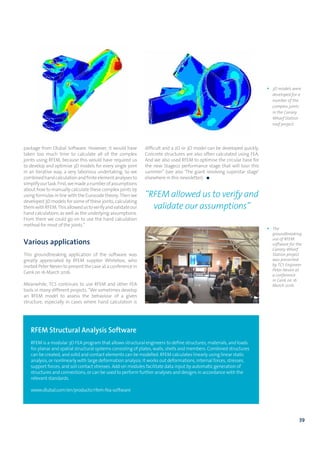
3D models were
developed for a
number of the
complex joints
in the Canary
Wharf Station
roof project.
The
groundbreaking
use of RFEM
software for the
Canary Wharf
Station project
was presented
by TCS Engineer
Peter Neven at
a conference
in Genk on 16
March 2016.
package from Dlubal Software. However, it would have
taken too much time to calculate all of the complex
joints using RFEM, because this would have required us
to develop and optimise 3D models for every single joint
in an iterative way, a very laborious undertaking. So we
combinedhandcalculationandfiniteelementanalysesto
simplifyourtask.First,wemadeanumberofassumptions
about how to manually calculate these complex joints by
using formulas in line with the Eurocode theory. Then we
developed 3D models for some of these joints, calculating
themwithRFEM.Thisallowedustoverifyandvalidateour
hand calculations as well as the underlying assumptions.
From there we could go on to use the hand calculation
method for most of the joints.”
Various applications
This groundbreaking application of the software was
greatly appreciated by RFEM supplier Whitebox, who
invited Peter Neven to present the case at a conference in
Genk on 16 March 2016.
Meanwhile, TCS continues to use RFEM and other FEA
tools in many different projects. “We sometimes develop
an RFEM model to assess the behaviour of a given
structure, especially in cases where hand calculation is
difficult and a 2D or 3D model can be developed quickly.
Concrete structures are also often calculated using FEA.
And we also used RFEM to optimise the circular base for
the new Stageco performance stage that will tour this
summer” (see also ‘The giant revolving superstar stage’
elsewhere in this newsletter).

2016 news@tcs june rfem software

  • 1.
    38 I n the steelconstruction industry, it is fairly unusual to use finite element calculation methods. “In the big majorityofcasesyoudon’tneedanyofthesemethods,” explains Neven. “Steel structures with standard beams such as IPE or HEA can be calculated as frames. The joints are then optimised using the formulas available in the Eurocode standard. Usually there’s no need to go any further than that.” Too complex for hand calculation However, standard solutions only cover standard problems. And the construction of London’s Canary Wharf Station roof, for which TCS was called in two years ago, was an entirely different matter. “This station roof is made of timber beams connected with steel joints,” explains Neven. “The architectural concept required that we design no fewer than 300 different steel joints, many of them each connecting five or six beams. We saw right away that a significant number of the joints were too complex to be calculated by hand using Eurocode standards. So it called for a more sophisticated process.” FEA to validate the method Peter Neven knew that FEA would be the solution, but a pragmatic approach was key to its success. “We decided to deploy RFEM, a powerful structural analysis software Getting to grips with complex structures Smart deployment of Finite Element Analysis The TCS engineering department increasingly deploys Finite Element Analysis (FEA) as a method of optimising the detailed design of steel structures. “FEA is particularly useful in complex projects, for example calculating irregular-shaped joints,”says TCS Head of Engineering Peter Neven. KEY FACTS •• TCS increasingly uses Finite Element Analysis (FEA) in designing steel structures. •• FEA is used typically in smart combination with hand calculation methods. •• Projects include Canary Wharf Station and the new giant Stageco performance stage due to tour this summer. Inside Group Timmers
  • 2.
    39 RFEM Structural AnalysisSoftware RFEM is a modular 3D FEA program that allows structural engineers to define structures, materials, and loads for planar and spatial structural systems consisting of plates, walls, shells and members. Combined structures can be created, and solid and contact elements can be modelled. RFEM calculates linearly using linear static analysis, or nonlinearly with large deformation analysis. It works out deformations, internal forces, stresses, support forces, and soil contact stresses. Add-on modules facilitate data input by automatic generation of structures and connections, or can be used to perform further analyses and designs in accordance with the relevant standards. www.dlubal.com/en/products/rfem-fea-software “RFEM allowed us to verify and validate our assumptions” 3D models were developed for a number of the complex joints in the Canary Wharf Station roof project. The groundbreaking use of RFEM software for the Canary Wharf Station project was presented by TCS Engineer Peter Neven at a conference in Genk on 16 March 2016. package from Dlubal Software. However, it would have taken too much time to calculate all of the complex joints using RFEM, because this would have required us to develop and optimise 3D models for every single joint in an iterative way, a very laborious undertaking. So we combinedhandcalculationandfiniteelementanalysesto simplifyourtask.First,wemadeanumberofassumptions about how to manually calculate these complex joints by using formulas in line with the Eurocode theory. Then we developed 3D models for some of these joints, calculating themwithRFEM.Thisallowedustoverifyandvalidateour hand calculations as well as the underlying assumptions. From there we could go on to use the hand calculation method for most of the joints.” Various applications This groundbreaking application of the software was greatly appreciated by RFEM supplier Whitebox, who invited Peter Neven to present the case at a conference in Genk on 16 March 2016. Meanwhile, TCS continues to use RFEM and other FEA tools in many different projects. “We sometimes develop an RFEM model to assess the behaviour of a given structure, especially in cases where hand calculation is difficult and a 2D or 3D model can be developed quickly. Concrete structures are also often calculated using FEA. And we also used RFEM to optimise the circular base for the new Stageco performance stage that will tour this summer” (see also ‘The giant revolving superstar stage’ elsewhere in this newsletter).