A Little Light Relief?
A summary of the post-Mitchell landscape
Mitchell v News Group
Newspapers
[2013] EWCA Civ 1537
• Claimant’s cost budget filed six days late
• Sanction imposed per CPR 3.14: Claimant
treated as if he had filed a budget comprising
only applicable court fees
• Court of Appeal dismissed Claimant’s appeal.
• Broad application:
• CPR 3.14 “unless the court orders otherwise” –
invites / entertains exercise of judicial discretion
• General guidance given by CoA
Mitchell v News Group
Newspapers
[2013] EWCA Civ 1537
• Triviality: “if [the non-compliance] can properly be regarded
as trivial, the court will usually grant relief provided that an
application is made promptly” [40]
• Reason: if the non-compliance is not trivial, burden shifts
to party in default to persuade the court to grant relief. If
there is a “good reason” (usually arising from a situation
outside party’s control) the court will be likely to grant
relief [41]
• Overriding Objective: the specified aims in the new
CPR 3.9 will usually “trump” other considerations [37]
• Assumption of Proper Sanction: if the real challenge is
to the proportionality of the sanction itself, the proper
route is CPR 3.1(7) [45]
Approach
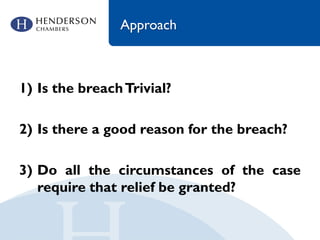
1) Is the breachTrivial?
2) Is there a good reason for the breach?
3) Do all the circumstances of the case
require that relief be granted?
Approach
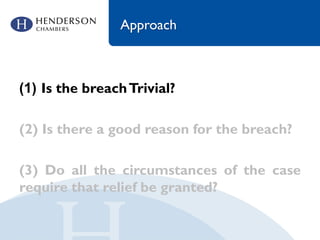
(1) Is the breachTrivial?
(2) Is there a good reason for the breach?
(3) Do all the circumstances of the case
require that relief be granted?
Triviality
• Inconsistent approach
• Demonstrated by Burt v Linford Christie (10/02/14)
Birmingham CC CF Wain v Gloucestershire CC [2014] EWHC
1274
• Costs budget filed one day late – latter case accepted
breach trivial, former did not.
• Envisaged in Mitchell as “a failure of form rather than of
substance; or where the party has narrowly missed the deadline
imposed by the order, but has otherwise fully complied with its
terms.”
• Broadly, difficult to demonstrate & requires global view of
what is “trivial” – taking into account impact on those
other than the parties
Triviality
• Need to consider prejudice:
• Lakatamia Shipping Co Ltd v Nobu SU & ors [2014] EWHC 275:
disclosure list late by 45 minutes. Hamblen J persuaded in part by
fact the default “has caused no prejudice to the Claimant, and none is
suggested.”
• Summit Navigation v Generali Romania Asiguare & ors [2014] EWHC
398: security for costs provided one day late but “it is not suggested
that this delay had any impact on any other aspect of the conduct of
the litigation.”
• But absence of prejudice will not always get you home: in
Associated Electrical Industries Ltd v Alstom UK [2014] EWHC 430: a
delay of 20 days was not trivial, despite the fact it did not prejudice
the other side or waste additional court resources
Approach
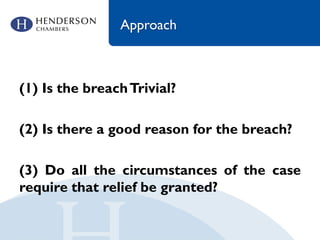
(1) Is the breachTrivial?
(2) Is there a good reason for the breach?
(3) Do all the circumstances of the case
require that relief be granted?
Approach
(1) Is the breachTrivial?
(2) Is there a good reason for the breach?
(3) Do all the circumstances of the case
require that relief be granted?
Good Reason
Guidance from Mitchell:
“If the reason… was that a party or his solicitor suffered from a debilitating illness
or was involved in an accident, then… that may constitute a good reason. Later
developments in the course of the litigation process are likely to be a good reason if
they show that the period for compliance originally imposed was unreasonable,
although the period seemed to be reasonable at the time… But mere overlooking a
deadline, whether on account of overwork or otherwise, is unlikely to be a good
reason. We understand that solicitors may be under pressure and have too much
work… but that will rarely be a good reason… good reasons are likely to arise from
circumstances outside the control of the party in default”
[41]
Good Reason
A “good reason” is not:
• Pressure of work / other commitments
• Lack of time comply properly (without an in-time application to
extend time) – see Chartwell Estate Agents v Fergie Properties [2014]
EWHC 438 and Associated Electrical Industries: “if difficulties in
investigating the claim do justify the particulars being late, a timely
request for an extension should have been sought”
• An “understandable” reason caused by confusing drafting of a
court order (Lakatamia)
• A challenge to the sanction itself (use CPR 3.1(7) instead)
• However – inability to obtain underwriters’ signature does
constitute good reason (Summit Navigation)
Approach
(1) Is the breachTrivial?
(2) Is there a good reason for the breach?
(3) Do all the circumstances of the case
require that relief be granted?
Approach
(1) Is the breachTrivial?
(2) Is there a good reason for the breach?
(3) Do all the circumstances of the case
require that relief be granted?
All the Circumstances
• Rarely successful – but it is available as a fall-back position
• Summit Navigation – even if conclusion on other two issues wrong, relief
would still have been granted on the basis that the default “did not… have
any impact on the efficient conduct of these proceedings, nor on the wider
public interest of ensuring that litigants can obtain justice efficiently and
proportionately”
• Chartwell – the trial date would not be lost, there was no significant extra
cost, and failing to grant relief would effectively end the claim
• Lakatamia – Claimants tried to persuade the judge to refuse relief on the
basis of historic / repeated defaults by the Defendants. It was said that the
history was not “ a sufficiently compelling circumstance” in the light of the
trivial nature of the default in issue.
The Summit Navigation spanner in
the works
Per Leggatt J at [36]: “the broad language of CPR 3.9 is quite
capable of accommodating more than one approach to
applications for relief from sanctions taking account of the
nature of the sanction and the nature of the relief sought…
the Court of Appeal in Mitchell was not concerned with the
“rather special form of order” that is an order for security of
costs, nor with the granting of relief from a sanction which was
not intended to be permanent.”
In that case, specific concerns set out at 3.9 carry less
weight; focus shifts instead to broader consideration of
“all the circumstances.”
The Mid-East Sales spanner in the
works
• CPR 3.8 vs CPR 3.9
• Mid-East Sales considered the approach to CPR 3.8
sanctions was stricter
• Sanctions pursuant to CPR 3.9 “may allow different
or wider considerations to be taken into account, or
more than trivial delays to be addressed” [88]
• That case concerned CPR 3.9 sanctions – relief
was granted despite delay of 5 ½ months since
service of judgment in default due to clearly
arguable defences & important jurisdiction issue
Is it a Mitchell case?
• What is a sanction? Leggat J in Summit Navigation at
[27]; “the term “sanction” seems to me apt to include any
consequences adverse to the party to whom it applies.”
• Includes applications to set aside default judgment:
• Silber J in Samara v MBI & Partners [2014] EWHC 563:
the new regime is “in very general terms and… of
universal application.”
• Burton J in Mid-East Sales v Pakistan [2014] EWHC
1457 (Comm): Silber’s interpretation “does seem likely
to be what was intended by Mitchell.”
Is it a Mitchell case?
• Applications before time has expired
• Kaneria v Kaneria [2014] EWHC 1165 – the
Mitchell principles do not apply to in-time
applications
• However, the question is still one of judicial
discretion
• Where application is very close to time limit or is
made before, but heard after, the expiry of time,
judges are loathe to depart from Mitchell principles
• Potential for further developments
Key Points
1. Pressure of work is rarely (if ever) going to be accepted as
a reason for default
2. If it looks like you are going to run out of time:
• Make an application for an extension as soon as possible,
particularly if you are in breach of a CPR 3.8 order that
specified the sanction
• Take any practical steps possible to reduce the impact of
non-compliance
• Engage in correspondence with the other side
3. If you have to make an application for relief:
• Put in all the evidence you can in support – this is case
management territory and successful appeals are few and
far between
There is hope!
Leggatt J in Summit Navigation
“Unlike the Claimants’ default itself, the defendants’
response to it has had a very serious impact on the
litigation. The whole timetable for the proceedings has
been derailed, significant costs have been incurred and
court time has been wasted to the detriment of other
court users. In other words, the reliance placed on
Mitchell in this case has had the very consequences
which the new approach enunciated by the Court of
Appeal in Mitchell is intended to avoid.”
Henderson Chambers
2 Harcourt Buildings
Temple
London EC4Y 9DB
Tel: 020 7583 9020
clerks@hendersonchambers.co.uk
www.hendersonchambers.co.uk
©
Rachel Tandy
Barrister
Rachel Tandy 2014

A Little Light Relief? A summary of the post-Mitchell landscape

  • 1.
    A Little LightRelief? A summary of the post-Mitchell landscape
  • 2.
    Mitchell v NewsGroup Newspapers [2013] EWCA Civ 1537 • Claimant’s cost budget filed six days late • Sanction imposed per CPR 3.14: Claimant treated as if he had filed a budget comprising only applicable court fees • Court of Appeal dismissed Claimant’s appeal. • Broad application: • CPR 3.14 “unless the court orders otherwise” – invites / entertains exercise of judicial discretion • General guidance given by CoA
  • 3.
    Mitchell v NewsGroup Newspapers [2013] EWCA Civ 1537 • Triviality: “if [the non-compliance] can properly be regarded as trivial, the court will usually grant relief provided that an application is made promptly” [40] • Reason: if the non-compliance is not trivial, burden shifts to party in default to persuade the court to grant relief. If there is a “good reason” (usually arising from a situation outside party’s control) the court will be likely to grant relief [41] • Overriding Objective: the specified aims in the new CPR 3.9 will usually “trump” other considerations [37] • Assumption of Proper Sanction: if the real challenge is to the proportionality of the sanction itself, the proper route is CPR 3.1(7) [45]
  • 4.
    Approach 1) Is thebreachTrivial? 2) Is there a good reason for the breach? 3) Do all the circumstances of the case require that relief be granted?
  • 5.
    Approach (1) Is thebreachTrivial? (2) Is there a good reason for the breach? (3) Do all the circumstances of the case require that relief be granted?
  • 6.
    Triviality • Inconsistent approach •Demonstrated by Burt v Linford Christie (10/02/14) Birmingham CC CF Wain v Gloucestershire CC [2014] EWHC 1274 • Costs budget filed one day late – latter case accepted breach trivial, former did not. • Envisaged in Mitchell as “a failure of form rather than of substance; or where the party has narrowly missed the deadline imposed by the order, but has otherwise fully complied with its terms.” • Broadly, difficult to demonstrate & requires global view of what is “trivial” – taking into account impact on those other than the parties
  • 7.
    Triviality • Need toconsider prejudice: • Lakatamia Shipping Co Ltd v Nobu SU & ors [2014] EWHC 275: disclosure list late by 45 minutes. Hamblen J persuaded in part by fact the default “has caused no prejudice to the Claimant, and none is suggested.” • Summit Navigation v Generali Romania Asiguare & ors [2014] EWHC 398: security for costs provided one day late but “it is not suggested that this delay had any impact on any other aspect of the conduct of the litigation.” • But absence of prejudice will not always get you home: in Associated Electrical Industries Ltd v Alstom UK [2014] EWHC 430: a delay of 20 days was not trivial, despite the fact it did not prejudice the other side or waste additional court resources
  • 8.
    Approach (1) Is thebreachTrivial? (2) Is there a good reason for the breach? (3) Do all the circumstances of the case require that relief be granted?
  • 9.
    Approach (1) Is thebreachTrivial? (2) Is there a good reason for the breach? (3) Do all the circumstances of the case require that relief be granted?
  • 10.
    Good Reason Guidance fromMitchell: “If the reason… was that a party or his solicitor suffered from a debilitating illness or was involved in an accident, then… that may constitute a good reason. Later developments in the course of the litigation process are likely to be a good reason if they show that the period for compliance originally imposed was unreasonable, although the period seemed to be reasonable at the time… But mere overlooking a deadline, whether on account of overwork or otherwise, is unlikely to be a good reason. We understand that solicitors may be under pressure and have too much work… but that will rarely be a good reason… good reasons are likely to arise from circumstances outside the control of the party in default” [41]
  • 11.
    Good Reason A “goodreason” is not: • Pressure of work / other commitments • Lack of time comply properly (without an in-time application to extend time) – see Chartwell Estate Agents v Fergie Properties [2014] EWHC 438 and Associated Electrical Industries: “if difficulties in investigating the claim do justify the particulars being late, a timely request for an extension should have been sought” • An “understandable” reason caused by confusing drafting of a court order (Lakatamia) • A challenge to the sanction itself (use CPR 3.1(7) instead) • However – inability to obtain underwriters’ signature does constitute good reason (Summit Navigation)
  • 12.
    Approach (1) Is thebreachTrivial? (2) Is there a good reason for the breach? (3) Do all the circumstances of the case require that relief be granted?
  • 13.
    Approach (1) Is thebreachTrivial? (2) Is there a good reason for the breach? (3) Do all the circumstances of the case require that relief be granted?
  • 14.
    All the Circumstances •Rarely successful – but it is available as a fall-back position • Summit Navigation – even if conclusion on other two issues wrong, relief would still have been granted on the basis that the default “did not… have any impact on the efficient conduct of these proceedings, nor on the wider public interest of ensuring that litigants can obtain justice efficiently and proportionately” • Chartwell – the trial date would not be lost, there was no significant extra cost, and failing to grant relief would effectively end the claim • Lakatamia – Claimants tried to persuade the judge to refuse relief on the basis of historic / repeated defaults by the Defendants. It was said that the history was not “ a sufficiently compelling circumstance” in the light of the trivial nature of the default in issue.
  • 15.
    The Summit Navigationspanner in the works Per Leggatt J at [36]: “the broad language of CPR 3.9 is quite capable of accommodating more than one approach to applications for relief from sanctions taking account of the nature of the sanction and the nature of the relief sought… the Court of Appeal in Mitchell was not concerned with the “rather special form of order” that is an order for security of costs, nor with the granting of relief from a sanction which was not intended to be permanent.” In that case, specific concerns set out at 3.9 carry less weight; focus shifts instead to broader consideration of “all the circumstances.”
  • 16.
    The Mid-East Salesspanner in the works • CPR 3.8 vs CPR 3.9 • Mid-East Sales considered the approach to CPR 3.8 sanctions was stricter • Sanctions pursuant to CPR 3.9 “may allow different or wider considerations to be taken into account, or more than trivial delays to be addressed” [88] • That case concerned CPR 3.9 sanctions – relief was granted despite delay of 5 ½ months since service of judgment in default due to clearly arguable defences & important jurisdiction issue
  • 17.
    Is it aMitchell case? • What is a sanction? Leggat J in Summit Navigation at [27]; “the term “sanction” seems to me apt to include any consequences adverse to the party to whom it applies.” • Includes applications to set aside default judgment: • Silber J in Samara v MBI & Partners [2014] EWHC 563: the new regime is “in very general terms and… of universal application.” • Burton J in Mid-East Sales v Pakistan [2014] EWHC 1457 (Comm): Silber’s interpretation “does seem likely to be what was intended by Mitchell.”
  • 18.
    Is it aMitchell case? • Applications before time has expired • Kaneria v Kaneria [2014] EWHC 1165 – the Mitchell principles do not apply to in-time applications • However, the question is still one of judicial discretion • Where application is very close to time limit or is made before, but heard after, the expiry of time, judges are loathe to depart from Mitchell principles • Potential for further developments
  • 19.
    Key Points 1. Pressureof work is rarely (if ever) going to be accepted as a reason for default 2. If it looks like you are going to run out of time: • Make an application for an extension as soon as possible, particularly if you are in breach of a CPR 3.8 order that specified the sanction • Take any practical steps possible to reduce the impact of non-compliance • Engage in correspondence with the other side 3. If you have to make an application for relief: • Put in all the evidence you can in support – this is case management territory and successful appeals are few and far between
  • 20.
    There is hope! LeggattJ in Summit Navigation “Unlike the Claimants’ default itself, the defendants’ response to it has had a very serious impact on the litigation. The whole timetable for the proceedings has been derailed, significant costs have been incurred and court time has been wasted to the detriment of other court users. In other words, the reliance placed on Mitchell in this case has had the very consequences which the new approach enunciated by the Court of Appeal in Mitchell is intended to avoid.”
  • 21.
    Henderson Chambers 2 HarcourtBuildings Temple London EC4Y 9DB Tel: 020 7583 9020 clerks@hendersonchambers.co.uk www.hendersonchambers.co.uk © Rachel Tandy Barrister Rachel Tandy 2014