Update on RTB
Developments
RTB Program Management Unit
Annual Review and Meeting
Lima
8th December 2015
Six reasons why RTB is best CRP!
1. Only CRP to receive “excellent” in Annual Reporting
to CO in 2014 and 2015!
2. Commendation by CO for reporting on gender and
used our format as model for other CRPs
3. CRP with highest number of A grades in ISPC
review of pre-proposals
4. Outstanding external review (best of all six read so
far by Yvonne Pinto of ISC)
5. Based on performance review DFID granted RTB 3.5
million pounds of W2 funding
6. Just agreed BMGF funding for RTB led project on
cassava seed systems for $11.6m
Overview
1. Governance & Management
2. Scientific collaboration
3. Gender research
4. Communications
5. Preproposal and ISPC review
6. External evaluation
7. BMGF cassava seed systems
8. Wrap up
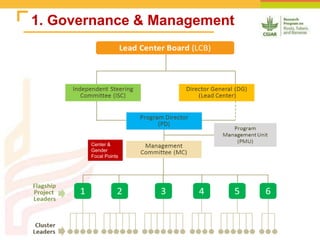
1. Governance & Management
Center &
Gender
Focal Points
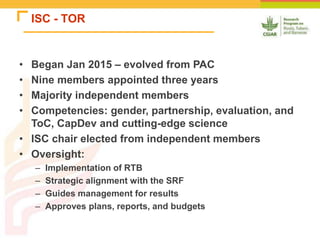
ISC - TOR
• Began Jan 2015 – evolved from PAC
• Nine members appointed three years
• Majority independent members
• Competencies: gender, partnership, evaluation, and
ToC, CapDev and cutting-edge science
• ISC chair elected from independent members
• Oversight:
– Implementation of RTB
– Strategic alignment with the SRF
– Guides management for results
– Approves plans, reports, and budgets
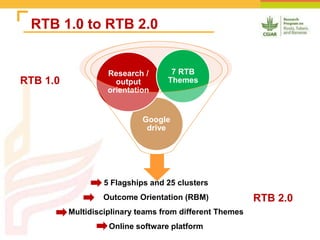
RTB 1.0 to RTB 2.0
RTB 1.0
RTB 2.0
5 Flagships and 25 clusters
Outcome Orientation (RBM)
Multidisciplinary teams from different Themes
Online software platform
Google
drive
Research /
output
orientation
7 RTB
Themes
• Gender research coordinator, full time - Bhawana
• Communications officer – Holly
• M&E Officer - Claudio
• Science officer – Michael:
– Product delivery plans
– Formulation and review of progress discovery/breeding related
products, milestones and activities.
– Strategic advice to Program Director on range of science issues
PMU staffing update
2. Scientific collaboration
• The CO wrote: The RTB Annual Review (AR) is excellent. The
diversity, relevance and clarity of the results (i.e. outputs)
delivered are impressive and confirm the quality of the RTB
upstream research from harnessing genetic diversity to
post-harvest management practices and value-chain
focused solutions. Progress in applying state of the art
biological tools was remarkable including the building up of
the metabolomics platform, and the use of genome-wide
association mapping combined with the next generation
sequencing. These outputs are feeding the delivery and
adoption process for scaling-up and out in targeted
countries through key projects: tripling potato yield in
Ethiopia, reducing bacteria wilt impact in banana (BXW) in
Eastern and Central Africa, and doubling vitamin A intake
through orange-flesh sweet potato adoption in Kenya
2. Scientific collaboration
• NEXTGEN sequencing and phenotyping data
• Genomic analyses (GWAS, GS) for complex traits (eg. potato
tuberization and early bulking, fertility and fruit quality in banana) and
for targeted breeding strategies (eg. heterotic grouping)
• Large-scale Phenotyping identifies heat tolerant sweet potato lines
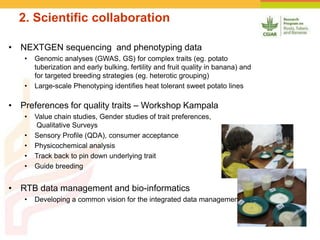
• Preferences for quality traits – Workshop Kampala
• Value chain studies, Gender studies of trait preferences,
Qualitative Surveys
• Sensory Profile (QDA), consumer acceptance
• Physicochemical analysis
• Track back to pin down underlying trait
• Guide breeding
• RTB data management and bio-informatics
• Developing a common vision for the integrated data management
• Biological and socio-economic surveys along
altitudinal gradients
– patterns of pest/disease abundance and their impacts
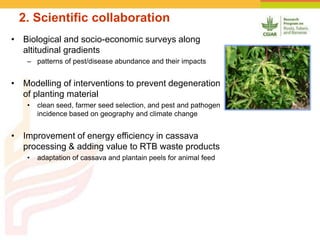
• Modelling of interventions to prevent degeneration
of planting material
• clean seed, farmer seed selection, and pest and pathogen
incidence based on geography and climate change
• Improvement of energy efficiency in cassava
processing & adding value to RTB waste products
• adaptation of cassava and plantain peels for animal feed
2. Scientific collaboration
3. RTB Gender Portfolio Achievements
• RTB gender reporting model for
CGIAR!
• Filling critical gaps and building
capacity with RTB-University
Partnership Gender Integration
initiative with 9 universities and 6
students in 2015
• More targeted and linked up
approach for integrated gender
research:
– RTB & NEXTGEN Cassava project pilot
study on gender differentiatiated
preferences for cassava traits in Nigeria
– RTB with IITA and Bioversity submitted
proposals on CO calls for Post-Doctoral
fellow on gender & breeding in cassava
and banana
• Enabling environment with strategic
gender research:
– Gennovate
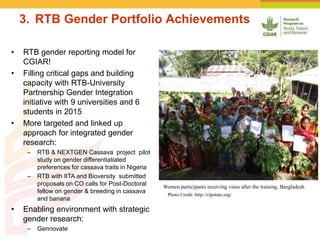
Photo Credit :http://cipotato.org/
Women participants receiving vines after the training, Bangladesh
4. Communications
● RTB communication channels in 2015
• Blogs and News
– RTB research, publications, successes
– Partners contribute and share
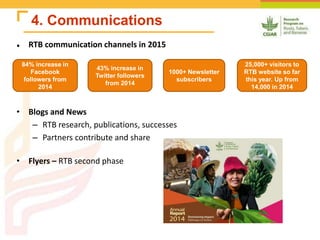
• Flyers – RTB second phase
84% increase in
Facebook
followers from
2014
43% increase in
Twitter followers
from 2014
1000+ Newsletter
subscribers
25,000+ visitors to
RTB website so far
this year. Up from
14,000 in 2014
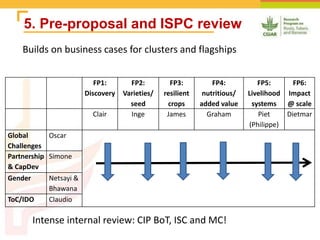
FP1:
Discovery
FP2:
Varieties/
seed
FP3:
resilient
crops
FP4:
nutritious/
added value
FP5:
Livelihood
systems
FP6:
Impact
@ scale
Clair Inge James Graham Piet
(Philippe)
Dietmar
Global
Challenges
Oscar
Partnership
& CapDev
Simone
Gender Netsayi &
Bhawana
ToC/IDO Claudio
5. Pre-proposal and ISPC review
Intense internal review: CIP BoT, ISC and MC!
Builds on business cases for clusters and flagships
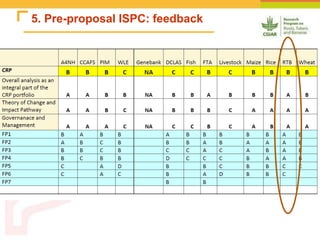
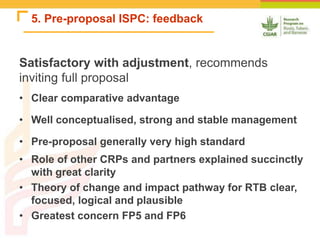
5. Pre-proposal ISPC: feedback
Satisfactory with adjustment, recommends
inviting full proposal
• Clear comparative advantage
• Well conceptualised, strong and stable management
• Pre-proposal generally very high standard
• Role of other CRPs and partners explained succinctly
with great clarity
• Theory of change and impact pathway for RTB clear,
focused, logical and plausible
• Greatest concern FP5 and FP6
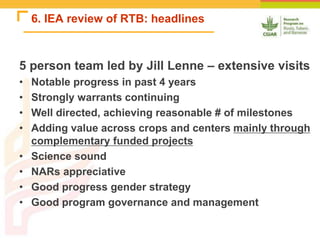
6. IEA review of RTB: headlines
5 person team led by Jill Lenne – extensive visits
• Notable progress in past 4 years
• Strongly warrants continuing
• Well directed, achieving reasonable # of milestones
• Adding value across crops and centers mainly through
complementary funded projects
• Science sound
• NARs appreciative
• Good progress gender strategy
• Good program governance and management
IEA review of RTB: for improvement
• using outcomes of priority assessment for more
strategic allocation of budget across crops
• collaboration among breeders (cassava and banana)
• strengthening CRP expertise in seed systems
• improved integration of crop improvement and
management technologies
• enhanced focus of post-harvest research on the
crop-specific aspects of value chain improvements
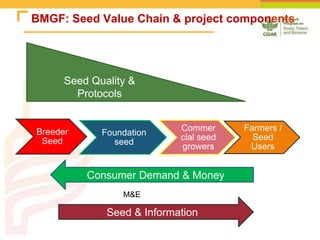
BMGF: Seed Value Chain & project components
Breeder
Seed
Foundation
seed
Commer
cial seed
growers
Farmers /
Seed
Users
Seed Quality &
Protocols
Seed & Information
Consumer Demand & Money
M&E
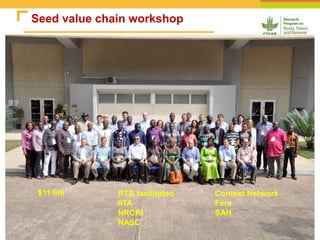
Seed value chain workshop
RTB facilitated
IITA
NRCRI
NASC
Context Network
Fera
SAH
$11.6m
Tough year but we made it!
1. External evaluation – teams came together
2. Internal audit review – good shape
3. Delays in contracts from Fund Office down
4. Lack of clarity over carry-over from 2014
5. Shifts in donors – closer accountability W1&W2
6. Pressures on aid budgets – system change
7. Four cuts to 2015 FinPlan
8. Optimistic of recovery in 2017
9. THANKS EVERYBODY FOR STAYING COURSE!
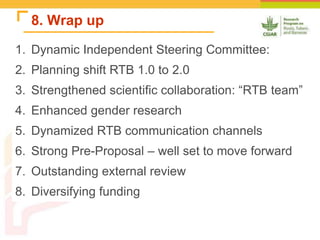
8. Wrap up
1. Dynamic Independent Steering Committee:
2. Planning shift RTB 1.0 to 2.0
3. Strengthened scientific collaboration: “RTB team”
4. Enhanced gender research
5. Dynamized RTB communication channels
6. Strong Pre-Proposal – well set to move forward
7. Outstanding external review
8. Diversifying funding

2015 RTB Program Highlights & Updates

  • 1.
    Update on RTB Developments RTBProgram Management Unit Annual Review and Meeting Lima 8th December 2015
  • 2.
    Six reasons whyRTB is best CRP! 1. Only CRP to receive “excellent” in Annual Reporting to CO in 2014 and 2015! 2. Commendation by CO for reporting on gender and used our format as model for other CRPs 3. CRP with highest number of A grades in ISPC review of pre-proposals 4. Outstanding external review (best of all six read so far by Yvonne Pinto of ISC) 5. Based on performance review DFID granted RTB 3.5 million pounds of W2 funding 6. Just agreed BMGF funding for RTB led project on cassava seed systems for $11.6m
  • 3.
    Overview 1. Governance &Management 2. Scientific collaboration 3. Gender research 4. Communications 5. Preproposal and ISPC review 6. External evaluation 7. BMGF cassava seed systems 8. Wrap up
  • 4.
    1. Governance &Management Center & Gender Focal Points
  • 5.
    ISC - TOR •Began Jan 2015 – evolved from PAC • Nine members appointed three years • Majority independent members • Competencies: gender, partnership, evaluation, and ToC, CapDev and cutting-edge science • ISC chair elected from independent members • Oversight: – Implementation of RTB – Strategic alignment with the SRF – Guides management for results – Approves plans, reports, and budgets
  • 6.
    RTB 1.0 toRTB 2.0 RTB 1.0 RTB 2.0 5 Flagships and 25 clusters Outcome Orientation (RBM) Multidisciplinary teams from different Themes Online software platform Google drive Research / output orientation 7 RTB Themes
  • 7.
    • Gender researchcoordinator, full time - Bhawana • Communications officer – Holly • M&E Officer - Claudio • Science officer – Michael: – Product delivery plans – Formulation and review of progress discovery/breeding related products, milestones and activities. – Strategic advice to Program Director on range of science issues PMU staffing update
  • 8.
    2. Scientific collaboration •The CO wrote: The RTB Annual Review (AR) is excellent. The diversity, relevance and clarity of the results (i.e. outputs) delivered are impressive and confirm the quality of the RTB upstream research from harnessing genetic diversity to post-harvest management practices and value-chain focused solutions. Progress in applying state of the art biological tools was remarkable including the building up of the metabolomics platform, and the use of genome-wide association mapping combined with the next generation sequencing. These outputs are feeding the delivery and adoption process for scaling-up and out in targeted countries through key projects: tripling potato yield in Ethiopia, reducing bacteria wilt impact in banana (BXW) in Eastern and Central Africa, and doubling vitamin A intake through orange-flesh sweet potato adoption in Kenya
  • 9.
    2. Scientific collaboration •NEXTGEN sequencing and phenotyping data • Genomic analyses (GWAS, GS) for complex traits (eg. potato tuberization and early bulking, fertility and fruit quality in banana) and for targeted breeding strategies (eg. heterotic grouping) • Large-scale Phenotyping identifies heat tolerant sweet potato lines • Preferences for quality traits – Workshop Kampala • Value chain studies, Gender studies of trait preferences, Qualitative Surveys • Sensory Profile (QDA), consumer acceptance • Physicochemical analysis • Track back to pin down underlying trait • Guide breeding • RTB data management and bio-informatics • Developing a common vision for the integrated data management
  • 10.
    • Biological andsocio-economic surveys along altitudinal gradients – patterns of pest/disease abundance and their impacts • Modelling of interventions to prevent degeneration of planting material • clean seed, farmer seed selection, and pest and pathogen incidence based on geography and climate change • Improvement of energy efficiency in cassava processing & adding value to RTB waste products • adaptation of cassava and plantain peels for animal feed 2. Scientific collaboration
  • 11.
    3. RTB GenderPortfolio Achievements • RTB gender reporting model for CGIAR! • Filling critical gaps and building capacity with RTB-University Partnership Gender Integration initiative with 9 universities and 6 students in 2015 • More targeted and linked up approach for integrated gender research: – RTB & NEXTGEN Cassava project pilot study on gender differentiatiated preferences for cassava traits in Nigeria – RTB with IITA and Bioversity submitted proposals on CO calls for Post-Doctoral fellow on gender & breeding in cassava and banana • Enabling environment with strategic gender research: – Gennovate Photo Credit :http://cipotato.org/ Women participants receiving vines after the training, Bangladesh
  • 12.
    4. Communications ● RTBcommunication channels in 2015 • Blogs and News – RTB research, publications, successes – Partners contribute and share • Flyers – RTB second phase 84% increase in Facebook followers from 2014 43% increase in Twitter followers from 2014 1000+ Newsletter subscribers 25,000+ visitors to RTB website so far this year. Up from 14,000 in 2014
  • 13.
    FP1: Discovery FP2: Varieties/ seed FP3: resilient crops FP4: nutritious/ added value FP5: Livelihood systems FP6: Impact @ scale ClairInge James Graham Piet (Philippe) Dietmar Global Challenges Oscar Partnership & CapDev Simone Gender Netsayi & Bhawana ToC/IDO Claudio 5. Pre-proposal and ISPC review Intense internal review: CIP BoT, ISC and MC! Builds on business cases for clusters and flagships
  • 14.
  • 15.
    5. Pre-proposal ISPC:feedback Satisfactory with adjustment, recommends inviting full proposal • Clear comparative advantage • Well conceptualised, strong and stable management • Pre-proposal generally very high standard • Role of other CRPs and partners explained succinctly with great clarity • Theory of change and impact pathway for RTB clear, focused, logical and plausible • Greatest concern FP5 and FP6
  • 16.
    6. IEA reviewof RTB: headlines 5 person team led by Jill Lenne – extensive visits • Notable progress in past 4 years • Strongly warrants continuing • Well directed, achieving reasonable # of milestones • Adding value across crops and centers mainly through complementary funded projects • Science sound • NARs appreciative • Good progress gender strategy • Good program governance and management
  • 17.
    IEA review ofRTB: for improvement • using outcomes of priority assessment for more strategic allocation of budget across crops • collaboration among breeders (cassava and banana) • strengthening CRP expertise in seed systems • improved integration of crop improvement and management technologies • enhanced focus of post-harvest research on the crop-specific aspects of value chain improvements
  • 18.
    BMGF: Seed ValueChain & project components Breeder Seed Foundation seed Commer cial seed growers Farmers / Seed Users Seed Quality & Protocols Seed & Information Consumer Demand & Money M&E
  • 19.
    Seed value chainworkshop RTB facilitated IITA NRCRI NASC Context Network Fera SAH $11.6m
  • 20.
    Tough year butwe made it! 1. External evaluation – teams came together 2. Internal audit review – good shape 3. Delays in contracts from Fund Office down 4. Lack of clarity over carry-over from 2014 5. Shifts in donors – closer accountability W1&W2 6. Pressures on aid budgets – system change 7. Four cuts to 2015 FinPlan 8. Optimistic of recovery in 2017 9. THANKS EVERYBODY FOR STAYING COURSE!
  • 21.
    8. Wrap up 1.Dynamic Independent Steering Committee: 2. Planning shift RTB 1.0 to 2.0 3. Strengthened scientific collaboration: “RTB team” 4. Enhanced gender research 5. Dynamized RTB communication channels 6. Strong Pre-Proposal – well set to move forward 7. Outstanding external review 8. Diversifying funding