Hodnocení výzkumných
organizací a jednotek ve Francii
Vladimír MAJER
10.2.2015
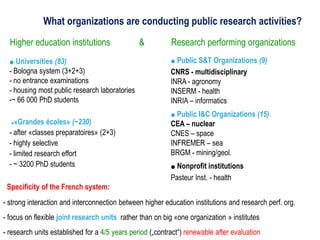
What organizations are conducting public research activities?
● Public S&T Organizations (9)
CNRS - multidisciplinary
INRA - agronomy
INSERM - health
INRIA – informatics
● Public I&C Organizations (15)
CEA – nuclear
CNES – space
INFREMER – sea
BRGM - mining/geol.
● Nonprofit institutions
Pasteur Inst. - health
● Universities (83)
- Bologna system (3+2+3)
- no entrance examinations
- housing most public research laboratories
-~ 66 000 PhD students
●«Grandes écoles» (~230)
- after «classes preparatoires» (2+3)
- highly selective
- limited research effort
- ~ 3200 PhD students
Higher education institutions & Research performing organizations
Specificity of the French system:
- strong interaction and interconnection between higher education institutions and research perf. org.
- focus on flexible joint research units rather than on big «one organization » institutes
- research units established for a 4/5 years period („contract“) renewable after evaluation
Tasks:
- evaluation of institutions (universities and research organizations)
- evaluation of research units (laboratories), modifications startiing 2015 !
- assessment of internal evaluation procedures
- evaluation of university programmes and diplomas
Composition :
- President (scientist)
- 25 / 30 board members (most are scientists, 4 years assignments)
- three departments (institutions, units, programmes and degrees)
- staff of 100 scientific delegates (part time) and 70 administrative staff (full time)
- 3500 experts called to evaluation committees per year (20% from abroad)
- annual budget of 15 M€ (2014)
Evaluating research and higher education in France
Agence d’evaluation de la recherche et de l’enseignement supérieur (AERES)
established working in 2006, transformed in 2014
Haut conseil d’evaluation de la recherche et de l’enseignement sup. (HCERES)
For more information see: http://www.aeres-evaluation.com/
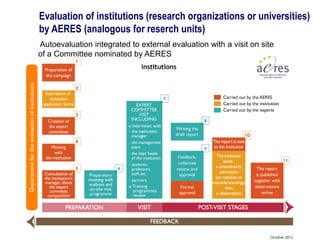
Evaluation of institutions (research organizations or universities)
by AERES (analogous for reserch units)
Autoevaluation integrated to external evaluation with a visit on site
of a Committee nominated by AERES
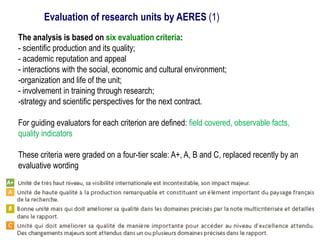
The analysis is based on six evaluation criteria:
- scientific production and its quality;
- academic reputation and appeal
- interactions with the social, economic and cultural environment;
-organization and life of the unit;
- involvement in training through research;
-strategy and scientific perspectives for the next contract.
For guiding evaluators for each criterion are defined: field covered, observable facts,
quality indicators
These criteria were graded on a four-tier scale: A+, A, B and C, replaced recently by an
evaluative wording
Evaluation of research units by AERES (1)
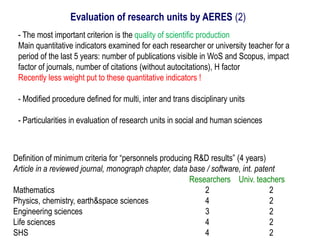
- The most important criterion is the quality of scientific production
Main quantitative indicators examined for each researcher or university teacher for a
period of the last 5 years: number of publications visible in WoS and Scopus, impact
factor of journals, number of citations (without autocitations), H factor
Recently less weight put to these quantitative indicators !
- Modified procedure defined for multi, inter and trans disciplinary units
- Particularities in evaluation of research units in social and human sciences
Evaluation of research units by AERES (2)
Definition of minimum criteria for “personnels producing R&D results” (4 years)
Article in a reviewed journal, monograph chapter, data base / software, int. patent
Researchers Univ. teachers
Mathematics 2 2
Physics, chemistry, earth&space sciences 4 2
Engineering sciences 3 2
Life sciences 4 2
SHS 4 2
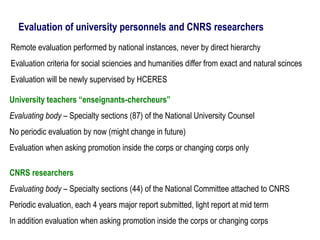
Evaluation of university personnels and CNRS researchers
University teachers “enseignants-chercheurs”
Evaluating body – Specialty sections (87) of the National University Counsel
No periodic evaluation by now (might change in future)
Evaluation when asking promotion inside the corps or changing corps only
CNRS researchers
Evaluating body – Specialty sections (44) of the National Committee attached to CNRS
Periodic evaluation, each 4 years major report submitted, light report at mid term
In addition evaluation when asking promotion inside the corps or changing corps
Remote evaluation performed by national instances, never by direct hierarchy
Evaluation criteria for social sciencies and humanities differ from exact and natural scinces
Evaluation will be newly supervised by HCERES
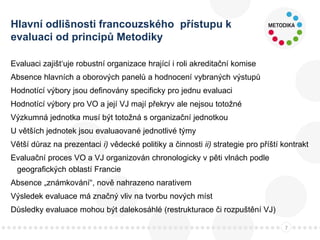
Hlavní odlišnosti francouzského přístupu k
evaluaci od principů Metodiky
Evaluaci zajišt‘uje robustní organizace hrající i roli akreditační komise
Absence hlavních a oborových panelů a hodnocení vybraných výstupů
Hodnotící výbory jsou definovány specificky pro jednu evaluaci
Hodnotící výbory pro VO a její VJ mají překryv ale nejsou totožné
Výzkumná jednotka musí být totožná s organizační jednotkou
U větších jednotek jsou evaluaované jednotlivé týmy
Větší důraz na prezentaci i) vědecké politiky a činnosti ii) strategie pro příští kontrakt
Evaluační proces VO a VJ organizován chronologicky v pěti vlnách podle
geografických oblastí Francie
Absence „známkování“, nově nahrazeno narativem
Výsledek evaluace má značný vliv na tvorbu nových míst
Důsledky evaluace mohou být dalekosáhlé (restrukturace či rozpuštění VJ)
7
Děkuji Vám za pozornost
vladimir.majer@tul.cz

Hodnocení výzkumných organizací a jednotek ve Francii

  • 1.
    Hodnocení výzkumných organizací ajednotek ve Francii Vladimír MAJER 10.2.2015
  • 2.
    What organizations areconducting public research activities? ● Public S&T Organizations (9) CNRS - multidisciplinary INRA - agronomy INSERM - health INRIA – informatics ● Public I&C Organizations (15) CEA – nuclear CNES – space INFREMER – sea BRGM - mining/geol. ● Nonprofit institutions Pasteur Inst. - health ● Universities (83) - Bologna system (3+2+3) - no entrance examinations - housing most public research laboratories -~ 66 000 PhD students ●«Grandes écoles» (~230) - after «classes preparatoires» (2+3) - highly selective - limited research effort - ~ 3200 PhD students Higher education institutions & Research performing organizations Specificity of the French system: - strong interaction and interconnection between higher education institutions and research perf. org. - focus on flexible joint research units rather than on big «one organization » institutes - research units established for a 4/5 years period („contract“) renewable after evaluation
  • 3.
    Tasks: - evaluation ofinstitutions (universities and research organizations) - evaluation of research units (laboratories), modifications startiing 2015 ! - assessment of internal evaluation procedures - evaluation of university programmes and diplomas Composition : - President (scientist) - 25 / 30 board members (most are scientists, 4 years assignments) - three departments (institutions, units, programmes and degrees) - staff of 100 scientific delegates (part time) and 70 administrative staff (full time) - 3500 experts called to evaluation committees per year (20% from abroad) - annual budget of 15 M€ (2014) Evaluating research and higher education in France Agence d’evaluation de la recherche et de l’enseignement supérieur (AERES) established working in 2006, transformed in 2014 Haut conseil d’evaluation de la recherche et de l’enseignement sup. (HCERES) For more information see: http://www.aeres-evaluation.com/
  • 4.
    Evaluation of institutions(research organizations or universities) by AERES (analogous for reserch units) Autoevaluation integrated to external evaluation with a visit on site of a Committee nominated by AERES
  • 5.
    The analysis isbased on six evaluation criteria: - scientific production and its quality; - academic reputation and appeal - interactions with the social, economic and cultural environment; -organization and life of the unit; - involvement in training through research; -strategy and scientific perspectives for the next contract. For guiding evaluators for each criterion are defined: field covered, observable facts, quality indicators These criteria were graded on a four-tier scale: A+, A, B and C, replaced recently by an evaluative wording Evaluation of research units by AERES (1)
  • 6.
    - The mostimportant criterion is the quality of scientific production Main quantitative indicators examined for each researcher or university teacher for a period of the last 5 years: number of publications visible in WoS and Scopus, impact factor of journals, number of citations (without autocitations), H factor Recently less weight put to these quantitative indicators ! - Modified procedure defined for multi, inter and trans disciplinary units - Particularities in evaluation of research units in social and human sciences Evaluation of research units by AERES (2) Definition of minimum criteria for “personnels producing R&D results” (4 years) Article in a reviewed journal, monograph chapter, data base / software, int. patent Researchers Univ. teachers Mathematics 2 2 Physics, chemistry, earth&space sciences 4 2 Engineering sciences 3 2 Life sciences 4 2 SHS 4 2
  • 7.
    Evaluation of universitypersonnels and CNRS researchers University teachers “enseignants-chercheurs” Evaluating body – Specialty sections (87) of the National University Counsel No periodic evaluation by now (might change in future) Evaluation when asking promotion inside the corps or changing corps only CNRS researchers Evaluating body – Specialty sections (44) of the National Committee attached to CNRS Periodic evaluation, each 4 years major report submitted, light report at mid term In addition evaluation when asking promotion inside the corps or changing corps Remote evaluation performed by national instances, never by direct hierarchy Evaluation criteria for social sciencies and humanities differ from exact and natural scinces Evaluation will be newly supervised by HCERES
  • 8.
    Hlavní odlišnosti francouzskéhopřístupu k evaluaci od principů Metodiky Evaluaci zajišt‘uje robustní organizace hrající i roli akreditační komise Absence hlavních a oborových panelů a hodnocení vybraných výstupů Hodnotící výbory jsou definovány specificky pro jednu evaluaci Hodnotící výbory pro VO a její VJ mají překryv ale nejsou totožné Výzkumná jednotka musí být totožná s organizační jednotkou U větších jednotek jsou evaluaované jednotlivé týmy Větší důraz na prezentaci i) vědecké politiky a činnosti ii) strategie pro příští kontrakt Evaluační proces VO a VJ organizován chronologicky v pěti vlnách podle geografických oblastí Francie Absence „známkování“, nově nahrazeno narativem Výsledek evaluace má značný vliv na tvorbu nových míst Důsledky evaluace mohou být dalekosáhlé (restrukturace či rozpuštění VJ) 7
  • 9.
    Děkuji Vám zapozornost vladimir.majer@tul.cz