BUSINESS MODEL INNOVATION 
IN THE PHARMA INDUSTRY: 
MANAGERIAL CHALLENGES 
Nicolai J Foss 
SMG – CBS
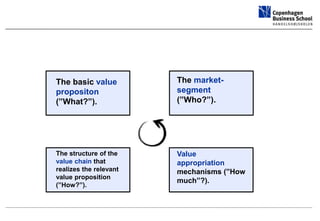
The basic value 
propositon 
(”What?”). 
The market-segment 
(”Who?”). 
The structure of the 
value chain that 
realizes the relevant 
value proposition 
(”How?”). 
Value 
appropriation 
mechanisms (”How 
much”?).
A business model innovation is a change of 
[value propositions, market segments, value 
chain elements, value appropriation 
mechanisms] that is new to the industry. 
Modular (the Kindle businesss model) vs 
systemic (Lego’s turnaround). 
Radical (Kindle) vs incremental (Lego).
BMIs are prompted by drivers that are internal 
and external to the industry. 
BMIs are embedded in organizational / 
administrative structures … that may have to 
change.
BMI DRIVERS IN THE PHARMA INDUSTRY 
The ”payment challenge”, i.e., increased 
demands that companies demonstrate 
therapeutic/cost advantages of their 
products. 
Slide 5 
More stringent regulatory environment 
(approval success rates have been going 
down since the early 1990s).
BMI DRIVERS – CONT’D 
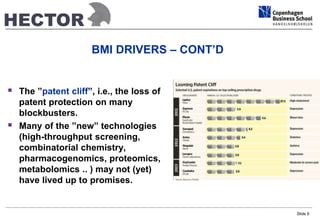
 The ”patent cliff”, i.e., the loss of 
patent protection on many 
blockbusters. 
 Many of the ”new” technologies 
(high-throughput screening, 
combinatorial chemistry, 
pharmacogenomics, proteomics, 
metabolomics .. ) may not (yet) 
have lived up to promises. 
Slide 6
BMI DRIVERS – CONT’D 
 New potential/actual entrants 
with strong downstream asset 
bases, e.g., Nestlé, Google, 
Apple, Walmart … 
 End users increasingly active 
and critical. 
Slide 7
BUSINESS MODEL INNOVATION / CHANGE 
 Blurring boundaries: 
 Increased use of contract research 
organizations and other service providers. 
 Former ”core areas” increasingly 
outsourced 
 Discovery chemistry, manufacturing, data 
management . 
 Or, pooled with other pharma players in JVs 
(e.g., Johnson & Johnson, Lilly, Merck, Novartis, 
and Pfizer setting up Enlight Biosciences). 
 Patient-centricity / ”servitization”. 
Slide 8
MANAGERIAL CHALLENGES OF BMI 
The soft underbelly of the BM/BMI literature. 
BMI: a major organizational change process. 
So far, questions rather than answers. 
Major HECTOR research theme. 
Slide 9
HUMAN RESOURCES CHALLENGES 
 Some human capital will be relatively 
less important. 
 Hiring and training new human capital, 
e.g. 
 employees specialized in market-access; 
increased need for hybrid profiles, i.e., 
both a science and business background. 
 Power and legitimacy issues. 
 Need for new KPIs, metrics, and rewards (e.g., patient satisfaction, 
Slide 10 
# of patients enrolled in service programs, benchmarking of 
external partners, etc.).
FIRM BOUNDARIES 
Challenges from handling new 
partners, e.g., service providers 
and producers of ”devices” (e.g., 
Leo and Klox Techn.). 
 Small-numbers situations. 
 IPR issues. 
 Do the right competencies exist 
for managing longer-term 
partnerships? 
Slide 11
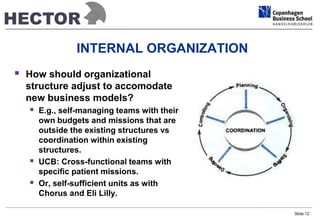
INTERNAL ORGANIZATION 
 How should organizational 
structure adjust to accomodate 
new business models? 
 E.g., self-managing teams with their 
own budgets and missions that are 
outside the existing structures vs 
coordination within existing 
structures. 
 UCB: Cross-functional teams with 
specific patient missions. 
 Or, self-sufficient units as with 
Chorus and Eli Lilly. 
Slide 12
LEADERSHIP CHALLENGES 
 Culture and identity changes? 
 ”Research-driven” → ”patient centrity-driven.” 
 Requires very different TMT communication 
 BMIs come in different forms. 
 Some involve massive changes in several 
interlocking parts of the business model, others 
involve changing a single component. 
 Leadership role depends on the nature of change. 
Slide 13
BUSINESS MODEL INNOVATION IN THE PHARMA INDUSTRY: MANAGERIAL CHALLENGES

BUSINESS MODEL INNOVATION IN THE PHARMA INDUSTRY: MANAGERIAL CHALLENGES

  • 1.
    BUSINESS MODEL INNOVATION IN THE PHARMA INDUSTRY: MANAGERIAL CHALLENGES Nicolai J Foss SMG – CBS
  • 2.
    The basic value propositon (”What?”). The market-segment (”Who?”). The structure of the value chain that realizes the relevant value proposition (”How?”). Value appropriation mechanisms (”How much”?).
  • 3.
    A business modelinnovation is a change of [value propositions, market segments, value chain elements, value appropriation mechanisms] that is new to the industry. Modular (the Kindle businesss model) vs systemic (Lego’s turnaround). Radical (Kindle) vs incremental (Lego).
  • 4.
    BMIs are promptedby drivers that are internal and external to the industry. BMIs are embedded in organizational / administrative structures … that may have to change.
  • 5.
    BMI DRIVERS INTHE PHARMA INDUSTRY The ”payment challenge”, i.e., increased demands that companies demonstrate therapeutic/cost advantages of their products. Slide 5 More stringent regulatory environment (approval success rates have been going down since the early 1990s).
  • 6.
    BMI DRIVERS –CONT’D  The ”patent cliff”, i.e., the loss of patent protection on many blockbusters.  Many of the ”new” technologies (high-throughput screening, combinatorial chemistry, pharmacogenomics, proteomics, metabolomics .. ) may not (yet) have lived up to promises. Slide 6
  • 7.
    BMI DRIVERS –CONT’D  New potential/actual entrants with strong downstream asset bases, e.g., Nestlé, Google, Apple, Walmart …  End users increasingly active and critical. Slide 7
  • 8.
    BUSINESS MODEL INNOVATION/ CHANGE  Blurring boundaries:  Increased use of contract research organizations and other service providers.  Former ”core areas” increasingly outsourced  Discovery chemistry, manufacturing, data management .  Or, pooled with other pharma players in JVs (e.g., Johnson & Johnson, Lilly, Merck, Novartis, and Pfizer setting up Enlight Biosciences).  Patient-centricity / ”servitization”. Slide 8
  • 9.
    MANAGERIAL CHALLENGES OFBMI The soft underbelly of the BM/BMI literature. BMI: a major organizational change process. So far, questions rather than answers. Major HECTOR research theme. Slide 9
  • 10.
    HUMAN RESOURCES CHALLENGES  Some human capital will be relatively less important.  Hiring and training new human capital, e.g.  employees specialized in market-access; increased need for hybrid profiles, i.e., both a science and business background.  Power and legitimacy issues.  Need for new KPIs, metrics, and rewards (e.g., patient satisfaction, Slide 10 # of patients enrolled in service programs, benchmarking of external partners, etc.).
  • 11.
    FIRM BOUNDARIES Challengesfrom handling new partners, e.g., service providers and producers of ”devices” (e.g., Leo and Klox Techn.).  Small-numbers situations.  IPR issues.  Do the right competencies exist for managing longer-term partnerships? Slide 11
  • 12.
    INTERNAL ORGANIZATION How should organizational structure adjust to accomodate new business models?  E.g., self-managing teams with their own budgets and missions that are outside the existing structures vs coordination within existing structures.  UCB: Cross-functional teams with specific patient missions.  Or, self-sufficient units as with Chorus and Eli Lilly. Slide 12
  • 13.
    LEADERSHIP CHALLENGES Culture and identity changes?  ”Research-driven” → ”patient centrity-driven.”  Requires very different TMT communication  BMIs come in different forms.  Some involve massive changes in several interlocking parts of the business model, others involve changing a single component.  Leadership role depends on the nature of change. Slide 13