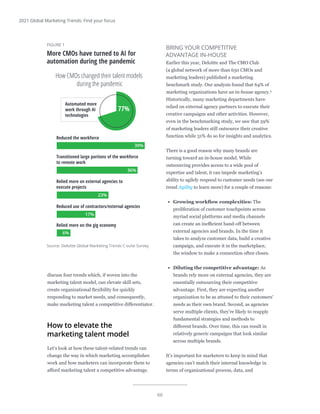
2021 Global Marketing Trends
Find your focus
Deloitte’s CMO Program supports CMOs as they navigate the complexities of the role, anticipate
upcoming market trends, and respond to challenges with agile marketing.
Read more on the latest marketing trends and insights.
About the Deloitte CMO Program
Digital technology has changed the face of business. Across the globe, Deloitte Digital helps
clients see what’s possible, identify what’s valuable, and deliver on it by combining creative and
digital capabilities with advertising agency prowess and the technical experience, deep business
strategy, and relationships of the world’s largest consultancy. Deloitte Digital empowers
businesses with the insights, platforms, and behaviors needed to continuously and rapidly
evolve to perform beyond expectations. Read more about Deloitte Digital’s world-class digital
agency and its service offerings.
Contents
Introduction	 2
Purpose: Built to flourish	 6
Agility: Changing the playbook	 16
Human Experience: Know thyself	 24
Trust: The promises we keep—or don’t	 34
Participation: A two-way street	 44
Fusion: The new ecosystem	 54
Talent: Marketing disrupted	 64
2
2021 Global Marketing Trends: Find your focus
T
HROUGHOUT HISTORY, MOMENTS of crisis
and uncertainty have galvanized new
innovations and shifted views on what
matters most to people. The 1918 pandemic
popularized the use of the telephone so much that
the people-powered switch operators couldn’t keep
up.1
In the Cold War era, the rise of televisions in
households directly influenced how people
perceived conflict at a time when the Vietnam War
became the world’s “First Televised War.”2
And,
more recently, as issues of climate change and
gender equality took centerstage, people began to
demand more from businesses.3
Now, we are confronted with an amalgamation of
uncertainty—and the world is collectively looking
for answers. With an omnipresent pandemic, we
had to find new ways to socialize in a world where
social distancing quickly became the norm; work
had to be redesigned so people could do their jobs
safely and productively; grocery shopping,
dining out, education, and medical treatment
fundamentally changed. And, almost in parallel, as
a reckoning of systemic racism came to a head, we
were forced to reassess and reflect on our values
and what it means to be human.
From people and businesses to governments,
everyone needed to find new ways to navigate this
new world—and this trends report was no different.
How do you uncover and discuss the implications
of global marketing trends at a time when the
world has seemingly turned on its axis and still
continues to change in unpredictable ways?
To seek an answer to this question, we set out on
an all-encompassing journey to better understand
how people and brands responded to the
pandemic—and, most importantly, why some
brands were able to flourish even during these
Introduction
2021 Global Marketing Trends: Find your focus
THE 2021 GLOBAL MARKETING TRENDS STUDY
As our world went through rapid changes, we recognized a need to dig deeper into the evolving
milieu to better understand how consumers and executives are responding to their new
environments. With this in mind, we conducted two surveys to inform each of the 2021 Global
Marketing Trends chapters.
The Global Marketing Trends Consumer Pulse Survey polled 2,447 global consumers, ages 18
and above, in April 2020. This survey was launched in the United States, the United Kingdom, Mexico,
China, South Africa, Qatar, the United Arab Emirates, and the Kingdom of Saudi Arabia.
The Global Marketing Trends C-suite Survey polled 405 US C-suite executives from global
companies in May 2020. This survey asked CMOs, CFOs, COOs, and CHROs their thoughts on
a variety of topics related to their response to COVID-19.
3
Introduction
Source: Deloitte Global Marketing Trends C-suite Survey.
Deloitte Insights | deloitte.com/insights
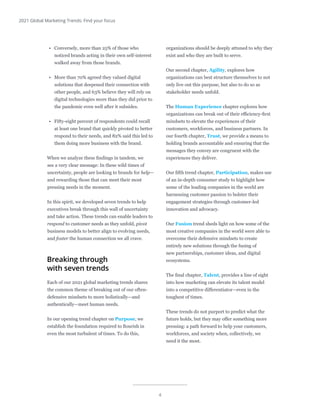
FIGURE 1
C-suite executives have all seen a significant drop in confidence
Percentage of confident executives
2019 2020 (post COVID-19)
CEO
55%
35%
CIO
41%
17%
COO
2%
8%
CMO
3%
5%
CFO
17%
10%
turbulent times. In our second annual report, we
combine subject matter expertise, voices from the
field, and two overarching surveys—one consumer-
based and the other targeted toward executives—to
separate the signals from the noise of change (see
the sidebar, “The 2021 Global Marketing Trends
study” to learn more).
Even among executives, our research found they’re
feeling the pressure of an uncertain future. For
instance, 18 months ago, we polled executives on
their ability to influence their peers and make a
strategic impact.4
When we asked 405 executives
the same questions in May of 2020, we saw
C-suite confidence has plummeted across the
board (figure 1).
As often is the case when we are unsure of how to
respond, our most basic instincts kick in and we
prioritize survival over human connection and
growth. When we asked these executives what
outcomes they hoped to achieve in responding to
the pandemic, the majority prioritized improving
efficiency and productivity over more human-
centric initiatives such as strengthening customer
engagement, retaining talent, and increasing the
company’s impact on society. And in these
moments of high stress and low certainty, almost
no one was thinking about growing revenues or
disrupting their industry.
Answering the call for help
Of course, this isn’t unprecedented or unexpected
behavior, but when we polled consumers, they
showed us that as times get tougher, they expect
more from the brands they frequent. Consider the
following findings from our consumer survey:
•	 Almost four in five people could cite a time a
brand responded positively to the pandemic
and one in five strongly agreed it led to
increased brand loyalty on their part.
4
2021 Global Marketing Trends: Find your focus
•	 Conversely, more than 25% of those who
noticed brands acting in their own self-interest
walked away from those brands.
•	 More than 70% agreed they valued digital
solutions that deepened their connection with
other people, and 63% believe they will rely on
digital technologies more than they did prior to
the pandemic even well after it subsides.
•	 Fifty-eight percent of respondents could recall
at least one brand that quickly pivoted to better
respond to their needs, and 82% said this led to
them doing more business with the brand.
When we analyze these findings in tandem, we
see a very clear message: In these wild times of
uncertainty, people are looking to brands for help—
and rewarding those that can meet their most
pressing needs in the moment.
In this spirit, we developed seven trends to help
executives break through this wall of uncertainty
and take action. These trends can enable leaders to
respond to customer needs as they unfold, pivot
business models to better align to evolving needs,
and foster the human connection we all crave.
Breaking through
with seven trends
Each of our 2021 global marketing trends shares
the common theme of breaking out of our often-
defensive mindsets to more holistically—and
authentically—meet human needs.
In our opening trend chapter on Purpose, we
establish the foundation required to flourish in
even the most turbulent of times. To do this,
organizations should be deeply attuned to why they
exist and who they are built to serve.
Our second chapter, Agility, explores how
organizations can best structure themselves to not
only live out this purpose, but also to do so as
stakeholder needs unfold.
The Human Experience chapter explores how
organizations can break out of their efficiency-first
mindsets to elevate the experiences of their
customers, workforces, and business partners. In
our fourth chapter, Trust, we provide a means to
holding brands accountable and ensuring that the
messages they convey are congruent with the
experiences they deliver.
Our fifth trend chapter, Participation, makes use
of an in-depth consumer study to highlight how
some of the leading companies in the world are
harnessing customer passion to bolster their
engagement strategies through customer-led
innovation and advocacy.
Our Fusion trend sheds light on how some of the
most creative companies in the world were able to
overcome their defensive mindsets to create
entirely new solutions through the fusing of
new partnerships, customer ideas, and digital
ecosystems.
The final chapter, Talent, provides a line of sight
into how marketing can elevate its talent model
into a competitive differentiator—even in the
toughest of times.
These trends do not purport to predict what the
future holds, but they may offer something more
pressing: a path forward to help your customers,
workforces, and society when, collectively, we
need it the most.
5
Introduction
1.	 David Cassel, “How technology helped us through the 1918 flu pandemic,” New Stack, April 12, 2020.
2.	 Jessie Kratz, “Vietnam: The first television war,” U.S. National Archives, January 25, 2018.
3.	 Dimple Agarwal et al., The rise of the social enterprise: 2018 Deloitte Global Human Capital Trends, Deloitte
Insights, 2018.
4.	 Diana O’Brien, Jennifer Veenstra, and Timothy Murphy, The makings of a more confident CMO: Three ways to
increase C-suite impact, Deloitte Insights, September 18, 2020.
Endnotes
Jennifer Veenstra is the managing director of Deloitte’s Global CMO Program.
She focuses on CMO leadership, especially around the client experience, driving
strategy, and digital transformation. She works across multiple industry areas to
help CMOs in delivering enterprise growth and connecting with customers around
purpose. She has led the transformation of the Deloitte Client Experience.
Timothy Murphy is the director of research and insights for Deloitte’s CMO
Program. As a researcher and analytical scientist with Deloitte Services LP, he
focuses on emerging marketing trends and CMO dynamics within the C-suite.
About the authors
6
2021 Global Marketing Trends: Find your focus
Organizations that know why
they exist and who they’re
built to serve are uniquely
positioned to navigate
unprecedented change.
Purpose
7
Purpose: Built to flourish
T
HE WORLD HAS been through one of the
worst crises of this century—the coronavirus
pandemic—and is just beginning to pick up
the pieces and rebuild itself socially and
economically. As COVID-19 took its economic and
emotional toll on the world, businesses were—and
still are—faced with myriad uncertainties. How do
organizations navigate a reality where their
products and services may no longer have the same
standing as they did prior to the outbreak? For
some, it may be a question of how to connect with
their communities when storefronts are shuttered,
or, in terms of talent, how to support workforces
on the frontlines as well as those confined to
their homes.
While most brands are mulling over how to
reposition themselves and best serve their
stakeholders, some are positioned to remain
steadfast in one key dimension—their purpose.
These companies inherently understand why they
exist and who they are best built to serve—from
their customers and workforces to the community—
regardless of what they sell today.
Promisingly, people are taking note of these brands.
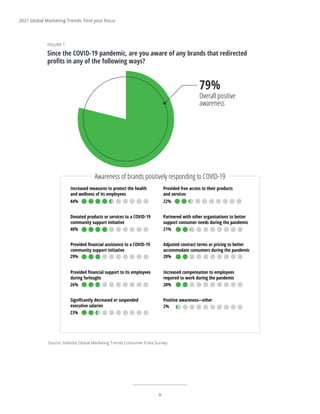
In Deloitte’s survey of 2,447 global consumers, 79%
of respondents recalled instances of brands
positively responding to COVID-19 to help their
customers, workforces, and communities (figure 1).
We saw this manifest in countless ways: financial
institutions pausing overdraft fees and deferring
loan payments; shoe companies donating
thousands of pairs of shoes to nurses healing
their communities; and many companies
shifting their long-standing corporate
policies to better support the workforces that
drive their business.
When an organization’s crisis responses are
driven by a holistic purpose—connecting a
business’s role in society to its long-term
value—there is a clear alignment between its
brand identity and a sustained commitment
to all stakeholders—including customers,
employees, suppliers, and communities, in
addition to shareholders.
Purpose-driven companies
inherently understand why
they exist and who they are
best built to serve regardless
of what they sell today.
Built to flourish
Navigating an ever-changing world
through the purpose-driven enterprise
8
2021 Global Marketing Trends: Find your focus
Source: Deloitte Global Marketing Trends Consumer Pulse Survey.
Deloitte Insights | deloitte.com/insights
FIGURE 1
Since the COVID-19 pandemic, are you aware of any brands that redirected
profits in any of the following ways?
Awareness of brands positively responding to COVID-19
Overall positive
awareness
79%
23%
26%
29%
40%
22%
Provided free access to their products
and services
Partnered with other organizations to better
support consumer needs during the pandemic
21%
Adjusted contract terms or pricing to better
accommodate consumers during the pandemic
20%
Increased compensation to employees
required to work during the pandemic
20%
Positive awareness—other
2%
Increased measures to protect the health
and wellness of its employees
Donated products or services to a COVID-19
community support initiative
Provided financial assistance to a COVID-19
community support initiative
Provided financial support to its employees
during furloughs
Significantly decreased or suspended
executive salaries
44%
9
Purpose: Built to flourish
We call these purpose-driven enterprises. Guided
by an authentic, enterprisewide purpose, these
organizations turn tough decisions into simple
choices—following the path that best embodies
their purpose. Purpose-driven enterprises are not
only garnering more attention but also spurring
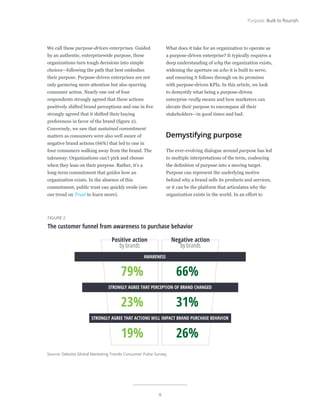
consumer action. Nearly one out of four
respondents strongly agreed that these actions
positively shifted brand perceptions and one in five
strongly agreed that it shifted their buying
preferences in favor of the brand (figure 2).
Conversely, we saw that sustained commitment
matters as consumers were also well aware of
negative brand actions (66%) that led to one in
four consumers walking away from the brand. The
takeaway: Organizations can’t pick and choose
when they lean on their purpose. Rather, it’s a
long-term commitment that guides how an
organization exists. In the absence of this
commitment, public trust can quickly erode (see
our trend on Trust to learn more).
What does it take for an organization to operate as
a purpose-driven enterprise? It typically requires a
deep understanding of why the organization exists,
widening the aperture on who it is built to serve,
and ensuring it follows through on its promises
with purpose-driven KPIs. In this article, we look
to demystify what being a purpose-driven
enterprise really means and how marketers can
elevate their purpose to encompass all their
stakeholders—in good times and bad.
Demystifying purpose
The ever-evolving dialogue around purpose has led
to multiple interpretations of the term, coalescing
the definition of purpose into a moving target.
Purpose can represent the underlying motive
behind why a brand sells its products and services,
or it can be the platform that articulates why the
organization exists in the world. In an effort to
Source: Deloitte Global Marketing Trends Consumer Pulse Survey.
Deloitte Insights | deloitte.com/insights
FIGURE 2
The customer funnel from awareness to purchase behavior
Positive action
by brands
79%
23%
19%
Negative action
by brands
66%
31%
26%
AWARENESS
STRONGLY AGREE THAT PERCEPTION OF BRAND CHANGED
STRONGLY AGREE THAT ACTIONS WILL IMPACT BRAND PURCHASE BEHAVIOR
10
2021 Global Marketing Trends: Find your focus
demystify purpose, we refer to the former as brand
purpose, as it is anchored in the consumer; while
the latter refers to a purpose-driven enterprise,
intended to address the needs of all its
stakeholders. Regardless of the endeavor, most
purpose-led brands and organizations require
clarity in motive and a means of holding
themselves accountable to the promises they make.
HOW A BIGGER “WHY” EXTENDS
THE REACH OF THE ENTERPRISE
Brand purpose and the purpose-driven enterprise
don’t have to be mutually exclusive endeavors. In
fact, a purpose-driven enterprise aligns its brand
purpose to a bigger enterprisewide purpose.
However, in many cases, the “why” behind an
organization’s products and services is siloed from
other important facets, such as talent and business
partnership strategy.
When purpose is managed in siloes, its meaning
can be confused or, at worst, it can appear
disingenuous. But when an enterprise clearly puts
its “why” at the center of its operations, purpose
can be amplified and extended both within and
outside the enterprise.
Consider one such purpose-driven enterprise—
Ella’s Kitchen. The maker of organic baby and
toddler food wants to “create healthy eating
habits that will last a lifetime.”1
Ella’s Kitchen’s
intent is to live out this purpose by going beyond
simply selling food. In line with this, it applies
its “good to each other” standards and works
with myriad stakeholders to ensure an ethically
sourced supply chain. Besides using healthy
ingredients in its products, it also provides
parents and caregivers resources to help them
develop healthy eating habits in their children.2
Ella’s Kitchen also galvanizes its corporate social
responsibility (CSR) initiatives by donating more
than 300,000 food pouches to underserved children
across the world.3
For clarity, CSR initiatives are not
synonymous with a purpose-driven enterprise.
Rather, organizations with an enterprisewide
purpose work to ensure that their CSR
activities reinforce their purpose and
their ability to positively impact the
world (see sidebar, “Elevating the
social enterprise”).
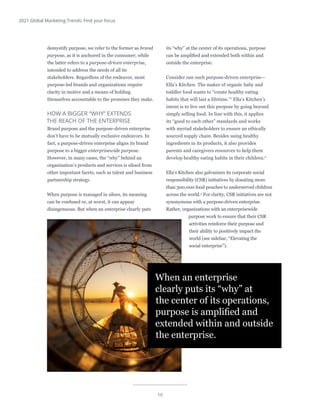
When an enterprise
clearly puts its “why” at
the center of its operations,
purpose is amplified and
extended within and outside
the enterprise.
11
Purpose: Built to flourish
Measurement: Staying
true to promises made
Our news feeds are peppered with examples of
businesses falling short of their grandiose promises.
It’s easy to put something on paper but takes
considerably more effort to authentically live out
those words. Whether it’s a brand upholding its
promises to its customers or an enterprise
demonstrating its purpose across the value chain,
organizations can benefit from promoting KPIs
that ensure they are living out their purpose across
three key dimensions:
Ingraining measurement in policies:
Organizations can establish measurable policies
across the enterprise that bolster their purpose
through key practices. Take United States–based
investment management company BlackRock, for
instance. BlackRock CEO Larry Fink once notably
said that purpose and profits are closely linked and,
as such, require policies that align fundamental
business decisions with purpose.7
In line with this,
BlackRock requests “robust” disclosures from
companies regarding how they are adhering to the
industry-specific guidelines provided by the
Sustainability Accounting Standards Board (SASB).8
For those who fall short in these disclosures,
BlackRock will “increasingly conclude that
companies are not adequately managing risk.”9
Following these standards, BlackRock “voted
against or withheld votes from 4,800 directors at
2,700 different companies” where there was a lack
of sustainability disclosures.10
KPIs for teams: To truly live out a purpose, the
workforce needs to live and breathe its values and
mission. For instance, Alaska Airlines employs
annual engagement surveys to better understand
how its employees perceive the company and
engage in living out its purpose.11
In 2020, its goal
is to ensure engagement scores are 80% or higher
across company divisions. Organizations can build
on this method by reporting to boards how these
ELEVATING THE SOCIAL ENTERPRISE
Countless brands have existed for decades—and financially flourished as well—even without a
purpose that ties directly to societal good. However, two global trends suggest organizations can do
better than “well” by ensuring their enterprise purpose and ensuing CSR initiatives are focused on
making the world a better place. These trends are:
•	 The world is shifting to the social enterprise: The social enterprise’s mission combines profit
with societal impact. We see businesses trending in this direction as CEOs most often cite “impact
on society, including income inequality, diversity, and the environment” as their most important
success measure.4
It’s not just CEOs either—millennials and Generation Z are most likely to
support companies that share their values and walk away from those that don’t hold themselves
accountable to these values.5
•	 The world is looking to businesses for solutions: According to the Edelman Trust Barometer,
which surveyed 34,000 individuals in 28 global markets, people see businesses as the most
competent group to solve global issues, even more so than nonprofits and governments.6
Notably,
respondents suggested that stakeholders including communities, consumers, and talent are
most important to an organization’s long-term success (only 13% noted shareholders as the most
important stakeholder).
Increasingly, “brand” represents how people perceive the organization, and consumers are
gravitating toward enterprises that support socially important endeavors. Keeping this in mind,
organizations should infuse a societal dimension to purpose throughout the enterprise to effectively
answer the call of stakeholders.
12
2021 Global Marketing Trends: Find your focus
engagement scores are trending over time while
simultaneously ensuring that purpose-related
conversations are a foundational part of
performance reviews.
Linking profit to purpose: If profit and purpose
are linked, organizations should measure purpose-
driven outputs to demonstrate the value of adhering
to a purpose. Further, success helps secure buy-in
and provides a line of sight into what’s working for
the organization. For example, Unilever’s
enterprise purpose is “to make sustainable living
commonplace.”12
Living this purpose, Unilever
measures the performance of its sustainable living
products versus the rest of its product portfolio.
The results: “Sustainable Living Brands are growing
69% faster than the rest of the business and
delivering 75% of the company’s growth.”13
How marketers can bring
purpose to the forefront of the
enterprise—for the long run
A purpose-driven enterprise can require multiple
facets of the organization to work in concert.
However, we recognize that not all businesses
start from the same place as far as purpose is
concerned. Start-ups can integrate purpose
into their operations from the ground up,
whereas large, legacy companies have a
steeper hill to climb as they pivot to more
purpose-driven endeavors. How marketers
can weave purpose throughout the enterprise
varies depending on the organization’s
maturity and industry.
Regardless of organizational maturity and the
industry, CMOs and their marketing organizations
can take three steps to bring purpose to life for
their consumers and, in time, all enterprise
stakeholders. They are:
1.	 Own brand purpose: As marketers are
traditionally regarded as customer experts,14
they are uniquely positioned to understand and
articulate the higher order “why” behind the
brand’s products and services. Bringing
the “why” to brand purpose can unlock creativity,
inspire employees, and create differentiation by
building an emotional connection with
consumers. Marvin, a window and door
company, shows how marketers can turn their
products into a higher-level purpose. Their
purpose: “To imagine and create better ways
of living.”15
Through its brand purpose, Marvin
articulates how it can take a seemingly
straightforward product, like a window or door,
and help people see this purchase as a way to
live a happier and healthier life in their homes.
This can be through innovative technology, such
as hidden lock sensors and smart skylights, or
the ability to fine tune every design detail to
help customers build spaces that best reflect
their individual personalities, wants, and needs.
2.	 Catalyze the enterprise purpose: If the
organization is not currently thinking about
enterprise purpose, marketers can catalyze the
How marketers can weave
purpose throughout the
enterprise varies depending
on the organization’s
maturity and industry.
13
Purpose: Built to flourish
conversation by bringing an “outside-in”
perspective to C-suite conversations. This may
mean speaking to corporate reputation or
bringing data to the table that sheds light on
current perceptions of the company relative to
the competition.
As noted in our consumer pulsing research
(figure 1), consumers are most aware of brands
that responded to COVID-19 by protecting
employees (44%) and donating products to
support a COVID-19 community support
initiative (40%). Ethias, a large insurer in
Belgium, did exactly this when the pandemic
first hit. Wilfried Neven, the chief digital
transformation officer of Ethias, said they
quickly developed three phases of response: “First,
protect the employees; second protect the
clients; and third, overall, protect the company.”16
Beyond moving employees to remote work,
Ethias stood up digital messaging campaigns to
check in on employee well-being. And to assist
the community, Ethias employees combined
their digital expertise with their insurance
ecosystem to develop a COVID-19 volunteer
network through their App4You platform. This
platform matched volunteers with community
needs—while providing free insurance to the
volunteers providing service. In doing so,
Ethias was able to expand its core mission and
purpose across the enterprise—and beyond the
traditional customer base.
3.	 Fuse brand and enterprise purpose
where appropriate: Are an organization’s
CSR initiatives a major reason its consumers
are loyal to its brand? If yes, marketers can work
directly with public relations to help ensure that
the messaging for the brand and enterprise
purposes is congruent. If not, marketers can
work with the CSR team to strengthen the
enterprise’s voice in the marketplace.
Consider Expensify, a corporate credit card and
expense reporting company. Expensify started
with the strong brand purpose of giving busy
professionals some time back by making
expense reporting fast and easy.17
As the
company grew in popularity, it was able to
build a larger enterprisewide purpose.
Expensify now donates 10% of its card revenue
to societal initiatives addressing homelessness,
child hunger, and climate change. When
someone books a hotel on its platform,
Expensify donates to causes addressing
homelessness, and when someone buys a plane
ticket, it helps plant trees to reduce carbon
emissions. Expensify has a strong brand
purpose that directs its CSR initiatives.
The COVID-19 pandemic has shown us that
companies which know “why” they serve their
stakeholders are uniquely positioned to navigate
unprecedented change. When purpose is
embedded across the entire enterprise,
organizations can live it out across the value chain
to fulfill the hopes of their stakeholders, and
possibly, change the world.
14
2021 Global Marketing Trends: Find your focus
1.	 Ella’s Kitchen, “Our mission + values,” accessed August 6, 2020.
2.	 Ella’s Kitchen “Our dream,” accessed August 6, 2020.
3.	 Ella’s Kitchen, The good stuff we do, 2019.
4.	 Erica Volini et al., Introduction: Leading the social enterprise—Reinvent with a human focus: 2019 Global Human
Capital Trends, Deloitte Insights, April 11, 2019.
5.	 Michele Parmelee, The Deloitte Global Millennial Survey 2020: Highlights—In the midst of crisis, younger generations
show resilience, Deloitte Insights, June 25, 2020.
6.	 “Edelman Trust Barometer 2020,” presented at the Points of Light: Corporate Services Council,
February 5, 2020.
7.	 BlackRock, “Larry Fink’s 2019 letter to CEOs,” 2019.
8.	 BlackRock, “A fundamental reshaping of finance,” accessed April 29, 2020.
9.	 Ibid.
10.	 Ibid.
11.	 Alaska Airlines, 2016 sustainability report: Focusing on people, 2016.
12.	 Unilever, Our sustainable living report, accessed April 29, 2020.
13.	 Unilever, “Unilever, purpose-led brands outperform,” accessed April 29, 2020.
14.	 Diana O’Brien, Jennifer Veenstra, and Timothy Murphy, The making of a more confident CMO: Three ways to
increase C-suite impact, Deloitte Insights, September 18, 2019.
15.	 Marvin, “Our story: Advancing with purpose,” accessed June 2, 2020.
16.	 Wilfried Neven (chief digital transformation officer, marketing function), interview with the author.
17.	 First reported by Amanda Gregory, “Three great examples of brand purpose,” Catalyst Marketing, April 16, 2019
and elaborated on Expensify’s “Who we are: How we got here,” accessed March 26, 2020.
Endnotes
15
Purpose: Built to flourish
Suzanne Kounkel is the chief marketing officer of Deloitte and Deloitte
Consulting LLP. She pushes the bounds of creativity and collaboration in
pursuit of two intertwined goals: happy clients and healthy business growth.
A principal in Deloitte Consulting LLP, Kounkel is a frequent speaker and
published author on purpose-driven brand, elevating the human experience
within B2B marketing, and the ethical use of data within marketing.
Amy Silverstein leads Deloitte’s Purpose Strategy offering, a unique collaboration
across the Monitor Institute and Monitor Deloitte Strategy. A leader within
the Monitor Institute by Deloitte LLP, she advises organizations to develop,
operationalize, measure, and communicate their purpose including Environmental,
Social, and Governance (ESG) strategies and linking purpose to core enterprise
strategy to accelerate commercial growth, manage risk, and advance societal
impact. Silverstein is a frequent speaker and author on the topic of social purpose
for value creation, the role of business in society, and the future of CSR.
Kathleen Peeters leads the Marketing and Commerce Practice in Belgium, where
her professional motivation involves helping companies leverage the full potential
of their business by making meaningful connections with their customers and
transforming their marketing. A director with Deloitte Consulting LLP, she has led
multiple transformation projects focused on maximizing the value of marketing
technology and data to help the clients’ business grow. Peeters is a marketing
and communication executive with broad experience in digital marketing, Data
& BI, CRM, CDP, strategy, marketing automation and marketing operations.
About the authors
16
2021 Global Marketing Trends: Find your focus
The time is just right for
marketers to leverage
relevant digital tools and
design an organizational
road map to make agile
marketing a reality.
Agility
17
Agility: Changing the playbook
F
OR DECADES, THE recession playbook
remained mostly unchanged: Either retrench,
focus on costs, and ride out the downturn, or
spend ahead of demand with a view to capturing
market share. However, the current pandemic-
triggered recession is unique in that it has forced
massive, rapid changes in consumer behavior—
away from brick-and-mortar stores and toward
digital channels. Consequently, navigating the
downturn requires a new playbook: Pivot to an
agile digital channel strategy that meets customer
needs as they unfold or risk losing relevance in an
already tight marketplace.
In our survey of 2,447 global consumers, 58% were
able to name a brand that was able to quickly pivot
its offerings to better react to the “new normal”
induced by COVID-19. Of this set of respondents,
82% said such new, relevant offerings had
increased their desire to do more business with
these brands. COVID-19 has also heightened
customers’ appreciation and adoption of digital
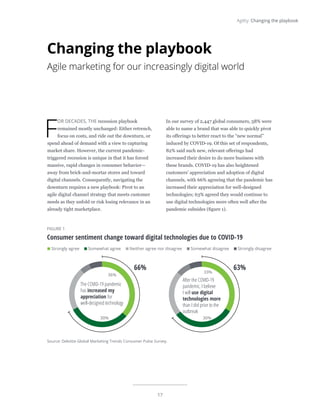
channels, with 66% agreeing that the pandemic has
increased their appreciation for well-designed
technologies; 63% agreed they would continue to
use digital technologies more often well after the
pandemic subsides (figure 1).
Changing the playbook
Agile marketing for our increasingly digital world
FIGURE 1
Consumer sentiment change toward digital technologies due to COVID-19
Strongly agree Somewhat agree Neither agree nor disagree Somewhat disagree Strongly disagree
Source: Deloitte Global Marketing Trends Consumer Pulse Survey.
Deloitte Insights | deloitte.com/insights
The COVID-19 pandemic
has increased my
appreciation for
well-designed technology
36%
30%
66%
After the COVID-19
pandemic, I believe
I will use digital
technologies more
than I did prior to the
outbreak
30%
33%
63%
18
2021 Global Marketing Trends: Find your focus
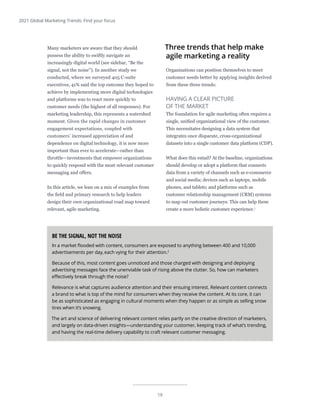
Many marketers are aware that they should
possess the ability to swiftly navigate an
increasingly digital world (see sidebar, “Be the
signal, not the noise”). In another study we
conducted, where we surveyed 405 C-suite
executives, 41% said the top outcome they hoped to
achieve by implementing more digital technologies
and platforms was to react more quickly to
customer needs (the highest of all responses). For
marketing leadership, this represents a watershed
moment. Given the rapid changes in customer
engagement expectations, coupled with
customers’ increased appreciation of and
dependence on digital technology, it is now more
important than ever to accelerate—rather than
throttle—investments that empower organizations
to quickly respond with the most relevant customer
messaging and offers.
In this article, we lean on a mix of examples from
the field and primary research to help leaders
design their own organizational road map toward
relevant, agile marketing.
Three trends that help make
agile marketing a reality
Organizations can position themselves to meet
customer needs better by applying insights derived
from these three trends:
HAVING A CLEAR PICTURE
OF THE MARKET
The foundation for agile marketing often requires a
single, unified organizational view of the customer.
This necessitates designing a data system that
integrates once disparate, cross-organizational
datasets into a single customer data platform (CDP).
What does this entail? At the baseline, organizations
should develop or adopt a platform that connects
data from a variety of channels such as e-commerce
and social media; devices such as laptops, mobile
phones, and tablets; and platforms such as
customer relationship management (CRM) systems
to map out customer journeys. This can help them
create a more holistic customer experience.1
BE THE SIGNAL, NOT THE NOISE
In a market flooded with content, consumers are exposed to anything between 400 and 10,000
advertisements per day,each vying for their attention.2
Because of this, most content goes unnoticed and those charged with designing and deploying
advertising messages face the unenviable task of rising above the clutter. So, how can marketers
effectively break through the noise?
Relevance is what captures audience attention and their ensuing interest. Relevant content connects
a brand to what is top of the mind for consumers when they receive the content. At its core, it can
be as sophisticated as engaging in cultural moments when they happen or as simple as selling snow
tires when it’s snowing.
The art and science of delivering relevant content relies partly on the creative direction of marketers,
and largely on data-driven insights—understanding your customer, keeping track of what’s trending,
and having the real-time delivery capability to craft relevant customer messaging.
19
Agility: Changing the playbook
Take for example a global consumer goods
manufacturer that underwent an initiative
to establish its own CDP to provide more
relevant and personalized customer
offerings. Previously, the marketing database had a
difficult time keeping up with the changing needs
of the customer as it consisted of 1,700 tables that
were updated on a weekly cadence. By mapping
out the customer journey across the various
information sources, the manufacturer was able to
consolidate these sources into eight tables that
reflected key customer interactions across their
website, mobile apps, text messages, call centers,
and instore transactions. By doing so, it was able to
effectively deliver relevant marketing solutions
across the customer journey to more than 50 million
customers—as their needs unfolded in real time.3
ANTICIPATING THE CONVERSATION
To truly answer the call of the customer, an
organization should be able to sense—and
understand—the needs of the customer. Thankfully,
a holistic CDP combined with “predictive sensing”
technologies (powered by machine learning and
artificial intelligence) makes this possible for many
organizations.
For instance, Deloitte Digital’s social sensing
capabilities forecast where conversations are
headed over the next 72 hours, helping enable
organizations to scan conversations in the
marketplace, measure consumer sentiment, and
predict where those conversations may trend over
the coming days. This can be as specific as
measuring and predicting sentiment on advertising
messages or determining where people who have
recovered from COVID-19 may be most open to
donating plasma containing antibodies.4
EMBRACING SOCIAL CRM
Once they have a sense of where the conversation
is heading, marketers have myriad channels at
their disposal to engage with their audiences.
Beyond traditional channels such as email, print
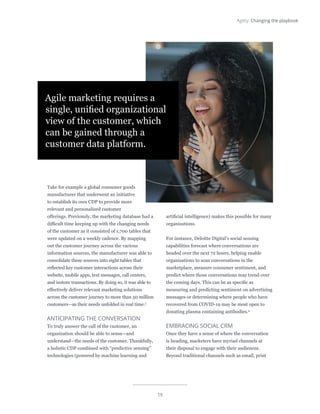
Agile marketing requires a
single, unified organizational
view of the customer, which
can be gained through a
customer data platform.
20
2021 Global Marketing Trends: Find your focus
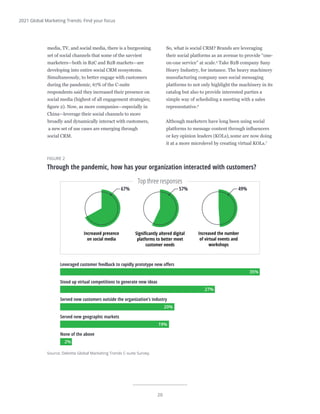
media, TV, and social media, there is a burgeoning
set of social channels that some of the savviest
marketers—both in B2C and B2B markets—are
developing into entire social CRM ecosystems.
Simultaneously, to better engage with customers
during the pandemic, 67% of the C-suite
respondents said they increased their presence on
social media (highest of all engagement strategies;
figure 2). Now, as more companies—especially in
China—leverage their social channels to more
broadly and dynamically interact with customers,
a new set of use cases are emerging through
social CRM.
So, what is social CRM? Brands are leveraging
their social platforms as an avenue to provide “one-
on-one service” at scale.5
Take B2B company Sany
Heavy Industry, for instance. The heavy machinery
manufacturing company uses social messaging
platforms to not only highlight the machinery in its
catalog but also to provide interested parties a
simple way of scheduling a meeting with a sales
representative.6
Although marketers have long been using social
platforms to message content through influencers
or key opinion leaders (KOLs),some are now doing
it at a more microlevel by creating virtual KOLs.7
Source: Deloitte Global Marketing Trends C-suite Survey.
Deloitte Insights | deloitte.com/insights
FIGURE 2
Through the pandemic, how has your organization interacted with customers?
Top three responses
Increased presence
on social media
Significantly altered digital
platforms to better meet
customer needs
Increased the number
of virtual events and
workshops
Leveraged customer feedback to rapidly prototype new offers
Stood up virtual competitions to generate new ideas
Served new customers outside the organization’s industry
Served new geographic markets
None of the above
35%
27%
20%
19%
2%
67% 57% 49%
21
Agility: Changing the playbook
For example, China-based cosmetics company
Perfect Diary developed a virtual KOL, Xiao Wanzi,
to offer her followers advice on its products and
share tutorials on using them in the best way. Part
of what makes her so good at her job is that she
isn’t real!8
Perfect Diary developed the virtual
persona of Xiao Wanzi to interact with consumers
and help set trends in the marketplace.
Both Perfect Diary and Sany Heavy Industry are
examples of companies pioneering the use of social
media for large enterprise digital marketing and
commerce. For many companies based in the
western hemisphere, this trend is just beginning to
take form, with many refining their social
strategies within their Chinese markets.
Starting your journey to agile
For organizations to be able to implement
these tools and capabilities effectively and
make agile marketing a reality, the C-suite
needs to operate from a foundation of a
clear, enterprisewide vision. Based on our
research, here are three steps marketers
can take to create and execute on their
vision of agile marketing:
1.	 Lead through the customer. With CDPs
becoming more commonplace (and better
supported by major technology vendors),
marketers can be bold in their aspirations. This
starts with understanding the customer and
their needs—a position the CMO is uniquely
qualified to navigate (see our trend on Fusion to
learn more).9
Our research shows that CMOs
have a significant impact on customer
experience conversations within the C-suite
(81%). They can use this position of knowledge
to help map out a unified vision for
the organization.
2.	 Collaborate on channel strategy design.
When we asked members of the C-suite which
functional areas will be most critical over the
next year, digital technology and sales and
marketing were cited the most (68% and 63%,
respectively). Naturally, these two areas will be
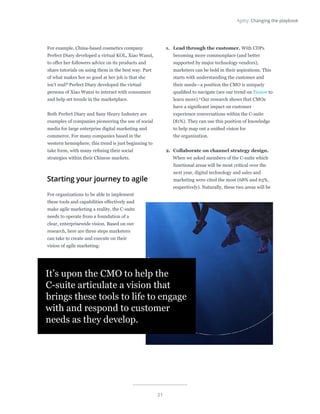
It’s upon the CMO to help the
C-suite articulate a vision that
brings these tools to life to engage
with and respond to customer
needs as they develop.
22
2021 Global Marketing Trends: Find your focus
1.	 Chitra Iyer, “What is a Customer Data Platform (CDP)? With top 10 CDP software for 2020,” MarTech Advisor,
November 4, 2019.
2.	 Jon Simpson, “Finding brand success in the digital world,” Forbes, August 25, 2017.
3.	 From Deloitte client work.
4.	 Ibid.
5.	 Ruonan Zheng, “The hidden power of WeChat Social CRM: what you need to know,” Jing Daily, May 22, 2019.
6.	 Jourdan Ma, “A beginner’s guide to China’s biggest social media platforms,” New Narrative, June 12, 2019.
7.	 Diana O’Brien et al., Diffusing agility across the organization, Deloitte Insights, October 15, 2019.
8.	 Lauren Hallanan, “Fictional influencer ‘Xiao Wanzi’ is perfect diary’s secret to success,” Jing Daily,
September 29, 2019.
9.	 Diana O’Brien, Jennifer Veenstra, and Timothy Murphy, The makings of a more confident CMO, Deloitte Insights,
September 18, 2019.
Endnotes
incredibly relevant while designing a channel
strategy that works in concert across the
customer journey. In this context, the CMO and
chief information officer (CIO) can better
position their agile strategy by bringing key
members of the C-suite—such as the chief sales
officer (CSO)—into the fold early and
incorporate their needs and insights into the
channel strategy design.
3.	 Rapidly prototype—and launch—new
offers. For agile marketing to be successful,
speed is of paramount importance. Yet, figure 2
shows that only 35% of organizations are
leveraging customer feedback to rapidly
prototype new offers. Considering the
importance of relevant messaging—coupled
with a clear understanding of the customer
journey—there may be no better time to lean on
sensing technology and social CRM to embrace
rapid execution.
For the first time, the tools to successfully execute
agile marketing are readily available to organizations.
Now, it’s upon the CMO to help the C-suite articulate
a vision that brings these tools to life to engage
with and respond to customer needs as
they develop.
23
Agility: Changing the playbook
Acknowledgments
Peter Sedivy is the leader of Deloitte Digital Asia-Pacific. He is an experienced
implementation leader and digital strategist with 22 years of experience in
customer strategy, e-commerce, digital marketing, and large-scale digital
transformation. Sedivy has led substantial initiatives in the United States, Mexico,
Germany, China, and Japan for several of the world’s leading companies. He is
presently based in Hong Kong as part of Deloitte Advisory (Hong Kong) Ltd.
Michael Barrett is president at Deloitte Digital’s Heat, working with companies
to drive growth by developing new offerings, expanding relationships with
existing clients and bringing in new business. A principal with Deloitte Consulting
LLP, he has more than 20 years of advertising experience, in a wide variety of
roles in the industry. Barrett has partnered with clients to build effective creative,
powerfully engage with an audience, and craft award-winning campaigns.
About the authors
The authors would like to thank Yohan Gaumont (Canada), Ed Greig (United Kingdom), and Kathleen
Peeters (Belgium) for their contributions to the development of this trend.
24
2021 Global Marketing Trends: Find your focus
Pivot your thinking from
speed-to-market and
efficiency plays to fostering
the human connection.
Human Experience
25
Human Experience: Know thyself
W
HAT’S MORE IMPORTANT—efficiency
or the human experience? It’s the choice
between taking a cheaper flight or a
safer one; buying clothing with the fastest delivery
or from the supplier with the most ethically
designed supply chain; relying on a “robo adviser”
for your investments or taking out time to ensure
your money is directed toward investments that
align with your values.
In our inaugural Global Marketing Trends
report, we discussed in the Human Experience
chapter how organizations need to pay down
their “experience debt.”1
That is, when
organizations design their digital future for
efficiency, rather than human connection, a debt
accrues, and this debt can manifest in biased
results, lack of inclusivity, and feelings of
social isolation.
Then COVID-19 swept the globe. For some
organizations, these more efficient but less
human-centric solutions proved
insufficient at a time when technology
became the primary conduit to human
connection. As people looked to digital
solutions that deepened this connection,
they often moved away from the companies
that didn’t—or couldn’t—reflect what they
value, toward those that elevated the human
experience. For instance, when we surveyed almost
2,500 global consumers in April, one in four people
strongly agreed that they walked away from brands
they believe acted in self-interest. Simultaneously,
more than 70% agreed that they valued the digital
innovations that deepened their connection with
others during COVID-19.
We then dug deeper and asked more than 400
executives in May the top outcomes they hoped to
achieve while responding to the pandemic.
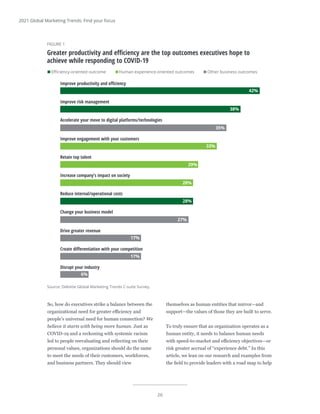
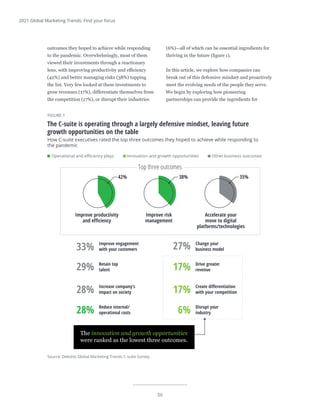
Interestingly, three intuitive outcomes topped the
list: Improving productivity and efficiency,
improving risk management, and accelerating
organizational moves to digital platforms and
technologies (figure 1). Of course, with many
organizations scrambling to find any possible
means to preserve their business, striving for
efficiency and better risk management is a logical
path forward. But something else also caught our
eye: This period of uncertainty put a spotlight on
our universal need for connection. Our executive
survey found that improving customer engagement,
retaining top talent, and increasing the company’s
impact on society—all ways to connect with
customers, workforces, and society—were the next
most important objectives for many organizations.
Know thyself
How enterprise values drive the human experience
Organizations should
view themselves as human
entities that mirror—and
support—the values of those
they are built to serve.
26
2021 Global Marketing Trends: Find your focus
So, how do executives strike a balance between the
organizational need for greater efficiency and
people’s universal need for human connection? We
believe it starts with being more human. Just as
COVID-19 and a reckoning with systemic racism
led to people reevaluating and reflecting on their
personal values, organizations should do the same
to meet the needs of their customers, workforces,
and business partners. They should view
themselves as human entities that mirror—and
support—the values of those they are built to serve.
To truly ensure that an organization operates as a
human entity, it needs to balance human needs
with speed-to-market and efficiency objectives—or
risk greater accrual of “experience debt.” In this
article, we lean on our research and examples from
the field to provide leaders with a road map to help
Source: Deloitte Global Marketing Trends C-suite Survey.
Deloitte Insights | deloitte.com/insights
FIGURE 1
Greater productivity and efficiency are the top outcomes executives hope to
achieve while responding to COVID-19
Efficiency-oriented outcome Human experience-oriented outcomes Other business outcomes
6%
17%
17%
27%
28%
28%
29%
33%
35%
38%
42%
Disrupt your industry
Create differentiation with your competition
Drive greater revenue
Change your business model
Reduce internal/operational costs
Increase company’s impact on society
Retain top talent
Improve engagement with your customers
Accelerate your move to digital platforms/technologies
Improve risk management
Improve productivity and efficiency
27
Human Experience: Know thyself
bring human values to the forefront of their
solutions and empower them to respond quickly—
and authentically—to human needs.
Reimagining organizations
to be more human
Times of societal disruption—such as the ongoing
pandemic—can be a call to action for companies to
rethink their values, operations, and infrastructure.
It’s an opportunity to innovate and rebuild the
human experience in a manner that addresses our
collective needs. Here are two ways in which an
organization can transform itself into the more
human-centered enterprise the world is expecting:
BRINGING VALUE-BASED
SOLUTIONS TO MARKET
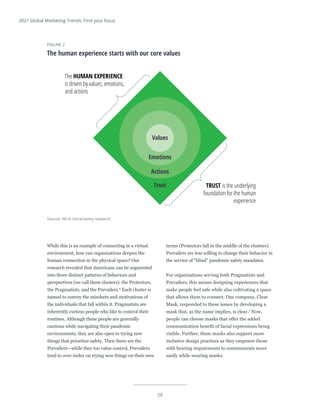
Why start with values? Because values drive human
emotions and actions—they are not the things we
do, but explain why we do them (figure 2).2
Ninety-
five percent of our purchasing decisions are
driven by subconscious urges, the biggest of
which is emotion.3
In our earlier study
covering 16,000 persons, we found more
than half of all people desired a more “human”
experience from their virtual environments.4
And as time went on, even these virtual experiences
had diminishing returns as technology couldn’t
fully compensate for in-person interactions.
Complicating matters is the fact that in the past,
organizations relied on in-person interactions to
bolster the human connection while new-age
digital solutions are likely a little less human.
Promisingly, however, some companies have been
able to quickly pivot and revamp their digital
environments to better foster this connection. For
instance, Kenu, a smartphone accessory
manufacturer, used to regularly visit its Chinese
partners to tour their manufacturing plants and
connect with key stakeholders.5
When travel
became restricted due to the pandemic, Kenu
moved these visits to a virtual environment.
By using 360-degree remote cameras and a
collaboration platform named AVATOUR, Kenu
continued to conduct regular plant tours with key
business partners. An added benefit of going
digital: They can now meet anytime.
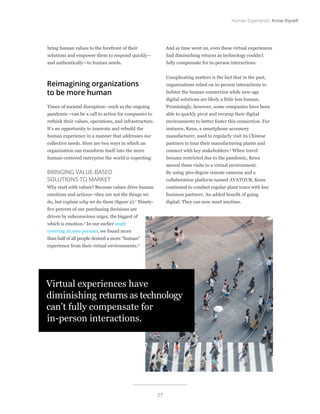
Virtual experiences have
diminishing returns as technology
can’t fully compensate for
in-person interactions.
28
2021 Global Marketing Trends: Find your focus
While this is an example of connecting in a virtual
environment, how can organizations deepen the
human connection in the physical space? Our
research revealed that Americans can be segmented
into three distinct patterns of behaviors and
perspectives (we call them clusters): the Protectors,
the Pragmatists, and the Prevailers.6
Each cluster is
named to convey the mindsets and motivations of
the individuals that fall within it. Pragmatists are
inherently curious people who like to control their
routines. Although these people are generally
cautious while navigating their pandemic
environments, they are also open to trying new
things that prioritize safety. Then there are the
Prevailers—while they too value control, Prevailers
tend to over-index on trying new things on their own
terms (Protectors fall in the middle of the clusters).
Prevailers are less willing to change their behavior in
the service of “blind” pandemic safety mandates.
For organizations serving both Pragmatists and
Prevailers, this means designing experiences that
make people feel safe while also cultivating a space
that allows them to connect. One company, Clear
Mask, responded to these issues by developing a
mask that, as the name implies, is clear.7
Now,
people can choose masks that offer the added
communication benefit of facial expressions being
visible. Further, these masks also support more
inclusive design practices as they empower those
with hearing impairments to communicate more
easily while wearing masks.
Source: HX in Uncertainty research.
Deloitte Insights | deloitte.com/insights
FIGURE 2
The human experience starts with our core values
The HUMAN EXPERIENCE
is driven by values, emotions,
and actions
TRUST is the underlying
foundation for the human
experience
Values
Emotions
Actions
Trust
29
Human Experience: Know thyself
At a more micro level, it’s important for brands to
understand their purpose. For instance, global
furniture company IKEA has a vision to “create a
better everyday life for the many people—for
customers, but also for our coworkers and the
people who work at our suppliers.”8
To help
develop new home design ideas in an environment
that’s safe for both customers and employees, IKEA
offers an augmented reality design room that pairs
customers with interior designers and technologies.
It also enables them to walk through their homes
and visualize what different combinations of
products could look like in their living spaces.9
REDESIGNING INFRASTRUCTURE
TO RESPOND TO SOCIETY’S
MOST PRESSING NEEDS
Crises always create opportunities for
organizations to reset, innovate, and better serve
the needs of individuals and communities. For
instance, consider the devastating effects of
Hurricane Katrina in the United States in August
2005.10
At the time, it was estimated that 80% of
New Orleans was flooded due to the city’s poor
infrastructure and engineering policies. Following
the disaster, the city invested in modern
engineering and sophisticated computer modeling
techniques to create the best flood control system
of any coastal city in the United States.
Companies can use times of unrest to assess if they
are prepared to respond, and if not, use their
learnings to redesign internal processes and
policies to come out stronger than before.
Members of the Business Roundtable, a nonprofit
organization of CEOs from some of the world’s
leading brands, have already released a statement
on the “purpose of a corporation.” The statement
acknowledges that businesses need to address
needs such as employee fairness, ethical supply
chains, and protect and support the communities
they work in.11
Some leading brands today are actively engaging in
such self-assessment and making changes to their
infrastructure and policies to meet the needs of
society. For example, to address issues of inequality
and systematic racism, PepsiCo CEO Ramon
Laguarta in an open letter talked about the three
pillars of policy changes—and corresponding
measurable goals—that the company has
implemented.12
Here are some steps PepsiCo has
taken around each of the three pillars:
•	 People: To increase the representation of
minorities in its ranks, the company has
announced a goal to expand its Black
managerial population by 30% by 2025. In
addition, it is focusing on increasing
recruitment efforts with Historically Black
colleges and universities.
•	 Business partners: PepsiCo also stated that
it will double its spending on Black-owned
suppliers and leverage its influence to create
more roles for Black creators at its
marketing agencies.
•	 Communities: To help drive long-term
change, PepsiCo will invest US$20 million
more dollars over the next five years in Black
communities. This includes programs designed
to provide jobs, nutrition, and mentoring and
management training for Black-owned
small businesses.
Similarly, yogurt producer Chobani built a
comprehensive approach to supporting its entire
ecosystem of stakeholders. For instance, to bring
better food to people around the world, the
Chobani Incubator provides innovative food and
beverage startups with grants, mentorship, and
access to its partner network.13
And in terms of its
own people, Chobani Shares invites all full-time
employees the chance to own equity in the
company and share in its growth.14
30
2021 Global Marketing Trends: Find your focus
In the absence of such a deliberate approach—as
adopted by PepsiCo and Chobani—to address
human needs, organizational trust can erode.
These examples highlight an important takeaway:
Addressing the most pressing needs of people can
take more than just good intentions—it can require
a deliberate effort to uncover human needs and
address those needs holistically.
Becoming a bit more human
Reimagining your organization to be more human
often starts with empathetic leadership. Here are
three areas leaders can focus on today as part of
their longer-term journey to better elevate the
human experience:
•	 Look for blind spots: It’s hard for an
organization (or an individual) to see
their own blind spots. It’s also a very
personal process that most likely starts
with the CEO playing an active role in
reaching out and listening to those the
organization represents. Thankfully, the
CEO can start each one of these
conversations on the premise of one
universal fact: We are all humans with
the need for connection.15
This entails listening
to customers, employees, and business
partners to understand—and address—what
matters most to them.
•	 It’s OK to sit out (for a little while): Speed
to market is always a pressing business need,
and it’s not acceptable to stay put, but
sometimes your organization just isn’t ready to
jump in on the conversation—and that’s okay.
It’s better to sit out and ensure your words
match your actions rather than unwittingly
straying into one of those “blind spots.”
Organizations can use such times to reflect and
build a plan to systematically address any
issues from within before they speak up. This
can not only allow them to respond better when
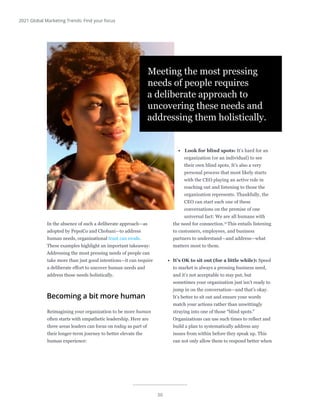
Meeting the most pressing
needs of people requires
a deliberate approach to
uncovering these needs and
addressing them holistically.
31
Human Experience: Know thyself
they’re ready, but it also can help ensure that
their messages are authentic.
•	 Be proactive (when you are ready):
Building an authentic brand typically starts
with living out the espoused values of the
organization. And when a brand’s values match
stakeholder values, better solutions can come to
fruition. So, how can organizations proactively
align their values with those of stakeholders? On
many executive teams, the CMO is seen as the
customer champion (and hopefully, more
broadly, as the human champion).16
The CMO
can use this position to advocate the needs of
their most important stakeholders and ensure
that the entire organization is positioned to
address those needs authentically.
Moving fast and striving for efficiency will always
be important for businesses, but in times of crisis,
we’re reminded of what’s unchanging—people’s
values. When we pause to reflect on what people
need, we can design more sustainable solutions
that tap into what makes us human—our universal
need for connection.
32
2021 Global Marketing Trends: Find your focus
Endnotes
1.	 Diana O’Brien et al., Paying down the experience debt, Deloitte Insights, October 15, 2019.
2.	 Amelia Dunlop et al., “The human experience: Quantifying the value of human values,” Deloitte Digital,
August 7, 2019.
3.	 Manda Mahoney, “The subconscious mind of the customer (and how to reach it),” Harvard Business School,
January 13, 2003.
4.	 Amelia Dunlop et al., “Navigating uncertainty: The Protector, the Pragmatist, and the Prevailer,” Deloitte Digital,
July 30, 2020.
5.	 AVATOUR, “AVATOUR and Insta360 offer virtual reality remote presence as a solution to coronavirus travel
restrictions,” March 11, 2020.
6.	 Dunlop et al., “Navigating uncertainty.”
7.	 CBS Baltimore, “Maryland business recognized for making clear masks,” July 14, 2020.
8.	 IKEA “Vision & Business idea,” accessed July 16, 2020.
9.	 Furniture, Lighting, & Décor, “IKEA and Space10 launch website to re-think home design post COVID-19,”
June 17, 2020.
10.	 Sarah Gibbens, “Hurricane Katrina, explained,” National Geographic, January 16, 2019.
11.	 Business Roundtable, “Our commitment,” accessed July 30, 2020.
12.	 Ramon Laguarta, “PepsiCo CEO: ‘Black Lives Matter, to our company and to me,’” Fortune, June 16, 2020.
13.	 Chobani Incubator, accessed July 29, 2020.
14.	 Chobani Incubator, “About,” accessed July 29, 2020.
15.	 Amelia Dunlop, “Why CEOs are really chief (human) experience officers,” Wired partner content, accessed
July 16, 2020.
16.	 Diana O’Brien, Jennifer Veenstra, and Timothy Murphy, The makings of a more confident CMO, Deloitte Insights,
September 18, 2019.
33
Human Experience: Know thyself
Acknowledgments
Amelia Dunlop is the chief experience officer for Deloitte Digital and
leader of the US Customer Strategy and Applied Design practice for Deloitte
Consulting LLP, where she helps companies develop winning strategies
that combine innovation, creativity, and digital strategy. Dunlop writes and
speaks regularly about human experience, creativity, and customer strategy,
and contributes to the Wall Street Journal’s CMO Journal and Adweek.
About the author
The author would like to thank Maggie Gross (United States), Emily Werner (United States), and
Ashley Reichheld (United States) for their contributions to the development of this trend.
34
2021 Global Marketing Trends: Find your focus
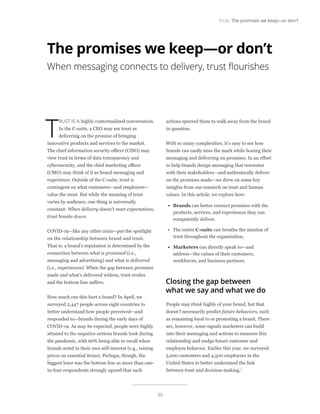
To build trust in these turbulent
times, brands should look at
what people value—rather
than what they look like—and
ensure their promises are in
sync with their competence to
deliver on them.
Trust
35
Trust: The promises we keep—or don’t
T
RUST IS A highly contextualized conversation.
In the C-suite, a CEO may see trust as
delivering on the promise of bringing
innovative products and services to the market.
The chief information security officer (CISO) may
view trust in terms of data transparency and
cybersecurity, and the chief marketing officer
(CMO) may think of it as brand messaging and
experience. Outside of the C-suite, trust is
contingent on what customers—and employees—
value the most. But while the meaning of trust
varies by audience, one thing is universally
constant: When delivery doesn’t meet expectations,
trust breaks down.
COVID-19—like any other crisis—put the spotlight
on the relationship between brand and trust.
That is, a brand’s reputation is determined by the
connection between what is promised (i.e.,
messaging and advertising) and what is delivered
(i.e., experiences). When the gap between promises
made and what’s delivered widens, trust erodes
and the bottom line suffers.
How much can this hurt a brand? In April, we
surveyed 2,447 people across eight countries to
better understand how people perceived—and
responded to—brands during the early days of
COVID-19. As may be expected, people were highly
attuned to the negative actions brands took during
the pandemic, with 66% being able to recall when
brands acted in their own self-interest (e.g., raising
prices on essential items). Perhaps, though, the
biggest loser was the bottom line as more than one-
in-four respondents strongly agreed that such
actions spurred them to walk away from the brand
in question.
With so many complexities, it’s easy to see how
brands can easily miss the mark while honing their
messaging and delivering on promises. In an effort
to help brands design messaging that resonates
with their stakeholders—and authentically deliver
on the promises made—we drew on some key
insights from our research on trust and human
values. In this article, we explore how:
•	 Brands can better connect promises with the
products, services, and experiences they can
competently deliver.
•	 The entire C-suite can breathe the mission of
trust throughout the organization.
•	 Marketers can directly speak to—and
address—the values of their customers,
workforces, and business partners.
Closing the gap between
what we say and what we do
People may think highly of your brand, but that
doesn’t necessarily predict future behaviors, such
as remaining loyal to or promoting a brand. There
are, however, some signals marketers can build
into their messaging and actions to measure this
relationship and nudge future customer and
employee behavior. Earlier this year, we surveyed
3,000 customers and 4,500 employees in the
United States to better understand the link
between trust and decision-making.1
The promises we keep—or don’t
When messaging connects to delivery, trust flourishes
36
2021 Global Marketing Trends: Find your focus
Through multivariate analysis, we identified four
signals—humanity, transparency, capability, and
reliability—that measure trust and, more
importantly, influence future behavior
(see sidebar, “The HX TrustID” to learn more).
Humanity and transparency reflect a brand’s
intentions while capability and reliability
demonstrate its competency in fulfilling those
intentions. For marketers seeking to build and
strengthen brand reputation, this can be translated
into messaging (intentions) and delivery
(competence). Brand messaging should maintain
transparency in its intentions and reflect its
humanity. At the same time, the delivery of its
experiences and products needs to be
consistently reliable and capable of doing
what is promised.
By isolating each of these signals and
reviewing how they’re incorporating them
into their messaging and actions, brands
can better identify where they are
operating with trust and which areas they
need to improve upon.
We’ve seen in our research that 82% of customers
are more likely to visit businesses that ensure the
safety and well-being of their employees, and 31%
say this is imperative to earn their repeat business
(highest of all customer priorities).2
As such, if
brands promise that individual well-being is a
priority but make employees work in unsafe
environments, there will naturally be a gap
between stated intentions and competence.
Patagonia, an international outdoor apparel brand,
has taken significant measures to transparently tie
its promise of ethical supply chains—and worker
conditions—with the delivery of its end products.3
With this in mind, every product that is showcased
directly links back to a “Footprint Chronicle” which
explains in detail how and where the product was
made across the supply chain.
Making trust matter
for everyone
At the onset, we noted how trust can mean
different things to different stakeholders. As such,
ensuring that a brand’s intentions and competence
are aligned takes more than just a good creative
strategy. It requires a holistic trust strategy that
consistently elevates the human experience for the
brand’s customers, employees, and business
partners. For marketers trying to weave multiple
dimensions of trust into a single message, this
means zooming out and taking an enterprisewide
view of the brand and how it can fully deliver on
trust (see our trend on Purpose to learn more).
Building trust requires a coordinated effort
between a number of key functions, including
product development, information security, talent,
and marketing strategy, among others. However,
this can be challenging as different functions and
roles are responsible for different activities across
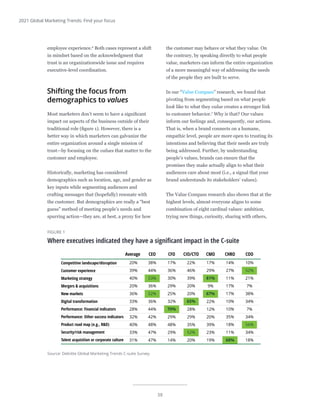
the enterprise (figure 1). While some areas, such as
marketing strategy, have a clear owner, others such
as product road map and corporate culture are
more democratized across the C-suite.
Some companies are addressing this fragmented
trust environment by establishing new roles that
better encompass the multiple facets of trust. For
instance, Forcepoint, a cybersecurity company,
recently created a chief strategy and trust officer
role.4
In organizations such as WW (formerly
Weight Watchers), the chief people officer is
responsible for delivering on all parts of the
Building trust requires a
coordinated effort between a
number of key functions.
37
Trust: The promises we keep—or don’t
37
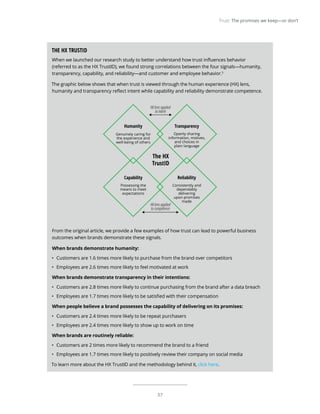
THE HX TRUSTID
When we launched our research study to better understand how trust influences behavior
(referred to as the HX TrustID), we found strong correlations between the four signals—humanity,
transparency, capability, and reliability—and customer and employee behavior.5
The graphic below shows that when trust is viewed through the human experience (HX) lens,
humanity and transparency reflect intent while capability and reliability demonstrate competence.
From the original article, we provide a few examples of how trust can lead to powerful business
outcomes when brands demonstrate these signals.
When brands demonstrate humanity:
•	 Customers are 1.6 times more likely to purchase from the brand over competitors
•	 Employees are 2.6 times more likely to feel motivated at work
When brands demonstrate transparency in their intentions:
•	 Customers are 2.8 times more likely to continue purchasing from the brand after a data breach
•	 Employees are 1.7 times more likely to be satisfied with their compensation
When people believe a brand possesses the capability of delivering on its promises:
•	 Customers are 2.4 times more likely to be repeat purchasers
•	 Employees are 2.4 times more likely to show up to work on time
When brands are routinely reliable:
•	 Customers are 2 times more likely to recommend the brand to a friend
•	 Employees are 1.7 times more likely to positively review their company on social media
To learn more about the HX TrustID and the methodology behind it, click here.
HX lens applied
to intent
HX lens applied
to competence
Humanity
Genuinely caring for
the experience and
well-being of others
Transparency
Openly sharing
information, motives,
and choices in
plain language
Capability
Possessing the
means to meet
expectations
Reliability
Consistently and
dependably
delivering
upon promises
made
The HX
TrustID
38
2021 Global Marketing Trends: Find your focus
employee experience.6
Both cases represent a shift
in mindset based on the acknowledgment that
trust is an organizationwide issue and requires
executive-level coordination.
Shifting the focus from
demographics to values
Most marketers don’t seem to have a significant
impact on aspects of the business outside of their
traditional role (figure 1). However, there is a
better way in which marketers can galvanize the
entire organization around a single mission of
trust—by focusing on the values that matter to the
customer and employee.
Historically, marketing has considered
demographics such as location, age, and gender as
key inputs while segmenting audiences and
crafting messages that (hopefully) resonate with
the customer. But demographics are really a “best
guess” method of meeting people’s needs and
spurring action—they are, at best, a proxy for how
the customer may behave or what they value. On
the contrary, by speaking directly to what people
value, marketers can inform the entire organization
of a more meaningful way of addressing the needs
of the people they are built to serve.
In our “Value Compass” research, we found that
pivoting from segmenting based on what people
look like to what they value creates a stronger link
to customer behavior.7
Why is that? Our values
inform our feelings and, consequently, our actions.
That is, when a brand connects on a humane,
empathic level, people are more open to trusting its
intentions and believing that their needs are truly
being addressed. Further, by understanding
people’s values, brands can ensure that the
promises they make actually align to what their
audiences care about most (i.e., a signal that your
brand understands its stakeholders’ values).
The Value Compass research also shows that at the
highest levels, almost everyone aligns to some
combination of eight cardinal values: ambition,
trying new things, curiosity, sharing with others,
Source: Deloitte Global Marketing Trends C-suite Survey.
Deloitte Insights | deloitte.com/insights
FIGURE 1
Where executives indicated they have a significant impact in the C-suite
CEO
Average CFO CMO
CIO/CTO CHRO COO
Competitive landscape/disruption 20% 38% 17% 22% 17% 14% 10%
Customer experience 39% 44% 36% 46% 29% 27% 52%
Marketing strategy 40% 53% 30% 39% 81% 11% 21%
Mergers & acquisitions 20% 36% 29% 20% 9% 17% 7%
New markets 36% 52% 25% 20% 67% 17% 38%
Digital transformation 33% 36% 32% 65% 22% 10% 34%
Performance: Financial indicators 28% 44% 70% 28% 12% 10% 7%
Performance: Other success indicators 32% 42% 29% 29% 20% 35% 34%
Product road map (e.g., R&D) 40% 48% 48% 35% 39% 18% 56%
Security/risk management 33% 47% 29% 52% 23% 11% 34%
Talent acquisition or corporate culture 31% 47% 14% 20% 19% 68% 18%
39
Trust: The promises we keep—or don’t
belonging, caring for others,
control, and learning new things.
By starting here, we can identify
universal needs and behaviors.
For instance, insights from a
recent study conducted during
COVID-19—Respond, recover,
and thrive: Aligning with
human values—found one of
these eight values—control—
moved to the forefront of
people’s minds as the pandemic
spread.8
Across population
demographics, control, as a core
value, increased in importance by 31%.
Now, let’s consider how it’s playing out in a
particular segment—frequent travelers. Many
hotels that have taken note of the rise in the need
for “control” among customers are bolstering their
apps to allow guests greater control over their
stays, and in a contactless environment.9
Or at the
organizational level, Delta Air Lines created an
entirely new Global Cleanliness division within its
Customer Experience organization to reimagine its
cleanliness standards.10
Headed by a vice president
of cleanliness, Delta worked with outside health
experts to develop the Delta “CareStandards.” For
passengers, CareStandards brought new solutions
to market; for example, “care kits” that help Delta
travelers feel at ease and confident that their safety
is taken seriously. And, as importantly,
CareStandards has already helped increase
employee protection as the number of Delta
employees testing positive for COVID-19 is “well
below the national average.”
Bringing it back to the power of tying promises to
delivery, Delta started by understanding what their
stakeholders value, transparently messaged how
they are addressing those values, and embedded
multiple delivery touchpoints throughout their
processes to ensure cleanliness and safety for
customers and employees.
When a brand connects on a humane,
empathic level, people are more open to
trusting its intentions and believing that
their needs are truly being addressed.
40
2021 Global Marketing Trends: Find your focus
Such values-based segmentation can get even more
granular. Consider people’s willingness (or the lack
of it) to share their data with an organization. In
our COVID-19 consumer survey, 21% strongly
agreed they were willing to share their data with
businesses to help respond to the pandemic. One
would expect this number to be lower for those
who usually have a high level of concerns around
sharing personal data. Yet, figure 2 shows that
those most highly concerned about data privacy
are also the ones most willing to share their data
with businesses to respond to COVID-19—30%
versus 16% for those not as concerned about
data privacy.
Why is that? It turns out that those who are most
highly concerned about sharing data put a premium
on data transparency (67% for those with high data
privacy concerns versus 37%) and believe that
businesses should use this data in an ethical
manner (72% versus 39% for everyone else). In this
specific case, it’s not about how people generally
behave; it’s about uncovering what’s important to
them in these times—and others—and speaking to
those values directly.
Source: Deloitte Global Marketing Trends Consumer Pulse Survey.
Deloitte Insights | deloitte.com/insights
6%
11%
9%
10%
30%
20%
39%
29%
16%
30%
Strongly agree
Somewhat agree
Neither agree
nor disagree
Somewhat disagree
Strongly disagree
FIGURE 2
Those most concerned about data privacy are also most willing
to share their data to respond to the pandemic
High data privacy concerns Low-to-moderate data privacy concerns
41
Trust: The promises we keep—or don’t
Building trust
To be able to deliver on their promises and meet
customers’ evolving value-based needs, brands
need to align their intentions with their actions (or
competency). And all members of the C-suite—not
just the CMO—need to come together to bring
about this alignment. Here are some steps
leadership can take in this direction:
•	 Don’t stay in your lane: While clear functional
owners exist in most organizations, trust
requires collaboration across the C-suite. This
means developing cross-functional teams that
align on trust-related KPIs, assigning
ownership for those KPIs, and developing a
road map for closing the gap between
intentions and competency.
•	 Choose your trust competencies wisely: How
you demonstrate trust may be conditional on
your organizational goals. If, for example, your
customers value transparent and ethical data
usage, it may be important to incorporate
straightforward messaging on how your
organization will use their data and ensure
systems are in place to protect that data from
both cyber risks and invasive data practices.
•	 Expand the marketer’s toolkit: It’s hard to
deliver on trust when the marketing
department mirrors the skills of an ad agency.
Delivering holistically on trust requires a wide-
ranging collection of skill sets, including
expertise in product development, analytics,
and a deep understanding of revenue models.
Trust is the gap between messaging and delivery.
The good news: Organizations now have the tools
to close that gap, and in the process, create
something people wholeheartedly trust to deliver
upon their needs.
42
2021 Global Marketing Trends: Find your focus
1.	 Ashley Reichheld et al., “A new measure of trust for consumer industries,” Deloitte Digital, July 6, 2020.
2.	 Deloitte HX in Uncertainty Survey, 16,000 respondents, May 2020.
3.	 Patagonia, “Everything we make has an impact on the planet,” accessed June 29, 2020.
4.	 Sarah Sybert, “Forcepoint names Myrna Soto as chief strategy, trust officer,” Executive Gov, June 1, 2020.
5.	 Reichheld et al., “A new measure of trust for consumer industries,” May 2020.
6.	 WW, “WW names Kim Seymour chief people officer,” press release, PR Newswire, April 1, 2019.
7.	 Amelia Dunlop et al., “The human experience: Quantifying the value of human values,” Deloitte Digital,
August 7, 2019.
8.	 Maggie Gross et al., “Respond, Recover, & Thrive: Aligning with Human Values,” Deloitte Digital, May 21, 2020.
9.	 Bryan Wroten, “Industry looks at contactless tech to build guest trust,” Hotel News Network, May 13, 2020.
10.	 Dan Booth, “Delta Air Lines new Global Cleanliness division focused on innovation,” Business Traveler, June 12,
2020; Delta, “Delta engages Mayo Clinic experts to advise on making travel even safer,” June 30, 2020.
42
Endnotes
43
Trust: The promises we keep—or don’t
Ashley Reichheld is the leader of the Customer, Brand & Experience practice for
the Automotive, Transportation, Hospitality & Services sectors. Reichheld has spent
nearly 20 years helping her clients reimagine brands and experiences, shaping
the moments that matter with customers, workforce, and partners. A principal in
Deloitte Digital, she is deeply passionate about building trust, enabling businesses
to create value and stronger connections with people, markets, and ultimately
earnings. Reichheld has lived and worked on nearly every continent and in over
40 countries and is an active writer. Her work and ideas have been featured in
multiple publications, including The Wall Street Journal, Adweek, and Skift.
Abby Godee is the offering leader for Customer Strategy & Applied Design in
Deloitte Netherlands. She also leads the Deloitte Garage in the Netherlands, which
cocreates new innovations and solutions with clients. In these roles, she helps clients
create customer-centric organizations and innovate and grow new businesses.
Godee specializes in helping companies solve for transformational challenges by
integrating and leveraging strategic business, design, and technology perspectives.
Mark Allen is the Human Insights leader for the Automotive, Transportation,
Hospitality & Services sectors. A principal in Deloitte Consulting LLP, Allen
is passionate about understanding the drivers of human behavior, and
applying that understanding to help businesses grow through increasing
customer and employee engagement, loyalty, and advocacy.
About the authors
The authors would like to thank Amelia Dunlop (United States), Maggie Gross (United States),
Emily Werner (United States), Andy Sussman (United States), Dierdre O’Connell (United States),
Casey Lafer (United States), Shant Marootian (United States), and Michael Bondar (United States)
for their contributions to the development of this trend.
Acknowledgments
44
2021 Global Marketing Trends: Find your focus
Marketers can benefit—and
stay ahead of the competition—
by crafting an engagement
strategy that leans into
customer participation at its
deepest levels.
Participation
45
Participation: A two-way street
A
S BRANDS RUSH to respond to the ever-
changing COVID-19 landscape, pivoting
business models has become the norm.
While the potential directions a brand can take
are numerous, one path stands out among the
rest: pivoting the way brands engage with
customers. When we surveyed 405 executives in
May of this year, 64% said they transformed the
way their organization engages with customers to
better respond to the pandemic (most selected of
all options).
A year ago, our 2020 Global Marketing Trends
report discussed how customer participation is
changing the way brands craft their engagement
strategies (see sidebar, “What is participation?”).
Notably, how deeply a customer engages with and
participates in a brand can vary across a wide
spectrum. Participation can manifest in low-touch,
low-effort activities such as writing online reviews
and posting about a brand on social media, to
deeper forms such as cocreating with a brand to
develop new products or produce original content
(e.g., uploading videos and blogging). And as
digital technologies bring people and brands closer
together (see our trend on Agility to learn more),
the deeper, higher-effort forms of participation are
gaining in popularity.
Customer engagement is quickly becoming a two-
way street where customers participate as brand
ambassadors, influencers, collaborators, and
innovators.1 As such, marketers can benefit—and
differentiate themselves from the competition—by
crafting an engagement strategy that leans into
participation at its deepest levels and
maximizes its mutual benefits for
customers and brands.
In light of these emerging trends, we
launched an in-depth study that
polled 7,506 consumers across four
countries—the United States, the
United Kingdom, Brazil, and China—
to better understand who is
participating in brands, why they do
it, and where they engage the most.
We then drew on our primary
research and examples from the field to explore
how participation is coming to life across the globe
and how marketers can lean into it while building
their customer engagement strategy.
Participation across the
engagement spectrum
We wanted to understand how people participated
over the past year across a variety of engagement
activities, from the lower to the higher end of the
A two-way street
How customer participation
fuels your engagement strategy
Customer engagement is
quickly becoming a two-
way street where customers
participate as brand
ambassadors, influencers,
collaborators, and innovators.
46
2021 Global Marketing Trends: Find your focus
spectrum. For lower-level activities, we asked if
respondents participated in online conversations
(e.g., posting on social media) or wrote online
reviews. Alternately, to capture deeper forms of
participation, we asked if they gave online advice
(e.g., video tutorials or “how to” expertise); posted
original content about a brand (e.g., visual content
or blogging); or cocreated by providing direct input
on the development of products or services (e.g.,
entering contests for design ideas or direct
cocreation).
Incredibly, we found that 56% of people engaged in
at least one activity over the course of the past year
(figure 1). Though it’s unsurprising that most
participation occurred at the lower end of the
spectrum—32% participated in online
conversations about brands—deeper, higher-effort
forms of engagement were also well represented.
Twenty-one percent gave online advice on products
or services, 15% provided direct input on design,
and 14% developed original content for a brand—
all clear indicators of strong brand engagement,
interest, and, in many cases, advocacy.
In the ensuing sections, we explore several trends
related to participation: Who is participating
across countries and age demographics, where are
they doing it most often, and what motivates
people to engage in deeper forms of participation.
These insights can help marketers develop an
engagement strategy that leans into participation.
Incredibly, we found that
56% of people engaged in
at least one digital activity
over the course of the
past year.
WHAT IS PARTICIPATION?
Customer participation represents both the passive and active ways in which people interact to
influence brands. Passive participation may include low-touch, low-effort activities in which people
provide feedback (e.g., writing reviews) or discuss a brand, while active participation represents the
more purposeful and involved ways people interact with brands (e.g., cocreation and developing
original content).
47
Participation: A two-way street
Source: Deloitte Global Marketing Trends Participation Survey.
Deloitte Insights | deloitte.com/insights
FIGURE 1
Although Brazil led in participation in sheer numbers, China led in deeper
forms of participation
Overall: 56%
Participation by country
Participation across the spectrum
United States United Kingdom China Brazil
49% 51%
59%
67%
Participated in online conversations (social media, brand platforms, community sites)
Wrote online reviews (e-commerce sites, review platforms)
Gave online advice to others on specific products or services (video tutorials, providing “how to” expertise)
Provided direct input on the design of a product or service (cocreation, contests for ideas/designs)
Developed and posted content about a brand (visual content, blogging)
None of the above
32%
28%
21%
15%
14%
44%
Who’s participating:
Global leaders
Of the four countries we surveyed, Brazil led the
pack with 67% participating in some manner or the
other. When we dug deeper, we found most of this
was driven by low-to-medium level activities, with
40% participating in online conversations, 36%
writing reviews, and 33% giving advice to others.
China, while second in overall participation, led in
its deepest forms, with nearly one in four people
providing direct input on design and one in five
48
2021 Global Marketing Trends: Find your focus
developing original content for a brand. This isn’t
surprising as China has been ahead of the curve in
pioneering the use of social media for customer
engagement (see sidebar, “The social ecosystems of
China” to learn more). For instance, Chinese
platforms such as Little Red Book (Xiaohongshu)
use social as both an e-commerce platform and, in
the case of participation, as a forum for customers
to converse with key opinion consumers.2 Unlike
key opinion leaders, who often possess some level
of fame, key opinion consumers are mostly regular
people who have garnered a following because of
their knowledge and/or expertise in a brand’s
products or services.
Source: Deloitte Global Marketing Trends Participation Survey.
Deloitte Insights | deloitte.com/insights
FIGURE 2
How participation changes with age
Overall participation by age
Participation by age across the engagement spectrum
Ages 18–25 Ages 26–45 Ages 46+
73% 64% 42%
Participated in online conversations (social media, brand platforms, community sites)
Wrote online reviews (e-commerce sites, review platforms)
Gave online advice to others on specific products or services (video tutorials, providing “how to” expertise)
Provided direct input on the design of a product or service (cocreation, contests for ideas/designs)
Developed and posted content about a brand (visual content, blogging)
37%
37%
25%
33%
33%
30%
28%
12%
18%
20%
20%
19%
7%
8%
22%
49
Participation: A two-way street
Who’s participating:
With age comes passion
As many may expect, younger generations interact
most frequently with brands. Figure 2 shows while
Generation Z (ages 18–25) participates in brands at
a rate of 73%, the rate gradually declines to 42% for
people over the age of 45. The gap especially
increases for deeper forms of participation, with only
7% of people over age 45 developing original content
versus nearly 20% of those who are 45 and younger.
As we sought to understand why there are
differences in participation by age, one theme
stood out: passion. When we asked respondents if
they engaged in these activities because they were
passionate about a specific brand, product, or
service, we found age is highly correlated with
passion and engagement. That is, the older the
individual, the bigger the role passion plays in
participation. Across all forms of engagement, Gen
Z agreed that passion plays a role between 54% and
65% of the time. By comparison, those older than
25 said passion is relevant 76% to 85% of the
time (figure 3).
Though it’s difficult to say definitively, this trend
may be a reflection of the fact that Gen Z grew up
in a digitally native environment while older
generations had to actively learn how to navigate
various technologies and forums for participation.
Thus, for Gen Z, participation may simply be part
of their core mindset and a natural behavior
while older people may need the extra
motivation of passion to engage with brands
digitally.
DeWalt, a global tools manufacturer, tapped
into consumer passion by forming an insights
community of 8,000 tradespeople and 4,000
do-it-yourselfers (DIYers).3
DeWalt provides
individuals within this community with tools
to test, say, during a home improvement
project. The ask: customer feedback. DeWalt
estimates this community has saved the
company more than US$6 million in R&D cost.
Participation frequency:
The few but mighty
Industries that witness the most engagement are
fairly consistent across the participation spectrum.
Specifically, we see electronics, beauty and personal
THE SOCIAL ECOSYSTEMS OF CHINA
In China, many leading brands are developing intricate social strategies that maximize engagement
for both participation activities and customer types. For instance, some platforms are built to
encourage people to upload video tutorials while others work like search engines that pair people
with the most relevant key opinion consumers (e.g., Little Red Book). Among customer types,
younger audiences are gravitating toward interactive platforms such as Bilibili while older individuals
are likely to stick to “what they know.” In all cases, marketing leaders can proactively follow this
blueprint to identify the role each platform can play in crafting their strategies.
We found age is highly
correlated with passion
and engagement. That is,
the older the individual,
the bigger the role passion
plays in participation.
50
2021 Global Marketing Trends: Find your focus
care, health and wellness, apparel and footwear,
and grocery and beverage consistently represented
in the top five industries as far as participation is
concerned. Their representation at the top is
mostly intuitive as they see relatively frequent
purchases whereas categories such as furniture and
automobiles see less frequent buys. Interestingly,
though, grocery and beverage, which are
traditionally considered low-involvement
purchases, is a top participation category for
US consumers.
However, when people do participate in less-
frequent purchase categories, they do so at a rate
consistent with the higher-frequency purchase
industries. The BMW Group, for instance, has
hosted virtual cocreation contests where hundreds
of car enthusiasts have submitted innovation ideas
for both interior and exterior design concepts.4
It is also encouraging to see that frequency of
participation increases as one moves across the
spectrum. In figure 4, we can see how this plays
out—while 28% of those who participate in online
conversations engage in the activity at least once a
week, 37% provide direct input on design once a
week or more. In essence, as people engage in
deeper activities, they also participate in them
more frequently.
Note: These results are represented by those that agree passion played a role in each activity.
Source: Deloitte Global Marketing Trends Participation Survey.
Deloitte Insights | deloitte.com/insights
FIGURE 3
Participation in those older than 25 is more driven by passion than it is in Gen Z
Ages 18–25 Ages 26–45 Ages 46+
Wrote online reviews (e-commerce sites, review platforms)
Participated in online conversations (social media, brand platforms, community sites)
Gave online advice to others on specific products or services (video tutorials, providing “how to” expertise)
Provided direct input on the design of a product or service (cocreation, contests for ideas/designs)
Developed and posted content about a brand (visual content, blogging)
76%
60%
65%
59%
54%
55%
76%
85%
81%
81%
80%
81%
80%
80%
79%
51
Participation: A two-way street
Motivations for participating:
The desire to help
When we explored why people participate, an
overwhelming trend rose to the fore: People are
most motivated to participate in an effort to help
others. Helping others regularly outranked other
motivations such as “wanting to share something
exciting,” “having expertise in a product or service,”
or a “brand launching a new product.”
Perhaps most intriguing is the motivation that was
consistently at the bottom: “Wanting to be
recognized for my expertise.” Interestingly, there is
As people engage in
deeper activities, they also
participate in them more
frequently.
Source: Deloitte Global Marketing Trends Participation Survey.
Deloitte Insights | deloitte.com/insights
FIGURE 4
Participation frequency in deeper engagement activities is higher than in
lower-level ones
Customers participating in an activity at least once a week
Participate in online
conversations
Write online
reviews
Develop and
post content
Give online
advice
Provide direct
input on design
28%
31%
35% 35%
37%
Participation activities DEEPER
LOWER
52
2021 Global Marketing Trends: Find your focus
one notable exception—China. As respondents in
China moved to deeper forms of participation,
recognition of one’s expertise rose to become the
second-highest motivator, while helping others
dropped to the fourth position. This could reflect
the key opinion consumer culture we discussed
earlier. Globally, the implication may be that as
people are provided with more opportunities to
participate, their motivations could evolve to more
personal reasons.
Making participation
part of your strategy
As participation moves across the spectrum to
deeper forms of engagement, marketing leaders
can weave these insights—who’s participating,
where they’re participating the most, and what
motivates them—into their marketing strategy.
Here’s what marketers should keep in mind while
crafting a strategy that leans into customer
participation:
•	 Build a holistic participation plan: It’s
important to pinpoint where participation can
be integrated into your engagement strategy—
this means matching the customer journey to
the optimal participation platform. For example,
building awareness and consideration requires
brands to promote community forums and/or
relevant blogs too. Or, at the other end of the
customer journey, marketers may want to
encourage people to develop their own video
tutorials to drive conversions and repeat usage.
•	 Create a deeper customer relationship:
While traditional loyalty approaches (e.g.,
customer relationship management systems
and loyalty programs) are often a one-way
street, participation is unique in its ability to
interactively foster and nurture brand loyalty
and customer advocacy. It enables brand
interactions—and even innovations—to become
a two-way conversation, effectively adding
another layer to the customer relationship.
•	 It’s more than just a B2C strategy: B2B
companies can kindle participation in a similar
manner as their B2C peers. While B2C
companies have always sought customer
feedback, B2B companies can encourage deeper
forms of participation as well. This can manifest
in innovation labs where customers help
cocreate new products and services or in brands
encouraging customers to advocate on their
behalf at conferences or through
community forums.
Engagement is a two-way street and now marketers
have more opportunities than ever to invite their
customers to participate in—and bring life to—their
strategy, products, and services.
53
Participation: A two-way street
Jennifer Lacks Kaplan has more than 20 years of experience serving many of
the world’s leading companies in a range of industries where she helps clients
develop and enable winning growth strategies and marketing transformation.
She is a principal with Deloitte Consulting LLP and a member of the Customer
and Marketing strategy practice within the US Strategy service line Monitor
Deloitte. Prior to Deloitte, Kaplan was a senior partner at Monitor Group.
1.	 Diana O’Brien et al., The amplification of consumer participation: How emerging customer engagement strategies are
unlocking new value for global brands, Deloitte Insights, October 15, 2019.
2.	 Tamsin Smith, “What is a KOC? Behind China’s latest influencer trend,” Jing Daily, October 8, 2019.
3.	 Vision Critical, “How the power tool manufacturer uses customer insight to spark innovation,” accessed
June 25, 2020.
4.	 BMW Group, “BMW Group Co-Creation Lab,” press release, July 20, 2010.
Endnotes
The author would like to thank Grace Ling (China) for her contribution to the development of
this trend.
Acknowledgments
About the author
54
2021 Global Marketing Trends: Find your focus
Organizations can better help
the people they serve by
creating innovative experiences
through cross-industry
partnerships.
Fusion
55
Fusion: The new ecosystem
T
HE WORLDWIDE SHUTDOWNS triggered by
the COVID-19 pandemic have brought our
universal human needs to the forefront.
These needs range from access to essential
products and services and connecting with family
and friends to navigating disrupted work
environments at a time when “normal” life has
fundamentally changed. In many ways, the crisis
has created a crucible of experimentation and
innovation as communities, companies,
governments, and individuals work to piece
together new ways to meet these unmet
human needs.
In our inaugural trend report on Fusion, we
discussed the 60-year evolution from last century’s
industrial, supply-driven products and services to
more customer-inspired solutions.1
The result: The
most disruptive companies started looking
beyond traditional industry boundaries to
find better ways to serve customer needs.
Now, we see a new pivot happening across
industries. Many organizations are moving
past serving customers with point products
and solutions. They are going a level deeper
to truly understand the needs of the people
they serve in a more fundamental way. And
with that knowledge, they’re working to
meet the needs of their people more holistically.
It’s not about doing “the same thing better.” Rather,
organizations have an opportunity to completely
reimagine partnership strategies that open the
aperture of solutions for the people they serve.
They must remember: People don’t need cars, they
need to get from point A to point B, just as they
don’t need surgery, they need to be well.
While some organizations were already making
efforts to align with this human-centric mindset,
COVID-19 shifted the dynamics for many others
practically overnight. And in the face of dire
economic conditions, some companies pivoted to
look for creative ways to meet these evolving needs,
leading to new collaborations—or fusions—across
industry lines. Amid uncertainty about the
pandemic, these organizations entered into new
partnerships that engaged customers in novel ways
and made major, transformational investments in
digital platforms in a matter of months—all in
pursuit of finding innovative ways to meet
people’s needs.
What’s striking and instructive for executives is the
paradox between these forward-leaning
investments and the current defensive, operational
mindset in the C-suite. In Deloitte’s survey of 405
C-suite executives, we asked leaders the top
The new ecosystem
Fusing cross-industry partnerships
in a postpandemic world
People don’t need cars, they
need to get from point A to
point B, just as they don’t
need surgery, they need to
be well.
56
2021 Global Marketing Trends: Find your focus
outcomes they hoped to achieve while responding
to the pandemic. Overwhelmingly, most of them
viewed their investments through a reactionary
lens, with improving productivity and efficiency
(42%) and better managing risks (38%) topping
the list. Very few looked at these investments to
grow revenues (17%), differentiate themselves from
the competition (17%), or disrupt their industries
(6%)—all of which can be essential ingredients for
thriving in the future (figure 1).
In this article, we explore how companies can
break out of this defensive mindset and proactively
meet the evolving needs of the people they serve.
We begin by exploring how pioneering
partnerships can provide the ingredients for
Source: Deloitte Global Marketing Trends C-suite Survey.
Deloitte Insights | deloitte.com/insights
FIGURE 1
The C-suite is operating through a largely defensive mindset, leaving future
growth opportunities on the table
How C-suite executives rated the top three outcomes they hoped to achieve while responding to
the pandemic
Operational and efficiency plays Innovation and growth opportunities Other business outcomes
Top three outcomes
Improve productivity
and efficiency
Improve risk
management
Accelerate your
move to digital
platforms/technologies
33%
29%
28%
28%
27%
17%
17%
6%
Improve engagement
with your customers
Retain top
talent
Change your
business model
Drive greater
revenue
Increase company’s
impact on society
Reduce internal/
operational costs
Create differentiation
with your competition
Disrupt your
industry
The innovation and growth opportunities
were ranked as the lowest three outcomes.
38% 35%
42%
57
Fusion: The new ecosystem
growth and close with a discussion on how chief
marketing officers (CMOs) are uniquely positioned
to lead the charge by innovating along with and
through the eyes of the customer.
How organizations are
better addressing human
needs through fusion
Through a combination of primary research and
examples from the field, we explored how brands
can look beyond what they do today and fuse new
partnerships that integrate customer insights and
digital platforms in their innovation road maps to
surprise and delight the people they serve.
THE POWER AND PROMISE OF
BUSINESS PARTNERSHIPS
Holistically delivering on human needs often
requires a shift in mindset. For brands, it can mean
thinking beyond their own products and services
and seeking out partnerships that empower them
to better serve their stakeholders. The early days of
the pandemic helped incubate many creative,
unexpected business partnerships to solve new
challenges. Consider the pivot by restaurant dining
app OpenTable, which entered into new
partnerships with a variety of supermarket chains
and other essential businesses to turn a visit to
grocery and other retail stores into a reservable
event. As a result of that collaboration, people
could safely—and predictably—buy essential items
without the worry (or hassle) of being caught in
large crowds.2
Beyond the pandemic, there are many examples of
companies moving outside of their traditional
domains to meet emerging needs, such as
ExxonMobil’s collaboration to create a new car
care ecosystem in China. Shifting from traditional
B2B to a more customer-driven market, ExxonMobil
partnered with a global tech company and a local
car care brand to create a “digitally enabled car-
maintenance experience.”3
A data platform
created through the ecosystem enables customers
to receive maintenance recommendations and
make online reservations to have cars serviced; at
the same time, it enables ExxonMobil to not only
fuel vehicles but also ensure they are running
safely and effectively.
Whether formed before or during the pandemic,
there’s new evidence that these cross-industry,
cross-boundary partnerships have staying power,
according to C-suite leaders. In our survey, we
asked how companies adjusted their business
models to better respond to the pandemic. Though
entering new business partnerships was a distant
second to digital acceleration initiatives (64%
versus 36%), we see evidence that these new
business partnerships have the most staying power
after the pandemic.
How do we know this? We asked executives if they
would revert to old models or carry on with the
new models once the pandemic subsides.
Executives across the board—a resounding 78%—
indicated that new partnerships would be retained
to some degree, highest of all business model
changes (figure 2).
Whether out of sheer necessity to survive or
because they saw new opportunities, many brands
that took the leap and entered into new partnerships
found better ways to more holistically serve people—
both in the short and long term.
INTEGRATE CUSTOMER INSIGHTS
ACROSS INDUSTRY LINES
It can be difficult to take a comprehensive view of
the customer if insights are limited to your
industry. To gain a more complete picture of
behavior and underlying needs, brands can seek
partnerships that provide complementary views of
the people they are serving. At its core, it means
58
2021 Global Marketing Trends: Find your focus
building robust data mechanisms that capture the
full landscape of customer behavior and feedback
so companies can involve the people they serve
directly in the innovation process.
Here are two ways brands are using cross-industry
partnerships to design innovation strategies in a
human-centric spirit:
1.	 Listening to evolving needs through
social: Social sensing doesn’t have to be
limited to crafting timely customer messaging
(see our trend on Agility to learn more). It can
also provide a direct line of sight into what
people need now. For instance, during the
pandemic, Lloyds Bank expanded its
partnership with Mental Health UK to foster
public awareness and offer resources on dealing
with the negative mental health impact of
financial problems.4
By directly listening to
people, Lloyds Bank—with the help of a key
partner—didn’t just create a banking solution;
it crafted a financial and mental wellness
solution at a time when wallets were tight and
anxieties were high.
2.	 Inviting customers to participate: Inviting
people to directly participate in the knowledge-
sharing process affords brands a unique
opportunity to learn what people really need to
Source: Deloitte Global Marketing Trends C-suite Survey.
Deloitte Insights | deloitte.com/insights
FIGURE 2
Most executives agree that new partnerships forged during COVID-19 will
continue after the pandemic subsides
Should immediately go back to former business model
Should retain some portion of this new business model
New business model is a long-term solution for success
Engaged in new partnerships to better serve customer needs
Transformed the way organization engages with customers (i.e. from physical to digital storefront)
Entered new geographic markets
Pivoted product offerings
Entered new industries
9%
33%
45%
7%
24%
39%
18%
31%
38%
9%
50%
37%
17%
37%
35%
59
Fusion: The new ecosystem
drive innovation efforts (see our Participation
trend to learn more). Take the example of
GovConnect, a convergence of digital solutions
that includes a COVID-19 contact-tracking and
tracing effort. GovConnect enables individuals
to opt in to create a network of their mobility to
help pinpoint potential exposure to the virus.5
The public-facing portal—created by leading
technology companies—also helps participating
members of the public find community and
government services through customized
recommendations. Simultaneously, GovConnect
helps government leaders and public health
officials make better real-time decisions for
responding to the pandemic.
In this way, by coalescing insights from customers
at a cross-industry intersection of their needs,
companies can develop solutions that anticipate
and respond to evolving demands.		
HARNESS NEW PARTNERSHIPS TO
EXPAND DIGITAL ECOSYSTEMS
While the role and importance of digital
have been exploding for many years now,
the pandemic was a turning point that
drove many organizations to not only
accelerate their move to digital platforms,
but also to find new ways and new
partnerships to address needs through
digital.
To understand these dynamics, we
surveyed 2,447 global consumers to
understand the new ways in which people
are navigating their COVID-19
environment. This included activities such
as shopping for essentials, continuing their work
and education, consulting with doctors, and
connecting with family and friends—all with
minimal human contact and often enabled by
cross-industry digital solutions. Interestingly,
people were more open and willing than ever to
test new solutions during this worldwide digital
test drive. Among eight different activities, 82%
tried at least one of these digital activities for the
first time (figure 3).
ConvergeHEALTH Connect powered by technology
platform Zyter is one such example of emerging
digital telemedicine services coming to life during
the pandemic, offering patient video visits,
virtual “smart” exams with patients, secure
file-sharing, and other provider-to-provider
collaboration for health care teams.6
Through
multiple cross-industry partnerships,
ConvergeHEALTH Connect helps enable health
care providers and government health agencies to
digitally triage patients. In addition, it helps
protect patient privacy while shifting the care of
presumptive cases into the virtual space, provides
the ability to extend critical care virtually using
digital innovation, and enables providers to
efficiently deploy evolving protocols and virtually
consult specialists to advance patients through the
continuum of care.
Amid a new environment where people are
physically isolated from one another, we found that
the vast majority were largely satisfied with these
new experiences. Across all categories, at least 53%
found their new digital experiences an adequate
substitute, and about a third even said these
digitally native methods were a superior alternative
to their in-person experiences.
Through multiple cross-
industry partnerships,
ConvergeHEALTH Connect
helps enable health care
providers and government
health agencies to digitally
triage patients.
60
2021 Global Marketing Trends: Find your focus
60
Source: Deloitte Global Marketing Trends Consumer Pulse Survey.
Deloitte Insights | deloitte.com/insights
FIGURE 3
Most customers who tried digital experiences for the first time during the
pandemic were satisfied with them
First time trying digital experiences and their satisfaction with those experiences
Disappointed with experience Adequate substitute Superior alternative First time use
Spoke with friends
or family through
video chat
55%
42%
46%
56%
38%
Attended a live,
online workshop to
learn a new skill
26%
Watched a movie
with friends located
elsewhere with an app
53%
38%
18%
Evaluated/treated
through telemedicine 55%
37%
13%
Purchased food
from a restaurant
with an app
56%
40% 24%
Used an
educational app
60%
34%
33%
Used an
exercise app
60%
35%
29%
Purchased groceries
with online ordering
and service
53%
42%
34%
Have not tried
any of these
18%
Even after the pandemic subsides, the evolution of
these digital platforms will likely continue to
provide executives with fresh partnership
opportunities to create a virtuous cycle that
enables them to study the needs of the people they
serve; infuse insights about their needs and
motivations into future offerings; and unlock
competitive advantages for their organizations.
61
Fusion: The new ecosystem
Accelerating your
fusion journey
For organizations to tap into the competitive
advantage and bottom-line results of fusion, the
C-suite should shake off its largely operational
mindset and move toward aspirational and
innovative partnership strategies that drive future
growth. The CMO, as the C-suite executive often
closest to the customer, is uniquely equipped to
lead the charge of this innovation. Here are two
recommended actions marketers can take to drive
the innovation agenda for their organizations:
1.	 Own the innovation road map. CMOs have
always underplayed their role in driving
innovation, perhaps because they underestimate
the value of their tacit customer knowledge or
don’t see peers clamoring for innovation to be
part of marketing’s remit. But the pandemic
saw the profile of marketing elevated across the
C-suite, with executives seeing marketing and
sales as the second-most critical function in the
coming months (63%), after digital technology
(68%). CMOs are positioned to advise the
organization on its innovation strategy and
should rise up from being just the “receiver” of
a strategy they are responsible for marketing to
customers downstream.
2.	 Fusion starts with customer needs.
Earlier this year, our analysis found that CMOs
are most effective when they own an
organization’s innovation road map and
customer experience.7
It’s no coincidence that
these two aspects go hand in hand—the only
way to truly address human need is to look at it
through the eyes of the customer. CMOs can
leverage their insights into customer behavior
and expectations to guide the choice of
beneficial business partnerships while
embedding customer feedback into the digital
ecosystems they design.
Fusion is about reimaging the art of the possible
when a company goes beyond its four walls to
innovate and create for the people they serve. As
COVID-19 pushes digital innovation to the
forefront, marketers can help their organizations
pivot their thinking from “protecting what they
have” to opening new doors, new partnerships, and
new digital platforms that capture their customers’
hearts and minds.
62
2021 Global Marketing Trends: Find your focus
1.	 Diana O’Brien et al., Fusion is the new business blend: How the convergence of ecosystems sparks new business
models and greater collaboration, Deloitte Insights, October 15, 2019.
2.	 Dalvin Brown, “OpenTable launches tool to help you avoid long lines at restaurants, grocery stores,” USA Today,
March 30, 2020.
3.	 Business Wire, “ExxonMobil, Tencent and automotive aftersales market partner to build digital automotive
maintenance ecosystem in China,” press release, January 21, 2020.
4.	 Lloyds Bank, “Mental health & financial wellbeing,” accessed June 24, 2020.
5.	 Example from Deloitte client work.
6.	 Ibid.
7.	 Jennifer Veenstra, Sarah Allred, and Tim Murphy, Course correcting the evolution of the CMO: Positioning the CMO
for greater organizational impact and C-suite influence, Deloitte Insights, July 17, 2020.
Endnotes
63
Fusion: The new ecosystem
The authors would like to thank Kathleen Peeters (Belgium) for her contribution to the development
of this trend.
Acknowledgments
Alicia Hatch is the global CMO for Deloitte Digital’s marketing organization—an
increasingly diverse and connected web of data, technology, and creative—with
a focus on driving growth in the marketplace and delivering quantifiable results
for clients. She also leads Deloitte’s Ecosystems and Alliances practice.
Becky Skiles is the chief marketing officer for Deloitte Digital UK and works
with companies to develop and deliver transformational experiences for
their customers and employees. A partner in the Customer Strategy and
Design space, Skiles is passionate about working with clients to consider
the wider human needs of the people in their ecosystem and designing
innovative products, services and solutions to make their lives better.
Amanda Li has a background in design and is focused on embedding experience
innovation in the integration of customer, data, and platforms. A partner with
Deloitte Digital in China, Li has led projects that include digital strategy, new
market entry and service offerings design and road map, and digital marketing
and sales architecture for Fortune 20 companies. Li previously spent 11 years with
Deloitte Digital Australia, where she designed, led, and delivered large scale digital
transformation programs for leading brands and all levels of governments.
About the authors
64
2021 Global Marketing Trends: Find your focus
As the marketing landscape
undergoes rapid changes,
talent models should evolve
in-step to position marketing
as a competitive differentiator.
Talent
65
Talent: Marketing disrupted
O
VER THE LAST few years, the roles of
marketing and talent within organizations
have undergone a sea change. By now, it’s
apparent that the chief marketing officer (CMO) is
evolving from a brand manager to an enterprisewide
strategic thinker and revenue driver.1
In
parallel, talent discussions across
industries—specifically, changing talent
models—have seen some recurring
themes. These themes may sound
familiar: Artificial intelligence (AI) is
making us faster and smarter workers;
people are opting out of traditional
9-to-5 jobs in favor of the gig economy;
and new paradigms for on-the-job
training and continuous learning are
altering how we grow our skill sets, to
name a few.2
But these aren’t isolated
shifts. To answer the call of the organization and
elevate the role of marketing, marketers should
evolve their talent models in-step with these
evolving trends.
Marketers (and heads of other functions) were
already incorporating many of these talent trends
in their organizations in varying degrees. But then
COVID-19 happened. Out of sheer necessity,
organizations were forced to change how they
accomplished work. When we surveyed 405 C-suite
United States–based executives in May of this year,
we saw some talent trends accelerate and others
just starting to emerge. For instance, our survey
shows that in this new environment, CMOs have
overwhelmingly turned to AI to automate work
(77%). Alternately, only 6% have increased their
reliance on the gig economy—a possible reflection
of how gig workers can easily be scaled during
economic downturns (figure 1).
COVID-19 may be the catalyst that puts these
evolving marketing and talent trends on a new
trajectory. When we asked executives what are the
most important functional areas over the next 12
months, they ranked marketing and sales second
(61%), after digital and technology (68%). There is
also evidence that the CMO’s role may be gaining
momentum. Just 20 months ago, 46% of CMOs
had said they had a significant impact on C-suite
conversations relating to marketing strategy.3
Now, this number has almost doubled to 81%.
To address this accelerated pace of change,
marketers need to push talent transformation to
the forefront of their agenda. In this article, we
Marketing disrupted
Four trends turning talent into
a competitive differentiator
Marketers need to push
talent transformation to the
forefront of their agenda to
address this accelerated pace
of change.
66
2021 Global Marketing Trends: Find your focus
discuss four trends which, if woven into the
marketing talent model, can elevate skill sets,
create organizational flexibility for quickly
responding to market needs, and consequently,
make marketing talent a competitive differentiator.
How to elevate the
marketing talent model
Let’s look at how these talent-related trends can
change the way in which marketing accomplishes
work and how marketers can incorporate them to
afford marketing talent a competitive advantage.
BRING YOUR COMPETITIVE
ADVANTAGE IN-HOUSE
Earlier this year, Deloitte and The CMO Club
(a global network of more than 650 CMOs and
marketing leaders) published a marketing
benchmark study. Our analysis found that 64% of
marketing organizations have an in-house agency.4
Historically, many marketing departments have
relied on external agency partners to execute their
creative campaigns and other activities. However,
even in the benchmarking study, we saw that 59%
of marketing leaders still outsource their creative
function while 31% do so for insights and analytics.
There is a good reason why many brands are
turning toward an in-house model. While
outsourcing provides access to a wide pool of
expertise and talent, it can impede marketing’s
ability to agilely respond to customer needs (see our
trend Agility to learn more) for a couple of reasons:
•	 Growing workflow complexities: The
proliferation of customer touchpoints across
myriad social platforms and media channels
can create an inefficient hand-off between
external agencies and brands. In the time it
takes to analyze customer data, build a creative
campaign, and execute it in the marketplace,
the window to make a connection often closes.
•	 Diluting the competitive advantage: As
brands rely more on external agencies, they are
essentially outsourcing their competitive
advantage. First, they are expecting another
organization to be as attuned to their customers’
needs as their own brand. Second, as agencies
serve multiple clients, they’re likely to reapply
fundamental strategies and methods to
different brands. Over time, this can result in
relatively generic campaigns that look similar
across multiple brands.
It’s important for marketers to keep in mind that
agencies can’t match their internal knowledge in
terms of organizational process, data, and
Source: Deloitte Global Marketing Trends C-suite Survey.
Deloitte Insights | deloitte.com/insights
FIGURE 1
More CMOs have turned to AI for
automation during the pandemic
How CMOs changed their talent models
during the pandemic
77%
Automated more
work through AI
technologies
Reduced the workforce
Transitioned large portions of the workforce
to remote work
Relied more on external agencies to
execute projects
Reduced use of contractors/external agencies
Relied more on the gig economy
17%
6%
23%
36%
39%
67
Talent: Marketing disrupted
customer needs. Building one’s own insourcing
strategy starts with pivoting from an ad campaign
mindset to a more holistic editorial thought
process. This requires the marketing team to assess
its workflows, technology, and skill sets to
determine the most efficient and effective means of
delivering content.5
Based on these assessments, marketers can
develop a core team comprising roles that best
reflect their competitive advantage. Traditionally,
these roles include those responsible for data
insights, dynamic content creation, and owned and
earned media. It’s important to note that bringing
key skills in-house does not mean a brand must
bring everything inside. For example, Unilever
created its own in-house digital content function
called U-Studio to manage its day-to-day creative
needs.6
However, when the company needs help
with broader strategic or creative ideas, it looks to
external agencies for help. In this case, Unilever
was able to identify where an in-house agency
provides the most advantages and where external
assistance is most beneficial.
LEVERAGE THE GIG ECONOMY TO
SCALE DOWNSTREAM ACTIVITIES
As marketing teams gravitate toward insourcing-
required skill sets, they will likely need to bifurcate
their talent strategy. One prong of this strategy
includes the more strategic or analytical roles while
the other represents narrower, more tactical
downstream roles such as graphic design or
copyediting. Given the fluctuations in
organizational need, marketing is increasingly
looking for flexible ways to scale downstream
activities. The gig economy can be an excellent
resource for marketers to tap into for specific skill
sets as and when the need arises. Besides, in an
increasingly volatile economic environment, the
gig economy enables organizations to better
manage uncertainty without getting locked into
long-term financial commitments.
Creative and production talent are two areas that
regularly see fluctuations in terms of organizational
need, often requiring scaling up or down.
Encouragingly for marketers, there are multiple
platforms that provide a marketplace for clients to
directly contract individuals for projects, allowing
them to scale according to need. Deloitte, for
example, relies upon the gig economy to augment a
variety of skills, such as copyediting.
The gig economy not only provides marketers a
network of contractors, but also offers them a
platform to source new ideas through
crowdsourcing and innovation contests (see our
trend on Participation). Such contests enable
organizations to solicit new ideas and innovations
which they can quickly embed into their products
or experiences.
It’s not just the marketers who benefit from the gig
work model that offers them an efficient and highly
scalable source of skill sets and ideas; employees
too are highly satisfied with this new work
environment. In our global consumer survey of
2,447 individuals, where we asked how work
environments have changed since COVID-19, we
found 14% have entered the gig economy for the
first time. Figure 2 shows these respondents are by
far the most satisfied with their new work
environments (as compared to their previous
environments). This is especially true of those
who’ve entered the gig economy in their area of
expertise. This may be encouraging news for
marketers who’re considering their first foray into
the gig economy.
ELEVATE THE MARKETER, AUTOMATE
THE REDUNDANT TASKS
Employing AI for automation is one of the fastest-
growing trends in the talent space—and it’s likely
here to stay. When we asked executives how they
perceive the longevity of each of these talent trends,
AI-enabled automation led the lot, with 57%
68
2021 Global Marketing Trends: Find your focus
suggesting they had found a superior way to work
(figure 3). The knee-jerk reaction—as is often the
case with AI—is to assume that increased reliance
on the technology might reduce the need for
employees. But we also found that executives do
not see the pandemic-induced workforce
reductions as a long-term solution. In fact, 59%
said they should go back to their former workforce
levels immediately after the pandemic subsides.
This highlights an important fact about AI: It can
be most effective when it bolsters what people are
inherently good at (e.g., creativity and critical
thinking) and replaces the tasks that are best left to
a machine (e.g., redundant activities or
computationally intensive calculations).
In both the long and short term, it makes sense for
marketers to deploy AI to clear the more repetitive
tasks off their plate and redesign their function’s
work to concentrate on more strategic endeavors.
For one, AI can have a direct application in
dynamic creative assembly where it can be used to
analyze data and match the best content to
consumers. Take the example of a large food and
beverage company that employed AI to match
appropriate imagery and messaging to relevant
demographics and markets.7
Not only did this help
it create a more refined process for assembling
creative materials, it also elevated the marketer’s
role to more strategic initiatives such as developing
underlying rulesets. This may include dictating
rules around which imagery is best suited for each
AI-driven customer profile.
It’s worth noting that while AI is certainly on the
rise, a significant amount of work appears to be
directed toward less-sophisticated use cases (e.g.,
robotic process automation to execute rulesets).
However, marketers can also deploy AI to improve
their overall strategies and decision-making
process. For instance, Norwegian Air used
machine learning algorithms to identify the
customer attributes and activities that most often
led to flight bookings.8
Doing so helped the
company decrease its cost-per-booking by 170%
while simultaneously matching the best
advertisements to each customer. Going back to
our discussion on insourcing, this heightens the
need for more analytical skill sets within marketing,
thereby forcing marketing to upskill talent.
UPSKILL THROUGH
MARKETING UNIVERSITIES
Between insourcing and automation, the role of
marketing will inevitably change—and for the good.
To help their teams prepare for these changes,
Source: Deloitte Global Marketing Trends Consumer Pulse Survey.
Deloitte Insights | deloitte.com/insights
FIGURE 2
Gig workers are most satisfied with their new work environments
I believe my new work environment is superior to how I previously worked
Strongly agree Somewhat agree Neither agree nor disagree Somewhat disagree Strongly disagree
Started
remote work
9%
30%
Started gig work
outside area
of expertise
15%
39%
Started gig work
within area
of expertise
22%
35%
54% 57% 39%
69
Talent: Marketing disrupted
many organizations are designing in-house
marketing universities that target key skills to help
talent navigate the future of marketing.
In our work with clients from various industries,
we’ve seen brands develop programs that combine
online curricula with role-specific deep dives and
in-person workshops. Like all forms of effective
learning, these aren’t “one-off” events either. To
keep pace with our ever-changing environments,
marketers can create learning pathways (i.e.,
specialized tracks) and micro-hackathons to
capture the best ideas the workforce has to offer
(i.e., internal crowdsourcing). The goal is to
provide multiple channels—both ongoing and
event-based—to equip practitioners with the right
skills, thereby optimizing marketing talent as a
competitive differentiator.
Source: Deloitte Global Marketing Trends C-suite Survey.
Deloitte Insights | deloitte.com/insights
FIGURE 3
AI automation is here to stay, but not at the expense of the workforce
After the pandemic subsides, which option best describes your view on these talent models?
New talent model offers a superior way to execute work Should retain some portion of this new talent model
Should immediately go back to its former talent model
14%
24%
59%
Reduce the workforce
57%
22%
6%
Automate more work through AI technologies
42%
40%
13%
Transition large portions of workforce to remote work
52%
15%
31%
Rely more on gig economy
31%
35%
21%
Reduce the use of contractors/external agencies
51%
22%
24%
Rely more on external agencies to execute projects
70
2021 Global Marketing Trends: Find your focus
The talent journey
Transforming your marketing talent organization
isn’t a static event. Instead, it’s a journey that’s
unique to each marketing team’s specific skill sets
and structure. To best capitalize on these trends,
consider the following steps:
•	 Galvanize leadership commitment: With
marketing’s position being currently elevated
within the C-suite, there may be no better time
than now to evolve talent models. However, it’s
hard to get started on this exercise if the
leadership doesn’t support upskilling of talent.
Kick off your journey by enlisting support for
standing up marketing universities as this will
help prepare marketing talent for their elevated
roles in the organization.
•	 Place strategic bets: For most organizations,
there’s no need to make wholesale changes to
the existing talent model—marketers can
simply tweak the current model by placing
strategic bets on some new aspects. Start by
assessing where your strengths and weaknesses
lie as a team. If your creative function is mostly
outsourced, consider new models—such as the
gig economy—to bring your competitive
advantage back inside the four walls of your
organization. If your content is fairly static, it
may make sense to automate the more
redundant work through AI.
•	 Invest in culture: Marketing can work best
when it responds to customer needs in an agile
manner. This can require a true shift in the
cultural mindset—from a layered organization to
one that empowers people to move quickly and
adapt to changing customer needs as they arise.
It also means embedding life-long learning as a
key part of the company culture with a focus on
evolving skill sets as needs change.
A new era of marketing requires a new outlook on
talent. The organizations that do it right can
elevate marketing’s standing within the
organization and even disrupt their industries
along the way.
71
Talent: Marketing disrupted
1.	 Diana O’Brien, Jennifer Veenstra, and Timothy Murphy, “Redefining the CMO,” Deloitte Review 22, January 22,
2018.
2.	 Each of these topics were discussed at length over three years ago in Deloitte Review 21 on July 31, 2017.
3.	 Diana O’Brien, Jennifer Veenstra, and Timothy Murphy, The makings of a more confident CMO: Three ways to
increase C-suite impact, Deloitte Insights, September 18, 2019.
4.	 Deloitte and The CMO Club, Evolution of marketing organizations, January 2020.
5.	 Christine Cutten and Alan Schulman, “Insourcing to gain marketing speed, efficiency, effectiveness,” Wall Street
Journal, August 8, 2018.
6.	 Lucy Handley, “Firms are taking more marketing functions in-house. Here’s why,” CNBC, March 4, 2019.
7.	 From Deloitte client work.
8.	 Chiradeep BasuMallick, “5 examples of AI in marketing to inspire you in 2019,” MarTech Advisor, July 29, 2019.
Endnotes
72
The authors would like to thank Gillian Simpson (United Kingdom) and Dylan Cotter (Ireland) for their
contributions to the development of this trend.
Acknowledgments
Christine Cutten is a leader within the Customer Transformation practice,
where she helps CMOs rethink their marketing strategies and operations by
working alongside them to design their road maps to the future. A principal
with Deloitte Consulting LLP, Cutten received a Bachelor of Science degree
from the Wharton School, University of Pennsylvania and her MBA from
Kellogg Graduate School of Management, Northwestern University.
As leader of the Advertising, Marketing and Commerce practice for Deloitte
Digital UK, Libby Cousins helps companies transform their Customer
Experience, advising on re-designing and delivering digital experiences to
provide a truly human experience to customers and drive business value.
About the authors
2021 Global Marketing Trends: Find your focus
73
2021 Global Marketing Trends: Find your focus
This report would not be possible without the collaboration that results from working alongside
colleagues to understand the impact of these trends in the marketplace and how to embrace them to
drive growth for organizations.
Special thanks to the entire CMO Program team for their insight and support through this journey.
Thank you to the following:
Recognition and appreciation
•	 Global program manager: Anna Syrkis
•	 Content and insights: Sarah Allred, Timothy Murphy
•	 Marketing and events: Julie Murphy, Cailin Rocco, Julie Storer, Marissa Devine, Abhilash Yarala
•	 Podcasts: Fahad Ahmed
•	 Public Relations: Kori Green, Rory Mackin, Pia Basu
•	 WSJ CMO Today: Jenny Fisher, Mary Morrison
•	 Green Dot Agency: Emily Garbutt, Audrey Jackson, Mary-Kate Lamis, Emily Moreano, Stela Murat,
Melissa O’Brien, Vishal Prajapati, Megha Priya, Joey Michelle Suing, Arun Thota, Molly Woodsworth,
Sourabh Yaduvanshi, Sylvia Yoon Chang, Tushar Barman
•	 Deloitte Insights team: Prakriti Singhania, Abrar Khan, Rupesh Bhat, Nairita Gangopadhyay,
Amy Bergstrom, Nikita Garia, Preetha Devan
OUR GLOBAL MARKETING TRENDS TEAM
Americas
•	 Leadership: Bevin Arnason, Omar Camacho, Itzel Castellanos, Shaunna Conway, Jefferson Denti,
Guilherme Bretzke Evans, Maria Flores, Yohan Gaumont, Patrick Hall, Javier Huechao, Andres Gebauer
Millas, Heloisa Montes, Eduardo Pacheco, Francisco Pecorella, Pablo Selvino, Renato Souza, Enrique
Varela, Barbara Venneman, Livia Zufferli
•	 Marketing: Martin Avdolov, Maria Gabriela Paredes Cadiz, Marta Boica Dare, Carolina Alejandra
Peters Ramirez, Coby Savage
OUR GLOBAL COLLABORATORS CONTRIBUTING ACROSS THE
ENTIRE 2021 GLOBAL MARKETING TRENDS REPORT
74
EMEA
•	 Leadership: Rani Argov, Helene Chaplain, David Conway, Dylan Cotter, Doug De Villiers, Ronan Vander
Elst, Flor de, Esteban, Joao Matias Ferreira, Cristina Gamito, Hakan Gol, Noam Gonen, Will Grobel,
Antonio Ibanez, Erdem Ilhan, Randy Jagt, Andy Jolly, Ravouth Keuky, Paul Kruegel, Roland Linder,
Ori Mace, Jonas Juul Mortensen, David Olsson, Riccardo Plata, Victor Press, Sam Roddick, Filipe Melo
de Sampaio, Andy Sandoz, Eli Tidhar, Gabriele Vanoli, Stephen Ward, Egbert Wege, Ozlem Yanmaz
•	 Marketing: Teresa Posser de Andrade, Ala Abu Baker, Isabel Brito, Margarida Benard da Costa, Rushdi
Duqah, Hanna Drzymalik, Fiona Elkins, Salimah Esmail, Zakaria El Gnaoui, Gina Grassmann, Richard
Hurley, Berk Kocaman, Romain Mary, Tamara Mersnik, Maria Cristina Morra, Nikolaus Moser, Gareth
Nicholls, Armin Nowshad, Tharien Padayachee, Joana Peixoto, Katrien de Raijmaeker, Sharon Rikkers,
Nele Roerden, Filipa Sousa Santos, Shakeel Ahmed Sawar, Tor Soderholm, Anne-Catherine Vergeynst,
Krzysztof Wasowski, Peta Williams, Patricia Zangerl
APAC
•	 Leadership: Grant Frear, Steve Hallam, Pascal Hua, Emma Gu, Ryo Kanayama, Grace Ling,
Go Miyashita, David Phillips, Balaji Venkataraman, Minoru Wakabayashi
•	 Marketing: Sally Denniston, George Dickinson, Ryan HitchAmber Kunziak, Yukiko Noji, Kaoru Obata
2021 Global Marketing Trends: Find your focus
75
2021 Global Marketing Trends: Find your focus
Contact us
Our insights can help you take advantage of change. If you’re looking for fresh ideas to address your
challenges, we should talk.
Jennifer Veenstra
CMO Program global leader | Managing director | Deloitte Consulting LLP
+1 415 783 4223 | jveenstra@deloitte.com
About Deloitte Insights
Deloitte Insights publishes original articles, reports and periodicals that provide insights for businesses, the public sector and
NGOs. Our goal is to draw upon research and experience from throughout our professional services organization, and that of
coauthors in academia and business, to advance the conversation on a broad spectrum of topics of interest to executives and
government leaders.
Deloitte Insights is an imprint of Deloitte Development LLC.
About this publication
This publication contains general information only, and none of Deloitte Touche Tohmatsu Limited, its member firms, or its
and their affiliates are, by means of this publication, rendering accounting, business, financial, investment, legal, tax, or other
professional advice or services. This publication is not a substitute for such professional advice or services, nor should it be
used as a basis for any decision or action that may affect your finances or your business. Before making any decision or taking
any action that may affect your finances or your business, you should consult a qualified professional adviser.
None of Deloitte Touche Tohmatsu Limited, its member firms, or its and their respective affiliates shall be responsible for any
loss whatsoever sustained by any person who relies on this publication.
About Deloitte
Deloitte refers to one or more of Deloitte Touche Tohmatsu Limited, a UK private company limited by guarantee (“DTTL”), its
network of member firms, and their related entities. DTTL and each of its member firms are legally separate and independent
entities. DTTL (also referred to as “Deloitte Global”) does not provide services to clients. In the United States, Deloitte refers to
one or more of the US member firms of DTTL, their related entities that operate using the “Deloitte” name in the United States
and their respective affiliates. Certain services may not be available to attest clients under the rules and regulations of public
accounting. Please see www.deloitte.com/about to learn more about our global network of member firms.
Copyright © 2020 Deloitte Development LLC. All rights reserved.
Member of Deloitte Touche Tohmatsu Limited
Deloitte Insights contributors
Editorial: Prakriti Singhania, Abrar Khan, Rupesh Bhat, Nairita Gangopadhyay,
and Preetha Devan
Creative: Molly Woodworth, Stela Murat, Tushar Barman, and Sylvia Chang
Promotion: Nikita Garia
Sign up for Deloitte Insights updates at www.deloitte.com/insights.
Follow @DeloitteInsight

2021 Global Marketing Trends

  • 1.
    2021 Global MarketingTrends Find your focus
  • 2.
    Deloitte’s CMO Programsupports CMOs as they navigate the complexities of the role, anticipate upcoming market trends, and respond to challenges with agile marketing. Read more on the latest marketing trends and insights. About the Deloitte CMO Program Digital technology has changed the face of business. Across the globe, Deloitte Digital helps clients see what’s possible, identify what’s valuable, and deliver on it by combining creative and digital capabilities with advertising agency prowess and the technical experience, deep business strategy, and relationships of the world’s largest consultancy. Deloitte Digital empowers businesses with the insights, platforms, and behaviors needed to continuously and rapidly evolve to perform beyond expectations. Read more about Deloitte Digital’s world-class digital agency and its service offerings.
  • 3.
    Contents Introduction 2 Purpose: Builtto flourish 6 Agility: Changing the playbook 16 Human Experience: Know thyself 24 Trust: The promises we keep—or don’t 34 Participation: A two-way street 44 Fusion: The new ecosystem 54 Talent: Marketing disrupted 64
  • 4.
    2 2021 Global MarketingTrends: Find your focus T HROUGHOUT HISTORY, MOMENTS of crisis and uncertainty have galvanized new innovations and shifted views on what matters most to people. The 1918 pandemic popularized the use of the telephone so much that the people-powered switch operators couldn’t keep up.1 In the Cold War era, the rise of televisions in households directly influenced how people perceived conflict at a time when the Vietnam War became the world’s “First Televised War.”2 And, more recently, as issues of climate change and gender equality took centerstage, people began to demand more from businesses.3 Now, we are confronted with an amalgamation of uncertainty—and the world is collectively looking for answers. With an omnipresent pandemic, we had to find new ways to socialize in a world where social distancing quickly became the norm; work had to be redesigned so people could do their jobs safely and productively; grocery shopping, dining out, education, and medical treatment fundamentally changed. And, almost in parallel, as a reckoning of systemic racism came to a head, we were forced to reassess and reflect on our values and what it means to be human. From people and businesses to governments, everyone needed to find new ways to navigate this new world—and this trends report was no different. How do you uncover and discuss the implications of global marketing trends at a time when the world has seemingly turned on its axis and still continues to change in unpredictable ways? To seek an answer to this question, we set out on an all-encompassing journey to better understand how people and brands responded to the pandemic—and, most importantly, why some brands were able to flourish even during these Introduction 2021 Global Marketing Trends: Find your focus THE 2021 GLOBAL MARKETING TRENDS STUDY As our world went through rapid changes, we recognized a need to dig deeper into the evolving milieu to better understand how consumers and executives are responding to their new environments. With this in mind, we conducted two surveys to inform each of the 2021 Global Marketing Trends chapters. The Global Marketing Trends Consumer Pulse Survey polled 2,447 global consumers, ages 18 and above, in April 2020. This survey was launched in the United States, the United Kingdom, Mexico, China, South Africa, Qatar, the United Arab Emirates, and the Kingdom of Saudi Arabia. The Global Marketing Trends C-suite Survey polled 405 US C-suite executives from global companies in May 2020. This survey asked CMOs, CFOs, COOs, and CHROs their thoughts on a variety of topics related to their response to COVID-19.
  • 5.
    3 Introduction Source: Deloitte GlobalMarketing Trends C-suite Survey. Deloitte Insights | deloitte.com/insights FIGURE 1 C-suite executives have all seen a significant drop in confidence Percentage of confident executives 2019 2020 (post COVID-19) CEO 55% 35% CIO 41% 17% COO 2% 8% CMO 3% 5% CFO 17% 10% turbulent times. In our second annual report, we combine subject matter expertise, voices from the field, and two overarching surveys—one consumer- based and the other targeted toward executives—to separate the signals from the noise of change (see the sidebar, “The 2021 Global Marketing Trends study” to learn more). Even among executives, our research found they’re feeling the pressure of an uncertain future. For instance, 18 months ago, we polled executives on their ability to influence their peers and make a strategic impact.4 When we asked 405 executives the same questions in May of 2020, we saw C-suite confidence has plummeted across the board (figure 1). As often is the case when we are unsure of how to respond, our most basic instincts kick in and we prioritize survival over human connection and growth. When we asked these executives what outcomes they hoped to achieve in responding to the pandemic, the majority prioritized improving efficiency and productivity over more human- centric initiatives such as strengthening customer engagement, retaining talent, and increasing the company’s impact on society. And in these moments of high stress and low certainty, almost no one was thinking about growing revenues or disrupting their industry. Answering the call for help Of course, this isn’t unprecedented or unexpected behavior, but when we polled consumers, they showed us that as times get tougher, they expect more from the brands they frequent. Consider the following findings from our consumer survey: • Almost four in five people could cite a time a brand responded positively to the pandemic and one in five strongly agreed it led to increased brand loyalty on their part.
  • 6.
    4 2021 Global MarketingTrends: Find your focus • Conversely, more than 25% of those who noticed brands acting in their own self-interest walked away from those brands. • More than 70% agreed they valued digital solutions that deepened their connection with other people, and 63% believe they will rely on digital technologies more than they did prior to the pandemic even well after it subsides. • Fifty-eight percent of respondents could recall at least one brand that quickly pivoted to better respond to their needs, and 82% said this led to them doing more business with the brand. When we analyze these findings in tandem, we see a very clear message: In these wild times of uncertainty, people are looking to brands for help— and rewarding those that can meet their most pressing needs in the moment. In this spirit, we developed seven trends to help executives break through this wall of uncertainty and take action. These trends can enable leaders to respond to customer needs as they unfold, pivot business models to better align to evolving needs, and foster the human connection we all crave. Breaking through with seven trends Each of our 2021 global marketing trends shares the common theme of breaking out of our often- defensive mindsets to more holistically—and authentically—meet human needs. In our opening trend chapter on Purpose, we establish the foundation required to flourish in even the most turbulent of times. To do this, organizations should be deeply attuned to why they exist and who they are built to serve. Our second chapter, Agility, explores how organizations can best structure themselves to not only live out this purpose, but also to do so as stakeholder needs unfold. The Human Experience chapter explores how organizations can break out of their efficiency-first mindsets to elevate the experiences of their customers, workforces, and business partners. In our fourth chapter, Trust, we provide a means to holding brands accountable and ensuring that the messages they convey are congruent with the experiences they deliver. Our fifth trend chapter, Participation, makes use of an in-depth consumer study to highlight how some of the leading companies in the world are harnessing customer passion to bolster their engagement strategies through customer-led innovation and advocacy. Our Fusion trend sheds light on how some of the most creative companies in the world were able to overcome their defensive mindsets to create entirely new solutions through the fusing of new partnerships, customer ideas, and digital ecosystems. The final chapter, Talent, provides a line of sight into how marketing can elevate its talent model into a competitive differentiator—even in the toughest of times. These trends do not purport to predict what the future holds, but they may offer something more pressing: a path forward to help your customers, workforces, and society when, collectively, we need it the most.
  • 7.
    5 Introduction 1. David Cassel,“How technology helped us through the 1918 flu pandemic,” New Stack, April 12, 2020. 2. Jessie Kratz, “Vietnam: The first television war,” U.S. National Archives, January 25, 2018. 3. Dimple Agarwal et al., The rise of the social enterprise: 2018 Deloitte Global Human Capital Trends, Deloitte Insights, 2018. 4. Diana O’Brien, Jennifer Veenstra, and Timothy Murphy, The makings of a more confident CMO: Three ways to increase C-suite impact, Deloitte Insights, September 18, 2020. Endnotes Jennifer Veenstra is the managing director of Deloitte’s Global CMO Program. She focuses on CMO leadership, especially around the client experience, driving strategy, and digital transformation. She works across multiple industry areas to help CMOs in delivering enterprise growth and connecting with customers around purpose. She has led the transformation of the Deloitte Client Experience. Timothy Murphy is the director of research and insights for Deloitte’s CMO Program. As a researcher and analytical scientist with Deloitte Services LP, he focuses on emerging marketing trends and CMO dynamics within the C-suite. About the authors
  • 8.
    6 2021 Global MarketingTrends: Find your focus Organizations that know why they exist and who they’re built to serve are uniquely positioned to navigate unprecedented change. Purpose
  • 9.
    7 Purpose: Built toflourish T HE WORLD HAS been through one of the worst crises of this century—the coronavirus pandemic—and is just beginning to pick up the pieces and rebuild itself socially and economically. As COVID-19 took its economic and emotional toll on the world, businesses were—and still are—faced with myriad uncertainties. How do organizations navigate a reality where their products and services may no longer have the same standing as they did prior to the outbreak? For some, it may be a question of how to connect with their communities when storefronts are shuttered, or, in terms of talent, how to support workforces on the frontlines as well as those confined to their homes. While most brands are mulling over how to reposition themselves and best serve their stakeholders, some are positioned to remain steadfast in one key dimension—their purpose. These companies inherently understand why they exist and who they are best built to serve—from their customers and workforces to the community— regardless of what they sell today. Promisingly, people are taking note of these brands. In Deloitte’s survey of 2,447 global consumers, 79% of respondents recalled instances of brands positively responding to COVID-19 to help their customers, workforces, and communities (figure 1). We saw this manifest in countless ways: financial institutions pausing overdraft fees and deferring loan payments; shoe companies donating thousands of pairs of shoes to nurses healing their communities; and many companies shifting their long-standing corporate policies to better support the workforces that drive their business. When an organization’s crisis responses are driven by a holistic purpose—connecting a business’s role in society to its long-term value—there is a clear alignment between its brand identity and a sustained commitment to all stakeholders—including customers, employees, suppliers, and communities, in addition to shareholders. Purpose-driven companies inherently understand why they exist and who they are best built to serve regardless of what they sell today. Built to flourish Navigating an ever-changing world through the purpose-driven enterprise
  • 10.
    8 2021 Global MarketingTrends: Find your focus Source: Deloitte Global Marketing Trends Consumer Pulse Survey. Deloitte Insights | deloitte.com/insights FIGURE 1 Since the COVID-19 pandemic, are you aware of any brands that redirected profits in any of the following ways? Awareness of brands positively responding to COVID-19 Overall positive awareness 79% 23% 26% 29% 40% 22% Provided free access to their products and services Partnered with other organizations to better support consumer needs during the pandemic 21% Adjusted contract terms or pricing to better accommodate consumers during the pandemic 20% Increased compensation to employees required to work during the pandemic 20% Positive awareness—other 2% Increased measures to protect the health and wellness of its employees Donated products or services to a COVID-19 community support initiative Provided financial assistance to a COVID-19 community support initiative Provided financial support to its employees during furloughs Significantly decreased or suspended executive salaries 44%
  • 11.
    9 Purpose: Built toflourish We call these purpose-driven enterprises. Guided by an authentic, enterprisewide purpose, these organizations turn tough decisions into simple choices—following the path that best embodies their purpose. Purpose-driven enterprises are not only garnering more attention but also spurring consumer action. Nearly one out of four respondents strongly agreed that these actions positively shifted brand perceptions and one in five strongly agreed that it shifted their buying preferences in favor of the brand (figure 2). Conversely, we saw that sustained commitment matters as consumers were also well aware of negative brand actions (66%) that led to one in four consumers walking away from the brand. The takeaway: Organizations can’t pick and choose when they lean on their purpose. Rather, it’s a long-term commitment that guides how an organization exists. In the absence of this commitment, public trust can quickly erode (see our trend on Trust to learn more). What does it take for an organization to operate as a purpose-driven enterprise? It typically requires a deep understanding of why the organization exists, widening the aperture on who it is built to serve, and ensuring it follows through on its promises with purpose-driven KPIs. In this article, we look to demystify what being a purpose-driven enterprise really means and how marketers can elevate their purpose to encompass all their stakeholders—in good times and bad. Demystifying purpose The ever-evolving dialogue around purpose has led to multiple interpretations of the term, coalescing the definition of purpose into a moving target. Purpose can represent the underlying motive behind why a brand sells its products and services, or it can be the platform that articulates why the organization exists in the world. In an effort to Source: Deloitte Global Marketing Trends Consumer Pulse Survey. Deloitte Insights | deloitte.com/insights FIGURE 2 The customer funnel from awareness to purchase behavior Positive action by brands 79% 23% 19% Negative action by brands 66% 31% 26% AWARENESS STRONGLY AGREE THAT PERCEPTION OF BRAND CHANGED STRONGLY AGREE THAT ACTIONS WILL IMPACT BRAND PURCHASE BEHAVIOR
  • 12.
    10 2021 Global MarketingTrends: Find your focus demystify purpose, we refer to the former as brand purpose, as it is anchored in the consumer; while the latter refers to a purpose-driven enterprise, intended to address the needs of all its stakeholders. Regardless of the endeavor, most purpose-led brands and organizations require clarity in motive and a means of holding themselves accountable to the promises they make. HOW A BIGGER “WHY” EXTENDS THE REACH OF THE ENTERPRISE Brand purpose and the purpose-driven enterprise don’t have to be mutually exclusive endeavors. In fact, a purpose-driven enterprise aligns its brand purpose to a bigger enterprisewide purpose. However, in many cases, the “why” behind an organization’s products and services is siloed from other important facets, such as talent and business partnership strategy. When purpose is managed in siloes, its meaning can be confused or, at worst, it can appear disingenuous. But when an enterprise clearly puts its “why” at the center of its operations, purpose can be amplified and extended both within and outside the enterprise. Consider one such purpose-driven enterprise— Ella’s Kitchen. The maker of organic baby and toddler food wants to “create healthy eating habits that will last a lifetime.”1 Ella’s Kitchen’s intent is to live out this purpose by going beyond simply selling food. In line with this, it applies its “good to each other” standards and works with myriad stakeholders to ensure an ethically sourced supply chain. Besides using healthy ingredients in its products, it also provides parents and caregivers resources to help them develop healthy eating habits in their children.2 Ella’s Kitchen also galvanizes its corporate social responsibility (CSR) initiatives by donating more than 300,000 food pouches to underserved children across the world.3 For clarity, CSR initiatives are not synonymous with a purpose-driven enterprise. Rather, organizations with an enterprisewide purpose work to ensure that their CSR activities reinforce their purpose and their ability to positively impact the world (see sidebar, “Elevating the social enterprise”). When an enterprise clearly puts its “why” at the center of its operations, purpose is amplified and extended within and outside the enterprise.
  • 13.
    11 Purpose: Built toflourish Measurement: Staying true to promises made Our news feeds are peppered with examples of businesses falling short of their grandiose promises. It’s easy to put something on paper but takes considerably more effort to authentically live out those words. Whether it’s a brand upholding its promises to its customers or an enterprise demonstrating its purpose across the value chain, organizations can benefit from promoting KPIs that ensure they are living out their purpose across three key dimensions: Ingraining measurement in policies: Organizations can establish measurable policies across the enterprise that bolster their purpose through key practices. Take United States–based investment management company BlackRock, for instance. BlackRock CEO Larry Fink once notably said that purpose and profits are closely linked and, as such, require policies that align fundamental business decisions with purpose.7 In line with this, BlackRock requests “robust” disclosures from companies regarding how they are adhering to the industry-specific guidelines provided by the Sustainability Accounting Standards Board (SASB).8 For those who fall short in these disclosures, BlackRock will “increasingly conclude that companies are not adequately managing risk.”9 Following these standards, BlackRock “voted against or withheld votes from 4,800 directors at 2,700 different companies” where there was a lack of sustainability disclosures.10 KPIs for teams: To truly live out a purpose, the workforce needs to live and breathe its values and mission. For instance, Alaska Airlines employs annual engagement surveys to better understand how its employees perceive the company and engage in living out its purpose.11 In 2020, its goal is to ensure engagement scores are 80% or higher across company divisions. Organizations can build on this method by reporting to boards how these ELEVATING THE SOCIAL ENTERPRISE Countless brands have existed for decades—and financially flourished as well—even without a purpose that ties directly to societal good. However, two global trends suggest organizations can do better than “well” by ensuring their enterprise purpose and ensuing CSR initiatives are focused on making the world a better place. These trends are: • The world is shifting to the social enterprise: The social enterprise’s mission combines profit with societal impact. We see businesses trending in this direction as CEOs most often cite “impact on society, including income inequality, diversity, and the environment” as their most important success measure.4 It’s not just CEOs either—millennials and Generation Z are most likely to support companies that share their values and walk away from those that don’t hold themselves accountable to these values.5 • The world is looking to businesses for solutions: According to the Edelman Trust Barometer, which surveyed 34,000 individuals in 28 global markets, people see businesses as the most competent group to solve global issues, even more so than nonprofits and governments.6 Notably, respondents suggested that stakeholders including communities, consumers, and talent are most important to an organization’s long-term success (only 13% noted shareholders as the most important stakeholder). Increasingly, “brand” represents how people perceive the organization, and consumers are gravitating toward enterprises that support socially important endeavors. Keeping this in mind, organizations should infuse a societal dimension to purpose throughout the enterprise to effectively answer the call of stakeholders.
  • 14.
    12 2021 Global MarketingTrends: Find your focus engagement scores are trending over time while simultaneously ensuring that purpose-related conversations are a foundational part of performance reviews. Linking profit to purpose: If profit and purpose are linked, organizations should measure purpose- driven outputs to demonstrate the value of adhering to a purpose. Further, success helps secure buy-in and provides a line of sight into what’s working for the organization. For example, Unilever’s enterprise purpose is “to make sustainable living commonplace.”12 Living this purpose, Unilever measures the performance of its sustainable living products versus the rest of its product portfolio. The results: “Sustainable Living Brands are growing 69% faster than the rest of the business and delivering 75% of the company’s growth.”13 How marketers can bring purpose to the forefront of the enterprise—for the long run A purpose-driven enterprise can require multiple facets of the organization to work in concert. However, we recognize that not all businesses start from the same place as far as purpose is concerned. Start-ups can integrate purpose into their operations from the ground up, whereas large, legacy companies have a steeper hill to climb as they pivot to more purpose-driven endeavors. How marketers can weave purpose throughout the enterprise varies depending on the organization’s maturity and industry. Regardless of organizational maturity and the industry, CMOs and their marketing organizations can take three steps to bring purpose to life for their consumers and, in time, all enterprise stakeholders. They are: 1. Own brand purpose: As marketers are traditionally regarded as customer experts,14 they are uniquely positioned to understand and articulate the higher order “why” behind the brand’s products and services. Bringing the “why” to brand purpose can unlock creativity, inspire employees, and create differentiation by building an emotional connection with consumers. Marvin, a window and door company, shows how marketers can turn their products into a higher-level purpose. Their purpose: “To imagine and create better ways of living.”15 Through its brand purpose, Marvin articulates how it can take a seemingly straightforward product, like a window or door, and help people see this purchase as a way to live a happier and healthier life in their homes. This can be through innovative technology, such as hidden lock sensors and smart skylights, or the ability to fine tune every design detail to help customers build spaces that best reflect their individual personalities, wants, and needs. 2. Catalyze the enterprise purpose: If the organization is not currently thinking about enterprise purpose, marketers can catalyze the How marketers can weave purpose throughout the enterprise varies depending on the organization’s maturity and industry.
  • 15.
    13 Purpose: Built toflourish conversation by bringing an “outside-in” perspective to C-suite conversations. This may mean speaking to corporate reputation or bringing data to the table that sheds light on current perceptions of the company relative to the competition. As noted in our consumer pulsing research (figure 1), consumers are most aware of brands that responded to COVID-19 by protecting employees (44%) and donating products to support a COVID-19 community support initiative (40%). Ethias, a large insurer in Belgium, did exactly this when the pandemic first hit. Wilfried Neven, the chief digital transformation officer of Ethias, said they quickly developed three phases of response: “First, protect the employees; second protect the clients; and third, overall, protect the company.”16 Beyond moving employees to remote work, Ethias stood up digital messaging campaigns to check in on employee well-being. And to assist the community, Ethias employees combined their digital expertise with their insurance ecosystem to develop a COVID-19 volunteer network through their App4You platform. This platform matched volunteers with community needs—while providing free insurance to the volunteers providing service. In doing so, Ethias was able to expand its core mission and purpose across the enterprise—and beyond the traditional customer base. 3. Fuse brand and enterprise purpose where appropriate: Are an organization’s CSR initiatives a major reason its consumers are loyal to its brand? If yes, marketers can work directly with public relations to help ensure that the messaging for the brand and enterprise purposes is congruent. If not, marketers can work with the CSR team to strengthen the enterprise’s voice in the marketplace. Consider Expensify, a corporate credit card and expense reporting company. Expensify started with the strong brand purpose of giving busy professionals some time back by making expense reporting fast and easy.17 As the company grew in popularity, it was able to build a larger enterprisewide purpose. Expensify now donates 10% of its card revenue to societal initiatives addressing homelessness, child hunger, and climate change. When someone books a hotel on its platform, Expensify donates to causes addressing homelessness, and when someone buys a plane ticket, it helps plant trees to reduce carbon emissions. Expensify has a strong brand purpose that directs its CSR initiatives. The COVID-19 pandemic has shown us that companies which know “why” they serve their stakeholders are uniquely positioned to navigate unprecedented change. When purpose is embedded across the entire enterprise, organizations can live it out across the value chain to fulfill the hopes of their stakeholders, and possibly, change the world.
  • 16.
    14 2021 Global MarketingTrends: Find your focus 1. Ella’s Kitchen, “Our mission + values,” accessed August 6, 2020. 2. Ella’s Kitchen “Our dream,” accessed August 6, 2020. 3. Ella’s Kitchen, The good stuff we do, 2019. 4. Erica Volini et al., Introduction: Leading the social enterprise—Reinvent with a human focus: 2019 Global Human Capital Trends, Deloitte Insights, April 11, 2019. 5. Michele Parmelee, The Deloitte Global Millennial Survey 2020: Highlights—In the midst of crisis, younger generations show resilience, Deloitte Insights, June 25, 2020. 6. “Edelman Trust Barometer 2020,” presented at the Points of Light: Corporate Services Council, February 5, 2020. 7. BlackRock, “Larry Fink’s 2019 letter to CEOs,” 2019. 8. BlackRock, “A fundamental reshaping of finance,” accessed April 29, 2020. 9. Ibid. 10. Ibid. 11. Alaska Airlines, 2016 sustainability report: Focusing on people, 2016. 12. Unilever, Our sustainable living report, accessed April 29, 2020. 13. Unilever, “Unilever, purpose-led brands outperform,” accessed April 29, 2020. 14. Diana O’Brien, Jennifer Veenstra, and Timothy Murphy, The making of a more confident CMO: Three ways to increase C-suite impact, Deloitte Insights, September 18, 2019. 15. Marvin, “Our story: Advancing with purpose,” accessed June 2, 2020. 16. Wilfried Neven (chief digital transformation officer, marketing function), interview with the author. 17. First reported by Amanda Gregory, “Three great examples of brand purpose,” Catalyst Marketing, April 16, 2019 and elaborated on Expensify’s “Who we are: How we got here,” accessed March 26, 2020. Endnotes
  • 17.
    15 Purpose: Built toflourish Suzanne Kounkel is the chief marketing officer of Deloitte and Deloitte Consulting LLP. She pushes the bounds of creativity and collaboration in pursuit of two intertwined goals: happy clients and healthy business growth. A principal in Deloitte Consulting LLP, Kounkel is a frequent speaker and published author on purpose-driven brand, elevating the human experience within B2B marketing, and the ethical use of data within marketing. Amy Silverstein leads Deloitte’s Purpose Strategy offering, a unique collaboration across the Monitor Institute and Monitor Deloitte Strategy. A leader within the Monitor Institute by Deloitte LLP, she advises organizations to develop, operationalize, measure, and communicate their purpose including Environmental, Social, and Governance (ESG) strategies and linking purpose to core enterprise strategy to accelerate commercial growth, manage risk, and advance societal impact. Silverstein is a frequent speaker and author on the topic of social purpose for value creation, the role of business in society, and the future of CSR. Kathleen Peeters leads the Marketing and Commerce Practice in Belgium, where her professional motivation involves helping companies leverage the full potential of their business by making meaningful connections with their customers and transforming their marketing. A director with Deloitte Consulting LLP, she has led multiple transformation projects focused on maximizing the value of marketing technology and data to help the clients’ business grow. Peeters is a marketing and communication executive with broad experience in digital marketing, Data & BI, CRM, CDP, strategy, marketing automation and marketing operations. About the authors
  • 18.
    16 2021 Global MarketingTrends: Find your focus The time is just right for marketers to leverage relevant digital tools and design an organizational road map to make agile marketing a reality. Agility
  • 19.
    17 Agility: Changing theplaybook F OR DECADES, THE recession playbook remained mostly unchanged: Either retrench, focus on costs, and ride out the downturn, or spend ahead of demand with a view to capturing market share. However, the current pandemic- triggered recession is unique in that it has forced massive, rapid changes in consumer behavior— away from brick-and-mortar stores and toward digital channels. Consequently, navigating the downturn requires a new playbook: Pivot to an agile digital channel strategy that meets customer needs as they unfold or risk losing relevance in an already tight marketplace. In our survey of 2,447 global consumers, 58% were able to name a brand that was able to quickly pivot its offerings to better react to the “new normal” induced by COVID-19. Of this set of respondents, 82% said such new, relevant offerings had increased their desire to do more business with these brands. COVID-19 has also heightened customers’ appreciation and adoption of digital channels, with 66% agreeing that the pandemic has increased their appreciation for well-designed technologies; 63% agreed they would continue to use digital technologies more often well after the pandemic subsides (figure 1). Changing the playbook Agile marketing for our increasingly digital world FIGURE 1 Consumer sentiment change toward digital technologies due to COVID-19 Strongly agree Somewhat agree Neither agree nor disagree Somewhat disagree Strongly disagree Source: Deloitte Global Marketing Trends Consumer Pulse Survey. Deloitte Insights | deloitte.com/insights The COVID-19 pandemic has increased my appreciation for well-designed technology 36% 30% 66% After the COVID-19 pandemic, I believe I will use digital technologies more than I did prior to the outbreak 30% 33% 63%
  • 20.
    18 2021 Global MarketingTrends: Find your focus Many marketers are aware that they should possess the ability to swiftly navigate an increasingly digital world (see sidebar, “Be the signal, not the noise”). In another study we conducted, where we surveyed 405 C-suite executives, 41% said the top outcome they hoped to achieve by implementing more digital technologies and platforms was to react more quickly to customer needs (the highest of all responses). For marketing leadership, this represents a watershed moment. Given the rapid changes in customer engagement expectations, coupled with customers’ increased appreciation of and dependence on digital technology, it is now more important than ever to accelerate—rather than throttle—investments that empower organizations to quickly respond with the most relevant customer messaging and offers. In this article, we lean on a mix of examples from the field and primary research to help leaders design their own organizational road map toward relevant, agile marketing. Three trends that help make agile marketing a reality Organizations can position themselves to meet customer needs better by applying insights derived from these three trends: HAVING A CLEAR PICTURE OF THE MARKET The foundation for agile marketing often requires a single, unified organizational view of the customer. This necessitates designing a data system that integrates once disparate, cross-organizational datasets into a single customer data platform (CDP). What does this entail? At the baseline, organizations should develop or adopt a platform that connects data from a variety of channels such as e-commerce and social media; devices such as laptops, mobile phones, and tablets; and platforms such as customer relationship management (CRM) systems to map out customer journeys. This can help them create a more holistic customer experience.1 BE THE SIGNAL, NOT THE NOISE In a market flooded with content, consumers are exposed to anything between 400 and 10,000 advertisements per day,each vying for their attention.2 Because of this, most content goes unnoticed and those charged with designing and deploying advertising messages face the unenviable task of rising above the clutter. So, how can marketers effectively break through the noise? Relevance is what captures audience attention and their ensuing interest. Relevant content connects a brand to what is top of the mind for consumers when they receive the content. At its core, it can be as sophisticated as engaging in cultural moments when they happen or as simple as selling snow tires when it’s snowing. The art and science of delivering relevant content relies partly on the creative direction of marketers, and largely on data-driven insights—understanding your customer, keeping track of what’s trending, and having the real-time delivery capability to craft relevant customer messaging.
  • 21.
    19 Agility: Changing theplaybook Take for example a global consumer goods manufacturer that underwent an initiative to establish its own CDP to provide more relevant and personalized customer offerings. Previously, the marketing database had a difficult time keeping up with the changing needs of the customer as it consisted of 1,700 tables that were updated on a weekly cadence. By mapping out the customer journey across the various information sources, the manufacturer was able to consolidate these sources into eight tables that reflected key customer interactions across their website, mobile apps, text messages, call centers, and instore transactions. By doing so, it was able to effectively deliver relevant marketing solutions across the customer journey to more than 50 million customers—as their needs unfolded in real time.3 ANTICIPATING THE CONVERSATION To truly answer the call of the customer, an organization should be able to sense—and understand—the needs of the customer. Thankfully, a holistic CDP combined with “predictive sensing” technologies (powered by machine learning and artificial intelligence) makes this possible for many organizations. For instance, Deloitte Digital’s social sensing capabilities forecast where conversations are headed over the next 72 hours, helping enable organizations to scan conversations in the marketplace, measure consumer sentiment, and predict where those conversations may trend over the coming days. This can be as specific as measuring and predicting sentiment on advertising messages or determining where people who have recovered from COVID-19 may be most open to donating plasma containing antibodies.4 EMBRACING SOCIAL CRM Once they have a sense of where the conversation is heading, marketers have myriad channels at their disposal to engage with their audiences. Beyond traditional channels such as email, print Agile marketing requires a single, unified organizational view of the customer, which can be gained through a customer data platform.
  • 22.
    20 2021 Global MarketingTrends: Find your focus media, TV, and social media, there is a burgeoning set of social channels that some of the savviest marketers—both in B2C and B2B markets—are developing into entire social CRM ecosystems. Simultaneously, to better engage with customers during the pandemic, 67% of the C-suite respondents said they increased their presence on social media (highest of all engagement strategies; figure 2). Now, as more companies—especially in China—leverage their social channels to more broadly and dynamically interact with customers, a new set of use cases are emerging through social CRM. So, what is social CRM? Brands are leveraging their social platforms as an avenue to provide “one- on-one service” at scale.5 Take B2B company Sany Heavy Industry, for instance. The heavy machinery manufacturing company uses social messaging platforms to not only highlight the machinery in its catalog but also to provide interested parties a simple way of scheduling a meeting with a sales representative.6 Although marketers have long been using social platforms to message content through influencers or key opinion leaders (KOLs),some are now doing it at a more microlevel by creating virtual KOLs.7 Source: Deloitte Global Marketing Trends C-suite Survey. Deloitte Insights | deloitte.com/insights FIGURE 2 Through the pandemic, how has your organization interacted with customers? Top three responses Increased presence on social media Significantly altered digital platforms to better meet customer needs Increased the number of virtual events and workshops Leveraged customer feedback to rapidly prototype new offers Stood up virtual competitions to generate new ideas Served new customers outside the organization’s industry Served new geographic markets None of the above 35% 27% 20% 19% 2% 67% 57% 49%
  • 23.
    21 Agility: Changing theplaybook For example, China-based cosmetics company Perfect Diary developed a virtual KOL, Xiao Wanzi, to offer her followers advice on its products and share tutorials on using them in the best way. Part of what makes her so good at her job is that she isn’t real!8 Perfect Diary developed the virtual persona of Xiao Wanzi to interact with consumers and help set trends in the marketplace. Both Perfect Diary and Sany Heavy Industry are examples of companies pioneering the use of social media for large enterprise digital marketing and commerce. For many companies based in the western hemisphere, this trend is just beginning to take form, with many refining their social strategies within their Chinese markets. Starting your journey to agile For organizations to be able to implement these tools and capabilities effectively and make agile marketing a reality, the C-suite needs to operate from a foundation of a clear, enterprisewide vision. Based on our research, here are three steps marketers can take to create and execute on their vision of agile marketing: 1. Lead through the customer. With CDPs becoming more commonplace (and better supported by major technology vendors), marketers can be bold in their aspirations. This starts with understanding the customer and their needs—a position the CMO is uniquely qualified to navigate (see our trend on Fusion to learn more).9 Our research shows that CMOs have a significant impact on customer experience conversations within the C-suite (81%). They can use this position of knowledge to help map out a unified vision for the organization. 2. Collaborate on channel strategy design. When we asked members of the C-suite which functional areas will be most critical over the next year, digital technology and sales and marketing were cited the most (68% and 63%, respectively). Naturally, these two areas will be It’s upon the CMO to help the C-suite articulate a vision that brings these tools to life to engage with and respond to customer needs as they develop.
  • 24.
    22 2021 Global MarketingTrends: Find your focus 1. Chitra Iyer, “What is a Customer Data Platform (CDP)? With top 10 CDP software for 2020,” MarTech Advisor, November 4, 2019. 2. Jon Simpson, “Finding brand success in the digital world,” Forbes, August 25, 2017. 3. From Deloitte client work. 4. Ibid. 5. Ruonan Zheng, “The hidden power of WeChat Social CRM: what you need to know,” Jing Daily, May 22, 2019. 6. Jourdan Ma, “A beginner’s guide to China’s biggest social media platforms,” New Narrative, June 12, 2019. 7. Diana O’Brien et al., Diffusing agility across the organization, Deloitte Insights, October 15, 2019. 8. Lauren Hallanan, “Fictional influencer ‘Xiao Wanzi’ is perfect diary’s secret to success,” Jing Daily, September 29, 2019. 9. Diana O’Brien, Jennifer Veenstra, and Timothy Murphy, The makings of a more confident CMO, Deloitte Insights, September 18, 2019. Endnotes incredibly relevant while designing a channel strategy that works in concert across the customer journey. In this context, the CMO and chief information officer (CIO) can better position their agile strategy by bringing key members of the C-suite—such as the chief sales officer (CSO)—into the fold early and incorporate their needs and insights into the channel strategy design. 3. Rapidly prototype—and launch—new offers. For agile marketing to be successful, speed is of paramount importance. Yet, figure 2 shows that only 35% of organizations are leveraging customer feedback to rapidly prototype new offers. Considering the importance of relevant messaging—coupled with a clear understanding of the customer journey—there may be no better time to lean on sensing technology and social CRM to embrace rapid execution. For the first time, the tools to successfully execute agile marketing are readily available to organizations. Now, it’s upon the CMO to help the C-suite articulate a vision that brings these tools to life to engage with and respond to customer needs as they develop.
  • 25.
    23 Agility: Changing theplaybook Acknowledgments Peter Sedivy is the leader of Deloitte Digital Asia-Pacific. He is an experienced implementation leader and digital strategist with 22 years of experience in customer strategy, e-commerce, digital marketing, and large-scale digital transformation. Sedivy has led substantial initiatives in the United States, Mexico, Germany, China, and Japan for several of the world’s leading companies. He is presently based in Hong Kong as part of Deloitte Advisory (Hong Kong) Ltd. Michael Barrett is president at Deloitte Digital’s Heat, working with companies to drive growth by developing new offerings, expanding relationships with existing clients and bringing in new business. A principal with Deloitte Consulting LLP, he has more than 20 years of advertising experience, in a wide variety of roles in the industry. Barrett has partnered with clients to build effective creative, powerfully engage with an audience, and craft award-winning campaigns. About the authors The authors would like to thank Yohan Gaumont (Canada), Ed Greig (United Kingdom), and Kathleen Peeters (Belgium) for their contributions to the development of this trend.
  • 26.
    24 2021 Global MarketingTrends: Find your focus Pivot your thinking from speed-to-market and efficiency plays to fostering the human connection. Human Experience
  • 27.
    25 Human Experience: Knowthyself W HAT’S MORE IMPORTANT—efficiency or the human experience? It’s the choice between taking a cheaper flight or a safer one; buying clothing with the fastest delivery or from the supplier with the most ethically designed supply chain; relying on a “robo adviser” for your investments or taking out time to ensure your money is directed toward investments that align with your values. In our inaugural Global Marketing Trends report, we discussed in the Human Experience chapter how organizations need to pay down their “experience debt.”1 That is, when organizations design their digital future for efficiency, rather than human connection, a debt accrues, and this debt can manifest in biased results, lack of inclusivity, and feelings of social isolation. Then COVID-19 swept the globe. For some organizations, these more efficient but less human-centric solutions proved insufficient at a time when technology became the primary conduit to human connection. As people looked to digital solutions that deepened this connection, they often moved away from the companies that didn’t—or couldn’t—reflect what they value, toward those that elevated the human experience. For instance, when we surveyed almost 2,500 global consumers in April, one in four people strongly agreed that they walked away from brands they believe acted in self-interest. Simultaneously, more than 70% agreed that they valued the digital innovations that deepened their connection with others during COVID-19. We then dug deeper and asked more than 400 executives in May the top outcomes they hoped to achieve while responding to the pandemic. Interestingly, three intuitive outcomes topped the list: Improving productivity and efficiency, improving risk management, and accelerating organizational moves to digital platforms and technologies (figure 1). Of course, with many organizations scrambling to find any possible means to preserve their business, striving for efficiency and better risk management is a logical path forward. But something else also caught our eye: This period of uncertainty put a spotlight on our universal need for connection. Our executive survey found that improving customer engagement, retaining top talent, and increasing the company’s impact on society—all ways to connect with customers, workforces, and society—were the next most important objectives for many organizations. Know thyself How enterprise values drive the human experience Organizations should view themselves as human entities that mirror—and support—the values of those they are built to serve.
  • 28.
    26 2021 Global MarketingTrends: Find your focus So, how do executives strike a balance between the organizational need for greater efficiency and people’s universal need for human connection? We believe it starts with being more human. Just as COVID-19 and a reckoning with systemic racism led to people reevaluating and reflecting on their personal values, organizations should do the same to meet the needs of their customers, workforces, and business partners. They should view themselves as human entities that mirror—and support—the values of those they are built to serve. To truly ensure that an organization operates as a human entity, it needs to balance human needs with speed-to-market and efficiency objectives—or risk greater accrual of “experience debt.” In this article, we lean on our research and examples from the field to provide leaders with a road map to help Source: Deloitte Global Marketing Trends C-suite Survey. Deloitte Insights | deloitte.com/insights FIGURE 1 Greater productivity and efficiency are the top outcomes executives hope to achieve while responding to COVID-19 Efficiency-oriented outcome Human experience-oriented outcomes Other business outcomes 6% 17% 17% 27% 28% 28% 29% 33% 35% 38% 42% Disrupt your industry Create differentiation with your competition Drive greater revenue Change your business model Reduce internal/operational costs Increase company’s impact on society Retain top talent Improve engagement with your customers Accelerate your move to digital platforms/technologies Improve risk management Improve productivity and efficiency
  • 29.
    27 Human Experience: Knowthyself bring human values to the forefront of their solutions and empower them to respond quickly— and authentically—to human needs. Reimagining organizations to be more human Times of societal disruption—such as the ongoing pandemic—can be a call to action for companies to rethink their values, operations, and infrastructure. It’s an opportunity to innovate and rebuild the human experience in a manner that addresses our collective needs. Here are two ways in which an organization can transform itself into the more human-centered enterprise the world is expecting: BRINGING VALUE-BASED SOLUTIONS TO MARKET Why start with values? Because values drive human emotions and actions—they are not the things we do, but explain why we do them (figure 2).2 Ninety- five percent of our purchasing decisions are driven by subconscious urges, the biggest of which is emotion.3 In our earlier study covering 16,000 persons, we found more than half of all people desired a more “human” experience from their virtual environments.4 And as time went on, even these virtual experiences had diminishing returns as technology couldn’t fully compensate for in-person interactions. Complicating matters is the fact that in the past, organizations relied on in-person interactions to bolster the human connection while new-age digital solutions are likely a little less human. Promisingly, however, some companies have been able to quickly pivot and revamp their digital environments to better foster this connection. For instance, Kenu, a smartphone accessory manufacturer, used to regularly visit its Chinese partners to tour their manufacturing plants and connect with key stakeholders.5 When travel became restricted due to the pandemic, Kenu moved these visits to a virtual environment. By using 360-degree remote cameras and a collaboration platform named AVATOUR, Kenu continued to conduct regular plant tours with key business partners. An added benefit of going digital: They can now meet anytime. Virtual experiences have diminishing returns as technology can’t fully compensate for in-person interactions.
  • 30.
    28 2021 Global MarketingTrends: Find your focus While this is an example of connecting in a virtual environment, how can organizations deepen the human connection in the physical space? Our research revealed that Americans can be segmented into three distinct patterns of behaviors and perspectives (we call them clusters): the Protectors, the Pragmatists, and the Prevailers.6 Each cluster is named to convey the mindsets and motivations of the individuals that fall within it. Pragmatists are inherently curious people who like to control their routines. Although these people are generally cautious while navigating their pandemic environments, they are also open to trying new things that prioritize safety. Then there are the Prevailers—while they too value control, Prevailers tend to over-index on trying new things on their own terms (Protectors fall in the middle of the clusters). Prevailers are less willing to change their behavior in the service of “blind” pandemic safety mandates. For organizations serving both Pragmatists and Prevailers, this means designing experiences that make people feel safe while also cultivating a space that allows them to connect. One company, Clear Mask, responded to these issues by developing a mask that, as the name implies, is clear.7 Now, people can choose masks that offer the added communication benefit of facial expressions being visible. Further, these masks also support more inclusive design practices as they empower those with hearing impairments to communicate more easily while wearing masks. Source: HX in Uncertainty research. Deloitte Insights | deloitte.com/insights FIGURE 2 The human experience starts with our core values The HUMAN EXPERIENCE is driven by values, emotions, and actions TRUST is the underlying foundation for the human experience Values Emotions Actions Trust
  • 31.
    29 Human Experience: Knowthyself At a more micro level, it’s important for brands to understand their purpose. For instance, global furniture company IKEA has a vision to “create a better everyday life for the many people—for customers, but also for our coworkers and the people who work at our suppliers.”8 To help develop new home design ideas in an environment that’s safe for both customers and employees, IKEA offers an augmented reality design room that pairs customers with interior designers and technologies. It also enables them to walk through their homes and visualize what different combinations of products could look like in their living spaces.9 REDESIGNING INFRASTRUCTURE TO RESPOND TO SOCIETY’S MOST PRESSING NEEDS Crises always create opportunities for organizations to reset, innovate, and better serve the needs of individuals and communities. For instance, consider the devastating effects of Hurricane Katrina in the United States in August 2005.10 At the time, it was estimated that 80% of New Orleans was flooded due to the city’s poor infrastructure and engineering policies. Following the disaster, the city invested in modern engineering and sophisticated computer modeling techniques to create the best flood control system of any coastal city in the United States. Companies can use times of unrest to assess if they are prepared to respond, and if not, use their learnings to redesign internal processes and policies to come out stronger than before. Members of the Business Roundtable, a nonprofit organization of CEOs from some of the world’s leading brands, have already released a statement on the “purpose of a corporation.” The statement acknowledges that businesses need to address needs such as employee fairness, ethical supply chains, and protect and support the communities they work in.11 Some leading brands today are actively engaging in such self-assessment and making changes to their infrastructure and policies to meet the needs of society. For example, to address issues of inequality and systematic racism, PepsiCo CEO Ramon Laguarta in an open letter talked about the three pillars of policy changes—and corresponding measurable goals—that the company has implemented.12 Here are some steps PepsiCo has taken around each of the three pillars: • People: To increase the representation of minorities in its ranks, the company has announced a goal to expand its Black managerial population by 30% by 2025. In addition, it is focusing on increasing recruitment efforts with Historically Black colleges and universities. • Business partners: PepsiCo also stated that it will double its spending on Black-owned suppliers and leverage its influence to create more roles for Black creators at its marketing agencies. • Communities: To help drive long-term change, PepsiCo will invest US$20 million more dollars over the next five years in Black communities. This includes programs designed to provide jobs, nutrition, and mentoring and management training for Black-owned small businesses. Similarly, yogurt producer Chobani built a comprehensive approach to supporting its entire ecosystem of stakeholders. For instance, to bring better food to people around the world, the Chobani Incubator provides innovative food and beverage startups with grants, mentorship, and access to its partner network.13 And in terms of its own people, Chobani Shares invites all full-time employees the chance to own equity in the company and share in its growth.14
  • 32.
    30 2021 Global MarketingTrends: Find your focus In the absence of such a deliberate approach—as adopted by PepsiCo and Chobani—to address human needs, organizational trust can erode. These examples highlight an important takeaway: Addressing the most pressing needs of people can take more than just good intentions—it can require a deliberate effort to uncover human needs and address those needs holistically. Becoming a bit more human Reimagining your organization to be more human often starts with empathetic leadership. Here are three areas leaders can focus on today as part of their longer-term journey to better elevate the human experience: • Look for blind spots: It’s hard for an organization (or an individual) to see their own blind spots. It’s also a very personal process that most likely starts with the CEO playing an active role in reaching out and listening to those the organization represents. Thankfully, the CEO can start each one of these conversations on the premise of one universal fact: We are all humans with the need for connection.15 This entails listening to customers, employees, and business partners to understand—and address—what matters most to them. • It’s OK to sit out (for a little while): Speed to market is always a pressing business need, and it’s not acceptable to stay put, but sometimes your organization just isn’t ready to jump in on the conversation—and that’s okay. It’s better to sit out and ensure your words match your actions rather than unwittingly straying into one of those “blind spots.” Organizations can use such times to reflect and build a plan to systematically address any issues from within before they speak up. This can not only allow them to respond better when Meeting the most pressing needs of people requires a deliberate approach to uncovering these needs and addressing them holistically.
  • 33.
    31 Human Experience: Knowthyself they’re ready, but it also can help ensure that their messages are authentic. • Be proactive (when you are ready): Building an authentic brand typically starts with living out the espoused values of the organization. And when a brand’s values match stakeholder values, better solutions can come to fruition. So, how can organizations proactively align their values with those of stakeholders? On many executive teams, the CMO is seen as the customer champion (and hopefully, more broadly, as the human champion).16 The CMO can use this position to advocate the needs of their most important stakeholders and ensure that the entire organization is positioned to address those needs authentically. Moving fast and striving for efficiency will always be important for businesses, but in times of crisis, we’re reminded of what’s unchanging—people’s values. When we pause to reflect on what people need, we can design more sustainable solutions that tap into what makes us human—our universal need for connection.
  • 34.
    32 2021 Global MarketingTrends: Find your focus Endnotes 1. Diana O’Brien et al., Paying down the experience debt, Deloitte Insights, October 15, 2019. 2. Amelia Dunlop et al., “The human experience: Quantifying the value of human values,” Deloitte Digital, August 7, 2019. 3. Manda Mahoney, “The subconscious mind of the customer (and how to reach it),” Harvard Business School, January 13, 2003. 4. Amelia Dunlop et al., “Navigating uncertainty: The Protector, the Pragmatist, and the Prevailer,” Deloitte Digital, July 30, 2020. 5. AVATOUR, “AVATOUR and Insta360 offer virtual reality remote presence as a solution to coronavirus travel restrictions,” March 11, 2020. 6. Dunlop et al., “Navigating uncertainty.” 7. CBS Baltimore, “Maryland business recognized for making clear masks,” July 14, 2020. 8. IKEA “Vision & Business idea,” accessed July 16, 2020. 9. Furniture, Lighting, & Décor, “IKEA and Space10 launch website to re-think home design post COVID-19,” June 17, 2020. 10. Sarah Gibbens, “Hurricane Katrina, explained,” National Geographic, January 16, 2019. 11. Business Roundtable, “Our commitment,” accessed July 30, 2020. 12. Ramon Laguarta, “PepsiCo CEO: ‘Black Lives Matter, to our company and to me,’” Fortune, June 16, 2020. 13. Chobani Incubator, accessed July 29, 2020. 14. Chobani Incubator, “About,” accessed July 29, 2020. 15. Amelia Dunlop, “Why CEOs are really chief (human) experience officers,” Wired partner content, accessed July 16, 2020. 16. Diana O’Brien, Jennifer Veenstra, and Timothy Murphy, The makings of a more confident CMO, Deloitte Insights, September 18, 2019.
  • 35.
    33 Human Experience: Knowthyself Acknowledgments Amelia Dunlop is the chief experience officer for Deloitte Digital and leader of the US Customer Strategy and Applied Design practice for Deloitte Consulting LLP, where she helps companies develop winning strategies that combine innovation, creativity, and digital strategy. Dunlop writes and speaks regularly about human experience, creativity, and customer strategy, and contributes to the Wall Street Journal’s CMO Journal and Adweek. About the author The author would like to thank Maggie Gross (United States), Emily Werner (United States), and Ashley Reichheld (United States) for their contributions to the development of this trend.
  • 36.
    34 2021 Global MarketingTrends: Find your focus To build trust in these turbulent times, brands should look at what people value—rather than what they look like—and ensure their promises are in sync with their competence to deliver on them. Trust
  • 37.
    35 Trust: The promiseswe keep—or don’t T RUST IS A highly contextualized conversation. In the C-suite, a CEO may see trust as delivering on the promise of bringing innovative products and services to the market. The chief information security officer (CISO) may view trust in terms of data transparency and cybersecurity, and the chief marketing officer (CMO) may think of it as brand messaging and experience. Outside of the C-suite, trust is contingent on what customers—and employees— value the most. But while the meaning of trust varies by audience, one thing is universally constant: When delivery doesn’t meet expectations, trust breaks down. COVID-19—like any other crisis—put the spotlight on the relationship between brand and trust. That is, a brand’s reputation is determined by the connection between what is promised (i.e., messaging and advertising) and what is delivered (i.e., experiences). When the gap between promises made and what’s delivered widens, trust erodes and the bottom line suffers. How much can this hurt a brand? In April, we surveyed 2,447 people across eight countries to better understand how people perceived—and responded to—brands during the early days of COVID-19. As may be expected, people were highly attuned to the negative actions brands took during the pandemic, with 66% being able to recall when brands acted in their own self-interest (e.g., raising prices on essential items). Perhaps, though, the biggest loser was the bottom line as more than one- in-four respondents strongly agreed that such actions spurred them to walk away from the brand in question. With so many complexities, it’s easy to see how brands can easily miss the mark while honing their messaging and delivering on promises. In an effort to help brands design messaging that resonates with their stakeholders—and authentically deliver on the promises made—we drew on some key insights from our research on trust and human values. In this article, we explore how: • Brands can better connect promises with the products, services, and experiences they can competently deliver. • The entire C-suite can breathe the mission of trust throughout the organization. • Marketers can directly speak to—and address—the values of their customers, workforces, and business partners. Closing the gap between what we say and what we do People may think highly of your brand, but that doesn’t necessarily predict future behaviors, such as remaining loyal to or promoting a brand. There are, however, some signals marketers can build into their messaging and actions to measure this relationship and nudge future customer and employee behavior. Earlier this year, we surveyed 3,000 customers and 4,500 employees in the United States to better understand the link between trust and decision-making.1 The promises we keep—or don’t When messaging connects to delivery, trust flourishes
  • 38.
    36 2021 Global MarketingTrends: Find your focus Through multivariate analysis, we identified four signals—humanity, transparency, capability, and reliability—that measure trust and, more importantly, influence future behavior (see sidebar, “The HX TrustID” to learn more). Humanity and transparency reflect a brand’s intentions while capability and reliability demonstrate its competency in fulfilling those intentions. For marketers seeking to build and strengthen brand reputation, this can be translated into messaging (intentions) and delivery (competence). Brand messaging should maintain transparency in its intentions and reflect its humanity. At the same time, the delivery of its experiences and products needs to be consistently reliable and capable of doing what is promised. By isolating each of these signals and reviewing how they’re incorporating them into their messaging and actions, brands can better identify where they are operating with trust and which areas they need to improve upon. We’ve seen in our research that 82% of customers are more likely to visit businesses that ensure the safety and well-being of their employees, and 31% say this is imperative to earn their repeat business (highest of all customer priorities).2 As such, if brands promise that individual well-being is a priority but make employees work in unsafe environments, there will naturally be a gap between stated intentions and competence. Patagonia, an international outdoor apparel brand, has taken significant measures to transparently tie its promise of ethical supply chains—and worker conditions—with the delivery of its end products.3 With this in mind, every product that is showcased directly links back to a “Footprint Chronicle” which explains in detail how and where the product was made across the supply chain. Making trust matter for everyone At the onset, we noted how trust can mean different things to different stakeholders. As such, ensuring that a brand’s intentions and competence are aligned takes more than just a good creative strategy. It requires a holistic trust strategy that consistently elevates the human experience for the brand’s customers, employees, and business partners. For marketers trying to weave multiple dimensions of trust into a single message, this means zooming out and taking an enterprisewide view of the brand and how it can fully deliver on trust (see our trend on Purpose to learn more). Building trust requires a coordinated effort between a number of key functions, including product development, information security, talent, and marketing strategy, among others. However, this can be challenging as different functions and roles are responsible for different activities across the enterprise (figure 1). While some areas, such as marketing strategy, have a clear owner, others such as product road map and corporate culture are more democratized across the C-suite. Some companies are addressing this fragmented trust environment by establishing new roles that better encompass the multiple facets of trust. For instance, Forcepoint, a cybersecurity company, recently created a chief strategy and trust officer role.4 In organizations such as WW (formerly Weight Watchers), the chief people officer is responsible for delivering on all parts of the Building trust requires a coordinated effort between a number of key functions.
  • 39.
    37 Trust: The promiseswe keep—or don’t 37 THE HX TRUSTID When we launched our research study to better understand how trust influences behavior (referred to as the HX TrustID), we found strong correlations between the four signals—humanity, transparency, capability, and reliability—and customer and employee behavior.5 The graphic below shows that when trust is viewed through the human experience (HX) lens, humanity and transparency reflect intent while capability and reliability demonstrate competence. From the original article, we provide a few examples of how trust can lead to powerful business outcomes when brands demonstrate these signals. When brands demonstrate humanity: • Customers are 1.6 times more likely to purchase from the brand over competitors • Employees are 2.6 times more likely to feel motivated at work When brands demonstrate transparency in their intentions: • Customers are 2.8 times more likely to continue purchasing from the brand after a data breach • Employees are 1.7 times more likely to be satisfied with their compensation When people believe a brand possesses the capability of delivering on its promises: • Customers are 2.4 times more likely to be repeat purchasers • Employees are 2.4 times more likely to show up to work on time When brands are routinely reliable: • Customers are 2 times more likely to recommend the brand to a friend • Employees are 1.7 times more likely to positively review their company on social media To learn more about the HX TrustID and the methodology behind it, click here. HX lens applied to intent HX lens applied to competence Humanity Genuinely caring for the experience and well-being of others Transparency Openly sharing information, motives, and choices in plain language Capability Possessing the means to meet expectations Reliability Consistently and dependably delivering upon promises made The HX TrustID
  • 40.
    38 2021 Global MarketingTrends: Find your focus employee experience.6 Both cases represent a shift in mindset based on the acknowledgment that trust is an organizationwide issue and requires executive-level coordination. Shifting the focus from demographics to values Most marketers don’t seem to have a significant impact on aspects of the business outside of their traditional role (figure 1). However, there is a better way in which marketers can galvanize the entire organization around a single mission of trust—by focusing on the values that matter to the customer and employee. Historically, marketing has considered demographics such as location, age, and gender as key inputs while segmenting audiences and crafting messages that (hopefully) resonate with the customer. But demographics are really a “best guess” method of meeting people’s needs and spurring action—they are, at best, a proxy for how the customer may behave or what they value. On the contrary, by speaking directly to what people value, marketers can inform the entire organization of a more meaningful way of addressing the needs of the people they are built to serve. In our “Value Compass” research, we found that pivoting from segmenting based on what people look like to what they value creates a stronger link to customer behavior.7 Why is that? Our values inform our feelings and, consequently, our actions. That is, when a brand connects on a humane, empathic level, people are more open to trusting its intentions and believing that their needs are truly being addressed. Further, by understanding people’s values, brands can ensure that the promises they make actually align to what their audiences care about most (i.e., a signal that your brand understands its stakeholders’ values). The Value Compass research also shows that at the highest levels, almost everyone aligns to some combination of eight cardinal values: ambition, trying new things, curiosity, sharing with others, Source: Deloitte Global Marketing Trends C-suite Survey. Deloitte Insights | deloitte.com/insights FIGURE 1 Where executives indicated they have a significant impact in the C-suite CEO Average CFO CMO CIO/CTO CHRO COO Competitive landscape/disruption 20% 38% 17% 22% 17% 14% 10% Customer experience 39% 44% 36% 46% 29% 27% 52% Marketing strategy 40% 53% 30% 39% 81% 11% 21% Mergers & acquisitions 20% 36% 29% 20% 9% 17% 7% New markets 36% 52% 25% 20% 67% 17% 38% Digital transformation 33% 36% 32% 65% 22% 10% 34% Performance: Financial indicators 28% 44% 70% 28% 12% 10% 7% Performance: Other success indicators 32% 42% 29% 29% 20% 35% 34% Product road map (e.g., R&D) 40% 48% 48% 35% 39% 18% 56% Security/risk management 33% 47% 29% 52% 23% 11% 34% Talent acquisition or corporate culture 31% 47% 14% 20% 19% 68% 18%
  • 41.
    39 Trust: The promiseswe keep—or don’t belonging, caring for others, control, and learning new things. By starting here, we can identify universal needs and behaviors. For instance, insights from a recent study conducted during COVID-19—Respond, recover, and thrive: Aligning with human values—found one of these eight values—control— moved to the forefront of people’s minds as the pandemic spread.8 Across population demographics, control, as a core value, increased in importance by 31%. Now, let’s consider how it’s playing out in a particular segment—frequent travelers. Many hotels that have taken note of the rise in the need for “control” among customers are bolstering their apps to allow guests greater control over their stays, and in a contactless environment.9 Or at the organizational level, Delta Air Lines created an entirely new Global Cleanliness division within its Customer Experience organization to reimagine its cleanliness standards.10 Headed by a vice president of cleanliness, Delta worked with outside health experts to develop the Delta “CareStandards.” For passengers, CareStandards brought new solutions to market; for example, “care kits” that help Delta travelers feel at ease and confident that their safety is taken seriously. And, as importantly, CareStandards has already helped increase employee protection as the number of Delta employees testing positive for COVID-19 is “well below the national average.” Bringing it back to the power of tying promises to delivery, Delta started by understanding what their stakeholders value, transparently messaged how they are addressing those values, and embedded multiple delivery touchpoints throughout their processes to ensure cleanliness and safety for customers and employees. When a brand connects on a humane, empathic level, people are more open to trusting its intentions and believing that their needs are truly being addressed.
  • 42.
    40 2021 Global MarketingTrends: Find your focus Such values-based segmentation can get even more granular. Consider people’s willingness (or the lack of it) to share their data with an organization. In our COVID-19 consumer survey, 21% strongly agreed they were willing to share their data with businesses to help respond to the pandemic. One would expect this number to be lower for those who usually have a high level of concerns around sharing personal data. Yet, figure 2 shows that those most highly concerned about data privacy are also the ones most willing to share their data with businesses to respond to COVID-19—30% versus 16% for those not as concerned about data privacy. Why is that? It turns out that those who are most highly concerned about sharing data put a premium on data transparency (67% for those with high data privacy concerns versus 37%) and believe that businesses should use this data in an ethical manner (72% versus 39% for everyone else). In this specific case, it’s not about how people generally behave; it’s about uncovering what’s important to them in these times—and others—and speaking to those values directly. Source: Deloitte Global Marketing Trends Consumer Pulse Survey. Deloitte Insights | deloitte.com/insights 6% 11% 9% 10% 30% 20% 39% 29% 16% 30% Strongly agree Somewhat agree Neither agree nor disagree Somewhat disagree Strongly disagree FIGURE 2 Those most concerned about data privacy are also most willing to share their data to respond to the pandemic High data privacy concerns Low-to-moderate data privacy concerns
  • 43.
    41 Trust: The promiseswe keep—or don’t Building trust To be able to deliver on their promises and meet customers’ evolving value-based needs, brands need to align their intentions with their actions (or competency). And all members of the C-suite—not just the CMO—need to come together to bring about this alignment. Here are some steps leadership can take in this direction: • Don’t stay in your lane: While clear functional owners exist in most organizations, trust requires collaboration across the C-suite. This means developing cross-functional teams that align on trust-related KPIs, assigning ownership for those KPIs, and developing a road map for closing the gap between intentions and competency. • Choose your trust competencies wisely: How you demonstrate trust may be conditional on your organizational goals. If, for example, your customers value transparent and ethical data usage, it may be important to incorporate straightforward messaging on how your organization will use their data and ensure systems are in place to protect that data from both cyber risks and invasive data practices. • Expand the marketer’s toolkit: It’s hard to deliver on trust when the marketing department mirrors the skills of an ad agency. Delivering holistically on trust requires a wide- ranging collection of skill sets, including expertise in product development, analytics, and a deep understanding of revenue models. Trust is the gap between messaging and delivery. The good news: Organizations now have the tools to close that gap, and in the process, create something people wholeheartedly trust to deliver upon their needs.
  • 44.
    42 2021 Global MarketingTrends: Find your focus 1. Ashley Reichheld et al., “A new measure of trust for consumer industries,” Deloitte Digital, July 6, 2020. 2. Deloitte HX in Uncertainty Survey, 16,000 respondents, May 2020. 3. Patagonia, “Everything we make has an impact on the planet,” accessed June 29, 2020. 4. Sarah Sybert, “Forcepoint names Myrna Soto as chief strategy, trust officer,” Executive Gov, June 1, 2020. 5. Reichheld et al., “A new measure of trust for consumer industries,” May 2020. 6. WW, “WW names Kim Seymour chief people officer,” press release, PR Newswire, April 1, 2019. 7. Amelia Dunlop et al., “The human experience: Quantifying the value of human values,” Deloitte Digital, August 7, 2019. 8. Maggie Gross et al., “Respond, Recover, & Thrive: Aligning with Human Values,” Deloitte Digital, May 21, 2020. 9. Bryan Wroten, “Industry looks at contactless tech to build guest trust,” Hotel News Network, May 13, 2020. 10. Dan Booth, “Delta Air Lines new Global Cleanliness division focused on innovation,” Business Traveler, June 12, 2020; Delta, “Delta engages Mayo Clinic experts to advise on making travel even safer,” June 30, 2020. 42 Endnotes
  • 45.
    43 Trust: The promiseswe keep—or don’t Ashley Reichheld is the leader of the Customer, Brand & Experience practice for the Automotive, Transportation, Hospitality & Services sectors. Reichheld has spent nearly 20 years helping her clients reimagine brands and experiences, shaping the moments that matter with customers, workforce, and partners. A principal in Deloitte Digital, she is deeply passionate about building trust, enabling businesses to create value and stronger connections with people, markets, and ultimately earnings. Reichheld has lived and worked on nearly every continent and in over 40 countries and is an active writer. Her work and ideas have been featured in multiple publications, including The Wall Street Journal, Adweek, and Skift. Abby Godee is the offering leader for Customer Strategy & Applied Design in Deloitte Netherlands. She also leads the Deloitte Garage in the Netherlands, which cocreates new innovations and solutions with clients. In these roles, she helps clients create customer-centric organizations and innovate and grow new businesses. Godee specializes in helping companies solve for transformational challenges by integrating and leveraging strategic business, design, and technology perspectives. Mark Allen is the Human Insights leader for the Automotive, Transportation, Hospitality & Services sectors. A principal in Deloitte Consulting LLP, Allen is passionate about understanding the drivers of human behavior, and applying that understanding to help businesses grow through increasing customer and employee engagement, loyalty, and advocacy. About the authors The authors would like to thank Amelia Dunlop (United States), Maggie Gross (United States), Emily Werner (United States), Andy Sussman (United States), Dierdre O’Connell (United States), Casey Lafer (United States), Shant Marootian (United States), and Michael Bondar (United States) for their contributions to the development of this trend. Acknowledgments
  • 46.
    44 2021 Global MarketingTrends: Find your focus Marketers can benefit—and stay ahead of the competition— by crafting an engagement strategy that leans into customer participation at its deepest levels. Participation
  • 47.
    45 Participation: A two-waystreet A S BRANDS RUSH to respond to the ever- changing COVID-19 landscape, pivoting business models has become the norm. While the potential directions a brand can take are numerous, one path stands out among the rest: pivoting the way brands engage with customers. When we surveyed 405 executives in May of this year, 64% said they transformed the way their organization engages with customers to better respond to the pandemic (most selected of all options). A year ago, our 2020 Global Marketing Trends report discussed how customer participation is changing the way brands craft their engagement strategies (see sidebar, “What is participation?”). Notably, how deeply a customer engages with and participates in a brand can vary across a wide spectrum. Participation can manifest in low-touch, low-effort activities such as writing online reviews and posting about a brand on social media, to deeper forms such as cocreating with a brand to develop new products or produce original content (e.g., uploading videos and blogging). And as digital technologies bring people and brands closer together (see our trend on Agility to learn more), the deeper, higher-effort forms of participation are gaining in popularity. Customer engagement is quickly becoming a two- way street where customers participate as brand ambassadors, influencers, collaborators, and innovators.1 As such, marketers can benefit—and differentiate themselves from the competition—by crafting an engagement strategy that leans into participation at its deepest levels and maximizes its mutual benefits for customers and brands. In light of these emerging trends, we launched an in-depth study that polled 7,506 consumers across four countries—the United States, the United Kingdom, Brazil, and China— to better understand who is participating in brands, why they do it, and where they engage the most. We then drew on our primary research and examples from the field to explore how participation is coming to life across the globe and how marketers can lean into it while building their customer engagement strategy. Participation across the engagement spectrum We wanted to understand how people participated over the past year across a variety of engagement activities, from the lower to the higher end of the A two-way street How customer participation fuels your engagement strategy Customer engagement is quickly becoming a two- way street where customers participate as brand ambassadors, influencers, collaborators, and innovators.
  • 48.
    46 2021 Global MarketingTrends: Find your focus spectrum. For lower-level activities, we asked if respondents participated in online conversations (e.g., posting on social media) or wrote online reviews. Alternately, to capture deeper forms of participation, we asked if they gave online advice (e.g., video tutorials or “how to” expertise); posted original content about a brand (e.g., visual content or blogging); or cocreated by providing direct input on the development of products or services (e.g., entering contests for design ideas or direct cocreation). Incredibly, we found that 56% of people engaged in at least one activity over the course of the past year (figure 1). Though it’s unsurprising that most participation occurred at the lower end of the spectrum—32% participated in online conversations about brands—deeper, higher-effort forms of engagement were also well represented. Twenty-one percent gave online advice on products or services, 15% provided direct input on design, and 14% developed original content for a brand— all clear indicators of strong brand engagement, interest, and, in many cases, advocacy. In the ensuing sections, we explore several trends related to participation: Who is participating across countries and age demographics, where are they doing it most often, and what motivates people to engage in deeper forms of participation. These insights can help marketers develop an engagement strategy that leans into participation. Incredibly, we found that 56% of people engaged in at least one digital activity over the course of the past year. WHAT IS PARTICIPATION? Customer participation represents both the passive and active ways in which people interact to influence brands. Passive participation may include low-touch, low-effort activities in which people provide feedback (e.g., writing reviews) or discuss a brand, while active participation represents the more purposeful and involved ways people interact with brands (e.g., cocreation and developing original content).
  • 49.
    47 Participation: A two-waystreet Source: Deloitte Global Marketing Trends Participation Survey. Deloitte Insights | deloitte.com/insights FIGURE 1 Although Brazil led in participation in sheer numbers, China led in deeper forms of participation Overall: 56% Participation by country Participation across the spectrum United States United Kingdom China Brazil 49% 51% 59% 67% Participated in online conversations (social media, brand platforms, community sites) Wrote online reviews (e-commerce sites, review platforms) Gave online advice to others on specific products or services (video tutorials, providing “how to” expertise) Provided direct input on the design of a product or service (cocreation, contests for ideas/designs) Developed and posted content about a brand (visual content, blogging) None of the above 32% 28% 21% 15% 14% 44% Who’s participating: Global leaders Of the four countries we surveyed, Brazil led the pack with 67% participating in some manner or the other. When we dug deeper, we found most of this was driven by low-to-medium level activities, with 40% participating in online conversations, 36% writing reviews, and 33% giving advice to others. China, while second in overall participation, led in its deepest forms, with nearly one in four people providing direct input on design and one in five
  • 50.
    48 2021 Global MarketingTrends: Find your focus developing original content for a brand. This isn’t surprising as China has been ahead of the curve in pioneering the use of social media for customer engagement (see sidebar, “The social ecosystems of China” to learn more). For instance, Chinese platforms such as Little Red Book (Xiaohongshu) use social as both an e-commerce platform and, in the case of participation, as a forum for customers to converse with key opinion consumers.2 Unlike key opinion leaders, who often possess some level of fame, key opinion consumers are mostly regular people who have garnered a following because of their knowledge and/or expertise in a brand’s products or services. Source: Deloitte Global Marketing Trends Participation Survey. Deloitte Insights | deloitte.com/insights FIGURE 2 How participation changes with age Overall participation by age Participation by age across the engagement spectrum Ages 18–25 Ages 26–45 Ages 46+ 73% 64% 42% Participated in online conversations (social media, brand platforms, community sites) Wrote online reviews (e-commerce sites, review platforms) Gave online advice to others on specific products or services (video tutorials, providing “how to” expertise) Provided direct input on the design of a product or service (cocreation, contests for ideas/designs) Developed and posted content about a brand (visual content, blogging) 37% 37% 25% 33% 33% 30% 28% 12% 18% 20% 20% 19% 7% 8% 22%
  • 51.
    49 Participation: A two-waystreet Who’s participating: With age comes passion As many may expect, younger generations interact most frequently with brands. Figure 2 shows while Generation Z (ages 18–25) participates in brands at a rate of 73%, the rate gradually declines to 42% for people over the age of 45. The gap especially increases for deeper forms of participation, with only 7% of people over age 45 developing original content versus nearly 20% of those who are 45 and younger. As we sought to understand why there are differences in participation by age, one theme stood out: passion. When we asked respondents if they engaged in these activities because they were passionate about a specific brand, product, or service, we found age is highly correlated with passion and engagement. That is, the older the individual, the bigger the role passion plays in participation. Across all forms of engagement, Gen Z agreed that passion plays a role between 54% and 65% of the time. By comparison, those older than 25 said passion is relevant 76% to 85% of the time (figure 3). Though it’s difficult to say definitively, this trend may be a reflection of the fact that Gen Z grew up in a digitally native environment while older generations had to actively learn how to navigate various technologies and forums for participation. Thus, for Gen Z, participation may simply be part of their core mindset and a natural behavior while older people may need the extra motivation of passion to engage with brands digitally. DeWalt, a global tools manufacturer, tapped into consumer passion by forming an insights community of 8,000 tradespeople and 4,000 do-it-yourselfers (DIYers).3 DeWalt provides individuals within this community with tools to test, say, during a home improvement project. The ask: customer feedback. DeWalt estimates this community has saved the company more than US$6 million in R&D cost. Participation frequency: The few but mighty Industries that witness the most engagement are fairly consistent across the participation spectrum. Specifically, we see electronics, beauty and personal THE SOCIAL ECOSYSTEMS OF CHINA In China, many leading brands are developing intricate social strategies that maximize engagement for both participation activities and customer types. For instance, some platforms are built to encourage people to upload video tutorials while others work like search engines that pair people with the most relevant key opinion consumers (e.g., Little Red Book). Among customer types, younger audiences are gravitating toward interactive platforms such as Bilibili while older individuals are likely to stick to “what they know.” In all cases, marketing leaders can proactively follow this blueprint to identify the role each platform can play in crafting their strategies. We found age is highly correlated with passion and engagement. That is, the older the individual, the bigger the role passion plays in participation.
  • 52.
    50 2021 Global MarketingTrends: Find your focus care, health and wellness, apparel and footwear, and grocery and beverage consistently represented in the top five industries as far as participation is concerned. Their representation at the top is mostly intuitive as they see relatively frequent purchases whereas categories such as furniture and automobiles see less frequent buys. Interestingly, though, grocery and beverage, which are traditionally considered low-involvement purchases, is a top participation category for US consumers. However, when people do participate in less- frequent purchase categories, they do so at a rate consistent with the higher-frequency purchase industries. The BMW Group, for instance, has hosted virtual cocreation contests where hundreds of car enthusiasts have submitted innovation ideas for both interior and exterior design concepts.4 It is also encouraging to see that frequency of participation increases as one moves across the spectrum. In figure 4, we can see how this plays out—while 28% of those who participate in online conversations engage in the activity at least once a week, 37% provide direct input on design once a week or more. In essence, as people engage in deeper activities, they also participate in them more frequently. Note: These results are represented by those that agree passion played a role in each activity. Source: Deloitte Global Marketing Trends Participation Survey. Deloitte Insights | deloitte.com/insights FIGURE 3 Participation in those older than 25 is more driven by passion than it is in Gen Z Ages 18–25 Ages 26–45 Ages 46+ Wrote online reviews (e-commerce sites, review platforms) Participated in online conversations (social media, brand platforms, community sites) Gave online advice to others on specific products or services (video tutorials, providing “how to” expertise) Provided direct input on the design of a product or service (cocreation, contests for ideas/designs) Developed and posted content about a brand (visual content, blogging) 76% 60% 65% 59% 54% 55% 76% 85% 81% 81% 80% 81% 80% 80% 79%
  • 53.
    51 Participation: A two-waystreet Motivations for participating: The desire to help When we explored why people participate, an overwhelming trend rose to the fore: People are most motivated to participate in an effort to help others. Helping others regularly outranked other motivations such as “wanting to share something exciting,” “having expertise in a product or service,” or a “brand launching a new product.” Perhaps most intriguing is the motivation that was consistently at the bottom: “Wanting to be recognized for my expertise.” Interestingly, there is As people engage in deeper activities, they also participate in them more frequently. Source: Deloitte Global Marketing Trends Participation Survey. Deloitte Insights | deloitte.com/insights FIGURE 4 Participation frequency in deeper engagement activities is higher than in lower-level ones Customers participating in an activity at least once a week Participate in online conversations Write online reviews Develop and post content Give online advice Provide direct input on design 28% 31% 35% 35% 37% Participation activities DEEPER LOWER
  • 54.
    52 2021 Global MarketingTrends: Find your focus one notable exception—China. As respondents in China moved to deeper forms of participation, recognition of one’s expertise rose to become the second-highest motivator, while helping others dropped to the fourth position. This could reflect the key opinion consumer culture we discussed earlier. Globally, the implication may be that as people are provided with more opportunities to participate, their motivations could evolve to more personal reasons. Making participation part of your strategy As participation moves across the spectrum to deeper forms of engagement, marketing leaders can weave these insights—who’s participating, where they’re participating the most, and what motivates them—into their marketing strategy. Here’s what marketers should keep in mind while crafting a strategy that leans into customer participation: • Build a holistic participation plan: It’s important to pinpoint where participation can be integrated into your engagement strategy— this means matching the customer journey to the optimal participation platform. For example, building awareness and consideration requires brands to promote community forums and/or relevant blogs too. Or, at the other end of the customer journey, marketers may want to encourage people to develop their own video tutorials to drive conversions and repeat usage. • Create a deeper customer relationship: While traditional loyalty approaches (e.g., customer relationship management systems and loyalty programs) are often a one-way street, participation is unique in its ability to interactively foster and nurture brand loyalty and customer advocacy. It enables brand interactions—and even innovations—to become a two-way conversation, effectively adding another layer to the customer relationship. • It’s more than just a B2C strategy: B2B companies can kindle participation in a similar manner as their B2C peers. While B2C companies have always sought customer feedback, B2B companies can encourage deeper forms of participation as well. This can manifest in innovation labs where customers help cocreate new products and services or in brands encouraging customers to advocate on their behalf at conferences or through community forums. Engagement is a two-way street and now marketers have more opportunities than ever to invite their customers to participate in—and bring life to—their strategy, products, and services.
  • 55.
    53 Participation: A two-waystreet Jennifer Lacks Kaplan has more than 20 years of experience serving many of the world’s leading companies in a range of industries where she helps clients develop and enable winning growth strategies and marketing transformation. She is a principal with Deloitte Consulting LLP and a member of the Customer and Marketing strategy practice within the US Strategy service line Monitor Deloitte. Prior to Deloitte, Kaplan was a senior partner at Monitor Group. 1. Diana O’Brien et al., The amplification of consumer participation: How emerging customer engagement strategies are unlocking new value for global brands, Deloitte Insights, October 15, 2019. 2. Tamsin Smith, “What is a KOC? Behind China’s latest influencer trend,” Jing Daily, October 8, 2019. 3. Vision Critical, “How the power tool manufacturer uses customer insight to spark innovation,” accessed June 25, 2020. 4. BMW Group, “BMW Group Co-Creation Lab,” press release, July 20, 2010. Endnotes The author would like to thank Grace Ling (China) for her contribution to the development of this trend. Acknowledgments About the author
  • 56.
    54 2021 Global MarketingTrends: Find your focus Organizations can better help the people they serve by creating innovative experiences through cross-industry partnerships. Fusion
  • 57.
    55 Fusion: The newecosystem T HE WORLDWIDE SHUTDOWNS triggered by the COVID-19 pandemic have brought our universal human needs to the forefront. These needs range from access to essential products and services and connecting with family and friends to navigating disrupted work environments at a time when “normal” life has fundamentally changed. In many ways, the crisis has created a crucible of experimentation and innovation as communities, companies, governments, and individuals work to piece together new ways to meet these unmet human needs. In our inaugural trend report on Fusion, we discussed the 60-year evolution from last century’s industrial, supply-driven products and services to more customer-inspired solutions.1 The result: The most disruptive companies started looking beyond traditional industry boundaries to find better ways to serve customer needs. Now, we see a new pivot happening across industries. Many organizations are moving past serving customers with point products and solutions. They are going a level deeper to truly understand the needs of the people they serve in a more fundamental way. And with that knowledge, they’re working to meet the needs of their people more holistically. It’s not about doing “the same thing better.” Rather, organizations have an opportunity to completely reimagine partnership strategies that open the aperture of solutions for the people they serve. They must remember: People don’t need cars, they need to get from point A to point B, just as they don’t need surgery, they need to be well. While some organizations were already making efforts to align with this human-centric mindset, COVID-19 shifted the dynamics for many others practically overnight. And in the face of dire economic conditions, some companies pivoted to look for creative ways to meet these evolving needs, leading to new collaborations—or fusions—across industry lines. Amid uncertainty about the pandemic, these organizations entered into new partnerships that engaged customers in novel ways and made major, transformational investments in digital platforms in a matter of months—all in pursuit of finding innovative ways to meet people’s needs. What’s striking and instructive for executives is the paradox between these forward-leaning investments and the current defensive, operational mindset in the C-suite. In Deloitte’s survey of 405 C-suite executives, we asked leaders the top The new ecosystem Fusing cross-industry partnerships in a postpandemic world People don’t need cars, they need to get from point A to point B, just as they don’t need surgery, they need to be well.
  • 58.
    56 2021 Global MarketingTrends: Find your focus outcomes they hoped to achieve while responding to the pandemic. Overwhelmingly, most of them viewed their investments through a reactionary lens, with improving productivity and efficiency (42%) and better managing risks (38%) topping the list. Very few looked at these investments to grow revenues (17%), differentiate themselves from the competition (17%), or disrupt their industries (6%)—all of which can be essential ingredients for thriving in the future (figure 1). In this article, we explore how companies can break out of this defensive mindset and proactively meet the evolving needs of the people they serve. We begin by exploring how pioneering partnerships can provide the ingredients for Source: Deloitte Global Marketing Trends C-suite Survey. Deloitte Insights | deloitte.com/insights FIGURE 1 The C-suite is operating through a largely defensive mindset, leaving future growth opportunities on the table How C-suite executives rated the top three outcomes they hoped to achieve while responding to the pandemic Operational and efficiency plays Innovation and growth opportunities Other business outcomes Top three outcomes Improve productivity and efficiency Improve risk management Accelerate your move to digital platforms/technologies 33% 29% 28% 28% 27% 17% 17% 6% Improve engagement with your customers Retain top talent Change your business model Drive greater revenue Increase company’s impact on society Reduce internal/ operational costs Create differentiation with your competition Disrupt your industry The innovation and growth opportunities were ranked as the lowest three outcomes. 38% 35% 42%
  • 59.
    57 Fusion: The newecosystem growth and close with a discussion on how chief marketing officers (CMOs) are uniquely positioned to lead the charge by innovating along with and through the eyes of the customer. How organizations are better addressing human needs through fusion Through a combination of primary research and examples from the field, we explored how brands can look beyond what they do today and fuse new partnerships that integrate customer insights and digital platforms in their innovation road maps to surprise and delight the people they serve. THE POWER AND PROMISE OF BUSINESS PARTNERSHIPS Holistically delivering on human needs often requires a shift in mindset. For brands, it can mean thinking beyond their own products and services and seeking out partnerships that empower them to better serve their stakeholders. The early days of the pandemic helped incubate many creative, unexpected business partnerships to solve new challenges. Consider the pivot by restaurant dining app OpenTable, which entered into new partnerships with a variety of supermarket chains and other essential businesses to turn a visit to grocery and other retail stores into a reservable event. As a result of that collaboration, people could safely—and predictably—buy essential items without the worry (or hassle) of being caught in large crowds.2 Beyond the pandemic, there are many examples of companies moving outside of their traditional domains to meet emerging needs, such as ExxonMobil’s collaboration to create a new car care ecosystem in China. Shifting from traditional B2B to a more customer-driven market, ExxonMobil partnered with a global tech company and a local car care brand to create a “digitally enabled car- maintenance experience.”3 A data platform created through the ecosystem enables customers to receive maintenance recommendations and make online reservations to have cars serviced; at the same time, it enables ExxonMobil to not only fuel vehicles but also ensure they are running safely and effectively. Whether formed before or during the pandemic, there’s new evidence that these cross-industry, cross-boundary partnerships have staying power, according to C-suite leaders. In our survey, we asked how companies adjusted their business models to better respond to the pandemic. Though entering new business partnerships was a distant second to digital acceleration initiatives (64% versus 36%), we see evidence that these new business partnerships have the most staying power after the pandemic. How do we know this? We asked executives if they would revert to old models or carry on with the new models once the pandemic subsides. Executives across the board—a resounding 78%— indicated that new partnerships would be retained to some degree, highest of all business model changes (figure 2). Whether out of sheer necessity to survive or because they saw new opportunities, many brands that took the leap and entered into new partnerships found better ways to more holistically serve people— both in the short and long term. INTEGRATE CUSTOMER INSIGHTS ACROSS INDUSTRY LINES It can be difficult to take a comprehensive view of the customer if insights are limited to your industry. To gain a more complete picture of behavior and underlying needs, brands can seek partnerships that provide complementary views of the people they are serving. At its core, it means
  • 60.
    58 2021 Global MarketingTrends: Find your focus building robust data mechanisms that capture the full landscape of customer behavior and feedback so companies can involve the people they serve directly in the innovation process. Here are two ways brands are using cross-industry partnerships to design innovation strategies in a human-centric spirit: 1. Listening to evolving needs through social: Social sensing doesn’t have to be limited to crafting timely customer messaging (see our trend on Agility to learn more). It can also provide a direct line of sight into what people need now. For instance, during the pandemic, Lloyds Bank expanded its partnership with Mental Health UK to foster public awareness and offer resources on dealing with the negative mental health impact of financial problems.4 By directly listening to people, Lloyds Bank—with the help of a key partner—didn’t just create a banking solution; it crafted a financial and mental wellness solution at a time when wallets were tight and anxieties were high. 2. Inviting customers to participate: Inviting people to directly participate in the knowledge- sharing process affords brands a unique opportunity to learn what people really need to Source: Deloitte Global Marketing Trends C-suite Survey. Deloitte Insights | deloitte.com/insights FIGURE 2 Most executives agree that new partnerships forged during COVID-19 will continue after the pandemic subsides Should immediately go back to former business model Should retain some portion of this new business model New business model is a long-term solution for success Engaged in new partnerships to better serve customer needs Transformed the way organization engages with customers (i.e. from physical to digital storefront) Entered new geographic markets Pivoted product offerings Entered new industries 9% 33% 45% 7% 24% 39% 18% 31% 38% 9% 50% 37% 17% 37% 35%
  • 61.
    59 Fusion: The newecosystem drive innovation efforts (see our Participation trend to learn more). Take the example of GovConnect, a convergence of digital solutions that includes a COVID-19 contact-tracking and tracing effort. GovConnect enables individuals to opt in to create a network of their mobility to help pinpoint potential exposure to the virus.5 The public-facing portal—created by leading technology companies—also helps participating members of the public find community and government services through customized recommendations. Simultaneously, GovConnect helps government leaders and public health officials make better real-time decisions for responding to the pandemic. In this way, by coalescing insights from customers at a cross-industry intersection of their needs, companies can develop solutions that anticipate and respond to evolving demands. HARNESS NEW PARTNERSHIPS TO EXPAND DIGITAL ECOSYSTEMS While the role and importance of digital have been exploding for many years now, the pandemic was a turning point that drove many organizations to not only accelerate their move to digital platforms, but also to find new ways and new partnerships to address needs through digital. To understand these dynamics, we surveyed 2,447 global consumers to understand the new ways in which people are navigating their COVID-19 environment. This included activities such as shopping for essentials, continuing their work and education, consulting with doctors, and connecting with family and friends—all with minimal human contact and often enabled by cross-industry digital solutions. Interestingly, people were more open and willing than ever to test new solutions during this worldwide digital test drive. Among eight different activities, 82% tried at least one of these digital activities for the first time (figure 3). ConvergeHEALTH Connect powered by technology platform Zyter is one such example of emerging digital telemedicine services coming to life during the pandemic, offering patient video visits, virtual “smart” exams with patients, secure file-sharing, and other provider-to-provider collaboration for health care teams.6 Through multiple cross-industry partnerships, ConvergeHEALTH Connect helps enable health care providers and government health agencies to digitally triage patients. In addition, it helps protect patient privacy while shifting the care of presumptive cases into the virtual space, provides the ability to extend critical care virtually using digital innovation, and enables providers to efficiently deploy evolving protocols and virtually consult specialists to advance patients through the continuum of care. Amid a new environment where people are physically isolated from one another, we found that the vast majority were largely satisfied with these new experiences. Across all categories, at least 53% found their new digital experiences an adequate substitute, and about a third even said these digitally native methods were a superior alternative to their in-person experiences. Through multiple cross- industry partnerships, ConvergeHEALTH Connect helps enable health care providers and government health agencies to digitally triage patients.
  • 62.
    60 2021 Global MarketingTrends: Find your focus 60 Source: Deloitte Global Marketing Trends Consumer Pulse Survey. Deloitte Insights | deloitte.com/insights FIGURE 3 Most customers who tried digital experiences for the first time during the pandemic were satisfied with them First time trying digital experiences and their satisfaction with those experiences Disappointed with experience Adequate substitute Superior alternative First time use Spoke with friends or family through video chat 55% 42% 46% 56% 38% Attended a live, online workshop to learn a new skill 26% Watched a movie with friends located elsewhere with an app 53% 38% 18% Evaluated/treated through telemedicine 55% 37% 13% Purchased food from a restaurant with an app 56% 40% 24% Used an educational app 60% 34% 33% Used an exercise app 60% 35% 29% Purchased groceries with online ordering and service 53% 42% 34% Have not tried any of these 18% Even after the pandemic subsides, the evolution of these digital platforms will likely continue to provide executives with fresh partnership opportunities to create a virtuous cycle that enables them to study the needs of the people they serve; infuse insights about their needs and motivations into future offerings; and unlock competitive advantages for their organizations.
  • 63.
    61 Fusion: The newecosystem Accelerating your fusion journey For organizations to tap into the competitive advantage and bottom-line results of fusion, the C-suite should shake off its largely operational mindset and move toward aspirational and innovative partnership strategies that drive future growth. The CMO, as the C-suite executive often closest to the customer, is uniquely equipped to lead the charge of this innovation. Here are two recommended actions marketers can take to drive the innovation agenda for their organizations: 1. Own the innovation road map. CMOs have always underplayed their role in driving innovation, perhaps because they underestimate the value of their tacit customer knowledge or don’t see peers clamoring for innovation to be part of marketing’s remit. But the pandemic saw the profile of marketing elevated across the C-suite, with executives seeing marketing and sales as the second-most critical function in the coming months (63%), after digital technology (68%). CMOs are positioned to advise the organization on its innovation strategy and should rise up from being just the “receiver” of a strategy they are responsible for marketing to customers downstream. 2. Fusion starts with customer needs. Earlier this year, our analysis found that CMOs are most effective when they own an organization’s innovation road map and customer experience.7 It’s no coincidence that these two aspects go hand in hand—the only way to truly address human need is to look at it through the eyes of the customer. CMOs can leverage their insights into customer behavior and expectations to guide the choice of beneficial business partnerships while embedding customer feedback into the digital ecosystems they design. Fusion is about reimaging the art of the possible when a company goes beyond its four walls to innovate and create for the people they serve. As COVID-19 pushes digital innovation to the forefront, marketers can help their organizations pivot their thinking from “protecting what they have” to opening new doors, new partnerships, and new digital platforms that capture their customers’ hearts and minds.
  • 64.
    62 2021 Global MarketingTrends: Find your focus 1. Diana O’Brien et al., Fusion is the new business blend: How the convergence of ecosystems sparks new business models and greater collaboration, Deloitte Insights, October 15, 2019. 2. Dalvin Brown, “OpenTable launches tool to help you avoid long lines at restaurants, grocery stores,” USA Today, March 30, 2020. 3. Business Wire, “ExxonMobil, Tencent and automotive aftersales market partner to build digital automotive maintenance ecosystem in China,” press release, January 21, 2020. 4. Lloyds Bank, “Mental health & financial wellbeing,” accessed June 24, 2020. 5. Example from Deloitte client work. 6. Ibid. 7. Jennifer Veenstra, Sarah Allred, and Tim Murphy, Course correcting the evolution of the CMO: Positioning the CMO for greater organizational impact and C-suite influence, Deloitte Insights, July 17, 2020. Endnotes
  • 65.
    63 Fusion: The newecosystem The authors would like to thank Kathleen Peeters (Belgium) for her contribution to the development of this trend. Acknowledgments Alicia Hatch is the global CMO for Deloitte Digital’s marketing organization—an increasingly diverse and connected web of data, technology, and creative—with a focus on driving growth in the marketplace and delivering quantifiable results for clients. She also leads Deloitte’s Ecosystems and Alliances practice. Becky Skiles is the chief marketing officer for Deloitte Digital UK and works with companies to develop and deliver transformational experiences for their customers and employees. A partner in the Customer Strategy and Design space, Skiles is passionate about working with clients to consider the wider human needs of the people in their ecosystem and designing innovative products, services and solutions to make their lives better. Amanda Li has a background in design and is focused on embedding experience innovation in the integration of customer, data, and platforms. A partner with Deloitte Digital in China, Li has led projects that include digital strategy, new market entry and service offerings design and road map, and digital marketing and sales architecture for Fortune 20 companies. Li previously spent 11 years with Deloitte Digital Australia, where she designed, led, and delivered large scale digital transformation programs for leading brands and all levels of governments. About the authors
  • 66.
    64 2021 Global MarketingTrends: Find your focus As the marketing landscape undergoes rapid changes, talent models should evolve in-step to position marketing as a competitive differentiator. Talent
  • 67.
    65 Talent: Marketing disrupted O VERTHE LAST few years, the roles of marketing and talent within organizations have undergone a sea change. By now, it’s apparent that the chief marketing officer (CMO) is evolving from a brand manager to an enterprisewide strategic thinker and revenue driver.1 In parallel, talent discussions across industries—specifically, changing talent models—have seen some recurring themes. These themes may sound familiar: Artificial intelligence (AI) is making us faster and smarter workers; people are opting out of traditional 9-to-5 jobs in favor of the gig economy; and new paradigms for on-the-job training and continuous learning are altering how we grow our skill sets, to name a few.2 But these aren’t isolated shifts. To answer the call of the organization and elevate the role of marketing, marketers should evolve their talent models in-step with these evolving trends. Marketers (and heads of other functions) were already incorporating many of these talent trends in their organizations in varying degrees. But then COVID-19 happened. Out of sheer necessity, organizations were forced to change how they accomplished work. When we surveyed 405 C-suite United States–based executives in May of this year, we saw some talent trends accelerate and others just starting to emerge. For instance, our survey shows that in this new environment, CMOs have overwhelmingly turned to AI to automate work (77%). Alternately, only 6% have increased their reliance on the gig economy—a possible reflection of how gig workers can easily be scaled during economic downturns (figure 1). COVID-19 may be the catalyst that puts these evolving marketing and talent trends on a new trajectory. When we asked executives what are the most important functional areas over the next 12 months, they ranked marketing and sales second (61%), after digital and technology (68%). There is also evidence that the CMO’s role may be gaining momentum. Just 20 months ago, 46% of CMOs had said they had a significant impact on C-suite conversations relating to marketing strategy.3 Now, this number has almost doubled to 81%. To address this accelerated pace of change, marketers need to push talent transformation to the forefront of their agenda. In this article, we Marketing disrupted Four trends turning talent into a competitive differentiator Marketers need to push talent transformation to the forefront of their agenda to address this accelerated pace of change.
  • 68.
    66 2021 Global MarketingTrends: Find your focus discuss four trends which, if woven into the marketing talent model, can elevate skill sets, create organizational flexibility for quickly responding to market needs, and consequently, make marketing talent a competitive differentiator. How to elevate the marketing talent model Let’s look at how these talent-related trends can change the way in which marketing accomplishes work and how marketers can incorporate them to afford marketing talent a competitive advantage. BRING YOUR COMPETITIVE ADVANTAGE IN-HOUSE Earlier this year, Deloitte and The CMO Club (a global network of more than 650 CMOs and marketing leaders) published a marketing benchmark study. Our analysis found that 64% of marketing organizations have an in-house agency.4 Historically, many marketing departments have relied on external agency partners to execute their creative campaigns and other activities. However, even in the benchmarking study, we saw that 59% of marketing leaders still outsource their creative function while 31% do so for insights and analytics. There is a good reason why many brands are turning toward an in-house model. While outsourcing provides access to a wide pool of expertise and talent, it can impede marketing’s ability to agilely respond to customer needs (see our trend Agility to learn more) for a couple of reasons: • Growing workflow complexities: The proliferation of customer touchpoints across myriad social platforms and media channels can create an inefficient hand-off between external agencies and brands. In the time it takes to analyze customer data, build a creative campaign, and execute it in the marketplace, the window to make a connection often closes. • Diluting the competitive advantage: As brands rely more on external agencies, they are essentially outsourcing their competitive advantage. First, they are expecting another organization to be as attuned to their customers’ needs as their own brand. Second, as agencies serve multiple clients, they’re likely to reapply fundamental strategies and methods to different brands. Over time, this can result in relatively generic campaigns that look similar across multiple brands. It’s important for marketers to keep in mind that agencies can’t match their internal knowledge in terms of organizational process, data, and Source: Deloitte Global Marketing Trends C-suite Survey. Deloitte Insights | deloitte.com/insights FIGURE 1 More CMOs have turned to AI for automation during the pandemic How CMOs changed their talent models during the pandemic 77% Automated more work through AI technologies Reduced the workforce Transitioned large portions of the workforce to remote work Relied more on external agencies to execute projects Reduced use of contractors/external agencies Relied more on the gig economy 17% 6% 23% 36% 39%
  • 69.
    67 Talent: Marketing disrupted customerneeds. Building one’s own insourcing strategy starts with pivoting from an ad campaign mindset to a more holistic editorial thought process. This requires the marketing team to assess its workflows, technology, and skill sets to determine the most efficient and effective means of delivering content.5 Based on these assessments, marketers can develop a core team comprising roles that best reflect their competitive advantage. Traditionally, these roles include those responsible for data insights, dynamic content creation, and owned and earned media. It’s important to note that bringing key skills in-house does not mean a brand must bring everything inside. For example, Unilever created its own in-house digital content function called U-Studio to manage its day-to-day creative needs.6 However, when the company needs help with broader strategic or creative ideas, it looks to external agencies for help. In this case, Unilever was able to identify where an in-house agency provides the most advantages and where external assistance is most beneficial. LEVERAGE THE GIG ECONOMY TO SCALE DOWNSTREAM ACTIVITIES As marketing teams gravitate toward insourcing- required skill sets, they will likely need to bifurcate their talent strategy. One prong of this strategy includes the more strategic or analytical roles while the other represents narrower, more tactical downstream roles such as graphic design or copyediting. Given the fluctuations in organizational need, marketing is increasingly looking for flexible ways to scale downstream activities. The gig economy can be an excellent resource for marketers to tap into for specific skill sets as and when the need arises. Besides, in an increasingly volatile economic environment, the gig economy enables organizations to better manage uncertainty without getting locked into long-term financial commitments. Creative and production talent are two areas that regularly see fluctuations in terms of organizational need, often requiring scaling up or down. Encouragingly for marketers, there are multiple platforms that provide a marketplace for clients to directly contract individuals for projects, allowing them to scale according to need. Deloitte, for example, relies upon the gig economy to augment a variety of skills, such as copyediting. The gig economy not only provides marketers a network of contractors, but also offers them a platform to source new ideas through crowdsourcing and innovation contests (see our trend on Participation). Such contests enable organizations to solicit new ideas and innovations which they can quickly embed into their products or experiences. It’s not just the marketers who benefit from the gig work model that offers them an efficient and highly scalable source of skill sets and ideas; employees too are highly satisfied with this new work environment. In our global consumer survey of 2,447 individuals, where we asked how work environments have changed since COVID-19, we found 14% have entered the gig economy for the first time. Figure 2 shows these respondents are by far the most satisfied with their new work environments (as compared to their previous environments). This is especially true of those who’ve entered the gig economy in their area of expertise. This may be encouraging news for marketers who’re considering their first foray into the gig economy. ELEVATE THE MARKETER, AUTOMATE THE REDUNDANT TASKS Employing AI for automation is one of the fastest- growing trends in the talent space—and it’s likely here to stay. When we asked executives how they perceive the longevity of each of these talent trends, AI-enabled automation led the lot, with 57%
  • 70.
    68 2021 Global MarketingTrends: Find your focus suggesting they had found a superior way to work (figure 3). The knee-jerk reaction—as is often the case with AI—is to assume that increased reliance on the technology might reduce the need for employees. But we also found that executives do not see the pandemic-induced workforce reductions as a long-term solution. In fact, 59% said they should go back to their former workforce levels immediately after the pandemic subsides. This highlights an important fact about AI: It can be most effective when it bolsters what people are inherently good at (e.g., creativity and critical thinking) and replaces the tasks that are best left to a machine (e.g., redundant activities or computationally intensive calculations). In both the long and short term, it makes sense for marketers to deploy AI to clear the more repetitive tasks off their plate and redesign their function’s work to concentrate on more strategic endeavors. For one, AI can have a direct application in dynamic creative assembly where it can be used to analyze data and match the best content to consumers. Take the example of a large food and beverage company that employed AI to match appropriate imagery and messaging to relevant demographics and markets.7 Not only did this help it create a more refined process for assembling creative materials, it also elevated the marketer’s role to more strategic initiatives such as developing underlying rulesets. This may include dictating rules around which imagery is best suited for each AI-driven customer profile. It’s worth noting that while AI is certainly on the rise, a significant amount of work appears to be directed toward less-sophisticated use cases (e.g., robotic process automation to execute rulesets). However, marketers can also deploy AI to improve their overall strategies and decision-making process. For instance, Norwegian Air used machine learning algorithms to identify the customer attributes and activities that most often led to flight bookings.8 Doing so helped the company decrease its cost-per-booking by 170% while simultaneously matching the best advertisements to each customer. Going back to our discussion on insourcing, this heightens the need for more analytical skill sets within marketing, thereby forcing marketing to upskill talent. UPSKILL THROUGH MARKETING UNIVERSITIES Between insourcing and automation, the role of marketing will inevitably change—and for the good. To help their teams prepare for these changes, Source: Deloitte Global Marketing Trends Consumer Pulse Survey. Deloitte Insights | deloitte.com/insights FIGURE 2 Gig workers are most satisfied with their new work environments I believe my new work environment is superior to how I previously worked Strongly agree Somewhat agree Neither agree nor disagree Somewhat disagree Strongly disagree Started remote work 9% 30% Started gig work outside area of expertise 15% 39% Started gig work within area of expertise 22% 35% 54% 57% 39%
  • 71.
    69 Talent: Marketing disrupted manyorganizations are designing in-house marketing universities that target key skills to help talent navigate the future of marketing. In our work with clients from various industries, we’ve seen brands develop programs that combine online curricula with role-specific deep dives and in-person workshops. Like all forms of effective learning, these aren’t “one-off” events either. To keep pace with our ever-changing environments, marketers can create learning pathways (i.e., specialized tracks) and micro-hackathons to capture the best ideas the workforce has to offer (i.e., internal crowdsourcing). The goal is to provide multiple channels—both ongoing and event-based—to equip practitioners with the right skills, thereby optimizing marketing talent as a competitive differentiator. Source: Deloitte Global Marketing Trends C-suite Survey. Deloitte Insights | deloitte.com/insights FIGURE 3 AI automation is here to stay, but not at the expense of the workforce After the pandemic subsides, which option best describes your view on these talent models? New talent model offers a superior way to execute work Should retain some portion of this new talent model Should immediately go back to its former talent model 14% 24% 59% Reduce the workforce 57% 22% 6% Automate more work through AI technologies 42% 40% 13% Transition large portions of workforce to remote work 52% 15% 31% Rely more on gig economy 31% 35% 21% Reduce the use of contractors/external agencies 51% 22% 24% Rely more on external agencies to execute projects
  • 72.
    70 2021 Global MarketingTrends: Find your focus The talent journey Transforming your marketing talent organization isn’t a static event. Instead, it’s a journey that’s unique to each marketing team’s specific skill sets and structure. To best capitalize on these trends, consider the following steps: • Galvanize leadership commitment: With marketing’s position being currently elevated within the C-suite, there may be no better time than now to evolve talent models. However, it’s hard to get started on this exercise if the leadership doesn’t support upskilling of talent. Kick off your journey by enlisting support for standing up marketing universities as this will help prepare marketing talent for their elevated roles in the organization. • Place strategic bets: For most organizations, there’s no need to make wholesale changes to the existing talent model—marketers can simply tweak the current model by placing strategic bets on some new aspects. Start by assessing where your strengths and weaknesses lie as a team. If your creative function is mostly outsourced, consider new models—such as the gig economy—to bring your competitive advantage back inside the four walls of your organization. If your content is fairly static, it may make sense to automate the more redundant work through AI. • Invest in culture: Marketing can work best when it responds to customer needs in an agile manner. This can require a true shift in the cultural mindset—from a layered organization to one that empowers people to move quickly and adapt to changing customer needs as they arise. It also means embedding life-long learning as a key part of the company culture with a focus on evolving skill sets as needs change. A new era of marketing requires a new outlook on talent. The organizations that do it right can elevate marketing’s standing within the organization and even disrupt their industries along the way.
  • 73.
    71 Talent: Marketing disrupted 1. Diana O’Brien, Jennifer Veenstra, and Timothy Murphy, “Redefining the CMO,” Deloitte Review 22, January 22, 2018. 2. Each of these topics were discussed at length over three years ago in Deloitte Review 21 on July 31, 2017. 3. Diana O’Brien, Jennifer Veenstra, and Timothy Murphy, The makings of a more confident CMO: Three ways to increase C-suite impact, Deloitte Insights, September 18, 2019. 4. Deloitte and The CMO Club, Evolution of marketing organizations, January 2020. 5. Christine Cutten and Alan Schulman, “Insourcing to gain marketing speed, efficiency, effectiveness,” Wall Street Journal, August 8, 2018. 6. Lucy Handley, “Firms are taking more marketing functions in-house. Here’s why,” CNBC, March 4, 2019. 7. From Deloitte client work. 8. Chiradeep BasuMallick, “5 examples of AI in marketing to inspire you in 2019,” MarTech Advisor, July 29, 2019. Endnotes
  • 74.
    72 The authors wouldlike to thank Gillian Simpson (United Kingdom) and Dylan Cotter (Ireland) for their contributions to the development of this trend. Acknowledgments Christine Cutten is a leader within the Customer Transformation practice, where she helps CMOs rethink their marketing strategies and operations by working alongside them to design their road maps to the future. A principal with Deloitte Consulting LLP, Cutten received a Bachelor of Science degree from the Wharton School, University of Pennsylvania and her MBA from Kellogg Graduate School of Management, Northwestern University. As leader of the Advertising, Marketing and Commerce practice for Deloitte Digital UK, Libby Cousins helps companies transform their Customer Experience, advising on re-designing and delivering digital experiences to provide a truly human experience to customers and drive business value. About the authors 2021 Global Marketing Trends: Find your focus
  • 75.
    73 2021 Global MarketingTrends: Find your focus This report would not be possible without the collaboration that results from working alongside colleagues to understand the impact of these trends in the marketplace and how to embrace them to drive growth for organizations. Special thanks to the entire CMO Program team for their insight and support through this journey. Thank you to the following: Recognition and appreciation • Global program manager: Anna Syrkis • Content and insights: Sarah Allred, Timothy Murphy • Marketing and events: Julie Murphy, Cailin Rocco, Julie Storer, Marissa Devine, Abhilash Yarala • Podcasts: Fahad Ahmed • Public Relations: Kori Green, Rory Mackin, Pia Basu • WSJ CMO Today: Jenny Fisher, Mary Morrison • Green Dot Agency: Emily Garbutt, Audrey Jackson, Mary-Kate Lamis, Emily Moreano, Stela Murat, Melissa O’Brien, Vishal Prajapati, Megha Priya, Joey Michelle Suing, Arun Thota, Molly Woodsworth, Sourabh Yaduvanshi, Sylvia Yoon Chang, Tushar Barman • Deloitte Insights team: Prakriti Singhania, Abrar Khan, Rupesh Bhat, Nairita Gangopadhyay, Amy Bergstrom, Nikita Garia, Preetha Devan OUR GLOBAL MARKETING TRENDS TEAM Americas • Leadership: Bevin Arnason, Omar Camacho, Itzel Castellanos, Shaunna Conway, Jefferson Denti, Guilherme Bretzke Evans, Maria Flores, Yohan Gaumont, Patrick Hall, Javier Huechao, Andres Gebauer Millas, Heloisa Montes, Eduardo Pacheco, Francisco Pecorella, Pablo Selvino, Renato Souza, Enrique Varela, Barbara Venneman, Livia Zufferli • Marketing: Martin Avdolov, Maria Gabriela Paredes Cadiz, Marta Boica Dare, Carolina Alejandra Peters Ramirez, Coby Savage OUR GLOBAL COLLABORATORS CONTRIBUTING ACROSS THE ENTIRE 2021 GLOBAL MARKETING TRENDS REPORT
  • 76.
    74 EMEA • Leadership: RaniArgov, Helene Chaplain, David Conway, Dylan Cotter, Doug De Villiers, Ronan Vander Elst, Flor de, Esteban, Joao Matias Ferreira, Cristina Gamito, Hakan Gol, Noam Gonen, Will Grobel, Antonio Ibanez, Erdem Ilhan, Randy Jagt, Andy Jolly, Ravouth Keuky, Paul Kruegel, Roland Linder, Ori Mace, Jonas Juul Mortensen, David Olsson, Riccardo Plata, Victor Press, Sam Roddick, Filipe Melo de Sampaio, Andy Sandoz, Eli Tidhar, Gabriele Vanoli, Stephen Ward, Egbert Wege, Ozlem Yanmaz • Marketing: Teresa Posser de Andrade, Ala Abu Baker, Isabel Brito, Margarida Benard da Costa, Rushdi Duqah, Hanna Drzymalik, Fiona Elkins, Salimah Esmail, Zakaria El Gnaoui, Gina Grassmann, Richard Hurley, Berk Kocaman, Romain Mary, Tamara Mersnik, Maria Cristina Morra, Nikolaus Moser, Gareth Nicholls, Armin Nowshad, Tharien Padayachee, Joana Peixoto, Katrien de Raijmaeker, Sharon Rikkers, Nele Roerden, Filipa Sousa Santos, Shakeel Ahmed Sawar, Tor Soderholm, Anne-Catherine Vergeynst, Krzysztof Wasowski, Peta Williams, Patricia Zangerl APAC • Leadership: Grant Frear, Steve Hallam, Pascal Hua, Emma Gu, Ryo Kanayama, Grace Ling, Go Miyashita, David Phillips, Balaji Venkataraman, Minoru Wakabayashi • Marketing: Sally Denniston, George Dickinson, Ryan HitchAmber Kunziak, Yukiko Noji, Kaoru Obata 2021 Global Marketing Trends: Find your focus
  • 77.
    75 2021 Global MarketingTrends: Find your focus Contact us Our insights can help you take advantage of change. If you’re looking for fresh ideas to address your challenges, we should talk. Jennifer Veenstra CMO Program global leader | Managing director | Deloitte Consulting LLP +1 415 783 4223 | jveenstra@deloitte.com
  • 80.
    About Deloitte Insights DeloitteInsights publishes original articles, reports and periodicals that provide insights for businesses, the public sector and NGOs. Our goal is to draw upon research and experience from throughout our professional services organization, and that of coauthors in academia and business, to advance the conversation on a broad spectrum of topics of interest to executives and government leaders. Deloitte Insights is an imprint of Deloitte Development LLC. About this publication This publication contains general information only, and none of Deloitte Touche Tohmatsu Limited, its member firms, or its and their affiliates are, by means of this publication, rendering accounting, business, financial, investment, legal, tax, or other professional advice or services. This publication is not a substitute for such professional advice or services, nor should it be used as a basis for any decision or action that may affect your finances or your business. Before making any decision or taking any action that may affect your finances or your business, you should consult a qualified professional adviser. None of Deloitte Touche Tohmatsu Limited, its member firms, or its and their respective affiliates shall be responsible for any loss whatsoever sustained by any person who relies on this publication. About Deloitte Deloitte refers to one or more of Deloitte Touche Tohmatsu Limited, a UK private company limited by guarantee (“DTTL”), its network of member firms, and their related entities. DTTL and each of its member firms are legally separate and independent entities. DTTL (also referred to as “Deloitte Global”) does not provide services to clients. In the United States, Deloitte refers to one or more of the US member firms of DTTL, their related entities that operate using the “Deloitte” name in the United States and their respective affiliates. Certain services may not be available to attest clients under the rules and regulations of public accounting. Please see www.deloitte.com/about to learn more about our global network of member firms. Copyright © 2020 Deloitte Development LLC. All rights reserved. Member of Deloitte Touche Tohmatsu Limited Deloitte Insights contributors Editorial: Prakriti Singhania, Abrar Khan, Rupesh Bhat, Nairita Gangopadhyay, and Preetha Devan Creative: Molly Woodworth, Stela Murat, Tushar Barman, and Sylvia Chang Promotion: Nikita Garia Sign up for Deloitte Insights updates at www.deloitte.com/insights. Follow @DeloitteInsight