Cologne  Shanghai  Beijing  Mumbai  São Paulo  Singapore  Seoul
Title
Author
Event, Location
Month Year
discussion paper #1/2015
LAYING THE FOUNDATION FOR
SUCCESSFUL DIGITAL GROWTH
DIGITAL
LEADERSHIP
Intro
2globeone | Digital Leadership
At globeone, we are your sparring partner for developing digital
leadership.
We believe in good process, thorough research, and a hands-on spirit
from strategy to implementation.
With this discussion paper we want to show the importance of
digitalization for businesses and how globeone’s tools – ‘Digital
Performance Leadership Measurement’, ‘Digital Consumer Journey’ &
our ‘Corporate Website Evaluation Model’ – can help you exploit it.
This means embarking on a journey to discover the untapped digital
potential and customer segments.
At globeone, we believe that this journey will be a fruitful one.
3globeone | Digital Leadership
Digital Future – now only the tip
of the iceberg
People tweet, like, upload, download,
create and share millions of
information in the digital sphere. At
any time around the world people not
only talk about their personal life, but
also about products, brands and
companies. As of 2014, global social
media penetration reaches 26%,
internet penetration 35% and mobile
phone penetration 93% .1
The digitization trend is fundamentally
affecting companies ’ environment, in
particular the way in which they
interact with their customers.
Consumers are much more
demanding, more empowered and
require personalized interaction.
For the past decade, companies have
started to adjust their business
models to the new era of digitalization,
recognizing the importance of this
trend. Nevertheless, few of them have
been able to keep up with the ever
changing demands for an excellent
digital experience. Technology
continuously evolves, and with that
consumers’ expectations. Winning over
and keeping the new ‘always-on’
consumer has become the business
imperative at the digital frontier.
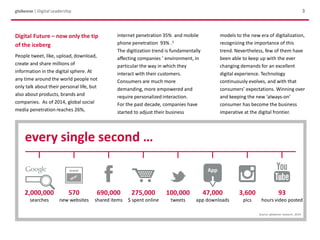
every single second …
2,000,000
searches
570
new websites
690,000
shared items
275,000
$ spent online
100,000
tweets
47,000
app downloads
3,600
pics
93
hours video posted
Source: globeone research, 2014
China – the land of digital
opportunity:
While the rest of the world
is still rather reluctant
towards intensive online
exchanges with brands,
Chinese are at the forefront
of doing so.
66% of Chinese social media
users follow a brand.
8 brands on average.
80% care about commercial
information spread on
social networks.
Source: China Internet Network Information Centre, 2013
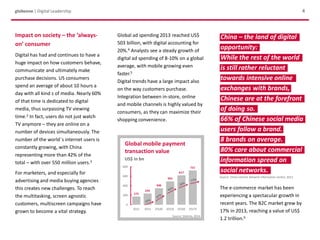
Global mobile payment
transaction value
US$ in bn
Source: Statista, 2014
globeone | Digital Leadership
Impact on society – the ‘always-
on’ consumer
Digital has had and continues to have a
huge impact on how customers behave,
communicate and ultimately make
purchase decisions. US consumers
spend an average of about 10 hours a
day with all kind s of media. Nearly 60%
of that time is dedicated to digital
media, thus surpassing TV viewing
time.2 In fact, users do not just watch
TV anymore – they are online on a
number of devices simultaneously. The
number of the world´s internet users is
constantly growing, with China
representing more than 42% of the
total – with over 550 million users.3
For marketers, and especially for
advertising and media buying agencies
this creates new challenges. To reach
the multitasking, screen agnostic
customers, multiscreen campaigns have
grown to become a vital strategy.
The e-commerce market has been
experiencing a spectacular growth in
recent years. The B2C market grew by
17% in 2013, reaching a value of US$
1.2 trillion.6
Global ad spending 2013 reached US$
503 billion, with digital accounting for
20%.4 Analysts see a steady growth of
digital ad spending of 8-10% on a global
average, with mobile growing even
faster.5
Digital trends have a large impact also
on the way customers purchase.
Integration between in-store, online
and mobile channels is highly valued by
consumers, as they can maximize their
shopping convenience.
4
Chinas ‘Single Day’ in 2013
recorded US$ 5.75 billion
sales. Bigger than sales on
Cyber Monday.
China’s e-commerce is
expected to double within
the next two years to more
than US$ 400 billion.
Source: Forbes, 2013; BrandChannel, 2013
With total sales of US$ 420 billion,
North America was the largest
e-commerce region– however, it is
expected that Asia will become the
biggest contributor in 2014, with a total
spending of US$ 502 billion.7
While for B2B businesses corporate
websites and product websites are still
most relevant to engage with
customers and to inform them about
the latest product developments, B2C
companies need to broaden their
online presence and exploit other tools
and channels to engage with
customers. B2C companies that view e-
commerce only as a desktop driven
channel might struggle to compete in
the future.
Mobile web browsing, in fact,
surpassed desktop web browsing mid
of 2014. Roughly half of e-commerce
transactions already come from mobile
phones and tablets. With 93% global
cell phone penetration,
globeone | Digital Leadership 5
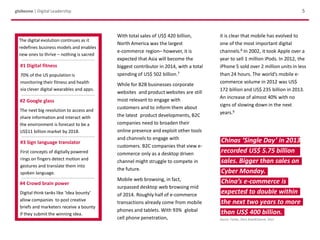
The digital evolution continues as it
redefines business models and enables
new ones to thrive – nothing is sacred
#1 Digital fitness
70% of the US population is
monitoring their fitness and health
via clever digital wearables and apps.
#2 Google glass
The next big revolution to access and
share information and interact with
the environment is forecast to be a
US$11 billion market by 2018.
#3 Sign language translator
First concepts of digitally powered
rings on fingers detect motion and
gestures and translate them into
spoken language.
#4 Crowd brain power
Digital think tanks like ‘Idea bounty’
allow companies to post creative
briefs and marketers receive a bounty
if they submit the winning idea.
it is clear that mobile has evolved to
one of the most important digital
channels.8 In 2002, it took Apple over a
year to sell 1 million iPods. In 2012, the
iPhone 5 sold over 2 million units in less
than 24 hours. The world’s mobile e-
commerce volume in 2012 was US$
172 billion and US$ 235 billion in 2013.
An increase of almost 40% with no
signs of slowing down in the next
years.9
Customer’s purchase journey through online and offline channels
Digital permanently affects
customers’ purchase journey –
B2B and B2C
Marketers need to offer the right
information through the right channels
at the right time. Understanding the
purchase journey of consumers has
never been more important. It can be
extremely complex as they often move
across channels during their journey.
Indeed, today´s customers do not
follow a straight path to purchase
anymore. Along the customers´
purchase journey, the line between
online and offline has become
globeone | Digital Leadership
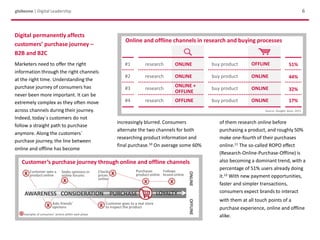
of them research online before
purchasing a product, and roughly 50%
make one-fourth of their purchases
online.11 The so-called ROPO effect
(Research-Online-Purchase-Offline) is
also becoming a dominant trend, with a
percentage of 51% users already doing
it.12 With new payment opportunities,
faster and simpler transactions,
consumers expect brands to interact
with them at all touch points of a
purchase experience, online and offline
alike.
6
Source: Google/ Ipsos, 2013
Online and offline channels in research and buying processes
#1
#2
#3
#4
research
research
research
research
ONLINE
ONLINE
ONLINE +
OFFLINE
OFFLINE
buy product
buy product
buy product
buy product
OFFLINE
ONLINE
ONLINE
ONLINE
51%
44%
32%
17%
increasingly blurred. Consumers
alternate the two channels for both
researching product information and
final purchase.10 On average some 60%
AWARENESS CONSIDERATION PURCHASE LOYALTY
X
X
X
X
X
X
ONLINEOFFLINE
X
X Examples of consumers‘ actions within each phase
Customer sees a
product online
Asks friends’
opinions
Seeks opinions in
online forums
Customer goes to a real store
to inspect the product
Follows
brand online
Checks
prices
online
Purchases
product online
globeone | Digital Leadership 7
over 75% of Chinese smartphone users
have bought something from their
mobile (global percentage: 20%).13
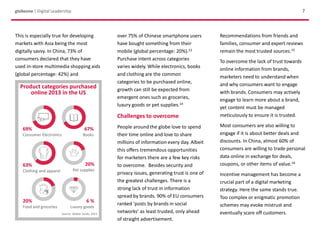
Purchase intent across categories
varies widely. While electronics, books
and clothing are the common
categories to be purchased online,
growth can still be expected from
emergent ones such as groceries,
luxury goods or pet supplies.14
Challenges to overcome
People around the globe love to spend
their time online and love to share
millions of information every day. Albeit
this offers tremendous opportunities
for marketers there are a few key risks
to overcome. Besides security and
privacy issues, generating trust is one of
the greatest challenges. There is a
strong lack of trust in information
spread by brands. 90% of EU consumers
ranked ‘posts by brands in social
networks’ as least trusted, only ahead
of straight advertisement.
Recommendations from friends and
families, consumer and expert reviews
remain the most trusted sources.15
To overcome the lack of trust towards
online information from brands,
marketers need to understand when
and why consumers want to engage
with brands. Consumers may actively
engage to learn more about a brand,
yet content must be managed
meticulously to ensure it is trusted.
Most consumers are also willing to
engage if it is about better deals and
discounts. In China, almost 60% of
consumers are willing to trade personal
data online in exchange for deals,
coupons, or other items of value.16
Incentive management has become a
crucial part of a digital marketing
strategy. Here the same stands true.
Too complex or enigmatic promotion
schemes may evoke mistrust and
eventually scare off customers.
Product categories purchased
online 2013 in the US
69%
Consumer Electronics
67%
Books
63%
Clothing and apparel
20%
Pet supplies
20%
Food and groceries
6 %
Luxury goods
Source: Walker Sands, 2013
This is especially true for developing
markets with Asia being the most
digitally savvy. In China, 73% of
consumers declared that they have
used in-store multimedia shopping aids
(global percentage: 42%) and
8globeone | Digital Leadership
Drive customer awareness
Inform journalists and investors
Create brand experience and build
relationship
Generate sales
Digital / viral
campaign
#1 #1 #2#2 #3#3
Social media
(Twitter, Weibo)
Search engine
marketing
Corporate/
product websites
Digital brand
world / club
Digital malls
(e.g. Tmall)
Corporate
video channel
Digital PR
Online
supported events
Digital brand
community
Digital B2B
campaign
Search engine
marketing
Corporate /
product websites
Digital PR
Digital PR
Social media
(esp. Twitter)
Digital CRM
Digital client
center
Corporate /
product websites
Online tech
center
Corporate /
product websites
Corporate
video channel
Digital PR
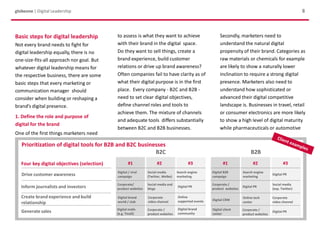
Prioritization of digital tools for B2B and B2C businesses
B2C B2B
Secondly, marketers need to
understand the natural digital
propensity of their brand. Categories as
raw materials or chemicals for example
are likely to show a naturally lower
inclination to require a strong digital
presence. Marketers also need to
understand how sophisticated or
advanced their digital competitive
landscape is. Businesses in travel, retail
or consumer electronics are more likely
to show a high level of digital maturity
while pharmaceuticals or automotive
to assess is what they want to achieve
with their brand in the digital space.
Do they want to sell things, create a
brand experience, build customer
relations or drive up brand awareness?
Often companies fail to have clarity as of
what their digital purpose is in the first
place. Every company - B2C and B2B -
need to set clear digital objectives,
define channel roles and tools to
achieve them. The mixture of channels
and adequate tools differs substantially
between B2C and B2B businesses.
Social media and
blogs
Basic steps for digital leadership
Not every brand needs to fight for
digital leadership equally, there is no
one-size-fits-all approach nor goal. But
whatever digital leadership means for
the respective business, there are some
basic steps that every marketing or
communication manager should
consider when building or reshaping a
brand’s digital presence.
1. Define the role and purpose of
digital for the brand
One of the first things marketers need
Four key digital objectives (selection)
parts suppliers tend to be less
mature.17 Clarity in purpose is the first
step to a successful digital strategy,
maybe the easiest to be overlooked.
2. Understand your digital ecosystem
A firm needs to have a clear
understanding of its own digital
ecosystem, which includes not only its
target customers, but also its
competitive environment. A brand
9globeone | Digital Leadership
3. Measure and track digital
performance
Digital performance measurement
and how to efficiently use the
multitude of data produced at every
digital touch point is still one of the
biggest challenges.
Marketers must effectively sort
through this valuable stream of
information to derive brand status
knowledge, consumer insights and
new opportunities for digital
engagement, advocacy and sales.
Tracking and measuring the
performance of integrated marketing
campaigns is important to work out
the returns on marketing investments
and whether or not the campaign
achieved its objectives. Brand
managers must define the most
important metrics to be tracked for
their business and determine clear
KPIs that can be linked to their
strategic digital goals.
needs to understand its target groups’
specific digital behavior. It is critical to
address differences in digital behavior
across target groups. Some may be
heavier on social media, others may
be more centered around websites.
Only by understanding when, where
and how the target groups engage,
can the digital touch points and media
mix be balanced efficiently.
A holistic and consistent online and
offline consumer journey undoubtedly
is key for success. Organizations often
put marketers in positions where they
have to detach digital media planning
from traditional media. In a perfect
world, it should simply be part of one
overall media mix.
In order to fully understand and have a
clear view of a company’s ecosystem,
a similar analysis should be carried
out for competitors. In particular, a
thorough analysis should be done for
those competitors targeting the same
(or a similar) target group.
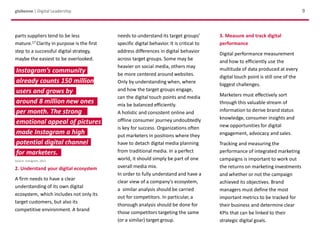
Source: Instagram, 2013
Instagram’s community
already counts 150 million
users and grows by
around 8 million new ones
per month. The strong
emotional appeal of pictures
made Instagram a high
potential digital channel
for marketers.
10globeone | Digital Leadership
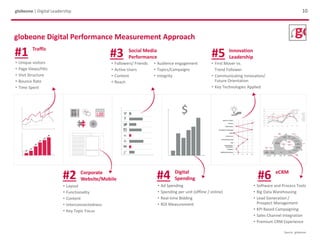
globeone Digital Performance Measurement Approach
#6 eCRM
• Software and Process Tools
• Big Data Warehousing
• Lead Generation /
Prospect Management
• KPI Based Campaigning
• Sales Channel Integration
• Premium CRM Experience
#1 Traffic
• Unique visitors
• Page Views/Hits
• Visit Structure
• Bounce Rate
• Time Spent
#3 Social Media
Performance
• Followers/ Friends
• Active Users
• Content
• Reach
#4 Digital
Spending
• Ad Spending
• Spending per unit (offline / online)
• Real-time Bidding
• ROI Measurement
#5 Innovation
Leadership
• First Mover vs.
Trend Follower
• Communicating Innovation/
Future Orientation
• Key Technologies Applied
#2 Corporate
Website/Mobile
• Layout
• Functionality
• Content
• Interconnectedness
• Key Topic Focus
• Audience engagement
• Topics/Campaigns
• Integrity
Source: globeone
11globeone | Digital Leadership
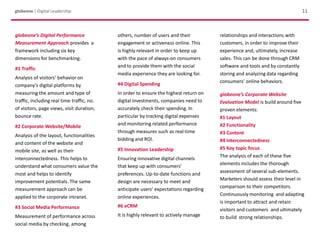
globeone’s Digital Performance
Measurement Approach provides a
framework including six key
dimensions for benchmarking.
#1 Traffic
Analysis of visitors’ behavior on
company’s digital platforms by
measuring the amount and type of
traffic, including real time traffic, no.
of visitors, page views, visit duration,
bounce rate.
#2 Corporate Website/Mobile
Analysis of the layout, functionalities
and content of the website and
mobile site, as well as their
interconnectedness. This helps to
understand what consumers value the
most and helps to identify
improvement potentials. The same
measurement approach can be
applied to the corporate intranet.
#3 Social Media Performance
Measurement of performance across
social media by checking, among
others, number of users and their
engagement or activeness online. This
is highly relevant in order to keep up
with the pace of always-on consumers
and to provide them with the social
media experience they are looking for.
#4 Digital Spending
In order to ensure the highest return on
digital investments, companies need to
accurately check their spending. In
particular by tracking digital expenses
and monitoring related performance
through measures such as real-time
bidding and ROI.
#5 Innovation Leadership
Ensuring innovative digital channels
that keep up with consumers’
preferences. Up-to-date functions and
design are necessary to meet and
anticipate users’ expectations regarding
online experiences.
#6 eCRM
It is highly relevant to actively manage
relationships and interactions with
customers, in order to improve their
experience and, ultimately, increase
sales. This can be done through CRM
software and tools and by constantly
storing and analyzing data regarding
consumers’ online behaviors.
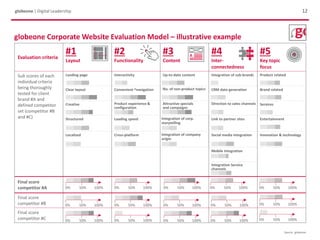
globeone’s Corporate Website
Evaluation Model is build around five
proven elements:
#1 Layout
#2 Functionality
#3 Content
#4 Interconnectedness
#5 Key topic focus
The analysis of each of these five
elements includes the thorough
assessment of several sub-elements.
Marketers should assess their level in
comparison to their competitors.
Continuously monitoring and adapting
is important to attract and retain
visitors and customers and ultimately
to build strong relationships.
12globeone | Digital Leadership
Evaluation criteria
#1
Layout
#2
Functionality
#3
Content
#4
Inter-
connectedness
#5
Key topic
focus
Sub scores of each
individual criteria
being thoroughly
tested for client
brand #A and
defined competitor
set (competitor #B
and #C)
Landing page Interactivity Up-to-date content Integration of sub-brands Product related
Clear layout Convenient ^navigation No. of non-product topics CRM data generation Brand related
Creative Product experience &
configuration
Attractive specials
and campaigns
Direction to sales channels Services
Structured Loading speed Integration of corp.
storytelling
Link to partner sites Entertainment
Localized Cross-platform Integration of company
origin
Social media integration Innovation & technology
Mobile integration
Integration Service
channels
Final score
competitor #A
Final score
competitor #B
Final score
competitor #C
Source: globeone
globeone Corporate Website Evaluation Model – illustrative example
0% 50% 100%0% 50% 100%0% 50% 100%0% 50% 100% 0% 50% 100%
0% 50% 100% 0% 50% 100% 0% 50% 100% 0% 50% 100% 0% 50% 100%
0% 50% 100% 0% 50% 100% 0% 50% 100% 0% 50% 100% 0% 50% 100%
13globeone | Digital Leadership
Who are we?
globeone is a management consultancy with special competence in brand
management, strategy, communications, and research. We are passionate
about positioning brands in their home markets and around the globe.
From our offices in Europe, Asia, and South America we combine global
strategy and local opportunity to help ambitious leaders outsmart the
competition.
Want to know more?
Dr. Niklas Schaffmeister
Managing Partner
Carina Hauswald
Managing Director Cologne
Niklas Schaffmeister advises many Western
blue chip corporations as well as ‘Champion
Brands’ from emerging markets on how to
boost their brand and business performance
in key growth markets. He spent seven years
in China, is fluent in Chinese, and has
conducted major consulting projects in India,
Russia, Brazil and South-East-Asia.
We’re looking forward to hearing from you! Or visit us at www.globe-one.com
Carina Hauswald is an expert in brand
management and strategic market
communications. Her profound marketing
expertise has allowed her to create
meaningful impact for DAX and MDAX listed
companies. As an expert in the
internationalization of corporate
communications, she helps companies explore
their untapped story potential and inspires
them to bring the right story to life.
phone: +49 221 788068-11
niklas.schaffmeister@globe-one.com
phone: +49 221 788068-17
carina.hauswald@globe-one.com
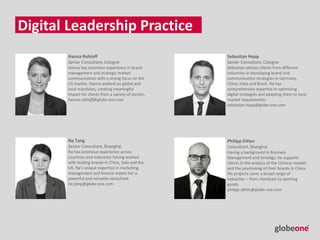
Hanna Rohloff
Senior Consultant, Cologne
Hanna has extensive experience in brand
management and strategic market
communication with a strong focus on the
US market. Hanna worked on global and
local mandates, creating meaningful
impact for clients from a variety of sectors.
hanna.rohloff@globe-one.com
Digital Leadership Practice
Sebastian Hepp
Senior Consultant, Cologne
Sebastian advises clients from different
industries in developing brand and
communication strategies in Germany,
China, India and Brazil. He has
comprehensive expertise in optimizing
digital strategies and adapting them to local
market requirements.
sebastian.hepp@globe-one.com
Na Tang
Senior Consultant, Shanghai
Na has extensive experience across
countries and industries having worked
with leading brands in China, Italy and the
UK. Na’s unique expertise in marketing,
management and finance makes her a
powerful and versatile consultant.
na.tang@globe-one.com
Philipp Dittes
Consultant, Shanghai
Having a background in Business
Management and Sinology, he supports
clients in the analysis of the Chinese market
and the positioning of their brands in China.
His projects cover a broad range of
industries – from chemicals to sporting
goods.
philipp.dittes@globe-one.com
References
1. GlobalWebIndex
2. GlobalWebIndex
3. GlobalWebIndex
4. Emarketer
5. Techcrunch
6. Emarketer
7. Emarketer
8. GlobalWebIndex
9. Statista
10. Google
11. McKinsey iConsumer 2012
12. Google
13. Walker sands’ 2014 future of Retail study
14. Walker sands’ 2014 future of Retail study
15. Forrester Research
16. China Internet Network Information Centre
17. Capgemini Consulting
Cologne  Shanghai  Beijing  Mumbai  São Paulo  Singapore  Seoul
© Copyright
This document of globeone GmbH or its network office is intended exclusively for the client or addressee. It remains exclusive property of
globeone GmbH or its network office until the rights of use are expressly transferred. Any revision, use, duplication or commercial distribution of
this work is permitted only with the consent of globeone GmbH or its network office. This document is a discussion paper. It makes use of
secondary information and hypotheses and is therefore for discussion only. It does not include any recommendations or binding statements.

Digital leadership discussion paper

  • 1.
    Cologne  Shanghai Beijing  Mumbai  São Paulo  Singapore  Seoul Title Author Event, Location Month Year discussion paper #1/2015 LAYING THE FOUNDATION FOR SUCCESSFUL DIGITAL GROWTH DIGITAL LEADERSHIP
  • 2.
    Intro 2globeone | DigitalLeadership At globeone, we are your sparring partner for developing digital leadership. We believe in good process, thorough research, and a hands-on spirit from strategy to implementation. With this discussion paper we want to show the importance of digitalization for businesses and how globeone’s tools – ‘Digital Performance Leadership Measurement’, ‘Digital Consumer Journey’ & our ‘Corporate Website Evaluation Model’ – can help you exploit it. This means embarking on a journey to discover the untapped digital potential and customer segments. At globeone, we believe that this journey will be a fruitful one.
  • 3.
    3globeone | DigitalLeadership Digital Future – now only the tip of the iceberg People tweet, like, upload, download, create and share millions of information in the digital sphere. At any time around the world people not only talk about their personal life, but also about products, brands and companies. As of 2014, global social media penetration reaches 26%, internet penetration 35% and mobile phone penetration 93% .1 The digitization trend is fundamentally affecting companies ’ environment, in particular the way in which they interact with their customers. Consumers are much more demanding, more empowered and require personalized interaction. For the past decade, companies have started to adjust their business models to the new era of digitalization, recognizing the importance of this trend. Nevertheless, few of them have been able to keep up with the ever changing demands for an excellent digital experience. Technology continuously evolves, and with that consumers’ expectations. Winning over and keeping the new ‘always-on’ consumer has become the business imperative at the digital frontier. every single second … 2,000,000 searches 570 new websites 690,000 shared items 275,000 $ spent online 100,000 tweets 47,000 app downloads 3,600 pics 93 hours video posted Source: globeone research, 2014
  • 4.
    China – theland of digital opportunity: While the rest of the world is still rather reluctant towards intensive online exchanges with brands, Chinese are at the forefront of doing so. 66% of Chinese social media users follow a brand. 8 brands on average. 80% care about commercial information spread on social networks. Source: China Internet Network Information Centre, 2013 Global mobile payment transaction value US$ in bn Source: Statista, 2014 globeone | Digital Leadership Impact on society – the ‘always- on’ consumer Digital has had and continues to have a huge impact on how customers behave, communicate and ultimately make purchase decisions. US consumers spend an average of about 10 hours a day with all kind s of media. Nearly 60% of that time is dedicated to digital media, thus surpassing TV viewing time.2 In fact, users do not just watch TV anymore – they are online on a number of devices simultaneously. The number of the world´s internet users is constantly growing, with China representing more than 42% of the total – with over 550 million users.3 For marketers, and especially for advertising and media buying agencies this creates new challenges. To reach the multitasking, screen agnostic customers, multiscreen campaigns have grown to become a vital strategy. The e-commerce market has been experiencing a spectacular growth in recent years. The B2C market grew by 17% in 2013, reaching a value of US$ 1.2 trillion.6 Global ad spending 2013 reached US$ 503 billion, with digital accounting for 20%.4 Analysts see a steady growth of digital ad spending of 8-10% on a global average, with mobile growing even faster.5 Digital trends have a large impact also on the way customers purchase. Integration between in-store, online and mobile channels is highly valued by consumers, as they can maximize their shopping convenience. 4
  • 5.
    Chinas ‘Single Day’in 2013 recorded US$ 5.75 billion sales. Bigger than sales on Cyber Monday. China’s e-commerce is expected to double within the next two years to more than US$ 400 billion. Source: Forbes, 2013; BrandChannel, 2013 With total sales of US$ 420 billion, North America was the largest e-commerce region– however, it is expected that Asia will become the biggest contributor in 2014, with a total spending of US$ 502 billion.7 While for B2B businesses corporate websites and product websites are still most relevant to engage with customers and to inform them about the latest product developments, B2C companies need to broaden their online presence and exploit other tools and channels to engage with customers. B2C companies that view e- commerce only as a desktop driven channel might struggle to compete in the future. Mobile web browsing, in fact, surpassed desktop web browsing mid of 2014. Roughly half of e-commerce transactions already come from mobile phones and tablets. With 93% global cell phone penetration, globeone | Digital Leadership 5 The digital evolution continues as it redefines business models and enables new ones to thrive – nothing is sacred #1 Digital fitness 70% of the US population is monitoring their fitness and health via clever digital wearables and apps. #2 Google glass The next big revolution to access and share information and interact with the environment is forecast to be a US$11 billion market by 2018. #3 Sign language translator First concepts of digitally powered rings on fingers detect motion and gestures and translate them into spoken language. #4 Crowd brain power Digital think tanks like ‘Idea bounty’ allow companies to post creative briefs and marketers receive a bounty if they submit the winning idea. it is clear that mobile has evolved to one of the most important digital channels.8 In 2002, it took Apple over a year to sell 1 million iPods. In 2012, the iPhone 5 sold over 2 million units in less than 24 hours. The world’s mobile e- commerce volume in 2012 was US$ 172 billion and US$ 235 billion in 2013. An increase of almost 40% with no signs of slowing down in the next years.9
  • 6.
    Customer’s purchase journeythrough online and offline channels Digital permanently affects customers’ purchase journey – B2B and B2C Marketers need to offer the right information through the right channels at the right time. Understanding the purchase journey of consumers has never been more important. It can be extremely complex as they often move across channels during their journey. Indeed, today´s customers do not follow a straight path to purchase anymore. Along the customers´ purchase journey, the line between online and offline has become globeone | Digital Leadership of them research online before purchasing a product, and roughly 50% make one-fourth of their purchases online.11 The so-called ROPO effect (Research-Online-Purchase-Offline) is also becoming a dominant trend, with a percentage of 51% users already doing it.12 With new payment opportunities, faster and simpler transactions, consumers expect brands to interact with them at all touch points of a purchase experience, online and offline alike. 6 Source: Google/ Ipsos, 2013 Online and offline channels in research and buying processes #1 #2 #3 #4 research research research research ONLINE ONLINE ONLINE + OFFLINE OFFLINE buy product buy product buy product buy product OFFLINE ONLINE ONLINE ONLINE 51% 44% 32% 17% increasingly blurred. Consumers alternate the two channels for both researching product information and final purchase.10 On average some 60% AWARENESS CONSIDERATION PURCHASE LOYALTY X X X X X X ONLINEOFFLINE X X Examples of consumers‘ actions within each phase Customer sees a product online Asks friends’ opinions Seeks opinions in online forums Customer goes to a real store to inspect the product Follows brand online Checks prices online Purchases product online
  • 7.
    globeone | DigitalLeadership 7 over 75% of Chinese smartphone users have bought something from their mobile (global percentage: 20%).13 Purchase intent across categories varies widely. While electronics, books and clothing are the common categories to be purchased online, growth can still be expected from emergent ones such as groceries, luxury goods or pet supplies.14 Challenges to overcome People around the globe love to spend their time online and love to share millions of information every day. Albeit this offers tremendous opportunities for marketers there are a few key risks to overcome. Besides security and privacy issues, generating trust is one of the greatest challenges. There is a strong lack of trust in information spread by brands. 90% of EU consumers ranked ‘posts by brands in social networks’ as least trusted, only ahead of straight advertisement. Recommendations from friends and families, consumer and expert reviews remain the most trusted sources.15 To overcome the lack of trust towards online information from brands, marketers need to understand when and why consumers want to engage with brands. Consumers may actively engage to learn more about a brand, yet content must be managed meticulously to ensure it is trusted. Most consumers are also willing to engage if it is about better deals and discounts. In China, almost 60% of consumers are willing to trade personal data online in exchange for deals, coupons, or other items of value.16 Incentive management has become a crucial part of a digital marketing strategy. Here the same stands true. Too complex or enigmatic promotion schemes may evoke mistrust and eventually scare off customers. Product categories purchased online 2013 in the US 69% Consumer Electronics 67% Books 63% Clothing and apparel 20% Pet supplies 20% Food and groceries 6 % Luxury goods Source: Walker Sands, 2013 This is especially true for developing markets with Asia being the most digitally savvy. In China, 73% of consumers declared that they have used in-store multimedia shopping aids (global percentage: 42%) and
  • 8.
    8globeone | DigitalLeadership Drive customer awareness Inform journalists and investors Create brand experience and build relationship Generate sales Digital / viral campaign #1 #1 #2#2 #3#3 Social media (Twitter, Weibo) Search engine marketing Corporate/ product websites Digital brand world / club Digital malls (e.g. Tmall) Corporate video channel Digital PR Online supported events Digital brand community Digital B2B campaign Search engine marketing Corporate / product websites Digital PR Digital PR Social media (esp. Twitter) Digital CRM Digital client center Corporate / product websites Online tech center Corporate / product websites Corporate video channel Digital PR Prioritization of digital tools for B2B and B2C businesses B2C B2B Secondly, marketers need to understand the natural digital propensity of their brand. Categories as raw materials or chemicals for example are likely to show a naturally lower inclination to require a strong digital presence. Marketers also need to understand how sophisticated or advanced their digital competitive landscape is. Businesses in travel, retail or consumer electronics are more likely to show a high level of digital maturity while pharmaceuticals or automotive to assess is what they want to achieve with their brand in the digital space. Do they want to sell things, create a brand experience, build customer relations or drive up brand awareness? Often companies fail to have clarity as of what their digital purpose is in the first place. Every company - B2C and B2B - need to set clear digital objectives, define channel roles and tools to achieve them. The mixture of channels and adequate tools differs substantially between B2C and B2B businesses. Social media and blogs Basic steps for digital leadership Not every brand needs to fight for digital leadership equally, there is no one-size-fits-all approach nor goal. But whatever digital leadership means for the respective business, there are some basic steps that every marketing or communication manager should consider when building or reshaping a brand’s digital presence. 1. Define the role and purpose of digital for the brand One of the first things marketers need Four key digital objectives (selection)
  • 9.
    parts suppliers tendto be less mature.17 Clarity in purpose is the first step to a successful digital strategy, maybe the easiest to be overlooked. 2. Understand your digital ecosystem A firm needs to have a clear understanding of its own digital ecosystem, which includes not only its target customers, but also its competitive environment. A brand 9globeone | Digital Leadership 3. Measure and track digital performance Digital performance measurement and how to efficiently use the multitude of data produced at every digital touch point is still one of the biggest challenges. Marketers must effectively sort through this valuable stream of information to derive brand status knowledge, consumer insights and new opportunities for digital engagement, advocacy and sales. Tracking and measuring the performance of integrated marketing campaigns is important to work out the returns on marketing investments and whether or not the campaign achieved its objectives. Brand managers must define the most important metrics to be tracked for their business and determine clear KPIs that can be linked to their strategic digital goals. needs to understand its target groups’ specific digital behavior. It is critical to address differences in digital behavior across target groups. Some may be heavier on social media, others may be more centered around websites. Only by understanding when, where and how the target groups engage, can the digital touch points and media mix be balanced efficiently. A holistic and consistent online and offline consumer journey undoubtedly is key for success. Organizations often put marketers in positions where they have to detach digital media planning from traditional media. In a perfect world, it should simply be part of one overall media mix. In order to fully understand and have a clear view of a company’s ecosystem, a similar analysis should be carried out for competitors. In particular, a thorough analysis should be done for those competitors targeting the same (or a similar) target group. Source: Instagram, 2013 Instagram’s community already counts 150 million users and grows by around 8 million new ones per month. The strong emotional appeal of pictures made Instagram a high potential digital channel for marketers.
  • 10.
    10globeone | DigitalLeadership globeone Digital Performance Measurement Approach #6 eCRM • Software and Process Tools • Big Data Warehousing • Lead Generation / Prospect Management • KPI Based Campaigning • Sales Channel Integration • Premium CRM Experience #1 Traffic • Unique visitors • Page Views/Hits • Visit Structure • Bounce Rate • Time Spent #3 Social Media Performance • Followers/ Friends • Active Users • Content • Reach #4 Digital Spending • Ad Spending • Spending per unit (offline / online) • Real-time Bidding • ROI Measurement #5 Innovation Leadership • First Mover vs. Trend Follower • Communicating Innovation/ Future Orientation • Key Technologies Applied #2 Corporate Website/Mobile • Layout • Functionality • Content • Interconnectedness • Key Topic Focus • Audience engagement • Topics/Campaigns • Integrity Source: globeone
  • 11.
    11globeone | DigitalLeadership globeone’s Digital Performance Measurement Approach provides a framework including six key dimensions for benchmarking. #1 Traffic Analysis of visitors’ behavior on company’s digital platforms by measuring the amount and type of traffic, including real time traffic, no. of visitors, page views, visit duration, bounce rate. #2 Corporate Website/Mobile Analysis of the layout, functionalities and content of the website and mobile site, as well as their interconnectedness. This helps to understand what consumers value the most and helps to identify improvement potentials. The same measurement approach can be applied to the corporate intranet. #3 Social Media Performance Measurement of performance across social media by checking, among others, number of users and their engagement or activeness online. This is highly relevant in order to keep up with the pace of always-on consumers and to provide them with the social media experience they are looking for. #4 Digital Spending In order to ensure the highest return on digital investments, companies need to accurately check their spending. In particular by tracking digital expenses and monitoring related performance through measures such as real-time bidding and ROI. #5 Innovation Leadership Ensuring innovative digital channels that keep up with consumers’ preferences. Up-to-date functions and design are necessary to meet and anticipate users’ expectations regarding online experiences. #6 eCRM It is highly relevant to actively manage relationships and interactions with customers, in order to improve their experience and, ultimately, increase sales. This can be done through CRM software and tools and by constantly storing and analyzing data regarding consumers’ online behaviors. globeone’s Corporate Website Evaluation Model is build around five proven elements: #1 Layout #2 Functionality #3 Content #4 Interconnectedness #5 Key topic focus The analysis of each of these five elements includes the thorough assessment of several sub-elements. Marketers should assess their level in comparison to their competitors. Continuously monitoring and adapting is important to attract and retain visitors and customers and ultimately to build strong relationships.
  • 12.
    12globeone | DigitalLeadership Evaluation criteria #1 Layout #2 Functionality #3 Content #4 Inter- connectedness #5 Key topic focus Sub scores of each individual criteria being thoroughly tested for client brand #A and defined competitor set (competitor #B and #C) Landing page Interactivity Up-to-date content Integration of sub-brands Product related Clear layout Convenient ^navigation No. of non-product topics CRM data generation Brand related Creative Product experience & configuration Attractive specials and campaigns Direction to sales channels Services Structured Loading speed Integration of corp. storytelling Link to partner sites Entertainment Localized Cross-platform Integration of company origin Social media integration Innovation & technology Mobile integration Integration Service channels Final score competitor #A Final score competitor #B Final score competitor #C Source: globeone globeone Corporate Website Evaluation Model – illustrative example 0% 50% 100%0% 50% 100%0% 50% 100%0% 50% 100% 0% 50% 100% 0% 50% 100% 0% 50% 100% 0% 50% 100% 0% 50% 100% 0% 50% 100% 0% 50% 100% 0% 50% 100% 0% 50% 100% 0% 50% 100% 0% 50% 100%
  • 13.
    13globeone | DigitalLeadership Who are we? globeone is a management consultancy with special competence in brand management, strategy, communications, and research. We are passionate about positioning brands in their home markets and around the globe. From our offices in Europe, Asia, and South America we combine global strategy and local opportunity to help ambitious leaders outsmart the competition.
  • 14.
    Want to knowmore? Dr. Niklas Schaffmeister Managing Partner Carina Hauswald Managing Director Cologne Niklas Schaffmeister advises many Western blue chip corporations as well as ‘Champion Brands’ from emerging markets on how to boost their brand and business performance in key growth markets. He spent seven years in China, is fluent in Chinese, and has conducted major consulting projects in India, Russia, Brazil and South-East-Asia. We’re looking forward to hearing from you! Or visit us at www.globe-one.com Carina Hauswald is an expert in brand management and strategic market communications. Her profound marketing expertise has allowed her to create meaningful impact for DAX and MDAX listed companies. As an expert in the internationalization of corporate communications, she helps companies explore their untapped story potential and inspires them to bring the right story to life. phone: +49 221 788068-11 niklas.schaffmeister@globe-one.com phone: +49 221 788068-17 carina.hauswald@globe-one.com
  • 15.
    Hanna Rohloff Senior Consultant,Cologne Hanna has extensive experience in brand management and strategic market communication with a strong focus on the US market. Hanna worked on global and local mandates, creating meaningful impact for clients from a variety of sectors. hanna.rohloff@globe-one.com Digital Leadership Practice Sebastian Hepp Senior Consultant, Cologne Sebastian advises clients from different industries in developing brand and communication strategies in Germany, China, India and Brazil. He has comprehensive expertise in optimizing digital strategies and adapting them to local market requirements. sebastian.hepp@globe-one.com Na Tang Senior Consultant, Shanghai Na has extensive experience across countries and industries having worked with leading brands in China, Italy and the UK. Na’s unique expertise in marketing, management and finance makes her a powerful and versatile consultant. na.tang@globe-one.com Philipp Dittes Consultant, Shanghai Having a background in Business Management and Sinology, he supports clients in the analysis of the Chinese market and the positioning of their brands in China. His projects cover a broad range of industries – from chemicals to sporting goods. philipp.dittes@globe-one.com
  • 16.
    References 1. GlobalWebIndex 2. GlobalWebIndex 3.GlobalWebIndex 4. Emarketer 5. Techcrunch 6. Emarketer 7. Emarketer 8. GlobalWebIndex 9. Statista 10. Google 11. McKinsey iConsumer 2012 12. Google 13. Walker sands’ 2014 future of Retail study 14. Walker sands’ 2014 future of Retail study 15. Forrester Research 16. China Internet Network Information Centre 17. Capgemini Consulting
  • 17.
    Cologne  Shanghai Beijing  Mumbai  São Paulo  Singapore  Seoul © Copyright This document of globeone GmbH or its network office is intended exclusively for the client or addressee. It remains exclusive property of globeone GmbH or its network office until the rights of use are expressly transferred. Any revision, use, duplication or commercial distribution of this work is permitted only with the consent of globeone GmbH or its network office. This document is a discussion paper. It makes use of secondary information and hypotheses and is therefore for discussion only. It does not include any recommendations or binding statements.