2014 AnnuAl RepoRt
WE CAN’T END HUNGER WITH FOOD: GOING BEYOND THE MEAL
Michael F. Curtin, Jr.
Chief Executive Officer
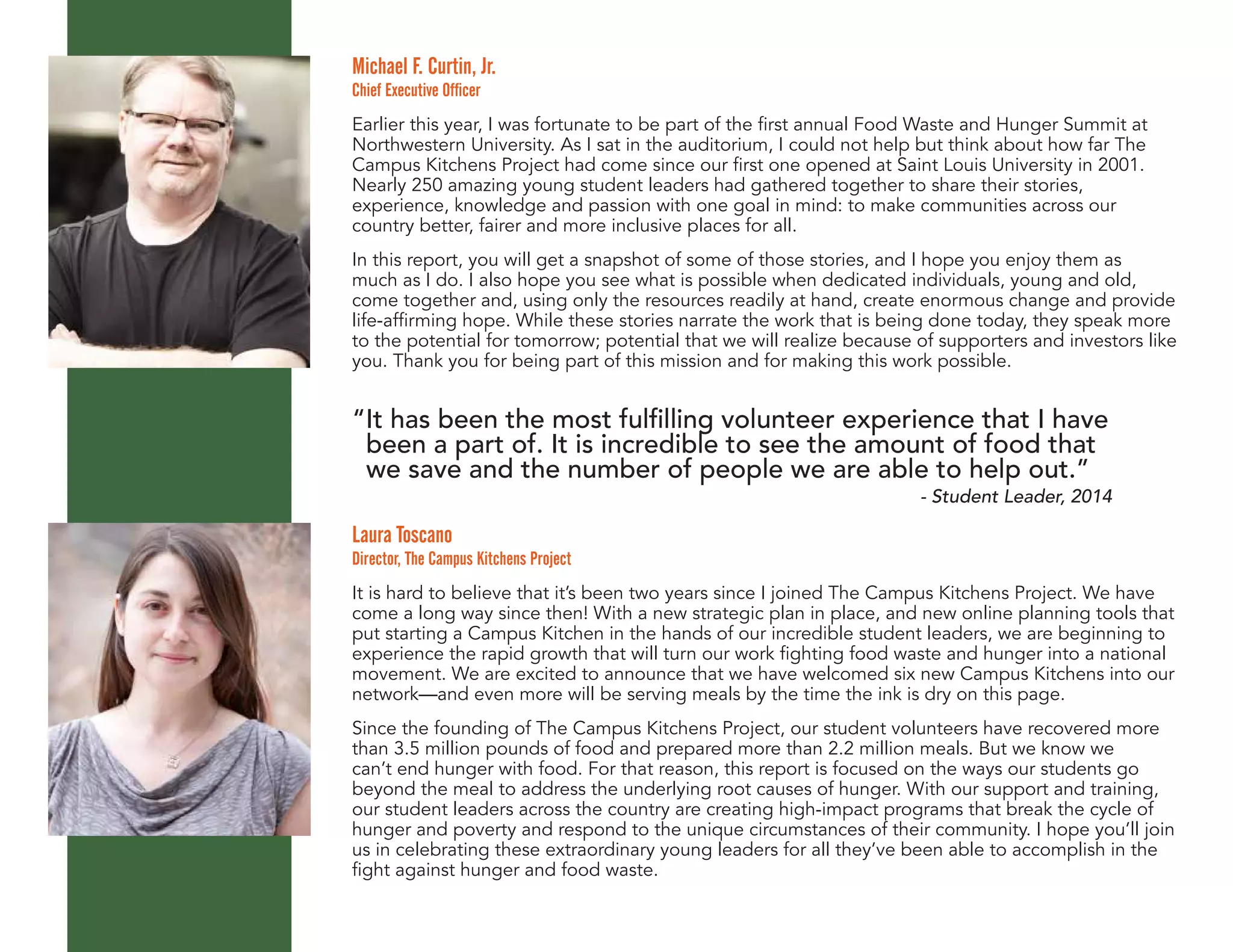
Earlier this year, I was fortunate to be part of the first annual Food Waste and Hunger Summit at
Northwestern University. As I sat in the auditorium, I could not help but think about how far The
Campus Kitchens Project had come since our first one opened at Saint Louis University in 2001.
Nearly 250 amazing young student leaders had gathered together to share their stories,
experience, knowledge and passion with one goal in mind: to make communities across our
country better, fairer and more inclusive places for all.
In this report, you will get a snapshot of some of those stories, and I hope you enjoy them as
much as I do. I also hope you see what is possible when dedicated individuals, young and old,
come together and, using only the resources readily at hand, create enormous change and provide
life-affirming hope. While these stories narrate the work that is being done today, they speak more
to the potential for tomorrow; potential that we will realize because of supporters and investors like
you. Thank you for being part of this mission and for making this work possible.
Laura Toscano
Director, The Campus Kitchens Project
It is hard to believe that it’s been two years since I joined The Campus Kitchens Project. We have
come a long way since then! With a new strategic plan in place, and new online planning tools that
put starting a Campus Kitchen in the hands of our incredible student leaders, we are beginning to
experience the rapid growth that will turn our work fighting food waste and hunger into a national
movement. We are excited to announce that we have welcomed six new Campus Kitchens into our
network—and even more will be serving meals by the time the ink is dry on this page.
Since the founding of The Campus Kitchens Project, our student volunteers have recovered more
than 3.5 million pounds of food and prepared more than 2.2 million meals. But we know we
can’t end hunger with food. For that reason, this report is focused on the ways our students go
beyond the meal to address the underlying root causes of hunger. With our support and training,
our student leaders across the country are creating high-impact programs that break the cycle of
hunger and poverty and respond to the unique circumstances of their community. I hope you’ll join
us in celebrating these extraordinary young leaders for all they’ve been able to accomplish in the
fight against hunger and food waste.
“It has been the most fulfilling volunteer experience that I have
been a part of. It is incredible to see the amount of food that
we save and the number of people we are able to help out.”
- Student Leader, 2014
The Campus Kitchens Project is empowering student leaders to create innovative and sustainable
solutions to hunger.
Building on Existing Assets
While the need in a community is often all too obvious, the existing assets available to meet that
need frequently go unnoticed. At each Campus Kitchen our student leaders recover food that would
have gone to waste and put university dining halls to use after hours to feed those struggling with
food insecurity. In addition to creating a strong operating model, we are teaching students to see
wasted resources as a sustainable solution to community issues.
Going Beyond the Meal
We know we can’t end hunger with food. The Campus Kitchens Project teaches students to assess
the specific need in their community and develop programs that address the underlying root causes
of food insecurity. From nutrition education classes to senior hunger outreach, from community
gardens to policy events, our students deliver more than meals.
Developing Student Leaders
Whether they are leading volunteers in the kitchen or developing relationships with community
organizations, our student leaders are learning entrepreneurial and leadership skills that they will
carry with them into future careers. Our Student Leadership Team structure ensures that students
who come in to volunteer have opportunities to learn and to lead.
The Campus Kitchens Project
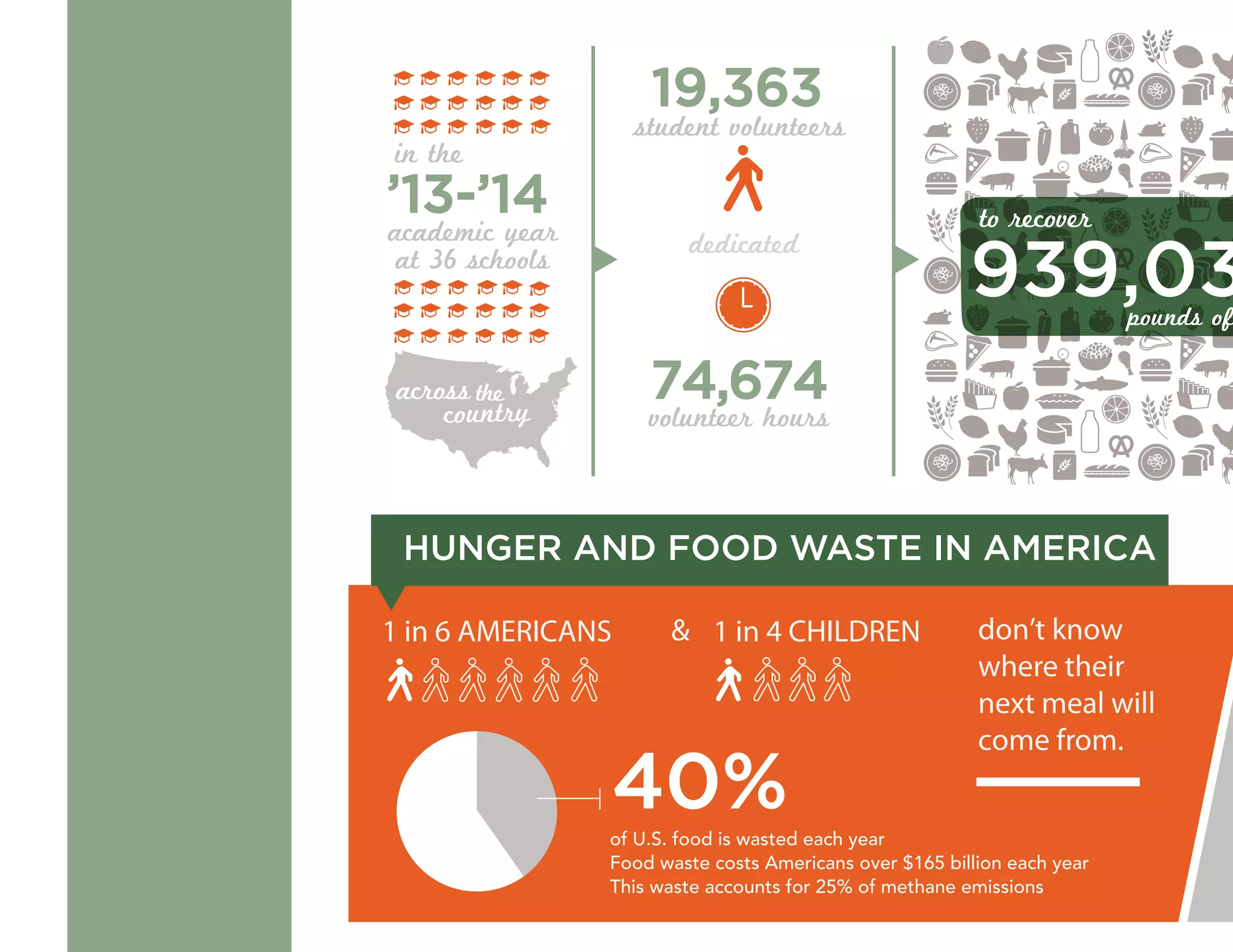
19,363
dedicated
student volunteers
74,674
volunteer hours
939,03pounds of
to recover
across the
country
1 in 4 CHILDREN don’t know
where their
next meal will
come from.
1 in 6 AMERICANS
of U.S. food is wasted each year
Food waste costs Americans over $165 billion each year
This waste accounts for 25% of methane emissions
&
40%
HUNGER AND FOOD WASTE IN AMERICA
’13-’14
in the
at 36 schools
academic year
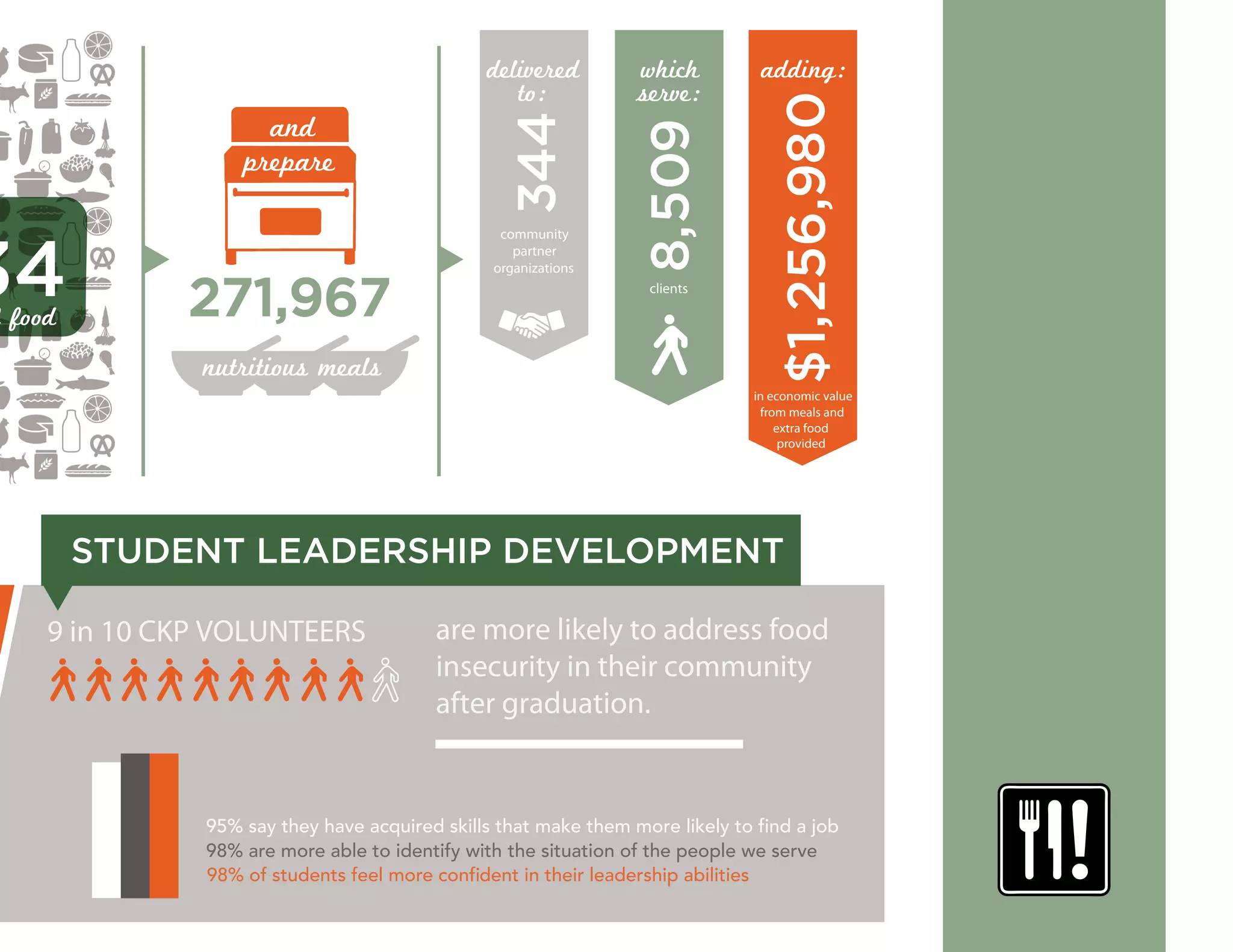
271,967
adding:delivered
to:
which
serve:
community
partner
organizations
clients
in economic value
from meals and
provided
extra food
34f food
344
8,509
$1,256,980
nutritious meals
prepare
and
are more likely to address food
insecurity in their community
after graduation.
9 in 10 CKP VOLUNTEERS
98% are more able to identify with the situation of the people we serve
98% of students feel more confident in their leadership abilities
95% say they have acquired skills that make them more likely to find a job
STUDENT LEADERSHIP DEVELOPMENT
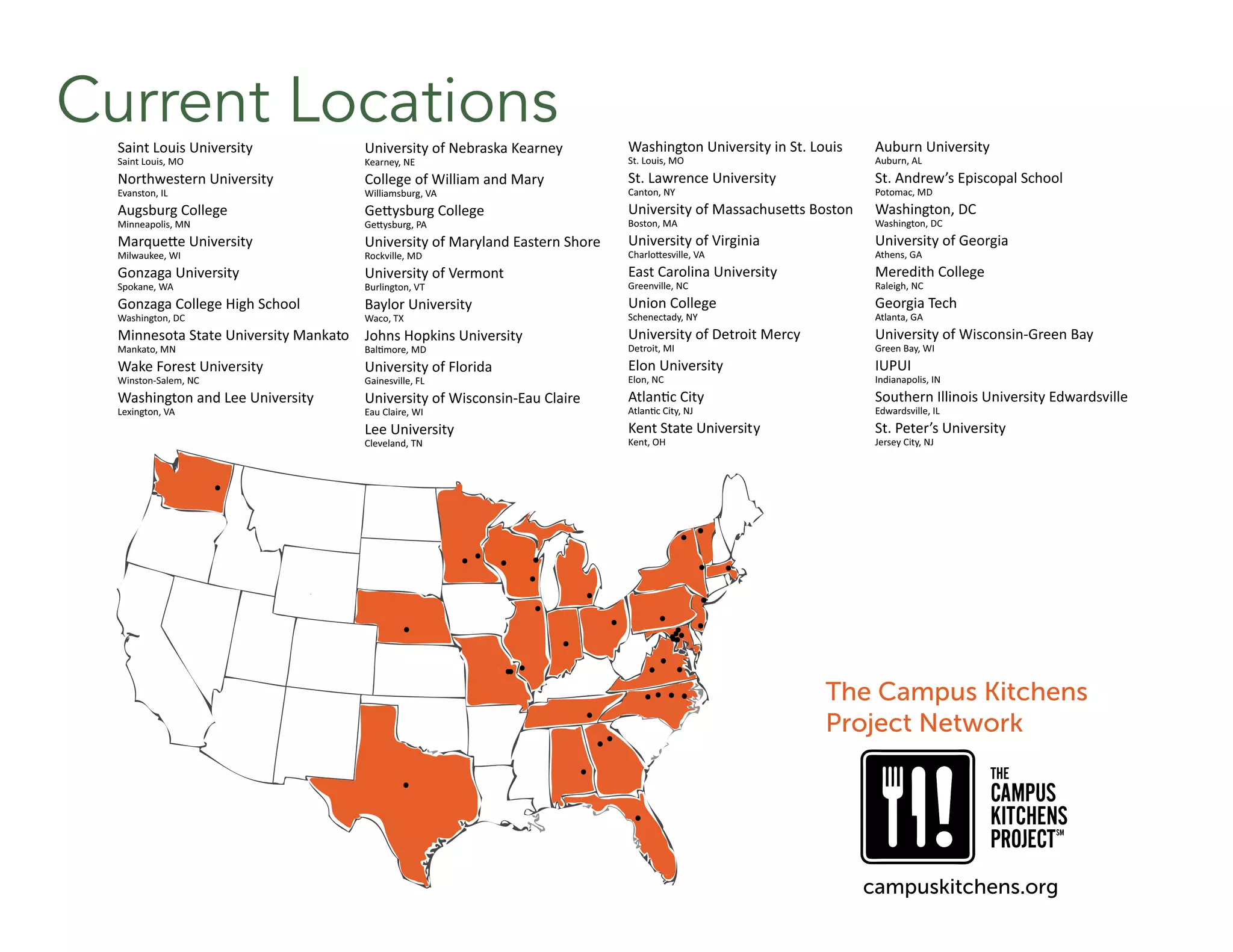
Current LocationsSaint Louis University
Saint Louis, MO
Northwestern University
Evanston, IL
Augsburg College
Minneapolis, MN
MarqueƩe University
Milwaukee, WI
Gonzaga University
Spokane, WA
Gonzaga College High School
Washington, DC
Minnesota State University Mankato
Mankato, MN
Wake Forest University
Winston-Salem, NC
Washington and Lee University
Lexington, VA
University of Nebraska Kearney
Kearney, NE
College of William and Mary
Williamsburg, VA
GeƩysburg College
GeƩysburg, PA
University of Maryland Eastern Shore
Rockville, MD
University of Vermont
Burlington, VT
Baylor University
Waco, TX
Johns Hopkins University
BalƟmore, MD
University of Florida
Gainesville, FL
University of Wisconsin-Eau Claire
Eau Claire, WI
Lee University
Cleveland, TN
Washington University in St. Louis
St. Louis, MO
St. Lawrence University
Canton, NY
University of MassachuseƩs Boston
Boston, MA
University of Virginia
CharloƩesville, VA
East Carolina University
Greenville, NC
Union College
Schenectady, NY
University of Detroit Mercy
Detroit, MI
Elon University
Elon, NC
AtlanƟc City
AtlanƟc City, NJ
Kent State University
Kent, OH
The Campus Kitchens
Project Network
campuskitchens.org
Auburn University
Auburn, AL
St. Andrew’s Episcopal School
Potomac, MD
Washington, DC
Washington, DC
University of Georgia
Athens, GA
Meredith College
Raleigh, NC
Georgia Tech
Atlanta, GA
University of Wisconsin-Green Bay
Green Bay, WI
IUPUI
Indianapolis, IN
Southern Illinois University Edwardsville
Edwardsville, IL
St. Peter’s University
Jersey City, NJ
Strategic Growth Plan
Quantity: The Solution Must Mirror The Scope Of The Problem
The Campus Kitchens Project empowers student leaders to manage an innovative
and entrepreneurial nonprofit program on their high school or college campus. Our
new expansion strategy puts the task of starting that nonprofit initiative squarely in
the hands of our student leaders. Through an effective new online Campus Kitchen
Planner, students can log in on our website and identify all the steps needed to bring
our program to their school. They can invite friends to join their planning committee,
track their progress, download resources to help them plan and pitch the program to
stakeholders on campus and in the community, and access grants to support their work.
Quality: Building Effective Programs Nationwide
The Campus Kitchens Project is known for its valuable ongoing support to our students
and schools, which helps our Campus Kitchens grow their impact in their community
through programs that go beyond the meal to address the underlying root causes of
hunger. In partnership with our funders, we collect the most promising practices and
programs from across our network and create resources and grant opportunities that
help established Campus Kitchens implement proven effective solutions, like anti-
isolation programs for seniors, community gardens that get more fresh local produce
into the hands of our clients, and nutrition education programs for youth.
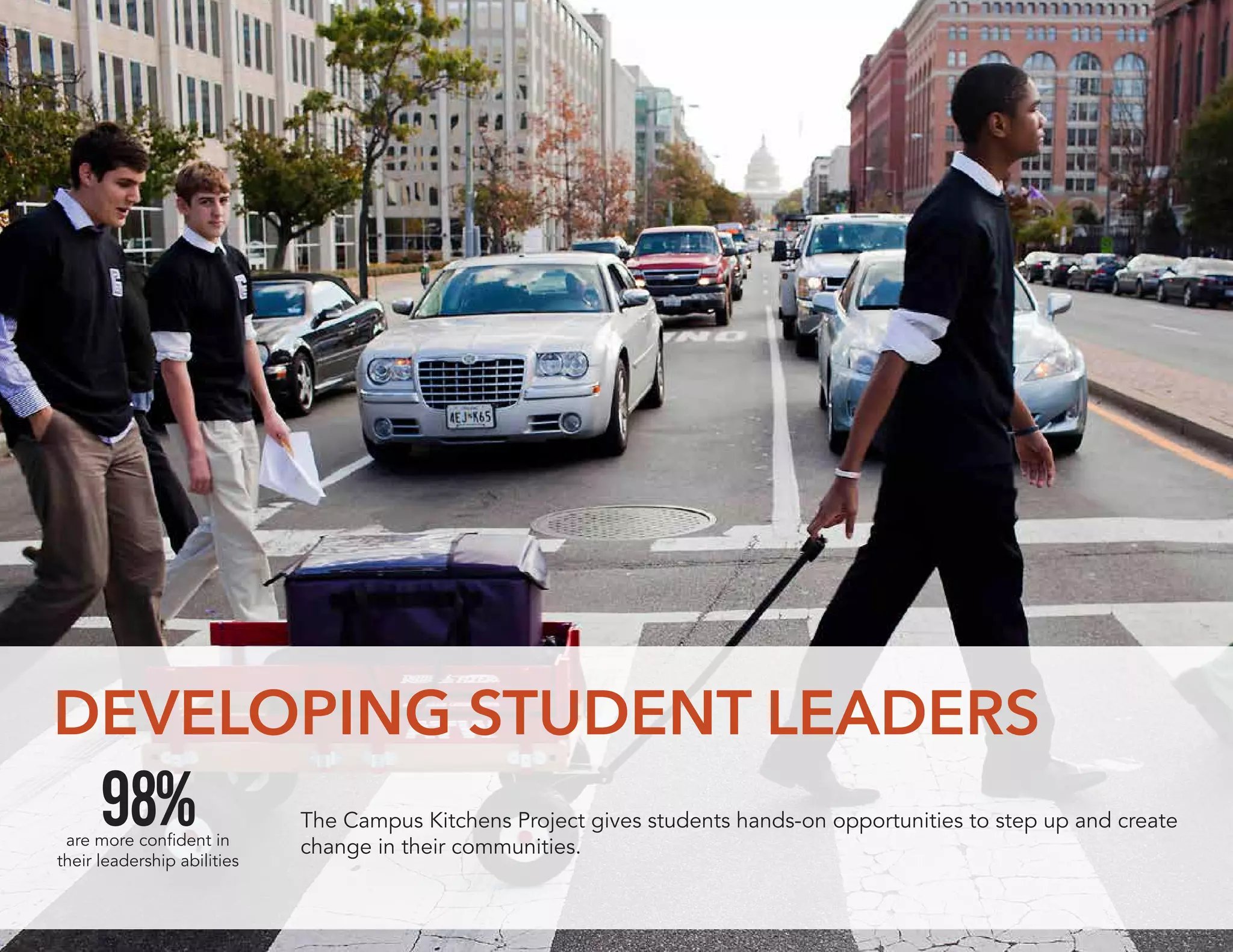
The Campus Kitchens Project gives students hands-on opportunities to step up and create
change in their communities.
DEVELOPING STUDENT LEADERS
98%are more confident in
their leadership abilities
Campus Kitchen student leaders provide incredible services to their
communities, and by doing so they are developing entrepreneurial and
leadership skills that will give them the tools and experience to become the
next generation of effective leaders.
In the spring of 2014, The Campus Kitchens Project, in partnership with a
student research group at George Mason University, led a study of student
leadership development to gain a deeper understanding of the impact that
holding a leadership role in a Campus Kitchen has on the personal and
professional growth of student leaders. We conducted a series of in depth
interviews that guided the design of a survey instrument that was administered
to Campus Kitchen leaders and alumni across the country.
Our student leadership evaluation revealed profound quantitative and
qualitative results. Not only did 95% of student leaders feel that their Campus
Kitchen experience would make them more likely to get a job, but they also
highlighted the impact that this volunteer experience had on their career
trajectory. Many described clarifying their goals to work in non-profits and
public service, or awakening a desire to bring a community focus to their
careers, from law to medicine to agriculture. They also learned concrete skills,
including developing community partnerships, managing groups of people
and fundraising. These students also valued the experience for the way it
shaped their perception of the community served and of their ability to make
a difference in the fight against hunger. As one student noted, “I can use the
leadership and management skills in any situation.”
As they reflected on their leadership experience, one student described The
Campus Kitchens Project as:
“a great organization that not only educates people about food waste
and hunger but also allows students to have a hands-on role addressing
these problems…you learn a lot about leading a group of people and
remaining organized.”
- Student Leader, 2014
DEVELOPING STUDENT LEADERS:
THE NEXT GENERATION IN
THE FIGHT AGAINST HUNGER
95%responded the skills they
acquired made them
more likely to find a job
94%of students have
learned how to develop
community partnerships
92%are more likely to
address food insecurity
in their community after
graduation
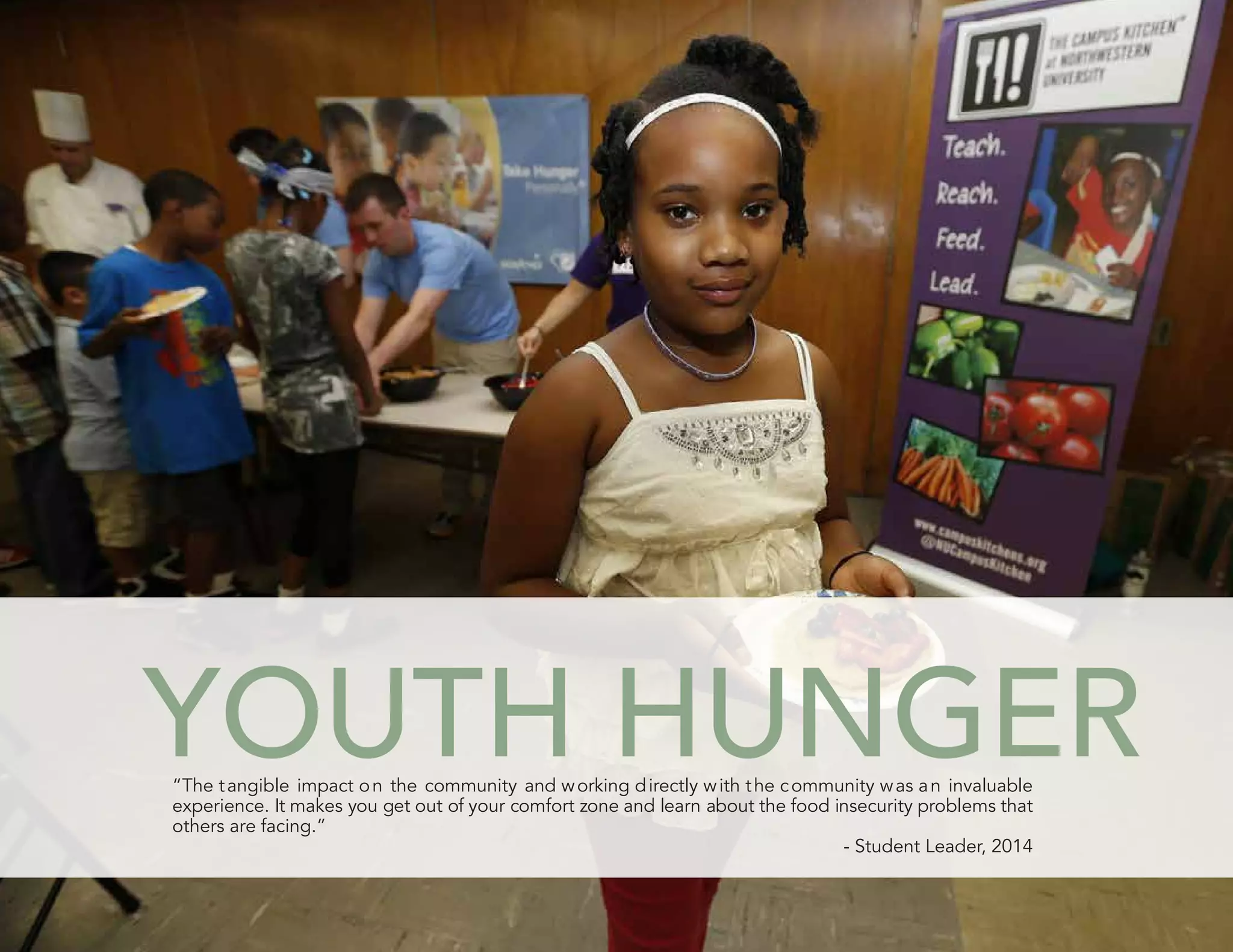
YOUTH HUNGER“The tangible impact on the community and working directly with the community was an invaluable
experience. It makes you get out of your comfort zone and learn about the food insecurity problems that
others are facing.”
- Student Leader, 2014
“The tangible impact on the community and working directly with the community was an invaluable
YOUTH HUNGER
others are facing.”
- Student Leader, 2014
experience. It makes you get out of your comfort zone and learn about the food insecurity problems that
A big lesson from the childhood obesity epidemic is that food insecurity is
about more than not having enough to eat. We need to not only eat enough,
but make healthy choices and eat the right kinds of foods. Eating balanced
meals with all of the essential nutrients for a child’s growth is a recipe for lifelong
health. In order to meet this need among food insecure children in communities
around the country, The Campus Kitchens Project has made nutrition education
a focus across the network.
In the fall of 2013, in partnership with Sodexo Foundation, we rolled out
Building Blocks for Healthy Kids, a six-lesson curriculum for elementary school
students that includes hands-on activities, educational takeaways and recipes for
the whole family. As Campus Kitchens adopt this curriculum, we are giving the
next generation a foundation to make healthy choices and form healthy habits.
A leadership team member at the Campus Kitchen at the University of
Massachusetts Boston described her experience leading nutrition education
classes by sharing the following highlight:
“My favorite thing is when students start to grasp what is healthy versus
what is not healthy for them and when they genuinely get excited about
the healthy snacks for the day!”
- Student Leader, 2014
BEYOND THE MEAL SOLUTION:
EFFECTIVE NUTRITION
EDUCATION CURRICULUM
20,500online views of Building
Blocks for Healthy Kids
86%of Campus Kitchens
serve youth
1 in 4children are at
risk for hunger
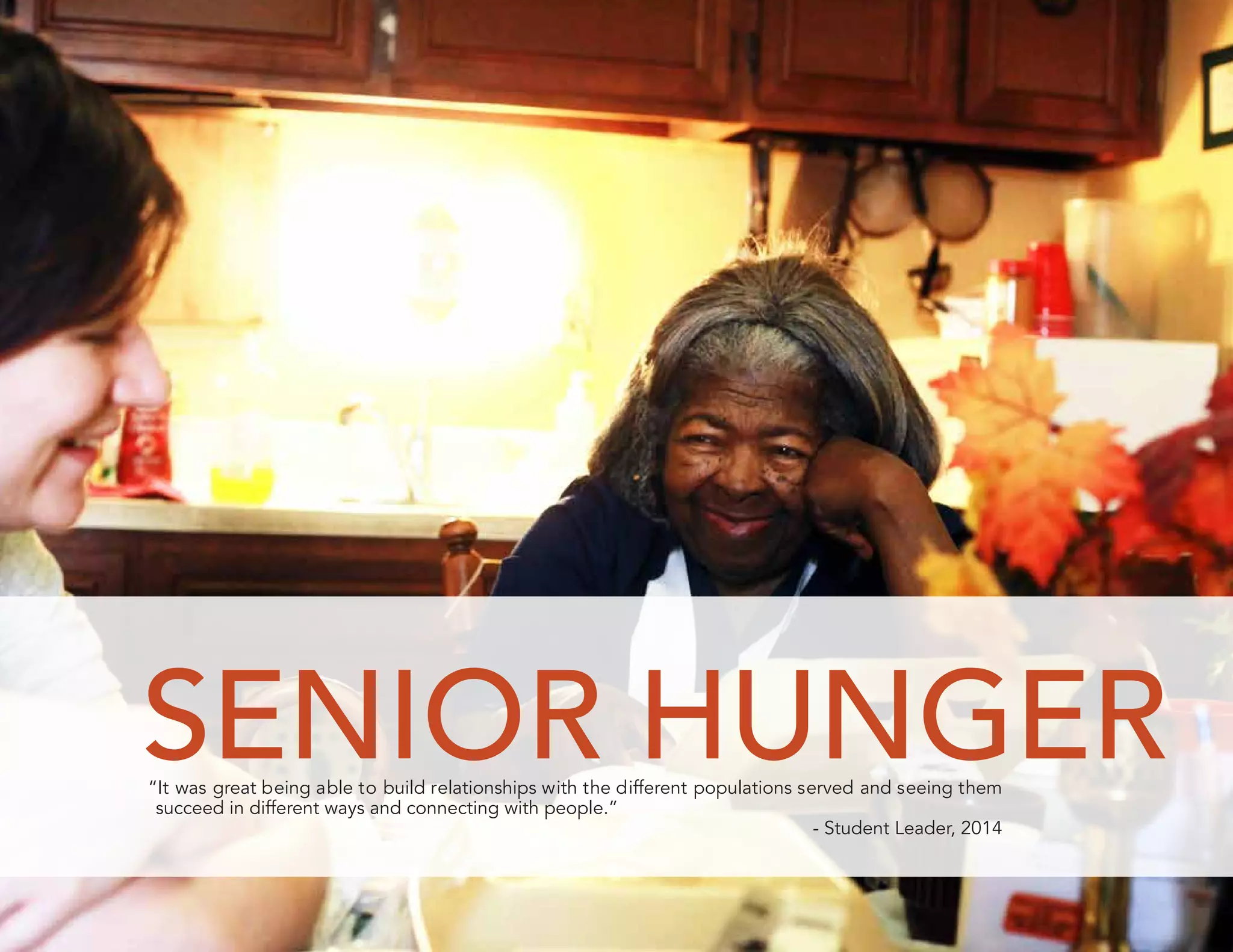
SENIOR HUNGERsucceed in different ways and connecting with people.”
- Student Leader, 2014
“It was great being able to build relationships with the different populations served and seeing them
More than nine million seniors face the threat of hunger, representing over
15% of American older adults. The economic hardships of the last few years
have added to the challenges that seniors face: between 2007 and 2012, the
number of older adults at risk of hunger has increased by 49%. At The Campus
Kitchens Project, we believe that no one should have to choose between
feeding their grandchildren and feeding themselves, or between buying
groceries and paying for prescription medications.
Through a partnership with AARP Foundation, a growing number of Campus
Kitchens are addressing the needs of seniors in communities across the country.
The Campus Kitchens in our network provide meals, lead nutrition and wellness
classes, and create opportunities for friendship and community engagement in
order to reduce the isolation that many seniors experience. Over the course of
the last year, these Campus Kitchens served more than 4,600 meals per month
to over 1,800 seniors, and led over 500 outreach sessions.
Our student leaders rated their relationship with our clients as the #1 reason
that they come back to volunteer again and again with their Campus Kitchen.
The Campus Kitchen at Lee University cited their relationships with seniors
clients as one of their greatest successes, and said that “having an opportunity
to interact with these seniors has opened up a deeper understanding for the
incredible needs of this population and…it has opened our eyes to better ways
to serve, interact, and provide for seniors.”
The Campus Kitchen at Washington and Lee shared that
“increased food security and nutrition for older adults is our goal.
The means to accomplish that goal is the personal relationships that our
students invest their time and energy into, which provides them with
a platform to provide meals and education around healthful living.”
- Student Leader, 2014
98%of students are more
able to identify with the
situation of the people
we serve
55,851meals served to seniors
100%of client agencies agree
that our partnership
has increased the food
security of their clients
BEYOND THE MEAL SOLUTION:
ANTI-ISOLATION PROGRAMS FOR
SENIORS
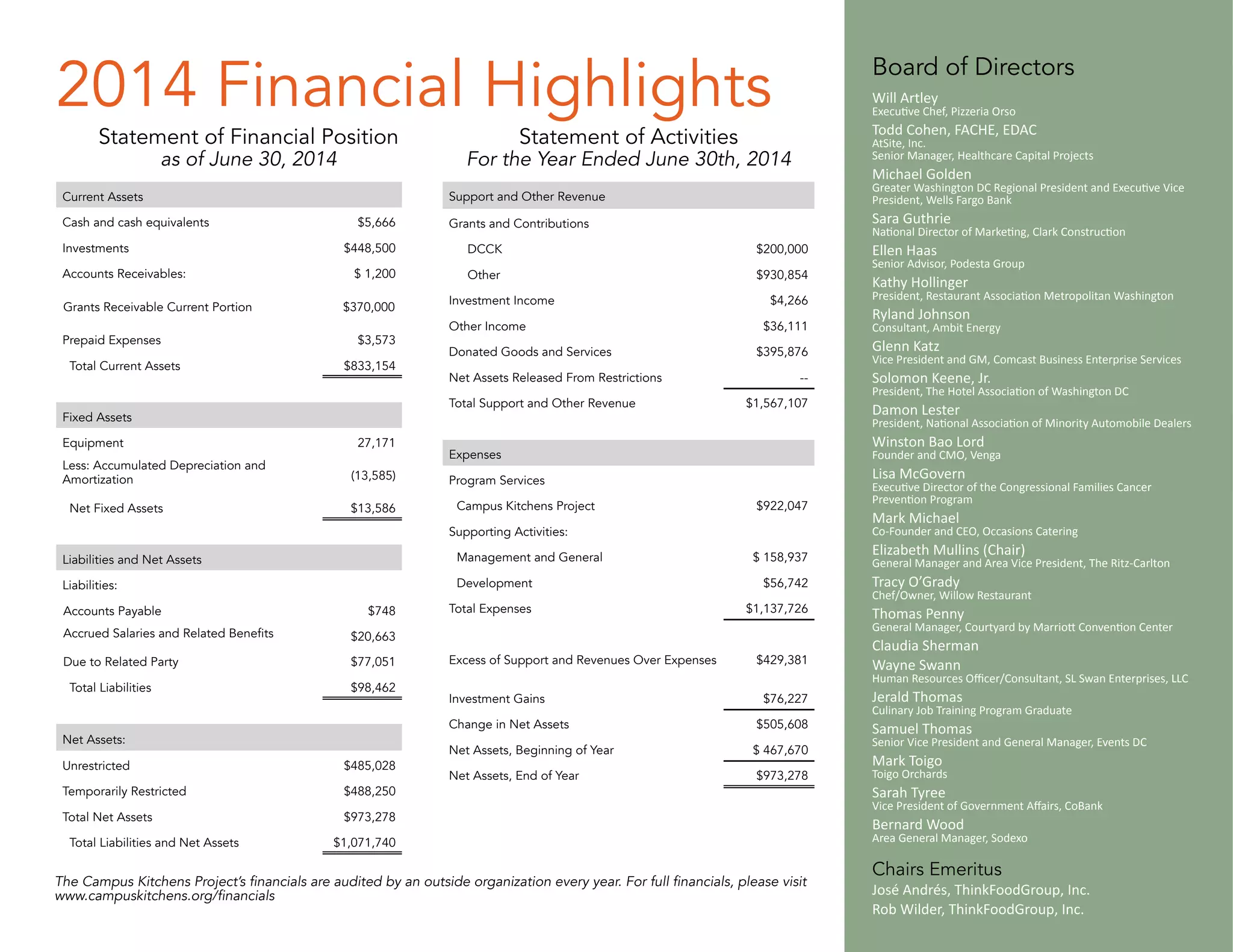
2014 Financial Highlights Board of Directors
Will Artley
Executive Chef, Pizzeria Orso
Todd Cohen, FACHE, EDAC
AtSite, Inc.
Senior Manager, Healthcare Capital Projects
Michael Golden
Greater Washington DC Regional President and Executive Vice
President, Wells Fargo Bank
Sara Guthrie
National Director of Marketing, Clark Construction
Ellen Haas
Senior Advisor, Podesta Group
Kathy Hollinger
President, Restaurant Association Metropolitan Washington
Ryland Johnson
Consultant, Ambit Energy
Glenn Katz
Vice President and GM, Comcast Business Enterprise Services
Solomon Keene, Jr.
President, The Hotel Association of Washington DC
Damon Lester
President, National Association of Minority Automobile Dealers
Winston Bao Lord
Founder and CMO, Venga
Lisa McGovern
Executive Director of the Congressional Families Cancer
Prevention Program
Mark Michael
Co-Founder and CEO, Occasions Catering
Elizabeth Mullins (Chair)
General Manager and Area Vice President, The Ritz-Carlton
Tracy O’Grady
Chef/Owner, Willow Restaurant
Thomas Penny
General Manager, Courtyard by Marriott Convention Center
Claudia Sherman
Wayne Swann
Human Resources Officer/Consultant, SL Swan Enterprises, LLC
Jerald Thomas
Culinary Job Training Program Graduate
Samuel Thomas
Senior Vice President and General Manager, Events DC
Mark Toigo
Toigo Orchards
Sarah Tyree
Vice President of Government Affairs, CoBank
Bernard Wood
Area General Manager, Sodexo
Chairs Emeritus
José Andrés, ThinkFoodGroup, Inc.
Rob Wilder, ThinkFoodGroup, Inc.
Current Assets
Cash and cash equivalents $5,666
Investments $448,500
Accounts Receivables: $ 1,200
Grants Receivable Current Portion $370,000
Prepaid Expenses $3,573
Total Current Assets $833,154
Fixed Assets
Equipment 27,171
Less: Accumulated Depreciation and
Amortization (13,585)
Net Fixed Assets $13,586
Liabilities and Net Assets
Liabilities:
Accounts Payable $748
Accrued Salaries and Related Benefits $20,663
Due to Related Party $77,051
Total Liabilities $98,462
Net Assets:
Unrestricted $485,028
Temporarily Restricted $488,250
Total Net Assets $973,278
Total Liabilities and Net Assets $1,071,740
Statement of Financial Position
as of June 30, 2014
Support and Other Revenue
Grants and Contributions
DCCK $200,000
Other $930,854
Investment Income $4,266
Other Income $36,111
Donated Goods and Services $395,876
Net Assets Released From Restrictions --
Total Support and Other Revenue $1,567,107
Expenses
Program Services
Campus Kitchens Project $922,047
Supporting Activities:
Management and General $ 158,937
Development $56,742
Total Expenses $1,137,726
Excess of Support and Revenues Over Expenses $429,381
Investment Gains $76,227
Change in Net Assets $505,608
Net Assets, Beginning of Year $ 467,670
Net Assets, End of Year $973,278
Statement of Activities
For the Year Ended June 30th, 2014
The Campus Kitchens Project’s financials are audited by an outside organization every year. For full financials, please visit
www.campuskitchens.org/financials
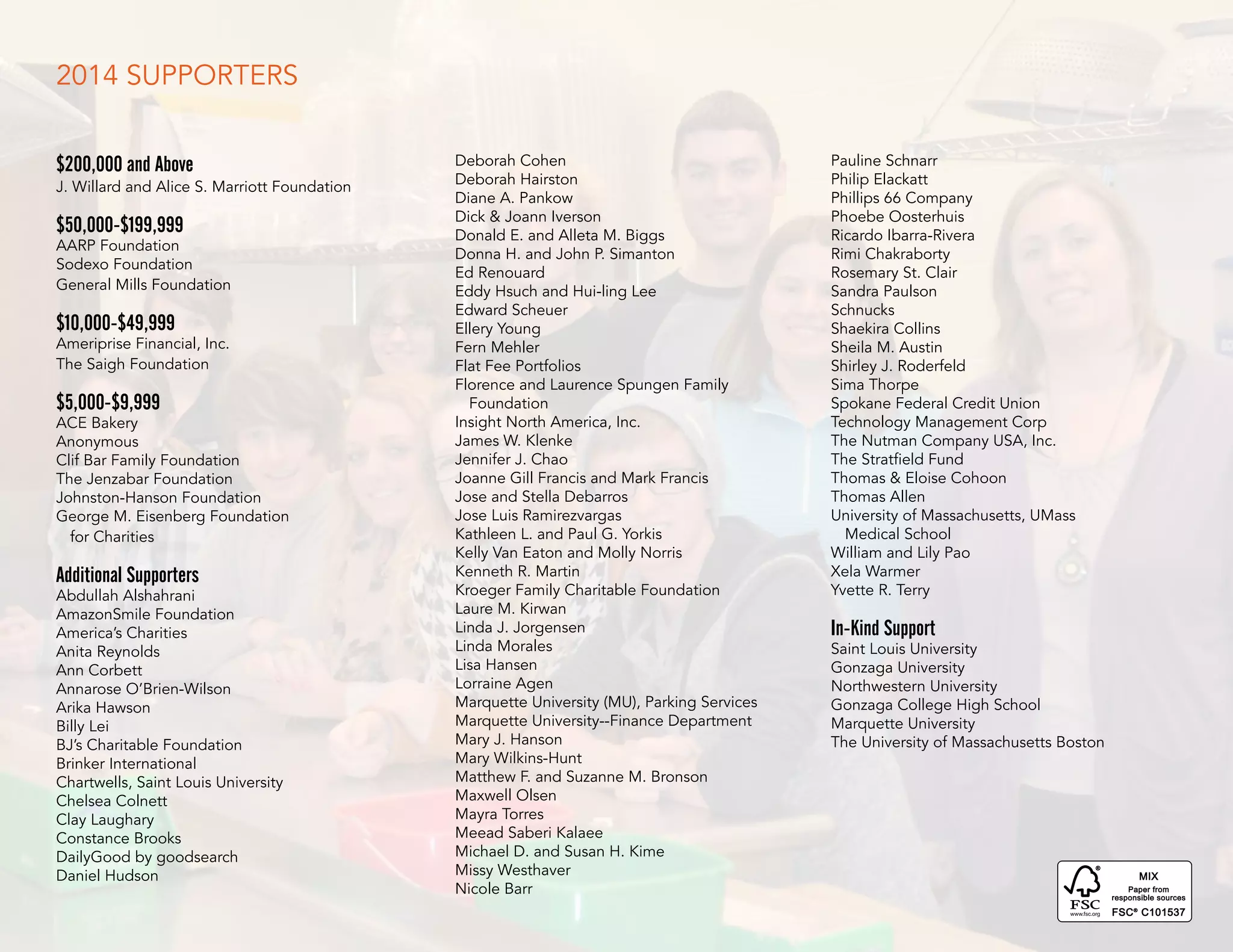
2014 SUPPORTERS
$200,000 and Above
J. Willard and Alice S. Marriott Foundation
$50,000-$199,999
AARP Foundation
Sodexo Foundation
General Mills Foundation
$10,000-$49,999
Ameriprise Financial, Inc.
The Saigh Foundation
$5,000-$9,999
ACE Bakery
Anonymous
Clif Bar Family Foundation
The Jenzabar Foundation
Johnston-Hanson Foundation
George M. Eisenberg Foundation
for Charities
Additional Supporters
Abdullah Alshahrani
AmazonSmile Foundation
America’s Charities
Anita Reynolds
Ann Corbett
Annarose O’Brien-Wilson
Arika Hawson
Billy Lei
BJ’s Charitable Foundation
Brinker International
Chartwells, Saint Louis University
Chelsea Colnett
Clay Laughary
Constance Brooks
DailyGood by goodsearch
Daniel Hudson
Deborah Cohen
Deborah Hairston
Diane A. Pankow
Dick & Joann Iverson
Donald E. and Alleta M. Biggs
Donna H. and John P. Simanton
Ed Renouard
Eddy Hsuch and Hui-ling Lee
Edward Scheuer
Ellery Young
Fern Mehler
Flat Fee Portfolios
Florence and Laurence Spungen Family
Foundation
Insight North America, Inc.
James W. Klenke
Jennifer J. Chao
Joanne Gill Francis and Mark Francis
Jose and Stella Debarros
Jose Luis Ramirezvargas
Kathleen L. and Paul G. Yorkis
Kelly Van Eaton and Molly Norris
Kenneth R. Martin
Kroeger Family Charitable Foundation
Laure M. Kirwan
Linda J. Jorgensen
Linda Morales
Lisa Hansen
Lorraine Agen
Marquette University (MU), Parking Services
Marquette University--Finance Department
Mary J. Hanson
Mary Wilkins-Hunt
Matthew F. and Suzanne M. Bronson
Maxwell Olsen
Mayra Torres
Meead Saberi Kalaee
Michael D. and Susan H. Kime
Missy Westhaver
Nicole Barr
Pauline Schnarr
Philip Elackatt
Phillips 66 Company
Phoebe Oosterhuis
Ricardo Ibarra-Rivera
Rimi Chakraborty
Rosemary St. Clair
Sandra Paulson
Schnucks
Shaekira Collins
Sheila M. Austin
Shirley J. Roderfeld
Sima Thorpe
Spokane Federal Credit Union
Technology Management Corp
The Nutman Company USA, Inc.
The Stratfield Fund
Thomas & Eloise Cohoon
Thomas Allen
University of Massachusetts, UMass
Medical School
William and Lily Pao
Xela Warmer
Yvette R. Terry
In-Kind Support
Saint Louis University
Gonzaga University
Northwestern University
Gonzaga College High School
Marquette University
The University of Massachusetts Boston
19 Eye Street NW, Washington, DC 20001 | Phone: 202-789-5979 | Fax: 202-789-5977
campuskitchens.org | @campuskitchens

2014 Annual Report

  • 1.
    2014 AnnuAl RepoRt WECAN’T END HUNGER WITH FOOD: GOING BEYOND THE MEAL
  • 2.
    Michael F. Curtin,Jr. Chief Executive Officer Earlier this year, I was fortunate to be part of the first annual Food Waste and Hunger Summit at Northwestern University. As I sat in the auditorium, I could not help but think about how far The Campus Kitchens Project had come since our first one opened at Saint Louis University in 2001. Nearly 250 amazing young student leaders had gathered together to share their stories, experience, knowledge and passion with one goal in mind: to make communities across our country better, fairer and more inclusive places for all. In this report, you will get a snapshot of some of those stories, and I hope you enjoy them as much as I do. I also hope you see what is possible when dedicated individuals, young and old, come together and, using only the resources readily at hand, create enormous change and provide life-affirming hope. While these stories narrate the work that is being done today, they speak more to the potential for tomorrow; potential that we will realize because of supporters and investors like you. Thank you for being part of this mission and for making this work possible. Laura Toscano Director, The Campus Kitchens Project It is hard to believe that it’s been two years since I joined The Campus Kitchens Project. We have come a long way since then! With a new strategic plan in place, and new online planning tools that put starting a Campus Kitchen in the hands of our incredible student leaders, we are beginning to experience the rapid growth that will turn our work fighting food waste and hunger into a national movement. We are excited to announce that we have welcomed six new Campus Kitchens into our network—and even more will be serving meals by the time the ink is dry on this page. Since the founding of The Campus Kitchens Project, our student volunteers have recovered more than 3.5 million pounds of food and prepared more than 2.2 million meals. But we know we can’t end hunger with food. For that reason, this report is focused on the ways our students go beyond the meal to address the underlying root causes of hunger. With our support and training, our student leaders across the country are creating high-impact programs that break the cycle of hunger and poverty and respond to the unique circumstances of their community. I hope you’ll join us in celebrating these extraordinary young leaders for all they’ve been able to accomplish in the fight against hunger and food waste. “It has been the most fulfilling volunteer experience that I have been a part of. It is incredible to see the amount of food that we save and the number of people we are able to help out.” - Student Leader, 2014
  • 3.
    The Campus KitchensProject is empowering student leaders to create innovative and sustainable solutions to hunger. Building on Existing Assets While the need in a community is often all too obvious, the existing assets available to meet that need frequently go unnoticed. At each Campus Kitchen our student leaders recover food that would have gone to waste and put university dining halls to use after hours to feed those struggling with food insecurity. In addition to creating a strong operating model, we are teaching students to see wasted resources as a sustainable solution to community issues. Going Beyond the Meal We know we can’t end hunger with food. The Campus Kitchens Project teaches students to assess the specific need in their community and develop programs that address the underlying root causes of food insecurity. From nutrition education classes to senior hunger outreach, from community gardens to policy events, our students deliver more than meals. Developing Student Leaders Whether they are leading volunteers in the kitchen or developing relationships with community organizations, our student leaders are learning entrepreneurial and leadership skills that they will carry with them into future careers. Our Student Leadership Team structure ensures that students who come in to volunteer have opportunities to learn and to lead. The Campus Kitchens Project
  • 4.
    19,363 dedicated student volunteers 74,674 volunteer hours 939,03poundsof to recover across the country 1 in 4 CHILDREN don’t know where their next meal will come from. 1 in 6 AMERICANS of U.S. food is wasted each year Food waste costs Americans over $165 billion each year This waste accounts for 25% of methane emissions & 40% HUNGER AND FOOD WASTE IN AMERICA ’13-’14 in the at 36 schools academic year
  • 5.
    271,967 adding:delivered to: which serve: community partner organizations clients in economic value frommeals and provided extra food 34f food 344 8,509 $1,256,980 nutritious meals prepare and are more likely to address food insecurity in their community after graduation. 9 in 10 CKP VOLUNTEERS 98% are more able to identify with the situation of the people we serve 98% of students feel more confident in their leadership abilities 95% say they have acquired skills that make them more likely to find a job STUDENT LEADERSHIP DEVELOPMENT
  • 6.
    Current LocationsSaint LouisUniversity Saint Louis, MO Northwestern University Evanston, IL Augsburg College Minneapolis, MN MarqueƩe University Milwaukee, WI Gonzaga University Spokane, WA Gonzaga College High School Washington, DC Minnesota State University Mankato Mankato, MN Wake Forest University Winston-Salem, NC Washington and Lee University Lexington, VA University of Nebraska Kearney Kearney, NE College of William and Mary Williamsburg, VA GeƩysburg College GeƩysburg, PA University of Maryland Eastern Shore Rockville, MD University of Vermont Burlington, VT Baylor University Waco, TX Johns Hopkins University BalƟmore, MD University of Florida Gainesville, FL University of Wisconsin-Eau Claire Eau Claire, WI Lee University Cleveland, TN Washington University in St. Louis St. Louis, MO St. Lawrence University Canton, NY University of MassachuseƩs Boston Boston, MA University of Virginia CharloƩesville, VA East Carolina University Greenville, NC Union College Schenectady, NY University of Detroit Mercy Detroit, MI Elon University Elon, NC AtlanƟc City AtlanƟc City, NJ Kent State University Kent, OH The Campus Kitchens Project Network campuskitchens.org Auburn University Auburn, AL St. Andrew’s Episcopal School Potomac, MD Washington, DC Washington, DC University of Georgia Athens, GA Meredith College Raleigh, NC Georgia Tech Atlanta, GA University of Wisconsin-Green Bay Green Bay, WI IUPUI Indianapolis, IN Southern Illinois University Edwardsville Edwardsville, IL St. Peter’s University Jersey City, NJ
  • 7.
    Strategic Growth Plan Quantity:The Solution Must Mirror The Scope Of The Problem The Campus Kitchens Project empowers student leaders to manage an innovative and entrepreneurial nonprofit program on their high school or college campus. Our new expansion strategy puts the task of starting that nonprofit initiative squarely in the hands of our student leaders. Through an effective new online Campus Kitchen Planner, students can log in on our website and identify all the steps needed to bring our program to their school. They can invite friends to join their planning committee, track their progress, download resources to help them plan and pitch the program to stakeholders on campus and in the community, and access grants to support their work. Quality: Building Effective Programs Nationwide The Campus Kitchens Project is known for its valuable ongoing support to our students and schools, which helps our Campus Kitchens grow their impact in their community through programs that go beyond the meal to address the underlying root causes of hunger. In partnership with our funders, we collect the most promising practices and programs from across our network and create resources and grant opportunities that help established Campus Kitchens implement proven effective solutions, like anti- isolation programs for seniors, community gardens that get more fresh local produce into the hands of our clients, and nutrition education programs for youth.
  • 8.
    The Campus KitchensProject gives students hands-on opportunities to step up and create change in their communities. DEVELOPING STUDENT LEADERS 98%are more confident in their leadership abilities
  • 9.
    Campus Kitchen studentleaders provide incredible services to their communities, and by doing so they are developing entrepreneurial and leadership skills that will give them the tools and experience to become the next generation of effective leaders. In the spring of 2014, The Campus Kitchens Project, in partnership with a student research group at George Mason University, led a study of student leadership development to gain a deeper understanding of the impact that holding a leadership role in a Campus Kitchen has on the personal and professional growth of student leaders. We conducted a series of in depth interviews that guided the design of a survey instrument that was administered to Campus Kitchen leaders and alumni across the country. Our student leadership evaluation revealed profound quantitative and qualitative results. Not only did 95% of student leaders feel that their Campus Kitchen experience would make them more likely to get a job, but they also highlighted the impact that this volunteer experience had on their career trajectory. Many described clarifying their goals to work in non-profits and public service, or awakening a desire to bring a community focus to their careers, from law to medicine to agriculture. They also learned concrete skills, including developing community partnerships, managing groups of people and fundraising. These students also valued the experience for the way it shaped their perception of the community served and of their ability to make a difference in the fight against hunger. As one student noted, “I can use the leadership and management skills in any situation.” As they reflected on their leadership experience, one student described The Campus Kitchens Project as: “a great organization that not only educates people about food waste and hunger but also allows students to have a hands-on role addressing these problems…you learn a lot about leading a group of people and remaining organized.” - Student Leader, 2014 DEVELOPING STUDENT LEADERS: THE NEXT GENERATION IN THE FIGHT AGAINST HUNGER 95%responded the skills they acquired made them more likely to find a job 94%of students have learned how to develop community partnerships 92%are more likely to address food insecurity in their community after graduation
  • 10.
    YOUTH HUNGER“The tangibleimpact on the community and working directly with the community was an invaluable experience. It makes you get out of your comfort zone and learn about the food insecurity problems that others are facing.” - Student Leader, 2014 “The tangible impact on the community and working directly with the community was an invaluable YOUTH HUNGER others are facing.” - Student Leader, 2014 experience. It makes you get out of your comfort zone and learn about the food insecurity problems that
  • 11.
    A big lessonfrom the childhood obesity epidemic is that food insecurity is about more than not having enough to eat. We need to not only eat enough, but make healthy choices and eat the right kinds of foods. Eating balanced meals with all of the essential nutrients for a child’s growth is a recipe for lifelong health. In order to meet this need among food insecure children in communities around the country, The Campus Kitchens Project has made nutrition education a focus across the network. In the fall of 2013, in partnership with Sodexo Foundation, we rolled out Building Blocks for Healthy Kids, a six-lesson curriculum for elementary school students that includes hands-on activities, educational takeaways and recipes for the whole family. As Campus Kitchens adopt this curriculum, we are giving the next generation a foundation to make healthy choices and form healthy habits. A leadership team member at the Campus Kitchen at the University of Massachusetts Boston described her experience leading nutrition education classes by sharing the following highlight: “My favorite thing is when students start to grasp what is healthy versus what is not healthy for them and when they genuinely get excited about the healthy snacks for the day!” - Student Leader, 2014 BEYOND THE MEAL SOLUTION: EFFECTIVE NUTRITION EDUCATION CURRICULUM 20,500online views of Building Blocks for Healthy Kids 86%of Campus Kitchens serve youth 1 in 4children are at risk for hunger
  • 12.
    SENIOR HUNGERsucceed indifferent ways and connecting with people.” - Student Leader, 2014 “It was great being able to build relationships with the different populations served and seeing them
  • 13.
    More than ninemillion seniors face the threat of hunger, representing over 15% of American older adults. The economic hardships of the last few years have added to the challenges that seniors face: between 2007 and 2012, the number of older adults at risk of hunger has increased by 49%. At The Campus Kitchens Project, we believe that no one should have to choose between feeding their grandchildren and feeding themselves, or between buying groceries and paying for prescription medications. Through a partnership with AARP Foundation, a growing number of Campus Kitchens are addressing the needs of seniors in communities across the country. The Campus Kitchens in our network provide meals, lead nutrition and wellness classes, and create opportunities for friendship and community engagement in order to reduce the isolation that many seniors experience. Over the course of the last year, these Campus Kitchens served more than 4,600 meals per month to over 1,800 seniors, and led over 500 outreach sessions. Our student leaders rated their relationship with our clients as the #1 reason that they come back to volunteer again and again with their Campus Kitchen. The Campus Kitchen at Lee University cited their relationships with seniors clients as one of their greatest successes, and said that “having an opportunity to interact with these seniors has opened up a deeper understanding for the incredible needs of this population and…it has opened our eyes to better ways to serve, interact, and provide for seniors.” The Campus Kitchen at Washington and Lee shared that “increased food security and nutrition for older adults is our goal. The means to accomplish that goal is the personal relationships that our students invest their time and energy into, which provides them with a platform to provide meals and education around healthful living.” - Student Leader, 2014 98%of students are more able to identify with the situation of the people we serve 55,851meals served to seniors 100%of client agencies agree that our partnership has increased the food security of their clients BEYOND THE MEAL SOLUTION: ANTI-ISOLATION PROGRAMS FOR SENIORS
  • 14.
    2014 Financial HighlightsBoard of Directors Will Artley Executive Chef, Pizzeria Orso Todd Cohen, FACHE, EDAC AtSite, Inc. Senior Manager, Healthcare Capital Projects Michael Golden Greater Washington DC Regional President and Executive Vice President, Wells Fargo Bank Sara Guthrie National Director of Marketing, Clark Construction Ellen Haas Senior Advisor, Podesta Group Kathy Hollinger President, Restaurant Association Metropolitan Washington Ryland Johnson Consultant, Ambit Energy Glenn Katz Vice President and GM, Comcast Business Enterprise Services Solomon Keene, Jr. President, The Hotel Association of Washington DC Damon Lester President, National Association of Minority Automobile Dealers Winston Bao Lord Founder and CMO, Venga Lisa McGovern Executive Director of the Congressional Families Cancer Prevention Program Mark Michael Co-Founder and CEO, Occasions Catering Elizabeth Mullins (Chair) General Manager and Area Vice President, The Ritz-Carlton Tracy O’Grady Chef/Owner, Willow Restaurant Thomas Penny General Manager, Courtyard by Marriott Convention Center Claudia Sherman Wayne Swann Human Resources Officer/Consultant, SL Swan Enterprises, LLC Jerald Thomas Culinary Job Training Program Graduate Samuel Thomas Senior Vice President and General Manager, Events DC Mark Toigo Toigo Orchards Sarah Tyree Vice President of Government Affairs, CoBank Bernard Wood Area General Manager, Sodexo Chairs Emeritus José Andrés, ThinkFoodGroup, Inc. Rob Wilder, ThinkFoodGroup, Inc. Current Assets Cash and cash equivalents $5,666 Investments $448,500 Accounts Receivables: $ 1,200 Grants Receivable Current Portion $370,000 Prepaid Expenses $3,573 Total Current Assets $833,154 Fixed Assets Equipment 27,171 Less: Accumulated Depreciation and Amortization (13,585) Net Fixed Assets $13,586 Liabilities and Net Assets Liabilities: Accounts Payable $748 Accrued Salaries and Related Benefits $20,663 Due to Related Party $77,051 Total Liabilities $98,462 Net Assets: Unrestricted $485,028 Temporarily Restricted $488,250 Total Net Assets $973,278 Total Liabilities and Net Assets $1,071,740 Statement of Financial Position as of June 30, 2014 Support and Other Revenue Grants and Contributions DCCK $200,000 Other $930,854 Investment Income $4,266 Other Income $36,111 Donated Goods and Services $395,876 Net Assets Released From Restrictions -- Total Support and Other Revenue $1,567,107 Expenses Program Services Campus Kitchens Project $922,047 Supporting Activities: Management and General $ 158,937 Development $56,742 Total Expenses $1,137,726 Excess of Support and Revenues Over Expenses $429,381 Investment Gains $76,227 Change in Net Assets $505,608 Net Assets, Beginning of Year $ 467,670 Net Assets, End of Year $973,278 Statement of Activities For the Year Ended June 30th, 2014 The Campus Kitchens Project’s financials are audited by an outside organization every year. For full financials, please visit www.campuskitchens.org/financials
  • 15.
    2014 SUPPORTERS $200,000 andAbove J. Willard and Alice S. Marriott Foundation $50,000-$199,999 AARP Foundation Sodexo Foundation General Mills Foundation $10,000-$49,999 Ameriprise Financial, Inc. The Saigh Foundation $5,000-$9,999 ACE Bakery Anonymous Clif Bar Family Foundation The Jenzabar Foundation Johnston-Hanson Foundation George M. Eisenberg Foundation for Charities Additional Supporters Abdullah Alshahrani AmazonSmile Foundation America’s Charities Anita Reynolds Ann Corbett Annarose O’Brien-Wilson Arika Hawson Billy Lei BJ’s Charitable Foundation Brinker International Chartwells, Saint Louis University Chelsea Colnett Clay Laughary Constance Brooks DailyGood by goodsearch Daniel Hudson Deborah Cohen Deborah Hairston Diane A. Pankow Dick & Joann Iverson Donald E. and Alleta M. Biggs Donna H. and John P. Simanton Ed Renouard Eddy Hsuch and Hui-ling Lee Edward Scheuer Ellery Young Fern Mehler Flat Fee Portfolios Florence and Laurence Spungen Family Foundation Insight North America, Inc. James W. Klenke Jennifer J. Chao Joanne Gill Francis and Mark Francis Jose and Stella Debarros Jose Luis Ramirezvargas Kathleen L. and Paul G. Yorkis Kelly Van Eaton and Molly Norris Kenneth R. Martin Kroeger Family Charitable Foundation Laure M. Kirwan Linda J. Jorgensen Linda Morales Lisa Hansen Lorraine Agen Marquette University (MU), Parking Services Marquette University--Finance Department Mary J. Hanson Mary Wilkins-Hunt Matthew F. and Suzanne M. Bronson Maxwell Olsen Mayra Torres Meead Saberi Kalaee Michael D. and Susan H. Kime Missy Westhaver Nicole Barr Pauline Schnarr Philip Elackatt Phillips 66 Company Phoebe Oosterhuis Ricardo Ibarra-Rivera Rimi Chakraborty Rosemary St. Clair Sandra Paulson Schnucks Shaekira Collins Sheila M. Austin Shirley J. Roderfeld Sima Thorpe Spokane Federal Credit Union Technology Management Corp The Nutman Company USA, Inc. The Stratfield Fund Thomas & Eloise Cohoon Thomas Allen University of Massachusetts, UMass Medical School William and Lily Pao Xela Warmer Yvette R. Terry In-Kind Support Saint Louis University Gonzaga University Northwestern University Gonzaga College High School Marquette University The University of Massachusetts Boston
  • 16.
    19 Eye StreetNW, Washington, DC 20001 | Phone: 202-789-5979 | Fax: 202-789-5977 campuskitchens.org | @campuskitchens