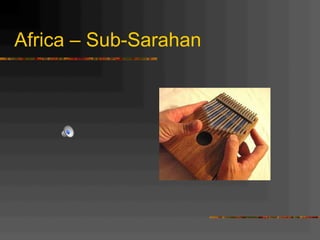
Africa – Sub-Sarahan
Africa today –
regional
traditions -
Instrument
types
Overview
n  Ancestors, Communality, Function and
Religion
n  Characteristics – tonality, scales,
polyrhythms, dance
n  Regional aspects – urban v.rural, old v.
new
n  Vocal characteristics
n  Instrumental traditions
Week 11 - Africa (Sub Saharan)
n  Birthplace of mankind
n  Separation of North and South due to
divide of Sahara
n  Until 100 years ago Sub Saharan had no
literacy tradition
n  Oral-aural culture
n  Music tied to social context and religious
custom
Ancestors
n  Central to mores of Sub-saharan society is
belief that the moral life of community is
watched over by the ancestors.
n  Ancestors communicate through music –
in particular the drum.
n  Music strengthens moral values that
inform community life.
Functions of Music
n  Deters individual or community
misfortunes.
n  Intrinsic to age-set ceremonies
n  Important for obtaining happiness
n  Without music to organise community
events society is dead. Example of
Greeting in Uganda
n  Example of Work Song.
Aesthetics
n  Africans judge musical performance not so
much for entertainment as social
relevance.
n  Songs for all activities. How well does the
music aid and affect the activity?
n  Music both practical and aesthetic.
n  Praise-singing and aural history is bound
up in music.
n  ‘Jahli’ or ‘griots’ in Mali, Gambia,
Senegal
Hereditary Musicians
n  In many traditions professionals are born
into a caste or class and learn from their
family.
n  In some areas professionals are also witch
doctors or healers in some way. Chosen
by the spirit world.
n  Now there are conservatories in some
cities – and some teach traditional musics.
Kora
Kora
Regional Difference
n  Big differences between city and rural
areas. Cities have evolved hybrid musics
based on blend of traditional and western.
Traditional areas have retained more of
their traditions.
n  Religious divides in most areas. Islam and
Christianity vie with traditional gods and
spirits.
Islam South of Sahara
n  Islam is strong in both in East and West Africa
and especially in desert and coastal areas.
n  Big effect of slavery across Africa – Islamic
culture used and accepted slaves long before
the Europeans. Example of Zanzibar.
n  Mixed cultures that are both Islamic and African
are particularly rich culturally – the islamisation
was often only a matter of convenience to avoid
slavery.
n  Example of Sudan and southern Egypt and
Ethiopia.
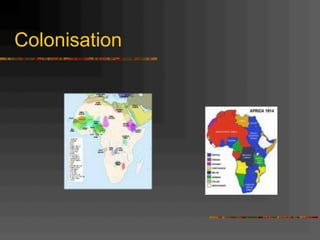
European Intervention
n  Originally Portuguese, then Dutch, then British,
French and Germans in a big carve up in the
19th century.
n  Colonisation set Africans against Africans.
European armies included lots of Africans.
Example of Boers.
n  Partitioning of Africa by European powers in the
19th century is still in place despite
independence in post war era.
Colonisation
Vocal Styles in Sub saharan
Africa
n  3,000 different societies and over 1,000 distinct
languages. All have considerable variation in style and
usage.
n  Also correspondences and similarities.
n  Vocal music is predominant – central to religious
practice – song words express belief.
n  Language and music is particularly intimate in Africa.
n  Musical lines follows contour of speech, instrumental
melodies act as surrogates for vocal melodies.
n  Antiphonal singing – call and response structure.
Reflects social function of music.
n  Initiation Song
Notes Sets
n  Particular societies have note-sets. 5,6 or 7 –
diatonic, anhemitonic (no semi-tones or
equidistant.
n  As with speech shape of melody tends to fall –
downdrift. A high tone at the end is lower that
tone at beginning.
n  Call and response may be structured by
rhythmic cycles.
n  Variation of patterns in words and melodies by
professionals is highly prized.
Rhythm Aspects
n  Organising force of all African expressions
n  Derived from Speech and drummers often
represent a specific speech-text.
n  Drums speak. Melody of drums is
important. This works with layers of
drums within ensembles.
n  Interplay of cross-rhythms. Polyrhythmic
cycles – or rather polymetric. The ability
to hear two metres concurrently and their
resultant patterns.
Drumming Session - Mali
Polyrhythms
Combinations of simple patterns are combined
to create complexity.
n  Master drummer can then invent in the context
of the ongoing patterns and lead into new
ideas.
n  Example of East African polyrhythms.
Xylophones, drums, rattles, shakers, voices.
Call and response.
Musical Instruments
n  Drums – made in many shapes and forms. Some
societies however do not use drums but stamping sticks,
or body percussion, and foot-stamping.
n  Idiophones ubiquitous – rattles and shakers.
n  Flutes made from natural local materials – cane, grass,
gourd, horn, millet.
n  Single and double reed instruments and natural
trumpets.
n  Plucked strings – lutes, harps, arched harps and lyres.
Example of Ugandan lyre.
n  Bowed lutes in Eastern Africa and spiked fiddles in West
Africa. Example of Tanzanian one-string fiddle.
Marimbas - Botswana
Xylophones - Ghana
Spiked fiddle
Ensemble Playing
n  Some instruments typically solo – others
are ensemble – xylophones and
interlocking patterns.
n  Llamellaphone also use interlocking
patterns – Example of Zimbabwean
Mbiras
n  Ensemble panpipes.
Mbira
Zimbabwe Mbira
New Forms
n  African musicians have been enthusiastic in
taking up Western instruments and adapting
techniques to them – also amplification.
n  Lots is local forms based on blends – Kwela,
High-Life, etc.
n  Great Success of World Music as a sector of
popular music – has made some African
musicians superstars.
Kwela Video
Youssou Ndour (1955-)
n  Senegalese singer.
n  From Dakar
n  Singing in French. Huge following in
France and French speaking countries.
n  Mix of native styles, Western pop
technology and festival culture.
n  Wolof language and traditions given new
life
Promo Video
Readings
n  World Music, The Rough Guide, vol 1
n  Gregory Barz, Music in East Africa, Oxford
OUP 2004
n  Elizabeth May, Music of Many Cultures
n  Jeff Todd Titon, Worlds of Music, New
York, 1992

2014 africa

  • 1.
  • 2.
  • 3.
    Overview n  Ancestors, Communality,Function and Religion n  Characteristics – tonality, scales, polyrhythms, dance n  Regional aspects – urban v.rural, old v. new n  Vocal characteristics n  Instrumental traditions
  • 4.
    Week 11 -Africa (Sub Saharan) n  Birthplace of mankind n  Separation of North and South due to divide of Sahara n  Until 100 years ago Sub Saharan had no literacy tradition n  Oral-aural culture n  Music tied to social context and religious custom
  • 5.
    Ancestors n  Central tomores of Sub-saharan society is belief that the moral life of community is watched over by the ancestors. n  Ancestors communicate through music – in particular the drum. n  Music strengthens moral values that inform community life.
  • 6.
    Functions of Music n Deters individual or community misfortunes. n  Intrinsic to age-set ceremonies n  Important for obtaining happiness n  Without music to organise community events society is dead. Example of Greeting in Uganda n  Example of Work Song.
  • 7.
    Aesthetics n  Africans judgemusical performance not so much for entertainment as social relevance. n  Songs for all activities. How well does the music aid and affect the activity? n  Music both practical and aesthetic. n  Praise-singing and aural history is bound up in music. n  ‘Jahli’ or ‘griots’ in Mali, Gambia, Senegal
  • 8.
    Hereditary Musicians n  Inmany traditions professionals are born into a caste or class and learn from their family. n  In some areas professionals are also witch doctors or healers in some way. Chosen by the spirit world. n  Now there are conservatories in some cities – and some teach traditional musics.
  • 9.
  • 10.
  • 11.
    Regional Difference n  Bigdifferences between city and rural areas. Cities have evolved hybrid musics based on blend of traditional and western. Traditional areas have retained more of their traditions. n  Religious divides in most areas. Islam and Christianity vie with traditional gods and spirits.
  • 12.
    Islam South ofSahara n  Islam is strong in both in East and West Africa and especially in desert and coastal areas. n  Big effect of slavery across Africa – Islamic culture used and accepted slaves long before the Europeans. Example of Zanzibar. n  Mixed cultures that are both Islamic and African are particularly rich culturally – the islamisation was often only a matter of convenience to avoid slavery. n  Example of Sudan and southern Egypt and Ethiopia.
  • 13.
    European Intervention n  OriginallyPortuguese, then Dutch, then British, French and Germans in a big carve up in the 19th century. n  Colonisation set Africans against Africans. European armies included lots of Africans. Example of Boers. n  Partitioning of Africa by European powers in the 19th century is still in place despite independence in post war era.
  • 14.
  • 15.
    Vocal Styles inSub saharan Africa n  3,000 different societies and over 1,000 distinct languages. All have considerable variation in style and usage. n  Also correspondences and similarities. n  Vocal music is predominant – central to religious practice – song words express belief. n  Language and music is particularly intimate in Africa. n  Musical lines follows contour of speech, instrumental melodies act as surrogates for vocal melodies. n  Antiphonal singing – call and response structure. Reflects social function of music. n  Initiation Song
  • 16.
    Notes Sets n  Particularsocieties have note-sets. 5,6 or 7 – diatonic, anhemitonic (no semi-tones or equidistant. n  As with speech shape of melody tends to fall – downdrift. A high tone at the end is lower that tone at beginning. n  Call and response may be structured by rhythmic cycles. n  Variation of patterns in words and melodies by professionals is highly prized.
  • 17.
    Rhythm Aspects n  Organisingforce of all African expressions n  Derived from Speech and drummers often represent a specific speech-text. n  Drums speak. Melody of drums is important. This works with layers of drums within ensembles. n  Interplay of cross-rhythms. Polyrhythmic cycles – or rather polymetric. The ability to hear two metres concurrently and their resultant patterns.
  • 18.
  • 19.
    Polyrhythms Combinations of simplepatterns are combined to create complexity. n  Master drummer can then invent in the context of the ongoing patterns and lead into new ideas. n  Example of East African polyrhythms. Xylophones, drums, rattles, shakers, voices. Call and response.
  • 20.
    Musical Instruments n  Drums– made in many shapes and forms. Some societies however do not use drums but stamping sticks, or body percussion, and foot-stamping. n  Idiophones ubiquitous – rattles and shakers. n  Flutes made from natural local materials – cane, grass, gourd, horn, millet. n  Single and double reed instruments and natural trumpets. n  Plucked strings – lutes, harps, arched harps and lyres. Example of Ugandan lyre. n  Bowed lutes in Eastern Africa and spiked fiddles in West Africa. Example of Tanzanian one-string fiddle.
  • 21.
  • 22.
  • 23.
  • 24.
    Ensemble Playing n  Someinstruments typically solo – others are ensemble – xylophones and interlocking patterns. n  Llamellaphone also use interlocking patterns – Example of Zimbabwean Mbiras n  Ensemble panpipes.
  • 25.
  • 26.
  • 27.
    New Forms n  Africanmusicians have been enthusiastic in taking up Western instruments and adapting techniques to them – also amplification. n  Lots is local forms based on blends – Kwela, High-Life, etc. n  Great Success of World Music as a sector of popular music – has made some African musicians superstars.
  • 28.
  • 29.
    Youssou Ndour (1955-) n Senegalese singer. n  From Dakar n  Singing in French. Huge following in France and French speaking countries. n  Mix of native styles, Western pop technology and festival culture. n  Wolof language and traditions given new life
  • 30.
  • 31.
    Readings n  World Music,The Rough Guide, vol 1 n  Gregory Barz, Music in East Africa, Oxford OUP 2004 n  Elizabeth May, Music of Many Cultures n  Jeff Todd Titon, Worlds of Music, New York, 1992