INTRODUCTION METHOD & MODEL RESULTS SUMMARY
Graphene on Cubic and Hexagonal SiC:
A Comparative Theoretical Study
O. Pankratov S. Hensel P. Götzfried M. Bockstedte
Lehrstuhl für Theoretische Festkörperphysik
DPG Frühjahrstagung
Regensburg
2013
INTRODUCTION METHOD & MODEL RESULTS SUMMARY
Graphene on Cubic and Hexagonal SiC
Motivation
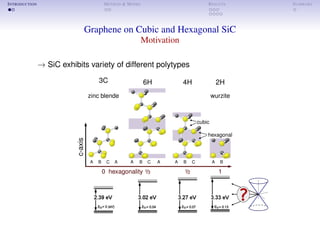
→ SiC exhibits variety of different polytypes
c-axis 3C
A B C A
0
zinc blende
hexagonality
2H
A B
1
wurzite
4H
A B C
1/2
cubic
hexagonal
6H
A B C A
1/3
INTRODUCTION METHOD & MODEL RESULTS SUMMARY
Graphene on Cubic and Hexagonal SiC
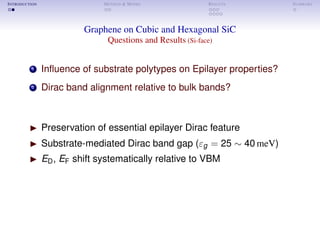
Questions and Results (Si-face)
1 Influence of substrate polytypes on Epilayer properties?
2 Dirac band alignment relative to bulk bands?
Preservation of essential epilayer Dirac feature
Substrate-mediated Dirac band gap (εg = 25 ∼ 40 meV)
ED, EF shift systematically relative to VBM
INTRODUCTION METHOD & MODEL RESULTS SUMMARY
Graphene on Cubic and Hexagonal SiC
Calculational Method
Problem 1) Band gap deficiency of LDA-functional
Combined LDA-/HSE hybrid functional approach
(Heyd-Scuseria-Ernzerhof)
1
◦ Admix fraction of nonlocal HF-type exchange
EHSE
xc = EPBE
xc + 1
4
EHF
x − EPBE
x
◦ Screened interaction reduces calculational expense
1
r
≡ erfc(ωr)
r
short-range
+ erf(ωr)
r
long-range
Density functional program package VASP2
XC-functional L(S)DA HSE06 hybrid
Cut-off energy [eV] 520 eV 420 eV
Γ-centered k-sampling 9x9x1 6x6x1
PAW pseudo-potentials CA PBE
[1] Heyd et al., J.Chem.Phys. (2003) [2] Kresse and Furthmüller, PRB (1996)
INTRODUCTION METHOD & MODEL RESULTS SUMMARY
Graphene on Cubic and Hexagonal SiC
Structural Access
Problem 2) Incommensurable lattices
Si-face (6
√
3×6
√
3)R30 buffer layer1
C-face no buffer,2,3 mutually rotated layer4
(
√
3×
√
3)R30 Model
computationally tractable
correct description of graphene on Si-face5,6
◦ covalent interface bonding
◦ correct epilayer distance
◦ strained graphene interface has minor effect7
⇒ Focus on the Si-face
PRL 99, 076802 (2007)
[1] Otha et al., Science (2006) [2] Emtsev et al., PRB (2008) [3] Hiebel et al., PRB (2009)
[4] Haas et al., PRL (2008) [5] Mattausch et al., PRL (2007) [6] Varchon et al., PRL (2007)
[7] Pankratov et al., PRB (2010)
INTRODUCTION METHOD & MODEL RESULTS SUMMARY
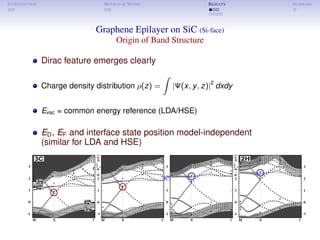
Graphene Epilayer on SiC (Si-face)
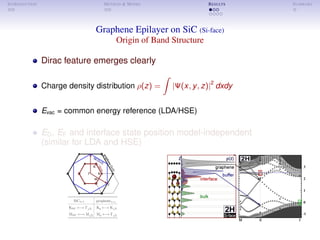
Origin of Band Structure
Dirac feature emerges clearly
Charge density distribution ρ(z) = |Ψ(x, y, z)|2
dxdy
Evac = common energy reference (LDA/HSE)
ED, EF and interface state position model-independent
(similar for LDA and HSE)
INTRODUCTION METHOD & MODEL RESULTS SUMMARY
Graphene Epilayer on SiC (Si-face)
Origin of Band Structure
Dirac feature emerges clearly
Charge density distribution ρ(z) = |Ψ(x, y, z)|2
dxdy
Evac = common energy reference (LDA/HSE)
ED, EF and interface state position model-independent
(similar for LDA and HSE)
INTRODUCTION METHOD & MODEL RESULTS SUMMARY
Graphene Epilayer on SiC (Si-face)
Dirac Point Position
ED, EF shift systematically with hexagonality
HSE in good agreement with experiments
|EF − ED| ∼= const. ⇒ ne− 5.6 · 1013
cm−2
SiC EHSE
D − EHSE
V [eV] EExp
D − EExp
V [eV] EF − ED [eV]
3C 1.48 0.62
6H 1.90 2.25 [1] 0.63
4H 2.53 2.91±±±0.1 [2] 0.61
2H 2.39 0.62
[1] Ristein et al., PRL 108, 246104 (2012) [2] Sonde et al., PRB 80, 241406 (2009)
INTRODUCTION METHOD & MODEL RESULTS SUMMARY
Graphene Epilayer on SiC (Si-face)
Dirac Band Gap
Dirac band gap εg = 25 ∼ 40 meV same for HSE and LDA
Similar small εg for strain-free 5x5 structure1
Upper experimental limit given by ARPES resolution (40 ∼ 50 meV)
SiC HSE
g [meV]
LDA
g [meV]
3C 41.4 36.7
6H 39.9 35.4
4H 28.0 26.3
2H 33.9 32.9
[1] Pankratov et al., PRB 82, 121416R (2010)
INTRODUCTION METHOD & MODEL RESULTS SUMMARY
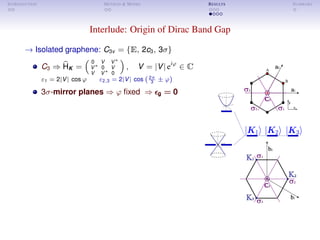
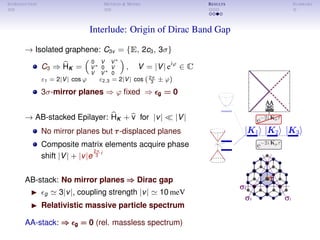
Interlude: Origin of Dirac Band Gap
→ Isolated graphene: C3v = {E, 2c3, 3σ}
C3 ⇒ HK =
0∗ V∗ V∗
V∗
0∗ V∗
V∗ V∗
0∗
, V = |V| eiϕ
∈ C
ε1 = 2|V| cos ϕ ε2,3 = 2|V| cos 2π
3 ± ϕ
3σ-mirror planes ⇒ ϕ fixed ⇒ ggg = 000
INTRODUCTION METHOD & MODEL RESULTS SUMMARY
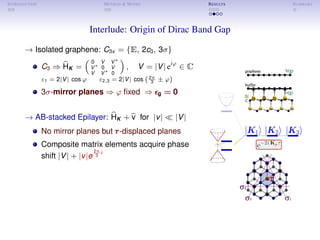
Interlude: Origin of Dirac Band Gap
→ Isolated graphene: C3v = {E, 2c3, 3σ}
C3 ⇒ HK =
0∗ V∗ V∗
V∗
0∗ V∗
V∗ V∗
0∗
, V = |V| eiϕ
∈ C
ε1 = 2|V| cos ϕ ε2,3 = 2|V| cos 2π
3 ± ϕ
3σ-mirror planes ⇒ ϕ fixed ⇒ ggg = 000
→ AB-stacked Epilayer: HK + v for |v| |V|
No mirror planes but τττ-displaced planes
Composite matrix elements acquire phase
shift |V| + |v|e
2π
3
i
INTRODUCTION METHOD & MODEL RESULTS SUMMARY
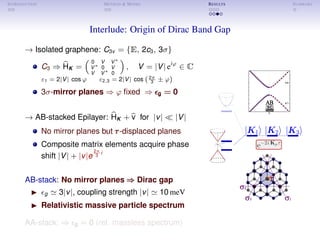
Interlude: Origin of Dirac Band Gap
→ Isolated graphene: C3v = {E, 2c3, 3σ}
C3 ⇒ HK =
0∗ V∗ V∗
V∗
0∗ V∗
V∗ V∗
0∗
, V = |V| eiϕ
∈ C
ε1 = 2|V| cos ϕ ε2,3 = 2|V| cos 2π
3 ± ϕ
3σ-mirror planes ⇒ ϕ fixed ⇒ ggg = 000
→ AB-stacked Epilayer: HK + v for |v| |V|
No mirror planes but τττ-displaced planes
Composite matrix elements acquire phase
shift |V| + |v|e
2π
3
i
AB-stack: No mirror planes ⇒⇒⇒ Dirac gap
g 3|v|, coupling strength |v| 10 meV
Relativistic massive particle spectrum
AA-stack: ⇒ g = 0⇒ g = 0⇒ g = 0 (rel. massless spectrum)
INTRODUCTION METHOD & MODEL RESULTS SUMMARY
Interlude: Origin of Dirac Band Gap
→ Isolated graphene: C3v = {E, 2c3, 3σ}
C3 ⇒ HK =
0∗ V∗ V∗
V∗
0∗ V∗
V∗ V∗
0∗
, V = |V| eiϕ
∈ C
ε1 = 2|V| cos ϕ ε2,3 = 2|V| cos 2π
3 ± ϕ
3σ-mirror planes ⇒ ϕ fixed ⇒ ggg = 000
→ AB-stacked Epilayer: HK + v for |v| |V|
No mirror planes but τττ-displaced planes
Composite matrix elements acquire phase
shift |V| + |v|e
2π
3
i
AB-stack: No mirror planes ⇒⇒⇒ Dirac gap
g 3|v|, coupling strength |v| 10 meV
Relativistic massive particle spectrum
AA-stack: ⇒ g = 0⇒ g = 0⇒ g = 0 (rel. massless spectrum)
INTRODUCTION METHOD & MODEL RESULTS SUMMARY
Graphene Epilayer on SiC (Si-face)
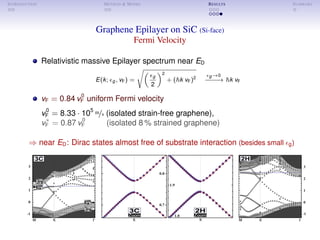
Fermi Velocity
Relativistic massive Epilayer spectrum near ED
E(k; g , vF) =
g
2
2
+ ( k vF)2 g →0
−−−−→ k vF
vF = 0.84 v0
F uniform Fermi velocity
v0
F = 8.33 · 105 m/s (isolated strain-free graphene),
v∗
F = 0.87 v0
F (isolated 8 % strained graphene)
⇒ near ED: Dirac states almost free of substrate interaction (besides small g)
INTRODUCTION METHOD & MODEL RESULTS SUMMARY
Summary - Graphene on Different SiC Polytypes
Ab initio Calculations with Combined LDA and HSE06 Hybrid Functional Approach
1 Influence of substrate polytypes on Epilayer?
2 Dirac band alignment relative to bulk bands?
Preservation of essential epilayer Dirac feature
Uniform Fermi-velocity, similar n-doping (Fermi-pinning)
Substrate-mediated Dirac band gap1
(εg = 25 ∼ 40 meV)
ED, EF shift systematically relative to VBM
HSE06 - good agreement with experimental data, LDA - correctly
corroborates trends
[1] Pankratov et al., PRB 86, 155432 (2012)
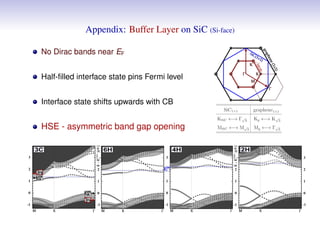
Appendix: Buffer Layer on SiC (Si-face)
No Dirac bands near EF
Half-filled interface state pins Fermi level
Interface state shifts upwards with CB
HSE - asymmetric band gap opening
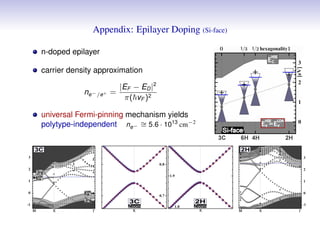
Appendix: Epilayer Doping (Si-face)
n-doped epilayer
carrier density approximation
ne−/e+ =
|EF − ED|2
π( vF )2
universal Fermi-pinning mechanism yields
polytype-independent ne−
∼= 5.6 · 1013
cm−2

2013_Talk.Regensburg.DPG

  • 1.
    INTRODUCTION METHOD &MODEL RESULTS SUMMARY Graphene on Cubic and Hexagonal SiC: A Comparative Theoretical Study O. Pankratov S. Hensel P. Götzfried M. Bockstedte Lehrstuhl für Theoretische Festkörperphysik DPG Frühjahrstagung Regensburg 2013
  • 2.
    INTRODUCTION METHOD &MODEL RESULTS SUMMARY Graphene on Cubic and Hexagonal SiC Motivation → SiC exhibits variety of different polytypes c-axis 3C A B C A 0 zinc blende hexagonality 2H A B 1 wurzite 4H A B C 1/2 cubic hexagonal 6H A B C A 1/3
  • 3.
    INTRODUCTION METHOD &MODEL RESULTS SUMMARY Graphene on Cubic and Hexagonal SiC Questions and Results (Si-face) 1 Influence of substrate polytypes on Epilayer properties? 2 Dirac band alignment relative to bulk bands? Preservation of essential epilayer Dirac feature Substrate-mediated Dirac band gap (εg = 25 ∼ 40 meV) ED, EF shift systematically relative to VBM
  • 4.
    INTRODUCTION METHOD &MODEL RESULTS SUMMARY Graphene on Cubic and Hexagonal SiC Calculational Method Problem 1) Band gap deficiency of LDA-functional Combined LDA-/HSE hybrid functional approach (Heyd-Scuseria-Ernzerhof) 1 ◦ Admix fraction of nonlocal HF-type exchange EHSE xc = EPBE xc + 1 4 EHF x − EPBE x ◦ Screened interaction reduces calculational expense 1 r ≡ erfc(ωr) r short-range + erf(ωr) r long-range Density functional program package VASP2 XC-functional L(S)DA HSE06 hybrid Cut-off energy [eV] 520 eV 420 eV Γ-centered k-sampling 9x9x1 6x6x1 PAW pseudo-potentials CA PBE [1] Heyd et al., J.Chem.Phys. (2003) [2] Kresse and Furthmüller, PRB (1996)
  • 5.
    INTRODUCTION METHOD &MODEL RESULTS SUMMARY Graphene on Cubic and Hexagonal SiC Structural Access Problem 2) Incommensurable lattices Si-face (6 √ 3×6 √ 3)R30 buffer layer1 C-face no buffer,2,3 mutually rotated layer4 ( √ 3× √ 3)R30 Model computationally tractable correct description of graphene on Si-face5,6 ◦ covalent interface bonding ◦ correct epilayer distance ◦ strained graphene interface has minor effect7 ⇒ Focus on the Si-face PRL 99, 076802 (2007) [1] Otha et al., Science (2006) [2] Emtsev et al., PRB (2008) [3] Hiebel et al., PRB (2009) [4] Haas et al., PRL (2008) [5] Mattausch et al., PRL (2007) [6] Varchon et al., PRL (2007) [7] Pankratov et al., PRB (2010)
  • 6.
    INTRODUCTION METHOD &MODEL RESULTS SUMMARY Graphene Epilayer on SiC (Si-face) Origin of Band Structure Dirac feature emerges clearly Charge density distribution ρ(z) = |Ψ(x, y, z)|2 dxdy Evac = common energy reference (LDA/HSE) ED, EF and interface state position model-independent (similar for LDA and HSE)
  • 7.
    INTRODUCTION METHOD &MODEL RESULTS SUMMARY Graphene Epilayer on SiC (Si-face) Origin of Band Structure Dirac feature emerges clearly Charge density distribution ρ(z) = |Ψ(x, y, z)|2 dxdy Evac = common energy reference (LDA/HSE) ED, EF and interface state position model-independent (similar for LDA and HSE)
  • 8.
    INTRODUCTION METHOD &MODEL RESULTS SUMMARY Graphene Epilayer on SiC (Si-face) Dirac Point Position ED, EF shift systematically with hexagonality HSE in good agreement with experiments |EF − ED| ∼= const. ⇒ ne− 5.6 · 1013 cm−2 SiC EHSE D − EHSE V [eV] EExp D − EExp V [eV] EF − ED [eV] 3C 1.48 0.62 6H 1.90 2.25 [1] 0.63 4H 2.53 2.91±±±0.1 [2] 0.61 2H 2.39 0.62 [1] Ristein et al., PRL 108, 246104 (2012) [2] Sonde et al., PRB 80, 241406 (2009)
  • 9.
    INTRODUCTION METHOD &MODEL RESULTS SUMMARY Graphene Epilayer on SiC (Si-face) Dirac Band Gap Dirac band gap εg = 25 ∼ 40 meV same for HSE and LDA Similar small εg for strain-free 5x5 structure1 Upper experimental limit given by ARPES resolution (40 ∼ 50 meV) SiC HSE g [meV] LDA g [meV] 3C 41.4 36.7 6H 39.9 35.4 4H 28.0 26.3 2H 33.9 32.9 [1] Pankratov et al., PRB 82, 121416R (2010)
  • 10.
    INTRODUCTION METHOD &MODEL RESULTS SUMMARY Interlude: Origin of Dirac Band Gap → Isolated graphene: C3v = {E, 2c3, 3σ} C3 ⇒ HK = 0∗ V∗ V∗ V∗ 0∗ V∗ V∗ V∗ 0∗ , V = |V| eiϕ ∈ C ε1 = 2|V| cos ϕ ε2,3 = 2|V| cos 2π 3 ± ϕ 3σ-mirror planes ⇒ ϕ fixed ⇒ ggg = 000
  • 11.
    INTRODUCTION METHOD &MODEL RESULTS SUMMARY Interlude: Origin of Dirac Band Gap → Isolated graphene: C3v = {E, 2c3, 3σ} C3 ⇒ HK = 0∗ V∗ V∗ V∗ 0∗ V∗ V∗ V∗ 0∗ , V = |V| eiϕ ∈ C ε1 = 2|V| cos ϕ ε2,3 = 2|V| cos 2π 3 ± ϕ 3σ-mirror planes ⇒ ϕ fixed ⇒ ggg = 000 → AB-stacked Epilayer: HK + v for |v| |V| No mirror planes but τττ-displaced planes Composite matrix elements acquire phase shift |V| + |v|e 2π 3 i
  • 12.
    INTRODUCTION METHOD &MODEL RESULTS SUMMARY Interlude: Origin of Dirac Band Gap → Isolated graphene: C3v = {E, 2c3, 3σ} C3 ⇒ HK = 0∗ V∗ V∗ V∗ 0∗ V∗ V∗ V∗ 0∗ , V = |V| eiϕ ∈ C ε1 = 2|V| cos ϕ ε2,3 = 2|V| cos 2π 3 ± ϕ 3σ-mirror planes ⇒ ϕ fixed ⇒ ggg = 000 → AB-stacked Epilayer: HK + v for |v| |V| No mirror planes but τττ-displaced planes Composite matrix elements acquire phase shift |V| + |v|e 2π 3 i AB-stack: No mirror planes ⇒⇒⇒ Dirac gap g 3|v|, coupling strength |v| 10 meV Relativistic massive particle spectrum AA-stack: ⇒ g = 0⇒ g = 0⇒ g = 0 (rel. massless spectrum)
  • 13.
    INTRODUCTION METHOD &MODEL RESULTS SUMMARY Interlude: Origin of Dirac Band Gap → Isolated graphene: C3v = {E, 2c3, 3σ} C3 ⇒ HK = 0∗ V∗ V∗ V∗ 0∗ V∗ V∗ V∗ 0∗ , V = |V| eiϕ ∈ C ε1 = 2|V| cos ϕ ε2,3 = 2|V| cos 2π 3 ± ϕ 3σ-mirror planes ⇒ ϕ fixed ⇒ ggg = 000 → AB-stacked Epilayer: HK + v for |v| |V| No mirror planes but τττ-displaced planes Composite matrix elements acquire phase shift |V| + |v|e 2π 3 i AB-stack: No mirror planes ⇒⇒⇒ Dirac gap g 3|v|, coupling strength |v| 10 meV Relativistic massive particle spectrum AA-stack: ⇒ g = 0⇒ g = 0⇒ g = 0 (rel. massless spectrum)
  • 14.
    INTRODUCTION METHOD &MODEL RESULTS SUMMARY Graphene Epilayer on SiC (Si-face) Fermi Velocity Relativistic massive Epilayer spectrum near ED E(k; g , vF) = g 2 2 + ( k vF)2 g →0 −−−−→ k vF vF = 0.84 v0 F uniform Fermi velocity v0 F = 8.33 · 105 m/s (isolated strain-free graphene), v∗ F = 0.87 v0 F (isolated 8 % strained graphene) ⇒ near ED: Dirac states almost free of substrate interaction (besides small g)
  • 15.
    INTRODUCTION METHOD &MODEL RESULTS SUMMARY Summary - Graphene on Different SiC Polytypes Ab initio Calculations with Combined LDA and HSE06 Hybrid Functional Approach 1 Influence of substrate polytypes on Epilayer? 2 Dirac band alignment relative to bulk bands? Preservation of essential epilayer Dirac feature Uniform Fermi-velocity, similar n-doping (Fermi-pinning) Substrate-mediated Dirac band gap1 (εg = 25 ∼ 40 meV) ED, EF shift systematically relative to VBM HSE06 - good agreement with experimental data, LDA - correctly corroborates trends [1] Pankratov et al., PRB 86, 155432 (2012)
  • 18.
    Appendix: Buffer Layeron SiC (Si-face) No Dirac bands near EF Half-filled interface state pins Fermi level Interface state shifts upwards with CB HSE - asymmetric band gap opening
  • 19.
    Appendix: Epilayer Doping(Si-face) n-doped epilayer carrier density approximation ne−/e+ = |EF − ED|2 π( vF )2 universal Fermi-pinning mechanism yields polytype-independent ne− ∼= 5.6 · 1013 cm−2