Visualisation
Help understand and communicate
Course on Participatory Planning, Monitoring and Evaluation (PPME)
20 March 2013, Mirjam Schaap @mirjamschaap
Our problem
 Dusty reports .....
 We want to show all
 not very effective ->
 help people understand & act
on our findings?
 tell stories that strengthen the
information you want to get
across
 use visuals in telling your story
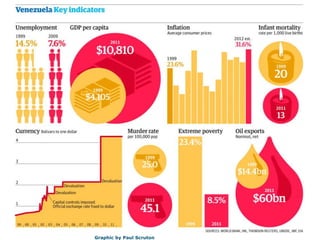
Graphic by Paul Scruton
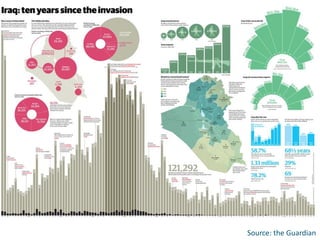
Source: the Guardian
Elements in data visualisations
When (temporal)
Where (geospatial)
What (topical)
With whom (network analysis)
WHEN
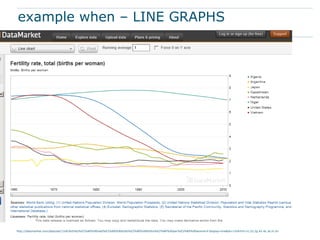
 Trends—e.g. fertility rate
 Patterns—e.g. seasonality in flu cases
 Correlations—e.g. safe drinking water – child mortality
example when – LINE GRAPHS
http://datamarket.com/data/set/15r6/fertility%E2%80%90rate%E2%80%90total%E2%80%90births%E2%80%90per%E2%80%90woman#!display=line&ds=15r6!hrt=1t.22.2g.45.4s.3d.m.5n
example when - HISTOGRAM
Based on: Katy Börner - ivMOOC
WHERE – map types
 General reference maps
 Topographic maps
 Thematic maps
● Physio‐geographical maps
● Socio‐economic maps
1854
John Snow
Snows choleramap
 Water pumps
 Cholera deaths
-> visualising
helps analysis
 http://www.guardian.co.uk/news/datablog/interactive/2013/mar/15/cholera-map-john-snow-recreated
Worldmapper.org
1932
Henry Beck - 1933
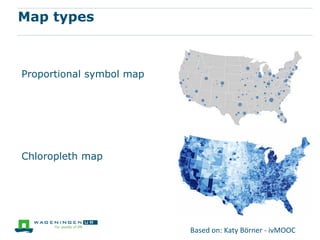
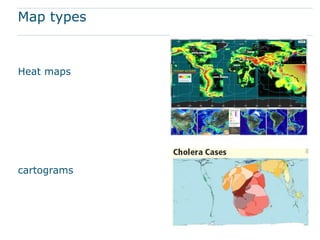
Map types
Proportional symbol map
Chloropleth map
Based on: Katy Börner - ivMOOC
Map types
Heat maps
cartograms
Map types
 Flow maps
From: Dat Visualisation: a successful design process. Andy Kirk.
Image (left) republished from the freely licensed media file repository Wikimedia Commons, source:
http://en.wikipedia.org/wiki/File:FrancePopulationDensity1968.png
Image (right) from "The Good and The Bad [2012]" (http://www.theusrus.de/blog/
the-good-the-bad-22012/) by Martin Theus
Graphic Variable Types Data Scale
Position: x, y, z axes
Form
• Size
• Shape
• Orientation
Color
• Value (lightness / shade)
• Hue (tint)
• Saturation (intensity)
Quantitative
Quantitative
qualitative
qualitative
Quantitative
qualitative
Quantitative
http://colorbrewer2.org
Based on: Katy Börner - ivMOOC
www.colorbrewer.org
WHAT
 wordclouds
WITH WHOM - networks
 visualisations
facebook
WITH WHOM – nodeXL network visualisation
Guardian datablog
production process
 Share data
 Spread sheets
 Perform calculations on data
 output
Nice websites
Visualisation
 https://drawingbynumbers.org/
 http://www.scimaps.org/
 http://www.guardian.co.uk/news/datablog
 http://datamarket.com/
 http://vizthinker.com/
 http://www.dataviz.org/
 http://visual.ly/
 http://www.creativebloq.com/design-tools/data-
visualisation-712402
 http://www.tableausoftware.com/
Geographic Visualisations
 http://worldmapper.org
 http://www.gapminder.org/data
 http://spatialanalysis.co.uk/
Social Network Analysis
 http://gephi.org/
 http://nodexl.codeplex.com/
Free courses
 http://ivmooc.cns.iu.edu/
 http://knightcenter.utexas.edu/
 https://www.coursera.org/#course/sna
credits
 Structure and approach based on Information Visualisation MOOC, Indiana
University, Katy Börner
 Guardian datablog
 Albert Cairo’s MOOC data visualisation
 London tube maps: http://randomwire.com/new-london-tube-map-proposal
 Venezuela key indicators infographic: Paul Scruton
 9 Ways to Visualize Proportions – Nathan Yau http://flowingdata.com/2009/11/25/9-ways-to-visualize-proportions-a-guide/
 Iraq after the invasion http://www.guardian.co.uk/news/datablog/2013/mar/14/iraq-ten-years-visualised
 Maps France: Image (left) republished from the freely licensed media file repository Wikimedia
Commons, source: ttp://en.wikipedia.org/wiki/File:FrancePopulationDensity1968.png Image from "The Good and The Bad [2012]" by
Martin Theus http://www.theusrus.de/blog/ the-good-the-bad-22012/
Enjoy visualising !
www.wageningenUR.nl/cdi
www.facebook.com/CDIwageningenUR
www.twitter.com/CDIwageningenUR
mirjam.schaap@wur.nl

Visualisation; help understand and communicate

  • 1.
    Visualisation Help understand andcommunicate Course on Participatory Planning, Monitoring and Evaluation (PPME) 20 March 2013, Mirjam Schaap @mirjamschaap
  • 2.
    Our problem  Dustyreports .....  We want to show all  not very effective ->  help people understand & act on our findings?  tell stories that strengthen the information you want to get across  use visuals in telling your story
  • 4.
  • 5.
  • 6.
    Elements in datavisualisations When (temporal) Where (geospatial) What (topical) With whom (network analysis)
  • 7.
    WHEN  Trends—e.g. fertilityrate  Patterns—e.g. seasonality in flu cases  Correlations—e.g. safe drinking water – child mortality
  • 8.
    example when –LINE GRAPHS http://datamarket.com/data/set/15r6/fertility%E2%80%90rate%E2%80%90total%E2%80%90births%E2%80%90per%E2%80%90woman#!display=line&ds=15r6!hrt=1t.22.2g.45.4s.3d.m.5n
  • 9.
    example when -HISTOGRAM Based on: Katy Börner - ivMOOC
  • 10.
    WHERE – maptypes  General reference maps  Topographic maps  Thematic maps ● Physio‐geographical maps ● Socio‐economic maps
  • 11.
  • 12.
    Snows choleramap  Waterpumps  Cholera deaths -> visualising helps analysis  http://www.guardian.co.uk/news/datablog/interactive/2013/mar/15/cholera-map-john-snow-recreated
  • 13.
  • 14.
  • 15.
  • 16.
    Map types Proportional symbolmap Chloropleth map Based on: Katy Börner - ivMOOC
  • 17.
  • 18.
  • 19.
    From: Dat Visualisation:a successful design process. Andy Kirk. Image (left) republished from the freely licensed media file repository Wikimedia Commons, source: http://en.wikipedia.org/wiki/File:FrancePopulationDensity1968.png Image (right) from "The Good and The Bad [2012]" (http://www.theusrus.de/blog/ the-good-the-bad-22012/) by Martin Theus
  • 20.
    Graphic Variable TypesData Scale Position: x, y, z axes Form • Size • Shape • Orientation Color • Value (lightness / shade) • Hue (tint) • Saturation (intensity) Quantitative Quantitative qualitative qualitative Quantitative qualitative Quantitative http://colorbrewer2.org Based on: Katy Börner - ivMOOC
  • 21.
  • 22.
  • 23.
    WITH WHOM -networks  visualisations facebook
  • 24.
    WITH WHOM –nodeXL network visualisation
  • 25.
    Guardian datablog production process Share data  Spread sheets  Perform calculations on data  output
  • 26.
    Nice websites Visualisation  https://drawingbynumbers.org/ http://www.scimaps.org/  http://www.guardian.co.uk/news/datablog  http://datamarket.com/  http://vizthinker.com/  http://www.dataviz.org/  http://visual.ly/  http://www.creativebloq.com/design-tools/data- visualisation-712402  http://www.tableausoftware.com/ Geographic Visualisations  http://worldmapper.org  http://www.gapminder.org/data  http://spatialanalysis.co.uk/ Social Network Analysis  http://gephi.org/  http://nodexl.codeplex.com/ Free courses  http://ivmooc.cns.iu.edu/  http://knightcenter.utexas.edu/  https://www.coursera.org/#course/sna
  • 27.
    credits  Structure andapproach based on Information Visualisation MOOC, Indiana University, Katy Börner  Guardian datablog  Albert Cairo’s MOOC data visualisation  London tube maps: http://randomwire.com/new-london-tube-map-proposal  Venezuela key indicators infographic: Paul Scruton  9 Ways to Visualize Proportions – Nathan Yau http://flowingdata.com/2009/11/25/9-ways-to-visualize-proportions-a-guide/  Iraq after the invasion http://www.guardian.co.uk/news/datablog/2013/mar/14/iraq-ten-years-visualised  Maps France: Image (left) republished from the freely licensed media file repository Wikimedia Commons, source: ttp://en.wikipedia.org/wiki/File:FrancePopulationDensity1968.png Image from "The Good and The Bad [2012]" by Martin Theus http://www.theusrus.de/blog/ the-good-the-bad-22012/
  • 28.