VOAD Disaster Ready:
Level 1
CommunityOS - Content Management System (CMS)
VisionLink: Ray Thompson and Rene Alvarez
alvarez@visionlink.org
www.visionlink.org #50stateVOAD
twitter.com/visionlink #VOAD
Introduction
National VOAD in partnership with VisionLink are providing each state VOAD with their
own CommunityOS platform portal. This platform offers a centralized place for each
state organization to maintain all pertinent disaster related information.
Information can be public and restricted to authorized users, including resources,
contacts, policy and processes, documents, and much more.
How to Access the State VOAD Site
VisionLink is creating a website for each state VOAD. The individual state VOAD
contacts will be notified once their site is ready. At that point users will need to
register on the site.
Training
VisionLink will be hosting training sessions on the tools to manage the website. Each
state VOAD contact will be invited to participate in a training session once their site is
available.
Introduction (cont’d)
Website Customization
After completing training each state will be able to customize the content, navigation
menus, and images on their website to meet their specific needs.
Who to Contact
Once a state VOAD has completed training, Tyler McKee (support@nvoad.org) at
National VOAD is the contact person for questions about user accounts and website
management.
Monthly State VOAD User Group
Starting in June 2012 (watch for your email dates and times), VisionLink will be hosting
a monthly State VOAD Users Group. These users group sessions will give
representatives from different states a chance to share ideas, and ask questions of
their peers. Additional information about the users group will be distributed shortly.
BASIC FEATURES
Accessing the State VOAD Site
• VisionLink has created a website for each
state VOAD:
Ex: vlvoad.communityos.org
• All users will need to register on their site.
Who to Contact
• Once a state VOAD has completed training,
Tyler McKee at National VOAD will serve as
the contact person for questions about user
accounts, and website management.
• Contact Tyler at support@nvoad.org
State VOAD User Group
• Starting June 6, 2012, VisionLink began
hosting monthly State VOAD Users Group
the first Wednesday of every month at 1PM
MST.
• Topics for these user groups have included:
– Suggestions for site improvements
• “I would like it if my site could…”
– Discussing different tasks
• “How do I…”
– Specialized Overviews
BASIC OVERVIEW:
CREATING A PAGE
Content Management System (CMS)
Creating a Page
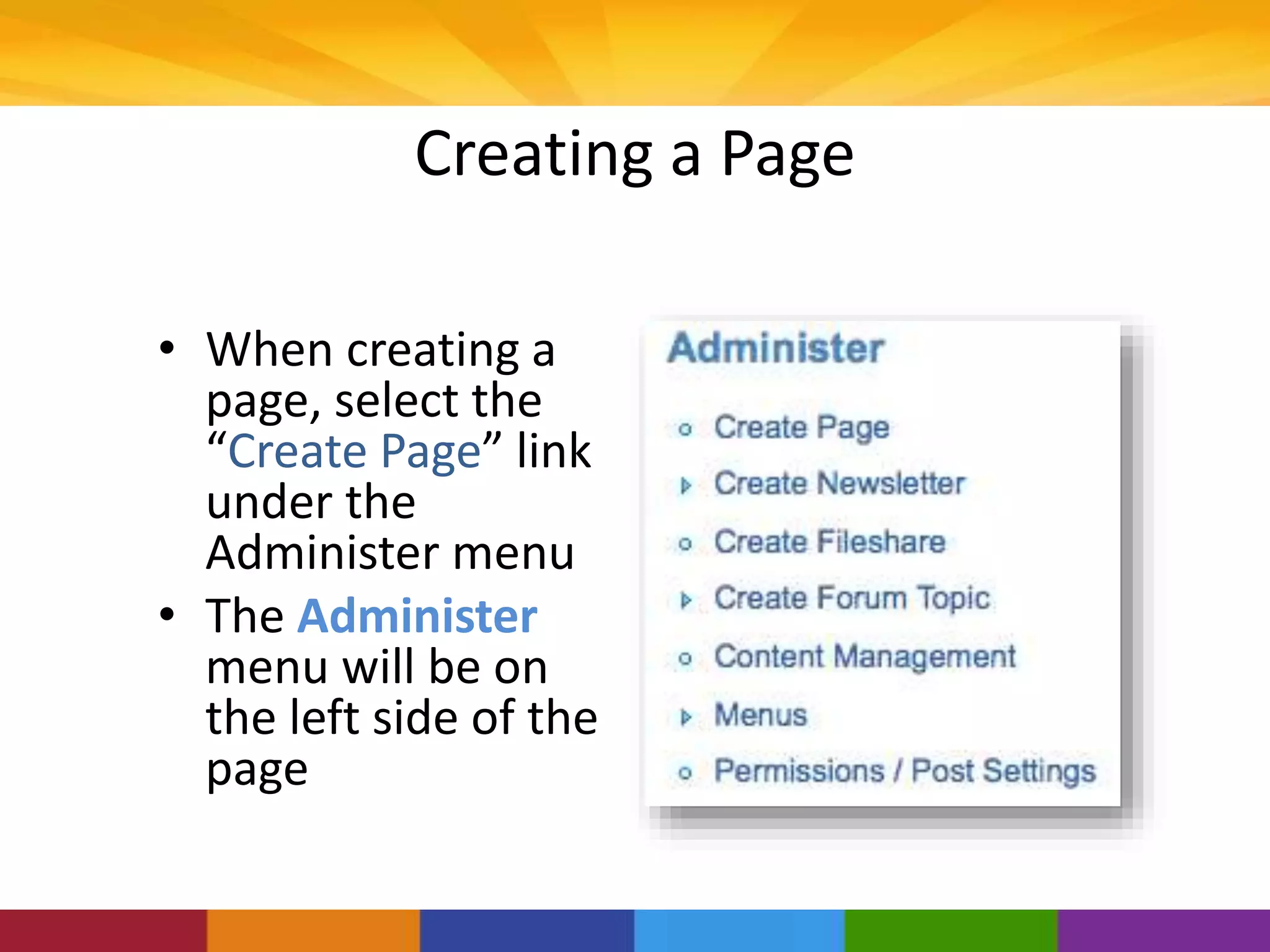
• When creating a
page, select the
“Create Page” link
under the
Administer menu
• The Administer
menu will be on
the left side of the
page
Creating a Page: Title
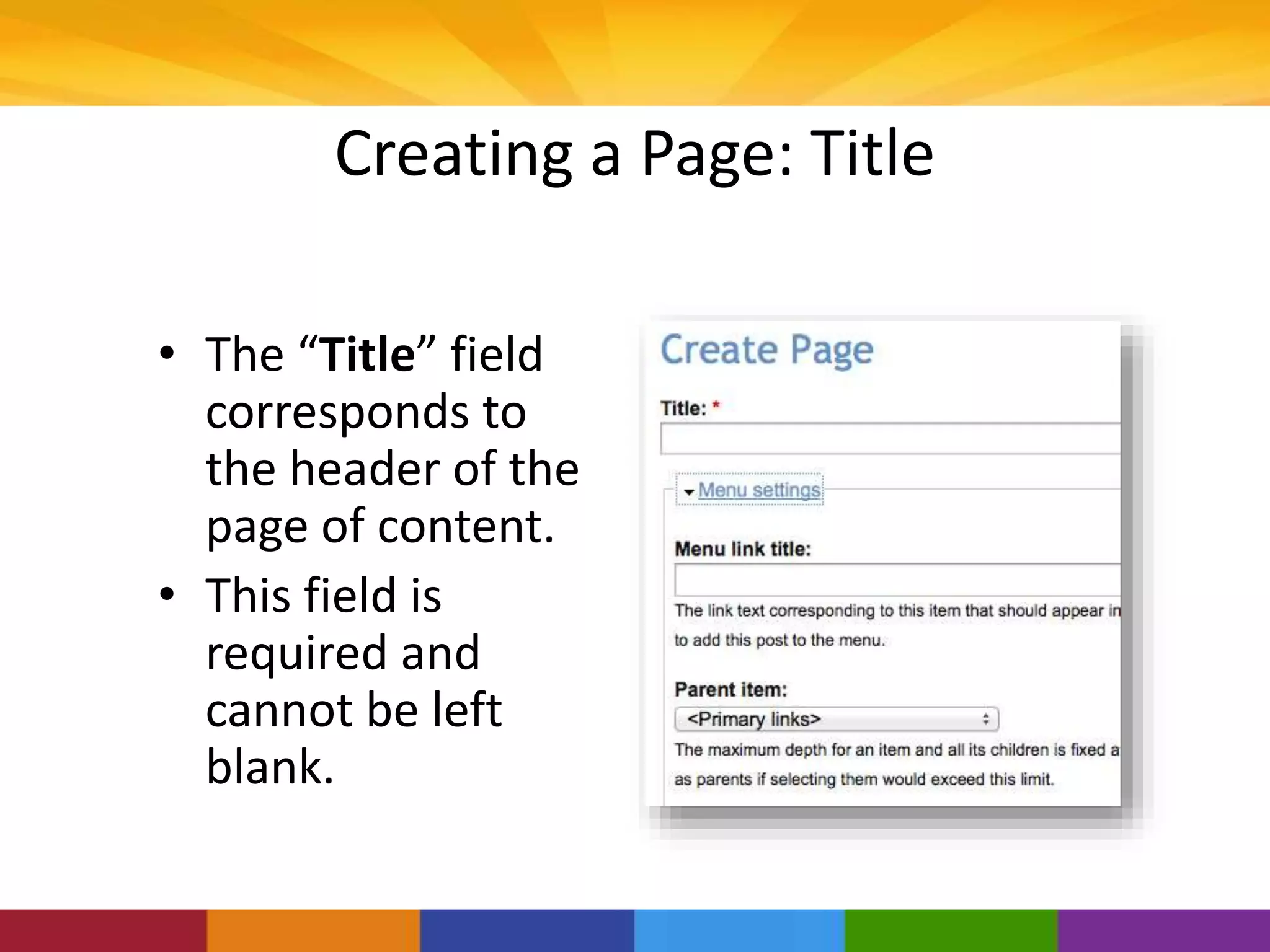
• The “Title” field
corresponds to
the header of the
page of content.
• This field is
required and
cannot be left
blank.
Creating a Page: Menu Link Title
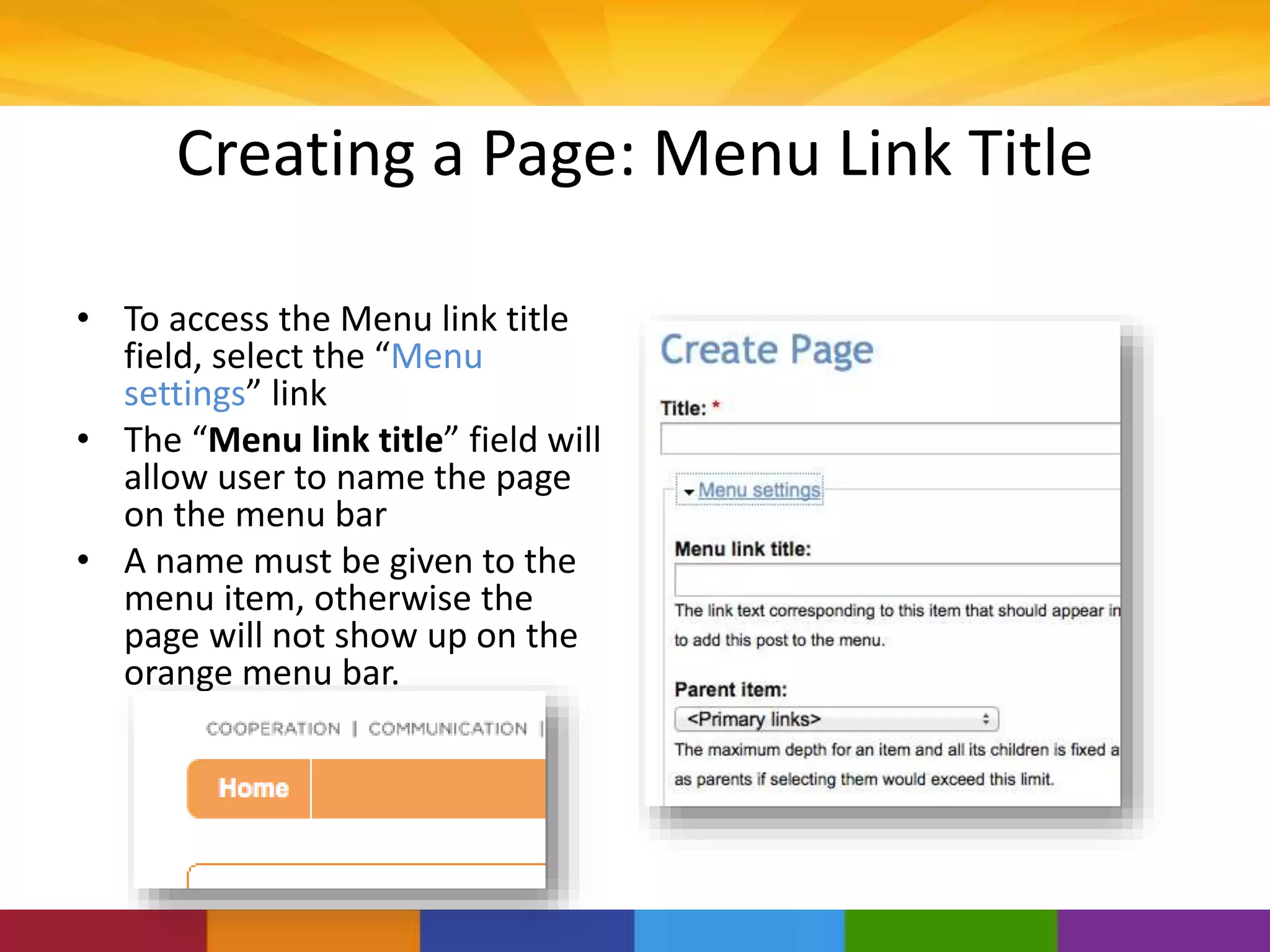
• To access the Menu link title
field, select the “Menu
settings” link
• The “Menu link title” field will
allow user to name the page
on the menu bar
• A name must be given to the
menu item, otherwise the
page will not show up on the
orange menu bar.
Creating a Page: Parent Item
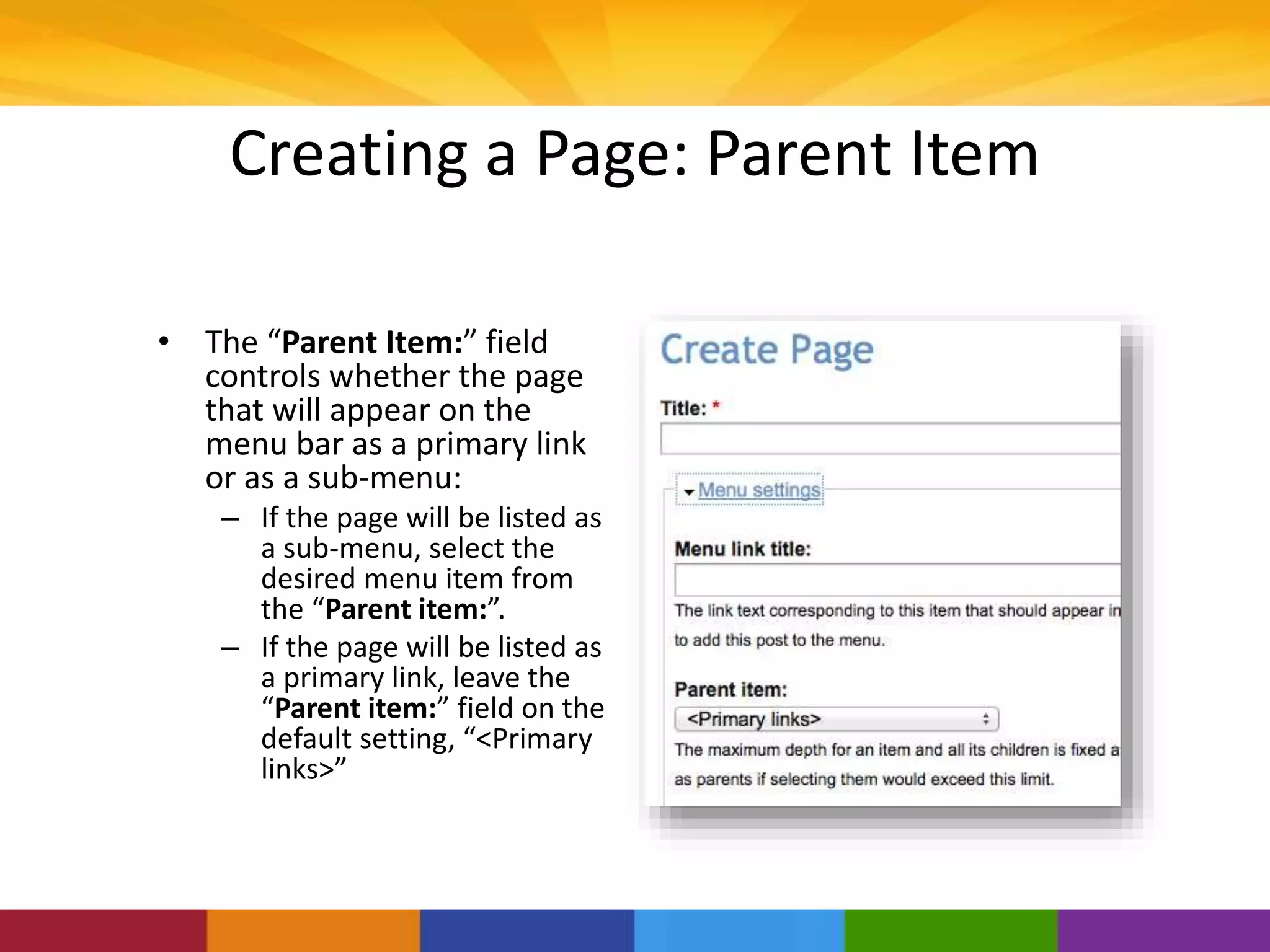
• The “Parent Item:” field
controls whether the page
that will appear on the
menu bar as a primary link
or as a sub-menu:
– If the page will be listed as
a sub-menu, select the
desired menu item from
the “Parent item:”.
– If the page will be listed as
a primary link, leave the
“Parent item:” field on the
default setting, “<Primary
links>”
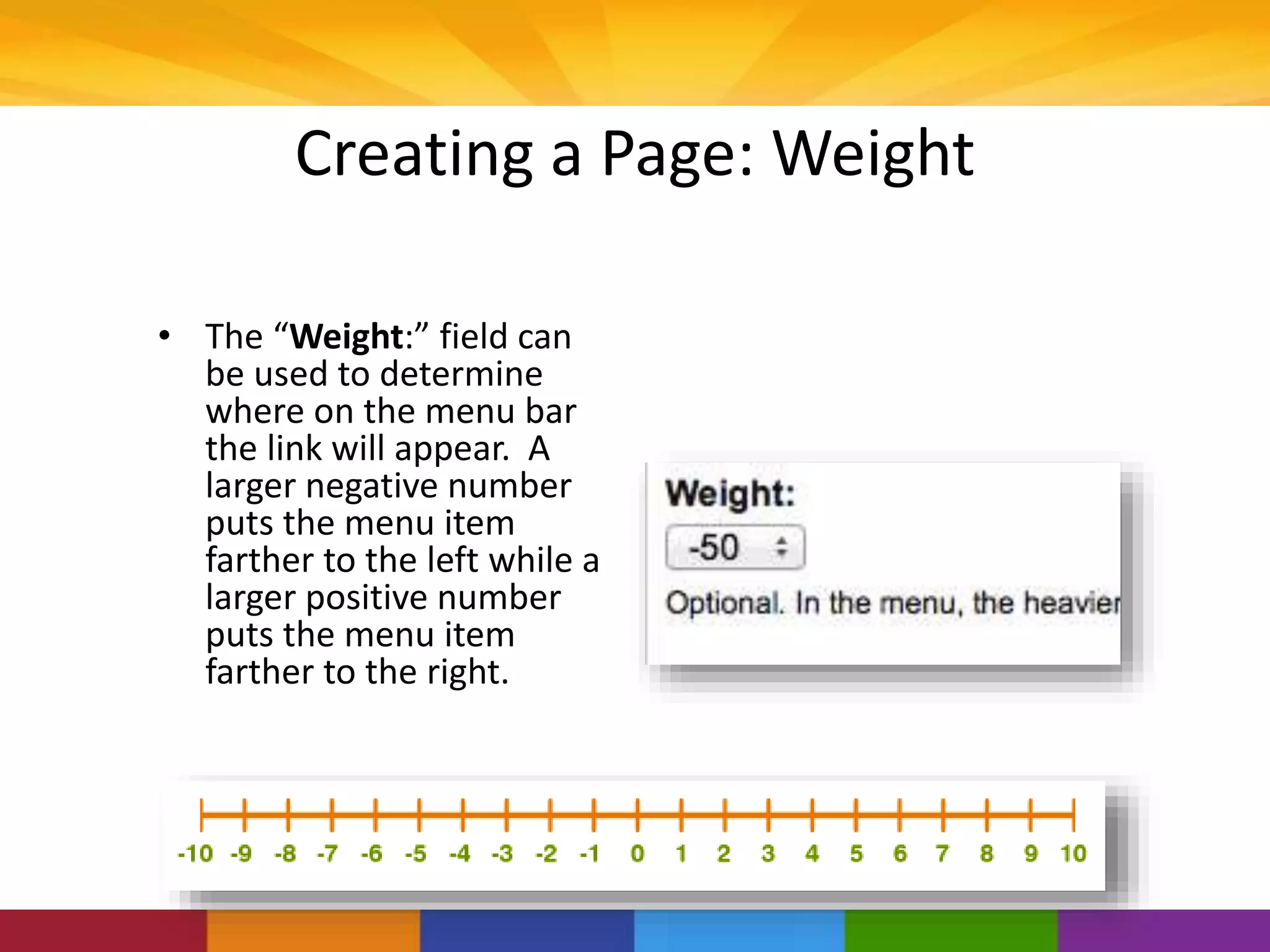
Creating a Page: Weight
• The “Weight:” field can
be used to determine
where on the menu bar
the link will appear. A
larger negative number
puts the menu item
farther to the left while a
larger positive number
puts the menu item
farther to the right.
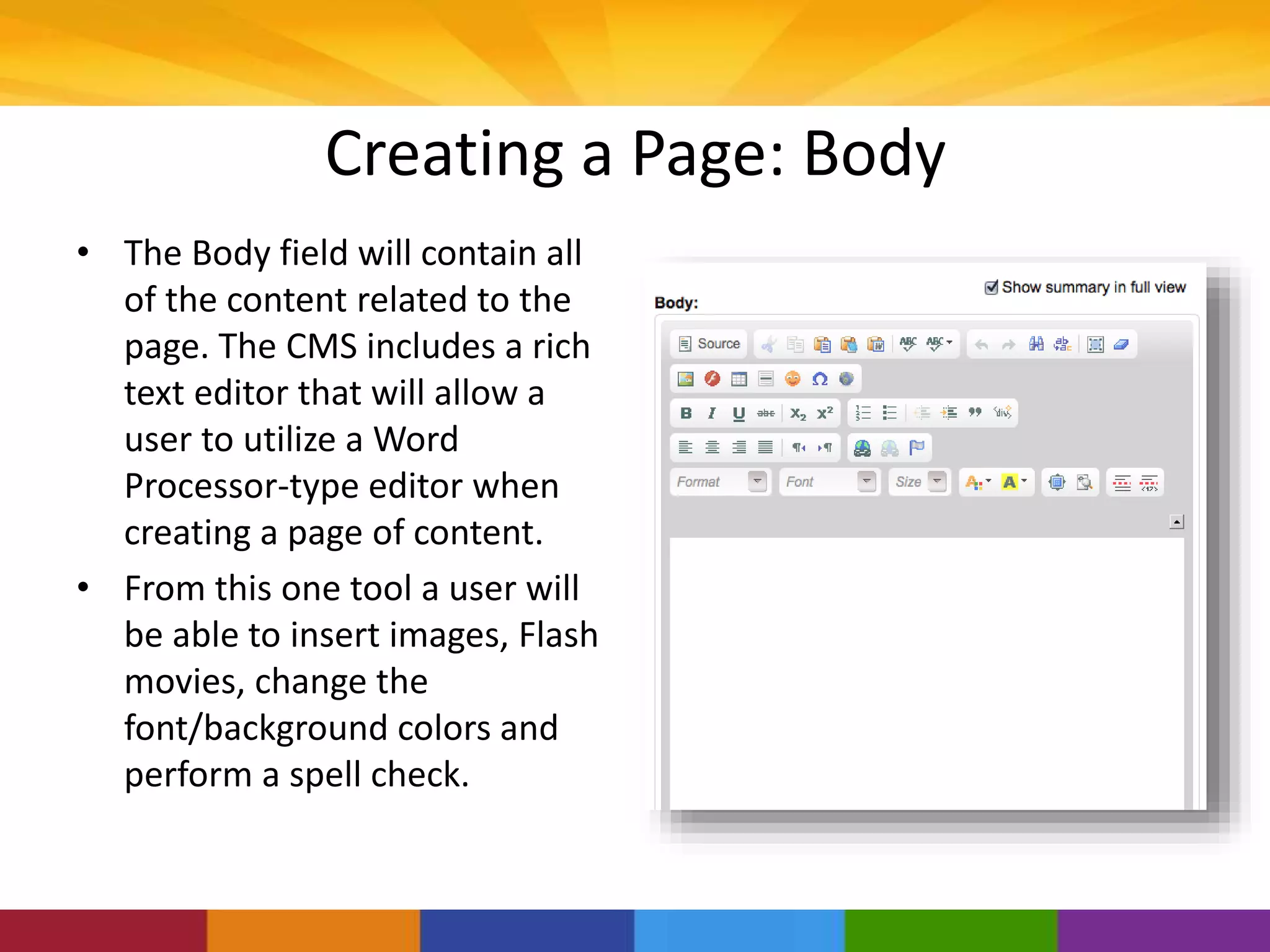
Creating a Page: Body
• The Body field will contain all
of the content related to the
page. The CMS includes a rich
text editor that will allow a
user to utilize a Word
Processor-type editor when
creating a page of content.
• From this one tool a user will
be able to insert images, Flash
movies, change the
font/background colors and
perform a spell check.
Creating a Page: Body [Source]
• For the users that are
comfortable with working
with HTML Code, they can
select the “Source” button.
• This will convert the body
text into html code so that
the user can manually enter
or manipulate the page
Creating a Page: Body [Image Upload]
• Adding images to the CMS
requires selecting this
button, which will bring up
a new window
Creating a Page: Body [Image Upload]
• From here, the image can
be formatted to fit the
user’s needs
• The image dimensions
can be set using the
“Width” and “Height”
fields
• The image alignment can
be set under the “Align”
field. This will allow the
image to be “right-
aligned”, “left-aligned,
etc.
Creating a Page: Body [Hyperlink]
• Adding hyperlinks to the
CMS requires selecting this
button, which will bring up
a new window
• The secondary hyperlink
symbol allows the user to
remove the hyperlink
Creating a Page: Body [Adding Tables]
• Adding tables to
the CMS requires
selecting this
button, which
will bring up a
new window
Creating a Page: Body [Adding Tables]
• Within each box, the
user can add in their
data
• Tables can be used to
organize data on the
page
• The borders can also be
made to be invisible
Creating a Page: Body [Coloring]
• Changing the color of the
font, can be done by
selecting “A” button with
the color squares
• Adding color to the area
behind the text can be
done by selecting the
yellow “A” button
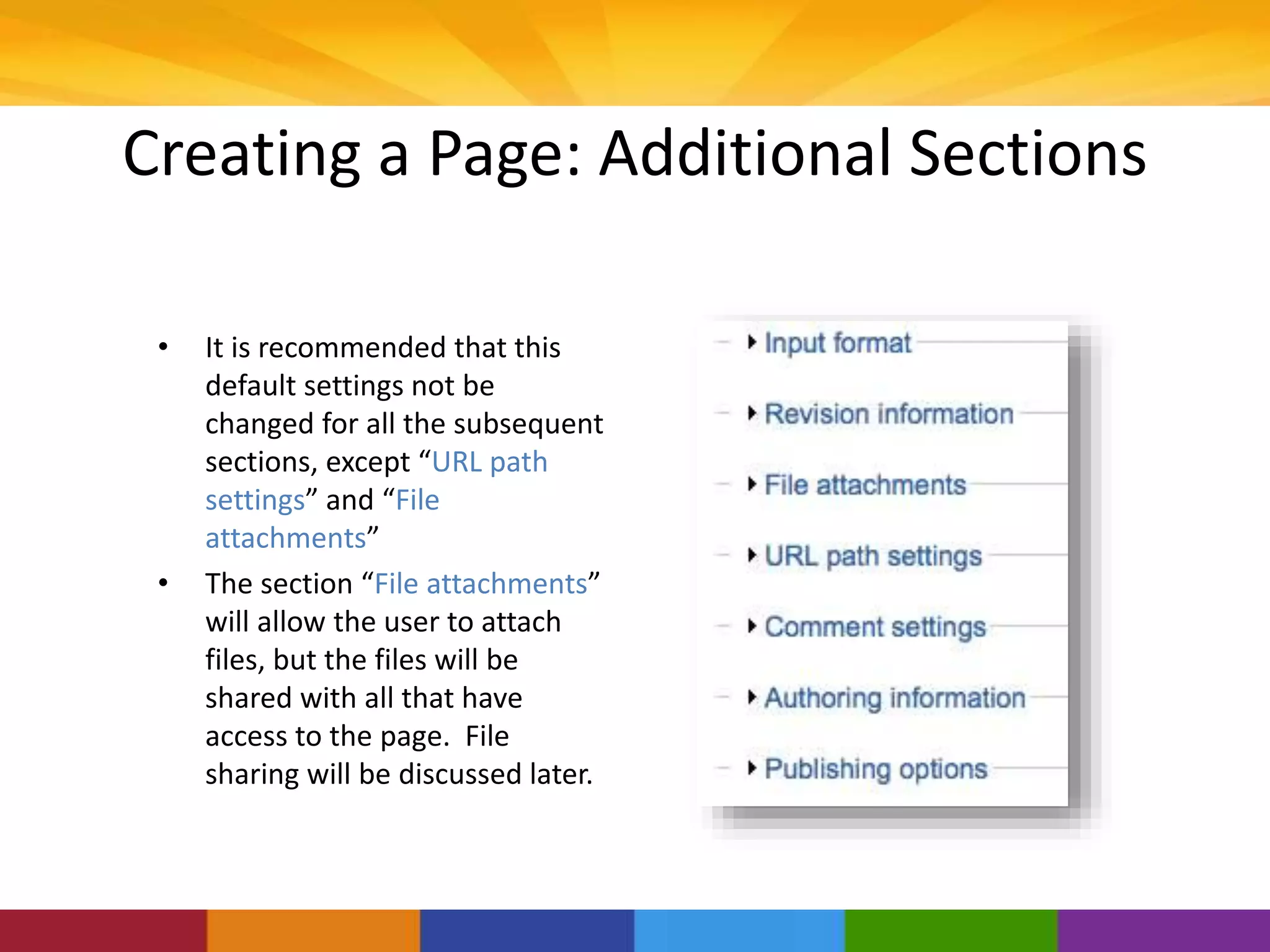
Creating a Page: Additional Sections
• It is recommended that this
default settings not be
changed for all the subsequent
sections, except “URL path
settings” and “File
attachments”
• The section “File attachments”
will allow the user to attach
files, but the files will be
shared with all that have
access to the page. File
sharing will be discussed later.
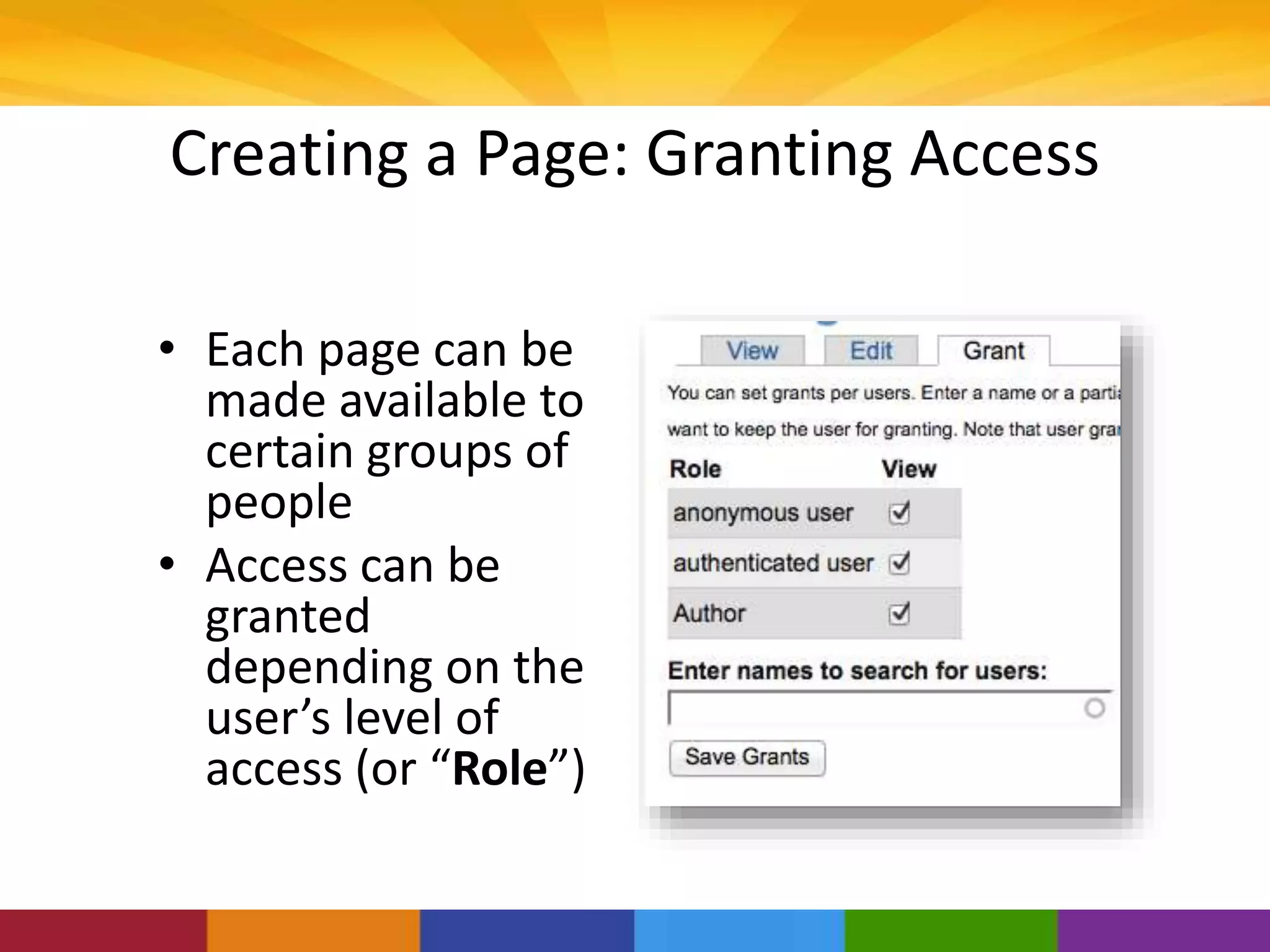
Creating a Page: Granting Access
• Each page can be
made available to
certain groups of
people
• Access can be
granted
depending on the
user’s level of
access (or “Role”)
Creating a Page: Granting Access (Roles)
• Anonymous User: This role will have the ability to view all types of content but will
not be able to edit or create new content. This user will be able to view the forums
but will not be able to interact with the forums.
• Authenticated User: This role will have the ability to view all types of content but
will not be able to edit or create new content. The user will all be able to access
and utilize the forums.
• Author: This role will be able to create content on the site but will not be able to
perform administrative functions like forum, menu and content type
administration.
BASIC OVERVIEW:
CREATING A NEWSLETTER
Content Management System (CMS)
Administering a Newsletter
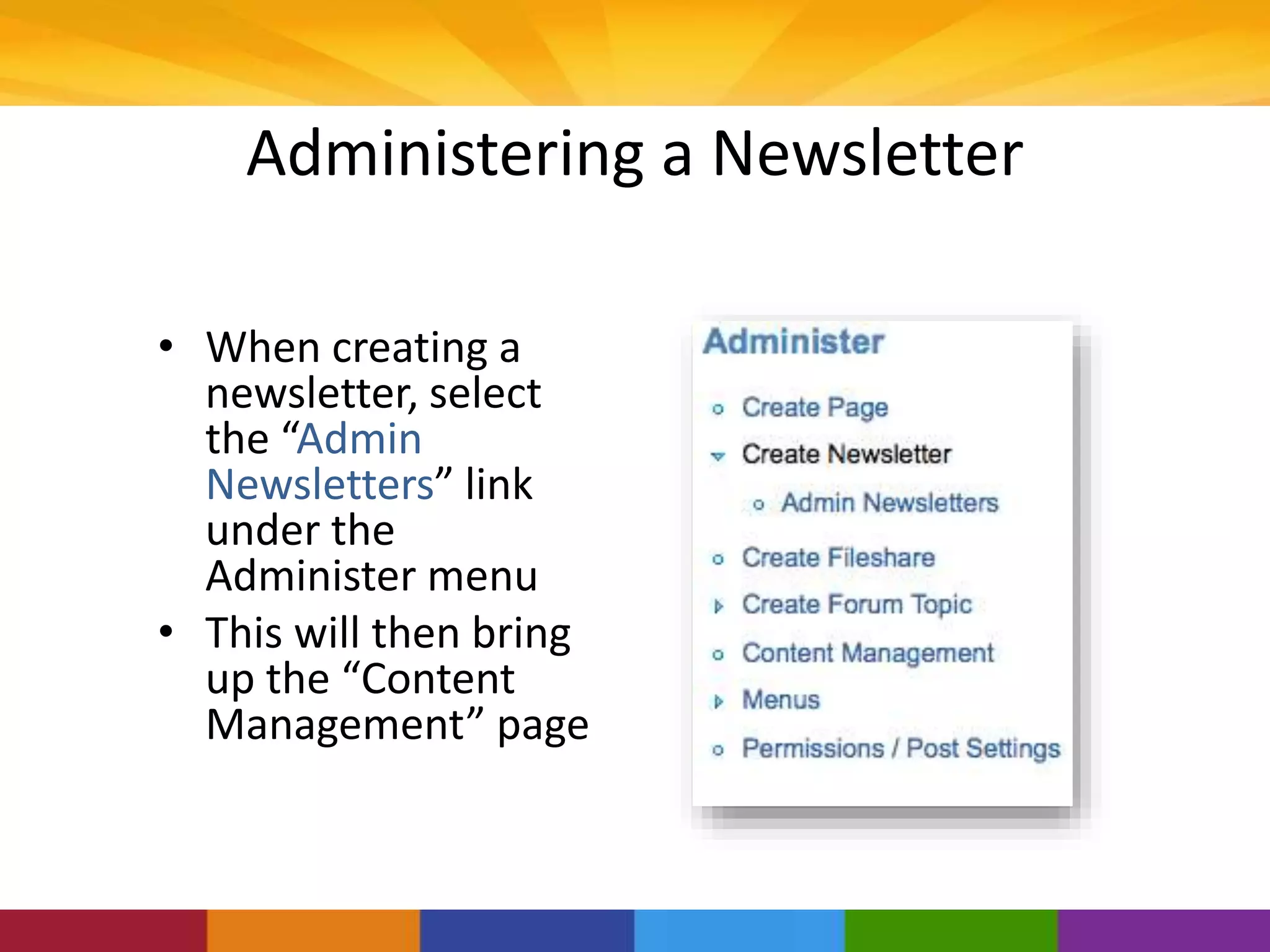
• When creating a
newsletter, select
the “Admin
Newsletters” link
under the
Administer menu
• This will then bring
up the “Content
Management” page
Administering a Newsletter
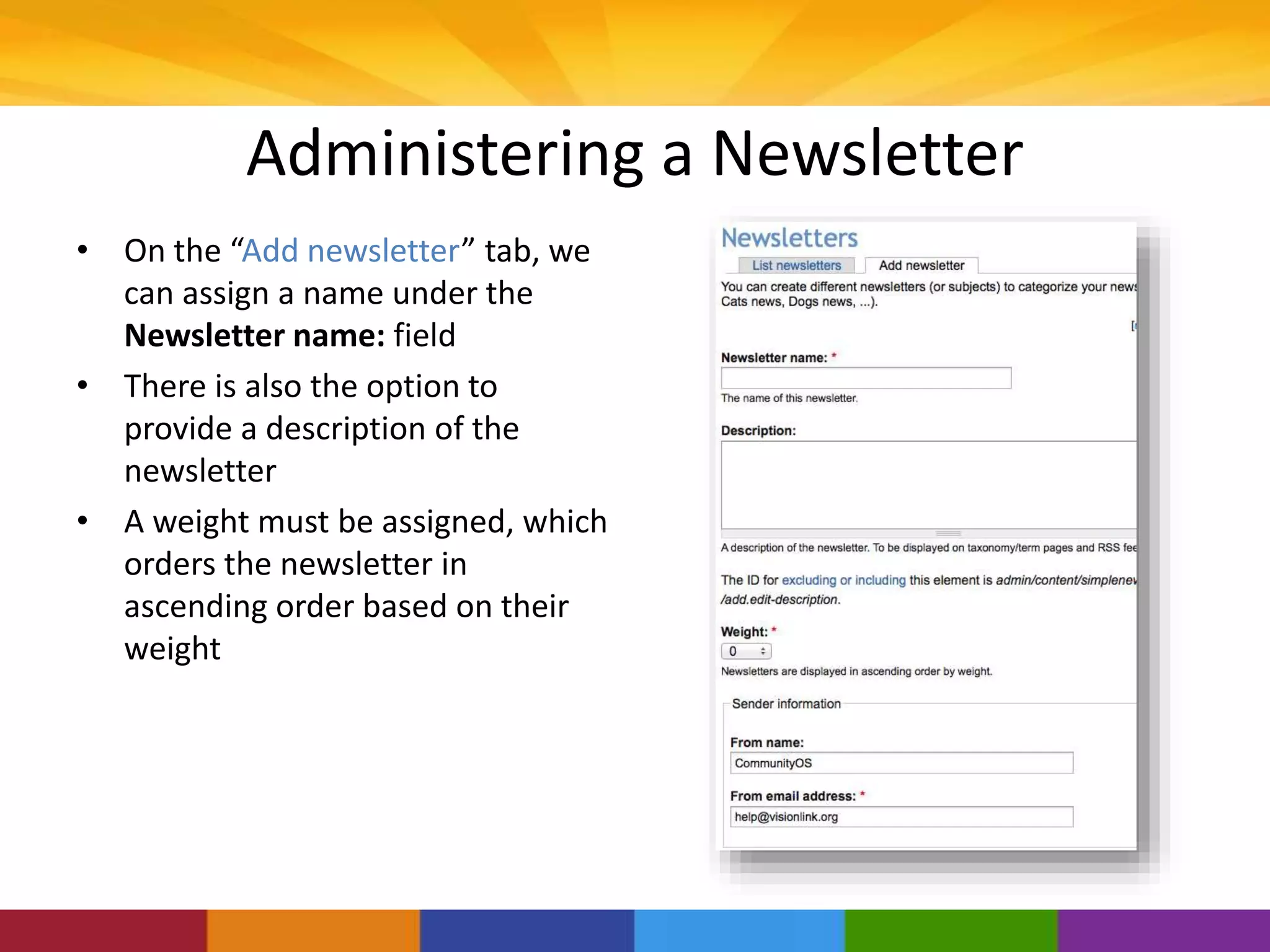
• On the “Add newsletter” tab, we
can assign a name under the
Newsletter name: field
• There is also the option to
provide a description of the
newsletter
• A weight must be assigned, which
orders the newsletter in
ascending order based on their
weight
Administering a Newsletter
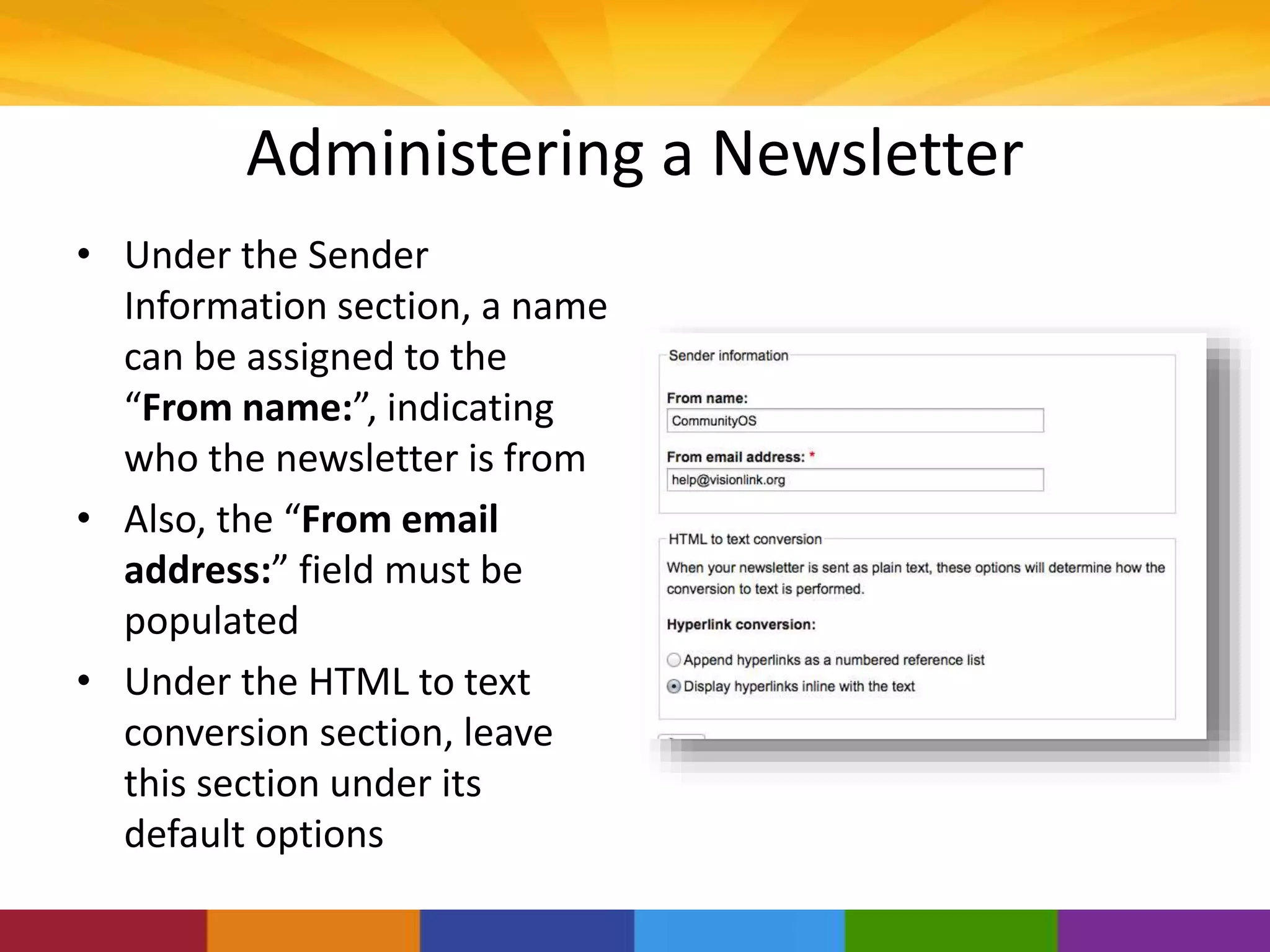
• Under the Sender
Information section, a name
can be assigned to the
“From name:”, indicating
who the newsletter is from
• Also, the “From email
address:” field must be
populated
• Under the HTML to text
conversion section, leave
this section under its
default options
Creating a Newsletter
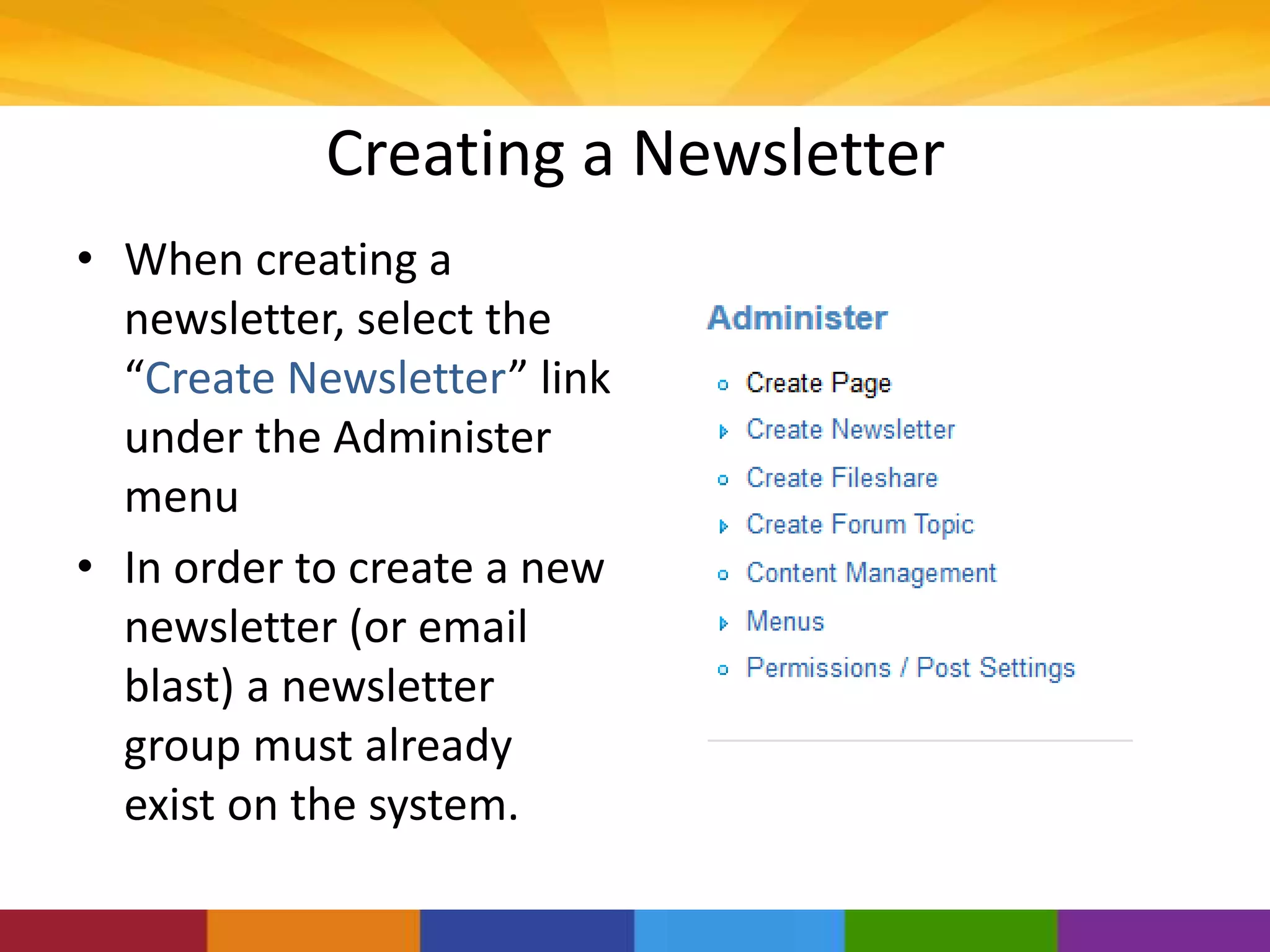
• When creating a
newsletter, select the
“Create Newsletter” link
under the Administer
menu
• In order to create a new
newsletter (or email
blast) a newsletter
group must already
exist on the system.
BASIC OVERVIEW:
CREATING A FILESHARE
Content Management System (CMS)
Creating a Fileshare
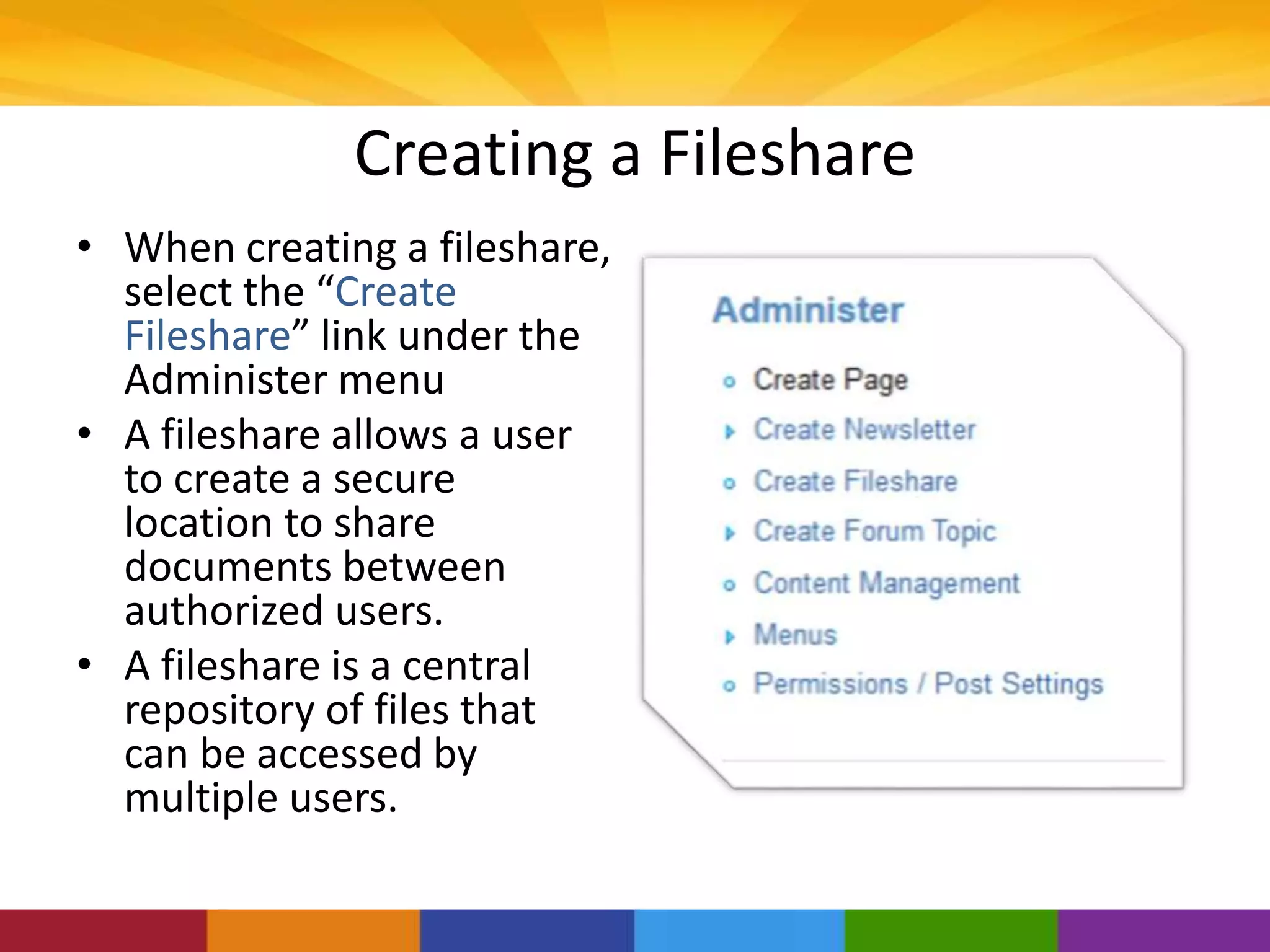
• When creating a fileshare,
select the “Create
Fileshare” link under the
Administer menu
• A fileshare allows a user
to create a secure
location to share
documents between
authorized users.
• A fileshare is a central
repository of files that
can be accessed by
multiple users.
Create a Fileshare
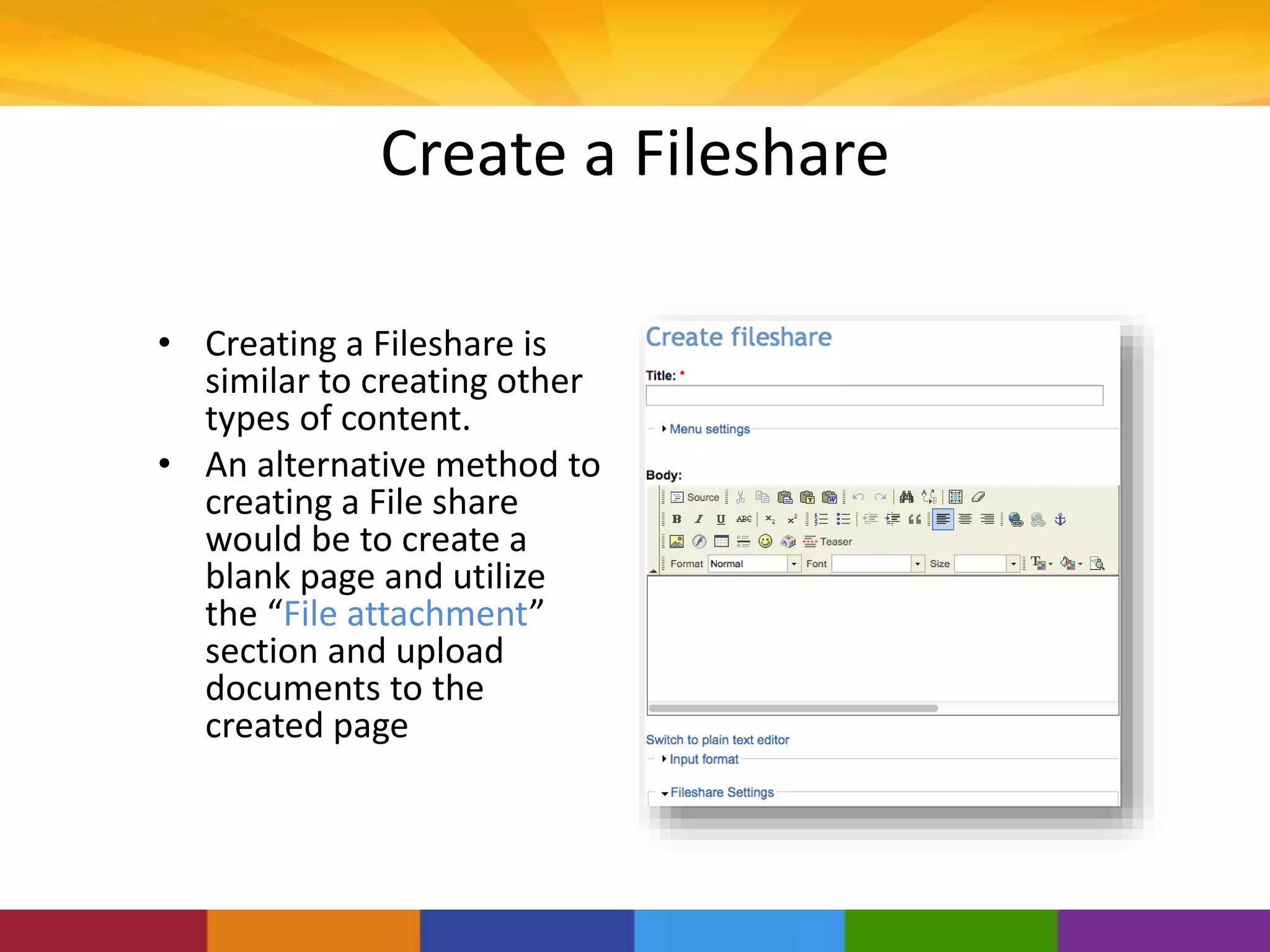
• Creating a Fileshare is
similar to creating other
types of content.
• An alternative method to
creating a File share
would be to create a
blank page and utilize
the “File attachment”
section and upload
documents to the
created page
BASIC OVERVIEW:
CREATING A DISCUSSION FORUM
Content Management System (CMS)
Administering a Forum: Containers
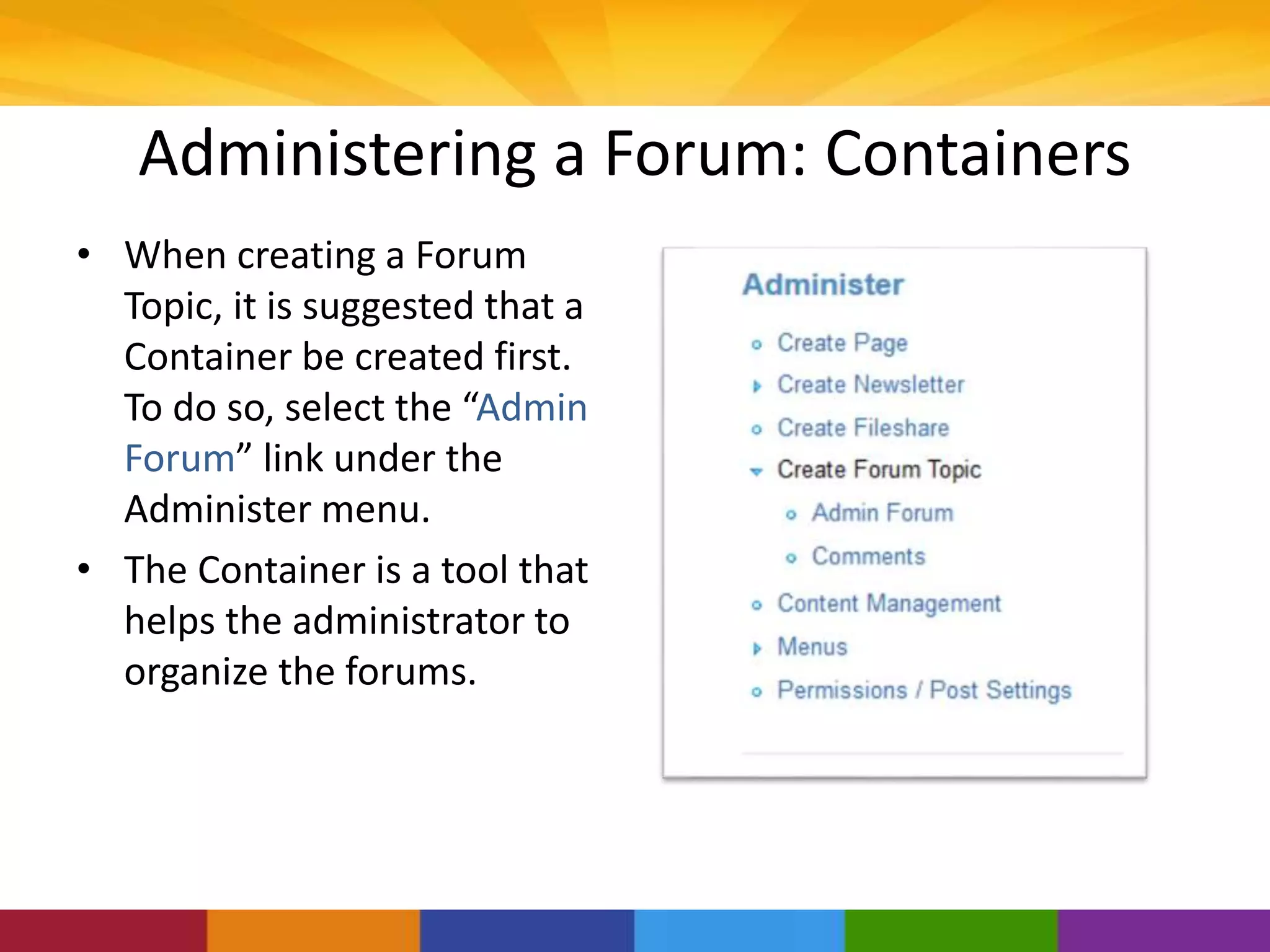
• When creating a Forum
Topic, it is suggested that a
Container be created first.
To do so, select the “Admin
Forum” link under the
Administer menu.
• The Container is a tool that
helps the administrator to
organize the forums.
Administering a Forum: Containers
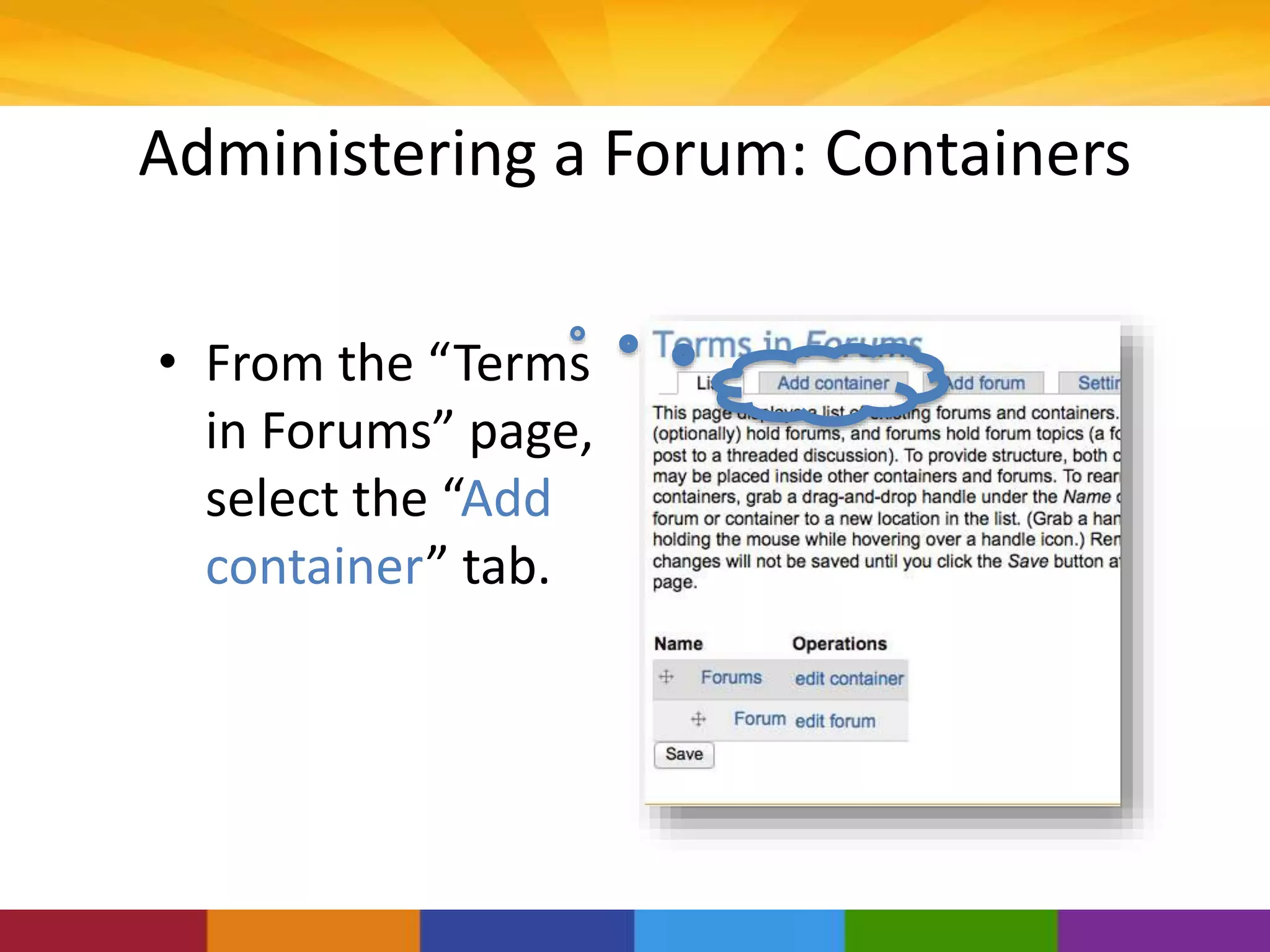
• From the “Terms
in Forums” page,
select the “Add
container” tab.
Administering a Forum
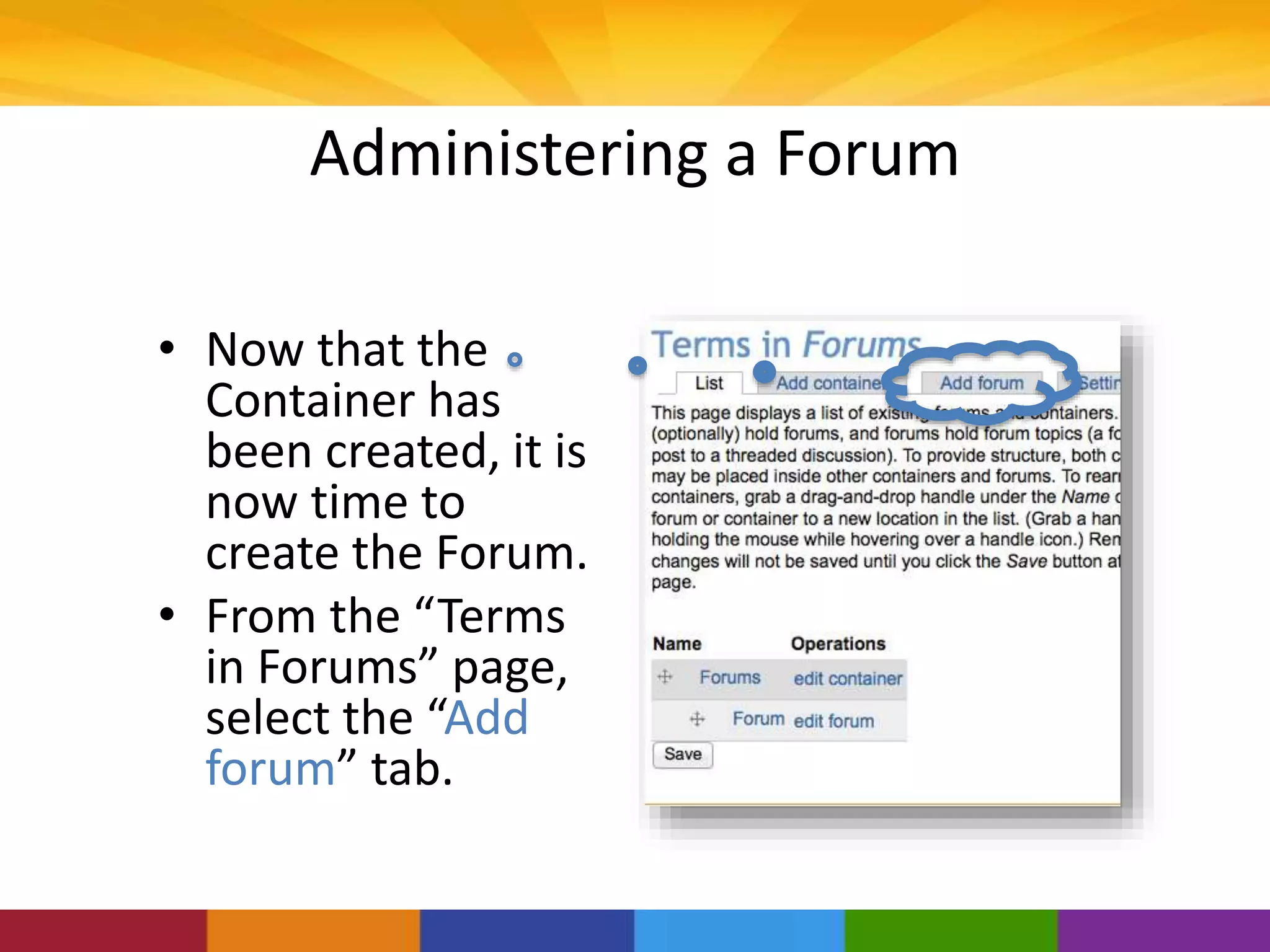
• Now that the
Container has
been created, it is
now time to
create the Forum.
• From the “Terms
in Forums” page,
select the “Add
forum” tab.
Administering a Forum
Required Fields
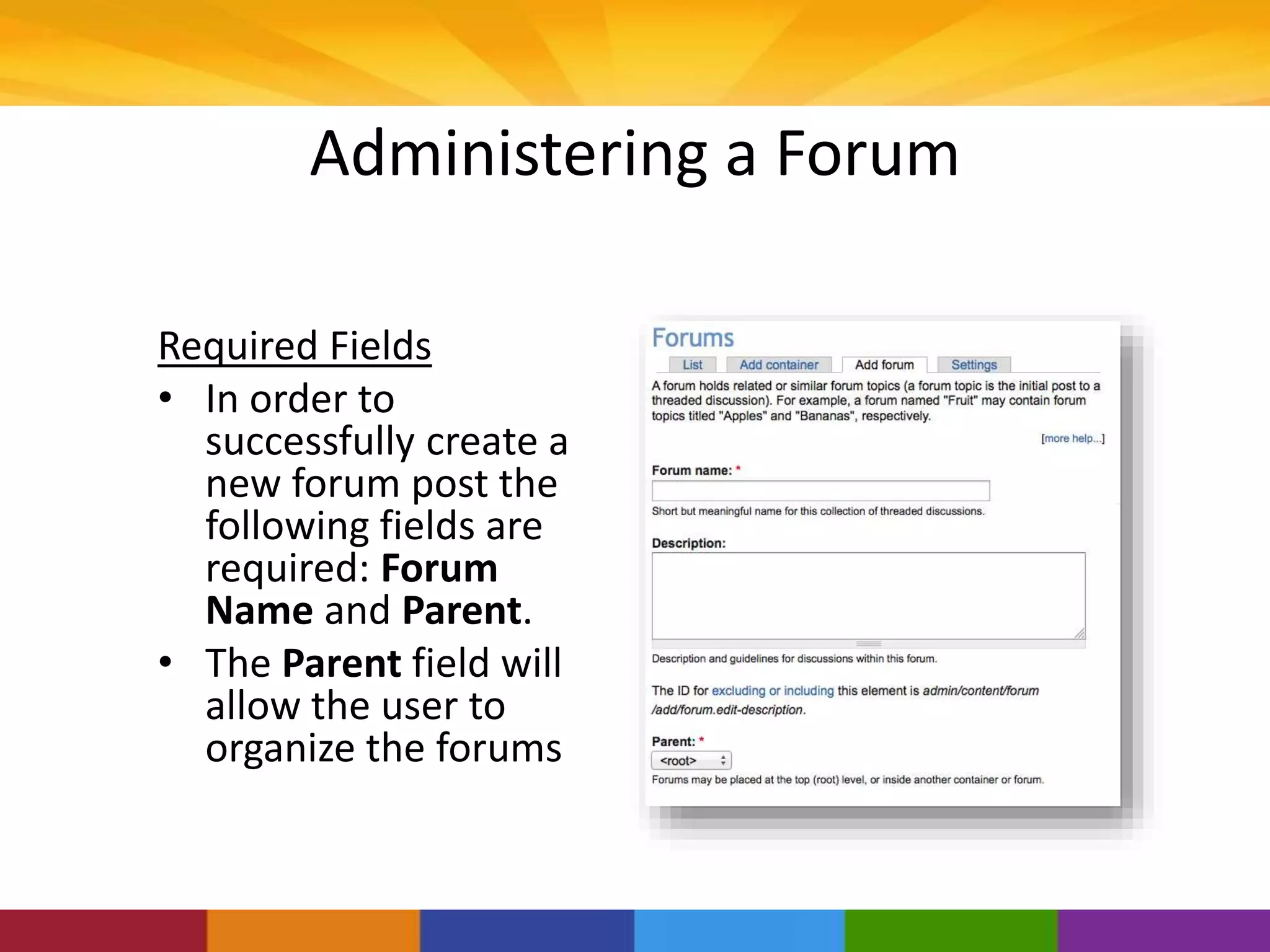
• In order to
successfully create a
new forum post the
following fields are
required: Forum
Name and Parent.
• The Parent field will
allow the user to
organize the forums
Creating a Forum Topic
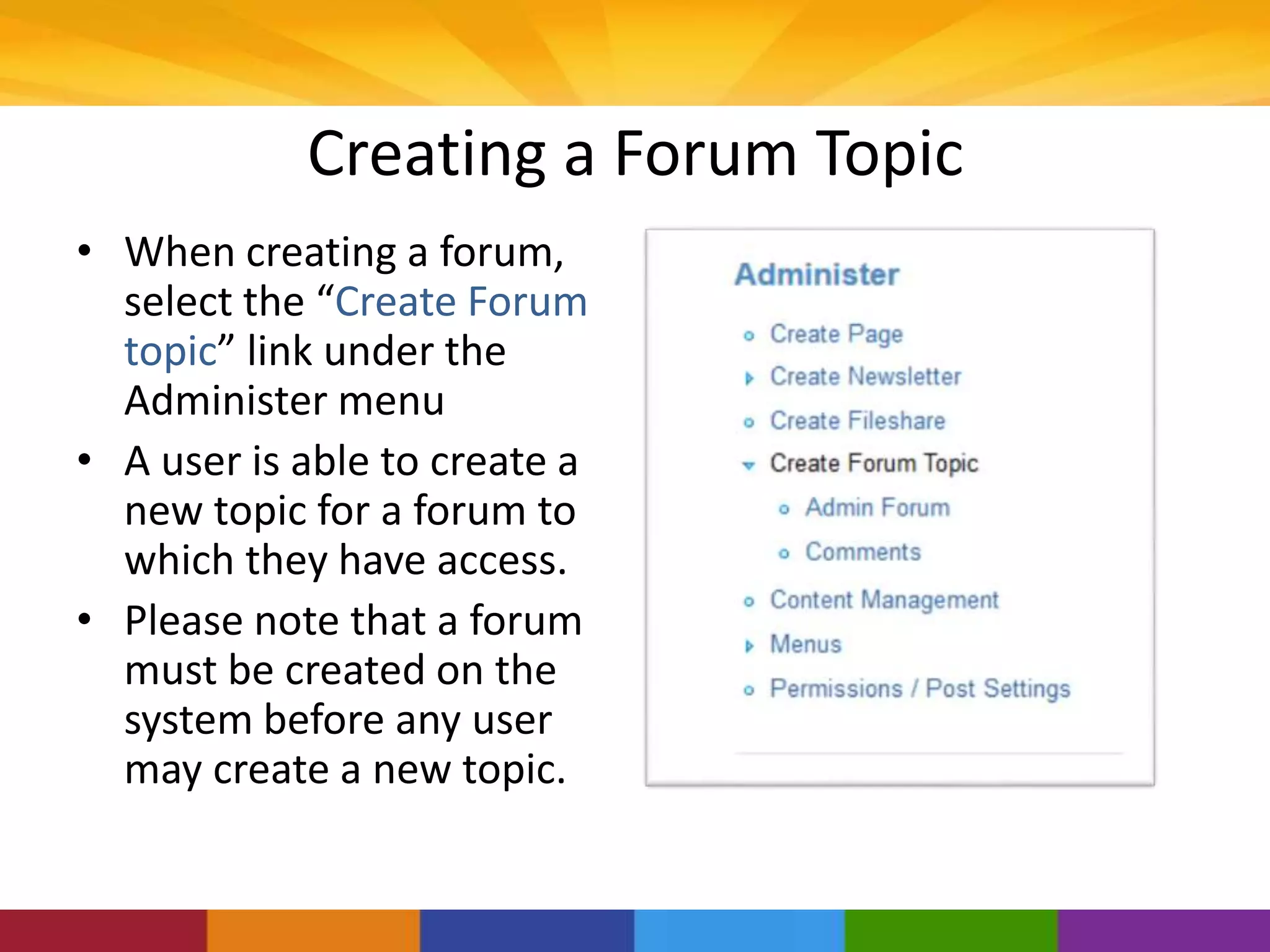
• When creating a forum,
select the “Create Forum
topic” link under the
Administer menu
• A user is able to create a
new topic for a forum to
which they have access.
• Please note that a forum
must be created on the
system before any user
may create a new topic.
Creating a Forum Topic
Required Fields
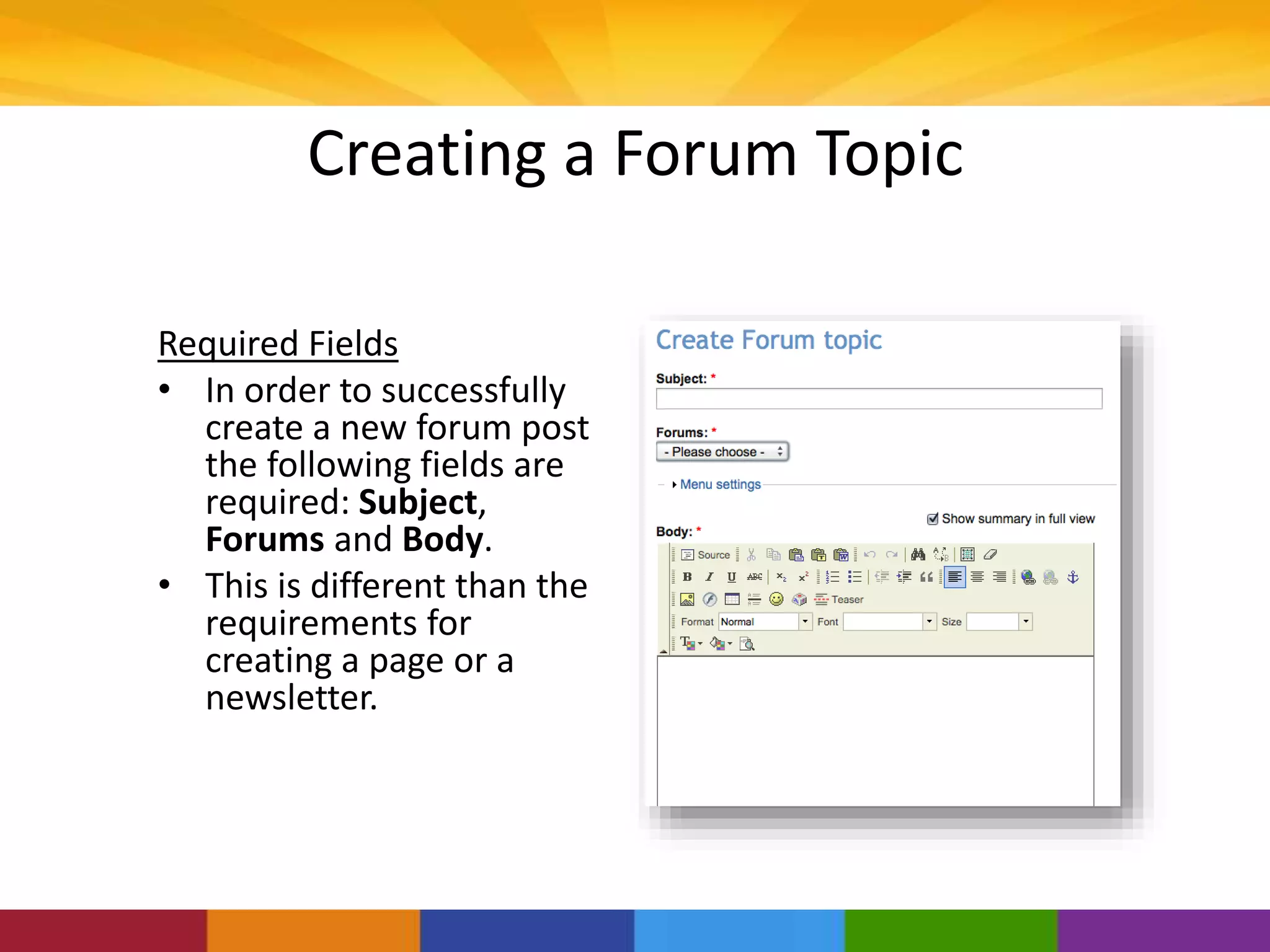
• In order to successfully
create a new forum post
the following fields are
required: Subject,
Forums and Body.
• This is different than the
requirements for
creating a page or a
newsletter.
BASIC OVERVIEW:
CONTENT MANAGEMENT
Content Management System (CMS)
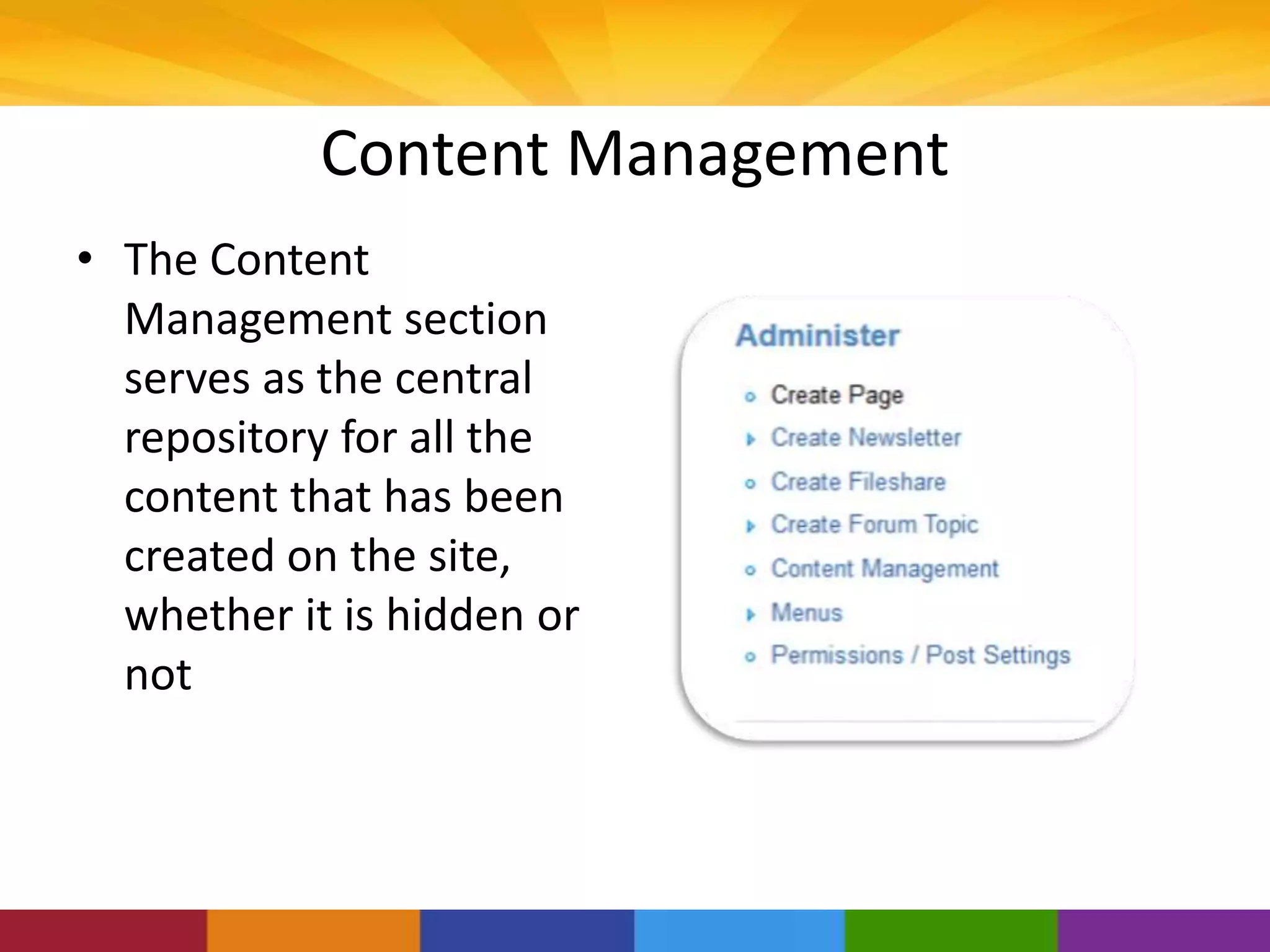
Content Management
• The Content
Management section
serves as the central
repository for all the
content that has been
created on the site,
whether it is hidden or
not
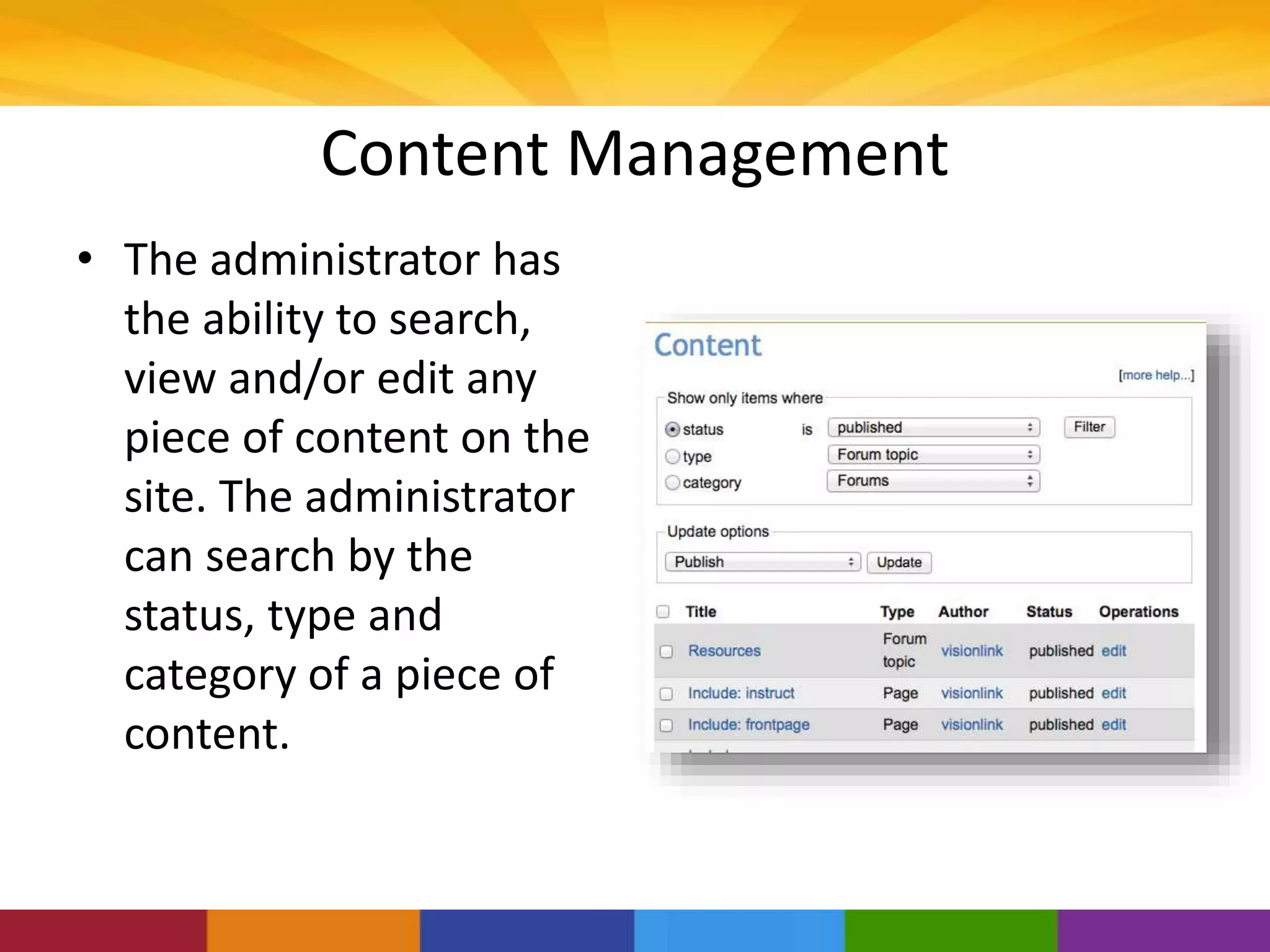
Content Management
• The administrator has
the ability to search,
view and/or edit any
piece of content on the
site. The administrator
can search by the
status, type and
category of a piece of
content.
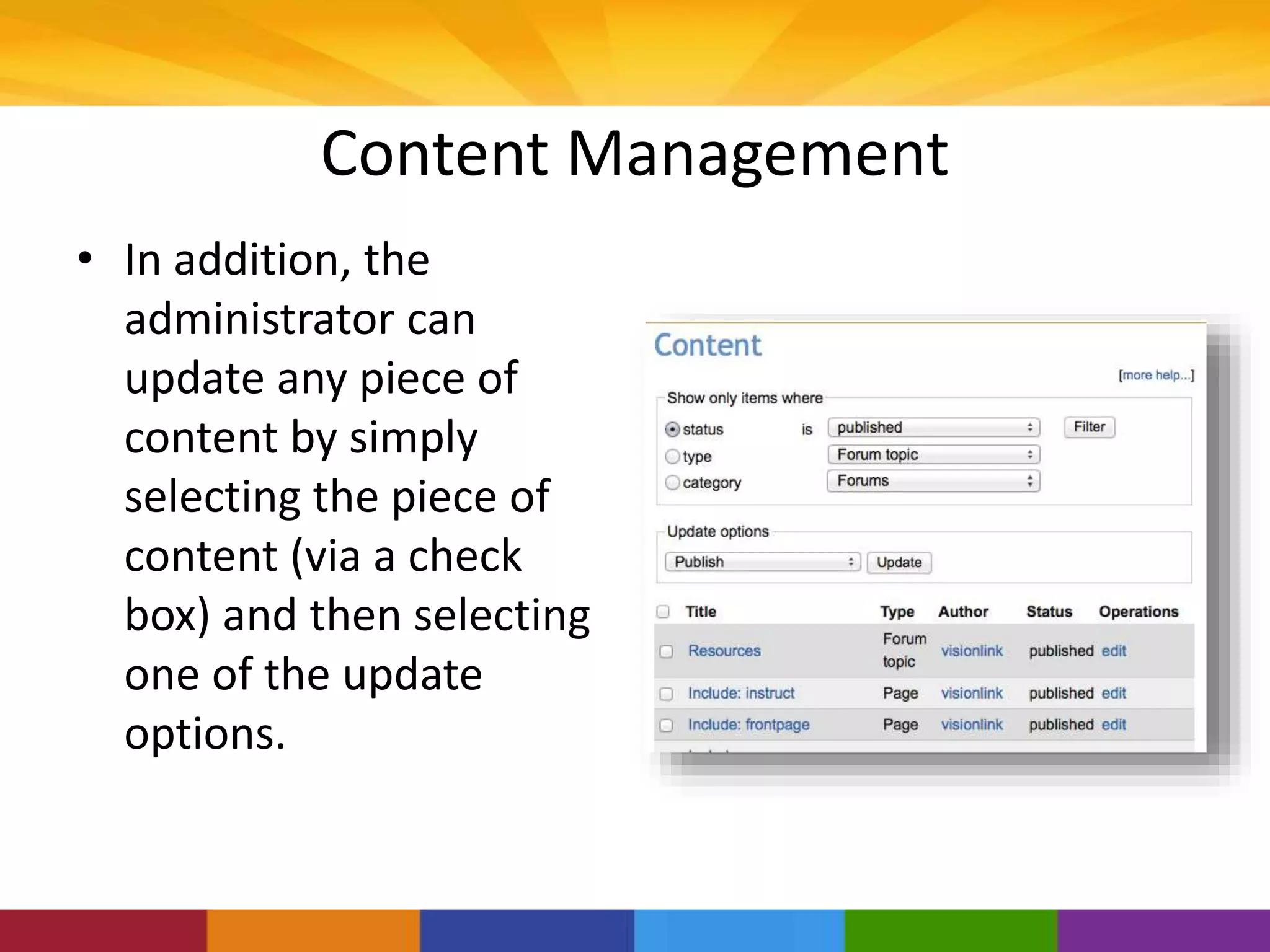
Content Management
• In addition, the
administrator can
update any piece of
content by simply
selecting the piece of
content (via a check
box) and then selecting
one of the update
options.
BASIC OVERVIEW:
MENUS
Content Management System (CMS)
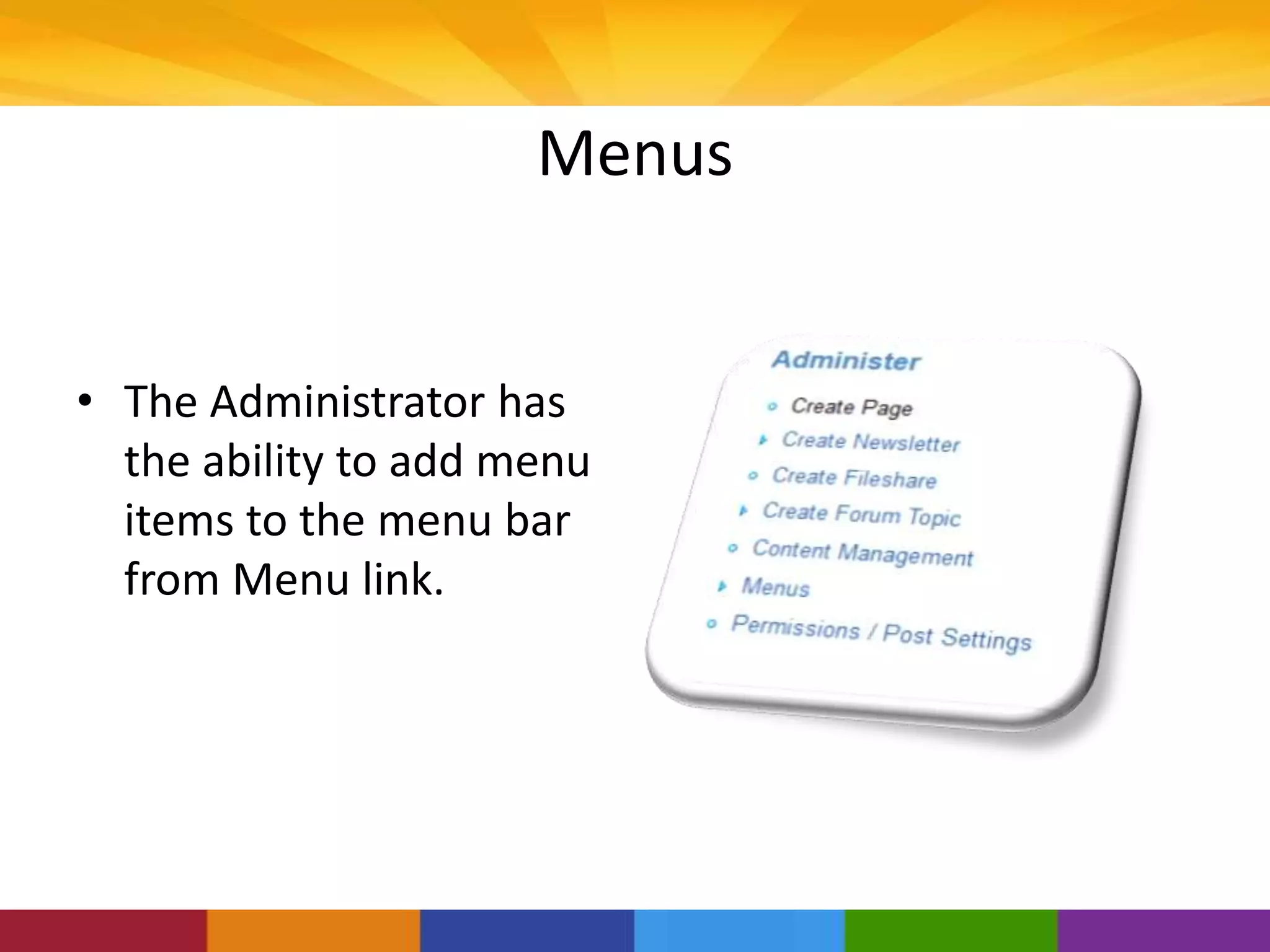
Menus
• The Administrator has
the ability to add menu
items to the menu bar
from Menu link.
Menus
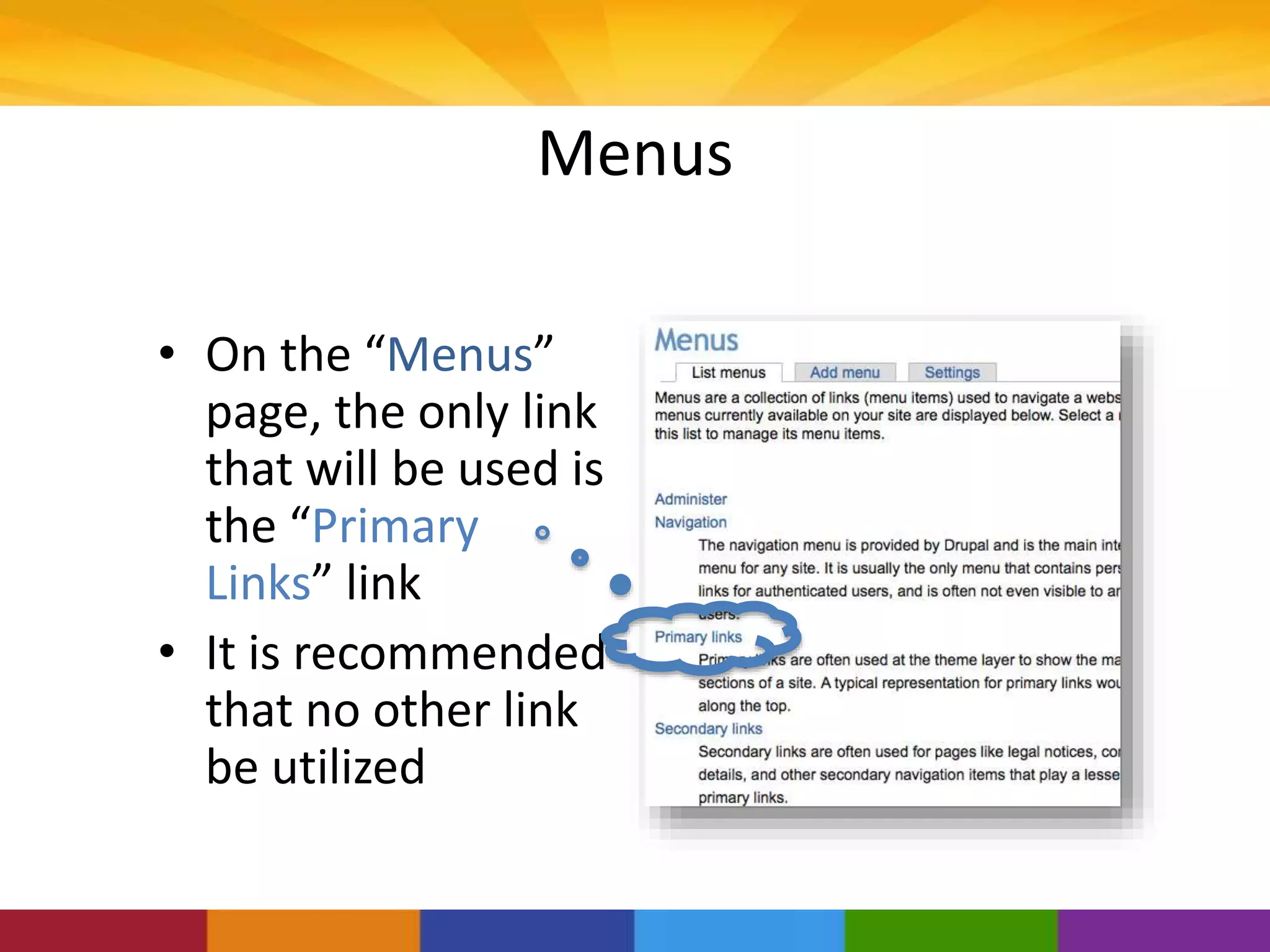
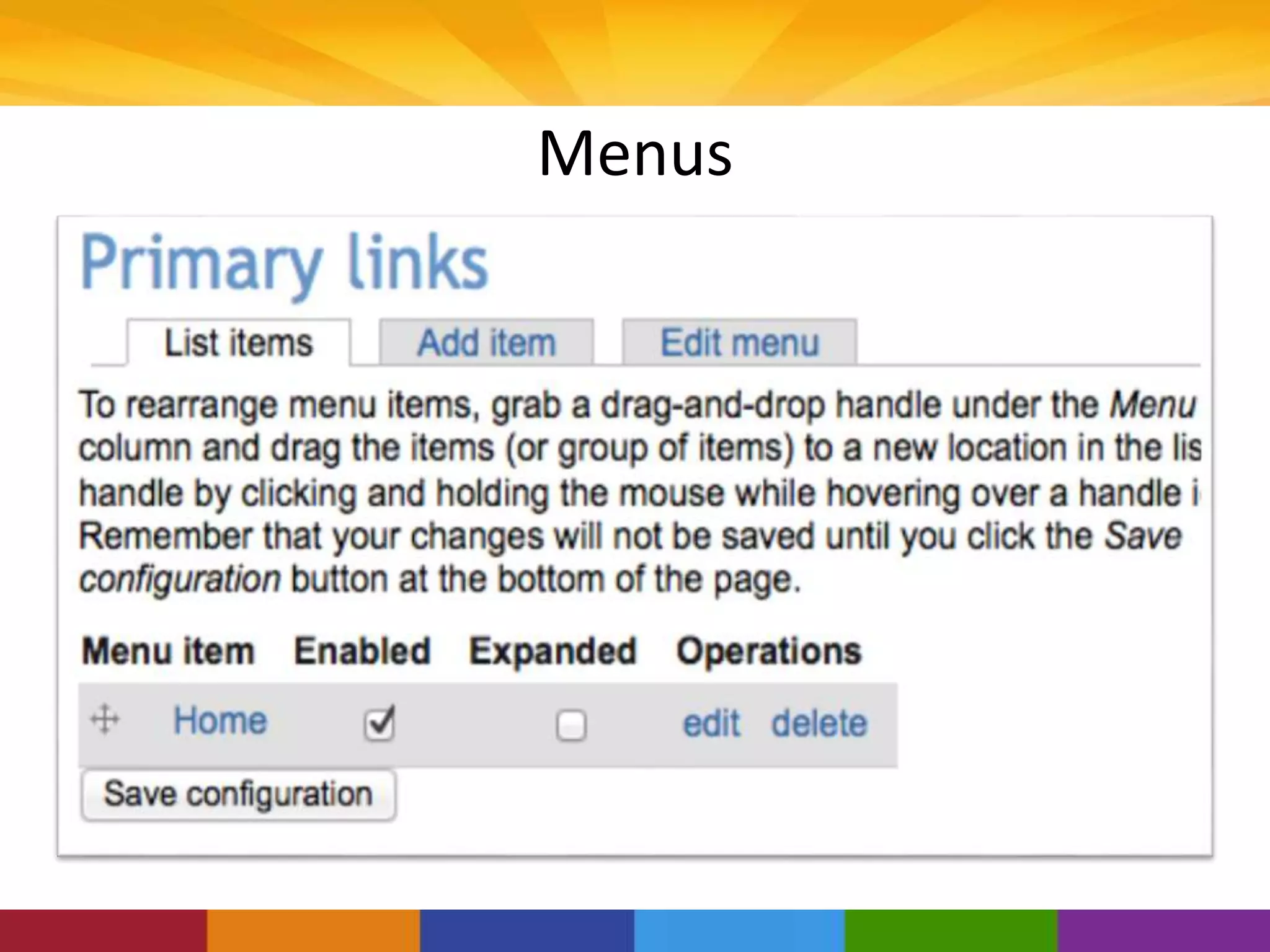
• On the “Menus”
page, the only link
that will be used is
the “Primary
Links” link
• It is recommended
that no other link
be utilized
Menus
BASIC OVERVIEW:
PERMISSIONS/POST SETTINGS
Content Management System (CMS)
Permissions/Post Settings
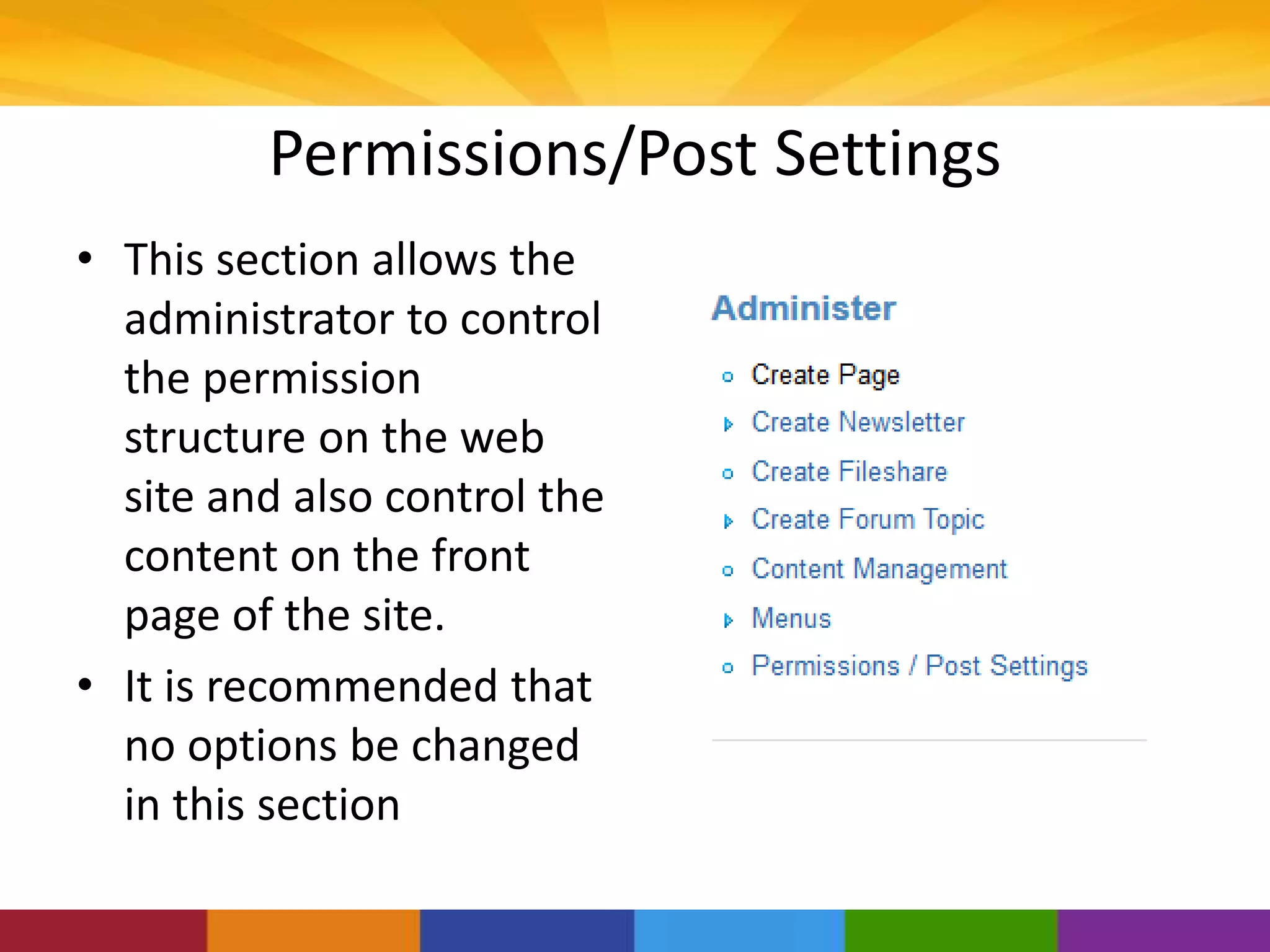
• This section allows the
administrator to control
the permission
structure on the web
site and also control the
content on the front
page of the site.
• It is recommended that
no options be changed
in this section
ADVANCED OVERVIEW:
BLOCKS
Content Management System (CMS)
Blocks
Blocks
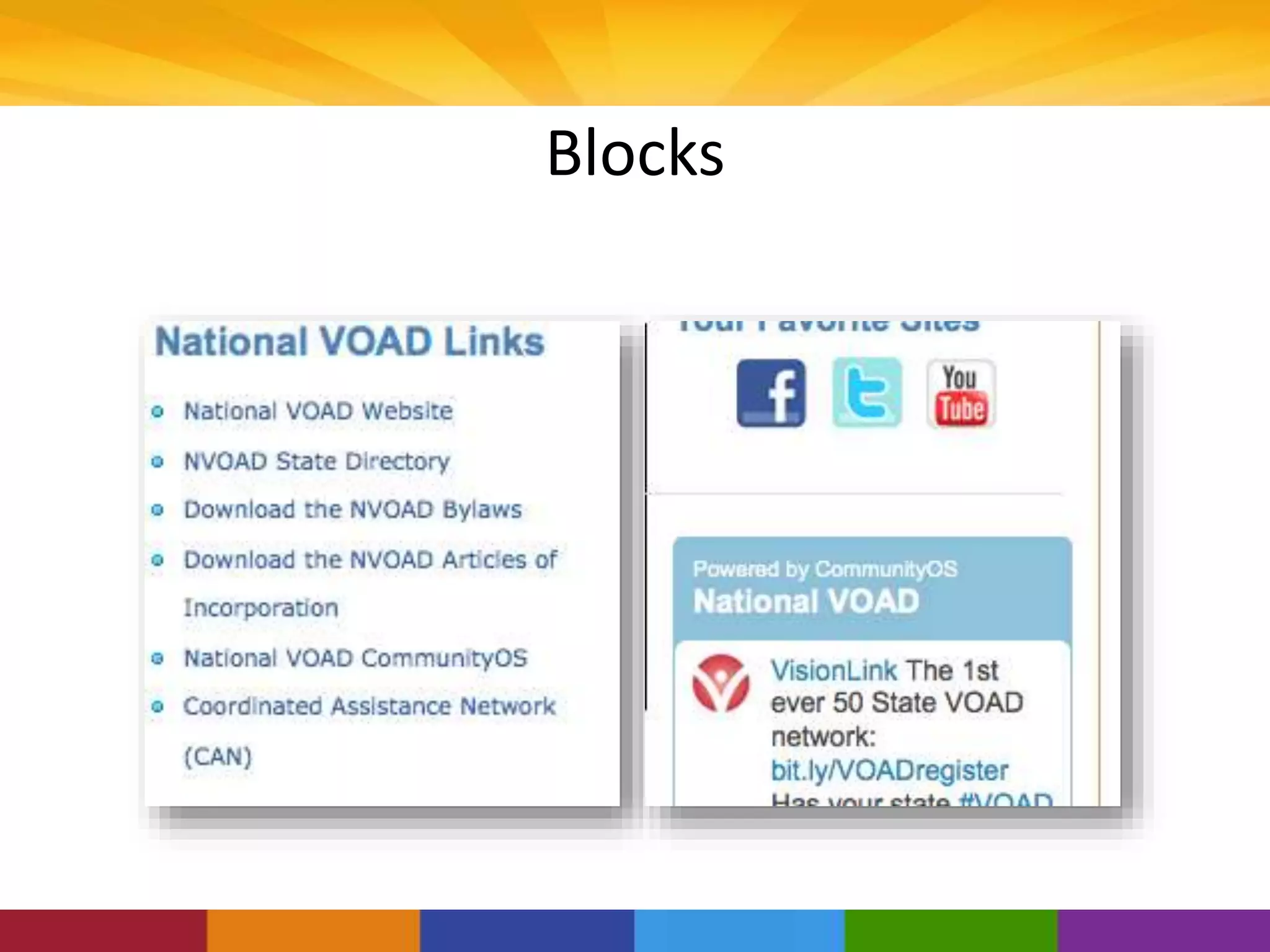
• The Content Management System also has the
ability to utilize “blocks” which are located on
the right hand or left hand side of the page.
• Each block is persistent across all pages
• Blocks such as Twitter feeds, links to external
sites, or any other content that can be
embedded in a website
ADVANCED FEATURES
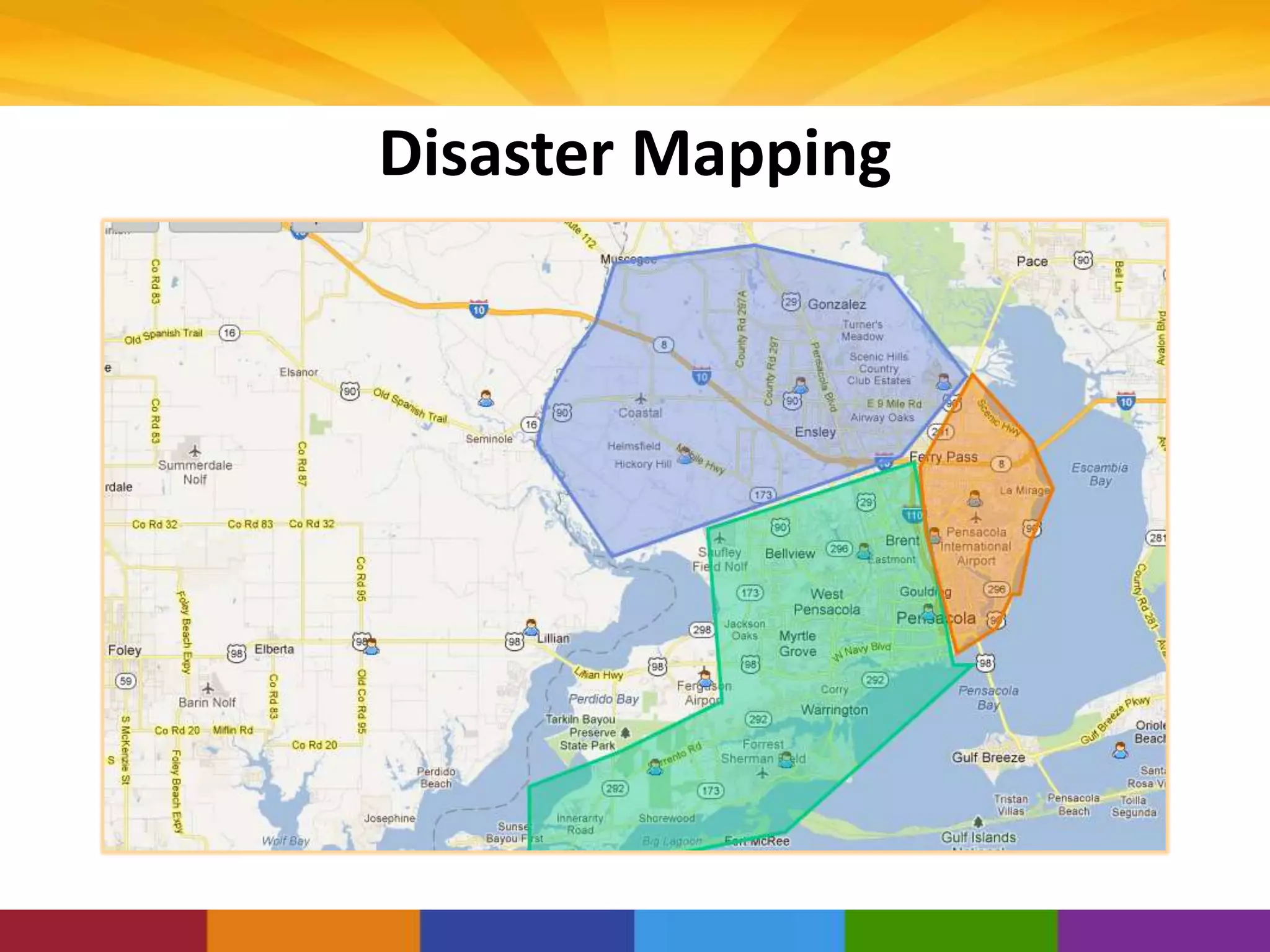
Disaster Mapping
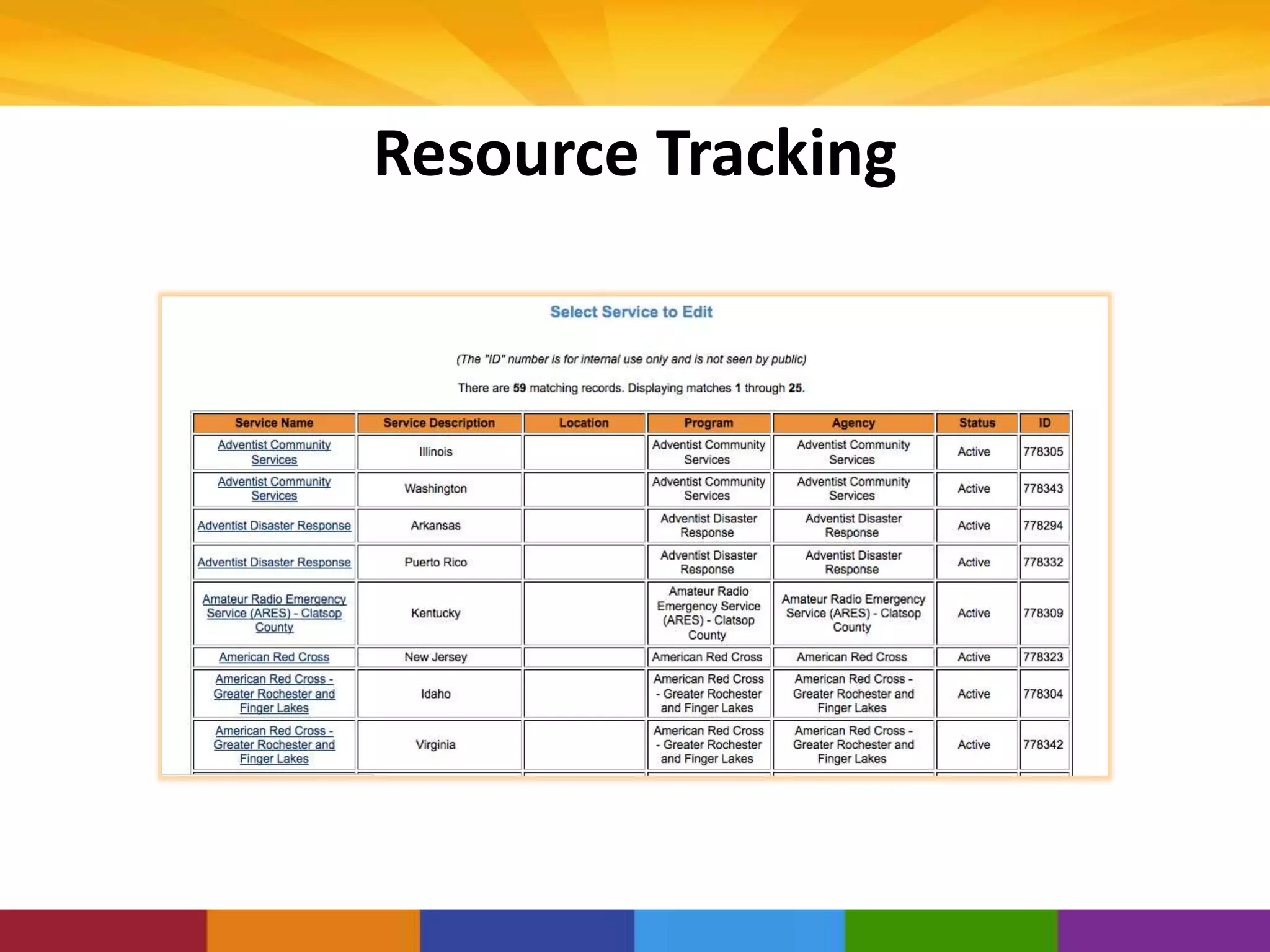
Resource Tracking
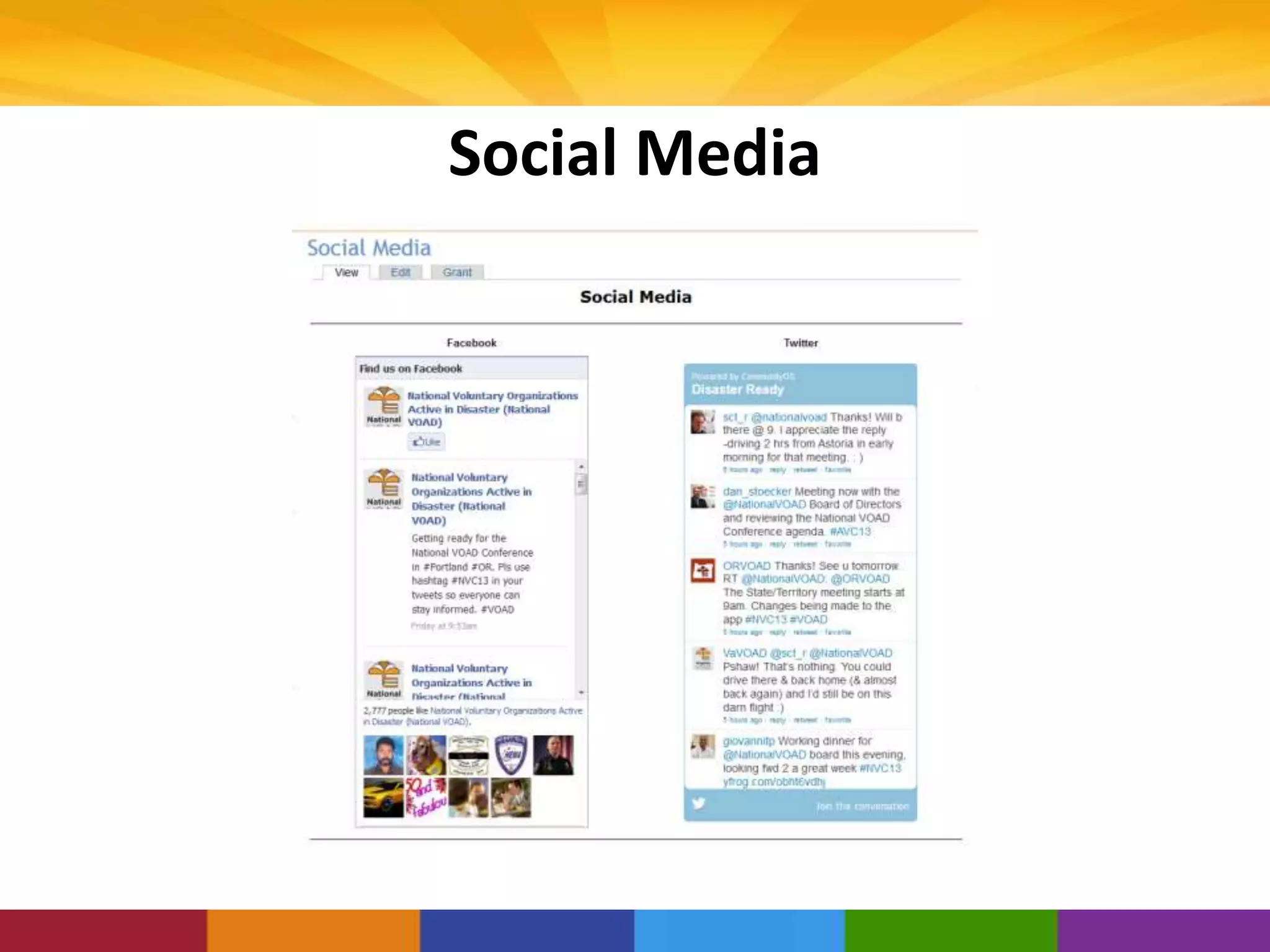
Social Media
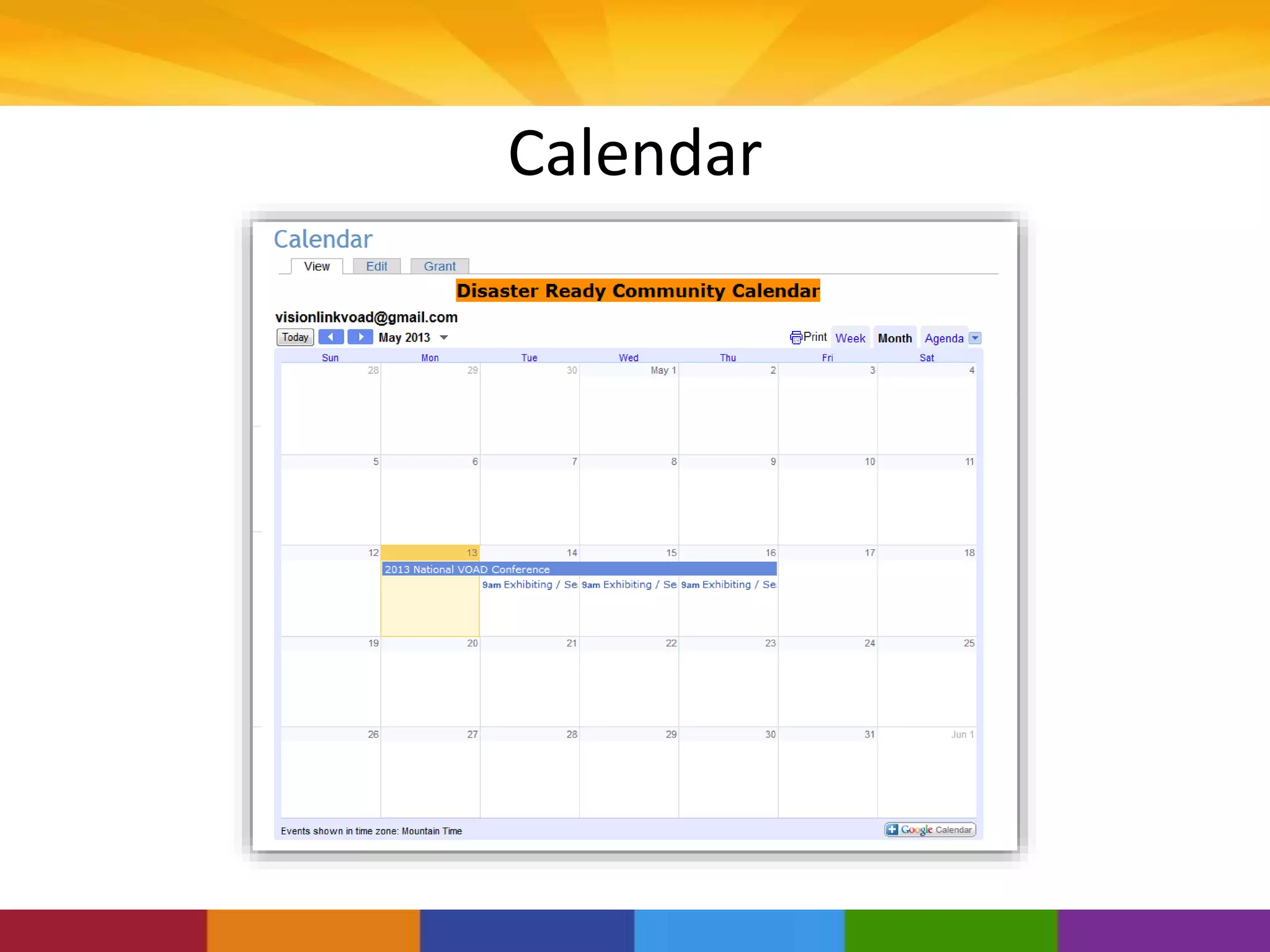
Calendar
Contact Information
National VOAD:
Tyler McKee
support@nvoad.org
VisionLink:
Rene Alvarez
alvarez@visionlink.org
VisionLink General Information:
877-VSN-LINK
www.visionlink.org
Twitter.com/visionlink
Facebook.com/VisionLink.CommunityOS
www.visiolinkblog.org
VOAD Disaster Ready:
Level 2
Tomorrow

2013 NVC Voad Portal Project

  • 1.
    VOAD Disaster Ready: Level1 CommunityOS - Content Management System (CMS) VisionLink: Ray Thompson and Rene Alvarez alvarez@visionlink.org www.visionlink.org #50stateVOAD twitter.com/visionlink #VOAD
  • 2.
    Introduction National VOAD inpartnership with VisionLink are providing each state VOAD with their own CommunityOS platform portal. This platform offers a centralized place for each state organization to maintain all pertinent disaster related information. Information can be public and restricted to authorized users, including resources, contacts, policy and processes, documents, and much more. How to Access the State VOAD Site VisionLink is creating a website for each state VOAD. The individual state VOAD contacts will be notified once their site is ready. At that point users will need to register on the site. Training VisionLink will be hosting training sessions on the tools to manage the website. Each state VOAD contact will be invited to participate in a training session once their site is available.
  • 3.
    Introduction (cont’d) Website Customization Aftercompleting training each state will be able to customize the content, navigation menus, and images on their website to meet their specific needs. Who to Contact Once a state VOAD has completed training, Tyler McKee (support@nvoad.org) at National VOAD is the contact person for questions about user accounts and website management. Monthly State VOAD User Group Starting in June 2012 (watch for your email dates and times), VisionLink will be hosting a monthly State VOAD Users Group. These users group sessions will give representatives from different states a chance to share ideas, and ask questions of their peers. Additional information about the users group will be distributed shortly.
  • 4.
  • 5.
    Accessing the StateVOAD Site • VisionLink has created a website for each state VOAD: Ex: vlvoad.communityos.org • All users will need to register on their site.
  • 6.
    Who to Contact •Once a state VOAD has completed training, Tyler McKee at National VOAD will serve as the contact person for questions about user accounts, and website management. • Contact Tyler at support@nvoad.org
  • 7.
    State VOAD UserGroup • Starting June 6, 2012, VisionLink began hosting monthly State VOAD Users Group the first Wednesday of every month at 1PM MST. • Topics for these user groups have included: – Suggestions for site improvements • “I would like it if my site could…” – Discussing different tasks • “How do I…” – Specialized Overviews
  • 8.
    BASIC OVERVIEW: CREATING APAGE Content Management System (CMS)
  • 9.
    Creating a Page •When creating a page, select the “Create Page” link under the Administer menu • The Administer menu will be on the left side of the page
  • 10.
    Creating a Page:Title • The “Title” field corresponds to the header of the page of content. • This field is required and cannot be left blank.
  • 11.
    Creating a Page:Menu Link Title • To access the Menu link title field, select the “Menu settings” link • The “Menu link title” field will allow user to name the page on the menu bar • A name must be given to the menu item, otherwise the page will not show up on the orange menu bar.
  • 12.
    Creating a Page:Parent Item • The “Parent Item:” field controls whether the page that will appear on the menu bar as a primary link or as a sub-menu: – If the page will be listed as a sub-menu, select the desired menu item from the “Parent item:”. – If the page will be listed as a primary link, leave the “Parent item:” field on the default setting, “<Primary links>”
  • 13.
    Creating a Page:Weight • The “Weight:” field can be used to determine where on the menu bar the link will appear. A larger negative number puts the menu item farther to the left while a larger positive number puts the menu item farther to the right.
  • 14.
    Creating a Page:Body • The Body field will contain all of the content related to the page. The CMS includes a rich text editor that will allow a user to utilize a Word Processor-type editor when creating a page of content. • From this one tool a user will be able to insert images, Flash movies, change the font/background colors and perform a spell check.
  • 15.
    Creating a Page:Body [Source] • For the users that are comfortable with working with HTML Code, they can select the “Source” button. • This will convert the body text into html code so that the user can manually enter or manipulate the page
  • 16.
    Creating a Page:Body [Image Upload] • Adding images to the CMS requires selecting this button, which will bring up a new window
  • 17.
    Creating a Page:Body [Image Upload] • From here, the image can be formatted to fit the user’s needs • The image dimensions can be set using the “Width” and “Height” fields • The image alignment can be set under the “Align” field. This will allow the image to be “right- aligned”, “left-aligned, etc.
  • 18.
    Creating a Page:Body [Hyperlink] • Adding hyperlinks to the CMS requires selecting this button, which will bring up a new window • The secondary hyperlink symbol allows the user to remove the hyperlink
  • 19.
    Creating a Page:Body [Adding Tables] • Adding tables to the CMS requires selecting this button, which will bring up a new window
  • 20.
    Creating a Page:Body [Adding Tables] • Within each box, the user can add in their data • Tables can be used to organize data on the page • The borders can also be made to be invisible
  • 21.
    Creating a Page:Body [Coloring] • Changing the color of the font, can be done by selecting “A” button with the color squares • Adding color to the area behind the text can be done by selecting the yellow “A” button
  • 22.
    Creating a Page:Additional Sections • It is recommended that this default settings not be changed for all the subsequent sections, except “URL path settings” and “File attachments” • The section “File attachments” will allow the user to attach files, but the files will be shared with all that have access to the page. File sharing will be discussed later.
  • 23.
    Creating a Page:Granting Access • Each page can be made available to certain groups of people • Access can be granted depending on the user’s level of access (or “Role”)
  • 24.
    Creating a Page:Granting Access (Roles) • Anonymous User: This role will have the ability to view all types of content but will not be able to edit or create new content. This user will be able to view the forums but will not be able to interact with the forums. • Authenticated User: This role will have the ability to view all types of content but will not be able to edit or create new content. The user will all be able to access and utilize the forums. • Author: This role will be able to create content on the site but will not be able to perform administrative functions like forum, menu and content type administration.
  • 25.
    BASIC OVERVIEW: CREATING ANEWSLETTER Content Management System (CMS)
  • 26.
    Administering a Newsletter •When creating a newsletter, select the “Admin Newsletters” link under the Administer menu • This will then bring up the “Content Management” page
  • 27.
    Administering a Newsletter •On the “Add newsletter” tab, we can assign a name under the Newsletter name: field • There is also the option to provide a description of the newsletter • A weight must be assigned, which orders the newsletter in ascending order based on their weight
  • 28.
    Administering a Newsletter •Under the Sender Information section, a name can be assigned to the “From name:”, indicating who the newsletter is from • Also, the “From email address:” field must be populated • Under the HTML to text conversion section, leave this section under its default options
  • 29.
    Creating a Newsletter •When creating a newsletter, select the “Create Newsletter” link under the Administer menu • In order to create a new newsletter (or email blast) a newsletter group must already exist on the system.
  • 30.
    BASIC OVERVIEW: CREATING AFILESHARE Content Management System (CMS)
  • 31.
    Creating a Fileshare •When creating a fileshare, select the “Create Fileshare” link under the Administer menu • A fileshare allows a user to create a secure location to share documents between authorized users. • A fileshare is a central repository of files that can be accessed by multiple users.
  • 32.
    Create a Fileshare •Creating a Fileshare is similar to creating other types of content. • An alternative method to creating a File share would be to create a blank page and utilize the “File attachment” section and upload documents to the created page
  • 33.
    BASIC OVERVIEW: CREATING ADISCUSSION FORUM Content Management System (CMS)
  • 34.
    Administering a Forum:Containers • When creating a Forum Topic, it is suggested that a Container be created first. To do so, select the “Admin Forum” link under the Administer menu. • The Container is a tool that helps the administrator to organize the forums.
  • 35.
    Administering a Forum:Containers • From the “Terms in Forums” page, select the “Add container” tab.
  • 36.
    Administering a Forum •Now that the Container has been created, it is now time to create the Forum. • From the “Terms in Forums” page, select the “Add forum” tab.
  • 37.
    Administering a Forum RequiredFields • In order to successfully create a new forum post the following fields are required: Forum Name and Parent. • The Parent field will allow the user to organize the forums
  • 38.
    Creating a ForumTopic • When creating a forum, select the “Create Forum topic” link under the Administer menu • A user is able to create a new topic for a forum to which they have access. • Please note that a forum must be created on the system before any user may create a new topic.
  • 39.
    Creating a ForumTopic Required Fields • In order to successfully create a new forum post the following fields are required: Subject, Forums and Body. • This is different than the requirements for creating a page or a newsletter.
  • 40.
  • 41.
    Content Management • TheContent Management section serves as the central repository for all the content that has been created on the site, whether it is hidden or not
  • 42.
    Content Management • Theadministrator has the ability to search, view and/or edit any piece of content on the site. The administrator can search by the status, type and category of a piece of content.
  • 43.
    Content Management • Inaddition, the administrator can update any piece of content by simply selecting the piece of content (via a check box) and then selecting one of the update options.
  • 44.
  • 45.
    Menus • The Administratorhas the ability to add menu items to the menu bar from Menu link.
  • 46.
    Menus • On the“Menus” page, the only link that will be used is the “Primary Links” link • It is recommended that no other link be utilized
  • 47.
  • 48.
  • 49.
    Permissions/Post Settings • Thissection allows the administrator to control the permission structure on the web site and also control the content on the front page of the site. • It is recommended that no options be changed in this section
  • 50.
  • 51.
  • 52.
    Blocks • The ContentManagement System also has the ability to utilize “blocks” which are located on the right hand or left hand side of the page. • Each block is persistent across all pages • Blocks such as Twitter feeds, links to external sites, or any other content that can be embedded in a website
  • 53.
  • 54.
  • 55.
  • 56.
  • 57.
  • 58.
    Contact Information National VOAD: TylerMcKee support@nvoad.org VisionLink: Rene Alvarez alvarez@visionlink.org VisionLink General Information: 877-VSN-LINK www.visionlink.org Twitter.com/visionlink Facebook.com/VisionLink.CommunityOS www.visiolinkblog.org
  • 59.

Editor's Notes

  • #6  ----- Meeting Notes (5/7/12 11:06) ----- site is now available
  • #7  ----- Meeting Notes (5/7/12 11:06) ----- add in email
  • #13 Look at your website
  • #15  ----- Meeting Notes (5/7/12 11:27) ----- hovering over link will say what it is
  • #16  ----- Meeting Notes (5/7/12 11:27) ----- hovering over link will say what it is
  • #21  ----- Meeting Notes (5/7/12 11:27) ----- hover features…play around with it