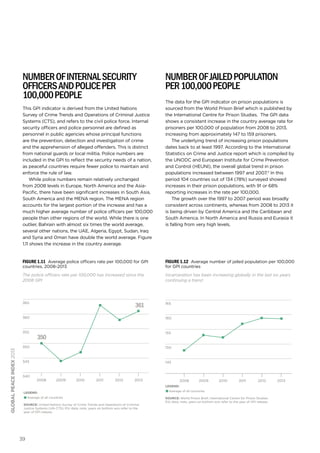
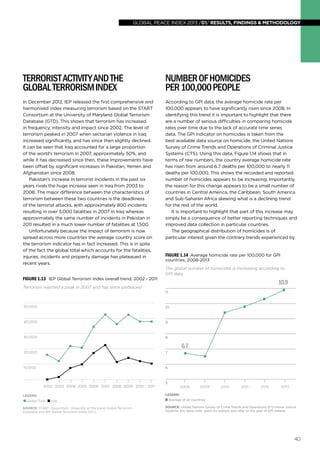
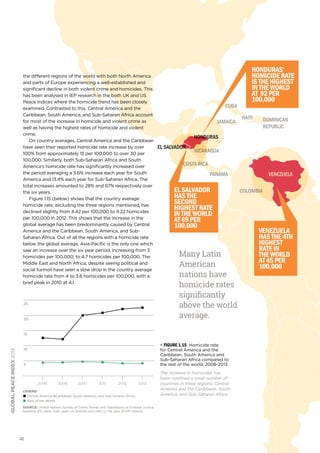
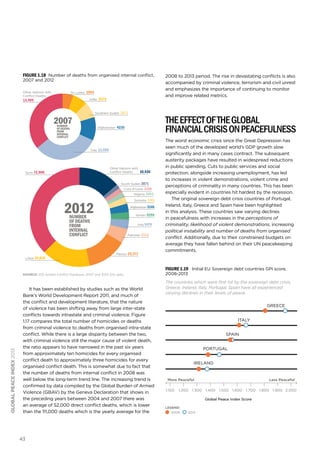
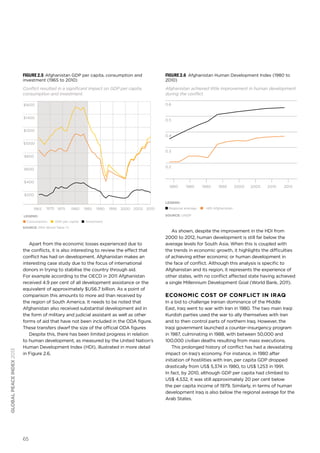
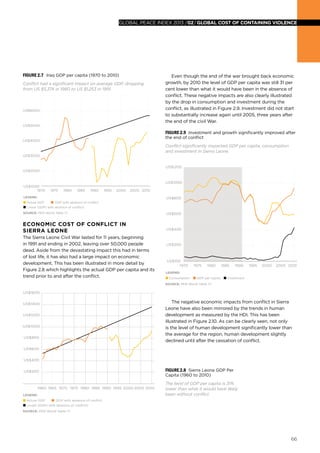
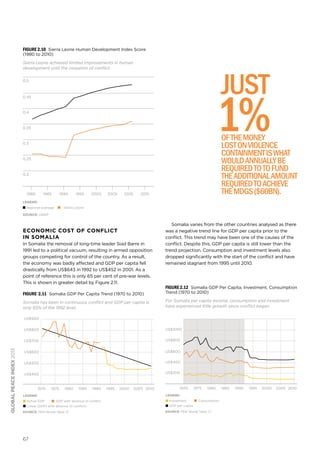
global peace index 2013 /01/ results, findings & methodology
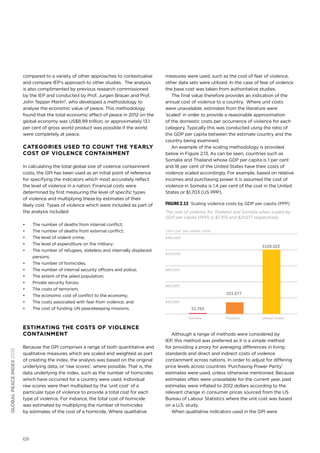
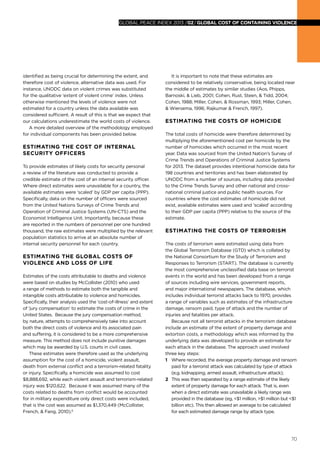
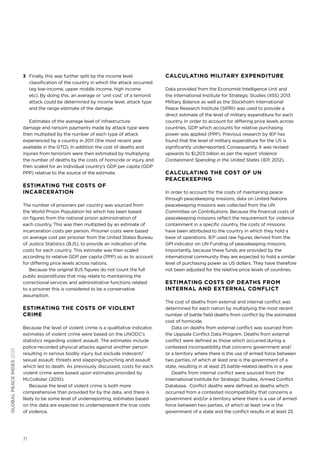
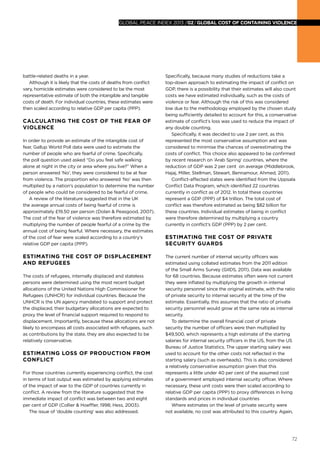
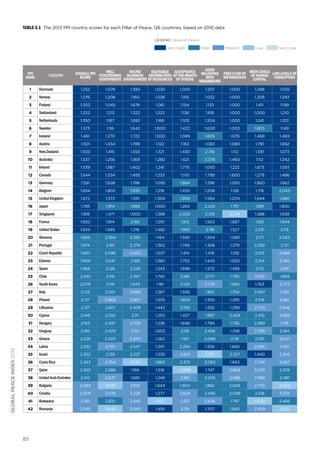
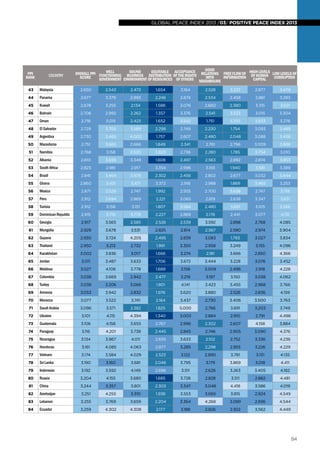
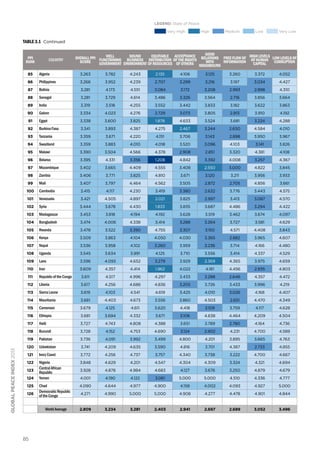
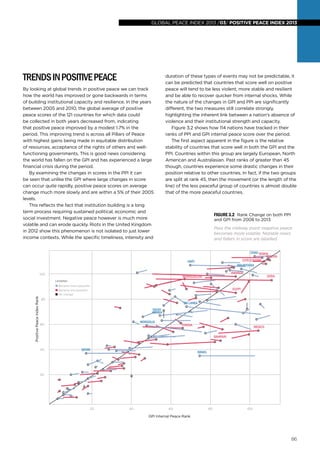
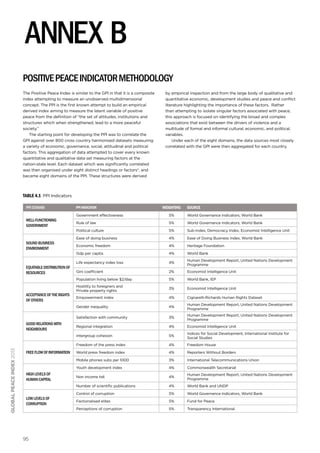
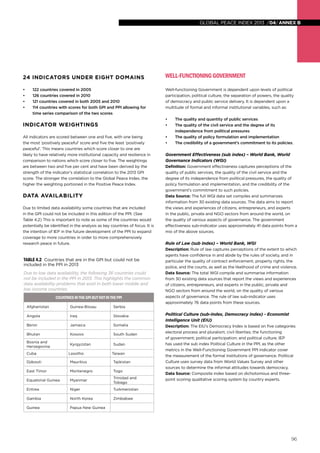
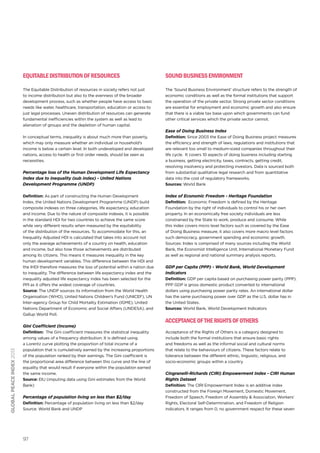
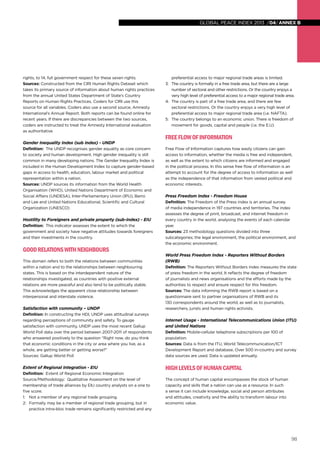
1
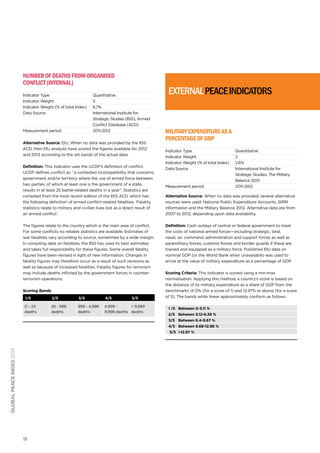
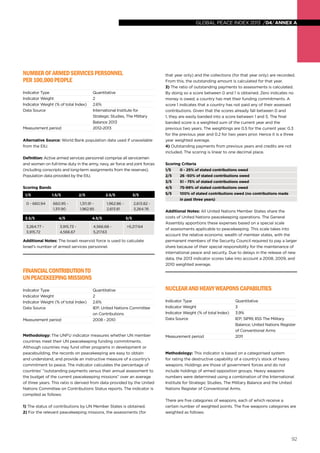
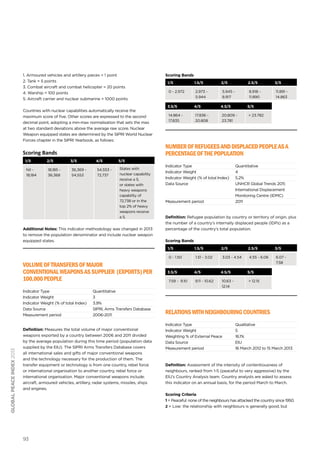
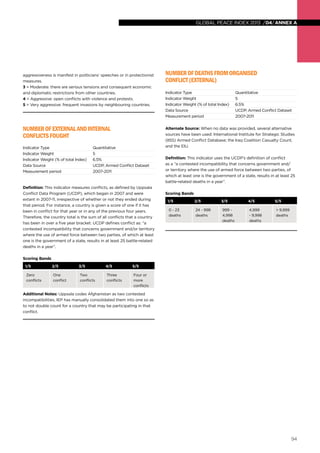
measuring the state of global peace
GLOBAL
PEACE
INDEX
2013
QUANTIFYING PEACE AND ITS BENEFITS
The Institute for Economics and Peace (IEP) is an independent, non-partisan, non-profit research organisation dedicated to shifting the
world’s focus to peace as a positive, achievable, and tangible measure of human well-being and progress.
IEP achieves its goals by developing new conceptual frameworks to define peacefulness; providing metrics for measuring peace; and
uncovering the relationships between business, peace and prosperity as well as promoting a better understanding of the cultural,
economic and political factors that create peace.
IEP has offices in Sydney and New York. It works with a wide range of partners internationally and collaborates with intergovernmental
organisations on measuring and communicating the economic value of peace.
For more information visit www.economicsandpeace.org
contents
03
	Results,Findings
	 &Methodology
Highlights 	 3
2013 Global Peace Index rankings	 5
Analysis of the results 	 7
Regional overview 	 7
The ten countries most at peace 	 16
The ten countries least at peace 	 20
Risers and fallers 	 25
GPI indicators: annual changes 	 30
Six-year trends in peace 	 31
Methodology	51
Executive Summary 	 1
Highlights 	 77
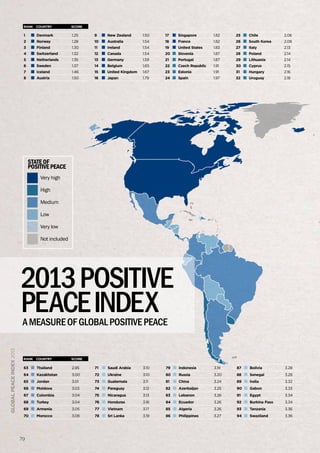
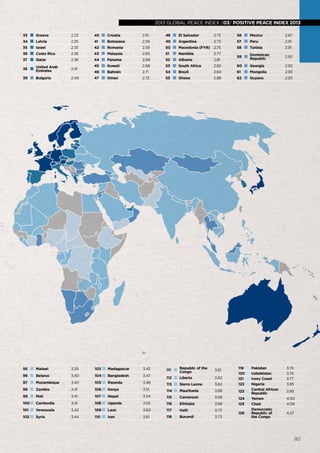
2013 Positive Peace Index rankings 	 79
The results	 81
77
	POSITiVEPEACE
	INDEX
87
Annex A - GPI indicator sources, definitions 	 87
and scoring criteria 	
Annex B – Positive Peace Index methodology 	 95
References	99
	ANNEXES
55
	theglobalcostof
	 containingviolence
Highlights 	 55
Economic impact of violence containment rankings 	 59
Methodology 	 68
Economic cost of violence literature review 	 73
1
globalpeaceindex2013
1
This is the seventh edition of the Global Peace Index (GPI),
which ranks nations according to their level of peace. It is
composed of 22 qualitative and quantitative indicators from
highly respected sources, which gauge three broad themes: the
level of safety and security in society; the extent of domestic or
international conflict; and the degree of militarisation. The 2013
GPI has been expanded to rank 162 independent states and
updated with the latest available figures and information.
In addition to presenting the findings from the 2013 GPI
and its six-year trend analysis, this year’s report contains two
additional sections; an analysis of the economic impact of
containing and dealing with the consequences of violence,
followed by the second edition of the Positive Peace Index,
which measures the strength of the attitudes, institutions, and
structures of 126 nations to determine their capacity to create
and sustain a peaceful environment.
The last year has been marked by the rising intensity of the
civil war in Syria and its geopolitical ramifications, the continued
US withdrawal from Afghanistan alongside persistently weak
performances by the major economies. These factors have
contributed to the world becoming slightly less peaceful
continuing the global slide in peacefulness which has now been
in effect for the last six years.
2012 has also seen the continuation of two major contrasting
themes for global peacefulness; the increasing intensity of
internal conflict and declines in large collective inter-state
conflicts.
The index has again been topped by Iceland with the ten
highest ranking nations in the GPI being all relatively small,
stable democracies. Nordic and Alpine countries are particularly
well represented. Asia-Pacific is also represented at the top,
with New Zealand at 3rd and Japan at 6th.
The most peaceful region of the world continues to
be Europe while the least peaceful region is South Asia.
Afghanistan this year returns to the bottom of the GPI, partly
due to increases in political instability and terrorist activity. It
replaces Somalia which experienced a slightly more peaceful
year and moved up from the lowest position in the GPI for the
first time in two years.
Libya experienced the greatest improvement in its score,
with a newly elected government and recovering institutions
following the turmoil of the recent revolution and civil war,
however it is still lowly ranked. Syria’s descent into civil war has
resulted in not only the largest deterioration of the year, but
also the largest the GPI-score deterioration in the history of the
Index. Cote d’Ivoire registered the second-most substantial
decline in peace while Burkina Faso suffered the third-largest
deterioration. These two countries are however by no means
indicative of Sub-Saharan Africa as a whole.
The fall in global peace in the last year has primarily been
driven by the deterioration in three indicators: number of
homicides, military expenditure as a percentage of GDP, and
political instability. Counteracting these falls are improvements
in the likelihood of violent demonstrations, Political Terror
Scale, and number of armed service personnel per 100,000.
Military spending as a percentage of GDP increased in
more countries than it decreased with 59 countries increasing
spending, while 36 cut their military spend. This is in
contradiction to the total amount of money spent on defence,
which dropped this year for the first time since 1998. The drop
was related to only a few large countries decreasing their level
of expenditure, most notably the U.S. which decreased its
military spending from 4.6% to 4.1% of GDP.
The past six years have been marked by many changes, with
countervailing trends. While some of these trends have been
positive, the majority have been negative with the global peace
index score deteriorating by five per cent over the six years.
Only five indicators increased in peace over this time
while seventeen indicators deteriorated. Over the six years
global peace was negatively affected by a number of major
international events including major outbreaks of violence in
the Middle-East, caused by the Arab spring; a deterioration
of security in Afghanistan and Pakistan; civil wars in Libya
and Syria; the escalation of the drug war in Central America;
continued deteriorations in peace in Somalia, DRC and Rwanda
and violent demonstrations associated with the economic
downturn in a number of European countries such as Greece.
On the positive side, the improvements in peace were mainly
driven by declining rates of homicide in the US, Western and
Eastern Europe, and the winding down of military operations in
Iraq and Afghanistan which resulted in declines in the number of
external battlefield deaths from organised conflict. Furthermore,
the Political Terror Scale, an indicator measuring the presence
of state sponsored violence and terror has improved across the
executive
summary
2
2013 global peace index // executive summary
2
The three countries that had the greatest
improvements in peace over the last six
years are Chad, Georgia and Haiti while
the three countries with the greatest
deterioration are Syria, Libya and Rwanda.
world, except for the South Asia and Russia & Eurasia regions.
All the regions of the world have recorded declines in peace
since 2008, other than North America which has remained
static. Whilst regions like Europe and Asia-Pacific have seen
very small decreases in their GPI score, Russia & Eurasia,
the Middle East & North Africa, and Central America & the
Caribbean have seen larger deteriorations.
The three countries that had the greatest improvements in
peace over the last six years are Chad, Georgia and Haiti while
the three countries with the greatest deterioration are Syria,
Libya and Rwanda.
The three indicators that recorded the greatest deterioration
over the last six years are the number of homicides, perceptions
of criminality and likelihood of violent demonstrations while the
three indicators that have had the greatest improvement are the
Political Terror Scale, military expenditure as a percentage of
GDP and the number of armed service personnel.
One of the more interesting trends is that countries with
small and medium populations - one million to twenty five
million - consistently score the highest average level of peace.
While very large countries, with populations over 100 million,
consistently record the lowest levels of peace.
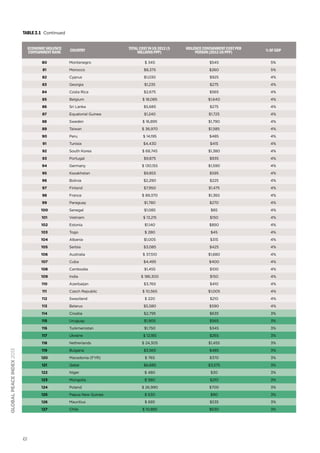
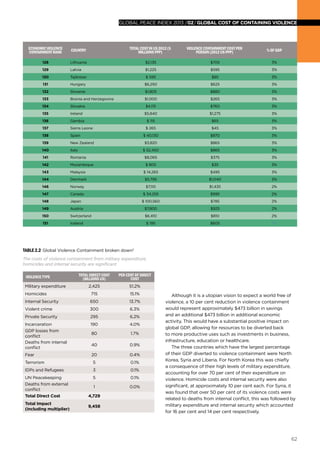
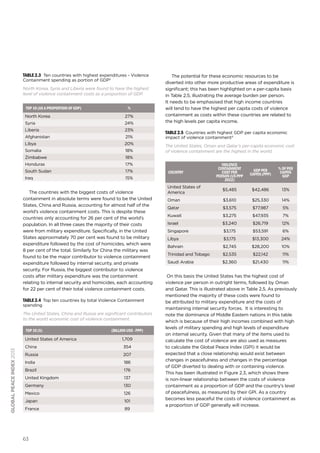
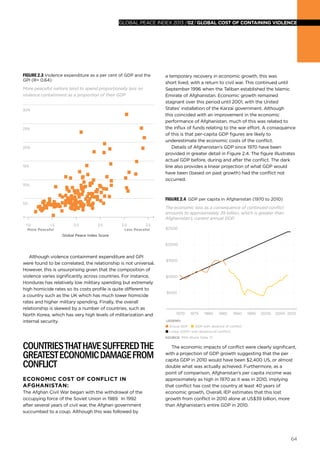
The economic impact of violence on the global economy has
also been calculated. IEP has adopted a new and novel method
of estimating the cost of violence to the global economy
through calculating global violence containment costs. IEP
defines violence containment costs as economic activity that
is related to the consequences or prevention of violence where
the violence is directed against people or property.
This methodology enables global and country-based
estimates for the 162 countries covered by the GPI. To allow
relative comparisons between countries at different levels of
economic development, GDP per capita has been used to scale
the costs associated with violence for each country.
Some of the key economic findings of this analysis are:
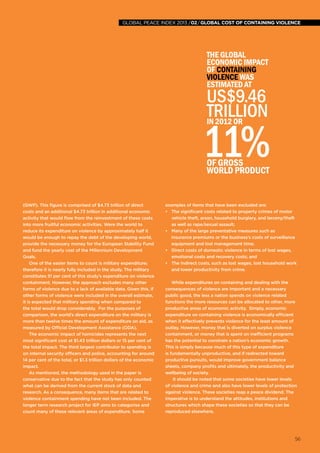
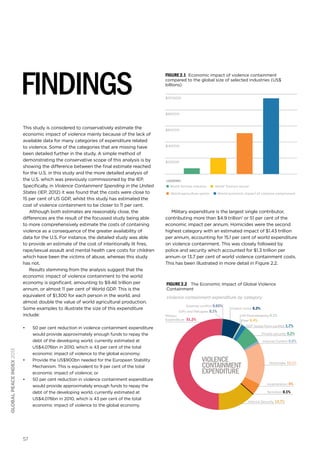
•	 The global economic impact of containing violence is
estimated to be US$9.46 trillion in 2012 or 11% of Gross
World Product.
•	 Were the world to reduce its expenditure on violence
by approximately 50% it could repay the debt of the
developing world ($4,076bn), provide enough money for
the European stability mechanism ($900bn) and fund
the additional amount required to achieve the Millennium
Development Goals ($60bn).
•	 The economic impact of violence containment to the world
economy is significant and is nearly double the value of
the world’s agricultural production, nearly five times the
total output of the tourism industry to the world GDP
and almost thirteen times the annual output of the global
airlines industry.
•	 The economic impact of homicide was $1.43 trillion in 2012
and comprised approximately 15% of the total expenditure
on violence containment.
•	 The economic impact of violence containment is 75 times
the size of the official ODAs in 2012 which amounted to
$125.6bn.
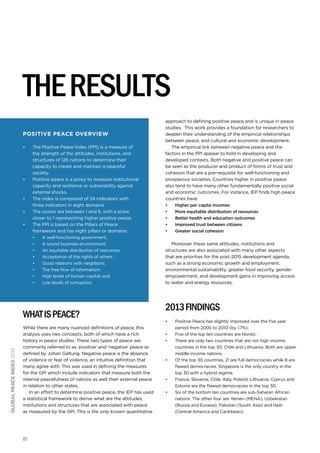
The Positive Peace Index (PPI) measures the strength of the
attitudes, institutions, and structures of 126 nations to determine
their capacity to create and sustain a peaceful environment.
This is the second edition of the PPI, and as well as ranking
countries according to their positive peace, it also measures
the movement of these factors over time. The PPI is based on
a statistical framework which groups these attributes into eight
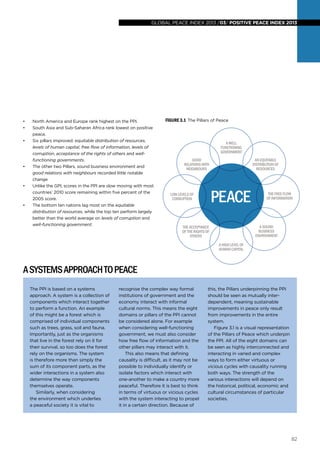
key categories known as the ‘Pillars of Peace’. These pillars have
been identified as describing what underpins a peaceful society.
The Pillars of Peace emphasise the importance of a holistic
set of institutions which work together to systematically shape
the environments that lead to peace. This framework is not
aimed at deriving causality between any of the Pillars, rather
they work as an inter-dependent set of factors where causality
can run in either direction and the strength of the relationships
between the Pillars will change depending on the specific
circumstances in a particular country.
The 2013 PPI has ranked 126 countries on 24 indicators and
found that the global average of positive peace improved in
the period between 2005 and 2010 by 1.7%. There have been
improvements in the equitable distribution of resources, levels
of human capital, free flow of information, levels of corruption,
acceptance of the rights of others and well-functioning
governments.
3
There has been a 5% deterioration
in the Global Peace Index score
over the last six years, indicating
a less peaceful world.
The ten highest ranking nations in the GPI are all
relatively small, stable democracies, with Nordic and
Alpine countries particularly well represented. Europe
is comfortably the most peaceful region; few countries
are involved in external conflict and most societies are
broadly harmonious. Nevertheless, several European
countries experienced less peaceful conditions amid
challenging economic circumstances, including Spain,
Greece, France and Portugal. North America is the
second-most peaceful region, followed by Asia-Pacific,
which is buoyed by high rankings for New Zealand (2nd)
and Japan (6th), as well as Australia, Singapore, Taiwan
and Malaysia, all of which lie in the top 30.
Libya experienced the greatest rise in peacefulness, with
a newly elected government and recovering institutions
following the turmoil of the recent revolution and civil war.
Sudan and Chad experienced the second and third-most
substantial gains as their respective conflicts eased, but
conditions in areas of both countries are far from peaceful
and they remain in the lower reaches of the GPI.
Uruguay and Chile stand out as the two most peaceful
South American nations, characterised by relatively strong
institutions and the rule of law. Conditions worsened in
third-ranked Argentina amid a series of trade spats with
neighbours. In Central America, Costa Rica again emerges
as the most peaceful nation, although it suffered from a
decline in internal peace. Nicaragua, Guatemala and El
[highlights]
results,findings
&methodology
3
globalpeaceindex2013
global peace index 2013 /01/ results, findings & methodology
4
Salvador all saw improvements in their GPI scores, albeit
from low levels. This partly reflects progress made by their
governments in improving internal security after several
years of heightened violence linked to Mexican drug cartels.
Bhutan remains in 20th place, by far the most peaceful
country in South Asia, which is the region least at peace—
with the other six nations in the group ranked below 80th
place.
War-ravaged Afghanistan returns to the foot of the
GPI, amid mounting political instability and a sharp rise in
military spending as a share of GDP. Somalia experienced
a more peaceful year and it moved up from the lowest
position in the GPI for the first time in two years. Syria’s
descent into civil war was reflected by the world’s highest
GPI-score deterioration—only Somalia and Afghanistan
are ranked lower. Many Middle Eastern and North African
countries have continued to be affected by the fallout from
the Arab Spring: violent protests and instability combined
with crackdowns by authoritarian regimes.
Overall, Cote d’Ivoire registered the second-most
substantial decline in peacefulness; a fresh wave of violent
conflict punctured an uneasy peace that has held sway
since April 2011, while Burkina Faso suffered the third-
largest deterioration. These two countries are, however, by
no means indicative of Sub-Saharan Africa as a whole. The
region ranks above the three regions of Russia and Eurasia,
the Middle East and North Africa and South Asia in the 2013
GPI, which partly reflects its rising prosperity and a degree
of insulation from the global financial crisis.
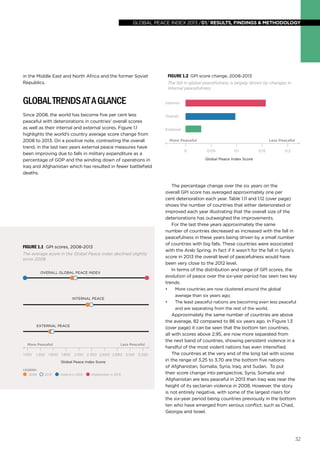
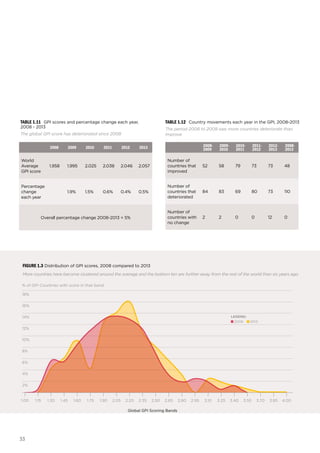
Looking at the 2008-2013 trends, the world has
gradually become less peaceful over the past six years. The
global GPI average score has deteriorated five per cent as
17 of the 22 indicators record a less peaceful state than six
years ago. The change however is not completely uniform,
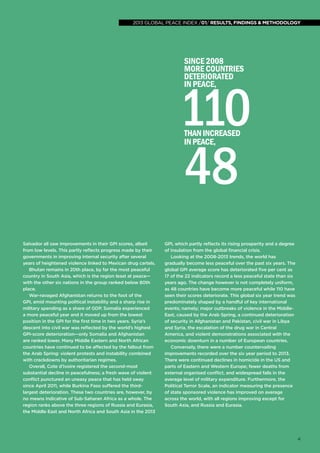
as 48 countries have become more peaceful while 110 have
seen their scores deteriorate. This global six year trend was
predominately shaped by a handful of key international
events; namely; major outbreaks of violence in the Middle-
East, caused by the Arab Spring, a continued deterioration
of security in Afghanistan and Pakistan, civil war in Libya
and Syria, the escalation of the drug war in Central
America, and violent demonstrations associated with the
economic downturn in a number of European countries.
Conversely, there were a number countervailing
improvements recorded over the six year period to 2013.
There were continued declines in homicide in the US and
parts of Eastern and Western Europe; fewer deaths from
external organised conflict, and widespread falls in the
average level of military expenditure. Furthermore, the
Political Terror Scale, an indicator measuring the presence
of state sponsored violence has improved on average
across the world, with all regions improving except for
South Asia, and Russia and Eurasia.
4
since 2008
More countries
deteriorated
in peace,
2013 global peace index /01/ results, findings & methodology
110thanincreased
inpeace,
48
55
Asnapshotoftheglobalstate ofpeace
2013global
peaceindex
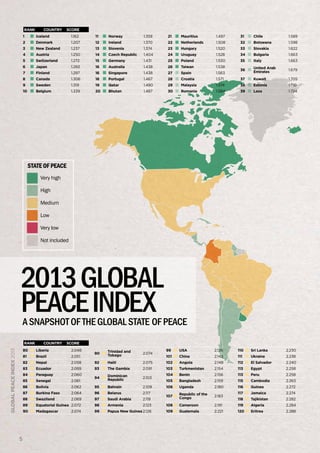
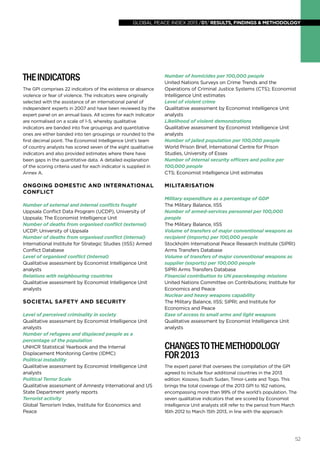
RANK	COUNTRY	 SCORE
RANK	COUNTRY	 SCORE
80 Liberia 2.048
81 Brazil 2.051
82 Nepal 2.058
83 Ecuador 2.059
84 Paraguay 2.060
85 Senegal 2.061
86 Bolivia 2.062
87 Burkina Faso 2.064
88 Swaziland 2.069
89 Equatorial Guinea 2.072
90 Madagascar 2.074
90
Trinidad and
Tobago
2.074
92 Haiti 2.075
93 The Gambia 2.091
94
Dominican
Republic
2.103
95 Bahrain 2.109
96 Belarus 2.117
97 Saudi Arabia 2.119
98 Armenia 2.123
99 Papua New Guinea2.126
99 USA 2.126
101 China 2.142
102 Angola 2.148
103 Turkmenistan 2.154
104 Benin 2.156
105 Bangladesh 2.159
106 Uganda 2.180
107
Republic of the
Congo
2.183
108 Cameroon 2.191
109 Guatemala 2.221
110 Sri Lanka 2.230
111 Ukraine 2.238
112 El Salvador 2.240
113 Egypt 2.258
113 Peru 2.258
115 Cambodia 2.263
116 Guinea 2.272
117 Jamaica 2.274
118 Tajikistan 2.282
119 Algeria 2.284
120 Eritrea 2.288
Very high
High
Medium
Low
Very low
Not included
STATEOFPEACE
1 Iceland 1.162
2 Denmark 1.207
3 New Zealand 1.237
4 Austria 1.250
5 Switzerland 1.272
6 Japan 1.293
7 Finland 1.297
8 Canada 1.306
9 Sweden 1.319
10 Belgium 1.339
11 Norway 1.359
12 Ireland 1.370
13 Slovenia 1.374
14 Czech Republic 1.404
15 Germany 1.431
16 Australia 1.438
16 Singapore 1.438
18 Portugal 1.467
19 Qatar 1.480
20 Bhutan 1.487
21 Mauritius 1.497
22 Netherlands 1.508
23 Hungary 1.520
24 Uruguay 1.528
25 Poland 1.530
26 Taiwan 1.538
27 Spain 1.563
28 Croatia 1.571
29 Malaysia 1.574
30 Romania 1.584
31 Chile 1.589
32 Botswana 1.598
33 Slovakia 1.622
34 Bulgaria 1.663
35 Italy 1.663
36
United Arab
Emirates
1.679
37 Kuwait 1.705
38 Estonia 1.710
39 Laos 1.724
globalpeaceindex2013
global peace index 2013 /01/ results, findings & methodology
66
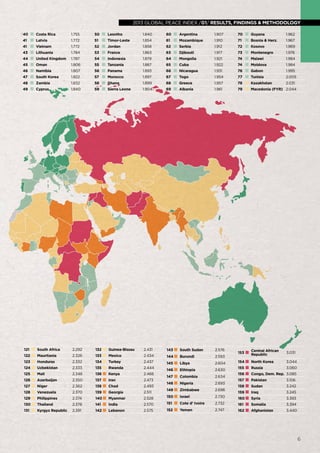
121 South Africa 2.292
122 Mauritania 2.326
123 Honduras 2.332
124 Uzbekistan 2.333
125 Mali 2.346
126 Azerbaijan 2.350
127 Niger 2.362
128 Venezuela 2.370
129 Philippines 2.374
130 Thailand 2.378
131 Kyrgyz Republic 2.391
132 Guinea-Bissau 2.431
133 Mexico 2.434
134 Turkey 2.437
135 Rwanda 2.444
136 Kenya 2.466
137 Iran 2.473
138 Chad 2.493
139 Georgia 2.511
140 Myanmar 2.528
141 India 2.570
142 Lebanon 2.575
143 South Sudan 2.576
144 Burundi 2.593
145 Libya 2.604
146 Ethiopia 2.630
147 Colombia 2.634
148 Nigeria 2.693
149 Zimbabwe 2.696
150 Israel 2.730
151 Cote d’ Ivoire 2.732
152 Yemen 2.747
153
Central African
Republic
3.031
154 North Korea 3.044
155 Russia 3.060
156 Congo, Dem. Rep. 3.085
157 Pakistan 3.106
158 Sudan 3.242
159 Iraq 3.245
160 Syria 3.393
161 Somalia 3.394
162 Afghanistan 3.440
40 Costa Rica 1.755
41 Latvia 1.772
41 Vietnam 1.772
43 Lithuania 1.784
44 United Kingdom 1.787
45 Oman 1.806
46 Namibia 1.807
47 South Korea 1.822
48 Zambia 1.832
49 Cyprus 1.840
50 Lesotho 1.840
51 Timor-Leste 1.854
52 Jordan 1.858
53 France 1.863
54 Indonesia 1.879
55 Tanzania 1.887
56 Panama 1.893
57 Morocco 1.897
58 Ghana 1.899
59 Sierra Leone 1.904
60 Argentina 1.907
61 Mozambique 1.910
62 Serbia 1.912
63 Djibouti 1.917
64 Mongolia 1.921
65 Cuba 1.922
66 Nicaragua 1.931
67 Togo 1.954
68 Greece 1.957
69 Albania 1.961
70 Guyana 1.962
71 Bosnia & Herz. 1.967
72 Kosovo 1.969
73 Montenegro 1.976
74 Malawi 1.984
74 Moldova 1.984
76 Gabon 1.995
77 Tunisia 2.005
78 Kazakhstan 2.031
79 Macedonia (FYR) 2.044
2013 global peace index /01/ results, findings & methodology
7
globalpeaceindex2013
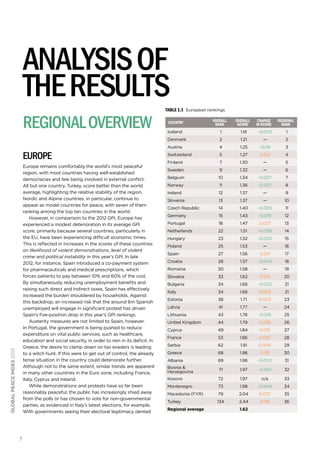
europe
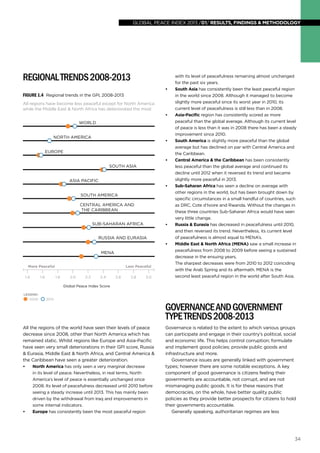
Europe remains comfortably the world’s most peaceful
region, with most countries having well-established
democracies and few being involved in external conflict.
All but one country, Turkey, score better than the world
average, highlighting the relative stability of the region.
Nordic and Alpine countries, in particular, continue to
appear as model countries for peace, with seven of them
ranking among the top ten countries in the world.
However, in comparison to the 2012 GPI, Europe has
experienced a modest deterioration in its average GPI
score, primarily because several countries, particularly in
the EU, have been experiencing difficult economic times.
This is reflected in increases in the scores of these countries
on likelihood of violent demonstrations, level of violent
crime and political instability in this year’s GPI. In late
2012, for instance, Spain introduced a co-payment system
for pharmaceuticals and medical prescriptions, which
forces patients to pay between 10% and 60% of the cost.
By simultaneously reducing unemployment benefits and
raising such direct and indirect taxes, Spain has effectively
increased the burden shouldered by households. Against
this backdrop, an increased risk that the around 6m Spanish
unemployed will engage in significant protest has driven
Spain’s five-position drop in this year’s GPI rankings.
Austerity measures are not limited to Spain, however.
In Portugal, the government is being pushed to reduce
expenditure on vital public services, such as healthcare,
education and social security, in order to rein in its deficit. In
Greece, the desire to clamp down on tax evaders is leading
to a witch hunt. If this were to get out of control, the already
tense situation in the country could deteriorate further.
Although not to the same extent, similar trends are apparent
in many other countries in the Euro zone, including France,
Italy, Cyprus and Ireland.
While demonstrations and protests have so far been
reasonably peaceful, the public has increasingly shied away
from the polls or has chosen to vote for non-governmental
parties, as evidenced in Italy’s latest elections, for example.
With governments seeing their electoral legitimacy dented
analysisof
theresults
regionaloverview
TABLE 1.1 European rankings
Country Overall
rank
Overall
score
Change
in score
Regional
rank
Iceland 1 1.16 -0.003 1
Denmark 2 1.21 — 2
Austria 4 1.25 -0.06 3
Switzerland 5 1.27 0.013 4
Finland 7 1.30 — 5
Sweden 9 1.32 — 6
Belgium 10 1.34 -0.027 7
Norway 11 1.36 -0.027 8
Ireland 12 1.37 — 9
Slovenia 13 1.37 — 10
Czech Republic 14 1.40 -0.003 11
Germany 15 1.43 -0.019 12
Portugal 18 1.47 0.027 13
Netherlands 22 1.51 -0.039 14
Hungary 23 1.52 -0.002 15
Poland 25 1.53 — 16
Spain 27 1.56 0.04 17
Croatia 28 1.57 -0.043 18
Romania 30 1.58 — 19
Slovakia 33 1.62 0.04 20
Bulgaria 34 1.66 -0.023 21
Italy 34 1.66 0.003 21
Estonia 38 1.71 0.003 23
Latvia 41 1.77 — 24
Lithuania 43 1.78 -0.016 25
United Kingdom 44 1.79 0.056 26
Cyprus 49 1.84 0.015 27
France 53 1.86 0.037 28
Serbia 62 1.91 0.006 29
Greece 68 1.96 0.05 30
Albania 69 1.96 -0.002 31
Bosnia &
Herzegovina
71 1.97 -0.001 32
Kosovo 72 1.97 n/a  33
Montenegro 73 1.98 -0.044 34
Macedonia (FYR) 79 2.04 0.072 35
Turkey 134 2.44 0.116 36
Regional average   1.62    
global peace index 2013 /01/ results, findings & methodology
8
and their policies systematically oriented towards austerity,
a political crisis is boiling under the surface in the Euro zone.
Given the historically strong correlation between political
stability and internal peace scores, there is a substantive risk
of the region’s score weakening in coming years.
External factors have been more important for countries
such as Turkey, which has suffered from a deterioration of
the military situation in neighbouring countries, in particular
in Syria. This has also driven to an increase in the risk of
terrorist activities. Similarly, the Former Yugoslav Republic
of Macedonia (FYROM) has suffered from poor relations
with its neighbours, in the shape of a territorial dispute
with Greece and accusations that FYROM is seeking to
appropriate part of Bulgaria’s history, leading foreign
ministers from both EU countries to put off setting a date
for opening EU-accession talks. At the same time, internal
tensions between ethnic Macedonians and ethnic Albanians
remain problematic, although a return to inter-ethnic armed
conflict is unlikely. 
Despite a fall in its military spending due to the recession,
Cyprus has seen its GPI score deteriorate. The division of
the island between the Turkish Cypriots in the north and the
Greek Cypriots in the south is the result of a decade-long
conflict, which is still weighing on the country’s stability, as
illustrated by the 30,000-40,000 military troops stationed
in the north of the island. The exploration of offshore
gasfields has led to another escalation of tensions with
Turkey, which has led military exercises in neighbouring
waters. Although it does not claim rights over the gasfields,
Turkey argues that any revenue should be shared with
the Turkish Cypriots, and that it will therefore continue its
military exercises as long as the Cyprus question remains
unresolved. Cyprus’s financial meltdown may, however,
ultimately prove beneficial to the negotiations; as it is
desperately seeking new sources of revenue, the Greek
Cypriot government is likely to be willing to accelerate the
exploitation of its gas resources, and might, therefore, be
ready to re-open negotiations with a more flexible attitude.
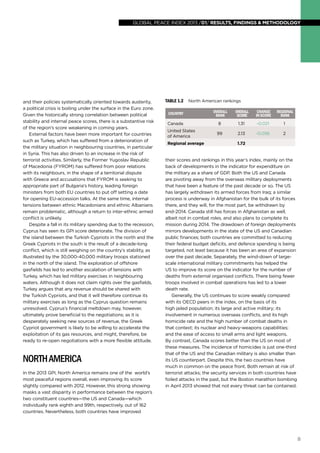
NorthAmerica
In the 2013 GPI, North America remains one of the world’s
most peaceful regions overall, even improving its score
slightly compared with 2012. However, this strong showing
masks a vast disparity in performance between the region’s
two constituent countries—the US and Canada—which
individually rank eighth and 99th, respectively, out of 162
countries. Nevertheless, both countries have improved
their scores and rankings in this year’s index, mainly on the
back of developments in the indicator for expenditure on
the military as a share of GDP. Both the US and Canada
are pivoting away from the overseas military deployments
that have been a feature of the past decade or so. The US
has largely withdrawn its armed forces from Iraq; a similar
process is underway in Afghanistan for the bulk of its forces
there, and they will, for the most part, be withdrawn by
end-2014. Canada still has forces in Afghanistan as well,
albeit not in combat roles, and also plans to complete its
mission during 2014. The drawdown of foreign deployments
mirrors developments in the state of the US and Canadian
public finances; both countries are committed to reducing
their federal budget deficits, and defence spending is being
targeted, not least because it has been an area of expansion
over the past decade. Separately, the wind-down of large-
scale international military commitments has helped the
US to improve its score on the indicator for the number of
deaths from external organised conflicts. There being fewer
troops involved in combat operations has led to a lower
death rate.
Generally, the US continues to score weakly compared
with its OECD peers in the index, on the basis of its
high jailed population; its large and active military; its
involvement in numerous overseas conflicts, and its high
homicide rate and the high number of combat deaths in
that context; its nuclear and heavy-weapons capabilities;
and the ease of access to small arms and light weapons.
By contrast, Canada scores better than the US on most of
these measures. The incidence of homicides is just one-third
that of the US and the Canadian military is also smaller than
its US counterpart. Despite this, the two countries have
much in common on the peace front. Both remain at risk of
terrorist attacks; the security services in both countries have
foiled attacks in the past, but the Boston marathon bombing
in April 2013 showed that not every threat can be contained.
TABLE 1.2 North American rankings
Country Overall
rank
Overall
score
Change
inscore
Regional
rank
Canada 8 1.31 -0.021 1
United States
of America
99 2.13 -0.056 2
Regional average   1.72    
9
globalpeaceindex2013
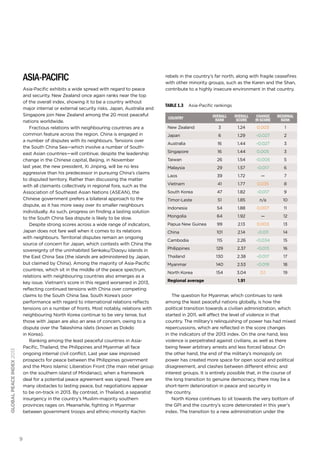
Asia-Pacific
Asia-Pacific exhibits a wide spread with regard to peace
and security. New Zealand once again ranks near the top
of the overall index, showing it to be a country without
major internal or external security risks. Japan, Australia and
Singapore join New Zealand among the 20 most peaceful
nations worldwide.
Fractious relations with neighbouring countries are a
common feature across the region. China is engaged in
a number of disputes with its neighbours. Tensions over
the South China Sea—which involve a number of South-
east Asian countries—will continue; despite the leadership
change in the Chinese capital, Beijing, in November
last year, the new president, Xi Jinping, will be no less
aggressive than his predecessor in pursuing China’s claims
to disputed territory. Rather than discussing the matter
with all claimants collectively in regional fora, such as the
Association of Southeast Asian Nations (ASEAN), the
Chinese government prefers a bilateral approach to the
dispute, as it has more sway over its smaller neighbours
individually. As such, progress on finding a lasting solution
to the South China Sea dispute is likely to be slow.
Despite strong scores across a wide range of indicators,
Japan does not fare well when it comes to its relations
with neighbours. Territorial disputes remain an ongoing
source of concern for Japan, which contests with China the
sovereignty of the uninhabited Senkaku/Diaoyu islands in
the East China Sea (the islands are administered by Japan,
but claimed by China). Among the majority of Asia-Pacific
countries, which sit in the middle of the peace spectrum,
relations with neighbouring countries also emerges as a
key issue. Vietnam’s score in this regard worsened in 2013,
reflecting continued tensions with China over competing
claims to the South China Sea. South Korea’s poor
performance with regard to international relations reflects
tensions on a number of fronts. Most notably, relations with
neighbouring North Korea continue to be very tense, but
those with Japan are also an area of concern, owing to a
dispute over the Takeshima islets (known as Dokdo
in Korea).
Ranking among the least peaceful countries in Asia-
Pacific, Thailand, the Philippines and Myanmar all face
ongoing internal civil conflict. Last year saw improved
prospects for peace between the Philippines government
and the Moro Islamic Liberation Front (the main rebel group
on the southern island of Mindanao), when a framework
deal for a potential peace agreement was signed. There are
many obstacles to lasting peace, but negotiations appear
to be on-track in 2013. By contrast, in Thailand, a separatist
insurgency in the country’s Muslim-majority southern
provinces rages on. Meanwhile, fighting in Myanmar
between government troops and ethnic-minority Kachin
rebels in the country’s far north, along with fragile ceasefires
with other minority groups, such as the Karen and the Shan,
contribute to a highly insecure environment in that country.
TABLE 1.3 Asia-Pacific rankings
Country Overall
rank
Overall
score
Change
inscore
Regional
rank
New Zealand 3 1.24 0.003 1
Japan 6 1.29 -0.027 2
Australia 16 1.44 -0.027 3
Singapore 16 1.44 0.005 3
Taiwan 26 1.54 -0.005 5
Malaysia 29 1.57 -0.017 6
Laos 39 1.72 — 7
Vietnam 41 1.77 0.035 8
South Korea 47 1.82 -0.017 9
Timor-Leste 51 1.85 n/a 10
Indonesia 54 1.88 0.007 11
Mongolia 64 1.92 — 12
Papua New Guinea 99 2.13 0.003 13
China 101 2.14 -0.011 14
Cambodia 115 2.26 -0.034 15
Philippines 129 2.37 -0.013 16
Thailand 130 2.38 -0.017 17
Myanmar 140 2.53 -0.019 18
North Korea 154 3.04 0.1 19
Regional average   1.91    
The question for Myanmar, which continues to rank
among the least peaceful nations globally, is how the
political transition towards a civilian administration, which
started in 2011, will affect the level of violence in that
country. The military’s relinquishing of power has had mixed
repercussions, which are reflected in the score changes
in the indicators of the 2013 index. On the one hand, less
violence is perpetrated against civilians, as well as there
being fewer arbitrary arrests and less forced labour. On
the other hand, the end of the military’s monopoly on
power has created more space for open social and political
disagreement, and clashes between different ethnic and
interest groups. It is entirely possible that, in the course of
the long transition to genuine democracy, there may be a
short-term deterioration in peace and security in
the country.
North Korea continues to sit towards the very bottom of
the GPI and the country’s score deteriorated in this year’s
index. The transition to a new administration under the
global peace index 2013 /01/ results, findings & methodology
10
leadership of Kim Jong-un, whose comparative youth and
limited experience seem to have instilled a desire to prove
himself, has increased uncertainty about the prospects for
peace in North Korea. A so-called satellite launch (in reality,
an ill-disguised missile test) in late 2012 marked the start of
a particularly tense period for North Korean relations with its
enemies, notably the US and South Korea. The questionable
ability of Kim Jong-un to retain the absolute loyalty and
obedience of the country’s citizens marginally worsens the
prospects for political stability in North Korea.
SouthAmerica
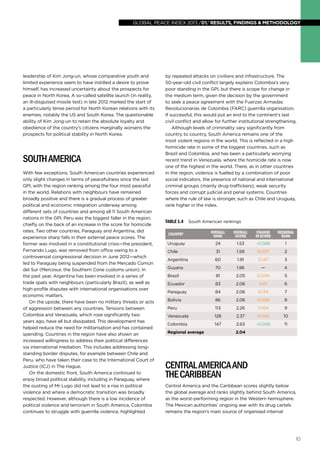
With few exceptions, South American countries experienced
only slight changes in terms of peacefulness since the last
GPI, with the region ranking among the four most peaceful
in the world. Relations with neighbours have remained
broadly positive and there is a gradual process of greater
political and economic integration underway among
different sets of countries and among all 11 South American
nations in the GPI. Peru was the biggest faller in the region,
chiefly on the back of an increase in the score for homicide
rates. Two other countries, Paraguay and Argentina, did
experience sharp falls in their external peace scores. The
former was involved in a constitutional crisis—the president,
Fernando Lugo, was removed from office owing to a
controversial congressional decision in June 2012—which
led to Paraguay being suspended from the Mercado Común
del Sur (Mercosur, the Southern Cone customs union). In
the past year, Argentina has been involved in a series of
trade spats with neighbours (particularly Brazil), as well as
high-profile disputes with international organisations over
economic matters.
On the upside, there have been no military threats or acts
of aggression between any countries. Tensions between
Colombia and Venezuela, which rose significantly two
years ago, have all but dissipated. This development has
helped reduce the need for militarisation and has contained
spending. Countries in the region have also shown an
increased willingness to address their political differences
via international mediation. This includes addressing long-
standing border disputes, for example between Chile and
Peru, who have taken their case to the International Court of
Justice (ICJ) in The Hague.
On the domestic front, South America continued to
enjoy broad political stability, including in Paraguay, where
the ousting of Mr Lugo did not lead to a rise in political
violence and where a democratic transition was broadly
respected. However, although there is a low incidence of
political violence and terrorism in South America, Colombia
continues to struggle with guerrilla violence, highlighted
by repeated attacks on civilians and infrastructure. The
50-year-old civil conflict largely explains Colombia’s very
poor standing in the GPI, but there is scope for change in
the medium term, given the decision by the government
to seek a peace agreement with the Fuerzas Armadas
Revolucionarias de Colombia (FARC) guerrilla organisation.
If successful, this would put an end to the continent’s last
civil conflict and allow for further institutional strengthening.
Although levels of criminality vary significantly from
country to country, South America remains one of the
most violent regions in the world. This is reflected in a high
homicide rate in some of the biggest countries, such as
Brazil and Colombia, and has been a particularly worrying
recent trend in Venezuela, where the homicide rate is now
one of the highest in the world. There, as in other countries
in the region, violence is fuelled by a combination of poor
social indicators, the presence of national and international
criminal groups (mainly drug-traffickers), weak security
forces and corrupt judicial and penal systems. Countries
where the rule of law is stronger, such as Chile and Uruguay,
rank higher in the index.
TABLE 1.4 South American rankings
Country Overall
rank
Overall
score
Change
inscore
Regional
rank
Uruguay 24 1.53 -0.086 1
Chile 31 1.59 0.007 2
Argentina 60 1.91 0.147 3
Guyana 70 1.96 — 4
Brazil 81 2.05 0.004 5
Ecuador 83 2.06 0.01 6
Paraguay 84 2.06 0.134 7
Bolivia 86 2.06 0.006 8
Peru 113 2.26 0.164 9
Venezuela 128 2.37 0.042 10
Colombia 147 2.63 -0.006 11
Regional average 2.04    
CentralAmericaand
theCaribbean
Central America and the Caribbean scores slightly below
the global average and ranks slightly behind South America,
as the worst-performing region in the Western hemisphere.
The Mexican authorities’ ongoing war with its drug cartels
remains the region’s main source of organised internal
11
globalpeaceindex2013
conflict, and one that has partly contributed to the rise in
criminality seen in some of its Central American neighbours
over the past five years. On a more positive note, former
violent border cities, such as Tijuana and Ciudad Juárez,
have made measurable advances in stemming their high
rates of violence. However, this has come at the expense of
other cities, as turf wars have shifted; for example, the resort
city of Acapulco has now become the most dangerous
city in the country in terms of murder rate. A rift between
the two main cartels, the Sinaloa Cartel and Los Zetas,
may trigger a future flare-up of violence, and the new
government has yet to make any radical changes to security
strategy compared to its predecessor, with the benefits and
shortcomings that this stasis brings.
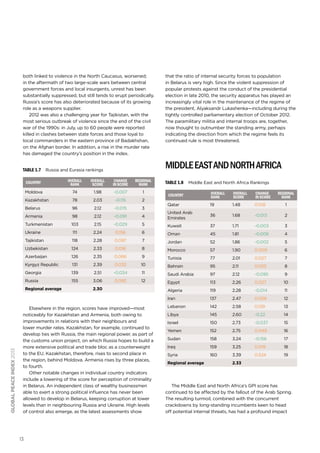
TABLE 1.5 Central America and the Caribbean rankings
Country Overall
rank
Overall
score
Change
inscore
Regional
rank
Costa Rica 40 1.76 0.074 1
Panama 56 1.89 -0.002 2
Cuba 65 1.92 -0.023 3
Nicaragua 66 1.93 -0.096 4
Trinidad and
Tobago
90 2.07 -0.019 5
Haiti 92 2.08 -0.103 6
Dominican Re-
public
94 2.10 0.026 7
Guatemala 109 2.22 -0.093 8
El Salvador 112 2.24 -0.086 9
Jamaica 117 2.27 0.007 10
Honduras 123 2.33 -0.013 11
Mexico 133 2.43 -0.011 12
Regional average   2.10    
In Central America, governments have had mixed
success in improving their internal security. Guatemala and
El Salvador stand out as two countries that have seen a
notable jump in the rankings—10 places each—albeit from
already low levels. In some cases, such as that of El Salvador,
this has been largely due to unique circumstances, such
as a temporary Church-sponsored truce between the two
main mara gangs, which has now lasted for over a year.
However, other types of violent crime are still commonplace.
The isthmus’s most dangerous country, however,
remains Honduras, which continues to lead the world in
homicides per capita. Costa Rica has been suffering from
a deterioration of internal peace, although it still remains
the region’s safest country apart from Cuba, and continues
to top the region’s overall score in 2013. However, its lead
over Panama is likely to be eroded going forward, given the
steady rise in crime in Costa Rica in the past few years.
No consistent trend is evident among Caribbean
countries, with Haiti and Trinidad and Tobago jumping up
in the rankings, while Jamaica and the Dominican Republic
have fallen. Haiti has benefited from an improvement in
its homicide rate (now the third-lowest in the region), as
the country slowly recovers from the social repercussions
of its devastating 2010 earthquake. Caribbean countries
are among the most heavily policed in the region, with
Jamaica, Trinidad and Tobago and Cuba all reporting over
400 internal security officers and police per 100,000 people
(in the case of Cuba, due to the authoritarian nature of the
regime, rather than high levels of criminality). Cuba and
Trinidad and Tobago also lead the region in armed services
personnel per head, with Cuba showing the region’s highest
levels of overall militarisation of society.
Externally, the region faces few threats, and the diffusion
of older tensions, such as a border dispute between
Nicaragua and Costa Rica, has helped to improve relations,
even if there is a measure of lingering distrust. Military
spending as a share of GDP is low (under 1% of GDP for
most countries), although both Panama and Trinidad have
seen spikes compared to the 2012 GPI.
Sub-SaharanAfrica
The perception of Sub-Saharan Africa as a locus of
economic underperformance and political instability is
increasingly out-of-date, as underscored by the 2013 results
of the GPI. Sub-Saharan Africa as a whole this year ranks
above the Middle East and North Africa, South Asia, and
Russia and Eurasia in terms of peacefulness. In part, this
reflects rising economic prosperity—Sub-Saharan economic
growth has outstripped that of every other region in the
world over the past two years—and, ironically, the region’s
traditional marginalisation from the global economy has
helped insulate it from the impact of the global financial
crisis.
However, it is clear that risks can arise where there is a
public perception that the benefits of more rapid national
growth are not being shared equitably. For example, the
deterioration in Burkina Faso’s ranking is underscored by
a rise in the likelihood of violent demonstrations, homicide
rates and violent crime. Public anger over the high cost of
living and the inadequacy of state services, notwithstanding
strong overall economic growth, has already led to a wave
of violent protests and strikes, and the potential for further
unrest remains high. To a large extent, these institutional
weaknesses are reflected in IEP research on positive peace,
which found Burkina Faso in 2012 to be the nation with
global peace index 2013 /01/ results, findings & methodology
12
the largest positive peace deficit. Frustration with the
inequitable division of spoils can also lead to an upsurge
in violent crime, or perceptions thereof, as is apparent in
the Central African Republic (CAR), Gambia, Mozambique,
Niger, Tanzania and Togo.
What a number of these states also have in common
is the increasing longevity of their leaders. Longstanding
leaders are often accompanied by a marginalisation of
opposition parties; deprived of the opportunity to change
leadership via the ballot box, populations will turn instead to
more violent means, as has been the case in the CAR (the
military coup in Mali was an exception, being a reflection
of military dissatisfaction with the conduct of an anti-
insurgency campaign). While the eventual overthrow of the
CAR’s president will be reflected in next year’s rankings,
the preceding violence and instability contributed to the
country’s ranking of 42nd out of 45 regional states.
The other states propping up the regional rankings
demonstrate the enduring impact of conflict; Cote d’Ivoire’s
2013 ranking was hit by a surge in violence in the second
half of 2012, with a series of attacks in the south of the
country blamed by the government on forces loyal to the
former president, Laurent Gbagbo. The Democratic Republic
of the Congo continues to be affected by armed conflict in
the eastern provinces of the country, which in turn is driven
by extensive population displacement over decades, as well
as a lack of central government control, competition over
control of the region’s vast natural resources and tensions
between various communities and ethnic groups. Sudan’s
low ranking is a reflection of the long-standing tensions
that led to the secession of South Sudan in July 2011. This
did not resolve issues in the states bordering what is now
South Sudan, while Somalia has not truly recovered from its
descent into civil conflict in the early 1990s.
RussiaandEurasia
Russia and Eurasia remain among the least peaceful regions
in the world in the 2013 edition of the GPI, above only South
Asia and the Middle East and North Africa. The pattern of
change across the region has been uneven, with half of the
countries deteriorating and half seeing their scores improve.
Scores worsened substantially for Ukraine, Tajikistan and
Russia. The main factors behind the decline in peacefulness
in Ukraine compared with last year were a rise in perception
of criminality under the presidency of Viktor Yanukovych
(who came to power in early 2010), alongside a worsening
of relations with an important neighbour, Russia, as the
complex struggle over Ukraine’s geo-political orientation
has heated up. In the case of Russia, scores for terrorist
activity and the number of deaths from internal conflict,
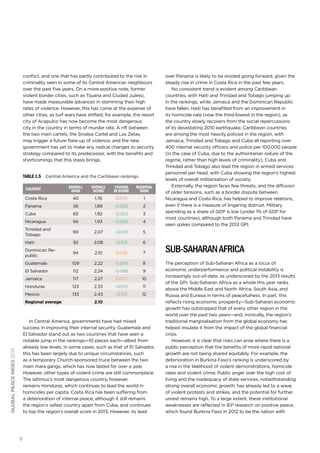
TABLE 1.6 Sub-Saharan African rankings
Country Overall
rank
Overall
score
Change
inscore
Regional
rank
Mauritius 21 1.50 -0.075 1
Botswana 32 1.60 -0.007 2
Namibia 46 1.81 — 3
Zambia 48 1.83 -0.064 4
Lesotho 49 1.84 -0.028 5
Tanzania 55 1.89 0.03 6
Ghana 58 1.90 0.106 7
Sierra Leone 59 1.90 -0.022 8
Mozambique 61 1.91 0.064 9
Djibouti 63 1.92 -0.016 10
Togo 67 1.95  n/a 11
Malawi 74 1.98 0.017 12
Gabon 76 2.00 -0.007 13
Liberia 80 2.05 -0.019 14
Senegal 85 2.06 0.034 15
Burkina Faso 87 2.06 0.2 16
Swaziland 88 2.07 0.023 17
Equatorial Guinea 89 2.07 0.026 18
Madagascar 90 2.07 -0.08 19
The Gambia 93 2.09 0.073 20
Angola 102 2.15 0.004 21
Benin 104 2.16 -0.071 22
Uganda 106 2.18 -0.02 23
Republic of the
Congo
107 2.18 0.008 24
Cameroon 108 2.19 0.06 25
Guinea 116 2.27 0.115 26
Eritrea 120 2.29 0.007 27
South Africa 121 2.29 0.023 28
Mauritania 122 2.33 -0.064 29
Mali 125 2.35 0.08 30
Niger 127 2.36 -0.024 31
Guinea-Bissau 132 2.43 -0.024 32
Rwanda 135 2.44 0.096 33
Kenya 136 2.47 0.133 34
Chad 138 2.49 -0.138 35
South Sudan 143 2.58  n/a 36
Burundi 144 2.59 -0.025 37
Ethiopia 146 2.63 0.058 38
Nigeria 148 2.69 -0.014 39
Zimbabwe 149 2.70 0.098 40
Cote d'Ivoire 151 2.73 0.237 41
Central African
Republic
153 3.03 0.122 42
Democratic
Republic of
the Congo
156 3.09 -0.014 43
Somalia 161 3.39 -0.092 44
Regional average   2.24    
13
globalpeaceindex2013
both linked to violence in the North Caucasus, worsened;
in the aftermath of two large-scale wars between central
government forces and local insurgents, unrest has been
substantially suppressed, but still tends to erupt periodically.
Russia’s score has also deteriorated because of its growing
role as a weapons supplier.
2012 was also a challenging year for Tajikistan, with the
most serious outbreak of violence since the end of the civil
war of the 1990s: in July, up to 60 people were reported
killed in clashes between state forces and those loyal to
local commanders in the eastern province of Badakhshan,
on the Afghan border. In addition, a rise in the murder rate
has damaged the country’s position in the index.
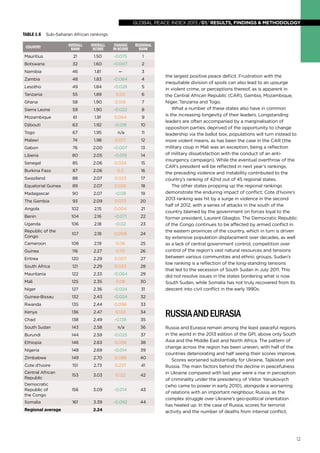
TABLE 1.7 Russia and Eurasia rankings
Country Overall
rank
Overall
score
Change
inscore
Regional
rank
Moldova 74 1.98 -0.007 1
Kazakhstan 78 2.03 -0.115 2
Belarus 96 2.12 -0.015 3
Armenia 98 2.12 -0.091 4
Turkmenistan 103 2.15 -0.029 5
Ukraine 111 2.24 0.156 6
Tajikistan 118 2.28 0.097 7
Uzbekistan 124 2.33 0.016 8
Azerbaijan 126 2.35 0.066 9
Kyrgyz Republic 131 2.39 0.032 10
Georgia 139 2.51 -0.034 11
Russia 155 3.06 0.092 12
Regional average 2.30    
Elsewhere in the region, scores have improved—most
noticeably for Kazakhstan and Armenia, both owing to
improvements in relations with their neighbours and
lower murder rates. Kazakhstan, for example, continued to
develop ties with Russia, the main regional power, as part of
the customs union project, on which Russia hopes to build a
more extensive political and trade bloc as a counterweight
to the EU. Kazakhstan, therefore, rises to second place in
the region, behind Moldova. Armenia rises by three places,
to fourth.
Other notable changes in individual country indicators
include a lowering of the score for perception of criminality
in Belarus. An independent class of wealthy businessmen
able to exert a strong political influence has never been
allowed to develop in Belarus, keeping corruption at lower
levels than in neighbouring Russia and Ukraine. High levels
of control also emerge, as the latest assessments show
that the ratio of internal security forces to population
in Belarus is very high. Since the violent suppression of
popular protests against the conduct of the presidential
election in late 2010, the security apparatus has played an
increasingly vital role in the maintenance of the regime of
the president, Alyaksandr Lukashenka—including during the
tightly controlled parliamentary election of October 2012.
The paramilitary militia and internal troops are, together,
now thought to outnumber the standing army, perhaps
indicating the direction from which the regime feels its
continued rule is most threatened.
MiddleEastandNorthAfrica
TABLE 1.8 Middle East and North Africa Rankings
Country Overall
rank
Overall
score
Change
inscore
Regional
rank
Qatar 19 1.48 0.108 1
United Arab
Emirates
36 1.68 -0.013 2
Kuwait 37 1.71 -0.003 3
Oman 45 1.81 -0.006 4
Jordan 52 1.86 -0.002 5
Morocco 57 1.90 0.009 6
Tunisia 77 2.01 0.027 7
Bahrain 95 2.11 0.025 8
Saudi Arabia 97 2.12 -0.095 9
Egypt 113 2.26 0.027 10
Algeria 119 2.28 -0.014 11
Iran 137 2.47 0.056 12
Lebanon 142 2.58 0.139 13
Libya 145 2.60 -0.22 14
Israel 150 2.73 -0.037 15
Yemen 152 2.75 0.049 16
Sudan 158 3.24 -0.156 17
Iraq 159 3.25 0.019 18
Syria 160 3.39 0.524 19
Regional average   2.33    
The Middle East and North Africa’s GPI score has
continued to be affected by the fallout of the Arab Spring.
The resulting turmoil, combined with the concurrent
crackdowns by long-standing incumbents keen to head
off potential internal threats, has had a profound impact
global peace index 2013 /01/ results, findings & methodology
14
on the region’s overall peacefulness. This is especially
notable in Tunisia, Egypt and Yemen, which have all seen a
deterioration in their scores. The new leaderships in these
post-revolutionary states have struggled to implement
an orderly transition, resulting in a resurgence of violent
protests, rising violent crime and, in the cases of Egypt
and Yemen, an increase in terrorist activity. As a result, all
three have suffered a further slide down the rankings. More
positively, Libya, which is also grappling with a difficult
transition, has experienced an improvement in its score,
after the conclusion of its civil war and the removal of
Muammar Qadhafi.
With the exception of Bahrain, the wealthier Gulf Arab
states have managed to remain largely on the peripheries
of the Arab Spring, although their internal peace rankings
are undermined by a lack of democratic institutions and
an intolerance of dissent. Indeed, Saudi Arabia improved
significantly, reflecting an easing of concerns over the
prospects for violent unrest (a “day of rage”, scheduled
on Facebook to bring protesters out on the street, barely
attracted a dozen people) and a small drop-off in military
expenditure, although spending is expected to rise once
again in the coming years. In contrast, Bahrain continues
to be affected by increasingly violent protests, largely
from the country’s Shia majority. This prompted the
government to introduce a ban on public demonstrations
in October, which in turn drove the country’s six-place fall
in the rankings. The only other Gulf Co-operation Council
(GCC) state to see a deterioration in its ranking was Qatar.
This largely reflects the Qatari government’s increasingly
assertive foreign policy, which has led to friction with
other regional powers (and has consequently prompted
a deterioration in the emirate’s score for relations with
neighbouring countries), and been accompanied by a
ramping up of military spending.
Qatar’s predilection for foreign intervention has been
especially evident of late in Syria, where Qatar has been
funnelling arms and money to the opposition, which,
unsurprisingly, saw the region’s biggest fall in score this year
and is now the lowest-ranked MENA country in the GPI.
Syria’s ongoing civil war has seen a mass militarisation of
the population and an upsurge in terrorist attacks, and has
resulted in the deaths of around 70,000 people. In addition,
1.3m Syrians have now fled the country, with a further 3.8m
internally displaced.
The impact on neighbouring states has also been marked,
with politically fragile Lebanon especially affected—divisions
between the ruling March 8th alliance, dominated by Hezbollah
and its pro-Syrian allies, and the pro-Western March 14th
alliance, have been further deepened by the crisis, and, amid
the growing turmoil, the prime minister resigned in March.
Although less heavily affected domestically, the external
peace scores of Iraq and Jordan have also deteriorated in
the wake of the civil war in Syria. The deteriorating situation
in Syria is also a major concern for Israel, especially given
the regime’s large chemical weapons stocks and tensions
in the Israeli-occupied, but Syrian-claimed, Golan Heights;
however, the worsening in Israel’s already low score for
peacefulness stems from its short war with Hamas (an
Islamist group that controls the Gaza Strip) in November
2012, and the associated rise in its defence spending.
SouthAsia
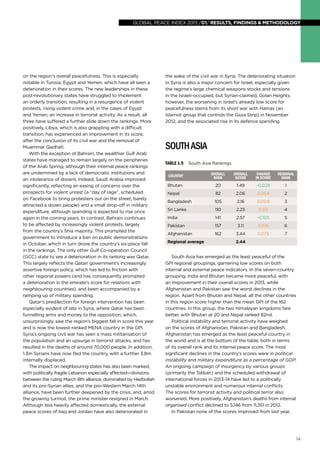
TABLE 1.9 South Asia Rankings
Country Overall
rank
Overall
score
Change
inscore
Regional
rank
Bhutan 20 1.49 -0.028 1
Nepal 82 2.06 0.054 2
Bangladesh 105 2.16 0.009 3
Sri Lanka 110 2.23 0.03 4
India 141 2.57 -0.105 5
Pakistan 157 3.11 0.106 6
Afghanistan 162 3.44 0.075 7
Regional average 2.44    
South Asia has emerged as the least peaceful of the
GPI regional groupings, garnering low scores on both
internal and external peace indicators. In the seven-country
grouping, India and Bhutan became more peaceful, with
an improvement in their overall scores in 2013, while
Afghanistan and Pakistan saw the worst declines in the
region. Apart from Bhutan and Nepal, all the other countries
in this region score higher than the mean GPI of the 162
countries. In this group, the two Himalayan kingdoms fare
better, with Bhutan at 20 and Nepal ranked 82nd.
Political instability and terrorist activity have weighed
on the scores of Afghanistan, Pakistan and Bangladesh.
Afghanistan has emerged as the least peaceful country in
the world and is at the bottom of the table, both in terms
of its overall rank and its internal peace score. The most
significant declines in the country’s scores were in political
instability and military expenditure as a percentage of GDP.
An ongoing campaign of insurgency by various groups
(primarily the Taliban) and the scheduled withdrawal of
international forces in 2013-14 have led to a politically
unstable environment and numerous internal conflicts.
The scores for terrorist activity and political terror also
worsened. More positively, Afghanistan’s deaths from internal
organised conflict declined to 5,146 from 11,351 in 2012.
In Pakistan none of the scores improved from last year,
15
globalpeaceindex2013
but there was further deterioration in the level of organised
conflict, violent crime and terrorist activity. The scores are
mostly a reflection of the escalation in sectarian militant
activity targeting the minority Shia community. Although
Shias are in the minority in Pakistan, they constitute one-
fifth of the population. According to Human Rights Watch,
325 members of the Shia community were killed across
Pakistan in 2012, in separate incidents targeting the minority
group. In 2013, the death toll for January and February,
as a result of two separate bombings targeting the Shia
community, stands at 200. It is believed that groups such
as Lashkar-e-Jhangvi, which believes that Shia Muslims are
heretics, have stepped up attacks on the Shia community.
The political environment in Bangladesh became less
stable in the current round of scoring and the country’s
peace indicators took a hit from increased terrorist activity.
Ongoing war tribunals, wherein senior political figures
have been charged with atrocities committed in the 1971
war of secession with Pakistan and secular groups have
demanded tougher punishments for those convicted, have
led to frequent violent street clashes between the police
and supporters of the political leaders. Along with this, the
campaigns of violence by terrorist groups have also led to
increased instability.
In Sri Lanka, both internal and external peace indicators
weighed negatively on the overall score. The existing
divisions in society, increased attacks on the media and
rising anti-Muslim sentiment have impacted the peace
scores for the country. India’s internal peace indicators
benefited from an improvement in the perception of
criminality in society and the number of deaths from
organised conflict, but increased defence spending pulled
its score down. India’s overall internal peace score improved
by 0.2 points, but its external peace indicator declined
marginally this year. India’s relations with neighbours
Pakistan and China have been turbulent and border
skirmishes are not unheard of. Overall, however, relations
with both China and Pakistan have improved, with frequent
diplomatic exchanges taking place between the countries.
Nevertheless, border tensions require India to maintain a
large military force and the increase in defence expenditure
was a drag on the overall peace score. Nepal’s political
stalemate has led to increased uncertainties. Although an
interim government was appointed earlier this year, it is yet
to finalise the new constitution and determine an election
date. Perhaps unsurprisingly, Bhutan, known for using gross
national happiness, rather than GDP, to gauge its progress,
remains the most peaceful country in the region.
India’s internal peace
indicators benefited
from an improvement
in the perception of
criminality in society
and the number of
deaths from organised
conflict but increased
defence spending
pulled its score down.
global peace index 2013 /01/ results, findings & methodology
1616
Iceland is classified the most
peaceful nation of 162 surveyed in
the 2013 GPI, followed by Denmark
and New Zealand.
Iceland:1stplace
Score 1.162
Iceland is the world’s most peaceful country. The island
nation is free from conflict; crime and homicide rates are
minimal; and the jailed population is considerably lower than
elsewhere in Europe and among the smallest proportions
in the world, remaining at 47 per 100,000 in 2012. Indeed,
all of Iceland’s GPI measures of safety and security in
society receive the lowest possible scores (1), apart from
the number of internal security officers and police, and
perceived criminality in society (both accorded a score of
2: “low”). The political scene has been fairly stable under the
centre-left coalition of the Social Democratic Alliance (SDA)
and the Left-Green Movement (LGM). Led since April 2009
by the reformist prime minister, Johanna Sigurdardottir, the
coalition has presided over a gradual economic recovery,
which won praise from the IMF in 2012. However, a growing
backlash against austerity and eventual accession to the
EU saw the centre-right Independence Party and the
Progressive Party return to power in the April 2013 general
election. Olafur Ragnar Grimsson remains president; he won
a fifth successive term of office in July 2012, defeating his
nearest rival by nearly 20% of the vote.
Iceland has no standing army; the Icelandic Defence
Agency (IDA), which was launched in 2008 with a budget
of US$20m, was disbanded amid austerity measures in the
wake of the collapse of the country’s three main commercial
banks and of the currency. A modest budget is channelled
to the Coast Guard, which operates a small number of
lightly armed ships and aircraft. A member of NATO since
its inception in 1949, Iceland participates in international
peacekeeping missions in Afghanistan, Lebanon, Palestine
and the Balkans.
denmark:2ndplace
Score 1.207
Denmark’s GPI score was unchanged from 2012 and it
remains the world’s second-most peaceful country. A slight
rise in terrorist activity, from a very low base (according
to IEP’s Global Terrorism Index), was offset by a drop in
imports of major conventional weapons, amid ongoing
budget constraints. This continues a trend: the current Danish
defence agreement reduces the number of the country’s
F-16 fighter aircraft from 48 to 30 and the process of
procuring new F-35 fighters was put on hold in March 2010.
Military spending remains at a relatively modest 1.3% of GDP,
although Denmark’s heavy-weapons capability is higher than
that of Austria, Ireland and Iceland.
Denmark ranks highest in the world for internal peace,
ahead of Iceland by virtue of having an even lower number
of police and internal security officers per capita. Crime and
homicide rates are extremely low, violent demonstrations
are highly unlikely and very few citizens are in jail (just
68 people per 100,000, one of the lowest proportions
in Europe). While the minority coalition of the Social
Democrats, the Socialist People’s Party and the Social
Liberal Party has seen its poll ratings slide since taking office
in October 2011, it is stable and not under threat. Relations
with neighbouring Sweden, Norway and Germany have long
been harmonious.
NewZealand:3rdplace
Score 1.237
New Zealand remains the third-most peaceful country in the
world. Its overall score deteriorated slightly in response to
a marginal rise in military expenditure, to a still-low 1.4% of
the10
countries
mostatpeace
2013 global peace index /01/ results, findings & methodology
17
globalpeaceindex2013
17
GDP. The New Zealand Defence Force has just 8,617 active
personnel and a modest stock of military hardware—in 2001
the Labour government removed air-combat capability
by cancelling the planned purchase of F-15 jets. The 2010
Defence White Paper included a pledge to maintain and
enhance existing capabilities and to provide additional
services, such as maritime air patrols, in spite of the tough
fiscal climate.
The majority of the GPI’s measures of safety and security
suggest that New Zealand society is broadly harmonious;
violent demonstrations are highly unlikely, while homicides
and terrorist acts are very rare. The jailed population
dropped, but not sufficiently to have an impact on the
country’s overall GPI score; at 194 per 100,000, it remains
higher than that of most OECD countries, notably Japan
(55) and Switzerland (76). New Zealand’s political scene
remained stable, with support for the prime minister, John
Key, and the ruling centre-right National Party holding
up amid confidence over the government’s handling of
the economy, which grew by 2.5% in 2012. New Zealand
maintained harmonious relations with its neighbours in
2012; links with Australia are underpinned by the 1983
Closer Economic Relations (CER) agreement. The two
governments are negotiating a protocol on a common
border, pension portability and joint investment, all of which
would move the countries closer to their goal of forming a
single economic market.
Austria:4thplace
Score 1.250
Austria became more peaceful in 2012/13, moving up two
places in the Index. The compilers of the Political Terror
Scale report a more benign environment and violent
demonstrations are considered to have become less likely
in the year to March 2013. This indicator ratcheted up in the
previous year, partly in response to protests against Internet
restrictions (the Anti-Counterfeiting Trade Agreement,
ACTA) in several Austrian cities in February 2012. Austria’s
indicators of internal peace point to a broadly harmonious
society, with notably modest tallies for the level of violent
crime and the homicide rate, which remain among the
lowest of the 162 nations surveyed.
Military spending rose slightly in 2012, but, at just 0.8%
of GDP, it remains very low—the legacy of the 1955 Austrian
State Treaty, which committed the country to permanent
neutrality. Among OECD countries, only Ireland, Mexico
and Iceland direct a smaller proportion of their GDP to
the military. Budget cuts over recent years have led to
substantial reductions in the fleet of armoured vehicles
and artillery, although the controversial procurement of
Eurofighter Typhoon interceptors went ahead and the
joint-command air force now has 15 of the jets. This results
in a higher score (“less at peace”) in the nuclear and heavy-
weapons capability indicator than, for example, Hungary
and Iceland. The political scene is broadly stable, with the
coalition of the Austrian People’s Party (ÖVP) and the Social
Democratic Party (SPÖ) likely to continue until the next
election, which is due in September 2013.
Switzerland:5thplace
Score 1.272
Switzerland drops to 5th position in the 2013 GPI. Last year,
it entered the top ten in the Index for the first time, primarily
as a result of contractions in its military sphere. While the
country has a tradition of neutrality that dates from the
Treaty of Paris in 1815, Switzerland maintains a significant
defence industry and exports of conventional weapons
per capita are among the highest in Europe. However, the
volume has declined since restrictions banning sales to
countries involved in armed conflict, or that “systematically
and severely violate human rights”, were introduced in
2009. Military expenditure was at 0.8% of GDP in 2012,
continuing a trend that began in 2003, when a sweeping
reform programme, known as Army XXI, was introduced.
Nuclear and heavy-weapons capabilities are adjudged to be
moderate and, while restricted, access to light weapons is
easier than in Iceland and New Zealand.
Switzerland enjoys very low levels of violent crime,
homicides and political terror, although the GPI gauge of
terrorist activity registered a modest rise from a very low
base, with three incidents recorded in 2011 by the University
of Maryland’s Global Terrorism Database. The political
scene is stable, although the right-wing Swiss People’s
Party (SVP), which retained most seats of any party in
the October 2011 election, continues to pursue opposition
tactics in the five-party coalition government. While the
euro debt crisis and the strength of the Swiss franc pose
threats, the fundamentals of the economy are strong and
violent demonstrations remained highly unlikely in 2012 and
early 2013.
Japan:6thplace
Score 1.293
Japan’s overall peacefulness improved from last year. The
compilers of the Political Terror Scale report that conditions
in Japan returned to the most peaceful level recognised by
the GPI, having previously risen as a result of concerns raised
in Amnesty International’s 2010 report. Despite the ban on
maintaining war potential, which was enshrined in Japan’s
1946 constitution, the country’s self-defence forces (SDF) are
global peace index 2013 /01/ results, findings & methodology
1818
sophisticated and capable and the government has recently
unveiled plans to boost its forces and missile defences over
the next decade, in order to counter China’s military rise and
the threat from a nuclear-armed North Korea. Tensions with
China and Taiwan over control of the Senkaku/Diaoyu islands
continued: all three countries reiterated their sovereignty
claims in 2012, with Japan’s supported by a nationalist activist
group, Ganbare Nippon. Japan’s relations with neighbouring
countries are therefore rated “moderate”, a notably higher
score than the other top-ten nations, which contributes to
Japan’s relatively lowly rank of 88th in external peace—nine
GPI indicators covering militarisation, external conflict and
refugees/displaced persons.
In terms of internal peace, Japan is ranked 2nd in the
world, behind Iceland. The country remained free from civil
unrest in 2012, while violent crime and homicides are very
rare and terrorist activity highly unlikely. Japan incarcerates
fewer citizens than almost anywhere in the world (55 per
100,000 people) and stringent laws prohibit the possession
of firearms. Japan’s political scene is stable (more so than
most other countries in the region) and the centre-right
Liberal Democratic Party (LDP), led by Shinzo Abe, which
was emphatically returned to power in December 2012, has
a good chance of serving a full four-year term.
Finland:7thplace
Score 1.297
Finland remained essentially peaceful in 2012/13; the
country’s overall GPI tally was unchanged, but it slipped
to 7th place owing to more substantial gains in Austria
and Japan. Like many other European countries, defence
expenditure has come under pressure and Finland has
embarked on a wide-ranging review that may include the
closure of bases. Since the end of the cold war, Finland has
adopted a policy of strategic non-alignment and chosen
not to apply for NATO membership, despite the fact that
the three former Soviet Baltic states joined in 2004. The
majority of Finland’s measures of militarisation are accorded
low scores in a broad international comparison, with the
lowest number of internal security officers and police per
capita (152 per 100,000 population) in the OECD and
fairly low volumes of imports and exports of conventional
weapons. There is a growing emphasis on participation
in international defence partnerships, which will probably
extend to procurement, and 195 soldiers are deployed in
Afghanistan as part of the NATO-led force there.
Finnish society is broadly safe and secure; there is no civil
unrest, crime rates are very low and terrorist activities highly
unlikely, although the homicide rate remains higher than
in the other Nordic countries. Finland’s jailed population
is very low: just 60 per 100,000 people in 2012. Among
OECD countries, only Iceland and Japan incarcerate a lower
proportion of their populations. While the six-party coalition
government that was formed in June 2011 represents a
broader spectrum of opinion than is usual, it is stable and
expected to last out its four-year term. Relations with
neighbouring Nordic countries are harmonious and ties with
Russia have improved.
Canada:8thplace
Score 1.306
Canada became slightly more peaceful in 2012/13, leading to
a one-position improvement in this year’s rankings. Canada’s
military expenditure dipped to 1% of GDP in 2012, reflecting
swinging government cutbacks; the army’s budget has
reportedly been cut by 22% since 2010 and the military has
scaled back its Arctic exercises. Canada’s relations with the
US improved, mainly reflecting the ending of a protectionist-
tinged period when the buy American stipulation in the US
fiscal stimulus was in force in 2010-12. The number of internal
security officers and police rose slightly, to 204 per 100,000
people, which is still low by the standards of OECD countries.
Canadian society is largely harmonious, free from internal
conflict and with very low crime and homicide rates. Violent
demonstrations are rare, but considered more likely to
occur than in some countries, including Iceland and Japan.
The proportion of the population in jail is higher than in
the Scandinavian nations, but lower than in New Zealand
and much lower than in the US. Access to small arms and
light weapons has been restricted since the 1995 Firearms
Act and they are far less readily available than in the US,
but more so than in Japan and several Western European
countries. The Conservative Party, led by Stephen Harper,
the prime minister, has a majority in parliament, providing a
stable political environment; the government is expected to
last its full five-year term to 2015.
Sweden:9thplace
Score 1.319
In terms of “internal peace”, Sweden performs impressively
– 4th of the 162 countries surveyed, behind only Iceland,
Japan and Denmark. There is no civil unrest, crime and
homicide rates are extremely low, terrorist activities highly
unlikely and the jailed population minimal – dropping to
just 70 per 100,000 people in 2012. Sweden’s relations with
neighbouring countries have long been harmonious, and
economic integration in the region has strengthened since
the Baltic States joined the European Union in 2004. The
political scene is stable, with the minority four-party centre-
right Alliance for Sweden expected to hold together and
2013 global peace index /01/ results, findings & methodology
19
globalpeaceindex2013
19
serve a full term to September 2014.
Small arms and light weapons are easier to access than
some other countries in the top ten of the GPI, but two other
measures of militarization continue to weigh on Sweden’s GPI
tally: the volume of exports of major conventional weapons
per head of population and, to a lesser extent, nuclear and
heavy weapons capabilities. In the former indicator, Sweden
is ranked second-lowest of the 162 countries, behind Israel,
reflecting the country’s dynamic defence industry, with a
long history despite Sweden’s neutral stance since the early
nineteenth century. Karlskronavarvet, specializing in naval
surface vessels and submarines, and Bofors, a producer
of artillery systems once owned by Alfred Nobel, have, for
example, been in business for more than 300 years. The
country’s heavy weapons are mainly associated with the
Swedish Air Force, which was expanded after the Second
World War to combat a feared invasion by the Soviet Union.
There are 130 fighter jets in service, all of which are built by
the local aerospace firm, Saab.
Belgium:10thplace
Score 1.339
Belgium is the 10th-most peaceful country in the world in
2012/13. It is free from civil unrest, its homicide rate is very
low, terrorist activities are highly unlikely and a relatively
low proportion of the population is in jail, although a higher
proportion than in Scandinavia. Violent crime is low, as is
the risk of violent demonstrations, but both receive higher
scores than the Nordic nations. There was an improvement
in the country’s standing in the Political Terror Scale to
the lowest (most peaceful) level, for the first time since
2001. This brings Belgium alongside most countries in
Western Europe, with the exception of France, Italy, Spain
and Portugal. Belgium enjoys harmonious relations with
neighbouring countries, but ongoing tensions at home
across the two linguistic communities have undermined
political stability in recent years. A six-party coalition
government, headed by Elio Di Rupo, was finally formed in
December 2011, almost 18 months after the general election.
The hardline separatist New-Flemish Alliance (N-VA) is likely
to exploit its position as the main opposition party in order
to boost its popularity further.
An active participant in NATO missions, Belgium typically
channels around 1% of its GDP to military/defence purposes.
Most GPI gauges of militarisation are accorded relatively
low scores, although the volume of transfers (exports) of
major conventional weapons is notably higher than for
most similarly sized OECD countries. In 2008 FN Herstal,
a Belgium-based small-arms manufacturer, controversially
signed a €12m contract with Muammer Qadafi’s government
to supply Libya’s 32nd brigade.
global peace index 2013 /01/ results, findings & methodology
2020
War-torn Afghanistan is classified
the least at peace out of 162
countries, followed by Somalia
and Syria.
Afghanistan:162ndplace
Score 3.440
Embroiled in conflict and instability for much of the
past two decades, Afghanistan remained far from
peaceful during 2012. While two GPI indicators registered
improvements (fewer people killed as a result of internal
conflict and a drop in the number of refugees and displaced
people), four deteriorated and the country returned to
the foot of the GPI, below an improving Somalia. The UN
believes that 2,754 civilians were killed during 2012 (down
from 3,021 in 2011), the result of reduced ground fighting
by Taliban and US troops, a decrease in the number of
NATO airstrikes and fewer attacks by insurgents. Deadly
suicide attacks continued throughout 2012, however; one in
Maimana in late October killed 41 and injured 56. The capital,
Kabul, suffered two major attacks in 2012: on the parliament
building, the International Security Assistance Force (ISAF)
headquarters and the British and German embassies in
mid-April; and, in June, on a hotel, which culminated in a
fire-fight, leaving at least 22 dead. Casualties among the
NATO-led ISAF dropped to 402 in 2012, compared with 566
in 2011 and 711 in 2010.
The compilers of the Political Terror Scale registered
a deterioration in Afghanistan’s score and the measure of
terrorist activities also worsened. Afghanistan’s political
scene became even more unstable in 2012 amid the ongoing
insurgency, the imminent transition of security responsibility
to domestic forces, the withdrawal of international troops
over the coming year and the presidential election in 2014.
The Afghan National Army (ANA) has expanded steadily in
recent years, with reports of 200,000 serving troops in early
2013. Under the 2012 US-Afghanistan Strategic Partnership
Agreement, the US designated Afghanistan a “major non-
NATO ally” and it will continue to provide funding for the
ANA, including for salaries, military equipment and training.
The International Institute for Strategic Studies (IISS)
reported a sharp rise in Afghanistan’s military expenditure in
2012, to 11.2% of GDP, one of the highest proportions in the
world.
Somalia:161stplace
Score 3.394
A drop in the number of fatalities resulting from internal
conflict and improved relations with neighbouring countries
contributed to a more peaceful environment in Somalia in
2012/13, and lifted the country from the foot of the GPI after
two years. Worsening conditions in Afghanistan were also
a factor. The violent confrontation between the Transitional
Federal Government (the Federal Government of Somalia
from August 2012) and Islamist rebel groups, Hizbul Islam
and al-Shabaab, continued for the seventh successive
year. Somali government troops made substantial military
gains in the south. In February 2012 al-Shabaab lost the
key southern town of Baidoa to Kenyan troops and Somali
government forces and, in May, African Union (AU) and
Somali government forces captured Afgoye, cutting al-
Shabaab territory in half.
While Somalia’s political scene remains unstable, the first
formal parliament since the country descended into civil war
in 1991 took office in August 2012. Hassan Sheikh Mohamud,
an academic and civic activist, was chosen by parliament to
be president. His appointment, along with the government’s
recent territorial gains, contributed to the improvement in
the GPI measure of relations with neighbouring countries;
the Somali government is currently receiving support
from Kenyan, Ethiopian, Burundian and Djiboutian troops
(mostly under the purview of the African Union Mission in
Somalia, Amisom) to fight the Islamist militia. There was
also a sharp drop in the number of reported pirate attacks
off Somalia’s coast in 2012, with 75 incidents, according
to the International Maritime Bureau, compared with 237
the10
countries
leastatpeace
2013 global peace index /01/ results, findings & methodology
21
globalpeaceindex2013
in 2011. This reflected the presence of international naval
collaboration and private armed security teams aboard
ships. Almost all of Somalia’s measures of societal safety
and security continue to receive very poor GPI tallies. The
exceptions are police numbers per head and the proportion
of the population in jail, on account of the country’s lack of
civil institutions.
Syria:160thplace
Score 3.393
Syria experienced by far the greatest deterioration in
peacefulness in the world in 2012/13 and the largest fall
in the history of the GPI. The violent conflict between
forces loyal to the president, Bashar al-Assad, and those
opposed to his rule escalated into a full-scale civil war.
The UN estimates that 70,000 people have been killed
since March 2011, when protests against al-Assad’s regime
erupted in the southern city of Deraa. Throughout 2012,
mass protests took place across the country, which were
often violently dispersed by the Syrian Armed Forces (SAF).
Rebel-controlled land in the north and east has come under
sustained bombardment from government forces, while the
SAF has fought to retain its grip on a north-south axis from
Damascus through Homs and Hama, to the port of Latakia,
formerly home to the al-Assad family. Opposition groups
are divided, representing different ethnic groups; there have
been clashes between Kurdish militias and Islamist groups,
some of which have been reinforced by foreign jihadists.
By the end of 2012 more than 500,000 refugees had been
registered in Egypt and other neighbouring countries and
an estimated 2.3m have been forced to leave their homes
within Syria.
Beneath it all has been the brutalisation of life in Syria,
a relatively peaceful place two years ago. Most of the
GPI indicators of safety and security in society—violent
crime, homicide rate, terrorist activities and the Political
Terror Scale, all worsened substantially. Political instability
increased, as the regime and its Alawite allies continued to
launch attacks on a disintegrating nation from their fortified
enclave. Relations with neighbouring Iraq, Israel, Jordan,
Lebanon and Turkey remained extremely tense, with the
GPI score for this indicator unchanged at 5 from last year.
The largest deterioration was seen in the number of internal
security officers and police, with large use of the army to
repress the population and fight the rebels, as Assad tries
to hold on to power and armed opposition to the regime
increases. The civil war has clearly undermined regulations
regarding the possession of firearms; rebel forces have
reportedly brought in weapons from Lebanon, and Gulf
countries, including Qatar, Saudi Arabia and Kuwait, have
reportedly supplied opposition fighters with light weapons,
many through private donors.
Iraq:159thplace
Score 3.245
Iraq became marginally less peaceful in 2012, largely
because of a substantial rise in military expenditure, to an
estimated 7.1% of GDP (up from 3.1%) in 2011. This reflects
the purchase of equipment, including 18 Lockheed Martin
F-16 fighter jets, costing around US$3bn, intended to form
the basis of the country’s air sovereignty. Iraq remains a
highly militarised country; small arms and light weapons
are numerous and very easily obtained. The GPI measure
of Iraq’s relations with its neighbours also deteriorated,
specifically with Turkey, following Ankara’s arrangement
with the autonomous Kurdistan Regional Government
(KRG). Economic and diplomatic relations with Turkey
may be in jeopardy. There is also heightened tension
and uncertainty over Iraq’s relationship with Syria; Iraq
has been less vocally critical of the Syrian government’s
crackdown than many of its Arab peers. The political scene
became slightly more stable, with the prime minister, Nouri
al-Maliki, appearing to have broad popular support; he is
likely to remain in office until the next elections, scheduled
21
Syria experienced by far
the greatest deterioration
in peacefulness in the
world in 2012/13 and the
largest fall in the history
of the GPI. The violent
conflict between forces
loyal to the president,
Bashar al-Assad, and
those opposed to his
rule escalated into a
full-scale civil war. The
UN estimates that 70,000
people have been killed
since March 2011.
global peace index 2013 /01/ results, findings & methodology
22
for 2014. Nevertheless, the government of national unity,
which brings together the four largest political groups,
remained weak and divided and tensions between the
central government in Baghdad and the KRG, stemming
from the allocation of oil revenue, persist.
The compliers of the Political Terror Scale report a
marginally more benign environment. There was also a
reduction in the number of refugees and internally displaced
people, to 8.5% of the population, still the sixth-highest
proportion in the world. This partly reflects the return of
Iraqis from an increasingly unstable Syria (around 1m Iraqis
are thought to live there, with another 475,000 in Jordan).
The GPI measure of internal conflict remained at a very high
level; sectarian tension and violence remain widespread and
the Iraq Body Count recorded 4,573 civilian deaths from
violence in 2012, up from 4,087 last year. Sunni militant
groups launched bomb attacks on governmental institutions
and security forces across the country, notably in Anbar,
Diyala, Ninawa, Salah ad-Din and the capital, Baghdad. The
homicide rate, the level of violent crime, the perceptions
of criminality, the likelihood of violent demonstrations
and terrorist activity all receive the highest possible tallies
(unchanged from last year).
Sudan:158thplace
Score 3.242
Sudan became slightly more peaceful in 2012/13, moving
above Iraq, but remaining among the five lowest-ranked
nations in the GPI. Measures of internal conflict and battle-
related deaths declined from very high levels, as did the
homicide rate. Nevertheless, several conflicts raged on:
in February 2013; for example, 60 people were reported
killed and 83 injured in inter-tribal fighting in the Jebel
Marra region of North Darfur. Violent conflicts continued
in the Sudanese provinces of South Kordofan and Blue
Nile between the government and the Sudan People’s
Liberation Movement/Army-North. Furthermore, the conflict
between Sudan and South Sudan over the oil-rich Abyei
area escalated, with reports of aerial bombardments by the
Sudanese Air Force and heavy fighting over oil installations
in April and May 2012.
The UNHCR reported that the number of refugees and
internally displaced persons rose again, reaching 14.2% of
Sudan’s population. The UN estimates that up to 300,000
people have died and around 2.7m have been forced to
flee their homes from the combined effects of war, famine
and disease in Darfur since 2003. There were also increases
in terrorist activity and in the number of armed services
personnel. The political scene remained unstable. Tensions
within the ruling National Congress Party (NCP), headed
by the president, Omar al-Bashir, over allowing the south
to secede abated following a trade, oil and security deal
with the South Sudan government, brokered by Ethiopia
in September 2012. Nevertheless, the government faced
several protests in Khartoum during 2012 over austerity
measures linked to the post-succession drop in oil revenue.
Sudan’s scores for the Political Terror Scale remain at the
worst possible level, unchanged since 2012. Perceptions of
criminality and the level of violent crime, however, receive
more moderate scores than most countries in the lowest
reaches of the GPI, which reflects Sudan’s size and the fact
that, while parts of the country are in turmoil, other areas,
including the capital, Khartoum, are stable. Sudan’s military
sphere is relatively little-developed; military expenditure,
for example, is 1.8% of GDP, lower than elsewhere in the region.
Pakistan:157thplace
Score 3.106
Pakistan became even less peaceful in 2012. Three GPI
indicators deteriorated: the intensity of internal conflict,
terrorist activity and the level of violent crime, two of
which had improved in 2011. Pakistan dropped below the
Democratic Republic of the Congo (DRC) and Central
African Republic (CAR), to rank 157th of 162 nations. The
conflict over national power and political orientation
between the government, which is supported by the US,
and various Islamist militant groups, including Tehrik-i-
Taliban (TTB, also known as the Pakistani Taliban), al-Qaeda
and Haqqani network continued for the sixth consecutive
year. According to the Global Terrorism Index, terrorism-
related violence caused 1,468 deaths in Pakistan in 2011
(the latest available year). The most serious clashes took
place in the Federally Administrated Tribal Areas (FATA),
especially Orakzai, Khyber and North Waziristan, where US
drone strikes continued. Sectarian violence also increased
in 2012; the Institute for Conflict Management reports 113
attacks against the Shia minority, while ethnic violence in
Sindh province eased, with fewer reported attacks and riots
in Karachi.
The political scene remained fairly unstable in 2012,
although less so than in most countries ranked in the GPI’s
ten-lowest positions. Speculation about a military coup
proved wide off the mark and, while there have been tensions
between the coalition government and the army, parliament
is set to complete its five-year term, a rarity in Pakistan.
Relations with neighbouring Afghanistan and India remained
difficult and the compilers of the Political Terror Scale placed
Pakistan at the highest possible level for a second successive
year. As a nuclear-armed state, Pakistan is accorded the
highest possible GPI rating for nuclear and heavy-weapons
capability. Military expenditure fell marginally, to a relatively
high 2.5% of GDP. Small arms and light weapons are very
22
2013 global peace index /01/ results, findings & methodology
23
globalpeaceindex2013
23
easily obtained, although other GPI measures of militarisation,
such as the number of troops and police as a proportion of
the population, and transfers of heavy weapons are accorded
low scores, unchanged from last year.
DemocraticRepublicof
theCongo:156thplace
Score 3.085
Several eastern regions of the Democratic Republic of the
Congo (DRC) remained embroiled in violent conflict in 2012,
the disastrous consequence of decades of misrule. The
country’s civil war between 1998 and 2003 caused as many
as 3m deaths through fighting or disease and malnutrition.
Overall, the country’s GPI score was little changed, with
rises in the internal conflict indicator (to the highest level)
and terrorist activities offset by a modest fall in the Political
Terror Scale and the number of people killed in internal
conflict. The DRC is ranked 156th out of 162 countries in
this year’s GPI. This is an improvement on last year, which
is largely explained by worsening conditions in Pakistan
and Syria, which both ranked above the DRC last year. In
2012 there was an escalation in the conflict between the
government and the National Congress for the Defence of
the People (CNDP, subsequently known as M23).
During November, M23 rebels established a parallel
administration in parts of North Kivu, taxing locals and
controlling a border post with neighbouring Uganda.
They briefly ousted the Forces Armées de la République
Démocratique du Congo (FARDC, the national army)
from the provincial capital, Goma, in November, before
withdrawing under growing international pressure. Clashes
in North and South Kivu between the Hutu rebels of the
Democratic Forces for the Liberation of Rwanda (FDLR),
allied with smaller groups, including the Mayi-Mayi, as well
as the FARDC, left hundreds dead and forced thousands to
leave their homes. One estimate put the number displaced
in South Kivu during the first six months of 2012 at more
than 200,000.
DRC’s relations with neighbouring countries are again
accorded a moderate score, which reflects strong links
with Rwanda and Zambia. Relations with Angola remained
tense, however, with an ongoing dispute over the two
countries’ maritime border and offshore oil. The continued
weakness of the DRC’s institutions is underlined by very
low numbers of police and security officers per head.
While recorded transfers of major conventional weapons
are very low, small arms are widespread and readily
available. Military expenditure remained at a relatively low
level (1.3% of GDP), compared with 2.2% in the Republic of
Congo and 3.3% in Angola.
Russia:155thplace
Score 3.060
Russia experienced a decline in peacefulness in 2012/13,
following a slight improvement the previous year. Fatalities
from internal conflict rose, there was a rise in terrorist
activity, an uptick in exports of major conventional weapons
and an increase in military expenditure, to 3% of GDP—a
high level by international comparison, but lower than that
of the US (4.1%). Russia’s exports of major conventional
weapons, the number of heavy weapons and the size of the
police force relative to the population remain among the
highest in the world. While the jailed population dropped for
the fifth successive year, 495 per 100,000 people remains
very high; only Cuba, Eritrea, Rwanda, the US and North
Korea incarcerate a higher proportion of their population.
Ongoing conflict in the North Caucasus and the related
terrorist threat are also key factors, along with a poor
ranking in the Political Terror Scale and a high homicide
rate. Shootings, bombings and ambushes against security
forces and local authorities took place in Chechnya,
Dagestan, Ingushetia, and Kabardino-Balkaria, claiming
more than 600 lives in 2012. Dagestan experienced the most
serious violence, with an escalation in attacks by militant
Islamists, including on a police station in Makhachkala in
May, during which at least 13 people were killed and 120
injured. Russia’s score for the GPI indicator of internal
conflict remained “moderate” in 2012-13, however, reflecting
the fact that large areas of the country are free of conflict.
NorthKorea:154thplace
Score 3.044
North Korea is among the ten-least peaceful nations in the
GPI for the third year running, and its score worsened in
2012/13, mainly because of a sharp increase in the jailed
population, to 830 per 100,000, the highest proportion in
the world, above the US (730). Credible reports suggest
up to 200,000 prisoners are held in six sprawling political
prison camps, with thousands more detained at scores of
other detention centres. There was also a rise in political
instability and a slight escalation in violent crime, from
very low levels (as is often the case in highly repressive,
authoritarian states). This reflects reports of incidents
associated with smuggling close to the border with China.
Likewise, violent demonstrations are highly unlikely and
terrorist activity minimal, which serves to highlight how
profoundly “unpeaceful” North Korea is on most other
GPI indicators. Since Kim Jong-un succeeded his father as
supreme leader in December 2011, tensions on the Korean
peninsula have ratcheted up alarmingly, from already high
global peace index 2013 /01/ results, findings & methodology
2424
levels, with increasingly bellicose rhetoric and a third nuclear
test in February 2013, said to be twice as powerful as the
one in 2009. The lack of a clear motive for the North Korean
government’s behaviour suggests that domestic politics is
playing a role; the inexperienced Kim Jong-un might still feel
the need to prove himself by flexing his military muscles.
However, there are signs that he may be overreaching
himself. Relations with China and Japan also remained
strained in 2012/13.
North Korea maintains one of the world’s largest
standing armies and militarism pervades all aspects of
life. Military expenditure is estimated at 20% of GDP, by
far the greatest proportion of the 162 countries surveyed.
North Korea receives the highest GPI score for nuclear and
heavy-weapons capability; a recent South Korean report
suggests the country had increased its investment in tanks
and special forces, which number 200,000. Other measures
of militarisation are accorded much lower tallies, notably
transfers (imports and exports) of major conventional
weapons, reflecting the country’s ongoing economic and
political isolation.
CentralAfricanRepublic:
153rdplace
Score 3.031
The Central African Republic (CAR) became markedly less
peaceful in 2012, with deterioration of five GPI indicators,
four of which concern ongoing conflict and safety and
security in society. The conflict for national power between
the government and various rebel groups intensified, with
a series of violent attacks in the north and east of the
country organised by a new coalition, Séléka. This appears
to encompass dissident factions of a rebel group that did
not sign up to the 2011 peace process, Convention des
Patriotes pour la Justice et la Paix (CPJP) and the Union of
Democratic Forces for Unity (UFDR). In early December
Séléka attacked the north-western town of Ndele and
advanced southward, capturing large parts of the country
to within 100km of the capital, Bengui. Facing potential
military opposition from Chad and other neighbouring
countries, Séléka halted its advance in late December and
agreed to peace negotiations in January 2013.
The political scene became even less stable; the new
government of national unity, consisting of allies of
the president, François Bozizé, Séléka and the political
opposition lacks coherence, and there is a risk of renewed
fighting. Small arms and light weapons are easily obtained
in the CAR and military expenditure rose to 2.6% of GDP,
higher than that of Gabon (1.7%) and Senegal (1.6%). Most
other GPI measures of militarisation, including transfers
of major conventional weapons and heavy-weapons
capability, are scored very low—the army comprises just
2,150 trained soldiers.
North Korea
maintains one of
the world’s largest
standing armies and
militarism pervades
all aspects of life.
Military expenditure
is estimated at 20% of
GDP, by far the greatest
proportion of the 162
countries surveyed.
2013 global peace index /01/ results, findings & methodology
25
globalpeaceindex2013
risers
&fallers
libya2.604 /-0.22 145/ 3
overall score / change in score
overall rank / change in rank
sudan3.242 /-0.156 158 / -1
chad2.493 /-0.138 138 / 4
kazakhstan
india2.57 /-0.105 141 / 3
ukraine2.238 /+0.156 111 / -23
peru2.258 /+0.164 113 / 22
coted’ivoire2.732 /+0.237 151 / -15
syria3.393 /+0.524 160/-11
Libya experienced the largest
improvement in peacefulness
of the 162 nations surveyed
and climbed three places, to
145th position. Sudan saw the
second-largest improvement
in peacefulness, followed by
Chad, where violent conflicts
abated, although clashes
continued in some areas.
Syria experienced by far
the greatest deterioration in
peacefulness in the world and
the largest fall in the history
of the GPI.
2.031 /-0.115 78 / 18
2.064 /+0.2 87 / -32
burkinafaso
global peace index 2013 /01/ results, findings & methodology
26
risers&fallers
Libya experienced the largest year-on-year improvement in
peacefulness of the 162 nations surveyed and climbed three
places, to 145th position. Sudan saw the second-largest
improvement in peacefulness, followed by Chad, where
violent conflicts abated, although clashes continued in some
areas. While these three African nations all experienced
substantial improvements in their GPI scores, their positions
in the index saw comparatively little change. This is because
the countries in the lower reaches of the index have high
scores, with a much larger degree of variance between them
than countries ranked towards the top of the GPI. In terms
of ranking, Kazakhstan saw the greatest advance, rising 18
places, followed by Nicaragua (up 13 positions).
Syria experienced by far the largest deterioration in
conditions in the overall index for the second successive
year, dropping to 160th position. The conflict between
the regime of the Syrian president, Bashar al-Assad, and
those opposed to it, escalated and spread—fanning the
flames of sectarian hatred and threatening the country’s
very existence. Peacefulness in Cote d’Ivoire and Burkina
Faso worsened by the second and third-largest margins,
respectively.
topfivenationalimprovements
inpeacefullness
Libya145th
Change in score 2012/13: -0.220
Change in rank 2012/13: 3
Libya became markedly more peaceful in 2012/13 after the
turmoil of the revolution and civil war that culminated in
the overthrow of Muammer Qadafi in October 2011. Nine
GPI indicators improved, three of which dropped from
the highest possible levels: internal conflict, perceived
criminality in society and ease of access to small arms and
light weapons. The threat of violent demonstrations receded
and the political scene became more stable following the
handover of power from the transitional government to
the newly elected General National Congress in August
2012. Nevertheless, political uncertainty remains high; there
were two failed attempts to form a government before Ali
Zidan finally took office as prime minister of a broad-based
administration in November. Many of Libya’s GPI gauges
of safety and security retain high scores, reflecting the
fact that several militias remain powerful and active. There
were several attacks on Sufi shrines by Salafists and a lethal
attack on the US consulate in Benghazi in September 2012.
Sudan158th
Change in score 2012-13: -0.156
Change in rank 2012-13: 1
Sudan’s substantial rise in peacefulness in 2012/13 mainly
reflected an easing of some of the country’s conflicts, albeit
from highly intense levels. The war between various rebel
groups and the government, which had raged in Darfur
for ten years, de-escalated and became largely confined
to North Darfur. This contributed to a drop in the GPI tally
for internal conflict, from the highest possible level, as did
the fact that the ongoing conflict over the oil-rich Abeyi
area has been designated an international conflict since
July 2011, when South Sudan gained independence. The
number of deaths from internal conflict fell sharply, from
6,717 to 746, and the homicide rate declined from a very
high level. Nevertheless, Sudan remains far from peaceful
and among the five lowest-ranked nations in the GPI, with
violent conflict continuing in the South Kordofan and Blue
Nile provinces and poor scores for a host of GPI indicators
of safety and security in society.
Chad138th
Change in score 2012-13: -0.138
Change in rank 2012-13: 4
Chad experienced a substantially more peaceful
environment, with gains in three GPI indicators, reflecting
a sharp drop in the number of deaths caused by internal
conflict, an improvement in Chad’s position in the Political
Terror Scale and better relations with neighbouring
countries. This is owing to the ending of the civil war in
2010, although sporadic violence continues between various
rebel groups, mainly the Popular Front for Recovery (FPR)
and the government led by Idriss Déby. In September
27
globalpeaceindex2013
2012, the leader of the FPR, Abdel Kader Baba Laddé,
surrendered. Relations with Sudan strengthened in 2012/13;
they have steadily improved since the conclusion of a five-
year war in January 2010. Sudan has recently announced
plans to build a road to Chad, with funding from Qatar.
Ties with the Malian authorities improved, underscored by
the presence of Chadian troops alongside French forces
in ousting Islamist rebels from the north of the country
in early 2013. Relations with the Central African Republic
also remain strong, illustrated by Chad’s support for the
CAR government during the Séléka uprising. Nevertheless,
sporadic conflict with the FPR and other rebel groups
continued along the border with CAR and poor scores for
the GPI indicators for ongoing conflict and societal safety
and security leave Chad ranked 138th out of 162 nations.
Kazakhstan78th
Change in score 2012-13: -0.115
Change in rank 2012-13: 18
Kazakhstan’s GPI score improved robustly in 2012/13 amid
warming relations with its neighbouring central Asian countries
and a drop in the homicide rate; the country rose 18 places,
to 78th position. The surge up the GPI is greater than that
of Libya, Sudan and Chad because there is a much narrower
spread of scores among mid-ranking nations than the lowest-
ranked ones. Improving foreign relations led to a gain in the
score for that GPI indicator to 2: “good”, which partly reflects
the country’s fast-growing economy and its status as an
emerging regional power. Russia remains the closest foreign
policy ally, with close political, economic and military ties,
cemented by warm personal relations between the president,
Nursultan Nazarbayev and his Russian counterpart, Vladimir
Putin, who returned to power in May 2012. The customs union
between Kazakhstan, Russia and Belarus that was established
in 2010 is moving towards a deeper Eurasian economic union,
although the target for this of 2015 looks optimistic. Relations
with China continued to warm, with expanding strategic
and commercial links through the Shanghai Cooperation
Organisation (SCO), while economic and trade links between
Kazakhstan and Iran also improved.
India141st
Change in score 2012-13: -0.105
Change in rank 2012-13: 3
India became more peaceful in 2012/13, with improvements
in two GPI indicators: the number of deaths from internal
conflict and perceptions of criminality. The latter has been
revised down one notch from “very high levels of distrust in
other citizens” to better reflect conditions for most of the
Indian population. Criminality is nevertheless perceived to
be “high” in India, more so than elsewhere in South Asia,
apart from Afghanistan; brutal acts of violence do occur.
Only one of India’s GPI measures registered a deterioration:
there was a modest rise in military expenditure as a
proportion of GDP. For the first time since 1994, the total
number of fatalities linked to conflict within India dropped
below four figures (799 according to the International
Institute of Strategic Studies Armed Conflict Database),
with a notable decline in deaths related to Islamist
terrorism and insurgency in Jammu and Kashmir. This is
the continuation of a trend started in 2001. There was also
a reduction in violence and fewer fatalities associated with
the Maoist insurgency (Naxalites) across the Red Belt, which
includes the states of Andhra Pradesh, Bihar, Chhattisgarh,
Jharkhand and Odisha. Nevertheless, several of India’s GPI
measures of ongoing conflict remained at a high level: the
total number of internal and external conflicts, the level
of terrorist activity and the Political Terror Scale. Indeed,
an escalation of violence was reported in some of India’s
troubled north-eastern states in 2012, notably Nagaland,
Manipur and Meghalaya. Nuclear-armed India continues to
perform poorly on several GPI measures of militarisation,
which contribute to its low rank of 141st out of 162 nations.
Chad experienced a
substantially more
peaceful environment,
with gains in three GPI
indicators, reflecting
a sharp drop in the
number of deaths caused
by internal conflict,
an improvement in
Chad’s position in the
Political Terror Scale
and better relations with
neighbouring countries.
global peace index 2013 /01/ results, findings & methodology
28
Syria160th
Change in score 2012-13: +0.524
Change in rank 2012-13: 11
Syria’s descent into full-scale civil war, with as many as
70,000 killed since 2011, is registered by the GPI as by far
the most substantial deterioration in peacefulness in the
world; only war-torn Somalia and Afghanistan rank lower
in the 2013 index. In 2008, Syria was relatively peaceful,
ranked 80th out of 138 countries. Conditions gradually
deteriorated over the next three years, before conflict
erupted, sparked by mass demonstrations against the
regime of Bashar al-Assad in the southern city of Deraa
on March 11th 2011. There was substantial deterioration
in eight of Syria’s GPI indicators, most of which relate to
societal safety and security: deaths from internal conflict,
violent crime, homicides, terrorist activities and political
terror. Violent demonstrations became even more likely to
occur, with weapons becoming more widely available and
rebel groups importing arms from Lebanon and elsewhere.
Several Gulf nations have reportedly supplied opposition
fighters with light weapons, many through private donors.
Relations with neighbouring Iraq, Israel, Jordan, Lebanon
and Turkey remained extremely tense in 2012; this
indicator, along with six other GPI gauges, was accorded
the worst possible score.
Coted’Ivoire151st
Change in score 2012-13: +0.237
Change in rank 2012-13: 15
Cote d’Ivoire became markedly less peaceful in 2012/13, with
a fresh wave of violent conflict puncturing an uneasy peace
that began in April 2011, when the former president, Laurent
Gbagbo, was ousted. Six GPI indicators deteriorated,
including increased terrorist activities and homicides, an
uptick in the Political Terror Scale and a rise in fatalities
linked to conflict within the country. Forces loyal to Mr
Gbagbo, thought to number 3,000-4,000, launched raids
from Liberia during 2012. In early August several people
died after an attack on the Akouédo barracks, in which the
assailants captured significant amounts of weapons. The
ease with which they were able to do so raised questions
about the effectiveness of the Force Républicaines de Côte
d’Ivoire (FRCI, the new national army) and prompted fresh
concerns about political stability. The surge in violence
highlighted the difficulty Alassane Ouattara’s government
has faced in resuming the disarmament, demobilisation and
reintegration (DDR) of rebel and militia forces associated
with Côte d’Ivoire’s five-month civil conflict in 2010/11, which
claimed more than 3,000 lives. The GPI also records a rise
in the number of refugees and internally displaced people
and a substantial increase in military expenditure, to 2.5% of
GDP, among the highest levels in West Africa.
BurkinaFaso87th
Change in score 2012-13: +0.200
Change in rank 2012-13: 32
Until recently ranked one of the most peaceful countries
in Africa, Burkina Faso experienced a sharp decline in
peacefulness for the second successive year. Five GPI
indicators deteriorated, including the homicide rate and the
Political Terror Scale, which relate to the wave of protests,
strikes and destructive rampages by army units that erupted
in March 2011 following the death of a student, Justin Zongo,
in police custody. Social tensions persist; public anger over
the cost of living, inadequate government services and
widespread corruption remains high, and violent protests
are now common across the country. Violent crime has
risen from a low level (from a score of 2 to a score of 3).
The political scene became more unstable; after more
than 25 years in power, the president, Blaise Compaoré, is
coming under increasing pressure. While the regime has
taken steps to implement political reforms, including the
creation of a Senate, some moves, notably the granting of
immunity to the president, have been strongly criticised by
the opposition and civil society groups. There are fears that
the ruling Congrès pour la Démocratie et le Progrès (CDP)
may try to allow Mr Compaoré to run yet again in the 2015
presidential election.
Peru113th
Change in score 2012-13: +0.164
Change in rank 2012-13: 22
Peru’s slide of 22 places, to 113th in the 2013 GPI, is partly
the result of rises in the homicide rate and terrorist activities.
Since the publication of the 2012 index, there have been a
series of violent and prolonged bouts of social unrest, linked
to fears about the environmental and social impacts of large
topfivenationaldeteriorations
inpeacefullness
29
globalpeaceindex2013
mining projects. In May 2012, for instance, the government
declared a 30-day state of emergency in the southern
region of Espinar, after violent anti-mining protests left
two civilians dead and at least 76 police officers injured. In
July protesters over Minas Conga—a US$5bn investment
in the northern region of Cajamarca by a US-Peruvian
joint venture—stormed a government building, with three
fatalities and more than 20 wounded. Clashes between the
remaining members of a Maoist guerrilla group, Sendero
Luminoso (SL), and the armed forces continued in the
remote Ene and Apurímac Valley area where the state’s
presence is limited. The increase in Peru’s homicide rate
may also reflect reports of a shift in drug cultivation and
trafficking by cartels from Colombia into Peru. Relations
with Chile worsened ahead of a ruling by the International
Court of Justice (ICJ) in The Hague over a long-running
maritime dispute, although Peru’s links with its other
neighbours remained broadly harmonious. The political
scene became less stable in the run-up to regional elections
in 2014; radical leaders in several rural districts where
national institutions are weak are winning support from the
poor and disenfranchised.
Ukraine111th
Change in score 2012-13: +0.156
Change in rank 2012-13: 23
Six of Ukraine’s GPI measures deteriorated in 2012/13
and the country dropped to 111th position. Perceptions of
criminality have risen to a higher level; the official Ministry
of Internal Affairs statistics indicated an increase in all
categories of crime in 2011 and there is mounting concern
about cybercrime, widespread corruption and inadequate
law enforcement. The compilers of the Political Terror Scale
downgraded Ukraine to a score of 3: “there is extensive
political imprisonment”. Relations with neighbouring Russia
soured over the Ukrainian government’s apparent refusal
to join a Russian-led customs union and in January 2013
Russia’s state-owned energy company, Gazprom, billed
Ukraine US$7bn for gas that it had failed to import in 2012.
This was apparently a bid to punish Ukraine for its attempts
to reduce its dependence on Russian fuel. Ukraine’s political
landscape became less stable; the government appointed
in December 2012 has a smaller parliamentary majority than
its predecessor, drawn mainly from the Party of Regions
(PoR) of the president, Viktor Yanukovych. Ukraine’s military
expenditure increased to a relatively modest (by the
standards of former Soviet Republics) 1.2% of GDP.
Until recently ranked
one of the most
peaceful countries in
Africa, Burkina Faso
experienced a sharp
decline in peacefulness
for the second
successive year.
global peace index 2013 /01/ results, findings & methodology
30
GPI indicators:
annualchanges
The fall in global peace in the last year has primarily been
driven by the deterioration in three indicators: number of
homicides, military expenditure as a percentage of GDP
and political instability. Counteracting these deteriorations
are upturns on a number of indicators which have slightly
improved over the last year, in particular: the likelihood
of violent demonstrations, Political Terror Scale and the
number of armed service personnel per 100,000. The
annual change is calculated by taking the average scores
for each of the 22 GPI indicators and comparing them with
those from the 158 countries analysed in the 2012 GPI.
Improvements
The likelihood of violent demonstrations registered a 1.3%
improvement in peace in the last year which was mainly
driven by a relatively calmer situation in many Arab Spring
countries like Libya, Algeria, Iraq, Yemen, and Saudi Arabia.
The Political Terror Scale, which measures levels of
political violence and terror worldwide, saw a 1% positive
improvement. Political terror decreased especially in
countries such as Kenya, Kyrgyz Republic, Zambia, and
Tunisia, offsetting increases in Syria, Libya and Cote d’Ivoire.
These annual changes are in line with the 6-year trend
finding that since 2008 political terror has seen a slow and
steady decline.
The number of armed service personnel per 100,000 is
one of the slowest moving indicators in the GPI, reflecting
longer term strategic changes in the makeup of military
forces. There was a slight improvement on the indicator
over the period, meaning there are globally on average fewer
armed service personnel per 100,000. The most notable
decreases in the number of armed service personnel were
seen in Belarus, Israel, Russia, and South Korea.
Deteriorations
The number of homicides increased from the prior year with
approximately 40,000 additional homicides occurring (an
8% increase from the previous year) bringing the total for
the year to approximately 524,000 homicides. This increase
can be almost entirely attributed to Sub-Saharan Africa with
countries such as Cote d’Ivoire’s experiencing a significant
deterioration in their internal peacefulness. The homicide
rate in Honduras further increased by almost 10 per 100,000
people and is now the highest in the world at 92 homicides
per 100,000 people.
Military spending as a percentage of GDP increased on
the GPI banded score with 59 countries spending more
and 36 cutting military spending as a percentage of GDP.
This is in contradiction to the total amount of money
spent on defence, which dropped this year for the first
time since 1998 in light of a few large countries decreasing
their level of expenditure. Most notably the US decreased
military spending from approximately 4.6% to 4.1% of
GDP. The overall deterioration of the military spending
indicator in the GPI is however primarily due to a large
number of low income and low-middle income countries,
typically authoritarian regimes like Iran, Oman, Zimbabwe,
Afghanistan, Cote d’Ivoire and Congo, having increased their
expenditure.
Political instability increased from the prior year due to
deteriorations in the political situation in the sub-Saharan
African nations of Mali, Central African Republic and Niger.
There were also notable declines in Afghanistan, Mongolia,
and Nepal. Italy registered the largest fall for a Western
European country. The overall deterioration was driven
by large changes in a handful of countries as overall 42
countries actually improved with fewer, 36 deteriorating.
The great majority of countries (84) saw no change in their
political instability score.
Table 1.10 Top three improving and deteriorating indicators
from 2012 to 2013, based on banded GPI score
It should be noted that, on the whole, the magnitude of
indicator changes has been greater for those indicators which
have deteriorated than those which have improved.
Top-threeImprovements 2012to2013Change
Likelihood of violent demonstrations -0.038
Political Terror Scale -0.025
Number of armed service personnel
per 100,000
-0.009
Top-threeDeteriorations 2012to2013Change
Number of homicides 0.082
Military expenditure as a percentage
of GDP
0.065
Political instability 0.025
31
globalpeaceindex2013
The past six years has been marked by many changes, with
countervailing trends. While some have been positive, the
majority however have been negative with global peace
deteriorating by five per cent over this period of time. The
major prevailing trend has been a continuing shift away
from large collective inter-state conflict towards organised
internal conflicts with Syria recording the largest decline in
peacefulness over the 2008-2013 period.
The changes have not been uniform. 48 countries have
become more peaceful while 110 countries have become
less peaceful. Of the twenty two indicators which comprise
the GPI, only five indicators improved while 17 deteriorated.
Global peacefulness was negatively affected by a number of
international events including major outbreaks of violence in
the Middle-East, caused by the Arab spring; a deterioration
of security in Afghanistan and Pakistan; civil wars in Libya
and Syria; the escalation of the drug war in Central America;
continued deteriorations in peace in Somalia, DRC and
Rwanda and violent demonstrations associated with the
economic downturn in a number of European countries such
as Greece.
Three key factors have been associated with the negative
trend:
•	 Internal peace indicators measuring safety and security
have deteriorated, including an increase in the number of
internal conflicts.
•	 The peace gap between countries under authoritarian
regimes and the rest of the world is becoming larger.
•	 Countries that suffer from recession have decreased in
peace at a greater rate than the rest of the world.
On the positive side, the improvements in peace were
mainly driven by declining rates of homicide in the US and
parts of Western Europe, the winding down of military
operations in Iraq and Afghanistan resulting in declines in
the number of battlefield deaths from organised conflict and
widespread falls in the average level of military expenditure.
Furthermore, the Political Terror Scale, an indicator
measuring the presence of state sponsored violence and
terror has improved across the world, except for the South
Asia and Russia and Eurasia regions.
The GPI has been analysed using country data which has
then been averaged by region and indicator to develop the
trends. To determine whether the averages are accurately
reflecting global trends, raw data was collected from the
variety of publically available sources on ten key quantitative
indicators and has confirmed the trend.
Out of the twenty-two indicators which comprise the
GPI, there has been a decrease in peacefulness in all but five
indicators since 2008. The indicators that improved were
Political Terror Scale, military expenditure as a percentage
of GDP, number of armed services personnel per 100,000
people, nuclear and heavy weapons capabilities and
estimated number of deaths from organised external
conflict. This reflects the global trend where there is a shift
away from large collective inter-state conflicts towards
organised internal conflicts, criminal violence, terrorism and
violent demonstrations. This is best emphasised by the
72,900 deaths from organised internal conflict in Syria in
2012 as compared to 12,050 deaths from the Iraq conflict in
2008.
The indicators which saw the greatest negative change
on average have been homicide rates, perceptions of
criminality and violent demonstrations. Importantly, the
regional performance varies greatly as well as performance
by income levels, and governance type.
The homicide rate has followed a well-documented
decline in Europe and North America, but has continued
to increase in the Asia-Pacific, Central America and the
Caribbean, South America and Sub-Saharan Africa with the
most significant increases being in Central America and the
Caribbean. While the trends are similar for perceptions of
criminality, the likelihood of violent demonstrations tells
a different story, with increases occurring in Europe, the
Middle East and North Africa, Russia and Eurasia1
and South
Asia.
Meanwhile the shift away from inter-state conflicts is
highlighted by the decline in military expenditure as a
percentage of GDP, the number of armed service personnel
and number of deaths from external conflict. Military
spending has also been affected by the global financial crisis
and the ensuing austerity measures. The lingering effect
of financial instability and its consequences has also been
a factor negatively affecting some European countries with
scores declining for a number of key internal indicators
such as political instability and likelihood of violent
demonstrations.
Governance continues to be an important determinant
of peace in 2013, with countries classified as authoritarian
becoming less peaceful at a greater rate than the world
average. This is reflected in their higher homicide rates, their
level of violent crime, weapons imports and increases in
internally displaced people and refugees. The 52 countries
classified as authoritarian tend to be in Sub-Saharan Africa,
sixyeartrends
inpeace
global peace index 2013 /01/ results, findings & methodology
32
in the Middle East and North Africa and the former Soviet
Republics.
GlobalTrendsataGlance
Since 2008, the world has become five per cent less
peaceful with deteriorations in countries’ overall scores
as well as their internal and external scores. Figure 1.1
highlights the world’s country average score change from
2008 to 2013. On a positive note, contrasting the overall
trend, in the last two years external peace measures have
been improving due to falls in military expenditure as a
percentage of GDP and the winding down of operations in
Iraq and Afghanistan which has resulted in fewer battlefield
deaths.
OVERALL GLOBAL PEACE INDEX
INTERNAL PEACE
EXTERNAL PEACE
1.100 1.350 1.600 1.850 2.100 2.350
Global Peace Index Score
2.600 2.850 3.100 3.350
20132008
LEGEND:
Afghanistan in 2013Iceland in 2013
More Peaceful Less Peaceful
External
Overall
Internal
0 0.05 0.1 0.15 0.2
Global Peace Index Score
More Peaceful Less Peaceful
Figure 1.1 GPI scores, 2008-2013
The average score in the Global Peace Index declined slightly
since 2008
Figure 1.2 GPI score change, 2008-2013
The fall in global peacefulness is largely driven by changes in
internal peacefulness
The percentage change over the six years on the
overall GPI score has averaged approximately one per
cent deterioration each year. Table 1.11 and 1.12 (over page)
shows the number of countries that either deteriorated or
improved each year illustrating that the overall size of the
deteriorations has outweighed the improvements.
For the last three years approximately the same
number of countries decreased as increased with the fall in
peacefulness in these years being driven by a small number
of countries with big falls. These countries were associated
with the Arab Spring. In fact if it wasn’t for the fall in Syria’s
score in 2013 the overall level of peacefulness would have
been very close to the 2012 level.
In terms of the distribution and range of GPI scores, the
evolution of peace over the six-year period has seen two key
trends:
•	 More countries are now clustered around the global
average than six years ago;
•	 The least peaceful nations are becoming even less peaceful
and are separating from the rest of the world.
Approximately the same number of countries are above
the average, 82 compared to 86 six years ago. In Figure 1.3
(over page) it can be seen that the bottom ten countries,
all with scores above 2.95, are now more separated from
the next band of countries, showing persistent violence in a
handful of the most violent nations has even intensified.
The countries at the very end of the long tail with scores
in the range of 3.25 to 3.70 are the bottom five nations
of Afghanistan, Somalia, Syria, Iraq, and Sudan. To put
their score change into perspective, Syria, Somalia and
Afghanistan are less peaceful in 2013 than Iraq was near the
height of its sectarian violence in 2008. However, the story
is not entirely negative, with some of the largest risers for
the six-year period being countries previously in the bottom
ten who have emerged from serious conflict; such as Chad,
Georgia and Israel.
33
globalpeaceindex2013
1.00 1.15 1.30 1.45 1.60 1.75 1.90 2.05 2.20 2.35 2.50 2.65 2.80 2.95 3.10 3.25 3.40 3.55 3.70 3.85 4.00
2%
4%
6%
8%
10%
12%
14%
16%
18%
2008 2013
Global GPI Scoring Bands
% of GPI Countries with score in that band
LEGEND:
2008 2009 2010 2011 2012 2013
World
Average
GPI score
1.958 1.995 2.025 2.038 2.046 2.057
Percentage
change
each year
1.9% 1.5% 0.6% 0.4% 0.5%
Overall percentage change 2008-2013 = 5%
2008-
2009
2009-
2010
2010-
2011
2011-
2012
2012-
2013
2008-
2013
Number of
countries that
improved
52 58 79 73 73 48
Number of
countries that
deteriorated
84 83 69 80 73 110
Number of
countries with
no change
2 2 0 0 12 0
Table 1.11 GPI scores and percentage change each year,
2008 - 2013
The global GPI score has deteriorated since 2008
Table 1.12 Country movements each year in the GPI, 2008-2013
The period 2008 to 2009 saw more countries deteriorate than
improve
Figure 1.3 Distribution of GPI scores, 2008 compared to 2013
More countries have become clustered around the average and the bottom ten are further away from the rest of the world than six years ago.
global peace index 2013 /01/ results, findings & methodology
34
RegionalTrends2008-2013
All the regions of the world have seen their levels of peace
decrease since 2008, other than North America which has
remained static. Whilst regions like Europe and Asia-Pacific
have seen very small deteriorations in their GPI score, Russia
& Eurasia, Middle East & North Africa, and Central America &
the Caribbean have seen a greater deterioration.
•	 North America has only seen a very marginal decrease
in its level of peace. Nevertheless, in real terms, North
America’s level of peace is essentially unchanged since
2008. Its level of peacefulness decreased until 2010 before
seeing a steady increase until 2013. This has mainly been
driven by the withdrawal from Iraq and improvements in
some internal indicators.
•	 Europe has consistently been the most peaceful region
Figure 1.4 Regional trends in the GPI, 2008-2013
All regions have become less peaceful except for North America
while the Middle East & North Africa has deteriorated the most
Global Peace Index Score
20132008
LEGEND:
More Peaceful Less Peaceful
SOUTH AMERICA
SUB-SAHARAN AFRICA
CENTRAL AMERICA AND
THE CARIBBEAN
RUSSIA AND EURASIA
MENA
ASIA PACIFIC
SOUTH ASIA
EUROPE
WORLD
NORTH AMERICA
1.4 1.6 1.8 2.0 2.2 2.4 2.6 2.8 3.0
with its level of peacefulness remaining almost unchanged
for the past six years.
•	 South Asia has consistently been the least peaceful region
in the world since 2008. Although it managed to become
slightly more peaceful since its worst year in 2010, its
current level of peacefulness is still less than in 2008.
•	 Asia-Pacific region has consistently scored as more
peaceful than the global average. Although its current level
of peace is less than it was in 2008 there has been a steady
improvement since 2010.
•	 South America is slightly more peaceful than the global
average but has declined on par with Central America and
the Caribbean.
•	 Central America & the Caribbean has been consistently
less peaceful than the global average and continued its
decline until 2012 when it reversed its trend and became
slightly more peaceful in 2013.
•	 Sub-Saharan Africa has seen a decline on average with
other regions in the world, but has been brought down by
specific circumstances in a small handful of countries, such
as DRC, Cote d’Ivoire and Rwanda. Without the changes in
these three countries Sub-Saharan Africa would have seen
very little change.
•	 Russia & Eurasia has decreased in peacefulness until 2010,
and then reversed its trend. Nevertheless, its current level
of peacefulness is almost equal to MENA’s.
•	 Middle East & North Africa (MENA) saw a small increase in
peacefulness from 2008 to 2009 before seeing a sustained
decrease in the ensuing years.
The sharpest decreases were from 2010 to 2012 coinciding
with the Arab Spring and its aftermath. MENA is the
second least peaceful region in the world after South Asia.
GovernanceandGovernment
TypeTrends2008-2013
Governance is related to the extent to which various groups
can participate and engage in their country’s political, social
and economic life. This helps control corruption; formulate
and implement good policies; provide public goods and
infrastructure and more.
Governance issues are generally linked with government
types; however there are some notable exceptions. A key
component of good governance is citizens feeling their
governments are accountable, not corrupt, and are not
mismanaging public goods. It is for these reasons that
democracies, on the whole, have better quality public
policies as they provide better prospects for citizens to hold
their governments accountable.
Generally speaking, authoritarian regimes are less
35
globalpeaceindex2013
How does IEP classify government
types?
The government type groups in this report are based on
the Economist Intelligence Unit’s (EIU) classifications from
the 2012 Democracy Index. The EIU compile the Democracy
Index which has 60 indicators grouped into five categories:
electoral process and pluralism, civil liberties, functioning of
government, political participation and political culture. The
60 indicators are aggregated to give a score between zero
and ten:
•	 Full democracies: scores of 8 to 10
•	 Flawed democracies: scores of 6 to 7.9
•	 Hybrid regimes: scores of 4 to 5.9
•	 Authoritarian regimes: scores of 0 to 3.9
responsive to the interests of their citizens which can
significantly hamper their development processes. Hence,
the link between government type and the peacefulness of
a nation is strong. In saying this, it should be noted there are
some exceptions with hybrid regimes like Singapore, Qatar
or Bhutan scoring relatively highly on the GPI.
Quality of governance as measured by the EIU covers a
broad range of aspects associated with governing such as
political systems, accountability and sound management.
Figure 1.5 Governance types and GPI scores, 2008-2013
While flawed democracies have become less peaceful in the
past six years, authoritarian regimes have seen the biggest
decreases in peace
LEGEND:
SOURCE: Source: 2012 EIU Democracy Index and the Global Peace Index
2008
GPI Score
1.0
1.5
2.0
2.5
20132012201120102009
Hybrid regimeFull democracy Authoritarian regimeFlawed democracy
Figure 1.5 shows that there is a clear and significant
difference between government types and the level of
peacefulness of a nation. In terms of peace, democracies
fare better on key indicators such as political instability,
Political Terror Scale, relations with neighboring countries,
and the number of homicides per 100,000 people.
Authoritarian regimes and hybrid regimes perform
worse than both flawed democracies and full democracies.
Hybrid regimes are regimes that share some overlap with
both authoritarian regimes and flawed democracies. It is
interesting to note that authoritarian regimes performed
better than hybrid regimes until 2010.
The decrease in peacefulness of authoritarian regimes
was a result of the Arab Spring when Egypt, Bahrain, Libya,
and Syria descended into violence.
In Africa the countries of Rwanda, Cote d’Ivoire, and
Burkina Faso also fell with increases in terrorist activity and
internal conflicts. These changes in peace were largely due
to internal factors rather than external violence and conflict.
Population dynamics
and governance are
closely associated
with peace. Levels
of violence tend
to be higher in
authoritarian regimes
and in countries with
larger populations
global peace index 2013 /01/ results, findings & methodology
36
Country 2008-2013Raw
Change
2008-2013Percentage
Change
Chad -0.480 16%
Georgia -0.331 12%
Haiti -0.329 14%
Israel -0.244 8%
Sri Lanka -0.221 9%
Croatia -0.188 11%
Armenia -0.173 8%
Mongolia -0.138 7%
Benin -0.136 6%
Taiwan -0.125 8%
Total -2.365
PopulationGroupTrends
2008-2013
There is a marked relationship between the size of the
population of a country and its peacefulness: on average the
level of peacefulness decreases as the population increases.
Other factors also affect peace such as migration patterns
and the age distribution of the population. For example, the
so-called youth bulge is associated with propensities for
conflict, violence, and criminality. The correlation between
the number of youths aged between 15 and 34 and the GPI
is approximately 0.5, showing that countries with a higher
percentage of young people to the rest of the population is
associated with less peace. Although a large youth cohort
can correlate with increased conflict, it is generally only in
countries where the economy performs poorly. Properly
utilised, a high number of youths provide a deeper stock
of human capital. Nevertheless, worries about changes in
population dynamics and their potential as a destabilising
political force are not only reserved for poorer nations.
In places with an aging adult population concerns about
young people are closely linked to debates over crime and
immigration in light of the relative youth of many migrants.2
2008
1.50
2.0
2.50
2.25
1.75
20132012201120102009
Very large Medium SmallLarge
LEGEND:
SOURCE: Population data from World Bank, World Development Indicators
GPI Score
Top10RisersandFallersover
2008-2013
As is usually the case for countries improving significantly
on the GPI, the largest risers over the past six years have
been countries emerging from conflict. Chad has been
emerging from a civil war which ended in 2010 and as a
consequence its indicators related to domestic conflict have
significantly improved, with the number of deaths from
conflict significantly falling from an estimated 2,500 at the
peak of the civil war, to zero in 2013. Diplomatic relations
with neighboring states has also improved.
Israel, the fourth biggest riser over the period, has
improved in several indicators such as political stability,
perceptions of criminality, and also on several indicators
related to organised conflict as a consequence of the
Country 2008-2013Raw
Change
2008-2013
PercentageChange
Syria 1.400 70%
Libya 0.733 39%
Rwanda 0.575 31%
Madagascar 0.445 27%
Oman 0.338 23%
Tunisia 0.342 21%
Cote d' Ivoire 0.430 19%
Yemen 0.421 18%
Mexico 0.368 18%
Bahrain 0.308 17%
Total 5.360
Figure 1.6 Country population sizes compared to the GPI,
2008-2013
All population groups have decreased in peace over the
past six years, but very large and large population countries
are notably less peaceful than the medium and small
population countries.
TABLE 1.13 Top 10 Risers 2008-2013
TABLE 1.14 Top 10 Fallers 2008-2013
37
globalpeaceindex2013
Figure 1.7 Ten biggest risers
and fallers, sorted by change
in score, 2008 to 2013
Fallers deteriorated by a
larger a margin than the risers
improved
ceasefire after the 2006 Lebanon conflict. Syria’s fall on
the GPI is the largest in the seven-year history of the GPI.
It was ranked close to the global average in 2008 and
since then the score has deteriorated by 70%. In 2013 Syria
has been scored less peaceful than Iraq was in 2008. The
revolutionary protests of the Arab Spring explain the fall of
six of the top ten fallers.
Peace improves gradually whereas the onset of conflict
can happen quickly. This is shown by a greater average level
of deterioration in the ten biggest fallers than the average
level of improvement in the ten biggest risers.
-1.5 -1.2 -0.9 -0.6 -0.3 0.0 0.3 0.6
SYRIA
LIBYA
RWANDA
MADAGASCAR
COTE D' IVOIRE
YEMEN
MEXICO
TUNISIA
OMAN
BAHRAIN
TAIWAN
BENIN
MONGOLIA
ARMENIA
CROATIA
SRI LANKA
ISRAEL
HAITI
GEORGIA
CHAD
Global Peace Index Score
More PeacefulLess Peaceful
70%theamountsyria’s
GPIscorehasfallen
since 2008–the
largestinGPIhistory
global peace index 2013 /01/ results, findings & methodology
38
IndicatorChanges2008–2013
Figure 1.8 Trend on societal safety and security indicators of
the GPI, 2008 -2013
Only one internal safety and security indicator has improved
over the past six years
Indicator changes summary
It can be clearly seen that more indicators have deteriorated
in the past six years than improved. Those highlighted
in yellow in Figures 1.8, 1.9 and 1.10 show twelve of the
22 indicators were mainly responsible for the decline in
peace. As previously stated, most of these are in the safety
and security domain, with only one indicator, the Political
Terror Scale which measures forms of state terror and
violence showing improvement. The only other indicator
to show notable improvement was military expenditure
as a percentage of GDP. Eight of the 22 indicators while
experiencing year to year change did not differ significantly
enough to materially affect the overall GPI score.
1.000 3.0002.5002.0001.500 3.500
More Peaceful Less Peaceful
GPI Score
2008 2013 Deterioration Improvement
LEGEND:
NUMBER OF DISPLACED PEOPLE AS
A PERCENTAGE OF POPULATION
NUMBER OF JAILED POPULATION PER 100,000 PEOPLE
TERRORIST ACTIVITY
POLITICAL INSTABILITY
POLITICAL TERROR SCALE
NUMBER OF HOMICIDES PER 100,000 PEOPLE
LEVEL OF VIOLENT CRIME
PERCEPTIONS OF CRIMINALITY IN SOCIETY
LIKELIHOOD OF VIOLENT DEMONSTRATIONS
NUMBER OF INTERNAL SECURITY OFFICERS
AND POLICE PER 100,000 PEOPLE
Figure 1.9 Trend on on-going domestic and international
conflict indicators of the GPI, 2008 -2013
Ongoing Domestic and International Conflict has only slightly
changed in the last six years
1.000 1.200 1.400 1.600 1.800 2000 2.200 2.400 2.600 2.800
GPI Score
More Peaceful Less Peaceful
LEVEL OF ORGANISED CONFLICT (INTERNAL)
NUMBER OF DEATHS FROM ORGANISED
CONFLICT (INTERNAL)
ESTIMATED DEATHS FROM ORGANISED
CONFLICT (EXTERNAL)
RELATIONS WITH NEIGHBOURING COUNTRIES
2008 2013 Deterioration Improvement No change
NUMBER OF EXTERNAL AND INTERNAL
CONFLICTS FOUGHT
LEGEND:
Figure 1.10 Trend on militarisation indicators of the GPI,
2008 -2013
Militarisation has improved slightly on four of the seven
indicators
1.000 3.0002.5002.0001.500 3.500
More Peaceful Less Peaceful
MILITARY EXPENDITURE AS A PERCENTAGE OF GDP
UN PEACEKEEPING CONTRIBUTIONS
NUCLEAR AND HEAVY WEAPONS CAPABILITY
EXPORTS OF MAJOR CONVENTIONAL WEAPONS
PER 100,000 PEOPLE
NUMBER OF ARMED SERVICES PERSONNEL
PER 100,000 PEOPLE
IMPORTS OF MAJOR CONVENTIONAL
WEAPONS PER 100,000 PEOPLE
ACCESSIBILITY OF SMALL ARMS AND
LIGHT WEAPONS (SALW)
GPI Score
2008 2013 Deterioration Improvement No change
LEGEND:
39
globalpeaceindex2013
Numberofinternalsecurity
officersandpolicePER
100,000people
This GPI indicator is derived from the United Nations
Survey of Crime Trends and Operations of Criminal Justice
Systems (CTS), and refers to the civil police force. Internal
security officers and police personnel are defined as
personnel in public agencies whose principal functions
are the prevention, detection and investigation of crime
and the apprehension of alleged offenders. This is distinct
from national guards or local militia. Police numbers are
included in the GPI to reflect the security needs of a nation,
as peaceful countries require fewer police to maintain and
enforce the rule of law.
While police numbers remain relatively unchanged
from 2008 levels in Europe, North America and the Asia-
Pacific, there have been significant increases in South Asia,
South America and the MENA region. The MENA region
accounts for the largest portion of the increase and has a
much higher average number of police officers per 100,000
people than other regions of the world. While there is one
outlier, Bahrain with almost six times the world average,
several other nations, the UAE, Algeria, Egypt, Sudan, Iraq
and Syria and Oman have double the world average. Figure
1.11 shows the increase in the country average.
Figure 1.11 Average police officers rate per 100,000 for GPI
countries, 2008-2013
The police officers rate per 100,000 has increased since the
2008 GPI
2008
340
345
350
355
360
365
370
20132012201120102009
Average of all countries
LEGEND:
SOURCE: United Nations Survey of Crime Trends and Operations of Criminal
Justice Systems (UN-CTS); EIU data; note, years on bottom axis refer to the
year of GPI release.
Numberofjailedpopulation
per100,000people
The data for the GPI indicator on prison populations is
sourced from the World Prison Brief which is published by
the International Centre for Prison Studies. The GPI data
shows a consistent increase in the country average rate for
prisoners per 100,000 of population from 2008 to 2013,
increasing from approximately 147 to 159 prisoners.
The underlying trend of increasing prison populations
dates back to at least 1997. According to the International
Statistics on Crime and Justice report which is compiled by
the UNODC and European Institute for Crime Prevention
and Control (HEUNI), the overall global trend in prison
populations increased between 1997 and 2007.3
In this
period 104 countries out of 134 (78%) surveyed showed
increases in their prison populations, with 91 or 68%
reporting increases in the rate per 100,000.
The growth over the 1997 to 2007 period was broadly
consistent across continents, whereas from 2008 to 2013 it
is being driven by Central America and the Caribbean and
South America. In North America and Russia and Eurasia it
is falling from very high levels.
Figure 1.12 Average number of jailed population per 100,000
for GPI countries
Incarceration has been increasing globally in the last six years
continuing a trend
2008
145
150
155
160
165
20132012201120102009
Average of all countries
LEGEND:
SOURCE: World Prison Brief, International Centre for Prison Studies;
EIU data; note, years on bottom axis refer to the year of GPI release.
350
361
global peace index 2013 /01/ results, findings & methodology
40
TerroristActivityandthe
GlobalTerrorismindex
In December 2012, IEP released the first comprehensive and
harmonised index measuring terrorism based on the START
Consortium at the University of Maryland Global Terrorism
Database (GTD). This shows that terrorism has increased
in frequency, intensity and impact since 2002. The level of
terrorism peaked in 2007 when sectarian violence in Iraq
increased significantly, and has since then slightly declined.
It can be seen that Iraq accounted for a large proportion
of the world’s terrorism in 2007, approximately 50%, and
while it has decreased since then, these improvements have
been offset by significant increases in Pakistan, Yemen and
Afghanistan since 2008.
Pakistan’s increase in terrorist incidents in the past six
years rivals the huge increase seen in Iraq from 2003 to
2008. The major difference between the characteristics of
terrorism between these two countries is the deadliness
of the terrorist attacks, with approximately 800 incidents
resulting in over 5,000 fatalities in 2007 in Iraq whereas
approximately the same number of incidents in Pakistan in
2011 resulted in a much lower number of fatalities at 1,500.
Unfortunately because the impact of terrorism is now
spread across more countries the average country score on
the terrorism indicator has in fact increased. This is in spite
of the fact the global total which accounts for the fatalities,
injuries, incidents and property damage has plateaued in
recent years.
2002
10,000
20,000
30,000
40,000
50,000
2007 2008 2009 2010 20112006200520042003
Global Total Iraq
LEGEND:
SOURCE: START Consortium, University of Maryland Global Terrorism
Database and IEP Global Terrorism Index (GTI).
Figure 1.13 IEP Global Terrorism Index overall trend, 2002 - 2011
Terrorism reached a peak in 2007 and has since plateaued
Numberofhomicides
per100,000people
According to GPI data, the average homicide rate per
100,000 appears to have significantly risen since 2008. In
identifying this trend it is important to highlight that there
are a number of serious difficulties in comparing homicide
rates over time due to the lack of accurate time series
data. The GPI indicator on homicides is taken from the
best available data source on homicide, the United Nations
Survey of Crime Trends and Operations of Criminal Justice
Systems (CTS). Using this data, Figure 1.14 shows that in
terms of raw numbers, the country average homicide rate
has risen from around 6.7 deaths per 100,000 to nearly 11
deaths per 100,000. This shows the recorded and reported
number of homicides appears to be increasing. Importantly,
the reason for this change appears to be a small number of
countries in Central America, the Caribbean, South America
and Sub-Saharan Africa skewing what is a declining trend
for the rest of the world.
It is important to highlight that part of this increase may
simply be a consequence of better reporting techniques and
improved data collection in particular countries.
The geographical distribution of homicides is of
particular interest given the contrary trends experienced by
Figure 1.14 Average homicide rate per 100,000 for GPI
countries, 2008-2013
The global number of homicides is increasing according to
GPI data.
2008
5
6
7
8
9
10
11
20132012201120102009
Average of all countries
LEGEND:
SOURCE: United Nations Survey of Crime Trends and Operations of Criminal Justice
Systems; EIU data; note, years on bottom axis refer to the year of GPI release.
6.7
10.9
41
globalpeaceindex2013
NICARAGUA
COSTA RICA
PANAMA
COLOMBIA
VENEZUELA
DOMINICAN
REPUBLIC
HAITI
CUBA
JAMAICA
EL SALVADOR
HONDURAS
the different regions of the world with both North America
and parts of Europe experiencing a well-established and
significant decline in both violent crime and homicides. This
has been analysed in IEP research in the both UK and US
Peace Indices where the homicide trend has been closely
examined. Contrasted to this, Central America and the
Caribbean, South America, and Sub-Saharan Africa account
for most of the increase in homicide and violent crime as
well as having the highest rates of homicide and violent
crime.
On country averages, Central America and the Caribbean
have seen their reported homicide rate increase by over
100% from approximately 15 per 100,000 to over 30 per
100,000. Similarly, both Sub-Saharan Africa and South
America’s homicide rate has significantly increased over
the period averaging a 5.6% increase each year for South
America and 13.4% each year for Sub-Saharan Africa. The
total increases amounted to 28% and 67% respectively over
the six years.
Figure 1.15 (below) shows that the country average
homicide rate, excluding the three regions mentioned, has
declined slightly from 4.42 per 100,000 to 4.22 homicides
per 100,000 in 2012. This shows that the increase in the
global average has been predominantly caused by Central
America and the Caribbean, South America, and Sub-
Saharan Africa. Out of all the regions with a homicide rate
below the global average, Asia-Pacific is the only one which
saw an increase over the six year period, increasing from 3
homicides per 100,000, to 4.7 homicides per 100,000. The
Middle East and North Africa, despite seeing political and
social turmoil have seen a slow drop in the country average
homicide rate from 4 to 3.6 homicides per 100,000, with a
brief peak in 2010 at 4.1.
Figure 1.15 Homicide rate
for Central America and the
Caribbean, South America and
Sub-Saharan Africa compared to
the rest of the world, 2008-2013
The increase in homicides has
been confined a small number of
countries in three regions; Central
America and the Caribbean, South
America, and Sub-Saharan Africa
Many Latin
American
nations have
homicide rates
significantly
above the world
average.
Venezuela
hasthe4th
highest
ratein
theworld
at45per
100,000
ElSalvador
hasthe
second
highestrate
intheworld
at69per
100,000
Honduras’
HomicideRate
isthehighest
intheworld
at 92per
100,000
5
10
15
20
25
Central America &Caribbean, South America, and Sub-Saharan Africa
Rest of the World
2008 20132012201120102009
LEGEND:
SOURCE: United Nations Survey of Crime Trends and Operations of Criminal Justice
Systems; EIU data; note, years on bottom axis refer to the year of GPI release.
global peace index 2013 /01/ results, findings & methodology
42
Figure 1.16 Homicide rate in Honduras, El Salvador, Cote
d’Ivoire, Venezuela, Jamaica, 2008-2013
The global rise in homicide has been caused by a small number
of countries
2008
20
40
60
80
100
20132012201120102009
Jamaica Venezuela Cote d'Ivoire El Salvador Honduras
Global Peace Index Score
LEGEND:
SOURCE: United Nations Survey of Crime Trends and Operations of Criminal Justice
Systems; EIU data; note, years on bottom axis refer to the year of GPI release.
Honduras has the worst homicide rate in the world,
currently 92 deaths per 100,000 people. Honduras’
homicide rate closely parallels its internal situation where
the 2009 coup d’état was followed by a media blackout,
curfews, and a subsequent increase in crimes, gangs and
violence. It is followed by El Salvador at 69 deaths per
100,000. In comparison, Australia has a homicide rate of one
per 100,000 people while a number of Western European
countries have a homicide rate as low as 0.5 per 100,000
people. Cuba and Haiti are the only countries within the
region to have a homicide rate that is not double-digits, with
rates of 5 and 6.9 deaths per 100,000 people respectively.
It should be noted here that the majority of deaths
from Mexico’s drug war are accounted for in the deaths
from organised internal conflict and are not included in
the homicide indicator. If we were to include these deaths,
Mexico’s current homicide rate of approximately 24 per
100,000 people, would rise significantly, along with the
regional average.
Numberofdeathsfrom
organisedconflict(internal)
The number of deaths from organised internal conflict is
taken from the IISS Armed Conflict Database (ACD). Figures
for the 2013 GPI are compiled from the most recent edition
of the IISS ACD, which uses the following definition of
armed conflict-related fatalities: ‘Fatality statistics relate to
military and civilian lives lost as a direct result of an armed
conflict’. The definition for a conflict is taken from the
Uppsala Conflict Data Program’s definition of conflict (see
Annex A for details). What the data shows is a significant
increase in the number of deaths from 2008 to 2013, with
increases in both the magnitude and distribution of conflict.
The increase in magnitude is clear with the overall change
from 37,269 deaths in 2008 to 178,287 deaths in 2013.
This is significant and is almost a five times increase. The
expanding distribution of conflict deaths across countries
is also notable. Only four countries exceeded 2,000 conflict
deaths in 2008, jumping to 11 in 2013, with Mexico, Libya and
Syria all recording more than double the number of deaths
of Iraq in 2008. Syria’s estimated 72,900 deaths is almost
double the total number of deaths from internal conflict
recorded for entire world in 2008.
Table 1.15 World total number of deaths from internal conflict
for GPI countries, 2008-2013
World total number of deaths from internal conflict has
increased substantially
2008 2009 2010 2011 2012 2013
37,269 114,705 112,999 96,009 128,178 178,287
Source: IISS Armed Conflict Database; EIU data, note, years in table refer to the
year of GPI release
Figure 1.17 World total number of deaths from internal conflict
compared to world total number of homicides, 2008-2013
World total of homicide still significantly outnumbers internal
conflict deaths but the ratio is narrowing.
201320122011201020092008
World Total of Homicide World Total Number of Deaths from Internal Conflict
0
100000
200000
300000
400000
500000
600000
LEGEND:
SOURCE: Source: United Nations Survey of Crime Trends and Operations of
Criminal Justice Systems; IISS Armed Conflict Database; EIU data, note, years on
bottom axis refer to the year of GPI release.
43
globalpeaceindex2013
It has been established by studies such as the World
Bank’s World Development Report 2011, and much of
the conflict and development literature, that the nature
of violence has been shifting away from large inter-state
conflicts towards intrastate and criminal violence. Figure
1.17 compares the total number of homicides or deaths
from criminal violence to deaths from organised intra-state
conflict. While there is a large disparity between the two,
with criminal violence still the major cause of violent death,
the ratio appears to have narrowed in the past six years
from approximately ten homicides for every organised
conflict death to approximately three homicides for every
organised conflict death. This is somewhat due to fact that
the number of deaths from internal conflict in 2008 was
well below the long-term trend line. The increasing trend is
confirmed by data compiled by the Global Burden of Armed
Violence (GBAV) by the Geneva Declaration that shows in
the preceding years between 2004 and 2007 there was
an average of 52,000 direct conflict deaths, which is lower
than the 111,000 deaths which is the yearly average for the
2008 to 2013 period. The rise in devastating conflicts is also
accompanied by criminal violence, terrorism and civil unrest
and emphasizes the importance of continuing to monitor
and improve related metrics.
TheeffectoftheGlobal
FinancialCrisisonpeacefulness
The worst economic crisis since the Great Depression has
seen much of the developed world’s GDP growth slow
significantly and in many cases contract. The subsequent
austerity packages have resulted in widespread reductions
in public spending. Cuts to public services and social
protection, alongside increasing unemployment, has led
to increases in violent demonstrations, violent crime and
perceptions of criminality in many countries. This has been
especially evident in countries hit hardest by the recession.
The original sovereign debt crisis countries of Portugal,
Ireland, Italy, Greece and Spain have been highlighted
in this analysis. These countries saw varying declines
in peacefulness with increases in the perceptions of
criminality, likelihood of violent demonstrations, increasing
political instability and number of deaths from organised
conflict. Additionally, due to their constrained budgets on
average they have fallen behind on their UN peacekeeping
commitments.
Other Nations with
Conflict Deaths
Iraq
Afghanistan
Southern Sudan
India
Sri Lanka
Other Nations with
Conflict Deaths
NUMBER
OF DEATHS
FROM
INTERNAL
CONFLICT
2012
NUMBER
OF DEATHS
FROM
INTERNAL
CONFLICT
2007
2054
2675
2871
4210
12,050
13,409
10,436
South Sudan 2871
Cote d'Ivoire 3108
Nigeria 3604
Somalia 4101
Afghanistan 5146
Yemen 5295
Iraq 5474
Pakistan 9153
Mexico 25,371
Syria 72,900
Libya 30,828
Source: IISS Armed Conflict Database, 2007 and 2012; EIU data
Figure 1.18 Number of deaths from organised internal conflict,
2007 and 2012
Figure 1.19 Initial EU Sovereign debt countries GPI score,
2008-2013
The countries which were first hit by the sovereign debt crisis,
Greece, Ireland, Italy, Portugal, Spain have all experienced
varying declines in their levels of peace.
1.100 1.200 1.300 1.400 1.500 1.600 1.700 1.800 1.900 2.000
Global Peace Index Score
More Peaceful Less Peaceful
GREECE
ITALY
SPAIN
PORTUGAL
IRELAND
Global Peace Index Score
20132008
LEGEND:
global peace index 2013 /01/ results, findings & methodology
44
Figure 1.20 Countries hit by recession compared to the rest of
the world average on GPI score, 2008-2013
Recession hit economies have deteriorated at a greater rate
than the world average
2008
1.85
1.80
1.90
1.95
2.00
2.05
2.10
20132012201120102009
World AverageRecession
LEGEND:
SOURCE: World Bank national accounts data, and OECD National Accounts data files.
The association between recession hit countries and the
change in the GPI is clear. Figure 1.20 shows that countries
hit by recession have declined in peace at a greater rate
than non-recession countries. Investigation of the specific
indicators shows:
•	 Perceptions of criminality has increased at a greater rate
than the global average
•	 Likelihood of violent demonstrations has been higher
than the global average
•	 Qualitative assessment of level of violent crime has
increased above the global average
•	 Political instability has increased, although there has been
a slight improvement in the last year. Political instability is
also up in Europe albeit slightly
•	 Political Terror Scale is up in these recession hit countries
which is contrary to the global trend.
•	 Countries hit by recession have fallen behind on their UN
peacekeeping contributions, from 50% to 75% overdue on
average.
Recession hit countries were defined by the World Bank
as experiencing negative annual growth for 2011. The World
Bank lists the following countries as having negative GDP
growth in 2011. (Source: World Bank national accounts data,
and OECD National Accounts data files.)
• Tunisia	 • Portugal	 • Yemen
• Greece	 • Croatia	 • Trinidad and Tobago
• Slovenia	 • Cote d’Ivoire	 • Romania	
• Somalia	 • Japan	 • The Gambia
Figure 1.21 UN Peacekeeping contributions for recession and
non-recession countries compared, 2008-2013
Countries in recession have significantly fallen behind on their
UN peacekeeping contributions
2008
55%
50%
60%
65%
70%
75%
80%
20132012201120102009
World AverageCountries in recession 2012-13
LEGEND:
SOURCE: UN Funding GPI Indicator; UN Committee on Contributions
Each year, the UN Committee on Contributions
calculates how much countries are required to pay toward
peacekeeping commitments based on “the scale of
assessments for the regular budget of the United Nations,
with an appropriate and transparent system of adjustments
based on levels of Member States”. Under this system,
Member States are assigned to one of 10 “levels” to facilitate
automatic, predictable movement between categories on
the basis of the per capita gross national product (GNP)
of Member States. What can be clearly seen in figure 1.21 is
that recession hit countries have fallen behind significantly
on their stated UN peacekeeping commitments.
The fall is in their country average and is represented
by the percentage of non-payment of UN assessed
contributions for peacekeeping for the three prior years.
This represents a fall from 50% of their commitments not
being paid to 75% of their commitments not being paid.
A commitment to fund UN Peacekeeping operations is a
positive measure in the GPI.
European countries have cut their military spending at a
greater rate as a percentage of their GDP than the rest of
the world. The winding down from the Iraq and Afghanistan
conflicts has also improved the indicator that measure the
number of internal and external conflicts a country is in.
75%ofUNPeacekeeping
contributionsowed
45
globalpeaceindex2013
ArabSpringandPeace
The wave of violent and non-violent protests that erupted
across the Middle East and the North Africa region in
late 2010 continues to have domestic and international
consequences in 2013. While the various Arab Spring
movements shared many of the same goals, one key
consequence in the short and medium term has been in
the escalation of violence in both internal and external
measures of the GPI. Although on average the increases are
disappointing there are some bright spots with both Tunisia
and Mauritania recording improvements in their scores on
the Political Terror Scale.
Figure 1.24 Selected Arab Spring countries, Political Terror
Scale, 2008-2013
The Political Terror Scale suggests on average, Arab Spring
countries4
now experience higher levels of political terror, with
more countries deteriorating than improving.
2006 2011 Deterioration Improvement No change
1 2 3 4 5
Global Peace Index Score
More Peaceful Less Peaceful
ALGERIA
TUNESIA
LEBANON
MAURITANIA
EGYPT
JORDAN
OMAN
SAUDI ARABIA
BAHRAIN
YEMEN
LYBIA
SYRIA
LEGEND:
SOURCE: Political Terror Scale, 2011; GPI Indicator
LEGEND:
SOURCE: IISS Military Balance, National Public Expenditure Accounts, EIU data
2008
1.9
1.8
2.0
2.1
2.2
2.3
2.4
20132012201120102009
Arab Spring Countries Overall GPI World GPI
Figure 1.23 Arab spring peacefulness versus the world average,
2008-2013
The gap between the Arab Spring countries and the rest of the
world on peacefulness has increased in the past six years
While internal indicators such as the perceptions of
criminality, level of violent demonstrations, and political
instability have perhaps predictably increased, there have
also been increases in availability of small arms and light
weapons, a slight increase in the Political Terror Scale, the
level of terrorist activity, and increases in the number of
displaced people.
The Figure 1.24 shows out of the selected Arab Spring
countries, only Mauritania, Lebanon, Algeria and Tunisia saw
an improvement in their Political Terror Scale while Egypt
and Jordan experienced no change. Tunisia saw full regime
change and Jordan saw the replacement of two Prime
Ministers and their Cabinet underpinning the potential
Figure 1.22 Average % of GDP on military spending,
Europe compared to the global average, 2008-2013
European countries have cut military spending as a % of
GDP at a faster rate than the global average
2008
1.5%
1.0%
2.0%
2.5%
3.0%
20132012201120102009
European Average % of GDP spent on the military
Global Average of % of GDP spent on the military
LEGEND:
SOURCE: IISS Military Balance, National Public Expenditure Accounts, EIU data
global peace index 2013 /01/ results, findings & methodology
46
nature of progress in these nations. Yemen also saw the
overthrow of its government, but has seen an increase
in political repression and violence. Overall however, on
average, more Arab Spring countries now experience a
greater level of political violence and state-sponsored
control with Oman, Saudi Arabia, Yemen, Bahrain and Syria
recording higher levels of political violence in 2011.
Three of the Arab Spring countries Egypt, Libya, and
Syria have had very different outcomes. Libya had direct
NATO intervention, whilst Egypt’s conflict was entirely
internal in nature. Syria’s conflict on the other hand has
erupted into a full scale civil war with limited international
intervention.
These differences exhibit themselves in differences in
the character of each country’s peace profiles. For example,
the accessibility of small arms and light weapons has
risen in Syria which now receives a maximum score of 5,
whilst it has declined for Libya. The likelihood of violent
demonstrations rose in all three countries however Libya
is the only country where the likelihood is now falling.
The increased access to small arms and light weapons
highlights one of the key legacy factors of civil war and the
increased latent destructive capacity that remains in post
conflict states.
2008
2
3
4
5
20132012201120102009
Egypt Libya Syria
LEGEND:
SOURCE: GPI indicator, EIU qualitative assessment
Figure 1.25 GPI indicator, qualitative assessment of the
access to small arms and light weapons, Libya, Syria,
and Egypt, 2008-2013
Access to light arms has increased in Libya and Egypt
since 2008
SOURCE: Gallup World Poll
2012
2009
100%0% 20% 40% 60% 80%
Figure 1.26 Gallup World Poll, Egypt - % who believe that
government corruption is widespread (2012)
Perceptions of corruption have increased in Egypt since the
Arab Spring and regime change
FIGURE 1.27 Gallup World Poll, Egypt and Syria % who feel safe
walking alone at night (2008-2012)
Perceptions of safety in Egypt and Syria have drastically fallen in
the past five years. Before civil war in Syria perceptions of safety
were gradually declining.
2008
55%
60%
65%
70%
80%
85%
90%
75%
2012201120102009
LEGEND:
SOURCE: Gallup World Poll
Egypt Syria
Political Terror Scale
1 = Countries under a secure rule of law, people are not
imprisoned for their view, and torture is rare or exceptional.
Political murders are extremely rare.
2 = There is a limited amount of imprisonment for
nonviolent political activity. However, few persons are
affected, torture and beatings are exceptional. Political
murder is rare.
3 = There is extensive political imprisonment, or a recent
history of such imprisonment. Execution or other political
murders and brutality may be common. Unlimited
detention, with or without a trial, for political views is
accepted.
4 = Civil and political rights violations have expanded to
large numbers of the population. Murders, disappearances,
and torture are a common part of life. In spite of its
generality, on this level terror affects those who interest
themselves in politics or ideas.
5 = Terror has expanded to the whole population. The
leaders of these societies place no limits on the means
or thoroughness with which they pursue personal or
ideological goals.
2008
55%
60%
65%
70%
80%
85%
90%
75%
20102009
LEGEND:
SOURCE: Gallup World Poll
Egypt Syria
47
globalpeaceindex2013
Escalationandcontinuationof
thedrugwarinCentralAmerica
Since the demise of the Colombian cartels, Mexican drug
cartels have sought to increase their control in the illicit drug
trade. It is now believed that almost all the cocaine sold
in the US, the largest consumer of illicit drugs, is supplied
by Mexican cartels. As a consequence, Mexican cartels
are now the main suppliers of cocaine to the world’s drug
market and are also the main foreign supplier of marijuana
and methamphetamine to the US. The start of the current
drug war is generally considered to have begun with the
commencement of Operation Michoacan on December 11th,
2006. The ongoing war, now into its sixth year of conflict,
has escalated dramatically in the violence and brutality
experienced with kidnappings, mass killings, executions and
public displays of dead bodies.
Figure 1.28 Top three countries in deaths from organised
conflict in South and Central America and the Caribbean,
2008-2013
The spike in deaths from internal conflict in Mexico is unrivalled
in Central America, the Caribbean and South America
2008
5000
10,000
15,000
20,000
25,000
30,000
20132012201120102009
Mexico Colombia Peru
LEGEND:
SOURCE: IISS Armed Conflict Database
Figure 1.28 shows the number of deaths from organised
internal conflict in Mexico compared to Colombia and Peru,
the countries to register the most deaths from organised
internal conflict in South America. The only other Central
American country to suffer from organised conflict deaths
was Haiti which registered fewer than 100 deaths over
the period. Even compared to South American averages
the Mexico spike is exceptional, Colombia a country with
relatively significant levels of internal conflict had 6,000
fewer deaths for the full six years than Mexico had in 2012.
Various reports estimate between 60,000 to 90,000 have
been killed in Mexico since 2005. Despite the difficulty in
accurately gauging the impact of the conflict, the escalation
in violence is clear.
Figure 1.29 compares Mexico to Libya in 2011 to 2012
and Iraq in 2007 to 2008, putting the significance of the
Mexican conflict into perspective with other major intra-
state conflict.
50000 10,000 15,000 20,000 25,000 30,000 35,000
SOURCE: IISS Armed Conflict Database
MEXICO IN 2011 to 2012
LIBYA IN 2011 to 2012
IRAQ IN 2007 to 2008
2008
0.5%
1.0%
1.5%
2.0%
20132012201120102009
1.5%
0.2%
SOURCE: UNHCR and Internal Displacement Monitoring Centre (IDMC)
Figure 1.30 Total refugees and displaced people as a
percentage of the Mexican population, 2008 to 2013
The total number of refugees and displaced persons in Mexico
has seen at least a seven times increase in the past six years
Figure 1.29 Mexican deaths from organised conflict
compared to Libya and Iraq
The number of deaths in Mexico rival that of countries in full
civil war
global peace index 2013 /01/ results, findings & methodology
48
Figure 1.30 shows that the number of people displaced
in Mexico has steadily trended upwards. Since 2008, there
has been nearly a ten-fold increase in the number of people
displaced. Some estimate that up to 1.2 million Mexicans
have been displaced as a result of the drug war.
The spill-over of the drug war has affected Mexico’s
neighbours: the US and Guatemala. The US has incurred a
huge institutional and financial burden in order to quell and
control the influx of narcotics. The effect of US gun policy
on Mexico’s drug war is enormous: the sophisticated arms
which Mexican drug cartels use are often purchased by US
citizens and then smuggled over the border to Mexico. The
ease in which arms can be obtained in the US has helped to
propel the violence with military grade weaponry commonly
available.
Ongoingconflictandterrorism
inIraq,Afghanistan,Somalia,
DRCandRwanda
In spite of the large international focus on state building and
peace building efforts in Afghanistan, Somalia and DRC, the
conflict has continued and their scores have deteriorated on
the GPI. In contrast Iraq has improved from an extremely
violent period in 2007 and 2008, but still suffers from near
daily occurrences of terrorism.
Rwanda is notable as it has sustained the third largest
fall in its GPI score over the six years but is not classified as
being in a fragile situation5
in 2013 and therefore makes an
interesting comparison to the aforementioned countries.
Rwanda has seen increases in homicide and terrorist activity
as well as having falls in several external indicators related to
the conflict in neighboring DRC.
These five nations are notable in that outside of the Arab
Spring countries, they account for a significant majority of
the global fall in peacefulness. Figure 1.31 shows the tail end
of the distribution of the GPI where all these nations fall,
other than Rwanda which is ranked 135. This shows the size
of the tail has increased and the least peaceful nations are
becoming less peaceful.
Iraq
Iraq is one of the few countries in the ten least peaceful
countries to have seen a noteworthy improvement in its
level of peace. Since 2010, it has seen a sustained decrease
in its overall level of violence as its internal peace score has
consistently improved since 2008. Iraq has seen a decrease
in the level of organised internal conflict, likelihood of
violent demonstrations and political instability. However,
over the last two years, it has seen a large increase in
terrorist activity and whilst the number of deaths from these
terrorist acts is less than during the surge, it has still claimed
an average of 7,000 deaths annually over the last three
years and is still extremely violent.
Afghanistan
Afghanistan has seen a decline in its overall, internal and
external peace score since 2008. Its internal peace score
has declined by 0.5 which in terms of the GPI is a significant
fall. Afghanistan briefly saw its external peace level increase
but since 2011 it has again deteriorated. Its level of internal
organised conflict, political instability, terrorist activity, and
the number of people displaced has seen an upward trend.
Somalia
Somalia’s overall level of peacefulness has fallen mainly
because of its decline in internal peace. The deterioration
in internal peace has been driven by a sharp increase in
terrorist activity and political instability. Furthermore,
whilst there has been a drop in deaths from internal conflict
2.0%
4.0%
6.0%
8.0%
10.0%
12.0%
14.0%
16.0%
18.0%
2.20 3.553.10 3.25 3.402.952.50 2.65 2.802.35
2008 2013
Global Peace Index Score
Percentage of countries in the GPI
More Peaceful Less Peaceful
LEGEND:
Chart 1.31 Histogram of GPI Scores (2008 and 2013, scores of
2.2 or greater only)
The least peaceful countries have become increasingly less
peaceful since 2008
49
globalpeaceindex2013
since 2011, its three year average is still 6,100 – nearly the
same level as Iraq. The number of people displaced as a
percentage of the population has increased steadily with its
current rate at 27 displaced people per 100,000, a five-fold
increase since 2009.
Democratic Republic of the Congo
DRC’s geographic location and the character of the
ongoing conflict has meant that it has seen an increase
in its number of internal conflicts. The flow-on effects
have seen an increase in the percentage of the population
which is displaced, as well as a large rise in the imports of
conventional weapons and perceptions of criminality in
society. Despite a fall in the homicide rate, its current rate
of 22 deaths per 100,000 people is the 23rd highest in the
world.
Rwanda
Rwanda’s western border with the DRC has been a source of
tension and conflict with both governments often accusing
each other of supporting armed rebels. The tension
between the two countries goes back to the Rwandan
genocide. Rwandan civil society has also suffered with a
clampdown on independent media and attacks on political
opponents. The destabilizing effect means that Rwanda has
seen an increase in its Political Terror Scale, the number of
people jailed per 100,000 people, political instability, level
of organised internal conflict, availability of small arms and
light weapons, homicide rate, and terrorist activity. These
factors have contributed to Rwanda experiencing the third
largest fall in the GPI since 2008.
Rankby
Improvement
inGPIScore
Country
GPIScore
Change*(lower
=morepeaceful)
%Change
from2008*
1 Chad -0.480 -16%
2 Georgia -0.331 -12%
3 Haiti -0.329 -14%
4 Israel -0.244 -8%
5 Sri Lanka -0.221 -9%
6 Croatia -0.188 -11%
7 Armenia -0.173 -8%
8 Mongolia -0.138 -7%
9 Benin -0.136 -6%
10 Saudi Arabia -0.136 -6%
11 Uganda -0.125 -5%
12 Taiwan -0.125 -8%
13 Iraq -0.122 -4%
14 Guyana -0.120 -6%
15 Serbia -0.110 -5%
16 Ecuador -0.109 -5%
17 Lebanon -0.098 -4%
18 Poland -0.083 -5%
19 Qatar -0.080 -5%
20 Mauritius -0.075 -5%
21 Liberia -0.065 -3%
22 Niger -0.063 -3%
23 Bulgaria -0.056 -3%
24 Brazil -0.051 -2%
25 Botswana -0.050 -3%
26 Laos -0.047 -3%
27 Netherlands -0.046 -3%
28
United States of
America
-0.041 -2%
29 Austria -0.040 -3%
30 Honduras -0.033 -1%
31 Czech Republic -0.033 -2%
32 Denmark -0.031 -3%
33 Montenegro -0.029 -1%
34 Belgium -0.028 -2%
35 Lesotho -0.028 -2%
36 Singapore -0.026 -2%
37 Guinea Bissau -0.024 -1%
38 Nicaragua -0.020 -1%
39 Angola -0.018 -1%
40 Djibouti -0.016 -1%
41 Moldova -0.016 -1%
42 Namibia -0.011 -1%
43 Algeria -0.010 0%
44 Myanmar -0.009 0%
45 Papua New Guinea -0.006 0%
46 Turkmenistan -0.004 0%
47 Turkey -0.002 0%
48 Kazakhstan -0.001 0%
49 Philippines 0.001 0%
50 Congo Brazzaville 0.002 0%
51 Uruguay 0.002 0%
52 Slovenia 0.003 0%
53 Uzbekistan 0.007 0%
Table 1.16 Global Peace Index
score change from 2008 to
2013 for 158 countries
*There were only 139 countries
in the 2008 GPI. Score change
is thus taken from the first year
the country entered the GPI.
Kosovo, Timor Leste, Togo and
South Sudan are not included
because they were new
countries for the 2013 GPI.
global peace index 2013 /01/ results, findings & methodology
50
Rankby
Improvement
inGPIScore
Country
GPIScore
Change*(lower
=morepeaceful)
%Change
from2008*
54 Tajikistan 0.010 0%
55 Eritrea 0.010 0%
56 Spain 0.011 1%
57 Indonesia 0.013 1%
58 Guatemala 0.015 1%
59 Iran 0.016 1%
60 Australia 0.017 1%
61 Trinidad and Tobago 0.017 1%
62 Colombia 0.019 1%
63 Jordan 0.024 1%
64 Germany 0.024 2%
65 Finland 0.025 2%
66 Kuwait 0.036 2%
67 Switzerland 0.037 3%
68 Sweden 0.037 3%
69 Vietnam 0.039 2%
70 Canada 0.042 3%
71 United Kingdom 0.044 3%
72 Italy 0.045 3%
73 New Zealand 0.047 4%
74 Bhutan 0.048 3%
75 Romania 0.048 3%
76 Thailand 0.052 2%
77 Albania 0.055 3%
78 Iceland 0.055 5%
79 Malaysia 0.056 4%
80 Burundi 0.057 2%
81 Mali 0.057 2%
82 Azerbaijan 0.058 3%
83 Dominican Republic 0.059 3%
84 Ireland 0.061 5%
85 Japan 0.061 5%
86 Cuba 0.062 3%
87 Sierra Leone 0.063 3%
88 Bangladesh 0.063 3%
89
Bosnia and
Hercegovina
0.067 4%
90 Zambia 0.067 4%
91 Hungary 0.068 5%
92 Norway 0.070 5%
93 Latvia 0.070 4%
94 Mauritania 0.072 3%
95 Morocco 0.075 4%
96 Somalia 0.078 2%
97 Macedonia 0.079 4%
98 Portugal 0.081 6%
99 India 0.082 3%
100 Nepal 0.083 4%
101 Kenya 0.086 4%
102 Sudan 0.088 3%
103 Slovakia 0.089 6%
104 Cameroon 0.094 4%
105 Tanzania 0.098 5%
106 Bolivia 0.106 5%
107 Senegal 0.107 5%
Rankby
Improvement
inGPIScore
Country
GPIScore
Change*(lower
=morepeaceful)
%Change
from2008*
108 Guinea 0.110 5%
109 Lithuania 0.113 7%
110 France 0.114 7%
111 China 0.118 6%
112 Nigeria 0.119 5%
113 Swaziland 0.121 6%
114 United Arab Emirates 0.122 8%
115 Kyrgyz Republic 0.124 5%
116 Venezuela 0.126 6%
117 Ghana 0.128 7%
118 Estonia 0.130 8%
119 Burkina Faso 0.131 7%
120 Argentina 0.139 8%
121 Malawi 0.140 8%
122 Belarus 0.141 7%
123 Cambodia 0.143 7%
124 El Salvador 0.146 7%
125 Greece 0.150 8%
126 Chile 0.156 11%
127 South Korea 0.158 10%
128 Paraguay 0.161 8%
129 Ethiopia 0.167 7%
130 Equatorial Guinea 0.170 9%
131 The Gambia 0.174 9%
132 South Africa 0.175 8%
133 Costa Rica 0.180 11%
134 Russia 0.186 6%
135 Peru 0.193 9%
136 Cyprus 0.193 12%
137 Mozambique 0.206 12%
138 Panama 0.214 13%
139 Ukraine 0.215 11%
140 Jamaica 0.216 11%
141
Central African
Republic
0.218 8%
142 Pakistan 0.221 8%
143 Gabon 0.249 14%
144 North Korea 0.296 11%
145 Egypt 0.299 15%
146 Bahrain 0.308 17%
147 Zimbabwe 0.312 13%
148 Oman 0.338 23%
149 Tunisia 0.342 21%
150 Mexico 0.368 18%
151
Democratic Republic
of the Congo
0.396 15%
152 Yemen 0.421 18%
153 Cote d' Ivoire 0.430 19%
154 Afghanistan 0.439 15%
155 Madagascar 0.445 27%
156 Rwanda 0.575 31%
157 Libya 0.733 39%
158 Syria 1.400 70%
51
globalpeaceindex2013
Measuringstatesofpeace
Peace is notoriously difficult to define. Perhaps the simplest
way of approaching it is in terms of harmony achieved
by the absence of war, conflict or violence or fear of the
aforementioned. Applied to nations, this would suggest that
those not involved in violent conflicts with neighbouring states
or suffering internal wars or violence have achieved a state of
peace, which has been described as “negative peace”.
In attempting to gauge peacefulness, the GPI investigates
the extent to which countries are involved in ongoing
domestic and international conflicts. It also seeks to
evaluate the level of harmony or discord within a nation;
ten indicators broadly assess what might be described as
safety and security in society. The assertion is that low crime
rates, minimal terrorist activity and violent demonstrations,
harmonious relations with neighbouring countries, a stable
political scene and a small proportion of the population
being internally displaced or made refugees can be equated
with peacefulness.
Seven further indicators are related to a country’s
military build-up—reflecting the assertion that the level
of militarisation and access to weapons is directly linked
to how peaceful a country feels, both domestically and
internationally. Comparable data on military expenditure
as a percentage of GDP and the number of armed service
officers per head are gauged, as are financial contributions
to UN peacekeeping missions.
An additional aim of the GPI is to explore the concept
of positive peace. Various studies have proposed that a
culture of peace might be based on human rights, gender
equality, democratic participation, a tolerant society, open
communication and international security. However, these
links between peace and its causes tend to be presumed,
rather than systematically measured. For this reason,
this report examines the relationships between the GPI
and many reliable international measures of democracy,
transparency, education and material wellbeing. By doing
so, the research ultimately attempts to understand the
relative importance of a range of potential determinants, or
drivers, which may influence the creation and nurturance of
peaceful societies, both internally and externally.
Theresearchteam
The GPI was founded by Steve Killelea, an Australian
technology entrepreneur and philanthropist. It is produced
by the Institute for Economics and Peace, a global think
tank dedicated to building a greater understanding of the
relationship between economics, business and peace. The
GPI is collated and calculated by the Economist Intelligence
Unit, which has also contributed the results, findings and
methodology section of this report.
An international panel of independent experts played
a key role in establishing the GPI in 2007—in selecting the
indicators that best assess a nation’s level of peace and in
assigning their weightings. The panel has overseen each
edition of the GPI; this year, it included:
Professor Kevin P. Clements,
chairperson
Foundation Chair of Peace and Conflict Studies and director,
National Centre for Peace and Conflict Studies, University of
Otago, Dunedin, New Zealand
Dr Sabina Alkire
Director, Oxford Poverty & Human Development Initiative,
University of Oxford, United Kingdom
Dr Ian Anthony
Research co-ordinator and leader of the Arms Control and
Non-proliferation Programme, Stockholm International
Peace Research Institute (SIPRI), Sweden
Professor Sultan Barakat
Director, Post-war Reconstruction and Development Unit (PRDU),
Department of Politics, University of York, United Kingdom
Mr Nick Grono
CEO, Walk Free, Perth, Australia, formerly deputy president,
International Crisis Group (ICG)	
Dr Manuela Mesa
Director, Centre for Education and Peace Research (CEIPAZ)
and president, Spanish Association for Peace Research
(AIPAZ), Madrid, Spain
Dr Ekaterina Stepanova
Head, Unit on Peace and Conflict Studies, Institute of the
World Economy and International Relations (IMEMO),
Russian Academy of Sciences, Moscow, Russia
METHODOLOGY
global peace index 2013 /01/ results, findings & methodology
52
Theindicators
The GPI comprises 22 indicators of the existence or absence
violence or fear of violence. The indicators were originally
selected with the assistance of an international panel of
independent experts in 2007 and have been reviewed by the
expert panel on an annual basis. All scores for each indicator
are normalised on a scale of 1-5, whereby qualitative
indicators are banded into five groupings and quantitative
ones are either banded into ten groupings or rounded to the
first decimal point. The Economist Intelligence Unit’s team
of country analysts has scored seven of the eight qualitative
indicators and also provided estimates where there have
been gaps in the quantitative data. A detailed explanation
of the scoring criteria used for each indicator is supplied in
Annex A.
ONGOING DOMESTIC AND INTERNATIONAL
CONFLICT
Number of external and internal conflicts fought
Uppsala Conflict Data Program (UCDP), University of
Uppsala; The Economist Intelligence Unit
Number of deaths from organised conflict (external)
UCDP; University of Uppsala
Number of deaths from organised conflict (internal)
International Institute for Strategic Studies (IISS) Armed
Conflict Database
Level of organised conflict (internal)
Qualitative assessment by Economist Intelligence Unit
analysts
Relations with neighbouring countries
Qualitative assessment by Economist Intelligence Unit
analysts
SOCIETAL SAFETY AND SECURITY
Level of perceived criminality in society
Qualitative assessment by Economist Intelligence Unit
analysts
Number of refugees and displaced people as a
percentage of the population
UNHCR Statistical Yearbook and the Internal
Displacement Monitoring Centre (IDMC)
Political instability
Qualitative assessment by Economist Intelligence Unit
analysts
Political Terror Scale
Qualitative assessment of Amnesty International and US
State Department yearly reports
Terrorist activity
Global Terrorism Index, Institute for Economics and
Peace
Number of homicides per 100,000 people
United Nations Surveys on Crime Trends and the
Operations of Criminal Justice Systems (CTS); Economist
Intelligence Unit estimates
Level of violent crime
Qualitative assessment by Economist Intelligence Unit
analysts
Likelihood of violent demonstrations
Qualitative assessment by Economist Intelligence Unit
analysts
Number of jailed population per 100,000 people
World Prison Brief, International Centre for Prison
Studies, University of Essex
Number of internal security officers and police per
100,000 people
CTS; Economist Intelligence Unit estimates
MILITARISATION
Military expenditure as a percentage of GDP
The Military Balance, IISS
Number of armed-services personnel per 100,000
people
The Military Balance, IISS
Volume of transfers of major conventional weapons as
recipient (imports) per 100,000 people
Stockholm International Peace Research Institute (SIPRI)
Arms Transfers Database
Volume of transfers of major conventional weapons as
supplier (exports) per 100,000 people
SIPRI Arms Transfers Database
Financial contribution to UN peacekeeping missions
United Nations Committee on Contributions; Institute for
Economics and Peace
Nuclear and heavy weapons capability
The Military Balance, IISS; SIPRI; and Institute for
Economics and Peace
Ease of access to small arms and light weapons
Qualitative assessment by Economist Intelligence Unit
analysts
Changestothemethodology
for2013
The expert panel that oversees the compilation of the GPI
agreed to include four additional countries in the 2013
edition: Kosovo, South Sudan, Timor-Leste and Togo. This
brings the total coverage of the 2013 GPI to 162 nations,
encompassing more than 99% of the world’s population. The
seven qualitative indicators that are scored by Economist
Intelligence Unit analysts still refer to the period from March
16th 2012 to March 15th 2013, in line with the approach
53
globalpeaceindex2013
introduced in 2011.
The panel has agreed to the revision of a number of
indicators for the 2013 edition of the GPI:
The indicator military capability/sophistication has been
removed from the Index. Its weight (6.1%) has been equally
redistributed across the remaining indicators that make
up the external peace category. The concept of military
capability has been preserved and included in the new
indicator nuclear and heavy weapons capability. Countries
with nuclear capabilities now automatically receive a score
of five, the highest score possible.
Heavy weapons, while being scored using the same
methodology, are no longer scaled by population. The panel
felt that this would better account for countries’ actual
capacity to project force.
The normalisation of the indicator number of external
conflicts fought has been similarly revised. The banding
for the scores now reflects, in a linear way, the number of
conflicts fought in the previous five years; that is, countries
that have not been in conflict receive a score of 1, countries
that have experienced one conflict are awarded a score of
two, and so forth.
The renaming of terrorist acts to terrorist activity has
been agreed upon under the premise that the new label
better reflects the information contained in the indicator.
Lastly, financial contribution to UN peacekeeping missions
has been revised in order to overcome a negative bias
towards countries with significant accrued debt vis-à-vis the
UN. The indicator now measures outstanding contributions
for the three years prior to the index publication, rather than
since the year they joined the UN.
Methodologicalnotes
Weighting the index
When the GPI was launched in 2007 the advisory panel
of independent experts apportioned scores based on the
relative importance of each of the indicators on a scale
1-5. Two sub-component weighted indices were then
calculated from the GPI group of indicators:
1) A measure of how at peace internally a country is;
2) A measure of how at peace externally a country is
(its state of peace beyond its borders).
The overall composite score and index was then
formulated by applying a weight of 60% to the measure
of internal peace and 40% for external peace. The heavier
weight applied to internal peace was agreed upon by the
advisory panel, following robust debate. The decision
was based on the innovative notion that a greater level
of internal peace is likely to lead to, or at least correlate
with, lower external conflict. The weights have been
reviewed by the advisory panel prior to the compilation
of each edition of the GPI.
Indicator Weight
Internal Peace 60% / External Peace 40%
Internal Peace (Weight 1 to 5)	
Level of perceived criminality in society 3
Number of internal security officers and police
per 100,000 people 3
Number of homicides per 100,000 people 4
Number of jailed population per 100,000 people 3
Ease of access to small arms and light weapons 3
Level of organised conflict (internal) 5
Likelihood of violent demonstrations 3
Level of violent crime 4
Political instability 4
Political Terror Scale 4
Volume of transfers of major conventional weapons,
as recipient (imports) per 100,000 people 2
Terrorist activity 2
Number of deaths from organised conflict (internal) 5
External Peace (Weight 1 to 5)
Military expenditure as a percentage of GDP 2
Number of armed services personnel per
100,000 people 2
Financial contribution to UN peacekeeping missions 2
Nuclear and heavy weapons capability 3
Volume of transfers of major conventional weapons as
supplier (exports) per 100,000 people 3
Number of displaced people as a percentage of
the population 4
Relations with neighbouring countries 5
Number of external and internal conflicts fought 5
Estimated number of deaths from organised
conflict (external) 5
Qualitative scoring: the Economist
Intelligence Unit’s approach
The EIU’s Country Analysis team plays an important role in
producing the GPI by scoring seven qualitative indicators
and filling in data gaps on quantitative indicators when
official data is missing. The EIU employs more than 100
full-time country experts and economists, supported by 650
in-country contributors. Analysts generally focus on two or
three countries and, in conjunction with local contributors,
develop a deep knowledge of a nation’s political scene, the
performance of its economy and the society in general.
global peace index 2013 /01/ results, findings & methodology
54
Seven of the GPI’s 22 indicators are scored qualitatively
by the EIU’s country analysts. Scoring follows a strict process
to ensure reliability, consistency and comparability:
1. Individual country analysts score qualitative indicators.
2. Country analysts meet with their respective regional
teams collectively to assess indicators and to ensure
consistency and comparability within the region.
3. Indicator scores are checked by the EIU’s Custom
Research team (which has responsibility for the GPI) to
ensure global comparability.
4. If an indicator score is found to be questionable, the
Custom Research team, and the appropriate regional
director and country analyst discuss and make a
judgment on the score.
5. Scores are assessed by the external advisory panel
before finalising the GPI.
6. If the advisory panel finds an indicator score to be
questionable, the Custom Research team, and the
appropriate regional director and country analyst discuss
and make a final judgment on the score.
Because of the large scope of the GPI, occasionally data
for quantitative indicators do not extend to all nations. In this
case, country analysts are asked to suggest an alternative
data source or provide an estimate to fill any gap. This score
is checked by the Regional Director to ensure reliability and
consistency within the region, and by the Custom Research
team to ensure global comparability. Again, indicators are
assessed by the external advisory panel before finalisation.
The expert panel that
oversees the compilation of
the GPI agreed to include four
additional countries in the
2013 edition: Kosovo, South
Sudan, Timor-Leste and Togo.
This brings the total coverage
of the 2013 GPI to 162 nations,
encompassing more than 99%
of the world’s population.
endnotes
1.	 Eurasia refers to most of the Commonwealth of
Independent States which represent nine former Soviet
Republics.
2.	 Kassimir & Flanagan C., “Youth Civic Engagement in the
Developing World: Challenges and Opportunities” in
Handbook of Research on Civic Engagement in Youth,
2010, Lonnie R Sherrod, Judith Torney-Purta (ed),
Constance A. Flanagan, Wiley & Sons, New Jersey, p. 91.
3.	 Harrendorf S., Heiskanen M. & Malby, S. (2010).
International Statistics on Crime and Justice (Eds)
European Institute for Crime Prevention and Control
(HEUNI), United Nations Office on Drugs and Crime
(UNODC).
4.	 Arab Spring countries are defined as those in the MENA
region that have experienced major and minor protest.
These are: Algeria, Bahrain, Djibouti, Egypt, Iraq, Jordan,
Kuwait, Libya, Mauritania, Morocco, Oman, Saudi Arabia,
Sudan, Syria, Tunisia, and Yemen.
5.	 Fragile Situation is defined by the World Bank as either
having a) a harmonized average CPIA country rating of
3.2 or less, or b) the presence of a UN and/or regional
peace-keeping or peace-building mission during the past
three years.
55
Were the world to reduce its
expenditure on violence by
approximately 50 per cent it could
repay the debt of the developing
world ($4076bn), provide enough
money for the European stability
mechanism ($900bn) and fund
the additional amount required
to achieve the annual cost of the
Millennium Development Goals
[summary]
TheGlobalCost
ofContaining
Violence
55
Calculating the cost of violence to the global economy
is notoriously difficult. In the past IEP has adopted a
methodology developed by Brauer and Tepper-Marlin (BTM
method) which reviewed existing literature on the cost of
violence, conflict and war and then estimated the additional
economic flow-on effects if these costs did not arise. To
complement this approach IEP has adopted a new and novel
method of estimating the cost of violence to the global
economy through calculating global violence containment
costs. IEP defines violence containment costs as economic
activity that is related to the consequences or prevention
of violence where the violence is directed against people or
property.
This approach uses ten indicators from the GPI and three
additional key areas of expenditure to place an economic
value on these thirteen different dimensions. This process
has been developed so that in addition to estimating the
global impact, the methodology could also be used to create
country based estimates. To enable relative comparisons
between countries at different levels of economic
development, GDP per capita has been used to scale the cost
of violence containment for each country. In both the US and
the UK a number of robust analyses have been conducted on
the cost of various types of violence and crime and used as
the basis for the scaling.
This study is highly conservative as there are many items
which have not been counted simply because accurate data
could not be obtained. Future studies will attempt to capture
these items; therefore future estimates are expected to be
much higher.
Using this methodology the economic impact of violence
containment to the world economy in 2012 was estimated
to be US$9.46 trillion or 11 per cent of Gross World Product
globalpeaceindex2013
56
global peace index 2013 /02/GLOBAL COST OF CONTAINING VIOLENCE
56
The global
economic impact
of containing
violence was
estimated at
US$9.46
trillionin 2012 or
11%of Gross
World Product
(GWP). This figure is comprised of $4.73 trillion of direct
costs and an additional $4.73 trillion in additional economic
activity that would flow from the reinvestment of these costs
into more fruitful economic activities. Were the world to
reduce its expenditure on violence by approximately half it
would be enough to repay the debt of the developing world,
provide the necessary money for the European Stability Fund
and fund the yearly cost of the Millennium Development
Goals.
One of the easier items to count is military expenditure;
therefore it is nearly fully included in the study. The military
constitutes 51 per cent of this study’s expenditure on violence
containment. However, the approach excludes many other
forms of violence due to a lack of available data. Given this, if
other forms of violence were included in the overall estimate,
it is expected that military spending when compared to
the total would drop considerably. For the purposes of
comparison, the world’s direct expenditure on the military is
more than twelve times the amount of expenditure on aid, as
measured by Official Development Assistance (ODA).
The economic impact of homicides represents the next
most significant cost at $1.43 trillion dollars or 15 per cent of
the total impact. The third largest contributor to spending is
on internal security officers and police, accounting for around
14 per cent of the total, or $1.3 trillion dollars of the economic
impact.
As mentioned, the methodology used in the paper is
conservative due to the fact that the study has only counted
what can be derived from the current stock of data and
research. As a consequence, many items that are related to
violence containment spending have not been included. The
longer term research project for IEP aims to categorise and
count many of these relevant areas of expenditure. Some
examples of items that have been excluded are:
•	 The significant costs related to property crimes of motor
vehicle theft, arson, household burglary, and larceny/theft
as well as rape/sexual assault;
•	 Many of the large preventative measures such as
insurance premiums or the business’s costs of surveillance
equipment and lost management time;
•	 Direct costs of domestic violence in terms of lost wages,
emotional costs and recovery costs; and
•	 The indirect costs, such as lost wages, lost household work
and lower productivity from crime.
While expenditures on containing and dealing with the
consequences of violence are important and a necessary
public good, the less a nation spends on violence related
functions the more resources can be allocated to other, more
productive areas of economic activity. Simply, economic
expenditure on containing violence is economically efficient
when it effectively prevents violence for the least amount of
outlay. However, money that is diverted on surplus violence
containment, or money that is spent on inefficient programs
has the potential to constrain a nation’s economic growth.
This is simply because much of this type of expenditure
is fundamentally unproductive, and if redirected toward
productive pursuits, would improve government balance
sheets, company profits and ultimately, the productivity and
wellbeing of society.
It should be noted that some societies have lower levels
of violence and crime and also have lower levels of protection
against violence. These societies reap a peace dividend. The
imperative is to understand the attitudes, institutions and
structures which shape these societies so that they can be
reproduced elsewhere.
global peace index 2013 /02/GLOBAL COST OF CONTAINING VIOLENCE
57
globalpeaceindex2013
findings
This study is considered to conservatively estimate the
economic impact of violence mainly because of the lack of
available data for many categories of expenditure related
to violence. Some of the categories that are missing have
been detailed further in the study. A simple method of
demonstrating the conservative scope of this analysis is by
showing the difference between the final estimate reached
for the U.S. in this study and the more detailed analysis of
the U.S. which was previously commissioned by the IEP.
Specifically, in Violence Containment Spending in the United
States (IEP, 2012) it was found that the costs were close to
15 per cent of US GDP, whilst this study has estimated the
cost of violence containment to be closer to 11 per cent.
Although both estimates are reasonably close, the
differences are the result of the focussed study being able
to more comprehensively estimate the costs of containing
violence as a consequence of the greater availability of
data for the U.S. For instance, the detailed study was able
to provide an estimate of the cost of intentionally lit fires,
rape/sexual assault and mental health care costs for children
which have been the victims of abuse, whereas this study
has not.
Results stemming from the analysis suggest that the
economic impact of violence containment to the world
economy is significant, amounting to $9.46 trillion per
annum, or almost 11 per cent of World GDP. This is the
equivalent of $1,300 for each person in the world, and
almost double the value of world agricultural production.
Some examples to illustrate the size of this expenditure
include:
•	 50 per cent reduction in violence containment expenditure
would provide approximately enough funds to repay the
debt of the developing world, currently estimated at
US$4,076bn in 2010, which is 43 per cent of the total
economic impact of violence to the global economy;
•	 Provide the US$900bn needed for the European Stability
Mechanism. This is equivalent to 9 per cent of the total
economic impact of violence; or
•	 50 per cent reduction in violence containment expenditure
would provide approximately enough funds to repay the
debt of the developing world, currently estimated at
US$4,076bn in 2010, which is 43 per cent of the total
economic impact of violence to the global economy.
Violent crime 6.3%
External conflict 0.03%
IDPs and Refugees 0.1%
UN Peacekeeping 0.1%
Fear 0.4%
Military
Expenditure 51.2%
GDP losses from conflict 1.7%
Private security 6.2%
Internal Conflict 0.9%
Homicides 15.1%
Incarceration 4%
Internal Security 13.7%
Terrorism 0.1%
Figure 2.2 The Economic Impact of Global Violence
Containment
Violence containment expenditure by category
Violence
containment
expenditure
World Airlines Industry World Tourism sector
World agriculture sector World economic impact of violence containment
LEGEND:
$2000
$4000
$6000
$8000
$10000
Figure 2.1 Economic impact of violence containment
compared to the global size of selected industries (US$
billions)
Military expenditure is the largest single contributor,
contributing more than $4.9 trillion1
or 51 per cent of the
economic impact per annum. Homicides were the second
highest category with an estimated impact of $1.43 trillion
per annum, accounting for 15.1 per cent of world expenditure
on violence containment. This was closely followed by
police and security which accounted for $1.3 trillion per
annum or 13.7 per cent of world violence containment costs.
This has been illustrated in more detail in Figure 2.2.
58
global peace index 2013 /02/GLOBAL COST OF CONTAINING VIOLENCE
Whilst the figure above does not encompass all forms of
violence containment it is one of the most comprehensive
estimates completed to date. What has been counted in
each category is outlined in greater detail below:
•	 Military expenditure – this category includes the total
level of expenditure on the military.
•	 Internal Security – includes the total cost of government
expenditure on internal security personnel, such as police.
•	 Private Security – this category includes estimates of the
amount of expenditure on security personnel employed
by private bodies, such as security guards employed by
business.
•	 Deaths from internal conflict – includes the costs
of battle-related deaths which have occurred as a
consequence of internal conflict.
•	 Deaths from external conflict – this category includes
the costs of battle-related deaths which have occurred as
a consequence of external conflict.
•	 Fear – this denotes the average annual economic cost of
individuals being in fear of violence.
•	 GDP losses from conflict – includes the total impact of
conflict as a consequence of GDP reductions in countries
currently in conflict.
•	 IDPs and Refugees- counts the budgetary costs of
refugees and internally displaced persons (IDP) for
the United Nations High Commissioner for Refugees
(UNHCR). Costs borne by countries is not included, thus
the figure is highly conservative.
•	 Incarceration – denotes the costs attributable to the
world’s jailed population.
•	 Terrorism – includes the economic impact of deaths,
injuries, asset damage and ransom payments which occur
as a consequence of terrorism.
•	 UN Peacekeeping - counts the total cost of UN
peacekeeping missions around the world.
•	 Violent crime – is an estimate of the cost of serious
physical attacks on individuals. Excluding indecent/sexual
assault; threats and slapping/punching.
What are we not counting in
this analysis?
This calculation is conservative because data is not
available for many relevant categories of violence
containment. Categories not counted in the study
include:
•	 The spill-over effect of conflict on neighbouring
countries which has been emphasized by Collier et al.
(2003)
•	 The costs related to property crimes of motor vehicle
theft, arson, household burglary, larceny/theft and rape/
sexual assault.
•	 Some of the costs associated with preventative
measures are also excluded, such as insurance
premiums or the business cost of surveillance
equipment.
•	 Direct costs of domestic violence in terms of
individual expenditures and costs to providers. Also
the indirect costs such as lost wages resulting from
lower productivity and absenteeism from work and
the inability to perform household and other domestic
tasks.
•	 The monetary value associated with the time, effort,
and expenditures which minimize the risk of being
victims of crime such as costs associated with
household security systems, security guards, badge-
only access at workplaces, guard dogs, neighborhood
watch programs, and time spent seeking travel routes
perceived to be safer.
•	 The social, developmental, environmental and strategic
costs of conflict.
•	 The indirect cost of terrorism such as the pain and
suffering of the victims and their relatives as well as
their psychological trauma. The indirect costs in terms
of forgone revenues for the travel and tourism industry
as a result of a terrorist attack.
•	 Estimates for the cost of conflict also do not include the
costs attributable to injuries from armed conflict.
Results stemming from
the analysis suggest
that the economic
impact of violence
containment to the
world economy is
significant, amounting
to $9.46 trillion per
annum, or almost 11 per
cent of World GDP.
59
globalpeaceindex2013
Just as the level of peace varies across countries, so
does the cost and economic impact of violence. The net
amount a country spends on violence containment is highly
dependant on income per capita, therefore a better way of
analysing the economic burden is to express the figure as
a percentage of GDP. This has been illustrated in detail in
Table 2.1 below.
EconomicViolence
ContainmentRank Country TotalCostinUS2012($
millionsPPP)
ViolenceContainmentcostper
person(2012USPPP) %ofGDP
1 North Korea $ 10,980 $450 27%
2 Syria $ 20,900 $1,005 24%
3 Liberia $ 670 $160 23%
4 Afghanistan $7,280 $205 21%
5 Libya $ 20,395 $3,175 20%
6 Somalia $1,085 $115 18%
7 Zimbabwe $1,355 $105 18%
8 Honduras $6,900 $890 17%
9 South Sudan $2,865 $280 17%
10 Iraq $ 26,835 $815 15%
11 Cote d' Ivoire $6,115 $305 14%
12 El Salvador $6,550 $1,050 14%
13 Trinidad and Tobago $3,415 $2,535 12%
14
Democratic Republic of the
Congo
$3,615 $55 12%
15 Sudan $9,385 $275 12%
16 Jamaica $2,930 $1,085 11%
17 Colombia $ 57,110 $1,215 11%
18 Oman $ 10,275 $3,610 11%
19 Bahrain $3,635 $2,745 11%
20 United States of America $ 1,708,575 $5,485 11%
21 Central African Republic $ 425 $95 10%
22 Lesotho $ 435 $200 10%
23 Venezuela $ 41,670 $1,425 10%
24 Israel $ 25,175 $3,240 10%
25 Uganda $5,075 $145 9%
26 Mauritania $750 $210 9%
27 Algeria $25,775 $715 9%
28 Yemen $5,170 $210 8%
29 Saudi Arabia $ 66,260 $2,360 8%
30 South Africa $ 51,210 $1,010 8%
31 Kenya $6,890 $165 8%
32 Guatemala $6,730 $455 8%
33 Myanmar $7,820 $160 8%
Table 2.1 Violence Containment Costs
Percentage of GDP, all countries, 2012
All countries and their violence containment cost
as a % of GDP. Note estimates have been rounded
and do not include the multiplier effect
Economicimpactofviolence
containmentrankings
60
global peace index 2013 /02/GLOBAL COST OF CONTAINING VIOLENCE
EconomicViolence
ContainmentRank Country TotalCostinUS2012($
millionsPPP)
ViolenceContainmentcostper
person(2012USPPP) %ofGDP
34 Botswana $2,700 $1,330 8%
35 Republic of the Congo $1,635 $395 8%
36 Zambia $2,060 $155 8%
37 Panama $4,790 $1,340 8%
38 Russia $ 206,600 $1,445 8%
39 Angola $ 10,385 $530 8%
40 Burundi $ 440 $50 8%
41 Haiti $1,065 $105 8%
42 Ethiopia $8,345 $100 7%
43 Namibia $1,310 $565 7%
44 Iran $ 74,505 $995 7%
45 Brazil $ 175,785 $895 7%
46 Malawi $1,095 $70 7%
47 Armenia $1,390 $450 7%
48 Pakistan $ 37,355 $210 7%
49 Jordan $2,805 $455 7%
50 Mexico $ 126,055 $1,100 7%
51 Guinea-Bissau $ 140 $90 7%
52 Chad $1,455 $125 7%
53 Guyana $ 425 $560 6%
54 Eritrea $ 290 $55 6%
55 Egypt $ 35,155 $425 6%
56 Mali $1,130 $70 6%
57 Ecuador $8,765 $600 6%
58 Dominican Republic $6,360 $635 6%
59 United Arab Emirates $ 16,400 $2,080 6%
60 United Kingdom $ 137,265 $2,190 6%
61 Tanzania $4,480 $95 6%
62 Lebanon $3,710 $870 6%
63 Nigeria $ 26,835 $165 6%
64 Rwanda $ 895 $80 5%
65 Cameroon $2,945 $145 5%
66 Uzbekistan $6,145 $210 5%
67 Burkina Faso $1,405 $85 5%
68 Kuwait $9,235 $3,275 5%
69 Kyrgyz Republic $ 800 $145 5%
70 Thailand $ 37,245 $535 5%
71 Gabon $1,475 $960 5%
72 Nicaragua $1,095 $185 5%
73 Timor-Leste $ 540 $460 5%
74 Djibouti $ 125 $140 5%
75 Guinea $ 640 $65 5%
76 Greece $ 13,240 $1,170 5%
77 Singapore $ 16,470 $3,175 5%
78 Benin $ 785 $85 5%
79 Turkey $ 55,895 $760 5%
61
globalpeaceindex2013
EconomicViolence
ContainmentRank Country TotalCostinUS2012($
millionsPPP)
ViolenceContainmentcostper
person(2012USPPP) %ofGDP
80 Montenegro $ 345 $545 5%
81 Morocco $8,375 $260 5%
82 Cyprus $1,030 $925 4%
83 Georgia $1,235 $275 4%
84 Costa Rica $2,675 $565 4%
85 Belgium $ 18,085 $1,640 4%
86 Sri Lanka $5,685 $275 4%
87 Equatorial Guinea $1,240 $1,725 4%
88 Sweden $ 16,895 $1,790 4%
89 Taiwan $ 36,970 $1,585 4%
90 Peru $ 14,195 $485 4%
91 Tunisia $4,430 $415 4%
92 South Korea $ 68,745 $1,380 4%
93 Portugal $9,875 $935 4%
94 Germany $ 130,155 $1,590 4%
95 Kazakhstan $9,855 $595 4%
96 Bolivia $2,290 $225 4%
97 Finland $7,950 $1,475 4%
98 France $ 89,370 $1,365 4%
99 Paraguay $1,780 $270 4%
100 Senegal $1,085 $85 4%
101 Vietnam $ 13,215 $150 4%
102 Estonia $1,140 $850 4%
103 Togo $ 280 $45 4%
104 Albania $1,005 $315 4%
105 Serbia $3,085 $425 4%
106 Australia $ 37,510 $1,680 4%
107 Cuba $4,495 $400 4%
108 Cambodia $1,455 $100 4%
109 India $ 186,300 $150 4%
110 Azerbaijan $3,765 $410 4%
111 Czech Republic $ 10,565 $1,005 4%
112 Swaziland $ 220 $210 4%
113 Belarus $5,580 $590 4%
114 Croatia $2,795 $635 3%
115 Uruguay $1,905 $565 3%
116 Turkmenistan $1,750 $345 3%
117 Ukraine $ 12,185 $265 3%
118 Netherlands $ 24,305 $1,455 3%
119 Bulgaria $3,565 $485 3%
120 Macedonia (FYR) $ 765 $370 3%
121 Qatar $6,685 $3,575 3%
122 Niger $ 480 $30 3%
123 Mongolia $ 580 $210 3%
124 Poland $ 26,990 $700 3%
125 Papua New Guinea $ 630 $90 3%
126 Mauritius $ 685 $535 3%
127 Chile $ 10,885 $630 3%
Table 2.1 Continued
62
global peace index 2013 /02/GLOBAL COST OF CONTAINING VIOLENCE
EconomicViolence
ContainmentRank Country TotalCostinUS2012($
millionsPPP)
ViolenceContainmentcostper
person(2012USPPP) %ofGDP
128 Lithuania $2,135 $705 3%
129 Latvia $1,225 $595 3%
130 Tajikistan $ 595 $85 3%
131 Hungary $6,250 $625 3%
132 Slovenia $1,805 $880 3%
133 Bosnia and Herzegovina $1,000 $265 3%
134 Slovakia $4,115 $760 3%
135 Ireland $5,840 $1,275 3%
136 Gambia $ 115 $65 3%
137 Sierra Leone $ 265 $45 3%
138 Spain $ 40,130 $870 3%
139 New Zealand $3,820 $865 3%
140 Italy $ 52,450 $865 3%
141 Romania $8,065 $375 3%
142 Mozambique $ 805 $35 3%
143 Malaysia $ 14,265 $495 3%
144 Denmark $5,795 $1,040 3%
146 Norway $7,110 $1,435 2%
147 Canada $ 34,255 $995 2%
148 Japan $ 100,560 $785 2%
149 Austria $7,800 $925 2%
150 Switzerland $6,410 $810 2%
151 Iceland $ 195 $605 1%
Violence Type Total Direct Cost
(Billions US)
Per cent of Direct
Cost
Military expenditure 2,425 51.2%
Homicides 715 15.1%
Internal Security 650 13.7%
Violent crime 300 6.3%
Private Security 295 6.2%
Incarceration 190 4.0%
GDP losses from
conflict
80 1.7%
Deaths from internal
conflict
40 0.9%
Fear 20 0.4%
Terrorism 5 0.1%
IDPs and Refugees 3 0.1%
UN Peacekeeping 5 0.1%
Deaths from external
conflict
1 0.0%
Total Direct Cost 4,729
Total Impact
(including multiplier)
9,458  
Table 2.2 Global Violence Containment broken down2
The costs of violence containment from military expenditure,
homicides and internal security are significant.
Although it is a utopian vision to expect a world free of
violence, a 10 per cent reduction in violence containment
would represent approximately $473 billion in savings
and an additional $473 billion in additional economic
activity. This would have a substantial positive impact on
global GDP, allowing for resources to be diverted back
to more productive uses such as investments in business,
infrastructure, education or healthcare.
The three countries which have the largest percentage
of their GDP diverted to violence containment were North
Korea, Syria and Liberia. For North Korea this was chiefly
a consequence of their high levels of military expenditure,
accounting for over 70 per cent of their expenditure on
violence. Homicide costs and internal security were also
significant, at approximately 10 per cent each. For Syria, it
was found that over 50 per cent of its violence costs were
related to deaths from internal conflict, this was followed by
military expenditure and internal security which accounted
for 16 per cent and 14 per cent respectively.
63
globalpeaceindex2013
Table 2.3 Ten countries with highest expenditures - Violence
Containment spending as portion of GDP3
North Korea, Syria and Liberia were found to have the highest
level of violence containment costs as a proportion of GDP.
Top10(asaproportionofGDP) %
North Korea 27%
Syria 24%
Liberia 23%
Afghanistan 21%
Libya 20%
Somalia 18%
Zimbabwe 18%
Honduras 17%
South Sudan 17%
Iraq 15%
The countries with the biggest costs of violence
containment in absolute terms were found to be the United
States, China and Russia, accounting for almost half of the
world’s violence containment costs. This is despite these
countries only accounting for 26 per cent of the world’s
population. In all three cases the majority of their costs
were from military expenditure. Specifically, in the United
States approximately 70 per cent was found to be military
expenditure followed by the cost of homicides, which were
8 per cent of the total. Similarly for China the military was
found to be the major contributor to violence containment
expenditure followed by internal security, and private
security. For Russia, the biggest contributor to violence
costs after military expenditure was the containment
relating to internal security and homicides, each accounting
for 22 per cent of their total violence containment costs.
Table 2.4 Top ten countries by total Violence Containment
spending
The United States, China and Russia are significant contributors
to the world economic cost of violence containment.
Top10($) (BillionUSs-PPP)
United States of America 1,709
China 354
Russia 207
India 186
Brazil 176
United Kingdom 137
Germany 130
Mexico 126
Japan 101
France 89
The potential for these economic resources to be
diverted into other more productive areas of expenditure is
significant; this has been highlighted on a per-capita basis
in Table 2.5, illustrating the average burden per person.
It needs to be emphasised that high income countries
will tend to have the highest per capita costs of violence
containment as costs within these countries are related to
the high levels per capita income.
Table 2.5 Countries with highest GDP per capita economic
impact of violence containment4
The United States, Oman and Qatar’s per-capita economic cost
of violence containment are the highest in the world.
Country
Violence
Containment
costper
person(USPPP
2012)
GDPPer
capita(PPP)
%ofper
capita
GDP
United States of
America
$5,485 $42,486 13%
Oman $3,610 $25,330 14%
Qatar $3,575 $77,987 5%
Kuwait $3,275 $47,935 7%
Israel $3,240 $26,719 12%
Singapore $3,175 $53,591 6%
Libya $3,175 $13,300 24%
Bahrain $2,745 $28,200 10%
Trinidad and Tobago $2,535 $22,142 11%
Saudi Arabia $2,360 $21,430 11%
On this basis the United States has the highest cost of
violence per person in outright terms, followed by Oman
and Qatar. This is illustrated above in Table 2.5. As previously
mentioned the majority of these costs were found to
be attributed to military expenditure and the costs of
maintaining internal security forces. It is interesting to
note the dominance of Middle Eastern nations in this table
which is because of their high incomes combined with high
levels of military spending and high levels of expenditure
on internal security. Given that many of the items used to
calculate the cost of violence are also used as measures
to calculate the Global Peace Index (GPI) it would be
expected that a close relationship would exist between
changes in peacefulness and changes in the percentage
of GDP diverted to dealing with or containing violence.
This has been illustrated in Figure 2.3, which shows there
is non-linear relationship between the costs of violence
containment as a proportion of GDP and the country’s level
of peacefulness, as measured by their GPI. As a country
becomes less peaceful the costs of violence containment as
a proportion of GDP generally will increase.
64
global peace index 2013 /02/GLOBAL COST OF CONTAINING VIOLENCE
Figure 2.3 Violence expenditure as a per cent of GDP and the
GPI (R= 0.64)	
More peaceful nations tend to spend proportionally less on
violence containment as a proportion of their GDP
5%
10%
15%
20%
25%
30%
1.0 1.5 2.0 2.5 3.0 3.5
Global Peace Index Score
More Peaceful Less Peaceful
Although violence containment expenditure and GPI
were found to be correlated, the relationship is not universal.
However, this is unsurprising given that the composition of
violence varies significantly across countries. For instance,
Honduras has relatively low military spending but extremely
high homicide rates so its costs profile is quite different to
a country such as the UK which has much lower homicide
rates and higher military spending. Finally, the overall
relationship is skewed by a number of countries, such as
North Korea, which has very high levels of militarization and
internal security.
Countriesthathavesufferedthe
greatesteconomicdamagefrom
conflict
Economic Cost of Conflict in
Afghanistan:
The Afghan Civil War began with the withdrawal of the
occupying force of the Soviet Union in 1989. In 1992
after several years of civil war, the Afghan government
succumbed to a coup. Although this was followed by
a temporary recovery in economic growth, this was
short lived, with a return to civil war. This continued until
September 1996 when the Taliban established the Islamic
Emirate of Afghanistan. Economic growth remained
stagnant over this period until 2001, with the United
States’ installation of the Karzai government. Although
this coincided with an improvement in the economic
performance of Afghanistan, much of this was related to
the influx of funds relating to the war effort. A consequence
of this is that per-capita GDP figures are likely to
underestimate the economic costs of the conflict.
Details of Afghanistan’s GDP since 1970 have been
provided in greater detail in Figure 2.4. The figure illustrates
actual GDP before, during and after the conflict. The dark
line also provides a linear projection of what GDP would
have been (based on past growth) had the conflict not
occurred.
The economic impacts of conflict were clearly significant,
with a projection of GDP growth suggesting that the per
capita GDP in 2010 would have been $2,400 US, or almost
double what was actually achieved. Furthermore, as a
point of comparison, Afghanistan’s per capita income was
approximately as high in 1970 as it was in 2010, implying
that conflict has cost the country at least 40 years of
economic growth. Overall, IEP estimates that this lost
growth from conflict in 2010 alone at US$39 billion, more
than Afghanistan’s entire GDP in 2010.
Actual GDP GDP with absence of conflict
Linear (GDP) with absence of conflict)
LEGEND:
SOURCE: PEN World Table 7.1
$500
$1000
$1500
$2000
$2500
201020052000199519901985198019751970
Figure 2.4 GDP per capita in Afghanistan (1970 to 2010)
The economic loss as a consequence of continued conflict
amounts to approximately 39 billion, which is greater than
Afghanistan’s current annual GDP.
65
globalpeaceindex2013
Figure 2.5 Afghanistan GDP per capita, consumption and
investment (1965 to 2010)
Conflict resulted in a significant impact on GDP per capita,
consumption and investment.
Consumption GDP per capita Investment
LEGEND:
SOURCE: PEN World Table 7.1
$200
$400
$600
$800
$1000
$1200
$1400
$1600
1965 1970 1975 1980 1985 1990 1995 2000 20102005
Apart from the economic losses experienced due to
the conflicts, it is also interesting to review the effect that
conflict has had on development. Afghanistan makes an
interesting case study due to the focus of international
donors in trying to stabilise the country through aid.
For example according to the OECD in 2011 Afghanistan
received 4.9 per cent of all development assistance or the
equivalent of approximately $US6.7 billion. As a point of
comparison this amounts to more aid than received by
the region of South America. It needs to be noted that
Afghanistan also received substantial development aid in
the form of military and judicial assistant as well as other
forms of aid that have not been included in the ODA figure.
These transfers dwarf the size of the official ODA figures
Despite this, there has been limited progress in relation
to human development, as measured by the United Nation’s
Human Development Index (HDI), illustrated in more detail
in Figure 2.6.
Figure 2.6 Afghanistan Human Development Index (1980 to
2010)
Afghanistan achieved little improvement in human development
during the conflict.
1980 1985 1990 1995 2000 2005 2010 2015
0.2
0.3
0.4
0.5
0.6
Regional average HDI Afghanistan
LEGEND:
SOURCE: UNDP
As shown, despite the improvement in the HDI from
2000 to 2012, human development is still far below the
average levels for South Asia. When this is coupled with
the trends in economic growth, it highlights the difficulties
of achieving either economic or human development in
the face of conflict. Although this analysis is specific to
Afghanistan and its region, it represents the experience of
other states, with no conflict affected state having achieved
a single Millennium Development Goal (World Bank, 2011).
Economic Cost of Conflict in Iraq
In a bid to challenge Iranian dominance of the Middle
East, Iraq went to war with Iran in 1980. The two main Iraqi
Kurdish parties used the war to ally themselves with Iran
and to then control parts of northern Iraq. However, the
Iraqi government launched a counter-insurgency program
in 1987, culminating in 1988, with between 50,000 and
100,000 civilian deaths resulting from mass executions.
This prolonged history of conflict has had a devastating
impact on Iraq’s economy. For instance, in 1980 after
initiation of hostilities with Iran, per capita GDP dropped
drastically from US$ 5,374 in 1980, to US$ 1,253 in 1991.
In fact, by 2010, although GDP per capita had climbed to
US$ 4,532, it was still approximately 20 per cent below
the per capita income of 1979. Similarly, in terms of human
development Iraq is also below the regional average for the
Arab States.
66
global peace index 2013 /02/GLOBAL COST OF CONTAINING VIOLENCE
Figure 2.7 Iraq GDP per capita (1970 to 2010)
Conflict had a significant impact on average GDP, dropping
from US $5,374 in 1980 to US $1,253 in 1991.
Actual GDP GDP with absence of conflict
Linear (GDP) with absence of conflict)
LEGEND:
SOURCE: PEN World Table 7.1
US$2000
US$1000
US$3000
US$4000
US$5000
US$6000
201020052000199519901985198019751970
Economic cost of conflict in
Sierra Leone
The Sierra Leone Civil War lasted for 11 years, beginning
in 1991 and ending in 2002, leaving over 50,000 people
dead. Aside from the devastating impact this had in terms
of lost life, it has also had a large impact on economic
development. This has been illustrated in more detail by
Figure 2.8 which highlights the actual GDP per capita and its
trend prior to and after the conflict.
Even though the end of the war brought back economic
growth, by 2010 the level of GDP per capita was still 31 per
cent lower than what it would have been in the absence of
conflict. These negative impacts are also clearly illustrated
by the drop in consumption and investment during the
conflict, as illustrated in Figure 2.9. Investment did not start
to substantially increase again until 2005, three years after
the end of the civil War.
Figure 2.9 Investment and growth significantly improved after
the end of conflict
Conflict significantly impacted GDP per capita, consumption
and investment in Sierra Leone.
Consumption GDP per capita Investment
LEGEND:
SOURCE: PEN World Table 7.1
US$400
US$200
US$100
US$600
US$800
US$1000
US$1200
201020052000199519901985198019751970
The negative economic impacts from conflict in Sierra
Leone have also been mirrored by the trends in human
development as measured by the HDI. This has been
illustrated in Figure 2.10. As can be clearly seen, not only
is the level of human development significantly lower than
the average for the region, human development slightly
declined until after the cessation of conflict.
Actual GDP GDP with absence of conflict
Linear (GDP) with absence of conflict)
LEGEND:
SOURCE: PEN World Table 7.1
US$200
US$400
US$600
US$800
US$1200
US$1400
US$1600
US$1000
20102005200019951990198519801970 19751960 1965
Figure 2.8 Sierra Leone GDP Per
Capita (1960 to 2010)
The level of GDP per capita is 31%
lower than what it would have likely
been without conflict.
67
globalpeaceindex2013
1980 1985 1990 1995 2000 2005 2010 2015
0.2
0.25
0.3
0.35
0.4
0.45
0.5
Regional average Sierra Leone
LEGEND:
SOURCE: UNDP
Economic cost of Conflict
in Somalia
In Somalia the removal of long-time leader Siad Barre in
1991 led to a political vacuum, resulting in armed opposition
groups competing for control of the country. As a result,
the economy was badly affected and GDP per capita fell
drastically from US$643 in 1992 to US$452 in 2001. As a
point of reference this is only 65 per cent of pre-war levels.
This is shown in greater detail by Figure 2.11.
Figure 2.11 Somalia GDP Per Capita Trend (1970 to 2010)
Somalia has been in continuous conflict and GDP per capita is
only 65% of the 1992 level.
Actual GDP GDP with absence of conflict
Linear (GDP) with absence of conflict)
LEGEND:
SOURCE: PEN World Table 7.1
US$400
US$600
US$700
US$500
US$800
US$900
201020052000199519901985198019751970
Somalia varies from the other countries analysed as there
was a negative trend line for GDP per capita prior to the
conflict. This trend may have been one of the causes of the
conflict. Despite this, GDP per capita is still lower than the
trend projection. Consumption and investment levels also
dropped significantly with the start of the conflict and have
remained stagnant from 1995 until 2010.
Figure 2.12 Somalia GDP Per Capita, Investment, Consumption
Trend (1970 to 2010)
For Somalia per capita income, consumption and investment
have experienced little growth since conflict began.
Investment Consumption
GDP per capita
LEGEND:
SOURCE: PEN World Table 7.1
US$200
US$600
US$800
US$400
US$1000
201020052000199519901985198019751970
ofthemoney
lostonviolence
containmentiswhat
wouldannuallybe
requiredtotofund
theadditionalamount
requiredtoachieve
theMDGs($60bn).
1%
JUST
Figure 2.10 Sierra Leone Human Development Index Score
(1980 to 2010)
Sierra Leone achieved limited improvements in human
development until the cessation of conflict.
68
global peace index 2013 /02/GLOBAL COST OF CONTAINING VIOLENCE
Methodologicalapproachfor
accountingforGlobalViolence
containment
It has been well established that violence has a marked
negative impact on economic activity and social
development. Many studies have demonstrated the direct
and indirect economic impacts of criminal violence,
organised conflict, and outright war, as well as the costs
of state responses to violence in the form of policing,
incarceration and maintenance of justice and rule of law.
However, in spite of the multitude of methodological
approaches to counting the costs of crime and violence,
there is no universally agreed method to holistically
aggregate the current and future financial effects of conflict.
To complement the available literature IEP has adopted a
new and novel method of estimating the cost of violence
to the global economy through calculating global violence
containment costs. IEP defines violence containment costs
as economic activity that is related to the consequences
or prevention of violence where the violence is directed
against people or property.
This approach uses ten indicators from the GPI and
three additional key areas of expenditure to place an
economic value on these thirteen different dimensions.
This process has been developed so that the costs could
also be estimated by country as well as globally. To enable
relative comparisons between countries at different level of
economic development, GDP per capita adjusted for relative
prices (PPP) has been used to scale the cost of violence
containment for each country. In both the US and the UK
a number of robust analyses have been conducted on the
cost of various types of violence and crime. Where data was
not available for a country these studies were then scaled
according to a country’s GDP per capita.
Expenditure related to the prevention and alleviation of
violence can divert resources from other, more beneficial,
causes such as health, education or public infrastructure.
That is, the costs imposed on the wider society for having
to respond to greater levels of violent crime, homicide or
terrorism could potentially be invested in programs which
proactively encourage a more peaceful and prosperous
society. Violence also can have a range of less tangible
impacts, such as increased morbidity, mortality and
emotional disorders for victims and their social networks
(Buvinic, Morrison, & Shifter, 1999). Therefore to truly
estimate the economic impact of violence a multiplying
factor was used to estimate the trapped economic activity
that would be unleashed by reductions in violence.
Many existing approaches to counting costs of crime and
conflict tend to be fixed on specific categories of violence,
such as the cost of terrorism, armed conflict, violent
crime or homicide. In contrast to these approaches, IEP
has developed a methodology aimed at comprehensively
counting both the direct costs of violence in terms
of the costs of prevention and protection and also its
consequences. By identifying different dimensions of
violence containment spending it is possible to develop a
fuller picture of the proportion of global economic activity
captured by the actions to prevent consequence of conflict.
By aggregating these total costs it is possible to illustrate
the potential economic benefits of a more peaceful global
economy.
There are at least two types of economic gain associated
with increases in peace:
1 	 The direct benefits associated with the absence of
violence and the loss via asset destruction which can
occur in war,organised conflict, or armed violence.
Importantly, the direct benefits also accrue in terms of
lowering the costs of preventing violence and the risk
abatement required to mitigate violence via incarceration,
justice expenditure, policing and the military. Tangible
examples of direct costs in a current year include;
medical costs from violence, lost wages from violence-
related incapacitation or death, insurance premiums paid
by business to protect against the consequences of asset
destruction and private security guards just to name
a few.
2 	 The indirect benefits generated from the additional
economic activity gained from the more productive
use of expenditure as well as the flow-on effects from
economic activity trapped by violence such as the wages
of injured people. Very large indirect benefits may accrue
when one considers lost life-time wages from homicide
and the loss of human capital from the economy when
labor and capital is displaced or when workers are less
productive due to trauma or unable to work due to injury.
This study has aimed to predominately account for the
first category, direct costs, which specifically fall due in the
current year. However, some indirect costs are counted but
where possible these were only included where they fell in
the current year. The methodology presented here has been
METHODOLOGY
69
globalpeaceindex2013
compared to a variety of other approaches to contextualise
and compare IEP’s approach to other studies. The analysis
is also complimented by previous research commissioned
by the IEP and conducted by Prof. Jurgen Brauer and Prof.
John Tepper Marlin5
, who developed a methodology to
analyse the economic value of peace. This methodology
found that the total economic effect of peace in 2012 on the
global economy was US$8.99 trillion, or approximately 13.1
per cent of gross world product was possible if the world
were completely at peace.
Categories used to count the yearly
cost of violence containment
In calculating the total global size of violence containment
costs, the GPI has been used as an initial point of reference
for specifying the indicators which most accurately reflect
the level of violence in a nation. Financial costs were
determined by first measuring the level of specific types
of violence and multiplying these by estimates of their
likely cost. Types of violence which were included as part of
the analysis included:
•	 The number of deaths from internal conflict;
•	 The number of deaths from external conflict;
•	 The level of violent crime;
•	 The level of expenditure on the military;
•	 The number of refugees, stateless and internally displaced
persons;
•	 The number of homicides;
•	 The number of internal security officers and police;
•	 The extent of the jailed population;
•	 Private security forces;
•	 The costs of terrorism;
•	 The economic cost of conflict to the economy;
•	 The costs associated with fear from violence; and
•	 The cost of funding UN peacekeeping missions.
Estimating the Costs of Violence
Containment
Because the GPI comprises a range of both quantitative and
qualitative measures which are scaled and weighted as part
of creating the index, the analysis was based on the original
underlying data, or ‘raw scores’, where possible. That is, the
data underlying the index, such as the number of homicides
which have occurred for a country were used. Individual
raw scores were then multiplied by the ‘unit cost’ of a
particular type of violence to provide a total cost for each
type of violence. For instance, the total cost of homicide
was estimated by multiplying the number of homicides
by estimates of the cost of a homicide. Where qualitative
measures were used, such as the cost of fear of violence,
other data sets were utilized. In the case of fear of violence
the base cost was taken from authoritative studies.
The final value therefore provides an indication of the
annual cost of violence to a country. Where unit costs
were unavailable, estimates from the literature were
‘scaled’ in order to provide a reasonable approximation
of the domestic costs per occurrence of violence for each
category. Typically this was conducted using the ratio of
the GDP per capita between the estimate country and the
country being examined.
An example of the scaling methodology is provided
below in Figure 2.13. As can be seen, countries such as
Somalia and Thailand whose GDP per capita is 1 per cent
and 18 per cent of the United States have their costs of
violence scaled accordingly. For example, based on relative
incomes and purchasing power it is assumed the cost of
violence in Somalia is 1.4 per cent of the cost in the United
States or $1,703 (US PPP).
Figure 2.13 Scaling violence costs by GDP per capita (PPP)
The cost of violence for Thailand and Somalia when scaled by
GDP per capita (PPP) is $1,703 and $21,677 respectively.
$1,703
$21,677
$120,622
$30,000
$60,000
$90,000
$120,000
$150,000
‘Unit cost’ per violent crime
United StatesThailandSomalia
Although a range of methods were considered by
IEP, this method was preferred as it is a simple method
for providing a proxy for averaging differences in living
standards and direct and indirect costs of violence
containment across nations. In order to adjust for differing
price levels across countries ‘Purchasing Power Parity’
estimates were used, unless otherwise mentioned. Because
estimates often were unavailable for the current year, past
estimates were inflated to 2012 dollars according to the
relevant change in consumer prices sourced from the US
Bureau of Labour Statistics where the unit cost was based
on a U.S. study.
When qualitative indicators used in the GPI were
70
global peace index 2013 /02/GLOBAL COST OF CONTAINING VIOLENCE
identified as being crucial for determining the extent, and
therefore cost of violence, alternative data was used. For
instance, UNODC data on violent crimes was substituted
for the qualitative ‘extent of violent crime’ index. Unless
otherwise mentioned the levels of violence were not
estimated for a country unless the data available was
considered sufficient. A result of this is that we expect that
our calculations underestimate the world costs of violence.
A more detailed overview of the methodology employed
for individual components has been provided below.
Estimating the cost of Internal
Security Officers
To provide estimates of likely costs for security personal
a review of the literature was conducted to provide a
credible estimate of the cost of an internal security officer.
Where direct estimates were unavailable for a country, the
available estimates were ‘scaled’ by GDP per capita (PPP).
Specifically, data on the number of officers were sourced
from the United Nations Surveys of Crime Trends and
Operation of Criminal Justice Systems (UN-CTS) and the
Economist Intelligence Unit. Importantly, because these
are reported in the numbers of personnel per one hundred
thousand, the raw estimates were multiplied by the relevant
population statistics to arrive at an absolute number of
internal security personnel for each country.
Estimating the global costs of
violence and loss of life
Estimates of the costs attributable to deaths and violence
were based on studies by McCollister (2010) who used
a range of methods to estimate both the tangible and
intangible costs attributable to violence and homicides.
Specifically, their analysis used the ‘cost-of-illness’ and extent
of ‘jury compensation’ to estimate the costs of crime in the
United States. Because the jury compensation method,
by nature, attempts to comprehensively take into account
both the direct costs of violence and its associated pain
and suffering, it is considered to be a more comprehensive
measure. This method does not include punitive damages
which may be awarded by U.S. courts in civil cases.
These estimates were therefore used as the underlying
assumption for the cost of a homicide, violent assault,
death from external conflict and a terrorism-related fatality
or injury. Specifically, a homicide was assumed to cost
$8,888,692, while each violent assault and terrorism-related
injury was $120,622. Because it was assumed many of the
costs related to deaths from conflict would be accounted
for in military expenditure only direct costs were included,
that is the cost was assumed as $1,370,449 (McCollister,
French, & Fang, 2010).6
It is important to note that these estimates are
considered to be relatively conservative, being located near
the middle of estimates by similar studies (Aos, Phipps,
Barnoski, & Lieb, 2001; Cohen, Rust, Steen, & Tidd, 2004;
Cohen, 1988; Miller, Cohen, & Rossman, 1993; Miller, Cohen,
& Wiersema, 1996; Rajkumar & French, 1997).
Estimating the costs of homicide
The total costs of homicide were therefore determined by
multiplying the aforementioned cost per homicide by the
number of homicides which occurred in the most recent
year. Data was sourced from the United Nation’s Survey of
Crime Trends and Operations of Criminal Justice Systems
for 2013. The dataset provides intentional homicide data for
198 countries and territories and has been elaborated by
UNODC from a number of sources, including data provided
to the Crime Trends Survey and other national and cross-
national criminal justice and public health sources. For
countries where the cost estimates of homicide did not
exist, available estimates were used and ‘scaled’ according
to their GDP per capita (PPP) relative to the source of the
estimate.
Estimating the costs of terrorism
The costs of terrorism were estimated using data from
the Global Terrorism Database (GTD) which is collated by
the National Consortium for the Study of Terrorism and
Responses to Terrorism (START). The database is currently
the most comprehensive unclassified data base on terrorist
events in the world and has been developed from a range
of sources including wire services, government reports,
and major international newspapers. The database, which
includes individual terrorist attacks back to 1970, provides
a range of variables such as estimates of the infrastructure
damage, ransom paid, type of attack and the number of
injuries and fatalities per attack.
Because not all terrorist attacks in the terrorism database
include an estimate of the extent of property damage and
extortion costs, a methodology which was informed by the
underlying data was developed to provide an estimate for
each attack in the database. The approach used involved
three key steps:
1 	 Where recorded, the average property damage and ransom
paid for a terrorist attack was calculated by type of attack
(e.g. kidnapping, armed assault, infrastructure attack);
2 	 This was then separated by a range estimate of the likely
extent of property damage for each attack. That is, even
when a direct estimate was unavailable a likely range was
provided in the database (eg, <$1 million, >$1 million but <$1
billion etc). This then allowed an average to be calculated
for each estimated damage range by attack type.
71
globalpeaceindex2013
3 	 Finally, this was further split by the income level
classification of the country in which the attack occurred
(eg low-income, upper middle income, high income
etc). By doing this, an average or ‘unit cost’ of a terrorist
attack could be determined by income level, attack type
and the range estimate of the damage.
Estimates of the average level of infrastructure
damage and ransom payments made by attack type were
then multiplied by the number of each type of attack
experienced by a country in 2011 (the most recent year
available in the GTD). In addition the cost of deaths and
injuries from terrorism were then estimated by multiplying
the number of deaths by the costs of homicide or injury and
then scaled for an individual country’s GDP per capita (GDP
PPP) relative to the source of the estimate.
Estimating the costs of
incarceration
The number of prisoners per country was sourced from
the World Prison Population list which has been based
on figures from the national prison administration of
each country. This was then multiplied by an estimate of
incarceration costs per person. Prisoner costs were based
on average cost per prisoner from the United States Bureau
of Justice Statistics (BJS), to provide an indication of the
costs for each country. This estimate was then scaled
according to relative GDP per capita (PPP) so as to account
for differing price levels across nations.
Because the original BJS figures do not count the full
public expenditures that may relate to maintaining the
correctional services and administrative functions related
to a prisoner this is considered to be a conservative
assumption.
Estimating the costs of violent
crime
Because the level of violent crime is a qualitative indicator,
estimates of violent crime were based on the UNODC’s
statistics regarding violent assault. The estimates include
police-recorded physical attacks against another person
resulting in serious bodily injury but exclude indecent/
sexual assault; threats and slapping/punching and assault
which led to death. As previously discussed, costs for each
violent crime were based upon estimates provided by
McCollister (2010).
Because the level of violent crime is both more
comprehensive than provided for by the data, and there is
likely to be some level of underreporting, estimates based
on this data are expected to underrepresent the true costs
of violence.
Calculating military expenditure
Data provided from the Economist Intelligence Unit and
the International Institute for Strategic Studies (IISS) 2013
Military Balance as well as the Stockholm International
Peace Research Institute (SIPRI) was used to provide a
direct estimate of the level of military expenditure for each
country. In order to account for differing price levels across
countries, GDP which accounts for relative purchasing
power was applied (PPP). Previous research by IEP has
found that the level of military expenditure for the US is
significantly underreported. Consequently, it was revised
upwards to $1,203 billion as per the report Violence
Containment Spending in the United States (IEP, 2012).
Calculating the cost of UN
Peacekeeping
In order to account for the costs of maintaining peace
through peacekeeping missions, data on United Nations
peacekeeping missions was collected from the UN
Committee on Contributions. Because the financial costs of
peacekeeping missions reflect the requirement for violence
containment in a specific country, the costs of missions
have been attributed to the country in which they hold a
base of operations. IEP used raw figures derived from the
GPI indicator on UN Funding of peacekeeping missions.
Importantly, because these funds are provided by the
international community they are expected to hold a similar
level of purchasing power as US dollars. They have therefore
not been adjusted for the relative price levels of countries.
Estimating costs of deaths from
internal and external conflict
The cost of deaths from external and internal conflict was
determined for each nation by multiplying the most recent
number of battle field deaths from conflict by the estimated
cost of homicide.
Data on deaths from external conflict was sourced from
the Uppsala Conflict Data Program. Deaths from external
conflict were defined as those which occurred during a
contested incompatibility that concerns government and/
or a territory where there is the use of armed force between
two parties, of which at least one is the government of a
state, resulting in at least 25 battle-related deaths in a year.
Deaths from internal conflict were sourced from the
International Institute for Strategic Studies, Armed Conflict
Database. Conflict deaths were defined as deaths which
occurred from a contested incompatibility that concerns a
government and/or a territory where there is a use of armed
force between two parties, of which at least one is the
government of a state and the conflict results in at least 25
72
global peace index 2013 /02/GLOBAL COST OF CONTAINING VIOLENCE
battle-related deaths in a year.
Although it is likely that the costs of deaths from conflict
vary, homicide estimates were considered to be the most
representative estimate of both the intangible and tangible
costs of death. For individual countries, these estimates were
then scaled according to relative GDP per capita (PPP).
Calculating the cost of the fear of
violence
In order to provide an estimate of the intangible cost of
fear, Gallup World Poll data were used to estimate the
number of people who are fearful of crime. Specifically,
the poll question used asked “Do you feel safe walking
alone at night in the city or area where you live?” When a
person answered ‘No’, they were considered to be at fear
from violence. The proportion who answered ‘No’ was then
multiplied by a nation’s population to determine the number
of people who could be considered to be fearful of crime.
A review of the literature suggested that in the UK
the average annual costs of being fearful of crime is
approximately £19.50 per person (Dolan & Peasgood, 2007).
The cost of the fear of violence was therefore estimated by
multiplying the number of people fearful of a crime by the
annual cost of being fearful. Where necessary, the estimates
of the cost of fear were scaled according to a country’s
relative GDP per capita (PPP).
Estimating the cost of displacement
and refugees
The costs of refugees, internally displaced and stateless
persons were determined using the most recent budget
allocations of the United Nations High Commissioner for
Refugees (UNHCR) for individual countries. Because the
UNHCR is the UN agency mandated to support and protect
the displaced, their budgetary allocations are expected to
proxy the level of financial support required to respond to
displacement. Importantly, because these allocations are not
likely to encompass all costs associated with refugees, such
as contributions by the state, they are also expected to be
relatively conservative.
Estimating loss of production from
conflict
For those countries currently experiencing conflict, the cost
in terms of lost output was estimated by applying estimates
of the impact of war to the GDP of countries currently in
conflict. A review from the literature suggested that the
immediate impact of conflict was between two and eight
per cent of GDP (Collier & Hoeffler, 1998; Hess, 2003).
The issue of ‘double counting’ was also addressed.
Specifically, because many studies of reductions take a
top-down approach to estimating the impact of conflict on
GDP, there is a possibility that their estimates will also count
costs we have estimated individually, such as the costs of
violence or fear. Although the risk of this was considered
low due to the methodology employed by the chosen study
being sufficiently detailed to account for this, a conservative
estimate of conflict’s loss was used to reduce the impact of
any double counting.
Specifically, it was decided to use 2 per cent, as this
represented the most conservative assumption and was
considered to minimise the chances of overestimating the
costs of conflict. This choice also appeared to be confirmed
by recent research on ‘Arab Spring’ countries, where the
reduction of GDP was 2 per cent on average (Middlebrook,
Hajaj, Miller, Stellman, Stewart, Bennamour, Ahmed, 2011).
Conflict-affected states were identified from the Uppsala
Conflict Data Program, which identified 22 countries
currently in conflict as of 2012. In total these countries
represent a GDP (PPP) of $4 trillion. The total cost of
conflict was therefore estimated as being $82 billion for
these countries. Individual estimates of being in conflict
were therefore determined by multiplying a country
currently in conflict’s GDP (PPP) by 2 per cent.
Estimating the cost of private
security guards
The current number of internal security officers was
estimated using collated estimates from the 2011 edition
of the Small Arms Survey (GIIDS, 2011). Data was available
for 68 countries. Because estimates often were not current
they were inflated by multiplying the growth in internal
security personnel since the original estimate, with the ratio
of private security to internal security at the time of the
estimate. Essentially, this assumes that the ratio of private
security personnel would grow at the same rate as internal
security.
To determine the overall financial cost of private
security the number of officers were then multiplied by
$49,500, which represents a high estimate of the starting
salaries for internal security officers in the US, from the US
Bureau of Justice Statistics. The upper starting salary was
used to account for the other costs not reflected in the
starting salary (such as overheads). This is also considered
a relatively conservative assumption given that this
represents a little under 40 per cent of the assumed cost
of a government employed internal security officer. Where
necessary, these unit costs were then scaled according to
relative GDP per capita (PPP) to proxy differences in living
standards and prices in individual countries
Where estimates on the level of private security were
not available, no cost was attributed to this country. Again,
73
globalpeaceindex2013
when combined with the conservative unit cost of a security
officer, this suggests that we are likely underestimating the
true costs of private security for a number of countries.
Economiccostofviolence
literaturereview
Violence is generally described as “an intentional use of
force or power with a predetermined end by which one or
more persons produce physical, mental (psychological),
or sexual injury, injure the freedom of movement, or cause
the death of another person or persons” (including him or
herself) (Concha-Eastman, 2002). The sources of violence
are diverse, ranging from different types of crimes to
terrorism and armed conflicts. While the social impact of
violence is well understood, there is no agreement regarding
the economic impact of violence for the world economy
and its quantification.
A review of the crime-costing literature reveals multiple
sources, including published articles and government
reports, which collectively represent the alternative
approaches for estimating the economic losses associated
with criminal activity. One distinctive aspect of many of
the previous studies is that methods, measures, and data
sources vary greatly from each other.
Most of the studies identify different type of costs
associated with crime, placing emphasis on the existence
of tangible and intangible costs and their measurement
methods. One influential paper regarding the cost of crime
was written by Cohen M, (2000), who reviewed some of the
methodologies to measure society’s responses to crime and
its cost. He has pointed out that there are many different
approaches to measuring society’s response to the costs of
crime, and classified costs as either tangible or intangible,
and measurement methods as either direct or indirect.
He defined tangible costs as those that involve monetary
payments such as medical costs, stolen or damaged
property, wage losses, prison cells, and police expenditures.
On the other hand, he classified as intangible or non-
monetary those costs not normally exchanged in private or
public markets, such as fear, pain, suffering, and lost quality
of life.
Since intangible costs are relatively harder to identify
and measure, there are several approaches that have been
used to estimate their monetary value. A recent trend in
cost of crime estimates has been towards a ‘willingness to
pay’ methodology (Webber A, 2010) which involves asking
the public what they would be willing to pay to reduce the
likelihood of them becoming a victim of a specific crime,
and then combining this with information about the risk
of victimization to calculate the implied cost of one crime
from the results. However, one limitation to “willingness
to pay” measures is that the methodology assumes that
people are well informed about the risks of crime. If there
are misperceptions regarding crime in the community,
then “willingness to pay” estimates may not be completely
accurate (Mayhew, 2003). Even though the willingness
to pay method has been used in recent studies, there is
a methodology developed by Cohen M, (2000) for the
estimation of the intangible costs of crime which still is the
reference for many of the studies in the field. He used the
“jury compensation method” which is based on jury award
data to estimate the monetary value of pain, suffering, and
lost quality of life for non-fatal injuries.
Another recent study by McCollister et al (2010)
distinguished between tangible and intangible costs. Their
analysis followed a two-pronged approach that employs
both cost-of-illness and jury compensation methods to
estimate the costs of crime for the US. The cost-of-illness
approach estimates the tangible costs of crime, including
lost productivity for the perpetrator and victim as well as
short term medical expenses, lost earnings, and property
damage/loss for the victim. As part of the tangible costs,
they also include a “crime career cost” that has not always
been explicitly measured in previous studies, defined as the
opportunity costs associated with the criminal’s choice to
engage in illegal rather than legal and productive activities.
The intangible costs for victims were estimated based on
the difference between the jury’s total award and the direct
economic loss to the victim (medical expenses and lost
earnings incurred by the victim), which are determined
during the trial. Considering only tangible costs (victim cost,
crime career cost, and justice system cost), their figures
were as follows: for murder $1,278,424, rape/sexual assault
$41,247, aggravated assault $19,537 and robbery $21,398.
Their total cost estimations (tangible and intangible in 2008
dollars) were much higher with murder being estimated
at nearly $9 million per offense, rape/sexual assault at
$240,776 per offense, aggravated assault at $107,020, and
the average robbery leads to a societal burden of $42,310.
These figures clearly show the significance of intangible
costs in determining the totals.
Following the same line of research, Mayhew and Adkins
(2003) assessed some of the major costs in Australia for
a range of offences, using similar methodologies as other
studies in the US and UK. That is, they considered tangible
and intangible costs but clarified that measuring the full
impact of crime requires an estimate of the actual number
of crimes that occur rather than the number recorded by
police. Their approach was to use victimization survey
figures to estimate the “real” level of crime. Then, they
constructed a multiplier for each crime which was the ratio
74
global peace index 2013 /02/GLOBAL COST OF CONTAINING VIOLENCE
between the survey-estimated number of crimes in 1997-
98 and the number recorded by the police over the same
period. The methodology follows current work in the US
and the UK insofar as estimates are made of medical costs,
lost output and intangible costs. It is worth noting that
many studies use homicide data as a starting point and
then estimate other crimes with reference to the homicide
figure, and because the estimate represents the value of
a life, estimates of the value of a statistical life (VSL) from
other fields (such as health or road safety) can be used for
comparison (Miller, 2000).
In addition to all these tangible and intangible costs
identified in most of the literature, crime and violence
have significant “multiplier” effects on the economy by
supressing savings, investments, earnings, productivity,
labor market participation, tourism, and ultimately growth.
Morrison et al, (2003) presented a typology of many of
the costs that may be associated with violence which
not only reflects direct monetary and non-monetary
costs but also others so called economic multiplier
effects (macroeconomic, labor market, intergenerational
productivity effects) and social multiplier effects which
refer to the impact on interpersonal relations and quality
of life. As an example, they mentioned a case study of
Colombia suggesting that for every additional 10 homicides
per 100,000 residents, the level of investment falls by
approximately 4%, or alternatively, if homicide rates in
Colombia had remained unchanged since the 1960s, total
annual investment in Colombia today would be around 20
per cent higher.
Building further on the existing body of literature
related to violence, there are other studies that have
attempted to measure the cost of violence resulting from
terrorism and conflicts. For instance, Crain & Crain (2005)
estimated the macroeconomic consequences of terrorism
on GDP, investment, consumer spending, and tourism,
showing that a reduction in terrorism could potentially
yield large economic benefits depending on the country’s
demographics, base level of output, and investment.
Following the same line of research, Blomberg et al.
(2004) examined the macroeconomic consequences of
international terrorism in 177 countries from 1968 to 2000
and found that terrorism has a negative effect on growth
but was considerably smaller and less persistent than
external wars or internal conflict. Their data indicated that
terrorism had a strong and negative impact of about half of
a percentage point on the investment to GDP ratio, while
other types of conflict do not. Furthermore, the study finds
that the economic consequences of terrorism are visible
only in the short term and dissipate quickly, even after one
year, while the effects of external wars take up to three
years, and internal conflict takes up to six years to dissipate.
Regarding the effects of internal and external conflicts
and the cost for the countries involved, several studies have
attempted to quantify the extent of the damage imposed
to the societies by this type of violence. De Groot et al.
(2009) has pointed out that one overlapping feature of
most studies is that they tend to express the economic
consequences of conflict as a proportion of Gross Domestic
Product (GDP) and many of them only include effects
that are directly attributable to the conflict and omit the
non-direct costs. The literature present two main lines of
research in terms of the methodology used to estimate
the cost of conflicts: one is an accounting technique, while
the other uses counterfactual analysis. The first tries to
calculate the total value of goods destroyed as a result
of conflict, whereas the latter estimates a conflict-free
counterfactual outcome and considers the gap between
such counterfactual and the actual situation as a cost.
Most studies rely on counterfactual regression analyses
such as the study from Abadie & Gardeazabal (2003) who
had investigated the economic effects of conflict, using
the terrorist conflict in the Basque Country as a case study.
Their methodology was using a combination of other
Spanish regions to construct the “synthetic” control region
which resembles relevant economic characteristics of
the Basque Country before the outset of Basque political
terrorism. They compared the economic evolution of
this counterfactual Basque Country without terrorism to
the actual experience of the Basque Country and found
that, after the outbreak of terrorism, per capita GDP in
the Basque Country declined about 10 percentage points
relative to the synthetic control region, suggesting this
figure as the cost of having the conflict. Similarly, Kelegama
The economic impact of
violence containment
to the world economy is
significant and is nearly
double the value of the
world’s agricultural
production, nearly five
times the total output of
the tourism industry to
the world GDP and almost
thirteen times the annual
output of the global airlines
industry.
75
globalpeaceindex2013
(1999) analysed Sri Lanka and attributed the opportunity
costs in terms of GDP forgone as a result of the conflict to
specific channels. They used data on military expenditure to
calculate the amount of forgone investment, and calculated
the influence of forgone investment on the growth rate
of GDP. Additionally, they analysed temporary losses in
production on the basis of destroyed assets, and the losses
due to forgone tourism. Finally, they even included the
rehabilitation costs of displaced persons as a cost of the
conflict. Even though case studies are very valuable, there
is little consistency across them. Studies that use a cross-
country perspective generally assume the consequences
of conflict to adhere to a common pattern across countries
and time periods (de Groot et al, 2009).
One of the most influential studies in the literature to
survey the economic consequences of conflict is from
Collier (1999) who focuses on civil war. He argued that civil
wars affect growth through the destruction of resources,
the disruption of infrastructure and social order, budgetary
substitution, dissaving and portfolio substitution of foreign
investors, highlighting that the first four of these channels
are expected to influence an economy only during conflict,
whereas the final one is likely to continue having an effect
after the restoration of peace. In particular, he argued that
long-running conflicts are more likely to be followed by
an increase in growth, whereas short-lasting conflicts will
suffer reduced growth rates over a longer period of time.
He supported his argument using data on all civil wars
since 1960 and running an Ordinary Least Squares (OLS)
regression model, concluding that during civil conflict, the
annual growth rate is reduced by 2.2%. After a one-year
conflict, the five post-conflict years will have a growth rate
2.1% below the growth path in absence of conflict. On the
other hand, after a 15-year conflict, the post-war growth rate
is 5.9% higher.
Apart from this seminal paper, there are other studies
which have followed similar approaches, but the paper
from Hess (2003) presented an interesting methodology
to measure the economic welfare cost of conflict, very
different from the standard Collier-style regressions. He
sets out to estimate how much income people would be
willing to give up to live in a peaceful world. He employs
a technique developed by Lucas (1987) and compares
the actual consumption path of the world’s citizens with a
hypothetical consumption path in a world in which there
is no conflict at all. He found that individuals who live in a
country that has experienced some conflict during the 1960-
1992 period would permanently give up to approximately
8 percent of their current level of consumption to live in a
purely peaceful world.
endnotes
1.	 A previous study from The Institute for Economics
and Peace (IEP) on US violence containment spending
shows that public sector spending in national defence
was the largest contributor to the country total violence
containment spending.
2.	 Please note, individual category estimates do not include
the ‘multiplier effect’.
3.	 Because these estimates exclude the ‘multiplier’ effect,
the economic costs are likely to be higher.
4.	 These estimates exclude the ‘multiplier effect’.
5.	 Dr. J. Brauer is Professor of Economics at Georgia
Regents University’s James M Hull College of Business
and co-editor of The Economics of Peace and Security
Journal. Dr. J. Tepper Marlin is principal at CityEconomist
and Adjunct Professor at the Stern School of Business,
NYU.
6.	 All the aforementioned figures have been are presented
in 2012 dollars.
76
global peace index 2013 /02/GLOBAL COST OF CONTAINING VIOLENCE
77
globalpeaceindex2013
There has been a 1.7% improvement in
global Positive Peace since 2005.
PositivePeace
Index 2013
77
global peace index 2013 /03/ POSITIVE PEACE INDEX 2013
78
This is the second edition of the Positive Peace Index
(PPI), a measure of the strength of the attitudes,
institutions, and structures of 126 nations to determine
their capacity to create and maintain a peaceful society.
The PPI is based on a statistical framework which groups
these attributes into eight key categories known as the
‘Pillars of Peace’. These pillars have been identified as
describing what underpins a peaceful society.
The Pillars of Peace emphasise the importance of
a holistic set of institutions which work together to
systematically shape the environments that lead to peace.
This framework is not aimed at deriving causality between
any of the Pillars, rather they work as an inter-dependent
set of factors where causality can run in either direction
and the strength of the relationships between the Pillars
will change depending on the specific circumstances in a
particular country.
In constructing the Pillars of Peace, over 800 different
indexes, datasets and attitudinal surveys were analysed in
conjunction with a broad literature review about the key
factors that drive peace, resilience and conflict.
In order to ensure the final framework was holistic, a
multidisciplinary and ‘systems approach’ to the concept of
peace was used, drawing on recent research.
The 2013 PPI has ranked 126 countries on 24 indicators
and found that the global average of positive peace
improved in the period between 2005 and 2010 by 1.7%.
Globally there have been improvements in equitable
distribution of resources, levels of human capital, free flow
of information, levels of corruption, acceptance of the
rights of others and well-functioning governments.
North America and Europe remain the regions with the
highest levels of positive peace. Relative improvements
have been made in Asia-Pacific, South America, Central
America, MENA and Russia and Eurasia.
[highlights]
78
2013 global peace index /03/ POSITIVE PEACE INDEX 2013
21
Of the top 30
countries
are full
democracies
while
8are flawed
democracies
and
1isahybrid
regime
79
Very high
High
Medium
Low
Very low
Not included
1 Denmark 1.25
2 Norway 1.28
3 Finland 1.30
4 Switzerland 1.32
5 Netherlands 1.35
6 Sweden 1.37
7 Iceland 1.46
8 Austria 1.50
9 New Zealand 1.50
10 Australia 1.54
11 Ireland 1.54
12 Canada 1.54
13 Germany 1.59
14 Belgium 1.65
15 United Kingdom 1.67
16 Japan 1.79
17 Singapore 1.82
18 France 1.82
19 United States 1.83
20 Slovenia 1.87
21 Portugal 1.87
22 Czech Republic 1.91
23 Estonia 1.91
24 Spain 1.97
25 Chile 2.06
26 South Korea 2.08
27 Italy 2.13
28 Poland 2.14
29 Lithuania 2.14
30 Cyprus 2.15
31 Hungary 2.16
32 Uruguay 2.18
63 Thailand 2.95
64 Kazakhstan 3.00
65 Jordan 3.01
66 Moldova 3.03
67 Colombia 3.04
68 Turkey 3.04
69 Armenia 3.05
70 Morocco 3.08
71 Saudi Arabia 3.10
72 Ukraine 3.10
73 Guatemala 3.11
74 Paraguay 3.12
75 Nicaragua 3.13
76 Honduras 3.16
77 Vietnam 3.17
78 Sri Lanka 3.19
79 Indonesia 3.19
80 Russia 3.20
81 China 3.24
82 Azerbaijan 3.25
83 Lebanon 3.26
84 Ecuador 3.26
85 Algeria 3.26
86 Philippines 3.27
87 Bolivia 3.28
88 Senegal 3.28
89 India 3.32
90 Gabon 3.33
91 Egypt 3.34
92 Burkina Faso 3.34
93 Tanzania 3.36
94 Swaziland 3.36
RANK	COUNTRY	 SCORE
RANK	COUNTRY	 SCORE
Ameasureofglobalpositivepeace
2013positive
peaceindex
STATEOF
positivePEACE
globalpeaceindex2013
global peace index 2013 /03/ POSITIVE PEACE INDEX 2013
80
95 Malawi 3.39
96 Belarus 3.40
97 Mozambique 3.40
98 Zambia 3.41
99 Mali 3.41
100 Cambodia 3.41
101 Venezuela 3.42
102 Syria 3.44
103 Madagascar 3.45
104 Bangladesh 3.47
105 Rwanda 3.48
106 Kenya 3.51
107 Nepal 3.54
108 Uganda 3.55
109 Laos 3.60
110 Iran 3.61
111
Republic of the
Congo
3.61
112 Liberia 3.62
113 Sierra Leone 3.62
114 Mauritania 3.66
115 Cameroon 3.68
116 Ethiopia 3.68
117 Haiti 3.73
118 Burundi 3.73
119 Pakistan 3.74
120 Uzbekistan 3.74
121 Ivory Coast 3.77
122 Nigeria 3.85
123
Central African
Republic
3.93
124 Yemen 4.00
125 Chad 4.09
126
Democratic
Republic of
the Congo
4.27
33 Greece 2.23
34 Latvia 2.25
35 Israel 2.35
36 Costa Rica 2.36
37 Qatar 2.36
38
United Arab
Emirates
2.41
39 Bulgaria 2.49
40 Croatia 2.51
41 Botswana 2.58
42 Romania 2.58
43 Malaysia 2.65
44 Panama 2.68
45 Kuwait 2.68
46 Bahrain 2.71
47 Oman 2.72
48 El Salvador 2.73
49 Argentina 2.73
50 Macedonia (FYR) 2.75
51 Namibia 2.77
52 Albania 2.81
53 South Africa 2.82
54 Brazil 2.84
55 Ghana 2.86
56 Mexico 2.87
57 Peru 2.91
58 Tunisia 2.91
59
Dominican
Republic
2.92
60 Georgia 2.92
61 Mongolia 2.93
62 Guyana 2.93
2013 global peace index /03/ POSITIVE PEACE INDEX 2013
81
globalpeaceindex2013
theresults
whatispeace?
While there are many nuanced definitions of peace, this
analysis uses two concepts, both of which have a rich
history in peace studies. These two types of peace are
commonly referred to as ‘positive’ and ‘negative’ peace as
defined by Johan Galtung. Negative peace is the absence
of violence or fear of violence, an intuitive definition that
many agree with. This was used in defining the measures
for the GPI which include indicators that measure both the
internal peacefulness of nations as well their external peace
in relation to other states.
In an effort to determine positive peace, the IEP has used
a statistical framework to derive what are the attitudes,
institutions and structures that are associated with peace
as measured by the GPI. This is the only known quantitative
Positive peace overview
•	 The Positive Peace Index (PPI) is a measure of
the strength of the attitudes, institutions, and
structures of 126 nations to determine their
capacity to create and maintain a peaceful
society.
•	 Positive peace is a proxy to measure institutional
capacity and resilience or vulnerability against
external shocks.
•	 The index is composed of 24 indicators with
three indicators in eight domains
•	 The scores are between 1 and 5, with a score
closer to 1 representing higher positive peace.
•	 The PPI is based on the Pillars of Peace
framework and has eight pillars or domains:
•	 A well-functioning government;
•	 A sound business environment;
•	 An equitable distribution of resources;
•	 Acceptance of the rights of others ;
•	 Good relations with neighbors;
•	 The free flow of information;
•	 High levels of human capital; and
•	 Low levels of corruption.
approach to defining positive peace and is unique in peace
studies. This work provides a foundation for researchers to
deepen their understanding of the empirical relationships
between peace, and cultural and economic development.
The empirical link between negative peace and the
factors in the PPI appear to hold in developing and
developed contexts. Both negative and positive peace can
be seen as the producer and product of forms of trust and
cohesion that are a pre-requisite for well-functioning and
prosperous societies. Countries higher in positive peace
also tend to have many other fundamentally positive social
and economic outcomes. For instance, IEP finds high peace
countries have:
•	 Higher per capita incomes
•	 More equitable distribution of resources
•	 Better health and education outcomes
•	 Improved trust between citizens
•	 Greater social cohesion
Moreover these same attitudes, institutions and
structures are also associated with many other aspects
that are priorities for the post-2015 development agenda,
such as a strong economic growth and employment,
environmental sustainability, greater food security, gender
empowerment, and development gains in improving access
to water and energy resources.
 
2013Findings
•	 Positive Peace has slightly improved over the five year
period from 2005 to 2010 (by 1.7%).
•	 Five of the top ten countries are Nordic.
•	 There are only two countries that are not high income
countries in the top 30; Chile and Lithuania. Both are upper
middle income nations.
•	 Of the top 30 countries, 21 are full democracies while 8 are
flawed democracies. Singapore is the only country in the
top 30 with a hybrid regime.
•	 France, Slovenia, Chile, Italy, Poland, Lithuania, Cyprus and
Estonia are the flawed democracies in the top 30.
•	 Six of the bottom ten countries are sub-Saharan African
nations. The other four are Yemen (MENA), Uzbekistan
(Russia and Eurasia), Pakistan (South Asia) and Haiti
(Central America and Caribbean).
global peace index 2013 /03/ POSITIVE PEACE INDEX 2013
82
•	 North America and Europe rank highest on the PPI.
•	 South Asia and Sub-Saharan Africa rank lowest on positive
peace.
•	 Six pillars improved: equitable distribution of resources,
levels of human capital, free flow of information, levels of
corruption, acceptance of the rights of others and well-
functioning governments.
•	 The other two Pillars, sound business environment and
good relations with neighbours recorded little notable
change
•	 Unlike the GPI, scores in the PPI are slow moving with most
countries’ 2010 score remaining within five percent of the
2005 score.
•	 The bottom ten nations lag most on the equitable
distribution of resources, while the top ten perform largely
better than the world average on levels of corruption and
well-functioning government.
Figure 3.1 The Pillars of Peace
Anequitable
distributionof
resources
thefreeflow
ofinformation
asound
business
environment
ahighlevelof
humancapital
theacceptance
oftherightsof
others
lowlevelsof
corruption
good
relationswith
neighbours
awell
functioning
government
The ppi is based on a systems
approach. A system is a collection of
components which interact together
to perform a function. An example
of this might be a forest which is
comprised of individual components
such as trees, grass, soil and fauna.
Importantly, just as the organisms
that live in the forest rely on it for
their survival, so too does the forest
rely on the organisms. The system
is therefore more than simply the
sum of its component parts, as the
wider interactions in a system also
determine the way components
themselves operate.
Similarly, when considering
the environment which underlies
a peaceful society it is vital to
recognise the complex way formal
institutions of government and the
economy interact with informal
cultural norms. This means the eight
domains or pillars of the PPI cannot
be considered alone. For example
when considering well-functioning
government, we must also consider
how free flow of information and the
other pillars may interact with it.
This also means that defining
causality is difficult, as it may not be
possible to individually identify or
isolate factors which interact with
one-another to make a country more
peaceful. Therefore it is best to think
in terms of virtuous or vicious cycles
with the system interacting to propel
it in a certain direction. Because of
this, the Pillars underpinning the PPI
should be seen as mutually inter-
dependent, meaning sustainable
improvements in peace only result
from improvements in the entire
system.
Figure 3.1 is a visual representation
of the Pillars of Peace which underpin
the PPI. All of the eight domains can
be seen as highly interconnected and
interacting in varied and complex
ways to form either virtuous or
vicious cycles with causality running
both ways. The strength of the
various interactions will depend on
the historical, political, economic and
cultural circumstances of particular
societies.
aSYSTEMSAPPROACHTOPEACE
83
globalpeaceindex2013
Table 3.1 The 2013 PPI country scores for each Pillar of Peace, 126 countries, based on 2010 data
PPI
Rank Country OverallPPI
Score
Well
Functioning
Government
Sound
Business
Environment
Equitable
Distribution
ofResources
Acceptance
oftheRights
ofOthers
Good
Relations
with
Neighbours
FreeFlowof
Information
HighLevels
ofHuman
Capital
LowLevelsof
Corruption
1 Denmark 1.252 1.078 1.393 1.030 1.000 1.201 1.000 1.298 1.055
2 Norway 1.276 1.208 1.160 1.026 1.155 1.032 1.000 1.206 1.293
3 Finland 1.303 1.045 1.676 1.061 1.154 1.133 1.000 1.411 1.199
4 Switzerland 1.322 1.213 1.322 1.223 1.136 1.616 1.000 1.000 1.210
5 Netherlands 1.350 1.187 1.692 1.166 1.103 1.204 1.000 1.241 1.313
6 Sweden 1.373 1.116 1.642 1.000 1.422 1.000 1.000 1.803 1.149
7 Iceland 1.461 1.270 1.722 1.000 1.089 1.805 1.076 1.469 1.469
8 Austria 1.501 1.434 1.789 1.122 1.163 1.083 1.080 1.781 1.682
9 NewZealand 1.503 1.415 1.555 1.321 1.430 2.316 1.112 1.391 1.073
10 Australia 1.537 1.256 1.369 1.280 1.621 2.378 1.460 1.112 1.342
11 Ireland 1.539 1.567 1.402 1.241 1.775 1.050 1.222 1.673 1.593
12 Canada 1.544 1.334 1.493 1.233 1.510 1.799 1.600 1.279 1.486
13 Germany 1.591 1.628 1.786 1.095 1.864 1.296 1.055 1.660 1.662
14 Belgium 1.654 1.805 1.935 1.216 1.450 1.208 1.126 1.716 2.045
15 UnitedKingdom 1.672 1.573 1.591 1.304 1.906 1.584 1.204 1.644 1.980
16 Japan 1.785 1.914 1.893 1.000 1.265 2.422 1.751 1.891 1.800
17 Singapore 1.818 1.471 1.000 1.398 2.020 2.218 3.274 1.588 1.638
18 France 1.820 1.814 2.185 1.201 1.912 1.563 1.687 1.951 1.944
19 UnitedStates 1.834 1.685 1.216 1.482 1.993 2.118 1.527 2.231 2.113
20 Slovenia 1.869 2.384 2.395 1.164 1.590 1.204 1.589 2.171 2.063
21 Portugal 1.874 2.161 2.379 1.362 1.749 1.368 1.279 2.292 2.131
22 CzechRepublic 1.907 2.096 2.602 1.037 1.414 1.419 1.129 2.103 2.866
23 Estonia 1.909 2.041 2.189 1.380 1.752 1.445 1.053 2.214 2.740
24 Spain 1.966 2.128 2.228 1.243 1.698 1.572 1.495 2.115 2.811
25 Chile 2.061 2.116 2.397 1.792 2.166 2.177 1.795 2.610 1.869
26 SouthKorea 2.078 2.116 1.943 1.181 2.129 2.734 1.856 1.763 2.772
27 Italy 2.132 2.501 2.668 1.267 1.506 1.801 1.754 2.087 3.195
28 Poland 2.137 2.963 2.807 1.305 1.804 1.350 1.295 2.518 2.861
29 Lithuania 2.137 2.601 2.409 1.442 2.108 1.592 1.299 2.705 2.846
30 Cyprus 2.146 2.242 2.111 1.253 1.427 1.997 2.424 2.410 3.066
31 Hungary 2.163 2.497 2.708 1.236 1.646 1.794 1.736 2.389 3.116
32 Uruguay 2.185 2.429 3.151 1.653 2.116 2.456 1.298 2.788 2.184
33 Greece 2.229 2.520 2.843 1.262 1.921 2.068 2.116 2.081 3.047
34 Latvia 2.252 2.710 2.547 1.397 2.284 1.556 1.666 2.666 3.150
35 Israel 2.352 2.135 2.337 1.339 2.601 3.757 2.227 1.440 3.345
36 CostaRica 2.363 2.754 3.520 1.863 2.375 2.063 1.663 2.734 2.667
37 Qatar 2.365 2.586 1.166 1.516 4.006 1.747 2.894 3.035 2.378
38 UnitedArabEmirates 2.412 2.937 1.685 1.248 3.165 2.205 2.998 2.988 2.481
39 Bulgaria 2.493 3.519 3.106 1.643 1.904 1.882 2.059 2.730 3.424
40 Croatia 2.509 3.074 3.228 1.277 2.624 2.485 2.099 2.518 3.274
41 Botswana 2.581 2.610 2.845 3.611 2.831 2.656 1.797 3.630 2.456
42 Romania 2.585 3.645 3.095 1.419 3.118 1.707 1.893 2.659 3.531
LEGEND: State of Peace
Very High High Medium Low Very Low
global peace index 2013 /03/ POSITIVE PEACE INDEX 2013
84
43 Malaysia 2.650 2.543 2.473 1.654 3.164 2.528 3.237 2.877 3.479
44 Panama 2.677 3.379 2.993 2.246 2.674 2.534 2.458 2.861 3.293
45 Kuwait 2.678 3.255 2.134 1.588 3.076 2.660 2.380 3.315 3.621
46 Bahrain 2.706 2.992 2.262 1.357 3.376 2.541 3.533 3.015 3.304
47 Oman 2.718 3.015 2.423 1.652 3.542 1.751 3.255 3.633 3.276
48 ElSalvador 2.729 3.705 3.589 2.298 2.749 2.230 1.754 3.093 3.489
49 Argentina 2.730 3.469 4.002 1.757 2.607 2.480 2.048 3.088 3.436
50 Macedonia 2.751 3.665 2.666 1.849 2.341 2.761 2.796 3.009 3.688
51 Namibia 2.768 3.158 3.520 3.820 2.736 2.280 1.785 3.754 3.010
52 Albania 2.810 3.656 3.349 1.608 2.497 2.563 2.892 2.874 3.853
53 SouthAfrica 2.823 2.981 2.917 3.354 2.996 3.193 1.940 3.581 3.389
54 Brazil 2.841 3.464 3.979 2.302 2.456 2.802 2.677 3.032 3.444
55 Ghana 2.860 3.431 3.471 3.372 2.918 2.988 1.869 3.465 3.253
56 Mexico 2.871 3.529 2.747 1.992 2.935 2.700 3.638 2.747 3.718
57 Peru 2.912 3.694 2.869 2.221 3.065 2.819 2.638 3.347 3.831
58 Tunisia 2.912 3.158 3.151 1.807 3.584 2.480 3.691 3.105 3.566
59 DominicanRepublic 2.915 3.719 3.778 2.227 2.889 2.178 2.441 3.077 4.131
60 Georgia 2.917 3.565 2.585 2.528 2.539 3.592 2.898 2.768 4.085
61 Mongolia 2.929 3.678 3.531 2.825 2.814 2.567 2.580 2.974 3.904
62 Guyana 2.930 3.724 4.205 2.495 2.839 3.083 1.793 3.027 3.834
63 Thailand 2.950 3.213 2.732 1.991 3.350 2.958 3.249 3.155 4.096
64 Kazakhstan 3.002 3.836 3.017 1.666 3.274 2.181 3.666 2.850 4.366
65 Jordan 3.011 3.487 3.633 1.706 3.672 3.444 3.228 3.076 3.452
66 Moldova 3.027 4.106 3.778 1.689 3.158 3.009 2.496 2.918 4.228
67 Colombia 3.038 3.669 2.942 2.477 3.219 3.197 3.150 3.038 4.062
68 Turkey 3.038 3.206 3.066 1.801 4.141 3.423 3.455 2.968 3.766
69 Armenia 3.053 3.942 2.832 1.976 3.620 3.880 2.526 2.836 4.159
70 Morocco 3.077 3.522 3.741 2.164 3.437 2.730 3.406 3.500 3.763
71 SaudiArabia 3.096 3.571 2.382 1.825 5.000 2.766 3.691 3.203 3.749
72 Ukraine 3.101 4.115 4.394 1.340 3.003 2.884 2.910 2.791 4.498
73 Guatemala 3.106 4.158 3.655 2.767 2.996 2.302 2.607 4.158 3.884
74 Paraguay 3.116 4.201 3.738 2.445 2.845 2.746 2.905 3.090 4.376
75 Nicaragua 3.134 3.967 4.011 2.655 3.633 2.102 2.752 3.336 4.236
76 Honduras 3.161 4.085 4.063 2.877 3.285 2.298 2.955 3.226 4.229
77 Vietnam 3.174 3.584 4.029 2.523 3.122 2.890 3.781 3.131 4.135
78 SriLanka 3.190 3.160 3.681 2.046 3.795 3.179 3.869 3.018 4.411
79 Indonesia 3.192 3.592 4.149 2.696 3.511 2.626 3.263 3.405 4.182
80 Russia 3.204 4.155 3.680 1.685 3.728 2.828 3.511 2.882 4.481
81 China 3.244 3.357 3.801 2.303 3.347 3.048 4.418 3.586 4.019
82 Azerbaijan 3.251 4.255 3.310 1.938 3.553 3.065 3.815 2.924 4.549
83 Lebanon 3.255 3.769 3.659 2.204 3.364 4.268 3.089 2.936 4.544
84 Ecuador 3.259 4.302 4.308 2.177 3.188 2.826 2.922 3.562 4.449
PPI
Rank Country OverallPPI
Score
Well
Functioning
Government
Sound
Business
Environment
Equitable
Distribution
ofResources
Acceptance
oftheRights
ofOthers
Good
Relations
with
Neighbours
FreeFlowof
Information
HighLevels
ofHuman
Capital
LowLevelsof
Corruption
85
globalpeaceindex2013
85 Algeria 3.263 3.782 4.243 2.135 4.106 3.125 3.260 3.372 4.052
86 Philippines 3.266 3.952 4.239 2.707 3.299 3.216 3.197 3.034 4.427
87 Bolivia 3.281 4.173 4.551 3.084 3.172 3.208 2.993 2.898 4.310
88 Senegal 3.281 3.729 4.614 3.486 3.326 3.564 2.716 3.856 3.664
89 India 3.319 3.518 4.255 3.552 3.442 3.833 3.182 3.622 3.863
90 Gabon 3.334 4.023 4.276 2.729 3.073 3.805 2.913 3.910 4.192
91 Egypt 3.338 3.600 3.825 1.878 4.633 3.524 3.681 3.224 4.288
92 BurkinaFaso 3.341 3.893 4.387 4.275 2.467 3.244 2.650 4.584 4.010
93 Tanzania 3.359 3.671 4.220 4.151 3.706 3.143 2.898 3.950 3.967
94 Swaziland 3.359 3.883 4.010 4.018 3.520 3.096 4.103 3.141 3.826
95 Malawi 3.390 3.504 4.566 4.378 2.908 2.851 3.320 4.381 4.108
96 Belarus 3.395 4.331 3.356 1.208 4.842 3.392 4.008 3.257 4.367
97 Mozambique 3.402 3.665 4.409 4.555 3.408 2.550 3.000 4.822 3.845
98 Zambia 3.406 3.771 3.825 4.810 3.671 3.120 3.211 3.956 3.933
99 Mali 3.407 3.797 4.464 4.562 3.505 2.872 2.705 4.856 3.661
100 Cambodia 3.415 4.117 4.230 3.419 3.380 2.632 3.776 3.443 4.575
101 Venezuela 3.421 4.505 4.897 2.021 3.825 2.997 3.413 3.087 4.570
102 Syria 3.444 3.678 4.430 1.833 3.835 3.687 4.486 3.294 4.422
103 Madagascar 3.453 3.818 4.194 4.192 3.628 3.519 3.462 3.674 4.097
104 Bangladesh 3.474 4.006 4.338 3.414 3.288 3.264 3.727 3.581 4.629
105 Rwanda 3.478 3.522 3.390 4.755 3.307 3.150 4.571 4.408 3.843
106 Kenya 3.509 3.863 4.104 4.050 4.030 3.365 2.882 3.965 4.607
107 Nepal 3.536 3.958 4.102 3.260 3.959 3.236 3.714 4.166 4.480
108 Uganda 3.545 3.634 3.991 4.125 3.710 3.556 3.414 4.337 4.529
109 Laos 3.596 4.093 4.652 3.279 3.929 2.369 4.365 3.975 4.659
110 Iran 3.609 4.357 4.414 1.962 4.022 4.161 4.456 2.935 4.803
111 RepublicoftheCongo 3.611 4.517 4.996 4.297 3.433 3.288 2.646 4.357 4.472
112 Liberia 3.617 4.256 4.686 4.836 3.205 3.726 3.433 3.996 4.219
113 SierraLeone 3.619 4.103 4.541 4.619 3.425 4.010 3.026 4.168 4.407
114 Mauritania 3.661 4.403 4.673 3.556 3.860 4.503 2.651 4.470 4.349
115 Cameroon 3.679 4.125 4.611 3.620 4.418 3.109 3.759 4.117 4.628
116 Ethiopia 3.681 3.694 4.332 3.671 3.106 4.638 4.464 4.209 4.504
117 Haiti 3.727 4.743 4.808 4.388 3.651 3.789 2.780 4.164 4.736
118 Burundi 3.728 4.152 4.753 4.690 3.124 2.902 4.231 4.700 4.589
119 Pakistan 3.736 4.091 3.992 3.499 4.800 4.201 3.895 3.665 4.763
120 Uzbekistan 3.741 4.209 4.635 3.590 4.816 3.701 4.387 2.733 4.855
121 IvoryCoast 3.772 4.256 4.737 3.757 4.340 3.738 3.222 4.700 4.667
122 Nigeria 3.848 4.629 4.201 4.547 4.304 4.309 3.324 4.321 4.694
123
CentralAfrican
Republic 3.928 4.878 4.984 4.683 4.127 3.676 3.250 4.879 4.679
124 Yemen 4.001 4.190 4.122 3.061 5.000 5.000 4.510 4.336 4.777
125 Chad 4.090 4.644 4.977 4.900 4.158 4.002 4.093 4.927 5.000
126
DemocraticRepublic
oftheCongo 4.271 4.990 5.000 5.000 4.908 4.277 4.478 4.901 4.844
WorldAverage 2.809 3.234 3.281 2.403 2.941 2.697 2.689 3.052 3.496
LEGEND: State of Peace
Very High High Medium Low Very Low
PPI
Rank Country OverallPPI
Score
Well
Functioning
Government
Sound
Business
Environment
Equitable
Distribution
ofResources
Acceptance
oftheRights
ofOthers
Good
Relations
with
Neighbours
FreeFlowof
Information
HighLevels
ofHuman
Capital
LowLevelsof
Corruption
Table 3.1 Continued
global peace index 2013 /03/ POSITIVE PEACE INDEX 2013
86
TrendsinPositivePeace
By looking at global trends in positive peace we can track
how the world has improved or gone backwards in terms
of building institutional capacity and resilience. In the years
between 2005 and 2010, the global average of positive
peace scores of the 121 countries for which data could
be collected in both years decreased from, indicating
that positive peace improved by a modest 1.7% in the
period. This improving trend is across all Pillars of Peace
with highest gains being made in equitable distribution
of resources, acceptance of the rights of others and well-
functioning governments. This is good news considering
the world has fallen on the GPI and has experienced a large
financial crisis during the period.
By examining the changes in scores in the PPI it can
be seen that unlike the GPI where large changes in score
can occur quite rapidly, positive peace scores on average
change much more slowly and are within a 5% of their 2005
levels.
This reflects the fact that institution building is a long
term process requiring sustained political, economic and
social investment. Negative peace however is much more
volatile and can erode quickly. Riots in the United Kingdom
in 2012 show this phenomenon is not isolated to just lower
income contexts. While the specific timeliness, intensity and
duration of these types of events may not be predictable, it
can be predicted that countries that score well on positive
peace will tend to be less violent, more stable and resilient
and be able to recover quicker from internal shocks. While
the nature of the changes in GPI and PPI are significantly
different, the two measures still correlate strongly,
highlighting the inherent link between a nation’s absence of
violence and their institutional strength and capacity.
Figure 3.2 shows how 114 nations have tracked in their
ranks of PPI and GPI internal peace score over the period.
The first aspect apparent in the figure is the relative
stability of countries that score well in both the GPI and the
PPI. Countries within this group are largely European, North
American and Australasian. Past ranks of greater than 45
though, countries experience some drastic changes in their
position relative to other countries. In fact, if the two groups
are split at rank 45, then the movement (or the length of the
line) of the less peaceful group of countries is almost double
that of the more peaceful countries.
Became more peaceful
Became less peaceful
No change
LEGEND:
20 40 60 80 100
20
40
60
80
100
GPI Internal Peace Rank
PositivePeaceIndexRank
QATAR
MONGOLIA
BAHRAIN
MEXICO
SYRIA
EGYPT
MADAGASCAR
RWANDA
NIGERIA
YEMEN
ISRAEL
SRI LANKA
MAURITANIA
HAITI
CHAD
SAUDI
ARABIA
TUNISIA
COTE D’IVOIRE
FIGURE 3.2 Rank Change on both PPI
and GPI from 2008 to 2013
Pass the midway point negative peace
becomes more volatile. Notable risers
and fallers in score are labelled.
87
globalpeaceindex2013
GPIIndicatorSources,
Definitions,Methodologyand
ScoringCriteria
The information below details the sources, definitions, and scoring
criteria of the 22 indicators that form the Global Peace Index. All
scores for each indicator are “banded” or normalised either on a scale
of 1-5, whereby qualitative indicators are banded into five groupings
and quantitative ones are either banded into ten groupings or
rounded to the first decimal point. The Economist Intelligence Unit
(EIU) has provided imputed estimates in the rare event there are gaps
in the quantitative data.
internalPeaceIndicators
LevelofPerceivedCriminality
inSociety
Indicator type	 Qualitative
Indicator weight	 3
Indicator Weight (%of total Index)	 4%
Data Source	 EIU
Measurement period 	 March 16 2012 to March 15 2013
Definition: Assessment of the level of perceived criminality in
society, ranked from 1-5 (very low to very high) by the EIU’s Country
Analysis team. Country analysts are asked to assess this indicator on
an annual basis, for the period March to March.
Scoring Criteria:
1 = Very low: the majority of other citizens can be trusted; very low
levels of domestic security.
2 = Low: an overall positive climate of trust with other citizens.
3 = Moderate: reasonable degree of trust in other citizens.
4 = High: high levels of distrust in other citizens; high levels of
domestic security.
5 = Very high: very high levels of distrust in other citizens - people
are extremely cautious in their dealings with others; large number of
gated communities, high prevalence of security guards.
NumberofInternalSecurityOfficersandPolice
per 100,000People
Indicator type	 Quantitative
Indicator weight	 3
Indicator Weight (%of total Index)	 4%
Data Source	 UNODC, 2012 United Nations
Survey of Crime Trends and
Operations of Criminal Justice
Systems
Measurement period 	 2011
Alternative Source: EIU. Where data is not provided, the EIU’s
analysts have filled them based on likely scores from the set bands
of the actual data.
Definition: This indicator comes from the United Nations Survey of
Crime Trends and Operations of Criminal Justice Systems (UN-CTS),
and refers to the civil police force. Police Personnel means personnel
in public agencies whose principal functions are the prevention,
detection and investigation of crime and the apprehension of
alleged offenders. It is distinct from national guards or local militia.
Scoring Bands
1/5 2/5 3/5 4/5 5/5
0 - 199.8 199.9 -
399.8
399.9 -
599.8
599.9 -
799.8
> 799.9
Additional Notes: For Nicaragua, the score has been smoothed out
following the latest UNODC data release. For Belarus, the score has
been smoothed out while reflecting an increase accounting for the
ubiquitous militia in the country.
NumberofHomicidesper
100,000People
Indicator Type 	 Quantitative
Indicator Weight	 4
Indicator Weight (% of total Index)	 5.3%
Data Source	 UNOCD, 2012 United Nations
Survey of Crime Trends and
Operations of Criminal Justice
Systems
Measurement period	 2011
Alternative Source: EIU. Where data is not provided, the EIU’s
analysts have filled them based on likely scores from the set bands
of the actual data.
Definition: This indicator comes from the United Nations Survey of
Crime Trends and Operations of Criminal Justice Systems (UN-
CTS) . Intentional homicide refers to death deliberately inflicted on
a person by another person, including infanticide. The figures refer
to the total number of penal code offences or their equivalent, but
excluding minor road traffic and other petty offences, brought to
the attention of the police or other law enforcement agencies and
recorded by one of those agencies.
ANNEX a
88
global peace index 2013 /04/annex a
Scoring Bands
1/5 2/5 3/5 4/5 5/5
0 – 1.99 2 – 5.99 6 – 9.99 10 – 19.99 > 20
Additional Notes: For Haiti, the score has been smoothed following
an update of UNODC data.
NumberofJailedPopulation
per100,000People
Indicator Type	 Quantitative
Indicator Weight	 3
Indicator Weight (% of total Index)	 4.0%
Data Source	 International Centre for Prison
Studies, University of Essex,
World Prison Brief
Measurement period	 2002-12, depending upon data
availability
Definition: Figures are from the International Centre for Prison
Studies, and are compiled from a variety of sources. In almost all
cases the original source is the national prison administration of the
country concerned, or else the Ministry responsible for the prison
administration. Prison population rates per 100,000 people are based
on estimates of the national population. In order to compare prison
population rates, and to estimate the number of persons held in
prison in the countries for which information is not available, median
rates have been used by the International Centre for Prison Studies to
minimise the effect of countries with rates that are untypically high or
low. Indeed, comparability can be compromised by different practice
in different countries, for example with regard to pre-trial detainees
and juveniles, but also psychiatrically ill offenders and offenders being
detained for treatment for alcoholism and drug addiction.
Scoring Bands
1/5 1.5/5 2/5 2.5/5 3/5
0 - 109.74 109.75 -
199.4
199.5
-289.24
289.25 -
378.9
379.0 -
468.74
3.5/5 4/5 4.5/5 5/5
468.75 -
558.4
558.5 -
648.24
648.25 -
737.9
> 738
Additional Notes: The data provided by World Prison Briefs are not
annual averages but indicate the number of jailed population per
100,000 inhabitants in a particular month during the year. The year
and month may differ from country to country.
EaseofAccesstoSmallArms
andLightWeapons
Indicator Type	 Qualitative
Indicator Weight	 3
Indicator Weight (% of total Index)	 4.0%
Data Source	 EIU
Measurement period	 March 16 2012 to March 15 2013
Definition: Assessment of the accessibility of small arms and light
weapons (SALW), ranked from 1-5 (very limited access to very easy
access) by the EIU’s Country Analysis team. Country analysts are
asked to assess this indicator on an annual basis, for the period from
March to March.
Scoring Criteria:
1 = Very limited access: the country has developed policy
instruments and best practices, such as firearm licences,
strengthening of export controls, codes of conduct, firearms or
ammunition marking.
2 = Limited access: the regulation implies that it is difficult,
time-consuming and costly to obtain firearms; domestic firearms
regulation also reduces the ease with which legal arms are diverted
to illicit markets.
3 = Moderate access: there are regulations and commitment to ensure
controls on civilian possession of firearms, although inadequate
controls are not sufficient to stem the flow of illegal weapons.
4 = Easy access: there are basic regulations, but they are not
effectively enforced; obtaining firearms is straightforward.
5 = Very easy access: there is no regulation of civilian possession,
ownership, storage, carriage and use of firearms.
LevelofOrganisedConflict(Internal)
Indicator Type	 Qualitative
Indicator Weight	 5
Indicator Weight (% of total Index)	 6.7%
Data Source	 EIU
Measurement period	 March 16 2012 to March 15 2013
Definition: Assessment of the intensity of conflicts within the country,
ranked from 1-5 (no conflict to severe crisis) by the EIU’s Country
Analysis team. Country analysts are asked to assess this indicator on
an annual basis, for the period March to March.
Scoring Criteria:
1 = No conflict.
2 = Latent conflict: positional differences over definable values of
national importance.
3 = Manifest conflict: explicit threats of violence; imposition of
economic sanctions by other countries.
4 = Crisis: a tense situation across most of the country; at least one
group uses violent force in sporadic incidents.
5 = Severe crisis: civil war - violent force is used with a certain
continuity in anorganised and systematic way throughout the country.
89
globalpeaceindex2013
LikelihoodofViolentDemonstrations
Indicator Type	 Qualitative
Indicator Weight	 3
Indicator Weight (% of total Index)	 4.0%
Data Source	 EIU
Measurement period	 March 16 2012 to March 15 2013
Definition: Assessment of the likelihood of violent demonstration
ranked from 1-5 (very low to very high) by the EIU’s Country Analysis
team, based on the question “Are violent demonstrations or violent
civil/labour unrest likely to pose a threat to property or the conduct
of business over the next two years?”. Country analysts assess this
question on a quarterly basis. The score provided for March 2012 -
March 2013 is the average of the scores given for each quarter.
Scoring Criteria
“Are violent demonstrations or violent civil/labour unrest likely to
pose a threat to property or the conduct of business over the next
two years?”
1/5	 Strongly no
2/5	No
3/5	 Somewhat of a problem
4/5	Yes
5/5	 Strongly yes
LevelofViolentCrime
Indicator Type	 Qualitative
Indicator Weight	 4
Indicator Weight (% of total Index)	 5.3%
Data Source	 EIU
Measurement period	 March 16 2012 to March 15 2013
Definition: Assessment of the likelihood of violent crime ranked from
1 to 5 (very low to very high) by the EIU’s Country Analysis team
based on the question “Is violent crime likely to pose a significant
problem for government and/or business over the next two years?”.
Country analysts assess this question on a quarterly basis. The score
provided for March 2012 - March 2013 is the average of the scores
given for each quarter.
Scoring Criteria
“Is violent crime likely to pose a significant problem for government
and/or business over the next two years?”
1/5	 Strongly no
2/5	No
3/5	 Somewhat of a problem
4/5	Yes
5/5	 Strongly yes
PoliticalInstability
Indicator Type	 Qualitative
Indicator Weight	 4
Indicator Weight (% of total Index)	 5.3%
Data Source	 EIU
Measurement period	 March 16 2012 to March 15 2013
Definition: Assessment of political instability ranked from 0 to 100
(very low to very high instability) by the EIU’s Country Analysis
team, based on five questions. This indicator aggregates five other
questions on social unrest, orderly transfers, opposition stance,
excessive executive authority, and an international tension sub-
index. Country analysts assess this question on a quarterly basis. The
score provided for March 2012 - March 2013 is the average of the
scores given for each quarter.
Specific Questions:
•	 What is the risk of significant social unrest during the next two
years?
•	 How clear, established, and accepted are constitutional
mechanisms for the orderly transfer of power from one
government to another?
•	 How likely is it that an opposition party or group will come to
power and cause a significant deterioration in business operating
conditions?
•	 Is excessive power concentrated or likely to be concentrated, in
the executive so that executive authority lacks accountability and
possesses excessive discretion?
•	 Is there a risk that international disputes/tensions will negatively
affect the economy and/or polity?
Scoring Bands
1/5 2/5 3/5 4/5 5/5
0 - 20.4 20.5 - 40.4 40.5 - 60.4 60.5 - 80.4 80.5 - 100
PoliticalTerrorScale
Indicator Type	 Qualitative
Indicator Weight	 4
Indicator Weight (% of total Index)	 5.3%
Data Source	 Gibney, M., Cornett, L., & Wood,
R., (2011) Political Terror Scale
1976-2011
Measurement period	 2011
Definition: The Political Terror Scale (PTS) measures levels of
political violence and terror that a country experiences in a
particular year based on a 5-level “terror scale” originally developed
by Freedom House. The data used in compiling this index comes
from two different sources: the yearly country reports of Amnesty
International and the US Department of State’s Country Reports
on Human Rights Practices. The average of the two scores is taken.
90
global peace index 2013 /04/annex a
Scoring Criteria:
1 = Countries under a secure rule of law, people are not imprisoned
for their view, and torture is rare or exceptional. Political murders are
extremely rare.
2 = There is a limited amount of imprisonment for nonviolent
political activity. However, few persons are affected, torture and
beatings are exceptional. Political murder is rare.
3 = There is extensive political imprisonment, or a recent history
of such imprisonment. Execution or other political murders and
brutality may be common. Unlimited detention, with or without a
trial, for political views is accepted.
4 = Civil and political rights violations have expanded to large
numbers of the population. Murders, disappearances, and torture
are a common part of life. In spite of its generality, on this level terror
affects those who interest themselves in politics or ideas.
5 = Terror has expanded to the whole population. The leaders of
these societies place no limits on the means or thoroughness with
which they pursue personal or ideological goals.
VolumeofTransfersofMajor
ConventionalWeapons, asRecipient (imports)
per100,000People
Indicator Type	 Quantitative
Indicator Weight	 2
Indicator Weight (% of total Index)	 2.7%
Data Source	 SIPRI Arms Transfers Database;
Economist Intelligence Unit
Measurement period	 2007-2011
Definition: Measures the total volume of major conventional
weapons imported by a country between 2006 and 2010, divided
by the average population in this time period at the 100,000
people level (population data supplied by the EIU). The SIPRI
Arms Transfers Database covers all international sales and gifts of
major conventional weapons and the technology necessary for the
production of them. The transfer equipment or technology is from
one country, rebel force or international organisation to another
country, rebel force or international organisation. Major conventional
weapons include: aircraft, armoured vehicles, artillery, radar systems,
missiles, ships, engines.
Scoring Bands
1/5 1.5/5 2/5 2.5/5 3/5
0 - 7.596 7.597 -
15.192
15.193 -
22.788
22.789 -
30.384
30.385 -
37.980
3.5/5 4/5 4.5/5 5/5
37.981 - 45.576 45.577 -
53.172
53.173 - 60.768 > 60.769
TerroristActivity
Indicator Type	 Quantitative
Indicator Weight	 2
Indicator Weight (% of total Index)	 2.7%
Data Source	 IEP, Global Terrorism Index, GTI
Measurement period	 1 Jan 2010 to 1 Jan 2011
Definition: Terrorist incidents are defined as “intentional acts of
violence or threat of violence by a non-state actor”. This means an
incident has to meet three criteria in order for it to be counted as a
terrorist act:
a) The incident must be intentional – the result of a conscious
calculation on the part of a perpetrator.
b) The incident must entail some level of violence or threat of
violence – including property violence, as well as violence against
people.
c) The perpetrators of the incidents must be sub-national actors.
This database does not include acts of state terrorism.
For all incidents listed, at least two of the following three criteria
must be present:
1. The act must be aimed at attaining a political, economic, religious,
or social goal.
2. There must be evidence of an intention to coerce, intimidate, or
convey some other message to a larger audience (or audiences)
than the immediate victims.
3. The action must be outside the context of legitimate warfare
activities.
Methodology: Using the comprehensive event database, the Global
Terrorism Database (GTD), the TERR indicator based on the GTI
combines four variables to develop a composite score; the number
of terrorist incidents in a given year, total number of fatalities in
a given year, total number of injuries caused in a given year and
the approximate level of property damage in a given year. The
composite score captures the direct effects of terrorist related
violence, in terms of its physical effect, but also attempts to reflect
the residual effects of terrorism in terms of emotional wounds and
fear by attributing a weighted average to the damage inflicted in
previous years.
Scoring Bands
1/5 1.5/5 2/5 2.5/5 3/5
0 - 3.39 3.37 - 11.36 11.36 -
38.30
38.30 -
129.1
129.11 -
435.21
3.5/5 4/5 4.5/5 5/5
435.21 -
1,467.03
1,467.03 -
4,945.15
4,945.15 -
16,669.41
>16,669.41
91
globalpeaceindex2013
NumberofDeathsfromOrganised
Conflict(Internal)
Indicator Type	 Quantitative
Indicator Weight	 5
Indicator Weight (% of total Index)	 6.7%
Data Source	 International Institute for
Strategic Studies (IISS), Armed
Conflict Database (ACD)
Measurement period	 2011-2012
Alternative Source: EIU. When no data was provided by the IISS
ACD, then EIU analysts have scored the figures available for 2012
and 2013 according to the set bands of the actual data.
Definition: This indicator uses the UCDP’s definition of conflict.
UCDP defines conflict as: “a contested incompatibility that concerns
government and/or territory where the use of armed force between
two parties, of which at least one is the government of a state,
results in at least 25 battle-related deaths in a year”. Statistics are
compiled from the most recent edition of the IISS ACD, which has
the following definition of armed conflict-related fatalities: ‘Fatality
statistics relate to military and civilian lives lost as a direct result of
an armed conflict’.
The figures relate to the country which is the main area of conflict.
For some conflicts no reliable statistics are available. Estimates of
war fatalities vary according to source, sometimes by a wide margin.
In compiling data on fatalities, the IISS has used its best estimates
and takes full responsibility for these figures. Some overall fatality
figures have been revised in light of new information. Changes in
fatality figures may therefore occur as a result of such revisions as
well as because of increased fatalities. Fatality figures for terrorism
may include deaths inflicted by the government forces in counter-
terrorism operations.
Scoring Bands
1/5 2/5 3/5 4/5 5/5
0 – 23
deaths
24 - 998
deaths
999 - 4,998
deaths
4,999 -
9,998 deaths
> 9,999
deaths
MilitaryExpenditureasa
PercentageofGDP
Indicator Type	 Quantitative
Indicator Weight	 2
Indicator Weight (% of total Index)	 2.6%
Data Source	 International Institute for
Strategic Studies, The Military
Balance 2013
Measurement period	 2011-2012
Alternative Source: When no data was provided, several alternative
sources were used: National Public Expenditure Accounts, SIPRI
information and the Military Balance 2012. Alternative data are from
2007 to 2012, depending upon data availability.
Definition: Cash outlays of central or federal government to meet
the costs of national armed forces—including strategic, land,
naval, air, command, administration and support forces as well as
paramilitary forces, customs forces and border guards if these are
trained and equipped as a military force. Published EIU data on
nominal GDP (or the World Bank when unavailable) was used to
arrive at the value of military expenditure as a percentage of GDP.
Scoring Criteria: This indicator is scored using a min-max
normalisation. Applying this method, a country’s score is based on
the distance of its military expenditure as a share of GDP from the
benchmarks of 0% (for a score of 1) and 12.97% or above (for a score
of 5). The bands while linear approximately conform as follows:
1 /5	 Between 0-3.11 %
2/5	 Between 3.12-6.39 %
3/5	 Between 6.4-9.67 %
4/5	 Between 9.68-12.96 %
5/5 	>12.97 %
externalPeaceIndicators
92
global peace index 2013 /04/annex a
NumberofArmedServicesPersonnel
per100,000people
Indicator Type	 Quantitative
Indicator Weight	 2
Indicator Weight (% of total Index)	 2.6%
Data Source	 International Institute for
Strategic Studies, The Military
Balance 2013
Measurement period	 2012-2013
Alternative Source: World Bank population data used if unavailable
from the EIU.
Definition: Active armed services personnel comprise all servicemen
and women on full-time duty in the army, navy, air force and joint forces
(including conscripts and long-term assignments from the reserves).
Population data provided by the EIU.
Scoring Bands
1/5 1.5/5 2/5 2.5/5 3/5
0 - 660.94 660.95 -
1,311.90
1,311.91 -
1,962.85
1,962.86 -
2,613.81
2,613.82 -
3,264.76
3.5/5 4/5 4.5/5 5/5
3,264.77 -
3,915.72
3,915.73 -
4,566.67
4,566.68 -
5,217.63
>5,217.64
Additional Notes: The Israeli reservist force is used to calculate
Israel’s number of armed services personnel.
FinancialContributionto
UNPeacekeepingMissions
Indicator Type	 Quantitative
Indicator Weight	 2
Indicator Weight (% of total Index)	 2.6%
Data Source	 IEP; United Nations Committee
on Contributions
Measurement period	 2008 - 2010
Methodology: The UNFU indicator measures whether UN member
countries meet their UN peacekeeping funding commitments.
Although countries may fund other programs in development or
peacebuilding, the records on peacekeeping are easy to obtain
and understand, and provide an instructive measure of a country’s
commitment to peace. The indicator calculates the percentage of
countries’ “outstanding payments versus their annual assessment to
the budget of the current peacekeeping missions” over an average
of three years. This ratio is derived from data provided by the United
Nations Committee on Contributions Status reports. The indicator is
compiled as follows:
1) The status of contributions by UN Member States is obtained.
2) For the relevant peacekeeping missions, the assessments (for
that year only) and the collections (for that year only) are recorded.
From this, the outstanding amount is calculated for that year.
3) The ratio of outstanding payments to assessments is calculated.
By doing so a score between 0 and 1 is obtained. Zero indicates no
money is owed; a country has met their funding commitments. A
score 1 indicates that a country has not paid any of their assessed
contributions. Given that the scores already fall between 0 and
1, they are easily banded into a score between 1 and 5. The final
banded score is a weighted sum of the current year and the
previous two years. The weightings are 0.5 for the current year, 0.3
for the previous year and 0.2 for two years prior. Hence it is a three
year weighted average.
4) Outstanding payments from previous years and credits are not
included. The scoring is linear to one decimal place.
Scoring Criteria
1/5	 0 - 25% of stated contributions owed
2/5	 26 -50% of stated contributions owed
3/5	 51 - 75% of stated contributions owed
4/5	 75-99% of stated contributions owed
5/5	 100% of stated contributions owed (no contributions made
	 in past three years)
Additional Notes: All United Nations Member States share the
costs of United Nations peacekeeping operations. The General
Assembly apportions these expenses based on a special scale
of assessments applicable to peacekeeping. This scale takes into
account the relative economic wealth of member states, with the
permanent members of the Security Council required to pay a larger
share because of their special responsibility for the maintenance of
international peace and security. Due to delays in the release of new
data, the 2013 indicator scores take into account a 2008, 2009, and
2010 weighted average.
NuclearandHeavyWeaponsCapabilities
Indicator Type	 Quantitative
Indicator Weight	 3
Indicator Weight (% of total Index)	 3.9%
Data Source	 IEP; SIPRI; IISS The Military
Balance; United Nations Register
of Conventional Arms
Measurement period	 2011
Methodology: This indicator is based on a categorised system
for rating the destructive capability of a country’s stock of heavy
weapons. Holdings are those of government forces and do not
include holdings of armed opposition groups. Heavy weapons
numbers were determined using a combination of the International
Institute for Strategic Studies, The Military Balance and the United
Nations Register of Conventional Arms.
There are five categories of weapons, each of which receive a
certain number of weighted points. The five weapons categories are
weighted as follows:
93
globalpeaceindex2013
1. Armoured vehicles and artillery pieces = 1 point
2. Tank = 5 points
3. Combat aircraft and combat helicopter = 20 points
4. Warship = 100 points
5. Aircraft carrier and nuclear submarine = 1000 points
Countries with nuclear capabilities automatically receive the
maximum score of five. Other scores are expressed to the second
decimal point, adopting a min-max normalisation that sets the max
at two standard deviations above the average raw score. Nuclear
Weapon equipped states are determined by the SIPRI World Nuclear
Forces chapter in the SIPRI Yearbook, as follows:
Scoring Bands
1/5 2/5 3/5 4/5 5/5
Nil -
18,184
18,185 -
36,368
36,369 -
54,553
54,553 -
72,737
States with
nuclear capability
receive a 5,
or states with
heavy weapons
capability of
72,738 or in the
top 2% of heavy
weapons receive
a 5.
Additional Notes: This indicator methodology was changed in 2013
to remove the population denominator and include nuclear weapon
equipped states.
VolumeofTransfersofMajor
ConventionalWeaponsasSupplier (Exports)per
100,000people
Indicator Type	 Quantitative
Indicator Weight	 3
Indicator Weight (% of total Index)	 3.9%
Data Source	 SIPRI, Arms Transfers Database
Measurement period	 2006-2011
Definition: Measures the total volume of major conventional
weapons exported by a country between 2006 and 2011 divided
by the average population during this time period (population data
supplied by the EIU). The SIPRI Arms Transfers Database covers
all international sales and gifts of major conventional weapons
and the technology necessary for the production of them. The
transfer equipment or technology is from one country, rebel force
or international organisation to another country, rebel force or
international organisation. Major conventional weapons include:
aircraft, armoured vehicles, artillery, radar systems, missiles, ships
and engines.
Scoring Bands
1/5 1.5/5 2/5 2.5/5 3/5
0 - 2.972 2.973 -
5.944
5.945 -
8.917
8.918 -
11.890
11.891 -
14.863
3.5/5 4/5 4.5/5 5/5
14.864 -
17.835
17.836 -
20.808
20.809 -
23.781
> 23.782
NumberofRefugeesandDisplacedPeopleasa
PercentageofthePopulation
Indicator Type	 Quantitative
Indicator Weight	 4
Indicator Weight (% of total Index)	 5.2%
Data Source	 UNHCR Global Trends 2011;
International Displacement
Monitoring Centre (IDMC)
Measurement period	 2011
Definition: Refugee population by country or territory of origin, plus
the number of a country’s internally displaced people (IDPs) as a
percentage of the country’s total population.
Scoring Bands
1/5 1.5/5 2/5 2.5/5 3/5
0 - 1.50 1.51 - 3.02 3.03 - 4.54 4.55 - 6.06 6.07 -
7.58
3.5/5 4/5 4.5/5 5/5
7.59 - 9.10 9.11 - 10.62 10.63 -
12.14
> 12.15
RelationswithNeighbouringCountries
Indicator Type	 Qualitative
Indicator Weight	 5
Weighting % of External Peace	 16.1%
Data Source	 EIU
Measurement period	 16 March 2012 to 15 March 2013
Definition: Assessment of the intensity of contentiousness of
neighbours, ranked from 1-5 (peaceful to very aggressive) by the
EIU’s Country Analysis team. Country analysts are asked to assess
this indicator on an annual basis, for the period March to March.
Scoring Criteria
1 = Peaceful: none of the neighbours has attacked the country since 1950.
2 = Low: the relationship with neighbours is generally good, but
94
global peace index 2013 /04/annex a
aggressiveness is manifest in politicians’ speeches or in protectionist
measures.
3 = Moderate: there are serious tensions and consequent economic
and diplomatic restrictions from other countries.
4 = Aggressive: open conflicts with violence and protests.
5 = Very aggressive: frequent invasions by neighbouring countries.
NumberofExternalandInternal
ConflictsFought
Indicator Type	 Quantitative
Indicator Weight	 5
Indicator Weight (% of total Index)	 6.5%
Data Source	 UCDP, Armed Conflict Dataset
Measurement period	 2007-2011
Definition: This indicator measures conflicts, as defined by Uppsala
Conflict Data Program (UCDP), which began in 2007 and were
extant in 2007-11, irrespective of whether or not they ended during
that period. For instance, a country is given a score of one if it has
been in conflict for that year or in any of the previous four years.
Therefore, the country total is the sum of all conflicts that a country
has been in over a five year bracket. UCDP defines conflict as: “a
contested incompatibility that concerns government and/or territory
where the use of armed force between two parties, of which at least
one is the government of a state, results in at least 25 battle-related
deaths in a year”.
Scoring Bands
1/5 2/5 3/5 4/5 5/5
Zero
conflicts
One
conflict
Two
conflicts
Three
conflicts
Four or
more
conflicts
Additional Notes: Uppsala codes Afghanistan as two contested
incompatibilities, IEP has manually consolidated them into one so as
to not double count for a country that may be participating in that
conflict.
NumberofDeathsfromOrganised
Conflict(External)
Indicator Type	 Quantitative
Indicator Weight	 5
Indicator Weight (% of total Index)	 6.5%
Data Source	 UCDP, Armed Conflict Dataset
Measurement period	 2007-2011
Alternate Source: When no data was provided, several alternative
sources have been used: International Institute for Strategic Studies
(IISS) Armed Conflict Database; the Iraq Coalition Casualty Count,
and the EIU.
Definition: This indicator uses the UCDP’s definition of conflict
as a “a contested incompatibility that concerns government and/
or territory where the use of armed force between two parties, of
which at least one is the government of a state, results in at least 25
battle-related deaths in a year”.
Scoring Bands
1/5 2/5 3/5 4/5 5/5
0 - 23
deaths
24 - 998
deaths
999 -
4,998
deaths
4,999
- 9,998
deaths
> 9,999
deaths
95
globalpeaceindex2013
The Positive Peace Index is similar to the GPI in that it is a composite
index attempting to measure an unobserved multidimensional
concept. The PPI is the first known attempt to build an empirical
derived index aiming to measure the latent variable of positive
peace from the definition of “the set of attitudes, institutions and
structures which when strengthened, lead to a more peaceful
society.”
The starting point for developing the PPI was to correlate the
GPI against over 800 cross country harmonised datasets measuring
a variety of economic, governance, social, attitudinal and political
factors. This aggregation of data attempted to cover every known
quantitative and qualitative data set measuring factors at the
nation-state level. Each dataset which was significantly correlated
was then organised under eight distinct headings or factors*, and
became eight domains of the PPI. These structures were derived
by empirical inspection and from the large body of qualitative and
quantitative economic, development studies and peace and conflict
literature highlighting the importance of these factors. Rather
than attempting to isolate singular factors associated with peace,
this approach is focused on identifying the broad and complex
associations that exist between the drivers of violence and a
multitude of formal and informal cultural, economic, and political,
variables.
Under each of the eight domains, the data sources most closely
correlated with the GPI were then aggregated for each country.
PositivePeaceIndicatorMethodology
PPIDomain PPIIndicator Weighting Source
Well-Functioning
Government
Government effectiveness 5% World Governance Indicators, World Bank
Rule of law 5% World Governance Indicators, World Bank
Political culture 5% Sub-Index, Democracy Index, Economist Intelligence Unit
SoundBusiness
Environment
Ease of doing business 4% Ease of Doing Business Index, World Bank
Economic freedom 4% Heritage Foundation
Gdp per capita 4% World Bank
EquitableDistributionof
Resources
Life expectancy index loss 4%
Human Development Report, United Nations Development
Programme
Gini coefficient 2% Economist Intelligence Unit
Population living below $2/day 5% World Bank, IEP
AcceptanceoftheRights
ofOthers
Hostility to foreigners and
Private property rights
3% Economist Intelligence Unit
Empowerment index 4% Cignarelli-Richards Human Rights Dataset
Gender inequality 4%
Human Development Report, United Nations Development
Programme
GoodRelationswith
Neighbours
Satisfaction with community 3%
Human Development Report, United Nations Development
Programme
Regional integration 4% Economist Intelligence Unit
Intergroup cohesion 5%
Indices for Social Development, International Institute for
Social Studies
FreeFlowofInformation
Freedom of the press index 4% Freedom House
World press freedom index 4% Reporters Without Borders
Mobile phones subs per 1000 3% International Telecommunications Union
Highlevelsof
humancapital
Youth development index 4% Commonwealth Secretariat
Non income hdi 4%
Human Development Report, United Nations Development
Programme
Number of scientific publications 4% World Bank and UNDP
LowLevelsof
Corruption
Control of corruption 5% World Governance Indicators, World Bank
Factionalised elites 5% Fund for Peace
Perceptions of corruption 5% Transparency International
TABLE 4.1 PPI Indicators
ANNEX B
96
global peace index 2013 /04/annex b
24 indicators under eight domains
•	 122 countries covered in 2005
•	 126 countries covered in 2010
•	 121 countries covered in both 2005 and 2010
•	 114 countries with scores for both GPI and PPI allowing for
time series comparison of the two scores
Indicator weightings
All indicators are scored between one and five, with one being
the most ‘positively peaceful’ score and five the least ‘positively
peaceful’. This means countries which score closer to one are
likely to have relatively more institutional capacity and resilience in
comparison to nations which score closer to five. The weightings
are between two and five per cent and have been derived by the
strength of the indicator’s statistical correlation to the 2013 GPI
score. The stronger the correlation to the Global Peace Index, the
higher the weighting portioned in the Positive Peace Index.
Data Availability
Due to limited data availability some countries that are included
in the GPI could not be included in this edition of the PPI. (See
Table 4.2) This is important to note as some of the countries would
potentially be identified in the analysis as key countries of focus. It is
the intention of IEP in the future development of the PPI to expand
coverage to more countries in order to more comprehensively
research peace in future.
Well-functioningGovernment
Well-functioning Government is dependent upon levels of political
participation, political culture, the separation of powers, the quality
of democracy and public service delivery. It is dependent upon a
multitude of formal and informal institutional variables, such as:
•	 The quality and quantity of public services
•	 The quality of the civil service and the degree of its
independence from political pressures
•	 The quality of policy formulation and implementation
•	 The credibility of a government’s commitment to its policies.
Government Effectiveness (sub index) – World Bank, World
Governance Indicators (WGI)
Definition: Government effectiveness captures perceptions of the
quality of public services, the quality of the civil service and the
degree of its independence from political pressures, the quality of
policy formulation and implementation, and the credibility of the
government’s commitment to such policies.
Data Source: The full WGI data set compiles and summarizes
information from 30 existing data sources. The data aims to report
the views and experiences of citizens, entrepreneurs, and experts
in the public, private and NGO sectors from around the world, on
the quality of various aspects of governance. The government
effectiveness sub-indicator uses approximately 41 data points from a
mix of the above sources.
Rule of Law (sub index) – World Bank, WGI
Description: Rule of law captures perceptions of the extent to which
agents have confidence in and abide by the rules of society, and in
particular the quality of contract enforcement, property rights, the
police, and the courts, as well as the likelihood of crime and violence.
Data Source: The total WGI compile and summarise information
from 30 existing data sources that report the views and experiences
of citizens, entrepreneurs, and experts in the public, private and
NGO sectors from around the world, on the quality of various
aspects of governance. The rule of law sub-indicator uses
approximately 76 data points from these sources.
Political Culture (sub-index, Democracy Index) - Economist
Intelligence Unit (EIU)
Description: The EIU’s Democracy Index is based on five categories:
electoral process and pluralism; civil liberties; the functioning
of government; political participation; and political culture. IEP
has used the sub index Political Culture in the PPI, as the other
metrics in the Well-Functioning Government PPI indicator cover
the measurement of the formal institutions of governance. Political
Culture uses survey data from World Values Survey and other
sources to determine the informal attitudes towards democracy.
Data Source: Composite index based on dichotomous and three-
point scoring qualitative scoring system by country experts.
Table 4.2 Countries that are in the GPI but could not be
included in the PPI in 2013
Due to low data availability, the following 36 countries could
not be included in the PPI in 2013. This highlights the common
data availability problems that exist in both lower middle and
low income countries.
CountriesintheGPIbutnotinthePPI
Afghanistan Guinea-Bissau Serbia
Angola Iraq Slovakia
Benin Jamaica Somalia
Bhutan Kosovo South Sudan
Bosnia and
Herzegovina
Kyrgyzstan Sudan
Cuba Lesotho Taiwan
Djibouti Mauritius Tajikistan
East Timor Montenegro Togo
Equatorial Guinea Myanmar
Trinidad and
Tobago
Eritrea Niger Turkmenistan
Gambia North Korea Zimbabwe
Guinea Papua New Guinea
97
globalpeaceindex2013
EquitableDistributionofResources
The Equitable Distribution of resources in society refers not just
to income distribution but also to the evenness of the broader
development process, such as whether people have access to basic
needs like water, healthcare, transportation, education or access to
just legal processes. Uneven distribution of resources can generate
fundamental inefficiencies within the system as well as lead to
alienation of groups and the depletion of human capital.
In conceptual terms, inequality is about much more than poverty,
which may only measure whether an individual or household’s
income is below a certain level. In both undeveloped and developed
nations, access to health or first order needs, should be seen as
necessities.
Percentage loss of the Human Development Life Expectancy
Index due to inequality (sub index) - United Nations
Development Programme (UNDP)
Definition: As part of constructing the Human Development
Index, the United Nations Development Programme (UNDP) build
composite indexes on three categories, life expectancy, education
and income. Due to the nature of composite indexes, it is possible
in the standard HDI for two countries to achieve the same score
while very different results when measured by the equitability
of the distribution of the resources. To accommodate for this, an
Inequality Adjusted HDI is calculated that takes into account not
only the average achievements of a country on health, education
and income, but also how those achievements are distributed
among its citizens. This means it measures inequality in the key
human development variables. This difference between the HDI and
the IHDI therefore measures the loss of potential within a nation due
to inequality. The difference between life expectancy index and the
inequality adjusted life expectancy index has been selected for the
PPI as it offers the widest coverage of countries.
Source: The UNDP sources its information from the World Health
Organisation (WHO), United Nations Children’s Fund (UNICEF), UN
Inter-agency Group for Child Mortality Estimation (IGME), United
Nations Department of Economic and Social Affairs (UNDESA), and
Gallup World Poll.
Gini Coefficient (Income)
Definition: The Gini coefficient measures the statistical inequality
among values of a frequency distribution. It is defined using
a Lorentz curve plotting the proportion of total income of a
population that is cumulatively earned by the increasing proportions
of the population ranked by their earnings. The Gini coefficient is
the proportional area difference between this curve and the line of
equality that would result if everyone within the population earned
the same income.
Source: EIU (imputing data using Gini estimates from the World
Bank)
Percentage of population living on less than $2/day
Definition: Percentage of population living on less than $2/day
Source: World Bank and UNDP
SoundBusinessEnvironment
The ‘Sound Business Environment’ structure refers to the strength of
economic conditions as well as the formal institutions that support
the operation of the private sector. Strong private sector conditions
are essential for employment and economic growth and also ensure
that there is a viable tax base upon which governments can fund
other critical services which the private sector cannot.
Ease of Doing Business Index
Definition: Since 2003 the Ease of Doing Business project measures
the efficiency and strength of laws, regulations and institutions that
are relevant too small to medium-sized companies throughout their
life cycle. It covers 10 aspects of doing business including starting
a business, getting electricity, taxes, contracts, getting credit,
resolving insolvency and protecting investors. Data is sourced both
from substantial qualitative legal research and from quantitative
data into the cost of regulatory frameworks.
Sources: World Bank
Index of Economic Freedom - Heritage Foundation
Definition: Economic Freedom is defined by the Heritage
Foundation by the right of individuals to control his or her own
property. In an economically free society individuals are less
constrained by the State to work, produce and consume. While
this index covers micro level factors such as covered by the Ease
of Doing Business measure, it also covers more macro level factors
such democracy, government spending and economic growth.
Sources: Index is comprised of many sources including the World
Bank, the Economist Intelligence Unit, International Monetary Fund
as well as regional and national summary analysis reports.
GDP per Capita (PPP) - World Bank, World Development
Indicators
Definition: GDP per capita based on purchasing power parity (PPP).
PPP GDP is gross domestic product converted to international
dollars using purchasing power parity rates. An international dollar
has the same purchasing power over GDP as the U.S. dollar has in
the United States.
Sources: World Bank, World Development Indicators
AcceptanceoftheRightsofOthers
Acceptance of the Rights of Others is a category designed to
include both the formal institutions that ensure basic rights
and freedoms as well as the informal social and cultural norms
that relate to the behaviours of citizens. These factors relate to
tolerance between the different ethnic, linguistic, religious, and
socio‑economic groups within a country.
Cingranelli-Richards (CIRI) Empowerment Index - CIRI Human
Rights Dataset
Definition: The CIRI Empowerment Index is an additive index
constructed from the Foreign Movement, Domestic Movement,
Freedom of Speech, Freedom of Assembly & Association, Workers’
Rights, Electoral Self-Determination, and Freedom of Religion
indicators. It ranges from 0, no government respect for these seven
98
global peace index 2013 /04/annex b
rights, to 14, full government respect for these seven rights.
Sources: Constructed from the CIRI Human Rights Dataset which
takes its primary source of information about human rights practices
from the annual United States Department of State’s Country
Reports on Human Rights Practices. Coders for CIRI use this
source for all variables. Coders also use a second source, Amnesty
International’s Annual Report. Both reports can be found online for
recent years. If there are discrepancies between the two sources,
coders are instructed to treat the Amnesty International evaluation
as authoritative
Gender Inequality Index (sub index) - UNDP
Definition: The UNDP recognises gender equality as core concern
to society and human development. High gender inequality is still
common in many developing nations. The Gender Inequality Index is
included in the Human Development Index to capture gender-based
gaps in access to health, education, labour market and political
representation within a nation.
Sources: UNDP sources its information from the World Health
Organisation (WHO), United Nations Department of Economic and
Social Affairs (UNDESA), Inter-Parliamentary Union (IPU), Barro
and Lee and United Nations Educational, Scientific and Cultural
Organization (UNESCO)
Hostility to Foreigners and private property (sub-index) - EIU
Definition: This indicator assesses the extent to which the
government and society have negative attitudes towards foreigners
and their investments in the country.
GoodRelationswithNeighbours
This domain refers to both the relations between communities
within a nation and to the relationships between neighbouring
states. This is based on the interdependent nature of the
relationships investigated, as countries with positive external
relations are more peaceful and also tend to be politically stable.
This acknowledges the apparent close relationship between
interpersonal and interstate violence.
Satisfaction with community – UNDP
Definition: In constructing the HDI, UNDP uses attitudinal surveys
regarding perceptions of community and safety. To gauge
satisfaction with community, UNDP uses the most recent Gallup
World Poll data over the period between 2007-2011 of respondents
who answered positively to the question “Right now, do you think
that economic conditions in the city or area where you live, as a
whole, are getting better or getting worse?”
Sources: Gallup World Poll
Extent of Regional Integration - EIU
Definition: Extent of Regional Economic Integration
Source/Methodology: Qualitative Assessment on the level of
membership of trade alliances by EIU country analysts on a one to
five score.
1: 	 Not a member of any regional trade grouping.
2: 	Formally may be a member of regional trade grouping, but in
practice intra-bloc trade remains significantly restricted and any
preferential access to major regional trade areas is limited.
3: 	 The country is formally in a free trade area, but there are a large
number of sectoral and other restrictions. Or the country enjoys a
very high level of preferential access to a major regional trade area.
4: 	The country is part of a free trade area, and there are few
sectoral restrictions. Or the country enjoys a very high level of
preferential access to major regional trade area (i.e. NAFTA).
5: 	The country belongs to an economic union. There is freedom of
movement for goods, capital and people (i.e. the E.U)
FreeflowofInformation
Free Flow of Information captures how easily citizens can gain
access to information, whether the media is free and independent,
as well as the extent to which citizens are informed and engaged
in the political process. In this sense free flow of information is an
attempt to account for the degree of access to information as well
as the independence of that information from vested political and
economic interests.
Press Freedom Index - Freedom House
Definition: The Freedom of the Press index is an annual survey
of media independence in 197 countries and territories. The index
assesses the degree of print, broadcast, and internet freedom in
every country in the world, analysing the events of each calendar
year.
Sources: 23 methodology questions divided into three
subcategories; the legal environment, the political environment, and
the economic environment.
World Press Freedom Index - Reporters Without Borders
(RWB)
Definition: The Reporters Without Borders index measures the state
of press freedom in the world. It reflects the degree of freedom
of journalists and news organisations and the efforts made by the
authorities to respect and ensure respect for this freedom.
Sources: The data informing the RWB report is based on a
questionnaire sent to partner organisations of RWB and its
130 correspondents around the world, as well as to journalists,
researchers, jurists and human rights activists.
Internet Usage - International Telecommunications Union (ITU)
and United Nations
Definition: Mobile-cellular telephone subscriptions per 100 of
population.
Sources: Data is from the ITU, World Telecommunication/ICT
Development Report and database. Over 500 in-country and survey
data sources are used. Data is updated annually.
Highlevelsofhumancapital
The concept of human capital encompasses the stock of human
capacity and skills that a nation can use as a resource. In such
a sense it can include knowledge, social and person attributes
and attitudes, creativity and the ability to transform labour into
economic value.
99
globalpeaceindex2013
Youth Development Index
Definition: Youth development is an important consideration for
the prosperity of a nation as it empowers youth to build on their
competencies and capabilities for life. It enables them to contribute
and benefit from a politically stable, economically viable, and
legally supportive environment, ensuring their full participation as
active citizens in their countries. The Youth Development index is
a composite measure aimed at comparing nations on their levels
of youth development. It is based on 15 indicators under five key
domains: Education, Health and Wellbeing, Employment, Civic
Participation and Political Participation.
Sources: IEP composite index sourcing World Bank, UNDP, WHO,
United Nations Office on Drugs and Crime, UNAIDS, Centres for
Disease Control and Prevention, Global Youth Tobacco Survey,
United Nations Statistical Division, Millennium Development Goals
Database, African Economic Outlook, Commonwealth Secretariat,
Ace Electoral Network and Gallup World Poll.
Education and Health HDI
Definition: This is the HDI calculated on Education and Health
indexes within the HDI.
Sources: UNDP sourcing UNESCO, OECD and Gallup World Poll.
Scientific Publications
Definition: Measures of human capital are possible but current
datasets, such as the Human Capital Index, are limited in country
coverage. To maximise coverage the number of scientific and
technical publications that a nation produces within a year per 100
000 people is used as a proxy measure creative and innovation
aspects of human capital.
Sources: World Bank
Lowlevelsofcorruption
Two indexes focusing on corruption, Transparency International’s
Corruption Perceptions Index (CPI) and the World Bank’s World
Governance Indicators Control of Corruption measure were chosen
as the pre-eminent global measures of corruption.
Control of Corruption - World Bank, World Governance
Indicators
Definition: A sub-index of the World Governance Indicators.
Captures perceptions of the extent to which public power is
exercised for private gain, including both petty and grand forms
of corruption, as well as “capture” of the state by elites and private
interests.
Sources: Based on 31 sources of expert and survey data.
Corruption Perception Index - Transparency International
Definition: The CPI ranks countries according to their perceived
levels of public-sector corruption.
Sources: The data sources for the Transparency International
CPI vary each year but draw upon different assessments and
business opinion surveys carried out by independent institutions.
The surveys and assessments used to compile the index include
questions relating to the bribery of public officials, kickbacks in
public procurement, embezzlement of public funds, and questions
that probe the strength and effectiveness of public-sector anti-
corruption efforts.
Factionalised Elites – Fund For Peace
Definition: Nations with poor government run the risk of becoming
unstable as small groups, in the absence of a widely accepted
leadership, begin to rally for power. The rise of factionalised elites
indicator measures the level of elite groups, along ethnic, religious or
racial have become fragmented with state institutions. The measure
itself captures the levels of power struggles, defectors, flawed
elections and political competition.
Sources: UNHCR, WHO, UNDP, Transparency International, World
Fact book, Freedom House, World Bank, and other reliable sources.
references
Abadie, A., & Ardeazabal, J. (2003). The Economic Costs of Conflict : A Case
Study of the Basque Country. American Economic Review.
Addison, T. (2012). Human security report 2009/2010: the causes of peace
and the shrinking costs of war. Canadian Journal of Development Studies/
Revue canadienne d’études du développement, 33(1), 106–108.
Adsera, A., Boix, C., & Payne, M. (2003). Are you being served? Political
accountability and quality of government. Journal of Law, Economics, and
Organization.
Akcay, S. (2006). Corruption and Human Development. Cato Journal, 26.
Retrieved from http://heinonline.org/HOL/Page?handle=hein.journals/catoj
26&id=31&div=&collection=journals
Aos, S., Phipps, P., Barnoski, R. & Lieb, R. (2001). The Comparative Costs and
Benefits of Programs to Reduce Crime. Washington State Institute for
Public Policy. Olympia, WA
Ardagna, S., & Lusardi, A. (2010). Heterogeneity in the effect of regulation
on entrepreneurship and entry size. Journal of the European Economic
Association, 8(2-3).
Aron, J. (2000). Growth and institutions: a review of the evidence. The World
Bank Research Observer. Retrieved from http://wbro.oxfordjournals.org/
content/15/1/99.short
Barrett, G., Vanderplaat, M., Castellano Gonzalez, M. E., Ferreira Irmao, J.,
Godoy Ampuero, M. C., & Miranda Vera, C. E. (2011). Civic Networks and
Community Resilience in Brazil, Canada, Chile, and Cuba. Journal of Civil
Society, 7(4), 333–362.
Basabe, N., & Valencia, J. (2007). Culture of peace: Sociostructural dimensions,
cultural values, and emotional climate. Journal of Social Issues.
Berkman, H. (2007). Social Exclusion and Violence in Latin America and the
Caribbean. Inter-American Development Bank. Discussion Paper Series.
Washington, DC 20577.
Berrebi, C., & Klor, E. (2005). The impact of terrorism across countries: an
empirical study. The Maurice Falk Institute for Economic Research in Israel.
Jerusalem, Israel.
Blomberg, Brock S., Gregory D. Hess, and Athanasios Orphanides. 2004.
The Macroeconomic Consequences of Terrorism. Journal of Monetary
Economics 51(5): 1007-1032.
Bozzoli, C., Brück, T., Drautzburg, T., & Sottsas, S. (2008). Economic Cost of
Mass Violent Conflicts. DIW Berlin, Department of International Economics.
Berlin, Germany.
100
global peace index 2013 /04/references
Brand, S., & Price, R. (2000). The economic and social costs of crime. Home
Office RDS, Research Study, 217. London SW 1H 9AT.
Bratić, V. (2006). Media effects during violent conflict: Evaluating media con-
tributions to peace building. Conflict & Communication online, 5(1).
Brian, K. (2007). OECD Insights Human Capital How what you know shapes
your life: How what you know shapes your life. Danvers, MA01923 USA.
Bruck, T., Naude, W., & Verwimp, P. (2013). Business under Fire:
Entrepreneurship and Violent Conflict in Developing Countries. Journal of
Conflict Resolution, 57(1), 3–19.
Brunetti, A., & Weder, B. (2003). A free press is bad news for corruption.
Journal of Public Economics, 87(7-8), 1801–1824.
Buesa, M., Valiño, A., Heijs, J., Baumert, T., & Gómez, J. G. (2007). The
Economic Cost of March 11: Measuring the Direct Economic Cost of the
Terrorist Attack on March 11, 2004 in Madrid. Terrorism and Political
Violence, 19(4), 489–509.
Buvinic, M., Morrison, A., & Shifter, M. (1999). Violence in Latin America and
the Caribbean : A Framework for Action. Technical Study. Sustainable
Development Department – Inter-American Development Bank.
Washington, DC 20577
Chang, H.-C., Huang, B.-N., & Yang, C. W. (2011). Military expenditure and eco-
nomic growth across different groups: A dynamic panel Granger-causality
approach. Economic Modelling, 28(6), 2416–2423.
Cohen, M. (1988). Pain, suffering and jury awards: A study of the cost of crime
to victims. Law & Society Review, 22(3), 537-556.
Cohen, M. A. (2000). Measuring the Costs and Benefits of Crime and Justice.
Criminal Justice, 4, 263–315.
Cohen, M., Rust, R., Steen, S. & Tidd, S. (2004). Willingness-to-Pay for Crime
Control Programs. Criminology, 42, 86-106.
Colletta, N. J., & Cullen, M. L. (2000). Armed Conflict and the Transformation
of Social Capital: Lessons from Rwanda, Somalia, Cambodia and
Guatemala (p. 139). World Bank Publications.
Collier, P. (1999). On the economic consequences of civil war. Oxford
Economic Papers, 51(1), 168–183.
Collier, P., & Hoeffler, A. (1998). On economic causes of civil war. Oxford eco-
nomic papers.
Concha-Eastman, Alberto (2002), “Urban Violence in Latin American and the
Caribbean. Dimensions, Explanations, Actions.” Citizens of Fear: Urban
Violence in Latin America. New Brunswick, NJ: pp. 37-54.
Crain, N. V, & Crain, W. M. (2006). Terrorized Economies. Public Choice, vol.
128, No 1/2.
Das, J., & DiRienzo, C. E. (2012). Global peace and repression: a cross-country
analysis. Global Change, Peace & Security, 24(2), 271–287.
Day, T., Mckenna, K., & Bowlus, A. (2005). The economic cost of violence
against women: an evaluation of the literature. The University of Western
Ontario. Ontario, Canada.
De Groot, O. J. (2009b). A Methodology for the Calculation of the Global
Economic Costs of Conflict. DIW Berlin, Department of International
Economics. Berlin, Germany.
De Groot, O. J. (2010). The spillover effect of conflict on economic growth
in neighbouring countries in Africa. Defence and Peace Economics, 21(2),
149–164.
De Groot, O., Bruck, T., & Bozzoli, C. (2009a). How many bucks in a bang: on
the estimation of the economic costs of conflict. Discussion Paper No 948.
DIW Berlin, Department of International Economics. Berlin, Germany.
Diener, E., Diener, M., & Diener, C. (1995). Factors predicting the subjective
well-being of nations. Journal of Personality and Social Psychology, 69(5).
Dolan, P. (2005). Estimating the Intangible Victim Costs of Violent Crime.
British Journal of Criminology, 45(6), 958–976.
Dolan, P., & Peasgood, T. (2006). Estimating the Economic and Social Costs of
the Fear of Crime. British Journal of Criminology, 47(1), 121–132.
Dreher, A., & Herzfeld, T. (2005). The economic costs of corruption: A survey
and new evidence. IAMO Working paper Series.
Dube, O., & Vargas, J. (2008). Commodity price shocks and civil conflict:
Evidence from Colombia. Unpublished manuscript Harvard University.
Eberts, R. (1990). Public infrastructure and regional economic development.
Economic Review.
Fajnzlber, P., Lederman, D., & Loayza, N. (2002). Inequality and Violent Crime.
Journal of Law & Economics, 45.
Feils, D. J., & Rahman, M. (2011). The Impact of Regional Integration on Insider
and Outsider FDI. Management International Review, 51(1), 41–63.
Fernandez, R., & Kulik, J. (1981). A multilevel model of life satisfaction: effects
of individual characteristics and neighborhood composition. American
Sociological Review.
Fiala, N. (2012). The economic consequences of forced displacement. HiCN
working paper, No 137. University of Sussex. Brighton, BN1 9RE UK.
Finkel, S. E. (n.d.). Civic Education and the Mobilization of Political
Participation in Developing Democracies. The Journal of Politics, 64(04),
994–1020.
Fischer, R., & Hanke, K. (2009). Are societal values linked to global peace and
conflict? Peace and Conflict: Journal of Peace Psychology, 15(3).
Freedom House. (2012). Property Rights: Definition, Economic Growth, Index,
Examples.
Galtung, J. (1985). Twenty-five years of peace research: ten challenges and
some responses. Journal of Peace Research.
Galtung, J. (1996). Peace by peaceful means: Peace and conflict, development
and civilization.
Garcia-Montalvo, J., & Reynal-Querol, M. (2004). Ethnic Polarization, Potential
Conflict, and Civil Wars. SSRN Electronic Journal.
Gates, S., Hegre, H., Nygård, H. M., & Strand, H. (2012). Development
Consequences of Armed Conflict. World Development, 40(9), 1713–1722.
Gizelis, T., & Wooden, A. (2010). Water resources, institutions, & intrastate con-
flict. Political Geography.
Gupta, S. (2002). Fiscal Consequences of Armed Conflict and Terrorism in
Low- and Middle-Income Countries (p. 28). International Monetary Fund.
Haider, H. (2012). Topic guide on conflict. Governance and Social Development
Resource Centre, University of Birmingham. Birmingham.
Hegre, H., & Sambanis, N. (2006). Sensitivity analysis of empirical results on
civil war onset. Journal of Conflict Resolution. Retrieved from http://jcr.
sagepub.com/content/50/4/508.short
Hegre, H., Oneal, J. R., & Russett, B. (2010). Trade does promote peace: New
simultaneous estimates of the reciprocal effects of trade and conflict.
Journal of Peace Research, 47(6), 763–774.
Hegre, H., Oneal, J., & Russett, B. (2010). Trade does promote peace: New
simultaneous estimates of the reciprocal effects of trade and conflict.
Journal of Peace Research.
Helliwell, J. (2001). Social capital, the economy and well-being. The review
of economic performance and social progress 2001: the longest decade,
Canada in the 1990s.
Helliwell, JF. (2006). Well-Being, Social Capital and Public Policy: What’s
New?*. The Economic Journal, 116(510), C34–C45.
Hess, Gregory D. (20030 The Economic Welfare Cost of Conflict: An Empirical
Assessment. CESifo Working Paper Series. No. 852.
Homer-Dixon, T. (1994). Environmental scarcities and violent conflict: evidence
from cases. International security.
Imai, K., & Weinstein, J. (2000). Measuring the Economic Impact of Civil War.
Working Paper No 51. Center for International Development, Harvard
University. USA
Institute for Economics and Peace. (2010). The Global Peace Index and Multi-
National Attitude Research.
Institute for Economics and Peace. (2012). United States Peace Index 2012.
Sydney, Australia.
J., G., Amos, B., & Plumptre, T. (2003). Principles for Good Governance in
the 21st Century. Institute on Governance: Policy Brief, 15. Retrieved from
http://www.growourregion.ca/images/file/governance/policybrief15_0.pdf
Jedwab, R., & Moradi, A. (2011). Transportation Infrastructure and
Development in Ghana. Paris School of Economics Working paper, 24.
Julius, M., Ngao, G., David, M., & Paul, M. (2012). Peace Education for
Sustainable Peace and Development: A Case of Kenya. Journal of research
in peace gender and development, 2(2), 28–33.
Kaufmann, D. (2009). Governance matters 2009: learning from over a decade
of the Worldwide Governance Indicators. The Brookings Institution.
Kimenyi, M. (2011). Contribution of Higher Education to Economic
Development: A Survey of International Evidence. Journal of African
Economies, 20(3).
Klugman, J. (2010). Human development report 2010: the real wealth of
nations: pathways to human development.
Korf, B. (2005). Rethinking the Greed-Grievance Nexus: Property Rights and
the Political Economy of War in Sri Lanka. Journal of Peace Research,
42(2), 201–217.
Lake, D. A., & Baum, M. A. (2001). The Invisible Hand of Democracy: Political
Control and the Provision of Public Services. Comparative Political Studies,
34(6), 587–621.
Lambsdorff, J. G. (2010). Who accepts bribery? Evidence from a global house-
hold survey. University of Passau working paper, 61.
Lindley, D. (2006). Promoting Peace with Information (pp. 574–631).
101
globalpeaceindex2013
Mancini, L. (2005). Horizontal Inequality and Communal Violence : Evidence
from Indonesian Districts. CRISE working paper, (22).
Mani, R. (1998). Conflict resolution, justice and the law: Rebuilding the rule
of law in the aftermath of complex political emergencies. International
Peacekeeping, 5(3), 1–25.
Mayhew, P. (2003a). Counting the Costs of Crime in Australia. Trends & Issues
in crime and criminal justice, No 247.
Mayhew, P. (2003b). Counting the Costs of Crime in Australia : Technical
Report. Technical and Background paper Series, no 4. Australian Institute
of Criminology. Canberra, Australia
McCollister, K. E., French, M. T., & Fang, H. (2010). The cost of crime to society:
new crime-specific estimates for policy and program evaluation. Drug and
alcohol dependence, 108(1-2), 98–109.
Messer, E., Cohen, M., & Marchione, T. (n.d.). Conflict: A Cause and effect of
hunger. ECSP report, 7.
Miller, Ted R., Mark A. Cohen, and Brian Wiersema. (1996). Victim Costs and
Consequences: A New Look. National Institute of Justice. Washington, DC.
Mueller, J., & Stewart, M. G. (2011). Terror, Security, and Money: Balancing the
risks, benefits, and costs of homeland security. Annual Convention of the
Midwest Political Science Association. Chicago, IL.
Mullainathan, S., & Shleifer, A. (2002). Media bias. Retrieved from http://www.
nber.org/papers/w9295
Muto, M., & Yamano, T. (2009). The impact of mobile phone coverage expan-
sion on market participation: Panel data evidence from Uganda. World
Development.
Myint, U. (2000). Corruption: causes, consequences and cures. Asia Pacific
Development Journal.
Nelson, T., Clawson, R., & Oxley, Z. (1997). Media framing of a civil liberties con-
flict and its effect on tolerance. American Political Science Review.
Ness, I. (Ed.). (2013). The Encyclopedia of Global Human Migration. Oxford,
UK: Blackwell Publishing Ltd.
Njoh, A. J. (2012). Impact of Transportation Infrastructure on Development in
East Africa and the Indian Ocean Region. Journal of Human Planning and
Development, 138(1).
Persson, T., Roland, G., & Tabellini, G. (1997). Separation of Powers and Political
Accountability. The Quarterly Journal of Economics, 112(4), 1163–1202.
Quinlan, A. (2010). Building resilience in Ontario: More than metaphor or
Arcane concept. Resilience Science.
Rajkumar, A.S., French, M.T., 1997. Drug abuse, crime costs, and the economic
benefits of treatment. Journal of Quantitative Criminology. 13, 291–323.
Randall K.Q. Akee, Arnab K. Basu, Nancy H. Chau, M. K. (2010). Migration and
Culture. Frontiers of Economics and Globalization, 8, 691–716.
Rice, S., Graff, C., & Lewis, J. (2006). Poverty and Civil War: What Policymakers
Need to Know. Brookings Global Economy and Development Working
paper, 2.
Rivera-Batiz, F. L. (2002). Democracy, Governance, and Economic Growth:
Theory and Evidence. Review of Development Economics, 6(2), 225–247.
Ross, M., Lujala, P., & Rustad, S. (2012). Horizontal inequality, decentralizing the
distribution of natural resource revenues, and peace. Retrieved from http://
elr.info/sites/default/files/251-259_ross_lujala_rustad.pdf
Rousseau, P. L., & Yilmazkuday, H. (2009). Inflation, financial development,
and growth: A trilateral analysis. Economic Systems, 33(4), 310–324.
doi:10.1016/j.ecosys.2009.06.002
Rue, F. La. (2011). Report of the Special Rapporteur on the promotion and pro-
tection of the right to freedom of opinion and expression. Human Rights
Council.
Schwens, C., Eiche, J., & Kabst, R. (2010). The Moderating Impact of Informal
Institutional Distance and Formal Institutional Risk on SME Entry Mode
Choice. Journal of Management Studies, 48(2), no–no.
Sen, A. (1999). Development as freedom. Oxford, UK: Oxford University Press.
Shapiro, R., & Hasset, K. (2012). The Economic Benefits of Reducing Violent
Crime: a case study of eight American cities. Center for American
Progress. Washington, DC 2005.
Sharma, M. (2011). Education for nurturing peace culture. MIER Journal of
Educational Studies.
Simons, K. L. (2011). No time to thrive : armed conflict and early language and
cognitive development in Ethiopia and Peru. Georgetown University.
Skaperdas, S., Soares, R., Willman, A., & Miller, S. C. (2009). The Cost of
Violence. Social Development Department - The World Bank. Washington,
DC 20433.
Solheim, E. (2010). Climate, Conflict and Capital: Critical Issues for the MDGs
and Beyond 2015. IDS Bulletin, 41(1), 100–103.
Sonn, C. C., & Fisher, A. T. (1998). Sense of community: community resilient
responses to oppression and change. Journal of Community Psychology.
Stewart, F. (2011). Horizontal inequalities as a cause of conflict a review of
CRISE findings. The World Bank. Washington DC. The World Bank.
Stromseth, J. (2009). Justice on the Ground: Can International Criminal
Courts Strengthen Domestic Rule of Law in Post-Conflict Societies? Hague
Journal on the Rule of Law.
Sunshine Hillygus, D. (2005). The missing link: Exploring the Relationship
Between Higher Education and Political Engagement. Political Behavior,
27(1), 25–47. doi:10.1007/s11109-005-3075-8
The Fund for Peace Failed States Index 2012 . (n.d.). Retrieved March 11, 2013,
from http://www.fundforpeace.org/global/library/cfsir1210-failedstatesin-
dex2012-06p.pdf
The Institute for Economics and Peace. (2009). 2009 Discussion Paper: Peace,
its Causes and Economic Value. Retrieved March 13, 2013, from http://eco-
nomicsandpeace.org/wp-content/uploads/2011/09/2009-GPI-Discussion-
Paper.pdf
Tong, K. K., Hung, E. P. W., & Yuen, S. M. (2010). The Quality of Social
Networks: Its Determinants and Impacts on Helping and Volunteering in
Macao. Social Indicators Research, 102(2), 351–361.
Transparency International. (2009). Corruption Perceptions Index 2009.
UN. (2012). Extreme poverty and human rights (A /67/278), 45806(August).
Retrieved from http://daccess-dds-ny.un.org/doc/UNDOC/GEN/
N12/458/06/PDF/N1245806.pdf?OpenElement
University of Oxford- Refugee Studies Centre. (2011). Volume II: Study on
Impacts and Costs of Forced Displacement. State of the art literature
review. Oxford, UK.
Walter, B. (2011). Conflict Relapse and the Sustainability of Post-Conflict Peace.
Retrieved from https://openknowledge.worldbank.org/handle/10986/9069
Waters, H. R., Hyder, A. A., Rajkotia, Y., Basu, S., & Butchart, A. (2005). The
costs of interpersonal violence: an international review. Health policy,
73(3), 303–15.
Webber, A. (2010). Literature Review: cost of crime. NSW Government-
Attorney General & Justice. Sydney, Australia.
WEF. (2013). Global Risks 2013 - Eighth Edition | World Economic Forum
- Global Risks 2013 - Eighth Edition. Global Risks 2013 - Eighth Edition -
World Economic Forum. Retrieved March 10, 2013, from http://www.wefo-
rum.org/reports/global-risks-2013-eighth-edition
Wickrama, K. A. S., & Mulford, C. L. (1996). Political Democracy, economic
development, disarticulation and social well-being in developing countries.
The Sociological Quarterly, 37(3), 375–390.
Wilkinson, R., Soysa, I. de, & Emadi-Coffin, B. (n.d.). Regional Trade Integration
and Conflict Resolution. abhatoo.net.ma. Retrieved from ttp://www.abha-
too.net.ma/index.php/fre/content/download/7281/102673/file/doc_ircd_.
pdf
World Bank. (2011). World Development Report 2011: Conflict, Security, and
Development. The World Bank.
World Bank. (2012a). Rule of law Variable Definition. World Governance
Indicators data definitions. Retrieved March 11, 2013, from http://info.world-
bank.org/governance/wgi/pdf/rl.pdf
World Bank. (2012b). Voice and accountability measures the extent to which a
country’s citizens are able to participate in selecting their government, as
well as freedom of expression, freedom of association, and a free media.
World Governance Indicators data definitions.
World Economic Forum. (2006). The Competitiveness Indexes. Retrieved
March 12, 2013, from https://members.weforum.org/pdf/Global_
Competitiveness_Reports/Reports/gcr_2006/chapter_1_1.pdf
Yakop, M., & Van Bergeijk, P. A. G. (2011). Economic diplomacy, trade and
developing countries. Cambridge Journal of Regions, Economy and
Society, 4(2), 253–267.
OTHER PUBLICATIONS FROM
THE INSTITUTE FOR ECONOMICS AND PEACE
United Kingdom Peace Index 2013
Institute for Economic & Peace – April 2013
The UK Peace Index report analyses the fabric of peace in the UK
over the last decade and has found that since 2003 the UK has
become more peaceful.
Pillars of Peace
Institute for Economics and Peace - January 2013
Pillars of Peace is a new conceptual framework for understanding
and describing the factors that create a peaceful society.
Global Terrorism Index 2012
Institute for Economic & Peace - December 2012
The Global Terrorism Index is the first index to systematically rank
and compare 158 countries according to the impact of terrorism.
Violence Containment Spending in the United States
Institute for Economic & Peace - September 2012
Violence Containment Spending provides a new methodology to
categorise and account for the public and private expenditure on
containing violence.
Global Peace Index 2012
Institute for Economic & Peace - June 2012
The Global Peace Index is the world’s preeminent measure of
peacefulness. This is the 6th edition of the Global Peace Index.
United States Peace Index 2012
Institute for Economic & Peace - April 2012
The 2012 United States Peace Index has found that the U.S. is more
peaceful now than at any other time over the last twenty years.
Economic Consequences of War on the U.S. Economy
Institute for Economic & Peace - February 2012
The Economic Consequences of War on the U.S. Economy analyses
the macroeconomic effects of U.S. government spending on wars
since World War II.
Measuring Peace in the Media
Institute for Economics & Peace and Media Tenor - January 2012
IEP and Media Tenor have jointly analysed global television networks’
coverage of peace and violence issues; covering over 160,000 news
items from 31 programs.
Holding G8 Accountability to Account
Jeffery Sachs, Earth Institute and Steve Killelea, IEP – September 2010
A critical analysis of the G8’s internal accountability mechanism and
the failure of the G8 to meet self-determined deadlines for aid relief
donations in Africa.
Available for download at
www.economicsandpeace.org
103
globalpeaceindex2013
The Institute for Economics and Peace is a registered charitable
research institute in Australia and a Deductible Gift Recipient.
IEP USA is a 501(c)(3) tax exempt organisation.
IEP is an independent, non-partisan,
non-profit research organisation dedicated to
shifting the world’s focus to peace as a positive,
achievable, and tangible measure of human
wellbeing and progress.
IEP has offices in Sydney and New York. It works
with a wide range of partners internationally and
collaborates with intergovernmental organisations
on measuring and communicating the economic
value of peace.
FOR MORE INFORMATION
INFO@ECONOMICSANDPEACE.ORG
EXPLORE OUR WORK
WWW.ECONOMICSANDPEACE.ORG AND
WWW.VISIONOFHUMANITY.ORG
GlobalPeaceIndex
@GlobPeaceIndex
IEP REPORT 21
Scan code to go to the
Vision of Humanity website

2013 global peace_index_report

  • 1.
    global peace index2013 /01/ results, findings & methodology 1 measuring the state of global peace GLOBAL PEACE INDEX 2013
  • 2.
    QUANTIFYING PEACE ANDITS BENEFITS The Institute for Economics and Peace (IEP) is an independent, non-partisan, non-profit research organisation dedicated to shifting the world’s focus to peace as a positive, achievable, and tangible measure of human well-being and progress. IEP achieves its goals by developing new conceptual frameworks to define peacefulness; providing metrics for measuring peace; and uncovering the relationships between business, peace and prosperity as well as promoting a better understanding of the cultural, economic and political factors that create peace. IEP has offices in Sydney and New York. It works with a wide range of partners internationally and collaborates with intergovernmental organisations on measuring and communicating the economic value of peace. For more information visit www.economicsandpeace.org contents
  • 3.
    03 Results,Findings &Methodology Highlights 3 2013 Global Peace Index rankings 5 Analysis of the results 7 Regional overview 7 The ten countries most at peace 16 The ten countries least at peace 20 Risers and fallers 25 GPI indicators: annual changes 30 Six-year trends in peace 31 Methodology 51 Executive Summary 1 Highlights 77 2013 Positive Peace Index rankings 79 The results 81 77 POSITiVEPEACE INDEX 87 Annex A - GPI indicator sources, definitions 87 and scoring criteria Annex B – Positive Peace Index methodology 95 References 99 ANNEXES 55 theglobalcostof containingviolence Highlights 55 Economic impact of violence containment rankings 59 Methodology 68 Economic cost of violence literature review 73
  • 4.
    1 globalpeaceindex2013 1 This is theseventh edition of the Global Peace Index (GPI), which ranks nations according to their level of peace. It is composed of 22 qualitative and quantitative indicators from highly respected sources, which gauge three broad themes: the level of safety and security in society; the extent of domestic or international conflict; and the degree of militarisation. The 2013 GPI has been expanded to rank 162 independent states and updated with the latest available figures and information. In addition to presenting the findings from the 2013 GPI and its six-year trend analysis, this year’s report contains two additional sections; an analysis of the economic impact of containing and dealing with the consequences of violence, followed by the second edition of the Positive Peace Index, which measures the strength of the attitudes, institutions, and structures of 126 nations to determine their capacity to create and sustain a peaceful environment. The last year has been marked by the rising intensity of the civil war in Syria and its geopolitical ramifications, the continued US withdrawal from Afghanistan alongside persistently weak performances by the major economies. These factors have contributed to the world becoming slightly less peaceful continuing the global slide in peacefulness which has now been in effect for the last six years. 2012 has also seen the continuation of two major contrasting themes for global peacefulness; the increasing intensity of internal conflict and declines in large collective inter-state conflicts. The index has again been topped by Iceland with the ten highest ranking nations in the GPI being all relatively small, stable democracies. Nordic and Alpine countries are particularly well represented. Asia-Pacific is also represented at the top, with New Zealand at 3rd and Japan at 6th. The most peaceful region of the world continues to be Europe while the least peaceful region is South Asia. Afghanistan this year returns to the bottom of the GPI, partly due to increases in political instability and terrorist activity. It replaces Somalia which experienced a slightly more peaceful year and moved up from the lowest position in the GPI for the first time in two years. Libya experienced the greatest improvement in its score, with a newly elected government and recovering institutions following the turmoil of the recent revolution and civil war, however it is still lowly ranked. Syria’s descent into civil war has resulted in not only the largest deterioration of the year, but also the largest the GPI-score deterioration in the history of the Index. Cote d’Ivoire registered the second-most substantial decline in peace while Burkina Faso suffered the third-largest deterioration. These two countries are however by no means indicative of Sub-Saharan Africa as a whole. The fall in global peace in the last year has primarily been driven by the deterioration in three indicators: number of homicides, military expenditure as a percentage of GDP, and political instability. Counteracting these falls are improvements in the likelihood of violent demonstrations, Political Terror Scale, and number of armed service personnel per 100,000. Military spending as a percentage of GDP increased in more countries than it decreased with 59 countries increasing spending, while 36 cut their military spend. This is in contradiction to the total amount of money spent on defence, which dropped this year for the first time since 1998. The drop was related to only a few large countries decreasing their level of expenditure, most notably the U.S. which decreased its military spending from 4.6% to 4.1% of GDP. The past six years have been marked by many changes, with countervailing trends. While some of these trends have been positive, the majority have been negative with the global peace index score deteriorating by five per cent over the six years. Only five indicators increased in peace over this time while seventeen indicators deteriorated. Over the six years global peace was negatively affected by a number of major international events including major outbreaks of violence in the Middle-East, caused by the Arab spring; a deterioration of security in Afghanistan and Pakistan; civil wars in Libya and Syria; the escalation of the drug war in Central America; continued deteriorations in peace in Somalia, DRC and Rwanda and violent demonstrations associated with the economic downturn in a number of European countries such as Greece. On the positive side, the improvements in peace were mainly driven by declining rates of homicide in the US, Western and Eastern Europe, and the winding down of military operations in Iraq and Afghanistan which resulted in declines in the number of external battlefield deaths from organised conflict. Furthermore, the Political Terror Scale, an indicator measuring the presence of state sponsored violence and terror has improved across the executive summary
  • 5.
    2 2013 global peaceindex // executive summary 2 The three countries that had the greatest improvements in peace over the last six years are Chad, Georgia and Haiti while the three countries with the greatest deterioration are Syria, Libya and Rwanda. world, except for the South Asia and Russia & Eurasia regions. All the regions of the world have recorded declines in peace since 2008, other than North America which has remained static. Whilst regions like Europe and Asia-Pacific have seen very small decreases in their GPI score, Russia & Eurasia, the Middle East & North Africa, and Central America & the Caribbean have seen larger deteriorations. The three countries that had the greatest improvements in peace over the last six years are Chad, Georgia and Haiti while the three countries with the greatest deterioration are Syria, Libya and Rwanda. The three indicators that recorded the greatest deterioration over the last six years are the number of homicides, perceptions of criminality and likelihood of violent demonstrations while the three indicators that have had the greatest improvement are the Political Terror Scale, military expenditure as a percentage of GDP and the number of armed service personnel. One of the more interesting trends is that countries with small and medium populations - one million to twenty five million - consistently score the highest average level of peace. While very large countries, with populations over 100 million, consistently record the lowest levels of peace. The economic impact of violence on the global economy has also been calculated. IEP has adopted a new and novel method of estimating the cost of violence to the global economy through calculating global violence containment costs. IEP defines violence containment costs as economic activity that is related to the consequences or prevention of violence where the violence is directed against people or property. This methodology enables global and country-based estimates for the 162 countries covered by the GPI. To allow relative comparisons between countries at different levels of economic development, GDP per capita has been used to scale the costs associated with violence for each country. Some of the key economic findings of this analysis are: • The global economic impact of containing violence is estimated to be US$9.46 trillion in 2012 or 11% of Gross World Product. • Were the world to reduce its expenditure on violence by approximately 50% it could repay the debt of the developing world ($4,076bn), provide enough money for the European stability mechanism ($900bn) and fund the additional amount required to achieve the Millennium Development Goals ($60bn). • The economic impact of violence containment to the world economy is significant and is nearly double the value of the world’s agricultural production, nearly five times the total output of the tourism industry to the world GDP and almost thirteen times the annual output of the global airlines industry. • The economic impact of homicide was $1.43 trillion in 2012 and comprised approximately 15% of the total expenditure on violence containment. • The economic impact of violence containment is 75 times the size of the official ODAs in 2012 which amounted to $125.6bn. The Positive Peace Index (PPI) measures the strength of the attitudes, institutions, and structures of 126 nations to determine their capacity to create and sustain a peaceful environment. This is the second edition of the PPI, and as well as ranking countries according to their positive peace, it also measures the movement of these factors over time. The PPI is based on a statistical framework which groups these attributes into eight key categories known as the ‘Pillars of Peace’. These pillars have been identified as describing what underpins a peaceful society. The Pillars of Peace emphasise the importance of a holistic set of institutions which work together to systematically shape the environments that lead to peace. This framework is not aimed at deriving causality between any of the Pillars, rather they work as an inter-dependent set of factors where causality can run in either direction and the strength of the relationships between the Pillars will change depending on the specific circumstances in a particular country. The 2013 PPI has ranked 126 countries on 24 indicators and found that the global average of positive peace improved in the period between 2005 and 2010 by 1.7%. There have been improvements in the equitable distribution of resources, levels of human capital, free flow of information, levels of corruption, acceptance of the rights of others and well-functioning governments.
  • 6.
    3 There has beena 5% deterioration in the Global Peace Index score over the last six years, indicating a less peaceful world. The ten highest ranking nations in the GPI are all relatively small, stable democracies, with Nordic and Alpine countries particularly well represented. Europe is comfortably the most peaceful region; few countries are involved in external conflict and most societies are broadly harmonious. Nevertheless, several European countries experienced less peaceful conditions amid challenging economic circumstances, including Spain, Greece, France and Portugal. North America is the second-most peaceful region, followed by Asia-Pacific, which is buoyed by high rankings for New Zealand (2nd) and Japan (6th), as well as Australia, Singapore, Taiwan and Malaysia, all of which lie in the top 30. Libya experienced the greatest rise in peacefulness, with a newly elected government and recovering institutions following the turmoil of the recent revolution and civil war. Sudan and Chad experienced the second and third-most substantial gains as their respective conflicts eased, but conditions in areas of both countries are far from peaceful and they remain in the lower reaches of the GPI. Uruguay and Chile stand out as the two most peaceful South American nations, characterised by relatively strong institutions and the rule of law. Conditions worsened in third-ranked Argentina amid a series of trade spats with neighbours. In Central America, Costa Rica again emerges as the most peaceful nation, although it suffered from a decline in internal peace. Nicaragua, Guatemala and El [highlights] results,findings &methodology 3 globalpeaceindex2013
  • 7.
    global peace index2013 /01/ results, findings & methodology 4 Salvador all saw improvements in their GPI scores, albeit from low levels. This partly reflects progress made by their governments in improving internal security after several years of heightened violence linked to Mexican drug cartels. Bhutan remains in 20th place, by far the most peaceful country in South Asia, which is the region least at peace— with the other six nations in the group ranked below 80th place. War-ravaged Afghanistan returns to the foot of the GPI, amid mounting political instability and a sharp rise in military spending as a share of GDP. Somalia experienced a more peaceful year and it moved up from the lowest position in the GPI for the first time in two years. Syria’s descent into civil war was reflected by the world’s highest GPI-score deterioration—only Somalia and Afghanistan are ranked lower. Many Middle Eastern and North African countries have continued to be affected by the fallout from the Arab Spring: violent protests and instability combined with crackdowns by authoritarian regimes. Overall, Cote d’Ivoire registered the second-most substantial decline in peacefulness; a fresh wave of violent conflict punctured an uneasy peace that has held sway since April 2011, while Burkina Faso suffered the third- largest deterioration. These two countries are, however, by no means indicative of Sub-Saharan Africa as a whole. The region ranks above the three regions of Russia and Eurasia, the Middle East and North Africa and South Asia in the 2013 GPI, which partly reflects its rising prosperity and a degree of insulation from the global financial crisis. Looking at the 2008-2013 trends, the world has gradually become less peaceful over the past six years. The global GPI average score has deteriorated five per cent as 17 of the 22 indicators record a less peaceful state than six years ago. The change however is not completely uniform, as 48 countries have become more peaceful while 110 have seen their scores deteriorate. This global six year trend was predominately shaped by a handful of key international events; namely; major outbreaks of violence in the Middle- East, caused by the Arab Spring, a continued deterioration of security in Afghanistan and Pakistan, civil war in Libya and Syria, the escalation of the drug war in Central America, and violent demonstrations associated with the economic downturn in a number of European countries. Conversely, there were a number countervailing improvements recorded over the six year period to 2013. There were continued declines in homicide in the US and parts of Eastern and Western Europe; fewer deaths from external organised conflict, and widespread falls in the average level of military expenditure. Furthermore, the Political Terror Scale, an indicator measuring the presence of state sponsored violence has improved on average across the world, with all regions improving except for South Asia, and Russia and Eurasia. 4 since 2008 More countries deteriorated in peace, 2013 global peace index /01/ results, findings & methodology 110thanincreased inpeace, 48
  • 8.
    55 Asnapshotoftheglobalstate ofpeace 2013global peaceindex RANK COUNTRY SCORE RANK COUNTRY SCORE 80 Liberia 2.048 81 Brazil 2.051 82 Nepal 2.058 83 Ecuador 2.059 84 Paraguay 2.060 85 Senegal 2.061 86 Bolivia 2.062 87 Burkina Faso 2.064 88 Swaziland 2.069 89 Equatorial Guinea 2.072 90 Madagascar 2.074 90 Trinidad and Tobago 2.074 92 Haiti 2.075 93 The Gambia 2.091 94 Dominican Republic 2.103 95 Bahrain 2.109 96 Belarus 2.117 97 Saudi Arabia 2.119 98 Armenia 2.123 99 Papua New Guinea2.126 99 USA 2.126 101 China 2.142 102 Angola 2.148 103 Turkmenistan 2.154 104 Benin 2.156 105 Bangladesh 2.159 106 Uganda 2.180 107 Republic of the Congo 2.183 108 Cameroon 2.191 109 Guatemala 2.221 110 Sri Lanka 2.230 111 Ukraine 2.238 112 El Salvador 2.240 113 Egypt 2.258 113 Peru 2.258 115 Cambodia 2.263 116 Guinea 2.272 117 Jamaica 2.274 118 Tajikistan 2.282 119 Algeria 2.284 120 Eritrea 2.288 Very high High Medium Low Very low Not included STATEOFPEACE 1 Iceland 1.162 2 Denmark 1.207 3 New Zealand 1.237 4 Austria 1.250 5 Switzerland 1.272 6 Japan 1.293 7 Finland 1.297 8 Canada 1.306 9 Sweden 1.319 10 Belgium 1.339 11 Norway 1.359 12 Ireland 1.370 13 Slovenia 1.374 14 Czech Republic 1.404 15 Germany 1.431 16 Australia 1.438 16 Singapore 1.438 18 Portugal 1.467 19 Qatar 1.480 20 Bhutan 1.487 21 Mauritius 1.497 22 Netherlands 1.508 23 Hungary 1.520 24 Uruguay 1.528 25 Poland 1.530 26 Taiwan 1.538 27 Spain 1.563 28 Croatia 1.571 29 Malaysia 1.574 30 Romania 1.584 31 Chile 1.589 32 Botswana 1.598 33 Slovakia 1.622 34 Bulgaria 1.663 35 Italy 1.663 36 United Arab Emirates 1.679 37 Kuwait 1.705 38 Estonia 1.710 39 Laos 1.724 globalpeaceindex2013
  • 9.
    global peace index2013 /01/ results, findings & methodology 66 121 South Africa 2.292 122 Mauritania 2.326 123 Honduras 2.332 124 Uzbekistan 2.333 125 Mali 2.346 126 Azerbaijan 2.350 127 Niger 2.362 128 Venezuela 2.370 129 Philippines 2.374 130 Thailand 2.378 131 Kyrgyz Republic 2.391 132 Guinea-Bissau 2.431 133 Mexico 2.434 134 Turkey 2.437 135 Rwanda 2.444 136 Kenya 2.466 137 Iran 2.473 138 Chad 2.493 139 Georgia 2.511 140 Myanmar 2.528 141 India 2.570 142 Lebanon 2.575 143 South Sudan 2.576 144 Burundi 2.593 145 Libya 2.604 146 Ethiopia 2.630 147 Colombia 2.634 148 Nigeria 2.693 149 Zimbabwe 2.696 150 Israel 2.730 151 Cote d’ Ivoire 2.732 152 Yemen 2.747 153 Central African Republic 3.031 154 North Korea 3.044 155 Russia 3.060 156 Congo, Dem. Rep. 3.085 157 Pakistan 3.106 158 Sudan 3.242 159 Iraq 3.245 160 Syria 3.393 161 Somalia 3.394 162 Afghanistan 3.440 40 Costa Rica 1.755 41 Latvia 1.772 41 Vietnam 1.772 43 Lithuania 1.784 44 United Kingdom 1.787 45 Oman 1.806 46 Namibia 1.807 47 South Korea 1.822 48 Zambia 1.832 49 Cyprus 1.840 50 Lesotho 1.840 51 Timor-Leste 1.854 52 Jordan 1.858 53 France 1.863 54 Indonesia 1.879 55 Tanzania 1.887 56 Panama 1.893 57 Morocco 1.897 58 Ghana 1.899 59 Sierra Leone 1.904 60 Argentina 1.907 61 Mozambique 1.910 62 Serbia 1.912 63 Djibouti 1.917 64 Mongolia 1.921 65 Cuba 1.922 66 Nicaragua 1.931 67 Togo 1.954 68 Greece 1.957 69 Albania 1.961 70 Guyana 1.962 71 Bosnia & Herz. 1.967 72 Kosovo 1.969 73 Montenegro 1.976 74 Malawi 1.984 74 Moldova 1.984 76 Gabon 1.995 77 Tunisia 2.005 78 Kazakhstan 2.031 79 Macedonia (FYR) 2.044 2013 global peace index /01/ results, findings & methodology
  • 10.
    7 globalpeaceindex2013 europe Europe remains comfortablythe world’s most peaceful region, with most countries having well-established democracies and few being involved in external conflict. All but one country, Turkey, score better than the world average, highlighting the relative stability of the region. Nordic and Alpine countries, in particular, continue to appear as model countries for peace, with seven of them ranking among the top ten countries in the world. However, in comparison to the 2012 GPI, Europe has experienced a modest deterioration in its average GPI score, primarily because several countries, particularly in the EU, have been experiencing difficult economic times. This is reflected in increases in the scores of these countries on likelihood of violent demonstrations, level of violent crime and political instability in this year’s GPI. In late 2012, for instance, Spain introduced a co-payment system for pharmaceuticals and medical prescriptions, which forces patients to pay between 10% and 60% of the cost. By simultaneously reducing unemployment benefits and raising such direct and indirect taxes, Spain has effectively increased the burden shouldered by households. Against this backdrop, an increased risk that the around 6m Spanish unemployed will engage in significant protest has driven Spain’s five-position drop in this year’s GPI rankings. Austerity measures are not limited to Spain, however. In Portugal, the government is being pushed to reduce expenditure on vital public services, such as healthcare, education and social security, in order to rein in its deficit. In Greece, the desire to clamp down on tax evaders is leading to a witch hunt. If this were to get out of control, the already tense situation in the country could deteriorate further. Although not to the same extent, similar trends are apparent in many other countries in the Euro zone, including France, Italy, Cyprus and Ireland. While demonstrations and protests have so far been reasonably peaceful, the public has increasingly shied away from the polls or has chosen to vote for non-governmental parties, as evidenced in Italy’s latest elections, for example. With governments seeing their electoral legitimacy dented analysisof theresults regionaloverview TABLE 1.1 European rankings Country Overall rank Overall score Change in score Regional rank Iceland 1 1.16 -0.003 1 Denmark 2 1.21 — 2 Austria 4 1.25 -0.06 3 Switzerland 5 1.27 0.013 4 Finland 7 1.30 — 5 Sweden 9 1.32 — 6 Belgium 10 1.34 -0.027 7 Norway 11 1.36 -0.027 8 Ireland 12 1.37 — 9 Slovenia 13 1.37 — 10 Czech Republic 14 1.40 -0.003 11 Germany 15 1.43 -0.019 12 Portugal 18 1.47 0.027 13 Netherlands 22 1.51 -0.039 14 Hungary 23 1.52 -0.002 15 Poland 25 1.53 — 16 Spain 27 1.56 0.04 17 Croatia 28 1.57 -0.043 18 Romania 30 1.58 — 19 Slovakia 33 1.62 0.04 20 Bulgaria 34 1.66 -0.023 21 Italy 34 1.66 0.003 21 Estonia 38 1.71 0.003 23 Latvia 41 1.77 — 24 Lithuania 43 1.78 -0.016 25 United Kingdom 44 1.79 0.056 26 Cyprus 49 1.84 0.015 27 France 53 1.86 0.037 28 Serbia 62 1.91 0.006 29 Greece 68 1.96 0.05 30 Albania 69 1.96 -0.002 31 Bosnia & Herzegovina 71 1.97 -0.001 32 Kosovo 72 1.97 n/a  33 Montenegro 73 1.98 -0.044 34 Macedonia (FYR) 79 2.04 0.072 35 Turkey 134 2.44 0.116 36 Regional average   1.62    
  • 11.
    global peace index2013 /01/ results, findings & methodology 8 and their policies systematically oriented towards austerity, a political crisis is boiling under the surface in the Euro zone. Given the historically strong correlation between political stability and internal peace scores, there is a substantive risk of the region’s score weakening in coming years. External factors have been more important for countries such as Turkey, which has suffered from a deterioration of the military situation in neighbouring countries, in particular in Syria. This has also driven to an increase in the risk of terrorist activities. Similarly, the Former Yugoslav Republic of Macedonia (FYROM) has suffered from poor relations with its neighbours, in the shape of a territorial dispute with Greece and accusations that FYROM is seeking to appropriate part of Bulgaria’s history, leading foreign ministers from both EU countries to put off setting a date for opening EU-accession talks. At the same time, internal tensions between ethnic Macedonians and ethnic Albanians remain problematic, although a return to inter-ethnic armed conflict is unlikely.  Despite a fall in its military spending due to the recession, Cyprus has seen its GPI score deteriorate. The division of the island between the Turkish Cypriots in the north and the Greek Cypriots in the south is the result of a decade-long conflict, which is still weighing on the country’s stability, as illustrated by the 30,000-40,000 military troops stationed in the north of the island. The exploration of offshore gasfields has led to another escalation of tensions with Turkey, which has led military exercises in neighbouring waters. Although it does not claim rights over the gasfields, Turkey argues that any revenue should be shared with the Turkish Cypriots, and that it will therefore continue its military exercises as long as the Cyprus question remains unresolved. Cyprus’s financial meltdown may, however, ultimately prove beneficial to the negotiations; as it is desperately seeking new sources of revenue, the Greek Cypriot government is likely to be willing to accelerate the exploitation of its gas resources, and might, therefore, be ready to re-open negotiations with a more flexible attitude. NorthAmerica In the 2013 GPI, North America remains one of the world’s most peaceful regions overall, even improving its score slightly compared with 2012. However, this strong showing masks a vast disparity in performance between the region’s two constituent countries—the US and Canada—which individually rank eighth and 99th, respectively, out of 162 countries. Nevertheless, both countries have improved their scores and rankings in this year’s index, mainly on the back of developments in the indicator for expenditure on the military as a share of GDP. Both the US and Canada are pivoting away from the overseas military deployments that have been a feature of the past decade or so. The US has largely withdrawn its armed forces from Iraq; a similar process is underway in Afghanistan for the bulk of its forces there, and they will, for the most part, be withdrawn by end-2014. Canada still has forces in Afghanistan as well, albeit not in combat roles, and also plans to complete its mission during 2014. The drawdown of foreign deployments mirrors developments in the state of the US and Canadian public finances; both countries are committed to reducing their federal budget deficits, and defence spending is being targeted, not least because it has been an area of expansion over the past decade. Separately, the wind-down of large- scale international military commitments has helped the US to improve its score on the indicator for the number of deaths from external organised conflicts. There being fewer troops involved in combat operations has led to a lower death rate. Generally, the US continues to score weakly compared with its OECD peers in the index, on the basis of its high jailed population; its large and active military; its involvement in numerous overseas conflicts, and its high homicide rate and the high number of combat deaths in that context; its nuclear and heavy-weapons capabilities; and the ease of access to small arms and light weapons. By contrast, Canada scores better than the US on most of these measures. The incidence of homicides is just one-third that of the US and the Canadian military is also smaller than its US counterpart. Despite this, the two countries have much in common on the peace front. Both remain at risk of terrorist attacks; the security services in both countries have foiled attacks in the past, but the Boston marathon bombing in April 2013 showed that not every threat can be contained. TABLE 1.2 North American rankings Country Overall rank Overall score Change inscore Regional rank Canada 8 1.31 -0.021 1 United States of America 99 2.13 -0.056 2 Regional average   1.72    
  • 12.
    9 globalpeaceindex2013 Asia-Pacific Asia-Pacific exhibits awide spread with regard to peace and security. New Zealand once again ranks near the top of the overall index, showing it to be a country without major internal or external security risks. Japan, Australia and Singapore join New Zealand among the 20 most peaceful nations worldwide. Fractious relations with neighbouring countries are a common feature across the region. China is engaged in a number of disputes with its neighbours. Tensions over the South China Sea—which involve a number of South- east Asian countries—will continue; despite the leadership change in the Chinese capital, Beijing, in November last year, the new president, Xi Jinping, will be no less aggressive than his predecessor in pursuing China’s claims to disputed territory. Rather than discussing the matter with all claimants collectively in regional fora, such as the Association of Southeast Asian Nations (ASEAN), the Chinese government prefers a bilateral approach to the dispute, as it has more sway over its smaller neighbours individually. As such, progress on finding a lasting solution to the South China Sea dispute is likely to be slow. Despite strong scores across a wide range of indicators, Japan does not fare well when it comes to its relations with neighbours. Territorial disputes remain an ongoing source of concern for Japan, which contests with China the sovereignty of the uninhabited Senkaku/Diaoyu islands in the East China Sea (the islands are administered by Japan, but claimed by China). Among the majority of Asia-Pacific countries, which sit in the middle of the peace spectrum, relations with neighbouring countries also emerges as a key issue. Vietnam’s score in this regard worsened in 2013, reflecting continued tensions with China over competing claims to the South China Sea. South Korea’s poor performance with regard to international relations reflects tensions on a number of fronts. Most notably, relations with neighbouring North Korea continue to be very tense, but those with Japan are also an area of concern, owing to a dispute over the Takeshima islets (known as Dokdo in Korea). Ranking among the least peaceful countries in Asia- Pacific, Thailand, the Philippines and Myanmar all face ongoing internal civil conflict. Last year saw improved prospects for peace between the Philippines government and the Moro Islamic Liberation Front (the main rebel group on the southern island of Mindanao), when a framework deal for a potential peace agreement was signed. There are many obstacles to lasting peace, but negotiations appear to be on-track in 2013. By contrast, in Thailand, a separatist insurgency in the country’s Muslim-majority southern provinces rages on. Meanwhile, fighting in Myanmar between government troops and ethnic-minority Kachin rebels in the country’s far north, along with fragile ceasefires with other minority groups, such as the Karen and the Shan, contribute to a highly insecure environment in that country. TABLE 1.3 Asia-Pacific rankings Country Overall rank Overall score Change inscore Regional rank New Zealand 3 1.24 0.003 1 Japan 6 1.29 -0.027 2 Australia 16 1.44 -0.027 3 Singapore 16 1.44 0.005 3 Taiwan 26 1.54 -0.005 5 Malaysia 29 1.57 -0.017 6 Laos 39 1.72 — 7 Vietnam 41 1.77 0.035 8 South Korea 47 1.82 -0.017 9 Timor-Leste 51 1.85 n/a 10 Indonesia 54 1.88 0.007 11 Mongolia 64 1.92 — 12 Papua New Guinea 99 2.13 0.003 13 China 101 2.14 -0.011 14 Cambodia 115 2.26 -0.034 15 Philippines 129 2.37 -0.013 16 Thailand 130 2.38 -0.017 17 Myanmar 140 2.53 -0.019 18 North Korea 154 3.04 0.1 19 Regional average   1.91     The question for Myanmar, which continues to rank among the least peaceful nations globally, is how the political transition towards a civilian administration, which started in 2011, will affect the level of violence in that country. The military’s relinquishing of power has had mixed repercussions, which are reflected in the score changes in the indicators of the 2013 index. On the one hand, less violence is perpetrated against civilians, as well as there being fewer arbitrary arrests and less forced labour. On the other hand, the end of the military’s monopoly on power has created more space for open social and political disagreement, and clashes between different ethnic and interest groups. It is entirely possible that, in the course of the long transition to genuine democracy, there may be a short-term deterioration in peace and security in the country. North Korea continues to sit towards the very bottom of the GPI and the country’s score deteriorated in this year’s index. The transition to a new administration under the
  • 13.
    global peace index2013 /01/ results, findings & methodology 10 leadership of Kim Jong-un, whose comparative youth and limited experience seem to have instilled a desire to prove himself, has increased uncertainty about the prospects for peace in North Korea. A so-called satellite launch (in reality, an ill-disguised missile test) in late 2012 marked the start of a particularly tense period for North Korean relations with its enemies, notably the US and South Korea. The questionable ability of Kim Jong-un to retain the absolute loyalty and obedience of the country’s citizens marginally worsens the prospects for political stability in North Korea. SouthAmerica With few exceptions, South American countries experienced only slight changes in terms of peacefulness since the last GPI, with the region ranking among the four most peaceful in the world. Relations with neighbours have remained broadly positive and there is a gradual process of greater political and economic integration underway among different sets of countries and among all 11 South American nations in the GPI. Peru was the biggest faller in the region, chiefly on the back of an increase in the score for homicide rates. Two other countries, Paraguay and Argentina, did experience sharp falls in their external peace scores. The former was involved in a constitutional crisis—the president, Fernando Lugo, was removed from office owing to a controversial congressional decision in June 2012—which led to Paraguay being suspended from the Mercado Común del Sur (Mercosur, the Southern Cone customs union). In the past year, Argentina has been involved in a series of trade spats with neighbours (particularly Brazil), as well as high-profile disputes with international organisations over economic matters. On the upside, there have been no military threats or acts of aggression between any countries. Tensions between Colombia and Venezuela, which rose significantly two years ago, have all but dissipated. This development has helped reduce the need for militarisation and has contained spending. Countries in the region have also shown an increased willingness to address their political differences via international mediation. This includes addressing long- standing border disputes, for example between Chile and Peru, who have taken their case to the International Court of Justice (ICJ) in The Hague. On the domestic front, South America continued to enjoy broad political stability, including in Paraguay, where the ousting of Mr Lugo did not lead to a rise in political violence and where a democratic transition was broadly respected. However, although there is a low incidence of political violence and terrorism in South America, Colombia continues to struggle with guerrilla violence, highlighted by repeated attacks on civilians and infrastructure. The 50-year-old civil conflict largely explains Colombia’s very poor standing in the GPI, but there is scope for change in the medium term, given the decision by the government to seek a peace agreement with the Fuerzas Armadas Revolucionarias de Colombia (FARC) guerrilla organisation. If successful, this would put an end to the continent’s last civil conflict and allow for further institutional strengthening. Although levels of criminality vary significantly from country to country, South America remains one of the most violent regions in the world. This is reflected in a high homicide rate in some of the biggest countries, such as Brazil and Colombia, and has been a particularly worrying recent trend in Venezuela, where the homicide rate is now one of the highest in the world. There, as in other countries in the region, violence is fuelled by a combination of poor social indicators, the presence of national and international criminal groups (mainly drug-traffickers), weak security forces and corrupt judicial and penal systems. Countries where the rule of law is stronger, such as Chile and Uruguay, rank higher in the index. TABLE 1.4 South American rankings Country Overall rank Overall score Change inscore Regional rank Uruguay 24 1.53 -0.086 1 Chile 31 1.59 0.007 2 Argentina 60 1.91 0.147 3 Guyana 70 1.96 — 4 Brazil 81 2.05 0.004 5 Ecuador 83 2.06 0.01 6 Paraguay 84 2.06 0.134 7 Bolivia 86 2.06 0.006 8 Peru 113 2.26 0.164 9 Venezuela 128 2.37 0.042 10 Colombia 147 2.63 -0.006 11 Regional average 2.04     CentralAmericaand theCaribbean Central America and the Caribbean scores slightly below the global average and ranks slightly behind South America, as the worst-performing region in the Western hemisphere. The Mexican authorities’ ongoing war with its drug cartels remains the region’s main source of organised internal
  • 14.
    11 globalpeaceindex2013 conflict, and onethat has partly contributed to the rise in criminality seen in some of its Central American neighbours over the past five years. On a more positive note, former violent border cities, such as Tijuana and Ciudad Juárez, have made measurable advances in stemming their high rates of violence. However, this has come at the expense of other cities, as turf wars have shifted; for example, the resort city of Acapulco has now become the most dangerous city in the country in terms of murder rate. A rift between the two main cartels, the Sinaloa Cartel and Los Zetas, may trigger a future flare-up of violence, and the new government has yet to make any radical changes to security strategy compared to its predecessor, with the benefits and shortcomings that this stasis brings. TABLE 1.5 Central America and the Caribbean rankings Country Overall rank Overall score Change inscore Regional rank Costa Rica 40 1.76 0.074 1 Panama 56 1.89 -0.002 2 Cuba 65 1.92 -0.023 3 Nicaragua 66 1.93 -0.096 4 Trinidad and Tobago 90 2.07 -0.019 5 Haiti 92 2.08 -0.103 6 Dominican Re- public 94 2.10 0.026 7 Guatemala 109 2.22 -0.093 8 El Salvador 112 2.24 -0.086 9 Jamaica 117 2.27 0.007 10 Honduras 123 2.33 -0.013 11 Mexico 133 2.43 -0.011 12 Regional average   2.10     In Central America, governments have had mixed success in improving their internal security. Guatemala and El Salvador stand out as two countries that have seen a notable jump in the rankings—10 places each—albeit from already low levels. In some cases, such as that of El Salvador, this has been largely due to unique circumstances, such as a temporary Church-sponsored truce between the two main mara gangs, which has now lasted for over a year. However, other types of violent crime are still commonplace. The isthmus’s most dangerous country, however, remains Honduras, which continues to lead the world in homicides per capita. Costa Rica has been suffering from a deterioration of internal peace, although it still remains the region’s safest country apart from Cuba, and continues to top the region’s overall score in 2013. However, its lead over Panama is likely to be eroded going forward, given the steady rise in crime in Costa Rica in the past few years. No consistent trend is evident among Caribbean countries, with Haiti and Trinidad and Tobago jumping up in the rankings, while Jamaica and the Dominican Republic have fallen. Haiti has benefited from an improvement in its homicide rate (now the third-lowest in the region), as the country slowly recovers from the social repercussions of its devastating 2010 earthquake. Caribbean countries are among the most heavily policed in the region, with Jamaica, Trinidad and Tobago and Cuba all reporting over 400 internal security officers and police per 100,000 people (in the case of Cuba, due to the authoritarian nature of the regime, rather than high levels of criminality). Cuba and Trinidad and Tobago also lead the region in armed services personnel per head, with Cuba showing the region’s highest levels of overall militarisation of society. Externally, the region faces few threats, and the diffusion of older tensions, such as a border dispute between Nicaragua and Costa Rica, has helped to improve relations, even if there is a measure of lingering distrust. Military spending as a share of GDP is low (under 1% of GDP for most countries), although both Panama and Trinidad have seen spikes compared to the 2012 GPI. Sub-SaharanAfrica The perception of Sub-Saharan Africa as a locus of economic underperformance and political instability is increasingly out-of-date, as underscored by the 2013 results of the GPI. Sub-Saharan Africa as a whole this year ranks above the Middle East and North Africa, South Asia, and Russia and Eurasia in terms of peacefulness. In part, this reflects rising economic prosperity—Sub-Saharan economic growth has outstripped that of every other region in the world over the past two years—and, ironically, the region’s traditional marginalisation from the global economy has helped insulate it from the impact of the global financial crisis. However, it is clear that risks can arise where there is a public perception that the benefits of more rapid national growth are not being shared equitably. For example, the deterioration in Burkina Faso’s ranking is underscored by a rise in the likelihood of violent demonstrations, homicide rates and violent crime. Public anger over the high cost of living and the inadequacy of state services, notwithstanding strong overall economic growth, has already led to a wave of violent protests and strikes, and the potential for further unrest remains high. To a large extent, these institutional weaknesses are reflected in IEP research on positive peace, which found Burkina Faso in 2012 to be the nation with
  • 15.
    global peace index2013 /01/ results, findings & methodology 12 the largest positive peace deficit. Frustration with the inequitable division of spoils can also lead to an upsurge in violent crime, or perceptions thereof, as is apparent in the Central African Republic (CAR), Gambia, Mozambique, Niger, Tanzania and Togo. What a number of these states also have in common is the increasing longevity of their leaders. Longstanding leaders are often accompanied by a marginalisation of opposition parties; deprived of the opportunity to change leadership via the ballot box, populations will turn instead to more violent means, as has been the case in the CAR (the military coup in Mali was an exception, being a reflection of military dissatisfaction with the conduct of an anti- insurgency campaign). While the eventual overthrow of the CAR’s president will be reflected in next year’s rankings, the preceding violence and instability contributed to the country’s ranking of 42nd out of 45 regional states. The other states propping up the regional rankings demonstrate the enduring impact of conflict; Cote d’Ivoire’s 2013 ranking was hit by a surge in violence in the second half of 2012, with a series of attacks in the south of the country blamed by the government on forces loyal to the former president, Laurent Gbagbo. The Democratic Republic of the Congo continues to be affected by armed conflict in the eastern provinces of the country, which in turn is driven by extensive population displacement over decades, as well as a lack of central government control, competition over control of the region’s vast natural resources and tensions between various communities and ethnic groups. Sudan’s low ranking is a reflection of the long-standing tensions that led to the secession of South Sudan in July 2011. This did not resolve issues in the states bordering what is now South Sudan, while Somalia has not truly recovered from its descent into civil conflict in the early 1990s. RussiaandEurasia Russia and Eurasia remain among the least peaceful regions in the world in the 2013 edition of the GPI, above only South Asia and the Middle East and North Africa. The pattern of change across the region has been uneven, with half of the countries deteriorating and half seeing their scores improve. Scores worsened substantially for Ukraine, Tajikistan and Russia. The main factors behind the decline in peacefulness in Ukraine compared with last year were a rise in perception of criminality under the presidency of Viktor Yanukovych (who came to power in early 2010), alongside a worsening of relations with an important neighbour, Russia, as the complex struggle over Ukraine’s geo-political orientation has heated up. In the case of Russia, scores for terrorist activity and the number of deaths from internal conflict, TABLE 1.6 Sub-Saharan African rankings Country Overall rank Overall score Change inscore Regional rank Mauritius 21 1.50 -0.075 1 Botswana 32 1.60 -0.007 2 Namibia 46 1.81 — 3 Zambia 48 1.83 -0.064 4 Lesotho 49 1.84 -0.028 5 Tanzania 55 1.89 0.03 6 Ghana 58 1.90 0.106 7 Sierra Leone 59 1.90 -0.022 8 Mozambique 61 1.91 0.064 9 Djibouti 63 1.92 -0.016 10 Togo 67 1.95  n/a 11 Malawi 74 1.98 0.017 12 Gabon 76 2.00 -0.007 13 Liberia 80 2.05 -0.019 14 Senegal 85 2.06 0.034 15 Burkina Faso 87 2.06 0.2 16 Swaziland 88 2.07 0.023 17 Equatorial Guinea 89 2.07 0.026 18 Madagascar 90 2.07 -0.08 19 The Gambia 93 2.09 0.073 20 Angola 102 2.15 0.004 21 Benin 104 2.16 -0.071 22 Uganda 106 2.18 -0.02 23 Republic of the Congo 107 2.18 0.008 24 Cameroon 108 2.19 0.06 25 Guinea 116 2.27 0.115 26 Eritrea 120 2.29 0.007 27 South Africa 121 2.29 0.023 28 Mauritania 122 2.33 -0.064 29 Mali 125 2.35 0.08 30 Niger 127 2.36 -0.024 31 Guinea-Bissau 132 2.43 -0.024 32 Rwanda 135 2.44 0.096 33 Kenya 136 2.47 0.133 34 Chad 138 2.49 -0.138 35 South Sudan 143 2.58  n/a 36 Burundi 144 2.59 -0.025 37 Ethiopia 146 2.63 0.058 38 Nigeria 148 2.69 -0.014 39 Zimbabwe 149 2.70 0.098 40 Cote d'Ivoire 151 2.73 0.237 41 Central African Republic 153 3.03 0.122 42 Democratic Republic of the Congo 156 3.09 -0.014 43 Somalia 161 3.39 -0.092 44 Regional average   2.24    
  • 16.
    13 globalpeaceindex2013 both linked toviolence in the North Caucasus, worsened; in the aftermath of two large-scale wars between central government forces and local insurgents, unrest has been substantially suppressed, but still tends to erupt periodically. Russia’s score has also deteriorated because of its growing role as a weapons supplier. 2012 was also a challenging year for Tajikistan, with the most serious outbreak of violence since the end of the civil war of the 1990s: in July, up to 60 people were reported killed in clashes between state forces and those loyal to local commanders in the eastern province of Badakhshan, on the Afghan border. In addition, a rise in the murder rate has damaged the country’s position in the index. TABLE 1.7 Russia and Eurasia rankings Country Overall rank Overall score Change inscore Regional rank Moldova 74 1.98 -0.007 1 Kazakhstan 78 2.03 -0.115 2 Belarus 96 2.12 -0.015 3 Armenia 98 2.12 -0.091 4 Turkmenistan 103 2.15 -0.029 5 Ukraine 111 2.24 0.156 6 Tajikistan 118 2.28 0.097 7 Uzbekistan 124 2.33 0.016 8 Azerbaijan 126 2.35 0.066 9 Kyrgyz Republic 131 2.39 0.032 10 Georgia 139 2.51 -0.034 11 Russia 155 3.06 0.092 12 Regional average 2.30     Elsewhere in the region, scores have improved—most noticeably for Kazakhstan and Armenia, both owing to improvements in relations with their neighbours and lower murder rates. Kazakhstan, for example, continued to develop ties with Russia, the main regional power, as part of the customs union project, on which Russia hopes to build a more extensive political and trade bloc as a counterweight to the EU. Kazakhstan, therefore, rises to second place in the region, behind Moldova. Armenia rises by three places, to fourth. Other notable changes in individual country indicators include a lowering of the score for perception of criminality in Belarus. An independent class of wealthy businessmen able to exert a strong political influence has never been allowed to develop in Belarus, keeping corruption at lower levels than in neighbouring Russia and Ukraine. High levels of control also emerge, as the latest assessments show that the ratio of internal security forces to population in Belarus is very high. Since the violent suppression of popular protests against the conduct of the presidential election in late 2010, the security apparatus has played an increasingly vital role in the maintenance of the regime of the president, Alyaksandr Lukashenka—including during the tightly controlled parliamentary election of October 2012. The paramilitary militia and internal troops are, together, now thought to outnumber the standing army, perhaps indicating the direction from which the regime feels its continued rule is most threatened. MiddleEastandNorthAfrica TABLE 1.8 Middle East and North Africa Rankings Country Overall rank Overall score Change inscore Regional rank Qatar 19 1.48 0.108 1 United Arab Emirates 36 1.68 -0.013 2 Kuwait 37 1.71 -0.003 3 Oman 45 1.81 -0.006 4 Jordan 52 1.86 -0.002 5 Morocco 57 1.90 0.009 6 Tunisia 77 2.01 0.027 7 Bahrain 95 2.11 0.025 8 Saudi Arabia 97 2.12 -0.095 9 Egypt 113 2.26 0.027 10 Algeria 119 2.28 -0.014 11 Iran 137 2.47 0.056 12 Lebanon 142 2.58 0.139 13 Libya 145 2.60 -0.22 14 Israel 150 2.73 -0.037 15 Yemen 152 2.75 0.049 16 Sudan 158 3.24 -0.156 17 Iraq 159 3.25 0.019 18 Syria 160 3.39 0.524 19 Regional average   2.33     The Middle East and North Africa’s GPI score has continued to be affected by the fallout of the Arab Spring. The resulting turmoil, combined with the concurrent crackdowns by long-standing incumbents keen to head off potential internal threats, has had a profound impact
  • 17.
    global peace index2013 /01/ results, findings & methodology 14 on the region’s overall peacefulness. This is especially notable in Tunisia, Egypt and Yemen, which have all seen a deterioration in their scores. The new leaderships in these post-revolutionary states have struggled to implement an orderly transition, resulting in a resurgence of violent protests, rising violent crime and, in the cases of Egypt and Yemen, an increase in terrorist activity. As a result, all three have suffered a further slide down the rankings. More positively, Libya, which is also grappling with a difficult transition, has experienced an improvement in its score, after the conclusion of its civil war and the removal of Muammar Qadhafi. With the exception of Bahrain, the wealthier Gulf Arab states have managed to remain largely on the peripheries of the Arab Spring, although their internal peace rankings are undermined by a lack of democratic institutions and an intolerance of dissent. Indeed, Saudi Arabia improved significantly, reflecting an easing of concerns over the prospects for violent unrest (a “day of rage”, scheduled on Facebook to bring protesters out on the street, barely attracted a dozen people) and a small drop-off in military expenditure, although spending is expected to rise once again in the coming years. In contrast, Bahrain continues to be affected by increasingly violent protests, largely from the country’s Shia majority. This prompted the government to introduce a ban on public demonstrations in October, which in turn drove the country’s six-place fall in the rankings. The only other Gulf Co-operation Council (GCC) state to see a deterioration in its ranking was Qatar. This largely reflects the Qatari government’s increasingly assertive foreign policy, which has led to friction with other regional powers (and has consequently prompted a deterioration in the emirate’s score for relations with neighbouring countries), and been accompanied by a ramping up of military spending. Qatar’s predilection for foreign intervention has been especially evident of late in Syria, where Qatar has been funnelling arms and money to the opposition, which, unsurprisingly, saw the region’s biggest fall in score this year and is now the lowest-ranked MENA country in the GPI. Syria’s ongoing civil war has seen a mass militarisation of the population and an upsurge in terrorist attacks, and has resulted in the deaths of around 70,000 people. In addition, 1.3m Syrians have now fled the country, with a further 3.8m internally displaced. The impact on neighbouring states has also been marked, with politically fragile Lebanon especially affected—divisions between the ruling March 8th alliance, dominated by Hezbollah and its pro-Syrian allies, and the pro-Western March 14th alliance, have been further deepened by the crisis, and, amid the growing turmoil, the prime minister resigned in March. Although less heavily affected domestically, the external peace scores of Iraq and Jordan have also deteriorated in the wake of the civil war in Syria. The deteriorating situation in Syria is also a major concern for Israel, especially given the regime’s large chemical weapons stocks and tensions in the Israeli-occupied, but Syrian-claimed, Golan Heights; however, the worsening in Israel’s already low score for peacefulness stems from its short war with Hamas (an Islamist group that controls the Gaza Strip) in November 2012, and the associated rise in its defence spending. SouthAsia TABLE 1.9 South Asia Rankings Country Overall rank Overall score Change inscore Regional rank Bhutan 20 1.49 -0.028 1 Nepal 82 2.06 0.054 2 Bangladesh 105 2.16 0.009 3 Sri Lanka 110 2.23 0.03 4 India 141 2.57 -0.105 5 Pakistan 157 3.11 0.106 6 Afghanistan 162 3.44 0.075 7 Regional average 2.44     South Asia has emerged as the least peaceful of the GPI regional groupings, garnering low scores on both internal and external peace indicators. In the seven-country grouping, India and Bhutan became more peaceful, with an improvement in their overall scores in 2013, while Afghanistan and Pakistan saw the worst declines in the region. Apart from Bhutan and Nepal, all the other countries in this region score higher than the mean GPI of the 162 countries. In this group, the two Himalayan kingdoms fare better, with Bhutan at 20 and Nepal ranked 82nd. Political instability and terrorist activity have weighed on the scores of Afghanistan, Pakistan and Bangladesh. Afghanistan has emerged as the least peaceful country in the world and is at the bottom of the table, both in terms of its overall rank and its internal peace score. The most significant declines in the country’s scores were in political instability and military expenditure as a percentage of GDP. An ongoing campaign of insurgency by various groups (primarily the Taliban) and the scheduled withdrawal of international forces in 2013-14 have led to a politically unstable environment and numerous internal conflicts. The scores for terrorist activity and political terror also worsened. More positively, Afghanistan’s deaths from internal organised conflict declined to 5,146 from 11,351 in 2012. In Pakistan none of the scores improved from last year,
  • 18.
    15 globalpeaceindex2013 but there wasfurther deterioration in the level of organised conflict, violent crime and terrorist activity. The scores are mostly a reflection of the escalation in sectarian militant activity targeting the minority Shia community. Although Shias are in the minority in Pakistan, they constitute one- fifth of the population. According to Human Rights Watch, 325 members of the Shia community were killed across Pakistan in 2012, in separate incidents targeting the minority group. In 2013, the death toll for January and February, as a result of two separate bombings targeting the Shia community, stands at 200. It is believed that groups such as Lashkar-e-Jhangvi, which believes that Shia Muslims are heretics, have stepped up attacks on the Shia community. The political environment in Bangladesh became less stable in the current round of scoring and the country’s peace indicators took a hit from increased terrorist activity. Ongoing war tribunals, wherein senior political figures have been charged with atrocities committed in the 1971 war of secession with Pakistan and secular groups have demanded tougher punishments for those convicted, have led to frequent violent street clashes between the police and supporters of the political leaders. Along with this, the campaigns of violence by terrorist groups have also led to increased instability. In Sri Lanka, both internal and external peace indicators weighed negatively on the overall score. The existing divisions in society, increased attacks on the media and rising anti-Muslim sentiment have impacted the peace scores for the country. India’s internal peace indicators benefited from an improvement in the perception of criminality in society and the number of deaths from organised conflict, but increased defence spending pulled its score down. India’s overall internal peace score improved by 0.2 points, but its external peace indicator declined marginally this year. India’s relations with neighbours Pakistan and China have been turbulent and border skirmishes are not unheard of. Overall, however, relations with both China and Pakistan have improved, with frequent diplomatic exchanges taking place between the countries. Nevertheless, border tensions require India to maintain a large military force and the increase in defence expenditure was a drag on the overall peace score. Nepal’s political stalemate has led to increased uncertainties. Although an interim government was appointed earlier this year, it is yet to finalise the new constitution and determine an election date. Perhaps unsurprisingly, Bhutan, known for using gross national happiness, rather than GDP, to gauge its progress, remains the most peaceful country in the region. India’s internal peace indicators benefited from an improvement in the perception of criminality in society and the number of deaths from organised conflict but increased defence spending pulled its score down.
  • 19.
    global peace index2013 /01/ results, findings & methodology 1616 Iceland is classified the most peaceful nation of 162 surveyed in the 2013 GPI, followed by Denmark and New Zealand. Iceland:1stplace Score 1.162 Iceland is the world’s most peaceful country. The island nation is free from conflict; crime and homicide rates are minimal; and the jailed population is considerably lower than elsewhere in Europe and among the smallest proportions in the world, remaining at 47 per 100,000 in 2012. Indeed, all of Iceland’s GPI measures of safety and security in society receive the lowest possible scores (1), apart from the number of internal security officers and police, and perceived criminality in society (both accorded a score of 2: “low”). The political scene has been fairly stable under the centre-left coalition of the Social Democratic Alliance (SDA) and the Left-Green Movement (LGM). Led since April 2009 by the reformist prime minister, Johanna Sigurdardottir, the coalition has presided over a gradual economic recovery, which won praise from the IMF in 2012. However, a growing backlash against austerity and eventual accession to the EU saw the centre-right Independence Party and the Progressive Party return to power in the April 2013 general election. Olafur Ragnar Grimsson remains president; he won a fifth successive term of office in July 2012, defeating his nearest rival by nearly 20% of the vote. Iceland has no standing army; the Icelandic Defence Agency (IDA), which was launched in 2008 with a budget of US$20m, was disbanded amid austerity measures in the wake of the collapse of the country’s three main commercial banks and of the currency. A modest budget is channelled to the Coast Guard, which operates a small number of lightly armed ships and aircraft. A member of NATO since its inception in 1949, Iceland participates in international peacekeeping missions in Afghanistan, Lebanon, Palestine and the Balkans. denmark:2ndplace Score 1.207 Denmark’s GPI score was unchanged from 2012 and it remains the world’s second-most peaceful country. A slight rise in terrorist activity, from a very low base (according to IEP’s Global Terrorism Index), was offset by a drop in imports of major conventional weapons, amid ongoing budget constraints. This continues a trend: the current Danish defence agreement reduces the number of the country’s F-16 fighter aircraft from 48 to 30 and the process of procuring new F-35 fighters was put on hold in March 2010. Military spending remains at a relatively modest 1.3% of GDP, although Denmark’s heavy-weapons capability is higher than that of Austria, Ireland and Iceland. Denmark ranks highest in the world for internal peace, ahead of Iceland by virtue of having an even lower number of police and internal security officers per capita. Crime and homicide rates are extremely low, violent demonstrations are highly unlikely and very few citizens are in jail (just 68 people per 100,000, one of the lowest proportions in Europe). While the minority coalition of the Social Democrats, the Socialist People’s Party and the Social Liberal Party has seen its poll ratings slide since taking office in October 2011, it is stable and not under threat. Relations with neighbouring Sweden, Norway and Germany have long been harmonious. NewZealand:3rdplace Score 1.237 New Zealand remains the third-most peaceful country in the world. Its overall score deteriorated slightly in response to a marginal rise in military expenditure, to a still-low 1.4% of the10 countries mostatpeace 2013 global peace index /01/ results, findings & methodology
  • 20.
    17 globalpeaceindex2013 17 GDP. The NewZealand Defence Force has just 8,617 active personnel and a modest stock of military hardware—in 2001 the Labour government removed air-combat capability by cancelling the planned purchase of F-15 jets. The 2010 Defence White Paper included a pledge to maintain and enhance existing capabilities and to provide additional services, such as maritime air patrols, in spite of the tough fiscal climate. The majority of the GPI’s measures of safety and security suggest that New Zealand society is broadly harmonious; violent demonstrations are highly unlikely, while homicides and terrorist acts are very rare. The jailed population dropped, but not sufficiently to have an impact on the country’s overall GPI score; at 194 per 100,000, it remains higher than that of most OECD countries, notably Japan (55) and Switzerland (76). New Zealand’s political scene remained stable, with support for the prime minister, John Key, and the ruling centre-right National Party holding up amid confidence over the government’s handling of the economy, which grew by 2.5% in 2012. New Zealand maintained harmonious relations with its neighbours in 2012; links with Australia are underpinned by the 1983 Closer Economic Relations (CER) agreement. The two governments are negotiating a protocol on a common border, pension portability and joint investment, all of which would move the countries closer to their goal of forming a single economic market. Austria:4thplace Score 1.250 Austria became more peaceful in 2012/13, moving up two places in the Index. The compilers of the Political Terror Scale report a more benign environment and violent demonstrations are considered to have become less likely in the year to March 2013. This indicator ratcheted up in the previous year, partly in response to protests against Internet restrictions (the Anti-Counterfeiting Trade Agreement, ACTA) in several Austrian cities in February 2012. Austria’s indicators of internal peace point to a broadly harmonious society, with notably modest tallies for the level of violent crime and the homicide rate, which remain among the lowest of the 162 nations surveyed. Military spending rose slightly in 2012, but, at just 0.8% of GDP, it remains very low—the legacy of the 1955 Austrian State Treaty, which committed the country to permanent neutrality. Among OECD countries, only Ireland, Mexico and Iceland direct a smaller proportion of their GDP to the military. Budget cuts over recent years have led to substantial reductions in the fleet of armoured vehicles and artillery, although the controversial procurement of Eurofighter Typhoon interceptors went ahead and the joint-command air force now has 15 of the jets. This results in a higher score (“less at peace”) in the nuclear and heavy- weapons capability indicator than, for example, Hungary and Iceland. The political scene is broadly stable, with the coalition of the Austrian People’s Party (ÖVP) and the Social Democratic Party (SPÖ) likely to continue until the next election, which is due in September 2013. Switzerland:5thplace Score 1.272 Switzerland drops to 5th position in the 2013 GPI. Last year, it entered the top ten in the Index for the first time, primarily as a result of contractions in its military sphere. While the country has a tradition of neutrality that dates from the Treaty of Paris in 1815, Switzerland maintains a significant defence industry and exports of conventional weapons per capita are among the highest in Europe. However, the volume has declined since restrictions banning sales to countries involved in armed conflict, or that “systematically and severely violate human rights”, were introduced in 2009. Military expenditure was at 0.8% of GDP in 2012, continuing a trend that began in 2003, when a sweeping reform programme, known as Army XXI, was introduced. Nuclear and heavy-weapons capabilities are adjudged to be moderate and, while restricted, access to light weapons is easier than in Iceland and New Zealand. Switzerland enjoys very low levels of violent crime, homicides and political terror, although the GPI gauge of terrorist activity registered a modest rise from a very low base, with three incidents recorded in 2011 by the University of Maryland’s Global Terrorism Database. The political scene is stable, although the right-wing Swiss People’s Party (SVP), which retained most seats of any party in the October 2011 election, continues to pursue opposition tactics in the five-party coalition government. While the euro debt crisis and the strength of the Swiss franc pose threats, the fundamentals of the economy are strong and violent demonstrations remained highly unlikely in 2012 and early 2013. Japan:6thplace Score 1.293 Japan’s overall peacefulness improved from last year. The compilers of the Political Terror Scale report that conditions in Japan returned to the most peaceful level recognised by the GPI, having previously risen as a result of concerns raised in Amnesty International’s 2010 report. Despite the ban on maintaining war potential, which was enshrined in Japan’s 1946 constitution, the country’s self-defence forces (SDF) are
  • 21.
    global peace index2013 /01/ results, findings & methodology 1818 sophisticated and capable and the government has recently unveiled plans to boost its forces and missile defences over the next decade, in order to counter China’s military rise and the threat from a nuclear-armed North Korea. Tensions with China and Taiwan over control of the Senkaku/Diaoyu islands continued: all three countries reiterated their sovereignty claims in 2012, with Japan’s supported by a nationalist activist group, Ganbare Nippon. Japan’s relations with neighbouring countries are therefore rated “moderate”, a notably higher score than the other top-ten nations, which contributes to Japan’s relatively lowly rank of 88th in external peace—nine GPI indicators covering militarisation, external conflict and refugees/displaced persons. In terms of internal peace, Japan is ranked 2nd in the world, behind Iceland. The country remained free from civil unrest in 2012, while violent crime and homicides are very rare and terrorist activity highly unlikely. Japan incarcerates fewer citizens than almost anywhere in the world (55 per 100,000 people) and stringent laws prohibit the possession of firearms. Japan’s political scene is stable (more so than most other countries in the region) and the centre-right Liberal Democratic Party (LDP), led by Shinzo Abe, which was emphatically returned to power in December 2012, has a good chance of serving a full four-year term. Finland:7thplace Score 1.297 Finland remained essentially peaceful in 2012/13; the country’s overall GPI tally was unchanged, but it slipped to 7th place owing to more substantial gains in Austria and Japan. Like many other European countries, defence expenditure has come under pressure and Finland has embarked on a wide-ranging review that may include the closure of bases. Since the end of the cold war, Finland has adopted a policy of strategic non-alignment and chosen not to apply for NATO membership, despite the fact that the three former Soviet Baltic states joined in 2004. The majority of Finland’s measures of militarisation are accorded low scores in a broad international comparison, with the lowest number of internal security officers and police per capita (152 per 100,000 population) in the OECD and fairly low volumes of imports and exports of conventional weapons. There is a growing emphasis on participation in international defence partnerships, which will probably extend to procurement, and 195 soldiers are deployed in Afghanistan as part of the NATO-led force there. Finnish society is broadly safe and secure; there is no civil unrest, crime rates are very low and terrorist activities highly unlikely, although the homicide rate remains higher than in the other Nordic countries. Finland’s jailed population is very low: just 60 per 100,000 people in 2012. Among OECD countries, only Iceland and Japan incarcerate a lower proportion of their populations. While the six-party coalition government that was formed in June 2011 represents a broader spectrum of opinion than is usual, it is stable and expected to last out its four-year term. Relations with neighbouring Nordic countries are harmonious and ties with Russia have improved. Canada:8thplace Score 1.306 Canada became slightly more peaceful in 2012/13, leading to a one-position improvement in this year’s rankings. Canada’s military expenditure dipped to 1% of GDP in 2012, reflecting swinging government cutbacks; the army’s budget has reportedly been cut by 22% since 2010 and the military has scaled back its Arctic exercises. Canada’s relations with the US improved, mainly reflecting the ending of a protectionist- tinged period when the buy American stipulation in the US fiscal stimulus was in force in 2010-12. The number of internal security officers and police rose slightly, to 204 per 100,000 people, which is still low by the standards of OECD countries. Canadian society is largely harmonious, free from internal conflict and with very low crime and homicide rates. Violent demonstrations are rare, but considered more likely to occur than in some countries, including Iceland and Japan. The proportion of the population in jail is higher than in the Scandinavian nations, but lower than in New Zealand and much lower than in the US. Access to small arms and light weapons has been restricted since the 1995 Firearms Act and they are far less readily available than in the US, but more so than in Japan and several Western European countries. The Conservative Party, led by Stephen Harper, the prime minister, has a majority in parliament, providing a stable political environment; the government is expected to last its full five-year term to 2015. Sweden:9thplace Score 1.319 In terms of “internal peace”, Sweden performs impressively – 4th of the 162 countries surveyed, behind only Iceland, Japan and Denmark. There is no civil unrest, crime and homicide rates are extremely low, terrorist activities highly unlikely and the jailed population minimal – dropping to just 70 per 100,000 people in 2012. Sweden’s relations with neighbouring countries have long been harmonious, and economic integration in the region has strengthened since the Baltic States joined the European Union in 2004. The political scene is stable, with the minority four-party centre- right Alliance for Sweden expected to hold together and 2013 global peace index /01/ results, findings & methodology
  • 22.
    19 globalpeaceindex2013 19 serve a fullterm to September 2014. Small arms and light weapons are easier to access than some other countries in the top ten of the GPI, but two other measures of militarization continue to weigh on Sweden’s GPI tally: the volume of exports of major conventional weapons per head of population and, to a lesser extent, nuclear and heavy weapons capabilities. In the former indicator, Sweden is ranked second-lowest of the 162 countries, behind Israel, reflecting the country’s dynamic defence industry, with a long history despite Sweden’s neutral stance since the early nineteenth century. Karlskronavarvet, specializing in naval surface vessels and submarines, and Bofors, a producer of artillery systems once owned by Alfred Nobel, have, for example, been in business for more than 300 years. The country’s heavy weapons are mainly associated with the Swedish Air Force, which was expanded after the Second World War to combat a feared invasion by the Soviet Union. There are 130 fighter jets in service, all of which are built by the local aerospace firm, Saab. Belgium:10thplace Score 1.339 Belgium is the 10th-most peaceful country in the world in 2012/13. It is free from civil unrest, its homicide rate is very low, terrorist activities are highly unlikely and a relatively low proportion of the population is in jail, although a higher proportion than in Scandinavia. Violent crime is low, as is the risk of violent demonstrations, but both receive higher scores than the Nordic nations. There was an improvement in the country’s standing in the Political Terror Scale to the lowest (most peaceful) level, for the first time since 2001. This brings Belgium alongside most countries in Western Europe, with the exception of France, Italy, Spain and Portugal. Belgium enjoys harmonious relations with neighbouring countries, but ongoing tensions at home across the two linguistic communities have undermined political stability in recent years. A six-party coalition government, headed by Elio Di Rupo, was finally formed in December 2011, almost 18 months after the general election. The hardline separatist New-Flemish Alliance (N-VA) is likely to exploit its position as the main opposition party in order to boost its popularity further. An active participant in NATO missions, Belgium typically channels around 1% of its GDP to military/defence purposes. Most GPI gauges of militarisation are accorded relatively low scores, although the volume of transfers (exports) of major conventional weapons is notably higher than for most similarly sized OECD countries. In 2008 FN Herstal, a Belgium-based small-arms manufacturer, controversially signed a €12m contract with Muammer Qadafi’s government to supply Libya’s 32nd brigade.
  • 23.
    global peace index2013 /01/ results, findings & methodology 2020 War-torn Afghanistan is classified the least at peace out of 162 countries, followed by Somalia and Syria. Afghanistan:162ndplace Score 3.440 Embroiled in conflict and instability for much of the past two decades, Afghanistan remained far from peaceful during 2012. While two GPI indicators registered improvements (fewer people killed as a result of internal conflict and a drop in the number of refugees and displaced people), four deteriorated and the country returned to the foot of the GPI, below an improving Somalia. The UN believes that 2,754 civilians were killed during 2012 (down from 3,021 in 2011), the result of reduced ground fighting by Taliban and US troops, a decrease in the number of NATO airstrikes and fewer attacks by insurgents. Deadly suicide attacks continued throughout 2012, however; one in Maimana in late October killed 41 and injured 56. The capital, Kabul, suffered two major attacks in 2012: on the parliament building, the International Security Assistance Force (ISAF) headquarters and the British and German embassies in mid-April; and, in June, on a hotel, which culminated in a fire-fight, leaving at least 22 dead. Casualties among the NATO-led ISAF dropped to 402 in 2012, compared with 566 in 2011 and 711 in 2010. The compilers of the Political Terror Scale registered a deterioration in Afghanistan’s score and the measure of terrorist activities also worsened. Afghanistan’s political scene became even more unstable in 2012 amid the ongoing insurgency, the imminent transition of security responsibility to domestic forces, the withdrawal of international troops over the coming year and the presidential election in 2014. The Afghan National Army (ANA) has expanded steadily in recent years, with reports of 200,000 serving troops in early 2013. Under the 2012 US-Afghanistan Strategic Partnership Agreement, the US designated Afghanistan a “major non- NATO ally” and it will continue to provide funding for the ANA, including for salaries, military equipment and training. The International Institute for Strategic Studies (IISS) reported a sharp rise in Afghanistan’s military expenditure in 2012, to 11.2% of GDP, one of the highest proportions in the world. Somalia:161stplace Score 3.394 A drop in the number of fatalities resulting from internal conflict and improved relations with neighbouring countries contributed to a more peaceful environment in Somalia in 2012/13, and lifted the country from the foot of the GPI after two years. Worsening conditions in Afghanistan were also a factor. The violent confrontation between the Transitional Federal Government (the Federal Government of Somalia from August 2012) and Islamist rebel groups, Hizbul Islam and al-Shabaab, continued for the seventh successive year. Somali government troops made substantial military gains in the south. In February 2012 al-Shabaab lost the key southern town of Baidoa to Kenyan troops and Somali government forces and, in May, African Union (AU) and Somali government forces captured Afgoye, cutting al- Shabaab territory in half. While Somalia’s political scene remains unstable, the first formal parliament since the country descended into civil war in 1991 took office in August 2012. Hassan Sheikh Mohamud, an academic and civic activist, was chosen by parliament to be president. His appointment, along with the government’s recent territorial gains, contributed to the improvement in the GPI measure of relations with neighbouring countries; the Somali government is currently receiving support from Kenyan, Ethiopian, Burundian and Djiboutian troops (mostly under the purview of the African Union Mission in Somalia, Amisom) to fight the Islamist militia. There was also a sharp drop in the number of reported pirate attacks off Somalia’s coast in 2012, with 75 incidents, according to the International Maritime Bureau, compared with 237 the10 countries leastatpeace 2013 global peace index /01/ results, findings & methodology
  • 24.
    21 globalpeaceindex2013 in 2011. Thisreflected the presence of international naval collaboration and private armed security teams aboard ships. Almost all of Somalia’s measures of societal safety and security continue to receive very poor GPI tallies. The exceptions are police numbers per head and the proportion of the population in jail, on account of the country’s lack of civil institutions. Syria:160thplace Score 3.393 Syria experienced by far the greatest deterioration in peacefulness in the world in 2012/13 and the largest fall in the history of the GPI. The violent conflict between forces loyal to the president, Bashar al-Assad, and those opposed to his rule escalated into a full-scale civil war. The UN estimates that 70,000 people have been killed since March 2011, when protests against al-Assad’s regime erupted in the southern city of Deraa. Throughout 2012, mass protests took place across the country, which were often violently dispersed by the Syrian Armed Forces (SAF). Rebel-controlled land in the north and east has come under sustained bombardment from government forces, while the SAF has fought to retain its grip on a north-south axis from Damascus through Homs and Hama, to the port of Latakia, formerly home to the al-Assad family. Opposition groups are divided, representing different ethnic groups; there have been clashes between Kurdish militias and Islamist groups, some of which have been reinforced by foreign jihadists. By the end of 2012 more than 500,000 refugees had been registered in Egypt and other neighbouring countries and an estimated 2.3m have been forced to leave their homes within Syria. Beneath it all has been the brutalisation of life in Syria, a relatively peaceful place two years ago. Most of the GPI indicators of safety and security in society—violent crime, homicide rate, terrorist activities and the Political Terror Scale, all worsened substantially. Political instability increased, as the regime and its Alawite allies continued to launch attacks on a disintegrating nation from their fortified enclave. Relations with neighbouring Iraq, Israel, Jordan, Lebanon and Turkey remained extremely tense, with the GPI score for this indicator unchanged at 5 from last year. The largest deterioration was seen in the number of internal security officers and police, with large use of the army to repress the population and fight the rebels, as Assad tries to hold on to power and armed opposition to the regime increases. The civil war has clearly undermined regulations regarding the possession of firearms; rebel forces have reportedly brought in weapons from Lebanon, and Gulf countries, including Qatar, Saudi Arabia and Kuwait, have reportedly supplied opposition fighters with light weapons, many through private donors. Iraq:159thplace Score 3.245 Iraq became marginally less peaceful in 2012, largely because of a substantial rise in military expenditure, to an estimated 7.1% of GDP (up from 3.1%) in 2011. This reflects the purchase of equipment, including 18 Lockheed Martin F-16 fighter jets, costing around US$3bn, intended to form the basis of the country’s air sovereignty. Iraq remains a highly militarised country; small arms and light weapons are numerous and very easily obtained. The GPI measure of Iraq’s relations with its neighbours also deteriorated, specifically with Turkey, following Ankara’s arrangement with the autonomous Kurdistan Regional Government (KRG). Economic and diplomatic relations with Turkey may be in jeopardy. There is also heightened tension and uncertainty over Iraq’s relationship with Syria; Iraq has been less vocally critical of the Syrian government’s crackdown than many of its Arab peers. The political scene became slightly more stable, with the prime minister, Nouri al-Maliki, appearing to have broad popular support; he is likely to remain in office until the next elections, scheduled 21 Syria experienced by far the greatest deterioration in peacefulness in the world in 2012/13 and the largest fall in the history of the GPI. The violent conflict between forces loyal to the president, Bashar al-Assad, and those opposed to his rule escalated into a full-scale civil war. The UN estimates that 70,000 people have been killed since March 2011.
  • 25.
    global peace index2013 /01/ results, findings & methodology 22 for 2014. Nevertheless, the government of national unity, which brings together the four largest political groups, remained weak and divided and tensions between the central government in Baghdad and the KRG, stemming from the allocation of oil revenue, persist. The compliers of the Political Terror Scale report a marginally more benign environment. There was also a reduction in the number of refugees and internally displaced people, to 8.5% of the population, still the sixth-highest proportion in the world. This partly reflects the return of Iraqis from an increasingly unstable Syria (around 1m Iraqis are thought to live there, with another 475,000 in Jordan). The GPI measure of internal conflict remained at a very high level; sectarian tension and violence remain widespread and the Iraq Body Count recorded 4,573 civilian deaths from violence in 2012, up from 4,087 last year. Sunni militant groups launched bomb attacks on governmental institutions and security forces across the country, notably in Anbar, Diyala, Ninawa, Salah ad-Din and the capital, Baghdad. The homicide rate, the level of violent crime, the perceptions of criminality, the likelihood of violent demonstrations and terrorist activity all receive the highest possible tallies (unchanged from last year). Sudan:158thplace Score 3.242 Sudan became slightly more peaceful in 2012/13, moving above Iraq, but remaining among the five lowest-ranked nations in the GPI. Measures of internal conflict and battle- related deaths declined from very high levels, as did the homicide rate. Nevertheless, several conflicts raged on: in February 2013; for example, 60 people were reported killed and 83 injured in inter-tribal fighting in the Jebel Marra region of North Darfur. Violent conflicts continued in the Sudanese provinces of South Kordofan and Blue Nile between the government and the Sudan People’s Liberation Movement/Army-North. Furthermore, the conflict between Sudan and South Sudan over the oil-rich Abyei area escalated, with reports of aerial bombardments by the Sudanese Air Force and heavy fighting over oil installations in April and May 2012. The UNHCR reported that the number of refugees and internally displaced persons rose again, reaching 14.2% of Sudan’s population. The UN estimates that up to 300,000 people have died and around 2.7m have been forced to flee their homes from the combined effects of war, famine and disease in Darfur since 2003. There were also increases in terrorist activity and in the number of armed services personnel. The political scene remained unstable. Tensions within the ruling National Congress Party (NCP), headed by the president, Omar al-Bashir, over allowing the south to secede abated following a trade, oil and security deal with the South Sudan government, brokered by Ethiopia in September 2012. Nevertheless, the government faced several protests in Khartoum during 2012 over austerity measures linked to the post-succession drop in oil revenue. Sudan’s scores for the Political Terror Scale remain at the worst possible level, unchanged since 2012. Perceptions of criminality and the level of violent crime, however, receive more moderate scores than most countries in the lowest reaches of the GPI, which reflects Sudan’s size and the fact that, while parts of the country are in turmoil, other areas, including the capital, Khartoum, are stable. Sudan’s military sphere is relatively little-developed; military expenditure, for example, is 1.8% of GDP, lower than elsewhere in the region. Pakistan:157thplace Score 3.106 Pakistan became even less peaceful in 2012. Three GPI indicators deteriorated: the intensity of internal conflict, terrorist activity and the level of violent crime, two of which had improved in 2011. Pakistan dropped below the Democratic Republic of the Congo (DRC) and Central African Republic (CAR), to rank 157th of 162 nations. The conflict over national power and political orientation between the government, which is supported by the US, and various Islamist militant groups, including Tehrik-i- Taliban (TTB, also known as the Pakistani Taliban), al-Qaeda and Haqqani network continued for the sixth consecutive year. According to the Global Terrorism Index, terrorism- related violence caused 1,468 deaths in Pakistan in 2011 (the latest available year). The most serious clashes took place in the Federally Administrated Tribal Areas (FATA), especially Orakzai, Khyber and North Waziristan, where US drone strikes continued. Sectarian violence also increased in 2012; the Institute for Conflict Management reports 113 attacks against the Shia minority, while ethnic violence in Sindh province eased, with fewer reported attacks and riots in Karachi. The political scene remained fairly unstable in 2012, although less so than in most countries ranked in the GPI’s ten-lowest positions. Speculation about a military coup proved wide off the mark and, while there have been tensions between the coalition government and the army, parliament is set to complete its five-year term, a rarity in Pakistan. Relations with neighbouring Afghanistan and India remained difficult and the compilers of the Political Terror Scale placed Pakistan at the highest possible level for a second successive year. As a nuclear-armed state, Pakistan is accorded the highest possible GPI rating for nuclear and heavy-weapons capability. Military expenditure fell marginally, to a relatively high 2.5% of GDP. Small arms and light weapons are very 22 2013 global peace index /01/ results, findings & methodology
  • 26.
    23 globalpeaceindex2013 23 easily obtained, althoughother GPI measures of militarisation, such as the number of troops and police as a proportion of the population, and transfers of heavy weapons are accorded low scores, unchanged from last year. DemocraticRepublicof theCongo:156thplace Score 3.085 Several eastern regions of the Democratic Republic of the Congo (DRC) remained embroiled in violent conflict in 2012, the disastrous consequence of decades of misrule. The country’s civil war between 1998 and 2003 caused as many as 3m deaths through fighting or disease and malnutrition. Overall, the country’s GPI score was little changed, with rises in the internal conflict indicator (to the highest level) and terrorist activities offset by a modest fall in the Political Terror Scale and the number of people killed in internal conflict. The DRC is ranked 156th out of 162 countries in this year’s GPI. This is an improvement on last year, which is largely explained by worsening conditions in Pakistan and Syria, which both ranked above the DRC last year. In 2012 there was an escalation in the conflict between the government and the National Congress for the Defence of the People (CNDP, subsequently known as M23). During November, M23 rebels established a parallel administration in parts of North Kivu, taxing locals and controlling a border post with neighbouring Uganda. They briefly ousted the Forces Armées de la République Démocratique du Congo (FARDC, the national army) from the provincial capital, Goma, in November, before withdrawing under growing international pressure. Clashes in North and South Kivu between the Hutu rebels of the Democratic Forces for the Liberation of Rwanda (FDLR), allied with smaller groups, including the Mayi-Mayi, as well as the FARDC, left hundreds dead and forced thousands to leave their homes. One estimate put the number displaced in South Kivu during the first six months of 2012 at more than 200,000. DRC’s relations with neighbouring countries are again accorded a moderate score, which reflects strong links with Rwanda and Zambia. Relations with Angola remained tense, however, with an ongoing dispute over the two countries’ maritime border and offshore oil. The continued weakness of the DRC’s institutions is underlined by very low numbers of police and security officers per head. While recorded transfers of major conventional weapons are very low, small arms are widespread and readily available. Military expenditure remained at a relatively low level (1.3% of GDP), compared with 2.2% in the Republic of Congo and 3.3% in Angola. Russia:155thplace Score 3.060 Russia experienced a decline in peacefulness in 2012/13, following a slight improvement the previous year. Fatalities from internal conflict rose, there was a rise in terrorist activity, an uptick in exports of major conventional weapons and an increase in military expenditure, to 3% of GDP—a high level by international comparison, but lower than that of the US (4.1%). Russia’s exports of major conventional weapons, the number of heavy weapons and the size of the police force relative to the population remain among the highest in the world. While the jailed population dropped for the fifth successive year, 495 per 100,000 people remains very high; only Cuba, Eritrea, Rwanda, the US and North Korea incarcerate a higher proportion of their population. Ongoing conflict in the North Caucasus and the related terrorist threat are also key factors, along with a poor ranking in the Political Terror Scale and a high homicide rate. Shootings, bombings and ambushes against security forces and local authorities took place in Chechnya, Dagestan, Ingushetia, and Kabardino-Balkaria, claiming more than 600 lives in 2012. Dagestan experienced the most serious violence, with an escalation in attacks by militant Islamists, including on a police station in Makhachkala in May, during which at least 13 people were killed and 120 injured. Russia’s score for the GPI indicator of internal conflict remained “moderate” in 2012-13, however, reflecting the fact that large areas of the country are free of conflict. NorthKorea:154thplace Score 3.044 North Korea is among the ten-least peaceful nations in the GPI for the third year running, and its score worsened in 2012/13, mainly because of a sharp increase in the jailed population, to 830 per 100,000, the highest proportion in the world, above the US (730). Credible reports suggest up to 200,000 prisoners are held in six sprawling political prison camps, with thousands more detained at scores of other detention centres. There was also a rise in political instability and a slight escalation in violent crime, from very low levels (as is often the case in highly repressive, authoritarian states). This reflects reports of incidents associated with smuggling close to the border with China. Likewise, violent demonstrations are highly unlikely and terrorist activity minimal, which serves to highlight how profoundly “unpeaceful” North Korea is on most other GPI indicators. Since Kim Jong-un succeeded his father as supreme leader in December 2011, tensions on the Korean peninsula have ratcheted up alarmingly, from already high
  • 27.
    global peace index2013 /01/ results, findings & methodology 2424 levels, with increasingly bellicose rhetoric and a third nuclear test in February 2013, said to be twice as powerful as the one in 2009. The lack of a clear motive for the North Korean government’s behaviour suggests that domestic politics is playing a role; the inexperienced Kim Jong-un might still feel the need to prove himself by flexing his military muscles. However, there are signs that he may be overreaching himself. Relations with China and Japan also remained strained in 2012/13. North Korea maintains one of the world’s largest standing armies and militarism pervades all aspects of life. Military expenditure is estimated at 20% of GDP, by far the greatest proportion of the 162 countries surveyed. North Korea receives the highest GPI score for nuclear and heavy-weapons capability; a recent South Korean report suggests the country had increased its investment in tanks and special forces, which number 200,000. Other measures of militarisation are accorded much lower tallies, notably transfers (imports and exports) of major conventional weapons, reflecting the country’s ongoing economic and political isolation. CentralAfricanRepublic: 153rdplace Score 3.031 The Central African Republic (CAR) became markedly less peaceful in 2012, with deterioration of five GPI indicators, four of which concern ongoing conflict and safety and security in society. The conflict for national power between the government and various rebel groups intensified, with a series of violent attacks in the north and east of the country organised by a new coalition, Séléka. This appears to encompass dissident factions of a rebel group that did not sign up to the 2011 peace process, Convention des Patriotes pour la Justice et la Paix (CPJP) and the Union of Democratic Forces for Unity (UFDR). In early December Séléka attacked the north-western town of Ndele and advanced southward, capturing large parts of the country to within 100km of the capital, Bengui. Facing potential military opposition from Chad and other neighbouring countries, Séléka halted its advance in late December and agreed to peace negotiations in January 2013. The political scene became even less stable; the new government of national unity, consisting of allies of the president, François Bozizé, Séléka and the political opposition lacks coherence, and there is a risk of renewed fighting. Small arms and light weapons are easily obtained in the CAR and military expenditure rose to 2.6% of GDP, higher than that of Gabon (1.7%) and Senegal (1.6%). Most other GPI measures of militarisation, including transfers of major conventional weapons and heavy-weapons capability, are scored very low—the army comprises just 2,150 trained soldiers. North Korea maintains one of the world’s largest standing armies and militarism pervades all aspects of life. Military expenditure is estimated at 20% of GDP, by far the greatest proportion of the 162 countries surveyed. 2013 global peace index /01/ results, findings & methodology
  • 28.
    25 globalpeaceindex2013 risers &fallers libya2.604 /-0.22 145/3 overall score / change in score overall rank / change in rank sudan3.242 /-0.156 158 / -1 chad2.493 /-0.138 138 / 4 kazakhstan india2.57 /-0.105 141 / 3 ukraine2.238 /+0.156 111 / -23 peru2.258 /+0.164 113 / 22 coted’ivoire2.732 /+0.237 151 / -15 syria3.393 /+0.524 160/-11 Libya experienced the largest improvement in peacefulness of the 162 nations surveyed and climbed three places, to 145th position. Sudan saw the second-largest improvement in peacefulness, followed by Chad, where violent conflicts abated, although clashes continued in some areas. Syria experienced by far the greatest deterioration in peacefulness in the world and the largest fall in the history of the GPI. 2.031 /-0.115 78 / 18 2.064 /+0.2 87 / -32 burkinafaso
  • 29.
    global peace index2013 /01/ results, findings & methodology 26 risers&fallers Libya experienced the largest year-on-year improvement in peacefulness of the 162 nations surveyed and climbed three places, to 145th position. Sudan saw the second-largest improvement in peacefulness, followed by Chad, where violent conflicts abated, although clashes continued in some areas. While these three African nations all experienced substantial improvements in their GPI scores, their positions in the index saw comparatively little change. This is because the countries in the lower reaches of the index have high scores, with a much larger degree of variance between them than countries ranked towards the top of the GPI. In terms of ranking, Kazakhstan saw the greatest advance, rising 18 places, followed by Nicaragua (up 13 positions). Syria experienced by far the largest deterioration in conditions in the overall index for the second successive year, dropping to 160th position. The conflict between the regime of the Syrian president, Bashar al-Assad, and those opposed to it, escalated and spread—fanning the flames of sectarian hatred and threatening the country’s very existence. Peacefulness in Cote d’Ivoire and Burkina Faso worsened by the second and third-largest margins, respectively. topfivenationalimprovements inpeacefullness Libya145th Change in score 2012/13: -0.220 Change in rank 2012/13: 3 Libya became markedly more peaceful in 2012/13 after the turmoil of the revolution and civil war that culminated in the overthrow of Muammer Qadafi in October 2011. Nine GPI indicators improved, three of which dropped from the highest possible levels: internal conflict, perceived criminality in society and ease of access to small arms and light weapons. The threat of violent demonstrations receded and the political scene became more stable following the handover of power from the transitional government to the newly elected General National Congress in August 2012. Nevertheless, political uncertainty remains high; there were two failed attempts to form a government before Ali Zidan finally took office as prime minister of a broad-based administration in November. Many of Libya’s GPI gauges of safety and security retain high scores, reflecting the fact that several militias remain powerful and active. There were several attacks on Sufi shrines by Salafists and a lethal attack on the US consulate in Benghazi in September 2012. Sudan158th Change in score 2012-13: -0.156 Change in rank 2012-13: 1 Sudan’s substantial rise in peacefulness in 2012/13 mainly reflected an easing of some of the country’s conflicts, albeit from highly intense levels. The war between various rebel groups and the government, which had raged in Darfur for ten years, de-escalated and became largely confined to North Darfur. This contributed to a drop in the GPI tally for internal conflict, from the highest possible level, as did the fact that the ongoing conflict over the oil-rich Abeyi area has been designated an international conflict since July 2011, when South Sudan gained independence. The number of deaths from internal conflict fell sharply, from 6,717 to 746, and the homicide rate declined from a very high level. Nevertheless, Sudan remains far from peaceful and among the five lowest-ranked nations in the GPI, with violent conflict continuing in the South Kordofan and Blue Nile provinces and poor scores for a host of GPI indicators of safety and security in society. Chad138th Change in score 2012-13: -0.138 Change in rank 2012-13: 4 Chad experienced a substantially more peaceful environment, with gains in three GPI indicators, reflecting a sharp drop in the number of deaths caused by internal conflict, an improvement in Chad’s position in the Political Terror Scale and better relations with neighbouring countries. This is owing to the ending of the civil war in 2010, although sporadic violence continues between various rebel groups, mainly the Popular Front for Recovery (FPR) and the government led by Idriss Déby. In September
  • 30.
    27 globalpeaceindex2013 2012, the leaderof the FPR, Abdel Kader Baba Laddé, surrendered. Relations with Sudan strengthened in 2012/13; they have steadily improved since the conclusion of a five- year war in January 2010. Sudan has recently announced plans to build a road to Chad, with funding from Qatar. Ties with the Malian authorities improved, underscored by the presence of Chadian troops alongside French forces in ousting Islamist rebels from the north of the country in early 2013. Relations with the Central African Republic also remain strong, illustrated by Chad’s support for the CAR government during the Séléka uprising. Nevertheless, sporadic conflict with the FPR and other rebel groups continued along the border with CAR and poor scores for the GPI indicators for ongoing conflict and societal safety and security leave Chad ranked 138th out of 162 nations. Kazakhstan78th Change in score 2012-13: -0.115 Change in rank 2012-13: 18 Kazakhstan’s GPI score improved robustly in 2012/13 amid warming relations with its neighbouring central Asian countries and a drop in the homicide rate; the country rose 18 places, to 78th position. The surge up the GPI is greater than that of Libya, Sudan and Chad because there is a much narrower spread of scores among mid-ranking nations than the lowest- ranked ones. Improving foreign relations led to a gain in the score for that GPI indicator to 2: “good”, which partly reflects the country’s fast-growing economy and its status as an emerging regional power. Russia remains the closest foreign policy ally, with close political, economic and military ties, cemented by warm personal relations between the president, Nursultan Nazarbayev and his Russian counterpart, Vladimir Putin, who returned to power in May 2012. The customs union between Kazakhstan, Russia and Belarus that was established in 2010 is moving towards a deeper Eurasian economic union, although the target for this of 2015 looks optimistic. Relations with China continued to warm, with expanding strategic and commercial links through the Shanghai Cooperation Organisation (SCO), while economic and trade links between Kazakhstan and Iran also improved. India141st Change in score 2012-13: -0.105 Change in rank 2012-13: 3 India became more peaceful in 2012/13, with improvements in two GPI indicators: the number of deaths from internal conflict and perceptions of criminality. The latter has been revised down one notch from “very high levels of distrust in other citizens” to better reflect conditions for most of the Indian population. Criminality is nevertheless perceived to be “high” in India, more so than elsewhere in South Asia, apart from Afghanistan; brutal acts of violence do occur. Only one of India’s GPI measures registered a deterioration: there was a modest rise in military expenditure as a proportion of GDP. For the first time since 1994, the total number of fatalities linked to conflict within India dropped below four figures (799 according to the International Institute of Strategic Studies Armed Conflict Database), with a notable decline in deaths related to Islamist terrorism and insurgency in Jammu and Kashmir. This is the continuation of a trend started in 2001. There was also a reduction in violence and fewer fatalities associated with the Maoist insurgency (Naxalites) across the Red Belt, which includes the states of Andhra Pradesh, Bihar, Chhattisgarh, Jharkhand and Odisha. Nevertheless, several of India’s GPI measures of ongoing conflict remained at a high level: the total number of internal and external conflicts, the level of terrorist activity and the Political Terror Scale. Indeed, an escalation of violence was reported in some of India’s troubled north-eastern states in 2012, notably Nagaland, Manipur and Meghalaya. Nuclear-armed India continues to perform poorly on several GPI measures of militarisation, which contribute to its low rank of 141st out of 162 nations. Chad experienced a substantially more peaceful environment, with gains in three GPI indicators, reflecting a sharp drop in the number of deaths caused by internal conflict, an improvement in Chad’s position in the Political Terror Scale and better relations with neighbouring countries.
  • 31.
    global peace index2013 /01/ results, findings & methodology 28 Syria160th Change in score 2012-13: +0.524 Change in rank 2012-13: 11 Syria’s descent into full-scale civil war, with as many as 70,000 killed since 2011, is registered by the GPI as by far the most substantial deterioration in peacefulness in the world; only war-torn Somalia and Afghanistan rank lower in the 2013 index. In 2008, Syria was relatively peaceful, ranked 80th out of 138 countries. Conditions gradually deteriorated over the next three years, before conflict erupted, sparked by mass demonstrations against the regime of Bashar al-Assad in the southern city of Deraa on March 11th 2011. There was substantial deterioration in eight of Syria’s GPI indicators, most of which relate to societal safety and security: deaths from internal conflict, violent crime, homicides, terrorist activities and political terror. Violent demonstrations became even more likely to occur, with weapons becoming more widely available and rebel groups importing arms from Lebanon and elsewhere. Several Gulf nations have reportedly supplied opposition fighters with light weapons, many through private donors. Relations with neighbouring Iraq, Israel, Jordan, Lebanon and Turkey remained extremely tense in 2012; this indicator, along with six other GPI gauges, was accorded the worst possible score. Coted’Ivoire151st Change in score 2012-13: +0.237 Change in rank 2012-13: 15 Cote d’Ivoire became markedly less peaceful in 2012/13, with a fresh wave of violent conflict puncturing an uneasy peace that began in April 2011, when the former president, Laurent Gbagbo, was ousted. Six GPI indicators deteriorated, including increased terrorist activities and homicides, an uptick in the Political Terror Scale and a rise in fatalities linked to conflict within the country. Forces loyal to Mr Gbagbo, thought to number 3,000-4,000, launched raids from Liberia during 2012. In early August several people died after an attack on the Akouédo barracks, in which the assailants captured significant amounts of weapons. The ease with which they were able to do so raised questions about the effectiveness of the Force Républicaines de Côte d’Ivoire (FRCI, the new national army) and prompted fresh concerns about political stability. The surge in violence highlighted the difficulty Alassane Ouattara’s government has faced in resuming the disarmament, demobilisation and reintegration (DDR) of rebel and militia forces associated with Côte d’Ivoire’s five-month civil conflict in 2010/11, which claimed more than 3,000 lives. The GPI also records a rise in the number of refugees and internally displaced people and a substantial increase in military expenditure, to 2.5% of GDP, among the highest levels in West Africa. BurkinaFaso87th Change in score 2012-13: +0.200 Change in rank 2012-13: 32 Until recently ranked one of the most peaceful countries in Africa, Burkina Faso experienced a sharp decline in peacefulness for the second successive year. Five GPI indicators deteriorated, including the homicide rate and the Political Terror Scale, which relate to the wave of protests, strikes and destructive rampages by army units that erupted in March 2011 following the death of a student, Justin Zongo, in police custody. Social tensions persist; public anger over the cost of living, inadequate government services and widespread corruption remains high, and violent protests are now common across the country. Violent crime has risen from a low level (from a score of 2 to a score of 3). The political scene became more unstable; after more than 25 years in power, the president, Blaise Compaoré, is coming under increasing pressure. While the regime has taken steps to implement political reforms, including the creation of a Senate, some moves, notably the granting of immunity to the president, have been strongly criticised by the opposition and civil society groups. There are fears that the ruling Congrès pour la Démocratie et le Progrès (CDP) may try to allow Mr Compaoré to run yet again in the 2015 presidential election. Peru113th Change in score 2012-13: +0.164 Change in rank 2012-13: 22 Peru’s slide of 22 places, to 113th in the 2013 GPI, is partly the result of rises in the homicide rate and terrorist activities. Since the publication of the 2012 index, there have been a series of violent and prolonged bouts of social unrest, linked to fears about the environmental and social impacts of large topfivenationaldeteriorations inpeacefullness
  • 32.
    29 globalpeaceindex2013 mining projects. InMay 2012, for instance, the government declared a 30-day state of emergency in the southern region of Espinar, after violent anti-mining protests left two civilians dead and at least 76 police officers injured. In July protesters over Minas Conga—a US$5bn investment in the northern region of Cajamarca by a US-Peruvian joint venture—stormed a government building, with three fatalities and more than 20 wounded. Clashes between the remaining members of a Maoist guerrilla group, Sendero Luminoso (SL), and the armed forces continued in the remote Ene and Apurímac Valley area where the state’s presence is limited. The increase in Peru’s homicide rate may also reflect reports of a shift in drug cultivation and trafficking by cartels from Colombia into Peru. Relations with Chile worsened ahead of a ruling by the International Court of Justice (ICJ) in The Hague over a long-running maritime dispute, although Peru’s links with its other neighbours remained broadly harmonious. The political scene became less stable in the run-up to regional elections in 2014; radical leaders in several rural districts where national institutions are weak are winning support from the poor and disenfranchised. Ukraine111th Change in score 2012-13: +0.156 Change in rank 2012-13: 23 Six of Ukraine’s GPI measures deteriorated in 2012/13 and the country dropped to 111th position. Perceptions of criminality have risen to a higher level; the official Ministry of Internal Affairs statistics indicated an increase in all categories of crime in 2011 and there is mounting concern about cybercrime, widespread corruption and inadequate law enforcement. The compilers of the Political Terror Scale downgraded Ukraine to a score of 3: “there is extensive political imprisonment”. Relations with neighbouring Russia soured over the Ukrainian government’s apparent refusal to join a Russian-led customs union and in January 2013 Russia’s state-owned energy company, Gazprom, billed Ukraine US$7bn for gas that it had failed to import in 2012. This was apparently a bid to punish Ukraine for its attempts to reduce its dependence on Russian fuel. Ukraine’s political landscape became less stable; the government appointed in December 2012 has a smaller parliamentary majority than its predecessor, drawn mainly from the Party of Regions (PoR) of the president, Viktor Yanukovych. Ukraine’s military expenditure increased to a relatively modest (by the standards of former Soviet Republics) 1.2% of GDP. Until recently ranked one of the most peaceful countries in Africa, Burkina Faso experienced a sharp decline in peacefulness for the second successive year.
  • 33.
    global peace index2013 /01/ results, findings & methodology 30 GPI indicators: annualchanges The fall in global peace in the last year has primarily been driven by the deterioration in three indicators: number of homicides, military expenditure as a percentage of GDP and political instability. Counteracting these deteriorations are upturns on a number of indicators which have slightly improved over the last year, in particular: the likelihood of violent demonstrations, Political Terror Scale and the number of armed service personnel per 100,000. The annual change is calculated by taking the average scores for each of the 22 GPI indicators and comparing them with those from the 158 countries analysed in the 2012 GPI. Improvements The likelihood of violent demonstrations registered a 1.3% improvement in peace in the last year which was mainly driven by a relatively calmer situation in many Arab Spring countries like Libya, Algeria, Iraq, Yemen, and Saudi Arabia. The Political Terror Scale, which measures levels of political violence and terror worldwide, saw a 1% positive improvement. Political terror decreased especially in countries such as Kenya, Kyrgyz Republic, Zambia, and Tunisia, offsetting increases in Syria, Libya and Cote d’Ivoire. These annual changes are in line with the 6-year trend finding that since 2008 political terror has seen a slow and steady decline. The number of armed service personnel per 100,000 is one of the slowest moving indicators in the GPI, reflecting longer term strategic changes in the makeup of military forces. There was a slight improvement on the indicator over the period, meaning there are globally on average fewer armed service personnel per 100,000. The most notable decreases in the number of armed service personnel were seen in Belarus, Israel, Russia, and South Korea. Deteriorations The number of homicides increased from the prior year with approximately 40,000 additional homicides occurring (an 8% increase from the previous year) bringing the total for the year to approximately 524,000 homicides. This increase can be almost entirely attributed to Sub-Saharan Africa with countries such as Cote d’Ivoire’s experiencing a significant deterioration in their internal peacefulness. The homicide rate in Honduras further increased by almost 10 per 100,000 people and is now the highest in the world at 92 homicides per 100,000 people. Military spending as a percentage of GDP increased on the GPI banded score with 59 countries spending more and 36 cutting military spending as a percentage of GDP. This is in contradiction to the total amount of money spent on defence, which dropped this year for the first time since 1998 in light of a few large countries decreasing their level of expenditure. Most notably the US decreased military spending from approximately 4.6% to 4.1% of GDP. The overall deterioration of the military spending indicator in the GPI is however primarily due to a large number of low income and low-middle income countries, typically authoritarian regimes like Iran, Oman, Zimbabwe, Afghanistan, Cote d’Ivoire and Congo, having increased their expenditure. Political instability increased from the prior year due to deteriorations in the political situation in the sub-Saharan African nations of Mali, Central African Republic and Niger. There were also notable declines in Afghanistan, Mongolia, and Nepal. Italy registered the largest fall for a Western European country. The overall deterioration was driven by large changes in a handful of countries as overall 42 countries actually improved with fewer, 36 deteriorating. The great majority of countries (84) saw no change in their political instability score. Table 1.10 Top three improving and deteriorating indicators from 2012 to 2013, based on banded GPI score It should be noted that, on the whole, the magnitude of indicator changes has been greater for those indicators which have deteriorated than those which have improved. Top-threeImprovements 2012to2013Change Likelihood of violent demonstrations -0.038 Political Terror Scale -0.025 Number of armed service personnel per 100,000 -0.009 Top-threeDeteriorations 2012to2013Change Number of homicides 0.082 Military expenditure as a percentage of GDP 0.065 Political instability 0.025
  • 34.
    31 globalpeaceindex2013 The past sixyears has been marked by many changes, with countervailing trends. While some have been positive, the majority however have been negative with global peace deteriorating by five per cent over this period of time. The major prevailing trend has been a continuing shift away from large collective inter-state conflict towards organised internal conflicts with Syria recording the largest decline in peacefulness over the 2008-2013 period. The changes have not been uniform. 48 countries have become more peaceful while 110 countries have become less peaceful. Of the twenty two indicators which comprise the GPI, only five indicators improved while 17 deteriorated. Global peacefulness was negatively affected by a number of international events including major outbreaks of violence in the Middle-East, caused by the Arab spring; a deterioration of security in Afghanistan and Pakistan; civil wars in Libya and Syria; the escalation of the drug war in Central America; continued deteriorations in peace in Somalia, DRC and Rwanda and violent demonstrations associated with the economic downturn in a number of European countries such as Greece. Three key factors have been associated with the negative trend: • Internal peace indicators measuring safety and security have deteriorated, including an increase in the number of internal conflicts. • The peace gap between countries under authoritarian regimes and the rest of the world is becoming larger. • Countries that suffer from recession have decreased in peace at a greater rate than the rest of the world. On the positive side, the improvements in peace were mainly driven by declining rates of homicide in the US and parts of Western Europe, the winding down of military operations in Iraq and Afghanistan resulting in declines in the number of battlefield deaths from organised conflict and widespread falls in the average level of military expenditure. Furthermore, the Political Terror Scale, an indicator measuring the presence of state sponsored violence and terror has improved across the world, except for the South Asia and Russia and Eurasia regions. The GPI has been analysed using country data which has then been averaged by region and indicator to develop the trends. To determine whether the averages are accurately reflecting global trends, raw data was collected from the variety of publically available sources on ten key quantitative indicators and has confirmed the trend. Out of the twenty-two indicators which comprise the GPI, there has been a decrease in peacefulness in all but five indicators since 2008. The indicators that improved were Political Terror Scale, military expenditure as a percentage of GDP, number of armed services personnel per 100,000 people, nuclear and heavy weapons capabilities and estimated number of deaths from organised external conflict. This reflects the global trend where there is a shift away from large collective inter-state conflicts towards organised internal conflicts, criminal violence, terrorism and violent demonstrations. This is best emphasised by the 72,900 deaths from organised internal conflict in Syria in 2012 as compared to 12,050 deaths from the Iraq conflict in 2008. The indicators which saw the greatest negative change on average have been homicide rates, perceptions of criminality and violent demonstrations. Importantly, the regional performance varies greatly as well as performance by income levels, and governance type. The homicide rate has followed a well-documented decline in Europe and North America, but has continued to increase in the Asia-Pacific, Central America and the Caribbean, South America and Sub-Saharan Africa with the most significant increases being in Central America and the Caribbean. While the trends are similar for perceptions of criminality, the likelihood of violent demonstrations tells a different story, with increases occurring in Europe, the Middle East and North Africa, Russia and Eurasia1 and South Asia. Meanwhile the shift away from inter-state conflicts is highlighted by the decline in military expenditure as a percentage of GDP, the number of armed service personnel and number of deaths from external conflict. Military spending has also been affected by the global financial crisis and the ensuing austerity measures. The lingering effect of financial instability and its consequences has also been a factor negatively affecting some European countries with scores declining for a number of key internal indicators such as political instability and likelihood of violent demonstrations. Governance continues to be an important determinant of peace in 2013, with countries classified as authoritarian becoming less peaceful at a greater rate than the world average. This is reflected in their higher homicide rates, their level of violent crime, weapons imports and increases in internally displaced people and refugees. The 52 countries classified as authoritarian tend to be in Sub-Saharan Africa, sixyeartrends inpeace
  • 35.
    global peace index2013 /01/ results, findings & methodology 32 in the Middle East and North Africa and the former Soviet Republics. GlobalTrendsataGlance Since 2008, the world has become five per cent less peaceful with deteriorations in countries’ overall scores as well as their internal and external scores. Figure 1.1 highlights the world’s country average score change from 2008 to 2013. On a positive note, contrasting the overall trend, in the last two years external peace measures have been improving due to falls in military expenditure as a percentage of GDP and the winding down of operations in Iraq and Afghanistan which has resulted in fewer battlefield deaths. OVERALL GLOBAL PEACE INDEX INTERNAL PEACE EXTERNAL PEACE 1.100 1.350 1.600 1.850 2.100 2.350 Global Peace Index Score 2.600 2.850 3.100 3.350 20132008 LEGEND: Afghanistan in 2013Iceland in 2013 More Peaceful Less Peaceful External Overall Internal 0 0.05 0.1 0.15 0.2 Global Peace Index Score More Peaceful Less Peaceful Figure 1.1 GPI scores, 2008-2013 The average score in the Global Peace Index declined slightly since 2008 Figure 1.2 GPI score change, 2008-2013 The fall in global peacefulness is largely driven by changes in internal peacefulness The percentage change over the six years on the overall GPI score has averaged approximately one per cent deterioration each year. Table 1.11 and 1.12 (over page) shows the number of countries that either deteriorated or improved each year illustrating that the overall size of the deteriorations has outweighed the improvements. For the last three years approximately the same number of countries decreased as increased with the fall in peacefulness in these years being driven by a small number of countries with big falls. These countries were associated with the Arab Spring. In fact if it wasn’t for the fall in Syria’s score in 2013 the overall level of peacefulness would have been very close to the 2012 level. In terms of the distribution and range of GPI scores, the evolution of peace over the six-year period has seen two key trends: • More countries are now clustered around the global average than six years ago; • The least peaceful nations are becoming even less peaceful and are separating from the rest of the world. Approximately the same number of countries are above the average, 82 compared to 86 six years ago. In Figure 1.3 (over page) it can be seen that the bottom ten countries, all with scores above 2.95, are now more separated from the next band of countries, showing persistent violence in a handful of the most violent nations has even intensified. The countries at the very end of the long tail with scores in the range of 3.25 to 3.70 are the bottom five nations of Afghanistan, Somalia, Syria, Iraq, and Sudan. To put their score change into perspective, Syria, Somalia and Afghanistan are less peaceful in 2013 than Iraq was near the height of its sectarian violence in 2008. However, the story is not entirely negative, with some of the largest risers for the six-year period being countries previously in the bottom ten who have emerged from serious conflict; such as Chad, Georgia and Israel.
  • 36.
    33 globalpeaceindex2013 1.00 1.15 1.301.45 1.60 1.75 1.90 2.05 2.20 2.35 2.50 2.65 2.80 2.95 3.10 3.25 3.40 3.55 3.70 3.85 4.00 2% 4% 6% 8% 10% 12% 14% 16% 18% 2008 2013 Global GPI Scoring Bands % of GPI Countries with score in that band LEGEND: 2008 2009 2010 2011 2012 2013 World Average GPI score 1.958 1.995 2.025 2.038 2.046 2.057 Percentage change each year 1.9% 1.5% 0.6% 0.4% 0.5% Overall percentage change 2008-2013 = 5% 2008- 2009 2009- 2010 2010- 2011 2011- 2012 2012- 2013 2008- 2013 Number of countries that improved 52 58 79 73 73 48 Number of countries that deteriorated 84 83 69 80 73 110 Number of countries with no change 2 2 0 0 12 0 Table 1.11 GPI scores and percentage change each year, 2008 - 2013 The global GPI score has deteriorated since 2008 Table 1.12 Country movements each year in the GPI, 2008-2013 The period 2008 to 2009 saw more countries deteriorate than improve Figure 1.3 Distribution of GPI scores, 2008 compared to 2013 More countries have become clustered around the average and the bottom ten are further away from the rest of the world than six years ago.
  • 37.
    global peace index2013 /01/ results, findings & methodology 34 RegionalTrends2008-2013 All the regions of the world have seen their levels of peace decrease since 2008, other than North America which has remained static. Whilst regions like Europe and Asia-Pacific have seen very small deteriorations in their GPI score, Russia & Eurasia, Middle East & North Africa, and Central America & the Caribbean have seen a greater deterioration. • North America has only seen a very marginal decrease in its level of peace. Nevertheless, in real terms, North America’s level of peace is essentially unchanged since 2008. Its level of peacefulness decreased until 2010 before seeing a steady increase until 2013. This has mainly been driven by the withdrawal from Iraq and improvements in some internal indicators. • Europe has consistently been the most peaceful region Figure 1.4 Regional trends in the GPI, 2008-2013 All regions have become less peaceful except for North America while the Middle East & North Africa has deteriorated the most Global Peace Index Score 20132008 LEGEND: More Peaceful Less Peaceful SOUTH AMERICA SUB-SAHARAN AFRICA CENTRAL AMERICA AND THE CARIBBEAN RUSSIA AND EURASIA MENA ASIA PACIFIC SOUTH ASIA EUROPE WORLD NORTH AMERICA 1.4 1.6 1.8 2.0 2.2 2.4 2.6 2.8 3.0 with its level of peacefulness remaining almost unchanged for the past six years. • South Asia has consistently been the least peaceful region in the world since 2008. Although it managed to become slightly more peaceful since its worst year in 2010, its current level of peacefulness is still less than in 2008. • Asia-Pacific region has consistently scored as more peaceful than the global average. Although its current level of peace is less than it was in 2008 there has been a steady improvement since 2010. • South America is slightly more peaceful than the global average but has declined on par with Central America and the Caribbean. • Central America & the Caribbean has been consistently less peaceful than the global average and continued its decline until 2012 when it reversed its trend and became slightly more peaceful in 2013. • Sub-Saharan Africa has seen a decline on average with other regions in the world, but has been brought down by specific circumstances in a small handful of countries, such as DRC, Cote d’Ivoire and Rwanda. Without the changes in these three countries Sub-Saharan Africa would have seen very little change. • Russia & Eurasia has decreased in peacefulness until 2010, and then reversed its trend. Nevertheless, its current level of peacefulness is almost equal to MENA’s. • Middle East & North Africa (MENA) saw a small increase in peacefulness from 2008 to 2009 before seeing a sustained decrease in the ensuing years. The sharpest decreases were from 2010 to 2012 coinciding with the Arab Spring and its aftermath. MENA is the second least peaceful region in the world after South Asia. GovernanceandGovernment TypeTrends2008-2013 Governance is related to the extent to which various groups can participate and engage in their country’s political, social and economic life. This helps control corruption; formulate and implement good policies; provide public goods and infrastructure and more. Governance issues are generally linked with government types; however there are some notable exceptions. A key component of good governance is citizens feeling their governments are accountable, not corrupt, and are not mismanaging public goods. It is for these reasons that democracies, on the whole, have better quality public policies as they provide better prospects for citizens to hold their governments accountable. Generally speaking, authoritarian regimes are less
  • 38.
    35 globalpeaceindex2013 How does IEPclassify government types? The government type groups in this report are based on the Economist Intelligence Unit’s (EIU) classifications from the 2012 Democracy Index. The EIU compile the Democracy Index which has 60 indicators grouped into five categories: electoral process and pluralism, civil liberties, functioning of government, political participation and political culture. The 60 indicators are aggregated to give a score between zero and ten: • Full democracies: scores of 8 to 10 • Flawed democracies: scores of 6 to 7.9 • Hybrid regimes: scores of 4 to 5.9 • Authoritarian regimes: scores of 0 to 3.9 responsive to the interests of their citizens which can significantly hamper their development processes. Hence, the link between government type and the peacefulness of a nation is strong. In saying this, it should be noted there are some exceptions with hybrid regimes like Singapore, Qatar or Bhutan scoring relatively highly on the GPI. Quality of governance as measured by the EIU covers a broad range of aspects associated with governing such as political systems, accountability and sound management. Figure 1.5 Governance types and GPI scores, 2008-2013 While flawed democracies have become less peaceful in the past six years, authoritarian regimes have seen the biggest decreases in peace LEGEND: SOURCE: Source: 2012 EIU Democracy Index and the Global Peace Index 2008 GPI Score 1.0 1.5 2.0 2.5 20132012201120102009 Hybrid regimeFull democracy Authoritarian regimeFlawed democracy Figure 1.5 shows that there is a clear and significant difference between government types and the level of peacefulness of a nation. In terms of peace, democracies fare better on key indicators such as political instability, Political Terror Scale, relations with neighboring countries, and the number of homicides per 100,000 people. Authoritarian regimes and hybrid regimes perform worse than both flawed democracies and full democracies. Hybrid regimes are regimes that share some overlap with both authoritarian regimes and flawed democracies. It is interesting to note that authoritarian regimes performed better than hybrid regimes until 2010. The decrease in peacefulness of authoritarian regimes was a result of the Arab Spring when Egypt, Bahrain, Libya, and Syria descended into violence. In Africa the countries of Rwanda, Cote d’Ivoire, and Burkina Faso also fell with increases in terrorist activity and internal conflicts. These changes in peace were largely due to internal factors rather than external violence and conflict. Population dynamics and governance are closely associated with peace. Levels of violence tend to be higher in authoritarian regimes and in countries with larger populations
  • 39.
    global peace index2013 /01/ results, findings & methodology 36 Country 2008-2013Raw Change 2008-2013Percentage Change Chad -0.480 16% Georgia -0.331 12% Haiti -0.329 14% Israel -0.244 8% Sri Lanka -0.221 9% Croatia -0.188 11% Armenia -0.173 8% Mongolia -0.138 7% Benin -0.136 6% Taiwan -0.125 8% Total -2.365 PopulationGroupTrends 2008-2013 There is a marked relationship between the size of the population of a country and its peacefulness: on average the level of peacefulness decreases as the population increases. Other factors also affect peace such as migration patterns and the age distribution of the population. For example, the so-called youth bulge is associated with propensities for conflict, violence, and criminality. The correlation between the number of youths aged between 15 and 34 and the GPI is approximately 0.5, showing that countries with a higher percentage of young people to the rest of the population is associated with less peace. Although a large youth cohort can correlate with increased conflict, it is generally only in countries where the economy performs poorly. Properly utilised, a high number of youths provide a deeper stock of human capital. Nevertheless, worries about changes in population dynamics and their potential as a destabilising political force are not only reserved for poorer nations. In places with an aging adult population concerns about young people are closely linked to debates over crime and immigration in light of the relative youth of many migrants.2 2008 1.50 2.0 2.50 2.25 1.75 20132012201120102009 Very large Medium SmallLarge LEGEND: SOURCE: Population data from World Bank, World Development Indicators GPI Score Top10RisersandFallersover 2008-2013 As is usually the case for countries improving significantly on the GPI, the largest risers over the past six years have been countries emerging from conflict. Chad has been emerging from a civil war which ended in 2010 and as a consequence its indicators related to domestic conflict have significantly improved, with the number of deaths from conflict significantly falling from an estimated 2,500 at the peak of the civil war, to zero in 2013. Diplomatic relations with neighboring states has also improved. Israel, the fourth biggest riser over the period, has improved in several indicators such as political stability, perceptions of criminality, and also on several indicators related to organised conflict as a consequence of the Country 2008-2013Raw Change 2008-2013 PercentageChange Syria 1.400 70% Libya 0.733 39% Rwanda 0.575 31% Madagascar 0.445 27% Oman 0.338 23% Tunisia 0.342 21% Cote d' Ivoire 0.430 19% Yemen 0.421 18% Mexico 0.368 18% Bahrain 0.308 17% Total 5.360 Figure 1.6 Country population sizes compared to the GPI, 2008-2013 All population groups have decreased in peace over the past six years, but very large and large population countries are notably less peaceful than the medium and small population countries. TABLE 1.13 Top 10 Risers 2008-2013 TABLE 1.14 Top 10 Fallers 2008-2013
  • 40.
    37 globalpeaceindex2013 Figure 1.7 Tenbiggest risers and fallers, sorted by change in score, 2008 to 2013 Fallers deteriorated by a larger a margin than the risers improved ceasefire after the 2006 Lebanon conflict. Syria’s fall on the GPI is the largest in the seven-year history of the GPI. It was ranked close to the global average in 2008 and since then the score has deteriorated by 70%. In 2013 Syria has been scored less peaceful than Iraq was in 2008. The revolutionary protests of the Arab Spring explain the fall of six of the top ten fallers. Peace improves gradually whereas the onset of conflict can happen quickly. This is shown by a greater average level of deterioration in the ten biggest fallers than the average level of improvement in the ten biggest risers. -1.5 -1.2 -0.9 -0.6 -0.3 0.0 0.3 0.6 SYRIA LIBYA RWANDA MADAGASCAR COTE D' IVOIRE YEMEN MEXICO TUNISIA OMAN BAHRAIN TAIWAN BENIN MONGOLIA ARMENIA CROATIA SRI LANKA ISRAEL HAITI GEORGIA CHAD Global Peace Index Score More PeacefulLess Peaceful 70%theamountsyria’s GPIscorehasfallen since 2008–the largestinGPIhistory
  • 41.
    global peace index2013 /01/ results, findings & methodology 38 IndicatorChanges2008–2013 Figure 1.8 Trend on societal safety and security indicators of the GPI, 2008 -2013 Only one internal safety and security indicator has improved over the past six years Indicator changes summary It can be clearly seen that more indicators have deteriorated in the past six years than improved. Those highlighted in yellow in Figures 1.8, 1.9 and 1.10 show twelve of the 22 indicators were mainly responsible for the decline in peace. As previously stated, most of these are in the safety and security domain, with only one indicator, the Political Terror Scale which measures forms of state terror and violence showing improvement. The only other indicator to show notable improvement was military expenditure as a percentage of GDP. Eight of the 22 indicators while experiencing year to year change did not differ significantly enough to materially affect the overall GPI score. 1.000 3.0002.5002.0001.500 3.500 More Peaceful Less Peaceful GPI Score 2008 2013 Deterioration Improvement LEGEND: NUMBER OF DISPLACED PEOPLE AS A PERCENTAGE OF POPULATION NUMBER OF JAILED POPULATION PER 100,000 PEOPLE TERRORIST ACTIVITY POLITICAL INSTABILITY POLITICAL TERROR SCALE NUMBER OF HOMICIDES PER 100,000 PEOPLE LEVEL OF VIOLENT CRIME PERCEPTIONS OF CRIMINALITY IN SOCIETY LIKELIHOOD OF VIOLENT DEMONSTRATIONS NUMBER OF INTERNAL SECURITY OFFICERS AND POLICE PER 100,000 PEOPLE Figure 1.9 Trend on on-going domestic and international conflict indicators of the GPI, 2008 -2013 Ongoing Domestic and International Conflict has only slightly changed in the last six years 1.000 1.200 1.400 1.600 1.800 2000 2.200 2.400 2.600 2.800 GPI Score More Peaceful Less Peaceful LEVEL OF ORGANISED CONFLICT (INTERNAL) NUMBER OF DEATHS FROM ORGANISED CONFLICT (INTERNAL) ESTIMATED DEATHS FROM ORGANISED CONFLICT (EXTERNAL) RELATIONS WITH NEIGHBOURING COUNTRIES 2008 2013 Deterioration Improvement No change NUMBER OF EXTERNAL AND INTERNAL CONFLICTS FOUGHT LEGEND: Figure 1.10 Trend on militarisation indicators of the GPI, 2008 -2013 Militarisation has improved slightly on four of the seven indicators 1.000 3.0002.5002.0001.500 3.500 More Peaceful Less Peaceful MILITARY EXPENDITURE AS A PERCENTAGE OF GDP UN PEACEKEEPING CONTRIBUTIONS NUCLEAR AND HEAVY WEAPONS CAPABILITY EXPORTS OF MAJOR CONVENTIONAL WEAPONS PER 100,000 PEOPLE NUMBER OF ARMED SERVICES PERSONNEL PER 100,000 PEOPLE IMPORTS OF MAJOR CONVENTIONAL WEAPONS PER 100,000 PEOPLE ACCESSIBILITY OF SMALL ARMS AND LIGHT WEAPONS (SALW) GPI Score 2008 2013 Deterioration Improvement No change LEGEND:
  • 42.
    39 globalpeaceindex2013 Numberofinternalsecurity officersandpolicePER 100,000people This GPI indicatoris derived from the United Nations Survey of Crime Trends and Operations of Criminal Justice Systems (CTS), and refers to the civil police force. Internal security officers and police personnel are defined as personnel in public agencies whose principal functions are the prevention, detection and investigation of crime and the apprehension of alleged offenders. This is distinct from national guards or local militia. Police numbers are included in the GPI to reflect the security needs of a nation, as peaceful countries require fewer police to maintain and enforce the rule of law. While police numbers remain relatively unchanged from 2008 levels in Europe, North America and the Asia- Pacific, there have been significant increases in South Asia, South America and the MENA region. The MENA region accounts for the largest portion of the increase and has a much higher average number of police officers per 100,000 people than other regions of the world. While there is one outlier, Bahrain with almost six times the world average, several other nations, the UAE, Algeria, Egypt, Sudan, Iraq and Syria and Oman have double the world average. Figure 1.11 shows the increase in the country average. Figure 1.11 Average police officers rate per 100,000 for GPI countries, 2008-2013 The police officers rate per 100,000 has increased since the 2008 GPI 2008 340 345 350 355 360 365 370 20132012201120102009 Average of all countries LEGEND: SOURCE: United Nations Survey of Crime Trends and Operations of Criminal Justice Systems (UN-CTS); EIU data; note, years on bottom axis refer to the year of GPI release. Numberofjailedpopulation per100,000people The data for the GPI indicator on prison populations is sourced from the World Prison Brief which is published by the International Centre for Prison Studies. The GPI data shows a consistent increase in the country average rate for prisoners per 100,000 of population from 2008 to 2013, increasing from approximately 147 to 159 prisoners. The underlying trend of increasing prison populations dates back to at least 1997. According to the International Statistics on Crime and Justice report which is compiled by the UNODC and European Institute for Crime Prevention and Control (HEUNI), the overall global trend in prison populations increased between 1997 and 2007.3 In this period 104 countries out of 134 (78%) surveyed showed increases in their prison populations, with 91 or 68% reporting increases in the rate per 100,000. The growth over the 1997 to 2007 period was broadly consistent across continents, whereas from 2008 to 2013 it is being driven by Central America and the Caribbean and South America. In North America and Russia and Eurasia it is falling from very high levels. Figure 1.12 Average number of jailed population per 100,000 for GPI countries Incarceration has been increasing globally in the last six years continuing a trend 2008 145 150 155 160 165 20132012201120102009 Average of all countries LEGEND: SOURCE: World Prison Brief, International Centre for Prison Studies; EIU data; note, years on bottom axis refer to the year of GPI release. 350 361
  • 43.
    global peace index2013 /01/ results, findings & methodology 40 TerroristActivityandthe GlobalTerrorismindex In December 2012, IEP released the first comprehensive and harmonised index measuring terrorism based on the START Consortium at the University of Maryland Global Terrorism Database (GTD). This shows that terrorism has increased in frequency, intensity and impact since 2002. The level of terrorism peaked in 2007 when sectarian violence in Iraq increased significantly, and has since then slightly declined. It can be seen that Iraq accounted for a large proportion of the world’s terrorism in 2007, approximately 50%, and while it has decreased since then, these improvements have been offset by significant increases in Pakistan, Yemen and Afghanistan since 2008. Pakistan’s increase in terrorist incidents in the past six years rivals the huge increase seen in Iraq from 2003 to 2008. The major difference between the characteristics of terrorism between these two countries is the deadliness of the terrorist attacks, with approximately 800 incidents resulting in over 5,000 fatalities in 2007 in Iraq whereas approximately the same number of incidents in Pakistan in 2011 resulted in a much lower number of fatalities at 1,500. Unfortunately because the impact of terrorism is now spread across more countries the average country score on the terrorism indicator has in fact increased. This is in spite of the fact the global total which accounts for the fatalities, injuries, incidents and property damage has plateaued in recent years. 2002 10,000 20,000 30,000 40,000 50,000 2007 2008 2009 2010 20112006200520042003 Global Total Iraq LEGEND: SOURCE: START Consortium, University of Maryland Global Terrorism Database and IEP Global Terrorism Index (GTI). Figure 1.13 IEP Global Terrorism Index overall trend, 2002 - 2011 Terrorism reached a peak in 2007 and has since plateaued Numberofhomicides per100,000people According to GPI data, the average homicide rate per 100,000 appears to have significantly risen since 2008. In identifying this trend it is important to highlight that there are a number of serious difficulties in comparing homicide rates over time due to the lack of accurate time series data. The GPI indicator on homicides is taken from the best available data source on homicide, the United Nations Survey of Crime Trends and Operations of Criminal Justice Systems (CTS). Using this data, Figure 1.14 shows that in terms of raw numbers, the country average homicide rate has risen from around 6.7 deaths per 100,000 to nearly 11 deaths per 100,000. This shows the recorded and reported number of homicides appears to be increasing. Importantly, the reason for this change appears to be a small number of countries in Central America, the Caribbean, South America and Sub-Saharan Africa skewing what is a declining trend for the rest of the world. It is important to highlight that part of this increase may simply be a consequence of better reporting techniques and improved data collection in particular countries. The geographical distribution of homicides is of particular interest given the contrary trends experienced by Figure 1.14 Average homicide rate per 100,000 for GPI countries, 2008-2013 The global number of homicides is increasing according to GPI data. 2008 5 6 7 8 9 10 11 20132012201120102009 Average of all countries LEGEND: SOURCE: United Nations Survey of Crime Trends and Operations of Criminal Justice Systems; EIU data; note, years on bottom axis refer to the year of GPI release. 6.7 10.9
  • 44.
    41 globalpeaceindex2013 NICARAGUA COSTA RICA PANAMA COLOMBIA VENEZUELA DOMINICAN REPUBLIC HAITI CUBA JAMAICA EL SALVADOR HONDURAS thedifferent regions of the world with both North America and parts of Europe experiencing a well-established and significant decline in both violent crime and homicides. This has been analysed in IEP research in the both UK and US Peace Indices where the homicide trend has been closely examined. Contrasted to this, Central America and the Caribbean, South America, and Sub-Saharan Africa account for most of the increase in homicide and violent crime as well as having the highest rates of homicide and violent crime. On country averages, Central America and the Caribbean have seen their reported homicide rate increase by over 100% from approximately 15 per 100,000 to over 30 per 100,000. Similarly, both Sub-Saharan Africa and South America’s homicide rate has significantly increased over the period averaging a 5.6% increase each year for South America and 13.4% each year for Sub-Saharan Africa. The total increases amounted to 28% and 67% respectively over the six years. Figure 1.15 (below) shows that the country average homicide rate, excluding the three regions mentioned, has declined slightly from 4.42 per 100,000 to 4.22 homicides per 100,000 in 2012. This shows that the increase in the global average has been predominantly caused by Central America and the Caribbean, South America, and Sub- Saharan Africa. Out of all the regions with a homicide rate below the global average, Asia-Pacific is the only one which saw an increase over the six year period, increasing from 3 homicides per 100,000, to 4.7 homicides per 100,000. The Middle East and North Africa, despite seeing political and social turmoil have seen a slow drop in the country average homicide rate from 4 to 3.6 homicides per 100,000, with a brief peak in 2010 at 4.1. Figure 1.15 Homicide rate for Central America and the Caribbean, South America and Sub-Saharan Africa compared to the rest of the world, 2008-2013 The increase in homicides has been confined a small number of countries in three regions; Central America and the Caribbean, South America, and Sub-Saharan Africa Many Latin American nations have homicide rates significantly above the world average. Venezuela hasthe4th highest ratein theworld at45per 100,000 ElSalvador hasthe second highestrate intheworld at69per 100,000 Honduras’ HomicideRate isthehighest intheworld at 92per 100,000 5 10 15 20 25 Central America &Caribbean, South America, and Sub-Saharan Africa Rest of the World 2008 20132012201120102009 LEGEND: SOURCE: United Nations Survey of Crime Trends and Operations of Criminal Justice Systems; EIU data; note, years on bottom axis refer to the year of GPI release.
  • 45.
    global peace index2013 /01/ results, findings & methodology 42 Figure 1.16 Homicide rate in Honduras, El Salvador, Cote d’Ivoire, Venezuela, Jamaica, 2008-2013 The global rise in homicide has been caused by a small number of countries 2008 20 40 60 80 100 20132012201120102009 Jamaica Venezuela Cote d'Ivoire El Salvador Honduras Global Peace Index Score LEGEND: SOURCE: United Nations Survey of Crime Trends and Operations of Criminal Justice Systems; EIU data; note, years on bottom axis refer to the year of GPI release. Honduras has the worst homicide rate in the world, currently 92 deaths per 100,000 people. Honduras’ homicide rate closely parallels its internal situation where the 2009 coup d’état was followed by a media blackout, curfews, and a subsequent increase in crimes, gangs and violence. It is followed by El Salvador at 69 deaths per 100,000. In comparison, Australia has a homicide rate of one per 100,000 people while a number of Western European countries have a homicide rate as low as 0.5 per 100,000 people. Cuba and Haiti are the only countries within the region to have a homicide rate that is not double-digits, with rates of 5 and 6.9 deaths per 100,000 people respectively. It should be noted here that the majority of deaths from Mexico’s drug war are accounted for in the deaths from organised internal conflict and are not included in the homicide indicator. If we were to include these deaths, Mexico’s current homicide rate of approximately 24 per 100,000 people, would rise significantly, along with the regional average. Numberofdeathsfrom organisedconflict(internal) The number of deaths from organised internal conflict is taken from the IISS Armed Conflict Database (ACD). Figures for the 2013 GPI are compiled from the most recent edition of the IISS ACD, which uses the following definition of armed conflict-related fatalities: ‘Fatality statistics relate to military and civilian lives lost as a direct result of an armed conflict’. The definition for a conflict is taken from the Uppsala Conflict Data Program’s definition of conflict (see Annex A for details). What the data shows is a significant increase in the number of deaths from 2008 to 2013, with increases in both the magnitude and distribution of conflict. The increase in magnitude is clear with the overall change from 37,269 deaths in 2008 to 178,287 deaths in 2013. This is significant and is almost a five times increase. The expanding distribution of conflict deaths across countries is also notable. Only four countries exceeded 2,000 conflict deaths in 2008, jumping to 11 in 2013, with Mexico, Libya and Syria all recording more than double the number of deaths of Iraq in 2008. Syria’s estimated 72,900 deaths is almost double the total number of deaths from internal conflict recorded for entire world in 2008. Table 1.15 World total number of deaths from internal conflict for GPI countries, 2008-2013 World total number of deaths from internal conflict has increased substantially 2008 2009 2010 2011 2012 2013 37,269 114,705 112,999 96,009 128,178 178,287 Source: IISS Armed Conflict Database; EIU data, note, years in table refer to the year of GPI release Figure 1.17 World total number of deaths from internal conflict compared to world total number of homicides, 2008-2013 World total of homicide still significantly outnumbers internal conflict deaths but the ratio is narrowing. 201320122011201020092008 World Total of Homicide World Total Number of Deaths from Internal Conflict 0 100000 200000 300000 400000 500000 600000 LEGEND: SOURCE: Source: United Nations Survey of Crime Trends and Operations of Criminal Justice Systems; IISS Armed Conflict Database; EIU data, note, years on bottom axis refer to the year of GPI release.
  • 46.
    43 globalpeaceindex2013 It has beenestablished by studies such as the World Bank’s World Development Report 2011, and much of the conflict and development literature, that the nature of violence has been shifting away from large inter-state conflicts towards intrastate and criminal violence. Figure 1.17 compares the total number of homicides or deaths from criminal violence to deaths from organised intra-state conflict. While there is a large disparity between the two, with criminal violence still the major cause of violent death, the ratio appears to have narrowed in the past six years from approximately ten homicides for every organised conflict death to approximately three homicides for every organised conflict death. This is somewhat due to fact that the number of deaths from internal conflict in 2008 was well below the long-term trend line. The increasing trend is confirmed by data compiled by the Global Burden of Armed Violence (GBAV) by the Geneva Declaration that shows in the preceding years between 2004 and 2007 there was an average of 52,000 direct conflict deaths, which is lower than the 111,000 deaths which is the yearly average for the 2008 to 2013 period. The rise in devastating conflicts is also accompanied by criminal violence, terrorism and civil unrest and emphasizes the importance of continuing to monitor and improve related metrics. TheeffectoftheGlobal FinancialCrisisonpeacefulness The worst economic crisis since the Great Depression has seen much of the developed world’s GDP growth slow significantly and in many cases contract. The subsequent austerity packages have resulted in widespread reductions in public spending. Cuts to public services and social protection, alongside increasing unemployment, has led to increases in violent demonstrations, violent crime and perceptions of criminality in many countries. This has been especially evident in countries hit hardest by the recession. The original sovereign debt crisis countries of Portugal, Ireland, Italy, Greece and Spain have been highlighted in this analysis. These countries saw varying declines in peacefulness with increases in the perceptions of criminality, likelihood of violent demonstrations, increasing political instability and number of deaths from organised conflict. Additionally, due to their constrained budgets on average they have fallen behind on their UN peacekeeping commitments. Other Nations with Conflict Deaths Iraq Afghanistan Southern Sudan India Sri Lanka Other Nations with Conflict Deaths NUMBER OF DEATHS FROM INTERNAL CONFLICT 2012 NUMBER OF DEATHS FROM INTERNAL CONFLICT 2007 2054 2675 2871 4210 12,050 13,409 10,436 South Sudan 2871 Cote d'Ivoire 3108 Nigeria 3604 Somalia 4101 Afghanistan 5146 Yemen 5295 Iraq 5474 Pakistan 9153 Mexico 25,371 Syria 72,900 Libya 30,828 Source: IISS Armed Conflict Database, 2007 and 2012; EIU data Figure 1.18 Number of deaths from organised internal conflict, 2007 and 2012 Figure 1.19 Initial EU Sovereign debt countries GPI score, 2008-2013 The countries which were first hit by the sovereign debt crisis, Greece, Ireland, Italy, Portugal, Spain have all experienced varying declines in their levels of peace. 1.100 1.200 1.300 1.400 1.500 1.600 1.700 1.800 1.900 2.000 Global Peace Index Score More Peaceful Less Peaceful GREECE ITALY SPAIN PORTUGAL IRELAND Global Peace Index Score 20132008 LEGEND:
  • 47.
    global peace index2013 /01/ results, findings & methodology 44 Figure 1.20 Countries hit by recession compared to the rest of the world average on GPI score, 2008-2013 Recession hit economies have deteriorated at a greater rate than the world average 2008 1.85 1.80 1.90 1.95 2.00 2.05 2.10 20132012201120102009 World AverageRecession LEGEND: SOURCE: World Bank national accounts data, and OECD National Accounts data files. The association between recession hit countries and the change in the GPI is clear. Figure 1.20 shows that countries hit by recession have declined in peace at a greater rate than non-recession countries. Investigation of the specific indicators shows: • Perceptions of criminality has increased at a greater rate than the global average • Likelihood of violent demonstrations has been higher than the global average • Qualitative assessment of level of violent crime has increased above the global average • Political instability has increased, although there has been a slight improvement in the last year. Political instability is also up in Europe albeit slightly • Political Terror Scale is up in these recession hit countries which is contrary to the global trend. • Countries hit by recession have fallen behind on their UN peacekeeping contributions, from 50% to 75% overdue on average. Recession hit countries were defined by the World Bank as experiencing negative annual growth for 2011. The World Bank lists the following countries as having negative GDP growth in 2011. (Source: World Bank national accounts data, and OECD National Accounts data files.) • Tunisia • Portugal • Yemen • Greece • Croatia • Trinidad and Tobago • Slovenia • Cote d’Ivoire • Romania • Somalia • Japan • The Gambia Figure 1.21 UN Peacekeeping contributions for recession and non-recession countries compared, 2008-2013 Countries in recession have significantly fallen behind on their UN peacekeeping contributions 2008 55% 50% 60% 65% 70% 75% 80% 20132012201120102009 World AverageCountries in recession 2012-13 LEGEND: SOURCE: UN Funding GPI Indicator; UN Committee on Contributions Each year, the UN Committee on Contributions calculates how much countries are required to pay toward peacekeeping commitments based on “the scale of assessments for the regular budget of the United Nations, with an appropriate and transparent system of adjustments based on levels of Member States”. Under this system, Member States are assigned to one of 10 “levels” to facilitate automatic, predictable movement between categories on the basis of the per capita gross national product (GNP) of Member States. What can be clearly seen in figure 1.21 is that recession hit countries have fallen behind significantly on their stated UN peacekeeping commitments. The fall is in their country average and is represented by the percentage of non-payment of UN assessed contributions for peacekeeping for the three prior years. This represents a fall from 50% of their commitments not being paid to 75% of their commitments not being paid. A commitment to fund UN Peacekeeping operations is a positive measure in the GPI. European countries have cut their military spending at a greater rate as a percentage of their GDP than the rest of the world. The winding down from the Iraq and Afghanistan conflicts has also improved the indicator that measure the number of internal and external conflicts a country is in. 75%ofUNPeacekeeping contributionsowed
  • 48.
    45 globalpeaceindex2013 ArabSpringandPeace The wave ofviolent and non-violent protests that erupted across the Middle East and the North Africa region in late 2010 continues to have domestic and international consequences in 2013. While the various Arab Spring movements shared many of the same goals, one key consequence in the short and medium term has been in the escalation of violence in both internal and external measures of the GPI. Although on average the increases are disappointing there are some bright spots with both Tunisia and Mauritania recording improvements in their scores on the Political Terror Scale. Figure 1.24 Selected Arab Spring countries, Political Terror Scale, 2008-2013 The Political Terror Scale suggests on average, Arab Spring countries4 now experience higher levels of political terror, with more countries deteriorating than improving. 2006 2011 Deterioration Improvement No change 1 2 3 4 5 Global Peace Index Score More Peaceful Less Peaceful ALGERIA TUNESIA LEBANON MAURITANIA EGYPT JORDAN OMAN SAUDI ARABIA BAHRAIN YEMEN LYBIA SYRIA LEGEND: SOURCE: Political Terror Scale, 2011; GPI Indicator LEGEND: SOURCE: IISS Military Balance, National Public Expenditure Accounts, EIU data 2008 1.9 1.8 2.0 2.1 2.2 2.3 2.4 20132012201120102009 Arab Spring Countries Overall GPI World GPI Figure 1.23 Arab spring peacefulness versus the world average, 2008-2013 The gap between the Arab Spring countries and the rest of the world on peacefulness has increased in the past six years While internal indicators such as the perceptions of criminality, level of violent demonstrations, and political instability have perhaps predictably increased, there have also been increases in availability of small arms and light weapons, a slight increase in the Political Terror Scale, the level of terrorist activity, and increases in the number of displaced people. The Figure 1.24 shows out of the selected Arab Spring countries, only Mauritania, Lebanon, Algeria and Tunisia saw an improvement in their Political Terror Scale while Egypt and Jordan experienced no change. Tunisia saw full regime change and Jordan saw the replacement of two Prime Ministers and their Cabinet underpinning the potential Figure 1.22 Average % of GDP on military spending, Europe compared to the global average, 2008-2013 European countries have cut military spending as a % of GDP at a faster rate than the global average 2008 1.5% 1.0% 2.0% 2.5% 3.0% 20132012201120102009 European Average % of GDP spent on the military Global Average of % of GDP spent on the military LEGEND: SOURCE: IISS Military Balance, National Public Expenditure Accounts, EIU data
  • 49.
    global peace index2013 /01/ results, findings & methodology 46 nature of progress in these nations. Yemen also saw the overthrow of its government, but has seen an increase in political repression and violence. Overall however, on average, more Arab Spring countries now experience a greater level of political violence and state-sponsored control with Oman, Saudi Arabia, Yemen, Bahrain and Syria recording higher levels of political violence in 2011. Three of the Arab Spring countries Egypt, Libya, and Syria have had very different outcomes. Libya had direct NATO intervention, whilst Egypt’s conflict was entirely internal in nature. Syria’s conflict on the other hand has erupted into a full scale civil war with limited international intervention. These differences exhibit themselves in differences in the character of each country’s peace profiles. For example, the accessibility of small arms and light weapons has risen in Syria which now receives a maximum score of 5, whilst it has declined for Libya. The likelihood of violent demonstrations rose in all three countries however Libya is the only country where the likelihood is now falling. The increased access to small arms and light weapons highlights one of the key legacy factors of civil war and the increased latent destructive capacity that remains in post conflict states. 2008 2 3 4 5 20132012201120102009 Egypt Libya Syria LEGEND: SOURCE: GPI indicator, EIU qualitative assessment Figure 1.25 GPI indicator, qualitative assessment of the access to small arms and light weapons, Libya, Syria, and Egypt, 2008-2013 Access to light arms has increased in Libya and Egypt since 2008 SOURCE: Gallup World Poll 2012 2009 100%0% 20% 40% 60% 80% Figure 1.26 Gallup World Poll, Egypt - % who believe that government corruption is widespread (2012) Perceptions of corruption have increased in Egypt since the Arab Spring and regime change FIGURE 1.27 Gallup World Poll, Egypt and Syria % who feel safe walking alone at night (2008-2012) Perceptions of safety in Egypt and Syria have drastically fallen in the past five years. Before civil war in Syria perceptions of safety were gradually declining. 2008 55% 60% 65% 70% 80% 85% 90% 75% 2012201120102009 LEGEND: SOURCE: Gallup World Poll Egypt Syria Political Terror Scale 1 = Countries under a secure rule of law, people are not imprisoned for their view, and torture is rare or exceptional. Political murders are extremely rare. 2 = There is a limited amount of imprisonment for nonviolent political activity. However, few persons are affected, torture and beatings are exceptional. Political murder is rare. 3 = There is extensive political imprisonment, or a recent history of such imprisonment. Execution or other political murders and brutality may be common. Unlimited detention, with or without a trial, for political views is accepted. 4 = Civil and political rights violations have expanded to large numbers of the population. Murders, disappearances, and torture are a common part of life. In spite of its generality, on this level terror affects those who interest themselves in politics or ideas. 5 = Terror has expanded to the whole population. The leaders of these societies place no limits on the means or thoroughness with which they pursue personal or ideological goals. 2008 55% 60% 65% 70% 80% 85% 90% 75% 20102009 LEGEND: SOURCE: Gallup World Poll Egypt Syria
  • 50.
    47 globalpeaceindex2013 Escalationandcontinuationof thedrugwarinCentralAmerica Since the demiseof the Colombian cartels, Mexican drug cartels have sought to increase their control in the illicit drug trade. It is now believed that almost all the cocaine sold in the US, the largest consumer of illicit drugs, is supplied by Mexican cartels. As a consequence, Mexican cartels are now the main suppliers of cocaine to the world’s drug market and are also the main foreign supplier of marijuana and methamphetamine to the US. The start of the current drug war is generally considered to have begun with the commencement of Operation Michoacan on December 11th, 2006. The ongoing war, now into its sixth year of conflict, has escalated dramatically in the violence and brutality experienced with kidnappings, mass killings, executions and public displays of dead bodies. Figure 1.28 Top three countries in deaths from organised conflict in South and Central America and the Caribbean, 2008-2013 The spike in deaths from internal conflict in Mexico is unrivalled in Central America, the Caribbean and South America 2008 5000 10,000 15,000 20,000 25,000 30,000 20132012201120102009 Mexico Colombia Peru LEGEND: SOURCE: IISS Armed Conflict Database Figure 1.28 shows the number of deaths from organised internal conflict in Mexico compared to Colombia and Peru, the countries to register the most deaths from organised internal conflict in South America. The only other Central American country to suffer from organised conflict deaths was Haiti which registered fewer than 100 deaths over the period. Even compared to South American averages the Mexico spike is exceptional, Colombia a country with relatively significant levels of internal conflict had 6,000 fewer deaths for the full six years than Mexico had in 2012. Various reports estimate between 60,000 to 90,000 have been killed in Mexico since 2005. Despite the difficulty in accurately gauging the impact of the conflict, the escalation in violence is clear. Figure 1.29 compares Mexico to Libya in 2011 to 2012 and Iraq in 2007 to 2008, putting the significance of the Mexican conflict into perspective with other major intra- state conflict. 50000 10,000 15,000 20,000 25,000 30,000 35,000 SOURCE: IISS Armed Conflict Database MEXICO IN 2011 to 2012 LIBYA IN 2011 to 2012 IRAQ IN 2007 to 2008 2008 0.5% 1.0% 1.5% 2.0% 20132012201120102009 1.5% 0.2% SOURCE: UNHCR and Internal Displacement Monitoring Centre (IDMC) Figure 1.30 Total refugees and displaced people as a percentage of the Mexican population, 2008 to 2013 The total number of refugees and displaced persons in Mexico has seen at least a seven times increase in the past six years Figure 1.29 Mexican deaths from organised conflict compared to Libya and Iraq The number of deaths in Mexico rival that of countries in full civil war
  • 51.
    global peace index2013 /01/ results, findings & methodology 48 Figure 1.30 shows that the number of people displaced in Mexico has steadily trended upwards. Since 2008, there has been nearly a ten-fold increase in the number of people displaced. Some estimate that up to 1.2 million Mexicans have been displaced as a result of the drug war. The spill-over of the drug war has affected Mexico’s neighbours: the US and Guatemala. The US has incurred a huge institutional and financial burden in order to quell and control the influx of narcotics. The effect of US gun policy on Mexico’s drug war is enormous: the sophisticated arms which Mexican drug cartels use are often purchased by US citizens and then smuggled over the border to Mexico. The ease in which arms can be obtained in the US has helped to propel the violence with military grade weaponry commonly available. Ongoingconflictandterrorism inIraq,Afghanistan,Somalia, DRCandRwanda In spite of the large international focus on state building and peace building efforts in Afghanistan, Somalia and DRC, the conflict has continued and their scores have deteriorated on the GPI. In contrast Iraq has improved from an extremely violent period in 2007 and 2008, but still suffers from near daily occurrences of terrorism. Rwanda is notable as it has sustained the third largest fall in its GPI score over the six years but is not classified as being in a fragile situation5 in 2013 and therefore makes an interesting comparison to the aforementioned countries. Rwanda has seen increases in homicide and terrorist activity as well as having falls in several external indicators related to the conflict in neighboring DRC. These five nations are notable in that outside of the Arab Spring countries, they account for a significant majority of the global fall in peacefulness. Figure 1.31 shows the tail end of the distribution of the GPI where all these nations fall, other than Rwanda which is ranked 135. This shows the size of the tail has increased and the least peaceful nations are becoming less peaceful. Iraq Iraq is one of the few countries in the ten least peaceful countries to have seen a noteworthy improvement in its level of peace. Since 2010, it has seen a sustained decrease in its overall level of violence as its internal peace score has consistently improved since 2008. Iraq has seen a decrease in the level of organised internal conflict, likelihood of violent demonstrations and political instability. However, over the last two years, it has seen a large increase in terrorist activity and whilst the number of deaths from these terrorist acts is less than during the surge, it has still claimed an average of 7,000 deaths annually over the last three years and is still extremely violent. Afghanistan Afghanistan has seen a decline in its overall, internal and external peace score since 2008. Its internal peace score has declined by 0.5 which in terms of the GPI is a significant fall. Afghanistan briefly saw its external peace level increase but since 2011 it has again deteriorated. Its level of internal organised conflict, political instability, terrorist activity, and the number of people displaced has seen an upward trend. Somalia Somalia’s overall level of peacefulness has fallen mainly because of its decline in internal peace. The deterioration in internal peace has been driven by a sharp increase in terrorist activity and political instability. Furthermore, whilst there has been a drop in deaths from internal conflict 2.0% 4.0% 6.0% 8.0% 10.0% 12.0% 14.0% 16.0% 18.0% 2.20 3.553.10 3.25 3.402.952.50 2.65 2.802.35 2008 2013 Global Peace Index Score Percentage of countries in the GPI More Peaceful Less Peaceful LEGEND: Chart 1.31 Histogram of GPI Scores (2008 and 2013, scores of 2.2 or greater only) The least peaceful countries have become increasingly less peaceful since 2008
  • 52.
    49 globalpeaceindex2013 since 2011, itsthree year average is still 6,100 – nearly the same level as Iraq. The number of people displaced as a percentage of the population has increased steadily with its current rate at 27 displaced people per 100,000, a five-fold increase since 2009. Democratic Republic of the Congo DRC’s geographic location and the character of the ongoing conflict has meant that it has seen an increase in its number of internal conflicts. The flow-on effects have seen an increase in the percentage of the population which is displaced, as well as a large rise in the imports of conventional weapons and perceptions of criminality in society. Despite a fall in the homicide rate, its current rate of 22 deaths per 100,000 people is the 23rd highest in the world. Rwanda Rwanda’s western border with the DRC has been a source of tension and conflict with both governments often accusing each other of supporting armed rebels. The tension between the two countries goes back to the Rwandan genocide. Rwandan civil society has also suffered with a clampdown on independent media and attacks on political opponents. The destabilizing effect means that Rwanda has seen an increase in its Political Terror Scale, the number of people jailed per 100,000 people, political instability, level of organised internal conflict, availability of small arms and light weapons, homicide rate, and terrorist activity. These factors have contributed to Rwanda experiencing the third largest fall in the GPI since 2008. Rankby Improvement inGPIScore Country GPIScore Change*(lower =morepeaceful) %Change from2008* 1 Chad -0.480 -16% 2 Georgia -0.331 -12% 3 Haiti -0.329 -14% 4 Israel -0.244 -8% 5 Sri Lanka -0.221 -9% 6 Croatia -0.188 -11% 7 Armenia -0.173 -8% 8 Mongolia -0.138 -7% 9 Benin -0.136 -6% 10 Saudi Arabia -0.136 -6% 11 Uganda -0.125 -5% 12 Taiwan -0.125 -8% 13 Iraq -0.122 -4% 14 Guyana -0.120 -6% 15 Serbia -0.110 -5% 16 Ecuador -0.109 -5% 17 Lebanon -0.098 -4% 18 Poland -0.083 -5% 19 Qatar -0.080 -5% 20 Mauritius -0.075 -5% 21 Liberia -0.065 -3% 22 Niger -0.063 -3% 23 Bulgaria -0.056 -3% 24 Brazil -0.051 -2% 25 Botswana -0.050 -3% 26 Laos -0.047 -3% 27 Netherlands -0.046 -3% 28 United States of America -0.041 -2% 29 Austria -0.040 -3% 30 Honduras -0.033 -1% 31 Czech Republic -0.033 -2% 32 Denmark -0.031 -3% 33 Montenegro -0.029 -1% 34 Belgium -0.028 -2% 35 Lesotho -0.028 -2% 36 Singapore -0.026 -2% 37 Guinea Bissau -0.024 -1% 38 Nicaragua -0.020 -1% 39 Angola -0.018 -1% 40 Djibouti -0.016 -1% 41 Moldova -0.016 -1% 42 Namibia -0.011 -1% 43 Algeria -0.010 0% 44 Myanmar -0.009 0% 45 Papua New Guinea -0.006 0% 46 Turkmenistan -0.004 0% 47 Turkey -0.002 0% 48 Kazakhstan -0.001 0% 49 Philippines 0.001 0% 50 Congo Brazzaville 0.002 0% 51 Uruguay 0.002 0% 52 Slovenia 0.003 0% 53 Uzbekistan 0.007 0% Table 1.16 Global Peace Index score change from 2008 to 2013 for 158 countries *There were only 139 countries in the 2008 GPI. Score change is thus taken from the first year the country entered the GPI. Kosovo, Timor Leste, Togo and South Sudan are not included because they were new countries for the 2013 GPI.
  • 53.
    global peace index2013 /01/ results, findings & methodology 50 Rankby Improvement inGPIScore Country GPIScore Change*(lower =morepeaceful) %Change from2008* 54 Tajikistan 0.010 0% 55 Eritrea 0.010 0% 56 Spain 0.011 1% 57 Indonesia 0.013 1% 58 Guatemala 0.015 1% 59 Iran 0.016 1% 60 Australia 0.017 1% 61 Trinidad and Tobago 0.017 1% 62 Colombia 0.019 1% 63 Jordan 0.024 1% 64 Germany 0.024 2% 65 Finland 0.025 2% 66 Kuwait 0.036 2% 67 Switzerland 0.037 3% 68 Sweden 0.037 3% 69 Vietnam 0.039 2% 70 Canada 0.042 3% 71 United Kingdom 0.044 3% 72 Italy 0.045 3% 73 New Zealand 0.047 4% 74 Bhutan 0.048 3% 75 Romania 0.048 3% 76 Thailand 0.052 2% 77 Albania 0.055 3% 78 Iceland 0.055 5% 79 Malaysia 0.056 4% 80 Burundi 0.057 2% 81 Mali 0.057 2% 82 Azerbaijan 0.058 3% 83 Dominican Republic 0.059 3% 84 Ireland 0.061 5% 85 Japan 0.061 5% 86 Cuba 0.062 3% 87 Sierra Leone 0.063 3% 88 Bangladesh 0.063 3% 89 Bosnia and Hercegovina 0.067 4% 90 Zambia 0.067 4% 91 Hungary 0.068 5% 92 Norway 0.070 5% 93 Latvia 0.070 4% 94 Mauritania 0.072 3% 95 Morocco 0.075 4% 96 Somalia 0.078 2% 97 Macedonia 0.079 4% 98 Portugal 0.081 6% 99 India 0.082 3% 100 Nepal 0.083 4% 101 Kenya 0.086 4% 102 Sudan 0.088 3% 103 Slovakia 0.089 6% 104 Cameroon 0.094 4% 105 Tanzania 0.098 5% 106 Bolivia 0.106 5% 107 Senegal 0.107 5% Rankby Improvement inGPIScore Country GPIScore Change*(lower =morepeaceful) %Change from2008* 108 Guinea 0.110 5% 109 Lithuania 0.113 7% 110 France 0.114 7% 111 China 0.118 6% 112 Nigeria 0.119 5% 113 Swaziland 0.121 6% 114 United Arab Emirates 0.122 8% 115 Kyrgyz Republic 0.124 5% 116 Venezuela 0.126 6% 117 Ghana 0.128 7% 118 Estonia 0.130 8% 119 Burkina Faso 0.131 7% 120 Argentina 0.139 8% 121 Malawi 0.140 8% 122 Belarus 0.141 7% 123 Cambodia 0.143 7% 124 El Salvador 0.146 7% 125 Greece 0.150 8% 126 Chile 0.156 11% 127 South Korea 0.158 10% 128 Paraguay 0.161 8% 129 Ethiopia 0.167 7% 130 Equatorial Guinea 0.170 9% 131 The Gambia 0.174 9% 132 South Africa 0.175 8% 133 Costa Rica 0.180 11% 134 Russia 0.186 6% 135 Peru 0.193 9% 136 Cyprus 0.193 12% 137 Mozambique 0.206 12% 138 Panama 0.214 13% 139 Ukraine 0.215 11% 140 Jamaica 0.216 11% 141 Central African Republic 0.218 8% 142 Pakistan 0.221 8% 143 Gabon 0.249 14% 144 North Korea 0.296 11% 145 Egypt 0.299 15% 146 Bahrain 0.308 17% 147 Zimbabwe 0.312 13% 148 Oman 0.338 23% 149 Tunisia 0.342 21% 150 Mexico 0.368 18% 151 Democratic Republic of the Congo 0.396 15% 152 Yemen 0.421 18% 153 Cote d' Ivoire 0.430 19% 154 Afghanistan 0.439 15% 155 Madagascar 0.445 27% 156 Rwanda 0.575 31% 157 Libya 0.733 39% 158 Syria 1.400 70%
  • 54.
    51 globalpeaceindex2013 Measuringstatesofpeace Peace is notoriouslydifficult to define. Perhaps the simplest way of approaching it is in terms of harmony achieved by the absence of war, conflict or violence or fear of the aforementioned. Applied to nations, this would suggest that those not involved in violent conflicts with neighbouring states or suffering internal wars or violence have achieved a state of peace, which has been described as “negative peace”. In attempting to gauge peacefulness, the GPI investigates the extent to which countries are involved in ongoing domestic and international conflicts. It also seeks to evaluate the level of harmony or discord within a nation; ten indicators broadly assess what might be described as safety and security in society. The assertion is that low crime rates, minimal terrorist activity and violent demonstrations, harmonious relations with neighbouring countries, a stable political scene and a small proportion of the population being internally displaced or made refugees can be equated with peacefulness. Seven further indicators are related to a country’s military build-up—reflecting the assertion that the level of militarisation and access to weapons is directly linked to how peaceful a country feels, both domestically and internationally. Comparable data on military expenditure as a percentage of GDP and the number of armed service officers per head are gauged, as are financial contributions to UN peacekeeping missions. An additional aim of the GPI is to explore the concept of positive peace. Various studies have proposed that a culture of peace might be based on human rights, gender equality, democratic participation, a tolerant society, open communication and international security. However, these links between peace and its causes tend to be presumed, rather than systematically measured. For this reason, this report examines the relationships between the GPI and many reliable international measures of democracy, transparency, education and material wellbeing. By doing so, the research ultimately attempts to understand the relative importance of a range of potential determinants, or drivers, which may influence the creation and nurturance of peaceful societies, both internally and externally. Theresearchteam The GPI was founded by Steve Killelea, an Australian technology entrepreneur and philanthropist. It is produced by the Institute for Economics and Peace, a global think tank dedicated to building a greater understanding of the relationship between economics, business and peace. The GPI is collated and calculated by the Economist Intelligence Unit, which has also contributed the results, findings and methodology section of this report. An international panel of independent experts played a key role in establishing the GPI in 2007—in selecting the indicators that best assess a nation’s level of peace and in assigning their weightings. The panel has overseen each edition of the GPI; this year, it included: Professor Kevin P. Clements, chairperson Foundation Chair of Peace and Conflict Studies and director, National Centre for Peace and Conflict Studies, University of Otago, Dunedin, New Zealand Dr Sabina Alkire Director, Oxford Poverty & Human Development Initiative, University of Oxford, United Kingdom Dr Ian Anthony Research co-ordinator and leader of the Arms Control and Non-proliferation Programme, Stockholm International Peace Research Institute (SIPRI), Sweden Professor Sultan Barakat Director, Post-war Reconstruction and Development Unit (PRDU), Department of Politics, University of York, United Kingdom Mr Nick Grono CEO, Walk Free, Perth, Australia, formerly deputy president, International Crisis Group (ICG) Dr Manuela Mesa Director, Centre for Education and Peace Research (CEIPAZ) and president, Spanish Association for Peace Research (AIPAZ), Madrid, Spain Dr Ekaterina Stepanova Head, Unit on Peace and Conflict Studies, Institute of the World Economy and International Relations (IMEMO), Russian Academy of Sciences, Moscow, Russia METHODOLOGY
  • 55.
    global peace index2013 /01/ results, findings & methodology 52 Theindicators The GPI comprises 22 indicators of the existence or absence violence or fear of violence. The indicators were originally selected with the assistance of an international panel of independent experts in 2007 and have been reviewed by the expert panel on an annual basis. All scores for each indicator are normalised on a scale of 1-5, whereby qualitative indicators are banded into five groupings and quantitative ones are either banded into ten groupings or rounded to the first decimal point. The Economist Intelligence Unit’s team of country analysts has scored seven of the eight qualitative indicators and also provided estimates where there have been gaps in the quantitative data. A detailed explanation of the scoring criteria used for each indicator is supplied in Annex A. ONGOING DOMESTIC AND INTERNATIONAL CONFLICT Number of external and internal conflicts fought Uppsala Conflict Data Program (UCDP), University of Uppsala; The Economist Intelligence Unit Number of deaths from organised conflict (external) UCDP; University of Uppsala Number of deaths from organised conflict (internal) International Institute for Strategic Studies (IISS) Armed Conflict Database Level of organised conflict (internal) Qualitative assessment by Economist Intelligence Unit analysts Relations with neighbouring countries Qualitative assessment by Economist Intelligence Unit analysts SOCIETAL SAFETY AND SECURITY Level of perceived criminality in society Qualitative assessment by Economist Intelligence Unit analysts Number of refugees and displaced people as a percentage of the population UNHCR Statistical Yearbook and the Internal Displacement Monitoring Centre (IDMC) Political instability Qualitative assessment by Economist Intelligence Unit analysts Political Terror Scale Qualitative assessment of Amnesty International and US State Department yearly reports Terrorist activity Global Terrorism Index, Institute for Economics and Peace Number of homicides per 100,000 people United Nations Surveys on Crime Trends and the Operations of Criminal Justice Systems (CTS); Economist Intelligence Unit estimates Level of violent crime Qualitative assessment by Economist Intelligence Unit analysts Likelihood of violent demonstrations Qualitative assessment by Economist Intelligence Unit analysts Number of jailed population per 100,000 people World Prison Brief, International Centre for Prison Studies, University of Essex Number of internal security officers and police per 100,000 people CTS; Economist Intelligence Unit estimates MILITARISATION Military expenditure as a percentage of GDP The Military Balance, IISS Number of armed-services personnel per 100,000 people The Military Balance, IISS Volume of transfers of major conventional weapons as recipient (imports) per 100,000 people Stockholm International Peace Research Institute (SIPRI) Arms Transfers Database Volume of transfers of major conventional weapons as supplier (exports) per 100,000 people SIPRI Arms Transfers Database Financial contribution to UN peacekeeping missions United Nations Committee on Contributions; Institute for Economics and Peace Nuclear and heavy weapons capability The Military Balance, IISS; SIPRI; and Institute for Economics and Peace Ease of access to small arms and light weapons Qualitative assessment by Economist Intelligence Unit analysts Changestothemethodology for2013 The expert panel that oversees the compilation of the GPI agreed to include four additional countries in the 2013 edition: Kosovo, South Sudan, Timor-Leste and Togo. This brings the total coverage of the 2013 GPI to 162 nations, encompassing more than 99% of the world’s population. The seven qualitative indicators that are scored by Economist Intelligence Unit analysts still refer to the period from March 16th 2012 to March 15th 2013, in line with the approach
  • 56.
    53 globalpeaceindex2013 introduced in 2011. Thepanel has agreed to the revision of a number of indicators for the 2013 edition of the GPI: The indicator military capability/sophistication has been removed from the Index. Its weight (6.1%) has been equally redistributed across the remaining indicators that make up the external peace category. The concept of military capability has been preserved and included in the new indicator nuclear and heavy weapons capability. Countries with nuclear capabilities now automatically receive a score of five, the highest score possible. Heavy weapons, while being scored using the same methodology, are no longer scaled by population. The panel felt that this would better account for countries’ actual capacity to project force. The normalisation of the indicator number of external conflicts fought has been similarly revised. The banding for the scores now reflects, in a linear way, the number of conflicts fought in the previous five years; that is, countries that have not been in conflict receive a score of 1, countries that have experienced one conflict are awarded a score of two, and so forth. The renaming of terrorist acts to terrorist activity has been agreed upon under the premise that the new label better reflects the information contained in the indicator. Lastly, financial contribution to UN peacekeeping missions has been revised in order to overcome a negative bias towards countries with significant accrued debt vis-à-vis the UN. The indicator now measures outstanding contributions for the three years prior to the index publication, rather than since the year they joined the UN. Methodologicalnotes Weighting the index When the GPI was launched in 2007 the advisory panel of independent experts apportioned scores based on the relative importance of each of the indicators on a scale 1-5. Two sub-component weighted indices were then calculated from the GPI group of indicators: 1) A measure of how at peace internally a country is; 2) A measure of how at peace externally a country is (its state of peace beyond its borders). The overall composite score and index was then formulated by applying a weight of 60% to the measure of internal peace and 40% for external peace. The heavier weight applied to internal peace was agreed upon by the advisory panel, following robust debate. The decision was based on the innovative notion that a greater level of internal peace is likely to lead to, or at least correlate with, lower external conflict. The weights have been reviewed by the advisory panel prior to the compilation of each edition of the GPI. Indicator Weight Internal Peace 60% / External Peace 40% Internal Peace (Weight 1 to 5) Level of perceived criminality in society 3 Number of internal security officers and police per 100,000 people 3 Number of homicides per 100,000 people 4 Number of jailed population per 100,000 people 3 Ease of access to small arms and light weapons 3 Level of organised conflict (internal) 5 Likelihood of violent demonstrations 3 Level of violent crime 4 Political instability 4 Political Terror Scale 4 Volume of transfers of major conventional weapons, as recipient (imports) per 100,000 people 2 Terrorist activity 2 Number of deaths from organised conflict (internal) 5 External Peace (Weight 1 to 5) Military expenditure as a percentage of GDP 2 Number of armed services personnel per 100,000 people 2 Financial contribution to UN peacekeeping missions 2 Nuclear and heavy weapons capability 3 Volume of transfers of major conventional weapons as supplier (exports) per 100,000 people 3 Number of displaced people as a percentage of the population 4 Relations with neighbouring countries 5 Number of external and internal conflicts fought 5 Estimated number of deaths from organised conflict (external) 5 Qualitative scoring: the Economist Intelligence Unit’s approach The EIU’s Country Analysis team plays an important role in producing the GPI by scoring seven qualitative indicators and filling in data gaps on quantitative indicators when official data is missing. The EIU employs more than 100 full-time country experts and economists, supported by 650 in-country contributors. Analysts generally focus on two or three countries and, in conjunction with local contributors, develop a deep knowledge of a nation’s political scene, the performance of its economy and the society in general.
  • 57.
    global peace index2013 /01/ results, findings & methodology 54 Seven of the GPI’s 22 indicators are scored qualitatively by the EIU’s country analysts. Scoring follows a strict process to ensure reliability, consistency and comparability: 1. Individual country analysts score qualitative indicators. 2. Country analysts meet with their respective regional teams collectively to assess indicators and to ensure consistency and comparability within the region. 3. Indicator scores are checked by the EIU’s Custom Research team (which has responsibility for the GPI) to ensure global comparability. 4. If an indicator score is found to be questionable, the Custom Research team, and the appropriate regional director and country analyst discuss and make a judgment on the score. 5. Scores are assessed by the external advisory panel before finalising the GPI. 6. If the advisory panel finds an indicator score to be questionable, the Custom Research team, and the appropriate regional director and country analyst discuss and make a final judgment on the score. Because of the large scope of the GPI, occasionally data for quantitative indicators do not extend to all nations. In this case, country analysts are asked to suggest an alternative data source or provide an estimate to fill any gap. This score is checked by the Regional Director to ensure reliability and consistency within the region, and by the Custom Research team to ensure global comparability. Again, indicators are assessed by the external advisory panel before finalisation. The expert panel that oversees the compilation of the GPI agreed to include four additional countries in the 2013 edition: Kosovo, South Sudan, Timor-Leste and Togo. This brings the total coverage of the 2013 GPI to 162 nations, encompassing more than 99% of the world’s population. endnotes 1. Eurasia refers to most of the Commonwealth of Independent States which represent nine former Soviet Republics. 2. Kassimir & Flanagan C., “Youth Civic Engagement in the Developing World: Challenges and Opportunities” in Handbook of Research on Civic Engagement in Youth, 2010, Lonnie R Sherrod, Judith Torney-Purta (ed), Constance A. Flanagan, Wiley & Sons, New Jersey, p. 91. 3. Harrendorf S., Heiskanen M. & Malby, S. (2010). International Statistics on Crime and Justice (Eds) European Institute for Crime Prevention and Control (HEUNI), United Nations Office on Drugs and Crime (UNODC). 4. Arab Spring countries are defined as those in the MENA region that have experienced major and minor protest. These are: Algeria, Bahrain, Djibouti, Egypt, Iraq, Jordan, Kuwait, Libya, Mauritania, Morocco, Oman, Saudi Arabia, Sudan, Syria, Tunisia, and Yemen. 5. Fragile Situation is defined by the World Bank as either having a) a harmonized average CPIA country rating of 3.2 or less, or b) the presence of a UN and/or regional peace-keeping or peace-building mission during the past three years.
  • 58.
    55 Were the worldto reduce its expenditure on violence by approximately 50 per cent it could repay the debt of the developing world ($4076bn), provide enough money for the European stability mechanism ($900bn) and fund the additional amount required to achieve the annual cost of the Millennium Development Goals [summary] TheGlobalCost ofContaining Violence 55 Calculating the cost of violence to the global economy is notoriously difficult. In the past IEP has adopted a methodology developed by Brauer and Tepper-Marlin (BTM method) which reviewed existing literature on the cost of violence, conflict and war and then estimated the additional economic flow-on effects if these costs did not arise. To complement this approach IEP has adopted a new and novel method of estimating the cost of violence to the global economy through calculating global violence containment costs. IEP defines violence containment costs as economic activity that is related to the consequences or prevention of violence where the violence is directed against people or property. This approach uses ten indicators from the GPI and three additional key areas of expenditure to place an economic value on these thirteen different dimensions. This process has been developed so that in addition to estimating the global impact, the methodology could also be used to create country based estimates. To enable relative comparisons between countries at different levels of economic development, GDP per capita has been used to scale the cost of violence containment for each country. In both the US and the UK a number of robust analyses have been conducted on the cost of various types of violence and crime and used as the basis for the scaling. This study is highly conservative as there are many items which have not been counted simply because accurate data could not be obtained. Future studies will attempt to capture these items; therefore future estimates are expected to be much higher. Using this methodology the economic impact of violence containment to the world economy in 2012 was estimated to be US$9.46 trillion or 11 per cent of Gross World Product globalpeaceindex2013
  • 59.
    56 global peace index2013 /02/GLOBAL COST OF CONTAINING VIOLENCE 56 The global economic impact of containing violence was estimated at US$9.46 trillionin 2012 or 11%of Gross World Product (GWP). This figure is comprised of $4.73 trillion of direct costs and an additional $4.73 trillion in additional economic activity that would flow from the reinvestment of these costs into more fruitful economic activities. Were the world to reduce its expenditure on violence by approximately half it would be enough to repay the debt of the developing world, provide the necessary money for the European Stability Fund and fund the yearly cost of the Millennium Development Goals. One of the easier items to count is military expenditure; therefore it is nearly fully included in the study. The military constitutes 51 per cent of this study’s expenditure on violence containment. However, the approach excludes many other forms of violence due to a lack of available data. Given this, if other forms of violence were included in the overall estimate, it is expected that military spending when compared to the total would drop considerably. For the purposes of comparison, the world’s direct expenditure on the military is more than twelve times the amount of expenditure on aid, as measured by Official Development Assistance (ODA). The economic impact of homicides represents the next most significant cost at $1.43 trillion dollars or 15 per cent of the total impact. The third largest contributor to spending is on internal security officers and police, accounting for around 14 per cent of the total, or $1.3 trillion dollars of the economic impact. As mentioned, the methodology used in the paper is conservative due to the fact that the study has only counted what can be derived from the current stock of data and research. As a consequence, many items that are related to violence containment spending have not been included. The longer term research project for IEP aims to categorise and count many of these relevant areas of expenditure. Some examples of items that have been excluded are: • The significant costs related to property crimes of motor vehicle theft, arson, household burglary, and larceny/theft as well as rape/sexual assault; • Many of the large preventative measures such as insurance premiums or the business’s costs of surveillance equipment and lost management time; • Direct costs of domestic violence in terms of lost wages, emotional costs and recovery costs; and • The indirect costs, such as lost wages, lost household work and lower productivity from crime. While expenditures on containing and dealing with the consequences of violence are important and a necessary public good, the less a nation spends on violence related functions the more resources can be allocated to other, more productive areas of economic activity. Simply, economic expenditure on containing violence is economically efficient when it effectively prevents violence for the least amount of outlay. However, money that is diverted on surplus violence containment, or money that is spent on inefficient programs has the potential to constrain a nation’s economic growth. This is simply because much of this type of expenditure is fundamentally unproductive, and if redirected toward productive pursuits, would improve government balance sheets, company profits and ultimately, the productivity and wellbeing of society. It should be noted that some societies have lower levels of violence and crime and also have lower levels of protection against violence. These societies reap a peace dividend. The imperative is to understand the attitudes, institutions and structures which shape these societies so that they can be reproduced elsewhere. global peace index 2013 /02/GLOBAL COST OF CONTAINING VIOLENCE
  • 60.
    57 globalpeaceindex2013 findings This study isconsidered to conservatively estimate the economic impact of violence mainly because of the lack of available data for many categories of expenditure related to violence. Some of the categories that are missing have been detailed further in the study. A simple method of demonstrating the conservative scope of this analysis is by showing the difference between the final estimate reached for the U.S. in this study and the more detailed analysis of the U.S. which was previously commissioned by the IEP. Specifically, in Violence Containment Spending in the United States (IEP, 2012) it was found that the costs were close to 15 per cent of US GDP, whilst this study has estimated the cost of violence containment to be closer to 11 per cent. Although both estimates are reasonably close, the differences are the result of the focussed study being able to more comprehensively estimate the costs of containing violence as a consequence of the greater availability of data for the U.S. For instance, the detailed study was able to provide an estimate of the cost of intentionally lit fires, rape/sexual assault and mental health care costs for children which have been the victims of abuse, whereas this study has not. Results stemming from the analysis suggest that the economic impact of violence containment to the world economy is significant, amounting to $9.46 trillion per annum, or almost 11 per cent of World GDP. This is the equivalent of $1,300 for each person in the world, and almost double the value of world agricultural production. Some examples to illustrate the size of this expenditure include: • 50 per cent reduction in violence containment expenditure would provide approximately enough funds to repay the debt of the developing world, currently estimated at US$4,076bn in 2010, which is 43 per cent of the total economic impact of violence to the global economy; • Provide the US$900bn needed for the European Stability Mechanism. This is equivalent to 9 per cent of the total economic impact of violence; or • 50 per cent reduction in violence containment expenditure would provide approximately enough funds to repay the debt of the developing world, currently estimated at US$4,076bn in 2010, which is 43 per cent of the total economic impact of violence to the global economy. Violent crime 6.3% External conflict 0.03% IDPs and Refugees 0.1% UN Peacekeeping 0.1% Fear 0.4% Military Expenditure 51.2% GDP losses from conflict 1.7% Private security 6.2% Internal Conflict 0.9% Homicides 15.1% Incarceration 4% Internal Security 13.7% Terrorism 0.1% Figure 2.2 The Economic Impact of Global Violence Containment Violence containment expenditure by category Violence containment expenditure World Airlines Industry World Tourism sector World agriculture sector World economic impact of violence containment LEGEND: $2000 $4000 $6000 $8000 $10000 Figure 2.1 Economic impact of violence containment compared to the global size of selected industries (US$ billions) Military expenditure is the largest single contributor, contributing more than $4.9 trillion1 or 51 per cent of the economic impact per annum. Homicides were the second highest category with an estimated impact of $1.43 trillion per annum, accounting for 15.1 per cent of world expenditure on violence containment. This was closely followed by police and security which accounted for $1.3 trillion per annum or 13.7 per cent of world violence containment costs. This has been illustrated in more detail in Figure 2.2.
  • 61.
    58 global peace index2013 /02/GLOBAL COST OF CONTAINING VIOLENCE Whilst the figure above does not encompass all forms of violence containment it is one of the most comprehensive estimates completed to date. What has been counted in each category is outlined in greater detail below: • Military expenditure – this category includes the total level of expenditure on the military. • Internal Security – includes the total cost of government expenditure on internal security personnel, such as police. • Private Security – this category includes estimates of the amount of expenditure on security personnel employed by private bodies, such as security guards employed by business. • Deaths from internal conflict – includes the costs of battle-related deaths which have occurred as a consequence of internal conflict. • Deaths from external conflict – this category includes the costs of battle-related deaths which have occurred as a consequence of external conflict. • Fear – this denotes the average annual economic cost of individuals being in fear of violence. • GDP losses from conflict – includes the total impact of conflict as a consequence of GDP reductions in countries currently in conflict. • IDPs and Refugees- counts the budgetary costs of refugees and internally displaced persons (IDP) for the United Nations High Commissioner for Refugees (UNHCR). Costs borne by countries is not included, thus the figure is highly conservative. • Incarceration – denotes the costs attributable to the world’s jailed population. • Terrorism – includes the economic impact of deaths, injuries, asset damage and ransom payments which occur as a consequence of terrorism. • UN Peacekeeping - counts the total cost of UN peacekeeping missions around the world. • Violent crime – is an estimate of the cost of serious physical attacks on individuals. Excluding indecent/sexual assault; threats and slapping/punching. What are we not counting in this analysis? This calculation is conservative because data is not available for many relevant categories of violence containment. Categories not counted in the study include: • The spill-over effect of conflict on neighbouring countries which has been emphasized by Collier et al. (2003) • The costs related to property crimes of motor vehicle theft, arson, household burglary, larceny/theft and rape/ sexual assault. • Some of the costs associated with preventative measures are also excluded, such as insurance premiums or the business cost of surveillance equipment. • Direct costs of domestic violence in terms of individual expenditures and costs to providers. Also the indirect costs such as lost wages resulting from lower productivity and absenteeism from work and the inability to perform household and other domestic tasks. • The monetary value associated with the time, effort, and expenditures which minimize the risk of being victims of crime such as costs associated with household security systems, security guards, badge- only access at workplaces, guard dogs, neighborhood watch programs, and time spent seeking travel routes perceived to be safer. • The social, developmental, environmental and strategic costs of conflict. • The indirect cost of terrorism such as the pain and suffering of the victims and their relatives as well as their psychological trauma. The indirect costs in terms of forgone revenues for the travel and tourism industry as a result of a terrorist attack. • Estimates for the cost of conflict also do not include the costs attributable to injuries from armed conflict. Results stemming from the analysis suggest that the economic impact of violence containment to the world economy is significant, amounting to $9.46 trillion per annum, or almost 11 per cent of World GDP.
  • 62.
    59 globalpeaceindex2013 Just as thelevel of peace varies across countries, so does the cost and economic impact of violence. The net amount a country spends on violence containment is highly dependant on income per capita, therefore a better way of analysing the economic burden is to express the figure as a percentage of GDP. This has been illustrated in detail in Table 2.1 below. EconomicViolence ContainmentRank Country TotalCostinUS2012($ millionsPPP) ViolenceContainmentcostper person(2012USPPP) %ofGDP 1 North Korea $ 10,980 $450 27% 2 Syria $ 20,900 $1,005 24% 3 Liberia $ 670 $160 23% 4 Afghanistan $7,280 $205 21% 5 Libya $ 20,395 $3,175 20% 6 Somalia $1,085 $115 18% 7 Zimbabwe $1,355 $105 18% 8 Honduras $6,900 $890 17% 9 South Sudan $2,865 $280 17% 10 Iraq $ 26,835 $815 15% 11 Cote d' Ivoire $6,115 $305 14% 12 El Salvador $6,550 $1,050 14% 13 Trinidad and Tobago $3,415 $2,535 12% 14 Democratic Republic of the Congo $3,615 $55 12% 15 Sudan $9,385 $275 12% 16 Jamaica $2,930 $1,085 11% 17 Colombia $ 57,110 $1,215 11% 18 Oman $ 10,275 $3,610 11% 19 Bahrain $3,635 $2,745 11% 20 United States of America $ 1,708,575 $5,485 11% 21 Central African Republic $ 425 $95 10% 22 Lesotho $ 435 $200 10% 23 Venezuela $ 41,670 $1,425 10% 24 Israel $ 25,175 $3,240 10% 25 Uganda $5,075 $145 9% 26 Mauritania $750 $210 9% 27 Algeria $25,775 $715 9% 28 Yemen $5,170 $210 8% 29 Saudi Arabia $ 66,260 $2,360 8% 30 South Africa $ 51,210 $1,010 8% 31 Kenya $6,890 $165 8% 32 Guatemala $6,730 $455 8% 33 Myanmar $7,820 $160 8% Table 2.1 Violence Containment Costs Percentage of GDP, all countries, 2012 All countries and their violence containment cost as a % of GDP. Note estimates have been rounded and do not include the multiplier effect Economicimpactofviolence containmentrankings
  • 63.
    60 global peace index2013 /02/GLOBAL COST OF CONTAINING VIOLENCE EconomicViolence ContainmentRank Country TotalCostinUS2012($ millionsPPP) ViolenceContainmentcostper person(2012USPPP) %ofGDP 34 Botswana $2,700 $1,330 8% 35 Republic of the Congo $1,635 $395 8% 36 Zambia $2,060 $155 8% 37 Panama $4,790 $1,340 8% 38 Russia $ 206,600 $1,445 8% 39 Angola $ 10,385 $530 8% 40 Burundi $ 440 $50 8% 41 Haiti $1,065 $105 8% 42 Ethiopia $8,345 $100 7% 43 Namibia $1,310 $565 7% 44 Iran $ 74,505 $995 7% 45 Brazil $ 175,785 $895 7% 46 Malawi $1,095 $70 7% 47 Armenia $1,390 $450 7% 48 Pakistan $ 37,355 $210 7% 49 Jordan $2,805 $455 7% 50 Mexico $ 126,055 $1,100 7% 51 Guinea-Bissau $ 140 $90 7% 52 Chad $1,455 $125 7% 53 Guyana $ 425 $560 6% 54 Eritrea $ 290 $55 6% 55 Egypt $ 35,155 $425 6% 56 Mali $1,130 $70 6% 57 Ecuador $8,765 $600 6% 58 Dominican Republic $6,360 $635 6% 59 United Arab Emirates $ 16,400 $2,080 6% 60 United Kingdom $ 137,265 $2,190 6% 61 Tanzania $4,480 $95 6% 62 Lebanon $3,710 $870 6% 63 Nigeria $ 26,835 $165 6% 64 Rwanda $ 895 $80 5% 65 Cameroon $2,945 $145 5% 66 Uzbekistan $6,145 $210 5% 67 Burkina Faso $1,405 $85 5% 68 Kuwait $9,235 $3,275 5% 69 Kyrgyz Republic $ 800 $145 5% 70 Thailand $ 37,245 $535 5% 71 Gabon $1,475 $960 5% 72 Nicaragua $1,095 $185 5% 73 Timor-Leste $ 540 $460 5% 74 Djibouti $ 125 $140 5% 75 Guinea $ 640 $65 5% 76 Greece $ 13,240 $1,170 5% 77 Singapore $ 16,470 $3,175 5% 78 Benin $ 785 $85 5% 79 Turkey $ 55,895 $760 5%
  • 64.
    61 globalpeaceindex2013 EconomicViolence ContainmentRank Country TotalCostinUS2012($ millionsPPP) ViolenceContainmentcostper person(2012USPPP)%ofGDP 80 Montenegro $ 345 $545 5% 81 Morocco $8,375 $260 5% 82 Cyprus $1,030 $925 4% 83 Georgia $1,235 $275 4% 84 Costa Rica $2,675 $565 4% 85 Belgium $ 18,085 $1,640 4% 86 Sri Lanka $5,685 $275 4% 87 Equatorial Guinea $1,240 $1,725 4% 88 Sweden $ 16,895 $1,790 4% 89 Taiwan $ 36,970 $1,585 4% 90 Peru $ 14,195 $485 4% 91 Tunisia $4,430 $415 4% 92 South Korea $ 68,745 $1,380 4% 93 Portugal $9,875 $935 4% 94 Germany $ 130,155 $1,590 4% 95 Kazakhstan $9,855 $595 4% 96 Bolivia $2,290 $225 4% 97 Finland $7,950 $1,475 4% 98 France $ 89,370 $1,365 4% 99 Paraguay $1,780 $270 4% 100 Senegal $1,085 $85 4% 101 Vietnam $ 13,215 $150 4% 102 Estonia $1,140 $850 4% 103 Togo $ 280 $45 4% 104 Albania $1,005 $315 4% 105 Serbia $3,085 $425 4% 106 Australia $ 37,510 $1,680 4% 107 Cuba $4,495 $400 4% 108 Cambodia $1,455 $100 4% 109 India $ 186,300 $150 4% 110 Azerbaijan $3,765 $410 4% 111 Czech Republic $ 10,565 $1,005 4% 112 Swaziland $ 220 $210 4% 113 Belarus $5,580 $590 4% 114 Croatia $2,795 $635 3% 115 Uruguay $1,905 $565 3% 116 Turkmenistan $1,750 $345 3% 117 Ukraine $ 12,185 $265 3% 118 Netherlands $ 24,305 $1,455 3% 119 Bulgaria $3,565 $485 3% 120 Macedonia (FYR) $ 765 $370 3% 121 Qatar $6,685 $3,575 3% 122 Niger $ 480 $30 3% 123 Mongolia $ 580 $210 3% 124 Poland $ 26,990 $700 3% 125 Papua New Guinea $ 630 $90 3% 126 Mauritius $ 685 $535 3% 127 Chile $ 10,885 $630 3% Table 2.1 Continued
  • 65.
    62 global peace index2013 /02/GLOBAL COST OF CONTAINING VIOLENCE EconomicViolence ContainmentRank Country TotalCostinUS2012($ millionsPPP) ViolenceContainmentcostper person(2012USPPP) %ofGDP 128 Lithuania $2,135 $705 3% 129 Latvia $1,225 $595 3% 130 Tajikistan $ 595 $85 3% 131 Hungary $6,250 $625 3% 132 Slovenia $1,805 $880 3% 133 Bosnia and Herzegovina $1,000 $265 3% 134 Slovakia $4,115 $760 3% 135 Ireland $5,840 $1,275 3% 136 Gambia $ 115 $65 3% 137 Sierra Leone $ 265 $45 3% 138 Spain $ 40,130 $870 3% 139 New Zealand $3,820 $865 3% 140 Italy $ 52,450 $865 3% 141 Romania $8,065 $375 3% 142 Mozambique $ 805 $35 3% 143 Malaysia $ 14,265 $495 3% 144 Denmark $5,795 $1,040 3% 146 Norway $7,110 $1,435 2% 147 Canada $ 34,255 $995 2% 148 Japan $ 100,560 $785 2% 149 Austria $7,800 $925 2% 150 Switzerland $6,410 $810 2% 151 Iceland $ 195 $605 1% Violence Type Total Direct Cost (Billions US) Per cent of Direct Cost Military expenditure 2,425 51.2% Homicides 715 15.1% Internal Security 650 13.7% Violent crime 300 6.3% Private Security 295 6.2% Incarceration 190 4.0% GDP losses from conflict 80 1.7% Deaths from internal conflict 40 0.9% Fear 20 0.4% Terrorism 5 0.1% IDPs and Refugees 3 0.1% UN Peacekeeping 5 0.1% Deaths from external conflict 1 0.0% Total Direct Cost 4,729 Total Impact (including multiplier) 9,458   Table 2.2 Global Violence Containment broken down2 The costs of violence containment from military expenditure, homicides and internal security are significant. Although it is a utopian vision to expect a world free of violence, a 10 per cent reduction in violence containment would represent approximately $473 billion in savings and an additional $473 billion in additional economic activity. This would have a substantial positive impact on global GDP, allowing for resources to be diverted back to more productive uses such as investments in business, infrastructure, education or healthcare. The three countries which have the largest percentage of their GDP diverted to violence containment were North Korea, Syria and Liberia. For North Korea this was chiefly a consequence of their high levels of military expenditure, accounting for over 70 per cent of their expenditure on violence. Homicide costs and internal security were also significant, at approximately 10 per cent each. For Syria, it was found that over 50 per cent of its violence costs were related to deaths from internal conflict, this was followed by military expenditure and internal security which accounted for 16 per cent and 14 per cent respectively.
  • 66.
    63 globalpeaceindex2013 Table 2.3 Tencountries with highest expenditures - Violence Containment spending as portion of GDP3 North Korea, Syria and Liberia were found to have the highest level of violence containment costs as a proportion of GDP. Top10(asaproportionofGDP) % North Korea 27% Syria 24% Liberia 23% Afghanistan 21% Libya 20% Somalia 18% Zimbabwe 18% Honduras 17% South Sudan 17% Iraq 15% The countries with the biggest costs of violence containment in absolute terms were found to be the United States, China and Russia, accounting for almost half of the world’s violence containment costs. This is despite these countries only accounting for 26 per cent of the world’s population. In all three cases the majority of their costs were from military expenditure. Specifically, in the United States approximately 70 per cent was found to be military expenditure followed by the cost of homicides, which were 8 per cent of the total. Similarly for China the military was found to be the major contributor to violence containment expenditure followed by internal security, and private security. For Russia, the biggest contributor to violence costs after military expenditure was the containment relating to internal security and homicides, each accounting for 22 per cent of their total violence containment costs. Table 2.4 Top ten countries by total Violence Containment spending The United States, China and Russia are significant contributors to the world economic cost of violence containment. Top10($) (BillionUSs-PPP) United States of America 1,709 China 354 Russia 207 India 186 Brazil 176 United Kingdom 137 Germany 130 Mexico 126 Japan 101 France 89 The potential for these economic resources to be diverted into other more productive areas of expenditure is significant; this has been highlighted on a per-capita basis in Table 2.5, illustrating the average burden per person. It needs to be emphasised that high income countries will tend to have the highest per capita costs of violence containment as costs within these countries are related to the high levels per capita income. Table 2.5 Countries with highest GDP per capita economic impact of violence containment4 The United States, Oman and Qatar’s per-capita economic cost of violence containment are the highest in the world. Country Violence Containment costper person(USPPP 2012) GDPPer capita(PPP) %ofper capita GDP United States of America $5,485 $42,486 13% Oman $3,610 $25,330 14% Qatar $3,575 $77,987 5% Kuwait $3,275 $47,935 7% Israel $3,240 $26,719 12% Singapore $3,175 $53,591 6% Libya $3,175 $13,300 24% Bahrain $2,745 $28,200 10% Trinidad and Tobago $2,535 $22,142 11% Saudi Arabia $2,360 $21,430 11% On this basis the United States has the highest cost of violence per person in outright terms, followed by Oman and Qatar. This is illustrated above in Table 2.5. As previously mentioned the majority of these costs were found to be attributed to military expenditure and the costs of maintaining internal security forces. It is interesting to note the dominance of Middle Eastern nations in this table which is because of their high incomes combined with high levels of military spending and high levels of expenditure on internal security. Given that many of the items used to calculate the cost of violence are also used as measures to calculate the Global Peace Index (GPI) it would be expected that a close relationship would exist between changes in peacefulness and changes in the percentage of GDP diverted to dealing with or containing violence. This has been illustrated in Figure 2.3, which shows there is non-linear relationship between the costs of violence containment as a proportion of GDP and the country’s level of peacefulness, as measured by their GPI. As a country becomes less peaceful the costs of violence containment as a proportion of GDP generally will increase.
  • 67.
    64 global peace index2013 /02/GLOBAL COST OF CONTAINING VIOLENCE Figure 2.3 Violence expenditure as a per cent of GDP and the GPI (R= 0.64) More peaceful nations tend to spend proportionally less on violence containment as a proportion of their GDP 5% 10% 15% 20% 25% 30% 1.0 1.5 2.0 2.5 3.0 3.5 Global Peace Index Score More Peaceful Less Peaceful Although violence containment expenditure and GPI were found to be correlated, the relationship is not universal. However, this is unsurprising given that the composition of violence varies significantly across countries. For instance, Honduras has relatively low military spending but extremely high homicide rates so its costs profile is quite different to a country such as the UK which has much lower homicide rates and higher military spending. Finally, the overall relationship is skewed by a number of countries, such as North Korea, which has very high levels of militarization and internal security. Countriesthathavesufferedthe greatesteconomicdamagefrom conflict Economic Cost of Conflict in Afghanistan: The Afghan Civil War began with the withdrawal of the occupying force of the Soviet Union in 1989. In 1992 after several years of civil war, the Afghan government succumbed to a coup. Although this was followed by a temporary recovery in economic growth, this was short lived, with a return to civil war. This continued until September 1996 when the Taliban established the Islamic Emirate of Afghanistan. Economic growth remained stagnant over this period until 2001, with the United States’ installation of the Karzai government. Although this coincided with an improvement in the economic performance of Afghanistan, much of this was related to the influx of funds relating to the war effort. A consequence of this is that per-capita GDP figures are likely to underestimate the economic costs of the conflict. Details of Afghanistan’s GDP since 1970 have been provided in greater detail in Figure 2.4. The figure illustrates actual GDP before, during and after the conflict. The dark line also provides a linear projection of what GDP would have been (based on past growth) had the conflict not occurred. The economic impacts of conflict were clearly significant, with a projection of GDP growth suggesting that the per capita GDP in 2010 would have been $2,400 US, or almost double what was actually achieved. Furthermore, as a point of comparison, Afghanistan’s per capita income was approximately as high in 1970 as it was in 2010, implying that conflict has cost the country at least 40 years of economic growth. Overall, IEP estimates that this lost growth from conflict in 2010 alone at US$39 billion, more than Afghanistan’s entire GDP in 2010. Actual GDP GDP with absence of conflict Linear (GDP) with absence of conflict) LEGEND: SOURCE: PEN World Table 7.1 $500 $1000 $1500 $2000 $2500 201020052000199519901985198019751970 Figure 2.4 GDP per capita in Afghanistan (1970 to 2010) The economic loss as a consequence of continued conflict amounts to approximately 39 billion, which is greater than Afghanistan’s current annual GDP.
  • 68.
    65 globalpeaceindex2013 Figure 2.5 AfghanistanGDP per capita, consumption and investment (1965 to 2010) Conflict resulted in a significant impact on GDP per capita, consumption and investment. Consumption GDP per capita Investment LEGEND: SOURCE: PEN World Table 7.1 $200 $400 $600 $800 $1000 $1200 $1400 $1600 1965 1970 1975 1980 1985 1990 1995 2000 20102005 Apart from the economic losses experienced due to the conflicts, it is also interesting to review the effect that conflict has had on development. Afghanistan makes an interesting case study due to the focus of international donors in trying to stabilise the country through aid. For example according to the OECD in 2011 Afghanistan received 4.9 per cent of all development assistance or the equivalent of approximately $US6.7 billion. As a point of comparison this amounts to more aid than received by the region of South America. It needs to be noted that Afghanistan also received substantial development aid in the form of military and judicial assistant as well as other forms of aid that have not been included in the ODA figure. These transfers dwarf the size of the official ODA figures Despite this, there has been limited progress in relation to human development, as measured by the United Nation’s Human Development Index (HDI), illustrated in more detail in Figure 2.6. Figure 2.6 Afghanistan Human Development Index (1980 to 2010) Afghanistan achieved little improvement in human development during the conflict. 1980 1985 1990 1995 2000 2005 2010 2015 0.2 0.3 0.4 0.5 0.6 Regional average HDI Afghanistan LEGEND: SOURCE: UNDP As shown, despite the improvement in the HDI from 2000 to 2012, human development is still far below the average levels for South Asia. When this is coupled with the trends in economic growth, it highlights the difficulties of achieving either economic or human development in the face of conflict. Although this analysis is specific to Afghanistan and its region, it represents the experience of other states, with no conflict affected state having achieved a single Millennium Development Goal (World Bank, 2011). Economic Cost of Conflict in Iraq In a bid to challenge Iranian dominance of the Middle East, Iraq went to war with Iran in 1980. The two main Iraqi Kurdish parties used the war to ally themselves with Iran and to then control parts of northern Iraq. However, the Iraqi government launched a counter-insurgency program in 1987, culminating in 1988, with between 50,000 and 100,000 civilian deaths resulting from mass executions. This prolonged history of conflict has had a devastating impact on Iraq’s economy. For instance, in 1980 after initiation of hostilities with Iran, per capita GDP dropped drastically from US$ 5,374 in 1980, to US$ 1,253 in 1991. In fact, by 2010, although GDP per capita had climbed to US$ 4,532, it was still approximately 20 per cent below the per capita income of 1979. Similarly, in terms of human development Iraq is also below the regional average for the Arab States.
  • 69.
    66 global peace index2013 /02/GLOBAL COST OF CONTAINING VIOLENCE Figure 2.7 Iraq GDP per capita (1970 to 2010) Conflict had a significant impact on average GDP, dropping from US $5,374 in 1980 to US $1,253 in 1991. Actual GDP GDP with absence of conflict Linear (GDP) with absence of conflict) LEGEND: SOURCE: PEN World Table 7.1 US$2000 US$1000 US$3000 US$4000 US$5000 US$6000 201020052000199519901985198019751970 Economic cost of conflict in Sierra Leone The Sierra Leone Civil War lasted for 11 years, beginning in 1991 and ending in 2002, leaving over 50,000 people dead. Aside from the devastating impact this had in terms of lost life, it has also had a large impact on economic development. This has been illustrated in more detail by Figure 2.8 which highlights the actual GDP per capita and its trend prior to and after the conflict. Even though the end of the war brought back economic growth, by 2010 the level of GDP per capita was still 31 per cent lower than what it would have been in the absence of conflict. These negative impacts are also clearly illustrated by the drop in consumption and investment during the conflict, as illustrated in Figure 2.9. Investment did not start to substantially increase again until 2005, three years after the end of the civil War. Figure 2.9 Investment and growth significantly improved after the end of conflict Conflict significantly impacted GDP per capita, consumption and investment in Sierra Leone. Consumption GDP per capita Investment LEGEND: SOURCE: PEN World Table 7.1 US$400 US$200 US$100 US$600 US$800 US$1000 US$1200 201020052000199519901985198019751970 The negative economic impacts from conflict in Sierra Leone have also been mirrored by the trends in human development as measured by the HDI. This has been illustrated in Figure 2.10. As can be clearly seen, not only is the level of human development significantly lower than the average for the region, human development slightly declined until after the cessation of conflict. Actual GDP GDP with absence of conflict Linear (GDP) with absence of conflict) LEGEND: SOURCE: PEN World Table 7.1 US$200 US$400 US$600 US$800 US$1200 US$1400 US$1600 US$1000 20102005200019951990198519801970 19751960 1965 Figure 2.8 Sierra Leone GDP Per Capita (1960 to 2010) The level of GDP per capita is 31% lower than what it would have likely been without conflict.
  • 70.
    67 globalpeaceindex2013 1980 1985 19901995 2000 2005 2010 2015 0.2 0.25 0.3 0.35 0.4 0.45 0.5 Regional average Sierra Leone LEGEND: SOURCE: UNDP Economic cost of Conflict in Somalia In Somalia the removal of long-time leader Siad Barre in 1991 led to a political vacuum, resulting in armed opposition groups competing for control of the country. As a result, the economy was badly affected and GDP per capita fell drastically from US$643 in 1992 to US$452 in 2001. As a point of reference this is only 65 per cent of pre-war levels. This is shown in greater detail by Figure 2.11. Figure 2.11 Somalia GDP Per Capita Trend (1970 to 2010) Somalia has been in continuous conflict and GDP per capita is only 65% of the 1992 level. Actual GDP GDP with absence of conflict Linear (GDP) with absence of conflict) LEGEND: SOURCE: PEN World Table 7.1 US$400 US$600 US$700 US$500 US$800 US$900 201020052000199519901985198019751970 Somalia varies from the other countries analysed as there was a negative trend line for GDP per capita prior to the conflict. This trend may have been one of the causes of the conflict. Despite this, GDP per capita is still lower than the trend projection. Consumption and investment levels also dropped significantly with the start of the conflict and have remained stagnant from 1995 until 2010. Figure 2.12 Somalia GDP Per Capita, Investment, Consumption Trend (1970 to 2010) For Somalia per capita income, consumption and investment have experienced little growth since conflict began. Investment Consumption GDP per capita LEGEND: SOURCE: PEN World Table 7.1 US$200 US$600 US$800 US$400 US$1000 201020052000199519901985198019751970 ofthemoney lostonviolence containmentiswhat wouldannuallybe requiredtotofund theadditionalamount requiredtoachieve theMDGs($60bn). 1% JUST Figure 2.10 Sierra Leone Human Development Index Score (1980 to 2010) Sierra Leone achieved limited improvements in human development until the cessation of conflict.
  • 71.
    68 global peace index2013 /02/GLOBAL COST OF CONTAINING VIOLENCE Methodologicalapproachfor accountingforGlobalViolence containment It has been well established that violence has a marked negative impact on economic activity and social development. Many studies have demonstrated the direct and indirect economic impacts of criminal violence, organised conflict, and outright war, as well as the costs of state responses to violence in the form of policing, incarceration and maintenance of justice and rule of law. However, in spite of the multitude of methodological approaches to counting the costs of crime and violence, there is no universally agreed method to holistically aggregate the current and future financial effects of conflict. To complement the available literature IEP has adopted a new and novel method of estimating the cost of violence to the global economy through calculating global violence containment costs. IEP defines violence containment costs as economic activity that is related to the consequences or prevention of violence where the violence is directed against people or property. This approach uses ten indicators from the GPI and three additional key areas of expenditure to place an economic value on these thirteen different dimensions. This process has been developed so that the costs could also be estimated by country as well as globally. To enable relative comparisons between countries at different level of economic development, GDP per capita adjusted for relative prices (PPP) has been used to scale the cost of violence containment for each country. In both the US and the UK a number of robust analyses have been conducted on the cost of various types of violence and crime. Where data was not available for a country these studies were then scaled according to a country’s GDP per capita. Expenditure related to the prevention and alleviation of violence can divert resources from other, more beneficial, causes such as health, education or public infrastructure. That is, the costs imposed on the wider society for having to respond to greater levels of violent crime, homicide or terrorism could potentially be invested in programs which proactively encourage a more peaceful and prosperous society. Violence also can have a range of less tangible impacts, such as increased morbidity, mortality and emotional disorders for victims and their social networks (Buvinic, Morrison, & Shifter, 1999). Therefore to truly estimate the economic impact of violence a multiplying factor was used to estimate the trapped economic activity that would be unleashed by reductions in violence. Many existing approaches to counting costs of crime and conflict tend to be fixed on specific categories of violence, such as the cost of terrorism, armed conflict, violent crime or homicide. In contrast to these approaches, IEP has developed a methodology aimed at comprehensively counting both the direct costs of violence in terms of the costs of prevention and protection and also its consequences. By identifying different dimensions of violence containment spending it is possible to develop a fuller picture of the proportion of global economic activity captured by the actions to prevent consequence of conflict. By aggregating these total costs it is possible to illustrate the potential economic benefits of a more peaceful global economy. There are at least two types of economic gain associated with increases in peace: 1 The direct benefits associated with the absence of violence and the loss via asset destruction which can occur in war,organised conflict, or armed violence. Importantly, the direct benefits also accrue in terms of lowering the costs of preventing violence and the risk abatement required to mitigate violence via incarceration, justice expenditure, policing and the military. Tangible examples of direct costs in a current year include; medical costs from violence, lost wages from violence- related incapacitation or death, insurance premiums paid by business to protect against the consequences of asset destruction and private security guards just to name a few. 2 The indirect benefits generated from the additional economic activity gained from the more productive use of expenditure as well as the flow-on effects from economic activity trapped by violence such as the wages of injured people. Very large indirect benefits may accrue when one considers lost life-time wages from homicide and the loss of human capital from the economy when labor and capital is displaced or when workers are less productive due to trauma or unable to work due to injury. This study has aimed to predominately account for the first category, direct costs, which specifically fall due in the current year. However, some indirect costs are counted but where possible these were only included where they fell in the current year. The methodology presented here has been METHODOLOGY
  • 72.
    69 globalpeaceindex2013 compared to avariety of other approaches to contextualise and compare IEP’s approach to other studies. The analysis is also complimented by previous research commissioned by the IEP and conducted by Prof. Jurgen Brauer and Prof. John Tepper Marlin5 , who developed a methodology to analyse the economic value of peace. This methodology found that the total economic effect of peace in 2012 on the global economy was US$8.99 trillion, or approximately 13.1 per cent of gross world product was possible if the world were completely at peace. Categories used to count the yearly cost of violence containment In calculating the total global size of violence containment costs, the GPI has been used as an initial point of reference for specifying the indicators which most accurately reflect the level of violence in a nation. Financial costs were determined by first measuring the level of specific types of violence and multiplying these by estimates of their likely cost. Types of violence which were included as part of the analysis included: • The number of deaths from internal conflict; • The number of deaths from external conflict; • The level of violent crime; • The level of expenditure on the military; • The number of refugees, stateless and internally displaced persons; • The number of homicides; • The number of internal security officers and police; • The extent of the jailed population; • Private security forces; • The costs of terrorism; • The economic cost of conflict to the economy; • The costs associated with fear from violence; and • The cost of funding UN peacekeeping missions. Estimating the Costs of Violence Containment Because the GPI comprises a range of both quantitative and qualitative measures which are scaled and weighted as part of creating the index, the analysis was based on the original underlying data, or ‘raw scores’, where possible. That is, the data underlying the index, such as the number of homicides which have occurred for a country were used. Individual raw scores were then multiplied by the ‘unit cost’ of a particular type of violence to provide a total cost for each type of violence. For instance, the total cost of homicide was estimated by multiplying the number of homicides by estimates of the cost of a homicide. Where qualitative measures were used, such as the cost of fear of violence, other data sets were utilized. In the case of fear of violence the base cost was taken from authoritative studies. The final value therefore provides an indication of the annual cost of violence to a country. Where unit costs were unavailable, estimates from the literature were ‘scaled’ in order to provide a reasonable approximation of the domestic costs per occurrence of violence for each category. Typically this was conducted using the ratio of the GDP per capita between the estimate country and the country being examined. An example of the scaling methodology is provided below in Figure 2.13. As can be seen, countries such as Somalia and Thailand whose GDP per capita is 1 per cent and 18 per cent of the United States have their costs of violence scaled accordingly. For example, based on relative incomes and purchasing power it is assumed the cost of violence in Somalia is 1.4 per cent of the cost in the United States or $1,703 (US PPP). Figure 2.13 Scaling violence costs by GDP per capita (PPP) The cost of violence for Thailand and Somalia when scaled by GDP per capita (PPP) is $1,703 and $21,677 respectively. $1,703 $21,677 $120,622 $30,000 $60,000 $90,000 $120,000 $150,000 ‘Unit cost’ per violent crime United StatesThailandSomalia Although a range of methods were considered by IEP, this method was preferred as it is a simple method for providing a proxy for averaging differences in living standards and direct and indirect costs of violence containment across nations. In order to adjust for differing price levels across countries ‘Purchasing Power Parity’ estimates were used, unless otherwise mentioned. Because estimates often were unavailable for the current year, past estimates were inflated to 2012 dollars according to the relevant change in consumer prices sourced from the US Bureau of Labour Statistics where the unit cost was based on a U.S. study. When qualitative indicators used in the GPI were
  • 73.
    70 global peace index2013 /02/GLOBAL COST OF CONTAINING VIOLENCE identified as being crucial for determining the extent, and therefore cost of violence, alternative data was used. For instance, UNODC data on violent crimes was substituted for the qualitative ‘extent of violent crime’ index. Unless otherwise mentioned the levels of violence were not estimated for a country unless the data available was considered sufficient. A result of this is that we expect that our calculations underestimate the world costs of violence. A more detailed overview of the methodology employed for individual components has been provided below. Estimating the cost of Internal Security Officers To provide estimates of likely costs for security personal a review of the literature was conducted to provide a credible estimate of the cost of an internal security officer. Where direct estimates were unavailable for a country, the available estimates were ‘scaled’ by GDP per capita (PPP). Specifically, data on the number of officers were sourced from the United Nations Surveys of Crime Trends and Operation of Criminal Justice Systems (UN-CTS) and the Economist Intelligence Unit. Importantly, because these are reported in the numbers of personnel per one hundred thousand, the raw estimates were multiplied by the relevant population statistics to arrive at an absolute number of internal security personnel for each country. Estimating the global costs of violence and loss of life Estimates of the costs attributable to deaths and violence were based on studies by McCollister (2010) who used a range of methods to estimate both the tangible and intangible costs attributable to violence and homicides. Specifically, their analysis used the ‘cost-of-illness’ and extent of ‘jury compensation’ to estimate the costs of crime in the United States. Because the jury compensation method, by nature, attempts to comprehensively take into account both the direct costs of violence and its associated pain and suffering, it is considered to be a more comprehensive measure. This method does not include punitive damages which may be awarded by U.S. courts in civil cases. These estimates were therefore used as the underlying assumption for the cost of a homicide, violent assault, death from external conflict and a terrorism-related fatality or injury. Specifically, a homicide was assumed to cost $8,888,692, while each violent assault and terrorism-related injury was $120,622. Because it was assumed many of the costs related to deaths from conflict would be accounted for in military expenditure only direct costs were included, that is the cost was assumed as $1,370,449 (McCollister, French, & Fang, 2010).6 It is important to note that these estimates are considered to be relatively conservative, being located near the middle of estimates by similar studies (Aos, Phipps, Barnoski, & Lieb, 2001; Cohen, Rust, Steen, & Tidd, 2004; Cohen, 1988; Miller, Cohen, & Rossman, 1993; Miller, Cohen, & Wiersema, 1996; Rajkumar & French, 1997). Estimating the costs of homicide The total costs of homicide were therefore determined by multiplying the aforementioned cost per homicide by the number of homicides which occurred in the most recent year. Data was sourced from the United Nation’s Survey of Crime Trends and Operations of Criminal Justice Systems for 2013. The dataset provides intentional homicide data for 198 countries and territories and has been elaborated by UNODC from a number of sources, including data provided to the Crime Trends Survey and other national and cross- national criminal justice and public health sources. For countries where the cost estimates of homicide did not exist, available estimates were used and ‘scaled’ according to their GDP per capita (PPP) relative to the source of the estimate. Estimating the costs of terrorism The costs of terrorism were estimated using data from the Global Terrorism Database (GTD) which is collated by the National Consortium for the Study of Terrorism and Responses to Terrorism (START). The database is currently the most comprehensive unclassified data base on terrorist events in the world and has been developed from a range of sources including wire services, government reports, and major international newspapers. The database, which includes individual terrorist attacks back to 1970, provides a range of variables such as estimates of the infrastructure damage, ransom paid, type of attack and the number of injuries and fatalities per attack. Because not all terrorist attacks in the terrorism database include an estimate of the extent of property damage and extortion costs, a methodology which was informed by the underlying data was developed to provide an estimate for each attack in the database. The approach used involved three key steps: 1 Where recorded, the average property damage and ransom paid for a terrorist attack was calculated by type of attack (e.g. kidnapping, armed assault, infrastructure attack); 2 This was then separated by a range estimate of the likely extent of property damage for each attack. That is, even when a direct estimate was unavailable a likely range was provided in the database (eg, <$1 million, >$1 million but <$1 billion etc). This then allowed an average to be calculated for each estimated damage range by attack type.
  • 74.
    71 globalpeaceindex2013 3 Finally,this was further split by the income level classification of the country in which the attack occurred (eg low-income, upper middle income, high income etc). By doing this, an average or ‘unit cost’ of a terrorist attack could be determined by income level, attack type and the range estimate of the damage. Estimates of the average level of infrastructure damage and ransom payments made by attack type were then multiplied by the number of each type of attack experienced by a country in 2011 (the most recent year available in the GTD). In addition the cost of deaths and injuries from terrorism were then estimated by multiplying the number of deaths by the costs of homicide or injury and then scaled for an individual country’s GDP per capita (GDP PPP) relative to the source of the estimate. Estimating the costs of incarceration The number of prisoners per country was sourced from the World Prison Population list which has been based on figures from the national prison administration of each country. This was then multiplied by an estimate of incarceration costs per person. Prisoner costs were based on average cost per prisoner from the United States Bureau of Justice Statistics (BJS), to provide an indication of the costs for each country. This estimate was then scaled according to relative GDP per capita (PPP) so as to account for differing price levels across nations. Because the original BJS figures do not count the full public expenditures that may relate to maintaining the correctional services and administrative functions related to a prisoner this is considered to be a conservative assumption. Estimating the costs of violent crime Because the level of violent crime is a qualitative indicator, estimates of violent crime were based on the UNODC’s statistics regarding violent assault. The estimates include police-recorded physical attacks against another person resulting in serious bodily injury but exclude indecent/ sexual assault; threats and slapping/punching and assault which led to death. As previously discussed, costs for each violent crime were based upon estimates provided by McCollister (2010). Because the level of violent crime is both more comprehensive than provided for by the data, and there is likely to be some level of underreporting, estimates based on this data are expected to underrepresent the true costs of violence. Calculating military expenditure Data provided from the Economist Intelligence Unit and the International Institute for Strategic Studies (IISS) 2013 Military Balance as well as the Stockholm International Peace Research Institute (SIPRI) was used to provide a direct estimate of the level of military expenditure for each country. In order to account for differing price levels across countries, GDP which accounts for relative purchasing power was applied (PPP). Previous research by IEP has found that the level of military expenditure for the US is significantly underreported. Consequently, it was revised upwards to $1,203 billion as per the report Violence Containment Spending in the United States (IEP, 2012). Calculating the cost of UN Peacekeeping In order to account for the costs of maintaining peace through peacekeeping missions, data on United Nations peacekeeping missions was collected from the UN Committee on Contributions. Because the financial costs of peacekeeping missions reflect the requirement for violence containment in a specific country, the costs of missions have been attributed to the country in which they hold a base of operations. IEP used raw figures derived from the GPI indicator on UN Funding of peacekeeping missions. Importantly, because these funds are provided by the international community they are expected to hold a similar level of purchasing power as US dollars. They have therefore not been adjusted for the relative price levels of countries. Estimating costs of deaths from internal and external conflict The cost of deaths from external and internal conflict was determined for each nation by multiplying the most recent number of battle field deaths from conflict by the estimated cost of homicide. Data on deaths from external conflict was sourced from the Uppsala Conflict Data Program. Deaths from external conflict were defined as those which occurred during a contested incompatibility that concerns government and/ or a territory where there is the use of armed force between two parties, of which at least one is the government of a state, resulting in at least 25 battle-related deaths in a year. Deaths from internal conflict were sourced from the International Institute for Strategic Studies, Armed Conflict Database. Conflict deaths were defined as deaths which occurred from a contested incompatibility that concerns a government and/or a territory where there is a use of armed force between two parties, of which at least one is the government of a state and the conflict results in at least 25
  • 75.
    72 global peace index2013 /02/GLOBAL COST OF CONTAINING VIOLENCE battle-related deaths in a year. Although it is likely that the costs of deaths from conflict vary, homicide estimates were considered to be the most representative estimate of both the intangible and tangible costs of death. For individual countries, these estimates were then scaled according to relative GDP per capita (PPP). Calculating the cost of the fear of violence In order to provide an estimate of the intangible cost of fear, Gallup World Poll data were used to estimate the number of people who are fearful of crime. Specifically, the poll question used asked “Do you feel safe walking alone at night in the city or area where you live?” When a person answered ‘No’, they were considered to be at fear from violence. The proportion who answered ‘No’ was then multiplied by a nation’s population to determine the number of people who could be considered to be fearful of crime. A review of the literature suggested that in the UK the average annual costs of being fearful of crime is approximately £19.50 per person (Dolan & Peasgood, 2007). The cost of the fear of violence was therefore estimated by multiplying the number of people fearful of a crime by the annual cost of being fearful. Where necessary, the estimates of the cost of fear were scaled according to a country’s relative GDP per capita (PPP). Estimating the cost of displacement and refugees The costs of refugees, internally displaced and stateless persons were determined using the most recent budget allocations of the United Nations High Commissioner for Refugees (UNHCR) for individual countries. Because the UNHCR is the UN agency mandated to support and protect the displaced, their budgetary allocations are expected to proxy the level of financial support required to respond to displacement. Importantly, because these allocations are not likely to encompass all costs associated with refugees, such as contributions by the state, they are also expected to be relatively conservative. Estimating loss of production from conflict For those countries currently experiencing conflict, the cost in terms of lost output was estimated by applying estimates of the impact of war to the GDP of countries currently in conflict. A review from the literature suggested that the immediate impact of conflict was between two and eight per cent of GDP (Collier & Hoeffler, 1998; Hess, 2003). The issue of ‘double counting’ was also addressed. Specifically, because many studies of reductions take a top-down approach to estimating the impact of conflict on GDP, there is a possibility that their estimates will also count costs we have estimated individually, such as the costs of violence or fear. Although the risk of this was considered low due to the methodology employed by the chosen study being sufficiently detailed to account for this, a conservative estimate of conflict’s loss was used to reduce the impact of any double counting. Specifically, it was decided to use 2 per cent, as this represented the most conservative assumption and was considered to minimise the chances of overestimating the costs of conflict. This choice also appeared to be confirmed by recent research on ‘Arab Spring’ countries, where the reduction of GDP was 2 per cent on average (Middlebrook, Hajaj, Miller, Stellman, Stewart, Bennamour, Ahmed, 2011). Conflict-affected states were identified from the Uppsala Conflict Data Program, which identified 22 countries currently in conflict as of 2012. In total these countries represent a GDP (PPP) of $4 trillion. The total cost of conflict was therefore estimated as being $82 billion for these countries. Individual estimates of being in conflict were therefore determined by multiplying a country currently in conflict’s GDP (PPP) by 2 per cent. Estimating the cost of private security guards The current number of internal security officers was estimated using collated estimates from the 2011 edition of the Small Arms Survey (GIIDS, 2011). Data was available for 68 countries. Because estimates often were not current they were inflated by multiplying the growth in internal security personnel since the original estimate, with the ratio of private security to internal security at the time of the estimate. Essentially, this assumes that the ratio of private security personnel would grow at the same rate as internal security. To determine the overall financial cost of private security the number of officers were then multiplied by $49,500, which represents a high estimate of the starting salaries for internal security officers in the US, from the US Bureau of Justice Statistics. The upper starting salary was used to account for the other costs not reflected in the starting salary (such as overheads). This is also considered a relatively conservative assumption given that this represents a little under 40 per cent of the assumed cost of a government employed internal security officer. Where necessary, these unit costs were then scaled according to relative GDP per capita (PPP) to proxy differences in living standards and prices in individual countries Where estimates on the level of private security were not available, no cost was attributed to this country. Again,
  • 76.
    73 globalpeaceindex2013 when combined withthe conservative unit cost of a security officer, this suggests that we are likely underestimating the true costs of private security for a number of countries. Economiccostofviolence literaturereview Violence is generally described as “an intentional use of force or power with a predetermined end by which one or more persons produce physical, mental (psychological), or sexual injury, injure the freedom of movement, or cause the death of another person or persons” (including him or herself) (Concha-Eastman, 2002). The sources of violence are diverse, ranging from different types of crimes to terrorism and armed conflicts. While the social impact of violence is well understood, there is no agreement regarding the economic impact of violence for the world economy and its quantification. A review of the crime-costing literature reveals multiple sources, including published articles and government reports, which collectively represent the alternative approaches for estimating the economic losses associated with criminal activity. One distinctive aspect of many of the previous studies is that methods, measures, and data sources vary greatly from each other. Most of the studies identify different type of costs associated with crime, placing emphasis on the existence of tangible and intangible costs and their measurement methods. One influential paper regarding the cost of crime was written by Cohen M, (2000), who reviewed some of the methodologies to measure society’s responses to crime and its cost. He has pointed out that there are many different approaches to measuring society’s response to the costs of crime, and classified costs as either tangible or intangible, and measurement methods as either direct or indirect. He defined tangible costs as those that involve monetary payments such as medical costs, stolen or damaged property, wage losses, prison cells, and police expenditures. On the other hand, he classified as intangible or non- monetary those costs not normally exchanged in private or public markets, such as fear, pain, suffering, and lost quality of life. Since intangible costs are relatively harder to identify and measure, there are several approaches that have been used to estimate their monetary value. A recent trend in cost of crime estimates has been towards a ‘willingness to pay’ methodology (Webber A, 2010) which involves asking the public what they would be willing to pay to reduce the likelihood of them becoming a victim of a specific crime, and then combining this with information about the risk of victimization to calculate the implied cost of one crime from the results. However, one limitation to “willingness to pay” measures is that the methodology assumes that people are well informed about the risks of crime. If there are misperceptions regarding crime in the community, then “willingness to pay” estimates may not be completely accurate (Mayhew, 2003). Even though the willingness to pay method has been used in recent studies, there is a methodology developed by Cohen M, (2000) for the estimation of the intangible costs of crime which still is the reference for many of the studies in the field. He used the “jury compensation method” which is based on jury award data to estimate the monetary value of pain, suffering, and lost quality of life for non-fatal injuries. Another recent study by McCollister et al (2010) distinguished between tangible and intangible costs. Their analysis followed a two-pronged approach that employs both cost-of-illness and jury compensation methods to estimate the costs of crime for the US. The cost-of-illness approach estimates the tangible costs of crime, including lost productivity for the perpetrator and victim as well as short term medical expenses, lost earnings, and property damage/loss for the victim. As part of the tangible costs, they also include a “crime career cost” that has not always been explicitly measured in previous studies, defined as the opportunity costs associated with the criminal’s choice to engage in illegal rather than legal and productive activities. The intangible costs for victims were estimated based on the difference between the jury’s total award and the direct economic loss to the victim (medical expenses and lost earnings incurred by the victim), which are determined during the trial. Considering only tangible costs (victim cost, crime career cost, and justice system cost), their figures were as follows: for murder $1,278,424, rape/sexual assault $41,247, aggravated assault $19,537 and robbery $21,398. Their total cost estimations (tangible and intangible in 2008 dollars) were much higher with murder being estimated at nearly $9 million per offense, rape/sexual assault at $240,776 per offense, aggravated assault at $107,020, and the average robbery leads to a societal burden of $42,310. These figures clearly show the significance of intangible costs in determining the totals. Following the same line of research, Mayhew and Adkins (2003) assessed some of the major costs in Australia for a range of offences, using similar methodologies as other studies in the US and UK. That is, they considered tangible and intangible costs but clarified that measuring the full impact of crime requires an estimate of the actual number of crimes that occur rather than the number recorded by police. Their approach was to use victimization survey figures to estimate the “real” level of crime. Then, they constructed a multiplier for each crime which was the ratio
  • 77.
    74 global peace index2013 /02/GLOBAL COST OF CONTAINING VIOLENCE between the survey-estimated number of crimes in 1997- 98 and the number recorded by the police over the same period. The methodology follows current work in the US and the UK insofar as estimates are made of medical costs, lost output and intangible costs. It is worth noting that many studies use homicide data as a starting point and then estimate other crimes with reference to the homicide figure, and because the estimate represents the value of a life, estimates of the value of a statistical life (VSL) from other fields (such as health or road safety) can be used for comparison (Miller, 2000). In addition to all these tangible and intangible costs identified in most of the literature, crime and violence have significant “multiplier” effects on the economy by supressing savings, investments, earnings, productivity, labor market participation, tourism, and ultimately growth. Morrison et al, (2003) presented a typology of many of the costs that may be associated with violence which not only reflects direct monetary and non-monetary costs but also others so called economic multiplier effects (macroeconomic, labor market, intergenerational productivity effects) and social multiplier effects which refer to the impact on interpersonal relations and quality of life. As an example, they mentioned a case study of Colombia suggesting that for every additional 10 homicides per 100,000 residents, the level of investment falls by approximately 4%, or alternatively, if homicide rates in Colombia had remained unchanged since the 1960s, total annual investment in Colombia today would be around 20 per cent higher. Building further on the existing body of literature related to violence, there are other studies that have attempted to measure the cost of violence resulting from terrorism and conflicts. For instance, Crain & Crain (2005) estimated the macroeconomic consequences of terrorism on GDP, investment, consumer spending, and tourism, showing that a reduction in terrorism could potentially yield large economic benefits depending on the country’s demographics, base level of output, and investment. Following the same line of research, Blomberg et al. (2004) examined the macroeconomic consequences of international terrorism in 177 countries from 1968 to 2000 and found that terrorism has a negative effect on growth but was considerably smaller and less persistent than external wars or internal conflict. Their data indicated that terrorism had a strong and negative impact of about half of a percentage point on the investment to GDP ratio, while other types of conflict do not. Furthermore, the study finds that the economic consequences of terrorism are visible only in the short term and dissipate quickly, even after one year, while the effects of external wars take up to three years, and internal conflict takes up to six years to dissipate. Regarding the effects of internal and external conflicts and the cost for the countries involved, several studies have attempted to quantify the extent of the damage imposed to the societies by this type of violence. De Groot et al. (2009) has pointed out that one overlapping feature of most studies is that they tend to express the economic consequences of conflict as a proportion of Gross Domestic Product (GDP) and many of them only include effects that are directly attributable to the conflict and omit the non-direct costs. The literature present two main lines of research in terms of the methodology used to estimate the cost of conflicts: one is an accounting technique, while the other uses counterfactual analysis. The first tries to calculate the total value of goods destroyed as a result of conflict, whereas the latter estimates a conflict-free counterfactual outcome and considers the gap between such counterfactual and the actual situation as a cost. Most studies rely on counterfactual regression analyses such as the study from Abadie & Gardeazabal (2003) who had investigated the economic effects of conflict, using the terrorist conflict in the Basque Country as a case study. Their methodology was using a combination of other Spanish regions to construct the “synthetic” control region which resembles relevant economic characteristics of the Basque Country before the outset of Basque political terrorism. They compared the economic evolution of this counterfactual Basque Country without terrorism to the actual experience of the Basque Country and found that, after the outbreak of terrorism, per capita GDP in the Basque Country declined about 10 percentage points relative to the synthetic control region, suggesting this figure as the cost of having the conflict. Similarly, Kelegama The economic impact of violence containment to the world economy is significant and is nearly double the value of the world’s agricultural production, nearly five times the total output of the tourism industry to the world GDP and almost thirteen times the annual output of the global airlines industry.
  • 78.
    75 globalpeaceindex2013 (1999) analysed SriLanka and attributed the opportunity costs in terms of GDP forgone as a result of the conflict to specific channels. They used data on military expenditure to calculate the amount of forgone investment, and calculated the influence of forgone investment on the growth rate of GDP. Additionally, they analysed temporary losses in production on the basis of destroyed assets, and the losses due to forgone tourism. Finally, they even included the rehabilitation costs of displaced persons as a cost of the conflict. Even though case studies are very valuable, there is little consistency across them. Studies that use a cross- country perspective generally assume the consequences of conflict to adhere to a common pattern across countries and time periods (de Groot et al, 2009). One of the most influential studies in the literature to survey the economic consequences of conflict is from Collier (1999) who focuses on civil war. He argued that civil wars affect growth through the destruction of resources, the disruption of infrastructure and social order, budgetary substitution, dissaving and portfolio substitution of foreign investors, highlighting that the first four of these channels are expected to influence an economy only during conflict, whereas the final one is likely to continue having an effect after the restoration of peace. In particular, he argued that long-running conflicts are more likely to be followed by an increase in growth, whereas short-lasting conflicts will suffer reduced growth rates over a longer period of time. He supported his argument using data on all civil wars since 1960 and running an Ordinary Least Squares (OLS) regression model, concluding that during civil conflict, the annual growth rate is reduced by 2.2%. After a one-year conflict, the five post-conflict years will have a growth rate 2.1% below the growth path in absence of conflict. On the other hand, after a 15-year conflict, the post-war growth rate is 5.9% higher. Apart from this seminal paper, there are other studies which have followed similar approaches, but the paper from Hess (2003) presented an interesting methodology to measure the economic welfare cost of conflict, very different from the standard Collier-style regressions. He sets out to estimate how much income people would be willing to give up to live in a peaceful world. He employs a technique developed by Lucas (1987) and compares the actual consumption path of the world’s citizens with a hypothetical consumption path in a world in which there is no conflict at all. He found that individuals who live in a country that has experienced some conflict during the 1960- 1992 period would permanently give up to approximately 8 percent of their current level of consumption to live in a purely peaceful world. endnotes 1. A previous study from The Institute for Economics and Peace (IEP) on US violence containment spending shows that public sector spending in national defence was the largest contributor to the country total violence containment spending. 2. Please note, individual category estimates do not include the ‘multiplier effect’. 3. Because these estimates exclude the ‘multiplier’ effect, the economic costs are likely to be higher. 4. These estimates exclude the ‘multiplier effect’. 5. Dr. J. Brauer is Professor of Economics at Georgia Regents University’s James M Hull College of Business and co-editor of The Economics of Peace and Security Journal. Dr. J. Tepper Marlin is principal at CityEconomist and Adjunct Professor at the Stern School of Business, NYU. 6. All the aforementioned figures have been are presented in 2012 dollars.
  • 79.
    76 global peace index2013 /02/GLOBAL COST OF CONTAINING VIOLENCE
  • 80.
    77 globalpeaceindex2013 There has beena 1.7% improvement in global Positive Peace since 2005. PositivePeace Index 2013 77
  • 81.
    global peace index2013 /03/ POSITIVE PEACE INDEX 2013 78 This is the second edition of the Positive Peace Index (PPI), a measure of the strength of the attitudes, institutions, and structures of 126 nations to determine their capacity to create and maintain a peaceful society. The PPI is based on a statistical framework which groups these attributes into eight key categories known as the ‘Pillars of Peace’. These pillars have been identified as describing what underpins a peaceful society. The Pillars of Peace emphasise the importance of a holistic set of institutions which work together to systematically shape the environments that lead to peace. This framework is not aimed at deriving causality between any of the Pillars, rather they work as an inter-dependent set of factors where causality can run in either direction and the strength of the relationships between the Pillars will change depending on the specific circumstances in a particular country. In constructing the Pillars of Peace, over 800 different indexes, datasets and attitudinal surveys were analysed in conjunction with a broad literature review about the key factors that drive peace, resilience and conflict. In order to ensure the final framework was holistic, a multidisciplinary and ‘systems approach’ to the concept of peace was used, drawing on recent research. The 2013 PPI has ranked 126 countries on 24 indicators and found that the global average of positive peace improved in the period between 2005 and 2010 by 1.7%. Globally there have been improvements in equitable distribution of resources, levels of human capital, free flow of information, levels of corruption, acceptance of the rights of others and well-functioning governments. North America and Europe remain the regions with the highest levels of positive peace. Relative improvements have been made in Asia-Pacific, South America, Central America, MENA and Russia and Eurasia. [highlights] 78 2013 global peace index /03/ POSITIVE PEACE INDEX 2013 21 Of the top 30 countries are full democracies while 8are flawed democracies and 1isahybrid regime
  • 82.
    79 Very high High Medium Low Very low Notincluded 1 Denmark 1.25 2 Norway 1.28 3 Finland 1.30 4 Switzerland 1.32 5 Netherlands 1.35 6 Sweden 1.37 7 Iceland 1.46 8 Austria 1.50 9 New Zealand 1.50 10 Australia 1.54 11 Ireland 1.54 12 Canada 1.54 13 Germany 1.59 14 Belgium 1.65 15 United Kingdom 1.67 16 Japan 1.79 17 Singapore 1.82 18 France 1.82 19 United States 1.83 20 Slovenia 1.87 21 Portugal 1.87 22 Czech Republic 1.91 23 Estonia 1.91 24 Spain 1.97 25 Chile 2.06 26 South Korea 2.08 27 Italy 2.13 28 Poland 2.14 29 Lithuania 2.14 30 Cyprus 2.15 31 Hungary 2.16 32 Uruguay 2.18 63 Thailand 2.95 64 Kazakhstan 3.00 65 Jordan 3.01 66 Moldova 3.03 67 Colombia 3.04 68 Turkey 3.04 69 Armenia 3.05 70 Morocco 3.08 71 Saudi Arabia 3.10 72 Ukraine 3.10 73 Guatemala 3.11 74 Paraguay 3.12 75 Nicaragua 3.13 76 Honduras 3.16 77 Vietnam 3.17 78 Sri Lanka 3.19 79 Indonesia 3.19 80 Russia 3.20 81 China 3.24 82 Azerbaijan 3.25 83 Lebanon 3.26 84 Ecuador 3.26 85 Algeria 3.26 86 Philippines 3.27 87 Bolivia 3.28 88 Senegal 3.28 89 India 3.32 90 Gabon 3.33 91 Egypt 3.34 92 Burkina Faso 3.34 93 Tanzania 3.36 94 Swaziland 3.36 RANK COUNTRY SCORE RANK COUNTRY SCORE Ameasureofglobalpositivepeace 2013positive peaceindex STATEOF positivePEACE globalpeaceindex2013
  • 83.
    global peace index2013 /03/ POSITIVE PEACE INDEX 2013 80 95 Malawi 3.39 96 Belarus 3.40 97 Mozambique 3.40 98 Zambia 3.41 99 Mali 3.41 100 Cambodia 3.41 101 Venezuela 3.42 102 Syria 3.44 103 Madagascar 3.45 104 Bangladesh 3.47 105 Rwanda 3.48 106 Kenya 3.51 107 Nepal 3.54 108 Uganda 3.55 109 Laos 3.60 110 Iran 3.61 111 Republic of the Congo 3.61 112 Liberia 3.62 113 Sierra Leone 3.62 114 Mauritania 3.66 115 Cameroon 3.68 116 Ethiopia 3.68 117 Haiti 3.73 118 Burundi 3.73 119 Pakistan 3.74 120 Uzbekistan 3.74 121 Ivory Coast 3.77 122 Nigeria 3.85 123 Central African Republic 3.93 124 Yemen 4.00 125 Chad 4.09 126 Democratic Republic of the Congo 4.27 33 Greece 2.23 34 Latvia 2.25 35 Israel 2.35 36 Costa Rica 2.36 37 Qatar 2.36 38 United Arab Emirates 2.41 39 Bulgaria 2.49 40 Croatia 2.51 41 Botswana 2.58 42 Romania 2.58 43 Malaysia 2.65 44 Panama 2.68 45 Kuwait 2.68 46 Bahrain 2.71 47 Oman 2.72 48 El Salvador 2.73 49 Argentina 2.73 50 Macedonia (FYR) 2.75 51 Namibia 2.77 52 Albania 2.81 53 South Africa 2.82 54 Brazil 2.84 55 Ghana 2.86 56 Mexico 2.87 57 Peru 2.91 58 Tunisia 2.91 59 Dominican Republic 2.92 60 Georgia 2.92 61 Mongolia 2.93 62 Guyana 2.93 2013 global peace index /03/ POSITIVE PEACE INDEX 2013
  • 84.
    81 globalpeaceindex2013 theresults whatispeace? While there aremany nuanced definitions of peace, this analysis uses two concepts, both of which have a rich history in peace studies. These two types of peace are commonly referred to as ‘positive’ and ‘negative’ peace as defined by Johan Galtung. Negative peace is the absence of violence or fear of violence, an intuitive definition that many agree with. This was used in defining the measures for the GPI which include indicators that measure both the internal peacefulness of nations as well their external peace in relation to other states. In an effort to determine positive peace, the IEP has used a statistical framework to derive what are the attitudes, institutions and structures that are associated with peace as measured by the GPI. This is the only known quantitative Positive peace overview • The Positive Peace Index (PPI) is a measure of the strength of the attitudes, institutions, and structures of 126 nations to determine their capacity to create and maintain a peaceful society. • Positive peace is a proxy to measure institutional capacity and resilience or vulnerability against external shocks. • The index is composed of 24 indicators with three indicators in eight domains • The scores are between 1 and 5, with a score closer to 1 representing higher positive peace. • The PPI is based on the Pillars of Peace framework and has eight pillars or domains: • A well-functioning government; • A sound business environment; • An equitable distribution of resources; • Acceptance of the rights of others ; • Good relations with neighbors; • The free flow of information; • High levels of human capital; and • Low levels of corruption. approach to defining positive peace and is unique in peace studies. This work provides a foundation for researchers to deepen their understanding of the empirical relationships between peace, and cultural and economic development. The empirical link between negative peace and the factors in the PPI appear to hold in developing and developed contexts. Both negative and positive peace can be seen as the producer and product of forms of trust and cohesion that are a pre-requisite for well-functioning and prosperous societies. Countries higher in positive peace also tend to have many other fundamentally positive social and economic outcomes. For instance, IEP finds high peace countries have: • Higher per capita incomes • More equitable distribution of resources • Better health and education outcomes • Improved trust between citizens • Greater social cohesion Moreover these same attitudes, institutions and structures are also associated with many other aspects that are priorities for the post-2015 development agenda, such as a strong economic growth and employment, environmental sustainability, greater food security, gender empowerment, and development gains in improving access to water and energy resources.   2013Findings • Positive Peace has slightly improved over the five year period from 2005 to 2010 (by 1.7%). • Five of the top ten countries are Nordic. • There are only two countries that are not high income countries in the top 30; Chile and Lithuania. Both are upper middle income nations. • Of the top 30 countries, 21 are full democracies while 8 are flawed democracies. Singapore is the only country in the top 30 with a hybrid regime. • France, Slovenia, Chile, Italy, Poland, Lithuania, Cyprus and Estonia are the flawed democracies in the top 30. • Six of the bottom ten countries are sub-Saharan African nations. The other four are Yemen (MENA), Uzbekistan (Russia and Eurasia), Pakistan (South Asia) and Haiti (Central America and Caribbean).
  • 85.
    global peace index2013 /03/ POSITIVE PEACE INDEX 2013 82 • North America and Europe rank highest on the PPI. • South Asia and Sub-Saharan Africa rank lowest on positive peace. • Six pillars improved: equitable distribution of resources, levels of human capital, free flow of information, levels of corruption, acceptance of the rights of others and well- functioning governments. • The other two Pillars, sound business environment and good relations with neighbours recorded little notable change • Unlike the GPI, scores in the PPI are slow moving with most countries’ 2010 score remaining within five percent of the 2005 score. • The bottom ten nations lag most on the equitable distribution of resources, while the top ten perform largely better than the world average on levels of corruption and well-functioning government. Figure 3.1 The Pillars of Peace Anequitable distributionof resources thefreeflow ofinformation asound business environment ahighlevelof humancapital theacceptance oftherightsof others lowlevelsof corruption good relationswith neighbours awell functioning government The ppi is based on a systems approach. A system is a collection of components which interact together to perform a function. An example of this might be a forest which is comprised of individual components such as trees, grass, soil and fauna. Importantly, just as the organisms that live in the forest rely on it for their survival, so too does the forest rely on the organisms. The system is therefore more than simply the sum of its component parts, as the wider interactions in a system also determine the way components themselves operate. Similarly, when considering the environment which underlies a peaceful society it is vital to recognise the complex way formal institutions of government and the economy interact with informal cultural norms. This means the eight domains or pillars of the PPI cannot be considered alone. For example when considering well-functioning government, we must also consider how free flow of information and the other pillars may interact with it. This also means that defining causality is difficult, as it may not be possible to individually identify or isolate factors which interact with one-another to make a country more peaceful. Therefore it is best to think in terms of virtuous or vicious cycles with the system interacting to propel it in a certain direction. Because of this, the Pillars underpinning the PPI should be seen as mutually inter- dependent, meaning sustainable improvements in peace only result from improvements in the entire system. Figure 3.1 is a visual representation of the Pillars of Peace which underpin the PPI. All of the eight domains can be seen as highly interconnected and interacting in varied and complex ways to form either virtuous or vicious cycles with causality running both ways. The strength of the various interactions will depend on the historical, political, economic and cultural circumstances of particular societies. aSYSTEMSAPPROACHTOPEACE
  • 86.
    83 globalpeaceindex2013 Table 3.1 The2013 PPI country scores for each Pillar of Peace, 126 countries, based on 2010 data PPI Rank Country OverallPPI Score Well Functioning Government Sound Business Environment Equitable Distribution ofResources Acceptance oftheRights ofOthers Good Relations with Neighbours FreeFlowof Information HighLevels ofHuman Capital LowLevelsof Corruption 1 Denmark 1.252 1.078 1.393 1.030 1.000 1.201 1.000 1.298 1.055 2 Norway 1.276 1.208 1.160 1.026 1.155 1.032 1.000 1.206 1.293 3 Finland 1.303 1.045 1.676 1.061 1.154 1.133 1.000 1.411 1.199 4 Switzerland 1.322 1.213 1.322 1.223 1.136 1.616 1.000 1.000 1.210 5 Netherlands 1.350 1.187 1.692 1.166 1.103 1.204 1.000 1.241 1.313 6 Sweden 1.373 1.116 1.642 1.000 1.422 1.000 1.000 1.803 1.149 7 Iceland 1.461 1.270 1.722 1.000 1.089 1.805 1.076 1.469 1.469 8 Austria 1.501 1.434 1.789 1.122 1.163 1.083 1.080 1.781 1.682 9 NewZealand 1.503 1.415 1.555 1.321 1.430 2.316 1.112 1.391 1.073 10 Australia 1.537 1.256 1.369 1.280 1.621 2.378 1.460 1.112 1.342 11 Ireland 1.539 1.567 1.402 1.241 1.775 1.050 1.222 1.673 1.593 12 Canada 1.544 1.334 1.493 1.233 1.510 1.799 1.600 1.279 1.486 13 Germany 1.591 1.628 1.786 1.095 1.864 1.296 1.055 1.660 1.662 14 Belgium 1.654 1.805 1.935 1.216 1.450 1.208 1.126 1.716 2.045 15 UnitedKingdom 1.672 1.573 1.591 1.304 1.906 1.584 1.204 1.644 1.980 16 Japan 1.785 1.914 1.893 1.000 1.265 2.422 1.751 1.891 1.800 17 Singapore 1.818 1.471 1.000 1.398 2.020 2.218 3.274 1.588 1.638 18 France 1.820 1.814 2.185 1.201 1.912 1.563 1.687 1.951 1.944 19 UnitedStates 1.834 1.685 1.216 1.482 1.993 2.118 1.527 2.231 2.113 20 Slovenia 1.869 2.384 2.395 1.164 1.590 1.204 1.589 2.171 2.063 21 Portugal 1.874 2.161 2.379 1.362 1.749 1.368 1.279 2.292 2.131 22 CzechRepublic 1.907 2.096 2.602 1.037 1.414 1.419 1.129 2.103 2.866 23 Estonia 1.909 2.041 2.189 1.380 1.752 1.445 1.053 2.214 2.740 24 Spain 1.966 2.128 2.228 1.243 1.698 1.572 1.495 2.115 2.811 25 Chile 2.061 2.116 2.397 1.792 2.166 2.177 1.795 2.610 1.869 26 SouthKorea 2.078 2.116 1.943 1.181 2.129 2.734 1.856 1.763 2.772 27 Italy 2.132 2.501 2.668 1.267 1.506 1.801 1.754 2.087 3.195 28 Poland 2.137 2.963 2.807 1.305 1.804 1.350 1.295 2.518 2.861 29 Lithuania 2.137 2.601 2.409 1.442 2.108 1.592 1.299 2.705 2.846 30 Cyprus 2.146 2.242 2.111 1.253 1.427 1.997 2.424 2.410 3.066 31 Hungary 2.163 2.497 2.708 1.236 1.646 1.794 1.736 2.389 3.116 32 Uruguay 2.185 2.429 3.151 1.653 2.116 2.456 1.298 2.788 2.184 33 Greece 2.229 2.520 2.843 1.262 1.921 2.068 2.116 2.081 3.047 34 Latvia 2.252 2.710 2.547 1.397 2.284 1.556 1.666 2.666 3.150 35 Israel 2.352 2.135 2.337 1.339 2.601 3.757 2.227 1.440 3.345 36 CostaRica 2.363 2.754 3.520 1.863 2.375 2.063 1.663 2.734 2.667 37 Qatar 2.365 2.586 1.166 1.516 4.006 1.747 2.894 3.035 2.378 38 UnitedArabEmirates 2.412 2.937 1.685 1.248 3.165 2.205 2.998 2.988 2.481 39 Bulgaria 2.493 3.519 3.106 1.643 1.904 1.882 2.059 2.730 3.424 40 Croatia 2.509 3.074 3.228 1.277 2.624 2.485 2.099 2.518 3.274 41 Botswana 2.581 2.610 2.845 3.611 2.831 2.656 1.797 3.630 2.456 42 Romania 2.585 3.645 3.095 1.419 3.118 1.707 1.893 2.659 3.531 LEGEND: State of Peace Very High High Medium Low Very Low
  • 87.
    global peace index2013 /03/ POSITIVE PEACE INDEX 2013 84 43 Malaysia 2.650 2.543 2.473 1.654 3.164 2.528 3.237 2.877 3.479 44 Panama 2.677 3.379 2.993 2.246 2.674 2.534 2.458 2.861 3.293 45 Kuwait 2.678 3.255 2.134 1.588 3.076 2.660 2.380 3.315 3.621 46 Bahrain 2.706 2.992 2.262 1.357 3.376 2.541 3.533 3.015 3.304 47 Oman 2.718 3.015 2.423 1.652 3.542 1.751 3.255 3.633 3.276 48 ElSalvador 2.729 3.705 3.589 2.298 2.749 2.230 1.754 3.093 3.489 49 Argentina 2.730 3.469 4.002 1.757 2.607 2.480 2.048 3.088 3.436 50 Macedonia 2.751 3.665 2.666 1.849 2.341 2.761 2.796 3.009 3.688 51 Namibia 2.768 3.158 3.520 3.820 2.736 2.280 1.785 3.754 3.010 52 Albania 2.810 3.656 3.349 1.608 2.497 2.563 2.892 2.874 3.853 53 SouthAfrica 2.823 2.981 2.917 3.354 2.996 3.193 1.940 3.581 3.389 54 Brazil 2.841 3.464 3.979 2.302 2.456 2.802 2.677 3.032 3.444 55 Ghana 2.860 3.431 3.471 3.372 2.918 2.988 1.869 3.465 3.253 56 Mexico 2.871 3.529 2.747 1.992 2.935 2.700 3.638 2.747 3.718 57 Peru 2.912 3.694 2.869 2.221 3.065 2.819 2.638 3.347 3.831 58 Tunisia 2.912 3.158 3.151 1.807 3.584 2.480 3.691 3.105 3.566 59 DominicanRepublic 2.915 3.719 3.778 2.227 2.889 2.178 2.441 3.077 4.131 60 Georgia 2.917 3.565 2.585 2.528 2.539 3.592 2.898 2.768 4.085 61 Mongolia 2.929 3.678 3.531 2.825 2.814 2.567 2.580 2.974 3.904 62 Guyana 2.930 3.724 4.205 2.495 2.839 3.083 1.793 3.027 3.834 63 Thailand 2.950 3.213 2.732 1.991 3.350 2.958 3.249 3.155 4.096 64 Kazakhstan 3.002 3.836 3.017 1.666 3.274 2.181 3.666 2.850 4.366 65 Jordan 3.011 3.487 3.633 1.706 3.672 3.444 3.228 3.076 3.452 66 Moldova 3.027 4.106 3.778 1.689 3.158 3.009 2.496 2.918 4.228 67 Colombia 3.038 3.669 2.942 2.477 3.219 3.197 3.150 3.038 4.062 68 Turkey 3.038 3.206 3.066 1.801 4.141 3.423 3.455 2.968 3.766 69 Armenia 3.053 3.942 2.832 1.976 3.620 3.880 2.526 2.836 4.159 70 Morocco 3.077 3.522 3.741 2.164 3.437 2.730 3.406 3.500 3.763 71 SaudiArabia 3.096 3.571 2.382 1.825 5.000 2.766 3.691 3.203 3.749 72 Ukraine 3.101 4.115 4.394 1.340 3.003 2.884 2.910 2.791 4.498 73 Guatemala 3.106 4.158 3.655 2.767 2.996 2.302 2.607 4.158 3.884 74 Paraguay 3.116 4.201 3.738 2.445 2.845 2.746 2.905 3.090 4.376 75 Nicaragua 3.134 3.967 4.011 2.655 3.633 2.102 2.752 3.336 4.236 76 Honduras 3.161 4.085 4.063 2.877 3.285 2.298 2.955 3.226 4.229 77 Vietnam 3.174 3.584 4.029 2.523 3.122 2.890 3.781 3.131 4.135 78 SriLanka 3.190 3.160 3.681 2.046 3.795 3.179 3.869 3.018 4.411 79 Indonesia 3.192 3.592 4.149 2.696 3.511 2.626 3.263 3.405 4.182 80 Russia 3.204 4.155 3.680 1.685 3.728 2.828 3.511 2.882 4.481 81 China 3.244 3.357 3.801 2.303 3.347 3.048 4.418 3.586 4.019 82 Azerbaijan 3.251 4.255 3.310 1.938 3.553 3.065 3.815 2.924 4.549 83 Lebanon 3.255 3.769 3.659 2.204 3.364 4.268 3.089 2.936 4.544 84 Ecuador 3.259 4.302 4.308 2.177 3.188 2.826 2.922 3.562 4.449 PPI Rank Country OverallPPI Score Well Functioning Government Sound Business Environment Equitable Distribution ofResources Acceptance oftheRights ofOthers Good Relations with Neighbours FreeFlowof Information HighLevels ofHuman Capital LowLevelsof Corruption
  • 88.
    85 globalpeaceindex2013 85 Algeria 3.2633.782 4.243 2.135 4.106 3.125 3.260 3.372 4.052 86 Philippines 3.266 3.952 4.239 2.707 3.299 3.216 3.197 3.034 4.427 87 Bolivia 3.281 4.173 4.551 3.084 3.172 3.208 2.993 2.898 4.310 88 Senegal 3.281 3.729 4.614 3.486 3.326 3.564 2.716 3.856 3.664 89 India 3.319 3.518 4.255 3.552 3.442 3.833 3.182 3.622 3.863 90 Gabon 3.334 4.023 4.276 2.729 3.073 3.805 2.913 3.910 4.192 91 Egypt 3.338 3.600 3.825 1.878 4.633 3.524 3.681 3.224 4.288 92 BurkinaFaso 3.341 3.893 4.387 4.275 2.467 3.244 2.650 4.584 4.010 93 Tanzania 3.359 3.671 4.220 4.151 3.706 3.143 2.898 3.950 3.967 94 Swaziland 3.359 3.883 4.010 4.018 3.520 3.096 4.103 3.141 3.826 95 Malawi 3.390 3.504 4.566 4.378 2.908 2.851 3.320 4.381 4.108 96 Belarus 3.395 4.331 3.356 1.208 4.842 3.392 4.008 3.257 4.367 97 Mozambique 3.402 3.665 4.409 4.555 3.408 2.550 3.000 4.822 3.845 98 Zambia 3.406 3.771 3.825 4.810 3.671 3.120 3.211 3.956 3.933 99 Mali 3.407 3.797 4.464 4.562 3.505 2.872 2.705 4.856 3.661 100 Cambodia 3.415 4.117 4.230 3.419 3.380 2.632 3.776 3.443 4.575 101 Venezuela 3.421 4.505 4.897 2.021 3.825 2.997 3.413 3.087 4.570 102 Syria 3.444 3.678 4.430 1.833 3.835 3.687 4.486 3.294 4.422 103 Madagascar 3.453 3.818 4.194 4.192 3.628 3.519 3.462 3.674 4.097 104 Bangladesh 3.474 4.006 4.338 3.414 3.288 3.264 3.727 3.581 4.629 105 Rwanda 3.478 3.522 3.390 4.755 3.307 3.150 4.571 4.408 3.843 106 Kenya 3.509 3.863 4.104 4.050 4.030 3.365 2.882 3.965 4.607 107 Nepal 3.536 3.958 4.102 3.260 3.959 3.236 3.714 4.166 4.480 108 Uganda 3.545 3.634 3.991 4.125 3.710 3.556 3.414 4.337 4.529 109 Laos 3.596 4.093 4.652 3.279 3.929 2.369 4.365 3.975 4.659 110 Iran 3.609 4.357 4.414 1.962 4.022 4.161 4.456 2.935 4.803 111 RepublicoftheCongo 3.611 4.517 4.996 4.297 3.433 3.288 2.646 4.357 4.472 112 Liberia 3.617 4.256 4.686 4.836 3.205 3.726 3.433 3.996 4.219 113 SierraLeone 3.619 4.103 4.541 4.619 3.425 4.010 3.026 4.168 4.407 114 Mauritania 3.661 4.403 4.673 3.556 3.860 4.503 2.651 4.470 4.349 115 Cameroon 3.679 4.125 4.611 3.620 4.418 3.109 3.759 4.117 4.628 116 Ethiopia 3.681 3.694 4.332 3.671 3.106 4.638 4.464 4.209 4.504 117 Haiti 3.727 4.743 4.808 4.388 3.651 3.789 2.780 4.164 4.736 118 Burundi 3.728 4.152 4.753 4.690 3.124 2.902 4.231 4.700 4.589 119 Pakistan 3.736 4.091 3.992 3.499 4.800 4.201 3.895 3.665 4.763 120 Uzbekistan 3.741 4.209 4.635 3.590 4.816 3.701 4.387 2.733 4.855 121 IvoryCoast 3.772 4.256 4.737 3.757 4.340 3.738 3.222 4.700 4.667 122 Nigeria 3.848 4.629 4.201 4.547 4.304 4.309 3.324 4.321 4.694 123 CentralAfrican Republic 3.928 4.878 4.984 4.683 4.127 3.676 3.250 4.879 4.679 124 Yemen 4.001 4.190 4.122 3.061 5.000 5.000 4.510 4.336 4.777 125 Chad 4.090 4.644 4.977 4.900 4.158 4.002 4.093 4.927 5.000 126 DemocraticRepublic oftheCongo 4.271 4.990 5.000 5.000 4.908 4.277 4.478 4.901 4.844 WorldAverage 2.809 3.234 3.281 2.403 2.941 2.697 2.689 3.052 3.496 LEGEND: State of Peace Very High High Medium Low Very Low PPI Rank Country OverallPPI Score Well Functioning Government Sound Business Environment Equitable Distribution ofResources Acceptance oftheRights ofOthers Good Relations with Neighbours FreeFlowof Information HighLevels ofHuman Capital LowLevelsof Corruption Table 3.1 Continued
  • 89.
    global peace index2013 /03/ POSITIVE PEACE INDEX 2013 86 TrendsinPositivePeace By looking at global trends in positive peace we can track how the world has improved or gone backwards in terms of building institutional capacity and resilience. In the years between 2005 and 2010, the global average of positive peace scores of the 121 countries for which data could be collected in both years decreased from, indicating that positive peace improved by a modest 1.7% in the period. This improving trend is across all Pillars of Peace with highest gains being made in equitable distribution of resources, acceptance of the rights of others and well- functioning governments. This is good news considering the world has fallen on the GPI and has experienced a large financial crisis during the period. By examining the changes in scores in the PPI it can be seen that unlike the GPI where large changes in score can occur quite rapidly, positive peace scores on average change much more slowly and are within a 5% of their 2005 levels. This reflects the fact that institution building is a long term process requiring sustained political, economic and social investment. Negative peace however is much more volatile and can erode quickly. Riots in the United Kingdom in 2012 show this phenomenon is not isolated to just lower income contexts. While the specific timeliness, intensity and duration of these types of events may not be predictable, it can be predicted that countries that score well on positive peace will tend to be less violent, more stable and resilient and be able to recover quicker from internal shocks. While the nature of the changes in GPI and PPI are significantly different, the two measures still correlate strongly, highlighting the inherent link between a nation’s absence of violence and their institutional strength and capacity. Figure 3.2 shows how 114 nations have tracked in their ranks of PPI and GPI internal peace score over the period. The first aspect apparent in the figure is the relative stability of countries that score well in both the GPI and the PPI. Countries within this group are largely European, North American and Australasian. Past ranks of greater than 45 though, countries experience some drastic changes in their position relative to other countries. In fact, if the two groups are split at rank 45, then the movement (or the length of the line) of the less peaceful group of countries is almost double that of the more peaceful countries. Became more peaceful Became less peaceful No change LEGEND: 20 40 60 80 100 20 40 60 80 100 GPI Internal Peace Rank PositivePeaceIndexRank QATAR MONGOLIA BAHRAIN MEXICO SYRIA EGYPT MADAGASCAR RWANDA NIGERIA YEMEN ISRAEL SRI LANKA MAURITANIA HAITI CHAD SAUDI ARABIA TUNISIA COTE D’IVOIRE FIGURE 3.2 Rank Change on both PPI and GPI from 2008 to 2013 Pass the midway point negative peace becomes more volatile. Notable risers and fallers in score are labelled.
  • 90.
    87 globalpeaceindex2013 GPIIndicatorSources, Definitions,Methodologyand ScoringCriteria The information belowdetails the sources, definitions, and scoring criteria of the 22 indicators that form the Global Peace Index. All scores for each indicator are “banded” or normalised either on a scale of 1-5, whereby qualitative indicators are banded into five groupings and quantitative ones are either banded into ten groupings or rounded to the first decimal point. The Economist Intelligence Unit (EIU) has provided imputed estimates in the rare event there are gaps in the quantitative data. internalPeaceIndicators LevelofPerceivedCriminality inSociety Indicator type Qualitative Indicator weight 3 Indicator Weight (%of total Index) 4% Data Source EIU Measurement period March 16 2012 to March 15 2013 Definition: Assessment of the level of perceived criminality in society, ranked from 1-5 (very low to very high) by the EIU’s Country Analysis team. Country analysts are asked to assess this indicator on an annual basis, for the period March to March. Scoring Criteria: 1 = Very low: the majority of other citizens can be trusted; very low levels of domestic security. 2 = Low: an overall positive climate of trust with other citizens. 3 = Moderate: reasonable degree of trust in other citizens. 4 = High: high levels of distrust in other citizens; high levels of domestic security. 5 = Very high: very high levels of distrust in other citizens - people are extremely cautious in their dealings with others; large number of gated communities, high prevalence of security guards. NumberofInternalSecurityOfficersandPolice per 100,000People Indicator type Quantitative Indicator weight 3 Indicator Weight (%of total Index) 4% Data Source UNODC, 2012 United Nations Survey of Crime Trends and Operations of Criminal Justice Systems Measurement period 2011 Alternative Source: EIU. Where data is not provided, the EIU’s analysts have filled them based on likely scores from the set bands of the actual data. Definition: This indicator comes from the United Nations Survey of Crime Trends and Operations of Criminal Justice Systems (UN-CTS), and refers to the civil police force. Police Personnel means personnel in public agencies whose principal functions are the prevention, detection and investigation of crime and the apprehension of alleged offenders. It is distinct from national guards or local militia. Scoring Bands 1/5 2/5 3/5 4/5 5/5 0 - 199.8 199.9 - 399.8 399.9 - 599.8 599.9 - 799.8 > 799.9 Additional Notes: For Nicaragua, the score has been smoothed out following the latest UNODC data release. For Belarus, the score has been smoothed out while reflecting an increase accounting for the ubiquitous militia in the country. NumberofHomicidesper 100,000People Indicator Type Quantitative Indicator Weight 4 Indicator Weight (% of total Index) 5.3% Data Source UNOCD, 2012 United Nations Survey of Crime Trends and Operations of Criminal Justice Systems Measurement period 2011 Alternative Source: EIU. Where data is not provided, the EIU’s analysts have filled them based on likely scores from the set bands of the actual data. Definition: This indicator comes from the United Nations Survey of Crime Trends and Operations of Criminal Justice Systems (UN- CTS) . Intentional homicide refers to death deliberately inflicted on a person by another person, including infanticide. The figures refer to the total number of penal code offences or their equivalent, but excluding minor road traffic and other petty offences, brought to the attention of the police or other law enforcement agencies and recorded by one of those agencies. ANNEX a
  • 91.
    88 global peace index2013 /04/annex a Scoring Bands 1/5 2/5 3/5 4/5 5/5 0 – 1.99 2 – 5.99 6 – 9.99 10 – 19.99 > 20 Additional Notes: For Haiti, the score has been smoothed following an update of UNODC data. NumberofJailedPopulation per100,000People Indicator Type Quantitative Indicator Weight 3 Indicator Weight (% of total Index) 4.0% Data Source International Centre for Prison Studies, University of Essex, World Prison Brief Measurement period 2002-12, depending upon data availability Definition: Figures are from the International Centre for Prison Studies, and are compiled from a variety of sources. In almost all cases the original source is the national prison administration of the country concerned, or else the Ministry responsible for the prison administration. Prison population rates per 100,000 people are based on estimates of the national population. In order to compare prison population rates, and to estimate the number of persons held in prison in the countries for which information is not available, median rates have been used by the International Centre for Prison Studies to minimise the effect of countries with rates that are untypically high or low. Indeed, comparability can be compromised by different practice in different countries, for example with regard to pre-trial detainees and juveniles, but also psychiatrically ill offenders and offenders being detained for treatment for alcoholism and drug addiction. Scoring Bands 1/5 1.5/5 2/5 2.5/5 3/5 0 - 109.74 109.75 - 199.4 199.5 -289.24 289.25 - 378.9 379.0 - 468.74 3.5/5 4/5 4.5/5 5/5 468.75 - 558.4 558.5 - 648.24 648.25 - 737.9 > 738 Additional Notes: The data provided by World Prison Briefs are not annual averages but indicate the number of jailed population per 100,000 inhabitants in a particular month during the year. The year and month may differ from country to country. EaseofAccesstoSmallArms andLightWeapons Indicator Type Qualitative Indicator Weight 3 Indicator Weight (% of total Index) 4.0% Data Source EIU Measurement period March 16 2012 to March 15 2013 Definition: Assessment of the accessibility of small arms and light weapons (SALW), ranked from 1-5 (very limited access to very easy access) by the EIU’s Country Analysis team. Country analysts are asked to assess this indicator on an annual basis, for the period from March to March. Scoring Criteria: 1 = Very limited access: the country has developed policy instruments and best practices, such as firearm licences, strengthening of export controls, codes of conduct, firearms or ammunition marking. 2 = Limited access: the regulation implies that it is difficult, time-consuming and costly to obtain firearms; domestic firearms regulation also reduces the ease with which legal arms are diverted to illicit markets. 3 = Moderate access: there are regulations and commitment to ensure controls on civilian possession of firearms, although inadequate controls are not sufficient to stem the flow of illegal weapons. 4 = Easy access: there are basic regulations, but they are not effectively enforced; obtaining firearms is straightforward. 5 = Very easy access: there is no regulation of civilian possession, ownership, storage, carriage and use of firearms. LevelofOrganisedConflict(Internal) Indicator Type Qualitative Indicator Weight 5 Indicator Weight (% of total Index) 6.7% Data Source EIU Measurement period March 16 2012 to March 15 2013 Definition: Assessment of the intensity of conflicts within the country, ranked from 1-5 (no conflict to severe crisis) by the EIU’s Country Analysis team. Country analysts are asked to assess this indicator on an annual basis, for the period March to March. Scoring Criteria: 1 = No conflict. 2 = Latent conflict: positional differences over definable values of national importance. 3 = Manifest conflict: explicit threats of violence; imposition of economic sanctions by other countries. 4 = Crisis: a tense situation across most of the country; at least one group uses violent force in sporadic incidents. 5 = Severe crisis: civil war - violent force is used with a certain continuity in anorganised and systematic way throughout the country.
  • 92.
    89 globalpeaceindex2013 LikelihoodofViolentDemonstrations Indicator Type Qualitative IndicatorWeight 3 Indicator Weight (% of total Index) 4.0% Data Source EIU Measurement period March 16 2012 to March 15 2013 Definition: Assessment of the likelihood of violent demonstration ranked from 1-5 (very low to very high) by the EIU’s Country Analysis team, based on the question “Are violent demonstrations or violent civil/labour unrest likely to pose a threat to property or the conduct of business over the next two years?”. Country analysts assess this question on a quarterly basis. The score provided for March 2012 - March 2013 is the average of the scores given for each quarter. Scoring Criteria “Are violent demonstrations or violent civil/labour unrest likely to pose a threat to property or the conduct of business over the next two years?” 1/5 Strongly no 2/5 No 3/5 Somewhat of a problem 4/5 Yes 5/5 Strongly yes LevelofViolentCrime Indicator Type Qualitative Indicator Weight 4 Indicator Weight (% of total Index) 5.3% Data Source EIU Measurement period March 16 2012 to March 15 2013 Definition: Assessment of the likelihood of violent crime ranked from 1 to 5 (very low to very high) by the EIU’s Country Analysis team based on the question “Is violent crime likely to pose a significant problem for government and/or business over the next two years?”. Country analysts assess this question on a quarterly basis. The score provided for March 2012 - March 2013 is the average of the scores given for each quarter. Scoring Criteria “Is violent crime likely to pose a significant problem for government and/or business over the next two years?” 1/5 Strongly no 2/5 No 3/5 Somewhat of a problem 4/5 Yes 5/5 Strongly yes PoliticalInstability Indicator Type Qualitative Indicator Weight 4 Indicator Weight (% of total Index) 5.3% Data Source EIU Measurement period March 16 2012 to March 15 2013 Definition: Assessment of political instability ranked from 0 to 100 (very low to very high instability) by the EIU’s Country Analysis team, based on five questions. This indicator aggregates five other questions on social unrest, orderly transfers, opposition stance, excessive executive authority, and an international tension sub- index. Country analysts assess this question on a quarterly basis. The score provided for March 2012 - March 2013 is the average of the scores given for each quarter. Specific Questions: • What is the risk of significant social unrest during the next two years? • How clear, established, and accepted are constitutional mechanisms for the orderly transfer of power from one government to another? • How likely is it that an opposition party or group will come to power and cause a significant deterioration in business operating conditions? • Is excessive power concentrated or likely to be concentrated, in the executive so that executive authority lacks accountability and possesses excessive discretion? • Is there a risk that international disputes/tensions will negatively affect the economy and/or polity? Scoring Bands 1/5 2/5 3/5 4/5 5/5 0 - 20.4 20.5 - 40.4 40.5 - 60.4 60.5 - 80.4 80.5 - 100 PoliticalTerrorScale Indicator Type Qualitative Indicator Weight 4 Indicator Weight (% of total Index) 5.3% Data Source Gibney, M., Cornett, L., & Wood, R., (2011) Political Terror Scale 1976-2011 Measurement period 2011 Definition: The Political Terror Scale (PTS) measures levels of political violence and terror that a country experiences in a particular year based on a 5-level “terror scale” originally developed by Freedom House. The data used in compiling this index comes from two different sources: the yearly country reports of Amnesty International and the US Department of State’s Country Reports on Human Rights Practices. The average of the two scores is taken.
  • 93.
    90 global peace index2013 /04/annex a Scoring Criteria: 1 = Countries under a secure rule of law, people are not imprisoned for their view, and torture is rare or exceptional. Political murders are extremely rare. 2 = There is a limited amount of imprisonment for nonviolent political activity. However, few persons are affected, torture and beatings are exceptional. Political murder is rare. 3 = There is extensive political imprisonment, or a recent history of such imprisonment. Execution or other political murders and brutality may be common. Unlimited detention, with or without a trial, for political views is accepted. 4 = Civil and political rights violations have expanded to large numbers of the population. Murders, disappearances, and torture are a common part of life. In spite of its generality, on this level terror affects those who interest themselves in politics or ideas. 5 = Terror has expanded to the whole population. The leaders of these societies place no limits on the means or thoroughness with which they pursue personal or ideological goals. VolumeofTransfersofMajor ConventionalWeapons, asRecipient (imports) per100,000People Indicator Type Quantitative Indicator Weight 2 Indicator Weight (% of total Index) 2.7% Data Source SIPRI Arms Transfers Database; Economist Intelligence Unit Measurement period 2007-2011 Definition: Measures the total volume of major conventional weapons imported by a country between 2006 and 2010, divided by the average population in this time period at the 100,000 people level (population data supplied by the EIU). The SIPRI Arms Transfers Database covers all international sales and gifts of major conventional weapons and the technology necessary for the production of them. The transfer equipment or technology is from one country, rebel force or international organisation to another country, rebel force or international organisation. Major conventional weapons include: aircraft, armoured vehicles, artillery, radar systems, missiles, ships, engines. Scoring Bands 1/5 1.5/5 2/5 2.5/5 3/5 0 - 7.596 7.597 - 15.192 15.193 - 22.788 22.789 - 30.384 30.385 - 37.980 3.5/5 4/5 4.5/5 5/5 37.981 - 45.576 45.577 - 53.172 53.173 - 60.768 > 60.769 TerroristActivity Indicator Type Quantitative Indicator Weight 2 Indicator Weight (% of total Index) 2.7% Data Source IEP, Global Terrorism Index, GTI Measurement period 1 Jan 2010 to 1 Jan 2011 Definition: Terrorist incidents are defined as “intentional acts of violence or threat of violence by a non-state actor”. This means an incident has to meet three criteria in order for it to be counted as a terrorist act: a) The incident must be intentional – the result of a conscious calculation on the part of a perpetrator. b) The incident must entail some level of violence or threat of violence – including property violence, as well as violence against people. c) The perpetrators of the incidents must be sub-national actors. This database does not include acts of state terrorism. For all incidents listed, at least two of the following three criteria must be present: 1. The act must be aimed at attaining a political, economic, religious, or social goal. 2. There must be evidence of an intention to coerce, intimidate, or convey some other message to a larger audience (or audiences) than the immediate victims. 3. The action must be outside the context of legitimate warfare activities. Methodology: Using the comprehensive event database, the Global Terrorism Database (GTD), the TERR indicator based on the GTI combines four variables to develop a composite score; the number of terrorist incidents in a given year, total number of fatalities in a given year, total number of injuries caused in a given year and the approximate level of property damage in a given year. The composite score captures the direct effects of terrorist related violence, in terms of its physical effect, but also attempts to reflect the residual effects of terrorism in terms of emotional wounds and fear by attributing a weighted average to the damage inflicted in previous years. Scoring Bands 1/5 1.5/5 2/5 2.5/5 3/5 0 - 3.39 3.37 - 11.36 11.36 - 38.30 38.30 - 129.1 129.11 - 435.21 3.5/5 4/5 4.5/5 5/5 435.21 - 1,467.03 1,467.03 - 4,945.15 4,945.15 - 16,669.41 >16,669.41
  • 94.
    91 globalpeaceindex2013 NumberofDeathsfromOrganised Conflict(Internal) Indicator Type Quantitative IndicatorWeight 5 Indicator Weight (% of total Index) 6.7% Data Source International Institute for Strategic Studies (IISS), Armed Conflict Database (ACD) Measurement period 2011-2012 Alternative Source: EIU. When no data was provided by the IISS ACD, then EIU analysts have scored the figures available for 2012 and 2013 according to the set bands of the actual data. Definition: This indicator uses the UCDP’s definition of conflict. UCDP defines conflict as: “a contested incompatibility that concerns government and/or territory where the use of armed force between two parties, of which at least one is the government of a state, results in at least 25 battle-related deaths in a year”. Statistics are compiled from the most recent edition of the IISS ACD, which has the following definition of armed conflict-related fatalities: ‘Fatality statistics relate to military and civilian lives lost as a direct result of an armed conflict’. The figures relate to the country which is the main area of conflict. For some conflicts no reliable statistics are available. Estimates of war fatalities vary according to source, sometimes by a wide margin. In compiling data on fatalities, the IISS has used its best estimates and takes full responsibility for these figures. Some overall fatality figures have been revised in light of new information. Changes in fatality figures may therefore occur as a result of such revisions as well as because of increased fatalities. Fatality figures for terrorism may include deaths inflicted by the government forces in counter- terrorism operations. Scoring Bands 1/5 2/5 3/5 4/5 5/5 0 – 23 deaths 24 - 998 deaths 999 - 4,998 deaths 4,999 - 9,998 deaths > 9,999 deaths MilitaryExpenditureasa PercentageofGDP Indicator Type Quantitative Indicator Weight 2 Indicator Weight (% of total Index) 2.6% Data Source International Institute for Strategic Studies, The Military Balance 2013 Measurement period 2011-2012 Alternative Source: When no data was provided, several alternative sources were used: National Public Expenditure Accounts, SIPRI information and the Military Balance 2012. Alternative data are from 2007 to 2012, depending upon data availability. Definition: Cash outlays of central or federal government to meet the costs of national armed forces—including strategic, land, naval, air, command, administration and support forces as well as paramilitary forces, customs forces and border guards if these are trained and equipped as a military force. Published EIU data on nominal GDP (or the World Bank when unavailable) was used to arrive at the value of military expenditure as a percentage of GDP. Scoring Criteria: This indicator is scored using a min-max normalisation. Applying this method, a country’s score is based on the distance of its military expenditure as a share of GDP from the benchmarks of 0% (for a score of 1) and 12.97% or above (for a score of 5). The bands while linear approximately conform as follows: 1 /5 Between 0-3.11 % 2/5 Between 3.12-6.39 % 3/5 Between 6.4-9.67 % 4/5 Between 9.68-12.96 % 5/5 >12.97 % externalPeaceIndicators
  • 95.
    92 global peace index2013 /04/annex a NumberofArmedServicesPersonnel per100,000people Indicator Type Quantitative Indicator Weight 2 Indicator Weight (% of total Index) 2.6% Data Source International Institute for Strategic Studies, The Military Balance 2013 Measurement period 2012-2013 Alternative Source: World Bank population data used if unavailable from the EIU. Definition: Active armed services personnel comprise all servicemen and women on full-time duty in the army, navy, air force and joint forces (including conscripts and long-term assignments from the reserves). Population data provided by the EIU. Scoring Bands 1/5 1.5/5 2/5 2.5/5 3/5 0 - 660.94 660.95 - 1,311.90 1,311.91 - 1,962.85 1,962.86 - 2,613.81 2,613.82 - 3,264.76 3.5/5 4/5 4.5/5 5/5 3,264.77 - 3,915.72 3,915.73 - 4,566.67 4,566.68 - 5,217.63 >5,217.64 Additional Notes: The Israeli reservist force is used to calculate Israel’s number of armed services personnel. FinancialContributionto UNPeacekeepingMissions Indicator Type Quantitative Indicator Weight 2 Indicator Weight (% of total Index) 2.6% Data Source IEP; United Nations Committee on Contributions Measurement period 2008 - 2010 Methodology: The UNFU indicator measures whether UN member countries meet their UN peacekeeping funding commitments. Although countries may fund other programs in development or peacebuilding, the records on peacekeeping are easy to obtain and understand, and provide an instructive measure of a country’s commitment to peace. The indicator calculates the percentage of countries’ “outstanding payments versus their annual assessment to the budget of the current peacekeeping missions” over an average of three years. This ratio is derived from data provided by the United Nations Committee on Contributions Status reports. The indicator is compiled as follows: 1) The status of contributions by UN Member States is obtained. 2) For the relevant peacekeeping missions, the assessments (for that year only) and the collections (for that year only) are recorded. From this, the outstanding amount is calculated for that year. 3) The ratio of outstanding payments to assessments is calculated. By doing so a score between 0 and 1 is obtained. Zero indicates no money is owed; a country has met their funding commitments. A score 1 indicates that a country has not paid any of their assessed contributions. Given that the scores already fall between 0 and 1, they are easily banded into a score between 1 and 5. The final banded score is a weighted sum of the current year and the previous two years. The weightings are 0.5 for the current year, 0.3 for the previous year and 0.2 for two years prior. Hence it is a three year weighted average. 4) Outstanding payments from previous years and credits are not included. The scoring is linear to one decimal place. Scoring Criteria 1/5 0 - 25% of stated contributions owed 2/5 26 -50% of stated contributions owed 3/5 51 - 75% of stated contributions owed 4/5 75-99% of stated contributions owed 5/5 100% of stated contributions owed (no contributions made in past three years) Additional Notes: All United Nations Member States share the costs of United Nations peacekeeping operations. The General Assembly apportions these expenses based on a special scale of assessments applicable to peacekeeping. This scale takes into account the relative economic wealth of member states, with the permanent members of the Security Council required to pay a larger share because of their special responsibility for the maintenance of international peace and security. Due to delays in the release of new data, the 2013 indicator scores take into account a 2008, 2009, and 2010 weighted average. NuclearandHeavyWeaponsCapabilities Indicator Type Quantitative Indicator Weight 3 Indicator Weight (% of total Index) 3.9% Data Source IEP; SIPRI; IISS The Military Balance; United Nations Register of Conventional Arms Measurement period 2011 Methodology: This indicator is based on a categorised system for rating the destructive capability of a country’s stock of heavy weapons. Holdings are those of government forces and do not include holdings of armed opposition groups. Heavy weapons numbers were determined using a combination of the International Institute for Strategic Studies, The Military Balance and the United Nations Register of Conventional Arms. There are five categories of weapons, each of which receive a certain number of weighted points. The five weapons categories are weighted as follows:
  • 96.
    93 globalpeaceindex2013 1. Armoured vehiclesand artillery pieces = 1 point 2. Tank = 5 points 3. Combat aircraft and combat helicopter = 20 points 4. Warship = 100 points 5. Aircraft carrier and nuclear submarine = 1000 points Countries with nuclear capabilities automatically receive the maximum score of five. Other scores are expressed to the second decimal point, adopting a min-max normalisation that sets the max at two standard deviations above the average raw score. Nuclear Weapon equipped states are determined by the SIPRI World Nuclear Forces chapter in the SIPRI Yearbook, as follows: Scoring Bands 1/5 2/5 3/5 4/5 5/5 Nil - 18,184 18,185 - 36,368 36,369 - 54,553 54,553 - 72,737 States with nuclear capability receive a 5, or states with heavy weapons capability of 72,738 or in the top 2% of heavy weapons receive a 5. Additional Notes: This indicator methodology was changed in 2013 to remove the population denominator and include nuclear weapon equipped states. VolumeofTransfersofMajor ConventionalWeaponsasSupplier (Exports)per 100,000people Indicator Type Quantitative Indicator Weight 3 Indicator Weight (% of total Index) 3.9% Data Source SIPRI, Arms Transfers Database Measurement period 2006-2011 Definition: Measures the total volume of major conventional weapons exported by a country between 2006 and 2011 divided by the average population during this time period (population data supplied by the EIU). The SIPRI Arms Transfers Database covers all international sales and gifts of major conventional weapons and the technology necessary for the production of them. The transfer equipment or technology is from one country, rebel force or international organisation to another country, rebel force or international organisation. Major conventional weapons include: aircraft, armoured vehicles, artillery, radar systems, missiles, ships and engines. Scoring Bands 1/5 1.5/5 2/5 2.5/5 3/5 0 - 2.972 2.973 - 5.944 5.945 - 8.917 8.918 - 11.890 11.891 - 14.863 3.5/5 4/5 4.5/5 5/5 14.864 - 17.835 17.836 - 20.808 20.809 - 23.781 > 23.782 NumberofRefugeesandDisplacedPeopleasa PercentageofthePopulation Indicator Type Quantitative Indicator Weight 4 Indicator Weight (% of total Index) 5.2% Data Source UNHCR Global Trends 2011; International Displacement Monitoring Centre (IDMC) Measurement period 2011 Definition: Refugee population by country or territory of origin, plus the number of a country’s internally displaced people (IDPs) as a percentage of the country’s total population. Scoring Bands 1/5 1.5/5 2/5 2.5/5 3/5 0 - 1.50 1.51 - 3.02 3.03 - 4.54 4.55 - 6.06 6.07 - 7.58 3.5/5 4/5 4.5/5 5/5 7.59 - 9.10 9.11 - 10.62 10.63 - 12.14 > 12.15 RelationswithNeighbouringCountries Indicator Type Qualitative Indicator Weight 5 Weighting % of External Peace 16.1% Data Source EIU Measurement period 16 March 2012 to 15 March 2013 Definition: Assessment of the intensity of contentiousness of neighbours, ranked from 1-5 (peaceful to very aggressive) by the EIU’s Country Analysis team. Country analysts are asked to assess this indicator on an annual basis, for the period March to March. Scoring Criteria 1 = Peaceful: none of the neighbours has attacked the country since 1950. 2 = Low: the relationship with neighbours is generally good, but
  • 97.
    94 global peace index2013 /04/annex a aggressiveness is manifest in politicians’ speeches or in protectionist measures. 3 = Moderate: there are serious tensions and consequent economic and diplomatic restrictions from other countries. 4 = Aggressive: open conflicts with violence and protests. 5 = Very aggressive: frequent invasions by neighbouring countries. NumberofExternalandInternal ConflictsFought Indicator Type Quantitative Indicator Weight 5 Indicator Weight (% of total Index) 6.5% Data Source UCDP, Armed Conflict Dataset Measurement period 2007-2011 Definition: This indicator measures conflicts, as defined by Uppsala Conflict Data Program (UCDP), which began in 2007 and were extant in 2007-11, irrespective of whether or not they ended during that period. For instance, a country is given a score of one if it has been in conflict for that year or in any of the previous four years. Therefore, the country total is the sum of all conflicts that a country has been in over a five year bracket. UCDP defines conflict as: “a contested incompatibility that concerns government and/or territory where the use of armed force between two parties, of which at least one is the government of a state, results in at least 25 battle-related deaths in a year”. Scoring Bands 1/5 2/5 3/5 4/5 5/5 Zero conflicts One conflict Two conflicts Three conflicts Four or more conflicts Additional Notes: Uppsala codes Afghanistan as two contested incompatibilities, IEP has manually consolidated them into one so as to not double count for a country that may be participating in that conflict. NumberofDeathsfromOrganised Conflict(External) Indicator Type Quantitative Indicator Weight 5 Indicator Weight (% of total Index) 6.5% Data Source UCDP, Armed Conflict Dataset Measurement period 2007-2011 Alternate Source: When no data was provided, several alternative sources have been used: International Institute for Strategic Studies (IISS) Armed Conflict Database; the Iraq Coalition Casualty Count, and the EIU. Definition: This indicator uses the UCDP’s definition of conflict as a “a contested incompatibility that concerns government and/ or territory where the use of armed force between two parties, of which at least one is the government of a state, results in at least 25 battle-related deaths in a year”. Scoring Bands 1/5 2/5 3/5 4/5 5/5 0 - 23 deaths 24 - 998 deaths 999 - 4,998 deaths 4,999 - 9,998 deaths > 9,999 deaths
  • 98.
    95 globalpeaceindex2013 The Positive PeaceIndex is similar to the GPI in that it is a composite index attempting to measure an unobserved multidimensional concept. The PPI is the first known attempt to build an empirical derived index aiming to measure the latent variable of positive peace from the definition of “the set of attitudes, institutions and structures which when strengthened, lead to a more peaceful society.” The starting point for developing the PPI was to correlate the GPI against over 800 cross country harmonised datasets measuring a variety of economic, governance, social, attitudinal and political factors. This aggregation of data attempted to cover every known quantitative and qualitative data set measuring factors at the nation-state level. Each dataset which was significantly correlated was then organised under eight distinct headings or factors*, and became eight domains of the PPI. These structures were derived by empirical inspection and from the large body of qualitative and quantitative economic, development studies and peace and conflict literature highlighting the importance of these factors. Rather than attempting to isolate singular factors associated with peace, this approach is focused on identifying the broad and complex associations that exist between the drivers of violence and a multitude of formal and informal cultural, economic, and political, variables. Under each of the eight domains, the data sources most closely correlated with the GPI were then aggregated for each country. PositivePeaceIndicatorMethodology PPIDomain PPIIndicator Weighting Source Well-Functioning Government Government effectiveness 5% World Governance Indicators, World Bank Rule of law 5% World Governance Indicators, World Bank Political culture 5% Sub-Index, Democracy Index, Economist Intelligence Unit SoundBusiness Environment Ease of doing business 4% Ease of Doing Business Index, World Bank Economic freedom 4% Heritage Foundation Gdp per capita 4% World Bank EquitableDistributionof Resources Life expectancy index loss 4% Human Development Report, United Nations Development Programme Gini coefficient 2% Economist Intelligence Unit Population living below $2/day 5% World Bank, IEP AcceptanceoftheRights ofOthers Hostility to foreigners and Private property rights 3% Economist Intelligence Unit Empowerment index 4% Cignarelli-Richards Human Rights Dataset Gender inequality 4% Human Development Report, United Nations Development Programme GoodRelationswith Neighbours Satisfaction with community 3% Human Development Report, United Nations Development Programme Regional integration 4% Economist Intelligence Unit Intergroup cohesion 5% Indices for Social Development, International Institute for Social Studies FreeFlowofInformation Freedom of the press index 4% Freedom House World press freedom index 4% Reporters Without Borders Mobile phones subs per 1000 3% International Telecommunications Union Highlevelsof humancapital Youth development index 4% Commonwealth Secretariat Non income hdi 4% Human Development Report, United Nations Development Programme Number of scientific publications 4% World Bank and UNDP LowLevelsof Corruption Control of corruption 5% World Governance Indicators, World Bank Factionalised elites 5% Fund for Peace Perceptions of corruption 5% Transparency International TABLE 4.1 PPI Indicators ANNEX B
  • 99.
    96 global peace index2013 /04/annex b 24 indicators under eight domains • 122 countries covered in 2005 • 126 countries covered in 2010 • 121 countries covered in both 2005 and 2010 • 114 countries with scores for both GPI and PPI allowing for time series comparison of the two scores Indicator weightings All indicators are scored between one and five, with one being the most ‘positively peaceful’ score and five the least ‘positively peaceful’. This means countries which score closer to one are likely to have relatively more institutional capacity and resilience in comparison to nations which score closer to five. The weightings are between two and five per cent and have been derived by the strength of the indicator’s statistical correlation to the 2013 GPI score. The stronger the correlation to the Global Peace Index, the higher the weighting portioned in the Positive Peace Index. Data Availability Due to limited data availability some countries that are included in the GPI could not be included in this edition of the PPI. (See Table 4.2) This is important to note as some of the countries would potentially be identified in the analysis as key countries of focus. It is the intention of IEP in the future development of the PPI to expand coverage to more countries in order to more comprehensively research peace in future. Well-functioningGovernment Well-functioning Government is dependent upon levels of political participation, political culture, the separation of powers, the quality of democracy and public service delivery. It is dependent upon a multitude of formal and informal institutional variables, such as: • The quality and quantity of public services • The quality of the civil service and the degree of its independence from political pressures • The quality of policy formulation and implementation • The credibility of a government’s commitment to its policies. Government Effectiveness (sub index) – World Bank, World Governance Indicators (WGI) Definition: Government effectiveness captures perceptions of the quality of public services, the quality of the civil service and the degree of its independence from political pressures, the quality of policy formulation and implementation, and the credibility of the government’s commitment to such policies. Data Source: The full WGI data set compiles and summarizes information from 30 existing data sources. The data aims to report the views and experiences of citizens, entrepreneurs, and experts in the public, private and NGO sectors from around the world, on the quality of various aspects of governance. The government effectiveness sub-indicator uses approximately 41 data points from a mix of the above sources. Rule of Law (sub index) – World Bank, WGI Description: Rule of law captures perceptions of the extent to which agents have confidence in and abide by the rules of society, and in particular the quality of contract enforcement, property rights, the police, and the courts, as well as the likelihood of crime and violence. Data Source: The total WGI compile and summarise information from 30 existing data sources that report the views and experiences of citizens, entrepreneurs, and experts in the public, private and NGO sectors from around the world, on the quality of various aspects of governance. The rule of law sub-indicator uses approximately 76 data points from these sources. Political Culture (sub-index, Democracy Index) - Economist Intelligence Unit (EIU) Description: The EIU’s Democracy Index is based on five categories: electoral process and pluralism; civil liberties; the functioning of government; political participation; and political culture. IEP has used the sub index Political Culture in the PPI, as the other metrics in the Well-Functioning Government PPI indicator cover the measurement of the formal institutions of governance. Political Culture uses survey data from World Values Survey and other sources to determine the informal attitudes towards democracy. Data Source: Composite index based on dichotomous and three- point scoring qualitative scoring system by country experts. Table 4.2 Countries that are in the GPI but could not be included in the PPI in 2013 Due to low data availability, the following 36 countries could not be included in the PPI in 2013. This highlights the common data availability problems that exist in both lower middle and low income countries. CountriesintheGPIbutnotinthePPI Afghanistan Guinea-Bissau Serbia Angola Iraq Slovakia Benin Jamaica Somalia Bhutan Kosovo South Sudan Bosnia and Herzegovina Kyrgyzstan Sudan Cuba Lesotho Taiwan Djibouti Mauritius Tajikistan East Timor Montenegro Togo Equatorial Guinea Myanmar Trinidad and Tobago Eritrea Niger Turkmenistan Gambia North Korea Zimbabwe Guinea Papua New Guinea
  • 100.
    97 globalpeaceindex2013 EquitableDistributionofResources The Equitable Distributionof resources in society refers not just to income distribution but also to the evenness of the broader development process, such as whether people have access to basic needs like water, healthcare, transportation, education or access to just legal processes. Uneven distribution of resources can generate fundamental inefficiencies within the system as well as lead to alienation of groups and the depletion of human capital. In conceptual terms, inequality is about much more than poverty, which may only measure whether an individual or household’s income is below a certain level. In both undeveloped and developed nations, access to health or first order needs, should be seen as necessities. Percentage loss of the Human Development Life Expectancy Index due to inequality (sub index) - United Nations Development Programme (UNDP) Definition: As part of constructing the Human Development Index, the United Nations Development Programme (UNDP) build composite indexes on three categories, life expectancy, education and income. Due to the nature of composite indexes, it is possible in the standard HDI for two countries to achieve the same score while very different results when measured by the equitability of the distribution of the resources. To accommodate for this, an Inequality Adjusted HDI is calculated that takes into account not only the average achievements of a country on health, education and income, but also how those achievements are distributed among its citizens. This means it measures inequality in the key human development variables. This difference between the HDI and the IHDI therefore measures the loss of potential within a nation due to inequality. The difference between life expectancy index and the inequality adjusted life expectancy index has been selected for the PPI as it offers the widest coverage of countries. Source: The UNDP sources its information from the World Health Organisation (WHO), United Nations Children’s Fund (UNICEF), UN Inter-agency Group for Child Mortality Estimation (IGME), United Nations Department of Economic and Social Affairs (UNDESA), and Gallup World Poll. Gini Coefficient (Income) Definition: The Gini coefficient measures the statistical inequality among values of a frequency distribution. It is defined using a Lorentz curve plotting the proportion of total income of a population that is cumulatively earned by the increasing proportions of the population ranked by their earnings. The Gini coefficient is the proportional area difference between this curve and the line of equality that would result if everyone within the population earned the same income. Source: EIU (imputing data using Gini estimates from the World Bank) Percentage of population living on less than $2/day Definition: Percentage of population living on less than $2/day Source: World Bank and UNDP SoundBusinessEnvironment The ‘Sound Business Environment’ structure refers to the strength of economic conditions as well as the formal institutions that support the operation of the private sector. Strong private sector conditions are essential for employment and economic growth and also ensure that there is a viable tax base upon which governments can fund other critical services which the private sector cannot. Ease of Doing Business Index Definition: Since 2003 the Ease of Doing Business project measures the efficiency and strength of laws, regulations and institutions that are relevant too small to medium-sized companies throughout their life cycle. It covers 10 aspects of doing business including starting a business, getting electricity, taxes, contracts, getting credit, resolving insolvency and protecting investors. Data is sourced both from substantial qualitative legal research and from quantitative data into the cost of regulatory frameworks. Sources: World Bank Index of Economic Freedom - Heritage Foundation Definition: Economic Freedom is defined by the Heritage Foundation by the right of individuals to control his or her own property. In an economically free society individuals are less constrained by the State to work, produce and consume. While this index covers micro level factors such as covered by the Ease of Doing Business measure, it also covers more macro level factors such democracy, government spending and economic growth. Sources: Index is comprised of many sources including the World Bank, the Economist Intelligence Unit, International Monetary Fund as well as regional and national summary analysis reports. GDP per Capita (PPP) - World Bank, World Development Indicators Definition: GDP per capita based on purchasing power parity (PPP). PPP GDP is gross domestic product converted to international dollars using purchasing power parity rates. An international dollar has the same purchasing power over GDP as the U.S. dollar has in the United States. Sources: World Bank, World Development Indicators AcceptanceoftheRightsofOthers Acceptance of the Rights of Others is a category designed to include both the formal institutions that ensure basic rights and freedoms as well as the informal social and cultural norms that relate to the behaviours of citizens. These factors relate to tolerance between the different ethnic, linguistic, religious, and socio‑economic groups within a country. Cingranelli-Richards (CIRI) Empowerment Index - CIRI Human Rights Dataset Definition: The CIRI Empowerment Index is an additive index constructed from the Foreign Movement, Domestic Movement, Freedom of Speech, Freedom of Assembly & Association, Workers’ Rights, Electoral Self-Determination, and Freedom of Religion indicators. It ranges from 0, no government respect for these seven
  • 101.
    98 global peace index2013 /04/annex b rights, to 14, full government respect for these seven rights. Sources: Constructed from the CIRI Human Rights Dataset which takes its primary source of information about human rights practices from the annual United States Department of State’s Country Reports on Human Rights Practices. Coders for CIRI use this source for all variables. Coders also use a second source, Amnesty International’s Annual Report. Both reports can be found online for recent years. If there are discrepancies between the two sources, coders are instructed to treat the Amnesty International evaluation as authoritative Gender Inequality Index (sub index) - UNDP Definition: The UNDP recognises gender equality as core concern to society and human development. High gender inequality is still common in many developing nations. The Gender Inequality Index is included in the Human Development Index to capture gender-based gaps in access to health, education, labour market and political representation within a nation. Sources: UNDP sources its information from the World Health Organisation (WHO), United Nations Department of Economic and Social Affairs (UNDESA), Inter-Parliamentary Union (IPU), Barro and Lee and United Nations Educational, Scientific and Cultural Organization (UNESCO) Hostility to Foreigners and private property (sub-index) - EIU Definition: This indicator assesses the extent to which the government and society have negative attitudes towards foreigners and their investments in the country. GoodRelationswithNeighbours This domain refers to both the relations between communities within a nation and to the relationships between neighbouring states. This is based on the interdependent nature of the relationships investigated, as countries with positive external relations are more peaceful and also tend to be politically stable. This acknowledges the apparent close relationship between interpersonal and interstate violence. Satisfaction with community – UNDP Definition: In constructing the HDI, UNDP uses attitudinal surveys regarding perceptions of community and safety. To gauge satisfaction with community, UNDP uses the most recent Gallup World Poll data over the period between 2007-2011 of respondents who answered positively to the question “Right now, do you think that economic conditions in the city or area where you live, as a whole, are getting better or getting worse?” Sources: Gallup World Poll Extent of Regional Integration - EIU Definition: Extent of Regional Economic Integration Source/Methodology: Qualitative Assessment on the level of membership of trade alliances by EIU country analysts on a one to five score. 1: Not a member of any regional trade grouping. 2: Formally may be a member of regional trade grouping, but in practice intra-bloc trade remains significantly restricted and any preferential access to major regional trade areas is limited. 3: The country is formally in a free trade area, but there are a large number of sectoral and other restrictions. Or the country enjoys a very high level of preferential access to a major regional trade area. 4: The country is part of a free trade area, and there are few sectoral restrictions. Or the country enjoys a very high level of preferential access to major regional trade area (i.e. NAFTA). 5: The country belongs to an economic union. There is freedom of movement for goods, capital and people (i.e. the E.U) FreeflowofInformation Free Flow of Information captures how easily citizens can gain access to information, whether the media is free and independent, as well as the extent to which citizens are informed and engaged in the political process. In this sense free flow of information is an attempt to account for the degree of access to information as well as the independence of that information from vested political and economic interests. Press Freedom Index - Freedom House Definition: The Freedom of the Press index is an annual survey of media independence in 197 countries and territories. The index assesses the degree of print, broadcast, and internet freedom in every country in the world, analysing the events of each calendar year. Sources: 23 methodology questions divided into three subcategories; the legal environment, the political environment, and the economic environment. World Press Freedom Index - Reporters Without Borders (RWB) Definition: The Reporters Without Borders index measures the state of press freedom in the world. It reflects the degree of freedom of journalists and news organisations and the efforts made by the authorities to respect and ensure respect for this freedom. Sources: The data informing the RWB report is based on a questionnaire sent to partner organisations of RWB and its 130 correspondents around the world, as well as to journalists, researchers, jurists and human rights activists. Internet Usage - International Telecommunications Union (ITU) and United Nations Definition: Mobile-cellular telephone subscriptions per 100 of population. Sources: Data is from the ITU, World Telecommunication/ICT Development Report and database. Over 500 in-country and survey data sources are used. Data is updated annually. Highlevelsofhumancapital The concept of human capital encompasses the stock of human capacity and skills that a nation can use as a resource. In such a sense it can include knowledge, social and person attributes and attitudes, creativity and the ability to transform labour into economic value.
  • 102.
    99 globalpeaceindex2013 Youth Development Index Definition:Youth development is an important consideration for the prosperity of a nation as it empowers youth to build on their competencies and capabilities for life. It enables them to contribute and benefit from a politically stable, economically viable, and legally supportive environment, ensuring their full participation as active citizens in their countries. The Youth Development index is a composite measure aimed at comparing nations on their levels of youth development. It is based on 15 indicators under five key domains: Education, Health and Wellbeing, Employment, Civic Participation and Political Participation. Sources: IEP composite index sourcing World Bank, UNDP, WHO, United Nations Office on Drugs and Crime, UNAIDS, Centres for Disease Control and Prevention, Global Youth Tobacco Survey, United Nations Statistical Division, Millennium Development Goals Database, African Economic Outlook, Commonwealth Secretariat, Ace Electoral Network and Gallup World Poll. Education and Health HDI Definition: This is the HDI calculated on Education and Health indexes within the HDI. Sources: UNDP sourcing UNESCO, OECD and Gallup World Poll. Scientific Publications Definition: Measures of human capital are possible but current datasets, such as the Human Capital Index, are limited in country coverage. To maximise coverage the number of scientific and technical publications that a nation produces within a year per 100 000 people is used as a proxy measure creative and innovation aspects of human capital. Sources: World Bank Lowlevelsofcorruption Two indexes focusing on corruption, Transparency International’s Corruption Perceptions Index (CPI) and the World Bank’s World Governance Indicators Control of Corruption measure were chosen as the pre-eminent global measures of corruption. Control of Corruption - World Bank, World Governance Indicators Definition: A sub-index of the World Governance Indicators. Captures perceptions of the extent to which public power is exercised for private gain, including both petty and grand forms of corruption, as well as “capture” of the state by elites and private interests. Sources: Based on 31 sources of expert and survey data. Corruption Perception Index - Transparency International Definition: The CPI ranks countries according to their perceived levels of public-sector corruption. Sources: The data sources for the Transparency International CPI vary each year but draw upon different assessments and business opinion surveys carried out by independent institutions. The surveys and assessments used to compile the index include questions relating to the bribery of public officials, kickbacks in public procurement, embezzlement of public funds, and questions that probe the strength and effectiveness of public-sector anti- corruption efforts. Factionalised Elites – Fund For Peace Definition: Nations with poor government run the risk of becoming unstable as small groups, in the absence of a widely accepted leadership, begin to rally for power. The rise of factionalised elites indicator measures the level of elite groups, along ethnic, religious or racial have become fragmented with state institutions. The measure itself captures the levels of power struggles, defectors, flawed elections and political competition. Sources: UNHCR, WHO, UNDP, Transparency International, World Fact book, Freedom House, World Bank, and other reliable sources. references Abadie, A., & Ardeazabal, J. (2003). The Economic Costs of Conflict : A Case Study of the Basque Country. American Economic Review. Addison, T. (2012). Human security report 2009/2010: the causes of peace and the shrinking costs of war. Canadian Journal of Development Studies/ Revue canadienne d’études du développement, 33(1), 106–108. Adsera, A., Boix, C., & Payne, M. (2003). Are you being served? Political accountability and quality of government. Journal of Law, Economics, and Organization. Akcay, S. (2006). Corruption and Human Development. Cato Journal, 26. Retrieved from http://heinonline.org/HOL/Page?handle=hein.journals/catoj 26&id=31&div=&collection=journals Aos, S., Phipps, P., Barnoski, R. & Lieb, R. (2001). The Comparative Costs and Benefits of Programs to Reduce Crime. Washington State Institute for Public Policy. Olympia, WA Ardagna, S., & Lusardi, A. (2010). Heterogeneity in the effect of regulation on entrepreneurship and entry size. Journal of the European Economic Association, 8(2-3). Aron, J. (2000). Growth and institutions: a review of the evidence. The World Bank Research Observer. Retrieved from http://wbro.oxfordjournals.org/ content/15/1/99.short Barrett, G., Vanderplaat, M., Castellano Gonzalez, M. E., Ferreira Irmao, J., Godoy Ampuero, M. C., & Miranda Vera, C. E. (2011). Civic Networks and Community Resilience in Brazil, Canada, Chile, and Cuba. Journal of Civil Society, 7(4), 333–362. Basabe, N., & Valencia, J. (2007). Culture of peace: Sociostructural dimensions, cultural values, and emotional climate. Journal of Social Issues. Berkman, H. (2007). Social Exclusion and Violence in Latin America and the Caribbean. Inter-American Development Bank. Discussion Paper Series. Washington, DC 20577. Berrebi, C., & Klor, E. (2005). The impact of terrorism across countries: an empirical study. The Maurice Falk Institute for Economic Research in Israel. Jerusalem, Israel. Blomberg, Brock S., Gregory D. Hess, and Athanasios Orphanides. 2004. The Macroeconomic Consequences of Terrorism. Journal of Monetary Economics 51(5): 1007-1032. Bozzoli, C., Brück, T., Drautzburg, T., & Sottsas, S. (2008). Economic Cost of Mass Violent Conflicts. DIW Berlin, Department of International Economics. Berlin, Germany.
  • 103.
    100 global peace index2013 /04/references Brand, S., & Price, R. (2000). The economic and social costs of crime. Home Office RDS, Research Study, 217. London SW 1H 9AT. Bratić, V. (2006). Media effects during violent conflict: Evaluating media con- tributions to peace building. Conflict & Communication online, 5(1). Brian, K. (2007). OECD Insights Human Capital How what you know shapes your life: How what you know shapes your life. Danvers, MA01923 USA. Bruck, T., Naude, W., & Verwimp, P. (2013). Business under Fire: Entrepreneurship and Violent Conflict in Developing Countries. Journal of Conflict Resolution, 57(1), 3–19. Brunetti, A., & Weder, B. (2003). A free press is bad news for corruption. Journal of Public Economics, 87(7-8), 1801–1824. Buesa, M., Valiño, A., Heijs, J., Baumert, T., & Gómez, J. G. (2007). The Economic Cost of March 11: Measuring the Direct Economic Cost of the Terrorist Attack on March 11, 2004 in Madrid. Terrorism and Political Violence, 19(4), 489–509. Buvinic, M., Morrison, A., & Shifter, M. (1999). Violence in Latin America and the Caribbean : A Framework for Action. Technical Study. Sustainable Development Department – Inter-American Development Bank. Washington, DC 20577 Chang, H.-C., Huang, B.-N., & Yang, C. W. (2011). Military expenditure and eco- nomic growth across different groups: A dynamic panel Granger-causality approach. Economic Modelling, 28(6), 2416–2423. Cohen, M. (1988). Pain, suffering and jury awards: A study of the cost of crime to victims. Law & Society Review, 22(3), 537-556. Cohen, M. A. (2000). Measuring the Costs and Benefits of Crime and Justice. Criminal Justice, 4, 263–315. Cohen, M., Rust, R., Steen, S. & Tidd, S. (2004). Willingness-to-Pay for Crime Control Programs. Criminology, 42, 86-106. Colletta, N. J., & Cullen, M. L. (2000). Armed Conflict and the Transformation of Social Capital: Lessons from Rwanda, Somalia, Cambodia and Guatemala (p. 139). World Bank Publications. Collier, P. (1999). On the economic consequences of civil war. Oxford Economic Papers, 51(1), 168–183. Collier, P., & Hoeffler, A. (1998). On economic causes of civil war. Oxford eco- nomic papers. Concha-Eastman, Alberto (2002), “Urban Violence in Latin American and the Caribbean. Dimensions, Explanations, Actions.” Citizens of Fear: Urban Violence in Latin America. New Brunswick, NJ: pp. 37-54. Crain, N. V, & Crain, W. M. (2006). Terrorized Economies. Public Choice, vol. 128, No 1/2. Das, J., & DiRienzo, C. E. (2012). Global peace and repression: a cross-country analysis. Global Change, Peace & Security, 24(2), 271–287. Day, T., Mckenna, K., & Bowlus, A. (2005). The economic cost of violence against women: an evaluation of the literature. The University of Western Ontario. Ontario, Canada. De Groot, O. J. (2009b). A Methodology for the Calculation of the Global Economic Costs of Conflict. DIW Berlin, Department of International Economics. Berlin, Germany. De Groot, O. J. (2010). The spillover effect of conflict on economic growth in neighbouring countries in Africa. Defence and Peace Economics, 21(2), 149–164. De Groot, O., Bruck, T., & Bozzoli, C. (2009a). How many bucks in a bang: on the estimation of the economic costs of conflict. Discussion Paper No 948. DIW Berlin, Department of International Economics. Berlin, Germany. Diener, E., Diener, M., & Diener, C. (1995). Factors predicting the subjective well-being of nations. Journal of Personality and Social Psychology, 69(5). Dolan, P. (2005). Estimating the Intangible Victim Costs of Violent Crime. British Journal of Criminology, 45(6), 958–976. Dolan, P., & Peasgood, T. (2006). Estimating the Economic and Social Costs of the Fear of Crime. British Journal of Criminology, 47(1), 121–132. Dreher, A., & Herzfeld, T. (2005). The economic costs of corruption: A survey and new evidence. IAMO Working paper Series. Dube, O., & Vargas, J. (2008). Commodity price shocks and civil conflict: Evidence from Colombia. Unpublished manuscript Harvard University. Eberts, R. (1990). Public infrastructure and regional economic development. Economic Review. Fajnzlber, P., Lederman, D., & Loayza, N. (2002). Inequality and Violent Crime. Journal of Law & Economics, 45. Feils, D. J., & Rahman, M. (2011). The Impact of Regional Integration on Insider and Outsider FDI. Management International Review, 51(1), 41–63. Fernandez, R., & Kulik, J. (1981). A multilevel model of life satisfaction: effects of individual characteristics and neighborhood composition. American Sociological Review. Fiala, N. (2012). The economic consequences of forced displacement. HiCN working paper, No 137. University of Sussex. Brighton, BN1 9RE UK. Finkel, S. E. (n.d.). Civic Education and the Mobilization of Political Participation in Developing Democracies. The Journal of Politics, 64(04), 994–1020. Fischer, R., & Hanke, K. (2009). Are societal values linked to global peace and conflict? Peace and Conflict: Journal of Peace Psychology, 15(3). Freedom House. (2012). Property Rights: Definition, Economic Growth, Index, Examples. Galtung, J. (1985). Twenty-five years of peace research: ten challenges and some responses. Journal of Peace Research. Galtung, J. (1996). Peace by peaceful means: Peace and conflict, development and civilization. Garcia-Montalvo, J., & Reynal-Querol, M. (2004). Ethnic Polarization, Potential Conflict, and Civil Wars. SSRN Electronic Journal. Gates, S., Hegre, H., Nygård, H. M., & Strand, H. (2012). Development Consequences of Armed Conflict. World Development, 40(9), 1713–1722. Gizelis, T., & Wooden, A. (2010). Water resources, institutions, & intrastate con- flict. Political Geography. Gupta, S. (2002). Fiscal Consequences of Armed Conflict and Terrorism in Low- and Middle-Income Countries (p. 28). International Monetary Fund. Haider, H. (2012). Topic guide on conflict. Governance and Social Development Resource Centre, University of Birmingham. Birmingham. Hegre, H., & Sambanis, N. (2006). Sensitivity analysis of empirical results on civil war onset. Journal of Conflict Resolution. Retrieved from http://jcr. sagepub.com/content/50/4/508.short Hegre, H., Oneal, J. R., & Russett, B. (2010). Trade does promote peace: New simultaneous estimates of the reciprocal effects of trade and conflict. Journal of Peace Research, 47(6), 763–774. Hegre, H., Oneal, J., & Russett, B. (2010). Trade does promote peace: New simultaneous estimates of the reciprocal effects of trade and conflict. Journal of Peace Research. Helliwell, J. (2001). Social capital, the economy and well-being. The review of economic performance and social progress 2001: the longest decade, Canada in the 1990s. Helliwell, JF. (2006). Well-Being, Social Capital and Public Policy: What’s New?*. The Economic Journal, 116(510), C34–C45. Hess, Gregory D. (20030 The Economic Welfare Cost of Conflict: An Empirical Assessment. CESifo Working Paper Series. No. 852. Homer-Dixon, T. (1994). Environmental scarcities and violent conflict: evidence from cases. International security. Imai, K., & Weinstein, J. (2000). Measuring the Economic Impact of Civil War. Working Paper No 51. Center for International Development, Harvard University. USA Institute for Economics and Peace. (2010). The Global Peace Index and Multi- National Attitude Research. Institute for Economics and Peace. (2012). United States Peace Index 2012. Sydney, Australia. J., G., Amos, B., & Plumptre, T. (2003). Principles for Good Governance in the 21st Century. Institute on Governance: Policy Brief, 15. Retrieved from http://www.growourregion.ca/images/file/governance/policybrief15_0.pdf Jedwab, R., & Moradi, A. (2011). Transportation Infrastructure and Development in Ghana. Paris School of Economics Working paper, 24. Julius, M., Ngao, G., David, M., & Paul, M. (2012). Peace Education for Sustainable Peace and Development: A Case of Kenya. Journal of research in peace gender and development, 2(2), 28–33. Kaufmann, D. (2009). Governance matters 2009: learning from over a decade of the Worldwide Governance Indicators. The Brookings Institution. Kimenyi, M. (2011). Contribution of Higher Education to Economic Development: A Survey of International Evidence. Journal of African Economies, 20(3). Klugman, J. (2010). Human development report 2010: the real wealth of nations: pathways to human development. Korf, B. (2005). Rethinking the Greed-Grievance Nexus: Property Rights and the Political Economy of War in Sri Lanka. Journal of Peace Research, 42(2), 201–217. Lake, D. A., & Baum, M. A. (2001). The Invisible Hand of Democracy: Political Control and the Provision of Public Services. Comparative Political Studies, 34(6), 587–621. Lambsdorff, J. G. (2010). Who accepts bribery? Evidence from a global house- hold survey. University of Passau working paper, 61. Lindley, D. (2006). Promoting Peace with Information (pp. 574–631).
  • 104.
    101 globalpeaceindex2013 Mancini, L. (2005).Horizontal Inequality and Communal Violence : Evidence from Indonesian Districts. CRISE working paper, (22). Mani, R. (1998). Conflict resolution, justice and the law: Rebuilding the rule of law in the aftermath of complex political emergencies. International Peacekeeping, 5(3), 1–25. Mayhew, P. (2003a). Counting the Costs of Crime in Australia. Trends & Issues in crime and criminal justice, No 247. Mayhew, P. (2003b). Counting the Costs of Crime in Australia : Technical Report. Technical and Background paper Series, no 4. Australian Institute of Criminology. Canberra, Australia McCollister, K. E., French, M. T., & Fang, H. (2010). The cost of crime to society: new crime-specific estimates for policy and program evaluation. Drug and alcohol dependence, 108(1-2), 98–109. Messer, E., Cohen, M., & Marchione, T. (n.d.). Conflict: A Cause and effect of hunger. ECSP report, 7. Miller, Ted R., Mark A. Cohen, and Brian Wiersema. (1996). Victim Costs and Consequences: A New Look. National Institute of Justice. Washington, DC. Mueller, J., & Stewart, M. G. (2011). Terror, Security, and Money: Balancing the risks, benefits, and costs of homeland security. Annual Convention of the Midwest Political Science Association. Chicago, IL. Mullainathan, S., & Shleifer, A. (2002). Media bias. Retrieved from http://www. nber.org/papers/w9295 Muto, M., & Yamano, T. (2009). The impact of mobile phone coverage expan- sion on market participation: Panel data evidence from Uganda. World Development. Myint, U. (2000). Corruption: causes, consequences and cures. Asia Pacific Development Journal. Nelson, T., Clawson, R., & Oxley, Z. (1997). Media framing of a civil liberties con- flict and its effect on tolerance. American Political Science Review. Ness, I. (Ed.). (2013). The Encyclopedia of Global Human Migration. Oxford, UK: Blackwell Publishing Ltd. Njoh, A. J. (2012). Impact of Transportation Infrastructure on Development in East Africa and the Indian Ocean Region. Journal of Human Planning and Development, 138(1). Persson, T., Roland, G., & Tabellini, G. (1997). Separation of Powers and Political Accountability. The Quarterly Journal of Economics, 112(4), 1163–1202. Quinlan, A. (2010). Building resilience in Ontario: More than metaphor or Arcane concept. Resilience Science. Rajkumar, A.S., French, M.T., 1997. Drug abuse, crime costs, and the economic benefits of treatment. Journal of Quantitative Criminology. 13, 291–323. Randall K.Q. Akee, Arnab K. Basu, Nancy H. Chau, M. K. (2010). Migration and Culture. Frontiers of Economics and Globalization, 8, 691–716. Rice, S., Graff, C., & Lewis, J. (2006). Poverty and Civil War: What Policymakers Need to Know. Brookings Global Economy and Development Working paper, 2. Rivera-Batiz, F. L. (2002). Democracy, Governance, and Economic Growth: Theory and Evidence. Review of Development Economics, 6(2), 225–247. Ross, M., Lujala, P., & Rustad, S. (2012). Horizontal inequality, decentralizing the distribution of natural resource revenues, and peace. Retrieved from http:// elr.info/sites/default/files/251-259_ross_lujala_rustad.pdf Rousseau, P. L., & Yilmazkuday, H. (2009). Inflation, financial development, and growth: A trilateral analysis. Economic Systems, 33(4), 310–324. doi:10.1016/j.ecosys.2009.06.002 Rue, F. La. (2011). Report of the Special Rapporteur on the promotion and pro- tection of the right to freedom of opinion and expression. Human Rights Council. Schwens, C., Eiche, J., & Kabst, R. (2010). The Moderating Impact of Informal Institutional Distance and Formal Institutional Risk on SME Entry Mode Choice. Journal of Management Studies, 48(2), no–no. Sen, A. (1999). Development as freedom. Oxford, UK: Oxford University Press. Shapiro, R., & Hasset, K. (2012). The Economic Benefits of Reducing Violent Crime: a case study of eight American cities. Center for American Progress. Washington, DC 2005. Sharma, M. (2011). Education for nurturing peace culture. MIER Journal of Educational Studies. Simons, K. L. (2011). No time to thrive : armed conflict and early language and cognitive development in Ethiopia and Peru. Georgetown University. Skaperdas, S., Soares, R., Willman, A., & Miller, S. C. (2009). The Cost of Violence. Social Development Department - The World Bank. Washington, DC 20433. Solheim, E. (2010). Climate, Conflict and Capital: Critical Issues for the MDGs and Beyond 2015. IDS Bulletin, 41(1), 100–103. Sonn, C. C., & Fisher, A. T. (1998). Sense of community: community resilient responses to oppression and change. Journal of Community Psychology. Stewart, F. (2011). Horizontal inequalities as a cause of conflict a review of CRISE findings. The World Bank. Washington DC. The World Bank. Stromseth, J. (2009). Justice on the Ground: Can International Criminal Courts Strengthen Domestic Rule of Law in Post-Conflict Societies? Hague Journal on the Rule of Law. Sunshine Hillygus, D. (2005). The missing link: Exploring the Relationship Between Higher Education and Political Engagement. Political Behavior, 27(1), 25–47. doi:10.1007/s11109-005-3075-8 The Fund for Peace Failed States Index 2012 . (n.d.). Retrieved March 11, 2013, from http://www.fundforpeace.org/global/library/cfsir1210-failedstatesin- dex2012-06p.pdf The Institute for Economics and Peace. (2009). 2009 Discussion Paper: Peace, its Causes and Economic Value. Retrieved March 13, 2013, from http://eco- nomicsandpeace.org/wp-content/uploads/2011/09/2009-GPI-Discussion- Paper.pdf Tong, K. K., Hung, E. P. W., & Yuen, S. M. (2010). The Quality of Social Networks: Its Determinants and Impacts on Helping and Volunteering in Macao. Social Indicators Research, 102(2), 351–361. Transparency International. (2009). Corruption Perceptions Index 2009. UN. (2012). Extreme poverty and human rights (A /67/278), 45806(August). Retrieved from http://daccess-dds-ny.un.org/doc/UNDOC/GEN/ N12/458/06/PDF/N1245806.pdf?OpenElement University of Oxford- Refugee Studies Centre. (2011). Volume II: Study on Impacts and Costs of Forced Displacement. State of the art literature review. Oxford, UK. Walter, B. (2011). Conflict Relapse and the Sustainability of Post-Conflict Peace. Retrieved from https://openknowledge.worldbank.org/handle/10986/9069 Waters, H. R., Hyder, A. A., Rajkotia, Y., Basu, S., & Butchart, A. (2005). The costs of interpersonal violence: an international review. Health policy, 73(3), 303–15. Webber, A. (2010). Literature Review: cost of crime. NSW Government- Attorney General & Justice. Sydney, Australia. WEF. (2013). Global Risks 2013 - Eighth Edition | World Economic Forum - Global Risks 2013 - Eighth Edition. Global Risks 2013 - Eighth Edition - World Economic Forum. Retrieved March 10, 2013, from http://www.wefo- rum.org/reports/global-risks-2013-eighth-edition Wickrama, K. A. S., & Mulford, C. L. (1996). Political Democracy, economic development, disarticulation and social well-being in developing countries. The Sociological Quarterly, 37(3), 375–390. Wilkinson, R., Soysa, I. de, & Emadi-Coffin, B. (n.d.). Regional Trade Integration and Conflict Resolution. abhatoo.net.ma. Retrieved from ttp://www.abha- too.net.ma/index.php/fre/content/download/7281/102673/file/doc_ircd_. pdf World Bank. (2011). World Development Report 2011: Conflict, Security, and Development. The World Bank. World Bank. (2012a). Rule of law Variable Definition. World Governance Indicators data definitions. Retrieved March 11, 2013, from http://info.world- bank.org/governance/wgi/pdf/rl.pdf World Bank. (2012b). Voice and accountability measures the extent to which a country’s citizens are able to participate in selecting their government, as well as freedom of expression, freedom of association, and a free media. World Governance Indicators data definitions. World Economic Forum. (2006). The Competitiveness Indexes. Retrieved March 12, 2013, from https://members.weforum.org/pdf/Global_ Competitiveness_Reports/Reports/gcr_2006/chapter_1_1.pdf Yakop, M., & Van Bergeijk, P. A. G. (2011). Economic diplomacy, trade and developing countries. Cambridge Journal of Regions, Economy and Society, 4(2), 253–267.
  • 105.
    OTHER PUBLICATIONS FROM THEINSTITUTE FOR ECONOMICS AND PEACE United Kingdom Peace Index 2013 Institute for Economic & Peace – April 2013 The UK Peace Index report analyses the fabric of peace in the UK over the last decade and has found that since 2003 the UK has become more peaceful. Pillars of Peace Institute for Economics and Peace - January 2013 Pillars of Peace is a new conceptual framework for understanding and describing the factors that create a peaceful society. Global Terrorism Index 2012 Institute for Economic & Peace - December 2012 The Global Terrorism Index is the first index to systematically rank and compare 158 countries according to the impact of terrorism. Violence Containment Spending in the United States Institute for Economic & Peace - September 2012 Violence Containment Spending provides a new methodology to categorise and account for the public and private expenditure on containing violence. Global Peace Index 2012 Institute for Economic & Peace - June 2012 The Global Peace Index is the world’s preeminent measure of peacefulness. This is the 6th edition of the Global Peace Index. United States Peace Index 2012 Institute for Economic & Peace - April 2012 The 2012 United States Peace Index has found that the U.S. is more peaceful now than at any other time over the last twenty years. Economic Consequences of War on the U.S. Economy Institute for Economic & Peace - February 2012 The Economic Consequences of War on the U.S. Economy analyses the macroeconomic effects of U.S. government spending on wars since World War II. Measuring Peace in the Media Institute for Economics & Peace and Media Tenor - January 2012 IEP and Media Tenor have jointly analysed global television networks’ coverage of peace and violence issues; covering over 160,000 news items from 31 programs. Holding G8 Accountability to Account Jeffery Sachs, Earth Institute and Steve Killelea, IEP – September 2010 A critical analysis of the G8’s internal accountability mechanism and the failure of the G8 to meet self-determined deadlines for aid relief donations in Africa. Available for download at www.economicsandpeace.org
  • 106.
    103 globalpeaceindex2013 The Institute forEconomics and Peace is a registered charitable research institute in Australia and a Deductible Gift Recipient. IEP USA is a 501(c)(3) tax exempt organisation. IEP is an independent, non-partisan, non-profit research organisation dedicated to shifting the world’s focus to peace as a positive, achievable, and tangible measure of human wellbeing and progress. IEP has offices in Sydney and New York. It works with a wide range of partners internationally and collaborates with intergovernmental organisations on measuring and communicating the economic value of peace. FOR MORE INFORMATION INFO@ECONOMICSANDPEACE.ORG EXPLORE OUR WORK WWW.ECONOMICSANDPEACE.ORG AND WWW.VISIONOFHUMANITY.ORG GlobalPeaceIndex @GlobPeaceIndex IEP REPORT 21 Scan code to go to the Vision of Humanity website