2014
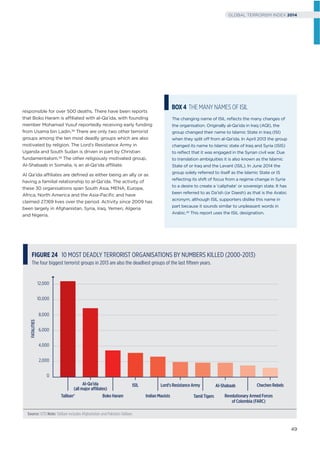
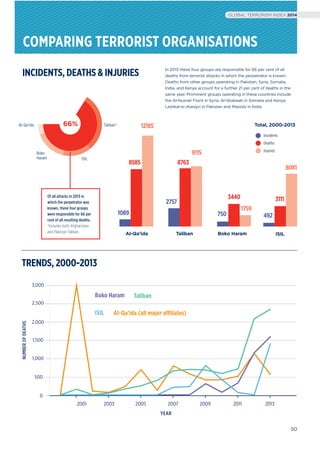
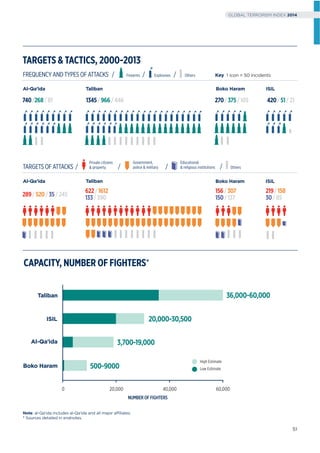
MEASURING AND UNDERSTANDING
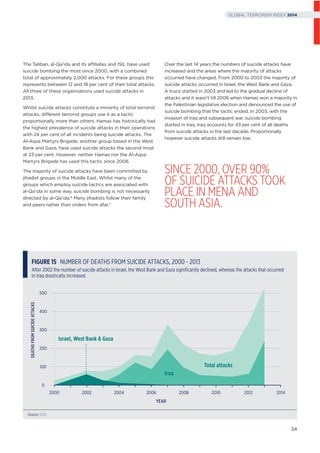
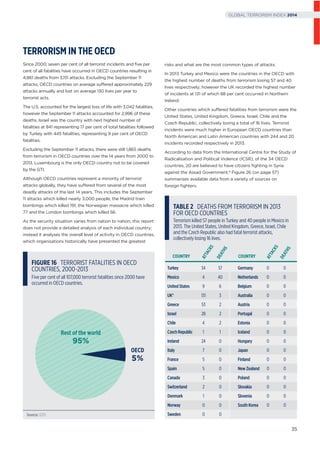
THE IMPACT OF TERRORISM
QUANTIFYING PEACE AND ITS BENEFITS
The Institute for Economics and Peace (IEP) is an independent, non-partisan, non-profit think tank dedicated to shifting the
world’s focus to peace as a positive, achievable, and tangible measure of human well-being and progress.
IEP achieves its goals by developing new conceptual frameworks to define peacefulness; providing metrics for measuring
peace; and uncovering the relationships between business, peace and prosperity as well as promoting a better
understanding of the cultural, economic and political factors that create peace.
IEP has offices in Sydney, New York and Oxford. It works with a wide range of partners internationally and collaborates
with intergovernmental organizations on measuring and communicating the economic value of peace.
For more information visit www.economicsandpeace.org
SPECIAL THANKS to the National Consortium for the Study of Terrorism and Responses to Terrorism (START)
headquartered at the University of Maryland for their cooperation on this study and for providing the Institute for
Economics and Peace with their Global Terrorism Database (GTD) datasets on terrorism.
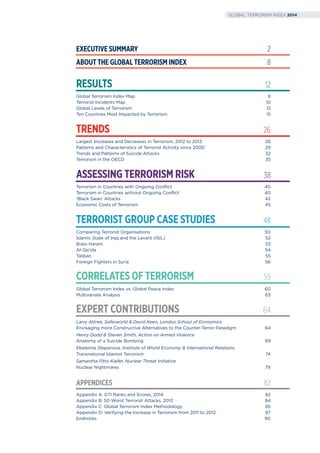
EXECUTIVE SUMMARY 2
ABOUT THE GLOBAL TERRORISM INDEX 8
RESULTS 12
Global Terrorism Index Map 8
Terrorist Incidents Map 10
Global Levels of Terrorism 12
Ten Countries Most Impacted by Terrorism 15
TRENDS 26
Largest Increases and Decreases in Terrorism, 2012 to 2013 26
Patterns and Characteristics of Terrorist Activity since 2000 29
Trends and Patterns of Suicide Attacks 32
Terrorism in the OECD 35
ASSESSING TERRORISM RISK 38
Terrorism in Countries with Ongoing Conflict 40
Terrorism in Countries without Ongoing Conflict 40
'Black Swan' Attacks 42
Economic Costs of Terrorism 45
TERRORIST GROUP CASE STUDIES 48
Comparing Terrorist Organisations 50
Islamic State of Iraq and the Levant (ISIL) 52
Boko Haram 53
Al-Qa’ida 54
Taliban 55
Foreign Fighters in Syria 56
CORRELATES OF TERRORISM 59
Global Terrorism Index vs. Global Peace Index 60
Multivariate Analysis 63
EXPERT CONTRIBUTIONS 64
Larry Attree, Saferworld & David Keen, London School of Economics
Envisaging more Constructive Alternatives to the Counter-Terror Paradigm 64
Henry Dodd & Steven Smith, Action on Armed Violence
Anatomy of a Suicide Bombing 69
Ekaterina Stepanova, Institute of World Economy & International Relations
Transnational Islamist Terrorism 74
Samantha Pitts-Kiefer, Nuclear Threat Initiative
Nuclear Nightmares 79
APPENDICES 82
Appendix A: GTI Ranks and Scores, 2014 82
Appendix B: 50 Worst Terrorist Attacks, 2013 84
Appendix C: Global Terrorism Index Methodology 85
Appendix D: Verifying the Increase in Terrorism from 2011 to 2012 87
Endnotes 90
1
GLOBAL TERRORISM INDEX 2014
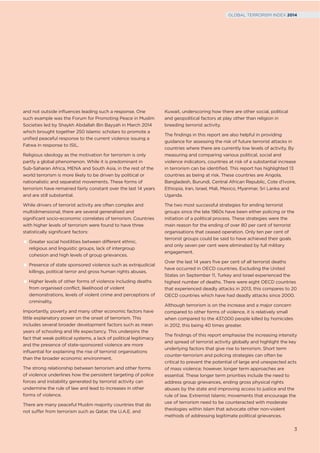
EXECUTIVE
SUMMARY
This is the second edition of the Global Terrorism Index (GTI)
report which provides a comprehensive summary of the key
global trends and patterns in terrorism over the last 14 years
beginning in 2000 and ending in 2013.
Produced by the Institute for Economics and Peace (IEP),
the GTI is based on data from the Global Terrorism Database
(GTD) which is collected and collated by the National
Consortium for the Study of Terrorism and Responses to
Terrorism (START). The GTD is considered to be the most
comprehensive dataset on terrorist activity globally and has
codified over 125,000 terrorist incidents.
The report summarises trends in terrorism over time and
analyses its changing patterns in terms of geographic
activity, methods of attack, organisations involved and the
national economic and political context. The index has also
been compared to a range of socio-economic indicators to
determine the key factors most closely associated with
terrorism.
In 2013 terrorist activity increased substantially with the total
number of deaths rising from 11,133 in 2012 to 17,958 in 2013,
a 61 per cent increase. Over the same period, the number of
countries that experienced more than 50 deaths rose from
15 to 24. This highlights that not only is the intensity of
terrorism increasing, its breadth is increasing as well.
Terrorism is both highly concentrated as well as a globally
distributed phenomenon. Over 80 per cent of the lives lost
to terrorist activity in 2013 occurred in only five countries -
Iraq, Afghanistan, Pakistan, Nigeria and Syria. However,
another 55 countries recorded one or more deaths from
terrorist activity.
Since 2000 there has been over a five-fold increase in the
number of deaths from terrorism, rising from 3,361 in 2000
to 17,958 in 2013. However for four years, starting in 2007,
there had been modest decreases in terrorist deaths and
also a slight decrease in the number of countries
experiencing greater than 50 deaths from terrorism per
annum. The latest jump in terrorist activity coincided with
the start of the Syrian civil war in 2011.
The threat of terrorist activity is a major if not the major
national security risk for many countries. The recent rise of
ultra-violent groups such as ISIL in Syria and Iraq is
underpinned by greater territorial ambitions in the Levant
which include the countries of Syria, Lebanon, Israel, Jordan,
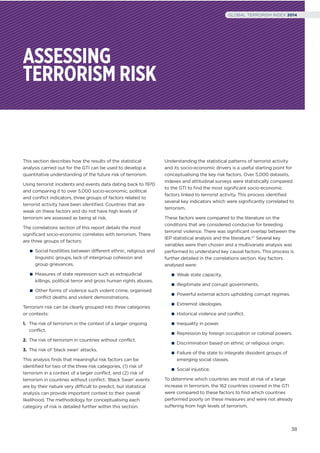
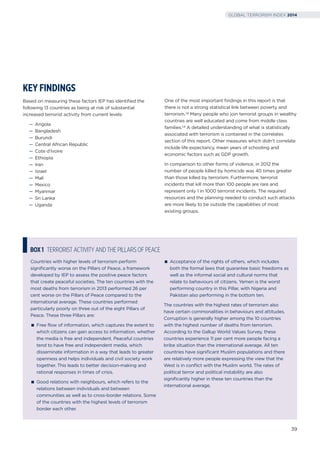
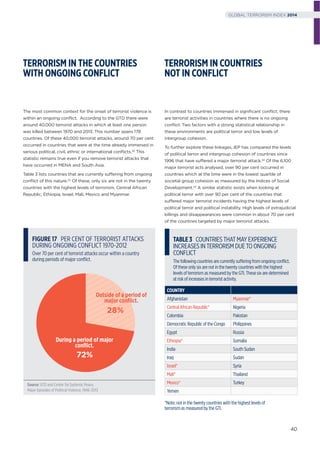
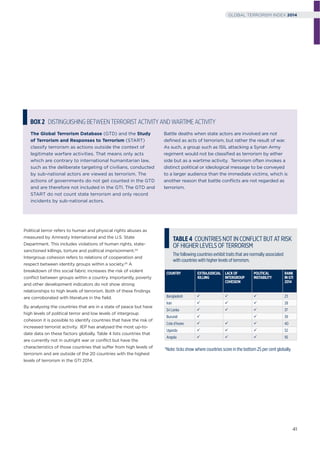
Palestine, as well as Southern Turkey, thereby increasing the
risk of further destabilisation in the Middle East region.
The majority of claimed deaths from terrorist attacks, 66 per
cent in 2013, are claimed by only four terrorist organisations;
ISIL, Boko Haram, the Taliban and al-Qa’ida and its affiliates.
Variations of religious ideologies based on extreme
interpretations of Wahhabi Islam are the key commonality
for all four groups; however their strategic goals are not
necessarily the same. To counteract the rise of religious
extremism, moderate Sunni theologies need to be cultivated
by credible forces within Islam. The current political context
underscores the importance of moderate Sunni countries
SINCE 2000 THERE HAS
BEEN OVER A FIVE-
FOLD INCREASE IN THE
NUMBER OF PEOPLE
KILLED BY TERRORISM.
82%KILLED IN TERRORIST
ATTACKS WERE IN
JUST FIVE COUNTRIES:
IRAQ
AFGHANISTAN
PAKISTAN
NIGERIA
SYRIA
2
GLOBAL TERRORISM INDEX 2014
and not outside influences leading such a response. One
such example was the Forum for Promoting Peace in Muslim
Societies led by Shaykh Abdallah Bin Bayyah in March 2014
which brought together 250 Islamic scholars to promote a
unified peaceful response to the current violence issuing a
Fatwa in response to ISIL.
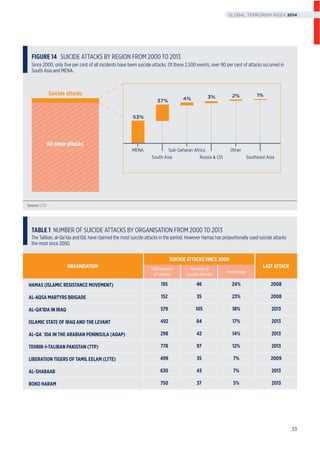
Religious ideology as the motivation for terrorism is only
partly a global phenomenon. While it is predominant in
Sub-Saharan Africa, MENA and South Asia, in the rest of the
world terrorism is more likely to be driven by political or
nationalistic and separatist movements. These forms of
terrorism have remained fairly constant over the last 14 years
and are still substantial.
While drivers of terrorist activity are often complex and
multidimensional, there are several generalised and
significant socio-economic correlates of terrorism. Countries
with higher levels of terrorism were found to have three
statistically significant factors:
Greater social hostilities between different ethnic,
religious and linguistic groups, lack of intergroup
cohesion and high levels of group grievances.
Presence of state sponsored violence such as extrajudicial
killings, political terror and gross human rights abuses.
Higher levels of other forms of violence including deaths
from organised conflict, likelihood of violent
demonstrations, levels of violent crime and perceptions of
criminality.
Importantly, poverty and many other economic factors have
little explanatory power on the onset of terrorism. This
includes several broader development factors such as mean
years of schooling and life expectancy. This underpins the
fact that weak political systems, a lack of political legitimacy
and the presence of state-sponsored violence are more
influential for explaining the rise of terrorist organisations
than the broader economic environment.
The strong relationship between terrorism and other forms
of violence underlines how the persistent targeting of police
forces and instability generated by terrorist activity can
undermine the rule of law and lead to increases in other
forms of violence.
There are many peaceful Muslim majority countries that do
not suffer from terrorism such as Qatar, the U.A.E. and
Kuwait, underscoring how there are other social, political
and geopolitical factors at play other than religion in
breeding terrorist activity.
The findings in this report are also helpful in providing
guidance for assessing the risk of future terrorist attacks in
countries where there are currently low levels of activity. By
measuring and comparing various political, social and
violence indicators, countries at risk of a substantial increase
in terrorism can be identified. This report has highlighted 13
countries as being at risk. These countries are Angola,
Bangladesh, Burundi, Central African Republic, Cote d’Ivoire,
Ethiopia, Iran, Israel, Mali, Mexico, Myanmar, Sri Lanka and
Uganda.
The two most successful strategies for ending terrorist
groups since the late 1960s have been either policing or the
initiation of a political process. These strategies were the
main reason for the ending of over 80 per cent of terrorist
organisations that ceased operation. Only ten per cent of
terrorist groups could be said to have achieved their goals
and only seven per cent were eliminated by full military
engagement.
Over the last 14 years five per cent of all terrorist deaths
have occurred in OECD countries. Excluding the United
States on September 11, Turkey and Israel experienced the
highest number of deaths. There were eight OECD countries
that experienced deadly attacks in 2013, this compares to 20
OECD countries which have had deadly attacks since 2000.
Although terrorism is on the increase and a major concern
compared to other forms of violence, it is relatively small
when compared to the 437,000 people killed by homicides
in 2012, this being 40 times greater.
The findings of this report emphasise the increasing intensity
and spread of terrorist activity globally and highlight the key
underlying factors that give rise to terrorism. Short term
counter-terrorism and policing strategies can often be
critical to prevent the potential of large and unexpected acts
of mass violence; however, longer term approaches are
essential. These longer term priorities include the need to
address group grievances, ending gross physical rights
abuses by the state and improving access to justice and the
rule of law. Extremist Islamic movements that encourage the
use of terrorism need to be counteracted with moderate
theologies within Islam that advocate other non-violent
methods of addressing legitimate political grievances.
3
GLOBAL TERRORISM INDEX 2014
Correlates of terrorism
From thousands of socio-economic, governance
and attitudinal variables analysed, three
groupings of indicators show a multivariate
significant relationship with the GTI:
— Political stability
— Intergroup cohesion
— Legitimacy of the state
There is no systematic link to poverty measures,
nor to several broader economic development
factors such as the Human Development Index or
its subcomponents such as mean years of
schooling, or life expectancy. Similarly economic
indicators such as year to year GDP growth do not
correlate.
Trade as a percentage of GDP is the only
economic indicator to show moderate
correlation at R= -0.40.
Tactics and patterns
The primary target of terrorism has consistently
been private property and citizens.
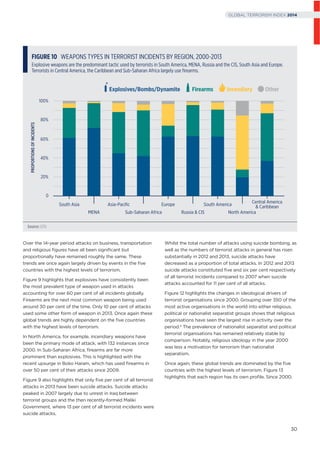
60 per cent of all attacks involve the use of
explosives, 30 per cent use firearms and 10 per
cent used other tactics including incendiary
devices, melee attacks and sabotage of
equipment.
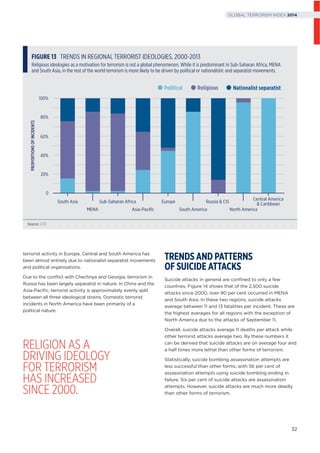
Religion as a driving ideology for terrorism has
dramatically increased since 2000. Prior to 2000
nationalist separatist agendas were the biggest
drivers of terrorist organisations.
Political and national separatist movements are
still significant in 2013 but have seen little change
over the 14 year period.
Explosives accounted for the majority of attacks,
while suicide bombings accounted for less than
five per cent of all terrorist attacks since 2000.
Risk of terrorism
IEP has identified the following 13 countries as
being at risk of increased terrorist activity from
current levels:
— Angola
— Bangladesh
— Burundi
— Central African Republic
— Cote d’Ivoire
— Ethiopia
— Iran
— Israel
— Mali
— Mexico
— Myanmar
— Sri Lanka
— Uganda
Putting terrorism in context
Around five per cent of all the 107,000 terrorist
fatalities since 2000 have occurred in OECD
countries.
Homicide claims 40 times more people globally
than terrorism with 437,000 lives lost due to
homicide in 2012, compared to 11,000 terrorist
deaths in 2012.
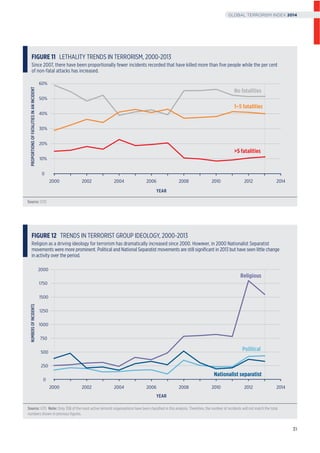
Approximately 50 per cent of terrorist attacks
claim no lives.
The long term indirect costs of terrorism can be 10
to 20 times larger than the direct costs.
Key trends
In 2013 more than 80 per cent of the lives lost to
terrorism occurred in only five countries; Iraq,
Afghanistan, Pakistan, Nigeria and Syria.
The largest year-on-year increase in deaths from
terrorism was recorded between 2012 and 2013
increasing from 11,133 to 17,958.
102 of 162 countries covered in this study
experienced no deaths from terrorism in 2013,
while 60 countries recorded one or more deaths
from terrorism.
87 countries experienced a terrorist incident in
2013, slightly up from 81 in 2012.
The number of countries experiencing over 50
deaths in one year hit an all-time high in 2013 at
24, five greater than the previous high of 19
countries in 2008.
4
GLOBAL TERRORISM INDEX 2014
The Results Section summarises overall trends in terrorism
and includes detailed country profiles for the ten countries
with the highest levels of terrorist activity in 2013. These
countries experienced 90 per cent of global terrorist
activity. This section also provides an overview of the
global trends in terrorism and details the significant
increases since 2000.
The Trends Section highlights the countries that have had
the largest improvements and deteriorations in terrorist
activity and maps in detail the patterns and characteristics
of terrorist activity in terms of its targets, weapons used
and ideological drivers. This section includes a brief
statistical summary of the patterns and prevalence of
suicide attacks as a terrorist tactic, trends in terrorist
activity among OECD countries, and also compares this to
other forms of violent activity. The key terrorist actors
operating in OECD nations are also mapped and
summarised.
The Risk Section assesses the risk of countries
experiencing high levels of terrorism. The research utilises
GTI data and other existing datasets to statistically analyse
the future likelihood of terrorist activity based on an
analysis of the socio-economic conditions most closely
associated with terrorism. A brief literature review assesses
the economic costs of terrorism and the potential direct
and indirect costs as well as an analysis of the effects of
terrorism on foreign direct investment.
The Terrorist Group Case Studies Section focuses on the
four major terrorist groups covering their ideology, history,
capacity and resources with key networks described as
well. The numbers of foreign fighters from several OECD
countries and the Middle East are outlined based on
existing research highlighting both high and low estimates.
This section also references existing research on how
terrorist groups end and the tactics and strategies that
have been successful for addressing this form of violence
in the past.
The Correlates of Terrorism Section uses multivariate
statistical analysis and other statistical techniques to
derive the key socio-economic correlations associated with
terrorism and to better understand the factors most
closely associated with terrorist environments.
The Expert Contributions Section includes four essays
from leading academics and applied researchers in the
fields of development, public policy, peace and conflict
and terrorism studies.
Larry Attree from Saferworld and David Keen from the
London School of Economics, outline a series of counter-
terrorism approaches that should be scaled back and
present six constructive alternatives that could help
reverse the alarming rise in global terrorism.
Henry Dodd and Steve Smith from Action on Armed
Violence, provide an important contribution from another
perspective to the research provided in this report.
They detail the horrific human impact of a single suicide
attack in a Pakistan marketplace in 2009, contextualising
the broader physical, psychological and financial
consequences of this form of violence.
Ekaterina Stepanova from the Institute of World Economy
& International Relations, outlines a shift in two main
trends, the broader network fragmentation of the global
jihadi movement and shift from top-down to bottom-up
regionalization of violent Islamic groups. She also tracks
the complex evolution of ISIL as a regional force in the
Middle East, and what its continued growth means for the
world and region.
Finally, Samantha Pitts-Kiefer from the Nuclear Threat
Initiative, outlines the history and current reality of a
nuclear terrorist threat, suggesting approaches for
strengthening global nuclear security, highlighting the
urgent need to improve global nuclear security.
ABOUT THE REPORT
5
GLOBAL TERRORISM INDEX 2014
ABOUT THE GLOBAL
TERRORISM INDEX
The Global Terrorism Index (GTI) is a comprehensive study
that accounts for the direct and indirect impact of
terrorism in 162 countries in terms of lives lost, injuries,
property damage and the psychological after-effects of
terrorism. This study covers 99.6 per cent of the world’s
population.
It aggregates the most authoritative data source on
terrorism today, the Global Terrorism Database (GTD) into
a composite score in order to provide an ordinal ranking
of nations on the negative impact of terrorism. The GTD is
unique in that it consists of systematically and
comprehensively coded data on domestic as well as
international terrorist incidents and now includes more
than 125,000 cases.
Given the resources committed to counter-terrorism
efforts internationally, it is important to analyse and
aggregate available data related to terrorism to better
understand its various properties such as:
The differing socio-economic conditions under which it
occurs.
The geopolitical drivers associated with terrorism and
ideological aims of terrorists groups.
The types of strategies deployed, tactical terrorist
targets and how these evolve over time.
In this context, one of the key aims of the GTI is to
examine these trends to help inform a positive and
practical debate about the future of terrorism and the
required policy responses.
The GTI was developed in consultation with the GPI
Expert Panel, and in particular with the advice of Expert
Panel member and terrorism expert Dr Ekaterina
Stepanova, Head of the Peace and Conflict Studies Unit at
the Institute of World Economy & International Relations.
Defining terrorism is not a straightforward matter. There is
no single internationally accepted definition of what
constitutes terrorism, and the terrorism literature abounds
with competing definitions and typologies. IEP accepts
the terminology and definitions agreed to by the authors
of the GTD, the National Consortium for the Study of
Terrorism and Responses to Terrorism (START)
researchers and its advisory panel. The GTI therefore
defines terrorism as “the threatened or actual use of
illegal force and violence by a non-state actor to attain a
political, economic, religious, or social goal through fear,
coercion, or intimidation.” This definition recognises that
terrorism is not only the physical act of an attack, but also
the psychological impact it has on a society for many
years after.
In order to be included as an incident in the GTD the act
has to be: “an intentional act of violence or threat of
violence by a non-state actor.” This means an incident has
to meet three criteria in order for it to be counted as a
terrorist act:
6
GLOBAL TERRORISM INDEX 2014
1. The incident must be intentional – the result of a
conscious calculation on the part of a perpetrator.
2. The incident must entail some level of violence or
threat of violence — including property violence, as well
as violence against people.
3. The perpetrators of the incidents must be sub-national
actors. This database does not include acts of
state terrorism.
In addition to this baseline definition, two of the following
three criteria have to be met in order to be included in the
START database from 1997:
The violent act was aimed at attaining a political,
economic, religious, or social goal.
The violent act included evidence of an intention to
coerce, intimidate, or convey some other message to a
larger audience (or audiences) other than the
immediate victims.
The violent act was outside the precepts of
international humanitarian law.
In cases where there is insufficient information to make a
definitive distinction about whether it is a terrorist
incident within the confines of the definition, the database
codes these incidents as ‘doubt terrorism proper’. In
order to only count unambiguous incidents of terrorism,
the GTI does not include doubted incidents.
It is important to understand how incidents are counted.
According to the GTD codebook: “incidents occurring in
both the same geographic and temporal point will be
regarded as a single incident, but if either the time of the
occurrence of the incidents or their locations are
discontinuous, the events will be regarded as separate
incidents.” Illustrative examples from the GTD codebook
are as follows:1
Four truck bombs explode nearly simultaneously in
different parts of a major city. This represents four
incidents.
A bomb goes off, and while police are working on the
scene the next day, they are attacked by terrorists with
automatic weapons. These are two separate incidents,
as they were not continuous, given the time lag
between the two events.
A group of militants shoot and kill five guards at a
perimeter checkpoint of a petroleum refinery and then
proceeds to set explosives and destroy the refinery.
This is one incident since it occurred in a single location
(the petroleum refinery) and was one continuous event.
A group of hijackers diverts a plane to Senegal and,
while at an airport in Senegal, shoots two Senegalese
policemen. This is one incident, since the hijacking was
still in progress at the time of the shooting and hence
the two events occurred at the same time and in the
same place.
THE GLOBAL TERRORISM INDEX IS A COMPREHENSIVE
STUDY THAT ACCOUNTS FOR THE DIRECT AND INDIRECT
IMPACT OF TERRORISM IN 162 COUNTRIES IN TERMS OF
LIVES LOST, INJURIES, PROPERTY DAMAGE AND THE
PSYCHOLOGICAL AFTER-EFFECTS OF TERRORISM.
THIS STUDY COVERS 99.6 PER CENT OF THE
WORLD’S POPULATION.
7
GLOBAL TERRORISM INDEX 2014
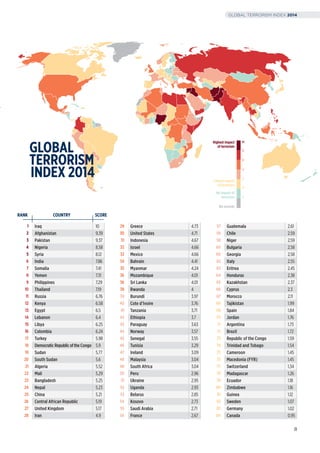
1 Iraq 10
2 Afghanistan 9.39
3 Pakistan 9.37
4 Nigeria 8.58
5 Syria 8.12
6 India 7.86
7 Somalia 7.41
8 Yemen 7.31
9 Philippines 7.29
10 Thailand 7.19
11 Russia 6.76
12 Kenya 6.58
13 Egypt 6.5
14 Lebanon 6.4
15 Libya 6.25
16 Colombia 6.24
17 Turkey 5.98
18 DemocraticRepublicofthe Congo 5.9
19 Sudan 5.77
20 South Sudan 5.6
21 Algeria 5.52
22 Mali 5.29
23 Bangladesh 5.25
24 Nepal 5.23
25 China 5.21
26 Central African Republic 5.19
27 United Kingdom 5.17
28 Iran 4.9
29 Greece 4.73
30 United States 4.71
31 Indonesia 4.67
32 Israel 4.66
32 Mexico 4.66
34 Bahrain 4.41
35 Myanmar 4.24
36 Mozambique 4.01
36 Sri Lanka 4.01
38 Rwanda 4
39 Burundi 3.97
40 Cote d’Ivoire 3.76
41 Tanzania 3.71
42 Ethiopia 3.7
43 Paraguay 3.63
44 Norway 3.57
45 Senegal 3.55
46 Tunisia 3.29
47 Ireland 3.09
48 Malaysia 3.04
48 South Africa 3.04
50 Peru 2.96
51 Ukraine 2.95
52 Uganda 2.93
53 Belarus 2.85
54 Kosovo 2.73
55 Saudi Arabia 2.71
56 France 2.67
57 Guatemala 2.61
58 Chile 2.59
58 Niger 2.59
60 Bulgaria 2.58
60 Georgia 2.58
62 Italy 2.55
63 Eritrea 2.45
64 Honduras 2.38
65 Kazakhstan 2.37
66 Cyprus 2.3
67 Morocco 2.11
68 Tajikistan 1.99
69 Spain 1.84
70 Jordan 1.76
71 Argentina 1.73
72 Brazil 1.72
73 Republic of the Congo 1.59
74 Trinidad and Tobago 1.54
75 Cameroon 1.45
75 Macedonia (FYR) 1.45
77 Switzerland 1.34
78 Madagascar 1.26
79 Ecuador 1.18
80 Zimbabwe 1.16
81 Guinea 1.12
82 Sweden 1.07
83 Germany 1.02
84 Canada 0.95
RANK COUNTRY SCORE
.01
0
Highest impact
of terrorism
Lowest impact
of terrorism
No impact of
terrorism
2
4
6
8
10
No records
GLOBAL
TERRORISM
INDEX 2014
8
GLOBAL TERRORISM INDEX 2014
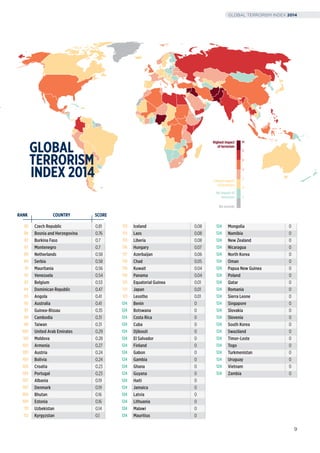
85 Czech Republic 0.81
86 Bosnia and Herzegovina 0.76
87 Burkina Faso 0.7
87 Montenegro 0.7
89 Netherlands 0.58
89 Serbia 0.58
91 Mauritania 0.56
92 Venezuela 0.54
93 Belgium 0.53
94 Dominican Republic 0.47
95 Angola 0.41
95 Australia 0.41
97 Guinea-Bissau 0.35
98 Cambodia 0.31
98 Taiwan 0.31
100 United Arab Emirates 0.29
101 Moldova 0.28
102 Armenia 0.27
103 Austria 0.24
103 Bolivia 0.24
105 Croatia 0.23
105 Portugal 0.23
107 Albania 0.19
107 Denmark 0.19
109 Bhutan 0.16
109 Estonia 0.16
111 Uzbekistan 0.14
112 Kyrgyzstan 0.1
113 Iceland 0.08
113 Laos 0.08
113 Liberia 0.08
116 Hungary 0.07
117 Azerbaijan 0.06
118 Chad 0.05
119 Kuwait 0.04
119 Panama 0.04
121 Equatorial Guinea 0.01
121 Japan 0.01
121 Lesotho 0.01
124 Benin 0
124 Botswana 0
124 Costa Rica 0
124 Cuba 0
124 Djibouti 0
124 El Salvador 0
124 Finland 0
124 Gabon 0
124 Gambia 0
124 Ghana 0
124 Guyana 0
124 Haiti 0
124 Jamaica 0
124 Latvia 0
124 Lithuania 0
124 Malawi 0
124 Mauritius 0
124 Mongolia 0
124 Namibia 0
124 New Zealand 0
124 Nicaragua 0
124 North Korea 0
124 Oman 0
124 Papua New Guinea 0
124 Poland 0
124 Qatar 0
124 Romania 0
124 Sierra Leone 0
124 Singapore 0
124 Slovakia 0
124 Slovenia 0
124 South Korea 0
124 Swaziland 0
124 Timor-Leste 0
124 Togo 0
124 Turkmenistan 0
124 Uruguay 0
124 Vietnam 0
124 Zambia 0
RANK COUNTRY SCORE
.01
0
Highest impact
of terrorism
Lowest impact
of terrorism
No impact of
terrorism
2
4
6
8
10
No records
GLOBAL
TERRORISM
INDEX 2014
9
GLOBAL TERRORISM INDEX 2014
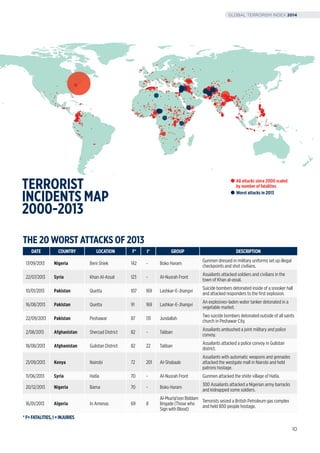
17/09/2013 Nigeria Beni Shiek 142 - Boko Haram
Gunmen dressed in military uniforms set up illegal
checkpoints and shot civilians.
22/07/2013 Syria Khan Al-Assal 123 -  Al-Nusrah Front
Assailants attacked soldiers and civilians in the
town of Khan al-assal.
10/01/2013 Pakistan Quetta 107 169 Lashkar-E-Jhangvi
Suicide bombers detonated inside of a snooker hall
and attacked responders to the first explosion.
16/08/2013 Pakistan Quetta 91 169 Lashkar-E-Jhangvi
An explosives-laden water tanker detonated in a
vegetable market.
22/09/2013 Pakistan Peshawar 87 131 Jundallah
Two suicide bombers detonated outside of all saints
church in Peshawar City.
2/08/2013 Afghanistan Sherzad District 82 - Taliban
Assailants ambushed a joint military and police
convoy.
18/08/2013 Afghanistan Gulistan District 82 22 Taliban
Assailants attacked a police convoy in Gulistan
district.
21/09/2013 Kenya Nairobi 72 201 Al-Shabaab
Assailants with automatic weapons and grenades
attacked the westgate mall in Nairobi and held
patrons hostage.
11/06/2013 Syria Hatla 70 - Al-Nusrah Front Gunmen attacked the shiite village of Hatla.
20/12/2013 Nigeria Bama 70 - Boko Haram
300 Assailants attacked a Nigerian army barracks
and kidnapped some soldiers.
16/01/2013 Algeria In Amenas 69 8
Al-Mua’qi’oon Biddam
Brigade (Those who
Sign with Blood)
Terrorists seized a British Petroleum gas complex
and held 800 people hostage.
THE 20 WORST ATTACKS OF 2013
*F=FATALITIES,I=INJURIES
DATE COUNTRY LOCATION F* I* GROUP DESCRIPTION
All attacks since 2000 scaled
by number of fatalities
Worst attacks in 2013
TERRORIST
INCIDENTS MAP
2000-2013
10
GLOBAL TERRORISM INDEX 2014
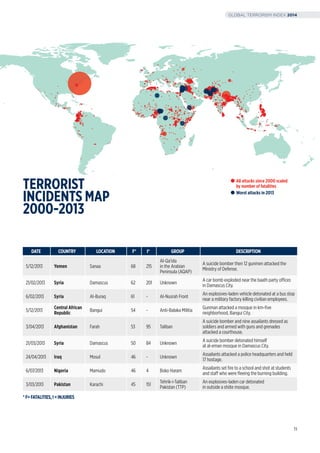
5/12/2013 Yemen Sanaa 68 215
Al-Qa'ida
in the Arabian
Peninsula (AQAP)
A suicide bomber then 12 gunmen attacked the
Ministry of Defense.
21/02/2013 Syria Damascus 62 201 Unknown
A car bomb exploded near the baath party offices
in Damascus City.
6/02/2013 Syria Al-Buraq 61 - Al-Nusrah Front
An explosives-laden vehicle detonated at a bus stop
near a military factory killing civilian employees.
5/12/2013
Central African
Republic
Bangui 54 - Anti-Balaka Militia
Gunman attacked a mosque in km-five
neighborhood, Bangui City.
3/04/2013 Afghanistan Farah 53 95 Taliban
A suicide bomber and nine assailants dressed as
soldiers and armed with guns and grenades
attacked a courthouse.
21/03/2013 Syria Damascus 50 84 Unknown
A suicide bomber detonated himself
at al-eman mosque in Damascus City.
24/04/2013 Iraq Mosul 46 - Unknown
Assailants attacked a police headquarters and held
17 hostage.
6/07/2013 Nigeria Mamudo 46 4 Boko Haram
Assailants set fire to a school and shot at students
and staff who were fleeing the burning building.
3/03/2013 Pakistan Karachi 45 151
Tehrik-i-Taliban
Pakistan (TTP)
An explosives-laden car detonated
in outside a shiite mosque.
*F=FATALITIES,I=INJURIES
DATE COUNTRY LOCATION F* I* GROUP DESCRIPTION
All attacks since 2000 scaled
by number of fatalities
Worst attacks in 2013
TERRORIST
INCIDENTS MAP
2000-2013
11
GLOBAL TERRORISM INDEX 2014
RESULTS
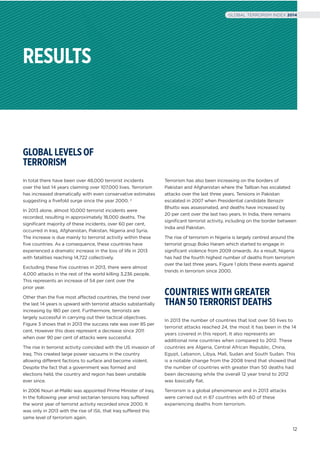
In total there have been over 48,000 terrorist incidents
over the last 14 years claiming over 107,000 lives. Terrorism
has increased dramatically with even conservative estimates
suggesting a fivefold surge since the year 2000. 2
In 2013 alone, almost 10,000 terrorist incidents were
recorded, resulting in approximately 18,000 deaths. The
significant majority of these incidents, over 60 per cent,
occurred in Iraq, Afghanistan, Pakistan, Nigeria and Syria.
The increase is due mainly to terrorist activity within these
five countries. As a consequence, these countries have
experienced a dramatic increase in the loss of life in 2013
with fatalities reaching 14,722 collectively.
Excluding these five countries in 2013, there were almost
4,000 attacks in the rest of the world killing 3,236 people.
This represents an increase of 54 per cent over the
prior year.
Other than the five most affected countries, the trend over
the last 14 years is upward with terrorist attacks substantially
increasing by 180 per cent. Furthermore, terrorists are
largely successful in carrying out their tactical objectives.
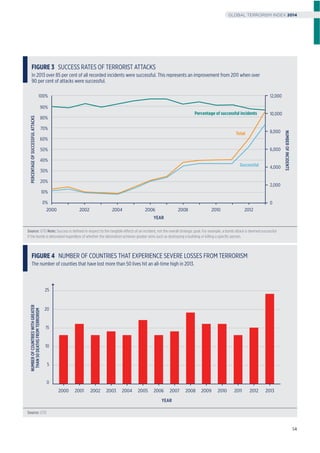
Figure 3 shows that in 2013 the success rate was over 85 per
cent. However this does represent a decrease since 2011
when over 90 per cent of attacks were successful.
The rise in terrorist activity coincided with the US invasion of
Iraq. This created large power vacuums in the country
allowing different factions to surface and become violent.
Despite the fact that a government was formed and
elections held, the country and region has been unstable
ever since.
In 2006 Nouri al-Maliki was appointed Prime Minister of Iraq.
In the following year amid sectarian tensions Iraq suffered
the worst year of terrorist activity recorded since 2000. It
was only in 2013 with the rise of ISIL that Iraq suffered this
same level of terrorism again.
Terrorism has also been increasing on the borders of
Pakistan and Afghanistan where the Taliban has escalated
attacks over the last three years. Tensions in Pakistan
escalated in 2007 when Presidential candidate Benazir
Bhutto was assassinated, and deaths have increased by
20 per cent over the last two years. In India, there remains
significant terrorist activity, including on the border between
India and Pakistan.
The rise of terrorism in Nigeria is largely centred around the
terrorist group Boko Haram which started to engage in
significant violence from 2009 onwards. As a result, Nigeria
has had the fourth highest number of deaths from terrorism
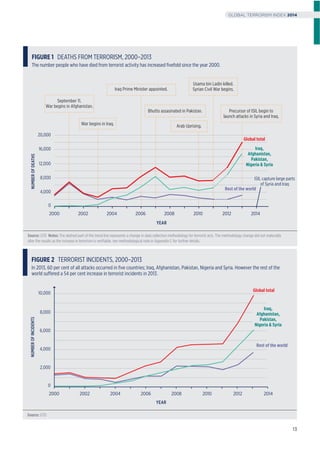
over the last three years. Figure 1 plots these events against
trends in terrorism since 2000.
GLOBAL LEVELS OF
TERRORISM
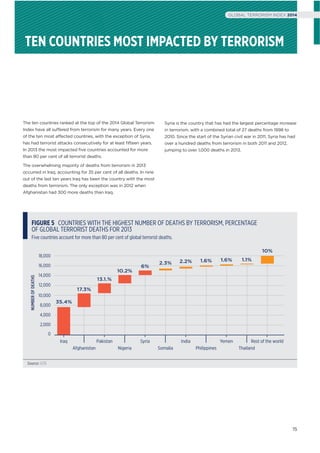
In 2013 the number of countries that lost over 50 lives to
terrorist attacks reached 24, the most it has been in the 14
years covered in this report. It also represents an
additional nine countries when compared to 2012. These
countries are Algeria, Central African Republic, China,
Egypt, Lebanon, Libya, Mali, Sudan and South Sudan. This
is a notable change from the 2008 trend that showed that
the number of countries with greater than 50 deaths had
been decreasing while the overall 12 year trend to 2012
was basically flat.
Terrorism is a global phenomenon and in 2013 attacks
were carried out in 87 countries with 60 of these
experiencing deaths from terrorism.
COUNTRIES WITH GREATER
THAN 50 TERRORIST DEATHS
12
GLOBAL TERRORISM INDEX 2014
FIGURE 2 TERRORIST INCIDENTS, 2000–2013
In 2013, 60 per cent of all attacks occurred in five countries; Iraq, Afghanistan, Pakistan, Nigeria and Syria. However the rest of the
world suffered a 54 per cent increase in terrorist incidents in 2013.
YEAR
Source: GTD
10,000
6,000
8,000
2,000
4,000
0
NUMBEROFINCIDENTS
2000 2002 2004 2006 2008 2010 2012 2014
Rest of the world
Global total
Iraq,
Afghanistan,
Pakistan,
Nigeria & Syria
FIGURE 1 DEATHS FROM TERRORISM, 2000–2013
The number people who have died from terrorist activity has increased fivefold since the year 2000.
Source: GTD Notes: The dashed part of the trend line represents a change in data collection methodology for terrorist acts. The methodology change did not materially
alter the results as the increase in terrorism is verifiable, see methodological note in Appendix C for further details.
YEAR
20,000
16,000
12,000
4,000
8,000
0
NUMBEROFDEATHS
Rest of the world
2000 2002 2004 2006 2008 2010 2012 2014
ISIL capture large parts
of Syria and Iraq
Global total
Iraq,
Afghanistan,
Pakistan,
Nigeria & Syria
September 11.
War begins in Afghanistan.
Iraq Prime Minister appointed.
War begins in Iraq. Arab Uprising.
Bhutto assasinated in Pakistan.
Usama bin Ladin killed.
Syrian Civil War begins.
Precursor of ISIL begin to
launch attacks in Syria and Iraq.
13
GLOBAL TERRORISM INDEX 2014
FIGURE 4 NUMBER OF COUNTRIES THAT EXPERIENCE SEVERE LOSSES FROM TERRORISM
The number of counties that have lost more than 50 lives hit an all-time high in 2013.
Source: GTD
YEAR
25
15
20
5
10
0
NUMBEROFCOUNTRIESWITHGREATER
THAN50DEATHSFROMTERRORISM
2000 2002 2004 2006 2008 201020032001 2005 2007 2009 2011 2012 2013
FIGURE 3 SUCCESS RATES OF TERRORIST ATTACKS
In 2013 over 85 per cent of all recorded incidents were successful. This represents an improvement from 2011 when over
90 per cent of attacks were successful.
Source: GTD Note: Success is defined in respect to the tangible effects of an incident, not the overall strategic goal. For example, a bomb attack is deemed successful
if the bomb is detonated regardless of whether the detonation achieves greater aims such as destroying a building or killing a specific person.
YEAR
100% 12,000
10,000
8,000
6,000
4,000
2,000
0
80%
90%
50%
40%
70%
20%
60%
10%
30%
0%
PERCENTAGEOFSUCCESSFULATTACKS
NUMBEROFINCIDENTS
2000 2002 2004 2006 2008 2010 2012
Total
Percentage of successful incidents
Successful
14
GLOBAL TERRORISM INDEX 2014
The ten countries ranked at the top of the 2014 Global Terrorism
Index have all suffered from terrorism for many years. Every one
of the ten most affected countries, with the exception of Syria,
has had terrorist attacks consecutively for at least fifteen years.
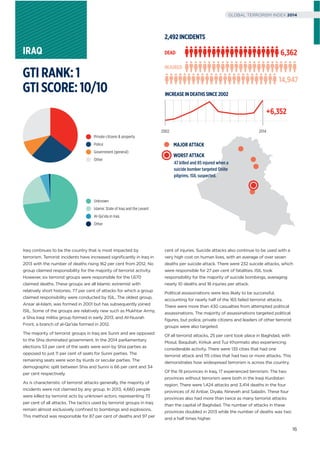
In 2013 the most impacted five countries accounted for more
than 80 per cent of all terrorist deaths.
The overwhelming majority of deaths from terrorism in 2013
occurred in Iraq, accounting for 35 per cent of all deaths. In nine
out of the last ten years Iraq has been the country with the most
deaths from terrorism. The only exception was in 2012 when
Afghanistan had 300 more deaths than Iraq.
Syria is the country that has had the largest percentage increase
in terrorism, with a combined total of 27 deaths from 1998 to
2010. Since the start of the Syrian civil war in 2011, Syria has had
over a hundred deaths from terrorism in both 2011 and 2012,
jumping to over 1,000 deaths in 2013.
FIGURE 5 COUNTRIES WITH THE HIGHEST NUMBER OF DEATHS BY TERRORISM, PERCENTAGE
OF GLOBAL TERRORIST DEATHS FOR 2013
Five countries account for more than 80 per cent of global terrorist deaths.
Source: GTD
18,000
16,000
14,000
12,000
10,000
2,000
4,000
8,000
0
NUMBEROFDEATHS
Iraq
35.4%
Afghanistan
17.3%
Pakistan
13.1.%
Nigeria
10.2%
Syria
6%
Somalia
2.3%
India
2.2%
Philippines
1.6%
Yemen
1.6%
Thailand
1.1%
Rest of the world
10%
TEN COUNTRIES MOST IMPACTED BY TERRORISM
15
GLOBAL TERRORISM INDEX 2014
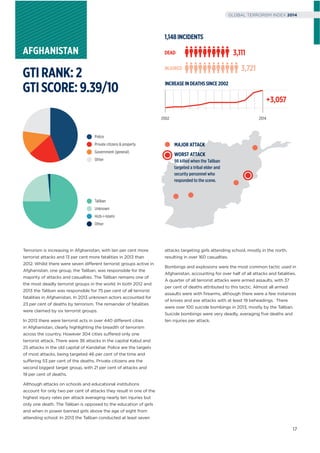
Iraq continues to be the country that is most impacted by
terrorism. Terrorist incidents have increased significantly in Iraq in
2013 with the number of deaths rising 162 per cent from 2012. No
group claimed responsibility for the majority of terrorist activity.
However, six terrorist groups were responsible for the 1,670
claimed deaths. These groups are all Islamic extremist with
relatively short histories. 77 per cent of attacks for which a group
claimed responsibility were conducted by ISIL. The oldest group,
Ansar al-Islam, was formed in 2001 but has subsequently joined
ISIL. Some of the groups are relatively new such as Mukhtar Army,
a Shia Iraqi militia group formed in early 2013, and Al-Nusrah
Front, a branch of al-Qa'ida formed in 2012.
The majority of terrorist groups in Iraq are Sunni and are opposed
to the Shia dominated government. In the 2014 parliamentary
elections 53 per cent of the seats were won by Shia parties as
opposed to just 11 per cent of seats for Sunni parties. The
remaining seats were won by Kurds or secular parties. The
demographic split between Shia and Sunni is 66 per cent and 34
per cent respectively.
As is characteristic of terrorist attacks generally, the majority of
incidents were not claimed by any group. In 2013, 4,660 people
were killed by terrorist acts by unknown actors, representing 73
per cent of all attacks. The tactics used by terrorist groups in Iraq
remain almost exclusively confined to bombings and explosions.
This method was responsible for 87 per cent of deaths and 97 per
cent of injuries. Suicide attacks also continue to be used with a
very high cost on human lives, with an average of over seven
deaths per suicide attack. There were 232 suicide attacks, which
were responsible for 27 per cent of fatalities. ISIL took
responsibility for the majority of suicide bombings, averaging
nearly 10 deaths and 18 injuries per attack.
Political assassinations were less likely to be successful,
accounting for nearly half of the 165 failed terrorist attacks.
There were more than 430 casualties from attempted political
assassinations. The majority of assassinations targeted political
figures, but police, private citizens and leaders of other terrorist
groups were also targeted.
Of all terrorist attacks, 25 per cent took place in Baghdad, with
Mosul, Baqubah, Kirkuk and Tuz Khormato also experiencing
considerable activity. There were 135 cities that had one
terrorist attack and 115 cities that had two or more attacks. This
demonstrates how widespread terrorism is across the country.
Of the 19 provinces in Iraq, 17 experienced terrorism. The two
provinces without terrorism were both in the Iraqi Kurdistan
region. There were 1,424 attacks and 3,414 deaths in the four
provinces of Al Anbar, Diyala, Nineveh and Saladin. These four
provinces also had more than twice as many terrorist attacks
than the capital of Baghdad. The number of attacks in these
provinces doubled in 2013 while the number of deaths was two
and a half times higher.
IRAQ DEAD 6,362
INCREASEINDEATHSSINCE2002
+6,352
2002 2014
Unknown
Islamic State of Iraq and the Levant
Al-Qa’ida in Iraq
Other
Private citizens & property
Police
Government (general)
Other
INJURED
14,947
WORST ATTACK
47 killed and 85 injured when a
suicide bomber targeted Shiite
pilgrims. ISIL suspected.
GTIRANK:1
GTISCORE:10/10
MAJOR ATTACK
2,492INCIDENTS
16
GLOBAL TERRORISM INDEX 2014
Terrorism is increasing in Afghanistan, with ten per cent more
terrorist attacks and 13 per cent more fatalities in 2013 than
2012. Whilst there were seven different terrorist groups active in
Afghanistan, one group, the Taliban, was responsible for the
majority of attacks and casualties. The Taliban remains one of
the most deadly terrorist groups in the world. In both 2012 and
2013 the Taliban was responsible for 75 per cent of all terrorist
fatalities in Afghanistan. In 2013 unknown actors accounted for
23 per cent of deaths by terrorism. The remainder of fatalities
were claimed by six terrorist groups.
In 2013 there were terrorist acts in over 440 different cities
in Afghanistan, clearly highlighting the breadth of terrorism
across the country. However 304 cities suffered only one
terrorist attack. There were 36 attacks in the capital Kabul and
25 attacks in the old capital of Kandahar. Police are the targets
of most attacks, being targeted 46 per cent of the time and
suffering 53 per cent of the deaths. Private citizens are the
second biggest target group, with 21 per cent of attacks and
19 per cent of deaths.
Although attacks on schools and educational institutions
account for only two per cent of attacks they result in one of the
highest injury rates per attack averaging nearly ten injuries but
only one death. The Taliban is opposed to the education of girls
and when in power banned girls above the age of eight from
attending school. In 2013 the Taliban conducted at least seven
attacks targeting girls attending school, mostly in the north,
resulting in over 160 casualties.
Bombings and explosions were the most common tactic used in
Afghanistan, accounting for over half of all attacks and fatalities.
A quarter of all terrorist attacks were armed assaults, with 37
per cent of deaths attributed to this tactic. Almost all armed
assaults were with firearms, although there were a few instances
of knives and axe attacks with at least 19 beheadings. There
were over 100 suicide bombings in 2013, mostly by the Taliban.
Suicide bombings were very deadly, averaging five deaths and
ten injuries per attack.
AFGHANISTAN
Taliban
Unknown
Hizb-i-Islami
Other
Police
Private citizens & property
Government (general)
Other
DEAD 3,111
INJURED 3,721
INCREASEINDEATHSSINCE2002
+3,057
2002 2014
GTIRANK:2
GTISCORE:9.39/10
1,148INCIDENTS
WORST ATTACK
98 killed when the Taliban
targeted a tribal elder and
security personnel who
responded to the scene.
MAJOR ATTACK
GLOBAL TERRORISM INDEX 2014
17
GLOBAL TERRORISM INDEX 2014
DEAD 2,345
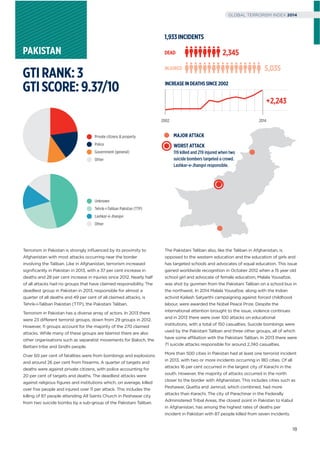
Terrorism in Pakistan is strongly influenced by its proximity to
Afghanistan with most attacks occurring near the border
involving the Taliban. Like in Afghanistan, terrorism increased
significantly in Pakistan in 2013, with a 37 per cent increase in
deaths and 28 per cent increase in injuries since 2012. Nearly half
of all attacks had no groups that have claimed responsibility. The
deadliest group in Pakistan in 2013, responsible for almost a
quarter of all deaths and 49 per cent of all claimed attacks, is
Tehrik-i-Taliban Pakistan (TTP), the Pakistani Taliban.
Terrorism in Pakistan has a diverse array of actors. In 2013 there
were 23 different terrorist groups, down from 29 groups in 2012.
However, 11 groups account for the majority of the 270 claimed
attacks. While many of these groups are Islamist there are also
other organisations such as separatist movements for Baloch, the
Bettani tribe and Sindhi people.
Over 60 per cent of fatalities were from bombings and explosions
and around 26 per cent from firearms. A quarter of targets and
deaths were against private citizens, with police accounting for
20 per cent of targets and deaths. The deadliest attacks were
against religious figures and institutions which, on average, killed
over five people and injured over 11 per attack. This includes the
killing of 87 people attending All Saints Church in Peshawar city
from two suicide bombs by a sub-group of the Pakistani Taliban.
The Pakistani Taliban also, like the Taliban in Afghanistan, is
opposed to the western education and the education of girls and
has targeted schools and advocates of equal education. This issue
gained worldwide recognition in October 2012 when a 15 year old
school girl and advocate of female education, Malala Yousafzai,
was shot by gunmen from the Pakistani Taliban on a school bus in
the northwest. In 2014 Malala Yousafzai, along with the Indian
activist Kailash Satyarthi campaigning against forced childhood
labour, were awarded the Nobel Peace Prize. Despite the
international attention brought to the issue, violence continues
and in 2013 there were over 100 attacks on educational
institutions, with a total of 150 casualties. Suicide bombings were
used by the Pakistani Taliban and three other groups, all of which
have some affiliation with the Pakistani Taliban. In 2013 there were
71 suicide attacks responsible for around 2,740 casualties.
More than 500 cities in Pakistan had at least one terrorist incident
in 2013, with two or more incidents occurring in 180 cities. Of all
attacks 16 per cent occurred in the largest city of Karachi in the
south. However, the majority of attacks occurred in the north
closer to the border with Afghanistan. This includes cities such as
Peshawar, Quetta and Jamrud, which combined, had more
attacks than Karachi. The city of Parachinar in the Federally
Administered Tribal Areas, the closest point in Pakistan to Kabul
in Afghanistan, has among the highest rates of deaths per
incident in Pakistan with 87 people killed from seven incidents.
PAKISTAN
INJURED 5,035
GTIRANK:3
GTISCORE:9.37/10
1,933INCIDENTS
Unknown
Tehrik-i-Taliban Pakistan (TTP)
Lashkar-e-Jhangvi
Other
Private citizens & property
Police
Government (general)
Other
INCREASEINDEATHSSINCE2002
+2,243
2002 2014
WORST ATTACK
119 killed and 219 injured when two
suicide bombers targeted a crowd.
Lashkar-e-Jhangvi responsible.
MAJOR ATTACK
18
GLOBAL TERRORISM INDEX 2014
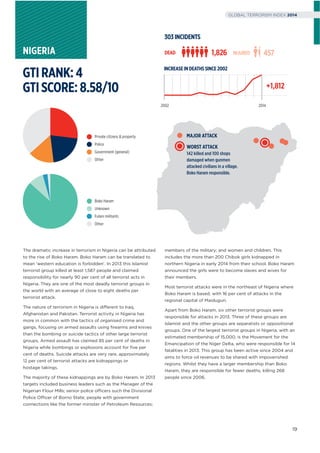
The dramatic increase in terrorism in Nigeria can be attributed
to the rise of Boko Haram. Boko Haram can be translated to
mean ‘western education is forbidden’. In 2013 this Islamist
terrorist group killed at least 1,587 people and claimed
responsibility for nearly 90 per cent of all terrorist acts in
Nigeria. They are one of the most deadly terrorist groups in
the world with an average of close to eight deaths per
terrorist attack.
The nature of terrorism in Nigeria is different to Iraq,
Afghanistan and Pakistan. Terrorist activity in Nigeria has
more in common with the tactics of organised crime and
gangs, focusing on armed assaults using firearms and knives
than the bombing or suicide tactics of other large terrorist
groups. Armed assault has claimed 85 per cent of deaths in
Nigeria while bombings or explosions account for five per
cent of deaths. Suicide attacks are very rare, approximately
12 per cent of terrorist attacks are kidnappings or
hostage takings.
The majority of these kidnappings are by Boko Haram. In 2013
targets included business leaders such as the Manager of the
Nigerian Flour Mills; senior police officers such the Divisional
Police Officer of Borno State; people with government
connections like the former minister of Petroleum Resources;
members of the military; and women and children. This
includes the more than 200 Chibok girls kidnapped in
northern Nigeria in early 2014 from their school. Boko Haram
announced the girls were to become slaves and wives for
their members.
Most terrorist attacks were in the northeast of Nigeria where
Boko Haram is based, with 16 per cent of attacks in the
regional capital of Maiduguri.
Apart from Boko Haram, six other terrorist groups were
responsible for attacks in 2013. Three of these groups are
Islamist and the other groups are separatists or oppositional
groups. One of the largest terrorist groups in Nigeria, with an
estimated membership of 15,000, is the Movement for the
Emancipation of the Niger Delta, who were responsible for 14
fatalities in 2013. This group has been active since 2004 and
aims to force oil revenues to be shared with impoverished
regions. Whilst they have a larger membership than Boko
Haram, they are responsible for fewer deaths, killing 268
people since 2006.
NIGERIA
GTIRANK:4
GTISCORE:8.58/10
303INCIDENTS
INCREASEINDEATHSSINCE2002
+1,812
2002 2014
DEAD 1,826
Boko Haram
Unknown
Fulani militants
Other
Private citizens & property
Police
Government (general)
Other
INJURED 457
WORST ATTACK
142 killed and 100 shops
damaged when gunmen
attacked civilians in a village.
Boko Haram responsible.
MAJOR ATTACK
19
GLOBAL TERRORISM INDEX 2014
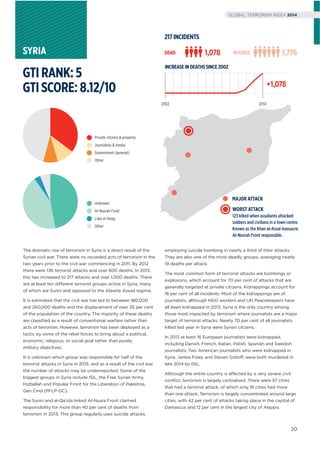
The dramatic rise of terrorism in Syria is a direct result of the
Syrian civil war. There were no recorded acts of terrorism in the
two years prior to the civil war commencing in 2011. By 2012
there were 136 terrorist attacks and over 600 deaths. In 2013,
this has increased to 217 attacks and over 1,000 deaths. There
are at least ten different terrorist groups active in Syria, many
of which are Sunni and opposed to the Alawite Assad regime.
It is estimated that the civil war has led to between 180,000
and 260,000 deaths and the displacement of over 35 per cent
of the population of the country. The majority of these deaths
are classified as a result of conventional warfare rather than
acts of terrorism. However, terrorism has been deployed as a
tactic by some of the rebel forces to bring about a political,
economic, religious, or social goal rather than purely
military objectives.
It is unknown which group was responsible for half of the
terrorist attacks in Syria in 2013, and as a result of the civil war
the number of attacks may be underreported. Some of the
biggest groups in Syria include ISIL, the Free Syrian Army,
Hizballah and Popular Front for the Liberation of Palestine,
Gen Cmd (PFLP-GC).
The Sunni and al-Qa’ida linked Al-Nusra Front claimed
responsibility for more than 40 per cent of deaths from
terrorism in 2013. This group regularly uses suicide attacks,
employing suicide bombing in nearly a third of their attacks.
They are also one of the most deadly groups, averaging nearly
19 deaths per attack.
The most common form of terrorist attacks are bombings or
explosions, which account for 70 per cent of attacks that are
generally targeted at private citizens. Kidnappings account for
18 per cent of all incidents. Most of the kidnappings are of
journalists, although NGO workers and UN Peacekeepers have
all been kidnapped in 2013. Syria is the only country among
those most impacted by terrorism where journalists are a major
target of terrorist attacks. Nearly 70 per cent of all journalists
killed last year in Syria were Syrian citizens.
In 2013 at least 16 European journalists were kidnapped,
including Danish, French, Italian, Polish, Spanish and Swedish
journalists. Two American journalists who were kidnapped in
Syria, James Foley and Steven Sotloff, were both murdered in
late 2014 by ISIL.
Although the entire country is affected by a very severe civil
conflict, terrorism is largely centralised. There were 57 cities
that had a terrorist attack, of which only 16 cities had more
than one attack. Terrorism is largely concentrated around large
cities, with 42 per cent of attacks taking place in the capital of
Damascus and 12 per cent in the largest city of Aleppo.
SYRIA
MAJOR ATTACK
WORST ATTACK
123 killed when assailants attacked
soldiers and civilians in a town centre.
Known as the Khan al-Assal massacre.
Al-Nusrah Front responsible.
Unknown
Al-Nusrah Front
Liwa al-Haqq
Other
Private citizens & property
Journalists & media
Government (general)
Other
DEAD 1,078 INJURED 1,776
INCREASEINDEATHSSINCE2002
+1,078
2002 2014
GTIRANK:5
GTISCORE:8.12/10
217INCIDENTS
20
GLOBAL TERRORISM INDEX 2014
MAJOR ATTACK
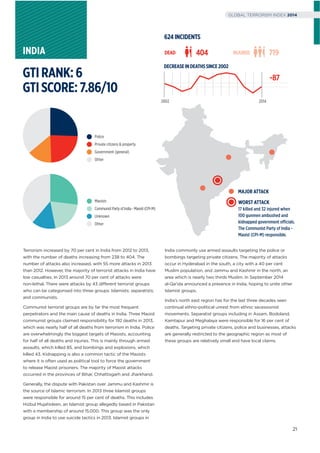
Terrorism increased by 70 per cent in India from 2012 to 2013,
with the number of deaths increasing from 238 to 404. The
number of attacks also increased, with 55 more attacks in 2013
than 2012. However, the majority of terrorist attacks in India have
low casualties. In 2013 around 70 per cent of attacks were
non-lethal. There were attacks by 43 different terrorist groups
who can be categorised into three groups: Islamists; separatists;
and communists.
Communist terrorist groups are by far the most frequent
perpetrators and the main cause of deaths in India. Three Maoist
communist groups claimed responsibility for 192 deaths in 2013,
which was nearly half of all deaths from terrorism in India. Police
are overwhelmingly the biggest targets of Maoists, accounting
for half of all deaths and injuries. This is mainly through armed
assaults, which killed 85, and bombings and explosions, which
killed 43. Kidnapping is also a common tactic of the Maoists
where it is often used as political tool to force the government
to release Maoist prisoners. The majority of Maoist attacks
occurred in the provinces of Bihar, Chhattisgarh and Jharkhand.
Generally, the dispute with Pakistan over Jammu and Kashmir is
the source of Islamic terrorism. In 2013 three Islamist groups
were responsible for around 15 per cent of deaths. This includes
Hizbul Mujahideen, an Islamist group allegedly based in Pakistan
with a membership of around 15,000. This group was the only
group in India to use suicide tactics in 2013. Islamist groups in
India commonly use armed assaults targeting the police or
bombings targeting private citizens. The majority of attacks
occur in Hyderabad in the south, a city with a 40 per cent
Muslim population, and Jammu and Kashmir in the north, an
area which is nearly two thirds Muslim. In September 2014
al-Qa’ida announced a presence in India, hoping to unite other
Islamist groups.
India’s north east region has for the last three decades seen
continual ethno-political unrest from ethnic secessionist
movements. Separatist groups including in Assam, Bodoland,
Kamtapur and Meghalaya were responsible for 16 per cent of
deaths. Targeting private citizens, police and businesses, attacks
are generally restricted to the geographic region as most of
these groups are relatively small and have local claims.
INDIA
Maoists
Communist Party of India - Maoist (CPI-M)
Unknown
Other
Police
Private citizens & property
Government (general)
Other
WORST ATTACK
17 killed and 32 injured when
100 gunmen ambushed and
kidnapped government officials.
The Communist Party of India -
Maoist (CPI-M) responsible.
DEAD 404 INJURED 719
2002 2014
DECREASEINDEATHSSINCE2002
-87GTIRANK:6
GTISCORE:7.86/10
624INCIDENTS
21
GLOBAL TERRORISM INDEX 2014
MAJOR ATTACK
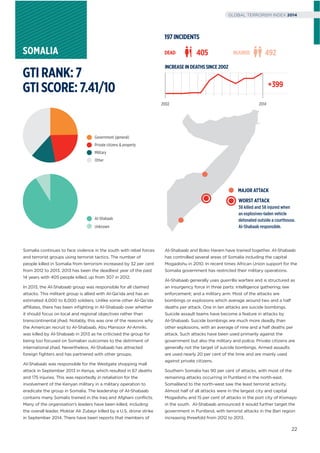
Somalia continues to face violence in the south with rebel forces
and terrorist groups using terrorist tactics. The number of
people killed in Somalia from terrorism increased by 32 per cent
from 2012 to 2013. 2013 has been the deadliest year of the past
14 years with 405 people killed, up from 307 in 2012.
In 2013, the Al-Shabaab group was responsible for all claimed
attacks. This militant group is allied with Al-Qa’ida and has an
estimated 4,000 to 6,000 soldiers. Unlike some other Al-Qa’ida
affiliates, there has been infighting in Al-Shabaab over whether
it should focus on local and regional objectives rather than
transcontinental jihad. Notably, this was one of the reasons why
the American recruit to Al-Shabaab, Abu Mansoor Al-Amriki,
was killed by Al-Shabaab in 2013 as he criticised the group for
being too focused on Somalian outcomes to the detriment of
international jihad. Nevertheless, Al-Shabaab has attracted
foreign fighters and has partnered with other groups.
Al-Shabaab was responsible for the Westgate shopping mall
attack in September 2013 in Kenya, which resulted in 67 deaths
and 175 injuries. This was reportedly in retaliation for the
involvement of the Kenyan military in a military operation to
eradicate the group in Somalia. The leadership of Al-Shabaab
contains many Somalis trained in the Iraq and Afghani conflicts.
Many of the organisation’s leaders have been killed, including
the overall leader, Moktar Ali Zubeyr killed by a U.S. drone strike
in September 2014. There have been reports that members of
Al-Shabaab and Boko Haram have trained together. Al-Shabaab
has controlled several areas of Somalia including the capital
Mogadishu in 2010. In recent times African Union support for the
Somalia government has restricted their military operations.
Al-Shabaab generally uses guerrilla warfare and is structured as
an insurgency force in three parts: intelligence gathering; law
enforcement; and a military arm. Most of the attacks are
bombings or explosions which average around two and a half
deaths per attack. One in ten attacks are suicide bombings.
Suicide assault teams have become a feature in attacks by
Al-Shabaab. Suicide bombings are much more deadly than
other explosions, with an average of nine and a half deaths per
attack. Such attacks have been used primarily against the
government but also the military and police. Private citizens are
generally not the target of suicide bombings. Armed assaults
are used nearly 20 per cent of the time and are mainly used
against private citizens.
Southern Somalia has 90 per cent of attacks, with most of the
remaining attacks occurring in Puntland in the north-east.
Somaliland to the north-west saw the least terrorist activity.
Almost half of all attacks were in the largest city and capital
Mogadishu and 15 per cent of attacks in the port city of Kismayo
in the south. Al-Shabaab announced it would further target the
government in Puntland, with terrorist attacks in the Bari region
increasing threefold from 2012 to 2013.
SOMALIA INJURED 492
Al-Shabaab
Unknown
Government (general)
Private citizens & property
Military
Other
DEAD 405
WORST ATTACK
38 killed and 58 injured when
an explosives-laden vehicle
detonated outside a courthouse.
Al-Shabaab responsible.
INCREASEINDEATHSSINCE2002
+399
2002 2014
197INCIDENTS
GTIRANK:7
GTISCORE:7.41/10
22
GLOBAL TERRORISM INDEX 2014
MAJOR ATTACK
WORST ATTACK
68 killed, 215 injured when a suicide
bomber detonated an explosives-laden
vehicle at the entrance of a government
building. Al-Qa’ida in the Arabian
Peninsula (AQAP) responsible.
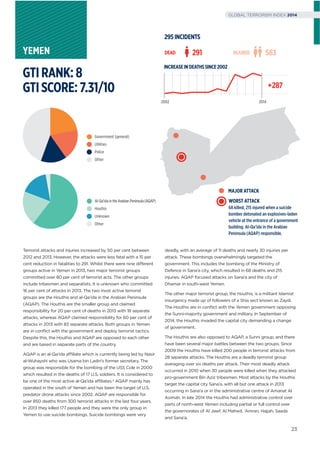
Terrorist attacks and injuries increased by 50 per cent between
2012 and 2013. However, the attacks were less fatal with a 15 per
cent reduction in fatalities to 291. Whilst there were nine different
groups active in Yemen in 2013, two major terrorist groups
committed over 80 per cent of terrorist acts. The other groups
include tribesmen and separatists. It is unknown who committed
16 per cent of attacks in 2013. The two most active terrorist
groups are the Houthis and al-Qa’ida in the Arabian Peninsula
(AQAP). The Houthis are the smaller group and claimed
responsibility for 20 per cent of deaths in 2013 with 18 separate
attacks, whereas AQAP claimed responsibility for 60 per cent of
attacks in 2013 with 83 separate attacks. Both groups in Yemen
are in conflict with the government and deploy terrorist tactics.
Despite this, the Houthis and AQAP are opposed to each other
and are based in separate parts of the country.
AQAP is an al-Qa’ida affiliate which is currently being led by Nasir
al-Wuhayshi who was Usama bin Ladin’s former secretary. The
group was responsible for the bombing of the USS Cole in 2000
which resulted in the deaths of 17 U.S. soldiers. It is considered to
be one of the most active al-Qa’ida affiliates.3 AQAP mainly has
operated in the south of Yemen and has been the target of U.S.
predator drone attacks since 2002. AQAP are responsible for
over 850 deaths from 300 terrorist attacks in the last four years.
In 2013 they killed 177 people and they were the only group in
Yemen to use suicide bombings. Suicide bombings were very
deadly, with an average of 11 deaths and nearly 30 injuries per
attack. These bombings overwhelmingly targeted the
government. This includes the bombing of the Ministry of
Defence in Sana’a city, which resulted in 68 deaths and 215
injuries. AQAP focused attacks on Sana’a and the city of
Dhamar in south-west Yemen.
The other major terrorist group, the Houthis, is a militant Islamist
insurgency made up of followers of a Shia sect known as Zaydi.
The Houthis are in conflict with the Yemen government opposing
the Sunni-majority government and military. In September of
2014, the Houthis invaded the capital city demanding a change
of government.
The Houthis are also opposed to AQAP, a Sunni group, and there
have been several major battles between the two groups. Since
2009 the Houthis have killed 200 people in terrorist attacks from
28 separate attacks. The Houthis are a deadly terrorist group
averaging over six deaths per attack. Their most deadly attack
occurred in 2010 when 30 people were killed when they attacked
pro-government Bin Aziz tribesmen. Most attacks by the Houthis
target the capital city Sana’a, with all but one attack in 2013
occurring in Sana’a or in the administrative centre of Amanat Al
Asimah. In late 2014 the Houthis had administrative control over
parts of north-west Yemen including partial or full control over
the governorates of Al Jawf, Al Mahwit, ‘Amran, Hajjah, Saada
and Sana’a.
YEMEN
Al-Qa’ida in the Arabian Peninsula (AQAP)
Houthis
Unknown
Other
Government (general)
Utilities
Police
Other
INJURED 583DEAD 291
2002 2014
INCREASEINDEATHSSINCE2002
+287
295INCIDENTS
GTIRANK:8
GTISCORE:7.31/10
23
GLOBAL TERRORISM INDEX 2014
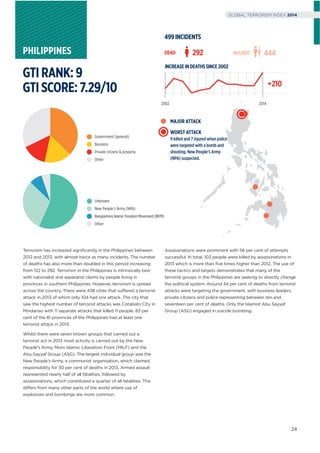
Terrorism has increased significantly in the Philippines between
2012 and 2013, with almost twice as many incidents. The number
of deaths has also more than doubled in this period increasing
from 122 to 292. Terrorism in the Philippines is intrinsically tied
with nationalist and separatist claims by people living in
provinces in southern Philippines. However, terrorism is spread
across the country. There were 438 cities that suffered a terrorist
attack in 2013 of which only 104 had one attack. The city that
saw the highest number of terrorist attacks was Cotabato City in
Mindanao with 11 separate attacks that killed 11 people. 83 per
cent of the 81 provinces of the Philippines had at least one
terrorist attack in 2013.
Whilst there were seven known groups that carried out a
terrorist act in 2013 most activity is carried out by the New
People’s Army, Moro Islamic Liberation Front (MILF) and the
Abu Sayyaf Group (ASG). The largest individual group was the
New People’s Army, a communist organisation, which claimed
responsibility for 30 per cent of deaths in 2013. Armed assault
represented nearly half of all fatalities, followed by
assassinations, which constituted a quarter of all fatalities. This
differs from many other parts of the world where use of
explosives and bombings are more common.
Assassinations were prominent with 56 per cent of attempts
successful. In total, 103 people were killed by assassinations in
2013 which is more than five times higher than 2012. The use of
these tactics and targets demonstrates that many of the
terrorist groups in the Philippines are seeking to directly change
the political system. Around 34 per cent of deaths from terrorist
attacks were targeting the government, with business leaders,
private citizens and police representing between ten and
seventeen per cent of deaths. Only the Islamist Abu Sayyaf
Group (ASG) engaged in suicide bombing.
PHILIPPINES
Unknown
New People’s Army (NPA)
Bangsamoro Islamic Freedom Movement (BIFM)
Other
Government (general)
Business
Private citizens & property
Other
DEAD 292
WORST ATTACK
9 killed and 7 injured when police
were targeted with a bomb and
shooting. New People’s Army
(NPA) suspected.
INJURED 444
INCREASEINDEATHSSINCE2002
+210
2002 2014
499INCIDENTS
GTIRANK:9
GTISCORE:7.29/10
MAJOR ATTACK
24
GLOBAL TERRORISM INDEX 2014
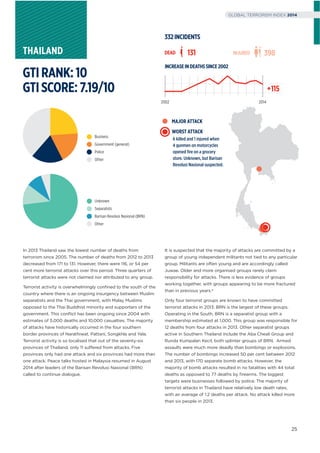
In 2013 Thailand saw the lowest number of deaths from
terrorism since 2005. The number of deaths from 2012 to 2013
decreased from 171 to 131. However, there were 116, or 54 per
cent more terrorist attacks over this period. Three quarters of
terrorist attacks were not claimed nor attributed to any group.
Terrorist activity is overwhelmingly confined to the south of the
country where there is an ongoing insurgency between Muslim
separatists and the Thai government, with Malay Muslims
opposed to the Thai Buddhist minority and supporters of the
government. This conflict has been ongoing since 2004 with
estimates of 5,000 deaths and 10,000 casualties. The majority
of attacks have historically occurred in the four southern
border provinces of Narathiwat, Pattani, Songkhla and Yala.
Terrorist activity is so localised that out of the seventy-six
provinces of Thailand, only 11 suffered from attacks. Five
provinces only had one attack and six provinces had more than
one attack. Peace talks hosted in Malaysia resumed in August
2014 after leaders of the Barisan Revolusi Nasional (BRN)
called to continue dialogue.
It is suspected that the majority of attacks are committed by a
group of young independent militants not tied to any particular
group. Militants are often young and are accordingly called
Juwae. Older and more organised groups rarely claim
responsibility for attacks. There is less evidence of groups
working together, with groups appearing to be more fractured
than in previous years.4
Only four terrorist groups are known to have committed
terrorist attacks in 2013. BRN is the largest of these groups.
Operating in the South, BRN is a separatist group with a
membership estimated at 1,000. This group was responsible for
12 deaths from four attacks in 2013. Other separatist groups
active in Southern Thailand include the Aba Cheali Group and
Runda Kumpalan Kecil, both splinter groups of BRN. Armed
assaults were much more deadly than bombings or explosions.
The number of bombings increased 50 per cent between 2012
and 2013, with 170 separate bomb attacks. However, the
majority of bomb attacks resulted in no fatalities with 44 total
deaths as opposed to 77 deaths by firearms. The biggest
targets were businesses followed by police. The majority of
terrorist attacks in Thailand have relatively low death rates,
with an average of 1.2 deaths per attack. No attack killed more
than six people in 2013.
6 killed and 1 injured when
4 gunmen on motorcycles
opened fire on a grocery
store. Unknown, but Barisan
Revolusi Nasional suspected.
WORST ATTACK
THAILAND DEAD 131 INJURED 398
Unknown
Separatists
Barisan Revolusi Nasional (BRN)
Other
Business
Government (general)
Police
Other
INCREASEINDEATHSSINCE2002
2002 2014
+115
332INCIDENTS
GTIRANK:10
GTISCORE:7.19/10
MAJOR ATTACK
25
GLOBAL TERRORISM INDEX 2014
Analysis of the year-to-year trends in terrorist attacks
underscores its dynamic nature showing it can quickly
intensify yet also fall away. As has been highlighted in the
results section, the majority of terrorist attacks are
concentrated in a small number of countries and this is
where most of the year-to-year change is observed.
While this section focuses on number of deaths, this is not
always perfectly reflective of changes in overall terrorist
impact as some countries may experience more incidents
but fewer deaths, as was the case in Yemen in 2013.
In 2013, 102 of the 162 countries included in this report did
not experience a fatal terrorist attack. Of the remaining 60
countries, 40 experienced an increase in the number of
fatalities when comparing 2012 to 2013. Conversely, there
were 26 countries that had fewer deaths from terrorism in
2013 than 2012.
Eighty-seven countries experienced a terrorist incident in
2013, only slightly up from 81 in the 2012. This trend has
remained fairly stable over the last 14-year period reflecting
the fact that many terrorist incidents can manifest
themselves in very small, non-lethal attacks.
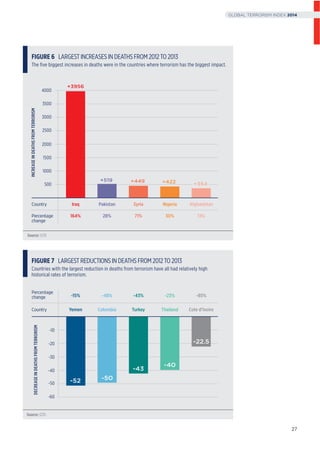
The five countries with the biggest increases in deaths from
2012 to 2013 are also the countries most impacted by
terrorism. The number of deaths in these five countries has
increased by 52 per cent over this period. The country with
the biggest increase in deaths was Iraq, which saw nearly
4,000 more fatalities from terrorism in 2013 than 2012,
TRENDS
LARGEST INCREASES AND
DECREASES IN TERRORISM
2012 TO 2013
representing a 164 per cent increase. The reason for the
increase in Iraq is largely due to the actions of ISIL.
The country with the second largest increase in the numbers
of deaths was Pakistan. However, Pakistan saw a much
smaller increase than Iraq with 520 more deaths in 2013 than
2012. Pakistan saw a substantial increase in the number of
deaths per attack. In particular, the second and third biggest
terrorist groups, Lashkar-e-Jhangvi and Jundallah, averaged
20 more fatalities per attack in 2013 than the previous year.
This highlights the growing lethality of the groups.
Syria saw the third largest increase in the number of deaths
between 2012 and 2013, increasing by 71 per cent. The
increase in deaths in Syria is partly a result of the ongoing
civil war which has displaced millions since its start in 2011.
Most of the deaths in Syria have been classified as war
deaths rather than terrorist deaths.
The increase in terrorism in Nigeria is due to Boko Haram
which has increased in both members and resources. There
was a significant increase in terrorism from 2009 after the
founder and leader of Boko Haram, Mohammed Yusuf,
was killed.
The country with the fifth largest increase in deaths from
terrorism is Afghanistan, where there was an increase of 13
per cent or 350 deaths from 2012 to 2013. This increase is
largely due to further activity by the Taliban, which killed
almost 2,350 in 2013 up from 2,050 in 2012.
26
GLOBAL TERRORISM INDEX 2014
4000
3500
3000
2500
2000
500
1000
1500
INCREASEINDEATHSFROMTERRORISM
FIGURE 6 LARGEST INCREASES IN DEATHS FROM 2012TO 2013
The five biggest increases in deaths were in the countries where terrorism has the biggest impact.
Source: GTD
IraqCountry AfghanistanPakistan NigeriaSyria
164%
+3956
Percentage
change
13%28% 30%71%
+354
+519 +422+449
-60
-50
-40
-10
-20
-30
DECREASEINDEATHSFROMTERRORISM
FIGURE 7 LARGEST REDUCTIONS IN DEATHS FROM 2012TO 2013
Countries with the largest reduction in deaths from terrorism have all had relatively high
historical rates of terrorism.
Source: GTD
YemenCountry Cote d’IvoireColombia ThailandTurkey
-15%
Percentage
change -85%-48% -23%-43%
-52
-22.5
-50
-40
-43
27
GLOBAL TERRORISM INDEX 2014
The five countries with the biggest decrease in deaths from
2012 to 2013 still maintain high levels of terrorist activity,
with Yemen and Thailand being amongst the ten countries
suffering the most from terrorism.
The country with the biggest fall in deaths was Yemen,
falling by 52, or 15 per cent. However, that does not mean
that terrorism is no longer a significant threat. There were
nearly 100 more attacks in 2013 than 2012. Similarly, the
number of injuries from terrorism in Yemen increased from
2012 by 56 per cent to nearly 600. Yemen continues to
confront a dual terrorist threat from the Houthis in the north
of the country and al-Qa’ida in the Arab Peninsula (AQAP) in
the south.
Colombia experienced the second biggest improvement,
with the death rate decreasing by 48 per cent to 55 deaths
from 105 in 2012. This represents a substantial improvement
over the decade average which was three times higher,
averaging approximately 150 per year. The Revolutionary
Armed Forces of Colombia (FARC), the largest terrorist
group, have been in peace talks with the Colombian
Government since 2013 and have substantially reduced the
number of people they have killed.
FIGURE 8 TARGETS OF TERRORISM, 2000-2013
The primary target of terrorism has historically been private property and citizens. However since 2009 there has been a substantial
proportional upsurge in incidents targeting police.
Source: GTD
YEAR
PROPORTIONSOFANNUALATTACKS
0
5%
10%
15%
20%
25%
30%
35%
40%
201220102008 20142006200420022000
Business
Transportation
Religious figures/institutions
Private citizens & property
Government
Police
The third biggest improvement was seen in Turkey, which
experienced 57 deaths from terrorism in 2013, down from
100 in 2012. The decline in Turkey was largely due to the
Kurdistan Workers’ Party (PKK) decreasing terrorist attacks
in Turkey in 2013. In 2012 the PKK killed 86 people, whereas
in 2013 the PKK was responsible for only one death.
However, the emergence of ISIL, which killed at least 53
people in Turkey in 2013, is a significant concern.
The fourth biggest improvement occurred in Thailand which
saw 23 per cent less deaths in 2013 than 2012. At 131 deaths,
2013 was the lowest number of fatalities from terrorism in
Thailand since 2005.
The fifth biggest improvement occurred in Cote d’Ivoire,
which saw deaths decrease by 85 per cent with only four
fatalities in 2013 compared to 27 in 2012. 2012 was the
deadliest year for terrorists in Cote d’Ivoire since 2005.
Terrorism in Cote d’Ivoire sometimes takes the form of
periodic attacks with high casualties. This was the case in
2012 when a group loyal to the former President Gbagbo,
who was arrested and imprisoned by the International
Criminal Court, attacked a UN peacekeeping patrol and
killed ten people.
28
GLOBAL TERRORISM INDEX 2014
PATTERNS AND CHARACTERISTICS
OF TERRORIST ACTIVITY SINCE
2000
This section summarises the overarching patterns and
characteristics of terrorist activity over the last 14 years in
terms of targets, weapons used, tactics, lethality, ideology
and location.
The primary target of terrorism has been private property
and citizens, followed by attacks on police. In MENA and
South Asia explosives are primarily used, while in Central
America, the Caribbean and Sub-Saharan Africa, firearms
are more regularly used. In North America, incendiary
devices/firebombs are common.
Suicide attacks have been used in five per cent of all
incidents since 2000.
Most terrorist attacks do not result in heavy loss of life. In
2013 over 50 per cent of all attacks claimed no fatalities and
only 10 per cent claimed more than five lives. The most
lethal terrorism occurs in MENA, South Asia and Sub-
Saharan Africa.
Around five per cent of all deaths from terrorism since 2000
have occurred in OECD countries.
Over the past 14 years there has been a large increase in
religion as the motivator for terrorist activity. However in
2000, nationalist separatist movements were a more
prominent motivation for terrorism than religion. Today,
political and national separatist aims are still a significant
driver of terrorism but unlike religion, they have seen
comparatively little change over the period.
Figure 8 highlights that the primary target of most terrorist
attacks has been private property and citizens, however
from 2009 onwards the preferred target group gradually
switched to police. These two groups in 2013 accounted for
around 50 per cent of all incidents. Attacks on private
property and citizens decreased from 35 per cent of total
attacks to 25 per cent, while attacks on police increased
from 10 per cent of total attacks in 2009 to 24 per cent in
2013. The trends of these two target groups show large
fluctuations since 2000 rising and falling with subsequent
events in Iraq, Afghanistan and Pakistan.
FIGURE 9 WEAPONS TRENDS IN TERRORISM, 2000-2013
The proportion of weapons used in terrorist acts has remained relatively constant globally with approximately 60 per cent of all
attacks using explosives, 30 per cent using firearms and 10 per cent using other weapons.
Source: GTD Note: Suicide attacks are dashed to indicate that they are included regardless of weapon used and therefore should not be included when adding
proportions to total 100 per cent.
YEAR
PROPORTIONSOFINCIDENTS
0
10%
20%
30%
40%
50%
60%
70%
201220102008 20142006200420022000
Firearms
All others
Suicide attacks
Explosives
29
GLOBAL TERRORISM INDEX 2014
Over the 14-year period attacks on business, transportation
and religious figures have all been significant but
proportionally have remained roughly the same. These
trends are once again largely driven by events in the five
countries with the highest levels of terrorism.
Figure 9 highlights that explosives have consistently been
the most prevalent type of weapon used in attacks
accounting for over 60 per cent of all incidents globally.
Firearms are the next most common weapon being used
around 30 per cent of the time. Only 10 per cent of attacks
used some other form of weapon in 2013. Once again these
global trends are highly dependent on the five countries
with the highest levels of terrorism.
In North America, for example, incendiary weapons have
been the primary mode of attack, with 132 instances since
2000. In Sub-Saharan Africa, firearms are far more
prominent than explosives. This is highlighted with the
recent upsurge in Boko Haram, which has used firearms in
over 50 per cent of their attacks since 2009.
Figure 9 also highlights that only five per cent of all terrorist
attacks in 2013 have been suicide attacks. Suicide attacks
peaked in 2007 largely due to unrest in Iraq between
terrorist groups and the then recently-formed Maliki
Government, where 13 per cent of all terrorist incidents were
suicide attacks.
Whilst the total number of attacks using suicide bombing, as
well as the numbers of terrorist attacks in general has risen
substantially in 2012 and 2013, suicide attacks have
decreased as a proportion of total attacks. In 2012 and 2013
suicide attacks constituted five and six per cent respectively
of all terrorist incidents compared to 2007 when suicide
attacks accounted for 11 per cent of all attacks.
Figure 12 highlights the changes in ideological drivers of
terrorist organisations since 2000. Grouping over 350 of the
most active organisations in the world into either religious,
political or nationalist separatist groups shows that religious
organisations have seen the largest rise in activity over the
period.5 The prevalence of nationalist separatist and political
terrorist organisations has remained relatively stable by
comparison. Notably, religious ideology in the year 2000
was less a motivation for terrorism than nationalist
separatism.
Once again, these global trends are dominated by the five
countries with the highest levels of terrorism. Figure 13
highlights that each region has its own profile. Since 2000,
FIGURE 10 WEAPONS TYPES IN TERRORIST INCIDENTS BY REGION, 2000-2013
Explosive weapons are the predominant tactic used by terrorists in South America, MENA, Russia and the CIS, South Asia and Europe.
Terrorists in Central America, the Caribbean and Sub-Saharan Africa largely use firearms.
Source: GTD
100%
80%
60%
40%
20%
PROPORTIONSOFINCIDENTS
0
South Asia
MENA
Asia-Pacific
Sub-Saharan Africa
Europe
Russia & CIS
South America
North America
Central America
& Caribbean
OtherExplosives/Bombs/Dynamite IncendiaryFirearms
30
GLOBAL TERRORISM INDEX 2014
FIGURE 11 LETHALITY TRENDS IN TERRORISM, 2000-2013
Since 2007, there have been proportionally fewer incidents recorded that have killed more than five people while the per cent
of non-fatal attacks has increased.
Source: GTD
YEAR
PROPORTIONSOFFATALITIESINANINCIDENT
0
20%
10%
30%
40%
50%
60%
201220102008 20142006200420022000
1–5 fatalities
No fatalities
>5 fatalities
FIGURE 12 TRENDS IN TERRORIST GROUP IDEOLOGY, 2000-2013
Religion as a driving ideology for terrorism has dramatically increased since 2000. However, in 2000 Nationalist Separatist
movements were more prominent. Political and National Separatist movements are still significant in 2013 but have seen little change
in activity over the period.
Source: GTD Note: Only 358 of the most active terrorist organisations have been classified in this analysis. Therefore, the number of incidents will not match the total
numbers shown in previous figures.
YEAR
NUMBERSOFINCIDENTS
500
1000
1500
2000
250
0
750
1250
1750
201220102008 20142006200420022000
Political
Religious
Nationalist separatist
31
GLOBAL TERRORISM INDEX 2014
FIGURE 13 TRENDS IN REGIONAL TERRORIST IDEOLOGIES, 2000-2013
Religious ideologies as a motivation for terrorism is not a global phenomenon. While it is predominant in Sub-Saharan Africa, MENA
and South Asia, in the rest of the world terrorism is more likely to be driven by political or nationalistic and separatist movements.
Source: GTD
PROPORTIONSOFINCIDENTS
South Asia
MENA
Sub-Saharan Africa
Asia-Pacific
Europe
South America
Russia & CIS
North America
Central America
& Caribbean
Political Religious Nationalist separatist
100%
80%
60%
40%
20%
0
terrorist activity in Europe, Central and South America has
been almost entirely due to nationalist separatist movements
and political organisations.
Due to the conflict with Chechnya and Georgia, terrorism in
Russia has been largely separatist in nature. In China and the
Asia-Pacific, terrorist activity is approximately evenly split
between all three ideological strains. Domestic terrorist
incidents in North America have been primarily of a
political nature.
TRENDS AND PATTERNS
OF SUICIDE ATTACKS
Suicide attacks in general are confined to only a few
countries. Figure 14 shows that of the 2,500 suicide
attacks since 2000, over 90 per cent occurred in MENA
and South Asia. In these two regions, suicide attacks
average between 11 and 13 fatalities per incident. These are
the highest averages for all regions with the exception of
North America due to the attacks of September 11.
Overall, suicide attacks average 11 deaths per attack while
other terrorist attacks average two. By these numbers it
can be derived that suicide attacks are on average four and
a half times more lethal than other forms of terrorism.
Statistically, suicide bombing assassination attempts are
less successful than other forms, with 56 per cent of
assassination attempts using suicide bombing ending in
failure. Six per cent of suicide attacks are assassination
attempts. However, suicide attacks are much more deadly
than other forms of terrorism.
RELIGION AS A
DRIVING IDEOLOGY
FOR TERRORISM
HAS INCREASED
SINCE 2000.
32
GLOBAL TERRORISM INDEX 2014
FIGURE 14 SUICIDE ATTACKS BY REGION FROM 2000 TO 2013
Since 2000, only five per cent of all incidents have been suicide attacks. Of these 2,500 events, over 90 per cent of attacks occurred in
South Asia and MENA.
Source: GTD
MENA
South Asia
Sub-Saharan Africa
Russia & CIS
Other
Southeast Asia
4% 3%
53%
37%
2% 1%Suicide attacks
All other attacks
TABLE 1 NUMBER OF SUICIDE ATTACKS BY ORGANISATION FROM 2000 TO 2013
The Taliban, al-Qa’ida and ISIL have claimed the most suicide attacks in the period. However Hamas has proportionally used suicide attacks
the most since 2000.
HAMAS (ISLAMIC RESISTANCE MOVEMENT)
AL-AQSA MARTYRS BRIGADE
AL-QA’IDA IN IRAQ
ISLAMIC STATE OF IRAQ AND THE LEVANT
AL-QA`IDA IN THE ARABIAN PENINSULA (AQAP)
TEHRIK-I-TALIBAN PAKISTAN (TTP)
LIBERATION TIGERS OF TAMIL EELAM (LTTE)
AL-SHABAAB
BOKO HARAM
ORGANISATION LAST ATTACK
SUICIDE ATTACKS SINCE 2000
195
152
579
492
298
778
499
630
750
46
35
105
84
42
97
35
43
37
24%
23%
18%
17%
14%
12%
7%
7%
5%
2008
2008
2013
2013
2013
2013
2009
2013
2013
Total number
of attacks
Number of
suicide attacks
Percentage
33
GLOBAL TERRORISM INDEX 2014
Source: GTD
YEAR
DEATHSFROMSUICIDEATTACKS
0
200
100
300
400
500
201220102008 20142006200420022000
Iraq
Total attacks
Israel, West Bank & Gaza
FIGURE 15 NUMBER OF DEATHS FROM SUICIDE ATTACKS, 2000 - 2013
After 2002 the number of suicide attacks in Israel, the West Bank and Gaza significantly declined, whereas the attacks that occurred
in Iraq drastically increased.
The Taliban, al-Qa’ida and its affiliates and ISIL have used
suicide bombing the most since 2000, with a combined
total of approximately 2,000 attacks. For these groups this
represents between 12 and 18 per cent of their total attacks.
All three of these organisations used suicide attacks in
2013.
Whilst suicide attacks constitute a minority of total terrorist
attacks, different terrorist groups use it as a tactic
proportionally more than others. Hamas has historically had
the highest prevalence of suicide attacks in their operations
with 24 per cent of all incidents being suicide attacks. The
Al-Aqsa Martyrs Brigade, another group based in the West
Bank and Gaza, have used suicide attacks the second most
at 23 per cent. However, neither Hamas nor the Al-Aqsa
Martyrs Brigade has used this tactic since 2008.
The majority of suicide attacks have been committed by
jihadist groups in the Middle East. Whilst many of the
groups which employ suicide tactics are associated with
al-Qa’ida in some way, suicide bombing is not necessarily
directed by al-Qa’ida.6 Many jihadists follow their family
and peers rather than orders from afar.7
Over the last 14 years the numbers of suicide attacks have
increased and the areas where the majority of attacks
occurred have changed. From 2000 to 2003 the majority of
suicide attacks occurred in Israel, the West Bank and Gaza.
A truce started in 2003 and led to the gradual decline of
attacks and it wasn’t till 2006 when Hamas won a majority in
the Palestinian legislative election and denounced the use of
suicide bombing that the tactic ended. In 2003, with the
invasion of Iraq and subsequent war, suicide bombing
started in Iraq. Iraq accounts for 43 per cent of all deaths
from suicide attacks in the last decade. Proportionally
however suicide attacks still remain low.
SINCE 2000, OVER 90%
OF SUICIDE ATTACKS TOOK
PLACE IN MENA AND
SOUTH ASIA.
34
GLOBAL TERRORISM INDEX 2014
Turkey 34 57 Germany 0 0
Mexico 4 40 Netherlands 0 0
UnitedStates 9 6 Belgium 0 0
UK* 131 3 Australia 0 0
Greece 53 2 Austria 0 0
Israel 28 2 Portugal 0 0
Chile 4 2 Estonia 0 0
CzechRepublic 1 1 Iceland 0 0
Ireland 24 0 Hungary 0 0
Italy 7 0 Japan 0 0
France 5 0 Finland 0 0
Spain 5 0 NewZealand 0 0
Canada 3 0 Poland 0 0
Switzerland 2 0 Slovakia 0 0
Denmark 1 0 Slovenia 0 0
Norway 0 0 South Korea 0 0
Sweden 0 0
0 0
0 0
0 0
0 0
0 0
0 0
0 0
0 0
0 0
0 0
0 0
0 0
0 0
0 0
0 0
0 0
TABLE 2 DEATHS FROM TERRORISM IN 2013
FOR OECD COUNTRIES
Terrorism killed 57 people in Turkey and 40 people in Mexico in
2013. The United States, United Kingdom, Greece, Israel, Chile
and the Czech Republic also had fatal terrorist attacks,
collectively losing 16 lives.
COUNTRY
ATTACKS
DEATHS
ATTACKS
DEATHS
COUNTRY
TERRORISM IN THE OECD
Since 2000, seven per cent of all terrorist incidents and five per
cent of all fatalities have occurred in OECD countries resulting in
4,861 deaths from 3,151 attacks. Excluding the September 11
attacks, OECD countries on average suffered approximately 229
attacks annually and lost on average 130 lives per year to
terrorist acts.
The U.S. accounted for the largest loss of life with 3,042 fatalities,
however the September 11 attacks accounted for 2,996 of these
deaths. Israel was the country with next highest number of
fatalities at 841 representing 17 per cent of total fatalities followed
by Turkey with 445 fatalities, representing 9 per cent of OECD
fatalities.
Excluding the September 11 attacks, there were still 1,865 deaths
from terrorism in OECD countries over the 14 years from 2000 to
2013. Luxembourg is the only OECD country not to be covered
by the GTI.
Although OECD countries represent a minority of terrorist
attacks globally, they have suffered from several of the most
deadly attacks of the last 14 years. This includes the September
11 attacks which killed nearly 3,000 people, the Madrid train
bombings which killed 191, the Norwegian massacre which killed
77 and the London bombings which killed 56.
As the security situation varies from nation to nation, this report
does not provide a detailed analysis of each individual country;
instead it analyses the overall level of activity in OECD countries,
which organisations historically have presented the greatest
Source: GTD
FIGURE 16 TERRORIST FATALITIES IN OECD
COUNTRIES, 2000-2013
Five per cent of all 107,000 terrorist fatalities since 2000 have
occurred in OECD countries.
95%
Rest of the world
OECD
5%
risks and what are the most common types of attacks.
In 2013 Turkey and Mexico were the countries in the OECD with
the highest number of deaths from terrorism losing 57 and 40
lives respectively; however the UK recorded the highest number
of incidents at 131 of which 88 per cent occurred in Northern
Ireland.
Other countries which suffered fatalities from terrorism were the
United States, United Kingdom, Greece, Israel, Chile and the
Czech Republic, collectively losing a total of 16 lives. Terrorist
incidents were much higher in European OECD countries than
North American and Latin American countries with 244 and 20
incidents recorded respectively in 2013.
According to data from the International Centre for the Study of
Radicalisation and Political Violence (ICSR), of the 34 OECD
countries, 20 are believed to have citizens fighting in Syria
against the Assad Government.8 Figure 26 (on page 57)
summarises available data from a variety of sources on
foreign fighters.
35
GLOBAL TERRORISM INDEX 2014
THE MOST ACTIVE TERRORIST
GROUPS IN THE OECD
This section of the report covers the last five years in which
447 people died from terrorism in the OECD from 1,284
incidents. During the five years from 2009 to 2013, terrorism
in the OECD was predominately concentrated in two
countries, Turkey and Mexico, which had 58 per cent of all
deaths over the last five years.
Lone individuals who were not affiliated with any terrorist
group accounted for 25 per cent of the deaths in OECD
countries over the last five years with for 113 fatalities. The
four groups covered below as well as individual actors
accounted for 338 deaths or 76 per cent of all deaths from
terrorism in OECD countries over the last five years.
Kurdistan Workers’ Party (PKK)
OECD countries attacked in last five years: Turkey
Incidents in last five years in OECD countries: 156
Fatalities in last five years in OECD countries: 129
Injuries in last five years in OECD countries: 303
The PKK are responsible for the most terrorist deaths
in the OECD in the last five years. They were
established in 1978 and initially sought an
independent Kurdish state.9 However, in recent years
the group has focussed more or Kurdish autonomy
within a Turkish state. Operating primarily in Turkey
and Iraq, waves of violence waged by the PKK in the
1990’s are estimated to have caused approximately
40,000 casualties.10 In the past five years the PKK
has been responsible for 29 per cent of all deaths
from terrorism in the OECD.
Individual Actors
OECD countries attacked in last five years:
Belgium, France, Great Britain, Norway, Sweden
and the United States.
Incidents in last five years: 35
Fatalities in last five years: 113
Injuries in last five years: 144
Individual actors are the second major cause of
terrorist deaths in the OECD in the last five years.
They are people who are not formally members of a
terrorist group but may work in cooperation with
one. In the last five years individual actors have been
responsible for over a quarter of all terrorist deaths in
OECD countries. These individuals could either be
attempting to promote their own cause or to support
another group. One prominent example of lone wolf
terrorism occurred in Norway in July 2011 when a
right-wing extremist killed 77 and injured over 300 in
two attacks in part to promote his manifesto.
Another example is in 2013 with the Boston
Marathon Bombing on April 15 which was conducted
by two brothers who learned ideology and terrorist
tactics from al-Qa’ida publications.11
36
GLOBAL TERRORISM INDEX 2014
Islamic State of Iraq and the Levant (ISIL)
OECD countries attacked in last five years: Turkey
Incidents in last five years in OECD countries: 2
Fatalities in last five years in OECD countries: 53
Injuries in last five years in OECD countries: 140
Over the last five years ISIL was responsible for a
quarter of all deaths from terrorism in Turkey. This
makes them the fourth most active group in the
OECD. What is striking is that they have not been
active in Turkey for long and in a short period of time
have replaced the PKK as the most deadly group in
the country killing 53 people in 2013. It is important
to note that these numbers only count up to the
end of 2013.
Devrimci Halk Kurtulus Cephesi
(DHKP/C)
OECD countries attacked in last five years: Turkey
Incidents in last five years in OECD countries: 10
Fatalities in last five years in OECD countries: 6
Injuries in last five years in OECD countries: 16
The DHKP/C, a Marxist-Leninist party formed in
Turkey in 1978 is the fifth most active terrorist group
in the OECD over the past five years.14 It aims to
establish a socialist state within Turkey and is
strongly opposed to the United States, NATO and
Turkish establishment.15 They have claimed
responsibility for the suicide bombing outside the
U.S. Embassy in Ankara in 2013 which killed an
embassy guard and injured one.16
Individualidades Tendiendo a lo Salvaje
(Individuals Tending Toward Savagery)
OECD countries attacked in last five years: Mexico
Incidents in last five years in OECD countries: 2
Fatalities in last five years in OECD countries: 37
Injuries in last five years in OECD countries: 102
This group, based in Mexico, have branded
themselves as anarchist eco-terrorists opposed to
nanotechnology.12 They have claimed responsibility
for an explosion at the Pemex state oil company
offices which killed 37 people in January 2013. They
have also claimed responsibility of shooting a
biotechnology researcher, Ernesto Mendez Salinas to
death in 2011.13 If responsible for both attacks then
they are the fourth most deadly terrorist group in the
OECD in the last five years. Deaths from the drug
wars which have been active in Mexico over the last
decade are not classified as terrorism because they
are organised criminal groupings without unified
political or ideological objectives.
LONE INDIVIDUALS WHO
WERE NOT AFFILIATED
WITH ANY TERRORIST
GROUP ACCOUNTED FOR 25
PER CENT OF THE DEATHS
IN OECD COUNTRIES.
37
GLOBAL TERRORISM INDEX 2014
ASSESSING
TERRORISM RISK
This section describes how the results of the statistical
analysis carried out for the GTI can be used to develop a
quantitative understanding of the future risk of terrorism.
Using terrorist incidents and events data dating back to 1970
and comparing it to over 5,000 socio-economic, political
and conflict indicators, three groups of factors related to
terrorist activity have been identified. Countries that are
weak on these factors and do not have high levels of
terrorism are assessed as being at risk.
The correlations section of this report details the most
significant socio-economic correlates with terrorism. There
are three groups of factors:
Social hostilities between different ethnic, religious and
linguistic groups, lack of intergroup cohesion and
group grievances.
Measures of state repression such as extrajudicial
killings, political terror and gross human rights abuses.
Other forms of violence such violent crime, organised
conflict deaths and violent demonstrations.
Terrorism risk can be clearly grouped into three categories
or contexts:
1. The risk of terrorism in the context of a larger ongoing
conflict.
2. The risk of terrorism in countries without conflict.
3. The risk of ‘black swan’ attacks.
This analysis finds that meaningful risk factors can be
identified for two of the three risk categories, (1) risk of
terrorism in a context of a larger conflict, and (2) risk of
terrorism in countries without conflict. ‘Black Swan’ events
are by their nature very difficult to predict, but statistical
analysis can provide important context to their overall
likelihood. The methodology for conceptualising each
category of risk is detailed further within this section.
Understanding the statistical patterns of terrorist activity
and its socio-economic drivers is a useful starting point for
conceptualising the key risk factors. Over 5,000 datasets,
indexes and attitudinal surveys were statistically compared
to the GTI to find the most significant socio-economic
factors linked to terrorist activity. This process identified
several key indicators which were significantly correlated to
terrorism.
These factors were compared to the literature on the
conditions that are considered conducive for breeding
terrorist violence. There was significant overlap between the
IEP statistical analysis and the literature.17 Several key
variables were then chosen and a multivariate analysis was
performed to understand key causal factors. This process is
further detailed in the correlations section. Key factors
analysed were:
Weak state capacity.
Illegitimate and corrupt governments.
Powerful external actors upholding corrupt regimes.
Extremist ideologies.
Historical violence and conflict.
Inequality in power.
Repression by foreign occupation or colonial powers.
Discrimination based on ethnic or religious origin.
Failure of the state to integrate dissident groups of
emerging social classes.
Social injustice.
To determine which countries are most at risk of a large
increase in terrorism, the 162 countries covered in the GTI
were compared to these factors to find which countries
performed poorly on these measures and were not already
suffering from high levels of terrorism.
38
GLOBAL TERRORISM INDEX 2014
Countries with higher levels of terrorism perform
significantly worse on the Pillars of Peace, a framework
developed by IEP to assess the positive peace factors
that create peaceful societies. The ten countries with the
most deaths from terrorism in 2013 performed 26 per
cent worse on the Pillars of Peace compared to the
international average. These countries performed
particularly poorly on three out of the eight Pillars of
Peace. These three Pillars are:
Free flow of information, which captures the extent to
which citizens can gain access to information, whether
the media is free and independent. Peaceful countries
tend to have free and independent media, which
disseminate information in a way that leads to greater
openness and helps individuals and civil society work
together. This leads to better decision-making and
rational responses in times of crisis.
Good relations with neighbours, which refers to the
relations between individuals and between
communities as well as to cross-border relations. Some
of the countries with the highest levels of terrorism
border each other.
Acceptance of the rights of others, which includes
both the formal laws that guarantee basic freedoms as
well as the informal social and cultural norms that
relate to behaviours of citizens. Yemen is the worst
performing country in this Pillar, with Nigeria and
Pakistan also performing in the bottom ten.
The countries with the highest rates of terrorism also
have certain commonalities in behaviours and attitudes.
Corruption is generally higher among the 10 countries
with the highest number of deaths from terrorism.
According to the Gallup World Values Survey, these
countries experience 11 per cent more people facing a
bribe situation than the international average. All ten
countries have significant Muslim populations and there
are relatively more people expressing the view that the
West is in conflict with the Muslim world. The rates of
political terror and political instability are also
significantly higher in these ten countries than the
international average.
BOX1 TERRORIST ACTIVITY AND THE PILLARS OF PEACE
KEY FINDINGS
Based on measuring these factors IEP has identified the
following 13 countries as being at risk of substantial
increased terrorist activity from current levels:
— Angola
— Bangladesh
— Burundi
— Central African Republic
— Cote d’Ivoire
— Ethiopia
— Iran
— Israel
— Mali
— Mexico
— Myanmar
— Sri Lanka
— Uganda
One of the most important findings in this report is that
there is not a strong statistical link between poverty and
terrorism.18 Many people who join terrorist groups in wealthy
countries are well educated and come from middle class
families.19 A detailed understanding of what is statistically
associated with terrorism is contained in the correlates
section of this report. Other measures which didn’t correlate
include life expectancy, mean years of schooling and
economic factors such as GDP growth.
In comparison to other forms of violence, in 2012 the
number of people killed by homicide was 40 times greater
than those killed by terrorism. Furthermore, terrorist
incidents that kill more than 100 people are rare and
represent only 1 in 1000 terrorist incidents. The required
resources and the planning needed to conduct such attacks
are more likely to be outside the capabilities of most
existing groups.
GLOBAL TERRORISM INDEX 2014
39
GLOBAL TERRORISM INDEX 2014
TERRORISM IN COUNTRIES
NOT IN CONFLICT
TERRORISM IN THE COUNTRIES
WITH ONGOING CONFLICT
In contrast to countries immersed in significant conflict, there
are terrorist activities in countries where there is no ongoing
conflict. Two factors with a strong statistical relationship in
these environments are political terror and low levels of
intergroup cohesion.
To further explore these linkages, IEP has compared the levels
of political terror and intergroup cohesion of countries since
1996 that have suffered a major terrorist attack.22 Of the 6,100
major terrorist acts analysed, over 90 per cent occurred in
countries which at the time were in the lowest quartile of
societal group cohesion as measured by the Indices of Social
Development.23 A similar statistic exists when looking at
political terror with over 90 per cent of the countries that
suffered major terrorist incidents having the highest levels of
political terror and political instability. High levels of extrajudicial
killings and disappearances were common in about 70 per cent
of the countries targeted by major terrorist attacks.
The most common context for the onset of terrorist violence is
within an ongoing conflict. According to the GTD there were
around 40,000 terrorist attacks in which at least one person
was killed between 1970 and 2013. This number spans 178
countries. Of these 40,000 terrorist attacks, around 70 per cent
occurred in countries that were at the time already immersed in
serious political, civil, ethnic or international conflicts.20 This
statistic remains true even if you remove terrorist attacks that
have occurred in MENA and South Asia.
Table 3 lists countries that are currently suffering from ongoing
conflict of this nature.21 Of these, only six are not in the twenty
countries with the highest levels of terrorism, Central African
Republic, Ethiopia, Israel, Mali, Mexico and Myanmar.
COUNTRY
Afghanistan Myanmar*
Central African Republic* Nigeria
Colombia Pakistan
Democratic Republic of the Congo Philippines
Egypt Russia
Ethiopia* Somalia
India South Sudan
Iraq Sudan
Israel* Syria
Mali* Thailand
Mexico* Turkey
Yemen
TABLE3 COUNTRIES THAT MAY EXPERIENCE
INCREASES IN TERRORISM DUE TO ONGOING
CONFLICT
*Note: not in the twenty countries with the highest levels of
terrorism as measured by the GTI.
The following countries are currently suffering from ongoing conflict.
Of these only six are not in the twenty countries with the highest
levels of terrorism as measured by the GTI. These six are determined
at risk of increases in terrorist activity.
FIGURE 17 PER CENT OF TERRORIST ATTACKS
DURING ONGOING CONFLICT 1970-2012
Over 70 per cent of terrorist attacks occur within a country
during periods of major conflict.
72%
During a period of major
conflict.
Outside of a period of
major conflict.
28%
Source: GTD and Center for Systemic Peace,
Major Episodes of Political Violence, 1946-2013
40
GLOBAL TERRORISM INDEX 2014
The Global Terrorism Database (GTD) and the Study
of Terrorism and Responses to Terrorism (START)
classify terrorism as actions outside the context of
legitimate warfare activities. That means only acts
which are contrary to international humanitarian law,
such as the deliberate targeting of civilians, conducted
by sub-national actors are viewed as terrorism. The
actions of governments do not get counted in the GTD
and are therefore not included in the GTI. The GTD and
START do not count state terrorism and only record
incidents by sub-national actors.
Battle deaths when state actors are involved are not
defined as acts of terrorism, but rather the result of war.
As such, a group such as ISIL attacking a Syrian Army
regiment would not be classified as terrorism by either
side but as a wartime activity. Terrorism often invokes a
distinct political or ideological message to be conveyed
to a larger audience than the immediate victims, which is
another reason that battle conflicts are not regarded as
terrorism.
BOX2 DISTINGUISHING BETWEEN TERRORIST ACTIVITY AND WARTIME ACTIVITY
Political terror refers to human and physical rights abuses as
measured by Amnesty International and the U.S. State
Department. This includes violations of human rights, state-
sanctioned killings, torture and political imprisonment.24
Intergroup cohesion refers to relations of cooperation and
respect between identity groups within a society.25 A
breakdown of this social fabric increases the risk of violent
conflict between groups within a country. Importantly, poverty
and other development indicators do not show strong
relationships to high levels of terrorism. Both of these findings
are corroborated with literature in the field.
By analysing the countries that are in a state of peace but have
high levels of political terror and low levels of intergroup
cohesion it is possible to identify countries that have the risk of
increased terrorist activity. IEP has analysed the most up-to-
date data on these factors globally. Table 4 lists countries that
are currently not in outright war or conflict but have the
characteristics of those countries that suffer from high levels of
terrorism and are outside of the 20 countries with the highest
levels of terrorism in the GTI 2014.
TABLE4 COUNTRIES NOT IN CONFLICT BUT AT RISK
OF HIGHER LEVELS OF TERRORISM
The following countries exhibit traits that are normally associated
with countries with higher levels of terrorism.
COUNTRY EXTRAJUDICIAL
KILLING
LACKOF
INTERGROUP
COHESION
POLITICAL
INSTABILITY
RANK
INGTI
2014
Bangladesh 23
Iran 28
Sri Lanka 37
Burundi 39
Cote d’Ivoire 40
Uganda 52
Angola 95
*Note: ticks show where countries score in the bottom 25 per cent globally.
41
GLOBAL TERRORISM INDEX 2014
Not all terrorist incidents are equally devastating, and not
all terrorist groups are equally effective. ‘Black Swan’ events
are by their nature, unknown, unpredictable and devastating.
Understanding the statistical properties and patterns of
these attacks in the context of all terrorist attacks can
provide information that can help with prediction and
risk assessment.
Whilst the fear of large scale and unpredicted black swan
terrorist incidents loom large in the public imagination, the
reality is that most terrorist incidents result in no deaths.
Only one terrorist attack has resulted in more than a
thousand deaths, that being the attacks of September 11th,
with 49 attacks resulting in more than one hundred deaths.
Just over half of all terrorist attacks recorded in the GTI led
to one or more deaths, with the vast majority of those
resulting in less than ten deaths.
The majority of terrorist organisations are relatively
ineffective, with the vast majority of deaths from terrorism
being the responsibility of the four largest terrorist
organisations in the world, each of which has the resources,
manpower, experience, and expertise in order to carry out
successful attacks. Even with these resources, most large
terrorist organisations have had very limited success in
pulling off large scale attacks, especially beyond the
territories in which they operate.
By analysing the distribution and intensity of terrorist
activity it can be seen that the majority of deaths from
terrorism occur from a relatively small percentage of attacks.
Figure 18 shows in fact around 50 per cent of all incidents
claim no lives and most of the remainder claim less than ten.
By analysing the cumulative distribution of deaths Figure 19
shows that 80 per cent of all deaths were caused by only 17
per cent of all the attacks since 2000. Such statistical
properties lead to the observation that deaths from
terrorism follows a power-law probability distribution.
Based on purely mathematical assumption of the power-law
distribution there may even have been slightly fewer terrorist
attacks claiming between 100 and 1000 casualties than
expected. Logical explanations for this include successful
counter-terrorism efforts, or that large scale terrorist
organisations focus on encouraging either small or
independent terrorist cells to pursue smaller scale attacks.
If deaths from terrorism do follow a power-law distribution,
it is expected to see a logarithmic relationship between
deaths in a given incident and the number of incidents with
at least that many deaths. This is indeed what is observed, as
shown in figure 20. Large scale terrorist attacks like the
September 11 attacks, 7/7 London attack, the Madrid train
bombing, or the Beslan hostage crisis are rare but not
completely unexpected.
Terrorism as a tactic of sustained mass destruction on a
large scale is mostly ineffective. However, large scale
explosions and mass deaths cause large, unpredictable and
unintended consequences whereas individual deaths have
much smaller flow-on effects. Therefore comparing ‘black
swan’ events with smaller incidents is difficult as these large
events can be profoundly course changing and result in
significant domestic and international consequences well
beyond their initial impact.
‘BLACK SWAN’ ATTACKS
FIGURE 18 NUMBER OF INCIDENTS
CATEGORISED BY DEATHS.
Just half of all terrorist incidents result in no fatalities.
No deaths
24,413
22,470
1–10 Deaths
2,427
10–100 Deaths
49
100–1000 Deaths
1
> 1,000 Deaths
Source: GTD
42
GLOBAL TERRORISM INDEX 2014
FIGURE 20 NUMBER OF DEATHS PER INCIDENT VS NUMBER OF INCIDENTS
WITH AT LEAST THAT MANY DEATHS
Terrorist incidents with extremely high casualties rarely occur.
Source: GTD Note: Log Scale
10,000
100,000
1,000
100
10
1
1 10010 1,000 10,000
NUMBEROFATTACKSWITHATLEASTTHISMANYDEATHS
NUMBER OF DEATHS IN A SINGLE INCIDENT
FIGURE 19 CUMULATIVE DEATHS FROM TERRORISM SINCE 2000
80 per cent of all deaths have occurred from only 17 per cent of all attacks.
ATTACK RANK BASED ON FATALITIES
100%
80%
40%
20%
60%
0%
1 8330 24413 49360
PERCENTAGEOFTOTALFATALITIES
Four fifths of all fatalities since 2000
were caused by the top 8,330 most lethal
terrorist attacks.
Therefore 80 per cent of fatalities come
from about 17 per cent of the attacks.
43
GLOBAL TERRORISM INDEX 2014
x40
Comparing the number of deaths from homicide versus the
number of deaths from terrorism from 2000 to 2011 in the
four countries that experienced ‘black swan’ events it is
possible to compare the ratio between homicides and
terrorism. Four examples of significant ‘black swan’ incidents
since 2000 include the 2011 Norway attack, the 2004 Madrid
bombings, the 2005 7/7 London attacks and September 11.
A comparison of deaths from these four events to national
homicides of each country over the period of 2000 to 2011 is
shown in Table 5. What is apparent is that even in countries
which have experienced a devastating terrorist attack in the
last ten years; significantly more people were killed by
homicide than by terrorism over the period.
At the global level, the difference between deaths from
intentional homicide and terrorism is very significant. Figure
21 shows that in 2012 a total of around 437,000 lives were
lost due to homicide, by contrast in the same year, a total of
11,000 people were killed from terrorism representing a
number 40 times less than homicide.26 Therefore the
likelihood of being killed through intentional homicide is
much greater than being killed in a terrorist attack.
Of course while it should be noted that while terrorism may
claim fewer lives, its effect on a community is traumatic,
creating fear, changing daily habits and producing
substantial economic costs.
Source: GTD, UNODC Global Study on Homicide 2013
FIGURE 21 NUMBER OF DEATHS BY HOMICIDES
VS. TERRORISM GLOBALLY, 2012
Around 40 times more people were killed globally by
homicide than terrorism in 2012.
DEATHSIN2012
0
200,000
100,000
300,000
400,000
500,000
Homicides
437,000
Terrorism
11,000
COMPARING HOMICIDE TO
TERRORIST DEATHS
TABLE5 DEATHS BY HOMICIDE VS. DEATHS FROM
FOUR LARGE ‘BLACK SWAN’ EVENTS
Even in countries which have experienced a devastating terrorist
attack in the last ten years; significantly more people were killed by
homicide than by terrorism over the 2000-2011 period.
Country Deaths from
terrorism (T)
Homicides (H)
[1]
Ratio = (H – T)/
(T)
Norway 75 518 1:6
Spain 249 5,897 1:23
United Kingdom 57 10,776 1:188
United States 3029 195,948 1:64
TOTALNUMBEROFDEATHS 2000-2011
Source: UNODC, Homicide Statistics, http://www.unodc.org/gsh/en/data.html ,2013,
(accessed 7 October 2014).
AN INDIVIDUAL IS 40
TIMES MORE LIKELY
TO BE A VICTIM OF
HOMICIDE THAN
BE KILLED IN A
TERRORIST ATTACK.
44
GLOBAL TERRORISM INDEX 2014
The economic costs of terrorism go further than the
destruction of property and the loss of life. The increased
costs of security, military expenditure and insurance often
outweigh the original attack. Further, terrorist activities
increase uncertainty in the market, decrease foreign
investment, alter trade and change consumption and
savings behaviour.27 Long run effects can be long lasting
and have a significantly larger effect on the economies of
developing economies.
In 2001 the IMF estimated that terrorism cost the U.S. 0.75
per cent of GDP or approximately US$75 billion per year,
while increases in terrorism in Nigeria in 2010 was
associated with a decline of Foreign Direct Investment
(FDI) by 30 per cent the following year.28
The total costs of terrorism can be divided into two
categories, primary or direct costs and secondary or
indirect costs. Primary costs refer to the immediate
damage caused by an act of terrorism. For example, the
primary costs include the loss of life, injury and damage to
infrastructure. These are the immediate costs in the
aftermath of an event. Secondary costs are more
complicated and can span a greater time period. These are
disruptions to an economy due to a terror event or threat.
This may take the form of increased security costs,
changed consumption patterns, decreased FDI, decreased
trade, and decreased tourism.
Trying to quantify the total global cost of terrorism is
difficult. While direct costs of terrorism are largely agreed
upon in the literature, secondary costs, however, are wide
ranging. For example, studies trying to assess the cost of
the September 11 attack have estimates ranging from $35
billion to $109 billion.29 In addition, terrorism as a term
covers such a vast array of attacks that generalisation is
almost impossible. For example a bioterrorist attack could
be delivered using a poison, virus or bacteria, each of which
would have varying degrees of damage. The estimated
economic cost of such an attack could range from $477.7
million to $26.2 billion for every 100,000 persons
exposed.30
Other economic costs of terrorism included in a report
published by the Australian Department of Foreign Affairs
and Trade which estimated in 2013 the extra trade costs
due to terrorism alone could be as high as $180 billion. A
report by RAND published in 2011 outlined three different
levels of terrorism and associated costs within the U.S.
These were moderate, severe and nuclear. Table 6 is a
rough estimate of the associated direct costs of each
category of an attack according to their calculations.
The primary costs of terrorism can incur huge totals,
especially large scale events such as the London and Madrid
bombings and the September 11 attacks. The large loss of
life and destruction of infrastructure from September 11
totalled $55 billion in New York alone, while secondary
effects such as increased security ($589 billion), decreased
economic activity ($123 billion) and other costs have been
totalled to as much as $3.3 trillion.31
TABLE6 RAND ESTIMATED DIRECT COSTS OF
TERRORIST ATTACKS WITHIN THE U.S.
A RAND study published in 2011, estimated the costs of terrorist
attacks on the US economy by dividing attacks into three groups.
Severe attacks such as the 9/11 bombings are estimated to cost
the economy 1 per cent of GDP, while a nuclear attack would double
this. These are rough estimations and the location of the attack
would have major effects on the outcome.
MODERATE SEVERE NUCLEAR
Cost per year $11 billion $183 billion $465 billion
Cost of life $4 million per
person
$4 million per
person
$4 million per
person
Cost of injury $40,000 per
person
$40,000 per
person
$40,000 per
person
Annual resource cost $10 billion $200 billion $300 billion
GDP 0.05% 1% 2%
ECONOMIC COST OF
TERRORISM
THE LONG TERM
INDIRECT COSTS OF
TERRORISM CAN BE
TEN TO 20 TIMES
LARGER THAN THE
DIRECT COSTS.
45
GLOBAL TERRORISM INDEX 2014
Trade and FDI are negatively affected by acts of terrorism.
However there are exceptions, single incidents, even when
major events, do not seem to affect FDI. Studies have shown
that the 9/11 terrorist attacks had little effect on U.S. FDI,32
while FDI in Spain actually increased by $6 billion in 2005
following the 2004 Madrid train bombings and by another
$11 billion in 2006.33
Decreased FDI flows due to terrorism were recorded in
Greece and Spain in the 1980s and 1990s and were worth up
to half a billion for each nation.34 The effect has been more
dramatic in Nigeria where it has been estimated that FDI
flows dropped $6.1 billion in 2010 due to Boko Haram’s acts
of terrorism.35 This represents a decline of almost 30 per
cent from the previous fiscal year. This is shown in Figure 22.
As developing economies or fragile states are generally
more volatile, investment comes at a higher risk. As a result,
terrorism in high risk countries drastically lowers investment.
These acts also increase the security premium, further
increasing the cost of economic activity and leading
investors to look elsewhere. This is one reason why acts of
terror within developing nations have a more drastic effect
on FDI than in developed nations.
The average FDI within the ten countries most affected by
terrorism is less than half of that of OECD countries. Trade
as a per cent of GDP is 51 per cent for these countries,
while OECD countries are on average 87.5 per cent.36 As
many developing economies depend on trade flows with
the developed world and rely on FDI inflows, these
decreases have substantial long-term economic and
developmental effects.
Figure 23 shows the correlation between terrorist incidents
and trade activity as a per cent of GDP in Colombia. While
not all change can be attributed terrorism, it demonstrates
there can be a notable potential impact.
TERRORISM,
INVESTMENT AND
TRADE
Increased costs of insurance
Following the 9/11 attacks, insurance premiums on large
infrastructure within the U.S. skyrocketed, Chicago’s
O’Hare airport annual insurance policy increased in cost
from $125,000 to $6.9 million while its insurance
coverage for terrorism decreased from $750 million to
$150 million per annum.37 This resulted on the creation of
the Terrorism Risk Insurance Act (TRIA), which was
passed resulting in the government reimbursing up to 85
per cent of losses due to acts of terrorism. Similar
policies have been seen in Australia following the Bali
bombings, the UK, Germany and France.
GDP Decrease
Changes in consumer behaviour, decreased investment,
and decreased trade, destruction of human and physical
capital all combine to decrease a country’s GDP.
Increased government spending
Governments often have to take on the financial burden
of any terrorist acts which result in damage to property
or people. The opportunity cost of such large scale
expenditure has the potential to take funding away from
other infrastructure investments and social investments in
education, the health sector, transport and R&D.
Changes in consumer behaviour
The way people act within an economy changes as a
result of terrorism. Consumption patterns change,
people invest more wealth into insurance which as a
result is diverted from other expenditure. In extreme
cases individuals are reluctant to move in public spaces
due to the fear of attack thereby decreasing expenditure
and economic activity.
BOX3 OTHER FLOW-ON COSTS OF TERRORISM
46
GLOBAL TERRORISM INDEX 2014
FIGURE 22 CHANGES IN FDI AS A PER CENT OF GDP IN NIGERIA AND BENIN, 2006-2013
Since increased violence from Boko Haram in 2009, FDI in Nigeria has decreased sharply from five per cent of GDP to just one per cent,
while FDI in neighbouring Benin has shown increases.
Source: World Bank
Boko Haram
increases in activity.
FDI(NETINFLOWS)PERCENTOFGDP
2012201120102008 20092007 20132006
2
1
-1
0
3
4
5
Nigeria
Benin
YEAR
FIGURE 23 COLOMBIA: TERRORIST INCIDENTS COMPARED TO TRADE AS PER CENT OF GDP, 2008–2013
While a large drop in trade in 2008 was attributed to the global financial crisis, there is a significant statistical relationship between
trade and terrorism of –R=0.79 over the last 6 years.
Source: World Bank Data, GTD
TRADEASPERPERCENTOFGDP
0
40
80
120
160
31
40
39
38
37
36
35
34
33
32
ACTSOFTERRORISM
201320122011201020092008
r=0.79
Trade as % of GDP
Acts of terrorism
47
GLOBAL TERRORISM INDEX 2014
In 2013 four terrorist groups were responsible for 66 per
cent of all deaths from claimed terrorism incidents. These
four groups are the most deadly terrorist groups in the last
fifteen years, and have killed at least 25,000 people in a
decade. The deadliest terrorist group is the Taliban and the
TTP, which has killed over 12,000 people, closely followed by
al-Qa’ida and its major affiliates that have killed at least
8,585 people.
The two other largest terrorist groups have shorter histories.
Islamic State of Iraq and the Levant (ISIL) and Boko Haram
both became more active in 2009, which was the first year
that either group killed over 300 people. Based on data up
to the end of 2013, these two groups have killed in excess of
3,000 people in four years, half of which was in 2013 alone.
The ten largest terrorist groups have varying agendas and
are a combination of religiously motivated groups, separatist
movements and ideological groups wanting a change of
system. The four most deadly organisations all ascribe
broadly to the Wahhabi sect of Sunni Islam and have an
association with al-Qa’ida.
The origins of al-Qa’ida can be traced to the Soviet war in
Afghanistan, where they were one of the many groups
fighting the Soviet Union. Similarly, the Taliban was involved
in opposing Soviet forces in Afghanistan.
The two groups have had close ties since 1996 when they
trained together in Afghanistan. In recent times al-Qa’ida has
decentralised and its direct affiliates continue to be
significant. Of its major branches or affiliated organisations
al-Qa’ida in Iraq (AQI) has been responsible for the most
deaths. Following the death of AQI’s leader and a split over
tactics, Islamic State of Iraq (ISI) emerged from AQI. ISI was
renamed Islamic State of Iraq and the Levant (ISIL) and is
the biggest terrorist group operating in Iraq today. It has
since adopted the name of Islamic State, but this report uses
the ISIL designation.
Other large affiliates of al-Qa’ida include al-Qa’ida in the
Arabian Peninsula (AQAP) based in Yemen which has been
responsible for nearly 1,000 deaths and al-Qa’ida in the
Lands of the Islamic Maghreb (AQLIM) based in Algeria and
TERRORIST GROUP
CASE STUDIES
48
GLOBAL TERRORISM INDEX 2014
responsible for over 500 deaths. There have been reports
that Boko Haram is affiliated with al-Qa’ida, with founding
member Mohamad Yusuf reportedly receiving early funding
from Usama bin Ladin.38 There are only two other terrorist
groups among the ten most deadly groups which are also
motivated by religion. The Lord’s Resistance Army in
Uganda and South Sudan is driven in part by Christian
fundamentalism.39 The other religiously motivated group,
Al-Shabaab in Somalia, is an al-Qa’ida affiliate.
Al Qa’ida affiliates are defined as either being an ally or as
having a familial relationship to al-Qa’ida. The activity of
these 30 organisations span South Asia, MENA, Europe,
Africa, North America and the Asia-Pacific and have
claimed 27,169 lives over the period. Activity since 2009 has
been largely in Afghanistan, Syria, Iraq, Yemen, Algeria
and Nigeria.
FIGURE 24 10 MOST DEADLY TERRORIST ORGANISATIONS BY NUMBERS KILLED (2000-2013)
The four biggest terrorist groups in 2013 are also the deadliest groups of the last fifteen years.
Source: GTD Note: Taliban includes Afghanistan and Pakistan Taliban.
Taliban* Boko Haram Indian Maoists
Al-Shabaab
Revolutionary Armed Forces
of Colombia (FARC)
12,000
10,000
6,000
8,000
2,000
4,000
0
FATALITIES
ISILAl-Qa'ida
(all major affiliates)
Lord's Resistance Army
Tamil Tigers
Chechen Rebels
The changing name of ISIL reflects the many changes of
the organisation. Originally al-Qa’ida in Iraq (AQI), the
group changed their name to Islamic State in Iraq (ISI)
when they split off from al-Qa’ida. In April 2013 the group
changed its name to Islamic state of Iraq and Syria (ISIS)
to reflect that it was engaged in the Syrian civil war. Due
to translation ambiguities it is also known as the Islamic
State of or Iraq and the Levant (ISIL). In June 2014 the
group solely referred to itself as the Islamic State or IS
reflecting its shift of focus from a regime change in Syria
to a desire to create a ‘caliphate’ or sovereign state. It has
been referred to as Da’ish (or Daesh) as that is the Arabic
acronym, although ISIL supporters dislike this name in
part because it sounds similar to unpleasant words in
Arabic.40 This report uses the ISIL designation.
BOX4 THE MANY NAMES OF ISIL
49
GLOBAL TERRORISM INDEX 2014
COMPARING TERRORIST ORGANISATIONS
INCIDENTS, DEATHS & INJURIES In 2013 these four groups are responsible for 66 per cent of all
deaths from terrorist attacks in which the perpetrator is known.
Deaths from other groups operating in Pakistan, Syria, Somalia,
India, and Kenya account for a further 21 per cent of deaths in the
same year. Prominent groups operating in these countries include
the Al-Nusrah Front in Syria, Al-Shabaab in Somalia and Kenya,
Lashkar-e-Jhangvi in Pakistan and Maoists in India.
ISIL
Boko
Haram
Al-Qa’ida Taliban*66%
Of all attacks in 2013 in
which the perpetrator was
known, these four groups
were responsible for 66 per
cent of all resulting deaths.
*Includes both Afghanistan
and Pakistan Taliban.
9115
12185
ISILBoko HaramAl-Qa’ida Taliban
3111
8081
492
3440
1759
750
8763
2757
8585
1089
Total, 2000-2013
Incidents
Deaths
Injuries
TRENDS, 2000-2013
YEAR
NUMBEROFDEATHS
0
500
1,000
1,500
2,000
2,500
3,000
2001 2003 2005 2007 2009 2011 2013
Taliban
ISIL Al-Qa'ida (all major affiliates)
Boko Haram
50
GLOBAL TERRORISM INDEX 2014
TARGETS & TACTICS, 2000-2013
FREQUENCY AND TYPES OF ATTACKS / / /
TARGETS OF ATTACKS / / / /
420/51 /21
ISIL
270/375 /105
622/ 1612
133 /390
Boko Haram
Al-Qa’ida
740/268 /81
289/ 520 /35 /245
Al-Qa’ida Taliban
Taliban
Note: al-Qa’ida includes al-Qa’ida and all major affiliates.
* Sources detailed in endnotes.
156/307
150 /137
Boko Haram
1345/966 /446
219/158
30 /85
ISIL
Private citizens
& property
Government,
police & military
Firearms Explosives Others Key 1 icon = 50 incidents
Others
Educational
& religious institutions
CAPACITY, NUMBER OF FIGHTERS*
0 20,000 40,000
36,000-60,000
20,000-30,500
3,700-19,000
500-9000
60,000
Boko Haram
ISIL
Al-Qa’ida
Taliban
High Estimate
Low Estimate
NUMBEROFFIGHTERS
51
GLOBAL TERRORISM INDEX 2014
ISLAMIC STATE OF IRAQ AND
THE LEVANT (ISIL)
Iraq’s wheat growing land. The second main source of revenue is
through foreign investors.44 The third revenue stream is through
looting and controlling resources. Kidnapping and extortion, as
well as the charging of electricity, fines and religious taxes, are
also major revenue streams for ISIL.45
MEMBERSHIP
Recent estimates suggest that ISIL has access to up to 31,500
soldiers.46 This represents up to a fifteen fold increase on the
numbers of AQI in 2011 which the U.S. Department of State
estimated at 1,000 to 2,000.47 The majority of these soldiers are
from Syria and Iraq, attracted in part by steady wages. ISIL
reportedly pays soldiers $400 per month and a bonus every year
with added premiums for a dependant which is a good wage for
the region.48 ISIL actively recruits foreign fighters, posting on
social media in multiple languages and publishing its propaganda
magazine, Dabiq, in English. The war in Syria has attracted at
least 12,000 foreign fighters. As the Syrian civil war has
continued, foreign fighters have been more attracted to
extremist groups like ISIL over more mainstream rebel groups.49
ACTIVITIES
The military and intelligence wings remain significant as ISIL
attempt to gain and maintain control over land. Military
operations include training camps as well as military incursions
and terrorist activity. Terrorist activity takes the form of
bombings targeting private citizens, police and businesses. In
2013 there were 350 terrorist attacks by ISIL which killed 1,400
people and injured 3,600. ISIL conducted over 50 suicide
bombings which killed an average of nine and injured 17 people.
ISIL is both an insurgency and a quasi-government for the
regions it controls in both Iraq and Syria. ISIL has developed a
governing bureaucracy since shifting its focus from overthrowing
the Assad regime in Syria to establishing a state. There are
departments which draft and implement ISIL policies.
Responsibilities include developing laws, recruitment, controlling
financial matters including a 410 page annual report and oil and
weapon sales, propaganda and media outreach. As well as
internal organisational roles, councils have adopted governance
responsibilities including the establishment of Islamic courts as
well as policing and punishment. There are also reports that ISIL
have taken on service delivery functions including electricity,
repairing roads, food kitchens and, in some areas, post offices.50
HISTORY
The Islamic State of Iraq and the Levant (ISIL) has emerged as
the largest Sunni terrorist organisation active in the Middle East.
The group was originally al-Qa’ida in Iraq (AQI). However
following the death of the head of AQI, Abu Musab al-Zarqawi,
and disagreements over tactics, a group split from AQI and
formed the Islamic State in Iraq (ISI).
ISIL became known for extreme violence and terror tactics as a
major actor in the Syrian civil war in 2013 and with its rapid
expansion into Syria and then Iraq in 2014. In February 2014
al-Qa’ida formally broke ties with ISIL, with leader Ayman
al-Zawahiri stating ISIL disobeyed directions from al-Qa’ida to kill
fewer civilians.
IDEOLOGY
ISIL is an extremist Wahhabi insurgency with the primary goal of
establishing a regional caliphate, or state, under Salafist oriented
Islamic law.41 The group promotes violence to those who do not
adhere to its interpretations. ISIL aspires to control the Levant
region which includes Israel, Iraq, Jordan, Lebanon and Syria. It is
opposed to the Alawite Assad regime and the Shia Iraqi
Government of both former Prime Minister Nouri al-Maliki and his
successor Haider al-Abadi. ISIL has also claimed to be fighting a
holy war against Shia Muslims, Christians and Yezidis, a Kurdish
ethno-religious group in Iraq and Syria.
LEADERSHIP
The entire organisation is led by Abu Bakr al Baghdadi who is
known as the Caliph or political successor. The ‘governor’ of the
Syrian territories of ISIL is run by Abu Ali al-Anbari, a former
Major General under the Hussein regime. The ‘governor’ of the
Iraqi territories of ISIL is run by another former army General
under Hussein, Abu Muslim al Turkmani. Both men engage in
military strategy and govern areas through the oversight of local
councils.
FUNDING
ISIL has emerged as one of the wealthiest terrorist organisations,
with at least three main revenue streams. The first is through
selling what they have captured. This includes oil sales to local
consumers, the Syrian regime and black marketers as well as
exporting crude oil to Turkey.42 It is believed that ISIL controls a
dozen oil fields and refineries in Iraq and Syria generating
revenues of between one to three million U.S. dollars per day.43
ISIL captured some of the oil fields from Al-Nusrah Front in 2014.
As well as oil, it is believed that ISIL has access to 40 per cent of
52
GLOBAL TERRORISM INDEX 2014
BOKO HARAM
GLOBAL TERRORISM INDEX 2014
HISTORY
Boko Haram is a Nigerian based terrorist group founded in 2002.
The name has been interpreted to mean ‘Western education is
sin’ or ‘Western Civilisation is forbidden.’ The group began as
members of a mosque in the north-east which sought to
implement a separatist community under Wahhabi principles.51
Boko Haram was founded as a Sunni Islamic fundamentalist sect
advocating a strict form of sharia law and developed into a
Salafist-jihadi group in 2009, influenced by the Wahhabi
movement.52 After a dispute with police which killed 70
members, a new group was formed under Imam Mohamad Yusuf
who built a new mosque for the group. Following the death of
Mohammed Yusuf while he was in police custody in 2009 the
group became markedly more violent. Before 2009 the group
engaged in few acts of violence, but it has been responsible for
3,500 civilian deaths since.53
IDEOLOGY
The group is Sunni Islamist and seeks to abolish the secular
system of government to implement Wahhabi interpretations of
Sharia law in Nigeria.54 Sharia law is fully implemented in nine and
partially implemented in three of the 36 states of Nigeria, all of
which are in northern Nigeria. However, Boko Haram is seeking
full implementation of Sharia throughout the entire country.
They aim to use acts of terror to further the social divide
between Muslim, Christian groups and the Federal Government.
As such, they have issued an ultimatum to Christians living in
north-east Nigeria to ‘leave or die.’55 The group is against any
Western influence and, like the Taliban, attacks educational
institutions to highlight its opposition to western education.56
LEADERSHIP
After the death of founder Mohamad Yusuf in 2009, deputy
leader Abubakar Shekau took over until he was killed by Nigerian
forces on 26 September 2014. The group is largely decentralised.
Different states host cells which often have little communication
with each other. Hence it is difficult to dissect the organisational
structure, size and leadership. What is known is that Boko Haram
has two main sections: the larger section is focused on
discrediting the Nigerian government; whereas the smaller
section is more focused on conducting increasingly sophisticated
and lethal attacks.57
FUNDING
Boko Haram has multiple revenue streams. This includes the sale
of goods, extracting the profits of supportive businesses, child
beggars which are also used as spies for the organisation,
extorting local traders and cross-border smuggling of arms and
cash.58 They also receive funding from wealthy members and
supportive benefacttors. There are also major narcotic trafficking
routes to Europe in West Africa and it is suspected that Boko
Haram has links with al-Qa’ida in the Islamic Maghreb (AQIM) in
trafficking narcotics as another major source of revenue.59
MEMBERSHIP
The exact number of Boko Haram members is unknown60
however higher estimates are around 9,000.61 Recruitment has
targeted disaffected youths in the poorest areas of Nigeria,
namely Yobe, Kano, Bauchi, Borno and Kaduna all in the north.
The 12 most northern states where Boko Haram operates have
almost double the poverty rates and four times the child
malnutrition rates of the rest of the country.62 Members are often
disaffected youths, unemployed graduates and members of
Almajiris which are homeless youth supposedly under religious
guidance.
ACTIVITIES
Boko Haram wants to bring about Sharia law rather than control
areas and service delivery. As such, the majority of its activity is
aimed at destabilising the Nigerian Government and increasing
religious tensions rather than becoming the government. Apart
from recruitment, fundraising and increasing political influence,
Boko Haram is predominantly engaged in terrorist activity. The
group has been increasing its deadliness each year, with 2013
being four times as deadly as 2009. In the period between 2009
and 2012, over 3,500 Nigerians have been killed by the group
through shootings and bombings.63 Around 60 per cent of
attacks and fatalities are armed assaults using guns, with a
quarter of attacks and fatalities from bombings. They have used
at least 35 suicide bombings, 28 of which occurred in 2012.
Suicide bombings account for five per cent of all attacks.
Boko Haram is known for instigating sectarian violence between
Christian and Muslim groups and has attacked both churches
and mosques in an attempt to instigate hatred and unrest among
the two groups. In 2013 Boko Haram killed 64 people who were
attending services in mosques and 16 attending church services
in over 11 separate attacks. In 2013 there were 11 private citizens
who were beheaded.
Like other large terrorist groups, Boko Haram shows concern
over the way it is depicted in the media. The group has specific
journalists which they contact directly to claim responsibility for
various attacks. They regularly release videos online, including
in response to the international ‘Bring Back Our Girls’ campaign
which was started in protest of the school girls kidnapped
in Chibok. 53
GLOBAL TERRORISM INDEX 2014
AL-QA’IDA
HISTORY
Al-Qa’ida was formed in 1988 by Usama bin Ladin, a Saudi
Arabian who was killed in 2011, and Abdullah Azzam, a
Palestine Sunni scholar who was killed in 1989. The group, like
the Taliban, rose during the Soviet war in Afghanistan. It strives
for international jihad, and is the only international jihadi group
to have successfully conducted large scale attacks in the West.
The group was responsible for large scale attacks in New York,
London and Madrid and were a main target of the NATO-led
War on Terror following September 11. As a result, many of
al-Qa’ida’s leadership have been killed and al-Qa’ida now
adopts a decentralised structure using regional cells and
affiliated organisations instead of a centrally controlled
organisation. While direct acts of terrorism attributed to
al-Qa’ida have been relatively lower since 2011, activity by
al-Qa’ida affiliated groups has risen.
IDEOLOGY
Al-Qa’ida is a Salafi jihadist group inspired by the teachings of
Wahhabism and seeks to use armed conflict to advance Islam.
The group is opposed to other forms of Islam including Shia,
and other major religions well as Judaism. Al-Qa’ida also views
the West as allied to Israel, and determines this relationship as
responsible for the poverty of many Muslim countries.64 The
organisation seeks to rid the Muslim world of any western
influence and implement an Islamic caliphate, or state, under
sharia law.65
LEADERSHIP
Following the capture or assassination of many of the group’s
leaders, the structure and leadership of the organisation has
decentralised into regional cells. The current leader is Ayman
al-Zawahiri, who reportedly was one of the architects of the
September 11 attacks and served as bin Ladin’s physician in the
1980s. His whereabouts have remained unknown since he went
into hiding following the overthrow of the Taliban.
Nasser Abdul Karim al-Wahuyshi is the leader of al-Qa’ida in the
Arabian Peninsula (AQAP), the most active franchise of
al-Qa’ida. Khalid al-Habib was named as the organisation’s
military commander after it was falsely believed he had been
killed in U.S. drone strokes in 2006. He is believed to oversee
internal operations in Afghanistan and Pakistan.
FUNDING
Originally the organisation was funded by bin Ladin’s personal
wealth and fundraising as well as through the opium trade.66
Recently, ransoms for hostages have been a major source of
revenue for al-Qa’ida. According to a New York Times report,
al-Qa’ida has raised $125 million from ransoms since 2008, with
$66 million from 2013 alone.67 The source of the majority of
ransom payments is reportedly European governments and
companies.
MEMBERSHIP
The size of al-Qa’ida is hard to measure as many significant
leaders from al-Qa’ida have been killed or imprisoned and the
organisation is largely decentralised. The central organisation
has decreased in size in recent years, with the former CIA
Director, Leon Panetta, claiming in mid-2010 that there were
fewer than 100 al-Qa’ida members in Afghanistan. However, its
affiliation with other organisations and reach, especially in
Africa, has increased.68 Al-Qa'ida and its affiliates are estimated
to have 3,700 to around 19,000 members. 69 70
While the organisation is split into sects such as al-Qa’ida in the
Islamic Maghreb, al-Qa’ida in Syria, al-Qa’ida in Somalia,
al-Qa’ida in the Indian Subcontinent and al-Qa’ida in the Arabian
Peninsula, the organisation is also indirectly affiliated with at
least 18 other terrorist groups and has connections with Boko
Haram and Al-Shabaab.
ACTIVITIES
Prior to the death of bin Ladin the group were responsible for a
number of high profile attacks within western countries such as
September 11, the London and Madrid bombings, as well as a
string of smaller attacks. However, recently it hasn’t committed
large scale acts of terror. This may be because of the much
reduced organisational capacity. Other attacks such as suicide
bombings, armed attacks, IEDs, kidnapping and hijackings have
also been employed by the organisation. The number of terrorist
attacks attributed to al-Qa’ida dropped significantly in 2013 to
166 from 405 in 2012, while the organisation was still responsible
for the death of 559 people and injury of 1,245 others.
54
GLOBAL TERRORISM INDEX 2014
TALIBAN
HISTORY
Founded in 1994 by Mohamad Omar, the group were originally a
mixture of Mujahedeen who fought against the Soviet invasion
of Afghanistan in the 1980s and a group of Pashtun tribesmen.
The Taliban took control of Afghanistan in 1996 and ruled until
2001, when they were overthrown by the American-led invasion
of Afghanistan. They have since regrouped as an insurgency
movement to fight the now former Karsai administration and the
NATO-led International Security Forces (ISAF). Now known as
the ‘Neo-Taliban’ or the Quetta Shura Taliban due to the current
location of their leadership, the organisation has rebranded itself
as an independence movement in an attempt to gain support as
it endeavours to recapture and take control of Afghanistan.
IDEOLOGY
Its beliefs are a mixture of Wahhabism, Deobandi, a form of
Hanafi Sunni Islam, and Pashtun local tribe codes known as
Pashtunwali.71 The group has rebranded itself as an
independence movement rather than a fundamentalist
organisation.72 The new structure forcibly recruits men and
children into their ranks.
LEADERSHIP
Since the collapse of the Islamic Emirate of Afghanistan in 2001,
the leadership of the Taliban is based in Quetta, Pakistan, known
as the Quetta Shura Taliban. Mullah Omar who began his
involvement with the Taliban in 1996 is said to head the
organisation. While there have been several reports of his death,
none have been confirmed.
FUNDING
Al-Qa’ida had provided the Taliban with financial support and
imported fighters from Arab countries and Central Asia. While
also dependant on smuggling and drug trafficking, opium and
heroin production is believed to be the equivalent to four per
cent of Afghanistan’s GDP and the global heroin trade has
historically been a major source of revenue for the Taliban.73 74 In
2008 it was estimated that the opium trade financed as much as
40 per cent of the Taliban’s activities.75 The U.S. has also
accused Iran for supplying militants with Iranian-made weapons
including road side bombs, one of the main forms of attacks
used by the Taliban.76
MEMBERSHIP
In 2010 the estimated size of the Taliban was said to be 36,000
to 60,000.77 78
ACTIVITIES
While the Taliban has been responsible for 75 per cent of civilian
casualties in Afghanistan since 2010, its main targets are
government administration, police and military personnel,
specifically targeting coalition and Afghan forces as it stages an
insurgency campaign to recapture the state. In 2013 the Taliban
were responsible for 649 acts of terrorism with 234 associated
deaths. While suicide bombings are used for around 10 per cent
of attacks the majority of Taliban incidents have been via
roadside bombs, explosive devices or armed attacks. There has
been an increase in targeting of military and police in recent
years.
Major attacks in 2013 included:
A suicide bomber detonated a bomb outside of Kabul’s
Supreme Court killing 17 and wounding 40.
In December 2013 an armed assault on Afghan security
forces in Jurn district, Badakhshan province, Afghanistan
killed a total of 19 people including two soldiers.
In November of 2013 an assault on the national army in
Bala Morgab district, Badgis province, Afghanistan killed
eight people including two soldiers and injuring 23 others.
No group claimed responsibility; however the attack was
attributed to the Taliban.
The organisation has been using Twitter and text
messages to communicate with the media and claim
responsibility for attacks as well as operating a
clandestine radio station “voice of the Shariat” to claim
responsibility for attacks and spread their agenda.79
GLOBAL TERRORISM INDEX 2014GLOBAL TERRORISM INDEX 2014
55
GLOBAL TERRORISM INDEX 2014
Following the beginning of the Syrian war there is growing
interest surrounding the increases in foreign fighters,
particularly ‘western’ born jihadists. Central to this interest is
the concern that foreign fighters returning from the conflicts
in Iraq and Syria will commit terrorist attacks once they have
returned to their country of origin. Statements made by ISIL
have said that they wish to encourage ‘lone wolf’ terrorism
committed by fighters once they return home.
As a result of these concerns, there has been a great deal of
debate regarding the number of foreign fighters currently
fighting for ISIL. Estimates vary depending on sources, with
some counting total numbers, including those killed in
action or those who have returned home, whilst others try
to estimate only the number of currently active fighters
only. Figure 26 shows an estimate of the total number of
active foreign fighters in Syria based on government
reports and the International Centre for the Study of
Radicalism (ICSR). High and low estimates are provided by
ICSR as well as a comprehensive account of how these
estimates were derived.
The vast majority of foreign fighters in Syria came from
surrounding Middle Eastern countries. Low estimates
suggest that there were four times as many foreign fighters
from the Middle East and North Africa, compared to Western
European countries.
Comprehensive counter-terrorism efforts are concerned
not only with stopping specific terrorist attacks, but also
disrupting, breaking up, and eventually ending terrorist
groups. Thus, it is important to understand how,
historically, terrorist groups come to an end in order to
hasten the demise of currently active terrorist groups.
A report by the RAND Corporation, which looked at
terrorist groups over a forty year period, found that the
majority of terrorist groups ended by either joining the
political process, meaning either the whole organisation,
or via a political wing of the organisation and becoming
became a legitimate political party, or were destroyed by
policing and intelligence agencies breaking up the group
and either arresting or killing key members. Military force
in of itself was rarely responsible for ending terrorist
groups, as shown in Figure 25.
The report also found that the manner in which a
terrorist organisation developed was closely related to
the goals of that organisation. Terrorist groups with
narrow goals were much less likely to engage in
widespread violence, were more likely to find common
ground or at least negotiate a settlement with the acting
government, and thus more likely to seek legitimisation
through the political process. Conversely, groups with
broad goals or those groups with an international focus
and a religious orientation were much less likely to
achieve their goals, and are more likely to continue
operating, increase in size, and need military intervention
to halt them. Of all the terrorist groups tracked in the
report between 1968 and 2006, 62 per cent ended, but
of these only 32 per cent of religious terrorist groups
ceased operating.
BOX5 FOREIGN FIGHTERS IN SYRIA
BOX6 HOW TERRORIST GROUPS END
Source: RAND
FIGURE 25 HOW TERRORIST GROUPS END,
268 TERRORIST GROUPS (1968-2006)
Political engagement and policing were the most successful
strategies in combating terrorist groups in the long run.
Politicisation
43%
40%
Policing
10%
Achieved goals
7%
Military force
56
GLOBAL TERRORISM INDEX 2014
FIGURE 26 ACTIVE FOREIGN FIGHTERS IN SYRIA
Most foreign fighters come from surrounding Middle-Eastern countries.
Source: ICSR Data. Report: "ICSR Insight: Up to 11,000 Foreign Fighters in Syria; Steep Rise Among Western Europeans" (http://icsr.info/2013/12/icsr-insight-11000-foreign-
fighters-syria-steep-rise-among-western-europeans/); Govt. Agency Data. Report: "Foreign Fighters in Syria", The Soufan Group
(http://soufangroup.com/wp-content/uploads/2014/06/TSG-Foreign-Fighters-in-Syria.pdf).
Note: Data refers to fighters in total, does not subtract for fighters who have been killed, or who have returned to their home countries. Other estimates exist in the media, these
two sources represent the most reliable estimates at the time of publication. Not every foreign fighter in Syria is a terrorist or joined with the explicit desire to fight for ISIL.
However, as the conflict has gone, foreign fighters have tended to become more radical.
150010005000
100 200 300 400 500 600 700 8000
2000 2500 3000
Russia
France
UK
Belgium
Germany
Netherlands
Kosovo
Denmark
Spain
Sweden
United States
Austria
Indonesia
Italy
Norway
Finland
Ireland
Canada
Switzerland
Kyrgyzstan
Luxembourg
Singapore
Tunisia
Saudi Arabia
Jordan
Morocco
Lebanon
Libya
Turkey
Egypt
Iraq
Algeria
Palestine
Sudan
Kuwait
Qatar
U.A.E.
Bahrain
Mauritania
Oman
6000
5000
4000
3000
2000
7000
Europe MENA
6664
1930
1846
396
ICSR Low estimate (Dec 2013)
NEAR NEIGHBOURS
ICSR High estimate (Dec 2013)
Govt. Agency Estimates (Feb-April 2014)
FOREIGN FIGHTERS
ICSR Low estimate (Dec 2013)
ICSR High estimate (Dec 2013)
Govt. Agency Estimates (Feb-April 2014)
57
GLOBAL TERRORISM INDEX 2014
The RAND study on how terrorist groups end focuses on the
period 1968 to 2006 as outlined in Box 6 on page 56.
However, there has been a tremendous growth in the total
level of terrorist activity in the last decade with a shift from
small nationalist and ethnic terrorist groups towards large
scale groups or even insurgencies with broad religious and
political based goals.
Despite this increase, there are some large terrorist groups
that have seen significant declines in terrorist activity over
the last six years, when compared to total terrorist activity in
the prior six years from 2002 to 2007.
Of the 20 terrorist groups which saw the largest declines in
activity over this period:
Ten are still active to some degree, although most of them
are operating with much reduced capacity.
Nationalist and separatist terrorist groups had the biggest
decreases in terrorist activity, the key developments were:
— FARC in Colombia have seen large declines in
activity by partially entering a political process.
— The Tamil Tigers were defeated by the military in
Sri Lanka.
— Activity by the Chechen Rebels has declined partly
due to military intervention but also due to the
dispersion of members into other terrorist groups.
— In Israel, a combination of political process and
counterterrorism activities has led to a significant
reduction in terrorist activity from Hamas, the
Al-Asqa Martyr’s Brigade, and Palestinian Islamic
Jihad. This is based on data up to the end of 2013.
— There was also a significant reduction in terrorism
in India by Maoist separatists but that trend has
since plateaued.
THE RISE AND FALL
OF TERRORIST GROUPS
SINCE SEPTEMBER 11
However, most of the religiously motivated terrorist groups
with broad goals which had large decreases in terrorist
activity either merged with other terrorist groups or
morphed into slightly different organisations. For instance:
Tawid and Jihad, a terrorist organisation founded by
al-Zarqawi in 1999, began operating in Iraq in 2002 before
becoming known as Al-Qa’ida in Iraq. It has merged with
other groups several times, and was the precursor to ISIL.
Similarly, the Salafist Group for Preaching and Combat
(GSPC) which was active in Algeria from 1998 to 2006,
became known as Al-Qa’ida in the Islamic Maghreb in
2007, after a loss of popular support saw its resources
dwindle.
The pattern of terrorist group declines in the last decade
follows the outline suggested in the RAND study on how
terrorist groups end. Nationalist groups have either partially
entered a political process or been completely defeated,
whilst those groups with mixed ideologies and broad goals
have mutated or merged with other groups. In some areas,
ethnically motivated groups have been displaced by
religious groups with links to broader terrorist networks, and
even when efforts to quell these groups have been
successful, they have been able to draw upon networks of
likeminded groups to rebrand and help rebuild resources
and capacity.
IN THE LAST DECADE THERE
HAS BEEN A SHIFT FROM
SMALL NATIONALIST AND
ETHNIC TERRORIST GROUPS
TOWARDS LARGE GROUPS
WITH BROAD RELIGIOUS AND
POLITICAL GOALS.
58
GLOBAL TERRORISM INDEX 2014
The most significant socio-economic correlates with
terrorism can be grouped into three main factors.
Measures of social hostilities between different ethnic,
religious and linguistic groups, lack of intergroup
cohesion and group grievances.
Measures of state sponsored violence such as extrajudicial
killings, political terror scale and poor human rights.
Measures of other forms of violence including
perceptions of criminality, violent demonstrations and
levels of violent crime.
Importantly, there is no systematic link to poverty measures,
and several broader economic development factors such as
the Human Development Index or its subcomponents such
as mean years of schooling or life expectancy. Similarly,
economic indicators such as GDP growth also do not
correlate.
When conducting a more in-depth multivariate analysis it
can be seen that the measures of violence, state-sponsored
violence, social hostility indicators and governance
indicators have the most significant explanatory relationship
with the GTI. This suggests, as shown in the previous
correlations, that political violence in combination with social
hostilities is the dominating factor which influences the level
of terrorism within a country.
Table 7 highlights the correlations of the 2014 GTI with a
range of indexes and indicators associated with the level of
terrorism. Social hostilities and political violence are the key
correlates of terrorism. While these figures only show
correlation, not causation, the results provide evidence as to
the factors that are associated with terrorist activity. Social
hostilities, ongoing conflict, a lack of social cohesion, and a
lack of political stability have a strong statistical relationship
to the GTI.
Terrorism can be linked to a range of factors which span
economic, social and political dimensions. However there is
not one predominant variable responsible for spawning
terrorist activity. There are a range of factors which jointly
develop the climate for terrorist activity to thrive.
CORRELATES
OF TERRORISM
INDICATOR
STRENGTHOF
CORRELATION
NUMBEROF
COUNTRIES
Social Hostilities Index 0.75 155
Political stability -0.72 162
Ongoing conflict 0.7 162
Intergroup cohesion -0.69 153
Security effectiveness 0.68 161
Deaths in conflict 0.68 151
Global Peace Index 0.65 162
Security legitimacy 0.61 161
Extrajudicial killing -0.61 160
Political Terror Scale 0.6 162
Were there crimes, malicious acts or
violence motivated by religious hatred or
bias?
0.59 161
Physical Integrity Rights Index -0.59 160
Guerrilla acts per capita (log) 0.59 158
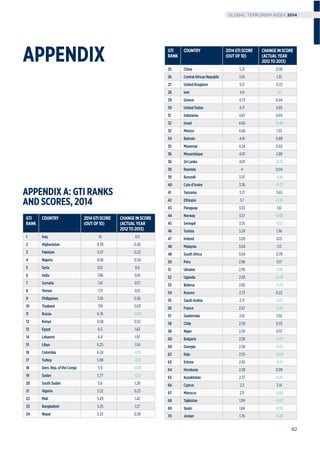
Did organised groups use force or coercion
in an attempt to dominate public life with
their perspective on religion, including
preventing some religious groups from
operating in the country?
0.58 161
Was there mob violence related to
religion?
0.56 161
Were there acts of sectarian or communal
violence between religious groups?
0.55 161
Group grievances 0.54 157
Religious tensions  rating -0.53 133
Order and security -0.52 96
TABLE7 THEMOSTSIGNIFICANTCORRELATIONS
WITHTHEGLOBALTERRORISMINDEX
The most statistically significant correlates with terrorism include
measures of social hostilities and lack of intergroup cohesion
and group grievances, but also measures of state sponsored
violence such as extrajudicial killings, political terror scale and
poor human rights.
59
GLOBAL TERRORISM INDEX 2014
GLOBAL TERRORISM INDEX
VS GLOBAL PEACE INDEX:
HOW DOES TERRORISM RELATE
TO OTHER FORMS OF VIOLENCE?
When the GTI is correlated with the indicators in the Global
Peace Index (GPI), other forms of violence which are related
to acts of terrorism can be further assessed. Out of the 22
indicators used to calculate the GPI, several are highly
significant with the GTI. As would be expected, levels of
terrorism correlates strongly with internal deaths from
conflict and levels of political terror.
Levels of internal organised conflict, likelihood violent
demonstrations, violent crime, and deaths from conflict are
all significantly related to levels of terrorism. This highlights
how the persistent targeting of police forces and instability
generated by terrorism can possibly undermine rule of law
and lead to the increase in other forms of violence.
POLITICAL TERROR AND EXTRAJUDICIAL KILLINGS
The level of political violence and terror that a country
experiences in a particular year is measured by the Political
Terror Scale developed by Wood and Gibney based on U.S.
State Department and Amnesty International human rights
reports. The data is presented on a 1 to 5 ‘terror scale’, 5
being the highest level of political terror. Terrorism correlates
significantly with the Political Terror Scale with r= 0.59.
This can be viewed in two ways. Either increased terrorism
leads governments to implement stricter, authoritarian and
illegal acts toward its citizens through torture or state
violence, or the repression results in terrorist acts as
TABLE8 CHANGEINCORRELATIONBETWEEN
GTIANDGLOBALPEACEINDEXINDICATORS.
The correlation between the GPI and GTI is very strong indicating
the link between terrorism and broader societal peacefulness.
GLOBALPEACE
INDICATORS
CORRELATION
2013
CORRELATION
2014
CHANGEIN
CORRELATION
2013-2014
Safety&security 0.53 0.51 -0.02
Militarization 0.43 0.45 0.02
Ongoingconflict 0.66 0.65 -0.01
Internalpeace 0.59 0.58 -0.02
Externalpeace 0.48 0.50 0.02
Deaths from conflict
(internal)
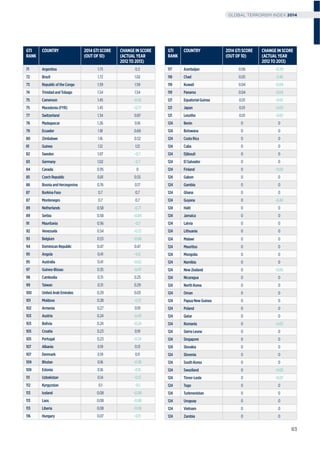
0.66 0.70 0.04
Political terror scale 0.63 0.59 -0.04
Level of organised
conflict (internal)
0.56 0.57 0.00
Likelihood of violent
demonstrations
0.33 0.38 0.05
Level of violent crime 0.37 0.38 0.01
Perceptions of
criminality in society
0.32 0.36 0.04
Access to small arms
and light weapons
0.43 0.35 -0.07
Nuclear and heavy
weapons capability
0.26 0.33 0.07
Military expenditure
(% of GDP)
0.11 0.33 0.22
Displaced people
(% population)
0.32 0.33 0.01
Deaths from conflict
(external)
0.13 0.32 0.19
Relations with
neighbouring countries
0.29 0.32 0.02
Total conflicts
(internal and external)
0.33 0.31 -0.02
Political instability 0.29 0.27 -0.02
Homicide rate
(per 100,000 people)
0.28 0.18 -0.10
UN peacekeeping data 0.16 0.11 -0.05
Armed services
personnel
(per 100,000 people)
0.10 0.10 0.01
Police (per 100,000
people)
-0.01 0.01 0.01
Incarceration rate
(per 100,000 people)
-0.02 -0.01 0.01
Weapons exports
(per 100,000 people)
-0.03 -0.02 0.00
Weapons imports
(per 100,000 people)
-0.03 -0.08 -0.05
OVERALLGPISCORE 0.65 0.64 -0.01
Table8continued.
60
GLOBAL TERRORISM INDEX 2014
FIGURE 27 GROUP GRIEVANCES VS. GTI
Group Grievances are positively correlated with the GTI. This shows increased tension and violence between ethnic, religious
and social groups isrelated to increased levels of terrorism.
Source: IEP, Failed States Index
0 2.0 4.0 6.0 8.01.0 3.0 5.0 7.0 9.0 10.0
GLOBAL TERRORISM INDEX (GTI)NO TERRORISM
LOWHIGH
HIGH LEVELS OF TERRORISM
GROUPGRIEVANCES
2
4
6
8
10
1
3
5
7
9
r=0.54
United Kindgom
Colombia
United States
Greece
Mozambique
Ukraine Mexico
Indonesia
Iran
Nepal Egypt
Russia
Philippines
India
Syria
Nigeria Pakistan
Afganistan
South Sudan
Israel
Sri Lianka
Chad
Serbia
Jordan
Spain
Canada
Germany
Denmark
Switzerland
Portugal
Japan
Iceland Sweden
Ireland
NorwayHungary
retaliation. This can create a vicious cycle of violence making
it difficult to clearly identify causality.
Extrajudicial killings measured by the CIRI data project hold a
significant correlation of r=-0.61 with the GTI. Extrajudicial
killings measure the killings by government officials without
due process of law. This also includes murders by private
groups that have been instigated by the government.
SOCIAL FACTORS, SOCIAL COHESION,
GROUP GRIEVANCES
The group grievance indicator correlates significantly with
the GTI with an r= 0.54. The positive correlation means that
high levels of group grievances are associated with higher
levels of terrorism. Conversely, low levels of group grievances
are associated with low levels of terrorism.
The intergroup cohesion indicator is compiled by the Institute
of Social Studies (ISS). The indicator measures the relations
of cooperation with respect between identity groups within
a society. When cooperation breaks down between
prominent identity groups, there is the potential for conflict
including killings, assassinations, rioting, and acts of
terrorism. ISS measures intergroup cohesion using
composite data on ‘inter-group disparities, perceptions of
being discriminated against, and feelings of distrust against
members of other groups’.
DEVELOPMENT INDICATORS
While countries that record high levels of terrorism tend to
be under-developed, development indicators do not
correlate with levels of terrorism globally. This suggests
that while these characteristics such as poor life expectancy,
educational attainment and GNI per capita may be common
in areas with increased levels of terrorism, they are not
unique to them.
TABLE9 CORRELATIONWITHHUMAN
DEVELOPMENTINDICATORSANDTHEGTI
While a negative relationship is shown, suggesting that high
levels of terrorism are related to low development, none of the
relationships are significant, suggesting that development is not
a major contributor to the development of terrorist activity.
HDI INDICATORS CORRELATION
Human Development Index (HDI) -0.20
Life expectancy at birth -0.14
Mean years of schooling -0.27
Expected years of schooling -0.21
Gross national income (GNI) per capita -0.24
61
GLOBAL TERRORISM INDEX 2014
ECONOMICSTATISTICS 2012 2014
FDI net inflows 0.10 -0.07
Trade as a % of GDP -0.41 -0.40
Natural resources as a % of GDP
(2012)
-0.06 -0.09
Youth unemployment -0.14 -0.02
Male youth unemployment -0.18 -0.08
GDP growth -0.01 -0.05
TABLE10 CORRELATIONBETWEENGTI
ANDKEYECONOMICSTATISTICS,2012-2014
While the GTI shows negative relationships with the economic
statistics below, the correlations are not significant. However,
trade as a per cent of GDP notably correlates.
FIGURE 28 TRADE AS A PERCENT OF GDP VS. GTI
Trade as a per cent of GDP shows a negative correlation with the level for terrorism. While this is not overly significant, it does suggest
that acts of terrorism could affect trade.
Source: IEP, World Bank
0 2.0 4.0 6.0 8.01.0 3.0 5.0 7.0 9.0 10.0
GLOBAL TERRORISM INDEX (GTI)NO TERRORISM HIGH LEVELS OF TERRORISM
TRADEASPERCENTOFGDP
0
40
60
80
100
120
140
160
180
r=-0.40
Belgium
Malaysia
Ukraine
United Kindgom
Columbia
Philippines
India Nigeria Pakistan
Afganistan
Iraq
ThailandLebanon
Mozambique
Chile
Argentina
Australia
Canada
Saudi Arabia
FINANCE AND TRADE
While the table below shows a negative relationship with
the GTI for five of the six economic, trade and investment
indicators, there is only one moderately strong statistical
relationship; trade as a per cent of GDP with a R= -0.40.
The 2012 GTI was correlated with 2013 economic statistics
to see if terrorist activity has an effect on future economic
indicators. While there was a stronger relationship
between the GTI and decreased levels of economic
activity, the relationships were not significant.
62
GLOBAL TERRORISM INDEX 2014
This section seeks to explore what explanatory power a
range of variables have on the GTI. This is done through
multivariate regression analysis, a statistical tool which
enables comparison against multiple variables. The
multivariate regression analysis reveals the interplay
between the GTI and 11 different variables, such as economic
performance, governance and violence, demonstrating the
nature of the relationship between various indicators. IEP
does not suggest that these are the only indicators which
affect the level of terrorism, these were selected due to the
strength of statistical relationship with the GTI and the
literature review of the factors that create terrorism.
The economic indicators used in the analysis are foreign
direct investment (net inflows) and trade as a per cent of
GDP. Both indicators are taken form the World Bank data
bank. Political stability, legitimacy of the state, the level of
human rights and the number of refugees and IDPs are
taken from a range of sources. The police rate, homicide
rate and incarceration rate per 100,000 people are based on
GPI data.
Of the indicators used in this analysis, only three show a
multivariate significant relationship with the GTI:
Political stability
Intergroup cohesion
Legitimacy of the state
Surprisingly, while none of the violence or economic
indicators are significant, three political indicators are
significantly related to terrorism. This suggests that a weak
political system and a lack of legitimacy of the government
combined with group grievances may be more influential in
the rise of terrorist organisations than economic
performance or violence.
MULTIVARIATE ANALYSIS
TABLE11 MULTIVARIATEREGRESSIONANALYSIS
Governance and intergroup cohesion related indicators are the
only indicators to show a significant relationship with the GTI.
This suggests that the political climate in combination with
intergroup cohesion is the dominating factor which influences
the level of terrorism within a country.
GTI ESTIMATE
(Intercept) 9.48E+00***
Trade as a present of GDP -4.40E-03
FDI -2.68E-12
Political stability -1.88E+00**
Intergroup cohesion -8.26E+00*
Refugees and IDPs -2.46E-01
Group grievance 2.47E-01
Legitimacy of the state -5.65E-01**
Human rights 2.50E-01
Police per 100.000 people 1.40E-03
Homicide rate per 100.000 people. -7.12E-03
Incarceration rate per 100.000 people 3.72E-05
Adjusted R-squared 0.71
A WEAK POLITICAL SYSTEM
AND A LACK OF LEGITIMACY
OF THE GOVERNMENT
COMBINED WITH GROUP
GRIEVANCES ARE MORE
INFLUENTIAL IN THE RISE OF
TERRORIST ORGANISATIONS
THAN ECONOMIC
PERFORMANCE OR EXISTING
LEVELS OF VIOLENCE.
63
GLOBAL TERRORISM INDEX 2014
‘Terrorism’ has come to dominate current
affairs in the western world, and dealing with it
is one of the foremost priorities on the
domestic and foreign policy agendas of
western nations. As IEP’s valuable work has
highlighted, the urgency surrounding the
agenda has not always facilitated sober
reflection on the available facts regarding the
nature of the problem and what they show us.
The urgent priority afforded to counter-terror
has impacted on the actions of practitioners
in many walks of public life. Particularly
affected by the imperatives of counter-
terrorism and its conceptual framing have
been stabilisation and statebuilding—those
emerging fields poised at the intersection of
defence, foreign affairs, intelligence,
peacebuilding and development. Building on
a forthcoming discussion paper prepared for
Saferworld by Prof. David Keen (LSE), this
paper identifies some key questions about
how counter-terrorism, and related
stabilisation and statebuilding efforts, are
being pursued, and suggests some
constructive peacebuilding alternatives.
The public debate on how to respond to
‘terrorist’ threats tends to revolve around the
most horrific outrages and sensational crises.
Whether the option in question is to bomb a
reviled spoiler, to arm those opposing an evil
regime, or to sponsor a regional partner to
take on the dangerous militants, public
debate tends to focus minds on apparently
simple choices between action and inaction.
In this climate, the pressure on leaders to
appear strong and act decisively—especially
in the face of violent provocation—is very
powerful. However, when the media directs its
fickle gaze to newer stories, the success or
failure of policy responses to ‘terrorism’
threats overseas over the long term is rarely
publicly discussed.
For this reason, it is perhaps not widely
known that:
In Somalia, thousands of weapons and
hundreds of vehicles and high-frequency
radios provided by the international
community as security assistance during the
1990s ended up in the hands of local militias.
In addition, from 2004 onwards over 14,000
Somali soldiers trained by Ethiopia reportedly
defected or deserted with their weapons and
uniforms, while UN-trained police were
implicated in violent abuses against civilians;1
In Iraq, heavy handed military action, such
as the assault on Falluja in the wake of the
ENVISAGING MORE CONSTRUCTIVE ALTERNATIVES
TO THE COUNTER-TERROR PARADIGM
Larry Attree, Head of Policy, Saferworld & David Keen, Political Economist and Professor
of Complex Emergencies, London School of Economics
INTRODUCTION
AccordingtothefindingsoftheGlobalTerrorismIndex,thelevelofglobal
terroristactivityhasgreatlyincreasedinthelastdecade.Mostofthepublic
conversationaboutterrorismhasfocusedonconventionalcounter-terrorism
efforts:intelligencegathering,policing,andmilitaryforce.However,such
effortsareoftenineffective,andevencounterproductive.Inthisessay,Larry
AttreefromSaferworldandDavidKeenfromtheLondonSchoolofEconomics,
outlinesixconventionalapproachesthatshouldbescaledbackandsix
constructivealternativestoconventionalcounter-terrorismthatcouldhelp
reverse thealarming rise in globalterrorism.
EXPERT
CONTRIBUTIONS
64
GLOBAL TERRORISM INDEX 2014
lynching of four American security
contractors in April 2004, resulted in the
deaths of hundreds of people, including
many women and children, and served to
fuel further insurgency;2
In Afghanistan, because of local codes of
revenge in Pashtun areas, killing insurgents
has often served ‘to multiply enemies
rather than subtract them’.3
Studies have
also ‘found little evidence that aid projects
are “winning hearts and minds”’ in the
country: ‘instead of contributing to stability,
in many cases aid is contributing to conflict
and instability’;4
In Yemen, external counter terror support
served to reduce the Saleh regime’s need
to be responsive to its own constituents
and institute reforms.5
It is remarkable that such failures have led
neither to detailed public debate on how
peace can best be achieved in the wake of
‘terrorist’ violence, nor to any serious
accountability for the leaders and officials that
presided over them. But what is even more
striking is that the mistakes of the present
echo those of past decades: for example, the
practice of bombing large swathes of the
countryside and the diversion of aid to corrupt
purposes that fed public support for the Viet
Cong in Vietnam;6
or the government
emergency measures, including the attempt to
use ‘development’ and forced relocation as
instruments of counterinsurgency, that
strongly fuelled the Mau Mau insurgency
under British rule in Kenya during the 1950s.7
While such problems are, tragically, familiar to
scholars and experts working to document
the track record of counter-terror,
stabilisation and statebuilding approaches
around the world, attention to the lessons of
the past is strikingly absent from the public
debate on how to do better in future.
In recent months, Saferworld has attempted to
take the long view on efforts to deal with
conflicts related to rebel or ‘terrorist’ groups
and their sponsors in past decades, considering
contexts as diverse as Afghanistan, Cambodia,
DRC, Indonesia, Iraq, Kenya, Pakistan, Sierra
Leone, Somalia, Sri Lanka, Uganda, Vietnam,
and Yemen. Despite the investment of huge
resources in such contexts by Western
governments, the results have been mixed
at best: the current long-term instability of
the Middle East, North and East Africa,
Afghanistan and Pakistan, the spread of
al-Qa’ida into multiple new regions, and the
mushrooming of other transnational militant
groups suggest that something is seriously
wrong with the Western response to such
problems.
Long-standing problems appear to lie in three
main areas. Firstly, by setting national security
above human security objectives the West
has – whether directly or through proxies—
too frequently responded to the threat of
‘terrorism’ with the use of violence. Such
violence has, all too often, been
indiscriminate, and has had a tendency to
exacerbate conflict dynamics rather than
contribute to sustainable peace. Secondly,
counter-terrorism efforts and related actions
taken under the label of ‘stabilisation’ and
‘statebuilding’ have often failed to address
drivers of conflict in meaningful ways. In fact,
they often clumsily reinforce the most serious
drivers of conflict – especially patterns of
abusive and exclusive governance and
corruption. Thirdly, the Western response has
typically neglected to focus on sustainable
solutions to conflict that involve and respond
to the concerns, priorities and potentials of
conflict-affected people in constructive ways.
There is much detail that could be added to
this critique, and many examples that could
be offered of these shortcomings in action
and their impacts. If policy alternatives are to
be brought to the fore, more thorough
analysis is needed to examine why similar
shortcomings are repeated from one decade
to the next with diminishing public scrutiny.
However, what is perhaps more challenging,
and more useful, is to envisage what
constructive alternatives are available.
One caveat before discussing these
alternatives: all approaches to peacebuilding
have shortcomings, and the challenges of
conflict frequently present choices between
a range of sub-ideal alternatives. The policy
directions that are set out in this paper are
neither a call to side with the ‘enemy’, nor to
evade the imperatives to respond to conflict
swiftly and effectively. Instead, they are a call
for the lessons of the past and the available
alternatives to be more carefully considered,
with the overarching objective of working
towards long term peace in mind.
SIX THINGS TO DO LESS OFTEN
1 THINKING SHORT TERM
There needs to be more effort to avoid
investing in short-term reactions with no
clear long-term solution in mind—especially
when there are clear risks of contributing
to long-term drivers of conflict through
short-term action. Similarly, more thought
needs to be put into whether approaches
require long-term commitment to be
sustainable, and whether such commitment
is feasible.
2 REINFORCING POOR
GOVERNANCE AND CORRUPTION
Governance deficits are perhaps the single
most significant factor in driving conflict.
This means that support for repressive and
corrupt actors and regimes needs, as a
priority, to be avoided because of its
potential to lessen accountability and
worsen governance deficits. Governance
deficits known to have a significant role in
driving conflict include corruption,
violations of human rights and international
humanitarian law, and exclusive political
systems. Importantly, where international
actors support leaders, governments and
security forces that are not committed to
addressing these failures, they reduce the
pressure on them to be inclusive,
accountable, responsive and fair toward
their own societies. This in turn tends to
fuel conflict. The apparent strategic
advantage to be gained from alliances with
regimes not committed to inclusive, fair,
responsive and accountable governance is
often illusory—not least because such
alliances typically stoke the grievances that
fuel insecurity.
3 MISTAKING PARTNERS’ MOTIVES
Past experience shows that assumptions
about the motives and behaviours of
apparent ‘allies’ in counter-terror,
stabilisation and state-building endeavours
need to be interrogated more deeply. The
consequences of working with allies whose
motives differ from one’s own have
included appalling abuses against civilian
populations, the diversion of money, arms
and other resources into fuelling conflict,
and the reinforcement of corruption, bad
governance and grievances. All of these are
known drivers of conflict. One of the
clearest lessons from past failures is that
the motives of ‘allies’ are hard to
understand clearly: they may differ
between individuals and across institutions,
and can shift over time. An expressed aim
of defeating terrorism, for example, may
differ dramatically from the actual aims of
any given actor. Importantly, the actions of
‘allies’ are also affected by the resources on
offer for counter-terror, stabilisation and
statebuilding processes, which may even
serve as an incentive for prolonging
conflict. Conflict sensitivity requires much
more careful monitoring of these issues
65
GLOBAL TERRORISM INDEX 2014
and more determination to minimise harm
by factoring this better into decision-
making.
4 USING AID IN THE SERVICE OF
COUNTER-TERRORISM
Casual assumptions about aid contributing
to counter-terrorism, stabilisation and
statebuilding objectives are called into
question by the significant evidence that
the use of aid to reinforce military action
and stabilisation efforts has in many
contexts proved either ineffective or
harmful. In particular there is a need to
revisit the assumption that local action to
address socio-economic drivers of
radicalisation can provide an adequate
solution when wider structural drivers of
conflict are not simultaneously addressed—
including the role of international actors
and their proxies in contributing to
grievances and injustice. While
development processes are likely part of
the solution to the conflicts that are being
defined as problems of ‘terrorism’,
‘radicalisation’ and ‘extremism’, the holistic
pursuit of positive peace should include a
wider range of measures, including
avoidance of policies and actions that
create the grievances that fuel conflict.
A related issue is the tendency to overlook
the way in which aid and other resources
(such as military equipment) provided to
allies is diverted for harmful or corrupt
purposes by conflict actors. Because
corruption is known to be such a visible
driver of conflict, and diversion of resources
away from their intended purpose is such a
common failing, corruption and diversion
need to be more systematically prevented
and monitored – even when they involve
apparent ‘allies’ of the international
community. Too often, declaring a
particular government to be an ‘ally’ has
given it a green light for corruption and
abuse. In practice, there has often been
much more concern about the way aid
might be misused by ‘terrorists’ than the
way it is being misused by governments.8
Attempts to co-opt aid agencies into
support for any particular side in a
conflict—as providers of intelligence, as
offering relief and assistance only to one
group or side – are also counterproductive:
they compromise the principle of
impartiality, render assistance ineffective,
alienate the local population, and make aid
agencies a target for attack.
5 USING FORCE
International actors should be much less
ready to use force to resolve conflict. In
particular, more caution is needed in
designating any particular actor as a
‘spoiler’. The staying power of ‘spoilers’
needs to be assessed much more
realistically, and greater awareness is
needed of the potential for conflict
dynamics to spin out of control as a result
of intervention. In particular, military force
should not be used simply to demonstrate
the resolve or power to retaliate in
response to violent provocation—indeed,
military responses of this kind often play
into the intentions of ‘terrorists’.9
6 LACK OF ACCOUNTABILITY
FOR ABUSES
Significant efforts are also needed to
strengthen adherence to international
humanitarian and human rights law by
international actors and those they
co-operate with: torture and indiscriminate
use of violence are not only wrong in
principle – they also deepen the
grievances that can fuel violence and make
sustainable peace much harder to achieve.
Demonstrating full accountability for
irresponsible use of force and abuses that
have taken place is vital to efforts to
minimise grievances.
SIX DIRECTIONS FOR
CONSTRUCTIVE ALTERNATIVES
1 A DIFFERENT CONCEPTUAL
FRAMING AND APPROACH
The first and most important shift in the
pursuit of constructive alternatives to the
counter-terrorism paradigm should be to
reaffirm long-term sustained peace for all
actors involved as the overall objective—
rather than ‘victory’ over a particular enemy
or ‘national security’ defined in narrow
terms. To construct a strategy oriented
towards lasting and positive peace it is then
crucial – especially in relation to conflicts
involving the most reviled of ‘spoilers’—
to develop an impartial picture of all
dimensions of the conflict. One key starting
point for achieving this is perhaps offered
by developing a conflict analysis.
Conflict analysis can provide an important
opportunity to avoid biased actor analysis
and narrow analysis of the causes of a
conflict. In the counter-terrorism paradigm,
designating certain actors as ‘spoilers’,
‘radicals’, ‘terrorists’ or ‘extremists’ risks
framing the problem from the outset as
lying with those actors alone – the solution
being to change their wrong-thinking (or
physically eliminate them) rather than
seeking to identify what all relevant
actors—including national, regional and
international governments—can change to
contribute towards lasting peace.
Similarly, approaching conflict as a problem
of ‘extremism’ or ‘radicalisation’ has
sometimes encouraged a focus on the
socio-economic disadvantages experienced
by the individuals who perpetrate acts of
violence. Looking at local poverty or
unemployment may be helpful, but it must
not preclude a focus on other causes of
conflict – including the actions of
governments enjoying various degrees of
immunity to international criticism.
Grievances created by powerful political
actors at national, regional or international
levels may well prove especially important in
driving conflicts defined as ‘terrorism’,
‘radicalisation’ and ‘extremism’. Framing the
problem impartially as one of ‘conflict’ may
enable much more comprehensive
identification of causes that require fresh
approaches – not only by extremists and
local actors but also by national, regional
and international leaders, governments,
security forces and so on.
Conflict analysis may also provide an
opportunity to connect apparently local or
national dynamics to transnational factors: it
may be crucial to recognise that ‘extremism’
is not only driven by the transnational
spread of problematic ideologies based on
misperceptions, but also by the moral
objection of conflict actors in one country to
policies and actions taken in other countries,
which are indeed unjust or unlawful and
which they feel powerless to change
through constructive means. Peacebuilding
strategies in such contexts could valuably
include the creation of effective channels for
grievances to be constructively raised and
addressed.
Given the need to avoid the common
challenges of short-term thinking, failure to
learn from past mistakes and incoherence
between development, diplomatic,
economic and military-security approaches,
conflict analysis also provides opportunities
to consider how different responses to
conflict will play out through the
development of forward-looking scenarios,
examine lessons from past engagement, and
facilitate diverse actors to recognise their
roles and responsibilities within a shared
long-term peacebuilding strategy.
66
GLOBAL TERRORISM INDEX 2014
2 CHANGING INTERNATIONAL AND
NATIONAL POLICIES THAT HAVE
FUELLED GRIEVANCES
If conflicts defined as stemming from
‘extremism’, ‘radicalisation’ or ‘terrorism’
are driven in part by moral objections to
policies and actions which are unjust or
unlawful, part of the strategy for achieving
sustainable peace should be to reconsider
those policies and actions. Just as
apartheid needed to be brought to an end,
and many former colonies were awarded
their independence following struggles by
rebel organisations now viewed as
liberation movements, in the same way
there is a need to examine the justice of
policies that are the focus of rebellion and
protest around the world.
Such unjust policies may be military
(indiscriminate use of violence, military aid
to actors who are perpetrating abuses),
economic (sanctions perceived to be
unjust, failure to regulate markets in goods
and resources from conflict-affected
countries, imposition of unequal trade
rules, or prioritisation of natural resource
access over other priorities), diplomatic
(support for allies who are violating human
rights and/or international law), or
developmental (further support for such
allies). A greater effort to demonstrate
consistent support for international law
and human rights is surely one of the most
promising options for reducing the
grievances of the victims of unjust
international policies and practices, and
those who claim to represent them.
3 SEEKING TO NEGOTIATE PEACE
– AND BUILDING TOWARDS
INCLUSIVE AND JUST POLITICAL
SETTLEMENTS
There are many challenges inherent in
deciding whether and how to negotiate
peace. Overall, however, negotiating
solutions is currently a less favoured option
than it was during the 1990s. Clearly it is
neither desirable nor practical to welcome
every militant or rebel group into a
power-sharing deal. Both inviting and
excluding rebel movements to the dialogue
table has incentivised armed violence in the
past. At the same time, long-term peace
can of course be undermined when only a
relatively narrow and elite group is
accepted into negotiations and into the
political settlement that results.
While the dilemmas involved are complex,
the counter-terrorism paradigm has in
certain contexts ruled out the possibility of
negotiation with (or even assistance to)
large sections of whole societies (as in
Somalia and Afghanistan). In this context,
it seems important to reflect that long-term
peace will eventually be sustainable only if
those who survive the conflict are prepared
to accept the eventual settlement that is
made. Moreover, as Greenhill and Solomon
argue, even an apparently ‘implacable’
spoiler may sometimes change – in new
circumstances – into a less violent entity.10
In this context, alongside the inclusion in
peace processes of those who have not
resorted to violence, and ongoing efforts to
ensure broader inclusion in political
settlements of the public, including women,
youth and any marginalised groups, more
effort is needed to pursue communication
with and understand all actors involved in
any given conflict – even those ‘terrorists’,
‘violent extremists’, ‘radicalised groups’ and
‘spoilers’ that are most reviled.
4 USING LEGAL-JUDICIAL
RESPONSES AND TARGETED
SANCTIONS
An important option for approaching
conflict is to use the law (national or
international) to punish and deter violence
and to protect those who may otherwise
feel marginalized and resort to violence as
a last resort. Legal approaches to insecurity
are complex, and only a few points can be
made here. Prosecutions offer the prospect
of reducing impunity, deterring violence
(both within a particular country and more
broadly), and of course incarcerating those
responsible for violence (and thus taking
them ‘out of the game’). In many cases,
a policing response to disorder
(apprehending and trying criminal
suspects) will be more appropriate than
a military response. Sometimes, it is a
heavy-handed military response that turns
a small rebellion into a large one or gives
life to a weakening ‘terrorist’ movement.
When due process is applied and the rights
of defendants to fair trials are visibly
upheld, legal approaches offer the
considerable advantage of guaranteeing
rights of defendants and their equal
treatment before the law—thereby helping
to dispel perceptions of discrimination
against particular groups.
The option to deploy sanctions comes with
certain drawbacks. Sanctions can be used
by those targeted to shore up their
economic advantages and their political
support base. They can also do great harm
to the general population and create
grievances among those they were
intended to help. Yet, when they are
carefully targeted, sanctions can offer an
important option for pressurising conflict
actors, including armed groups, to change
their approach.
5 SUPPORTING TRANSFORMATIVE
GOVERNANCE EFFORTS
Of course, governance reforms are
explicitly part of the stabilisation and
statebuilding policy agenda. However, this
policy agenda is typically coloured by the
imperatives provided by counter-terrorism
to boost a counterinsurgency or a new
political order with external aid or military
support. Likewise, the international
discourse on peacebuilding and
statebuilding enshrines ownership of
processes by nation states in a way that
tends towards the exclusion of other actors
and far-reaching reforms in practice. The
‘mainstream’ approach to all three
(counter-terrorism, stabilisation and
statebuilding) thus leans visibly towards
aligning behind and reinforcing the
capacities of the state as it is (including
states recently installed by military action)
rather than prioritising wider social
empowerment models that seek to
transform the state from within and foster
lasting and positive peace.
Peace indeed cannot be built in the absence
of institutional capacities, but these
capacities also need to be oriented towards
beneficial purposes. This makes the
objective of achieving wider reform and the
transformation of state-society relations
(widely acknowledged in policy discourse
but rarely pursued effectively in practice)
absolutely central to efforts to respond to
conflicts labelled as ‘terrorism’,
‘radicalisation’ and ‘extremism’. After all,
such conflicts often emerge from the
grievances and injustice that are created by
poor governance, and prove difficult to
manage in the wake of institutional
breakdown and civic unrest.
Past research by Saferworld11
suggests that
to support lasting peace, transformative
governance reform should include
significant efforts to:
Ensure inclusive political dialogue and
decision making
Provide people-focused security and justice
67
GLOBAL TERRORISM INDEX 2014
Reduce corruption and bribery in
conflict-sensitive ways
Offer fair access to social services,
resources and opportunities to all social
groups
Resolve grievances and disputes
constructively
An example of the shift that is needed can
be found in the security sector. While much
development work is oriented to social
empowerment and community driven
models, when it comes to responding to
conflict and insecurity, bottom-up
approaches are not pursued on the scale
that is required to achieve a transformative
effect. Thus ‘Security Sector Reform’ and
efforts to negotiate peace settlements tend
to be relatively top-down and exclusionary.
Therefore, to a certain extent, they tend to
lack the legitimacy to be both successful
and sustainable. Application of ‘community
security’ approaches at a greater scale has
the potential to deliver a different kind of
result.12
6 BRINGING A PEACEBUILDING
PERSPECTIVE TO THE FORE IN
PUBLIC DEBATE
One of the challenges inherent in trying to
move beyond mainstream approaches is
the way in which problems of ‘rogue
regimes’, ‘terrorism’, ‘radicalisation’ and
‘extremism’ and relevant responses are
presented in public debate. Leaders,
journalists and news outlets are in some
ways responsible for establishing prevailing
notions of enmity, while at the same time
public interest and public opinion has a role
in shaping and underpinning policy
directions that leaders come under
pressure to adopt. Thus the success of
peace efforts partly depends on much
more systematic questioning of the
fault-lines of conflict, the prevailing
definitions of the enemy, and the impacts
of potential policy responses. Demonising
particular enemies too often serves as
‘cover’ for those claiming to confront them;
but those making these claims may not
only be failing to confront these enemies
but even actively reinforcing them in
various ways.
In many contexts, the declaration of a ‘war
on terror’ remains a convenient banner to
call for public unity in support of a common
enemy, bolstering the power base of
political leaders. When the status of an
‘enemy’ has been well established in public
discourse, this seems to lead to journalistic
failures to question the tactics to be used,
the allies to be supported, and the
coherence of longer term strategies.
A further problem is that, especially within
conflict-affected contexts, those who
oppose an officially-approved persecution
or question the approved ‘fault-lines’ in a
conflict, risk themselves being labelled as
‘enemies’, ‘terrorists’ and so on—and
sometimes face intimidation, violence or
prosecution as a result. This affects the
willingness to speak out not only of
journalists, the public and local activists but
also international aid agencies and
multilateral bodies. Particular definitions of
the enemy have often been ‘policed’ in this
way, and those who are in a position to
question these definitions have a particular
responsibility to do so.
While politicians, diplomats and human
rights organisations tend to remain vigilant
and critical regarding human rights in
conflict situations, much more systematic
efforts are needed to question the
definitions of enmity that create—and
recreate—mass violence, as well as to
challenge the methods that are justified
through this discourse at different levels.
CONCLUSION
This paper has offered a summary of
constructive alternatives to the counter-
terrorism paradigm and to some of the
approaches taken to stabilisation and
statebuilding under the influence of this
paradigm. Alongside these, it is important to
mention one further option, noting: that in
some cases ‘terrorist’ atrocities frequently
produce a sense of revulsion even among
those the terrorists claim to represent; that if
conflict resolution demands reform (as
suggested above), the best way to encourage
this may in some circumstances be not to
provide support to the current leadership and
institutions in conflict-affected contexts; and
that international actors may not be able to
influence the dynamics of each and every
conflict effectively. Given these points, in
some contexts choosing not to engage should
be considered a valid option.
These issues will be discussed in more detail in
Saferworld’s forthcoming research studies on
constructive alternatives to counter-terrorism
in a range of different country contexts.
NOTES
1. Bryden M, ‘Somalia Redux’, (CSIS, August 2013),
pp 9-10, citing M Bryden et al, ‘‘Report of the
Monitoring Group on Somalia pursuant to Security
Council resolution 1811 (2008)’, (New York, UN
Security Council, 10 Dec 2008), p.12.
2. Hills, Alice, ‘Fear and Loathing in Falluja’, Armed
Forces and Society, 32 (2006), 623-639; Barnard
A, ‘Death toll near 500 in Fallujah, Baghdad’,
Boston Globe, 22 April 2004; Dodge, Toby,
testimony to US Committee on Foreign Relations
on ‘The Iraq Transition’ (20 April 2004).
3. The words are those of Major General Michael
Flynn, United States’ deputy chief of staff for
intelligence in Afghanistan: see Flynn, Major Gen.
Michael, Captain Matt Pottinger and Paul
Batchelor, ‘Fixing Intel: A Blueprint for Making
Intelligence Relevant in Afghanistan’, Center for a
New American Security, Washington DC (2010),
p.8.
4. Wilder, Andrew, ‘A “weapons system” based on
wishful thinking’, Boston Globe (16 September
2009); Thompson, Edwina, Report on Wilton Park
Conference 1022, Winning ‘Hearts and Minds’ in
Afghanistan: Assessing the Effectiveness of
Development Aid in COIN Operations, 11–14 March
2010 (1 April 2010).
5. S Philips, ‘Yemen: Developmental dysfunction and
division in a crisis state’, (DLP Researhc paper 14,
February 2011).
6. Sheehan, Neil, A Bright Shining Lie: John Paul
Vann and America in Vietnam, New York: Picador
(1990); Bilton, Michael and Kevin Sim, Four Hours
in My Lai, London: Penguin (1993); Hunt, David,
‘Dirty Wars: Counterinsurgency in Vietnam and
Today’, Politics and Society, 38:1 (2010), pp.
35–66, p.36; Corson, William, The Betrayal, New
York: W. W. Norton and Co. (1968).
7. Berman, Bruce, ‘Bureaucracy and Incumbent
Violence: Colonial Administration and the Origins
of the “Mau Mau” Emergency in Kenya’, British
Journal of Political Science, 6:2 (April 1976), pp.
143–75.
8. See, for example, D Keen, When ‘Do No Harm’
Hurts, 6 November 2013.
9. Just as, according to Osama Bin Laden’s son it
was ‘my father’s dream was to get America to
invade Afghanistan’ (BBC2, Afghanistan: War
Without End (22 June 2011), it is clear that Islamic
State militants intended to provoke further direct
military action in Iraq by Western powers through
their beheading of Western citizens in 2014.
10. See Greenhill, Kelly and Soloman Major, ‘The Perils
of Profiling: Civil War Spoilers and the Collapse of
Intrastate Peace Accords’, International Security,
31, 3, (winter 2006/7), 7-40; Stedman, Stephen,
‘Spoiler Problems in Peace Processes’,
International Security, 22, 2, 5-53 (1997).
11. See Saferworld, ‘Addressing conflict and violence
from 2015 – Issue Paper 2: What are the key
challenges? What works in addressing them?’,
(November 2012).
12. See Saferworld, ‘Community Security Handbook’,
(Saferworld, 2014).
68
GLOBAL TERRORISM INDEX 2014
ANATOMY OF A SUICIDE BOMBING
MOON MARKET ATTACK, LAHORE, PAKISTAN
Henry Dodd, Senior Weapons Researcher, Action on Armed Violence (AOAV)
Edited by: Steven Smith MBE, Chief Executive, AOAV
For the last three years, Action on Armed
Violence (AOAV) has been monitoring the
levels of harm caused by explosive weapons
around the world. In this time, we have
watched the recorded toll continue to climb,
year-on-year. Perhaps most startling is the fact
that by far the greatest proportion of
casualties are civilians. For example, in 2013,
82% of the total reported casualties from
explosive weapons were civilians. Another
statistic of major concern is the rise in
casualties attributable to improvised explosive
devices (IEDs). While IEDs are often seen as
being the weapons of choice for non-state
actors against conventional military forces, the
staggering fact is that they are far more likely
to kill civilians than soldiers. In 2013, 73% of
civilian casualties (22,829) from all forms of
explosive violence were caused by IEDs.1
But the bare casualty figures alone only show
part of the picture. Reports in the immediate
aftermath of attacks tend to provide the
number of fatalities, sometimes the number
of injured, a description of the scene of the
blast, and some reaction quotes. Small attacks
barely warrant a mention. Little or no focus is
directed at the wider effects of explosive
violence. What does it mean for a health system
to receive over 100 trauma patients within just a
few minutes? What happens to a market that
has witnessed a major blast, and is forever
associated with the tragedy? Who supports a
family when they lose their principal earner, or
when a relative suffers complex injuries? In
order to answer these questions and more,
AOAV returned to the scene of a double-suicide
bombing attack that had been inflicted on a
busy market in Lahore, Pakistan, in 2009.
The Moon Market, in Iqbal, in the south-west
of Lahore, is considered to be the second
busiest market in the city after the more
fashionable Liberty market. Stalls and shops
are closely packed together, leaving a narrow
pathway for shoppers to squeeze through.
Spread across two floors, the top floor has a
selection of beauty salons and a gym, as well
as the upper storeys of the largest and most
prosperous market businesses. The lower
floor has a selection of shops selling fabrics,
children’s clothes, jewellery, books, furniture,
shoes, and pharmaceuticals. Each shop has
around five or six stalls, most only a few feet
wide, pitched in front. Stall owners pay a few
rupees to hook a wire up to their shops to
power a bare bulb over their wares.
The scene is vibrant and congested.
There had been warning signs before that
The methodology for the Global Terrorism Index incorporates a lagged
scoring system, in which a single terrorist incident is not only counted in
the year that it was committed, but also for five years afterwards, in
order to reflect the lingering emotional, social, structural, and economic
impact of terrorism. This essay, from Action on Armed Violence, traces
the long term impact of a suicide bombing in a busy marketplace, which
occurred in Lahore, Pakistan in December 2009.
BACKGROUND THE BLAST
69
GLOBAL TERRORISM INDEX 2014
the Moon Market might be a target for
violence. The previous year, on 14 August
—the eve of Pakistani Independence Day—
a suicide bomber had approached a police
line at the roundabout by the market and
detonated his explosive vest. Eight people
were killed, but it would have been more, had
not a policeman bravely wrestled the bomber
away from the crowd, losing his own life in
the process.2
2009 had been another violent year across
Pakistan. Bomb blasts at a funeral in Dera
Ishmail Khan, in February, had killed over
thirty people, and left hundreds more
injured.3
In October, 55 people were killed in
a blast at the Khyber Bazaar in Peshawar.
A few days later, the same city also saw over
a hundred people killed by a car bomb at the
Meena Bazaar.4
Attacks like these, on targets seemingly
unconnected to the sectarian violence in
Pakistan, may have provided a warning to
the Moon Market shoppers. However, even
with such threats ever-present, people need
to live their lives, buy clothes for their
children, and prepare for weddings.
The first blast happened at 8.40 pm on
7 December 2009, when the market was at
its busiest. At an intersection of three roads,
the first bomber detonated a vest containing
10kg of high explosive and ball bearings.
As people ran from the area in panic, they
were funnelled by the narrow streets into a
tightly-packed crowd. Around a minute after
the first explosion, a second bomber
detonated an identical explosive vest outside
the National Bank in the corner of the market.
It was this second bomb, surrounded by
people, unprotected, in the open, which
caused the most casualties.5
The first explosion started fires, which spread
rapidly. Electrical points in the market are
stuffed with wires, and the electrical fire
moved quickly into shops and stalls. The fires
were fed by the fuel of the many generators in
the market and by the petrol in the hundreds
of motorbikes parked nearby. Combined with
the highly flammable clothes and textiles
inside the shops and stalls, a massive blaze
quickly started. People who sought shelter
inside shops were trapped by flames, and
many died from smoke inhalation.6
At 20:42, the 1122 Rescue Service received
a call reporting that there had been an
explosion.7
There is a rescue station, with
ambulances and fire engines, approximately
100 metres from the market, so emergency
responders were able to reach the scene
within a minute of the call being received.
That’s where the good luck ended.
The fire engines were unable to reach the
blast site, as shopkeepers had placed bollards
and barricades around the market to prevent
cars entering. The rescue services then had
to use cranes to remove obstacles and cut
through iron bars to get close to the fire.
A collapsed electricity transformer meant that
that the closest fire hydrants could not be
used. Hoses had to be run to hydrants further
away from the market.
Rescue workers were further hampered by an
uncooperative crowd. At one point, the crowd
burst through the police cordon and
demanded that the rescuers deal with the
dead bodies that were being left behind.
As families heard the news, they rushed to
the scene, causing traffic jams that hampered
rescue vehicles. It took two hours to put the
fires out and another hour to rescue people
from the rubble.8
DEATHS AND INJURIES
It is likely that around 60 people died as a
result of the Moon Market bombings. The
death toll was initially reported as 34, but this
number quickly rose.9
The official record of
casualties maintained by the City District
Government documented 49 people killed
and 131 injured. These figures were obtained
from hospitals and mortuaries four days after
the bombing. They do not include victims
who did not seek treatment at hospitals.
In addition to the 49 people officially
recorded as being killed in the blast,
there were a further three dead who were
suspected as being perpetrators. In
addition, the mortuary of King Edward’s
Medical University received a shopping bag
filled with limbs two days after the incident.
These body parts were not counted in
government records.
After four days, around half of the injured
(66) had been discharged from hospitals.
However, some of those recorded as injured in
the initial assessment eventually succumbed
to their wounds. For example, at the Sheik
Zayed hospital, a state hospital near the blast,
which received the largest number of
casualties, eight of those admitted died over
the following weeks.10
One family told AOAV that their son, Shahn,
who owned a stall selling children’s clothes,
could only be identified by his underwear.
Shahn received burns to 70% of his body and
had seven pieces of shrapnel in his chest.
He was in hospital for 26 days before he
eventually died following complications
during his second surgery.
Victims were taken to a variety of hospitals,
with some of the closest facilities quickly
overwhelmed and forced to divert casualties.
Dr Sajud Sharif, the consultant in charge of
the Accident and Emergency department at
the Sheikh Zayed hospital, said the biggest
challenge his department faced was keeping
track of who had received what treatment.
The situation was made more difficult by
overcrowding. As well as receiving over
50 casualties in just a few hours, the hospital
was packed with families looking for relatives,
and with media reporting on the attack.
In Pakistan, it is quite normal for camera
crews to come right inside the hospital to film
victims receiving treatment. Zafari Iqbal,
a security guard in the hospital, remembers
having to break up scuffles between the
crowds and trying to placate devastated
families searching for someone to blame.
Within this chaos was the additional challenge
of tackling the complex nature of the wounds
suffered by the victims. Professor Maheed,
Trauma Surgeon at the Sheikh Zayed hospital,
who operated on many of the injured, explained
that bomb blasts present a particular series of
challenges. Unlike in the case of gunshot
victims, bomb blast patients arrive with multiple
traumatic injuries. Their treatment is therefore
more complicated and their condition harder to
manage. Maheed also acknowledged that it is
possible to miss injuries or trauma.
Victims of the Moon Market blast in Sheikh
Zayed hospital were treated for: penetrating
injuries from ball bearings, and even from
other people’s bone fragments; blunt trauma
injuries; severe burns and smoke inhalation;
collapsed lungs; amputations; eardrum
damage and eye injuries.11
Salman Zaib was a 21-year-old student at the
time of the attack. He was at the Moon
Market to collect money from a jeweller for
his father, and was standing about a metre
away from the second bomb when it
detonated. He was spared almost certain
death when a woman happened to walk in
front of him just as it exploded.
Zaib had to have stitches on his back for injuries
from shrapnel and pieces of the woman’s
bones. Both his legs were broken. They were so
badly damaged that they required expensive
plastic surgery and bone grafts. He was in bed
for 4-5 months, and it took over one and a half
years before he was able to walk again. Even
70
GLOBAL TERRORISM INDEX 2014
four years later, he is unable to put in the same
hours at his father’s furniture business or move
around easily.
The day after the bomb blast, Zaib was due to
take the final exams for his accountancy
qualification. The time he spent in hospital
recovering from his injuries meant that he fell
behind with his studies and eventually had to
drop out.12
PSYCHOLOGICAL HARM
Other injuries can be less visible, but have
equally devastating effects. Witnessing horrific
violence and seeing the bloody aftermath can
lead to psychological trauma and impact
negatively on psycho-social wellbeing.
Many of the people who AOAV spoke to had
displayed symptoms associated with post-
traumatic stress disorder (PTSD) at some point
in the years following the bombing. People
complained of unending headaches, reliving the
event through flashbacks, and feeling
constantly on guard. Some described the
incident in vivid terms, and were clearly
overwhelmed by the sudden change in their
physical surroundings. Some people found their
entire moods changed after the blast.
Muhammad Arif Saleem was visiting the
market with his wife to buy new school
uniforms for his children, as the weather was
getting colder. He received a deep cut to the
head and damaged his hearing, but these
physical injuries were treated within a week.
Emotionally though, he was deeply disturbed.
Saleem went back to working in a restaurant
a few weeks after the bombing, but was still
having nightmares about the attack. He found
that his temper had changed since the
incident, and lost his job as a result. His
restaurant sent him home as he had clearly
not fully recovered. When he came back after
a few days, his job had been given to
someone else.13
INDIRECT EFFECTS
ON HEALTHCARE
Responding to bombings like the one in the
Moon Market, and preparing for the possibility
of future attacks, have deep consequences.
These activities drain hospitals of resources
and have knock-on effects on their patients.
A few hours after the bombing, hospitals
received calls from government officials
telling them that treatment for all victims
of the bombing should be provided free
of charge. In most cases, this meant that
victims received free treatment and
medication, at least initially, unless they went
to private hospital.
In practice, this gesture is less generous than
it first appears. The free treatment and
medication provided by the hospitals was
not met with extra money from the
government. The additional costs that
emerged had to be absorbed by the existing
budgets. According to senior hospital
officials, no additional funds were offered by
the government to either the Jinnah or
Sheikh Zayed hospitals, which had received
the majority of victims after the Moon
market bombing.
In order to respond to future incidents of the
scale of the Moon Market blast, hospitals
have had to purchase specialist medical
equipment for trauma patients, like chest
tubes for up to 50 patients. Staff members
have also had to receive extra training for
responding to mass casualty disasters.14
General concerns about the security situation
in Pakistan mean that hospitals also invest
heavily in defending themselves from
potential attacks. For instance, the Sheikh
Zayed hospital currently employs 104
security guards, costing around 1% of its
annual budget. Hospitals in Pakistan are
further hampered by difficulties in retaining
their best and brightest doctors, who are
keen to move abroad because of the security
situation across the whole of the country.
Police search through the ashes of the market for evidence
71
GLOBAL TERRORISM INDEX 2014
DAMAGE TO THE MARKET
The Moon Market bombing had severe
economic effects on both the businesses in
the market and on families of victims. Before
the attack, the Moon Market was one of the
busiest markets in Lahore, with several
hundred shops, stalls and restaurants. There
are 18 plazas in the market, and each
contains around 70-80 shops and stalls.
Shoppers would travel from across the city
to buy goods, conduct business and meet
with friends.
According to Abdul Jabar, President of the
Traders’ Union in the market, 61 shops were
damaged, along with 90 smaller stalls. Jabar
was on the committee with government
officials to determine how compensation was
awarded to businesses in the market. He
claimed that businesses in the market
suffered for 3-6 months after the blast, when
it was partially closed. He argued that they
are now trading at roughly the same level as
before the bombing. Part of the reason for
this, he suggested, was that the Punjab
provincial government awarded
compensation ranging from Rs150,000 and
Rs1.5 million (US$2,100 to US$21,000).15
However, not everyone interviewed was as
positive about the market’s recovery, and
some were critical of the process for awarding
compensation to businesses. Rao Mubarak,
Executive Vice President of the rival Quami
Tajir Ittehad traders’ Union, claimed that the
money provided by the government was well
short of the Rs500 million (US$6.9 million) of
damage estimated by the District
Coordinator’s Office. He claimed that some
money was paid to bogus claimants. In
Mubarak’s estimation, the market is trading at
around 30% of the level it was before the
bombing. While small eateries are doing well,
the cloth and jewellery shops are suffering.
Many traders would have left, but are forced
to stay because the value of their assets has
decreased so much that they do not want to
sell for a loss.16
Some relatives of the stall owners who were
killed in the bombing missed out on the
compensation to which they were entitled.
The family of Shanh, the young stall-holder
who was in hospital for 26 days before he
died from his injuries, were told by the market
union that they had applied late, and were not
awarded any compensation for the
approximate Rs300,000 (US$2,550) of stock
which was lost. The family said that they were
anxious not to appear greedy, or somehow
not sufficiently mournful, at the death of their
son, which is why they did not apply for
money straight away, so missed the deadline
for applications.
LONG-TERM IMPACTS ON FAMILIES
It was not just businesses in the Moon market
that suffered economically after the blast.
Many victims and their families were left with
their primary earner either injured or killed.
Some people lost jobs because they could no
longer work. Despite help with initial medical
treatment, most people also faced large
medical bills for subsequent treatment.
Victims of the bombing were entitled to
compensation from the provincial
government. Families who lost loved-ones
received Rs500,000 (US$4,350). People who
were severely injured received Rs200,000
(US$1,650), and those with slight injuries
Rs50,000 (US$450). Compensation was only
given to those with physical injuries.
Government officials acknowledge that this
system of flat rates of compensation was
imperfect, and did not address the fact that
some injuries are more debilitating and
long-lasting than others. However, it was
felt that devising a new system based on
needs would be subjective, overly
complicated and expensive.
For most of the families AOAV spoke to, the
support offered did not come close to
covering the losses and expenses they
endured following the bombing. In
particular, there was a collective failure by
government and civil society to appreciate
just how long-lasting the effects of the
bombing were. The uncle of one victim said,
‘You can’t give a man a meal for a day. After
a week, he’ll starve.’
Abdul Qadir, who works at a stall selling
children’s shoes in the market, received
shrapnel injuries to his stomach, and his had
was cut by broken glass. He had to have a
colostomy operation, and his large intestine
was shut down for 4-5 months. When AOAV
visited, four years later, he was still in pain,
and had recently been told that he needed
more surgery. Most of the treatment that he
received in the hospital was free, even in the
months after the blast. However, he did have
to pay around Rs4,000 (US$45) for the
colostomy bags, which needed to be changed
four times a week for several months. Qadir’s
stall was completely destroyed in the blast,
and he was awarded Rs100,000 (US$900) for
the damage. He took the difficult decision to
rebuild his stall. He started his business up
again, but had to buy all his supplies on credit
Rescuers were quick to the scene of the incident but faced a number of difficulties in fighting the fire
72
GLOBAL TERRORISM INDEX 2014
and now works off a smaller stall that has
cheaper rent.17
Some victims AOAV spoke to found that after
their recovery they had no jobs to return to or
they were no longer able to perform them.
THE PERPETRATORS
Nearly four years after the bombing, no
convictions have been made in relation to
the Moon Market attacks. Pakistan has been
widely criticised for failing to successfully
prosecute people accused of involvement in
bombings like the one at Moon Market.18
Out
of the 559 cases brought against alleged
terrorists in Punjab Province in 2012, 414
(71%) were acquitted.19
In part, these figures are misleading. Unlike in
other countries, the Pakistani justice system does
not allow for prosecutors to drop a case, even if
they think the evidence is insufficient to go to
trial. However, lawyers AOAV spoke to identified
several areas that made securing convictions
particularly difficult for prosecutors in Pakistan.20
Firstly, they have repeatedly found that
witnesses are reluctant to testify. With no
witness protection programme in Pakistan, they
are especially vulnerable to threats and
intimidation by militant groups.
Secondly, the quality of evidence obtained by
police investigating the bombing is not of a
high enough quality to be admissible.
Sometimes, this is due to the high standards
demanded of the evidence, but at other times,
it is because the police are either under-
resourced or poorly-trained.
Finally, with the actual perpetrators of the
bombing killed in the blast, it is difficult to
link members of the same group to that
particular incident.
CONCLUSION
AOAV’s research has shown that IED attacks
in Pakistan have an impact far beyond the
headline casualty figures. Alongside those
directly killed and injured are the countless
others who suffer psychologically and
financially: the children who are terrified when
a firework goes off; the hospital staff who
cannot eat barbecued food again after
smelling the burning flesh of the victims; the
stall owner whose takings are down now that
the market is less popular.
The stories of the people impacted by the
Moon Market bombings are just a few of
thousands. There were 22 suicide bomb
attacks in Pakistan in 2012; five of them
occurred in markets. The whole of Pakistani
society is impacted, and vital resources are
having to be diverted to help victims and to
prevent future violence.
But this is not just Pakistan’s problem. It is one
that is proliferating world-wide. The
humanitarian harm to civilians is catastrophic,
and states must take action to address it.
Responses should not be restricted purely to
preventative security measures; they should
also embrace: stigmatisation; the robust
application of international humanitarian law;
better control of the trade in components,
such as detonators and explosive materials;
tighter stockpile controls; addressing the
financing of non-state actors; ensuring that
the needs of victims are properly met; and
embarking on campaigns of education and
outreach. The annual civilian deaths from IEDs
world-wide already vastly exceed those from
landmines. This is a global problem that needs
to be addressed now.
NOTES
1. Dodd, H. and Perkins, R. (2014), Explosive Events,
AOAV, April 2014, available at: http://aoav.org.uk/
wp-content/uploads/2014/05/AOAV-Explosive-
Events-2013.pdf, accessed10 December 2013.
2. Ali, Muhammad Faisal (2008), ‘Bomber draws
blood on Independence Day eve’, DAWN, 14
August 2008, available at: dawn.com/
news/316472/bomber-draws-blood-on-
independence-day-eve, accessed 10 December
2013.
3. Shah, Pir Zubair (2009), ‘Pakistan bombing kills
more than 30’, The New York Times, 20 February
2009, available at:
nytimes.com/2009/02/21/world/asia/21pstan.
html, accessed
10 December 2013.
4. ‘Blast in Peshawar’. Geo TV, 30 October 2009,
available at:
geo.tv/important_events/2009/Peshawar_
blast28oct/pages/English_news.asp, accessed
10 December 2013.
5. Interviews with victims of the blast, conducted
by AOAV in November 2013.
6. Interview with the Civil Defence Department
Headquarters,
6 November 2013.
7. Interview with the Punjab Emergency Service,
6 November 2013.
8. Interviews with victims of the blast, conducted
by AOAV in November 2013
9. Associated Press (2009), ‘Lahore bomb attack
kills 34’,
The Guardian, 7 December 2009, available at:
theguardian.com/world/2009/dec/07/
lahore-maket-bomb-attack, accessed
9 December 2013.
10. AOAV examination of official records in the
Sheikh Zayed Hospital.
11. Interview with Professor Maeed, 9 November
2013.
12. Interview with Salman Zaib, November 2013.
13. Interview with Muhammad Arif Saleem, November
2013.
14. Twenty-five hospital staff from across the Punjab
were sent on 15-day training courses organised by
the WHO in Nepal in 2011 and 2013.
15. Interview with Abdul Jabar, November 2013.
16. Interview with Rao Mubarak, November 2013.
17. Interview with Abdul Qadir, November 2013.
18. Nelson, D. (2011), ‘Pakistan incapable of
prosecuting terror suspects’, The Telegraph,
31 August 2011, available at:
www.telegraph.co.uk/news/worldnews/asia/
pakistan/8733203/Pakistan-incapable-of-
prosecuting-terrorists.html, accessed
10 December 2013.
19. Mir-Khan, Aetekah (2013), ‘Prosecuting terrorists:
Out of 599 cases in 2012, suspects acquitted in
414’, The Express Tribune,
1 April 2013, available at: http://tribune.com.pk/
story/529353/prosecuting-terrorists-out-of-599-
cases-in-2012-suspects-acquitted-in-414/
accessed 1 December 2013.
20. Interview with the office of the Prosecutor-
General of Punjab Province, 12 November 2013.
73
GLOBAL TERRORISM INDEX 2014
The rise of the Islamic State of Iraq and
Levant (ISIL)1 occurred in the broader context
of the dominance of radical Islamist
organizations among the world’s most lethal
militant-terrorist groups in the Middle East,
Asia and Africa and the occasional outbreaks
of homegrown, but transnationally inspired
jihadist terrorism in the West. The ISIL
phenomenon has also featured a higher-than-
usual inflow of jihadists from other conflict
hotspots and non-Muslim states. All this adds
to the overall confusion about the different
types and levels of transnational terrorism of
radical Islamist bent and reinforces the
demand for overly simplistic explanations. For
instance, in official circles and media
discourse both in the West and in the rest of
the world the main direction of
transnationalisation of Islamist terrorism is
often still interpreted as the top-down
regionalization of al-Qaeda-centered ‘global
jihad’ movement.
This article argues instead that the evolution
of transnational Islamist terrorism is more
complex and non-linear. Its cutting edge may
be formed by two ideologically linked, but
distinct and only partially overlapping
processes:
the network fragmentation of the global
jihad movement, including in the West;
the bottom-up, rather than top-down,
regionalization of violent Islamism in the
world’s heavily internationalized centers of
militant-terrorist activity in the Greater
Middle East.
MAIN TRENDS IN TRANSNATIONAL
TERRORISM
Of all trends in contemporary terrorism, the
following three are of particular relevance to
the evolution of transnational Islamist
terrorism.
(1) Sharp increase in terrorist activity in the
recent years, coupled with its
disproportionately high concentration in two
regions and two major trans-border conflict
areas. No current international security crisis
– from the outbreak of Ebola to the crisis
around and conflict in Ukraine as the
dominant European security issue – can undo
or overshadow one simple fact: 2013 was the
peak year in global terrorist activity not only
in the early 21st century, but also for the entire
period since 1970 that is covered by available
TRANSNATIONAL ISLAMIST TERRORISM
NETWORK FRAGMENTATION AND BOTTOM-UP REGIONALIZATION
Ekaterina Stepanova, Head, Peace and Conflict Studies Unit, Institute of World
Economy & International Relations (IMEMO)
The 2014 Global Terrorism Index tracks the rise and fall of the world’s
largest terrorist organisations since 1998. Whilst the vast majority of
terrorist groups are only responsible for a handful of deaths, a select
few are responsible for the majority of death and destruction caused by
terrorism in the last fifteen years. ISIL, which emerged out of Al-Qa’ida
in Iraq, is one such group. In this essay, terrorism expert Ekaterina
Stepanova from the Institute of World Economy & International
Relations, outlines a shift in two main trends, the broader network
fragmentation of the global jihadi movement and the shift from top-
down to bottom-up regionalization of violent Islamic groups. She also
tracks the complex evolution of ISIL as a regional force in the Middle
East, and what its continued growth means for the world and region.
74
GLOBAL TERRORISM INDEX 2014
statistics. Disturbingly, the previous highs for
terrorist incidents were recorded in 2011 and
2012 and for fatalities – in 2012.2
While terrorist activity is at its historical peak
and continues to increase, it is very unevenly
distributed around the world, with the bulk of
it concentrated in just a handful of countries.
The post-9/11 global terrorism statistics is
heavily dominated by two regions (the Middle
East and South Asia). The bulk of terrorist
activity there is, in turn, accounted for by two
regional centers of gravity – major armed
conflicts in Iraq and Afghanistan (and, more
recently, in the broader Afghanistan-Pakistan
and the Iraq-Syria contexts). The heavily
internationalized wars in Iraq and Afghanistan
both involved armed insurgent/terrorist
movements in Muslim countries directed
primarily against Western troops backing
weak local governments. The Western
withdrawal from Iraq and Afghanistan and
changing forms of internationalization of the
respective conflicts did not improve the
situation.
(2) The general dominance of region-based
radical Islamist groups and movements
among the most active and lethal militant-
terrorist groups. In 2012, the top 6 terrorist
groups – all of the radical Islamist type –
accounted for almost half (around 5000) of
all terrorist fatalities in the world.3 In 2013, all
of the most lethal terrorist groups in the
world were radical Islamist organizations,
including the Taliban in Afghanistan, ISIL (in
Iraq and Syria), “Tehrik-e-Taleban” (Pakistan),
“Boko Haram” (Nigeria), “Lashkar-e-Jangvi”
(Pakistan), “Djabhat an-Nusrah” (Syria),
“ash-Shabab” (Somalia). Remarkably, these
groups, in addition to the use of terrorist
means, have also been active combatants –
military parties to major armed conflicts in
respective states. All of them have or acquire
a major trans-border dimension and evolve in
the direction of further regionalization of
militant and terrorist activity. In contrast to
these groups, for instance, al-Qaeda as such
has not committed a single terrorist act in
2012–2013.
(3) Further transnationalisation of terrorism
at different levels that could be
distinguished primarily by the ultimate scale
of a group’s end goal(s) – local, regional
or global. At the present stage of
globalization, terrorism at different levels of
world politics from local to global differs
more in terms of degree and quality of
transnationalisation, than by whether or not it
is transnationalised. Furthermore,
transnationalisation primarily manifests itself
in qualitative rather than quantitative terms.
Despite the fact that out of a couple of
thousands of terrorist groups tracked by the
Global Terrorism Dataset (GTD) only few
attack soft targets on foreign territory,4 the
very boundary between ‘domestic’ and
‘international’ terrorism gets increasingly
blurred. Even terrorist groups with localized
political agenda tend to increasingly
transnationalise some or most of their
logistics, fund-raising, propaganda and
training activities. Terrorist actors of certain
motivational/ideological types, such as the
jihadist cells and individuals in the West, may
address their terrorist acts to ‘the world as
whole’ and act to advance explicitly
transnationalised or global goals, even as they
rely primarily or solely on local resources and
do not necessarily travel out of their country
of citizenship. In addition, in today’s
globalized world, transnationalisation does
not exclude – and is often dynamically
interlinked with – the fragmentation of
terrorism and other forms of collective
violence.
In sum, as all terrorism today is
transnationalised to some degree, of critical
importance is to distinguish between different
levels and qualities of transnational terrorism.
In the world where even a group with
localized agenda can develop a wide
transnational fund-raising network or hit
citizens of many states by attacking civilians
in major urban centers, the main criterion to
establish the qualitative level of
transnationalisation of terrorism is the scale
of an organization’s ultimate goals and
agenda – local, regional or global.
NETWORK FRAGMENTATION OF
‘GLOBAL JIHAD’
The bulk of terrorist activity in the world is
accounted for by militant actors that pursue
relatively limited goals in local or regional
contexts. In contrast, the more recent
phenomenon of ‘global terrorism’ associated
primarily with al-Qaeda advances an explicitly
universalist agenda and ultimately pursues
existential, non-negotiable and unlimited
goals. Such terrorism is truly extraterritorial:
while it is not specifically tied to any single
local or regional political context, it does not
have to be global in its physical reach to have
a global impact. Despite minimal number of
incidents, operatives and ideologues,
al-Qaeda continued to attract
disproportionately high attention well after
9/11. This may be partly explained by the fact
that most of its high-profile targets have been
either located in or associated with the
developed Western world, partly – by the
significant anti-system potential of the
supranational ideology of global jihad that
offers a very radical and reactionary response
to very modern challenges of a globalizing
world.
However, in the mid-2010s, following a
massive anti-al-Qaeda campaign and
liquidation of most of its first generation
leaders, including Osama bin Laden, the
following question seems appropriate. How
come that the al-Qaeda-centred global jihad
is still considered to pose the main terrorist
threat to international security, if in the early
2010s, al-Qaeda as such did not even make it
into the top 20 most dangerous terrorist
groups (in 2011, it was responsible just for one
kidnapping out of over 5000 terrorist
incidents5 and, in 2012-2013, did not commit
any terrorist attacks)?6 The answer is complex
and linked the dynamic structural
transformation of the global jihad movement
and its adaptation to changing circumstances.
There are two main interpretations of the
evolution of the global jihad movement. While
both imply a degree of fragmentation of the
original ‘al-Qaeda’, the first framework
interprets this process as top-down
regionalization. Since the late 2000s, this
approach has prevailed in mainstream expert
and political discourses in the United States
and in the West at large. It disaggregates
‘global jihad’ into three levels. First, it leaves
some direct strategic command and control
role to what remains of the ‘al-Qaeda core’
based in Pakistan/Afghanistan. Second, it
argues that the movement’s main center of
gravity has shifted towards several large,
well-structured and organizationally coherent
regional affiliates in Muslim regions
(ultimately subordinate to ‘al-Qaeda Central’).
This usually refers to ‘al-Qaeda in the Arabian
Peninsula’, ‘al-Qaeda in the Lands of the
Islamic Maghreb’, ‘al-Qaeda in Iraq’ and even
‘al-Qaedas’ in the Horn of Africa and in
Southeast Asia. The third level is formed by
al-Qaeda’s ‘ideological adherents’ – small cells
and individuals, most active in the West itself,
who ‘know the group only through its
ideology to carry out violence in its name.’7
The loose network of these micro-cells,
however, is commonly interpreted as a sign of
al-Qaeda’s organizational degradation that is
claimed to have resulted primarily from
counterterrorist pressure by the United States
and its allies.
The alternative approach promoted in this
article emphasizes the genuine ‘network
fragmentation’ of global jihad as the cutting
75
GLOBAL TERRORISM INDEX 2014
edge of the movement’s evolution.8 It denies
residual strategic command functions for ‘the
al-Qaeda core’ at the present stage, beyond
the symbolic and inspirational role of its
ideology and remaining leaders such as
Ayman az-Zawahiri. This approach does not in
principle deny the existence of al-Qaeda’s
regional affiliates in Muslim regions (this role
best fits ‘al-Qaeda in the Arabian peninsula’
that retains a genetic link with the original
al-Qaeda and, to a lesser extent – ‘al-Qaeda in
the Lands of the Islamic Maghreb’). It does,
however, question the vision of global jihad as
the ‘top down’, hierarchically integrated
‘Islamist International’ clearly divided into
large well-structured regional affiliates. It
points at the fact that most of the so-called
regional affiliates have long and solid local
pre-history and strong homegrown roots.
Their main agendas and priorities are
inextricably tied to respective regional
contexts and local/regional armed conflicts.
When they upgrade and expand their activity
to the regional level, it is by following the
‘bottom-up’ logic rather than any ‘top-down’
impulse or command from some master HQs.
These groups’ occasional statements of
support or even pledges of loyalty to
al-Qaeda have been more of a symbolic and
declaratory than substantive nature.
Instead, smaller autonomous cells9 that are
linked by a loose ideological network, are
active in several dozen countries and promote
an explicitly globalist agenda are seen as the
most committed ideological adepts of global
jihad and as the cutting edge of the evolution
of its organizational patterns. Such network
fragmentation was best captured by Abu
Musab as-Suri’s theory of ‘jihad by individual
cells’ (and, in the West, by the ‘leaderless
jihad’ theory).10 Network fragmentation does
not imply aggressive recruitment into a
pre-existing framework – rather, adepts are
encouraged to start their own cells to further
the shared ideology and the movement’s
ends. The idea of starting a violent cell
appeals as much to young people’s desire for
glory and personal conscience as to their
political or ideological beliefs. In contrast to
Islamist groups and movements tied to the
specific local/regional contexts and armed
conflicts in the Middle East, Asia or Africa, this
type of cell is truly extraterritorial in its
outlook and goals, with most of such actors
emerging in Western rather than Muslim
states. These cells display diverse
radicalization paths and are often not linked
to one another in any formal way, but they
share the ideology of global jihad and
together form – and see themselves as part of
– an adaptive and resilient transnational
network-type movement.
Despite its marginality, this movement can
still pose a serious terrorist threat to
international security in two main ways.
First, there has been a gradual rise in
homegrown jihadist terrorism in the West,
despite continuing fragmentation of such
violence underscored by dominance of
mini-cells and the growing proportion of
single actors. Some of them – the so-called
‘lone wolves’ – act entirely on their own (e.g.,
Nidal Hasan in the 2010 Fort Hood shooting),
others act either as network agents or on
their own initiative, but with some operational
or other network connections.11 Fragmented
jihadist terrorism in the West is hard to track
as individuals or cells may not be in contact
with other/known terrorist actors, do not
necessarily get external training, and often
acquire weapons and materials independently
and from open sources. However, it also tends
to produce a mismatch between the Western
jihadists’ high ideological ambition and their
relatively limited capacity to launch terrorist
attacks (they generally lack experience in
violence unless a group involves a veteran/
returnee from a foreign armed conflict or
have got some professional training). This
mismatch often results in failure and partly
explains why, while half of jihadist plots in the
West involved plans to cause mass casualties,
very few have led to actual mass-casualty
attacks.12
Secondly, the fragmented network of ‘global
jihad’ adepts forms a natural pool for influx of
Western jihadist fighters to various conflicts in
the Muslim world. More limited connections
– a few foreign contacts and visits to
conflict-torn regions for ideological
inspiration, sometimes also in hope to get
some training – while not a must for
jihadists13 in the West, have not been
uncommon either. The two-way nature of
such flows and links has become more
disturbing than ever in view of the rise of
radical Islamist organizations in the Iraq-Syria
context (such as ‘Jabhat an-Nusrah’ and,
above all, ISIL). They have attracted more
foreign Islamist fighters than any other
theater since Afghanistan in the 1980s, with
Western, mainly European, fighters
comprising no less than a quarter of all
foreign jihadists – a disproportionately high
share. For the West, this has alarming
implications. Possible return of some of these
seasoned fighters could stimulate new
extremist networks and do a lot to bridge the
mismatch between jihadists terrorists’
ambition and qualification (even as only a
limited percentage of such returnees from
previous conflicts have turned back to
terrorism so far).14
While certainly a serious concern, the network
fragmentation of global jihad (that manifests
itself more in the West than anywhere else) is
a less critical international security problem
than the challenge posed by the bottom-up
regionalization of Islamist militancy and
terrorism.
BOTTOM-UP REGIONALIZATION:
ISIL
Regionalization of territorially based
insurgent-terrorist Islamist groups could be
traced in various regions. However, it only
tends to become an issue of major
international concern in regional contexts
characterized by a combination of chronic
state weakness or failure, protracted major
conflicts and all-out civil wars and high
degree of transnationalisation and/or even
formal internationalization (foreign military
presence). It is in these conditions that
regionalization of a more localized movement
is coupled with consolidation rather than
fragmentation of its military-political potential
and with a qualitative upgrade of its militant/
terrorist activity, rather than decline in its
intensity. Nowhere does this trend manifest
itself better than in the context of the
ongoing crisis in and around Iraq and the
trans-border ISIL phenomenon.
Iraq has led the list of countries most affected
by terrorism since the mid-2000s – well
before ISIL has taken full shape (in the first
post-9/11 decade Iraq alone accounted for
over third of all terrorism-related fatalities
worldwide).15 However, a decade later, it is
the activity of ISIL and some smaller radical
Islamist groups in the extended, cross-border
Iraq-Syria context that has become the main
impulse and driver of anti-government
militancy, terrorism and sectarian violence in
the region. Acting in two (semi-)failed state
contexts – in Iraq as a chronically failing
post-intervention state and in Syria seriously
weakened by an ongoing bloody civil war –
ISIL provides an even more impressive
example of the full regionalization of a
militant-terrorist movement with a powerful
ideology, major state-building ambitions and
quasi-state potential than the cross-border
activity and phenomenon of the Taliban in the
Afghanistan-Pakistan context.
The emergence and evolution of ISIL in the
direction of ‘bottom-up regionalization’ has to
be addressed in two main contexts: (1)
76
GLOBAL TERRORISM INDEX 2014
internal dynamics and conflicts in Iraq and
Syria, including the overlap with intra-regional
dimension and (2) broader links and
connections to transnational Islamism.
First, no other major regionalizing Islamist
movement has been so strongly driven by
intra-state and intra-regional factors, even as
these dynamics were partly distorted,
stimulated or set in motion by previous
external intervention in Iraq. The informal
transnationalisation of a civil war in Syria on
both sides has also largely, although not
exclusively, been a product of intra-regional
dynamics.
Of all the factors and conditions that can
explain the rise of ISIL and its major military
and modest state-building successes since
the summer of 2014, the more specific and
directly relevant ones are internal to the
countries and the region in question. They
include the genuine discontent by very
diverse groups of Iraqi Sunnis – from the
former Baathists to tribal groups to radical
Islamists – with their growing political and
socio-economic marginalization and
repression. This rising discontent had earlier
helped feed the anti-U.S. insurgency, but
continued to accumulate during the rule of
the increasingly sectarian al-Maliki
government. That was coupled with the
general limited functionality and low
legitimacy of the unpopular, but increasingly
authoritarian Iraqi regime inherited from the
times of the foreign security presence. The
bloody civil war that erupted in the
neighboring Syria provided an ideal ‘window
of opportunity’ to ISIL as the most radical
part of the Iraqi Sunni opposition to get a
haven, secure the second country-base,
continue fighting and acquire financial
self-sufficiency through control of the
cross-border smuggling of oil and almost
anything else, even before it shifted its main
center of activity back to Iraq.
Not surprisingly, the worst and most direct
implications of the ISIL activity once it has
taken its full shape affect, first and foremost,
the region itself. The ISIL phenomenon
threatens to deal a massive, if not necessarily
final, blow to at least two already failing or
seriously weakened states at once, adding
new quality to the broader destabilization in
the region that has already for over a decade
been the world’s main center of terrorist and
militant activity.
Second, ISIL’s links to transnational Islamist
terrorism remain a contested issue. In policy
and media circles ISIL, as well as its previous
‘editions’, are often portrayed not as
self-sufficient organizations but as a branch
of al-Qaeda-inspired ‘global jihad’. This
interpretation usually emphasizes two issues:
(a) ISIL’s pre-history in Iraq, with a focus on
the so-called ‘al-Qaeda in Iraq’ and (b) the
unprecedentedly large presence of foreign
jihadist fighters among ISIL’s command and
rank-and-file alike.
The Islamist core of what is now known as
ISIL (and was previously known as Islamic
State in Iraq and earlier as ‘al-Qaeda in Iraq’)
formed in the aftermath of the 2003 US-led
intervention in the course of escalating and
radicalizing resistance to foreign forces and
their local allies. A few statements of support
and loyalty to al-Qaeda made by the group’s
first leader Abu Musab az-Zarqawi (a
controversial figure with ambiguous
connections in and beyond jihadist circles),
the reference to al-Qaeda in the group’s name
under Zarkawi (removed shortly after his
death in 2006) and his increasing reliance on
demonstrative use of mass-casualty terrorist
sufficed to degrade the group to little but
‘al-Qaeda off shoot’. While this might have
served well to discredit the genuine nature of
the armed Sunni opposition to the US
presence in Iraq, it did not reflect the real
nature and composition of the group. Its main
goal remained the liberation of Iraq and the
establishment of an Islamist state in Iraq and
the overwhelming majority of militants and
commanders were Iraqi (while the proportion
of foreign fighters did not exceed 4–10 per
cent).16 By the end of 2006, the group
became one of the largest insurgency forces
in Iraq, formed the core of the coalition of the
anti-government Islamist actors and renamed
itself into Islamic State of Iraq.
The intensifying pressure by the US forces
and some loyal Sunni tribes, as part of the
‘surge’ campaign of the late 2000s, and later
also by the government and its Shia allies
pushed part of the movement out of Iraq to
the neighboring Syria. The escalating civil war
there since 2011 gave the group a major boost
and upgraded it to one of the largest forces
on the radical Islamist flank of the armed
opposition. While the group had joined the
Syrian civil war on the side of the jihadist part
of the opposition, after it upgraded itself to
the Islamic State of Iraq and Levant and tried
to unite other Islamist groups under its
control, it fell out with the another largest
jihadist organization ‘Jabhat an-Nusrah’.
Remarkably, in the conflict between ISIL and
‘an-Nusrah’ in Syria the political and
ideological support of ‘al-Qaeda Central’ was
not on the ISIL side. As the ISIL shifted the
main focus of its activity back to Iraq and
seized upon the rising tensions between the
al-Maliki government and the Iraqi Sunnis,
al-Qaeda’s main voice Ayman az-Zawahiri
formally denied any support or affiliation to
ISIL in February 2014, months before its
victorious march deeper into Iraq.17
The absence of al-Qaeda blessing did not
stop thousands of foreign fighters (some of
whom switched the front from Syria) from
joining ISIL, increasingly well-funded and well-
organized militarily. Their overall numbers,
proportion and composition are dynamic and
yet to be clarified, but two preliminary
conclusions can be made even on the basis of
available information. First, while the ISIL
army-style combat potential is largely
attributed to the presence of the Iraqi
ex-Baathist professional security and military
cadre (who may comprise up to a third of
ISIL’s leader al-Baghdadi’s deputies), foreign
jihadists appear to play a disproportionately
large role in the ISIL terrorist attacks and
other atrocities, including beheadings.
Second, it is the influx of ‘global jihad’ fighters
from the West in particular, with their
distinctively universalist agenda, that may
provide the region-based ISIL with its main
link to a truly globalized agenda. In this
respect, they may play an even larger role
than either the ideological symbolism of the
historical al-Qaeda core or the influence of
jihadists from other local/regional ‘fronts’
(that range from major conflicts in failed
states such as Afghanistan, Somalia or Yemen
to peripheral Islamist/separatist insurgencies
in many fully functional states in Asia and
Eurasia).
***
Obsessive attempts to trace or link any
Islamist insurgency/terrorist movements in
areas of heavily transnationalised armed
conflicts to the ‘core al-Qaeda’ in line with the
strict ‘top-down regionalization’ scheme
might have played their own part in
overlooking the rise of ISIL. This trans-border,
regional movement is not only extremely
radical in ideological outlook and methods,
but also efficient in combat and, potentially,
basic governance and quick to adapt to the
limited anti-ISIL air campaign launched by the
US-led coalition of Western and Arab states.
The regionalization of ISIL largely followed
the ‘bottom-up’ rather than ‘top-down’
pattern and was primarily driven by intra-
regional dynamics, state weakness and
sectarianism (exacerbated by previous
international interventions). ISIL’s main link to
77
GLOBAL TERRORISM INDEX 2014
the ‘global jihad’ agenda and ideology is
provided by the significant presence of
foreign fighters, especially Western jihadists
with their markedly universalist outlook.
However, in contrast to al-Qaeda or ‘global
jihad’ adepts in and beyond the West, ISIL
does not appear to pursue or prioritize totally
abstract and utopian global goals. It is
precisely the fact that ISIL is fully mired in the
regional context, sets up more tangible and
realistic goals and does not (dis)miss a
chance of building a trans-border regional
Islamic state here and now that makes it
today a no lesser, or even a greater, challenge
to international security than al-Qaeda and its
direct off-shoots and self-generating
micro-clones.
Whether the ISIL phenomenon is more of an
outlier or signals a broader trend may yet to
be seen. However, some of the deadliest
Islamist militant-terrorist groups in the world’s
worst conflicts (ranging from the Afghan and
Pakistani Taliban to ‘Boko Haram’ in Nigeria or
‘ash-Shabab’ in Somalia) – appear to or may
evolve in the same direction, especially if a
combination of dysfunctional or failing states,
deep regional divisions and unsuccessful past
of present external interventions is in place.
This provides sufficient grounds to consider
the ‘bottom-up regionalization’ as one of the
most potentially disturbing trends in
transnational Islamist terrorism.
NOTES
1. On 29 June 2014, the movement changed the
name to Islamic State (IS), but is more widely
known in English as ISIL or ISIS – Islamic State of
Iraq and Sham (the Arabic for Levant) or Islamic
State of Iraq and Syria.
2. 2013 is the last year for which full GTD statistics
was available at the time of writing. Global
Terrorism Database (GTD) / National Consortium
for the Study of Terrorism and Responses to
Terrorism (START), University of Maryland. http://
www.start.umd.edu/data/gtd.
3. Testimony by W. Braniff, Executive Director,
START, University of Maryland, before the U.S.
House Armed Services Committee Hearing on the
State of Al Qaeda, its Affiliates, and Associated
Groups: View From Outside Experts. Washington,
DC: United States House of Representatives, 4
Feb. 2014, P. 3.
4. Global Terrorism Database 2014.
5. Global Terrorism Index: Capturing the Impact of
Terrorism in 2002-2011 (Sydney; N.Y.: Institute for
Economics and Peace, 2012), p. 6 http://www.
visionofhumanity.org/sites/default/files/2012_
Global_Terrorism_Index_Report.pdf
6. Testimony by W. Braniff. p. 3.
7. National Strategy for Counterterrorism
(Washington D.C.: The White House, 28 June
2011), p. 19.
8. Stepanova E., ‘The evolution of the al-Qaeda-type
terrorism: networks and beyond’, in L. Bossi et al.
(ed.), Dynamics of Political Violence: A
Process-Oriented Perspective on Radicalization
and the Escalation of Political Conflict (Farnham,
VA: Ashgate, 2014), pp. 288–305.
9. Al-Suri A.M., The Call to Global Islamic Resistance.
CENTRA Technology, Inc. / trans. From Arabic
(DCIA Counterterrorism Center, Office of
Terrorism Analysis, 2004), pp. 1367–1368.
10. Sageman M. Leaderless Jihad: Terror Networks in
the Twenty-First Century (Philadelphia: University
of Pennsylvania Press, 2007).
11. See, e. g., Nesser P., ‘Single actor terrorism: scope,
characteristics and explanations’, in Perspectives
on Terrorism, vol. 6, no. 6 (2012), pp. 61–73.
12. There were only 4 rarely successful mass-casualty
jihadist attacks in the West after 2001: the 2004
Madrid bombings, the 2005 London bombings,
the 2009 Fort Hood shooting and the 2013
Boston Marathon bombings.
13. For numbers on Syria, see Zelin A.Y., ‘Up to 11,000
foreign fighters in Syria; steep rise among
Western Europeans’, ICSR Insight, 17 December
2013. Estimated numbers for foreign fighters in
ISIL in the Iraq-Syria context are higher, but vary
significantly.
14. For more detail, see Hegghammer T., “Should I
stay or should I go? Explaining variation in
Western jihadists’ choice between domestic and
foreign fighting,” in American Political Science
Review, vol. 107, no. 1 (Feb. 2013), p. 10.
15. Global Terrorism Index 2012, p. 12.
16. Baker J., Hamilton L. The Iraq Study Group Report
(Washington D.C.: Iraq Study Group, 2006).
17. Bayoumi A., Harding L., “Mapping Iraq’s fighting
groups”, Al-Jazeera (27 June 2014); The Evolution
of the Islamic State of Iraq and the Levant (ISIL):
Relationships 2004-2014, START Fact Sheet, June
2014.
78
GLOBAL TERRORISM INDEX 2014
Thirteen years after the 9/11 attacks stunned
the world and nearly a decade after the
subsequent attacks in London, Madrid, and
Bali made global terrorism a painful reality,
public concern and awareness about the
terrorist threat had started to fade. But the
emergence this year of the Islamic State of
Iraq and the Levant (ISIL), most notably with
gruesome videotaped beheadings, has once
again captured the attention of citizens across
the globe.
Images of the barbaric ritualistic killings of
American journalists and British aid workers
sparked international outrage. At the same
time, however, in many parts of the world, a
sense remains that these kinds of deeply
troubling events take place only in remote and
far-off lands, and pose little threat closer to
home. Unfortunately, it is naïve to think so. ISIL
has tens of thousands of fighters, is well-
financed, pays little respect to international
borders and, in addition to individual acts of
barbarism, engages in large-scale attacks on
civilians. Al Qaeda leaders made it clear they
were seeking weapons of mass destruction,
including nuclear weapons. What if ISIL
decides it too wants them? World leaders and
their publics have a duty to ask such
“what-ifs.” What if ISIL, al Qaeda, or some
other yet-as-unknown terrorist group obtained
nuclear materials and fashioned a crude
improvised nuclear device? What if they were
able to ship it, undetected, through one of the
world’s porous ports? What if they succeeded
in detonating it in one of the world’s cities?
This is not just the stuff of Hollywood. Such
“what-ifs” must be treated in capitals with
seriousness and resolve from Washington, DC,
to Moscow and beyond. World leaders,
including U.S. presidents Barack Obama and
George W. Bush, have identified nuclear
terrorism as the number one security threat
and have taken steps to address the threat
through the Nuclear Security Summit process
and other programs such as the Global
Initiative to Combat Nuclear Terrorism and the
G8 Global Partnership Against the Spread of
Weapons and Materials of Mass Destruction.
But much more needs to be done. Until all the
materials needed to make a bomb are
properly secured, the world will not be safe
from terrorists bent on unleashing
unimaginable horror.
THE THREAT OF NUCLEAR
TERRORISM
During the Cold War, the United States and
the Soviet Union built up vast amounts of
nuclear weapons and materials. The Cuban
Missile Crisis heightened fears that the nuclear
arms race could result in destruction on a
massive scale, whether as a result of an
intentional or accidental launch and
detonation of a nuclear bomb. As the Cold
War came to a close, a new threat emerged:
nuclear terrorism. With the disintegration of
the Soviet Union, nuclear weapons and
NUCLEAR NIGHTMARES
Samantha Pitts-Kiefer, Senior Project Officer, Nuclear Threat Initiative (NTI)
Terrorism in all its forms is a major threat to national security. Nuclear
terrorism however is the most serious possible terrorist threat. Samantha
Pitts-Kiefer from the Nuclear Threat Initiative, outlines the history and
current reality of a nuclear terrorist threat, highlighting the urgent need
to better strengthen global nuclear security. This contribution
summarises the key global initiatives focused on this task and how the
NTI Nuclear Materials Security Index aims to provide better evidence to
measure amongst countries of the world, the quantities, security and
control measures, global norms, domestic commitments and capacity
and risk environment for nuclear materials.
79
GLOBAL TERRORISM INDEX 2014
materials were left scattered across hundreds
of sites in former Soviet states prompting
urgent concern that smugglers or terrorists
would steal enough material for a bomb.
Russia and the United States worked together,
through the Nunn-Lugar Cooperative Threat
Reduction Program, to dismantle and destroy
thousands of weapons and to ensure that the
nuclear materials from those weapons were
disposed of safely. Despite all that has been
achieved, the security of weapons-usable
nuclear materials remains an urgent concern,
while at the same time terrorist groups have
grown more sophisticated and more adept at
carrying out mass-casualty attacks.
So, today’s leaders and citizens face a chilling
prospect: the detonation of a crude nuclear
weapon built by terrorists with materials
stolen or purchased on the black market.
Though the al Qaeda that attacked the United
States on 9/11 has been much diminished, al
Qaeda affiliates in the Arabian Peninsula and
Northern Africa, ISIL, and terrorist
organizations like al-Shabaab in Somalia
remind us that the terrorist threat is dynamic,
constantly evolving, and, most of all, enduring.
At the same time, the materials needed to
build a bomb are spread around the world.
Globally, there are approximately 2,000 metric
tons of weapons-usable nuclear material
(plutonium and highly enriched uranium or
HEU) located at hundreds of sites—some of
them poorly secured—scattered across
twenty-five countries. Building one bomb
requires only enough HEU to fill a five-pound
bag of sugar or a quantity of plutonium the
size of a grapefruit. Terrorists also have
access to the technology and know-how
needed to build a crude nuclear device, and a
number of terrorist groups have in the past
stated a desire to acquire and use a nuclear
bomb. The consequences of detonating such a
bomb in a major city would be staggering:
hundreds of thousands of casualties;
long-lasting environmental damage; economic
losses in the hundreds of billions; and
considerable political and social ramifications.
No matter where a bomb is detonated, the
consequences would reverberate around the
globe.
To build a bomb the biggest challenge
terrorists face is obtaining enough HEU or
separated plutonium. Every step after
acquiring the material—building the bomb,
transporting it, and detonating it—is easier for
terrorists to take and harder for the
international community to stop. So it is
imperative that terrorists don’t get a hold of
the materials.
Today, there are myriad ways that a well-
organized and sufficiently-funded terrorist
group could seize the materials they need to
build an improvised nuclear device that would
destroy the heart of a city. They could send a
team of armed assailants to overwhelm guards
at an understaffed nuclear facility or to attack
a convoy transporting weapons-usable nuclear
materials from one facility to another. A
terrorist or criminal network could corrupt
insiders or use a cyberattack to defeat
security controls.
That is why ensuring that all weapons-usable
nuclear material is properly secured to the
highest standards is the key to preventing
nuclear terrorism.
BUILDING A STRENGTHENED
GLOBAL NUCLEAR SECURITY
SYSTEM
The Nuclear Security Summits, launched by
the United States in 2010, have brought
high-level attention to the threat of nuclear
terrorism and have catalyzed actions by the
54 participating states to strengthen their own
security and work collectively to strengthen
global security. As a result of the Summit
process, states have strengthened their
nuclear security laws and regulations, signed
on to international treaties that require them
to secure nuclear materials and criminalize
acts of nuclear terrorism, and provided
financial or other assistance to states to help
them secure their materials. Significantly, since
the Summit process was launched in 2009,
twelve countries have eliminated all of their
inventories of these dangerous materials.
Yet, despite these important efforts, there is
still no global system for securing all material.
Incredibly, the security of some of the world’s
most dangerous material is not subject to any
common international standards or “rules of
the road” that all states must follow. Indeed,
security practices vary widely across states.
While several elements for guiding states’
nuclear security practices do exist, they fall
short of what is needed. In particular:
The international legal agreement for
securing nuclear materials—the Convention
on the Physical Protection of Nuclear
Material (CPPNM) and its 2005
Amendment—does not define standards
and best practices and the 2005
Amendment, which strengthens the overall
scope of the CPPNM, has not yet entered
into force. Entry into force must be a
priority and the United States, which has
so far failed to complete ratification of the
2005 Amendment, must act swiftly to
do so.
Nuclear security recommendations and
guidelines issued by the International
Atomic Energy Agency (IAEA) are not
mandatory and are implemented
inconsistently.
Existing legal agreements and guidelines
cover only 15 percent of all global stocks of
weapons-usable nuclear material: those
used in civilian programs. The remaining
85% are considered “military material” and
are not subject even to those limited
practices.
Not only is the current system devoid of an
agreed-upon set of international standards or
best practices, there is no governing body
tasked with holding states accountable for lax
security and no expectation that states should
take steps to build confidence in others that
they are effectively securing their materials.
Even though poor security in one state can
result in the detonation of a nuclear bomb
anywhere else in the world, many states still
consider nuclear security solely a sovereign,
not a shared, responsibility, and continue to
simply say, “Trust me.”
NUCLEAR SECURITY LAGS BEHIND
OTHER INDUSTRIES
The lack of global standards, information
sharing, or accountability mechanisms in
nuclear security is in stark contrast to other
high-risk global enterprises, such as civil
aviation, where public safety and security is at
stake and where states understand and accept
that all parties have an interest in the
performance of others. In the case of aviation,
for example, almost all states are members of
the International Civil Aviation Organization
(ICAO), which sets safety and security
standards for all airlines, conducts audits, and
shares security concerns with others states.
Yet with weapons-usable nuclear materials,
where poor security can lead to a nuclear
catastrophe with global consequences, there
is no shared system of standards, assurance,
or accountability.
If the threat of nuclear terrorism is to be taken
seriously and all weapons-usable nuclear
material secured, there must be a global
system of international standards and best
practices that covers all materials, including
military materials, and provides mechanisms
for states to be held accountable and to build
confidence in their security practices. In
addition, sates must reduce risk by minimizing
and, where possible, eliminating their stocks of
80
GLOBAL TERRORISM INDEX 2014
weapons-usable nuclear materials, for
example by converting power and research
reactors that use HEU fuel to low enriched
uranium fuels.
STRENGTHENING GLOBAL
NUCLEAR SECURITY
Securing vulnerable nuclear materials has
been a priority at the Nuclear Threat Initiative
(NTI) since its founding in 2001. In recent
years, NTI’s work in this area has followed two
tracks: a public initiative that focused
worldwide attention on the status of nuclear
materials security, and a separate effort to
engage governments and experts to shape the
agendas and outcomes of the Nuclear
Security Summits.
In January 2014, NTI published the second
edition of the NTI Nuclear Materials Security
Index (NTI Index), a unique public assessment
of nuclear security conditions in 176 countries.
The NTI Index provides a framework for
analysis that has sparked international
discussions about priorities for strengthening
security. The NTI Index assesses 25 countries
with one kilogram or more of weapons-usable
nuclear material (HEU or separated plutonium)
across five categories:
Quantities and Sites: the quantities of
material, number of sites at which the
material is located, and whether material
quantities are decreasing or increasing;
Security and Control Measures: whether
certain physical protection, control, and
accounting measures are required by
national laws and regulations;
Global Norms: whether a state has joined
international treaties, undertaken voluntary
measures to support global efforts, and
taken steps to build confidence in the
security of its material;
Domestic Commitments and Capacity:
whether a state has implemented its
international obligations; and
Risk Environment: factors that though not
directly related to the security of nuclear
materials may still impact a state’s ability
to maintain appropriate security, including
political instability, ineffective governance,
corruption, and the presence of groups
interested in illicitly acquiring material.
The NTI Index assesses an additional 151
countries with less than one kilogram of
weapons-usable nuclear materials, or none at
all, on the last three of these categories. These
states are included in the NTI Index because
all states, not just those with materials, have a
responsibility to prevent nuclear terrorism by
ensuring that their territories are not used as
safe havens, staging grounds, or transit points
for terrorist operations. NTI plans to release a
third edition of the NTI Index in early 2016.
SETTING PRIORITIES
One of NTI’s recommendations in the 2012 NTI
Index was the need for a dialogue on priorities
for securing nuclear materials. Although the
2010 Summit had resulted in important
commitments by states to strengthen their
own security and support global nuclear
security efforts, these commitments were not
driven by an agreed set of priorities. To
address this challenge, in July 2012, NTI
convened the first of a series of meetings
called the Global Dialogue on Nuclear Security
Priorities, a Track 1.5 dialogue among
government officials, experts, nuclear security
practitioners, and other stakeholders to build
consensus on the need for a strengthened
global nuclear security system and the
elements of that system. Leading up to the
2014 Nuclear Security Summit, participants in
the Global Dialogue developed the following
set of principles that define such a system:
Comprehensiveness: All weapons-usable
nuclear materials and facilities should be
covered by the system, including the 85%
of all global stocks that are military
materials.
International Standards and Best
Practices: All states and facilities with
those materials should adhere to
international standards and best practices.
Building Confidence: States should help
build confidence in the effectiveness of
their security practices and take reassuring
actions to demonstrate that all nuclear
materials and facilities are secure (e.g.,
through peer review, best practice
exchanges, and sharing of non-sensitive
security information).
Material Minimization and Elimination:
States should work to reduce risk through
minimizing or, where feasible, eliminating
weapons-usable nuclear materials stocks
and the number of locations where they
are found.
The 2014 Summit Communiqué made
significant headway on several of these fronts,
calling for a strengthened international nuclear
security architecture and emphasizing the
value of countries building the confidence of
others in the security of their weapons-usable
nuclear materials. In addition, 35 countries
(two-thirds of Summit participants) agreed to
put principles into practice by joining the
“Strengthening Nuclear Security
Implementation” initiative, pledging to meet
the intent of the IAEA’s voluntary guidelines
through implementing national regulations,
committing to improve their nuclear security
through internal assessments and peer
reviews, and ensuring that those responsible
for nuclear security are “demonstrably
competent.”
Despite this importance progress, challenges
remain. The security of military material has
largely remained unaddressed by the
Summits. In addition, despite progress on
minimizing stocks of HEU, discussions of the
minimization and management of plutonium
have been stymied by political and other
challenges. Finally, at what is presumed to be
the final Summit scheduled for 2016, leaders
will need to agree on a way to sustain the
nuclear security mission beyond 2016 or risk
much of the positive work to strengthen
nuclear security going unfinished or, worse,
backsliding. To address these challenges, NTI
has once again convened the Global Dialogue
to continue our efforts to strengthen the
global system in support of the 2016 Summit.
LOOKING AHEAD
Terrorism in all its forms presents a major
threat to global security. Yet, the prospect of a
terrorist using a nuclear bomb to destroy a
city, killing and injuring hundreds of
thousands, is the threat most likely to keep
leaders and global experts awake at night. A
nuclear nightmare like the kind seen in horror
movies and television dramas could become a
reality if the world does not do what we
already know must and can be done to secure
the materials that could be used in a nuclear
bomb.
With the final Nuclear Security Summit
approaching, the window of opportunity to
put in place the global system necessary to
get the job done is closing. We cannot stand
aside and let the window close. States must
agree to a path forward for sustaining the
nuclear security mission and for building a
truly global system for securing all nuclear
materials—a system where materials are
secured according to international standards
and best practices, where states take actions
to build the confidence of others that they are
properly securing their materials, and where
states continue to minimize and eventually
eliminate stockpiles of weapons-usable
nuclear materials.
81
GLOBAL TERRORISM INDEX 2014
APPENDIX A: GTI RANKS
AND SCORES, 2014
APPENDIX
GTI
RANK
COUNTRY 2014GTISCORE
(OUTOF10)
CHANGEINSCORE
(ACTUALYEAR
2012TO2013)
1 Iraq 10 0.5
2 Afghanistan 9.39 0.26
3 Pakistan 9.37 0.23
4 Nigeria 8.58 0.34
5 Syria 8.12 0.6
6 India 7.86 0.01
7 Somalia 7.41 0.17
8 Yemen 7.31 0.15
9 Philippines 7.29 0.56
10 Thailand 7.19 0.03
11 Russia 6.76 -0.09
12 Kenya 6.58 0.52
13 Egypt 6.5 1.63
14 Lebanon 6.4 1.97
15 Libya 6.25 1.54
16 Colombia 6.24 -0.15
17 Turkey 5.98 -0.12
18 Dem.Rep.oftheCongo 5.9 -0.05
19 Sudan 5.77 -0.15
20 SouthSudan 5.6 1.28
21 Algeria 5.52 0.23
22 Mali 5.29 1.42
23 Bangladesh 5.25 1.27
24 Nepal 5.23 0.28
GTI
RANK
COUNTRY 2014GTISCORE
(OUTOF10)
CHANGEINSCORE
(ACTUALYEAR
2012TO2013)
25 China 5.21 0.38
26 CentralAfricanRepublic 5.19 1.35
27 UnitedKingdom 5.17 0.72
28 Iran 4.9 -0.1
29 Greece 4.73 0.44
30 UnitedStates 4.71 0.85
31 Indonesia 4.67 0.03
32 Israel 4.66 -0.46
32 Mexico 4.66 1.53
34 Bahrain 4.41 0.89
35 Myanmar 4.24 0.02
36 Mozambique 4.01 2.89
36 SriLanka 4.01 -0.76
38 Rwanda 4 0.04
39 Burundi 3.97 -0.41
40 Coted’Ivoire 3.76 -0.37
41 Tanzania 3.71 3.65
42 Ethiopia 3.7 -0.38
43 Paraguay 3.63 1.61
44 Norway 3.57 -0.68
45 Senegal 3.55 -0.12
46 Tunisia 3.29 1.56
47 Ireland 3.09 0.15
48 Malaysia 3.04 1.13
48 SouthAfrica 3.04 0.79
50 Peru 2.96 0.17
51 Ukraine 2.95 -0.18
52 Uganda 2.93 -0.78
53 Belarus 2.85 -0.73
54 Kosovo 2.73 0.22
55 SaudiArabia 2.71 -0.17
56 France 2.67 -0.41
57 Guatemala 2.61 1.02
58 Chile 2.59 0.33
58 Niger 2.59 0.57
60 Bulgaria 2.58 -0.57
60 Georgia 2.58 -0.43
62 Italy 2.55 -0.09
63 Eritrea 2.45 -0.71
64 Honduras 2.38 0.99
65 Kazakhstan 2.37 -0.47
66 Cyprus 2.3 2.14
67 Morocco 2.11 -0.69
68 Tajikistan 1.99 -0.67
69 Spain 1.84 -0.53
70 Jordan 1.76 -0.28
82
GLOBAL TERRORISM INDEX 2014
GTI
RANK
COUNTRY 2014GTISCORE
(OUTOF10)
CHANGEINSCORE
(ACTUALYEAR
2012TO2013)
71 Argentina 1.73 0.3
72 Brazil 1.72 1.02
73 RepublicoftheCongo 1.59 1.59
74 TrinidadandTobago 1.54 1.54
75 Cameroon 1.45 -0.45
75 Macedonia(FYR) 1.45 -0.77
77 Switzerland 1.34 0.87
78 Madagascar 1.26 0.16
79 Ecuador 1.18 0.69
80 Zimbabwe 1.16 0.52
81 Guinea 1.12 1.12
82 Sweden 1.07 -0.7
83 Germany 1.02 -0.7
84 Canada 0.95 0
85 CzechRepublic 0.81 0.55
86 BosniaandHerzegovina 0.76 0.17
87 BurkinaFaso 0.7 0.7
87 Montenegro 0.7 0.7
89 Netherlands 0.58 -0.71
89 Serbia 0.58 -0.84
91 Mauritania 0.56 -0.7
92 Venezuela 0.54 -0.72
93 Belgium 0.53 -0.68
94 DominicanRepublic 0.47 0.47
95 Angola 0.41 -0.6
95 Australia 0.41 -0.62
97 Guinea-Bissau 0.35 -0.47
98 Cambodia 0.31 0.25
99 Taiwan 0.31 0.29
100 UnitedArabEmirates 0.29 0.03
101 Moldova 0.28 -0.31
102 Armenia 0.27 0.19
103 Austria 0.24 -0.43
103 Bolivia 0.24 -0.24
105 Croatia 0.23 0.19
105 Portugal 0.23 -0.24
107 Albania 0.19 0.13
107 Denmark 0.19 0.11
109 Bhutan 0.16 -0.38
109 Estonia 0.16 -0.15
111 Uzbekistan 0.14 -0.13
112 Kyrgyzstan 0.1 -0.1
113 Iceland 0.08 -0.08
113 Laos 0.08 -0.08
113 Liberia 0.08 -0.08
116 Hungary 0.07 -0.11
GTI
RANK
COUNTRY 2014GTISCORE
(OUTOF10)
CHANGEINSCORE
(ACTUALYEAR
2012TO2013)
117 Azerbaijan 0.06 -0.29
118 Chad 0.05 -3.48
119 Kuwait 0.04 -0.04
119 Panama 0.04 -0.04
121 EquatorialGuinea 0.01 -0.01
121 Japan 0.01 -0.05
121 Lesotho 0.01 -0.01
124 Benin 0 0
124 Botswana 0 0
124 CostaRica 0 0
124 Cuba 0 0
124 Djibouti 0 0
124 ElSalvador 0 0
124 Finland 0 -0.03
124 Gabon 0 0
124 Gambia 0 0
124 Ghana 0 0
124 Guyana 0 -0.42
124 Haiti 0 0
124 Jamaica 0 0
124 Latvia 0 0
124 Lithuania 0 0
124 Malawi 0 0
124 Mauritius 0 0
124 Mongolia 0 0
124 Namibia 0 0
124 NewZealand 0 -0.05
124 Nicaragua 0 0
124 NorthKorea 0 0
124 Oman 0 0
124 PapuaNewGuinea 0 0
124 Poland 0 0
124 Qatar 0 0
124 Romania 0 -0.02
124 SierraLeone 0 0
124 Singapore 0 0
124 Slovakia 0 0
124 Slovenia 0 0
124 SouthKorea 0 0
124 Swaziland 0 -0.03
124 Timor-Leste 0 -0.07
124 Togo 0 0
124 Turkmenistan 0 0
124 Uruguay 0 0
124 Vietnam 0 0
124 Zambia 0 0
83
GLOBAL TERRORISM INDEX 2014
APPENDIX B: 50 WORST TERRORIST ATTACKS IN 2013
RANK COUNTRY DATE CITY ORGANISATION F I WEAPONTYPE
1 Nigeria 17/09/2013 BeniShiek BokoHaram 142 0 Firearms
2 Nigeria 24/10/2013 Damatura BokoHaram 125 0 Explosives/Bombs/Dynamite
3 Syria 22/07/2013 Khanal-Assal Al-NusrahFront 123 0 Firearms
4 Pakistan 10/01/2013 Quetta Lashkar-e-Jhangvi 119 219 Explosives/Bombs/Dynamite
5 Afghanistan 2/08/2013 Sherzaddistrict Taliban 98 0 Firearms
6 Pakistan 16/02/2013 Quetta Lashkar-e-Jhangvi 91 169 Explosives/Bombs/Dynamite
7 Pakistan 22/09/2013 Peshawar Jundallah 87 131 Explosives/Bombs/Dynamite
8 Afghanistan 18/08/2013 Gulistandistrict Taliban 82 22 Firearms
9 Kenya 21/09/2013 Nairobi Al-Shabaab 72 201 Explosives/Bombs/Dynamite
10 Nigeria 20/12/2013 Bama BokoHaram 70 0 Explosives/Bombs/Dynamite
11 Syria 11/06/2013 Hatla Al-NusrahFront 70 0 Firearms
12 Algeria 16/01/2013 InAmenas al-Mua’qi’oonBiddamBrigade(ThosewhoSignwithBlood) 69 8 Explosives/Bombs/Dynamite
13 Yemen 5/12/2013 Sanaa Al-Qa`idaintheArabianPeninsula(AQAP) 68 215 Explosives/Bombs/Dynamite
14 Syria 21/02/2013 Damascus Unknown 62 201 Explosives/Bombs/Dynamite
15 Pakistan 26/07/2013 Parachinar MujahideenAnsar 61 151 Explosives/Bombs/Dynamite
16 Syria 6/02/2013 Al-Buraq Al-NusrahFront 61 0 Explosives/Bombs/Dynamite
17 Nigeria 7/05/2013 Bama BokoHaram 55 0 Firearms
18 CentralAfricanRep. 5/12/2013 Bangui Anti-BalakaMilitia 54 0 Firearms
19 Turkey 11/05/2013 Reyhanli IslamicStateofIraqandtheLevant 53 140 Explosives/Bombs/Dynamite
20 Afghanistan 3/04/2013 Farah Taliban 53 95 Explosives/Bombs/Dynamite
21 Syria 21/03/2013 Damascus Unknown 50 84 Explosives/Bombs/Dynamite
22 Lebanon 23/08/2013 Tripoli IslamicUnificationMovement 47 300 Explosives/Bombs/Dynamite
23 Iraq 5/10/2013 Baghdad IslamicStateofIraqandtheLevant 47 85 Explosives/Bombs/Dynamite
24 Nigeria 6/07/2013 Mamudo BokoHaram 46 4 Firearms
25 Iraq 24/04/2013 Mosul Unknown 46 0 Firearms
26 Pakistan 3/03/2013 Karachi Tehrik-i-TalibanPakistan(TTP) 45 151 Explosives/Bombs/Dynamite
27 Iraq 21/09/2013 Baghdad Unknown 45 80 Explosives/Bombs/Dynamite
28 Iraq 25/12/2013 Baghdad IslamicStateofIraqandtheLevant 44 71 Explosives/Bombs/Dynamite
29 Nigeria 11/08/2013 Konduga BokoHaram 44 26 Firearms
30 Pakistan 29/09/2013 Peshawar Unknown 43 101 Explosives/Bombs/Dynamite
31 Iraq 23/01/2013 TuzKhormato Al-Qa`idainIraq 43 75 Explosives/Bombs/Dynamite
32 Iraq 12/07/2013 Kirkuk Unknown 42 35 Explosives/Bombs/Dynamite
33 Iraq 29/09/2013 Musayyib IslamicStateofIraqandtheLevant 41 50 Explosives/Bombs/Dynamite
34 Syria 1/08/2013 Homs Liwaal-Haqq 40 160 Explosives/Bombs/Dynamite
35 Iraq 17/05/2013 Baqubah Unknown 40 57 Explosives/Bombs/Dynamite
36 Nigeria 29/09/2013 Gujba BokoHaram 40 18 Firearms
37 Dem.Rep.ofCongo 25/12/2013 Kamango AlliedDemocraticForces(ADF) 40 16 Firearms
38 Nigeria 18/03/2013 Kano BokoHaram 39 75 Explosives/Bombs/Dynamite
39 Pakistan 8/08/2013 Quetta Tehrik-i-TalibanPakistan(TTP) 39 50 Explosives/Bombs/Dynamite
40 Somalia 13/04/2013 Mogadishu Al-Shabaab 38 58 Explosives/Bombs/Dynamite
41 Mexico 31/01/2013 MexicoCity IndividualsTendingTowardSavagery 37 101 Incendiary
42 Iraq 20/10/2013 Baghdad Unknown 37 50 Explosives/Bombs/Dynamite
43 Iraq 3/02/2013 Kirkuk Al-Qa`idainIraq 36 70 Explosives/Bombs/Dynamite
44 Pakistan 18/06/2013 Mardan Unknown 35 43 Explosives/Bombs/Dynamite
45 Nigeria 19/08/2013 Baga BokoHaram 35 14 Incendiary
46 Pakistan 2/02/2013 SeraiNaurang Tehrik-i-TalibanPakistan(TTP) 35 8 Explosives/Bombs/Dynamite
47 Iraq 14/11/2013 Sadiyah Unknown 33 80 Explosives/Bombs/Dynamite
48 Pakistan 30/06/2013 Quetta Lashkar-e-Jhangvi 32 55 Explosives/Bombs/Dynamite
49 Iraq 14/03/2013 Baghdad Al-Qa`idainIraq 32 50 Explosives/Bombs/Dynamite
50 Pakistan 10/01/2013 Mingora Lashkar-e-Jhangvi 31 70 Explosives/Bombs/Dynamite
*F=FATALITIES,I=INJURIES
84
GLOBAL TERRORISM INDEX 2014
APPENDIX C: GLOBAL TERRORISM
INDEX METHODOLOGY
The GTI ranks 162 countries based on four indicators weighted
over five years. The Occupied Palestinian Territories is the only
region that records notable amounts of terrorism that is not
included in the index.80
The GTI score for a country in a given year is a based on a
unique scoring system to account for the relative impact of
incidents in the year.
The four factors counted in each country’s
yearly score, are:
Total number of terrorist incidents in a given year
Total number of fatalities caused by terrorists in
a given year
Total number of injuries caused by terrorists in a
given year
A measure of the total property damage from
terrorist incidents in a given year.
Each of the factors is weighted between zero and three and a
five year weighted average is applied to try and reflect the
latent psychological effect of terrorist acts over time. The
weightings shown in Table 12 was determined by consultation
with the GPI Expert Panel.
The greatest weighting is attributed to a fatality. It should be
noted the property damage measure is further disaggregated
into four bands depending on the measured scope of the
property damage inflicted by one incident. These bandings are
shown in Table 13, whereby incidents causing less than US$1
million are accorded a weighting of 1, between $1 million and $1
billion a 2, and more than $1 billion a 3. It should be noted a
great majority of incidents are coded in the GTD as ‘unknown’,
thus scoring nil, with ‘catastrophic’ events being extremely rare.
TABLE12 INDICATOR WEIGHTS USED IN THE
GLOBAL TERRORISM INDEX
DIMENSION WEIGHT
Total number of incidents 1
Total number of fatalities 3
Total number of injuries 0.5
Sum of property damages
measure
Between 0 and 3 depending
on severity
CODE/WEIGHT DAMAGELEVEL
0 Unknown
1 Minor (likely < $1 million)
2 Major (likely between $1 million and $1 billion)
3 Catastrophic (likely > $1 billion)
TABLE13 PROPERTY DAMAGE LEVELS AS
DEFINED IN THE GTD AND WEIGHTS USED IN THE
GLOBAL TERRORISM INDEX
DIMENSION WEIGHT NUMBEROFRECORDS
FORTHEGIVENYEAR
CALCULATED
RAWSCORE
Total number of
incidents
1 21 21
Total number of
fatalities
3 36 108
Total number of
injuries
0.5 53 26.5
Sum of property
damages measure
2 20 40
Total raw score 195.5
TABLE14 HYPOTHETICAL COUNTRY TERRORIST
ATTACKS IN A GIVEN YEAR
HYPOTHETICALEXAMPLEOFACOUNTRY’SGLOBAL
TERRORISMINDEXSCORE
To assign a relative number to how a country has been directly
impacted by terrorism in any given year, for every incident
recorded the GTI calculates a weighted sum of all indicators. To
illustrate, assume Table 14 depicts a hypothetical country’s
records for a given year.
Given these indicator values, the country for that year would be
assessed as having an impact of terrorism of 195.5.
85
GLOBAL TERRORISM INDEX 2014
FIVEYEARWEIGHTEDAVERAGE
To account for the lingering effect terrorist attacks have on a
society in terms of fear and subsequent security response, the
GTI takes into consideration the events of previous years as
having a bearing on a country’s score in the current year. For
instance, the scale of the 2011 terrorist attacks in Norway will
continue to have a psychological impact on the population for
many years to come. The scoring system presented here is a
simple attempt to account for this by weighting the country’s
previous scores using the values shown in Table 15.
LOGARITHMICBANDINGSCORESONASCALEOF1-10
The impact of terrorism is not evenly distributed throughout
the world; there are a handful of countries with very high levels
of terrorism compared to many countries which experience
only very small amounts, if not zero terrorism. Hence, the GTI
uses a base 10 logarithmic banding system between 0 and 10 at
0.5 intervals.
As shown in Table 16, mapping the scores in this way yields the
total number of 21 bands. This maps all values to a band of size
0.5 within the scale of 0-10. In order to band these scores the
following method is used:
1. Define the Minimum GTI score across all countries as
having a banded score of 0
2. Define the Maximum GTI score across all countries as
having a banded score 10
3. Subtract the Minimum from the Maximum GTI scores
and calculate r by:
a. root = 2*(Highest GTI banded score - Lowest
GTI banded score) = 20*(10-0) =20
b. Range = 2*(Highest recorded GTI raw score –
Lowest recorded GTI raw score)
c. r = root Range
The mapped band cut-off value for bin n is
calculated by rn.
Following this method produces mapping of GTI scores to the
set bands as defined in Table 16.
In following this method of scoring, weighting and banding, the
GTI can be seen as a relative indicator of how terrorism impacts
a country compared to all other countries in the GTD. This
importantly recognises that there are diminishing returns to
terrorism in terms of its psychological, economic, political and
cultural impact. Simply, a terrorist incident killing one person is
likely to have a greater psychological impact in a country with
zero terrorist incidents than in a country like Iraq where
terrorism is a regular, if not daily occurrence.
BANDNUMBER BANDS BANDCUTOFF
VALUES
1 0 0.00
2 0.5 1.64
3 1 2.69
4 1.5 4.42
5 2 7.25
6 2.5 11.89
7 3 19.52
8 3.5 32.03
9 4 52.55
10 4.5 86.23
11 5 141.48
12 5.5 232.15
13 6 380.93
14 6.5 625.06
15 7 1025.63
16 7.5 1682.91
17 8 2761.41
18 8.5 4531.07
19 9 7434.84
20 9.5 12199.51
21 10 20017.65
TABLE16 BANDS USED IN THE GTI
YEAR WEIGHT %OFSCORE
Current year 16 52%
Previous year 8 26%
Two years ago 4 13%
Three years ago 2 6%
Four years ago 1 3%
TABLE15 TIME WEIGHTING OF HISTORICAL SCORES
YEAR WEIGHT %OFSCORE
Current year 16 52%
Previous year 8 26%
Two years ago 4 13%
Three years ago 2 6%
Four years ago 1 3%
86
GLOBAL TERRORISM INDEX 2014
APPENDIX D: VERIFYING THE INCREASE
IN TERRORISM FROM 2011 TO 2012
Until 2011 data collection for this exercise was largely a manual
process with START employing many people to trawl through
media articles and code each terrorist event by hand into the
database. Since 2012 however, START began using automated
machine coding to add new events to the database. This new
technology not only increased the efficiency of the data entry
process but also allowed more sources to be searched
increasing coverage of terrorism at the global scale. While
this new technology means that the GTD is now a more
comprehensive data source, the change in the data collection
methodology does create difficulties in analysing
longitudinal trends.
There has been a large increase in the number of incidents since
1998. There has been a patricularly significant increase in the
number of recorded terrorist events since 2011. However, the
change of methodology offers two possible reasons for such an
increase.
1. The increase is a reflection of real-world events or
2. The increase is a product of more efficient database coding.
In regards to this, START report that their analysis suggests a
combination of these two factors are the explanation for the
dramatic increase in recorded terrorist events. The problem is
how to estimate the percentage that can be attributed to factors
(1) and (2). In turn an estimate can be assigned to the “real
world” proportional increase in terrorism.
It is not possible to say exactly how much terrorism has
increased given the changed methodology, however it is
possible to give statistical estimates to this increase by only
using data from 2012 that would have been collected in 2011
using the old methodology. What the analysis finds is that the
dramatic increase from 2012 to 2013 is valid and that there is
strong evidence indicating a large increase in terrorism from
2011 to 2013.
To estimate what the increase could have been based on the
previous methodology, IEP used geospatial analysis to filter out
events in regions of the world that previously had never been
covered prior to the change in methodology. This represents a
lower bound estimate because events in previously uncovered
regions may actually be real increases, however, given the
change of methodology it is not possible to say for certain.
The GTD geo-codes events with a latitude and longitude
wherever possible. For data prior to 2011, around 75 per cent of
the events within GTD are geocoded. Where the GTD has not
geo-coded events, IEP has assigned a latitude and longitude to
an event by the following process:
1. Matched the city name where the event occurred
with two separate large world city databases to
estimate a location for each event (19 per cent of
events coded in this step).
2. Where (1) is not possible, IEP locates the event to
the centre of the country that it occurred
(remaining six per cent of events coded in this step).
Figure 29 highlights the results of this geocoding process for
events between 1998 and 2011. During this period events were
coded manually and so offer the baseline coverage to compare
data from 2012 onwards. The assumption here is that if an
incident occurs in 2012 that is near any other incident that was
coded prior to 2012, then it would have been coded even if
START had not introduced the more efficient data collection
method. If an incident occurs in 2012 that is in a completely new
location that has never before seen terrorist activity, there is no
precedent to assume that it would have been included using the
old data collection methodology. This technique has been
developed by IEP and is referred to as the geospatial filtering
approach (GFA).
87
GLOBAL TERRORISM INDEX 2014
SELECTINGAFILTERINGRADIUS
To implement the GFA all incidents recorded in 2012 have been
compared to the incident closest to it from the set of all
incidents occurring between 1998 and 2011. This process follows
the steps:
Select Incident A from 2012 GTD
Select the closest incident to Incident A from all
incidents recorded in the GTD between 1998 and
2011, call this Incident B
If A is within x kms of B then include Incident A in
the calculation of the percentage increase in
terrorism between 2011 and 2012
If A is greater than x kms away from B, exclude A
from further analysis
Repeat for all incidents recorded in 2012.
TABLE17 CONVERGENCE OF THE GFA WITH
PREVIOUS KNOWN YEAR ON YEAR PERCENTAGE
YEAR GFAFILTERRADIUSTOCONVERGETOWITHIN5%OF
TRUEPERCENTAGEINCREASE(KMS)
2001 90
2002 44
2003 60
2004 22
2005 41
2006 28
2007 21
2008 52
2009 19
2010 21
2011 26
There are shortfalls with this. Namely, it ignores the possibility
of terrorism arising in new parts of the globe. While
methodologically this is an issue, in regards to the nature of
terrorism and the data collection from media, this is not believed
to be a significant factor due to the following reasons:
1. Since 2002, most terrorism has occurred in five
countries, all of which have had good coverage in
the GTD throughout the period.
2. What would be generally termed “Black Swan”
events occur in countries where terrorism is not a
constant threat. The Madrid and London train
bombings and the 2011 Norway attacks are
examples of these. However, countries such as
these have good media coverage and so it is very
unlikely that these would be excluded using the
geospatial filtering approach.
Before applying the GFA it is therefore necessary to define what
distance radius is to be used as the filtering mechanism. In
essence this step makes an assumption of the coverage of
media sources used in the GTD prior to 2012. To do this trials
were run over all known year on year increases since 2000 using
distances between 0 and 100 kms. Table 17 shows the filtering
distance that provided an estimate that was within 5 per cent of
the known year on year increase. The most restrictive filtering
radii occurred in 2009 when 95 per cent of the increase in
terrorism occurred within 19 kms of attacks that occurred in
2008.
Figure 29 plots the results from applying the GFA to 2011 to
2012 data and the baseline case of 2008 - 2009. If we assume
that the GFA converges to within 5 per cent of the true increase
at the baseline radii 19km, then the estimated like for like
increase in terrorism between 2011-2012 is around 20% +
5% = 25%.
While the GFA only provides an estimate, it does suggest that a
large part of the calculated increase in terrorism between 2011
and 2012 is due to real world events. These results concur with
START’s analysis.81 However, Table 18 shows that even if a
conservative approach is taken by assuming there was no
increase between 2011 and 2012, terrorism would still have
increased fivefold since 2000. Using a 45 per cent increase
between 2011 and 2012, this statistic rises to being seven fold.
88
GLOBAL TERRORISM INDEX 2014
Source: GTD
RADIUS USED FOR ESTIMATE (KMS)
FIGURE 29 CONVERGENCE OF THE GFA FOR 2011-2012.
The Geospatial Filtering Approach estimates a 25% increase in terrorist incidents between 2011-2012.
ESTIMATEINCREASEINTERRORISM2011-2012
Estimated Baseline Increase of 25% in 2011-2012
At a radius of 19km filtering the GFA converges to the correct increase of 0% between 2008-2009
At a radius of 19km filtering the GFA converges to the correct increase of 20% between 2011-2012
-40%
-30%
-20%
-10%
0%
10%
20%
30%
40%
50%
GFA applied to 2008-2009 Increase
GFA applied to 2011-2012 Increase
300250200 350 40015010050
YEAR ASSUMENOINCREASEIN
2011TO2012( )
ASSUME25%INCREASEIN
2011TO2012( )
ASSUME45%INCREASEIN
2011TO2012( )
2012 Use 0.00% - conservative Use 25.00% - GFA estimate Use 45.00% -upper bound
Total % estimate of increase since 2011
Formula = (1+ )-100% for all year on year changes since 2000
44% 59% 109%
Terrorism in 2013 as a percentage of 2000
Formula = (1+ ) % for all year on year changes since 2000
475%
(approximately five fold)
594%
(approximately six fold)
689%
(approximately seven fold)
TABLE18 ESTIMATES OF THE INCREASE OF TERRORISM SINCE 2000
Estimates of the increase in terrorism range from five to seven fold since 2000.
89
GLOBAL TERRORISM INDEX 2014
1. Global Terrorism Database, ‘Codebook: Inclusion Criteria and Variables’,
National Consortium for the Study of Terrorism and Responses to Terrorism
(START), http://www.start.umd.edu/gtd/downloads/Codebook.pdf, 2012,
(accessed 3 October 2014).
2. See methodological note.
3. Masters, J. & Laub, Z., ‘Al-Qaeda in the Arabian Peninsula (AQAP)’, Council on
Foreign Relations, 22 August 2013, http://www.cfr.org/yemen/al-qaeda-
arabian-peninsula-aqap/p9369, (accessed 3 October 2014).
4. Terrorism Research and Analysis Consortium (TRAC), Thailand threat
assessment, http://www.trackingterrorism.org/region/threatened/1062,
(accessed 7 October, 2014).
5. Global Terrorism Database, ‘Terrorist Group Profiles’, http://www.start.umd.
edu/tops/, (accessed 7 October 2014).
6. Atran. S., ‘The Moral Logic and Growth of Suicide Terrorism’, The Washington
Quarterly, vol. 29, no.2, 2006, p. 132.
7. Ibid.
8. The International Centre for the study of Radicalisation and Political Violence,
Countering Radicalisation and Political Violence, London, 2014, http://icsr.
info/2013/12/icsr-insight-11000-foreign-fighters-syria-steep-rise-among-
western-europeans/, (accessed 3 October 2014).
9. U.S. Department of State, Country Reports on Terrorism, 2013, http://www.
state.gov/j/ct/rls/crt/2013/224829.htm, (accessed 3 October 2014).
10. Ibid.
11. Teich, S., Trends and Developments in Lone Wolf Terrorism in the Western
World, International Institute for Counter Terrorism, 2013, http://i-hls.com/
wp-content/uploads/2013/11/Lone-Wolf-Sarah-Teich-2013.pdf (accessed 24
October 2014).
12. Phillips, L., ‘Nanotechnology: Armed Resistance’, Nature, Vol 488 No. 7413,
2012, http://www.nature.com/news/nanotechnology-armed-resistance-1.11287,
(accessed 24 October 2014).
13. ‘Por sobres-bomba y homicidio de académico: Van por ala terrorista de
anarquistas’, Diario 24 Horas, 26 February 2013.
14. U.S. Department of State, Country Reports on Terrorism, 2013, http://www.
state.gov/j/ct/rls/crt/2013/224829.htm, (accessed 3 October 2014).
15. Ibid.
16. US Department of State Overseas Advisory Council, Message for U.S. Citizens:
Ankara (Turkey): Embassy will open and Additional Security Information,
Istanbul, 2013, https://www.osac.gov/pages/ContentReportDetails.
aspx?cid=13550, (accessed 3 October 2014).
17. Gupta, D., ‘Exploring roots of terrorism’, in Bjorgo, T.,(ed.), Root Causes of
Terrorism: Myths, reality and ways forward, New York, Routledge,2005.
18. Maleckova, J., ‘Impoverished terrorists: stereotype or reality?’, in Bjorgo,
T.,(ed.), Root Causes of Terrorism: Myths, reality and ways forward, New York,
Routledge,2005.
19. Ibid
20. Centre for Systemic Peace (CSP), ‘Major episodes of political violence,
1946-2013’, 2013, www.systemicpeace.org/warlist/warlist.htm, (accessed 3
October 2014). This dataset assesses the severity of each instance of political
violence on an eleven point scale with 0 being no political violence and 10
being “annihilation and extermination”. On this scale terrorist campaigns such
as Northern Ireland and the Cuban Revolution are assessed as being severity
score 2. Analysis provided uses all incidents ranked above a level 2 in this
dataset.
21. Political Instability Task Force, ‘State Failure Dataset 1955-2013’, 2013, http://
www.systemicpeace.org/inscr/PITFProbSetCodebook2013.pdf, (accessed 3
October 2014).
22. Terrorist attacks from 1996 was selected due to data availability of political
terror and group cohesion measures. A major terrorist attack is defined by one
that claims the lives of over five people.
23. International Institute of Social Studies, Intergroup Cohesion, http://www.
indsocdev.org/intergroup-cohesion.html, (Accessed 6th October 2014).
24. Gibney, M. & M. Dalton, ‘The Political Terror Scale’ In David L. C. (ed.), Human
Rights and Developing Countries, Greenwich: JAI,1996.
25. International Institute of Social Studies. Intergroup Cohesion, http://www.
indsocdev.org/intergroup-cohesion.html, (Accessed 6th October 2014).
26. UNODC, Global Study on Homicide, http://www.unodc.org/documents/gsh/
pdfs/2014_GLOBAL_HOMICIDE_BOOK_web.pdf, 2013, (accessed 7 October
2014).
27. Frey, B. et al., ‘Calculating tragedy: Assessing the costs of Terrorism’, Journal of
Economic Surveys, vol.21, no.1, 2007.
28. International Monetary Fund, World Economic Outlook: The Global Economy
After September 11, Washington DC, 2001.
29. Rose, A. Z. & B. S. Blomberg,’Total Economic Consequences of Terrorist
Attacks: Insights from 9/11’, Create Homeland and Security Center, Paper 190,
2010, http://research.create.usc.edu/published_papers/190, (accessed 7
October 2014 ).
30. Kaufman, A, F, and M. I., Meltzer, and G., P., Schmid, ‘The economics impact of a
bioterrorist attack: Are prevention and Postattack Intervention programs
justifiable?’, Emerging Infection Diseases, Vol 3 Number 2, 83-94.
31. Stiglitz, J. E. & L. J. Bilmes, The three trillion dollar war: The true cost of the
Iraq conflict, WW Norton & Company, 2008.
32. Enders, W. et al., ‘The Impact of Transnational Terrorism on U.S. Foreign Direct
Investment’, Create Homeland and Security Center, Paper 55, 2006, http://
research.create.usc.edu/published_papers/55, (accessed 7 October 2014 ).
33. World Bank Data
34. Enders, W. & T., Sandler, ‘Terrorism and Foreign Direct Investment in Spain and
Greece’, Kyklos, vol. 49, no.3, 1996, pp.331-52.
35. Adebayo, A.A., ‘Implications of Boko Haram Terrorism on National
Development in Nigeria’, Mediterranean Journal of Social Sciences, vol.5, no.16,
2014.
36. Calculations from World Bank data.
37. Kunreuther, H and M, Erwann, ‘Policy Watch: Challenges for terrorism risk
insurance in the United States’, http://www.nber.org/papers/w10870.pdf,
(accessed 3 October 2014).
38. International Crisis Group, ‘Curbing Violence in Nigeria (II): The Boko Haram
Insurgency’, Africa Report 216, 3 April 2014.
39. Doom, R. & K. Vlassenroot, ‘Kony’s Message: A New Koine? The Lord’s
Resistance Army In Northern Uganda’, African Affairs, vol. 98, no.390, 1999,
pp.5-36.
40. The Economist, ‘The many names of ISIS’, The Economist, 28 September 2014,
http://www.economist.com/blogs/economist-explains/2014/09/economist-
explains-19, (accessed 7 October 2014).
41. Kirkpatrick, D., ‘ISIS Harsh Brand of Islam Is Rooted in Austere Saudi Creed’,
The New York Times, 24 September 2014.
42. Marcel, V., ‘ISIS and the Dangers of Black Market Oil’, Chatham House, 21 July
2014, http://www.chathamhouse.org/expert/comment/15203, (accessed 7
October, 2014).
43. Johnson, K., ‘The Islamic State Is the Newest Petrostate’, The Foreign Policy, 28
July 2014, http://www.foreignpolicy.com/articles/2014/07/28/baghdadis_
hillbillies_isis_iraq_syria_oil_terrorism_islamic_state , (accessed 7 October
2014 ).
44. Shatz, H.J., ‘How ISIS funds its Reign of Terror’, RAND, 8 September 2014,
http://www.rand.org/blog/2014/09/how-isis-funds-its-reign-of-terror.
html,(accessed 7 October 2014).
45. Opperman, J., ‘Leadership Structure of Islamic State’, Terrorism Research and
Analysis Consortium (TRAC), http://www.trackingterrorism.org/chatter/
leadership-structure-islamic-state , 2014, (accessed 7 October 2014).
46. ‘Islamic State fighter estimate triples-CIA’, BBC, 12 September 2014,http://
www.bbc.com/news/world-middle-east-29169914 ,(accessed 7 October 2014).
ENDNOTES
90
GLOBAL TERRORISM INDEX 2014
47. U.S. Department of State, Country Reports on Terrorism 2011, 31 July 2012.
http://www.state.gov/j/ct/rls/crt/2011/195553.htm#AQI ,(accessed 7 October
2014 ).
48. Chulov, M., ‘Syrian city of Raqqa gripped by fear of US air strikes on Isis’, The
Guardian, 16 September 2014, http://www.theguardian.com/world/2014/
sep/15/syria-raqqa-fear-us-air-strikes-isis , (accessed 7 October 2014).
49. Barrett, R., ‘Foreign Fighters in Syria’, The Soufan Group, http://soufangroup.
com/wp-content/uploads/2014/06/TSG-Foreign-Fighters-in-Syria.pdf pp.6,
24, (accessed 7 October 2014).
50. Opperman, J. ‘Leadership Structure of Islamic State’, Terrorism Research and
Analysis Consortium (TRAC), http://www.trackingterrorism.org/chatter/
leadership-structure-islamic-state,2014 ,(accessed 7 October 2014).
51. Walker, A., ‘What is Boko Haram?’, United States Institute of Peace Special
Report, no. 308, 2012.
52. Bederka, A., ‘Wahhabism and Boko Haram’, Student Center for African
Research and Resolutions, 2014, http://www.scarrdc.org/
uploads/2/6/5/4/26549924/bederkawahhabism.pdf , (accessed 7 October
2014).
53. The American Foreign Policy Council, ‘Boko Haram’, 21 August 2013, http://
almanac.afpc.org/sites/almanac.afpc.org/files/Boko%20Haram%20August%20
2014_0.pdf, (accessed 7 October 2014).
54. Bederka, A., ‘Wahhabism and Boko Haram’, Student Center for African
Research and Resolutions, 2014, http://www.scarrdc.org/
uploads/2/6/5/4/26549924/bederkawahhabism.pdf , (accessed 7 October
2014).
55. Anyadike, O., ‘Boko Haram and National Security Challenges in Nigeria; Causes
and Solutions’, Journal of Economics and Sustainable Development, Vol 4, No.
5, 2013, http://iiste.org/Journals/index.php/JEDS/article/viewFile/4849/4927,
(accessed 7 October 2014).
56. National Consortium for the Study of Terrorism and Responses to Terrorism
(START), Background Report: Boko Haram Recent Attacks, http://www.start.
umd.edu/pubs/STARTBackgroundReport_BokoHaramRecentAttacks_
May2014_0.pdf, 2014.
57. Anyadike, O., ‘Analysis: Carrot or Stick?-Nigerians divided over Boko Haram’,
IRIN,16 July 2012, http://www.irinnews.org/report/95874/analysis-carrot-or-
stick-nigerians-divided-over-boko-haram , (accessed 7 October 2014).
58. http://www.fatf-gafi.org/media/fatf/documents/reports/tf-in-west-africa.pdf
p.17
59. Financial Action Task Force (FATF), Terrorist Financing in West Africa, http://
www.fatf-gafi.org/media/fatf/documents/reports/tf-in-west-africa.pdf,
p.17,2013.
60. United States Department of State, ‘Country Reports on Terrorism 2013’,
United States Department of State, April 2014, http://www.state.gov/
documents/organization/225886.pdf, (accessed 7 November 2014).
61. Freeman, C., ‘Al-Qaeda map: Isis, Boko Haram and other affiliates’ strongholds
across Africa and Asia’, The Telegraph, 12 June 2014, http://www.telegraph.co.
uk/news/worldnews/al-qaeda/10893889/Al-Qaeda-map-Isis-Boko-Haram-and-
other-affiliates-strongholds-across-Africa-and-Asia.html, (accessed 7 October
2014).
62. Adebayo, A.A., ‘Implications of Boko Haram Terrorism on National
Development in Nigeria’, Mediterranean Journal of Social Sciences,
vol.5,no.16,2014.
63. Agbiboa, D.E. and B. Maiangwa, ‘Nigeria united in grief; divided in response:
Religious terrorism, Boko Haram, and the dynamics of state response’, African
Journal on Conflict Resolution, vol.14, no.1, 2014.
64. MI5 Security Service, Al Qaida’s Ideology, https://www.mi5.gov.uk/home/
the-threats/terrorism/international-terrorism/the-nature-of-the-threat/
al-qaidas-ideology.html , (accessed 3 October 2014).
65. Blanchard, C.M., ‘CRS Report for Congress Al Qaeda: Statements and Evolving
Ideology’, 9 July 2007, Congressional Research Service, http://fas.org/sgp/crs/
terror/RL32759.pdf ,(accessed 3 October 2014).
66. Peters, G., ‘How Opium Profits the Taliban’, United States Institute of Peace:
Peaceworks, no. 62, 2009, pp.11-15.
67. Callimachi, R., ‘Paying Ransoms, Europe Bankrolls Qaeda Terror’, The New York
Times, 29 July 2014, http://www.nytimes.com/2014/07/30/world/africa/
ransoming-citizens-europe-becomes-al-qaedas-patron.html,(accessed 8th
October, 2014).
68. Hoffman, B., ‘Al Qaeda’s Uncertain Future’, Studies in Conflict & Terrorism, vol.
36, no. 8, 2013. pp. 635-653.
69. Freeman, C., ‘Al-Qaeda map: Isis, Boko Haram and other affiliates’ strongholds
across Africa and Asia’, The Telegraph, 12 June 2014, http://www.telegraph.co.
uk/news/worldnews/al-qaeda/10893889/Al-Qaeda-map-Isis-Boko-Haram-and-
other-affiliates-strongholds-across-Africa-and-Asia.html, (accessed 7 October
2014).; Terrorism Research and Analysis Consortium (TRAC), al Shabaab,
TRAC, http://www.trackingterrorism.org/region/threatened/1062, (accessed 9
November 2014).
70. Jenkins, B., ‘The Dynamics of Syria’s Civil War’, RAND Corporation, 2014.
http://www.rand.org/content/dam/rand/pubs/perspectives/PE100/PE115/
RAND_PE115.pdf, (accessed 10 October 2014); United States Department of
State, ‘Country Reports on Terrorism 2013’, United States Department of State,
April 2014, http://www.state.gov/documents/organization/225886.pdf,
(accessed 7 November 2014); Masters, J. & Laub, Z., ‘Al-Qaeda in the Arabian
Peninsula (AQAP)’, Council on Foreign Relations, 22 August 2013, http://www.
cfr.org/yemen/al-qaeda-arabian-peninsula-aqap/p9369, (accessed 3 October
2014).; The National Counterterrorism Center, ‘Al-Qa‘ida in the Lands of the
Islamic Maghreb (AQIM)’, The National Counterterrorism Center, http://www.
nctc.gov/site/groups/aqim.html, (accessed 10 November 2014).; Masters, J.,
‘Al-Shabab’, Council on Foreign Relations, 5 September 2014, http://www.cfr.
org/somalia/al-shabab/p18650, (accessed 10 November 2014).
71. Hayat, A., ‘Reconstruction in Post-Taliban Afghanistan: Women and Education’,
Resources for Feminist Research, vol. 30, no.3/4, 2003.
72. Brahimi, A., ‘The Taliban’s Evolving Ideology’, London School of Economics
Global Governance, 2010.
73. UNODC, Afghanistan Opium Survey 2013, http://www.unodc.org/documents/
crop-monitoring/Afghanistan/Afghan_report_Summary_Findings_2013.pdf ,
(accessed 3 October 2014).
74. Rashid, A., ‘The Taliban: exporting extremism’. Foreign Affairs, vol.22,
no.35,1999.
75. Stanekzai, M.M., ‘Thwarting Afghanistan’s insurgency.” A Pragmatic Approach
toward Peace and Reconciliation’, United States Institute of Peace Special
Report, no. 212, 2008.
76. Bruno, G. and L. Beehner, ‘Iran and the Future of Afghanistan’, Council on
Foreign Relations, 30 March 2009, http://www.cfr.org/iran/iran-future-
afghanistan/p13578, (accessed 3 October 2014).
77. Starkey, J., ‘Major-General Richard Barrons puts Taliban fighter numbers at
36,000’, The Times, 3 March 2010.
78. Giustozzi, A., ‘Taliban networks in Afghanistan’, Center on Irregular Warfare
and Armed Groups, Newport, Rhode Island, 2012, 84.
79. Bajoria, J., ‘The Taliban in Afghanistan’, Council on Foreign Relations, 6
October 2011, http://lindblomeagles.org/ourpages/auto/2012/2/11/58143717/
terrorism%20background%20readings.pdf, (accessed 3 October 2014).
80. This follows Global Peace Index convention.
81. Jensen, M., ‘Discussion Point: The Benefits and Drawbacks of Methodological
Advancements in Data Collection and Coding: Insights from the Global
Terrorism Database’, National Consortium for the Study of Terrorism and
Responses to Terrorism (START), 25 November 2013, http://www.start.umd.
edu/news/discussion-point-benefits-and-drawbacks-methodological-
advancements-data-collection-and-coding, (accessed 7 October, 2014).
Icons sourced from The Noun Project (see p. 54,55) include:
Firecracker by Maximilian Becker from The Noun Project
Book by Mateo Zlatar from The Noun Project
People by Wilson Joseph from The Noun Project
91
GLOBAL TERRORISM INDEX 2014
2014 Global Peace Index Report
Institute for Economics and Peace
– February 2014
The 2014 GPI Report analyses the
state of peace around the world and
identifies countries most at risk of
becoming less peaceful.
The Economic Cost of
Violence Containment
Institute for Economics and Peace
– February 2014
A new methodology that calculates
the cost of preventing and containing
violence in over 150 countries.
Mexico Peace Index
Institute for Economics and Peace
– November 2013
The Mexico Peace Index measures the
state of peace in all 32 Mexican states
analysing trends and drivers of peace
over the last ten years.
Pillars of Peace
Institute for Economics and Peace
– September 2013
Pillars of Peace is a new conceptual
framework for understanding and
describing the factors that create a
peaceful society.
Global Peace Index 2013
Institute for Economics and Peace
– June 2013
The 2013 GPI Report analyses the
state of peace around the world,
identifying trends in violence and
conflict, as well as the key drivers
of peace.
GLOBAL PEACE INDEX 2013 /01/ RESULTS, FINDINGS & METHODOLOGY
1
MEASURING THE STATE OF GLOBAL PEACE
GLOBAL
PEACE
INDEX
2013
United Kingdom Peace Index 2013
Institute for Economic and Peace
– April 2013
The UK Peace Index report analyses
the fabric of peace in the UK over
the last decade and has found that
since 2003 the UK has become more
peaceful.
Global Terrorism Index 2012
Institute for Economic and Peace –
December 2012
The Global Terrorism Index is the
first index to systematically rank and
compare 158 countries according to
the impact of terrorism.
Violence Containment Spending
in the United States
Institute for Economics and Peace
– September 2012
Violence Containment Spending
provides a new methodology to
categorise and account for the
public and private expenditure on
containing violence.
Global Peace Index 2012
Institute for Economics and Peace
– June 2012
The Global Peace Index is the world’s
preeminent measure of peacefulness.
This is the 6th edition of the Global
Peace Index.
United States Peace Index 2012
Institute for Economics and Peace
– April 2012
The 2012 United States Peace Index
has found that the U.S. is more
peaceful now than at any other time
over the last twenty years.
Economic Consequences of War
on the U.S. Economy
Institute for Economics and Peace
– February 2012
The Economic Consequences of
War on the U.S. Economy analyses
the macroeconomic effects of U.S.
government spending on wars
since World War II.
Measuring Peace in the Media 2011
Institute for Economics and Peace and
Media Tenor – January 2012
For the second year, IEP and Media
Tenor have jointly analysed global
television networks’ coverage of
peace and violence issues; it covers
over 160,000 news items from 31 news
and current affairs programs that air
on four continents.
OTHER PUBLICATIONS FROM
THE INSTITUTE FOR ECONOMICS AND PEACE
Available for download at www.economicsandpeace.org

Global terrorism index report 2014

  • 1.
  • 2.
    QUANTIFYING PEACE ANDITS BENEFITS The Institute for Economics and Peace (IEP) is an independent, non-partisan, non-profit think tank dedicated to shifting the world’s focus to peace as a positive, achievable, and tangible measure of human well-being and progress. IEP achieves its goals by developing new conceptual frameworks to define peacefulness; providing metrics for measuring peace; and uncovering the relationships between business, peace and prosperity as well as promoting a better understanding of the cultural, economic and political factors that create peace. IEP has offices in Sydney, New York and Oxford. It works with a wide range of partners internationally and collaborates with intergovernmental organizations on measuring and communicating the economic value of peace. For more information visit www.economicsandpeace.org SPECIAL THANKS to the National Consortium for the Study of Terrorism and Responses to Terrorism (START) headquartered at the University of Maryland for their cooperation on this study and for providing the Institute for Economics and Peace with their Global Terrorism Database (GTD) datasets on terrorism.
  • 3.
    EXECUTIVE SUMMARY 2 ABOUTTHE GLOBAL TERRORISM INDEX 8 RESULTS 12 Global Terrorism Index Map 8 Terrorist Incidents Map 10 Global Levels of Terrorism 12 Ten Countries Most Impacted by Terrorism 15 TRENDS 26 Largest Increases and Decreases in Terrorism, 2012 to 2013 26 Patterns and Characteristics of Terrorist Activity since 2000 29 Trends and Patterns of Suicide Attacks 32 Terrorism in the OECD 35 ASSESSING TERRORISM RISK 38 Terrorism in Countries with Ongoing Conflict 40 Terrorism in Countries without Ongoing Conflict 40 'Black Swan' Attacks 42 Economic Costs of Terrorism 45 TERRORIST GROUP CASE STUDIES 48 Comparing Terrorist Organisations 50 Islamic State of Iraq and the Levant (ISIL) 52 Boko Haram 53 Al-Qa’ida 54 Taliban 55 Foreign Fighters in Syria 56 CORRELATES OF TERRORISM 59 Global Terrorism Index vs. Global Peace Index 60 Multivariate Analysis 63 EXPERT CONTRIBUTIONS 64 Larry Attree, Saferworld & David Keen, London School of Economics Envisaging more Constructive Alternatives to the Counter-Terror Paradigm 64 Henry Dodd & Steven Smith, Action on Armed Violence Anatomy of a Suicide Bombing 69 Ekaterina Stepanova, Institute of World Economy & International Relations Transnational Islamist Terrorism 74 Samantha Pitts-Kiefer, Nuclear Threat Initiative Nuclear Nightmares 79 APPENDICES 82 Appendix A: GTI Ranks and Scores, 2014 82 Appendix B: 50 Worst Terrorist Attacks, 2013 84 Appendix C: Global Terrorism Index Methodology 85 Appendix D: Verifying the Increase in Terrorism from 2011 to 2012 87 Endnotes 90 1 GLOBAL TERRORISM INDEX 2014
  • 4.
    EXECUTIVE SUMMARY This is thesecond edition of the Global Terrorism Index (GTI) report which provides a comprehensive summary of the key global trends and patterns in terrorism over the last 14 years beginning in 2000 and ending in 2013. Produced by the Institute for Economics and Peace (IEP), the GTI is based on data from the Global Terrorism Database (GTD) which is collected and collated by the National Consortium for the Study of Terrorism and Responses to Terrorism (START). The GTD is considered to be the most comprehensive dataset on terrorist activity globally and has codified over 125,000 terrorist incidents. The report summarises trends in terrorism over time and analyses its changing patterns in terms of geographic activity, methods of attack, organisations involved and the national economic and political context. The index has also been compared to a range of socio-economic indicators to determine the key factors most closely associated with terrorism. In 2013 terrorist activity increased substantially with the total number of deaths rising from 11,133 in 2012 to 17,958 in 2013, a 61 per cent increase. Over the same period, the number of countries that experienced more than 50 deaths rose from 15 to 24. This highlights that not only is the intensity of terrorism increasing, its breadth is increasing as well. Terrorism is both highly concentrated as well as a globally distributed phenomenon. Over 80 per cent of the lives lost to terrorist activity in 2013 occurred in only five countries - Iraq, Afghanistan, Pakistan, Nigeria and Syria. However, another 55 countries recorded one or more deaths from terrorist activity. Since 2000 there has been over a five-fold increase in the number of deaths from terrorism, rising from 3,361 in 2000 to 17,958 in 2013. However for four years, starting in 2007, there had been modest decreases in terrorist deaths and also a slight decrease in the number of countries experiencing greater than 50 deaths from terrorism per annum. The latest jump in terrorist activity coincided with the start of the Syrian civil war in 2011. The threat of terrorist activity is a major if not the major national security risk for many countries. The recent rise of ultra-violent groups such as ISIL in Syria and Iraq is underpinned by greater territorial ambitions in the Levant which include the countries of Syria, Lebanon, Israel, Jordan, Palestine, as well as Southern Turkey, thereby increasing the risk of further destabilisation in the Middle East region. The majority of claimed deaths from terrorist attacks, 66 per cent in 2013, are claimed by only four terrorist organisations; ISIL, Boko Haram, the Taliban and al-Qa’ida and its affiliates. Variations of religious ideologies based on extreme interpretations of Wahhabi Islam are the key commonality for all four groups; however their strategic goals are not necessarily the same. To counteract the rise of religious extremism, moderate Sunni theologies need to be cultivated by credible forces within Islam. The current political context underscores the importance of moderate Sunni countries SINCE 2000 THERE HAS BEEN OVER A FIVE- FOLD INCREASE IN THE NUMBER OF PEOPLE KILLED BY TERRORISM. 82%KILLED IN TERRORIST ATTACKS WERE IN JUST FIVE COUNTRIES: IRAQ AFGHANISTAN PAKISTAN NIGERIA SYRIA 2 GLOBAL TERRORISM INDEX 2014
  • 5.
    and not outsideinfluences leading such a response. One such example was the Forum for Promoting Peace in Muslim Societies led by Shaykh Abdallah Bin Bayyah in March 2014 which brought together 250 Islamic scholars to promote a unified peaceful response to the current violence issuing a Fatwa in response to ISIL. Religious ideology as the motivation for terrorism is only partly a global phenomenon. While it is predominant in Sub-Saharan Africa, MENA and South Asia, in the rest of the world terrorism is more likely to be driven by political or nationalistic and separatist movements. These forms of terrorism have remained fairly constant over the last 14 years and are still substantial. While drivers of terrorist activity are often complex and multidimensional, there are several generalised and significant socio-economic correlates of terrorism. Countries with higher levels of terrorism were found to have three statistically significant factors: Greater social hostilities between different ethnic, religious and linguistic groups, lack of intergroup cohesion and high levels of group grievances. Presence of state sponsored violence such as extrajudicial killings, political terror and gross human rights abuses. Higher levels of other forms of violence including deaths from organised conflict, likelihood of violent demonstrations, levels of violent crime and perceptions of criminality. Importantly, poverty and many other economic factors have little explanatory power on the onset of terrorism. This includes several broader development factors such as mean years of schooling and life expectancy. This underpins the fact that weak political systems, a lack of political legitimacy and the presence of state-sponsored violence are more influential for explaining the rise of terrorist organisations than the broader economic environment. The strong relationship between terrorism and other forms of violence underlines how the persistent targeting of police forces and instability generated by terrorist activity can undermine the rule of law and lead to increases in other forms of violence. There are many peaceful Muslim majority countries that do not suffer from terrorism such as Qatar, the U.A.E. and Kuwait, underscoring how there are other social, political and geopolitical factors at play other than religion in breeding terrorist activity. The findings in this report are also helpful in providing guidance for assessing the risk of future terrorist attacks in countries where there are currently low levels of activity. By measuring and comparing various political, social and violence indicators, countries at risk of a substantial increase in terrorism can be identified. This report has highlighted 13 countries as being at risk. These countries are Angola, Bangladesh, Burundi, Central African Republic, Cote d’Ivoire, Ethiopia, Iran, Israel, Mali, Mexico, Myanmar, Sri Lanka and Uganda. The two most successful strategies for ending terrorist groups since the late 1960s have been either policing or the initiation of a political process. These strategies were the main reason for the ending of over 80 per cent of terrorist organisations that ceased operation. Only ten per cent of terrorist groups could be said to have achieved their goals and only seven per cent were eliminated by full military engagement. Over the last 14 years five per cent of all terrorist deaths have occurred in OECD countries. Excluding the United States on September 11, Turkey and Israel experienced the highest number of deaths. There were eight OECD countries that experienced deadly attacks in 2013, this compares to 20 OECD countries which have had deadly attacks since 2000. Although terrorism is on the increase and a major concern compared to other forms of violence, it is relatively small when compared to the 437,000 people killed by homicides in 2012, this being 40 times greater. The findings of this report emphasise the increasing intensity and spread of terrorist activity globally and highlight the key underlying factors that give rise to terrorism. Short term counter-terrorism and policing strategies can often be critical to prevent the potential of large and unexpected acts of mass violence; however, longer term approaches are essential. These longer term priorities include the need to address group grievances, ending gross physical rights abuses by the state and improving access to justice and the rule of law. Extremist Islamic movements that encourage the use of terrorism need to be counteracted with moderate theologies within Islam that advocate other non-violent methods of addressing legitimate political grievances. 3 GLOBAL TERRORISM INDEX 2014
  • 6.
    Correlates of terrorism Fromthousands of socio-economic, governance and attitudinal variables analysed, three groupings of indicators show a multivariate significant relationship with the GTI: — Political stability — Intergroup cohesion — Legitimacy of the state There is no systematic link to poverty measures, nor to several broader economic development factors such as the Human Development Index or its subcomponents such as mean years of schooling, or life expectancy. Similarly economic indicators such as year to year GDP growth do not correlate. Trade as a percentage of GDP is the only economic indicator to show moderate correlation at R= -0.40. Tactics and patterns The primary target of terrorism has consistently been private property and citizens. 60 per cent of all attacks involve the use of explosives, 30 per cent use firearms and 10 per cent used other tactics including incendiary devices, melee attacks and sabotage of equipment. Religion as a driving ideology for terrorism has dramatically increased since 2000. Prior to 2000 nationalist separatist agendas were the biggest drivers of terrorist organisations. Political and national separatist movements are still significant in 2013 but have seen little change over the 14 year period. Explosives accounted for the majority of attacks, while suicide bombings accounted for less than five per cent of all terrorist attacks since 2000. Risk of terrorism IEP has identified the following 13 countries as being at risk of increased terrorist activity from current levels: — Angola — Bangladesh — Burundi — Central African Republic — Cote d’Ivoire — Ethiopia — Iran — Israel — Mali — Mexico — Myanmar — Sri Lanka — Uganda Putting terrorism in context Around five per cent of all the 107,000 terrorist fatalities since 2000 have occurred in OECD countries. Homicide claims 40 times more people globally than terrorism with 437,000 lives lost due to homicide in 2012, compared to 11,000 terrorist deaths in 2012. Approximately 50 per cent of terrorist attacks claim no lives. The long term indirect costs of terrorism can be 10 to 20 times larger than the direct costs. Key trends In 2013 more than 80 per cent of the lives lost to terrorism occurred in only five countries; Iraq, Afghanistan, Pakistan, Nigeria and Syria. The largest year-on-year increase in deaths from terrorism was recorded between 2012 and 2013 increasing from 11,133 to 17,958. 102 of 162 countries covered in this study experienced no deaths from terrorism in 2013, while 60 countries recorded one or more deaths from terrorism. 87 countries experienced a terrorist incident in 2013, slightly up from 81 in 2012. The number of countries experiencing over 50 deaths in one year hit an all-time high in 2013 at 24, five greater than the previous high of 19 countries in 2008. 4 GLOBAL TERRORISM INDEX 2014
  • 7.
    The Results Sectionsummarises overall trends in terrorism and includes detailed country profiles for the ten countries with the highest levels of terrorist activity in 2013. These countries experienced 90 per cent of global terrorist activity. This section also provides an overview of the global trends in terrorism and details the significant increases since 2000. The Trends Section highlights the countries that have had the largest improvements and deteriorations in terrorist activity and maps in detail the patterns and characteristics of terrorist activity in terms of its targets, weapons used and ideological drivers. This section includes a brief statistical summary of the patterns and prevalence of suicide attacks as a terrorist tactic, trends in terrorist activity among OECD countries, and also compares this to other forms of violent activity. The key terrorist actors operating in OECD nations are also mapped and summarised. The Risk Section assesses the risk of countries experiencing high levels of terrorism. The research utilises GTI data and other existing datasets to statistically analyse the future likelihood of terrorist activity based on an analysis of the socio-economic conditions most closely associated with terrorism. A brief literature review assesses the economic costs of terrorism and the potential direct and indirect costs as well as an analysis of the effects of terrorism on foreign direct investment. The Terrorist Group Case Studies Section focuses on the four major terrorist groups covering their ideology, history, capacity and resources with key networks described as well. The numbers of foreign fighters from several OECD countries and the Middle East are outlined based on existing research highlighting both high and low estimates. This section also references existing research on how terrorist groups end and the tactics and strategies that have been successful for addressing this form of violence in the past. The Correlates of Terrorism Section uses multivariate statistical analysis and other statistical techniques to derive the key socio-economic correlations associated with terrorism and to better understand the factors most closely associated with terrorist environments. The Expert Contributions Section includes four essays from leading academics and applied researchers in the fields of development, public policy, peace and conflict and terrorism studies. Larry Attree from Saferworld and David Keen from the London School of Economics, outline a series of counter- terrorism approaches that should be scaled back and present six constructive alternatives that could help reverse the alarming rise in global terrorism. Henry Dodd and Steve Smith from Action on Armed Violence, provide an important contribution from another perspective to the research provided in this report. They detail the horrific human impact of a single suicide attack in a Pakistan marketplace in 2009, contextualising the broader physical, psychological and financial consequences of this form of violence. Ekaterina Stepanova from the Institute of World Economy & International Relations, outlines a shift in two main trends, the broader network fragmentation of the global jihadi movement and shift from top-down to bottom-up regionalization of violent Islamic groups. She also tracks the complex evolution of ISIL as a regional force in the Middle East, and what its continued growth means for the world and region. Finally, Samantha Pitts-Kiefer from the Nuclear Threat Initiative, outlines the history and current reality of a nuclear terrorist threat, suggesting approaches for strengthening global nuclear security, highlighting the urgent need to improve global nuclear security. ABOUT THE REPORT 5 GLOBAL TERRORISM INDEX 2014
  • 8.
    ABOUT THE GLOBAL TERRORISMINDEX The Global Terrorism Index (GTI) is a comprehensive study that accounts for the direct and indirect impact of terrorism in 162 countries in terms of lives lost, injuries, property damage and the psychological after-effects of terrorism. This study covers 99.6 per cent of the world’s population. It aggregates the most authoritative data source on terrorism today, the Global Terrorism Database (GTD) into a composite score in order to provide an ordinal ranking of nations on the negative impact of terrorism. The GTD is unique in that it consists of systematically and comprehensively coded data on domestic as well as international terrorist incidents and now includes more than 125,000 cases. Given the resources committed to counter-terrorism efforts internationally, it is important to analyse and aggregate available data related to terrorism to better understand its various properties such as: The differing socio-economic conditions under which it occurs. The geopolitical drivers associated with terrorism and ideological aims of terrorists groups. The types of strategies deployed, tactical terrorist targets and how these evolve over time. In this context, one of the key aims of the GTI is to examine these trends to help inform a positive and practical debate about the future of terrorism and the required policy responses. The GTI was developed in consultation with the GPI Expert Panel, and in particular with the advice of Expert Panel member and terrorism expert Dr Ekaterina Stepanova, Head of the Peace and Conflict Studies Unit at the Institute of World Economy & International Relations. Defining terrorism is not a straightforward matter. There is no single internationally accepted definition of what constitutes terrorism, and the terrorism literature abounds with competing definitions and typologies. IEP accepts the terminology and definitions agreed to by the authors of the GTD, the National Consortium for the Study of Terrorism and Responses to Terrorism (START) researchers and its advisory panel. The GTI therefore defines terrorism as “the threatened or actual use of illegal force and violence by a non-state actor to attain a political, economic, religious, or social goal through fear, coercion, or intimidation.” This definition recognises that terrorism is not only the physical act of an attack, but also the psychological impact it has on a society for many years after. In order to be included as an incident in the GTD the act has to be: “an intentional act of violence or threat of violence by a non-state actor.” This means an incident has to meet three criteria in order for it to be counted as a terrorist act: 6 GLOBAL TERRORISM INDEX 2014
  • 9.
    1. The incidentmust be intentional – the result of a conscious calculation on the part of a perpetrator. 2. The incident must entail some level of violence or threat of violence — including property violence, as well as violence against people. 3. The perpetrators of the incidents must be sub-national actors. This database does not include acts of state terrorism. In addition to this baseline definition, two of the following three criteria have to be met in order to be included in the START database from 1997: The violent act was aimed at attaining a political, economic, religious, or social goal. The violent act included evidence of an intention to coerce, intimidate, or convey some other message to a larger audience (or audiences) other than the immediate victims. The violent act was outside the precepts of international humanitarian law. In cases where there is insufficient information to make a definitive distinction about whether it is a terrorist incident within the confines of the definition, the database codes these incidents as ‘doubt terrorism proper’. In order to only count unambiguous incidents of terrorism, the GTI does not include doubted incidents. It is important to understand how incidents are counted. According to the GTD codebook: “incidents occurring in both the same geographic and temporal point will be regarded as a single incident, but if either the time of the occurrence of the incidents or their locations are discontinuous, the events will be regarded as separate incidents.” Illustrative examples from the GTD codebook are as follows:1 Four truck bombs explode nearly simultaneously in different parts of a major city. This represents four incidents. A bomb goes off, and while police are working on the scene the next day, they are attacked by terrorists with automatic weapons. These are two separate incidents, as they were not continuous, given the time lag between the two events. A group of militants shoot and kill five guards at a perimeter checkpoint of a petroleum refinery and then proceeds to set explosives and destroy the refinery. This is one incident since it occurred in a single location (the petroleum refinery) and was one continuous event. A group of hijackers diverts a plane to Senegal and, while at an airport in Senegal, shoots two Senegalese policemen. This is one incident, since the hijacking was still in progress at the time of the shooting and hence the two events occurred at the same time and in the same place. THE GLOBAL TERRORISM INDEX IS A COMPREHENSIVE STUDY THAT ACCOUNTS FOR THE DIRECT AND INDIRECT IMPACT OF TERRORISM IN 162 COUNTRIES IN TERMS OF LIVES LOST, INJURIES, PROPERTY DAMAGE AND THE PSYCHOLOGICAL AFTER-EFFECTS OF TERRORISM. THIS STUDY COVERS 99.6 PER CENT OF THE WORLD’S POPULATION. 7 GLOBAL TERRORISM INDEX 2014
  • 10.
    1 Iraq 10 2Afghanistan 9.39 3 Pakistan 9.37 4 Nigeria 8.58 5 Syria 8.12 6 India 7.86 7 Somalia 7.41 8 Yemen 7.31 9 Philippines 7.29 10 Thailand 7.19 11 Russia 6.76 12 Kenya 6.58 13 Egypt 6.5 14 Lebanon 6.4 15 Libya 6.25 16 Colombia 6.24 17 Turkey 5.98 18 DemocraticRepublicofthe Congo 5.9 19 Sudan 5.77 20 South Sudan 5.6 21 Algeria 5.52 22 Mali 5.29 23 Bangladesh 5.25 24 Nepal 5.23 25 China 5.21 26 Central African Republic 5.19 27 United Kingdom 5.17 28 Iran 4.9 29 Greece 4.73 30 United States 4.71 31 Indonesia 4.67 32 Israel 4.66 32 Mexico 4.66 34 Bahrain 4.41 35 Myanmar 4.24 36 Mozambique 4.01 36 Sri Lanka 4.01 38 Rwanda 4 39 Burundi 3.97 40 Cote d’Ivoire 3.76 41 Tanzania 3.71 42 Ethiopia 3.7 43 Paraguay 3.63 44 Norway 3.57 45 Senegal 3.55 46 Tunisia 3.29 47 Ireland 3.09 48 Malaysia 3.04 48 South Africa 3.04 50 Peru 2.96 51 Ukraine 2.95 52 Uganda 2.93 53 Belarus 2.85 54 Kosovo 2.73 55 Saudi Arabia 2.71 56 France 2.67 57 Guatemala 2.61 58 Chile 2.59 58 Niger 2.59 60 Bulgaria 2.58 60 Georgia 2.58 62 Italy 2.55 63 Eritrea 2.45 64 Honduras 2.38 65 Kazakhstan 2.37 66 Cyprus 2.3 67 Morocco 2.11 68 Tajikistan 1.99 69 Spain 1.84 70 Jordan 1.76 71 Argentina 1.73 72 Brazil 1.72 73 Republic of the Congo 1.59 74 Trinidad and Tobago 1.54 75 Cameroon 1.45 75 Macedonia (FYR) 1.45 77 Switzerland 1.34 78 Madagascar 1.26 79 Ecuador 1.18 80 Zimbabwe 1.16 81 Guinea 1.12 82 Sweden 1.07 83 Germany 1.02 84 Canada 0.95 RANK COUNTRY SCORE .01 0 Highest impact of terrorism Lowest impact of terrorism No impact of terrorism 2 4 6 8 10 No records GLOBAL TERRORISM INDEX 2014 8 GLOBAL TERRORISM INDEX 2014
  • 11.
    85 Czech Republic0.81 86 Bosnia and Herzegovina 0.76 87 Burkina Faso 0.7 87 Montenegro 0.7 89 Netherlands 0.58 89 Serbia 0.58 91 Mauritania 0.56 92 Venezuela 0.54 93 Belgium 0.53 94 Dominican Republic 0.47 95 Angola 0.41 95 Australia 0.41 97 Guinea-Bissau 0.35 98 Cambodia 0.31 98 Taiwan 0.31 100 United Arab Emirates 0.29 101 Moldova 0.28 102 Armenia 0.27 103 Austria 0.24 103 Bolivia 0.24 105 Croatia 0.23 105 Portugal 0.23 107 Albania 0.19 107 Denmark 0.19 109 Bhutan 0.16 109 Estonia 0.16 111 Uzbekistan 0.14 112 Kyrgyzstan 0.1 113 Iceland 0.08 113 Laos 0.08 113 Liberia 0.08 116 Hungary 0.07 117 Azerbaijan 0.06 118 Chad 0.05 119 Kuwait 0.04 119 Panama 0.04 121 Equatorial Guinea 0.01 121 Japan 0.01 121 Lesotho 0.01 124 Benin 0 124 Botswana 0 124 Costa Rica 0 124 Cuba 0 124 Djibouti 0 124 El Salvador 0 124 Finland 0 124 Gabon 0 124 Gambia 0 124 Ghana 0 124 Guyana 0 124 Haiti 0 124 Jamaica 0 124 Latvia 0 124 Lithuania 0 124 Malawi 0 124 Mauritius 0 124 Mongolia 0 124 Namibia 0 124 New Zealand 0 124 Nicaragua 0 124 North Korea 0 124 Oman 0 124 Papua New Guinea 0 124 Poland 0 124 Qatar 0 124 Romania 0 124 Sierra Leone 0 124 Singapore 0 124 Slovakia 0 124 Slovenia 0 124 South Korea 0 124 Swaziland 0 124 Timor-Leste 0 124 Togo 0 124 Turkmenistan 0 124 Uruguay 0 124 Vietnam 0 124 Zambia 0 RANK COUNTRY SCORE .01 0 Highest impact of terrorism Lowest impact of terrorism No impact of terrorism 2 4 6 8 10 No records GLOBAL TERRORISM INDEX 2014 9 GLOBAL TERRORISM INDEX 2014
  • 12.
    17/09/2013 Nigeria BeniShiek 142 - Boko Haram Gunmen dressed in military uniforms set up illegal checkpoints and shot civilians. 22/07/2013 Syria Khan Al-Assal 123 -  Al-Nusrah Front Assailants attacked soldiers and civilians in the town of Khan al-assal. 10/01/2013 Pakistan Quetta 107 169 Lashkar-E-Jhangvi Suicide bombers detonated inside of a snooker hall and attacked responders to the first explosion. 16/08/2013 Pakistan Quetta 91 169 Lashkar-E-Jhangvi An explosives-laden water tanker detonated in a vegetable market. 22/09/2013 Pakistan Peshawar 87 131 Jundallah Two suicide bombers detonated outside of all saints church in Peshawar City. 2/08/2013 Afghanistan Sherzad District 82 - Taliban Assailants ambushed a joint military and police convoy. 18/08/2013 Afghanistan Gulistan District 82 22 Taliban Assailants attacked a police convoy in Gulistan district. 21/09/2013 Kenya Nairobi 72 201 Al-Shabaab Assailants with automatic weapons and grenades attacked the westgate mall in Nairobi and held patrons hostage. 11/06/2013 Syria Hatla 70 - Al-Nusrah Front Gunmen attacked the shiite village of Hatla. 20/12/2013 Nigeria Bama 70 - Boko Haram 300 Assailants attacked a Nigerian army barracks and kidnapped some soldiers. 16/01/2013 Algeria In Amenas 69 8 Al-Mua’qi’oon Biddam Brigade (Those who Sign with Blood) Terrorists seized a British Petroleum gas complex and held 800 people hostage. THE 20 WORST ATTACKS OF 2013 *F=FATALITIES,I=INJURIES DATE COUNTRY LOCATION F* I* GROUP DESCRIPTION All attacks since 2000 scaled by number of fatalities Worst attacks in 2013 TERRORIST INCIDENTS MAP 2000-2013 10 GLOBAL TERRORISM INDEX 2014
  • 13.
    5/12/2013 Yemen Sanaa68 215 Al-Qa'ida in the Arabian Peninsula (AQAP) A suicide bomber then 12 gunmen attacked the Ministry of Defense. 21/02/2013 Syria Damascus 62 201 Unknown A car bomb exploded near the baath party offices in Damascus City. 6/02/2013 Syria Al-Buraq 61 - Al-Nusrah Front An explosives-laden vehicle detonated at a bus stop near a military factory killing civilian employees. 5/12/2013 Central African Republic Bangui 54 - Anti-Balaka Militia Gunman attacked a mosque in km-five neighborhood, Bangui City. 3/04/2013 Afghanistan Farah 53 95 Taliban A suicide bomber and nine assailants dressed as soldiers and armed with guns and grenades attacked a courthouse. 21/03/2013 Syria Damascus 50 84 Unknown A suicide bomber detonated himself at al-eman mosque in Damascus City. 24/04/2013 Iraq Mosul 46 - Unknown Assailants attacked a police headquarters and held 17 hostage. 6/07/2013 Nigeria Mamudo 46 4 Boko Haram Assailants set fire to a school and shot at students and staff who were fleeing the burning building. 3/03/2013 Pakistan Karachi 45 151 Tehrik-i-Taliban Pakistan (TTP) An explosives-laden car detonated in outside a shiite mosque. *F=FATALITIES,I=INJURIES DATE COUNTRY LOCATION F* I* GROUP DESCRIPTION All attacks since 2000 scaled by number of fatalities Worst attacks in 2013 TERRORIST INCIDENTS MAP 2000-2013 11 GLOBAL TERRORISM INDEX 2014
  • 14.
    RESULTS In total therehave been over 48,000 terrorist incidents over the last 14 years claiming over 107,000 lives. Terrorism has increased dramatically with even conservative estimates suggesting a fivefold surge since the year 2000. 2 In 2013 alone, almost 10,000 terrorist incidents were recorded, resulting in approximately 18,000 deaths. The significant majority of these incidents, over 60 per cent, occurred in Iraq, Afghanistan, Pakistan, Nigeria and Syria. The increase is due mainly to terrorist activity within these five countries. As a consequence, these countries have experienced a dramatic increase in the loss of life in 2013 with fatalities reaching 14,722 collectively. Excluding these five countries in 2013, there were almost 4,000 attacks in the rest of the world killing 3,236 people. This represents an increase of 54 per cent over the prior year. Other than the five most affected countries, the trend over the last 14 years is upward with terrorist attacks substantially increasing by 180 per cent. Furthermore, terrorists are largely successful in carrying out their tactical objectives. Figure 3 shows that in 2013 the success rate was over 85 per cent. However this does represent a decrease since 2011 when over 90 per cent of attacks were successful. The rise in terrorist activity coincided with the US invasion of Iraq. This created large power vacuums in the country allowing different factions to surface and become violent. Despite the fact that a government was formed and elections held, the country and region has been unstable ever since. In 2006 Nouri al-Maliki was appointed Prime Minister of Iraq. In the following year amid sectarian tensions Iraq suffered the worst year of terrorist activity recorded since 2000. It was only in 2013 with the rise of ISIL that Iraq suffered this same level of terrorism again. Terrorism has also been increasing on the borders of Pakistan and Afghanistan where the Taliban has escalated attacks over the last three years. Tensions in Pakistan escalated in 2007 when Presidential candidate Benazir Bhutto was assassinated, and deaths have increased by 20 per cent over the last two years. In India, there remains significant terrorist activity, including on the border between India and Pakistan. The rise of terrorism in Nigeria is largely centred around the terrorist group Boko Haram which started to engage in significant violence from 2009 onwards. As a result, Nigeria has had the fourth highest number of deaths from terrorism over the last three years. Figure 1 plots these events against trends in terrorism since 2000. GLOBAL LEVELS OF TERRORISM In 2013 the number of countries that lost over 50 lives to terrorist attacks reached 24, the most it has been in the 14 years covered in this report. It also represents an additional nine countries when compared to 2012. These countries are Algeria, Central African Republic, China, Egypt, Lebanon, Libya, Mali, Sudan and South Sudan. This is a notable change from the 2008 trend that showed that the number of countries with greater than 50 deaths had been decreasing while the overall 12 year trend to 2012 was basically flat. Terrorism is a global phenomenon and in 2013 attacks were carried out in 87 countries with 60 of these experiencing deaths from terrorism. COUNTRIES WITH GREATER THAN 50 TERRORIST DEATHS 12 GLOBAL TERRORISM INDEX 2014
  • 15.
    FIGURE 2 TERRORISTINCIDENTS, 2000–2013 In 2013, 60 per cent of all attacks occurred in five countries; Iraq, Afghanistan, Pakistan, Nigeria and Syria. However the rest of the world suffered a 54 per cent increase in terrorist incidents in 2013. YEAR Source: GTD 10,000 6,000 8,000 2,000 4,000 0 NUMBEROFINCIDENTS 2000 2002 2004 2006 2008 2010 2012 2014 Rest of the world Global total Iraq, Afghanistan, Pakistan, Nigeria & Syria FIGURE 1 DEATHS FROM TERRORISM, 2000–2013 The number people who have died from terrorist activity has increased fivefold since the year 2000. Source: GTD Notes: The dashed part of the trend line represents a change in data collection methodology for terrorist acts. The methodology change did not materially alter the results as the increase in terrorism is verifiable, see methodological note in Appendix C for further details. YEAR 20,000 16,000 12,000 4,000 8,000 0 NUMBEROFDEATHS Rest of the world 2000 2002 2004 2006 2008 2010 2012 2014 ISIL capture large parts of Syria and Iraq Global total Iraq, Afghanistan, Pakistan, Nigeria & Syria September 11. War begins in Afghanistan. Iraq Prime Minister appointed. War begins in Iraq. Arab Uprising. Bhutto assasinated in Pakistan. Usama bin Ladin killed. Syrian Civil War begins. Precursor of ISIL begin to launch attacks in Syria and Iraq. 13 GLOBAL TERRORISM INDEX 2014
  • 16.
    FIGURE 4 NUMBEROF COUNTRIES THAT EXPERIENCE SEVERE LOSSES FROM TERRORISM The number of counties that have lost more than 50 lives hit an all-time high in 2013. Source: GTD YEAR 25 15 20 5 10 0 NUMBEROFCOUNTRIESWITHGREATER THAN50DEATHSFROMTERRORISM 2000 2002 2004 2006 2008 201020032001 2005 2007 2009 2011 2012 2013 FIGURE 3 SUCCESS RATES OF TERRORIST ATTACKS In 2013 over 85 per cent of all recorded incidents were successful. This represents an improvement from 2011 when over 90 per cent of attacks were successful. Source: GTD Note: Success is defined in respect to the tangible effects of an incident, not the overall strategic goal. For example, a bomb attack is deemed successful if the bomb is detonated regardless of whether the detonation achieves greater aims such as destroying a building or killing a specific person. YEAR 100% 12,000 10,000 8,000 6,000 4,000 2,000 0 80% 90% 50% 40% 70% 20% 60% 10% 30% 0% PERCENTAGEOFSUCCESSFULATTACKS NUMBEROFINCIDENTS 2000 2002 2004 2006 2008 2010 2012 Total Percentage of successful incidents Successful 14 GLOBAL TERRORISM INDEX 2014
  • 17.
    The ten countriesranked at the top of the 2014 Global Terrorism Index have all suffered from terrorism for many years. Every one of the ten most affected countries, with the exception of Syria, has had terrorist attacks consecutively for at least fifteen years. In 2013 the most impacted five countries accounted for more than 80 per cent of all terrorist deaths. The overwhelming majority of deaths from terrorism in 2013 occurred in Iraq, accounting for 35 per cent of all deaths. In nine out of the last ten years Iraq has been the country with the most deaths from terrorism. The only exception was in 2012 when Afghanistan had 300 more deaths than Iraq. Syria is the country that has had the largest percentage increase in terrorism, with a combined total of 27 deaths from 1998 to 2010. Since the start of the Syrian civil war in 2011, Syria has had over a hundred deaths from terrorism in both 2011 and 2012, jumping to over 1,000 deaths in 2013. FIGURE 5 COUNTRIES WITH THE HIGHEST NUMBER OF DEATHS BY TERRORISM, PERCENTAGE OF GLOBAL TERRORIST DEATHS FOR 2013 Five countries account for more than 80 per cent of global terrorist deaths. Source: GTD 18,000 16,000 14,000 12,000 10,000 2,000 4,000 8,000 0 NUMBEROFDEATHS Iraq 35.4% Afghanistan 17.3% Pakistan 13.1.% Nigeria 10.2% Syria 6% Somalia 2.3% India 2.2% Philippines 1.6% Yemen 1.6% Thailand 1.1% Rest of the world 10% TEN COUNTRIES MOST IMPACTED BY TERRORISM 15 GLOBAL TERRORISM INDEX 2014
  • 18.
    Iraq continues tobe the country that is most impacted by terrorism. Terrorist incidents have increased significantly in Iraq in 2013 with the number of deaths rising 162 per cent from 2012. No group claimed responsibility for the majority of terrorist activity. However, six terrorist groups were responsible for the 1,670 claimed deaths. These groups are all Islamic extremist with relatively short histories. 77 per cent of attacks for which a group claimed responsibility were conducted by ISIL. The oldest group, Ansar al-Islam, was formed in 2001 but has subsequently joined ISIL. Some of the groups are relatively new such as Mukhtar Army, a Shia Iraqi militia group formed in early 2013, and Al-Nusrah Front, a branch of al-Qa'ida formed in 2012. The majority of terrorist groups in Iraq are Sunni and are opposed to the Shia dominated government. In the 2014 parliamentary elections 53 per cent of the seats were won by Shia parties as opposed to just 11 per cent of seats for Sunni parties. The remaining seats were won by Kurds or secular parties. The demographic split between Shia and Sunni is 66 per cent and 34 per cent respectively. As is characteristic of terrorist attacks generally, the majority of incidents were not claimed by any group. In 2013, 4,660 people were killed by terrorist acts by unknown actors, representing 73 per cent of all attacks. The tactics used by terrorist groups in Iraq remain almost exclusively confined to bombings and explosions. This method was responsible for 87 per cent of deaths and 97 per cent of injuries. Suicide attacks also continue to be used with a very high cost on human lives, with an average of over seven deaths per suicide attack. There were 232 suicide attacks, which were responsible for 27 per cent of fatalities. ISIL took responsibility for the majority of suicide bombings, averaging nearly 10 deaths and 18 injuries per attack. Political assassinations were less likely to be successful, accounting for nearly half of the 165 failed terrorist attacks. There were more than 430 casualties from attempted political assassinations. The majority of assassinations targeted political figures, but police, private citizens and leaders of other terrorist groups were also targeted. Of all terrorist attacks, 25 per cent took place in Baghdad, with Mosul, Baqubah, Kirkuk and Tuz Khormato also experiencing considerable activity. There were 135 cities that had one terrorist attack and 115 cities that had two or more attacks. This demonstrates how widespread terrorism is across the country. Of the 19 provinces in Iraq, 17 experienced terrorism. The two provinces without terrorism were both in the Iraqi Kurdistan region. There were 1,424 attacks and 3,414 deaths in the four provinces of Al Anbar, Diyala, Nineveh and Saladin. These four provinces also had more than twice as many terrorist attacks than the capital of Baghdad. The number of attacks in these provinces doubled in 2013 while the number of deaths was two and a half times higher. IRAQ DEAD 6,362 INCREASEINDEATHSSINCE2002 +6,352 2002 2014 Unknown Islamic State of Iraq and the Levant Al-Qa’ida in Iraq Other Private citizens & property Police Government (general) Other INJURED 14,947 WORST ATTACK 47 killed and 85 injured when a suicide bomber targeted Shiite pilgrims. ISIL suspected. GTIRANK:1 GTISCORE:10/10 MAJOR ATTACK 2,492INCIDENTS 16 GLOBAL TERRORISM INDEX 2014
  • 19.
    Terrorism is increasingin Afghanistan, with ten per cent more terrorist attacks and 13 per cent more fatalities in 2013 than 2012. Whilst there were seven different terrorist groups active in Afghanistan, one group, the Taliban, was responsible for the majority of attacks and casualties. The Taliban remains one of the most deadly terrorist groups in the world. In both 2012 and 2013 the Taliban was responsible for 75 per cent of all terrorist fatalities in Afghanistan. In 2013 unknown actors accounted for 23 per cent of deaths by terrorism. The remainder of fatalities were claimed by six terrorist groups. In 2013 there were terrorist acts in over 440 different cities in Afghanistan, clearly highlighting the breadth of terrorism across the country. However 304 cities suffered only one terrorist attack. There were 36 attacks in the capital Kabul and 25 attacks in the old capital of Kandahar. Police are the targets of most attacks, being targeted 46 per cent of the time and suffering 53 per cent of the deaths. Private citizens are the second biggest target group, with 21 per cent of attacks and 19 per cent of deaths. Although attacks on schools and educational institutions account for only two per cent of attacks they result in one of the highest injury rates per attack averaging nearly ten injuries but only one death. The Taliban is opposed to the education of girls and when in power banned girls above the age of eight from attending school. In 2013 the Taliban conducted at least seven attacks targeting girls attending school, mostly in the north, resulting in over 160 casualties. Bombings and explosions were the most common tactic used in Afghanistan, accounting for over half of all attacks and fatalities. A quarter of all terrorist attacks were armed assaults, with 37 per cent of deaths attributed to this tactic. Almost all armed assaults were with firearms, although there were a few instances of knives and axe attacks with at least 19 beheadings. There were over 100 suicide bombings in 2013, mostly by the Taliban. Suicide bombings were very deadly, averaging five deaths and ten injuries per attack. AFGHANISTAN Taliban Unknown Hizb-i-Islami Other Police Private citizens & property Government (general) Other DEAD 3,111 INJURED 3,721 INCREASEINDEATHSSINCE2002 +3,057 2002 2014 GTIRANK:2 GTISCORE:9.39/10 1,148INCIDENTS WORST ATTACK 98 killed when the Taliban targeted a tribal elder and security personnel who responded to the scene. MAJOR ATTACK GLOBAL TERRORISM INDEX 2014 17 GLOBAL TERRORISM INDEX 2014
  • 20.
    DEAD 2,345 Terrorism inPakistan is strongly influenced by its proximity to Afghanistan with most attacks occurring near the border involving the Taliban. Like in Afghanistan, terrorism increased significantly in Pakistan in 2013, with a 37 per cent increase in deaths and 28 per cent increase in injuries since 2012. Nearly half of all attacks had no groups that have claimed responsibility. The deadliest group in Pakistan in 2013, responsible for almost a quarter of all deaths and 49 per cent of all claimed attacks, is Tehrik-i-Taliban Pakistan (TTP), the Pakistani Taliban. Terrorism in Pakistan has a diverse array of actors. In 2013 there were 23 different terrorist groups, down from 29 groups in 2012. However, 11 groups account for the majority of the 270 claimed attacks. While many of these groups are Islamist there are also other organisations such as separatist movements for Baloch, the Bettani tribe and Sindhi people. Over 60 per cent of fatalities were from bombings and explosions and around 26 per cent from firearms. A quarter of targets and deaths were against private citizens, with police accounting for 20 per cent of targets and deaths. The deadliest attacks were against religious figures and institutions which, on average, killed over five people and injured over 11 per attack. This includes the killing of 87 people attending All Saints Church in Peshawar city from two suicide bombs by a sub-group of the Pakistani Taliban. The Pakistani Taliban also, like the Taliban in Afghanistan, is opposed to the western education and the education of girls and has targeted schools and advocates of equal education. This issue gained worldwide recognition in October 2012 when a 15 year old school girl and advocate of female education, Malala Yousafzai, was shot by gunmen from the Pakistani Taliban on a school bus in the northwest. In 2014 Malala Yousafzai, along with the Indian activist Kailash Satyarthi campaigning against forced childhood labour, were awarded the Nobel Peace Prize. Despite the international attention brought to the issue, violence continues and in 2013 there were over 100 attacks on educational institutions, with a total of 150 casualties. Suicide bombings were used by the Pakistani Taliban and three other groups, all of which have some affiliation with the Pakistani Taliban. In 2013 there were 71 suicide attacks responsible for around 2,740 casualties. More than 500 cities in Pakistan had at least one terrorist incident in 2013, with two or more incidents occurring in 180 cities. Of all attacks 16 per cent occurred in the largest city of Karachi in the south. However, the majority of attacks occurred in the north closer to the border with Afghanistan. This includes cities such as Peshawar, Quetta and Jamrud, which combined, had more attacks than Karachi. The city of Parachinar in the Federally Administered Tribal Areas, the closest point in Pakistan to Kabul in Afghanistan, has among the highest rates of deaths per incident in Pakistan with 87 people killed from seven incidents. PAKISTAN INJURED 5,035 GTIRANK:3 GTISCORE:9.37/10 1,933INCIDENTS Unknown Tehrik-i-Taliban Pakistan (TTP) Lashkar-e-Jhangvi Other Private citizens & property Police Government (general) Other INCREASEINDEATHSSINCE2002 +2,243 2002 2014 WORST ATTACK 119 killed and 219 injured when two suicide bombers targeted a crowd. Lashkar-e-Jhangvi responsible. MAJOR ATTACK 18 GLOBAL TERRORISM INDEX 2014
  • 21.
    The dramatic increasein terrorism in Nigeria can be attributed to the rise of Boko Haram. Boko Haram can be translated to mean ‘western education is forbidden’. In 2013 this Islamist terrorist group killed at least 1,587 people and claimed responsibility for nearly 90 per cent of all terrorist acts in Nigeria. They are one of the most deadly terrorist groups in the world with an average of close to eight deaths per terrorist attack. The nature of terrorism in Nigeria is different to Iraq, Afghanistan and Pakistan. Terrorist activity in Nigeria has more in common with the tactics of organised crime and gangs, focusing on armed assaults using firearms and knives than the bombing or suicide tactics of other large terrorist groups. Armed assault has claimed 85 per cent of deaths in Nigeria while bombings or explosions account for five per cent of deaths. Suicide attacks are very rare, approximately 12 per cent of terrorist attacks are kidnappings or hostage takings. The majority of these kidnappings are by Boko Haram. In 2013 targets included business leaders such as the Manager of the Nigerian Flour Mills; senior police officers such the Divisional Police Officer of Borno State; people with government connections like the former minister of Petroleum Resources; members of the military; and women and children. This includes the more than 200 Chibok girls kidnapped in northern Nigeria in early 2014 from their school. Boko Haram announced the girls were to become slaves and wives for their members. Most terrorist attacks were in the northeast of Nigeria where Boko Haram is based, with 16 per cent of attacks in the regional capital of Maiduguri. Apart from Boko Haram, six other terrorist groups were responsible for attacks in 2013. Three of these groups are Islamist and the other groups are separatists or oppositional groups. One of the largest terrorist groups in Nigeria, with an estimated membership of 15,000, is the Movement for the Emancipation of the Niger Delta, who were responsible for 14 fatalities in 2013. This group has been active since 2004 and aims to force oil revenues to be shared with impoverished regions. Whilst they have a larger membership than Boko Haram, they are responsible for fewer deaths, killing 268 people since 2006. NIGERIA GTIRANK:4 GTISCORE:8.58/10 303INCIDENTS INCREASEINDEATHSSINCE2002 +1,812 2002 2014 DEAD 1,826 Boko Haram Unknown Fulani militants Other Private citizens & property Police Government (general) Other INJURED 457 WORST ATTACK 142 killed and 100 shops damaged when gunmen attacked civilians in a village. Boko Haram responsible. MAJOR ATTACK 19 GLOBAL TERRORISM INDEX 2014
  • 22.
    The dramatic riseof terrorism in Syria is a direct result of the Syrian civil war. There were no recorded acts of terrorism in the two years prior to the civil war commencing in 2011. By 2012 there were 136 terrorist attacks and over 600 deaths. In 2013, this has increased to 217 attacks and over 1,000 deaths. There are at least ten different terrorist groups active in Syria, many of which are Sunni and opposed to the Alawite Assad regime. It is estimated that the civil war has led to between 180,000 and 260,000 deaths and the displacement of over 35 per cent of the population of the country. The majority of these deaths are classified as a result of conventional warfare rather than acts of terrorism. However, terrorism has been deployed as a tactic by some of the rebel forces to bring about a political, economic, religious, or social goal rather than purely military objectives. It is unknown which group was responsible for half of the terrorist attacks in Syria in 2013, and as a result of the civil war the number of attacks may be underreported. Some of the biggest groups in Syria include ISIL, the Free Syrian Army, Hizballah and Popular Front for the Liberation of Palestine, Gen Cmd (PFLP-GC). The Sunni and al-Qa’ida linked Al-Nusra Front claimed responsibility for more than 40 per cent of deaths from terrorism in 2013. This group regularly uses suicide attacks, employing suicide bombing in nearly a third of their attacks. They are also one of the most deadly groups, averaging nearly 19 deaths per attack. The most common form of terrorist attacks are bombings or explosions, which account for 70 per cent of attacks that are generally targeted at private citizens. Kidnappings account for 18 per cent of all incidents. Most of the kidnappings are of journalists, although NGO workers and UN Peacekeepers have all been kidnapped in 2013. Syria is the only country among those most impacted by terrorism where journalists are a major target of terrorist attacks. Nearly 70 per cent of all journalists killed last year in Syria were Syrian citizens. In 2013 at least 16 European journalists were kidnapped, including Danish, French, Italian, Polish, Spanish and Swedish journalists. Two American journalists who were kidnapped in Syria, James Foley and Steven Sotloff, were both murdered in late 2014 by ISIL. Although the entire country is affected by a very severe civil conflict, terrorism is largely centralised. There were 57 cities that had a terrorist attack, of which only 16 cities had more than one attack. Terrorism is largely concentrated around large cities, with 42 per cent of attacks taking place in the capital of Damascus and 12 per cent in the largest city of Aleppo. SYRIA MAJOR ATTACK WORST ATTACK 123 killed when assailants attacked soldiers and civilians in a town centre. Known as the Khan al-Assal massacre. Al-Nusrah Front responsible. Unknown Al-Nusrah Front Liwa al-Haqq Other Private citizens & property Journalists & media Government (general) Other DEAD 1,078 INJURED 1,776 INCREASEINDEATHSSINCE2002 +1,078 2002 2014 GTIRANK:5 GTISCORE:8.12/10 217INCIDENTS 20 GLOBAL TERRORISM INDEX 2014
  • 23.
    MAJOR ATTACK Terrorism increasedby 70 per cent in India from 2012 to 2013, with the number of deaths increasing from 238 to 404. The number of attacks also increased, with 55 more attacks in 2013 than 2012. However, the majority of terrorist attacks in India have low casualties. In 2013 around 70 per cent of attacks were non-lethal. There were attacks by 43 different terrorist groups who can be categorised into three groups: Islamists; separatists; and communists. Communist terrorist groups are by far the most frequent perpetrators and the main cause of deaths in India. Three Maoist communist groups claimed responsibility for 192 deaths in 2013, which was nearly half of all deaths from terrorism in India. Police are overwhelmingly the biggest targets of Maoists, accounting for half of all deaths and injuries. This is mainly through armed assaults, which killed 85, and bombings and explosions, which killed 43. Kidnapping is also a common tactic of the Maoists where it is often used as political tool to force the government to release Maoist prisoners. The majority of Maoist attacks occurred in the provinces of Bihar, Chhattisgarh and Jharkhand. Generally, the dispute with Pakistan over Jammu and Kashmir is the source of Islamic terrorism. In 2013 three Islamist groups were responsible for around 15 per cent of deaths. This includes Hizbul Mujahideen, an Islamist group allegedly based in Pakistan with a membership of around 15,000. This group was the only group in India to use suicide tactics in 2013. Islamist groups in India commonly use armed assaults targeting the police or bombings targeting private citizens. The majority of attacks occur in Hyderabad in the south, a city with a 40 per cent Muslim population, and Jammu and Kashmir in the north, an area which is nearly two thirds Muslim. In September 2014 al-Qa’ida announced a presence in India, hoping to unite other Islamist groups. India’s north east region has for the last three decades seen continual ethno-political unrest from ethnic secessionist movements. Separatist groups including in Assam, Bodoland, Kamtapur and Meghalaya were responsible for 16 per cent of deaths. Targeting private citizens, police and businesses, attacks are generally restricted to the geographic region as most of these groups are relatively small and have local claims. INDIA Maoists Communist Party of India - Maoist (CPI-M) Unknown Other Police Private citizens & property Government (general) Other WORST ATTACK 17 killed and 32 injured when 100 gunmen ambushed and kidnapped government officials. The Communist Party of India - Maoist (CPI-M) responsible. DEAD 404 INJURED 719 2002 2014 DECREASEINDEATHSSINCE2002 -87GTIRANK:6 GTISCORE:7.86/10 624INCIDENTS 21 GLOBAL TERRORISM INDEX 2014
  • 24.
    MAJOR ATTACK Somalia continuesto face violence in the south with rebel forces and terrorist groups using terrorist tactics. The number of people killed in Somalia from terrorism increased by 32 per cent from 2012 to 2013. 2013 has been the deadliest year of the past 14 years with 405 people killed, up from 307 in 2012. In 2013, the Al-Shabaab group was responsible for all claimed attacks. This militant group is allied with Al-Qa’ida and has an estimated 4,000 to 6,000 soldiers. Unlike some other Al-Qa’ida affiliates, there has been infighting in Al-Shabaab over whether it should focus on local and regional objectives rather than transcontinental jihad. Notably, this was one of the reasons why the American recruit to Al-Shabaab, Abu Mansoor Al-Amriki, was killed by Al-Shabaab in 2013 as he criticised the group for being too focused on Somalian outcomes to the detriment of international jihad. Nevertheless, Al-Shabaab has attracted foreign fighters and has partnered with other groups. Al-Shabaab was responsible for the Westgate shopping mall attack in September 2013 in Kenya, which resulted in 67 deaths and 175 injuries. This was reportedly in retaliation for the involvement of the Kenyan military in a military operation to eradicate the group in Somalia. The leadership of Al-Shabaab contains many Somalis trained in the Iraq and Afghani conflicts. Many of the organisation’s leaders have been killed, including the overall leader, Moktar Ali Zubeyr killed by a U.S. drone strike in September 2014. There have been reports that members of Al-Shabaab and Boko Haram have trained together. Al-Shabaab has controlled several areas of Somalia including the capital Mogadishu in 2010. In recent times African Union support for the Somalia government has restricted their military operations. Al-Shabaab generally uses guerrilla warfare and is structured as an insurgency force in three parts: intelligence gathering; law enforcement; and a military arm. Most of the attacks are bombings or explosions which average around two and a half deaths per attack. One in ten attacks are suicide bombings. Suicide assault teams have become a feature in attacks by Al-Shabaab. Suicide bombings are much more deadly than other explosions, with an average of nine and a half deaths per attack. Such attacks have been used primarily against the government but also the military and police. Private citizens are generally not the target of suicide bombings. Armed assaults are used nearly 20 per cent of the time and are mainly used against private citizens. Southern Somalia has 90 per cent of attacks, with most of the remaining attacks occurring in Puntland in the north-east. Somaliland to the north-west saw the least terrorist activity. Almost half of all attacks were in the largest city and capital Mogadishu and 15 per cent of attacks in the port city of Kismayo in the south. Al-Shabaab announced it would further target the government in Puntland, with terrorist attacks in the Bari region increasing threefold from 2012 to 2013. SOMALIA INJURED 492 Al-Shabaab Unknown Government (general) Private citizens & property Military Other DEAD 405 WORST ATTACK 38 killed and 58 injured when an explosives-laden vehicle detonated outside a courthouse. Al-Shabaab responsible. INCREASEINDEATHSSINCE2002 +399 2002 2014 197INCIDENTS GTIRANK:7 GTISCORE:7.41/10 22 GLOBAL TERRORISM INDEX 2014
  • 25.
    MAJOR ATTACK WORST ATTACK 68killed, 215 injured when a suicide bomber detonated an explosives-laden vehicle at the entrance of a government building. Al-Qa’ida in the Arabian Peninsula (AQAP) responsible. Terrorist attacks and injuries increased by 50 per cent between 2012 and 2013. However, the attacks were less fatal with a 15 per cent reduction in fatalities to 291. Whilst there were nine different groups active in Yemen in 2013, two major terrorist groups committed over 80 per cent of terrorist acts. The other groups include tribesmen and separatists. It is unknown who committed 16 per cent of attacks in 2013. The two most active terrorist groups are the Houthis and al-Qa’ida in the Arabian Peninsula (AQAP). The Houthis are the smaller group and claimed responsibility for 20 per cent of deaths in 2013 with 18 separate attacks, whereas AQAP claimed responsibility for 60 per cent of attacks in 2013 with 83 separate attacks. Both groups in Yemen are in conflict with the government and deploy terrorist tactics. Despite this, the Houthis and AQAP are opposed to each other and are based in separate parts of the country. AQAP is an al-Qa’ida affiliate which is currently being led by Nasir al-Wuhayshi who was Usama bin Ladin’s former secretary. The group was responsible for the bombing of the USS Cole in 2000 which resulted in the deaths of 17 U.S. soldiers. It is considered to be one of the most active al-Qa’ida affiliates.3 AQAP mainly has operated in the south of Yemen and has been the target of U.S. predator drone attacks since 2002. AQAP are responsible for over 850 deaths from 300 terrorist attacks in the last four years. In 2013 they killed 177 people and they were the only group in Yemen to use suicide bombings. Suicide bombings were very deadly, with an average of 11 deaths and nearly 30 injuries per attack. These bombings overwhelmingly targeted the government. This includes the bombing of the Ministry of Defence in Sana’a city, which resulted in 68 deaths and 215 injuries. AQAP focused attacks on Sana’a and the city of Dhamar in south-west Yemen. The other major terrorist group, the Houthis, is a militant Islamist insurgency made up of followers of a Shia sect known as Zaydi. The Houthis are in conflict with the Yemen government opposing the Sunni-majority government and military. In September of 2014, the Houthis invaded the capital city demanding a change of government. The Houthis are also opposed to AQAP, a Sunni group, and there have been several major battles between the two groups. Since 2009 the Houthis have killed 200 people in terrorist attacks from 28 separate attacks. The Houthis are a deadly terrorist group averaging over six deaths per attack. Their most deadly attack occurred in 2010 when 30 people were killed when they attacked pro-government Bin Aziz tribesmen. Most attacks by the Houthis target the capital city Sana’a, with all but one attack in 2013 occurring in Sana’a or in the administrative centre of Amanat Al Asimah. In late 2014 the Houthis had administrative control over parts of north-west Yemen including partial or full control over the governorates of Al Jawf, Al Mahwit, ‘Amran, Hajjah, Saada and Sana’a. YEMEN Al-Qa’ida in the Arabian Peninsula (AQAP) Houthis Unknown Other Government (general) Utilities Police Other INJURED 583DEAD 291 2002 2014 INCREASEINDEATHSSINCE2002 +287 295INCIDENTS GTIRANK:8 GTISCORE:7.31/10 23 GLOBAL TERRORISM INDEX 2014
  • 26.
    Terrorism has increasedsignificantly in the Philippines between 2012 and 2013, with almost twice as many incidents. The number of deaths has also more than doubled in this period increasing from 122 to 292. Terrorism in the Philippines is intrinsically tied with nationalist and separatist claims by people living in provinces in southern Philippines. However, terrorism is spread across the country. There were 438 cities that suffered a terrorist attack in 2013 of which only 104 had one attack. The city that saw the highest number of terrorist attacks was Cotabato City in Mindanao with 11 separate attacks that killed 11 people. 83 per cent of the 81 provinces of the Philippines had at least one terrorist attack in 2013. Whilst there were seven known groups that carried out a terrorist act in 2013 most activity is carried out by the New People’s Army, Moro Islamic Liberation Front (MILF) and the Abu Sayyaf Group (ASG). The largest individual group was the New People’s Army, a communist organisation, which claimed responsibility for 30 per cent of deaths in 2013. Armed assault represented nearly half of all fatalities, followed by assassinations, which constituted a quarter of all fatalities. This differs from many other parts of the world where use of explosives and bombings are more common. Assassinations were prominent with 56 per cent of attempts successful. In total, 103 people were killed by assassinations in 2013 which is more than five times higher than 2012. The use of these tactics and targets demonstrates that many of the terrorist groups in the Philippines are seeking to directly change the political system. Around 34 per cent of deaths from terrorist attacks were targeting the government, with business leaders, private citizens and police representing between ten and seventeen per cent of deaths. Only the Islamist Abu Sayyaf Group (ASG) engaged in suicide bombing. PHILIPPINES Unknown New People’s Army (NPA) Bangsamoro Islamic Freedom Movement (BIFM) Other Government (general) Business Private citizens & property Other DEAD 292 WORST ATTACK 9 killed and 7 injured when police were targeted with a bomb and shooting. New People’s Army (NPA) suspected. INJURED 444 INCREASEINDEATHSSINCE2002 +210 2002 2014 499INCIDENTS GTIRANK:9 GTISCORE:7.29/10 MAJOR ATTACK 24 GLOBAL TERRORISM INDEX 2014
  • 27.
    In 2013 Thailandsaw the lowest number of deaths from terrorism since 2005. The number of deaths from 2012 to 2013 decreased from 171 to 131. However, there were 116, or 54 per cent more terrorist attacks over this period. Three quarters of terrorist attacks were not claimed nor attributed to any group. Terrorist activity is overwhelmingly confined to the south of the country where there is an ongoing insurgency between Muslim separatists and the Thai government, with Malay Muslims opposed to the Thai Buddhist minority and supporters of the government. This conflict has been ongoing since 2004 with estimates of 5,000 deaths and 10,000 casualties. The majority of attacks have historically occurred in the four southern border provinces of Narathiwat, Pattani, Songkhla and Yala. Terrorist activity is so localised that out of the seventy-six provinces of Thailand, only 11 suffered from attacks. Five provinces only had one attack and six provinces had more than one attack. Peace talks hosted in Malaysia resumed in August 2014 after leaders of the Barisan Revolusi Nasional (BRN) called to continue dialogue. It is suspected that the majority of attacks are committed by a group of young independent militants not tied to any particular group. Militants are often young and are accordingly called Juwae. Older and more organised groups rarely claim responsibility for attacks. There is less evidence of groups working together, with groups appearing to be more fractured than in previous years.4 Only four terrorist groups are known to have committed terrorist attacks in 2013. BRN is the largest of these groups. Operating in the South, BRN is a separatist group with a membership estimated at 1,000. This group was responsible for 12 deaths from four attacks in 2013. Other separatist groups active in Southern Thailand include the Aba Cheali Group and Runda Kumpalan Kecil, both splinter groups of BRN. Armed assaults were much more deadly than bombings or explosions. The number of bombings increased 50 per cent between 2012 and 2013, with 170 separate bomb attacks. However, the majority of bomb attacks resulted in no fatalities with 44 total deaths as opposed to 77 deaths by firearms. The biggest targets were businesses followed by police. The majority of terrorist attacks in Thailand have relatively low death rates, with an average of 1.2 deaths per attack. No attack killed more than six people in 2013. 6 killed and 1 injured when 4 gunmen on motorcycles opened fire on a grocery store. Unknown, but Barisan Revolusi Nasional suspected. WORST ATTACK THAILAND DEAD 131 INJURED 398 Unknown Separatists Barisan Revolusi Nasional (BRN) Other Business Government (general) Police Other INCREASEINDEATHSSINCE2002 2002 2014 +115 332INCIDENTS GTIRANK:10 GTISCORE:7.19/10 MAJOR ATTACK 25 GLOBAL TERRORISM INDEX 2014
  • 28.
    Analysis of theyear-to-year trends in terrorist attacks underscores its dynamic nature showing it can quickly intensify yet also fall away. As has been highlighted in the results section, the majority of terrorist attacks are concentrated in a small number of countries and this is where most of the year-to-year change is observed. While this section focuses on number of deaths, this is not always perfectly reflective of changes in overall terrorist impact as some countries may experience more incidents but fewer deaths, as was the case in Yemen in 2013. In 2013, 102 of the 162 countries included in this report did not experience a fatal terrorist attack. Of the remaining 60 countries, 40 experienced an increase in the number of fatalities when comparing 2012 to 2013. Conversely, there were 26 countries that had fewer deaths from terrorism in 2013 than 2012. Eighty-seven countries experienced a terrorist incident in 2013, only slightly up from 81 in the 2012. This trend has remained fairly stable over the last 14-year period reflecting the fact that many terrorist incidents can manifest themselves in very small, non-lethal attacks. The five countries with the biggest increases in deaths from 2012 to 2013 are also the countries most impacted by terrorism. The number of deaths in these five countries has increased by 52 per cent over this period. The country with the biggest increase in deaths was Iraq, which saw nearly 4,000 more fatalities from terrorism in 2013 than 2012, TRENDS LARGEST INCREASES AND DECREASES IN TERRORISM 2012 TO 2013 representing a 164 per cent increase. The reason for the increase in Iraq is largely due to the actions of ISIL. The country with the second largest increase in the numbers of deaths was Pakistan. However, Pakistan saw a much smaller increase than Iraq with 520 more deaths in 2013 than 2012. Pakistan saw a substantial increase in the number of deaths per attack. In particular, the second and third biggest terrorist groups, Lashkar-e-Jhangvi and Jundallah, averaged 20 more fatalities per attack in 2013 than the previous year. This highlights the growing lethality of the groups. Syria saw the third largest increase in the number of deaths between 2012 and 2013, increasing by 71 per cent. The increase in deaths in Syria is partly a result of the ongoing civil war which has displaced millions since its start in 2011. Most of the deaths in Syria have been classified as war deaths rather than terrorist deaths. The increase in terrorism in Nigeria is due to Boko Haram which has increased in both members and resources. There was a significant increase in terrorism from 2009 after the founder and leader of Boko Haram, Mohammed Yusuf, was killed. The country with the fifth largest increase in deaths from terrorism is Afghanistan, where there was an increase of 13 per cent or 350 deaths from 2012 to 2013. This increase is largely due to further activity by the Taliban, which killed almost 2,350 in 2013 up from 2,050 in 2012. 26 GLOBAL TERRORISM INDEX 2014
  • 29.
    4000 3500 3000 2500 2000 500 1000 1500 INCREASEINDEATHSFROMTERRORISM FIGURE 6 LARGESTINCREASES IN DEATHS FROM 2012TO 2013 The five biggest increases in deaths were in the countries where terrorism has the biggest impact. Source: GTD IraqCountry AfghanistanPakistan NigeriaSyria 164% +3956 Percentage change 13%28% 30%71% +354 +519 +422+449 -60 -50 -40 -10 -20 -30 DECREASEINDEATHSFROMTERRORISM FIGURE 7 LARGEST REDUCTIONS IN DEATHS FROM 2012TO 2013 Countries with the largest reduction in deaths from terrorism have all had relatively high historical rates of terrorism. Source: GTD YemenCountry Cote d’IvoireColombia ThailandTurkey -15% Percentage change -85%-48% -23%-43% -52 -22.5 -50 -40 -43 27 GLOBAL TERRORISM INDEX 2014
  • 30.
    The five countrieswith the biggest decrease in deaths from 2012 to 2013 still maintain high levels of terrorist activity, with Yemen and Thailand being amongst the ten countries suffering the most from terrorism. The country with the biggest fall in deaths was Yemen, falling by 52, or 15 per cent. However, that does not mean that terrorism is no longer a significant threat. There were nearly 100 more attacks in 2013 than 2012. Similarly, the number of injuries from terrorism in Yemen increased from 2012 by 56 per cent to nearly 600. Yemen continues to confront a dual terrorist threat from the Houthis in the north of the country and al-Qa’ida in the Arab Peninsula (AQAP) in the south. Colombia experienced the second biggest improvement, with the death rate decreasing by 48 per cent to 55 deaths from 105 in 2012. This represents a substantial improvement over the decade average which was three times higher, averaging approximately 150 per year. The Revolutionary Armed Forces of Colombia (FARC), the largest terrorist group, have been in peace talks with the Colombian Government since 2013 and have substantially reduced the number of people they have killed. FIGURE 8 TARGETS OF TERRORISM, 2000-2013 The primary target of terrorism has historically been private property and citizens. However since 2009 there has been a substantial proportional upsurge in incidents targeting police. Source: GTD YEAR PROPORTIONSOFANNUALATTACKS 0 5% 10% 15% 20% 25% 30% 35% 40% 201220102008 20142006200420022000 Business Transportation Religious figures/institutions Private citizens & property Government Police The third biggest improvement was seen in Turkey, which experienced 57 deaths from terrorism in 2013, down from 100 in 2012. The decline in Turkey was largely due to the Kurdistan Workers’ Party (PKK) decreasing terrorist attacks in Turkey in 2013. In 2012 the PKK killed 86 people, whereas in 2013 the PKK was responsible for only one death. However, the emergence of ISIL, which killed at least 53 people in Turkey in 2013, is a significant concern. The fourth biggest improvement occurred in Thailand which saw 23 per cent less deaths in 2013 than 2012. At 131 deaths, 2013 was the lowest number of fatalities from terrorism in Thailand since 2005. The fifth biggest improvement occurred in Cote d’Ivoire, which saw deaths decrease by 85 per cent with only four fatalities in 2013 compared to 27 in 2012. 2012 was the deadliest year for terrorists in Cote d’Ivoire since 2005. Terrorism in Cote d’Ivoire sometimes takes the form of periodic attacks with high casualties. This was the case in 2012 when a group loyal to the former President Gbagbo, who was arrested and imprisoned by the International Criminal Court, attacked a UN peacekeeping patrol and killed ten people. 28 GLOBAL TERRORISM INDEX 2014
  • 31.
    PATTERNS AND CHARACTERISTICS OFTERRORIST ACTIVITY SINCE 2000 This section summarises the overarching patterns and characteristics of terrorist activity over the last 14 years in terms of targets, weapons used, tactics, lethality, ideology and location. The primary target of terrorism has been private property and citizens, followed by attacks on police. In MENA and South Asia explosives are primarily used, while in Central America, the Caribbean and Sub-Saharan Africa, firearms are more regularly used. In North America, incendiary devices/firebombs are common. Suicide attacks have been used in five per cent of all incidents since 2000. Most terrorist attacks do not result in heavy loss of life. In 2013 over 50 per cent of all attacks claimed no fatalities and only 10 per cent claimed more than five lives. The most lethal terrorism occurs in MENA, South Asia and Sub- Saharan Africa. Around five per cent of all deaths from terrorism since 2000 have occurred in OECD countries. Over the past 14 years there has been a large increase in religion as the motivator for terrorist activity. However in 2000, nationalist separatist movements were a more prominent motivation for terrorism than religion. Today, political and national separatist aims are still a significant driver of terrorism but unlike religion, they have seen comparatively little change over the period. Figure 8 highlights that the primary target of most terrorist attacks has been private property and citizens, however from 2009 onwards the preferred target group gradually switched to police. These two groups in 2013 accounted for around 50 per cent of all incidents. Attacks on private property and citizens decreased from 35 per cent of total attacks to 25 per cent, while attacks on police increased from 10 per cent of total attacks in 2009 to 24 per cent in 2013. The trends of these two target groups show large fluctuations since 2000 rising and falling with subsequent events in Iraq, Afghanistan and Pakistan. FIGURE 9 WEAPONS TRENDS IN TERRORISM, 2000-2013 The proportion of weapons used in terrorist acts has remained relatively constant globally with approximately 60 per cent of all attacks using explosives, 30 per cent using firearms and 10 per cent using other weapons. Source: GTD Note: Suicide attacks are dashed to indicate that they are included regardless of weapon used and therefore should not be included when adding proportions to total 100 per cent. YEAR PROPORTIONSOFINCIDENTS 0 10% 20% 30% 40% 50% 60% 70% 201220102008 20142006200420022000 Firearms All others Suicide attacks Explosives 29 GLOBAL TERRORISM INDEX 2014
  • 32.
    Over the 14-yearperiod attacks on business, transportation and religious figures have all been significant but proportionally have remained roughly the same. These trends are once again largely driven by events in the five countries with the highest levels of terrorism. Figure 9 highlights that explosives have consistently been the most prevalent type of weapon used in attacks accounting for over 60 per cent of all incidents globally. Firearms are the next most common weapon being used around 30 per cent of the time. Only 10 per cent of attacks used some other form of weapon in 2013. Once again these global trends are highly dependent on the five countries with the highest levels of terrorism. In North America, for example, incendiary weapons have been the primary mode of attack, with 132 instances since 2000. In Sub-Saharan Africa, firearms are far more prominent than explosives. This is highlighted with the recent upsurge in Boko Haram, which has used firearms in over 50 per cent of their attacks since 2009. Figure 9 also highlights that only five per cent of all terrorist attacks in 2013 have been suicide attacks. Suicide attacks peaked in 2007 largely due to unrest in Iraq between terrorist groups and the then recently-formed Maliki Government, where 13 per cent of all terrorist incidents were suicide attacks. Whilst the total number of attacks using suicide bombing, as well as the numbers of terrorist attacks in general has risen substantially in 2012 and 2013, suicide attacks have decreased as a proportion of total attacks. In 2012 and 2013 suicide attacks constituted five and six per cent respectively of all terrorist incidents compared to 2007 when suicide attacks accounted for 11 per cent of all attacks. Figure 12 highlights the changes in ideological drivers of terrorist organisations since 2000. Grouping over 350 of the most active organisations in the world into either religious, political or nationalist separatist groups shows that religious organisations have seen the largest rise in activity over the period.5 The prevalence of nationalist separatist and political terrorist organisations has remained relatively stable by comparison. Notably, religious ideology in the year 2000 was less a motivation for terrorism than nationalist separatism. Once again, these global trends are dominated by the five countries with the highest levels of terrorism. Figure 13 highlights that each region has its own profile. Since 2000, FIGURE 10 WEAPONS TYPES IN TERRORIST INCIDENTS BY REGION, 2000-2013 Explosive weapons are the predominant tactic used by terrorists in South America, MENA, Russia and the CIS, South Asia and Europe. Terrorists in Central America, the Caribbean and Sub-Saharan Africa largely use firearms. Source: GTD 100% 80% 60% 40% 20% PROPORTIONSOFINCIDENTS 0 South Asia MENA Asia-Pacific Sub-Saharan Africa Europe Russia & CIS South America North America Central America & Caribbean OtherExplosives/Bombs/Dynamite IncendiaryFirearms 30 GLOBAL TERRORISM INDEX 2014
  • 33.
    FIGURE 11 LETHALITYTRENDS IN TERRORISM, 2000-2013 Since 2007, there have been proportionally fewer incidents recorded that have killed more than five people while the per cent of non-fatal attacks has increased. Source: GTD YEAR PROPORTIONSOFFATALITIESINANINCIDENT 0 20% 10% 30% 40% 50% 60% 201220102008 20142006200420022000 1–5 fatalities No fatalities >5 fatalities FIGURE 12 TRENDS IN TERRORIST GROUP IDEOLOGY, 2000-2013 Religion as a driving ideology for terrorism has dramatically increased since 2000. However, in 2000 Nationalist Separatist movements were more prominent. Political and National Separatist movements are still significant in 2013 but have seen little change in activity over the period. Source: GTD Note: Only 358 of the most active terrorist organisations have been classified in this analysis. Therefore, the number of incidents will not match the total numbers shown in previous figures. YEAR NUMBERSOFINCIDENTS 500 1000 1500 2000 250 0 750 1250 1750 201220102008 20142006200420022000 Political Religious Nationalist separatist 31 GLOBAL TERRORISM INDEX 2014
  • 34.
    FIGURE 13 TRENDSIN REGIONAL TERRORIST IDEOLOGIES, 2000-2013 Religious ideologies as a motivation for terrorism is not a global phenomenon. While it is predominant in Sub-Saharan Africa, MENA and South Asia, in the rest of the world terrorism is more likely to be driven by political or nationalistic and separatist movements. Source: GTD PROPORTIONSOFINCIDENTS South Asia MENA Sub-Saharan Africa Asia-Pacific Europe South America Russia & CIS North America Central America & Caribbean Political Religious Nationalist separatist 100% 80% 60% 40% 20% 0 terrorist activity in Europe, Central and South America has been almost entirely due to nationalist separatist movements and political organisations. Due to the conflict with Chechnya and Georgia, terrorism in Russia has been largely separatist in nature. In China and the Asia-Pacific, terrorist activity is approximately evenly split between all three ideological strains. Domestic terrorist incidents in North America have been primarily of a political nature. TRENDS AND PATTERNS OF SUICIDE ATTACKS Suicide attacks in general are confined to only a few countries. Figure 14 shows that of the 2,500 suicide attacks since 2000, over 90 per cent occurred in MENA and South Asia. In these two regions, suicide attacks average between 11 and 13 fatalities per incident. These are the highest averages for all regions with the exception of North America due to the attacks of September 11. Overall, suicide attacks average 11 deaths per attack while other terrorist attacks average two. By these numbers it can be derived that suicide attacks are on average four and a half times more lethal than other forms of terrorism. Statistically, suicide bombing assassination attempts are less successful than other forms, with 56 per cent of assassination attempts using suicide bombing ending in failure. Six per cent of suicide attacks are assassination attempts. However, suicide attacks are much more deadly than other forms of terrorism. RELIGION AS A DRIVING IDEOLOGY FOR TERRORISM HAS INCREASED SINCE 2000. 32 GLOBAL TERRORISM INDEX 2014
  • 35.
    FIGURE 14 SUICIDEATTACKS BY REGION FROM 2000 TO 2013 Since 2000, only five per cent of all incidents have been suicide attacks. Of these 2,500 events, over 90 per cent of attacks occurred in South Asia and MENA. Source: GTD MENA South Asia Sub-Saharan Africa Russia & CIS Other Southeast Asia 4% 3% 53% 37% 2% 1%Suicide attacks All other attacks TABLE 1 NUMBER OF SUICIDE ATTACKS BY ORGANISATION FROM 2000 TO 2013 The Taliban, al-Qa’ida and ISIL have claimed the most suicide attacks in the period. However Hamas has proportionally used suicide attacks the most since 2000. HAMAS (ISLAMIC RESISTANCE MOVEMENT) AL-AQSA MARTYRS BRIGADE AL-QA’IDA IN IRAQ ISLAMIC STATE OF IRAQ AND THE LEVANT AL-QA`IDA IN THE ARABIAN PENINSULA (AQAP) TEHRIK-I-TALIBAN PAKISTAN (TTP) LIBERATION TIGERS OF TAMIL EELAM (LTTE) AL-SHABAAB BOKO HARAM ORGANISATION LAST ATTACK SUICIDE ATTACKS SINCE 2000 195 152 579 492 298 778 499 630 750 46 35 105 84 42 97 35 43 37 24% 23% 18% 17% 14% 12% 7% 7% 5% 2008 2008 2013 2013 2013 2013 2009 2013 2013 Total number of attacks Number of suicide attacks Percentage 33 GLOBAL TERRORISM INDEX 2014
  • 36.
    Source: GTD YEAR DEATHSFROMSUICIDEATTACKS 0 200 100 300 400 500 201220102008 20142006200420022000 Iraq Totalattacks Israel, West Bank & Gaza FIGURE 15 NUMBER OF DEATHS FROM SUICIDE ATTACKS, 2000 - 2013 After 2002 the number of suicide attacks in Israel, the West Bank and Gaza significantly declined, whereas the attacks that occurred in Iraq drastically increased. The Taliban, al-Qa’ida and its affiliates and ISIL have used suicide bombing the most since 2000, with a combined total of approximately 2,000 attacks. For these groups this represents between 12 and 18 per cent of their total attacks. All three of these organisations used suicide attacks in 2013. Whilst suicide attacks constitute a minority of total terrorist attacks, different terrorist groups use it as a tactic proportionally more than others. Hamas has historically had the highest prevalence of suicide attacks in their operations with 24 per cent of all incidents being suicide attacks. The Al-Aqsa Martyrs Brigade, another group based in the West Bank and Gaza, have used suicide attacks the second most at 23 per cent. However, neither Hamas nor the Al-Aqsa Martyrs Brigade has used this tactic since 2008. The majority of suicide attacks have been committed by jihadist groups in the Middle East. Whilst many of the groups which employ suicide tactics are associated with al-Qa’ida in some way, suicide bombing is not necessarily directed by al-Qa’ida.6 Many jihadists follow their family and peers rather than orders from afar.7 Over the last 14 years the numbers of suicide attacks have increased and the areas where the majority of attacks occurred have changed. From 2000 to 2003 the majority of suicide attacks occurred in Israel, the West Bank and Gaza. A truce started in 2003 and led to the gradual decline of attacks and it wasn’t till 2006 when Hamas won a majority in the Palestinian legislative election and denounced the use of suicide bombing that the tactic ended. In 2003, with the invasion of Iraq and subsequent war, suicide bombing started in Iraq. Iraq accounts for 43 per cent of all deaths from suicide attacks in the last decade. Proportionally however suicide attacks still remain low. SINCE 2000, OVER 90% OF SUICIDE ATTACKS TOOK PLACE IN MENA AND SOUTH ASIA. 34 GLOBAL TERRORISM INDEX 2014
  • 37.
    Turkey 34 57Germany 0 0 Mexico 4 40 Netherlands 0 0 UnitedStates 9 6 Belgium 0 0 UK* 131 3 Australia 0 0 Greece 53 2 Austria 0 0 Israel 28 2 Portugal 0 0 Chile 4 2 Estonia 0 0 CzechRepublic 1 1 Iceland 0 0 Ireland 24 0 Hungary 0 0 Italy 7 0 Japan 0 0 France 5 0 Finland 0 0 Spain 5 0 NewZealand 0 0 Canada 3 0 Poland 0 0 Switzerland 2 0 Slovakia 0 0 Denmark 1 0 Slovenia 0 0 Norway 0 0 South Korea 0 0 Sweden 0 0 0 0 0 0 0 0 0 0 0 0 0 0 0 0 0 0 0 0 0 0 0 0 0 0 0 0 0 0 0 0 0 0 TABLE 2 DEATHS FROM TERRORISM IN 2013 FOR OECD COUNTRIES Terrorism killed 57 people in Turkey and 40 people in Mexico in 2013. The United States, United Kingdom, Greece, Israel, Chile and the Czech Republic also had fatal terrorist attacks, collectively losing 16 lives. COUNTRY ATTACKS DEATHS ATTACKS DEATHS COUNTRY TERRORISM IN THE OECD Since 2000, seven per cent of all terrorist incidents and five per cent of all fatalities have occurred in OECD countries resulting in 4,861 deaths from 3,151 attacks. Excluding the September 11 attacks, OECD countries on average suffered approximately 229 attacks annually and lost on average 130 lives per year to terrorist acts. The U.S. accounted for the largest loss of life with 3,042 fatalities, however the September 11 attacks accounted for 2,996 of these deaths. Israel was the country with next highest number of fatalities at 841 representing 17 per cent of total fatalities followed by Turkey with 445 fatalities, representing 9 per cent of OECD fatalities. Excluding the September 11 attacks, there were still 1,865 deaths from terrorism in OECD countries over the 14 years from 2000 to 2013. Luxembourg is the only OECD country not to be covered by the GTI. Although OECD countries represent a minority of terrorist attacks globally, they have suffered from several of the most deadly attacks of the last 14 years. This includes the September 11 attacks which killed nearly 3,000 people, the Madrid train bombings which killed 191, the Norwegian massacre which killed 77 and the London bombings which killed 56. As the security situation varies from nation to nation, this report does not provide a detailed analysis of each individual country; instead it analyses the overall level of activity in OECD countries, which organisations historically have presented the greatest Source: GTD FIGURE 16 TERRORIST FATALITIES IN OECD COUNTRIES, 2000-2013 Five per cent of all 107,000 terrorist fatalities since 2000 have occurred in OECD countries. 95% Rest of the world OECD 5% risks and what are the most common types of attacks. In 2013 Turkey and Mexico were the countries in the OECD with the highest number of deaths from terrorism losing 57 and 40 lives respectively; however the UK recorded the highest number of incidents at 131 of which 88 per cent occurred in Northern Ireland. Other countries which suffered fatalities from terrorism were the United States, United Kingdom, Greece, Israel, Chile and the Czech Republic, collectively losing a total of 16 lives. Terrorist incidents were much higher in European OECD countries than North American and Latin American countries with 244 and 20 incidents recorded respectively in 2013. According to data from the International Centre for the Study of Radicalisation and Political Violence (ICSR), of the 34 OECD countries, 20 are believed to have citizens fighting in Syria against the Assad Government.8 Figure 26 (on page 57) summarises available data from a variety of sources on foreign fighters. 35 GLOBAL TERRORISM INDEX 2014
  • 38.
    THE MOST ACTIVETERRORIST GROUPS IN THE OECD This section of the report covers the last five years in which 447 people died from terrorism in the OECD from 1,284 incidents. During the five years from 2009 to 2013, terrorism in the OECD was predominately concentrated in two countries, Turkey and Mexico, which had 58 per cent of all deaths over the last five years. Lone individuals who were not affiliated with any terrorist group accounted for 25 per cent of the deaths in OECD countries over the last five years with for 113 fatalities. The four groups covered below as well as individual actors accounted for 338 deaths or 76 per cent of all deaths from terrorism in OECD countries over the last five years. Kurdistan Workers’ Party (PKK) OECD countries attacked in last five years: Turkey Incidents in last five years in OECD countries: 156 Fatalities in last five years in OECD countries: 129 Injuries in last five years in OECD countries: 303 The PKK are responsible for the most terrorist deaths in the OECD in the last five years. They were established in 1978 and initially sought an independent Kurdish state.9 However, in recent years the group has focussed more or Kurdish autonomy within a Turkish state. Operating primarily in Turkey and Iraq, waves of violence waged by the PKK in the 1990’s are estimated to have caused approximately 40,000 casualties.10 In the past five years the PKK has been responsible for 29 per cent of all deaths from terrorism in the OECD. Individual Actors OECD countries attacked in last five years: Belgium, France, Great Britain, Norway, Sweden and the United States. Incidents in last five years: 35 Fatalities in last five years: 113 Injuries in last five years: 144 Individual actors are the second major cause of terrorist deaths in the OECD in the last five years. They are people who are not formally members of a terrorist group but may work in cooperation with one. In the last five years individual actors have been responsible for over a quarter of all terrorist deaths in OECD countries. These individuals could either be attempting to promote their own cause or to support another group. One prominent example of lone wolf terrorism occurred in Norway in July 2011 when a right-wing extremist killed 77 and injured over 300 in two attacks in part to promote his manifesto. Another example is in 2013 with the Boston Marathon Bombing on April 15 which was conducted by two brothers who learned ideology and terrorist tactics from al-Qa’ida publications.11 36 GLOBAL TERRORISM INDEX 2014
  • 39.
    Islamic State ofIraq and the Levant (ISIL) OECD countries attacked in last five years: Turkey Incidents in last five years in OECD countries: 2 Fatalities in last five years in OECD countries: 53 Injuries in last five years in OECD countries: 140 Over the last five years ISIL was responsible for a quarter of all deaths from terrorism in Turkey. This makes them the fourth most active group in the OECD. What is striking is that they have not been active in Turkey for long and in a short period of time have replaced the PKK as the most deadly group in the country killing 53 people in 2013. It is important to note that these numbers only count up to the end of 2013. Devrimci Halk Kurtulus Cephesi (DHKP/C) OECD countries attacked in last five years: Turkey Incidents in last five years in OECD countries: 10 Fatalities in last five years in OECD countries: 6 Injuries in last five years in OECD countries: 16 The DHKP/C, a Marxist-Leninist party formed in Turkey in 1978 is the fifth most active terrorist group in the OECD over the past five years.14 It aims to establish a socialist state within Turkey and is strongly opposed to the United States, NATO and Turkish establishment.15 They have claimed responsibility for the suicide bombing outside the U.S. Embassy in Ankara in 2013 which killed an embassy guard and injured one.16 Individualidades Tendiendo a lo Salvaje (Individuals Tending Toward Savagery) OECD countries attacked in last five years: Mexico Incidents in last five years in OECD countries: 2 Fatalities in last five years in OECD countries: 37 Injuries in last five years in OECD countries: 102 This group, based in Mexico, have branded themselves as anarchist eco-terrorists opposed to nanotechnology.12 They have claimed responsibility for an explosion at the Pemex state oil company offices which killed 37 people in January 2013. They have also claimed responsibility of shooting a biotechnology researcher, Ernesto Mendez Salinas to death in 2011.13 If responsible for both attacks then they are the fourth most deadly terrorist group in the OECD in the last five years. Deaths from the drug wars which have been active in Mexico over the last decade are not classified as terrorism because they are organised criminal groupings without unified political or ideological objectives. LONE INDIVIDUALS WHO WERE NOT AFFILIATED WITH ANY TERRORIST GROUP ACCOUNTED FOR 25 PER CENT OF THE DEATHS IN OECD COUNTRIES. 37 GLOBAL TERRORISM INDEX 2014
  • 40.
    ASSESSING TERRORISM RISK This sectiondescribes how the results of the statistical analysis carried out for the GTI can be used to develop a quantitative understanding of the future risk of terrorism. Using terrorist incidents and events data dating back to 1970 and comparing it to over 5,000 socio-economic, political and conflict indicators, three groups of factors related to terrorist activity have been identified. Countries that are weak on these factors and do not have high levels of terrorism are assessed as being at risk. The correlations section of this report details the most significant socio-economic correlates with terrorism. There are three groups of factors: Social hostilities between different ethnic, religious and linguistic groups, lack of intergroup cohesion and group grievances. Measures of state repression such as extrajudicial killings, political terror and gross human rights abuses. Other forms of violence such violent crime, organised conflict deaths and violent demonstrations. Terrorism risk can be clearly grouped into three categories or contexts: 1. The risk of terrorism in the context of a larger ongoing conflict. 2. The risk of terrorism in countries without conflict. 3. The risk of ‘black swan’ attacks. This analysis finds that meaningful risk factors can be identified for two of the three risk categories, (1) risk of terrorism in a context of a larger conflict, and (2) risk of terrorism in countries without conflict. ‘Black Swan’ events are by their nature very difficult to predict, but statistical analysis can provide important context to their overall likelihood. The methodology for conceptualising each category of risk is detailed further within this section. Understanding the statistical patterns of terrorist activity and its socio-economic drivers is a useful starting point for conceptualising the key risk factors. Over 5,000 datasets, indexes and attitudinal surveys were statistically compared to the GTI to find the most significant socio-economic factors linked to terrorist activity. This process identified several key indicators which were significantly correlated to terrorism. These factors were compared to the literature on the conditions that are considered conducive for breeding terrorist violence. There was significant overlap between the IEP statistical analysis and the literature.17 Several key variables were then chosen and a multivariate analysis was performed to understand key causal factors. This process is further detailed in the correlations section. Key factors analysed were: Weak state capacity. Illegitimate and corrupt governments. Powerful external actors upholding corrupt regimes. Extremist ideologies. Historical violence and conflict. Inequality in power. Repression by foreign occupation or colonial powers. Discrimination based on ethnic or religious origin. Failure of the state to integrate dissident groups of emerging social classes. Social injustice. To determine which countries are most at risk of a large increase in terrorism, the 162 countries covered in the GTI were compared to these factors to find which countries performed poorly on these measures and were not already suffering from high levels of terrorism. 38 GLOBAL TERRORISM INDEX 2014
  • 41.
    Countries with higherlevels of terrorism perform significantly worse on the Pillars of Peace, a framework developed by IEP to assess the positive peace factors that create peaceful societies. The ten countries with the most deaths from terrorism in 2013 performed 26 per cent worse on the Pillars of Peace compared to the international average. These countries performed particularly poorly on three out of the eight Pillars of Peace. These three Pillars are: Free flow of information, which captures the extent to which citizens can gain access to information, whether the media is free and independent. Peaceful countries tend to have free and independent media, which disseminate information in a way that leads to greater openness and helps individuals and civil society work together. This leads to better decision-making and rational responses in times of crisis. Good relations with neighbours, which refers to the relations between individuals and between communities as well as to cross-border relations. Some of the countries with the highest levels of terrorism border each other. Acceptance of the rights of others, which includes both the formal laws that guarantee basic freedoms as well as the informal social and cultural norms that relate to behaviours of citizens. Yemen is the worst performing country in this Pillar, with Nigeria and Pakistan also performing in the bottom ten. The countries with the highest rates of terrorism also have certain commonalities in behaviours and attitudes. Corruption is generally higher among the 10 countries with the highest number of deaths from terrorism. According to the Gallup World Values Survey, these countries experience 11 per cent more people facing a bribe situation than the international average. All ten countries have significant Muslim populations and there are relatively more people expressing the view that the West is in conflict with the Muslim world. The rates of political terror and political instability are also significantly higher in these ten countries than the international average. BOX1 TERRORIST ACTIVITY AND THE PILLARS OF PEACE KEY FINDINGS Based on measuring these factors IEP has identified the following 13 countries as being at risk of substantial increased terrorist activity from current levels: — Angola — Bangladesh — Burundi — Central African Republic — Cote d’Ivoire — Ethiopia — Iran — Israel — Mali — Mexico — Myanmar — Sri Lanka — Uganda One of the most important findings in this report is that there is not a strong statistical link between poverty and terrorism.18 Many people who join terrorist groups in wealthy countries are well educated and come from middle class families.19 A detailed understanding of what is statistically associated with terrorism is contained in the correlates section of this report. Other measures which didn’t correlate include life expectancy, mean years of schooling and economic factors such as GDP growth. In comparison to other forms of violence, in 2012 the number of people killed by homicide was 40 times greater than those killed by terrorism. Furthermore, terrorist incidents that kill more than 100 people are rare and represent only 1 in 1000 terrorist incidents. The required resources and the planning needed to conduct such attacks are more likely to be outside the capabilities of most existing groups. GLOBAL TERRORISM INDEX 2014 39 GLOBAL TERRORISM INDEX 2014
  • 42.
    TERRORISM IN COUNTRIES NOTIN CONFLICT TERRORISM IN THE COUNTRIES WITH ONGOING CONFLICT In contrast to countries immersed in significant conflict, there are terrorist activities in countries where there is no ongoing conflict. Two factors with a strong statistical relationship in these environments are political terror and low levels of intergroup cohesion. To further explore these linkages, IEP has compared the levels of political terror and intergroup cohesion of countries since 1996 that have suffered a major terrorist attack.22 Of the 6,100 major terrorist acts analysed, over 90 per cent occurred in countries which at the time were in the lowest quartile of societal group cohesion as measured by the Indices of Social Development.23 A similar statistic exists when looking at political terror with over 90 per cent of the countries that suffered major terrorist incidents having the highest levels of political terror and political instability. High levels of extrajudicial killings and disappearances were common in about 70 per cent of the countries targeted by major terrorist attacks. The most common context for the onset of terrorist violence is within an ongoing conflict. According to the GTD there were around 40,000 terrorist attacks in which at least one person was killed between 1970 and 2013. This number spans 178 countries. Of these 40,000 terrorist attacks, around 70 per cent occurred in countries that were at the time already immersed in serious political, civil, ethnic or international conflicts.20 This statistic remains true even if you remove terrorist attacks that have occurred in MENA and South Asia. Table 3 lists countries that are currently suffering from ongoing conflict of this nature.21 Of these, only six are not in the twenty countries with the highest levels of terrorism, Central African Republic, Ethiopia, Israel, Mali, Mexico and Myanmar. COUNTRY Afghanistan Myanmar* Central African Republic* Nigeria Colombia Pakistan Democratic Republic of the Congo Philippines Egypt Russia Ethiopia* Somalia India South Sudan Iraq Sudan Israel* Syria Mali* Thailand Mexico* Turkey Yemen TABLE3 COUNTRIES THAT MAY EXPERIENCE INCREASES IN TERRORISM DUE TO ONGOING CONFLICT *Note: not in the twenty countries with the highest levels of terrorism as measured by the GTI. The following countries are currently suffering from ongoing conflict. Of these only six are not in the twenty countries with the highest levels of terrorism as measured by the GTI. These six are determined at risk of increases in terrorist activity. FIGURE 17 PER CENT OF TERRORIST ATTACKS DURING ONGOING CONFLICT 1970-2012 Over 70 per cent of terrorist attacks occur within a country during periods of major conflict. 72% During a period of major conflict. Outside of a period of major conflict. 28% Source: GTD and Center for Systemic Peace, Major Episodes of Political Violence, 1946-2013 40 GLOBAL TERRORISM INDEX 2014
  • 43.
    The Global TerrorismDatabase (GTD) and the Study of Terrorism and Responses to Terrorism (START) classify terrorism as actions outside the context of legitimate warfare activities. That means only acts which are contrary to international humanitarian law, such as the deliberate targeting of civilians, conducted by sub-national actors are viewed as terrorism. The actions of governments do not get counted in the GTD and are therefore not included in the GTI. The GTD and START do not count state terrorism and only record incidents by sub-national actors. Battle deaths when state actors are involved are not defined as acts of terrorism, but rather the result of war. As such, a group such as ISIL attacking a Syrian Army regiment would not be classified as terrorism by either side but as a wartime activity. Terrorism often invokes a distinct political or ideological message to be conveyed to a larger audience than the immediate victims, which is another reason that battle conflicts are not regarded as terrorism. BOX2 DISTINGUISHING BETWEEN TERRORIST ACTIVITY AND WARTIME ACTIVITY Political terror refers to human and physical rights abuses as measured by Amnesty International and the U.S. State Department. This includes violations of human rights, state- sanctioned killings, torture and political imprisonment.24 Intergroup cohesion refers to relations of cooperation and respect between identity groups within a society.25 A breakdown of this social fabric increases the risk of violent conflict between groups within a country. Importantly, poverty and other development indicators do not show strong relationships to high levels of terrorism. Both of these findings are corroborated with literature in the field. By analysing the countries that are in a state of peace but have high levels of political terror and low levels of intergroup cohesion it is possible to identify countries that have the risk of increased terrorist activity. IEP has analysed the most up-to- date data on these factors globally. Table 4 lists countries that are currently not in outright war or conflict but have the characteristics of those countries that suffer from high levels of terrorism and are outside of the 20 countries with the highest levels of terrorism in the GTI 2014. TABLE4 COUNTRIES NOT IN CONFLICT BUT AT RISK OF HIGHER LEVELS OF TERRORISM The following countries exhibit traits that are normally associated with countries with higher levels of terrorism. COUNTRY EXTRAJUDICIAL KILLING LACKOF INTERGROUP COHESION POLITICAL INSTABILITY RANK INGTI 2014 Bangladesh 23 Iran 28 Sri Lanka 37 Burundi 39 Cote d’Ivoire 40 Uganda 52 Angola 95 *Note: ticks show where countries score in the bottom 25 per cent globally. 41 GLOBAL TERRORISM INDEX 2014
  • 44.
    Not all terroristincidents are equally devastating, and not all terrorist groups are equally effective. ‘Black Swan’ events are by their nature, unknown, unpredictable and devastating. Understanding the statistical properties and patterns of these attacks in the context of all terrorist attacks can provide information that can help with prediction and risk assessment. Whilst the fear of large scale and unpredicted black swan terrorist incidents loom large in the public imagination, the reality is that most terrorist incidents result in no deaths. Only one terrorist attack has resulted in more than a thousand deaths, that being the attacks of September 11th, with 49 attacks resulting in more than one hundred deaths. Just over half of all terrorist attacks recorded in the GTI led to one or more deaths, with the vast majority of those resulting in less than ten deaths. The majority of terrorist organisations are relatively ineffective, with the vast majority of deaths from terrorism being the responsibility of the four largest terrorist organisations in the world, each of which has the resources, manpower, experience, and expertise in order to carry out successful attacks. Even with these resources, most large terrorist organisations have had very limited success in pulling off large scale attacks, especially beyond the territories in which they operate. By analysing the distribution and intensity of terrorist activity it can be seen that the majority of deaths from terrorism occur from a relatively small percentage of attacks. Figure 18 shows in fact around 50 per cent of all incidents claim no lives and most of the remainder claim less than ten. By analysing the cumulative distribution of deaths Figure 19 shows that 80 per cent of all deaths were caused by only 17 per cent of all the attacks since 2000. Such statistical properties lead to the observation that deaths from terrorism follows a power-law probability distribution. Based on purely mathematical assumption of the power-law distribution there may even have been slightly fewer terrorist attacks claiming between 100 and 1000 casualties than expected. Logical explanations for this include successful counter-terrorism efforts, or that large scale terrorist organisations focus on encouraging either small or independent terrorist cells to pursue smaller scale attacks. If deaths from terrorism do follow a power-law distribution, it is expected to see a logarithmic relationship between deaths in a given incident and the number of incidents with at least that many deaths. This is indeed what is observed, as shown in figure 20. Large scale terrorist attacks like the September 11 attacks, 7/7 London attack, the Madrid train bombing, or the Beslan hostage crisis are rare but not completely unexpected. Terrorism as a tactic of sustained mass destruction on a large scale is mostly ineffective. However, large scale explosions and mass deaths cause large, unpredictable and unintended consequences whereas individual deaths have much smaller flow-on effects. Therefore comparing ‘black swan’ events with smaller incidents is difficult as these large events can be profoundly course changing and result in significant domestic and international consequences well beyond their initial impact. ‘BLACK SWAN’ ATTACKS FIGURE 18 NUMBER OF INCIDENTS CATEGORISED BY DEATHS. Just half of all terrorist incidents result in no fatalities. No deaths 24,413 22,470 1–10 Deaths 2,427 10–100 Deaths 49 100–1000 Deaths 1 > 1,000 Deaths Source: GTD 42 GLOBAL TERRORISM INDEX 2014
  • 45.
    FIGURE 20 NUMBEROF DEATHS PER INCIDENT VS NUMBER OF INCIDENTS WITH AT LEAST THAT MANY DEATHS Terrorist incidents with extremely high casualties rarely occur. Source: GTD Note: Log Scale 10,000 100,000 1,000 100 10 1 1 10010 1,000 10,000 NUMBEROFATTACKSWITHATLEASTTHISMANYDEATHS NUMBER OF DEATHS IN A SINGLE INCIDENT FIGURE 19 CUMULATIVE DEATHS FROM TERRORISM SINCE 2000 80 per cent of all deaths have occurred from only 17 per cent of all attacks. ATTACK RANK BASED ON FATALITIES 100% 80% 40% 20% 60% 0% 1 8330 24413 49360 PERCENTAGEOFTOTALFATALITIES Four fifths of all fatalities since 2000 were caused by the top 8,330 most lethal terrorist attacks. Therefore 80 per cent of fatalities come from about 17 per cent of the attacks. 43 GLOBAL TERRORISM INDEX 2014
  • 46.
    x40 Comparing the numberof deaths from homicide versus the number of deaths from terrorism from 2000 to 2011 in the four countries that experienced ‘black swan’ events it is possible to compare the ratio between homicides and terrorism. Four examples of significant ‘black swan’ incidents since 2000 include the 2011 Norway attack, the 2004 Madrid bombings, the 2005 7/7 London attacks and September 11. A comparison of deaths from these four events to national homicides of each country over the period of 2000 to 2011 is shown in Table 5. What is apparent is that even in countries which have experienced a devastating terrorist attack in the last ten years; significantly more people were killed by homicide than by terrorism over the period. At the global level, the difference between deaths from intentional homicide and terrorism is very significant. Figure 21 shows that in 2012 a total of around 437,000 lives were lost due to homicide, by contrast in the same year, a total of 11,000 people were killed from terrorism representing a number 40 times less than homicide.26 Therefore the likelihood of being killed through intentional homicide is much greater than being killed in a terrorist attack. Of course while it should be noted that while terrorism may claim fewer lives, its effect on a community is traumatic, creating fear, changing daily habits and producing substantial economic costs. Source: GTD, UNODC Global Study on Homicide 2013 FIGURE 21 NUMBER OF DEATHS BY HOMICIDES VS. TERRORISM GLOBALLY, 2012 Around 40 times more people were killed globally by homicide than terrorism in 2012. DEATHSIN2012 0 200,000 100,000 300,000 400,000 500,000 Homicides 437,000 Terrorism 11,000 COMPARING HOMICIDE TO TERRORIST DEATHS TABLE5 DEATHS BY HOMICIDE VS. DEATHS FROM FOUR LARGE ‘BLACK SWAN’ EVENTS Even in countries which have experienced a devastating terrorist attack in the last ten years; significantly more people were killed by homicide than by terrorism over the 2000-2011 period. Country Deaths from terrorism (T) Homicides (H) [1] Ratio = (H – T)/ (T) Norway 75 518 1:6 Spain 249 5,897 1:23 United Kingdom 57 10,776 1:188 United States 3029 195,948 1:64 TOTALNUMBEROFDEATHS 2000-2011 Source: UNODC, Homicide Statistics, http://www.unodc.org/gsh/en/data.html ,2013, (accessed 7 October 2014). AN INDIVIDUAL IS 40 TIMES MORE LIKELY TO BE A VICTIM OF HOMICIDE THAN BE KILLED IN A TERRORIST ATTACK. 44 GLOBAL TERRORISM INDEX 2014
  • 47.
    The economic costsof terrorism go further than the destruction of property and the loss of life. The increased costs of security, military expenditure and insurance often outweigh the original attack. Further, terrorist activities increase uncertainty in the market, decrease foreign investment, alter trade and change consumption and savings behaviour.27 Long run effects can be long lasting and have a significantly larger effect on the economies of developing economies. In 2001 the IMF estimated that terrorism cost the U.S. 0.75 per cent of GDP or approximately US$75 billion per year, while increases in terrorism in Nigeria in 2010 was associated with a decline of Foreign Direct Investment (FDI) by 30 per cent the following year.28 The total costs of terrorism can be divided into two categories, primary or direct costs and secondary or indirect costs. Primary costs refer to the immediate damage caused by an act of terrorism. For example, the primary costs include the loss of life, injury and damage to infrastructure. These are the immediate costs in the aftermath of an event. Secondary costs are more complicated and can span a greater time period. These are disruptions to an economy due to a terror event or threat. This may take the form of increased security costs, changed consumption patterns, decreased FDI, decreased trade, and decreased tourism. Trying to quantify the total global cost of terrorism is difficult. While direct costs of terrorism are largely agreed upon in the literature, secondary costs, however, are wide ranging. For example, studies trying to assess the cost of the September 11 attack have estimates ranging from $35 billion to $109 billion.29 In addition, terrorism as a term covers such a vast array of attacks that generalisation is almost impossible. For example a bioterrorist attack could be delivered using a poison, virus or bacteria, each of which would have varying degrees of damage. The estimated economic cost of such an attack could range from $477.7 million to $26.2 billion for every 100,000 persons exposed.30 Other economic costs of terrorism included in a report published by the Australian Department of Foreign Affairs and Trade which estimated in 2013 the extra trade costs due to terrorism alone could be as high as $180 billion. A report by RAND published in 2011 outlined three different levels of terrorism and associated costs within the U.S. These were moderate, severe and nuclear. Table 6 is a rough estimate of the associated direct costs of each category of an attack according to their calculations. The primary costs of terrorism can incur huge totals, especially large scale events such as the London and Madrid bombings and the September 11 attacks. The large loss of life and destruction of infrastructure from September 11 totalled $55 billion in New York alone, while secondary effects such as increased security ($589 billion), decreased economic activity ($123 billion) and other costs have been totalled to as much as $3.3 trillion.31 TABLE6 RAND ESTIMATED DIRECT COSTS OF TERRORIST ATTACKS WITHIN THE U.S. A RAND study published in 2011, estimated the costs of terrorist attacks on the US economy by dividing attacks into three groups. Severe attacks such as the 9/11 bombings are estimated to cost the economy 1 per cent of GDP, while a nuclear attack would double this. These are rough estimations and the location of the attack would have major effects on the outcome. MODERATE SEVERE NUCLEAR Cost per year $11 billion $183 billion $465 billion Cost of life $4 million per person $4 million per person $4 million per person Cost of injury $40,000 per person $40,000 per person $40,000 per person Annual resource cost $10 billion $200 billion $300 billion GDP 0.05% 1% 2% ECONOMIC COST OF TERRORISM THE LONG TERM INDIRECT COSTS OF TERRORISM CAN BE TEN TO 20 TIMES LARGER THAN THE DIRECT COSTS. 45 GLOBAL TERRORISM INDEX 2014
  • 48.
    Trade and FDIare negatively affected by acts of terrorism. However there are exceptions, single incidents, even when major events, do not seem to affect FDI. Studies have shown that the 9/11 terrorist attacks had little effect on U.S. FDI,32 while FDI in Spain actually increased by $6 billion in 2005 following the 2004 Madrid train bombings and by another $11 billion in 2006.33 Decreased FDI flows due to terrorism were recorded in Greece and Spain in the 1980s and 1990s and were worth up to half a billion for each nation.34 The effect has been more dramatic in Nigeria where it has been estimated that FDI flows dropped $6.1 billion in 2010 due to Boko Haram’s acts of terrorism.35 This represents a decline of almost 30 per cent from the previous fiscal year. This is shown in Figure 22. As developing economies or fragile states are generally more volatile, investment comes at a higher risk. As a result, terrorism in high risk countries drastically lowers investment. These acts also increase the security premium, further increasing the cost of economic activity and leading investors to look elsewhere. This is one reason why acts of terror within developing nations have a more drastic effect on FDI than in developed nations. The average FDI within the ten countries most affected by terrorism is less than half of that of OECD countries. Trade as a per cent of GDP is 51 per cent for these countries, while OECD countries are on average 87.5 per cent.36 As many developing economies depend on trade flows with the developed world and rely on FDI inflows, these decreases have substantial long-term economic and developmental effects. Figure 23 shows the correlation between terrorist incidents and trade activity as a per cent of GDP in Colombia. While not all change can be attributed terrorism, it demonstrates there can be a notable potential impact. TERRORISM, INVESTMENT AND TRADE Increased costs of insurance Following the 9/11 attacks, insurance premiums on large infrastructure within the U.S. skyrocketed, Chicago’s O’Hare airport annual insurance policy increased in cost from $125,000 to $6.9 million while its insurance coverage for terrorism decreased from $750 million to $150 million per annum.37 This resulted on the creation of the Terrorism Risk Insurance Act (TRIA), which was passed resulting in the government reimbursing up to 85 per cent of losses due to acts of terrorism. Similar policies have been seen in Australia following the Bali bombings, the UK, Germany and France. GDP Decrease Changes in consumer behaviour, decreased investment, and decreased trade, destruction of human and physical capital all combine to decrease a country’s GDP. Increased government spending Governments often have to take on the financial burden of any terrorist acts which result in damage to property or people. The opportunity cost of such large scale expenditure has the potential to take funding away from other infrastructure investments and social investments in education, the health sector, transport and R&D. Changes in consumer behaviour The way people act within an economy changes as a result of terrorism. Consumption patterns change, people invest more wealth into insurance which as a result is diverted from other expenditure. In extreme cases individuals are reluctant to move in public spaces due to the fear of attack thereby decreasing expenditure and economic activity. BOX3 OTHER FLOW-ON COSTS OF TERRORISM 46 GLOBAL TERRORISM INDEX 2014
  • 49.
    FIGURE 22 CHANGESIN FDI AS A PER CENT OF GDP IN NIGERIA AND BENIN, 2006-2013 Since increased violence from Boko Haram in 2009, FDI in Nigeria has decreased sharply from five per cent of GDP to just one per cent, while FDI in neighbouring Benin has shown increases. Source: World Bank Boko Haram increases in activity. FDI(NETINFLOWS)PERCENTOFGDP 2012201120102008 20092007 20132006 2 1 -1 0 3 4 5 Nigeria Benin YEAR FIGURE 23 COLOMBIA: TERRORIST INCIDENTS COMPARED TO TRADE AS PER CENT OF GDP, 2008–2013 While a large drop in trade in 2008 was attributed to the global financial crisis, there is a significant statistical relationship between trade and terrorism of –R=0.79 over the last 6 years. Source: World Bank Data, GTD TRADEASPERPERCENTOFGDP 0 40 80 120 160 31 40 39 38 37 36 35 34 33 32 ACTSOFTERRORISM 201320122011201020092008 r=0.79 Trade as % of GDP Acts of terrorism 47 GLOBAL TERRORISM INDEX 2014
  • 50.
    In 2013 fourterrorist groups were responsible for 66 per cent of all deaths from claimed terrorism incidents. These four groups are the most deadly terrorist groups in the last fifteen years, and have killed at least 25,000 people in a decade. The deadliest terrorist group is the Taliban and the TTP, which has killed over 12,000 people, closely followed by al-Qa’ida and its major affiliates that have killed at least 8,585 people. The two other largest terrorist groups have shorter histories. Islamic State of Iraq and the Levant (ISIL) and Boko Haram both became more active in 2009, which was the first year that either group killed over 300 people. Based on data up to the end of 2013, these two groups have killed in excess of 3,000 people in four years, half of which was in 2013 alone. The ten largest terrorist groups have varying agendas and are a combination of religiously motivated groups, separatist movements and ideological groups wanting a change of system. The four most deadly organisations all ascribe broadly to the Wahhabi sect of Sunni Islam and have an association with al-Qa’ida. The origins of al-Qa’ida can be traced to the Soviet war in Afghanistan, where they were one of the many groups fighting the Soviet Union. Similarly, the Taliban was involved in opposing Soviet forces in Afghanistan. The two groups have had close ties since 1996 when they trained together in Afghanistan. In recent times al-Qa’ida has decentralised and its direct affiliates continue to be significant. Of its major branches or affiliated organisations al-Qa’ida in Iraq (AQI) has been responsible for the most deaths. Following the death of AQI’s leader and a split over tactics, Islamic State of Iraq (ISI) emerged from AQI. ISI was renamed Islamic State of Iraq and the Levant (ISIL) and is the biggest terrorist group operating in Iraq today. It has since adopted the name of Islamic State, but this report uses the ISIL designation. Other large affiliates of al-Qa’ida include al-Qa’ida in the Arabian Peninsula (AQAP) based in Yemen which has been responsible for nearly 1,000 deaths and al-Qa’ida in the Lands of the Islamic Maghreb (AQLIM) based in Algeria and TERRORIST GROUP CASE STUDIES 48 GLOBAL TERRORISM INDEX 2014
  • 51.
    responsible for over500 deaths. There have been reports that Boko Haram is affiliated with al-Qa’ida, with founding member Mohamad Yusuf reportedly receiving early funding from Usama bin Ladin.38 There are only two other terrorist groups among the ten most deadly groups which are also motivated by religion. The Lord’s Resistance Army in Uganda and South Sudan is driven in part by Christian fundamentalism.39 The other religiously motivated group, Al-Shabaab in Somalia, is an al-Qa’ida affiliate. Al Qa’ida affiliates are defined as either being an ally or as having a familial relationship to al-Qa’ida. The activity of these 30 organisations span South Asia, MENA, Europe, Africa, North America and the Asia-Pacific and have claimed 27,169 lives over the period. Activity since 2009 has been largely in Afghanistan, Syria, Iraq, Yemen, Algeria and Nigeria. FIGURE 24 10 MOST DEADLY TERRORIST ORGANISATIONS BY NUMBERS KILLED (2000-2013) The four biggest terrorist groups in 2013 are also the deadliest groups of the last fifteen years. Source: GTD Note: Taliban includes Afghanistan and Pakistan Taliban. Taliban* Boko Haram Indian Maoists Al-Shabaab Revolutionary Armed Forces of Colombia (FARC) 12,000 10,000 6,000 8,000 2,000 4,000 0 FATALITIES ISILAl-Qa'ida (all major affiliates) Lord's Resistance Army Tamil Tigers Chechen Rebels The changing name of ISIL reflects the many changes of the organisation. Originally al-Qa’ida in Iraq (AQI), the group changed their name to Islamic State in Iraq (ISI) when they split off from al-Qa’ida. In April 2013 the group changed its name to Islamic state of Iraq and Syria (ISIS) to reflect that it was engaged in the Syrian civil war. Due to translation ambiguities it is also known as the Islamic State of or Iraq and the Levant (ISIL). In June 2014 the group solely referred to itself as the Islamic State or IS reflecting its shift of focus from a regime change in Syria to a desire to create a ‘caliphate’ or sovereign state. It has been referred to as Da’ish (or Daesh) as that is the Arabic acronym, although ISIL supporters dislike this name in part because it sounds similar to unpleasant words in Arabic.40 This report uses the ISIL designation. BOX4 THE MANY NAMES OF ISIL 49 GLOBAL TERRORISM INDEX 2014
  • 52.
    COMPARING TERRORIST ORGANISATIONS INCIDENTS,DEATHS & INJURIES In 2013 these four groups are responsible for 66 per cent of all deaths from terrorist attacks in which the perpetrator is known. Deaths from other groups operating in Pakistan, Syria, Somalia, India, and Kenya account for a further 21 per cent of deaths in the same year. Prominent groups operating in these countries include the Al-Nusrah Front in Syria, Al-Shabaab in Somalia and Kenya, Lashkar-e-Jhangvi in Pakistan and Maoists in India. ISIL Boko Haram Al-Qa’ida Taliban*66% Of all attacks in 2013 in which the perpetrator was known, these four groups were responsible for 66 per cent of all resulting deaths. *Includes both Afghanistan and Pakistan Taliban. 9115 12185 ISILBoko HaramAl-Qa’ida Taliban 3111 8081 492 3440 1759 750 8763 2757 8585 1089 Total, 2000-2013 Incidents Deaths Injuries TRENDS, 2000-2013 YEAR NUMBEROFDEATHS 0 500 1,000 1,500 2,000 2,500 3,000 2001 2003 2005 2007 2009 2011 2013 Taliban ISIL Al-Qa'ida (all major affiliates) Boko Haram 50 GLOBAL TERRORISM INDEX 2014
  • 53.
    TARGETS & TACTICS,2000-2013 FREQUENCY AND TYPES OF ATTACKS / / / TARGETS OF ATTACKS / / / / 420/51 /21 ISIL 270/375 /105 622/ 1612 133 /390 Boko Haram Al-Qa’ida 740/268 /81 289/ 520 /35 /245 Al-Qa’ida Taliban Taliban Note: al-Qa’ida includes al-Qa’ida and all major affiliates. * Sources detailed in endnotes. 156/307 150 /137 Boko Haram 1345/966 /446 219/158 30 /85 ISIL Private citizens & property Government, police & military Firearms Explosives Others Key 1 icon = 50 incidents Others Educational & religious institutions CAPACITY, NUMBER OF FIGHTERS* 0 20,000 40,000 36,000-60,000 20,000-30,500 3,700-19,000 500-9000 60,000 Boko Haram ISIL Al-Qa’ida Taliban High Estimate Low Estimate NUMBEROFFIGHTERS 51 GLOBAL TERRORISM INDEX 2014
  • 54.
    ISLAMIC STATE OFIRAQ AND THE LEVANT (ISIL) Iraq’s wheat growing land. The second main source of revenue is through foreign investors.44 The third revenue stream is through looting and controlling resources. Kidnapping and extortion, as well as the charging of electricity, fines and religious taxes, are also major revenue streams for ISIL.45 MEMBERSHIP Recent estimates suggest that ISIL has access to up to 31,500 soldiers.46 This represents up to a fifteen fold increase on the numbers of AQI in 2011 which the U.S. Department of State estimated at 1,000 to 2,000.47 The majority of these soldiers are from Syria and Iraq, attracted in part by steady wages. ISIL reportedly pays soldiers $400 per month and a bonus every year with added premiums for a dependant which is a good wage for the region.48 ISIL actively recruits foreign fighters, posting on social media in multiple languages and publishing its propaganda magazine, Dabiq, in English. The war in Syria has attracted at least 12,000 foreign fighters. As the Syrian civil war has continued, foreign fighters have been more attracted to extremist groups like ISIL over more mainstream rebel groups.49 ACTIVITIES The military and intelligence wings remain significant as ISIL attempt to gain and maintain control over land. Military operations include training camps as well as military incursions and terrorist activity. Terrorist activity takes the form of bombings targeting private citizens, police and businesses. In 2013 there were 350 terrorist attacks by ISIL which killed 1,400 people and injured 3,600. ISIL conducted over 50 suicide bombings which killed an average of nine and injured 17 people. ISIL is both an insurgency and a quasi-government for the regions it controls in both Iraq and Syria. ISIL has developed a governing bureaucracy since shifting its focus from overthrowing the Assad regime in Syria to establishing a state. There are departments which draft and implement ISIL policies. Responsibilities include developing laws, recruitment, controlling financial matters including a 410 page annual report and oil and weapon sales, propaganda and media outreach. As well as internal organisational roles, councils have adopted governance responsibilities including the establishment of Islamic courts as well as policing and punishment. There are also reports that ISIL have taken on service delivery functions including electricity, repairing roads, food kitchens and, in some areas, post offices.50 HISTORY The Islamic State of Iraq and the Levant (ISIL) has emerged as the largest Sunni terrorist organisation active in the Middle East. The group was originally al-Qa’ida in Iraq (AQI). However following the death of the head of AQI, Abu Musab al-Zarqawi, and disagreements over tactics, a group split from AQI and formed the Islamic State in Iraq (ISI). ISIL became known for extreme violence and terror tactics as a major actor in the Syrian civil war in 2013 and with its rapid expansion into Syria and then Iraq in 2014. In February 2014 al-Qa’ida formally broke ties with ISIL, with leader Ayman al-Zawahiri stating ISIL disobeyed directions from al-Qa’ida to kill fewer civilians. IDEOLOGY ISIL is an extremist Wahhabi insurgency with the primary goal of establishing a regional caliphate, or state, under Salafist oriented Islamic law.41 The group promotes violence to those who do not adhere to its interpretations. ISIL aspires to control the Levant region which includes Israel, Iraq, Jordan, Lebanon and Syria. It is opposed to the Alawite Assad regime and the Shia Iraqi Government of both former Prime Minister Nouri al-Maliki and his successor Haider al-Abadi. ISIL has also claimed to be fighting a holy war against Shia Muslims, Christians and Yezidis, a Kurdish ethno-religious group in Iraq and Syria. LEADERSHIP The entire organisation is led by Abu Bakr al Baghdadi who is known as the Caliph or political successor. The ‘governor’ of the Syrian territories of ISIL is run by Abu Ali al-Anbari, a former Major General under the Hussein regime. The ‘governor’ of the Iraqi territories of ISIL is run by another former army General under Hussein, Abu Muslim al Turkmani. Both men engage in military strategy and govern areas through the oversight of local councils. FUNDING ISIL has emerged as one of the wealthiest terrorist organisations, with at least three main revenue streams. The first is through selling what they have captured. This includes oil sales to local consumers, the Syrian regime and black marketers as well as exporting crude oil to Turkey.42 It is believed that ISIL controls a dozen oil fields and refineries in Iraq and Syria generating revenues of between one to three million U.S. dollars per day.43 ISIL captured some of the oil fields from Al-Nusrah Front in 2014. As well as oil, it is believed that ISIL has access to 40 per cent of 52 GLOBAL TERRORISM INDEX 2014
  • 55.
    BOKO HARAM GLOBAL TERRORISMINDEX 2014 HISTORY Boko Haram is a Nigerian based terrorist group founded in 2002. The name has been interpreted to mean ‘Western education is sin’ or ‘Western Civilisation is forbidden.’ The group began as members of a mosque in the north-east which sought to implement a separatist community under Wahhabi principles.51 Boko Haram was founded as a Sunni Islamic fundamentalist sect advocating a strict form of sharia law and developed into a Salafist-jihadi group in 2009, influenced by the Wahhabi movement.52 After a dispute with police which killed 70 members, a new group was formed under Imam Mohamad Yusuf who built a new mosque for the group. Following the death of Mohammed Yusuf while he was in police custody in 2009 the group became markedly more violent. Before 2009 the group engaged in few acts of violence, but it has been responsible for 3,500 civilian deaths since.53 IDEOLOGY The group is Sunni Islamist and seeks to abolish the secular system of government to implement Wahhabi interpretations of Sharia law in Nigeria.54 Sharia law is fully implemented in nine and partially implemented in three of the 36 states of Nigeria, all of which are in northern Nigeria. However, Boko Haram is seeking full implementation of Sharia throughout the entire country. They aim to use acts of terror to further the social divide between Muslim, Christian groups and the Federal Government. As such, they have issued an ultimatum to Christians living in north-east Nigeria to ‘leave or die.’55 The group is against any Western influence and, like the Taliban, attacks educational institutions to highlight its opposition to western education.56 LEADERSHIP After the death of founder Mohamad Yusuf in 2009, deputy leader Abubakar Shekau took over until he was killed by Nigerian forces on 26 September 2014. The group is largely decentralised. Different states host cells which often have little communication with each other. Hence it is difficult to dissect the organisational structure, size and leadership. What is known is that Boko Haram has two main sections: the larger section is focused on discrediting the Nigerian government; whereas the smaller section is more focused on conducting increasingly sophisticated and lethal attacks.57 FUNDING Boko Haram has multiple revenue streams. This includes the sale of goods, extracting the profits of supportive businesses, child beggars which are also used as spies for the organisation, extorting local traders and cross-border smuggling of arms and cash.58 They also receive funding from wealthy members and supportive benefacttors. There are also major narcotic trafficking routes to Europe in West Africa and it is suspected that Boko Haram has links with al-Qa’ida in the Islamic Maghreb (AQIM) in trafficking narcotics as another major source of revenue.59 MEMBERSHIP The exact number of Boko Haram members is unknown60 however higher estimates are around 9,000.61 Recruitment has targeted disaffected youths in the poorest areas of Nigeria, namely Yobe, Kano, Bauchi, Borno and Kaduna all in the north. The 12 most northern states where Boko Haram operates have almost double the poverty rates and four times the child malnutrition rates of the rest of the country.62 Members are often disaffected youths, unemployed graduates and members of Almajiris which are homeless youth supposedly under religious guidance. ACTIVITIES Boko Haram wants to bring about Sharia law rather than control areas and service delivery. As such, the majority of its activity is aimed at destabilising the Nigerian Government and increasing religious tensions rather than becoming the government. Apart from recruitment, fundraising and increasing political influence, Boko Haram is predominantly engaged in terrorist activity. The group has been increasing its deadliness each year, with 2013 being four times as deadly as 2009. In the period between 2009 and 2012, over 3,500 Nigerians have been killed by the group through shootings and bombings.63 Around 60 per cent of attacks and fatalities are armed assaults using guns, with a quarter of attacks and fatalities from bombings. They have used at least 35 suicide bombings, 28 of which occurred in 2012. Suicide bombings account for five per cent of all attacks. Boko Haram is known for instigating sectarian violence between Christian and Muslim groups and has attacked both churches and mosques in an attempt to instigate hatred and unrest among the two groups. In 2013 Boko Haram killed 64 people who were attending services in mosques and 16 attending church services in over 11 separate attacks. In 2013 there were 11 private citizens who were beheaded. Like other large terrorist groups, Boko Haram shows concern over the way it is depicted in the media. The group has specific journalists which they contact directly to claim responsibility for various attacks. They regularly release videos online, including in response to the international ‘Bring Back Our Girls’ campaign which was started in protest of the school girls kidnapped in Chibok. 53 GLOBAL TERRORISM INDEX 2014
  • 56.
    AL-QA’IDA HISTORY Al-Qa’ida was formedin 1988 by Usama bin Ladin, a Saudi Arabian who was killed in 2011, and Abdullah Azzam, a Palestine Sunni scholar who was killed in 1989. The group, like the Taliban, rose during the Soviet war in Afghanistan. It strives for international jihad, and is the only international jihadi group to have successfully conducted large scale attacks in the West. The group was responsible for large scale attacks in New York, London and Madrid and were a main target of the NATO-led War on Terror following September 11. As a result, many of al-Qa’ida’s leadership have been killed and al-Qa’ida now adopts a decentralised structure using regional cells and affiliated organisations instead of a centrally controlled organisation. While direct acts of terrorism attributed to al-Qa’ida have been relatively lower since 2011, activity by al-Qa’ida affiliated groups has risen. IDEOLOGY Al-Qa’ida is a Salafi jihadist group inspired by the teachings of Wahhabism and seeks to use armed conflict to advance Islam. The group is opposed to other forms of Islam including Shia, and other major religions well as Judaism. Al-Qa’ida also views the West as allied to Israel, and determines this relationship as responsible for the poverty of many Muslim countries.64 The organisation seeks to rid the Muslim world of any western influence and implement an Islamic caliphate, or state, under sharia law.65 LEADERSHIP Following the capture or assassination of many of the group’s leaders, the structure and leadership of the organisation has decentralised into regional cells. The current leader is Ayman al-Zawahiri, who reportedly was one of the architects of the September 11 attacks and served as bin Ladin’s physician in the 1980s. His whereabouts have remained unknown since he went into hiding following the overthrow of the Taliban. Nasser Abdul Karim al-Wahuyshi is the leader of al-Qa’ida in the Arabian Peninsula (AQAP), the most active franchise of al-Qa’ida. Khalid al-Habib was named as the organisation’s military commander after it was falsely believed he had been killed in U.S. drone strokes in 2006. He is believed to oversee internal operations in Afghanistan and Pakistan. FUNDING Originally the organisation was funded by bin Ladin’s personal wealth and fundraising as well as through the opium trade.66 Recently, ransoms for hostages have been a major source of revenue for al-Qa’ida. According to a New York Times report, al-Qa’ida has raised $125 million from ransoms since 2008, with $66 million from 2013 alone.67 The source of the majority of ransom payments is reportedly European governments and companies. MEMBERSHIP The size of al-Qa’ida is hard to measure as many significant leaders from al-Qa’ida have been killed or imprisoned and the organisation is largely decentralised. The central organisation has decreased in size in recent years, with the former CIA Director, Leon Panetta, claiming in mid-2010 that there were fewer than 100 al-Qa’ida members in Afghanistan. However, its affiliation with other organisations and reach, especially in Africa, has increased.68 Al-Qa'ida and its affiliates are estimated to have 3,700 to around 19,000 members. 69 70 While the organisation is split into sects such as al-Qa’ida in the Islamic Maghreb, al-Qa’ida in Syria, al-Qa’ida in Somalia, al-Qa’ida in the Indian Subcontinent and al-Qa’ida in the Arabian Peninsula, the organisation is also indirectly affiliated with at least 18 other terrorist groups and has connections with Boko Haram and Al-Shabaab. ACTIVITIES Prior to the death of bin Ladin the group were responsible for a number of high profile attacks within western countries such as September 11, the London and Madrid bombings, as well as a string of smaller attacks. However, recently it hasn’t committed large scale acts of terror. This may be because of the much reduced organisational capacity. Other attacks such as suicide bombings, armed attacks, IEDs, kidnapping and hijackings have also been employed by the organisation. The number of terrorist attacks attributed to al-Qa’ida dropped significantly in 2013 to 166 from 405 in 2012, while the organisation was still responsible for the death of 559 people and injury of 1,245 others. 54 GLOBAL TERRORISM INDEX 2014
  • 57.
    TALIBAN HISTORY Founded in 1994by Mohamad Omar, the group were originally a mixture of Mujahedeen who fought against the Soviet invasion of Afghanistan in the 1980s and a group of Pashtun tribesmen. The Taliban took control of Afghanistan in 1996 and ruled until 2001, when they were overthrown by the American-led invasion of Afghanistan. They have since regrouped as an insurgency movement to fight the now former Karsai administration and the NATO-led International Security Forces (ISAF). Now known as the ‘Neo-Taliban’ or the Quetta Shura Taliban due to the current location of their leadership, the organisation has rebranded itself as an independence movement in an attempt to gain support as it endeavours to recapture and take control of Afghanistan. IDEOLOGY Its beliefs are a mixture of Wahhabism, Deobandi, a form of Hanafi Sunni Islam, and Pashtun local tribe codes known as Pashtunwali.71 The group has rebranded itself as an independence movement rather than a fundamentalist organisation.72 The new structure forcibly recruits men and children into their ranks. LEADERSHIP Since the collapse of the Islamic Emirate of Afghanistan in 2001, the leadership of the Taliban is based in Quetta, Pakistan, known as the Quetta Shura Taliban. Mullah Omar who began his involvement with the Taliban in 1996 is said to head the organisation. While there have been several reports of his death, none have been confirmed. FUNDING Al-Qa’ida had provided the Taliban with financial support and imported fighters from Arab countries and Central Asia. While also dependant on smuggling and drug trafficking, opium and heroin production is believed to be the equivalent to four per cent of Afghanistan’s GDP and the global heroin trade has historically been a major source of revenue for the Taliban.73 74 In 2008 it was estimated that the opium trade financed as much as 40 per cent of the Taliban’s activities.75 The U.S. has also accused Iran for supplying militants with Iranian-made weapons including road side bombs, one of the main forms of attacks used by the Taliban.76 MEMBERSHIP In 2010 the estimated size of the Taliban was said to be 36,000 to 60,000.77 78 ACTIVITIES While the Taliban has been responsible for 75 per cent of civilian casualties in Afghanistan since 2010, its main targets are government administration, police and military personnel, specifically targeting coalition and Afghan forces as it stages an insurgency campaign to recapture the state. In 2013 the Taliban were responsible for 649 acts of terrorism with 234 associated deaths. While suicide bombings are used for around 10 per cent of attacks the majority of Taliban incidents have been via roadside bombs, explosive devices or armed attacks. There has been an increase in targeting of military and police in recent years. Major attacks in 2013 included: A suicide bomber detonated a bomb outside of Kabul’s Supreme Court killing 17 and wounding 40. In December 2013 an armed assault on Afghan security forces in Jurn district, Badakhshan province, Afghanistan killed a total of 19 people including two soldiers. In November of 2013 an assault on the national army in Bala Morgab district, Badgis province, Afghanistan killed eight people including two soldiers and injuring 23 others. No group claimed responsibility; however the attack was attributed to the Taliban. The organisation has been using Twitter and text messages to communicate with the media and claim responsibility for attacks as well as operating a clandestine radio station “voice of the Shariat” to claim responsibility for attacks and spread their agenda.79 GLOBAL TERRORISM INDEX 2014GLOBAL TERRORISM INDEX 2014 55 GLOBAL TERRORISM INDEX 2014
  • 58.
    Following the beginningof the Syrian war there is growing interest surrounding the increases in foreign fighters, particularly ‘western’ born jihadists. Central to this interest is the concern that foreign fighters returning from the conflicts in Iraq and Syria will commit terrorist attacks once they have returned to their country of origin. Statements made by ISIL have said that they wish to encourage ‘lone wolf’ terrorism committed by fighters once they return home. As a result of these concerns, there has been a great deal of debate regarding the number of foreign fighters currently fighting for ISIL. Estimates vary depending on sources, with some counting total numbers, including those killed in action or those who have returned home, whilst others try to estimate only the number of currently active fighters only. Figure 26 shows an estimate of the total number of active foreign fighters in Syria based on government reports and the International Centre for the Study of Radicalism (ICSR). High and low estimates are provided by ICSR as well as a comprehensive account of how these estimates were derived. The vast majority of foreign fighters in Syria came from surrounding Middle Eastern countries. Low estimates suggest that there were four times as many foreign fighters from the Middle East and North Africa, compared to Western European countries. Comprehensive counter-terrorism efforts are concerned not only with stopping specific terrorist attacks, but also disrupting, breaking up, and eventually ending terrorist groups. Thus, it is important to understand how, historically, terrorist groups come to an end in order to hasten the demise of currently active terrorist groups. A report by the RAND Corporation, which looked at terrorist groups over a forty year period, found that the majority of terrorist groups ended by either joining the political process, meaning either the whole organisation, or via a political wing of the organisation and becoming became a legitimate political party, or were destroyed by policing and intelligence agencies breaking up the group and either arresting or killing key members. Military force in of itself was rarely responsible for ending terrorist groups, as shown in Figure 25. The report also found that the manner in which a terrorist organisation developed was closely related to the goals of that organisation. Terrorist groups with narrow goals were much less likely to engage in widespread violence, were more likely to find common ground or at least negotiate a settlement with the acting government, and thus more likely to seek legitimisation through the political process. Conversely, groups with broad goals or those groups with an international focus and a religious orientation were much less likely to achieve their goals, and are more likely to continue operating, increase in size, and need military intervention to halt them. Of all the terrorist groups tracked in the report between 1968 and 2006, 62 per cent ended, but of these only 32 per cent of religious terrorist groups ceased operating. BOX5 FOREIGN FIGHTERS IN SYRIA BOX6 HOW TERRORIST GROUPS END Source: RAND FIGURE 25 HOW TERRORIST GROUPS END, 268 TERRORIST GROUPS (1968-2006) Political engagement and policing were the most successful strategies in combating terrorist groups in the long run. Politicisation 43% 40% Policing 10% Achieved goals 7% Military force 56 GLOBAL TERRORISM INDEX 2014
  • 59.
    FIGURE 26 ACTIVEFOREIGN FIGHTERS IN SYRIA Most foreign fighters come from surrounding Middle-Eastern countries. Source: ICSR Data. Report: "ICSR Insight: Up to 11,000 Foreign Fighters in Syria; Steep Rise Among Western Europeans" (http://icsr.info/2013/12/icsr-insight-11000-foreign- fighters-syria-steep-rise-among-western-europeans/); Govt. Agency Data. Report: "Foreign Fighters in Syria", The Soufan Group (http://soufangroup.com/wp-content/uploads/2014/06/TSG-Foreign-Fighters-in-Syria.pdf). Note: Data refers to fighters in total, does not subtract for fighters who have been killed, or who have returned to their home countries. Other estimates exist in the media, these two sources represent the most reliable estimates at the time of publication. Not every foreign fighter in Syria is a terrorist or joined with the explicit desire to fight for ISIL. However, as the conflict has gone, foreign fighters have tended to become more radical. 150010005000 100 200 300 400 500 600 700 8000 2000 2500 3000 Russia France UK Belgium Germany Netherlands Kosovo Denmark Spain Sweden United States Austria Indonesia Italy Norway Finland Ireland Canada Switzerland Kyrgyzstan Luxembourg Singapore Tunisia Saudi Arabia Jordan Morocco Lebanon Libya Turkey Egypt Iraq Algeria Palestine Sudan Kuwait Qatar U.A.E. Bahrain Mauritania Oman 6000 5000 4000 3000 2000 7000 Europe MENA 6664 1930 1846 396 ICSR Low estimate (Dec 2013) NEAR NEIGHBOURS ICSR High estimate (Dec 2013) Govt. Agency Estimates (Feb-April 2014) FOREIGN FIGHTERS ICSR Low estimate (Dec 2013) ICSR High estimate (Dec 2013) Govt. Agency Estimates (Feb-April 2014) 57 GLOBAL TERRORISM INDEX 2014
  • 60.
    The RAND studyon how terrorist groups end focuses on the period 1968 to 2006 as outlined in Box 6 on page 56. However, there has been a tremendous growth in the total level of terrorist activity in the last decade with a shift from small nationalist and ethnic terrorist groups towards large scale groups or even insurgencies with broad religious and political based goals. Despite this increase, there are some large terrorist groups that have seen significant declines in terrorist activity over the last six years, when compared to total terrorist activity in the prior six years from 2002 to 2007. Of the 20 terrorist groups which saw the largest declines in activity over this period: Ten are still active to some degree, although most of them are operating with much reduced capacity. Nationalist and separatist terrorist groups had the biggest decreases in terrorist activity, the key developments were: — FARC in Colombia have seen large declines in activity by partially entering a political process. — The Tamil Tigers were defeated by the military in Sri Lanka. — Activity by the Chechen Rebels has declined partly due to military intervention but also due to the dispersion of members into other terrorist groups. — In Israel, a combination of political process and counterterrorism activities has led to a significant reduction in terrorist activity from Hamas, the Al-Asqa Martyr’s Brigade, and Palestinian Islamic Jihad. This is based on data up to the end of 2013. — There was also a significant reduction in terrorism in India by Maoist separatists but that trend has since plateaued. THE RISE AND FALL OF TERRORIST GROUPS SINCE SEPTEMBER 11 However, most of the religiously motivated terrorist groups with broad goals which had large decreases in terrorist activity either merged with other terrorist groups or morphed into slightly different organisations. For instance: Tawid and Jihad, a terrorist organisation founded by al-Zarqawi in 1999, began operating in Iraq in 2002 before becoming known as Al-Qa’ida in Iraq. It has merged with other groups several times, and was the precursor to ISIL. Similarly, the Salafist Group for Preaching and Combat (GSPC) which was active in Algeria from 1998 to 2006, became known as Al-Qa’ida in the Islamic Maghreb in 2007, after a loss of popular support saw its resources dwindle. The pattern of terrorist group declines in the last decade follows the outline suggested in the RAND study on how terrorist groups end. Nationalist groups have either partially entered a political process or been completely defeated, whilst those groups with mixed ideologies and broad goals have mutated or merged with other groups. In some areas, ethnically motivated groups have been displaced by religious groups with links to broader terrorist networks, and even when efforts to quell these groups have been successful, they have been able to draw upon networks of likeminded groups to rebrand and help rebuild resources and capacity. IN THE LAST DECADE THERE HAS BEEN A SHIFT FROM SMALL NATIONALIST AND ETHNIC TERRORIST GROUPS TOWARDS LARGE GROUPS WITH BROAD RELIGIOUS AND POLITICAL GOALS. 58 GLOBAL TERRORISM INDEX 2014
  • 61.
    The most significantsocio-economic correlates with terrorism can be grouped into three main factors. Measures of social hostilities between different ethnic, religious and linguistic groups, lack of intergroup cohesion and group grievances. Measures of state sponsored violence such as extrajudicial killings, political terror scale and poor human rights. Measures of other forms of violence including perceptions of criminality, violent demonstrations and levels of violent crime. Importantly, there is no systematic link to poverty measures, and several broader economic development factors such as the Human Development Index or its subcomponents such as mean years of schooling or life expectancy. Similarly, economic indicators such as GDP growth also do not correlate. When conducting a more in-depth multivariate analysis it can be seen that the measures of violence, state-sponsored violence, social hostility indicators and governance indicators have the most significant explanatory relationship with the GTI. This suggests, as shown in the previous correlations, that political violence in combination with social hostilities is the dominating factor which influences the level of terrorism within a country. Table 7 highlights the correlations of the 2014 GTI with a range of indexes and indicators associated with the level of terrorism. Social hostilities and political violence are the key correlates of terrorism. While these figures only show correlation, not causation, the results provide evidence as to the factors that are associated with terrorist activity. Social hostilities, ongoing conflict, a lack of social cohesion, and a lack of political stability have a strong statistical relationship to the GTI. Terrorism can be linked to a range of factors which span economic, social and political dimensions. However there is not one predominant variable responsible for spawning terrorist activity. There are a range of factors which jointly develop the climate for terrorist activity to thrive. CORRELATES OF TERRORISM INDICATOR STRENGTHOF CORRELATION NUMBEROF COUNTRIES Social Hostilities Index 0.75 155 Political stability -0.72 162 Ongoing conflict 0.7 162 Intergroup cohesion -0.69 153 Security effectiveness 0.68 161 Deaths in conflict 0.68 151 Global Peace Index 0.65 162 Security legitimacy 0.61 161 Extrajudicial killing -0.61 160 Political Terror Scale 0.6 162 Were there crimes, malicious acts or violence motivated by religious hatred or bias? 0.59 161 Physical Integrity Rights Index -0.59 160 Guerrilla acts per capita (log) 0.59 158 Did organised groups use force or coercion in an attempt to dominate public life with their perspective on religion, including preventing some religious groups from operating in the country? 0.58 161 Was there mob violence related to religion? 0.56 161 Were there acts of sectarian or communal violence between religious groups? 0.55 161 Group grievances 0.54 157 Religious tensions  rating -0.53 133 Order and security -0.52 96 TABLE7 THEMOSTSIGNIFICANTCORRELATIONS WITHTHEGLOBALTERRORISMINDEX The most statistically significant correlates with terrorism include measures of social hostilities and lack of intergroup cohesion and group grievances, but also measures of state sponsored violence such as extrajudicial killings, political terror scale and poor human rights. 59 GLOBAL TERRORISM INDEX 2014
  • 62.
    GLOBAL TERRORISM INDEX VSGLOBAL PEACE INDEX: HOW DOES TERRORISM RELATE TO OTHER FORMS OF VIOLENCE? When the GTI is correlated with the indicators in the Global Peace Index (GPI), other forms of violence which are related to acts of terrorism can be further assessed. Out of the 22 indicators used to calculate the GPI, several are highly significant with the GTI. As would be expected, levels of terrorism correlates strongly with internal deaths from conflict and levels of political terror. Levels of internal organised conflict, likelihood violent demonstrations, violent crime, and deaths from conflict are all significantly related to levels of terrorism. This highlights how the persistent targeting of police forces and instability generated by terrorism can possibly undermine rule of law and lead to the increase in other forms of violence. POLITICAL TERROR AND EXTRAJUDICIAL KILLINGS The level of political violence and terror that a country experiences in a particular year is measured by the Political Terror Scale developed by Wood and Gibney based on U.S. State Department and Amnesty International human rights reports. The data is presented on a 1 to 5 ‘terror scale’, 5 being the highest level of political terror. Terrorism correlates significantly with the Political Terror Scale with r= 0.59. This can be viewed in two ways. Either increased terrorism leads governments to implement stricter, authoritarian and illegal acts toward its citizens through torture or state violence, or the repression results in terrorist acts as TABLE8 CHANGEINCORRELATIONBETWEEN GTIANDGLOBALPEACEINDEXINDICATORS. The correlation between the GPI and GTI is very strong indicating the link between terrorism and broader societal peacefulness. GLOBALPEACE INDICATORS CORRELATION 2013 CORRELATION 2014 CHANGEIN CORRELATION 2013-2014 Safety&security 0.53 0.51 -0.02 Militarization 0.43 0.45 0.02 Ongoingconflict 0.66 0.65 -0.01 Internalpeace 0.59 0.58 -0.02 Externalpeace 0.48 0.50 0.02 Deaths from conflict (internal) 0.66 0.70 0.04 Political terror scale 0.63 0.59 -0.04 Level of organised conflict (internal) 0.56 0.57 0.00 Likelihood of violent demonstrations 0.33 0.38 0.05 Level of violent crime 0.37 0.38 0.01 Perceptions of criminality in society 0.32 0.36 0.04 Access to small arms and light weapons 0.43 0.35 -0.07 Nuclear and heavy weapons capability 0.26 0.33 0.07 Military expenditure (% of GDP) 0.11 0.33 0.22 Displaced people (% population) 0.32 0.33 0.01 Deaths from conflict (external) 0.13 0.32 0.19 Relations with neighbouring countries 0.29 0.32 0.02 Total conflicts (internal and external) 0.33 0.31 -0.02 Political instability 0.29 0.27 -0.02 Homicide rate (per 100,000 people) 0.28 0.18 -0.10 UN peacekeeping data 0.16 0.11 -0.05 Armed services personnel (per 100,000 people) 0.10 0.10 0.01 Police (per 100,000 people) -0.01 0.01 0.01 Incarceration rate (per 100,000 people) -0.02 -0.01 0.01 Weapons exports (per 100,000 people) -0.03 -0.02 0.00 Weapons imports (per 100,000 people) -0.03 -0.08 -0.05 OVERALLGPISCORE 0.65 0.64 -0.01 Table8continued. 60 GLOBAL TERRORISM INDEX 2014
  • 63.
    FIGURE 27 GROUPGRIEVANCES VS. GTI Group Grievances are positively correlated with the GTI. This shows increased tension and violence between ethnic, religious and social groups isrelated to increased levels of terrorism. Source: IEP, Failed States Index 0 2.0 4.0 6.0 8.01.0 3.0 5.0 7.0 9.0 10.0 GLOBAL TERRORISM INDEX (GTI)NO TERRORISM LOWHIGH HIGH LEVELS OF TERRORISM GROUPGRIEVANCES 2 4 6 8 10 1 3 5 7 9 r=0.54 United Kindgom Colombia United States Greece Mozambique Ukraine Mexico Indonesia Iran Nepal Egypt Russia Philippines India Syria Nigeria Pakistan Afganistan South Sudan Israel Sri Lianka Chad Serbia Jordan Spain Canada Germany Denmark Switzerland Portugal Japan Iceland Sweden Ireland NorwayHungary retaliation. This can create a vicious cycle of violence making it difficult to clearly identify causality. Extrajudicial killings measured by the CIRI data project hold a significant correlation of r=-0.61 with the GTI. Extrajudicial killings measure the killings by government officials without due process of law. This also includes murders by private groups that have been instigated by the government. SOCIAL FACTORS, SOCIAL COHESION, GROUP GRIEVANCES The group grievance indicator correlates significantly with the GTI with an r= 0.54. The positive correlation means that high levels of group grievances are associated with higher levels of terrorism. Conversely, low levels of group grievances are associated with low levels of terrorism. The intergroup cohesion indicator is compiled by the Institute of Social Studies (ISS). The indicator measures the relations of cooperation with respect between identity groups within a society. When cooperation breaks down between prominent identity groups, there is the potential for conflict including killings, assassinations, rioting, and acts of terrorism. ISS measures intergroup cohesion using composite data on ‘inter-group disparities, perceptions of being discriminated against, and feelings of distrust against members of other groups’. DEVELOPMENT INDICATORS While countries that record high levels of terrorism tend to be under-developed, development indicators do not correlate with levels of terrorism globally. This suggests that while these characteristics such as poor life expectancy, educational attainment and GNI per capita may be common in areas with increased levels of terrorism, they are not unique to them. TABLE9 CORRELATIONWITHHUMAN DEVELOPMENTINDICATORSANDTHEGTI While a negative relationship is shown, suggesting that high levels of terrorism are related to low development, none of the relationships are significant, suggesting that development is not a major contributor to the development of terrorist activity. HDI INDICATORS CORRELATION Human Development Index (HDI) -0.20 Life expectancy at birth -0.14 Mean years of schooling -0.27 Expected years of schooling -0.21 Gross national income (GNI) per capita -0.24 61 GLOBAL TERRORISM INDEX 2014
  • 64.
    ECONOMICSTATISTICS 2012 2014 FDInet inflows 0.10 -0.07 Trade as a % of GDP -0.41 -0.40 Natural resources as a % of GDP (2012) -0.06 -0.09 Youth unemployment -0.14 -0.02 Male youth unemployment -0.18 -0.08 GDP growth -0.01 -0.05 TABLE10 CORRELATIONBETWEENGTI ANDKEYECONOMICSTATISTICS,2012-2014 While the GTI shows negative relationships with the economic statistics below, the correlations are not significant. However, trade as a per cent of GDP notably correlates. FIGURE 28 TRADE AS A PERCENT OF GDP VS. GTI Trade as a per cent of GDP shows a negative correlation with the level for terrorism. While this is not overly significant, it does suggest that acts of terrorism could affect trade. Source: IEP, World Bank 0 2.0 4.0 6.0 8.01.0 3.0 5.0 7.0 9.0 10.0 GLOBAL TERRORISM INDEX (GTI)NO TERRORISM HIGH LEVELS OF TERRORISM TRADEASPERCENTOFGDP 0 40 60 80 100 120 140 160 180 r=-0.40 Belgium Malaysia Ukraine United Kindgom Columbia Philippines India Nigeria Pakistan Afganistan Iraq ThailandLebanon Mozambique Chile Argentina Australia Canada Saudi Arabia FINANCE AND TRADE While the table below shows a negative relationship with the GTI for five of the six economic, trade and investment indicators, there is only one moderately strong statistical relationship; trade as a per cent of GDP with a R= -0.40. The 2012 GTI was correlated with 2013 economic statistics to see if terrorist activity has an effect on future economic indicators. While there was a stronger relationship between the GTI and decreased levels of economic activity, the relationships were not significant. 62 GLOBAL TERRORISM INDEX 2014
  • 65.
    This section seeksto explore what explanatory power a range of variables have on the GTI. This is done through multivariate regression analysis, a statistical tool which enables comparison against multiple variables. The multivariate regression analysis reveals the interplay between the GTI and 11 different variables, such as economic performance, governance and violence, demonstrating the nature of the relationship between various indicators. IEP does not suggest that these are the only indicators which affect the level of terrorism, these were selected due to the strength of statistical relationship with the GTI and the literature review of the factors that create terrorism. The economic indicators used in the analysis are foreign direct investment (net inflows) and trade as a per cent of GDP. Both indicators are taken form the World Bank data bank. Political stability, legitimacy of the state, the level of human rights and the number of refugees and IDPs are taken from a range of sources. The police rate, homicide rate and incarceration rate per 100,000 people are based on GPI data. Of the indicators used in this analysis, only three show a multivariate significant relationship with the GTI: Political stability Intergroup cohesion Legitimacy of the state Surprisingly, while none of the violence or economic indicators are significant, three political indicators are significantly related to terrorism. This suggests that a weak political system and a lack of legitimacy of the government combined with group grievances may be more influential in the rise of terrorist organisations than economic performance or violence. MULTIVARIATE ANALYSIS TABLE11 MULTIVARIATEREGRESSIONANALYSIS Governance and intergroup cohesion related indicators are the only indicators to show a significant relationship with the GTI. This suggests that the political climate in combination with intergroup cohesion is the dominating factor which influences the level of terrorism within a country. GTI ESTIMATE (Intercept) 9.48E+00*** Trade as a present of GDP -4.40E-03 FDI -2.68E-12 Political stability -1.88E+00** Intergroup cohesion -8.26E+00* Refugees and IDPs -2.46E-01 Group grievance 2.47E-01 Legitimacy of the state -5.65E-01** Human rights 2.50E-01 Police per 100.000 people 1.40E-03 Homicide rate per 100.000 people. -7.12E-03 Incarceration rate per 100.000 people 3.72E-05 Adjusted R-squared 0.71 A WEAK POLITICAL SYSTEM AND A LACK OF LEGITIMACY OF THE GOVERNMENT COMBINED WITH GROUP GRIEVANCES ARE MORE INFLUENTIAL IN THE RISE OF TERRORIST ORGANISATIONS THAN ECONOMIC PERFORMANCE OR EXISTING LEVELS OF VIOLENCE. 63 GLOBAL TERRORISM INDEX 2014
  • 66.
    ‘Terrorism’ has cometo dominate current affairs in the western world, and dealing with it is one of the foremost priorities on the domestic and foreign policy agendas of western nations. As IEP’s valuable work has highlighted, the urgency surrounding the agenda has not always facilitated sober reflection on the available facts regarding the nature of the problem and what they show us. The urgent priority afforded to counter-terror has impacted on the actions of practitioners in many walks of public life. Particularly affected by the imperatives of counter- terrorism and its conceptual framing have been stabilisation and statebuilding—those emerging fields poised at the intersection of defence, foreign affairs, intelligence, peacebuilding and development. Building on a forthcoming discussion paper prepared for Saferworld by Prof. David Keen (LSE), this paper identifies some key questions about how counter-terrorism, and related stabilisation and statebuilding efforts, are being pursued, and suggests some constructive peacebuilding alternatives. The public debate on how to respond to ‘terrorist’ threats tends to revolve around the most horrific outrages and sensational crises. Whether the option in question is to bomb a reviled spoiler, to arm those opposing an evil regime, or to sponsor a regional partner to take on the dangerous militants, public debate tends to focus minds on apparently simple choices between action and inaction. In this climate, the pressure on leaders to appear strong and act decisively—especially in the face of violent provocation—is very powerful. However, when the media directs its fickle gaze to newer stories, the success or failure of policy responses to ‘terrorism’ threats overseas over the long term is rarely publicly discussed. For this reason, it is perhaps not widely known that: In Somalia, thousands of weapons and hundreds of vehicles and high-frequency radios provided by the international community as security assistance during the 1990s ended up in the hands of local militias. In addition, from 2004 onwards over 14,000 Somali soldiers trained by Ethiopia reportedly defected or deserted with their weapons and uniforms, while UN-trained police were implicated in violent abuses against civilians;1 In Iraq, heavy handed military action, such as the assault on Falluja in the wake of the ENVISAGING MORE CONSTRUCTIVE ALTERNATIVES TO THE COUNTER-TERROR PARADIGM Larry Attree, Head of Policy, Saferworld & David Keen, Political Economist and Professor of Complex Emergencies, London School of Economics INTRODUCTION AccordingtothefindingsoftheGlobalTerrorismIndex,thelevelofglobal terroristactivityhasgreatlyincreasedinthelastdecade.Mostofthepublic conversationaboutterrorismhasfocusedonconventionalcounter-terrorism efforts:intelligencegathering,policing,andmilitaryforce.However,such effortsareoftenineffective,andevencounterproductive.Inthisessay,Larry AttreefromSaferworldandDavidKeenfromtheLondonSchoolofEconomics, outlinesixconventionalapproachesthatshouldbescaledbackandsix constructivealternativestoconventionalcounter-terrorismthatcouldhelp reverse thealarming rise in globalterrorism. EXPERT CONTRIBUTIONS 64 GLOBAL TERRORISM INDEX 2014
  • 67.
    lynching of fourAmerican security contractors in April 2004, resulted in the deaths of hundreds of people, including many women and children, and served to fuel further insurgency;2 In Afghanistan, because of local codes of revenge in Pashtun areas, killing insurgents has often served ‘to multiply enemies rather than subtract them’.3 Studies have also ‘found little evidence that aid projects are “winning hearts and minds”’ in the country: ‘instead of contributing to stability, in many cases aid is contributing to conflict and instability’;4 In Yemen, external counter terror support served to reduce the Saleh regime’s need to be responsive to its own constituents and institute reforms.5 It is remarkable that such failures have led neither to detailed public debate on how peace can best be achieved in the wake of ‘terrorist’ violence, nor to any serious accountability for the leaders and officials that presided over them. But what is even more striking is that the mistakes of the present echo those of past decades: for example, the practice of bombing large swathes of the countryside and the diversion of aid to corrupt purposes that fed public support for the Viet Cong in Vietnam;6 or the government emergency measures, including the attempt to use ‘development’ and forced relocation as instruments of counterinsurgency, that strongly fuelled the Mau Mau insurgency under British rule in Kenya during the 1950s.7 While such problems are, tragically, familiar to scholars and experts working to document the track record of counter-terror, stabilisation and statebuilding approaches around the world, attention to the lessons of the past is strikingly absent from the public debate on how to do better in future. In recent months, Saferworld has attempted to take the long view on efforts to deal with conflicts related to rebel or ‘terrorist’ groups and their sponsors in past decades, considering contexts as diverse as Afghanistan, Cambodia, DRC, Indonesia, Iraq, Kenya, Pakistan, Sierra Leone, Somalia, Sri Lanka, Uganda, Vietnam, and Yemen. Despite the investment of huge resources in such contexts by Western governments, the results have been mixed at best: the current long-term instability of the Middle East, North and East Africa, Afghanistan and Pakistan, the spread of al-Qa’ida into multiple new regions, and the mushrooming of other transnational militant groups suggest that something is seriously wrong with the Western response to such problems. Long-standing problems appear to lie in three main areas. Firstly, by setting national security above human security objectives the West has – whether directly or through proxies— too frequently responded to the threat of ‘terrorism’ with the use of violence. Such violence has, all too often, been indiscriminate, and has had a tendency to exacerbate conflict dynamics rather than contribute to sustainable peace. Secondly, counter-terrorism efforts and related actions taken under the label of ‘stabilisation’ and ‘statebuilding’ have often failed to address drivers of conflict in meaningful ways. In fact, they often clumsily reinforce the most serious drivers of conflict – especially patterns of abusive and exclusive governance and corruption. Thirdly, the Western response has typically neglected to focus on sustainable solutions to conflict that involve and respond to the concerns, priorities and potentials of conflict-affected people in constructive ways. There is much detail that could be added to this critique, and many examples that could be offered of these shortcomings in action and their impacts. If policy alternatives are to be brought to the fore, more thorough analysis is needed to examine why similar shortcomings are repeated from one decade to the next with diminishing public scrutiny. However, what is perhaps more challenging, and more useful, is to envisage what constructive alternatives are available. One caveat before discussing these alternatives: all approaches to peacebuilding have shortcomings, and the challenges of conflict frequently present choices between a range of sub-ideal alternatives. The policy directions that are set out in this paper are neither a call to side with the ‘enemy’, nor to evade the imperatives to respond to conflict swiftly and effectively. Instead, they are a call for the lessons of the past and the available alternatives to be more carefully considered, with the overarching objective of working towards long term peace in mind. SIX THINGS TO DO LESS OFTEN 1 THINKING SHORT TERM There needs to be more effort to avoid investing in short-term reactions with no clear long-term solution in mind—especially when there are clear risks of contributing to long-term drivers of conflict through short-term action. Similarly, more thought needs to be put into whether approaches require long-term commitment to be sustainable, and whether such commitment is feasible. 2 REINFORCING POOR GOVERNANCE AND CORRUPTION Governance deficits are perhaps the single most significant factor in driving conflict. This means that support for repressive and corrupt actors and regimes needs, as a priority, to be avoided because of its potential to lessen accountability and worsen governance deficits. Governance deficits known to have a significant role in driving conflict include corruption, violations of human rights and international humanitarian law, and exclusive political systems. Importantly, where international actors support leaders, governments and security forces that are not committed to addressing these failures, they reduce the pressure on them to be inclusive, accountable, responsive and fair toward their own societies. This in turn tends to fuel conflict. The apparent strategic advantage to be gained from alliances with regimes not committed to inclusive, fair, responsive and accountable governance is often illusory—not least because such alliances typically stoke the grievances that fuel insecurity. 3 MISTAKING PARTNERS’ MOTIVES Past experience shows that assumptions about the motives and behaviours of apparent ‘allies’ in counter-terror, stabilisation and state-building endeavours need to be interrogated more deeply. The consequences of working with allies whose motives differ from one’s own have included appalling abuses against civilian populations, the diversion of money, arms and other resources into fuelling conflict, and the reinforcement of corruption, bad governance and grievances. All of these are known drivers of conflict. One of the clearest lessons from past failures is that the motives of ‘allies’ are hard to understand clearly: they may differ between individuals and across institutions, and can shift over time. An expressed aim of defeating terrorism, for example, may differ dramatically from the actual aims of any given actor. Importantly, the actions of ‘allies’ are also affected by the resources on offer for counter-terror, stabilisation and statebuilding processes, which may even serve as an incentive for prolonging conflict. Conflict sensitivity requires much more careful monitoring of these issues 65 GLOBAL TERRORISM INDEX 2014
  • 68.
    and more determinationto minimise harm by factoring this better into decision- making. 4 USING AID IN THE SERVICE OF COUNTER-TERRORISM Casual assumptions about aid contributing to counter-terrorism, stabilisation and statebuilding objectives are called into question by the significant evidence that the use of aid to reinforce military action and stabilisation efforts has in many contexts proved either ineffective or harmful. In particular there is a need to revisit the assumption that local action to address socio-economic drivers of radicalisation can provide an adequate solution when wider structural drivers of conflict are not simultaneously addressed— including the role of international actors and their proxies in contributing to grievances and injustice. While development processes are likely part of the solution to the conflicts that are being defined as problems of ‘terrorism’, ‘radicalisation’ and ‘extremism’, the holistic pursuit of positive peace should include a wider range of measures, including avoidance of policies and actions that create the grievances that fuel conflict. A related issue is the tendency to overlook the way in which aid and other resources (such as military equipment) provided to allies is diverted for harmful or corrupt purposes by conflict actors. Because corruption is known to be such a visible driver of conflict, and diversion of resources away from their intended purpose is such a common failing, corruption and diversion need to be more systematically prevented and monitored – even when they involve apparent ‘allies’ of the international community. Too often, declaring a particular government to be an ‘ally’ has given it a green light for corruption and abuse. In practice, there has often been much more concern about the way aid might be misused by ‘terrorists’ than the way it is being misused by governments.8 Attempts to co-opt aid agencies into support for any particular side in a conflict—as providers of intelligence, as offering relief and assistance only to one group or side – are also counterproductive: they compromise the principle of impartiality, render assistance ineffective, alienate the local population, and make aid agencies a target for attack. 5 USING FORCE International actors should be much less ready to use force to resolve conflict. In particular, more caution is needed in designating any particular actor as a ‘spoiler’. The staying power of ‘spoilers’ needs to be assessed much more realistically, and greater awareness is needed of the potential for conflict dynamics to spin out of control as a result of intervention. In particular, military force should not be used simply to demonstrate the resolve or power to retaliate in response to violent provocation—indeed, military responses of this kind often play into the intentions of ‘terrorists’.9 6 LACK OF ACCOUNTABILITY FOR ABUSES Significant efforts are also needed to strengthen adherence to international humanitarian and human rights law by international actors and those they co-operate with: torture and indiscriminate use of violence are not only wrong in principle – they also deepen the grievances that can fuel violence and make sustainable peace much harder to achieve. Demonstrating full accountability for irresponsible use of force and abuses that have taken place is vital to efforts to minimise grievances. SIX DIRECTIONS FOR CONSTRUCTIVE ALTERNATIVES 1 A DIFFERENT CONCEPTUAL FRAMING AND APPROACH The first and most important shift in the pursuit of constructive alternatives to the counter-terrorism paradigm should be to reaffirm long-term sustained peace for all actors involved as the overall objective— rather than ‘victory’ over a particular enemy or ‘national security’ defined in narrow terms. To construct a strategy oriented towards lasting and positive peace it is then crucial – especially in relation to conflicts involving the most reviled of ‘spoilers’— to develop an impartial picture of all dimensions of the conflict. One key starting point for achieving this is perhaps offered by developing a conflict analysis. Conflict analysis can provide an important opportunity to avoid biased actor analysis and narrow analysis of the causes of a conflict. In the counter-terrorism paradigm, designating certain actors as ‘spoilers’, ‘radicals’, ‘terrorists’ or ‘extremists’ risks framing the problem from the outset as lying with those actors alone – the solution being to change their wrong-thinking (or physically eliminate them) rather than seeking to identify what all relevant actors—including national, regional and international governments—can change to contribute towards lasting peace. Similarly, approaching conflict as a problem of ‘extremism’ or ‘radicalisation’ has sometimes encouraged a focus on the socio-economic disadvantages experienced by the individuals who perpetrate acts of violence. Looking at local poverty or unemployment may be helpful, but it must not preclude a focus on other causes of conflict – including the actions of governments enjoying various degrees of immunity to international criticism. Grievances created by powerful political actors at national, regional or international levels may well prove especially important in driving conflicts defined as ‘terrorism’, ‘radicalisation’ and ‘extremism’. Framing the problem impartially as one of ‘conflict’ may enable much more comprehensive identification of causes that require fresh approaches – not only by extremists and local actors but also by national, regional and international leaders, governments, security forces and so on. Conflict analysis may also provide an opportunity to connect apparently local or national dynamics to transnational factors: it may be crucial to recognise that ‘extremism’ is not only driven by the transnational spread of problematic ideologies based on misperceptions, but also by the moral objection of conflict actors in one country to policies and actions taken in other countries, which are indeed unjust or unlawful and which they feel powerless to change through constructive means. Peacebuilding strategies in such contexts could valuably include the creation of effective channels for grievances to be constructively raised and addressed. Given the need to avoid the common challenges of short-term thinking, failure to learn from past mistakes and incoherence between development, diplomatic, economic and military-security approaches, conflict analysis also provides opportunities to consider how different responses to conflict will play out through the development of forward-looking scenarios, examine lessons from past engagement, and facilitate diverse actors to recognise their roles and responsibilities within a shared long-term peacebuilding strategy. 66 GLOBAL TERRORISM INDEX 2014
  • 69.
    2 CHANGING INTERNATIONALAND NATIONAL POLICIES THAT HAVE FUELLED GRIEVANCES If conflicts defined as stemming from ‘extremism’, ‘radicalisation’ or ‘terrorism’ are driven in part by moral objections to policies and actions which are unjust or unlawful, part of the strategy for achieving sustainable peace should be to reconsider those policies and actions. Just as apartheid needed to be brought to an end, and many former colonies were awarded their independence following struggles by rebel organisations now viewed as liberation movements, in the same way there is a need to examine the justice of policies that are the focus of rebellion and protest around the world. Such unjust policies may be military (indiscriminate use of violence, military aid to actors who are perpetrating abuses), economic (sanctions perceived to be unjust, failure to regulate markets in goods and resources from conflict-affected countries, imposition of unequal trade rules, or prioritisation of natural resource access over other priorities), diplomatic (support for allies who are violating human rights and/or international law), or developmental (further support for such allies). A greater effort to demonstrate consistent support for international law and human rights is surely one of the most promising options for reducing the grievances of the victims of unjust international policies and practices, and those who claim to represent them. 3 SEEKING TO NEGOTIATE PEACE – AND BUILDING TOWARDS INCLUSIVE AND JUST POLITICAL SETTLEMENTS There are many challenges inherent in deciding whether and how to negotiate peace. Overall, however, negotiating solutions is currently a less favoured option than it was during the 1990s. Clearly it is neither desirable nor practical to welcome every militant or rebel group into a power-sharing deal. Both inviting and excluding rebel movements to the dialogue table has incentivised armed violence in the past. At the same time, long-term peace can of course be undermined when only a relatively narrow and elite group is accepted into negotiations and into the political settlement that results. While the dilemmas involved are complex, the counter-terrorism paradigm has in certain contexts ruled out the possibility of negotiation with (or even assistance to) large sections of whole societies (as in Somalia and Afghanistan). In this context, it seems important to reflect that long-term peace will eventually be sustainable only if those who survive the conflict are prepared to accept the eventual settlement that is made. Moreover, as Greenhill and Solomon argue, even an apparently ‘implacable’ spoiler may sometimes change – in new circumstances – into a less violent entity.10 In this context, alongside the inclusion in peace processes of those who have not resorted to violence, and ongoing efforts to ensure broader inclusion in political settlements of the public, including women, youth and any marginalised groups, more effort is needed to pursue communication with and understand all actors involved in any given conflict – even those ‘terrorists’, ‘violent extremists’, ‘radicalised groups’ and ‘spoilers’ that are most reviled. 4 USING LEGAL-JUDICIAL RESPONSES AND TARGETED SANCTIONS An important option for approaching conflict is to use the law (national or international) to punish and deter violence and to protect those who may otherwise feel marginalized and resort to violence as a last resort. Legal approaches to insecurity are complex, and only a few points can be made here. Prosecutions offer the prospect of reducing impunity, deterring violence (both within a particular country and more broadly), and of course incarcerating those responsible for violence (and thus taking them ‘out of the game’). In many cases, a policing response to disorder (apprehending and trying criminal suspects) will be more appropriate than a military response. Sometimes, it is a heavy-handed military response that turns a small rebellion into a large one or gives life to a weakening ‘terrorist’ movement. When due process is applied and the rights of defendants to fair trials are visibly upheld, legal approaches offer the considerable advantage of guaranteeing rights of defendants and their equal treatment before the law—thereby helping to dispel perceptions of discrimination against particular groups. The option to deploy sanctions comes with certain drawbacks. Sanctions can be used by those targeted to shore up their economic advantages and their political support base. They can also do great harm to the general population and create grievances among those they were intended to help. Yet, when they are carefully targeted, sanctions can offer an important option for pressurising conflict actors, including armed groups, to change their approach. 5 SUPPORTING TRANSFORMATIVE GOVERNANCE EFFORTS Of course, governance reforms are explicitly part of the stabilisation and statebuilding policy agenda. However, this policy agenda is typically coloured by the imperatives provided by counter-terrorism to boost a counterinsurgency or a new political order with external aid or military support. Likewise, the international discourse on peacebuilding and statebuilding enshrines ownership of processes by nation states in a way that tends towards the exclusion of other actors and far-reaching reforms in practice. The ‘mainstream’ approach to all three (counter-terrorism, stabilisation and statebuilding) thus leans visibly towards aligning behind and reinforcing the capacities of the state as it is (including states recently installed by military action) rather than prioritising wider social empowerment models that seek to transform the state from within and foster lasting and positive peace. Peace indeed cannot be built in the absence of institutional capacities, but these capacities also need to be oriented towards beneficial purposes. This makes the objective of achieving wider reform and the transformation of state-society relations (widely acknowledged in policy discourse but rarely pursued effectively in practice) absolutely central to efforts to respond to conflicts labelled as ‘terrorism’, ‘radicalisation’ and ‘extremism’. After all, such conflicts often emerge from the grievances and injustice that are created by poor governance, and prove difficult to manage in the wake of institutional breakdown and civic unrest. Past research by Saferworld11 suggests that to support lasting peace, transformative governance reform should include significant efforts to: Ensure inclusive political dialogue and decision making Provide people-focused security and justice 67 GLOBAL TERRORISM INDEX 2014
  • 70.
    Reduce corruption andbribery in conflict-sensitive ways Offer fair access to social services, resources and opportunities to all social groups Resolve grievances and disputes constructively An example of the shift that is needed can be found in the security sector. While much development work is oriented to social empowerment and community driven models, when it comes to responding to conflict and insecurity, bottom-up approaches are not pursued on the scale that is required to achieve a transformative effect. Thus ‘Security Sector Reform’ and efforts to negotiate peace settlements tend to be relatively top-down and exclusionary. Therefore, to a certain extent, they tend to lack the legitimacy to be both successful and sustainable. Application of ‘community security’ approaches at a greater scale has the potential to deliver a different kind of result.12 6 BRINGING A PEACEBUILDING PERSPECTIVE TO THE FORE IN PUBLIC DEBATE One of the challenges inherent in trying to move beyond mainstream approaches is the way in which problems of ‘rogue regimes’, ‘terrorism’, ‘radicalisation’ and ‘extremism’ and relevant responses are presented in public debate. Leaders, journalists and news outlets are in some ways responsible for establishing prevailing notions of enmity, while at the same time public interest and public opinion has a role in shaping and underpinning policy directions that leaders come under pressure to adopt. Thus the success of peace efforts partly depends on much more systematic questioning of the fault-lines of conflict, the prevailing definitions of the enemy, and the impacts of potential policy responses. Demonising particular enemies too often serves as ‘cover’ for those claiming to confront them; but those making these claims may not only be failing to confront these enemies but even actively reinforcing them in various ways. In many contexts, the declaration of a ‘war on terror’ remains a convenient banner to call for public unity in support of a common enemy, bolstering the power base of political leaders. When the status of an ‘enemy’ has been well established in public discourse, this seems to lead to journalistic failures to question the tactics to be used, the allies to be supported, and the coherence of longer term strategies. A further problem is that, especially within conflict-affected contexts, those who oppose an officially-approved persecution or question the approved ‘fault-lines’ in a conflict, risk themselves being labelled as ‘enemies’, ‘terrorists’ and so on—and sometimes face intimidation, violence or prosecution as a result. This affects the willingness to speak out not only of journalists, the public and local activists but also international aid agencies and multilateral bodies. Particular definitions of the enemy have often been ‘policed’ in this way, and those who are in a position to question these definitions have a particular responsibility to do so. While politicians, diplomats and human rights organisations tend to remain vigilant and critical regarding human rights in conflict situations, much more systematic efforts are needed to question the definitions of enmity that create—and recreate—mass violence, as well as to challenge the methods that are justified through this discourse at different levels. CONCLUSION This paper has offered a summary of constructive alternatives to the counter- terrorism paradigm and to some of the approaches taken to stabilisation and statebuilding under the influence of this paradigm. Alongside these, it is important to mention one further option, noting: that in some cases ‘terrorist’ atrocities frequently produce a sense of revulsion even among those the terrorists claim to represent; that if conflict resolution demands reform (as suggested above), the best way to encourage this may in some circumstances be not to provide support to the current leadership and institutions in conflict-affected contexts; and that international actors may not be able to influence the dynamics of each and every conflict effectively. Given these points, in some contexts choosing not to engage should be considered a valid option. These issues will be discussed in more detail in Saferworld’s forthcoming research studies on constructive alternatives to counter-terrorism in a range of different country contexts. NOTES 1. Bryden M, ‘Somalia Redux’, (CSIS, August 2013), pp 9-10, citing M Bryden et al, ‘‘Report of the Monitoring Group on Somalia pursuant to Security Council resolution 1811 (2008)’, (New York, UN Security Council, 10 Dec 2008), p.12. 2. Hills, Alice, ‘Fear and Loathing in Falluja’, Armed Forces and Society, 32 (2006), 623-639; Barnard A, ‘Death toll near 500 in Fallujah, Baghdad’, Boston Globe, 22 April 2004; Dodge, Toby, testimony to US Committee on Foreign Relations on ‘The Iraq Transition’ (20 April 2004). 3. The words are those of Major General Michael Flynn, United States’ deputy chief of staff for intelligence in Afghanistan: see Flynn, Major Gen. Michael, Captain Matt Pottinger and Paul Batchelor, ‘Fixing Intel: A Blueprint for Making Intelligence Relevant in Afghanistan’, Center for a New American Security, Washington DC (2010), p.8. 4. Wilder, Andrew, ‘A “weapons system” based on wishful thinking’, Boston Globe (16 September 2009); Thompson, Edwina, Report on Wilton Park Conference 1022, Winning ‘Hearts and Minds’ in Afghanistan: Assessing the Effectiveness of Development Aid in COIN Operations, 11–14 March 2010 (1 April 2010). 5. S Philips, ‘Yemen: Developmental dysfunction and division in a crisis state’, (DLP Researhc paper 14, February 2011). 6. Sheehan, Neil, A Bright Shining Lie: John Paul Vann and America in Vietnam, New York: Picador (1990); Bilton, Michael and Kevin Sim, Four Hours in My Lai, London: Penguin (1993); Hunt, David, ‘Dirty Wars: Counterinsurgency in Vietnam and Today’, Politics and Society, 38:1 (2010), pp. 35–66, p.36; Corson, William, The Betrayal, New York: W. W. Norton and Co. (1968). 7. Berman, Bruce, ‘Bureaucracy and Incumbent Violence: Colonial Administration and the Origins of the “Mau Mau” Emergency in Kenya’, British Journal of Political Science, 6:2 (April 1976), pp. 143–75. 8. See, for example, D Keen, When ‘Do No Harm’ Hurts, 6 November 2013. 9. Just as, according to Osama Bin Laden’s son it was ‘my father’s dream was to get America to invade Afghanistan’ (BBC2, Afghanistan: War Without End (22 June 2011), it is clear that Islamic State militants intended to provoke further direct military action in Iraq by Western powers through their beheading of Western citizens in 2014. 10. See Greenhill, Kelly and Soloman Major, ‘The Perils of Profiling: Civil War Spoilers and the Collapse of Intrastate Peace Accords’, International Security, 31, 3, (winter 2006/7), 7-40; Stedman, Stephen, ‘Spoiler Problems in Peace Processes’, International Security, 22, 2, 5-53 (1997). 11. See Saferworld, ‘Addressing conflict and violence from 2015 – Issue Paper 2: What are the key challenges? What works in addressing them?’, (November 2012). 12. See Saferworld, ‘Community Security Handbook’, (Saferworld, 2014). 68 GLOBAL TERRORISM INDEX 2014
  • 71.
    ANATOMY OF ASUICIDE BOMBING MOON MARKET ATTACK, LAHORE, PAKISTAN Henry Dodd, Senior Weapons Researcher, Action on Armed Violence (AOAV) Edited by: Steven Smith MBE, Chief Executive, AOAV For the last three years, Action on Armed Violence (AOAV) has been monitoring the levels of harm caused by explosive weapons around the world. In this time, we have watched the recorded toll continue to climb, year-on-year. Perhaps most startling is the fact that by far the greatest proportion of casualties are civilians. For example, in 2013, 82% of the total reported casualties from explosive weapons were civilians. Another statistic of major concern is the rise in casualties attributable to improvised explosive devices (IEDs). While IEDs are often seen as being the weapons of choice for non-state actors against conventional military forces, the staggering fact is that they are far more likely to kill civilians than soldiers. In 2013, 73% of civilian casualties (22,829) from all forms of explosive violence were caused by IEDs.1 But the bare casualty figures alone only show part of the picture. Reports in the immediate aftermath of attacks tend to provide the number of fatalities, sometimes the number of injured, a description of the scene of the blast, and some reaction quotes. Small attacks barely warrant a mention. Little or no focus is directed at the wider effects of explosive violence. What does it mean for a health system to receive over 100 trauma patients within just a few minutes? What happens to a market that has witnessed a major blast, and is forever associated with the tragedy? Who supports a family when they lose their principal earner, or when a relative suffers complex injuries? In order to answer these questions and more, AOAV returned to the scene of a double-suicide bombing attack that had been inflicted on a busy market in Lahore, Pakistan, in 2009. The Moon Market, in Iqbal, in the south-west of Lahore, is considered to be the second busiest market in the city after the more fashionable Liberty market. Stalls and shops are closely packed together, leaving a narrow pathway for shoppers to squeeze through. Spread across two floors, the top floor has a selection of beauty salons and a gym, as well as the upper storeys of the largest and most prosperous market businesses. The lower floor has a selection of shops selling fabrics, children’s clothes, jewellery, books, furniture, shoes, and pharmaceuticals. Each shop has around five or six stalls, most only a few feet wide, pitched in front. Stall owners pay a few rupees to hook a wire up to their shops to power a bare bulb over their wares. The scene is vibrant and congested. There had been warning signs before that The methodology for the Global Terrorism Index incorporates a lagged scoring system, in which a single terrorist incident is not only counted in the year that it was committed, but also for five years afterwards, in order to reflect the lingering emotional, social, structural, and economic impact of terrorism. This essay, from Action on Armed Violence, traces the long term impact of a suicide bombing in a busy marketplace, which occurred in Lahore, Pakistan in December 2009. BACKGROUND THE BLAST 69 GLOBAL TERRORISM INDEX 2014
  • 72.
    the Moon Marketmight be a target for violence. The previous year, on 14 August —the eve of Pakistani Independence Day— a suicide bomber had approached a police line at the roundabout by the market and detonated his explosive vest. Eight people were killed, but it would have been more, had not a policeman bravely wrestled the bomber away from the crowd, losing his own life in the process.2 2009 had been another violent year across Pakistan. Bomb blasts at a funeral in Dera Ishmail Khan, in February, had killed over thirty people, and left hundreds more injured.3 In October, 55 people were killed in a blast at the Khyber Bazaar in Peshawar. A few days later, the same city also saw over a hundred people killed by a car bomb at the Meena Bazaar.4 Attacks like these, on targets seemingly unconnected to the sectarian violence in Pakistan, may have provided a warning to the Moon Market shoppers. However, even with such threats ever-present, people need to live their lives, buy clothes for their children, and prepare for weddings. The first blast happened at 8.40 pm on 7 December 2009, when the market was at its busiest. At an intersection of three roads, the first bomber detonated a vest containing 10kg of high explosive and ball bearings. As people ran from the area in panic, they were funnelled by the narrow streets into a tightly-packed crowd. Around a minute after the first explosion, a second bomber detonated an identical explosive vest outside the National Bank in the corner of the market. It was this second bomb, surrounded by people, unprotected, in the open, which caused the most casualties.5 The first explosion started fires, which spread rapidly. Electrical points in the market are stuffed with wires, and the electrical fire moved quickly into shops and stalls. The fires were fed by the fuel of the many generators in the market and by the petrol in the hundreds of motorbikes parked nearby. Combined with the highly flammable clothes and textiles inside the shops and stalls, a massive blaze quickly started. People who sought shelter inside shops were trapped by flames, and many died from smoke inhalation.6 At 20:42, the 1122 Rescue Service received a call reporting that there had been an explosion.7 There is a rescue station, with ambulances and fire engines, approximately 100 metres from the market, so emergency responders were able to reach the scene within a minute of the call being received. That’s where the good luck ended. The fire engines were unable to reach the blast site, as shopkeepers had placed bollards and barricades around the market to prevent cars entering. The rescue services then had to use cranes to remove obstacles and cut through iron bars to get close to the fire. A collapsed electricity transformer meant that that the closest fire hydrants could not be used. Hoses had to be run to hydrants further away from the market. Rescue workers were further hampered by an uncooperative crowd. At one point, the crowd burst through the police cordon and demanded that the rescuers deal with the dead bodies that were being left behind. As families heard the news, they rushed to the scene, causing traffic jams that hampered rescue vehicles. It took two hours to put the fires out and another hour to rescue people from the rubble.8 DEATHS AND INJURIES It is likely that around 60 people died as a result of the Moon Market bombings. The death toll was initially reported as 34, but this number quickly rose.9 The official record of casualties maintained by the City District Government documented 49 people killed and 131 injured. These figures were obtained from hospitals and mortuaries four days after the bombing. They do not include victims who did not seek treatment at hospitals. In addition to the 49 people officially recorded as being killed in the blast, there were a further three dead who were suspected as being perpetrators. In addition, the mortuary of King Edward’s Medical University received a shopping bag filled with limbs two days after the incident. These body parts were not counted in government records. After four days, around half of the injured (66) had been discharged from hospitals. However, some of those recorded as injured in the initial assessment eventually succumbed to their wounds. For example, at the Sheik Zayed hospital, a state hospital near the blast, which received the largest number of casualties, eight of those admitted died over the following weeks.10 One family told AOAV that their son, Shahn, who owned a stall selling children’s clothes, could only be identified by his underwear. Shahn received burns to 70% of his body and had seven pieces of shrapnel in his chest. He was in hospital for 26 days before he eventually died following complications during his second surgery. Victims were taken to a variety of hospitals, with some of the closest facilities quickly overwhelmed and forced to divert casualties. Dr Sajud Sharif, the consultant in charge of the Accident and Emergency department at the Sheikh Zayed hospital, said the biggest challenge his department faced was keeping track of who had received what treatment. The situation was made more difficult by overcrowding. As well as receiving over 50 casualties in just a few hours, the hospital was packed with families looking for relatives, and with media reporting on the attack. In Pakistan, it is quite normal for camera crews to come right inside the hospital to film victims receiving treatment. Zafari Iqbal, a security guard in the hospital, remembers having to break up scuffles between the crowds and trying to placate devastated families searching for someone to blame. Within this chaos was the additional challenge of tackling the complex nature of the wounds suffered by the victims. Professor Maheed, Trauma Surgeon at the Sheikh Zayed hospital, who operated on many of the injured, explained that bomb blasts present a particular series of challenges. Unlike in the case of gunshot victims, bomb blast patients arrive with multiple traumatic injuries. Their treatment is therefore more complicated and their condition harder to manage. Maheed also acknowledged that it is possible to miss injuries or trauma. Victims of the Moon Market blast in Sheikh Zayed hospital were treated for: penetrating injuries from ball bearings, and even from other people’s bone fragments; blunt trauma injuries; severe burns and smoke inhalation; collapsed lungs; amputations; eardrum damage and eye injuries.11 Salman Zaib was a 21-year-old student at the time of the attack. He was at the Moon Market to collect money from a jeweller for his father, and was standing about a metre away from the second bomb when it detonated. He was spared almost certain death when a woman happened to walk in front of him just as it exploded. Zaib had to have stitches on his back for injuries from shrapnel and pieces of the woman’s bones. Both his legs were broken. They were so badly damaged that they required expensive plastic surgery and bone grafts. He was in bed for 4-5 months, and it took over one and a half years before he was able to walk again. Even 70 GLOBAL TERRORISM INDEX 2014
  • 73.
    four years later,he is unable to put in the same hours at his father’s furniture business or move around easily. The day after the bomb blast, Zaib was due to take the final exams for his accountancy qualification. The time he spent in hospital recovering from his injuries meant that he fell behind with his studies and eventually had to drop out.12 PSYCHOLOGICAL HARM Other injuries can be less visible, but have equally devastating effects. Witnessing horrific violence and seeing the bloody aftermath can lead to psychological trauma and impact negatively on psycho-social wellbeing. Many of the people who AOAV spoke to had displayed symptoms associated with post- traumatic stress disorder (PTSD) at some point in the years following the bombing. People complained of unending headaches, reliving the event through flashbacks, and feeling constantly on guard. Some described the incident in vivid terms, and were clearly overwhelmed by the sudden change in their physical surroundings. Some people found their entire moods changed after the blast. Muhammad Arif Saleem was visiting the market with his wife to buy new school uniforms for his children, as the weather was getting colder. He received a deep cut to the head and damaged his hearing, but these physical injuries were treated within a week. Emotionally though, he was deeply disturbed. Saleem went back to working in a restaurant a few weeks after the bombing, but was still having nightmares about the attack. He found that his temper had changed since the incident, and lost his job as a result. His restaurant sent him home as he had clearly not fully recovered. When he came back after a few days, his job had been given to someone else.13 INDIRECT EFFECTS ON HEALTHCARE Responding to bombings like the one in the Moon Market, and preparing for the possibility of future attacks, have deep consequences. These activities drain hospitals of resources and have knock-on effects on their patients. A few hours after the bombing, hospitals received calls from government officials telling them that treatment for all victims of the bombing should be provided free of charge. In most cases, this meant that victims received free treatment and medication, at least initially, unless they went to private hospital. In practice, this gesture is less generous than it first appears. The free treatment and medication provided by the hospitals was not met with extra money from the government. The additional costs that emerged had to be absorbed by the existing budgets. According to senior hospital officials, no additional funds were offered by the government to either the Jinnah or Sheikh Zayed hospitals, which had received the majority of victims after the Moon market bombing. In order to respond to future incidents of the scale of the Moon Market blast, hospitals have had to purchase specialist medical equipment for trauma patients, like chest tubes for up to 50 patients. Staff members have also had to receive extra training for responding to mass casualty disasters.14 General concerns about the security situation in Pakistan mean that hospitals also invest heavily in defending themselves from potential attacks. For instance, the Sheikh Zayed hospital currently employs 104 security guards, costing around 1% of its annual budget. Hospitals in Pakistan are further hampered by difficulties in retaining their best and brightest doctors, who are keen to move abroad because of the security situation across the whole of the country. Police search through the ashes of the market for evidence 71 GLOBAL TERRORISM INDEX 2014
  • 74.
    DAMAGE TO THEMARKET The Moon Market bombing had severe economic effects on both the businesses in the market and on families of victims. Before the attack, the Moon Market was one of the busiest markets in Lahore, with several hundred shops, stalls and restaurants. There are 18 plazas in the market, and each contains around 70-80 shops and stalls. Shoppers would travel from across the city to buy goods, conduct business and meet with friends. According to Abdul Jabar, President of the Traders’ Union in the market, 61 shops were damaged, along with 90 smaller stalls. Jabar was on the committee with government officials to determine how compensation was awarded to businesses in the market. He claimed that businesses in the market suffered for 3-6 months after the blast, when it was partially closed. He argued that they are now trading at roughly the same level as before the bombing. Part of the reason for this, he suggested, was that the Punjab provincial government awarded compensation ranging from Rs150,000 and Rs1.5 million (US$2,100 to US$21,000).15 However, not everyone interviewed was as positive about the market’s recovery, and some were critical of the process for awarding compensation to businesses. Rao Mubarak, Executive Vice President of the rival Quami Tajir Ittehad traders’ Union, claimed that the money provided by the government was well short of the Rs500 million (US$6.9 million) of damage estimated by the District Coordinator’s Office. He claimed that some money was paid to bogus claimants. In Mubarak’s estimation, the market is trading at around 30% of the level it was before the bombing. While small eateries are doing well, the cloth and jewellery shops are suffering. Many traders would have left, but are forced to stay because the value of their assets has decreased so much that they do not want to sell for a loss.16 Some relatives of the stall owners who were killed in the bombing missed out on the compensation to which they were entitled. The family of Shanh, the young stall-holder who was in hospital for 26 days before he died from his injuries, were told by the market union that they had applied late, and were not awarded any compensation for the approximate Rs300,000 (US$2,550) of stock which was lost. The family said that they were anxious not to appear greedy, or somehow not sufficiently mournful, at the death of their son, which is why they did not apply for money straight away, so missed the deadline for applications. LONG-TERM IMPACTS ON FAMILIES It was not just businesses in the Moon market that suffered economically after the blast. Many victims and their families were left with their primary earner either injured or killed. Some people lost jobs because they could no longer work. Despite help with initial medical treatment, most people also faced large medical bills for subsequent treatment. Victims of the bombing were entitled to compensation from the provincial government. Families who lost loved-ones received Rs500,000 (US$4,350). People who were severely injured received Rs200,000 (US$1,650), and those with slight injuries Rs50,000 (US$450). Compensation was only given to those with physical injuries. Government officials acknowledge that this system of flat rates of compensation was imperfect, and did not address the fact that some injuries are more debilitating and long-lasting than others. However, it was felt that devising a new system based on needs would be subjective, overly complicated and expensive. For most of the families AOAV spoke to, the support offered did not come close to covering the losses and expenses they endured following the bombing. In particular, there was a collective failure by government and civil society to appreciate just how long-lasting the effects of the bombing were. The uncle of one victim said, ‘You can’t give a man a meal for a day. After a week, he’ll starve.’ Abdul Qadir, who works at a stall selling children’s shoes in the market, received shrapnel injuries to his stomach, and his had was cut by broken glass. He had to have a colostomy operation, and his large intestine was shut down for 4-5 months. When AOAV visited, four years later, he was still in pain, and had recently been told that he needed more surgery. Most of the treatment that he received in the hospital was free, even in the months after the blast. However, he did have to pay around Rs4,000 (US$45) for the colostomy bags, which needed to be changed four times a week for several months. Qadir’s stall was completely destroyed in the blast, and he was awarded Rs100,000 (US$900) for the damage. He took the difficult decision to rebuild his stall. He started his business up again, but had to buy all his supplies on credit Rescuers were quick to the scene of the incident but faced a number of difficulties in fighting the fire 72 GLOBAL TERRORISM INDEX 2014
  • 75.
    and now worksoff a smaller stall that has cheaper rent.17 Some victims AOAV spoke to found that after their recovery they had no jobs to return to or they were no longer able to perform them. THE PERPETRATORS Nearly four years after the bombing, no convictions have been made in relation to the Moon Market attacks. Pakistan has been widely criticised for failing to successfully prosecute people accused of involvement in bombings like the one at Moon Market.18 Out of the 559 cases brought against alleged terrorists in Punjab Province in 2012, 414 (71%) were acquitted.19 In part, these figures are misleading. Unlike in other countries, the Pakistani justice system does not allow for prosecutors to drop a case, even if they think the evidence is insufficient to go to trial. However, lawyers AOAV spoke to identified several areas that made securing convictions particularly difficult for prosecutors in Pakistan.20 Firstly, they have repeatedly found that witnesses are reluctant to testify. With no witness protection programme in Pakistan, they are especially vulnerable to threats and intimidation by militant groups. Secondly, the quality of evidence obtained by police investigating the bombing is not of a high enough quality to be admissible. Sometimes, this is due to the high standards demanded of the evidence, but at other times, it is because the police are either under- resourced or poorly-trained. Finally, with the actual perpetrators of the bombing killed in the blast, it is difficult to link members of the same group to that particular incident. CONCLUSION AOAV’s research has shown that IED attacks in Pakistan have an impact far beyond the headline casualty figures. Alongside those directly killed and injured are the countless others who suffer psychologically and financially: the children who are terrified when a firework goes off; the hospital staff who cannot eat barbecued food again after smelling the burning flesh of the victims; the stall owner whose takings are down now that the market is less popular. The stories of the people impacted by the Moon Market bombings are just a few of thousands. There were 22 suicide bomb attacks in Pakistan in 2012; five of them occurred in markets. The whole of Pakistani society is impacted, and vital resources are having to be diverted to help victims and to prevent future violence. But this is not just Pakistan’s problem. It is one that is proliferating world-wide. The humanitarian harm to civilians is catastrophic, and states must take action to address it. Responses should not be restricted purely to preventative security measures; they should also embrace: stigmatisation; the robust application of international humanitarian law; better control of the trade in components, such as detonators and explosive materials; tighter stockpile controls; addressing the financing of non-state actors; ensuring that the needs of victims are properly met; and embarking on campaigns of education and outreach. The annual civilian deaths from IEDs world-wide already vastly exceed those from landmines. This is a global problem that needs to be addressed now. NOTES 1. Dodd, H. and Perkins, R. (2014), Explosive Events, AOAV, April 2014, available at: http://aoav.org.uk/ wp-content/uploads/2014/05/AOAV-Explosive- Events-2013.pdf, accessed10 December 2013. 2. Ali, Muhammad Faisal (2008), ‘Bomber draws blood on Independence Day eve’, DAWN, 14 August 2008, available at: dawn.com/ news/316472/bomber-draws-blood-on- independence-day-eve, accessed 10 December 2013. 3. Shah, Pir Zubair (2009), ‘Pakistan bombing kills more than 30’, The New York Times, 20 February 2009, available at: nytimes.com/2009/02/21/world/asia/21pstan. html, accessed 10 December 2013. 4. ‘Blast in Peshawar’. Geo TV, 30 October 2009, available at: geo.tv/important_events/2009/Peshawar_ blast28oct/pages/English_news.asp, accessed 10 December 2013. 5. Interviews with victims of the blast, conducted by AOAV in November 2013. 6. Interview with the Civil Defence Department Headquarters, 6 November 2013. 7. Interview with the Punjab Emergency Service, 6 November 2013. 8. Interviews with victims of the blast, conducted by AOAV in November 2013 9. Associated Press (2009), ‘Lahore bomb attack kills 34’, The Guardian, 7 December 2009, available at: theguardian.com/world/2009/dec/07/ lahore-maket-bomb-attack, accessed 9 December 2013. 10. AOAV examination of official records in the Sheikh Zayed Hospital. 11. Interview with Professor Maeed, 9 November 2013. 12. Interview with Salman Zaib, November 2013. 13. Interview with Muhammad Arif Saleem, November 2013. 14. Twenty-five hospital staff from across the Punjab were sent on 15-day training courses organised by the WHO in Nepal in 2011 and 2013. 15. Interview with Abdul Jabar, November 2013. 16. Interview with Rao Mubarak, November 2013. 17. Interview with Abdul Qadir, November 2013. 18. Nelson, D. (2011), ‘Pakistan incapable of prosecuting terror suspects’, The Telegraph, 31 August 2011, available at: www.telegraph.co.uk/news/worldnews/asia/ pakistan/8733203/Pakistan-incapable-of- prosecuting-terrorists.html, accessed 10 December 2013. 19. Mir-Khan, Aetekah (2013), ‘Prosecuting terrorists: Out of 599 cases in 2012, suspects acquitted in 414’, The Express Tribune, 1 April 2013, available at: http://tribune.com.pk/ story/529353/prosecuting-terrorists-out-of-599- cases-in-2012-suspects-acquitted-in-414/ accessed 1 December 2013. 20. Interview with the office of the Prosecutor- General of Punjab Province, 12 November 2013. 73 GLOBAL TERRORISM INDEX 2014
  • 76.
    The rise ofthe Islamic State of Iraq and Levant (ISIL)1 occurred in the broader context of the dominance of radical Islamist organizations among the world’s most lethal militant-terrorist groups in the Middle East, Asia and Africa and the occasional outbreaks of homegrown, but transnationally inspired jihadist terrorism in the West. The ISIL phenomenon has also featured a higher-than- usual inflow of jihadists from other conflict hotspots and non-Muslim states. All this adds to the overall confusion about the different types and levels of transnational terrorism of radical Islamist bent and reinforces the demand for overly simplistic explanations. For instance, in official circles and media discourse both in the West and in the rest of the world the main direction of transnationalisation of Islamist terrorism is often still interpreted as the top-down regionalization of al-Qaeda-centered ‘global jihad’ movement. This article argues instead that the evolution of transnational Islamist terrorism is more complex and non-linear. Its cutting edge may be formed by two ideologically linked, but distinct and only partially overlapping processes: the network fragmentation of the global jihad movement, including in the West; the bottom-up, rather than top-down, regionalization of violent Islamism in the world’s heavily internationalized centers of militant-terrorist activity in the Greater Middle East. MAIN TRENDS IN TRANSNATIONAL TERRORISM Of all trends in contemporary terrorism, the following three are of particular relevance to the evolution of transnational Islamist terrorism. (1) Sharp increase in terrorist activity in the recent years, coupled with its disproportionately high concentration in two regions and two major trans-border conflict areas. No current international security crisis – from the outbreak of Ebola to the crisis around and conflict in Ukraine as the dominant European security issue – can undo or overshadow one simple fact: 2013 was the peak year in global terrorist activity not only in the early 21st century, but also for the entire period since 1970 that is covered by available TRANSNATIONAL ISLAMIST TERRORISM NETWORK FRAGMENTATION AND BOTTOM-UP REGIONALIZATION Ekaterina Stepanova, Head, Peace and Conflict Studies Unit, Institute of World Economy & International Relations (IMEMO) The 2014 Global Terrorism Index tracks the rise and fall of the world’s largest terrorist organisations since 1998. Whilst the vast majority of terrorist groups are only responsible for a handful of deaths, a select few are responsible for the majority of death and destruction caused by terrorism in the last fifteen years. ISIL, which emerged out of Al-Qa’ida in Iraq, is one such group. In this essay, terrorism expert Ekaterina Stepanova from the Institute of World Economy & International Relations, outlines a shift in two main trends, the broader network fragmentation of the global jihadi movement and the shift from top- down to bottom-up regionalization of violent Islamic groups. She also tracks the complex evolution of ISIL as a regional force in the Middle East, and what its continued growth means for the world and region. 74 GLOBAL TERRORISM INDEX 2014
  • 77.
    statistics. Disturbingly, theprevious highs for terrorist incidents were recorded in 2011 and 2012 and for fatalities – in 2012.2 While terrorist activity is at its historical peak and continues to increase, it is very unevenly distributed around the world, with the bulk of it concentrated in just a handful of countries. The post-9/11 global terrorism statistics is heavily dominated by two regions (the Middle East and South Asia). The bulk of terrorist activity there is, in turn, accounted for by two regional centers of gravity – major armed conflicts in Iraq and Afghanistan (and, more recently, in the broader Afghanistan-Pakistan and the Iraq-Syria contexts). The heavily internationalized wars in Iraq and Afghanistan both involved armed insurgent/terrorist movements in Muslim countries directed primarily against Western troops backing weak local governments. The Western withdrawal from Iraq and Afghanistan and changing forms of internationalization of the respective conflicts did not improve the situation. (2) The general dominance of region-based radical Islamist groups and movements among the most active and lethal militant- terrorist groups. In 2012, the top 6 terrorist groups – all of the radical Islamist type – accounted for almost half (around 5000) of all terrorist fatalities in the world.3 In 2013, all of the most lethal terrorist groups in the world were radical Islamist organizations, including the Taliban in Afghanistan, ISIL (in Iraq and Syria), “Tehrik-e-Taleban” (Pakistan), “Boko Haram” (Nigeria), “Lashkar-e-Jangvi” (Pakistan), “Djabhat an-Nusrah” (Syria), “ash-Shabab” (Somalia). Remarkably, these groups, in addition to the use of terrorist means, have also been active combatants – military parties to major armed conflicts in respective states. All of them have or acquire a major trans-border dimension and evolve in the direction of further regionalization of militant and terrorist activity. In contrast to these groups, for instance, al-Qaeda as such has not committed a single terrorist act in 2012–2013. (3) Further transnationalisation of terrorism at different levels that could be distinguished primarily by the ultimate scale of a group’s end goal(s) – local, regional or global. At the present stage of globalization, terrorism at different levels of world politics from local to global differs more in terms of degree and quality of transnationalisation, than by whether or not it is transnationalised. Furthermore, transnationalisation primarily manifests itself in qualitative rather than quantitative terms. Despite the fact that out of a couple of thousands of terrorist groups tracked by the Global Terrorism Dataset (GTD) only few attack soft targets on foreign territory,4 the very boundary between ‘domestic’ and ‘international’ terrorism gets increasingly blurred. Even terrorist groups with localized political agenda tend to increasingly transnationalise some or most of their logistics, fund-raising, propaganda and training activities. Terrorist actors of certain motivational/ideological types, such as the jihadist cells and individuals in the West, may address their terrorist acts to ‘the world as whole’ and act to advance explicitly transnationalised or global goals, even as they rely primarily or solely on local resources and do not necessarily travel out of their country of citizenship. In addition, in today’s globalized world, transnationalisation does not exclude – and is often dynamically interlinked with – the fragmentation of terrorism and other forms of collective violence. In sum, as all terrorism today is transnationalised to some degree, of critical importance is to distinguish between different levels and qualities of transnational terrorism. In the world where even a group with localized agenda can develop a wide transnational fund-raising network or hit citizens of many states by attacking civilians in major urban centers, the main criterion to establish the qualitative level of transnationalisation of terrorism is the scale of an organization’s ultimate goals and agenda – local, regional or global. NETWORK FRAGMENTATION OF ‘GLOBAL JIHAD’ The bulk of terrorist activity in the world is accounted for by militant actors that pursue relatively limited goals in local or regional contexts. In contrast, the more recent phenomenon of ‘global terrorism’ associated primarily with al-Qaeda advances an explicitly universalist agenda and ultimately pursues existential, non-negotiable and unlimited goals. Such terrorism is truly extraterritorial: while it is not specifically tied to any single local or regional political context, it does not have to be global in its physical reach to have a global impact. Despite minimal number of incidents, operatives and ideologues, al-Qaeda continued to attract disproportionately high attention well after 9/11. This may be partly explained by the fact that most of its high-profile targets have been either located in or associated with the developed Western world, partly – by the significant anti-system potential of the supranational ideology of global jihad that offers a very radical and reactionary response to very modern challenges of a globalizing world. However, in the mid-2010s, following a massive anti-al-Qaeda campaign and liquidation of most of its first generation leaders, including Osama bin Laden, the following question seems appropriate. How come that the al-Qaeda-centred global jihad is still considered to pose the main terrorist threat to international security, if in the early 2010s, al-Qaeda as such did not even make it into the top 20 most dangerous terrorist groups (in 2011, it was responsible just for one kidnapping out of over 5000 terrorist incidents5 and, in 2012-2013, did not commit any terrorist attacks)?6 The answer is complex and linked the dynamic structural transformation of the global jihad movement and its adaptation to changing circumstances. There are two main interpretations of the evolution of the global jihad movement. While both imply a degree of fragmentation of the original ‘al-Qaeda’, the first framework interprets this process as top-down regionalization. Since the late 2000s, this approach has prevailed in mainstream expert and political discourses in the United States and in the West at large. It disaggregates ‘global jihad’ into three levels. First, it leaves some direct strategic command and control role to what remains of the ‘al-Qaeda core’ based in Pakistan/Afghanistan. Second, it argues that the movement’s main center of gravity has shifted towards several large, well-structured and organizationally coherent regional affiliates in Muslim regions (ultimately subordinate to ‘al-Qaeda Central’). This usually refers to ‘al-Qaeda in the Arabian Peninsula’, ‘al-Qaeda in the Lands of the Islamic Maghreb’, ‘al-Qaeda in Iraq’ and even ‘al-Qaedas’ in the Horn of Africa and in Southeast Asia. The third level is formed by al-Qaeda’s ‘ideological adherents’ – small cells and individuals, most active in the West itself, who ‘know the group only through its ideology to carry out violence in its name.’7 The loose network of these micro-cells, however, is commonly interpreted as a sign of al-Qaeda’s organizational degradation that is claimed to have resulted primarily from counterterrorist pressure by the United States and its allies. The alternative approach promoted in this article emphasizes the genuine ‘network fragmentation’ of global jihad as the cutting 75 GLOBAL TERRORISM INDEX 2014
  • 78.
    edge of themovement’s evolution.8 It denies residual strategic command functions for ‘the al-Qaeda core’ at the present stage, beyond the symbolic and inspirational role of its ideology and remaining leaders such as Ayman az-Zawahiri. This approach does not in principle deny the existence of al-Qaeda’s regional affiliates in Muslim regions (this role best fits ‘al-Qaeda in the Arabian peninsula’ that retains a genetic link with the original al-Qaeda and, to a lesser extent – ‘al-Qaeda in the Lands of the Islamic Maghreb’). It does, however, question the vision of global jihad as the ‘top down’, hierarchically integrated ‘Islamist International’ clearly divided into large well-structured regional affiliates. It points at the fact that most of the so-called regional affiliates have long and solid local pre-history and strong homegrown roots. Their main agendas and priorities are inextricably tied to respective regional contexts and local/regional armed conflicts. When they upgrade and expand their activity to the regional level, it is by following the ‘bottom-up’ logic rather than any ‘top-down’ impulse or command from some master HQs. These groups’ occasional statements of support or even pledges of loyalty to al-Qaeda have been more of a symbolic and declaratory than substantive nature. Instead, smaller autonomous cells9 that are linked by a loose ideological network, are active in several dozen countries and promote an explicitly globalist agenda are seen as the most committed ideological adepts of global jihad and as the cutting edge of the evolution of its organizational patterns. Such network fragmentation was best captured by Abu Musab as-Suri’s theory of ‘jihad by individual cells’ (and, in the West, by the ‘leaderless jihad’ theory).10 Network fragmentation does not imply aggressive recruitment into a pre-existing framework – rather, adepts are encouraged to start their own cells to further the shared ideology and the movement’s ends. The idea of starting a violent cell appeals as much to young people’s desire for glory and personal conscience as to their political or ideological beliefs. In contrast to Islamist groups and movements tied to the specific local/regional contexts and armed conflicts in the Middle East, Asia or Africa, this type of cell is truly extraterritorial in its outlook and goals, with most of such actors emerging in Western rather than Muslim states. These cells display diverse radicalization paths and are often not linked to one another in any formal way, but they share the ideology of global jihad and together form – and see themselves as part of – an adaptive and resilient transnational network-type movement. Despite its marginality, this movement can still pose a serious terrorist threat to international security in two main ways. First, there has been a gradual rise in homegrown jihadist terrorism in the West, despite continuing fragmentation of such violence underscored by dominance of mini-cells and the growing proportion of single actors. Some of them – the so-called ‘lone wolves’ – act entirely on their own (e.g., Nidal Hasan in the 2010 Fort Hood shooting), others act either as network agents or on their own initiative, but with some operational or other network connections.11 Fragmented jihadist terrorism in the West is hard to track as individuals or cells may not be in contact with other/known terrorist actors, do not necessarily get external training, and often acquire weapons and materials independently and from open sources. However, it also tends to produce a mismatch between the Western jihadists’ high ideological ambition and their relatively limited capacity to launch terrorist attacks (they generally lack experience in violence unless a group involves a veteran/ returnee from a foreign armed conflict or have got some professional training). This mismatch often results in failure and partly explains why, while half of jihadist plots in the West involved plans to cause mass casualties, very few have led to actual mass-casualty attacks.12 Secondly, the fragmented network of ‘global jihad’ adepts forms a natural pool for influx of Western jihadist fighters to various conflicts in the Muslim world. More limited connections – a few foreign contacts and visits to conflict-torn regions for ideological inspiration, sometimes also in hope to get some training – while not a must for jihadists13 in the West, have not been uncommon either. The two-way nature of such flows and links has become more disturbing than ever in view of the rise of radical Islamist organizations in the Iraq-Syria context (such as ‘Jabhat an-Nusrah’ and, above all, ISIL). They have attracted more foreign Islamist fighters than any other theater since Afghanistan in the 1980s, with Western, mainly European, fighters comprising no less than a quarter of all foreign jihadists – a disproportionately high share. For the West, this has alarming implications. Possible return of some of these seasoned fighters could stimulate new extremist networks and do a lot to bridge the mismatch between jihadists terrorists’ ambition and qualification (even as only a limited percentage of such returnees from previous conflicts have turned back to terrorism so far).14 While certainly a serious concern, the network fragmentation of global jihad (that manifests itself more in the West than anywhere else) is a less critical international security problem than the challenge posed by the bottom-up regionalization of Islamist militancy and terrorism. BOTTOM-UP REGIONALIZATION: ISIL Regionalization of territorially based insurgent-terrorist Islamist groups could be traced in various regions. However, it only tends to become an issue of major international concern in regional contexts characterized by a combination of chronic state weakness or failure, protracted major conflicts and all-out civil wars and high degree of transnationalisation and/or even formal internationalization (foreign military presence). It is in these conditions that regionalization of a more localized movement is coupled with consolidation rather than fragmentation of its military-political potential and with a qualitative upgrade of its militant/ terrorist activity, rather than decline in its intensity. Nowhere does this trend manifest itself better than in the context of the ongoing crisis in and around Iraq and the trans-border ISIL phenomenon. Iraq has led the list of countries most affected by terrorism since the mid-2000s – well before ISIL has taken full shape (in the first post-9/11 decade Iraq alone accounted for over third of all terrorism-related fatalities worldwide).15 However, a decade later, it is the activity of ISIL and some smaller radical Islamist groups in the extended, cross-border Iraq-Syria context that has become the main impulse and driver of anti-government militancy, terrorism and sectarian violence in the region. Acting in two (semi-)failed state contexts – in Iraq as a chronically failing post-intervention state and in Syria seriously weakened by an ongoing bloody civil war – ISIL provides an even more impressive example of the full regionalization of a militant-terrorist movement with a powerful ideology, major state-building ambitions and quasi-state potential than the cross-border activity and phenomenon of the Taliban in the Afghanistan-Pakistan context. The emergence and evolution of ISIL in the direction of ‘bottom-up regionalization’ has to be addressed in two main contexts: (1) 76 GLOBAL TERRORISM INDEX 2014
  • 79.
    internal dynamics andconflicts in Iraq and Syria, including the overlap with intra-regional dimension and (2) broader links and connections to transnational Islamism. First, no other major regionalizing Islamist movement has been so strongly driven by intra-state and intra-regional factors, even as these dynamics were partly distorted, stimulated or set in motion by previous external intervention in Iraq. The informal transnationalisation of a civil war in Syria on both sides has also largely, although not exclusively, been a product of intra-regional dynamics. Of all the factors and conditions that can explain the rise of ISIL and its major military and modest state-building successes since the summer of 2014, the more specific and directly relevant ones are internal to the countries and the region in question. They include the genuine discontent by very diverse groups of Iraqi Sunnis – from the former Baathists to tribal groups to radical Islamists – with their growing political and socio-economic marginalization and repression. This rising discontent had earlier helped feed the anti-U.S. insurgency, but continued to accumulate during the rule of the increasingly sectarian al-Maliki government. That was coupled with the general limited functionality and low legitimacy of the unpopular, but increasingly authoritarian Iraqi regime inherited from the times of the foreign security presence. The bloody civil war that erupted in the neighboring Syria provided an ideal ‘window of opportunity’ to ISIL as the most radical part of the Iraqi Sunni opposition to get a haven, secure the second country-base, continue fighting and acquire financial self-sufficiency through control of the cross-border smuggling of oil and almost anything else, even before it shifted its main center of activity back to Iraq. Not surprisingly, the worst and most direct implications of the ISIL activity once it has taken its full shape affect, first and foremost, the region itself. The ISIL phenomenon threatens to deal a massive, if not necessarily final, blow to at least two already failing or seriously weakened states at once, adding new quality to the broader destabilization in the region that has already for over a decade been the world’s main center of terrorist and militant activity. Second, ISIL’s links to transnational Islamist terrorism remain a contested issue. In policy and media circles ISIL, as well as its previous ‘editions’, are often portrayed not as self-sufficient organizations but as a branch of al-Qaeda-inspired ‘global jihad’. This interpretation usually emphasizes two issues: (a) ISIL’s pre-history in Iraq, with a focus on the so-called ‘al-Qaeda in Iraq’ and (b) the unprecedentedly large presence of foreign jihadist fighters among ISIL’s command and rank-and-file alike. The Islamist core of what is now known as ISIL (and was previously known as Islamic State in Iraq and earlier as ‘al-Qaeda in Iraq’) formed in the aftermath of the 2003 US-led intervention in the course of escalating and radicalizing resistance to foreign forces and their local allies. A few statements of support and loyalty to al-Qaeda made by the group’s first leader Abu Musab az-Zarqawi (a controversial figure with ambiguous connections in and beyond jihadist circles), the reference to al-Qaeda in the group’s name under Zarkawi (removed shortly after his death in 2006) and his increasing reliance on demonstrative use of mass-casualty terrorist sufficed to degrade the group to little but ‘al-Qaeda off shoot’. While this might have served well to discredit the genuine nature of the armed Sunni opposition to the US presence in Iraq, it did not reflect the real nature and composition of the group. Its main goal remained the liberation of Iraq and the establishment of an Islamist state in Iraq and the overwhelming majority of militants and commanders were Iraqi (while the proportion of foreign fighters did not exceed 4–10 per cent).16 By the end of 2006, the group became one of the largest insurgency forces in Iraq, formed the core of the coalition of the anti-government Islamist actors and renamed itself into Islamic State of Iraq. The intensifying pressure by the US forces and some loyal Sunni tribes, as part of the ‘surge’ campaign of the late 2000s, and later also by the government and its Shia allies pushed part of the movement out of Iraq to the neighboring Syria. The escalating civil war there since 2011 gave the group a major boost and upgraded it to one of the largest forces on the radical Islamist flank of the armed opposition. While the group had joined the Syrian civil war on the side of the jihadist part of the opposition, after it upgraded itself to the Islamic State of Iraq and Levant and tried to unite other Islamist groups under its control, it fell out with the another largest jihadist organization ‘Jabhat an-Nusrah’. Remarkably, in the conflict between ISIL and ‘an-Nusrah’ in Syria the political and ideological support of ‘al-Qaeda Central’ was not on the ISIL side. As the ISIL shifted the main focus of its activity back to Iraq and seized upon the rising tensions between the al-Maliki government and the Iraqi Sunnis, al-Qaeda’s main voice Ayman az-Zawahiri formally denied any support or affiliation to ISIL in February 2014, months before its victorious march deeper into Iraq.17 The absence of al-Qaeda blessing did not stop thousands of foreign fighters (some of whom switched the front from Syria) from joining ISIL, increasingly well-funded and well- organized militarily. Their overall numbers, proportion and composition are dynamic and yet to be clarified, but two preliminary conclusions can be made even on the basis of available information. First, while the ISIL army-style combat potential is largely attributed to the presence of the Iraqi ex-Baathist professional security and military cadre (who may comprise up to a third of ISIL’s leader al-Baghdadi’s deputies), foreign jihadists appear to play a disproportionately large role in the ISIL terrorist attacks and other atrocities, including beheadings. Second, it is the influx of ‘global jihad’ fighters from the West in particular, with their distinctively universalist agenda, that may provide the region-based ISIL with its main link to a truly globalized agenda. In this respect, they may play an even larger role than either the ideological symbolism of the historical al-Qaeda core or the influence of jihadists from other local/regional ‘fronts’ (that range from major conflicts in failed states such as Afghanistan, Somalia or Yemen to peripheral Islamist/separatist insurgencies in many fully functional states in Asia and Eurasia). *** Obsessive attempts to trace or link any Islamist insurgency/terrorist movements in areas of heavily transnationalised armed conflicts to the ‘core al-Qaeda’ in line with the strict ‘top-down regionalization’ scheme might have played their own part in overlooking the rise of ISIL. This trans-border, regional movement is not only extremely radical in ideological outlook and methods, but also efficient in combat and, potentially, basic governance and quick to adapt to the limited anti-ISIL air campaign launched by the US-led coalition of Western and Arab states. The regionalization of ISIL largely followed the ‘bottom-up’ rather than ‘top-down’ pattern and was primarily driven by intra- regional dynamics, state weakness and sectarianism (exacerbated by previous international interventions). ISIL’s main link to 77 GLOBAL TERRORISM INDEX 2014
  • 80.
    the ‘global jihad’agenda and ideology is provided by the significant presence of foreign fighters, especially Western jihadists with their markedly universalist outlook. However, in contrast to al-Qaeda or ‘global jihad’ adepts in and beyond the West, ISIL does not appear to pursue or prioritize totally abstract and utopian global goals. It is precisely the fact that ISIL is fully mired in the regional context, sets up more tangible and realistic goals and does not (dis)miss a chance of building a trans-border regional Islamic state here and now that makes it today a no lesser, or even a greater, challenge to international security than al-Qaeda and its direct off-shoots and self-generating micro-clones. Whether the ISIL phenomenon is more of an outlier or signals a broader trend may yet to be seen. However, some of the deadliest Islamist militant-terrorist groups in the world’s worst conflicts (ranging from the Afghan and Pakistani Taliban to ‘Boko Haram’ in Nigeria or ‘ash-Shabab’ in Somalia) – appear to or may evolve in the same direction, especially if a combination of dysfunctional or failing states, deep regional divisions and unsuccessful past of present external interventions is in place. This provides sufficient grounds to consider the ‘bottom-up regionalization’ as one of the most potentially disturbing trends in transnational Islamist terrorism. NOTES 1. On 29 June 2014, the movement changed the name to Islamic State (IS), but is more widely known in English as ISIL or ISIS – Islamic State of Iraq and Sham (the Arabic for Levant) or Islamic State of Iraq and Syria. 2. 2013 is the last year for which full GTD statistics was available at the time of writing. Global Terrorism Database (GTD) / National Consortium for the Study of Terrorism and Responses to Terrorism (START), University of Maryland. http:// www.start.umd.edu/data/gtd. 3. Testimony by W. Braniff, Executive Director, START, University of Maryland, before the U.S. House Armed Services Committee Hearing on the State of Al Qaeda, its Affiliates, and Associated Groups: View From Outside Experts. Washington, DC: United States House of Representatives, 4 Feb. 2014, P. 3. 4. Global Terrorism Database 2014. 5. Global Terrorism Index: Capturing the Impact of Terrorism in 2002-2011 (Sydney; N.Y.: Institute for Economics and Peace, 2012), p. 6 http://www. visionofhumanity.org/sites/default/files/2012_ Global_Terrorism_Index_Report.pdf 6. Testimony by W. Braniff. p. 3. 7. National Strategy for Counterterrorism (Washington D.C.: The White House, 28 June 2011), p. 19. 8. Stepanova E., ‘The evolution of the al-Qaeda-type terrorism: networks and beyond’, in L. Bossi et al. (ed.), Dynamics of Political Violence: A Process-Oriented Perspective on Radicalization and the Escalation of Political Conflict (Farnham, VA: Ashgate, 2014), pp. 288–305. 9. Al-Suri A.M., The Call to Global Islamic Resistance. CENTRA Technology, Inc. / trans. From Arabic (DCIA Counterterrorism Center, Office of Terrorism Analysis, 2004), pp. 1367–1368. 10. Sageman M. Leaderless Jihad: Terror Networks in the Twenty-First Century (Philadelphia: University of Pennsylvania Press, 2007). 11. See, e. g., Nesser P., ‘Single actor terrorism: scope, characteristics and explanations’, in Perspectives on Terrorism, vol. 6, no. 6 (2012), pp. 61–73. 12. There were only 4 rarely successful mass-casualty jihadist attacks in the West after 2001: the 2004 Madrid bombings, the 2005 London bombings, the 2009 Fort Hood shooting and the 2013 Boston Marathon bombings. 13. For numbers on Syria, see Zelin A.Y., ‘Up to 11,000 foreign fighters in Syria; steep rise among Western Europeans’, ICSR Insight, 17 December 2013. Estimated numbers for foreign fighters in ISIL in the Iraq-Syria context are higher, but vary significantly. 14. For more detail, see Hegghammer T., “Should I stay or should I go? Explaining variation in Western jihadists’ choice between domestic and foreign fighting,” in American Political Science Review, vol. 107, no. 1 (Feb. 2013), p. 10. 15. Global Terrorism Index 2012, p. 12. 16. Baker J., Hamilton L. The Iraq Study Group Report (Washington D.C.: Iraq Study Group, 2006). 17. Bayoumi A., Harding L., “Mapping Iraq’s fighting groups”, Al-Jazeera (27 June 2014); The Evolution of the Islamic State of Iraq and the Levant (ISIL): Relationships 2004-2014, START Fact Sheet, June 2014. 78 GLOBAL TERRORISM INDEX 2014
  • 81.
    Thirteen years afterthe 9/11 attacks stunned the world and nearly a decade after the subsequent attacks in London, Madrid, and Bali made global terrorism a painful reality, public concern and awareness about the terrorist threat had started to fade. But the emergence this year of the Islamic State of Iraq and the Levant (ISIL), most notably with gruesome videotaped beheadings, has once again captured the attention of citizens across the globe. Images of the barbaric ritualistic killings of American journalists and British aid workers sparked international outrage. At the same time, however, in many parts of the world, a sense remains that these kinds of deeply troubling events take place only in remote and far-off lands, and pose little threat closer to home. Unfortunately, it is naïve to think so. ISIL has tens of thousands of fighters, is well- financed, pays little respect to international borders and, in addition to individual acts of barbarism, engages in large-scale attacks on civilians. Al Qaeda leaders made it clear they were seeking weapons of mass destruction, including nuclear weapons. What if ISIL decides it too wants them? World leaders and their publics have a duty to ask such “what-ifs.” What if ISIL, al Qaeda, or some other yet-as-unknown terrorist group obtained nuclear materials and fashioned a crude improvised nuclear device? What if they were able to ship it, undetected, through one of the world’s porous ports? What if they succeeded in detonating it in one of the world’s cities? This is not just the stuff of Hollywood. Such “what-ifs” must be treated in capitals with seriousness and resolve from Washington, DC, to Moscow and beyond. World leaders, including U.S. presidents Barack Obama and George W. Bush, have identified nuclear terrorism as the number one security threat and have taken steps to address the threat through the Nuclear Security Summit process and other programs such as the Global Initiative to Combat Nuclear Terrorism and the G8 Global Partnership Against the Spread of Weapons and Materials of Mass Destruction. But much more needs to be done. Until all the materials needed to make a bomb are properly secured, the world will not be safe from terrorists bent on unleashing unimaginable horror. THE THREAT OF NUCLEAR TERRORISM During the Cold War, the United States and the Soviet Union built up vast amounts of nuclear weapons and materials. The Cuban Missile Crisis heightened fears that the nuclear arms race could result in destruction on a massive scale, whether as a result of an intentional or accidental launch and detonation of a nuclear bomb. As the Cold War came to a close, a new threat emerged: nuclear terrorism. With the disintegration of the Soviet Union, nuclear weapons and NUCLEAR NIGHTMARES Samantha Pitts-Kiefer, Senior Project Officer, Nuclear Threat Initiative (NTI) Terrorism in all its forms is a major threat to national security. Nuclear terrorism however is the most serious possible terrorist threat. Samantha Pitts-Kiefer from the Nuclear Threat Initiative, outlines the history and current reality of a nuclear terrorist threat, highlighting the urgent need to better strengthen global nuclear security. This contribution summarises the key global initiatives focused on this task and how the NTI Nuclear Materials Security Index aims to provide better evidence to measure amongst countries of the world, the quantities, security and control measures, global norms, domestic commitments and capacity and risk environment for nuclear materials. 79 GLOBAL TERRORISM INDEX 2014
  • 82.
    materials were leftscattered across hundreds of sites in former Soviet states prompting urgent concern that smugglers or terrorists would steal enough material for a bomb. Russia and the United States worked together, through the Nunn-Lugar Cooperative Threat Reduction Program, to dismantle and destroy thousands of weapons and to ensure that the nuclear materials from those weapons were disposed of safely. Despite all that has been achieved, the security of weapons-usable nuclear materials remains an urgent concern, while at the same time terrorist groups have grown more sophisticated and more adept at carrying out mass-casualty attacks. So, today’s leaders and citizens face a chilling prospect: the detonation of a crude nuclear weapon built by terrorists with materials stolen or purchased on the black market. Though the al Qaeda that attacked the United States on 9/11 has been much diminished, al Qaeda affiliates in the Arabian Peninsula and Northern Africa, ISIL, and terrorist organizations like al-Shabaab in Somalia remind us that the terrorist threat is dynamic, constantly evolving, and, most of all, enduring. At the same time, the materials needed to build a bomb are spread around the world. Globally, there are approximately 2,000 metric tons of weapons-usable nuclear material (plutonium and highly enriched uranium or HEU) located at hundreds of sites—some of them poorly secured—scattered across twenty-five countries. Building one bomb requires only enough HEU to fill a five-pound bag of sugar or a quantity of plutonium the size of a grapefruit. Terrorists also have access to the technology and know-how needed to build a crude nuclear device, and a number of terrorist groups have in the past stated a desire to acquire and use a nuclear bomb. The consequences of detonating such a bomb in a major city would be staggering: hundreds of thousands of casualties; long-lasting environmental damage; economic losses in the hundreds of billions; and considerable political and social ramifications. No matter where a bomb is detonated, the consequences would reverberate around the globe. To build a bomb the biggest challenge terrorists face is obtaining enough HEU or separated plutonium. Every step after acquiring the material—building the bomb, transporting it, and detonating it—is easier for terrorists to take and harder for the international community to stop. So it is imperative that terrorists don’t get a hold of the materials. Today, there are myriad ways that a well- organized and sufficiently-funded terrorist group could seize the materials they need to build an improvised nuclear device that would destroy the heart of a city. They could send a team of armed assailants to overwhelm guards at an understaffed nuclear facility or to attack a convoy transporting weapons-usable nuclear materials from one facility to another. A terrorist or criminal network could corrupt insiders or use a cyberattack to defeat security controls. That is why ensuring that all weapons-usable nuclear material is properly secured to the highest standards is the key to preventing nuclear terrorism. BUILDING A STRENGTHENED GLOBAL NUCLEAR SECURITY SYSTEM The Nuclear Security Summits, launched by the United States in 2010, have brought high-level attention to the threat of nuclear terrorism and have catalyzed actions by the 54 participating states to strengthen their own security and work collectively to strengthen global security. As a result of the Summit process, states have strengthened their nuclear security laws and regulations, signed on to international treaties that require them to secure nuclear materials and criminalize acts of nuclear terrorism, and provided financial or other assistance to states to help them secure their materials. Significantly, since the Summit process was launched in 2009, twelve countries have eliminated all of their inventories of these dangerous materials. Yet, despite these important efforts, there is still no global system for securing all material. Incredibly, the security of some of the world’s most dangerous material is not subject to any common international standards or “rules of the road” that all states must follow. Indeed, security practices vary widely across states. While several elements for guiding states’ nuclear security practices do exist, they fall short of what is needed. In particular: The international legal agreement for securing nuclear materials—the Convention on the Physical Protection of Nuclear Material (CPPNM) and its 2005 Amendment—does not define standards and best practices and the 2005 Amendment, which strengthens the overall scope of the CPPNM, has not yet entered into force. Entry into force must be a priority and the United States, which has so far failed to complete ratification of the 2005 Amendment, must act swiftly to do so. Nuclear security recommendations and guidelines issued by the International Atomic Energy Agency (IAEA) are not mandatory and are implemented inconsistently. Existing legal agreements and guidelines cover only 15 percent of all global stocks of weapons-usable nuclear material: those used in civilian programs. The remaining 85% are considered “military material” and are not subject even to those limited practices. Not only is the current system devoid of an agreed-upon set of international standards or best practices, there is no governing body tasked with holding states accountable for lax security and no expectation that states should take steps to build confidence in others that they are effectively securing their materials. Even though poor security in one state can result in the detonation of a nuclear bomb anywhere else in the world, many states still consider nuclear security solely a sovereign, not a shared, responsibility, and continue to simply say, “Trust me.” NUCLEAR SECURITY LAGS BEHIND OTHER INDUSTRIES The lack of global standards, information sharing, or accountability mechanisms in nuclear security is in stark contrast to other high-risk global enterprises, such as civil aviation, where public safety and security is at stake and where states understand and accept that all parties have an interest in the performance of others. In the case of aviation, for example, almost all states are members of the International Civil Aviation Organization (ICAO), which sets safety and security standards for all airlines, conducts audits, and shares security concerns with others states. Yet with weapons-usable nuclear materials, where poor security can lead to a nuclear catastrophe with global consequences, there is no shared system of standards, assurance, or accountability. If the threat of nuclear terrorism is to be taken seriously and all weapons-usable nuclear material secured, there must be a global system of international standards and best practices that covers all materials, including military materials, and provides mechanisms for states to be held accountable and to build confidence in their security practices. In addition, sates must reduce risk by minimizing and, where possible, eliminating their stocks of 80 GLOBAL TERRORISM INDEX 2014
  • 83.
    weapons-usable nuclear materials,for example by converting power and research reactors that use HEU fuel to low enriched uranium fuels. STRENGTHENING GLOBAL NUCLEAR SECURITY Securing vulnerable nuclear materials has been a priority at the Nuclear Threat Initiative (NTI) since its founding in 2001. In recent years, NTI’s work in this area has followed two tracks: a public initiative that focused worldwide attention on the status of nuclear materials security, and a separate effort to engage governments and experts to shape the agendas and outcomes of the Nuclear Security Summits. In January 2014, NTI published the second edition of the NTI Nuclear Materials Security Index (NTI Index), a unique public assessment of nuclear security conditions in 176 countries. The NTI Index provides a framework for analysis that has sparked international discussions about priorities for strengthening security. The NTI Index assesses 25 countries with one kilogram or more of weapons-usable nuclear material (HEU or separated plutonium) across five categories: Quantities and Sites: the quantities of material, number of sites at which the material is located, and whether material quantities are decreasing or increasing; Security and Control Measures: whether certain physical protection, control, and accounting measures are required by national laws and regulations; Global Norms: whether a state has joined international treaties, undertaken voluntary measures to support global efforts, and taken steps to build confidence in the security of its material; Domestic Commitments and Capacity: whether a state has implemented its international obligations; and Risk Environment: factors that though not directly related to the security of nuclear materials may still impact a state’s ability to maintain appropriate security, including political instability, ineffective governance, corruption, and the presence of groups interested in illicitly acquiring material. The NTI Index assesses an additional 151 countries with less than one kilogram of weapons-usable nuclear materials, or none at all, on the last three of these categories. These states are included in the NTI Index because all states, not just those with materials, have a responsibility to prevent nuclear terrorism by ensuring that their territories are not used as safe havens, staging grounds, or transit points for terrorist operations. NTI plans to release a third edition of the NTI Index in early 2016. SETTING PRIORITIES One of NTI’s recommendations in the 2012 NTI Index was the need for a dialogue on priorities for securing nuclear materials. Although the 2010 Summit had resulted in important commitments by states to strengthen their own security and support global nuclear security efforts, these commitments were not driven by an agreed set of priorities. To address this challenge, in July 2012, NTI convened the first of a series of meetings called the Global Dialogue on Nuclear Security Priorities, a Track 1.5 dialogue among government officials, experts, nuclear security practitioners, and other stakeholders to build consensus on the need for a strengthened global nuclear security system and the elements of that system. Leading up to the 2014 Nuclear Security Summit, participants in the Global Dialogue developed the following set of principles that define such a system: Comprehensiveness: All weapons-usable nuclear materials and facilities should be covered by the system, including the 85% of all global stocks that are military materials. International Standards and Best Practices: All states and facilities with those materials should adhere to international standards and best practices. Building Confidence: States should help build confidence in the effectiveness of their security practices and take reassuring actions to demonstrate that all nuclear materials and facilities are secure (e.g., through peer review, best practice exchanges, and sharing of non-sensitive security information). Material Minimization and Elimination: States should work to reduce risk through minimizing or, where feasible, eliminating weapons-usable nuclear materials stocks and the number of locations where they are found. The 2014 Summit Communiqué made significant headway on several of these fronts, calling for a strengthened international nuclear security architecture and emphasizing the value of countries building the confidence of others in the security of their weapons-usable nuclear materials. In addition, 35 countries (two-thirds of Summit participants) agreed to put principles into practice by joining the “Strengthening Nuclear Security Implementation” initiative, pledging to meet the intent of the IAEA’s voluntary guidelines through implementing national regulations, committing to improve their nuclear security through internal assessments and peer reviews, and ensuring that those responsible for nuclear security are “demonstrably competent.” Despite this importance progress, challenges remain. The security of military material has largely remained unaddressed by the Summits. In addition, despite progress on minimizing stocks of HEU, discussions of the minimization and management of plutonium have been stymied by political and other challenges. Finally, at what is presumed to be the final Summit scheduled for 2016, leaders will need to agree on a way to sustain the nuclear security mission beyond 2016 or risk much of the positive work to strengthen nuclear security going unfinished or, worse, backsliding. To address these challenges, NTI has once again convened the Global Dialogue to continue our efforts to strengthen the global system in support of the 2016 Summit. LOOKING AHEAD Terrorism in all its forms presents a major threat to global security. Yet, the prospect of a terrorist using a nuclear bomb to destroy a city, killing and injuring hundreds of thousands, is the threat most likely to keep leaders and global experts awake at night. A nuclear nightmare like the kind seen in horror movies and television dramas could become a reality if the world does not do what we already know must and can be done to secure the materials that could be used in a nuclear bomb. With the final Nuclear Security Summit approaching, the window of opportunity to put in place the global system necessary to get the job done is closing. We cannot stand aside and let the window close. States must agree to a path forward for sustaining the nuclear security mission and for building a truly global system for securing all nuclear materials—a system where materials are secured according to international standards and best practices, where states take actions to build the confidence of others that they are properly securing their materials, and where states continue to minimize and eventually eliminate stockpiles of weapons-usable nuclear materials. 81 GLOBAL TERRORISM INDEX 2014
  • 84.
    APPENDIX A: GTIRANKS AND SCORES, 2014 APPENDIX GTI RANK COUNTRY 2014GTISCORE (OUTOF10) CHANGEINSCORE (ACTUALYEAR 2012TO2013) 1 Iraq 10 0.5 2 Afghanistan 9.39 0.26 3 Pakistan 9.37 0.23 4 Nigeria 8.58 0.34 5 Syria 8.12 0.6 6 India 7.86 0.01 7 Somalia 7.41 0.17 8 Yemen 7.31 0.15 9 Philippines 7.29 0.56 10 Thailand 7.19 0.03 11 Russia 6.76 -0.09 12 Kenya 6.58 0.52 13 Egypt 6.5 1.63 14 Lebanon 6.4 1.97 15 Libya 6.25 1.54 16 Colombia 6.24 -0.15 17 Turkey 5.98 -0.12 18 Dem.Rep.oftheCongo 5.9 -0.05 19 Sudan 5.77 -0.15 20 SouthSudan 5.6 1.28 21 Algeria 5.52 0.23 22 Mali 5.29 1.42 23 Bangladesh 5.25 1.27 24 Nepal 5.23 0.28 GTI RANK COUNTRY 2014GTISCORE (OUTOF10) CHANGEINSCORE (ACTUALYEAR 2012TO2013) 25 China 5.21 0.38 26 CentralAfricanRepublic 5.19 1.35 27 UnitedKingdom 5.17 0.72 28 Iran 4.9 -0.1 29 Greece 4.73 0.44 30 UnitedStates 4.71 0.85 31 Indonesia 4.67 0.03 32 Israel 4.66 -0.46 32 Mexico 4.66 1.53 34 Bahrain 4.41 0.89 35 Myanmar 4.24 0.02 36 Mozambique 4.01 2.89 36 SriLanka 4.01 -0.76 38 Rwanda 4 0.04 39 Burundi 3.97 -0.41 40 Coted’Ivoire 3.76 -0.37 41 Tanzania 3.71 3.65 42 Ethiopia 3.7 -0.38 43 Paraguay 3.63 1.61 44 Norway 3.57 -0.68 45 Senegal 3.55 -0.12 46 Tunisia 3.29 1.56 47 Ireland 3.09 0.15 48 Malaysia 3.04 1.13 48 SouthAfrica 3.04 0.79 50 Peru 2.96 0.17 51 Ukraine 2.95 -0.18 52 Uganda 2.93 -0.78 53 Belarus 2.85 -0.73 54 Kosovo 2.73 0.22 55 SaudiArabia 2.71 -0.17 56 France 2.67 -0.41 57 Guatemala 2.61 1.02 58 Chile 2.59 0.33 58 Niger 2.59 0.57 60 Bulgaria 2.58 -0.57 60 Georgia 2.58 -0.43 62 Italy 2.55 -0.09 63 Eritrea 2.45 -0.71 64 Honduras 2.38 0.99 65 Kazakhstan 2.37 -0.47 66 Cyprus 2.3 2.14 67 Morocco 2.11 -0.69 68 Tajikistan 1.99 -0.67 69 Spain 1.84 -0.53 70 Jordan 1.76 -0.28 82 GLOBAL TERRORISM INDEX 2014
  • 85.
    GTI RANK COUNTRY 2014GTISCORE (OUTOF10) CHANGEINSCORE (ACTUALYEAR 2012TO2013) 71 Argentina1.73 0.3 72 Brazil 1.72 1.02 73 RepublicoftheCongo 1.59 1.59 74 TrinidadandTobago 1.54 1.54 75 Cameroon 1.45 -0.45 75 Macedonia(FYR) 1.45 -0.77 77 Switzerland 1.34 0.87 78 Madagascar 1.26 0.16 79 Ecuador 1.18 0.69 80 Zimbabwe 1.16 0.52 81 Guinea 1.12 1.12 82 Sweden 1.07 -0.7 83 Germany 1.02 -0.7 84 Canada 0.95 0 85 CzechRepublic 0.81 0.55 86 BosniaandHerzegovina 0.76 0.17 87 BurkinaFaso 0.7 0.7 87 Montenegro 0.7 0.7 89 Netherlands 0.58 -0.71 89 Serbia 0.58 -0.84 91 Mauritania 0.56 -0.7 92 Venezuela 0.54 -0.72 93 Belgium 0.53 -0.68 94 DominicanRepublic 0.47 0.47 95 Angola 0.41 -0.6 95 Australia 0.41 -0.62 97 Guinea-Bissau 0.35 -0.47 98 Cambodia 0.31 0.25 99 Taiwan 0.31 0.29 100 UnitedArabEmirates 0.29 0.03 101 Moldova 0.28 -0.31 102 Armenia 0.27 0.19 103 Austria 0.24 -0.43 103 Bolivia 0.24 -0.24 105 Croatia 0.23 0.19 105 Portugal 0.23 -0.24 107 Albania 0.19 0.13 107 Denmark 0.19 0.11 109 Bhutan 0.16 -0.38 109 Estonia 0.16 -0.15 111 Uzbekistan 0.14 -0.13 112 Kyrgyzstan 0.1 -0.1 113 Iceland 0.08 -0.08 113 Laos 0.08 -0.08 113 Liberia 0.08 -0.08 116 Hungary 0.07 -0.11 GTI RANK COUNTRY 2014GTISCORE (OUTOF10) CHANGEINSCORE (ACTUALYEAR 2012TO2013) 117 Azerbaijan 0.06 -0.29 118 Chad 0.05 -3.48 119 Kuwait 0.04 -0.04 119 Panama 0.04 -0.04 121 EquatorialGuinea 0.01 -0.01 121 Japan 0.01 -0.05 121 Lesotho 0.01 -0.01 124 Benin 0 0 124 Botswana 0 0 124 CostaRica 0 0 124 Cuba 0 0 124 Djibouti 0 0 124 ElSalvador 0 0 124 Finland 0 -0.03 124 Gabon 0 0 124 Gambia 0 0 124 Ghana 0 0 124 Guyana 0 -0.42 124 Haiti 0 0 124 Jamaica 0 0 124 Latvia 0 0 124 Lithuania 0 0 124 Malawi 0 0 124 Mauritius 0 0 124 Mongolia 0 0 124 Namibia 0 0 124 NewZealand 0 -0.05 124 Nicaragua 0 0 124 NorthKorea 0 0 124 Oman 0 0 124 PapuaNewGuinea 0 0 124 Poland 0 0 124 Qatar 0 0 124 Romania 0 -0.02 124 SierraLeone 0 0 124 Singapore 0 0 124 Slovakia 0 0 124 Slovenia 0 0 124 SouthKorea 0 0 124 Swaziland 0 -0.03 124 Timor-Leste 0 -0.07 124 Togo 0 0 124 Turkmenistan 0 0 124 Uruguay 0 0 124 Vietnam 0 0 124 Zambia 0 0 83 GLOBAL TERRORISM INDEX 2014
  • 86.
    APPENDIX B: 50WORST TERRORIST ATTACKS IN 2013 RANK COUNTRY DATE CITY ORGANISATION F I WEAPONTYPE 1 Nigeria 17/09/2013 BeniShiek BokoHaram 142 0 Firearms 2 Nigeria 24/10/2013 Damatura BokoHaram 125 0 Explosives/Bombs/Dynamite 3 Syria 22/07/2013 Khanal-Assal Al-NusrahFront 123 0 Firearms 4 Pakistan 10/01/2013 Quetta Lashkar-e-Jhangvi 119 219 Explosives/Bombs/Dynamite 5 Afghanistan 2/08/2013 Sherzaddistrict Taliban 98 0 Firearms 6 Pakistan 16/02/2013 Quetta Lashkar-e-Jhangvi 91 169 Explosives/Bombs/Dynamite 7 Pakistan 22/09/2013 Peshawar Jundallah 87 131 Explosives/Bombs/Dynamite 8 Afghanistan 18/08/2013 Gulistandistrict Taliban 82 22 Firearms 9 Kenya 21/09/2013 Nairobi Al-Shabaab 72 201 Explosives/Bombs/Dynamite 10 Nigeria 20/12/2013 Bama BokoHaram 70 0 Explosives/Bombs/Dynamite 11 Syria 11/06/2013 Hatla Al-NusrahFront 70 0 Firearms 12 Algeria 16/01/2013 InAmenas al-Mua’qi’oonBiddamBrigade(ThosewhoSignwithBlood) 69 8 Explosives/Bombs/Dynamite 13 Yemen 5/12/2013 Sanaa Al-Qa`idaintheArabianPeninsula(AQAP) 68 215 Explosives/Bombs/Dynamite 14 Syria 21/02/2013 Damascus Unknown 62 201 Explosives/Bombs/Dynamite 15 Pakistan 26/07/2013 Parachinar MujahideenAnsar 61 151 Explosives/Bombs/Dynamite 16 Syria 6/02/2013 Al-Buraq Al-NusrahFront 61 0 Explosives/Bombs/Dynamite 17 Nigeria 7/05/2013 Bama BokoHaram 55 0 Firearms 18 CentralAfricanRep. 5/12/2013 Bangui Anti-BalakaMilitia 54 0 Firearms 19 Turkey 11/05/2013 Reyhanli IslamicStateofIraqandtheLevant 53 140 Explosives/Bombs/Dynamite 20 Afghanistan 3/04/2013 Farah Taliban 53 95 Explosives/Bombs/Dynamite 21 Syria 21/03/2013 Damascus Unknown 50 84 Explosives/Bombs/Dynamite 22 Lebanon 23/08/2013 Tripoli IslamicUnificationMovement 47 300 Explosives/Bombs/Dynamite 23 Iraq 5/10/2013 Baghdad IslamicStateofIraqandtheLevant 47 85 Explosives/Bombs/Dynamite 24 Nigeria 6/07/2013 Mamudo BokoHaram 46 4 Firearms 25 Iraq 24/04/2013 Mosul Unknown 46 0 Firearms 26 Pakistan 3/03/2013 Karachi Tehrik-i-TalibanPakistan(TTP) 45 151 Explosives/Bombs/Dynamite 27 Iraq 21/09/2013 Baghdad Unknown 45 80 Explosives/Bombs/Dynamite 28 Iraq 25/12/2013 Baghdad IslamicStateofIraqandtheLevant 44 71 Explosives/Bombs/Dynamite 29 Nigeria 11/08/2013 Konduga BokoHaram 44 26 Firearms 30 Pakistan 29/09/2013 Peshawar Unknown 43 101 Explosives/Bombs/Dynamite 31 Iraq 23/01/2013 TuzKhormato Al-Qa`idainIraq 43 75 Explosives/Bombs/Dynamite 32 Iraq 12/07/2013 Kirkuk Unknown 42 35 Explosives/Bombs/Dynamite 33 Iraq 29/09/2013 Musayyib IslamicStateofIraqandtheLevant 41 50 Explosives/Bombs/Dynamite 34 Syria 1/08/2013 Homs Liwaal-Haqq 40 160 Explosives/Bombs/Dynamite 35 Iraq 17/05/2013 Baqubah Unknown 40 57 Explosives/Bombs/Dynamite 36 Nigeria 29/09/2013 Gujba BokoHaram 40 18 Firearms 37 Dem.Rep.ofCongo 25/12/2013 Kamango AlliedDemocraticForces(ADF) 40 16 Firearms 38 Nigeria 18/03/2013 Kano BokoHaram 39 75 Explosives/Bombs/Dynamite 39 Pakistan 8/08/2013 Quetta Tehrik-i-TalibanPakistan(TTP) 39 50 Explosives/Bombs/Dynamite 40 Somalia 13/04/2013 Mogadishu Al-Shabaab 38 58 Explosives/Bombs/Dynamite 41 Mexico 31/01/2013 MexicoCity IndividualsTendingTowardSavagery 37 101 Incendiary 42 Iraq 20/10/2013 Baghdad Unknown 37 50 Explosives/Bombs/Dynamite 43 Iraq 3/02/2013 Kirkuk Al-Qa`idainIraq 36 70 Explosives/Bombs/Dynamite 44 Pakistan 18/06/2013 Mardan Unknown 35 43 Explosives/Bombs/Dynamite 45 Nigeria 19/08/2013 Baga BokoHaram 35 14 Incendiary 46 Pakistan 2/02/2013 SeraiNaurang Tehrik-i-TalibanPakistan(TTP) 35 8 Explosives/Bombs/Dynamite 47 Iraq 14/11/2013 Sadiyah Unknown 33 80 Explosives/Bombs/Dynamite 48 Pakistan 30/06/2013 Quetta Lashkar-e-Jhangvi 32 55 Explosives/Bombs/Dynamite 49 Iraq 14/03/2013 Baghdad Al-Qa`idainIraq 32 50 Explosives/Bombs/Dynamite 50 Pakistan 10/01/2013 Mingora Lashkar-e-Jhangvi 31 70 Explosives/Bombs/Dynamite *F=FATALITIES,I=INJURIES 84 GLOBAL TERRORISM INDEX 2014
  • 87.
    APPENDIX C: GLOBALTERRORISM INDEX METHODOLOGY The GTI ranks 162 countries based on four indicators weighted over five years. The Occupied Palestinian Territories is the only region that records notable amounts of terrorism that is not included in the index.80 The GTI score for a country in a given year is a based on a unique scoring system to account for the relative impact of incidents in the year. The four factors counted in each country’s yearly score, are: Total number of terrorist incidents in a given year Total number of fatalities caused by terrorists in a given year Total number of injuries caused by terrorists in a given year A measure of the total property damage from terrorist incidents in a given year. Each of the factors is weighted between zero and three and a five year weighted average is applied to try and reflect the latent psychological effect of terrorist acts over time. The weightings shown in Table 12 was determined by consultation with the GPI Expert Panel. The greatest weighting is attributed to a fatality. It should be noted the property damage measure is further disaggregated into four bands depending on the measured scope of the property damage inflicted by one incident. These bandings are shown in Table 13, whereby incidents causing less than US$1 million are accorded a weighting of 1, between $1 million and $1 billion a 2, and more than $1 billion a 3. It should be noted a great majority of incidents are coded in the GTD as ‘unknown’, thus scoring nil, with ‘catastrophic’ events being extremely rare. TABLE12 INDICATOR WEIGHTS USED IN THE GLOBAL TERRORISM INDEX DIMENSION WEIGHT Total number of incidents 1 Total number of fatalities 3 Total number of injuries 0.5 Sum of property damages measure Between 0 and 3 depending on severity CODE/WEIGHT DAMAGELEVEL 0 Unknown 1 Minor (likely < $1 million) 2 Major (likely between $1 million and $1 billion) 3 Catastrophic (likely > $1 billion) TABLE13 PROPERTY DAMAGE LEVELS AS DEFINED IN THE GTD AND WEIGHTS USED IN THE GLOBAL TERRORISM INDEX DIMENSION WEIGHT NUMBEROFRECORDS FORTHEGIVENYEAR CALCULATED RAWSCORE Total number of incidents 1 21 21 Total number of fatalities 3 36 108 Total number of injuries 0.5 53 26.5 Sum of property damages measure 2 20 40 Total raw score 195.5 TABLE14 HYPOTHETICAL COUNTRY TERRORIST ATTACKS IN A GIVEN YEAR HYPOTHETICALEXAMPLEOFACOUNTRY’SGLOBAL TERRORISMINDEXSCORE To assign a relative number to how a country has been directly impacted by terrorism in any given year, for every incident recorded the GTI calculates a weighted sum of all indicators. To illustrate, assume Table 14 depicts a hypothetical country’s records for a given year. Given these indicator values, the country for that year would be assessed as having an impact of terrorism of 195.5. 85 GLOBAL TERRORISM INDEX 2014
  • 88.
    FIVEYEARWEIGHTEDAVERAGE To account forthe lingering effect terrorist attacks have on a society in terms of fear and subsequent security response, the GTI takes into consideration the events of previous years as having a bearing on a country’s score in the current year. For instance, the scale of the 2011 terrorist attacks in Norway will continue to have a psychological impact on the population for many years to come. The scoring system presented here is a simple attempt to account for this by weighting the country’s previous scores using the values shown in Table 15. LOGARITHMICBANDINGSCORESONASCALEOF1-10 The impact of terrorism is not evenly distributed throughout the world; there are a handful of countries with very high levels of terrorism compared to many countries which experience only very small amounts, if not zero terrorism. Hence, the GTI uses a base 10 logarithmic banding system between 0 and 10 at 0.5 intervals. As shown in Table 16, mapping the scores in this way yields the total number of 21 bands. This maps all values to a band of size 0.5 within the scale of 0-10. In order to band these scores the following method is used: 1. Define the Minimum GTI score across all countries as having a banded score of 0 2. Define the Maximum GTI score across all countries as having a banded score 10 3. Subtract the Minimum from the Maximum GTI scores and calculate r by: a. root = 2*(Highest GTI banded score - Lowest GTI banded score) = 20*(10-0) =20 b. Range = 2*(Highest recorded GTI raw score – Lowest recorded GTI raw score) c. r = root Range The mapped band cut-off value for bin n is calculated by rn. Following this method produces mapping of GTI scores to the set bands as defined in Table 16. In following this method of scoring, weighting and banding, the GTI can be seen as a relative indicator of how terrorism impacts a country compared to all other countries in the GTD. This importantly recognises that there are diminishing returns to terrorism in terms of its psychological, economic, political and cultural impact. Simply, a terrorist incident killing one person is likely to have a greater psychological impact in a country with zero terrorist incidents than in a country like Iraq where terrorism is a regular, if not daily occurrence. BANDNUMBER BANDS BANDCUTOFF VALUES 1 0 0.00 2 0.5 1.64 3 1 2.69 4 1.5 4.42 5 2 7.25 6 2.5 11.89 7 3 19.52 8 3.5 32.03 9 4 52.55 10 4.5 86.23 11 5 141.48 12 5.5 232.15 13 6 380.93 14 6.5 625.06 15 7 1025.63 16 7.5 1682.91 17 8 2761.41 18 8.5 4531.07 19 9 7434.84 20 9.5 12199.51 21 10 20017.65 TABLE16 BANDS USED IN THE GTI YEAR WEIGHT %OFSCORE Current year 16 52% Previous year 8 26% Two years ago 4 13% Three years ago 2 6% Four years ago 1 3% TABLE15 TIME WEIGHTING OF HISTORICAL SCORES YEAR WEIGHT %OFSCORE Current year 16 52% Previous year 8 26% Two years ago 4 13% Three years ago 2 6% Four years ago 1 3% 86 GLOBAL TERRORISM INDEX 2014
  • 89.
    APPENDIX D: VERIFYINGTHE INCREASE IN TERRORISM FROM 2011 TO 2012 Until 2011 data collection for this exercise was largely a manual process with START employing many people to trawl through media articles and code each terrorist event by hand into the database. Since 2012 however, START began using automated machine coding to add new events to the database. This new technology not only increased the efficiency of the data entry process but also allowed more sources to be searched increasing coverage of terrorism at the global scale. While this new technology means that the GTD is now a more comprehensive data source, the change in the data collection methodology does create difficulties in analysing longitudinal trends. There has been a large increase in the number of incidents since 1998. There has been a patricularly significant increase in the number of recorded terrorist events since 2011. However, the change of methodology offers two possible reasons for such an increase. 1. The increase is a reflection of real-world events or 2. The increase is a product of more efficient database coding. In regards to this, START report that their analysis suggests a combination of these two factors are the explanation for the dramatic increase in recorded terrorist events. The problem is how to estimate the percentage that can be attributed to factors (1) and (2). In turn an estimate can be assigned to the “real world” proportional increase in terrorism. It is not possible to say exactly how much terrorism has increased given the changed methodology, however it is possible to give statistical estimates to this increase by only using data from 2012 that would have been collected in 2011 using the old methodology. What the analysis finds is that the dramatic increase from 2012 to 2013 is valid and that there is strong evidence indicating a large increase in terrorism from 2011 to 2013. To estimate what the increase could have been based on the previous methodology, IEP used geospatial analysis to filter out events in regions of the world that previously had never been covered prior to the change in methodology. This represents a lower bound estimate because events in previously uncovered regions may actually be real increases, however, given the change of methodology it is not possible to say for certain. The GTD geo-codes events with a latitude and longitude wherever possible. For data prior to 2011, around 75 per cent of the events within GTD are geocoded. Where the GTD has not geo-coded events, IEP has assigned a latitude and longitude to an event by the following process: 1. Matched the city name where the event occurred with two separate large world city databases to estimate a location for each event (19 per cent of events coded in this step). 2. Where (1) is not possible, IEP locates the event to the centre of the country that it occurred (remaining six per cent of events coded in this step). Figure 29 highlights the results of this geocoding process for events between 1998 and 2011. During this period events were coded manually and so offer the baseline coverage to compare data from 2012 onwards. The assumption here is that if an incident occurs in 2012 that is near any other incident that was coded prior to 2012, then it would have been coded even if START had not introduced the more efficient data collection method. If an incident occurs in 2012 that is in a completely new location that has never before seen terrorist activity, there is no precedent to assume that it would have been included using the old data collection methodology. This technique has been developed by IEP and is referred to as the geospatial filtering approach (GFA). 87 GLOBAL TERRORISM INDEX 2014
  • 90.
    SELECTINGAFILTERINGRADIUS To implement theGFA all incidents recorded in 2012 have been compared to the incident closest to it from the set of all incidents occurring between 1998 and 2011. This process follows the steps: Select Incident A from 2012 GTD Select the closest incident to Incident A from all incidents recorded in the GTD between 1998 and 2011, call this Incident B If A is within x kms of B then include Incident A in the calculation of the percentage increase in terrorism between 2011 and 2012 If A is greater than x kms away from B, exclude A from further analysis Repeat for all incidents recorded in 2012. TABLE17 CONVERGENCE OF THE GFA WITH PREVIOUS KNOWN YEAR ON YEAR PERCENTAGE YEAR GFAFILTERRADIUSTOCONVERGETOWITHIN5%OF TRUEPERCENTAGEINCREASE(KMS) 2001 90 2002 44 2003 60 2004 22 2005 41 2006 28 2007 21 2008 52 2009 19 2010 21 2011 26 There are shortfalls with this. Namely, it ignores the possibility of terrorism arising in new parts of the globe. While methodologically this is an issue, in regards to the nature of terrorism and the data collection from media, this is not believed to be a significant factor due to the following reasons: 1. Since 2002, most terrorism has occurred in five countries, all of which have had good coverage in the GTD throughout the period. 2. What would be generally termed “Black Swan” events occur in countries where terrorism is not a constant threat. The Madrid and London train bombings and the 2011 Norway attacks are examples of these. However, countries such as these have good media coverage and so it is very unlikely that these would be excluded using the geospatial filtering approach. Before applying the GFA it is therefore necessary to define what distance radius is to be used as the filtering mechanism. In essence this step makes an assumption of the coverage of media sources used in the GTD prior to 2012. To do this trials were run over all known year on year increases since 2000 using distances between 0 and 100 kms. Table 17 shows the filtering distance that provided an estimate that was within 5 per cent of the known year on year increase. The most restrictive filtering radii occurred in 2009 when 95 per cent of the increase in terrorism occurred within 19 kms of attacks that occurred in 2008. Figure 29 plots the results from applying the GFA to 2011 to 2012 data and the baseline case of 2008 - 2009. If we assume that the GFA converges to within 5 per cent of the true increase at the baseline radii 19km, then the estimated like for like increase in terrorism between 2011-2012 is around 20% + 5% = 25%. While the GFA only provides an estimate, it does suggest that a large part of the calculated increase in terrorism between 2011 and 2012 is due to real world events. These results concur with START’s analysis.81 However, Table 18 shows that even if a conservative approach is taken by assuming there was no increase between 2011 and 2012, terrorism would still have increased fivefold since 2000. Using a 45 per cent increase between 2011 and 2012, this statistic rises to being seven fold. 88 GLOBAL TERRORISM INDEX 2014
  • 91.
    Source: GTD RADIUS USEDFOR ESTIMATE (KMS) FIGURE 29 CONVERGENCE OF THE GFA FOR 2011-2012. The Geospatial Filtering Approach estimates a 25% increase in terrorist incidents between 2011-2012. ESTIMATEINCREASEINTERRORISM2011-2012 Estimated Baseline Increase of 25% in 2011-2012 At a radius of 19km filtering the GFA converges to the correct increase of 0% between 2008-2009 At a radius of 19km filtering the GFA converges to the correct increase of 20% between 2011-2012 -40% -30% -20% -10% 0% 10% 20% 30% 40% 50% GFA applied to 2008-2009 Increase GFA applied to 2011-2012 Increase 300250200 350 40015010050 YEAR ASSUMENOINCREASEIN 2011TO2012( ) ASSUME25%INCREASEIN 2011TO2012( ) ASSUME45%INCREASEIN 2011TO2012( ) 2012 Use 0.00% - conservative Use 25.00% - GFA estimate Use 45.00% -upper bound Total % estimate of increase since 2011 Formula = (1+ )-100% for all year on year changes since 2000 44% 59% 109% Terrorism in 2013 as a percentage of 2000 Formula = (1+ ) % for all year on year changes since 2000 475% (approximately five fold) 594% (approximately six fold) 689% (approximately seven fold) TABLE18 ESTIMATES OF THE INCREASE OF TERRORISM SINCE 2000 Estimates of the increase in terrorism range from five to seven fold since 2000. 89 GLOBAL TERRORISM INDEX 2014
  • 92.
    1. Global TerrorismDatabase, ‘Codebook: Inclusion Criteria and Variables’, National Consortium for the Study of Terrorism and Responses to Terrorism (START), http://www.start.umd.edu/gtd/downloads/Codebook.pdf, 2012, (accessed 3 October 2014). 2. See methodological note. 3. Masters, J. & Laub, Z., ‘Al-Qaeda in the Arabian Peninsula (AQAP)’, Council on Foreign Relations, 22 August 2013, http://www.cfr.org/yemen/al-qaeda- arabian-peninsula-aqap/p9369, (accessed 3 October 2014). 4. Terrorism Research and Analysis Consortium (TRAC), Thailand threat assessment, http://www.trackingterrorism.org/region/threatened/1062, (accessed 7 October, 2014). 5. Global Terrorism Database, ‘Terrorist Group Profiles’, http://www.start.umd. edu/tops/, (accessed 7 October 2014). 6. Atran. S., ‘The Moral Logic and Growth of Suicide Terrorism’, The Washington Quarterly, vol. 29, no.2, 2006, p. 132. 7. Ibid. 8. The International Centre for the study of Radicalisation and Political Violence, Countering Radicalisation and Political Violence, London, 2014, http://icsr. info/2013/12/icsr-insight-11000-foreign-fighters-syria-steep-rise-among- western-europeans/, (accessed 3 October 2014). 9. U.S. Department of State, Country Reports on Terrorism, 2013, http://www. state.gov/j/ct/rls/crt/2013/224829.htm, (accessed 3 October 2014). 10. Ibid. 11. Teich, S., Trends and Developments in Lone Wolf Terrorism in the Western World, International Institute for Counter Terrorism, 2013, http://i-hls.com/ wp-content/uploads/2013/11/Lone-Wolf-Sarah-Teich-2013.pdf (accessed 24 October 2014). 12. Phillips, L., ‘Nanotechnology: Armed Resistance’, Nature, Vol 488 No. 7413, 2012, http://www.nature.com/news/nanotechnology-armed-resistance-1.11287, (accessed 24 October 2014). 13. ‘Por sobres-bomba y homicidio de académico: Van por ala terrorista de anarquistas’, Diario 24 Horas, 26 February 2013. 14. U.S. Department of State, Country Reports on Terrorism, 2013, http://www. state.gov/j/ct/rls/crt/2013/224829.htm, (accessed 3 October 2014). 15. Ibid. 16. US Department of State Overseas Advisory Council, Message for U.S. Citizens: Ankara (Turkey): Embassy will open and Additional Security Information, Istanbul, 2013, https://www.osac.gov/pages/ContentReportDetails. aspx?cid=13550, (accessed 3 October 2014). 17. Gupta, D., ‘Exploring roots of terrorism’, in Bjorgo, T.,(ed.), Root Causes of Terrorism: Myths, reality and ways forward, New York, Routledge,2005. 18. Maleckova, J., ‘Impoverished terrorists: stereotype or reality?’, in Bjorgo, T.,(ed.), Root Causes of Terrorism: Myths, reality and ways forward, New York, Routledge,2005. 19. Ibid 20. Centre for Systemic Peace (CSP), ‘Major episodes of political violence, 1946-2013’, 2013, www.systemicpeace.org/warlist/warlist.htm, (accessed 3 October 2014). This dataset assesses the severity of each instance of political violence on an eleven point scale with 0 being no political violence and 10 being “annihilation and extermination”. On this scale terrorist campaigns such as Northern Ireland and the Cuban Revolution are assessed as being severity score 2. Analysis provided uses all incidents ranked above a level 2 in this dataset. 21. Political Instability Task Force, ‘State Failure Dataset 1955-2013’, 2013, http:// www.systemicpeace.org/inscr/PITFProbSetCodebook2013.pdf, (accessed 3 October 2014). 22. Terrorist attacks from 1996 was selected due to data availability of political terror and group cohesion measures. A major terrorist attack is defined by one that claims the lives of over five people. 23. International Institute of Social Studies, Intergroup Cohesion, http://www. indsocdev.org/intergroup-cohesion.html, (Accessed 6th October 2014). 24. Gibney, M. & M. Dalton, ‘The Political Terror Scale’ In David L. C. (ed.), Human Rights and Developing Countries, Greenwich: JAI,1996. 25. International Institute of Social Studies. Intergroup Cohesion, http://www. indsocdev.org/intergroup-cohesion.html, (Accessed 6th October 2014). 26. UNODC, Global Study on Homicide, http://www.unodc.org/documents/gsh/ pdfs/2014_GLOBAL_HOMICIDE_BOOK_web.pdf, 2013, (accessed 7 October 2014). 27. Frey, B. et al., ‘Calculating tragedy: Assessing the costs of Terrorism’, Journal of Economic Surveys, vol.21, no.1, 2007. 28. International Monetary Fund, World Economic Outlook: The Global Economy After September 11, Washington DC, 2001. 29. Rose, A. Z. & B. S. Blomberg,’Total Economic Consequences of Terrorist Attacks: Insights from 9/11’, Create Homeland and Security Center, Paper 190, 2010, http://research.create.usc.edu/published_papers/190, (accessed 7 October 2014 ). 30. Kaufman, A, F, and M. I., Meltzer, and G., P., Schmid, ‘The economics impact of a bioterrorist attack: Are prevention and Postattack Intervention programs justifiable?’, Emerging Infection Diseases, Vol 3 Number 2, 83-94. 31. Stiglitz, J. E. & L. J. Bilmes, The three trillion dollar war: The true cost of the Iraq conflict, WW Norton & Company, 2008. 32. Enders, W. et al., ‘The Impact of Transnational Terrorism on U.S. Foreign Direct Investment’, Create Homeland and Security Center, Paper 55, 2006, http:// research.create.usc.edu/published_papers/55, (accessed 7 October 2014 ). 33. World Bank Data 34. Enders, W. & T., Sandler, ‘Terrorism and Foreign Direct Investment in Spain and Greece’, Kyklos, vol. 49, no.3, 1996, pp.331-52. 35. Adebayo, A.A., ‘Implications of Boko Haram Terrorism on National Development in Nigeria’, Mediterranean Journal of Social Sciences, vol.5, no.16, 2014. 36. Calculations from World Bank data. 37. Kunreuther, H and M, Erwann, ‘Policy Watch: Challenges for terrorism risk insurance in the United States’, http://www.nber.org/papers/w10870.pdf, (accessed 3 October 2014). 38. International Crisis Group, ‘Curbing Violence in Nigeria (II): The Boko Haram Insurgency’, Africa Report 216, 3 April 2014. 39. Doom, R. & K. Vlassenroot, ‘Kony’s Message: A New Koine? The Lord’s Resistance Army In Northern Uganda’, African Affairs, vol. 98, no.390, 1999, pp.5-36. 40. The Economist, ‘The many names of ISIS’, The Economist, 28 September 2014, http://www.economist.com/blogs/economist-explains/2014/09/economist- explains-19, (accessed 7 October 2014). 41. Kirkpatrick, D., ‘ISIS Harsh Brand of Islam Is Rooted in Austere Saudi Creed’, The New York Times, 24 September 2014. 42. Marcel, V., ‘ISIS and the Dangers of Black Market Oil’, Chatham House, 21 July 2014, http://www.chathamhouse.org/expert/comment/15203, (accessed 7 October, 2014). 43. Johnson, K., ‘The Islamic State Is the Newest Petrostate’, The Foreign Policy, 28 July 2014, http://www.foreignpolicy.com/articles/2014/07/28/baghdadis_ hillbillies_isis_iraq_syria_oil_terrorism_islamic_state , (accessed 7 October 2014 ). 44. Shatz, H.J., ‘How ISIS funds its Reign of Terror’, RAND, 8 September 2014, http://www.rand.org/blog/2014/09/how-isis-funds-its-reign-of-terror. html,(accessed 7 October 2014). 45. Opperman, J., ‘Leadership Structure of Islamic State’, Terrorism Research and Analysis Consortium (TRAC), http://www.trackingterrorism.org/chatter/ leadership-structure-islamic-state , 2014, (accessed 7 October 2014). 46. ‘Islamic State fighter estimate triples-CIA’, BBC, 12 September 2014,http:// www.bbc.com/news/world-middle-east-29169914 ,(accessed 7 October 2014). ENDNOTES 90 GLOBAL TERRORISM INDEX 2014
  • 93.
    47. U.S. Departmentof State, Country Reports on Terrorism 2011, 31 July 2012. http://www.state.gov/j/ct/rls/crt/2011/195553.htm#AQI ,(accessed 7 October 2014 ). 48. Chulov, M., ‘Syrian city of Raqqa gripped by fear of US air strikes on Isis’, The Guardian, 16 September 2014, http://www.theguardian.com/world/2014/ sep/15/syria-raqqa-fear-us-air-strikes-isis , (accessed 7 October 2014). 49. Barrett, R., ‘Foreign Fighters in Syria’, The Soufan Group, http://soufangroup. com/wp-content/uploads/2014/06/TSG-Foreign-Fighters-in-Syria.pdf pp.6, 24, (accessed 7 October 2014). 50. Opperman, J. ‘Leadership Structure of Islamic State’, Terrorism Research and Analysis Consortium (TRAC), http://www.trackingterrorism.org/chatter/ leadership-structure-islamic-state,2014 ,(accessed 7 October 2014). 51. Walker, A., ‘What is Boko Haram?’, United States Institute of Peace Special Report, no. 308, 2012. 52. Bederka, A., ‘Wahhabism and Boko Haram’, Student Center for African Research and Resolutions, 2014, http://www.scarrdc.org/ uploads/2/6/5/4/26549924/bederkawahhabism.pdf , (accessed 7 October 2014). 53. The American Foreign Policy Council, ‘Boko Haram’, 21 August 2013, http:// almanac.afpc.org/sites/almanac.afpc.org/files/Boko%20Haram%20August%20 2014_0.pdf, (accessed 7 October 2014). 54. Bederka, A., ‘Wahhabism and Boko Haram’, Student Center for African Research and Resolutions, 2014, http://www.scarrdc.org/ uploads/2/6/5/4/26549924/bederkawahhabism.pdf , (accessed 7 October 2014). 55. Anyadike, O., ‘Boko Haram and National Security Challenges in Nigeria; Causes and Solutions’, Journal of Economics and Sustainable Development, Vol 4, No. 5, 2013, http://iiste.org/Journals/index.php/JEDS/article/viewFile/4849/4927, (accessed 7 October 2014). 56. National Consortium for the Study of Terrorism and Responses to Terrorism (START), Background Report: Boko Haram Recent Attacks, http://www.start. umd.edu/pubs/STARTBackgroundReport_BokoHaramRecentAttacks_ May2014_0.pdf, 2014. 57. Anyadike, O., ‘Analysis: Carrot or Stick?-Nigerians divided over Boko Haram’, IRIN,16 July 2012, http://www.irinnews.org/report/95874/analysis-carrot-or- stick-nigerians-divided-over-boko-haram , (accessed 7 October 2014). 58. http://www.fatf-gafi.org/media/fatf/documents/reports/tf-in-west-africa.pdf p.17 59. Financial Action Task Force (FATF), Terrorist Financing in West Africa, http:// www.fatf-gafi.org/media/fatf/documents/reports/tf-in-west-africa.pdf, p.17,2013. 60. United States Department of State, ‘Country Reports on Terrorism 2013’, United States Department of State, April 2014, http://www.state.gov/ documents/organization/225886.pdf, (accessed 7 November 2014). 61. Freeman, C., ‘Al-Qaeda map: Isis, Boko Haram and other affiliates’ strongholds across Africa and Asia’, The Telegraph, 12 June 2014, http://www.telegraph.co. uk/news/worldnews/al-qaeda/10893889/Al-Qaeda-map-Isis-Boko-Haram-and- other-affiliates-strongholds-across-Africa-and-Asia.html, (accessed 7 October 2014). 62. Adebayo, A.A., ‘Implications of Boko Haram Terrorism on National Development in Nigeria’, Mediterranean Journal of Social Sciences, vol.5,no.16,2014. 63. Agbiboa, D.E. and B. Maiangwa, ‘Nigeria united in grief; divided in response: Religious terrorism, Boko Haram, and the dynamics of state response’, African Journal on Conflict Resolution, vol.14, no.1, 2014. 64. MI5 Security Service, Al Qaida’s Ideology, https://www.mi5.gov.uk/home/ the-threats/terrorism/international-terrorism/the-nature-of-the-threat/ al-qaidas-ideology.html , (accessed 3 October 2014). 65. Blanchard, C.M., ‘CRS Report for Congress Al Qaeda: Statements and Evolving Ideology’, 9 July 2007, Congressional Research Service, http://fas.org/sgp/crs/ terror/RL32759.pdf ,(accessed 3 October 2014). 66. Peters, G., ‘How Opium Profits the Taliban’, United States Institute of Peace: Peaceworks, no. 62, 2009, pp.11-15. 67. Callimachi, R., ‘Paying Ransoms, Europe Bankrolls Qaeda Terror’, The New York Times, 29 July 2014, http://www.nytimes.com/2014/07/30/world/africa/ ransoming-citizens-europe-becomes-al-qaedas-patron.html,(accessed 8th October, 2014). 68. Hoffman, B., ‘Al Qaeda’s Uncertain Future’, Studies in Conflict & Terrorism, vol. 36, no. 8, 2013. pp. 635-653. 69. Freeman, C., ‘Al-Qaeda map: Isis, Boko Haram and other affiliates’ strongholds across Africa and Asia’, The Telegraph, 12 June 2014, http://www.telegraph.co. uk/news/worldnews/al-qaeda/10893889/Al-Qaeda-map-Isis-Boko-Haram-and- other-affiliates-strongholds-across-Africa-and-Asia.html, (accessed 7 October 2014).; Terrorism Research and Analysis Consortium (TRAC), al Shabaab, TRAC, http://www.trackingterrorism.org/region/threatened/1062, (accessed 9 November 2014). 70. Jenkins, B., ‘The Dynamics of Syria’s Civil War’, RAND Corporation, 2014. http://www.rand.org/content/dam/rand/pubs/perspectives/PE100/PE115/ RAND_PE115.pdf, (accessed 10 October 2014); United States Department of State, ‘Country Reports on Terrorism 2013’, United States Department of State, April 2014, http://www.state.gov/documents/organization/225886.pdf, (accessed 7 November 2014); Masters, J. & Laub, Z., ‘Al-Qaeda in the Arabian Peninsula (AQAP)’, Council on Foreign Relations, 22 August 2013, http://www. cfr.org/yemen/al-qaeda-arabian-peninsula-aqap/p9369, (accessed 3 October 2014).; The National Counterterrorism Center, ‘Al-Qa‘ida in the Lands of the Islamic Maghreb (AQIM)’, The National Counterterrorism Center, http://www. nctc.gov/site/groups/aqim.html, (accessed 10 November 2014).; Masters, J., ‘Al-Shabab’, Council on Foreign Relations, 5 September 2014, http://www.cfr. org/somalia/al-shabab/p18650, (accessed 10 November 2014). 71. Hayat, A., ‘Reconstruction in Post-Taliban Afghanistan: Women and Education’, Resources for Feminist Research, vol. 30, no.3/4, 2003. 72. Brahimi, A., ‘The Taliban’s Evolving Ideology’, London School of Economics Global Governance, 2010. 73. UNODC, Afghanistan Opium Survey 2013, http://www.unodc.org/documents/ crop-monitoring/Afghanistan/Afghan_report_Summary_Findings_2013.pdf , (accessed 3 October 2014). 74. Rashid, A., ‘The Taliban: exporting extremism’. Foreign Affairs, vol.22, no.35,1999. 75. Stanekzai, M.M., ‘Thwarting Afghanistan’s insurgency.” A Pragmatic Approach toward Peace and Reconciliation’, United States Institute of Peace Special Report, no. 212, 2008. 76. Bruno, G. and L. Beehner, ‘Iran and the Future of Afghanistan’, Council on Foreign Relations, 30 March 2009, http://www.cfr.org/iran/iran-future- afghanistan/p13578, (accessed 3 October 2014). 77. Starkey, J., ‘Major-General Richard Barrons puts Taliban fighter numbers at 36,000’, The Times, 3 March 2010. 78. Giustozzi, A., ‘Taliban networks in Afghanistan’, Center on Irregular Warfare and Armed Groups, Newport, Rhode Island, 2012, 84. 79. Bajoria, J., ‘The Taliban in Afghanistan’, Council on Foreign Relations, 6 October 2011, http://lindblomeagles.org/ourpages/auto/2012/2/11/58143717/ terrorism%20background%20readings.pdf, (accessed 3 October 2014). 80. This follows Global Peace Index convention. 81. Jensen, M., ‘Discussion Point: The Benefits and Drawbacks of Methodological Advancements in Data Collection and Coding: Insights from the Global Terrorism Database’, National Consortium for the Study of Terrorism and Responses to Terrorism (START), 25 November 2013, http://www.start.umd. edu/news/discussion-point-benefits-and-drawbacks-methodological- advancements-data-collection-and-coding, (accessed 7 October, 2014). Icons sourced from The Noun Project (see p. 54,55) include: Firecracker by Maximilian Becker from The Noun Project Book by Mateo Zlatar from The Noun Project People by Wilson Joseph from The Noun Project 91 GLOBAL TERRORISM INDEX 2014
  • 94.
    2014 Global PeaceIndex Report Institute for Economics and Peace – February 2014 The 2014 GPI Report analyses the state of peace around the world and identifies countries most at risk of becoming less peaceful. The Economic Cost of Violence Containment Institute for Economics and Peace – February 2014 A new methodology that calculates the cost of preventing and containing violence in over 150 countries. Mexico Peace Index Institute for Economics and Peace – November 2013 The Mexico Peace Index measures the state of peace in all 32 Mexican states analysing trends and drivers of peace over the last ten years. Pillars of Peace Institute for Economics and Peace – September 2013 Pillars of Peace is a new conceptual framework for understanding and describing the factors that create a peaceful society. Global Peace Index 2013 Institute for Economics and Peace – June 2013 The 2013 GPI Report analyses the state of peace around the world, identifying trends in violence and conflict, as well as the key drivers of peace. GLOBAL PEACE INDEX 2013 /01/ RESULTS, FINDINGS & METHODOLOGY 1 MEASURING THE STATE OF GLOBAL PEACE GLOBAL PEACE INDEX 2013 United Kingdom Peace Index 2013 Institute for Economic and Peace – April 2013 The UK Peace Index report analyses the fabric of peace in the UK over the last decade and has found that since 2003 the UK has become more peaceful. Global Terrorism Index 2012 Institute for Economic and Peace – December 2012 The Global Terrorism Index is the first index to systematically rank and compare 158 countries according to the impact of terrorism. Violence Containment Spending in the United States Institute for Economics and Peace – September 2012 Violence Containment Spending provides a new methodology to categorise and account for the public and private expenditure on containing violence. Global Peace Index 2012 Institute for Economics and Peace – June 2012 The Global Peace Index is the world’s preeminent measure of peacefulness. This is the 6th edition of the Global Peace Index. United States Peace Index 2012 Institute for Economics and Peace – April 2012 The 2012 United States Peace Index has found that the U.S. is more peaceful now than at any other time over the last twenty years. Economic Consequences of War on the U.S. Economy Institute for Economics and Peace – February 2012 The Economic Consequences of War on the U.S. Economy analyses the macroeconomic effects of U.S. government spending on wars since World War II. Measuring Peace in the Media 2011 Institute for Economics and Peace and Media Tenor – January 2012 For the second year, IEP and Media Tenor have jointly analysed global television networks’ coverage of peace and violence issues; it covers over 160,000 news items from 31 news and current affairs programs that air on four continents. OTHER PUBLICATIONS FROM THE INSTITUTE FOR ECONOMICS AND PEACE Available for download at www.economicsandpeace.org