Post-Adoption Services & Maintaining Permanency in Adoption Center for Women in Government Fellow’s Forum Amanda J. Lester June 23, 2010
Overview and Background: Origin of Need for Post-Adoption Services Each year, thousand of children are adopted out of foster care in NYS “ Hard to place” children About 33% of adoptive children are reported as having emotional difficulties; 40% behavioral problems*  Difficulties faced by adoptive children which range beyond those that may be addressed by “typical” parenting solutions *North American Council on Adoptable Children, 2007
Overview and Background: Some problems that may be experienced by adoptive children Social, emotional, psychological, neurological, and cognitive disorders, grief, separation trauma, attachment disorders, fetal alcohol spectrum Some problems may present later or increase with time Milestones and child development may exacerbate or reinitiate problems or reactions
Overview and Background:  What are Post-Adoption Services? Post-adoption services (PAS) are specialized services to provide parents of adoptive children possessing emotional, behavioral, medical, or learning problems due to prior abuse or neglect. Provides support and addresses unique needs of adoptive children in the context of the family  Improves family dynamics and addresses unique needs of adoptive children while they remain at home
Overview and Background: Why are post-adoption services needed? Demands placed on families by needs and problems experienced by some adoptive children may result in adoptive children being served in residential treatment placements if no supports and resources are available to parents. “ Adoptive parents can feel overwhelmed by the transition” PAS supports families and children within the family structure Reduced likelihood of adoption disruption and adoption dissolution May increase rate of adoption out of foster care
Overview and Background: The Current Problems are… Most funding for services provided in foster care are eliminated at adoption PAS are not equally available to all families in NYS Lack of services negatively impacts adoption permanency in many ways Expansion of regionally available services are needed More PAS training programs and trained providers needed Inadequate data collection and tracking systems Funding for existing PA Services in NYS are in jeopardy of being eliminated in the current budget process.
Overview and Background:  What happens to families when post-adoption services are not available ? Increases in residential treatment placements Reductions in adoptions from foster care Adoption disruptions (temporary removal from family to receive residential treatment/return to foster care) Adoption dissolutions (adoption failure after finalization)
PAS in NYS Beginning in 2000, PAS services were offered through the development of Prevention and Post-Adoption Programs funded through RFP process Program is subject to annual budget appropriations Funding comes 100% from Temporary Assistance to Needy Families (TANF) funds Currently, 13 regional programs are in existence throughout NYS
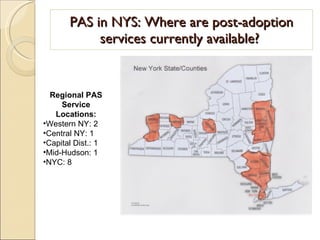
PAS in NYS: Where are post-adoption services currently available?  Regional PAS Service Locations: Western NY: 2 Central NY: 1 Capital Dist.: 1 Mid-Hudson: 1 NYC: 8
Implementing PAS in NYS Regional structure generally supported as best approach  Gaps in service provision Efforts to expand services impeded by economic crisis Existing services concentrated in urban areas Areas without regional PAS locations receive county supports which vary in services offered  Funding for PAS is complicated and conditional on appropriation
PAS in NYS: Types of Services Available * Not all services are available from all providers* Information about available services Support groups (child/parent/family) Parenting education Counseling  Crisis intervention Advocacy services (negotiating the system) Respite/after-school care/babysitting Integrated services/training in integrated behavior plan Peer training/support Referral and resources
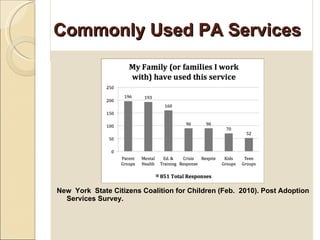
Commonly Used PA Services New  York  State Citizens Coalition for Children (Feb.  2010). Post Adoption Services Survey.
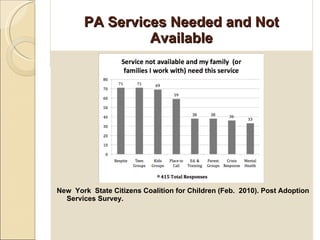
PA Services Needed and Not Available New  York  State Citizens Coalition for Children (Feb.  2010). Post Adoption Services Survey.
PAS in NYS: Possible Funding Streams and the Current Funding of PAS  Funding for PAS is fragmented and conditional… Some possible funding streams TANF* Adoption Subsidies* Medicaid Federal Title IV-E Adoption Assistance Bridges to Health OMRDD Private insurance Donations
Overview and Background: Cost-Benefits of Maintaining PAS
What does PAS Provide?:  The Research PAS are needed to help establish permanency despite any trauma-related difficulties that a child may exhibit A loving home cannot overcome these problems alone Many problems exhibited require specialized services to support the child within the social structures of family, school and community Without specialized support, needs of the child may exceed capabilities of the parent More research is needed, but supports success of PAS in increasing permanency
Adoption Permanency and Why it Matters Permanency: achieving a lifetime of safe, healthy, and supportive relationships and connections for children Lifetime family support and involvement Family intimacy, belonging,  familial status (connections) Critical for positive growth and development Can be achieved for children in foster care through adoption When permanency is not achieved, negative consequences may occur Social/emotional difficulties into adulthood  Homelessness, incarceration, substance abuse,  under-education, reentry into system as an adult
Other Factors Affecting Permanency: Gender, Race, Class & PAS Class plays a direct role in availability of post-adoption services Adoptions from foster care can often lead to the establishment of transracial families, affecting the adjustment of the adoptive child and family beyond existing issues. Discrimination and lack of available services based on race can be a factor, especially for males. Being male or being the only adoptee in a family of birth children can increase the likelihood of maladjustment.  Stresses in parenting can also be sometimes linked to gender roles
PAS in States Other than New York: Models and Components for Expansion NYS is one of 48 states offering some level of PAS Services vary state-to-state In most states, services are provided by private agencies, but some PAS is provided by state agencies States identified as having the most comprehensive programs: Alabama, Connecticut, Massachusetts, Oregon, Tennessee,  and Utah Programs are statewide,  include the key components identified as needed by NYS families and have more comprehenive approaches to funding
Seeking Alternatives and Viable Solutions to Sustain PAS in NYS Current focus: sustaining services and improving areas with negligible fiscal impact Improving access to information Prioritizing services to be sustained Continued lobbying for funding restoration Seeking out new ways to utilize existing funding streams (piecing together and rethinking “siloed” funding to provide resources to the greatest number of families) Developing long-range plans to address short-comings of current system and plan for cost-effective expansion through a more comprehensive approach and new funding possibilities
Advocacy and Persistence In the current economic crisis,  small steps must be pursued to achieve incremental change Constant advocacy is needed to keep the issues surrounding PAS “on the radar” Non-appropriation actions must be pursued and supported to improve information and referral for services that remain
Current Legislation to Address PAS Need in NYS Introduction of A.11175/S.8132: Post-Adoption Services Information Bill Would require that family courts provide adoptive families with up-to-date information about available post-adoption services and their location by adoption finalization
Summary and Conclusions Current economic sustainability of programs will not likely include preservation of programs at the current levels of service provision. Vigilant and persistent advocacy is needed to keep efforts to address shortcomings of the current system in motion PAS in NYS has provided assistance to many families in maintaining adoption permanency, but its shortcomings and tenuous funding structure need to be improved to achieve greater effectiveness and to reduce need to request appropriations for expansion and reorganization
Summary and Conclusions A more effective model would include: Greater interagency collaboration Improved data collection systems to track movement of children when disruptions and dissolutions occur A self-sustaining and dedicated funding structure Expand services state-wide using a more structured regional model that would include community outreach and expansion into rural areas The creation of social services training programs to improve and expand the availability of trained PAS workers
Q&A/Contact Information Amanda Lester, 2010 Fellow Center for Women in Government and Civil Society [email_address]
REFERENCES Avery, R. J. (2004).  Strengthening and preserving adoptive families: A study of TANF- funded post-adoption services in New York State . Cornell University. Retrieved from  http://nysccc.org/wp-content/uploads/tanfaverypasrpt.pdf Bandeau, S. (2010).  Permanence 5+5+5=Forever: Key questions when permanency  planning with older children  (2010, May 8). Presented at the 21 st  New York State Citizen’s Coalition for Children Annual Foster Care and Adoption Conference, Albany, NY. Brooks, D. & Barth, R.P. (1999). Adult transracial and inracial adoptees: Effects of  race, gender, adoptive family structure, and placement history on adjustment outcomes.  American Journal of Orthopsychiatry , 69 (1),  Casey Center for Effective Child Welfare Practice (2003).  Strengthening families  communities: Creative strategies for financing post-adoption services: A white paper.  Retrieved from http://www.aecf.org/upload/publicationfiles/creative%20strategies%20for %20financing.pdf Casey Family Services (2001, October).  Post-adoption services: Strengthening families  and communities . Retrieved from http://www.caseyfamilyservices.org  Encouraging adoption and helping families: The case for refocusing federal funding on  post-adoption services (2009).  Retrieved from Voices for Adoption: http://voice-for-adoption.org/downloads/VFA%20postadopt%20paper%20FINAL%207.9.09.pdf Gelo, J. & O’Malley, K.D. (2003).  Family stress in parenting a child or adolescent with  FASD . Iceberg, 13 (1), 1-5. Retrieved from  http://www.fasiceberg.org/newsletters/Vol13Num1_Mar2003.htm   Gibbs, D, Siebenauler, K., & Barth, R. P. (2002).  Assessing the field of post-adoption  services,: Family needs, program models, and evaluation issues . (Contract No. 100-99-0006). University of North Carolina School of Social Work. Retrieved from  http://aspe.hhs.gov/hsp/post-adoption01/summary/report.pdf   Keeping families together to save lives and money  (2010). Retrieved from New York  State Citizen’s Coalition for Children and Families: http://www.nysccc.org Linares, L. O. (2005). An understudied form of intra-family violence: Sibling-to-sibling  aggression among foster children.  Aggression and Violent Behavior , 11, 95-105. doi: 10.1016/j.avb.2005.07.001
REFERENCES CONTINUED Linares, L. O., Montalto, D. Rosbruch, N. & Li, M.M. (2006). Discipline practices among  biological and foster parents.  Child Maltreatment , 11, 157-167. doi:10.1177/1077559505285747 North American Council on Adoptable Children (2007, July).  The effective use of  adoption subsidies: Executive Summary.  Retrived from  http://www.nacac.org/adoptalk/exec_adoption_subsidies.html   Parents and professionals identify post adoption service needs in New York State  (2010). Retrieved from NYS Citizen’s Coalition for Children:  http://nysccc.org/wp- content/uploads/PAS-Survey-Full.pdf Paterson, D. and Megna, R.L. (2010). New York State 2010-2011 Executive Budget.  Retrieved from  http://publications.budget.state.ny.us/eBudget1011/fy1011littlebook/PublicSafety.html   Post-adoption services: Meeting the mental health care needs of children adopted from  foster care  (2007).. Retrieved from North American Council on Adoptable Children: http://www.nacac.org O’Connor, T. G., Deater-Deckard, K., Fulker, D., Rutter, M., & Plomin, R. (1998).  Genotype-environment correlations in late childhood and early adolescence: Antisocial behavioral problems and coercive parenting.  Developmental Psychology , 34 (5), 970-981. Office of Children and Family Services Bureau of Program and Community  Development (2010, February).  Post-adoption programs: “Lessons learned and  challenges ahead”.  Report created by OCFS Bureau of Program and Community  Development from final reports for 2008 received from the thirteen OCFS-funded  Post Adoption programs.  Post adoption programs: Lessons learned and challenges ahead  (2010). A preliminary  report based on the final reports for 2008 of thirteen OCFS-funded Post Adoption programs complied by the Office of Children and Family Services Bureau of Program and Community Development. Paper presented at the 15 th  Joint Local District and Voluntary Agency Meeting, Saratoga Springs, NY. Rosman, E., Johnson, C. & Zappala, M. (2009). Finding permanence for kids: NCFA  recommendations for immediate improvement to the foster care system.  Adoption Advocate , 17. Retrieved from National Council for Adoption:  http://www.adoptioncouncil.org
REFERENCES CONTINUED Schimmer, R., Smith, L. & D’Aversa, S. (2010).  Sometimes “forever families” need a  little help: A white paper on post adoption services from Parsons Child and Family Center . Paper presented at the 15 th  Joint Local District and Voluntary Agency Meeting, Saratoga Springs, NY.  Summary of the Adoption and Safe Families Act of 1997. Retrieved from  http://library.adoption.com/articles/summary-of-the-safe-families-act-of -1997 . html  Why families need post-adoption services . Children’s Service Practice Notes for North  Carolina’s Child Welfare Social Workers, 10, (1), 1-4. Retrieved from the North Carolina Division of Social Workers and the Family and Children Resource Program: http://www.practicenotes.org/vol10_n1/need.htm

Post adoption services & maintaining permanency in adoption

  • 1.
    Post-Adoption Services &Maintaining Permanency in Adoption Center for Women in Government Fellow’s Forum Amanda J. Lester June 23, 2010
  • 2.
    Overview and Background:Origin of Need for Post-Adoption Services Each year, thousand of children are adopted out of foster care in NYS “ Hard to place” children About 33% of adoptive children are reported as having emotional difficulties; 40% behavioral problems* Difficulties faced by adoptive children which range beyond those that may be addressed by “typical” parenting solutions *North American Council on Adoptable Children, 2007
  • 3.
    Overview and Background:Some problems that may be experienced by adoptive children Social, emotional, psychological, neurological, and cognitive disorders, grief, separation trauma, attachment disorders, fetal alcohol spectrum Some problems may present later or increase with time Milestones and child development may exacerbate or reinitiate problems or reactions
  • 4.
    Overview and Background: What are Post-Adoption Services? Post-adoption services (PAS) are specialized services to provide parents of adoptive children possessing emotional, behavioral, medical, or learning problems due to prior abuse or neglect. Provides support and addresses unique needs of adoptive children in the context of the family Improves family dynamics and addresses unique needs of adoptive children while they remain at home
  • 5.
    Overview and Background:Why are post-adoption services needed? Demands placed on families by needs and problems experienced by some adoptive children may result in adoptive children being served in residential treatment placements if no supports and resources are available to parents. “ Adoptive parents can feel overwhelmed by the transition” PAS supports families and children within the family structure Reduced likelihood of adoption disruption and adoption dissolution May increase rate of adoption out of foster care
  • 6.
    Overview and Background:The Current Problems are… Most funding for services provided in foster care are eliminated at adoption PAS are not equally available to all families in NYS Lack of services negatively impacts adoption permanency in many ways Expansion of regionally available services are needed More PAS training programs and trained providers needed Inadequate data collection and tracking systems Funding for existing PA Services in NYS are in jeopardy of being eliminated in the current budget process.
  • 7.
    Overview and Background: What happens to families when post-adoption services are not available ? Increases in residential treatment placements Reductions in adoptions from foster care Adoption disruptions (temporary removal from family to receive residential treatment/return to foster care) Adoption dissolutions (adoption failure after finalization)
  • 8.
    PAS in NYSBeginning in 2000, PAS services were offered through the development of Prevention and Post-Adoption Programs funded through RFP process Program is subject to annual budget appropriations Funding comes 100% from Temporary Assistance to Needy Families (TANF) funds Currently, 13 regional programs are in existence throughout NYS
  • 9.
    PAS in NYS:Where are post-adoption services currently available? Regional PAS Service Locations: Western NY: 2 Central NY: 1 Capital Dist.: 1 Mid-Hudson: 1 NYC: 8
  • 10.
    Implementing PAS inNYS Regional structure generally supported as best approach Gaps in service provision Efforts to expand services impeded by economic crisis Existing services concentrated in urban areas Areas without regional PAS locations receive county supports which vary in services offered Funding for PAS is complicated and conditional on appropriation
  • 11.
    PAS in NYS:Types of Services Available * Not all services are available from all providers* Information about available services Support groups (child/parent/family) Parenting education Counseling Crisis intervention Advocacy services (negotiating the system) Respite/after-school care/babysitting Integrated services/training in integrated behavior plan Peer training/support Referral and resources
  • 12.
    Commonly Used PAServices New York State Citizens Coalition for Children (Feb. 2010). Post Adoption Services Survey.
  • 13.
    PA Services Neededand Not Available New York State Citizens Coalition for Children (Feb. 2010). Post Adoption Services Survey.
  • 14.
    PAS in NYS:Possible Funding Streams and the Current Funding of PAS Funding for PAS is fragmented and conditional… Some possible funding streams TANF* Adoption Subsidies* Medicaid Federal Title IV-E Adoption Assistance Bridges to Health OMRDD Private insurance Donations
  • 15.
    Overview and Background:Cost-Benefits of Maintaining PAS
  • 16.
    What does PASProvide?: The Research PAS are needed to help establish permanency despite any trauma-related difficulties that a child may exhibit A loving home cannot overcome these problems alone Many problems exhibited require specialized services to support the child within the social structures of family, school and community Without specialized support, needs of the child may exceed capabilities of the parent More research is needed, but supports success of PAS in increasing permanency
  • 17.
    Adoption Permanency andWhy it Matters Permanency: achieving a lifetime of safe, healthy, and supportive relationships and connections for children Lifetime family support and involvement Family intimacy, belonging, familial status (connections) Critical for positive growth and development Can be achieved for children in foster care through adoption When permanency is not achieved, negative consequences may occur Social/emotional difficulties into adulthood Homelessness, incarceration, substance abuse, under-education, reentry into system as an adult
  • 18.
    Other Factors AffectingPermanency: Gender, Race, Class & PAS Class plays a direct role in availability of post-adoption services Adoptions from foster care can often lead to the establishment of transracial families, affecting the adjustment of the adoptive child and family beyond existing issues. Discrimination and lack of available services based on race can be a factor, especially for males. Being male or being the only adoptee in a family of birth children can increase the likelihood of maladjustment. Stresses in parenting can also be sometimes linked to gender roles
  • 19.
    PAS in StatesOther than New York: Models and Components for Expansion NYS is one of 48 states offering some level of PAS Services vary state-to-state In most states, services are provided by private agencies, but some PAS is provided by state agencies States identified as having the most comprehensive programs: Alabama, Connecticut, Massachusetts, Oregon, Tennessee, and Utah Programs are statewide, include the key components identified as needed by NYS families and have more comprehenive approaches to funding
  • 20.
    Seeking Alternatives andViable Solutions to Sustain PAS in NYS Current focus: sustaining services and improving areas with negligible fiscal impact Improving access to information Prioritizing services to be sustained Continued lobbying for funding restoration Seeking out new ways to utilize existing funding streams (piecing together and rethinking “siloed” funding to provide resources to the greatest number of families) Developing long-range plans to address short-comings of current system and plan for cost-effective expansion through a more comprehensive approach and new funding possibilities
  • 21.
    Advocacy and PersistenceIn the current economic crisis, small steps must be pursued to achieve incremental change Constant advocacy is needed to keep the issues surrounding PAS “on the radar” Non-appropriation actions must be pursued and supported to improve information and referral for services that remain
  • 22.
    Current Legislation toAddress PAS Need in NYS Introduction of A.11175/S.8132: Post-Adoption Services Information Bill Would require that family courts provide adoptive families with up-to-date information about available post-adoption services and their location by adoption finalization
  • 23.
    Summary and ConclusionsCurrent economic sustainability of programs will not likely include preservation of programs at the current levels of service provision. Vigilant and persistent advocacy is needed to keep efforts to address shortcomings of the current system in motion PAS in NYS has provided assistance to many families in maintaining adoption permanency, but its shortcomings and tenuous funding structure need to be improved to achieve greater effectiveness and to reduce need to request appropriations for expansion and reorganization
  • 24.
    Summary and ConclusionsA more effective model would include: Greater interagency collaboration Improved data collection systems to track movement of children when disruptions and dissolutions occur A self-sustaining and dedicated funding structure Expand services state-wide using a more structured regional model that would include community outreach and expansion into rural areas The creation of social services training programs to improve and expand the availability of trained PAS workers
  • 25.
    Q&A/Contact Information AmandaLester, 2010 Fellow Center for Women in Government and Civil Society [email_address]
  • 26.
    REFERENCES Avery, R.J. (2004). Strengthening and preserving adoptive families: A study of TANF- funded post-adoption services in New York State . Cornell University. Retrieved from http://nysccc.org/wp-content/uploads/tanfaverypasrpt.pdf Bandeau, S. (2010). Permanence 5+5+5=Forever: Key questions when permanency planning with older children (2010, May 8). Presented at the 21 st New York State Citizen’s Coalition for Children Annual Foster Care and Adoption Conference, Albany, NY. Brooks, D. & Barth, R.P. (1999). Adult transracial and inracial adoptees: Effects of race, gender, adoptive family structure, and placement history on adjustment outcomes. American Journal of Orthopsychiatry , 69 (1), Casey Center for Effective Child Welfare Practice (2003). Strengthening families communities: Creative strategies for financing post-adoption services: A white paper. Retrieved from http://www.aecf.org/upload/publicationfiles/creative%20strategies%20for %20financing.pdf Casey Family Services (2001, October). Post-adoption services: Strengthening families and communities . Retrieved from http://www.caseyfamilyservices.org Encouraging adoption and helping families: The case for refocusing federal funding on post-adoption services (2009). Retrieved from Voices for Adoption: http://voice-for-adoption.org/downloads/VFA%20postadopt%20paper%20FINAL%207.9.09.pdf Gelo, J. & O’Malley, K.D. (2003). Family stress in parenting a child or adolescent with FASD . Iceberg, 13 (1), 1-5. Retrieved from http://www.fasiceberg.org/newsletters/Vol13Num1_Mar2003.htm Gibbs, D, Siebenauler, K., & Barth, R. P. (2002). Assessing the field of post-adoption services,: Family needs, program models, and evaluation issues . (Contract No. 100-99-0006). University of North Carolina School of Social Work. Retrieved from http://aspe.hhs.gov/hsp/post-adoption01/summary/report.pdf Keeping families together to save lives and money (2010). Retrieved from New York State Citizen’s Coalition for Children and Families: http://www.nysccc.org Linares, L. O. (2005). An understudied form of intra-family violence: Sibling-to-sibling aggression among foster children. Aggression and Violent Behavior , 11, 95-105. doi: 10.1016/j.avb.2005.07.001
  • 27.
    REFERENCES CONTINUED Linares,L. O., Montalto, D. Rosbruch, N. & Li, M.M. (2006). Discipline practices among biological and foster parents. Child Maltreatment , 11, 157-167. doi:10.1177/1077559505285747 North American Council on Adoptable Children (2007, July). The effective use of adoption subsidies: Executive Summary. Retrived from http://www.nacac.org/adoptalk/exec_adoption_subsidies.html Parents and professionals identify post adoption service needs in New York State (2010). Retrieved from NYS Citizen’s Coalition for Children: http://nysccc.org/wp- content/uploads/PAS-Survey-Full.pdf Paterson, D. and Megna, R.L. (2010). New York State 2010-2011 Executive Budget. Retrieved from http://publications.budget.state.ny.us/eBudget1011/fy1011littlebook/PublicSafety.html Post-adoption services: Meeting the mental health care needs of children adopted from foster care (2007).. Retrieved from North American Council on Adoptable Children: http://www.nacac.org O’Connor, T. G., Deater-Deckard, K., Fulker, D., Rutter, M., & Plomin, R. (1998). Genotype-environment correlations in late childhood and early adolescence: Antisocial behavioral problems and coercive parenting. Developmental Psychology , 34 (5), 970-981. Office of Children and Family Services Bureau of Program and Community Development (2010, February). Post-adoption programs: “Lessons learned and challenges ahead”. Report created by OCFS Bureau of Program and Community Development from final reports for 2008 received from the thirteen OCFS-funded Post Adoption programs. Post adoption programs: Lessons learned and challenges ahead (2010). A preliminary report based on the final reports for 2008 of thirteen OCFS-funded Post Adoption programs complied by the Office of Children and Family Services Bureau of Program and Community Development. Paper presented at the 15 th Joint Local District and Voluntary Agency Meeting, Saratoga Springs, NY. Rosman, E., Johnson, C. & Zappala, M. (2009). Finding permanence for kids: NCFA recommendations for immediate improvement to the foster care system. Adoption Advocate , 17. Retrieved from National Council for Adoption: http://www.adoptioncouncil.org
  • 28.
    REFERENCES CONTINUED Schimmer,R., Smith, L. & D’Aversa, S. (2010). Sometimes “forever families” need a little help: A white paper on post adoption services from Parsons Child and Family Center . Paper presented at the 15 th Joint Local District and Voluntary Agency Meeting, Saratoga Springs, NY. Summary of the Adoption and Safe Families Act of 1997. Retrieved from http://library.adoption.com/articles/summary-of-the-safe-families-act-of -1997 . html Why families need post-adoption services . Children’s Service Practice Notes for North Carolina’s Child Welfare Social Workers, 10, (1), 1-4. Retrieved from the North Carolina Division of Social Workers and the Family and Children Resource Program: http://www.practicenotes.org/vol10_n1/need.htm

Editor's Notes

  • #3 Adoption rates out of foster care: 2008 (2,328) / 2009 (2, 197) –Link to Title funding Hard to place: 2008: 46.4 % of children placed rec’d hard to place subsidy/53.6 received handicapped subsidy Adoptions from foster care (2,236 in 2008/2,197 in 2009) (In 2008, 46.4% of children discharged to adoption received “hard to place” subsidies/53.6% received handicapped subsidies)
  • #13 It is not surprising that parent groups is listed as the number one used service because survey outreach included parent group leaders (NYSCCC has contact information for 88 foster and adoptive parent groups across the state) and they likely forwarded the survey on to their members. Additionally, parent groups, while time consuming to run, are inexpensive to organize. It should also be noted that many survey participants indicated that they (or families they have worked with) have used multiple services.
  • #14 The survey did not identify different types of respite and it was clear from the comments that participants had varying needs with regard to this service. Responses were fairly consistent across the regions with the exception of Region 2 where Respite and Crisis Response were identified as needed by the most participants, and need for a Place to Call was only identified by one participant.