Non-Destructive Testing & Evaluation of
Prestressed Concrete Cylinder Pipe (PCCP):
A Proactive & Budget Conscious Approach
AWWA Ohio Section
2012 Conference
Prestressed Concrete Cylinder Pipe (PCCP)
 Steel Cylinder Pipe, Concrete Core, Prestressing wire, Exterior
Cementitious Mortar and Grout
 Alkaline pH (12.5-13.5) cement = passive oxide film
 AWWA C301 – 1949 (Manufacturing Standard)
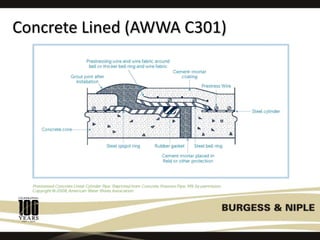
– 1942 Concrete Lined
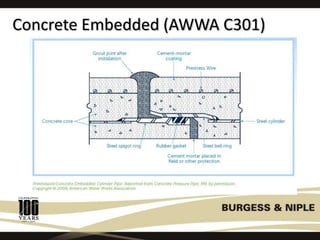
– 1952 Concrete Embedded
 AWWA C304 – 1992 (Design Standard)
 1970s – Substandard wire manufacturing
 90% of largest water utilities have PCCP
Concrete Lined (AWWA C301)
Concrete Embedded (AWWA C301)
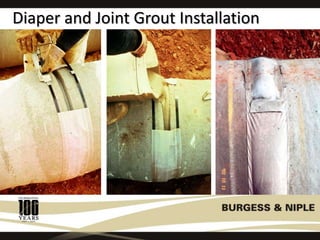
Diaper and Joint Grout Installation
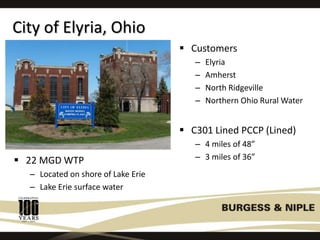
City of Elyria, Ohio
 22 MGD WTP
– Located on shore of Lake Erie
– Lake Erie surface water
 Customers
– Elyria
– Amherst
– North Ridgeville
– Northern Ohio Rural Water
 C301 Lined PCCP (Lined)
– 4 miles of 48”
– 3 miles of 36”
Why Be Proactive?
 Installed 1958 (54 years old)
– no previous inspections
 “Stories” of failures and leaks
 Primary Transmission Mains
 Access Issues
– park, roadways, residential property, high school
 PCCP can fail with little or no warning
 Sense of Stewardship! Customers – they depend on us!
 Goal – General Condition Assessment
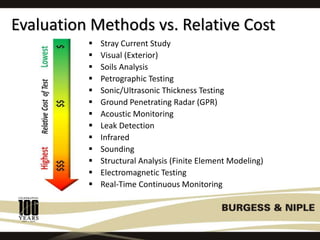
Evaluation Methods vs. Relative Cost
 Stray Current Study
 Visual (Exterior)
 Soils Analysis
 Petrographic Testing
 Sonic/Ultrasonic Thickness Testing
 Ground Penetrating Radar (GPR)
 Acoustic Monitoring
 Leak Detection
 Infrared
 Sounding
 Structural Analysis (Finite Element Modeling)
 Electromagnetic Testing
 Real-Time Continuous Monitoring
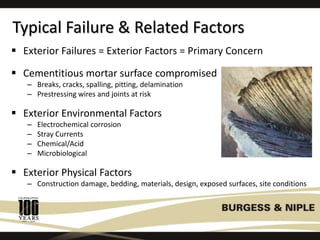
Typical Failure & Related Factors
 Exterior Failures = Exterior Factors = Primary Concern
 Cementitious mortar surface compromised
– Breaks, cracks, spalling, pitting, delamination
– Prestressing wires and joints at risk
 Exterior Environmental Factors
– Electrochemical corrosion
– Stray Currents
– Chemical/Acid
– Microbiological
 Exterior Physical Factors
– Construction damage, bedding, materials, design, exposed surfaces, site conditions
Evaluation Methodology
 Team Collaboration! Meetings, Discussions, Interviews
 Verification of Historical Data and “Stories”
– Only one documented failure (hydrant lateral)
– No actual documentation of leaks or breaks
 Assumed failure modes and contributing factors
 Impacts to service
 Destructive vs. Non-Destructive
 Cost Evaluation
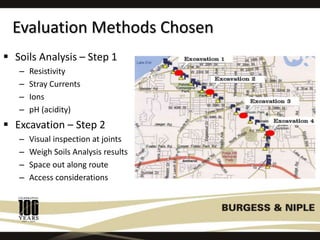
Evaluation Methods Chosen
 Soils Analysis – Step 1
– Resistivity
– Stray Currents
– Ions
– pH (acidity)
 Excavation – Step 2
– Visual inspection at joints
– Weigh Soils Analysis results
– Space out along route
– Access considerations
Soil Resistivity (ohm-cm) – Four Pin Method
 Inverse of conductivity
 Lower resistivity = easier current movement through soil
 5,000-2,000 = Corrosive (metals)
 Less than 2,000 = Highly corrosive (metals)
 Less than 1,500 = Corrosive (cementitious materials)
 Test Results = 5,400-4,500
Stray Currents
 DC flowing underground
– Cathodic protection, grounding systems, electric railway, arc-welding
 AC flowing overhead and underground
– Electrical transmission lines (electromagnetically induced, flaw in line)
 Accumulates/travels on pipe
 Discharges from Anode to Cathode
– Prefers long, electrically continuous runs, path of least resistance
– Can cause corrosion damage where it discharges from pipe
 Structure to Soil Potential Test
– Prefer to do over time and on electrically continuous pipe
 Visual Inspection and Utilities Research
Chloride Ions (ppm)
 Common source = Deicing activities
 Disrupt passive protective film
 Not consumed – initiate and sustain corrosion
 Greater than 400 ppm = Corrosive (cementitious materials)
 Test Results = 2 – 180 ppm
Sulfate/Sulfide Ions (ppm)
 Sulfates (calcium, sodium, magnesium – alkali soils)
– Chemical attack
– Greater than 2,000 ppm = Corrosive (cementitious materials)
– Test Results = 96 – 330 ppm
 Sulfate Reducing Bacteria (SRB) may be present
– Microbiological attack
– Moisture, clay, muck, organics (anaerobic conditions)
 Sulfides
– SRB reduces sulfates to sulfides (H2S, sulfuric acid)
– Test Results = None detected
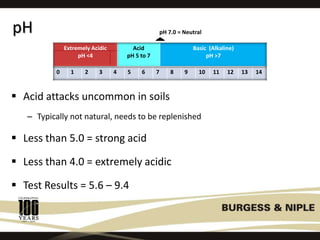
pH
 Acid attacks uncommon in soils
– Typically not natural, needs to be replenished
 Less than 5.0 = strong acid
 Less than 4.0 = extremely acidic
 Test Results = 5.6 – 9.4
0 1 2 3 4 5 6 7 8 9 10 11 12 13 14
pH 7.0 = Neutral
Extremely Acidic
pH <4
Acid
pH 5 to 7
Basic (Alkaline)
pH >7
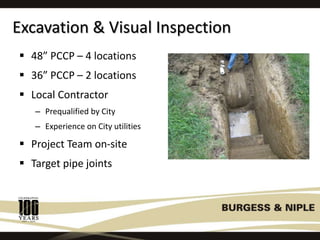
Excavation & Visual Inspection
 48” PCCP – 4 locations
 36” PCCP – 2 locations
 Local Contractor
– Prequalified by City
– Experience on City utilities
 Project Team on-site
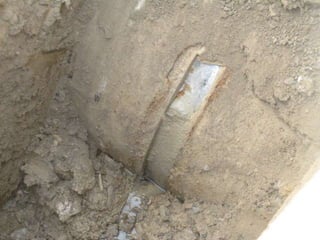
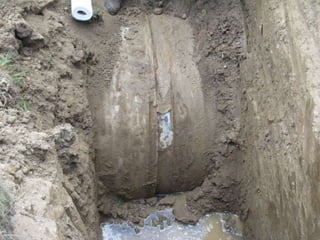
 Target pipe joints
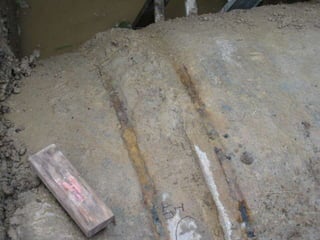
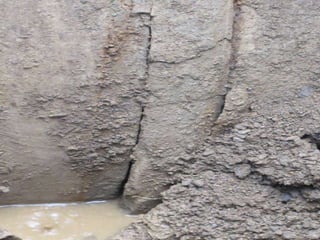
Visual Inspection Results
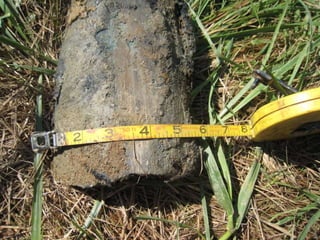
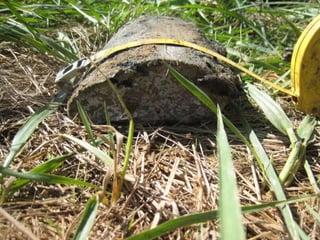
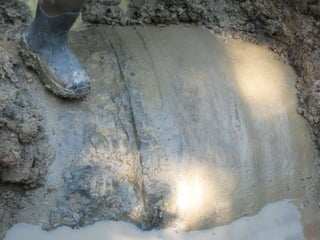
 Pipe = good condition
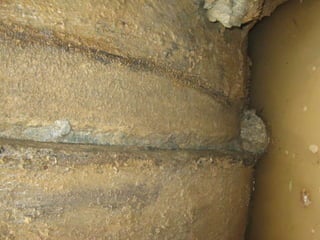
 Joints = good condition
– Grout diaper and steel bands still evident
– Joint recesses still tightly packed
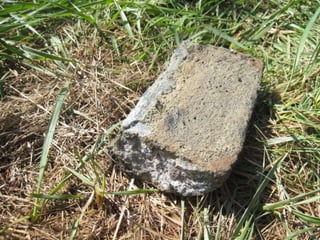
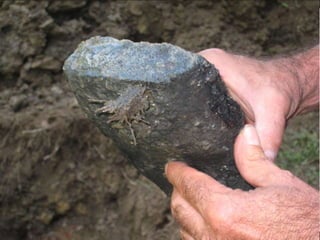
– Joint grout was loose and fell away
– Observations not uncommon for age and construction methods
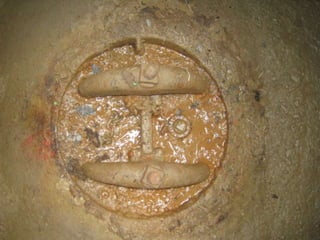
 Access Hatches
– Surface corrosion, appear structurally sound
Findings & Recommendations
 Soils tested were found not to be corrosive to PCCP.
 No failures or precursor conditions to failure were observed
during testing and visual inspection.
 PCCP in GOOD condition.
 Access Hatches
– Visual inspection, clean, ultrasonic thickness test, protective coating,
rehab or replace as necessary.
 Future Testing/Inspection Considerations
– Metal pipe connections
– Joint Grout – petrographic testing, replace grout
Questions?
Tim Antos, PE
Burgess & Niple, Inc.
timothy.antos@burgessniple.com
(440) 354-9700

2012 OAWWA NON-DESTRUCTIVE TESTING PCCP

  • 1.
    Non-Destructive Testing &Evaluation of Prestressed Concrete Cylinder Pipe (PCCP): A Proactive & Budget Conscious Approach AWWA Ohio Section 2012 Conference
  • 2.
    Prestressed Concrete CylinderPipe (PCCP)  Steel Cylinder Pipe, Concrete Core, Prestressing wire, Exterior Cementitious Mortar and Grout  Alkaline pH (12.5-13.5) cement = passive oxide film  AWWA C301 – 1949 (Manufacturing Standard) – 1942 Concrete Lined – 1952 Concrete Embedded  AWWA C304 – 1992 (Design Standard)  1970s – Substandard wire manufacturing  90% of largest water utilities have PCCP
  • 3.
  • 4.
  • 5.
    Diaper and JointGrout Installation
  • 8.
    City of Elyria,Ohio  22 MGD WTP – Located on shore of Lake Erie – Lake Erie surface water  Customers – Elyria – Amherst – North Ridgeville – Northern Ohio Rural Water  C301 Lined PCCP (Lined) – 4 miles of 48” – 3 miles of 36”
  • 9.
    Why Be Proactive? Installed 1958 (54 years old) – no previous inspections  “Stories” of failures and leaks  Primary Transmission Mains  Access Issues – park, roadways, residential property, high school  PCCP can fail with little or no warning  Sense of Stewardship! Customers – they depend on us!  Goal – General Condition Assessment
  • 10.
    Evaluation Methods vs.Relative Cost  Stray Current Study  Visual (Exterior)  Soils Analysis  Petrographic Testing  Sonic/Ultrasonic Thickness Testing  Ground Penetrating Radar (GPR)  Acoustic Monitoring  Leak Detection  Infrared  Sounding  Structural Analysis (Finite Element Modeling)  Electromagnetic Testing  Real-Time Continuous Monitoring
  • 11.
    Typical Failure &Related Factors  Exterior Failures = Exterior Factors = Primary Concern  Cementitious mortar surface compromised – Breaks, cracks, spalling, pitting, delamination – Prestressing wires and joints at risk  Exterior Environmental Factors – Electrochemical corrosion – Stray Currents – Chemical/Acid – Microbiological  Exterior Physical Factors – Construction damage, bedding, materials, design, exposed surfaces, site conditions
  • 12.
    Evaluation Methodology  TeamCollaboration! Meetings, Discussions, Interviews  Verification of Historical Data and “Stories” – Only one documented failure (hydrant lateral) – No actual documentation of leaks or breaks  Assumed failure modes and contributing factors  Impacts to service  Destructive vs. Non-Destructive  Cost Evaluation
  • 13.
    Evaluation Methods Chosen Soils Analysis – Step 1 – Resistivity – Stray Currents – Ions – pH (acidity)  Excavation – Step 2 – Visual inspection at joints – Weigh Soils Analysis results – Space out along route – Access considerations
  • 14.
    Soil Resistivity (ohm-cm)– Four Pin Method  Inverse of conductivity  Lower resistivity = easier current movement through soil  5,000-2,000 = Corrosive (metals)  Less than 2,000 = Highly corrosive (metals)  Less than 1,500 = Corrosive (cementitious materials)  Test Results = 5,400-4,500
  • 15.
    Stray Currents  DCflowing underground – Cathodic protection, grounding systems, electric railway, arc-welding  AC flowing overhead and underground – Electrical transmission lines (electromagnetically induced, flaw in line)  Accumulates/travels on pipe  Discharges from Anode to Cathode – Prefers long, electrically continuous runs, path of least resistance – Can cause corrosion damage where it discharges from pipe  Structure to Soil Potential Test – Prefer to do over time and on electrically continuous pipe  Visual Inspection and Utilities Research
  • 16.
    Chloride Ions (ppm) Common source = Deicing activities  Disrupt passive protective film  Not consumed – initiate and sustain corrosion  Greater than 400 ppm = Corrosive (cementitious materials)  Test Results = 2 – 180 ppm
  • 17.
    Sulfate/Sulfide Ions (ppm) Sulfates (calcium, sodium, magnesium – alkali soils) – Chemical attack – Greater than 2,000 ppm = Corrosive (cementitious materials) – Test Results = 96 – 330 ppm  Sulfate Reducing Bacteria (SRB) may be present – Microbiological attack – Moisture, clay, muck, organics (anaerobic conditions)  Sulfides – SRB reduces sulfates to sulfides (H2S, sulfuric acid) – Test Results = None detected
  • 18.
    pH  Acid attacksuncommon in soils – Typically not natural, needs to be replenished  Less than 5.0 = strong acid  Less than 4.0 = extremely acidic  Test Results = 5.6 – 9.4 0 1 2 3 4 5 6 7 8 9 10 11 12 13 14 pH 7.0 = Neutral Extremely Acidic pH <4 Acid pH 5 to 7 Basic (Alkaline) pH >7
  • 19.
    Excavation & VisualInspection  48” PCCP – 4 locations  36” PCCP – 2 locations  Local Contractor – Prequalified by City – Experience on City utilities  Project Team on-site  Target pipe joints
  • 29.
    Visual Inspection Results Pipe = good condition  Joints = good condition – Grout diaper and steel bands still evident – Joint recesses still tightly packed – Joint grout was loose and fell away – Observations not uncommon for age and construction methods  Access Hatches – Surface corrosion, appear structurally sound
  • 30.
    Findings & Recommendations Soils tested were found not to be corrosive to PCCP.  No failures or precursor conditions to failure were observed during testing and visual inspection.  PCCP in GOOD condition.  Access Hatches – Visual inspection, clean, ultrasonic thickness test, protective coating, rehab or replace as necessary.  Future Testing/Inspection Considerations – Metal pipe connections – Joint Grout – petrographic testing, replace grout
  • 31.
    Questions? Tim Antos, PE Burgess& Niple, Inc. timothy.antos@burgessniple.com (440) 354-9700

Editor's Notes

  • #3 C301: 1940s – standard for manufacture and materials of construction C304: 1992 – standard for design Strength due to helically wrapped prestressing wire 90% of 100 largest water producing utilities have PCCP Easy to install Price Brothers headquartered in Dayton – purchased by Hanson pipe 2007 Passive oxide film = high pH of cement
  • #4 Record drawings C301-55T. T=Tentative standard open for review/comment/revisions.
  • #9 Elyria: 55,000 population
  • #11 Carbonation – lowers pH, makes passive film unstable, and also makes any Chloride ion attacks more potent
  • #12 Prestressing wire gives pipe its strength Corrosion can also be acid “chemical” or “microbiological” in nature Corrosion needs moisture and oxygen Corrosion (electrochemical) = loss of electrons (oxidization) Electrons travel from anode (negative pipe) to cathode (positive cement and soil – anywhere can combine with moisture and oxygen) Metal wants to break down to its natural state and join (oxidize) with oxygen Passive film does not 100% stop corrosion, just reduces it to insignificant levels
  • #15 Wenner 4 Pin method = 4 rods equally spaced in straight line, current run between 2 outermost rods, voltage drop across two middle rods measured.
  • #16 Since very high voltages of sources, these can often lead to severe/rapid corrosion, But also not common, and not always easy to find/document.
  • #17 Chlorides are main concern as they penetrate the passive oxide film easier that other ions. Chlorides do not cause the corrosion directly, instead they disrupt/destroy the passive film. Often high concentrations can be found in areas where exposed to de-icing salts or seawater.
  • #18 If have Sulfates, may have SRB, especially if anaerobic conditions (no oxygen). SRB can attack both concrete and metals. SRB makes sulfates = sulfides (H2S) which can attack both concrete and metals (sulfide stress cracking of metals), H2S oxidizes to sulfuric acid
  • #19 5.6 – 9.4 = moderately acid to strongly alkaline