2011
Organized Retail
Crime Survey
www.nrf.com/organizedretailcrime
NRF 2011 Organized Retail Crime Survey2
About the Survey
NRF’s Organized Retail Crime survey is distributed each spring to senior loss prevention executives nationwide.
This year’s survey features responses from 129 executives representing department/large box stores, discount,
drug, grocery, restaurant and specialty retailers. The 2011 Organized Retail Crime Survey is NRF's seventh annual
survey and was conducted from April 19 – May 10, 2011.
About the National Retail Federation
As the world's largest retail trade association and the voice of retail worldwide, the National Retail Federation's
global membership includes retailers of all sizes, formats and channels of distribution as well as chain restaurants
and industry partners from the U.S. and more than 45 countries abroad. In the U.S., NRF represents the breadth
and diversity of an industry with more than 1.6 million American companies that employ nearly 25 million workers
and generated 2010 sales of $2.4 trillion. www.nrf.com
NRF Contacts
Survey Information: Media Inquiries:
Angelica Rodriguez Kathy Grannis
Sr. Director, Loss Prevention Director, Media Relations
202-626-8142 202-626-8189
rodrigueza@nrf.com grannisk@nrf.com
www.nrf.com/organizedretailcrime 3
Table of Contents
Executive Summary……………………………………………………………………………………4
Introduction………………………………………………………………………………………….….6
Increasing Levels of Organized Retail Crime……………………………………………………….7
Gateway Crimes……………………………………………………………………………………….8
Cargo Theft……………………………………………………………………………………………..9
Top 10 Cities………………………………………………………………………………………….10
Legislative Initiatives…………………………………………………………………………………11
Recent Cases…………………………………..…………………………………………………….12
Strategic Partnerships…………………………………………………………….…………………14
Additional Survey Findings………………………………………………………………………….16
Conclusion…………………………………………………………………………………………….18
Addendum A – Highly Targeted Items……………………………………………………………..19
Addendum B – Recent Case Studies…………………….………………………………………..20
Addendum C - How Organized Retail Crime Works……………………………………………..22
NRF 2011 Organized Retail Crime Survey4
EXECUTIVE SUMMARY
The National Retail Federation’s Organized Retail Crime survey, now in its seventh year, is conducted every spring
to gauge the impact and severity of organized retail crime. This year’s survey collects information from a variety of
retailers, ranging from restaurants to department stores to specialty retailers and grocery stores. Insights of senior
retail loss prevention executives from 129 retail companies are included in this report.
Organized Retail Crime Grows, Criminals Becoming More Violent
This year’s survey found that organized retail crime affects almost every single retailer, with 95 percent reporting
they have been a victim of organized retail crime in the past 12 months, up six percent from last year. Although
retailers continue to build their defenses against this growing problem, criminals are finding myriad ways to work
around the system. Retailers are also reporting that the criminals they apprehend are increasingly resorting to
violence, putting the safety of both associates and customers at risk.
Cargo Theft Poses Major Problem for Retailers
The scope of most criminal enterprises extends far beyond store limits. For the first time in the survey’s history,
NRF polled retailers about this threat and found that nearly half of all respondents said they have been a victim of
cargo theft within the past year. The survey found most cargo theft occurs en route from the distribution center to
the store, but other points within the supply chain are just as vulnerable. This not only affects a retailer’s bottom
line, it also affects what consumers end up seeing on the shelves at the store and the amount of inventory
available.
Top Cities Impacted by Organized Retail Crime
Crime rings throughout the country often take advantage of big cities and large highways to move their stolen
merchandise and hit multiple targets. When asked where in the United States retailers have the most problems with
criminal gangs and organized retail crime, cities including Los Angeles, Miami, New York and Dallas were listed.
Making the list for the first time, Las Vegas and Phoenix are now among the top 10 metropolitan areas retailers say
are affected, indicating criminal enterprises continue to travel the country. Many times, retailers and law
enforcement officials find it difficult to track these crime gangs because they cross state lines in a matter of hours.
New technologies, however, are beginning to play a vital role in tracking thefts and criminal behavior even through
various states and at different retail companies.
Awareness and Allocation of Resources
As the economy forces retail executives to pay close attention to every line item in their budgets, loss prevention
executives say senior leadership is more likely to understand how organized retail crime impacts the company’s
bottom line. This year’s survey found nearly six in 10 senior loss prevention executives say their senior
www.nrf.com/organizedretailcrime 5
management understands the severity of the problem, a big step up from the 39 percent reported in 2005. As a
result, many companies are allocating additional resources – including more personnel and greater investment in
technology – to combat the problem.
Retailers Identifying More Fence Locations
Organized crime gangs who steal consumer and other valuable goods such as over-the-counter medicines, baby
formula, diabetic testing strips and designer jeans, often use the façade of a local pawn shop, flea market or
warehouse to hide their stolen merchandise. These criminals also pose as legitimate sellers on online auction sites,
selling their stolen goods to innocent and unknowing consumers. The report found more than seven in 10 retailers
identified or recovered this stolen merchandise from both physical and online fence locations. Industry partnerships
with law enforcement and increased resources in personnel may have contributed to the increase in identifying
these stolen goods. The increase in the number of retailers who have been victimized may have played a role as
well.
Legislative Efforts
Retailers have spent years lobbying Congress about the need for specific organized retail crime legislation. Specific
lobbying interests include stiffer penalties for criminals involved with organized retail crimes, expanding law
enforcement’s ability to charge and prosecute offenders and decreasing the felony dollar amount threshold at which
criminals are charged. Though retailers recently celebrated the passing of H.R. 5932, the Organized Retail Theft
Investigation and Prosecution Act of 2010 in the House of Representatives, which aims to establish the Organized
Retail Theft Investigation and Prosecution Unit with the Department of Justice, budget crises and several other
pressing issues prevented this bill from being presented to the Senate. Several states have engaged the issue
through state legislation and many have already seen success. The report outlines which states have already
passed bills and those that are currently working on bills.
Conclusion
Through various platforms, retailers are able to communicate and network with industry peers about the challenges
organized retail crime presents for their business and how to combat the multi-billion dollar problem. These
platforms include national committees, local intelligence sharing groups, partnerships with local, state, and federal
law enforcement, and relationships with lawmakers. Together, retailers and law enforcement officials are making
great strides in uncovering the criminal enterprises that exist throughout the country. These collaborations have
resulted in many successful federal indictments and the breakup of large crime rings, which operated for years
behind physical and online fence operations.
From government affairs and strategic partnerships to grassroots initiatives, retailers have been very resourceful in
finding ways to confront the issue. Efforts to pass federal legislation persist and work continues behind the scenes
as executives from different companies come together to shed light on this growing problem.
NRF 2011 Organized Retail Crime Survey6
2011 Organized Retail Crime Survey
Purpose
The purpose of the National Retail Federation’s annual organized retail crime survey is to understand the impact of
organized retail crime on retailers across the country. By measuring trends and operational methods of criminal
enterprises making tens of billions of dollars in illegal profits every year, retailers, law enforcement and legislators
will be in a better position to respond to this industry-wide issue which has significant repercussions on consumers,
brands and local economies.
Introduction: Organized Retail Crime
Organized retail crime is defined as the theft/fraud activity conducted with the intent to convert illegally obtained
merchandise, cargo, cash, or cash equivalent into financial gain (no personal use), where/when the following
elements are present:
 Theft/Fraud is multiples of items
 Theft/Fraud is conducted:
 over multiple occurrences
 and/or in multiple stores
 and/or in multiple jurisdictions
 by two or more persons, or an individual acting in dual roles (booster & fence)
Groups, gangs and sometimes individuals are engaged in illegally obtaining retail merchandise through both theft
and fraud in substantial quantities as part of a criminal enterprise. These crime rings generally consist of “boosters”
– who methodically steal merchandise from retail stores or trailers (cargo theft) – and fence operators who convert
the product to cash or drugs as part of the criminal enterprise. Sophisticated criminals have even found ways to
switch UPC bar codes on merchandise so they ring up differently at checkout, commonly called “ticket switching.”
Others use stolen or cloned credit cards to obtain merchandise, tamper with retail equipment such as pin-pads or
produce fictitious receipts to return products back to retail stores.
Organized retail crime ring members will have designated roles, such as driver, lookout, picker, packer and
supervisor. They use hand signals, cell phones, GPS devices and comprehensive shopping lists. Tools of the trade
include foil-lined shopping bags, purses, boxes and signal jammers to defeat inventory control tags. Some will use
computers to replicate fake receipts for the purpose of making cash returns, while others will use fake credit cards
or checks to purchase gift cards and other expensive goods. In some cases, employees are recruited to look the
other way or provide details about camera or security systems.
www.nrf.com/organizedretailcrime 7
Precise measurements of the true scope of this problem are difficult to determine given the inherently secretive
nature of these criminal operators. However, according to Congressional testimony and industry experts, organized
retail crime losses total an estimated $15-30 billion annually.
In many instances, organized retail crime groups target several retailers in one day moving from state to state
stealing and reselling merchandise. These groups often steal thousands of dollars worth of merchandise at a time
with the intent to resell it for profit. Many times, unsuspecting consumers purchase these items from pawn shops,
swap meets, flea markets and street vendors. In recent years, crime rings have also swarmed the internet with
intentions to unload their stolen goods through online marketplaces, classified ads or through their own websites.
This practice is referred to as e-Fencing.
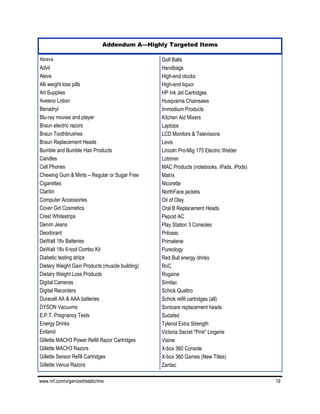
The most popular items targeted by these groups are goods in high demand commanding up to a near-retail resale
price. In general, department and specialty stores groups target items such as designer clothing, handbags, lingerie
and accessories. Grocery and drug stores are targeted for infant formula, over-the-counter drugs, razor blades and
high-end health and beauty aids. At electronics and general merchandise locations, items range from batteries to
the latest “i” devices. Stores are targeted for gift cards using fraudulent tender or return.
Increasing partnerships between retailers and law enforcement agencies demonstrate the severity of the issue for
retailers of all sizes and formats. Organized retail crime gangs can wreak havoc on a company’s entire operating
system as well as potentially causing serious harm to store employees and shoppers should a thief get violent.
NRF 2011 Organized Retail Crime Survey8
Organized Retail Crime is Increasing
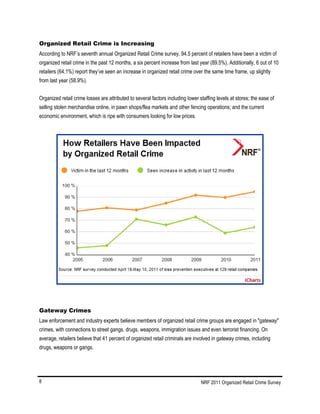
According to NRF’s seventh annual Organized Retail Crime survey, 94.5 percent of retailers have been a victim of
organized retail crime in the past 12 months, a six percent increase from last year (89.5%). Additionally, 6 out of 10
retailers (64.1%) report they’ve seen an increase in organized retail crime over the same time frame, up slightly
from last year (58.9%).
Organized retail crime losses are attributed to several factors including lower staffing levels at stores; the ease of
selling stolen merchandise online, in pawn shops/flea markets and other fencing operations; and the current
economic environment, which is ripe with consumers looking for low prices.
Gateway Crimes
Law enforcement and industry experts believe members of organized retail crime groups are engaged in "gateway"
crimes, with connections to street gangs, drugs, weapons, immigration issues and even terrorist financing. On
average, retailers believe that 41 percent of organized retail criminals are involved in gateway crimes, including
drugs, weapons or gangs.
www.nrf.com/organizedretailcrime 9
As an example, it is not uncommon to see low-level drug users stealing specific merchandise at the direction of a
group leader. The new merchandise they steal or fraudulently obtain is then traded for cash to buy drugs or
exchanged for drugs. In some cases the proceeds of this black market activity are used to further a larger criminal
enterprise engaged in stolen automobiles, money laundering, or immigration violations.
Survey Evaluates Impact of Cargo Theft for First Time
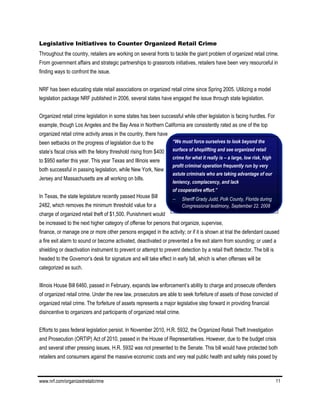
For the first time in this year’s survey, the impact of cargo theft was evaluated. According to the survey, almost half
(49.6%) of retailers were victims of cargo theft within the past year. Most of these thefts occurred en route from the
distribution center to the store (57.4%), though retailers often experienced cargo theft from the manufacturer to the
distribution center (39.7%), from one store to another (10.3%), at the distribution center (22.1%) and when the items
arrived at a store (17.6%). Figure 2 shows the various location points where cargo theft is a problem for retailers.
NRF 2011 Organized Retail Crime Survey10
Top 10 Cities for Organized Retail Crime
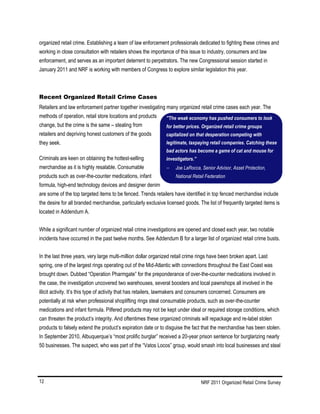
Last year survey respondents reported the top cities organized retail crime gangs targeted. This year, survey
responses were very similar. The top cities in alphabetical order include:
• Atlanta, GA • Los Angeles, CA
• Chicago, IL • Miami/Ft. Lauderdale, FL
• Dallas, TX • New York, NY/Northern NJ
• Houston, TX • Philadelphia, PA
• Las Vegas, NV • Phoenix, AZ
Las Vegas and Phoenix are two new additions to the list, replacing San Francisco and the Baltimore-DC-Northern
Virginia corridor, which both continue to be areas with high organized retail crime activity.
www.nrf.com/organizedretailcrime 11
Legislative Initiatives to Counter Organized Retail Crime
Throughout the country, retailers are working on several fronts to tackle the giant problem of organized retail crime.
From government affairs and strategic partnerships to grassroots initiatives, retailers have been very resourceful in
finding ways to confront the issue.
NRF has been educating state retail associations on organized retail crime since Spring 2005. Utilizing a model
legislation package NRF published in 2006, several states have engaged the issue through state legislation.
Organized retail crime legislation in some states has been successful while other legislation is facing hurdles. For
example, though Los Angeles and the Bay Area in Northern California are consistently rated as one of the top
organized retail crime activity areas in the country, there have
been setbacks on the progress of legislation due to the
state’s fiscal crisis with the felony threshold rising from $400
to $950 earlier this year. This year Texas and Illinois were
both successful in passing legislation, while New York, New
Jersey and Massachusetts are all working on bills.
In Texas, the state legislature recently passed House Bill
2482, which removes the minimum threshold value for a
charge of organized retail theft of $1,500. Punishment would
be increased to the next higher category of offense for persons that organize, supervise,
finance, or manage one or more other persons engaged in the activity; or if it is shown at trial the defendant caused
a fire exit alarm to sound or become activated, deactivated or prevented a fire exit alarm from sounding; or used a
shielding or deactivation instrument to prevent or attempt to prevent detection by a retail theft detector. The bill is
headed to the Governor’s desk for signature and will take effect in early fall, which is when offenses will be
categorized as such.
Illinois House Bill 6460, passed in February, expands law enforcement’s ability to charge and prosecute offenders
of organized retail crime. Under the new law, prosecutors are able to seek forfeiture of assets of those convicted of
organized retail crime. The forfeiture of assets represents a major legislative step forward in providing financial
disincentive to organizers and participants of organized retail crime.
Efforts to pass federal legislation persist. In November 2010, H.R. 5932, the Organized Retail Theft Investigation
and Prosecution (ORTIP) Act of 2010, passed in the House of Representatives. However, due to the budget crisis
and several other pressing issues, H.R. 5932 was not presented to the Senate. This bill would have protected both
retailers and consumers against the massive economic costs and very real public health and safety risks posed by
“We must force ourselves to look beyond the
surface of shoplifting and see organized retail
crime for what it really is – a large, low risk, high
profit criminal operation frequently run by very
astute criminals who are taking advantage of our
leniency, complacency, and lack
of cooperative effort.”
 Sheriff Grady Judd, Polk County, Florida during
Congressional testimony, September 22, 2008
NRF 2011 Organized Retail Crime Survey12
organized retail crime. Establishing a team of law enforcement professionals dedicated to fighting these crimes and
working in close consultation with retailers shows the importance of this issue to industry, consumers and law
enforcement, and serves as an important deterrent to perpetrators. The new Congressional session started in
January 2011 and NRF is working with members of Congress to explore similar legislation this year.
Recent Organized Retail Crime Cases
Retailers and law enforcement partner together investigating many organized retail crime cases each year. The
methods of operation, retail store locations and products
change, but the crime is the same – stealing from
retailers and depriving honest customers of the goods
they seek.
Criminals are keen on obtaining the hottest-selling
merchandise as it is highly resalable. Consumable
products such as over-the-counter medications, infant
formula, high-end technology devices and designer denim
are some of the top targeted items to be fenced. Trends retailers have identified in top fenced merchandise include
the desire for all branded merchandise, particularly exclusive licensed goods. The list of frequently targeted items is
located in Addendum A.
While a significant number of organized retail crime investigations are opened and closed each year, two notable
incidents have occurred in the past twelve months. See Addendum B for a larger list of organized retail crime busts.
In the last three years, very large multi-million dollar organized retail crime rings have been broken apart. Last
spring, one of the largest rings operating out of the Mid-Atlantic with connections throughout the East Coast was
brought down. Dubbed “Operation Pharmgate” for the preponderance of over-the-counter medications involved in
the case, the investigation uncovered two warehouses, several boosters and local pawnshops all involved in the
illicit activity. It’s this type of activity that has retailers, lawmakers and consumers concerned. Consumers are
potentially at risk when professional shoplifting rings steal consumable products, such as over-the-counter
medications and infant formula. Pilfered products may not be kept under ideal or required storage conditions, which
can threaten the product’s integrity. And oftentimes these organized criminals will repackage and re-label stolen
products to falsely extend the product’s expiration date or to disguise the fact that the merchandise has been stolen.
In September 2010, Albuquerque’s “most prolific burglar” received a 20-year prison sentence for burglarizing nearly
50 businesses. The suspect, who was part of the “Vatos Locos” group, would smash into local businesses and steal
“The weak economy has pushed consumers to look
for better prices. Organized retail crime groups
capitalized on that desperation competing with
legitimate, taxpaying retail companies. Catching these
bad actors has become a game of cat and mouse for
investigators.”
 Joe LaRocca, Senior Advisor, Asset Protection,
National Retail Federation
www.nrf.com/organizedretailcrime 13
expensive merchandise such as iPods, sunglasses and cell phones. In addition to the merchandise losses and
potential safety issues for customers and store employees, some cases involve costly repairs and an unsightly
storefront to local businesses.
Incidents Involving Aggressive Thieves/Violence
Retail criminals know that if they are apprehended they face arrest, prosecution, bail and even jail. Oftentimes, they
will stop at nothing to steal merchandise and keep from getting caught. Unfortunately, some of these crimes are
committed through acts of violence and can endanger the lives of others. According to the survey, retailers say that
13 percent of organized retail crime apprehensions result in violence including physical assault or battery.
Many retailers report an increase in violent behavior among criminals, which puts both employees and shoppers at
risk. When asked, “Within the past year, what trends in organized retail crime have you noticed,” answers included:
 less fear of getting caught
 smash and grab activity significantly increased
 criminals are getting more violent, more bold
 steady increase in activity
Last holiday season, two separate incidents highlighted the extent of violence and aggression criminals are willing
to exert to avoid apprehension.
In November 2010, a loss prevention associate working for Weis Markets in East Lampeter, Pa., was shot in the
parking lot while attempting to apprehend two retail theft suspects. One of the suspects was taken into custody and
the other was recently arrested in New York using a stolen credit card. The loss prevention associate was working a
shift Sunday afternoon when he spotted two apparent shoplifters and followed them to the parking lot. One of the
suspects pulled a handgun, pistol-whipped him on the head several times and then shot him.
On the same November weekend, during a police investigation into three men suspected of organized retail crime
in Orlando, a suspect used a stolen van to ram an unmarked police car in the parking lot of a Target store. With
dozens of shoppers in the area and few options, two officers were forced to open fire, critically injuring one suspect.
The two other suspects were booked into Orange County jail on charges including grand theft and fraudulent use of
personal identification information. While violent incidents do not occur during all investigations, the propensity to
violence is increasing and is something retailers are monitoring.
NRF 2011 Organized Retail Crime Survey14
Strategic Partnerships to Tackle Organized Retail Crime
There are several partnerships retailers have established to tackle organized retail crime in various methods
including:
 national committees
 local intelligence sharing groups
 partnerships with local, state, and federal law enforcement
 relationships with lawmakers
 public media platforms
Committee Involvement
NRF’s Joint Organized Retail Crime Task Force (JORCTF) and Investigator’s
Network are two committees dedicated to educating, training and working on
organized retail crime. Comprised of the nation’s top organized retail crime
investigators, the JORCTF educates the industry and law enforcement on
patterns and trends. The Investigator’s Network is a committee of over 1600
retail investigators. Meetings held throughout the country in various regions
and allow loss prevention and law enforcement personnel to meet regionally,
track local offenders and work collaboratively on major organized retail crime
issues.
Local Law Enforcement Relationships
As organized retail crime has received significant media attention over the past few years, several jurisdictions
throughout the country have put in place plans to address the issue. The City of Albuquerque laid out a community
strategic plan in 2008 to get the entire community engaged and involved to make their city a safer place. In 2009,
the Los Angeles Area Organized Retail Crime Association (LAAORCA) recently conducted their annual training
seminar with over 800 attendees from retail, law enforcement and financial institutions. Results in both communities
have been astounding as criminals have begun looking for other locales in which to conduct their illicit business.
Several communities throughout the country were quick to pick up the format and replicate the regional law
enforcement-retail community plan in their area. Local organized retail crime associations have been created and
rolled out in metropolitan areas like San Diego, Chicago and Montgomery County (MD).
Federal Law Enforcement Partnerships
Higher volume dollar loss cases, with cross-state border activity or having an international nexus are investigated
alongside federal law enforcement partners at the U.S. Immigration and Customs Enforcement-Homeland Security
Investigations (ICE-HSI), United States Postal Inspection Service (USPIS), United States Secret Service (USSS)
and Federal Bureau of Investigation (FBI).
“The use of the task force
approach to combating crime,
coupled with successful
partnerships within industry, is
seen by the FBI as one of the most
effective and efficient tools by
which to identify, disrupt and
dismantle any criminal enterprise.
That strategy is working.”
 Dave Johnson, Section Chief,
Criminal Investigation
Division, FBI
www.nrf.com/organizedretailcrime 15
In July 2009, ICE-HSI launched a Pilot program in Houston, Los Angeles, Miami and New York focused on building
partnerships with the retail industry and developing a series of tools to assist law enforcement in threat
assessments, case tracking and most significantly, an in-depth analysis of how organized crime rings are exploiting
systemic vulnerabilities in the banking system to launder their profits.
Due to the success of the Pilot, in February the program was expanded into a national initiative, which will be
known as the SEARCH initiative (Seizing Earnings and Assets from Retail Crime Heists). As a result of this
partnership, ICE-HSI reported that as of May 2011, more than 93 criminal HSI cases have been initiated. These
cases have resulted in 41 criminal arrests, 29 indictments, 15 convictions, 251 seizures, the execution of 22 search
warrants, and 15 administrative arrests. These cases have also led to the seizure of nearly $4.9 million in cash,
property, and monetary instruments.
According to ICE-HSI officials, the challenge of combating these
networks is best addressed through federal anti-money laundering
statutes that can carry severe penalties and through partnerships
between the retail industry and law enforcement at all levels. By
linking these types of crimes together, federal investigations have
proven the level and sophistication of criminal enterprises often
involved in organized retail crime activity.
NRF has maintained a long-standing partnership with the Federal Bureau of Investigation (FBI). Since 2005, NRF
and the FBI have worked together on many fronts, from legislative and networking to training and data share
initiatives. The partnership has provided education for thousands of retailers and law enforcement, and helped pave
the path with a unique partnership that was established in spring 2009.
The Federal Bureau of Investigation has stated organized retail crime groups can best be dismantled through a
coordinated and cooperative effort between law enforcement and the retail industry. In December 2003 the FBI
established an organized retail theft initiative to identify and disrupt multijurisdictional groups using federal statutes
such as conspiracy, interstate transportation of stolen property, and money laundering.
Additionally, Congress passed legislation signed by the President in January of 2006 that required the attorney
general and the FBI, in consultation with the retail community, to build a system for information sharing, to include
intelligence as well as lessons learned and best practices regarding organized retail theft.
“This type of organized, criminal activity is
commonly looked at as a local problem,
but I can assure you that is not always the
case.”
 James Dinkins, Executive Associate
Director, ICE-HSI
NRF 2011 Organized Retail Crime Survey16
Industry Partnerships
In early 2009, NRF announced a partnership with the world’s largest online marketplace, eBay, to tackle organized
retail crime. With support from the FBI and retailers from around the country, the Partnering with Retailers
Offensively Against Crime and Theft (PROACT) program was launched. The program is aimed at identifying and
stopping criminals who resell stolen goods online, and results have been encouraging.
Another important component of the partnership includes working together on legislation to enhance federal law
enforcement resources to combat organized retail crime and punish major offenders through enhanced criminal
penalties. The working group will also identify ways to leverage new technology, including data sharing initiatives,
which offensively partners with retailers against crime and theft.
Due to the landlord-tenant relationship, retailers are working closely with mall property owners. In 2007 the NRF in
partnership with the International Council of Shopping Centers (ICSC) launched a organized retail crime training
video for mall security officers. By working together, criminal groups may be spotted in parking lots or mall
entrances before they even enter the store and steal a single piece of merchandise. Through this collaboration, mall
blitz operations have uncovered dozens of retail crime cases over the past year. This year the relationship is
expanded to include joint training sessions during the NRF’s Loss Prevention Conference in June 2011.
Additional Organized Retail Crime Survey Findings
Overall Organized Retail Crime Levels in the U.S.
NRF asked retailers what they thought about the pattern of criminal activity in general over the last three years.
Eight out of ten retailers (84.8%) believe organized retail crime activity has increased in the last three years.
Allocation of Resources
While the economy is beginning to recover, retailers are still operating on lean budgets and cautiously adding back
staff and more resources to tackle the problem. Nearly half of retailers (46.5%) polled report they are allocating
additional resources toward fighting organized retail crime, a modest decrease from last year (48.4%). Some
retailers surveyed spend upwards of $1 million on personnel every year to address the issue, while others are
choosing to invest in technologies that have helped curb the problem.
Organized Retail Crime Threat Level
When asked how organized retail crime ranks as a threat to their company, over one-quarter (26.7%) rated the
problem as a “severe” or “significant” threat to their company. On average, retailers rated organized retail crime as
2.87, which is slightly up from last year’s 2.67 rating.
www.nrf.com/organizedretailcrime 17
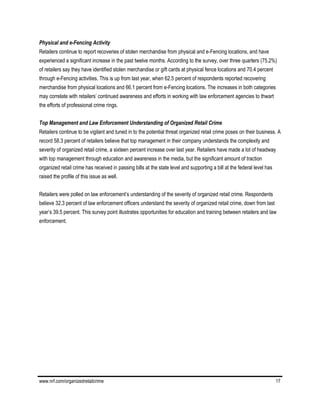
Physical and e-Fencing Activity
Retailers continue to report recoveries of stolen merchandise from physical and e-Fencing locations, and have
experienced a significant increase in the past twelve months. According to the survey, over three quarters (75.2%)
of retailers say they have identified stolen merchandise or gift cards at physical fence locations and 70.4 percent
through e-Fencing activities. This is up from last year, when 62.5 percent of respondents reported recovering
merchandise from physical locations and 66.1 percent from e-Fencing locations. The increases in both categories
may correlate with retailers’ continued awareness and efforts in working with law enforcement agencies to thwart
the efforts of professional crime rings.
Top Management and Law Enforcement Understanding of Organized Retail Crime
Retailers continue to be vigilant and tuned in to the potential threat organized retail crime poses on their business. A
record 58.3 percent of retailers believe that top management in their company understands the complexity and
severity of organized retail crime, a sixteen percent increase over last year. Retailers have made a lot of headway
with top management through education and awareness in the media, but the significant amount of traction
organized retail crime has received in passing bills at the state level and supporting a bill at the federal level has
raised the profile of this issue as well.
Retailers were polled on law enforcement’s understanding of the severity of organized retail crime. Respondents
believe 32.3 percent of law enforcement officers understand the severity of organized retail crime, down from last
year’s 39.5 percent. This survey point illustrates opportunities for education and training between retailers and law
enforcement.
NRF 2011 Organized Retail Crime Survey18
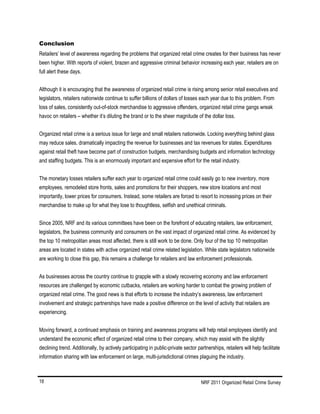
Conclusion
Retailers’ level of awareness regarding the problems that organized retail crime creates for their business has never
been higher. With reports of violent, brazen and aggressive criminal behavior increasing each year, retailers are on
full alert these days.
Although it is encouraging that the awareness of organized retail crime is rising among senior retail executives and
legislators, retailers nationwide continue to suffer billions of dollars of losses each year due to this problem. From
loss of sales, consistently out-of-stock merchandise to aggressive offenders, organized retail crime gangs wreak
havoc on retailers – whether it’s diluting the brand or to the sheer magnitude of the dollar loss.
Organized retail crime is a serious issue for large and small retailers nationwide. Locking everything behind glass
may reduce sales, dramatically impacting the revenue for businesses and tax revenues for states. Expenditures
against retail theft have become part of construction budgets, merchandising budgets and information technology
and staffing budgets. This is an enormously important and expensive effort for the retail industry.
The monetary losses retailers suffer each year to organized retail crime could easily go to new inventory, more
employees, remodeled store fronts, sales and promotions for their shoppers, new store locations and most
importantly, lower prices for consumers. Instead, some retailers are forced to resort to increasing prices on their
merchandise to make up for what they lose to thoughtless, selfish and unethical criminals.
Since 2005, NRF and its various committees have been on the forefront of educating retailers, law enforcement,
legislators, the business community and consumers on the vast impact of organized retail crime. As evidenced by
the top 10 metropolitan areas most affected, there is still work to be done. Only four of the top 10 metropolitan
areas are located in states with active organized retail crime related legislation. While state legislators nationwide
are working to close this gap, this remains a challenge for retailers and law enforcement professionals.
As businesses across the country continue to grapple with a slowly recovering economy and law enforcement
resources are challenged by economic cutbacks, retailers are working harder to combat the growing problem of
organized retail crime. The good news is that efforts to increase the industry’s awareness, law enforcement
involvement and strategic partnerships have made a positive difference on the level of activity that retailers are
experiencing.
Moving forward, a continued emphasis on training and awareness programs will help retail employees identify and
understand the economic effect of organized retail crime to their company, which may assist with the slightly
declining trend. Additionally, by actively participating in public-private sector partnerships, retailers will help facilitate
information sharing with law enforcement on large, multi-jurisdictional crimes plaguing the industry.
www.nrf.com/organizedretailcrime 19
Abreva
Advil
Aleve
Alli weight loss pills
Art Supplies
Aveeno Lotion
Benadryl
Blu-ray movies and player
Braun electric razors
Braun Toothbrushes
Braun Replacement Heads
Bumble and Bumble Hair Products
Candles
Cell Phones
Chewing Gum & Mints – Regular or Sugar Free
Cigarettes
Claritin
Computer Accessories
Cover Girl Cosmetics
Crest Whitestrips
Denim Jeans
Deodorant
DeWalt 18v Batteries
DeWalt 18v 6-tool Combo Kit
Diabetic testing strips
Dietary Weight Gain Products (muscle building)
Dietary Weight Loss Products
Digital Cameras
Digital Recorders
Duracell AA & AAA batteries
DYSON Vacuums
E.P.T. Pregnancy Tests
Energy Drinks
Enfamil
Gillette MACH3 Power Refill Razor Cartridges
Gillette MACH3 Razors
Gillette Sensor Refill Cartridges
Gillette Venus Razors
Golf Balls
Handbags
High-end clocks
High-end liquor
HP Ink Jet Cartridges
Husqvarna Chainsaws
Immodium Products
Kitchen Aid Mixers
Laptops
LCD Monitors & Televisions
Levis
Lincoln Pro-Mig 175 Electric Welder
Lotrimin
MAC Products (notebooks, iPads, iPods)
Matrix
Nicorette
NorthFace jackets
Oil of Olay
Oral B Replacement Heads
Pepcid AC
Play Station 3 Consoles
Prilosec
Primatene
Pureology
Red Bull energy drinks
RoC
Rogaine
Similac
Schick Quattro
Schick refill cartridges (all)
Sonicare replacement heads
Sudafed
Tylenol Extra Strength
Victoria Secret "Pink" Lingerie
Visine
X-box 360 Console
X-box 360 Games (New Titles)
Zantac
Addendum A—Highly Targeted Items
NRF 2011 Organized Retail Crime Survey20
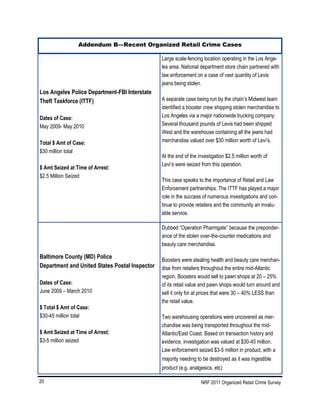
Addendum B—Recent Organized Retail Crime Cases
Los Angeles Police Department-FBI Interstate
Theft Taskforce (ITTF)
Dates of Case:
May 2009- May 2010
Total $ Amt of Case:
$30 million total
$ Amt Seized at Time of Arrest:
$2.5 Million Seized
Large scale-fencing location operating in the Los Ange-
les area. National department store chain partnered with
law enforcement on a case of vast quantity of Levis
jeans being stolen.
A separate case being run by the chain’s Midwest team
identified a booster crew shipping stolen merchandise to
Los Angeles via a major nationwide trucking company.
Several thousand pounds of Levis had been shipped
West and the warehouse containing all the jeans had
merchandise valued over $30 million worth of Levi’s.
At the end of the investigation $2.5 million worth of
Levi’s were seized from this operation.
This case speaks to the importance of Retail and Law
Enforcement partnerships. The ITTF has played a major
role in the success of numerous investigations and con-
tinue to provide retailers and the community an invalu-
able service.
Baltimore County (MD) Police
Department and United States Postal Inspector
Dates of Case:
June 2009 – March 2010
$ Total $ Amt of Case:
$30-45 million total
$ Amt Seized at Time of Arrest:
$3-5 million seized
Dubbed “Operation Pharmgate” because the preponder-
ance of the stolen over-the-counter medications and
beauty care merchandise.
Boosters were stealing health and beauty care merchan-
dise from retailers throughout the entire mid-Atlantic
region. Boosters would sell to pawn shops at 20 – 25%
of its retail value and pawn shops would turn around and
sell it only for at prices that were 30 – 40% LESS than
the retail value.
Two warehousing operations were uncovered as mer-
chandise was being transported throughout the mid-
Atlantic/East Coast. Based on transaction history and
evidence, investigation was valued at $30-45 million.
Law enforcement seized $3-5 million in product, with a
majority needing to be destroyed as it was ingestible
product (e.g. analgesics, etc)
www.nrf.com/organizedretailcrime 21
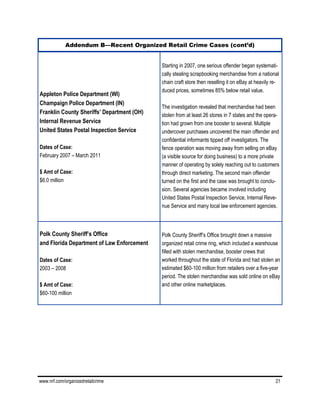
Appleton Police Department (WI)
Champaign Police Department (IN)
Franklin County Sheriffs’ Department (OH)
Internal Revenue Service
United States Postal Inspection Service
Dates of Case:
February 2007 – March 2011
$ Amt of Case:
$6.0 million
Starting in 2007, one serious offender began systemati-
cally stealing scrapbooking merchandise from a national
chain craft store then reselling it on eBay at heavily re-
duced prices, sometimes 85% below retail value.
The investigation revealed that merchandise had been
stolen from at least 26 stores in 7 states and the opera-
tion had grown from one booster to several. Multiple
undercover purchases uncovered the main offender and
confidential informants tipped off investigators. The
fence operation was moving away from selling on eBay
(a visible source for doing business) to a more private
manner of operating by solely reaching out to customers
through direct marketing. The second main offender
turned on the first and the case was brought to conclu-
sion. Several agencies became involved including
United States Postal Inspection Service, Internal Reve-
nue Service and many local law enforcement agencies.
Polk County Sheriff’s Office
and Florida Department of Law Enforcement
Dates of Case:
2003 – 2008
$ Amt of Case:
$60-100 million
Polk County Sheriff’s Office brought down a massive
organized retail crime ring, which included a warehouse
filled with stolen merchandise, booster crews that
worked throughout the state of Florida and had stolen an
estimated $60-100 million from retailers over a five-year
period. The stolen merchandise was sold online on eBay
and other online marketplaces.
Addendum B—Recent Organized Retail Crime Cases (cont’d)
NRF 2011 Organized Retail Crime Survey22
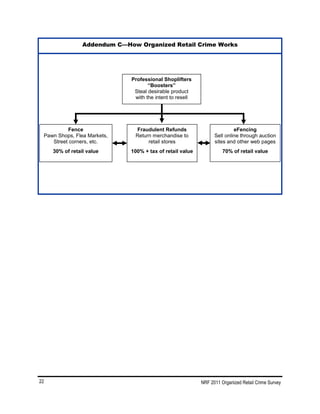
Addendum C—How Organized Retail Crime Works
Fraudulent Refunds
Return merchandise to
retail stores
100% + tax of retail value
Fence
Pawn Shops, Flea Markets,
Street corners, etc.
30% of retail value
eFencing
Sell online through auction
sites and other web pages
70% of retail value
Professional Shoplifters
“Boosters”
Steal desirable product
with the intent to resell
325 7th Street, NW
Suite 1100
Washington, DC 20004
www.nrf.com

2011 organized retail crime survey final

  • 1.
  • 2.
    NRF 2011 OrganizedRetail Crime Survey2 About the Survey NRF’s Organized Retail Crime survey is distributed each spring to senior loss prevention executives nationwide. This year’s survey features responses from 129 executives representing department/large box stores, discount, drug, grocery, restaurant and specialty retailers. The 2011 Organized Retail Crime Survey is NRF's seventh annual survey and was conducted from April 19 – May 10, 2011. About the National Retail Federation As the world's largest retail trade association and the voice of retail worldwide, the National Retail Federation's global membership includes retailers of all sizes, formats and channels of distribution as well as chain restaurants and industry partners from the U.S. and more than 45 countries abroad. In the U.S., NRF represents the breadth and diversity of an industry with more than 1.6 million American companies that employ nearly 25 million workers and generated 2010 sales of $2.4 trillion. www.nrf.com NRF Contacts Survey Information: Media Inquiries: Angelica Rodriguez Kathy Grannis Sr. Director, Loss Prevention Director, Media Relations 202-626-8142 202-626-8189 rodrigueza@nrf.com grannisk@nrf.com
  • 3.
    www.nrf.com/organizedretailcrime 3 Table ofContents Executive Summary……………………………………………………………………………………4 Introduction………………………………………………………………………………………….….6 Increasing Levels of Organized Retail Crime……………………………………………………….7 Gateway Crimes……………………………………………………………………………………….8 Cargo Theft……………………………………………………………………………………………..9 Top 10 Cities………………………………………………………………………………………….10 Legislative Initiatives…………………………………………………………………………………11 Recent Cases…………………………………..…………………………………………………….12 Strategic Partnerships…………………………………………………………….…………………14 Additional Survey Findings………………………………………………………………………….16 Conclusion…………………………………………………………………………………………….18 Addendum A – Highly Targeted Items……………………………………………………………..19 Addendum B – Recent Case Studies…………………….………………………………………..20 Addendum C - How Organized Retail Crime Works……………………………………………..22
  • 4.
    NRF 2011 OrganizedRetail Crime Survey4 EXECUTIVE SUMMARY The National Retail Federation’s Organized Retail Crime survey, now in its seventh year, is conducted every spring to gauge the impact and severity of organized retail crime. This year’s survey collects information from a variety of retailers, ranging from restaurants to department stores to specialty retailers and grocery stores. Insights of senior retail loss prevention executives from 129 retail companies are included in this report. Organized Retail Crime Grows, Criminals Becoming More Violent This year’s survey found that organized retail crime affects almost every single retailer, with 95 percent reporting they have been a victim of organized retail crime in the past 12 months, up six percent from last year. Although retailers continue to build their defenses against this growing problem, criminals are finding myriad ways to work around the system. Retailers are also reporting that the criminals they apprehend are increasingly resorting to violence, putting the safety of both associates and customers at risk. Cargo Theft Poses Major Problem for Retailers The scope of most criminal enterprises extends far beyond store limits. For the first time in the survey’s history, NRF polled retailers about this threat and found that nearly half of all respondents said they have been a victim of cargo theft within the past year. The survey found most cargo theft occurs en route from the distribution center to the store, but other points within the supply chain are just as vulnerable. This not only affects a retailer’s bottom line, it also affects what consumers end up seeing on the shelves at the store and the amount of inventory available. Top Cities Impacted by Organized Retail Crime Crime rings throughout the country often take advantage of big cities and large highways to move their stolen merchandise and hit multiple targets. When asked where in the United States retailers have the most problems with criminal gangs and organized retail crime, cities including Los Angeles, Miami, New York and Dallas were listed. Making the list for the first time, Las Vegas and Phoenix are now among the top 10 metropolitan areas retailers say are affected, indicating criminal enterprises continue to travel the country. Many times, retailers and law enforcement officials find it difficult to track these crime gangs because they cross state lines in a matter of hours. New technologies, however, are beginning to play a vital role in tracking thefts and criminal behavior even through various states and at different retail companies. Awareness and Allocation of Resources As the economy forces retail executives to pay close attention to every line item in their budgets, loss prevention executives say senior leadership is more likely to understand how organized retail crime impacts the company’s bottom line. This year’s survey found nearly six in 10 senior loss prevention executives say their senior
  • 5.
    www.nrf.com/organizedretailcrime 5 management understandsthe severity of the problem, a big step up from the 39 percent reported in 2005. As a result, many companies are allocating additional resources – including more personnel and greater investment in technology – to combat the problem. Retailers Identifying More Fence Locations Organized crime gangs who steal consumer and other valuable goods such as over-the-counter medicines, baby formula, diabetic testing strips and designer jeans, often use the façade of a local pawn shop, flea market or warehouse to hide their stolen merchandise. These criminals also pose as legitimate sellers on online auction sites, selling their stolen goods to innocent and unknowing consumers. The report found more than seven in 10 retailers identified or recovered this stolen merchandise from both physical and online fence locations. Industry partnerships with law enforcement and increased resources in personnel may have contributed to the increase in identifying these stolen goods. The increase in the number of retailers who have been victimized may have played a role as well. Legislative Efforts Retailers have spent years lobbying Congress about the need for specific organized retail crime legislation. Specific lobbying interests include stiffer penalties for criminals involved with organized retail crimes, expanding law enforcement’s ability to charge and prosecute offenders and decreasing the felony dollar amount threshold at which criminals are charged. Though retailers recently celebrated the passing of H.R. 5932, the Organized Retail Theft Investigation and Prosecution Act of 2010 in the House of Representatives, which aims to establish the Organized Retail Theft Investigation and Prosecution Unit with the Department of Justice, budget crises and several other pressing issues prevented this bill from being presented to the Senate. Several states have engaged the issue through state legislation and many have already seen success. The report outlines which states have already passed bills and those that are currently working on bills. Conclusion Through various platforms, retailers are able to communicate and network with industry peers about the challenges organized retail crime presents for their business and how to combat the multi-billion dollar problem. These platforms include national committees, local intelligence sharing groups, partnerships with local, state, and federal law enforcement, and relationships with lawmakers. Together, retailers and law enforcement officials are making great strides in uncovering the criminal enterprises that exist throughout the country. These collaborations have resulted in many successful federal indictments and the breakup of large crime rings, which operated for years behind physical and online fence operations. From government affairs and strategic partnerships to grassroots initiatives, retailers have been very resourceful in finding ways to confront the issue. Efforts to pass federal legislation persist and work continues behind the scenes as executives from different companies come together to shed light on this growing problem.
  • 6.
    NRF 2011 OrganizedRetail Crime Survey6 2011 Organized Retail Crime Survey Purpose The purpose of the National Retail Federation’s annual organized retail crime survey is to understand the impact of organized retail crime on retailers across the country. By measuring trends and operational methods of criminal enterprises making tens of billions of dollars in illegal profits every year, retailers, law enforcement and legislators will be in a better position to respond to this industry-wide issue which has significant repercussions on consumers, brands and local economies. Introduction: Organized Retail Crime Organized retail crime is defined as the theft/fraud activity conducted with the intent to convert illegally obtained merchandise, cargo, cash, or cash equivalent into financial gain (no personal use), where/when the following elements are present:  Theft/Fraud is multiples of items  Theft/Fraud is conducted:  over multiple occurrences  and/or in multiple stores  and/or in multiple jurisdictions  by two or more persons, or an individual acting in dual roles (booster & fence) Groups, gangs and sometimes individuals are engaged in illegally obtaining retail merchandise through both theft and fraud in substantial quantities as part of a criminal enterprise. These crime rings generally consist of “boosters” – who methodically steal merchandise from retail stores or trailers (cargo theft) – and fence operators who convert the product to cash or drugs as part of the criminal enterprise. Sophisticated criminals have even found ways to switch UPC bar codes on merchandise so they ring up differently at checkout, commonly called “ticket switching.” Others use stolen or cloned credit cards to obtain merchandise, tamper with retail equipment such as pin-pads or produce fictitious receipts to return products back to retail stores. Organized retail crime ring members will have designated roles, such as driver, lookout, picker, packer and supervisor. They use hand signals, cell phones, GPS devices and comprehensive shopping lists. Tools of the trade include foil-lined shopping bags, purses, boxes and signal jammers to defeat inventory control tags. Some will use computers to replicate fake receipts for the purpose of making cash returns, while others will use fake credit cards or checks to purchase gift cards and other expensive goods. In some cases, employees are recruited to look the other way or provide details about camera or security systems.
  • 7.
    www.nrf.com/organizedretailcrime 7 Precise measurementsof the true scope of this problem are difficult to determine given the inherently secretive nature of these criminal operators. However, according to Congressional testimony and industry experts, organized retail crime losses total an estimated $15-30 billion annually. In many instances, organized retail crime groups target several retailers in one day moving from state to state stealing and reselling merchandise. These groups often steal thousands of dollars worth of merchandise at a time with the intent to resell it for profit. Many times, unsuspecting consumers purchase these items from pawn shops, swap meets, flea markets and street vendors. In recent years, crime rings have also swarmed the internet with intentions to unload their stolen goods through online marketplaces, classified ads or through their own websites. This practice is referred to as e-Fencing. The most popular items targeted by these groups are goods in high demand commanding up to a near-retail resale price. In general, department and specialty stores groups target items such as designer clothing, handbags, lingerie and accessories. Grocery and drug stores are targeted for infant formula, over-the-counter drugs, razor blades and high-end health and beauty aids. At electronics and general merchandise locations, items range from batteries to the latest “i” devices. Stores are targeted for gift cards using fraudulent tender or return. Increasing partnerships between retailers and law enforcement agencies demonstrate the severity of the issue for retailers of all sizes and formats. Organized retail crime gangs can wreak havoc on a company’s entire operating system as well as potentially causing serious harm to store employees and shoppers should a thief get violent.
  • 8.
    NRF 2011 OrganizedRetail Crime Survey8 Organized Retail Crime is Increasing According to NRF’s seventh annual Organized Retail Crime survey, 94.5 percent of retailers have been a victim of organized retail crime in the past 12 months, a six percent increase from last year (89.5%). Additionally, 6 out of 10 retailers (64.1%) report they’ve seen an increase in organized retail crime over the same time frame, up slightly from last year (58.9%). Organized retail crime losses are attributed to several factors including lower staffing levels at stores; the ease of selling stolen merchandise online, in pawn shops/flea markets and other fencing operations; and the current economic environment, which is ripe with consumers looking for low prices. Gateway Crimes Law enforcement and industry experts believe members of organized retail crime groups are engaged in "gateway" crimes, with connections to street gangs, drugs, weapons, immigration issues and even terrorist financing. On average, retailers believe that 41 percent of organized retail criminals are involved in gateway crimes, including drugs, weapons or gangs.
  • 9.
    www.nrf.com/organizedretailcrime 9 As anexample, it is not uncommon to see low-level drug users stealing specific merchandise at the direction of a group leader. The new merchandise they steal or fraudulently obtain is then traded for cash to buy drugs or exchanged for drugs. In some cases the proceeds of this black market activity are used to further a larger criminal enterprise engaged in stolen automobiles, money laundering, or immigration violations. Survey Evaluates Impact of Cargo Theft for First Time For the first time in this year’s survey, the impact of cargo theft was evaluated. According to the survey, almost half (49.6%) of retailers were victims of cargo theft within the past year. Most of these thefts occurred en route from the distribution center to the store (57.4%), though retailers often experienced cargo theft from the manufacturer to the distribution center (39.7%), from one store to another (10.3%), at the distribution center (22.1%) and when the items arrived at a store (17.6%). Figure 2 shows the various location points where cargo theft is a problem for retailers.
  • 10.
    NRF 2011 OrganizedRetail Crime Survey10 Top 10 Cities for Organized Retail Crime Last year survey respondents reported the top cities organized retail crime gangs targeted. This year, survey responses were very similar. The top cities in alphabetical order include: • Atlanta, GA • Los Angeles, CA • Chicago, IL • Miami/Ft. Lauderdale, FL • Dallas, TX • New York, NY/Northern NJ • Houston, TX • Philadelphia, PA • Las Vegas, NV • Phoenix, AZ Las Vegas and Phoenix are two new additions to the list, replacing San Francisco and the Baltimore-DC-Northern Virginia corridor, which both continue to be areas with high organized retail crime activity.
  • 11.
    www.nrf.com/organizedretailcrime 11 Legislative Initiativesto Counter Organized Retail Crime Throughout the country, retailers are working on several fronts to tackle the giant problem of organized retail crime. From government affairs and strategic partnerships to grassroots initiatives, retailers have been very resourceful in finding ways to confront the issue. NRF has been educating state retail associations on organized retail crime since Spring 2005. Utilizing a model legislation package NRF published in 2006, several states have engaged the issue through state legislation. Organized retail crime legislation in some states has been successful while other legislation is facing hurdles. For example, though Los Angeles and the Bay Area in Northern California are consistently rated as one of the top organized retail crime activity areas in the country, there have been setbacks on the progress of legislation due to the state’s fiscal crisis with the felony threshold rising from $400 to $950 earlier this year. This year Texas and Illinois were both successful in passing legislation, while New York, New Jersey and Massachusetts are all working on bills. In Texas, the state legislature recently passed House Bill 2482, which removes the minimum threshold value for a charge of organized retail theft of $1,500. Punishment would be increased to the next higher category of offense for persons that organize, supervise, finance, or manage one or more other persons engaged in the activity; or if it is shown at trial the defendant caused a fire exit alarm to sound or become activated, deactivated or prevented a fire exit alarm from sounding; or used a shielding or deactivation instrument to prevent or attempt to prevent detection by a retail theft detector. The bill is headed to the Governor’s desk for signature and will take effect in early fall, which is when offenses will be categorized as such. Illinois House Bill 6460, passed in February, expands law enforcement’s ability to charge and prosecute offenders of organized retail crime. Under the new law, prosecutors are able to seek forfeiture of assets of those convicted of organized retail crime. The forfeiture of assets represents a major legislative step forward in providing financial disincentive to organizers and participants of organized retail crime. Efforts to pass federal legislation persist. In November 2010, H.R. 5932, the Organized Retail Theft Investigation and Prosecution (ORTIP) Act of 2010, passed in the House of Representatives. However, due to the budget crisis and several other pressing issues, H.R. 5932 was not presented to the Senate. This bill would have protected both retailers and consumers against the massive economic costs and very real public health and safety risks posed by “We must force ourselves to look beyond the surface of shoplifting and see organized retail crime for what it really is – a large, low risk, high profit criminal operation frequently run by very astute criminals who are taking advantage of our leniency, complacency, and lack of cooperative effort.”  Sheriff Grady Judd, Polk County, Florida during Congressional testimony, September 22, 2008
  • 12.
    NRF 2011 OrganizedRetail Crime Survey12 organized retail crime. Establishing a team of law enforcement professionals dedicated to fighting these crimes and working in close consultation with retailers shows the importance of this issue to industry, consumers and law enforcement, and serves as an important deterrent to perpetrators. The new Congressional session started in January 2011 and NRF is working with members of Congress to explore similar legislation this year. Recent Organized Retail Crime Cases Retailers and law enforcement partner together investigating many organized retail crime cases each year. The methods of operation, retail store locations and products change, but the crime is the same – stealing from retailers and depriving honest customers of the goods they seek. Criminals are keen on obtaining the hottest-selling merchandise as it is highly resalable. Consumable products such as over-the-counter medications, infant formula, high-end technology devices and designer denim are some of the top targeted items to be fenced. Trends retailers have identified in top fenced merchandise include the desire for all branded merchandise, particularly exclusive licensed goods. The list of frequently targeted items is located in Addendum A. While a significant number of organized retail crime investigations are opened and closed each year, two notable incidents have occurred in the past twelve months. See Addendum B for a larger list of organized retail crime busts. In the last three years, very large multi-million dollar organized retail crime rings have been broken apart. Last spring, one of the largest rings operating out of the Mid-Atlantic with connections throughout the East Coast was brought down. Dubbed “Operation Pharmgate” for the preponderance of over-the-counter medications involved in the case, the investigation uncovered two warehouses, several boosters and local pawnshops all involved in the illicit activity. It’s this type of activity that has retailers, lawmakers and consumers concerned. Consumers are potentially at risk when professional shoplifting rings steal consumable products, such as over-the-counter medications and infant formula. Pilfered products may not be kept under ideal or required storage conditions, which can threaten the product’s integrity. And oftentimes these organized criminals will repackage and re-label stolen products to falsely extend the product’s expiration date or to disguise the fact that the merchandise has been stolen. In September 2010, Albuquerque’s “most prolific burglar” received a 20-year prison sentence for burglarizing nearly 50 businesses. The suspect, who was part of the “Vatos Locos” group, would smash into local businesses and steal “The weak economy has pushed consumers to look for better prices. Organized retail crime groups capitalized on that desperation competing with legitimate, taxpaying retail companies. Catching these bad actors has become a game of cat and mouse for investigators.”  Joe LaRocca, Senior Advisor, Asset Protection, National Retail Federation
  • 13.
    www.nrf.com/organizedretailcrime 13 expensive merchandisesuch as iPods, sunglasses and cell phones. In addition to the merchandise losses and potential safety issues for customers and store employees, some cases involve costly repairs and an unsightly storefront to local businesses. Incidents Involving Aggressive Thieves/Violence Retail criminals know that if they are apprehended they face arrest, prosecution, bail and even jail. Oftentimes, they will stop at nothing to steal merchandise and keep from getting caught. Unfortunately, some of these crimes are committed through acts of violence and can endanger the lives of others. According to the survey, retailers say that 13 percent of organized retail crime apprehensions result in violence including physical assault or battery. Many retailers report an increase in violent behavior among criminals, which puts both employees and shoppers at risk. When asked, “Within the past year, what trends in organized retail crime have you noticed,” answers included:  less fear of getting caught  smash and grab activity significantly increased  criminals are getting more violent, more bold  steady increase in activity Last holiday season, two separate incidents highlighted the extent of violence and aggression criminals are willing to exert to avoid apprehension. In November 2010, a loss prevention associate working for Weis Markets in East Lampeter, Pa., was shot in the parking lot while attempting to apprehend two retail theft suspects. One of the suspects was taken into custody and the other was recently arrested in New York using a stolen credit card. The loss prevention associate was working a shift Sunday afternoon when he spotted two apparent shoplifters and followed them to the parking lot. One of the suspects pulled a handgun, pistol-whipped him on the head several times and then shot him. On the same November weekend, during a police investigation into three men suspected of organized retail crime in Orlando, a suspect used a stolen van to ram an unmarked police car in the parking lot of a Target store. With dozens of shoppers in the area and few options, two officers were forced to open fire, critically injuring one suspect. The two other suspects were booked into Orange County jail on charges including grand theft and fraudulent use of personal identification information. While violent incidents do not occur during all investigations, the propensity to violence is increasing and is something retailers are monitoring.
  • 14.
    NRF 2011 OrganizedRetail Crime Survey14 Strategic Partnerships to Tackle Organized Retail Crime There are several partnerships retailers have established to tackle organized retail crime in various methods including:  national committees  local intelligence sharing groups  partnerships with local, state, and federal law enforcement  relationships with lawmakers  public media platforms Committee Involvement NRF’s Joint Organized Retail Crime Task Force (JORCTF) and Investigator’s Network are two committees dedicated to educating, training and working on organized retail crime. Comprised of the nation’s top organized retail crime investigators, the JORCTF educates the industry and law enforcement on patterns and trends. The Investigator’s Network is a committee of over 1600 retail investigators. Meetings held throughout the country in various regions and allow loss prevention and law enforcement personnel to meet regionally, track local offenders and work collaboratively on major organized retail crime issues. Local Law Enforcement Relationships As organized retail crime has received significant media attention over the past few years, several jurisdictions throughout the country have put in place plans to address the issue. The City of Albuquerque laid out a community strategic plan in 2008 to get the entire community engaged and involved to make their city a safer place. In 2009, the Los Angeles Area Organized Retail Crime Association (LAAORCA) recently conducted their annual training seminar with over 800 attendees from retail, law enforcement and financial institutions. Results in both communities have been astounding as criminals have begun looking for other locales in which to conduct their illicit business. Several communities throughout the country were quick to pick up the format and replicate the regional law enforcement-retail community plan in their area. Local organized retail crime associations have been created and rolled out in metropolitan areas like San Diego, Chicago and Montgomery County (MD). Federal Law Enforcement Partnerships Higher volume dollar loss cases, with cross-state border activity or having an international nexus are investigated alongside federal law enforcement partners at the U.S. Immigration and Customs Enforcement-Homeland Security Investigations (ICE-HSI), United States Postal Inspection Service (USPIS), United States Secret Service (USSS) and Federal Bureau of Investigation (FBI). “The use of the task force approach to combating crime, coupled with successful partnerships within industry, is seen by the FBI as one of the most effective and efficient tools by which to identify, disrupt and dismantle any criminal enterprise. That strategy is working.”  Dave Johnson, Section Chief, Criminal Investigation Division, FBI
  • 15.
    www.nrf.com/organizedretailcrime 15 In July2009, ICE-HSI launched a Pilot program in Houston, Los Angeles, Miami and New York focused on building partnerships with the retail industry and developing a series of tools to assist law enforcement in threat assessments, case tracking and most significantly, an in-depth analysis of how organized crime rings are exploiting systemic vulnerabilities in the banking system to launder their profits. Due to the success of the Pilot, in February the program was expanded into a national initiative, which will be known as the SEARCH initiative (Seizing Earnings and Assets from Retail Crime Heists). As a result of this partnership, ICE-HSI reported that as of May 2011, more than 93 criminal HSI cases have been initiated. These cases have resulted in 41 criminal arrests, 29 indictments, 15 convictions, 251 seizures, the execution of 22 search warrants, and 15 administrative arrests. These cases have also led to the seizure of nearly $4.9 million in cash, property, and monetary instruments. According to ICE-HSI officials, the challenge of combating these networks is best addressed through federal anti-money laundering statutes that can carry severe penalties and through partnerships between the retail industry and law enforcement at all levels. By linking these types of crimes together, federal investigations have proven the level and sophistication of criminal enterprises often involved in organized retail crime activity. NRF has maintained a long-standing partnership with the Federal Bureau of Investigation (FBI). Since 2005, NRF and the FBI have worked together on many fronts, from legislative and networking to training and data share initiatives. The partnership has provided education for thousands of retailers and law enforcement, and helped pave the path with a unique partnership that was established in spring 2009. The Federal Bureau of Investigation has stated organized retail crime groups can best be dismantled through a coordinated and cooperative effort between law enforcement and the retail industry. In December 2003 the FBI established an organized retail theft initiative to identify and disrupt multijurisdictional groups using federal statutes such as conspiracy, interstate transportation of stolen property, and money laundering. Additionally, Congress passed legislation signed by the President in January of 2006 that required the attorney general and the FBI, in consultation with the retail community, to build a system for information sharing, to include intelligence as well as lessons learned and best practices regarding organized retail theft. “This type of organized, criminal activity is commonly looked at as a local problem, but I can assure you that is not always the case.”  James Dinkins, Executive Associate Director, ICE-HSI
  • 16.
    NRF 2011 OrganizedRetail Crime Survey16 Industry Partnerships In early 2009, NRF announced a partnership with the world’s largest online marketplace, eBay, to tackle organized retail crime. With support from the FBI and retailers from around the country, the Partnering with Retailers Offensively Against Crime and Theft (PROACT) program was launched. The program is aimed at identifying and stopping criminals who resell stolen goods online, and results have been encouraging. Another important component of the partnership includes working together on legislation to enhance federal law enforcement resources to combat organized retail crime and punish major offenders through enhanced criminal penalties. The working group will also identify ways to leverage new technology, including data sharing initiatives, which offensively partners with retailers against crime and theft. Due to the landlord-tenant relationship, retailers are working closely with mall property owners. In 2007 the NRF in partnership with the International Council of Shopping Centers (ICSC) launched a organized retail crime training video for mall security officers. By working together, criminal groups may be spotted in parking lots or mall entrances before they even enter the store and steal a single piece of merchandise. Through this collaboration, mall blitz operations have uncovered dozens of retail crime cases over the past year. This year the relationship is expanded to include joint training sessions during the NRF’s Loss Prevention Conference in June 2011. Additional Organized Retail Crime Survey Findings Overall Organized Retail Crime Levels in the U.S. NRF asked retailers what they thought about the pattern of criminal activity in general over the last three years. Eight out of ten retailers (84.8%) believe organized retail crime activity has increased in the last three years. Allocation of Resources While the economy is beginning to recover, retailers are still operating on lean budgets and cautiously adding back staff and more resources to tackle the problem. Nearly half of retailers (46.5%) polled report they are allocating additional resources toward fighting organized retail crime, a modest decrease from last year (48.4%). Some retailers surveyed spend upwards of $1 million on personnel every year to address the issue, while others are choosing to invest in technologies that have helped curb the problem. Organized Retail Crime Threat Level When asked how organized retail crime ranks as a threat to their company, over one-quarter (26.7%) rated the problem as a “severe” or “significant” threat to their company. On average, retailers rated organized retail crime as 2.87, which is slightly up from last year’s 2.67 rating.
  • 17.
    www.nrf.com/organizedretailcrime 17 Physical ande-Fencing Activity Retailers continue to report recoveries of stolen merchandise from physical and e-Fencing locations, and have experienced a significant increase in the past twelve months. According to the survey, over three quarters (75.2%) of retailers say they have identified stolen merchandise or gift cards at physical fence locations and 70.4 percent through e-Fencing activities. This is up from last year, when 62.5 percent of respondents reported recovering merchandise from physical locations and 66.1 percent from e-Fencing locations. The increases in both categories may correlate with retailers’ continued awareness and efforts in working with law enforcement agencies to thwart the efforts of professional crime rings. Top Management and Law Enforcement Understanding of Organized Retail Crime Retailers continue to be vigilant and tuned in to the potential threat organized retail crime poses on their business. A record 58.3 percent of retailers believe that top management in their company understands the complexity and severity of organized retail crime, a sixteen percent increase over last year. Retailers have made a lot of headway with top management through education and awareness in the media, but the significant amount of traction organized retail crime has received in passing bills at the state level and supporting a bill at the federal level has raised the profile of this issue as well. Retailers were polled on law enforcement’s understanding of the severity of organized retail crime. Respondents believe 32.3 percent of law enforcement officers understand the severity of organized retail crime, down from last year’s 39.5 percent. This survey point illustrates opportunities for education and training between retailers and law enforcement.
  • 18.
    NRF 2011 OrganizedRetail Crime Survey18 Conclusion Retailers’ level of awareness regarding the problems that organized retail crime creates for their business has never been higher. With reports of violent, brazen and aggressive criminal behavior increasing each year, retailers are on full alert these days. Although it is encouraging that the awareness of organized retail crime is rising among senior retail executives and legislators, retailers nationwide continue to suffer billions of dollars of losses each year due to this problem. From loss of sales, consistently out-of-stock merchandise to aggressive offenders, organized retail crime gangs wreak havoc on retailers – whether it’s diluting the brand or to the sheer magnitude of the dollar loss. Organized retail crime is a serious issue for large and small retailers nationwide. Locking everything behind glass may reduce sales, dramatically impacting the revenue for businesses and tax revenues for states. Expenditures against retail theft have become part of construction budgets, merchandising budgets and information technology and staffing budgets. This is an enormously important and expensive effort for the retail industry. The monetary losses retailers suffer each year to organized retail crime could easily go to new inventory, more employees, remodeled store fronts, sales and promotions for their shoppers, new store locations and most importantly, lower prices for consumers. Instead, some retailers are forced to resort to increasing prices on their merchandise to make up for what they lose to thoughtless, selfish and unethical criminals. Since 2005, NRF and its various committees have been on the forefront of educating retailers, law enforcement, legislators, the business community and consumers on the vast impact of organized retail crime. As evidenced by the top 10 metropolitan areas most affected, there is still work to be done. Only four of the top 10 metropolitan areas are located in states with active organized retail crime related legislation. While state legislators nationwide are working to close this gap, this remains a challenge for retailers and law enforcement professionals. As businesses across the country continue to grapple with a slowly recovering economy and law enforcement resources are challenged by economic cutbacks, retailers are working harder to combat the growing problem of organized retail crime. The good news is that efforts to increase the industry’s awareness, law enforcement involvement and strategic partnerships have made a positive difference on the level of activity that retailers are experiencing. Moving forward, a continued emphasis on training and awareness programs will help retail employees identify and understand the economic effect of organized retail crime to their company, which may assist with the slightly declining trend. Additionally, by actively participating in public-private sector partnerships, retailers will help facilitate information sharing with law enforcement on large, multi-jurisdictional crimes plaguing the industry.
  • 19.
    www.nrf.com/organizedretailcrime 19 Abreva Advil Aleve Alli weightloss pills Art Supplies Aveeno Lotion Benadryl Blu-ray movies and player Braun electric razors Braun Toothbrushes Braun Replacement Heads Bumble and Bumble Hair Products Candles Cell Phones Chewing Gum & Mints – Regular or Sugar Free Cigarettes Claritin Computer Accessories Cover Girl Cosmetics Crest Whitestrips Denim Jeans Deodorant DeWalt 18v Batteries DeWalt 18v 6-tool Combo Kit Diabetic testing strips Dietary Weight Gain Products (muscle building) Dietary Weight Loss Products Digital Cameras Digital Recorders Duracell AA & AAA batteries DYSON Vacuums E.P.T. Pregnancy Tests Energy Drinks Enfamil Gillette MACH3 Power Refill Razor Cartridges Gillette MACH3 Razors Gillette Sensor Refill Cartridges Gillette Venus Razors Golf Balls Handbags High-end clocks High-end liquor HP Ink Jet Cartridges Husqvarna Chainsaws Immodium Products Kitchen Aid Mixers Laptops LCD Monitors & Televisions Levis Lincoln Pro-Mig 175 Electric Welder Lotrimin MAC Products (notebooks, iPads, iPods) Matrix Nicorette NorthFace jackets Oil of Olay Oral B Replacement Heads Pepcid AC Play Station 3 Consoles Prilosec Primatene Pureology Red Bull energy drinks RoC Rogaine Similac Schick Quattro Schick refill cartridges (all) Sonicare replacement heads Sudafed Tylenol Extra Strength Victoria Secret "Pink" Lingerie Visine X-box 360 Console X-box 360 Games (New Titles) Zantac Addendum A—Highly Targeted Items
  • 20.
    NRF 2011 OrganizedRetail Crime Survey20 Addendum B—Recent Organized Retail Crime Cases Los Angeles Police Department-FBI Interstate Theft Taskforce (ITTF) Dates of Case: May 2009- May 2010 Total $ Amt of Case: $30 million total $ Amt Seized at Time of Arrest: $2.5 Million Seized Large scale-fencing location operating in the Los Ange- les area. National department store chain partnered with law enforcement on a case of vast quantity of Levis jeans being stolen. A separate case being run by the chain’s Midwest team identified a booster crew shipping stolen merchandise to Los Angeles via a major nationwide trucking company. Several thousand pounds of Levis had been shipped West and the warehouse containing all the jeans had merchandise valued over $30 million worth of Levi’s. At the end of the investigation $2.5 million worth of Levi’s were seized from this operation. This case speaks to the importance of Retail and Law Enforcement partnerships. The ITTF has played a major role in the success of numerous investigations and con- tinue to provide retailers and the community an invalu- able service. Baltimore County (MD) Police Department and United States Postal Inspector Dates of Case: June 2009 – March 2010 $ Total $ Amt of Case: $30-45 million total $ Amt Seized at Time of Arrest: $3-5 million seized Dubbed “Operation Pharmgate” because the preponder- ance of the stolen over-the-counter medications and beauty care merchandise. Boosters were stealing health and beauty care merchan- dise from retailers throughout the entire mid-Atlantic region. Boosters would sell to pawn shops at 20 – 25% of its retail value and pawn shops would turn around and sell it only for at prices that were 30 – 40% LESS than the retail value. Two warehousing operations were uncovered as mer- chandise was being transported throughout the mid- Atlantic/East Coast. Based on transaction history and evidence, investigation was valued at $30-45 million. Law enforcement seized $3-5 million in product, with a majority needing to be destroyed as it was ingestible product (e.g. analgesics, etc)
  • 21.
    www.nrf.com/organizedretailcrime 21 Appleton PoliceDepartment (WI) Champaign Police Department (IN) Franklin County Sheriffs’ Department (OH) Internal Revenue Service United States Postal Inspection Service Dates of Case: February 2007 – March 2011 $ Amt of Case: $6.0 million Starting in 2007, one serious offender began systemati- cally stealing scrapbooking merchandise from a national chain craft store then reselling it on eBay at heavily re- duced prices, sometimes 85% below retail value. The investigation revealed that merchandise had been stolen from at least 26 stores in 7 states and the opera- tion had grown from one booster to several. Multiple undercover purchases uncovered the main offender and confidential informants tipped off investigators. The fence operation was moving away from selling on eBay (a visible source for doing business) to a more private manner of operating by solely reaching out to customers through direct marketing. The second main offender turned on the first and the case was brought to conclu- sion. Several agencies became involved including United States Postal Inspection Service, Internal Reve- nue Service and many local law enforcement agencies. Polk County Sheriff’s Office and Florida Department of Law Enforcement Dates of Case: 2003 – 2008 $ Amt of Case: $60-100 million Polk County Sheriff’s Office brought down a massive organized retail crime ring, which included a warehouse filled with stolen merchandise, booster crews that worked throughout the state of Florida and had stolen an estimated $60-100 million from retailers over a five-year period. The stolen merchandise was sold online on eBay and other online marketplaces. Addendum B—Recent Organized Retail Crime Cases (cont’d)
  • 22.
    NRF 2011 OrganizedRetail Crime Survey22 Addendum C—How Organized Retail Crime Works Fraudulent Refunds Return merchandise to retail stores 100% + tax of retail value Fence Pawn Shops, Flea Markets, Street corners, etc. 30% of retail value eFencing Sell online through auction sites and other web pages 70% of retail value Professional Shoplifters “Boosters” Steal desirable product with the intent to resell
  • 23.
    325 7th Street,NW Suite 1100 Washington, DC 20004 www.nrf.com