T
he digital world we live in today is
redefining what constitutes a deal with
important implications for suppliers
to Target.
With the smartphone penetration rate
among Target shoppers now well above 50%,
it is possible for loyal guests to stand at the
shelf and evaluate the legitimacy of deals
served up by branded suppliers, as well as by
Target. That’s because loyalty and purchase
behavior will increasingly be influenced by
more than the lowest price, the most stuff
bundled together, an exclusive design or
product quality.
Those factors will continue to play impor-
tant roles, but the big brand winners of the
future will be those who create a different
type of deal. One that can be experienced in
store, but is further elevated and validated by
real-time, engaging conversations that are
happening online before, during and after the
sale. This is especially true of Target’s loyal
guests who are smart, style-conscious, value-
oriented consumers, who also happen to be
aggressive users of social media.
This combination is requiring brands to re-
think their mix of promotional tactics to more
effectively engage with guests, and increas-
ingly that means digital programs. Brands risk
leaving dollars on the table and ceding share
to those who are more aggressive with digital
strategies and social media activities that
comprise a more comprehensive approach to
engaging guests on their path to purchase.
For example, with new product launches,
the effectiveness of such time-worn tactics as
coupons and circular placement is undeni-
able. However, those tactics are greatly
enhanced by a strong and well-integrated
digital component to reinforce the value
proposition. When brands take advantage of
digital programs that amplify conventional
tactics, it gives consumers another line of sight
into what the brand offers, and that reinforces
what they experience or discover in the store.
Redefining ‘deals’
in a digital landscape
1
Continued on page 5
Continued on page 9
SUMMER 2013
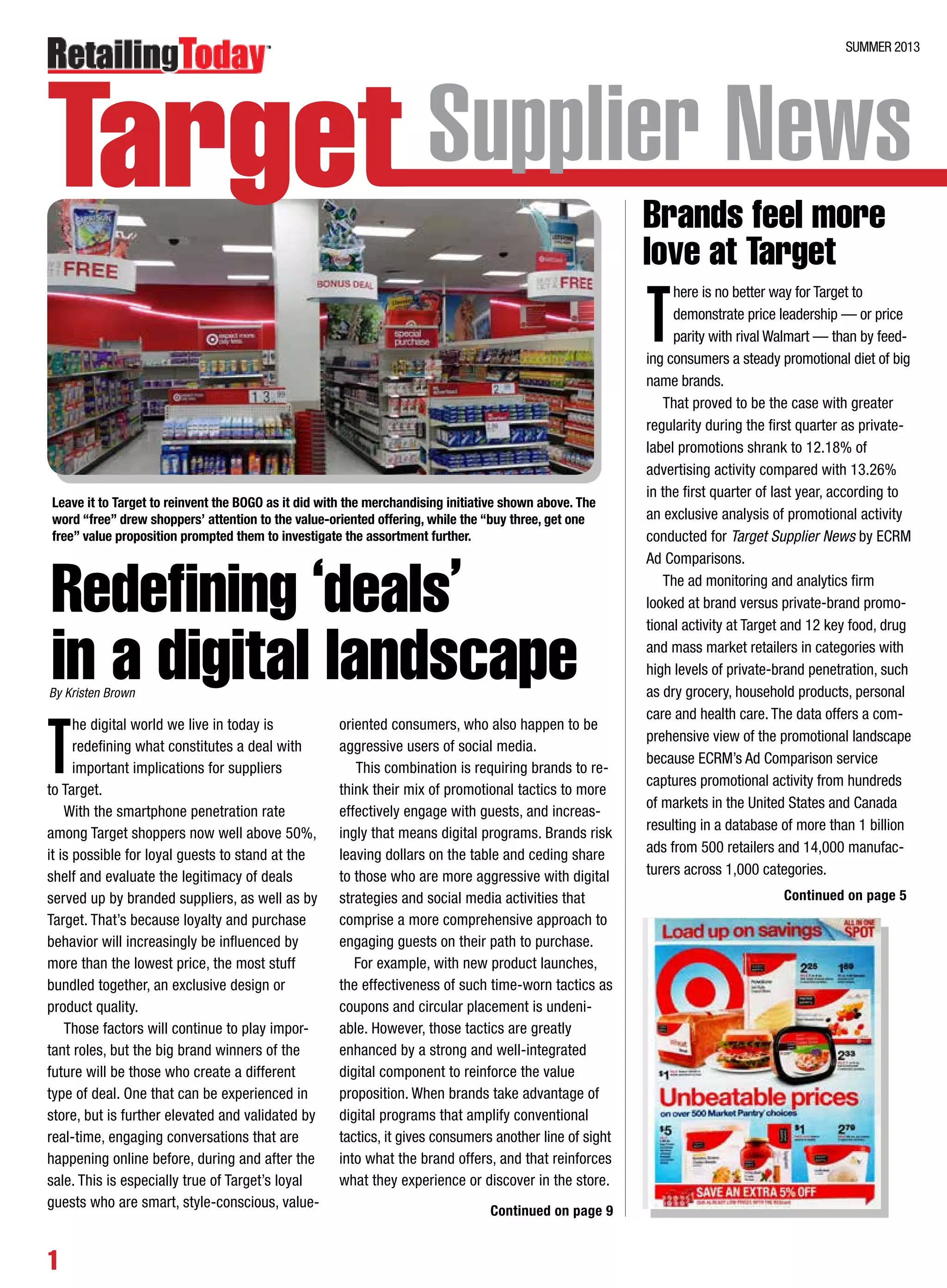
Leave it to Target to reinvent the BOGO as it did with the merchandising initiative shown above. The
word “free” drew shoppers’ attention to the value-oriented offering, while the “buy three, get one
free” value proposition prompted them to investigate the assortment further.
Brands feel more
love at Target
T
here is no better way for Target to
demonstrate price leadership — or price
parity with rival Walmart — than by feed-
ing consumers a steady promotional diet of big
name brands.
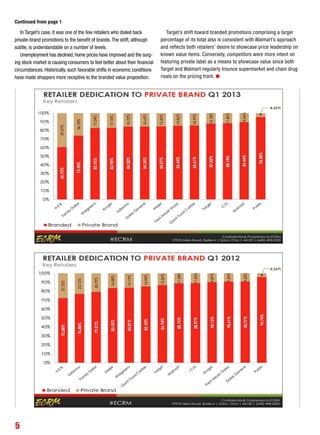
That proved to be the case with greater
regularity during the first quarter as private-
label promotions shrank to 12.18% of
advertising activity compared with 13.26%
in the first quarter of last year, according to
an exclusive analysis of promotional activity
conducted for Target Supplier News by ECRM
Ad Comparisons.
The ad monitoring and analytics firm
looked at brand versus private-brand promo-
tional activity at Target and 12 key food, drug
and mass market retailers in categories with
high levels of private-brand penetration, such
as dry grocery, household products, personal
care and health care. The data offers a com-
prehensive view of the promotional landscape
because ECRM’s Ad Comparison service
captures promotional activity from hundreds
of markets in the United States and Canada
resulting in a database of more than 1 billion
ads from 500 retailers and 14,000 manufac-
turers across 1,000 categories.
By Kristen Brown
We target your success™
www.rmservicing.com • 800-777-3767 • info@rmservicing.com
Every store,
Every week
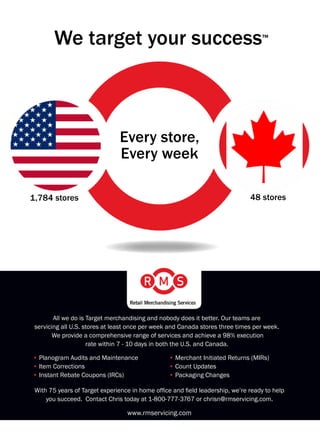
All we do is Target merchandising and nobody does it better. Our teams are
servicing all U.S. stores at least once per week and Canada stores three times per week.
We provide a comprehensive range of services and achieve a 98% execution
rate within 7 - 10 days in both the U.S. and Canada.
• Planogram Audits and Maintenance
• Item Corrections
• Instant Rebate Coupons (IRCs)
• Merchant Initiated Returns (MIRs)
• Count Updates
• Packaging Changes
With 75 years of Target experience in home office and field leadership, we’re ready to help
you succeed. Contact Chris today at 1-800-777-3767 or chrisn@rmservicing.com.
www.rmservicing.com
1,784 stores 48 stores
3
N
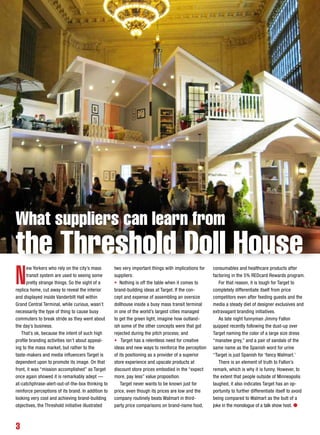
ew Yorkers who rely on the city’s mass
transit system are used to seeing some
pretty strange things. So the sight of a
replica home, cut away to reveal the interior
and displayed inside Vanderbilt Hall within
Grand Central Terminal, while curious, wasn’t
necessarily the type of thing to cause busy
commuters to break stride as they went about
the day’s business.
That’s ok, because the intent of such high
profile branding activities isn’t about appeal-
ing to the mass market, but rather to the
taste-makers and media influencers Target is
dependent upon to promote its image. On that
front, it was “mission accomplished” as Target
once again showed it is remarkably adept —
at-catchphrase-alert-out-of-the-box thinking to
reinforce perceptions of its brand. In addition to
looking very cool and achieving brand-building
objectives, the Threshold initiative illustrated
two very important things with implications for
suppliers:
• Nothing is off the table when it comes to
brand-building ideas at Target. If the con-
cept and expense of assembling an oversize
dollhouse inside a busy mass transit terminal
in one of the world’s largest cities managed
to get the green light, imagine how outland-
ish some of the other concepts were that got
rejected during the pitch process; and
• Target has a relentless need for creative
ideas and new ways to reinforce the perception
of its positioning as a provider of a superior
store experience and upscale products at
discount store prices embodied in the “expect
more, pay less” value proposition.
Target never wants to be known just for
price, even though its prices are low and the
company routinely beats Walmart in third-
party price comparisons on brand-name food,
consumables and healthcare products after
factoring in the 5% REDcard Rewards program.
For that reason, it is tough for Target to
completely differentiate itself from price
competitors even after feeding guests and the
media a steady diet of designer exclusives and
extravagant branding initiatives.
As late night funnyman Jimmy Fallon
quipped recently following the dust-up over
Target naming the color of a large size dress
“manatee grey,” and a pair of sandals of the
same name as the Spanish word for urine
“Target is just Spanish for ‘fancy Walmart.’
There is an element of truth to Fallon’s
remark, which is why it is funny. However, to
the extent that people outside of Minneapolis
laughed, it also indicates Target has an op-
portunity to further differentiate itself to avoid
being compared to Walmart as the butt of a
joke in the monologue of a talk show host. l
What suppliers can learn from
the Threshold Doll House
Case Study
Using SetSight to influence Target orders
Background/problem
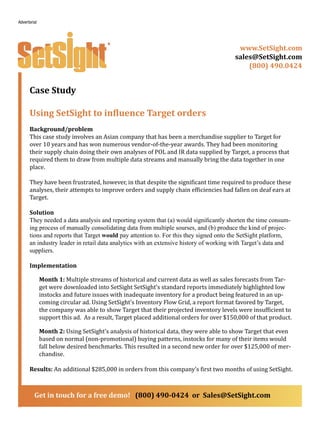
This case study involves an Asian company that has been a merchandise supplier to Target for
over 10 years and has won numerous vendor-of-the-year awards. They had been monitoring
their supply chain doing their own analyses of POL and IR data supplied by Target, a process that
required them to draw from multiple data streams and manually bring the data together in one
place.
They have been frustrated, however, in that despite the significant time required to produce these
analyses, their attempts to improve orders and supply chain efficiencies had fallen on deaf ears at
Target.
Solution
They needed a data analysis and reporting system that (a) would significantly shorten the time consum-
ing process of manually consolidating data from multiple sourses, and (b) produce the kind of projec-
tions and reports that Target would pay attention to. For this they signed onto the SetSight platform,
an industry leader in retail data analytics with an extensive history of working with Target’s data and
suppliers.
Implementation
Month 1: Multiple streams of historical and current data as well as sales forecasts from Tar-
get were downloaded into SetSight SetSight’s standard reports immediately highlighted low
instocks and future issues with inadequate inventory for a product being featured in an up-
coming circular ad. Using SetSight’s Inventory Flow Grid, a report format favored by Target,
the company was able to show Target that their projected inventory levels were insufficient to
support this ad. As a result, Target placed additional orders for over $150,000 of that product.
Month 2: Using SetSight’s analysis of historical data, they were able to show Target that even
based on normal (non-promotional) buying patterns, instocks for many of their items would
fall below desired benchmarks. This resulted in a second new order for over $125,000 of mer-
chandise.
Results: An additional $285,000 in orders from this company’s first two months of using SetSight.
www.SetSight.com
sales@SetSight.com
(800) 490.0424
Get in touch for a free demo! (800) 490-0424 or Sales@SetSight.com
Advertorial
Continued from page 1
5
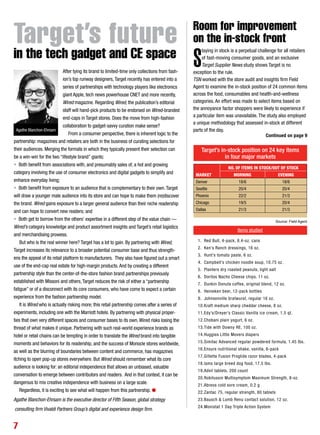
In Target’s case, it was one of the few retailers who dialed back
private-brand promotions to the benefit of brands. The shift, although
subtle, is understandable on a number of levels.
Unemployment has declined, home prices have improved and the surg-
ing stock market is causing consumers to feel better about their financial
circumstances. Historically, such favorable shifts in economic conditions
have made shoppers more receptive to the branded value proposition.
Target’s shift toward branded promotions comprising a larger
percentage of its total also is consistent with Walmart’s approach
and reflects both retailers’ desire to showcase price leadership on
known value items. Conversely, competitors were more intent on
featuring private label as a means to showcase value since both
Target and Walmart regularly trounce supermarket and chain drug
rivals on the pricing front. l
6
Continued on page 9
We’ve been working with Target since the day they opened their doors.
We move more products in more locations than anyone else. Every store.
Every week. And the best completion rates in the industry. Guaranteed.
LAWRENCE
MERCHANDISING
Right on Target since 1962
Joel Nelson: 877-483-5785 x715 / jnelson@lmsvc.com
Greg Knight: 877-483-5785 x702 / gknight@lmsvc.com
After tying its brand to limited-time only collections from fash-
ion’s top runway designers,Target recently has entered into a
series of partnerships with technology players like electronics
giant Apple, tech news powerhouse CNET and more recently,
Wired magazine. Regarding Wired, the publication’s editorial
staff will hand-pick products to be endorsed on Wired-branded
end-caps in Target stores. Does the move from high-fashion
collaboration to gadget-savvy curation make sense?
From a consumer perspective, there is inherent logic to the
partnership: magazines and retailers are both in the business of curating selections for
their audiences. Merging the formats in which they typically present their selection can
be a win-win for the two “lifestyle brand” giants:
• Both benefit from associations with, and presumably sales of, a hot and growing
category involving the use of consumer electronics and digital gadgets to simplify and
enhance everyday living;
• Both benefit from exposure to an audience that is complementary to their own.Target
will draw a younger male audience into its store and can hope to make them (re)discover
the brand. Wired gains exposure to a larger general audience than their niche readership
and can hope to convert new readers; and
• Both get to borrow from the others’ expertise in a different step of the value chain —
Wired’s category knowledge and product assortment insights and Target’s retail logistics
and merchandising prowess.
But who is the real winner here? Target has a lot to gain. By partnering with Wired,
Target increases its relevance to a broader potential consumer base and thus strength-
ens the appeal of its retail platform to manufacturers. They also have figured out a smart
use of the end-cap real estate for high-margin products.And by creating a different
partnership style than the center-of-the-store fashion brand partnerships previously
established with Missoni and others,Target reduces the risk of either a “partnership
fatigue” or of a disconnect with its core consumers, who have come to expect a certain
experience from the fashion partnership model.
It is Wired who is actually risking more; this retail partnership comes after a series of
experiments, including one with the Marriott hotels. By partnering with physical proper-
ties that own very different spaces and consumer bases to its own,Wired risks losing the
thread of what makes it unique. Partnering with such real-world experience brands as
hotel or retail chains can be tempting in order to translate the Wired brand into tangible
moments and behaviors for its readership, and the success of Monocle stores worldwide,
as well as the blurring of boundaries between content and commerce, has magazines
itching to open pop-up stores everywhere. But Wired should remember what its core
audience is looking for: an editorial independence that allows an unbiased, valuable
conversation to emerge between contributors and readers. And in that context, it can be
dangerous to mix creative independence with business on a large scale.
Regardless, it is exciting to see what will happen from this partnership. l
Agathe Blanchon-Ehrsam is the executive director of Fifth Season, global strategy
consulting firm Vivaldi Partners Group’s digital and experience design firm.
7
Target’s future
in the tech gadget and CE space
Source: Field Agent
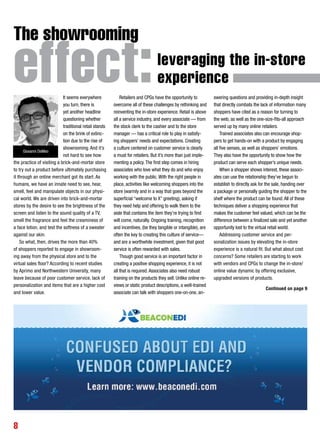
Target’s in-stock position on 24 key items
in four major markets
1.	 Red Bull, 4-pack, 8.4-oz. cans
2.	 Ken’s Ranch dressings, 16 oz.
3.	 Hunt’s tomato paste, 6 oz.
4.	 Campbell’s chicken noodle soup, 10.75 oz.
5.	 Planters dry roasted peanuts, light salt
6.	 Doritos Nacho Cheese chips, 11 oz.
7.	 Dunkin Donuts coffee, original blend, 12 oz.
8.	 Heineken beer, 12-pack bottles
9.	 Johnsonville bratwurst, regular 16 oz.
10.	Kraft medium sharp cheddar cheese, 8 oz.
11.	Edy’s/Dreyer’s Classic Vanilla ice cream, 1.5 qt.
12.	Chobani plain yogurt, 6 oz.
13.	Tide with Downy HE, 100 oz.
14.	Huggies Little Movers diapers
15.	Similac Advanced regular powdered formula, 1.45 lbs.
16.	Ensure nutritional shake, vanilla, 6-pack
17.	Gillette Fusion Proglide razor blades, 4-pack
18.	Iams large breed dog food, 17.5 lbs.
19.	Advil tablets, 200 count
20.	Robitussin Multisymptom Maximum Strength, 8-oz.
21.	Abreva cold sore cream, 0.2 g
22.	Zantac 75, regular strength, 80 tablets
23.	Bausch & Lomb Renu contact solution, 12 oz.
24.	Monistat 1 Day Triple Action System
market
No. of items in stock/out of stock
morning evening
Denver 18/6 18/6
Seattle 20/4 20/4
Phoenix 22/2 21/3
Chicago 19/5 20/4
Dallas 21/3 21/3
Items studied
Room for improvement
on the in-stock front
S
taying in stock is a perpetual challenge for all retailers
of fast-moving consumer goods, and an exclusive
Target Supplier News study shows Target is no
exception to the rule.
TSN worked with the store audit and insights firm Field
Agent to examine the in-stock position of 24 common items
across the food, consumables and health-and-wellness
categories. An effort was made to select items based on
the annoyance factor shoppers were likely to experience if
a particular item was unavailable. The study also employed
a unique methodology that assessed in-stock at different
parts of the day.Agathe Blanchon-Ehrsam
Continued on page 9
8
It seems everywhere
you turn, there is
yet another headline
questioning whether
traditional retail stands
on the brink of extinc-
tion due to the rise of
showrooming. And it’s
not hard to see how
the practice of visiting a brick-and-mortar store
to try out a product before ultimately purchasing
it through an online merchant got its start. As
humans, we have an innate need to see, hear,
smell, feel and manipulate objects in our physi-
cal world. We are driven into brick-and-mortar
stores by the desire to see the brightness of the
screen and listen to the sound quality of a TV,
smell the fragrance and feel the creaminess of
a face lotion, and test the softness of a sweater
against our skin.
So what, then, drives the more than 40%
of shoppers reported to engage in showroom-
ing away from the physical store and to the
virtual sales floor? According to recent studies
by Aprimo and Northwestern University, many
leave because of poor customer service, lack of
personalization and items that are a higher cost
and lower value.
Retailers and CPGs have the opportunity to
overcome all of these challenges by rethinking and
reinventing the in-store experience. Retail is above
all a service industry, and every associate — from
the stock clerk to the cashier and to the store
manager — has a critical role to play in satisfy-
ing shoppers’ needs and expectations. Creating
a culture centered on customer service is clearly
a must for retailers. But it’s more than just imple-
menting a policy. The first step comes in hiring
associates who love what they do and who enjoy
working with the public. With the right people in
place, activities like welcoming shoppers into the
store (warmly and in a way that goes beyond the
superficial “welcome to X” greeting), asking if
they need help and offering to walk them to the
aisle that contains the item they’re trying to find
will come, naturally. Ongoing training, recognition
and incentives, (be they tangible or intangible), are
often the key to creating this culture of service—
and are a worthwhile investment, given that good
service is often rewarded with sales.
Though good service is an important factor in
creating a positive shopping experience, it is not
all that is required. Associates also need robust
training on the products they sell. Unlike online re-
views or static product descriptions, a well-trained
associate can talk with shoppers one-on-one, an-
swering questions and providing in-depth insight
that directly combats the lack of information many
shoppers have cited as a reason for turning to
the web, as well as the one-size-fits-all approach
served up by many online retailers.
Trained associates also can encourage shop-
pers to get hands-on with a product by engaging
all five senses, as well as shoppers’ emotions.
They also have the opportunity to show how the
product can serve each shopper’s unique needs.
When a shopper shows interest, these associ-
ates can use the relationship they’ve begun to
establish to directly ask for the sale, handing over
a package or personally guiding the shopper to the
shelf where the product can be found. All of these
techniques deliver a shopping experience that
makes the customer feel valued, which can be the
difference between a finalized sale and yet another
opportunity lost to the virtual retail world.
Addressing customer service and per-
sonalization issues by elevating the in-store
experience is a natural fit. But what about cost
concerns? Some retailers are starting to work
with vendors and CPGs to change the in-store/
online value dynamic by offering exclusive,
upgraded versions of products.
The showrooming
effect:leveraging the in-store
experience
Giovanni DeMeo
Continued on page 9
Accordingly, Field Agents visited stores in five geographically disperse
markets during the morning to get a benchmark reading on the in-stock
position of the 24 items when those items would presumably be at peak
levels due to overnight or early morning stocking activities. The in-stock
level of those same items were measured again in the late afternoon/
early evening time frame to get an indication of whether in-stock levels
deteriorated throughout the day.
That proved not to be the case, however, as none of the five stores
measured were able to boast 100% in-stock levels during the morning.
Items that were out-of-stock during the morning tended to stay that way
throughout the day.
Another element of this study involved a desire to examine stores
after they had been under duress by shopping activity. Typically, that
would be a Saturday afternoon. However, in this case, the measurement
took place on Tuesday, April 30, because that is the date that millions of
Americans get paid by their employers or receive government assis-
tance, and pent-up demand is released into the market by shoppers who
live pay check to paycheck. l
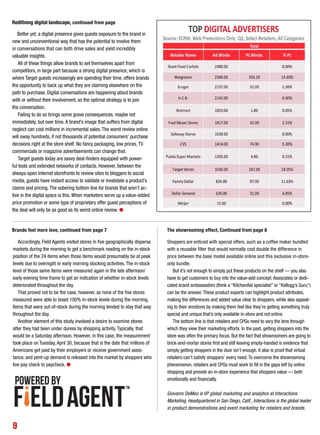
Better yet, a digital presence gives guests exposure to the brand in
new and unconventional way that has the potential to involve them
in conversations that can both drive sales and yield incredibly
valuable insights.
All of these things allow brands to set themselves apart from
competitors, in large part because a strong digital presence, which is
where Target guests increasingly are spending their time, offers brands
the opportunity to back up what they are claiming elsewhere on the
path to purchase. Digital conversations are happening about brands
with or without their involvement, so the optimal strategy is to join
the conversation.
Failing to do so brings some grave consequences, maybe not
immediately, but over time. A brand’s image that suffers from digital
neglect can cost millions in incremental sales. The worst review online
will sway hundreds, if not thousands of potential consumers’ purchase
decisions right at the store shelf. No fancy packaging, low prices, TV
commercials or magazine advertisements can change that.
Target guests today are savvy deal-finders equipped with power-
ful tools and extended networks of contacts. However, between the
always-open Internet storefronts to review sites to bloggers to social
media, guests have instant access to validate or invalidate a product’s
claims and pricing. The sobering bottom line for brands that aren’t ac-
tive in the digital space is this. When marketers serve up a value-added
price promotion or some type of proprietary offer guest perceptions of
the deal will only be as good as its worst online review. l
Redifining digital landscape, continued from page
Brands feel more love, continued from page 7 The showrooming effect, Continued from page 8
Shoppers are enticed with special offers, such as a coffee maker bundled
with a reusable filter that would normally cost double the difference in
price between the base model available online and this exclusive in-store-
only bundle.
But it’s not enough to simply put these products on the shelf — you also
have to get customers to buy into the value-add concept. Associates or dedi-
cated brand ambassadors (think a “KitchenAid specialist” or “Kellogg’s Guru”)
can be the answer. These product experts can highlight product attributes,
making the differences and added value clear to shoppers, while also appeal-
ing to their emotions by making them feel like they’re getting something truly
special and unique that’s only available in-store and not online.
The bottom line is that retailers and CPGs need to vary the lens through
which they view their marketing efforts. In the past, getting shoppers into the
store was often the primary focus. But the fact that showroomers are going to
brick-and-mortar stores first and still leaving empty-handed is evidence that
simply getting shoppers in the door isn’t enough. It also is proof that virtual
retailers can’t satisfy shoppers’ every need. To overcome the showrooming
phenomenon, retailers and CPGs must work to fill in the gaps left by online
shopping and provide an in-store experience that shoppers value — both
emotionally and financially.
Giovanni DeMeo is VP global marketing and analytics at Interactions
Marketing. Headquartered in San Diego, Calif., Interactions is the global leader
in product demonstrations and event marketing for retailers and brands.
9

Target report

  • 1.
    T he digital worldwe live in today is redefining what constitutes a deal with important implications for suppliers to Target. With the smartphone penetration rate among Target shoppers now well above 50%, it is possible for loyal guests to stand at the shelf and evaluate the legitimacy of deals served up by branded suppliers, as well as by Target. That’s because loyalty and purchase behavior will increasingly be influenced by more than the lowest price, the most stuff bundled together, an exclusive design or product quality. Those factors will continue to play impor- tant roles, but the big brand winners of the future will be those who create a different type of deal. One that can be experienced in store, but is further elevated and validated by real-time, engaging conversations that are happening online before, during and after the sale. This is especially true of Target’s loyal guests who are smart, style-conscious, value- oriented consumers, who also happen to be aggressive users of social media. This combination is requiring brands to re- think their mix of promotional tactics to more effectively engage with guests, and increas- ingly that means digital programs. Brands risk leaving dollars on the table and ceding share to those who are more aggressive with digital strategies and social media activities that comprise a more comprehensive approach to engaging guests on their path to purchase. For example, with new product launches, the effectiveness of such time-worn tactics as coupons and circular placement is undeni- able. However, those tactics are greatly enhanced by a strong and well-integrated digital component to reinforce the value proposition. When brands take advantage of digital programs that amplify conventional tactics, it gives consumers another line of sight into what the brand offers, and that reinforces what they experience or discover in the store. Redefining ‘deals’ in a digital landscape 1 Continued on page 5 Continued on page 9 SUMMER 2013 Leave it to Target to reinvent the BOGO as it did with the merchandising initiative shown above. The word “free” drew shoppers’ attention to the value-oriented offering, while the “buy three, get one free” value proposition prompted them to investigate the assortment further. Brands feel more love at Target T here is no better way for Target to demonstrate price leadership — or price parity with rival Walmart — than by feed- ing consumers a steady promotional diet of big name brands. That proved to be the case with greater regularity during the first quarter as private- label promotions shrank to 12.18% of advertising activity compared with 13.26% in the first quarter of last year, according to an exclusive analysis of promotional activity conducted for Target Supplier News by ECRM Ad Comparisons. The ad monitoring and analytics firm looked at brand versus private-brand promo- tional activity at Target and 12 key food, drug and mass market retailers in categories with high levels of private-brand penetration, such as dry grocery, household products, personal care and health care. The data offers a com- prehensive view of the promotional landscape because ECRM’s Ad Comparison service captures promotional activity from hundreds of markets in the United States and Canada resulting in a database of more than 1 billion ads from 500 retailers and 14,000 manufac- turers across 1,000 categories. By Kristen Brown
  • 2.
    We target yoursuccess™ www.rmservicing.com • 800-777-3767 • info@rmservicing.com Every store, Every week All we do is Target merchandising and nobody does it better. Our teams are servicing all U.S. stores at least once per week and Canada stores three times per week. We provide a comprehensive range of services and achieve a 98% execution rate within 7 - 10 days in both the U.S. and Canada. • Planogram Audits and Maintenance • Item Corrections • Instant Rebate Coupons (IRCs) • Merchant Initiated Returns (MIRs) • Count Updates • Packaging Changes With 75 years of Target experience in home office and field leadership, we’re ready to help you succeed. Contact Chris today at 1-800-777-3767 or chrisn@rmservicing.com. www.rmservicing.com 1,784 stores 48 stores
  • 3.
    3 N ew Yorkers whorely on the city’s mass transit system are used to seeing some pretty strange things. So the sight of a replica home, cut away to reveal the interior and displayed inside Vanderbilt Hall within Grand Central Terminal, while curious, wasn’t necessarily the type of thing to cause busy commuters to break stride as they went about the day’s business. That’s ok, because the intent of such high profile branding activities isn’t about appeal- ing to the mass market, but rather to the taste-makers and media influencers Target is dependent upon to promote its image. On that front, it was “mission accomplished” as Target once again showed it is remarkably adept — at-catchphrase-alert-out-of-the-box thinking to reinforce perceptions of its brand. In addition to looking very cool and achieving brand-building objectives, the Threshold initiative illustrated two very important things with implications for suppliers: • Nothing is off the table when it comes to brand-building ideas at Target. If the con- cept and expense of assembling an oversize dollhouse inside a busy mass transit terminal in one of the world’s largest cities managed to get the green light, imagine how outland- ish some of the other concepts were that got rejected during the pitch process; and • Target has a relentless need for creative ideas and new ways to reinforce the perception of its positioning as a provider of a superior store experience and upscale products at discount store prices embodied in the “expect more, pay less” value proposition. Target never wants to be known just for price, even though its prices are low and the company routinely beats Walmart in third- party price comparisons on brand-name food, consumables and healthcare products after factoring in the 5% REDcard Rewards program. For that reason, it is tough for Target to completely differentiate itself from price competitors even after feeding guests and the media a steady diet of designer exclusives and extravagant branding initiatives. As late night funnyman Jimmy Fallon quipped recently following the dust-up over Target naming the color of a large size dress “manatee grey,” and a pair of sandals of the same name as the Spanish word for urine “Target is just Spanish for ‘fancy Walmart.’ There is an element of truth to Fallon’s remark, which is why it is funny. However, to the extent that people outside of Minneapolis laughed, it also indicates Target has an op- portunity to further differentiate itself to avoid being compared to Walmart as the butt of a joke in the monologue of a talk show host. l What suppliers can learn from the Threshold Doll House
  • 4.
    Case Study Using SetSightto influence Target orders Background/problem This case study involves an Asian company that has been a merchandise supplier to Target for over 10 years and has won numerous vendor-of-the-year awards. They had been monitoring their supply chain doing their own analyses of POL and IR data supplied by Target, a process that required them to draw from multiple data streams and manually bring the data together in one place. They have been frustrated, however, in that despite the significant time required to produce these analyses, their attempts to improve orders and supply chain efficiencies had fallen on deaf ears at Target. Solution They needed a data analysis and reporting system that (a) would significantly shorten the time consum- ing process of manually consolidating data from multiple sourses, and (b) produce the kind of projec- tions and reports that Target would pay attention to. For this they signed onto the SetSight platform, an industry leader in retail data analytics with an extensive history of working with Target’s data and suppliers. Implementation Month 1: Multiple streams of historical and current data as well as sales forecasts from Tar- get were downloaded into SetSight SetSight’s standard reports immediately highlighted low instocks and future issues with inadequate inventory for a product being featured in an up- coming circular ad. Using SetSight’s Inventory Flow Grid, a report format favored by Target, the company was able to show Target that their projected inventory levels were insufficient to support this ad. As a result, Target placed additional orders for over $150,000 of that product. Month 2: Using SetSight’s analysis of historical data, they were able to show Target that even based on normal (non-promotional) buying patterns, instocks for many of their items would fall below desired benchmarks. This resulted in a second new order for over $125,000 of mer- chandise. Results: An additional $285,000 in orders from this company’s first two months of using SetSight. www.SetSight.com sales@SetSight.com (800) 490.0424 Get in touch for a free demo! (800) 490-0424 or Sales@SetSight.com Advertorial
  • 5.
    Continued from page1 5 In Target’s case, it was one of the few retailers who dialed back private-brand promotions to the benefit of brands. The shift, although subtle, is understandable on a number of levels. Unemployment has declined, home prices have improved and the surg- ing stock market is causing consumers to feel better about their financial circumstances. Historically, such favorable shifts in economic conditions have made shoppers more receptive to the branded value proposition. Target’s shift toward branded promotions comprising a larger percentage of its total also is consistent with Walmart’s approach and reflects both retailers’ desire to showcase price leadership on known value items. Conversely, competitors were more intent on featuring private label as a means to showcase value since both Target and Walmart regularly trounce supermarket and chain drug rivals on the pricing front. l
  • 6.
    6 Continued on page9 We’ve been working with Target since the day they opened their doors. We move more products in more locations than anyone else. Every store. Every week. And the best completion rates in the industry. Guaranteed. LAWRENCE MERCHANDISING Right on Target since 1962 Joel Nelson: 877-483-5785 x715 / jnelson@lmsvc.com Greg Knight: 877-483-5785 x702 / gknight@lmsvc.com
  • 7.
    After tying itsbrand to limited-time only collections from fash- ion’s top runway designers,Target recently has entered into a series of partnerships with technology players like electronics giant Apple, tech news powerhouse CNET and more recently, Wired magazine. Regarding Wired, the publication’s editorial staff will hand-pick products to be endorsed on Wired-branded end-caps in Target stores. Does the move from high-fashion collaboration to gadget-savvy curation make sense? From a consumer perspective, there is inherent logic to the partnership: magazines and retailers are both in the business of curating selections for their audiences. Merging the formats in which they typically present their selection can be a win-win for the two “lifestyle brand” giants: • Both benefit from associations with, and presumably sales of, a hot and growing category involving the use of consumer electronics and digital gadgets to simplify and enhance everyday living; • Both benefit from exposure to an audience that is complementary to their own.Target will draw a younger male audience into its store and can hope to make them (re)discover the brand. Wired gains exposure to a larger general audience than their niche readership and can hope to convert new readers; and • Both get to borrow from the others’ expertise in a different step of the value chain — Wired’s category knowledge and product assortment insights and Target’s retail logistics and merchandising prowess. But who is the real winner here? Target has a lot to gain. By partnering with Wired, Target increases its relevance to a broader potential consumer base and thus strength- ens the appeal of its retail platform to manufacturers. They also have figured out a smart use of the end-cap real estate for high-margin products.And by creating a different partnership style than the center-of-the-store fashion brand partnerships previously established with Missoni and others,Target reduces the risk of either a “partnership fatigue” or of a disconnect with its core consumers, who have come to expect a certain experience from the fashion partnership model. It is Wired who is actually risking more; this retail partnership comes after a series of experiments, including one with the Marriott hotels. By partnering with physical proper- ties that own very different spaces and consumer bases to its own,Wired risks losing the thread of what makes it unique. Partnering with such real-world experience brands as hotel or retail chains can be tempting in order to translate the Wired brand into tangible moments and behaviors for its readership, and the success of Monocle stores worldwide, as well as the blurring of boundaries between content and commerce, has magazines itching to open pop-up stores everywhere. But Wired should remember what its core audience is looking for: an editorial independence that allows an unbiased, valuable conversation to emerge between contributors and readers. And in that context, it can be dangerous to mix creative independence with business on a large scale. Regardless, it is exciting to see what will happen from this partnership. l Agathe Blanchon-Ehrsam is the executive director of Fifth Season, global strategy consulting firm Vivaldi Partners Group’s digital and experience design firm. 7 Target’s future in the tech gadget and CE space Source: Field Agent Target’s in-stock position on 24 key items in four major markets 1. Red Bull, 4-pack, 8.4-oz. cans 2. Ken’s Ranch dressings, 16 oz. 3. Hunt’s tomato paste, 6 oz. 4. Campbell’s chicken noodle soup, 10.75 oz. 5. Planters dry roasted peanuts, light salt 6. Doritos Nacho Cheese chips, 11 oz. 7. Dunkin Donuts coffee, original blend, 12 oz. 8. Heineken beer, 12-pack bottles 9. Johnsonville bratwurst, regular 16 oz. 10. Kraft medium sharp cheddar cheese, 8 oz. 11. Edy’s/Dreyer’s Classic Vanilla ice cream, 1.5 qt. 12. Chobani plain yogurt, 6 oz. 13. Tide with Downy HE, 100 oz. 14. Huggies Little Movers diapers 15. Similac Advanced regular powdered formula, 1.45 lbs. 16. Ensure nutritional shake, vanilla, 6-pack 17. Gillette Fusion Proglide razor blades, 4-pack 18. Iams large breed dog food, 17.5 lbs. 19. Advil tablets, 200 count 20. Robitussin Multisymptom Maximum Strength, 8-oz. 21. Abreva cold sore cream, 0.2 g 22. Zantac 75, regular strength, 80 tablets 23. Bausch & Lomb Renu contact solution, 12 oz. 24. Monistat 1 Day Triple Action System market No. of items in stock/out of stock morning evening Denver 18/6 18/6 Seattle 20/4 20/4 Phoenix 22/2 21/3 Chicago 19/5 20/4 Dallas 21/3 21/3 Items studied Room for improvement on the in-stock front S taying in stock is a perpetual challenge for all retailers of fast-moving consumer goods, and an exclusive Target Supplier News study shows Target is no exception to the rule. TSN worked with the store audit and insights firm Field Agent to examine the in-stock position of 24 common items across the food, consumables and health-and-wellness categories. An effort was made to select items based on the annoyance factor shoppers were likely to experience if a particular item was unavailable. The study also employed a unique methodology that assessed in-stock at different parts of the day.Agathe Blanchon-Ehrsam Continued on page 9
  • 8.
    8 It seems everywhere youturn, there is yet another headline questioning whether traditional retail stands on the brink of extinc- tion due to the rise of showrooming. And it’s not hard to see how the practice of visiting a brick-and-mortar store to try out a product before ultimately purchasing it through an online merchant got its start. As humans, we have an innate need to see, hear, smell, feel and manipulate objects in our physi- cal world. We are driven into brick-and-mortar stores by the desire to see the brightness of the screen and listen to the sound quality of a TV, smell the fragrance and feel the creaminess of a face lotion, and test the softness of a sweater against our skin. So what, then, drives the more than 40% of shoppers reported to engage in showroom- ing away from the physical store and to the virtual sales floor? According to recent studies by Aprimo and Northwestern University, many leave because of poor customer service, lack of personalization and items that are a higher cost and lower value. Retailers and CPGs have the opportunity to overcome all of these challenges by rethinking and reinventing the in-store experience. Retail is above all a service industry, and every associate — from the stock clerk to the cashier and to the store manager — has a critical role to play in satisfy- ing shoppers’ needs and expectations. Creating a culture centered on customer service is clearly a must for retailers. But it’s more than just imple- menting a policy. The first step comes in hiring associates who love what they do and who enjoy working with the public. With the right people in place, activities like welcoming shoppers into the store (warmly and in a way that goes beyond the superficial “welcome to X” greeting), asking if they need help and offering to walk them to the aisle that contains the item they’re trying to find will come, naturally. Ongoing training, recognition and incentives, (be they tangible or intangible), are often the key to creating this culture of service— and are a worthwhile investment, given that good service is often rewarded with sales. Though good service is an important factor in creating a positive shopping experience, it is not all that is required. Associates also need robust training on the products they sell. Unlike online re- views or static product descriptions, a well-trained associate can talk with shoppers one-on-one, an- swering questions and providing in-depth insight that directly combats the lack of information many shoppers have cited as a reason for turning to the web, as well as the one-size-fits-all approach served up by many online retailers. Trained associates also can encourage shop- pers to get hands-on with a product by engaging all five senses, as well as shoppers’ emotions. They also have the opportunity to show how the product can serve each shopper’s unique needs. When a shopper shows interest, these associ- ates can use the relationship they’ve begun to establish to directly ask for the sale, handing over a package or personally guiding the shopper to the shelf where the product can be found. All of these techniques deliver a shopping experience that makes the customer feel valued, which can be the difference between a finalized sale and yet another opportunity lost to the virtual retail world. Addressing customer service and per- sonalization issues by elevating the in-store experience is a natural fit. But what about cost concerns? Some retailers are starting to work with vendors and CPGs to change the in-store/ online value dynamic by offering exclusive, upgraded versions of products. The showrooming effect:leveraging the in-store experience Giovanni DeMeo Continued on page 9
  • 9.
    Accordingly, Field Agentsvisited stores in five geographically disperse markets during the morning to get a benchmark reading on the in-stock position of the 24 items when those items would presumably be at peak levels due to overnight or early morning stocking activities. The in-stock level of those same items were measured again in the late afternoon/ early evening time frame to get an indication of whether in-stock levels deteriorated throughout the day. That proved not to be the case, however, as none of the five stores measured were able to boast 100% in-stock levels during the morning. Items that were out-of-stock during the morning tended to stay that way throughout the day. Another element of this study involved a desire to examine stores after they had been under duress by shopping activity. Typically, that would be a Saturday afternoon. However, in this case, the measurement took place on Tuesday, April 30, because that is the date that millions of Americans get paid by their employers or receive government assis- tance, and pent-up demand is released into the market by shoppers who live pay check to paycheck. l Better yet, a digital presence gives guests exposure to the brand in new and unconventional way that has the potential to involve them in conversations that can both drive sales and yield incredibly valuable insights. All of these things allow brands to set themselves apart from competitors, in large part because a strong digital presence, which is where Target guests increasingly are spending their time, offers brands the opportunity to back up what they are claiming elsewhere on the path to purchase. Digital conversations are happening about brands with or without their involvement, so the optimal strategy is to join the conversation. Failing to do so brings some grave consequences, maybe not immediately, but over time. A brand’s image that suffers from digital neglect can cost millions in incremental sales. The worst review online will sway hundreds, if not thousands of potential consumers’ purchase decisions right at the store shelf. No fancy packaging, low prices, TV commercials or magazine advertisements can change that. Target guests today are savvy deal-finders equipped with power- ful tools and extended networks of contacts. However, between the always-open Internet storefronts to review sites to bloggers to social media, guests have instant access to validate or invalidate a product’s claims and pricing. The sobering bottom line for brands that aren’t ac- tive in the digital space is this. When marketers serve up a value-added price promotion or some type of proprietary offer guest perceptions of the deal will only be as good as its worst online review. l Redifining digital landscape, continued from page Brands feel more love, continued from page 7 The showrooming effect, Continued from page 8 Shoppers are enticed with special offers, such as a coffee maker bundled with a reusable filter that would normally cost double the difference in price between the base model available online and this exclusive in-store- only bundle. But it’s not enough to simply put these products on the shelf — you also have to get customers to buy into the value-add concept. Associates or dedi- cated brand ambassadors (think a “KitchenAid specialist” or “Kellogg’s Guru”) can be the answer. These product experts can highlight product attributes, making the differences and added value clear to shoppers, while also appeal- ing to their emotions by making them feel like they’re getting something truly special and unique that’s only available in-store and not online. The bottom line is that retailers and CPGs need to vary the lens through which they view their marketing efforts. In the past, getting shoppers into the store was often the primary focus. But the fact that showroomers are going to brick-and-mortar stores first and still leaving empty-handed is evidence that simply getting shoppers in the door isn’t enough. It also is proof that virtual retailers can’t satisfy shoppers’ every need. To overcome the showrooming phenomenon, retailers and CPGs must work to fill in the gaps left by online shopping and provide an in-store experience that shoppers value — both emotionally and financially. Giovanni DeMeo is VP global marketing and analytics at Interactions Marketing. Headquartered in San Diego, Calif., Interactions is the global leader in product demonstrations and event marketing for retailers and brands. 9