2010 Updated Avery-George-Holtzheimer Database of rTMS
depression studies
Kurt H. Polley,a
Rita Navarro,b
David H. Avery,b
Mark S. George,a,c
Paul E. Holtzheimerd
a
Brain Stimulation Laboratory, Medical University of South Carolina, Charleston, South Carolina
b
Department of Psychiatry and Behavioral Sciences, University of Washington School of Medicine, Harborview Medical
Center, Seattle, Washington
c
Ralph H. Johnson VA Medical Center, Charleston, South Carolina
d
Department of Psychiatry and Behavioral Sciences, Emory University School of Medicine, Atlanta, Georgia
Transcranial magnetic stimulation (TMS) is a rapidly
advancing tool used for the acute treatment of depressed
patients. Beginning in 1993, researchers and clinicians have
used a variety of TMS methods to study its antidepressant
efficacy. As the studies began to unfold, it became clear that
various researchers were stimulating in different ways, and
that these variables (coil type, location, dose, frequency)
might impact clinical outcome. In 1998, several researchers
tabulated the then-published TMS depression studies into
a workable and easily accessible excel spreadsheet and made
this list available for free download from the first internet
website of the International Society for Transcranial Stim-
ulation (ISTS). This dataset has been updated periodically
but infrequently and made available through a TMS blog,
http://neuro-modulation.blogspot.com/. This database was
created to track pertinent information from studies carried
out around the world with the hope that it might be
useful toward the advancement of TMS. Data concerning
treatment parameters, stimulation sites, percent decrease in
depression, response, and remission rates were collected
for each published TMS study, with an accompanying
reference list. Daily left prefrontal TMS for several weeks
was approved as a treatment by the US Food and Drug
Administration (FDA) in October 2008, and clinical as well
as research use of the technology has expanded. We sought
to rigorously update the database and make it available for
download from a journal website.
Hypothesis
We hypothesized that an update of the database might
reveal general trends regarding TMS parameters used to
treat depression as well as allow for quicker and more
systematic access to this dataset.
Methods
In June 2010 the working database obtained from the
TMS blog contained approximately 100 studies and had
not been updated systematically in the preceding 4 years. We
updated the database through a Pubmed (Medline) search
(English language only) on June 13, 2010, containing
the search terms: transcranial magnetic stimulation (Title/
Abstract) AND Depression (Title/Abstract) AND 2007/01/
01 to present (Publication Date). The search generated 234
references containing both review articles and clinical trials.
The search titles and abstracts were read to exclude review
articles, meta-analyses, single subject case reports, and low
Correspondence: Mark S. George, Brain Stimulation Laboratory,
Medical University of South Carolina, 67 President Street, Charleston, SC
29425
E-mail address: georgem@musc.edu
Submitted August 30, 2010. Accepted for publication September 1,
2010.
1935-861X/$ - see front matter Ó 2011 Elsevier Inc. All rights reserved.
doi:10.1016/j.brs.2010.09.001
Brain Stimulation (2011) 4, 115–6
www.brainstimjrnl.com
field magnetic stimulation reducing the list to 94 studies.
Each study entry into the dataset was cross-checked by at
least two researchers, and where there were inconsistencies
or missing information, we attempted to contact authors
directly for clarification. From these 94 articles, 40 new
studies were recently added to the final working database. We
required that the study have at least two subjects (single case
reports are not listed) and that depression was at least one of
the major entry criteria for patients and that changes in
depression ratings was one of the variables published. With
one exception from the very first version of the dataset, we
have not added studies with low-field magnetic stimulation,
and have restricted the dataset to studies stimulating at or
near the motor threshold. For each study added to the
database, a description of the trial, with full reference, was
added to the companion reference document.
Results
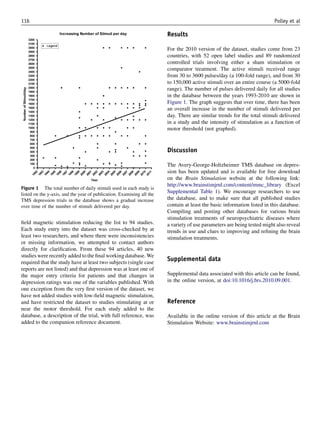
For the 2010 version of the dataset, studies come from 23
countries, with 52 open label studies and 89 randomized
controlled trials involving either a sham stimulation or
comparator treatment. The active stimuli received range
from 30 to 3600 pulses/day (a 100-fold range), and from 30
to 150,000 active stimuli over an entire course (a 5000-fold
range). The number of pulses delivered daily for all studies
in the database between the years 1993-2010 are shown in
Figure 1. The graph suggests that over time, there has been
an overall increase in the number of stimuli delivered per
day. There are similar trends for the total stimuli delivered
in a study and the intensity of stimulation as a function of
motor threshold (not graphed).
Discussion
The Avery-George-Holtzheimer TMS database on depres-
sion has been updated and is available for free download
on the Brain Stimulation website at the following link:
http://www.brainstimjrnl.com/content/mmc_library (Excel
Supplemental Table 1). We encourage researchers to use
the database, and to make sure that all published studies
contain at least the basic information listed in this database.
Compiling and posting other databases for various brain
stimulation treatments of neuropsychiatric diseases where
a variety of use parameters are being tested might also reveal
trends in use and clues to improving and refining the brain
stimulation treatments.
Supplemental data
Supplemental data associated with this article can be found,
in the online version, at doi:10.1016/j.brs.2010.09.001.
Reference
Available in the online version of this article at the Brain
Stimulation Website: www.brainstimjrnl.com
Figure 1 The total number of daily stimuli used in each study is
listed on the y-axis, and the year of publication. Examining all the
TMS depression trials in the database shows a gradual increase
over time of the number of stimuli delivered per day.
116 Polley et al

2010_Updated_Avery-George-Holtzheimer_Da

  • 1.
    2010 Updated Avery-George-HoltzheimerDatabase of rTMS depression studies Kurt H. Polley,a Rita Navarro,b David H. Avery,b Mark S. George,a,c Paul E. Holtzheimerd a Brain Stimulation Laboratory, Medical University of South Carolina, Charleston, South Carolina b Department of Psychiatry and Behavioral Sciences, University of Washington School of Medicine, Harborview Medical Center, Seattle, Washington c Ralph H. Johnson VA Medical Center, Charleston, South Carolina d Department of Psychiatry and Behavioral Sciences, Emory University School of Medicine, Atlanta, Georgia Transcranial magnetic stimulation (TMS) is a rapidly advancing tool used for the acute treatment of depressed patients. Beginning in 1993, researchers and clinicians have used a variety of TMS methods to study its antidepressant efficacy. As the studies began to unfold, it became clear that various researchers were stimulating in different ways, and that these variables (coil type, location, dose, frequency) might impact clinical outcome. In 1998, several researchers tabulated the then-published TMS depression studies into a workable and easily accessible excel spreadsheet and made this list available for free download from the first internet website of the International Society for Transcranial Stim- ulation (ISTS). This dataset has been updated periodically but infrequently and made available through a TMS blog, http://neuro-modulation.blogspot.com/. This database was created to track pertinent information from studies carried out around the world with the hope that it might be useful toward the advancement of TMS. Data concerning treatment parameters, stimulation sites, percent decrease in depression, response, and remission rates were collected for each published TMS study, with an accompanying reference list. Daily left prefrontal TMS for several weeks was approved as a treatment by the US Food and Drug Administration (FDA) in October 2008, and clinical as well as research use of the technology has expanded. We sought to rigorously update the database and make it available for download from a journal website. Hypothesis We hypothesized that an update of the database might reveal general trends regarding TMS parameters used to treat depression as well as allow for quicker and more systematic access to this dataset. Methods In June 2010 the working database obtained from the TMS blog contained approximately 100 studies and had not been updated systematically in the preceding 4 years. We updated the database through a Pubmed (Medline) search (English language only) on June 13, 2010, containing the search terms: transcranial magnetic stimulation (Title/ Abstract) AND Depression (Title/Abstract) AND 2007/01/ 01 to present (Publication Date). The search generated 234 references containing both review articles and clinical trials. The search titles and abstracts were read to exclude review articles, meta-analyses, single subject case reports, and low Correspondence: Mark S. George, Brain Stimulation Laboratory, Medical University of South Carolina, 67 President Street, Charleston, SC 29425 E-mail address: georgem@musc.edu Submitted August 30, 2010. Accepted for publication September 1, 2010. 1935-861X/$ - see front matter Ó 2011 Elsevier Inc. All rights reserved. doi:10.1016/j.brs.2010.09.001 Brain Stimulation (2011) 4, 115–6 www.brainstimjrnl.com
  • 2.
    field magnetic stimulationreducing the list to 94 studies. Each study entry into the dataset was cross-checked by at least two researchers, and where there were inconsistencies or missing information, we attempted to contact authors directly for clarification. From these 94 articles, 40 new studies were recently added to the final working database. We required that the study have at least two subjects (single case reports are not listed) and that depression was at least one of the major entry criteria for patients and that changes in depression ratings was one of the variables published. With one exception from the very first version of the dataset, we have not added studies with low-field magnetic stimulation, and have restricted the dataset to studies stimulating at or near the motor threshold. For each study added to the database, a description of the trial, with full reference, was added to the companion reference document. Results For the 2010 version of the dataset, studies come from 23 countries, with 52 open label studies and 89 randomized controlled trials involving either a sham stimulation or comparator treatment. The active stimuli received range from 30 to 3600 pulses/day (a 100-fold range), and from 30 to 150,000 active stimuli over an entire course (a 5000-fold range). The number of pulses delivered daily for all studies in the database between the years 1993-2010 are shown in Figure 1. The graph suggests that over time, there has been an overall increase in the number of stimuli delivered per day. There are similar trends for the total stimuli delivered in a study and the intensity of stimulation as a function of motor threshold (not graphed). Discussion The Avery-George-Holtzheimer TMS database on depres- sion has been updated and is available for free download on the Brain Stimulation website at the following link: http://www.brainstimjrnl.com/content/mmc_library (Excel Supplemental Table 1). We encourage researchers to use the database, and to make sure that all published studies contain at least the basic information listed in this database. Compiling and posting other databases for various brain stimulation treatments of neuropsychiatric diseases where a variety of use parameters are being tested might also reveal trends in use and clues to improving and refining the brain stimulation treatments. Supplemental data Supplemental data associated with this article can be found, in the online version, at doi:10.1016/j.brs.2010.09.001. Reference Available in the online version of this article at the Brain Stimulation Website: www.brainstimjrnl.com Figure 1 The total number of daily stimuli used in each study is listed on the y-axis, and the year of publication. Examining all the TMS depression trials in the database shows a gradual increase over time of the number of stimuli delivered per day. 116 Polley et al