Occupational Health and Safety Council of Ontario (OHSCO)
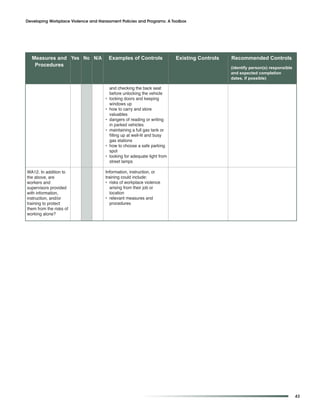
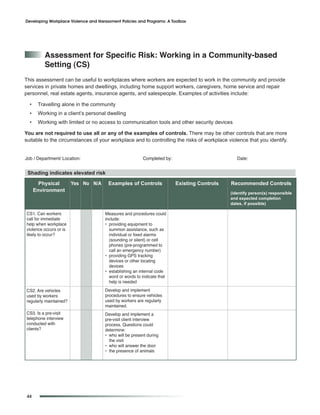
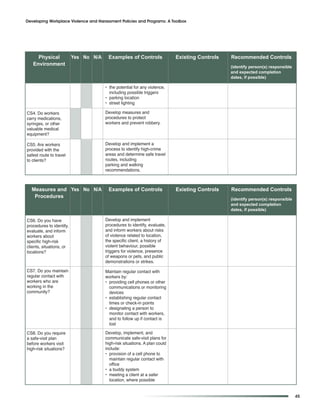
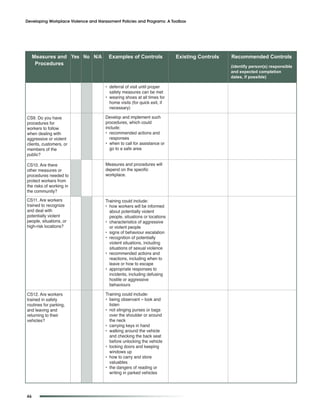
    WOrkplaCe ViOlenCe preVentiOn SerieS


                Developing Workplace
                    Violence and
                 Harassment Policies
                   and Programs:


                           A Toolbox


a
Disclaimer
The material contained in this Toolbox is for information and reference purposes only and is not
intended as legal or professional advice. The adoption of the practices described in this material may
not meet all the needs, requirements, or obligations of individual workplaces.
Developing Workplace Violence and Harassment Policies and Programs: A Toolbox


             table of Contents


Purpose....................................................................................................................................................................ii
Workplace Violence Survey ..................................................................................................................................1
Policy, Program, and Training Review Tool ..........................................................................................................6
Workplace Violence Assessments ......................................................................................................................16
 General Physical Environment Assessment ........................................................................................................18
 Risk Factor Selection Tool ..................................................................................................................................22
 Assessment for Specific Risk: Direct Contact with Clients (CC)..........................................................................25
 Assessment for Specific Risk: Handling Cash (HC) ............................................................................................29
 Assessment for Specific Risk: Working with Unstable or Volatile Clients (VC)....................................................35
 Assessment for Specific Risk: Working Alone or in Small Numbers (WA) ..........................................................40
 Assessment for Specific Risk: Working in a Community-based Setting (CS)......................................................44
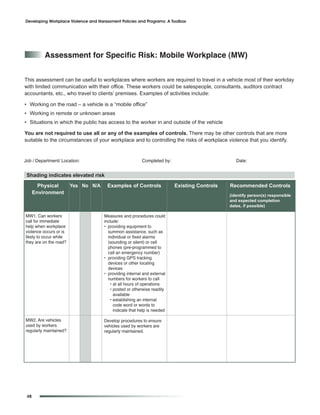
 Assessment for Specific Risk: Mobile Workplace (MW) ......................................................................................48
 Assessment for Specific Risk: Working in High-Crime Areas (CA)......................................................................52
 Assessment for Specific Risk: Securing/Protecting Valuable Goods (SV) ..........................................................57
 Assessment for Specific Risk: Transporting People and/or Goods (TG) ............................................................61
Action Plan ............................................................................................................................................................66
Example Workplace Violence Policy ..................................................................................................................67
Example Workplace Harassment Policy ............................................................................................................68
Recognizing Domestic Violence in the Workplace ............................................................................................69
Creating a Safety Plan ..........................................................................................................................................70
What if the Abuser and the Victim Belong to the Same Workplace? ..............................................................72
Resources..............................................................................................................................................................73
Acknowledgements ..............................................................................................................................................75


                                                                                                                                                                                i
Developing Workplace Violence and Harassment Policies and Programs: A Toolbox


         purpose


This Toolbox supports Developing Workplace Violence and Harassment Policies and Programs: What Employers
Need to Know http://www.labour.gov.on.ca/english/hs/pubs/wvps_guide/index.php, which outlines steps that will help
you protect the workers in your workplace from the hazard of violence.

This Toolbox contains information, tools, and assessments that can be useful to employers as they develop a
workplace violence policy and program, a workplace harassment policy and program, or a domestic violence
program.

Workplaces are not required to use all or any of the tools presented in this Toolbox. Employers may use other
tools or techniques to help them to comply with the requirements of the Occupational Health and Safety Act.

Contact your Health and Safety Association with any questions about workplace violence prevention. Ontario’s health
and safety associations have sector-specific information, programs, and services related to workplace violence and
harassment, as well as other topics. See the Resources section for contact information.

Use, reproduction, or customization of these tools to meet sector or workplace-specific needs is recommended and
encouraged. These documents are available online http://www.labour.gov.on.ca/english/hs/pubs/wvps_guide/index.php
and http://www.labour.gov.on.ca/english/hs/pubs/wvps_toolbox/index.php


ii
Developing Workplace Violence and Harassment Policies and Programs: A Toolbox


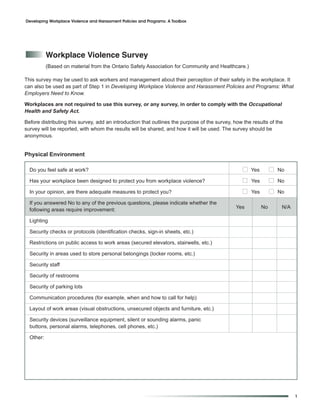
           Workplace Violence Survey
           (Based on material from the Ontario Safety Association for Community and Healthcare.)

This survey may be used to ask workers and management about their perception of their safety in the workplace. It
can also be used as part of Step 1 in Developing Workplace Violence and Harassment Policies and Programs: What
Employers Need to Know.

Workplaces are not required to use this survey, or any survey, in order to comply with the Occupational
Health and Safety Act.

Before distributing this survey, add an introduction that outlines the purpose of the survey, how the results of the
survey will be reported, with whom the results will be shared, and how it will be used. The survey should be
anonymous.


Physical Environment

  Do you feel safe at work?                                                                       I Yes        I No
  Has your workplace been designed to protect you from workplace violence?                       I Yes         I No
  In your opinion, are there adequate measures to protect you?                                   I Yes         I No
  If you answered No to any of the previous questions, please indicate whether the
                                                                                              Yes         No       N/A
  following areas require improvement:

  Lighting

  Security checks or protocols (identification checks, sign-in sheets, etc.)

  Restrictions on public access to work areas (secured elevators, stairwells, etc.)

  Security in areas used to store personal belongings (locker rooms, etc.)

  Security staff

  Security of restrooms

  Security of parking lots

  Communication procedures (for example, when and how to call for help)

  Layout of work areas (visual obstructions, unsecured objects and furniture, etc.)

  Security devices (surveillance equipment, silent or sounding alarms, panic
  buttons, personal alarms, telephones, cell phones, etc.)

  Other:


                                                                                                                         1
Developing Workplace Violence and Harassment Policies and Programs: A Toolbox


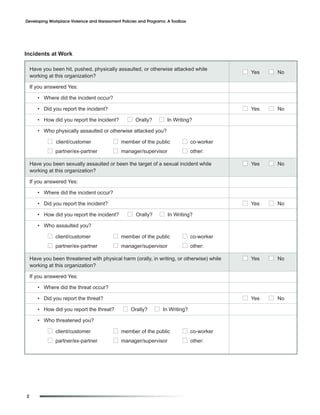
Incidents at Work

    Have you been hit, pushed, physically assaulted, or otherwise attacked while
                                                                                           I Yes   I No
    working at this organization?

    If you answered Yes:

       • Where did the incident occur?

       • Did you report the incident?                                                      I Yes   I No
       • How did you report the incident?       I Orally?       I In Writing?
       • Who physically assaulted or otherwise attacked you?

           I client/customer              I member of the public           I co-worker
           I partner/ex-partner           I manager/supervisor             I other:
    Have you been sexually assaulted or been the target of a sexual incident while         I Yes   I No
    working at this organization?

    If you answered Yes:

       • Where did the incident occur?

       • Did you report the incident?                                                      I Yes   I No
       • How did you report the incident?       I Orally?       I In Writing?
       • Who assaulted you?

           I client/customer              I member of the public           I co-worker
           I partner/ex-partner           I manager/supervisor             I other:
    Have you been threatened with physical harm (orally, in writing, or otherwise) while   I Yes   I No
    working at this organization?

    If you answered Yes:

       • Where did the threat occur?

       • Did you report the threat?                                                        I Yes   I No
       • How did you report the threat?       I Orally?      I In Writing?
       • Who threatened you?

           I client/customer              I member of the public           I co-worker
           I partner/ex-partner           I manager/supervisor             I other:


2
Developing Workplace Violence and Harassment Policies and Programs: A Toolbox


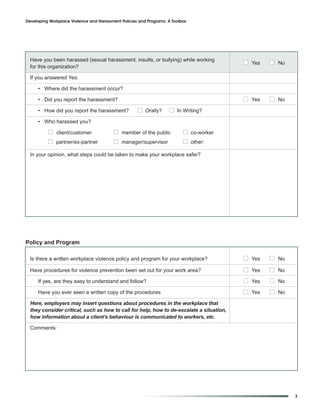
  Have you been harassed (sexual harassment, insults, or bullying) while working
                                                                                          I Yes   I No
  for this organization?

  If you answered Yes:

     • Where did the harassment occur?

     • Did you report the harassment?                                                     I Yes   I No
     • How did you report the harassment?            I Orally?      I In Writing?
     • Who harassed you?

          I client/customer               I member of the public           I co-worker
          I partner/ex-partner            I manager/supervisor             I other:

  In your opinion, what steps could be taken to make your workplace safer?


Policy and Program

  Is there a written workplace violence policy and program for your workplace?            I Yes   I No
  Have procedures for violence prevention been set out for your work area?                I Yes   I No
     If yes, are they easy to understand and follow?                                      I Yes   I No
     Have you ever seen a written copy of the procedures                                  I Yes   I No
  Here, employers may insert questions about procedures in the workplace that
  they consider critical, such as how to call for help, how to de-escalate a situation,
  how information about a client’s behaviour is communicated to workers, etc.

  Comments:


                                                                                                         3
Developing Workplace Violence and Harassment Policies and Programs: A Toolbox


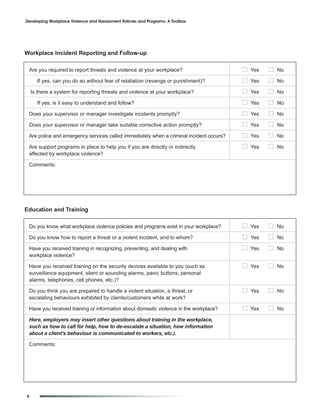
Workplace Incident Reporting and Follow-up

 Are you required to report threats and violence at your workplace?                      I Yes   I No
      If yes, can you do so without fear of retaliation (revenge or punishment)?         I Yes   I No
    Is there a system for reporting threats and violence at your workplace?              I Yes   I No
      If yes, is it easy to understand and follow?                                       I Yes   I No
 Does your supervisor or manager investigate incidents promptly?                         I Yes   I No
 Does your supervisor or manager take suitable corrective action promptly?               I Yes   I No
 Are police and emergency services called immediately when a criminal incident occurs?   I Yes   I No
 Are support programs in place to help you if you are directly or indirectly             I Yes   I No
 affected by workplace violence?

 Comments:


Education and Training

 Do you know what workplace violence policies and programs exist in your workplace?      I Yes   I No
 Do you know how to report a threat or a violent incident, and to whom?                  I Yes   I No
 Have you received training in recognizing, preventing, and dealing with                 I Yes   I No
 workplace violence?

 Have you received training on the security devices available to you (such as            I Yes   I No
 surveillance equipment, silent or sounding alarms, panic buttons, personal
 alarms, telephones, cell phones, etc.)?

 Do you think you are prepared to handle a violent situation, a threat, or               I Yes   I No
 escalating behaviours exhibited by clients/customers while at work?

 Have you received training or information about domestic violence in the workplace?     I Yes   I No
 Here, employers may insert other questions about training in the workplace,
 such as how to call for help, how to de-escalate a situation, how information
 about a client’s behaviour is communicated to workers, etc.).

 Comments:


4
Developing Workplace Violence and Harassment Policies and Programs: A Toolbox


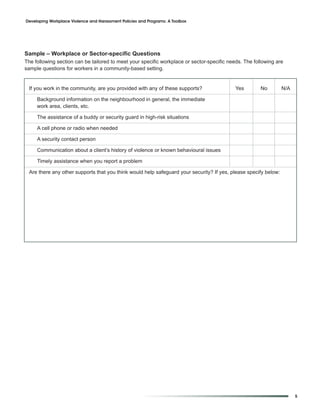
Sample – Workplace or Sector-specific Questions
The following section can be tailored to meet your specific workplace or sector-specific needs. The following are
sample questions for workers in a community-based setting.


 If you work in the community, are you provided with any of these supports?                 Yes        No        N/A

     Background information on the neighbourhood in general, the immediate
     work area, clients, etc.

     The assistance of a buddy or security guard in high-risk situations

     A cell phone or radio when needed

     A security contact person

     Communication about a client’s history of violence or known behavioural issues

     Timely assistance when you report a problem

 Are there any other supports that you think would help safeguard your security? If yes, please specify below:


                                                                                                                       5
Developing Workplace Violence and Harassment Policies and Programs: A Toolbox


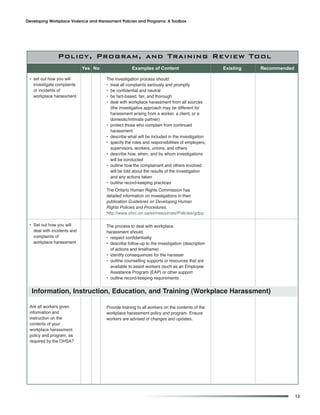
         policy, program, and training review tool


This section outlines policies, programs, and training related to workplace violence prevention.

The tool may be used during three of the steps for developing your workplace violence policy and program, as
outlined in Developing Workplace Violence and Harassment Policies and Programs: What Employers Need to Know.

During Step 2, Assess the Risks of Workplace Violence, the tool can help you review the policies, programs,
measures, and procedures you have in place to counter workplace violence. During this step, you may wish only to
use the Yes and No columns to determine whether your workplace has the policies, programs, or training in place.

During Step 3, Control the Risks of Workplace Violence, when you are setting up your workplace violence program,
you may wish to use the examples of content for policies, programs, and training as ideas for what you could do in
your workplace.

During Step 4, Monitor and Evaluate, the questions about workplace culture may help you monitor and evaluate your
workplace violence and harassment policies and programs.

Workplaces are not required to use the examples of policy, program, and training content provided in this
tool. Employers may develop their own policies, programs, and training that comply with the requirements of the
Occupational Health and Safety Act.


6
Developing Workplace Violence and Harassment Policies and Programs: A Toolbox


          Overview andProgram, actionTraining Review Tool
            Policy, Context for and
                              Yes No                 Examples of Content                      Existing   Recommended

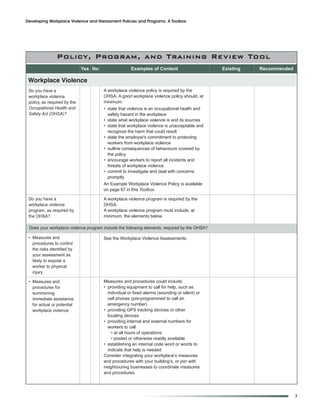
 Workplace Violence
 Do you have a                         A workplace violence policy is required by the
 workplace violence                    OHSA. A good workplace violence policy should, at
 policy, as required by the            minimum:
 Occupational Health and               • state that violence is an occupational health and
 Safety Act (OHSA)?                      safety hazard in the workplace
                                       • state what workplace violence is and its sources
                                       • state that workplace violence is unacceptable and
                                         recognize the harm that could result
                                       • state the employer's commitment to protecting
                                         workers from workplace violence
                                       • outline consequences of behaviours covered by
                                         the policy
                                       • encourage workers to report all incidents and
                                         threats of workplace violence
                                       • commit to investigate and deal with concerns
                                         promptly
                                       An Example Workplace Violence Policy is available
                                       on page 67 in this Toolbox.

 Do you have a                         A workplace violence program is required by the
 workplace violence                    OHSA.
 program, as required by               A workplace violence program must include, at
 the OHSA?                             minimum, the elements below.

 Does your workplace violence program include the following elements, required by the OHSA?

 • Measures and                        See the Workplace Violence Assessments.
   procedures to control
   the risks identified by
   your assessment as
   likely to expose a
   worker to physical
   injury

 • Measures and                        Measures and procedures could include:
   procedures for                      • providing equipment to call for help, such as
   summoning                             individual or fixed alarms (sounding or silent) or
   immediate assistance                  cell phones (pre-programmed to call an
   for actual or potential               emergency number)
   workplace violence                  • providing GPS tracking devices or other
                                         locating devices
                                       • providing internal and external numbers for
                                         workers to call
                                           • at all hours of operations
                                           • posted or otherwise readily available
                                       • establishing an internal code word or words to
                                         indicate that help is needed
                                       Consider integrating your workplace’s measures
                                       and procedures with your building’s, or join with
                                       neighbouring businesses to coordinate measures
                                       and procedures.


                                                                                                                       7
Developing Workplace Violence and Harassment Policies and Programs: A Toolbox


         Overview andProgram, actionTraining Review Tool
           Policy, Context for and
                            Yes No                  Examples of Content                        Existing   Recommended

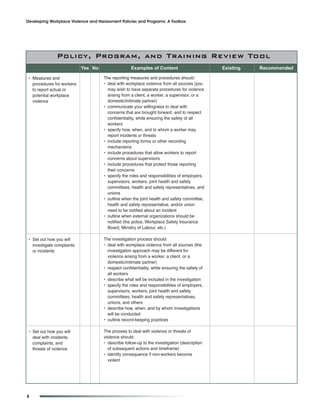
 • Measures and                      The reporting measures and procedures should:
   procedures for workers            • deal with workplace violence from all sources (you
   to report actual or                 may wish to have separate procedures for violence
   potential workplace                 arising from a client, a worker, a supervisor, or a
   violence                            domestic/intimate partner)
                                     • communicate your willingness to deal with
                                       concerns that are brought forward, and to respect
                                       confidentiality, while ensuring the safety of all
                                       workers
                                     • specify how, when, and to whom a worker may
                                       report incidents or threats
                                     • include reporting forms or other recording
                                       mechanisms
                                     • include procedures that allow workers to report
                                       concerns about supervisors
                                     • include procedures that protect those reporting
                                       their concerns
                                     • specify the roles and responsibilities of employers,
                                       supervisors, workers, joint health and safety
                                       committees, health and safety representatives, and
                                       unions
                                     • outline when the joint health and safety committee,
                                       health and safety representative, and/or union
                                       need to be notified about an incident
                                     • outline when external organizations should be
                                       notified (the police, Workplace Safety Insurance
                                       Board, Ministry of Labour, etc.)

 • Set out how you will              The investigation process should:
   investigate complaints            • deal with workplace violence from all sources (the
   or incidents                        investigation approach may be different for
                                       violence arising from a worker, a client, or a
                                       domestic/intimate partner)
                                     • respect confidentiality, while ensuring the safety of
                                       all workers
                                     • describe what will be included in the investigation
                                     • specify the roles and responsibilities of employers,
                                       supervisors, workers, joint health and safety
                                       committees, health and safety representatives,
                                       unions, and others
                                     • describe how, when, and by whom investigations
                                       will be conducted
                                     • outline record-keeping practices

 • Set out how you will              The process to deal with violence or threats of
   deal with incidents,              violence should:
   complaints, and                   • describe follow-up to the investigation (description
   threats of violence                 of subsequent actions and timeframe)
                                     • identify consequence if non-workers become
                                       violent


8
Developing Workplace Violence and Harassment Policies and Programs: A Toolbox


        Overview andProgram, actionTraining Review Tool
          Policy, Context for and
                             Yes No                  Examples of Content                        Existing   Recommended

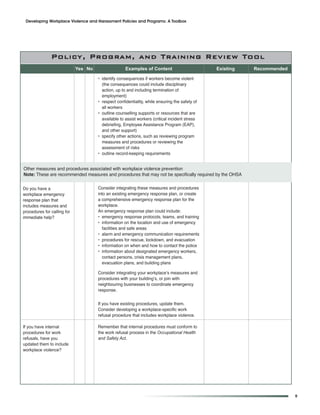
                                      • identify consequences if workers become violent
                                        (the consequences could include disciplinary
                                        action, up to and including termination of
                                        employment)
                                      • respect confidentiality, while ensuring the safety of
                                        all workers
                                      • outline counselling supports or resources that are
                                        available to assist workers (critical incident stress
                                        debriefing, Employee Assistance Program (EAP),
                                        and other support)
                                      • specify other actions, such as reviewing program
                                        measures and procedures or reviewing the
                                        assessment of risks
                                      • outline record-keeping requirements


Other measures and procedures associated with workplace violence prevention
note: These are recommended measures and procedures that may not be specifically required by the OHSA

Do you have a                         Consider integrating these measures and procedures
workplace emergency                   into an existing emergency response plan, or create
response plan that                    a comprehensive emergency response plan for the
includes measures and                 workplace.
procedures for calling for            An emergency response plan could include:
immediate help?                       • emergency response protocols, teams, and training
                                      • information on the location and use of emergency
                                        facilities and safe areas
                                      • alarm and emergency communication requirements
                                      • procedures for rescue, lockdown, and evacuation
                                      • information on when and how to contact the police
                                      • information about designated emergency workers,
                                        contact persons, crisis management plans,
                                        evacuation plans, and building plans

                                      Consider integrating your workplace’s measures and
                                      procedures with your building’s, or join with
                                      neighbouring businesses to coordinate emergency
                                      response.


                                      If you have existing procedures, update them.
                                      Consider developing a workplace-specific work
                                      refusal procedure that includes workplace violence.

If you have internal                  Remember that internal procedures must conform to
procedures for work                   the work refusal process in the Occupational Health
refusals, have you                    and Safety Act.
updated them to include
workplace violence?


                                                                                                                         9
Developing Workplace Violence and Harassment Policies and Programs: A Toolbox


         Overview andProgram, actionTraining Review Tool
           Policy, Context for and
                             Yes No                Examples of Content                          Existing   Recommended

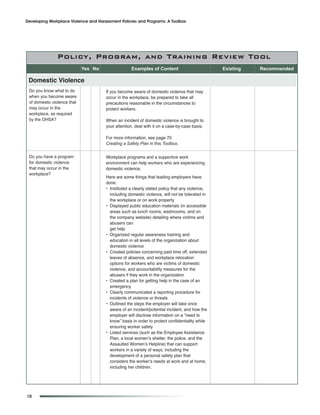
 Domestic Violence
 Do you know what to do               If you become aware of domestic violence that may
 when you become aware                occur in the workplace, be prepared to take all
 of domestic violence that            precautions reasonable in the circumstances to
 may occur in the                     protect workers.
 workplace, as required
 by the OHSA?                         When an incident of domestic violence is brought to
                                      your attention, deal with it on a case-by-case basis.

                                      For more information, see page 70
                                      Creating a Safety Plan in this Toolbox.

 Do you have a program                Workplace programs and a supportive work
 for domestic violence                environment can help workers who are experiencing
 that may occur in the                domestic violence.
 workplace?
                                      Here are some things that leading employers have
                                      done:
                                      • Instituted a clearly stated policy that any violence,
                                        including domestic violence, will not be tolerated in
                                        the workplace or on work property
                                      • Displayed public education materials (in accessible
                                        areas such as lunch rooms, washrooms, and on
                                        the company website) detailing where victims and
                                        abusers can
                                        get help
                                      • Organized regular awareness training and
                                        education in all levels of the organization about
                                        domestic violence
                                      • Created policies concerning paid time off, extended
                                        leaves of absence, and workplace relocation
                                        options for workers who are victims of domestic
                                        violence, and accountability measures for the
                                        abusers if they work in the organization
                                      • Created a plan for getting help in the case of an
                                        emergency
                                      • Clearly communicated a reporting procedure for
                                        incidents of violence or threats
                                      • Outlined the steps the employer will take once
                                        aware of an incident/potential incident, and how the
                                        employer will disclose information on a “need to
                                        know” basis in order to protect confidentiality while
                                        ensuring worker safety
                                      • Listed services (such as the Employee Assistance
                                        Plan, a local women’s shelter, the police, and the
                                        Assaulted Women’s Helpline) that can support
                                        workers in a variety of ways, including the
                                        development of a personal safety plan that
                                        considers the worker’s needs at work and at home,
                                        including her children.


10
Developing Workplace Violence and Harassment Policies and Programs: A Toolbox


        Overview andProgram, actionTraining Review Tool
          Policy, Context for and
                          Yes No                   Examples of Content                           Existing   Recommended

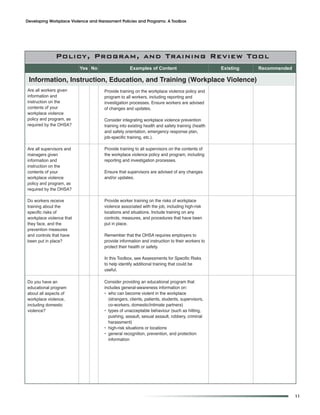
 information, instruction, education, and training (Workplace Violence)
Are all workers given                Provide training on the workplace violence policy and
information and                      program to all workers, including reporting and
instruction on the                   investigation processes. Ensure workers are advised
contents of your                     of changes and updates.
workplace violence
policy and program, as               Consider integrating workplace violence prevention
required by the OHSA?                training into existing health and safety training (health
                                     and safety orientation, emergency response plan,
                                     job-specific training, etc.).

Are all supervisors and              Provide training to all supervisors on the contents of
managers given                       the workplace violence policy and program, including
information and                      reporting and investigation processes.
instruction on the
contents of your                     Ensure that supervisors are advised of any changes
workplace violence                   and/or updates.
policy and program, as
required by the OHSA?

Do workers receive                   Provide worker training on the risks of workplace
training about the                   violence associated with the job, including high-risk
specific risks of                    locations and situations. Include training on any
workplace violence that              controls, measures, and procedures that have been
they face, and the                   put in place.
prevention measures
and controls that have               Remember that the OHSA requires employers to
been put in place?                   provide information and instruction to their workers to
                                     protect their health or safety.

                                     In this Toolbox, see Assessments for Specific Risks
                                     to help identify additional training that could be
                                     useful.

Do you have an                       Consider providing an educational program that
educational program                  includes general-awareness information on:
about all aspects of                 • who can become violent in the workplace
workplace violence,                    (strangers, clients, patients, students, supervisors,
including domestic                     co-workers, domestic/intimate partners)
violence?                            • types of unacceptable behaviour (such as hitting,
                                       pushing, assault, sexual assault, robbery, criminal
                                       harassment)
                                     • high-risk situations or locations
                                     • general recognition, prevention, and protection
                                       information


                                                                                                                          11
Developing Workplace Violence and Harassment Policies and Programs: A Toolbox


         Overview andProgram, actionTraining Review Tool
           Policy, Context for and
                              Yes No                Examples of Content                            Existing   Recommended

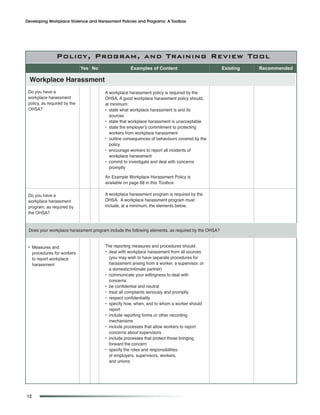
 Workplace Harassment
 Do you have a                         A workplace harassment policy is required by the
 workplace harassment                  OHSA. A good workplace harassment policy should,
 policy, as required by the            at minimum:
 OHSA?                                 • state what workplace harassment is and its
                                         sources
                                       • state that workplace harassment is unacceptable
                                       • state the employer's commitment to protecting
                                         workers from workplace harassment
                                       • outline consequences of behaviours covered by the
                                         policy
                                       • encourage workers to report all incidents of
                                         workplace harassment
                                       • commit to investigate and deal with concerns
                                         promptly

                                       An Example Workplace Harassment Policy is
                                       available on page 68 in this Toolbox.

 Do you have a                         A workplace harassment program is required by the
 workplace harassment                  OHSA. A workplace harassment program must
 program, as required by               include, at a minimum, the elements below.
 the OHSA?


 Does your workplace harassment program include the following elements, as required by the OHSA?


 • Measures and                        The reporting measures and procedures should:
   procedures for workers              • deal with workplace harassment from all sources
   to report workplace                   (you may wish to have separate procedures for
   harassment                            harassment arising from a worker, a supervisor, or
                                         a domestic/intimate partner)
                                       • communicate your willingness to deal with
                                         concerns
                                       • be confidential and neutral
                                       • treat all complaints seriously and promptly
                                       • respect confidentiality
                                       • specify how, when, and to whom a worker should
                                         report
                                       • include reporting forms or other recording
                                         mechanisms
                                       • include processes that allow workers to report
                                         concerns about supervisors
                                       • include processes that protect those bringing
                                         forward the concern
                                       • specify the roles and responsibilities
                                         of employers, supervisors, workers,
                                         and unions


12
Developing Workplace Violence and Harassment Policies and Programs: A Toolbox


         Overview andProgram, actionTraining Review Tool
           Policy, Context for and
                             Yes No                Examples of Content                         Existing   Recommended

 • set out how you will               The investigation process should:
   investigate complaints             • treat all complaints seriously and promptly
   or incidents of                    • be confidential and neutral
   workplace harassment               • be fact-based, fair, and thorough
                                      • deal with workplace harassment from all sources
                                        (the investigative approach may be different for
                                        harassment arising from a worker, a client, or a
                                        domestic/intimate partner)
                                      • protect those who complain from continued
                                        harassment
                                      • describe what will be included in the investigation
                                      • specify the roles and responsibilities of employers,
                                        supervisors, workers, unions, and others
                                      • describe how, when, and by whom investigations
                                        will be conducted
                                      • outline how the complainant and others involved
                                        will be told about the results of the investigation
                                        and any actions taken
                                      • outline record-keeping practices
                                      The Ontario Human Rights Commission has
                                      detailed information on investigations in their
                                      publication Guidelines on Developing Human
                                      Rights Policies and Procedures.
                                      http://www.ohrc.on.ca/en/resources/Policies/gdpp

 • Set out how you will               The process to deal with workplace
   deal with incidents and            harassment should:
   complaints of                      • respect confidentiality
   workplace harassment               • describe follow-up to the investigation (description
                                        of actions and timeframe)
                                      • identify consequences for the harasser
                                      • outline counselling supports or resources that are
                                        available to assist workers (such as an Employee
                                        Assistance Program (EAP) or other support
                                      • outline record-keeping requirements


  information, instruction, education, and training (Workplace Harassment)

 Are all workers given                Provide training to all workers on the contents of the
 information and                      workplace harassment policy and program. Ensure
 instruction on the                   workers are advised of changes and updates.
 contents of your
 workplace harassment
 policy and program, as
 required by the OHSA?


                                                                                                                        13
Developing Workplace Violence and Harassment Policies and Programs: A Toolbox


         Overview andProgram, actionTraining Review Tool
           Policy, Context for and
                            Yes No                  Examples of Content                          Existing   Recommended

                                      Consider integrating workplace harassment
                                      prevention training into existing training (orientation,
                                      sensitivity training, anti-harassment or anti-
                                      discrimination training, respectful workplace training,
                                      etc.)

 Are all supervisors and              Provide training to all supervisors on the contents of
 managers given                       the workplace harassment policy and program.
 information and                      Ensure that supervisors are advised of any changes
 instruction on the                   and/or updates.
 contents of your
 workplace harassment
 policy and program, as
 required by the OHSA?

 Do you have an                       Consider providing an educational program that
 educational program on               includes general awareness information on
 harassment prevention?               harassment prevention and human rights in Ontario.


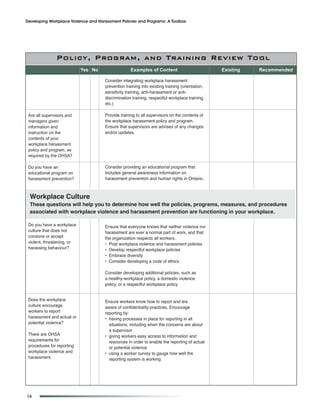
  Workplace Culture
  these questions will help you to determine how well the policies, programs, measures, and procedures
  associated with workplace violence and harassment prevention are functioning in your workplace.

 Do you have a workplace              Ensure that everyone knows that neither violence nor
 culture that does not                harassment are ever a normal part of work, and that
 condone or accept                    the organization respects all workers.
 violent, threatening, or             • Post workplace violence and harassment policies
 harassing behaviour?                 • Develop respectful workplace policies
                                      • Embrace diversity
                                      • Consider developing a code of ethics

                                      Consider developing additional policies, such as
                                      a healthy-workplace policy, a domestic violence
                                      policy, or a respectful workplace policy


 Does the workplace                   Ensure workers know how to report and are
 culture encourage                    aware of confidentiality practices. Encourage
 workers to report                    reporting by:
 harassment and actual or             • having processes in place for reporting in all
 potential violence?                    situations, including when the concerns are about
                                        a supervisor
 There are OHSA                       • giving workers easy access to information and
 requirements for                       resources in order to enable the reporting of actual
 procedures for reporting               or potential violence
 workplace violence and               • using a worker survey to gauge how well the
 harassment.                            reporting system is working


14
Developing Workplace Violence and Harassment Policies and Programs: A Toolbox


          Overview andProgram, actionTraining Review Tool
            Policy, Context for and
                             Yes No                Examples of Content                         Existing   Recommended

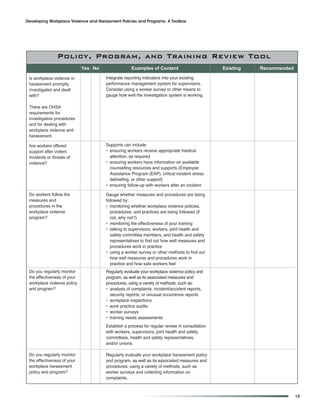
 Is workplace violence or             Integrate reporting indicators into your existing
 harassment promptly                  performance management system for supervisors.
 investigated and dealt               Consider using a worker survey or other means to
 with?                                gauge how well the investigation system is working.

 There are OHSA
 requirements for
 investigative procedures
 and for dealing with
 workplace violence and
 harassment.

 Are workers offered                  Supports can include:
 support after violent                • ensuring workers receive appropriate medical
 incidents or threats of                attention, as required
 violence?                            • ensuring workers have information on available
                                        counselling resources and supports (Employee
                                        Assistance Program (EAP), critical incident stress
                                        debriefing, or other support)
                                      • ensuring follow-up with workers after an incident

 Do workers follow the                Gauge whether measures and procedures are being
 measures and                         followed by:
 procedures in the                    • monitoring whether workplace violence policies,
 workplace violence                     procedures, and practices are being followed (if
 program?                               not, why not?)
                                      • monitoring the effectiveness of your training
                                      • talking to supervisors, workers, joint health and
                                        safety committee members, and health and safety
                                        representatives to find out how well measures and
                                        procedures work in practice
                                      • using a worker survey or other methods to find out
                                        how well measures and procedures work in
                                        practice and how safe workers feel
 Do you regularly monitor             Regularly evaluate your workplace violence policy and
 the effectiveness of your            program, as well as its associated measures and
 workplace violence policy            procedures, using a variety of methods, such as:
 and program?                         • analysis of complaints, incident/accident reports,
                                        security reports, or unusual occurrence reports
                                      • workplace inspections
                                      • work practice audits
                                      • worker surveys
                                      • training needs assessments
                                      Establish a process for regular review in consultation
                                      with workers, supervisors, joint health and safety
                                      committees, health and safety representatives,
                                      and/or unions.

 Do you regularly monitor             Regularly evaluate your workplace harassment policy
 the effectiveness of your            and program, as well as its associated measures and
 workplace harassment                 procedures, using a variety of methods, such as
 policy and program?                  worker surveys and collecting information on
                                      complaints.


                                                                                                                        15
Developing Workplace Violence and Harassment Policies and Programs: A Toolbox


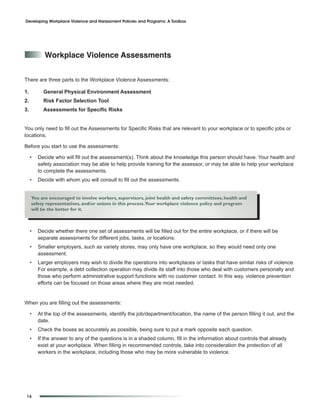
            Workplace Violence assessments


There are three parts to the Workplace Violence Assessments:

1.         General Physical Environment Assessment
2.         Risk Factor Selection Tool
3.         Assessments for Specific Risks


You only need to fill out the Assessments for Specific Risks that are relevant to your workplace or to specific jobs or
locations.

Before you start to use the assessments:

     •   Decide who will fill out the assessment(s). Think about the knowledge this person should have. Your health and
         safety association may be able to help provide training for the assessor, or may be able to help your workplace
         to complete the assessments.
     •   Decide with whom you will consult to fill out the assessments.


     You are encouraged to involve workers, supervisors, joint health and safety committees, health and
     safety representatives, and/or unions in this process.Your workplace violence policy and program
     will be the better for it.


     •   Decide whether there one set of assessments will be filled out for the entire workplace, or if there will be
         separate assessments for different jobs, tasks, or locations:
     •   Smaller employers, such as variety stores, may only have one workplace, so they would need only one
         assessment.
     •   Larger employers may wish to divide the operations into workplaces or tasks that have similar risks of violence.
         For example, a debt collection operation may divide its staff into those who deal with customers personally and
         those who perform administrative support functions with no customer contact. In this way, violence prevention
         efforts can be focused on those areas where they are most needed.


When you are filling out the assessments:

     •   At the top of the assessments, identify the job/department/location, the name of the person filling it out, and the
         date.
     •   Check the boxes as accurately as possible, being sure to put a mark opposite each question.
     •   If the answer to any of the questions is in a shaded column, fill in the information about controls that already
         exist at your workplace. When filling in recommended controls, take into consideration the protection of all
         workers in the workplace, including those who may be more vulnerable to violence.


 16
Developing Workplace Violence and Harassment Policies and Programs: A Toolbox


Workplaces are not required to use all or any of the examples of controls. There may be other controls that are
more suitable to the circumstances of your workplace, and to controlling the risks of workplace violence that you
identify.

Your workplace may have additional risks that are not covered by these Workplace Violence Assessments, or you
may need to customize them for your workplace. Your Health and Safety Association may have suggestions or
materials about more focused assessments for your type of workplace.


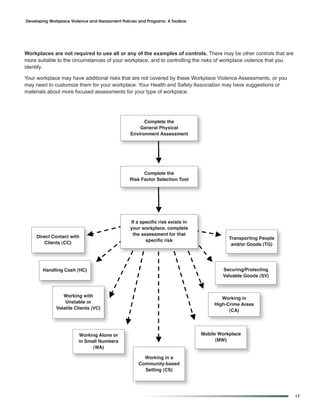
                                                        Complete the
                                                      General physical
                                                  environment assessment


                                                       Complete the
                                                 risk Factor Selection tool


                                                  if a specific risk exists in
                                                  your workplace, complete
                                                   the assessment for that
     Direct Contact with                                                                    transporting people
                                                         specific risk
         Clients (CC)                                                                        and/or Goods (tG)


        Handling Cash (HC)                                                               Securing/protecting
                                                                                         Valuable Goods (SV)


                 Working with
                                                                                         Working in
                  Unstable or
                                                                                      High-Crime areas
              Volatile Clients (VC)
                                                                                            (Ca)


                         Working alone or                                        Mobile Workplace
                         in Small numbers                                              (MW)
                               (Wa)

                                                        Working in a
                                                      Community-based
                                                        Setting (CS)


                                                                                                                    17
Developing Workplace Violence and Harassment Policies and Programs: A Toolbox


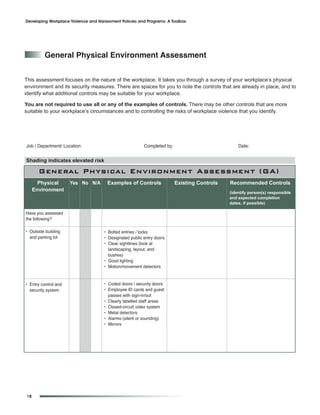
         General physical environment assessment


This assessment focuses on the nature of the workplace. It takes you through a survey of your workplace’s physical
environment and its security measures. There are spaces for you to note the controls that are already in place, and to
identify what additional controls may be suitable for your workplace.

You are not required to use all or any of the examples of controls. There may be other controls that are more
suitable to your workplace’s circumstances and to controlling the risks of workplace violence that you identify.


Job / Department/ Location:                              Completed by:                           Date:


Shading indicates elevated risk

       General and Context for action
        Overview Physical Environment Assessment (GA)
       Physical       Yes No N/A       Examples of Controls              Existing Controls   Recommended Controls
     Environment                                                                             (identify person(s) responsible
                                                                                             and expected completion
                                                                                             dates, if possible)

Have you assessed
the following?

• Outside building                   • Bolted entries / locks
  and parking lot                    • Designated public entry doors
                                     • Clear sightlines (look at
                                       landscaping, layout, and
                                       bushes)
                                     • Good lighting
                                     • Motion/movement detectors


• Entry control and                  • Coded doors / security doors
  security system                    • Employee ID cards and guest
                                       passes with sign-in/out
                                     • Clearly labelled staff areas
                                     • Closed-circuit video system
                                     • Metal detectors
                                     • Alarms (silent or sounding)
                                     • Mirrors


18
Developing Workplace Violence and Harassment Policies and Programs: A Toolbox


        Overview and Context for action
        Overview Physical Environment Assessment (GA)
       General and Context for action
     Physical             Yes No N/A       Examples of Controls         Existing Controls   Recommended Controls
   Environment                                                                              (identify person(s) responsible
                                                                                            and expected completion
                                                                                            dates, if possible)

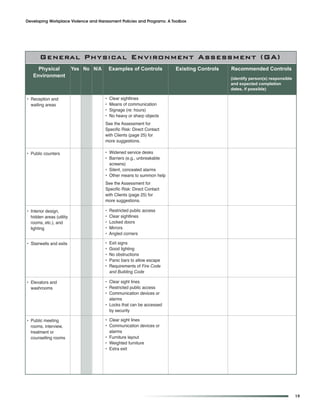
• Reception and                        •   Clear sightlines
  waiting areas                        •   Means of communication
                                       •   Signage (re: hours)
                                       •   No heavy or sharp objects
                                       See the Assessment for
                                       Specific Risk: Direct Contact
                                       with Clients (page 25) for
                                       more suggestions.

• Public counters                      • Widened service desks
                                       • Barriers (e.g., unbreakable
                                         screens)
                                       • Silent, concealed alarms
                                       • Other means to summon help
                                       See the Assessment for
                                       Specific Risk: Direct Contact
                                       with Clients (page 25) for
                                       more suggestions.

• Interior design,                     •   Restricted public access
  hidden areas (utility                •   Clear sightlines
  rooms, etc.), and                    •   Locked doors
  lighting                             •   Mirrors
                                       •   Angled corners

• Stairwells and exits                 •   Exit signs
                                       •   Good lighting
                                       •   No obstructions
                                       •   Panic bars to allow escape
                                       •   Requirements of Fire Code
                                           and Building Code

• Elevators and                        • Clear sight lines
  washrooms                            • Restricted public access
                                       • Communication devices or
                                         alarms
                                       • Locks that can be accessed
                                         by security

• Public meeting                       • Clear sight lines
  rooms, interview,                    • Communication devices or
  treatment or                           alarms
  counselling rooms                    • Furniture layout
                                       • Weighted furniture
                                       • Extra exit


                                                                                                                              19
Developing Workplace Violence and Harassment Policies and Programs: A Toolbox


        General Physical Environment Assessment (GA)
       Physical            Yes No N/A       Examples of Controls            Existing Controls   Recommended Controls
     Environment                                                                                (identify person(s) responsible
                                                                                                and expected completion
                                                                                                dates, if possible)

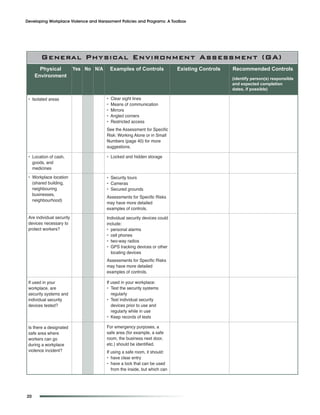
 • Isolated areas                       •   Clear sight lines
                                        •   Means of communication
                                        •   Mirrors
                                        •   Angled corners
                                        •   Restricted access
                                        See the Assessment for Specific
                                        Risk: Working Alone or in Small
                                        Numbers (page 40) for more
                                        suggestions.

 • Location of cash,                    • Locked and hidden storage
   goods, and
   medicines

 • Workplace location                   • Security tours
   (shared building,                    • Cameras
   neighbouring                         • Secured grounds
   businesses,
                                        Assessments for Specific Risks
   neighbourhood)
                                        may have more detailed
                                        examples of controls.

 Are individual security                Individual security devices could
 devices necessary to                   include:
 protect workers?                       • personal alarms
                                        • cell phones
                                        • two-way radios
                                        • GPS tracking devices or other
                                          locating devices
                                        Assessments for Specific Risks
                                        may have more detailed
                                        examples of controls.

 If used in your                        If used in your workplace:
 workplace, are                         • Test the security systems
 security systems and                      regularly
 individual security                    • Test individual security
 devices tested?                           devices prior to use and
                                           regularly while in use
                                        • Keep records of tests

 Is there a designated                  For emergency purposes, a
 safe area where                        safe area (for example, a safe
 workers can go                         room, the business next door,
 during a workplace                     etc.) should be identified.
 violence incident?                     If using a safe room, it should:
                                        • have clear entry
                                        • have a lock that can be used
                                           from the inside, but which can


20
Developing Workplace Violence and Harassment Policies and Programs: A Toolbox


       Overview and Context for action
       Overview Physical Environment Assessment (GA)
      General and Context for action
     Physical            Yes No N/A    Examples of Controls             Existing Controls   Recommended Controls
   Environment                                                                              (identify person(s) responsible
                                                                                            and expected completion
                                                                                            dates, if possible)

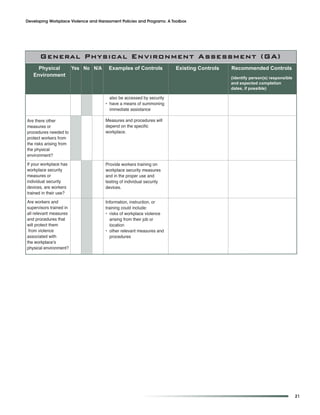
                                        also be accessed by security
                                      • have a means of summoning
                                        immediate assistance

Are there other                       Measures and procedures will
measures or                           depend on the specific
procedures needed to                  workplace.
protect workers from
the risks arising from
the physical
environment?
If your workplace has                 Provide workers training on
workplace security                    workplace security measures
measures or                           and in the proper use and
individual security                   testing of individual security
devices, are workers                  devices.
trained in their use?

Are workers and                       Information, instruction, or
supervisors trained in                training could include:
all relevant measures                 • risks of workplace violence
and procedures that                      arising from their job or
will protect them                        location
 from violence                        • other relevant measures and
associated with                          procedures
the workplace’s
physical environment?


                                                                                                                              21
Developing Workplace Violence and Harassment Policies and Programs: A Toolbox


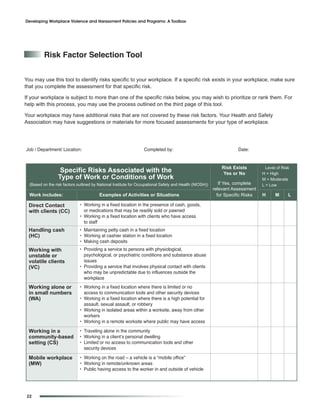
          risk Factor Selection tool


You may use this tool to identify risks specific to your workplace. If a specific risk exists in your workplace, make sure
that you complete the assessment for that specific risk.

If your workplace is subject to more than one of the specific risks below, you may wish to prioritize or rank them. For
help with this process, you may use the process outlined on the third page of this tool.

Your workplace may have additional risks that are not covered by these risk factors. Your Health and Safety
Association may have suggestions or materials for more focused assessments for your type of workplace.


Job / Department/ Location:                                       Completed by:                                      Date:


                                                                                                              Risk Exists          Level of Risk
                   Specific Risks Associated with the                                                          Yes or No         H = High
                  Type of Work or Conditions of Work                                                                             M = Moderate
  (Based on the risk factors outlined by National Institute for Occupational Safety and Health (NIOSH))      If Yes, complete    L = Low
                                                                                                          relevant Assessment
  Work includes:                         Examples of Activities or Situations                               for Specific Risks   H      M      L

 Direct Contact               • Working in a fixed location in the presence of cash, goods,
 with clients (CC)              or medications that may be readily sold or pawned
                              • Working in a fixed location with clients who have access
                                to staff
 Handling cash                • Maintaining petty cash in a fixed location
 (HC)                         • Working at cashier station in a fixed location
                              • Making cash deposits
 Working with                 • Providing a service to persons with physiological,
 unstable or                    psychological, or psychiatric conditions and substance abuse
 volatile clients               issues
 (VC)                         • Providing a service that involves physical contact with clients
                                who may be unpredictable due to influences outside the
                                workplace
 Working alone or             • Working in a fixed location where there is limited or no
 in small numbers               access to communication tools and other security devices
 (WA)                         • Working in a fixed location where there is a high potential for
                                assault, sexual assault, or robbery
                              • Working in isolated areas within a worksite, away from other
                                workers
                              • Working in a remote worksite where public may have access

 Working in a                 • Traveling alone in the community
 community-based              • Working in a client’s personal dwelling
 setting (CS)                 • Limited or no access to communication tools and other
                                security devices

 Mobile workplace             • Working on the road – a vehicle is a “mobile office”
 (MW)                         • Working in remote/unknown areas
                              • Public having access to the worker in and outside of vehicle


 22
Developing Workplace Violence and Harassment Policies and Programs: A Toolbox


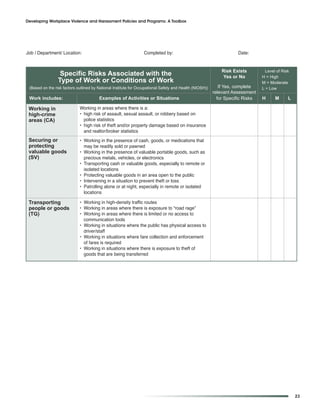
Job / Department/ Location:                                      Completed by:                                      Date:


                                                                                                             Risk Exists          Level of Risk
                  Specific Risks Associated with the                                                          Yes or No         H = High
                 Type of Work or Conditions of Work                                                                             M = Moderate
 (Based on the risk factors outlined by National Institute for Occupational Safety and Health (NIOSH))      If Yes, complete    L = Low
                                                                                                         relevant Assessment
 Work includes:                         Examples of Activities or Situations                               for Specific Risks   H      M      L

 Working in                  Working in areas where there is a:
 high-crime                  • high risk of assault, sexual assault, or robbery based on
 areas (CA)                    police statistics
                             • high risk of theft and/or property damage based on insurance
                               and realtor/broker statistics
 Securing or                 • Working in the presence of cash, goods, or medications that
 protecting                    may be readily sold or pawned
 valuable goods              • Working in the presence of valuable portable goods, such as
 (SV)                          precious metals, vehicles, or electronics
                             • Transporting cash or valuable goods, especially to remote or
                               isolated locations
                             • Protecting valuable goods in an area open to the public
                             • Intervening in a situation to prevent theft or loss
                             • Patrolling alone or at night, especially in remote or isolated
                               locations

 Transporting                • Working in high-density traffic routes
 people or goods             • Working in areas where there is exposure to “road rage”
 (TG)                        • Working in areas where there is limited or no access to
                               communication tools
                             • Working in situations where the public has physical access to
                               driver/staff
                             • Working in situations where fare collection and enforcement
                               of fares is required
                             • Working in situations where there is exposure to theft of
                               goods that are being transferred


                                                                                                                                                  23
Developing Workplace Violence and Harassment Policies and Programs: A Toolbox


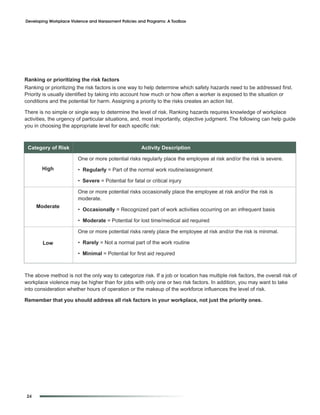
Ranking or prioritizing the risk factors
Ranking or prioritizing the risk factors is one way to help determine which safety hazards need to be addressed first.
Priority is usually identified by taking into account how much or how often a worker is exposed to the situation or
conditions and the potential for harm. Assigning a priority to the risks creates an action list.

There is no simple or single way to determine the level of risk. Ranking hazards requires knowledge of workplace
activities, the urgency of particular situations, and, most importantly, objective judgment. The following can help guide
you in choosing the appropriate level for each specific risk:


 Category of Risk                                      Activity Description

                         One or more potential risks regularly place the employee at risk and/or the risk is severe.
        High             • Regularly = Part of the normal work routine/assignment

                         • Severe = Potential for fatal or critical injury

                         One or more potential risks occasionally place the employee at risk and/or the risk is
                         moderate.
      Moderate
                         • Occasionally = Recognized part of work activities occurring on an infrequent basis

                         • Moderate = Potential for lost time/medical aid required

                         One or more potential risks rarely place the employee at risk and/or the risk is minimal.

        Low              • Rarely = Not a normal part of the work routine

                         • Minimal = Potential for first aid required


The above method is not the only way to categorize risk. If a job or location has multiple risk factors, the overall risk of
workplace violence may be higher than for jobs with only one or two risk factors. In addition, you may want to take
into consideration whether hours of operation or the makeup of the workforce influences the level of risk.

Remember that you should address all risk factors in your workplace, not just the priority ones.


 24
Developing Workplace Violence and Harassment Policies and Programs: A Toolbox


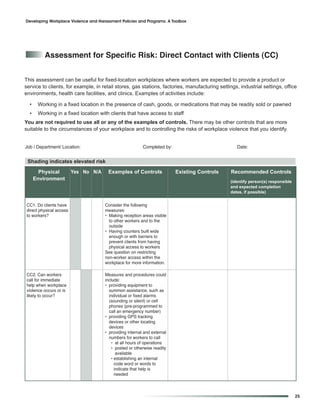
          assessment for Specific risk: Direct Contact with Clients (CC)


This assessment can be useful for fixed-location workplaces where workers are expected to provide a product or
service to clients, for example, in retail stores, gas stations, factories, manufacturing settings, industrial settings, office
environments, health care facilities, and clinics. Examples of activities include:

  •    Working in a fixed location in the presence of cash, goods, or medications that may be readily sold or pawned
  •    Working in a fixed location with clients that have access to staff
You are not required to use all or any of the examples of controls. There may be other controls that are more
suitable to the circumstances of your workplace and to controlling the risks of workplace violence that you identify.


Job / Department/ Location:                               Completed by:                            Date:


 Shading indicates elevated risk
        Physical         Yes No N/A    Examples of Controls               Existing Controls     Recommended Controls
      Environment                                                                               (identify person(s) responsible
                                                                                                and expected completion
                                                                                                dates, if possible)


CC1. Do clients have                  Consider the following
direct physical access                measures:
to workers?                           • Making reception areas visible
                                        to other workers and to the
                                        outside
                                      • Having counters built wide
                                        enough or with barriers to
                                        prevent clients from having
                                        physical access to workers
                                      See question on restricting
                                      non-worker access within the
                                      workplace for more information.

CC2. Can workers                      Measures and procedures could
call for immediate                    include:
help when workplace                   • providing equipment to
violence occurs or is                   summon assistance, such as
likely to occur?                        individual or fixed alarms
                                        (sounding or silent) or cell
                                        phones (pre-programmed to
                                        call an emergency number)
                                      • providing GPS tracking
                                        devices or other locating
                                        devices
                                      • providing internal and external
                                        numbers for workers to call
                                          • at all hours of operations
                                          • posted or otherwise readily
                                             available
                                          • establishing an internal
                                            code word or words to
                                            indicate that help is
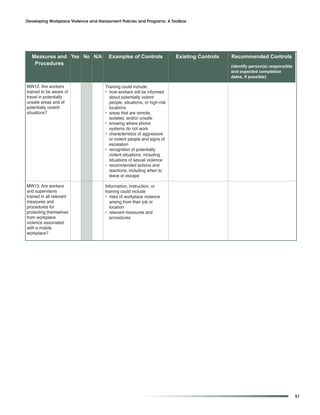
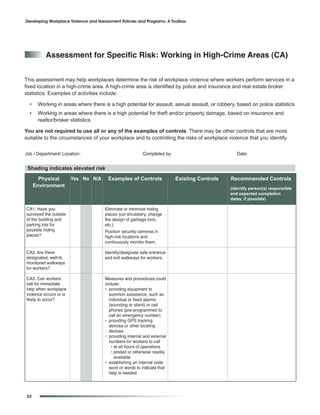
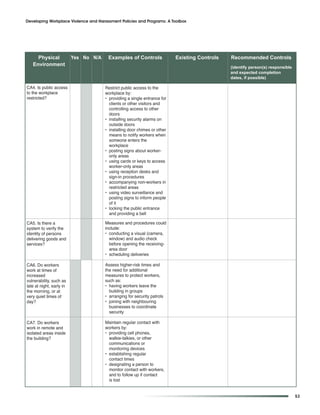
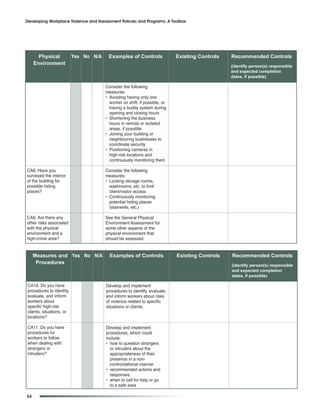
                                            needed


                                                                                                                                  25
Developing Workplace Violence and Harassment Policies and Programs: A Toolbox


         Overview and Context for Controls
       Physical  Yes No N/A Examples of action                            Existing Controls   Recommended Controls
     Environment                                                                              (identify person(s) responsible
                                                                                              and expected completion
                                                                                              dates, if possible)

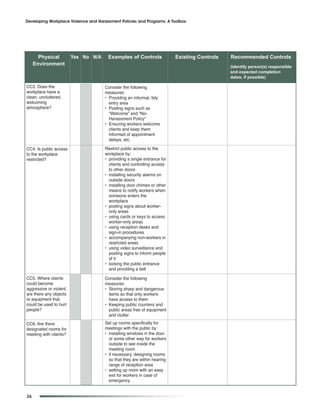
CC3. Does the                         Consider the following
workplace have a                      measures:
clean, uncluttered,                   • Providing an informal, tidy
welcoming                               entry area
atmosphere?                           • Posting signs such as
                                        “Welcome” and “No-
                                        Harassment Policy”
                                      • Ensuring workers welcome
                                        clients and keep them
                                        informed of appointment
                                        delays, etc.

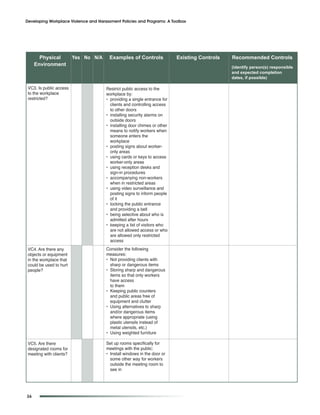
CC4. Is public access                 Restrict public access to the
to the workplace                      workplace by:
restricted?                           • providing a single entrance for
                                        clients and controlling access
                                        to other doors
                                      • installing security alarms on
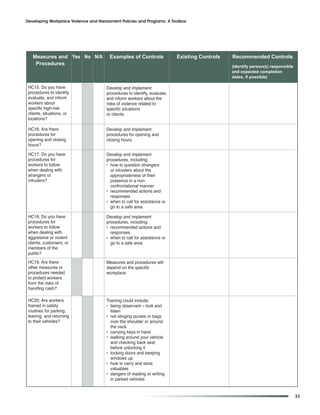
                                        outside doors
                                      • installing door chimes or other
                                        means to notify workers when
                                        someone enters the
                                        workplace
                                      • posting signs about worker-
                                        only areas
                                      • using cards or keys to access
                                        worker-only areas
                                      • using reception desks and
                                        sign-in procedures
                                      • accompanying non-workers in
                                        restricted areas
                                      • using video surveillance and
                                        posting signs to inform people
                                        of it
                                      • locking the public entrance
                                        and providing a bell

CC5. Where clients                    Consider the following
could become                          measures:
aggressive or violent,                • Storing sharp and dangerous
are there any objects                   items so that only workers
or equipment that                       have access to them
could be used to hurt                 • Keeping public counters and
people?                                 public areas free of equipment
                                        and clutter
CC6. Are there                        Set up rooms specifically for
designated rooms for                  meetings with the public by:
meeting with clients?                 • installing windows in the door
                                        or some other way for workers
                                        outside to see inside the
                                        meeting room
                                      • if necessary, designing rooms
                                        so that they are within hearing
                                        range of reception area
                                      • setting up room with an easy
                                        exit for workers in case of
                                        emergency


26
Developing Workplace Violence and Harassment Policies and Programs: A Toolbox


      Physical             Yes No N/A    Examples of Controls              Existing Controls   Recommended Controls
    Environment                                                                                (identify person(s) responsible
                                                                                               and expected completion
                                                                                               dates, if possible)

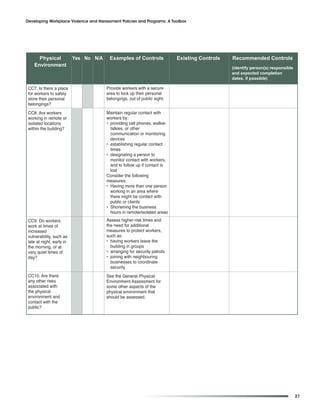
 CC7. Is there a place                  Provide workers with a secure
 for workers to safely                  area to lock up their personal
 store their personal                   belongings, out of public sight.
 belongings?

 CC8. Are workers                       Maintain regular contact with
 working in remote or                   workers by:
 isolated locations                     • providing cell phones, walkie-
 within the building?                     talkies, or other
                                          communication or monitoring
                                          devices
                                        • establishing regular contact
                                          times
                                        • designating a person to
                                          monitor contact with workers,
                                          and to follow up if contact is
                                          lost
                                        Consider the following
                                        measures:
                                        • Having more than one person
                                          working in an area where
                                          there might be contact with
                                          public or clients
                                        • Shortening the business
                                          hours in remote/isolated areas
 CC9. Do workers                        Assess higher-risk times and
 work at times of                       the need for additional
 increased                              measures to protect workers,
 vulnerability, such as                 such as:
 late at night, early in                • having workers leave the
 the morning, or at                       building in groups
 very quiet times of                    • arranging for security patrols
 day?                                   • joining with neighbouring
                                          businesses to coordinate
                                          security
 CC10. Are there                        See the General Physical
 any other risks                        Environment Assessment for
 associated with                        some other aspects of the
 the physical                           physical environment that
 environment and                        should be assessed.
 contact with the
 public?


                                                                                                                                 27
Developing Workplace Violence and Harassment Policies and Programs: A Toolbox


  Measures and Yes and Context for Controls
      Overview No N/A Examples of action                                   Existing Controls   Recommended Controls
   Procedures                                                                                  (identify person(s) responsible
                                                                                               and expected completion
                                                                                               dates, if possible)

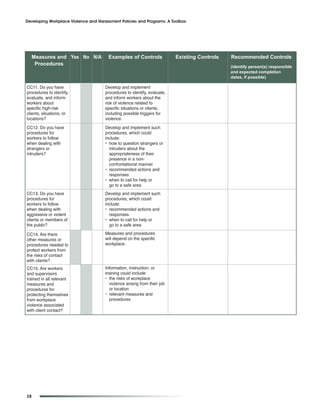
CC11. Do you have                     Develop and implement
procedures to identify,               procedures to identify, evaluate,
evaluate, and inform                  and inform workers about the
workers about                         risk of violence related to
specific high-risk                    specific situations or clients,
clients, situations, or               including possible triggers for
locations?                            violence.

CC12. Do you have                     Develop and implement such
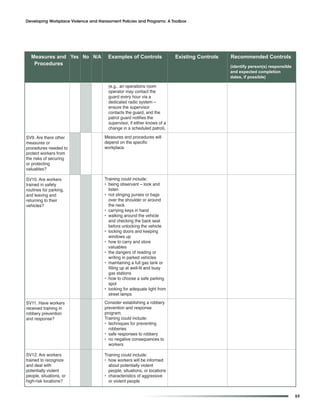
procedures for                        procedures, which could
workers to follow                     include:
when dealing with                     • how to question strangers or
strangers or                            intruders about the
intruders?                              appropriateness of their
                                        presence in a non-
                                        confrontational manner
                                      • recommended actions and
                                        responses
                                      • when to call for help or
                                        go to a safe area
CC13. Do you have                     Develop and implement such
procedures for                        procedures, which could
workers to follow                     include:
when dealing with                     • recommended actions and
aggressive or violent                   responses
clients or members of                 • when to call for help or
the public?                             go to a safe area

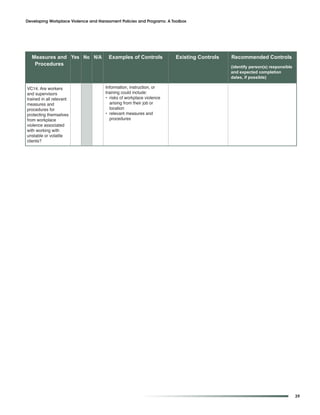
CC14. Are there                       Measures and procedures
other measures or                     will depend on the specific
procedures needed to                  workplace.
protect workers from
the risks of contact
with clients?
CC15. Are workers                     Information, instruction, or
and supervisors                       training could include:
trained in all relevant               • the risks of workplace
measures and                             violence arising from their job
procedures for                           or location
protecting themselves                 • relevant measures and
from workplace                           procedures
violence associated
with client contact?


28
Developing Workplace Violence and Harassment Policies and Programs: A Toolbox


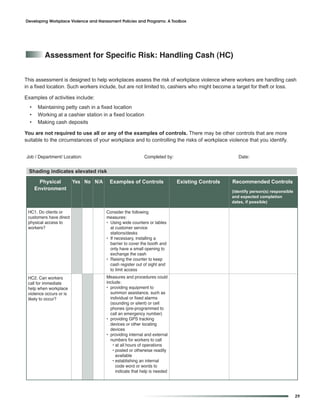
          assessment for Specific risk: Handling Cash (HC)


This assessment is designed to help workplaces assess the risk of workplace violence where workers are handling cash
in a fixed location. Such workers include, but are not limited to, cashiers who might become a target for theft or loss.

Examples of activities include:
  •    Maintaining petty cash in a fixed location
  •    Working at a cashier station in a fixed location
  •    Making cash deposits

You are not required to use all or any of the examples of controls. There may be other controls that are more
suitable to the circumstances of your workplace and to controlling the risks of workplace violence that you identify.


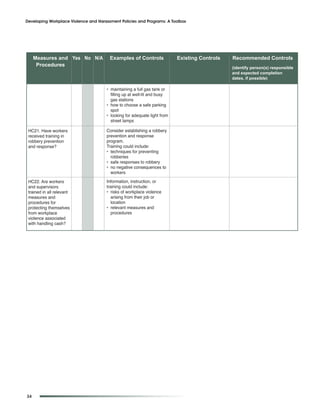
Job / Department/ Location:                                Completed by:                          Date:


 Shading indicates elevated risk
        Physical         Yes No N/A     Examples of Controls               Existing Controls   Recommended Controls
      Environment                                                                              (identify person(s) responsible
                                                                                               and expected completion
                                                                                               dates, if possible)

 HC1. Do clients or                   Consider the following
 customers have direct                measures:
 physical access to                   • Using wide counters or tables
 workers?                               at customer service
                                        stations/desks
                                      • If necessary, installing a
                                        barrier to cover the booth and
                                        only have a small opening to
                                        exchange the cash
                                      • Raising the counter to keep
                                        cash register out of sight and
                                        to limit access
 HC2. Can workers                     Measures and procedures could
 call for immediate                   include:
 help when workplace                  • providing equipment to
 violence occurs or is                  summon assistance, such as
 likely to occur?                       individual or fixed alarms
                                        (sounding or silent) or cell
                                        phones (pre-programmed to
                                        call an emergency number)
                                      • providing GPS tracking
                                        devices or other locating
                                        devices
                                      • providing internal and external
                                        numbers for workers to call
                                          • at all hours of operations
                                          • posted or otherwise readily
                                            available
                                          • establishing an internal
                                            code word or words to
                                            indicate that help is needed


                                                                                                                                 29
Developing Workplace Violence and Harassment Policies and Programs: A Toolbox


       Physical         Yes No N/A     Examples of Controls               Existing Controls   Recommended Controls
     Environment                                                                              (identify person(s) responsible
                                                                                              and expected completion
                                                                                              dates, if possible)

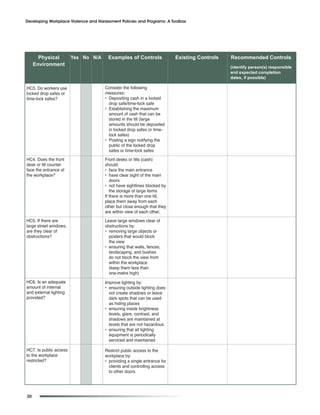
HC3. Do workers use                   Consider the following
locked drop safes or                  measures:
time-lock safes?                      • Depositing cash in a locked
                                        drop safe/time-lock safe
                                      • Establishing the maximum
                                        amount of cash that can be
                                        stored in the till (large
                                        amounts should be deposited
                                        in locked drop safes or time-
                                        lock safes)
                                      • Posting a sign notifying the
                                        public of the locked drop
                                        safes or time-lock safes
HC4. Does the front                   Front desks or tills (cash)
desk or till counter                  should:
face the entrance of                  • face the main entrance
the workplace?                        • have clear sight of the main
                                         doors
                                      • not have sightlines blocked by
                                         the storage of large items
                                      If there is more than one till,
                                      place them away from each
                                      other but close enough that they
                                      are within view of each other.
HC5. If there are                     Leave large windows clear of
large street windows,                 obstructions by:
are they clear of                     • removing large objects or
obstructions?                           posters that would block
                                        the view
                                      • ensuring that walls, fences,
                                        landscaping, and bushes
                                        do not block the view from
                                        within the workplace
                                        (keep them less than
                                        one-metre high)
HC6. Is an adequate                   Improve lighting by:
amount of internal                    • ensuring outside lighting does
and external lighting                   not create shadows or leave
provided?                               dark spots that can be used
                                        as hiding places
                                      • ensuring inside brightness
                                        levels, glare, contrast, and
                                        shadows are maintained at
                                        levels that are not hazardous
                                      • ensuring that all lighting
                                        equipment is periodically
                                        serviced and maintained

HC7. Is public access                 Restrict public access to the
to the workplace                      workplace by:
restricted?                           • providing a single entrance for
                                        clients and controlling access
                                        to other doors


30
Developing Workplace Violence and Harassment Policies and Programs: A Toolbox


     Physical           Yes No N/A     Examples of Controls               Existing Controls   Recommended Controls
   Environment                                                                                (identify person(s) responsible
                                                                                              and expected completion
                                                                                              dates, if possible)

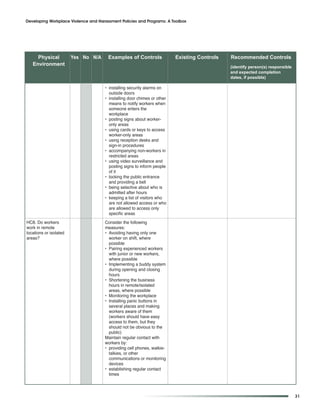
                                      • installing security alarms on
                                        outside doors
                                      • installing door chimes or other
                                        means to notify workers when
                                        someone enters the
                                        workplace
                                      • posting signs about worker-
                                        only areas
                                      • using cards or keys to access
                                        worker-only areas
                                      • using reception desks and
                                        sign-in procedures
                                      • accompanying non-workers in
                                        restricted areas
                                      • using video surveillance and
                                        posting signs to inform people
                                        of it
                                      • locking the public entrance
                                        and providing a bell
                                      • being selective about who is
                                        admitted after hours
                                      • keeping a list of visitors who
                                        are not allowed access or who
                                        are allowed to access only
                                        specific areas
HC8. Do workers                       Consider the following
work in remote                        measures:
locations or isolated                 • Avoiding having only one
areas?                                  worker on shift, where
                                        possible
                                      • Pairing experienced workers
                                        with junior or new workers,
                                        where possible
                                      • Implementing a buddy system
                                        during opening and closing
                                        hours
                                      • Shortening the business
                                        hours in remote/isolated
                                        areas, where possible
                                      • Monitoring the workplace
                                      • Installing panic buttons in
                                        several places and making
                                        workers aware of them
                                        (workers should have easy
                                        access to them, but they
                                        should not be obvious to the
                                        public)
                                      Maintain regular contact with
                                      workers by:
                                      • providing cell phones, walkie-
                                        talkies, or other
                                        communications or monitoring
                                        devices
                                      • establishing regular contact
                                        times


                                                                                                                                31
Developing Workplace Violence and Harassment Policies and Programs: A Toolbox


       Physical           Yes No N/A    Examples of Controls                  Existing Controls   Recommended Controls
     Environment                                                                                  (identify person(s) responsible
                                                                                                  and expected completion
                                                                                                  dates, if possible)

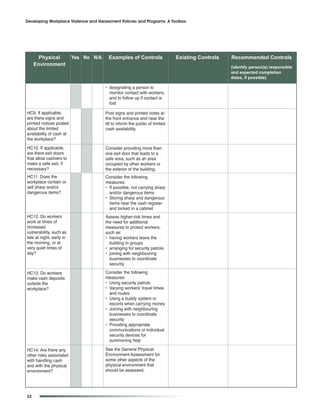
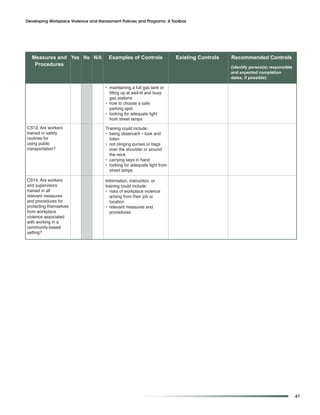
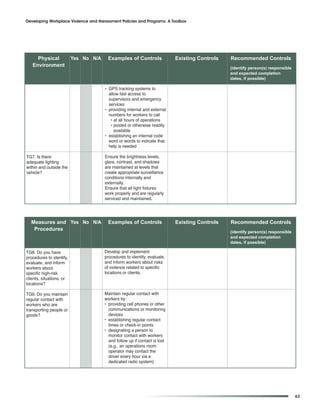
                                       • designating a person to
                                         monitor contact with workers,
                                         and to follow up if contact is
                                         lost

HC9. If applicable,                    Post signs and printed notes at
are there signs and                    the front entrance and near the
printed notices posted                 till to inform the public of limited
about the limited                      cash availability.
availability of cash at
the workplace?

HC10. If applicable,                   Consider providing more than
are there exit doors                   one exit door that leads to a
that allow cashiers to                 safe area, such as an area
make a safe exit, if                   occupied by other workers or
necessary?                             the exterior of the building.
HC11. Does the                         Consider the following
workplace contain or                   measures:
sell sharp and/or                      • If possible, not carrying sharp
dangerous items?                         and/or dangerous items
                                       • Storing sharp and dangerous
                                         items near the cash register
                                         and locked in a cabinet
HC12. Do workers                       Assess higher-risk times and
work at times of                       the need for additional
increased                              measures to protect workers,
vulnerability, such as                 such as:
late at night, early in                • having workers leave the
the morning, or at                       building in groups
very quiet times of                    • arranging for security patrols
day?                                   • joining with neighbouring
                                         businesses to coordinate
                                         security

HC13. Do workers                       Consider the following
make cash deposits                     measures:
outside the                            • Using security patrols
workplace?                             • Varying workers’ travel times
                                         and routes
                                       • Using a buddy system or
                                         escorts when carrying money
                                       • Joining with neighbouring
                                         businesses to coordinate
                                         security
                                       • Providing appropriate
                                         communications or individual
                                         security devices for
                                         summoning help

HC14. Are there any                    See the General Physical
other risks associated                 Environment Assessment for
with handling cash                     some other aspects of the
and with the physical                  physical environment that
environment?                           should be assessed.


32
Developing Workplace Violence and Harassment Policies and Programs: A Toolbox


   Measures and Yes No N/A              Examples of Controls              Existing Controls   Recommended Controls
    Procedures                                                                                (identify person(s) responsible
                                                                                              and expected completion
                                                                                              dates, if possible)

 HC15. Do you have                    Develop and implement
 procedures to identify,              procedures to identify, evaluate,
 evaluate, and inform                 and inform workers about the
 workers about                        risks of violence related to
 specific high-risk                   specific situations
 clients, situations, or              or clients.
 locations?

 HC16. Are there                      Develop and implement
 procedures for                       procedures for opening and
 opening and closing                  closing hours.
 hours?

 HC17. Do you have                    Develop and implement
 procedures for                       procedures, including:
 workers to follow                    • how to question strangers
 when dealing with                      or intruders about the
 strangers or                           appropriateness of their
 intruders?                             presence in a non-
                                        confrontational manner
                                      • recommended actions and
                                        responses
                                      • when to call for assistance or
                                        go to a safe area

 HC18. Do you have                    Develop and implement
 procedures for                       procedures, including:
 workers to follow                    • recommended actions and
 when dealing with                      responses
 aggressive or violent                • when to call for assistance or
 clients, customers, or                 go to a safe area
 members of the
 public?

 HC19. Are there                      Measures and procedures will
 other measures or                    depend on the specific
 procedures needed                    workplace.
 to protect workers
 from the risks of
 handling cash?

 HC20. Are workers                    Training could include:
 trained in safety                    • being observant – look and
 routines for parking,                  listen
 leaving, and returning               • not slinging purses or bags
 to their vehicles?                     over the shoulder or around
                                        the neck
                                      • carrying keys in hand
                                      • walking around your vehicle
                                        and checking back seat
                                        before unlocking it
                                      • locking doors and keeping
                                        windows up
                                      • how to carry and store
                                        valuables
                                      • dangers of reading or writing
                                        in parked vehicles


                                                                                                                                33
Developing Workplace Violence and Harassment Policies and Programs: A Toolbox


     Measures and Yes No N/A            Examples of Controls              Existing Controls   Recommended Controls
      Procedures                                                                              (identify person(s) responsible
                                                                                              and expected completion
                                                                                              dates, if possible)

                                      • maintaining a full gas tank or
                                        filling up at well-lit and busy
                                        gas stations
                                      • how to choose a safe parking
                                        spot
                                      • looking for adequate light from
                                        street lamps

 HC21. Have workers                   Consider establishing a robbery
 received training in                 prevention and response
 robbery prevention                   program.
 and response?                        Training could include:
                                      • techniques for preventing
                                        robberies
                                      • safe responses to robbery
                                      • no negative consequences to
                                        workers

 HC22. Are workers                    Information, instruction, or
 and supervisors                      training could include:
 trained in all relevant              • risks of workplace violence
 measures and                            arising from their job or
 procedures for                          location
 protecting themselves                • relevant measures and
 from workplace                          procedures
 violence associated
 with handling cash?


34
Developing Workplace Violence and Harassment Policies and Programs: A Toolbox


          assessment for Specific risk: Working with Unstable
          or Volatile Clients (VC)
This assessment can be useful to workplaces where workers are providing services or products to persons with
physiological, psychological, or psychiatric conditions, or substance abuse issues. Examples of workers providing
services or products to this population include caregivers, parole officers, police, corrections officers, youth officers,
social service workers, and receptionists. Examples of activities include:

  •    Providing a service to persons with physiological, psychological, or psychiatric conditions, or substance abuse
       issues
  •    Providing a service that involves physical contact with clients who may be unpredictable due to influences
       outside the workplace

You are not required to use all or any of the examples of controls. There may be other controls that are more
suitable to the circumstances of your workplace and to controlling the risks of workplace violence that you identify.

Job / Department/ Location:                                Completed by:                          Date:


 Shading indicates elevated risk
        Physical          Yes No N/A    Examples of Controls               Existing Controls   Recommended Controls
      Environment                                                                              (identify person(s) responsible
                                                                                               and expected completion
                                                                                               dates, if possible)

 VC1. Do clients have                  Consider the following
 direct physical access                measures:
 to workers?                           • Making reception areas visible
                                         to other workers and to the
                                         outside
                                       • Having counters built wide
                                         enough or with barriers to
                                         prevent clients from having
                                         physical access to workers
                                       See VC3 (restricting non-worker
                                       access within the workplace) for
                                       more information.
 VC2. Can workers                      Measures and procedures could
 call for immediate                    include:
 help when workplace                   • providing equipment to
 violence occurs or is                   summon assistance, such as
 likely to occur?                        individual or fixed alarms
                                         (sounding or silent) or cell
                                         phones (pre-programmed to
                                         call an emergency number)
                                       • providing GPS tracking
                                         devices or other locating
                                         devices
                                       • providing internal and external
                                         numbers for workers to call
                                           • at all hours of operations
                                           • posted or otherwise readily
                                             available
                                       • establishing an internal code
                                         word or words to indicate that
                                         help is needed


                                                                                                                                 35
Developing Workplace Violence and Harassment Policies and Programs: A Toolbox


       Physical          Yes No N/A     Examples of Controls              Existing Controls   Recommended Controls
     Environment                                                                              (identify person(s) responsible
                                                                                              and expected completion
                                                                                              dates, if possible)

 VC3. Is public access                Restrict public access to the
 to the workplace                     workplace by:
 restricted?                          • providing a single entrance for
                                        clients and controlling access
                                        to other doors
                                      • installing security alarms on
                                        outside doors
                                      • installing door chimes or other
                                        means to notify workers when
                                        someone enters the
                                        workplace
                                      • posting signs about worker-
                                        only areas
                                      • using cards or keys to access
                                        worker-only areas
                                      • using reception desks and
                                        sign-in procedures
                                      • accompanying non-workers
                                        when in restricted areas
                                      • using video surveillance and
                                        posting signs to inform people
                                        of it
                                      • locking the public entrance
                                        and providing a bell
                                      • being selective about who is
                                        admitted after hours
                                      • keeping a list of visitors who
                                        are not allowed access or who
                                        are allowed only restricted
                                        access
 VC4. Are there any                   Consider the following
 objects or equipment                 measures:
 in the workplace that                • Not providing clients with
 could be used to hurt                  sharp or dangerous items
 people?                              • Storing sharp and dangerous
                                        items so that only workers
                                        have access
                                        to them
                                      • Keeping public counters
                                        and public areas free of
                                        equipment and clutter
                                      • Using alternatives to sharp
                                        and/or dangerous items
                                        where appropriate (using
                                        plastic utensils instead of
                                        metal utensils, etc.)
                                      • Using weighted furniture

 VC5. Are there                       Set up rooms specifically for
 designated rooms for                 meetings with the public:
 meeting with clients?                • Install windows in the door or
                                        some other way for workers
                                        outside the meeting room to
                                        see in


36
Developing Workplace Violence and Harassment Policies and Programs: A Toolbox


     Physical             Yes No N/A    Examples of Controls                Existing Controls   Recommended Controls
   Environment                                                                                  (identify person(s) responsible
                                                                                                and expected completion
                                                                                                dates, if possible)

                                       • Design rooms so that they are
                                          within hearing range of
                                          reception area or other
                                          workers
                                       • Set up room (including
                                          furniture) to allow for an easy
                                          exit in case of an emergency
                                       • Use weighted furniture
                                       • Provide a means of
                                          communication or alarm
                                       If no designated meeting rooms
                                       exist, set up offices so that
                                       workers can exit the office first.

VC6. Is there a place                  Provide workers with a secure
in which workers can                   area to lock their personal
safely store their                     belongings, out of public sight.
personal belongings?

VC7. Do workers                        Assess higher-risk times and
work at times of                       the need for additional
increased                              measures to protect workers,
vulnerability, such as                 such as:
late at night, early in                • having workers leave the
the morning, or at                       building in groups
very quiet times of                    • arranging for security patrols
day?                                   • joining with neighbouring
                                         businesses to coordinate
                                         security
VC8. Are there                         See the General Physical
any other risks                        Environment Assessment for
associated with                        some other aspects of the
the physical                           physical environment that
environment                            should be assessed.
and working with
unstable or
volatile clients?


                                                                                                                                  37
Developing Workplace Violence and Harassment Policies and Programs: A Toolbox


     Measures and Yes No N/A            Examples of Controls               Existing Controls   Recommended Controls
      Procedures                                                                               (identify person(s) responsible
                                                                                               and expected completion
                                                                                               dates, if possible)

 VC9. Do you have                     Develop and implement
 procedures to identify,              procedures to identify, evaluate,
 evaluate, and inform                 and inform workers about risks
 workers about                        of violence related to specific
 specific high-risk                   situations or clients, including
 clients, situations, or              possible triggers.
 locations?

 VC10. Do you have                    Develop and implement such
 procedures for                       procedures, which could
 workers to follow                    include:
 when dealing with                    • how to question strangers
 strangers or                           or intruders about the
 intruders?                             appropriateness of their
                                        presence in a non-
                                        confrontational manner
                                      • recommended actions and
                                        responses
                                      • when to call for help or go
                                        to a safe area
 VC11. Do you have                    Develop and implement such
 procedures for                       procedures, which could
 workers to follow                    include:
 when dealing with                    • recommended actions and
 aggressive or violent                  responses
 clients, customers, or               • when to call for help or go to a
 members of the                         safe area
 public?
 VC12. Are there                      Measures and procedures will
 other measures or                    depend on the specific
 procedures needed to                 workplace.
 protect workers from
 the risks of working
 with unstable or
 volatile clients?
 VC13. Are workers                    Training could include:
 trained to recognize                 • how workers will be informed
 and deal with                          about potentially violent
 potentially violent                    people, situations, or high-risk
 people, situations, or                 locations
 high-risk locations?                 • characteristics of aggressive
                                        or violent people
                                      • signs of behaviour escalation
                                      • recognition of potentially
                                        violent situations, including
                                        situations of sexual violence
                                      • recommended actions and
                                        reactions, including when to
                                        leave or escape
                                      • appropriate responses to
                                        incidents, including defusing
                                        hostile or aggressive
                                        behaviours


38
Developing Workplace Violence and Harassment Policies and Programs: A Toolbox


  Measures and Yes No N/A              Examples of Controls            Existing Controls   Recommended Controls
   Procedures                                                                              (identify person(s) responsible
                                                                                           and expected completion
                                                                                           dates, if possible)

VC14. Are workers                     Information, instruction, or
and supervisors                       training could include:
trained in all relevant               • risks of workplace violence
measures and                             arising from their job or
procedures for                           location
protecting themselves                 • relevant measures and
from workplace                           procedures
violence associated
with working with
unstable or volatile
clients?


                                                                                                                             39
Developing Workplace Violence and Harassment Policies and Programs: A Toolbox


          assessment for Specific risk: Working alone or in
          Small numbers (Wa)
This assessment can be useful to workplaces where work is performed at a fixed location by a single worker or very
few workers. This could include settings such as health care facilities and clinics, retail stores, gas stations, factories,
manufacturing facilities, industrial settings, and office environments. Examples of activities include:

  •    Working in a fixed location where there is limited or no access to communication tools and other security
       devices
  •    Working in a fixed location where there is high potential for assault, sexual assault, or robbery
  •    Working in isolated areas within a worksite, away from other workers
  •    Working in a remote worksite where the public may have access

You are not required to use all or any of the examples of controls. There may be other controls that are more
suitable to the circumstances of your workplace and to controlling the risks of workplace violence that you identify.


Job / Department/ Location:                               Completed by:                          Date:


 Shading indicates elevated risk
        Physical         Yes No N/A    Examples of Controls               Existing Controls   Recommended Controls
      Environment                                                                             (identify person(s) responsible
                                                                                              and expected completion
                                                                                              dates, if possible)

WA1. Do you have a                    Investigate the need for security
security system?                      systems such as:
                                      • personal alarms
                                      • fixed alarms connected to
                                        security services
                                      • video surveillance with a live
                                        feed to a central location
                                      • regular security patrols
                                      Develop and implement regular
                                      alarm checks.
WA2. Can workers                      Measures and procedures could
summon immediate                      include:
assistance when                       • providing equipment to
workplace violence                      summon assistance, such as
occurs or is likely to                  individual or fixed alarms
occur?                                  (sounding or silent) or cell
                                        phones (pre-programmed to
                                        call an emergency number)
                                      • providing GPS tracking
                                        devices or other locating
                                        devices
                                      • providing internal and external
                                        numbers for workers to call
                                          • at all hours of operations
                                          • posted or otherwise readily
                                            available
                                      • establishing an internal code
                                        word or words to indicate that
                                        help is needed


 40
Developing Workplace Violence and Harassment Policies and Programs: A Toolbox


      Physical            Yes No N/A    Examples of Controls               Existing Controls   Recommended Controls
    Environment                                                                                (identify person(s) responsible
                                                                                               and expected completion
                                                                                               dates, if possible)

 WA3. Is public access                 Restrict public access to the
 to the workplace                      workplace by:
 restricted?                           • providing a single entrance for
                                         clients and controlling access
                                         to other doors
                                       • installing security alarms on
                                         outside doors
                                       • installing door chimes or other
                                         means to notify workers when
                                         someone enters the
                                         workplace
                                       • posting signs about worker-
                                         only areas
                                       • using cards or keys to access
                                         worker-only areas
                                       • using reception desks and
                                         sign-in procedures
                                       • accompanying non-workers in
                                         restricted areas
                                       • using video surveillance and
                                         posting signs to inform people
                                         of it
                                       • locking the public entrance
                                         and providing a bell

 WA4. Do workers                       Assess higher-risk times and
 work at times                         the need for additional
 of increased                          measures to protect workers,
 vulnerability, such                   such as:
 as late at night,                     • having workers leave the
 early in the morning,                   building in groups
 or at very quiet times                • arranging for security patrols
 of day?                               • joining with neighbouring
                                         businesses to coordinate
                                         security

 WA5. Are there any                    See the General Physical
 other risks associated                Environment Assessment for
 with the physical                     some other aspects of the
 environment and                       physical environment that
 working alone?                        should be assessed.


                                                                                                                                 41
Developing Workplace Violence and Harassment Policies and Programs: A Toolbox


  Measures and Yes and Context for Controls
      Overview No N/A Examples of action                                 Existing Controls   Recommended Controls
   Procedures                                                                                (identify person(s) responsible
                                                                                             and expected completion
                                                                                             dates, if possible)

WA6. Do you have                      Develop and implement
procedures for                        procedures for opening, closing,
opening, closing, or                  or securing the workplace prior
securing the                          to starting and at the end of
workplace prior to                    shifts.
starting and at the                   Include procedures for
end of shifts?                        responding to and dealing with
                                      unusual circumstances.

WA7. Do you                           Maintain regular contact with
maintain regular                      workers by:
contact with workers                  • providing cell phones or other
who are working                         communications or monitoring
alone?                                  devices
                                      • establishing regular contact
                                        times or check-in points
                                      • designating a person to
                                        monitor contact with workers,
                                        and to follow up if contact is
                                        lost
WA8. Do you have                      Develop and implement such
procedures for                        procedures, which could
workers to follow                     include:
when dealing with                     • how to question strangers or
strangers or                            intruders about the
intruders?                              appropriateness of their
                                        presence in a non-
                                        confrontational manner
                                      • recommended actions and
                                        responses
                                      • when to call for assistance or
                                        go to a safe area

WA9. Do you have                      Develop and implement such
procedures for                        procedures, which could
workers to follow                     include:
when dealing with                     • recommended actions and
aggressive or violent                   responses
clients or members of                 • when to call for assistance or
the public?                             go to a safe area

WA10. Are there                       Measures and procedures will
other measures or                     depend on the specific
procedures needed to                  workplace.
protect workers from
the risks of working
alone?

WA11. Are workers                     Training could include:
trained in safety                     • being observant – look and
routines for parking,                   listen
and leaving and                       • not slinging purses or bags
returning to their                      over the shoulder or around
vehicles?                               the neck
                                      • carrying keys in hand
                                      • walking around the vehicle


42
Developing Workplace Violence and Harassment Policies and Programs: A Toolbox


  Measures and Yes No N/A                 Examples of Controls              Existing Controls   Recommended Controls
   Procedures                                                                                   (identify person(s) responsible
                                                                                                and expected completion
                                                                                                dates, if possible)

                                          and checking the back seat
                                          before unlocking the vehicle
                                      •   locking doors and keeping
                                          windows up
                                      •   how to carry and store
                                          valuables
                                      •   dangers of reading or writing
                                          in parked vehicles
                                      •   maintaining a full gas tank or
                                          filling up at well-lit and busy
                                          gas stations
                                      •   how to choose a safe parking
                                          spot
                                      •   looking for adequate light from
                                          street lamps

WA12. In addition to                  Information, instruction, or
the above, are                        training could include:
workers and                           • risks of workplace violence
supervisors provided                     arising from their job or
with information,                        location
instruction, and/or                   • relevant measures and
training to protect                      procedures
them from the risks of
working alone?


                                                                                                                                  43
Developing Workplace Violence and Harassment Policies and Programs: A Toolbox


          assessment for Specific risk: Working in a Community-based
          Setting (CS)
This assessment can be useful to workplaces where workers are expected to work in the community and provide
services in private homes and dwellings, including home support workers, caregivers, home service and repair
personnel, real estate agents, insurance agents, and salespeople. Examples of activities include:

  •    Travelling alone in the community
  •    Working in a client’s personal dwelling
  •    Working with limited or no access to communication tools and other security devices

You are not required to use all or any of the examples of controls. There may be other controls that are more
suitable to the circumstances of your workplace and to controlling the risks of workplace violence that you identify.


Job / Department/ Location:                              Completed by:                          Date:


 Shading indicates elevated risk
        Physical        Yes No N/A     Examples of Controls              Existing Controls   Recommended Controls
      Environment                                                                            (identify person(s) responsible
                                                                                             and expected completion
                                                                                             dates, if possible)

CS1. Can workers                      Measures and procedures could
call for immediate                    include:
help when workplace                   • providing equipment to
violence occurs or is                   summon assistance, such as
likely to occur?                        individual or fixed alarms
                                        (sounding or silent) or cell
                                        phones (pre-programmed to
                                        call an emergency number)
                                      • providing GPS tracking
                                        devices or other locating
                                        devices
                                      • establishing an internal code
                                        word or words to indicate that
                                        help is needed
CS2. Are vehicles                     Develop and implement
used by workers                       procedures to ensure vehicles
regularly maintained?                 used by workers are regularly
                                      maintained.
CS3. Is a pre-visit                   Develop and implement a
telephone interview                   pre-visit client interview
conducted with                        process. Questions could
clients?                              determine:
                                      • who will be present during
                                        the visit
                                      • who will answer the door
                                      • the presence of animals


 44
Developing Workplace Violence and Harassment Policies and Programs: A Toolbox


     Physical             Yes No N/A    Examples of Controls                Existing Controls   Recommended Controls
   Environment                                                                                  (identify person(s) responsible
                                                                                                and expected completion
                                                                                                dates, if possible)

                                       • the potential for any violence,
                                         including possible triggers
                                       • parking location
                                       • street lighting

CS4. Do workers                        Develop measures and
carry medications,                     procedures to protect
syringes, or other                     workers and prevent robbery.
valuable medical
equipment?

CS5. Are workers                       Develop and implement a
provided with the                      process to identify high-crime
safest route to travel                 areas and determine safe travel
to clients?                            routes, including
                                       parking and walking
                                       recommendations.


  Measures and Yes No N/A               Examples of Controls                Existing Controls   Recommended Controls
   Procedures                                                                                   (identify person(s) responsible
                                                                                                and expected completion
                                                                                                dates, if possible)

CS6. Do you have                       Develop and implement
procedures to identify,                procedures to identify, evaluate,
evaluate, and inform                   and inform workers about risks
workers about                          of violence related to location,
specific high-risk                     the specific client, a history of
clients, situations, or                violent behaviour, possible
locations?                             triggers for violence, presence
                                       of weapons or pets, and public
                                       demonstrations or strikes.

CS7. Do you maintain                   Maintain regular contact with
regular contact with                   workers by:
workers who are                        • providing cell phones or other
working in the                           communications or monitoring
community?                               devices
                                       • establishing regular contact
                                         times or check-in points
                                       • designating a person to
                                         monitor contact with workers,
                                         and to follow up if contact is
                                         lost

CS8. Do you require                    Develop, implement, and
a safe-visit plan                      communicate safe-visit plans for
before workers visit                   high-risk situations. A plan could
high-risk situations?                  include:
                                       • provision of a cell phone to
                                         maintain regular contact with
                                         office
                                       • a buddy system
                                       • meeting a client at a safer
                                         location, where possible


                                                                                                                                  45
Developing Workplace Violence and Harassment Policies and Programs: A Toolbox


     Measures and Yes No N/A           Examples of Controls               Existing Controls   Recommended Controls
      Procedures                                                                              (identify person(s) responsible
                                                                                              and expected completion
                                                                                              dates, if possible)

                                      • deferral of visit until proper
                                        safety measures can be met
                                      • wearing shoes at all times for
                                        home visits (for quick exit, if
                                        necessary)

CS9. Do you have                      Develop and implement such
procedures for                        procedures, which could
workers to follow                     include:
when dealing with                     • recommended actions and
aggressive or violent                   responses
clients, customers, or                • when to call for assistance or
members of the                          go to a safe area
public?

CS10. Are there                       Measures and procedures will
other measures or                     depend on the specific
procedures needed to                  workplace.
protect workers from
the risks of working in
the community?

CS11. Are workers                     Training could include:
trained to recognize                  • how workers will be informed
and deal with                           about potentially violent
potentially violent                     people, situations or locations
people, situations, or                • characteristics of aggressive
high-risk locations?                    or violent people
                                      • signs of behaviour escalation
                                      • recognition of potentially
                                        violent situations, including
                                        situations of sexual violence
                                      • recommended actions and
                                        reactions, including when to
                                        leave or how to escape
                                      • appropriate responses to
                                        incidents, including defusing
                                        hostile or aggressive
                                        behaviours

CS12. Are workers                     Training could include:
trained in safety                     • being observant – look and
routines for parking,                   listen
and leaving and                       • not slinging purses or bags
returning to their                      over the shoulder or around
vehicles?                               the neck
                                      • carrying keys in hand
                                      • walking around the vehicle
                                        and checking the back seat
                                        before unlocking the vehicle
                                      • locking doors and keeping
                                        windows up
                                      • how to carry and store
                                        valuables
                                      • the dangers of reading or
                                        writing in parked vehicles


46
Developing Workplace Violence and Harassment Policies and Programs: A Toolbox


  Measures and Yes No N/A              Examples of Controls               Existing Controls   Recommended Controls
   Procedures                                                                                 (identify person(s) responsible
                                                                                              and expected completion
                                                                                              dates, if possible)

                                      • maintaining a full gas tank or
                                        filling up at well-lit and busy
                                        gas stations
                                      • how to choose a safe
                                        parking spot
                                      • looking for adequate light
                                        from street lamps
CS13. Are workers                     Training could include:
trained in safety                     • being observant – look and
routines for                            listen
using public                          • not slinging purses or bags
transportation?                         over the shoulder or around
                                        the neck
                                      • carrying keys in hand
                                      • looking for adequate light from
                                        street lamps

CS14. Are workers                     Information, instruction, or
and supervisors                       training could include:
trained in all                        • risks of workplace violence
relevant measures                        arising from their job or
and procedures for                       location
protecting themselves                 • relevant measures and
from workplace                           procedures
violence associated
with working in a
community-based
setting?


                                                                                                                                47
Developing Workplace Violence and Harassment Policies and Programs: A Toolbox


          assessment for Specific risk: Mobile Workplace (MW)


This assessment can be useful to workplaces where workers are required to travel in a vehicle most of their workday
with limited communication with their office. These workers could be salespeople, consultants, auditors contract
accountants, etc., who travel to clients’ premises. Examples of activities include:

• Working on the road – a vehicle is a “mobile office”
• Working in remote or unknown areas
• Situations in which the public has access to the worker in and outside of the vehicle

You are not required to use all or any of the examples of controls. There may be other controls that are more
suitable to the circumstances of your workplace and to controlling the risks of workplace violence that you identify.


Job / Department/ Location:                              Completed by:                          Date:


 Shading indicates elevated risk
        Physical        Yes No N/A     Examples of Controls              Existing Controls   Recommended Controls
      Environment                                                                            (identify person(s) responsible
                                                                                             and expected completion
                                                                                             dates, if possible)

MW1. Can workers                     Measures and procedures could
call for immediate                   include:
help when workplace                  • providing equipment to
violence occurs or is                  summon assistance, such as
likely to occur while                  individual or fixed alarms
they are on the road?                  (sounding or silent) or cell
                                       phones (pre-programmed to
                                       call an emergency number)
                                     • providing GPS tracking
                                       devices or other locating
                                       devices
                                     • providing internal and external
                                       numbers for workers to call
                                        • at all hours of operations
                                        • posted or otherwise readily
                                          available
                                        • establishing an internal
                                          code word or words to
                                          indicate that help is needed

MW2. Are vehicles                    Develop procedures to ensure
used by workers                      vehicles used by workers are
regularly maintained?                regularly maintained.


 48
Developing Workplace Violence and Harassment Policies and Programs: A Toolbox


     Physical             Yes No N/A    Examples of Controls               Existing Controls   Recommended Controls
   Environment                                                                                 (identify person(s) responsible
                                                                                               and expected completion
                                                                                               dates, if possible)

MW3. Are vehicles                      Consider the following
equipped with special                  measures:
security devices?                      • Installing an alarm system in
                                         the vehicle
                                       • Installing a video camera in
                                         the vehicle
                                       • Making GPS available for
                                         those who want the system or
                                         providing GPS-equipped cell
                                         phones
MW4. Are workers                       Provide appropriate
working in remote or                   communications or individual
isolated locations?                    security devices (telephone,
                                       two-way radio, alarm buttons,
                                       etc.) and ensure these devices
                                       will be available should a
                                       problem arise.
MW5. Do workers                        Assess higher-risk times and
work at times of                       the need for additional
increased                              measures to protect workers,
vulnerability, such                    such as:
as late at night,                      • having workers leave the
early in the morning,                    building in groups
or at very quiet times                 • arranging for security patrols
of day?                                • joining with neighbouring
                                         businesses to coordinate
                                         security


  Measures and Yes No N/A               Examples of Controls               Existing Controls   Recommended Controls
   Procedures                                                                                  (identify person(s) responsible
                                                                                               and expected completion
                                                                                               dates, if possible)

MW6. Do you have                       Develop and implement
procedures to identify,                procedures to identify, evaluate,
evaluate, and inform                   and inform workers about risks
workers about                          of violence related to specific
specific high-risk                     situations or clients.
clients, situations, or
locations?

MW7. Do you have                       Develop and implement such
procedures for                         procedures, which could
workers to follow                      include:
when dealing with                      • how to question strangers or
strangers or                             intruders about the
intruders?                               appropriateness of their
                                         presence in a non-
                                         confrontational manner
                                       • recommended actions and
                                         responses
                                       • when to call for help or go to
                                         a safe area


                                                                                                                                 49
Developing Workplace Violence and Harassment Policies and Programs: A Toolbox


     Measures and Yes No N/A            Examples of Controls              Existing Controls   Recommended Controls
      Procedures                                                                              (identify person(s) responsible
                                                                                              and expected completion
                                                                                              dates, if possible)

 MW8. Do you have                     Develop and implement such
 procedures for                       procedures, which could
 workers to follow                    include:
 when dealing with                    • recommended actions and
 aggressive or violent                  responses
 clients or members of                • when to call for assistance or
 the public?                            go to a safe area
 MW9. Do you                          Maintain regular contact with
 maintain regular                     workers by:
 contact with workers                 • providing cell phones or other
 who are in a mobile                    communications or monitoring
 workplace?                             devices
                                      • establishing regular contact
                                        times or check-in points
                                      • designating a person to
                                        monitor contact with workers,
                                        and to follow up if contact is
                                        lost

 MW10. Are there                      Measures and procedures will
 other measures or                    depend on the specific
 procedures needed to                 workplace.
 protect workers from
 the risks of a mobile
 workplace?

 MW11. Are workers                    Training could include:
 trained in safety                    • being observant – look
 routines for parking,                  and listen
 and leaving and                      • not slinging purses or bags
 returning to their                     over the shoulder or around
 vehicles?                              the neck
                                      • carrying keys in hand
                                      • walking around the vehicle
                                        and the checking back seat
                                        before unlocking the vehicle
                                      • locking doors and keeping
                                        windows up
                                      • how to carry and store
                                        valuables
                                      • the dangers of reading or
                                        writing in parked vehicles
                                      • maintaining a full gas tank or
                                        filling up at well-lit and busy
                                        gas stations
                                      • how to choose a safe
                                        parking spot
                                      • looking for adequate light
                                        from street lamps


50
Developing Workplace Violence and Harassment Policies and Programs: A Toolbox


  Measures and Yes and Context for Controls
       Overview No N/A Examples of action                                  Existing Controls   Recommended Controls
   Procedures                                                                                  (identify person(s) responsible
                                                                                               and expected completion
                                                                                               dates, if possible)

MW12. Are workers                     Training could include:
trained to be aware of                • how workers will be informed
travel in potentially                   about potentially violent
unsafe areas and of                     people, situations, or high-risk
potentially violent                     locations
situations?                           • areas that are remote,
                                        isolated, and/or unsafe
                                      • knowing where phone
                                        systems do not work
                                      • characteristics of aggressive
                                        or violent people and signs of
                                        escalation
                                      • recognition of potentially
                                        violent situations, including
                                        situations of sexual violence
                                      • recommended actions and
                                        reactions, including when to
                                        leave or escape

MW13. Are workers                     Information, instruction, or
and supervisors                       training could include:
trained in all relevant               • risks of workplace violence
measures and                             arising from their job or
procedures for                           location
protecting themselves                 • relevant measures and
from workplace                           procedures
violence associated
with a mobile
workplace?


                                                                                                                                 51
Developing Workplace Violence and Harassment Policies and Programs: A Toolbox


          assessment for Specific risk: Working in High-Crime areas (Ca)


This assessment may help workplaces determine the risk of workplace violence where workers perform services in a
fixed location in a high-crime area. A high-crime area is identified by police and insurance and real estate broker
statistics. Examples of activities include:

  •    Working in areas where there is a high potential for assault, sexual assault, or robbery, based on police statistics
  •    Working in areas where there is a high potential for theft and/or property damage, based on insurance and
       realtor/broker statistics

You are not required to use all or any of the examples of controls. There may be other controls that are more
suitable to the circumstances of your workplace and to controlling the risks of workplace violence that you identify.


Job / Department/ Location:                               Completed by:                          Date:


 Shading indicates elevated risk
        Physical        Yes No N/A     Examples of Controls               Existing Controls   Recommended Controls
      Environment                                                                             (identify person(s) responsible
                                                                                              and expected completion
                                                                                              dates, if possible)

CA1. Have you                         Eliminate or minimize hiding
surveyed the outside                  places (cut shrubbery, change
of the building and                   the design of garbage bins,
parking lots for                      etc.).
possible hiding                       Position security cameras in
places?                               high-risk locations and
                                      continuously monitor them.

CA2. Are there                        Identify/designate safe entrance
designated, well-lit,                 and exit walkways for workers.
monitored walkways
for workers?

CA3. Can workers                      Measures and procedures could
call for immediate                    include:
help when workplace                   • providing equipment to
violence occurs or is                   summon assistance, such as
likely to occur?                        individual or fixed alarms
                                        (sounding or silent) or cell
                                        phones (pre-programmed to
                                        call an emergency number)
                                      • providing GPS tracking
                                        devices or other locating
                                        devices
                                      • providing internal and external
                                        numbers for workers to call
                                          • at all hours of operations
                                          • posted or otherwise readily
                                            available
                                      • establishing an internal code
                                        word or words to indicate that
                                        help is needed


 52
Developing Workplace Violence and Harassment Policies and Programs: A Toolbox


     Physical             Yes No N/A    Examples of Controls               Existing Controls   Recommended Controls
   Environment                                                                                 (identify person(s) responsible
                                                                                               and expected completion
                                                                                               dates, if possible)

CA4. Is public access                  Restrict public access to the
to the workplace                       workplace by:
restricted?                            • providing a single entrance for
                                         clients or other visitors and
                                         controlling access to other
                                         doors
                                       • installing security alarms on
                                         outside doors
                                       • installing door chimes or other
                                         means to notify workers when
                                         someone enters the
                                         workplace
                                       • posting signs about worker-
                                         only areas
                                       • using cards or keys to access
                                         worker-only areas
                                       • using reception desks and
                                         sign-in procedures
                                       • accompanying non-workers in
                                         restricted areas
                                       • using video surveillance and
                                         posting signs to inform people
                                         of it
                                       • locking the public entrance
                                         and providing a bell

CA5. Is there a                        Measures and procedures could
system to verify the                   include:
identity of persons                    • conducting a visual (camera,
delivering goods and                     window) and audio check
services?                                before opening the receiving-
                                         area door
                                       • scheduling deliveries

CA6. Do workers                        Assess higher-risk times and
work at times of                       the need for additional
increased                              measures to protect workers,
vulnerability, such as                 such as:
late at night, early in                • having workers leave the
the morning, or at                       building in groups
very quiet times of                    • arranging for security patrols
day?                                   • joining with neighbouring
                                         businesses to coordinate
                                         security

CA7. Do workers                        Maintain regular contact with
work in remote and                     workers by:
isolated areas inside                  • providing cell phones,
the building?                            walkie-talkies, or other
                                         communications or
                                         monitoring devices
                                       • establishing regular
                                         contact times
                                       • designating a person to
                                         monitor contact with workers,
                                         and to follow up if contact
                                         is lost


                                                                                                                                 53
Developing Workplace Violence and Harassment Policies and Programs: A Toolbox


       Physical           Yes No N/A    Examples of Controls                Existing Controls   Recommended Controls
     Environment                                                                                (identify person(s) responsible
                                                                                                and expected completion
                                                                                                dates, if possible)

                                       Consider the following
                                       measures:
                                       • Avoiding having only one
                                         worker on shift, if possible, or
                                         having a buddy system during
                                         opening and closing hours
                                       • Shortening the business
                                         hours in remote or isolated
                                         areas, if possible
                                       • Joining your building or
                                         neighbouring businesses to
                                         coordinate security
                                       • Positioning cameras in
                                         high-risk locations and
                                         continuously monitoring them

CA8. Have you                          Consider the following
surveyed the interior                  measures:
of the building for                    • Locking storage rooms,
possible hiding                          washrooms, etc. to limit
places?                                  client/visitor access
                                       • Continuously monitoring
                                         potential hiding places
                                         (stairwells, etc.)

CA9. Are there any                     See the General Physical
other risks associated                 Environment Assessment for
with the physical                      some other aspects of the
environment and a                      physical environment that
high-crime area?                       should be assessed.


     Measures and Yes No N/A             Examples of Controls               Existing Controls   Recommended Controls
      Procedures                                                                                (identify person(s) responsible
                                                                                                and expected completion
                                                                                                dates, if possible)

CA10. Do you have                      Develop and implement
procedures to identify,                procedures to identify, evaluate,
evaluate, and inform                   and inform workers about risks
workers about                          of violence related to specific
specific high-risk                     situations or clients.
clients, situations, or
locations?

CA11. Do you have                      Develop and implement
procedures for                         procedures, which could
workers to follow                      include:
when dealing with                      • how to question strangers
strangers or                             or intruders about the
intruders?                               appropriateness of their
                                         presence in a non-
                                         confrontational manner
                                       • recommended actions and
                                         responses
                                       • when to call for help or go
                                         to a safe area

54
Developing Workplace Violence and Harassment Policies and Programs: A Toolbox


   Measures and Yes No N/A              Examples of Controls               Existing Controls   Recommended Controls
    Procedures                                                                                 (identify person(s) responsible
                                                                                               and expected completion
                                                                                               dates, if possible)

CA12. Do you have                     Develop and implement
procedures for                        procedures, which could
workers to follow                     include:
when dealing with                     • recommended actions and
aggressive or violent                   responses
clients or members of                 • when to call for help or go to a
the public?                             safe area

CA13. Have you                        Consider participating in
developed a working                   community efforts to reduce
relationship with                     crime (attend meetings,
community crime-                      participate in awareness
prevention groups?                    campaigns, volunteer for
                                      community activities or fund
                                      raisers, etc.).
CA14. Do you provide                  Develop and implement
safe transportation                   procedures for providing safe
home very early or                    travel home when workers are
late at night?                        working very early in the
                                      morning or late at night (taxi
                                      service to worker’s door, etc.).

CA15. Are there other                 Measures and procedures will
measures and                          depend on the specific
procedures that                       workplace.
would protect workers
from the risks of
working in high-crime
areas?

CA16. Are workers                     Training could include:
trained in safety                     • being observant – look and
routines for parking,                   listen
and for leaving and                   • not slinging purses or bags
returning to their                      over the shoulder or around
vehicles?                               the neck
                                      • carrying keys in hand
                                      • walking around the vehicle
                                        and checking the back seat
                                        before unlocking the vehicle
                                      • locking doors and keeping
                                        windows up
                                      • how to carry and store
                                        valuables
                                      • the dangers of reading or
                                        writing in parked vehicles
                                      • maintaining a full gas tank or
                                        filling up at well-lit and busy
                                        gas stations
                                      • how to choose a safe parking
                                        spot
                                      • looking for adequate light
                                        from street lamps


                                                                                                                                 55
Developing Workplace Violence and Harassment Policies and Programs: A Toolbox


     Measures and Yes No N/A            Examples of Controls            Existing Controls   Recommended Controls
      Procedures                                                                            (identify person(s) responsible
                                                                                            and expected completion
                                                                                            dates, if possible)

 CA17. Are workers                    Training could include:
 trained in safety                    • being observant – look and
 routines for using                     listen
 public transportation?               • not slinging purses or bags
                                        over the shoulder or around
                                        the neck
                                      • carrying keys in hand
                                      • looking for adequate light
                                        from street lamps

 CA18. Are workers                    Information, instruction, or
 and supervisors                      training could include:
 trained in all relevant              • risks of workplace violence
 measures and                            arising from their job or
 procedures for                          location
 protecting them from                 • relevant measures and
 workplace violence                      procedures
 associated with high-
 crime areas?


56
Developing Workplace Violence and Harassment Policies and Programs: A Toolbox


         assessment for Specific risk: Securing/protecting
         Valuable Goods (SV)
This assessment is designed to help workplaces assess the risk of workplace violence where a worker’s principal job
function includes protecting or securing valuable goods in transport and/or in a fixed location which, if left unprotected
or unsecured, might become a target for theft or loss. Such workers include, but are not limited to, security guards.
Activities may include:

• Working in the presence of cash, goods, or medications that may be readily sold or pawned
• Working in the presence of valuable portable goods, such as precious metals, vehicles, or electronics
• Transporting cash or valuable goods, especially to remote or isolated locations
• Protecting valuable goods in an area open to the public
• Intervening in a situation to prevent theft or loss
• Patrolling alone or at night, especially in remote or isolated locations

You are not required to use all or any of the examples of controls. There may be other controls that are more
suitable to the circumstances of your workplace and to controlling the risks of workplace violence that you identify.


Job / Department/ Location:                               Completed by:                          Date:


 Shading indicates elevated risk
     Physical           Yes No N/A     Examples of Controls               Existing Controls   Recommended Controls
   Environment                                                                                (identify person(s) responsible
                                                                                              and expected completion
                                                                                              dates, if possible)

SV1. Can workers                      Measures and procedures could
call for immediate                    include:
help when workplace                   • providing equipment to
violence occurs or is                   summon assistance, such as
likely to occur?                        individual or fixed alarms
                                        (sounding or silent) or cell
                                        phones (pre-programmed to
                                        call emergency number)
                                      • providing GPS tracking
                                        devices or other locating
                                        devices
                                      • establishing an internal code
                                        word or words to indicate that
                                        help is needed
                                      • providing internal and external
                                        numbers for workers to call
                                          • at all hours of operations
                                          • posted or otherwise readily
                                            available

SV2. Are workers                      See SV1 and SV8.
working in remote                     Consider a buddy system.
and isolated areas?


                                                                                                                                57
Developing Workplace Violence and Harassment Policies and Programs: A Toolbox


       Physical           Yes No N/A    Examples of Controls                Existing Controls   Recommended Controls
     Environment                                                                                (identify person(s) responsible
                                                                                                and expected completion
                                                                                                dates, if possible)

 SV3. Do workers                       Assess higher-risk times and
work at times of                       the need for additional
increased                              measures to protect workers,
vulnerability, such as                 such as:
late at night, early in                • rescheduling hours, if possible
the morning, or at                     • adding workers or using a
very quiet times of                      buddy system
day?                                   • providing appropriate
                                         communications or individual
                                         security devices for
                                         summoning assistance

SV4. Are vehicles                      Develop and implement
used by workers                        procedures to ensure vehicles
regularly maintained?                  used by workers are regularly
                                       maintained.

SV5. Is interior and                   Discuss with the client the risks
exterior lighting                      posed by inadequate lighting
adequate?                              and consider providing workers
                                       with high-beam flashlights.

SV6. Are there any                     See the General Physical
other risks associated                 Environment Assessment for
with the physical                      some other aspects of the
environment and                        physical environment that
securing/protecting                    should be assessed.
valuables?


     Measures and Yes No N/A            Examples of Controls                Existing Controls   Recommended Controls
      Procedures                                                                                (identify person(s) responsible
                                                                                                and expected completion
                                                                                                dates, if possible)

SV7. Do you have                       Develop and implement
procedures to identify,                procedures to identify, evaluate,
evaluate, and inform                   and inform workers about risks
workers about                          of violence related to specific
specific high-risk                     locations or clients:
clients, situations, or                • location (unsafe area,
locations?                               isolation, unlit parking area,
                                         poor lighting, unsafe building)
                                       • history of violence associated
                                         with activity/work location
                                         (robberies, etc.)
SV8. Do you maintain                   Maintain regular contact with
regular contact with                   workers by:
workers who are                        • providing cell phones or other
securing or protecting                   communications or monitoring
valuables?                               devices
                                       • establishing regular contact
                                         times or check-in points
                                       • designating a person to
                                         monitor contact with workers
                                         and follow up if contact is lost

58
Developing Workplace Violence and Harassment Policies and Programs: A Toolbox


  Measures and Yes No N/A              Examples of Controls               Existing Controls   Recommended Controls
   Procedures                                                                                 (identify person(s) responsible
                                                                                              and expected completion
                                                                                              dates, if possible)

                                       (e.g., an operations room
                                       operator may contact the
                                       guard every hour via a
                                       dedicated radio system –
                                       ensure the supervisor
                                       contacts the guard, and the
                                       patrol guard notifies the
                                       supervisor, if either knows of a
                                       change in a scheduled patrol).

SV9. Are there other                 Measures and procedures will
measures or                          depend on the specific
procedures needed to                 workplace.
protect workers from
the risks of securing
or protecting
valuables?

SV10. Are workers                    Training could include:
trained in safety                    • being observant – look and
routines for parking,                  listen
and leaving and                      • not slinging purses or bags
returning to their                     over the shoulder or around
vehicles?                              the neck
                                     • carrying keys in hand
                                     • walking around the vehicle
                                       and checking the back seat
                                       before unlocking the vehicle
                                     • locking doors and keeping
                                       windows up
                                     • how to carry and store
                                       valuables
                                     • the dangers of reading or
                                       writing in parked vehicles
                                     • maintaining a full gas tank or
                                       filling up at well-lit and busy
                                       gas stations
                                     • how to choose a safe parking
                                       spot
                                     • looking for adequate light from
                                       street lamps
SV11. Have workers                   Consider establishing a robbery
received training in                 prevention and response
robbery prevention                   program.
and response?                        Training could include:
                                     • techniques for preventing
                                       robberies
                                     • safe responses to robbery
                                     • no negative consequences to
                                       workers

SV12. Are workers                    Training could include:
trained to recognize                 • how workers will be informed
and deal with                          about potentially violent
potentially violent                    people, situations, or locations
people, situations, or               • characteristics of aggressive
high-risk locations?                   or violent people


                                                                                                                                59
Developing Workplace Violence and Harassment Policies and Programs: A Toolbox


     Measures and Yes and Context for Controls
         Overview No N/A Examples of action                             Existing Controls   Recommended Controls
      Procedures                                                                            (identify person(s) responsible
                                                                                            and expected completion
                                                                                            dates, if possible)

                                      • signs of behaviour escalation
                                      • recognition of potentially
                                        violent situations, including
                                        situations of sexual violence
                                      • recommended actions and
                                        reactions, including when to
                                        leave or how to escape
                                      • appropriate responses to
                                        incidents, including defusing
                                        hostile or aggressive
                                        behaviours

SV13. In addition to                  Information, instruction, or
the above, are                        training could include:
workers and                           • risks of workplace violence
supervisors provided                     arising from their job or
with information,                        location
instruction, and/or                   • relevant measures and
training to protect                      procedures
them from the risks of
securing and
protecting valuables?


60
Developing Workplace Violence and Harassment Policies and Programs: A Toolbox


          assessment for Specific risk: transporting people
          and/or Goods (tG)
This assessment is designed to help workplaces determine the risk of workplace violence where workers transport
people in taxis, buses, streetcars, or subways, and where workers transfer goods of all kinds in trucks and mid-size
vehicles. Examples of activities include:

  •    Working in high-density traffic routes
  •    Working in areas where there is exposure to “road rage”
  •    Working in areas where there is limited or no access to communication tools
  •    Working in situations where the public has physical access to the driver/staff
  •    Working in situations where fare collection and the enforcement of fares is required
  •    Working in situations where there is exposure to theft of goods that are being transferred

You are not required to use all or any of the examples of controls. There may be other controls that are more
suitable to the circumstances of your workplace and to controlling the risks of workplace violence that you identify.


Job / Department/ Location:                                Completed by:                          Date:


 Shading indicates elevated risk
        Physical         Yes No N/A    Examples of Controls                Existing Controls   Recommended Controls
      Environment                                                                              (identify person(s) responsible
                                                                                               and expected completion
                                                                                               dates, if possible)

 TG1. Do passengers                   Consider the following
 have physical access                 measures:
 to drivers?                          • Removing direct access
                                        by installing a cage,
                                        barrier/partition, or door
                                        with a glass shield
                                      • Posting a sign to warn
                                        passengers of the outcomes
                                        if the driver is harassed (e.g.,
                                        they will be denied access to
                                        service, the police will be
                                        called)
 TG2. Do drivers carry                Public transportation:
 large amounts of                     • Encourage the use of tickets,
 money?                                 tokens, or Smart Cards
                                      Truck drivers (transporting
                                      goods):
                                      • Increase the use of
                                        debit/credit cards for payment
                                        of goods
                                      • Carry little cash (establish a
                                        rule that money in excess of a
                                        set amount must be deposited
                                        at the bank)


                                                                                                                                 61
Developing Workplace Violence and Harassment Policies and Programs: A Toolbox


          Overview and Context for Controls
       Physical  Yes No N/A Examples of action                            Existing Controls   Recommended Controls
     Environment                                                                              (identify person(s) responsible
                                                                                              and expected completion
                                                                                              dates, if possible)

                                      Taxi drivers:
                                      • Increase the use of
                                        debit/credit cards for fare
                                        payment
                                      • Carry little cash (establish a
                                        rule that money in excess of a
                                        set amount must be deposited
                                        at the bank)
                                      See the Assessment for Specific
                                      Risk: Handling Cash for more
                                      suggestions about deposits.

TG3. Do workers                       Assess higher-risk times and
work at times of                      the need for additional
increased                             measures to protect workers,
vulnerability, such as                such as:
late at night, early in               • rescheduling hours, if possible
the morning, during                   • adding workers or using a
very long work hours,                   buddy system
or at very quiet times                • providing appropriate
of day?                                 communications or individual
                                        security devices for
                                        summoning assistance

TG4. Are workers                      See TG6 and TG9.
transporting people or                Consider a buddy system.
goods in remote and
isolated areas?

TG5. Are vehicles                     Develop and implement
used by workers                       procedures to ensure vehicles
regularly maintained?                 used by workers are regularly
                                      maintained, such as:
                                      • daily, weekly, and monthly
                                        maintenance checklists
                                      • checking interior and exterior
                                        mirrors and replacing
                                        damaged mirrors
                                      • installing new large full-
                                        access mirrors in areas where
                                        it is required
                                      Where a vehicle is inoperable
                                      while passengers are present,
                                      notify them in a calm manner
                                      and immediately call for back
                                      up. Avoid confrontations.

TG6. Can workers                      Measures and procedures could
call for immediate                    include:
help when workplace                   • providing equipment to
violence occurs or is                   summon assistance, such as
likely to occur?                        individual or fixed alarms
                                        (sounding or silent) or cell
                                        phones (pre-programmed to
                                        call emergency number)
                                      • flashing lights, such as those
                                        used on taxis in some cities


62
Developing Workplace Violence and Harassment Policies and Programs: A Toolbox


     Physical             Yes No N/A    Examples of Controls                Existing Controls   Recommended Controls
   Environment                                                                                  (identify person(s) responsible
                                                                                                and expected completion
                                                                                                dates, if possible)

                                       • GPS tracking systems to
                                         allow fast access to
                                         supervisors and emergency
                                         services
                                       • providing internal and external
                                         numbers for workers to call
                                          • at all hours of operations
                                          • posted or otherwise readily
                                            available
                                       • establishing an internal code
                                         word or words to indicate that
                                         help is needed

TG7. Is there                          Ensure the brightness levels,
adequate lighting                      glare, contrast, and shadows
within and outside the                 are maintained at levels that
vehicle?                               create appropriate surveillance
                                       conditions internally and
                                       externally.
                                       Ensure that all light fixtures
                                       work properly and are regularly
                                       serviced and maintained.


  Measures and Yes No N/A               Examples of Controls                Existing Controls   Recommended Controls
   Procedures                                                                                   (identify person(s) responsible
                                                                                                and expected completion
                                                                                                dates, if possible)

TG8. Do you have                       Develop and implement
procedures to identify,                procedures to identify, evaluate,
evaluate, and inform                   and inform workers about risks
workers about                          of violence related to specific
specific high-risk                     locations or clients.
clients, situations, or
locations?

TG9. Do you maintain                   Maintain regular contact with
regular contact with                   workers by:
workers who are                        • providing cell phones or other
transporting people or                   communications or monitoring
goods?                                   devices
                                       • establishing regular contact
                                         times or check-in points
                                       • designating a person to
                                         monitor contact with workers
                                         and follow up if contact is lost
                                         (e.g., an operations room
                                         operator may contact the
                                         driver every hour via a
                                         dedicated radio system)


                                                                                                                                  63
Developing Workplace Violence and Harassment Policies and Programs: A Toolbox


   Measures and Yes No N/A Examples of Controls                            Existing Controls   Recommended Controls
        Overview and Context for action
    Procedures                                                                                 (identify person(s) responsible
                                                                                               and expected completion
                                                                                               dates, if possible)

TG10. Do you have                    Develop and implement
procedures for                       procedures, which could
workers to follow                    include:
when dealing with                    • recommended actions and
aggressive or violent                  responses
clients or others?                   • when to call for assistance or
                                       go to a safe area
TG11. Are                            All transportation sectors:
passengers and                       • Early notification can relieve
clients notified of the                passenger-client aggression
vehicle’s                              caused by fear of missing a
schedule (including                    bus, streetcar, subway, or taxi,
arrival time)?                         or the late arrival of goods.
                                     • If delays are expected, drivers
                                       should immediately notify
                                       passengers or clients (by
                                       announcement, on an
                                       electronic sign, or over the
                                       phone).
                                     Public transportation:
                                     • Post schedules to make it
                                       easy for public to view (e.g.,
                                       at stations, at each stop,
                                       online)
                                     Truck drivers (transporting
                                     goods):
                                     • Notify client of the arrival day
                                       and time in advance, either by
                                       phone, letter, or email.
                                     • Call close to scheduled
                                       delivery time to notify client of
                                       delays, if necessary.
                                     Taxi:
                                     • Dispatcher should notify client
                                       of the anticipated arrival time
                                       and expected delays, if any.

TG12. Do you have a                  Procedures should:
procedure regarding                  • clearly define when the driver
the correct response                   should withdraw from the
to fare disputes?                      dispute (workers must not to
                                       put themselves in danger for
                                       the collection of the correct
                                       fare – do not leave the nature
                                       of the response to the
                                       individual driver’s discretion)
                                     • rule out any negative
                                       consequences for failure to
                                       collect the correct fare
TG13. Are there other                Measures and procedures
measures or                          will depend on the specific
procedures needed to                 workplace.
protect workers from
the risks of
transporting people or
goods?


64
Developing Workplace Violence and Harassment Policies and Programs: A Toolbox


   Measures and Yes and Context forControls
        Overview No N/A Examples of action                                            Existing Controls   Recommended Controls
    Procedures                                                                                            (identify person(s) responsible
                                                                                                          and expected completion
                                                                                                          dates, if possible)

TG14. Have workers                    Consider establishing a robbery
received training in                  prevention and response
robbery prevention                    program.
and response?                         Training could include:
                                      • techniques for preventing
                                        robberies
                                      • safe responses to robbery
                                      • no negative consequences to
                                        workers

TG15. Are workers                     Training could include:
trained to recognize                  • how workers will be informed
and deal with                            about potentially violent
potentially violent                      people, situations or locations
clients, situations, or               • characteristics of aggressive
high-risk locations?                     or violent people
                                      • signs of behaviour escalation
                                      • recognition of potentially
                                         violent situations, including
                                         situations of sexual violence
                                      • recommended actions and
                                         reactions, including when to
                                         leave or how to escape
                                      • appropriate responses to
                                         incidents, including defusing
                                         hostile or aggressive
                                         behaviours
                                      See the Canadian Urban Transit
                                      Association’s Ambassador
                                      Training Program for Difficult
                                      and Dangerous Situations on
                                      Buses and Streetcars
                                      http://www.cutaactu.ca/en/transit_ambassador.


TG16. In addition to                  Information, instruction, or
the above, are                        training could include:
workers and                           • risks of workplace violence
supervisors provided                     arising from transporting
with information,                        people and/or goods
instruction, and/or                   • relevant measures and
training to protect                      procedures
them from the risks of
transporting people
and/or goods?


                                                                                                                                            65
Developing Workplace Violence and Harassment Policies and Programs: A Toolbox


          action plan

                                                     Action Plan

 Name of Employer/Department:                                     Job:


 Area:                                                            Address:


 Date:                                                            Completed by:


         Controls or Actions                Assigned To        End Date           Monitor       Other Actions
                                                                                Effectiveness


66
Developing Workplace Violence and Harassment Policies and Programs: A Toolbox


         example Workplace Violence policy


The management of ________________(insert company name) is committed to the prevention of workplace
violence and is ultimately responsible for worker health and safety. We will take whatever steps are reasonable to
protect our workers from workplace violence from all sources. (The workplace may wish to insert the definition of
workplace violence and to list the sources of workplace violence)

Violent behaviour in the workplace is unacceptable from anyone. This policy applies to (the workplace may wish to
list to who this policy applies to, especially if it applies to persons other than workers, such as visitors,
clients, delivery persons, volunteers, etc.). Everyone is expected to uphold this policy and to work together to
prevent workplace violence.

There is a workplace violence program that implements this policy. It includes measures and procedures to protect
workers from workplace violence, a means of summoning immediate assistance and a process for workers to report
incidents, or raise concerns. (The workplace may wish to specify and expand upon the components of the
workplace violence program here.)

_____________, (insert company name) as the employer, will ensure that this policy and the supporting program
are implemented and maintained and that all workers and supervisors have the appropriate information and
instruction to protect them from violence in the workplace.

Supervisors will adhere to this policy and the supporting program. Supervisors are responsible for ensuring that
measures and procedures are followed by workers and that workers have the information that they need to protect
themselves.

Every worker must work in compliance with this policy and the supporting program. All workers are encouraged to
raise any concerns about workplace violence and to report any violent incidents or threats. (The workplace may
wish to provide more information about how to report incidents, and may wish to emphasize that there will
be no negative consequences for reports made in good faith.)

Management pledges to investigate and deal with all incidents and complaints of workplace violence in a timely and
fair manner, respecting the privacy of all concerned to the extent possible. (The workplace may wish to provide
more information about how incidents and complaints will be investigated and/or dealt with.)


Signed: __________________________________ President/CEO                        Date: ________________


The workplace harassment policy should be consulted whenever there are concerns about harassment in the
workplace.


                                                                                                                     67
Developing Workplace Violence and Harassment Policies and Programs: A Toolbox


         example Workplace Harassment policy


The management of _______________(insert company name) is committed to providing a work environment in
which all individuals are treated with respect and dignity.

Workplace harassment will not be tolerated from any person in the workplace (The workplace may wish to list the
sources of workplace harassment). Everyone in the workplace must be dedicated to preventing workplace
harassment. Managers, supervisors, and workers are expected to uphold this policy, and will be held accountable by
the employer (If the policy applies to other people in the workplace, they should also be listed).

Workplace harassment means engaging in a course of vexatious comment or conduct against a worker in a
workplace – a comment or conduct that is known or ought reasonably to be known to be unwelcome (The workplace
may wish to list examples of unacceptable behaviour).

Harassment may also relate to a form of discrimination as set out in the Ontario Human Rights Code, but it does not
have to (The workplace may wish to include information about what constitutes discriminatory harassment
under Ontario’s Human Rights Code).

This policy is not intended to limit or constrain the reasonable exercise of management functions in the workplace
(The workplace may wish to include examples of work functions that would generally not be considered
workplace harassment).

Workers are encouraged to report any incidents of workplace harassment (The workplace may wish to provide
more information about how to report incidents and may wish to emphasize there will be no negative
consequences for reports made in good faith).

Management will investigate and deal with all concerns, complaints, or incidents of workplace harassment in a fair
and timely manner while respecting workers’ privacy as much as possible (The workplace may wish to provide
more information about how incidents of harassment will be investigated and/or dealt with).

Nothing in this policy prevents or discourages a worker from filing an application with the Human Rights Tribunal of
Ontario on a matter related to Ontario’s Human Rights Code within one year of the last alleged incident. A worker
also retains the right to exercise any other legal avenues that may be available.


Signed: __________________________________ President/CEO                        Date: ________________


The workplace violence policy should be consulted whenever there are concerns about violence in the workplace.


68
Developing Workplace Violence and Harassment Policies and Programs: A Toolbox


         recognizing Domestic Violence in the Workplace


It is in your best interests to be able to recognize the signs of domestic violence.
What follows are some signs that may be noticed in the workplace.

The victim may:

  •   try to cover bruises;
  •   be sad, lonely, withdrawn, and afraid;
  •   have trouble concentrating on a task;
  •   apologize for the abuser’s behaviour;
  •   be nervous when the abuser is in the workplace;
  •   make last-minute excuses or cancellations;
  •   use drugs or alcohol to cope; or
  •   miss work frequently or more often than usual.

The abuser may interfere with the victim while at work by:

  •   repeatedly phoning or emailing the victim;
  •   stalking and/or watching the victim;
  •   showing up at the workplace and pestering co-workers with questions about the victim
      (Where is she? Who is she with? When will she be back?, etc.);
  •   displaying jealous and controlling behaviours;
  •   lying to co-workers (she’s sick today, she’s out of town, she’s home with a sick child, etc.);
  •   threatening co-workers (if you don’t tell me, I’ll…);
  •   verbally abusing the victim or co-workers;
  •   destroying the victim’s or the organization’s property; or
  •   physically harming the victim and/or co-workers.

The abuser may attempt to prevent the victim from getting to work by:

• interfering with transportation by hiding or stealing the victim’s car keys or transportation money;
• hiding or stealing the victim’s identification cards;
• threatening deportation in a situation where the victim was sponsored;
• failing to show up to care for children; or
• physically restraining the victim.

  To find out more about what you can do to help a worker who is the victim of workplace violence, see the
  Domestic Violence section of Developing Workplace Violence and Harassment Policies and Programs:
  What Employers Need to Know http://www.labour.gov.on.ca/english/hs/wvps_guide/index.php


                                                                                                             69
Developing Workplace Violence and Harassment Policies and Programs: A Toolbox


         Creating a Safety plan


Safety planning is a way to increase the victim’s safety. By examining possible steps that victims of domestic violence
– and those around them – can take to minimize the risk of violence, you can increase safety in your workplace.

Safety plans look at the steps that can be taken at different points in time or in various situations (when at work, while
living with the abuser, getting ready to leave the abuser, leaving the abuser, after leaving the abuser, and protecting
children and family pets). Creating a safety plan requires experience in risk and threat assessments, so you may want
to connect with services in your community to get expert help with completing the plan.

Below, you will find information on the general features of a safety plan, as well as where to go for help with creating one.


A safety plan:
  •   identifies actions to increase the worker safety;
  •   is prepared in advance based on the possibility of further violence;
  •   needs to be created with the affected employee as she knows the abuser’s patterns of behaviour, the higher-
      risk times, and the resources available to her;
  •   suggests actions that the worker and employer can take – it doesn’t dictate absolute steps;
  •   recognizes that the abuser’s behaviour cannot be controlled, but that the plan may increase the worker’s safety,
      her co-workers’ safety, or the safety of her children; and
  •   is fluid – it needs to be reviewed regularly and revised as needed to respond to changes.

A workplace safety plan generally will look at:
  •   increased security measures for the victim while at work or travelling to and from work (panic buttons, caller i.d.,
      door security, code words, photo of abuser supplied to security, escorts to car or public transportation)
  •   record-keeping options for possible police evidence (e.g., threatening voice mails or emails)
  •   emergency contact person if the employer is unable to reach the worker
  •   alternative work arrangements to adjust the worker’s schedule or location in order to increase the worker’s
      safety

Services that provide safety planning include:

  •   The Assaulted Women’s Helpline at 1-866-863-0511 and TTY 1-866-863-7868. They offer anonymous and
      confidential crisis support for abused women in Ontario in 154 languages. Service representatives discuss the
      warning signs of abuse and give practical advice on safety planning and other community resources.
  •   Shelternet at www.shelternet.ca or 416-642-5463. They provide information for abused women, their family,
      friends, and colleagues on a variety of topics, including finding shelter and safety planning.
  •   Shelters for abused women. Their phone numbers can be found in your community telephone listings. They
      provide emergency shelter and support services to women and their children in various stages of their abusive
      relationship, including safety planning.


 70
Developing Workplace Violence and Harassment Policies and Programs: A Toolbox


Examples of safety plans:

  •   Creating a Safety Plan: www.cleonet.ca/resources/973
  •   Safety Planning: www.springtideresources.net/resources/show.cfm?id=136
  •   Safety Planning for Women who are Abused:
      http://www.neighboursfriendsandfamilies.ca/eng/safetyplanningforwomen.php


                                                                                  71
Developing Workplace Violence and Harassment Policies and Programs: A Toolbox


         What if the abuser and the Victim Belong to the Same Workplace?


In some cases of domestic violence, the victim and the abuser will work in the same organization. Keeping the victim
safe will require the employer to respond effectively to the worker who is abusive. It is important to hold the abuser
accountable for any unacceptable behaviour in the workplace.

In some instances, the violence may appear mutual, but there is usually one person who is exerting power and
control over the other to cause fear. Victims may act defensively or reactively to the violence. Keep this dynamic in
mind as you address domestic violence in the workplace.

Some steps that an employer can take to respond to a worker who is abusive and who works in the same
organization as the victim include:

  •   providing information on the Employee Assistance Program (EAP) or community counselling;
  •   following disciplinary steps that hold the abuser accountable for any unacceptable behaviour and ensuring that
      the victim and co-workers are protected;
  •   setting up alternative work arrangements so the abuser does not have access to the victim;
  •   calling the police to investigate and requesting restraining orders that keep the abuser away for the workplace
      and the victim; and
  •   ensuring that co-workers do not try to intervene physically to prevent or stop the violence themselves, and that
      police or counsellors are involved.

For further information on dealing with abusers, see the following resources:

  1. "How to Talk to Men”: The Centre for Research and Education on Violence Against Women and Children,
     Neighbours, Friends and Families. www.neighboursfriendsandfamilies.ca/eng/talktomen.php
  2. “Recognize. Respond. Refer: What to Do when Abuse at Home Comes to Work”: Liz Claiborne.
     http://www.loveisnotabuse.com/c/document_library/get_file?p_l_id=45693&folderId=72612&name=DLFE-6.pdf


72
Developing Workplace Violence and Harassment Policies and Programs: A Toolbox


          resources


I Ontario Health and Safety Associations                           I Other Occupational Health
                                                                      and Safety Contacts
http://www.preventiondynamics.com
                                                                   Institute for Work and Health
Health and Safety Association for                                  http://www.iwh.on.ca
Government Services
Tel: 416-250-2131                                                  Ministry of Labour
Toll-free: 1-877-250-7444                                          http://www.labour.gov.on.ca/
www.hsags.ca
                                                                   Workplace Safety and Insurance Board
  •   education                                                    http://www.wsib.on.ca
  •   municipalities
  •   community and healthcare                                     Canadian Centre for Occupational Health and Safety
                                                                   http://www.ccohs.ca/oshanswers
Infrastructure Health and Safety Association
Tel : 905 212-7933
www.ihsa.ca
                                                                   I For Human Rights
  •   aggregates
  •   construction                                                 Ontario Human Rights Commission
  •   electrical and utilities                                     http://www.ohrc.on.ca
  •   natural gas                                                  (416) 314-4500
  •   transportation
                                                                   Ontario Human Rights Legal Support Centre
  •   ready-mix concrete
                                                                   http://www.hrlsc.on.ca
Safe Workplace Promotion Services Ontario                          Tel: (416) 314-6266
1-888-478-6772                                                     Toll Free: 1-866-625-5179
www.ossa.com
  •   farm sector
  •   industrial sector                                            I For Domestic Violence
  •   service sector                                               Ontario Women’s Directorate
Workplace Safety North                                             http://www.citizenship.gov.on.ca/owd/
Tel: 705-474-7233
Toll-free: 1-888-730-7821
www.workplacesafetynorth.ca
  •   mining
  •   forestry
  •   pulp and paper

Occupational Health Clinics
for Ontario Workers, Inc.
Phone: (416) 449-0009
1-888-596-3800
http://www.ohcow.on.ca

Workers Health and Safety Centre (WHSC)
Phone: (416) 441-1939
1-888-869-7950
http://www.whsc.on.ca


                                                                                                                        73
Developing Workplace Violence and Harassment Policies and Programs: A Toolbox


I Ministry of Labour Publications                                           I Canadian Centre for Occupational Health
A Guide to the Occupational Health and Safety Act                              and Safety (CCOHS) Publications
http://www.labour.gov.on.ca/english/hs/pubs/ohsa/index.php                  Bill C-45 – Overview
Workplace Violence and Harassment: Understanding                            http://www.ccohs.ca/oshanswers/legisl/billc45.html
the Law                                                                     Violence in the Workplace Prevention Guide
http://www.labour.gov.on.ca/english/hs/pubs/wpvh/index.php                  http://www.ccohs.ca/products/publications/violence.html
MOL Factsheet: Protecting Workers From Workplace
Violence and Harassment                                                     I Domestic Violence/Safety Plan Resources
http://www.labour.gov.on.ca/english/hs/sawo/pubs/fs_workplaceviolence.php
                                                                            The Assaulted Women’s Helpline
Violence and Harassment Website                                             Phone: 1-866-863-0511
http://www.labour.gov.on.ca/english/hs/pubs/workplaceviolence.php           TTY 1-866-863-7868
                                                                            http://www.awhl.org

                                                                            Shelternet
I Ontario Human Rights Publications                                         Phone: 416-642-5463
Guide to Your Rights and Responsibilities Under the Human                   http://www.shelternet.ca
Rights Code
                                                                            Community Legal Education Ontario
http://www.ohrc.on.ca/en/resources/Guides/GuideHRcode2
                                                                            www.cleonet.ca/resources/973

Guidelines on Developing Human Rights Policies and                          Springtide Resources
Procedures http://www.ohrc.on.ca/en/resources/Policies/gdpp                 www.springtideresources.net/resources/show.cfm?id=136

                                                                            Neighbours Friends and Families
                                                                            http://www.neighboursfriendsandfamilies.ca/
I OHSCO Publications
                                                                            http://www.kanawayhitowin.ca/index.php
Domestic Violence Doesn’t Stop When Your Worker Arrives at
Work: What Employers Need to Know to Help
http://www.osach.ca/products/free_resource.shtml

Domestic Violence Doesn’t Stop When You go to Work: How to
get Help or Support a Colleague who may Need Help
http://www.osach.ca/products/free_resource.shtml


74
Developing Workplace Violence and Harassment Policies and Programs: A Toolbox


          acknowledgements


This document is part of the Occupational Health and Safety Council of Ontario’s Workplace Violence Prevention
Series. It was developed in partnership with the members of the Occupational Health and Safety Council of Ontario
(OHSCO). Supporting members include:

  •   Health and Safety Association for Government Services (HSAGS)
  •   Safe Workplace Promotion Services Ontario (SWPSO)
  •   Infrastructure Health and Safety Association (IHSA)
  •   Workplace Safety North
  •   Institute for Work & Health
  •   Occupational Health Clinics for Ontario Workers, Inc.
  •   Ontario Ministry of Labour
  •   Workers Health and Safety Centre
  •   Workplace Safety and Insurance Board (Ontario)

The Ontario Women’s Directorate, part of the Ontario Ministry of Citizenship and Immigration, was also
involved in the development of this document.


                                                                                                                    75
2010 april violence_tool_kit

2010 april violence_tool_kit

  • 1.
    Occupational Health andSafety Council of Ontario (OHSCO) WOrkplaCe ViOlenCe preVentiOn SerieS Developing Workplace Violence and Harassment Policies and Programs: A Toolbox a
  • 2.
    Disclaimer The material containedin this Toolbox is for information and reference purposes only and is not intended as legal or professional advice. The adoption of the practices described in this material may not meet all the needs, requirements, or obligations of individual workplaces.
  • 3.
    Developing Workplace Violenceand Harassment Policies and Programs: A Toolbox table of Contents Purpose....................................................................................................................................................................ii Workplace Violence Survey ..................................................................................................................................1 Policy, Program, and Training Review Tool ..........................................................................................................6 Workplace Violence Assessments ......................................................................................................................16 General Physical Environment Assessment ........................................................................................................18 Risk Factor Selection Tool ..................................................................................................................................22 Assessment for Specific Risk: Direct Contact with Clients (CC)..........................................................................25 Assessment for Specific Risk: Handling Cash (HC) ............................................................................................29 Assessment for Specific Risk: Working with Unstable or Volatile Clients (VC)....................................................35 Assessment for Specific Risk: Working Alone or in Small Numbers (WA) ..........................................................40 Assessment for Specific Risk: Working in a Community-based Setting (CS)......................................................44 Assessment for Specific Risk: Mobile Workplace (MW) ......................................................................................48 Assessment for Specific Risk: Working in High-Crime Areas (CA)......................................................................52 Assessment for Specific Risk: Securing/Protecting Valuable Goods (SV) ..........................................................57 Assessment for Specific Risk: Transporting People and/or Goods (TG) ............................................................61 Action Plan ............................................................................................................................................................66 Example Workplace Violence Policy ..................................................................................................................67 Example Workplace Harassment Policy ............................................................................................................68 Recognizing Domestic Violence in the Workplace ............................................................................................69 Creating a Safety Plan ..........................................................................................................................................70 What if the Abuser and the Victim Belong to the Same Workplace? ..............................................................72 Resources..............................................................................................................................................................73 Acknowledgements ..............................................................................................................................................75 i
  • 4.
    Developing Workplace Violenceand Harassment Policies and Programs: A Toolbox purpose This Toolbox supports Developing Workplace Violence and Harassment Policies and Programs: What Employers Need to Know http://www.labour.gov.on.ca/english/hs/pubs/wvps_guide/index.php, which outlines steps that will help you protect the workers in your workplace from the hazard of violence. This Toolbox contains information, tools, and assessments that can be useful to employers as they develop a workplace violence policy and program, a workplace harassment policy and program, or a domestic violence program. Workplaces are not required to use all or any of the tools presented in this Toolbox. Employers may use other tools or techniques to help them to comply with the requirements of the Occupational Health and Safety Act. Contact your Health and Safety Association with any questions about workplace violence prevention. Ontario’s health and safety associations have sector-specific information, programs, and services related to workplace violence and harassment, as well as other topics. See the Resources section for contact information. Use, reproduction, or customization of these tools to meet sector or workplace-specific needs is recommended and encouraged. These documents are available online http://www.labour.gov.on.ca/english/hs/pubs/wvps_guide/index.php and http://www.labour.gov.on.ca/english/hs/pubs/wvps_toolbox/index.php ii
  • 5.
    Developing Workplace Violenceand Harassment Policies and Programs: A Toolbox Workplace Violence Survey (Based on material from the Ontario Safety Association for Community and Healthcare.) This survey may be used to ask workers and management about their perception of their safety in the workplace. It can also be used as part of Step 1 in Developing Workplace Violence and Harassment Policies and Programs: What Employers Need to Know. Workplaces are not required to use this survey, or any survey, in order to comply with the Occupational Health and Safety Act. Before distributing this survey, add an introduction that outlines the purpose of the survey, how the results of the survey will be reported, with whom the results will be shared, and how it will be used. The survey should be anonymous. Physical Environment Do you feel safe at work? I Yes I No Has your workplace been designed to protect you from workplace violence? I Yes I No In your opinion, are there adequate measures to protect you? I Yes I No If you answered No to any of the previous questions, please indicate whether the Yes No N/A following areas require improvement: Lighting Security checks or protocols (identification checks, sign-in sheets, etc.) Restrictions on public access to work areas (secured elevators, stairwells, etc.) Security in areas used to store personal belongings (locker rooms, etc.) Security staff Security of restrooms Security of parking lots Communication procedures (for example, when and how to call for help) Layout of work areas (visual obstructions, unsecured objects and furniture, etc.) Security devices (surveillance equipment, silent or sounding alarms, panic buttons, personal alarms, telephones, cell phones, etc.) Other: 1
  • 6.
    Developing Workplace Violenceand Harassment Policies and Programs: A Toolbox Incidents at Work Have you been hit, pushed, physically assaulted, or otherwise attacked while I Yes I No working at this organization? If you answered Yes: • Where did the incident occur? • Did you report the incident? I Yes I No • How did you report the incident? I Orally? I In Writing? • Who physically assaulted or otherwise attacked you? I client/customer I member of the public I co-worker I partner/ex-partner I manager/supervisor I other: Have you been sexually assaulted or been the target of a sexual incident while I Yes I No working at this organization? If you answered Yes: • Where did the incident occur? • Did you report the incident? I Yes I No • How did you report the incident? I Orally? I In Writing? • Who assaulted you? I client/customer I member of the public I co-worker I partner/ex-partner I manager/supervisor I other: Have you been threatened with physical harm (orally, in writing, or otherwise) while I Yes I No working at this organization? If you answered Yes: • Where did the threat occur? • Did you report the threat? I Yes I No • How did you report the threat? I Orally? I In Writing? • Who threatened you? I client/customer I member of the public I co-worker I partner/ex-partner I manager/supervisor I other: 2
  • 7.
    Developing Workplace Violenceand Harassment Policies and Programs: A Toolbox Have you been harassed (sexual harassment, insults, or bullying) while working I Yes I No for this organization? If you answered Yes: • Where did the harassment occur? • Did you report the harassment? I Yes I No • How did you report the harassment? I Orally? I In Writing? • Who harassed you? I client/customer I member of the public I co-worker I partner/ex-partner I manager/supervisor I other: In your opinion, what steps could be taken to make your workplace safer? Policy and Program Is there a written workplace violence policy and program for your workplace? I Yes I No Have procedures for violence prevention been set out for your work area? I Yes I No If yes, are they easy to understand and follow? I Yes I No Have you ever seen a written copy of the procedures I Yes I No Here, employers may insert questions about procedures in the workplace that they consider critical, such as how to call for help, how to de-escalate a situation, how information about a client’s behaviour is communicated to workers, etc. Comments: 3
  • 8.
    Developing Workplace Violenceand Harassment Policies and Programs: A Toolbox Workplace Incident Reporting and Follow-up Are you required to report threats and violence at your workplace? I Yes I No If yes, can you do so without fear of retaliation (revenge or punishment)? I Yes I No Is there a system for reporting threats and violence at your workplace? I Yes I No If yes, is it easy to understand and follow? I Yes I No Does your supervisor or manager investigate incidents promptly? I Yes I No Does your supervisor or manager take suitable corrective action promptly? I Yes I No Are police and emergency services called immediately when a criminal incident occurs? I Yes I No Are support programs in place to help you if you are directly or indirectly I Yes I No affected by workplace violence? Comments: Education and Training Do you know what workplace violence policies and programs exist in your workplace? I Yes I No Do you know how to report a threat or a violent incident, and to whom? I Yes I No Have you received training in recognizing, preventing, and dealing with I Yes I No workplace violence? Have you received training on the security devices available to you (such as I Yes I No surveillance equipment, silent or sounding alarms, panic buttons, personal alarms, telephones, cell phones, etc.)? Do you think you are prepared to handle a violent situation, a threat, or I Yes I No escalating behaviours exhibited by clients/customers while at work? Have you received training or information about domestic violence in the workplace? I Yes I No Here, employers may insert other questions about training in the workplace, such as how to call for help, how to de-escalate a situation, how information about a client’s behaviour is communicated to workers, etc.). Comments: 4
  • 9.
    Developing Workplace Violenceand Harassment Policies and Programs: A Toolbox Sample – Workplace or Sector-specific Questions The following section can be tailored to meet your specific workplace or sector-specific needs. The following are sample questions for workers in a community-based setting. If you work in the community, are you provided with any of these supports? Yes No N/A Background information on the neighbourhood in general, the immediate work area, clients, etc. The assistance of a buddy or security guard in high-risk situations A cell phone or radio when needed A security contact person Communication about a client’s history of violence or known behavioural issues Timely assistance when you report a problem Are there any other supports that you think would help safeguard your security? If yes, please specify below: 5
  • 10.
    Developing Workplace Violenceand Harassment Policies and Programs: A Toolbox policy, program, and training review tool This section outlines policies, programs, and training related to workplace violence prevention. The tool may be used during three of the steps for developing your workplace violence policy and program, as outlined in Developing Workplace Violence and Harassment Policies and Programs: What Employers Need to Know. During Step 2, Assess the Risks of Workplace Violence, the tool can help you review the policies, programs, measures, and procedures you have in place to counter workplace violence. During this step, you may wish only to use the Yes and No columns to determine whether your workplace has the policies, programs, or training in place. During Step 3, Control the Risks of Workplace Violence, when you are setting up your workplace violence program, you may wish to use the examples of content for policies, programs, and training as ideas for what you could do in your workplace. During Step 4, Monitor and Evaluate, the questions about workplace culture may help you monitor and evaluate your workplace violence and harassment policies and programs. Workplaces are not required to use the examples of policy, program, and training content provided in this tool. Employers may develop their own policies, programs, and training that comply with the requirements of the Occupational Health and Safety Act. 6
  • 11.
    Developing Workplace Violenceand Harassment Policies and Programs: A Toolbox Overview andProgram, actionTraining Review Tool Policy, Context for and Yes No Examples of Content Existing Recommended Workplace Violence Do you have a A workplace violence policy is required by the workplace violence OHSA. A good workplace violence policy should, at policy, as required by the minimum: Occupational Health and • state that violence is an occupational health and Safety Act (OHSA)? safety hazard in the workplace • state what workplace violence is and its sources • state that workplace violence is unacceptable and recognize the harm that could result • state the employer's commitment to protecting workers from workplace violence • outline consequences of behaviours covered by the policy • encourage workers to report all incidents and threats of workplace violence • commit to investigate and deal with concerns promptly An Example Workplace Violence Policy is available on page 67 in this Toolbox. Do you have a A workplace violence program is required by the workplace violence OHSA. program, as required by A workplace violence program must include, at the OHSA? minimum, the elements below. Does your workplace violence program include the following elements, required by the OHSA? • Measures and See the Workplace Violence Assessments. procedures to control the risks identified by your assessment as likely to expose a worker to physical injury • Measures and Measures and procedures could include: procedures for • providing equipment to call for help, such as summoning individual or fixed alarms (sounding or silent) or immediate assistance cell phones (pre-programmed to call an for actual or potential emergency number) workplace violence • providing GPS tracking devices or other locating devices • providing internal and external numbers for workers to call • at all hours of operations • posted or otherwise readily available • establishing an internal code word or words to indicate that help is needed Consider integrating your workplace’s measures and procedures with your building’s, or join with neighbouring businesses to coordinate measures and procedures. 7
  • 12.
    Developing Workplace Violenceand Harassment Policies and Programs: A Toolbox Overview andProgram, actionTraining Review Tool Policy, Context for and Yes No Examples of Content Existing Recommended • Measures and The reporting measures and procedures should: procedures for workers • deal with workplace violence from all sources (you to report actual or may wish to have separate procedures for violence potential workplace arising from a client, a worker, a supervisor, or a violence domestic/intimate partner) • communicate your willingness to deal with concerns that are brought forward, and to respect confidentiality, while ensuring the safety of all workers • specify how, when, and to whom a worker may report incidents or threats • include reporting forms or other recording mechanisms • include procedures that allow workers to report concerns about supervisors • include procedures that protect those reporting their concerns • specify the roles and responsibilities of employers, supervisors, workers, joint health and safety committees, health and safety representatives, and unions • outline when the joint health and safety committee, health and safety representative, and/or union need to be notified about an incident • outline when external organizations should be notified (the police, Workplace Safety Insurance Board, Ministry of Labour, etc.) • Set out how you will The investigation process should: investigate complaints • deal with workplace violence from all sources (the or incidents investigation approach may be different for violence arising from a worker, a client, or a domestic/intimate partner) • respect confidentiality, while ensuring the safety of all workers • describe what will be included in the investigation • specify the roles and responsibilities of employers, supervisors, workers, joint health and safety committees, health and safety representatives, unions, and others • describe how, when, and by whom investigations will be conducted • outline record-keeping practices • Set out how you will The process to deal with violence or threats of deal with incidents, violence should: complaints, and • describe follow-up to the investigation (description threats of violence of subsequent actions and timeframe) • identify consequence if non-workers become violent 8
  • 13.
    Developing Workplace Violenceand Harassment Policies and Programs: A Toolbox Overview andProgram, actionTraining Review Tool Policy, Context for and Yes No Examples of Content Existing Recommended • identify consequences if workers become violent (the consequences could include disciplinary action, up to and including termination of employment) • respect confidentiality, while ensuring the safety of all workers • outline counselling supports or resources that are available to assist workers (critical incident stress debriefing, Employee Assistance Program (EAP), and other support) • specify other actions, such as reviewing program measures and procedures or reviewing the assessment of risks • outline record-keeping requirements Other measures and procedures associated with workplace violence prevention note: These are recommended measures and procedures that may not be specifically required by the OHSA Do you have a Consider integrating these measures and procedures workplace emergency into an existing emergency response plan, or create response plan that a comprehensive emergency response plan for the includes measures and workplace. procedures for calling for An emergency response plan could include: immediate help? • emergency response protocols, teams, and training • information on the location and use of emergency facilities and safe areas • alarm and emergency communication requirements • procedures for rescue, lockdown, and evacuation • information on when and how to contact the police • information about designated emergency workers, contact persons, crisis management plans, evacuation plans, and building plans Consider integrating your workplace’s measures and procedures with your building’s, or join with neighbouring businesses to coordinate emergency response. If you have existing procedures, update them. Consider developing a workplace-specific work refusal procedure that includes workplace violence. If you have internal Remember that internal procedures must conform to procedures for work the work refusal process in the Occupational Health refusals, have you and Safety Act. updated them to include workplace violence? 9
  • 14.
    Developing Workplace Violenceand Harassment Policies and Programs: A Toolbox Overview andProgram, actionTraining Review Tool Policy, Context for and Yes No Examples of Content Existing Recommended Domestic Violence Do you know what to do If you become aware of domestic violence that may when you become aware occur in the workplace, be prepared to take all of domestic violence that precautions reasonable in the circumstances to may occur in the protect workers. workplace, as required by the OHSA? When an incident of domestic violence is brought to your attention, deal with it on a case-by-case basis. For more information, see page 70 Creating a Safety Plan in this Toolbox. Do you have a program Workplace programs and a supportive work for domestic violence environment can help workers who are experiencing that may occur in the domestic violence. workplace? Here are some things that leading employers have done: • Instituted a clearly stated policy that any violence, including domestic violence, will not be tolerated in the workplace or on work property • Displayed public education materials (in accessible areas such as lunch rooms, washrooms, and on the company website) detailing where victims and abusers can get help • Organized regular awareness training and education in all levels of the organization about domestic violence • Created policies concerning paid time off, extended leaves of absence, and workplace relocation options for workers who are victims of domestic violence, and accountability measures for the abusers if they work in the organization • Created a plan for getting help in the case of an emergency • Clearly communicated a reporting procedure for incidents of violence or threats • Outlined the steps the employer will take once aware of an incident/potential incident, and how the employer will disclose information on a “need to know” basis in order to protect confidentiality while ensuring worker safety • Listed services (such as the Employee Assistance Plan, a local women’s shelter, the police, and the Assaulted Women’s Helpline) that can support workers in a variety of ways, including the development of a personal safety plan that considers the worker’s needs at work and at home, including her children. 10
  • 15.
    Developing Workplace Violenceand Harassment Policies and Programs: A Toolbox Overview andProgram, actionTraining Review Tool Policy, Context for and Yes No Examples of Content Existing Recommended information, instruction, education, and training (Workplace Violence) Are all workers given Provide training on the workplace violence policy and information and program to all workers, including reporting and instruction on the investigation processes. Ensure workers are advised contents of your of changes and updates. workplace violence policy and program, as Consider integrating workplace violence prevention required by the OHSA? training into existing health and safety training (health and safety orientation, emergency response plan, job-specific training, etc.). Are all supervisors and Provide training to all supervisors on the contents of managers given the workplace violence policy and program, including information and reporting and investigation processes. instruction on the contents of your Ensure that supervisors are advised of any changes workplace violence and/or updates. policy and program, as required by the OHSA? Do workers receive Provide worker training on the risks of workplace training about the violence associated with the job, including high-risk specific risks of locations and situations. Include training on any workplace violence that controls, measures, and procedures that have been they face, and the put in place. prevention measures and controls that have Remember that the OHSA requires employers to been put in place? provide information and instruction to their workers to protect their health or safety. In this Toolbox, see Assessments for Specific Risks to help identify additional training that could be useful. Do you have an Consider providing an educational program that educational program includes general-awareness information on: about all aspects of • who can become violent in the workplace workplace violence, (strangers, clients, patients, students, supervisors, including domestic co-workers, domestic/intimate partners) violence? • types of unacceptable behaviour (such as hitting, pushing, assault, sexual assault, robbery, criminal harassment) • high-risk situations or locations • general recognition, prevention, and protection information 11
  • 16.
    Developing Workplace Violenceand Harassment Policies and Programs: A Toolbox Overview andProgram, actionTraining Review Tool Policy, Context for and Yes No Examples of Content Existing Recommended Workplace Harassment Do you have a A workplace harassment policy is required by the workplace harassment OHSA. A good workplace harassment policy should, policy, as required by the at minimum: OHSA? • state what workplace harassment is and its sources • state that workplace harassment is unacceptable • state the employer's commitment to protecting workers from workplace harassment • outline consequences of behaviours covered by the policy • encourage workers to report all incidents of workplace harassment • commit to investigate and deal with concerns promptly An Example Workplace Harassment Policy is available on page 68 in this Toolbox. Do you have a A workplace harassment program is required by the workplace harassment OHSA. A workplace harassment program must program, as required by include, at a minimum, the elements below. the OHSA? Does your workplace harassment program include the following elements, as required by the OHSA? • Measures and The reporting measures and procedures should: procedures for workers • deal with workplace harassment from all sources to report workplace (you may wish to have separate procedures for harassment harassment arising from a worker, a supervisor, or a domestic/intimate partner) • communicate your willingness to deal with concerns • be confidential and neutral • treat all complaints seriously and promptly • respect confidentiality • specify how, when, and to whom a worker should report • include reporting forms or other recording mechanisms • include processes that allow workers to report concerns about supervisors • include processes that protect those bringing forward the concern • specify the roles and responsibilities of employers, supervisors, workers, and unions 12
  • 17.
    Developing Workplace Violenceand Harassment Policies and Programs: A Toolbox Overview andProgram, actionTraining Review Tool Policy, Context for and Yes No Examples of Content Existing Recommended • set out how you will The investigation process should: investigate complaints • treat all complaints seriously and promptly or incidents of • be confidential and neutral workplace harassment • be fact-based, fair, and thorough • deal with workplace harassment from all sources (the investigative approach may be different for harassment arising from a worker, a client, or a domestic/intimate partner) • protect those who complain from continued harassment • describe what will be included in the investigation • specify the roles and responsibilities of employers, supervisors, workers, unions, and others • describe how, when, and by whom investigations will be conducted • outline how the complainant and others involved will be told about the results of the investigation and any actions taken • outline record-keeping practices The Ontario Human Rights Commission has detailed information on investigations in their publication Guidelines on Developing Human Rights Policies and Procedures. http://www.ohrc.on.ca/en/resources/Policies/gdpp • Set out how you will The process to deal with workplace deal with incidents and harassment should: complaints of • respect confidentiality workplace harassment • describe follow-up to the investigation (description of actions and timeframe) • identify consequences for the harasser • outline counselling supports or resources that are available to assist workers (such as an Employee Assistance Program (EAP) or other support • outline record-keeping requirements information, instruction, education, and training (Workplace Harassment) Are all workers given Provide training to all workers on the contents of the information and workplace harassment policy and program. Ensure instruction on the workers are advised of changes and updates. contents of your workplace harassment policy and program, as required by the OHSA? 13
  • 18.
    Developing Workplace Violenceand Harassment Policies and Programs: A Toolbox Overview andProgram, actionTraining Review Tool Policy, Context for and Yes No Examples of Content Existing Recommended Consider integrating workplace harassment prevention training into existing training (orientation, sensitivity training, anti-harassment or anti- discrimination training, respectful workplace training, etc.) Are all supervisors and Provide training to all supervisors on the contents of managers given the workplace harassment policy and program. information and Ensure that supervisors are advised of any changes instruction on the and/or updates. contents of your workplace harassment policy and program, as required by the OHSA? Do you have an Consider providing an educational program that educational program on includes general awareness information on harassment prevention? harassment prevention and human rights in Ontario. Workplace Culture these questions will help you to determine how well the policies, programs, measures, and procedures associated with workplace violence and harassment prevention are functioning in your workplace. Do you have a workplace Ensure that everyone knows that neither violence nor culture that does not harassment are ever a normal part of work, and that condone or accept the organization respects all workers. violent, threatening, or • Post workplace violence and harassment policies harassing behaviour? • Develop respectful workplace policies • Embrace diversity • Consider developing a code of ethics Consider developing additional policies, such as a healthy-workplace policy, a domestic violence policy, or a respectful workplace policy Does the workplace Ensure workers know how to report and are culture encourage aware of confidentiality practices. Encourage workers to report reporting by: harassment and actual or • having processes in place for reporting in all potential violence? situations, including when the concerns are about a supervisor There are OHSA • giving workers easy access to information and requirements for resources in order to enable the reporting of actual procedures for reporting or potential violence workplace violence and • using a worker survey to gauge how well the harassment. reporting system is working 14
  • 19.
    Developing Workplace Violenceand Harassment Policies and Programs: A Toolbox Overview andProgram, actionTraining Review Tool Policy, Context for and Yes No Examples of Content Existing Recommended Is workplace violence or Integrate reporting indicators into your existing harassment promptly performance management system for supervisors. investigated and dealt Consider using a worker survey or other means to with? gauge how well the investigation system is working. There are OHSA requirements for investigative procedures and for dealing with workplace violence and harassment. Are workers offered Supports can include: support after violent • ensuring workers receive appropriate medical incidents or threats of attention, as required violence? • ensuring workers have information on available counselling resources and supports (Employee Assistance Program (EAP), critical incident stress debriefing, or other support) • ensuring follow-up with workers after an incident Do workers follow the Gauge whether measures and procedures are being measures and followed by: procedures in the • monitoring whether workplace violence policies, workplace violence procedures, and practices are being followed (if program? not, why not?) • monitoring the effectiveness of your training • talking to supervisors, workers, joint health and safety committee members, and health and safety representatives to find out how well measures and procedures work in practice • using a worker survey or other methods to find out how well measures and procedures work in practice and how safe workers feel Do you regularly monitor Regularly evaluate your workplace violence policy and the effectiveness of your program, as well as its associated measures and workplace violence policy procedures, using a variety of methods, such as: and program? • analysis of complaints, incident/accident reports, security reports, or unusual occurrence reports • workplace inspections • work practice audits • worker surveys • training needs assessments Establish a process for regular review in consultation with workers, supervisors, joint health and safety committees, health and safety representatives, and/or unions. Do you regularly monitor Regularly evaluate your workplace harassment policy the effectiveness of your and program, as well as its associated measures and workplace harassment procedures, using a variety of methods, such as policy and program? worker surveys and collecting information on complaints. 15
  • 20.
    Developing Workplace Violenceand Harassment Policies and Programs: A Toolbox Workplace Violence assessments There are three parts to the Workplace Violence Assessments: 1. General Physical Environment Assessment 2. Risk Factor Selection Tool 3. Assessments for Specific Risks You only need to fill out the Assessments for Specific Risks that are relevant to your workplace or to specific jobs or locations. Before you start to use the assessments: • Decide who will fill out the assessment(s). Think about the knowledge this person should have. Your health and safety association may be able to help provide training for the assessor, or may be able to help your workplace to complete the assessments. • Decide with whom you will consult to fill out the assessments. You are encouraged to involve workers, supervisors, joint health and safety committees, health and safety representatives, and/or unions in this process.Your workplace violence policy and program will be the better for it. • Decide whether there one set of assessments will be filled out for the entire workplace, or if there will be separate assessments for different jobs, tasks, or locations: • Smaller employers, such as variety stores, may only have one workplace, so they would need only one assessment. • Larger employers may wish to divide the operations into workplaces or tasks that have similar risks of violence. For example, a debt collection operation may divide its staff into those who deal with customers personally and those who perform administrative support functions with no customer contact. In this way, violence prevention efforts can be focused on those areas where they are most needed. When you are filling out the assessments: • At the top of the assessments, identify the job/department/location, the name of the person filling it out, and the date. • Check the boxes as accurately as possible, being sure to put a mark opposite each question. • If the answer to any of the questions is in a shaded column, fill in the information about controls that already exist at your workplace. When filling in recommended controls, take into consideration the protection of all workers in the workplace, including those who may be more vulnerable to violence. 16
  • 21.
    Developing Workplace Violenceand Harassment Policies and Programs: A Toolbox Workplaces are not required to use all or any of the examples of controls. There may be other controls that are more suitable to the circumstances of your workplace, and to controlling the risks of workplace violence that you identify. Your workplace may have additional risks that are not covered by these Workplace Violence Assessments, or you may need to customize them for your workplace. Your Health and Safety Association may have suggestions or materials about more focused assessments for your type of workplace. Complete the General physical environment assessment Complete the risk Factor Selection tool if a specific risk exists in your workplace, complete the assessment for that Direct Contact with transporting people specific risk Clients (CC) and/or Goods (tG) Handling Cash (HC) Securing/protecting Valuable Goods (SV) Working with Working in Unstable or High-Crime areas Volatile Clients (VC) (Ca) Working alone or Mobile Workplace in Small numbers (MW) (Wa) Working in a Community-based Setting (CS) 17
  • 22.
    Developing Workplace Violenceand Harassment Policies and Programs: A Toolbox General physical environment assessment This assessment focuses on the nature of the workplace. It takes you through a survey of your workplace’s physical environment and its security measures. There are spaces for you to note the controls that are already in place, and to identify what additional controls may be suitable for your workplace. You are not required to use all or any of the examples of controls. There may be other controls that are more suitable to your workplace’s circumstances and to controlling the risks of workplace violence that you identify. Job / Department/ Location: Completed by: Date: Shading indicates elevated risk General and Context for action Overview Physical Environment Assessment (GA) Physical Yes No N/A Examples of Controls Existing Controls Recommended Controls Environment (identify person(s) responsible and expected completion dates, if possible) Have you assessed the following? • Outside building • Bolted entries / locks and parking lot • Designated public entry doors • Clear sightlines (look at landscaping, layout, and bushes) • Good lighting • Motion/movement detectors • Entry control and • Coded doors / security doors security system • Employee ID cards and guest passes with sign-in/out • Clearly labelled staff areas • Closed-circuit video system • Metal detectors • Alarms (silent or sounding) • Mirrors 18
  • 23.
    Developing Workplace Violenceand Harassment Policies and Programs: A Toolbox Overview and Context for action Overview Physical Environment Assessment (GA) General and Context for action Physical Yes No N/A Examples of Controls Existing Controls Recommended Controls Environment (identify person(s) responsible and expected completion dates, if possible) • Reception and • Clear sightlines waiting areas • Means of communication • Signage (re: hours) • No heavy or sharp objects See the Assessment for Specific Risk: Direct Contact with Clients (page 25) for more suggestions. • Public counters • Widened service desks • Barriers (e.g., unbreakable screens) • Silent, concealed alarms • Other means to summon help See the Assessment for Specific Risk: Direct Contact with Clients (page 25) for more suggestions. • Interior design, • Restricted public access hidden areas (utility • Clear sightlines rooms, etc.), and • Locked doors lighting • Mirrors • Angled corners • Stairwells and exits • Exit signs • Good lighting • No obstructions • Panic bars to allow escape • Requirements of Fire Code and Building Code • Elevators and • Clear sight lines washrooms • Restricted public access • Communication devices or alarms • Locks that can be accessed by security • Public meeting • Clear sight lines rooms, interview, • Communication devices or treatment or alarms counselling rooms • Furniture layout • Weighted furniture • Extra exit 19
  • 24.
    Developing Workplace Violenceand Harassment Policies and Programs: A Toolbox General Physical Environment Assessment (GA) Physical Yes No N/A Examples of Controls Existing Controls Recommended Controls Environment (identify person(s) responsible and expected completion dates, if possible) • Isolated areas • Clear sight lines • Means of communication • Mirrors • Angled corners • Restricted access See the Assessment for Specific Risk: Working Alone or in Small Numbers (page 40) for more suggestions. • Location of cash, • Locked and hidden storage goods, and medicines • Workplace location • Security tours (shared building, • Cameras neighbouring • Secured grounds businesses, Assessments for Specific Risks neighbourhood) may have more detailed examples of controls. Are individual security Individual security devices could devices necessary to include: protect workers? • personal alarms • cell phones • two-way radios • GPS tracking devices or other locating devices Assessments for Specific Risks may have more detailed examples of controls. If used in your If used in your workplace: workplace, are • Test the security systems security systems and regularly individual security • Test individual security devices tested? devices prior to use and regularly while in use • Keep records of tests Is there a designated For emergency purposes, a safe area where safe area (for example, a safe workers can go room, the business next door, during a workplace etc.) should be identified. violence incident? If using a safe room, it should: • have clear entry • have a lock that can be used from the inside, but which can 20
  • 25.
    Developing Workplace Violenceand Harassment Policies and Programs: A Toolbox Overview and Context for action Overview Physical Environment Assessment (GA) General and Context for action Physical Yes No N/A Examples of Controls Existing Controls Recommended Controls Environment (identify person(s) responsible and expected completion dates, if possible) also be accessed by security • have a means of summoning immediate assistance Are there other Measures and procedures will measures or depend on the specific procedures needed to workplace. protect workers from the risks arising from the physical environment? If your workplace has Provide workers training on workplace security workplace security measures measures or and in the proper use and individual security testing of individual security devices, are workers devices. trained in their use? Are workers and Information, instruction, or supervisors trained in training could include: all relevant measures • risks of workplace violence and procedures that arising from their job or will protect them location from violence • other relevant measures and associated with procedures the workplace’s physical environment? 21
  • 26.
    Developing Workplace Violenceand Harassment Policies and Programs: A Toolbox risk Factor Selection tool You may use this tool to identify risks specific to your workplace. If a specific risk exists in your workplace, make sure that you complete the assessment for that specific risk. If your workplace is subject to more than one of the specific risks below, you may wish to prioritize or rank them. For help with this process, you may use the process outlined on the third page of this tool. Your workplace may have additional risks that are not covered by these risk factors. Your Health and Safety Association may have suggestions or materials for more focused assessments for your type of workplace. Job / Department/ Location: Completed by: Date: Risk Exists Level of Risk Specific Risks Associated with the Yes or No H = High Type of Work or Conditions of Work M = Moderate (Based on the risk factors outlined by National Institute for Occupational Safety and Health (NIOSH)) If Yes, complete L = Low relevant Assessment Work includes: Examples of Activities or Situations for Specific Risks H M L Direct Contact • Working in a fixed location in the presence of cash, goods, with clients (CC) or medications that may be readily sold or pawned • Working in a fixed location with clients who have access to staff Handling cash • Maintaining petty cash in a fixed location (HC) • Working at cashier station in a fixed location • Making cash deposits Working with • Providing a service to persons with physiological, unstable or psychological, or psychiatric conditions and substance abuse volatile clients issues (VC) • Providing a service that involves physical contact with clients who may be unpredictable due to influences outside the workplace Working alone or • Working in a fixed location where there is limited or no in small numbers access to communication tools and other security devices (WA) • Working in a fixed location where there is a high potential for assault, sexual assault, or robbery • Working in isolated areas within a worksite, away from other workers • Working in a remote worksite where public may have access Working in a • Traveling alone in the community community-based • Working in a client’s personal dwelling setting (CS) • Limited or no access to communication tools and other security devices Mobile workplace • Working on the road – a vehicle is a “mobile office” (MW) • Working in remote/unknown areas • Public having access to the worker in and outside of vehicle 22
  • 27.
    Developing Workplace Violenceand Harassment Policies and Programs: A Toolbox Job / Department/ Location: Completed by: Date: Risk Exists Level of Risk Specific Risks Associated with the Yes or No H = High Type of Work or Conditions of Work M = Moderate (Based on the risk factors outlined by National Institute for Occupational Safety and Health (NIOSH)) If Yes, complete L = Low relevant Assessment Work includes: Examples of Activities or Situations for Specific Risks H M L Working in Working in areas where there is a: high-crime • high risk of assault, sexual assault, or robbery based on areas (CA) police statistics • high risk of theft and/or property damage based on insurance and realtor/broker statistics Securing or • Working in the presence of cash, goods, or medications that protecting may be readily sold or pawned valuable goods • Working in the presence of valuable portable goods, such as (SV) precious metals, vehicles, or electronics • Transporting cash or valuable goods, especially to remote or isolated locations • Protecting valuable goods in an area open to the public • Intervening in a situation to prevent theft or loss • Patrolling alone or at night, especially in remote or isolated locations Transporting • Working in high-density traffic routes people or goods • Working in areas where there is exposure to “road rage” (TG) • Working in areas where there is limited or no access to communication tools • Working in situations where the public has physical access to driver/staff • Working in situations where fare collection and enforcement of fares is required • Working in situations where there is exposure to theft of goods that are being transferred 23
  • 28.
    Developing Workplace Violenceand Harassment Policies and Programs: A Toolbox Ranking or prioritizing the risk factors Ranking or prioritizing the risk factors is one way to help determine which safety hazards need to be addressed first. Priority is usually identified by taking into account how much or how often a worker is exposed to the situation or conditions and the potential for harm. Assigning a priority to the risks creates an action list. There is no simple or single way to determine the level of risk. Ranking hazards requires knowledge of workplace activities, the urgency of particular situations, and, most importantly, objective judgment. The following can help guide you in choosing the appropriate level for each specific risk: Category of Risk Activity Description One or more potential risks regularly place the employee at risk and/or the risk is severe. High • Regularly = Part of the normal work routine/assignment • Severe = Potential for fatal or critical injury One or more potential risks occasionally place the employee at risk and/or the risk is moderate. Moderate • Occasionally = Recognized part of work activities occurring on an infrequent basis • Moderate = Potential for lost time/medical aid required One or more potential risks rarely place the employee at risk and/or the risk is minimal. Low • Rarely = Not a normal part of the work routine • Minimal = Potential for first aid required The above method is not the only way to categorize risk. If a job or location has multiple risk factors, the overall risk of workplace violence may be higher than for jobs with only one or two risk factors. In addition, you may want to take into consideration whether hours of operation or the makeup of the workforce influences the level of risk. Remember that you should address all risk factors in your workplace, not just the priority ones. 24
  • 29.
    Developing Workplace Violenceand Harassment Policies and Programs: A Toolbox assessment for Specific risk: Direct Contact with Clients (CC) This assessment can be useful for fixed-location workplaces where workers are expected to provide a product or service to clients, for example, in retail stores, gas stations, factories, manufacturing settings, industrial settings, office environments, health care facilities, and clinics. Examples of activities include: • Working in a fixed location in the presence of cash, goods, or medications that may be readily sold or pawned • Working in a fixed location with clients that have access to staff You are not required to use all or any of the examples of controls. There may be other controls that are more suitable to the circumstances of your workplace and to controlling the risks of workplace violence that you identify. Job / Department/ Location: Completed by: Date: Shading indicates elevated risk Physical Yes No N/A Examples of Controls Existing Controls Recommended Controls Environment (identify person(s) responsible and expected completion dates, if possible) CC1. Do clients have Consider the following direct physical access measures: to workers? • Making reception areas visible to other workers and to the outside • Having counters built wide enough or with barriers to prevent clients from having physical access to workers See question on restricting non-worker access within the workplace for more information. CC2. Can workers Measures and procedures could call for immediate include: help when workplace • providing equipment to violence occurs or is summon assistance, such as likely to occur? individual or fixed alarms (sounding or silent) or cell phones (pre-programmed to call an emergency number) • providing GPS tracking devices or other locating devices • providing internal and external numbers for workers to call • at all hours of operations • posted or otherwise readily available • establishing an internal code word or words to indicate that help is needed 25
  • 30.
    Developing Workplace Violenceand Harassment Policies and Programs: A Toolbox Overview and Context for Controls Physical Yes No N/A Examples of action Existing Controls Recommended Controls Environment (identify person(s) responsible and expected completion dates, if possible) CC3. Does the Consider the following workplace have a measures: clean, uncluttered, • Providing an informal, tidy welcoming entry area atmosphere? • Posting signs such as “Welcome” and “No- Harassment Policy” • Ensuring workers welcome clients and keep them informed of appointment delays, etc. CC4. Is public access Restrict public access to the to the workplace workplace by: restricted? • providing a single entrance for clients and controlling access to other doors • installing security alarms on outside doors • installing door chimes or other means to notify workers when someone enters the workplace • posting signs about worker- only areas • using cards or keys to access worker-only areas • using reception desks and sign-in procedures • accompanying non-workers in restricted areas • using video surveillance and posting signs to inform people of it • locking the public entrance and providing a bell CC5. Where clients Consider the following could become measures: aggressive or violent, • Storing sharp and dangerous are there any objects items so that only workers or equipment that have access to them could be used to hurt • Keeping public counters and people? public areas free of equipment and clutter CC6. Are there Set up rooms specifically for designated rooms for meetings with the public by: meeting with clients? • installing windows in the door or some other way for workers outside to see inside the meeting room • if necessary, designing rooms so that they are within hearing range of reception area • setting up room with an easy exit for workers in case of emergency 26
  • 31.
    Developing Workplace Violenceand Harassment Policies and Programs: A Toolbox Physical Yes No N/A Examples of Controls Existing Controls Recommended Controls Environment (identify person(s) responsible and expected completion dates, if possible) CC7. Is there a place Provide workers with a secure for workers to safely area to lock up their personal store their personal belongings, out of public sight. belongings? CC8. Are workers Maintain regular contact with working in remote or workers by: isolated locations • providing cell phones, walkie- within the building? talkies, or other communication or monitoring devices • establishing regular contact times • designating a person to monitor contact with workers, and to follow up if contact is lost Consider the following measures: • Having more than one person working in an area where there might be contact with public or clients • Shortening the business hours in remote/isolated areas CC9. Do workers Assess higher-risk times and work at times of the need for additional increased measures to protect workers, vulnerability, such as such as: late at night, early in • having workers leave the the morning, or at building in groups very quiet times of • arranging for security patrols day? • joining with neighbouring businesses to coordinate security CC10. Are there See the General Physical any other risks Environment Assessment for associated with some other aspects of the the physical physical environment that environment and should be assessed. contact with the public? 27
  • 32.
    Developing Workplace Violenceand Harassment Policies and Programs: A Toolbox Measures and Yes and Context for Controls Overview No N/A Examples of action Existing Controls Recommended Controls Procedures (identify person(s) responsible and expected completion dates, if possible) CC11. Do you have Develop and implement procedures to identify, procedures to identify, evaluate, evaluate, and inform and inform workers about the workers about risk of violence related to specific high-risk specific situations or clients, clients, situations, or including possible triggers for locations? violence. CC12. Do you have Develop and implement such procedures for procedures, which could workers to follow include: when dealing with • how to question strangers or strangers or intruders about the intruders? appropriateness of their presence in a non- confrontational manner • recommended actions and responses • when to call for help or go to a safe area CC13. Do you have Develop and implement such procedures for procedures, which could workers to follow include: when dealing with • recommended actions and aggressive or violent responses clients or members of • when to call for help or the public? go to a safe area CC14. Are there Measures and procedures other measures or will depend on the specific procedures needed to workplace. protect workers from the risks of contact with clients? CC15. Are workers Information, instruction, or and supervisors training could include: trained in all relevant • the risks of workplace measures and violence arising from their job procedures for or location protecting themselves • relevant measures and from workplace procedures violence associated with client contact? 28
  • 33.
    Developing Workplace Violenceand Harassment Policies and Programs: A Toolbox assessment for Specific risk: Handling Cash (HC) This assessment is designed to help workplaces assess the risk of workplace violence where workers are handling cash in a fixed location. Such workers include, but are not limited to, cashiers who might become a target for theft or loss. Examples of activities include: • Maintaining petty cash in a fixed location • Working at a cashier station in a fixed location • Making cash deposits You are not required to use all or any of the examples of controls. There may be other controls that are more suitable to the circumstances of your workplace and to controlling the risks of workplace violence that you identify. Job / Department/ Location: Completed by: Date: Shading indicates elevated risk Physical Yes No N/A Examples of Controls Existing Controls Recommended Controls Environment (identify person(s) responsible and expected completion dates, if possible) HC1. Do clients or Consider the following customers have direct measures: physical access to • Using wide counters or tables workers? at customer service stations/desks • If necessary, installing a barrier to cover the booth and only have a small opening to exchange the cash • Raising the counter to keep cash register out of sight and to limit access HC2. Can workers Measures and procedures could call for immediate include: help when workplace • providing equipment to violence occurs or is summon assistance, such as likely to occur? individual or fixed alarms (sounding or silent) or cell phones (pre-programmed to call an emergency number) • providing GPS tracking devices or other locating devices • providing internal and external numbers for workers to call • at all hours of operations • posted or otherwise readily available • establishing an internal code word or words to indicate that help is needed 29
  • 34.
    Developing Workplace Violenceand Harassment Policies and Programs: A Toolbox Physical Yes No N/A Examples of Controls Existing Controls Recommended Controls Environment (identify person(s) responsible and expected completion dates, if possible) HC3. Do workers use Consider the following locked drop safes or measures: time-lock safes? • Depositing cash in a locked drop safe/time-lock safe • Establishing the maximum amount of cash that can be stored in the till (large amounts should be deposited in locked drop safes or time- lock safes) • Posting a sign notifying the public of the locked drop safes or time-lock safes HC4. Does the front Front desks or tills (cash) desk or till counter should: face the entrance of • face the main entrance the workplace? • have clear sight of the main doors • not have sightlines blocked by the storage of large items If there is more than one till, place them away from each other but close enough that they are within view of each other. HC5. If there are Leave large windows clear of large street windows, obstructions by: are they clear of • removing large objects or obstructions? posters that would block the view • ensuring that walls, fences, landscaping, and bushes do not block the view from within the workplace (keep them less than one-metre high) HC6. Is an adequate Improve lighting by: amount of internal • ensuring outside lighting does and external lighting not create shadows or leave provided? dark spots that can be used as hiding places • ensuring inside brightness levels, glare, contrast, and shadows are maintained at levels that are not hazardous • ensuring that all lighting equipment is periodically serviced and maintained HC7. Is public access Restrict public access to the to the workplace workplace by: restricted? • providing a single entrance for clients and controlling access to other doors 30
  • 35.
    Developing Workplace Violenceand Harassment Policies and Programs: A Toolbox Physical Yes No N/A Examples of Controls Existing Controls Recommended Controls Environment (identify person(s) responsible and expected completion dates, if possible) • installing security alarms on outside doors • installing door chimes or other means to notify workers when someone enters the workplace • posting signs about worker- only areas • using cards or keys to access worker-only areas • using reception desks and sign-in procedures • accompanying non-workers in restricted areas • using video surveillance and posting signs to inform people of it • locking the public entrance and providing a bell • being selective about who is admitted after hours • keeping a list of visitors who are not allowed access or who are allowed to access only specific areas HC8. Do workers Consider the following work in remote measures: locations or isolated • Avoiding having only one areas? worker on shift, where possible • Pairing experienced workers with junior or new workers, where possible • Implementing a buddy system during opening and closing hours • Shortening the business hours in remote/isolated areas, where possible • Monitoring the workplace • Installing panic buttons in several places and making workers aware of them (workers should have easy access to them, but they should not be obvious to the public) Maintain regular contact with workers by: • providing cell phones, walkie- talkies, or other communications or monitoring devices • establishing regular contact times 31
  • 36.
    Developing Workplace Violenceand Harassment Policies and Programs: A Toolbox Physical Yes No N/A Examples of Controls Existing Controls Recommended Controls Environment (identify person(s) responsible and expected completion dates, if possible) • designating a person to monitor contact with workers, and to follow up if contact is lost HC9. If applicable, Post signs and printed notes at are there signs and the front entrance and near the printed notices posted till to inform the public of limited about the limited cash availability. availability of cash at the workplace? HC10. If applicable, Consider providing more than are there exit doors one exit door that leads to a that allow cashiers to safe area, such as an area make a safe exit, if occupied by other workers or necessary? the exterior of the building. HC11. Does the Consider the following workplace contain or measures: sell sharp and/or • If possible, not carrying sharp dangerous items? and/or dangerous items • Storing sharp and dangerous items near the cash register and locked in a cabinet HC12. Do workers Assess higher-risk times and work at times of the need for additional increased measures to protect workers, vulnerability, such as such as: late at night, early in • having workers leave the the morning, or at building in groups very quiet times of • arranging for security patrols day? • joining with neighbouring businesses to coordinate security HC13. Do workers Consider the following make cash deposits measures: outside the • Using security patrols workplace? • Varying workers’ travel times and routes • Using a buddy system or escorts when carrying money • Joining with neighbouring businesses to coordinate security • Providing appropriate communications or individual security devices for summoning help HC14. Are there any See the General Physical other risks associated Environment Assessment for with handling cash some other aspects of the and with the physical physical environment that environment? should be assessed. 32
  • 37.
    Developing Workplace Violenceand Harassment Policies and Programs: A Toolbox Measures and Yes No N/A Examples of Controls Existing Controls Recommended Controls Procedures (identify person(s) responsible and expected completion dates, if possible) HC15. Do you have Develop and implement procedures to identify, procedures to identify, evaluate, evaluate, and inform and inform workers about the workers about risks of violence related to specific high-risk specific situations clients, situations, or or clients. locations? HC16. Are there Develop and implement procedures for procedures for opening and opening and closing closing hours. hours? HC17. Do you have Develop and implement procedures for procedures, including: workers to follow • how to question strangers when dealing with or intruders about the strangers or appropriateness of their intruders? presence in a non- confrontational manner • recommended actions and responses • when to call for assistance or go to a safe area HC18. Do you have Develop and implement procedures for procedures, including: workers to follow • recommended actions and when dealing with responses aggressive or violent • when to call for assistance or clients, customers, or go to a safe area members of the public? HC19. Are there Measures and procedures will other measures or depend on the specific procedures needed workplace. to protect workers from the risks of handling cash? HC20. Are workers Training could include: trained in safety • being observant – look and routines for parking, listen leaving, and returning • not slinging purses or bags to their vehicles? over the shoulder or around the neck • carrying keys in hand • walking around your vehicle and checking back seat before unlocking it • locking doors and keeping windows up • how to carry and store valuables • dangers of reading or writing in parked vehicles 33
  • 38.
    Developing Workplace Violenceand Harassment Policies and Programs: A Toolbox Measures and Yes No N/A Examples of Controls Existing Controls Recommended Controls Procedures (identify person(s) responsible and expected completion dates, if possible) • maintaining a full gas tank or filling up at well-lit and busy gas stations • how to choose a safe parking spot • looking for adequate light from street lamps HC21. Have workers Consider establishing a robbery received training in prevention and response robbery prevention program. and response? Training could include: • techniques for preventing robberies • safe responses to robbery • no negative consequences to workers HC22. Are workers Information, instruction, or and supervisors training could include: trained in all relevant • risks of workplace violence measures and arising from their job or procedures for location protecting themselves • relevant measures and from workplace procedures violence associated with handling cash? 34
  • 39.
    Developing Workplace Violenceand Harassment Policies and Programs: A Toolbox assessment for Specific risk: Working with Unstable or Volatile Clients (VC) This assessment can be useful to workplaces where workers are providing services or products to persons with physiological, psychological, or psychiatric conditions, or substance abuse issues. Examples of workers providing services or products to this population include caregivers, parole officers, police, corrections officers, youth officers, social service workers, and receptionists. Examples of activities include: • Providing a service to persons with physiological, psychological, or psychiatric conditions, or substance abuse issues • Providing a service that involves physical contact with clients who may be unpredictable due to influences outside the workplace You are not required to use all or any of the examples of controls. There may be other controls that are more suitable to the circumstances of your workplace and to controlling the risks of workplace violence that you identify. Job / Department/ Location: Completed by: Date: Shading indicates elevated risk Physical Yes No N/A Examples of Controls Existing Controls Recommended Controls Environment (identify person(s) responsible and expected completion dates, if possible) VC1. Do clients have Consider the following direct physical access measures: to workers? • Making reception areas visible to other workers and to the outside • Having counters built wide enough or with barriers to prevent clients from having physical access to workers See VC3 (restricting non-worker access within the workplace) for more information. VC2. Can workers Measures and procedures could call for immediate include: help when workplace • providing equipment to violence occurs or is summon assistance, such as likely to occur? individual or fixed alarms (sounding or silent) or cell phones (pre-programmed to call an emergency number) • providing GPS tracking devices or other locating devices • providing internal and external numbers for workers to call • at all hours of operations • posted or otherwise readily available • establishing an internal code word or words to indicate that help is needed 35
  • 40.
    Developing Workplace Violenceand Harassment Policies and Programs: A Toolbox Physical Yes No N/A Examples of Controls Existing Controls Recommended Controls Environment (identify person(s) responsible and expected completion dates, if possible) VC3. Is public access Restrict public access to the to the workplace workplace by: restricted? • providing a single entrance for clients and controlling access to other doors • installing security alarms on outside doors • installing door chimes or other means to notify workers when someone enters the workplace • posting signs about worker- only areas • using cards or keys to access worker-only areas • using reception desks and sign-in procedures • accompanying non-workers when in restricted areas • using video surveillance and posting signs to inform people of it • locking the public entrance and providing a bell • being selective about who is admitted after hours • keeping a list of visitors who are not allowed access or who are allowed only restricted access VC4. Are there any Consider the following objects or equipment measures: in the workplace that • Not providing clients with could be used to hurt sharp or dangerous items people? • Storing sharp and dangerous items so that only workers have access to them • Keeping public counters and public areas free of equipment and clutter • Using alternatives to sharp and/or dangerous items where appropriate (using plastic utensils instead of metal utensils, etc.) • Using weighted furniture VC5. Are there Set up rooms specifically for designated rooms for meetings with the public: meeting with clients? • Install windows in the door or some other way for workers outside the meeting room to see in 36
  • 41.
    Developing Workplace Violenceand Harassment Policies and Programs: A Toolbox Physical Yes No N/A Examples of Controls Existing Controls Recommended Controls Environment (identify person(s) responsible and expected completion dates, if possible) • Design rooms so that they are within hearing range of reception area or other workers • Set up room (including furniture) to allow for an easy exit in case of an emergency • Use weighted furniture • Provide a means of communication or alarm If no designated meeting rooms exist, set up offices so that workers can exit the office first. VC6. Is there a place Provide workers with a secure in which workers can area to lock their personal safely store their belongings, out of public sight. personal belongings? VC7. Do workers Assess higher-risk times and work at times of the need for additional increased measures to protect workers, vulnerability, such as such as: late at night, early in • having workers leave the the morning, or at building in groups very quiet times of • arranging for security patrols day? • joining with neighbouring businesses to coordinate security VC8. Are there See the General Physical any other risks Environment Assessment for associated with some other aspects of the the physical physical environment that environment should be assessed. and working with unstable or volatile clients? 37
  • 42.
    Developing Workplace Violenceand Harassment Policies and Programs: A Toolbox Measures and Yes No N/A Examples of Controls Existing Controls Recommended Controls Procedures (identify person(s) responsible and expected completion dates, if possible) VC9. Do you have Develop and implement procedures to identify, procedures to identify, evaluate, evaluate, and inform and inform workers about risks workers about of violence related to specific specific high-risk situations or clients, including clients, situations, or possible triggers. locations? VC10. Do you have Develop and implement such procedures for procedures, which could workers to follow include: when dealing with • how to question strangers strangers or or intruders about the intruders? appropriateness of their presence in a non- confrontational manner • recommended actions and responses • when to call for help or go to a safe area VC11. Do you have Develop and implement such procedures for procedures, which could workers to follow include: when dealing with • recommended actions and aggressive or violent responses clients, customers, or • when to call for help or go to a members of the safe area public? VC12. Are there Measures and procedures will other measures or depend on the specific procedures needed to workplace. protect workers from the risks of working with unstable or volatile clients? VC13. Are workers Training could include: trained to recognize • how workers will be informed and deal with about potentially violent potentially violent people, situations, or high-risk people, situations, or locations high-risk locations? • characteristics of aggressive or violent people • signs of behaviour escalation • recognition of potentially violent situations, including situations of sexual violence • recommended actions and reactions, including when to leave or escape • appropriate responses to incidents, including defusing hostile or aggressive behaviours 38
  • 43.
    Developing Workplace Violenceand Harassment Policies and Programs: A Toolbox Measures and Yes No N/A Examples of Controls Existing Controls Recommended Controls Procedures (identify person(s) responsible and expected completion dates, if possible) VC14. Are workers Information, instruction, or and supervisors training could include: trained in all relevant • risks of workplace violence measures and arising from their job or procedures for location protecting themselves • relevant measures and from workplace procedures violence associated with working with unstable or volatile clients? 39
  • 44.
    Developing Workplace Violenceand Harassment Policies and Programs: A Toolbox assessment for Specific risk: Working alone or in Small numbers (Wa) This assessment can be useful to workplaces where work is performed at a fixed location by a single worker or very few workers. This could include settings such as health care facilities and clinics, retail stores, gas stations, factories, manufacturing facilities, industrial settings, and office environments. Examples of activities include: • Working in a fixed location where there is limited or no access to communication tools and other security devices • Working in a fixed location where there is high potential for assault, sexual assault, or robbery • Working in isolated areas within a worksite, away from other workers • Working in a remote worksite where the public may have access You are not required to use all or any of the examples of controls. There may be other controls that are more suitable to the circumstances of your workplace and to controlling the risks of workplace violence that you identify. Job / Department/ Location: Completed by: Date: Shading indicates elevated risk Physical Yes No N/A Examples of Controls Existing Controls Recommended Controls Environment (identify person(s) responsible and expected completion dates, if possible) WA1. Do you have a Investigate the need for security security system? systems such as: • personal alarms • fixed alarms connected to security services • video surveillance with a live feed to a central location • regular security patrols Develop and implement regular alarm checks. WA2. Can workers Measures and procedures could summon immediate include: assistance when • providing equipment to workplace violence summon assistance, such as occurs or is likely to individual or fixed alarms occur? (sounding or silent) or cell phones (pre-programmed to call an emergency number) • providing GPS tracking devices or other locating devices • providing internal and external numbers for workers to call • at all hours of operations • posted or otherwise readily available • establishing an internal code word or words to indicate that help is needed 40
  • 45.
    Developing Workplace Violenceand Harassment Policies and Programs: A Toolbox Physical Yes No N/A Examples of Controls Existing Controls Recommended Controls Environment (identify person(s) responsible and expected completion dates, if possible) WA3. Is public access Restrict public access to the to the workplace workplace by: restricted? • providing a single entrance for clients and controlling access to other doors • installing security alarms on outside doors • installing door chimes or other means to notify workers when someone enters the workplace • posting signs about worker- only areas • using cards or keys to access worker-only areas • using reception desks and sign-in procedures • accompanying non-workers in restricted areas • using video surveillance and posting signs to inform people of it • locking the public entrance and providing a bell WA4. Do workers Assess higher-risk times and work at times the need for additional of increased measures to protect workers, vulnerability, such such as: as late at night, • having workers leave the early in the morning, building in groups or at very quiet times • arranging for security patrols of day? • joining with neighbouring businesses to coordinate security WA5. Are there any See the General Physical other risks associated Environment Assessment for with the physical some other aspects of the environment and physical environment that working alone? should be assessed. 41
  • 46.
    Developing Workplace Violenceand Harassment Policies and Programs: A Toolbox Measures and Yes and Context for Controls Overview No N/A Examples of action Existing Controls Recommended Controls Procedures (identify person(s) responsible and expected completion dates, if possible) WA6. Do you have Develop and implement procedures for procedures for opening, closing, opening, closing, or or securing the workplace prior securing the to starting and at the end of workplace prior to shifts. starting and at the Include procedures for end of shifts? responding to and dealing with unusual circumstances. WA7. Do you Maintain regular contact with maintain regular workers by: contact with workers • providing cell phones or other who are working communications or monitoring alone? devices • establishing regular contact times or check-in points • designating a person to monitor contact with workers, and to follow up if contact is lost WA8. Do you have Develop and implement such procedures for procedures, which could workers to follow include: when dealing with • how to question strangers or strangers or intruders about the intruders? appropriateness of their presence in a non- confrontational manner • recommended actions and responses • when to call for assistance or go to a safe area WA9. Do you have Develop and implement such procedures for procedures, which could workers to follow include: when dealing with • recommended actions and aggressive or violent responses clients or members of • when to call for assistance or the public? go to a safe area WA10. Are there Measures and procedures will other measures or depend on the specific procedures needed to workplace. protect workers from the risks of working alone? WA11. Are workers Training could include: trained in safety • being observant – look and routines for parking, listen and leaving and • not slinging purses or bags returning to their over the shoulder or around vehicles? the neck • carrying keys in hand • walking around the vehicle 42
  • 47.
    Developing Workplace Violenceand Harassment Policies and Programs: A Toolbox Measures and Yes No N/A Examples of Controls Existing Controls Recommended Controls Procedures (identify person(s) responsible and expected completion dates, if possible) and checking the back seat before unlocking the vehicle • locking doors and keeping windows up • how to carry and store valuables • dangers of reading or writing in parked vehicles • maintaining a full gas tank or filling up at well-lit and busy gas stations • how to choose a safe parking spot • looking for adequate light from street lamps WA12. In addition to Information, instruction, or the above, are training could include: workers and • risks of workplace violence supervisors provided arising from their job or with information, location instruction, and/or • relevant measures and training to protect procedures them from the risks of working alone? 43
  • 48.
    Developing Workplace Violenceand Harassment Policies and Programs: A Toolbox assessment for Specific risk: Working in a Community-based Setting (CS) This assessment can be useful to workplaces where workers are expected to work in the community and provide services in private homes and dwellings, including home support workers, caregivers, home service and repair personnel, real estate agents, insurance agents, and salespeople. Examples of activities include: • Travelling alone in the community • Working in a client’s personal dwelling • Working with limited or no access to communication tools and other security devices You are not required to use all or any of the examples of controls. There may be other controls that are more suitable to the circumstances of your workplace and to controlling the risks of workplace violence that you identify. Job / Department/ Location: Completed by: Date: Shading indicates elevated risk Physical Yes No N/A Examples of Controls Existing Controls Recommended Controls Environment (identify person(s) responsible and expected completion dates, if possible) CS1. Can workers Measures and procedures could call for immediate include: help when workplace • providing equipment to violence occurs or is summon assistance, such as likely to occur? individual or fixed alarms (sounding or silent) or cell phones (pre-programmed to call an emergency number) • providing GPS tracking devices or other locating devices • establishing an internal code word or words to indicate that help is needed CS2. Are vehicles Develop and implement used by workers procedures to ensure vehicles regularly maintained? used by workers are regularly maintained. CS3. Is a pre-visit Develop and implement a telephone interview pre-visit client interview conducted with process. Questions could clients? determine: • who will be present during the visit • who will answer the door • the presence of animals 44
  • 49.
    Developing Workplace Violenceand Harassment Policies and Programs: A Toolbox Physical Yes No N/A Examples of Controls Existing Controls Recommended Controls Environment (identify person(s) responsible and expected completion dates, if possible) • the potential for any violence, including possible triggers • parking location • street lighting CS4. Do workers Develop measures and carry medications, procedures to protect syringes, or other workers and prevent robbery. valuable medical equipment? CS5. Are workers Develop and implement a provided with the process to identify high-crime safest route to travel areas and determine safe travel to clients? routes, including parking and walking recommendations. Measures and Yes No N/A Examples of Controls Existing Controls Recommended Controls Procedures (identify person(s) responsible and expected completion dates, if possible) CS6. Do you have Develop and implement procedures to identify, procedures to identify, evaluate, evaluate, and inform and inform workers about risks workers about of violence related to location, specific high-risk the specific client, a history of clients, situations, or violent behaviour, possible locations? triggers for violence, presence of weapons or pets, and public demonstrations or strikes. CS7. Do you maintain Maintain regular contact with regular contact with workers by: workers who are • providing cell phones or other working in the communications or monitoring community? devices • establishing regular contact times or check-in points • designating a person to monitor contact with workers, and to follow up if contact is lost CS8. Do you require Develop, implement, and a safe-visit plan communicate safe-visit plans for before workers visit high-risk situations. A plan could high-risk situations? include: • provision of a cell phone to maintain regular contact with office • a buddy system • meeting a client at a safer location, where possible 45
  • 50.
    Developing Workplace Violenceand Harassment Policies and Programs: A Toolbox Measures and Yes No N/A Examples of Controls Existing Controls Recommended Controls Procedures (identify person(s) responsible and expected completion dates, if possible) • deferral of visit until proper safety measures can be met • wearing shoes at all times for home visits (for quick exit, if necessary) CS9. Do you have Develop and implement such procedures for procedures, which could workers to follow include: when dealing with • recommended actions and aggressive or violent responses clients, customers, or • when to call for assistance or members of the go to a safe area public? CS10. Are there Measures and procedures will other measures or depend on the specific procedures needed to workplace. protect workers from the risks of working in the community? CS11. Are workers Training could include: trained to recognize • how workers will be informed and deal with about potentially violent potentially violent people, situations or locations people, situations, or • characteristics of aggressive high-risk locations? or violent people • signs of behaviour escalation • recognition of potentially violent situations, including situations of sexual violence • recommended actions and reactions, including when to leave or how to escape • appropriate responses to incidents, including defusing hostile or aggressive behaviours CS12. Are workers Training could include: trained in safety • being observant – look and routines for parking, listen and leaving and • not slinging purses or bags returning to their over the shoulder or around vehicles? the neck • carrying keys in hand • walking around the vehicle and checking the back seat before unlocking the vehicle • locking doors and keeping windows up • how to carry and store valuables • the dangers of reading or writing in parked vehicles 46
  • 51.
    Developing Workplace Violenceand Harassment Policies and Programs: A Toolbox Measures and Yes No N/A Examples of Controls Existing Controls Recommended Controls Procedures (identify person(s) responsible and expected completion dates, if possible) • maintaining a full gas tank or filling up at well-lit and busy gas stations • how to choose a safe parking spot • looking for adequate light from street lamps CS13. Are workers Training could include: trained in safety • being observant – look and routines for listen using public • not slinging purses or bags transportation? over the shoulder or around the neck • carrying keys in hand • looking for adequate light from street lamps CS14. Are workers Information, instruction, or and supervisors training could include: trained in all • risks of workplace violence relevant measures arising from their job or and procedures for location protecting themselves • relevant measures and from workplace procedures violence associated with working in a community-based setting? 47
  • 52.
    Developing Workplace Violenceand Harassment Policies and Programs: A Toolbox assessment for Specific risk: Mobile Workplace (MW) This assessment can be useful to workplaces where workers are required to travel in a vehicle most of their workday with limited communication with their office. These workers could be salespeople, consultants, auditors contract accountants, etc., who travel to clients’ premises. Examples of activities include: • Working on the road – a vehicle is a “mobile office” • Working in remote or unknown areas • Situations in which the public has access to the worker in and outside of the vehicle You are not required to use all or any of the examples of controls. There may be other controls that are more suitable to the circumstances of your workplace and to controlling the risks of workplace violence that you identify. Job / Department/ Location: Completed by: Date: Shading indicates elevated risk Physical Yes No N/A Examples of Controls Existing Controls Recommended Controls Environment (identify person(s) responsible and expected completion dates, if possible) MW1. Can workers Measures and procedures could call for immediate include: help when workplace • providing equipment to violence occurs or is summon assistance, such as likely to occur while individual or fixed alarms they are on the road? (sounding or silent) or cell phones (pre-programmed to call an emergency number) • providing GPS tracking devices or other locating devices • providing internal and external numbers for workers to call • at all hours of operations • posted or otherwise readily available • establishing an internal code word or words to indicate that help is needed MW2. Are vehicles Develop procedures to ensure used by workers vehicles used by workers are regularly maintained? regularly maintained. 48
  • 53.
    Developing Workplace Violenceand Harassment Policies and Programs: A Toolbox Physical Yes No N/A Examples of Controls Existing Controls Recommended Controls Environment (identify person(s) responsible and expected completion dates, if possible) MW3. Are vehicles Consider the following equipped with special measures: security devices? • Installing an alarm system in the vehicle • Installing a video camera in the vehicle • Making GPS available for those who want the system or providing GPS-equipped cell phones MW4. Are workers Provide appropriate working in remote or communications or individual isolated locations? security devices (telephone, two-way radio, alarm buttons, etc.) and ensure these devices will be available should a problem arise. MW5. Do workers Assess higher-risk times and work at times of the need for additional increased measures to protect workers, vulnerability, such such as: as late at night, • having workers leave the early in the morning, building in groups or at very quiet times • arranging for security patrols of day? • joining with neighbouring businesses to coordinate security Measures and Yes No N/A Examples of Controls Existing Controls Recommended Controls Procedures (identify person(s) responsible and expected completion dates, if possible) MW6. Do you have Develop and implement procedures to identify, procedures to identify, evaluate, evaluate, and inform and inform workers about risks workers about of violence related to specific specific high-risk situations or clients. clients, situations, or locations? MW7. Do you have Develop and implement such procedures for procedures, which could workers to follow include: when dealing with • how to question strangers or strangers or intruders about the intruders? appropriateness of their presence in a non- confrontational manner • recommended actions and responses • when to call for help or go to a safe area 49
  • 54.
    Developing Workplace Violenceand Harassment Policies and Programs: A Toolbox Measures and Yes No N/A Examples of Controls Existing Controls Recommended Controls Procedures (identify person(s) responsible and expected completion dates, if possible) MW8. Do you have Develop and implement such procedures for procedures, which could workers to follow include: when dealing with • recommended actions and aggressive or violent responses clients or members of • when to call for assistance or the public? go to a safe area MW9. Do you Maintain regular contact with maintain regular workers by: contact with workers • providing cell phones or other who are in a mobile communications or monitoring workplace? devices • establishing regular contact times or check-in points • designating a person to monitor contact with workers, and to follow up if contact is lost MW10. Are there Measures and procedures will other measures or depend on the specific procedures needed to workplace. protect workers from the risks of a mobile workplace? MW11. Are workers Training could include: trained in safety • being observant – look routines for parking, and listen and leaving and • not slinging purses or bags returning to their over the shoulder or around vehicles? the neck • carrying keys in hand • walking around the vehicle and the checking back seat before unlocking the vehicle • locking doors and keeping windows up • how to carry and store valuables • the dangers of reading or writing in parked vehicles • maintaining a full gas tank or filling up at well-lit and busy gas stations • how to choose a safe parking spot • looking for adequate light from street lamps 50
  • 55.
    Developing Workplace Violenceand Harassment Policies and Programs: A Toolbox Measures and Yes and Context for Controls Overview No N/A Examples of action Existing Controls Recommended Controls Procedures (identify person(s) responsible and expected completion dates, if possible) MW12. Are workers Training could include: trained to be aware of • how workers will be informed travel in potentially about potentially violent unsafe areas and of people, situations, or high-risk potentially violent locations situations? • areas that are remote, isolated, and/or unsafe • knowing where phone systems do not work • characteristics of aggressive or violent people and signs of escalation • recognition of potentially violent situations, including situations of sexual violence • recommended actions and reactions, including when to leave or escape MW13. Are workers Information, instruction, or and supervisors training could include: trained in all relevant • risks of workplace violence measures and arising from their job or procedures for location protecting themselves • relevant measures and from workplace procedures violence associated with a mobile workplace? 51
  • 56.
    Developing Workplace Violenceand Harassment Policies and Programs: A Toolbox assessment for Specific risk: Working in High-Crime areas (Ca) This assessment may help workplaces determine the risk of workplace violence where workers perform services in a fixed location in a high-crime area. A high-crime area is identified by police and insurance and real estate broker statistics. Examples of activities include: • Working in areas where there is a high potential for assault, sexual assault, or robbery, based on police statistics • Working in areas where there is a high potential for theft and/or property damage, based on insurance and realtor/broker statistics You are not required to use all or any of the examples of controls. There may be other controls that are more suitable to the circumstances of your workplace and to controlling the risks of workplace violence that you identify. Job / Department/ Location: Completed by: Date: Shading indicates elevated risk Physical Yes No N/A Examples of Controls Existing Controls Recommended Controls Environment (identify person(s) responsible and expected completion dates, if possible) CA1. Have you Eliminate or minimize hiding surveyed the outside places (cut shrubbery, change of the building and the design of garbage bins, parking lots for etc.). possible hiding Position security cameras in places? high-risk locations and continuously monitor them. CA2. Are there Identify/designate safe entrance designated, well-lit, and exit walkways for workers. monitored walkways for workers? CA3. Can workers Measures and procedures could call for immediate include: help when workplace • providing equipment to violence occurs or is summon assistance, such as likely to occur? individual or fixed alarms (sounding or silent) or cell phones (pre-programmed to call an emergency number) • providing GPS tracking devices or other locating devices • providing internal and external numbers for workers to call • at all hours of operations • posted or otherwise readily available • establishing an internal code word or words to indicate that help is needed 52
  • 57.
    Developing Workplace Violenceand Harassment Policies and Programs: A Toolbox Physical Yes No N/A Examples of Controls Existing Controls Recommended Controls Environment (identify person(s) responsible and expected completion dates, if possible) CA4. Is public access Restrict public access to the to the workplace workplace by: restricted? • providing a single entrance for clients or other visitors and controlling access to other doors • installing security alarms on outside doors • installing door chimes or other means to notify workers when someone enters the workplace • posting signs about worker- only areas • using cards or keys to access worker-only areas • using reception desks and sign-in procedures • accompanying non-workers in restricted areas • using video surveillance and posting signs to inform people of it • locking the public entrance and providing a bell CA5. Is there a Measures and procedures could system to verify the include: identity of persons • conducting a visual (camera, delivering goods and window) and audio check services? before opening the receiving- area door • scheduling deliveries CA6. Do workers Assess higher-risk times and work at times of the need for additional increased measures to protect workers, vulnerability, such as such as: late at night, early in • having workers leave the the morning, or at building in groups very quiet times of • arranging for security patrols day? • joining with neighbouring businesses to coordinate security CA7. Do workers Maintain regular contact with work in remote and workers by: isolated areas inside • providing cell phones, the building? walkie-talkies, or other communications or monitoring devices • establishing regular contact times • designating a person to monitor contact with workers, and to follow up if contact is lost 53
  • 58.
    Developing Workplace Violenceand Harassment Policies and Programs: A Toolbox Physical Yes No N/A Examples of Controls Existing Controls Recommended Controls Environment (identify person(s) responsible and expected completion dates, if possible) Consider the following measures: • Avoiding having only one worker on shift, if possible, or having a buddy system during opening and closing hours • Shortening the business hours in remote or isolated areas, if possible • Joining your building or neighbouring businesses to coordinate security • Positioning cameras in high-risk locations and continuously monitoring them CA8. Have you Consider the following surveyed the interior measures: of the building for • Locking storage rooms, possible hiding washrooms, etc. to limit places? client/visitor access • Continuously monitoring potential hiding places (stairwells, etc.) CA9. Are there any See the General Physical other risks associated Environment Assessment for with the physical some other aspects of the environment and a physical environment that high-crime area? should be assessed. Measures and Yes No N/A Examples of Controls Existing Controls Recommended Controls Procedures (identify person(s) responsible and expected completion dates, if possible) CA10. Do you have Develop and implement procedures to identify, procedures to identify, evaluate, evaluate, and inform and inform workers about risks workers about of violence related to specific specific high-risk situations or clients. clients, situations, or locations? CA11. Do you have Develop and implement procedures for procedures, which could workers to follow include: when dealing with • how to question strangers strangers or or intruders about the intruders? appropriateness of their presence in a non- confrontational manner • recommended actions and responses • when to call for help or go to a safe area 54
  • 59.
    Developing Workplace Violenceand Harassment Policies and Programs: A Toolbox Measures and Yes No N/A Examples of Controls Existing Controls Recommended Controls Procedures (identify person(s) responsible and expected completion dates, if possible) CA12. Do you have Develop and implement procedures for procedures, which could workers to follow include: when dealing with • recommended actions and aggressive or violent responses clients or members of • when to call for help or go to a the public? safe area CA13. Have you Consider participating in developed a working community efforts to reduce relationship with crime (attend meetings, community crime- participate in awareness prevention groups? campaigns, volunteer for community activities or fund raisers, etc.). CA14. Do you provide Develop and implement safe transportation procedures for providing safe home very early or travel home when workers are late at night? working very early in the morning or late at night (taxi service to worker’s door, etc.). CA15. Are there other Measures and procedures will measures and depend on the specific procedures that workplace. would protect workers from the risks of working in high-crime areas? CA16. Are workers Training could include: trained in safety • being observant – look and routines for parking, listen and for leaving and • not slinging purses or bags returning to their over the shoulder or around vehicles? the neck • carrying keys in hand • walking around the vehicle and checking the back seat before unlocking the vehicle • locking doors and keeping windows up • how to carry and store valuables • the dangers of reading or writing in parked vehicles • maintaining a full gas tank or filling up at well-lit and busy gas stations • how to choose a safe parking spot • looking for adequate light from street lamps 55
  • 60.
    Developing Workplace Violenceand Harassment Policies and Programs: A Toolbox Measures and Yes No N/A Examples of Controls Existing Controls Recommended Controls Procedures (identify person(s) responsible and expected completion dates, if possible) CA17. Are workers Training could include: trained in safety • being observant – look and routines for using listen public transportation? • not slinging purses or bags over the shoulder or around the neck • carrying keys in hand • looking for adequate light from street lamps CA18. Are workers Information, instruction, or and supervisors training could include: trained in all relevant • risks of workplace violence measures and arising from their job or procedures for location protecting them from • relevant measures and workplace violence procedures associated with high- crime areas? 56
  • 61.
    Developing Workplace Violenceand Harassment Policies and Programs: A Toolbox assessment for Specific risk: Securing/protecting Valuable Goods (SV) This assessment is designed to help workplaces assess the risk of workplace violence where a worker’s principal job function includes protecting or securing valuable goods in transport and/or in a fixed location which, if left unprotected or unsecured, might become a target for theft or loss. Such workers include, but are not limited to, security guards. Activities may include: • Working in the presence of cash, goods, or medications that may be readily sold or pawned • Working in the presence of valuable portable goods, such as precious metals, vehicles, or electronics • Transporting cash or valuable goods, especially to remote or isolated locations • Protecting valuable goods in an area open to the public • Intervening in a situation to prevent theft or loss • Patrolling alone or at night, especially in remote or isolated locations You are not required to use all or any of the examples of controls. There may be other controls that are more suitable to the circumstances of your workplace and to controlling the risks of workplace violence that you identify. Job / Department/ Location: Completed by: Date: Shading indicates elevated risk Physical Yes No N/A Examples of Controls Existing Controls Recommended Controls Environment (identify person(s) responsible and expected completion dates, if possible) SV1. Can workers Measures and procedures could call for immediate include: help when workplace • providing equipment to violence occurs or is summon assistance, such as likely to occur? individual or fixed alarms (sounding or silent) or cell phones (pre-programmed to call emergency number) • providing GPS tracking devices or other locating devices • establishing an internal code word or words to indicate that help is needed • providing internal and external numbers for workers to call • at all hours of operations • posted or otherwise readily available SV2. Are workers See SV1 and SV8. working in remote Consider a buddy system. and isolated areas? 57
  • 62.
    Developing Workplace Violenceand Harassment Policies and Programs: A Toolbox Physical Yes No N/A Examples of Controls Existing Controls Recommended Controls Environment (identify person(s) responsible and expected completion dates, if possible) SV3. Do workers Assess higher-risk times and work at times of the need for additional increased measures to protect workers, vulnerability, such as such as: late at night, early in • rescheduling hours, if possible the morning, or at • adding workers or using a very quiet times of buddy system day? • providing appropriate communications or individual security devices for summoning assistance SV4. Are vehicles Develop and implement used by workers procedures to ensure vehicles regularly maintained? used by workers are regularly maintained. SV5. Is interior and Discuss with the client the risks exterior lighting posed by inadequate lighting adequate? and consider providing workers with high-beam flashlights. SV6. Are there any See the General Physical other risks associated Environment Assessment for with the physical some other aspects of the environment and physical environment that securing/protecting should be assessed. valuables? Measures and Yes No N/A Examples of Controls Existing Controls Recommended Controls Procedures (identify person(s) responsible and expected completion dates, if possible) SV7. Do you have Develop and implement procedures to identify, procedures to identify, evaluate, evaluate, and inform and inform workers about risks workers about of violence related to specific specific high-risk locations or clients: clients, situations, or • location (unsafe area, locations? isolation, unlit parking area, poor lighting, unsafe building) • history of violence associated with activity/work location (robberies, etc.) SV8. Do you maintain Maintain regular contact with regular contact with workers by: workers who are • providing cell phones or other securing or protecting communications or monitoring valuables? devices • establishing regular contact times or check-in points • designating a person to monitor contact with workers and follow up if contact is lost 58
  • 63.
    Developing Workplace Violenceand Harassment Policies and Programs: A Toolbox Measures and Yes No N/A Examples of Controls Existing Controls Recommended Controls Procedures (identify person(s) responsible and expected completion dates, if possible) (e.g., an operations room operator may contact the guard every hour via a dedicated radio system – ensure the supervisor contacts the guard, and the patrol guard notifies the supervisor, if either knows of a change in a scheduled patrol). SV9. Are there other Measures and procedures will measures or depend on the specific procedures needed to workplace. protect workers from the risks of securing or protecting valuables? SV10. Are workers Training could include: trained in safety • being observant – look and routines for parking, listen and leaving and • not slinging purses or bags returning to their over the shoulder or around vehicles? the neck • carrying keys in hand • walking around the vehicle and checking the back seat before unlocking the vehicle • locking doors and keeping windows up • how to carry and store valuables • the dangers of reading or writing in parked vehicles • maintaining a full gas tank or filling up at well-lit and busy gas stations • how to choose a safe parking spot • looking for adequate light from street lamps SV11. Have workers Consider establishing a robbery received training in prevention and response robbery prevention program. and response? Training could include: • techniques for preventing robberies • safe responses to robbery • no negative consequences to workers SV12. Are workers Training could include: trained to recognize • how workers will be informed and deal with about potentially violent potentially violent people, situations, or locations people, situations, or • characteristics of aggressive high-risk locations? or violent people 59
  • 64.
    Developing Workplace Violenceand Harassment Policies and Programs: A Toolbox Measures and Yes and Context for Controls Overview No N/A Examples of action Existing Controls Recommended Controls Procedures (identify person(s) responsible and expected completion dates, if possible) • signs of behaviour escalation • recognition of potentially violent situations, including situations of sexual violence • recommended actions and reactions, including when to leave or how to escape • appropriate responses to incidents, including defusing hostile or aggressive behaviours SV13. In addition to Information, instruction, or the above, are training could include: workers and • risks of workplace violence supervisors provided arising from their job or with information, location instruction, and/or • relevant measures and training to protect procedures them from the risks of securing and protecting valuables? 60
  • 65.
    Developing Workplace Violenceand Harassment Policies and Programs: A Toolbox assessment for Specific risk: transporting people and/or Goods (tG) This assessment is designed to help workplaces determine the risk of workplace violence where workers transport people in taxis, buses, streetcars, or subways, and where workers transfer goods of all kinds in trucks and mid-size vehicles. Examples of activities include: • Working in high-density traffic routes • Working in areas where there is exposure to “road rage” • Working in areas where there is limited or no access to communication tools • Working in situations where the public has physical access to the driver/staff • Working in situations where fare collection and the enforcement of fares is required • Working in situations where there is exposure to theft of goods that are being transferred You are not required to use all or any of the examples of controls. There may be other controls that are more suitable to the circumstances of your workplace and to controlling the risks of workplace violence that you identify. Job / Department/ Location: Completed by: Date: Shading indicates elevated risk Physical Yes No N/A Examples of Controls Existing Controls Recommended Controls Environment (identify person(s) responsible and expected completion dates, if possible) TG1. Do passengers Consider the following have physical access measures: to drivers? • Removing direct access by installing a cage, barrier/partition, or door with a glass shield • Posting a sign to warn passengers of the outcomes if the driver is harassed (e.g., they will be denied access to service, the police will be called) TG2. Do drivers carry Public transportation: large amounts of • Encourage the use of tickets, money? tokens, or Smart Cards Truck drivers (transporting goods): • Increase the use of debit/credit cards for payment of goods • Carry little cash (establish a rule that money in excess of a set amount must be deposited at the bank) 61
  • 66.
    Developing Workplace Violenceand Harassment Policies and Programs: A Toolbox Overview and Context for Controls Physical Yes No N/A Examples of action Existing Controls Recommended Controls Environment (identify person(s) responsible and expected completion dates, if possible) Taxi drivers: • Increase the use of debit/credit cards for fare payment • Carry little cash (establish a rule that money in excess of a set amount must be deposited at the bank) See the Assessment for Specific Risk: Handling Cash for more suggestions about deposits. TG3. Do workers Assess higher-risk times and work at times of the need for additional increased measures to protect workers, vulnerability, such as such as: late at night, early in • rescheduling hours, if possible the morning, during • adding workers or using a very long work hours, buddy system or at very quiet times • providing appropriate of day? communications or individual security devices for summoning assistance TG4. Are workers See TG6 and TG9. transporting people or Consider a buddy system. goods in remote and isolated areas? TG5. Are vehicles Develop and implement used by workers procedures to ensure vehicles regularly maintained? used by workers are regularly maintained, such as: • daily, weekly, and monthly maintenance checklists • checking interior and exterior mirrors and replacing damaged mirrors • installing new large full- access mirrors in areas where it is required Where a vehicle is inoperable while passengers are present, notify them in a calm manner and immediately call for back up. Avoid confrontations. TG6. Can workers Measures and procedures could call for immediate include: help when workplace • providing equipment to violence occurs or is summon assistance, such as likely to occur? individual or fixed alarms (sounding or silent) or cell phones (pre-programmed to call emergency number) • flashing lights, such as those used on taxis in some cities 62
  • 67.
    Developing Workplace Violenceand Harassment Policies and Programs: A Toolbox Physical Yes No N/A Examples of Controls Existing Controls Recommended Controls Environment (identify person(s) responsible and expected completion dates, if possible) • GPS tracking systems to allow fast access to supervisors and emergency services • providing internal and external numbers for workers to call • at all hours of operations • posted or otherwise readily available • establishing an internal code word or words to indicate that help is needed TG7. Is there Ensure the brightness levels, adequate lighting glare, contrast, and shadows within and outside the are maintained at levels that vehicle? create appropriate surveillance conditions internally and externally. Ensure that all light fixtures work properly and are regularly serviced and maintained. Measures and Yes No N/A Examples of Controls Existing Controls Recommended Controls Procedures (identify person(s) responsible and expected completion dates, if possible) TG8. Do you have Develop and implement procedures to identify, procedures to identify, evaluate, evaluate, and inform and inform workers about risks workers about of violence related to specific specific high-risk locations or clients. clients, situations, or locations? TG9. Do you maintain Maintain regular contact with regular contact with workers by: workers who are • providing cell phones or other transporting people or communications or monitoring goods? devices • establishing regular contact times or check-in points • designating a person to monitor contact with workers and follow up if contact is lost (e.g., an operations room operator may contact the driver every hour via a dedicated radio system) 63
  • 68.
    Developing Workplace Violenceand Harassment Policies and Programs: A Toolbox Measures and Yes No N/A Examples of Controls Existing Controls Recommended Controls Overview and Context for action Procedures (identify person(s) responsible and expected completion dates, if possible) TG10. Do you have Develop and implement procedures for procedures, which could workers to follow include: when dealing with • recommended actions and aggressive or violent responses clients or others? • when to call for assistance or go to a safe area TG11. Are All transportation sectors: passengers and • Early notification can relieve clients notified of the passenger-client aggression vehicle’s caused by fear of missing a schedule (including bus, streetcar, subway, or taxi, arrival time)? or the late arrival of goods. • If delays are expected, drivers should immediately notify passengers or clients (by announcement, on an electronic sign, or over the phone). Public transportation: • Post schedules to make it easy for public to view (e.g., at stations, at each stop, online) Truck drivers (transporting goods): • Notify client of the arrival day and time in advance, either by phone, letter, or email. • Call close to scheduled delivery time to notify client of delays, if necessary. Taxi: • Dispatcher should notify client of the anticipated arrival time and expected delays, if any. TG12. Do you have a Procedures should: procedure regarding • clearly define when the driver the correct response should withdraw from the to fare disputes? dispute (workers must not to put themselves in danger for the collection of the correct fare – do not leave the nature of the response to the individual driver’s discretion) • rule out any negative consequences for failure to collect the correct fare TG13. Are there other Measures and procedures measures or will depend on the specific procedures needed to workplace. protect workers from the risks of transporting people or goods? 64
  • 69.
    Developing Workplace Violenceand Harassment Policies and Programs: A Toolbox Measures and Yes and Context forControls Overview No N/A Examples of action Existing Controls Recommended Controls Procedures (identify person(s) responsible and expected completion dates, if possible) TG14. Have workers Consider establishing a robbery received training in prevention and response robbery prevention program. and response? Training could include: • techniques for preventing robberies • safe responses to robbery • no negative consequences to workers TG15. Are workers Training could include: trained to recognize • how workers will be informed and deal with about potentially violent potentially violent people, situations or locations clients, situations, or • characteristics of aggressive high-risk locations? or violent people • signs of behaviour escalation • recognition of potentially violent situations, including situations of sexual violence • recommended actions and reactions, including when to leave or how to escape • appropriate responses to incidents, including defusing hostile or aggressive behaviours See the Canadian Urban Transit Association’s Ambassador Training Program for Difficult and Dangerous Situations on Buses and Streetcars http://www.cutaactu.ca/en/transit_ambassador. TG16. In addition to Information, instruction, or the above, are training could include: workers and • risks of workplace violence supervisors provided arising from transporting with information, people and/or goods instruction, and/or • relevant measures and training to protect procedures them from the risks of transporting people and/or goods? 65
  • 70.
    Developing Workplace Violenceand Harassment Policies and Programs: A Toolbox action plan Action Plan Name of Employer/Department: Job: Area: Address: Date: Completed by: Controls or Actions Assigned To End Date Monitor Other Actions Effectiveness 66
  • 71.
    Developing Workplace Violenceand Harassment Policies and Programs: A Toolbox example Workplace Violence policy The management of ________________(insert company name) is committed to the prevention of workplace violence and is ultimately responsible for worker health and safety. We will take whatever steps are reasonable to protect our workers from workplace violence from all sources. (The workplace may wish to insert the definition of workplace violence and to list the sources of workplace violence) Violent behaviour in the workplace is unacceptable from anyone. This policy applies to (the workplace may wish to list to who this policy applies to, especially if it applies to persons other than workers, such as visitors, clients, delivery persons, volunteers, etc.). Everyone is expected to uphold this policy and to work together to prevent workplace violence. There is a workplace violence program that implements this policy. It includes measures and procedures to protect workers from workplace violence, a means of summoning immediate assistance and a process for workers to report incidents, or raise concerns. (The workplace may wish to specify and expand upon the components of the workplace violence program here.) _____________, (insert company name) as the employer, will ensure that this policy and the supporting program are implemented and maintained and that all workers and supervisors have the appropriate information and instruction to protect them from violence in the workplace. Supervisors will adhere to this policy and the supporting program. Supervisors are responsible for ensuring that measures and procedures are followed by workers and that workers have the information that they need to protect themselves. Every worker must work in compliance with this policy and the supporting program. All workers are encouraged to raise any concerns about workplace violence and to report any violent incidents or threats. (The workplace may wish to provide more information about how to report incidents, and may wish to emphasize that there will be no negative consequences for reports made in good faith.) Management pledges to investigate and deal with all incidents and complaints of workplace violence in a timely and fair manner, respecting the privacy of all concerned to the extent possible. (The workplace may wish to provide more information about how incidents and complaints will be investigated and/or dealt with.) Signed: __________________________________ President/CEO Date: ________________ The workplace harassment policy should be consulted whenever there are concerns about harassment in the workplace. 67
  • 72.
    Developing Workplace Violenceand Harassment Policies and Programs: A Toolbox example Workplace Harassment policy The management of _______________(insert company name) is committed to providing a work environment in which all individuals are treated with respect and dignity. Workplace harassment will not be tolerated from any person in the workplace (The workplace may wish to list the sources of workplace harassment). Everyone in the workplace must be dedicated to preventing workplace harassment. Managers, supervisors, and workers are expected to uphold this policy, and will be held accountable by the employer (If the policy applies to other people in the workplace, they should also be listed). Workplace harassment means engaging in a course of vexatious comment or conduct against a worker in a workplace – a comment or conduct that is known or ought reasonably to be known to be unwelcome (The workplace may wish to list examples of unacceptable behaviour). Harassment may also relate to a form of discrimination as set out in the Ontario Human Rights Code, but it does not have to (The workplace may wish to include information about what constitutes discriminatory harassment under Ontario’s Human Rights Code). This policy is not intended to limit or constrain the reasonable exercise of management functions in the workplace (The workplace may wish to include examples of work functions that would generally not be considered workplace harassment). Workers are encouraged to report any incidents of workplace harassment (The workplace may wish to provide more information about how to report incidents and may wish to emphasize there will be no negative consequences for reports made in good faith). Management will investigate and deal with all concerns, complaints, or incidents of workplace harassment in a fair and timely manner while respecting workers’ privacy as much as possible (The workplace may wish to provide more information about how incidents of harassment will be investigated and/or dealt with). Nothing in this policy prevents or discourages a worker from filing an application with the Human Rights Tribunal of Ontario on a matter related to Ontario’s Human Rights Code within one year of the last alleged incident. A worker also retains the right to exercise any other legal avenues that may be available. Signed: __________________________________ President/CEO Date: ________________ The workplace violence policy should be consulted whenever there are concerns about violence in the workplace. 68
  • 73.
    Developing Workplace Violenceand Harassment Policies and Programs: A Toolbox recognizing Domestic Violence in the Workplace It is in your best interests to be able to recognize the signs of domestic violence. What follows are some signs that may be noticed in the workplace. The victim may: • try to cover bruises; • be sad, lonely, withdrawn, and afraid; • have trouble concentrating on a task; • apologize for the abuser’s behaviour; • be nervous when the abuser is in the workplace; • make last-minute excuses or cancellations; • use drugs or alcohol to cope; or • miss work frequently or more often than usual. The abuser may interfere with the victim while at work by: • repeatedly phoning or emailing the victim; • stalking and/or watching the victim; • showing up at the workplace and pestering co-workers with questions about the victim (Where is she? Who is she with? When will she be back?, etc.); • displaying jealous and controlling behaviours; • lying to co-workers (she’s sick today, she’s out of town, she’s home with a sick child, etc.); • threatening co-workers (if you don’t tell me, I’ll…); • verbally abusing the victim or co-workers; • destroying the victim’s or the organization’s property; or • physically harming the victim and/or co-workers. The abuser may attempt to prevent the victim from getting to work by: • interfering with transportation by hiding or stealing the victim’s car keys or transportation money; • hiding or stealing the victim’s identification cards; • threatening deportation in a situation where the victim was sponsored; • failing to show up to care for children; or • physically restraining the victim. To find out more about what you can do to help a worker who is the victim of workplace violence, see the Domestic Violence section of Developing Workplace Violence and Harassment Policies and Programs: What Employers Need to Know http://www.labour.gov.on.ca/english/hs/wvps_guide/index.php 69
  • 74.
    Developing Workplace Violenceand Harassment Policies and Programs: A Toolbox Creating a Safety plan Safety planning is a way to increase the victim’s safety. By examining possible steps that victims of domestic violence – and those around them – can take to minimize the risk of violence, you can increase safety in your workplace. Safety plans look at the steps that can be taken at different points in time or in various situations (when at work, while living with the abuser, getting ready to leave the abuser, leaving the abuser, after leaving the abuser, and protecting children and family pets). Creating a safety plan requires experience in risk and threat assessments, so you may want to connect with services in your community to get expert help with completing the plan. Below, you will find information on the general features of a safety plan, as well as where to go for help with creating one. A safety plan: • identifies actions to increase the worker safety; • is prepared in advance based on the possibility of further violence; • needs to be created with the affected employee as she knows the abuser’s patterns of behaviour, the higher- risk times, and the resources available to her; • suggests actions that the worker and employer can take – it doesn’t dictate absolute steps; • recognizes that the abuser’s behaviour cannot be controlled, but that the plan may increase the worker’s safety, her co-workers’ safety, or the safety of her children; and • is fluid – it needs to be reviewed regularly and revised as needed to respond to changes. A workplace safety plan generally will look at: • increased security measures for the victim while at work or travelling to and from work (panic buttons, caller i.d., door security, code words, photo of abuser supplied to security, escorts to car or public transportation) • record-keeping options for possible police evidence (e.g., threatening voice mails or emails) • emergency contact person if the employer is unable to reach the worker • alternative work arrangements to adjust the worker’s schedule or location in order to increase the worker’s safety Services that provide safety planning include: • The Assaulted Women’s Helpline at 1-866-863-0511 and TTY 1-866-863-7868. They offer anonymous and confidential crisis support for abused women in Ontario in 154 languages. Service representatives discuss the warning signs of abuse and give practical advice on safety planning and other community resources. • Shelternet at www.shelternet.ca or 416-642-5463. They provide information for abused women, their family, friends, and colleagues on a variety of topics, including finding shelter and safety planning. • Shelters for abused women. Their phone numbers can be found in your community telephone listings. They provide emergency shelter and support services to women and their children in various stages of their abusive relationship, including safety planning. 70
  • 75.
    Developing Workplace Violenceand Harassment Policies and Programs: A Toolbox Examples of safety plans: • Creating a Safety Plan: www.cleonet.ca/resources/973 • Safety Planning: www.springtideresources.net/resources/show.cfm?id=136 • Safety Planning for Women who are Abused: http://www.neighboursfriendsandfamilies.ca/eng/safetyplanningforwomen.php 71
  • 76.
    Developing Workplace Violenceand Harassment Policies and Programs: A Toolbox What if the abuser and the Victim Belong to the Same Workplace? In some cases of domestic violence, the victim and the abuser will work in the same organization. Keeping the victim safe will require the employer to respond effectively to the worker who is abusive. It is important to hold the abuser accountable for any unacceptable behaviour in the workplace. In some instances, the violence may appear mutual, but there is usually one person who is exerting power and control over the other to cause fear. Victims may act defensively or reactively to the violence. Keep this dynamic in mind as you address domestic violence in the workplace. Some steps that an employer can take to respond to a worker who is abusive and who works in the same organization as the victim include: • providing information on the Employee Assistance Program (EAP) or community counselling; • following disciplinary steps that hold the abuser accountable for any unacceptable behaviour and ensuring that the victim and co-workers are protected; • setting up alternative work arrangements so the abuser does not have access to the victim; • calling the police to investigate and requesting restraining orders that keep the abuser away for the workplace and the victim; and • ensuring that co-workers do not try to intervene physically to prevent or stop the violence themselves, and that police or counsellors are involved. For further information on dealing with abusers, see the following resources: 1. "How to Talk to Men”: The Centre for Research and Education on Violence Against Women and Children, Neighbours, Friends and Families. www.neighboursfriendsandfamilies.ca/eng/talktomen.php 2. “Recognize. Respond. Refer: What to Do when Abuse at Home Comes to Work”: Liz Claiborne. http://www.loveisnotabuse.com/c/document_library/get_file?p_l_id=45693&folderId=72612&name=DLFE-6.pdf 72
  • 77.
    Developing Workplace Violenceand Harassment Policies and Programs: A Toolbox resources I Ontario Health and Safety Associations I Other Occupational Health and Safety Contacts http://www.preventiondynamics.com Institute for Work and Health Health and Safety Association for http://www.iwh.on.ca Government Services Tel: 416-250-2131 Ministry of Labour Toll-free: 1-877-250-7444 http://www.labour.gov.on.ca/ www.hsags.ca Workplace Safety and Insurance Board • education http://www.wsib.on.ca • municipalities • community and healthcare Canadian Centre for Occupational Health and Safety http://www.ccohs.ca/oshanswers Infrastructure Health and Safety Association Tel : 905 212-7933 www.ihsa.ca I For Human Rights • aggregates • construction Ontario Human Rights Commission • electrical and utilities http://www.ohrc.on.ca • natural gas (416) 314-4500 • transportation Ontario Human Rights Legal Support Centre • ready-mix concrete http://www.hrlsc.on.ca Safe Workplace Promotion Services Ontario Tel: (416) 314-6266 1-888-478-6772 Toll Free: 1-866-625-5179 www.ossa.com • farm sector • industrial sector I For Domestic Violence • service sector Ontario Women’s Directorate Workplace Safety North http://www.citizenship.gov.on.ca/owd/ Tel: 705-474-7233 Toll-free: 1-888-730-7821 www.workplacesafetynorth.ca • mining • forestry • pulp and paper Occupational Health Clinics for Ontario Workers, Inc. Phone: (416) 449-0009 1-888-596-3800 http://www.ohcow.on.ca Workers Health and Safety Centre (WHSC) Phone: (416) 441-1939 1-888-869-7950 http://www.whsc.on.ca 73
  • 78.
    Developing Workplace Violenceand Harassment Policies and Programs: A Toolbox I Ministry of Labour Publications I Canadian Centre for Occupational Health A Guide to the Occupational Health and Safety Act and Safety (CCOHS) Publications http://www.labour.gov.on.ca/english/hs/pubs/ohsa/index.php Bill C-45 – Overview Workplace Violence and Harassment: Understanding http://www.ccohs.ca/oshanswers/legisl/billc45.html the Law Violence in the Workplace Prevention Guide http://www.labour.gov.on.ca/english/hs/pubs/wpvh/index.php http://www.ccohs.ca/products/publications/violence.html MOL Factsheet: Protecting Workers From Workplace Violence and Harassment I Domestic Violence/Safety Plan Resources http://www.labour.gov.on.ca/english/hs/sawo/pubs/fs_workplaceviolence.php The Assaulted Women’s Helpline Violence and Harassment Website Phone: 1-866-863-0511 http://www.labour.gov.on.ca/english/hs/pubs/workplaceviolence.php TTY 1-866-863-7868 http://www.awhl.org Shelternet I Ontario Human Rights Publications Phone: 416-642-5463 Guide to Your Rights and Responsibilities Under the Human http://www.shelternet.ca Rights Code Community Legal Education Ontario http://www.ohrc.on.ca/en/resources/Guides/GuideHRcode2 www.cleonet.ca/resources/973 Guidelines on Developing Human Rights Policies and Springtide Resources Procedures http://www.ohrc.on.ca/en/resources/Policies/gdpp www.springtideresources.net/resources/show.cfm?id=136 Neighbours Friends and Families http://www.neighboursfriendsandfamilies.ca/ I OHSCO Publications http://www.kanawayhitowin.ca/index.php Domestic Violence Doesn’t Stop When Your Worker Arrives at Work: What Employers Need to Know to Help http://www.osach.ca/products/free_resource.shtml Domestic Violence Doesn’t Stop When You go to Work: How to get Help or Support a Colleague who may Need Help http://www.osach.ca/products/free_resource.shtml 74
  • 79.
    Developing Workplace Violenceand Harassment Policies and Programs: A Toolbox acknowledgements This document is part of the Occupational Health and Safety Council of Ontario’s Workplace Violence Prevention Series. It was developed in partnership with the members of the Occupational Health and Safety Council of Ontario (OHSCO). Supporting members include: • Health and Safety Association for Government Services (HSAGS) • Safe Workplace Promotion Services Ontario (SWPSO) • Infrastructure Health and Safety Association (IHSA) • Workplace Safety North • Institute for Work & Health • Occupational Health Clinics for Ontario Workers, Inc. • Ontario Ministry of Labour • Workers Health and Safety Centre • Workplace Safety and Insurance Board (Ontario) The Ontario Women’s Directorate, part of the Ontario Ministry of Citizenship and Immigration, was also involved in the development of this document. 75