UNOY Summer school 2009 Children’s rights at stake:  participation of children and young people in peacebuilding
Session outline Impact of armed conflict on children and young people Connecting the Culture of Peace with Children’s rights: Participation Case Uganda: Participation - How do children and young people contribute to peace?
Debate Statement Adults are more able to contribute to peace than children and young people.
1. Impact on children and young people
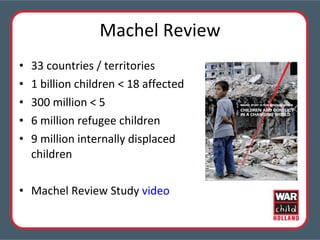
Machel Review 33 countries / territories 1 billion children < 18 affected 300 million < 5  6 million refugee children 9 million internally displaced children Machel Review Study  video
Quote “ Whoever wins the war, children are always the losers and their lost childhood never comes back.”
Quote “ I can help bring peace in Northern Uganda if only my views are heard and acted upon. I don’t hold a gun anymore; I hold the power of my voice.  When visitors come to see us in the centers they normally ask us about our experiences and how we managed to escape… But, they should also be asking us how we can participate in the peace process ourselves because we also fought in the war.”
Six ‘gravest’ violations UN Resolution 1612 Killing and maiming of children Recruiting and using children Attacks on schools and hospitals Rape and other forms of sexual violence  Abduction Denying humanitarian access
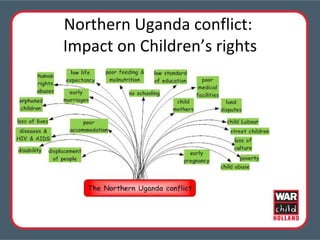
Northern Uganda conflict:  Impact on Children’s rights
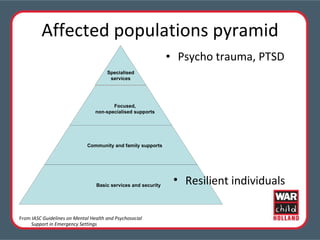
Affected populations pyramid From  IASC Guidelines on Mental Health and Psychosocial Support in Emergency Settings Psycho trauma, PTSD Resilient individuals Specialised services Focused, non-specialised supports Community and family supports Basic services and security
Machel Review Strategic review of Graca Machel study: Impact of Armed Conflict on Children (1996) “ Although we have made advances, especially in developing a solid framework of norms and standards, much more must be done to ensure compliance, to fight impunity and to protect children’s rights.”
Machel Review (cont.) All peacemaking and peacebuilding processes should be child-sensitive, including through  specific provisions in peace agreements,  the participation of  children in those processes and  the prioritization of resources
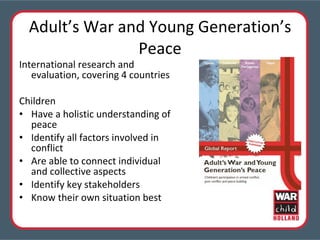
Adult’s War and Young Generation’s Peace International research and evaluation, covering 4 countries Children Have a holistic understanding of peace Identify all factors involved in conflict Are able to connect individual and collective aspects  Identify key stakeholders Know their own situation best
Adult’s War and Young Generation’s Peace (cont.) Recommendation One: Key adult institutions and actors should undertake increased efforts to ensure children’s rights and children’s voices are included in peace processes, peace agreements, and other political processes affecting children. Recommendation Two: Key adult institutions and actors should undertake more systematic efforts to promote and support meaningful, sustainable children’s participation processes, including support to child led peace initiatives, and child led organisations.
Seen, but Not Heard The reality is that children, their families, and their communities are first to be impacted by a lack of security. Children and youth may be seen everywhere, but they remain largely invisible on the security agenda.  And although the children and youth of today are tomorrow’s leaders, their voices are generally not heard.
Seen, but Not Heard (cont.) Children are active agents in their own lives and in their own development, with positive contributions to make, whether to post-conflict peacebuilding or tackling street violence.  Their energy, enthusiasm and creativity needs to be harnessed and tapped for the positive contribution that they can make to society.
2. Connecting the Culture of peace  with Children’s rights Theory Programming practice
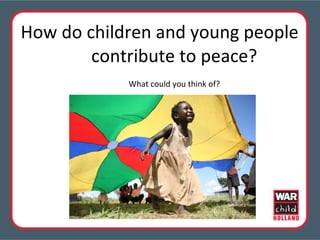
How do children and young people contribute to peace? What could you think of?
Culture of Peace and Children’s rights Knowledge Learn to know Values Learn to be Skills Learn to live together Action Learn to do Awareness Children have rights Beliefs Children are actors Practices Children can participate Systems Children’s best interests are considered
Machel Review  “Youth demand action” We want our rights to be respected. We want justice and to be safe from violence. We want to learn. We want to be healthy. We want jobs and a means to survive. We want more support and care for the excluded and forgotten. We just want to be children. We want to participate.
What is the UN Convention  on the rights of the child? 1989/1990 A Holistic Framework covering Economic/Social/Cultural, and Political/Civil Rights … more “complete” than any other human rights instrument Defines rights that cut across cultural, religious and other frontiers Almost Universal Ratification … 192/194 … the most of any Human Rights Instrument, highly “legitimising”
Why a UN Convention  on the rights of the child? Children not always accepted as holders of rights and actors in their own lives – sometimes as “possessions” of parents or communities Children have specific needs relating to their childhoods in contrast to adults … the special nature of childhood recognised in the UDHR, children’s evolving capacities in UNCRC Children, being “voiceless” have been relatively “invisible” Children often do not have the capacity to protect themselves, from abuse, from exploitation Children’s rights were “scattered” over other HR instruments
Categories of Children’s rights Survival Rights : - rights to life, and needs basic to a child’s existence Development Rights : - things children need to achieve their full potential Protection Rights : safeguards children are entitled to against all forms of neglect, abuse, exploitation Participation Rights:  rights that allow children to take part in affairs that affect their lives Accountability :  rights that allow children to  know that their rights are being fulfilled
Common perspective on children Sees children (especially small children) as passive, vulnerable and helpless, Views adults as the norm and sees childhood as a period of becoming, (of being in transition to adulthood) Holds that adults “know” and assume what is best for children  Follows “trickle down theory” implying that children benefit automatically from benefits that reach their families Bases models of children and childhood in development projects on social science research based on “Western” centred development psychology and pedagogy Tends to overlook gender and other dimensions (class, disability, ethnicity, etc.) Emphasises children's needs rather than children's rights
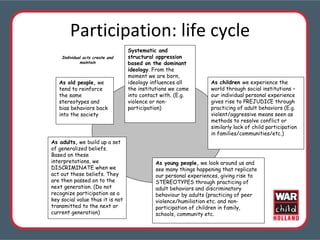
Participation: life cycle Systematic and structural oppression based on the dominant ideology . From the moment we are born, ideology influences all the institutions we come into contact with. (E.g. violence or non-participation) As adults,  we build up a set of generalized beliefs. Based on these interpretations, we DISCRIMINATE when we act out these beliefs. They are then passed on to the next generation. (Do not recognize participation as a key social value thus it is not transmitted to the next or current generation) As young people,  we look around us and see many things happening that replicate our personal experiences, giving rise to STEREOTYPES through practicing of adult behaviors and discriminatory behaviour by adults (practicing of peer violence/humiliation etc. and non- participation of children in family, schools, community etc.  As children  we experience the world through social institutions – our individual personal experience gives rise to PREJUDICE through practicing of adult behaviors (E.g. violent/aggressive means seen as methods to resolve conflict or similarly lack of child participation in families/communities/etc.) As old people,  we tend to reinforce the same stereotypes and bias behaviors back into the society  Individual acts create and maintain
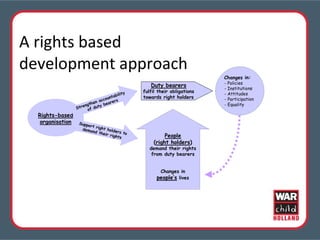
A rights based development approach
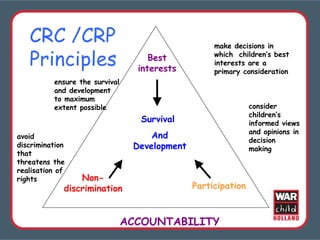
make decisions in which  children’s best interests are a primary consideration ensure the survival and development to maximum extent possible avoid discrimination that threatens the realisation of rights consider children’s informed views and opinions in decision making ACCOUNTABILITY  Survival  And Development Best interests Non-discrimination Participation CRC  /CRP  Principles
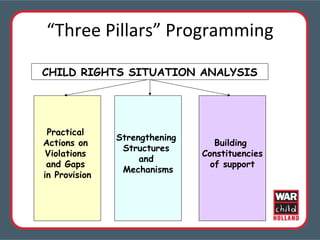
“ Three Pillars” Programming Practical  Actions on  Violations  and Gaps  in Provision Strengthening  Structures  and  Mechanisms Building  Constituencies of support CHILD RIGHTS SITUATION ANALYSIS
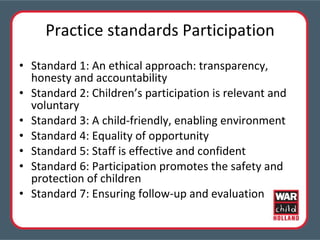
Practice standards Participation Standard 1: An ethical approach: transparency, honesty and accountability Standard 2: Children’s participation is relevant and voluntary Standard 3: A child-friendly, enabling environment Standard 4: Equality of opportunity Standard 5: Staff is effective and confident Standard 6: Participation promotes the safety and protection of children Standard 7: Ensuring follow-up and evaluation
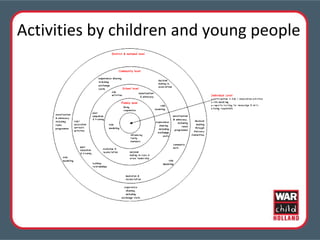
Activities by children and young people
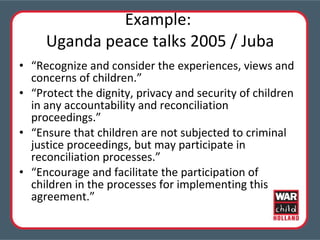
Example:  Uganda peace talks 2005 / Juba “ Recognize and consider the experiences, views and concerns of children.” “ Protect the dignity, privacy and security of children in any accountability and reconciliation proceedings.” “ Ensure that children are not subjected to criminal justice proceedings, but may participate in reconciliation processes.” “ Encourage and facilitate the participation of children in the processes for implementing this agreement.”
3. Case Uganda: Participation - How do children and young people contribute to peace?
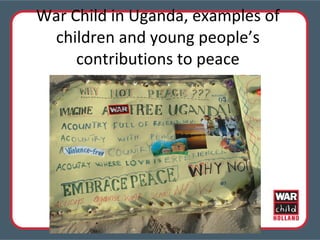
War Child in Uganda, examples of children and young people’s contributions to peace
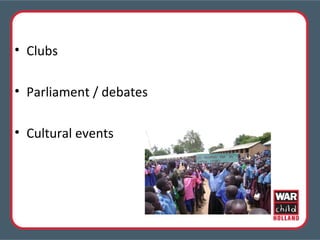
Clubs Parliament / debates Cultural events
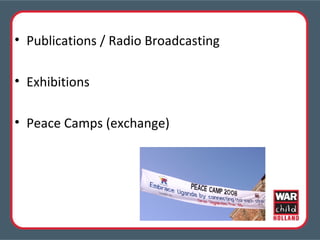
Publications / Radio Broadcasting Exhibitions Peace Camps (exchange)
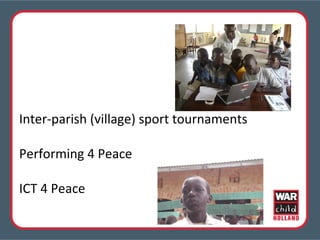
Inter-parish (village) sport tournaments Performing 4 Peace ICT 4 Peace
Sources UN - Machel+10 Report:  http://www.un.org/children/conflict/_download/msr2_en.pdf DCAF - Seen, but Not Heard:  http://www.dcaf.ch/publications/kms/details.cfm?lng=en&id=95946&nav1=5 SCN – Adult’s war, Young Generation’s Peace:  https://www.reddbarna.no/default.asp?V_ITEM_ID=19028

20090807

  • 1.
    UNOY Summer school2009 Children’s rights at stake: participation of children and young people in peacebuilding
  • 2.
    Session outline Impactof armed conflict on children and young people Connecting the Culture of Peace with Children’s rights: Participation Case Uganda: Participation - How do children and young people contribute to peace?
  • 3.
    Debate Statement Adultsare more able to contribute to peace than children and young people.
  • 4.
    1. Impact onchildren and young people
  • 5.
    Machel Review 33countries / territories 1 billion children < 18 affected 300 million < 5 6 million refugee children 9 million internally displaced children Machel Review Study video
  • 6.
    Quote “ Whoeverwins the war, children are always the losers and their lost childhood never comes back.”
  • 7.
    Quote “ Ican help bring peace in Northern Uganda if only my views are heard and acted upon. I don’t hold a gun anymore; I hold the power of my voice. When visitors come to see us in the centers they normally ask us about our experiences and how we managed to escape… But, they should also be asking us how we can participate in the peace process ourselves because we also fought in the war.”
  • 8.
    Six ‘gravest’ violationsUN Resolution 1612 Killing and maiming of children Recruiting and using children Attacks on schools and hospitals Rape and other forms of sexual violence Abduction Denying humanitarian access
  • 9.
    Northern Uganda conflict: Impact on Children’s rights
  • 10.
    Affected populations pyramidFrom IASC Guidelines on Mental Health and Psychosocial Support in Emergency Settings Psycho trauma, PTSD Resilient individuals Specialised services Focused, non-specialised supports Community and family supports Basic services and security
  • 11.
    Machel Review Strategicreview of Graca Machel study: Impact of Armed Conflict on Children (1996) “ Although we have made advances, especially in developing a solid framework of norms and standards, much more must be done to ensure compliance, to fight impunity and to protect children’s rights.”
  • 12.
    Machel Review (cont.)All peacemaking and peacebuilding processes should be child-sensitive, including through specific provisions in peace agreements, the participation of children in those processes and the prioritization of resources
  • 13.
    Adult’s War andYoung Generation’s Peace International research and evaluation, covering 4 countries Children Have a holistic understanding of peace Identify all factors involved in conflict Are able to connect individual and collective aspects Identify key stakeholders Know their own situation best
  • 14.
    Adult’s War andYoung Generation’s Peace (cont.) Recommendation One: Key adult institutions and actors should undertake increased efforts to ensure children’s rights and children’s voices are included in peace processes, peace agreements, and other political processes affecting children. Recommendation Two: Key adult institutions and actors should undertake more systematic efforts to promote and support meaningful, sustainable children’s participation processes, including support to child led peace initiatives, and child led organisations.
  • 15.
    Seen, but NotHeard The reality is that children, their families, and their communities are first to be impacted by a lack of security. Children and youth may be seen everywhere, but they remain largely invisible on the security agenda. And although the children and youth of today are tomorrow’s leaders, their voices are generally not heard.
  • 16.
    Seen, but NotHeard (cont.) Children are active agents in their own lives and in their own development, with positive contributions to make, whether to post-conflict peacebuilding or tackling street violence. Their energy, enthusiasm and creativity needs to be harnessed and tapped for the positive contribution that they can make to society.
  • 17.
    2. Connecting theCulture of peace with Children’s rights Theory Programming practice
  • 18.
    How do childrenand young people contribute to peace? What could you think of?
  • 19.
    Culture of Peaceand Children’s rights Knowledge Learn to know Values Learn to be Skills Learn to live together Action Learn to do Awareness Children have rights Beliefs Children are actors Practices Children can participate Systems Children’s best interests are considered
  • 20.
    Machel Review “Youth demand action” We want our rights to be respected. We want justice and to be safe from violence. We want to learn. We want to be healthy. We want jobs and a means to survive. We want more support and care for the excluded and forgotten. We just want to be children. We want to participate.
  • 21.
    What is theUN Convention on the rights of the child? 1989/1990 A Holistic Framework covering Economic/Social/Cultural, and Political/Civil Rights … more “complete” than any other human rights instrument Defines rights that cut across cultural, religious and other frontiers Almost Universal Ratification … 192/194 … the most of any Human Rights Instrument, highly “legitimising”
  • 22.
    Why a UNConvention on the rights of the child? Children not always accepted as holders of rights and actors in their own lives – sometimes as “possessions” of parents or communities Children have specific needs relating to their childhoods in contrast to adults … the special nature of childhood recognised in the UDHR, children’s evolving capacities in UNCRC Children, being “voiceless” have been relatively “invisible” Children often do not have the capacity to protect themselves, from abuse, from exploitation Children’s rights were “scattered” over other HR instruments
  • 23.
    Categories of Children’srights Survival Rights : - rights to life, and needs basic to a child’s existence Development Rights : - things children need to achieve their full potential Protection Rights : safeguards children are entitled to against all forms of neglect, abuse, exploitation Participation Rights: rights that allow children to take part in affairs that affect their lives Accountability : rights that allow children to know that their rights are being fulfilled
  • 24.
    Common perspective onchildren Sees children (especially small children) as passive, vulnerable and helpless, Views adults as the norm and sees childhood as a period of becoming, (of being in transition to adulthood) Holds that adults “know” and assume what is best for children Follows “trickle down theory” implying that children benefit automatically from benefits that reach their families Bases models of children and childhood in development projects on social science research based on “Western” centred development psychology and pedagogy Tends to overlook gender and other dimensions (class, disability, ethnicity, etc.) Emphasises children's needs rather than children's rights
  • 25.
    Participation: life cycleSystematic and structural oppression based on the dominant ideology . From the moment we are born, ideology influences all the institutions we come into contact with. (E.g. violence or non-participation) As adults, we build up a set of generalized beliefs. Based on these interpretations, we DISCRIMINATE when we act out these beliefs. They are then passed on to the next generation. (Do not recognize participation as a key social value thus it is not transmitted to the next or current generation) As young people, we look around us and see many things happening that replicate our personal experiences, giving rise to STEREOTYPES through practicing of adult behaviors and discriminatory behaviour by adults (practicing of peer violence/humiliation etc. and non- participation of children in family, schools, community etc. As children we experience the world through social institutions – our individual personal experience gives rise to PREJUDICE through practicing of adult behaviors (E.g. violent/aggressive means seen as methods to resolve conflict or similarly lack of child participation in families/communities/etc.) As old people, we tend to reinforce the same stereotypes and bias behaviors back into the society Individual acts create and maintain
  • 26.
    A rights baseddevelopment approach
  • 27.
    make decisions inwhich children’s best interests are a primary consideration ensure the survival and development to maximum extent possible avoid discrimination that threatens the realisation of rights consider children’s informed views and opinions in decision making ACCOUNTABILITY Survival And Development Best interests Non-discrimination Participation CRC /CRP Principles
  • 28.
    “ Three Pillars”Programming Practical Actions on Violations and Gaps in Provision Strengthening Structures and Mechanisms Building Constituencies of support CHILD RIGHTS SITUATION ANALYSIS
  • 29.
    Practice standards ParticipationStandard 1: An ethical approach: transparency, honesty and accountability Standard 2: Children’s participation is relevant and voluntary Standard 3: A child-friendly, enabling environment Standard 4: Equality of opportunity Standard 5: Staff is effective and confident Standard 6: Participation promotes the safety and protection of children Standard 7: Ensuring follow-up and evaluation
  • 30.
    Activities by childrenand young people
  • 31.
    Example: Ugandapeace talks 2005 / Juba “ Recognize and consider the experiences, views and concerns of children.” “ Protect the dignity, privacy and security of children in any accountability and reconciliation proceedings.” “ Ensure that children are not subjected to criminal justice proceedings, but may participate in reconciliation processes.” “ Encourage and facilitate the participation of children in the processes for implementing this agreement.”
  • 32.
    3. Case Uganda:Participation - How do children and young people contribute to peace?
  • 33.
    War Child inUganda, examples of children and young people’s contributions to peace
  • 34.
    Clubs Parliament /debates Cultural events
  • 35.
    Publications / RadioBroadcasting Exhibitions Peace Camps (exchange)
  • 36.
    Inter-parish (village) sporttournaments Performing 4 Peace ICT 4 Peace
  • 37.
    Sources UN -Machel+10 Report: http://www.un.org/children/conflict/_download/msr2_en.pdf DCAF - Seen, but Not Heard: http://www.dcaf.ch/publications/kms/details.cfm?lng=en&id=95946&nav1=5 SCN – Adult’s war, Young Generation’s Peace: https://www.reddbarna.no/default.asp?V_ITEM_ID=19028