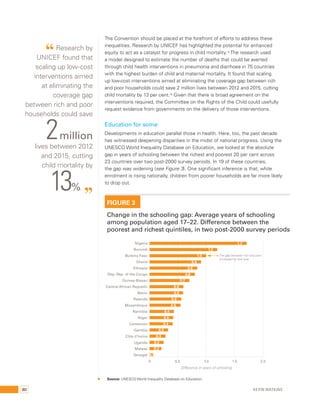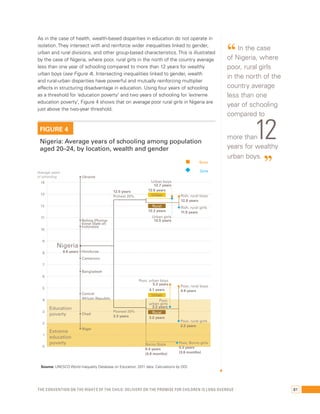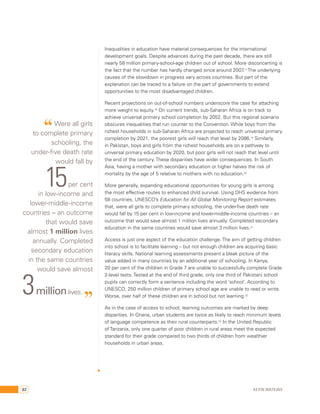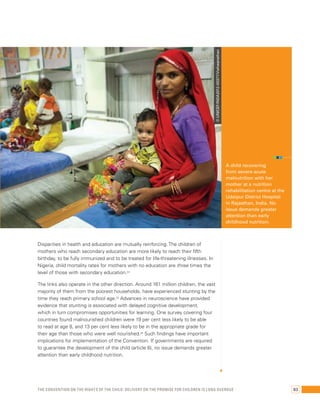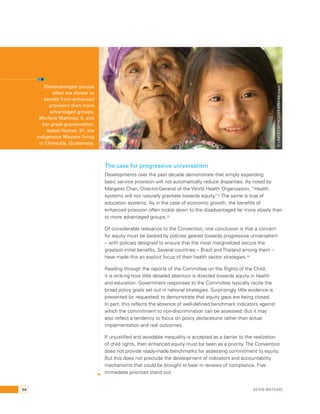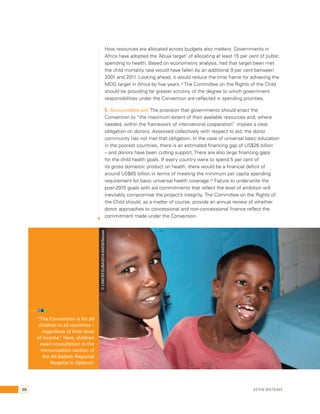
YEARS OF THE CONVENTION ON 
THE RIGHTS OF THE CHILD 
Is the world a better 
place for children?
The statements in this publication are the views of the authors 
and do not necessarily reflect the policies or the views of UNICEF. 
The release of this digital publication will precede the roll-out 
of additional essays by experts and opinion leaders in the weeks 
up until 20 November 2014. All essays will be available on UNICEF’s 
dedicated portal on the Convention on the Rights of the Child: 
<www.unicef.org/crc>. 
Permission is required to reproduce any part of this publication. 
Permission will be freely granted to educational or non-profit 
organizations. Others will be requested to pay a small fee. 
Please contact: 
Division of Communication, UNICEF 
Attn: Permissions 
3 United Nations Plaza 
New York, NY 10017, USA 
Tel: +1 (212) 326-7434 
Email: nyhqdoc.permit@unicef.org 
For the latest data, please visit <www.childinfo.org> 
ISBN: 978-92-806-4765-5 
© United Nations Children’s Fund (UNICEF) 
September 2014
CONTENTS 
3 Foreword 
Children’s rights, equity 
and our common future 
Anthony Lake, Executive Director, UNICEF 
9 Is the world a better place for children? 
A statistical analysis of progress since the adoption 
of the Convention on the Rights of the Child 
Viewpoints 
61 
The genesis and spirit of the Convention 
on the Rights of the Child 
Kirsten Sandberg, Chairperson of the Committee on 
the Rights of the Child 
69 
The Convention on the Rights of the Child: 
Delivery on the promise for children 
is long overdue 
Kevin Watkins, Executive Director, Overseas Development Institute, 
United Kingdom 
107 The Convention on the Rights of the Child: 
What it would mean to fulfil its potential 
Jody Heymann, Dean and Distinguished Professor of Epidemiology, 
University of California Los Angeles Fielding School of Public Health, 
and Founding Director, WORLD Policy Analysis Center 
and 
Amy Raub, Senior Research Analyst, WORLD Policy Analysis Center
3 
Foreword 
Children’s rights, equity 
and our common future 
by Anthony Lake 
Throughout history, the advance of civilization 
has been closely tied to the idea that all people 
have rights: universal, inalienable entitlements 
to freedom, dignity and security, to be treated 
fairly and to live free from oppression. The 
health and soul of all societies depend on 
how these human rights are recognized – and 
acted upon. 
But until the Convention on the Rights of the Child was conceived 
and adopted 25 years ago, the rights of the world’s youngest citizens 
were not explicitly recognized by any international treaty, nor was there 
acknowledgement of the fundamental connection between the well-being 
of children and the strength of their societies. This is why the Convention 
was such an important milestone – and why the occasion of its twenty-fifth 
anniversary challenges us all to find new ways of pursuing its universal 
mandate for every child, as the global community charts its course for the 
post-Millennium Development Goals period. 
The Convention articulated, for the first time, that children also possess 
innate rights, equal to those of adults: rights to health, to education, to 
protection and to equal opportunity – without regard to gender, economic 
status, ethnicity, religious belief, disability or geographical location. And, in 
conformance with the principles of the Charter of the United Nations and 
the Universal Declaration of Human Rights, the Convention unequivocally 
recognizes that these rights are “the foundation of freedom, justice and 
peace in the world.” 
But a recognized right is not necessarily an executed right. Children’s rights 
are brought to life not through pronouncements, but through sustained 
political commitment. A society’s strength is secured not through good 
intentions, but through strategic investments. And social change is achieved 
not only through powerful words, but also through the action such words can 
Anthony Lake 
is the Executive 
Director of UNICEF.
4 
© UNICEF/NYHQ2011-1485/Friedman-Rudovsky 
inspire. For without action – and the results only action can achieve – the best 
aspirations codified in the Convention on the Rights of the Child remain only 
words on paper. 
As the essays in this compendium make clear, during the 25 years since the 
Convention was adopted, the world has taken action. In every region – and 
virtually every nation on earth – the Convention has inspired changes in laws to 
protect children and policies to help them reach their full potential. More broadly, 
it has provided a clear mandate to translate the right of every child to health, 
protection and hope into practical programmes and services. 
This mandate has produced significant results, helping save and transform the 
lives of millions of children around the world. More children than ever before 
are surviving past their fifth birthdays. More are receiving vaccinations against 
diseases such as polio, which is nearly eradicated. More are benefiting from 
improved access to education, sanitation, water and nutrition. More youth are 
participating in matters affecting their own lives and taking a role in shaping their 
own futures. 
These gains are impressive and important – and prove that common goals 
and shared effort can drive real change for children on the global, national and 
local levels. 
But the very national statistical averages we use to prove our progress far too 
often mask the plight of far too many children. When we disaggregate these 
broad averages, disparities and even widening gaps emerge, revealing all the 
children who are not benefiting. Children who are being left behind because 
they live in hard-to-reach areas – in isolated rural communities or urban slums, 
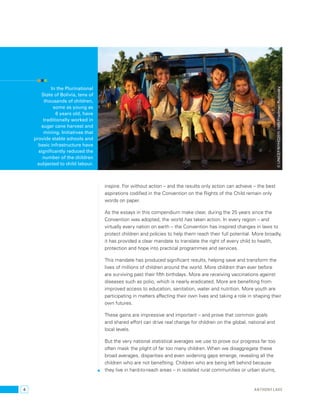
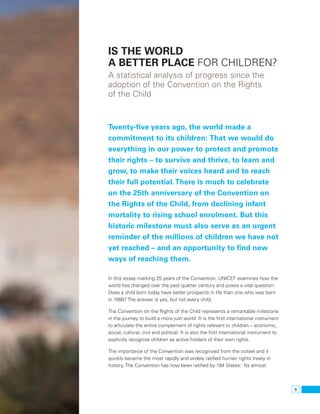
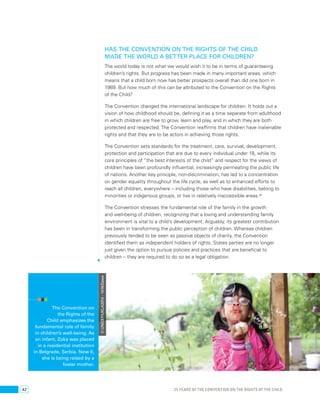
In the Plurinational 
State of Bolivia, tens of 
thousands of children, 
some as young as 
6 years old, have 
traditionally worked in 
sugar cane harvest and 
mining. Initiatives that 
provide stable schools and 
basic infrastructure have 
significantly reduced the 
number of the children 
subjected to child labour. 
anthony lake
or in communities torn by conflict or catastrophes. Children who are victims 
of systemic prejudice and discrimination based on gender, ethnicity, disability, 
religion or skin colour. Children who want for nearly everything. 
We cannot claim that children’s rights are being upheld when 17,000 children 
under the age of 5 die every day, largely from causes we know how to prevent. 
When a girl in Afghanistan is kept home from school to perform household 
chores while her brothers gain an education. When a mother in Pakistan cannot 
access a simple polio vaccination for her child because they live in a remote 
community. When about one in four American children lives in poverty. When 
children are torn from their families, recruited into armed groups, and made to 
fight and die for causes they can barely understand. 
These deprivations and adversities are violations of children’s rights and cruel 
betrayals of children’s hopes and dreams for a better life. This betrayal often 
begins at the beginning, in the earliest years, when critical neural connections 
are being formed in the developing brains of the youngest children. Research 
shows that these connections are deeply affected by deprivation, poor nutrition, 
trauma and toxic stress, further undermining the ability of children to reach their 
full potential. This loss is felt most by individual children and their families, but 
the long-term impact on their societies is tremendous. 
We see the magnitude of this threat most starkly in countries riven by conflict: 
in the Syrian Arab Republic, where children have endured years of violence, 
deprivation and displacement; in the Central African Republic, where children 
have both witnessed and experienced cruelty and inter-communal violence 
on a massive scale; in South Sudan, where civil war is causing a nutrition 
and protection crisis that has left tens of thousands of children dead and has 
undermined the health, well-being and futures of many more. We see it in 
Iraq and in Gaza, where the recurrence of violent conflicts and indiscriminate 
attacks are endangering so many children and undermining the stability of 
their homelands. 
These children are the future leaders of their societies, the future doctors 
and innovators, dreamers and doers. How will they view the world, and their 
responsibility to that world? If their own rights are violated, how will they 
learn respect for the rights of others, which is the foundation of civic duty and 
citizenship? How will they resist the lure of cynicism about the future, if their 
hopes for a better life have been destroyed? 
These questions must be asked and answered as the world marks the 
twenty-fifth anniversary of the Convention and takes stock of progress in 
fulfilling its mandate. It is an especially pivotal time to do so, as the international 
development community – and the broader global community – considers the 
priorities of the ‘post-2015’ period following the conclusion of the Millennium 
Development Goals era. 
“ We cannot 
claim that children’s 
rights are being 
upheld when 17,000 children under 
the age of 5 
die every day. ” 
Children’s rights, equity and our common future 5
6 
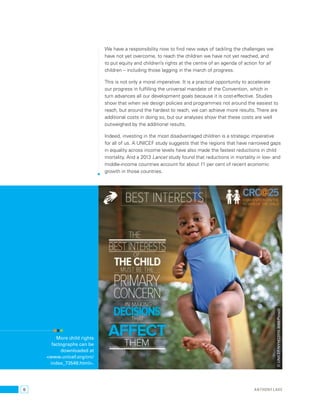
We have a responsibility now to find new ways of tackling the challenges we 
have not yet overcome, to reach the children we have not yet reached, and 
to put equity and children’s rights at the centre of an agenda of action for all 
children – including those lagging in the march of progress. 
This is not only a moral imperative. It is a practical opportunity to accelerate 
our progress in fulfilling the universal mandate of the Convention, which in 
turn advances all our development goals because it is cost-effective. Studies 
show that when we design policies and programmes not around the easiest to 
reach, but around the hardest to reach, we can achieve more results. There are 
additional costs in doing so, but our analyses show that these costs are well 
outweighed by the additional results. 
Indeed, investing in the most disadvantaged children is a strategic imperative 
for all of us. A UNICEF study suggests that the regions that have narrowed gaps 
in equality across income levels have also made the fastest reductions in child 
mortality. And a 2013 Lancet study found that reductions in mortality in low- and 
middle-income countries account for about 11 per cent of recent economic 
growth in those countries. 
anthony lake 
More child rights 
factographs can be 
downloaded at 
<www.unicef.org/crc/ 
index_73549.html>. 
© UNICEF/NYHQ2010-3088/Pirozzi
“ We have a 
responsibility now 
... to put equity and 
children’s rights at 
the centre of an 
agenda of action 
for all children. ” 
When we invest in a child’s health, nutrition, protection and survival, we do more 
than just save a life. As child survival improves, so of course does life expectancy. 
A one-year improvement in a population’s life expectancy is associated with a 
4 per cent increase in national economic output. 
When we invest in a child’s education, we set in motion a path towards 
prosperity, empowerment and inclusion not just for the individual but also for 
societies and economies. Each additional year of schooling translates into an 
up to 10 per cent increase in potential income. 
And we are also building the next generation of parents and leaders who, having 
grown up healthy, well educated and protected, will be better willing and able to 
guide future generations. 
So the rights of children are the foundation of a strong as well as a just society. 
The rapid, widespread ratification of the Convention on the Rights of the 
Child – and the results it has helped bring about for children – are among the 
great triumphs of the past quarter century. For reasons moral, economic and 
humanitarian – and as a means to promote peace and opportunity for every 
person, in every context – we must build on that progress. 
Achieving universal ratification is important, but we must also continue our work 
for universal implementation of the Convention, making the right of the most 
disadvantaged, vulnerable and excluded children to health, education, protection 
and equal opportunity a central public priority. 
The Convention on the Rights of the Child states that in all actions concerning 
children, “the best interests of the child shall be a primary consideration.” If we 
put those interests at the heart of our agenda for the future, we not only serve 
the rights of children, but we also constructively shape our own future. 
Anthony Lake 
Executive Director 
Children’s rights, equity and our common future 7
9 
Is the world 
a better place for children? 
A statistical analysis of progress since the 
adoption of the Convention on the Rights 
of the Child 
Twenty-five years ago, the world made a 
commitment to its children: That we would do 
everything in our power to protect and promote 
their rights – to survive and thrive, to learn and 
grow, to make their voices heard and to reach 
their full potential. There is much to celebrate 
on the 25th anniversary of the Convention on 
the Rights of the Child, from declining infant 
mortality to rising school enrolment. But this 
historic milestone must also serve as an urgent 
reminder of the millions of children we have not 
yet reached – and an opportunity to find new 
ways of reaching them. 
In this essay marking 25 years of the Convention, UNICEF examines how the 
world has changed over the past quarter century and poses a vital question: 
Does a child born today have better prospects in life than one who was born 
in 1989? The answer is yes, but not every child. 
The Convention on the Rights of the Child represents a remarkable milestone 
in the journey to build a more just world: It is the first international instrument 
to articulate the entire complement of rights relevant to children – economic, 
social, cultural, civil and political. It is also the first international instrument to 
explicitly recognize children as active holders of their own rights. 
The importance of the Convention was recognized from the outset and it 
quickly became the most rapidly and widely ratified human rights treaty in 
history. The Convention has now been ratified by 194 States.1 Its almost
10 
universal ratification shows an unparalleled level of agreement among the 
world’s nations: That children must receive the treatment and respect to which 
they have an innate and immutable right. 
The Convention offers a vision of a world in which children have a healthy start in 
life and are educated and protected, a world in which their views are respected 
and they can develop their full physical and mental potential. Its guiding 
principles – non-discrimination; the best interests of the child; the right to life, 
survival and development; and respect for the views of the child – have had a 
profound influence on how children are treated and regarded the world over. 
How has the world changed since 1989? 
The Millennium Development Goals (MDGs) process has been a key feature 
of global life over the past two and a half decades. The targets set by the 
international community were to be achieved by 2015 against a 1990 baseline. 
This is an appropriate moment, therefore, to take stock of the global state of 
children’s rights. 
The Convention on the Rights of the Child came into being at a time of great 
hope. Just 11 days before its adoption, the breaking down of the Berlin Wall 
symbolized the end of the cold war and prompted widespread expectations of 
a peace dividend following decades of spending on nuclear weapons. In 1990, 
Nelson Mandela walked out of prison, a free man after 27 years behind bars.2 
Several decades of statutory discrimination in South Africa soon came to an end 
with the repeal of several laws that had governed apartheid. Mandela was at the 
helm of the African National Congress in 1994, when it won the country’s first 
25 YEARS OF THE CONVENTION ON THE RIGHTS OF THE CHILD 
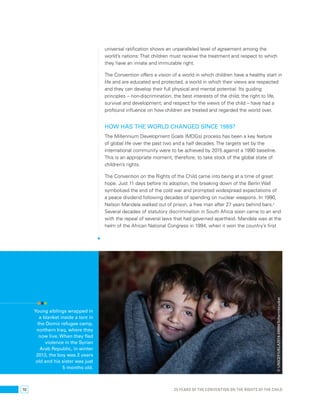
Young siblings wrapped in 
a blanket inside a tent in 
the Domiz refugee camp, 
northern Iraq, where they 
now live. When they fled 
violence in the Syrian 
Arab Republic, in winter 
2013, the boy was 2 years 
old and his sister was just 
5 months old. 
© UNICEF/UKLA2014-04894/Schermbrucker
fully democratic election.3 At the opposite end of the spectrum, the mid-1990s 
witnessed the genocide in Rwanda, with an estimated 800,000 people killed 
over the course of about 100 days.4 
Although the number of armed conflicts around the world has decreased 
from a peak of 52 in 1991 to 33 in 2013,5 the new century has already seen 
major conflicts in Afghanistan, Iraq and the Syrian Arab Republic, among other 
countries. In a world in which more than 1.5 billion people are experiencing 
political and social instability or large-scale criminal violence,6 there is no 
climate of peace and certainly no peace dividend. 
Environmental threats have also dominated the past two and a half decades, 
with the dangers of accelerated human-made climate change becoming 
ever more apparent. The impacts of climate change are already being felt in 
communities all over the world, and the brunt of the impact is being borne 
by children.7 
The world is also a different place in economic terms, with significant 
increases in global trade and investment since 1990. Globalization has brought 
both opportunities and dangers. Greater interconnectedness facilitates 
international investment and trade, and many nations have taken advantage. The 
recent formation of a new international development bank by Brazil, the Russian 
Federation, India, China and South Africa is emblematic of this new reality.8 The 
dangers of such interconnectedness, however, became evident in 2007–2008, 
when a financial crisis in developed markets reverberated globally, with indirect 
adverse effects on the livelihood of the poor and vulnerable in low- and middle-income 
countries. Even in a period when millions have been lifted out of poverty, 
inequalities and vulnerabilities within nations remain significant and have 
become a more pressing concern. 
There have been significant demographic changes, too. The world is becoming 
increasingly urban. In 1990, almost 43 per cent of the world’s population lived 
in cities, compared to 54 per cent in 2014.9 And while the global population has 
increased from just over 5 billion in 1990 to more than 7 billion now,10 growth 
rates have declined markedly in most regions. Sub-Saharan Africa, however, has 
had far higher rates of population growth than any other region, with its low- and 
lower-middle-income countries having the highest growth rates.11 
The proportion of children under age 5 living in countries currently classified 
as low income rose from 13 per cent in 1990 to 19 per cent in 2014.12 Yet, it 
is the poorest countries that inevitably find it most difficult to invest in the 
programmes that will fulfil the rights of their youngest citizens. There is a 
potential dividend to be reaped by those countries, particularly in Africa, that 
manage to successfully reduce birth rates while also investing in the resource 
of their young population. 
“ The proportion 
of children under 
age 5 living in 
countries currently 
classified as low 
income rose from 
13% in 1990 
to 19% in 2014. ” 
Is the world a better place for children? 11
There is more migration, and more complex patterns of migration, than in 1990, 
although migrants’ proportion of the global population has risen just slightly, 
from 2.9 per cent in 1990 to 3.2 per cent in 2013.13 
Information technology has had a transformative effect on societies the world 
over. In 1989, personal computers were relatively new and effectively confined 
to an elite in rich countries. In 2014, computers and mobile phones are an 
established part of life in all countries and, in many instances, are reaching 
relatively undeveloped rural areas. Instantaneous digital communication has 
networked societies, empowered social movements and focused attention 
on abuses or injustices that would have previously remained unnoticed. It has 
also enabled millions of children and adolescents to communicate beyond 
their immediate community and to express their opinions in public – while 
at the same time, however, making them vulnerable to online harassment 
and exploitation.14 Overall, the digital divide between rich and poor within 
low- and middle-income countries remains huge and may be exacerbating 
existing disparities. 
Is the world a better place for children? 
The principles articulated in the Convention on the Rights of the Child are 
indivisible and interdependent – no one right has precedence over another, and 
the non-realization of one right may impact on the realization of the other rights. 
In practice, almost all of the areas of children’s rights overlap and interact with 
each other: A child who is registered at birth is more likely to have access to 
health care, go to school and subsequently be protected from child marriage. 
A young child with access to safe drinking water is more likely to survive and 
be able to attend school at the appropriate age. Safe drinking water in school 
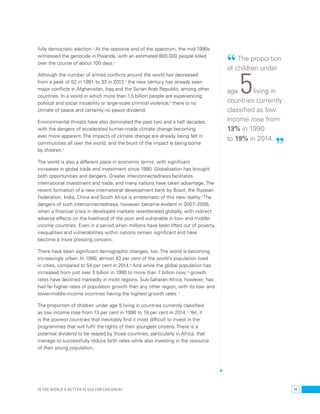
Children play with a 
baby lying in a makeshift 
crib, at a community 
health centre in Cobán, 
Guatemala. The centre 
provides routine health 
care and immunizations 
for young children and 
pregnant women from the 
surrounding area. 
© UNICEF/NYHQ2012-2240/Markisz 
12 25 YEARS OF THE CONVENTION ON THE RIGHTS OF THE CHILD
increases a child’s health and, therefore, academic achievement and likelihood of 
staying in school. A child who is attending school is less likely to be engaged in 
child labour. And so on. 
The lives of millions of children have improved since 1990. Several countries 
have incorporated the provisions of the Convention in their laws, constitutions, 
policies and budgets. Children are now widely viewed differently – as holders 
of their own rights to health care, adequate nutrition, education, participation, 
freedom from violence and exploitation, and the time and space to play. There 
is now a better understanding of the ways in which children experience poverty, 
and how the multiple deprivations they face acutely impact their ability to 
survive and thrive. This knowledge is informing better focused policies and 
programmes for children. More is also known about the importance of early 
childhood as the most important development stage in a person’s life, with 
resulting increases in the number of children benefiting from early education. 
But millions of children continue to lack essential services that can ensure 
their survival, reduce their vulnerability to disease and undernutrition, provide 
them with access to improved water and sanitation, increased access to 
HIV prevention, treatment, care and support services, and allow them to obtain 
a quality education. Millions of children lack a protective environment that shields 
them from violence, exploitation and abuse – in their homes, schools and 
communities. Millions of children continue to live in extreme poverty, a number 
that is disproportionate to their share of the global population. 
Children born to poor parents, children of ethnic minorities, children who live 
in rural areas, and children with disabilities all remain particularly vulnerable. 
The vision of the Convention can only be achieved if the rights of all children, 
including the most disadvantaged, are realized. 
In almost all areas examined in this essay, there has been substantial progress. 
But the task is far from finished. We have travelled farther down the road charted 
by the Convention, but we are still a long way from the envisioned destination. 
This section of the essay attempts to create an overall picture as to whether 
the world is a better place for children now than it was around 1989 and draws 
primarily on statistical evidence. The final section briefly examines legislative, 
programmatic and policy developments. 
Health and nutrition 
Article 6 of the Convention recognizes children’s “inherent right to life” and 
enjoins States parties to “ensure to the maximum extent possible the survival 
and development of the child.” A baby born in 2014 has a dramatically improved 
chance of living to age 5 compared with one born in 1990. The number of children 
under 5 years old who die each year has been reduced by almost 50 per cent – 
from 12.7 million in 1990 to 6.3 million in 2013.15 In global terms, the under-five 
mortality rate declined from 90 per 1,000 live births to 46 per 1,000 live births 
“ Millions of children 
continue to live in 
extreme poverty, 
a number that is 
disproportionate to 
their share of the 
global population. ” 
Is the world a better place for children? 13
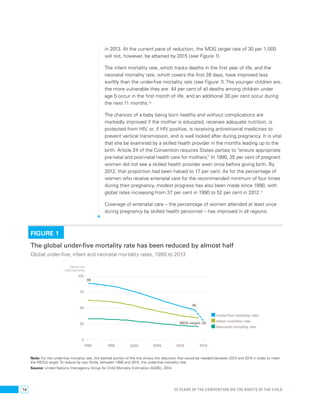
in 2013. At the current pace of reduction, the MDG target rate of 30 per 1,000 
will not, however, be attained by 2015 (see Figure 1). 
The infant mortality rate, which tracks deaths in the first year of life, and the 
neonatal mortality rate, which covers the first 28 days, have improved less 
swiftly than the under-five mortality rate (see Figure 1). The younger children are, 
the more vulnerable they are: 44 per cent of all deaths among children under 
age 5 occur in the first month of life, and an additional 30 per cent occur during 
the next 11 months.16 
The chances of a baby being born healthy and without complications are 
markedly improved if the mother is educated, receives adequate nutrition, is 
protected from HIV, or, if HIV positive, is receiving antiretroviral medicines to 
prevent vertical transmission, and is well looked after during pregnancy. It is vital 
that she be examined by a skilled health provider in the months leading up to the 
birth. Article 24 of the Convention requires States parties to “ensure appropriate 
pre-natal and post-natal health care for mothers.” In 1990, 35 per cent of pregnant 
women did not see a skilled health provider even once before giving birth. By 
2012, that proportion had been halved to 17 per cent. As for the percentage of 
women who receive antenatal care for the recommended minimum of four times 
during their pregnancy, modest progress has also been made since 1990, with 
global rates increasing from 37 per cent in 1990 to 52 per cent in 2012.17 
Coverage of antenatal care – the percentage of women attended at least once 
during pregnancy by skilled health personnel – has improved in all regions. 
14 
FIGURE 1 
The global under-five mortality rate has been reduced by almost half 
Global under-five, infant and neonatal mortality rates, 1990 to 2013 
Under-five mortality rate 
Infant mortality rate 
Neonatal mortality rate 
Deaths per 
1,000 live births 
100 
75 
50 
25 
90 
46 
MDG target: 30 
0 
1990 1995 2000 2005 2010 2015 
Note: For the under-five mortality rate, the dashed portion of the line shows the reduction that would be needed between 2013 and 2015 in order to meet 
the MDG4 target: To reduce by two thirds, between 1990 and 2015, the under-five mortality rate. 
Source: United Nations Inter-agency Group for Child Mortality Estimation (IGME), 2014. 
25 YEARS OF THE CONVENTION ON THE RIGHTS OF THE CHILD
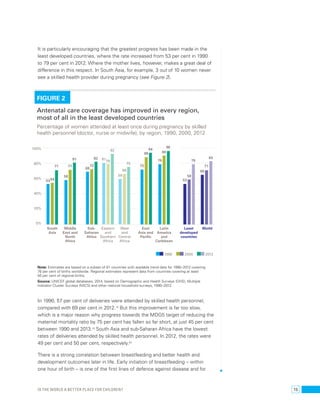
It is particularly encouraging that the greatest progress has been made in the 
least developed countries, where the rate increased from 53 per cent in 1990 
to 79 per cent in 2012. Where the mother lives, however, makes a great deal of 
difference in this respect. In South Asia, for example, 3 out of 10 women never 
see a skilled health provider during pregnancy (see Figure 2). 
FIGURE 2 
Antenatal care coverage has improved in every region, 
most of all in the least developed countries 
Percentage of women attended at least once during pregnancy by skilled 
health personnel (doctor, nurse or midwife), by region, 1990, 2000, 2012 
100% 
80% 
60% 
40% 
20% 
0% 
69 
82 
72 
Sub- 
Saharan 
Africa 
8179 
92 
Eastern 
and 
Southern 
Africa 
59 
75 
66 
West 
and 
Central 
Africa 
72 
88 
94 
East 
Asia and 
Pacific 
58 
71 
81 
Middle 
East and 
North 
Africa 
5354 
71 
South 
Asia 
53 
79 
58 
Least 
developed 
countries 
71 
65 
83 
World 
79 
90 
96 
Latin 
America 
and 
Caribbean 
1990 2000 2012 
Note: Estimates are based on a subset of 81 countries with available trend data for 1990–2012 covering 
76 per cent of births worldwide. Regional estimates represent data from countries covering at least 
50 per cent of regional births. 
Source: UNICEF global databases, 2014, based on Demographic and Health Surveys (DHS), Multiple 
Indicator Cluster Surveys (MICS) and other national household surveys, 1990–2012. 
In 1990, 57 per cent of deliveries were attended by skilled health personnel, 
compared with 69 per cent in 2012.18 But this improvement is far too slow, 
which is a major reason why progress towards the MDG5 target of reducing the 
maternal mortality ratio by 75 per cent has fallen so far short, at just 45 per cent 
between 1990 and 2013.19 South Asia and sub-Saharan Africa have the lowest 
rates of deliveries attended by skilled health personnel. In 2012, the rates were 
49 per cent and 50 per cent, respectively.20 
There is a strong correlation between breastfeeding and better health and 
development outcomes later in life. Early initiation of breastfeeding – within 
one hour of birth – is one of the first lines of defence against disease and for 
Is the world a better place for children? 15
ensuring that babies thrive. But fewer than half of all newborns are put to the 
breast in the first hour and even fewer are exclusively breastfed for the first 
6 months of life. 
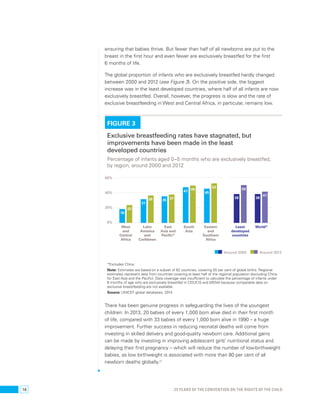
The global proportion of infants who are exclusively breastfed hardly changed 
between 2000 and 2012 (see Figure 3). On the positive side, the biggest 
increase was in the least developed countries, where half of all infants are now 
exclusively breastfed. Overall, however, the progress is slow and the rate of 
exclusive breastfeeding in West and Central Africa, in particular, remains low. 
FIGURE 3 
Exclusive breastfeeding rates have stagnated, but 
improvements have been made in the least 
developed countries 
Percentage of infants aged 0–5 months who are exclusively breastfed, 
by region, around 2000 and 2012 
38 
50 
Least 
developed 
countries 
38 
41 
World* 
Around 2000 Around 2012 
60% 
40% 
20% 
0% 
18 
23 
West 
and 
Central 
Africa 
31 
36 35 37 
Latin 
America 
and 
Caribbean 
East 
Asia and 
Pacific* 
47 49 
South 
Asia 
45 
52 
Eastern 
and 
Southern 
Africa 
*Excludes China. 
Note: Estimates are based on a subset of 62 countries, covering 55 per cent of global births. Regional 
estimates represent data from countries covering at least half of the regional population (excluding China 
for East Asia and the Pacific). Data coverage was insufficient to calculate the percentage of infants under 
6 months of age who are exclusively breastfed in CEE/CIS and MENA because comparable data on 
exclusive breastfeeding are not available. 
Source: UNICEF global databases, 2014. 
There has been genuine progress in safeguarding the lives of the youngest 
children: In 2013, 20 babies of every 1,000 born alive died in their first month 
of life, compared with 33 babies of every 1,000 born alive in 1990 – a huge 
improvement. Further success in reducing neonatal deaths will come from 
investing in skilled delivery and good-quality newborn care. Additional gains 
can be made by investing in improving adolescent girls’ nutritional status and 
delaying their first pregnancy – which will reduce the number of low-birthweight 
babies, as low birthweight is associated with more than 80 per cent of all 
newborn deaths globally.21 
16 25 YEARS OF THE CONVENTION ON THE RIGHTS OF THE CHILD
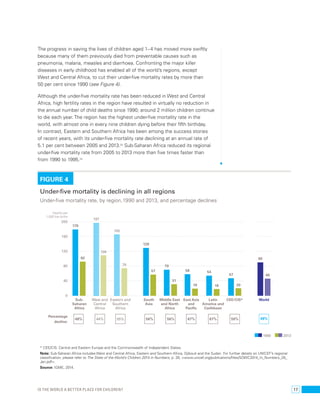
The progress in saving the lives of children aged 1–4 has moved more swiftly 
because many of them previously died from preventable causes such as 
pneumonia, malaria, measles and diarrhoea. Confronting the major killer 
diseases in early childhood has enabled all of the world’s regions, except 
West and Central Africa, to cut their under-five mortality rates by more than 
50 per cent since 1990 (see Figure 4). 
Although the under-five mortality rate has been reduced in West and Central 
Africa, high fertility rates in the region have resulted in virtually no reduction in 
the annual number of child deaths since 1990; around 2 million children continue 
to die each year. The region has the highest under-five mortality rate in the 
world, with almost one in every nine children dying before their fifth birthday. 
In contrast, Eastern and Southern Africa has been among the success stories 
of recent years, with its under-five mortality rate declining at an annual rate of 
5.1 per cent between 2005 and 2013.22 Sub-Saharan Africa reduced its regional 
under-five mortality rate from 2005 to 2013 more than five times faster than 
from 1990 to 1995.23 
FIGURE 4 
Under-five mortality is declining in all regions 
Under-five mortality rate, by region, 1990 and 2013, and percentage declines 
90 
46 
World 
49% 
1990 2013 
Deaths per 
1,000 live births 
200 
160 
120 
80 
40 
0 
179 
92 
Sub- 
Saharan 
Africa 
Percentage 
decline: 
48% 
197 
109 
West and 
Central 
Africa 
44% 
165 
74 
Eastern and 
Southern 
Africa 
55% 
129 
57 
South 
Asia 
56% 
70 
31 
Middle East 
and North 
Africa 
56% 
58 
19 
East Asia 
and 
Pacific 
67% 
54 
18 
Latin 
America and 
Caribbean 
67% 
47 
20 
CE/CIS* 
59% 
* CEE/CIS: Central and Eastern Europe and the Commonwealth of Independent States. 
Note: Sub-Saharan Africa includes West and Central Africa, Eastern and Southern Africa, Djibouti and the Sudan. For further details on UNICEF’s regional 
classification, please refer to The State of the World’s Children 2014 in Numbers, p. 26, <www.unicef.org/publications/files/SOWC2014_In_Numbers_28_ 
Jan.pdf>. 
Source: IGME, 2014. 
Is the world a better place for children? 17
Pneumonia, diarrhoea and malaria are still the leading causes of child 
deaths, together killing approximately 5,000 children under age 5 each day. 
Undernutrition is often an underlying factor that can exacerbate the severity and 
duration of these common illnesses. The major improvements in child survival 
today as compared with 1990 are largely attributable to affordable, evidence-based 
interventions against these diseases – such as immunization, insecticide-treated 
mosquito nets, rehydration treatment for diarrhoea, micronutrient 
supplementation and treatment of acute malnutrition, along with access to clean 
water and sanitation. 
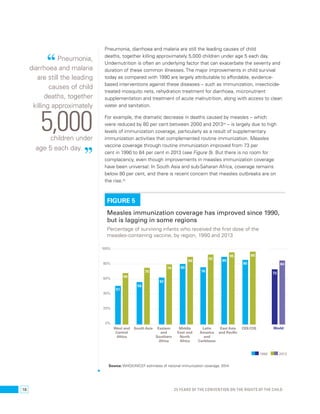
For example, the dramatic decrease in deaths caused by measles – which 
were reduced by 80 per cent between 2000 and 201324 – is largely due to high 
levels of immunization coverage, particularly as a result of supplementary 
immunization activities that complemented routine immunization. Measles 
vaccine coverage through routine immunization improved from 73 per 
cent in 1990 to 84 per cent in 2013 (see Figure 5). But there is no room for 
complacency, even though improvements in measles immunization coverage 
have been universal: In South Asia and sub-Saharan Africa, coverage remains 
below 80 per cent, and there is recent concern that measles outbreaks are on 
the rise.25 
FIGURE 5 
Measles immunization coverage has improved since 1990, 
but is lagging in some regions 
Percentage of surviving infants who received the first dose of the 
measles-containing vaccine, by region, 1990 and 2013 
73 
84 
World 
1990 2013 
100% 
80% 
60% 
40% 
20% 
0% 
62 
79 80 
Eastern 
and 
Southern 
Africa 
89 
Middle 
East and 
North 
Africa 
51 
68 
West and 
Central 
Africa 
56 
75 
South Asia 
76 
92 
Latin 
America 
and 
Caribbean 
89 
95 
East Asia 
and Pacific 
Source: WHO/UNICEF estimates of national immunization coverage, 2014. 
85 
96 
CE/CIS 
“ Pneumonia, 
diarrhoea and malaria 
are still the leading 
causes of child 
deaths, together 
killing approximately 5,000 
children under 
age 5 each day. ” 
18 25 YEARS OF THE CONVENTION ON THE RIGHTS OF THE CHILD
© UNICEF/NYHQ2014-0401/LeMoyne 
As a result of a comprehensive global effort to eradicate polio, the global 
number of cases has decreased by more than 99 per cent since 1988. In 2014, 
polio remains endemic in only three countries – Afghanistan, Nigeria and 
Pakistan. The virus continues to circulate, however, placing the poorest and most 
vulnerable children at risk.26 
A child’s nutritional status is directly linked to the right to survival and 
development, yet 15 per cent of babies are born with low birthweight27 – 
increasing their risk of death during their early months and years, and 
compromising their future health and cognitive functioning. In addition, millions 
of children suffer from micronutrient deficiencies that hamper their ability to 
learn and thrive.28 
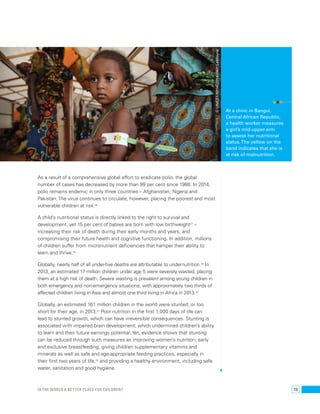
Globally, nearly half of all under-five deaths are attributable to undernutrition.29 In 
2013, an estimated 17 million children under age 5 were severely wasted, placing 
them at a high risk of death. Severe wasting is prevalent among young children in 
both emergency and non-emergency situations, with approximately two thirds of 
affected children living in Asia and almost one third living in Africa in 2013.30 
Globally, an estimated 161 million children in the world were stunted, or too 
short for their age, in 2013.31 Poor nutrition in the first 1,000 days of life can 
lead to stunted growth, which can have irreversible consequences. Stunting is 
associated with impaired brain development, which undermines children’s ability 
to learn and their future earnings potential. Yet, evidence shows that stunting 
can be reduced through such measures as improving women’s nutrition, early 
and exclusive breastfeeding, giving children supplementary vitamins and 
minerals as well as safe and age-appropriate feeding practices, especially in 
their first two years of life,32 and providing a healthy environment, including safe 
water, sanitation and good hygiene. 
At a clinic in Bangui, 
Central African Republic, 
a health worker measures 
a girl’s mid-upper-arm 
to assess her nutritional 
status. The yellow on the 
band indicates that she is 
at risk of malnutrition. 
Is the world a better place for children? 19
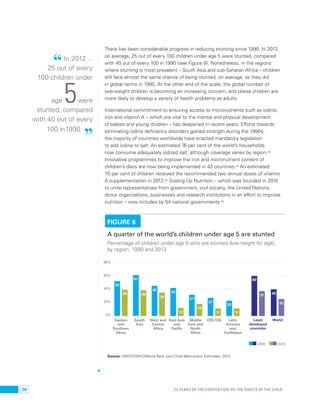
There has been considerable progress in reducing stunting since 1990. In 2013, 
on average, 25 out of every 100 children under age 5 were stunted, compared 
with 40 out of every 100 in 1990 (see Figure 6 ). Nonetheless, in the regions 
where stunting is most prevalent – South Asia and sub-Saharan Africa – children 
still face almost the same chance of being stunted, on average, as they did 
in global terms in 1990. At the other end of the scale, the global number of 
overweight children is becoming an increasing concern, and obese children are 
more likely to develop a variety of health problems as adults. 
International commitment to ensuring access to micronutrients such as iodine, 
iron and vitamin A – which are vital to the mental and physical development 
of babies and young children – has deepened in recent years. Efforts towards 
eliminating iodine deficiency disorders gained strength during the 1990s; 
the majority of countries worldwide have enacted mandatory legislation 
to add iodine to salt. An estimated 76 per cent of the world’s households 
now consume adequately iodized salt, although coverage varies by region.33 
Innovative programmes to improve the iron and micronutrient content of 
children’s diets are now being implemented in 43 countries.34 An estimated 
70 per cent of children received the recommended two annual doses of vitamin 
A supplementation in 2012.35 Scaling Up Nutrition – which was founded in 2010 
to unite representatives from government, civil society, the United Nations, 
donor organizations, businesses and research institutions in an effort to improve 
nutrition – now includes by 54 national governments.36 
FIGURE 6 
A quarter of the world’s children under age 5 are stunted 
Percentage of children under age 5 who are stunted (low height for age), 
by region, 1990 and 2013 
80% 
60% 
40% 
20% 
0% 
60 
37 40 
25 
61 
38 
45 
36 
42 
12 
31 
18 
27 
11 
23 
11 
South World 
Asia 
Least 
developed 
countries 
1990 2013 
West and 
Central 
Africa 
East Asia 
and 
Pacific 
Middle 
East and 
North 
Africa 
CE/CIS Latin 
America 
and 
Caribbean 
52 
39 
Eastern 
and 
Southern 
Africa 
Source: UNICEF/WHO/World Bank Joint Child Malnutrition Estimates, 2014. 
“ In 2012 ... 
25 out of every 
100 children under 
age 5 were 
stunted, compared 
with 40 out of every 
100 in 1990. ” 
20 25 YEARS OF THE CONVENTION ON THE RIGHTS OF THE CHILD
Decades of investments in early childhood health and well-being, higher 
immunization levels and improved child nutrition, among other interventions, 
have resulted in a steep decline in the spread of communicable diseases that 
primarily affect young children. Many children have survived to adolescence 
because of these advances. 
But children who survive until adolescence face new risks and threats to the 
achievement of their rights. Behaviours often established in adolescence 
account for two thirds of premature deaths and one third of the total disease 
burden in adults. Every year, 1.4 million adolescents die from road traffic injuries, 
complications of childbirth, suicide, violence, AIDS and other causes.37 
Water, sanitation and hygiene 
Access to clean water, adequate sanitation and hygiene education is crucial to 
ensuring a child’s right to survival and development, as well as essential for the 
overall health, welfare and livelihood of communities. Increased access and 
better services lead to reduced infections, higher levels of school achievement 
and improved economic productivity. 
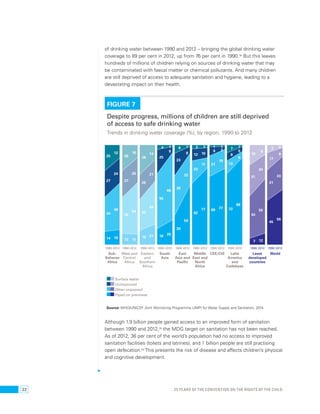
A child living in 2012 was much more likely than a child in 1990 to have access 
to improved sources of drinking water (see Figure 7 ), rather than relying on 
surface water or other unimproved sources. As the MDG target was met 
ahead of time, around 2.3 billion people gained access to improved sources 
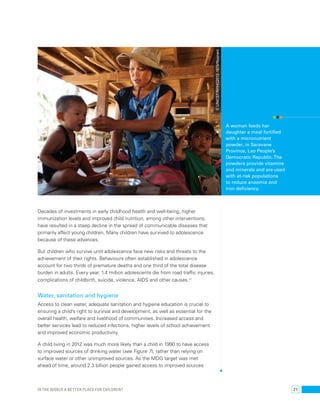
A woman feeds her 
daughter a meal fortified 
with a micronutrient 
powder, in Saravane 
Province, Lao People’s 
Democratic Republic. The 
powders provide vitamins 
and minerals and are used 
with at-risk populations 
to reduce anaemia and 
iron deficiency. 
© UNICEF/NYHQ2012-1874/Noorani 
Is the world a better place for children? 21
of drinking water between 1990 and 2012 – bringing the global drinking water 
coverage to 89 per cent in 2012, up from 76 per cent in 1990.38 But this leaves 
hundreds of millions of children relying on sources of drinking water that may 
be contaminated with faecal matter or chemical pollutants. And many children 
are still deprived of access to adequate sanitation and hygiene, leading to a 
devastating impact on their health. 
FIGURE 7 
Despite progress, millions of children are still deprived 
of access to safe drinking water 
Trends in drinking water coverage (%), by region, 1990 to 2012 
25 
27 
34 
12 
24 
48 
14 16 
25 
27 
36 
10 
25 
54 
12 11 
28 
25 
32 
14 
21 
44 
15 21 
4 1 
25 
55 
8 
66 
16 25 
8 1 
23 
39 
30 
8 
32 
59 
3 2 
12 10 
23 
62 
11 
77 
1 7 
7 2 
8 
13 
72 
1 
5 
6 
88 
19 
31 
43 
9 
24 
55 
7 12 
1 
9 
21 
69 
3 
19 
77 
1990 2012 
Least 
developed 
countries 
1990 2012 
Sub- 
Saharan 
Africa 
1990 2012 
West and 
Central 
Africa 
1990 2012 
Eastern 
and 
Southern 
Africa 
1990 2012 
South 
Asia 
1990 2012 
East 
Asia and 
Pacific 
1990 2012 
Middle 
East and 
North 
Africa 
1990 2012 
CE/CIS 
1990 2012 
Latin 
America 
and 
Caribbean 
Surface water 
Unimproved 
Other improved 
Piped on premises 
Source: WHO/UNICEF Joint Monitoring Programme (JMP) for Water Supply and Sanitation, 2014. 
17 
31 
45 
9 
33 
56 
1990 2012 
World 
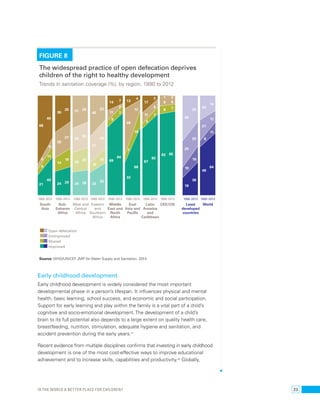
Although 1.9 billion people gained access to an improved form of sanitation 
between 1990 and 2012,39 the MDG target on sanitation has not been reached. 
As of 2012, 36 per cent of the world’s population had no access to improved 
sanitation facilities (toilets and latrines), and 1 billion people are still practising 
open defecation.40 This presents the risk of disease and affects children’s physical 
and cognitive development. 
22 25 YEARS OF THE CONVENTION ON THE RIGHTS OF THE CHILD
FIGURE 8 
The widespread practice of open defecation deprives 
children of the right to healthy development 
Trends in sanitation coverage (%), by region, 1990 to 2012 
68 
5 
6 
21 
40 
9 
11 
40 
1990 2012 
South 
Asia 
36 
26 
14 
25 
27 
19 
24 29 
1990 2012 
Sub- 
Saharan 
Africa 
31 25 
25 
26 
20 23 
24 26 
1990 2012 
West and 
Central 
Africa 
40 
27 
10 
23 
23 
29 
15 
33 
1990 2012 
Eastern 
and 
Southern 
Africa 
14 7 
2 
11 7 
6 
69 
84 
1990 2012 
Middle 
East and 
North 
Africa 
13 
48 
7 
32 
4 
12 
16 
68 
1990 2012 
East 
Asia and 
Pacific 
17 
3 
8 
11 7 
5 
67 
82 
1990 2012 
Latin 
America 
and 
Caribbean 
Open defecation 
Unimproved 
Shared 
Improved 
Source: WHO/UNICEF JMP for Water Supply and Sanitation, 2014. 
46 
25 
10 
19 
23 
25 
16 
36 
1990 2012 
Least 
developed 
countries 
24 
21 
6 
49 
14 
11 
11 
64 
1990 2012 
World 
1 
9 
8 
82 
0 
8 
7 
85 
1990 2012 
CE/CIS 
Early childhood development 
Early childhood development is widely considered the most important 
developmental phase in a person’s lifespan. It influences physical and mental 
health, basic learning, school success, and economic and social participation. 
Support for early learning and play within the family is a vital part of a child’s 
cognitive and socio-emotional development. The development of a child’s 
brain to its full potential also depends to a large extent on quality health care, 
breastfeeding, nutrition, stimulation, adequate hygiene and sanitation, and 
accident prevention during the early years.41 
Recent evidence from multiple disciplines confirms that investing in early childhood 
development is one of the most cost-effective ways to improve educational 
achievement and to increase skills, capabilities and productivity.42 Globally, 
Is the world a better place for children? 23
enrolment in early childhood education increased from 27 per cent in 1990 to 
54 per cent in 2012.43 Yet fewer than 50 per cent of children aged 3–4 attend 
preschool early learning programmes in most low- and middle-income countries.44 
The Convention highlights the importance of early child development in articles 
6, 24 and 27. These articles recognize every child’s right to a standard of living 
that is adequate for physical, mental, spiritual, moral and social development. 
Bolstering the Convention, the importance of caring for every child and giving 
every child the best possible start in life was reaffirmed in the 2002 Declaration 
‘A World Fit for Children’. 
Since the advent of the Convention, there has been significant progress in 
providing children with the best possible start in life. Decreased rates of infant 
and child mortality, reductions in the prevalence of stunting and improved 
sanitation may suggest that the world is on track to meet its promises 
for children. 
Beyond the national averages, however, there are widening disparities 
among and within regions and countries. It is estimated that poverty and 
associated health, nutrition and social factors are preventing 200 million 
children under age 5 in low- and middle-income countries from achieving 
their development potential.45 
With support from UNICEF and other partners, the Committee on the Rights 
of the Child issued a General Comment in 2005 on implementing child rights 
in early childhood.46 The Comment aimed to promote recognition that early 
childhood is a critical period for the realization of all the rights enshrined in 
the Convention and to guide States in further application of early childhood 
development across sectors. More recently, its importance was reaffirmed 
at the global level through the General Assembly’s resolution on the rights of 
the child.47 
Education 
In 1990, the World Conference on Education for All attempted to galvanize action 
by setting a goal of universal primary education by 2000. This was in alignment 
with article 28 of the Convention, which recognizes the State’s duty to ensure 
that primary education is both free and compulsory. The MDGs then recalibrated 
these targets, aiming for gender parity in primary and secondary education by 
2005 and universal primary education by 2015. Although the number of out-of- 
school children of primary school age was reduced by more than 40 per cent 
between 1990 and 2012,48 the MDG targets have not yet been attained. 
24 25 YEARS OF THE CONVENTION ON THE RIGHTS OF THE CHILD
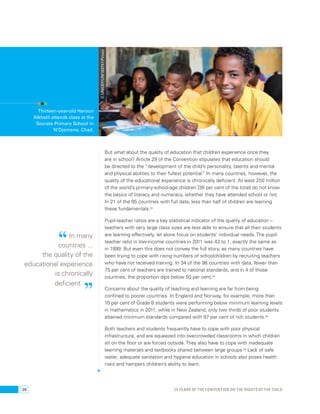
During the early years of this century, there was significant international 
momentum behind the drive to achieve primary education for all (see Figure 
9). Progress has since stalled, however, in part due to reduced aid funding for 
education in the wake of the global financial crisis of 2007–2008.49 As a result, 
almost 58 million children of primary school age, or 9 per cent of children in 
that age group, remain out of school.50 In sub-Saharan Africa, the out-of-school 
rate is much higher (21 per cent) according to official figures – and even higher, 
according to other estimates.51 
About half of the primary-school-age children who are not attending school 
live in countries affected by conflict,52 and that proportion is rising. Of those 
who are out of school in conflict-affected nations, 95 per cent live in low-and 
lower-middle-income countries. In addition, children with disabilities are 
disproportionately likely to be out of school. 
Although the waning rate of progress is disappointing, it should be noted that 
children today have far higher chances of being able to go to primary school 
than they did in 1990. It is also worth noting that, outside sub-Saharan Africa, 
the gender composition of the out-of-school contingent is broadly even, with a 
successful reduction in the number of girls out of school in South and West Asia 
between 2000 and 2010. 
FIGURE 9 
Progress in reducing the global number of out-of-school 
children has stalled 
Number of out-of-school children of primary school age, 1990 to 2012 
Rest of world 
Sub-Saharan 
Africa 
South and 
West Asia 
Millions 
120 
100 
80 
60 
40 
20 
World in 1990 
103.9 million 
10.3 
16.7 
17.1 
21.4 
11.7 
26.5 
0 
1990 
World in 2000 
99.8 million 
11.3 
13.6 
18.7 
22.3 
11.6 
22.2 
2000 
World in 2012 
57.8 million 
9.2 
9.2 
13.0 
16.6 
5.1 
4.8 
2012 
Male 
Female 
Male 
Female 
Male 
Female 
Source: UNESCO Institute for Statistics, 2014. 
“ Almost 58 million 
children of primary 
school age, 
or 9% of children 
in that age group, 
remain out 
of school. ” 
Is the world a better place for children? 25
© UNICEF/UNI163751/Pirozzi 
But what about the quality of education that children experience once they 
are in school? Article 29 of the Convention stipulates that education should 
be directed to the “development of the child’s personality, talents and mental 
and physical abilities to their fullest potential.” In many countries, however, the 
quality of the educational experience is chronically deficient. At least 250 million 
of the world’s primary-school-age children (38 per cent of the total) do not know 
the basics of literacy and numeracy, whether they have attended school or not. 
In 21 of the 85 countries with full data, less than half of children are learning 
these fundamentals.53 
Pupil-teacher ratios are a key statistical indicator of the quality of education – 
teachers with very large class sizes are less able to ensure that all their students 
are learning effectively, let alone focus on students’ individual needs. The pupil-teacher 
ratio in low-income countries in 2011 was 43 to 1, exactly the same as 
in 1999. But even this does not convey the full story, as many countries have 
been trying to cope with rising numbers of schoolchildren by recruiting teachers 
who have not received training. In 34 of the 98 countries with data, fewer than 
75 per cent of teachers are trained to national standards, and in 4 of those 
countries, the proportion dips below 50 per cent.54 
Concerns about the quality of teaching and learning are far from being 
confined to poorer countries. In England and Norway, for example, more than 
10 per cent of Grade 8 students were performing below minimum learning levels 
in mathematics in 2011, while in New Zealand, only two thirds of poor students 
attained minimum standards compared with 97 per cent of rich students.55 
Both teachers and students frequently have to cope with poor physical 
infrastructure, and are squeezed into overcrowded classrooms in which children 
sit on the floor or are forced outside. They also have to cope with inadequate 
learning materials and textbooks shared between large groups.56 Lack of safe 
water, adequate sanitation and hygiene education in schools also poses health 
risks and hampers children’s ability to learn. 
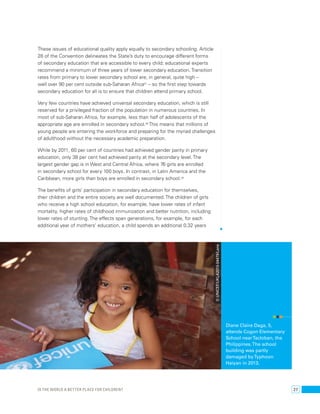
Thirteen-year-old Haroun 
Alkhalil attends class at the 
Socrate Primary School in 
N’Djamena, Chad. 
“ In many 
countries ... 
the quality of the 
educational experience 
is chronically 
deficient. ” 
26 25 YEARS OF THE CONVENTION ON THE RIGHTS OF THE CHILD
These issues of educational quality apply equally to secondary schooling. Article 
28 of the Convention delineates the State’s duty to encourage different forms 
of secondary education that are accessible to every child; educational experts 
recommend a minimum of three years of lower secondary education. Transition 
rates from primary to lower secondary school are, in general, quite high – 
well over 90 per cent outside sub-Saharan Africa57 – so the first step towards 
secondary education for all is to ensure that children attend primary school. 
Very few countries have achieved universal secondary education, which is still 
reserved for a privileged fraction of the population in numerous countries. In 
most of sub-Saharan Africa, for example, less than half of adolescents of the 
appropriate age are enrolled in secondary school.58 This means that millions of 
young people are entering the workforce and preparing for the myriad challenges 
of adulthood without the necessary academic preparation. 
While by 2011, 60 per cent of countries had achieved gender parity in primary 
education, only 38 per cent had achieved parity at the secondary level. The 
largest gender gap is in West and Central Africa, where 76 girls are enrolled 
in secondary school for every 100 boys. In contrast, in Latin America and the 
Caribbean, more girls than boys are enrolled in secondary school.59 
The benefits of girls’ participation in secondary education for themselves, 
their children and the entire society are well documented. The children of girls 
who receive a high school education, for example, have lower rates of infant 
mortality, higher rates of childhood immunization and better nutrition, including 
lower rates of stunting. The effects span generations, for example, for each 
additional year of mothers’ education, a child spends an additional 0.32 years 
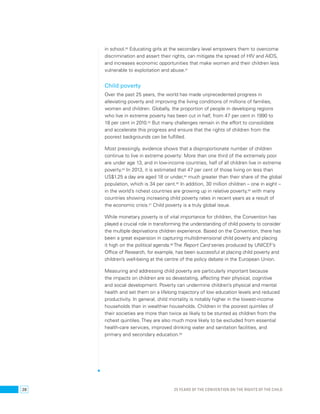
Diane Claire Daga, 5, 
attends Cogon Elementary 
School near Tacloban, the 
Philippines. The school 
building was partly 
damaged by Typhoon 
Haiyan in 2013. 
© UNICEF/UKLA2013-04479/Lane 
Is the world a better place for children? 27
in school.60 Educating girls at the secondary level empowers them to overcome 
discrimination and assert their rights, can mitigate the spread of HIV and AIDS, 
and increases economic opportunities that make women and their children less 
vulnerable to exploitation and abuse.61 
Child poverty 
Over the past 25 years, the world has made unprecedented progress in 
alleviating poverty and improving the living conditions of millions of families, 
women and children. Globally, the proportion of people in developing regions 
who live in extreme poverty has been cut in half, from 47 per cent in 1990 to 
18 per cent in 2010.62 But many challenges remain in the effort to consolidate 
and accelerate this progress and ensure that the rights of children from the 
poorest backgrounds can be fulfilled. 
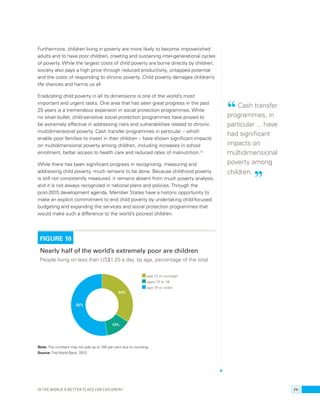
Most pressingly, evidence shows that a disproportionate number of children 
continue to live in extreme poverty: More than one third of the extremely poor 
are under age 13, and in low-income countries, half of all children live in extreme 
poverty.63 In 2013, it is estimated that 47 per cent of those living on less than 
US$1.25 a day are aged 18 or under,64 much greater than their share of the global 
population, which is 34 per cent.65 In addition, 30 million children – one in eight – 
in the world’s richest countries are growing up in relative poverty,66 with many 
countries showing increasing child poverty rates in recent years as a result of 
the economic crisis.67 Child poverty is a truly global issue. 
While monetary poverty is of vital importance for children, the Convention has 
played a crucial role in transforming the understanding of child poverty to consider 
the multiple deprivations children experience. Based on the Convention, there has 
been a great expansion in capturing multidimensional child poverty and placing 
it high on the political agenda.68 The Report Card series produced by UNICEF’s 
Office of Research, for example, has been successful at placing child poverty and 
children’s well-being at the centre of the policy debate in the European Union. 
Measuring and addressing child poverty are particularly important because 
the impacts on children are so devastating, affecting their physical, cognitive 
and social development. Poverty can undermine children’s physical and mental 
health and set them on a lifelong trajectory of low education levels and reduced 
productivity. In general, child mortality is notably higher in the lowest-income 
households than in wealthier households. Children in the poorest quintiles of 
their societies are more than twice as likely to be stunted as children from the 
richest quintiles. They are also much more likely to be excluded from essential 
health-care services, improved drinking water and sanitation facilities, and 
primary and secondary education.69 
28 25 YEARS OF THE CONVENTION ON THE RIGHTS OF THE CHILD
Furthermore, children living in poverty are more likely to become impoverished 
adults and to have poor children, creating and sustaining inter-generational cycles 
of poverty. While the largest costs of child poverty are borne directly by children, 
society also pays a high price through reduced productivity, untapped potential 
and the costs of responding to chronic poverty. Child poverty damages children’s 
life chances and harms us all. 
Eradicating child poverty in all its dimensions is one of the world’s most 
important and urgent tasks. One area that has seen great progress in the past 
25 years is a tremendous expansion in social protection programmes. While 
no silver bullet, child-sensitive social protection programmes have proved to 
be extremely effective in addressing risks and vulnerabilities related to chronic 
multidimensional poverty. Cash transfer programmes in particular – which 
enable poor families to invest in their children – have shown significant impacts 
on multidimensional poverty among children, including increases in school 
enrolment, better access to health care and reduced rates of malnutrition.70 
While there has been significant progress in recognizing, measuring and 
addressing child poverty, much remains to be done. Because childhood poverty 
is still not consistently measured, it remains absent from much poverty analysis, 
and it is not always recognized in national plans and policies. Through the 
post-2015 development agenda, Member States have a historic opportunity to 
make an explicit commitment to end child poverty by undertaking child-focused 
budgeting and expanding the services and social protection programmes that 
would make such a difference to the world’s poorest children. 
FIGURE 10 
Nearly half of the world’s extremely poor are children 
People living on less than US$1.25 a day, by age, percentage of the total 
52% 
34% 
13% 
age 12 or younger 
ages 13 to 18 
age 19 or older 
Note: The numbers may not add up to 100 per cent due to rounding. 
Source: The World Bank, 2013. 
“ Cash transfer 
programmes, in 
particular ... have 
had significant 
impacts on 
multidimensional 
poverty among 
children. ” 
Is the world a better place for children? 29
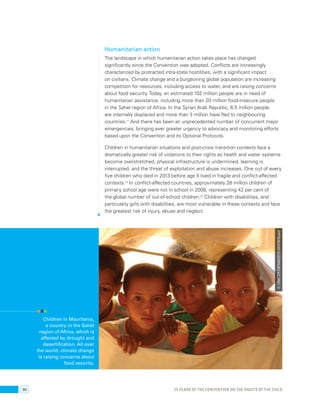
Humanitarian action 
The landscape in which humanitarian action takes place has changed 
significantly since the Convention was adopted. Conflicts are increasingly 
characterized by protracted intra-state hostilities, with a significant impact 
on civilians. Climate change and a burgeoning global population are increasing 
competition for resources, including access to water, and are raising concerns 
about food security. Today, an estimated 102 million people are in need of 
humanitarian assistance, including more than 20 million food-insecure people 
in the Sahel region of Africa. In the Syrian Arab Republic, 6.5 million people 
are internally displaced and more than 3 million have fled to neighbouring 
countries.71 And there has been an unprecedented number of concurrent major 
emergencies, bringing ever greater urgency to advocacy and monitoring efforts 
based upon the Convention and its Optional Protocols. 
Children in humanitarian situations and post-crisis transition contexts face a 
dramatically greater risk of violations to their rights as health and water systems 
become overstretched, physical infrastructure is undermined, learning is 
interrupted, and the threat of exploitation and abuse increases. One out of every 
five children who died in 2013 before age 5 lived in fragile and conflict-affected 
contexts.72 In conflict-affected countries, approximately 28 million children of 
primary school age were not in school in 2008, representing 42 per cent of 
the global number of out-of-school children.73 Children with disabilities, and 
particularly girls with disabilities, are most vulnerable in these contexts and face 
the greatest risk of injury, abuse and neglect. 
Children in Mauritania, 
a country in the Sahel 
region of Africa, which is 
affected by drought and 
desertification. All over 
the world, climate change 
is raising concerns about 
food security. 
© UNICEF/DENM2013-00376/Syed 
30 25 YEARS OF THE CONVENTION ON THE RIGHTS OF THE CHILD
The Convention provides a strong legislative framework for realizing child rights 
in humanitarian crises, particularly in articles 38 and 39 and through the Optional 
Protocols on the sale of children, child prostitution and child pornography, and on 
the involvement of children in armed conflict. 
The United Nations Security Council has embraced the norms and standards 
set by the Convention, referring to the treaty in numerous resolutions on the 
situation of children in armed conflict. Security Council Resolution 1612 (2005) 
established the most significant monitoring mechanism on grave violations 
of children’s rights during armed conflict; Resolution 1882 (2009) requires 
that parties to armed conflict engaged in patterns of “killing and maiming of 
children and/or rape and other sexual violence against children” are listed in the 
Secretary-General’s reports on children in armed conflict; and Resolution 1894 
(2009) addresses sexual violence as a tactic of war. The Security Council has 
also taken steps to protect children’s rights to health services and education 
through resolutions adopted in 1998 and 2011. 
In 2013, conflict-related violence gained additional attention with the 
endorsement by 122 countries of the Declaration of Commitment to End 
Sexual Violence in Conflict74 and the adoption of Security Council Resolution 
2106, which outlines a comprehensive approach and framework to prevent 
conflict-related sexual violence.75 
By upholding children’s rights in all situations, the Convention supports the 
objective of bridging humanitarian action and development assistance. The 
spirit of the Convention helps ensure that continuous investments are made to 
enhance communities’ capacities to cope and manage change on their own in 
the face of shock or stress. Organizations are increasingly applying risk-informed 
programming approaches to protect the rights of children when confronted 
with volatility and shocks, whether caused by natural disasters, armed conflicts, 
disease outbreaks or economic upheavals. The participation of children (as 
stated in article 12 of the Convention) and communities – especially the most 
marginalized and vulnerable – in risk assessment, prevention, emergency 
preparedness, response and recovery can greatly enhance their ability to 
withstand, adapt to and recover from shocks. 
Child protection 
The Convention on the Rights of the Child engendered a greater focus on 
child protection. Prior to its adoption, efforts to protect children were largely 
addressed by issue-specific initiatives,76 and work with children tended 
to concentrate on child survival and development in early childhood. The 
Convention, however, applies to “every human being below the age of eighteen 
years,” which means that a life-cycle approach that encompasses issues of child 
protection – including illicit transfer and non-return of children abroad (article 11), 
child labour (article 32), and child exploitation and abuse (articles 34, 35 and 36) – 
have become much more central to development efforts. 
“ By upholding 
children’s rights 
in all situations, 
the Convention 
supports the 
objective of bridging 
humanitarian action 
and development 
assistance. ” 
Is the world a better place for children? 31
Violence against children can occur in any setting (homes, schools, online) 
and be perpetrated by individuals (parents or other caregivers, peers, intimate 
partners, authority figures, strangers) or groups. The responsibility to protect 
children from violence, abuse, exploitation and neglect begins at birth. The right 
to a name, nationality and family is fundamental: Birth registration secures a 
child’s legal recognition, safeguards multiple rights later in life, and is enshrined 
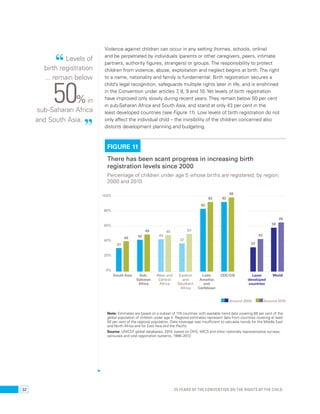
in the Convention under articles 7, 8, 9 and 10. Yet levels of birth registration 
have improved only slowly during recent years. They remain below 50 per cent 
in sub-Saharan Africa and South Asia, and stand at only 43 per cent in the 
least developed countries (see Figure 11). Low levels of birth registration do not 
only affect the individual child – the invisibility of the children concerned also 
distorts development planning and budgeting. 
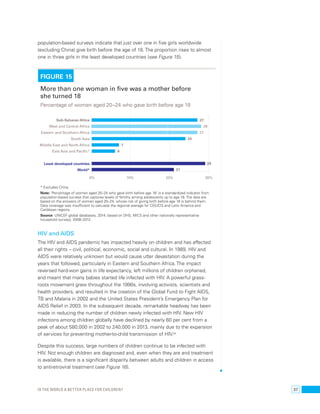
FIGURE 11 
There has been scant progress in increasing birth 
registration levels since 2000 
Percentage of children under age 5 whose births are registered, by region, 
2000 and 2010 
100% 
80% 
60% 
40% 
20% 
0% 
37 
50 
83 
92 92 
98 
32 
43 
58 
65 
Eastern CE/CIS Least 
World 
and 
developed 
Southern 
countries 
Africa 
Around 2000 Around 2010 
31 
40 42 
49 
South Asia Sub- 
Saharan 
Africa 
43 
48 
West and 
Central 
Africa 
Latin 
America 
and 
Caribbean 
Note: Estimates are based on a subset of 119 countries with available trend data covering 68 per cent of the 
global population of children under age 5. Regional estimates represent data from countries covering at least 
50 per cent of the regional population. Data coverage was insufficient to calculate trends for the Middle East 
and North Africa and for East Asia and the Pacific. 
Source: UNICEF global databases, 2014, based on DHS, MICS and other nationally representative surveys, 
censuses and vital registration systems, 1998–2012. 
“ Levels of 
birth registration 
... remain below 50% in 
sub-Saharan Africa 
and South Asia. ” 
32 25 YEARS OF THE CONVENTION ON THE RIGHTS OF THE CHILD
“ In the least 
developed countries, 
nearly one in four 
children is engaged 
in labour. ” 
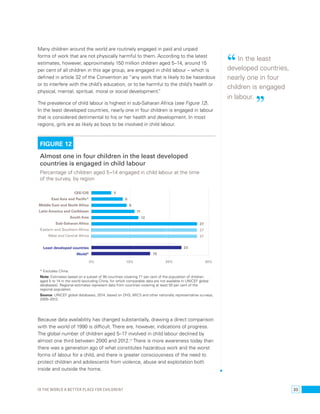
Many children around the world are routinely engaged in paid and unpaid 
forms of work that are not physically harmful to them. According to the latest 
estimates, however, approximately 150 million children aged 5–14, around 15 
per cent of all children in this age group, are engaged in child labour – which is 
defined in article 32 of the Convention as “any work that is likely to be hazardous 
or to interfere with the child’s education, or to be harmful to the child’s health or 
physical, mental, spiritual, moral or social development.” 
The prevalence of child labour is highest in sub-Saharan Africa (see Figure 12). 
In the least developed countries, nearly one in four children is engaged in labour 
that is considered detrimental to his or her health and development. In most 
regions, girls are as likely as boys to be involved in child labour. 
FIGURE 12 
Almost one in four children in the least developed 
countries is engaged in child labour 
Percentage of children aged 5–14 engaged in child labour at the time 
of the survey, by region 
CE/CIS 
East Asia and Pacific* 
Middle East and North Africa 
Latin America and Caribbean 
South Asia 
Sub-Saharan Africa 
Eastern and Southern Africa 
West and Central Africa 
Least developed countries 
World* 
5 
8 
9 
11 
12 
27 
27 
27 
23 
15 
0% 10% 20% 30% 
* Excludes China. 
Note: Estimates based on a subset of 90 countries covering 71 per cent of the population of children 
aged 5 to 14 in the world (excluding China, for which comparable data are not available in UNICEF global 
databases). Regional estimates represent data from countries covering at least 50 per cent of the 
regional population. 
Source: UNICEF global databases, 2014, based on DHS, MICS and other nationally representative surveys, 
2005–2012. 
Because data availability has changed substantially, drawing a direct comparison 
with the world of 1990 is difficult. There are, however, indications of progress. 
The global number of children aged 5–17 involved in child labour declined by 
almost one third between 2000 and 2012.77 There is more awareness today than 
there was a generation ago of what constitutes hazardous work and the worst 
forms of labour for a child, and there is greater consciousness of the need to 
protect children and adolescents from violence, abuse and exploitation both 
inside and outside the home. 
Is the world a better place for children? 33
The Convention’s influence on child protection extends to the work of the 
United Nations on children and armed conflict. The groundbreaking report 
on this issue presented by Graça Machel to the General Assembly, in 1996, 
relied heavily on the Convention.78 The Machel report led to several important 
developments, including: the appointment of a Special Representative on 
children and armed conflict; the General Assembly’s adoption, on 25 May 2000, 
of two Optional Protocols to the Convention on the Rights of the Child – on 
the involvement of children in armed conflict, and on the sale of children, child 
prostitution and child pornography – which have been ratified by 156 and 168 
States parties, respectively;79 and to 10 separate Security Council resolutions 
between 1999 and 2014.80 
Violence against children, in all its myriad and distressing forms, has become 
a paramount concern. The 2006 United Nations Secretary-General’s Study on 
Violence against Children was the first comprehensive global study of the 
issue. To promote dissemination of the study and ensure effective follow-up 
to its recommendations, the study called for the appointment of a Special 
Representative to the Secretary-General on Violence against Children. More 
recently, in September 2014, UNICEF released a study on violence against 
children. The study is the largest compilation of statistics on this issue to date. 
While caregivers play a pivotal role in protecting children, they may sometimes 
be the perpetrators of violence against children. Although household surveys 
indicate that the majority of adults think physical punishment is not needed 
to properly raise children, the same surveys show that many children – from a 
very early age – are subjected to violent forms of discipline at home, involving 
physical punishment and psychological aggression (see Figure 13 ). These routine 
instances of violence can have lasting effects on a child and are violations of 
article 19 of the Convention. 
All forms of violence 
against children are 
unacceptable. A boy, 
6, from an indigenous 
Garifuna community on the 
porch of his home in Pearl 
Lagoon, Nicaragua. 
© UNICEF/NYHQ2012-1488/Dormino 
34 25 YEARS OF THE CONVENTION ON THE RIGHTS OF THE CHILD
FIGURE 13 
Violent discpline appears to be the rule, rather than the exception 
Percentage of children aged 2–14 who experienced any form of violent discipline (psychological aggression 
or physical punishment in the past month) 
Yemen 
Ghana 
Tunisia 
Togo 
Cameroon 
State of Palestine 
Central African Republic 
Democratic Republic of the Congo 
Egypt 
Côte d’Ivoire 
Nigeria 
Morocco 
Gambia 
Jordan 
Liberia 
Swaziland 
Syrian Arab Republic 
Algeria 
Mauritania 
Congo 
Suriname 
Haiti 
Jamaica 
Chad 
Vanuatu 
Burkina Faso 
Lebanon 
Sierra Leone 
Niger 
Guinea-Bissau 
Kiribati 
Iraq 
Tajikistan 
Trinidad and Tobago 
Albania 
Azerbaijan 
Guyana 
Lao People’s Democratic Republic 
Republic of Moldova 
Barbados 
Afghanistan 
Viet Nam 
Argentina 
Djibouti 
Solomon Islands 
Fiji 
Belize 
Armenia 
The former Yugoslav Republic of Macedonia 
Saint Lucia 
Dominican Republic 
Serbia 
Georgia 
Belarus 
Montenegro 
Ukraine 
Bosnia and Herzegovina 
Kyrgyzstan 
Kazakhstan 
Mongolia 
Costa Rica 
Panama 
0% 10% 20% 30% 40% 50% 60% 70% 80% 90% 100% 
Note: Data for Belarus differ from the standard definition. Data for Fiji, Kiribati and Solomon Islands refer to adult reports of whether they have used 
physical discipline on their children. Data for Kyrgyzstan refer to children aged 3 to 14 years. Data for Panama refer to children aged 1 to 14 years. For 
Argentina, the sample was national and urban (municipalities with a population of more than 5,000), since the country’s rural population is scattered and 
accounts for less than 10 per cent of the total. 
Source: UNICEF global databases, 2014, based on DHS, MICS and other nationally representative surveys, 2005–2013. 
Is the world a better place for childenr? 35
Marriage before age 18 is a fundamental violation of child rights, though it is 
still not envisaged as such by many cultures. While not explicitly stated in the 
Convention, it is considered one of the “traditional practices prejudicial to the 
health of children” (article 24). Child marriage is linked to the denial of several other 
rights, including the right to health, physical and mental development, education, 
protection against discrimination, freedom of expression and information, and 
protection from all forms of abuse.81 It is seldom a matter of choice for the child 
(usually a girl) concerned and often involves withdrawal from school, social isolation 
and limited opportunities for gaining economic independence through work. The 
practice remains all too common: Globally, more than 700 million women alive 
today were married before their eighteenth birthday. More than one in three of 
these child brides, or about 250 million, entered into union before age 15.82 
There has, however, been some progress in reducing the prevalence of child 
marriage in all regions over the past three decades. The fastest regional progress 
has been made by the Middle East and North Africa (see Figure 14). South Asia 
still has the highest regional prevalence of child marriage, but the data show that 
in recent years the rate has dipped below 50 per cent. 
Child marriage routinely leads to early pregnancy, although adolescent girls also 
often become mothers outside marriage. Early pregnancy carries great risks: In 
low- and middle-income countries, complications from pregnancy and childbirth 
are a leading cause of death among girls aged 15–19.83 The latest figures from 
FIGURE 14 
Child marriage is still common, especially in South Asia and sub-Saharan Africa, 
but its prevalence is declining 
Percentage of women aged 20–24 years who were married or in union by age 18, by region, 1985 to 2010 
South Asia 
West and Central Africa 
Eastern and Southern Africa 
Latin America and Caribbean 
Middle East and North Africa 
East Asia and Pacific* 
CEE/CIS 
70% 
60% 
50% 
40% 
30% 
20% 
10% 
0% 
1985 1990 1995 2000 2005 2010 
*Excludes China 
Note: Estimates are based on a subset of countries covering at least 50 per cent of the global population of women aged 20 to 24 years. Regional 
estimates represent data covering at least 50 per cent of the regional population. Data coverage is below 50 per cent for East Asia and the Pacific region 
due to the lack of comparable data on child marriage for China in UNICEF global databases. 
Source: UNICEF global databases, 2014, based on DHS, MICS and other nationally representative surveys, 2005–2013. 
36 25 YEARS OF THE CONVENTION ON THE RIGHTS OF THE CHILD
population-based surveys indicate that just over one in five girls worldwide 
(excluding China) give birth before the age of 18. The proportion rises to almost 
one in three girls in the least developed countries (see Figure 15). 
FIGURE 15 
More than one woman in five was a mother before 
she turned 18 
Percentage of women aged 20–24 who gave birth before age 18 
Sub-Saharan Africa 
West and Central Africa 
Eastern and Southern Africa 
South Asia 
Middle East and North Africa 
East Asia and Pacific* 
Least developed countries 
World* 
27 
28 
27 
24 
7 
6 
29 
21 
0% 10% 20% 30% 
* Excludes China. 
Note: ‘Percentage of women aged 20–24 who gave birth before age 18’ is a standardized indicator from 
population-based surveys that captures levels of fertility among adolescents up to age 18. The data are 
based on the answers of women aged 20–24, whose risk of giving birth before age 18 is behind them. 
Data coverage was insufficient to calculate the regional average for CEE/CIS and Latin America and 
Caribbean regions. 
Source: UNICEF global databases, 2014, based on DHS, MICS and other nationally representative 
household surveys, 2008–2012. 
HIV and AIDS 
The HIV and AIDS pandemic has impacted heavily on children and has affected 
all their rights – civil, political, economic, social and cultural. In 1989, HIV and 
AIDS were relatively unknown but would cause utter devastation during the 
years that followed, particularly in Eastern and Southern Africa. The impact 
reversed hard-won gains in life expectancy, left millions of children orphaned, 
and meant that many babies started life infected with HIV. A powerful grass-roots 
movement grew throughout the 1990s, involving activists, scientists and 
health providers, and resulted in the creation of the Global Fund to Fight AIDS, 
TB and Malaria in 2002 and the United States President’s Emergency Plan for 
AIDS Relief in 2003. In the subsequent decade, remarkable headway has been 
made in reducing the number of children newly infected with HIV. New HIV 
infections among children globally have declined by nearly 60 per cent from a 
peak of about 580,000 in 2002 to 240,000 in 2013, mainly due to the expansion 
of services for preventing mother-to-child transmission of HIV.84 
Despite this success, large numbers of children continue to be infected with 
HIV. Not enough children are diagnosed and, even when they are and treatment 
is available, there is a significant disparity between adults and children in access 
to antiretroviral treatment (see Figure 16). 
Is the world a better place for children? 37
FIGURE 16 
Children are falling behind adults in access to 
antiretroviral treatment for HIV 
Percentage of adults (aged 15+) and children (aged 0–14) living with 
HIV and who are receiving ART, in 22 Global Plan priority countries 
and worldwide, 2013 
69 84 
33 55 
45 52 
27 51 
24 51 
9 50 
46 49 
12 48 
42 44 
31 42 
16 41 
22 40 
11 38 
30 36 
8 36 
22 33 
24 38 
0% 20% 40% 60% 80% 100% 
Children (aged 0–14) Adults (aged 15+) 
15 29 
14 27 
6 25 
5 24 
12 21 
8 20 
Botswana 
Zambia 
Namibia 
Zimbabwe 
Malawi 
Ethiopia 
Swaziland 
Burundi 
South Africa 
Kenya 
United Republic of Tanzania 
Uganda 
Ghana 
India 
Côte d'Ivoire 
Mozambique 
Lesotho 
Angola 
Cameroon 
Chad 
Nigeria 
Democratic Republic of the Congo 
World 
Note: The coverage estimate is based on the estimated unrounded number of children living with HIV 
receiving antiretroviral treatment (ART). This has changed from previous years, where coverage was defined 
as the percentage of children living with HIV and eligible for ART based on WHO eligibility treatment criteria 
who were receiving ART. 
Source: Joint United Nations Programme on HIV/AIDS, The Gap Report, July 2014, pp. A65–A74. 
Without antiretroviral treatment, more than 50 per cent of HIV-infected children 
die before age 2 of common childhood diseases such as pneumonia and 
diarrhoea, and most die before their fifth birthday.85 
Adolescents have been largely left behind in the international AIDS response. 
In 2013 alone, 250,000 older adolescents, aged 15–19, were newly infected with 
HIV, and from 2005–2013, the estimated number of AIDS-related deaths among 
that age group has not decreased as seen in other age groups.86 HIV is estimated 
to be the second largest contributor to adolescent (aged 10-19) mortality globally.87 
Household surveys in select countries in sub-Saharan Africa found that most 
adolescents have insufficient correct and comprehensive knowledge about HIV, 
with girls and young women in most countries being even less knowledgeable 
about HIV transmission and prevention than young men (see Figure 17). 
“ In 2013 alone, 
250,000 
older adolescents, 
aged 15–19, 
were newly infected 
with the virus. ” 
38 25 YEARS OF THE CONVENTION ON THE RIGHTS OF THE CHILD
FIGURE 17 
Most adolescents in sub-Saharan Africa do not know enough about HIV 
Percentage of adolescent girls and boys (aged 15–19) with comprehensive, correct knowledge of 
HIV and AIDS*, in selected sub-Saharan African countries, 2008 to 2013 
0% 10% 20% 30% 40% 50% 60% 
Boys aged 15–19 Girls aged 15–19 
Niger 
Côte d'Ivoire 
Congo 
Central African Republic 
Equatorial Guinea 
Comoros 
Guinea 
Madagascar 
Eritrea 
Nigeria 
Ethiopia 
Angola 
Senegal 
Benin 
Cameroon 
Mozambique 
Gabon 
Burkina Faso 
Togo 
Lesotho 
Ghana 
Uganda 
Zambia 
United Republic of Tanzania 
Sao Tome and Principe 
Malawi 
Kenya 
Burundi 
Zimbabwe 
Rwanda 
Swaziland 
* Comprehensive, correct knowledge about HIV and AIDS is defined as correctly identifying the two major ways of preventing the transmission of HIV 
(using condoms and limiting sex to one faithful, uninfected partner), rejecting the two most common local misconceptions about HIV transmission, and 
knowing that a healthy-looking person can transmit HIV. 
Source: UNICEF global HIV and AIDS databases, based on MICS, DHS and other nationally representative household surveys, July 2014. 
Is the world a better place for children? 39
Improving data to promote child rights 
During the past 25 years, the quantity and quality 
of data on children have increased tremendously. 
Before the mid-1990s, critical gaps in data hindered 
accurate and effective analysis of the situation of 
children and women. Around 1990, for example, 
only 29 low- and middle-income countries had 
trend data on child malnutrition, a basic indicator of 
children’s health and well-being. Today, those data 
are available for 107 countries – almost four times 
as many as in 1990. 
The availability of statistics on children and women 
improved after the advent of the Convention on the 
Rights of the Child and the adoption in 1990 of the 
World Summit for Children goals for 2000. The 
Millennium Development Goals (MDGs) and 
‘A World Fit for Children’ generated time-bound 
commitments that required even more data, 
comparable between countries and over time, 
with which to monitor progress. 
In 1995, UNICEF initiated the Multiple Indicator 
Cluster Surveys (MICS) to facilitate monitoring of 
the 1990 World Summit for Children goals and to 
support countries in their efforts to fill important 
data gaps. These surveys have revolutionized 
countries’ ability to document and understand the 
situation of women and children. Undertaken by 
national statistics authorities, they enable countries 
to produce statistically sound and internationally 
comparable estimates on a range of indicators in 
the areas of health, education, nutrition, water 
supply and sanitation, child protection, and HIV 
and AIDS. 
© UNICEF/THLC2008-00004/Thomas 
40 25 YEARS OF THE CONVENTION ON THE RIGHTS OF THE CHILD
Improving data to promote child rights (cont’d) 
Over the course of two decades, UNICEF 
has supported more than 250 MICS in more 
than 100 countries. In addition to low-income 
countries, the MICS programme covers a 
number of middle-income countries and even 
some high-income countries. 
UNICEF works closely with other household 
survey programmes, in particular, the 
Demographic and Health Surveys (DHS), to 
harmonize survey questions and methods of 
analysis. Together, DHS and MICS are the largest 
single source of data for monitoring the MDG 
targets as well as numerous other international 
goals and commitments related to women and 
children, including the Convention on the Rights 
of the Child, the Countdown to 2015 on Maternal, 
Newborn and Child Survival, the Abuja targets for 
malaria and ‘A World Fit for Children’. 
A significant feature of household surveys such 
as DHS and MICS is that the data can be 
disaggregated by age, sex, wealth, residence, 
education, ethnicity and religion, or combinations 
thereof. Disaggregated data allow national 
governments and organizations such as UNICEF 
to identify the most vulnerable and marginalized 
children so that programmes and policies can 
reflect their needs and advance their rights. 
To improve the reach, availability and reliability of 
data on the deprivations that affect children and 
their families, the tools for data collection, analysis 
and dissemination are regularly modified and new 
ones are developed. The number of topics covered 
by MICS, for example, has increased from 15 in 
1995 to 51 in MICS5, 2012–2014. Since the early 
2000s, inter-agency technical expert groups have 
played an important role in the development of 
new tools and methods to collect and analyse data. 
Recent discussions on a ‘development data 
revolution’ recognize data as central to the success 
of the post-2015 development agenda – and that 
data are vital to promote social accountability, 
reduce disparities and create a better future for 
all children. 
Increased investments are needed to strengthen 
routine data collection systems, including civil 
registration, vital statistics and health, and 
education information systems. These complement 
periodic household surveys, which provide 
development data at the outcome and impact 
level for the entire population. Whereas finance 
ministries often readily fund economic-based 
surveys – such as those related to income and 
expenditure, household budget or labour force 
participation – surveys on social indicators, such 
as MICS and DHS, also require predictable 
funding and need to become an integral part of 
national statistical development strategies. 
Is the world a better place for childenr? 41
Has the Convention on the Rights of the Child 
made the world a better place for children? 
The world today is not what we would wish it to be in terms of guaranteeing 
children’s rights. But progress has been made in many important areas, which 
means that a child born now has better prospects overall than did one born in 
1989. But how much of this can be attributed to the Convention on the Rights 
of the Child? 
The Convention changed the international landscape for children. It holds out a 
vision of how childhood should be, defining it as a time separate from adulthood 
in which children are free to grow, learn and play, and in which they are both 
protected and respected. The Convention reaffirms that children have inalienable 
rights and that they are to be actors in achieving those rights. 
The Convention sets standards for the treatment, care, survival, development, 
protection and participation that are due to every individual under 18, while its 
core principles of “the best interests of the child” and respect for the views of 
children have been profoundly influential, increasingly permeating the public life 
of nations. Another key principle, non-discrimination, has led to a concentration 
on gender equality throughout the life cycle, as well as to enhanced efforts to 
reach all children, everywhere – including those who have disabilities, belong to 
minorities or indigenous groups, or live in relatively inaccessible areas.88 
The Convention stresses the fundamental role of the family in the growth 
and well-being of children, recognizing that a loving and understanding family 
environment is vital to a child’s development. Arguably, its greatest contribution 
has been in transforming the public perception of children. Whereas children 
previously tended to be seen as passive objects of charity, the Convention 
identified them as independent holders of rights. States parties are no longer 
just given the option to pursue policies and practices that are beneficial to 
children – they are required to do so as a legal obligation. 
The Convention on 
the Rights of the 
Child emphasizes the 
fundamental role of family 
in children’s well-being. As 
an infant, Zoka was placed 
in a residential institution 
in Belgrade, Serbia. Now 6, 
she is being raised by a 
foster mother. 
© UNICEF/UKLA2014 - 1419/Dawe 
42 25 YEARS OF THE CONVENTION ON THE RIGHTS OF THE CHILD
As stated in article 4, “States Parties shall undertake all appropriate legislative, 
administrative and other measures for the implementation of the rights 
recognized in the present Convention.” This is not a distant principle or aspiration 
– it is something for which every State that has ratified the Convention must 
take responsibility through its interaction with the Committee on the Rights 
of the Child. 
The Committee is an international body of 18 independent experts tasked with 
monitoring implementation of the Convention by its States parties. Each country 
must submit an initial report two years after acceding to the Convention, then 
submit a follow-up report every five years. The Committee responds with its 
concluding observations, which contain concerns and recommendations that the 
country is invited to address over the succeeding five-year period. In addition, 
the Committee reviews reports from States parties to the Convention’s three 
Optional Protocols – on the involvement of children in armed conflict; on the sale 
of children, child prostitution and child pornography; and on a communications 
procedure (see Box, page 44 ) – as well as issuing General Comments on key 
issues to guide States in implementing children’s rights. 
The progress in the world’s treatment of children that has been charted, 
statistically and otherwise, in these pages has occurred over a period in which 
countries have been directly and publicly held to account for their policies and 
practices. Improvements in national provisions for children are often made in 
direct response to observations of the Committee, as is indicated by many of 
the positive examples cited in this section of the essay, which concentrates 
on four main areas: legislative reform, independent institutions, child-focused 
budgets and participation.89 These represent just a selection of the key measures 
that form the foundation of efforts to realize all the rights and principles 
enshrined in the Convention, and therefore merit special attention. 
In addition to the Committee on the Rights of the Child, a variety of other 
mechanisms contribute to accountability for child rights, including the Special 
Representatives of the Secretary-General on Violence against Children, and 
Children and Armed Conflict; Special Procedures of the Human Rights Council, 
including the United Nations Special Rapporteurs on the sale of children, child 
prostitution and child pornography, and education; and the Universal Periodic 
Review of the Human Rights Council. 
Other global and regional instruments that have been inspired or guided by 
the Convention include the International Labour Organization Conventions 
138 (on minimum age) and 182 (on worst forms of child labour), and such 
regional instruments as the African Charter on the Rights and Welfare of the 
Child and European Union and Council of Europe standards. National courts 
have upheld principles of the Convention, and the new Optional Protocol on a 
communications procedure establishes an additional resource mechanism for 
violations of child rights. 
Is the world a better place for children? 43
Establishing a communications procedure for the Convention 
on the Rights of the Child: The third Optional Protocol 
The Optional Protocol to the Convention on the 
Rights of the Child on a communications procedure 
was adopted by the United Nations General 
Assembly on 19 December 2011. This third 
Optional Protocol is designed to ensure that 
children have access to legal remedies when they 
have been unable to obtain justice in their own 
countries, and establishes a complaints procedure 
under the Convention on the Rights of the Child 
that is similar to those previously established for 
other core human rights treaties. 
The Optional Protocol on a communications 
procedure is open for signature by any State that 
has signed, ratified or acceded to the Convention 
on the Rights of the Child or the Optional Protocols 
to the Convention on the involvement of children 
in armed conflict and on the sale of children, child 
prostitution and child pornography. As of 
14 September 2014, it had been ratified by 
11 States parties.1 
Under the communications procedure, an individual 
child, groups of children or their representatives 
from any country that is a Party to the Optional 
Protocol can bring complaints directly to the 
Committee on the Rights of the Child concerning 
violations of their rights under the Convention or 
the other two Optional Protocols – after they have 
first exhausted domestic legal remedies, or where 
the application of the remedies is unreasonably 
prolonged or unlikely to bring effective relief. The 
Optional Protocol allows the Committee to open 
an investigation of grave or systematic violations 
of children’s rights by a State party upon receipt of 
reliable information. Participating States can also 
bring complaints against each other when they fail 
to live up to their child rights obligations under the 
Convention and its Optional Protocols, although the 
Office of the High Commissioner for Human Rights 
notes that inter-state complaints provisions of 
several human rights treaties have never 
been used.2 
The Optional Protocol recognizes that national 
governments have the primary responsibility for 
respecting and fulfilling child rights. This new 
instrument aims to reinforce and complement 
national and regional mechanisms that allow 
children to submit complaints for violations of 
their rights, and encourages States parties to 
develop child-sensitive procedures that enable 
children to access effective remedies at the 
domestic level.3 It strengthens the international 
system of accountability for human rights, and is 
a major step towards the full protection of 
children’s rights and the participatory approach 
of the Convention. 
1 United Nations, Optional Protocol to the Convention on the Rights of the Child on a communications procedure, A/RES/66/138, 
United Nations Treaty Collection, Chapter IV, Human Rights, 2014, <https://treaties.un.org/Pages/ViewDetails. 
aspx?src=TREATY&mtdsg_no=IV-11-d&chapter=4&lang=en>, accessed 14 September 2014. 
2 Office of the United Nations High Commissioner for Human Rights, Human Rights Bodies – Complaints Procedures, 
<www.ohchr.org/EN/HRBodies/TBPetitions/Pages/HRTBPetitions.aspx>, accessed 8 August 2014. 
3 United Nations, Resolution adopted by the General Assembly [on the report of the Third Committee (A/66/457)], A/RES/66/138, 
United Nations, New York, 27 January 2012, p. 2. 
44 25 YEARS OF THE CONVENTION ON THE RIGHTS OF THE CHILD
Legislative reform 
Countries that have ratified the Convention on the Rights of the Child have 
committed to bringing their national legislation in line with its standards and 
principles. Many States parties have embarked on this process and have made, 
and continue to make, impressive progress in harmonizing their legislative 
frameworks with the Convention – whether through overarching laws on 
children’s rights or child protection, or through mainstreaming children’s rights in 
sector-specific laws. 
Some countries have adopted constitutions with provisions dedicated to 
protecting children’s rights. Others have enacted children’s codes or children’s 
acts, or laws on specific issues such as adoption, child labour, child trafficking, 
female genital mutilation and the protection of adolescent mothers. Some have 
amended their criminal codes to introduce provisions designed to combat sexual 
exploitation of children and punish perpetrators. In the area of juvenile justice, 
important steps have been taken in many countries to give special attention to 
the rights of children in conflict with the law. 
Among the many promising examples: 
• Viet Nam adopted the amended Law on the Protection, Care and Education 
of Children in 2004, following concerns expressed by the Committee on 
the Rights of the Child.90 The Committee has since welcomed not only this 
law, but also other Vietnamese laws promoting and protecting child rights, 
Usher, 7 (in a red shirt 
and yellow sandals), 
plays football with his 
cousins and friends; he 
attends primary school 
in his village of Ponta 
Nova, Guinea-Bissau. 
Child rights are universal, 
regardless of children’s 
ability or disability. 
© UNICEF/PFPG2014P-0651/Lynch 
Is the world a better place for children? 45
including those on human trafficking, disability and adoption. It has also 
welcomed the acknowledgement of children’s right to be heard in judicial and 
administrative proceedings. In addition, Viet Nam adopted the Law on Persons 
with Disabilities and the Law on Adoption in 2010.91 
• Tunisia’s new Constitution, passed by the National Constituent Assembly 
in January 2014, includes article 47 dedicated to child rights. This explicitly 
recognizes that the child is a subject of rights, that the family and the State 
must guarantee these rights without discrimination, and that the child’s best 
interests must take precedence in any decision concerning him or her.92 
• Angola’s current Constitution makes specific reference to the rights of 
children, in particular to the concept of the best interests of the child. In 2012, 
the landmark Children’s Act was passed, on which UNICEF had collaborated 
closely. This enshrines key provisions of the Convention in national law and 
integrates the 11 ‘Commitments for Angolan Children’.93 
• In its review of Bangladesh in 2009, the Committee on the Rights of the Child 
recommended that the 1974 Children’s Act be revised.94 Bangladesh has now 
passed the new Children’s Act, which is based on the Convention. The Act 
defines childhood as lasting until 18 years of age; provides a comprehensive 
legal framework for preventing and responding to abuse, violence and 
exploitation; and legitimizes budgetary outlays on child protection systems and 
justice for children.95 
• Regarding Norway, in 2010, the Committee on the Rights of the Child noted 
the country’s ongoing activities to amend laws or adopt new ones in order to 
bring legislation in full harmony with the Convention.96 
Independent human rights institutions for children 
When the Convention on the Rights of the Child was adopted in 1989, less 
than a handful of independent human rights institutions for children existed in 
the world. Today, there are more than 200 operating in more than 70 countries, 
including ombudspersons, child commissioners, mediators, and child rights or 
human rights commissions. 
The role of these independent public bodies is to defend children’s best interests 
and champion their rights in policy and practice. They monitor the actions of 
governments and other entities, receive complaints, provide remedies for 
violations, and offer a space for dialogue about children in society and between 
children and the State. But they face numerous challenges, whether because 
their independence is threatened, their recommendations ignored or their 
focus on child rights questioned for political or budgetary reasons. Their ability 
to carry out their mandate effectively depends upon the constant vigilance and 
commitment of all in the field.97 
“ Today, there are 
more than 200 
[independent human 
rights institutions for 
children] operating 
in more than 70 
countries.” ” 
46 25 YEARS OF THE CONVENTION ON THE RIGHTS OF THE CHILD
These institutions have taken many actions to bring about change at the national 
level; the following list provides examples from various countries: 
• In Peru, the Defensoría del Pueblo (Office of the Ombudsperson) intervened 
in 2008, when the relevant authorities failed to act upon reports of the sexual 
abuse of children by a teacher. The teacher was subsequently prosecuted, 
together with those who had obstructed the judicial process.98 
• In Azerbaijan, the Commissioner for Human Rights has made a number of 
proposals to the National Assembly since 2011 to provide support to poor 
families, promote children’s deinstitutionalization and protect children’s rights 
in cases of divorce.99 
• In El Salvador, the Procuraduría para la Defensa de los Derechos Humanos 
(Attorney for the Defense of Human Rights) has set up juvenile dissemination 
units for human rights, each comprising around 300 volunteers aged 15–25. 
The activities of the units have evolved from focusing on human rights 
promotion to monitoring state action.100 
• In Indonesia, the Komisi Nasional Hak Asasi Manusia (National Commission 
for Human Rights), in 2005, analysed proposed law reforms related to 
citizenship from a child rights perspective and recommended several changes 
regarding children whose fathers are not Indonesian. The revised law on 
nationality adopted in 2006 addresses this concern.101 
“ [Independent 
human rights 
institutions for 
children] have taken 
many actions to bring 
about change at the 
national level. ” 
Boys play on a makeshift 
cart in the Bogra district, 
northern Bangladesh. 
Low lying and densely 
populated, the country is 
prone to annual flooding; 
around 3 million people 
were affected by monsoon 
floods triggered by heavy 
rainfall in September 2014. 
© UNICEF/BANA2014-01728/Paul 
Is the world a better place for children? 47
Child-focused budgeting 
Under article 4 of the Convention, States parties are obligated to invest in 
children to the maximum extent of their available resources. As a result, 
increasing numbers of countries are designing budgets with children specifically 
in mind. In addition, the Committee on the Rights of the Child, with the support 
of children’s organizations, is working on a General Comment on public spending 
to realize children’s rights that will clarify the policy implications of article 4.102 
Initiatives to introduce child-focused budgeting are being implemented in 
countries across the world. These include efforts to analyse budgets from a child 
rights-based perspective, ensure equitable resource allocation and expenditure, 
and raise public awareness of the importance of investing in children. Among 
the many positive examples: 
• In Jordan, a child budget analysis led to the development, in 2011, of a 
five-year Child Budget Engagement Plan that serves as guidance for the 
national budgeting process. The Ministries of Education, Health, Labour and 
Social Development have integrated child-friendly budgeting into their annual 
planning and budgeting. Moreover, government budget allocations for children 
are distinguished in Budget Law Table No. 22, as of 2012. There is a particular 
focus on service delivery for children with disabilities and other vulnerable 
children – identified as an area for improvement by the Committee on the 
Rights of the Child in 2006.103 
• In Bangladesh, nine social sector ministries developed a Child-Focused 
Budgeting Framework, which was launched in 2013 and is the first step 
towards child-sensitive budgeting, as urged by the Committee on the Rights 
of the Child in 2009. The Ministry of Finance is committed to integrating 
child-sensitive budgeting into the budgetary framework for the coming 
fiscal year.104 
Six-month-old Answer is 
a healthy child. Exposed 
to HIV in the womb, he 
has been treated with 
antiretrovirals since birth 
and remains HIV free. 
“ Initiatives 
to introduce 
child-focused 
budgeting are being 
implemented in 
countries across 
the world. ” 
© UNICEF/PFPG2014P-0426/Schermbrucker 
48 25 YEARS OF THE CONVENTION ON THE RIGHTS OF THE CHILD
• In Mexico, the annual federal budget includes an annex that shows the 
proportion of each line in the budget dedicated to children. Throughout the 
year, child-related expenditures are automatically coded and published online 
as part of the annual budget process.105 
• In South Africa, the Children’s Institute has worked with partners since 2007 
to monitor the Government’s budget for implementing the Children’s Act. This 
has involved annual analyses of allocations and spending in the budgets of 
the nine provincial departments of social development. Under the Children’s 
Act, these departments are required to provide and fund a range of care, 
protection and social services for children, especially the most vulnerable.106 
Participation 
Respect for the views of the child is one of the four guiding principles of the 
Convention identified by the Committee on the Rights of the Child. Along with 
other articles covering freedom of expression (13), thought, conscience and 
religion (14), association and peaceful assembly (15) and access to information 
(17), article 12 states that a child capable of forming his or her own views must 
have the “the right to express those views freely” in all matters affecting the 
child and for those views to be “given due weight in accordance with the age 
and maturity of the child”. This has had a transformative influence on how 
children are perceived, and on how they are treated by legal proceedings,107 
governments and societies. 
Participation is considered separately in this section but, in reality, it also plays 
a central part in all three of the preceding areas considered in this chapter – in 
legislative reform, child-focused budgeting and the work of independent human 
rights institutions for children, as well as in all programmatic areas highlighted in 
the earlier sections of this publication. 
Significant progress has been made in promoting the participation and 
self-expression of children all over the world. In particular, the right of children 
to be heard in matters that affect them has been increasingly recognized and a 
growing number of countries have made efforts to incorporate this right to be 
heard into administrative and legal proceedings. For instance, with the support 
of UNICEF, countries have established children’s parliaments that play an active 
role in addressing children’s issues in political and legislative deliberations. 
However, the Committee on the Rights of the Child has expressed concern that 
even where there are opportunities for children to be heard – and this is often 
challenged by traditional cultural attitudes, as well as political and economic 
barriers – the implementation is at times inadequate and of low quality. It has 
also noted that schools often lack respect for the right of children to be heard.108 
Younger children, girls and children belonging to vulnerable, marginalized and 
disadvantaged groups are much less likely to be heard. 
“ Respect for the 
views of the child 
is one of the four 
guiding principles of 
the Convention. ” 
Is the world a better place for children? 49
In 2009, the Committee’s General Comment No. 12 on the Right of the Child to 
Be Heard provided guidance to governments on how to implement the principle 
of children’s participation. There is a manifest need, however, to develop better 
indicators against which to monitor and measure the impact of participation 
by boys and girls – both how it happens and the benefits that flow from it. 
To this end, The Concerned for Working Children, Plan, Save the Children, 
UNICEF and World Vision developed a toolkit for monitoring and evaluating 
children’s participation.109 
Some notable examples of child participation include: 
• In Jamaica, the Office of the Children’s Advocate launched a Children’s 
Advisory Panel to facilitate the participation of children in its work. Panellists, 
who are recruited from traditional and non-traditional high schools, and public 
and private primary schools, provide their opinions on policies, programmes 
and issues that affect children.110 
• In Egypt, in 2013, more than 6,200 young people in 15 governorates gained 
increased knowledge and skills for active citizenship through a civic education 
programme implemented in partnership with the Ministry of Youth and Sports. 
The programme involved workshops covering rights and responsibilities, 
participation and active citizenship. An additional 2,100 adolescents participated 
in a life skills and employability programme supported by UNICEF.111 
“ There is manifest 
need ... to develop 
better indicators 
against which to 
monitor and measure 
the impact of 
participation by boys 
and girls. ” 
Governments are 
obligated to ensure to the 
maximum extent possible 
children’s survival and 
development. A caregiver 
with two young children 
at the Sayariy Warmi early 
childhood development 
(ECD) centre in 
Sucre, Bolivia. 
© UNICEF/NYHQ2013-1495/Pirozzi 
50 25 YEARS OF THE CONVENTION ON THE RIGHTS OF THE CHILD
• In Nepal, new policy provisions now promote the participation of girls and 
boys at key levels of the local government process. For example, some 
76,000 child club representatives (half of whom are girls) now have a voice in 
the Government’s 35,000 ward citizens forums nationwide.112 
• In Uganda, UNICEF has supported the development and implementation of 
‘U-report’, an innovative Short Message Service-based system that enables 
young Ugandans to report on development issues that are important to them. 
U-report now reaches more than 263,000 Ugandans and is helping to connect 
them to national planning and policymaking processes.113 
• In Rwanda, children with disabilities are now included in all decentralized-level 
child-organized forums, ensuring their participation and consideration 
of their views. This was a direct result of the discussions on equity between 
children and policymakers at the seventh national Children’s Summit, in 2012, 
supported by UNICEF. The Children’s Summit highlighted the voices and 
concerns of children living with disabilities, and promoted support for electing 
children with disabilities in children’s forums at the village, cell, sector and 
district levels. Today, one out of every six children elected to the children’s 
forums is a child living with a disability.114 
A better future for all is within reach 
The past 25 years have proved that change is possible. Children born today 
have a far better chance to survive, thrive and reach their potential than children 
born before 1989. Much of that is due to the emphasis the Convention places 
on children, enabling the world to zero in on what children are entitled to, rather 
than what adults think they need. 
The protracted crisis 
in the Syrian Arab 
Republic impacts upon 
children’s learning and 
well-being – and their 
futures. Syrian girls 
attend morning classes at 
a child-friendly school in 
the Za’atari refugee camp, 
Jordan; boys attend in 
the afternoon. 
“ Children born 
today have a far better 
chance to survive, 
thrive and reach 
their potential than 
children born before 1989. ” 
© UNICEF/UKLA2013-04587/Leclerc 
Is the world a better place for children? 51
The Convention is not just a historic document. It is a living force for change that 
directs and guides everyone from governments and international agencies to 
teachers and parents. But it is equally plain that further change is still required – 
that we are far from having achieved the child-friendly world that is promised by 
the Convention. 
Population dynamics are changing, while human-made and natural disasters, 
conflicts and climate change are putting hard-won gains at risk. Furthermore, 
large disparities remain within and between countries. Even as several targets 
have been achieved in terms of global or national averages, often the most 
disadvantaged and most vulnerable children have been left behind. 
The Convention does not deal in averages or aggregates: The rights it 
enumerates and elucidates apply to every child in the human family, wherever 
and into whatever circumstances they happen to be born. Its message to the 
next phase of human development is clear: No child can be left out or stranded 
beyond the reach of the latest ‘quick win’. We must reach out to the poorest 
and most vulnerable, closing the equity gaps so that the progress made is 
universally shared and equitable. 
As the world marks this anniversary, it is vital that we do more than simply 
take stock of successes and failures. As important as it is to achieve universal 
ratification of the Convention, we must also continue our work for universal 
implementation. We cannot afford to continue at the same pace for the next 
25 years. Unless efforts are stepped up, the rights of millions of children will 
continue to be violated. 
When we come together to focus commitments, investments and actions 
on the right interventions, true progress ensues. The outcomes detailed 
in this essay on child survival, education and water quality, among other 
issues, are evidence of that. But we cannot afford to be satisfied with these 
partial successes when we know that millions of children are excluded from 
their benefits. 
Let us then rededicate ourselves to the tasks ahead and to fulfilling the vision 
of the Convention. There is an urgent need, for example, to scale up action and 
advocacy to end preventable maternal and child deaths, with a particular focus 
on providing high-quality care around the time of birth. This can exponentially 
increase the chances of survival for both mothers and children, and could save 
the lives of millions of newborns each year. 
We should also invest in the early years of a child’s life, when the brain is growing 
rapidly. The best start in life is secured by keeping children healthy and nourished 
during early childhood, protecting them from violence and abuse, and giving them 
the stimulation they need to set forth on a path of success in school and in life. 
As children progress into adolescence, the most urgent priority is to end the routine 
and normalized violence that they face on a daily basis. The evidence is stark: 
Violence against children is everywhere – in schools, in homes and in communities – 
and it is much more common and more visible than we may typically recognize. 
“ The Convention 
does not deal 
in averages or 
aggregates: The 
rights it enumerates 
and elucidates apply 
to every child in the 
human family. ” 
52 25 YEARS OF THE CONVENTION ON THE RIGHTS OF THE CHILD
These are but a few of the myriad challenges facing the world if children’s rights 
are to be guaranteed. They may seem formidable, but the solutions are within 
reach. Some of those come from technology and some from long experience 
working on the problems of human development – a generation’s worth of trial 
and error bearing fruit. Increasingly, novel answers are being found outside the 
traditional paradigms, as social movements and communities – including young 
people – innovate and create solutions to local problems that have the potential 
to resonate around the world. 
But renewed commitment from the world as a whole is still required. 
Governments need to put in place the resources needed to make good on 
the promises their nations have made to children as part of the Convention. 
They need to make child-friendly budgets a universal reality rather than a ‘pilot 
scheme’ that is marginalized in times of crisis. They need to recognize that a 
society in which all children’s rights are fulfilled will be a healthier and happier 
one for every citizen. 
In rededicating ourselves to making the vision of the Convention a reality, we 
also make a commitment to a better future for us all. 
More child rights 
factographs can be 
downloaded at 
<www.unicef.org/crc/ 
index_73549.html>. 
©UNICEF/NYHQ2011-1751/Pirozzi 
Is the world a better place for children? 53
NOTES 
1 United Nations Treaty Collection, Convention on the Rights of the Child, Chapter IV, Human 
Rights, Resolution 44/25 of 20 November 1989, <https://treaties.un.org/Pages/ViewDetails. 
aspx?src=TREATY&mtdsg_no=IV-11&chapter=4&lang=en>, accessed 14 September 2014. Of 
the three United Nations Member States that have not ratified the Convention, both Somalia and 
the United States of America have signed, which constitutes a preliminary endorsement of the 
Convention but does not create binding legal obligations. The third Member State, South Sudan, 
became independent in 2011. 
2 United Nations Department of Public Information, Nelson Mandela in his Words: Excerpts from 
speeches 1961–2008, United Nations, New York, June 2010, pp. 7, 37. 
3 BC Archive, ‘News: Apartheid laws scrapped’, 1 February 1991, <www.bbc.co.uk/archive/ 
apartheid/7222.shtml>, accessed 31 August 2014; and United States Department of State, 
‘Archive: The end of apartheid’, <http://2001-2009.state.gov/r/pa/ho/time/pcw/98678.htm>, 
accessed 31 August 2014. 
4 United Nations Security Council, ‘Letter Dated 15 December 1999 from the Secretary-General 
Addressed to the President of the Security Council’, S/1999/1257, 16 December 1999, p. 3, 
<www.securitycouncilreport.org/atf/cf/%7B65BFCF9B-6D27-4E9C-8CD3-CF6E4FF96FF9%7D/ 
POC%20S19991257.pdf>, accessed 31 August 2014. 
5 Uppsala Conflict Data Program, cited in Lotta Themnér and Peter Wallenstein, ‘Armed Conflicts 
1946–2013’, Journal of Peace Research, vol. 51, no. 4, 2014, p. 543. 
6 World Bank, World Development Report 2011, World Bank, Washington, D.C., p. 2, 
<https://openknowledge.worldbank.org/bitstream/handle/10986/4389/9780821384398_overview. 
pdf>, accessed 31 August 2014. 
7 UNICEF Office of Research, Children on the Front Line: The challenges of climate change, UNICEF 
Office of Research, Florence, Italy, 2014, preface. 
8 United Nations, Department of Economic and Social Affairs, Development, Policy and Analysis 
Division, ‘World Economic Situation and Prospects – Monthly Briefing’, No. 69, United Nations, 
New York, August 2014, p. 1, <www.un.org/en/development/desa/policy/wesp/wesp_mb/wesp_ 
mb69.pdf>, accessed 31 August 2014. 
9 Data for 1990: Department of Economic and Social Affairs, Population Division, World Urbanization 
Prospects: The 2014 revision, CD-ROM Edition, United Nations, New York, 2014. Data for 2014: 
Department of Economic and Social Affairs, Population Division, World Urbanization Prospects: 
The 2014 revision – Highlights, ST/ESA/SER.A/352, United Nations, New York, 2014, p. 1. 
10 Department of Economic and Social Affairs, Population Division, Concise Report on the World 
Population Situation in 2014, United Nations, New York, 2014, p. 2; and United Nations, World 
Population Prospects: The 2012 revision, <http://esa.un.org/unpd/wpp/unpp/panel 
_population.htm>, accessed 31 August 2014. 
11 United Nations Population Division, World Population Prospects, 2012 Revision, United Nations, 
New York, 2013. Country classification: World Bank, Data, Country and Lending Groups: 
<http://data.worldbank.org/about/country-classifications/country-and-lending-groups>, accessed 
2 September 2014. 
12 United Nations Population Division, World Population Prospects, 2012 Revision, United Nations, 
New York, 2013. Country classification: World Bank, Data, Country and Lending Groups: 
<http://data.worldbank.org/about/country-classifications/country-and-lending-groups>, accessed 
2 September 2014. 
13 Department of Economic and Social Affairs, Population Division, Concise Report on the World 
Population Situation in 2014, United Nations, New York, 2014, p. 17. 
14 See, for example: UNICEF Innocenti Research Centre, Child Safety Online: Global challenges and 
strategies – Technical report, United Nations Children’s Fund, Florence, Italy, May 2012. 
15 United Nations Children’s Fund, Committing to Child Survival: A Promise Renewed – Progress 
report 2014, UNICEF, New York, 2014, p. 13. 
16 Ibid, p. 24. 
17 UNICEF global databases, 2014. 
18 United Nations, The Millennium Development Goals Report 2014, United Nations, 
New York, 2014, p. 29. 
54 25 YEARS OF THE CONVENTION ON THE RIGHTS OF THE CHILD
19 World Health Organization, United Nations Children’s Fund, United Nations Population Fund and 
the World Bank, Trends in Maternal Mortality: 1990 to 2013, WHO, Geneva, 2014. 
20 United Nations Children’s Fund, The State of the World’s Children 2014 in Numbers, UNICEF, 
New York, January 2014, p. 77. 
21 Mason, Elizabeth, et al., ‘From Evidence to Action to Deliver a Healthy Start for the Next 
Generation’, The Lancet, vol. 384, no. 9941, 2 August 2014, pp. 455–467. 
22 United Nations Children’s Fund, Committing to Child Survival: A Promise Renewed – Progress 
report 2014, UNICEF, New York, 2014, p. 15. 
23 Ibid. 
24 Ibid., p. 20. 
25 World Health Organization, Global Measles and Rubella Strategic Plan 2012–2020, WHO, 
Geneva, 2012, p. 18. 
26 World Health Organization, Fact Sheet No.114 on Poliomyelitis, updated May 2014, 
<http://www.who.int/mediacentre/factsheets/fs114/en/>, accessed 22 September 2014. 
27 United Nations Children’s Fund, ‘UNICEF Data: Monitoring the situation of children and 
women – Undernourishment in the womb can lead to diminished potential and predispose 
infants to early death’, UNICEF, 2014, <http://data.unicef.org/nutrition/low-birthweight>, 
accessed 1 September 2014. 
28 For example the World Health Organization estimates that 250 million preschool children are 
vitamin A deficient, see: <www.who.int/nutrition/topics/vad/en/> accessed 6 September 2014; 
and according to UNICEF, in 2011, 534,000 newborns were unprotected against iodine deficiency 
disorders, United Nations Children’s Fund, Improving Child Nutrition: The achievable imperative for 
global progress, UNICEF, New York, 2013, p. iv.5. 
29 United Nations Inter-agency Group for Child Mortality Estimation, Levels and Trends in Child 
Mortality – Report 2014, UNICEF, WHO, the World Bank and the United Nations, New York, 
2014, p. 1. 
30 United Nations Children’s Fund, the World Health Organization and the World Bank, ‘2013 Joint 
UNICEF/WHO/World Bank Child Malnutrition Estimates’, 2014. 
31 Ibid. 
32 United Nations Children’s Fund, Improving Child Nutrition: The achievable imperative for global 
progress, UNICEF, New York, April, 2013, p. 18. 
33 Data as of 2012. United Nations Children’s Fund, The State of the World’s Children 2014 in 
Numbers, UNICEF, New York, January 2014, p. 41. 
34 United Nations Children’s Fund, NUTRIDASH: The 2013 Global Report (draft), Nutrition Section, 
Programme Division, UNICEF New York, 2014. 
35 United Nations Children’s Fund, The State of the World’s Children 2014 in Numbers, UNICEF, 
New York, January 2014, p. 41. 
36 Scaling Up Nutrition, <http://scalingupnutrition.org>, accessed 6 September 2014. 
37 United Nations Children’s Fund, Progress for Children: A report card on adolescents, No. 10, 
UNICEF, New York, 2012, pp. 4, 18; and World Health Organization, Child and Adolescent Health 
and Development Progress Report 2009: Highlights, WHO, Geneva, 2010, p. 16. 
38 World Health Organization and United Nations Children’s Fund, Progress on Drinking Water and 
Sanitation: 2014 update, WHO, Geneva, 2014, p. v, <www.wssinfo.org/fileadmin/user_upload/ 
resources/JMP_report_2014_webEng.pdf>, accessed 31 August 2014. 
39 World Health Organization and United Nations Children’s Fund, Progress on Drinking Water and 
Sanitation: 2014 update, WHO, Geneva, 2014, p. 20. 
40 Ibid., p. v, 8. 
41 Naudeau, Sophie, et al., Investing in Young Children: An early childhood development guide for 
policy dialogue and project preparation, World Bank, Washington, D.C., 2011. 
Is the world a better place for children? 55
42 United Nations Children’s Fund, ‘The Formative Years: UNICEF’s work on measuring early childhood 
development’, UNICEF, New York, 1 January 2014, p. 1, <http://data.unicef.org/ecd/overview>, 
accessed 1 September 2014. 
43 UNESCO Institute Statistics Data Centre, <http://data.uis.unesco.org/#>, accessed 9 September 
2014. Data are for pre-primary gross enrolment. 
44 United Nations Children’s Fund, The State of the World’s Children 2014 in Numbers, UNICEF, 
New York, p. 109. 
45 Walker, Susan P., et al., ‘Child Development: Risk factors for adverse outcomes in developing 
countries’, The Lancet, vol. 369, no. 9556, 13 January 2007, pp. 145–157. 
46 Committee on the Rights of the Child, General Comment No. 7 (2005) Implementing child rights in 
early childhood, CRC/C/GC/7/Rev.1, United Nations, Geneva, 20 September 2006. 
47 Resolution adopted by the United Nations General Assembly, ‘Rights of the Child’, A/RES/65/197, 
30 March 2011. 
48 UNESCO Institute for Statistics. 
49 United Nations Children’s Fund, ‘Basic Education and Gender Equality: Equitable access’, 
UNICEF, New York, 15 July 2014, <www.unicef.org/education/bege_61657.html>, accessed 
1 September 2014. 
50 UNESCO Institute for Statistics and EFA Global Monitoring Report, ‘Progress in Getting All Children 
to School Stalls’, Policy Paper 14/Fact Sheet 28, United Nations Educational, Scientific and Cultural 
Organization, Montreal and Paris, June 2014, p. 1. 
51 Data for sub-Saharan Africa: UNESCO Institute Statistics Data Centre, 
<http://data.uis.unesco.org/#>, accessed 9 September 2014; higher estimates found in the 
following sources: United Nations Children’s Fund and UNESCO Institute for Statistics, Eastern and 
Southern Africa Regional Report, Global Initiative on Out-of-School Children, UNICEF and UIS, 
Nairobi, June 2014, <www.uis.unesco.org/Education/Documents/esar-oosci-report-2013.pdf>, 
accessed 31 August 2014; and United Nations Children’s Fund West and Central Africa Regional 
Office and UNESCO Institute for Statistics, Regional Report: West and Central Africa, Global 
Initiative on Out-of-School Children, UNICEF and UIS, Dakar, March 2014, <www.uis.unesco.org/ 
Education/Documents/wca-oosci-report-2014-en.pdf>, accessed 31 August 2014.. 
52 United Nations Educational, Scientific and Cultural Organization, EFA Global Monitoring Report 
2013/4: Teaching and learning, UNESCO, Paris, 2014, p. 55. 
53 United Nations Educational, Scientific and Cultural Organization, EFA Global Monitoring Report 
2013/4: Teaching and learning, UNESCO, Paris, 2014, p. 19. 
54 Ibid., pp. 85–86. 
55 Ibid., p. 20. 
56 Ibid., pp. 87–88. 
57 United Nations Educational, Scientific and Cultural Organization, EFA Global Monitoring Report 
2013/4: Teaching and learning, UNESCO, Paris, 2014, pp. 364–368. 
58 United Nations Educational, Scientific and Cultural Organization, EFA Global Monitoring Report 
2012, Youth and Skills: Putting Education to Work, UNESCO, Paris, 2012, p. 4. 
59 United Nations Children’s Fund, The State of the World’s Children 2014 in Numbers, UNICEF, 
New York, p. 77. 
60 Ibid., p. 17. 
61 See, for example: Murphy, Shannon, with Wivinia Belmonte and Jane Nelson, ‘Investing in Girls’ 
Education: An opportunity for corporate leadership’, CSR Initiative at the Harvard Kennedy School, 
Cambridge, Mass., September 2009; and Rihani, May A., with Lisa Kays and Stephanie Psaki, 
Keeping the Promise: Five benefits of girls’ secondary education, Academy for Educational 
Development, Washington D.C., 2006. 
56 25 YEARS OF THE CONVENTION ON THE RIGHTS OF THE CHILD
62 United Nations, The Millennium Development Goals Report 2013, United Nations, New York, 2013, 
p. 4, <www.un.org/millenniumgoals/pdf/report-2013/mdg-report-2013-english.pdf>, accessed 
2 September 2014. 
63 Olinto, Pedro, et al., ‘The State of the Poor: Where are the poor, where Is extreme poverty 
harder to end, and what Is the current profile of the world’s poor?’, Economic Premise, no. 125, 
World Bank, Washington, D.C., October 2013, p. 2. 
64 Ibid., p. 5. 
65 UNICEF calculation based on the Department of Economic and Social Affairs, ‘World Population 
Prospects: The 2012 revision’, United Nations, New York, 2013. 
66 UNICEF Innocenti Research Centre, ‘Measuring Child Poverty: New league tables of child poverty 
in the world’s rich countries’, Innocenti Report Card 10, United Nations Children’s Fund, Florence, 
Italy, May 2012, p. 7. 
67 See, for example: OECD Directorate for Employment, Labour and Social Affairs, and Statistics 
Directorate, ‘Income Inequality Update: Rising inequality – youth and the poor fall further behind’, 
Organisation for Economic Co-operation and Development, June 2014, <www.oecd.org/els/soc/ 
OECD2014-Income-Inequality-Update.pdf>, accessed 2 September 2014. 
68 Examples of initiatives to measure child poverty at the regional and national levels include 
UNICEF’s Multiple Overlapping Deprivation Analysis (MODA), <www.unicef-irc.org/MODA>; 
UNICEF Global Study on Child Poverty and Disparities, <www.unicef.org/socialpolicy/ 
index_45357.html>; UNICEF Office of Research Report Card series, <www.unicef-irc.org/ 
publications/series/16>; European Commission Recommendation of 20.02.2013, ‘Investing in 
Children: Breaking the cycle of disadvantage’, <http://ec.europa.eu/justice/fundamental-rights/ 
files/c_2013_778_en.pdf>; and Organisation of Economic Co-operation and Development 
database, <http://stats.oecd.org/Index.aspx?DataSetCode=ID> accessed 2 September 2014. 
69 United Nations Children’s Fund, Progress for Children: Achieving the MDGs with equity, 
No. 9, UNICEF, New York, September 2010, p. 8, <www.unicef.org/publications/files/Progress_for_ 
Children-No.9_EN_081710.pdf>, accessed 2 September 2014. 
70 United Nations Children’s Fund, ‘Social Protection Strategic Framework: Enhancing equity for 
children’, UNICEF, New York, 2012. 
71 Data as of 15 July 2014. Office for the Coordination of Humanitarian Affairs, ‘Global Humanitarian 
Overview: Status report’, United Nations, Geneva, August 2014, pp. 3, 11; Office of the 
United Nations High Commissioner for Refugees, Syria Regional Refugees Response 
Inter-agency Information Sharing Portal, <http://data.unhcr.org/syrianrefugees/regional.php>, 
accessed 19 September 2014. 
72 United Nations Inter-agency Group for Child Mortality Estimation, Levels and Trends in Child 
Mortality - Report 2014, UNICEF, WHO, the World Bank and the United Nations, New York, 2014, 
p. 11. 
73 United Nations Educational, Scientific and Cultural Organization, EFA Global Monitoring Report 
2011: The hidden crisis – Armed conflict and education, UNESCO, Paris, 2011, p. 2. 
74 Office of the Special Representative of the Secretary-General for Violence in Armed Conflict, 
‘122 Countries Endorse Historic “Declaration of Commitment to End Sexual Violence in Conflict” ’, 
Press release, 2 October 2013, <www.un.org/sexualviolenceinconflict/press-release/122-countries-endorse- 
historic-declaration-of-commitment-to-end-sexual-violence-in-conflict>, accessed 2 
September 2014; the full Declaration can be accessed at <www.gov.uk/government/uploads/ 
system/uploads/attachment_data/file/244849/A_DECLARATION_OF_COMMITMENT_TO_END_ 
SEXUAL_VIOLENCE_IN_CONFLICT__TO_PRINT....pdf>. 
75 United Nations, Security Council Resolution, S/RES/2016 (2013), United Nations, New York, 
24 June 2013, <http://unscr.com/files/2013/02106.pdf>, accessed 1 September 2014. 
76 United Nations Children’s Fund, The State of the World’s Children Special Edition: Celebrating 
20 years of the Convention on the Rights of the Child, UNICEF, New York, 2009, p. 21. 
77 Governance and Tripartism Department and International Programme on the Elimination of Child 
Labour, International Labour Organization, Marking Progress against Child Labour: Global estimates 
and trends 2000–2012, International Labour Organization, Geneva, 2013, p. 3. 
78 United Nations, Impact of armed conflict on children, A/51/306, United Nations, New York, 
26 August 1996, <www.unicef.org/graca/a51-306_en.pdf>, accessed 31 August 2014. 
Is the world a better place for children? 57
79 United Nations Treaty Collection, Chapter IV Human Rights, Optional Protocol to the 
Convention on the Rights of the Child on the involvement of children in armed conflict, 
A/RES/54/263, United Nations, New York, 25 May 2000, <https://treaties.un.org/pages/viewdetails. 
aspx?src=ind&mtdsg_no=iv-11-b&chapter=4&lang=en>, accessed 14 September; and United 
Nations Treaty Collection, Chapter IV Human Rights, Optional Protocol to the Convention 
on the Rights of the Child on the sale of children, child prostitution and child pornography, 
A/RES/54/263, United Nations, New York, 25 May 2000, <https://treaties.un.org/pages/viewdetails. 
aspx?src=ind&mtdsg_no=iv-11-c&chapter=4&lang=en>, accessed 14 September 2014. 
80 Security Council Working Group on Children and Armed Conflict, ‘Security Council Resolutions’, 
United Nations, New York, 2014, <www.un.org/sc/committees/WGCAAC/Resolutions%20and%20 
PRSTs.html>, accessed 2 September 2014. 
81 UNICEF Division of Policy and Planning, ‘Child Marriage and the Law: Legislative reform initiative 
paper series’, Working Paper, United Nations Children’s Fund, New York, January 2008, pp. 17–23. 
82 United Nations Children’s Fund, Ending Child Marriage: Progress and prospects, UNICEF, 
New York, 2014. 
83 World Health Organization, ‘Early Marriages, Adolescent and Young Pregnancies’, Report by the 
Secretariat, A65/13, WHO, Geneva, 16 March 2012, p. 3. 
84 Joint United Nations Programme on HIV/AIDS, The Gap Report, UNAIDS, Geneva, 2014, p. 8, 
<http://www.unaids.org/en/media/unaids/contentassets/documents/unaidspublication/2014/ 
UNAIDS_Gap_report_en.pdf>. 
85 Newell, Marie-Louise, et al., ‘Mortality of Infected and Uninfected Infants Born to HIV-Infected 
Mothers in Africa: A pooled analysis’, The Lancet, vol. 364, no. 9441, 2 October 2004, 
pp. 1236–1243. 
86 Joint United Nations Programme on HIV/AIDS, 2014 HIV and AIDS unpublished estimates, 
July 2014. 
87 World Health Organization, Health for the World’s Adolescents: A second chance in the second 
decade, WHO, Geneva, 2014, <http://apps.who.int/adolescent/second-decade/>, accessed 
25 September 2014. 
88 United Nations Children’s Fund, Global Evaluation of the Application of the Human Rights-Based 
Approach, UNICEF, New York, March 2012, p. 28. 
89 Implementation of the Convention on the Rights of the Child is by no means limited to these 
four areas. There have been many successes in areas covered by the General Measures of 
Implementation of the Convention on the Rights of the Child, which have been documented 
elsewhere. Also see: Committee on the Rights of the Child, General Comment No. 5 (2003), 
General measures of implementation of the Convention on the Rights of the Child, CRC/GC/203/5, 
United Nations, Geneva, 27 November 2003. 
90 Committee on the Rights of the Child, ‘Concluding Observations: Viet Nam’, CRC/C/15/Add.200, 
United Nations, Geneva, 18 March 2013. 
91 Committee on the Rights of the Child, 60th Session, ‘Concluding Observations: Viet Nam’ 
(2012) CRC/C/VNM/CO/3-4, <http://tbinternet.ohchr.org/_layouts/treatybodyexternal/TBSearch. 
aspx?Lang=en&TreatyID=5&TreatyID=10&TreatyID=11&DocTypeID=5>, accessed 2 September 
2014; additional information received from Le Hong Loan, Head of Child Protection, UNICEF 
Viet Nam, August 2014. 
92 Information from UNICEF Tunisia Country Office. Information confirmed in email from 
Georges Gonzales, Deputy Representative, UNICEF Tunisia, 8 May 2014. 
93 UNICEF Angola, ‘Country Office Annual Report 2012’, United Nations Children’s Fund, Luanda, 
2013. Information confirmed in email from Clara M. Barona, Chief of Communication for 
Development, UNICEF Angola, 19 August 2014. 
94 Committee on the Rights of the Child, ‘Concluding Observations: Bangladesh’, CRC/C/BGD/CO/4, 
United Nations, Geneva, 26 June 2009. 
95 UNICEF Bangladesh, ‘Country Office Annual Report 2013’, United Nations Children’s Fund, 
Dhaka, 2014. 
58 25 YEARS OF THE CONVENTION ON THE RIGHTS OF THE CHILD
96 Committee on the Rights of the Child, ‘Consideration of Reports Submitted by States Parties 
under Article 44 of the Convention: Concluding observations – Norway’, CRC/C/NOR/CO/4, 
United Nations, 29 January 2010, <http://tbinternet.ohchr.org/_layouts/treatybodyexternal/ 
TBSearch.aspx?Lang=en&TreatyID=5&TreatyID=10&TreatyID=11&DocTypeID=5>, accessed 
1 September 2014. 
97 UNICEF Office of Research, Championing Children’s Rights: A global study of independent human 
rights institutions for children, United Nations Children’s Fund, Florence, Italy, 2013, pp. 1–3; 
open PDF at <www.unicef-irc.org/publications/pdf/c950_ccrbook_130903web_noblanks.pdf>, 
accessed 1 September 2014. 
98 Republic of Peru, El Decimosegundo Informe Anual de la Defensoría del Pueblo [The Twelfth 
Annual Report of the Ombudsman’s Office], Lima, May 2009, p. 173, <www.defensoria.gob.pe/ 
modules/Downloads/informes/anuales/informe-anual-DP-2008.pdf>, accessed 1 September 2014. 
99 UNICEF Office of Research, Championing Children’s Rights, United Nations Children’s Fund, 
Florence, Italy, 2013, pp. 64, 88, 224. 
100 Ibid., p. 88. 
101 Ibid., p. 224. 
102 See, for example: Office of the United Nations High Commissioner for Human Rights, 
‘Committee on the Rights of the Child opens sixty-sixth session’, OHCHR, 26 May 2014, 
<www.ohchr.org/EN/NewsEvents/Pages/DisplayNews.aspx?NewsID=14643&LangID=E>, 
accessed 14 September 2014. 
103 United Nations Children’s Fund, ‘A Global Stocktake of UNICEF’s Programme Activities in the Area 
of Public Finance for Children’ (draft), UNICEF, New York, 7 July 2014, p. 35. 
104 Ibid., p. 35. 
105 Ibid., p. 43. 
106 Children’s Institute, University of Cape Town, <www.archive-za.com/page/1832776/2013-04-08/ 
http://ci.org.za/index.php?option=com_content&view=article&id=842:childrens-act-promoting-impl 
ementation&catid=36&Itemid=171&tmpl=component&print=1&layout=default&page=>, accessed 
15 September 2014. 
107 See, for example: Lansdown, Gerison, Every Child’s Right to Be Heard: A resource guide on the 
UN Committee on the Rights of the Child General Comment No. 12, Save the Children UK and 
United Nations Children’s Fund, London 2011, <www.unicef.org/french/adolescence/files/Every_ 
Childs_Right_to_be_Heard.pdf>, accessed 1 September 2014. 
108 UNICEF analysis of the concluding observations of 41 initial and periodic reports under the 
Convention on the Rights of the Child considered by the Committee on the Rights of the Child 
during its fifty-fourth to fifty-ninth sessions. 
109 Lansdown, Gerison, and Claire O’Kane, ‘A Toolkit for Monitoring and Evaluating Children’s 
Participation’, Booklet 4, Save the Children, London, 2014. 
110 UNICEF Jamaica, ‘Country Office Annual Report 2013’, United Nations Children’s Fund, 
Kingston, 2014, p. 17. 
111 UNICEF Egypt, ‘Country Office Annual Report 2013’, United Nations Children’s Fund, Cairo, 2014, 
p. 24. 
112 UNICEF Nepal, ‘Country Office Annual Report 2013’, United Nations Children’s Fund, Kathmandu, 
2013, p. 7. 
113 UNICEF Uganda, ‘Country Office Annual Report 2013’, United Nations Children’s Fund, Kampala, 
2014, p. 5. 
114 UNICEF Rwanda, ‘Country Office Annual Report 2012’, United Nations Children’s Fund, 
Kigali, 2013. 
Is the world a better place for children? 59
60 Kevin Watkins
61 
The genesis and spirit 
of the Convention on 
the Rights of the Child 
by Kirsten Sandberg 
The world has come a long way in making 
the shift from considering children as the 
property of their parents or as objects of charity 
to persons in their own right, with human 
rights that need to be respected, protected 
and fulfilled. 
The unique needs of children were first affirmed in the Geneva Declaration 
of the Rights of the Child, adopted in 1924 by the League of Nations, the 
forerunner to today’s United Nations. The spirit of that idea still resonates 
today when we discuss how far we have come in terms of realizing rights 
for all children. 
The Geneva Declaration recognized that “mankind owes to the Child the 
best that it has to give” and that “men and women of all nations” accept 
it as their duty to fulfil their obligations towards the child “beyond and 
above all considerations of race, nationality or creed.” It outlined the rights 
of children in five broad areas: (1) to the means that are necessary for 
material and spiritual development; (2) to help when hungry, sick, disabled, 
delinquent or orphaned; (3) to a first call on relief in times of distress; (4) to 
earn a livelihood and protection from all forms of exploitation; and (5) to an 
upbringing that instils social responsibility. Special safeguards for children 
are also reflected in the Universal Declaration of Human Rights, adopted 
in 1948, which refers in article 25 to childhood as “entitled to special care 
and assistance.” 
In 1959, the United Nations General Assembly adopted an expanded 
Declaration of the Rights of the Child. In addition to the rights enshrined in 
the Universal Declaration of Human Rights, the new Declaration affirmed 
children’s rights to protection against neglect, cruelty and exploitation; to 
prohibition of employment that could prejudice the child’s health, education 
or development; to the opportunity for play and recreation; and to special 
treatment, education and care for children with disabilities. 
Although the Declaration’s 10 principles address the most important issues 
related to safeguarding and protecting children, it was not legally binding. 
Moreover, its statement of principles does not spell out children’s rights in 
sufficient detail. 
Professor Kirsten 
Sandberg is a 
Norwegian jurist and 
expert on the rights 
of children. She is the 
current Chairperson 
of the Committee on 
the Rights of the Child 
and has served on the 
Committee since 2011. 
She is a Professor of 
Law at the University 
of Oslo, specializing 
in child law and 
children’s rights.
In 1978, inspired by the ideas and work of doctor, writer and educator 
Janusz Korczak, Poland began drafting a convention on child rights. The following 
year had been designated by the United Nations as the International Year of 
the Child, and Poland had hoped that the convention would be adopted within 
a short time frame and serve as the climax to the end-of-year celebrations. 
Poland’s original draft was based largely on the Declaration of the Rights of 
the Child, and a primary intention was to make the draft’s principles binding 
on States. At the time of drafting, the country’s representatives may not have 
imagined the comprehensive treaty that was to be adopted a decade later. 
In 1979, the United Nations Commission on Human Rights established a 
working group to consider the Polish proposal. It took 10 years of revisions 
and discussions to develop what became the Convention on the Rights of the 
Child, the first international treaty to articulate the entire complement of rights – 
economic, social, cultural, civil and political – relevant to children. The Convention 
is legally binding on all countries that have ratified it, and with its 194 States 
parties, it is the most widely ratified human rights treaty in history. 
The final draft reflected several developments in the view of human rights 
and the debate on children’s rights that occurred between 1979 and 1989. 
Deliberations on the draft involved government delegates, as well as United 
Nations representatives, non-governmental organizations, experts from a 
number of fields and religious leaders. Children, however, were not included in 
the drafting process. If such a document were to be negotiated today, we would 
be remiss to exclude them from a seat at the table. 
Children’s right to participate is one of the Convention’s guiding principles and 
has led to significant advances in children’s involvement in local and international 
decision-making forums over the past 25 years. It provides both the legal 
grounding and the impetus for children’s meaningful participation in the drafting 
of any and all legislation that affects their well-being. 
Children as rights holders 
Children’s human rights were reflected in international human rights instruments 
even before the Convention on the Rights of the Child was adopted in 1989. 
Human rights conventions – such as the International Covenant on Civil and 
Political Rights, and the International Covenant on Economic, Social and Cultural 
Rights, which both entered into force in 1976 – apply to all human beings, 
including children. However, the specific needs and concerns of children were 
mostly forgotten under these instruments. 
The Convention on the Rights of the Child has made children visible as rights 
holders. It specifies the rights to which all human beings are entitled and adapts 
these rights to the situation of children. And, not least important, the Convention 
confers upon children some rights that are not reflected in the more general human 
“ Children’s right 
to participate is one 
of the Convention’s 
guiding principles and 
has led to significant 
advances in children’s 
involvement in local 
and international 
decision-making 
forums over the past 25 years. ” 
62 Kirsten Sandberg
“ The Convention is 
legally binding on all 
countries that have 
ratified it, and 
with its194 
States parties, it 
is the most widely 
ratified human rights 
treaty in history. ” 
rights instruments, such as the right to be heard, the right to have all actions 
consider the child’s best interests, and the combination of the right to life, survival 
and development. 
The thrust of the Convention is its emphasis on children as subjects of rights, 
that is, children are human beings in their own right; they are not owned by their 
parents or by anyone else. Children’s dignity requires that we adults do not treat 
them as objects – of our love, our expectations, our frustration or our anger – but 
as persons with their own views, thoughts and ideas. To fulfil the obligations of 
the Convention, we need to see children as individuals, to listen to them and to 
take them seriously. 
Under the Convention, it is not up to a State to decide, for instance, which 
children go to school, whether to include children with disabilities in educational 
or leisure activities or whether to avoid discriminating against girls. The State 
cannot choose whether it should provide health care to children seeking asylum, 
or whether to protect children from corporal punishment, sexual abuse or other 
forms of violence. All of these are the rights of every single child. 
© UNICEF/NYHQ2010-0677/Markisz 
More child rights 
factographs can be 
downloaded at 
<www.unicef.org/crc/ 
index_73549.html>. 
The genesis and spirit of the Convention on the Rights of the Child 63
The influence of the Convention is evident in legislative reform initiatives, budget 
allocations, social protection measures and other forms of decision-making that 
affect children. Without the Convention, a State could argue that it was unable 
to provide children with protection or services, and it would be easier to prevent 
children from speaking up and voicing their views. A State’s activities could be 
based on the general needs of children, without addressing the needs and rights 
of children in specific situations and without hearing and taking into account 
children’s opinions. 
A human rights approach is a bottom-up approach that considers needs and 
desires from the perspective of the child, with the ultimate aim of realizing his or 
her rights. The approach is informed by the guiding principles of the Convention, 
which include non-discrimination; the best interests of the child; the right to life, 
survival and development; and respect for the views of the child. Where there is 
a legal obligation for a State to fulfil children’s rights, children can demand of the 
State that it fulfil those rights. 
Article 3 of the Convention declares that “the best interests of the child shall be 
a primary consideration” in all actions concerning them, which implies that each 
child must be considered individually. Moreover, since the child’s best interests 
are to be a primary consideration, those interests have to weigh heavily when 
decisions are made and should, as a primary rule, be given priority. 
The best-interests norm is closely linked to the right of the child to express her 
or his views. Too often, adults easily assume they are the ones who know what 
is in a child’s best interests. But how can adults know without first hearing what 
a child has to say? A child’s own view – if he or she would like to express it – 
must be given due weight. Even very young children can express themselves if 
given the time and opportunity. The rights under the Convention cannot be fully 
realized without first considering the views of children. 
Separate rights for children are also necessary to ensure that their interests 
are valued at least equally with the interests of adults. The right to family life, 
for instance, is a right of both children and parents against undue intervention 
from the State. The right of parents, however, is often weighed more heavily 
than the right of the child, even in cases where the conditions of family life put 
the child at risk – for example, when parents expose their children to physical 
violence, sexual abuse or emotional neglect. Without a specific right for children 
to be protected in such situations, the rights of adults would frequently take 
priority. At the same time, the Convention recognizes and provides strong 
support for the role, rights and duties of parents, along with the extended 
family, community members or legal guardians, as the primary caregivers and 
protectors of children. 
Children have the right to be included in forming their present and their future. 
Countries have an obligation to involve children in decision-making at the central 
and community levels, such as policymaking and resource allocation, as well 
as in decisions that affect an individual child. Much would be different if adults 
“ Children have 
the right to be 
included in forming 
their present and 
their future. ” 
64 Kirsten Sandberg
really allowed children to form their own opinions, listened to them and took 
them seriously, instead of adopting tokenistic approaches to child participation. 
In the words of human and child rights champion Thomas Hammarberg: “Can it 
be made obvious that … all sides stand to gain if adults learn to support children 
in the exercise of their right to be heard? I believe it can.... Enabling children 
to express themselves and have their views heard and respected in their 
homes, schools and communities from an early age will enhance their sense of 
belonging and their readiness to take on responsibility.”1 
Challenges to the realization of children’s rights 
Through its examination of reports from States parties, the Committee on the 
Rights of the Child has seen some encouraging improvements in governments’ 
provision and protection of the rights of children. There have been many solid 
efforts and results, not only with regard to health and education, but also in such 
areas as juvenile justice and child participation. 
Nevertheless, the quality of results varies significantly, and many challenges 
remain. In many countries, a lack of economic resources is presented as an 
obstacle to the fulfilment of human rights obligations, but much depends on the 
ability of governments to build good systems and their willingness to prioritize 
the needs and rights of children. 
In times of economic crisis, countries often do not shield services and other 
resources so that children can continue to benefit from health care, education 
and other services. Moreover, economic shocks often propel children out of the 
classroom and into the labour force, thus adding to their burden of household 
tasks or, particularly for the poorest, increasing their risk of being trafficked or 
engaged in hazardous labour.2 However, as the Committee stated in General 
Comment No. 5, “whatever their economic circumstances, States are required 
to undertake all possible measures towards the realization of the rights of the 
child, paying special attention to the most disadvantaged groups.” 
Violence against children demonstrates a lack of respect for the child as a human 
being and rights holder. Across countries at all levels of development, millions of 
children are subjected to physical, sexual and emotional violence. These children 
face immediate and long-term consequences, including an increased risk of 
mental health issues, low educational achievement and internalized violence.3 
Moreover, the effects of violence often span generations, affecting the well-being 
of children and their families and carrying severe economic and social costs for 
their countries.4 In spite of efforts by States, the international community and 
other actors to prevent and respond to violence, it remains a threat for children 
around the globe. Measures to end violence must be significantly strengthened 
and expanded in order to put an end to these practices. 
The Convention’s core principle of the right to non-discrimination remains 
unrealized for children the world over. Across countries with different political 
systems and levels of economic development, children who have traditionally 
“ States are 
required to 
undertake all possible 
measures towards 
the realization of 
the rights of the 
child, paying special 
attention to the 
most disadvantaged 
groups. ” 
The genesis and spirit of the Convention on the Rights of the Child 65
suffered from marginalization face discriminatory treatment – based on 
their gender, disability, ethnicity, residence, religion and other factors. Such 
discrimination is both a cause and a consequence of inequality, with these 
children experiencing deprivations that range from a lack of access to education, 
health care, adequate nutrition, a family environment and opportunities for 
proper growth and development to a lack of autonomy and protection from 
violence, exploitation and abuse. Unless discrimination – in all its forms – is 
proactively addressed by governments, children will continue to be denied the 
rights provided them under the Convention. 
Holding States accountable for fulfilling their obligations under the Convention 
may be seen as the overall challenge to the realization of children’s rights. States 
parties to the Convention are obliged to submit reports to the Committee on 
the Rights of the Child every five years; in turn, the Committee provides the 
State with its concluding observations. During the intervening period, the 
Committee is dependent on a State’s own motivation to address the concerns 
and recommendations listed in the observations of the Committee, and on 
independent national human rights institutions, children’s ombudspersons, 
UNICEF and civil society – including children – to advocate to the State for 
addressing violations of the Convention. 
It is important that each State develop systems of monitoring, measurement and 
evaluation to fulfil its obligations to all children. The Committee has consistently 
expressed the need for systems of accountability, including in particular through 
data collection, disaggregation and analysis; indicator construction; monitoring and 
evaluation; and support for independent human rights institutions. 
In the Committee’s view, the three major accountability indicator areas are 
structure, process and outcomes. Countries, in cooperation with international 
organizations and civil society, should plan, establish and implement 
programmes for accountability and report to the Committee the manner in 
which this has been done. Data gathering, disaggregation and analyses are 
crucial, and the views of children should be among the major data sources. 
With support from UNICEF and other partners, the Committee is elaborating a 
more specific framework for accountability that will help countries monitor and 
evaluate their implementation of the Convention, thus enhancing the realization 
of children’s rights. 
A recent positive development related to the recognition of children as rights 
holders is the adoption of the Optional Protocol to the Convention on the Rights 
of the Child on a communications procedure by the United Nations General 
Assembly on 19 December 2011. This third Optional Protocol entered into force 
on 14 April 2014, following its ratification by 10 countries.5 
Children (individuals or groups of children) from countries that have ratified 
the Optional Protocol can submit a complaint to the Committee on the Rights of 
the Child if their rights under the Convention or its two earlier Optional Protocols 
have been violated by the State, and, as a main rule, when all domestic remedies 
“ Unless 
discrimination – 
in all its forms – 
is proactively 
addressed by 
governments, 
children will 
continue to be 
denied the rights 
provided them 
under the 
Convention. ” 
66 Kirsten Sandberg
have been exhausted. In deciding individual cases, the Committee can spell out 
more specifically the State’s obligations and hold countries directly accountable 
to the children involved. The Committee’s hope, however, is that countries will 
create accessible complaint mechanisms for children so that they can find local 
solutions to violations of their rights. The Optional Protocol further strengthens 
accountability through an inquiry procedure that allows the Committee to carry 
out inquiries upon reliable information on grave or systematic violations of the 
Convention or any of its Optional Protocols by a State party. 
Reinforcing the commitment 
While much has been achieved for children during the 25 years since the 
adoption of the Convention on the Rights of the Child, the agenda for child 
rights is far from complete. None of the recent phenomena that we experience 
today – the frenetic pace of global change, the challenge of widening disparities, 
the digital revolution and a multipolar world – could have been envisaged in 
1989 when the Convention was adopted. As we approach the Millennium 
Development Goal deadline, and as discussions and drafting of the post-2015 
Development Agenda are under way, new ideas and approaches are required to 
tackle the unfinished business and to ensure that all obligations made under the 
Convention are upheld. 
The Convention on the Rights of the Child provides the building blocks for a 
universal agenda that protects the rights of all children, everywhere, to have 
the best start in life, to survive and thrive, to receive a quality education, and 
to live free from violence and abuse. It remains significant as a framework to 
guide how countries uphold the rights of their children. Its spirit and ideals must 
continue to drive us all to ensure a better world for children. 
I would like to call on the child rights community – children, human rights bodies, 
UNICEF and other international organizations, non-governmental organizations, 
the private sector, academics, practitioners and interested individuals, nationally 
and internationally – to collectively reinforce their efforts to realize the rights of 
all children. Another 25 years is too long to wait. 
“ While much 
has been achieved 
for children during 
the 25 years 
since the adoption 
of the Convention 
on the Rights of the 
Child, the agenda for 
child rights is far 
from complete. ” 
NOTES 
1 Hammarberg, Thomas, ‘Ring Loud, Ring Clear: Children’s voices and the vision of Janusz Korczak’, 
20 Years of the Convention on the Rights of the Child, United Nations Children’s Fund, 
<www.unicef.org/rightsite/364_537.htm>, accessed 29 August 2014. 
2 Harper, Caroline, et al., ‘Children in Times of Economic Crisis: Past lessons, future policies’, 
Background Note, Overseas Development Institute, London, March 2009. 
3 United Nations Children’s Fund, The State of the World’s Children Special Edition: Celebrating 
20 years of the Convention on the Rights of the Child, UNICEF, New York, November 2009, p. 25. 
4 United Nations Children’s Fund, Hidden in Plain Sight: A statistical analysis of violence against 
children, UNICEF, New York, 2014. 
5 As of 14 September 2014, the Optional Protocol to the Convention on the Rights of the Child 
on a communications procedure had been ratified by 11 States parties. 
The genesis and spirit of the Convention on the Rights of the Child 67
68 Kevin Watkins
69 
by Kevin Watkins 
Kevin Watkins 
is Executive Director 
of the Overseas 
Development Institute 
in the United Kingdom. 
He is a non-resident 
senior fellow with the 
Center for Universal 
Education at the 
Brookings Institution 
and a senior visiting 
fellow at Oxford 
University’s Global 
Economic Governance 
Programme. 
The Convention on 
the Rights of the Child: 
Delivery on the promise for children 
is long overdue 
In his speech delivered during the March on 
Washington, in 1963, Martin Luther King Jr. 
famously described “the magnificent words” 
of the American Constitution as “a promissory 
note” providing the guarantee of equal 
opportunity for all citizens. It was, he went on, 
a note on which America had defaulted through 
institutionalized discrimination. The civil rights 
movement was a response to that broken 
promise. Rejecting the “tranquilizing drug 
of gradualism,” King called on all Americans 
to recognize the “fierce urgency of now” in 
honouring the nation’s constitutional promise: 
“Instead of honoring this sacred obligation, America has given the 
Negro people a bad check, a check which has come back marked 
‘insufficient funds’. 
“But we refuse to believe that the bank of justice is bankrupt. We 
refuse to believe that there are insufficient funds in the great vaults 
of opportunity of this nation. So we’ve come to cash this check. … 
Now is the time to make justice a reality for all.”1 
As the world marks the twenty-fifth anniversary of the Convention on 
the Rights of the Child, these words retain a powerful resonance. The 
Convention, too, is a ‘promissory note’ – a solemn pledge backed by 
194 governments to the world’s children. That note, which establishes 
children as rights holders, is universal in scope and underpinned by four 
core principles. Governments are required to guarantee the rights set out 
in the Convention without discrimination of any kind (article 2), regardless
© UNICEF/BANA2014-01230/Kiron 
of wealth, gender, ethnicity, race or other circumstances. They have an obligation 
to act in the best interests of the child (article 3), to hear and respect the views 
of children (article 12), and to “ensure to the maximum extent possible the 
survival and development of the child” (article 6). 
It is intrinsically difficult to measure the impact of any international human rights 
instrument. Weighing normative influence, identifying causality and creating 
a counterfactual scenario are neither possible nor useful. Even so, the world 
today is unequivocally a better place for children than it would be without 
the Convention. 
Many countries have incorporated the Convention’s provisions into constitutions, 
national legislation, child rights codes and policies dealing with health and 
education. There have been major advances prompted by the Convention in 
child protection and in the treatment of children in national legal systems. The 
Committee on the Rights of the Child has played an important role in reviewing 
the alignment between national legislation and the Convention, and in brokering 
dialogue between governments and civil society. Less tangibly, but no less 
importantly, the Convention both reflects and reinforces changes in social norms 
on the treatment of children. 
Yet for all its achievements the Convention remains a promissory note that, 
to extend Martin Luther King Jr.’s analogy, has come back marked ‘insufficient 
funds’. Governments around the world continue to violate the rights of children 
on a widespread and systematic basis, and they do so with impunity. The 
Convention’s provisions on non-discrimination have done little to redress the 
marked disparities in opportunity that destroy so much potential. The right of 
children to survive and develop is undermined by deep and, in many countries, 
rising inequalities in health and education – inequalities that are reinforced by 
policies that favour those with wealth and power. When economic crisis strikes, 
all too often it is the most vulnerable children in the poorest households who are 
left to bear the brunt. 
Governments are 
obligated to ensure to the 
maximum extent possible 
children’s survival and 
development. Children 
attend a day-care centre 
the Baunia Badh 
urban settlement, 
Dhaka, Bandladesh. 
“ Yet for all its 
achievements the 
Convention remains 
a promissory note 
that, to extend 
Martin Luther King 
Jr.’s analogy, has 
come back marked 
‘insufficient funds’. ” 
70 Kevin Watkins
The Convention offers a vision of expanded freedom for children. Yet it has done 
little to galvanize action against the scourges of child labour, child marriage and 
child trafficking that deny freedom, opportunity and security to so many millions. 
Nor has it led to comprehensive action aimed at securing the rights of children 
trapped in armed conflict or forced by violence to flee their homes. The fact 
that so many countries have ratified the Convention is a major achievement. 
Yet it may also partly reflect an underlying weakness: namely, governments 
can endorse the Convention safe in the knowledge that they will never be held 
to account for failing to act on its principles. The absence of legal, institutional 
and financial enforcement weakens both the impact and the credibility of 
the Convention. 
The implementation deficits matter. Promises made by governments to 
children should be subjected to the most stringent monitoring requirements. 
The strength of the Convention cannot be measured in ratifications, national 
laws or government declarations. Ultimately, the real test is whether or not its 
provisions make a difference in the lives of children. How does the Convention 
help a young Bangladeshi girl denied education because she is forced into 
marriage? 2 This, after all, is a country in which over one quarter of girls is married 
by the age of 15. What hope and opportunity does the Convention provide 
to a child in Haiti or Kenya forced by poverty into hazardous and exploitative 
child labour? How does it help children in the Syrian Arab Republic or in Gaza 
where fundamental rights are violated with apparent impunity by indiscriminate 
violence? In our increasingly prosperous but obscenely unequal world, how 
is the Convention helping children left behind because of poverty, gender, 
ethnicity, racial origin, geographical location and other markers for disadvantage? 
What is it doing to expand opportunity for the world’s most marginalized and 
disadvantaged children? 
Inevitably, the answers to these questions will vary across countries. In some 
areas, the Convention, along with other human rights instruments, has informed 
national laws. Provisions on the treatment of children by national courts stand 
out as an example. In other areas, the impacts are weaker. National report cards 
on compliance with the Convention reflect political circumstances, capacity 
and the level of engagement by civil society. But it is difficult to escape the 
conclusion that application of the Convention is falling far short of the promise 
it holds. Five recurrent and related weaknesses stand out: 
1. Limited political engagement: To say that the Convention has been absent 
from international debates on post-2015 development goals would be an 
overstatement. However, its influence in guiding the framing of the goals, 
international advocacy and global debate has been muted despite the fact that 
the Convention’s provisions address many of the challenges that must be met if 
the world is to eradicate poverty, reduce child deaths, expand opportunities for 
education and achieve wider goals. For example, the Convention could provide 
the foundations for an approach that puts equity at the centre of the post-2015 
agenda. Within countries, the Convention has a similarly low political profile and 
“ The strength 
of the Convention 
cannot be measured 
in ratifications, national 
laws or government 
declarations. Ultimately, 
the real test is 
whether or not its 
provisions make a 
difference in the 
lives of children. ” 
The Convention on the Rights of the Child: Delivery on the promise for children is long overdue 71
reports of the Committee seldom generate extensive national debate or media 
coverage. If the Convention is to become a force for change, it needs to be seen 
as a reference point for advocacy, campaigning and policy engagement – and 
this in turn will require the development of political coalitions for change. 
2. Gaps between the letter of national laws and the spirit of the Convention: 
Integrating the Convention’s principles into legislation does not guarantee child 
rights. In some cases, governments adopt and implement these principles 
with serious intent. In others, they pass ‘dead-letter’ laws that mimic the 
Convention without reference to enforcement, monitoring, resourcing and 
wider measures – such as awareness-raising campaigns to change attitudes 
– needed to deliver results. The gap between legal form and institutional 
substance helps to explain why, in a fast-growing country such as India, child 
labour laws have little tangible effect on child labour practices. It also helps to 
explain the failure of governments around the world to act on the commitment 
to equalize opportunity. 
3. Failure to address inequalities that violate the Convention’s 
non-discrimination principles. Rising inequality is one of the signature 
themes of the past two decades. Wealth disparities are widening in many 
countries, fuelled by the gains secured by high-income groups and hyper-elites. 
Wider opportunity gaps in education, health and access to basic services are 
also growing. These wealth and opportunity disparities are locking children 
into mutually reinforcing cycles of disadvantage reinforced by public policy 
decisions. Insufficient attention has been paid in both poor and rich countries 
to the question of whether the widespread failure to reverse the drift towards 
inequality violates the rights enshrined in the Convention. 
Rand Atiq, 13, bottle-feeds 
her younger brother inside 
their family’s tent in the 
Islahiye refugee camp 
in Gaziantep Province, 
Turkey. The family fled 
Idlib Governorate, in the 
Syrian Arab Republic, in 
2013. The conflict in the 
Syrian Arab Republic is 
now in its fourth year. 
© UNICEF/NYHQ2014-0141/Noorani 
72 Kevin Watkins
4. Comfort zone scrutiny: Responsibility for upholding the Convention rests 
with a wide range of actors and institutions. The Committee on the Rights of the 
Child occupies a distinctive and important place in the governance system. It 
produces a steady stream of high-quality national reviews. Through its General 
Comments, it also provides governments with policy guidelines. Yet the current 
process is flawed on several levels. There is too much emphasis on reciting 
legislative initiatives, and too little on detailed scrutiny of the real impacts of 
legislation on vulnerable children. In particular, insufficient use is made of 
quantitative data on social disparities, child labour and early marriage, among 
other issues. This is true of rich countries as well as poor countries. Part of 
the problem is the absence of a well-defined accountability system backed by 
data collection, indicators for assessing progress, and independent monitoring. 
Another concern is the relatively low level of government engagement in the 
five-year review processes. For example, prime ministers and finance ministers 
are seldom involved. There is striking contrast here with the level of engagement 
evident when an International Monetary Fund mission visits a country, 
suggesting that child rights are widely viewed as a lower order priority than 
securing a seal of approval from the Fund. 
5. Weak provisions for converting principles into policy: The Convention 
establishes well-defined principles, many of them reflected in wider human 
rights legislation. However, there are no ready-made guides for converting 
principles into benchmarks for action against which governments can be held 
accountable. To take an obvious example, all governments are required under 
the Convention to provide the financial resources needed to realize the rights set 
out on a progressive basis. They are also required to enact policies that equalize 
opportunity. But there are no criteria against which the Committee on the Rights 
of the Child, civil society groups and others can measure the credibility of 
national efforts in these areas. 
There is an urgent need for political renewal of the Convention. The grave 
injustices experienced by children demand an international response. In a 
world where more than 6 million children die before their fifth birthday, where 
161 million are stunted, and where more than 250 million are denied even the 
most basic opportunities for learning,3 business as usual is unacceptable. Old 
civil rights challenges – child labour, child marriage and child trafficking – demand 
urgent redress. Meanwhile, urbanization, migration, climate change and trans-boundary 
crime are throwing up new challenges. Rights-based approaches 
can make a difference in all of these areas, but only when harnessed to strong 
political leadership, social mobilization, and international cooperation. 
Ultimately, no international human rights instrument is stronger than the 
political force behind it. The 1963 March on Washington marked a turning point 
not because of the principles in the Constitution of the United States, but 
because the civil rights movement formed alliances and mobilized to achieve 
“ In a world 
where more than 6 million 
children die before 
their fifth birthday, 
where 161 million 
are stunted, and 
where more than 
250 million are denied 
even the most basic 
opportunities 
for learning, 
business as usual 
is unacceptable. ” 
The Convention on the Rights of the Child: Delivery on the promise for children is long overdue 73
change. What is needed today is a global civil rights movement for children – a 
movement committed to combating unfair social disparities, marginalization and 
child slavery in all its forms. By engaging with children as agents of change, such 
a movement would breathe new life and energy into the Convention. 
The essay is organized as follows. Part 1 illustrates the case for a strengthened 
focus on equity by reference to health and education. It draws on evidence from 
the Millennium Development Goals (MDGs) in developing countries and the 
response to the financial crisis in rich countries. In Part 2, we turn to the broader 
civil rights agenda. In Part 3, the essay identifies a number of areas in which 
institutional reform and new strategies could make a difference. 
1. Strengthening the focus on equity: 
Health and education 
The Convention establishes principles that are universal and unconditional, 
applying to all children irrespective of their circumstances. The MDGs are 
grounded in these principles. By design, they provide universal benchmarks 
for measuring progress towards objectives set out in the Convention. Yet 
developments under the MDGs illustrate the case for an enhanced focus 
on equity, as summarized by Anthony Lake, UNICEF’s Executive Director: 
“Compelling data suggest that in the global push to achieve the MDGs, we 
are leaving behind millions of the world’s most disadvantaged, vulnerable and 
marginalized children: the children who are facing the longest odds.”4 
Where children are born remains the greatest determinant of their life chances. 
Being born in Chad increases the risk of mortality by a factor of 35 relative to 
France. Prospects for education, nutrition and health are strongly influenced 
by the nation of birth. But inequalities within countries are a major – and, in 
some countries, growing – barrier to the expansion of opportunity and the 
realization of potential. Acting on the principles enshrined in the Convention 
requires governments to work towards a twin convergence in global and national 
opportunity for all children. When it comes to fundamental rights – such as the 
rights to survival, education, access to clean water and sanitation, protection 
against violence and participation in decisions that affect one’s life – children’s 
country of birth should not dictate their prospects. Neither should circumstances 
over which they have no control, such as the wealth of their parents, their 
gender or ethnicity. 
Major advances in many areas of child well-being have been achieved during 
the past two decades. By 2013, under-five mortality has been reduced to half 
the levels registered in 1990 and the annual rate of reduction has accelerated.5 
The numbers of children out of school have declined, and gender disparities 
in education are narrowing. Strengthened economic growth in developing 
countries has contributed to a rapid reduction in poverty. While much of 
that reduction can be traced to East Asia, for the first time in a generation, 
sub-Saharan Africa has also seen a decline in the number of people living in 
“ When it comes 
to fundamental rights 
… children’s country 
of birth should not 
dictate their prospects. 
Neither should 
circumstances over 
which they have 
no control, such as 
the wealth of their 
parents, their gender 
or ethnicity. ” 
74 Kevin Watkins
extreme poverty. Yet despite these impressive gains, or perhaps because of 
them, insufficient attention has been paid to whether patterns of progress meet 
the criteria for non-discrimination and equity established by the Convention. 
In focusing on national averages, the reporting systems developed to monitor 
progress towards the MDGs have deflected attention from the disparities behind 
the averages. 
This matters for at least two closely related reasons. First, disparities in the 
basic opportunities that children enjoy for survival, nutrition and education 
are intrinsically unjust and unfair. They violate the letter and the spirit of the 
Convention. Under article 4 of the Convention, governments around the world 
have a responsibility to advance child rights and combat the unjust inequalities 
inherent in discrimination “to the maximum extent of their available resources 
and, where needed, within the framework of international co-operation.” 
Children have commensurate rights and entitlements to hold governments 
to account. 
The second reason why disparities matter is because they condition the rate 
of national progress towards absolute goals. Extreme wealth inequalities have 
the effect of reducing the rate at which economic growth converts into poverty 
reduction.6 Similarly, disparities in health and education act as a brake on efforts 
to reduce avoidable child deaths or expand opportunities for education. 
Students at the Kursa 
primary school in Ethiopia’s 
Afar region. Globally, the 
numbers of children out 
of school have declined, 
and gender disparities in 
education are narrowing. 
© UNICEF/ETHA_201300488/Ose 
The Convention on the Rights of the Child: Delivery on the promise for children is long overdue 75
The Convention enshrines an unequivocal obligation on governments to 
work towards greater equity. This is reflected in the provisions on health and 
education. In the case of health (article 24) States are required to apply the 
non-discriminatory principle in taking measures aimed at diminishing child 
mortality, ensuring provision of health care, combating malnutrition and securing 
the right to “the highest attainable standard of health.” In education (article 28), 
States are required to make primary education compulsory and available free to 
all, expand secondary education and, more broadly, promote universal learning 
“progressively and on the basis of equal opportunity.” 
Insufficient attention has been paid to the development of metrics that can be 
used to measure adherence to these commitments. This mirrors the absence 
of coherent equity benchmarks in the MDG framework. In principle, there are a 
number of indicators that could be adopted. Relative inequality can be measured 
by looking at the rate of decline in child mortality or increases in access to basic 
services of one group against another, comparing, for example, the poorest 
20 per cent to the national average or to the richest 20 per cent. 
One of the limitations of a relative measure is that it does not give a sense 
of the absolute gap. For this reason, indicators of absolute inequality – such 
as gaps in years of schooling or child survival – are also important. More 
comprehensive measures of equity can be made through concentration indexes 
that combine relative and absolute scales, although data quality and gaps 
present a constraint.7 
In recent years, UNICEF has started to apply equity criteria in monitoring the 
MDGs.8 This is a welcome development. But there is still no widely shared 
framework against which national governments and donors can be held to 
account for compliance with the Convention. 
Surviving childhood 
Child health indicators illustrate why equity matters. In preparing this paper we 
compared the rate of reduction in child mortality for children from the poorest 
and wealthiest quintiles in 24 countries. Using Demographic and Health Surveys 
(DHS), we calculated the average annual change in child mortality rates across 
two post-2000 survey periods: 1999–2003 for the first survey and 2008–2013 
for the second. The average gap in survey period was nine years. We divided 
countries into two groups: those with more rapid mortality reduction among the 
poor (the ‘pro-poor’ child mortality reduction group) and those with more rapid 
mortality reduction among the wealthiest households (‘pro-rich’ reduction). 
The results are instructive. In 12 of the countries covered, the rate of decline for 
the poorest quintile was below that for the richest (see Figure 1). In the case of 
the Philippines and the Plurinational State of Bolivia, mortality rates for the poor 
are declining at one half or more of those for the rich. That outcome is difficult 
to square with adherence to the Convention’s provisions. So too is the slow 
pace of catch-up in several of the countries with ‘pro-poor’ child mortality trends. 
“ The Convention 
enshrines an 
unequivocal obligation 
on governments 
to work towards 
greater equity. This 
is reflected in the 
provisions on health 
and education. ” 
76 Kevin Watkins
One plausible measure of progress towards the equalization of opportunity is 
the rate of convergence in child survival prospects. If current trends continue, 
15 of the 24 countries in our sample would see mortality rates for children 
from the poorest quintile converging on current levels of those for the richest 
after 2030. Once again, this is hard to square with the principles enshrined in 
the Convention. 
The pattern of declines in child mortality shown in Figure 1 has profound 
significance for the elimination of preventable child deaths by 2030, as 
envisaged under the post-2015 goals. Poor households tend to have more 
children. Higher mortality rates among these children reflect the risks that come 
with poorer nutrition, elevated exposure to disease vectors and more restricted 
access to basic services. 
The end result is that poorer households account for a larger share of child 
mortality than the richest households (see Figure 2). The ratio varies across 
countries depending on the overall level of mortality and the degree of 
inequality. In countries such as Nigeria and the United Republic of Tanzania, the 
poorest 20 per cent account for three to five times as many child mortality as 
“ If current trends 
continue, 15 of the 
24 countries in our 
sample would see 
mortality rates for 
children from the 
poorest quintile 
converging on current 
levels of those for 
the richest after 2030. 
… this is hard to 
square with the 
principles enshrined in 
the Convention. ” 
FIGURE 1 
Annual percentage decrease in the under-five mortality rate 
for the poorest and richest quintiles, selected countries 
Richest 
Poorest 
Ghana 
Cambodia 
Burkina Faso 
Nepal 
Bangladesh 
Ethiopia 
Haiti 
Guin ea 
Kenya 
Benin Rwanda 
Colombia 
Tanzania (United 
Republic of) 
Malawi 
Uganda 
Mozambique 
Peru 
Nigeria 
Gabon 
Madagascar 
Côte d’Ivoire 
Zimbabwe 
Philippines 
Bolivia 
(Plurinational 
State of) 
‘Pro-rich‘ mortality redu ction ‘Pro-poor‘ mortality reduction 
Annual 
percentage 
decrease 
7 
6 
5 
4 
3 
2 
1 
0 
Source: DHS data sets, 1999–2003 and 2008–2013. Calculations by the Overseas Development Institute (ODI). 
The Convention on the Rights of the Child: Delivery on the promise for children is long overdue 77
the richest 20 per cent, rising to eight to nine times in Peru and Colombia. It 
follows that, beyond the equity considerations, pro-poor child mortality reduction 
is a potentially powerful accelerant for national progress in saving lives. Given 
that the MDG target of cutting child mortality by two thirds will not be achieved 
until 2026 on current trends, simple arithmetic points to overwhelming grounds 
for reducing child survival disparities. 
Recent research into health disparities reinforces the case for an enhanced 
focus on equity. Using a different metric (the poorest 40 per cent versus the 
richest 60 per cent) and covering 64 countries, a World Bank report explores 
whether progress within countries has been pro-poor for a range of health 
FIGURE 2 
National share of under-five mortality: Poorest quintile as a multiple of the 
richest quintile 
Niger 
Mozambique 
Burundi 
Bangladesh 
Timor-Leste 
Zimbabwe 
Lesotho 
Burkina Faso 
Pakistan 
Ethiopia 
Côte d’Ivoire 
Cambodia 
Comoros 
Malawi 
Rwanda 
Cameroon 
Benin 
Nepal 
Haiti 
Nigeria 
Guinea 
Tanzania (United Republic of) 
Honduras 
Indonesia 
Senegal 
Gabon 
Liberia 
Colombia 
Peru 
Congo 
0.9 
1.0 
1.0 
0 2 3 4 5 6 7 8 9 10 
Source: DHS VI data sets, 2009–2013. 
3.2 
3.5 
3.9 
4.6 
5.1 
5.3 
7.0 
7.2 
3.2 
Poorest quintile as a multiple of the richest quintile 
1.6 
1.8 
1.8 
1.9 
1.9 
2.0 
2.1 
2.2 
2.3 
2.3 
2.5 
2.5 
2.7 
2.9 
1 
3.0 
9.8 
9.5 
8.6 
78 Kevin Watkins
outcomes and service provision indicators.9 The list includes a number of child 
health indicators, including survival, stunting, immunization and antenatal 
coverage for mothers. Several findings stand out. One is that, amid the overall 
progress, many countries have made limited advances in reducing stunting (one 
third of the total) and increasing immunization levels (one quarter of the total). 
Another is that for both malnutrition and child mortality, absolute inequality has 
been rising in a significant minority of countries (40–50 per cent in the case of 
child mortality and 40 per cent in the case of malnutrition).10 Absolute disparities 
were also rising in a significant group of countries. 
Various lessons can be drawn from the current body of research on health 
disparities. The broadly positive news is that, in many indicators of child 
well-being, gaps between the richest and poorest are closing. The bad news 
is that this picture is far from uniform and that, in many countries, gaps are 
widening. Leaving aside whether overall progress has been ‘pro-poor’ or 
‘pro-rich’ in aggregate, an important concern for the Convention – and, by 
extension, for the Committee on the Rights of the Child – is the large variation 
in performance across countries. Emerging research cautions strongly against 
any assumption that average progress in child well-being will benefit the poor 
in equal or disproportionate measure.11 The findings point to the imperative to 
monitor progress on a disaggregated basis and to identify the measures needed 
to reduce unjust inequalities. 
Disparities in health outcomes reflect wider social disparities in access to 
basic services. Whereas one quarter of women from the poorest quintile 
in sub-Saharan Africa deliver their children with skilled birth attendance, the 
equivalent figure for the richest quintile is three quarters. The quality and 
accessibility of health-system coverage affecting children is heavily influenced by 
individual and group characteristics. Household wealth, education, geographical 
location, gender and ethnicity all play a role. In Pakistan, for example, children 
from the poorest 20 per cent of households are three times less likely to be 
immunized than those from the richest 20 per cent. In Viet Nam, which has 
made rapid progress in child survival, ethnic minority children are three times 
more likely to die before age 5, and Kinh majority women are four times more 
likely to give birth at health facilities with skilled attendance.12 
Success in overcoming group- and wealth-based disparities will determine 
prospects for achieving the next set of development goals for children. 
Conservative estimates suggest that a set of 10 proven nutrition-related 
interventions could cut child deaths by 900,000 and reduce stunting by 
around 20 per cent.13 Yet as the evidence on inequality underlines, delivery 
of these interventions will require far greater attention to reaching the most 
disadvantaged sections of society. With around 3 million under-five deaths – 
almost half of the total – traceable to under nutrition, and 800,000 of these 
deaths a product of foetal growth restriction, it is apparent that inequalities in 
health status linked to inadequate service provision costs lives.14 
“ The broadly 
positive news is that, 
in many indicators 
of child well-being, 
gaps between the 
richest and poorest 
are closing. The bad 
news is that this 
picture is far from 
uniform and that, in 
many countries, gaps 
are widening. ” 
The Convention on the Rights of the Child: Delivery on the promise for children is long overdue 79
The Convention should be placed at the forefront of efforts to address these 
inequalities. Research by UNICEF has highlighted the potential for enhanced 
equity to act as a catalyst for progress in child mortality.15 The research used 
a model designed to estimate the number of deaths that could be averted 
through child health interventions in pneumonia and diarrhoea in 75 countries 
with the highest burden of child and maternal mortality. It found that scaling 
up low-cost interventions aimed at eliminating the coverage gap between rich 
and poor households could save 2 million lives between 2012 and 2015, cutting 
child mortality by 13 per cent.16 Given that there is broad agreement on the 
interventions required, the Committee on the Rights of the Child could usefully 
request evidence from governments on the delivery of those interventions. 
Education for some 
Developments in education parallel those in health. Here, too, the past decade 
has witnessed deepening disparities in the midst of national progress. Using the 
UNESCO World Inequality Database on Education, we looked at the absolute 
gap in years of schooling between the richest and poorest 20 per cent across 
23 countries over two post-2000 survey periods. In 19 of these countries, 
the gap was widening (see Figure 3). One significant inference is that, while 
enrolment is rising nationally, children from poorer households are far more likely 
to drop out. 
FIGURE 3 
Change in the schooling gap: Average years of schooling 
among population aged 17–22. Difference between the 
poorest and richest quintiles, in two post-2000 survey periods 
Nigeria 
Burundi 
Burkina Faso 
Ghana 
Ethiopia 
Dep. Rep. of the Congo 
Guinea-Bissau 
Central African Republic 
Benin 
Rwanda 
Mozambique 
Namibia 
Niger 
Cameroon 
Gambia 
Côte d’Ivoire 
Uganda 
Malawi 
Senegal 
1.7 
The gap between rich and poor 
increased by one year 
1.2 
1.0 
0.9 
0.8 
0.8 
0.7 
0.6 
0.6 
0.6 
0.5 
0.4 
0.4 
0.4 
0.3 
0.3 
0.2 
0.2 
0.1 
0 0.5 1.0 1.5 2.0 
Difference in years of schooling 
Source: UNESCO World Inequality Database on Education. 
“ Research by 
UNICEF found that 
scaling up low-cost 
interventions aimed 
at eliminating the 
coverage gap 
between rich and poor 
households could save 2 million 
lives between 2012 
and 2015, cutting 
child mortality by 13%. ” 
80 Kevin Watkins
As in the case of health, wealth-based disparities in education do not operate in 
isolation. They intersect with and reinforce wider inequalities linked to gender, 
urban and rural divisions, and other group-based characteristics. This is illustrated 
by the case of Nigeria, where poor, rural girls in the north of the country average 
less than one year of schooling compared to more than 12 years for wealthy 
urban boys (see Figure 4). Intersecting inequalities linked to gender, wealth 
and rural-urban disparities have powerful and mutually reinforcing multiplier 
effects in structuring disadvantage in education. Using four years of schooling 
as a threshold for ‘education poverty’ and two years of schooling for ‘extreme 
education poverty’, Figure 4 shows that on average poor rural girls in Nigeria are 
just above the two-year threshold. 
FIGURE 4 
Nigeria: Average years of schooling among population 
aged 20–24, by location, wealth and gender 
Average years 
of schooling 
14 
13 
12 
11 
10 
9 
8 
7 
6 
5 
4 
3 
2 
1 
0 
Nigeria 
8.6 years 
Education 
poverty 
Extreme 
education 
poverty 
Boys 
Girls 
• Ukraine 
• Bolivia (Plurina-tional 
State of) 
• Indonesia 
• Honduras 
• Cameroon 
• Bangladesh 
• Central 
African Republic 
• Chad 
• Niger 
12.5 years 
Richest 20% 
Poorest 20% 
3.3 years 
Urban boys 
12.7 years 
12.6 years 
Urban 
Rural 
12.3 years 
Urban girls 
12.5 years 
Poor, urban boys 
Rich, rural boys 
12.8 years 
Rich, rural girls 
11.9 years 
5.2 years Poor, rural boys 
4.1 years 
Urban 
Poor, 
urban girls 
3.3 years 
Rural 
3.2 years 
Borno State 
0.4 years 
(4.8 months) 
4.9 years 
Poor, rural girls 
2.2 years 
Poor, Borno girls 
0.3 years 
(3.6 months) 
Source: UNESCO World Inequality Database on Education, 2011 data. Calculations by ODI. 
“ In the case 
of Nigeria, where 
poor, rural girls 
in the north of the 
country average 
less than one 
year of schooling 
compared to 
more than12 
years for wealthy 
urban boys. ” 
The Convention on the Rights of the Child: Delivery on the promise for children is long overdue 81
Inequalities in education have material consequences for the international 
development goals. Despite advances during the past decade, there are still 
nearly 58 million primary-school-age children out of school. More disconcerting is 
the fact that the number has hardly changed since around 2007.17 The underlying 
causes of the slowdown in progress vary across countries. But part of the 
explanation can be traced to a failure on the part of governments to extend 
opportunities to the most disadvantaged children. 
Recent projections on out-of-school numbers underscore the case for attaching 
more weight to equity.18 On current trends, sub-Saharan Africa is on track to 
achieve universal primary school completion by 2052. But this regional scenario 
obscures inequalities that run counter to the Convention. While boys from the 
richest households in sub-Saharan Africa are projected to reach universal primary 
completion by 2021, the poorest girls will reach that level by 2086.19 Similarly, 
in Pakistan, boys and girls from the richest households are on a pathway to 
universal primary education by 2020, but poor girls will not reach that level until 
the end of the century. These disparities have wider consequences. In South 
Asia, having a mother with secondary education or higher halves the risk of 
mortality by the age of 5 relative to mothers with no education.20 
More generally, expanding educational opportunities for young girls is among 
the most effective routes to enhanced child survival. Using DHS evidence from 
58 countries, UNESCO’s Education for All Global Monitoring Report estimates 
that, were all girls to complete primary schooling, the under-five death rate 
would fall by 15 per cent in low-income and lower-middle-income countries – an 
outcome that would save almost 1 million lives annually. Completed secondary 
education in the same countries would save almost 3 million lives.21 
Access is just one aspect of the education challenge. The aim of getting children 
into school is to facilitate learning – but not enough children are acquiring basic 
literacy skills. National learning assessments present a bleak picture of the 
value added in many countries by an additional year of schooling. In Kenya, 
20 per cent of the children in Grade 7 are unable to successfully complete Grade 
2-level tests. Tested at the end of third grade, only one third of Pakistani school 
pupils can correctly form a sentence including the word ‘school’. According to 
UNESCO, 250 million children of primary school age are unable to read or write. 
Worse, over half of these children are in school but not learning.22 
As in the case of access to school, learning outcomes are marked by deep 
disparities. In Ghana, urban students are twice as likely to reach minimum levels 
of language competence as their rural counterparts.23 In the United Republic 
of Tanzania, only one quarter of poor children in rural areas meet the expected 
standard for their grade compared to two thirds of children from wealthier 
households in urban areas. 
“ Were all girls 
to complete primary 
schooling, the 
under-five death rate 
would fall by 15 per cent 
in low-income and 
lower-middle-income 
countries – an outcome 
that would save 
almost 1 million lives 
annually. Completed 
secondary education 
in the same countries 
would save almost 3 million lives. ” 
82 Kevin Watkins
Disparities in health and education are mutually reinforcing. The children of 
mothers who reach secondary education are more likely to reach their fifth 
birthday, to be fully immunized and to be treated for life-threatening illnesses. In 
Nigeria, child mortality rates for mothers with no education are three times the 
level of those with secondary education.24 
The links also operate in the other direction. Around 161 million children, the vast 
majority of them from the poorest households, have experienced stunting by the 
time they reach primary school age.25 Advances in neuroscience have provided 
evidence that stunting is associated with delayed cognitive development, 
which in turn compromises opportunities for learning. One survey covering four 
countries found malnourished children were 19 per cent less likely to be able 
to read at age 8, and 13 per cent less likely to be in the appropriate grade for 
their age than those who were well nourished.26 Such findings have important 
implications for implementation of the Convention. If governments are required 
to guarantee the development of the child (article 6), no issue demands greater 
attention than early childhood nutrition. 
A child recovering 
from severe acute 
malnutrition with her 
mother at a nutrition 
rehabilitation centre at the 
Udaipur District Hospital 
in Rajasthan, India. No 
issue demands greater 
attention than early 
childhood nutrition. 
© UNICEF/INDA2012-00377/Vishwanathan 
The Convention on the Rights of the Child: Delivery on the promise for children is long overdue 83
© UNICEF/NYHQ2007-2751/Versiani 
The case for progressive universalism 
Developments over the past decade demonstrate that simply expanding 
basic service provision will not automatically reduce disparities. As noted by 
Margaret Chan, Director-General of the World Health Organization, “Health 
systems will not naturally gravitate towards equity.”27 The same is true of 
education systems. As in the case of economic growth, the benefits of 
enhanced provision often trickle down to the disadvantaged far more slowly than 
to more advantaged groups.28 
Of considerable relevance to the Convention, one conclusion is that a concern 
for equity must be backed by policies geared towards progressive universalism 
– with policies designed to ensure that the most marginalized secure the 
greatest initial benefits. Several countries – Brazil and Thailand among them – 
have made this an explicit focus of their health sector strategies.29 
Reading through the reports of the Committee on the Rights of the Child, 
it is striking how little detailed attention is directed towards equity in health 
and education. Government responses to the Committee typically recite the 
broad policy goals set out in national strategies. Surprisingly little evidence is 
presented (or requested) to demonstrate that equity gaps are being closed. 
In part, this reflects the absence of well-defined benchmark indicators against 
which the commitment to non-discrimination can be assessed. But it may 
also reflect a tendency to focus on policy declarations rather than actual 
implementation and real outcomes. 
If unjustified and avoidable inequality is accepted as a barrier to the realization 
of child rights, then enhanced equity must be seen as a priority. The Convention 
does not provide ready-made benchmarks for assessing commitment to equity. 
But this does not preclude the development of indicators and accountability 
mechanisms that could be brought to bear in reviews of compliance. Five 
immediate priorities stand out: 
Disadvantaged groups 
often are slower to 
benefit from enhanced 
provision than more 
advantaged groups. 
Marlene Martinez, 5, and 
her great-grandmother, 
Isabel Homez, 91, are 
indigenous Mayans living 
in Chinautla, Guatemala. 
84 Kevin Watkins
1. Disaggregated data collection: Information is a powerful tool and vehicle 
for change. Many of the disparities that compromise children’s opportunities 
are hidden by an absence of data disaggregated by socio-economic status, 
gender and ethnicity. Even where data are available, they are often outdated. 
The High Level Panel report published by the United Nations Secretary-General 
to advise on the post-2015 development goals has called for a data revolution. 
That revolution should encompass the use of large-scale and small-scale surveys 
and new technologies to spotlight the children who are being left behind. 
International agencies such as UNICEF, the World Health Organization, UNESCO 
and the World Bank should be doing far more to coordinate their efforts to 
generate real-time disaggregated data and to build the capacity of national 
statistics agencies to do the same. 
2. ‘Stepping-stone’ equity goals:30 The post-2015 development framework will 
set ambitious absolute goals for 2030. Many of these goals – on child survival, 
nutrition, education, and access to water and sanitation to name a few of those 
under consideration – will have a direct bearing on child well-being. However, 
2030 is too remote and too far beyond the political cycle time-horizon to inform 
near-term policies – and the framework now under consideration lacks clear 
equity goals. 
These concerns could be addressed by setting ‘stepping-stone’ equity targets 
that, if attained, would accelerate progress towards the absolute goals. For 
example, as part of the commitment to eliminate avoidable child deaths, 
governments could aim to reduce disparities in death rates between the richest 
and poorest 20 per cent, between rural and urban areas, or between identifiably 
Girls washing their hands 
with soap and water at the 
Santo Niño Elementary 
School in the town of 
Tanauan, Leyte Province, 
the Philippines. The school 
was destroyed during 
Typhoon Haiyan in 2013 
and subsequently rebuilt. 
Water and sanitation 
have a direct bearing on 
child well-being. 
© UNICEF/NYHQ2014-0124/Pirozzi 
The Convention on the Rights of the Child: Delivery on the promise for children is long overdue 85
disadvantaged groups and the rest of the population. As part of the commitment 
on education, governments could target reductions in school attendance 
linked to parental wealth, gender and geographic regions. Targets could also 
be designed for the reduction of learning achievement disparities between the 
best- and worst-performing districts. In principle, the targets could be applied 
both to outcomes and to the coverage of basic services, such as immunization, 
maternal and child health care, and water and sanitation. 
These examples are illustrative. The specific targets could be framed through 
national dialogue. Too much emphasis has been placed under the MDGs on 
reporting to the United Nations and too little on reporting to national populations, 
civil society and elected legislative bodies. National reporting against equity 
targets would help to inform public debate – and it would turn the spotlight on 
children who are being left behind. Critically, stepping-stone equity targets could 
be used as a reference point for the Committee on the Rights of the Child. The 
Committee could ask government agencies to report systematically not just 
on legislation relating to non-discrimination and equal opportunity in health and 
education, but also on real progress in narrowing inequities. 
3. Progressive universalism:31 Universal access to health, education, water 
and other services is integral to the human rights enshrined in the Convention 
and other instruments. It is increasingly evident, however, that the expansion 
of basic service provision does not automatically enhance equity. The poor 
and marginalized are often the last to benefit. They often live farthest from the 
point of provision, they are least able to afford the costs of provision, and they 
frequently face barriers associated with stigma, limited access to education and 
unaccountable providers. 
At its core, progressive universalism is a determination to ensure that people 
who are poor gain at least as much as those who are better off at every step 
of the way towards universal coverage, rather than having to wait and catch up 
as that goal is eventually approached. Establishing the principle that the most 
marginalized children should be first in line for enhanced provision of health, 
nutrition, education and other services is the starting point for a strengthened 
commitment to equity. Translating that principle into practical policies would 
require a strengthened focus on the identification of barriers facing the poor, 
the design of policies aimed at removing those barriers, and the monitoring 
of outcomes. 
4. Equitable financing: How governments allocate their financial resources has 
a major bearing on equity. Children have equivalent rights under the Convention, 
but they do not have equivalent needs. Children who suffer from malnutrition 
and children with disabilities need more support to achieve equivalence of 
opportunity – the same way children living without access to basic services 
do. Similarly, children entering school as first-generation learners need greater 
support than those from literate homes. 
“ Establishing the 
principle that the 
most marginalized 
children should be first 
in line for enhanced 
provision of health, 
nutrition, education 
and other services 
is the starting point 
for a strengthened 
commitment 
to equity. ” 
86 Kevin Watkins
There is scope for debate over what equitable financing looks like in any one 
country or sector, and there are no blueprints. Many governments around 
the world – in rich countries as in well as poor countries – fail conspicuously 
to ensure that resource allocation reflects underlying needs and disparities. 
In many cases, the poorest areas and most disadvantaged children either 
receive less on a per capita basis than their wealthier and less disadvantaged 
counterparts, or governments apply an ‘equal financing’ formula for children at 
profoundly unequal starting points. 
Overall, resource mobilization and budget allocation is another concern. Nigeria 
and Pakistan have, respectively, the largest and second-largest out-of-school 
populations in the world. Not by coincidence, they also have among the world’s 
lowest levels of spending for education in proportion to gross domestic product. 
Low levels of revenue mobilization are part of the problem. With a tax-to-GDP 
ratio of 9.7 per cent in 2012–2013,32 one of the lowest in the world, Pakistan is 
unable to credibly address the challenge of delivering good quality child health 
and education services. Moreover, under-financing through public spending 
leaves poor households to pay for basic services, effectively excluding poor 
children from opportunities in education and driving many into labour markets.33 
A schoolboy in Damascus, 
Syrian Arab Republic, 
is immunized against 
measles, mumps and 
rubella and receives a 
dose of vitamin A from 
a health worker during a 
nationwide immunization 
campaign in 2013. The 
most marginalized 
children should be first 
in line for services. 
© UNICEF/NYHQ2013-0919/Rashidi 
The Convention on the Rights of the Child: Delivery on the promise for children is long overdue 87
How resources are allocated across budgets also matters. Governments in 
Africa have adopted the ‘Abuja target’ of allocating at least 15 per cent of public 
spending to health. Based on econometric analysis, had that target been met 
the child mortality rate would have fallen by an additional 9 per cent between 
2001 and 2011. Looking ahead, it would reduce the time frame for achieving the 
MDG target in Africa by five years.34 The Committee on the Rights of the Child 
should be providing far greater scrutiny of the degree to which government 
responsibilities under the Convention are reflected in spending priorities. 
5. Accountable aid: The provision that governments should enact the 
Convention to “the maximum extent of their available resources and, where 
needed, within the framework of international cooperation” implies a clear 
obligation on donors. Assessed collectively with respect to aid, the donor 
community has not met that obligation. In the case of universal basic education 
in the poorest countries, there is an estimated financing gap of US$26 billion 
– and donors have been cutting support. There are also large financing gaps 
for the child health goals. If every country were to spend 5 per cent of 
its gross domestic product on health, there would be a financial deficit of 
around US$65 billion in terms of meeting the minimum per capita spending 
requirement for basic universal health coverage.35 Failure to underwrite the 
post-2015 goals with aid commitments that reflect the level of ambition will 
inevitably compromise the project’s integrity. The Committee on the Rights of 
the Child should, as a matter of course, provide an annual review of whether 
donor approaches to concessional and non-concessional finance reflect the 
commitment made under the Convention. 
“The Convention is for all 
children in all countries – 
regardless of their level 
of income.” Here, children 
await consultation in the 
immunization section of 
the Ali-Sabieh Regional 
Hospital in Djibouti. 
© UNICEF/DJBA2014-00030/Seixas 
88 Kevin Watkins
Towards universalism 
Many of the critical examples cited so far are drawn from the experience of 
developing countries. However, the Convention is for all children in all countries, 
regardless of their level of income – and, with the sole exception of the United 
States, all rich countries are signatory. There is a compelling and growing body 
of evidence calling into question the degree to which policymakers in richer 
countries view the Convention as a guide to policy. 
The 2008 financial crisis marked a watershed in most member countries of 
the Organisation for Economic Co-Operation and Development (OECD), as 
governments grappled with the legacy of slower growth, increased public 
debt and fiscal pressure. As the Secretary-General of the OECD has observed 
“many of those who benefited least from growth before the crisis also bore a 
heavy burden in the recession.”36 That category includes children. Cuts in social 
transfers, stagnating or declining real wages for low earners, and high levels of 
unemployment have left the poorest households to make painful adjustments. 
In a majority of OECD countries, young adults and children with families face 
higher risks of poverty than in 2007: Child poverty has increased in 16 OECD 
countries. Rates of basic food insecurity have soared in the United States since 
2007 – once again, families with young children have borne the brunt.37 
The European Commission is another source of evidence on the burden 
carried by vulnerable children. In its 2013 Annual Report, the Commission’s 
Social Protection Committee identified the profound threat a ‘dramatic 
increase’ in child poverty would pose to the transmission of disadvantage 
across generations.38 The Committee’s report is striking on three counts. First, 
it documents in some detail the links between child poverty and exclusion in 
other areas, including health, education and employment. Second, the report 
documents the social policies and labour market conditions responsible for the 
rise in child poverty. Third, it is conspicuously silent on the identification of policy 
responsibility for the shocking reversals in child well-being that it highlights. 
Given the wealth of data available, it might have been expected that the 
Committee on the Rights of the Child would have emerged as a vigorous 
critic of the policies driving the rise in child poverty. In particular, the failure of 
OECD governments to curtail, in the face of that poverty, the relentless rise in 
inequality in general and the wealth of the top 1 per cent would appear to be a 
natural area for enquiry by the Committee on the Rights of the Child. It is difficult 
to find examples of robust investigation of the degree to which governments 
have sought to manage fiscal austerity in a fashion consistent with their 
obligations under the Convention. At the very least, a rights-based approach to 
monitoring in countries with such rich data sources might have been expected 
to disaggregate data on the basis of wealth, region and other potential markers 
for disadvantage. 
“ Cuts in social 
transfers, stagnating 
or declining real 
wages for low earners, 
and high levels of 
unemployment have 
left the poorest 
households to make 
painful adjustments 
Child poverty has 
increased in 16 
OECD countries. ” 
The Convention on the Rights of the Child: Delivery on the promise for children is long overdue 89
The case for disaggregated reporting can be illustrated by reference to the 
United Kingdom. In its most recent report to the Committee on the Rights 
of the Child, the Government sets out its self-assessment of the record on 
implementation of the Convention from 2008 to 2014 – a period marked by 
the economic downturn and acute fiscal pressure. The report specifies a 
commitment to “narrowing gaps between the most disadvantaged and their 
peers,” alongside wider commitments to act on the Convention.39 However, 
neither the report nor a compendious statistical annex document focuses on 
social disparities. At best, this would appear to reflect a loose interpretation of 
the government’s reporting responsibilities. At worst, it raises concerns over 
what may be a clear breach of the Convention. 
Like other governments, the United Kingdom is required to advance the best 
interests of the child (article 3) and ensure “a standard of living adequate for the 
child’s physical, mental, spiritual, moral and social development”(article 27). In 
some areas, credible efforts have been made to discharge that responsibility. 
Some basic services of vital concern to children – including education and 
health – have been relatively protected from public spending cuts. There have 
been efforts to extend child-care services in two- and three-year-olds. Measures 
have been put in place to support schools with large disadvantaged populations 
through the ‘pupil premium’. However, research from a range of sources points 
strongly towards prima facie non-compliance with the Convention in some 
key areas: 
• The Social Mobility and Child Poverty Commission has concluded that the 
United Kingdom is not on track to meet statutory goals on child poverty by 
2020 and that the target may be missed by as many as 2 million children.40 
In its review of public spending the Commission concluded that “fiscal 
consolidation has been regressive” and “inter-generationally unfair”: 
families with children have borne the brunt of fiscal consolidation. 
A woman brings her 
child to a health centre 
in the Daikundi province 
in eastern Afghanistan. 
Amartya Sen has said that 
development is a process 
of expanding human 
capabilities, or freedoms to 
make real choices. 
© UNICEF/AFGA2011-00130/Froutan 
90 Kevin Watkins
• One of the statutory targets for 2020 is less than 10 per cent of children 
living in households with incomes below 60 per cent of the median. Current 
projections suggest that, on this measure, 21 per cent of children will be living 
in poverty.41 One research exercise suggests that changes to personal tax and 
benefit policy announced by the coalition government are likely to increase the 
number of children in relative poverty by 200,000 and the number of children 
in absolute poverty by a similar amount in 2015–2016.42 
• Around two thirds of the 3.5 million children in poverty live in families where 
at least one parent is working, underlining the damaging effects of stagnating 
real wages. Low pay is now a stronger predictor of poverty than low hours in 
work, underscoring the interaction between child deprivation and low pay.43 
• Young adults appear to have borne the brunt of the recession with respect to 
employment and real wages.44 
These outcomes do not provide unequivocal evidence of non-compliance with 
the Convention. By the same token, the aggregate effects of policy reform 
raise a number of important concerns over the Government’s commitment to 
adequately assess the implications of policy reforms for vulnerable children, to 
review outcomes and to monitor overall equity. These concerns are not new. 
The independent Children’s Commissioner for England has raised questions 
over a failure to monitor the impact of spending cuts on children and the 
absence of any requirement from the Government to undertake child rights 
impact assessments. They have also identified concerns over the implications 
of spending cuts and welfare reforms for the distribution of opportunity in 
society, and for the most vulnerable children. Indeed, the Commissioner has 
concluded that “the best interests of children are not being treated as a primary 
consideration in the design of fiscal measures relating to welfare benefits, tax 
credits and taxes,” as required under article 3 of the Convention.45 
2. Equity and the wider civil rights agenda 
There is a clear link between equity and children’s basic civil rights. As defined 
by Amartya Sen, the Indian economist and philosopher, development is a 
process of expanding human capabilities, or freedoms to make real choices.46 
Children who are forced into child marriage and child labour are denied these 
basic freedoms, reinforcing inequalities and the transmission of poverty 
across generations. 
The Convention covers a range of civil rights. The Optional Protocol on the sale 
of children, child prostitution and child pornography deals with one set of rights, 
including those violated by child trafficking. In article 32, the Convention also 
recognizes the right of the child to be protected from economic exploitation 
and hazardous work. While child marriage is not considered directly, it is linked 
to other rights – such as children’s right to express their views freely, the 
right to protection from all forms of abuse, and the right to be protected from 
“ The Optional 
Protocol on the 
sale of children, child 
prostitution and child 
pornography deals 
with one set of rights, 
including those violated 
by child trafficking. 
In article 32, 
the Convention 
also recognizes the 
right of the child to 
be protected from 
economic exploitation 
and hazardous work. ” 
The Convention on the Rights of the Child: Delivery on the promise for children is long overdue 91
harmful traditional practices – and is frequently addressed by the Committee 
on the Rights of the Child. The Convention on the Elimination of All Forms of 
Discrimination against Women mentions more explicit provisions in article 16: 
“The betrothal and the marriage of a child shall have no legal effect, and all 
necessary action, including legislation, shall be taken to specify a minimum age 
for marriage.”47 
These are all areas in which systematic violation of child rights reinforces the 
inequalities that limit opportunity. Child labour is a case in point. As noted by 
Gordon Brown, the United Nations Special Envoy on Education, 215 million 
children worldwide are involved in child labour, with more than half of them 
under age 15 and 91 million less than 12 years old.48 Many of these children 
are involved in hazardous employment, working long hours in dangerous 
occupations such as artisanal mining, sugar cane cutting and unregulated 
informal activities. 
Child labour represents a clear violation of a range of International Labour 
Organization Conventions, as well as of the Convention on the Rights of the 
Child. It also represents a barrier to education. An estimated 15 million primary-school- 
age children are working instead of learning.49 Moreover, there is an 
emerging body of evidence pointing to an inverse relationship between child 
labour and learning. For millions of children around the world, exposure to child 
labour is both a violation of human rights and a source of diminished opportunity 
in education, which in turn fuels the wider cycle of poverty and vulnerability. 
Gordon Brown has also pointed to child marriage as a formidable constraint 
on educational opportunity. Nearly one third of all girls in developing countries 
marry before their eighteenth birthday. One in nine will be married by age 15, 
most of them in sub-Saharan Africa or South Asia.50 Child marriage, as Mr Brown 
notes, “marks an abrupt transition for millions of young girls into an adult world 
– a world for which they are emotionally and physically unprepared.” Among girls 
aged 15–19, more than 70,000 deaths annually are due to complications during 
pregnancy and childbirth, representing the single largest cause of mortality for 
girls in this age range. In addition, infants born to mothers who are under 18 
are 60 per cent more likely to die before they are a year old.51 Child marriage is 
also a prelude to school dropout for many girls. In Nigeria, where 40 per cent 
of girls marry before age 18, only 2 per cent of married girls aged 15–19 are in 
school, compared with 69 per cent of their unmarried cohort.52 Here, too, child 
marriage is part of a wider set of disparities. Girls from poor and rural homes are 
far more likely to be forced into marriage, with attendant risks for their health 
and education.53 
Issues such as child labour and child marriage confront the Committee on the 
Rights of the Child – and the wider international community – with a number 
of challenges. Children may be forced into labour by poverty, social and cultural 
practices, and child trafficking; the mutually reinforcing interaction between 
deprivation, social norms and illegal practice is inherently difficult to break. 
“ Among girls aged 
15–19, more than 70,000 
deaths annually are 
due to complications 
during pregnancy 
and childbirth, 
representing the 
single largest cause 
of mortality for girls in 
this age range. ” 
92 Kevin Watkins
And the same is true of child marriage. In countries where the majority of girls 
marry before age 18, even the most reform-minded government has to confront 
deeply engrained practices and power relationships. In both cases, it is far easier 
to change legislation than it is to change the attitudes and social norms that 
perpetuate the practices in question. 
Nonetheless, the Committee on the Rights of the Child could act as a far 
more robust inspector of current practices. In its most recent review of India’s 
compliance with the Convention, the Committee on the Rights of the Child 
received evidence and questioned government officials on a wide range of 
issues. Much of the evidence consisted of a recitation of child rights legislation, 
an area in which India meets high standards. The 2007 Protection of Child 
Rights Act and 2013 National Policy for Children are models of compliance with 
the Convention. The 2006 Right to Education Act established a constitutional 
right to free and compulsory education up to age 14, and the Juvenile 
Justice Act provides far-reaching protection. The Committee commended the 
Government for the commitment to child rights reflected in the legislation.54 
That commendation was partially justified. Recent reforms to child labour laws 
have reinforced the principle that the employment of children below the age of 
14 constitutes a violation of the right to education.55 
Enforcement of child rights, however, has been hampered by implementation 
problems, linked in turn to political failures. Child labour in India is a good 
example. While official data place the figure as low as 5 million, credible civil 
society sources suggest that the real figure may be 10 times this level.56 
Meanwhile, prosecution of firms and individuals responsible for child labour 
has been limited: An analysis by one NGO suggests that just 0.7 per cent 
of reported cases result in conviction. Moreover, child labour legislation is 
inconsistent with the constitutional right to education because it applies only 
A girl in the village of 
Mateneh, Bombali district, 
Sierra Leone. In sub- 
Saharan Africa, one girl in 
nine will be married before 
her 15th birthday. 
© UNICEF/SLRA2013-1013/Asselin 
The Convention on the Rights of the Child: Delivery on the promise for children is long overdue 93
to hazardous labour, rather than to any labour keeping children out of school.57 
Efforts to combat child trafficking are similarly dwarfed by the scale of the 
activity. Some 90,000 children in India go missing each year, and many of these 
children are trafficked through organized criminal networks into the commercial 
sex industry and prostitution.58 
Gaps between policy and practice are particularly evident in child marriage. The 
sheer scale of child marriage bears testimony to the misalignment. Across much 
of South Asia and sub-Saharan Africa, civil codes outlaw marriage before the age 
of 18. However, few governments either actively enforce these codes or have 
in place national strategies for changing attitudes. In some cases, the legislative 
framework itself is partial and inconsistent. In Nigeria, for example, the Child 
Rights Act adopted in 2003 raised the minimum age of marriage for girls to 
18, but only a few of the country’s 36 states have developed provisions for 
enforcing the law. Furthermore, there are three legal systems in operation – civil, 
customary and Islamic – but state- and federal-level governments control only 
civil-system marriages.59 
While acknowledging that international human rights instruments are a weak 
lever for effecting normative change, far more could be done to act on the 
principles set out in the Convention. In the case of child labour, governments 
could – and should – be requested to report on what they are doing to enforce 
legal provisions against trafficking, hazardous employment and underage 
employment. Many countries have yet to establish clear legal codes in these 
areas. Governments should also report on how many children they are getting 
out of child labour and into school through stipend programmes and second-chance 
education provision. In dealing with child marriage, governments should 
be held accountable for their efforts to apply the law, particularly in the most 
egregious cases involving young girls, and working through community-based 
initiatives to change attitudes. 
There are other areas in which the rights of children are brutally violated. Attacks 
on schools, teachers and schoolchildren are becoming more common and 
more violent in many countries.60 In Pakistan, more than 800 attacks on schools 
were reported between 2009 and 2012. Nigeria has seen a wave of attacks on 
schools and children by Boko Haram, including killing and kidnapping. In Gaza, 
many schoolchildren have been killed and schools destroyed during the recent 
conflict. Similarly, the Syrian Arab Republic’s education infrastructure has been 
devastated through acts of indiscriminate violence – and more than 1.2 million 
Syrian children, many of them traumatized by war, have been uprooted. In these 
cases, it is difficult to square the actions of both state and non-state actors with 
the Convention’s injunction to “take all feasible measures to ensure protection 
and care of children who are affected by an armed conflict” (article 38).61 
94 Kevin Watkins
Children as activists and advocates for the Convention – 
a missing link 
The Convention cannot be viewed in isolation. It is one element in a rights-based 
framework with foundations in the United Nations Charter. Today, binding human 
rights standards are integrated into national legislation in many policy areas in 
countries across the world. To varying degrees of effectiveness, compliance with 
that legislation is protected by courts, national legislatures and ombudsmen-style 
systems, and it is monitored by civil society organizations, auditing bodies, 
the media and professional bodies. The key question is whether human rights 
move beyond laws and institutions to improve the lives and well-being of 
people. In the case of the Convention, as for other human rights instruments, 
the answer to that question is dictated by the three ‘As’: accountability, activism 
and advocacy. 
The issue of accountability goes beyond formal provisions of the law. Under 
a human rights-based approach, development is theoretically anchored in a 
system of rights or entitlements and corresponding state obligations established 
by international laws. The precise meaning of concepts such as ‘the right to 
health’ or the ‘right to education’ is widely debated. In some cases, the formal 
rights established by international laws have little or no bearing on real world 
outcomes. In others, rights-based approaches have both informed laws and 
approaches enforcing those laws. For example, there is compelling evidence 
that such approaches have led to advances in child and maternal health care in 
Brazil, Malawi and Nepal.62 
A young girl carrying her 
baby brother is among 
persons displaced and 
living in tents in Malakal, 
South Sudan. More than 
1.8 million people have 
fled their homes because 
of violence and unrest 
in South Sudan since 
December 2013. 
© UNICEF/NYHQ2014-0425/Holt 
The Convention on the Rights of the Child: Delivery on the promise for children is long overdue 95
Rights-based frameworks in the health sectors have delivered best when they 
are linked to what one commentator describes as ‘transformative accountability’ 
mechanisms. These mechanisms operate not through punitive measures alone, 
but by translating a normative discourse into budget frameworks, operational 
guidelines for service providers, monitoring arrangements, legally enforceable 
claims and – critically – new relationships between service providers and users.63 
Notwithstanding some of the critical comments in this essay, the Convention 
and the Committee on the Rights of the Child have contributed to 
‘transformative accountability’. As already noted, the Convention has informed 
national legislation in many key areas affecting the well-being of children. 
One 2004 survey of 50 countries found that most countries had incorporated 
the Convention into national legal frameworks – and that many had enacted 
comprehensive new children’s codes backed by constitutional provisions, 
ministerial positions and ombudsmen-type arrangements.64 Every government 
that is party to the Convention must report to the Committee once every five 
years. The Committee’s reviews provide a forum for dialogue on the degree 
to which governments are acting on their obligations. Every two years, the 
Committee also reports to the United Nations General Assembly providing 
an opportunity for an international stocktake on child rights. Yet despite 
the undoubted benefits associated with all of these accomplishments, the 
Convention has attained limited political traction. 
Greater recourse to the second and third ‘As’ could change this picture. More 
specifically, activism and advocacy by children for children could provide a 
political impetus that makes the Convention a more powerful force for change. 
As Nancy Birdsall, founding president of the Center for Global Development, has 
persuasively argued, activist movements can play a decisive role in increasing 
awareness, changing attitudes and mobilizing people.65 During the nineteenth 
century, citizen activism translated the norms of the anti-slavery movement and 
the International Committee of the Red Cross into movements that transformed 
laws. More recently, the Jubilee 2000 movement provided a focal point for 
mobilization on aid, debt relief and the Millennium Development Goals. The 
information and communications revolution is creating new platforms and 
opportunities for citizen engagement, reducing the cost of cooperation across 
borders and creating dense networks of people linked by common concerns. 
Children are becoming increasingly visible and vocal advocates for the rights 
enshrined in the Convention. Eglantyne Jebb, the founder of Save the Children, 
once said that the only language the whole world understands is the cry 
of a child. Recent years have witnessed the emergence of what may be an 
embryonic global movement of activists using that language. The causes linking 
that movement are varied. In Bangladesh, young girls have come together to 
create ‘child marriage free zones’. In Ethiopia, the Yellow Movement, which 
started in Addis Ababa University, is bringing together young women working 
to combat violence against women. In India, Bachpan Bachao Andolan, a civil 
society organization, frees children from forced labour through raids, supports 
“ Activism and 
advocacy by 
children for children 
could provide a 
political impetus that 
makes the Convention 
a more powerful 
force for change. ” 
96 Kevin Watkins
© UNICEF/UNI161978/Holt 
their subsequent education and rehabilitation, and advocates for legislative 
reform. But it also provides a forum through which children can mobilize to 
demand an end to child labour and action against child trafficking.66 
One of the most striking developments of recent years has been the emergence 
of global expressions of children’s activism. Malala Yousafzai, the teenage 
Pakistani schoolgirl shot by the Taliban, has emerged as a global advocate for 
girls’ education – and for the Nigerian schoolgirls abducted by Boko Haram. 
While much of the world stood by and watched attacks on schools and children 
in Gaza, children around the world held vigils in support of those affected. The 
500 Global Youth Ambassadors working through A World at School are bringing 
national struggles for child rights to a global stage, linking education to child 
labour, child marriage, slavery and gender discrimination. These are not groups 
of children asking for charity and pity. They are activists demanding their rights. 
What does all of this mean for the Convention? First and foremost, it creates 
new opportunities for engagement. One of the hallmarks of the Convention is 
the distinctive emphasis that it places on the right of children in decision-making. 
The creation of ‘children’s parliaments’ in many countries can be traced to the 
Convention. So, too, can a wide range of formal processes and laws recognizing 
the right of children to be heard. Unfortunately, as the Committee on the Rights 
of the Child has regularly pointed out, this is one area marked by large gaps 
between formal provision and real participation. For example, in Cambodia, the 
Committee identified a tension between formal structures allowing children a 
voice in legislative processes on trafficking and sexual exploitation on the one 
side, and the persistence of traditional attitudes limiting real engagement on 
the other. 
Children perform songs 
and dances at their weekly 
Tuseme Club meeting in 
in Mbeya, United Republic 
of Tanzania. The name of 
the club means ‘Speaking 
Out Loud’. 
The Convention on the Rights of the Child: Delivery on the promise for children is long overdue 97
Such gaps reflect a top-down approach to participation. Governments have 
decreed that children should have a voice without considering the many 
barriers that the marginalized face in exercising that voice. The new children’s 
movements open the door to a more demand-driven model in which 
organizations working with and for children whose rights are being violated can 
participate in political processes. 
Recent developments in the remit of the Committee on the Rights of the 
Child reinforce the emerging opportunities. As Kirsten Sandberg points out in 
her essay in this collection, the third Optional Protocol on a communications 
procedure gives every child the right to bring a case to the Committee 
alleging violations of the Convention. Beyond the technical and legal issues 
concerning the state’s obligations, these cases could provide a focal point for 
political mobilization. 
3. Renewing the vision 
The urgency of global cooperation for children is now more apparent than 
ever. A world that is unable to expand opportunity for all children cannot build 
a pattern of globalization that offers shared prosperity, stability and hope. An 
international community unable to protect its most vulnerable people against 
violence and the denial of basic civil rights cannot hope to build a multilateral 
order that enables people to live in the “freedom from fear” envisaged by the 
United Nations Charter. Today, as never before, the principles enshrined in the 
Convention on the Rights of the Child matter not only for the world’s children, 
but also for the future of multilateralism and the shared values at the heart of 
the Charter. 
Yet precisely when the challenges have become so stark, and when the need 
for collective action to defend the rights of children is so evident, international 
cooperation has been found wanting. The gap between children from wealthier 
and poorer backgrounds, between girls and boys, and between advantaged 
and disadvantaged groups has been allowed to grow. Old civil rights issues 
– child labour, forced marriage and child trafficking – have yet to be resolved. 
International laws aimed at protecting children from armed conflict are widely 
ignored. In these areas, the international community should be using the 
Convention to uphold the rights of this generation of children. Looking ahead, 
extending the provisions and protections of the Convention to future generations 
of children for whom climate change poses such dramatic threats – remains 
a challenge. 
Confidence in multilateral responses to the injustices faced by children is at a 
low ebb. And if the world cannot come together to defend the rights of children, 
what hope is there for cooperation in other areas? 
“ Today, as never 
before, the principles 
enshrined in the 
Convention on the 
Rights of the Child 
matter not only for the 
world’s children but, 
also for the future of 
multilateralism and the 
shared values at the 
heart of the United 
Nations Charter. ” 
98 Kevin Watkins
Strengthening the role of the Committee 
on the Rights of the Child 
The Committee on the Rights of the Child is just one part of a more expansive 
architecture for enforcement of the Convention. Ultimate responsibility 
resides with governments and the wider United Nations system. However, 
the Committee could play an expanded role in holding governments to 
account. Subject to adequate resourcing, a strengthened remit and more 
active engagement from UNICEF and other agencies, the Committee’s review 
procedures could provide a focal point for national and international mobilization 
for child rights. 
More specifically, the Committee on the Rights of the Child should focus on 
the inequities that are leaving so many children behind in both the developed 
world and the developing world. It should be requesting that every government 
submit national progress reports addressing not only legislation relating to 
non-discrimination and equal opportunity in health and education, but also real 
progress in narrowing inequities between rich and poor. Critically, ‘stepping-stone’ 
equity targets could be established as a reference point. 
And the Committee should be providing far greater scrutiny of the degree to which 
governments reflect a focus on their poorest citizens in spending priorities. 
Surely it should be requesting every government to submit national progress 
reports for their poorest citizens – and for vulnerable refugees and migrants. 
It is not entirely fanciful to draw a partial analogy with the International Monetary 
Fund (IMF). Country surveillance is an inbuilt feature of membership of 
the Fund. Countries are required to engage in consultations – known as Article 4 
consultations67 – during which they are visited by an IMF team. Apart from 
meeting with finance ministers and central bank governors, IMF staff missions 
often also engage with parliamentarians, representatives of the business 
community and civil society. Article 4 reports are made publicly available – and 
they typically receive widespread media coverage. 
The analogy is partial. Even so, Article 4 consultations are notable for 
the high-level political engagement they prompt – and this in turn partly 
reflects a concern over the risk for reputational damage in financial markets. 
Notwithstanding the self-evident differences, reviews undertaken by the 
Committee on the Rights of the Child ought to be a matter of paramount 
importance to any government concerned with its reputational standing as 
a defender of child’s rights. The review itself should attract high-level political 
participation, including the active engagement of heads of government and 
finance ministers. 
“ Reviews 
undertaken by the 
Committee on 
the Rights of the 
Child ought to be a 
matter of paramount 
importance to 
any government 
concerned with its 
reputational standing 
as a defender of 
child’s rights. ” 
The Convention on the Rights of the Child: Delivery on the promise for children is long overdue 99
Part of the challenge is to raise the stakes associated with the review 
process. Building on the analysis set out in this essay, four approaches 
suggest themselves: 
• Strengthening the capacity of the Committee on the Rights of the Child. If 
the Committee is to effectively address the equity issues raised earlier, it has 
to be equipped to review data, public spending, taxation and wider economic 
policies. While some new and additional financing may be required, much 
of the expertise could be drawn from within UNICEF and the wider United 
Nations system. 
• Engaging with the post-2015 process: Whatever targets emerge from the 
post-2015 dialogue, it is vital that progress towards these targets is monitored 
on a disaggregated basis. The Committee could establish a unit that works 
with governments to keep under constant review the progress made by the 
most marginalized and disadvantaged children. 
• Identifying key civil rights issues. There are specialized agencies of the 
United Nations dealing with a number of civil rights issues affecting children. 
However, the Committee on the Rights of the Child could strategically identify 
areas of egregious human rights violation – such as the employment of minors 
in hazardous sectors, forced marriage before the age of 15 and child trafficking 
– and review gaps between legislative frameworks and enforcement. 
• Providing a voice for children and activist engagement. The Committee 
on the Rights of the Child cannot operate on a partisan basis. But it can 
lend its considerable prestige and standing to groups of children and civil 
society organizations by more actively – and more publicly – investigating and 
reporting on potential non-compliance with the Convention. 
None of this is to suggest that the Committee on the Rights of the Child 
can operate on a stand-alone basis. Ultimate responsibility for upholding the 
Convention rests with governments – and holding governments to account 
requires a mix of formal accountability and political mobilization. What the 
Committee on the Rights of the Child can do is turn the spotlight on policies 
that are corroding the intent of the Convention, raising the visibility of vulnerable 
children and providing a point of engagement for civil society in the process. 
In the last analysis, the Convention is one important element in the wider 
human rights architecture. What makes it distinctive is that it establishes 
children themselves as rights holders, rather than as the beneficiaries of adult 
charity. Children have an entitlement to the rights set out in the Convention and 
governments have a corresponding obligation to protect and strengthen those 
rights. Unfortunately, as we have documented in this essay, the letter and the 
spirit of the Convention are observed as much in the breach as in observation. 
“ The Committee 
on the Rights of the 
Child should focus 
on the inequities that 
are leaving so many 
children behind in 
both the developed 
world and the 
developing world. ” 
100 Kevin Watkins
Changing this picture will not be easy. The inequalities and civil rights violations 
highlighted in this essay are not in a narrow sense ‘legal problems’. They are the 
product of unequal power relationships, of governments placing the interests 
of elites before those of their most marginalized citizens, and of failures of 
international cooperation. More effective enforcement of child rights will require 
an uncompromising commitment to challenge those responsible for rights 
violations, whether by act of omission or acts of commission. 
The effectiveness of a human rights treaty cannot be weighed by the number 
of countries that have signed their endorsement, as important as that is. 
Ultimately, the real measure of the Convention is the difference it makes to the 
lives of children, especially the poorest and most marginalized among them. 
In a world grappling with the challenges posed by rising inequalities, climate 
change, armed violence and persistent poverty, it is vital that policymakers and 
civil society organizations ensure the rights of children are not ignored, diluted or 
wilfully violated. The Convention provides a mechanism for the advancement of 
child rights – but we need to use that mechanism far more effectively. If there’s 
one thing the world’s children cannot afford, it’s a promissory note that comes 
back marked insufficient funds. 
© UNICEF/SLRA2013-0459/Asselin 
“ Ultimate 
responsibility for 
upholding the 
Convention rests with 
governments – and 
holding governments 
to account requires 
a mix of formal 
accountability 
and political 
mobilization ” 
More child rights 
factographs can be 
downloaded at 
<www.unicef.org/crc/ 
index_73549.html>. 
The Convention on the Rights of the Child: Delivery on the promise for children is long overdue 101
NOTES 
1 King, Martin Luther, Jr., ‘I Have a Dream…‘, National Archives and Records Administration, 
Washington, D.C., 1963, p. 2; available at <www.archives.gov/press/exhibits/dream-speech.pdf>, 
accessed 12 August 2014. 
2 UNICEF, ‘The State of the World’s Children 2014 in Numbers, Every Child Counts, Revealing 
Disparities, Advancing Children’s Rights’, 2014; available at <www.unicef.org/eapro/EN-FINAL_ 
FUL_REPORT.pdf>, accessed 12 August 2014. 
3 United Nations Educational, Scientific and Cultural Organization, EFA Global Monitoring Report 
2013/4: Teaching and learning – Achieving quality for all, UNESCO, Paris, 2014; available at 
<unesco.nl/sites/default/files/dossier/gmr_2013-4.pdf?download=1>, accessed 13 August 2014. 
4 United Nations Children’s Fund, Progress for Children: Achieving the MDGs with equity, No. 9, 
UNICEF, New York, September 2010, p. 5; available at <www.unicef.org/publications/index_55740 
.html>, accessed 12 august 2014. 
5 United Nations Inter-Agency Group for Child Mortality Estimation, Levels and Trends in Child 
Mortality: Report 2014, United Nations Children’s Fund, World Health Organization, World Bank 
and United Nations, New York, 2014, p.1; available at <http://www.unicef.org/media/files/Levels_ 
and_Trends_in_Child_Mortality_2014.pdf>, accessed 24 September 2014. 
6 World Bank Group, ‘Prosperity for All – Ending Extreme Poverty; A Note for The World Bank 
Group Spring Meetings, 2014; available <siteresources.worldbank.org/INTPROSPECTS/ 
Resources/334934-1327948020811/8401693-1397074077765/Prosperity_for_All_Final_2014.pdf>, 
accessed 28 August 2014. 
7 Victora, Cesar G., et al., ‘How Changes in Coverage Affect Equity in Maternal and Child Health 
Interventions in 35 Countdown to 2015 Countries: An analysis of national surveys’, The Lancet, 
vol. 380, no. 9848, 29 September 2012, pp. 1149–1156; available at <www.thelancet.com/journals/ 
lancet/article/PIS0140-6736%2812%2961427-5/fulltext>, accessed 12 August 2014. 
8 See, for example: Victora, Cesar G., et al., ‘How Changes in Coverage Affect Equity in Maternal 
and Child Health Interventions in 35 Countdown to 2015 Countries’, The Lancet, vol. 380, no. 9848, 
29 September 2012, pp. 1149–1156; and United Nations Children’s Fund, The State of the World’s 
Children 2014 in Numbers: Every child counts – Revealing disparities, advancing children’s rights, 
UNICEF, New York; available at <www.unicef.org/eapro/EN-FINAL_FUL_REPORT.pdf>, accessed 
13 August 2014. 
9 Wagstaff, Adam, Caryn Bredenkamp and Leander R. Buisman, ‘Progress on Global Health Goals: 
Are the poor being left behind?’, World Bank Research Observer (Advance Access), Oxford 
University Press, 28 July 2014; available at <wbro.oxfordjournals.org/content/early/2014/07/28/ 
wbro.lku008.full.pdf?keytype=ref&ijkey=2mlPfbYirFxF7qr>, accessed 13 August 2014. 
10 Ibid., p.16; the reference period is 1990–2011. 
11 Rockefeller Foundation, et al., Universal Health Coverage: A commitment to close the gap, Save 
the Children, London, 2013; available at <www.savethechildren.org.uk/resources/online-library/ 
universal-health-coverage-commitment-close-gap>, accessed 13 August 2014. 
12 United Nations Children’s Fund, ‘Viet Nam: Child survival – Overview’, available at 
<www.unicef.org/vietnam/immunization.html>, accessed 13 August 2014. 
13 Horton, Richard, and Selina Lo, ‘Nutrition: The quintessential sustainable development goal’ in 
Maternal and Child Nutrition, The Lancet, 6 June 2013; available at <www.thelancet.com/series/ 
maternal-and-child-nutrition>, accessed 13 August 2014. 
14 Ibid. 
15 United Nations Children’s Fund, Pneumonia and Diarrhoea: Tackling the deadliest diseases for the 
world’s poorest children, UNICEF, New York, June 2012; available at <www.unicef.org/publications/ 
index_65491.html>, accessed 13 August 2014. 
16 Ibid., p. 1. 
17 United Nations Educational, Scientific and Cultural Organization Institute for Statistics and EFA 
Global Monitoring Report, ‘Progress in Getting All Children to School Stalls’, Policy Paper 14/Fact 
Sheet 28, UNESCO, Montreal and Paris, June 2014, p. 1. 
18 Ibid. 
19 Ibid., p. 7. 
102 Kevin Watkins
20 United Nations Children’s Fund, Progress for Children: Achieving the MDGs with equity, No. 9, 
UNICEF, New York, September 2010; available at <www.unicef.org/publications/index_55740.html>, 
accessed 12 August 2014. 
21 United Nations Educational, Scientific and Cultural Organization, EFA Global Monitoring Report 
2013/4: Teaching and learning – Achieving quality for all, UNESCO, Paris, 2014, p. 156; available at 
<www.unesco.nl/sites/default/files/dossier/gmr_2013-4.pdf?download=1>, 
accessed 13 August 2014. 
22 United Nations Educational, Scientific and Cultural Organization, EFA Global Monitoring Report 
2013/4: Teaching and learning – Achieving quality for all, UNESCO, Paris, 2014; available at 
<www.unesco.nl/sites/default/files/dossier/gmr_2013-4.pdf?download=1>, accessed 
13 August 2014. 
23 Ibid. 
24 USAID, Demographic and Health Survey, Nigeria, 2013; available at <www.dhsprogram.com/data/ 
available-datasets.cfm>, accessed 10 August 2014. 
25 United Nations Educational, Scientific and Cultural Organization, EFA Global Monitoring Report 
2013/4: Teaching and learning – Achieving quality for all, UNESCO, Paris, 2014; available at 
<www.unesco.nl/sites/default/files/dossier/gmr_2013-4.pdf?download=1>, accessed 
13 August 2014. 
26 Save the Children, ‘Food for Thought – Tackling child malnutrition to unlock potential and boost 
prosperity’, 2013; available at <www.savethechildren.org.uk/sites/default/files/images/Food_for_ 
Thought_UK.pdf, accessed 29 August 2014. 
27 World Health Organization, ‘Inequities Are Killing People on Grand Scale, Reports WHO’s 
Commission’, Press Release, WHO Media Centre, 28 August 2008; available at 
<www.who.int/mediacentre/news/releases/2008/pr29/en>, accessed 13 August 2014. 
28 Rockefeller Foundation, et al., Universal Health Coverage: A commitment to close the gap, Save 
the Children, London, 2013; available at <www.savethechildren.org.uk/resources/online-library/ 
universal-health-coverage-commitment-close-gap>, accessed 13 August 2014. 
29 Victora, Cesar G., et al., ‘Applying an Equity Lens to Child Health and Mortality: More of the same 
is not enough’, The Lancet, vol. 362, 19 July 2003, pp. 233–241. 
30 This builds on ideas I have set out in ‘Leaving No One Behind: An agenda for equity’, The Lancet, 
9 May 2014. 
31 On the case for progressive universalism, see: Gwatkin, Davidson R., and Alex Ergo, ‘Universal 
Health Coverage: Friend or foe of health equity?’, The Lancet, vol. 377, no. 9784, 25 June 
2011, pp. 2160–2161; available at <www.thelancet.com/journals/lancet/article/PIS0140- 
6736%2810%2962058-2/fulltext>, accessed 13 August 2014; Gwatkin, D. R. and Ergo, A., 
‘Universal Health Coverage: Friend or foe of health equity?’, The Lancet, 377, 2011, pp. 2160-2161; 
available at <www.thelancet.com/journals/lancet/article/PIS0140-6736(10)62058-2/fulltext>, 
accessed 26 August 2014; Kutzin, J., ‘Anything Goes on the Path to Universal Health Coverage? 
No’, 2012; available at <www.who.int/bulletin/volumes/90/11/12-113654/en/>, accessed 
26 August 2014. 
32 Bustreo, Flavia, et al., ‘Women’s and Children’s Health: Evidence of impact of human 
rights’, World Health Organization, Geneva, 2013; available at <http://apps.who.int/iris/ 
bitstream/10665/84203/1/9789241505420_eng.pdf>, accessed 29 August 2014. 
33 On tax evasion in Pakistan see Houreld, Katherine, ‘Pakistan Publishes List to Embarrass Tax 
Cheats into Paying Up’, 2014; available at <www.in.reuters.com/article/2014/04/16/pakistan-taxevasion- 
humiliation-idINKBN0D20CK20140416>, accessed 29 August 2014; on child labour in 
Pakistan see United States Department of Labor, ‘Pakistan – 2012 Findings on the Worst Forms of 
Child Labor’, 2012; available <www.dol.gov/ilab/reports/child-labor/pakistan.htm>, accessed 
29 August 2014. 
34 Grekou, Carl, and Romain Perez, ‘Child Mortality in Sub-Saharan Africa: Why public health spending 
matters’, Working Paper 2014-28, Université Paris Ouest, Nanterre, France, p. 1; available at 
<www.econpapers.repec.org/paper/drmwpaper/2014-28.htm>, accessed 13 August 2014. 
35 Chatham House, ‘Shared Responsibilities for Health: A coherent global framework for 
health financing – Final report of the Centre on Global Health Security Working Group on 
Health Financing’, Chatham House Report, Royal Institute of International Affairs, London, 
May 2014, p. 13; available at <www.chathamhouse.org/sites/files/chathamhouse/field/field_ 
document/20140521HealthFinancing.pdf>, accessed 26 August 2014. 
The Convention on the Rights of the Child: Delivery on the promise for children is long overdue 103
36 Organization for Economic Co-operation and Development, Society at a Glance 2014: OECD 
Social Indicators, OECD, OECD Publishing, 2014, p. 9; available at <http://www.oecd.org/els/soc/ 
OECD2014-SocietyAtAGlance2014.pdf, accessed 24 September 2014. 
37 Ibid. 
38 European Union, ‘Social Europe – Many ways, one objective – Annual Report of the Social 
Protection Committee on the social situation in the European Union (2013)’, 2014; available at 
<www.ec.europa.eu/social/main.jsp?catId=738&langId=en&pubId=7695>, accessed 26 August 
2014. 
39 HM Government, ‘The Fifth Periodic Report to the UN Committee on the Rights of the Child 
United Kingdom’, 2014; available at <www.equalityhumanrights.com/sites/default/files/uploads/ 
Pdfs/The%20UK’s%20Fifth%20Periodic%20Review%20Report%20on%20the%20UNCRC.pdf>, 
accessed 26 August 2014. 
40 Social Mobility and Child Poverty Commission, ‘State of the Nation 2013: Social mobility and child 
poverty in Great Britain’, 2013; available at <www.gov.uk/government/uploads/system/uploads/ 
attachment_data/file/292231/State_of_the_Nation_2013.pdf>, accessed 26 August 2014. 
41 Reed, Howard and Jonathan Portes, ‘Understanding the Parental Employment Scenarios 
Necessary to Meet the 2020 Child Poverty Targets, Research report’, 2014, available at 
<www.gov.uk/government/uploads/system/uploads/attachment_data/file/318073/3b_Poverty_ 
Research_-_Final.pdf>, accessed 26 August 2014. 
42 Brewer, Mike, James Browne and Robert Joyce, ‘Child and Working-Age Poverty from 2010 to 
2020’, Institute for Fiscal Studies, London, 2011. 
43 Child Poverty Action Group, ‘Child Poverty Facts and Figures’, 2000; available at <www.cpag.org 
.uk/child-poverty-facts-and-figures#footnote3_d6ynous>, accessed 28 August 2014. On labour 
market effects see: Social Mobility and Child Poverty Commission, ‘State of the Nation 2013: 
Social mobility and child poverty in Great Britain’, 2013; available at <www.gov.uk/government/ 
uploads/system/uploads/attachment_data/file/292231/State_of_the_Nation_2013.pdf>, accessed 
28 August 2014. 
44 Belfield, Chris, et al., ‘Living Standards, Poverty and Inequality in the UK: 2014’, Institute for Fiscal 
Studies, 2014; available at <http://www.ifs.org.uk/uploads/publications/comms/r96.pdf>, accessed 
28 August 2014. 
45 The UK Children’s Commissioner, ‘UK Children’s Commissioners’ Midterm Report to the UK 
State Party on the UN Convention on the Rights of the Child’, 2011; available at <www.niccy.org/ 
uploaded_docs/2011/Mid%20Term%20report/UNCRCMIDTERMREPORT_FINAL.pdf>, accessed 
26 August 2014. See also ‘Office of the Children’s Commissioner’ (2013) A Child Rights Impact 
Assessment of Budget Decisions: Including the 2013 Budget, and the cumulative 
impact of tax-benefit reforms and reductions in spending on public services 2010–2015 
<www.childrenscommissioner.gov.uk/content/publications/content_676>, accessed 
24 September 2014. 
46 Sen, Amartya, Development as Freedom, Anchor Books, New York 1999. 
47 The full text of the Convention on the Elimination of All Forms of Discrimination against Women is 
available in Arabic, Chinese, English, French, Russian and Spanish at <www.un.org/womenwatch/ 
daw/cedaw/cedaw.htm>, accessed 12 August 2014. 
48 Brown, Gordon, ‘Child Labour & Educational Disadvantage – Breaking the Link, Building 
Opportunity: A review by Gordon Brown’, Office of the United Nations Special Envoy for 
Global Education, London, 2012, pp. 4–5; available at <http://educationenvoy.org/wp-content/ 
uploads/2013/10/child_labour_and_education_UK.pdf>, accessed 12 August 2014. 
49 Ibid., pp. 4–5. 
50 Brown, Gordon, ‘Out of Wedlock, into School: Combating child marriage through education – A 
review by Gordon Brown’, Office of Gordon and Sarah Brown, London, 2012; available at <http:// 
educationenvoy.org/wp-content/uploads/2013/09/Child-Marriage.pdf>, accessed 12 August 2014. 
51 Ibid., p. 16. 
52 Population Council, ‘Child Marriage Briefing: Nigeria’, New York, September 2005, p. 1; available at 
<www.khubmarriage18.org/?q=node/153>, accessed 12 August 2014. 
53 UNFPA Nigeria, ‘Early Marriage in Nigeria’, 2004; available at <www.nigeria.unfpa.org/nigeirachild 
.html>, accessed 26 August 2014. 
104 Kevin Watkins
54 United Nations Office of the High Commissioner for Human Rights, ‘Committee on Rights of 
Child Examines Reports of India under the Convention and Protocols on Children in Armed 
Conflict, Sale of Children’, United Nations Office of the High Commissioner for Human Rights, 
Geneva, 3 June 2014; available at <www.ohchr.org/EN/NewsEvents/Pages/DisplayNews. 
aspx?NewsID=14663&LangID=E>, accessed 12 August 2014. 
55 Indian Ministry of Labour and Employment, ‘The child labour (prohibition) and regulation 
amendment bill, 2012; Fortieth Report, Standing Committee on Labour (2013-2014)’, 2013; available 
at <http://164.100.47.134/lsscommittee/Labour/15_Labour_40.pdf>, accessed 28 August 2014. 
56 Satyarthi, Kailash, ‘Getting Ready for the New Law against Child Labour’, The Hindu, 10 September 
2012; available at <www.thehindu.com/opinion/op-ed/getting-ready-for-the-new-law-against-child-labour/ 
article3878212.ece>, accessed 13 August 2014. 
57 Bachpan Bachao Andolan, ‘Right to Education: Impact 2010–2011’, New Delhi, March 2011; 
available at <http://bba.org.in/sites/default/files/RTE-2011.pdf>, accessed 13 August 2014. 
58 Kumar, Narayana KP, ‘Menace of child trafficking increasing in India: Here’s how government 
should deal with it’, 2014; available at <www.articles.economictimes.indiatimes.com/2014-07-27/ 
news/52089056_1_placement-agency-child-trafficking-bachpan-bachao-andolan>, accessed 
26 August 2014. 
59 Population Council, ‘Child Marriage Briefing: Nigeria’, New York, September 2005, p. 1; available at 
<www.khubmarriage18.org/?q=node/153>, accessed 12 August 2014. 
60 Global Coalition to Protect Education from Attack, ‘Education under Attack 2014’, GCPEA, 
New York, 2014; available at <www.protectingeducation.org/sites/default/files/documents/ 
eua_2014_full_0.pdf>, accessed 13 August 2014. 
61 United Nations Office for the Coordination of Humanitarian Affairs (OCHA), ‘Occupied Palestinian 
Territory: Gaza Emergency Situation Report (as of 12 August 2014, 0800 hrs)’, 2014; available at 
<www.ochaopt.org/documents/ocha_opt_sitrep_11_08_2014.pdf>, accessed 28 August 2014. 
62 Bustreo, Flavia, et al., ‘Women’s and Children’s Health: Evidence of Impact of Human 
Rights’, World Health Organization, Geneva, 2013; available at <http://apps.who.int/iris/ 
bitstream/10665/84203/1/9789241505420_eng.pdf>, accessed 29 August 2014. 
63 Yamin, Alicia, E., ‘Toward Transformative Accountability: Applying a rights-based approach to fulfill 
maternal health obligations’, International Journal on Human Rights, vol. 7, no. 12 (June 2010), 
p. 112; available at <www.surjournal.org/eng/conteudos/pdf/12/surjournal12.pdf>, accessed 
29 August 2014. 
64 United Nations Children’s Fund, ‘Summary Report of the Study on the Impact of the 
Implementation of the Convention on the Rights of the Child’, UNICEF Innocenti Research Center, 
Florence, 2004; available at <www.unicef-irc.org/publications/369>, accessed 29 August 2014. 
65 Birdsall, Nancy, Christian Meyer and Robert Joyce, ‘Global Markets, Global Citizens, and Global 
Governance in the 21st Century’, Center for Global Development, Working Paper 329, 2013; 
available at <www.cgdev.org/publication/global-markets-global-citizens-and-global-governance-21st-century- 
working-paper-329-0>, accessed 29 August 2014. 
66 See Bachpan Bachao Andolan (BA) website <www.bba.org.in/>, accessed 28 August 2014. 
67 This is because the consultations occur under Article 4 of the IMF’s Articles of Agreement. 
The Convention on the Rights of the Child: Delivery on the promise for children is long overdue 105
106 Jody Heymann and Amy Raub
107 
The Convention on 
the Rights of the Child: 
What it would mean to fulfil its potential 
by Jody Heymann ADN Amy Raub 
Successfully implementing the Convention on 
the Rights of the Child around the world would 
not only further dramatically reduce infant and 
child mortality, but would also diminish the 
marked inequalities in opportunity individuals 
face in overall health, education, and economic 
livelihoods throughout the life course. 
The Convention has been ratified by 194 States parties1 and is the most 
widely ratified human rights treaty in the world. Because of its near universal 
adoption, the Convention has tremendous potential to improve the health, 
development and future prospects of millions of children and youth. 
The Convention’s global impact relies, however, on the actions of individual 
countries. For the Convention to have an impact, national laws need to 
be passed and policies enacted to guarantee the rights affirmed in the 
Convention, and governments need to implement these policies and enforce 
these laws. The Convention’s impact will be felt when programmes and 
budgets ensure that the services and support that ratifying Parties commit to 
providing, do reach and benefit children and young people. 
We have spent much of the past decade leading and working with colleagues 
at the WORLD Policy Analysis Center to develop the most comprehensive 
quantitative data set of social, economic, educational and health laws 
and policies in United Nations Member States. After many years of work 
focused on laws and policies that are critical to children, in 2013 we launched 
Children’s Chances,2 an examination of how policies in United Nations 
Member States affect children’s opportunities for healthy development. 
We feel fortunate to have been able to partner with efforts under way in a 
range of United Nations agencies, including the United Nations Educational, 
Scientific and Cultural Organization, the World Health Organization and 
UNICEF – in supporting countries’ efforts to ensure that all children have 
an equal chance at education and healthy development. We have also had 
the chance to partner with civil society organizations that are dedicated to 
these goals. 
Jody Heymann, 
Dean and Distinguished 
Professor, University of 
California Los Angeles 
Fielding School of 
Public Health, and 
Founding Director, 
WORLD Policy 
Analysis Center 
Amy Raub, 
Senior Research 
Analyst, WORLD Policy 
Analysis Center
In anticipation of the 25th anniversary of the Convention on the Rights of 
the Child on 20 November 2014, we thought it important to evaluate how far 
countries have come in embedding the principles of the Convention in national 
laws and policies, and to examine what hurdles remain. For this purpose, we 
used data gathered from around the world through 2014 to examine progress 
in areas relevant to the Convention. (The methodology can be found at 
<www.worldpolicyforum.org>.) 
POLICIES AND LAWS THAT MAKE THE CONVENTION 
A REALITY AT COUNTRY LEVEL 
Through their constitutions, laws and policies, an overwhelming majority of 
countries have begun to meet some of the key commitments embodied in the 
Convention at the national level. These include both fundamental rights, such as 
tuition-free primary education, and fundamental protections, such as protection 
from work that interferes with schooling at young ages. 
Protection from economic exploitation 
Article 32 of the Convention recognizes “the right of the child to be protected from 
economic exploitation and from performing any work that is likely … to interfere 
with the child’s education.” It explicitly calls on States parties to the Convention to 
“take legislative, administrative, social and educational measures to ensure the 
implementation of the present article … in particular: (b) Provide for appropriate 
regulation of the hours and conditions of employment….” To assess national action 
on this provision, we examined the first steps of whether national legislation 
prohibits children and youth from working six hours or more on a school day. 
Protections for children are getting stronger. Whereas many countries have 
historically allowed child labour without restrictions, the majority of States 
parties to the Convention, 94 per cent, no longer allow 12-year-old children 
to work six hours or more on a school day. In 75 per cent of States parties, 
12-year-old children are prohibited from doing any type of work. At age 14, 
three quarters of States parties prohibit children from working six hours or 
more on a school day.3 The International Labour Organization (ILO) reports that 
child labour has declined by nearly one third from 2000 to 2012, although nearly 
11 per cent of the world’s children ages 5 to 17 – 168 million children – are still 
engaged in labour.4 Critical gaps are discussed below. 
Right to education 
Among other educational provisions, article 28 of the Convention calls on States 
parties to “make primary education compulsory and available free to all,” and 
to make secondary education “available and accessible to every child and take 
appropriate measures such as the introduction of free education….” 
“ An overwhelming 
majority of countries 
have begun to 
meet some of the 
key commitments 
embodied in the 
Convention at the 
national level. ” 
108 Jody Heymann and Amy Raub
The majority of States parties to the Convention (89 per cent) have complied 
with their obligation to make primary school free and compulsory, and only 
1 per cent of States parties have not made primary school either free or 
compulsory. And, according to the United Nations, the rate of primary school 
enrolment in “developing regions” has increased, from 80 per cent in 1990 to 
90 per cent in 2012.5 Tuition fees can present a substantial barrier to achieving 
gender equality in education; when families have to pay for education, they are 
more likely to send boys to school than girls. Only countries in sub-Saharan Africa 
and Oceania report charging tuition fees for primary education;6 these are two 
of the three regions with the largest remaining gaps between boys and girls for 
primary enrolment.7 Southern Asia, which no longer charges tuition fees at the 
primary level, has seen the largest improvements in gender parity from 1990 to 
achieve gender equality in primary enrolment in 2012.8 
In the first year of secondary school, 85 per cent of States parties do not charge 
tuition. In a smaller majority of countries, 76 per cent, secondary education is 
free of tuition through completion. While countries at every income level have 
made education tuition free through completion of secondary school, tuition 
fees are far more common in low-income countries (6 per cent of high-income 
countries charge fees compared with 22 per cent of middle-income countries, 
and 62 per cent of low-income countries that have ratified the Convention). With 
many countries still charging tuition fees that prevent children from receiving 
a secondary education, gender inequalities in secondary education persist in 
many regions. Sub-Saharan Africa and Oceania, the only two regions where a 
majority of countries charge tuition fees before the completion of secondary 
education, once again have the largest gap in enrolment between boys and girls. 
Primary school children 
in Gulu district, Uganda, 
gather for a photograph 
during their morning 
break. UNESCO reports 
that in Uganda, primary 
education access and 
quality did not improve 
significantly between 
2000 and 2007, and the 
learning gap between rich 
and poor widened. 
© UNICEF/UGDA201300461/Nakibuuka 
The Convention on the Rights of the Child: What it would mean to fulfil its potential 109
Despite progress in gender equality in primary school enrolment that is tuition 
free, Southern Asia still has a gender gap at higher levels of education with 
only 93 girls for every 100 boys enrolled in secondary school for which tuition 
is charged in nearly half of the countries. 
INCREASING NATIONAL ACTION OVER TIME 
Since the adoption of the Convention, a growing proportion of new national 
constitutions have explicitly provided for some of the rights and protections that 
are embodied in the Convention. 
Right to education 
Article 28 of the Convention recognizes the right of the child to an education. 
To assess the constitutional commitments of States parties to education, we 
examined explicit constitutional guarantees of the right to free and compulsory 
education. We compared provisions in constitutions adopted before ratification 
of the Convention to those adopted after its ratification. 
Constitutions adopted after ratification of the Convention more frequently 
include protections of education rights at all levels than constitutions adopted 
prior to its ratification. While 28 per cent of constitutions adopted before 
ratification do not include any protection of the right to education or a specific 
right to primary education, only 3 per cent of constitutions adopted after 
ratification lack this basic protection. Constitutions adopted after ratification are 
also more likely to guarantee that primary education, or education generally, is 
free (65 per cent compared with 47 per cent). While explicit protections of the 
right to secondary education are less common, 49 per cent of constitutions 
adopted after ratification provide some protection of the specific right to 
secondary education compared with only 33 per cent of those adopted 
before ratification.9 
In June 2014, 19-year-old 
Topper Kartik Sawhney 
addresses the audience 
at an Activate Talk at 
UNICEF, New York, which 
explored the intersection 
of inclusion, stigma, 
discrimination and 
innovation in the post-2015 
development agenda. 
© UNICEF/NYHQ2014-0741/Markisz 
110 Jody Heymann and Amy Raub
Right to health 
Article 24 of the Convention recognizes the right of the child to the “highest 
attainable standard of health and to facilities for the treatment of illness and 
rehabilitation of health.” We examined whether the right to health, medical care 
services and public health were protected in national constitutions, and 
compared those protections in constitutions adopted before ratification of the 
Convention to those adopted after its ratification. More than 75 per cent of 
constitutions adopted after ratification guarantee some aspect of protection of 
health for citizens compared with only 40 per cent adopted before ratification.10 
CRITICAL GAPS REMAIN IN NATIONAL LAWS AND POLICIES 
Despite the progress outlined above, there are critical areas where the world still 
lags far behind universal protections on issues important to children’s healthy 
development. Areas where protections for children are lacking include hazardous 
work, child marriage, equitable treatment of and education for children with 
disabilities, and adequate income for families. 
Protection from hazardous work 
Article 32 of the Convention protects children from hazardous work and calls on 
States parties to “provide for a minimum age or minimum ages for admission 
to employment.” However, only 53 per cent of States parties legally protect 
children from hazardous work in all circumstances. Two per cent of States 
parties have not established a national minimum age for hazardous work, and in 
24 per cent of States parties the minimum age for hazardous work is below age 
18. In an additional 21 per cent of States parties, the minimum age is set at age 
18, but the law includes exceptions that allow younger children to do hazardous 
work, such as for vocational purposes or for work done in the company of family 
members. The ILO reports that more than half of all child labourers are engaged 
in hazardous work. While the absolute number of children performing hazardous 
work declined by one half from 2000 to 2012, nearly 85 million children (aged 
5 to 17) are still engaged in hazardous work that endangers their well-being.11 
Protection from child marriage 
While the Convention does not explicitly address child marriage, many of its 
provisions are relevant to the harmful consequences of child marriage, especially 
the right to protection from violence (article 19), the right to health (article 
24), the right to education (article 28), and the right to protection from sexual 
exploitation and abuse (article 34). Child marriage lowers girls’ chances at an 
education, raises their risks of maternal mortality and increases their chances 
of experiencing violence. The Convention also provides for non-discrimination 
on the basis of gender (article 2), that “the best interests of the child shall be a 
primary consideration” (article 3), and that children shall be given “the right to 
express … views freely in all matters affecting the child” (article 12). 
“ [Despite progress,] 
there are critical areas 
where the world 
still lags far behind 
universal protections 
on issues important 
to children’s healthy 
development. ” 
The Convention on the Rights of the Child: What it would mean to fulfil its potential 111
There are still many gaps in legislative protections from child marriage. While 
88 per cent of States parties have set a minimum age of marriage for girls at 
18 years or older, most countries allow for exceptions with parental consent 
or under customary or religious law. When these exceptions are considered, 
15 per cent of States parties legally allow girls as young as 13 years old to marry 
and 28 per cent legally allow marriage at age 15. Moreover, despite their stated 
commitments to gender equality, there is a gender disparity in the minimum 
age of marriage with parental consent in nearly one third of States parties. In 
9 per cent of States parties, this disparity allows girls to marry three or four 
years earlier than boys.12 It should be unsurprising, then, that child marriages are 
far more common among girls than boys, with an estimated 720 million women 
married or in union before ages 15 and 18 compared with only 156 million men.13 
While child marriage remains a critical issue, protections from the practice 
have increased over time. The Maternal and Child Health Equity (MACHEquity) 
research programme examined laws in low- and middle-income countries, and 
found that while in 1995 only 27 per cent of countries had established a legal 
minimum age of parental consent, with no disparities between boys and girls, 
in 2013 more than half of countries had done so.14 
Protections for children with disabilities 
The Convention calls on States parties to protect children with disabilities from 
discrimination (article 2), and further emphasizes the responsibility of States 
parties to ensure a full and decent life for children with disabilities (article 23). 
We examined constitutional commitments both to overall equity based on 
disability and to equity specifically in education. 
Only 24 per cent of States parties explicitly guarantee a constitutional approach 
to equity based on disability. Looking specifically at constitutional protections 
of equity in education for children with disabilities, only 17 per cent of States 
parties explicitly protect the right to education for children with disabilities, 
prohibit discrimination in education based on disability, or guarantee citizens 
the right to education and broadly prohibit discrimination based on disability. 
Protections are significantly higher based on gender (63 per cent), race/ethnicity 
(56 per cent) and religion (57 per cent).15 
At the policy level, we looked at the level of integration of children with special 
needs into the public education system and found that there are significant 
gaps in the provision of education for children with disabilities. Fewer than 
half of States parties (43 per cent) integrate children with disabilities in the 
same classrooms as other students; an additional 40 per cent integrate 
children with disabilities within the same schools as children without 
disabilities. Only 12 per cent of countries make provisions for children with 
disabilities to attend separate schools, and 5 per cent of countries provide 
no public special education at all. Children with disabilities in low-income 
countries are especially disadvantaged, as more than a third of low-income 
“ There are 
significant gaps 
in the provision 
of education 
for children 
with disabilities. ” 
112 Jody Heymann and Amy Raub
countries (36 per cent) provide special education in separate schools or do 
not provide it at all. Data from 51 countries show that children with disabilities 
have significantly lower primary-school completion rates (51 per cent of 
boys with disabilities complete school compared with 61 per cent of boys 
without disabilities; and 42 per cent of girls with disabilities complete school 
compared with 53 per cent of girls without disabilities). The gap in primary 
school attendance rates between children with disabilities and children without 
disabilities is as large as 60 per cent. Low-income countries that are more likely 
to lack policy provisions for children with disabilities have the largest gap in 
primary school enrolment for children with disabilities.16 
Right to an adequate standard of living 
Article 27 of the Convention recognizes the “right of every child to a standard 
of living adequate for the child’s physical, mental, spiritual, moral and social 
development” and makes it the responsibility of parents to “secure, within their 
abilities and financial capacities, the conditions of living necessary for the child’s 
development” and the responsibility of States parties to “assist parents and 
others responsible for the child to implement this right.” 
© UNICEF/INDA2014-00037/Biswas More child rights 
factographs can be 
downloaded at 
<www.unicef.org/crc/ 
index_73549.html>. 
The Convention on the Rights of the Child: What it would mean to fulfil its potential 113
Decent jobs and wages are the most likely way to ensure an adequate living 
standard for all children. Twelve per cent of States parties have not taken a first 
step towards ensuring an adequate income for families by establishing a national 
minimum wage, either through legislation or sectoral collective bargaining. In an 
additional 23 per cent of States parties, the established minimum wage is less 
than US$2.00 per day in purchasing power parity adjusted dollars for a working 
adult and his or her dependent child.17 
Additional income protection is also needed to support families during 
unemployment, to ensure that an adequate standard of living for children is 
maintained. Ninety per cent of States parties guarantee at least some form of 
income protection during unemployment. However, most of these guarantees 
are unlikely to cover workers in the informal economy. Forty-six per cent of 
States parties only guarantee severance pay from employers and an additional 
29 per cent guarantee government unemployment benefits, but exclude those 
who are self-employed. Only 16 per cent of States parties explicitly provide 
unemployment benefits to the self-employed, a category that includes many of 
the poorest parents in the world. 
PROGRESS AND GAPS IN THE IMPLEMENTATION 
AND REALIZATION OF RIGHTS 
The process of establishing laws and policies at the country level is an essential 
first step, but this does not guarantee full implementation of any law. Minimum 
Children swing in 
the playground at a 
UNICEF-supported school 
in Phang Nga Province, 
Thailand. The Convention 
on the Rights of the Child 
recognizes children’s right 
to engage in play and 
recreational activities. 
© UNICEF/NYHQ2005-0396/Mohan 
114 Jody Heymann and Amy Raub
wage protections can only translate into family income when they are enforced. 
Likewise, laws to prevent hazardous child labour can only keep children safe 
when implemented. 
Similarly, guarantees of tuition-free and compulsory education are not enough 
to ensure that all children receive an education when other school fees remain, 
children lack access to transportation to school, or teachers are inadequately 
trained. Moreover, although there are far more children enrolled in school 
today than there were 25 years ago, quality education and the completion of 
secondary school are more important than enrolment to ensure that all children 
have access to jobs that provide a decent income. Establishing a minimum 
age of marriage is not enough to protect girls in the absence of provisions that 
penalize child marriage and changes in cultural norms and values regarding 
child marriage. 
We need to support and hold accountable our own countries and our global 
community for taking the first step necessary for the rights enshrined in the 
Convention to be realized: passing laws and enacting policies at the national 
level. Yet, for the Convention to reach its full potential, all countries must also 
engage in the equally important and ongoing work of supporting and monitoring 
full implementation of these acts. 
MAPPING PROGRESS, PUTTING READILY USABLE DATA 
IN PUBLIC HANDS 
By ratifying the Convention on the Rights of the Child, States parties have 
made a commitment to the children in their nations. Citizens deserve to receive 
regular updates on how their own countries are fulfilling that commitment, as 
well as how they compare to other countries that are facing similar opportunities 
and constraints. Policymakers deserve credit for the actions they take to help 
all children realize their rights. And, as a global community, we need to know 
where the gaps are around the world, the issues on which we need to focus 
our attention, and the problems that need to be solved in order to realize 
the commitments of the Convention in national laws, policies, programmes 
and actions. 
In article 44, the Convention outlines the ways in which States parties will report 
on their implementation of its principles. It establishes a periodic reporting 
process that requires States parties to submit an initial report to the Committee 
on the Rights of the Child two years after acceding to the Convention, and 
progress reports every five years thereafter. These reviews remain valuable as 
they provide an opportunity for an in-depth review of the fulfilment of children’s 
rights in individual countries. 
“ Guarantees of 
tuition-free and 
compulsory education 
are not enough 
to ensure that all 
children receive 
an education. ” 
The Convention on the Rights of the Child: What it would mean to fulfil its potential 115
But if we are to accelerate change, we need to take advantage of the new 
information and communications technology that has been developed since 
the adoption of the Convention, to provide actionable real-time information to 
citizens, civil society and government leaders alike. Everyone should be able to 
access updated information about what countries are doing via their cell phones. 
Electronic maps should readily show the steps that countries have taken and 
where gaps remain. 
Action steps that leaders take, such as passing laws and enacting policies 
relevant to each article of the Convention, should be readily visible to all, 
as should all measures of implementation. Thousands of pages of national 
legislation that are already being collected by the United Nations, but are 
currently difficult to access because of their length and variety of languages, 
could be translated into ready-to-understand maps that clearly show the 
protections afforded children in different countries. We demonstrate what 
the transparent mapping of national laws and policies could look like at 
<www.worldpolicyforum.org>. Existing surveys in countries around the world 
could be used to monitor implementation of the Convention and to ask citizens 
whether they are receiving free education; about the nature of health services 
they receive; and about the effectiveness of poverty alleviation programmes, to 
name a few examples. Moreover, through interactive technology, children and 
families could supplement survey measures of implementation by providing 
direct input about the nature and extent of implementation of these policies. 
No document offers more promise for children than the Convention on the 
Rights of the Child. Important progress has been made by States parties 
in fulfilling their commitments to children under the Convention, but much 
remains to be done. The future of millions of children depends on how fast the 
world acts. Making actionable real-time information widely available will be a 
key element of this process. To make the promise and the principles of the 
Convention a reality will require active engagement by citizens and civil society 
worldwide to ensure that States parties act quickly and comprehensively to 
ensure rights for all children. 
“ To make the 
promise and principles 
of the Convention 
a reality will require 
active engagement 
by citizens and civil 
society worldwide. ” 
116 Jody Heymann and Amy Raub
NOTES 
1 United Nations Treaty Collection, Convention on the Rights of the Child, Chapter IV, Human Rights, 
Resolution 44/25 of 20 November 1989, <https://treaties.un.org/Pages/ViewDetails 
.aspx?src=TREATY&mtdsg_no=IV-11&chapter=4&lang=en>, accessed 14 September 2014. 
2 Heymann, Jodi, and Kristen McNeill, Children’s Chances: How countries can move from surviving 
to thriving, Harvard University Press, Cambridge, MA, 2013. Children’s Chances was accompanied 
by a website that compiled comparative data about a range of policies affecting children’s health 
and development. See <www.worldpolicyforum.org>. 
3 Heymann, Jodi, Kristen McNeill and Amy Raub, ‘Assessing Compliance with the CRC: Indicators of 
law and policy in 191 countries, International Journal of Children’s Rights, forthcoming. 
4 Governance and Tripartism Department, International Labour Office, ‘Marking Progress against 
Child Labour: Global estimates and trends 2000–2012, International Labour Organization, 
Geneva, 2013. 
5 United Nations, The Millennium Development Goals Report 2014, United Nations, New York, 2014, 
p. 16. 
6 WORLD Policy Analysis Center, Education Database. 
7 United Nations, The Millennium Development Goals Report 2014, United Nations, New York, 2014, 
p. 20. The third region is Western Asia. 
8 WORLD Policy Analysis Center, Education Database; United Nations, The Millennium Development 
Goals Report 2014, United Nations, New York, 2014, p. 20. 
9 Heymann, Jodi, et al., ‘Constitutional Rights to Education and their Relationship to National Policy 
and School Enrolment’, International Journal of Educational Development, forthcoming. 
10 Heymann, Jodi, et al., ‘Constitutional Rights to Health, Public Health and Medical Care: The status 
of health protections in 191 countries’, Global Public Health: An International Journal for Research, 
Policy and Practice, vol. 8, no. 6, pp. 639–653. 
11 Governance and Tripartism Department, International Labour Office, ‘Marking Progress against 
Child Labour: Global estimates and trends 2000–2012’, International Labour Organization, Geneva, 
2013, p. 3. 
12 Latz, Isabel K., et al., ‘Measuring and Mapping Policy Progress: One of the necessary steps in 
increasing accountability’, Policy brief submitted to call for evidence by WHO independent Expert 
Review Group (iERG) on Accountability for Women’s and Children’s Health, 2013. 
13 United Nations Children’s Fund, Ending Child Marriage: Progress and prospects, UNICEF, New York, 
2014, p. 1. 
14 MACHEquity, Child Marriage Database, <http://machequity.com/data/policy>, accessed 
16 September 2014. 
15 WORLD Policy Analysis Center, Constitutions Database, <http://worldpolicyforum.org/methods/ 
equal-rights-and-discrimination/>, accessed 16 September 2014. 
16 World Health Organization and World Bank, World Report on Disability, WHO, Geneva, 2011, 
p. 206–208. 
17 Heymann, Jodi, Kristen McNeill and Amy Raub, ‘Rights Monitoring and Assessment using 
Quantitative Indicators of Law and Policy: International Covenant on Economic, Social, and Cultural 
Rights’, Human Rights Quarterly, forthcoming. 
The Convention on the Rights of the Child: What it would mean to fulfil its potential 117
118
PHOTO credits and captions 
Cover: 
Hama Omar, 8, attends Amharic class at an alternative basic 
education center, presently upgraded as a primary school, in 
Afar region, Ethiopia. Primary education school completion 
rates by pastoralist communities are generally quite low. 
© UNICEF/ETHA_2014_00099/Ose 
Page 2: 
A health worker in Maharashtra, India, washes the hands 
of a young girl, a part of the Integrated Child Development 
Scheme that provides health and nutrition education for 
mothers along with other services. 
© UNICEF/INDA2012-00178/Vishwanathan 
Page 8: 
A woman holds a baby boy as she walks through a 
village near the southern city of Medenine, Tunisia. 
© UNICEF/NYHQ2011-0598/Ramoneda 
Page 60: 
A student plays the cello during a class at the Vision Nouvelle 
School in Haiti. The school is one of only 10 across Haiti that 
offers music classes to its students. 
© UNICEF/HTIA2011-00359/Dormino 
Page 68: 
When asked what she wants to be when she grows up, 
a four-year-old girl at a displacement site in Bangui, 
Central African Republic, responds, “I want to be a midwife 
so I can be near women in the hospital.” 
© UNICEF/NYHQ2014-0961/Bindra 
Page 106: 
Two boys at a primary school in the Ramgamati lake district, 
in south-eastern Bangladesh. Most districts in the region are 
remote; for many children going to school involves a long 
walk and a boat ride. 
© UNICEF/BANA2014-00626/Mawa
Published by UNICEF 
Division of Communication 
3 United Nations Plaza 
New York, NY 10017, USA 
pubdoc@unicef.org 
www.unicef.org 
http://data.unicef.org 
ISBN: 978-92-806-4765-5 
© United Nations Children’s Fund (UNICEF) 
September 2014

25 Years of the Convention on the Rights of the Child: Is the World a better place for children?

  • 1.
    YEARS OF THECONVENTION ON THE RIGHTS OF THE CHILD Is the world a better place for children?
  • 2.
    The statements inthis publication are the views of the authors and do not necessarily reflect the policies or the views of UNICEF. The release of this digital publication will precede the roll-out of additional essays by experts and opinion leaders in the weeks up until 20 November 2014. All essays will be available on UNICEF’s dedicated portal on the Convention on the Rights of the Child: <www.unicef.org/crc>. Permission is required to reproduce any part of this publication. Permission will be freely granted to educational or non-profit organizations. Others will be requested to pay a small fee. Please contact: Division of Communication, UNICEF Attn: Permissions 3 United Nations Plaza New York, NY 10017, USA Tel: +1 (212) 326-7434 Email: nyhqdoc.permit@unicef.org For the latest data, please visit <www.childinfo.org> ISBN: 978-92-806-4765-5 © United Nations Children’s Fund (UNICEF) September 2014
  • 3.
    CONTENTS 3 Foreword Children’s rights, equity and our common future Anthony Lake, Executive Director, UNICEF 9 Is the world a better place for children? A statistical analysis of progress since the adoption of the Convention on the Rights of the Child Viewpoints 61 The genesis and spirit of the Convention on the Rights of the Child Kirsten Sandberg, Chairperson of the Committee on the Rights of the Child 69 The Convention on the Rights of the Child: Delivery on the promise for children is long overdue Kevin Watkins, Executive Director, Overseas Development Institute, United Kingdom 107 The Convention on the Rights of the Child: What it would mean to fulfil its potential Jody Heymann, Dean and Distinguished Professor of Epidemiology, University of California Los Angeles Fielding School of Public Health, and Founding Director, WORLD Policy Analysis Center and Amy Raub, Senior Research Analyst, WORLD Policy Analysis Center
  • 5.
    3 Foreword Children’srights, equity and our common future by Anthony Lake Throughout history, the advance of civilization has been closely tied to the idea that all people have rights: universal, inalienable entitlements to freedom, dignity and security, to be treated fairly and to live free from oppression. The health and soul of all societies depend on how these human rights are recognized – and acted upon. But until the Convention on the Rights of the Child was conceived and adopted 25 years ago, the rights of the world’s youngest citizens were not explicitly recognized by any international treaty, nor was there acknowledgement of the fundamental connection between the well-being of children and the strength of their societies. This is why the Convention was such an important milestone – and why the occasion of its twenty-fifth anniversary challenges us all to find new ways of pursuing its universal mandate for every child, as the global community charts its course for the post-Millennium Development Goals period. The Convention articulated, for the first time, that children also possess innate rights, equal to those of adults: rights to health, to education, to protection and to equal opportunity – without regard to gender, economic status, ethnicity, religious belief, disability or geographical location. And, in conformance with the principles of the Charter of the United Nations and the Universal Declaration of Human Rights, the Convention unequivocally recognizes that these rights are “the foundation of freedom, justice and peace in the world.” But a recognized right is not necessarily an executed right. Children’s rights are brought to life not through pronouncements, but through sustained political commitment. A society’s strength is secured not through good intentions, but through strategic investments. And social change is achieved not only through powerful words, but also through the action such words can Anthony Lake is the Executive Director of UNICEF.
  • 6.
    4 © UNICEF/NYHQ2011-1485/Friedman-Rudovsky inspire. For without action – and the results only action can achieve – the best aspirations codified in the Convention on the Rights of the Child remain only words on paper. As the essays in this compendium make clear, during the 25 years since the Convention was adopted, the world has taken action. In every region – and virtually every nation on earth – the Convention has inspired changes in laws to protect children and policies to help them reach their full potential. More broadly, it has provided a clear mandate to translate the right of every child to health, protection and hope into practical programmes and services. This mandate has produced significant results, helping save and transform the lives of millions of children around the world. More children than ever before are surviving past their fifth birthdays. More are receiving vaccinations against diseases such as polio, which is nearly eradicated. More are benefiting from improved access to education, sanitation, water and nutrition. More youth are participating in matters affecting their own lives and taking a role in shaping their own futures. These gains are impressive and important – and prove that common goals and shared effort can drive real change for children on the global, national and local levels. But the very national statistical averages we use to prove our progress far too often mask the plight of far too many children. When we disaggregate these broad averages, disparities and even widening gaps emerge, revealing all the children who are not benefiting. Children who are being left behind because they live in hard-to-reach areas – in isolated rural communities or urban slums, In the Plurinational State of Bolivia, tens of thousands of children, some as young as 6 years old, have traditionally worked in sugar cane harvest and mining. Initiatives that provide stable schools and basic infrastructure have significantly reduced the number of the children subjected to child labour. anthony lake
  • 7.
    or in communitiestorn by conflict or catastrophes. Children who are victims of systemic prejudice and discrimination based on gender, ethnicity, disability, religion or skin colour. Children who want for nearly everything. We cannot claim that children’s rights are being upheld when 17,000 children under the age of 5 die every day, largely from causes we know how to prevent. When a girl in Afghanistan is kept home from school to perform household chores while her brothers gain an education. When a mother in Pakistan cannot access a simple polio vaccination for her child because they live in a remote community. When about one in four American children lives in poverty. When children are torn from their families, recruited into armed groups, and made to fight and die for causes they can barely understand. These deprivations and adversities are violations of children’s rights and cruel betrayals of children’s hopes and dreams for a better life. This betrayal often begins at the beginning, in the earliest years, when critical neural connections are being formed in the developing brains of the youngest children. Research shows that these connections are deeply affected by deprivation, poor nutrition, trauma and toxic stress, further undermining the ability of children to reach their full potential. This loss is felt most by individual children and their families, but the long-term impact on their societies is tremendous. We see the magnitude of this threat most starkly in countries riven by conflict: in the Syrian Arab Republic, where children have endured years of violence, deprivation and displacement; in the Central African Republic, where children have both witnessed and experienced cruelty and inter-communal violence on a massive scale; in South Sudan, where civil war is causing a nutrition and protection crisis that has left tens of thousands of children dead and has undermined the health, well-being and futures of many more. We see it in Iraq and in Gaza, where the recurrence of violent conflicts and indiscriminate attacks are endangering so many children and undermining the stability of their homelands. These children are the future leaders of their societies, the future doctors and innovators, dreamers and doers. How will they view the world, and their responsibility to that world? If their own rights are violated, how will they learn respect for the rights of others, which is the foundation of civic duty and citizenship? How will they resist the lure of cynicism about the future, if their hopes for a better life have been destroyed? These questions must be asked and answered as the world marks the twenty-fifth anniversary of the Convention and takes stock of progress in fulfilling its mandate. It is an especially pivotal time to do so, as the international development community – and the broader global community – considers the priorities of the ‘post-2015’ period following the conclusion of the Millennium Development Goals era. “ We cannot claim that children’s rights are being upheld when 17,000 children under the age of 5 die every day. ” Children’s rights, equity and our common future 5
  • 8.
    6 We havea responsibility now to find new ways of tackling the challenges we have not yet overcome, to reach the children we have not yet reached, and to put equity and children’s rights at the centre of an agenda of action for all children – including those lagging in the march of progress. This is not only a moral imperative. It is a practical opportunity to accelerate our progress in fulfilling the universal mandate of the Convention, which in turn advances all our development goals because it is cost-effective. Studies show that when we design policies and programmes not around the easiest to reach, but around the hardest to reach, we can achieve more results. There are additional costs in doing so, but our analyses show that these costs are well outweighed by the additional results. Indeed, investing in the most disadvantaged children is a strategic imperative for all of us. A UNICEF study suggests that the regions that have narrowed gaps in equality across income levels have also made the fastest reductions in child mortality. And a 2013 Lancet study found that reductions in mortality in low- and middle-income countries account for about 11 per cent of recent economic growth in those countries. anthony lake More child rights factographs can be downloaded at <www.unicef.org/crc/ index_73549.html>. © UNICEF/NYHQ2010-3088/Pirozzi
  • 9.
    “ We havea responsibility now ... to put equity and children’s rights at the centre of an agenda of action for all children. ” When we invest in a child’s health, nutrition, protection and survival, we do more than just save a life. As child survival improves, so of course does life expectancy. A one-year improvement in a population’s life expectancy is associated with a 4 per cent increase in national economic output. When we invest in a child’s education, we set in motion a path towards prosperity, empowerment and inclusion not just for the individual but also for societies and economies. Each additional year of schooling translates into an up to 10 per cent increase in potential income. And we are also building the next generation of parents and leaders who, having grown up healthy, well educated and protected, will be better willing and able to guide future generations. So the rights of children are the foundation of a strong as well as a just society. The rapid, widespread ratification of the Convention on the Rights of the Child – and the results it has helped bring about for children – are among the great triumphs of the past quarter century. For reasons moral, economic and humanitarian – and as a means to promote peace and opportunity for every person, in every context – we must build on that progress. Achieving universal ratification is important, but we must also continue our work for universal implementation of the Convention, making the right of the most disadvantaged, vulnerable and excluded children to health, education, protection and equal opportunity a central public priority. The Convention on the Rights of the Child states that in all actions concerning children, “the best interests of the child shall be a primary consideration.” If we put those interests at the heart of our agenda for the future, we not only serve the rights of children, but we also constructively shape our own future. Anthony Lake Executive Director Children’s rights, equity and our common future 7
  • 11.
    9 Is theworld a better place for children? A statistical analysis of progress since the adoption of the Convention on the Rights of the Child Twenty-five years ago, the world made a commitment to its children: That we would do everything in our power to protect and promote their rights – to survive and thrive, to learn and grow, to make their voices heard and to reach their full potential. There is much to celebrate on the 25th anniversary of the Convention on the Rights of the Child, from declining infant mortality to rising school enrolment. But this historic milestone must also serve as an urgent reminder of the millions of children we have not yet reached – and an opportunity to find new ways of reaching them. In this essay marking 25 years of the Convention, UNICEF examines how the world has changed over the past quarter century and poses a vital question: Does a child born today have better prospects in life than one who was born in 1989? The answer is yes, but not every child. The Convention on the Rights of the Child represents a remarkable milestone in the journey to build a more just world: It is the first international instrument to articulate the entire complement of rights relevant to children – economic, social, cultural, civil and political. It is also the first international instrument to explicitly recognize children as active holders of their own rights. The importance of the Convention was recognized from the outset and it quickly became the most rapidly and widely ratified human rights treaty in history. The Convention has now been ratified by 194 States.1 Its almost
  • 12.
    10 universal ratificationshows an unparalleled level of agreement among the world’s nations: That children must receive the treatment and respect to which they have an innate and immutable right. The Convention offers a vision of a world in which children have a healthy start in life and are educated and protected, a world in which their views are respected and they can develop their full physical and mental potential. Its guiding principles – non-discrimination; the best interests of the child; the right to life, survival and development; and respect for the views of the child – have had a profound influence on how children are treated and regarded the world over. How has the world changed since 1989? The Millennium Development Goals (MDGs) process has been a key feature of global life over the past two and a half decades. The targets set by the international community were to be achieved by 2015 against a 1990 baseline. This is an appropriate moment, therefore, to take stock of the global state of children’s rights. The Convention on the Rights of the Child came into being at a time of great hope. Just 11 days before its adoption, the breaking down of the Berlin Wall symbolized the end of the cold war and prompted widespread expectations of a peace dividend following decades of spending on nuclear weapons. In 1990, Nelson Mandela walked out of prison, a free man after 27 years behind bars.2 Several decades of statutory discrimination in South Africa soon came to an end with the repeal of several laws that had governed apartheid. Mandela was at the helm of the African National Congress in 1994, when it won the country’s first 25 YEARS OF THE CONVENTION ON THE RIGHTS OF THE CHILD Young siblings wrapped in a blanket inside a tent in the Domiz refugee camp, northern Iraq, where they now live. When they fled violence in the Syrian Arab Republic, in winter 2013, the boy was 2 years old and his sister was just 5 months old. © UNICEF/UKLA2014-04894/Schermbrucker
  • 13.
    fully democratic election.3At the opposite end of the spectrum, the mid-1990s witnessed the genocide in Rwanda, with an estimated 800,000 people killed over the course of about 100 days.4 Although the number of armed conflicts around the world has decreased from a peak of 52 in 1991 to 33 in 2013,5 the new century has already seen major conflicts in Afghanistan, Iraq and the Syrian Arab Republic, among other countries. In a world in which more than 1.5 billion people are experiencing political and social instability or large-scale criminal violence,6 there is no climate of peace and certainly no peace dividend. Environmental threats have also dominated the past two and a half decades, with the dangers of accelerated human-made climate change becoming ever more apparent. The impacts of climate change are already being felt in communities all over the world, and the brunt of the impact is being borne by children.7 The world is also a different place in economic terms, with significant increases in global trade and investment since 1990. Globalization has brought both opportunities and dangers. Greater interconnectedness facilitates international investment and trade, and many nations have taken advantage. The recent formation of a new international development bank by Brazil, the Russian Federation, India, China and South Africa is emblematic of this new reality.8 The dangers of such interconnectedness, however, became evident in 2007–2008, when a financial crisis in developed markets reverberated globally, with indirect adverse effects on the livelihood of the poor and vulnerable in low- and middle-income countries. Even in a period when millions have been lifted out of poverty, inequalities and vulnerabilities within nations remain significant and have become a more pressing concern. There have been significant demographic changes, too. The world is becoming increasingly urban. In 1990, almost 43 per cent of the world’s population lived in cities, compared to 54 per cent in 2014.9 And while the global population has increased from just over 5 billion in 1990 to more than 7 billion now,10 growth rates have declined markedly in most regions. Sub-Saharan Africa, however, has had far higher rates of population growth than any other region, with its low- and lower-middle-income countries having the highest growth rates.11 The proportion of children under age 5 living in countries currently classified as low income rose from 13 per cent in 1990 to 19 per cent in 2014.12 Yet, it is the poorest countries that inevitably find it most difficult to invest in the programmes that will fulfil the rights of their youngest citizens. There is a potential dividend to be reaped by those countries, particularly in Africa, that manage to successfully reduce birth rates while also investing in the resource of their young population. “ The proportion of children under age 5 living in countries currently classified as low income rose from 13% in 1990 to 19% in 2014. ” Is the world a better place for children? 11
  • 14.
    There is moremigration, and more complex patterns of migration, than in 1990, although migrants’ proportion of the global population has risen just slightly, from 2.9 per cent in 1990 to 3.2 per cent in 2013.13 Information technology has had a transformative effect on societies the world over. In 1989, personal computers were relatively new and effectively confined to an elite in rich countries. In 2014, computers and mobile phones are an established part of life in all countries and, in many instances, are reaching relatively undeveloped rural areas. Instantaneous digital communication has networked societies, empowered social movements and focused attention on abuses or injustices that would have previously remained unnoticed. It has also enabled millions of children and adolescents to communicate beyond their immediate community and to express their opinions in public – while at the same time, however, making them vulnerable to online harassment and exploitation.14 Overall, the digital divide between rich and poor within low- and middle-income countries remains huge and may be exacerbating existing disparities. Is the world a better place for children? The principles articulated in the Convention on the Rights of the Child are indivisible and interdependent – no one right has precedence over another, and the non-realization of one right may impact on the realization of the other rights. In practice, almost all of the areas of children’s rights overlap and interact with each other: A child who is registered at birth is more likely to have access to health care, go to school and subsequently be protected from child marriage. A young child with access to safe drinking water is more likely to survive and be able to attend school at the appropriate age. Safe drinking water in school Children play with a baby lying in a makeshift crib, at a community health centre in Cobán, Guatemala. The centre provides routine health care and immunizations for young children and pregnant women from the surrounding area. © UNICEF/NYHQ2012-2240/Markisz 12 25 YEARS OF THE CONVENTION ON THE RIGHTS OF THE CHILD
  • 15.
    increases a child’shealth and, therefore, academic achievement and likelihood of staying in school. A child who is attending school is less likely to be engaged in child labour. And so on. The lives of millions of children have improved since 1990. Several countries have incorporated the provisions of the Convention in their laws, constitutions, policies and budgets. Children are now widely viewed differently – as holders of their own rights to health care, adequate nutrition, education, participation, freedom from violence and exploitation, and the time and space to play. There is now a better understanding of the ways in which children experience poverty, and how the multiple deprivations they face acutely impact their ability to survive and thrive. This knowledge is informing better focused policies and programmes for children. More is also known about the importance of early childhood as the most important development stage in a person’s life, with resulting increases in the number of children benefiting from early education. But millions of children continue to lack essential services that can ensure their survival, reduce their vulnerability to disease and undernutrition, provide them with access to improved water and sanitation, increased access to HIV prevention, treatment, care and support services, and allow them to obtain a quality education. Millions of children lack a protective environment that shields them from violence, exploitation and abuse – in their homes, schools and communities. Millions of children continue to live in extreme poverty, a number that is disproportionate to their share of the global population. Children born to poor parents, children of ethnic minorities, children who live in rural areas, and children with disabilities all remain particularly vulnerable. The vision of the Convention can only be achieved if the rights of all children, including the most disadvantaged, are realized. In almost all areas examined in this essay, there has been substantial progress. But the task is far from finished. We have travelled farther down the road charted by the Convention, but we are still a long way from the envisioned destination. This section of the essay attempts to create an overall picture as to whether the world is a better place for children now than it was around 1989 and draws primarily on statistical evidence. The final section briefly examines legislative, programmatic and policy developments. Health and nutrition Article 6 of the Convention recognizes children’s “inherent right to life” and enjoins States parties to “ensure to the maximum extent possible the survival and development of the child.” A baby born in 2014 has a dramatically improved chance of living to age 5 compared with one born in 1990. The number of children under 5 years old who die each year has been reduced by almost 50 per cent – from 12.7 million in 1990 to 6.3 million in 2013.15 In global terms, the under-five mortality rate declined from 90 per 1,000 live births to 46 per 1,000 live births “ Millions of children continue to live in extreme poverty, a number that is disproportionate to their share of the global population. ” Is the world a better place for children? 13
  • 16.
    in 2013. Atthe current pace of reduction, the MDG target rate of 30 per 1,000 will not, however, be attained by 2015 (see Figure 1). The infant mortality rate, which tracks deaths in the first year of life, and the neonatal mortality rate, which covers the first 28 days, have improved less swiftly than the under-five mortality rate (see Figure 1). The younger children are, the more vulnerable they are: 44 per cent of all deaths among children under age 5 occur in the first month of life, and an additional 30 per cent occur during the next 11 months.16 The chances of a baby being born healthy and without complications are markedly improved if the mother is educated, receives adequate nutrition, is protected from HIV, or, if HIV positive, is receiving antiretroviral medicines to prevent vertical transmission, and is well looked after during pregnancy. It is vital that she be examined by a skilled health provider in the months leading up to the birth. Article 24 of the Convention requires States parties to “ensure appropriate pre-natal and post-natal health care for mothers.” In 1990, 35 per cent of pregnant women did not see a skilled health provider even once before giving birth. By 2012, that proportion had been halved to 17 per cent. As for the percentage of women who receive antenatal care for the recommended minimum of four times during their pregnancy, modest progress has also been made since 1990, with global rates increasing from 37 per cent in 1990 to 52 per cent in 2012.17 Coverage of antenatal care – the percentage of women attended at least once during pregnancy by skilled health personnel – has improved in all regions. 14 FIGURE 1 The global under-five mortality rate has been reduced by almost half Global under-five, infant and neonatal mortality rates, 1990 to 2013 Under-five mortality rate Infant mortality rate Neonatal mortality rate Deaths per 1,000 live births 100 75 50 25 90 46 MDG target: 30 0 1990 1995 2000 2005 2010 2015 Note: For the under-five mortality rate, the dashed portion of the line shows the reduction that would be needed between 2013 and 2015 in order to meet the MDG4 target: To reduce by two thirds, between 1990 and 2015, the under-five mortality rate. Source: United Nations Inter-agency Group for Child Mortality Estimation (IGME), 2014. 25 YEARS OF THE CONVENTION ON THE RIGHTS OF THE CHILD
  • 17.
    It is particularlyencouraging that the greatest progress has been made in the least developed countries, where the rate increased from 53 per cent in 1990 to 79 per cent in 2012. Where the mother lives, however, makes a great deal of difference in this respect. In South Asia, for example, 3 out of 10 women never see a skilled health provider during pregnancy (see Figure 2). FIGURE 2 Antenatal care coverage has improved in every region, most of all in the least developed countries Percentage of women attended at least once during pregnancy by skilled health personnel (doctor, nurse or midwife), by region, 1990, 2000, 2012 100% 80% 60% 40% 20% 0% 69 82 72 Sub- Saharan Africa 8179 92 Eastern and Southern Africa 59 75 66 West and Central Africa 72 88 94 East Asia and Pacific 58 71 81 Middle East and North Africa 5354 71 South Asia 53 79 58 Least developed countries 71 65 83 World 79 90 96 Latin America and Caribbean 1990 2000 2012 Note: Estimates are based on a subset of 81 countries with available trend data for 1990–2012 covering 76 per cent of births worldwide. Regional estimates represent data from countries covering at least 50 per cent of regional births. Source: UNICEF global databases, 2014, based on Demographic and Health Surveys (DHS), Multiple Indicator Cluster Surveys (MICS) and other national household surveys, 1990–2012. In 1990, 57 per cent of deliveries were attended by skilled health personnel, compared with 69 per cent in 2012.18 But this improvement is far too slow, which is a major reason why progress towards the MDG5 target of reducing the maternal mortality ratio by 75 per cent has fallen so far short, at just 45 per cent between 1990 and 2013.19 South Asia and sub-Saharan Africa have the lowest rates of deliveries attended by skilled health personnel. In 2012, the rates were 49 per cent and 50 per cent, respectively.20 There is a strong correlation between breastfeeding and better health and development outcomes later in life. Early initiation of breastfeeding – within one hour of birth – is one of the first lines of defence against disease and for Is the world a better place for children? 15
  • 18.
    ensuring that babiesthrive. But fewer than half of all newborns are put to the breast in the first hour and even fewer are exclusively breastfed for the first 6 months of life. The global proportion of infants who are exclusively breastfed hardly changed between 2000 and 2012 (see Figure 3). On the positive side, the biggest increase was in the least developed countries, where half of all infants are now exclusively breastfed. Overall, however, the progress is slow and the rate of exclusive breastfeeding in West and Central Africa, in particular, remains low. FIGURE 3 Exclusive breastfeeding rates have stagnated, but improvements have been made in the least developed countries Percentage of infants aged 0–5 months who are exclusively breastfed, by region, around 2000 and 2012 38 50 Least developed countries 38 41 World* Around 2000 Around 2012 60% 40% 20% 0% 18 23 West and Central Africa 31 36 35 37 Latin America and Caribbean East Asia and Pacific* 47 49 South Asia 45 52 Eastern and Southern Africa *Excludes China. Note: Estimates are based on a subset of 62 countries, covering 55 per cent of global births. Regional estimates represent data from countries covering at least half of the regional population (excluding China for East Asia and the Pacific). Data coverage was insufficient to calculate the percentage of infants under 6 months of age who are exclusively breastfed in CEE/CIS and MENA because comparable data on exclusive breastfeeding are not available. Source: UNICEF global databases, 2014. There has been genuine progress in safeguarding the lives of the youngest children: In 2013, 20 babies of every 1,000 born alive died in their first month of life, compared with 33 babies of every 1,000 born alive in 1990 – a huge improvement. Further success in reducing neonatal deaths will come from investing in skilled delivery and good-quality newborn care. Additional gains can be made by investing in improving adolescent girls’ nutritional status and delaying their first pregnancy – which will reduce the number of low-birthweight babies, as low birthweight is associated with more than 80 per cent of all newborn deaths globally.21 16 25 YEARS OF THE CONVENTION ON THE RIGHTS OF THE CHILD
  • 19.
    The progress insaving the lives of children aged 1–4 has moved more swiftly because many of them previously died from preventable causes such as pneumonia, malaria, measles and diarrhoea. Confronting the major killer diseases in early childhood has enabled all of the world’s regions, except West and Central Africa, to cut their under-five mortality rates by more than 50 per cent since 1990 (see Figure 4). Although the under-five mortality rate has been reduced in West and Central Africa, high fertility rates in the region have resulted in virtually no reduction in the annual number of child deaths since 1990; around 2 million children continue to die each year. The region has the highest under-five mortality rate in the world, with almost one in every nine children dying before their fifth birthday. In contrast, Eastern and Southern Africa has been among the success stories of recent years, with its under-five mortality rate declining at an annual rate of 5.1 per cent between 2005 and 2013.22 Sub-Saharan Africa reduced its regional under-five mortality rate from 2005 to 2013 more than five times faster than from 1990 to 1995.23 FIGURE 4 Under-five mortality is declining in all regions Under-five mortality rate, by region, 1990 and 2013, and percentage declines 90 46 World 49% 1990 2013 Deaths per 1,000 live births 200 160 120 80 40 0 179 92 Sub- Saharan Africa Percentage decline: 48% 197 109 West and Central Africa 44% 165 74 Eastern and Southern Africa 55% 129 57 South Asia 56% 70 31 Middle East and North Africa 56% 58 19 East Asia and Pacific 67% 54 18 Latin America and Caribbean 67% 47 20 CE/CIS* 59% * CEE/CIS: Central and Eastern Europe and the Commonwealth of Independent States. Note: Sub-Saharan Africa includes West and Central Africa, Eastern and Southern Africa, Djibouti and the Sudan. For further details on UNICEF’s regional classification, please refer to The State of the World’s Children 2014 in Numbers, p. 26, <www.unicef.org/publications/files/SOWC2014_In_Numbers_28_ Jan.pdf>. Source: IGME, 2014. Is the world a better place for children? 17
  • 20.
    Pneumonia, diarrhoea andmalaria are still the leading causes of child deaths, together killing approximately 5,000 children under age 5 each day. Undernutrition is often an underlying factor that can exacerbate the severity and duration of these common illnesses. The major improvements in child survival today as compared with 1990 are largely attributable to affordable, evidence-based interventions against these diseases – such as immunization, insecticide-treated mosquito nets, rehydration treatment for diarrhoea, micronutrient supplementation and treatment of acute malnutrition, along with access to clean water and sanitation. For example, the dramatic decrease in deaths caused by measles – which were reduced by 80 per cent between 2000 and 201324 – is largely due to high levels of immunization coverage, particularly as a result of supplementary immunization activities that complemented routine immunization. Measles vaccine coverage through routine immunization improved from 73 per cent in 1990 to 84 per cent in 2013 (see Figure 5). But there is no room for complacency, even though improvements in measles immunization coverage have been universal: In South Asia and sub-Saharan Africa, coverage remains below 80 per cent, and there is recent concern that measles outbreaks are on the rise.25 FIGURE 5 Measles immunization coverage has improved since 1990, but is lagging in some regions Percentage of surviving infants who received the first dose of the measles-containing vaccine, by region, 1990 and 2013 73 84 World 1990 2013 100% 80% 60% 40% 20% 0% 62 79 80 Eastern and Southern Africa 89 Middle East and North Africa 51 68 West and Central Africa 56 75 South Asia 76 92 Latin America and Caribbean 89 95 East Asia and Pacific Source: WHO/UNICEF estimates of national immunization coverage, 2014. 85 96 CE/CIS “ Pneumonia, diarrhoea and malaria are still the leading causes of child deaths, together killing approximately 5,000 children under age 5 each day. ” 18 25 YEARS OF THE CONVENTION ON THE RIGHTS OF THE CHILD
  • 21.
    © UNICEF/NYHQ2014-0401/LeMoyne Asa result of a comprehensive global effort to eradicate polio, the global number of cases has decreased by more than 99 per cent since 1988. In 2014, polio remains endemic in only three countries – Afghanistan, Nigeria and Pakistan. The virus continues to circulate, however, placing the poorest and most vulnerable children at risk.26 A child’s nutritional status is directly linked to the right to survival and development, yet 15 per cent of babies are born with low birthweight27 – increasing their risk of death during their early months and years, and compromising their future health and cognitive functioning. In addition, millions of children suffer from micronutrient deficiencies that hamper their ability to learn and thrive.28 Globally, nearly half of all under-five deaths are attributable to undernutrition.29 In 2013, an estimated 17 million children under age 5 were severely wasted, placing them at a high risk of death. Severe wasting is prevalent among young children in both emergency and non-emergency situations, with approximately two thirds of affected children living in Asia and almost one third living in Africa in 2013.30 Globally, an estimated 161 million children in the world were stunted, or too short for their age, in 2013.31 Poor nutrition in the first 1,000 days of life can lead to stunted growth, which can have irreversible consequences. Stunting is associated with impaired brain development, which undermines children’s ability to learn and their future earnings potential. Yet, evidence shows that stunting can be reduced through such measures as improving women’s nutrition, early and exclusive breastfeeding, giving children supplementary vitamins and minerals as well as safe and age-appropriate feeding practices, especially in their first two years of life,32 and providing a healthy environment, including safe water, sanitation and good hygiene. At a clinic in Bangui, Central African Republic, a health worker measures a girl’s mid-upper-arm to assess her nutritional status. The yellow on the band indicates that she is at risk of malnutrition. Is the world a better place for children? 19
  • 22.
    There has beenconsiderable progress in reducing stunting since 1990. In 2013, on average, 25 out of every 100 children under age 5 were stunted, compared with 40 out of every 100 in 1990 (see Figure 6 ). Nonetheless, in the regions where stunting is most prevalent – South Asia and sub-Saharan Africa – children still face almost the same chance of being stunted, on average, as they did in global terms in 1990. At the other end of the scale, the global number of overweight children is becoming an increasing concern, and obese children are more likely to develop a variety of health problems as adults. International commitment to ensuring access to micronutrients such as iodine, iron and vitamin A – which are vital to the mental and physical development of babies and young children – has deepened in recent years. Efforts towards eliminating iodine deficiency disorders gained strength during the 1990s; the majority of countries worldwide have enacted mandatory legislation to add iodine to salt. An estimated 76 per cent of the world’s households now consume adequately iodized salt, although coverage varies by region.33 Innovative programmes to improve the iron and micronutrient content of children’s diets are now being implemented in 43 countries.34 An estimated 70 per cent of children received the recommended two annual doses of vitamin A supplementation in 2012.35 Scaling Up Nutrition – which was founded in 2010 to unite representatives from government, civil society, the United Nations, donor organizations, businesses and research institutions in an effort to improve nutrition – now includes by 54 national governments.36 FIGURE 6 A quarter of the world’s children under age 5 are stunted Percentage of children under age 5 who are stunted (low height for age), by region, 1990 and 2013 80% 60% 40% 20% 0% 60 37 40 25 61 38 45 36 42 12 31 18 27 11 23 11 South World Asia Least developed countries 1990 2013 West and Central Africa East Asia and Pacific Middle East and North Africa CE/CIS Latin America and Caribbean 52 39 Eastern and Southern Africa Source: UNICEF/WHO/World Bank Joint Child Malnutrition Estimates, 2014. “ In 2012 ... 25 out of every 100 children under age 5 were stunted, compared with 40 out of every 100 in 1990. ” 20 25 YEARS OF THE CONVENTION ON THE RIGHTS OF THE CHILD
  • 23.
    Decades of investmentsin early childhood health and well-being, higher immunization levels and improved child nutrition, among other interventions, have resulted in a steep decline in the spread of communicable diseases that primarily affect young children. Many children have survived to adolescence because of these advances. But children who survive until adolescence face new risks and threats to the achievement of their rights. Behaviours often established in adolescence account for two thirds of premature deaths and one third of the total disease burden in adults. Every year, 1.4 million adolescents die from road traffic injuries, complications of childbirth, suicide, violence, AIDS and other causes.37 Water, sanitation and hygiene Access to clean water, adequate sanitation and hygiene education is crucial to ensuring a child’s right to survival and development, as well as essential for the overall health, welfare and livelihood of communities. Increased access and better services lead to reduced infections, higher levels of school achievement and improved economic productivity. A child living in 2012 was much more likely than a child in 1990 to have access to improved sources of drinking water (see Figure 7 ), rather than relying on surface water or other unimproved sources. As the MDG target was met ahead of time, around 2.3 billion people gained access to improved sources A woman feeds her daughter a meal fortified with a micronutrient powder, in Saravane Province, Lao People’s Democratic Republic. The powders provide vitamins and minerals and are used with at-risk populations to reduce anaemia and iron deficiency. © UNICEF/NYHQ2012-1874/Noorani Is the world a better place for children? 21
  • 24.
    of drinking waterbetween 1990 and 2012 – bringing the global drinking water coverage to 89 per cent in 2012, up from 76 per cent in 1990.38 But this leaves hundreds of millions of children relying on sources of drinking water that may be contaminated with faecal matter or chemical pollutants. And many children are still deprived of access to adequate sanitation and hygiene, leading to a devastating impact on their health. FIGURE 7 Despite progress, millions of children are still deprived of access to safe drinking water Trends in drinking water coverage (%), by region, 1990 to 2012 25 27 34 12 24 48 14 16 25 27 36 10 25 54 12 11 28 25 32 14 21 44 15 21 4 1 25 55 8 66 16 25 8 1 23 39 30 8 32 59 3 2 12 10 23 62 11 77 1 7 7 2 8 13 72 1 5 6 88 19 31 43 9 24 55 7 12 1 9 21 69 3 19 77 1990 2012 Least developed countries 1990 2012 Sub- Saharan Africa 1990 2012 West and Central Africa 1990 2012 Eastern and Southern Africa 1990 2012 South Asia 1990 2012 East Asia and Pacific 1990 2012 Middle East and North Africa 1990 2012 CE/CIS 1990 2012 Latin America and Caribbean Surface water Unimproved Other improved Piped on premises Source: WHO/UNICEF Joint Monitoring Programme (JMP) for Water Supply and Sanitation, 2014. 17 31 45 9 33 56 1990 2012 World Although 1.9 billion people gained access to an improved form of sanitation between 1990 and 2012,39 the MDG target on sanitation has not been reached. As of 2012, 36 per cent of the world’s population had no access to improved sanitation facilities (toilets and latrines), and 1 billion people are still practising open defecation.40 This presents the risk of disease and affects children’s physical and cognitive development. 22 25 YEARS OF THE CONVENTION ON THE RIGHTS OF THE CHILD
  • 25.
    FIGURE 8 Thewidespread practice of open defecation deprives children of the right to healthy development Trends in sanitation coverage (%), by region, 1990 to 2012 68 5 6 21 40 9 11 40 1990 2012 South Asia 36 26 14 25 27 19 24 29 1990 2012 Sub- Saharan Africa 31 25 25 26 20 23 24 26 1990 2012 West and Central Africa 40 27 10 23 23 29 15 33 1990 2012 Eastern and Southern Africa 14 7 2 11 7 6 69 84 1990 2012 Middle East and North Africa 13 48 7 32 4 12 16 68 1990 2012 East Asia and Pacific 17 3 8 11 7 5 67 82 1990 2012 Latin America and Caribbean Open defecation Unimproved Shared Improved Source: WHO/UNICEF JMP for Water Supply and Sanitation, 2014. 46 25 10 19 23 25 16 36 1990 2012 Least developed countries 24 21 6 49 14 11 11 64 1990 2012 World 1 9 8 82 0 8 7 85 1990 2012 CE/CIS Early childhood development Early childhood development is widely considered the most important developmental phase in a person’s lifespan. It influences physical and mental health, basic learning, school success, and economic and social participation. Support for early learning and play within the family is a vital part of a child’s cognitive and socio-emotional development. The development of a child’s brain to its full potential also depends to a large extent on quality health care, breastfeeding, nutrition, stimulation, adequate hygiene and sanitation, and accident prevention during the early years.41 Recent evidence from multiple disciplines confirms that investing in early childhood development is one of the most cost-effective ways to improve educational achievement and to increase skills, capabilities and productivity.42 Globally, Is the world a better place for children? 23
  • 26.
    enrolment in earlychildhood education increased from 27 per cent in 1990 to 54 per cent in 2012.43 Yet fewer than 50 per cent of children aged 3–4 attend preschool early learning programmes in most low- and middle-income countries.44 The Convention highlights the importance of early child development in articles 6, 24 and 27. These articles recognize every child’s right to a standard of living that is adequate for physical, mental, spiritual, moral and social development. Bolstering the Convention, the importance of caring for every child and giving every child the best possible start in life was reaffirmed in the 2002 Declaration ‘A World Fit for Children’. Since the advent of the Convention, there has been significant progress in providing children with the best possible start in life. Decreased rates of infant and child mortality, reductions in the prevalence of stunting and improved sanitation may suggest that the world is on track to meet its promises for children. Beyond the national averages, however, there are widening disparities among and within regions and countries. It is estimated that poverty and associated health, nutrition and social factors are preventing 200 million children under age 5 in low- and middle-income countries from achieving their development potential.45 With support from UNICEF and other partners, the Committee on the Rights of the Child issued a General Comment in 2005 on implementing child rights in early childhood.46 The Comment aimed to promote recognition that early childhood is a critical period for the realization of all the rights enshrined in the Convention and to guide States in further application of early childhood development across sectors. More recently, its importance was reaffirmed at the global level through the General Assembly’s resolution on the rights of the child.47 Education In 1990, the World Conference on Education for All attempted to galvanize action by setting a goal of universal primary education by 2000. This was in alignment with article 28 of the Convention, which recognizes the State’s duty to ensure that primary education is both free and compulsory. The MDGs then recalibrated these targets, aiming for gender parity in primary and secondary education by 2005 and universal primary education by 2015. Although the number of out-of- school children of primary school age was reduced by more than 40 per cent between 1990 and 2012,48 the MDG targets have not yet been attained. 24 25 YEARS OF THE CONVENTION ON THE RIGHTS OF THE CHILD
  • 27.
    During the earlyyears of this century, there was significant international momentum behind the drive to achieve primary education for all (see Figure 9). Progress has since stalled, however, in part due to reduced aid funding for education in the wake of the global financial crisis of 2007–2008.49 As a result, almost 58 million children of primary school age, or 9 per cent of children in that age group, remain out of school.50 In sub-Saharan Africa, the out-of-school rate is much higher (21 per cent) according to official figures – and even higher, according to other estimates.51 About half of the primary-school-age children who are not attending school live in countries affected by conflict,52 and that proportion is rising. Of those who are out of school in conflict-affected nations, 95 per cent live in low-and lower-middle-income countries. In addition, children with disabilities are disproportionately likely to be out of school. Although the waning rate of progress is disappointing, it should be noted that children today have far higher chances of being able to go to primary school than they did in 1990. It is also worth noting that, outside sub-Saharan Africa, the gender composition of the out-of-school contingent is broadly even, with a successful reduction in the number of girls out of school in South and West Asia between 2000 and 2010. FIGURE 9 Progress in reducing the global number of out-of-school children has stalled Number of out-of-school children of primary school age, 1990 to 2012 Rest of world Sub-Saharan Africa South and West Asia Millions 120 100 80 60 40 20 World in 1990 103.9 million 10.3 16.7 17.1 21.4 11.7 26.5 0 1990 World in 2000 99.8 million 11.3 13.6 18.7 22.3 11.6 22.2 2000 World in 2012 57.8 million 9.2 9.2 13.0 16.6 5.1 4.8 2012 Male Female Male Female Male Female Source: UNESCO Institute for Statistics, 2014. “ Almost 58 million children of primary school age, or 9% of children in that age group, remain out of school. ” Is the world a better place for children? 25
  • 28.
    © UNICEF/UNI163751/Pirozzi Butwhat about the quality of education that children experience once they are in school? Article 29 of the Convention stipulates that education should be directed to the “development of the child’s personality, talents and mental and physical abilities to their fullest potential.” In many countries, however, the quality of the educational experience is chronically deficient. At least 250 million of the world’s primary-school-age children (38 per cent of the total) do not know the basics of literacy and numeracy, whether they have attended school or not. In 21 of the 85 countries with full data, less than half of children are learning these fundamentals.53 Pupil-teacher ratios are a key statistical indicator of the quality of education – teachers with very large class sizes are less able to ensure that all their students are learning effectively, let alone focus on students’ individual needs. The pupil-teacher ratio in low-income countries in 2011 was 43 to 1, exactly the same as in 1999. But even this does not convey the full story, as many countries have been trying to cope with rising numbers of schoolchildren by recruiting teachers who have not received training. In 34 of the 98 countries with data, fewer than 75 per cent of teachers are trained to national standards, and in 4 of those countries, the proportion dips below 50 per cent.54 Concerns about the quality of teaching and learning are far from being confined to poorer countries. In England and Norway, for example, more than 10 per cent of Grade 8 students were performing below minimum learning levels in mathematics in 2011, while in New Zealand, only two thirds of poor students attained minimum standards compared with 97 per cent of rich students.55 Both teachers and students frequently have to cope with poor physical infrastructure, and are squeezed into overcrowded classrooms in which children sit on the floor or are forced outside. They also have to cope with inadequate learning materials and textbooks shared between large groups.56 Lack of safe water, adequate sanitation and hygiene education in schools also poses health risks and hampers children’s ability to learn. Thirteen-year-old Haroun Alkhalil attends class at the Socrate Primary School in N’Djamena, Chad. “ In many countries ... the quality of the educational experience is chronically deficient. ” 26 25 YEARS OF THE CONVENTION ON THE RIGHTS OF THE CHILD
  • 29.
    These issues ofeducational quality apply equally to secondary schooling. Article 28 of the Convention delineates the State’s duty to encourage different forms of secondary education that are accessible to every child; educational experts recommend a minimum of three years of lower secondary education. Transition rates from primary to lower secondary school are, in general, quite high – well over 90 per cent outside sub-Saharan Africa57 – so the first step towards secondary education for all is to ensure that children attend primary school. Very few countries have achieved universal secondary education, which is still reserved for a privileged fraction of the population in numerous countries. In most of sub-Saharan Africa, for example, less than half of adolescents of the appropriate age are enrolled in secondary school.58 This means that millions of young people are entering the workforce and preparing for the myriad challenges of adulthood without the necessary academic preparation. While by 2011, 60 per cent of countries had achieved gender parity in primary education, only 38 per cent had achieved parity at the secondary level. The largest gender gap is in West and Central Africa, where 76 girls are enrolled in secondary school for every 100 boys. In contrast, in Latin America and the Caribbean, more girls than boys are enrolled in secondary school.59 The benefits of girls’ participation in secondary education for themselves, their children and the entire society are well documented. The children of girls who receive a high school education, for example, have lower rates of infant mortality, higher rates of childhood immunization and better nutrition, including lower rates of stunting. The effects span generations, for example, for each additional year of mothers’ education, a child spends an additional 0.32 years Diane Claire Daga, 5, attends Cogon Elementary School near Tacloban, the Philippines. The school building was partly damaged by Typhoon Haiyan in 2013. © UNICEF/UKLA2013-04479/Lane Is the world a better place for children? 27
  • 30.
    in school.60 Educatinggirls at the secondary level empowers them to overcome discrimination and assert their rights, can mitigate the spread of HIV and AIDS, and increases economic opportunities that make women and their children less vulnerable to exploitation and abuse.61 Child poverty Over the past 25 years, the world has made unprecedented progress in alleviating poverty and improving the living conditions of millions of families, women and children. Globally, the proportion of people in developing regions who live in extreme poverty has been cut in half, from 47 per cent in 1990 to 18 per cent in 2010.62 But many challenges remain in the effort to consolidate and accelerate this progress and ensure that the rights of children from the poorest backgrounds can be fulfilled. Most pressingly, evidence shows that a disproportionate number of children continue to live in extreme poverty: More than one third of the extremely poor are under age 13, and in low-income countries, half of all children live in extreme poverty.63 In 2013, it is estimated that 47 per cent of those living on less than US$1.25 a day are aged 18 or under,64 much greater than their share of the global population, which is 34 per cent.65 In addition, 30 million children – one in eight – in the world’s richest countries are growing up in relative poverty,66 with many countries showing increasing child poverty rates in recent years as a result of the economic crisis.67 Child poverty is a truly global issue. While monetary poverty is of vital importance for children, the Convention has played a crucial role in transforming the understanding of child poverty to consider the multiple deprivations children experience. Based on the Convention, there has been a great expansion in capturing multidimensional child poverty and placing it high on the political agenda.68 The Report Card series produced by UNICEF’s Office of Research, for example, has been successful at placing child poverty and children’s well-being at the centre of the policy debate in the European Union. Measuring and addressing child poverty are particularly important because the impacts on children are so devastating, affecting their physical, cognitive and social development. Poverty can undermine children’s physical and mental health and set them on a lifelong trajectory of low education levels and reduced productivity. In general, child mortality is notably higher in the lowest-income households than in wealthier households. Children in the poorest quintiles of their societies are more than twice as likely to be stunted as children from the richest quintiles. They are also much more likely to be excluded from essential health-care services, improved drinking water and sanitation facilities, and primary and secondary education.69 28 25 YEARS OF THE CONVENTION ON THE RIGHTS OF THE CHILD
  • 31.
    Furthermore, children livingin poverty are more likely to become impoverished adults and to have poor children, creating and sustaining inter-generational cycles of poverty. While the largest costs of child poverty are borne directly by children, society also pays a high price through reduced productivity, untapped potential and the costs of responding to chronic poverty. Child poverty damages children’s life chances and harms us all. Eradicating child poverty in all its dimensions is one of the world’s most important and urgent tasks. One area that has seen great progress in the past 25 years is a tremendous expansion in social protection programmes. While no silver bullet, child-sensitive social protection programmes have proved to be extremely effective in addressing risks and vulnerabilities related to chronic multidimensional poverty. Cash transfer programmes in particular – which enable poor families to invest in their children – have shown significant impacts on multidimensional poverty among children, including increases in school enrolment, better access to health care and reduced rates of malnutrition.70 While there has been significant progress in recognizing, measuring and addressing child poverty, much remains to be done. Because childhood poverty is still not consistently measured, it remains absent from much poverty analysis, and it is not always recognized in national plans and policies. Through the post-2015 development agenda, Member States have a historic opportunity to make an explicit commitment to end child poverty by undertaking child-focused budgeting and expanding the services and social protection programmes that would make such a difference to the world’s poorest children. FIGURE 10 Nearly half of the world’s extremely poor are children People living on less than US$1.25 a day, by age, percentage of the total 52% 34% 13% age 12 or younger ages 13 to 18 age 19 or older Note: The numbers may not add up to 100 per cent due to rounding. Source: The World Bank, 2013. “ Cash transfer programmes, in particular ... have had significant impacts on multidimensional poverty among children. ” Is the world a better place for children? 29
  • 32.
    Humanitarian action Thelandscape in which humanitarian action takes place has changed significantly since the Convention was adopted. Conflicts are increasingly characterized by protracted intra-state hostilities, with a significant impact on civilians. Climate change and a burgeoning global population are increasing competition for resources, including access to water, and are raising concerns about food security. Today, an estimated 102 million people are in need of humanitarian assistance, including more than 20 million food-insecure people in the Sahel region of Africa. In the Syrian Arab Republic, 6.5 million people are internally displaced and more than 3 million have fled to neighbouring countries.71 And there has been an unprecedented number of concurrent major emergencies, bringing ever greater urgency to advocacy and monitoring efforts based upon the Convention and its Optional Protocols. Children in humanitarian situations and post-crisis transition contexts face a dramatically greater risk of violations to their rights as health and water systems become overstretched, physical infrastructure is undermined, learning is interrupted, and the threat of exploitation and abuse increases. One out of every five children who died in 2013 before age 5 lived in fragile and conflict-affected contexts.72 In conflict-affected countries, approximately 28 million children of primary school age were not in school in 2008, representing 42 per cent of the global number of out-of-school children.73 Children with disabilities, and particularly girls with disabilities, are most vulnerable in these contexts and face the greatest risk of injury, abuse and neglect. Children in Mauritania, a country in the Sahel region of Africa, which is affected by drought and desertification. All over the world, climate change is raising concerns about food security. © UNICEF/DENM2013-00376/Syed 30 25 YEARS OF THE CONVENTION ON THE RIGHTS OF THE CHILD
  • 33.
    The Convention providesa strong legislative framework for realizing child rights in humanitarian crises, particularly in articles 38 and 39 and through the Optional Protocols on the sale of children, child prostitution and child pornography, and on the involvement of children in armed conflict. The United Nations Security Council has embraced the norms and standards set by the Convention, referring to the treaty in numerous resolutions on the situation of children in armed conflict. Security Council Resolution 1612 (2005) established the most significant monitoring mechanism on grave violations of children’s rights during armed conflict; Resolution 1882 (2009) requires that parties to armed conflict engaged in patterns of “killing and maiming of children and/or rape and other sexual violence against children” are listed in the Secretary-General’s reports on children in armed conflict; and Resolution 1894 (2009) addresses sexual violence as a tactic of war. The Security Council has also taken steps to protect children’s rights to health services and education through resolutions adopted in 1998 and 2011. In 2013, conflict-related violence gained additional attention with the endorsement by 122 countries of the Declaration of Commitment to End Sexual Violence in Conflict74 and the adoption of Security Council Resolution 2106, which outlines a comprehensive approach and framework to prevent conflict-related sexual violence.75 By upholding children’s rights in all situations, the Convention supports the objective of bridging humanitarian action and development assistance. The spirit of the Convention helps ensure that continuous investments are made to enhance communities’ capacities to cope and manage change on their own in the face of shock or stress. Organizations are increasingly applying risk-informed programming approaches to protect the rights of children when confronted with volatility and shocks, whether caused by natural disasters, armed conflicts, disease outbreaks or economic upheavals. The participation of children (as stated in article 12 of the Convention) and communities – especially the most marginalized and vulnerable – in risk assessment, prevention, emergency preparedness, response and recovery can greatly enhance their ability to withstand, adapt to and recover from shocks. Child protection The Convention on the Rights of the Child engendered a greater focus on child protection. Prior to its adoption, efforts to protect children were largely addressed by issue-specific initiatives,76 and work with children tended to concentrate on child survival and development in early childhood. The Convention, however, applies to “every human being below the age of eighteen years,” which means that a life-cycle approach that encompasses issues of child protection – including illicit transfer and non-return of children abroad (article 11), child labour (article 32), and child exploitation and abuse (articles 34, 35 and 36) – have become much more central to development efforts. “ By upholding children’s rights in all situations, the Convention supports the objective of bridging humanitarian action and development assistance. ” Is the world a better place for children? 31
  • 34.
    Violence against childrencan occur in any setting (homes, schools, online) and be perpetrated by individuals (parents or other caregivers, peers, intimate partners, authority figures, strangers) or groups. The responsibility to protect children from violence, abuse, exploitation and neglect begins at birth. The right to a name, nationality and family is fundamental: Birth registration secures a child’s legal recognition, safeguards multiple rights later in life, and is enshrined in the Convention under articles 7, 8, 9 and 10. Yet levels of birth registration have improved only slowly during recent years. They remain below 50 per cent in sub-Saharan Africa and South Asia, and stand at only 43 per cent in the least developed countries (see Figure 11). Low levels of birth registration do not only affect the individual child – the invisibility of the children concerned also distorts development planning and budgeting. FIGURE 11 There has been scant progress in increasing birth registration levels since 2000 Percentage of children under age 5 whose births are registered, by region, 2000 and 2010 100% 80% 60% 40% 20% 0% 37 50 83 92 92 98 32 43 58 65 Eastern CE/CIS Least World and developed Southern countries Africa Around 2000 Around 2010 31 40 42 49 South Asia Sub- Saharan Africa 43 48 West and Central Africa Latin America and Caribbean Note: Estimates are based on a subset of 119 countries with available trend data covering 68 per cent of the global population of children under age 5. Regional estimates represent data from countries covering at least 50 per cent of the regional population. Data coverage was insufficient to calculate trends for the Middle East and North Africa and for East Asia and the Pacific. Source: UNICEF global databases, 2014, based on DHS, MICS and other nationally representative surveys, censuses and vital registration systems, 1998–2012. “ Levels of birth registration ... remain below 50% in sub-Saharan Africa and South Asia. ” 32 25 YEARS OF THE CONVENTION ON THE RIGHTS OF THE CHILD
  • 35.
    “ In theleast developed countries, nearly one in four children is engaged in labour. ” Many children around the world are routinely engaged in paid and unpaid forms of work that are not physically harmful to them. According to the latest estimates, however, approximately 150 million children aged 5–14, around 15 per cent of all children in this age group, are engaged in child labour – which is defined in article 32 of the Convention as “any work that is likely to be hazardous or to interfere with the child’s education, or to be harmful to the child’s health or physical, mental, spiritual, moral or social development.” The prevalence of child labour is highest in sub-Saharan Africa (see Figure 12). In the least developed countries, nearly one in four children is engaged in labour that is considered detrimental to his or her health and development. In most regions, girls are as likely as boys to be involved in child labour. FIGURE 12 Almost one in four children in the least developed countries is engaged in child labour Percentage of children aged 5–14 engaged in child labour at the time of the survey, by region CE/CIS East Asia and Pacific* Middle East and North Africa Latin America and Caribbean South Asia Sub-Saharan Africa Eastern and Southern Africa West and Central Africa Least developed countries World* 5 8 9 11 12 27 27 27 23 15 0% 10% 20% 30% * Excludes China. Note: Estimates based on a subset of 90 countries covering 71 per cent of the population of children aged 5 to 14 in the world (excluding China, for which comparable data are not available in UNICEF global databases). Regional estimates represent data from countries covering at least 50 per cent of the regional population. Source: UNICEF global databases, 2014, based on DHS, MICS and other nationally representative surveys, 2005–2012. Because data availability has changed substantially, drawing a direct comparison with the world of 1990 is difficult. There are, however, indications of progress. The global number of children aged 5–17 involved in child labour declined by almost one third between 2000 and 2012.77 There is more awareness today than there was a generation ago of what constitutes hazardous work and the worst forms of labour for a child, and there is greater consciousness of the need to protect children and adolescents from violence, abuse and exploitation both inside and outside the home. Is the world a better place for children? 33
  • 36.
    The Convention’s influenceon child protection extends to the work of the United Nations on children and armed conflict. The groundbreaking report on this issue presented by Graça Machel to the General Assembly, in 1996, relied heavily on the Convention.78 The Machel report led to several important developments, including: the appointment of a Special Representative on children and armed conflict; the General Assembly’s adoption, on 25 May 2000, of two Optional Protocols to the Convention on the Rights of the Child – on the involvement of children in armed conflict, and on the sale of children, child prostitution and child pornography – which have been ratified by 156 and 168 States parties, respectively;79 and to 10 separate Security Council resolutions between 1999 and 2014.80 Violence against children, in all its myriad and distressing forms, has become a paramount concern. The 2006 United Nations Secretary-General’s Study on Violence against Children was the first comprehensive global study of the issue. To promote dissemination of the study and ensure effective follow-up to its recommendations, the study called for the appointment of a Special Representative to the Secretary-General on Violence against Children. More recently, in September 2014, UNICEF released a study on violence against children. The study is the largest compilation of statistics on this issue to date. While caregivers play a pivotal role in protecting children, they may sometimes be the perpetrators of violence against children. Although household surveys indicate that the majority of adults think physical punishment is not needed to properly raise children, the same surveys show that many children – from a very early age – are subjected to violent forms of discipline at home, involving physical punishment and psychological aggression (see Figure 13 ). These routine instances of violence can have lasting effects on a child and are violations of article 19 of the Convention. All forms of violence against children are unacceptable. A boy, 6, from an indigenous Garifuna community on the porch of his home in Pearl Lagoon, Nicaragua. © UNICEF/NYHQ2012-1488/Dormino 34 25 YEARS OF THE CONVENTION ON THE RIGHTS OF THE CHILD
  • 37.
    FIGURE 13 Violentdiscpline appears to be the rule, rather than the exception Percentage of children aged 2–14 who experienced any form of violent discipline (psychological aggression or physical punishment in the past month) Yemen Ghana Tunisia Togo Cameroon State of Palestine Central African Republic Democratic Republic of the Congo Egypt Côte d’Ivoire Nigeria Morocco Gambia Jordan Liberia Swaziland Syrian Arab Republic Algeria Mauritania Congo Suriname Haiti Jamaica Chad Vanuatu Burkina Faso Lebanon Sierra Leone Niger Guinea-Bissau Kiribati Iraq Tajikistan Trinidad and Tobago Albania Azerbaijan Guyana Lao People’s Democratic Republic Republic of Moldova Barbados Afghanistan Viet Nam Argentina Djibouti Solomon Islands Fiji Belize Armenia The former Yugoslav Republic of Macedonia Saint Lucia Dominican Republic Serbia Georgia Belarus Montenegro Ukraine Bosnia and Herzegovina Kyrgyzstan Kazakhstan Mongolia Costa Rica Panama 0% 10% 20% 30% 40% 50% 60% 70% 80% 90% 100% Note: Data for Belarus differ from the standard definition. Data for Fiji, Kiribati and Solomon Islands refer to adult reports of whether they have used physical discipline on their children. Data for Kyrgyzstan refer to children aged 3 to 14 years. Data for Panama refer to children aged 1 to 14 years. For Argentina, the sample was national and urban (municipalities with a population of more than 5,000), since the country’s rural population is scattered and accounts for less than 10 per cent of the total. Source: UNICEF global databases, 2014, based on DHS, MICS and other nationally representative surveys, 2005–2013. Is the world a better place for childenr? 35
  • 38.
    Marriage before age18 is a fundamental violation of child rights, though it is still not envisaged as such by many cultures. While not explicitly stated in the Convention, it is considered one of the “traditional practices prejudicial to the health of children” (article 24). Child marriage is linked to the denial of several other rights, including the right to health, physical and mental development, education, protection against discrimination, freedom of expression and information, and protection from all forms of abuse.81 It is seldom a matter of choice for the child (usually a girl) concerned and often involves withdrawal from school, social isolation and limited opportunities for gaining economic independence through work. The practice remains all too common: Globally, more than 700 million women alive today were married before their eighteenth birthday. More than one in three of these child brides, or about 250 million, entered into union before age 15.82 There has, however, been some progress in reducing the prevalence of child marriage in all regions over the past three decades. The fastest regional progress has been made by the Middle East and North Africa (see Figure 14). South Asia still has the highest regional prevalence of child marriage, but the data show that in recent years the rate has dipped below 50 per cent. Child marriage routinely leads to early pregnancy, although adolescent girls also often become mothers outside marriage. Early pregnancy carries great risks: In low- and middle-income countries, complications from pregnancy and childbirth are a leading cause of death among girls aged 15–19.83 The latest figures from FIGURE 14 Child marriage is still common, especially in South Asia and sub-Saharan Africa, but its prevalence is declining Percentage of women aged 20–24 years who were married or in union by age 18, by region, 1985 to 2010 South Asia West and Central Africa Eastern and Southern Africa Latin America and Caribbean Middle East and North Africa East Asia and Pacific* CEE/CIS 70% 60% 50% 40% 30% 20% 10% 0% 1985 1990 1995 2000 2005 2010 *Excludes China Note: Estimates are based on a subset of countries covering at least 50 per cent of the global population of women aged 20 to 24 years. Regional estimates represent data covering at least 50 per cent of the regional population. Data coverage is below 50 per cent for East Asia and the Pacific region due to the lack of comparable data on child marriage for China in UNICEF global databases. Source: UNICEF global databases, 2014, based on DHS, MICS and other nationally representative surveys, 2005–2013. 36 25 YEARS OF THE CONVENTION ON THE RIGHTS OF THE CHILD
  • 39.
    population-based surveys indicatethat just over one in five girls worldwide (excluding China) give birth before the age of 18. The proportion rises to almost one in three girls in the least developed countries (see Figure 15). FIGURE 15 More than one woman in five was a mother before she turned 18 Percentage of women aged 20–24 who gave birth before age 18 Sub-Saharan Africa West and Central Africa Eastern and Southern Africa South Asia Middle East and North Africa East Asia and Pacific* Least developed countries World* 27 28 27 24 7 6 29 21 0% 10% 20% 30% * Excludes China. Note: ‘Percentage of women aged 20–24 who gave birth before age 18’ is a standardized indicator from population-based surveys that captures levels of fertility among adolescents up to age 18. The data are based on the answers of women aged 20–24, whose risk of giving birth before age 18 is behind them. Data coverage was insufficient to calculate the regional average for CEE/CIS and Latin America and Caribbean regions. Source: UNICEF global databases, 2014, based on DHS, MICS and other nationally representative household surveys, 2008–2012. HIV and AIDS The HIV and AIDS pandemic has impacted heavily on children and has affected all their rights – civil, political, economic, social and cultural. In 1989, HIV and AIDS were relatively unknown but would cause utter devastation during the years that followed, particularly in Eastern and Southern Africa. The impact reversed hard-won gains in life expectancy, left millions of children orphaned, and meant that many babies started life infected with HIV. A powerful grass-roots movement grew throughout the 1990s, involving activists, scientists and health providers, and resulted in the creation of the Global Fund to Fight AIDS, TB and Malaria in 2002 and the United States President’s Emergency Plan for AIDS Relief in 2003. In the subsequent decade, remarkable headway has been made in reducing the number of children newly infected with HIV. New HIV infections among children globally have declined by nearly 60 per cent from a peak of about 580,000 in 2002 to 240,000 in 2013, mainly due to the expansion of services for preventing mother-to-child transmission of HIV.84 Despite this success, large numbers of children continue to be infected with HIV. Not enough children are diagnosed and, even when they are and treatment is available, there is a significant disparity between adults and children in access to antiretroviral treatment (see Figure 16). Is the world a better place for children? 37
  • 40.
    FIGURE 16 Childrenare falling behind adults in access to antiretroviral treatment for HIV Percentage of adults (aged 15+) and children (aged 0–14) living with HIV and who are receiving ART, in 22 Global Plan priority countries and worldwide, 2013 69 84 33 55 45 52 27 51 24 51 9 50 46 49 12 48 42 44 31 42 16 41 22 40 11 38 30 36 8 36 22 33 24 38 0% 20% 40% 60% 80% 100% Children (aged 0–14) Adults (aged 15+) 15 29 14 27 6 25 5 24 12 21 8 20 Botswana Zambia Namibia Zimbabwe Malawi Ethiopia Swaziland Burundi South Africa Kenya United Republic of Tanzania Uganda Ghana India Côte d'Ivoire Mozambique Lesotho Angola Cameroon Chad Nigeria Democratic Republic of the Congo World Note: The coverage estimate is based on the estimated unrounded number of children living with HIV receiving antiretroviral treatment (ART). This has changed from previous years, where coverage was defined as the percentage of children living with HIV and eligible for ART based on WHO eligibility treatment criteria who were receiving ART. Source: Joint United Nations Programme on HIV/AIDS, The Gap Report, July 2014, pp. A65–A74. Without antiretroviral treatment, more than 50 per cent of HIV-infected children die before age 2 of common childhood diseases such as pneumonia and diarrhoea, and most die before their fifth birthday.85 Adolescents have been largely left behind in the international AIDS response. In 2013 alone, 250,000 older adolescents, aged 15–19, were newly infected with HIV, and from 2005–2013, the estimated number of AIDS-related deaths among that age group has not decreased as seen in other age groups.86 HIV is estimated to be the second largest contributor to adolescent (aged 10-19) mortality globally.87 Household surveys in select countries in sub-Saharan Africa found that most adolescents have insufficient correct and comprehensive knowledge about HIV, with girls and young women in most countries being even less knowledgeable about HIV transmission and prevention than young men (see Figure 17). “ In 2013 alone, 250,000 older adolescents, aged 15–19, were newly infected with the virus. ” 38 25 YEARS OF THE CONVENTION ON THE RIGHTS OF THE CHILD
  • 41.
    FIGURE 17 Mostadolescents in sub-Saharan Africa do not know enough about HIV Percentage of adolescent girls and boys (aged 15–19) with comprehensive, correct knowledge of HIV and AIDS*, in selected sub-Saharan African countries, 2008 to 2013 0% 10% 20% 30% 40% 50% 60% Boys aged 15–19 Girls aged 15–19 Niger Côte d'Ivoire Congo Central African Republic Equatorial Guinea Comoros Guinea Madagascar Eritrea Nigeria Ethiopia Angola Senegal Benin Cameroon Mozambique Gabon Burkina Faso Togo Lesotho Ghana Uganda Zambia United Republic of Tanzania Sao Tome and Principe Malawi Kenya Burundi Zimbabwe Rwanda Swaziland * Comprehensive, correct knowledge about HIV and AIDS is defined as correctly identifying the two major ways of preventing the transmission of HIV (using condoms and limiting sex to one faithful, uninfected partner), rejecting the two most common local misconceptions about HIV transmission, and knowing that a healthy-looking person can transmit HIV. Source: UNICEF global HIV and AIDS databases, based on MICS, DHS and other nationally representative household surveys, July 2014. Is the world a better place for children? 39
  • 42.
    Improving data topromote child rights During the past 25 years, the quantity and quality of data on children have increased tremendously. Before the mid-1990s, critical gaps in data hindered accurate and effective analysis of the situation of children and women. Around 1990, for example, only 29 low- and middle-income countries had trend data on child malnutrition, a basic indicator of children’s health and well-being. Today, those data are available for 107 countries – almost four times as many as in 1990. The availability of statistics on children and women improved after the advent of the Convention on the Rights of the Child and the adoption in 1990 of the World Summit for Children goals for 2000. The Millennium Development Goals (MDGs) and ‘A World Fit for Children’ generated time-bound commitments that required even more data, comparable between countries and over time, with which to monitor progress. In 1995, UNICEF initiated the Multiple Indicator Cluster Surveys (MICS) to facilitate monitoring of the 1990 World Summit for Children goals and to support countries in their efforts to fill important data gaps. These surveys have revolutionized countries’ ability to document and understand the situation of women and children. Undertaken by national statistics authorities, they enable countries to produce statistically sound and internationally comparable estimates on a range of indicators in the areas of health, education, nutrition, water supply and sanitation, child protection, and HIV and AIDS. © UNICEF/THLC2008-00004/Thomas 40 25 YEARS OF THE CONVENTION ON THE RIGHTS OF THE CHILD
  • 43.
    Improving data topromote child rights (cont’d) Over the course of two decades, UNICEF has supported more than 250 MICS in more than 100 countries. In addition to low-income countries, the MICS programme covers a number of middle-income countries and even some high-income countries. UNICEF works closely with other household survey programmes, in particular, the Demographic and Health Surveys (DHS), to harmonize survey questions and methods of analysis. Together, DHS and MICS are the largest single source of data for monitoring the MDG targets as well as numerous other international goals and commitments related to women and children, including the Convention on the Rights of the Child, the Countdown to 2015 on Maternal, Newborn and Child Survival, the Abuja targets for malaria and ‘A World Fit for Children’. A significant feature of household surveys such as DHS and MICS is that the data can be disaggregated by age, sex, wealth, residence, education, ethnicity and religion, or combinations thereof. Disaggregated data allow national governments and organizations such as UNICEF to identify the most vulnerable and marginalized children so that programmes and policies can reflect their needs and advance their rights. To improve the reach, availability and reliability of data on the deprivations that affect children and their families, the tools for data collection, analysis and dissemination are regularly modified and new ones are developed. The number of topics covered by MICS, for example, has increased from 15 in 1995 to 51 in MICS5, 2012–2014. Since the early 2000s, inter-agency technical expert groups have played an important role in the development of new tools and methods to collect and analyse data. Recent discussions on a ‘development data revolution’ recognize data as central to the success of the post-2015 development agenda – and that data are vital to promote social accountability, reduce disparities and create a better future for all children. Increased investments are needed to strengthen routine data collection systems, including civil registration, vital statistics and health, and education information systems. These complement periodic household surveys, which provide development data at the outcome and impact level for the entire population. Whereas finance ministries often readily fund economic-based surveys – such as those related to income and expenditure, household budget or labour force participation – surveys on social indicators, such as MICS and DHS, also require predictable funding and need to become an integral part of national statistical development strategies. Is the world a better place for childenr? 41
  • 44.
    Has the Conventionon the Rights of the Child made the world a better place for children? The world today is not what we would wish it to be in terms of guaranteeing children’s rights. But progress has been made in many important areas, which means that a child born now has better prospects overall than did one born in 1989. But how much of this can be attributed to the Convention on the Rights of the Child? The Convention changed the international landscape for children. It holds out a vision of how childhood should be, defining it as a time separate from adulthood in which children are free to grow, learn and play, and in which they are both protected and respected. The Convention reaffirms that children have inalienable rights and that they are to be actors in achieving those rights. The Convention sets standards for the treatment, care, survival, development, protection and participation that are due to every individual under 18, while its core principles of “the best interests of the child” and respect for the views of children have been profoundly influential, increasingly permeating the public life of nations. Another key principle, non-discrimination, has led to a concentration on gender equality throughout the life cycle, as well as to enhanced efforts to reach all children, everywhere – including those who have disabilities, belong to minorities or indigenous groups, or live in relatively inaccessible areas.88 The Convention stresses the fundamental role of the family in the growth and well-being of children, recognizing that a loving and understanding family environment is vital to a child’s development. Arguably, its greatest contribution has been in transforming the public perception of children. Whereas children previously tended to be seen as passive objects of charity, the Convention identified them as independent holders of rights. States parties are no longer just given the option to pursue policies and practices that are beneficial to children – they are required to do so as a legal obligation. The Convention on the Rights of the Child emphasizes the fundamental role of family in children’s well-being. As an infant, Zoka was placed in a residential institution in Belgrade, Serbia. Now 6, she is being raised by a foster mother. © UNICEF/UKLA2014 - 1419/Dawe 42 25 YEARS OF THE CONVENTION ON THE RIGHTS OF THE CHILD
  • 45.
    As stated inarticle 4, “States Parties shall undertake all appropriate legislative, administrative and other measures for the implementation of the rights recognized in the present Convention.” This is not a distant principle or aspiration – it is something for which every State that has ratified the Convention must take responsibility through its interaction with the Committee on the Rights of the Child. The Committee is an international body of 18 independent experts tasked with monitoring implementation of the Convention by its States parties. Each country must submit an initial report two years after acceding to the Convention, then submit a follow-up report every five years. The Committee responds with its concluding observations, which contain concerns and recommendations that the country is invited to address over the succeeding five-year period. In addition, the Committee reviews reports from States parties to the Convention’s three Optional Protocols – on the involvement of children in armed conflict; on the sale of children, child prostitution and child pornography; and on a communications procedure (see Box, page 44 ) – as well as issuing General Comments on key issues to guide States in implementing children’s rights. The progress in the world’s treatment of children that has been charted, statistically and otherwise, in these pages has occurred over a period in which countries have been directly and publicly held to account for their policies and practices. Improvements in national provisions for children are often made in direct response to observations of the Committee, as is indicated by many of the positive examples cited in this section of the essay, which concentrates on four main areas: legislative reform, independent institutions, child-focused budgets and participation.89 These represent just a selection of the key measures that form the foundation of efforts to realize all the rights and principles enshrined in the Convention, and therefore merit special attention. In addition to the Committee on the Rights of the Child, a variety of other mechanisms contribute to accountability for child rights, including the Special Representatives of the Secretary-General on Violence against Children, and Children and Armed Conflict; Special Procedures of the Human Rights Council, including the United Nations Special Rapporteurs on the sale of children, child prostitution and child pornography, and education; and the Universal Periodic Review of the Human Rights Council. Other global and regional instruments that have been inspired or guided by the Convention include the International Labour Organization Conventions 138 (on minimum age) and 182 (on worst forms of child labour), and such regional instruments as the African Charter on the Rights and Welfare of the Child and European Union and Council of Europe standards. National courts have upheld principles of the Convention, and the new Optional Protocol on a communications procedure establishes an additional resource mechanism for violations of child rights. Is the world a better place for children? 43
  • 46.
    Establishing a communicationsprocedure for the Convention on the Rights of the Child: The third Optional Protocol The Optional Protocol to the Convention on the Rights of the Child on a communications procedure was adopted by the United Nations General Assembly on 19 December 2011. This third Optional Protocol is designed to ensure that children have access to legal remedies when they have been unable to obtain justice in their own countries, and establishes a complaints procedure under the Convention on the Rights of the Child that is similar to those previously established for other core human rights treaties. The Optional Protocol on a communications procedure is open for signature by any State that has signed, ratified or acceded to the Convention on the Rights of the Child or the Optional Protocols to the Convention on the involvement of children in armed conflict and on the sale of children, child prostitution and child pornography. As of 14 September 2014, it had been ratified by 11 States parties.1 Under the communications procedure, an individual child, groups of children or their representatives from any country that is a Party to the Optional Protocol can bring complaints directly to the Committee on the Rights of the Child concerning violations of their rights under the Convention or the other two Optional Protocols – after they have first exhausted domestic legal remedies, or where the application of the remedies is unreasonably prolonged or unlikely to bring effective relief. The Optional Protocol allows the Committee to open an investigation of grave or systematic violations of children’s rights by a State party upon receipt of reliable information. Participating States can also bring complaints against each other when they fail to live up to their child rights obligations under the Convention and its Optional Protocols, although the Office of the High Commissioner for Human Rights notes that inter-state complaints provisions of several human rights treaties have never been used.2 The Optional Protocol recognizes that national governments have the primary responsibility for respecting and fulfilling child rights. This new instrument aims to reinforce and complement national and regional mechanisms that allow children to submit complaints for violations of their rights, and encourages States parties to develop child-sensitive procedures that enable children to access effective remedies at the domestic level.3 It strengthens the international system of accountability for human rights, and is a major step towards the full protection of children’s rights and the participatory approach of the Convention. 1 United Nations, Optional Protocol to the Convention on the Rights of the Child on a communications procedure, A/RES/66/138, United Nations Treaty Collection, Chapter IV, Human Rights, 2014, <https://treaties.un.org/Pages/ViewDetails. aspx?src=TREATY&mtdsg_no=IV-11-d&chapter=4&lang=en>, accessed 14 September 2014. 2 Office of the United Nations High Commissioner for Human Rights, Human Rights Bodies – Complaints Procedures, <www.ohchr.org/EN/HRBodies/TBPetitions/Pages/HRTBPetitions.aspx>, accessed 8 August 2014. 3 United Nations, Resolution adopted by the General Assembly [on the report of the Third Committee (A/66/457)], A/RES/66/138, United Nations, New York, 27 January 2012, p. 2. 44 25 YEARS OF THE CONVENTION ON THE RIGHTS OF THE CHILD
  • 47.
    Legislative reform Countriesthat have ratified the Convention on the Rights of the Child have committed to bringing their national legislation in line with its standards and principles. Many States parties have embarked on this process and have made, and continue to make, impressive progress in harmonizing their legislative frameworks with the Convention – whether through overarching laws on children’s rights or child protection, or through mainstreaming children’s rights in sector-specific laws. Some countries have adopted constitutions with provisions dedicated to protecting children’s rights. Others have enacted children’s codes or children’s acts, or laws on specific issues such as adoption, child labour, child trafficking, female genital mutilation and the protection of adolescent mothers. Some have amended their criminal codes to introduce provisions designed to combat sexual exploitation of children and punish perpetrators. In the area of juvenile justice, important steps have been taken in many countries to give special attention to the rights of children in conflict with the law. Among the many promising examples: • Viet Nam adopted the amended Law on the Protection, Care and Education of Children in 2004, following concerns expressed by the Committee on the Rights of the Child.90 The Committee has since welcomed not only this law, but also other Vietnamese laws promoting and protecting child rights, Usher, 7 (in a red shirt and yellow sandals), plays football with his cousins and friends; he attends primary school in his village of Ponta Nova, Guinea-Bissau. Child rights are universal, regardless of children’s ability or disability. © UNICEF/PFPG2014P-0651/Lynch Is the world a better place for children? 45
  • 48.
    including those onhuman trafficking, disability and adoption. It has also welcomed the acknowledgement of children’s right to be heard in judicial and administrative proceedings. In addition, Viet Nam adopted the Law on Persons with Disabilities and the Law on Adoption in 2010.91 • Tunisia’s new Constitution, passed by the National Constituent Assembly in January 2014, includes article 47 dedicated to child rights. This explicitly recognizes that the child is a subject of rights, that the family and the State must guarantee these rights without discrimination, and that the child’s best interests must take precedence in any decision concerning him or her.92 • Angola’s current Constitution makes specific reference to the rights of children, in particular to the concept of the best interests of the child. In 2012, the landmark Children’s Act was passed, on which UNICEF had collaborated closely. This enshrines key provisions of the Convention in national law and integrates the 11 ‘Commitments for Angolan Children’.93 • In its review of Bangladesh in 2009, the Committee on the Rights of the Child recommended that the 1974 Children’s Act be revised.94 Bangladesh has now passed the new Children’s Act, which is based on the Convention. The Act defines childhood as lasting until 18 years of age; provides a comprehensive legal framework for preventing and responding to abuse, violence and exploitation; and legitimizes budgetary outlays on child protection systems and justice for children.95 • Regarding Norway, in 2010, the Committee on the Rights of the Child noted the country’s ongoing activities to amend laws or adopt new ones in order to bring legislation in full harmony with the Convention.96 Independent human rights institutions for children When the Convention on the Rights of the Child was adopted in 1989, less than a handful of independent human rights institutions for children existed in the world. Today, there are more than 200 operating in more than 70 countries, including ombudspersons, child commissioners, mediators, and child rights or human rights commissions. The role of these independent public bodies is to defend children’s best interests and champion their rights in policy and practice. They monitor the actions of governments and other entities, receive complaints, provide remedies for violations, and offer a space for dialogue about children in society and between children and the State. But they face numerous challenges, whether because their independence is threatened, their recommendations ignored or their focus on child rights questioned for political or budgetary reasons. Their ability to carry out their mandate effectively depends upon the constant vigilance and commitment of all in the field.97 “ Today, there are more than 200 [independent human rights institutions for children] operating in more than 70 countries.” ” 46 25 YEARS OF THE CONVENTION ON THE RIGHTS OF THE CHILD
  • 49.
    These institutions havetaken many actions to bring about change at the national level; the following list provides examples from various countries: • In Peru, the Defensoría del Pueblo (Office of the Ombudsperson) intervened in 2008, when the relevant authorities failed to act upon reports of the sexual abuse of children by a teacher. The teacher was subsequently prosecuted, together with those who had obstructed the judicial process.98 • In Azerbaijan, the Commissioner for Human Rights has made a number of proposals to the National Assembly since 2011 to provide support to poor families, promote children’s deinstitutionalization and protect children’s rights in cases of divorce.99 • In El Salvador, the Procuraduría para la Defensa de los Derechos Humanos (Attorney for the Defense of Human Rights) has set up juvenile dissemination units for human rights, each comprising around 300 volunteers aged 15–25. The activities of the units have evolved from focusing on human rights promotion to monitoring state action.100 • In Indonesia, the Komisi Nasional Hak Asasi Manusia (National Commission for Human Rights), in 2005, analysed proposed law reforms related to citizenship from a child rights perspective and recommended several changes regarding children whose fathers are not Indonesian. The revised law on nationality adopted in 2006 addresses this concern.101 “ [Independent human rights institutions for children] have taken many actions to bring about change at the national level. ” Boys play on a makeshift cart in the Bogra district, northern Bangladesh. Low lying and densely populated, the country is prone to annual flooding; around 3 million people were affected by monsoon floods triggered by heavy rainfall in September 2014. © UNICEF/BANA2014-01728/Paul Is the world a better place for children? 47
  • 50.
    Child-focused budgeting Underarticle 4 of the Convention, States parties are obligated to invest in children to the maximum extent of their available resources. As a result, increasing numbers of countries are designing budgets with children specifically in mind. In addition, the Committee on the Rights of the Child, with the support of children’s organizations, is working on a General Comment on public spending to realize children’s rights that will clarify the policy implications of article 4.102 Initiatives to introduce child-focused budgeting are being implemented in countries across the world. These include efforts to analyse budgets from a child rights-based perspective, ensure equitable resource allocation and expenditure, and raise public awareness of the importance of investing in children. Among the many positive examples: • In Jordan, a child budget analysis led to the development, in 2011, of a five-year Child Budget Engagement Plan that serves as guidance for the national budgeting process. The Ministries of Education, Health, Labour and Social Development have integrated child-friendly budgeting into their annual planning and budgeting. Moreover, government budget allocations for children are distinguished in Budget Law Table No. 22, as of 2012. There is a particular focus on service delivery for children with disabilities and other vulnerable children – identified as an area for improvement by the Committee on the Rights of the Child in 2006.103 • In Bangladesh, nine social sector ministries developed a Child-Focused Budgeting Framework, which was launched in 2013 and is the first step towards child-sensitive budgeting, as urged by the Committee on the Rights of the Child in 2009. The Ministry of Finance is committed to integrating child-sensitive budgeting into the budgetary framework for the coming fiscal year.104 Six-month-old Answer is a healthy child. Exposed to HIV in the womb, he has been treated with antiretrovirals since birth and remains HIV free. “ Initiatives to introduce child-focused budgeting are being implemented in countries across the world. ” © UNICEF/PFPG2014P-0426/Schermbrucker 48 25 YEARS OF THE CONVENTION ON THE RIGHTS OF THE CHILD
  • 51.
    • In Mexico,the annual federal budget includes an annex that shows the proportion of each line in the budget dedicated to children. Throughout the year, child-related expenditures are automatically coded and published online as part of the annual budget process.105 • In South Africa, the Children’s Institute has worked with partners since 2007 to monitor the Government’s budget for implementing the Children’s Act. This has involved annual analyses of allocations and spending in the budgets of the nine provincial departments of social development. Under the Children’s Act, these departments are required to provide and fund a range of care, protection and social services for children, especially the most vulnerable.106 Participation Respect for the views of the child is one of the four guiding principles of the Convention identified by the Committee on the Rights of the Child. Along with other articles covering freedom of expression (13), thought, conscience and religion (14), association and peaceful assembly (15) and access to information (17), article 12 states that a child capable of forming his or her own views must have the “the right to express those views freely” in all matters affecting the child and for those views to be “given due weight in accordance with the age and maturity of the child”. This has had a transformative influence on how children are perceived, and on how they are treated by legal proceedings,107 governments and societies. Participation is considered separately in this section but, in reality, it also plays a central part in all three of the preceding areas considered in this chapter – in legislative reform, child-focused budgeting and the work of independent human rights institutions for children, as well as in all programmatic areas highlighted in the earlier sections of this publication. Significant progress has been made in promoting the participation and self-expression of children all over the world. In particular, the right of children to be heard in matters that affect them has been increasingly recognized and a growing number of countries have made efforts to incorporate this right to be heard into administrative and legal proceedings. For instance, with the support of UNICEF, countries have established children’s parliaments that play an active role in addressing children’s issues in political and legislative deliberations. However, the Committee on the Rights of the Child has expressed concern that even where there are opportunities for children to be heard – and this is often challenged by traditional cultural attitudes, as well as political and economic barriers – the implementation is at times inadequate and of low quality. It has also noted that schools often lack respect for the right of children to be heard.108 Younger children, girls and children belonging to vulnerable, marginalized and disadvantaged groups are much less likely to be heard. “ Respect for the views of the child is one of the four guiding principles of the Convention. ” Is the world a better place for children? 49
  • 52.
    In 2009, theCommittee’s General Comment No. 12 on the Right of the Child to Be Heard provided guidance to governments on how to implement the principle of children’s participation. There is a manifest need, however, to develop better indicators against which to monitor and measure the impact of participation by boys and girls – both how it happens and the benefits that flow from it. To this end, The Concerned for Working Children, Plan, Save the Children, UNICEF and World Vision developed a toolkit for monitoring and evaluating children’s participation.109 Some notable examples of child participation include: • In Jamaica, the Office of the Children’s Advocate launched a Children’s Advisory Panel to facilitate the participation of children in its work. Panellists, who are recruited from traditional and non-traditional high schools, and public and private primary schools, provide their opinions on policies, programmes and issues that affect children.110 • In Egypt, in 2013, more than 6,200 young people in 15 governorates gained increased knowledge and skills for active citizenship through a civic education programme implemented in partnership with the Ministry of Youth and Sports. The programme involved workshops covering rights and responsibilities, participation and active citizenship. An additional 2,100 adolescents participated in a life skills and employability programme supported by UNICEF.111 “ There is manifest need ... to develop better indicators against which to monitor and measure the impact of participation by boys and girls. ” Governments are obligated to ensure to the maximum extent possible children’s survival and development. A caregiver with two young children at the Sayariy Warmi early childhood development (ECD) centre in Sucre, Bolivia. © UNICEF/NYHQ2013-1495/Pirozzi 50 25 YEARS OF THE CONVENTION ON THE RIGHTS OF THE CHILD
  • 53.
    • In Nepal,new policy provisions now promote the participation of girls and boys at key levels of the local government process. For example, some 76,000 child club representatives (half of whom are girls) now have a voice in the Government’s 35,000 ward citizens forums nationwide.112 • In Uganda, UNICEF has supported the development and implementation of ‘U-report’, an innovative Short Message Service-based system that enables young Ugandans to report on development issues that are important to them. U-report now reaches more than 263,000 Ugandans and is helping to connect them to national planning and policymaking processes.113 • In Rwanda, children with disabilities are now included in all decentralized-level child-organized forums, ensuring their participation and consideration of their views. This was a direct result of the discussions on equity between children and policymakers at the seventh national Children’s Summit, in 2012, supported by UNICEF. The Children’s Summit highlighted the voices and concerns of children living with disabilities, and promoted support for electing children with disabilities in children’s forums at the village, cell, sector and district levels. Today, one out of every six children elected to the children’s forums is a child living with a disability.114 A better future for all is within reach The past 25 years have proved that change is possible. Children born today have a far better chance to survive, thrive and reach their potential than children born before 1989. Much of that is due to the emphasis the Convention places on children, enabling the world to zero in on what children are entitled to, rather than what adults think they need. The protracted crisis in the Syrian Arab Republic impacts upon children’s learning and well-being – and their futures. Syrian girls attend morning classes at a child-friendly school in the Za’atari refugee camp, Jordan; boys attend in the afternoon. “ Children born today have a far better chance to survive, thrive and reach their potential than children born before 1989. ” © UNICEF/UKLA2013-04587/Leclerc Is the world a better place for children? 51
  • 54.
    The Convention isnot just a historic document. It is a living force for change that directs and guides everyone from governments and international agencies to teachers and parents. But it is equally plain that further change is still required – that we are far from having achieved the child-friendly world that is promised by the Convention. Population dynamics are changing, while human-made and natural disasters, conflicts and climate change are putting hard-won gains at risk. Furthermore, large disparities remain within and between countries. Even as several targets have been achieved in terms of global or national averages, often the most disadvantaged and most vulnerable children have been left behind. The Convention does not deal in averages or aggregates: The rights it enumerates and elucidates apply to every child in the human family, wherever and into whatever circumstances they happen to be born. Its message to the next phase of human development is clear: No child can be left out or stranded beyond the reach of the latest ‘quick win’. We must reach out to the poorest and most vulnerable, closing the equity gaps so that the progress made is universally shared and equitable. As the world marks this anniversary, it is vital that we do more than simply take stock of successes and failures. As important as it is to achieve universal ratification of the Convention, we must also continue our work for universal implementation. We cannot afford to continue at the same pace for the next 25 years. Unless efforts are stepped up, the rights of millions of children will continue to be violated. When we come together to focus commitments, investments and actions on the right interventions, true progress ensues. The outcomes detailed in this essay on child survival, education and water quality, among other issues, are evidence of that. But we cannot afford to be satisfied with these partial successes when we know that millions of children are excluded from their benefits. Let us then rededicate ourselves to the tasks ahead and to fulfilling the vision of the Convention. There is an urgent need, for example, to scale up action and advocacy to end preventable maternal and child deaths, with a particular focus on providing high-quality care around the time of birth. This can exponentially increase the chances of survival for both mothers and children, and could save the lives of millions of newborns each year. We should also invest in the early years of a child’s life, when the brain is growing rapidly. The best start in life is secured by keeping children healthy and nourished during early childhood, protecting them from violence and abuse, and giving them the stimulation they need to set forth on a path of success in school and in life. As children progress into adolescence, the most urgent priority is to end the routine and normalized violence that they face on a daily basis. The evidence is stark: Violence against children is everywhere – in schools, in homes and in communities – and it is much more common and more visible than we may typically recognize. “ The Convention does not deal in averages or aggregates: The rights it enumerates and elucidates apply to every child in the human family. ” 52 25 YEARS OF THE CONVENTION ON THE RIGHTS OF THE CHILD
  • 55.
    These are buta few of the myriad challenges facing the world if children’s rights are to be guaranteed. They may seem formidable, but the solutions are within reach. Some of those come from technology and some from long experience working on the problems of human development – a generation’s worth of trial and error bearing fruit. Increasingly, novel answers are being found outside the traditional paradigms, as social movements and communities – including young people – innovate and create solutions to local problems that have the potential to resonate around the world. But renewed commitment from the world as a whole is still required. Governments need to put in place the resources needed to make good on the promises their nations have made to children as part of the Convention. They need to make child-friendly budgets a universal reality rather than a ‘pilot scheme’ that is marginalized in times of crisis. They need to recognize that a society in which all children’s rights are fulfilled will be a healthier and happier one for every citizen. In rededicating ourselves to making the vision of the Convention a reality, we also make a commitment to a better future for us all. More child rights factographs can be downloaded at <www.unicef.org/crc/ index_73549.html>. ©UNICEF/NYHQ2011-1751/Pirozzi Is the world a better place for children? 53
  • 56.
    NOTES 1 UnitedNations Treaty Collection, Convention on the Rights of the Child, Chapter IV, Human Rights, Resolution 44/25 of 20 November 1989, <https://treaties.un.org/Pages/ViewDetails. aspx?src=TREATY&mtdsg_no=IV-11&chapter=4&lang=en>, accessed 14 September 2014. Of the three United Nations Member States that have not ratified the Convention, both Somalia and the United States of America have signed, which constitutes a preliminary endorsement of the Convention but does not create binding legal obligations. The third Member State, South Sudan, became independent in 2011. 2 United Nations Department of Public Information, Nelson Mandela in his Words: Excerpts from speeches 1961–2008, United Nations, New York, June 2010, pp. 7, 37. 3 BC Archive, ‘News: Apartheid laws scrapped’, 1 February 1991, <www.bbc.co.uk/archive/ apartheid/7222.shtml>, accessed 31 August 2014; and United States Department of State, ‘Archive: The end of apartheid’, <http://2001-2009.state.gov/r/pa/ho/time/pcw/98678.htm>, accessed 31 August 2014. 4 United Nations Security Council, ‘Letter Dated 15 December 1999 from the Secretary-General Addressed to the President of the Security Council’, S/1999/1257, 16 December 1999, p. 3, <www.securitycouncilreport.org/atf/cf/%7B65BFCF9B-6D27-4E9C-8CD3-CF6E4FF96FF9%7D/ POC%20S19991257.pdf>, accessed 31 August 2014. 5 Uppsala Conflict Data Program, cited in Lotta Themnér and Peter Wallenstein, ‘Armed Conflicts 1946–2013’, Journal of Peace Research, vol. 51, no. 4, 2014, p. 543. 6 World Bank, World Development Report 2011, World Bank, Washington, D.C., p. 2, <https://openknowledge.worldbank.org/bitstream/handle/10986/4389/9780821384398_overview. pdf>, accessed 31 August 2014. 7 UNICEF Office of Research, Children on the Front Line: The challenges of climate change, UNICEF Office of Research, Florence, Italy, 2014, preface. 8 United Nations, Department of Economic and Social Affairs, Development, Policy and Analysis Division, ‘World Economic Situation and Prospects – Monthly Briefing’, No. 69, United Nations, New York, August 2014, p. 1, <www.un.org/en/development/desa/policy/wesp/wesp_mb/wesp_ mb69.pdf>, accessed 31 August 2014. 9 Data for 1990: Department of Economic and Social Affairs, Population Division, World Urbanization Prospects: The 2014 revision, CD-ROM Edition, United Nations, New York, 2014. Data for 2014: Department of Economic and Social Affairs, Population Division, World Urbanization Prospects: The 2014 revision – Highlights, ST/ESA/SER.A/352, United Nations, New York, 2014, p. 1. 10 Department of Economic and Social Affairs, Population Division, Concise Report on the World Population Situation in 2014, United Nations, New York, 2014, p. 2; and United Nations, World Population Prospects: The 2012 revision, <http://esa.un.org/unpd/wpp/unpp/panel _population.htm>, accessed 31 August 2014. 11 United Nations Population Division, World Population Prospects, 2012 Revision, United Nations, New York, 2013. Country classification: World Bank, Data, Country and Lending Groups: <http://data.worldbank.org/about/country-classifications/country-and-lending-groups>, accessed 2 September 2014. 12 United Nations Population Division, World Population Prospects, 2012 Revision, United Nations, New York, 2013. Country classification: World Bank, Data, Country and Lending Groups: <http://data.worldbank.org/about/country-classifications/country-and-lending-groups>, accessed 2 September 2014. 13 Department of Economic and Social Affairs, Population Division, Concise Report on the World Population Situation in 2014, United Nations, New York, 2014, p. 17. 14 See, for example: UNICEF Innocenti Research Centre, Child Safety Online: Global challenges and strategies – Technical report, United Nations Children’s Fund, Florence, Italy, May 2012. 15 United Nations Children’s Fund, Committing to Child Survival: A Promise Renewed – Progress report 2014, UNICEF, New York, 2014, p. 13. 16 Ibid, p. 24. 17 UNICEF global databases, 2014. 18 United Nations, The Millennium Development Goals Report 2014, United Nations, New York, 2014, p. 29. 54 25 YEARS OF THE CONVENTION ON THE RIGHTS OF THE CHILD
  • 57.
    19 World HealthOrganization, United Nations Children’s Fund, United Nations Population Fund and the World Bank, Trends in Maternal Mortality: 1990 to 2013, WHO, Geneva, 2014. 20 United Nations Children’s Fund, The State of the World’s Children 2014 in Numbers, UNICEF, New York, January 2014, p. 77. 21 Mason, Elizabeth, et al., ‘From Evidence to Action to Deliver a Healthy Start for the Next Generation’, The Lancet, vol. 384, no. 9941, 2 August 2014, pp. 455–467. 22 United Nations Children’s Fund, Committing to Child Survival: A Promise Renewed – Progress report 2014, UNICEF, New York, 2014, p. 15. 23 Ibid. 24 Ibid., p. 20. 25 World Health Organization, Global Measles and Rubella Strategic Plan 2012–2020, WHO, Geneva, 2012, p. 18. 26 World Health Organization, Fact Sheet No.114 on Poliomyelitis, updated May 2014, <http://www.who.int/mediacentre/factsheets/fs114/en/>, accessed 22 September 2014. 27 United Nations Children’s Fund, ‘UNICEF Data: Monitoring the situation of children and women – Undernourishment in the womb can lead to diminished potential and predispose infants to early death’, UNICEF, 2014, <http://data.unicef.org/nutrition/low-birthweight>, accessed 1 September 2014. 28 For example the World Health Organization estimates that 250 million preschool children are vitamin A deficient, see: <www.who.int/nutrition/topics/vad/en/> accessed 6 September 2014; and according to UNICEF, in 2011, 534,000 newborns were unprotected against iodine deficiency disorders, United Nations Children’s Fund, Improving Child Nutrition: The achievable imperative for global progress, UNICEF, New York, 2013, p. iv.5. 29 United Nations Inter-agency Group for Child Mortality Estimation, Levels and Trends in Child Mortality – Report 2014, UNICEF, WHO, the World Bank and the United Nations, New York, 2014, p. 1. 30 United Nations Children’s Fund, the World Health Organization and the World Bank, ‘2013 Joint UNICEF/WHO/World Bank Child Malnutrition Estimates’, 2014. 31 Ibid. 32 United Nations Children’s Fund, Improving Child Nutrition: The achievable imperative for global progress, UNICEF, New York, April, 2013, p. 18. 33 Data as of 2012. United Nations Children’s Fund, The State of the World’s Children 2014 in Numbers, UNICEF, New York, January 2014, p. 41. 34 United Nations Children’s Fund, NUTRIDASH: The 2013 Global Report (draft), Nutrition Section, Programme Division, UNICEF New York, 2014. 35 United Nations Children’s Fund, The State of the World’s Children 2014 in Numbers, UNICEF, New York, January 2014, p. 41. 36 Scaling Up Nutrition, <http://scalingupnutrition.org>, accessed 6 September 2014. 37 United Nations Children’s Fund, Progress for Children: A report card on adolescents, No. 10, UNICEF, New York, 2012, pp. 4, 18; and World Health Organization, Child and Adolescent Health and Development Progress Report 2009: Highlights, WHO, Geneva, 2010, p. 16. 38 World Health Organization and United Nations Children’s Fund, Progress on Drinking Water and Sanitation: 2014 update, WHO, Geneva, 2014, p. v, <www.wssinfo.org/fileadmin/user_upload/ resources/JMP_report_2014_webEng.pdf>, accessed 31 August 2014. 39 World Health Organization and United Nations Children’s Fund, Progress on Drinking Water and Sanitation: 2014 update, WHO, Geneva, 2014, p. 20. 40 Ibid., p. v, 8. 41 Naudeau, Sophie, et al., Investing in Young Children: An early childhood development guide for policy dialogue and project preparation, World Bank, Washington, D.C., 2011. Is the world a better place for children? 55
  • 58.
    42 United NationsChildren’s Fund, ‘The Formative Years: UNICEF’s work on measuring early childhood development’, UNICEF, New York, 1 January 2014, p. 1, <http://data.unicef.org/ecd/overview>, accessed 1 September 2014. 43 UNESCO Institute Statistics Data Centre, <http://data.uis.unesco.org/#>, accessed 9 September 2014. Data are for pre-primary gross enrolment. 44 United Nations Children’s Fund, The State of the World’s Children 2014 in Numbers, UNICEF, New York, p. 109. 45 Walker, Susan P., et al., ‘Child Development: Risk factors for adverse outcomes in developing countries’, The Lancet, vol. 369, no. 9556, 13 January 2007, pp. 145–157. 46 Committee on the Rights of the Child, General Comment No. 7 (2005) Implementing child rights in early childhood, CRC/C/GC/7/Rev.1, United Nations, Geneva, 20 September 2006. 47 Resolution adopted by the United Nations General Assembly, ‘Rights of the Child’, A/RES/65/197, 30 March 2011. 48 UNESCO Institute for Statistics. 49 United Nations Children’s Fund, ‘Basic Education and Gender Equality: Equitable access’, UNICEF, New York, 15 July 2014, <www.unicef.org/education/bege_61657.html>, accessed 1 September 2014. 50 UNESCO Institute for Statistics and EFA Global Monitoring Report, ‘Progress in Getting All Children to School Stalls’, Policy Paper 14/Fact Sheet 28, United Nations Educational, Scientific and Cultural Organization, Montreal and Paris, June 2014, p. 1. 51 Data for sub-Saharan Africa: UNESCO Institute Statistics Data Centre, <http://data.uis.unesco.org/#>, accessed 9 September 2014; higher estimates found in the following sources: United Nations Children’s Fund and UNESCO Institute for Statistics, Eastern and Southern Africa Regional Report, Global Initiative on Out-of-School Children, UNICEF and UIS, Nairobi, June 2014, <www.uis.unesco.org/Education/Documents/esar-oosci-report-2013.pdf>, accessed 31 August 2014; and United Nations Children’s Fund West and Central Africa Regional Office and UNESCO Institute for Statistics, Regional Report: West and Central Africa, Global Initiative on Out-of-School Children, UNICEF and UIS, Dakar, March 2014, <www.uis.unesco.org/ Education/Documents/wca-oosci-report-2014-en.pdf>, accessed 31 August 2014.. 52 United Nations Educational, Scientific and Cultural Organization, EFA Global Monitoring Report 2013/4: Teaching and learning, UNESCO, Paris, 2014, p. 55. 53 United Nations Educational, Scientific and Cultural Organization, EFA Global Monitoring Report 2013/4: Teaching and learning, UNESCO, Paris, 2014, p. 19. 54 Ibid., pp. 85–86. 55 Ibid., p. 20. 56 Ibid., pp. 87–88. 57 United Nations Educational, Scientific and Cultural Organization, EFA Global Monitoring Report 2013/4: Teaching and learning, UNESCO, Paris, 2014, pp. 364–368. 58 United Nations Educational, Scientific and Cultural Organization, EFA Global Monitoring Report 2012, Youth and Skills: Putting Education to Work, UNESCO, Paris, 2012, p. 4. 59 United Nations Children’s Fund, The State of the World’s Children 2014 in Numbers, UNICEF, New York, p. 77. 60 Ibid., p. 17. 61 See, for example: Murphy, Shannon, with Wivinia Belmonte and Jane Nelson, ‘Investing in Girls’ Education: An opportunity for corporate leadership’, CSR Initiative at the Harvard Kennedy School, Cambridge, Mass., September 2009; and Rihani, May A., with Lisa Kays and Stephanie Psaki, Keeping the Promise: Five benefits of girls’ secondary education, Academy for Educational Development, Washington D.C., 2006. 56 25 YEARS OF THE CONVENTION ON THE RIGHTS OF THE CHILD
  • 59.
    62 United Nations,The Millennium Development Goals Report 2013, United Nations, New York, 2013, p. 4, <www.un.org/millenniumgoals/pdf/report-2013/mdg-report-2013-english.pdf>, accessed 2 September 2014. 63 Olinto, Pedro, et al., ‘The State of the Poor: Where are the poor, where Is extreme poverty harder to end, and what Is the current profile of the world’s poor?’, Economic Premise, no. 125, World Bank, Washington, D.C., October 2013, p. 2. 64 Ibid., p. 5. 65 UNICEF calculation based on the Department of Economic and Social Affairs, ‘World Population Prospects: The 2012 revision’, United Nations, New York, 2013. 66 UNICEF Innocenti Research Centre, ‘Measuring Child Poverty: New league tables of child poverty in the world’s rich countries’, Innocenti Report Card 10, United Nations Children’s Fund, Florence, Italy, May 2012, p. 7. 67 See, for example: OECD Directorate for Employment, Labour and Social Affairs, and Statistics Directorate, ‘Income Inequality Update: Rising inequality – youth and the poor fall further behind’, Organisation for Economic Co-operation and Development, June 2014, <www.oecd.org/els/soc/ OECD2014-Income-Inequality-Update.pdf>, accessed 2 September 2014. 68 Examples of initiatives to measure child poverty at the regional and national levels include UNICEF’s Multiple Overlapping Deprivation Analysis (MODA), <www.unicef-irc.org/MODA>; UNICEF Global Study on Child Poverty and Disparities, <www.unicef.org/socialpolicy/ index_45357.html>; UNICEF Office of Research Report Card series, <www.unicef-irc.org/ publications/series/16>; European Commission Recommendation of 20.02.2013, ‘Investing in Children: Breaking the cycle of disadvantage’, <http://ec.europa.eu/justice/fundamental-rights/ files/c_2013_778_en.pdf>; and Organisation of Economic Co-operation and Development database, <http://stats.oecd.org/Index.aspx?DataSetCode=ID> accessed 2 September 2014. 69 United Nations Children’s Fund, Progress for Children: Achieving the MDGs with equity, No. 9, UNICEF, New York, September 2010, p. 8, <www.unicef.org/publications/files/Progress_for_ Children-No.9_EN_081710.pdf>, accessed 2 September 2014. 70 United Nations Children’s Fund, ‘Social Protection Strategic Framework: Enhancing equity for children’, UNICEF, New York, 2012. 71 Data as of 15 July 2014. Office for the Coordination of Humanitarian Affairs, ‘Global Humanitarian Overview: Status report’, United Nations, Geneva, August 2014, pp. 3, 11; Office of the United Nations High Commissioner for Refugees, Syria Regional Refugees Response Inter-agency Information Sharing Portal, <http://data.unhcr.org/syrianrefugees/regional.php>, accessed 19 September 2014. 72 United Nations Inter-agency Group for Child Mortality Estimation, Levels and Trends in Child Mortality - Report 2014, UNICEF, WHO, the World Bank and the United Nations, New York, 2014, p. 11. 73 United Nations Educational, Scientific and Cultural Organization, EFA Global Monitoring Report 2011: The hidden crisis – Armed conflict and education, UNESCO, Paris, 2011, p. 2. 74 Office of the Special Representative of the Secretary-General for Violence in Armed Conflict, ‘122 Countries Endorse Historic “Declaration of Commitment to End Sexual Violence in Conflict” ’, Press release, 2 October 2013, <www.un.org/sexualviolenceinconflict/press-release/122-countries-endorse- historic-declaration-of-commitment-to-end-sexual-violence-in-conflict>, accessed 2 September 2014; the full Declaration can be accessed at <www.gov.uk/government/uploads/ system/uploads/attachment_data/file/244849/A_DECLARATION_OF_COMMITMENT_TO_END_ SEXUAL_VIOLENCE_IN_CONFLICT__TO_PRINT....pdf>. 75 United Nations, Security Council Resolution, S/RES/2016 (2013), United Nations, New York, 24 June 2013, <http://unscr.com/files/2013/02106.pdf>, accessed 1 September 2014. 76 United Nations Children’s Fund, The State of the World’s Children Special Edition: Celebrating 20 years of the Convention on the Rights of the Child, UNICEF, New York, 2009, p. 21. 77 Governance and Tripartism Department and International Programme on the Elimination of Child Labour, International Labour Organization, Marking Progress against Child Labour: Global estimates and trends 2000–2012, International Labour Organization, Geneva, 2013, p. 3. 78 United Nations, Impact of armed conflict on children, A/51/306, United Nations, New York, 26 August 1996, <www.unicef.org/graca/a51-306_en.pdf>, accessed 31 August 2014. Is the world a better place for children? 57
  • 60.
    79 United NationsTreaty Collection, Chapter IV Human Rights, Optional Protocol to the Convention on the Rights of the Child on the involvement of children in armed conflict, A/RES/54/263, United Nations, New York, 25 May 2000, <https://treaties.un.org/pages/viewdetails. aspx?src=ind&mtdsg_no=iv-11-b&chapter=4&lang=en>, accessed 14 September; and United Nations Treaty Collection, Chapter IV Human Rights, Optional Protocol to the Convention on the Rights of the Child on the sale of children, child prostitution and child pornography, A/RES/54/263, United Nations, New York, 25 May 2000, <https://treaties.un.org/pages/viewdetails. aspx?src=ind&mtdsg_no=iv-11-c&chapter=4&lang=en>, accessed 14 September 2014. 80 Security Council Working Group on Children and Armed Conflict, ‘Security Council Resolutions’, United Nations, New York, 2014, <www.un.org/sc/committees/WGCAAC/Resolutions%20and%20 PRSTs.html>, accessed 2 September 2014. 81 UNICEF Division of Policy and Planning, ‘Child Marriage and the Law: Legislative reform initiative paper series’, Working Paper, United Nations Children’s Fund, New York, January 2008, pp. 17–23. 82 United Nations Children’s Fund, Ending Child Marriage: Progress and prospects, UNICEF, New York, 2014. 83 World Health Organization, ‘Early Marriages, Adolescent and Young Pregnancies’, Report by the Secretariat, A65/13, WHO, Geneva, 16 March 2012, p. 3. 84 Joint United Nations Programme on HIV/AIDS, The Gap Report, UNAIDS, Geneva, 2014, p. 8, <http://www.unaids.org/en/media/unaids/contentassets/documents/unaidspublication/2014/ UNAIDS_Gap_report_en.pdf>. 85 Newell, Marie-Louise, et al., ‘Mortality of Infected and Uninfected Infants Born to HIV-Infected Mothers in Africa: A pooled analysis’, The Lancet, vol. 364, no. 9441, 2 October 2004, pp. 1236–1243. 86 Joint United Nations Programme on HIV/AIDS, 2014 HIV and AIDS unpublished estimates, July 2014. 87 World Health Organization, Health for the World’s Adolescents: A second chance in the second decade, WHO, Geneva, 2014, <http://apps.who.int/adolescent/second-decade/>, accessed 25 September 2014. 88 United Nations Children’s Fund, Global Evaluation of the Application of the Human Rights-Based Approach, UNICEF, New York, March 2012, p. 28. 89 Implementation of the Convention on the Rights of the Child is by no means limited to these four areas. There have been many successes in areas covered by the General Measures of Implementation of the Convention on the Rights of the Child, which have been documented elsewhere. Also see: Committee on the Rights of the Child, General Comment No. 5 (2003), General measures of implementation of the Convention on the Rights of the Child, CRC/GC/203/5, United Nations, Geneva, 27 November 2003. 90 Committee on the Rights of the Child, ‘Concluding Observations: Viet Nam’, CRC/C/15/Add.200, United Nations, Geneva, 18 March 2013. 91 Committee on the Rights of the Child, 60th Session, ‘Concluding Observations: Viet Nam’ (2012) CRC/C/VNM/CO/3-4, <http://tbinternet.ohchr.org/_layouts/treatybodyexternal/TBSearch. aspx?Lang=en&TreatyID=5&TreatyID=10&TreatyID=11&DocTypeID=5>, accessed 2 September 2014; additional information received from Le Hong Loan, Head of Child Protection, UNICEF Viet Nam, August 2014. 92 Information from UNICEF Tunisia Country Office. Information confirmed in email from Georges Gonzales, Deputy Representative, UNICEF Tunisia, 8 May 2014. 93 UNICEF Angola, ‘Country Office Annual Report 2012’, United Nations Children’s Fund, Luanda, 2013. Information confirmed in email from Clara M. Barona, Chief of Communication for Development, UNICEF Angola, 19 August 2014. 94 Committee on the Rights of the Child, ‘Concluding Observations: Bangladesh’, CRC/C/BGD/CO/4, United Nations, Geneva, 26 June 2009. 95 UNICEF Bangladesh, ‘Country Office Annual Report 2013’, United Nations Children’s Fund, Dhaka, 2014. 58 25 YEARS OF THE CONVENTION ON THE RIGHTS OF THE CHILD
  • 61.
    96 Committee onthe Rights of the Child, ‘Consideration of Reports Submitted by States Parties under Article 44 of the Convention: Concluding observations – Norway’, CRC/C/NOR/CO/4, United Nations, 29 January 2010, <http://tbinternet.ohchr.org/_layouts/treatybodyexternal/ TBSearch.aspx?Lang=en&TreatyID=5&TreatyID=10&TreatyID=11&DocTypeID=5>, accessed 1 September 2014. 97 UNICEF Office of Research, Championing Children’s Rights: A global study of independent human rights institutions for children, United Nations Children’s Fund, Florence, Italy, 2013, pp. 1–3; open PDF at <www.unicef-irc.org/publications/pdf/c950_ccrbook_130903web_noblanks.pdf>, accessed 1 September 2014. 98 Republic of Peru, El Decimosegundo Informe Anual de la Defensoría del Pueblo [The Twelfth Annual Report of the Ombudsman’s Office], Lima, May 2009, p. 173, <www.defensoria.gob.pe/ modules/Downloads/informes/anuales/informe-anual-DP-2008.pdf>, accessed 1 September 2014. 99 UNICEF Office of Research, Championing Children’s Rights, United Nations Children’s Fund, Florence, Italy, 2013, pp. 64, 88, 224. 100 Ibid., p. 88. 101 Ibid., p. 224. 102 See, for example: Office of the United Nations High Commissioner for Human Rights, ‘Committee on the Rights of the Child opens sixty-sixth session’, OHCHR, 26 May 2014, <www.ohchr.org/EN/NewsEvents/Pages/DisplayNews.aspx?NewsID=14643&LangID=E>, accessed 14 September 2014. 103 United Nations Children’s Fund, ‘A Global Stocktake of UNICEF’s Programme Activities in the Area of Public Finance for Children’ (draft), UNICEF, New York, 7 July 2014, p. 35. 104 Ibid., p. 35. 105 Ibid., p. 43. 106 Children’s Institute, University of Cape Town, <www.archive-za.com/page/1832776/2013-04-08/ http://ci.org.za/index.php?option=com_content&view=article&id=842:childrens-act-promoting-impl ementation&catid=36&Itemid=171&tmpl=component&print=1&layout=default&page=>, accessed 15 September 2014. 107 See, for example: Lansdown, Gerison, Every Child’s Right to Be Heard: A resource guide on the UN Committee on the Rights of the Child General Comment No. 12, Save the Children UK and United Nations Children’s Fund, London 2011, <www.unicef.org/french/adolescence/files/Every_ Childs_Right_to_be_Heard.pdf>, accessed 1 September 2014. 108 UNICEF analysis of the concluding observations of 41 initial and periodic reports under the Convention on the Rights of the Child considered by the Committee on the Rights of the Child during its fifty-fourth to fifty-ninth sessions. 109 Lansdown, Gerison, and Claire O’Kane, ‘A Toolkit for Monitoring and Evaluating Children’s Participation’, Booklet 4, Save the Children, London, 2014. 110 UNICEF Jamaica, ‘Country Office Annual Report 2013’, United Nations Children’s Fund, Kingston, 2014, p. 17. 111 UNICEF Egypt, ‘Country Office Annual Report 2013’, United Nations Children’s Fund, Cairo, 2014, p. 24. 112 UNICEF Nepal, ‘Country Office Annual Report 2013’, United Nations Children’s Fund, Kathmandu, 2013, p. 7. 113 UNICEF Uganda, ‘Country Office Annual Report 2013’, United Nations Children’s Fund, Kampala, 2014, p. 5. 114 UNICEF Rwanda, ‘Country Office Annual Report 2012’, United Nations Children’s Fund, Kigali, 2013. Is the world a better place for children? 59
  • 62.
  • 63.
    61 The genesisand spirit of the Convention on the Rights of the Child by Kirsten Sandberg The world has come a long way in making the shift from considering children as the property of their parents or as objects of charity to persons in their own right, with human rights that need to be respected, protected and fulfilled. The unique needs of children were first affirmed in the Geneva Declaration of the Rights of the Child, adopted in 1924 by the League of Nations, the forerunner to today’s United Nations. The spirit of that idea still resonates today when we discuss how far we have come in terms of realizing rights for all children. The Geneva Declaration recognized that “mankind owes to the Child the best that it has to give” and that “men and women of all nations” accept it as their duty to fulfil their obligations towards the child “beyond and above all considerations of race, nationality or creed.” It outlined the rights of children in five broad areas: (1) to the means that are necessary for material and spiritual development; (2) to help when hungry, sick, disabled, delinquent or orphaned; (3) to a first call on relief in times of distress; (4) to earn a livelihood and protection from all forms of exploitation; and (5) to an upbringing that instils social responsibility. Special safeguards for children are also reflected in the Universal Declaration of Human Rights, adopted in 1948, which refers in article 25 to childhood as “entitled to special care and assistance.” In 1959, the United Nations General Assembly adopted an expanded Declaration of the Rights of the Child. In addition to the rights enshrined in the Universal Declaration of Human Rights, the new Declaration affirmed children’s rights to protection against neglect, cruelty and exploitation; to prohibition of employment that could prejudice the child’s health, education or development; to the opportunity for play and recreation; and to special treatment, education and care for children with disabilities. Although the Declaration’s 10 principles address the most important issues related to safeguarding and protecting children, it was not legally binding. Moreover, its statement of principles does not spell out children’s rights in sufficient detail. Professor Kirsten Sandberg is a Norwegian jurist and expert on the rights of children. She is the current Chairperson of the Committee on the Rights of the Child and has served on the Committee since 2011. She is a Professor of Law at the University of Oslo, specializing in child law and children’s rights.
  • 64.
    In 1978, inspiredby the ideas and work of doctor, writer and educator Janusz Korczak, Poland began drafting a convention on child rights. The following year had been designated by the United Nations as the International Year of the Child, and Poland had hoped that the convention would be adopted within a short time frame and serve as the climax to the end-of-year celebrations. Poland’s original draft was based largely on the Declaration of the Rights of the Child, and a primary intention was to make the draft’s principles binding on States. At the time of drafting, the country’s representatives may not have imagined the comprehensive treaty that was to be adopted a decade later. In 1979, the United Nations Commission on Human Rights established a working group to consider the Polish proposal. It took 10 years of revisions and discussions to develop what became the Convention on the Rights of the Child, the first international treaty to articulate the entire complement of rights – economic, social, cultural, civil and political – relevant to children. The Convention is legally binding on all countries that have ratified it, and with its 194 States parties, it is the most widely ratified human rights treaty in history. The final draft reflected several developments in the view of human rights and the debate on children’s rights that occurred between 1979 and 1989. Deliberations on the draft involved government delegates, as well as United Nations representatives, non-governmental organizations, experts from a number of fields and religious leaders. Children, however, were not included in the drafting process. If such a document were to be negotiated today, we would be remiss to exclude them from a seat at the table. Children’s right to participate is one of the Convention’s guiding principles and has led to significant advances in children’s involvement in local and international decision-making forums over the past 25 years. It provides both the legal grounding and the impetus for children’s meaningful participation in the drafting of any and all legislation that affects their well-being. Children as rights holders Children’s human rights were reflected in international human rights instruments even before the Convention on the Rights of the Child was adopted in 1989. Human rights conventions – such as the International Covenant on Civil and Political Rights, and the International Covenant on Economic, Social and Cultural Rights, which both entered into force in 1976 – apply to all human beings, including children. However, the specific needs and concerns of children were mostly forgotten under these instruments. The Convention on the Rights of the Child has made children visible as rights holders. It specifies the rights to which all human beings are entitled and adapts these rights to the situation of children. And, not least important, the Convention confers upon children some rights that are not reflected in the more general human “ Children’s right to participate is one of the Convention’s guiding principles and has led to significant advances in children’s involvement in local and international decision-making forums over the past 25 years. ” 62 Kirsten Sandberg
  • 65.
    “ The Conventionis legally binding on all countries that have ratified it, and with its194 States parties, it is the most widely ratified human rights treaty in history. ” rights instruments, such as the right to be heard, the right to have all actions consider the child’s best interests, and the combination of the right to life, survival and development. The thrust of the Convention is its emphasis on children as subjects of rights, that is, children are human beings in their own right; they are not owned by their parents or by anyone else. Children’s dignity requires that we adults do not treat them as objects – of our love, our expectations, our frustration or our anger – but as persons with their own views, thoughts and ideas. To fulfil the obligations of the Convention, we need to see children as individuals, to listen to them and to take them seriously. Under the Convention, it is not up to a State to decide, for instance, which children go to school, whether to include children with disabilities in educational or leisure activities or whether to avoid discriminating against girls. The State cannot choose whether it should provide health care to children seeking asylum, or whether to protect children from corporal punishment, sexual abuse or other forms of violence. All of these are the rights of every single child. © UNICEF/NYHQ2010-0677/Markisz More child rights factographs can be downloaded at <www.unicef.org/crc/ index_73549.html>. The genesis and spirit of the Convention on the Rights of the Child 63
  • 66.
    The influence ofthe Convention is evident in legislative reform initiatives, budget allocations, social protection measures and other forms of decision-making that affect children. Without the Convention, a State could argue that it was unable to provide children with protection or services, and it would be easier to prevent children from speaking up and voicing their views. A State’s activities could be based on the general needs of children, without addressing the needs and rights of children in specific situations and without hearing and taking into account children’s opinions. A human rights approach is a bottom-up approach that considers needs and desires from the perspective of the child, with the ultimate aim of realizing his or her rights. The approach is informed by the guiding principles of the Convention, which include non-discrimination; the best interests of the child; the right to life, survival and development; and respect for the views of the child. Where there is a legal obligation for a State to fulfil children’s rights, children can demand of the State that it fulfil those rights. Article 3 of the Convention declares that “the best interests of the child shall be a primary consideration” in all actions concerning them, which implies that each child must be considered individually. Moreover, since the child’s best interests are to be a primary consideration, those interests have to weigh heavily when decisions are made and should, as a primary rule, be given priority. The best-interests norm is closely linked to the right of the child to express her or his views. Too often, adults easily assume they are the ones who know what is in a child’s best interests. But how can adults know without first hearing what a child has to say? A child’s own view – if he or she would like to express it – must be given due weight. Even very young children can express themselves if given the time and opportunity. The rights under the Convention cannot be fully realized without first considering the views of children. Separate rights for children are also necessary to ensure that their interests are valued at least equally with the interests of adults. The right to family life, for instance, is a right of both children and parents against undue intervention from the State. The right of parents, however, is often weighed more heavily than the right of the child, even in cases where the conditions of family life put the child at risk – for example, when parents expose their children to physical violence, sexual abuse or emotional neglect. Without a specific right for children to be protected in such situations, the rights of adults would frequently take priority. At the same time, the Convention recognizes and provides strong support for the role, rights and duties of parents, along with the extended family, community members or legal guardians, as the primary caregivers and protectors of children. Children have the right to be included in forming their present and their future. Countries have an obligation to involve children in decision-making at the central and community levels, such as policymaking and resource allocation, as well as in decisions that affect an individual child. Much would be different if adults “ Children have the right to be included in forming their present and their future. ” 64 Kirsten Sandberg
  • 67.
    really allowed childrento form their own opinions, listened to them and took them seriously, instead of adopting tokenistic approaches to child participation. In the words of human and child rights champion Thomas Hammarberg: “Can it be made obvious that … all sides stand to gain if adults learn to support children in the exercise of their right to be heard? I believe it can.... Enabling children to express themselves and have their views heard and respected in their homes, schools and communities from an early age will enhance their sense of belonging and their readiness to take on responsibility.”1 Challenges to the realization of children’s rights Through its examination of reports from States parties, the Committee on the Rights of the Child has seen some encouraging improvements in governments’ provision and protection of the rights of children. There have been many solid efforts and results, not only with regard to health and education, but also in such areas as juvenile justice and child participation. Nevertheless, the quality of results varies significantly, and many challenges remain. In many countries, a lack of economic resources is presented as an obstacle to the fulfilment of human rights obligations, but much depends on the ability of governments to build good systems and their willingness to prioritize the needs and rights of children. In times of economic crisis, countries often do not shield services and other resources so that children can continue to benefit from health care, education and other services. Moreover, economic shocks often propel children out of the classroom and into the labour force, thus adding to their burden of household tasks or, particularly for the poorest, increasing their risk of being trafficked or engaged in hazardous labour.2 However, as the Committee stated in General Comment No. 5, “whatever their economic circumstances, States are required to undertake all possible measures towards the realization of the rights of the child, paying special attention to the most disadvantaged groups.” Violence against children demonstrates a lack of respect for the child as a human being and rights holder. Across countries at all levels of development, millions of children are subjected to physical, sexual and emotional violence. These children face immediate and long-term consequences, including an increased risk of mental health issues, low educational achievement and internalized violence.3 Moreover, the effects of violence often span generations, affecting the well-being of children and their families and carrying severe economic and social costs for their countries.4 In spite of efforts by States, the international community and other actors to prevent and respond to violence, it remains a threat for children around the globe. Measures to end violence must be significantly strengthened and expanded in order to put an end to these practices. The Convention’s core principle of the right to non-discrimination remains unrealized for children the world over. Across countries with different political systems and levels of economic development, children who have traditionally “ States are required to undertake all possible measures towards the realization of the rights of the child, paying special attention to the most disadvantaged groups. ” The genesis and spirit of the Convention on the Rights of the Child 65
  • 68.
    suffered from marginalizationface discriminatory treatment – based on their gender, disability, ethnicity, residence, religion and other factors. Such discrimination is both a cause and a consequence of inequality, with these children experiencing deprivations that range from a lack of access to education, health care, adequate nutrition, a family environment and opportunities for proper growth and development to a lack of autonomy and protection from violence, exploitation and abuse. Unless discrimination – in all its forms – is proactively addressed by governments, children will continue to be denied the rights provided them under the Convention. Holding States accountable for fulfilling their obligations under the Convention may be seen as the overall challenge to the realization of children’s rights. States parties to the Convention are obliged to submit reports to the Committee on the Rights of the Child every five years; in turn, the Committee provides the State with its concluding observations. During the intervening period, the Committee is dependent on a State’s own motivation to address the concerns and recommendations listed in the observations of the Committee, and on independent national human rights institutions, children’s ombudspersons, UNICEF and civil society – including children – to advocate to the State for addressing violations of the Convention. It is important that each State develop systems of monitoring, measurement and evaluation to fulfil its obligations to all children. The Committee has consistently expressed the need for systems of accountability, including in particular through data collection, disaggregation and analysis; indicator construction; monitoring and evaluation; and support for independent human rights institutions. In the Committee’s view, the three major accountability indicator areas are structure, process and outcomes. Countries, in cooperation with international organizations and civil society, should plan, establish and implement programmes for accountability and report to the Committee the manner in which this has been done. Data gathering, disaggregation and analyses are crucial, and the views of children should be among the major data sources. With support from UNICEF and other partners, the Committee is elaborating a more specific framework for accountability that will help countries monitor and evaluate their implementation of the Convention, thus enhancing the realization of children’s rights. A recent positive development related to the recognition of children as rights holders is the adoption of the Optional Protocol to the Convention on the Rights of the Child on a communications procedure by the United Nations General Assembly on 19 December 2011. This third Optional Protocol entered into force on 14 April 2014, following its ratification by 10 countries.5 Children (individuals or groups of children) from countries that have ratified the Optional Protocol can submit a complaint to the Committee on the Rights of the Child if their rights under the Convention or its two earlier Optional Protocols have been violated by the State, and, as a main rule, when all domestic remedies “ Unless discrimination – in all its forms – is proactively addressed by governments, children will continue to be denied the rights provided them under the Convention. ” 66 Kirsten Sandberg
  • 69.
    have been exhausted.In deciding individual cases, the Committee can spell out more specifically the State’s obligations and hold countries directly accountable to the children involved. The Committee’s hope, however, is that countries will create accessible complaint mechanisms for children so that they can find local solutions to violations of their rights. The Optional Protocol further strengthens accountability through an inquiry procedure that allows the Committee to carry out inquiries upon reliable information on grave or systematic violations of the Convention or any of its Optional Protocols by a State party. Reinforcing the commitment While much has been achieved for children during the 25 years since the adoption of the Convention on the Rights of the Child, the agenda for child rights is far from complete. None of the recent phenomena that we experience today – the frenetic pace of global change, the challenge of widening disparities, the digital revolution and a multipolar world – could have been envisaged in 1989 when the Convention was adopted. As we approach the Millennium Development Goal deadline, and as discussions and drafting of the post-2015 Development Agenda are under way, new ideas and approaches are required to tackle the unfinished business and to ensure that all obligations made under the Convention are upheld. The Convention on the Rights of the Child provides the building blocks for a universal agenda that protects the rights of all children, everywhere, to have the best start in life, to survive and thrive, to receive a quality education, and to live free from violence and abuse. It remains significant as a framework to guide how countries uphold the rights of their children. Its spirit and ideals must continue to drive us all to ensure a better world for children. I would like to call on the child rights community – children, human rights bodies, UNICEF and other international organizations, non-governmental organizations, the private sector, academics, practitioners and interested individuals, nationally and internationally – to collectively reinforce their efforts to realize the rights of all children. Another 25 years is too long to wait. “ While much has been achieved for children during the 25 years since the adoption of the Convention on the Rights of the Child, the agenda for child rights is far from complete. ” NOTES 1 Hammarberg, Thomas, ‘Ring Loud, Ring Clear: Children’s voices and the vision of Janusz Korczak’, 20 Years of the Convention on the Rights of the Child, United Nations Children’s Fund, <www.unicef.org/rightsite/364_537.htm>, accessed 29 August 2014. 2 Harper, Caroline, et al., ‘Children in Times of Economic Crisis: Past lessons, future policies’, Background Note, Overseas Development Institute, London, March 2009. 3 United Nations Children’s Fund, The State of the World’s Children Special Edition: Celebrating 20 years of the Convention on the Rights of the Child, UNICEF, New York, November 2009, p. 25. 4 United Nations Children’s Fund, Hidden in Plain Sight: A statistical analysis of violence against children, UNICEF, New York, 2014. 5 As of 14 September 2014, the Optional Protocol to the Convention on the Rights of the Child on a communications procedure had been ratified by 11 States parties. The genesis and spirit of the Convention on the Rights of the Child 67
  • 70.
  • 71.
    69 by KevinWatkins Kevin Watkins is Executive Director of the Overseas Development Institute in the United Kingdom. He is a non-resident senior fellow with the Center for Universal Education at the Brookings Institution and a senior visiting fellow at Oxford University’s Global Economic Governance Programme. The Convention on the Rights of the Child: Delivery on the promise for children is long overdue In his speech delivered during the March on Washington, in 1963, Martin Luther King Jr. famously described “the magnificent words” of the American Constitution as “a promissory note” providing the guarantee of equal opportunity for all citizens. It was, he went on, a note on which America had defaulted through institutionalized discrimination. The civil rights movement was a response to that broken promise. Rejecting the “tranquilizing drug of gradualism,” King called on all Americans to recognize the “fierce urgency of now” in honouring the nation’s constitutional promise: “Instead of honoring this sacred obligation, America has given the Negro people a bad check, a check which has come back marked ‘insufficient funds’. “But we refuse to believe that the bank of justice is bankrupt. We refuse to believe that there are insufficient funds in the great vaults of opportunity of this nation. So we’ve come to cash this check. … Now is the time to make justice a reality for all.”1 As the world marks the twenty-fifth anniversary of the Convention on the Rights of the Child, these words retain a powerful resonance. The Convention, too, is a ‘promissory note’ – a solemn pledge backed by 194 governments to the world’s children. That note, which establishes children as rights holders, is universal in scope and underpinned by four core principles. Governments are required to guarantee the rights set out in the Convention without discrimination of any kind (article 2), regardless
  • 72.
    © UNICEF/BANA2014-01230/Kiron ofwealth, gender, ethnicity, race or other circumstances. They have an obligation to act in the best interests of the child (article 3), to hear and respect the views of children (article 12), and to “ensure to the maximum extent possible the survival and development of the child” (article 6). It is intrinsically difficult to measure the impact of any international human rights instrument. Weighing normative influence, identifying causality and creating a counterfactual scenario are neither possible nor useful. Even so, the world today is unequivocally a better place for children than it would be without the Convention. Many countries have incorporated the Convention’s provisions into constitutions, national legislation, child rights codes and policies dealing with health and education. There have been major advances prompted by the Convention in child protection and in the treatment of children in national legal systems. The Committee on the Rights of the Child has played an important role in reviewing the alignment between national legislation and the Convention, and in brokering dialogue between governments and civil society. Less tangibly, but no less importantly, the Convention both reflects and reinforces changes in social norms on the treatment of children. Yet for all its achievements the Convention remains a promissory note that, to extend Martin Luther King Jr.’s analogy, has come back marked ‘insufficient funds’. Governments around the world continue to violate the rights of children on a widespread and systematic basis, and they do so with impunity. The Convention’s provisions on non-discrimination have done little to redress the marked disparities in opportunity that destroy so much potential. The right of children to survive and develop is undermined by deep and, in many countries, rising inequalities in health and education – inequalities that are reinforced by policies that favour those with wealth and power. When economic crisis strikes, all too often it is the most vulnerable children in the poorest households who are left to bear the brunt. Governments are obligated to ensure to the maximum extent possible children’s survival and development. Children attend a day-care centre the Baunia Badh urban settlement, Dhaka, Bandladesh. “ Yet for all its achievements the Convention remains a promissory note that, to extend Martin Luther King Jr.’s analogy, has come back marked ‘insufficient funds’. ” 70 Kevin Watkins
  • 73.
    The Convention offersa vision of expanded freedom for children. Yet it has done little to galvanize action against the scourges of child labour, child marriage and child trafficking that deny freedom, opportunity and security to so many millions. Nor has it led to comprehensive action aimed at securing the rights of children trapped in armed conflict or forced by violence to flee their homes. The fact that so many countries have ratified the Convention is a major achievement. Yet it may also partly reflect an underlying weakness: namely, governments can endorse the Convention safe in the knowledge that they will never be held to account for failing to act on its principles. The absence of legal, institutional and financial enforcement weakens both the impact and the credibility of the Convention. The implementation deficits matter. Promises made by governments to children should be subjected to the most stringent monitoring requirements. The strength of the Convention cannot be measured in ratifications, national laws or government declarations. Ultimately, the real test is whether or not its provisions make a difference in the lives of children. How does the Convention help a young Bangladeshi girl denied education because she is forced into marriage? 2 This, after all, is a country in which over one quarter of girls is married by the age of 15. What hope and opportunity does the Convention provide to a child in Haiti or Kenya forced by poverty into hazardous and exploitative child labour? How does it help children in the Syrian Arab Republic or in Gaza where fundamental rights are violated with apparent impunity by indiscriminate violence? In our increasingly prosperous but obscenely unequal world, how is the Convention helping children left behind because of poverty, gender, ethnicity, racial origin, geographical location and other markers for disadvantage? What is it doing to expand opportunity for the world’s most marginalized and disadvantaged children? Inevitably, the answers to these questions will vary across countries. In some areas, the Convention, along with other human rights instruments, has informed national laws. Provisions on the treatment of children by national courts stand out as an example. In other areas, the impacts are weaker. National report cards on compliance with the Convention reflect political circumstances, capacity and the level of engagement by civil society. But it is difficult to escape the conclusion that application of the Convention is falling far short of the promise it holds. Five recurrent and related weaknesses stand out: 1. Limited political engagement: To say that the Convention has been absent from international debates on post-2015 development goals would be an overstatement. However, its influence in guiding the framing of the goals, international advocacy and global debate has been muted despite the fact that the Convention’s provisions address many of the challenges that must be met if the world is to eradicate poverty, reduce child deaths, expand opportunities for education and achieve wider goals. For example, the Convention could provide the foundations for an approach that puts equity at the centre of the post-2015 agenda. Within countries, the Convention has a similarly low political profile and “ The strength of the Convention cannot be measured in ratifications, national laws or government declarations. Ultimately, the real test is whether or not its provisions make a difference in the lives of children. ” The Convention on the Rights of the Child: Delivery on the promise for children is long overdue 71
  • 74.
    reports of theCommittee seldom generate extensive national debate or media coverage. If the Convention is to become a force for change, it needs to be seen as a reference point for advocacy, campaigning and policy engagement – and this in turn will require the development of political coalitions for change. 2. Gaps between the letter of national laws and the spirit of the Convention: Integrating the Convention’s principles into legislation does not guarantee child rights. In some cases, governments adopt and implement these principles with serious intent. In others, they pass ‘dead-letter’ laws that mimic the Convention without reference to enforcement, monitoring, resourcing and wider measures – such as awareness-raising campaigns to change attitudes – needed to deliver results. The gap between legal form and institutional substance helps to explain why, in a fast-growing country such as India, child labour laws have little tangible effect on child labour practices. It also helps to explain the failure of governments around the world to act on the commitment to equalize opportunity. 3. Failure to address inequalities that violate the Convention’s non-discrimination principles. Rising inequality is one of the signature themes of the past two decades. Wealth disparities are widening in many countries, fuelled by the gains secured by high-income groups and hyper-elites. Wider opportunity gaps in education, health and access to basic services are also growing. These wealth and opportunity disparities are locking children into mutually reinforcing cycles of disadvantage reinforced by public policy decisions. Insufficient attention has been paid in both poor and rich countries to the question of whether the widespread failure to reverse the drift towards inequality violates the rights enshrined in the Convention. Rand Atiq, 13, bottle-feeds her younger brother inside their family’s tent in the Islahiye refugee camp in Gaziantep Province, Turkey. The family fled Idlib Governorate, in the Syrian Arab Republic, in 2013. The conflict in the Syrian Arab Republic is now in its fourth year. © UNICEF/NYHQ2014-0141/Noorani 72 Kevin Watkins
  • 75.
    4. Comfort zonescrutiny: Responsibility for upholding the Convention rests with a wide range of actors and institutions. The Committee on the Rights of the Child occupies a distinctive and important place in the governance system. It produces a steady stream of high-quality national reviews. Through its General Comments, it also provides governments with policy guidelines. Yet the current process is flawed on several levels. There is too much emphasis on reciting legislative initiatives, and too little on detailed scrutiny of the real impacts of legislation on vulnerable children. In particular, insufficient use is made of quantitative data on social disparities, child labour and early marriage, among other issues. This is true of rich countries as well as poor countries. Part of the problem is the absence of a well-defined accountability system backed by data collection, indicators for assessing progress, and independent monitoring. Another concern is the relatively low level of government engagement in the five-year review processes. For example, prime ministers and finance ministers are seldom involved. There is striking contrast here with the level of engagement evident when an International Monetary Fund mission visits a country, suggesting that child rights are widely viewed as a lower order priority than securing a seal of approval from the Fund. 5. Weak provisions for converting principles into policy: The Convention establishes well-defined principles, many of them reflected in wider human rights legislation. However, there are no ready-made guides for converting principles into benchmarks for action against which governments can be held accountable. To take an obvious example, all governments are required under the Convention to provide the financial resources needed to realize the rights set out on a progressive basis. They are also required to enact policies that equalize opportunity. But there are no criteria against which the Committee on the Rights of the Child, civil society groups and others can measure the credibility of national efforts in these areas. There is an urgent need for political renewal of the Convention. The grave injustices experienced by children demand an international response. In a world where more than 6 million children die before their fifth birthday, where 161 million are stunted, and where more than 250 million are denied even the most basic opportunities for learning,3 business as usual is unacceptable. Old civil rights challenges – child labour, child marriage and child trafficking – demand urgent redress. Meanwhile, urbanization, migration, climate change and trans-boundary crime are throwing up new challenges. Rights-based approaches can make a difference in all of these areas, but only when harnessed to strong political leadership, social mobilization, and international cooperation. Ultimately, no international human rights instrument is stronger than the political force behind it. The 1963 March on Washington marked a turning point not because of the principles in the Constitution of the United States, but because the civil rights movement formed alliances and mobilized to achieve “ In a world where more than 6 million children die before their fifth birthday, where 161 million are stunted, and where more than 250 million are denied even the most basic opportunities for learning, business as usual is unacceptable. ” The Convention on the Rights of the Child: Delivery on the promise for children is long overdue 73
  • 76.
    change. What isneeded today is a global civil rights movement for children – a movement committed to combating unfair social disparities, marginalization and child slavery in all its forms. By engaging with children as agents of change, such a movement would breathe new life and energy into the Convention. The essay is organized as follows. Part 1 illustrates the case for a strengthened focus on equity by reference to health and education. It draws on evidence from the Millennium Development Goals (MDGs) in developing countries and the response to the financial crisis in rich countries. In Part 2, we turn to the broader civil rights agenda. In Part 3, the essay identifies a number of areas in which institutional reform and new strategies could make a difference. 1. Strengthening the focus on equity: Health and education The Convention establishes principles that are universal and unconditional, applying to all children irrespective of their circumstances. The MDGs are grounded in these principles. By design, they provide universal benchmarks for measuring progress towards objectives set out in the Convention. Yet developments under the MDGs illustrate the case for an enhanced focus on equity, as summarized by Anthony Lake, UNICEF’s Executive Director: “Compelling data suggest that in the global push to achieve the MDGs, we are leaving behind millions of the world’s most disadvantaged, vulnerable and marginalized children: the children who are facing the longest odds.”4 Where children are born remains the greatest determinant of their life chances. Being born in Chad increases the risk of mortality by a factor of 35 relative to France. Prospects for education, nutrition and health are strongly influenced by the nation of birth. But inequalities within countries are a major – and, in some countries, growing – barrier to the expansion of opportunity and the realization of potential. Acting on the principles enshrined in the Convention requires governments to work towards a twin convergence in global and national opportunity for all children. When it comes to fundamental rights – such as the rights to survival, education, access to clean water and sanitation, protection against violence and participation in decisions that affect one’s life – children’s country of birth should not dictate their prospects. Neither should circumstances over which they have no control, such as the wealth of their parents, their gender or ethnicity. Major advances in many areas of child well-being have been achieved during the past two decades. By 2013, under-five mortality has been reduced to half the levels registered in 1990 and the annual rate of reduction has accelerated.5 The numbers of children out of school have declined, and gender disparities in education are narrowing. Strengthened economic growth in developing countries has contributed to a rapid reduction in poverty. While much of that reduction can be traced to East Asia, for the first time in a generation, sub-Saharan Africa has also seen a decline in the number of people living in “ When it comes to fundamental rights … children’s country of birth should not dictate their prospects. Neither should circumstances over which they have no control, such as the wealth of their parents, their gender or ethnicity. ” 74 Kevin Watkins
  • 77.
    extreme poverty. Yetdespite these impressive gains, or perhaps because of them, insufficient attention has been paid to whether patterns of progress meet the criteria for non-discrimination and equity established by the Convention. In focusing on national averages, the reporting systems developed to monitor progress towards the MDGs have deflected attention from the disparities behind the averages. This matters for at least two closely related reasons. First, disparities in the basic opportunities that children enjoy for survival, nutrition and education are intrinsically unjust and unfair. They violate the letter and the spirit of the Convention. Under article 4 of the Convention, governments around the world have a responsibility to advance child rights and combat the unjust inequalities inherent in discrimination “to the maximum extent of their available resources and, where needed, within the framework of international co-operation.” Children have commensurate rights and entitlements to hold governments to account. The second reason why disparities matter is because they condition the rate of national progress towards absolute goals. Extreme wealth inequalities have the effect of reducing the rate at which economic growth converts into poverty reduction.6 Similarly, disparities in health and education act as a brake on efforts to reduce avoidable child deaths or expand opportunities for education. Students at the Kursa primary school in Ethiopia’s Afar region. Globally, the numbers of children out of school have declined, and gender disparities in education are narrowing. © UNICEF/ETHA_201300488/Ose The Convention on the Rights of the Child: Delivery on the promise for children is long overdue 75
  • 78.
    The Convention enshrinesan unequivocal obligation on governments to work towards greater equity. This is reflected in the provisions on health and education. In the case of health (article 24) States are required to apply the non-discriminatory principle in taking measures aimed at diminishing child mortality, ensuring provision of health care, combating malnutrition and securing the right to “the highest attainable standard of health.” In education (article 28), States are required to make primary education compulsory and available free to all, expand secondary education and, more broadly, promote universal learning “progressively and on the basis of equal opportunity.” Insufficient attention has been paid to the development of metrics that can be used to measure adherence to these commitments. This mirrors the absence of coherent equity benchmarks in the MDG framework. In principle, there are a number of indicators that could be adopted. Relative inequality can be measured by looking at the rate of decline in child mortality or increases in access to basic services of one group against another, comparing, for example, the poorest 20 per cent to the national average or to the richest 20 per cent. One of the limitations of a relative measure is that it does not give a sense of the absolute gap. For this reason, indicators of absolute inequality – such as gaps in years of schooling or child survival – are also important. More comprehensive measures of equity can be made through concentration indexes that combine relative and absolute scales, although data quality and gaps present a constraint.7 In recent years, UNICEF has started to apply equity criteria in monitoring the MDGs.8 This is a welcome development. But there is still no widely shared framework against which national governments and donors can be held to account for compliance with the Convention. Surviving childhood Child health indicators illustrate why equity matters. In preparing this paper we compared the rate of reduction in child mortality for children from the poorest and wealthiest quintiles in 24 countries. Using Demographic and Health Surveys (DHS), we calculated the average annual change in child mortality rates across two post-2000 survey periods: 1999–2003 for the first survey and 2008–2013 for the second. The average gap in survey period was nine years. We divided countries into two groups: those with more rapid mortality reduction among the poor (the ‘pro-poor’ child mortality reduction group) and those with more rapid mortality reduction among the wealthiest households (‘pro-rich’ reduction). The results are instructive. In 12 of the countries covered, the rate of decline for the poorest quintile was below that for the richest (see Figure 1). In the case of the Philippines and the Plurinational State of Bolivia, mortality rates for the poor are declining at one half or more of those for the rich. That outcome is difficult to square with adherence to the Convention’s provisions. So too is the slow pace of catch-up in several of the countries with ‘pro-poor’ child mortality trends. “ The Convention enshrines an unequivocal obligation on governments to work towards greater equity. This is reflected in the provisions on health and education. ” 76 Kevin Watkins
  • 79.
    One plausible measureof progress towards the equalization of opportunity is the rate of convergence in child survival prospects. If current trends continue, 15 of the 24 countries in our sample would see mortality rates for children from the poorest quintile converging on current levels of those for the richest after 2030. Once again, this is hard to square with the principles enshrined in the Convention. The pattern of declines in child mortality shown in Figure 1 has profound significance for the elimination of preventable child deaths by 2030, as envisaged under the post-2015 goals. Poor households tend to have more children. Higher mortality rates among these children reflect the risks that come with poorer nutrition, elevated exposure to disease vectors and more restricted access to basic services. The end result is that poorer households account for a larger share of child mortality than the richest households (see Figure 2). The ratio varies across countries depending on the overall level of mortality and the degree of inequality. In countries such as Nigeria and the United Republic of Tanzania, the poorest 20 per cent account for three to five times as many child mortality as “ If current trends continue, 15 of the 24 countries in our sample would see mortality rates for children from the poorest quintile converging on current levels of those for the richest after 2030. … this is hard to square with the principles enshrined in the Convention. ” FIGURE 1 Annual percentage decrease in the under-five mortality rate for the poorest and richest quintiles, selected countries Richest Poorest Ghana Cambodia Burkina Faso Nepal Bangladesh Ethiopia Haiti Guin ea Kenya Benin Rwanda Colombia Tanzania (United Republic of) Malawi Uganda Mozambique Peru Nigeria Gabon Madagascar Côte d’Ivoire Zimbabwe Philippines Bolivia (Plurinational State of) ‘Pro-rich‘ mortality redu ction ‘Pro-poor‘ mortality reduction Annual percentage decrease 7 6 5 4 3 2 1 0 Source: DHS data sets, 1999–2003 and 2008–2013. Calculations by the Overseas Development Institute (ODI). The Convention on the Rights of the Child: Delivery on the promise for children is long overdue 77
  • 80.
    the richest 20per cent, rising to eight to nine times in Peru and Colombia. It follows that, beyond the equity considerations, pro-poor child mortality reduction is a potentially powerful accelerant for national progress in saving lives. Given that the MDG target of cutting child mortality by two thirds will not be achieved until 2026 on current trends, simple arithmetic points to overwhelming grounds for reducing child survival disparities. Recent research into health disparities reinforces the case for an enhanced focus on equity. Using a different metric (the poorest 40 per cent versus the richest 60 per cent) and covering 64 countries, a World Bank report explores whether progress within countries has been pro-poor for a range of health FIGURE 2 National share of under-five mortality: Poorest quintile as a multiple of the richest quintile Niger Mozambique Burundi Bangladesh Timor-Leste Zimbabwe Lesotho Burkina Faso Pakistan Ethiopia Côte d’Ivoire Cambodia Comoros Malawi Rwanda Cameroon Benin Nepal Haiti Nigeria Guinea Tanzania (United Republic of) Honduras Indonesia Senegal Gabon Liberia Colombia Peru Congo 0.9 1.0 1.0 0 2 3 4 5 6 7 8 9 10 Source: DHS VI data sets, 2009–2013. 3.2 3.5 3.9 4.6 5.1 5.3 7.0 7.2 3.2 Poorest quintile as a multiple of the richest quintile 1.6 1.8 1.8 1.9 1.9 2.0 2.1 2.2 2.3 2.3 2.5 2.5 2.7 2.9 1 3.0 9.8 9.5 8.6 78 Kevin Watkins
  • 81.
    outcomes and serviceprovision indicators.9 The list includes a number of child health indicators, including survival, stunting, immunization and antenatal coverage for mothers. Several findings stand out. One is that, amid the overall progress, many countries have made limited advances in reducing stunting (one third of the total) and increasing immunization levels (one quarter of the total). Another is that for both malnutrition and child mortality, absolute inequality has been rising in a significant minority of countries (40–50 per cent in the case of child mortality and 40 per cent in the case of malnutrition).10 Absolute disparities were also rising in a significant group of countries. Various lessons can be drawn from the current body of research on health disparities. The broadly positive news is that, in many indicators of child well-being, gaps between the richest and poorest are closing. The bad news is that this picture is far from uniform and that, in many countries, gaps are widening. Leaving aside whether overall progress has been ‘pro-poor’ or ‘pro-rich’ in aggregate, an important concern for the Convention – and, by extension, for the Committee on the Rights of the Child – is the large variation in performance across countries. Emerging research cautions strongly against any assumption that average progress in child well-being will benefit the poor in equal or disproportionate measure.11 The findings point to the imperative to monitor progress on a disaggregated basis and to identify the measures needed to reduce unjust inequalities. Disparities in health outcomes reflect wider social disparities in access to basic services. Whereas one quarter of women from the poorest quintile in sub-Saharan Africa deliver their children with skilled birth attendance, the equivalent figure for the richest quintile is three quarters. The quality and accessibility of health-system coverage affecting children is heavily influenced by individual and group characteristics. Household wealth, education, geographical location, gender and ethnicity all play a role. In Pakistan, for example, children from the poorest 20 per cent of households are three times less likely to be immunized than those from the richest 20 per cent. In Viet Nam, which has made rapid progress in child survival, ethnic minority children are three times more likely to die before age 5, and Kinh majority women are four times more likely to give birth at health facilities with skilled attendance.12 Success in overcoming group- and wealth-based disparities will determine prospects for achieving the next set of development goals for children. Conservative estimates suggest that a set of 10 proven nutrition-related interventions could cut child deaths by 900,000 and reduce stunting by around 20 per cent.13 Yet as the evidence on inequality underlines, delivery of these interventions will require far greater attention to reaching the most disadvantaged sections of society. With around 3 million under-five deaths – almost half of the total – traceable to under nutrition, and 800,000 of these deaths a product of foetal growth restriction, it is apparent that inequalities in health status linked to inadequate service provision costs lives.14 “ The broadly positive news is that, in many indicators of child well-being, gaps between the richest and poorest are closing. The bad news is that this picture is far from uniform and that, in many countries, gaps are widening. ” The Convention on the Rights of the Child: Delivery on the promise for children is long overdue 79
  • 82.
    The Convention shouldbe placed at the forefront of efforts to address these inequalities. Research by UNICEF has highlighted the potential for enhanced equity to act as a catalyst for progress in child mortality.15 The research used a model designed to estimate the number of deaths that could be averted through child health interventions in pneumonia and diarrhoea in 75 countries with the highest burden of child and maternal mortality. It found that scaling up low-cost interventions aimed at eliminating the coverage gap between rich and poor households could save 2 million lives between 2012 and 2015, cutting child mortality by 13 per cent.16 Given that there is broad agreement on the interventions required, the Committee on the Rights of the Child could usefully request evidence from governments on the delivery of those interventions. Education for some Developments in education parallel those in health. Here, too, the past decade has witnessed deepening disparities in the midst of national progress. Using the UNESCO World Inequality Database on Education, we looked at the absolute gap in years of schooling between the richest and poorest 20 per cent across 23 countries over two post-2000 survey periods. In 19 of these countries, the gap was widening (see Figure 3). One significant inference is that, while enrolment is rising nationally, children from poorer households are far more likely to drop out. FIGURE 3 Change in the schooling gap: Average years of schooling among population aged 17–22. Difference between the poorest and richest quintiles, in two post-2000 survey periods Nigeria Burundi Burkina Faso Ghana Ethiopia Dep. Rep. of the Congo Guinea-Bissau Central African Republic Benin Rwanda Mozambique Namibia Niger Cameroon Gambia Côte d’Ivoire Uganda Malawi Senegal 1.7 The gap between rich and poor increased by one year 1.2 1.0 0.9 0.8 0.8 0.7 0.6 0.6 0.6 0.5 0.4 0.4 0.4 0.3 0.3 0.2 0.2 0.1 0 0.5 1.0 1.5 2.0 Difference in years of schooling Source: UNESCO World Inequality Database on Education. “ Research by UNICEF found that scaling up low-cost interventions aimed at eliminating the coverage gap between rich and poor households could save 2 million lives between 2012 and 2015, cutting child mortality by 13%. ” 80 Kevin Watkins
  • 83.
    As in thecase of health, wealth-based disparities in education do not operate in isolation. They intersect with and reinforce wider inequalities linked to gender, urban and rural divisions, and other group-based characteristics. This is illustrated by the case of Nigeria, where poor, rural girls in the north of the country average less than one year of schooling compared to more than 12 years for wealthy urban boys (see Figure 4). Intersecting inequalities linked to gender, wealth and rural-urban disparities have powerful and mutually reinforcing multiplier effects in structuring disadvantage in education. Using four years of schooling as a threshold for ‘education poverty’ and two years of schooling for ‘extreme education poverty’, Figure 4 shows that on average poor rural girls in Nigeria are just above the two-year threshold. FIGURE 4 Nigeria: Average years of schooling among population aged 20–24, by location, wealth and gender Average years of schooling 14 13 12 11 10 9 8 7 6 5 4 3 2 1 0 Nigeria 8.6 years Education poverty Extreme education poverty Boys Girls • Ukraine • Bolivia (Plurina-tional State of) • Indonesia • Honduras • Cameroon • Bangladesh • Central African Republic • Chad • Niger 12.5 years Richest 20% Poorest 20% 3.3 years Urban boys 12.7 years 12.6 years Urban Rural 12.3 years Urban girls 12.5 years Poor, urban boys Rich, rural boys 12.8 years Rich, rural girls 11.9 years 5.2 years Poor, rural boys 4.1 years Urban Poor, urban girls 3.3 years Rural 3.2 years Borno State 0.4 years (4.8 months) 4.9 years Poor, rural girls 2.2 years Poor, Borno girls 0.3 years (3.6 months) Source: UNESCO World Inequality Database on Education, 2011 data. Calculations by ODI. “ In the case of Nigeria, where poor, rural girls in the north of the country average less than one year of schooling compared to more than12 years for wealthy urban boys. ” The Convention on the Rights of the Child: Delivery on the promise for children is long overdue 81
  • 84.
    Inequalities in educationhave material consequences for the international development goals. Despite advances during the past decade, there are still nearly 58 million primary-school-age children out of school. More disconcerting is the fact that the number has hardly changed since around 2007.17 The underlying causes of the slowdown in progress vary across countries. But part of the explanation can be traced to a failure on the part of governments to extend opportunities to the most disadvantaged children. Recent projections on out-of-school numbers underscore the case for attaching more weight to equity.18 On current trends, sub-Saharan Africa is on track to achieve universal primary school completion by 2052. But this regional scenario obscures inequalities that run counter to the Convention. While boys from the richest households in sub-Saharan Africa are projected to reach universal primary completion by 2021, the poorest girls will reach that level by 2086.19 Similarly, in Pakistan, boys and girls from the richest households are on a pathway to universal primary education by 2020, but poor girls will not reach that level until the end of the century. These disparities have wider consequences. In South Asia, having a mother with secondary education or higher halves the risk of mortality by the age of 5 relative to mothers with no education.20 More generally, expanding educational opportunities for young girls is among the most effective routes to enhanced child survival. Using DHS evidence from 58 countries, UNESCO’s Education for All Global Monitoring Report estimates that, were all girls to complete primary schooling, the under-five death rate would fall by 15 per cent in low-income and lower-middle-income countries – an outcome that would save almost 1 million lives annually. Completed secondary education in the same countries would save almost 3 million lives.21 Access is just one aspect of the education challenge. The aim of getting children into school is to facilitate learning – but not enough children are acquiring basic literacy skills. National learning assessments present a bleak picture of the value added in many countries by an additional year of schooling. In Kenya, 20 per cent of the children in Grade 7 are unable to successfully complete Grade 2-level tests. Tested at the end of third grade, only one third of Pakistani school pupils can correctly form a sentence including the word ‘school’. According to UNESCO, 250 million children of primary school age are unable to read or write. Worse, over half of these children are in school but not learning.22 As in the case of access to school, learning outcomes are marked by deep disparities. In Ghana, urban students are twice as likely to reach minimum levels of language competence as their rural counterparts.23 In the United Republic of Tanzania, only one quarter of poor children in rural areas meet the expected standard for their grade compared to two thirds of children from wealthier households in urban areas. “ Were all girls to complete primary schooling, the under-five death rate would fall by 15 per cent in low-income and lower-middle-income countries – an outcome that would save almost 1 million lives annually. Completed secondary education in the same countries would save almost 3 million lives. ” 82 Kevin Watkins
  • 85.
    Disparities in healthand education are mutually reinforcing. The children of mothers who reach secondary education are more likely to reach their fifth birthday, to be fully immunized and to be treated for life-threatening illnesses. In Nigeria, child mortality rates for mothers with no education are three times the level of those with secondary education.24 The links also operate in the other direction. Around 161 million children, the vast majority of them from the poorest households, have experienced stunting by the time they reach primary school age.25 Advances in neuroscience have provided evidence that stunting is associated with delayed cognitive development, which in turn compromises opportunities for learning. One survey covering four countries found malnourished children were 19 per cent less likely to be able to read at age 8, and 13 per cent less likely to be in the appropriate grade for their age than those who were well nourished.26 Such findings have important implications for implementation of the Convention. If governments are required to guarantee the development of the child (article 6), no issue demands greater attention than early childhood nutrition. A child recovering from severe acute malnutrition with her mother at a nutrition rehabilitation centre at the Udaipur District Hospital in Rajasthan, India. No issue demands greater attention than early childhood nutrition. © UNICEF/INDA2012-00377/Vishwanathan The Convention on the Rights of the Child: Delivery on the promise for children is long overdue 83
  • 86.
    © UNICEF/NYHQ2007-2751/Versiani Thecase for progressive universalism Developments over the past decade demonstrate that simply expanding basic service provision will not automatically reduce disparities. As noted by Margaret Chan, Director-General of the World Health Organization, “Health systems will not naturally gravitate towards equity.”27 The same is true of education systems. As in the case of economic growth, the benefits of enhanced provision often trickle down to the disadvantaged far more slowly than to more advantaged groups.28 Of considerable relevance to the Convention, one conclusion is that a concern for equity must be backed by policies geared towards progressive universalism – with policies designed to ensure that the most marginalized secure the greatest initial benefits. Several countries – Brazil and Thailand among them – have made this an explicit focus of their health sector strategies.29 Reading through the reports of the Committee on the Rights of the Child, it is striking how little detailed attention is directed towards equity in health and education. Government responses to the Committee typically recite the broad policy goals set out in national strategies. Surprisingly little evidence is presented (or requested) to demonstrate that equity gaps are being closed. In part, this reflects the absence of well-defined benchmark indicators against which the commitment to non-discrimination can be assessed. But it may also reflect a tendency to focus on policy declarations rather than actual implementation and real outcomes. If unjustified and avoidable inequality is accepted as a barrier to the realization of child rights, then enhanced equity must be seen as a priority. The Convention does not provide ready-made benchmarks for assessing commitment to equity. But this does not preclude the development of indicators and accountability mechanisms that could be brought to bear in reviews of compliance. Five immediate priorities stand out: Disadvantaged groups often are slower to benefit from enhanced provision than more advantaged groups. Marlene Martinez, 5, and her great-grandmother, Isabel Homez, 91, are indigenous Mayans living in Chinautla, Guatemala. 84 Kevin Watkins
  • 87.
    1. Disaggregated datacollection: Information is a powerful tool and vehicle for change. Many of the disparities that compromise children’s opportunities are hidden by an absence of data disaggregated by socio-economic status, gender and ethnicity. Even where data are available, they are often outdated. The High Level Panel report published by the United Nations Secretary-General to advise on the post-2015 development goals has called for a data revolution. That revolution should encompass the use of large-scale and small-scale surveys and new technologies to spotlight the children who are being left behind. International agencies such as UNICEF, the World Health Organization, UNESCO and the World Bank should be doing far more to coordinate their efforts to generate real-time disaggregated data and to build the capacity of national statistics agencies to do the same. 2. ‘Stepping-stone’ equity goals:30 The post-2015 development framework will set ambitious absolute goals for 2030. Many of these goals – on child survival, nutrition, education, and access to water and sanitation to name a few of those under consideration – will have a direct bearing on child well-being. However, 2030 is too remote and too far beyond the political cycle time-horizon to inform near-term policies – and the framework now under consideration lacks clear equity goals. These concerns could be addressed by setting ‘stepping-stone’ equity targets that, if attained, would accelerate progress towards the absolute goals. For example, as part of the commitment to eliminate avoidable child deaths, governments could aim to reduce disparities in death rates between the richest and poorest 20 per cent, between rural and urban areas, or between identifiably Girls washing their hands with soap and water at the Santo Niño Elementary School in the town of Tanauan, Leyte Province, the Philippines. The school was destroyed during Typhoon Haiyan in 2013 and subsequently rebuilt. Water and sanitation have a direct bearing on child well-being. © UNICEF/NYHQ2014-0124/Pirozzi The Convention on the Rights of the Child: Delivery on the promise for children is long overdue 85
  • 88.
    disadvantaged groups andthe rest of the population. As part of the commitment on education, governments could target reductions in school attendance linked to parental wealth, gender and geographic regions. Targets could also be designed for the reduction of learning achievement disparities between the best- and worst-performing districts. In principle, the targets could be applied both to outcomes and to the coverage of basic services, such as immunization, maternal and child health care, and water and sanitation. These examples are illustrative. The specific targets could be framed through national dialogue. Too much emphasis has been placed under the MDGs on reporting to the United Nations and too little on reporting to national populations, civil society and elected legislative bodies. National reporting against equity targets would help to inform public debate – and it would turn the spotlight on children who are being left behind. Critically, stepping-stone equity targets could be used as a reference point for the Committee on the Rights of the Child. The Committee could ask government agencies to report systematically not just on legislation relating to non-discrimination and equal opportunity in health and education, but also on real progress in narrowing inequities. 3. Progressive universalism:31 Universal access to health, education, water and other services is integral to the human rights enshrined in the Convention and other instruments. It is increasingly evident, however, that the expansion of basic service provision does not automatically enhance equity. The poor and marginalized are often the last to benefit. They often live farthest from the point of provision, they are least able to afford the costs of provision, and they frequently face barriers associated with stigma, limited access to education and unaccountable providers. At its core, progressive universalism is a determination to ensure that people who are poor gain at least as much as those who are better off at every step of the way towards universal coverage, rather than having to wait and catch up as that goal is eventually approached. Establishing the principle that the most marginalized children should be first in line for enhanced provision of health, nutrition, education and other services is the starting point for a strengthened commitment to equity. Translating that principle into practical policies would require a strengthened focus on the identification of barriers facing the poor, the design of policies aimed at removing those barriers, and the monitoring of outcomes. 4. Equitable financing: How governments allocate their financial resources has a major bearing on equity. Children have equivalent rights under the Convention, but they do not have equivalent needs. Children who suffer from malnutrition and children with disabilities need more support to achieve equivalence of opportunity – the same way children living without access to basic services do. Similarly, children entering school as first-generation learners need greater support than those from literate homes. “ Establishing the principle that the most marginalized children should be first in line for enhanced provision of health, nutrition, education and other services is the starting point for a strengthened commitment to equity. ” 86 Kevin Watkins
  • 89.
    There is scopefor debate over what equitable financing looks like in any one country or sector, and there are no blueprints. Many governments around the world – in rich countries as in well as poor countries – fail conspicuously to ensure that resource allocation reflects underlying needs and disparities. In many cases, the poorest areas and most disadvantaged children either receive less on a per capita basis than their wealthier and less disadvantaged counterparts, or governments apply an ‘equal financing’ formula for children at profoundly unequal starting points. Overall, resource mobilization and budget allocation is another concern. Nigeria and Pakistan have, respectively, the largest and second-largest out-of-school populations in the world. Not by coincidence, they also have among the world’s lowest levels of spending for education in proportion to gross domestic product. Low levels of revenue mobilization are part of the problem. With a tax-to-GDP ratio of 9.7 per cent in 2012–2013,32 one of the lowest in the world, Pakistan is unable to credibly address the challenge of delivering good quality child health and education services. Moreover, under-financing through public spending leaves poor households to pay for basic services, effectively excluding poor children from opportunities in education and driving many into labour markets.33 A schoolboy in Damascus, Syrian Arab Republic, is immunized against measles, mumps and rubella and receives a dose of vitamin A from a health worker during a nationwide immunization campaign in 2013. The most marginalized children should be first in line for services. © UNICEF/NYHQ2013-0919/Rashidi The Convention on the Rights of the Child: Delivery on the promise for children is long overdue 87
  • 90.
    How resources areallocated across budgets also matters. Governments in Africa have adopted the ‘Abuja target’ of allocating at least 15 per cent of public spending to health. Based on econometric analysis, had that target been met the child mortality rate would have fallen by an additional 9 per cent between 2001 and 2011. Looking ahead, it would reduce the time frame for achieving the MDG target in Africa by five years.34 The Committee on the Rights of the Child should be providing far greater scrutiny of the degree to which government responsibilities under the Convention are reflected in spending priorities. 5. Accountable aid: The provision that governments should enact the Convention to “the maximum extent of their available resources and, where needed, within the framework of international cooperation” implies a clear obligation on donors. Assessed collectively with respect to aid, the donor community has not met that obligation. In the case of universal basic education in the poorest countries, there is an estimated financing gap of US$26 billion – and donors have been cutting support. There are also large financing gaps for the child health goals. If every country were to spend 5 per cent of its gross domestic product on health, there would be a financial deficit of around US$65 billion in terms of meeting the minimum per capita spending requirement for basic universal health coverage.35 Failure to underwrite the post-2015 goals with aid commitments that reflect the level of ambition will inevitably compromise the project’s integrity. The Committee on the Rights of the Child should, as a matter of course, provide an annual review of whether donor approaches to concessional and non-concessional finance reflect the commitment made under the Convention. “The Convention is for all children in all countries – regardless of their level of income.” Here, children await consultation in the immunization section of the Ali-Sabieh Regional Hospital in Djibouti. © UNICEF/DJBA2014-00030/Seixas 88 Kevin Watkins
  • 91.
    Towards universalism Manyof the critical examples cited so far are drawn from the experience of developing countries. However, the Convention is for all children in all countries, regardless of their level of income – and, with the sole exception of the United States, all rich countries are signatory. There is a compelling and growing body of evidence calling into question the degree to which policymakers in richer countries view the Convention as a guide to policy. The 2008 financial crisis marked a watershed in most member countries of the Organisation for Economic Co-Operation and Development (OECD), as governments grappled with the legacy of slower growth, increased public debt and fiscal pressure. As the Secretary-General of the OECD has observed “many of those who benefited least from growth before the crisis also bore a heavy burden in the recession.”36 That category includes children. Cuts in social transfers, stagnating or declining real wages for low earners, and high levels of unemployment have left the poorest households to make painful adjustments. In a majority of OECD countries, young adults and children with families face higher risks of poverty than in 2007: Child poverty has increased in 16 OECD countries. Rates of basic food insecurity have soared in the United States since 2007 – once again, families with young children have borne the brunt.37 The European Commission is another source of evidence on the burden carried by vulnerable children. In its 2013 Annual Report, the Commission’s Social Protection Committee identified the profound threat a ‘dramatic increase’ in child poverty would pose to the transmission of disadvantage across generations.38 The Committee’s report is striking on three counts. First, it documents in some detail the links between child poverty and exclusion in other areas, including health, education and employment. Second, the report documents the social policies and labour market conditions responsible for the rise in child poverty. Third, it is conspicuously silent on the identification of policy responsibility for the shocking reversals in child well-being that it highlights. Given the wealth of data available, it might have been expected that the Committee on the Rights of the Child would have emerged as a vigorous critic of the policies driving the rise in child poverty. In particular, the failure of OECD governments to curtail, in the face of that poverty, the relentless rise in inequality in general and the wealth of the top 1 per cent would appear to be a natural area for enquiry by the Committee on the Rights of the Child. It is difficult to find examples of robust investigation of the degree to which governments have sought to manage fiscal austerity in a fashion consistent with their obligations under the Convention. At the very least, a rights-based approach to monitoring in countries with such rich data sources might have been expected to disaggregate data on the basis of wealth, region and other potential markers for disadvantage. “ Cuts in social transfers, stagnating or declining real wages for low earners, and high levels of unemployment have left the poorest households to make painful adjustments Child poverty has increased in 16 OECD countries. ” The Convention on the Rights of the Child: Delivery on the promise for children is long overdue 89
  • 92.
    The case fordisaggregated reporting can be illustrated by reference to the United Kingdom. In its most recent report to the Committee on the Rights of the Child, the Government sets out its self-assessment of the record on implementation of the Convention from 2008 to 2014 – a period marked by the economic downturn and acute fiscal pressure. The report specifies a commitment to “narrowing gaps between the most disadvantaged and their peers,” alongside wider commitments to act on the Convention.39 However, neither the report nor a compendious statistical annex document focuses on social disparities. At best, this would appear to reflect a loose interpretation of the government’s reporting responsibilities. At worst, it raises concerns over what may be a clear breach of the Convention. Like other governments, the United Kingdom is required to advance the best interests of the child (article 3) and ensure “a standard of living adequate for the child’s physical, mental, spiritual, moral and social development”(article 27). In some areas, credible efforts have been made to discharge that responsibility. Some basic services of vital concern to children – including education and health – have been relatively protected from public spending cuts. There have been efforts to extend child-care services in two- and three-year-olds. Measures have been put in place to support schools with large disadvantaged populations through the ‘pupil premium’. However, research from a range of sources points strongly towards prima facie non-compliance with the Convention in some key areas: • The Social Mobility and Child Poverty Commission has concluded that the United Kingdom is not on track to meet statutory goals on child poverty by 2020 and that the target may be missed by as many as 2 million children.40 In its review of public spending the Commission concluded that “fiscal consolidation has been regressive” and “inter-generationally unfair”: families with children have borne the brunt of fiscal consolidation. A woman brings her child to a health centre in the Daikundi province in eastern Afghanistan. Amartya Sen has said that development is a process of expanding human capabilities, or freedoms to make real choices. © UNICEF/AFGA2011-00130/Froutan 90 Kevin Watkins
  • 93.
    • One ofthe statutory targets for 2020 is less than 10 per cent of children living in households with incomes below 60 per cent of the median. Current projections suggest that, on this measure, 21 per cent of children will be living in poverty.41 One research exercise suggests that changes to personal tax and benefit policy announced by the coalition government are likely to increase the number of children in relative poverty by 200,000 and the number of children in absolute poverty by a similar amount in 2015–2016.42 • Around two thirds of the 3.5 million children in poverty live in families where at least one parent is working, underlining the damaging effects of stagnating real wages. Low pay is now a stronger predictor of poverty than low hours in work, underscoring the interaction between child deprivation and low pay.43 • Young adults appear to have borne the brunt of the recession with respect to employment and real wages.44 These outcomes do not provide unequivocal evidence of non-compliance with the Convention. By the same token, the aggregate effects of policy reform raise a number of important concerns over the Government’s commitment to adequately assess the implications of policy reforms for vulnerable children, to review outcomes and to monitor overall equity. These concerns are not new. The independent Children’s Commissioner for England has raised questions over a failure to monitor the impact of spending cuts on children and the absence of any requirement from the Government to undertake child rights impact assessments. They have also identified concerns over the implications of spending cuts and welfare reforms for the distribution of opportunity in society, and for the most vulnerable children. Indeed, the Commissioner has concluded that “the best interests of children are not being treated as a primary consideration in the design of fiscal measures relating to welfare benefits, tax credits and taxes,” as required under article 3 of the Convention.45 2. Equity and the wider civil rights agenda There is a clear link between equity and children’s basic civil rights. As defined by Amartya Sen, the Indian economist and philosopher, development is a process of expanding human capabilities, or freedoms to make real choices.46 Children who are forced into child marriage and child labour are denied these basic freedoms, reinforcing inequalities and the transmission of poverty across generations. The Convention covers a range of civil rights. The Optional Protocol on the sale of children, child prostitution and child pornography deals with one set of rights, including those violated by child trafficking. In article 32, the Convention also recognizes the right of the child to be protected from economic exploitation and hazardous work. While child marriage is not considered directly, it is linked to other rights – such as children’s right to express their views freely, the right to protection from all forms of abuse, and the right to be protected from “ The Optional Protocol on the sale of children, child prostitution and child pornography deals with one set of rights, including those violated by child trafficking. In article 32, the Convention also recognizes the right of the child to be protected from economic exploitation and hazardous work. ” The Convention on the Rights of the Child: Delivery on the promise for children is long overdue 91
  • 94.
    harmful traditional practices– and is frequently addressed by the Committee on the Rights of the Child. The Convention on the Elimination of All Forms of Discrimination against Women mentions more explicit provisions in article 16: “The betrothal and the marriage of a child shall have no legal effect, and all necessary action, including legislation, shall be taken to specify a minimum age for marriage.”47 These are all areas in which systematic violation of child rights reinforces the inequalities that limit opportunity. Child labour is a case in point. As noted by Gordon Brown, the United Nations Special Envoy on Education, 215 million children worldwide are involved in child labour, with more than half of them under age 15 and 91 million less than 12 years old.48 Many of these children are involved in hazardous employment, working long hours in dangerous occupations such as artisanal mining, sugar cane cutting and unregulated informal activities. Child labour represents a clear violation of a range of International Labour Organization Conventions, as well as of the Convention on the Rights of the Child. It also represents a barrier to education. An estimated 15 million primary-school- age children are working instead of learning.49 Moreover, there is an emerging body of evidence pointing to an inverse relationship between child labour and learning. For millions of children around the world, exposure to child labour is both a violation of human rights and a source of diminished opportunity in education, which in turn fuels the wider cycle of poverty and vulnerability. Gordon Brown has also pointed to child marriage as a formidable constraint on educational opportunity. Nearly one third of all girls in developing countries marry before their eighteenth birthday. One in nine will be married by age 15, most of them in sub-Saharan Africa or South Asia.50 Child marriage, as Mr Brown notes, “marks an abrupt transition for millions of young girls into an adult world – a world for which they are emotionally and physically unprepared.” Among girls aged 15–19, more than 70,000 deaths annually are due to complications during pregnancy and childbirth, representing the single largest cause of mortality for girls in this age range. In addition, infants born to mothers who are under 18 are 60 per cent more likely to die before they are a year old.51 Child marriage is also a prelude to school dropout for many girls. In Nigeria, where 40 per cent of girls marry before age 18, only 2 per cent of married girls aged 15–19 are in school, compared with 69 per cent of their unmarried cohort.52 Here, too, child marriage is part of a wider set of disparities. Girls from poor and rural homes are far more likely to be forced into marriage, with attendant risks for their health and education.53 Issues such as child labour and child marriage confront the Committee on the Rights of the Child – and the wider international community – with a number of challenges. Children may be forced into labour by poverty, social and cultural practices, and child trafficking; the mutually reinforcing interaction between deprivation, social norms and illegal practice is inherently difficult to break. “ Among girls aged 15–19, more than 70,000 deaths annually are due to complications during pregnancy and childbirth, representing the single largest cause of mortality for girls in this age range. ” 92 Kevin Watkins
  • 95.
    And the sameis true of child marriage. In countries where the majority of girls marry before age 18, even the most reform-minded government has to confront deeply engrained practices and power relationships. In both cases, it is far easier to change legislation than it is to change the attitudes and social norms that perpetuate the practices in question. Nonetheless, the Committee on the Rights of the Child could act as a far more robust inspector of current practices. In its most recent review of India’s compliance with the Convention, the Committee on the Rights of the Child received evidence and questioned government officials on a wide range of issues. Much of the evidence consisted of a recitation of child rights legislation, an area in which India meets high standards. The 2007 Protection of Child Rights Act and 2013 National Policy for Children are models of compliance with the Convention. The 2006 Right to Education Act established a constitutional right to free and compulsory education up to age 14, and the Juvenile Justice Act provides far-reaching protection. The Committee commended the Government for the commitment to child rights reflected in the legislation.54 That commendation was partially justified. Recent reforms to child labour laws have reinforced the principle that the employment of children below the age of 14 constitutes a violation of the right to education.55 Enforcement of child rights, however, has been hampered by implementation problems, linked in turn to political failures. Child labour in India is a good example. While official data place the figure as low as 5 million, credible civil society sources suggest that the real figure may be 10 times this level.56 Meanwhile, prosecution of firms and individuals responsible for child labour has been limited: An analysis by one NGO suggests that just 0.7 per cent of reported cases result in conviction. Moreover, child labour legislation is inconsistent with the constitutional right to education because it applies only A girl in the village of Mateneh, Bombali district, Sierra Leone. In sub- Saharan Africa, one girl in nine will be married before her 15th birthday. © UNICEF/SLRA2013-1013/Asselin The Convention on the Rights of the Child: Delivery on the promise for children is long overdue 93
  • 96.
    to hazardous labour,rather than to any labour keeping children out of school.57 Efforts to combat child trafficking are similarly dwarfed by the scale of the activity. Some 90,000 children in India go missing each year, and many of these children are trafficked through organized criminal networks into the commercial sex industry and prostitution.58 Gaps between policy and practice are particularly evident in child marriage. The sheer scale of child marriage bears testimony to the misalignment. Across much of South Asia and sub-Saharan Africa, civil codes outlaw marriage before the age of 18. However, few governments either actively enforce these codes or have in place national strategies for changing attitudes. In some cases, the legislative framework itself is partial and inconsistent. In Nigeria, for example, the Child Rights Act adopted in 2003 raised the minimum age of marriage for girls to 18, but only a few of the country’s 36 states have developed provisions for enforcing the law. Furthermore, there are three legal systems in operation – civil, customary and Islamic – but state- and federal-level governments control only civil-system marriages.59 While acknowledging that international human rights instruments are a weak lever for effecting normative change, far more could be done to act on the principles set out in the Convention. In the case of child labour, governments could – and should – be requested to report on what they are doing to enforce legal provisions against trafficking, hazardous employment and underage employment. Many countries have yet to establish clear legal codes in these areas. Governments should also report on how many children they are getting out of child labour and into school through stipend programmes and second-chance education provision. In dealing with child marriage, governments should be held accountable for their efforts to apply the law, particularly in the most egregious cases involving young girls, and working through community-based initiatives to change attitudes. There are other areas in which the rights of children are brutally violated. Attacks on schools, teachers and schoolchildren are becoming more common and more violent in many countries.60 In Pakistan, more than 800 attacks on schools were reported between 2009 and 2012. Nigeria has seen a wave of attacks on schools and children by Boko Haram, including killing and kidnapping. In Gaza, many schoolchildren have been killed and schools destroyed during the recent conflict. Similarly, the Syrian Arab Republic’s education infrastructure has been devastated through acts of indiscriminate violence – and more than 1.2 million Syrian children, many of them traumatized by war, have been uprooted. In these cases, it is difficult to square the actions of both state and non-state actors with the Convention’s injunction to “take all feasible measures to ensure protection and care of children who are affected by an armed conflict” (article 38).61 94 Kevin Watkins
  • 97.
    Children as activistsand advocates for the Convention – a missing link The Convention cannot be viewed in isolation. It is one element in a rights-based framework with foundations in the United Nations Charter. Today, binding human rights standards are integrated into national legislation in many policy areas in countries across the world. To varying degrees of effectiveness, compliance with that legislation is protected by courts, national legislatures and ombudsmen-style systems, and it is monitored by civil society organizations, auditing bodies, the media and professional bodies. The key question is whether human rights move beyond laws and institutions to improve the lives and well-being of people. In the case of the Convention, as for other human rights instruments, the answer to that question is dictated by the three ‘As’: accountability, activism and advocacy. The issue of accountability goes beyond formal provisions of the law. Under a human rights-based approach, development is theoretically anchored in a system of rights or entitlements and corresponding state obligations established by international laws. The precise meaning of concepts such as ‘the right to health’ or the ‘right to education’ is widely debated. In some cases, the formal rights established by international laws have little or no bearing on real world outcomes. In others, rights-based approaches have both informed laws and approaches enforcing those laws. For example, there is compelling evidence that such approaches have led to advances in child and maternal health care in Brazil, Malawi and Nepal.62 A young girl carrying her baby brother is among persons displaced and living in tents in Malakal, South Sudan. More than 1.8 million people have fled their homes because of violence and unrest in South Sudan since December 2013. © UNICEF/NYHQ2014-0425/Holt The Convention on the Rights of the Child: Delivery on the promise for children is long overdue 95
  • 98.
    Rights-based frameworks inthe health sectors have delivered best when they are linked to what one commentator describes as ‘transformative accountability’ mechanisms. These mechanisms operate not through punitive measures alone, but by translating a normative discourse into budget frameworks, operational guidelines for service providers, monitoring arrangements, legally enforceable claims and – critically – new relationships between service providers and users.63 Notwithstanding some of the critical comments in this essay, the Convention and the Committee on the Rights of the Child have contributed to ‘transformative accountability’. As already noted, the Convention has informed national legislation in many key areas affecting the well-being of children. One 2004 survey of 50 countries found that most countries had incorporated the Convention into national legal frameworks – and that many had enacted comprehensive new children’s codes backed by constitutional provisions, ministerial positions and ombudsmen-type arrangements.64 Every government that is party to the Convention must report to the Committee once every five years. The Committee’s reviews provide a forum for dialogue on the degree to which governments are acting on their obligations. Every two years, the Committee also reports to the United Nations General Assembly providing an opportunity for an international stocktake on child rights. Yet despite the undoubted benefits associated with all of these accomplishments, the Convention has attained limited political traction. Greater recourse to the second and third ‘As’ could change this picture. More specifically, activism and advocacy by children for children could provide a political impetus that makes the Convention a more powerful force for change. As Nancy Birdsall, founding president of the Center for Global Development, has persuasively argued, activist movements can play a decisive role in increasing awareness, changing attitudes and mobilizing people.65 During the nineteenth century, citizen activism translated the norms of the anti-slavery movement and the International Committee of the Red Cross into movements that transformed laws. More recently, the Jubilee 2000 movement provided a focal point for mobilization on aid, debt relief and the Millennium Development Goals. The information and communications revolution is creating new platforms and opportunities for citizen engagement, reducing the cost of cooperation across borders and creating dense networks of people linked by common concerns. Children are becoming increasingly visible and vocal advocates for the rights enshrined in the Convention. Eglantyne Jebb, the founder of Save the Children, once said that the only language the whole world understands is the cry of a child. Recent years have witnessed the emergence of what may be an embryonic global movement of activists using that language. The causes linking that movement are varied. In Bangladesh, young girls have come together to create ‘child marriage free zones’. In Ethiopia, the Yellow Movement, which started in Addis Ababa University, is bringing together young women working to combat violence against women. In India, Bachpan Bachao Andolan, a civil society organization, frees children from forced labour through raids, supports “ Activism and advocacy by children for children could provide a political impetus that makes the Convention a more powerful force for change. ” 96 Kevin Watkins
  • 99.
    © UNICEF/UNI161978/Holt theirsubsequent education and rehabilitation, and advocates for legislative reform. But it also provides a forum through which children can mobilize to demand an end to child labour and action against child trafficking.66 One of the most striking developments of recent years has been the emergence of global expressions of children’s activism. Malala Yousafzai, the teenage Pakistani schoolgirl shot by the Taliban, has emerged as a global advocate for girls’ education – and for the Nigerian schoolgirls abducted by Boko Haram. While much of the world stood by and watched attacks on schools and children in Gaza, children around the world held vigils in support of those affected. The 500 Global Youth Ambassadors working through A World at School are bringing national struggles for child rights to a global stage, linking education to child labour, child marriage, slavery and gender discrimination. These are not groups of children asking for charity and pity. They are activists demanding their rights. What does all of this mean for the Convention? First and foremost, it creates new opportunities for engagement. One of the hallmarks of the Convention is the distinctive emphasis that it places on the right of children in decision-making. The creation of ‘children’s parliaments’ in many countries can be traced to the Convention. So, too, can a wide range of formal processes and laws recognizing the right of children to be heard. Unfortunately, as the Committee on the Rights of the Child has regularly pointed out, this is one area marked by large gaps between formal provision and real participation. For example, in Cambodia, the Committee identified a tension between formal structures allowing children a voice in legislative processes on trafficking and sexual exploitation on the one side, and the persistence of traditional attitudes limiting real engagement on the other. Children perform songs and dances at their weekly Tuseme Club meeting in in Mbeya, United Republic of Tanzania. The name of the club means ‘Speaking Out Loud’. The Convention on the Rights of the Child: Delivery on the promise for children is long overdue 97
  • 100.
    Such gaps reflecta top-down approach to participation. Governments have decreed that children should have a voice without considering the many barriers that the marginalized face in exercising that voice. The new children’s movements open the door to a more demand-driven model in which organizations working with and for children whose rights are being violated can participate in political processes. Recent developments in the remit of the Committee on the Rights of the Child reinforce the emerging opportunities. As Kirsten Sandberg points out in her essay in this collection, the third Optional Protocol on a communications procedure gives every child the right to bring a case to the Committee alleging violations of the Convention. Beyond the technical and legal issues concerning the state’s obligations, these cases could provide a focal point for political mobilization. 3. Renewing the vision The urgency of global cooperation for children is now more apparent than ever. A world that is unable to expand opportunity for all children cannot build a pattern of globalization that offers shared prosperity, stability and hope. An international community unable to protect its most vulnerable people against violence and the denial of basic civil rights cannot hope to build a multilateral order that enables people to live in the “freedom from fear” envisaged by the United Nations Charter. Today, as never before, the principles enshrined in the Convention on the Rights of the Child matter not only for the world’s children, but also for the future of multilateralism and the shared values at the heart of the Charter. Yet precisely when the challenges have become so stark, and when the need for collective action to defend the rights of children is so evident, international cooperation has been found wanting. The gap between children from wealthier and poorer backgrounds, between girls and boys, and between advantaged and disadvantaged groups has been allowed to grow. Old civil rights issues – child labour, forced marriage and child trafficking – have yet to be resolved. International laws aimed at protecting children from armed conflict are widely ignored. In these areas, the international community should be using the Convention to uphold the rights of this generation of children. Looking ahead, extending the provisions and protections of the Convention to future generations of children for whom climate change poses such dramatic threats – remains a challenge. Confidence in multilateral responses to the injustices faced by children is at a low ebb. And if the world cannot come together to defend the rights of children, what hope is there for cooperation in other areas? “ Today, as never before, the principles enshrined in the Convention on the Rights of the Child matter not only for the world’s children but, also for the future of multilateralism and the shared values at the heart of the United Nations Charter. ” 98 Kevin Watkins
  • 101.
    Strengthening the roleof the Committee on the Rights of the Child The Committee on the Rights of the Child is just one part of a more expansive architecture for enforcement of the Convention. Ultimate responsibility resides with governments and the wider United Nations system. However, the Committee could play an expanded role in holding governments to account. Subject to adequate resourcing, a strengthened remit and more active engagement from UNICEF and other agencies, the Committee’s review procedures could provide a focal point for national and international mobilization for child rights. More specifically, the Committee on the Rights of the Child should focus on the inequities that are leaving so many children behind in both the developed world and the developing world. It should be requesting that every government submit national progress reports addressing not only legislation relating to non-discrimination and equal opportunity in health and education, but also real progress in narrowing inequities between rich and poor. Critically, ‘stepping-stone’ equity targets could be established as a reference point. And the Committee should be providing far greater scrutiny of the degree to which governments reflect a focus on their poorest citizens in spending priorities. Surely it should be requesting every government to submit national progress reports for their poorest citizens – and for vulnerable refugees and migrants. It is not entirely fanciful to draw a partial analogy with the International Monetary Fund (IMF). Country surveillance is an inbuilt feature of membership of the Fund. Countries are required to engage in consultations – known as Article 4 consultations67 – during which they are visited by an IMF team. Apart from meeting with finance ministers and central bank governors, IMF staff missions often also engage with parliamentarians, representatives of the business community and civil society. Article 4 reports are made publicly available – and they typically receive widespread media coverage. The analogy is partial. Even so, Article 4 consultations are notable for the high-level political engagement they prompt – and this in turn partly reflects a concern over the risk for reputational damage in financial markets. Notwithstanding the self-evident differences, reviews undertaken by the Committee on the Rights of the Child ought to be a matter of paramount importance to any government concerned with its reputational standing as a defender of child’s rights. The review itself should attract high-level political participation, including the active engagement of heads of government and finance ministers. “ Reviews undertaken by the Committee on the Rights of the Child ought to be a matter of paramount importance to any government concerned with its reputational standing as a defender of child’s rights. ” The Convention on the Rights of the Child: Delivery on the promise for children is long overdue 99
  • 102.
    Part of thechallenge is to raise the stakes associated with the review process. Building on the analysis set out in this essay, four approaches suggest themselves: • Strengthening the capacity of the Committee on the Rights of the Child. If the Committee is to effectively address the equity issues raised earlier, it has to be equipped to review data, public spending, taxation and wider economic policies. While some new and additional financing may be required, much of the expertise could be drawn from within UNICEF and the wider United Nations system. • Engaging with the post-2015 process: Whatever targets emerge from the post-2015 dialogue, it is vital that progress towards these targets is monitored on a disaggregated basis. The Committee could establish a unit that works with governments to keep under constant review the progress made by the most marginalized and disadvantaged children. • Identifying key civil rights issues. There are specialized agencies of the United Nations dealing with a number of civil rights issues affecting children. However, the Committee on the Rights of the Child could strategically identify areas of egregious human rights violation – such as the employment of minors in hazardous sectors, forced marriage before the age of 15 and child trafficking – and review gaps between legislative frameworks and enforcement. • Providing a voice for children and activist engagement. The Committee on the Rights of the Child cannot operate on a partisan basis. But it can lend its considerable prestige and standing to groups of children and civil society organizations by more actively – and more publicly – investigating and reporting on potential non-compliance with the Convention. None of this is to suggest that the Committee on the Rights of the Child can operate on a stand-alone basis. Ultimate responsibility for upholding the Convention rests with governments – and holding governments to account requires a mix of formal accountability and political mobilization. What the Committee on the Rights of the Child can do is turn the spotlight on policies that are corroding the intent of the Convention, raising the visibility of vulnerable children and providing a point of engagement for civil society in the process. In the last analysis, the Convention is one important element in the wider human rights architecture. What makes it distinctive is that it establishes children themselves as rights holders, rather than as the beneficiaries of adult charity. Children have an entitlement to the rights set out in the Convention and governments have a corresponding obligation to protect and strengthen those rights. Unfortunately, as we have documented in this essay, the letter and the spirit of the Convention are observed as much in the breach as in observation. “ The Committee on the Rights of the Child should focus on the inequities that are leaving so many children behind in both the developed world and the developing world. ” 100 Kevin Watkins
  • 103.
    Changing this picturewill not be easy. The inequalities and civil rights violations highlighted in this essay are not in a narrow sense ‘legal problems’. They are the product of unequal power relationships, of governments placing the interests of elites before those of their most marginalized citizens, and of failures of international cooperation. More effective enforcement of child rights will require an uncompromising commitment to challenge those responsible for rights violations, whether by act of omission or acts of commission. The effectiveness of a human rights treaty cannot be weighed by the number of countries that have signed their endorsement, as important as that is. Ultimately, the real measure of the Convention is the difference it makes to the lives of children, especially the poorest and most marginalized among them. In a world grappling with the challenges posed by rising inequalities, climate change, armed violence and persistent poverty, it is vital that policymakers and civil society organizations ensure the rights of children are not ignored, diluted or wilfully violated. The Convention provides a mechanism for the advancement of child rights – but we need to use that mechanism far more effectively. If there’s one thing the world’s children cannot afford, it’s a promissory note that comes back marked insufficient funds. © UNICEF/SLRA2013-0459/Asselin “ Ultimate responsibility for upholding the Convention rests with governments – and holding governments to account requires a mix of formal accountability and political mobilization ” More child rights factographs can be downloaded at <www.unicef.org/crc/ index_73549.html>. The Convention on the Rights of the Child: Delivery on the promise for children is long overdue 101
  • 104.
    NOTES 1 King,Martin Luther, Jr., ‘I Have a Dream…‘, National Archives and Records Administration, Washington, D.C., 1963, p. 2; available at <www.archives.gov/press/exhibits/dream-speech.pdf>, accessed 12 August 2014. 2 UNICEF, ‘The State of the World’s Children 2014 in Numbers, Every Child Counts, Revealing Disparities, Advancing Children’s Rights’, 2014; available at <www.unicef.org/eapro/EN-FINAL_ FUL_REPORT.pdf>, accessed 12 August 2014. 3 United Nations Educational, Scientific and Cultural Organization, EFA Global Monitoring Report 2013/4: Teaching and learning – Achieving quality for all, UNESCO, Paris, 2014; available at <unesco.nl/sites/default/files/dossier/gmr_2013-4.pdf?download=1>, accessed 13 August 2014. 4 United Nations Children’s Fund, Progress for Children: Achieving the MDGs with equity, No. 9, UNICEF, New York, September 2010, p. 5; available at <www.unicef.org/publications/index_55740 .html>, accessed 12 august 2014. 5 United Nations Inter-Agency Group for Child Mortality Estimation, Levels and Trends in Child Mortality: Report 2014, United Nations Children’s Fund, World Health Organization, World Bank and United Nations, New York, 2014, p.1; available at <http://www.unicef.org/media/files/Levels_ and_Trends_in_Child_Mortality_2014.pdf>, accessed 24 September 2014. 6 World Bank Group, ‘Prosperity for All – Ending Extreme Poverty; A Note for The World Bank Group Spring Meetings, 2014; available <siteresources.worldbank.org/INTPROSPECTS/ Resources/334934-1327948020811/8401693-1397074077765/Prosperity_for_All_Final_2014.pdf>, accessed 28 August 2014. 7 Victora, Cesar G., et al., ‘How Changes in Coverage Affect Equity in Maternal and Child Health Interventions in 35 Countdown to 2015 Countries: An analysis of national surveys’, The Lancet, vol. 380, no. 9848, 29 September 2012, pp. 1149–1156; available at <www.thelancet.com/journals/ lancet/article/PIS0140-6736%2812%2961427-5/fulltext>, accessed 12 August 2014. 8 See, for example: Victora, Cesar G., et al., ‘How Changes in Coverage Affect Equity in Maternal and Child Health Interventions in 35 Countdown to 2015 Countries’, The Lancet, vol. 380, no. 9848, 29 September 2012, pp. 1149–1156; and United Nations Children’s Fund, The State of the World’s Children 2014 in Numbers: Every child counts – Revealing disparities, advancing children’s rights, UNICEF, New York; available at <www.unicef.org/eapro/EN-FINAL_FUL_REPORT.pdf>, accessed 13 August 2014. 9 Wagstaff, Adam, Caryn Bredenkamp and Leander R. Buisman, ‘Progress on Global Health Goals: Are the poor being left behind?’, World Bank Research Observer (Advance Access), Oxford University Press, 28 July 2014; available at <wbro.oxfordjournals.org/content/early/2014/07/28/ wbro.lku008.full.pdf?keytype=ref&ijkey=2mlPfbYirFxF7qr>, accessed 13 August 2014. 10 Ibid., p.16; the reference period is 1990–2011. 11 Rockefeller Foundation, et al., Universal Health Coverage: A commitment to close the gap, Save the Children, London, 2013; available at <www.savethechildren.org.uk/resources/online-library/ universal-health-coverage-commitment-close-gap>, accessed 13 August 2014. 12 United Nations Children’s Fund, ‘Viet Nam: Child survival – Overview’, available at <www.unicef.org/vietnam/immunization.html>, accessed 13 August 2014. 13 Horton, Richard, and Selina Lo, ‘Nutrition: The quintessential sustainable development goal’ in Maternal and Child Nutrition, The Lancet, 6 June 2013; available at <www.thelancet.com/series/ maternal-and-child-nutrition>, accessed 13 August 2014. 14 Ibid. 15 United Nations Children’s Fund, Pneumonia and Diarrhoea: Tackling the deadliest diseases for the world’s poorest children, UNICEF, New York, June 2012; available at <www.unicef.org/publications/ index_65491.html>, accessed 13 August 2014. 16 Ibid., p. 1. 17 United Nations Educational, Scientific and Cultural Organization Institute for Statistics and EFA Global Monitoring Report, ‘Progress in Getting All Children to School Stalls’, Policy Paper 14/Fact Sheet 28, UNESCO, Montreal and Paris, June 2014, p. 1. 18 Ibid. 19 Ibid., p. 7. 102 Kevin Watkins
  • 105.
    20 United NationsChildren’s Fund, Progress for Children: Achieving the MDGs with equity, No. 9, UNICEF, New York, September 2010; available at <www.unicef.org/publications/index_55740.html>, accessed 12 August 2014. 21 United Nations Educational, Scientific and Cultural Organization, EFA Global Monitoring Report 2013/4: Teaching and learning – Achieving quality for all, UNESCO, Paris, 2014, p. 156; available at <www.unesco.nl/sites/default/files/dossier/gmr_2013-4.pdf?download=1>, accessed 13 August 2014. 22 United Nations Educational, Scientific and Cultural Organization, EFA Global Monitoring Report 2013/4: Teaching and learning – Achieving quality for all, UNESCO, Paris, 2014; available at <www.unesco.nl/sites/default/files/dossier/gmr_2013-4.pdf?download=1>, accessed 13 August 2014. 23 Ibid. 24 USAID, Demographic and Health Survey, Nigeria, 2013; available at <www.dhsprogram.com/data/ available-datasets.cfm>, accessed 10 August 2014. 25 United Nations Educational, Scientific and Cultural Organization, EFA Global Monitoring Report 2013/4: Teaching and learning – Achieving quality for all, UNESCO, Paris, 2014; available at <www.unesco.nl/sites/default/files/dossier/gmr_2013-4.pdf?download=1>, accessed 13 August 2014. 26 Save the Children, ‘Food for Thought – Tackling child malnutrition to unlock potential and boost prosperity’, 2013; available at <www.savethechildren.org.uk/sites/default/files/images/Food_for_ Thought_UK.pdf, accessed 29 August 2014. 27 World Health Organization, ‘Inequities Are Killing People on Grand Scale, Reports WHO’s Commission’, Press Release, WHO Media Centre, 28 August 2008; available at <www.who.int/mediacentre/news/releases/2008/pr29/en>, accessed 13 August 2014. 28 Rockefeller Foundation, et al., Universal Health Coverage: A commitment to close the gap, Save the Children, London, 2013; available at <www.savethechildren.org.uk/resources/online-library/ universal-health-coverage-commitment-close-gap>, accessed 13 August 2014. 29 Victora, Cesar G., et al., ‘Applying an Equity Lens to Child Health and Mortality: More of the same is not enough’, The Lancet, vol. 362, 19 July 2003, pp. 233–241. 30 This builds on ideas I have set out in ‘Leaving No One Behind: An agenda for equity’, The Lancet, 9 May 2014. 31 On the case for progressive universalism, see: Gwatkin, Davidson R., and Alex Ergo, ‘Universal Health Coverage: Friend or foe of health equity?’, The Lancet, vol. 377, no. 9784, 25 June 2011, pp. 2160–2161; available at <www.thelancet.com/journals/lancet/article/PIS0140- 6736%2810%2962058-2/fulltext>, accessed 13 August 2014; Gwatkin, D. R. and Ergo, A., ‘Universal Health Coverage: Friend or foe of health equity?’, The Lancet, 377, 2011, pp. 2160-2161; available at <www.thelancet.com/journals/lancet/article/PIS0140-6736(10)62058-2/fulltext>, accessed 26 August 2014; Kutzin, J., ‘Anything Goes on the Path to Universal Health Coverage? No’, 2012; available at <www.who.int/bulletin/volumes/90/11/12-113654/en/>, accessed 26 August 2014. 32 Bustreo, Flavia, et al., ‘Women’s and Children’s Health: Evidence of impact of human rights’, World Health Organization, Geneva, 2013; available at <http://apps.who.int/iris/ bitstream/10665/84203/1/9789241505420_eng.pdf>, accessed 29 August 2014. 33 On tax evasion in Pakistan see Houreld, Katherine, ‘Pakistan Publishes List to Embarrass Tax Cheats into Paying Up’, 2014; available at <www.in.reuters.com/article/2014/04/16/pakistan-taxevasion- humiliation-idINKBN0D20CK20140416>, accessed 29 August 2014; on child labour in Pakistan see United States Department of Labor, ‘Pakistan – 2012 Findings on the Worst Forms of Child Labor’, 2012; available <www.dol.gov/ilab/reports/child-labor/pakistan.htm>, accessed 29 August 2014. 34 Grekou, Carl, and Romain Perez, ‘Child Mortality in Sub-Saharan Africa: Why public health spending matters’, Working Paper 2014-28, Université Paris Ouest, Nanterre, France, p. 1; available at <www.econpapers.repec.org/paper/drmwpaper/2014-28.htm>, accessed 13 August 2014. 35 Chatham House, ‘Shared Responsibilities for Health: A coherent global framework for health financing – Final report of the Centre on Global Health Security Working Group on Health Financing’, Chatham House Report, Royal Institute of International Affairs, London, May 2014, p. 13; available at <www.chathamhouse.org/sites/files/chathamhouse/field/field_ document/20140521HealthFinancing.pdf>, accessed 26 August 2014. The Convention on the Rights of the Child: Delivery on the promise for children is long overdue 103
  • 106.
    36 Organization forEconomic Co-operation and Development, Society at a Glance 2014: OECD Social Indicators, OECD, OECD Publishing, 2014, p. 9; available at <http://www.oecd.org/els/soc/ OECD2014-SocietyAtAGlance2014.pdf, accessed 24 September 2014. 37 Ibid. 38 European Union, ‘Social Europe – Many ways, one objective – Annual Report of the Social Protection Committee on the social situation in the European Union (2013)’, 2014; available at <www.ec.europa.eu/social/main.jsp?catId=738&langId=en&pubId=7695>, accessed 26 August 2014. 39 HM Government, ‘The Fifth Periodic Report to the UN Committee on the Rights of the Child United Kingdom’, 2014; available at <www.equalityhumanrights.com/sites/default/files/uploads/ Pdfs/The%20UK’s%20Fifth%20Periodic%20Review%20Report%20on%20the%20UNCRC.pdf>, accessed 26 August 2014. 40 Social Mobility and Child Poverty Commission, ‘State of the Nation 2013: Social mobility and child poverty in Great Britain’, 2013; available at <www.gov.uk/government/uploads/system/uploads/ attachment_data/file/292231/State_of_the_Nation_2013.pdf>, accessed 26 August 2014. 41 Reed, Howard and Jonathan Portes, ‘Understanding the Parental Employment Scenarios Necessary to Meet the 2020 Child Poverty Targets, Research report’, 2014, available at <www.gov.uk/government/uploads/system/uploads/attachment_data/file/318073/3b_Poverty_ Research_-_Final.pdf>, accessed 26 August 2014. 42 Brewer, Mike, James Browne and Robert Joyce, ‘Child and Working-Age Poverty from 2010 to 2020’, Institute for Fiscal Studies, London, 2011. 43 Child Poverty Action Group, ‘Child Poverty Facts and Figures’, 2000; available at <www.cpag.org .uk/child-poverty-facts-and-figures#footnote3_d6ynous>, accessed 28 August 2014. On labour market effects see: Social Mobility and Child Poverty Commission, ‘State of the Nation 2013: Social mobility and child poverty in Great Britain’, 2013; available at <www.gov.uk/government/ uploads/system/uploads/attachment_data/file/292231/State_of_the_Nation_2013.pdf>, accessed 28 August 2014. 44 Belfield, Chris, et al., ‘Living Standards, Poverty and Inequality in the UK: 2014’, Institute for Fiscal Studies, 2014; available at <http://www.ifs.org.uk/uploads/publications/comms/r96.pdf>, accessed 28 August 2014. 45 The UK Children’s Commissioner, ‘UK Children’s Commissioners’ Midterm Report to the UK State Party on the UN Convention on the Rights of the Child’, 2011; available at <www.niccy.org/ uploaded_docs/2011/Mid%20Term%20report/UNCRCMIDTERMREPORT_FINAL.pdf>, accessed 26 August 2014. See also ‘Office of the Children’s Commissioner’ (2013) A Child Rights Impact Assessment of Budget Decisions: Including the 2013 Budget, and the cumulative impact of tax-benefit reforms and reductions in spending on public services 2010–2015 <www.childrenscommissioner.gov.uk/content/publications/content_676>, accessed 24 September 2014. 46 Sen, Amartya, Development as Freedom, Anchor Books, New York 1999. 47 The full text of the Convention on the Elimination of All Forms of Discrimination against Women is available in Arabic, Chinese, English, French, Russian and Spanish at <www.un.org/womenwatch/ daw/cedaw/cedaw.htm>, accessed 12 August 2014. 48 Brown, Gordon, ‘Child Labour & Educational Disadvantage – Breaking the Link, Building Opportunity: A review by Gordon Brown’, Office of the United Nations Special Envoy for Global Education, London, 2012, pp. 4–5; available at <http://educationenvoy.org/wp-content/ uploads/2013/10/child_labour_and_education_UK.pdf>, accessed 12 August 2014. 49 Ibid., pp. 4–5. 50 Brown, Gordon, ‘Out of Wedlock, into School: Combating child marriage through education – A review by Gordon Brown’, Office of Gordon and Sarah Brown, London, 2012; available at <http:// educationenvoy.org/wp-content/uploads/2013/09/Child-Marriage.pdf>, accessed 12 August 2014. 51 Ibid., p. 16. 52 Population Council, ‘Child Marriage Briefing: Nigeria’, New York, September 2005, p. 1; available at <www.khubmarriage18.org/?q=node/153>, accessed 12 August 2014. 53 UNFPA Nigeria, ‘Early Marriage in Nigeria’, 2004; available at <www.nigeria.unfpa.org/nigeirachild .html>, accessed 26 August 2014. 104 Kevin Watkins
  • 107.
    54 United NationsOffice of the High Commissioner for Human Rights, ‘Committee on Rights of Child Examines Reports of India under the Convention and Protocols on Children in Armed Conflict, Sale of Children’, United Nations Office of the High Commissioner for Human Rights, Geneva, 3 June 2014; available at <www.ohchr.org/EN/NewsEvents/Pages/DisplayNews. aspx?NewsID=14663&LangID=E>, accessed 12 August 2014. 55 Indian Ministry of Labour and Employment, ‘The child labour (prohibition) and regulation amendment bill, 2012; Fortieth Report, Standing Committee on Labour (2013-2014)’, 2013; available at <http://164.100.47.134/lsscommittee/Labour/15_Labour_40.pdf>, accessed 28 August 2014. 56 Satyarthi, Kailash, ‘Getting Ready for the New Law against Child Labour’, The Hindu, 10 September 2012; available at <www.thehindu.com/opinion/op-ed/getting-ready-for-the-new-law-against-child-labour/ article3878212.ece>, accessed 13 August 2014. 57 Bachpan Bachao Andolan, ‘Right to Education: Impact 2010–2011’, New Delhi, March 2011; available at <http://bba.org.in/sites/default/files/RTE-2011.pdf>, accessed 13 August 2014. 58 Kumar, Narayana KP, ‘Menace of child trafficking increasing in India: Here’s how government should deal with it’, 2014; available at <www.articles.economictimes.indiatimes.com/2014-07-27/ news/52089056_1_placement-agency-child-trafficking-bachpan-bachao-andolan>, accessed 26 August 2014. 59 Population Council, ‘Child Marriage Briefing: Nigeria’, New York, September 2005, p. 1; available at <www.khubmarriage18.org/?q=node/153>, accessed 12 August 2014. 60 Global Coalition to Protect Education from Attack, ‘Education under Attack 2014’, GCPEA, New York, 2014; available at <www.protectingeducation.org/sites/default/files/documents/ eua_2014_full_0.pdf>, accessed 13 August 2014. 61 United Nations Office for the Coordination of Humanitarian Affairs (OCHA), ‘Occupied Palestinian Territory: Gaza Emergency Situation Report (as of 12 August 2014, 0800 hrs)’, 2014; available at <www.ochaopt.org/documents/ocha_opt_sitrep_11_08_2014.pdf>, accessed 28 August 2014. 62 Bustreo, Flavia, et al., ‘Women’s and Children’s Health: Evidence of Impact of Human Rights’, World Health Organization, Geneva, 2013; available at <http://apps.who.int/iris/ bitstream/10665/84203/1/9789241505420_eng.pdf>, accessed 29 August 2014. 63 Yamin, Alicia, E., ‘Toward Transformative Accountability: Applying a rights-based approach to fulfill maternal health obligations’, International Journal on Human Rights, vol. 7, no. 12 (June 2010), p. 112; available at <www.surjournal.org/eng/conteudos/pdf/12/surjournal12.pdf>, accessed 29 August 2014. 64 United Nations Children’s Fund, ‘Summary Report of the Study on the Impact of the Implementation of the Convention on the Rights of the Child’, UNICEF Innocenti Research Center, Florence, 2004; available at <www.unicef-irc.org/publications/369>, accessed 29 August 2014. 65 Birdsall, Nancy, Christian Meyer and Robert Joyce, ‘Global Markets, Global Citizens, and Global Governance in the 21st Century’, Center for Global Development, Working Paper 329, 2013; available at <www.cgdev.org/publication/global-markets-global-citizens-and-global-governance-21st-century- working-paper-329-0>, accessed 29 August 2014. 66 See Bachpan Bachao Andolan (BA) website <www.bba.org.in/>, accessed 28 August 2014. 67 This is because the consultations occur under Article 4 of the IMF’s Articles of Agreement. The Convention on the Rights of the Child: Delivery on the promise for children is long overdue 105
  • 108.
    106 Jody Heymannand Amy Raub
  • 109.
    107 The Conventionon the Rights of the Child: What it would mean to fulfil its potential by Jody Heymann ADN Amy Raub Successfully implementing the Convention on the Rights of the Child around the world would not only further dramatically reduce infant and child mortality, but would also diminish the marked inequalities in opportunity individuals face in overall health, education, and economic livelihoods throughout the life course. The Convention has been ratified by 194 States parties1 and is the most widely ratified human rights treaty in the world. Because of its near universal adoption, the Convention has tremendous potential to improve the health, development and future prospects of millions of children and youth. The Convention’s global impact relies, however, on the actions of individual countries. For the Convention to have an impact, national laws need to be passed and policies enacted to guarantee the rights affirmed in the Convention, and governments need to implement these policies and enforce these laws. The Convention’s impact will be felt when programmes and budgets ensure that the services and support that ratifying Parties commit to providing, do reach and benefit children and young people. We have spent much of the past decade leading and working with colleagues at the WORLD Policy Analysis Center to develop the most comprehensive quantitative data set of social, economic, educational and health laws and policies in United Nations Member States. After many years of work focused on laws and policies that are critical to children, in 2013 we launched Children’s Chances,2 an examination of how policies in United Nations Member States affect children’s opportunities for healthy development. We feel fortunate to have been able to partner with efforts under way in a range of United Nations agencies, including the United Nations Educational, Scientific and Cultural Organization, the World Health Organization and UNICEF – in supporting countries’ efforts to ensure that all children have an equal chance at education and healthy development. We have also had the chance to partner with civil society organizations that are dedicated to these goals. Jody Heymann, Dean and Distinguished Professor, University of California Los Angeles Fielding School of Public Health, and Founding Director, WORLD Policy Analysis Center Amy Raub, Senior Research Analyst, WORLD Policy Analysis Center
  • 110.
    In anticipation ofthe 25th anniversary of the Convention on the Rights of the Child on 20 November 2014, we thought it important to evaluate how far countries have come in embedding the principles of the Convention in national laws and policies, and to examine what hurdles remain. For this purpose, we used data gathered from around the world through 2014 to examine progress in areas relevant to the Convention. (The methodology can be found at <www.worldpolicyforum.org>.) POLICIES AND LAWS THAT MAKE THE CONVENTION A REALITY AT COUNTRY LEVEL Through their constitutions, laws and policies, an overwhelming majority of countries have begun to meet some of the key commitments embodied in the Convention at the national level. These include both fundamental rights, such as tuition-free primary education, and fundamental protections, such as protection from work that interferes with schooling at young ages. Protection from economic exploitation Article 32 of the Convention recognizes “the right of the child to be protected from economic exploitation and from performing any work that is likely … to interfere with the child’s education.” It explicitly calls on States parties to the Convention to “take legislative, administrative, social and educational measures to ensure the implementation of the present article … in particular: (b) Provide for appropriate regulation of the hours and conditions of employment….” To assess national action on this provision, we examined the first steps of whether national legislation prohibits children and youth from working six hours or more on a school day. Protections for children are getting stronger. Whereas many countries have historically allowed child labour without restrictions, the majority of States parties to the Convention, 94 per cent, no longer allow 12-year-old children to work six hours or more on a school day. In 75 per cent of States parties, 12-year-old children are prohibited from doing any type of work. At age 14, three quarters of States parties prohibit children from working six hours or more on a school day.3 The International Labour Organization (ILO) reports that child labour has declined by nearly one third from 2000 to 2012, although nearly 11 per cent of the world’s children ages 5 to 17 – 168 million children – are still engaged in labour.4 Critical gaps are discussed below. Right to education Among other educational provisions, article 28 of the Convention calls on States parties to “make primary education compulsory and available free to all,” and to make secondary education “available and accessible to every child and take appropriate measures such as the introduction of free education….” “ An overwhelming majority of countries have begun to meet some of the key commitments embodied in the Convention at the national level. ” 108 Jody Heymann and Amy Raub
  • 111.
    The majority ofStates parties to the Convention (89 per cent) have complied with their obligation to make primary school free and compulsory, and only 1 per cent of States parties have not made primary school either free or compulsory. And, according to the United Nations, the rate of primary school enrolment in “developing regions” has increased, from 80 per cent in 1990 to 90 per cent in 2012.5 Tuition fees can present a substantial barrier to achieving gender equality in education; when families have to pay for education, they are more likely to send boys to school than girls. Only countries in sub-Saharan Africa and Oceania report charging tuition fees for primary education;6 these are two of the three regions with the largest remaining gaps between boys and girls for primary enrolment.7 Southern Asia, which no longer charges tuition fees at the primary level, has seen the largest improvements in gender parity from 1990 to achieve gender equality in primary enrolment in 2012.8 In the first year of secondary school, 85 per cent of States parties do not charge tuition. In a smaller majority of countries, 76 per cent, secondary education is free of tuition through completion. While countries at every income level have made education tuition free through completion of secondary school, tuition fees are far more common in low-income countries (6 per cent of high-income countries charge fees compared with 22 per cent of middle-income countries, and 62 per cent of low-income countries that have ratified the Convention). With many countries still charging tuition fees that prevent children from receiving a secondary education, gender inequalities in secondary education persist in many regions. Sub-Saharan Africa and Oceania, the only two regions where a majority of countries charge tuition fees before the completion of secondary education, once again have the largest gap in enrolment between boys and girls. Primary school children in Gulu district, Uganda, gather for a photograph during their morning break. UNESCO reports that in Uganda, primary education access and quality did not improve significantly between 2000 and 2007, and the learning gap between rich and poor widened. © UNICEF/UGDA201300461/Nakibuuka The Convention on the Rights of the Child: What it would mean to fulfil its potential 109
  • 112.
    Despite progress ingender equality in primary school enrolment that is tuition free, Southern Asia still has a gender gap at higher levels of education with only 93 girls for every 100 boys enrolled in secondary school for which tuition is charged in nearly half of the countries. INCREASING NATIONAL ACTION OVER TIME Since the adoption of the Convention, a growing proportion of new national constitutions have explicitly provided for some of the rights and protections that are embodied in the Convention. Right to education Article 28 of the Convention recognizes the right of the child to an education. To assess the constitutional commitments of States parties to education, we examined explicit constitutional guarantees of the right to free and compulsory education. We compared provisions in constitutions adopted before ratification of the Convention to those adopted after its ratification. Constitutions adopted after ratification of the Convention more frequently include protections of education rights at all levels than constitutions adopted prior to its ratification. While 28 per cent of constitutions adopted before ratification do not include any protection of the right to education or a specific right to primary education, only 3 per cent of constitutions adopted after ratification lack this basic protection. Constitutions adopted after ratification are also more likely to guarantee that primary education, or education generally, is free (65 per cent compared with 47 per cent). While explicit protections of the right to secondary education are less common, 49 per cent of constitutions adopted after ratification provide some protection of the specific right to secondary education compared with only 33 per cent of those adopted before ratification.9 In June 2014, 19-year-old Topper Kartik Sawhney addresses the audience at an Activate Talk at UNICEF, New York, which explored the intersection of inclusion, stigma, discrimination and innovation in the post-2015 development agenda. © UNICEF/NYHQ2014-0741/Markisz 110 Jody Heymann and Amy Raub
  • 113.
    Right to health Article 24 of the Convention recognizes the right of the child to the “highest attainable standard of health and to facilities for the treatment of illness and rehabilitation of health.” We examined whether the right to health, medical care services and public health were protected in national constitutions, and compared those protections in constitutions adopted before ratification of the Convention to those adopted after its ratification. More than 75 per cent of constitutions adopted after ratification guarantee some aspect of protection of health for citizens compared with only 40 per cent adopted before ratification.10 CRITICAL GAPS REMAIN IN NATIONAL LAWS AND POLICIES Despite the progress outlined above, there are critical areas where the world still lags far behind universal protections on issues important to children’s healthy development. Areas where protections for children are lacking include hazardous work, child marriage, equitable treatment of and education for children with disabilities, and adequate income for families. Protection from hazardous work Article 32 of the Convention protects children from hazardous work and calls on States parties to “provide for a minimum age or minimum ages for admission to employment.” However, only 53 per cent of States parties legally protect children from hazardous work in all circumstances. Two per cent of States parties have not established a national minimum age for hazardous work, and in 24 per cent of States parties the minimum age for hazardous work is below age 18. In an additional 21 per cent of States parties, the minimum age is set at age 18, but the law includes exceptions that allow younger children to do hazardous work, such as for vocational purposes or for work done in the company of family members. The ILO reports that more than half of all child labourers are engaged in hazardous work. While the absolute number of children performing hazardous work declined by one half from 2000 to 2012, nearly 85 million children (aged 5 to 17) are still engaged in hazardous work that endangers their well-being.11 Protection from child marriage While the Convention does not explicitly address child marriage, many of its provisions are relevant to the harmful consequences of child marriage, especially the right to protection from violence (article 19), the right to health (article 24), the right to education (article 28), and the right to protection from sexual exploitation and abuse (article 34). Child marriage lowers girls’ chances at an education, raises their risks of maternal mortality and increases their chances of experiencing violence. The Convention also provides for non-discrimination on the basis of gender (article 2), that “the best interests of the child shall be a primary consideration” (article 3), and that children shall be given “the right to express … views freely in all matters affecting the child” (article 12). “ [Despite progress,] there are critical areas where the world still lags far behind universal protections on issues important to children’s healthy development. ” The Convention on the Rights of the Child: What it would mean to fulfil its potential 111
  • 114.
    There are stillmany gaps in legislative protections from child marriage. While 88 per cent of States parties have set a minimum age of marriage for girls at 18 years or older, most countries allow for exceptions with parental consent or under customary or religious law. When these exceptions are considered, 15 per cent of States parties legally allow girls as young as 13 years old to marry and 28 per cent legally allow marriage at age 15. Moreover, despite their stated commitments to gender equality, there is a gender disparity in the minimum age of marriage with parental consent in nearly one third of States parties. In 9 per cent of States parties, this disparity allows girls to marry three or four years earlier than boys.12 It should be unsurprising, then, that child marriages are far more common among girls than boys, with an estimated 720 million women married or in union before ages 15 and 18 compared with only 156 million men.13 While child marriage remains a critical issue, protections from the practice have increased over time. The Maternal and Child Health Equity (MACHEquity) research programme examined laws in low- and middle-income countries, and found that while in 1995 only 27 per cent of countries had established a legal minimum age of parental consent, with no disparities between boys and girls, in 2013 more than half of countries had done so.14 Protections for children with disabilities The Convention calls on States parties to protect children with disabilities from discrimination (article 2), and further emphasizes the responsibility of States parties to ensure a full and decent life for children with disabilities (article 23). We examined constitutional commitments both to overall equity based on disability and to equity specifically in education. Only 24 per cent of States parties explicitly guarantee a constitutional approach to equity based on disability. Looking specifically at constitutional protections of equity in education for children with disabilities, only 17 per cent of States parties explicitly protect the right to education for children with disabilities, prohibit discrimination in education based on disability, or guarantee citizens the right to education and broadly prohibit discrimination based on disability. Protections are significantly higher based on gender (63 per cent), race/ethnicity (56 per cent) and religion (57 per cent).15 At the policy level, we looked at the level of integration of children with special needs into the public education system and found that there are significant gaps in the provision of education for children with disabilities. Fewer than half of States parties (43 per cent) integrate children with disabilities in the same classrooms as other students; an additional 40 per cent integrate children with disabilities within the same schools as children without disabilities. Only 12 per cent of countries make provisions for children with disabilities to attend separate schools, and 5 per cent of countries provide no public special education at all. Children with disabilities in low-income countries are especially disadvantaged, as more than a third of low-income “ There are significant gaps in the provision of education for children with disabilities. ” 112 Jody Heymann and Amy Raub
  • 115.
    countries (36 percent) provide special education in separate schools or do not provide it at all. Data from 51 countries show that children with disabilities have significantly lower primary-school completion rates (51 per cent of boys with disabilities complete school compared with 61 per cent of boys without disabilities; and 42 per cent of girls with disabilities complete school compared with 53 per cent of girls without disabilities). The gap in primary school attendance rates between children with disabilities and children without disabilities is as large as 60 per cent. Low-income countries that are more likely to lack policy provisions for children with disabilities have the largest gap in primary school enrolment for children with disabilities.16 Right to an adequate standard of living Article 27 of the Convention recognizes the “right of every child to a standard of living adequate for the child’s physical, mental, spiritual, moral and social development” and makes it the responsibility of parents to “secure, within their abilities and financial capacities, the conditions of living necessary for the child’s development” and the responsibility of States parties to “assist parents and others responsible for the child to implement this right.” © UNICEF/INDA2014-00037/Biswas More child rights factographs can be downloaded at <www.unicef.org/crc/ index_73549.html>. The Convention on the Rights of the Child: What it would mean to fulfil its potential 113
  • 116.
    Decent jobs andwages are the most likely way to ensure an adequate living standard for all children. Twelve per cent of States parties have not taken a first step towards ensuring an adequate income for families by establishing a national minimum wage, either through legislation or sectoral collective bargaining. In an additional 23 per cent of States parties, the established minimum wage is less than US$2.00 per day in purchasing power parity adjusted dollars for a working adult and his or her dependent child.17 Additional income protection is also needed to support families during unemployment, to ensure that an adequate standard of living for children is maintained. Ninety per cent of States parties guarantee at least some form of income protection during unemployment. However, most of these guarantees are unlikely to cover workers in the informal economy. Forty-six per cent of States parties only guarantee severance pay from employers and an additional 29 per cent guarantee government unemployment benefits, but exclude those who are self-employed. Only 16 per cent of States parties explicitly provide unemployment benefits to the self-employed, a category that includes many of the poorest parents in the world. PROGRESS AND GAPS IN THE IMPLEMENTATION AND REALIZATION OF RIGHTS The process of establishing laws and policies at the country level is an essential first step, but this does not guarantee full implementation of any law. Minimum Children swing in the playground at a UNICEF-supported school in Phang Nga Province, Thailand. The Convention on the Rights of the Child recognizes children’s right to engage in play and recreational activities. © UNICEF/NYHQ2005-0396/Mohan 114 Jody Heymann and Amy Raub
  • 117.
    wage protections canonly translate into family income when they are enforced. Likewise, laws to prevent hazardous child labour can only keep children safe when implemented. Similarly, guarantees of tuition-free and compulsory education are not enough to ensure that all children receive an education when other school fees remain, children lack access to transportation to school, or teachers are inadequately trained. Moreover, although there are far more children enrolled in school today than there were 25 years ago, quality education and the completion of secondary school are more important than enrolment to ensure that all children have access to jobs that provide a decent income. Establishing a minimum age of marriage is not enough to protect girls in the absence of provisions that penalize child marriage and changes in cultural norms and values regarding child marriage. We need to support and hold accountable our own countries and our global community for taking the first step necessary for the rights enshrined in the Convention to be realized: passing laws and enacting policies at the national level. Yet, for the Convention to reach its full potential, all countries must also engage in the equally important and ongoing work of supporting and monitoring full implementation of these acts. MAPPING PROGRESS, PUTTING READILY USABLE DATA IN PUBLIC HANDS By ratifying the Convention on the Rights of the Child, States parties have made a commitment to the children in their nations. Citizens deserve to receive regular updates on how their own countries are fulfilling that commitment, as well as how they compare to other countries that are facing similar opportunities and constraints. Policymakers deserve credit for the actions they take to help all children realize their rights. And, as a global community, we need to know where the gaps are around the world, the issues on which we need to focus our attention, and the problems that need to be solved in order to realize the commitments of the Convention in national laws, policies, programmes and actions. In article 44, the Convention outlines the ways in which States parties will report on their implementation of its principles. It establishes a periodic reporting process that requires States parties to submit an initial report to the Committee on the Rights of the Child two years after acceding to the Convention, and progress reports every five years thereafter. These reviews remain valuable as they provide an opportunity for an in-depth review of the fulfilment of children’s rights in individual countries. “ Guarantees of tuition-free and compulsory education are not enough to ensure that all children receive an education. ” The Convention on the Rights of the Child: What it would mean to fulfil its potential 115
  • 118.
    But if weare to accelerate change, we need to take advantage of the new information and communications technology that has been developed since the adoption of the Convention, to provide actionable real-time information to citizens, civil society and government leaders alike. Everyone should be able to access updated information about what countries are doing via their cell phones. Electronic maps should readily show the steps that countries have taken and where gaps remain. Action steps that leaders take, such as passing laws and enacting policies relevant to each article of the Convention, should be readily visible to all, as should all measures of implementation. Thousands of pages of national legislation that are already being collected by the United Nations, but are currently difficult to access because of their length and variety of languages, could be translated into ready-to-understand maps that clearly show the protections afforded children in different countries. We demonstrate what the transparent mapping of national laws and policies could look like at <www.worldpolicyforum.org>. Existing surveys in countries around the world could be used to monitor implementation of the Convention and to ask citizens whether they are receiving free education; about the nature of health services they receive; and about the effectiveness of poverty alleviation programmes, to name a few examples. Moreover, through interactive technology, children and families could supplement survey measures of implementation by providing direct input about the nature and extent of implementation of these policies. No document offers more promise for children than the Convention on the Rights of the Child. Important progress has been made by States parties in fulfilling their commitments to children under the Convention, but much remains to be done. The future of millions of children depends on how fast the world acts. Making actionable real-time information widely available will be a key element of this process. To make the promise and the principles of the Convention a reality will require active engagement by citizens and civil society worldwide to ensure that States parties act quickly and comprehensively to ensure rights for all children. “ To make the promise and principles of the Convention a reality will require active engagement by citizens and civil society worldwide. ” 116 Jody Heymann and Amy Raub
  • 119.
    NOTES 1 UnitedNations Treaty Collection, Convention on the Rights of the Child, Chapter IV, Human Rights, Resolution 44/25 of 20 November 1989, <https://treaties.un.org/Pages/ViewDetails .aspx?src=TREATY&mtdsg_no=IV-11&chapter=4&lang=en>, accessed 14 September 2014. 2 Heymann, Jodi, and Kristen McNeill, Children’s Chances: How countries can move from surviving to thriving, Harvard University Press, Cambridge, MA, 2013. Children’s Chances was accompanied by a website that compiled comparative data about a range of policies affecting children’s health and development. See <www.worldpolicyforum.org>. 3 Heymann, Jodi, Kristen McNeill and Amy Raub, ‘Assessing Compliance with the CRC: Indicators of law and policy in 191 countries, International Journal of Children’s Rights, forthcoming. 4 Governance and Tripartism Department, International Labour Office, ‘Marking Progress against Child Labour: Global estimates and trends 2000–2012, International Labour Organization, Geneva, 2013. 5 United Nations, The Millennium Development Goals Report 2014, United Nations, New York, 2014, p. 16. 6 WORLD Policy Analysis Center, Education Database. 7 United Nations, The Millennium Development Goals Report 2014, United Nations, New York, 2014, p. 20. The third region is Western Asia. 8 WORLD Policy Analysis Center, Education Database; United Nations, The Millennium Development Goals Report 2014, United Nations, New York, 2014, p. 20. 9 Heymann, Jodi, et al., ‘Constitutional Rights to Education and their Relationship to National Policy and School Enrolment’, International Journal of Educational Development, forthcoming. 10 Heymann, Jodi, et al., ‘Constitutional Rights to Health, Public Health and Medical Care: The status of health protections in 191 countries’, Global Public Health: An International Journal for Research, Policy and Practice, vol. 8, no. 6, pp. 639–653. 11 Governance and Tripartism Department, International Labour Office, ‘Marking Progress against Child Labour: Global estimates and trends 2000–2012’, International Labour Organization, Geneva, 2013, p. 3. 12 Latz, Isabel K., et al., ‘Measuring and Mapping Policy Progress: One of the necessary steps in increasing accountability’, Policy brief submitted to call for evidence by WHO independent Expert Review Group (iERG) on Accountability for Women’s and Children’s Health, 2013. 13 United Nations Children’s Fund, Ending Child Marriage: Progress and prospects, UNICEF, New York, 2014, p. 1. 14 MACHEquity, Child Marriage Database, <http://machequity.com/data/policy>, accessed 16 September 2014. 15 WORLD Policy Analysis Center, Constitutions Database, <http://worldpolicyforum.org/methods/ equal-rights-and-discrimination/>, accessed 16 September 2014. 16 World Health Organization and World Bank, World Report on Disability, WHO, Geneva, 2011, p. 206–208. 17 Heymann, Jodi, Kristen McNeill and Amy Raub, ‘Rights Monitoring and Assessment using Quantitative Indicators of Law and Policy: International Covenant on Economic, Social, and Cultural Rights’, Human Rights Quarterly, forthcoming. The Convention on the Rights of the Child: What it would mean to fulfil its potential 117
  • 120.
  • 121.
    PHOTO credits andcaptions Cover: Hama Omar, 8, attends Amharic class at an alternative basic education center, presently upgraded as a primary school, in Afar region, Ethiopia. Primary education school completion rates by pastoralist communities are generally quite low. © UNICEF/ETHA_2014_00099/Ose Page 2: A health worker in Maharashtra, India, washes the hands of a young girl, a part of the Integrated Child Development Scheme that provides health and nutrition education for mothers along with other services. © UNICEF/INDA2012-00178/Vishwanathan Page 8: A woman holds a baby boy as she walks through a village near the southern city of Medenine, Tunisia. © UNICEF/NYHQ2011-0598/Ramoneda Page 60: A student plays the cello during a class at the Vision Nouvelle School in Haiti. The school is one of only 10 across Haiti that offers music classes to its students. © UNICEF/HTIA2011-00359/Dormino Page 68: When asked what she wants to be when she grows up, a four-year-old girl at a displacement site in Bangui, Central African Republic, responds, “I want to be a midwife so I can be near women in the hospital.” © UNICEF/NYHQ2014-0961/Bindra Page 106: Two boys at a primary school in the Ramgamati lake district, in south-eastern Bangladesh. Most districts in the region are remote; for many children going to school involves a long walk and a boat ride. © UNICEF/BANA2014-00626/Mawa
  • 122.
    Published by UNICEF Division of Communication 3 United Nations Plaza New York, NY 10017, USA pubdoc@unicef.org www.unicef.org http://data.unicef.org ISBN: 978-92-806-4765-5 © United Nations Children’s Fund (UNICEF) September 2014