summer 2009 | volume 12 | number 4


    m e m b e r   m a g a z i n e   o f   t h e   a q u a r i u m   o f   t h e   p a c i f i c


Learn about these graceful and magnificent animals
that keep our ocean healthy!
Focus on Sustainability


    Global
    WarminG’s
    Evil TWin
    one aspect of global climate change that
    has received far less attention than many
    others, but may be among the most important
    to ocean life, is ocean acidification.

    By Jerry r. Schubel


        N
                 early everyone has heard of global warming, and
                 most believe that it is happening and that humans are a
                 major driving force because of our use of fossil fuels. The


                                                                                                                                                                                                      Russ HopcRoft/NoAA
                 more expansive term is global climate change, which
    includes an array of effects caused by warming. These include sea
    level rise, coral bleaching, loss of biodiversity, an increase in the
    frequency and intensity of tropical storms, and so on. One aspect of
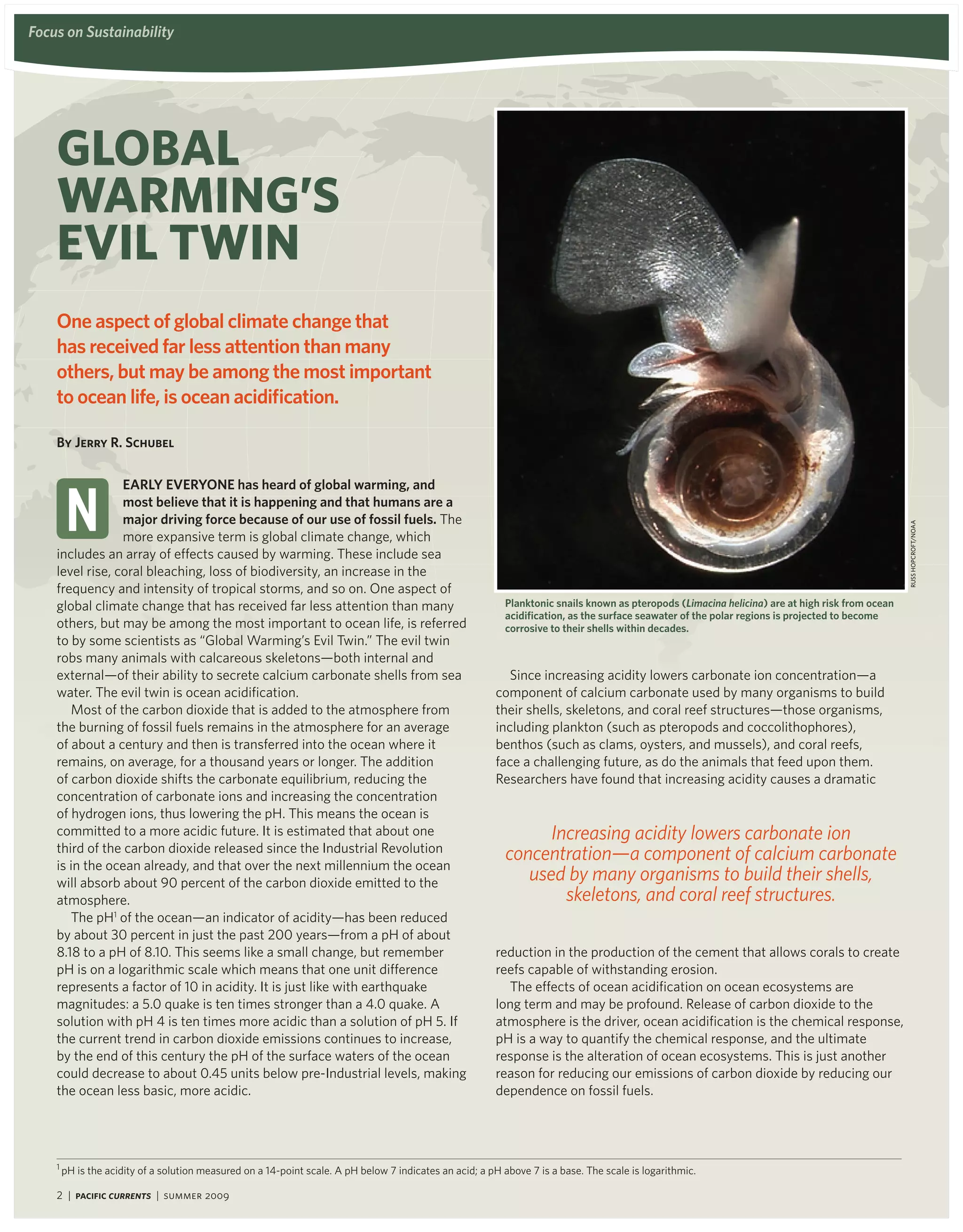
    global climate change that has received far less attention than many                                   Planktonic snails known as pteropods (Limacina helicina) are at high risk from ocean
                                                                                                           acidification, as the surface seawater of the polar regions is projected to become
    others, but may be among the most important to ocean life, is referred                                 corrosive to their shells within decades.
    to by some scientists as “Global Warming’s Evil Twin.” The evil twin
    robs many animals with calcareous skeletons—both internal and
    external—of their ability to secrete calcium carbonate shells from sea                                  Since increasing acidity lowers carbonate ion concentration—a
    water. The evil twin is ocean acidification.                                                         component of calcium carbonate used by many organisms to build
       Most of the carbon dioxide that is added to the atmosphere from                                   their shells, skeletons, and coral reef structures—those organisms,
    the burning of fossil fuels remains in the atmosphere for an average                                 including plankton (such as pteropods and coccolithophores),
    of about a century and then is transferred into the ocean where it                                   benthos (such as clams, oysters, and mussels), and coral reefs,
    remains, on average, for a thousand years or longer. The addition                                    face a challenging future, as do the animals that feed upon them.
    of carbon dioxide shifts the carbonate equilibrium, reducing the                                     Researchers have found that increasing acidity causes a dramatic
    concentration of carbonate ions and increasing the concentration
    of hydrogen ions, thus lowering the pH. This means the ocean is
    committed to a more acidic future. It is estimated that about one                                             Increasing acidity lowers carbonate ion
    third of the carbon dioxide released since the Industrial Revolution
    is in the ocean already, and that over the next millennium the ocean
                                                                                                            concentration—a component of calcium carbonate
    will absorb about 90 percent of the carbon dioxide emitted to the                                          used by many organisms to build their shells,
    atmosphere.                                                                                                     skeletons, and coral reef structures.
       The pH1 of the ocean—an indicator of acidity—has been reduced
    by about 30 percent in just the past 200 years—from a pH of about
    8.18 to a pH of 8.10. This seems like a small change, but remember                                   reduction in the production of the cement that allows corals to create
    pH is on a logarithmic scale which means that one unit difference                                    reefs capable of withstanding erosion.
    represents a factor of 10 in acidity. It is just like with earthquake                                  The effects of ocean acidification on ocean ecosystems are
    magnitudes: a 5.0 quake is ten times stronger than a 4.0 quake. A                                    long term and may be profound. Release of carbon dioxide to the
    solution with pH 4 is ten times more acidic than a solution of pH 5. If                              atmosphere is the driver, ocean acidification is the chemical response,
    the current trend in carbon dioxide emissions continues to increase,                                 pH is a way to quantify the chemical response, and the ultimate
    by the end of this century the pH of the surface waters of the ocean                                 response is the alteration of ocean ecosystems. This is just another
    could decrease to about 0.45 units below pre-Industrial levels, making                               reason for reducing our emissions of carbon dioxide by reducing our
    the ocean less basic, more acidic.                                                                   dependence on fossil fuels.


    1
        pH is the acidity of a solution measured on a 14-point scale. A pH below 7 indicates an acid; a pH above 7 is a base. The scale is logarithmic.

    2 | Pacific Currents | summer 2009                                  Pre-registration and pre-payment required on all programs unless noted. Call (562) 951-1630. All prices subject to change.v
table of contents
 table of contents


    In thIs Issue                                                                                                       letter from the CEo
                                                                                                                        Dear Members,
                          4         animal Updates | Meet our new sharks and


                                                                                                                         t
                                    rays that have joined us for Shark Summer. Also,                                                his summer we will be
                                    learn about Summer the sea otter’s recent eye surgery.                                          highlighting sharks and
                                                                                                                                    rays. Sharks are magnifi-
                                                                                                                                    cent wild animals that
                                                                                                                        play critical roles in maintaining a
                          6         Shark Summer | This summer the Aquarium                                             healthy ocean. Through the
                                    will focus on the majesty and ecological importance                                 introduction of new animals, our
                                    of sharks. Discover the fascinating characteristics of                              new Shark Zone, a new film, and
                                    sharks and rays that have helped them to survive on                                 more, we hope to educate and
                                    this planet for more than 400 million years. And                                    inspire our guests to conserve these
                                    consider some of the threats sharks face and what                                   amazing animals. And we will
                                    we might be able to do to help conserve them.                                       describe some ways to help conserve them.
                                                                                                                           The Aquarium’s most important relationship is the partner-
                          23 art Miles Project | The Aquarium welcomed                                                  ship we have with the City of Long Beach. We thank the city
                                    more than 430 artists of all ages for the Art Miles                                 for their ongoing support. Throughout our tenth anniversary
                                    mural event in February. Participants contributed                                   year, the city has been integral in promoting and celebrating
                                    28 panels to the growing mural to help Art Miles                                    our success with us. We appreciate the energy they provide
                                    set the world record for the longest ocean mural.                                   and look forward to future collaborations.
                                                                                                                           In light of the ongoing challenging economic situation, we
                                                                                                                        have been working hard to make sure we are frugal in our
                          27 Save Sharks | Sharks are harvested for every-                                              spending. One measure we have taken is to merge the fall is-
                                    thing from lipstick to supplements to shark fin soup.                               sue of this member magazine into the winter issue. Therefore,
                                    Perhaps there is something you use or consume that                                  in this one instance, we have decided to include in this issue
                                    you did not realize contained shark as an ingredient. Is                            not only the summer events, but all events scheduled through
                                    there shark oil in your favorite hand cream?                                        October 2009. The following issue will come out in October
                                                                                                                        and will include all events through February 2010. We hope
    2 Focus on Sustainability                               10 aquarium Programs & events                               you will understand why we felt it was important to take this
    3 letter from the Ceo                                   20 Kids Corner                                              action. We plan to resume our quarterly issues in the spring
                                                                                                                        of 2010. Be sure to check the Aquarium’s website periodically
    4 animal Updates                                        23 aquarium news                                            to learn about any new programs or updates.
    6 Feature                                               27 Conservation Corner                                         We hope each of you will take full advantage of your
                                                                                                                        Aquarium membership benefits. We have many exciting
                                                                                                                        events and programs for you from Shark Summer to summer
    PacIfIc currentS is published for members of               PHOnE nuMBErs (562 area code)                            camps, to workshops, Aquatic Academy courses, and fasci-
    the Aquarium of the Pacific. If you have comments          General Information........590-3100                      nating guest speakers on a wide range of topics—all designed
    about this magazine, please send an email to our           fAX .......................................951-1629      to entertain, educate, and enrich your Aquarium experience.
    editorial staff at PacificCurrents@LBAOP.org.              Membership ......................437-fIsH (3474)
                                                               Development ....................951-1605                 Thank you for your continued support.
    Note: No FaLL issue oF PaciFic currentS
                                                               Pacific Circle ......................951-1664
    Our MIssIOn | To instill a sense of wonder,                Lost & found .....................951-1733               Sincerely,
    respect, and stewardship for the Pacific Ocean, its        Private Event Info ............951-1663
    inhabitants, and ecosystems                                Education Programs .......951-1630
                                                               Gift store ............................951-1sEA (1732)
    PacIfIc currentS sTAff | Editor/Writer: Alexi                                                                       Jerry R. Schubel
                                                               Job Hotline.........................951-1674
    Holford | Copy Editor: Cecile fisher | Designer:
                                                               Volunteer Hotline.............951-1659
    Andrew reitsma | Contributing Writers: Jerry r.
                                                               Advanced Ticket sales ...590-3100, ext. 0
    schubel and Tricia Bennett                                 (note: $2 service charge per ticket, up to $10.)
    HOurs | Open daily from 9:00 a.m.–6:00 p.m. except         Group reservations ........951-1695
    Dec. 25 and during the Grand Prix of Long Beach
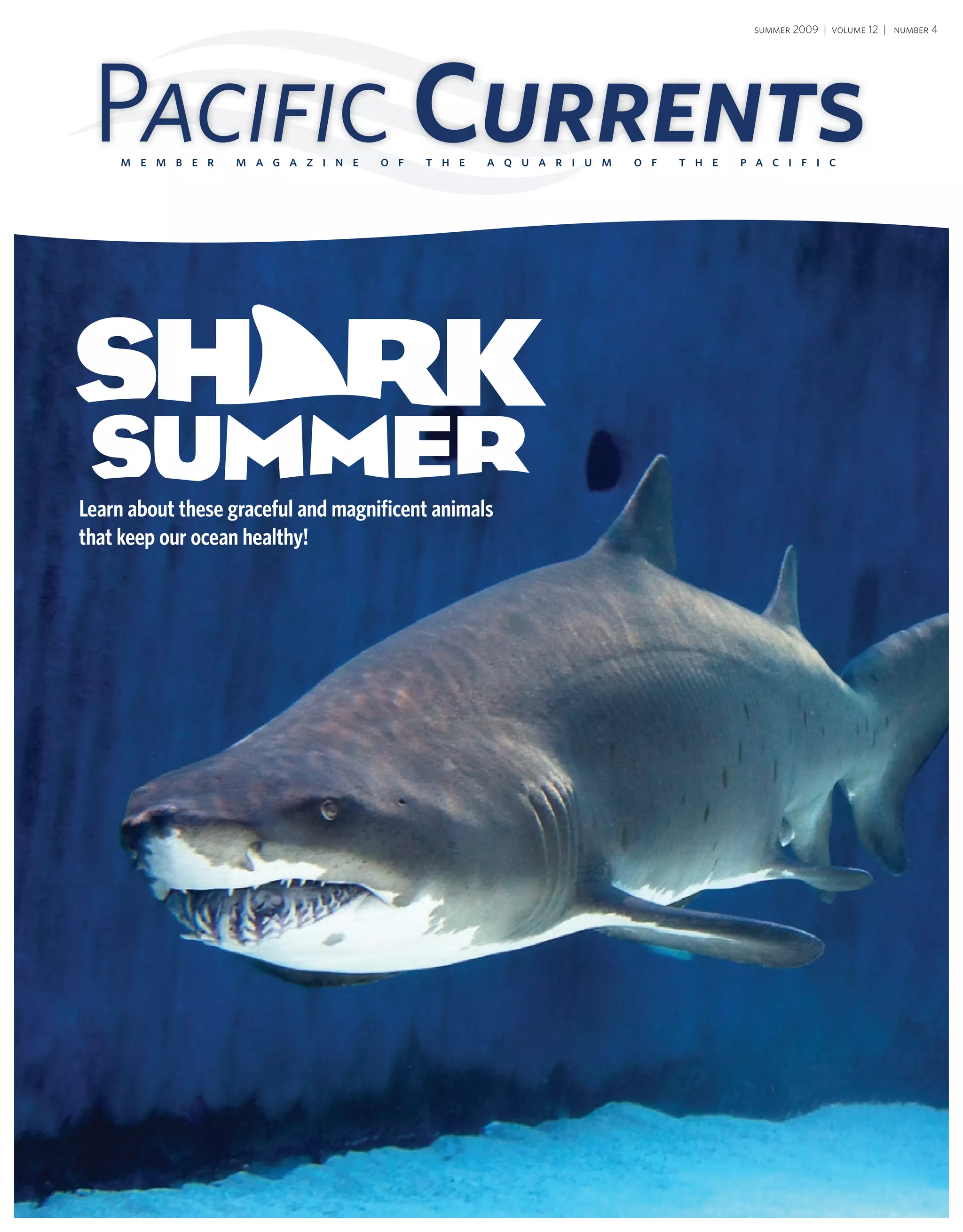
                                                               COVEr | sand tiger shark (carcharias taurus)
    MEMBErsHIP OffICE HOurs                                    Photo: Andrew reitsma
    8:00 a.m.–5:30 p.m. daily

                         the aquarium of the Pacific
                         is a non-profit 501(c)3
                         institution. to provide exciting
                         and innovative exhibits and
                         educational programs, we
                         rely heavily on the generous
                         donations of individuals,
                         foundations, and corporations.
                                                                                         Aquarium Founding Sponsor
                                                                                                                                                        summer 2009 | Pacific Currents | 3
animal updates
aquarium updates


   new shark and ray additions

     F
              or the aqUariUM’S Shark Summer, we are adding new
              sharks and rays to our exhibits. More animals will be added over
              the summer as they complete their behind-the-scenes quarantines,
              but here are some new rays and sharks that you can visit now.
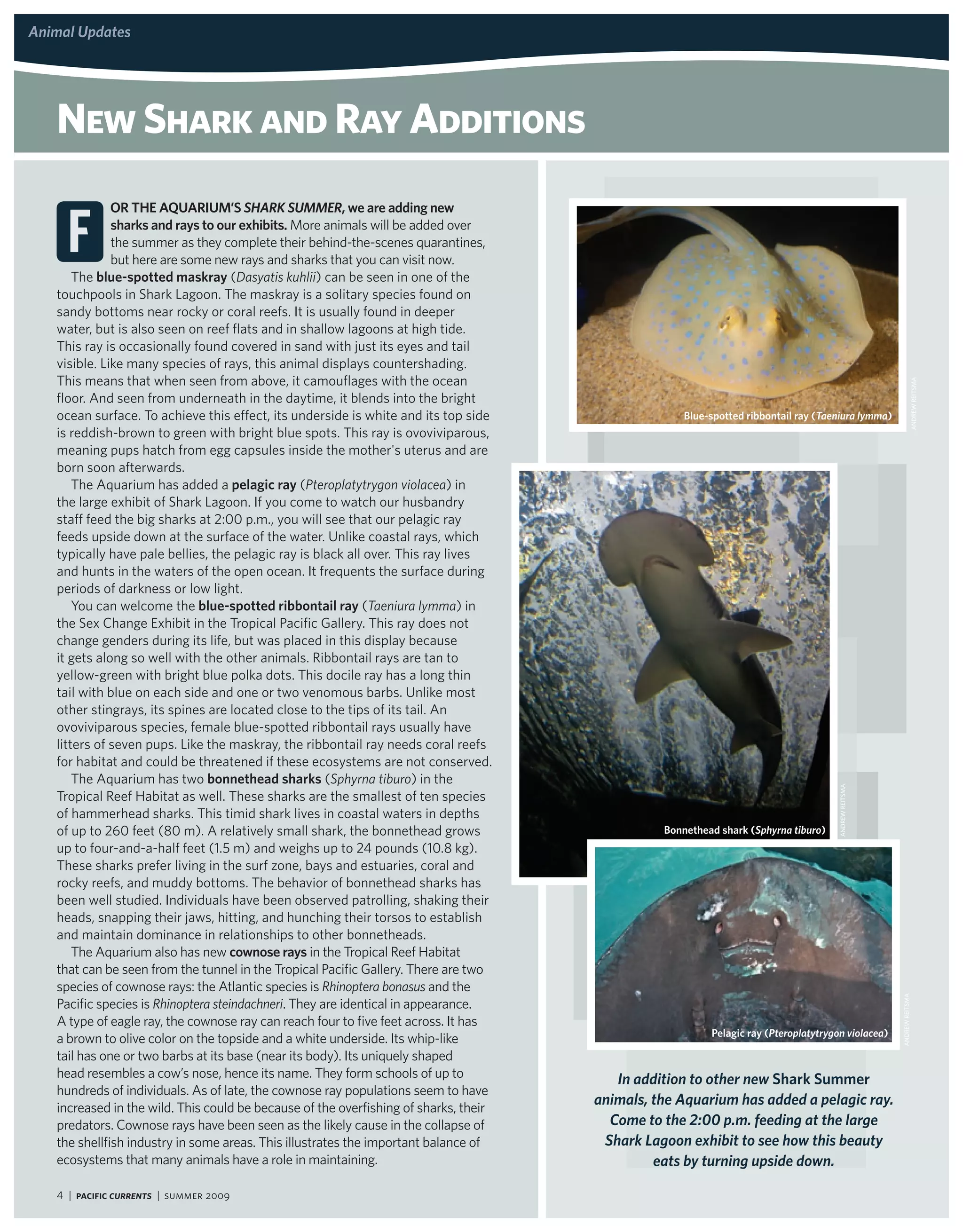
       The blue-spotted maskray (Dasyatis kuhlii) can be seen in one of the
   touchpools in Shark Lagoon. The maskray is a solitary species found on
   sandy bottoms near rocky or coral reefs. It is usually found in deeper
   water, but is also seen on reef flats and in shallow lagoons at high tide.
   This ray is occasionally found covered in sand with just its eyes and tail
   visible. Like many species of rays, this animal displays countershading.
   This means that when seen from above, it camouflages with the ocean


                                                                                                                                                                  ANdRew ReitsmA
   floor. And seen from underneath in the daytime, it blends into the bright
   ocean surface. To achieve this effect, its underside is white and its top side                   Blue-spotted ribbontail ray (taeniura lymma)
   is reddish-brown to green with bright blue spots. This ray is ovoviviparous,
   meaning pups hatch from egg capsules inside the mother's uterus and are
   born soon afterwards.
       The Aquarium has added a pelagic ray (Pteroplatytrygon violacea) in
   the large exhibit of Shark Lagoon. If you come to watch our husbandry
   staff feed the big sharks at 2:00 p.m., you will see that our pelagic ray
   feeds upside down at the surface of the water. Unlike coastal rays, which
   typically have pale bellies, the pelagic ray is black all over. This ray lives
   and hunts in the waters of the open ocean. It frequents the surface during
   periods of darkness or low light.
       You can welcome the blue-spotted ribbontail ray (taeniura lymma) in
   the Sex Change Exhibit in the Tropical Pacific Gallery. This ray does not
   change genders during its life, but was placed in this display because
   it gets along so well with the other animals. Ribbontail rays are tan to
   yellow-green with bright blue polka dots. This docile ray has a long thin
   tail with blue on each side and one or two venomous barbs. Unlike most
   other stingrays, its spines are located close to the tips of its tail. An
   ovoviviparous species, female blue-spotted ribbontail rays usually have
   litters of seven pups. Like the maskray, the ribbontail ray needs coral reefs
   for habitat and could be threatened if these ecosystems are not conserved.
       The Aquarium has two bonnethead sharks (Sphyrna tiburo) in the


                                                                                                                                     ANdRew ReitsmA
   Tropical Reef Habitat as well. These sharks are the smallest of ten species
   of hammerhead sharks. This timid shark lives in coastal waters in depths
   of up to 260 feet (80 m). A relatively small shark, the bonnethead grows                     Bonnethead shark (Sphyrna tiburo)
   up to four-and-a-half feet (1.5 m) and weighs up to 24 pounds (10.8 kg).
   These sharks prefer living in the surf zone, bays and estuaries, coral and
   rocky reefs, and muddy bottoms. The behavior of bonnethead sharks has
   been well studied. Individuals have been observed patrolling, shaking their
   heads, snapping their jaws, hitting, and hunching their torsos to establish
   and maintain dominance in relationships to other bonnetheads.
       The Aquarium also has new cownose rays in the Tropical Reef Habitat
   that can be seen from the tunnel in the Tropical Pacific Gallery. There are two
   species of cownose rays: the Atlantic species is rhinoptera bonasus and the
                                                                                                                                                      ANdRew ReitsmA


   Pacific species is rhinoptera steindachneri. They are identical in appearance.
   A type of eagle ray, the cownose ray can reach four to five feet across. It has
                                                                                                         Pelagic ray (Pteroplatytrygon violacea)
   a brown to olive color on the topside and a white underside. Its whip-like
   tail has one or two barbs at its base (near its body). Its uniquely shaped
   head resembles a cow’s nose, hence its name. They form schools of up to               in addition to other new Shark Summer
   hundreds of individuals. As of late, the cownose ray populations seem to have
   increased in the wild. This could be because of the overfishing of sharks, their
                                                                                      animals, the aquarium has added a pelagic ray.
   predators. Cownose rays have been seen as the likely cause in the collapse of        come to the 2:00 p.m. feeding at the large
   the shellfish industry in some areas. This illustrates the important balance of     Shark Lagoon exhibit to see how this beauty
   ecosystems that many animals have a role in maintaining.                                    eats by turning upside down.

   4 | Pacific Currents | summer 2009
aquarium updates
                                                                                                                                 animal


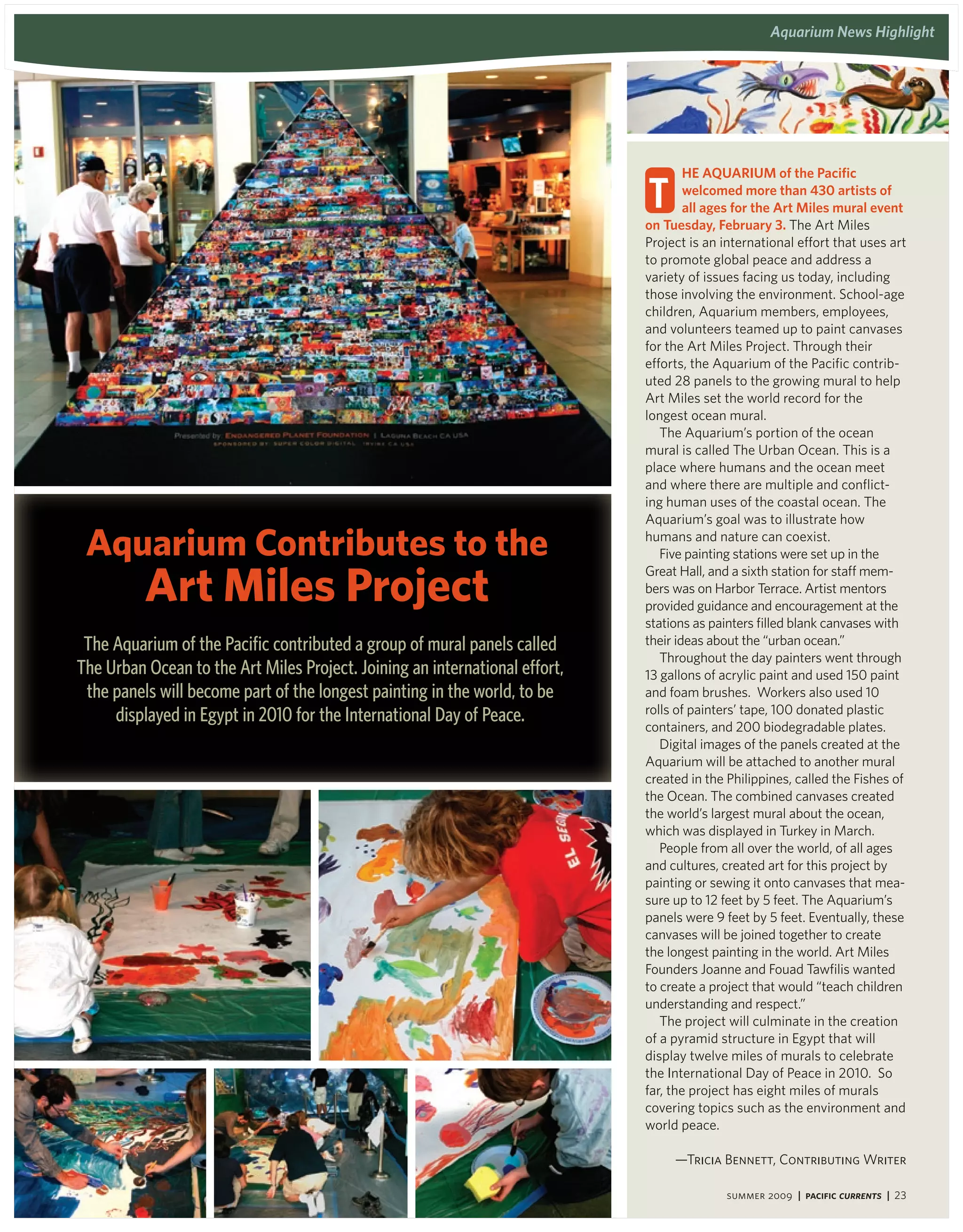
summer the sea otter Undergoes Eye surgery

 s
          UMMer the Sea otter was born in the                              animals like sea otters that have to hunt and forage for
          summer of 1998, hence her name. Found                            food and avoid predators in the wild would not survive
          stranded, she came to the Aquarium because                        long without their vision. however, at the aquarium,
          it was determined she could not survive in the
                                                                              they can continue to thrive despite the disability.
cold temperatures of her natural environment due to an
abnormally light coat of hair and other factors.
   As Summer has aged, the need for eye surgery
became evident. Summer had developed two problems,
one in each eye. Her left eye had internal damage and
was bleeding due to a condition known as uveitis. Her
right eye had a cataract. Summer’s vision became so
impaired that her ability to see was almost completely
gone. Without surgical treatment for her eye conditions,
Summer had no chance of restoration of any vision and
she would likely develop a painful swelling of the eyes
called glaucoma. In addition, Summer had stopped eating
and was not participating in training.
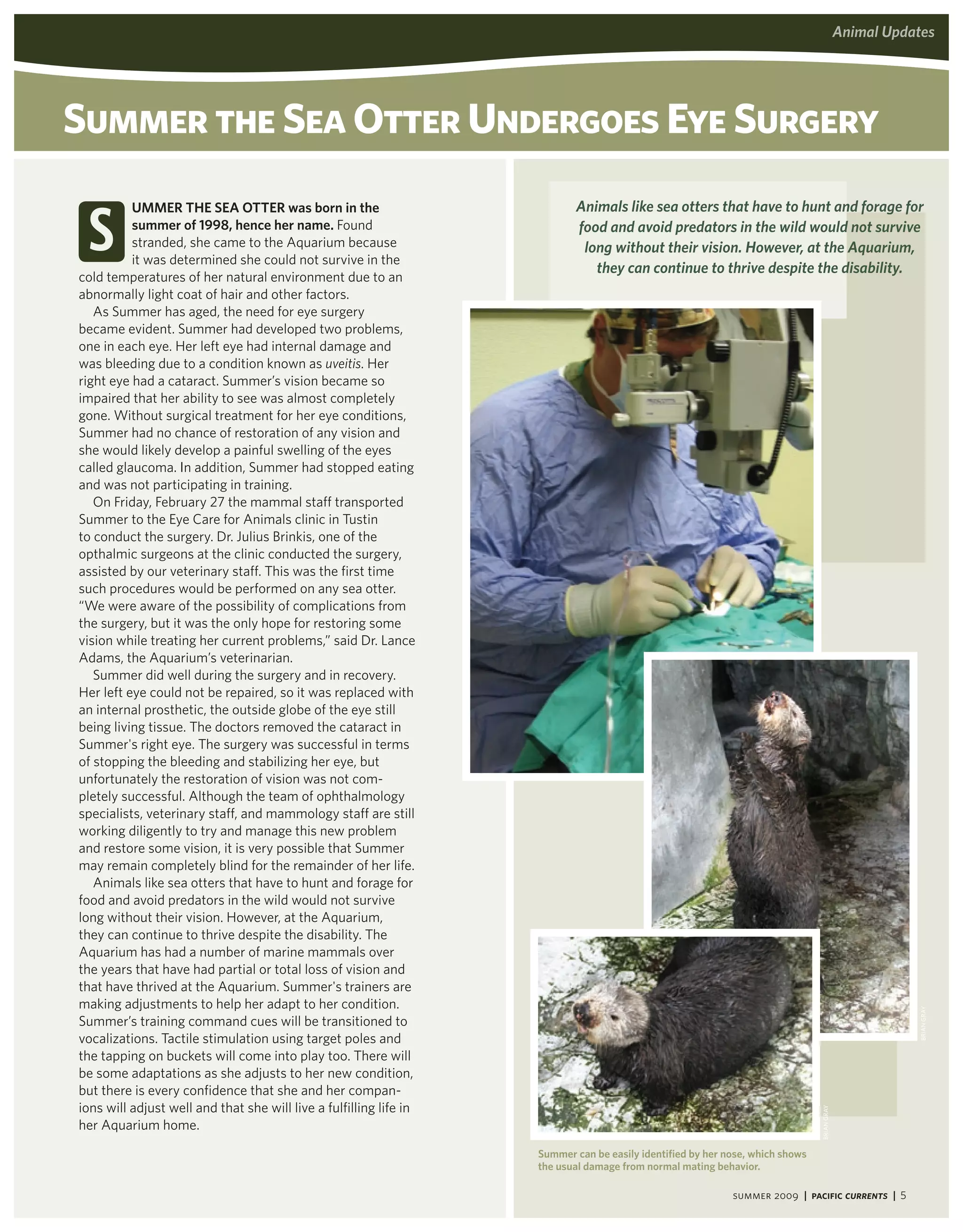
   On Friday, February 27 the mammal staff transported
Summer to the Eye Care for Animals clinic in Tustin
to conduct the surgery. Dr. Julius Brinkis, one of the
opthalmic surgeons at the clinic conducted the surgery,
assisted by our veterinary staff. This was the first time
such procedures would be performed on any sea otter.
“We were aware of the possibility of complications from
the surgery, but it was the only hope for restoring some
vision while treating her current problems,” said Dr. Lance
Adams, the Aquarium’s veterinarian.
   Summer did well during the surgery and in recovery.
Her left eye could not be repaired, so it was replaced with
an internal prosthetic, the outside globe of the eye still
being living tissue. The doctors removed the cataract in
Summer's right eye. The surgery was successful in terms
of stopping the bleeding and stabilizing her eye, but
unfortunately the restoration of vision was not com-
pletely successful. Although the team of ophthalmology
specialists, veterinary staff, and mammology staff are still
working diligently to try and manage this new problem
and restore some vision, it is very possible that Summer
may remain completely blind for the remainder of her life.
   Animals like sea otters that have to hunt and forage for
food and avoid predators in the wild would not survive
long without their vision. However, at the Aquarium,
they can continue to thrive despite the disability. The
Aquarium has had a number of marine mammals over
the years that have had partial or total loss of vision and
that have thrived at the Aquarium. Summer's trainers are
making adjustments to help her adapt to her condition.
                                                                                                                                                 BRiAN GRAy


Summer’s training command cues will be transitioned to
vocalizations. Tactile stimulation using target poles and
the tapping on buckets will come into play too. There will
be some adaptations as she adjusts to her new condition,
but there is every confidence that she and her compan-
ions will adjust well and that she will live a fulfilling life in
                                                                                                                                BRiAN GRAy


her Aquarium home.
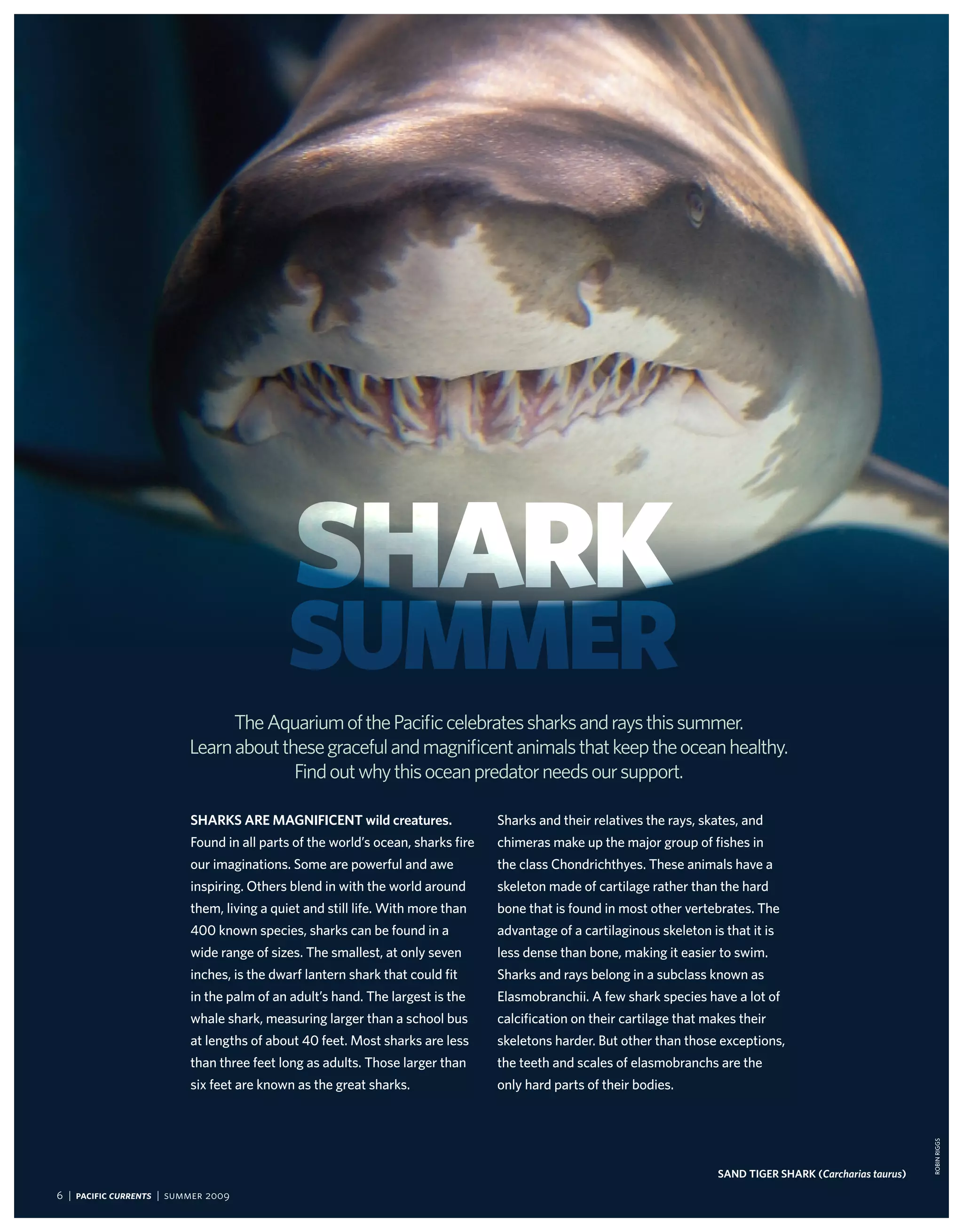
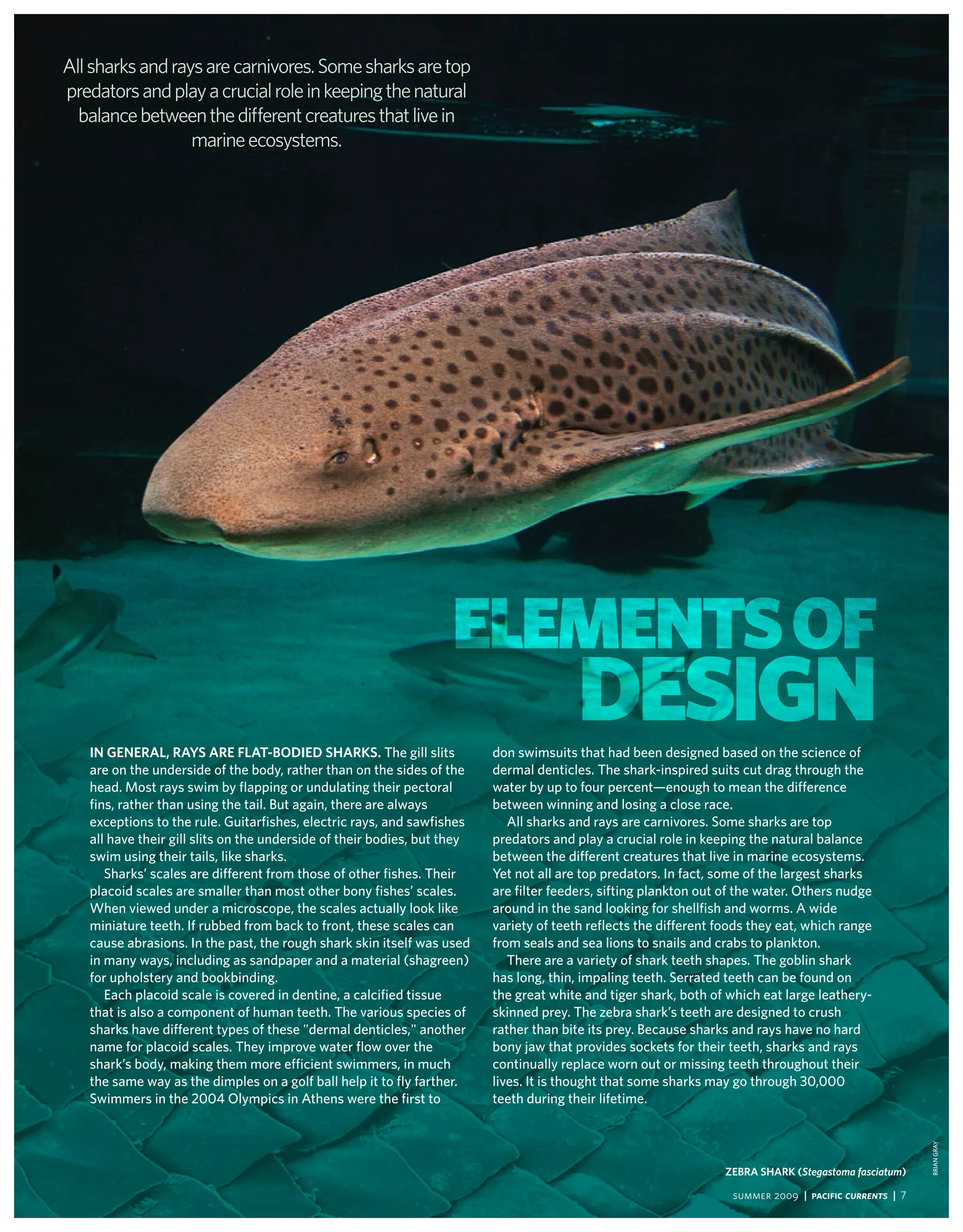
                                                                    Summer can be easily identified by her nose, which shows
                                                                    the usual damage from normal mating behavior.

                                                                                                            summer 2009 | Pacific Currents | 5
Shark
                                           Summer
                                The Aquarium of the Pacific celebrates sharks and rays this summer.
                          Learn about these graceful and magnificent animals that keep the ocean healthy.
                                        Find out why this ocean predator needs our support.

                          SharKS are MagniFiCent wild creatures.                 sharks and their relatives the rays, skates, and
                          found in all parts of the world’s ocean, sharks fire   chimeras make up the major group of fishes in
                          our imaginations. some are powerful and awe            the class chondrichthyes. these animals have a
                          inspiring. others blend in with the world around       skeleton made of cartilage rather than the hard
                          them, living a quiet and still life. with more than    bone that is found in most other vertebrates. the
                          400 known species, sharks can be found in a            advantage of a cartilaginous skeleton is that it is
                          wide range of sizes. the smallest, at only seven       less dense than bone, making it easier to swim.
                          inches, is the dwarf lantern shark that could fit      sharks and rays belong in a subclass known as
                          in the palm of an adult’s hand. the largest is the     elasmobranchii. A few shark species have a lot of
                          whale shark, measuring larger than a school bus        calcification on their cartilage that makes their
                          at lengths of about 40 feet. most sharks are less      skeletons harder. But other than those exceptions,
                          than three feet long as adults. those larger than      the teeth and scales of elasmobranchs are the
                          six feet are known as the great sharks.                only hard parts of their bodies.
                                                                                                                                                                RoBiN RiGGs


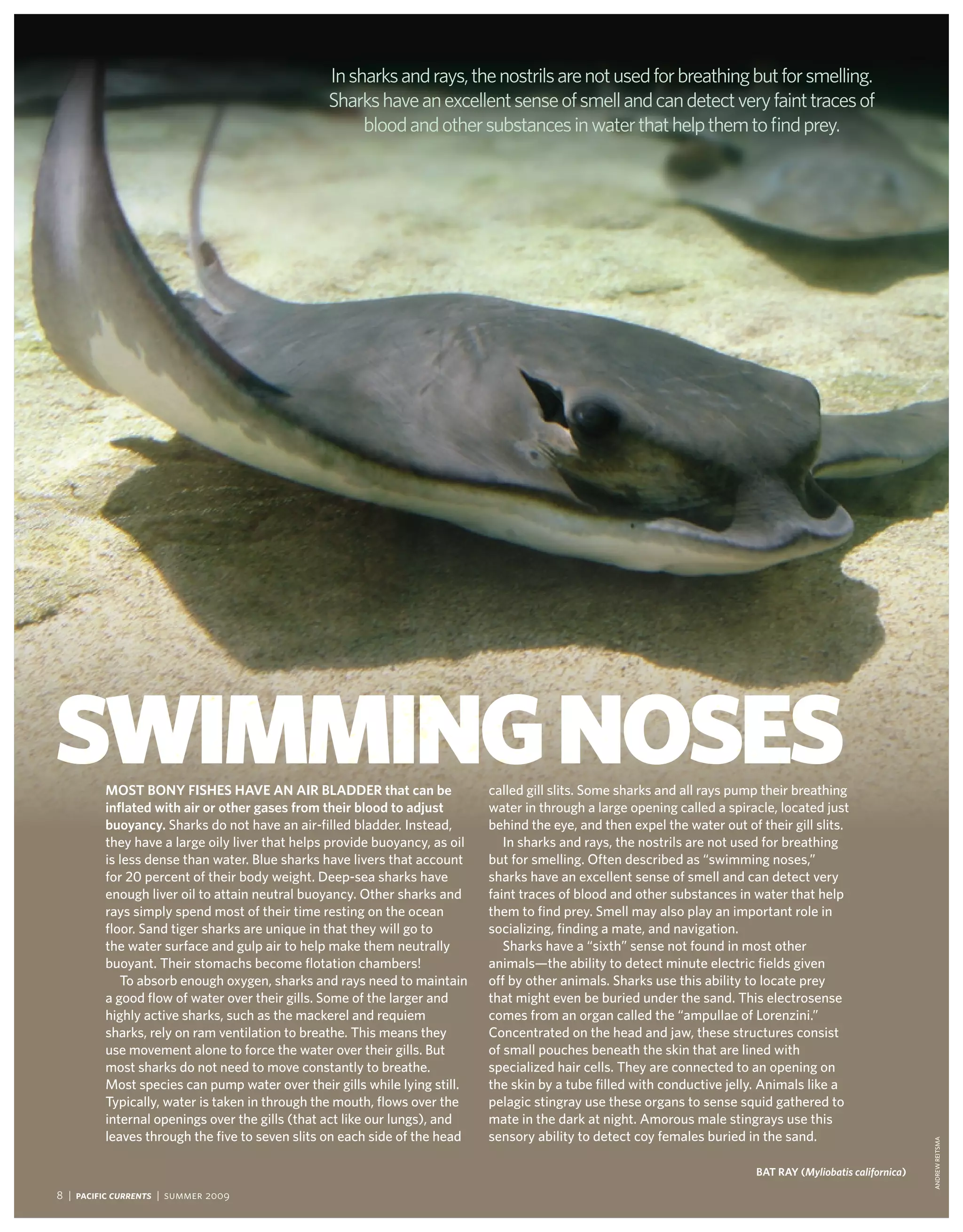
                                                                                                                         Sand tiger SharK (carcharias taurus)
6 | Pacific Currents | summer 2009
All sharks and rays are carnivores. Some sharks are top
predators and play a crucial role in keeping the natural
  balance between the different creatures that live in
                  marine ecosystems.


                                                                   ElEmEnts of
   in general, rayS are Flat-Bodied SharKS. the gill slits
                                                                                         DEsign
                                                                          don swimsuits that had been designed based on the science of
   are on the underside of the body, rather than on the sides of the      dermal denticles. the shark-inspired suits cut drag through the
   head. most rays swim by flapping or undulating their pectoral          water by up to four percent—enough to mean the difference
   fins, rather than using the tail. But again, there are always          between winning and losing a close race.
   exceptions to the rule. Guitarfishes, electric rays, and sawfishes        All sharks and rays are carnivores. some sharks are top
   all have their gill slits on the underside of their bodies, but they   predators and play a crucial role in keeping the natural balance
   swim using their tails, like sharks.                                   between the different creatures that live in marine ecosystems.
      sharks’ scales are different from those of other fishes. their      yet not all are top predators. in fact, some of the largest sharks
   placoid scales are smaller than most other bony fishes’ scales.        are filter feeders, sifting plankton out of the water. others nudge
   when viewed under a microscope, the scales actually look like          around in the sand looking for shellfish and worms. A wide
   miniature teeth. if rubbed from back to front, these scales can        variety of teeth reflects the different foods they eat, which range
   cause abrasions. in the past, the rough shark skin itself was used     from seals and sea lions to snails and crabs to plankton.
   in many ways, including as sandpaper and a material (shagreen)            there are a variety of shark teeth shapes. the goblin shark
   for upholstery and bookbinding.                                        has long, thin, impaling teeth. serrated teeth can be found on
      each placoid scale is covered in dentine, a calcified tissue        the great white and tiger shark, both of which eat large leathery-
   that is also a component of human teeth. the various species of        skinned prey. the zebra shark’s teeth are designed to crush
   sharks have different types of these "dermal denticles," another       rather than bite its prey. Because sharks and rays have no hard
   name for placoid scales. they improve water flow over the              bony jaw that provides sockets for their teeth, sharks and rays
   shark’s body, making them more efficient swimmers, in much             continually replace worn out or missing teeth throughout their
   the same way as the dimples on a golf ball help it to fly farther.     lives. it is thought that some sharks may go through 30,000
   swimmers in the 2004 olympics in Athens were the first to              teeth during their lifetime.
                                                                                                                                                         BRiAN GRAy


                                                                                                                   zeBra SharK (Stegastoma fasciatum)

                                                                                                                    summer 2009 | Pacific Currents | 7
In sharks and rays, the nostrils are not used for breathing but for smelling.
                                                Sharks have an excellent sense of smell and can detect very faint traces of
                                                     blood and other substances in water that help them to find prey.


Swimming noSeS
         MoSt Bony FiSheS have an air Bladder that can be
         inflated with air or other gases from their blood to adjust
                                                                            called gill slits. some sharks and all rays pump their breathing
                                                                            water in through a large opening called a spiracle, located just
         buoyancy. sharks do not have an air-filled bladder. instead,       behind the eye, and then expel the water out of their gill slits.
         they have a large oily liver that helps provide buoyancy, as oil      in sharks and rays, the nostrils are not used for breathing
         is less dense than water. Blue sharks have livers that account     but for smelling. often described as “swimming noses,”
         for 20 percent of their body weight. deep-sea sharks have          sharks have an excellent sense of smell and can detect very
         enough liver oil to attain neutral buoyancy. other sharks and      faint traces of blood and other substances in water that help
         rays simply spend most of their time resting on the ocean          them to find prey. smell may also play an important role in
         floor. sand tiger sharks are unique in that they will go to        socializing, finding a mate, and navigation.
         the water surface and gulp air to help make them neutrally            sharks have a “sixth” sense not found in most other
         buoyant. their stomachs become flotation chambers!                 animals—the ability to detect minute electric fields given
            to absorb enough oxygen, sharks and rays need to maintain       off by other animals. sharks use this ability to locate prey
         a good flow of water over their gills. some of the larger and      that might even be buried under the sand. this electrosense
         highly active sharks, such as the mackerel and requiem             comes from an organ called the “ampullae of Lorenzini.”
         sharks, rely on ram ventilation to breathe. this means they        concentrated on the head and jaw, these structures consist
         use movement alone to force the water over their gills. But        of small pouches beneath the skin that are lined with
         most sharks do not need to move constantly to breathe.             specialized hair cells. they are connected to an opening on
         most species can pump water over their gills while lying still.    the skin by a tube filled with conductive jelly. Animals like a
         typically, water is taken in through the mouth, flows over the     pelagic stingray use these organs to sense squid gathered to
         internal openings over the gills (that act like our lungs), and    mate in the dark at night. Amorous male stingrays use this
         leaves through the five to seven slits on each side of the head    sensory ability to detect coy females buried in the sand.
                                                                                                                                                               ANdRew ReitsmA


                                                                                                                            Bat ray (myliobatis californica)

8 | Pacific Currents | summer 2009
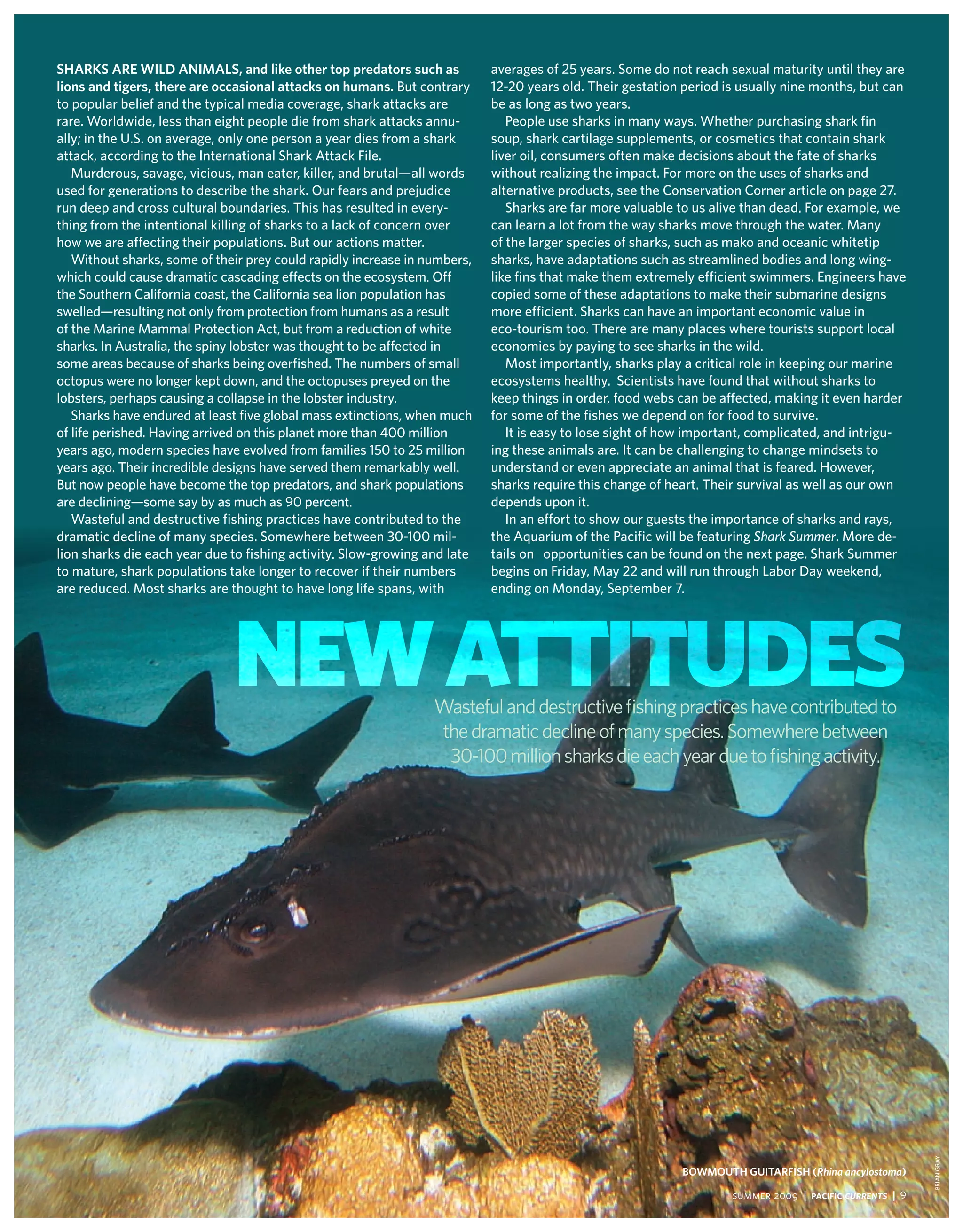
SharKS are wild aniMalS, and like other top predators such as              averages of 25 years. some do not reach sexual maturity until they are
lions and tigers, there are occasional attacks on humans. But contrary     12-20 years old. their gestation period is usually nine months, but can
to popular belief and the typical media coverage, shark attacks are        be as long as two years.
rare. worldwide, less than eight people die from shark attacks annu-          people use sharks in many ways. whether purchasing shark fin
ally; in the u.s. on average, only one person a year dies from a shark     soup, shark cartilage supplements, or cosmetics that contain shark
attack, according to the international shark Attack file.                  liver oil, consumers often make decisions about the fate of sharks
   murderous, savage, vicious, man eater, killer, and brutal—all words     without realizing the impact. for more on the uses of sharks and
used for generations to describe the shark. our fears and prejudice        alternative products, see the conservation corner article on page 27.
run deep and cross cultural boundaries. this has resulted in every-           sharks are far more valuable to us alive than dead. for example, we
thing from the intentional killing of sharks to a lack of concern over     can learn a lot from the way sharks move through the water. many
how we are affecting their populations. But our actions matter.            of the larger species of sharks, such as mako and oceanic whitetip
   without sharks, some of their prey could rapidly increase in numbers,   sharks, have adaptations such as streamlined bodies and long wing-
which could cause dramatic cascading effects on the ecosystem. off         like fins that make them extremely efficient swimmers. engineers have
the southern california coast, the california sea lion population has      copied some of these adaptations to make their submarine designs
swelled—resulting not only from protection from humans as a result         more efficient. sharks can have an important economic value in
of the marine mammal protection Act, but from a reduction of white         eco-tourism too. there are many places where tourists support local
sharks. in Australia, the spiny lobster was thought to be affected in      economies by paying to see sharks in the wild.
some areas because of sharks being overfished. the numbers of small           most importantly, sharks play a critical role in keeping our marine
octopus were no longer kept down, and the octopuses preyed on the          ecosystems healthy. scientists have found that without sharks to
lobsters, perhaps causing a collapse in the lobster industry.              keep things in order, food webs can be affected, making it even harder
   sharks have endured at least five global mass extinctions, when much    for some of the fishes we depend on for food to survive.
of life perished. Having arrived on this planet more than 400 million         it is easy to lose sight of how important, complicated, and intrigu-
years ago, modern species have evolved from families 150 to 25 million     ing these animals are. it can be challenging to change mindsets to
years ago. their incredible designs have served them remarkably well.      understand or even appreciate an animal that is feared. However,
But now people have become the top predators, and shark populations        sharks require this change of heart. their survival as well as our own
are declining—some say by as much as 90 percent.                           depends upon it.
   wasteful and destructive fishing practices have contributed to the         in an effort to show our guests the importance of sharks and rays,
dramatic decline of many species. somewhere between 30-100 mil-            the Aquarium of the pacific will be featuring Shark Summer. more de-
lion sharks die each year due to fishing activity. slow-growing and late   tails on opportunities can be found on the next page. shark summer
to mature, shark populations take longer to recover if their numbers       begins on friday, may 22 and will run through Labor day weekend,
are reduced. most sharks are thought to have long life spans, with         ending on monday, september 7.


                              New Attitudes                      Wasteful and destructive fishing practices have contributed to
                                                                 the dramatic decline of many species. Somewhere between
                                                                  30-100 million sharks die each year due to fishing activity.


                                                                                                                                                         BRiAN GRAy


                                                                                                           BowMoUth gUitarFiSh (rhina ancylostoma)

                                                                                                                    summer 2009 | Pacific Currents | 9
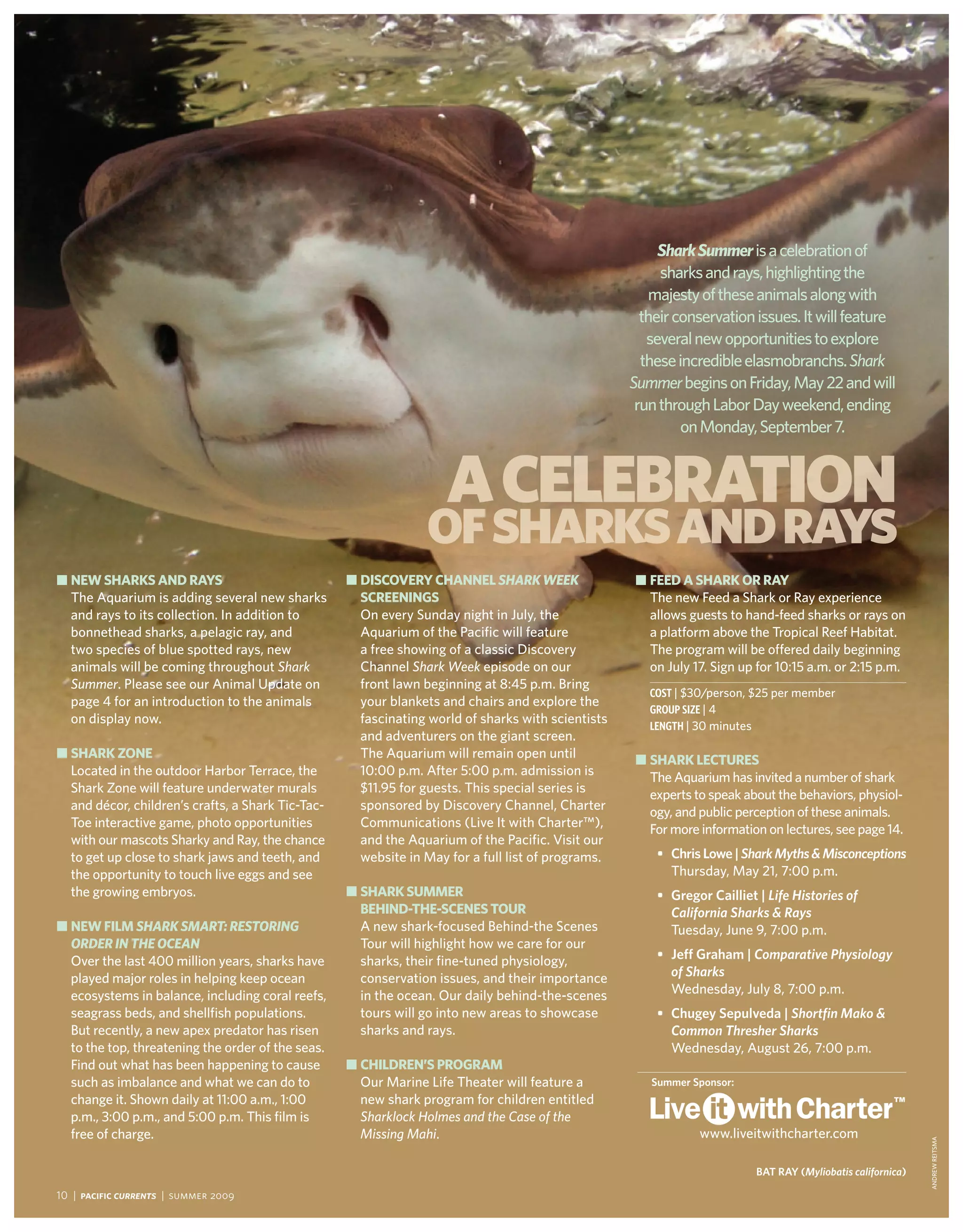
Shark Summer is a celebration of
                                                                                                        sharks and rays, highlighting the
                                                                                                       majesty of these animals along with
                                                                                                     their conservation issues. it will feature
                                                                                                      several new opportunities to explore
                                                                                                     these incredible elasmobranchs. Shark
                                                                                                   Summer begins on friday, may 22 and will
                                                                                                    run through Labor day weekend, ending
                                                                                                            on monday, september 7.


                                                                    a celebration
                                                                of sharks and rays
■ nEW sharks and rays                              ■ disCovEry ChannEl Shark Week                   ■ FEEd a shark or ray
  the Aquarium is adding several new sharks          sCrEEninGs                                       the new feed a shark or Ray experience
  and rays to its collection. in addition to         on every sunday night in July, the               allows guests to hand-feed sharks or rays on
  bonnethead sharks, a pelagic ray, and              Aquarium of the pacific will feature             a platform above the tropical Reef Habitat.
  two species of blue spotted rays, new              a free showing of a classic discovery            the program will be offered daily beginning
  animals will be coming throughout Shark            channel Shark Week episode on our                on July 17. sign up for 10:15 a.m. or 2:15 p.m.
  Summer. please see our Animal update on            front lawn beginning at 8:45 p.m. Bring
                                                                                                      Cost | $30/person, $25 per member
  page 4 for an introduction to the animals          your blankets and chairs and explore the
                                                                                                      GRouP siZe | 4
  on display now.                                    fascinating world of sharks with scientists      LeNGtH | 30 minutes
                                                     and adventurers on the giant screen.
■ shark ZonE                                         the Aquarium will remain open until            ■ shark lECTUrEs
  Located in the outdoor Harbor terrace, the         10:00 p.m. After 5:00 p.m. admission is          the Aquarium has invited a number of shark
  shark Zone will feature underwater murals          $11.95 for guests. this special series is        experts to speak about the behaviors, physiol-
  and décor, children’s crafts, a shark tic-tac-     sponsored by discovery channel, charter          ogy, and public perception of these animals.
  toe interactive game, photo opportunities          communications (Live it with charter™),          for more information on lectures, see page 14.
  with our mascots sharky and Ray, the chance        and the Aquarium of the pacific. Visit our
  to get up close to shark jaws and teeth, and       website in may for a full list of programs.       •	 Chris lowe | Shark myths & misconceptions
  the opportunity to touch live eggs and see                                                              thursday, may 21, 7:00 p.m.
  the growing embryos.                             ■ shark sUmmEr                                      •	 gregor Cailliet | Life histories of
                                                     bEhind-ThE-sCEnEs ToUr                               california Sharks & rays
■ nEW Film Shark Smart: reStoring                    A new shark-focused Behind-the scenes                tuesday, June 9, 7:00 p.m.
  order in the ocean                                 tour will highlight how we care for our
  over the last 400 million years, sharks have       sharks, their fine-tuned physiology,              •	 Jeff graham | comparative Physiology
  played major roles in helping keep ocean           conservation issues, and their importance            of Sharks
  ecosystems in balance, including coral reefs,      in the ocean. our daily behind-the-scenes            wednesday, July 8, 7:00 p.m.
  seagrass beds, and shellfish populations.          tours will go into new areas to showcase          •	 Chugey Sepulveda | Shortfin mako &
  But recently, a new apex predator has risen        sharks and rays.                                     common thresher Sharks
  to the top, threatening the order of the seas.                                                          wednesday, August 26, 7:00 p.m.
  find out what has been happening to cause        ■ ChildrEn’s ProGram
  such as imbalance and what we can do to            our marine Life theater will feature a           Summer Sponsor:
  change it. shown daily at 11:00 a.m., 1:00         new shark program for children entitled
  p.m., 3:00 p.m., and 5:00 p.m. this film is        Sharklock Holmes and the Case of the
  free of charge.                                    Missing Mahi.                                             www.liveitwithcharter.com
                                                                                                                                                            ANdRew ReitsmA


                                                                                                                         Bat ray (myliobatis californica)

10 | Pacific Currents | summer 2009
aquarium Programs and events


                                                                                     member events                                          member events
                                                                          Please join us for one of these select events just for
                                                                          our members and their guests.

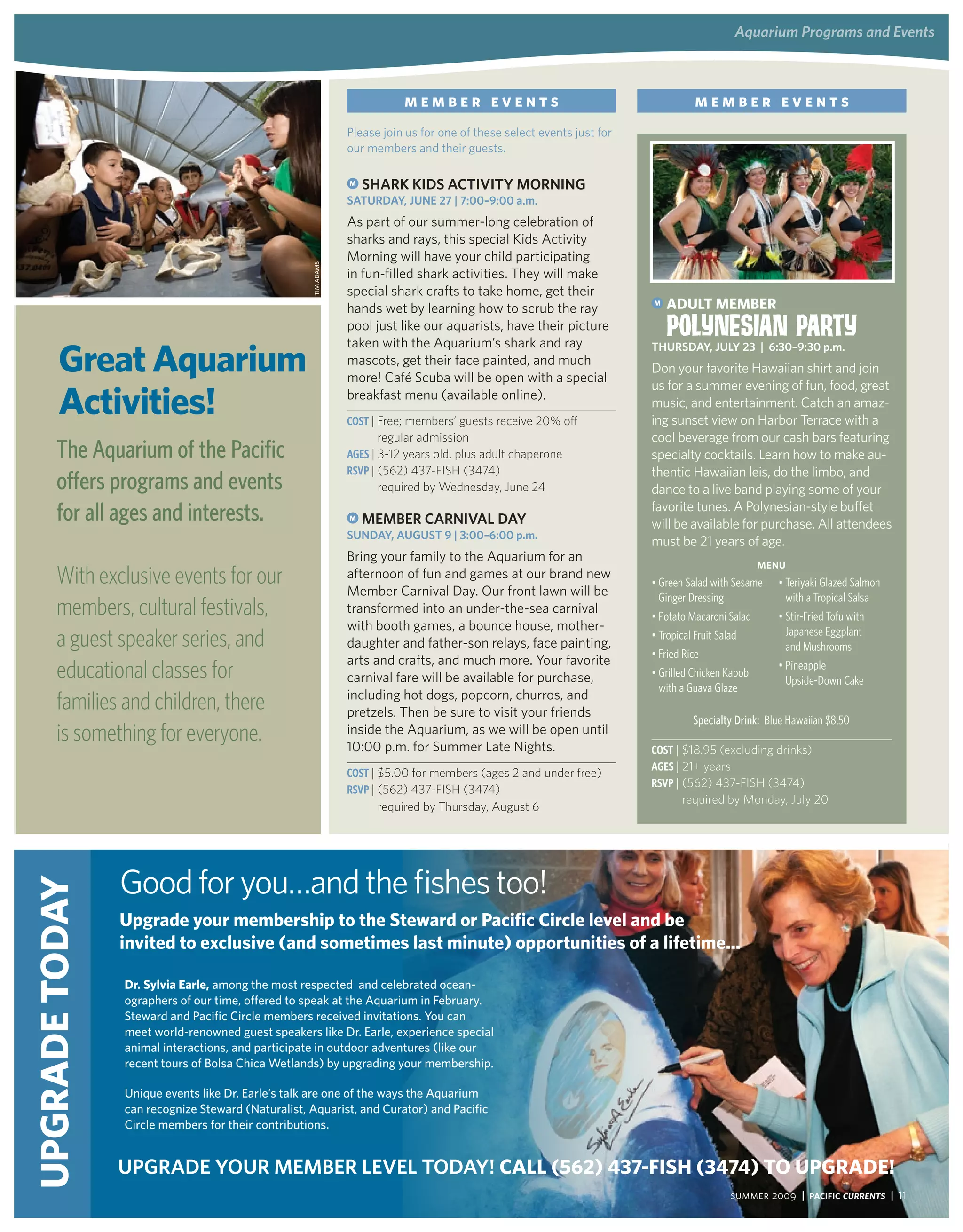
                                                                          M   SharK KidS aCtivity Morning
                                                                          SatUrday, JUne 27 | 7:00–9:00 a.m.
                                                                          As part of our summer-long celebration of
                                                                          sharks and rays, this special Kids Activity
                                                                          Morning will have your child participating


                                                              tim AdAms
                                                                          in fun-filled shark activities. They will make
                                                                          special shark crafts to take home, get their
                                                                          hands wet by learning how to scrub the ray
                                                                                                                                   M   adUlT mEmbEr
                                                                          pool just like our aquarists, have their picture             Polynesian Party
       Great aquarium
                                                                          taken with the Aquarium’s shark and ray                  thUrSday, JUly 23 | 6:30–9:30 p.m.
                                                                          mascots, get their face painted, and much
                                                                                                                                   Don your favorite Hawaiian shirt and join
                                                                          more! Café Scuba will be open with a special

       activities!
                                                                                                                                   us for a summer evening of fun, food, great
                                                                          breakfast menu (available online).
                                                                                                                                   music, and entertainment. Catch an amaz-
                                                                          Cost | Free; members’ guests receive 20% off             ing sunset view on Harbor Terrace with a
                                                                                regular admission                                  cool beverage from our cash bars featuring
       The Aquarium of the Pacific                                        aGes | 3-12 years old, plus adult chaperone              specialty cocktails. Learn how to make au-
                                                                          RsVP | (562) 437-FISH (3474)                             thentic Hawaiian leis, do the limbo, and
       offers programs and events                                               required by Wednesday, June 24                     dance to a live band playing some of your
       for all ages and interests.                                        M   MeMBer Carnival day
                                                                                                                                   favorite tunes. A Polynesian-style buffet
                                                                                                                                   will be available for purchase. All attendees
                                                                          SUnday, aUgUSt 9 | 3:00–6:00 p.m.
                                                                                                                                   must be 21 years of age.
                                                                          Bring your family to the Aquarium for an
                                                                                                                                                           Menu
       With exclusive events for our                                      afternoon of fun and games at our brand new
                                                                          Member Carnival Day. Our front lawn will be
                                                                                                                                   •	Green salad with sesame •	Teriyaki Glazed salmon
                                                                                                                                     Ginger Dressing            with a Tropical salsa
       members, cultural festivals,                                       transformed into an under-the-sea carnival
                                                                                                                                   •	Potato Macaroni salad    •	stir-fried Tofu with
                                                                          with booth games, a bounce house, mother-
       a guest speaker series, and                                        daughter and father-son relays, face painting,
                                                                                                                                   •	Tropical fruit salad
                                                                                                                                   •	fried rice
                                                                                                                                                                Japanese Eggplant
                                                                                                                                                                and Mushrooms
                                                                          arts and crafts, and much more. Your favorite
       educational classes for                                            carnival fare will be available for purchase,            •	Grilled Chicken Kabob
                                                                                                                                                              •	Pineapple
                                                                                                                                                                upside-Down Cake
                                                                                                                                     with a Guava Glaze
                                                                          including hot dogs, popcorn, churros, and
       families and children, there                                       pretzels. Then be sure to visit your friends
                                                                                                                                            Specialty Drink: Blue Hawaiian $8.50
       is something for everyone.                                         inside the Aquarium, as we will be open until
                                                                          10:00 p.m. for Summer Late Nights.                       Cost | $18.95 (excluding drinks)
                                                                                                                                   aGes | 21+ years
                                                                          Cost | $5.00 for members (ages 2 and under free)
                                                                                                                                   RsVP | (562) 437-FISH (3474)
                                                                          RsVP | (562) 437-FISH (3474)
                                                                                                                                         required by Monday, July 20
                                                                                required by Thursday, August 6


                    Good for you…and the fishes too!
UPGradE Today


                    Upgrade your membership to the steward or Pacific Circle level and be
                    invited to exclusive (and sometimes last minute) opportunities of a lifetime...

                     dr. sylvia Earle, among the most respected and celebrated ocean-
                     ographers of our time, offered to speak at the Aquarium in february.
                     steward and pacific circle members received invitations. you can
                     meet world-renowned guest speakers like dr. earle, experience special
                     animal interactions, and participate in outdoor adventures (like our
                     recent tours of Bolsa chica wetlands) by upgrading your membership.

                     unique events like dr. earle’s talk are one of the ways the Aquarium
                     can recognize steward (Naturalist, Aquarist, and curator) and pacific
                     circle members for their contributions.


                    UPgrade yoUr MeMBer level today! Call (562) 437-Fish (3474) To UPGradE!
      Pre-registration and pre-payment required on all programs unless noted. Call (562) 951-1630. All prices subject to change.                    summer 2009 | Pacific Currents | 11
aquarium Programs and events


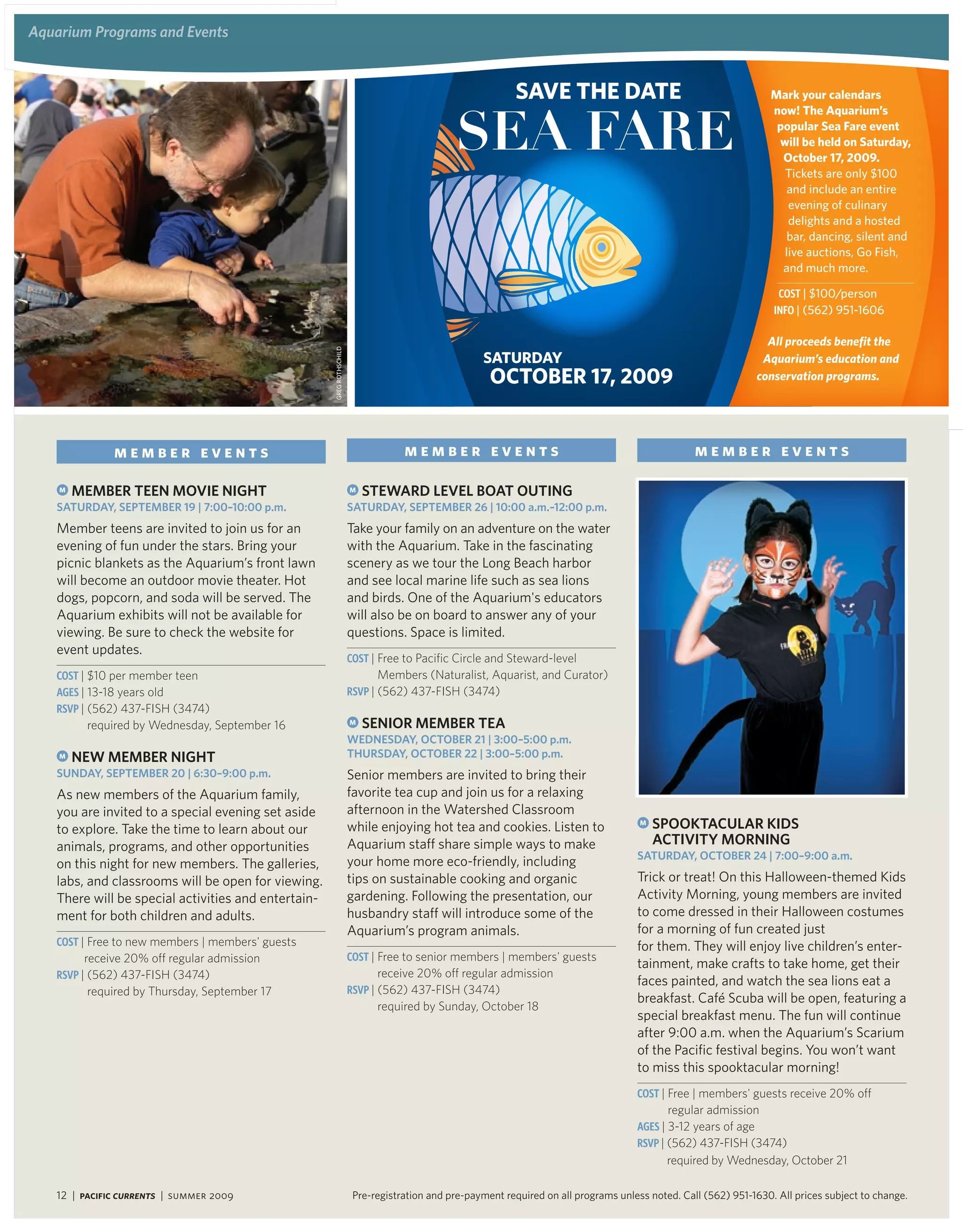
                                                                                                           savE ThE daTE                                           mark your calendars


                                                                                              Sea Fare
                                                                                                                                                                   now! The aquarium’s
                                                                                                                                                                    popular sea Fare event
                                                                                                                                                                    will be held on saturday,
                                                                                                                                                                     october 17, 2009.
                                                                                                                                                                     tickets are only $100
                                                                                                                                                                      and include an entire
                                                                                                                                                                      evening of culinary
                                                                                                                                                                      delights and a hosted
                                                                                                                                                                      bar, dancing, silent and
                                                                                                                                                                     live auctions, Go fish,
                                                                                                                                                                     and much more.

                                                                                                                                                                     Cost | $100/person
                                                                                                                                                                    iNFo | (562) 951-1606

                                                     GReG RotHscHiLd
                                                                                                                                                                  all proceeds benefit the
                                                                                                    saTUrday                                                     aquarium’s education and
                                                                                                      oCTobEr 17, 2009                                          conservation programs.


              member events                                                        member events                                                   member events

    M   MeMBer teen Movie night                                        M   Steward level Boat oUting
   SatUrday, SePteMBer 19 | 7:00–10:00 p.m.                            SatUrday, SePteMBer 26 | 10:00 a.m.–12:00 p.m.
   Member teens are invited to join us for an                          Take your family on an adventure on the water
   evening of fun under the stars. Bring your                          with the Aquarium. Take in the fascinating
   picnic blankets as the Aquarium’s front lawn                        scenery as we tour the Long Beach harbor
   will become an outdoor movie theater. Hot                           and see local marine life such as sea lions
   dogs, popcorn, and soda will be served. The                         and birds. One of the Aquarium's educators
   Aquarium exhibits will not be available for                         will also be on board to answer any of your
   viewing. Be sure to check the website for                           questions. Space is limited.
   event updates.
                                                                       Cost | Free to Pacific Circle and Steward-level
   Cost | $10 per member teen                                                Members (Naturalist, Aquarist, and Curator)
   aGes | 13-18 years old                                              RsVP | (562) 437-FISH (3474)
   RsVP | (562) 437-FISH (3474)
         required by Wednesday, September 16                           M   Senior MeMBer tea
                                                                       wedneSday, oCtoBer 21 | 3:00–5:00 p.m.
    M   new MeMBer night                                               thUrSday, oCtoBer 22 | 3:00–5:00 p.m.
   SUnday, SePteMBer 20 | 6:30–9:00 p.m.                               Senior members are invited to bring their
   As new members of the Aquarium family,                              favorite tea cup and join us for a relaxing
   you are invited to a special evening set aside                      afternoon in the Watershed Classroom
   to explore. Take the time to learn about our                        while enjoying hot tea and cookies. Listen to                   M   SPooKtaCUlar KidS
   animals, programs, and other opportunities                          Aquarium staff share simple ways to make                            aCtivity Morning
                                                                                                                                      SatUrday, oCtoBer 24 | 7:00–9:00 a.m.
   on this night for new members. The galleries,                       your home more eco-friendly, including
   labs, and classrooms will be open for viewing.                      tips on sustainable cooking and organic                        Trick or treat! On this Halloween-themed Kids
   There will be special activities and entertain-                     gardening. Following the presentation, our                     Activity Morning, young members are invited
   ment for both children and adults.                                  husbandry staff will introduce some of the                     to come dressed in their Halloween costumes
                                                                       Aquarium’s program animals.                                    for a morning of fun created just
   Cost | Free to new members | members' guests                                                                                       for them. They will enjoy live children’s enter-
         receive 20% off regular admission                             Cost | Free to senior members | members' guests
                                                                                                                                      tainment, make crafts to take home, get their
   RsVP | (562) 437-FISH (3474)                                              receive 20% off regular admission
                                                                                                                                      faces painted, and watch the sea lions eat a
         required by Thursday, September 17                            RsVP | (562) 437-FISH (3474)
                                                                                                                                      breakfast. Café Scuba will be open, featuring a
                                                                             required by Sunday, October 18
                                                                                                                                      special breakfast menu. The fun will continue
                                                                                                                                      after 9:00 a.m. when the Aquarium’s Scarium
                                                                                                                                      of the Pacific festival begins. You won’t want
                                                                                                                                      to miss this spooktacular morning!
                                                                                                                                      Cost | Free | members' guests receive 20% off
                                                                                                                                             regular admission
                                                                                                                                      aGes | 3-12 years of age
                                                                                                                                      RsVP | (562) 437-FISH (3474)
                                                                                                                                             required by Wednesday, October 21

   12 | Pacific Currents | summer 2009                                  Pre-registration and pre-payment required on all programs unless noted. Call (562) 951-1630. All prices subject to change.
aquarium Programs and events


           SPECIAL EVENTS
SE   oCean ConServation
     awardS gala
SatUrday, JUne 13 | 6:30–11:00 p.m.
Join the Aquarium of the Pacific for a glamorous
night out with the fish. This black-tie event
honors the outstanding achievements of
individuals and institutions that have greatly
contributed to environmental conservation
efforts. The evening features a special awards
program, a cocktail reception, full-course
gourmet dinner, live musical entertainment,
after-hours coffee bar and lounge and more.                              festivals                                              festivals
Attendees will also have the opportunity
                                                        To honor the rich diversity of Southern California,     F   MooMPetaM
to enjoy the ambiance of the Aquarium’s                 the Aquarium of the Pacific hosts cultural and family   SatUrday–SUnday, SePteMBer 19–20
exhibits at night. The 2009 honorees are                festivals throughout the year. Check our website for    9:00 a.m.–5:00 p.m.
the Leonardo DiCaprio Foundation, Google                more details and additional family festivals.
                                                                                                                In celebration of local Native American
Ocean, and Panasonic Corporation.
                                                                                                                cultures, the Aquarium of the Pacific will host
Cost | $600 per seat
                                                        F   PaCiFiC iSlander FeStival                           its annual Moompetam Festival. This weekend
RsVP | (562) 951-1606 or lglasco@lbaop.org              SatUrday & SUnday, JUne 6–7 | 9:00 a.m.–5:00 p.m.
                                                                                                                celebration features traditional cultural crafts,
                                                        Discover the rich and diverse cultures of the           storytelling, and other educational programs.
SE   Sea Fare                                           Pacific Islands through traditional craft demon-        Live demonstrations include music and dance
SatUrday, oCtoBer 17 | 6:30–10:30 p.m.                  strations, ethnic cuisine, educational programs,        of the indigenous California Indian maritime
The Aquarium of the Pacific will host its sixth         storytelling, and an ocean of entertainment,            cultures, including Ajachemen, Chumash,
annual Sea Fare, an evening of dining, live             including music and dance performances.                 Costanoan, Luiseno, and Tongva peoples.
music, and auctions. Guests will kick off the           Watch hula performances, listen to Tahitian
                                                                                                                Cost | Free for members
night by enjoying an open bar and live music            drumming, try out ancient Hawaiian games,
                                                                                                                       members’ guests
while they sample diverse cuisines from local           enjoy island cuisine, and admire artisans as
                                                                                                                       receive 20% off
restaurants. Attendees will have the opportu-           they create traditional weavings. The Pacific
                                                                                                                       regular admission
nity to bid on a range of unique live and silent        Islander Festival will feature Hawaiian,
                                                                                                                iNFo | (562) 437-FISH (3474)
auction items. Proceeds will lend a helping             Marshallese, Chamoru, Tahitian, Samoan,
fin to the Aquarium’s ocean conservation                Fijian, and Maori traditions.                           F   SoUtheaSt aSia day
education efforts.                                                                                              SatUrday, oCtoBer 3 | 9:00 a.m.–5:00 p.m.
                                                        Cost | Free for members | members’ guests receive
Cost | $100 per person                                        20% off regular admission                         The Aquarium celebrates its annual Southeast
RsVP | (562) 951-1606 or lglasco@lbaop.org              iNFo | (562) 437-FISH (3474)                            Asia Day by highlighting the beauty and
                                                                                                                diversity of Cambodian, Thai, Vietnamese,
SE   SharK lagoon nightS                                F   BaJa SPlaSh                                         Burmese, and Laotian cultures. Guests will
FridayS, SePt. 11–deC. 18 | 6:00–9:00 p.m.              SatUrday–SUnday, SePteMBer 12–13                        enjoy live performances, including music,
                                                        9:00 a.m.–5:00 p.m.
Shark Lagoon is open for everyone for free                                                                      dance, and cultural craft demonstrations.
after 6:00 p.m. Guests can touch and learn              In celebration of National Hispanic Heritage            Ethnic dishes will available for purchase, and
about sharks; shop at Shark Shack; and enjoy            Month and Mexican Independence Day,                     children will have the opportunity to partake
live music during select evenings.                      the Aquarium of the Pacific will feature live           in arts and crafts.
                                                        entertainment, cultural displays, educational
Cost | Free for everyone                                programs, and ethnic entrees. The Aquarium’s            Cost | Free for members | members’ guests receive
iNFo | (562) 437-FISH (3474)                            weekend festival features Mariachi music,                    20% off regular admission
                                                        Mexican folkloric and Aztec dance troupes,              iNFo | (562) 437-FISH (3474)
SE   Free day: SeniorS day                              interactive mural painting, and other special
tUeSday, SePteMBer 15 | 9:00 a.m.–5:00 p.m.
                                                        programs. Guests can also learn more about
                                                                                                                F   SCariUM oF the PaCiFiC
The Aquarium is free to seniors (ages 50 and                                                                    SatUrday & SUnday, oCtoBer 24–25 |
                                                        the amazing animals of Baja, Mexico and how             9:00 a.m.–5:00 p.m.
older) on this special day. Special exhibits            they can help protect them.
for seniors will include booth displays by the                                                                  Discover the creatures lurking in the depths
Aquarium’s volunteer services, education,               Cost | Free for members                                 at the Scarium of the Pacific—an educational
and animal husbandry departments.                              members’ guests                                  Halloween event for the whole family. Enjoy
                                                               receive 20% off                                  special Halloween programs, the annual
Cost | Free to ages 50 and over with a valid photo ID          regular admission                                children’s costume contest, the creepy coloring
iNFo | (562) 437-FISH (3474)                            iNFo | (562) 437-FISH (3474)                            contest, magic shows, spooky storytelling,
                                                                                                                kooky crafts, and eerie animals in the Great Hall.
                                                                                                                Cost | Free for members | members’ guests receive
                                                                                                                     20% off regular admission
                                                                                                                iNFo | (562) 437-FISH (3474)

                                                                                                                                 summer 2009 | Pacific Currents | 13
aquarium Programs and events


                                                                                guest speakers                                      guest speakers
                                                                                      GSgregor Cailliet |               GS   reUBen Margolin | Wave maker
                                                                                     Life histories of california       tUeSday, aUgUSt 4 | 7:00 p.m.
                                                                                     Sharks and rays                    We see waves everywhere: in water, in wind,
                                                                     tUeSday, JUne 9 | 7:00 p.m.
                                                                                                                        and in the contours of a flame. Artist Reuben
                                                                     Dr. Gregor Cailliet joins us to talk about the     Margolin has spent the last ten years making
                                                                     life histories of California sharks and rays.      kinetic sculptures inspired by wave motion.
                                                                     Learn about the diversity of sharks and rays,      Seeking to combine the logic of mathematics


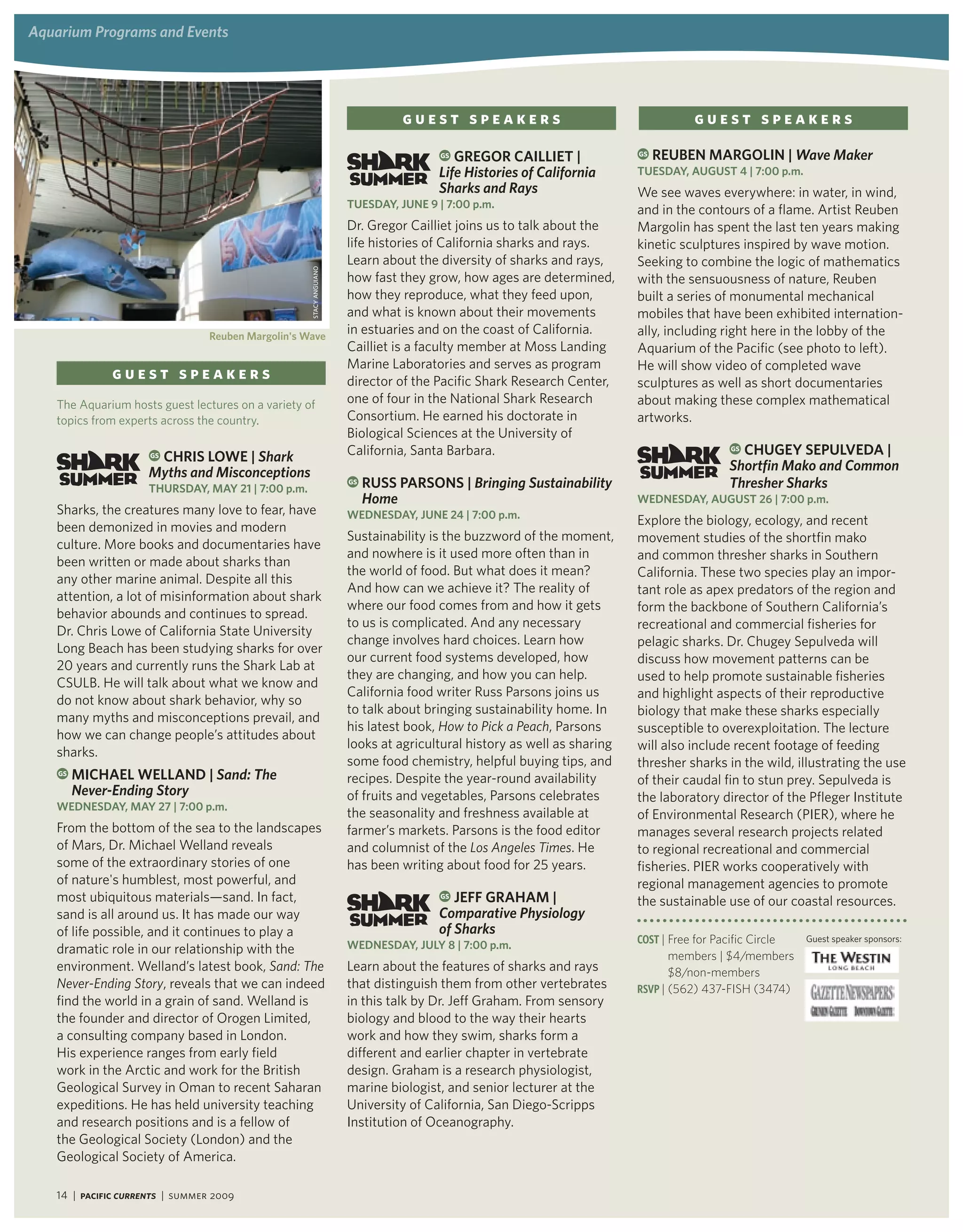
                                                    stAcy ANGuiANo
                                                                     how fast they grow, how ages are determined,       with the sensuousness of nature, Reuben
                                                                     how they reproduce, what they feed upon,           built a series of monumental mechanical
                                                                     and what is known about their movements            mobiles that have been exhibited internation-
                                 reuben Margolin's wave
                                                                     in estuaries and on the coast of California.       ally, including right here in the lobby of the
                                                                     Cailliet is a faculty member at Moss Landing       Aquarium of the Pacific (see photo to left).
                                                                     Marine Laboratories and serves as program          He will show video of completed wave
              guest speakers                                         director of the Pacific Shark Research Center,     sculptures as well as short documentaries
   The Aquarium hosts guest lectures on a variety of                 one of four in the National Shark Research         about making these complex mathematical
   topics from experts across the country.                           Consortium. He earned his doctorate in             artworks.
                                                                     Biological Sciences at the University of
                                                                                                                                            GS ChUgey SePUlveda |
                      ChriS lowe | Shark
                     GS                                              California, Santa Barbara.
                     myths and misconceptions                                                                                               Shortfin mako and common
                     thUrSday, May 21 | 7:00 p.m.
                                                                     GS   rUSS ParSonS | Bringing Sustainability                            thresher Sharks
                                                                          home                                          wedneSday, aUgUSt 26 | 7:00 p.m.
   Sharks, the creatures many love to fear, have                     wedneSday, JUne 24 | 7:00 p.m.
   been demonized in movies and modern                                                                                  Explore the biology, ecology, and recent
                                                                     Sustainability is the buzzword of the moment,      movement studies of the shortfin mako
   culture. More books and documentaries have
                                                                     and nowhere is it used more often than in          and common thresher sharks in Southern
   been written or made about sharks than
                                                                     the world of food. But what does it mean?          California. These two species play an impor-
   any other marine animal. Despite all this
                                                                     And how can we achieve it? The reality of          tant role as apex predators of the region and
   attention, a lot of misinformation about shark
                                                                     where our food comes from and how it gets          form the backbone of Southern California’s
   behavior abounds and continues to spread.
                                                                     to us is complicated. And any necessary            recreational and commercial fisheries for
   Dr. Chris Lowe of California State University
                                                                     change involves hard choices. Learn how            pelagic sharks. Dr. Chugey Sepulveda will
   Long Beach has been studying sharks for over
                                                                     our current food systems developed, how            discuss how movement patterns can be
   20 years and currently runs the Shark Lab at
                                                                     they are changing, and how you can help.           used to help promote sustainable fisheries
   CSULB. He will talk about what we know and
                                                                     California food writer Russ Parsons joins us       and highlight aspects of their reproductive
   do not know about shark behavior, why so
                                                                     to talk about bringing sustainability home. In     biology that make these sharks especially
   many myths and misconceptions prevail, and
                                                                     his latest book, How to Pick a Peach, Parsons      susceptible to overexploitation. The lecture
   how we can change people’s attitudes about
                                                                     looks at agricultural history as well as sharing   will also include recent footage of feeding
   sharks.
                                                                     some food chemistry, helpful buying tips, and      thresher sharks in the wild, illustrating the use
    GS   MiChael welland | Sand: the                                 recipes. Despite the year-round availability       of their caudal fin to stun prey. Sepulveda is
         never-ending Story                                          of fruits and vegetables, Parsons celebrates       the laboratory director of the Pfleger Institute
   wedneSday, May 27 | 7:00 p.m.
                                                                     the seasonality and freshness available at         of Environmental Research (PIER), where he
   From the bottom of the sea to the landscapes                      farmer’s markets. Parsons is the food editor       manages several research projects related
   of Mars, Dr. Michael Welland reveals                              and columnist of the Los angeles times. He         to regional recreational and commercial
   some of the extraordinary stories of one                          has been writing about food for 25 years.          fisheries. PIER works cooperatively with
   of nature's humblest, most powerful, and                                                                             regional management agencies to promote
   most ubiquitous materials—sand. In fact,                                          GS JeFF grahaM |
                                                                                                                        the sustainable use of our coastal resources.
   sand is all around us. It has made our way                                        comparative Physiology
   of life possible, and it continues to play a                                      of Sharks
                                                                     wedneSday, JUly 8 | 7:00 p.m.                      Cost | Free for Pacific Circle   Guest speaker sponsors:
   dramatic role in our relationship with the                                                                                  members | $4/members
   environment. Welland’s latest book, Sand: the                     Learn about the features of sharks and rays               $8/non-members
   never-ending Story, reveals that we can indeed                    that distinguish them from other vertebrates       RsVP | (562) 437-FISH (3474)
   find the world in a grain of sand. Welland is                     in this talk by Dr. Jeff Graham. From sensory
   the founder and director of Orogen Limited,                       biology and blood to the way their hearts
   a consulting company based in London.                             work and how they swim, sharks form a
   His experience ranges from early field                            different and earlier chapter in vertebrate
   work in the Arctic and work for the British                       design. Graham is a research physiologist,
   Geological Survey in Oman to recent Saharan                       marine biologist, and senior lecturer at the
   expeditions. He has held university teaching                      University of California, San Diego-Scripps
   and research positions and is a fellow of                         Institution of Oceanography.
   the Geological Society (London) and the
   Geological Society of America.

   14 | Pacific Currents | summer 2009
aquarium Programs and events


           aquarium tours
These programs are opportunities to see the
Aquarium and its animals in a different light.

                     AT   Feed a SharK or ray
                    daily Starting JUly 17
                    10:15 a.m. & 2:15 p.m.


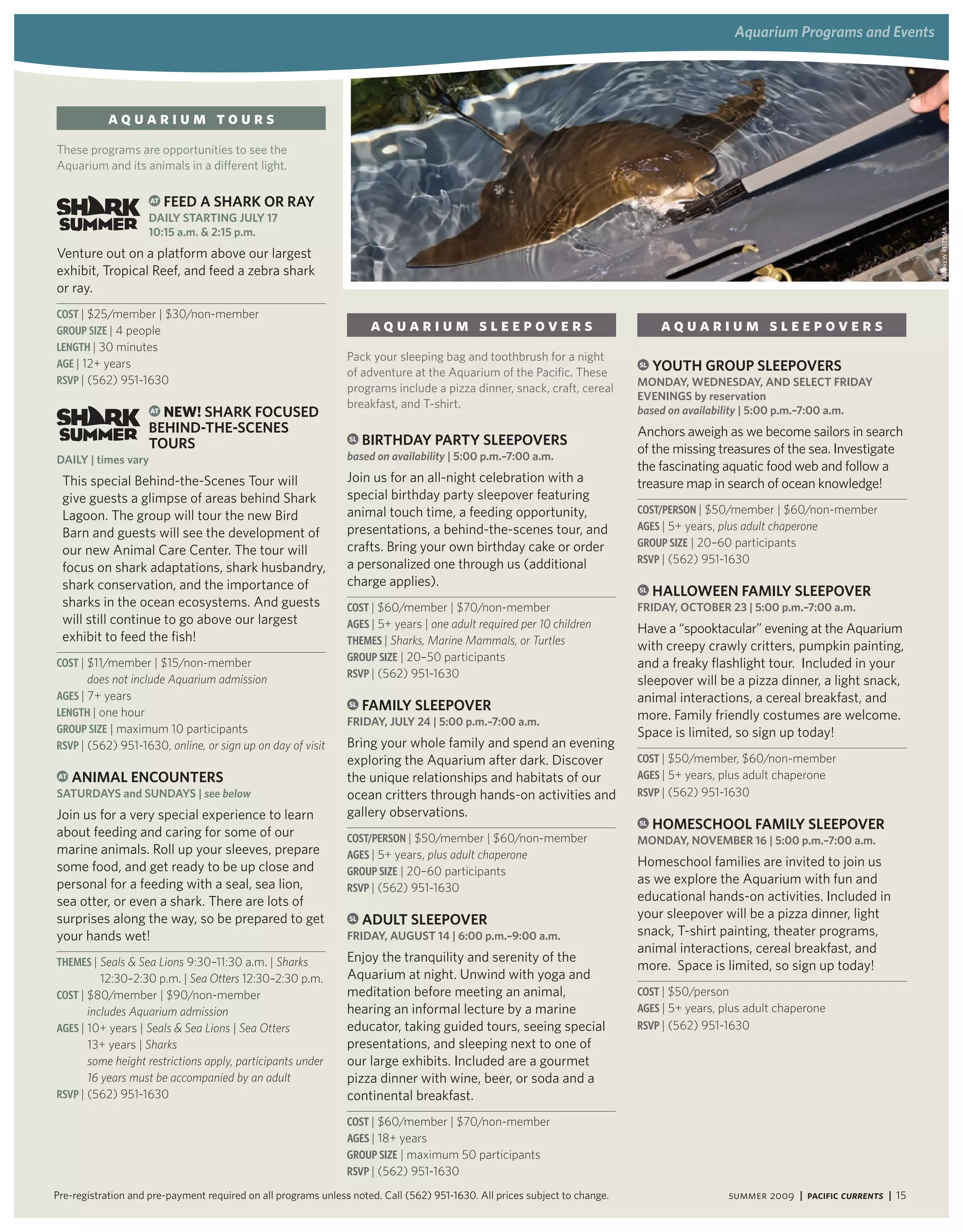
                                                                                                                                                                                    ANdRew ReitsmA
Venture out on a platform above our largest
exhibit, Tropical Reef, and feed a zebra shark
or ray.
Cost | $25/member | $30/non-member
GRouP siZe | 4 people                                                 aquarium sleepovers                                          aquarium sleepovers
LeNGtH | 30 minutes
                                                                Pack your sleeping bag and toothbrush for a night
aGe | 12+ years                                                                                                              SL   yoUth groUP SleePoverS
                                                                of adventure at the Aquarium of the Pacific. These
RsVP | (562) 951-1630                                                                                                        Monday, wedneSday, and SeleCt Friday
                                                                programs include a pizza dinner, snack, craft, cereal
                                                                                                                             eveningS by reservation
                    AT nEW! SharK FoCUSed
                                                                breakfast, and T-shirt.
                                                                                                                             based on availability | 5:00 p.m.–7:00 a.m.
                    Behind-the-SCeneS                                                                                        Anchors aweigh as we become sailors in search
                    toUrS                                       SL   Birthday Party SleePoverS
                                                                based on availability | 5:00 p.m.–7:00 a.m.
                                                                                                                             of the missing treasures of the sea. Investigate
daily | times vary
                                                                                                                             the fascinating aquatic food web and follow a
 This special Behind-the-Scenes Tour will                       Join us for an all-night celebration with a                  treasure map in search of ocean knowledge!
 give guests a glimpse of areas behind Shark                    special birthday party sleepover featuring
                                                                animal touch time, a feeding opportunity,                    Cost/PeRsoN | $50/member | $60/non-member
 Lagoon. The group will tour the new Bird
                                                                presentations, a behind-the-scenes tour, and                 aGes | 5+ years, plus adult chaperone
 Barn and guests will see the development of
                                                                crafts. Bring your own birthday cake or order                GRouP siZe | 20–60 participants
 our new Animal Care Center. The tour will
                                                                a personalized one through us (additional                    RsVP | (562) 951-1630
 focus on shark adaptations, shark husbandry,
 shark conservation, and the importance of                      charge applies).                                             SL   halloween FaMily SleePover
 sharks in the ocean ecosystems. And guests                     Cost | $60/member | $70/non-member                           Friday, oCtoBer 23 | 5:00 p.m.–7:00 a.m.
 will still continue to go above our largest                    aGes | 5+ years | one adult required per 10 children         Have a “spooktacular” evening at the Aquarium
 exhibit to feed the fish!                                      tHemes | Sharks, Marine Mammals, or Turtles                  with creepy crawly critters, pumpkin painting,
                                                                GRouP siZe | 20–50 participants
Cost | $11/member | $15/non-member                                                                                           and a freaky flashlight tour. Included in your
       does not include Aquarium admission                      RsVP | (562) 951-1630
                                                                                                                             sleepover will be a pizza dinner, a light snack,
aGes | 7+ years                                                                                                              animal interactions, a cereal breakfast, and
LeNGtH | one hour
                                                                SL   FaMily SleePover
                                                                Friday, JUly 24 | 5:00 p.m.–7:00 a.m.
                                                                                                                             more. Family friendly costumes are welcome.
GRouP siZe | maximum 10 participants                                                                                         Space is limited, so sign up today!
RsVP | (562) 951-1630, online, or sign up on day of visit       Bring your whole family and spend an evening
                                                                exploring the Aquarium after dark. Discover                  Cost | $50/member, $60/non-member
AT   aniMal enCoUnterS                                          the unique relationships and habitats of our                 aGes | 5+ years, plus adult chaperone
SatUrdayS and SUndayS | see below                               ocean critters through hands-on activities and               RsVP | (562) 951-1630
Join us for a very special experience to learn                  gallery observations.
                                                                                                                             SL   hoMeSChool FaMily SleePover
about feeding and caring for some of our                        Cost/PeRsoN | $50/member | $60/non-member                    Monday, noveMBer 16 | 5:00 p.m.–7:00 a.m.
marine animals. Roll up your sleeves, prepare                   aGes | 5+ years, plus adult chaperone
some food, and get ready to be up close and                                                                                  Homeschool families are invited to join us
                                                                GRouP siZe | 20–60 participants
personal for a feeding with a seal, sea lion,                                                                                as we explore the Aquarium with fun and
                                                                RsVP | (562) 951-1630
sea otter, or even a shark. There are lots of                                                                                educational hands-on activities. Included in
surprises along the way, so be prepared to get                  SL   adUlt SleePover                                         your sleepover will be a pizza dinner, light
your hands wet!                                                 Friday, aUgUSt 14 | 6:00 p.m.–9:00 a.m.                      snack, T-shirt painting, theater programs,
                                                                                                                             animal interactions, cereal breakfast, and
tHemes | Seals & Sea Lions 9:30–11:30 a.m. | Sharks             Enjoy the tranquility and serenity of the
                                                                                                                             more. Space is limited, so sign up today!
          12:30–2:30 p.m. | Sea Otters 12:30–2:30 p.m.          Aquarium at night. Unwind with yoga and
Cost | $80/member | $90/non-member                              meditation before meeting an animal,                         Cost | $50/person
       includes Aquarium admission                              hearing an informal lecture by a marine                      aGes | 5+ years, plus adult chaperone
aGes | 10+ years | Seals & Sea Lions | Sea Otters               educator, taking guided tours, seeing special                RsVP | (562) 951-1630
       13+ years | Sharks                                       presentations, and sleeping next to one of
       some height restrictions apply, participants under       our large exhibits. Included are a gourmet
       16 years must be accompanied by an adult                 pizza dinner with wine, beer, or soda and a
RsVP | (562) 951-1630                                           continental breakfast.
                                                                Cost | $60/member | $70/non-member
                                                                aGes | 18+ years
                                                                GRouP siZe | maximum 50 participants
                                                                RsVP | (562) 951-1630

Pre-registration and pre-payment required on all programs unless noted. Call (562) 951-1630. All prices subject to change.                    summer 2009 | Pacific Currents | 15
aquarium Programs and events


            special programs                                   outdoor adventures
                                                         Go beyond the Aquarium to participate in one of
    SP   Birthday PartieS
   availaBle By reServation only                         these offsite classes in the great outdoors.

   Let us make your child's next birthday                OA   natUre By KayaK
   celebration special. The Aquarium will supply
                                                         SUn., JUne 21; Sat., JUly 18; Sat., aUgUSt 22;
   all the ingredients for an unforgettable party,       SUn., SePteMBer 13; Sat., oCtoBer 17; Sat.,
   including a themed one-hour classroom                 noveMBer 21 | 9:00 a.m.–12:00 noon


                                                                                                                                                                                       ANdRew ReitsmA
   program featuring animal touch time,                  Join us for a morning of gentle paddling in the
   biofact discovery, and a take home souvenir           Upper Newport Bay Ecological Preserve for an
   craft project. The party concludes with an            up-close view of nature. After an introductory
   additional half hour in the classroom for the         lesson, you will be led on a naturalist-guided
   birthday celebration. Bring your own birthday         kayak expedition. Both double and single
   cake or order a personalized one through                                                                                        youth programs
                                                         kayaks are available in this off-site class.
   us (additional charge applies). Aquarium
   admission is included. All you need to do is          Cost | $53/member | $58/non-member                             YP   JUnior BiologiSt PrograM
   call us a least two weeks prior to reserve a          aGes | 11+ years, plus adult chaperone if under age 16         SatUrdayS | 9:30–11:30 a.m. | topics vary, see below
   date (subject availability), and then invite your     WHeRe | meets offsite | map included in confirmation           Participants will independently investigate
   guests. We also offer birthday sleepovers.                     materials                                             marine life during this exploratory program.
                                                         RsVP | (562) 951-1630
                                                                                                                        This class offers hands-on animal touch time,
   Cost | $33/member | $39/non-member | 15 person
                                                                                                                        Aquarium animal observation, and activities
          minimum, includes Aquarium admission           OA   BlUe whale watCh
   aGes | all ages, one adult required per 10 children   SUMMer SeaSon
                                                                                                                        relating to each topic. Select the topic that
   tHemes | Sharks, Marine Mammals, or Turtles
                                                                                                                        is most interesting, or take all the classes to
                                                         Search out the elusive and magnificent blue                    learn about the variety of animals found at
   GRouP siZe | 15–45 participants
                                                         whale with the Aquarium of the Pacific and                     the Aquarium.
   iNFo | (562) 951-1630
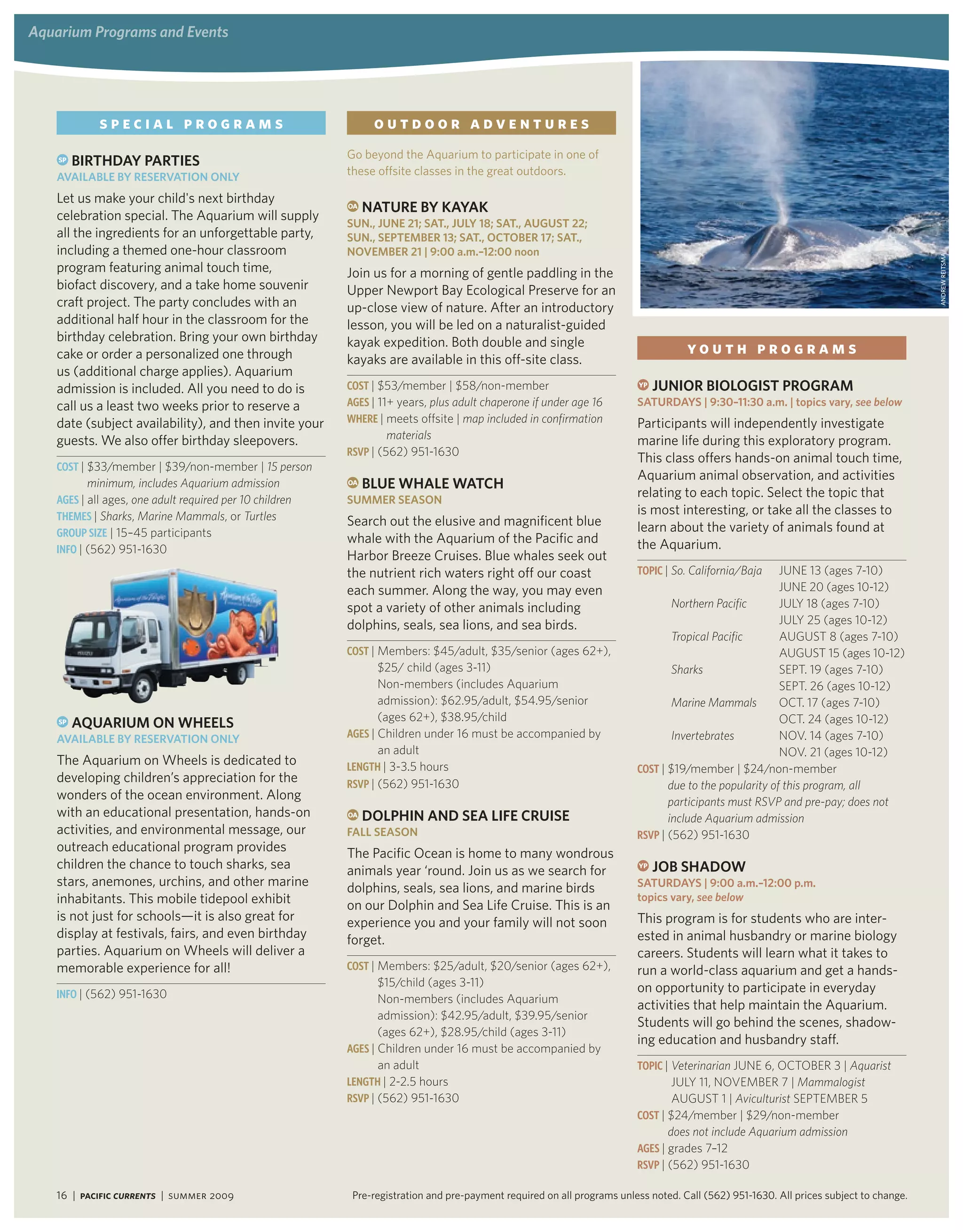
                                                         Harbor Breeze Cruises. Blue whales seek out
                                                         the nutrient rich waters right off our coast                   toPiC | So. California/Baja    JuNe 13 (ages 7-10)
                                                         each summer. Along the way, you may even                                                      JuNe 20 (ages 10-12)
                                                         spot a variety of other animals including                              Northern Pacific       July 18 (ages 7-10)
                                                         dolphins, seals, sea lions, and sea birds.                                                    July 25 (ages 10-12)
                                                                                                                                Tropical Pacific       AuguST 8 (ages 7-10)
                                                         Cost | Members: $45/adult, $35/senior (ages 62+),                                             AuguST 15 (ages 10-12)
                                                                $25/ child (ages 3-11)                                          Sharks                 SePT. 19 (ages 7-10)
                                                                Non-members (includes Aquarium                                                         SePT. 26 (ages 10-12)
                                                                admission): $62.95/adult, $54.95/senior                         Marine Mammals         OCT. 17 (ages 7-10)
                                                                (ages 62+), $38.95/child                                                               OCT. 24 (ages 10-12)
    SP   aqUariUM on wheelS
   availaBle By reServation only                         aGes | Children under 16 must be accompanied by                        Invertebrates          NOv. 14 (ages 7-10)
                                                                an adult                                                                               NOv. 21 (ages 10-12)
   The Aquarium on Wheels is dedicated to                LeNGtH | 3-3.5 hours                                           Cost | $19/member | $24/non-member
   developing children’s appreciation for the            RsVP | (562) 951-1630                                                 due to the popularity of this program, all
   wonders of the ocean environment. Along                                                                                     participants must RSVP and pre-pay; does not
   with an educational presentation, hands-on            OA   dolPhin and Sea liFe CrUiSe                                      include Aquarium admission
   activities, and environmental message, our            Fall SeaSon                                                    RsVP | (562) 951-1630
   outreach educational program provides                 The Pacific Ocean is home to many wondrous
   children the chance to touch sharks, sea              animals year ‘round. Join us as we search for                  YP   JoB Shadow
   stars, anemones, urchins, and other marine            dolphins, seals, sea lions, and marine birds                   SatUrdayS | 9:00 a.m.–12:00 p.m.
   inhabitants. This mobile tidepool exhibit             on our Dolphin and Sea Life Cruise. This is an
                                                                                                                        topics vary, see below
   is not just for schools—it is also great for          experience you and your family will not soon                   This program is for students who are inter-
   display at festivals, fairs, and even birthday        forget.                                                        ested in animal husbandry or marine biology
   parties. Aquarium on Wheels will deliver a                                                                           careers. Students will learn what it takes to
   memorable experience for all!                         Cost | Members: $25/adult, $20/senior (ages 62+),              run a world-class aquarium and get a hands-
                                                                $15/child (ages 3-11)                                   on opportunity to participate in everyday
   iNFo | (562) 951-1630                                        Non-members (includes Aquarium
                                                                                                                        activities that help maintain the Aquarium.
                                                                admission): $42.95/adult, $39.95/senior
                                                                                                                        Students will go behind the scenes, shadow-
                                                                (ages 62+), $28.95/child (ages 3-11)
                                                                                                                        ing education and husbandry staff.
                                                         aGes | Children under 16 must be accompanied by
                                                                an adult                                                toPiC | Veterinarian JuNe 6, OCTOber 3 | Aquarist
                                                         LeNGtH | 2-2.5 hours                                                   July 11, NOveMber 7 | Mammalogist
                                                         RsVP | (562) 951-1630                                                  AuguST 1 | Aviculturist SePTeMber 5
                                                                                                                        Cost | $24/member | $29/non-member
                                                                                                                               does not include Aquarium admission
                                                                                                                        aGes | grades 7–12
                                                                                                                        RsVP | (562) 951-1630

   16 | Pacific Currents | summer 2009                    Pre-registration and pre-payment required on all programs unless noted. Call (562) 951-1630. All prices subject to change.
aquarium Programs and events


                                                                                                                                                                                            GReG RotHscHiLd
                                                              tim AdAms


                  Day Camps                                                               Day Camps                                           Day Camps
DC   FiSh Fry day CaMP                                                    DC   oCean adventUre day CaMP
tUeSdayS–thUrSdayS | JUly 7–9 | aUgUSt 4–6 |                              Mon.–Fri. | JUly 6–10 camp 1 | JUly 13–17 camp 2
aUgUSt 18–20 | 8:30–10:30 a.m.                                            JUly 20–24 camp 3 | aUgUSt 17–21 camp 4
                                                                          aUgUSt 24–28 camp 1
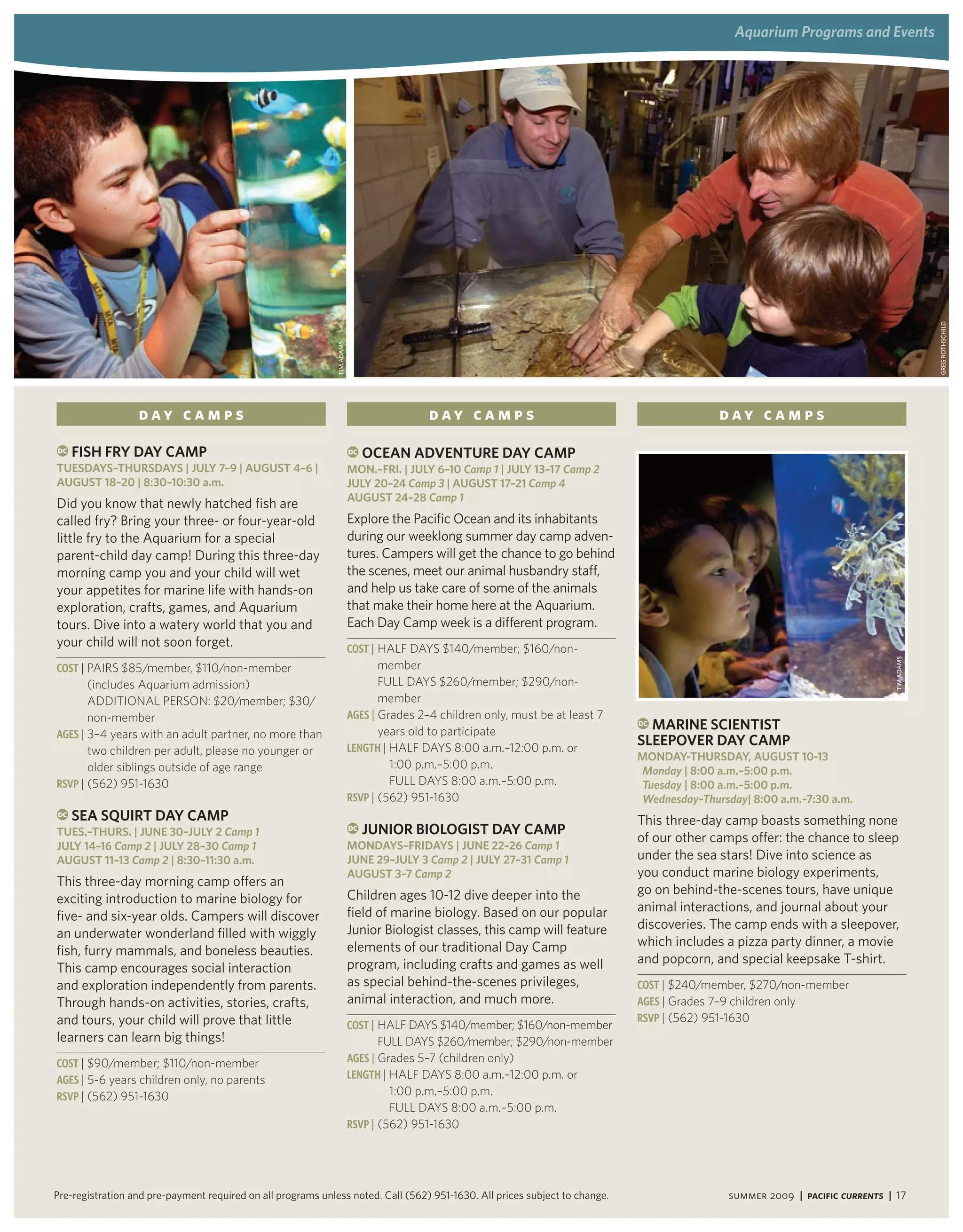
Did you know that newly hatched fish are
called fry? Bring your three- or four-year-old                            Explore the Pacific Ocean and its inhabitants
little fry to the Aquarium for a special                                  during our weeklong summer day camp adven-
parent-child day camp! During this three-day                              tures. Campers will get the chance to go behind
morning camp you and your child will wet                                  the scenes, meet our animal husbandry staff,
your appetites for marine life with hands-on                              and help us take care of some of the animals
exploration, crafts, games, and Aquarium                                  that make their home here at the Aquarium.
tours. Dive into a watery world that you and                              Each Day Camp week is a different program.
your child will not soon forget.                                          Cost | HAlF DAyS $140/member; $160/non-


                                                                                                                                                                                tim AdAms
Cost | PAIrS $85/member, $110/non-member                                         member
       (includes Aquarium admission)                                             Full DAyS $260/member; $290/non-
       ADDITIONAl PerSON: $20/member; $30/                                       member
       non-member                                                         aGes | grades 2–4 children only, must be at least 7
                                                                                                                                DC Marine SCientiSt
aGes | 3–4 years with an adult partner, no more than                             years old to participate
                                                                          LeNGtH | HAlF DAyS 8:00 a.m.–12:00 p.m. or
                                                                                                                                SleePover day CaMP
       two children per adult, please no younger or                                                                             Monday-thUrSday, aUgUSt 10-13
       older siblings outside of age range                                         1:00 p.m.–5:00 p.m.                          monday | 8:00 a.m.–5:00 p.m.
RsVP | (562) 951-1630                                                              Full DAyS 8:00 a.m.–5:00 p.m.                tuesday | 8:00 a.m.–5:00 p.m.
                                                                          RsVP | (562) 951-1630                                 Wednesday–thursday| 8:00 a.m.–7:30 a.m.
DC   Sea SqUirt day CaMP                                                                                                        This three-day camp boasts something none
tUeS.–thUrS. | JUne 30–JUly 2 camp 1                                      DC   JUnior BiologiSt day CaMP
                                                                                                                                of our other camps offer: the chance to sleep
JUly 14–16 camp 2 | JUly 28–30 camp 1                                     MondayS–FridayS | JUne 22–26 camp 1
aUgUSt 11–13 camp 2 | 8:30–11:30 a.m.                                     JUne 29–JUly 3 camp 2 | JUly 27–31 camp 1             under the sea stars! Dive into science as
                                                                          aUgUSt 3–7 camp 2                                     you conduct marine biology experiments,
This three-day morning camp offers an
                                                                          Children ages 10-12 dive deeper into the              go on behind-the-scenes tours, have unique
exciting introduction to marine biology for
                                                                          field of marine biology. Based on our popular         animal interactions, and journal about your
five- and six-year olds. Campers will discover
                                                                          Junior Biologist classes, this camp will feature      discoveries. The camp ends with a sleepover,
an underwater wonderland filled with wiggly
                                                                          elements of our traditional Day Camp                  which includes a pizza party dinner, a movie
fish, furry mammals, and boneless beauties.
                                                                          program, including crafts and games as well           and popcorn, and special keepsake T-shirt.
This camp encourages social interaction
and exploration independently from parents.                               as special behind-the-scenes privileges,              Cost | $240/member, $270/non-member
Through hands-on activities, stories, crafts,                             animal interaction, and much more.                    aGes | grades 7–9 children only
and tours, your child will prove that little                                                                                    RsVP | (562) 951-1630
                                                                          Cost | HAlF DAyS $140/member; $160/non-member
learners can learn big things!                                                  Full DAyS $260/member; $290/non-member
Cost | $90/member; $110/non-member                                        aGes | grades 5–7 (children only)
aGes | 5-6 years children only, no parents                                LeNGtH | HAlF DAyS 8:00 a.m.–12:00 p.m. or
RsVP | (562) 951-1630                                                              1:00 p.m.–5:00 p.m.
                                                                                   Full DAyS 8:00 a.m.–5:00 p.m.
                                                                          RsVP | (562) 951-1630


Pre-registration and pre-payment required on all programs unless noted. Call (562) 951-1630. All prices subject to change.                      summer 2009 | Pacific Currents | 17
aquarium Programs and events


    Saturday family fun programs                                         aqua tots                                                      aqua tots
   Children, along with a parent or adult chaperone,   Toddlers team up with their parent or chaperone                AQ   Shoreline ShaPeS
   will investigate the ocean world in a structured    for a first look into ocean life. Each of the Aqua Tots        tUeSday, JUly 21 | 2:30–4:00 p.m.
   classroom program that includes interactive         programs focuses and expands on a particular concept           wedneSday, oCtoBer 21 | 2:30–4:00 p.m.
   and hands-on activities. These programs foster      while encouraging adult and child interaction.
                                                                                                                      Did you know a sea jelly is shaped a lot
   the students’ discovery as well as interaction in
                                                                                                                      like a bell or that some fishes are as flat as
   relationships.                                      AQ   SoUndS oF the Sea                                         pancakes? In the Aquarium, there are eels so
                                                       wedneSday, JUne 3 | 2:30–4:00 p.m.
                                                                                                                      skinny they look like shoestrings! Explore the
    FP   totally tUrtleS                               wedneSday, SePteMBer 2 | 4:00–5:30 p.m.
                                                                                                                      exciting shapes of ocean life through a craft,
   SatUrday, JUne 27 | SatUrday, oCtoBer 10 |          Shake, rattle, and roll as we listen to the
   10:00–11:30 a.m.                                                                                                   songs, and hands-on activities.
                                                       sounds of the ocean. Experience the wonder-
   You may enjoy a sweet treat of Jelly Bellies,       ful world of sea sounds, from the songs of a                   AQ   SliPPery to PriCKly
   but a sea turtle prefers having a belly full of     big blue whale to the barking of a sea lion.                   tUeSday, aUgUSt 4 | 4:00–5:30 p.m.
   jellies! Discover fun facts and turtle trivia as                                                                   wedneSday, noveMBer 4 | 4:00–5:30 p.m.
   we explore these reptiles.                          AQ   ColorS oF the oCean                                       Whether it’s a slippery sea cucumber, soft and
                                                       tUeSday, JUne 16 | 4:00–5:30 p.m.
                                                                                                                      velvety bat ray, prickly sea urchin, or simply
    FP   SharK SleUthS                                 tUeSday, SePteMBer 22 | 2:30–4:00 p.m.
                                                                                                                      the smooth shell of a hermit crab, discover the
   SatUrday, JUly 4 | SatUrday, noveMBer 28 |          Below the surface of the blue ocean are ani-
   10:00–11:30 a.m.                                                                                                   many lovable and touchable creatures that
                                                       mals with amazing colors. Some are bright and                  live in the ocean. Learn what can be explored
   Discover how sharks’ amazing adaptations            flashy while others blend into the ocean bot-                  safely as we use our sense of touch on a
   make them excellent predators. Get an up-           tom. Discover some of these colorful animals,                  journey through the Pacific Ocean.
   close view of these creatures and others as         and search for those that may be hiding.
   we learn all about sharks!                                                                                         AQ   SUPer SenSeS oF the Sea
                                                       AQ   Movin’ & groovin’ Beneath the Sea                         wedneSday, aUgUSt 19 | 2:30–4:00 p.m.
    FP   MagniFiCent Marine MaMMalS                    wedneSday, JUly 8 | 4:00–5:30 p.m.                             tUeSday, noveMBer 17 | 2:30–4:00 p.m.
   SatUrday, aUgUSt 22 | 10:00–11:30 a.m.              tUeSday, oCtoBer 6 | 4:00–5:30 p.m.
                                                                                                                      Smell the salty air and feel the cool breeze
   What animals are warm blooded, hairy,               Roll like an otter and slide like a snail as we                as we use our senses to explore how ocean
   breathe air, and live in the ocean? Marine          discover animals through movement. Explore                     animals use their sight, taste, touch, and hear-
   mammals! Join us as we learn the special            the world of sea creatures by taking a closer                  ing in their watery home. Immerse yourself in
   ways sea otters, seals, sea lions, whales, and      look at the way they move. Join us as we move                  the wonder and discovery of this interactive
   other marine mammals survive in the sea.            and groove like the animals beneath the sea!                   program.
   FP Sea JellieS and other inCrediBle                                                                                Cost | ADulT-CHIlD PAIr: $24/member
   inverteBrateS                                                                                                             $30/non-member | ADDITIONAl PerSON:
   SatUrday, SePteMBer 12 | 10:00–11:30 a.m.                                                                                 $10/person, includes Aquarium admission
   They may be spineless, but they are the                                                                            aGes | 2–3 years, plus adult chaperone
                                                                                                                      RsVP | (562) 951-1630
   backbone of nature. Join us as we learn all
   about jellies and their invertebrate relatives
   that inhabit the ocean.
   Cost | ADulT-CHIlD PAIr: $24/member
          $36/non-member
          exTrA PerSON: $10/person
          includes Aquarium admission
   aGes | 4–6 years, plus adult chaperone
   RsVP | (562) 951-1630


   18 | Pacific Currents | summer 2009                  Pre-registration and pre-payment required on all programs unless noted. Call (562) 951-1630. All prices subject to change.
aquarium Programs and events
                                                                                                                                      aquarium Programs and events


       preschool programs                                                     other classes
Designed for young children to independently                    OC   Under the Sea ShaPeS
explore marine life, each Preschool Program class
                                                                availaBle By reServation only
offers hands-on animal touch time, a craft project,
story time, time to explore the Aquarium, a snack,              The ocean is full of incredible animals and
and activities relating to the project.                         vibrant colors. In this interactive educator- and
                                                                video-led program, children will match ocean
 PP   waCKy water world                                         animals, such as sharks and sea anemones, to
wedneSday, JUne 10 | 2:30–4:30 p.m.                             their shapes. This exciting program is designed
Everywhere we look there is water nearby: in                    especially for preschool and daycare groups.
the bathtub, in the sink, or even falling from                  Cost | $9/member or non-member (March–June)
the sky. We will explore why plants, animals,
and people need water as we investigate this
                                                                       $7.50/member or non-member (July–
                                                                       February)                                             Boeing
                                                                                                                             Teacher Institute
wet and wonderful world.                                        aGes | 4–5 years | plus one free adult chaperone per 10
                                                                       children
 PP   Shining StarS                                             LeNGtH | 45 minutes

                                                                                                                             Free Program for Teachers!
wedneSday, JUly 22 | 2:30–4:30 p.m.                             GRouP siZe | 20 student minimum
How do sea stars see? What do sea stars                         RsVP | (562) 951-1630
eat? Do they sleep? We will answer these and
many other interesting questions about the
                                                                OC   Sea liFe Stroll
                                                                thUrSday, JUly 23 | 8:30–9:30 a.m.
sea stars living in our tidepools. Join us as we                tUeSday, oCtoBer 13 | 8:30–9:30 a.M.
explore shining stars and their neighbors.
                                                                View the Aquarium before it opens! Bring
 PP   Jiggling JellieS                                          your child in a stroller for a close-up
wedneSday, aUgUSt 12 | 2:30–4:30 p.m.                           look at our exhibits. This class features
                                                                a personalized Aquarium tour and craft
Have you ever jiggled like a sea jelly? Come
                                                                designed with your toddler in mind.
explore the Pacific Ocean in search of these
rainbows of the sea! Learn all about these                      Cost | ADulT-CHIlD PAIr: $14/member
squishy creatures and even make one to take                            $20/non-member
home.                                                                  exTrA PerSON: $10/person, includes

 PP   SenSational SharKS
                                                                       Aquarium admission
                                                                aGes | toddler, plus adult chaperone
                                                                                                                             do you know a teacher
tUeSday, SePteMBer 29 | 2:30–4:30 p.m.                          RsVP | (562) 951-1630                                        interested in bringing
Discover super sharks and radical rays, and
learn what these relatives have in common
                                                                OC   Critter Chat                                            more marine science
even though they look so different. We will
                                                                SatUrdayS and SUndayS, 2:30 P.M.                             into their classroom?
also get to touch these cool cartilaginous                      Learn all about animals in a fun, interactive
creatures.                                                      classroom program where you get the chance
                                                                to meet one of our furry, scaly, or feathered                Would they be interested in
 PP   “o” iS For otter                                          friends up close and personal. Available for                 joining our educators for an
tUeSday, oCtoBer 20 | 2:30–4:30 p.m.                            groups or individuals.                                       in-depth exploration of California
Find out how a sea otter spends its day, both                   Cost | $6.00/member | $7.50/non-member                       marine life, including time behind
above and below the water’s surface. Discover                   LeNGtH | 30 minutes                                          the scenes at the Aquarium and
what tools they use to eat, what keeps them                     WHeRe | Watershed Classroom
warm, and why their teeth are sometimes                         RsVP | (562) 951-1630 or sign up the day of your visit
                                                                                                                             three days on Catalina Island? If
purple.                                                                                                                      so, they should apply to attend
                                                                                                                             the Boeing teacher institute for
 PP   Silly SealS and Sea lionS                                                                                              the week of august 24-28.
wedneSday, noveMBer 18 | 2:30–4:30 p.m.
                                                                                                                                Applications are available
Let’s dive through the kelp forest in search
of seals and sea lions. We will look at their                                                                                in the Teacher Resources
adaptations to the water and discover how to                                                                                 section of our website at www.
tell apart these furry creatures. Come along                                                                                 aquariumofpacific.org/teachers
as we investigate these California residents                                                                                 (under the Opportunities and
that live right off our coast.                                                                                               Announcements link on the left).
Cost | $19/member | $24/non-member                                                                                              Note that the application
        does not include Aquarium admission                                                                                  deadline is in June. Please
aGes | 4–5 years
                                                                                                                             call (562) 951-1630 for more
RsVP | (562) 951-1630
                                                                                                                             information.

Pre-registration and pre-payment required on all programs unless noted. Call (562) 951-1630. All prices subject to change.           summer 2009 | Pacific Currents | 19
KIDs CORneR

Shark "Food Chain" Bank
contributed by sabreena Kasbati


  S
           harks havE an ExTrEmEly imPorTanT job in
           ThE oCEan. Many sharks are apex (top) predators in
           the food web. a food chain within a food web shows how
           animals consume energy through eating other animals
or plants. Since sharks are often at the top of a food chain, they
have a huge influence on all animals below them. they determine
the structure and function of different areas in the ocean. Sharks
affect other animals’ behaviors, how many there are of one type of
animal, and how many different types of animals there are in the
ocean. in fact, we would not see so many different animals without
predation. without sharks, the ocean would be very different.


Below, you have the opportunity to show everyone a food chain
and its importance with your favorite shark as the apex predator.
when it's done, show your friends and family and explain to them
that the animal at the top eats the animal below it and so on. and
the energy from the sun feeds the plant. this craft can be used as a
money bank for saving money to save sharks.


                    heRe aRe sOme examples Of OCean fOOD ChaIns


   Sun                  Kelp             Sea Urchin                    Sea otter         great white Shark

  Sun


               Phytoplankton       zooplankton        Sea Jelly             Sea turtle     tiger Shark
mateRIals:
                                                                                                       Bonnethead Shark
                                                                                                              Sphyrna tiburo
  ❏ oatmeal Container                                        ❏ Construction Paper
  ❏ Glue                                                     ❏ scissors
  ❏ White Paper                                              ❏ markers/Crayons

  DIReCtIOns:
 1.    Take any wrapping off of your                    5.     below your shark, put an animal
       empty oatmeal container.                                that your shark would eat,
                                                               like an otter or sea turtle.
 2.    Wrap a piece of white paper
       around the container to make                     6.     below this animal, put a plant
       sure it fits. if it does not fit,                       that would in turn be eaten.
       you may have to cut it or add
       another piece of paper to be able                7.     all energy in a food chain
                                                                                                        Tropical pacific Gallery
       to cover the entire container.                          starts from the sun. include
                                                               the sun in your drawing.
 3.    now you will decorate the white
       paper to illustrate a food chain.                8.     When your drawing of a food
       keep in mind the direction the                          chain is complete, glue it onto
       chain is going. The shark should                        the oatmeal container.
       be on top. you can draw animals
       and plants and/or cut up other                   9.     Finish your shark bank by cutting
       colored paper to paste on.                              a two-inch slit in the top.
                                                                                                       Sand tiger Shark
 4.    at the top of the paper,                                                                              Carcharius taurus
       make a shark.


Fishing for
Knowledge!
                                                        ?     ?                   ?
                                                                                    ?
                                                                                                             Shark laGoon


       1. there are approximately __ __ __ species (or types) of sharks
          in the world. (Hint: see page 6)
 2. a shark’s skeleton is made up of __ __ __ __ __ __ __ __ __, the same
    material in your ears and nose.
                                                                                                        Shark egg CaSe
3. the largest shark in the ocean is the __ __ __ __ __ shark, which has
    tiny teeth that it does not use to eat. it feeds on plankton with its gills
    instead.
       Last Issue’s Questions and Answers:
      1. Scientists can determine what an animal eats by studying its mouth and its teeth inside the
           mouth.
           2. Typically animals with eyes on the side of their head tend to be prey animals,
                 whereas, animals having these on the front of their head tend to make
                      good predators.
                       3. Studying a bird’s beak can tell you a lot about what it eats.

                                                                                                        Tropical pacific Gallery


                                                                                                             summer 2009 | Pacific Currents | 21
member Specials
         Bonnethead Shark
                                     Sphyrna tiburo


                                                                              members!
                                                                                                                                                                  regiSter today and CUStoMize yoUr
                          PhySiCal CharaCteriStiCS
                                                                                                                                                                  MeMBerShiP with theSe great BeneFitS.
                          The bonnethead shark is the smallest of the
                          10 hammerhead species, reaching 4.9 feet
                          (150 cm) and 23.8 pounds (10.8 kg). They
                          are named because of the shape of their             Join our new                                                                         ✔ purchase extra print-at-home tickets
                                                                                                                                                                     with your member discount!

                                                                              and exclusive
                          head. They are a light gray on top with a
                          white underside.                                                                                                                         ✔ Buy advance tickets to 3d films, Behind-
Fun FaCt                                                                                                                                                             the-Scenes tours, and other onsite
                          haBitat
These sharks
give live birth
                          Bonnetheads are found in the subtropical
                          regions of the Western Atlantic Ocean
                                                                              Aquarium online                                                                        opportunities
                                                                                                                                                                   ✔ renew or purchase memberships

                                                                              community.
and can have
                          and the Eastern Pacific, as well as the                                                                                                    quickly and easily
litters of six to
                          Caribbean and Gulf of Mexico. They inhabit
nine pups.                                                                                                                                                         ✔ go green by requesting paperless
                          muddy bottom, sandy bottom, and coral reef
                          habitats inshore.                                                                                                                          communication
                          diet                                                                                                                                     ✔ Update your personal information
                          They eat small crustaceans like crabs and                                                                                                ✔ Be the first to know about special offers
                          shrimp, bivalves or shelled animals, octopus,                                                                                              and discounts
                          and small fish.                                      sign up for FrEE today at
                                                                               www.aquariumofpacific.org/register.


             Sand tiger Shark
                                 Carcharius taurus
                                                                             members-only merchandise
                          PhySiCal CharaCteriStiCS                           Show your support wherever you go!
                          Sand tiger sharks are light brown to gray
                          with dark brown spots on each side. They                                                                                                 as members, you now have the opportunity
                          have a very narrow, pointy snout with                                                                                                    to purchase exclusive aquarium merchan-
                          a constantly open mouth that reveals                                                                                                     dise created just for you.
                          needle-like teeth. Sandtigers grow to 10.5
                          feet (320 cm) and a maximum of 350                                                                                                       These limited-quantity items are available
Fun FaCt
                          pounds (158.8 kg).
                                                                                                                                                                   only in the Pacific Collections gift store. Two
This is the only
shark known
                          haBitat                                                                                                                                  members-only items are available now.
to swallow air            Sand tigers have a range from the
                          Western and Eastern Atlantic Ocean,
and hold it in its                                                                                                                                                  ✔ Steel exeCUtive Pen engraved with
stomach to help           Western Indian Ocean, and Western
                                                                                                                                                                      the aquarium member logo, $14.95
with buoyancy.            Pacific Ocean. They are commonly found
                          in surface water down to 626.6 feet                                                                                                       ✔ deSigner ColleCtion watCh with
                          (191 m).                                                                                                                                    a black leather band and silver face
                          diet                                                                                                                                        featuring the aquarium member logo,
                          This apex predator feeds on bony fish,                                                                                                      $39.95
                          crabs, lobsters, squid, rays, and small
                          sharks.
                                                                             visit Pacific Collections on your next visit and show your membership card at the
                                                                             counter in the gift shop to purchase your exclusive items.


                    Shark egg CaSe                                                                                                                                                                                                       MEMB
                                                                                                                                                                                                                                                    ER
                                                                                                                                                                                                                                          SPECISA NLY
                                                                                                                                                                                                                                                -O
                                                                                                                                                                                                                                                  L
                          PhySiCal CharaCteriStiCS
                          Some sharks lay eggs in a case that looks
                                                                          saVe 10% on your next food purchase!
                          like a leather oval pouch. At the ends, it      Present this coupon at Café Scuba or the Bamboo Bistro, along with your membership card, and save on a
                          tapers to a small opening, so water can         mouth-watering assortment of flavors and refreshments.
                          move through the egg. The horn shark’s
                          egg is the only egg with a corkscrew
                                                                          This coupon is valid through 9/30/09 inside Café scuba and Bamboo Bistro food areas. Valid as a one-time offer. Cannot be combined with any other offer. no cash
Fun FaCt                  shape.                                          value. restrictions may apply.                                                                                                                         n-0909-A
Shark egg cases         haBitat
are often called        Shark eggs are usually laid onto sandy
mermaids’               bottom, coral reef, and rocky bottom                                                                                                                                                                             MEMB
                                                                                                                                                                                                                                                    ER
purses. If a            habitats. The egg cases have long                                                                                                                                                                                 SPECISA NLY
                                                                                                                                                                                                                                                -O
shark pup               threads that attach to rocks.                                                                                                                                                                                             L
senses danger
while in the
                        diet
                                                                          saVe 20% this summer on all merchandise!
egg, it will stop       Shark pups inside an egg feed on the yolk
                        sac. As they grow, the yolk gets smaller          Present your membership card along with this coupon to receive an additional 10% discount in conjunction
or slow its
                        and smaller.                                      with your member discount, for a total of 20% off merchandise in Pacific Collections and the Shark Shack.
movement so
that a nearby
predator will not Currents | summer 2009
        22 | Pacific                                                      This coupon is valid through 9/30/09 inside Pacific Collections and the shark shack. Valid as a one-time offer. Cannot be combined with any other offer. no cash value.
catch its scent.                                                          restrictions may apply.                                                                                                                                   n-0909-A
aquarium Programs and events
                                                                                                 aquarium news highlight


                                                                                     he aqUariUM of the Pacific

                                                                             t       welcomed more than 430 artists of
                                                                                     all ages for the art Miles mural event
                                                                             on tuesday, February 3. The Art Miles
                                                                             Project is an international effort that uses art
                                                                             to promote global peace and address a
                                                                             variety of issues facing us today, including
                                                                             those involving the environment. School-age
                                                                             children, Aquarium members, employees,
                                                                             and volunteers teamed up to paint canvases
                                                                             for the Art Miles Project. Through their
                                                                             efforts, the Aquarium of the Pacific contrib-
                                                                             uted 28 panels to the growing mural to help
                                                                             Art Miles set the world record for the
                                                                             longest ocean mural.
                                                                                The Aquarium’s portion of the ocean
                                                                             mural is called The Urban Ocean. This is a
                                                                             place where humans and the ocean meet
                                                                             and where there are multiple and conflict-
                                                                             ing human uses of the coastal ocean. The
                                                                             Aquarium’s goal was to illustrate how

 aquarium Contributes to the                                                 humans and nature can coexist.
                                                                                Five painting stations were set up in the


          art miles Project
                                                                             Great Hall, and a sixth station for staff mem-
                                                                             bers was on Harbor Terrace. Artist mentors
                                                                             provided guidance and encouragement at the
                                                                             stations as painters filled blank canvases with
 The Aquarium of the Pacific contributed a group of mural panels called      their ideas about the “urban ocean.”
                                                                                Throughout the day painters went through
The Urban Ocean to the Art Miles Project. Joining an international effort,   13 gallons of acrylic paint and used 150 paint
 the panels will become part of the longest painting in the world, to be     and foam brushes. Workers also used 10
     displayed in Egypt in 2010 for the International Day of Peace.          rolls of painters’ tape, 100 donated plastic
                                                                             containers, and 200 biodegradable plates.
                                                                                Digital images of the panels created at the
                                                                             Aquarium will be attached to another mural
                                                                             created in the Philippines, called the Fishes of
                                                                             the Ocean. The combined canvases created
                                                                             the world’s largest mural about the ocean,
                                                                             which was displayed in Turkey in March.
                                                                                People from all over the world, of all ages
                                                                             and cultures, created art for this project by
                                                                             painting or sewing it onto canvases that mea-
                                                                             sure up to 12 feet by 5 feet. The Aquarium’s
                                                                             panels were 9 feet by 5 feet. Eventually, these
                                                                             canvases will be joined together to create
                                                                             the longest painting in the world. Art Miles
                                                                             Founders Joanne and Fouad Tawfilis wanted
                                                                             to create a project that would “teach children
                                                                             understanding and respect.”
                                                                                The project will culminate in the creation
                                                                             of a pyramid structure in Egypt that will
                                                                             display twelve miles of murals to celebrate
                                                                             the International Day of Peace in 2010. So
                                                                             far, the project has eight miles of murals
                                                                             covering topics such as the environment and
                                                                             world peace.

                                                                                  —Tricia Bennett, Contributing Writer

                                                                                            summer 2009 | Pacific Currents | 23
aquarium Programs and events
         news


    Fundraising highlights
   The Aquarium of the Pacific relies on support from individuals, corporations, foundations, and government partners to support its
   mission with contributions to the operating budget or to a diverse range of projects.

   ■ savor… Contributes                                 education Fund. This fund supports all         ■ Coca-Cola bottling Company of
       At the Aquarium’s January annual                 of the educational programs for K-12             southern California sponsors
       meeting of the board of Directors,               schoolchildren. The Aquarium serves more         marketing Efforts
       SAvOr…’s regional general Manager                than 250,000 schoolchildren and teachers         Coca-Cola, the Aquarium’s official soft
       veronica Quintero presented the                  each year both onsite and in the community       drink partner, provided $25,000 to
       Aquarium of the Pacific with a $500,000          through the Aquarium on Wheels, our              support the Aquarium’s marketing and
       gift as second payment on SAvOr…’s               mobile tidepool outreach vehicle.                community outreach efforts over the next
       $2 million pledge towards the Aquarium’s                                                          year. This funding allows the Aquarium to
       expansion projects. “SAvOr… has been           ■ howard and debbie Chambers                       reach a broader audience in sending out its
       the Aquarium’s exclusive food service            Give to Expansion Projects                       message of education and conservation.
       provider from the very beginning and has         Aquarium board Member Howard
       been a tremendous partner in all of the          Chambers and his wife Debbie Chambers          ■ Fran and steve Conley Contribute
       Aquarium’s new program efforts,” says            donated $50,000 to complete their pledge         to animal Care Center
       Jeanne brodeur, vP of Development.               to support the full range of expansion           Aquarium board Member and Dive
                                                        projects at the Aquarium, which included         volunteer Steve Conley and his wife Fran
   ■ mario and Therese molina Give                      the Our Watersheds: Pathway to the Pacific       Conley completed their full $100,000
     to animal Care Center and                          that opened to the public in November            campaign gift to support the Aquarium’s
     scholarship                                        2008.                                            Animal Care Center, now under
       Aquarium Chairman of the board Mario                                                              construction. The Conleys were among the
       Molina and his wife Therese Molina             ■ Ed and maryann Feo donate for                    first donors to the campaign and are the
       contributed $126,000 to the Aquarium. The        Pacific Circle and Campaign                      first of the Aquarium board Members to
       gift covers their second pledge payment          In December Aquarium board Member ed             complete their multi-year pledges.
       for the new Animal Care Center planned           Feo and his wife Maryann Feo contributed
       to open in 2010 and a small gift towards         $45,000 to both renew their exhibit            ■ Croul Family Foundation Provides
       providing field trip opportunities to the        sponsorship for 2009 and to fulfill part         support to oC kelp restoration
                                                        of their major pledge to the Aquarium’s
       Aquarium for Title 1 schools in the area.                                                         Project
                                                        capital projects.
                                                                                                         The Orange County Kelp restoration
   ■ breslauer-soref                                                                                     Project was supported by a second
     Foundation donates                               ■ janet and laurence Watt donate
                                                                                                         $25,000 grant from the Croul Family
       Through the breslauer-Soref Foundation,          to animal Care Center                            Foundation. This renewed support for the
       Jim and liz breslauer contributed a total of     The Animal Care Center project received
                                                                                                         project will enable Aquarium employees
       $111,000 to the Aquarium, which supports         a $30,000 gift from Janet and laurence
                                                                                                         and volunteers to continue to replant acres
       the Aquarium’s expansion plans, renews           Watt. This funding will support the
                                                                                                         of kelp forests in laguna and to teach
       a Pacific Circle exhibit sponsorship, and        construction of the new Animal Care
                                                                                                         kelp ecology to middle and high school
       provides scholarships for school groups to       Center, which includes a veterinary
                                                                                                         students in Orange County.
       attend the Aquarium.                             hospital featuring interaction opportunities
                                                        between the Aquarium’s animal care staff       ■ betty White ludden donates to
   ■ The simons Foundation Gives for                    and the public.
                                                                                                         animal Care Center
     special Projects                                                                                    A gift of $25,000 was received from betty
       The Simons Foundation contributed              ■ California Coastal Commission
                                                                                                         White ludden for the Aquarium’s new
       $100,000 to support special educational          Gives to Cesar Chavez                            Animal Care Center. ludden is well known
       projects to ensure that the Aquarium             Elementary school Partnership                    as an animal activist and a spokesperson
       continues to provide outstanding adult           The California Coastal Commission                for the los Angeles Zoo. The new Animal
       education opportunities through its              completed its final payment of $29,851           Care Center at the Aquarium will allow
       Aquatic Academy, guest speaker series,           for its 2008 grant to the Cesar Chavez           visitors to watch live examinations and
       coffeehouse readings, and other special          elementary School Partnership. The               surgeries on our animals and learn about
       activities.                                      grant supported the Aquarium’s K-5               aquatic veterinary care.
                                                        education program, including support for
   ■ ahmanson Foundation Provides                       the fifth-grade students to enjoy a special
     support to Education Fund                          boat tour to explore the Pacific Ocean and
       The Aquarium of the Pacific received             see dolphins, whales, sea lions, and other
       its first-ever grant from the Ahmanson           wildlife just off our shore.
       Foundation for $50,000 to support the
   24 | Pacific Currents | summer 2009
aquarium news


 aquarium accolades


                                                                                                                                                  executive officers


                                                                                                                                                                              aquarium board of directors
                                                                                                                                                  Dr. Jerry R. Schubel
                                                                                                                                                  president and ceo
Cody Unser speaks after receiving her heritage award from Jerry Schubel; Schubel, Melissa Morgan, and Mario Molina; ellie, the harbor seal        Mr. David Kane
                                                                                                                                                  cfo

The Aquarium is proud of milestones such as Ellie the harbor seal’s 20th birthday. The Festival of                                                Ms. Barbara Long
                                                                                                                                                  corporate secretary
Human Abilities celebrated remarkable individuals like Cody Unser. During the African Heritage
Festival, Long Beach’s Human Dignity Officer was recognized for her contributions as well.                                                        board of directors
                                                                                                                                                  Mr. James M. Breslauer
                                                                                                                                                  Mr. Howard Chambers
Cody Unser | Heritage Award                                         melissa morgan | Heritage Award
                                                                                                                                                  Mr. Stephen Conley
Cody Unser, a 22-year-old college student, received                 Melissa Morgan, who serves as the Human Dignity
the Aquarium’s Heritage Award at the Festival                       Officer for the City of Long Beach, accepted the                              Mr. Craig Cooning
of Human Abilities in January in recognition of                     Heritage Award at the African Heritage Festival in                            Mr. Edwin Feo
the great strides she has made for people with                      February. Among numerous accomplishments in this
disabilities. At the age of 12, Unser was paralyzed                 role, Morgan coordinates the City’s Youth and Gang                            Mr. John Fielder
from the chest down by Transverse Myelitis (TM),                    Violence Prevention Task Force, provides education                            Ms. Jennifer Hagle
a neurological syndrome caused by inflammation                      to prevent hate crimes and to encourage healing, and                          board secretary
of the spinal cord. One day she was an active sixth-                manages the administration of the City’s Hate Crime                           Mr. Roy Hearrean
grader at basketball practice, and the next day she                 Response Team. She coordinated a two-month long
                                                                                                                                                  Mr. Russell T. Hill
was unable to walk. Since that paralyzing moment                    city-wide campaign called A Season for Nonviolence                            Vice chairman
ten years ago, Unser has transformed this tragedy                   in 2008. She also co-founded and co-sponsored
into a victory by using the opportunities it presented              Peace Week in honor of Martin Luther King Jr.                                 Mr. Samuel King
to make a difference in many people’s lives.                        Morgan secured $400,000 of funding for the Long                               Mr. Bert Levy
   Unser founded the Cody Unser First Step                          Beach Gang Reduction, Intervention, and Prevention
                                                                                                                                                  Mr. Steven Mayer
Foundation to build awareness of TM, promote                        Project. Morgan is also co-chair of The Unity Festival
cooperation among researchers, improve the quality                  and ArtPEACE and works in association with the                                Ms. Janice Mazyck
of life for those with paralysis, and cure paralysis.               Homeland Cultural Center.                                                     Mr. John Molina
In 2001 her foundation, in conjunction with Johns
                                                                                                                                                  Dr. Mario Molina
Hopkins University, announced the formation of                      Ellie Turns 20!                                                               chairman
a TM research consortium with the University                        On May 16 Ellie, one of the Aquarium’s harbor seals,
of New Mexico. Unser lobbied in Congress with                                                                                                     Mr. Stephen Olson
                                                                    is celebrating her 20th birthday. Born in 1989 at an
the Christopher Reeve Foundation in 2005 and                        East Coast zoo, she is the Aquarium’s only Atlantic                           Mr. Douglas Otto
delivered testimony in support of the Stem Cell                     harbor seal. To celebrate the occasion, Ellie will                            Ms. Lynne M. Preslo, R.G.
Research Enhancement Act.                                           receive a special salmon treat. During Miller the sea
   She also created Cody’s Great SCUBA Adventure,                                                                                                 Mr. Christopher Rommel
                                                                    lion’s birthday bash a couple of years ago, Ellie stole
introducing people who have disabilities to the ther-               the big salmon that Miller received as a gift. So this                        Dr. Jerry R. Schubel
apeutic benefits of SCUBA diving. She also formed                   year, Ellie is getting her own salmon and a birthday                          Mr. Michael Sondermann
Operation Deep Down, a military diving program                      cake (actually a fish ice cake). Several of the
that helps rehabilitate wounded veterans through                    volunteer staff members are also contributing to the                          Mr. Marvin J. Suomi
SCUBA diving. In conjunction with the Festival                      festivities with their own donations of salmon and                            Mr. Peter Tong
of Human Abilities, the Aquarium of the Pacific,                    cakes. Volunteer Hugh Ryono will be writing about
Diveheart, and the Unser First Step Foundation took                                                                                               Mr. Thomas Turney
                                                                    it on his Aquarium blog, complete with photos. So,
several students and veterans with disabilities into                be sure to check out the celebration on our website                           Mr. Stephen Young
the water to explore diving. The event took place at                in May.                                                                       www.aquariumofpacific.org
the University of Southern California and was made
possible through partnerships with USC's Swim with
Mike program, Paralyzed Veterans of America, and
Miller Children's Hospital of Long Beach.
                                                                                                                                             summer 2009 | Pacific Currents | 25
aquarium news


    meet Pacific Circle members


   dave & Jenny
   Shlemmer


                                                                                                                                                             eLsoN-ALexANdRe pHotoGRApHy
   A Belmont Heights couple supports the Aquarium’s mission
   and shares it with their children and grandchildren.

              he aquarium of the Pacific is fortunate to have a membership

    t         base of 35,000 households. Some have been with us since
              the start. Dave and Jenny Shlemmer have been charter
              members and Pacific Circle donors since March 1998,
   before the official Aquarium of the Pacific opening in June 1998.
                                                                                 Aquarium will inspire children to reach further, to achieve more, and to
                                                                                 want to make their dreams come true with an education.
                                                                                    Dave always had an appreciation for the ocean. Born at St. Mary’s
                                                                                 Hospital, he lived only seven blocks from the beach and played volleyball
      The Shlemmers live in Belmont Heights and recently celebrated              when he was young. Their son Craig also became an ocean enthusiast,
   their 37th anniversary. With seven kids and eleven grandchildren, the         built his own aquariums, and learned to care for fish and corals. Falling
   proud and very busy couple attends the Aquarium Father’s Day Picnic           in love with the Aquarium of the Pacific was a natural next step.
   every year—their group usually numbering 18 in total.                            Each year the Shlemmers give family memberships to the four
      The Shlemmers are hard-working individuals who chose a few                 of their children whose families live locally. On any given visit, the
   favorite organizations in Long Beach to loyally support, the Aquarium         Shlemmers hardly get a chance to see their favorite animals. Being
   of the Pacific being one of them. Dave and Jenny are also strong              pulled in various directions depending on the grandchild in charge, the
   supporters of St. Mary’s Medical Center.
      Eleven years ago, both were excited about the Aquarium opening
   and felt it was what Long Beach needed. They feel the same today.                          The Schlemmers may feel
   Being the owner of Shlemmer Investments and a member of the                            that all they have done is to share
   Belmont Shore Business Association, Dave Shlemmer and his wife
   believe the Aquarium is good for the community.                                       the Aquarium, but they are teaching
      “We want the City of Long Beach to offer everything, and the                          the joy of philanthropy as well.
   Aquarium is a great plus,” says Jenny. “What always impressed me
   is that it seems as though every child in Long Beach is offered the
   opportunity to go to the Aquarium for free through school [made               lorikeets and sharks are always big attractions. But Dave is particularly
   possible through scholarships and funders].”                                  fond of the puffins, and when he and Jenny come to a special event,
      The Shlemmers never questioned going to college themselves. All of         they might find a moment to appreciate them just for themselves.
   their children attended college, with one continuing on to law school and        The Shlemmers may feel that all they have done is to share with
   another becoming a teacher. Having put five of their children through         their family something that they all can enjoy together. But by support-
   college at the same time was quite a commitment. And now that their           ing the Aquarium and passing along the gift of membership to their
   grandchildren are starting to look at colleges, they realize more than ever   family, they are teaching them the joy of philanthropy as well. Their
   that not all young adults expect to go to college. Their hope is that the     example of giving is a value that will resonate for generations to come.

   26 | Pacific Currents | summer 2009
conservation corner


Save the Sharks
Many species of sharks are endangered. These
magnificent wild animals have been on the planet
for over 400 million years, yet their populations are
struggling to keep up with our demand.


 s
            harks are an essential part of the ocean’s food web. Healthy
            oceans need sharks, and without them there are unpredict-
            able consequences to the balance of ecosystems and, in
            turn, the seafood we rely on. Sharks remove ill or injured
animals, stabilizing fish and marine mammal populations. In addition
to being useful and necessary, sharks are beautiful and graceful
animals—and rarely a threat to humans. However, humans have                             Shark finning is usually a wasteful and inhumane practice in which the live
become the number one threat to sharks. Their late sexual maturity,                     body of the shark is discarded at sea to keep from weighing down the boat.
long gestations (usually 9-22 months), and low rate of reproduction
make shark populations especially vulnerable. Each of us can make
decisions that help or hurt sharks. This is not a world-away problem.            Another shark-derived product that is still in high demand is shark
More often than we realize, the issue is at our doorstep.                     fin soup. A symbol of social status, shark fin soup is served to celebrate
   Shark oil, often listed as squalene or squalane, is found in a number      important events, especially weddings. The rising consumption of shark
of personal care products, such as moisturizing lotions, lipsticks,           fin soup is driving many shark species towards extinction. In addition,
lip glosses, and even some topical analgesics for hemorrhoids. But            the manner in which the shark fins are procured is often done in an inhu-
squalene can also be derived from other sources such as olive oil, rice       mane manner (while the shark is still alive) and is considered a wasteful
bran, wheat germ, amaranth seeds, palm oil, coconut oil, and jojoba           fishing practice. If you are invited to a wedding or some other function in
oil. Some companies have moved away from using shark oil. You can             which you suspect you will be served shark fin soup, let the host know
find out by asking at the cosmetic counter or pharmacy or by calling          you would rather not partake in this course of the meal. You might be
or emailing the manufacturer. And some companies even list the in-            able to do this by writing a short note to this effect on the RSVP card. If
gredients on the product itself or on their website. Wherever possible,       the host receives a number of these messages, perhaps
find out whether the products you are purchasing contain shark oil and        the soup will not be served.
choose those products that do not use shark as an ingredient.                    Eating sustainable seafood is also crucial. Many sharks die as by-
   Shark cartilage supplements are also a popular product derived             catch on longlines, which are a mile to sixty-two miles of fishing lines
from sharks. People take these over-the-counter supplements for               cast out to sea with thousands of baited hooks. Longline fishing usually
the alleged health benefits. Advocates claim shark cartilage helps            targets one animal, such as tuna or swordfish, but many other animals
to prevent cancer, reduce tumor size, slow the growth of cancer, and          die when they are inadvertently caught on the hooks as well. Longlines
help reverse diseases such as osteoporosis. While medical studies             are one of the most significant factors in the decline of oceanic sharks.
have been done and more trials are ongoing, the claims have not been          Choosing products such as the canned tuna fish sold by American
substantiated. As with shark cartilage, available scientific evidence         Tuna Inc., available in the Aquarium’s gift store, can help avoid such
does not support claims that shark liver oil supplements are effective        issues. This pole-caught tuna is harvested using a hook-and-line
against cancer in humans. Shark oil is marketed to boost the immune           method that ensures other species are not unintentionally caught.
system, fight infections, heal wounds, treat cancer, and lessen the              While the ocean can be a source for many of our needs and has
side effects of radiation and chemotherapy. Research has confirmed            been seen as a potential source for many miracle drugs, there are
that shark liver oil is a rich source of alkylglycerols (also called AKGs),   many products that use shark when other alternatives exist. Since
which are natural substances of the human body's immune system.               consumers generate the demand for a product, an educated consumer
Still, there is no scientific evidence that shark oil is a good treatment     can make a significant impact by not choosing products that contain
for weak immune systems and infections. Whenever possible, avoid              shark. Much like the change from the days when people used whale
taking supplements with shark cartilage or oil and look for alternative       oil for everyday use, we now need to foster the same shift away from
products with the desired results.                                            using the majestic and ecologically important shark.

                                                                                                                              summer 2009 | Pacific Currents | 27
Non-Profit Org.

 p a c i f i c
                                                                                                                                     U.S. Postage
                                                                                                                                      P A I D
                                                                                                                                    Long Beach, CA
 t h e


                                                                                                                                    Permit No. 233
 o f
 a q u a r i u m
�C
 t h e
 o f
 m a g a z i n e


                                     100 Aquarium way
                                     Long Beach, cA 90802
 m e m b e r


                   Printed on recycled Paper | ©2009 aquarium of the Pacific | all rights reserved
P


                   Free for members/$3.95 for non-members.


GO GREEN!                                                                                                        Win a 2010
                                                                                                                 Honda Insight Hybrid
                                                                                                                 or $15,000 cash
                                                                                                                 in the 6th Annual
                                                                                                                 Honda Raffle.


                                                                                                                 Tickets are only $15!
                                                                                                                 Increase your chances
                                                                                                                 of winning with
                                                                                                                 2 tickets for $25,
                                                                                                                 5 for $50 or
                                                                                                                 12 for $100 (a $180 value!)


                                                     Look for your entry form in the mail.
                                                     Or call (562) 437-3474 to purchase your tickets today.

                                                     All entries must be received at the Aquarium by 6:00 p.m. on Sept. 7, 2009.
                                                     All prizes are generously donated by American Honda Motor Co. Inc.

2009 Pacific Currents Summer

  • 1.
    summer 2009 |volume 12 | number 4 m e m b e r m a g a z i n e o f t h e a q u a r i u m o f t h e p a c i f i c Learn about these graceful and magnificent animals that keep our ocean healthy!
  • 2.
    Focus on Sustainability Global WarminG’s Evil TWin one aspect of global climate change that has received far less attention than many others, but may be among the most important to ocean life, is ocean acidification. By Jerry r. Schubel N early everyone has heard of global warming, and most believe that it is happening and that humans are a major driving force because of our use of fossil fuels. The Russ HopcRoft/NoAA more expansive term is global climate change, which includes an array of effects caused by warming. These include sea level rise, coral bleaching, loss of biodiversity, an increase in the frequency and intensity of tropical storms, and so on. One aspect of global climate change that has received far less attention than many Planktonic snails known as pteropods (Limacina helicina) are at high risk from ocean acidification, as the surface seawater of the polar regions is projected to become others, but may be among the most important to ocean life, is referred corrosive to their shells within decades. to by some scientists as “Global Warming’s Evil Twin.” The evil twin robs many animals with calcareous skeletons—both internal and external—of their ability to secrete calcium carbonate shells from sea Since increasing acidity lowers carbonate ion concentration—a water. The evil twin is ocean acidification. component of calcium carbonate used by many organisms to build Most of the carbon dioxide that is added to the atmosphere from their shells, skeletons, and coral reef structures—those organisms, the burning of fossil fuels remains in the atmosphere for an average including plankton (such as pteropods and coccolithophores), of about a century and then is transferred into the ocean where it benthos (such as clams, oysters, and mussels), and coral reefs, remains, on average, for a thousand years or longer. The addition face a challenging future, as do the animals that feed upon them. of carbon dioxide shifts the carbonate equilibrium, reducing the Researchers have found that increasing acidity causes a dramatic concentration of carbonate ions and increasing the concentration of hydrogen ions, thus lowering the pH. This means the ocean is committed to a more acidic future. It is estimated that about one Increasing acidity lowers carbonate ion third of the carbon dioxide released since the Industrial Revolution is in the ocean already, and that over the next millennium the ocean concentration—a component of calcium carbonate will absorb about 90 percent of the carbon dioxide emitted to the used by many organisms to build their shells, atmosphere. skeletons, and coral reef structures. The pH1 of the ocean—an indicator of acidity—has been reduced by about 30 percent in just the past 200 years—from a pH of about 8.18 to a pH of 8.10. This seems like a small change, but remember reduction in the production of the cement that allows corals to create pH is on a logarithmic scale which means that one unit difference reefs capable of withstanding erosion. represents a factor of 10 in acidity. It is just like with earthquake The effects of ocean acidification on ocean ecosystems are magnitudes: a 5.0 quake is ten times stronger than a 4.0 quake. A long term and may be profound. Release of carbon dioxide to the solution with pH 4 is ten times more acidic than a solution of pH 5. If atmosphere is the driver, ocean acidification is the chemical response, the current trend in carbon dioxide emissions continues to increase, pH is a way to quantify the chemical response, and the ultimate by the end of this century the pH of the surface waters of the ocean response is the alteration of ocean ecosystems. This is just another could decrease to about 0.45 units below pre-Industrial levels, making reason for reducing our emissions of carbon dioxide by reducing our the ocean less basic, more acidic. dependence on fossil fuels. 1 pH is the acidity of a solution measured on a 14-point scale. A pH below 7 indicates an acid; a pH above 7 is a base. The scale is logarithmic. 2 | Pacific Currents | summer 2009 Pre-registration and pre-payment required on all programs unless noted. Call (562) 951-1630. All prices subject to change.v
  • 3.
    table of contents table of contents In thIs Issue letter from the CEo Dear Members, 4 animal Updates | Meet our new sharks and t rays that have joined us for Shark Summer. Also, his summer we will be learn about Summer the sea otter’s recent eye surgery. highlighting sharks and rays. Sharks are magnifi- cent wild animals that play critical roles in maintaining a 6 Shark Summer | This summer the Aquarium healthy ocean. Through the will focus on the majesty and ecological importance introduction of new animals, our of sharks. Discover the fascinating characteristics of new Shark Zone, a new film, and sharks and rays that have helped them to survive on more, we hope to educate and this planet for more than 400 million years. And inspire our guests to conserve these consider some of the threats sharks face and what amazing animals. And we will we might be able to do to help conserve them. describe some ways to help conserve them. The Aquarium’s most important relationship is the partner- 23 art Miles Project | The Aquarium welcomed ship we have with the City of Long Beach. We thank the city more than 430 artists of all ages for the Art Miles for their ongoing support. Throughout our tenth anniversary mural event in February. Participants contributed year, the city has been integral in promoting and celebrating 28 panels to the growing mural to help Art Miles our success with us. We appreciate the energy they provide set the world record for the longest ocean mural. and look forward to future collaborations. In light of the ongoing challenging economic situation, we have been working hard to make sure we are frugal in our 27 Save Sharks | Sharks are harvested for every- spending. One measure we have taken is to merge the fall is- thing from lipstick to supplements to shark fin soup. sue of this member magazine into the winter issue. Therefore, Perhaps there is something you use or consume that in this one instance, we have decided to include in this issue you did not realize contained shark as an ingredient. Is not only the summer events, but all events scheduled through there shark oil in your favorite hand cream? October 2009. The following issue will come out in October and will include all events through February 2010. We hope 2 Focus on Sustainability 10 aquarium Programs & events you will understand why we felt it was important to take this 3 letter from the Ceo 20 Kids Corner action. We plan to resume our quarterly issues in the spring of 2010. Be sure to check the Aquarium’s website periodically 4 animal Updates 23 aquarium news to learn about any new programs or updates. 6 Feature 27 Conservation Corner We hope each of you will take full advantage of your Aquarium membership benefits. We have many exciting events and programs for you from Shark Summer to summer PacIfIc currentS is published for members of PHOnE nuMBErs (562 area code) camps, to workshops, Aquatic Academy courses, and fasci- the Aquarium of the Pacific. If you have comments General Information........590-3100 nating guest speakers on a wide range of topics—all designed about this magazine, please send an email to our fAX .......................................951-1629 to entertain, educate, and enrich your Aquarium experience. editorial staff at PacificCurrents@LBAOP.org. Membership ......................437-fIsH (3474) Development ....................951-1605 Thank you for your continued support. Note: No FaLL issue oF PaciFic currentS Pacific Circle ......................951-1664 Our MIssIOn | To instill a sense of wonder, Lost & found .....................951-1733 Sincerely, respect, and stewardship for the Pacific Ocean, its Private Event Info ............951-1663 inhabitants, and ecosystems Education Programs .......951-1630 Gift store ............................951-1sEA (1732) PacIfIc currentS sTAff | Editor/Writer: Alexi Jerry R. Schubel Job Hotline.........................951-1674 Holford | Copy Editor: Cecile fisher | Designer: Volunteer Hotline.............951-1659 Andrew reitsma | Contributing Writers: Jerry r. Advanced Ticket sales ...590-3100, ext. 0 schubel and Tricia Bennett (note: $2 service charge per ticket, up to $10.) HOurs | Open daily from 9:00 a.m.–6:00 p.m. except Group reservations ........951-1695 Dec. 25 and during the Grand Prix of Long Beach COVEr | sand tiger shark (carcharias taurus) MEMBErsHIP OffICE HOurs Photo: Andrew reitsma 8:00 a.m.–5:30 p.m. daily the aquarium of the Pacific is a non-profit 501(c)3 institution. to provide exciting and innovative exhibits and educational programs, we rely heavily on the generous donations of individuals, foundations, and corporations. Aquarium Founding Sponsor summer 2009 | Pacific Currents | 3
  • 4.
    animal updates aquarium updates new shark and ray additions F or the aqUariUM’S Shark Summer, we are adding new sharks and rays to our exhibits. More animals will be added over the summer as they complete their behind-the-scenes quarantines, but here are some new rays and sharks that you can visit now. The blue-spotted maskray (Dasyatis kuhlii) can be seen in one of the touchpools in Shark Lagoon. The maskray is a solitary species found on sandy bottoms near rocky or coral reefs. It is usually found in deeper water, but is also seen on reef flats and in shallow lagoons at high tide. This ray is occasionally found covered in sand with just its eyes and tail visible. Like many species of rays, this animal displays countershading. This means that when seen from above, it camouflages with the ocean ANdRew ReitsmA floor. And seen from underneath in the daytime, it blends into the bright ocean surface. To achieve this effect, its underside is white and its top side Blue-spotted ribbontail ray (taeniura lymma) is reddish-brown to green with bright blue spots. This ray is ovoviviparous, meaning pups hatch from egg capsules inside the mother's uterus and are born soon afterwards. The Aquarium has added a pelagic ray (Pteroplatytrygon violacea) in the large exhibit of Shark Lagoon. If you come to watch our husbandry staff feed the big sharks at 2:00 p.m., you will see that our pelagic ray feeds upside down at the surface of the water. Unlike coastal rays, which typically have pale bellies, the pelagic ray is black all over. This ray lives and hunts in the waters of the open ocean. It frequents the surface during periods of darkness or low light. You can welcome the blue-spotted ribbontail ray (taeniura lymma) in the Sex Change Exhibit in the Tropical Pacific Gallery. This ray does not change genders during its life, but was placed in this display because it gets along so well with the other animals. Ribbontail rays are tan to yellow-green with bright blue polka dots. This docile ray has a long thin tail with blue on each side and one or two venomous barbs. Unlike most other stingrays, its spines are located close to the tips of its tail. An ovoviviparous species, female blue-spotted ribbontail rays usually have litters of seven pups. Like the maskray, the ribbontail ray needs coral reefs for habitat and could be threatened if these ecosystems are not conserved. The Aquarium has two bonnethead sharks (Sphyrna tiburo) in the ANdRew ReitsmA Tropical Reef Habitat as well. These sharks are the smallest of ten species of hammerhead sharks. This timid shark lives in coastal waters in depths of up to 260 feet (80 m). A relatively small shark, the bonnethead grows Bonnethead shark (Sphyrna tiburo) up to four-and-a-half feet (1.5 m) and weighs up to 24 pounds (10.8 kg). These sharks prefer living in the surf zone, bays and estuaries, coral and rocky reefs, and muddy bottoms. The behavior of bonnethead sharks has been well studied. Individuals have been observed patrolling, shaking their heads, snapping their jaws, hitting, and hunching their torsos to establish and maintain dominance in relationships to other bonnetheads. The Aquarium also has new cownose rays in the Tropical Reef Habitat that can be seen from the tunnel in the Tropical Pacific Gallery. There are two species of cownose rays: the Atlantic species is rhinoptera bonasus and the ANdRew ReitsmA Pacific species is rhinoptera steindachneri. They are identical in appearance. A type of eagle ray, the cownose ray can reach four to five feet across. It has Pelagic ray (Pteroplatytrygon violacea) a brown to olive color on the topside and a white underside. Its whip-like tail has one or two barbs at its base (near its body). Its uniquely shaped head resembles a cow’s nose, hence its name. They form schools of up to in addition to other new Shark Summer hundreds of individuals. As of late, the cownose ray populations seem to have increased in the wild. This could be because of the overfishing of sharks, their animals, the aquarium has added a pelagic ray. predators. Cownose rays have been seen as the likely cause in the collapse of come to the 2:00 p.m. feeding at the large the shellfish industry in some areas. This illustrates the important balance of Shark Lagoon exhibit to see how this beauty ecosystems that many animals have a role in maintaining. eats by turning upside down. 4 | Pacific Currents | summer 2009
  • 5.
    aquarium updates animal summer the sea otter Undergoes Eye surgery s UMMer the Sea otter was born in the animals like sea otters that have to hunt and forage for summer of 1998, hence her name. Found food and avoid predators in the wild would not survive stranded, she came to the Aquarium because long without their vision. however, at the aquarium, it was determined she could not survive in the they can continue to thrive despite the disability. cold temperatures of her natural environment due to an abnormally light coat of hair and other factors. As Summer has aged, the need for eye surgery became evident. Summer had developed two problems, one in each eye. Her left eye had internal damage and was bleeding due to a condition known as uveitis. Her right eye had a cataract. Summer’s vision became so impaired that her ability to see was almost completely gone. Without surgical treatment for her eye conditions, Summer had no chance of restoration of any vision and she would likely develop a painful swelling of the eyes called glaucoma. In addition, Summer had stopped eating and was not participating in training. On Friday, February 27 the mammal staff transported Summer to the Eye Care for Animals clinic in Tustin to conduct the surgery. Dr. Julius Brinkis, one of the opthalmic surgeons at the clinic conducted the surgery, assisted by our veterinary staff. This was the first time such procedures would be performed on any sea otter. “We were aware of the possibility of complications from the surgery, but it was the only hope for restoring some vision while treating her current problems,” said Dr. Lance Adams, the Aquarium’s veterinarian. Summer did well during the surgery and in recovery. Her left eye could not be repaired, so it was replaced with an internal prosthetic, the outside globe of the eye still being living tissue. The doctors removed the cataract in Summer's right eye. The surgery was successful in terms of stopping the bleeding and stabilizing her eye, but unfortunately the restoration of vision was not com- pletely successful. Although the team of ophthalmology specialists, veterinary staff, and mammology staff are still working diligently to try and manage this new problem and restore some vision, it is very possible that Summer may remain completely blind for the remainder of her life. Animals like sea otters that have to hunt and forage for food and avoid predators in the wild would not survive long without their vision. However, at the Aquarium, they can continue to thrive despite the disability. The Aquarium has had a number of marine mammals over the years that have had partial or total loss of vision and that have thrived at the Aquarium. Summer's trainers are making adjustments to help her adapt to her condition. BRiAN GRAy Summer’s training command cues will be transitioned to vocalizations. Tactile stimulation using target poles and the tapping on buckets will come into play too. There will be some adaptations as she adjusts to her new condition, but there is every confidence that she and her compan- ions will adjust well and that she will live a fulfilling life in BRiAN GRAy her Aquarium home. Summer can be easily identified by her nose, which shows the usual damage from normal mating behavior. summer 2009 | Pacific Currents | 5
  • 6.
    Shark Summer The Aquarium of the Pacific celebrates sharks and rays this summer. Learn about these graceful and magnificent animals that keep the ocean healthy. Find out why this ocean predator needs our support. SharKS are MagniFiCent wild creatures. sharks and their relatives the rays, skates, and found in all parts of the world’s ocean, sharks fire chimeras make up the major group of fishes in our imaginations. some are powerful and awe the class chondrichthyes. these animals have a inspiring. others blend in with the world around skeleton made of cartilage rather than the hard them, living a quiet and still life. with more than bone that is found in most other vertebrates. the 400 known species, sharks can be found in a advantage of a cartilaginous skeleton is that it is wide range of sizes. the smallest, at only seven less dense than bone, making it easier to swim. inches, is the dwarf lantern shark that could fit sharks and rays belong in a subclass known as in the palm of an adult’s hand. the largest is the elasmobranchii. A few shark species have a lot of whale shark, measuring larger than a school bus calcification on their cartilage that makes their at lengths of about 40 feet. most sharks are less skeletons harder. But other than those exceptions, than three feet long as adults. those larger than the teeth and scales of elasmobranchs are the six feet are known as the great sharks. only hard parts of their bodies. RoBiN RiGGs Sand tiger SharK (carcharias taurus) 6 | Pacific Currents | summer 2009
  • 7.
    All sharks andrays are carnivores. Some sharks are top predators and play a crucial role in keeping the natural balance between the different creatures that live in marine ecosystems. ElEmEnts of in general, rayS are Flat-Bodied SharKS. the gill slits DEsign don swimsuits that had been designed based on the science of are on the underside of the body, rather than on the sides of the dermal denticles. the shark-inspired suits cut drag through the head. most rays swim by flapping or undulating their pectoral water by up to four percent—enough to mean the difference fins, rather than using the tail. But again, there are always between winning and losing a close race. exceptions to the rule. Guitarfishes, electric rays, and sawfishes All sharks and rays are carnivores. some sharks are top all have their gill slits on the underside of their bodies, but they predators and play a crucial role in keeping the natural balance swim using their tails, like sharks. between the different creatures that live in marine ecosystems. sharks’ scales are different from those of other fishes. their yet not all are top predators. in fact, some of the largest sharks placoid scales are smaller than most other bony fishes’ scales. are filter feeders, sifting plankton out of the water. others nudge when viewed under a microscope, the scales actually look like around in the sand looking for shellfish and worms. A wide miniature teeth. if rubbed from back to front, these scales can variety of teeth reflects the different foods they eat, which range cause abrasions. in the past, the rough shark skin itself was used from seals and sea lions to snails and crabs to plankton. in many ways, including as sandpaper and a material (shagreen) there are a variety of shark teeth shapes. the goblin shark for upholstery and bookbinding. has long, thin, impaling teeth. serrated teeth can be found on each placoid scale is covered in dentine, a calcified tissue the great white and tiger shark, both of which eat large leathery- that is also a component of human teeth. the various species of skinned prey. the zebra shark’s teeth are designed to crush sharks have different types of these "dermal denticles," another rather than bite its prey. Because sharks and rays have no hard name for placoid scales. they improve water flow over the bony jaw that provides sockets for their teeth, sharks and rays shark’s body, making them more efficient swimmers, in much continually replace worn out or missing teeth throughout their the same way as the dimples on a golf ball help it to fly farther. lives. it is thought that some sharks may go through 30,000 swimmers in the 2004 olympics in Athens were the first to teeth during their lifetime. BRiAN GRAy zeBra SharK (Stegastoma fasciatum) summer 2009 | Pacific Currents | 7
  • 8.
    In sharks andrays, the nostrils are not used for breathing but for smelling. Sharks have an excellent sense of smell and can detect very faint traces of blood and other substances in water that help them to find prey. Swimming noSeS MoSt Bony FiSheS have an air Bladder that can be inflated with air or other gases from their blood to adjust called gill slits. some sharks and all rays pump their breathing water in through a large opening called a spiracle, located just buoyancy. sharks do not have an air-filled bladder. instead, behind the eye, and then expel the water out of their gill slits. they have a large oily liver that helps provide buoyancy, as oil in sharks and rays, the nostrils are not used for breathing is less dense than water. Blue sharks have livers that account but for smelling. often described as “swimming noses,” for 20 percent of their body weight. deep-sea sharks have sharks have an excellent sense of smell and can detect very enough liver oil to attain neutral buoyancy. other sharks and faint traces of blood and other substances in water that help rays simply spend most of their time resting on the ocean them to find prey. smell may also play an important role in floor. sand tiger sharks are unique in that they will go to socializing, finding a mate, and navigation. the water surface and gulp air to help make them neutrally sharks have a “sixth” sense not found in most other buoyant. their stomachs become flotation chambers! animals—the ability to detect minute electric fields given to absorb enough oxygen, sharks and rays need to maintain off by other animals. sharks use this ability to locate prey a good flow of water over their gills. some of the larger and that might even be buried under the sand. this electrosense highly active sharks, such as the mackerel and requiem comes from an organ called the “ampullae of Lorenzini.” sharks, rely on ram ventilation to breathe. this means they concentrated on the head and jaw, these structures consist use movement alone to force the water over their gills. But of small pouches beneath the skin that are lined with most sharks do not need to move constantly to breathe. specialized hair cells. they are connected to an opening on most species can pump water over their gills while lying still. the skin by a tube filled with conductive jelly. Animals like a typically, water is taken in through the mouth, flows over the pelagic stingray use these organs to sense squid gathered to internal openings over the gills (that act like our lungs), and mate in the dark at night. Amorous male stingrays use this leaves through the five to seven slits on each side of the head sensory ability to detect coy females buried in the sand. ANdRew ReitsmA Bat ray (myliobatis californica) 8 | Pacific Currents | summer 2009
  • 9.
    SharKS are wildaniMalS, and like other top predators such as averages of 25 years. some do not reach sexual maturity until they are lions and tigers, there are occasional attacks on humans. But contrary 12-20 years old. their gestation period is usually nine months, but can to popular belief and the typical media coverage, shark attacks are be as long as two years. rare. worldwide, less than eight people die from shark attacks annu- people use sharks in many ways. whether purchasing shark fin ally; in the u.s. on average, only one person a year dies from a shark soup, shark cartilage supplements, or cosmetics that contain shark attack, according to the international shark Attack file. liver oil, consumers often make decisions about the fate of sharks murderous, savage, vicious, man eater, killer, and brutal—all words without realizing the impact. for more on the uses of sharks and used for generations to describe the shark. our fears and prejudice alternative products, see the conservation corner article on page 27. run deep and cross cultural boundaries. this has resulted in every- sharks are far more valuable to us alive than dead. for example, we thing from the intentional killing of sharks to a lack of concern over can learn a lot from the way sharks move through the water. many how we are affecting their populations. But our actions matter. of the larger species of sharks, such as mako and oceanic whitetip without sharks, some of their prey could rapidly increase in numbers, sharks, have adaptations such as streamlined bodies and long wing- which could cause dramatic cascading effects on the ecosystem. off like fins that make them extremely efficient swimmers. engineers have the southern california coast, the california sea lion population has copied some of these adaptations to make their submarine designs swelled—resulting not only from protection from humans as a result more efficient. sharks can have an important economic value in of the marine mammal protection Act, but from a reduction of white eco-tourism too. there are many places where tourists support local sharks. in Australia, the spiny lobster was thought to be affected in economies by paying to see sharks in the wild. some areas because of sharks being overfished. the numbers of small most importantly, sharks play a critical role in keeping our marine octopus were no longer kept down, and the octopuses preyed on the ecosystems healthy. scientists have found that without sharks to lobsters, perhaps causing a collapse in the lobster industry. keep things in order, food webs can be affected, making it even harder sharks have endured at least five global mass extinctions, when much for some of the fishes we depend on for food to survive. of life perished. Having arrived on this planet more than 400 million it is easy to lose sight of how important, complicated, and intrigu- years ago, modern species have evolved from families 150 to 25 million ing these animals are. it can be challenging to change mindsets to years ago. their incredible designs have served them remarkably well. understand or even appreciate an animal that is feared. However, But now people have become the top predators, and shark populations sharks require this change of heart. their survival as well as our own are declining—some say by as much as 90 percent. depends upon it. wasteful and destructive fishing practices have contributed to the in an effort to show our guests the importance of sharks and rays, dramatic decline of many species. somewhere between 30-100 mil- the Aquarium of the pacific will be featuring Shark Summer. more de- lion sharks die each year due to fishing activity. slow-growing and late tails on opportunities can be found on the next page. shark summer to mature, shark populations take longer to recover if their numbers begins on friday, may 22 and will run through Labor day weekend, are reduced. most sharks are thought to have long life spans, with ending on monday, september 7. New Attitudes Wasteful and destructive fishing practices have contributed to the dramatic decline of many species. Somewhere between 30-100 million sharks die each year due to fishing activity. BRiAN GRAy BowMoUth gUitarFiSh (rhina ancylostoma) summer 2009 | Pacific Currents | 9
  • 10.
    Shark Summer isa celebration of sharks and rays, highlighting the majesty of these animals along with their conservation issues. it will feature several new opportunities to explore these incredible elasmobranchs. Shark Summer begins on friday, may 22 and will run through Labor day weekend, ending on monday, september 7. a celebration of sharks and rays ■ nEW sharks and rays ■ disCovEry ChannEl Shark Week ■ FEEd a shark or ray the Aquarium is adding several new sharks sCrEEninGs the new feed a shark or Ray experience and rays to its collection. in addition to on every sunday night in July, the allows guests to hand-feed sharks or rays on bonnethead sharks, a pelagic ray, and Aquarium of the pacific will feature a platform above the tropical Reef Habitat. two species of blue spotted rays, new a free showing of a classic discovery the program will be offered daily beginning animals will be coming throughout Shark channel Shark Week episode on our on July 17. sign up for 10:15 a.m. or 2:15 p.m. Summer. please see our Animal update on front lawn beginning at 8:45 p.m. Bring Cost | $30/person, $25 per member page 4 for an introduction to the animals your blankets and chairs and explore the GRouP siZe | 4 on display now. fascinating world of sharks with scientists LeNGtH | 30 minutes and adventurers on the giant screen. ■ shark ZonE the Aquarium will remain open until ■ shark lECTUrEs Located in the outdoor Harbor terrace, the 10:00 p.m. After 5:00 p.m. admission is the Aquarium has invited a number of shark shark Zone will feature underwater murals $11.95 for guests. this special series is experts to speak about the behaviors, physiol- and décor, children’s crafts, a shark tic-tac- sponsored by discovery channel, charter ogy, and public perception of these animals. toe interactive game, photo opportunities communications (Live it with charter™), for more information on lectures, see page 14. with our mascots sharky and Ray, the chance and the Aquarium of the pacific. Visit our to get up close to shark jaws and teeth, and website in may for a full list of programs. • Chris lowe | Shark myths & misconceptions the opportunity to touch live eggs and see thursday, may 21, 7:00 p.m. the growing embryos. ■ shark sUmmEr • gregor Cailliet | Life histories of bEhind-ThE-sCEnEs ToUr california Sharks & rays ■ nEW Film Shark Smart: reStoring A new shark-focused Behind-the scenes tuesday, June 9, 7:00 p.m. order in the ocean tour will highlight how we care for our over the last 400 million years, sharks have sharks, their fine-tuned physiology, • Jeff graham | comparative Physiology played major roles in helping keep ocean conservation issues, and their importance of Sharks ecosystems in balance, including coral reefs, in the ocean. our daily behind-the-scenes wednesday, July 8, 7:00 p.m. seagrass beds, and shellfish populations. tours will go into new areas to showcase • Chugey Sepulveda | Shortfin mako & But recently, a new apex predator has risen sharks and rays. common thresher Sharks to the top, threatening the order of the seas. wednesday, August 26, 7:00 p.m. find out what has been happening to cause ■ ChildrEn’s ProGram such as imbalance and what we can do to our marine Life theater will feature a Summer Sponsor: change it. shown daily at 11:00 a.m., 1:00 new shark program for children entitled p.m., 3:00 p.m., and 5:00 p.m. this film is Sharklock Holmes and the Case of the free of charge. Missing Mahi. www.liveitwithcharter.com ANdRew ReitsmA Bat ray (myliobatis californica) 10 | Pacific Currents | summer 2009
  • 11.
    aquarium Programs andevents member events member events Please join us for one of these select events just for our members and their guests. M SharK KidS aCtivity Morning SatUrday, JUne 27 | 7:00–9:00 a.m. As part of our summer-long celebration of sharks and rays, this special Kids Activity Morning will have your child participating tim AdAms in fun-filled shark activities. They will make special shark crafts to take home, get their hands wet by learning how to scrub the ray M adUlT mEmbEr pool just like our aquarists, have their picture Polynesian Party Great aquarium taken with the Aquarium’s shark and ray thUrSday, JUly 23 | 6:30–9:30 p.m. mascots, get their face painted, and much Don your favorite Hawaiian shirt and join more! Café Scuba will be open with a special activities! us for a summer evening of fun, food, great breakfast menu (available online). music, and entertainment. Catch an amaz- Cost | Free; members’ guests receive 20% off ing sunset view on Harbor Terrace with a regular admission cool beverage from our cash bars featuring The Aquarium of the Pacific aGes | 3-12 years old, plus adult chaperone specialty cocktails. Learn how to make au- RsVP | (562) 437-FISH (3474) thentic Hawaiian leis, do the limbo, and offers programs and events required by Wednesday, June 24 dance to a live band playing some of your for all ages and interests. M MeMBer Carnival day favorite tunes. A Polynesian-style buffet will be available for purchase. All attendees SUnday, aUgUSt 9 | 3:00–6:00 p.m. must be 21 years of age. Bring your family to the Aquarium for an Menu With exclusive events for our afternoon of fun and games at our brand new Member Carnival Day. Our front lawn will be • Green salad with sesame • Teriyaki Glazed salmon Ginger Dressing with a Tropical salsa members, cultural festivals, transformed into an under-the-sea carnival • Potato Macaroni salad • stir-fried Tofu with with booth games, a bounce house, mother- a guest speaker series, and daughter and father-son relays, face painting, • Tropical fruit salad • fried rice Japanese Eggplant and Mushrooms arts and crafts, and much more. Your favorite educational classes for carnival fare will be available for purchase, • Grilled Chicken Kabob • Pineapple upside-Down Cake with a Guava Glaze including hot dogs, popcorn, churros, and families and children, there pretzels. Then be sure to visit your friends Specialty Drink: Blue Hawaiian $8.50 is something for everyone. inside the Aquarium, as we will be open until 10:00 p.m. for Summer Late Nights. Cost | $18.95 (excluding drinks) aGes | 21+ years Cost | $5.00 for members (ages 2 and under free) RsVP | (562) 437-FISH (3474) RsVP | (562) 437-FISH (3474) required by Monday, July 20 required by Thursday, August 6 Good for you…and the fishes too! UPGradE Today Upgrade your membership to the steward or Pacific Circle level and be invited to exclusive (and sometimes last minute) opportunities of a lifetime... dr. sylvia Earle, among the most respected and celebrated ocean- ographers of our time, offered to speak at the Aquarium in february. steward and pacific circle members received invitations. you can meet world-renowned guest speakers like dr. earle, experience special animal interactions, and participate in outdoor adventures (like our recent tours of Bolsa chica wetlands) by upgrading your membership. unique events like dr. earle’s talk are one of the ways the Aquarium can recognize steward (Naturalist, Aquarist, and curator) and pacific circle members for their contributions. UPgrade yoUr MeMBer level today! Call (562) 437-Fish (3474) To UPGradE! Pre-registration and pre-payment required on all programs unless noted. Call (562) 951-1630. All prices subject to change. summer 2009 | Pacific Currents | 11
  • 12.
    aquarium Programs andevents savE ThE daTE mark your calendars Sea Fare now! The aquarium’s popular sea Fare event will be held on saturday, october 17, 2009. tickets are only $100 and include an entire evening of culinary delights and a hosted bar, dancing, silent and live auctions, Go fish, and much more. Cost | $100/person iNFo | (562) 951-1606 GReG RotHscHiLd all proceeds benefit the saTUrday aquarium’s education and oCTobEr 17, 2009 conservation programs. member events member events member events M MeMBer teen Movie night M Steward level Boat oUting SatUrday, SePteMBer 19 | 7:00–10:00 p.m. SatUrday, SePteMBer 26 | 10:00 a.m.–12:00 p.m. Member teens are invited to join us for an Take your family on an adventure on the water evening of fun under the stars. Bring your with the Aquarium. Take in the fascinating picnic blankets as the Aquarium’s front lawn scenery as we tour the Long Beach harbor will become an outdoor movie theater. Hot and see local marine life such as sea lions dogs, popcorn, and soda will be served. The and birds. One of the Aquarium's educators Aquarium exhibits will not be available for will also be on board to answer any of your viewing. Be sure to check the website for questions. Space is limited. event updates. Cost | Free to Pacific Circle and Steward-level Cost | $10 per member teen Members (Naturalist, Aquarist, and Curator) aGes | 13-18 years old RsVP | (562) 437-FISH (3474) RsVP | (562) 437-FISH (3474) required by Wednesday, September 16 M Senior MeMBer tea wedneSday, oCtoBer 21 | 3:00–5:00 p.m. M new MeMBer night thUrSday, oCtoBer 22 | 3:00–5:00 p.m. SUnday, SePteMBer 20 | 6:30–9:00 p.m. Senior members are invited to bring their As new members of the Aquarium family, favorite tea cup and join us for a relaxing you are invited to a special evening set aside afternoon in the Watershed Classroom to explore. Take the time to learn about our while enjoying hot tea and cookies. Listen to M SPooKtaCUlar KidS animals, programs, and other opportunities Aquarium staff share simple ways to make aCtivity Morning SatUrday, oCtoBer 24 | 7:00–9:00 a.m. on this night for new members. The galleries, your home more eco-friendly, including labs, and classrooms will be open for viewing. tips on sustainable cooking and organic Trick or treat! On this Halloween-themed Kids There will be special activities and entertain- gardening. Following the presentation, our Activity Morning, young members are invited ment for both children and adults. husbandry staff will introduce some of the to come dressed in their Halloween costumes Aquarium’s program animals. for a morning of fun created just Cost | Free to new members | members' guests for them. They will enjoy live children’s enter- receive 20% off regular admission Cost | Free to senior members | members' guests tainment, make crafts to take home, get their RsVP | (562) 437-FISH (3474) receive 20% off regular admission faces painted, and watch the sea lions eat a required by Thursday, September 17 RsVP | (562) 437-FISH (3474) breakfast. Café Scuba will be open, featuring a required by Sunday, October 18 special breakfast menu. The fun will continue after 9:00 a.m. when the Aquarium’s Scarium of the Pacific festival begins. You won’t want to miss this spooktacular morning! Cost | Free | members' guests receive 20% off regular admission aGes | 3-12 years of age RsVP | (562) 437-FISH (3474) required by Wednesday, October 21 12 | Pacific Currents | summer 2009 Pre-registration and pre-payment required on all programs unless noted. Call (562) 951-1630. All prices subject to change.
  • 13.
    aquarium Programs andevents SPECIAL EVENTS SE oCean ConServation awardS gala SatUrday, JUne 13 | 6:30–11:00 p.m. Join the Aquarium of the Pacific for a glamorous night out with the fish. This black-tie event honors the outstanding achievements of individuals and institutions that have greatly contributed to environmental conservation efforts. The evening features a special awards program, a cocktail reception, full-course gourmet dinner, live musical entertainment, after-hours coffee bar and lounge and more. festivals festivals Attendees will also have the opportunity To honor the rich diversity of Southern California, F MooMPetaM to enjoy the ambiance of the Aquarium’s the Aquarium of the Pacific hosts cultural and family SatUrday–SUnday, SePteMBer 19–20 exhibits at night. The 2009 honorees are festivals throughout the year. Check our website for 9:00 a.m.–5:00 p.m. the Leonardo DiCaprio Foundation, Google more details and additional family festivals. In celebration of local Native American Ocean, and Panasonic Corporation. cultures, the Aquarium of the Pacific will host Cost | $600 per seat F PaCiFiC iSlander FeStival its annual Moompetam Festival. This weekend RsVP | (562) 951-1606 or lglasco@lbaop.org SatUrday & SUnday, JUne 6–7 | 9:00 a.m.–5:00 p.m. celebration features traditional cultural crafts, Discover the rich and diverse cultures of the storytelling, and other educational programs. SE Sea Fare Pacific Islands through traditional craft demon- Live demonstrations include music and dance SatUrday, oCtoBer 17 | 6:30–10:30 p.m. strations, ethnic cuisine, educational programs, of the indigenous California Indian maritime The Aquarium of the Pacific will host its sixth storytelling, and an ocean of entertainment, cultures, including Ajachemen, Chumash, annual Sea Fare, an evening of dining, live including music and dance performances. Costanoan, Luiseno, and Tongva peoples. music, and auctions. Guests will kick off the Watch hula performances, listen to Tahitian Cost | Free for members night by enjoying an open bar and live music drumming, try out ancient Hawaiian games, members’ guests while they sample diverse cuisines from local enjoy island cuisine, and admire artisans as receive 20% off restaurants. Attendees will have the opportu- they create traditional weavings. The Pacific regular admission nity to bid on a range of unique live and silent Islander Festival will feature Hawaiian, iNFo | (562) 437-FISH (3474) auction items. Proceeds will lend a helping Marshallese, Chamoru, Tahitian, Samoan, fin to the Aquarium’s ocean conservation Fijian, and Maori traditions. F SoUtheaSt aSia day education efforts. SatUrday, oCtoBer 3 | 9:00 a.m.–5:00 p.m. Cost | Free for members | members’ guests receive Cost | $100 per person 20% off regular admission The Aquarium celebrates its annual Southeast RsVP | (562) 951-1606 or lglasco@lbaop.org iNFo | (562) 437-FISH (3474) Asia Day by highlighting the beauty and diversity of Cambodian, Thai, Vietnamese, SE SharK lagoon nightS F BaJa SPlaSh Burmese, and Laotian cultures. Guests will FridayS, SePt. 11–deC. 18 | 6:00–9:00 p.m. SatUrday–SUnday, SePteMBer 12–13 enjoy live performances, including music, 9:00 a.m.–5:00 p.m. Shark Lagoon is open for everyone for free dance, and cultural craft demonstrations. after 6:00 p.m. Guests can touch and learn In celebration of National Hispanic Heritage Ethnic dishes will available for purchase, and about sharks; shop at Shark Shack; and enjoy Month and Mexican Independence Day, children will have the opportunity to partake live music during select evenings. the Aquarium of the Pacific will feature live in arts and crafts. entertainment, cultural displays, educational Cost | Free for everyone programs, and ethnic entrees. The Aquarium’s Cost | Free for members | members’ guests receive iNFo | (562) 437-FISH (3474) weekend festival features Mariachi music, 20% off regular admission Mexican folkloric and Aztec dance troupes, iNFo | (562) 437-FISH (3474) SE Free day: SeniorS day interactive mural painting, and other special tUeSday, SePteMBer 15 | 9:00 a.m.–5:00 p.m. programs. Guests can also learn more about F SCariUM oF the PaCiFiC The Aquarium is free to seniors (ages 50 and SatUrday & SUnday, oCtoBer 24–25 | the amazing animals of Baja, Mexico and how 9:00 a.m.–5:00 p.m. older) on this special day. Special exhibits they can help protect them. for seniors will include booth displays by the Discover the creatures lurking in the depths Aquarium’s volunteer services, education, Cost | Free for members at the Scarium of the Pacific—an educational and animal husbandry departments. members’ guests Halloween event for the whole family. Enjoy receive 20% off special Halloween programs, the annual Cost | Free to ages 50 and over with a valid photo ID regular admission children’s costume contest, the creepy coloring iNFo | (562) 437-FISH (3474) iNFo | (562) 437-FISH (3474) contest, magic shows, spooky storytelling, kooky crafts, and eerie animals in the Great Hall. Cost | Free for members | members’ guests receive 20% off regular admission iNFo | (562) 437-FISH (3474) summer 2009 | Pacific Currents | 13
  • 14.
    aquarium Programs andevents guest speakers guest speakers GSgregor Cailliet | GS reUBen Margolin | Wave maker Life histories of california tUeSday, aUgUSt 4 | 7:00 p.m. Sharks and rays We see waves everywhere: in water, in wind, tUeSday, JUne 9 | 7:00 p.m. and in the contours of a flame. Artist Reuben Dr. Gregor Cailliet joins us to talk about the Margolin has spent the last ten years making life histories of California sharks and rays. kinetic sculptures inspired by wave motion. Learn about the diversity of sharks and rays, Seeking to combine the logic of mathematics stAcy ANGuiANo how fast they grow, how ages are determined, with the sensuousness of nature, Reuben how they reproduce, what they feed upon, built a series of monumental mechanical and what is known about their movements mobiles that have been exhibited internation- reuben Margolin's wave in estuaries and on the coast of California. ally, including right here in the lobby of the Cailliet is a faculty member at Moss Landing Aquarium of the Pacific (see photo to left). Marine Laboratories and serves as program He will show video of completed wave guest speakers director of the Pacific Shark Research Center, sculptures as well as short documentaries The Aquarium hosts guest lectures on a variety of one of four in the National Shark Research about making these complex mathematical topics from experts across the country. Consortium. He earned his doctorate in artworks. Biological Sciences at the University of GS ChUgey SePUlveda | ChriS lowe | Shark GS California, Santa Barbara. myths and misconceptions Shortfin mako and common thUrSday, May 21 | 7:00 p.m. GS rUSS ParSonS | Bringing Sustainability thresher Sharks home wedneSday, aUgUSt 26 | 7:00 p.m. Sharks, the creatures many love to fear, have wedneSday, JUne 24 | 7:00 p.m. been demonized in movies and modern Explore the biology, ecology, and recent Sustainability is the buzzword of the moment, movement studies of the shortfin mako culture. More books and documentaries have and nowhere is it used more often than in and common thresher sharks in Southern been written or made about sharks than the world of food. But what does it mean? California. These two species play an impor- any other marine animal. Despite all this And how can we achieve it? The reality of tant role as apex predators of the region and attention, a lot of misinformation about shark where our food comes from and how it gets form the backbone of Southern California’s behavior abounds and continues to spread. to us is complicated. And any necessary recreational and commercial fisheries for Dr. Chris Lowe of California State University change involves hard choices. Learn how pelagic sharks. Dr. Chugey Sepulveda will Long Beach has been studying sharks for over our current food systems developed, how discuss how movement patterns can be 20 years and currently runs the Shark Lab at they are changing, and how you can help. used to help promote sustainable fisheries CSULB. He will talk about what we know and California food writer Russ Parsons joins us and highlight aspects of their reproductive do not know about shark behavior, why so to talk about bringing sustainability home. In biology that make these sharks especially many myths and misconceptions prevail, and his latest book, How to Pick a Peach, Parsons susceptible to overexploitation. The lecture how we can change people’s attitudes about looks at agricultural history as well as sharing will also include recent footage of feeding sharks. some food chemistry, helpful buying tips, and thresher sharks in the wild, illustrating the use GS MiChael welland | Sand: the recipes. Despite the year-round availability of their caudal fin to stun prey. Sepulveda is never-ending Story of fruits and vegetables, Parsons celebrates the laboratory director of the Pfleger Institute wedneSday, May 27 | 7:00 p.m. the seasonality and freshness available at of Environmental Research (PIER), where he From the bottom of the sea to the landscapes farmer’s markets. Parsons is the food editor manages several research projects related of Mars, Dr. Michael Welland reveals and columnist of the Los angeles times. He to regional recreational and commercial some of the extraordinary stories of one has been writing about food for 25 years. fisheries. PIER works cooperatively with of nature's humblest, most powerful, and regional management agencies to promote most ubiquitous materials—sand. In fact, GS JeFF grahaM | the sustainable use of our coastal resources. sand is all around us. It has made our way comparative Physiology of life possible, and it continues to play a of Sharks wedneSday, JUly 8 | 7:00 p.m. Cost | Free for Pacific Circle Guest speaker sponsors: dramatic role in our relationship with the members | $4/members environment. Welland’s latest book, Sand: the Learn about the features of sharks and rays $8/non-members never-ending Story, reveals that we can indeed that distinguish them from other vertebrates RsVP | (562) 437-FISH (3474) find the world in a grain of sand. Welland is in this talk by Dr. Jeff Graham. From sensory the founder and director of Orogen Limited, biology and blood to the way their hearts a consulting company based in London. work and how they swim, sharks form a His experience ranges from early field different and earlier chapter in vertebrate work in the Arctic and work for the British design. Graham is a research physiologist, Geological Survey in Oman to recent Saharan marine biologist, and senior lecturer at the expeditions. He has held university teaching University of California, San Diego-Scripps and research positions and is a fellow of Institution of Oceanography. the Geological Society (London) and the Geological Society of America. 14 | Pacific Currents | summer 2009
  • 15.
    aquarium Programs andevents aquarium tours These programs are opportunities to see the Aquarium and its animals in a different light. AT Feed a SharK or ray daily Starting JUly 17 10:15 a.m. & 2:15 p.m. ANdRew ReitsmA Venture out on a platform above our largest exhibit, Tropical Reef, and feed a zebra shark or ray. Cost | $25/member | $30/non-member GRouP siZe | 4 people aquarium sleepovers aquarium sleepovers LeNGtH | 30 minutes Pack your sleeping bag and toothbrush for a night aGe | 12+ years SL yoUth groUP SleePoverS of adventure at the Aquarium of the Pacific. These RsVP | (562) 951-1630 Monday, wedneSday, and SeleCt Friday programs include a pizza dinner, snack, craft, cereal eveningS by reservation AT nEW! SharK FoCUSed breakfast, and T-shirt. based on availability | 5:00 p.m.–7:00 a.m. Behind-the-SCeneS Anchors aweigh as we become sailors in search toUrS SL Birthday Party SleePoverS based on availability | 5:00 p.m.–7:00 a.m. of the missing treasures of the sea. Investigate daily | times vary the fascinating aquatic food web and follow a This special Behind-the-Scenes Tour will Join us for an all-night celebration with a treasure map in search of ocean knowledge! give guests a glimpse of areas behind Shark special birthday party sleepover featuring animal touch time, a feeding opportunity, Cost/PeRsoN | $50/member | $60/non-member Lagoon. The group will tour the new Bird presentations, a behind-the-scenes tour, and aGes | 5+ years, plus adult chaperone Barn and guests will see the development of crafts. Bring your own birthday cake or order GRouP siZe | 20–60 participants our new Animal Care Center. The tour will a personalized one through us (additional RsVP | (562) 951-1630 focus on shark adaptations, shark husbandry, shark conservation, and the importance of charge applies). SL halloween FaMily SleePover sharks in the ocean ecosystems. And guests Cost | $60/member | $70/non-member Friday, oCtoBer 23 | 5:00 p.m.–7:00 a.m. will still continue to go above our largest aGes | 5+ years | one adult required per 10 children Have a “spooktacular” evening at the Aquarium exhibit to feed the fish! tHemes | Sharks, Marine Mammals, or Turtles with creepy crawly critters, pumpkin painting, GRouP siZe | 20–50 participants Cost | $11/member | $15/non-member and a freaky flashlight tour. Included in your does not include Aquarium admission RsVP | (562) 951-1630 sleepover will be a pizza dinner, a light snack, aGes | 7+ years animal interactions, a cereal breakfast, and LeNGtH | one hour SL FaMily SleePover Friday, JUly 24 | 5:00 p.m.–7:00 a.m. more. Family friendly costumes are welcome. GRouP siZe | maximum 10 participants Space is limited, so sign up today! RsVP | (562) 951-1630, online, or sign up on day of visit Bring your whole family and spend an evening exploring the Aquarium after dark. Discover Cost | $50/member, $60/non-member AT aniMal enCoUnterS the unique relationships and habitats of our aGes | 5+ years, plus adult chaperone SatUrdayS and SUndayS | see below ocean critters through hands-on activities and RsVP | (562) 951-1630 Join us for a very special experience to learn gallery observations. SL hoMeSChool FaMily SleePover about feeding and caring for some of our Cost/PeRsoN | $50/member | $60/non-member Monday, noveMBer 16 | 5:00 p.m.–7:00 a.m. marine animals. Roll up your sleeves, prepare aGes | 5+ years, plus adult chaperone some food, and get ready to be up close and Homeschool families are invited to join us GRouP siZe | 20–60 participants personal for a feeding with a seal, sea lion, as we explore the Aquarium with fun and RsVP | (562) 951-1630 sea otter, or even a shark. There are lots of educational hands-on activities. Included in surprises along the way, so be prepared to get SL adUlt SleePover your sleepover will be a pizza dinner, light your hands wet! Friday, aUgUSt 14 | 6:00 p.m.–9:00 a.m. snack, T-shirt painting, theater programs, animal interactions, cereal breakfast, and tHemes | Seals & Sea Lions 9:30–11:30 a.m. | Sharks Enjoy the tranquility and serenity of the more. Space is limited, so sign up today! 12:30–2:30 p.m. | Sea Otters 12:30–2:30 p.m. Aquarium at night. Unwind with yoga and Cost | $80/member | $90/non-member meditation before meeting an animal, Cost | $50/person includes Aquarium admission hearing an informal lecture by a marine aGes | 5+ years, plus adult chaperone aGes | 10+ years | Seals & Sea Lions | Sea Otters educator, taking guided tours, seeing special RsVP | (562) 951-1630 13+ years | Sharks presentations, and sleeping next to one of some height restrictions apply, participants under our large exhibits. Included are a gourmet 16 years must be accompanied by an adult pizza dinner with wine, beer, or soda and a RsVP | (562) 951-1630 continental breakfast. Cost | $60/member | $70/non-member aGes | 18+ years GRouP siZe | maximum 50 participants RsVP | (562) 951-1630 Pre-registration and pre-payment required on all programs unless noted. Call (562) 951-1630. All prices subject to change. summer 2009 | Pacific Currents | 15
  • 16.
    aquarium Programs andevents special programs outdoor adventures Go beyond the Aquarium to participate in one of SP Birthday PartieS availaBle By reServation only these offsite classes in the great outdoors. Let us make your child's next birthday OA natUre By KayaK celebration special. The Aquarium will supply SUn., JUne 21; Sat., JUly 18; Sat., aUgUSt 22; all the ingredients for an unforgettable party, SUn., SePteMBer 13; Sat., oCtoBer 17; Sat., including a themed one-hour classroom noveMBer 21 | 9:00 a.m.–12:00 noon ANdRew ReitsmA program featuring animal touch time, Join us for a morning of gentle paddling in the biofact discovery, and a take home souvenir Upper Newport Bay Ecological Preserve for an craft project. The party concludes with an up-close view of nature. After an introductory additional half hour in the classroom for the lesson, you will be led on a naturalist-guided birthday celebration. Bring your own birthday kayak expedition. Both double and single cake or order a personalized one through youth programs kayaks are available in this off-site class. us (additional charge applies). Aquarium admission is included. All you need to do is Cost | $53/member | $58/non-member YP JUnior BiologiSt PrograM call us a least two weeks prior to reserve a aGes | 11+ years, plus adult chaperone if under age 16 SatUrdayS | 9:30–11:30 a.m. | topics vary, see below date (subject availability), and then invite your WHeRe | meets offsite | map included in confirmation Participants will independently investigate guests. We also offer birthday sleepovers. materials marine life during this exploratory program. RsVP | (562) 951-1630 This class offers hands-on animal touch time, Cost | $33/member | $39/non-member | 15 person Aquarium animal observation, and activities minimum, includes Aquarium admission OA BlUe whale watCh aGes | all ages, one adult required per 10 children SUMMer SeaSon relating to each topic. Select the topic that tHemes | Sharks, Marine Mammals, or Turtles is most interesting, or take all the classes to Search out the elusive and magnificent blue learn about the variety of animals found at GRouP siZe | 15–45 participants whale with the Aquarium of the Pacific and the Aquarium. iNFo | (562) 951-1630 Harbor Breeze Cruises. Blue whales seek out the nutrient rich waters right off our coast toPiC | So. California/Baja JuNe 13 (ages 7-10) each summer. Along the way, you may even JuNe 20 (ages 10-12) spot a variety of other animals including Northern Pacific July 18 (ages 7-10) dolphins, seals, sea lions, and sea birds. July 25 (ages 10-12) Tropical Pacific AuguST 8 (ages 7-10) Cost | Members: $45/adult, $35/senior (ages 62+), AuguST 15 (ages 10-12) $25/ child (ages 3-11) Sharks SePT. 19 (ages 7-10) Non-members (includes Aquarium SePT. 26 (ages 10-12) admission): $62.95/adult, $54.95/senior Marine Mammals OCT. 17 (ages 7-10) (ages 62+), $38.95/child OCT. 24 (ages 10-12) SP aqUariUM on wheelS availaBle By reServation only aGes | Children under 16 must be accompanied by Invertebrates NOv. 14 (ages 7-10) an adult NOv. 21 (ages 10-12) The Aquarium on Wheels is dedicated to LeNGtH | 3-3.5 hours Cost | $19/member | $24/non-member developing children’s appreciation for the RsVP | (562) 951-1630 due to the popularity of this program, all wonders of the ocean environment. Along participants must RSVP and pre-pay; does not with an educational presentation, hands-on OA dolPhin and Sea liFe CrUiSe include Aquarium admission activities, and environmental message, our Fall SeaSon RsVP | (562) 951-1630 outreach educational program provides The Pacific Ocean is home to many wondrous children the chance to touch sharks, sea animals year ‘round. Join us as we search for YP JoB Shadow stars, anemones, urchins, and other marine dolphins, seals, sea lions, and marine birds SatUrdayS | 9:00 a.m.–12:00 p.m. inhabitants. This mobile tidepool exhibit on our Dolphin and Sea Life Cruise. This is an topics vary, see below is not just for schools—it is also great for experience you and your family will not soon This program is for students who are inter- display at festivals, fairs, and even birthday forget. ested in animal husbandry or marine biology parties. Aquarium on Wheels will deliver a careers. Students will learn what it takes to memorable experience for all! Cost | Members: $25/adult, $20/senior (ages 62+), run a world-class aquarium and get a hands- $15/child (ages 3-11) on opportunity to participate in everyday iNFo | (562) 951-1630 Non-members (includes Aquarium activities that help maintain the Aquarium. admission): $42.95/adult, $39.95/senior Students will go behind the scenes, shadow- (ages 62+), $28.95/child (ages 3-11) ing education and husbandry staff. aGes | Children under 16 must be accompanied by an adult toPiC | Veterinarian JuNe 6, OCTOber 3 | Aquarist LeNGtH | 2-2.5 hours July 11, NOveMber 7 | Mammalogist RsVP | (562) 951-1630 AuguST 1 | Aviculturist SePTeMber 5 Cost | $24/member | $29/non-member does not include Aquarium admission aGes | grades 7–12 RsVP | (562) 951-1630 16 | Pacific Currents | summer 2009 Pre-registration and pre-payment required on all programs unless noted. Call (562) 951-1630. All prices subject to change.
  • 17.
    aquarium Programs andevents GReG RotHscHiLd tim AdAms Day Camps Day Camps Day Camps DC FiSh Fry day CaMP DC oCean adventUre day CaMP tUeSdayS–thUrSdayS | JUly 7–9 | aUgUSt 4–6 | Mon.–Fri. | JUly 6–10 camp 1 | JUly 13–17 camp 2 aUgUSt 18–20 | 8:30–10:30 a.m. JUly 20–24 camp 3 | aUgUSt 17–21 camp 4 aUgUSt 24–28 camp 1 Did you know that newly hatched fish are called fry? Bring your three- or four-year-old Explore the Pacific Ocean and its inhabitants little fry to the Aquarium for a special during our weeklong summer day camp adven- parent-child day camp! During this three-day tures. Campers will get the chance to go behind morning camp you and your child will wet the scenes, meet our animal husbandry staff, your appetites for marine life with hands-on and help us take care of some of the animals exploration, crafts, games, and Aquarium that make their home here at the Aquarium. tours. Dive into a watery world that you and Each Day Camp week is a different program. your child will not soon forget. Cost | HAlF DAyS $140/member; $160/non- tim AdAms Cost | PAIrS $85/member, $110/non-member member (includes Aquarium admission) Full DAyS $260/member; $290/non- ADDITIONAl PerSON: $20/member; $30/ member non-member aGes | grades 2–4 children only, must be at least 7 DC Marine SCientiSt aGes | 3–4 years with an adult partner, no more than years old to participate LeNGtH | HAlF DAyS 8:00 a.m.–12:00 p.m. or SleePover day CaMP two children per adult, please no younger or Monday-thUrSday, aUgUSt 10-13 older siblings outside of age range 1:00 p.m.–5:00 p.m. monday | 8:00 a.m.–5:00 p.m. RsVP | (562) 951-1630 Full DAyS 8:00 a.m.–5:00 p.m. tuesday | 8:00 a.m.–5:00 p.m. RsVP | (562) 951-1630 Wednesday–thursday| 8:00 a.m.–7:30 a.m. DC Sea SqUirt day CaMP This three-day camp boasts something none tUeS.–thUrS. | JUne 30–JUly 2 camp 1 DC JUnior BiologiSt day CaMP of our other camps offer: the chance to sleep JUly 14–16 camp 2 | JUly 28–30 camp 1 MondayS–FridayS | JUne 22–26 camp 1 aUgUSt 11–13 camp 2 | 8:30–11:30 a.m. JUne 29–JUly 3 camp 2 | JUly 27–31 camp 1 under the sea stars! Dive into science as aUgUSt 3–7 camp 2 you conduct marine biology experiments, This three-day morning camp offers an Children ages 10-12 dive deeper into the go on behind-the-scenes tours, have unique exciting introduction to marine biology for field of marine biology. Based on our popular animal interactions, and journal about your five- and six-year olds. Campers will discover Junior Biologist classes, this camp will feature discoveries. The camp ends with a sleepover, an underwater wonderland filled with wiggly elements of our traditional Day Camp which includes a pizza party dinner, a movie fish, furry mammals, and boneless beauties. program, including crafts and games as well and popcorn, and special keepsake T-shirt. This camp encourages social interaction and exploration independently from parents. as special behind-the-scenes privileges, Cost | $240/member, $270/non-member Through hands-on activities, stories, crafts, animal interaction, and much more. aGes | grades 7–9 children only and tours, your child will prove that little RsVP | (562) 951-1630 Cost | HAlF DAyS $140/member; $160/non-member learners can learn big things! Full DAyS $260/member; $290/non-member Cost | $90/member; $110/non-member aGes | grades 5–7 (children only) aGes | 5-6 years children only, no parents LeNGtH | HAlF DAyS 8:00 a.m.–12:00 p.m. or RsVP | (562) 951-1630 1:00 p.m.–5:00 p.m. Full DAyS 8:00 a.m.–5:00 p.m. RsVP | (562) 951-1630 Pre-registration and pre-payment required on all programs unless noted. Call (562) 951-1630. All prices subject to change. summer 2009 | Pacific Currents | 17
  • 18.
    aquarium Programs andevents Saturday family fun programs aqua tots aqua tots Children, along with a parent or adult chaperone, Toddlers team up with their parent or chaperone AQ Shoreline ShaPeS will investigate the ocean world in a structured for a first look into ocean life. Each of the Aqua Tots tUeSday, JUly 21 | 2:30–4:00 p.m. classroom program that includes interactive programs focuses and expands on a particular concept wedneSday, oCtoBer 21 | 2:30–4:00 p.m. and hands-on activities. These programs foster while encouraging adult and child interaction. Did you know a sea jelly is shaped a lot the students’ discovery as well as interaction in like a bell or that some fishes are as flat as relationships. AQ SoUndS oF the Sea pancakes? In the Aquarium, there are eels so wedneSday, JUne 3 | 2:30–4:00 p.m. skinny they look like shoestrings! Explore the FP totally tUrtleS wedneSday, SePteMBer 2 | 4:00–5:30 p.m. exciting shapes of ocean life through a craft, SatUrday, JUne 27 | SatUrday, oCtoBer 10 | Shake, rattle, and roll as we listen to the 10:00–11:30 a.m. songs, and hands-on activities. sounds of the ocean. Experience the wonder- You may enjoy a sweet treat of Jelly Bellies, ful world of sea sounds, from the songs of a AQ SliPPery to PriCKly but a sea turtle prefers having a belly full of big blue whale to the barking of a sea lion. tUeSday, aUgUSt 4 | 4:00–5:30 p.m. jellies! Discover fun facts and turtle trivia as wedneSday, noveMBer 4 | 4:00–5:30 p.m. we explore these reptiles. AQ ColorS oF the oCean Whether it’s a slippery sea cucumber, soft and tUeSday, JUne 16 | 4:00–5:30 p.m. velvety bat ray, prickly sea urchin, or simply FP SharK SleUthS tUeSday, SePteMBer 22 | 2:30–4:00 p.m. the smooth shell of a hermit crab, discover the SatUrday, JUly 4 | SatUrday, noveMBer 28 | Below the surface of the blue ocean are ani- 10:00–11:30 a.m. many lovable and touchable creatures that mals with amazing colors. Some are bright and live in the ocean. Learn what can be explored Discover how sharks’ amazing adaptations flashy while others blend into the ocean bot- safely as we use our sense of touch on a make them excellent predators. Get an up- tom. Discover some of these colorful animals, journey through the Pacific Ocean. close view of these creatures and others as and search for those that may be hiding. we learn all about sharks! AQ SUPer SenSeS oF the Sea AQ Movin’ & groovin’ Beneath the Sea wedneSday, aUgUSt 19 | 2:30–4:00 p.m. FP MagniFiCent Marine MaMMalS wedneSday, JUly 8 | 4:00–5:30 p.m. tUeSday, noveMBer 17 | 2:30–4:00 p.m. SatUrday, aUgUSt 22 | 10:00–11:30 a.m. tUeSday, oCtoBer 6 | 4:00–5:30 p.m. Smell the salty air and feel the cool breeze What animals are warm blooded, hairy, Roll like an otter and slide like a snail as we as we use our senses to explore how ocean breathe air, and live in the ocean? Marine discover animals through movement. Explore animals use their sight, taste, touch, and hear- mammals! Join us as we learn the special the world of sea creatures by taking a closer ing in their watery home. Immerse yourself in ways sea otters, seals, sea lions, whales, and look at the way they move. Join us as we move the wonder and discovery of this interactive other marine mammals survive in the sea. and groove like the animals beneath the sea! program. FP Sea JellieS and other inCrediBle Cost | ADulT-CHIlD PAIr: $24/member inverteBrateS $30/non-member | ADDITIONAl PerSON: SatUrday, SePteMBer 12 | 10:00–11:30 a.m. $10/person, includes Aquarium admission They may be spineless, but they are the aGes | 2–3 years, plus adult chaperone RsVP | (562) 951-1630 backbone of nature. Join us as we learn all about jellies and their invertebrate relatives that inhabit the ocean. Cost | ADulT-CHIlD PAIr: $24/member $36/non-member exTrA PerSON: $10/person includes Aquarium admission aGes | 4–6 years, plus adult chaperone RsVP | (562) 951-1630 18 | Pacific Currents | summer 2009 Pre-registration and pre-payment required on all programs unless noted. Call (562) 951-1630. All prices subject to change.
  • 19.
    aquarium Programs andevents aquarium Programs and events preschool programs other classes Designed for young children to independently OC Under the Sea ShaPeS explore marine life, each Preschool Program class availaBle By reServation only offers hands-on animal touch time, a craft project, story time, time to explore the Aquarium, a snack, The ocean is full of incredible animals and and activities relating to the project. vibrant colors. In this interactive educator- and video-led program, children will match ocean PP waCKy water world animals, such as sharks and sea anemones, to wedneSday, JUne 10 | 2:30–4:30 p.m. their shapes. This exciting program is designed Everywhere we look there is water nearby: in especially for preschool and daycare groups. the bathtub, in the sink, or even falling from Cost | $9/member or non-member (March–June) the sky. We will explore why plants, animals, and people need water as we investigate this $7.50/member or non-member (July– February) Boeing Teacher Institute wet and wonderful world. aGes | 4–5 years | plus one free adult chaperone per 10 children PP Shining StarS LeNGtH | 45 minutes Free Program for Teachers! wedneSday, JUly 22 | 2:30–4:30 p.m. GRouP siZe | 20 student minimum How do sea stars see? What do sea stars RsVP | (562) 951-1630 eat? Do they sleep? We will answer these and many other interesting questions about the OC Sea liFe Stroll thUrSday, JUly 23 | 8:30–9:30 a.m. sea stars living in our tidepools. Join us as we tUeSday, oCtoBer 13 | 8:30–9:30 a.M. explore shining stars and their neighbors. View the Aquarium before it opens! Bring PP Jiggling JellieS your child in a stroller for a close-up wedneSday, aUgUSt 12 | 2:30–4:30 p.m. look at our exhibits. This class features a personalized Aquarium tour and craft Have you ever jiggled like a sea jelly? Come designed with your toddler in mind. explore the Pacific Ocean in search of these rainbows of the sea! Learn all about these Cost | ADulT-CHIlD PAIr: $14/member squishy creatures and even make one to take $20/non-member home. exTrA PerSON: $10/person, includes PP SenSational SharKS Aquarium admission aGes | toddler, plus adult chaperone do you know a teacher tUeSday, SePteMBer 29 | 2:30–4:30 p.m. RsVP | (562) 951-1630 interested in bringing Discover super sharks and radical rays, and learn what these relatives have in common OC Critter Chat more marine science even though they look so different. We will SatUrdayS and SUndayS, 2:30 P.M. into their classroom? also get to touch these cool cartilaginous Learn all about animals in a fun, interactive creatures. classroom program where you get the chance to meet one of our furry, scaly, or feathered Would they be interested in PP “o” iS For otter friends up close and personal. Available for joining our educators for an tUeSday, oCtoBer 20 | 2:30–4:30 p.m. groups or individuals. in-depth exploration of California Find out how a sea otter spends its day, both Cost | $6.00/member | $7.50/non-member marine life, including time behind above and below the water’s surface. Discover LeNGtH | 30 minutes the scenes at the Aquarium and what tools they use to eat, what keeps them WHeRe | Watershed Classroom warm, and why their teeth are sometimes RsVP | (562) 951-1630 or sign up the day of your visit three days on Catalina Island? If purple. so, they should apply to attend the Boeing teacher institute for PP Silly SealS and Sea lionS the week of august 24-28. wedneSday, noveMBer 18 | 2:30–4:30 p.m. Applications are available Let’s dive through the kelp forest in search of seals and sea lions. We will look at their in the Teacher Resources adaptations to the water and discover how to section of our website at www. tell apart these furry creatures. Come along aquariumofpacific.org/teachers as we investigate these California residents (under the Opportunities and that live right off our coast. Announcements link on the left). Cost | $19/member | $24/non-member Note that the application does not include Aquarium admission deadline is in June. Please aGes | 4–5 years call (562) 951-1630 for more RsVP | (562) 951-1630 information. Pre-registration and pre-payment required on all programs unless noted. Call (562) 951-1630. All prices subject to change. summer 2009 | Pacific Currents | 19
  • 20.
    KIDs CORneR Shark "FoodChain" Bank contributed by sabreena Kasbati S harks havE an ExTrEmEly imPorTanT job in ThE oCEan. Many sharks are apex (top) predators in the food web. a food chain within a food web shows how animals consume energy through eating other animals or plants. Since sharks are often at the top of a food chain, they have a huge influence on all animals below them. they determine the structure and function of different areas in the ocean. Sharks affect other animals’ behaviors, how many there are of one type of animal, and how many different types of animals there are in the ocean. in fact, we would not see so many different animals without predation. without sharks, the ocean would be very different. Below, you have the opportunity to show everyone a food chain and its importance with your favorite shark as the apex predator. when it's done, show your friends and family and explain to them that the animal at the top eats the animal below it and so on. and the energy from the sun feeds the plant. this craft can be used as a money bank for saving money to save sharks. heRe aRe sOme examples Of OCean fOOD ChaIns Sun Kelp Sea Urchin Sea otter great white Shark Sun Phytoplankton zooplankton Sea Jelly Sea turtle tiger Shark
  • 21.
    mateRIals: Bonnethead Shark Sphyrna tiburo ❏ oatmeal Container ❏ Construction Paper ❏ Glue ❏ scissors ❏ White Paper ❏ markers/Crayons DIReCtIOns: 1. Take any wrapping off of your 5. below your shark, put an animal empty oatmeal container. that your shark would eat, like an otter or sea turtle. 2. Wrap a piece of white paper around the container to make 6. below this animal, put a plant sure it fits. if it does not fit, that would in turn be eaten. you may have to cut it or add another piece of paper to be able 7. all energy in a food chain Tropical pacific Gallery to cover the entire container. starts from the sun. include the sun in your drawing. 3. now you will decorate the white paper to illustrate a food chain. 8. When your drawing of a food keep in mind the direction the chain is complete, glue it onto chain is going. The shark should the oatmeal container. be on top. you can draw animals and plants and/or cut up other 9. Finish your shark bank by cutting colored paper to paste on. a two-inch slit in the top. Sand tiger Shark 4. at the top of the paper, Carcharius taurus make a shark. Fishing for Knowledge! ? ? ? ? Shark laGoon 1. there are approximately __ __ __ species (or types) of sharks in the world. (Hint: see page 6) 2. a shark’s skeleton is made up of __ __ __ __ __ __ __ __ __, the same material in your ears and nose. Shark egg CaSe 3. the largest shark in the ocean is the __ __ __ __ __ shark, which has tiny teeth that it does not use to eat. it feeds on plankton with its gills instead. Last Issue’s Questions and Answers: 1. Scientists can determine what an animal eats by studying its mouth and its teeth inside the mouth. 2. Typically animals with eyes on the side of their head tend to be prey animals, whereas, animals having these on the front of their head tend to make good predators. 3. Studying a bird’s beak can tell you a lot about what it eats. Tropical pacific Gallery summer 2009 | Pacific Currents | 21
  • 22.
    member Specials Bonnethead Shark Sphyrna tiburo members! regiSter today and CUStoMize yoUr PhySiCal CharaCteriStiCS MeMBerShiP with theSe great BeneFitS. The bonnethead shark is the smallest of the 10 hammerhead species, reaching 4.9 feet (150 cm) and 23.8 pounds (10.8 kg). They are named because of the shape of their Join our new ✔ purchase extra print-at-home tickets with your member discount! and exclusive head. They are a light gray on top with a white underside. ✔ Buy advance tickets to 3d films, Behind- Fun FaCt the-Scenes tours, and other onsite haBitat These sharks give live birth Bonnetheads are found in the subtropical regions of the Western Atlantic Ocean Aquarium online opportunities ✔ renew or purchase memberships community. and can have and the Eastern Pacific, as well as the quickly and easily litters of six to Caribbean and Gulf of Mexico. They inhabit nine pups. ✔ go green by requesting paperless muddy bottom, sandy bottom, and coral reef habitats inshore. communication diet ✔ Update your personal information They eat small crustaceans like crabs and ✔ Be the first to know about special offers shrimp, bivalves or shelled animals, octopus, and discounts and small fish. sign up for FrEE today at www.aquariumofpacific.org/register. Sand tiger Shark Carcharius taurus members-only merchandise PhySiCal CharaCteriStiCS Show your support wherever you go! Sand tiger sharks are light brown to gray with dark brown spots on each side. They as members, you now have the opportunity have a very narrow, pointy snout with to purchase exclusive aquarium merchan- a constantly open mouth that reveals dise created just for you. needle-like teeth. Sandtigers grow to 10.5 feet (320 cm) and a maximum of 350 These limited-quantity items are available Fun FaCt pounds (158.8 kg). only in the Pacific Collections gift store. Two This is the only shark known haBitat members-only items are available now. to swallow air Sand tigers have a range from the Western and Eastern Atlantic Ocean, and hold it in its ✔ Steel exeCUtive Pen engraved with stomach to help Western Indian Ocean, and Western the aquarium member logo, $14.95 with buoyancy. Pacific Ocean. They are commonly found in surface water down to 626.6 feet ✔ deSigner ColleCtion watCh with (191 m). a black leather band and silver face diet featuring the aquarium member logo, This apex predator feeds on bony fish, $39.95 crabs, lobsters, squid, rays, and small sharks. visit Pacific Collections on your next visit and show your membership card at the counter in the gift shop to purchase your exclusive items. Shark egg CaSe MEMB ER SPECISA NLY -O L PhySiCal CharaCteriStiCS Some sharks lay eggs in a case that looks saVe 10% on your next food purchase! like a leather oval pouch. At the ends, it Present this coupon at Café Scuba or the Bamboo Bistro, along with your membership card, and save on a tapers to a small opening, so water can mouth-watering assortment of flavors and refreshments. move through the egg. The horn shark’s egg is the only egg with a corkscrew This coupon is valid through 9/30/09 inside Café scuba and Bamboo Bistro food areas. Valid as a one-time offer. Cannot be combined with any other offer. no cash Fun FaCt shape. value. restrictions may apply. n-0909-A Shark egg cases haBitat are often called Shark eggs are usually laid onto sandy mermaids’ bottom, coral reef, and rocky bottom MEMB ER purses. If a habitats. The egg cases have long SPECISA NLY -O shark pup threads that attach to rocks. L senses danger while in the diet saVe 20% this summer on all merchandise! egg, it will stop Shark pups inside an egg feed on the yolk sac. As they grow, the yolk gets smaller Present your membership card along with this coupon to receive an additional 10% discount in conjunction or slow its and smaller. with your member discount, for a total of 20% off merchandise in Pacific Collections and the Shark Shack. movement so that a nearby predator will not Currents | summer 2009 22 | Pacific This coupon is valid through 9/30/09 inside Pacific Collections and the shark shack. Valid as a one-time offer. Cannot be combined with any other offer. no cash value. catch its scent. restrictions may apply. n-0909-A
  • 23.
    aquarium Programs andevents aquarium news highlight he aqUariUM of the Pacific t welcomed more than 430 artists of all ages for the art Miles mural event on tuesday, February 3. The Art Miles Project is an international effort that uses art to promote global peace and address a variety of issues facing us today, including those involving the environment. School-age children, Aquarium members, employees, and volunteers teamed up to paint canvases for the Art Miles Project. Through their efforts, the Aquarium of the Pacific contrib- uted 28 panels to the growing mural to help Art Miles set the world record for the longest ocean mural. The Aquarium’s portion of the ocean mural is called The Urban Ocean. This is a place where humans and the ocean meet and where there are multiple and conflict- ing human uses of the coastal ocean. The Aquarium’s goal was to illustrate how aquarium Contributes to the humans and nature can coexist. Five painting stations were set up in the art miles Project Great Hall, and a sixth station for staff mem- bers was on Harbor Terrace. Artist mentors provided guidance and encouragement at the stations as painters filled blank canvases with The Aquarium of the Pacific contributed a group of mural panels called their ideas about the “urban ocean.” Throughout the day painters went through The Urban Ocean to the Art Miles Project. Joining an international effort, 13 gallons of acrylic paint and used 150 paint the panels will become part of the longest painting in the world, to be and foam brushes. Workers also used 10 displayed in Egypt in 2010 for the International Day of Peace. rolls of painters’ tape, 100 donated plastic containers, and 200 biodegradable plates. Digital images of the panels created at the Aquarium will be attached to another mural created in the Philippines, called the Fishes of the Ocean. The combined canvases created the world’s largest mural about the ocean, which was displayed in Turkey in March. People from all over the world, of all ages and cultures, created art for this project by painting or sewing it onto canvases that mea- sure up to 12 feet by 5 feet. The Aquarium’s panels were 9 feet by 5 feet. Eventually, these canvases will be joined together to create the longest painting in the world. Art Miles Founders Joanne and Fouad Tawfilis wanted to create a project that would “teach children understanding and respect.” The project will culminate in the creation of a pyramid structure in Egypt that will display twelve miles of murals to celebrate the International Day of Peace in 2010. So far, the project has eight miles of murals covering topics such as the environment and world peace. —Tricia Bennett, Contributing Writer summer 2009 | Pacific Currents | 23
  • 24.
    aquarium Programs andevents news Fundraising highlights The Aquarium of the Pacific relies on support from individuals, corporations, foundations, and government partners to support its mission with contributions to the operating budget or to a diverse range of projects. ■ savor… Contributes education Fund. This fund supports all ■ Coca-Cola bottling Company of At the Aquarium’s January annual of the educational programs for K-12 southern California sponsors meeting of the board of Directors, schoolchildren. The Aquarium serves more marketing Efforts SAvOr…’s regional general Manager than 250,000 schoolchildren and teachers Coca-Cola, the Aquarium’s official soft veronica Quintero presented the each year both onsite and in the community drink partner, provided $25,000 to Aquarium of the Pacific with a $500,000 through the Aquarium on Wheels, our support the Aquarium’s marketing and gift as second payment on SAvOr…’s mobile tidepool outreach vehicle. community outreach efforts over the next $2 million pledge towards the Aquarium’s year. This funding allows the Aquarium to expansion projects. “SAvOr… has been ■ howard and debbie Chambers reach a broader audience in sending out its the Aquarium’s exclusive food service Give to Expansion Projects message of education and conservation. provider from the very beginning and has Aquarium board Member Howard been a tremendous partner in all of the Chambers and his wife Debbie Chambers ■ Fran and steve Conley Contribute Aquarium’s new program efforts,” says donated $50,000 to complete their pledge to animal Care Center Jeanne brodeur, vP of Development. to support the full range of expansion Aquarium board Member and Dive projects at the Aquarium, which included volunteer Steve Conley and his wife Fran ■ mario and Therese molina Give the Our Watersheds: Pathway to the Pacific Conley completed their full $100,000 to animal Care Center and that opened to the public in November campaign gift to support the Aquarium’s scholarship 2008. Animal Care Center, now under Aquarium Chairman of the board Mario construction. The Conleys were among the Molina and his wife Therese Molina ■ Ed and maryann Feo donate for first donors to the campaign and are the contributed $126,000 to the Aquarium. The Pacific Circle and Campaign first of the Aquarium board Members to gift covers their second pledge payment In December Aquarium board Member ed complete their multi-year pledges. for the new Animal Care Center planned Feo and his wife Maryann Feo contributed to open in 2010 and a small gift towards $45,000 to both renew their exhibit ■ Croul Family Foundation Provides providing field trip opportunities to the sponsorship for 2009 and to fulfill part support to oC kelp restoration of their major pledge to the Aquarium’s Aquarium for Title 1 schools in the area. Project capital projects. The Orange County Kelp restoration ■ breslauer-soref Project was supported by a second Foundation donates ■ janet and laurence Watt donate $25,000 grant from the Croul Family Through the breslauer-Soref Foundation, to animal Care Center Foundation. This renewed support for the Jim and liz breslauer contributed a total of The Animal Care Center project received project will enable Aquarium employees $111,000 to the Aquarium, which supports a $30,000 gift from Janet and laurence and volunteers to continue to replant acres the Aquarium’s expansion plans, renews Watt. This funding will support the of kelp forests in laguna and to teach a Pacific Circle exhibit sponsorship, and construction of the new Animal Care kelp ecology to middle and high school provides scholarships for school groups to Center, which includes a veterinary students in Orange County. attend the Aquarium. hospital featuring interaction opportunities between the Aquarium’s animal care staff ■ betty White ludden donates to ■ The simons Foundation Gives for and the public. animal Care Center special Projects A gift of $25,000 was received from betty The Simons Foundation contributed ■ California Coastal Commission White ludden for the Aquarium’s new $100,000 to support special educational Gives to Cesar Chavez Animal Care Center. ludden is well known projects to ensure that the Aquarium Elementary school Partnership as an animal activist and a spokesperson continues to provide outstanding adult The California Coastal Commission for the los Angeles Zoo. The new Animal education opportunities through its completed its final payment of $29,851 Care Center at the Aquarium will allow Aquatic Academy, guest speaker series, for its 2008 grant to the Cesar Chavez visitors to watch live examinations and coffeehouse readings, and other special elementary School Partnership. The surgeries on our animals and learn about activities. grant supported the Aquarium’s K-5 aquatic veterinary care. education program, including support for ■ ahmanson Foundation Provides the fifth-grade students to enjoy a special support to Education Fund boat tour to explore the Pacific Ocean and The Aquarium of the Pacific received see dolphins, whales, sea lions, and other its first-ever grant from the Ahmanson wildlife just off our shore. Foundation for $50,000 to support the 24 | Pacific Currents | summer 2009
  • 25.
    aquarium news aquariumaccolades executive officers aquarium board of directors Dr. Jerry R. Schubel president and ceo Cody Unser speaks after receiving her heritage award from Jerry Schubel; Schubel, Melissa Morgan, and Mario Molina; ellie, the harbor seal Mr. David Kane cfo The Aquarium is proud of milestones such as Ellie the harbor seal’s 20th birthday. The Festival of Ms. Barbara Long corporate secretary Human Abilities celebrated remarkable individuals like Cody Unser. During the African Heritage Festival, Long Beach’s Human Dignity Officer was recognized for her contributions as well. board of directors Mr. James M. Breslauer Mr. Howard Chambers Cody Unser | Heritage Award melissa morgan | Heritage Award Mr. Stephen Conley Cody Unser, a 22-year-old college student, received Melissa Morgan, who serves as the Human Dignity the Aquarium’s Heritage Award at the Festival Officer for the City of Long Beach, accepted the Mr. Craig Cooning of Human Abilities in January in recognition of Heritage Award at the African Heritage Festival in Mr. Edwin Feo the great strides she has made for people with February. Among numerous accomplishments in this disabilities. At the age of 12, Unser was paralyzed role, Morgan coordinates the City’s Youth and Gang Mr. John Fielder from the chest down by Transverse Myelitis (TM), Violence Prevention Task Force, provides education Ms. Jennifer Hagle a neurological syndrome caused by inflammation to prevent hate crimes and to encourage healing, and board secretary of the spinal cord. One day she was an active sixth- manages the administration of the City’s Hate Crime Mr. Roy Hearrean grader at basketball practice, and the next day she Response Team. She coordinated a two-month long Mr. Russell T. Hill was unable to walk. Since that paralyzing moment city-wide campaign called A Season for Nonviolence Vice chairman ten years ago, Unser has transformed this tragedy in 2008. She also co-founded and co-sponsored into a victory by using the opportunities it presented Peace Week in honor of Martin Luther King Jr. Mr. Samuel King to make a difference in many people’s lives. Morgan secured $400,000 of funding for the Long Mr. Bert Levy Unser founded the Cody Unser First Step Beach Gang Reduction, Intervention, and Prevention Mr. Steven Mayer Foundation to build awareness of TM, promote Project. Morgan is also co-chair of The Unity Festival cooperation among researchers, improve the quality and ArtPEACE and works in association with the Ms. Janice Mazyck of life for those with paralysis, and cure paralysis. Homeland Cultural Center. Mr. John Molina In 2001 her foundation, in conjunction with Johns Dr. Mario Molina Hopkins University, announced the formation of Ellie Turns 20! chairman a TM research consortium with the University On May 16 Ellie, one of the Aquarium’s harbor seals, of New Mexico. Unser lobbied in Congress with Mr. Stephen Olson is celebrating her 20th birthday. Born in 1989 at an the Christopher Reeve Foundation in 2005 and East Coast zoo, she is the Aquarium’s only Atlantic Mr. Douglas Otto delivered testimony in support of the Stem Cell harbor seal. To celebrate the occasion, Ellie will Ms. Lynne M. Preslo, R.G. Research Enhancement Act. receive a special salmon treat. During Miller the sea She also created Cody’s Great SCUBA Adventure, Mr. Christopher Rommel lion’s birthday bash a couple of years ago, Ellie stole introducing people who have disabilities to the ther- the big salmon that Miller received as a gift. So this Dr. Jerry R. Schubel apeutic benefits of SCUBA diving. She also formed year, Ellie is getting her own salmon and a birthday Mr. Michael Sondermann Operation Deep Down, a military diving program cake (actually a fish ice cake). Several of the that helps rehabilitate wounded veterans through volunteer staff members are also contributing to the Mr. Marvin J. Suomi SCUBA diving. In conjunction with the Festival festivities with their own donations of salmon and Mr. Peter Tong of Human Abilities, the Aquarium of the Pacific, cakes. Volunteer Hugh Ryono will be writing about Diveheart, and the Unser First Step Foundation took Mr. Thomas Turney it on his Aquarium blog, complete with photos. So, several students and veterans with disabilities into be sure to check out the celebration on our website Mr. Stephen Young the water to explore diving. The event took place at in May. www.aquariumofpacific.org the University of Southern California and was made possible through partnerships with USC's Swim with Mike program, Paralyzed Veterans of America, and Miller Children's Hospital of Long Beach. summer 2009 | Pacific Currents | 25
  • 26.
    aquarium news meet Pacific Circle members dave & Jenny Shlemmer eLsoN-ALexANdRe pHotoGRApHy A Belmont Heights couple supports the Aquarium’s mission and shares it with their children and grandchildren. he aquarium of the Pacific is fortunate to have a membership t base of 35,000 households. Some have been with us since the start. Dave and Jenny Shlemmer have been charter members and Pacific Circle donors since March 1998, before the official Aquarium of the Pacific opening in June 1998. Aquarium will inspire children to reach further, to achieve more, and to want to make their dreams come true with an education. Dave always had an appreciation for the ocean. Born at St. Mary’s Hospital, he lived only seven blocks from the beach and played volleyball The Shlemmers live in Belmont Heights and recently celebrated when he was young. Their son Craig also became an ocean enthusiast, their 37th anniversary. With seven kids and eleven grandchildren, the built his own aquariums, and learned to care for fish and corals. Falling proud and very busy couple attends the Aquarium Father’s Day Picnic in love with the Aquarium of the Pacific was a natural next step. every year—their group usually numbering 18 in total. Each year the Shlemmers give family memberships to the four The Shlemmers are hard-working individuals who chose a few of their children whose families live locally. On any given visit, the favorite organizations in Long Beach to loyally support, the Aquarium Shlemmers hardly get a chance to see their favorite animals. Being of the Pacific being one of them. Dave and Jenny are also strong pulled in various directions depending on the grandchild in charge, the supporters of St. Mary’s Medical Center. Eleven years ago, both were excited about the Aquarium opening and felt it was what Long Beach needed. They feel the same today. The Schlemmers may feel Being the owner of Shlemmer Investments and a member of the that all they have done is to share Belmont Shore Business Association, Dave Shlemmer and his wife believe the Aquarium is good for the community. the Aquarium, but they are teaching “We want the City of Long Beach to offer everything, and the the joy of philanthropy as well. Aquarium is a great plus,” says Jenny. “What always impressed me is that it seems as though every child in Long Beach is offered the opportunity to go to the Aquarium for free through school [made lorikeets and sharks are always big attractions. But Dave is particularly possible through scholarships and funders].” fond of the puffins, and when he and Jenny come to a special event, The Shlemmers never questioned going to college themselves. All of they might find a moment to appreciate them just for themselves. their children attended college, with one continuing on to law school and The Shlemmers may feel that all they have done is to share with another becoming a teacher. Having put five of their children through their family something that they all can enjoy together. But by support- college at the same time was quite a commitment. And now that their ing the Aquarium and passing along the gift of membership to their grandchildren are starting to look at colleges, they realize more than ever family, they are teaching them the joy of philanthropy as well. Their that not all young adults expect to go to college. Their hope is that the example of giving is a value that will resonate for generations to come. 26 | Pacific Currents | summer 2009
  • 27.
    conservation corner Save theSharks Many species of sharks are endangered. These magnificent wild animals have been on the planet for over 400 million years, yet their populations are struggling to keep up with our demand. s harks are an essential part of the ocean’s food web. Healthy oceans need sharks, and without them there are unpredict- able consequences to the balance of ecosystems and, in turn, the seafood we rely on. Sharks remove ill or injured animals, stabilizing fish and marine mammal populations. In addition to being useful and necessary, sharks are beautiful and graceful animals—and rarely a threat to humans. However, humans have Shark finning is usually a wasteful and inhumane practice in which the live become the number one threat to sharks. Their late sexual maturity, body of the shark is discarded at sea to keep from weighing down the boat. long gestations (usually 9-22 months), and low rate of reproduction make shark populations especially vulnerable. Each of us can make decisions that help or hurt sharks. This is not a world-away problem. Another shark-derived product that is still in high demand is shark More often than we realize, the issue is at our doorstep. fin soup. A symbol of social status, shark fin soup is served to celebrate Shark oil, often listed as squalene or squalane, is found in a number important events, especially weddings. The rising consumption of shark of personal care products, such as moisturizing lotions, lipsticks, fin soup is driving many shark species towards extinction. In addition, lip glosses, and even some topical analgesics for hemorrhoids. But the manner in which the shark fins are procured is often done in an inhu- squalene can also be derived from other sources such as olive oil, rice mane manner (while the shark is still alive) and is considered a wasteful bran, wheat germ, amaranth seeds, palm oil, coconut oil, and jojoba fishing practice. If you are invited to a wedding or some other function in oil. Some companies have moved away from using shark oil. You can which you suspect you will be served shark fin soup, let the host know find out by asking at the cosmetic counter or pharmacy or by calling you would rather not partake in this course of the meal. You might be or emailing the manufacturer. And some companies even list the in- able to do this by writing a short note to this effect on the RSVP card. If gredients on the product itself or on their website. Wherever possible, the host receives a number of these messages, perhaps find out whether the products you are purchasing contain shark oil and the soup will not be served. choose those products that do not use shark as an ingredient. Eating sustainable seafood is also crucial. Many sharks die as by- Shark cartilage supplements are also a popular product derived catch on longlines, which are a mile to sixty-two miles of fishing lines from sharks. People take these over-the-counter supplements for cast out to sea with thousands of baited hooks. Longline fishing usually the alleged health benefits. Advocates claim shark cartilage helps targets one animal, such as tuna or swordfish, but many other animals to prevent cancer, reduce tumor size, slow the growth of cancer, and die when they are inadvertently caught on the hooks as well. Longlines help reverse diseases such as osteoporosis. While medical studies are one of the most significant factors in the decline of oceanic sharks. have been done and more trials are ongoing, the claims have not been Choosing products such as the canned tuna fish sold by American substantiated. As with shark cartilage, available scientific evidence Tuna Inc., available in the Aquarium’s gift store, can help avoid such does not support claims that shark liver oil supplements are effective issues. This pole-caught tuna is harvested using a hook-and-line against cancer in humans. Shark oil is marketed to boost the immune method that ensures other species are not unintentionally caught. system, fight infections, heal wounds, treat cancer, and lessen the While the ocean can be a source for many of our needs and has side effects of radiation and chemotherapy. Research has confirmed been seen as a potential source for many miracle drugs, there are that shark liver oil is a rich source of alkylglycerols (also called AKGs), many products that use shark when other alternatives exist. Since which are natural substances of the human body's immune system. consumers generate the demand for a product, an educated consumer Still, there is no scientific evidence that shark oil is a good treatment can make a significant impact by not choosing products that contain for weak immune systems and infections. Whenever possible, avoid shark. Much like the change from the days when people used whale taking supplements with shark cartilage or oil and look for alternative oil for everyday use, we now need to foster the same shift away from products with the desired results. using the majestic and ecologically important shark. summer 2009 | Pacific Currents | 27
  • 28.
    Non-Profit Org. pa c i f i c U.S. Postage P A I D Long Beach, CA t h e Permit No. 233 o f a q u a r i u m �C t h e o f m a g a z i n e 100 Aquarium way Long Beach, cA 90802 m e m b e r Printed on recycled Paper | ©2009 aquarium of the Pacific | all rights reserved P Free for members/$3.95 for non-members. GO GREEN! Win a 2010 Honda Insight Hybrid or $15,000 cash in the 6th Annual Honda Raffle. Tickets are only $15! Increase your chances of winning with 2 tickets for $25, 5 for $50 or 12 for $100 (a $180 value!) Look for your entry form in the mail. Or call (562) 437-3474 to purchase your tickets today. All entries must be received at the Aquarium by 6:00 p.m. on Sept. 7, 2009. All prizes are generously donated by American Honda Motor Co. Inc.