
Capacity Development Programme  of the  ICCO-Alliance
Capacity Development: What? In Business plan described as: “ Create conditions (services, knowledge and instruments) to extend joint and individual capacities of stakeholders in the aid-chain (donor-implementer-target group) to enlarge their influence, to create changes and to obtain intended results”
Capacity Development :  What is it? Capacity Development is Learning Learning is not (necesarilly) Capacity Development (not really true though, but …..)
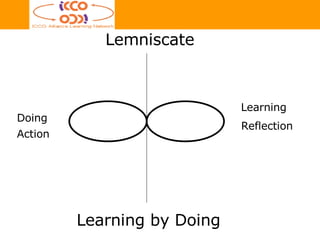
Doing Learning Reflection Action Learning by Doing Lemniscate
Supporting for implementation thematic   programmes in the South.  Crosscutting thematiccaly as well as   organisational CD- programme : What it is
build on existing (programmatic)   experiences Create joint visions and frameworks Create synergy and coherence between   the different activities Priority setting for organisational learning Contribute to a learning organisation   climate CD- programme : Way of working
Involvement of different (active and passive) actors: partner organisations and their staff    (at different levels)   internal in Alliance: PS’s, LF’s, PO’s, etc.  external “knowledge-holders” (universities,   networks, …………) Capacity Development :  WHO
Involvement of different levels within alliance members:  individual,  thematic departments,  HRM,  Organisational level (OD) Institutional level (ID - programme)  Capacity Development :  WHO
Capacity Development :  Wherefore? Improve: Thinking / learning Doing (implementation) Structures and systems Positioning and relating (I/C-scan)
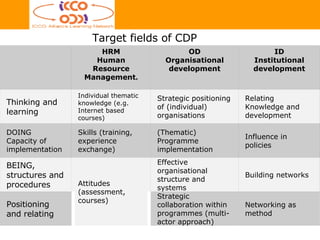
Target fields of CDP Attitudes (assessment, courses) Positioning and relating Strategic collaboration within programmes (multi-actor approach) Networking as method HRM Human Resource Management . OD Organisational development ID Institutional development Thinking and learning Individual thematic knowledge (e.g.  Internet based courses) Strategic positioning of (individual) organisations Relating Knowledge and development DOING Capacity of implementation Skills (training, experience exchange) (Thematic) Programme implementation Influence in policies BEING, structures and procedures Effective organisational structure and systems Building networks
Why Capacity Development & Learning? Need to constantly improve results of work  Work more effectively Avoid “reinventing the wheel”  (others probably already  have done what you are trying to do) Keep up with the ever changing contexts Be able to serve partners with “good” information A “hype”? Perhaps but a useful one
Capacity Development : Results Systematic learning within and among   organisations  Be able to attend “needs” (service package)  All involved know where to find assistance Organisations have improved there capacities Using information and lessons in daily practice Sharing experiences with partners in programmes Enhance quality of information (research) AND: Preparing/making the “identity-glue” for the  Network organisation ……….
What can the CDP offer? Personnel cooperation in South Local consultancies  I/C-Consultancies Learning Facilitators supporting   Programmatic specialists
Funds for training and scholarships Funds and facilitation of Research & Publication off & on-line Tools & Methods (e.g. Dgroups,   Peer-Review, resource centre, Websites) PME-instruments & specialist What can the CDP offer?
People: motivation / time Show short time results (Support!!)   <–> longer term strategic planning (help) Building trust between   Alliance Members Context-cultural level Right information at right time   in the right form at the right place Some Challenges
 
Elements for agenda 2007: Stocktaking & Needs assessment in South and   within Alliance (programmatic and thematic) Build up the R&D-team in the different   organisations of the ICCO-alliance Definition of roles (LF, PS) and working   structures Coordination of the different ‘inputs’ and   instruments (IC / PSO / external consultants:   TNO!)
Work on a joint vision on the CDP  (within   Alliance  (and later with partners in the South) Create and experiment with    methods and tools Create a organisational and a    joint Alliance agenda for 2008-2010 Elements for agenda 2007:
Elements for the agenda 2007 Build up the R&D-team in the different organisations of the ICCO-alliance Definition of roles (LF, PS) and working structures Coordination of the different ‘inputs’ and instruments (IC / PSO / external consultants; f.e. TNO!)
Elements for the agenda 2007 Work on a joint vision on ‘Capacity   Development’ in the Alliance and later  with Southern  Partners Work on concrete ´joint´ interests Create an organisational and a joint Alliance agenda for 2008-2010
Elements for the agenda 2007 Stocktaking & Need assessment (programmatic and thematic needs) Develop and experiment with methods and tools Develop a working-learning traject with PSO
Elements for the agenda 2007 Share and co-ordinate internal training programmes Support the development of the ´programmatic approach´ Support knowledge networks (Euforic) with websites, access to information, D-groups
Thanks for the attention ! So …… it is only a question of making the goals. Let’s do it!

20070509 Presentation Erica

  • 1.
    Capacity Development Programme of the ICCO-Alliance
  • 2.
    Capacity Development: What?In Business plan described as: “ Create conditions (services, knowledge and instruments) to extend joint and individual capacities of stakeholders in the aid-chain (donor-implementer-target group) to enlarge their influence, to create changes and to obtain intended results”
  • 3.
    Capacity Development : What is it? Capacity Development is Learning Learning is not (necesarilly) Capacity Development (not really true though, but …..)
  • 4.
    Doing Learning ReflectionAction Learning by Doing Lemniscate
  • 5.
    Supporting for implementationthematic programmes in the South. Crosscutting thematiccaly as well as organisational CD- programme : What it is
  • 6.
    build on existing(programmatic) experiences Create joint visions and frameworks Create synergy and coherence between the different activities Priority setting for organisational learning Contribute to a learning organisation climate CD- programme : Way of working
  • 7.
    Involvement of different(active and passive) actors: partner organisations and their staff (at different levels) internal in Alliance: PS’s, LF’s, PO’s, etc. external “knowledge-holders” (universities, networks, …………) Capacity Development : WHO
  • 8.
    Involvement of differentlevels within alliance members: individual, thematic departments, HRM, Organisational level (OD) Institutional level (ID - programme) Capacity Development : WHO
  • 9.
    Capacity Development : Wherefore? Improve: Thinking / learning Doing (implementation) Structures and systems Positioning and relating (I/C-scan)
  • 10.
    Target fields ofCDP Attitudes (assessment, courses) Positioning and relating Strategic collaboration within programmes (multi-actor approach) Networking as method HRM Human Resource Management . OD Organisational development ID Institutional development Thinking and learning Individual thematic knowledge (e.g. Internet based courses) Strategic positioning of (individual) organisations Relating Knowledge and development DOING Capacity of implementation Skills (training, experience exchange) (Thematic) Programme implementation Influence in policies BEING, structures and procedures Effective organisational structure and systems Building networks
  • 11.
    Why Capacity Development& Learning? Need to constantly improve results of work Work more effectively Avoid “reinventing the wheel” (others probably already have done what you are trying to do) Keep up with the ever changing contexts Be able to serve partners with “good” information A “hype”? Perhaps but a useful one
  • 12.
    Capacity Development :Results Systematic learning within and among organisations Be able to attend “needs” (service package) All involved know where to find assistance Organisations have improved there capacities Using information and lessons in daily practice Sharing experiences with partners in programmes Enhance quality of information (research) AND: Preparing/making the “identity-glue” for the Network organisation ……….
  • 13.
    What can theCDP offer? Personnel cooperation in South Local consultancies I/C-Consultancies Learning Facilitators supporting Programmatic specialists
  • 14.
    Funds for trainingand scholarships Funds and facilitation of Research & Publication off & on-line Tools & Methods (e.g. Dgroups, Peer-Review, resource centre, Websites) PME-instruments & specialist What can the CDP offer?
  • 15.
    People: motivation /time Show short time results (Support!!) <–> longer term strategic planning (help) Building trust between Alliance Members Context-cultural level Right information at right time in the right form at the right place Some Challenges
  • 16.
  • 17.
    Elements for agenda2007: Stocktaking & Needs assessment in South and within Alliance (programmatic and thematic) Build up the R&D-team in the different organisations of the ICCO-alliance Definition of roles (LF, PS) and working structures Coordination of the different ‘inputs’ and instruments (IC / PSO / external consultants: TNO!)
  • 18.
    Work on ajoint vision on the CDP (within Alliance (and later with partners in the South) Create and experiment with methods and tools Create a organisational and a joint Alliance agenda for 2008-2010 Elements for agenda 2007:
  • 19.
    Elements for theagenda 2007 Build up the R&D-team in the different organisations of the ICCO-alliance Definition of roles (LF, PS) and working structures Coordination of the different ‘inputs’ and instruments (IC / PSO / external consultants; f.e. TNO!)
  • 20.
    Elements for theagenda 2007 Work on a joint vision on ‘Capacity Development’ in the Alliance and later with Southern Partners Work on concrete ´joint´ interests Create an organisational and a joint Alliance agenda for 2008-2010
  • 21.
    Elements for theagenda 2007 Stocktaking & Need assessment (programmatic and thematic needs) Develop and experiment with methods and tools Develop a working-learning traject with PSO
  • 22.
    Elements for theagenda 2007 Share and co-ordinate internal training programmes Support the development of the ´programmatic approach´ Support knowledge networks (Euforic) with websites, access to information, D-groups
  • 23.
    Thanks for theattention ! So …… it is only a question of making the goals. Let’s do it!

Editor's Notes

  • #2 Short explanation about the design and intentions of the CDP Much has to be designed and even invented yet