Microprocessor Architecture
Microprocessor 8085 Architecture &
Pin Configuration
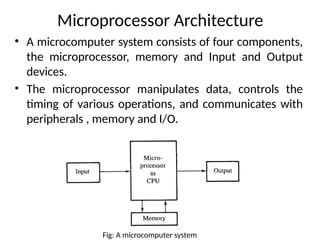
Microprocessor Architecture
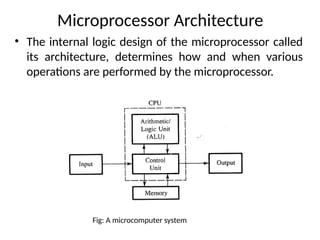
• A microcomputer system consists of four components,
the microprocessor, memory and Input and Output
devices.
• The microprocessor manipulates data, controls the
timing of various operations, and communicates with
peripherals , memory and I/O.
Fig: A microcomputer system
Microprocessor Architecture
• The internal logic design of the microprocessor called
its architecture, determines how and when various
operations are performed by the microprocessor.
Fig: A microcomputer system
Microprocessor Architecture
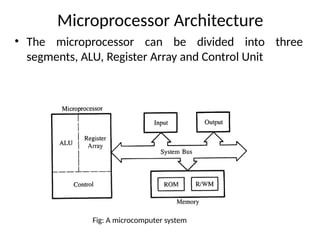
• The microprocessor can be divided into three
segments, ALU, Register Array and Control Unit
Fig: A microcomputer system
Microprocessor Architecture
• ALU performs arithmetical and logical operations on the
data received from the memory or an input device.
• Register array consists of registers identified by letters
like B, C, D, E, H, L and accumulator.
• These registers are primarily used to store data
temporarily during the execution of a program.
• Some of the registers are accessible to the user through
instructions.
• The control unit controls the flow of data and
instructions within the computer.
• The control unit provides the necessary timing and
control signals to all the operations in the
microcomputer.
Microprocessor Architecture
• ALU performs arithmetical and logical operations on the
data received from the memory or an input device.
• Register array consists of registers identified by letters
like B, C, D, E, H, L and accumulator.
• These registers are primarily used to store data
temporarily during the execution of a program.
• Some of the registers are accessible to the user through
instructions.
• The control unit controls the flow of data and
instructions within the computer.
• The control unit provides the necessary timing and
control signals to all the operations in the
microcomputer.
Microprocessor Architecture
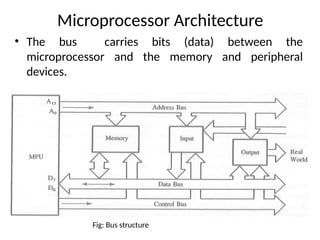
• The bus carries bits (data) between the
microprocessor and the memory and peripheral
devices.
Fig: Bus structure
Microprocessor Architecture
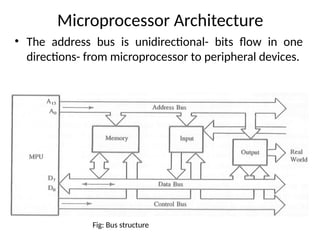
• The address bus is unidirectional- bits flow in one
directions- from microprocessor to peripheral devices.
Fig: Bus structure
Microprocessor Architecture
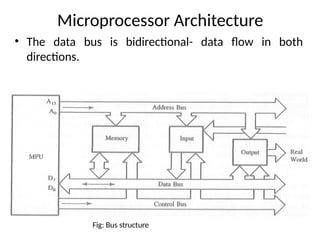
• The data bus is bidirectional- data flow in both
directions.
Fig: Bus structure
Microprocessor Architecture
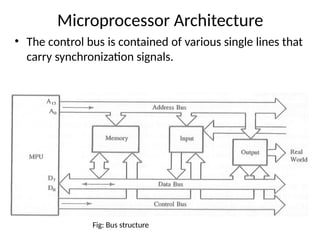
• The control bus is contained of various single lines that
carry synchronization signals.
Fig: Bus structure
Microprocessor Architecture
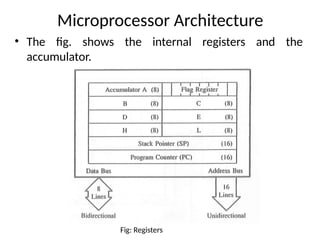
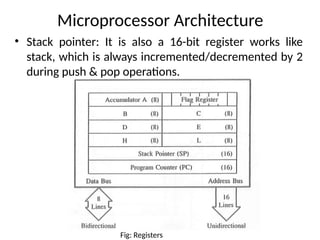
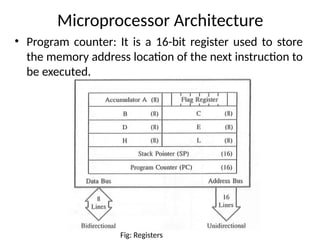
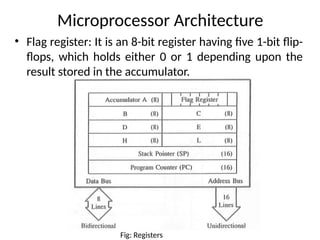
• The fig. shows the internal registers and the
accumulator.
Fig: Registers
Microprocessor Architecture
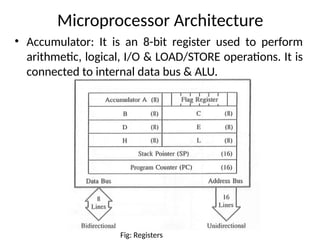
• Accumulator: It is an 8-bit register used to perform
arithmetic, logical, I/O & LOAD/STORE operations. It is
connected to internal data bus & ALU.
Fig: Registers
Microprocessor Architecture
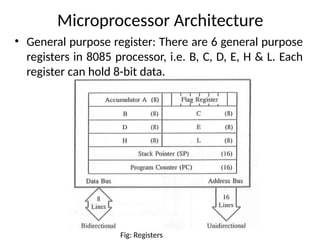
• General purpose register: There are 6 general purpose
registers in 8085 processor, i.e. B, C, D, E, H & L. Each
register can hold 8-bit data.
Fig: Registers
Microprocessor Architecture
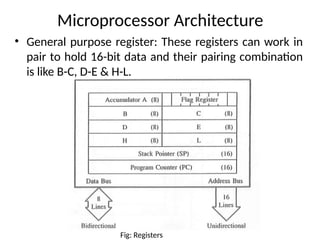
• General purpose register: These registers can work in
pair to hold 16-bit data and their pairing combination
is like B-C, D-E & H-L.
Fig: Registers
Microprocessor Architecture
• Stack pointer: It is also a 16-bit register works like
stack, which is always incremented/decremented by 2
during push & pop operations.
Fig: Registers
Microprocessor Architecture
• Program counter: It is a 16-bit register used to store
the memory address location of the next instruction to
be executed.
Fig: Registers
Microprocessor Architecture
• Flag register: It is an 8-bit register having five 1-bit flip-
flops, which holds either 0 or 1 depending upon the
result stored in the accumulator.
Fig: Registers
Microprocessor Architecture
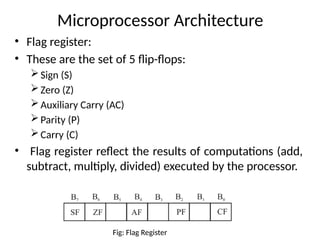
• Flag register:
• These are the set of 5 flip-flops:
Sign (S)
Zero (Z)
Auxiliary Carry (AC)
Parity (P)
Carry (C)
• Flag register reflect the results of computations (add,
subtract, multiply, divided) executed by the processor.
Fig: Flag Register
Microprocessor Architecture
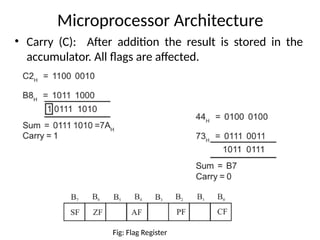
• Carry (C): After addition the result is stored in the
accumulator. All flags are affected.
Fig: Flag Register
Microprocessor Architecture
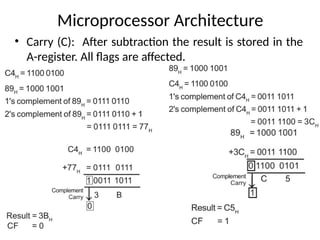
• Carry (C): After subtraction the result is stored in the
A-register. All flags are affected.
Microprocessor Architecture
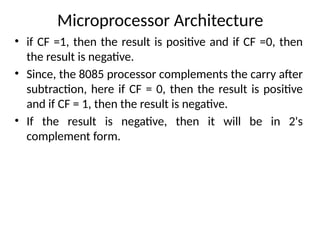
• if CF =1, then the result is positive and if CF =0, then
the result is negative.
• Since, the 8085 processor complements the carry after
subtraction, here if CF = 0, then the result is positive
and if CF = 1, then the result is negative.
• If the result is negative, then it will be in 2's
complement form.
Microprocessor Architecture
• if CF =1, then the result is positive and if CF =0, then
the result is negative.
• Since, the 8085 processor complements the carry after
subtraction, here if CF = 0, then the result is positive
and if CF = 1, then the result is negative.
• If the result is negative, then it will be in 2's
complement form.
Microprocessor Architecture
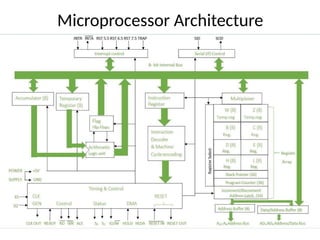
Instruction register and decoder
• When an instruction is fetched from memory then it is
stored in the Instruction register. Instruction decoder
decodes the information present in the Instruction
register.
Microprocessor Architecture
Timing and control unit
• It provides timing and control signal to the
microprocessor to perform operations. Following are
the timing and control signals, which control external
and internal circuits −
 Control Signals: READY, RD’, WR’, ALE
 Status Signals: S0, S1, IO/M’
 DMA Signals: HOLD, HLDA
 RESET Signals: RESET IN, RESET OUT
Microprocessor Architecture
Interrupt control
• As the name suggests it controls the interrupts during
a process. When a microprocessor is executing a main
program and whenever an interrupt occurs, the
microprocessor shifts the control from the main
program to process the incoming request. After the
request is completed, the control goes back to the
main program.
• There are 5 interrupt signals in 8085 microprocessor:
INTR, (INTA)’ RST 7.5, RST 6.5, RST 5.5, TRAP.
Microprocessor Architecture
Serial Input/output control
• It controls the serial data communication by using
these two instructions: SID (Serial input data) and SOD
(Serial output data).
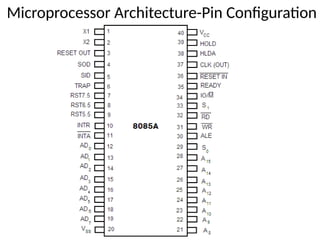
Microprocessor Architecture-Pin Configuration
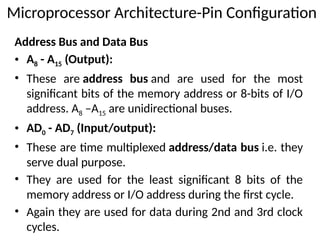
Address Bus and Data Bus
• A8 - A15 (Output):
• These are address bus and are used for the most
significant bits of the memory address or 8-bits of I/O
address. A8 –A15 are unidirectional buses.
• AD0 - AD7 (Input/output):
• These are time multiplexed address/data bus i.e. they
serve dual purpose.
• They are used for the least significant 8 bits of the
memory address or I/O address during the first cycle.
• Again they are used for data during 2nd and 3rd clock
cycles.
Microprocessor Architecture-Pin Configuration
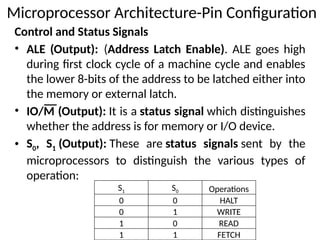
Control and Status Signals
• ALE (Output): (Address Latch Enable). ALE goes high
during first clock cycle of a machine cycle and enables
the lower 8-bits of the address to be latched either into
the memory or external latch.
• IO/M (Output): It is a status signal which distinguishes
whether the address is for memory or I/O device.
• S0, S1 (Output): These are status signals sent by the
microprocessors to distinguish the various types of
operation:
Microprocessor Architecture-Pin Configuration
S1 S0 Operations
0 0 HALT
0 1 WRITE
1 0 READ
1 1 FETCH
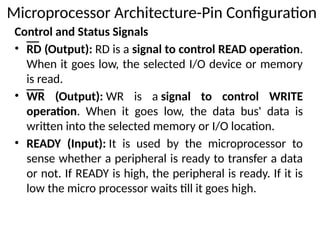
Control and Status Signals
• RD (Output): RD is a signal to control READ operation.
When it goes low, the selected I/O device or memory
is read.
• WR (Output): WR is a signal to control WRITE
operation. When it goes low, the data bus' data is
written into the selected memory or I/O location.
• READY (Input): It is used by the microprocessor to
sense whether a peripheral is ready to transfer a data
or not. If READY is high, the peripheral is ready. If it is
low the micro processor waits till it goes high.
Microprocessor Architecture-Pin Configuration
Interrupts and Externally Initiated Signals
• HOLD (INPUT): HOLD indicates that another device is
requesting for the use of the address and data bus.
The processor relinquishes the uses of the buses as
soon as the current cycle is completed.
• HLDA (OUTPUT): HLDA is a signal for HOLD
acknowledgement which indicates that the HOLD
request has been received. After the removal of this
request the HLDA goes low.
• INTR (Input): INTR is an Interrupt Request Signal.
Among interrupts it has the lowest priority. The INTR is
enabled or disabled by software.
Microprocessor Architecture-Pin Configuration
Interrupts and Externally Initiated Signals
• INTA (Output): INTA is an interrupt
acknowledgement sent by the microprocessor after
INTR is received.
• RST 5.5, 6.5, 7.5 and TRAP (Inputs): These all are
interrupts.
• The TRAP has the highest priority among interrupts.
The order of priority of interrupts is as follows:
 TRAP (Highest priority)
 RST 7.5
 RST 6.5
 RST 5.5
 INTR (Lowest priority).
Microprocessor Architecture-Pin Configuration
Reset Signals
• RESET IN (Input): It resets the program counter (PC) to
0. It also resets interrupt enable and HLDA flip-flops.
• RESET OUT (Output): RESET OUT indicates that the
CPU is being reset. The signal can be used to reset
other devices.
Microprocessor Architecture-Pin Configuration
Clock Signals
• X1, X2 (Input): X1 and X2 are terminals to be connected
to an external crystal oscillator which drives an
internal circuitry of the microprocessor.
• It is used to produce a suitable clock for the operation
of microprocessor.
• CLK (Output): CLK is a clock output for user, which can
be used as the system clock for other digital ICs. Its
frequency is same at which processor operates.
Microprocessor Architecture-Pin Configuration
Serial I/O Signals
• SID (Input): SID is data line for serial input. The data
on this line is loaded into the seventh bit of the
accumulator when RIM instruction is executed.
• SOD (Output): SOD is a data line for serial output. The
seventh bit of the accumulator is output on SOD line
when SIM instruction is executed.
Power Supply
• Vcc : +5 Vlots supply
• Vss : ground reference
Microprocessor Architecture-Pin Configuration
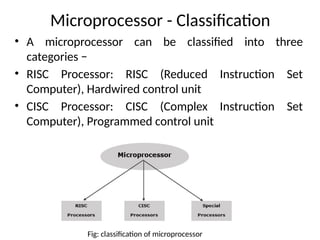
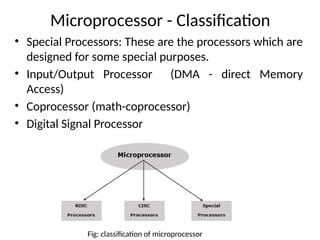
Microprocessor - Classification
• A microprocessor can be classified into three
categories −
• RISC Processor: RISC (Reduced Instruction Set
Computer), Hardwired control unit
• CISC Processor: CISC (Complex Instruction Set
Computer), Programmed control unit
Fig: classification of microprocessor
Microprocessor - Classification
• Special Processors: These are the processors which are
designed for some special purposes.
• Input/Output Processor (DMA - direct Memory
Access)
• Coprocessor (math-coprocessor)
• Digital Signal Processor
Fig: classification of microprocessor
20 Microprocessor Architecture mca .pptx

  • 1.
    Microprocessor Architecture Microprocessor 8085Architecture & Pin Configuration
  • 2.
    Microprocessor Architecture • Amicrocomputer system consists of four components, the microprocessor, memory and Input and Output devices. • The microprocessor manipulates data, controls the timing of various operations, and communicates with peripherals , memory and I/O. Fig: A microcomputer system
  • 3.
    Microprocessor Architecture • Theinternal logic design of the microprocessor called its architecture, determines how and when various operations are performed by the microprocessor. Fig: A microcomputer system
  • 4.
    Microprocessor Architecture • Themicroprocessor can be divided into three segments, ALU, Register Array and Control Unit Fig: A microcomputer system
  • 5.
    Microprocessor Architecture • ALUperforms arithmetical and logical operations on the data received from the memory or an input device. • Register array consists of registers identified by letters like B, C, D, E, H, L and accumulator. • These registers are primarily used to store data temporarily during the execution of a program. • Some of the registers are accessible to the user through instructions. • The control unit controls the flow of data and instructions within the computer. • The control unit provides the necessary timing and control signals to all the operations in the microcomputer.
  • 6.
    Microprocessor Architecture • ALUperforms arithmetical and logical operations on the data received from the memory or an input device. • Register array consists of registers identified by letters like B, C, D, E, H, L and accumulator. • These registers are primarily used to store data temporarily during the execution of a program. • Some of the registers are accessible to the user through instructions. • The control unit controls the flow of data and instructions within the computer. • The control unit provides the necessary timing and control signals to all the operations in the microcomputer.
  • 7.
    Microprocessor Architecture • Thebus carries bits (data) between the microprocessor and the memory and peripheral devices. Fig: Bus structure
  • 8.
    Microprocessor Architecture • Theaddress bus is unidirectional- bits flow in one directions- from microprocessor to peripheral devices. Fig: Bus structure
  • 9.
    Microprocessor Architecture • Thedata bus is bidirectional- data flow in both directions. Fig: Bus structure
  • 10.
    Microprocessor Architecture • Thecontrol bus is contained of various single lines that carry synchronization signals. Fig: Bus structure
  • 11.
    Microprocessor Architecture • Thefig. shows the internal registers and the accumulator. Fig: Registers
  • 12.
    Microprocessor Architecture • Accumulator:It is an 8-bit register used to perform arithmetic, logical, I/O & LOAD/STORE operations. It is connected to internal data bus & ALU. Fig: Registers
  • 13.
    Microprocessor Architecture • Generalpurpose register: There are 6 general purpose registers in 8085 processor, i.e. B, C, D, E, H & L. Each register can hold 8-bit data. Fig: Registers
  • 14.
    Microprocessor Architecture • Generalpurpose register: These registers can work in pair to hold 16-bit data and their pairing combination is like B-C, D-E & H-L. Fig: Registers
  • 15.
    Microprocessor Architecture • Stackpointer: It is also a 16-bit register works like stack, which is always incremented/decremented by 2 during push & pop operations. Fig: Registers
  • 16.
    Microprocessor Architecture • Programcounter: It is a 16-bit register used to store the memory address location of the next instruction to be executed. Fig: Registers
  • 17.
    Microprocessor Architecture • Flagregister: It is an 8-bit register having five 1-bit flip- flops, which holds either 0 or 1 depending upon the result stored in the accumulator. Fig: Registers
  • 18.
    Microprocessor Architecture • Flagregister: • These are the set of 5 flip-flops: Sign (S) Zero (Z) Auxiliary Carry (AC) Parity (P) Carry (C) • Flag register reflect the results of computations (add, subtract, multiply, divided) executed by the processor. Fig: Flag Register
  • 19.
    Microprocessor Architecture • Carry(C): After addition the result is stored in the accumulator. All flags are affected. Fig: Flag Register
  • 20.
    Microprocessor Architecture • Carry(C): After subtraction the result is stored in the A-register. All flags are affected.
  • 21.
    Microprocessor Architecture • ifCF =1, then the result is positive and if CF =0, then the result is negative. • Since, the 8085 processor complements the carry after subtraction, here if CF = 0, then the result is positive and if CF = 1, then the result is negative. • If the result is negative, then it will be in 2's complement form.
  • 22.
    Microprocessor Architecture • ifCF =1, then the result is positive and if CF =0, then the result is negative. • Since, the 8085 processor complements the carry after subtraction, here if CF = 0, then the result is positive and if CF = 1, then the result is negative. • If the result is negative, then it will be in 2's complement form.
  • 23.
  • 24.
    Microprocessor Architecture Instruction registerand decoder • When an instruction is fetched from memory then it is stored in the Instruction register. Instruction decoder decodes the information present in the Instruction register.
  • 25.
    Microprocessor Architecture Timing andcontrol unit • It provides timing and control signal to the microprocessor to perform operations. Following are the timing and control signals, which control external and internal circuits −  Control Signals: READY, RD’, WR’, ALE  Status Signals: S0, S1, IO/M’  DMA Signals: HOLD, HLDA  RESET Signals: RESET IN, RESET OUT
  • 26.
    Microprocessor Architecture Interrupt control •As the name suggests it controls the interrupts during a process. When a microprocessor is executing a main program and whenever an interrupt occurs, the microprocessor shifts the control from the main program to process the incoming request. After the request is completed, the control goes back to the main program. • There are 5 interrupt signals in 8085 microprocessor: INTR, (INTA)’ RST 7.5, RST 6.5, RST 5.5, TRAP.
  • 27.
    Microprocessor Architecture Serial Input/outputcontrol • It controls the serial data communication by using these two instructions: SID (Serial input data) and SOD (Serial output data).
  • 28.
  • 29.
    Address Bus andData Bus • A8 - A15 (Output): • These are address bus and are used for the most significant bits of the memory address or 8-bits of I/O address. A8 –A15 are unidirectional buses. • AD0 - AD7 (Input/output): • These are time multiplexed address/data bus i.e. they serve dual purpose. • They are used for the least significant 8 bits of the memory address or I/O address during the first cycle. • Again they are used for data during 2nd and 3rd clock cycles. Microprocessor Architecture-Pin Configuration
  • 30.
    Control and StatusSignals • ALE (Output): (Address Latch Enable). ALE goes high during first clock cycle of a machine cycle and enables the lower 8-bits of the address to be latched either into the memory or external latch. • IO/M (Output): It is a status signal which distinguishes whether the address is for memory or I/O device. • S0, S1 (Output): These are status signals sent by the microprocessors to distinguish the various types of operation: Microprocessor Architecture-Pin Configuration S1 S0 Operations 0 0 HALT 0 1 WRITE 1 0 READ 1 1 FETCH
  • 31.
    Control and StatusSignals • RD (Output): RD is a signal to control READ operation. When it goes low, the selected I/O device or memory is read. • WR (Output): WR is a signal to control WRITE operation. When it goes low, the data bus' data is written into the selected memory or I/O location. • READY (Input): It is used by the microprocessor to sense whether a peripheral is ready to transfer a data or not. If READY is high, the peripheral is ready. If it is low the micro processor waits till it goes high. Microprocessor Architecture-Pin Configuration
  • 32.
    Interrupts and ExternallyInitiated Signals • HOLD (INPUT): HOLD indicates that another device is requesting for the use of the address and data bus. The processor relinquishes the uses of the buses as soon as the current cycle is completed. • HLDA (OUTPUT): HLDA is a signal for HOLD acknowledgement which indicates that the HOLD request has been received. After the removal of this request the HLDA goes low. • INTR (Input): INTR is an Interrupt Request Signal. Among interrupts it has the lowest priority. The INTR is enabled or disabled by software. Microprocessor Architecture-Pin Configuration
  • 33.
    Interrupts and ExternallyInitiated Signals • INTA (Output): INTA is an interrupt acknowledgement sent by the microprocessor after INTR is received. • RST 5.5, 6.5, 7.5 and TRAP (Inputs): These all are interrupts. • The TRAP has the highest priority among interrupts. The order of priority of interrupts is as follows:  TRAP (Highest priority)  RST 7.5  RST 6.5  RST 5.5  INTR (Lowest priority). Microprocessor Architecture-Pin Configuration
  • 34.
    Reset Signals • RESETIN (Input): It resets the program counter (PC) to 0. It also resets interrupt enable and HLDA flip-flops. • RESET OUT (Output): RESET OUT indicates that the CPU is being reset. The signal can be used to reset other devices. Microprocessor Architecture-Pin Configuration
  • 35.
    Clock Signals • X1,X2 (Input): X1 and X2 are terminals to be connected to an external crystal oscillator which drives an internal circuitry of the microprocessor. • It is used to produce a suitable clock for the operation of microprocessor. • CLK (Output): CLK is a clock output for user, which can be used as the system clock for other digital ICs. Its frequency is same at which processor operates. Microprocessor Architecture-Pin Configuration
  • 36.
    Serial I/O Signals •SID (Input): SID is data line for serial input. The data on this line is loaded into the seventh bit of the accumulator when RIM instruction is executed. • SOD (Output): SOD is a data line for serial output. The seventh bit of the accumulator is output on SOD line when SIM instruction is executed. Power Supply • Vcc : +5 Vlots supply • Vss : ground reference Microprocessor Architecture-Pin Configuration
  • 37.
    Microprocessor - Classification •A microprocessor can be classified into three categories − • RISC Processor: RISC (Reduced Instruction Set Computer), Hardwired control unit • CISC Processor: CISC (Complex Instruction Set Computer), Programmed control unit Fig: classification of microprocessor
  • 38.
    Microprocessor - Classification •Special Processors: These are the processors which are designed for some special purposes. • Input/Output Processor (DMA - direct Memory Access) • Coprocessor (math-coprocessor) • Digital Signal Processor Fig: classification of microprocessor