Variables
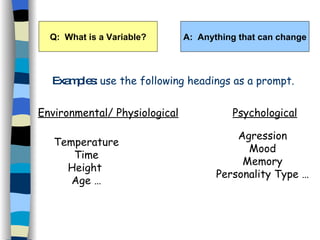
Q:  What is a Variable? A:  Anything that can change Examples:  use the following headings as a prompt. Environmental/ Physiological Psychological Temperature Time Height  Age … Agression Mood Memory Personality Type …
Key Terms Independent Variable (IV): The variable that we manipulate or change  e.g temperature, noise, organisation of  words in a memory test The IV can be manipulate naturally  e.g. gender, age, weather An investigation may have more than one IV Conditions: A condition is a particular manipulation of the IV. The IV can have two or more conditions e.g Condition 1 : No loud music  (control group) Condition 2:  Loud rock music (experimental group)
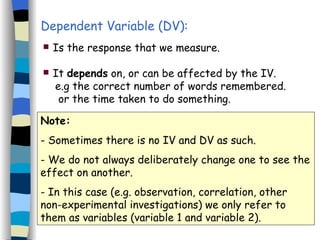
Dependent Variable (DV): Is the response that we measure. It  depends  on, or can be affected by the IV. e.g the correct number of words remembered.  or the time taken to do something. Note: - Sometimes there is no IV and DV as such.  We do not always deliberately change one to see the effect on another. In this case (e.g. observation, correlation, other  non-experimental investigations) we only refer to them as variables (variable 1 and variable 2).
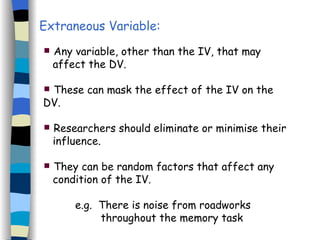
Extraneous Variable: Any variable, other than the IV, that may  affect the DV. These can mask the effect of the IV on the DV. Researchers should eliminate or minimise their  influence. They can be random factors that affect any  condition of the IV. e.g.  There is noise from roadworks  throughout the memory task
Confounding Variable: Again, a variable other than the IV that affects  the DV. The confounding variable, however, will affect only  one condition of the IV e.g. there is noise from roadworks during only  one of the conditions.
Activity: For each of the examples below, identify which variable you would manipulate (IV) and which one is measured (DV). Recall is influenced by the amount taken of Drug Z.  Females conform more than males in bus queues. Neutered cats eat more than non- neutered cats. Concentration is affected by the time of day. Vitamins boost intelligence.
Activity: In pairs complete both the activity boxes on page 197 of Caldwell.
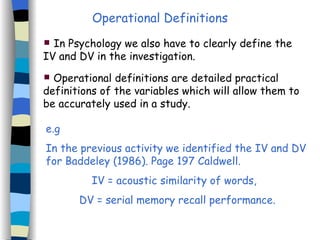
Operational Definitions In Psychology we also have to clearly define the IV and DV in the investigation. Operational definitions are detailed practical definitions of the variables which will allow them to be accurately used in a study. e.g  In the previous activity we identified the IV and DV for Baddeley (1986). Page 197 Caldwell. IV = acoustic similarity of words,  DV = serial memory recall performance.
Operational Definition: IV = five short words that sound the same (e.g.  man, map, mat, can, cap).  and five short words that do not sound the  same (e.g. pen, day, few, cow, pin). DV = The number of correct words recalled.  Baddeley (1986) also provides  operational definitions  to allow them to be accurately used in an investigation.
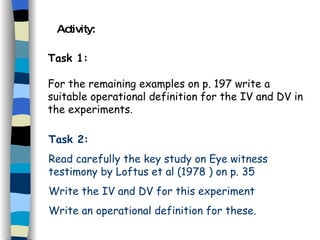
Task 2: Read carefully the key study on Eye witness testimony by Loftus et al (1978 ) on p. 35 Write the IV and DV for this experiment Write an operational definition for these.  Activity: Task 1: For the remaining examples on p. 197 write a suitable operational definition for the IV and DV in the experiments.
Answers: Task 1: 2)  Operational Definition of: IV = easy anagram to sort (e.g. doctro)  more difficult anagram to solve (e.g. cdrtoo) DV = Recall of anagrams.
3)  Operational Definition of: IV = all participants learning words in a distinctive  basement room.    some participants learning words in same  distinctive basement room.   some participants learning words in a fifth  floor room with different décor.   some participants learning words in another  room imagining themselves in the basement room DV = Memory recall of words learned.
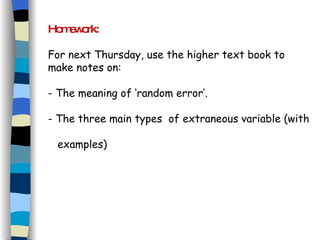
Homework: For next Thursday, use the higher text book to make notes on: - The meaning of ‘random error’.  The three main types  of extraneous variable (with  examples)

2. Variables

  • 1.
  • 2.
    Q: Whatis a Variable? A: Anything that can change Examples: use the following headings as a prompt. Environmental/ Physiological Psychological Temperature Time Height Age … Agression Mood Memory Personality Type …
  • 3.
    Key Terms IndependentVariable (IV): The variable that we manipulate or change e.g temperature, noise, organisation of words in a memory test The IV can be manipulate naturally e.g. gender, age, weather An investigation may have more than one IV Conditions: A condition is a particular manipulation of the IV. The IV can have two or more conditions e.g Condition 1 : No loud music (control group) Condition 2: Loud rock music (experimental group)
  • 4.
    Dependent Variable (DV):Is the response that we measure. It depends on, or can be affected by the IV. e.g the correct number of words remembered. or the time taken to do something. Note: - Sometimes there is no IV and DV as such. We do not always deliberately change one to see the effect on another. In this case (e.g. observation, correlation, other non-experimental investigations) we only refer to them as variables (variable 1 and variable 2).
  • 5.
    Extraneous Variable: Anyvariable, other than the IV, that may affect the DV. These can mask the effect of the IV on the DV. Researchers should eliminate or minimise their influence. They can be random factors that affect any condition of the IV. e.g. There is noise from roadworks throughout the memory task
  • 6.
    Confounding Variable: Again,a variable other than the IV that affects the DV. The confounding variable, however, will affect only one condition of the IV e.g. there is noise from roadworks during only one of the conditions.
  • 7.
    Activity: For eachof the examples below, identify which variable you would manipulate (IV) and which one is measured (DV). Recall is influenced by the amount taken of Drug Z. Females conform more than males in bus queues. Neutered cats eat more than non- neutered cats. Concentration is affected by the time of day. Vitamins boost intelligence.
  • 8.
    Activity: In pairscomplete both the activity boxes on page 197 of Caldwell.
  • 9.
    Operational Definitions InPsychology we also have to clearly define the IV and DV in the investigation. Operational definitions are detailed practical definitions of the variables which will allow them to be accurately used in a study. e.g In the previous activity we identified the IV and DV for Baddeley (1986). Page 197 Caldwell. IV = acoustic similarity of words, DV = serial memory recall performance.
  • 10.
    Operational Definition: IV= five short words that sound the same (e.g. man, map, mat, can, cap). and five short words that do not sound the same (e.g. pen, day, few, cow, pin). DV = The number of correct words recalled. Baddeley (1986) also provides operational definitions to allow them to be accurately used in an investigation.
  • 11.
    Task 2: Readcarefully the key study on Eye witness testimony by Loftus et al (1978 ) on p. 35 Write the IV and DV for this experiment Write an operational definition for these. Activity: Task 1: For the remaining examples on p. 197 write a suitable operational definition for the IV and DV in the experiments.
  • 12.
    Answers: Task 1:2) Operational Definition of: IV = easy anagram to sort (e.g. doctro) more difficult anagram to solve (e.g. cdrtoo) DV = Recall of anagrams.
  • 13.
    3) OperationalDefinition of: IV = all participants learning words in a distinctive basement room. some participants learning words in same distinctive basement room. some participants learning words in a fifth floor room with different décor. some participants learning words in another room imagining themselves in the basement room DV = Memory recall of words learned.
  • 14.
    Homework: For nextThursday, use the higher text book to make notes on: - The meaning of ‘random error’. The three main types of extraneous variable (with examples)