Total reflection
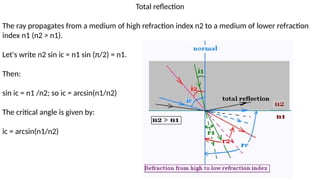
The ray propagates from a medium of high refraction index n2 to
a medium of lower refraction index n1 (n2 > n1).
The incident ray (incidence angle i1) has its related refracted ray
(refraction angle r1).
The incident ray (incidence angle i2) has its related refracted ray
(refraction angle r2).
The incident ray (incidence angle ic) has its related refracted ray
(refraction angle rc).
Any other ray of incidence angle bigger that ic has no refracted
ray and it is totally reflected.
The angle ic is the critical angle for which the refracted angle is
right (π/2).
Total reflection
The ray propagates from a medium of high refraction index n2 to a medium of lower refraction
index n1 (n2 > n1).
Let's write n2 sin ic = n1 sin (π/2) = n1.
Then:
sin ic = n1 /n2; so ic = arcsin(n1/n2)
The critical angle is given by:
ic = arcsin(n1/n2)
Total reflection
If the medium 2 is diamond, we will have:
n2 = 2.42. For n1 (air) = 1,
then: ic = arcsin(n1/n2) = arcsin(1/2.42) → ic = 24.41.
The critical angle for diamond is 24.41
All the rays within the angle of 24, are refracted, and all the
rays within the angle of 90 - 24 = 66, are reflected.
The diamond as substance keeps much of the light rays. This is
what makes it sparkle, when exposed to light.
Total reflection is really total in the sense that no energy is lost upon reflection.
In any device intended to utilize this property there will, however, be small losses due to
absorption in the medium and to reflections at the surfaces where the light enters and
leaves the medium.
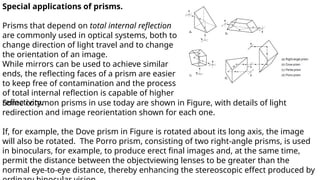
The commonest devices of this kind are called total reflection prisms, which are glass
prisms with two angles of 45° and one of 90°.
The light usually enters perpendicular to one of the shorter faces, is totally reflected
from the hypotenuse, and leaves at right angles to the other short face.
This deviates the rays through a right angle.
Such a prism may also be used in two other ways which are illustrated in (b) and (c) of the figure.
The Dove prism (c) interchanges the two rays, and if the prism is rotated about the direction of the
light, they rotate around each other with twice the angular velocity of the prism.
The roof prism accomplishes the same purpose as the total reflection prism (a) except that it
introduces an extra inversion.
Many other forms of prisms which use total reflection have been devised for special purposes. Two
common ones are illustrated in (d) and (e).
The triple mirror (e) is made by cutting off the corner of a cube by a plane which makes equal
angles with the three faces intersecting at that corner.
It has the useful property that any ray striking it will, after being internally reflected
at each of the three faces, be sent back parallel to its original direction. The Lummer-
Brodhun "cube" shown in (f) is used in photometry to compare the illumination of two
surfaces, one of which is viewed by rays (2) coming directly through the circular
region where the prisms are in contact, the other by rays (I) which are totally
reflected in the area around this region.
Special applications of prisms.
Prisms that depend on total internal reflection
are commonly used in optical systems, both to
change direction of light travel and to change
the orientation of an image.
While mirrors can be used to achieve similar
ends, the reflecting faces of a prism are easier
to keep free of contamination and the process
of total internal reflection is capable of higher
reflectivity.
Some common prisms in use today are shown in Figure, with details of light
redirection and image reorientation shown for each one.
If, for example, the Dove prism in Figure is rotated about its long axis, the image
will also be rotated. The Porro prism, consisting of two right-angle prisms, is used
in binoculars, for example, to produce erect final images and, at the same time,
permit the distance between the objectviewing lenses to be greater than the
normal eye-to-eye distance, thereby enhancing the stereoscopic effect produced by
The principle of most accurate refractometers (instruments for the determination of refractive
index) is based on the measurement of the critical angle.
In both the Pulfrich and Abbe types a convergent beam strikes the surface between the unknown
sample, of index n, and a prism of known index n'.
The beam is so oriented that some of its rays just graze the surface so that one observes in the
transmitted light a sharp boundary between light and dark.
Measurement of the angle at which this boundary occurs allows one to compute the value of the
angle and hence of n. There are important precautions that must be observed if the results are to be
at all accurate.
Internal reflection plays a critical role in modern communications and
modern medicine through fiber optics.
When light is sent down through a glass rod or fiber so that it strikes
the surface at an angle greater than the critical angle, as shown in
Figure (16a), the light will be completely reflected and continue to
bounce down the rod with no loss out through the surface.
By using modern very clear glass, a fiber can carry a light signal for
miles without serious attenuation.
The reason it is more effective to use light in glass fibers than electrons
in copper wire for transmitting signals, is that the glass fiber can carry
information at a much higher rate than a copper wire, as indicated in
Figure (16b).
This is because laser pulses traveling through glass, can be turned on
and off much more rapidly than electrical pulses in a wire.
The practical limit for copper wire is on the order of a million pulses or
bits of information per second (corresponding to a baud rate of one
megabit).
Typically the information rate is much slower over commercial
telephone lines, not much in excess of 30 to 50 thousand bits of
When a incidance angle is 0, then we got the
following, that the objects will be closer to us for
x0 distance:
(Plane parallel plate)
PLANE-PARALLEL PLATE
This could be used to determine the refractive index of the plane-parallel plate.
How? Using a micrscope objective: first of all – you should focus on the surface of the plate – P” point, then on the other
surface – P. To focus it in P point, the objective should be moved for b distance:
Refraction in prisms
Glass prisms are often used to bend light
in a given direction as well as to bend it
back again (retroreflection).
The process of refraction in prisms is
understood easily with the use of light
rays and Snell’s law.
When a light ray enters a prism at one face and exits at another, the exiting
ray is deviated from its original direction.
The prism shown is isosceles in cross section with apex angle A = 30° and
refractive index n = 1.50.
Refraction in prisms
The minimum angle of deviation is δm
Other angles could be find out in the
following way:
If the angles rather smalls, so their value is
approximately equal to there sines, then:
(Notice that φ is the angle of the prism)
Refraction in prisms
The incident angle θ and the angle of
deviation δ are shown on the diagram.
It shows how the angle of deviation δ
changes as the angle θ of the incident
ray changes.
Note that δ goes through a minimum
value, about 23° for this specific
prism.
Each prism material has its own
unique minimum angle of deviation.
Refraction in prisms
It turns out that we can determine the refractive index of a transparent
material by shaping it in the form of an isosceles prism and then
measuring its minimum angle of deviation.
With reference to Figure, the relationship between the refractive index n,
the prism apex angle A, and the minimum angle of deviation δm could be
given with an equation.
If we are changing the angle of incidance, then the angle of deviation is
changing and it has a minimum at some angle of incidance.
If the angle of deviation has a minimum value, then the ray is simmetrical.
The angle of incidance and the angle of deviation could
be measured by goniometer,
then the n could be measured.
Dispersion of light.
In fact, the refractive index is slightly wavelength dependent.
For example, the index of refraction for flint glass is about 1% higher for blue light
than for red light.
The variation of refractive index n with wavelength λ is called dispersion.
Figure shows a normal dispersion curve of versus λ for different types of optical glass.
Dispersion of light.
Figure shows the separation of the individual colors in white light —400 nm to 700 nm—
after passing through a prism.
Note that decreases as wavelength increases, thus causing the red light to be less deviated than
the blue light as it passes through a prism.
This type of dispersion that accounts for the colors seen in a rainbow, the “prism” there being the
individual raindrops.
Dispersion of light.
It is well known to those who have studied elementary physics that refraction causes
a separation of white light into its component colors.
Thus, as is shown in Fig. the incident ray of white light gives rise to refracted rays of different
colors (really a continuous spectrum) each of which has a different value of angle of refraction.
By Eq. the value of n' must therefore vary with color.
Notice that for small and :
Dispersion of light.
It is customary in the exact specification of indices of refraction to use the particular colors
corresponding to certain dark lines in the spectrum of the sun.
These Fraunhofer* lines, which are designated by the letters A, B, C, ... , starting at the extreme
red end, are given.
The ones most commonly are listed in the table in the next page.
The angular divergence of rays F and C (F and C are names of two Fraunhofer lines, refer figure
in previous page) is a measure of the dispersion produced, and has been greatly exaggerated in
the figure relative to the average deviation of the spectrum, which is measured by the angle
through which ray D is bent.
Dispersion of light.
To take a typical case of crown glass, the refractive indices as given in Table are
= 1.52933; = 1.52300; = 1.52042
REFER 1.10: COLOR DISPERSION IN PAGES 38, 39 AND 40 (BY PDF) OF OPTICS BY
JENKINS
The spectra of light – atoms, molecules and solid
state object – will be studied later, but the color of
light could be charactarized by the wavelength λ -
which could be measured in nm or angström (Å)
The region of visible light – 380 nm (violet) – 780
nm (red).
If we are using light source with one wavelength –
monocromatic – lasers.
Fraunhofer lines
- If we are using the ray of Sun for the experiment then it could be seen dark lines
in the spectra of it, they are the Fraunhofer lines: - Wollaston and Fraunhofer
(1802 and 1814).
- Each line could be charactarized by a color and wavelength:
Rainbows
Rainbows in the sky are formed by the reflection and refraction of
sunlight by raindrops.
It is not, however, particularly easy to see why a rainbow is formed.
René Descartes figured this out by tracing rays that enter and leave
a spherical raindrop.
In Figure (21a) we have used Snell’s law to trace the path of a ray of
yellow light that enters a spherical drop of water (of index n = 1.33),
is reflected on the back side, and emerges again on the front side.
In this drawing, the angle of refraction is determined.
At the back, the angles of incidence and reflection are equal, and at
the front we have 1.33.
Rainbows
In Figure we see what happens when a number of
parallel rays enter a spherical drop of water. (This is
similar to the construction that was done by
Descartes in 1633.)
When you look at the outgoing rays, it is not
immediately obvious that there is any special
direction for the reflected rays.
But if you look closely you will see that the ray we
have labeled #11 is the one that comes back at the
widest angle from the incident ray.
Ray #1, through the center, comes straight back out.
Ray #2 comes out at a small angle. The angles
increase up to Ray #11, and then start to decrease
again for Rays #12 and #13. In our construction the
maximum angle, that of Ray #11, was 41.6°, close to
the theoretical value of 42° for yellow light.
When you have sunlight striking many raindrops,
Rainbows:
1) https://youtu.be/xkDhQGXqwCM
2) https://youtu.be/OXDbc7QfTXU
Also, Why is sky blue? : https://youtu.be/4HBuHX4-VU8
Repeat the construction for red light where the index
of refraction is slightly less than 1.33, and you find
the maximum angle of deviation and the direction of
the parallel beam is slightly greater than 42°.
For blue light, with a higher index, the deviation is
less.
If you look at falling raindrops with the sun at your
back as shown in Figure (21c), you will see the yellow
part of the rainbow along the arc that has an angle of
42° from the rays of sun passing you.
The red light, having a greater angle of deviation will
be above the yellow,
Rainbows
Sometimes you will see two or more rainbows if the
rain is particularly heavy (we have seen up to 7).
These are caused by multiple internal reflections.
In the second rainbow there are two internal
reflections and the parallel beam of yellow light
comes out at an angle of 51°.
Because of the extra reflection the red is on the
inside of the arc and the blue on the outside.
Halos and Sun Dogs:
Another phenomenon often seen is the
reflection of light from hexagonal ice crystals
in the atmosphere.
The reflection is seen at an angle of 22° from
the sun.
If the ice crystals are randomly oriented then
we get a complete halo as seen in Figure.
If the crystals are falling with their flat planes
predominately horizontal, we only see the two
pieces of the halo at each side of the sun, seen
in Figure.
These little pieces of rainbow are known as
“sun dogs”.
Excercises 1
There is a can which 14 cm tall and 12 cm wide, which is full of water. In
which angle should we look into the can to see the corner of the can?
The refractive index of the water 4/3
Excercise 2
There is pool, which depth is 2 m.
Calculate the depth, which could be see from the side.
The refractive index is 1,34.
Excercise 3
There is a pool, which full with water.
There is a 2 m height column in the water, which is fully overlaped with
water.
The column is seen from outside in 40 degree, what will be the shadow
of the column. Refractive index of the water is 1,33.
Excercise 4 (TRY IT LATER)
There is car, which should get from A to B point.
The speed of the car in the first area is v1=0,75 * v2.
Where should cross the board with the car to get to faster to B point?
A) 200 m B) 300 m C) 400 m
D) 500 m E) 700 m
Excercise 5
A ray of light in air having a specific frequency is incident on a sheet of
glass.
The glass has an index of refraction at that frequency of 1.52.
If the transmitted ray makes an angle of 19.2° with the normal, find the
angle at which the light impinges on the interface.
Excercise 6
Find the refractive index of water,
if the optical path of a monochromatic light is same for
2.25 cm of water or 2.0 cm of glass.
The refractive of glass is 1.5.
Excercise 7
In a handheld optical instrument used under water, light is incident from
water onto the plane surface of flint glass at an angle of incidence of 45°.
The index of refraction is 1.33 for water and 1.63 for flint glass.
(a) What is the angle of reflection of light off the flint glass?
(b)What is the angle of refraction in the flint glass?
Does the refracted ray bend toward or away from the normal?
Excercise 8
A step-index fiber 0.0025 inch in diameter has a core index of 1.53 and a
cladding index of 1.39. See drawing. Such clad fibers are used frequently
in applications involving communication, sensing, and imaging. What is
the maximum acceptance angle θm for a cone of light rays incident on
the fiber face such that the refracted ray in the core of the fiber is
incident on the cladding at the critical angle?
Excercise 9
A fiber has a core index of 1.499 and a cladding index of 1.479.
When surrounded by air what will be its
(a)acceptance angle,
(b)numerical aperture,
and
(c)the critical angle at the core–cladding interface?
Excercise 10
Calculate the lateral displacements of rays of light incident on a block of
glass with parallel sides at the following angles:
(a)5.0°, (b) 10.0°, (c) 15.0°, (d) 20.0°, (e) 30.0°, and (f) 40.0°.
Plot a graph of lateral dispalacements versus angle of incidance.
Assume the glass thickness to be 5.0 cm.
The refractive index of the glass is 1.5250.
Excercise 11
A glass of unknown index of refraction is shaped in the form of an
isosceles prism with an apex angle of 25°.
In the laboratory, with the help of a laser beam and a prism table, the
minimum angle of deviation for this prism is measured carefully to be
15.8°.
What is the refractive index of this glass material?
Excercise 12 (E is the right answer)
We are staying in the A point in the forest. We should get to B point as
soon as possible as storm is coming and it is getting dark and cold.
Our speed in the forest is 3 km/h, while if we get the small road in the
forest, then on it the speed could reach 5 km/h.
What should be the angle ϕ, to find the way with the least time?
A) 53,1◦ B) 6,9◦ C) 66,9◦
D) 36,9◦ E) 23,1◦
Excercise 13
We are walking in the lakeside with our dog. We throw a ball to the lake.
The dog catch the ball and would like to get to his owner for the least
time from point L to G. His speed on the lake side is 3 m/s, while in the
water is 2 m/s Which path should he choose:
A) B) C) D) E) no one.
Excercise 14
The wavelength of light in the air is 6·10-7 m, while in the glass is 4,2·10-7 m
- What is the speed of light in the glass?
- What is the angle of incidance, if the angle between the reflected and refracted
rays is 90 degree?

2.-Reflection-Refraction-Dispersion.pptx

  • 3.
    Total reflection The raypropagates from a medium of high refraction index n2 to a medium of lower refraction index n1 (n2 > n1). The incident ray (incidence angle i1) has its related refracted ray (refraction angle r1). The incident ray (incidence angle i2) has its related refracted ray (refraction angle r2). The incident ray (incidence angle ic) has its related refracted ray (refraction angle rc). Any other ray of incidence angle bigger that ic has no refracted ray and it is totally reflected. The angle ic is the critical angle for which the refracted angle is right (π/2).
  • 4.
    Total reflection The raypropagates from a medium of high refraction index n2 to a medium of lower refraction index n1 (n2 > n1). Let's write n2 sin ic = n1 sin (π/2) = n1. Then: sin ic = n1 /n2; so ic = arcsin(n1/n2) The critical angle is given by: ic = arcsin(n1/n2)
  • 5.
    Total reflection If themedium 2 is diamond, we will have: n2 = 2.42. For n1 (air) = 1, then: ic = arcsin(n1/n2) = arcsin(1/2.42) → ic = 24.41. The critical angle for diamond is 24.41 All the rays within the angle of 24, are refracted, and all the rays within the angle of 90 - 24 = 66, are reflected. The diamond as substance keeps much of the light rays. This is what makes it sparkle, when exposed to light.
  • 6.
    Total reflection isreally total in the sense that no energy is lost upon reflection. In any device intended to utilize this property there will, however, be small losses due to absorption in the medium and to reflections at the surfaces where the light enters and leaves the medium. The commonest devices of this kind are called total reflection prisms, which are glass prisms with two angles of 45° and one of 90°. The light usually enters perpendicular to one of the shorter faces, is totally reflected from the hypotenuse, and leaves at right angles to the other short face. This deviates the rays through a right angle.
  • 7.
    Such a prismmay also be used in two other ways which are illustrated in (b) and (c) of the figure. The Dove prism (c) interchanges the two rays, and if the prism is rotated about the direction of the light, they rotate around each other with twice the angular velocity of the prism. The roof prism accomplishes the same purpose as the total reflection prism (a) except that it introduces an extra inversion.
  • 8.
    Many other formsof prisms which use total reflection have been devised for special purposes. Two common ones are illustrated in (d) and (e). The triple mirror (e) is made by cutting off the corner of a cube by a plane which makes equal angles with the three faces intersecting at that corner. It has the useful property that any ray striking it will, after being internally reflected at each of the three faces, be sent back parallel to its original direction. The Lummer- Brodhun "cube" shown in (f) is used in photometry to compare the illumination of two surfaces, one of which is viewed by rays (2) coming directly through the circular region where the prisms are in contact, the other by rays (I) which are totally reflected in the area around this region.
  • 9.
    Special applications ofprisms. Prisms that depend on total internal reflection are commonly used in optical systems, both to change direction of light travel and to change the orientation of an image. While mirrors can be used to achieve similar ends, the reflecting faces of a prism are easier to keep free of contamination and the process of total internal reflection is capable of higher reflectivity. Some common prisms in use today are shown in Figure, with details of light redirection and image reorientation shown for each one. If, for example, the Dove prism in Figure is rotated about its long axis, the image will also be rotated. The Porro prism, consisting of two right-angle prisms, is used in binoculars, for example, to produce erect final images and, at the same time, permit the distance between the objectviewing lenses to be greater than the normal eye-to-eye distance, thereby enhancing the stereoscopic effect produced by
  • 10.
    The principle ofmost accurate refractometers (instruments for the determination of refractive index) is based on the measurement of the critical angle. In both the Pulfrich and Abbe types a convergent beam strikes the surface between the unknown sample, of index n, and a prism of known index n'. The beam is so oriented that some of its rays just graze the surface so that one observes in the transmitted light a sharp boundary between light and dark. Measurement of the angle at which this boundary occurs allows one to compute the value of the angle and hence of n. There are important precautions that must be observed if the results are to be at all accurate.
  • 11.
    Internal reflection playsa critical role in modern communications and modern medicine through fiber optics. When light is sent down through a glass rod or fiber so that it strikes the surface at an angle greater than the critical angle, as shown in Figure (16a), the light will be completely reflected and continue to bounce down the rod with no loss out through the surface. By using modern very clear glass, a fiber can carry a light signal for miles without serious attenuation. The reason it is more effective to use light in glass fibers than electrons in copper wire for transmitting signals, is that the glass fiber can carry information at a much higher rate than a copper wire, as indicated in Figure (16b). This is because laser pulses traveling through glass, can be turned on and off much more rapidly than electrical pulses in a wire. The practical limit for copper wire is on the order of a million pulses or bits of information per second (corresponding to a baud rate of one megabit). Typically the information rate is much slower over commercial telephone lines, not much in excess of 30 to 50 thousand bits of
  • 15.
    When a incidanceangle is 0, then we got the following, that the objects will be closer to us for x0 distance: (Plane parallel plate)
  • 16.
    PLANE-PARALLEL PLATE This couldbe used to determine the refractive index of the plane-parallel plate. How? Using a micrscope objective: first of all – you should focus on the surface of the plate – P” point, then on the other surface – P. To focus it in P point, the objective should be moved for b distance:
  • 17.
    Refraction in prisms Glassprisms are often used to bend light in a given direction as well as to bend it back again (retroreflection). The process of refraction in prisms is understood easily with the use of light rays and Snell’s law. When a light ray enters a prism at one face and exits at another, the exiting ray is deviated from its original direction. The prism shown is isosceles in cross section with apex angle A = 30° and refractive index n = 1.50.
  • 18.
    Refraction in prisms Theminimum angle of deviation is δm Other angles could be find out in the following way: If the angles rather smalls, so their value is approximately equal to there sines, then: (Notice that φ is the angle of the prism)
  • 19.
    Refraction in prisms Theincident angle θ and the angle of deviation δ are shown on the diagram. It shows how the angle of deviation δ changes as the angle θ of the incident ray changes. Note that δ goes through a minimum value, about 23° for this specific prism. Each prism material has its own unique minimum angle of deviation.
  • 20.
    Refraction in prisms Itturns out that we can determine the refractive index of a transparent material by shaping it in the form of an isosceles prism and then measuring its minimum angle of deviation. With reference to Figure, the relationship between the refractive index n, the prism apex angle A, and the minimum angle of deviation δm could be given with an equation. If we are changing the angle of incidance, then the angle of deviation is changing and it has a minimum at some angle of incidance. If the angle of deviation has a minimum value, then the ray is simmetrical. The angle of incidance and the angle of deviation could be measured by goniometer, then the n could be measured.
  • 21.
    Dispersion of light. Infact, the refractive index is slightly wavelength dependent. For example, the index of refraction for flint glass is about 1% higher for blue light than for red light. The variation of refractive index n with wavelength λ is called dispersion. Figure shows a normal dispersion curve of versus λ for different types of optical glass.
  • 22.
    Dispersion of light. Figureshows the separation of the individual colors in white light —400 nm to 700 nm— after passing through a prism. Note that decreases as wavelength increases, thus causing the red light to be less deviated than the blue light as it passes through a prism. This type of dispersion that accounts for the colors seen in a rainbow, the “prism” there being the individual raindrops.
  • 23.
    Dispersion of light. Itis well known to those who have studied elementary physics that refraction causes a separation of white light into its component colors. Thus, as is shown in Fig. the incident ray of white light gives rise to refracted rays of different colors (really a continuous spectrum) each of which has a different value of angle of refraction. By Eq. the value of n' must therefore vary with color. Notice that for small and :
  • 24.
    Dispersion of light. Itis customary in the exact specification of indices of refraction to use the particular colors corresponding to certain dark lines in the spectrum of the sun. These Fraunhofer* lines, which are designated by the letters A, B, C, ... , starting at the extreme red end, are given. The ones most commonly are listed in the table in the next page. The angular divergence of rays F and C (F and C are names of two Fraunhofer lines, refer figure in previous page) is a measure of the dispersion produced, and has been greatly exaggerated in the figure relative to the average deviation of the spectrum, which is measured by the angle through which ray D is bent.
  • 25.
    Dispersion of light. Totake a typical case of crown glass, the refractive indices as given in Table are = 1.52933; = 1.52300; = 1.52042 REFER 1.10: COLOR DISPERSION IN PAGES 38, 39 AND 40 (BY PDF) OF OPTICS BY JENKINS
  • 26.
    The spectra oflight – atoms, molecules and solid state object – will be studied later, but the color of light could be charactarized by the wavelength λ - which could be measured in nm or angström (Å) The region of visible light – 380 nm (violet) – 780 nm (red). If we are using light source with one wavelength – monocromatic – lasers.
  • 27.
    Fraunhofer lines - Ifwe are using the ray of Sun for the experiment then it could be seen dark lines in the spectra of it, they are the Fraunhofer lines: - Wollaston and Fraunhofer (1802 and 1814). - Each line could be charactarized by a color and wavelength:
  • 28.
    Rainbows Rainbows in thesky are formed by the reflection and refraction of sunlight by raindrops. It is not, however, particularly easy to see why a rainbow is formed. René Descartes figured this out by tracing rays that enter and leave a spherical raindrop. In Figure (21a) we have used Snell’s law to trace the path of a ray of yellow light that enters a spherical drop of water (of index n = 1.33), is reflected on the back side, and emerges again on the front side. In this drawing, the angle of refraction is determined. At the back, the angles of incidence and reflection are equal, and at the front we have 1.33.
  • 29.
    Rainbows In Figure wesee what happens when a number of parallel rays enter a spherical drop of water. (This is similar to the construction that was done by Descartes in 1633.) When you look at the outgoing rays, it is not immediately obvious that there is any special direction for the reflected rays. But if you look closely you will see that the ray we have labeled #11 is the one that comes back at the widest angle from the incident ray. Ray #1, through the center, comes straight back out. Ray #2 comes out at a small angle. The angles increase up to Ray #11, and then start to decrease again for Rays #12 and #13. In our construction the maximum angle, that of Ray #11, was 41.6°, close to the theoretical value of 42° for yellow light. When you have sunlight striking many raindrops,
  • 30.
    Rainbows: 1) https://youtu.be/xkDhQGXqwCM 2) https://youtu.be/OXDbc7QfTXU Also,Why is sky blue? : https://youtu.be/4HBuHX4-VU8 Repeat the construction for red light where the index of refraction is slightly less than 1.33, and you find the maximum angle of deviation and the direction of the parallel beam is slightly greater than 42°. For blue light, with a higher index, the deviation is less. If you look at falling raindrops with the sun at your back as shown in Figure (21c), you will see the yellow part of the rainbow along the arc that has an angle of 42° from the rays of sun passing you. The red light, having a greater angle of deviation will be above the yellow,
  • 31.
    Rainbows Sometimes you willsee two or more rainbows if the rain is particularly heavy (we have seen up to 7). These are caused by multiple internal reflections. In the second rainbow there are two internal reflections and the parallel beam of yellow light comes out at an angle of 51°. Because of the extra reflection the red is on the inside of the arc and the blue on the outside.
  • 34.
    Halos and SunDogs: Another phenomenon often seen is the reflection of light from hexagonal ice crystals in the atmosphere. The reflection is seen at an angle of 22° from the sun. If the ice crystals are randomly oriented then we get a complete halo as seen in Figure. If the crystals are falling with their flat planes predominately horizontal, we only see the two pieces of the halo at each side of the sun, seen in Figure. These little pieces of rainbow are known as “sun dogs”.
  • 35.
    Excercises 1 There isa can which 14 cm tall and 12 cm wide, which is full of water. In which angle should we look into the can to see the corner of the can? The refractive index of the water 4/3
  • 36.
    Excercise 2 There ispool, which depth is 2 m. Calculate the depth, which could be see from the side. The refractive index is 1,34.
  • 37.
    Excercise 3 There isa pool, which full with water. There is a 2 m height column in the water, which is fully overlaped with water. The column is seen from outside in 40 degree, what will be the shadow of the column. Refractive index of the water is 1,33.
  • 38.
    Excercise 4 (TRYIT LATER) There is car, which should get from A to B point. The speed of the car in the first area is v1=0,75 * v2. Where should cross the board with the car to get to faster to B point? A) 200 m B) 300 m C) 400 m D) 500 m E) 700 m
  • 39.
    Excercise 5 A rayof light in air having a specific frequency is incident on a sheet of glass. The glass has an index of refraction at that frequency of 1.52. If the transmitted ray makes an angle of 19.2° with the normal, find the angle at which the light impinges on the interface.
  • 40.
    Excercise 6 Find therefractive index of water, if the optical path of a monochromatic light is same for 2.25 cm of water or 2.0 cm of glass. The refractive of glass is 1.5.
  • 41.
    Excercise 7 In ahandheld optical instrument used under water, light is incident from water onto the plane surface of flint glass at an angle of incidence of 45°. The index of refraction is 1.33 for water and 1.63 for flint glass. (a) What is the angle of reflection of light off the flint glass? (b)What is the angle of refraction in the flint glass? Does the refracted ray bend toward or away from the normal?
  • 42.
    Excercise 8 A step-indexfiber 0.0025 inch in diameter has a core index of 1.53 and a cladding index of 1.39. See drawing. Such clad fibers are used frequently in applications involving communication, sensing, and imaging. What is the maximum acceptance angle θm for a cone of light rays incident on the fiber face such that the refracted ray in the core of the fiber is incident on the cladding at the critical angle?
  • 43.
    Excercise 9 A fiberhas a core index of 1.499 and a cladding index of 1.479. When surrounded by air what will be its (a)acceptance angle, (b)numerical aperture, and (c)the critical angle at the core–cladding interface?
  • 44.
    Excercise 10 Calculate thelateral displacements of rays of light incident on a block of glass with parallel sides at the following angles: (a)5.0°, (b) 10.0°, (c) 15.0°, (d) 20.0°, (e) 30.0°, and (f) 40.0°. Plot a graph of lateral dispalacements versus angle of incidance. Assume the glass thickness to be 5.0 cm. The refractive index of the glass is 1.5250.
  • 45.
    Excercise 11 A glassof unknown index of refraction is shaped in the form of an isosceles prism with an apex angle of 25°. In the laboratory, with the help of a laser beam and a prism table, the minimum angle of deviation for this prism is measured carefully to be 15.8°. What is the refractive index of this glass material?
  • 46.
    Excercise 12 (Eis the right answer) We are staying in the A point in the forest. We should get to B point as soon as possible as storm is coming and it is getting dark and cold. Our speed in the forest is 3 km/h, while if we get the small road in the forest, then on it the speed could reach 5 km/h. What should be the angle ϕ, to find the way with the least time? A) 53,1◦ B) 6,9◦ C) 66,9◦ D) 36,9◦ E) 23,1◦
  • 47.
    Excercise 13 We arewalking in the lakeside with our dog. We throw a ball to the lake. The dog catch the ball and would like to get to his owner for the least time from point L to G. His speed on the lake side is 3 m/s, while in the water is 2 m/s Which path should he choose: A) B) C) D) E) no one.
  • 48.
    Excercise 14 The wavelengthof light in the air is 6·10-7 m, while in the glass is 4,2·10-7 m - What is the speed of light in the glass? - What is the angle of incidance, if the angle between the reflected and refracted rays is 90 degree?