




Today’s Presenters
Kara Badyna
Compliance Consultant 

Arthur J. Gallagher & Co.
kara_badyna@ajg.com
Jim Littlefield
Solutions Engineer 

PeopleMatter
jim.littlefield@peoplematter.com
Agenda

●  Background
●  Who is subject to a Section 6055 and/or 6056 reporting obligation?
●  IRS Forms: 
○  1094-B and 1095-B
○  1094-C and 1095-C
○  How to report minimum essential coverage, offers of coverage, full-
time employee status and other essential elements of these forms
●  When the forms must be filed with the IRS and sent to employees and
administrative details for reporting in 2016.
●  Action steps
PPACA created two significant IRS reporting obligations
that will commence in early 2016:
Background 

6055

Internal Revenue Code Section
6055 requires insurers and
sponsors of self-insured plans to
prepare annual reports regarding
“minimum essential
coverage” (“MEC”).
6056

Internal Revenue Code Section
6056 requires “applicable large
employer” members (“ALE”
members) to prepare annual
reports regarding the coverage
offered to their employees.
Who is required to report?
Employers (of all sizes) who sponsor
self-insured health plans that provide
minimum essential coverage to any
individual during the calendar year are
required to report under Section 6055.
Section 6055 (“MEC”)
What if we sponsor a
fully-insured plan?


Your health insurance
carrier will be responsible
for Section 6055 reporting
for that plan.
●  Eligible employer-sponsored plans
○  Both fully-insured and self-insured, regardless of employer size
○  This does not include excepted benefits
○  This does include even “low cost” plans or plans that do not provide
minimum value
○  Reporting not required for coverage that supplements MEC
●  Government-sponsored programs
●  Insured plans offered in the individual market or group market
What is MEC?
●  Applicable large employer members (both fully-insured and self-
insured) must report information to the IRS about the health
coverage, if any, that they offered to full-time employees. 
●  Such ALE members must also report information about whether
the coverage was affordable and whether coverage was offered to
dependents.
●  Finally, this reporting is the mechanism in place for an employer to
claim an exemption or delay in penalty exposure due to various
forms of transitional relief.
Section 6056 (“ALE”)
●  Applicable large employers are
those with 50 or more full-time
(FT) and full-time equivalent (FTE)
employees
●  Status as applicable large
employer is based on the entire
controlled group, but each ALE
member reports separately for its
employees
Who is an ALE member?
Note

All ALE members remain
subject to 6056 reporting
for the 2015 calendar year,
even if transitional relief
delays their penalty
exposure until later
●  Penalty for failing to offer coverage – 4980H(a)
○  An employer must offer “minimum essential
coverage” to 95% (70% for 2015) of its full-time
employees and their dependent children up to
age 26 or risk a penalty equal to (i) $2,000
(indexed), multiplied by (ii) the number of full-
time employees minus 30 (80 for 2015).
○  There is no requirement that the coverage be
affordable or provide “minimum value” to avoid
this penalty. 
○  But…
ESR Penalties: A Refresher
●  …there is a separate penalty for failing to offer coverage
which is both affordable and provides minimum value –
Section 4980H(b)
○  If the employer fails to offer coverage that is both
affordable and provides minimum value to a full-time
employee, it can risk a penalty equal to $3,000
(indexed) per year for that employee.
○  Penalty can only be triggered if a full-time employee
goes to the marketplace and receives premium tax
assistance.
ESR Penalties: A Refresher
IRS Forms: Walkthrough
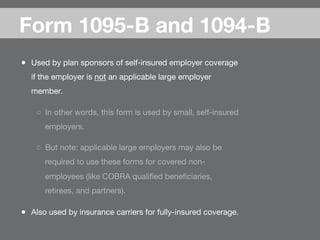
●  Used by plan sponsors of self-insured employer coverage
if the employer is not an applicable large employer
member.
○  In other words, this form is used by small, self-insured
employers.
○  But note: applicable large employers may also be
required to use these forms for covered non-
employees (like COBRA qualified beneficiaries,
retirees, and partners).
●  Also used by insurance carriers for fully-insured coverage.
Form 1095-B and 1094-B
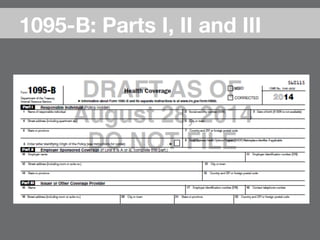
1095-B: Parts I, II and III
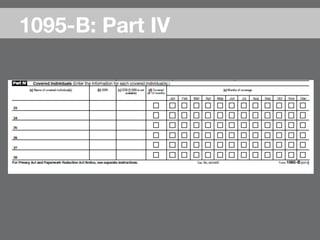
1095-B: Part IV
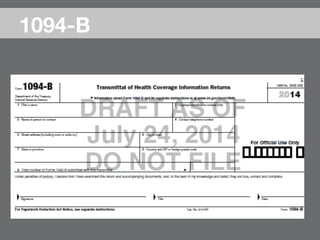
1094-B
●  Used by applicable large employer members,
regardless of whether they are fully-insured or self-
insured.
○  Employers that are fully-insured may leave part of
the Form 1095-C blank (the portion dealing with
covered individuals).
●  Keep in mind the rules for who is an applicable large
employer member.
○  Even if transitional relief delays potential penalties,
the reporting obligation will apply for 2015.
Form 1095-C and 1094-C
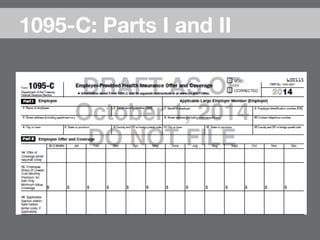
1095-C: Parts I and II
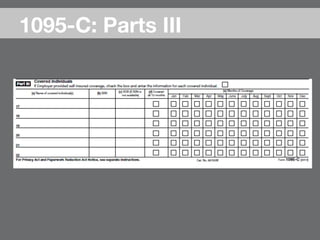
1095-C: Parts III
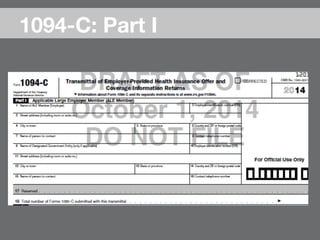
1094-C: Part I
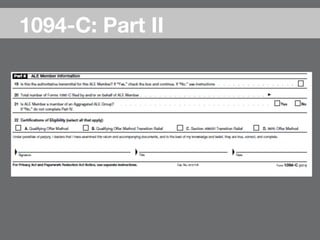
1094-C: Part II
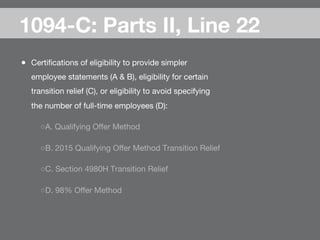
●  Certifications of eligibility to provide simpler
employee statements (A & B), eligibility for certain
transition relief (C), or eligibility to avoid specifying
the number of full-time employees (D):
○ A. Qualifying Offer Method
○ B. 2015 Qualifying Offer Method Transition Relief
○ C. Section 4980H Transition Relief
○ D. 98% Offer Method
1094-C: Parts II, Line 22
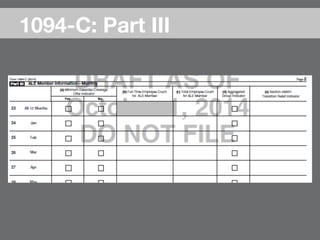
1094-C: Part III
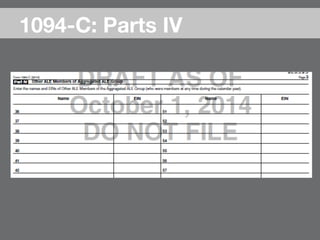
1094-C: Parts IV
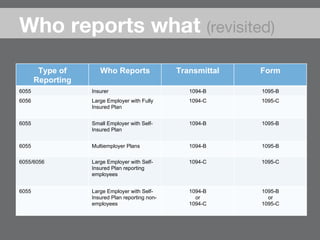
Type of
Reporting
Who Reports Transmittal Form
6055 Insurer 1094-B 1095-B
6056 Large Employer with Fully
Insured Plan
1094-C 1095-C
6055 Small Employer with Self-
Insured Plan
1094-B 1095-B
6055 Multiemployer Plans 1094-B 1095-B
6055/6056 Large Employer with Self-
Insured Plan reporting
employees
1094-C 1095-C
6055 Large Employer with Self-
Insured Plan reporting non-
employees
1094-B
or
1094-C
1095-B
or
1095-C
Who reports what (revisited)
Details and Deadlines
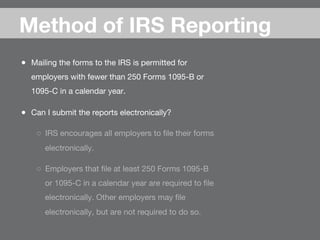
●  Mailing the forms to the IRS is permitted for
employers with fewer than 250 Forms 1095-B or
1095-C in a calendar year.
●  Can I submit the reports electronically?
○  IRS encourages all employers to file their forms
electronically. 
○  Employers that file at least 250 Forms 1095-B
or 1095-C in a calendar year are required to file
electronically. Other employers may file
electronically, but are not required to do so.
Method of IRS Reporting
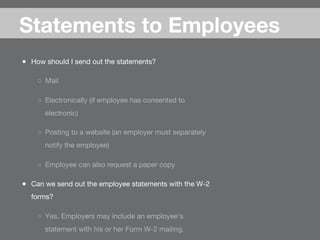
●  How should I send out the statements?
○  Mail
○  Electronically (if employee has consented to
electronic)
○  Posting to a website (an employer must separately
notify the employee)
○  Employee can also request a paper copy 
●  Can we send out the employee statements with the W-2
forms?
○  Yes. Employers may include an employee’s
statement with his or her Form W-2 mailing.
Statements to Employees
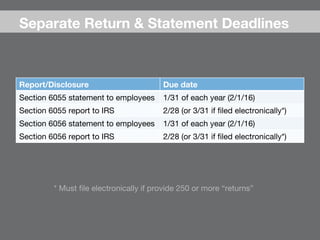
Report/Disclosure
 Due date
Section 6055 statement to employees
 1/31 of each year (2/1/16)
Section 6055 report to IRS
 2/28 (or 3/31 if filed electronically*)
Section 6056 statement to employees 
 1/31 of each year (2/1/16)
Section 6056 report to IRS
 2/28 (or 3/31 if filed electronically*)
* Must file electronically if provide 250 or more “returns”
Separate Return & Statement Deadlines
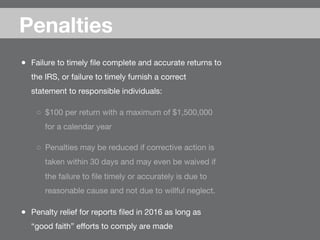
●  Failure to timely file complete and accurate returns to
the IRS, or failure to timely furnish a correct
statement to responsible individuals:
○  $100 per return with a maximum of $1,500,000
for a calendar year
○  Penalties may be reduced if corrective action is
taken within 30 days and may even be waived if
the failure to file timely or accurately is due to
reasonable cause and not due to willful neglect. 
●  Penalty relief for reports filed in 2016 as long as
“good faith” efforts to comply are made
Penalties
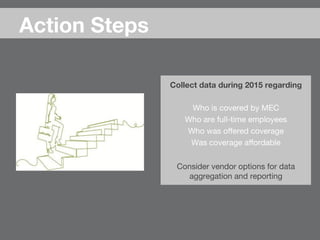
Action Steps
Collect data during 2015 regarding

Who is covered by MEC
Who are full-time employees
Who was offered coverage
Was coverage affordable

Consider vendor options for data
aggregation and reporting
Action Steps
Request Social Security numbers for
covered dependents 


Button-up compliance with employer
shared responsibility rules


Determine other controlled group and
affiliated service group members
Resources
www.ajghealthcarereform.com
The intent of this presentation is to provide you
with general information regarding the status of,
and/or potential concerns related to, your current
employee benefits issue.
It does not necessarily fully address all your
specific issues. It should not be construed as, nor
is it intended to provide, legal or tax advice.
Questions regarding specific issues should be
addressed by the your organization's general
counsel, tax advisor, or an attorney who
specializes in this practice area.
Thank you!
PeopleMatter Demo
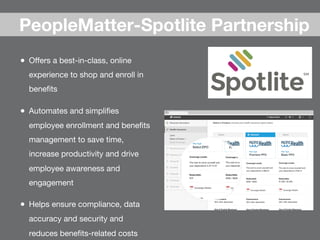
●  Offers a best-in-class, online
experience to shop and enroll in
benefits
●  Automates and simplifies
employee enrollment and benefits
management to save time,
increase productivity and drive
employee awareness and
engagement
●  Helps ensure compliance, data
accuracy and security and 

reduces benefits-related costs
PeopleMatter-Spotlite Partnership
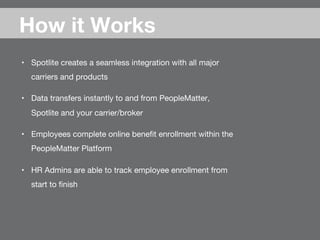
•  Spotlite creates a seamless integration with all major
carriers and products
•  Data transfers instantly to and from PeopleMatter,
Spotlite and your carrier/broker
•  Employees complete online benefit enrollment within the
PeopleMatter Platform
•  HR Admins are able to track employee enrollment from
start to finish
How it Works
Q&A
Kara Badyna
Compliance Consultant 

Arthur J. Gallagher & Co.
kara_badyna@ajg.com
Jim Littlefield
Solutions Engineer 

PeopleMatter
jim.littlefield@peoplematter.com
Program ID 238272

Credit hours awarded 1

Specified credit hours HR (General)
HRCI

2 New Reporting Rules for Obamacare in 2015

  • 2.
    Today’s Presenters Kara Badyna ComplianceConsultant 
 Arthur J. Gallagher & Co. kara_badyna@ajg.com Jim Littlefield Solutions Engineer 
 PeopleMatter jim.littlefield@peoplematter.com
  • 3.
    Agenda ●  Background ●  Whois subject to a Section 6055 and/or 6056 reporting obligation? ●  IRS Forms: ○  1094-B and 1095-B ○  1094-C and 1095-C ○  How to report minimum essential coverage, offers of coverage, full- time employee status and other essential elements of these forms ●  When the forms must be filed with the IRS and sent to employees and administrative details for reporting in 2016. ●  Action steps
  • 4.
    PPACA created twosignificant IRS reporting obligations that will commence in early 2016: Background 6055
 Internal Revenue Code Section 6055 requires insurers and sponsors of self-insured plans to prepare annual reports regarding “minimum essential coverage” (“MEC”). 6056
 Internal Revenue Code Section 6056 requires “applicable large employer” members (“ALE” members) to prepare annual reports regarding the coverage offered to their employees.
  • 5.
    Who is requiredto report?
  • 6.
    Employers (of allsizes) who sponsor self-insured health plans that provide minimum essential coverage to any individual during the calendar year are required to report under Section 6055. Section 6055 (“MEC”) What if we sponsor a fully-insured plan?
 
 Your health insurance carrier will be responsible for Section 6055 reporting for that plan.
  • 7.
    ●  Eligible employer-sponsoredplans ○  Both fully-insured and self-insured, regardless of employer size ○  This does not include excepted benefits ○  This does include even “low cost” plans or plans that do not provide minimum value ○  Reporting not required for coverage that supplements MEC ●  Government-sponsored programs ●  Insured plans offered in the individual market or group market What is MEC?
  • 8.
    ●  Applicable largeemployer members (both fully-insured and self- insured) must report information to the IRS about the health coverage, if any, that they offered to full-time employees. ●  Such ALE members must also report information about whether the coverage was affordable and whether coverage was offered to dependents. ●  Finally, this reporting is the mechanism in place for an employer to claim an exemption or delay in penalty exposure due to various forms of transitional relief. Section 6056 (“ALE”)
  • 9.
    ●  Applicable largeemployers are those with 50 or more full-time (FT) and full-time equivalent (FTE) employees ●  Status as applicable large employer is based on the entire controlled group, but each ALE member reports separately for its employees Who is an ALE member? Note
 All ALE members remain subject to 6056 reporting for the 2015 calendar year, even if transitional relief delays their penalty exposure until later
  • 10.
    ●  Penalty forfailing to offer coverage – 4980H(a) ○  An employer must offer “minimum essential coverage” to 95% (70% for 2015) of its full-time employees and their dependent children up to age 26 or risk a penalty equal to (i) $2,000 (indexed), multiplied by (ii) the number of full- time employees minus 30 (80 for 2015). ○  There is no requirement that the coverage be affordable or provide “minimum value” to avoid this penalty. ○  But… ESR Penalties: A Refresher
  • 11.
    ●  …there isa separate penalty for failing to offer coverage which is both affordable and provides minimum value – Section 4980H(b) ○  If the employer fails to offer coverage that is both affordable and provides minimum value to a full-time employee, it can risk a penalty equal to $3,000 (indexed) per year for that employee. ○  Penalty can only be triggered if a full-time employee goes to the marketplace and receives premium tax assistance. ESR Penalties: A Refresher
  • 12.
  • 13.
    ●  Used byplan sponsors of self-insured employer coverage if the employer is not an applicable large employer member. ○  In other words, this form is used by small, self-insured employers. ○  But note: applicable large employers may also be required to use these forms for covered non- employees (like COBRA qualified beneficiaries, retirees, and partners). ●  Also used by insurance carriers for fully-insured coverage. Form 1095-B and 1094-B
  • 14.
    1095-B: Parts I,II and III
  • 15.
  • 16.
  • 17.
    ●  Used byapplicable large employer members, regardless of whether they are fully-insured or self- insured. ○  Employers that are fully-insured may leave part of the Form 1095-C blank (the portion dealing with covered individuals). ●  Keep in mind the rules for who is an applicable large employer member. ○  Even if transitional relief delays potential penalties, the reporting obligation will apply for 2015. Form 1095-C and 1094-C
  • 18.
  • 19.
  • 20.
  • 21.
  • 22.
    ●  Certifications ofeligibility to provide simpler employee statements (A & B), eligibility for certain transition relief (C), or eligibility to avoid specifying the number of full-time employees (D): ○ A. Qualifying Offer Method ○ B. 2015 Qualifying Offer Method Transition Relief ○ C. Section 4980H Transition Relief ○ D. 98% Offer Method 1094-C: Parts II, Line 22
  • 23.
  • 24.
  • 25.
    Type of Reporting Who ReportsTransmittal Form 6055 Insurer 1094-B 1095-B 6056 Large Employer with Fully Insured Plan 1094-C 1095-C 6055 Small Employer with Self- Insured Plan 1094-B 1095-B 6055 Multiemployer Plans 1094-B 1095-B 6055/6056 Large Employer with Self- Insured Plan reporting employees 1094-C 1095-C 6055 Large Employer with Self- Insured Plan reporting non- employees 1094-B or 1094-C 1095-B or 1095-C Who reports what (revisited)
  • 26.
  • 27.
    ●  Mailing theforms to the IRS is permitted for employers with fewer than 250 Forms 1095-B or 1095-C in a calendar year. ●  Can I submit the reports electronically? ○  IRS encourages all employers to file their forms electronically. ○  Employers that file at least 250 Forms 1095-B or 1095-C in a calendar year are required to file electronically. Other employers may file electronically, but are not required to do so. Method of IRS Reporting
  • 28.
    ●  How shouldI send out the statements? ○  Mail ○  Electronically (if employee has consented to electronic) ○  Posting to a website (an employer must separately notify the employee) ○  Employee can also request a paper copy ●  Can we send out the employee statements with the W-2 forms? ○  Yes. Employers may include an employee’s statement with his or her Form W-2 mailing. Statements to Employees
  • 29.
    Report/Disclosure Due date Section6055 statement to employees 1/31 of each year (2/1/16) Section 6055 report to IRS 2/28 (or 3/31 if filed electronically*) Section 6056 statement to employees 1/31 of each year (2/1/16) Section 6056 report to IRS 2/28 (or 3/31 if filed electronically*) * Must file electronically if provide 250 or more “returns” Separate Return & Statement Deadlines
  • 30.
    ●  Failure totimely file complete and accurate returns to the IRS, or failure to timely furnish a correct statement to responsible individuals: ○  $100 per return with a maximum of $1,500,000 for a calendar year ○  Penalties may be reduced if corrective action is taken within 30 days and may even be waived if the failure to file timely or accurately is due to reasonable cause and not due to willful neglect. ●  Penalty relief for reports filed in 2016 as long as “good faith” efforts to comply are made Penalties
  • 31.
    Action Steps Collect dataduring 2015 regarding Who is covered by MEC Who are full-time employees Who was offered coverage Was coverage affordable Consider vendor options for data aggregation and reporting
  • 32.
    Action Steps Request SocialSecurity numbers for covered dependents 
 Button-up compliance with employer shared responsibility rules
 Determine other controlled group and affiliated service group members
  • 33.
  • 34.
    The intent ofthis presentation is to provide you with general information regarding the status of, and/or potential concerns related to, your current employee benefits issue. It does not necessarily fully address all your specific issues. It should not be construed as, nor is it intended to provide, legal or tax advice. Questions regarding specific issues should be addressed by the your organization's general counsel, tax advisor, or an attorney who specializes in this practice area. Thank you!
  • 35.
  • 36.
    ●  Offers abest-in-class, online experience to shop and enroll in benefits ●  Automates and simplifies employee enrollment and benefits management to save time, increase productivity and drive employee awareness and engagement ●  Helps ensure compliance, data accuracy and security and 
 reduces benefits-related costs PeopleMatter-Spotlite Partnership
  • 37.
    •  Spotlite createsa seamless integration with all major carriers and products •  Data transfers instantly to and from PeopleMatter, Spotlite and your carrier/broker •  Employees complete online benefit enrollment within the PeopleMatter Platform •  HR Admins are able to track employee enrollment from start to finish How it Works
  • 38.
    Q&A Kara Badyna Compliance Consultant
 Arthur J. Gallagher & Co. kara_badyna@ajg.com Jim Littlefield Solutions Engineer 
 PeopleMatter jim.littlefield@peoplematter.com
  • 39.
    Program ID 238272 Credithours awarded 1 Specified credit hours HR (General) HRCI