Chapter 1
Book:
Pathophysi
ology a
practical
approach
Chapter 1:
Pathophysi
ology Made
incredibly
easy
1. INTRODUCTION TO
PATHOPHYSIOLOGY
2. CELL FUNCTIONS
Dr. Mayada A. Daibes 2
6/29/2020
INTRODUCTION
Dr. Mayada A. Daibes 3
Health:
1. may be considered the absence of disease, but this concept can
also be expanded to include wellness of mind, body, and spirit.
2. The normal state may vary due to genetic, age, and gender
differences, and it becomes relative to the individual’s baseline.
Disease:
3. On the flip side of health is disease.
4. is a state in which a bodily function is no longer occurring
normally.
5. The severity of diseases ranges from merely causing temporary
stress to causing life-changing complications.
Health and disease may be considered as two ends of a continuum.
At one end are severe, life-threatening disease states that cause
significant physical and emotional issues; at the other end is
optimal health that supports mind, body, and spirit well-being.
6/29/2020
IMPORTANT CONCEPTS TO REMEMBER
Dr. Mayada A. Daibes 4
Diseases can be classified in several ways.
1. Hereditary, meaning it is transmitted before birth.
2. Disease may also be present at birth, or congenital.
3. Genetic diseases are caused by abnormalities in the individual’s
genetic makeup (e.g., Chromosomal numbers or mutations).
4. Developmental diseases occur as a result of an issue that arises
during embryonic or fetal development. Other diseases may
develop over the life span.
5. Inflammatory diseases are those that trigger the inflammatory
response.
6. Degenerative diseases include conditions that cause parts of the
body to deteriorate (e.g., Arthritis).
7. Conditions that affect metabolism are referred to as metabolic
diseases (e.g., Diabetes mellitus).
8. Neoplastic diseases are caused by abnormal or uncontrolled
cellular growth, which can lead to benign and malignant tumors
6/29/2020
DISEASE CLASSIFICATIONS
Dr. Mayada A. Daibes 5
Homeostasis
 Also known as equilibrium, balance, consistency, and stability.
 Some examples of this relative consistency can be seen in vital signs such
as blood pressure, pulse, and temperature, and reading of PH.
 Every part of the human body—from the smallest cells to the largest
organs—needs balance to maintain its usual functions.
 Several brain structures are instrumental in maintaining this balance,
including the medulla oblongata, hypothalamus, reticular formation, and
pituitary gland:
1. The medulla oblongata is located in the brain stem and controls vital
functions such as blood pressure, temperature, and pulse.
2. The reticular formation is a network of nerve cells in the brain stem and
the spinal cord that also controls vital functions; it relays information to
the hypothalamus.
3. The hypothalamus, in turn, controls homeostasis by communicating
information to the pituitary gland.
4. The pituitary gland, also known as the master gland, regulates other
glands that contribute to growth, maturation, and reproduction.
6/29/2020
Dr. Mayada A. Daibes 6
 Two types of feedback systems exist to maintain
homeostasis: negative and positive.
1. A negative feedback system—the most common type—
works to maintain a deficit in the system.
 Such negative feedback mechanisms work to resist any
change from normal.
 Examples include temperature and glucose regulation.
2. Positive feedback systems, though few in number, move
the body away from homeostasis.
 With this type of feedback, an amplified response occurs in
the same direction as the original stressor.
 Examples of positive feedback systems include childbirth,
sneezing, and blood clots.
6/29/2020
Dr. Mayada A. Daibes 7
 Etiology is the study of disease causation.
 Etiologic factors may include infectious agents, chemicals, and
environmental influences, or unknown (idiopathic).
 Additionally, diseases can be caused by an unintended, or
iatrogenic, effect of a medical treatment.
 Predisposing factors are tendencies that put an individual at
risk for developing certain diseases.
 Examples of predisposing factors are similar to etiologic factors
and may include dietary imbalances and carcinogen exposure.
 Identifying the etiology and predisposing factors for a disease
can be instrumental in preventing the disease by distinguishing
at-risk populations who can be targeted with prevention
measures.
6/29/2020
DISEASE DEVELOPMENT: IMPORTANT
CONCEPTS
Dr. Mayada A. Daibes 8
Pathogenesis is how a disease develops.
 Some diseases are self-limiting, whereas others are
chronic and never resolve. Some diseases cause
reversible changes, while others cause irreparable (non-
repairable) damage.
Compensatory mechanisms are physiological strategies
the body employs in the midst of homeostatic imbalance to
maintain normalcy.
 When those mechanisms can no longer maintain relative
consistency, disease occurs.
6/29/2020
Dr. Mayada A. Daibes 9
 Acute onset of a disease may include pronounced
indicators such as pain or vomiting (e.g. MI).
 A gradual, or insidious, onset may be associated with
only vague signals. (e.g. Hypertension).
6/29/2020
ONSET OF DISEASE
Dr. Mayada A. Daibes 10
1. Acute disease: A disease may be short term, occurring and
resolving quickly. (e.g. Gastroenteritis and tonsillitis).
2. Chronic disease: When an acute disease does not resolve after
a short period, it may move into a chronic state.
 A chronic disease often has less notable signs and occurs over a
longer period.
 Chronic diseases may not ever resolve but may sometimes
become manageable.
 E.g. Diabetes mellitus and depression.
Note: people with chronic diseases can experience an acute event
of that disease, complicating care. An example of this phenomenon
can be seen when a patient with asthma (a chronic disease) has an
acute asthma attack.
6/29/2020
DISEASE DURATION
Dr. Mayada A. Daibes 11
 Manifestations are the clinical effects or evidence of a
disease. They may include both
A. signs—what can be seen or measured—and
B. symptoms—what the patient describes but is not
visible to the healthcare practitioner.
 Manifestations may include issues identified during a
physical assessment (e.g., heart murmur), diagnostic
results (e.g., laboratory levels), patient complaints (e.g.,
pain), and family reports (e.g., unusual behavior).
6/29/2020
RECOGNITION OF A DISEASE
Dr. Mayada A. Daibes 12
Syndrome comprises a group of signs and symptoms that occur
together.
Some chronic diseases may include episodes of remission and
exacerbation:
1. Remission occurs when the manifestations subside,
&
2. exacerbation occurs when the manifestations increase
again.
 E.g. Systemic lupus erythematosus and heart failure are
examples of diseases that demonstrate remissions and
exacerbations.
6/29/2020
Dr. Mayada A. Daibes 13
Diagnosis: disease identification. Manifestations are often
a critical component.
Treatment refers to strategies used to manage or cure a
disease (e.g. antibiotic for infections, antiemitics for
vomiting)
Prevention includes strategies to avoid the development
of disease in individuals or groups.
e.g: screening, vaccinations, lifestyle changes, or
prophylactic interventions (e.g., medication to reduce high
cholesterol levels to prevent strokes, mastectomy in a
person at high risk of breast cancer).
6/29/2020
Dr. Mayada A. Daibes 14
Convalescence is the stage of recovery following a
disease, which may last for days or months.
Prognosis refers to an individual’s likelihood of making a
full recovery or regaining normal functioning.
Mortality The death rate from a particular disease.
Complications are new problems that arise because of a
disease. For example, renal failure can be a complication of
uncontrolled hypertension or diabetes mellitus.
6/29/2020
Dr. Mayada A. Daibes 15
 Morbidity refers to disease rates within a group.
 Epidemics occur when there are increasing numbers of
people with a certain disease within a specific group.
 Pandemic when the epidemic expands to a larger
population.
6/29/2020
CELL FUNCTIONS
Chapter 1:
Pathophysiol
ogy Made
incredibly
easy
CELL DIVISION AND
REPRODUCTION
 Individual cells don’t live as long as the organism they’re
a part of.
 They’re subject to wear and tear and must reproduce and
be replaced.
 Most cells reproduce as quickly as they die.
 Cell reproduction occurs in two stages.
a. In the first stage, called mitosis, the nucleus and
genetic material divide.
b. In the second stage, called cytokinesis, the cytoplasm
divides, beginning during late anaphase or telophase.
At the end of cytokinesis, the cell produces two
daughter cells.
 The great divide
 Before division, a cell must double its mass and content.
This occurs during the growth phase, called interphase.
Chromatin, the small, slender rods of the nucleus that
give it its granular appearance, begins to form .
 Replication and duplication of DNA occur during the four
phases of mitosis:
A. prophase
B. metaphase
C. anaphase
D. telophase.
PATHOPHYSIOLOGIC CONCEPTS
Adaptation
 Cells generally continue functioning despite challenging
conditions or stressors. However, severe or prolonged
stress or changes may injure or destroy cells.
 When cell integrity is threatened, the cell reacts by
drawing in its reserves to keep functioning, by adaptive
changes or by cellular dysfunction.
 If cellular reserve is insufficient, the cell dies. If enough
reserve is available and the body doesn’t detect
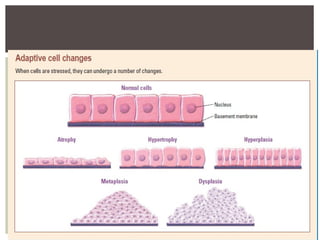
abnormalities, the cell adapts by atrophy, hypertrophy,
hyperplasia, metaplasia, or dysplasia. (See Adaptive cell
changes.)
A. Atrophy
 Atrophy is a reversible reduction in the size of the cell. It results
from disuse, insufficient blood flow, malnutrition, denervation, or
reduced endocrine stimulation.
B. Hypertrophy
 Hypertrophy is an increase in the size of a cell due to an
increased workload. It can result from normal physiologic
conditions or abnormal pathologic conditions.
C. Hyperplasia
 Hyperplasia, an increase in the number of cells, is caused by
increased workload, hormonal stimulation, or decreased tissue.
D. Metaplasia
 Metaplasia is the replacement of one adult cell with another adult
cell that can better endure the change or stress. It’s usually a
response to chronic inflammation or irritation.
E. Dysplasia
 In dysplasia, deranged cell growth of specific tissue results in
abnormal size, shape, and appearance. Although dysplastic cell
changes are adaptive and potentially reversible, they can precede
cancerous changes.
Cell injury
 A person’s state of wellness and disease is reflected in the cells.
 Injury to any of the cell’s components can lead to illness.
 One of the first indications of cell injury is a biochemical lesion
that forms on the cell at the point of injury. This lesion changes
the chemistry of metabolic reactions within the cell.
A. Toxic injury
 May be caused by:
1. endogenous factors: factors inside the body (e.g. genetically
determined metabolic errors, gross malformations, and
hypersensitivity reactions)
2. exogenous factors or outside the body (e.g. alcohol, lead,
carbon monoxide, and drugs that alter cellular function such as
chemotherapeutic agents used for cancer treatment and
immunosuppressive drugs that prevent rejection in organ
transplant recipients).
B. Infectious injury
 Viral, fungal, protozoan, and bacterial agents can cause cell
injury or death. These organisms affect cell integrity, usually by
interfering with cell synthesis, producing mutant cells. For
example, human immunodeficiency virus alters the cell when the
virus is replicated in the cell’s ribonucleic acid.
C. Physical injury
 Results from a disruption in the cell or in the
relationships of the intracellular organelles.
 Two major types of physical injury are thermal
(electrical or radiation) and mechanical (trauma or
surgery). Causes of thermal injury include radiation
therapy for cancer, X-rays, and ultraviolet radiation.
Causes of mechanical injury include motor vehicle
crashes, frostbite, and ischemia.
D. Deficit injury
 When a deficit of water, oxygen, or nutrients occurs,
or if constant temperature and adequate waste
disposal aren’t maintained, cellular synthesis can’t
take place. A lack of just one of these basic
requirements can cause cell disruption or death.
Cell degeneration
 A type of nonlethal cell damage known as degeneration
generally occurs in the cytoplasm of the cell, while the
nucleus remains unaffected.
 Degeneration usually affects organs with metabolically
active cells, such as the liver, heart, and kidneys, and is
caused by these problems:
• increased water in the cell or cellular swelling
• fatty infiltrates
• atrophy
• autophagocytosis, during which the cell absorbs some of its
own parts
• pigmentation changes
• calcification
• hyaline infiltration
• hypertrophy
• dysplasia (related to chronic irritation)
• hyperplasia.
Cell aging
 During the normal process of cell aging, cells lose
structure and function.
 Lost cell structure may cause a decrease in size or wasting
away, a process called atrophy.
 Two characteristics of lost cell function are:
A. hypertrophy, an abnormal thickening or increase in bulk
B. hyperplasia, an increase in the number of cells.
 Cell aging may slow down or speed up, depending on the
number and extent of injuries and the amount of wear and
tear on the cell.

1_Introduction to pathophysiosslogy.pptx

  • 1.
    Chapter 1 Book: Pathophysi ology a practical approach Chapter1: Pathophysi ology Made incredibly easy 1. INTRODUCTION TO PATHOPHYSIOLOGY 2. CELL FUNCTIONS
  • 2.
    Dr. Mayada A.Daibes 2 6/29/2020 INTRODUCTION
  • 3.
    Dr. Mayada A.Daibes 3 Health: 1. may be considered the absence of disease, but this concept can also be expanded to include wellness of mind, body, and spirit. 2. The normal state may vary due to genetic, age, and gender differences, and it becomes relative to the individual’s baseline. Disease: 3. On the flip side of health is disease. 4. is a state in which a bodily function is no longer occurring normally. 5. The severity of diseases ranges from merely causing temporary stress to causing life-changing complications. Health and disease may be considered as two ends of a continuum. At one end are severe, life-threatening disease states that cause significant physical and emotional issues; at the other end is optimal health that supports mind, body, and spirit well-being. 6/29/2020 IMPORTANT CONCEPTS TO REMEMBER
  • 4.
    Dr. Mayada A.Daibes 4 Diseases can be classified in several ways. 1. Hereditary, meaning it is transmitted before birth. 2. Disease may also be present at birth, or congenital. 3. Genetic diseases are caused by abnormalities in the individual’s genetic makeup (e.g., Chromosomal numbers or mutations). 4. Developmental diseases occur as a result of an issue that arises during embryonic or fetal development. Other diseases may develop over the life span. 5. Inflammatory diseases are those that trigger the inflammatory response. 6. Degenerative diseases include conditions that cause parts of the body to deteriorate (e.g., Arthritis). 7. Conditions that affect metabolism are referred to as metabolic diseases (e.g., Diabetes mellitus). 8. Neoplastic diseases are caused by abnormal or uncontrolled cellular growth, which can lead to benign and malignant tumors 6/29/2020 DISEASE CLASSIFICATIONS
  • 5.
    Dr. Mayada A.Daibes 5 Homeostasis  Also known as equilibrium, balance, consistency, and stability.  Some examples of this relative consistency can be seen in vital signs such as blood pressure, pulse, and temperature, and reading of PH.  Every part of the human body—from the smallest cells to the largest organs—needs balance to maintain its usual functions.  Several brain structures are instrumental in maintaining this balance, including the medulla oblongata, hypothalamus, reticular formation, and pituitary gland: 1. The medulla oblongata is located in the brain stem and controls vital functions such as blood pressure, temperature, and pulse. 2. The reticular formation is a network of nerve cells in the brain stem and the spinal cord that also controls vital functions; it relays information to the hypothalamus. 3. The hypothalamus, in turn, controls homeostasis by communicating information to the pituitary gland. 4. The pituitary gland, also known as the master gland, regulates other glands that contribute to growth, maturation, and reproduction. 6/29/2020
  • 6.
    Dr. Mayada A.Daibes 6  Two types of feedback systems exist to maintain homeostasis: negative and positive. 1. A negative feedback system—the most common type— works to maintain a deficit in the system.  Such negative feedback mechanisms work to resist any change from normal.  Examples include temperature and glucose regulation. 2. Positive feedback systems, though few in number, move the body away from homeostasis.  With this type of feedback, an amplified response occurs in the same direction as the original stressor.  Examples of positive feedback systems include childbirth, sneezing, and blood clots. 6/29/2020
  • 7.
    Dr. Mayada A.Daibes 7  Etiology is the study of disease causation.  Etiologic factors may include infectious agents, chemicals, and environmental influences, or unknown (idiopathic).  Additionally, diseases can be caused by an unintended, or iatrogenic, effect of a medical treatment.  Predisposing factors are tendencies that put an individual at risk for developing certain diseases.  Examples of predisposing factors are similar to etiologic factors and may include dietary imbalances and carcinogen exposure.  Identifying the etiology and predisposing factors for a disease can be instrumental in preventing the disease by distinguishing at-risk populations who can be targeted with prevention measures. 6/29/2020 DISEASE DEVELOPMENT: IMPORTANT CONCEPTS
  • 8.
    Dr. Mayada A.Daibes 8 Pathogenesis is how a disease develops.  Some diseases are self-limiting, whereas others are chronic and never resolve. Some diseases cause reversible changes, while others cause irreparable (non- repairable) damage. Compensatory mechanisms are physiological strategies the body employs in the midst of homeostatic imbalance to maintain normalcy.  When those mechanisms can no longer maintain relative consistency, disease occurs. 6/29/2020
  • 9.
    Dr. Mayada A.Daibes 9  Acute onset of a disease may include pronounced indicators such as pain or vomiting (e.g. MI).  A gradual, or insidious, onset may be associated with only vague signals. (e.g. Hypertension). 6/29/2020 ONSET OF DISEASE
  • 10.
    Dr. Mayada A.Daibes 10 1. Acute disease: A disease may be short term, occurring and resolving quickly. (e.g. Gastroenteritis and tonsillitis). 2. Chronic disease: When an acute disease does not resolve after a short period, it may move into a chronic state.  A chronic disease often has less notable signs and occurs over a longer period.  Chronic diseases may not ever resolve but may sometimes become manageable.  E.g. Diabetes mellitus and depression. Note: people with chronic diseases can experience an acute event of that disease, complicating care. An example of this phenomenon can be seen when a patient with asthma (a chronic disease) has an acute asthma attack. 6/29/2020 DISEASE DURATION
  • 11.
    Dr. Mayada A.Daibes 11  Manifestations are the clinical effects or evidence of a disease. They may include both A. signs—what can be seen or measured—and B. symptoms—what the patient describes but is not visible to the healthcare practitioner.  Manifestations may include issues identified during a physical assessment (e.g., heart murmur), diagnostic results (e.g., laboratory levels), patient complaints (e.g., pain), and family reports (e.g., unusual behavior). 6/29/2020 RECOGNITION OF A DISEASE
  • 12.
    Dr. Mayada A.Daibes 12 Syndrome comprises a group of signs and symptoms that occur together. Some chronic diseases may include episodes of remission and exacerbation: 1. Remission occurs when the manifestations subside, & 2. exacerbation occurs when the manifestations increase again.  E.g. Systemic lupus erythematosus and heart failure are examples of diseases that demonstrate remissions and exacerbations. 6/29/2020
  • 13.
    Dr. Mayada A.Daibes 13 Diagnosis: disease identification. Manifestations are often a critical component. Treatment refers to strategies used to manage or cure a disease (e.g. antibiotic for infections, antiemitics for vomiting) Prevention includes strategies to avoid the development of disease in individuals or groups. e.g: screening, vaccinations, lifestyle changes, or prophylactic interventions (e.g., medication to reduce high cholesterol levels to prevent strokes, mastectomy in a person at high risk of breast cancer). 6/29/2020
  • 14.
    Dr. Mayada A.Daibes 14 Convalescence is the stage of recovery following a disease, which may last for days or months. Prognosis refers to an individual’s likelihood of making a full recovery or regaining normal functioning. Mortality The death rate from a particular disease. Complications are new problems that arise because of a disease. For example, renal failure can be a complication of uncontrolled hypertension or diabetes mellitus. 6/29/2020
  • 15.
    Dr. Mayada A.Daibes 15  Morbidity refers to disease rates within a group.  Epidemics occur when there are increasing numbers of people with a certain disease within a specific group.  Pandemic when the epidemic expands to a larger population. 6/29/2020
  • 16.
  • 17.
    CELL DIVISION AND REPRODUCTION Individual cells don’t live as long as the organism they’re a part of.  They’re subject to wear and tear and must reproduce and be replaced.  Most cells reproduce as quickly as they die.  Cell reproduction occurs in two stages. a. In the first stage, called mitosis, the nucleus and genetic material divide. b. In the second stage, called cytokinesis, the cytoplasm divides, beginning during late anaphase or telophase. At the end of cytokinesis, the cell produces two daughter cells.
  • 18.
     The greatdivide  Before division, a cell must double its mass and content. This occurs during the growth phase, called interphase. Chromatin, the small, slender rods of the nucleus that give it its granular appearance, begins to form .  Replication and duplication of DNA occur during the four phases of mitosis: A. prophase B. metaphase C. anaphase D. telophase.
  • 20.
    PATHOPHYSIOLOGIC CONCEPTS Adaptation  Cellsgenerally continue functioning despite challenging conditions or stressors. However, severe or prolonged stress or changes may injure or destroy cells.  When cell integrity is threatened, the cell reacts by drawing in its reserves to keep functioning, by adaptive changes or by cellular dysfunction.  If cellular reserve is insufficient, the cell dies. If enough reserve is available and the body doesn’t detect abnormalities, the cell adapts by atrophy, hypertrophy, hyperplasia, metaplasia, or dysplasia. (See Adaptive cell changes.)
  • 22.
    A. Atrophy  Atrophyis a reversible reduction in the size of the cell. It results from disuse, insufficient blood flow, malnutrition, denervation, or reduced endocrine stimulation. B. Hypertrophy  Hypertrophy is an increase in the size of a cell due to an increased workload. It can result from normal physiologic conditions or abnormal pathologic conditions. C. Hyperplasia  Hyperplasia, an increase in the number of cells, is caused by increased workload, hormonal stimulation, or decreased tissue. D. Metaplasia  Metaplasia is the replacement of one adult cell with another adult cell that can better endure the change or stress. It’s usually a response to chronic inflammation or irritation. E. Dysplasia  In dysplasia, deranged cell growth of specific tissue results in abnormal size, shape, and appearance. Although dysplastic cell changes are adaptive and potentially reversible, they can precede cancerous changes.
  • 23.
    Cell injury  Aperson’s state of wellness and disease is reflected in the cells.  Injury to any of the cell’s components can lead to illness.  One of the first indications of cell injury is a biochemical lesion that forms on the cell at the point of injury. This lesion changes the chemistry of metabolic reactions within the cell. A. Toxic injury  May be caused by: 1. endogenous factors: factors inside the body (e.g. genetically determined metabolic errors, gross malformations, and hypersensitivity reactions) 2. exogenous factors or outside the body (e.g. alcohol, lead, carbon monoxide, and drugs that alter cellular function such as chemotherapeutic agents used for cancer treatment and immunosuppressive drugs that prevent rejection in organ transplant recipients). B. Infectious injury  Viral, fungal, protozoan, and bacterial agents can cause cell injury or death. These organisms affect cell integrity, usually by interfering with cell synthesis, producing mutant cells. For example, human immunodeficiency virus alters the cell when the virus is replicated in the cell’s ribonucleic acid.
  • 24.
    C. Physical injury Results from a disruption in the cell or in the relationships of the intracellular organelles.  Two major types of physical injury are thermal (electrical or radiation) and mechanical (trauma or surgery). Causes of thermal injury include radiation therapy for cancer, X-rays, and ultraviolet radiation. Causes of mechanical injury include motor vehicle crashes, frostbite, and ischemia. D. Deficit injury  When a deficit of water, oxygen, or nutrients occurs, or if constant temperature and adequate waste disposal aren’t maintained, cellular synthesis can’t take place. A lack of just one of these basic requirements can cause cell disruption or death.
  • 25.
    Cell degeneration  Atype of nonlethal cell damage known as degeneration generally occurs in the cytoplasm of the cell, while the nucleus remains unaffected.  Degeneration usually affects organs with metabolically active cells, such as the liver, heart, and kidneys, and is caused by these problems: • increased water in the cell or cellular swelling • fatty infiltrates • atrophy • autophagocytosis, during which the cell absorbs some of its own parts • pigmentation changes • calcification • hyaline infiltration • hypertrophy • dysplasia (related to chronic irritation) • hyperplasia.
  • 26.
    Cell aging  Duringthe normal process of cell aging, cells lose structure and function.  Lost cell structure may cause a decrease in size or wasting away, a process called atrophy.  Two characteristics of lost cell function are: A. hypertrophy, an abnormal thickening or increase in bulk B. hyperplasia, an increase in the number of cells.  Cell aging may slow down or speed up, depending on the number and extent of injuries and the amount of wear and tear on the cell.