Greek Drama
“Big 4 Playwrights”
•Aeschylus      •Euripides

•Aristophanes   •Sophocles
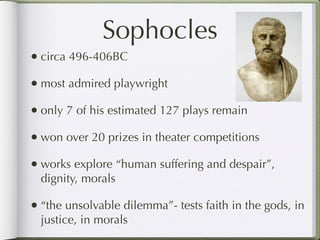
Sophocles
• circa 496-406BC
• most admired playwright
• only 7 of his estimated 127 plays remain
• won over 20 prizes in theater competitions
• works explore “human suffering and despair”,
  dignity, morals

• “the unsolvable dilemma”- tests faith in the gods, in
  justice, in morals
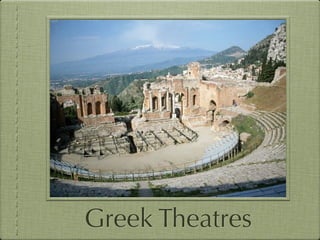
Greek Theatres
Theaters
• huge, outdoor facilities
• large audience capacity, all seats are good
• natural acoustics
• space also used for funerals of state, forums,
  meetings

• Romans turned theaters into arenas for sports
  and gladiators

• sometimes flooded for boat races
Major Themes

•fatal flaw vs. victim of fate
•role of divine justice... is there free
 will? or are we pawns of fate?

•roles of humans in the universe
Tragedy and
      the Tragic Hero
•tragic flaw: character’s weakness, faults
•Aristotle: tragedy is “when a hero goes
 through one or more reversals of
 fortune, leading up to a final
 recognition of truth”
Notes from Film
• Role of theatre in ancient Greek society: illustrate the
  “how” and “why” of the human experience

  ✴structure of the universe
  ✴structure of gods and family groups
  ✴give people a sense of the universe and how they fit
     in

  ✴truth of the human nature and experience
  ✴values, models for community living
Notes from Film
• Birthplace and Time: Athens, 4th or 5th century
• Original function: celebrate/honor Dionysis, the god
  of wine, sex, revel

• Schedule of Performances: seasonal, or part of theater
  competitions

• Play Themes and Narratives: not “highbrow”, based on
  myths and historical events, usually tragedy or comedy

• Actors: originally amateurs, then eventually
  professionals, then eventually acting troupes; low
  wages; only men
Notes from Film
•The SuperStars? playwrights!
 highest status in the theatre, did it
 all... wrote, acted, directed,
 costuming, wrote music

•Audience/Cost: men only at first,
 then women eventually; cost about
 a day’s wages, the eventually free
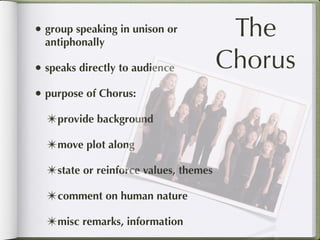
• group speaking in unison or
  antiphonally
                                        The
• speaks directly to audience          Chorus
• purpose of Chorus:
  ✴provide background
  ✴move plot along
  ✴state or reinforce values, themes
  ✴comment on human nature
  ✴misc remarks, information
Drama Terms to Know...
• Drama: art of writing or producing a story intended for
  performance

• Protagonist: main character, principal figure in a story
• Antagonist: character in opposition of protagonist or
  hero

• Comedy: dramatic work that is light or humorous in tone
• Tragedy: dramatic work in which the protagonist suffers
  sorrow or extreme ruin, especially as a consequence of a
  tragic flaw or moral weakness
Drama Terms to Know...
• Theatre: “what is seen” (vs THEATER: the place where
  it is seen)

• 3 Parts of Greek Theater
  • Scene/Sheenee: acting platform (later became a
     raised area, and called the stage)

  • Theatron: seating
  • Orchestra: where chorus stood
• Altars: to honor gods
Oedipus Rex
http://www.youtube.com/watch?v=sA1_QZxvRyo
Necessary Info...
• first of a trilogy about Thebes (Greek city/state)
   • Oedipus Rex, Oedipus at Colonus, Antigone
• Opening Situation: Thebes is suffering a great plague. Apollo
  says it will not end until the murderer of King Laius is found
  and punished.

• Audience Familiarity: would have known story (see summary
  in packet)

• Tight Dramatic Structure: very small range of time and space,
  can stand alone apart from rest of trilogy

   • Aristotle’s wholeness in literature: completeness of
     beginning, middle, and end
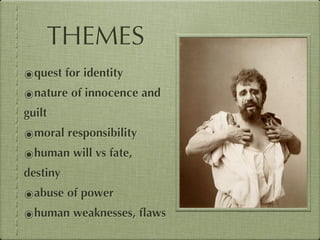
THEMES
๏quest for identity
๏nature of innocence and
guilt
๏moral responsibility
๏human will vs fate,
destiny
๏abuse of power
๏human weaknesses, flaws
Terms
Terms
• Dramatic Irony: when reader/audience knows or
  understands important point the character does not
Terms
• Dramatic Irony: when reader/audience knows or
  understands important point the character does not

  ★ we already know Oedipus’ true identity before story
    begins!
Terms
• Dramatic Irony: when reader/audience knows or
  understands important point the character does not

  ★ we already know Oedipus’ true identity before story
     begins!

• Prologue/Prologos: opening, exposition (character, setting,
  conflicts)
Terms
• Dramatic Irony: when reader/audience knows or
  understands important point the character does not

  ★ we already know Oedipus’ true identity before story
     begins!

• Prologue/Prologos: opening, exposition (character, setting,
  conflicts)

• Parados: entrance song of chorus
Terms
• Dramatic Irony: when reader/audience knows or
  understands important point the character does not

  ★ we already know Oedipus’ true identity before story
     begins!

• Prologue/Prologos: opening, exposition (character, setting,
  conflicts)

• Parados: entrance song of chorus
• Episodes (Scenes): action in the drama, performed by actors
Terms
• Dramatic Irony: when reader/audience knows or
  understands important point the character does not

  ★ we already know Oedipus’ true identity before story
     begins!

• Prologue/Prologos: opening, exposition (character, setting,
  conflicts)

• Parados: entrance song of chorus
• Episodes (Scenes): action in the drama, performed by actors
• Stasimons (Odes): chorus passages, alternate with Episodes
Terms
• Dramatic Irony: when reader/audience knows or
  understands important point the character does not

  ★ we already know Oedipus’ true identity before story
     begins!

• Prologue/Prologos: opening, exposition (character, setting,
  conflicts)

• Parados: entrance song of chorus
• Episodes (Scenes): action in the drama, performed by actors
• Stasimons (Odes): chorus passages, alternate with Episodes
• Exodus: conclusion, ends usually with chorus singing final
  lines as they exit

Oedipus Intro notes

  • 1.
  • 2.
    “Big 4 Playwrights” •Aeschylus •Euripides •Aristophanes •Sophocles
  • 3.
    Sophocles • circa 496-406BC •most admired playwright • only 7 of his estimated 127 plays remain • won over 20 prizes in theater competitions • works explore “human suffering and despair”, dignity, morals • “the unsolvable dilemma”- tests faith in the gods, in justice, in morals
  • 4.
  • 5.
    Theaters • huge, outdoorfacilities • large audience capacity, all seats are good • natural acoustics • space also used for funerals of state, forums, meetings • Romans turned theaters into arenas for sports and gladiators • sometimes flooded for boat races
  • 6.
    Major Themes •fatal flawvs. victim of fate •role of divine justice... is there free will? or are we pawns of fate? •roles of humans in the universe
  • 7.
    Tragedy and the Tragic Hero •tragic flaw: character’s weakness, faults •Aristotle: tragedy is “when a hero goes through one or more reversals of fortune, leading up to a final recognition of truth”
  • 8.
    Notes from Film •Role of theatre in ancient Greek society: illustrate the “how” and “why” of the human experience ✴structure of the universe ✴structure of gods and family groups ✴give people a sense of the universe and how they fit in ✴truth of the human nature and experience ✴values, models for community living
  • 9.
    Notes from Film •Birthplace and Time: Athens, 4th or 5th century • Original function: celebrate/honor Dionysis, the god of wine, sex, revel • Schedule of Performances: seasonal, or part of theater competitions • Play Themes and Narratives: not “highbrow”, based on myths and historical events, usually tragedy or comedy • Actors: originally amateurs, then eventually professionals, then eventually acting troupes; low wages; only men
  • 10.
    Notes from Film •TheSuperStars? playwrights! highest status in the theatre, did it all... wrote, acted, directed, costuming, wrote music •Audience/Cost: men only at first, then women eventually; cost about a day’s wages, the eventually free
  • 11.
    • group speakingin unison or antiphonally The • speaks directly to audience Chorus • purpose of Chorus: ✴provide background ✴move plot along ✴state or reinforce values, themes ✴comment on human nature ✴misc remarks, information
  • 12.
    Drama Terms toKnow... • Drama: art of writing or producing a story intended for performance • Protagonist: main character, principal figure in a story • Antagonist: character in opposition of protagonist or hero • Comedy: dramatic work that is light or humorous in tone • Tragedy: dramatic work in which the protagonist suffers sorrow or extreme ruin, especially as a consequence of a tragic flaw or moral weakness
  • 13.
    Drama Terms toKnow... • Theatre: “what is seen” (vs THEATER: the place where it is seen) • 3 Parts of Greek Theater • Scene/Sheenee: acting platform (later became a raised area, and called the stage) • Theatron: seating • Orchestra: where chorus stood • Altars: to honor gods
  • 14.
  • 15.
    Necessary Info... • firstof a trilogy about Thebes (Greek city/state) • Oedipus Rex, Oedipus at Colonus, Antigone • Opening Situation: Thebes is suffering a great plague. Apollo says it will not end until the murderer of King Laius is found and punished. • Audience Familiarity: would have known story (see summary in packet) • Tight Dramatic Structure: very small range of time and space, can stand alone apart from rest of trilogy • Aristotle’s wholeness in literature: completeness of beginning, middle, and end
  • 16.
    THEMES ๏quest for identity ๏natureof innocence and guilt ๏moral responsibility ๏human will vs fate, destiny ๏abuse of power ๏human weaknesses, flaws
  • 17.
  • 18.
    Terms • Dramatic Irony:when reader/audience knows or understands important point the character does not
  • 19.
    Terms • Dramatic Irony:when reader/audience knows or understands important point the character does not ★ we already know Oedipus’ true identity before story begins!
  • 20.
    Terms • Dramatic Irony:when reader/audience knows or understands important point the character does not ★ we already know Oedipus’ true identity before story begins! • Prologue/Prologos: opening, exposition (character, setting, conflicts)
  • 21.
    Terms • Dramatic Irony:when reader/audience knows or understands important point the character does not ★ we already know Oedipus’ true identity before story begins! • Prologue/Prologos: opening, exposition (character, setting, conflicts) • Parados: entrance song of chorus
  • 22.
    Terms • Dramatic Irony:when reader/audience knows or understands important point the character does not ★ we already know Oedipus’ true identity before story begins! • Prologue/Prologos: opening, exposition (character, setting, conflicts) • Parados: entrance song of chorus • Episodes (Scenes): action in the drama, performed by actors
  • 23.
    Terms • Dramatic Irony:when reader/audience knows or understands important point the character does not ★ we already know Oedipus’ true identity before story begins! • Prologue/Prologos: opening, exposition (character, setting, conflicts) • Parados: entrance song of chorus • Episodes (Scenes): action in the drama, performed by actors • Stasimons (Odes): chorus passages, alternate with Episodes
  • 24.
    Terms • Dramatic Irony:when reader/audience knows or understands important point the character does not ★ we already know Oedipus’ true identity before story begins! • Prologue/Prologos: opening, exposition (character, setting, conflicts) • Parados: entrance song of chorus • Episodes (Scenes): action in the drama, performed by actors • Stasimons (Odes): chorus passages, alternate with Episodes • Exodus: conclusion, ends usually with chorus singing final lines as they exit