Kegunaan energi kimia
dalam sel
 BIOSINTESIS
 KONTRAKSI DAN GERAKAN

 TRANSPOR AKTIF

 TRANSFER BAHAN GENETIK
Dari mana energinya?

 Dari makanan.
 Energi yang diekstrak dari
  makanan digunakan untuk
  memberi energi gugus fosfat agar
  dapat membentuk ATP.
ATP (Adenosin Tri
Fosfat)
 ATP memiliki energi yang dapat
  dilepaskan dengan mudah melalui
  pemutusan ikatan pada fosfat
  ketiga.
 Energi yang dilepaskan digunakan
  untuk menjalankan proses-proses
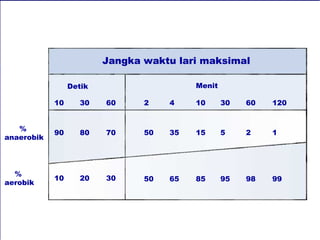
  kehidupan.
ATP (Adenosin Tri
Fosfat)
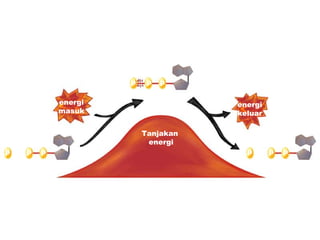
 Pembebasan fosfat ketiga mengubah
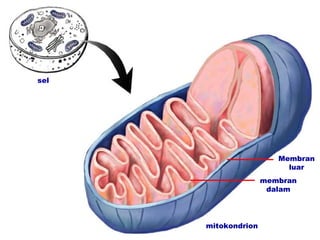
  ATP menjadi molekul yang memiliki 2
  gugus fosfat ( ADP).
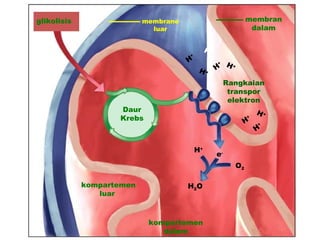
 ADP dapat membentuk ATP kembali
  bila terdapat gugus fosfat dan energi.
p    p    p

               energi            ATP
                                       energi
               masuk                   keluar

                            Tanjakan
                             energi
p    p   p                               p      p   p
P+       ADP                             P+         ADP
Memperoleh Energi dari
Makanan

■ Bagaimana makanan diubah
  menjadi energi?
■ Apakah nutrisi yang berbeda
  diekstrak energinya melalui cara
  yang berbeda?
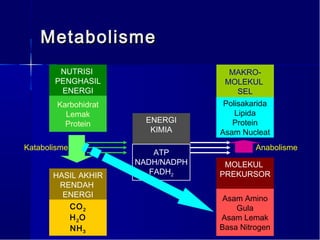
Metabolisme
        NUTRISI                      MAKRO-
       PENGHASIL                    MOLEKUL
        ENERGI                        SEL
        Karbohidrat                 Polisakarida
          Lemak                        Lipida
          Protein       ENERGI        Protein
                         KIMIA     Asam Nucleat
Katabolisme                                 Anabolisme
                          ATP
                      NADH/NADPH    MOLEKUL
       HASIL AKHIR       FADH2     PREKURSOR
        RENDAH
         ENERGI                     Asam Amino
          CO 2                         Gula
          H 2O                     Asam Lemak
          NH 3                     Basa Nitrogen
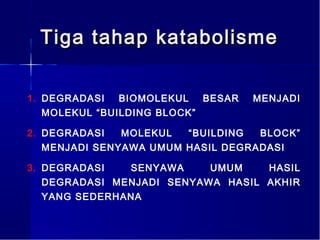
Tiga tahap katabolisme

1. DEGRADASI   BIOMOLEKUL   BESAR   MENJADI
   MOLEKUL “BUILDING BLOCK”

2. DEGRADASI   MOLEKUL  “BUILDING  BLOCK”
   MENJADI SENYAWA UMUM HASIL DEGRADASI

3. DEGRADASI   SENYAWA     UMUM    HASIL
   DEGRADASI MENJADI SENYAWA HASIL AKHIR
   YANG SEDERHANA
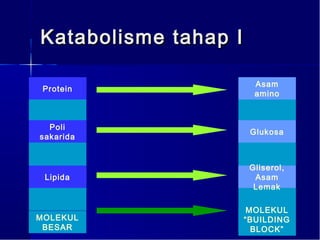
Katabolisme tahap I

                        Asam
 Protein
                        amino


  Poli
                       Glukosa
sakarida


                       Gliserol,
 Lipida                 Asam
                        Lemak

                       MOLEKUL
MOLEKUL               “BUILDING
 BESAR                  BLOCK”
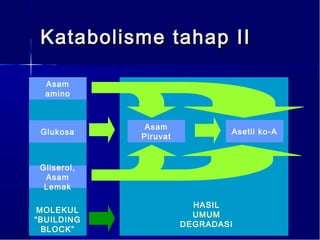
Katabolisme tahap II

  Asam
  amino


              Asam
 Glukosa                       Asetil ko-A
             Piruvat


 Gliserol,
  Asam
  Lemak

                         HASIL
 MOLEKUL
                         UMUM
“BUILDING
                       DEGRADASI
  BLOCK”
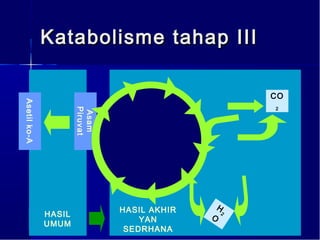
Katabolisme tahap III

                                                    CO
Asetil ko-A


                                                    2
                      Piruvat
                       Asam


                                HASIL AKHIR    H
              HASIL                           O
                                                2
                                    YAN
              UMUM
                                 SEDRHANA
Katabolisme Glukosa
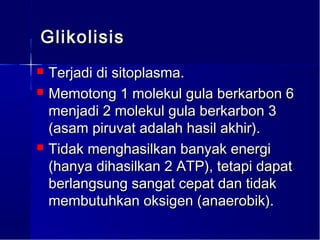
Glikolisis
 Terjadi di sitoplasma.
 Memotong 1 molekul gula berkarbon 6
  menjadi 2 molekul gula berkarbon 3
  (asam piruvat adalah hasil akhir).
 Tidak menghasilkan banyak energi
  (hanya dihasilkan 2 ATP), tetapi dapat
  berlangsung sangat cepat dan tidak
  membutuhkan oksigen (anaerobik).
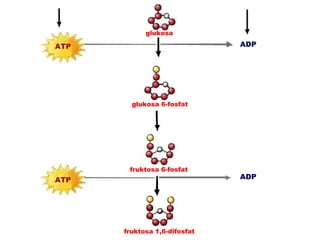
glukosa

ATP                           ADP


        glukosa 6-fosfat


       fruktosa 6-fosfat
ATP                           ADP


      fruktosa 1,6-difosfat
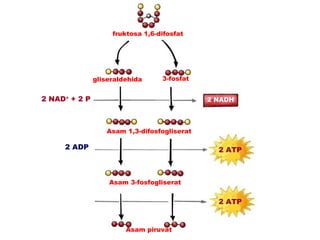
fruktosa 1,6-difosfat


               gliseraldehida     3-fosfat


2 NAD+ + 2 P                                 2 NADH   + 2 H+


                  Asam 1,3-difosfogliserat

     2 ADP                                     2 ATP


                   Asam 3-fosfogliserat

     2 ADP                                     2 ATP


                        Asam piruvat
Glikolisis
 Beberapa bakteri dan jasad eukaryot
  hanya menggunakan Glikolisis
  sebagai cara untuk memperoleh
  energi.
 Fermentasi alkohol yang dilakukan
  khamir pada keadaan tanpa oksigen
  mengubah asam piruvat menjadi
  alkohol.
 Fermantasi asam laktat yang terjadi di
  banyak sel jaringan hewan pada
  keadaan tanpa oksigen mengubah
  asam piruvat menjadi asam laktat.
PERHITUNGAN ENERGI

 Membutuhkan 2 ATP.
 Menghasilkan energi cukup
  untuk menggabungkan fosfat
  ke 4 molekul ADP membentuk
  4 ATP.
 Hasil 4 ATP – perlu 2 ATP =
  Hasil bersih 2 ATP.
Berlari 30 detik

  Perolehan energi melalui
   glikolisis, karena cepat.
  Tidak membutuhkan oksigen
   (anaerobik).
  Dihasilkan asam laktat yang dapat
   membakar otot.
Berlari 10 menit?

  Perlu energi lebih banyak.
  Tidak boleh terbentuk asam
   laktat terlalu banyak, maka
   kondisi tidak boleh anaerob.
Jangka waktu lari maksimal

                 Detik                    Menit

            10      30   60     2    4    10      30   60   120


   %
            90      80   70     50   35   15      5    2    1
anaerobik


  %
            10      20   30     50   65   85      95   98   99
aerobik
Peran Oksigen dalam
Katabolisme Glukosa?
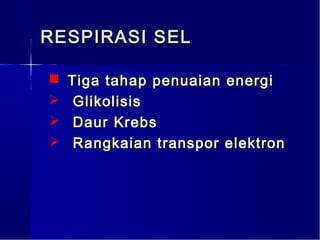
RESPIRASI SEL

   Tiga tahap penuaian energi
    Glikolisis
    Daur Krebs
    Rangkaian transpor elektron
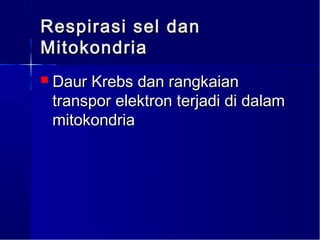
Respirasi sel dan
Mitokondria
   Daur Krebs dan rangkaian
    transpor elektron terjadi di dalam
    mitokondria
sel


                        Membran
                          luar
                     membran
                      dalam


      mitokondrion
glikolisis                 membrane                                membran
                             luar                                   dalam


                                               H+
                                      +
                                      H             +    H+
                                           H+       H

                                                         Rangkaian
                                                          transpor
                                                          elektron
                    Daur                                               H+
                    Krebs                                      H
                                                                   +
                                                                       +
                                                                       H

                                          H+
                                                    e-
                                                              O2

             kompartemen              H2 O
                luar


                            kompartemen
                               dalam
Peralihan antara Glikolisis dan
Daur Krebs
   Asam piruvat hasil glikolisis menuju
    ke mitokondria.
   Berikatan dengan koenzim A
    membentuk asetil koA, 1 molekul
    NADH, dan CO2.
   Daur Krebs terjadi di kompartemen
    dalam dari mitokondria.
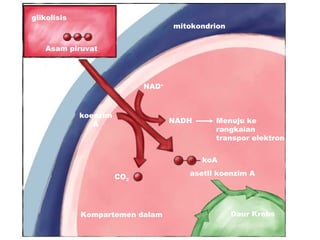
glikolisis
                                    mitokondrion


   Asam piruvat


cytosol
                             NAD+


             koenzim
                A                   NADH     Menuju ke
                                             rangkaian
                                             transpor elektron


                                           koA

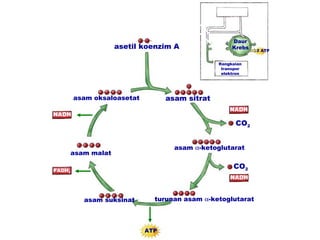
                       CO2             asetll koenzim A


             Kompartemen dalam                     Daur Krebs
SUMMARY OF THE KREBS CYCLE                     6 NADH         GLYCOLYSIS

                                               2 FADH2


                                           CoA                     Daur
                              asetil koenzim A                     Krebs
                                                                           CO2
                                                                           2 ATP


                                                              Rangkaian
                                                               transpor
                                                               elektron


                 asam oksaloasetat 1.          asam sitrat
                                               NAD+               NADH
         NADH                  NAD   +
                                                         2.
                       6.                                           CO2


                                                  asam α-ketoglutarat
                 asam malat

                                                         3.        CO2
         FADH2                FAD+
                                               NAD+               NADH
                              5.         ADP


                    asam suksinat            4.
                                           turunan asam α-ketoglutarat


                                         ATP
Ringkasan Daur Krebs
 Asetil koA didegradasi sempurna
  menjadi CO2.
 Hanya 1 ATP yang dihasilkan dari
  setiap asetil koA yang memasuki Daur
  Krebs (total 2 ATP tiap glukosa).
 Semua elektron dapat diikat dalam
  bentuk 6 NADH (per glukosa) untuk
  diproses lebih lanjut melalui rangkaian
  transpor elektron.
Katabolisme, Transfer
Elektron dan Reaksi Oksidasi
Reduksi
 Elektron dibebaskan dari
  oksidasi nutrisi selama
  katabolisme.
 Elektron dipindahkan oleh
  pembawa elektron melalui suatu
  proses untuk menghasilkan ATP.
Oksidasi - Reduksi

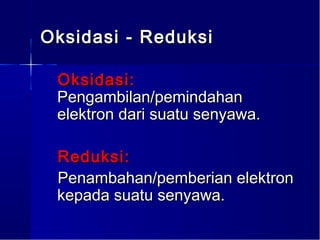
 Oksidasi:
 Pengambilan/pemindahan
 elektron dari suatu senyawa.

 Reduksi:
 Penambahan/pemberian elektron
 kepada suatu senyawa.
OKSIDASI-REDUKSI
    DALAM SEL
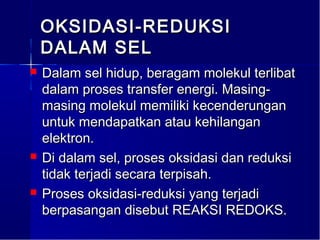
   Dalam sel hidup, beragam molekul terlibat
    dalam proses transfer energi. Masing-
    masing molekul memiliki kecenderungan
    untuk mendapatkan atau kehilangan
    elektron.
   Di dalam sel, proses oksidasi dan reduksi
    tidak terjadi secara terpisah.
   Proses oksidasi-reduksi yang terjadi
    berpasangan disebut REAKSI REDOKS.
PEMBAWA ELEKTRON

 Molekul yang memindahkan
  elektron selama proses oksidasi
  reduksi di dalam sel.
 NADH, FADH adalah molekul
                2
  pembawa elektron
NAD (Nikotinamida
Dinukleotida)
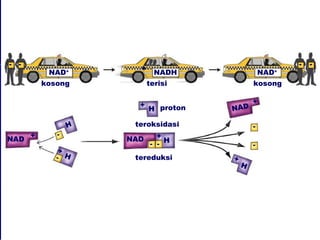
  Di dalam sel, NAD terdapat dalam 2
   bentuk:
  Bentuk membawa elektron atau atom
   hidrogen ( NADH) dan tanpa atom
   hidrogen (NAD+).
  NAD+ berperan sebagai senyawa
   pengoksidasi, bila menerima atom
   hidrogen dan elektron, menjadi NADH.
NAD (Nikotinamida
Dinukleotida)
    NADH dapat memindahkan
     elektron ke molekul lain, dan
     kembali menjadi NAD.
    Proses pemindahan ini
     dikendalikan/dilakukan oleh
     enzim.
- -                                                      -   -
           NAD+        + NADH                     NAD+
          kosong           terisi             kosong


                       +                      +
                           H proton   NAD

                 H    teroksidasi             -
      +      -               +
NAD                  NAD
                           - - H              -
              +
             - H      tereduksi       +
                                          H
Rangkaian Transpor
Elektron
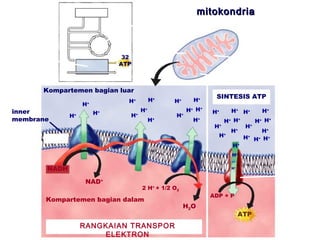
■ NADH memindahkan elektron
  ke suatu rangkaian molekul
  yang terdapat di membran
  dalam mitokondria.
■ Perpindahan elektron
  mengakibatkan perpindahan ion
  H+ melawan gradien konsenrasi.
Rangkaian Transpor
Elektron
■ Energi yang terbentuk pada saat
  masuknya kembali ion H+ ke dalam
  mitokondria melalui ATP sintase,
  digunakan untuk menggabungkan
  fosfat dengan ADP untuk membentuk
  ATP.
■ Dihasilkan ATP yang lebih banyak
  pada tahap ini (32 ATP per glukosa).
Rangkaian Transpor
Elektron
■ Di akhir rangkaian
  O2 + 2 electrons + 2 H+ = H2O.
■ Penyebab kebutuhan oksigen.
GLYCOLYSIS                                      mitokondria
                                                KREBS
                                                CYCLE

                                                inner
  ELECTRON                                      membrane
  TRANSPORT
  CHAIN                                32                                               inner compartment
                                      ATP
              O2                      H2O
                                                                                 outer compartment

        Kompartemen bagian luar
                                                                             SINTESIS ATP
                                        H+           H+    H+         H+
                        H+
inner                                           H+                  H+ H+   H+    H+ H+     H+
                             H+             H               H
                   H
                   +                        +                   +
membrane                                             H+               H+        H+ H+    H+ H+
                                                                             H+       H+
                                                                                  H+       H+
                                                                              H +
                                                                                      H+ H+ H+
                                                                                   H+
                                                                                   H+
                                                                                   H+

         NADH                                                                      H+

                                                                                                 ATP
                          NAD     +
                                                                                                 synthesis
                                                2 H+ + 1/2 O2
                                                                            ADP + P
         Kompartemen bagian dalam
                                                                H2O
                                                                                        ATP
                        RANGKAIAN TRANSPOR
                            ELEKTRON
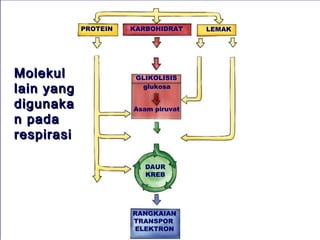
food


             PROTEIN      KARBOHIDRAT           LEMAK


            amino acids      sugars      glycerol fatty acids


Molekul                    GLIKOLISIS
lain yang                   glukosa

digunaka                  Asam piruvat
n pada
respirasi                  acetyl CoA


                             DAUR
                             KREB
               NH3
            (ammonia)

                          RANGKAIAN
                          TRANSPOR
                          ELEKTRON
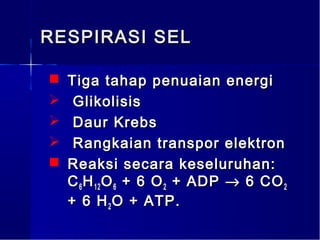
RESPIRASI SEL

   Tiga tahap penuaian energi
    Glikolisis
    Daur Krebs
    Rangkaian transpor elektron
   Reaksi secara keseluruhan:
    C 6 H 12 O 6 + 6 O 2 + ADP → 6 CO 2
    + 6 H 2 O + ATP.

2. energi dan metabolisme

  • 2.
    Kegunaan energi kimia dalamsel  BIOSINTESIS  KONTRAKSI DAN GERAKAN  TRANSPOR AKTIF  TRANSFER BAHAN GENETIK
  • 3.
    Dari mana energinya? Dari makanan.  Energi yang diekstrak dari makanan digunakan untuk memberi energi gugus fosfat agar dapat membentuk ATP.
  • 4.
    ATP (Adenosin Tri Fosfat) ATP memiliki energi yang dapat dilepaskan dengan mudah melalui pemutusan ikatan pada fosfat ketiga.  Energi yang dilepaskan digunakan untuk menjalankan proses-proses kehidupan.
  • 5.
    ATP (Adenosin Tri Fosfat) Pembebasan fosfat ketiga mengubah ATP menjadi molekul yang memiliki 2 gugus fosfat ( ADP).  ADP dapat membentuk ATP kembali bila terdapat gugus fosfat dan energi.
  • 6.
    p p p energi ATP energi masuk keluar Tanjakan energi p p p p p p P+ ADP P+ ADP
  • 7.
    Memperoleh Energi dari Makanan ■Bagaimana makanan diubah menjadi energi? ■ Apakah nutrisi yang berbeda diekstrak energinya melalui cara yang berbeda?
  • 8.
    Metabolisme NUTRISI MAKRO- PENGHASIL MOLEKUL ENERGI SEL Karbohidrat Polisakarida Lemak Lipida Protein ENERGI Protein KIMIA Asam Nucleat Katabolisme Anabolisme ATP NADH/NADPH MOLEKUL HASIL AKHIR FADH2 PREKURSOR RENDAH ENERGI Asam Amino CO 2 Gula H 2O Asam Lemak NH 3 Basa Nitrogen
  • 9.
    Tiga tahap katabolisme 1.DEGRADASI BIOMOLEKUL BESAR MENJADI MOLEKUL “BUILDING BLOCK” 2. DEGRADASI MOLEKUL “BUILDING BLOCK” MENJADI SENYAWA UMUM HASIL DEGRADASI 3. DEGRADASI SENYAWA UMUM HASIL DEGRADASI MENJADI SENYAWA HASIL AKHIR YANG SEDERHANA
  • 10.
    Katabolisme tahap I Asam Protein amino Poli Glukosa sakarida Gliserol, Lipida Asam Lemak MOLEKUL MOLEKUL “BUILDING BESAR BLOCK”
  • 11.
    Katabolisme tahap II Asam amino Asam Glukosa Asetil ko-A Piruvat Gliserol, Asam Lemak HASIL MOLEKUL UMUM “BUILDING DEGRADASI BLOCK”
  • 12.
    Katabolisme tahap III CO Asetil ko-A 2 Piruvat Asam HASIL AKHIR H HASIL O 2 YAN UMUM SEDRHANA
  • 13.
  • 14.
    Glikolisis  Terjadi disitoplasma.  Memotong 1 molekul gula berkarbon 6 menjadi 2 molekul gula berkarbon 3 (asam piruvat adalah hasil akhir).  Tidak menghasilkan banyak energi (hanya dihasilkan 2 ATP), tetapi dapat berlangsung sangat cepat dan tidak membutuhkan oksigen (anaerobik).
  • 15.
    glukosa ATP ADP glukosa 6-fosfat fruktosa 6-fosfat ATP ADP fruktosa 1,6-difosfat
  • 16.
    fruktosa 1,6-difosfat gliseraldehida 3-fosfat 2 NAD+ + 2 P 2 NADH + 2 H+ Asam 1,3-difosfogliserat 2 ADP 2 ATP Asam 3-fosfogliserat 2 ADP 2 ATP Asam piruvat
  • 17.
    Glikolisis  Beberapa bakteridan jasad eukaryot hanya menggunakan Glikolisis sebagai cara untuk memperoleh energi.  Fermentasi alkohol yang dilakukan khamir pada keadaan tanpa oksigen mengubah asam piruvat menjadi alkohol.  Fermantasi asam laktat yang terjadi di banyak sel jaringan hewan pada keadaan tanpa oksigen mengubah asam piruvat menjadi asam laktat.
  • 18.
    PERHITUNGAN ENERGI  Membutuhkan2 ATP.  Menghasilkan energi cukup untuk menggabungkan fosfat ke 4 molekul ADP membentuk 4 ATP.  Hasil 4 ATP – perlu 2 ATP = Hasil bersih 2 ATP.
  • 19.
    Berlari 30 detik  Perolehan energi melalui glikolisis, karena cepat.  Tidak membutuhkan oksigen (anaerobik).  Dihasilkan asam laktat yang dapat membakar otot.
  • 20.
    Berlari 10 menit?  Perlu energi lebih banyak.  Tidak boleh terbentuk asam laktat terlalu banyak, maka kondisi tidak boleh anaerob.
  • 21.
    Jangka waktu larimaksimal Detik Menit 10 30 60 2 4 10 30 60 120 % 90 80 70 50 35 15 5 2 1 anaerobik % 10 20 30 50 65 85 95 98 99 aerobik
  • 22.
  • 23.
    RESPIRASI SEL  Tiga tahap penuaian energi  Glikolisis  Daur Krebs  Rangkaian transpor elektron
  • 24.
    Respirasi sel dan Mitokondria  Daur Krebs dan rangkaian transpor elektron terjadi di dalam mitokondria
  • 25.
    sel Membran luar membran dalam mitokondrion
  • 26.
    glikolisis membrane membran luar dalam H+ + H + H+ H+ H Rangkaian transpor elektron Daur H+ Krebs H + + H H+ e- O2 kompartemen H2 O luar kompartemen dalam
  • 27.
    Peralihan antara Glikolisisdan Daur Krebs  Asam piruvat hasil glikolisis menuju ke mitokondria.  Berikatan dengan koenzim A membentuk asetil koA, 1 molekul NADH, dan CO2.  Daur Krebs terjadi di kompartemen dalam dari mitokondria.
  • 28.
    glikolisis mitokondrion Asam piruvat cytosol NAD+ koenzim A NADH Menuju ke rangkaian transpor elektron koA CO2 asetll koenzim A Kompartemen dalam Daur Krebs
  • 29.
    SUMMARY OF THEKREBS CYCLE 6 NADH GLYCOLYSIS 2 FADH2 CoA Daur asetil koenzim A Krebs CO2 2 ATP Rangkaian transpor elektron asam oksaloasetat 1. asam sitrat NAD+ NADH NADH NAD + 2. 6. CO2 asam α-ketoglutarat asam malat 3. CO2 FADH2 FAD+ NAD+ NADH 5. ADP asam suksinat 4. turunan asam α-ketoglutarat ATP
  • 30.
    Ringkasan Daur Krebs Asetil koA didegradasi sempurna menjadi CO2.  Hanya 1 ATP yang dihasilkan dari setiap asetil koA yang memasuki Daur Krebs (total 2 ATP tiap glukosa).  Semua elektron dapat diikat dalam bentuk 6 NADH (per glukosa) untuk diproses lebih lanjut melalui rangkaian transpor elektron.
  • 31.
    Katabolisme, Transfer Elektron danReaksi Oksidasi Reduksi  Elektron dibebaskan dari oksidasi nutrisi selama katabolisme.  Elektron dipindahkan oleh pembawa elektron melalui suatu proses untuk menghasilkan ATP.
  • 32.
    Oksidasi - Reduksi Oksidasi: Pengambilan/pemindahan elektron dari suatu senyawa. Reduksi: Penambahan/pemberian elektron kepada suatu senyawa.
  • 33.
    OKSIDASI-REDUKSI DALAM SEL  Dalam sel hidup, beragam molekul terlibat dalam proses transfer energi. Masing- masing molekul memiliki kecenderungan untuk mendapatkan atau kehilangan elektron.  Di dalam sel, proses oksidasi dan reduksi tidak terjadi secara terpisah.  Proses oksidasi-reduksi yang terjadi berpasangan disebut REAKSI REDOKS.
  • 34.
    PEMBAWA ELEKTRON  Molekulyang memindahkan elektron selama proses oksidasi reduksi di dalam sel.  NADH, FADH adalah molekul 2 pembawa elektron
  • 35.
    NAD (Nikotinamida Dinukleotida) Di dalam sel, NAD terdapat dalam 2 bentuk: Bentuk membawa elektron atau atom hidrogen ( NADH) dan tanpa atom hidrogen (NAD+). NAD+ berperan sebagai senyawa pengoksidasi, bila menerima atom hidrogen dan elektron, menjadi NADH.
  • 36.
    NAD (Nikotinamida Dinukleotida)  NADH dapat memindahkan elektron ke molekul lain, dan kembali menjadi NAD.  Proses pemindahan ini dikendalikan/dilakukan oleh enzim.
  • 37.
    - - - - NAD+ + NADH NAD+ kosong terisi kosong + + H proton NAD H teroksidasi - + - + NAD NAD - - H - + - H tereduksi + H
  • 38.
    Rangkaian Transpor Elektron ■ NADHmemindahkan elektron ke suatu rangkaian molekul yang terdapat di membran dalam mitokondria. ■ Perpindahan elektron mengakibatkan perpindahan ion H+ melawan gradien konsenrasi.
  • 39.
    Rangkaian Transpor Elektron ■ Energiyang terbentuk pada saat masuknya kembali ion H+ ke dalam mitokondria melalui ATP sintase, digunakan untuk menggabungkan fosfat dengan ADP untuk membentuk ATP. ■ Dihasilkan ATP yang lebih banyak pada tahap ini (32 ATP per glukosa).
  • 40.
    Rangkaian Transpor Elektron ■ Diakhir rangkaian O2 + 2 electrons + 2 H+ = H2O. ■ Penyebab kebutuhan oksigen.
  • 41.
    GLYCOLYSIS mitokondria KREBS CYCLE inner ELECTRON membrane TRANSPORT CHAIN 32 inner compartment ATP O2 H2O outer compartment Kompartemen bagian luar SINTESIS ATP H+ H+ H+ H+ H+ inner H+ H+ H+ H+ H+ H+ H+ H+ H H H + + + membrane H+ H+ H+ H+ H+ H+ H+ H+ H+ H+ H + H+ H+ H+ H+ H+ H+ NADH H+ ATP NAD + synthesis 2 H+ + 1/2 O2 ADP + P Kompartemen bagian dalam H2O ATP RANGKAIAN TRANSPOR ELEKTRON
  • 42.
    food PROTEIN KARBOHIDRAT LEMAK amino acids sugars glycerol fatty acids Molekul GLIKOLISIS lain yang glukosa digunaka Asam piruvat n pada respirasi acetyl CoA DAUR KREB NH3 (ammonia) RANGKAIAN TRANSPOR ELEKTRON
  • 43.
    RESPIRASI SEL  Tiga tahap penuaian energi  Glikolisis  Daur Krebs  Rangkaian transpor elektron  Reaksi secara keseluruhan: C 6 H 12 O 6 + 6 O 2 + ADP → 6 CO 2 + 6 H 2 O + ATP.

Editor's Notes

  • #7 Figure: 07-01 Title: Storing and releasing energy. Caption: Adenosine triphosphate (ATP) is the most important energy-releasing molecule in our bodies. The energy it contains is used to power everything from muscle contraction to thinking.
  • #16 Figure: 07-05a Title: Summary of glycolysis. Caption: In glycolysis, the single glucose molecule is transformed in a series of steps into two molecules of a substance called pyruvic acid. These two molecules then move on to the next stage of cellular respiration (the Krebs cycle). Meanwhile, glycolysis also produces two molecules of electron-carrying NADH, which move directly to the electron transport chain. Although two molecules of ATP are used up in the earlier stages of glycolysis, four more are produced in the later stages, for a net production of two ATP molecules per glucose molecule. The carbon atoms are represented by red circles, and the phosphate groups are represented by yellow circles.
  • #17 Figure: 07-05b Title: Summary of glycolysis. Caption: In glycolysis, the single glucose molecule is transformed in a series of steps into two molecules of a substance called pyruvic acid. These two molecules then move on to the next stage of cellular respiration (the Krebs cycle). Meanwhile, glycolysis also produces two molecules of electron-carrying NADH, which move directly to the electron transport chain. Although two molecules of ATP are used up in the earlier stages of glycolysis, four more are produced in the later stages, for a net production of two ATP molecules per glucose molecule. The carbon atoms are represented by red circles, and the phosphate groups are represented by yellow circles.
  • #22 Figure: 07-09-01UN Title: Different contributions over time. Caption: Relative contributions of anaerobic and aerobic respiration to exercise during the duration of a workout. At the 1-minute mark, aerobic respiration is supplying only 30 percent of the body's energy needs; at the 10-minute mark, it is supplying 85 percent. (Adapted from Astrand, P. O., and Rodahl, K. Textbook of Work Physiology. New York: Mc-Graw Hill Book Company, © 1977.)
  • #26 Figure: 07-06a Title: Energy transfer in the mitochondria. Caption: Mitochondria are organelles, or “tiny organs,” that exist within cells. They are the location for the second and third sets of steps in cellular respiration, the Krebs cycle and the electron transport chain. Following a transitional step (see Figure 7.7), the products of glycolysis—the downstream products of the original glucose molecule—pass into the inner compartment of a mitochondrion, where the Krebs cycle takes place. Electrons derived from the Krebs cycle then migrate, via electron carriers, from the Krebs cycle site into the highly folded inner membrane of the mitochondrion, where the bulk of ATP is produced in the electron transport chain.
  • #27 Figure: 07-06b Title: Energy transfer in the mitochondria. Caption: Mitochondria are organelles, or “tiny organs,” that exist within cells. They are the location for the second and third sets of steps in cellular respiration, the Krebs cycle and the electron transport chain. Following a transitional step (see Figure 7.7), the products of glycolysis—the downstream products of the original glucose molecule—pass into the inner compartment of a mitochondrion, where the Krebs cycle takes place. Electrons derived from the Krebs cycle then migrate, via electron carriers, from the Krebs cycle site into the highly folded inner membrane of the mitochondrion, where the bulk of ATP is produced in the electron transport chain.
  • #29 Figure: 07-07 Title: Transition between glycolysis and the Krebs cycle. Caption: The pyruvic acid product of glycolysis does not enter directly into the Krebs cycle. Rather, it must first be transformed into acetyl coenzyme A. The consequences of this reaction are the production of CO 2 , which dissolves into the bloodstream, and the production of an NADH molecule, which continues onto the electron transport chain. Because one molecule of glucose produces two molecules of pyruvic acid, two molecules of NADH are produced per glucose molecule in this transitional step.
  • #30 Figure: 07-08 Title: Summary of the Krebs cycle. Caption: The Krebs cycle is the major source of electrons that are transported to the electron transport chain by the electron carriers NADH and FADH 2 . For each molecule of glucose, two molecules of acetyl coenzyme A enter the Krebs cycle. Through a series of reactions, a total of 6 NADH, 2 FADH 2 , and 2 ATP are produced per glucose molecule. (From counting the number of NADH and FADH 2 around the cycle, it would appear that only 3 NADH and 1 FADH 2 are produced, but remember that one molecule of glucose results in two “trips” around the cycle, as two molecules of acetyl coenzyme A will enter the Krebs cycle for every molecule of glucose that is metabolized.)
  • #38 Figure: 07-03 Title: The electron carrier NAD + . Caption: In its unloaded form (NAD + ) and its loaded form (NADH), this molecule is a critical player in energy transfer, picking up energetic electrons from food and transferring them to later stages of respiration.
  • #42 Figure: 07-09 Title: The electron transport chain. Caption: The movement of electrons through the ETC powers the process that provides the bulk of the ATP yield in respiration. The electrons carried by NADH and FADH 2 are released into the ETC and transported along its chain of molecules. The movement of electrons along the chain releases enough energy to power the pumping of hydrogen ions (H + ) across the membrane into the outer compartment of the mitochondrion. It is the subsequent energetic “fall” of the H + ions back into the inner compartment that drives the synthesis of ATP molecules by the enzyme ATP synthase.
  • #43 Figure: 07-10 Title: Many respiratory pathways. Caption: Glucose is not the only starting material for cellular respiration. Other carbohydrates, proteins, and fats can also be used as fuel for cellular respiration. These reactants enter the process at different stages.