Critical literacy, communication and interaction 1 (GE3A)University of ArubaFAS: SW&D / OG&MSeptember 1, 2009UNIT 11
Today’s program: Introduce ourselvesCourse organization & logisticsIntroduce the course, 6 units and frameworkFocus on Unit 1 of the course:  	Communication and Interaction, humans as social beings. Sharing and negotiation of meaning, interpretation and identity2
Introducing ourselves…Welcome to our learning community! What do I mean with the concept of a learning community?We form a group (students together with instructor) who, for a while and motivated by common vision and will, are engaged in the pursuit of acquiring knowledge, abilities and attitudes. We inspire and support each other during this learning journey. We are building together our own learning environment3
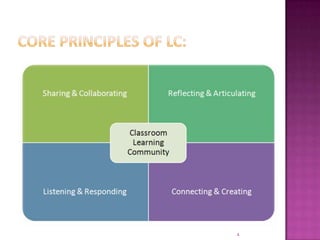
Core principles of LC:4
LC Members:Let’s here each others voices, tell something about yourself and what you expect to learn from this course5
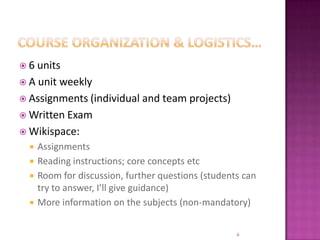
Course organization & logistics…6 unitsA unit weeklyAssignments (individual and team projects)Written ExamWikispace: AssignmentsReading instructions; core concepts etcRoom for discussion, further questions (students can try to answer, I’ll give guidance)More information on the subjects (non-mandatory)6
Link:www.criticalliteracycommunication.wikispaces.comwww.criticalliteracycommunication.wikispaces.comMore guidance:Module descriptionReading list 7
Framework: 6 Unit Themes Communication and Interaction, humans as social beings. Sharing and Negotiating meaning, interpretation and identityMaking sense of the world and its codes. The meaning of LiteracyThe verbal code, Human LanguageDiscourse as means for social action, constructing realities and persuasionStepping into the cultural dimension. Intercultural communication and its contextsNew literacies for the 21st century and our globalizing world. New ways of reading and what it means to be media literate8
Communication and Interaction,UNIT 1Communication and InteractionHumans as social beings,Sharing and negotiation meaning, interpretation and identity through codes9
Objectives:To present a starting point for the understanding of human communication processesTo explain the properties and dynamics of the communication processTo approach the communication process in a contextual mannerTo try to make the ‘intangible’ communication process more ‘tangible’ by focusing on the different components of the processTo translate the communication process in terms of transactions of ‘codes’To relate communication with the concept of identity(To explain the meaning of effective communication and communicative competence beginning of UNIT 2)10
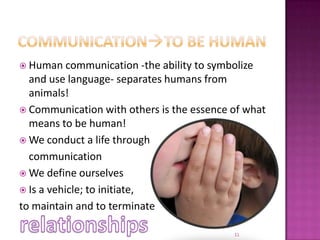
Communicationto be humanHuman communication -the ability to symbolize and use language- separates humans from animals!Communication with others is the essence of what means to be human!We conduct a life through 	communicationWe define ourselvesIs a vehicle; to initiate,to maintain and to terminaterelationships11
Etymology  = the study of the history of words and how their form and meaning have changed over time:Communication: from the Latin "communicare“ literally means "to put in common", “to share". The term originally meant sharing of tangible things; food, land, goods, andproperty.‘ to put in common’‘communicare’‘to share’12
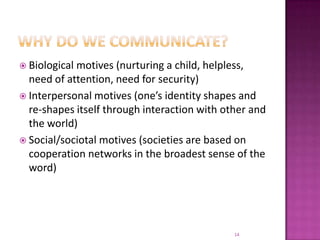
Humans are social beingsOur essence being socialThe world is web of relationships:So, communication has a social function!13
Why do we communicate?Biological motives (nurturing a child, helpless, need of attention, need for security)Interpersonal motives (one’s identity shapes and re-shapes itself through interaction with other and the world)Social/sociotal motives (societies are based on cooperation networks in the broadest sense of the word)14
So many definitions…Different, numerous, depending on what perspective you choose!holistic approach properties of communication, rather than 1 definition. And when we refer to ‘communication’ in a certain context, we will use the lasso technique and define the perspective and properties we choose to focus on! 15
8 properties/definitions:ProcessDynamicInteractive - TransactiveSymbolicIntentional – unintentional?ContextualUbiquitous (omnipresent)Cultural 16
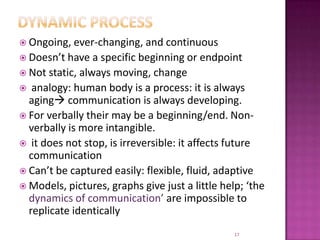
Dynamic processOngoing, ever-changing, and continuousDoesn’t have a specific beginning or endpointNot static, always moving, change analogy: human body is a process: it is always aging communication is always developing.For verbally their may be a beginning/end. Non-verbally is more intangible. it does not stop, is irreversible: it affects future communicationCan’t be captured easily: flexible, fluid, adaptiveModels, pictures, graphs give just a little help; ‘the dynamics of communication’ are impossible to replicate identically17
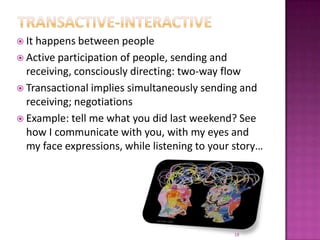
Transactive-interactiveIt happens between peopleActive participation of people, sending and receiving, consciously directing: two-way flowTransactional implies simultaneously sending and receiving; negotiationsExample: tell me what you did last weekend? See how I communicate with you, with my eyes and my face expressions, while listening to your story…18
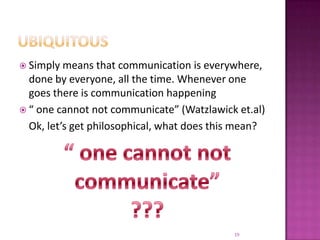
UbiquitousSimply means that communication is everywhere, done by everyone, all the time. Whenever one goes there is communication happening“ one cannot not communicate” (Watzlawick et.al)	Ok, let’s get philosophical, what does this mean?“ one cannot not communicate” ???19
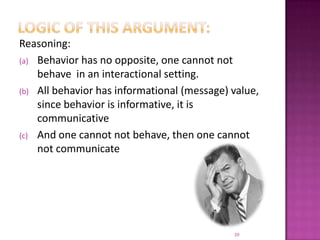
Logic of this argument:Reasoning:Behavior has no opposite, one cannot not behave  in an interactional setting. All behavior has informational (message) value, since behavior is informative, it is communicativeAnd one cannot not behave, then one cannot not communicate20
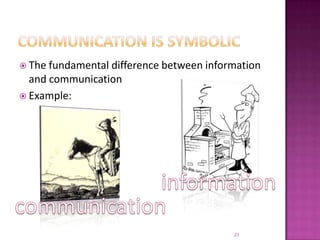
Communication is symbolicThe fundamental difference between information and communicationExample:informationcommunication21
Information vs. communicationEverything that reaches our human senses is information. What ‘you’ use as information, depends on your needs, knowledge and experienceCommunication implies signals (example sounds and images) that are symbolic in their nature.Symbolic = an arbitrarily selected and learned stimulus that represents something else. They don’t have any natural relationship with what they represent.Symbols are the vehicle by which the thoughts and ideas of one person can be communicated to another person.Both verbal as non-verbal symbols are arbitrary!22
(un)Intentional?Communication is intentional  people consciously engage in interaction with a purpose!	Eduard: “ do you want to go tonight to the movies?”	Sarah: “Yeah, that sounds like a good idea” Communication is unintentional  think about the statement:  “One cannot not communicate?”purpose=function23
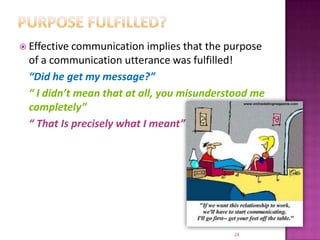
Purpose fulfilled?Effective communication implies that the purpose of a communication utterance was fulfilled! 	“Did he get my message?”“ I didn’t mean that at all, you misunderstood me completely” 	“ That Is precisely what I meant” 24
Communication is ContextualCommunication is dependent on the context in which it occursWhat is context? 25
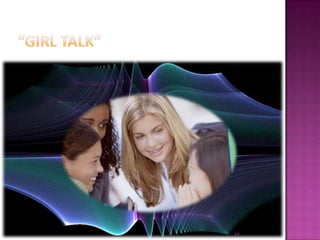
Context (1)Refers to the setting, situation, circumstances, background and overall framework within which communication occurs.example, study the following picture, and imagine the context where the communication process takes place: multilayers26
“Girl talk”27
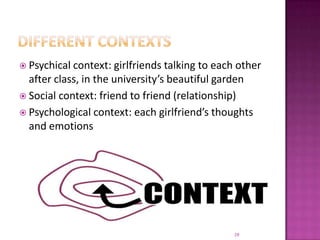
Different contextsPsychical context: girlfriends talking to each other after class, in the university’s beautiful gardenSocial context: friend to friend (relationship)Psychological context: each girlfriend’s thoughts and emotions28
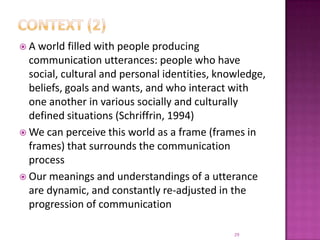
Context (2)A world filled with people producing communication utterances: people who have social, cultural and personal identities, knowledge, beliefs, goals and wants, and who interact with one another in various socially and culturally defined situations (Schriffrin, 1994)We can perceive this world as a frame (frames in frames) that surrounds the communication processOur meanings and understandings of a utterance are dynamic, and constantly re-adjusted in the progression of communication29
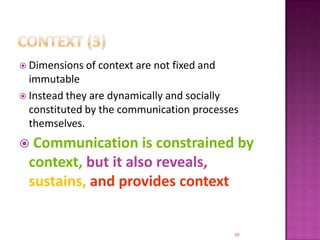
Context (3)Dimensions of context are not fixed and immutableInstead they are dynamically and socially constituted by the communication processes themselves.Communication is constrained by context, but it also reveals, sustains, and provides context30
Communication is culturalCulture shapes communication, and communication is culture-boundA specific context that influence communication: the cultural context This topic will be extensively elaborated in UNIT 5 of this course.31
Can you grasp it?http://www.youtube.com/watch?v=Omc-LerO92c32
Capturing the processCommunication is a dynamic process! Now let’s try to ‘take a picture’ of this process; let’s try to capture it for the purpose of awareness, analysis and reflection.What components are involved in this process?Let’s visualize and appointthe components33
Components involved in the processSender & Receiver (continuous role switching)  and their psychological personal world consisting of: accumulated knowledge, experience, attitudes, believes…ChannelMediumMessageCoding of messageDecoding of messageMultiple layers of contextNegotiation of meaning  interpretation FeedbackNoise34
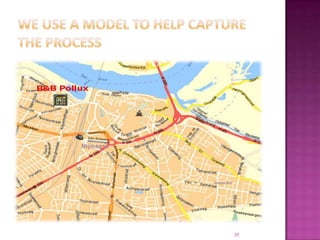
We use a model to help capture the process35
But  models, just like maps, or frames only capture a specific aspect of reality: always keep this in mind!36
Communication modelsWhen trying to capture the communication process in order to analyze it, models can be helpful! What is a model?=a systematic representation of an object  or event in idealized and abstract form. The act of abstracting eliminates certain details to focus on essential factors= it is a metaphor. it allow us to see one thing in terms of another= is merely a picture; that is even distorting, because it stops or freezes an essentially dynamic interactive or transactive process into a static picture37
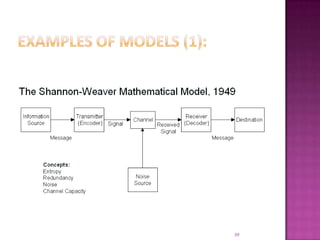
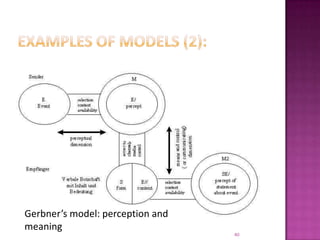
Fiske, 1990Chapter 1 and 2 introduces the concept of communication models. Objective: to understand the functions of models and illustrate the range of this approach of communication theoryModels:Shannon and Weaver’s model (1949)Gerbner’s model (1956)Laswell’s model (1948): Who says what in which channel to whom with what effect?Newcomb’s model (1953)/Westley and MacLean’s model (1957) masscommunicationJakobson’s model (1960)38
Examples of models (1):39
Examples of models (2):Gerbner’s model: perception and meaning40
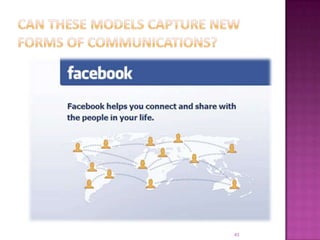
Can these models capture new forms of communications?41
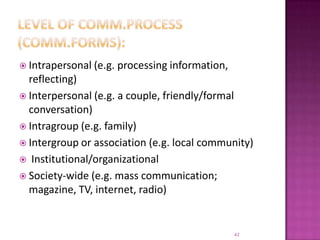
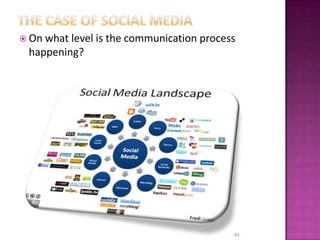
Level of comm.process (comm.forms):Intrapersonal (e.g. processing information, reflecting)Interpersonal (e.g. a couple, friendly/formal conversation)Intragroup (e.g. family)Intergroup or association (e.g. local community) Institutional/organizationalSociety-wide (e.g. mass communication; magazine, TV, internet, radio)42
The case of social mediaOn what level is the communication process happening?43
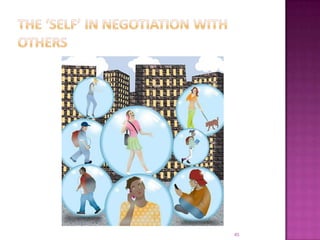
Negotiation of identitiesThe ‘self’ (self-identity) is based on innumerable messages about the ‘self’  that the individual gets from the world.Relationships and the input (messages) they give us about ourselves, helps form (shape and re-shape) our identities. This is a continuous processInterpersonal communication plays an important role in the negotiation of identitiesBut also the groups we want to belong to , we belong to or don’t belong to shapes our identities (social identity)44
The ‘self’ In negotiation with others45
Our identity…Identity is changeable, constant in a process of shaping and re-shapingIdentities are observable; we communicate it in differ forms (our cloths, language we use,  our behavior, communication is behaviorIdentities are a product of their time (Jane Austen’s Pride and Prejudice characters vs. Facebook generation)We look for acknowledgements (bevestiging) in our communication with others.Our ‘self’ is reflected through the mirror that others put in front of us46
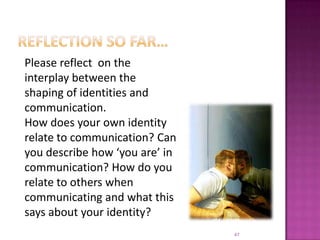
Reflection so far…47Please reflect  on the interplay between the shaping of identities and communication.How does your own identity relate to communication? Can you describe how ‘you are’ in communication? How do you relate to others when communicating and what this says about your identity?
So far:Communication is a dynamic processWe make sense of ourselves and the world we live in by negotiating meaning, interpretation and identities through messagesSender and receiver interactions are based on coding and decoding of messages. Messages are composed of codesStepping into ‘the code’ zone…CODES48
Properties of CODEs!codes are systemized (language, sentences, words, alphabet, agreement upon meaning of arbitrary signs: A B etc.) (verbal/non-verbal codes)All codes convey meaning: they are vehicles for messages, ideas, rules Codes depend upon agreement amongst their user and upon a shared sociocultural backgroundAll codes perform an identifiable social or communicative functionAll codes are transmittable by their appropriate media or channels of communication49
Bridging Unit 1 to unit 2: From unit 1- human beings are social, they communicate and make sense of their selves and their world through codes (messages, ideas, conventions, rules etc.)Being Literate means here, being aware of and being able to deal with these codes (coding and decoding process)Next week’s theme deals with:50
Theme next week:Making sense of the world and its codesThe meaning of being ‘Literate’51

UNIT 1 Critical Literacy, communication and Interaction 1

  • 1.
    Critical literacy, communicationand interaction 1 (GE3A)University of ArubaFAS: SW&D / OG&MSeptember 1, 2009UNIT 11
  • 2.
    Today’s program: IntroduceourselvesCourse organization & logisticsIntroduce the course, 6 units and frameworkFocus on Unit 1 of the course: Communication and Interaction, humans as social beings. Sharing and negotiation of meaning, interpretation and identity2
  • 3.
    Introducing ourselves…Welcome toour learning community! What do I mean with the concept of a learning community?We form a group (students together with instructor) who, for a while and motivated by common vision and will, are engaged in the pursuit of acquiring knowledge, abilities and attitudes. We inspire and support each other during this learning journey. We are building together our own learning environment3
  • 4.
  • 5.
    LC Members:Let’s hereeach others voices, tell something about yourself and what you expect to learn from this course5
  • 6.
    Course organization &logistics…6 unitsA unit weeklyAssignments (individual and team projects)Written ExamWikispace: AssignmentsReading instructions; core concepts etcRoom for discussion, further questions (students can try to answer, I’ll give guidance)More information on the subjects (non-mandatory)6
  • 7.
  • 8.
    Framework: 6 UnitThemes Communication and Interaction, humans as social beings. Sharing and Negotiating meaning, interpretation and identityMaking sense of the world and its codes. The meaning of LiteracyThe verbal code, Human LanguageDiscourse as means for social action, constructing realities and persuasionStepping into the cultural dimension. Intercultural communication and its contextsNew literacies for the 21st century and our globalizing world. New ways of reading and what it means to be media literate8
  • 9.
    Communication and Interaction,UNIT1Communication and InteractionHumans as social beings,Sharing and negotiation meaning, interpretation and identity through codes9
  • 10.
    Objectives:To present astarting point for the understanding of human communication processesTo explain the properties and dynamics of the communication processTo approach the communication process in a contextual mannerTo try to make the ‘intangible’ communication process more ‘tangible’ by focusing on the different components of the processTo translate the communication process in terms of transactions of ‘codes’To relate communication with the concept of identity(To explain the meaning of effective communication and communicative competence beginning of UNIT 2)10
  • 11.
    Communicationto be humanHumancommunication -the ability to symbolize and use language- separates humans from animals!Communication with others is the essence of what means to be human!We conduct a life through communicationWe define ourselvesIs a vehicle; to initiate,to maintain and to terminaterelationships11
  • 12.
    Etymology  = thestudy of the history of words and how their form and meaning have changed over time:Communication: from the Latin "communicare“ literally means "to put in common", “to share". The term originally meant sharing of tangible things; food, land, goods, andproperty.‘ to put in common’‘communicare’‘to share’12
  • 13.
    Humans are socialbeingsOur essence being socialThe world is web of relationships:So, communication has a social function!13
  • 14.
    Why do wecommunicate?Biological motives (nurturing a child, helpless, need of attention, need for security)Interpersonal motives (one’s identity shapes and re-shapes itself through interaction with other and the world)Social/sociotal motives (societies are based on cooperation networks in the broadest sense of the word)14
  • 15.
    So many definitions…Different,numerous, depending on what perspective you choose!holistic approach properties of communication, rather than 1 definition. And when we refer to ‘communication’ in a certain context, we will use the lasso technique and define the perspective and properties we choose to focus on! 15
  • 16.
    8 properties/definitions:ProcessDynamicInteractive -TransactiveSymbolicIntentional – unintentional?ContextualUbiquitous (omnipresent)Cultural 16
  • 17.
    Dynamic processOngoing, ever-changing,and continuousDoesn’t have a specific beginning or endpointNot static, always moving, change analogy: human body is a process: it is always aging communication is always developing.For verbally their may be a beginning/end. Non-verbally is more intangible. it does not stop, is irreversible: it affects future communicationCan’t be captured easily: flexible, fluid, adaptiveModels, pictures, graphs give just a little help; ‘the dynamics of communication’ are impossible to replicate identically17
  • 18.
    Transactive-interactiveIt happens betweenpeopleActive participation of people, sending and receiving, consciously directing: two-way flowTransactional implies simultaneously sending and receiving; negotiationsExample: tell me what you did last weekend? See how I communicate with you, with my eyes and my face expressions, while listening to your story…18
  • 19.
    UbiquitousSimply means thatcommunication is everywhere, done by everyone, all the time. Whenever one goes there is communication happening“ one cannot not communicate” (Watzlawick et.al) Ok, let’s get philosophical, what does this mean?“ one cannot not communicate” ???19
  • 20.
    Logic of thisargument:Reasoning:Behavior has no opposite, one cannot not behave in an interactional setting. All behavior has informational (message) value, since behavior is informative, it is communicativeAnd one cannot not behave, then one cannot not communicate20
  • 21.
    Communication is symbolicThefundamental difference between information and communicationExample:informationcommunication21
  • 22.
    Information vs. communicationEverythingthat reaches our human senses is information. What ‘you’ use as information, depends on your needs, knowledge and experienceCommunication implies signals (example sounds and images) that are symbolic in their nature.Symbolic = an arbitrarily selected and learned stimulus that represents something else. They don’t have any natural relationship with what they represent.Symbols are the vehicle by which the thoughts and ideas of one person can be communicated to another person.Both verbal as non-verbal symbols are arbitrary!22
  • 23.
    (un)Intentional?Communication is intentional people consciously engage in interaction with a purpose! Eduard: “ do you want to go tonight to the movies?” Sarah: “Yeah, that sounds like a good idea” Communication is unintentional  think about the statement: “One cannot not communicate?”purpose=function23
  • 24.
    Purpose fulfilled?Effective communicationimplies that the purpose of a communication utterance was fulfilled! “Did he get my message?”“ I didn’t mean that at all, you misunderstood me completely” “ That Is precisely what I meant” 24
  • 25.
    Communication is ContextualCommunicationis dependent on the context in which it occursWhat is context? 25
  • 26.
    Context (1)Refers tothe setting, situation, circumstances, background and overall framework within which communication occurs.example, study the following picture, and imagine the context where the communication process takes place: multilayers26
  • 27.
  • 28.
    Different contextsPsychical context:girlfriends talking to each other after class, in the university’s beautiful gardenSocial context: friend to friend (relationship)Psychological context: each girlfriend’s thoughts and emotions28
  • 29.
    Context (2)A worldfilled with people producing communication utterances: people who have social, cultural and personal identities, knowledge, beliefs, goals and wants, and who interact with one another in various socially and culturally defined situations (Schriffrin, 1994)We can perceive this world as a frame (frames in frames) that surrounds the communication processOur meanings and understandings of a utterance are dynamic, and constantly re-adjusted in the progression of communication29
  • 30.
    Context (3)Dimensions ofcontext are not fixed and immutableInstead they are dynamically and socially constituted by the communication processes themselves.Communication is constrained by context, but it also reveals, sustains, and provides context30
  • 31.
    Communication is culturalCultureshapes communication, and communication is culture-boundA specific context that influence communication: the cultural context This topic will be extensively elaborated in UNIT 5 of this course.31
  • 32.
    Can you graspit?http://www.youtube.com/watch?v=Omc-LerO92c32
  • 33.
    Capturing the processCommunicationis a dynamic process! Now let’s try to ‘take a picture’ of this process; let’s try to capture it for the purpose of awareness, analysis and reflection.What components are involved in this process?Let’s visualize and appointthe components33
  • 34.
    Components involved inthe processSender & Receiver (continuous role switching) and their psychological personal world consisting of: accumulated knowledge, experience, attitudes, believes…ChannelMediumMessageCoding of messageDecoding of messageMultiple layers of contextNegotiation of meaning  interpretation FeedbackNoise34
  • 35.
    We use amodel to help capture the process35
  • 36.
    But models,just like maps, or frames only capture a specific aspect of reality: always keep this in mind!36
  • 37.
    Communication modelsWhen tryingto capture the communication process in order to analyze it, models can be helpful! What is a model?=a systematic representation of an object or event in idealized and abstract form. The act of abstracting eliminates certain details to focus on essential factors= it is a metaphor. it allow us to see one thing in terms of another= is merely a picture; that is even distorting, because it stops or freezes an essentially dynamic interactive or transactive process into a static picture37
  • 38.
    Fiske, 1990Chapter 1and 2 introduces the concept of communication models. Objective: to understand the functions of models and illustrate the range of this approach of communication theoryModels:Shannon and Weaver’s model (1949)Gerbner’s model (1956)Laswell’s model (1948): Who says what in which channel to whom with what effect?Newcomb’s model (1953)/Westley and MacLean’s model (1957) masscommunicationJakobson’s model (1960)38
  • 39.
  • 40.
    Examples of models(2):Gerbner’s model: perception and meaning40
  • 41.
    Can these modelscapture new forms of communications?41
  • 42.
    Level of comm.process(comm.forms):Intrapersonal (e.g. processing information, reflecting)Interpersonal (e.g. a couple, friendly/formal conversation)Intragroup (e.g. family)Intergroup or association (e.g. local community) Institutional/organizationalSociety-wide (e.g. mass communication; magazine, TV, internet, radio)42
  • 43.
    The case ofsocial mediaOn what level is the communication process happening?43
  • 44.
    Negotiation of identitiesThe‘self’ (self-identity) is based on innumerable messages about the ‘self’ that the individual gets from the world.Relationships and the input (messages) they give us about ourselves, helps form (shape and re-shape) our identities. This is a continuous processInterpersonal communication plays an important role in the negotiation of identitiesBut also the groups we want to belong to , we belong to or don’t belong to shapes our identities (social identity)44
  • 45.
    The ‘self’ Innegotiation with others45
  • 46.
    Our identity…Identity ischangeable, constant in a process of shaping and re-shapingIdentities are observable; we communicate it in differ forms (our cloths, language we use, our behavior, communication is behaviorIdentities are a product of their time (Jane Austen’s Pride and Prejudice characters vs. Facebook generation)We look for acknowledgements (bevestiging) in our communication with others.Our ‘self’ is reflected through the mirror that others put in front of us46
  • 47.
    Reflection so far…47Pleasereflect on the interplay between the shaping of identities and communication.How does your own identity relate to communication? Can you describe how ‘you are’ in communication? How do you relate to others when communicating and what this says about your identity?
  • 48.
    So far:Communication isa dynamic processWe make sense of ourselves and the world we live in by negotiating meaning, interpretation and identities through messagesSender and receiver interactions are based on coding and decoding of messages. Messages are composed of codesStepping into ‘the code’ zone…CODES48
  • 49.
    Properties of CODEs!codesare systemized (language, sentences, words, alphabet, agreement upon meaning of arbitrary signs: A B etc.) (verbal/non-verbal codes)All codes convey meaning: they are vehicles for messages, ideas, rules Codes depend upon agreement amongst their user and upon a shared sociocultural backgroundAll codes perform an identifiable social or communicative functionAll codes are transmittable by their appropriate media or channels of communication49
  • 50.
    Bridging Unit 1to unit 2: From unit 1- human beings are social, they communicate and make sense of their selves and their world through codes (messages, ideas, conventions, rules etc.)Being Literate means here, being aware of and being able to deal with these codes (coding and decoding process)Next week’s theme deals with:50
  • 51.
    Theme next week:Makingsense of the world and its codesThe meaning of being ‘Literate’51