Supporting Phonemic Awareness in
the Classroom
Melissa Norton
August 20, 2014
Part I:
General Information
Melissa Norton, General Education Classroom Teacher
1st Grade
Lesson Block length: 30 minutes
Phonemic Awareness is currently being taught in my classroom through the Journeys
reading program and through various center activities. The Journeys program begins with a
PA warm-up routine each morning, including blending, segmenting, rhyming, and
manipulating sounds. Throughout the literacy centers, there are several opportunities for PA
practice. Many of the computer programs used during center time reinforce phonemic
awareness skills. Students also sort picture cards by vowel sounds and play “short vowel
bingo” to further develop their ability to hear isolated sounds in words.
Part II: Phonemic AwarenessI chose to reflect upon the Hoover article “The Importance of Phonemic Awareness in Learning to Read”
because it provides a wealth of information pertaining to phonemic awareness concepts that will be useful
to my teaching.
Phonemic awareness is a critical component of reading readiness and a strong indicator of future reading
success because it requires an internalization of the understanding of sound units, which become the
foundation of written and oral language. Even though phonemic awareness does not include reading
printed text or identifying letters, phonemic awareness skills directly relate to a person’s ability to acquire
those reading skills. Currently, phonemic awareness is assessed in my classroom through informal
activities (blending, segmenting, rhyming) as well as through formal assessments including the Phonemic
Segmentation subtest of DIBELS.
When the Phoneme Segmentation subtest is given in the Fall, it is one of the earliest indications we have
that a student may have reading difficulties. We often use these assessment scores to group students for
intervention supports.
Part III: Linguistic
Components
The Yopp article provides a wealth of information pertaining to what phonemic
awareness is and why it is important, as well as effective teaching practices for
addressing phonemic awareness concepts in the classroom. In particular, I liked the
rhyming activity with “The Hungry Thing” read aloud and the suggestions for
incorporating clapping and jumping into phonemic awareness games to make them
more fun and effective. I also intend to supplement the Journeys program phonemic
awareness routine by using the “Mail a Package” activity with my class one morning
per week. The program provides picture cards that I can modify based on the focus
sound for each week. The activity is basically what the program is already teaching
the students, but simply adding the ‘mailbox’ component makes it much more fun and
engaging for the students.
Part IV: Audio Recording
Practice
After completing this recording of myself saying the sounds in the alphabet, I realized how difficult it
can be to say all of them correctly in isolation. I think I am often rushed or not as precise as I should
be when delivering instruction on specific sounds. Hearing myself in the recording allows me to
better identify those sounds that I need to practice in isolation before instructing students on how to
pronounce them.
For students, this practice would be beneficial when it comes to assessment. Similar to a portfolio
where students can see the growth in their written work, the recording would allow students to hear
how they progress with isolating, segmenting, and blending sounds. However, I do think this
practice could be distracting for students at first. Once they are used to seeing my phone (or other
recording device) and are used to the procedure, they will be more focused and relaxed. I think it
can be intimidating for some students to know they are being recorded, but after they have done it a
couple of times I sure they would feel more comfortable with the process.
Part V: Student Assessment
The assessment that I chose is the Yopp-Singer test of phonemic
segmentation. I administered this assessment to a student entering
grade 2 who is currently working significantly below grade level in all
areas of the curriculum. I thought this assessment would give me a
better picture of her reading readiness and a better understanding of
her strengths and weaknesses, as well as a starting point for future
lessons and practice activities.
Part VI: AnalysisOverall, the assessment was very informative and provided me with a lot of information on how this particular
student segments and reproduces sounds. I was disappointed (shocked, really) with how weak her PA skills are
and with how unfamiliar she seemed with the process of segmenting.
My conclusions from the assessment are:
1. She is consistently able to correctly identify initial sounds, but struggles with vowel and ending sounds.
2. She repeatedly restates the words after I say them, produces the initial sound, then repeats the word again.
3. At times, it appeared as though she was picturing how the word is spelled and basing her segmentation off of
those letter sounds. For example, with the word "three", she replied "/t/ /h/ /ree/....three."
4. At times, she appeared unsure of what was being asked of her, even though the directions were the same for
each word. She asked me to clarify meaning on some of the words, which is a great skill to have when you are
unfamiliar with the language, just not appropriate for this particular task.
5. She needs significant interventions and additional instructional supports for how to segment sounds in
words. I think a kinesthetic approach would be great for this particular student. She is a hard worker and wants
to do well, but has little knowledge of how to do phoneme segmentation. I think a meaningful activity for her
would be to identify a picture card (to build vocabulary at the same time) such as "rat", say the word, 'catch' the
word, and let out the sounds in the words using her fingers, then sweeping the sounds back together into a fist
and repeating the whole word. I also think she would greatly benefit from extensive modeling and oral language
activities with guided practice and teacher feedback.
Part VII: Strategies
Products and Performances: Through the use of picture cards, Elkonin boxes, letter tiles, and bingo
counters, students will practice short vowel matching and isolation.
Questions relevant to your lesson: Are students able to identify words with the same short vowel
sound? Are students able to isolate the vowel sound? Which vowels are more challenging to the
students? Which students need further practice with these skills?
Instructional Strategies: Introduce the short vowel sounds that will appear in the lesson, reviewing
the sounds with students and practicing how to form the correct sound with mouth, tongue, etc.
Have students look at one another to see how the formation looks and how it changes for each
sound.
Specific skills to be developed: Producing, identifying, and isolating short vowel sounds in CVC
words.
Part VII: Strategies, cont.
Activities and procedures: Identify students in need of distinguishing short vowels /e/ and /i/. Practice listening to
the sounds in isolation as well as in words. Practice producing the sounds with correct formation. Show picture
cards and have students sort them into /e/ and /i/ piles. Have students say the word, repeat the word, and
segment the word to identify the vowel sound.
Extensions and modifications: Using Elkonin boxes would be a way to help struggling students segment and blend
the words by placing bingo chips onto the boxes to represent each sound. This also makes the activity tactile and
more concrete to help solidify the concepts.
Materials and resources: picture cards, letter tiles, Elkonin boxes, bingo chips
Websites:
http://www.readingrockets.org/strategies/elkonin_boxes
http://www.readwritethink.org/classroom-resources/lesson-plans/building-phonemic-awareness-with-120.html
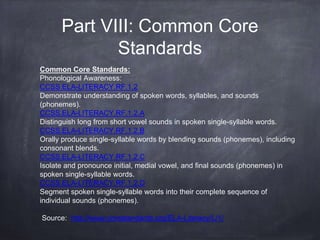
Part VIII: Common Core
Standards
Common Core Standards:
Phonological Awareness:
CCSS.ELA-LITERACY.RF.1.2
Demonstrate understanding of spoken words, syllables, and sounds
(phonemes).
CCSS.ELA-LITERACY.RF.1.2.A
Distinguish long from short vowel sounds in spoken single-syllable words.
CCSS.ELA-LITERACY.RF.1.2.B
Orally produce single-syllable words by blending sounds (phonemes), including
consonant blends.
CCSS.ELA-LITERACY.RF.1.2.C
Isolate and pronounce initial, medial vowel, and final sounds (phonemes) in
spoken single-syllable words.
CCSS.ELA-LITERACY.RF.1.2.D
Segment spoken single-syllable words into their complete sequence of
individual sounds (phonemes).
Source: http://www.corestandards.org/ELA-Literacy/L/1/
Part IX: Technology
I currently have two desktop computers in my classroom which the students use in groups during center time. The
students work in pairs at each computer. In addition, our class visits the computer lab for 45 minutes every other
week. During this time, each student works independently on his/her own computer the entire time. At the end of
the school year I received a new projector and interactive whiteboard, which will be a fantastic resource for teaching
phonemic awareness whole group and introducing some of the games and activities from this course as well as
projecting phonemic awareness lessons from the Journeys reading program.
Some online resources:
readingeggs.com (used during computer lab time, students work on their own level identified by their ability in a
pretest)
starfall.com (used during center time, students learn to isolate and blend sounds as well as practice reading fluency
and sight words)
pbskids.org (used during center time, can incorporate new games from this course into classroom routine such as
PBS Kids Island and Frog’s Rhyming Machine)
Part X: ReflectionThis course has provided me with several learning experiences that will benefit both teaching and
learning in my classroom. I have always seen the teaching of phonemic awareness as a
weakness in my instruction because until now, I had little resources to pull from when addressing
various student needs. This course has given me several resources to use going forward as well
as the knowledge of how to approach the teaching of phonemic awareness skills as part of an
integrated reading lesson.
The recording tool to better hear myself and my students will be valuable for identifying areas of
weakness and documenting assessments. I intend to use many of the online resources during
differentiated group lessons and center time. Furthermore, I intend to use some of the movement
and kinesthetic activities to practice segmenting and blending with my students because I believe
these types of experiences are critical in helping students internalize phonemic awareness
concepts.

Supporting Phonemic Awareness Presentation

  • 1.
    Supporting Phonemic Awarenessin the Classroom Melissa Norton August 20, 2014
  • 2.
    Part I: General Information MelissaNorton, General Education Classroom Teacher 1st Grade Lesson Block length: 30 minutes Phonemic Awareness is currently being taught in my classroom through the Journeys reading program and through various center activities. The Journeys program begins with a PA warm-up routine each morning, including blending, segmenting, rhyming, and manipulating sounds. Throughout the literacy centers, there are several opportunities for PA practice. Many of the computer programs used during center time reinforce phonemic awareness skills. Students also sort picture cards by vowel sounds and play “short vowel bingo” to further develop their ability to hear isolated sounds in words.
  • 3.
    Part II: PhonemicAwarenessI chose to reflect upon the Hoover article “The Importance of Phonemic Awareness in Learning to Read” because it provides a wealth of information pertaining to phonemic awareness concepts that will be useful to my teaching. Phonemic awareness is a critical component of reading readiness and a strong indicator of future reading success because it requires an internalization of the understanding of sound units, which become the foundation of written and oral language. Even though phonemic awareness does not include reading printed text or identifying letters, phonemic awareness skills directly relate to a person’s ability to acquire those reading skills. Currently, phonemic awareness is assessed in my classroom through informal activities (blending, segmenting, rhyming) as well as through formal assessments including the Phonemic Segmentation subtest of DIBELS. When the Phoneme Segmentation subtest is given in the Fall, it is one of the earliest indications we have that a student may have reading difficulties. We often use these assessment scores to group students for intervention supports.
  • 4.
    Part III: Linguistic Components TheYopp article provides a wealth of information pertaining to what phonemic awareness is and why it is important, as well as effective teaching practices for addressing phonemic awareness concepts in the classroom. In particular, I liked the rhyming activity with “The Hungry Thing” read aloud and the suggestions for incorporating clapping and jumping into phonemic awareness games to make them more fun and effective. I also intend to supplement the Journeys program phonemic awareness routine by using the “Mail a Package” activity with my class one morning per week. The program provides picture cards that I can modify based on the focus sound for each week. The activity is basically what the program is already teaching the students, but simply adding the ‘mailbox’ component makes it much more fun and engaging for the students.
  • 5.
    Part IV: AudioRecording Practice After completing this recording of myself saying the sounds in the alphabet, I realized how difficult it can be to say all of them correctly in isolation. I think I am often rushed or not as precise as I should be when delivering instruction on specific sounds. Hearing myself in the recording allows me to better identify those sounds that I need to practice in isolation before instructing students on how to pronounce them. For students, this practice would be beneficial when it comes to assessment. Similar to a portfolio where students can see the growth in their written work, the recording would allow students to hear how they progress with isolating, segmenting, and blending sounds. However, I do think this practice could be distracting for students at first. Once they are used to seeing my phone (or other recording device) and are used to the procedure, they will be more focused and relaxed. I think it can be intimidating for some students to know they are being recorded, but after they have done it a couple of times I sure they would feel more comfortable with the process.
  • 6.
    Part V: StudentAssessment The assessment that I chose is the Yopp-Singer test of phonemic segmentation. I administered this assessment to a student entering grade 2 who is currently working significantly below grade level in all areas of the curriculum. I thought this assessment would give me a better picture of her reading readiness and a better understanding of her strengths and weaknesses, as well as a starting point for future lessons and practice activities.
  • 7.
    Part VI: AnalysisOverall,the assessment was very informative and provided me with a lot of information on how this particular student segments and reproduces sounds. I was disappointed (shocked, really) with how weak her PA skills are and with how unfamiliar she seemed with the process of segmenting. My conclusions from the assessment are: 1. She is consistently able to correctly identify initial sounds, but struggles with vowel and ending sounds. 2. She repeatedly restates the words after I say them, produces the initial sound, then repeats the word again. 3. At times, it appeared as though she was picturing how the word is spelled and basing her segmentation off of those letter sounds. For example, with the word "three", she replied "/t/ /h/ /ree/....three." 4. At times, she appeared unsure of what was being asked of her, even though the directions were the same for each word. She asked me to clarify meaning on some of the words, which is a great skill to have when you are unfamiliar with the language, just not appropriate for this particular task. 5. She needs significant interventions and additional instructional supports for how to segment sounds in words. I think a kinesthetic approach would be great for this particular student. She is a hard worker and wants to do well, but has little knowledge of how to do phoneme segmentation. I think a meaningful activity for her would be to identify a picture card (to build vocabulary at the same time) such as "rat", say the word, 'catch' the word, and let out the sounds in the words using her fingers, then sweeping the sounds back together into a fist and repeating the whole word. I also think she would greatly benefit from extensive modeling and oral language activities with guided practice and teacher feedback.
  • 8.
    Part VII: Strategies Productsand Performances: Through the use of picture cards, Elkonin boxes, letter tiles, and bingo counters, students will practice short vowel matching and isolation. Questions relevant to your lesson: Are students able to identify words with the same short vowel sound? Are students able to isolate the vowel sound? Which vowels are more challenging to the students? Which students need further practice with these skills? Instructional Strategies: Introduce the short vowel sounds that will appear in the lesson, reviewing the sounds with students and practicing how to form the correct sound with mouth, tongue, etc. Have students look at one another to see how the formation looks and how it changes for each sound. Specific skills to be developed: Producing, identifying, and isolating short vowel sounds in CVC words.
  • 9.
    Part VII: Strategies,cont. Activities and procedures: Identify students in need of distinguishing short vowels /e/ and /i/. Practice listening to the sounds in isolation as well as in words. Practice producing the sounds with correct formation. Show picture cards and have students sort them into /e/ and /i/ piles. Have students say the word, repeat the word, and segment the word to identify the vowel sound. Extensions and modifications: Using Elkonin boxes would be a way to help struggling students segment and blend the words by placing bingo chips onto the boxes to represent each sound. This also makes the activity tactile and more concrete to help solidify the concepts. Materials and resources: picture cards, letter tiles, Elkonin boxes, bingo chips Websites: http://www.readingrockets.org/strategies/elkonin_boxes http://www.readwritethink.org/classroom-resources/lesson-plans/building-phonemic-awareness-with-120.html
  • 10.
    Part VIII: CommonCore Standards Common Core Standards: Phonological Awareness: CCSS.ELA-LITERACY.RF.1.2 Demonstrate understanding of spoken words, syllables, and sounds (phonemes). CCSS.ELA-LITERACY.RF.1.2.A Distinguish long from short vowel sounds in spoken single-syllable words. CCSS.ELA-LITERACY.RF.1.2.B Orally produce single-syllable words by blending sounds (phonemes), including consonant blends. CCSS.ELA-LITERACY.RF.1.2.C Isolate and pronounce initial, medial vowel, and final sounds (phonemes) in spoken single-syllable words. CCSS.ELA-LITERACY.RF.1.2.D Segment spoken single-syllable words into their complete sequence of individual sounds (phonemes). Source: http://www.corestandards.org/ELA-Literacy/L/1/
  • 11.
    Part IX: Technology Icurrently have two desktop computers in my classroom which the students use in groups during center time. The students work in pairs at each computer. In addition, our class visits the computer lab for 45 minutes every other week. During this time, each student works independently on his/her own computer the entire time. At the end of the school year I received a new projector and interactive whiteboard, which will be a fantastic resource for teaching phonemic awareness whole group and introducing some of the games and activities from this course as well as projecting phonemic awareness lessons from the Journeys reading program. Some online resources: readingeggs.com (used during computer lab time, students work on their own level identified by their ability in a pretest) starfall.com (used during center time, students learn to isolate and blend sounds as well as practice reading fluency and sight words) pbskids.org (used during center time, can incorporate new games from this course into classroom routine such as PBS Kids Island and Frog’s Rhyming Machine)
  • 12.
    Part X: ReflectionThiscourse has provided me with several learning experiences that will benefit both teaching and learning in my classroom. I have always seen the teaching of phonemic awareness as a weakness in my instruction because until now, I had little resources to pull from when addressing various student needs. This course has given me several resources to use going forward as well as the knowledge of how to approach the teaching of phonemic awareness skills as part of an integrated reading lesson. The recording tool to better hear myself and my students will be valuable for identifying areas of weakness and documenting assessments. I intend to use many of the online resources during differentiated group lessons and center time. Furthermore, I intend to use some of the movement and kinesthetic activities to practice segmenting and blending with my students because I believe these types of experiences are critical in helping students internalize phonemic awareness concepts.